Kids are always chasing rainbows, but baseball is a world where you can catch them.
Johnny Vander Meer, Major League Southpaw
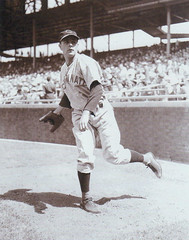
Photo by rchdj10 
Johnny Vander Meer did indeed catch some baseball rainbows. Most memorably – or, at least, most historically – his tossing of two consecutive no-hitters for the Cincinnati Reds in 1938. That still-unmatched feat is what Vander Meer is most known for. That’s not surprising when you consider his career (13 seasons – 1937-43 & 1946-51 … Reds, Cubs, Indians) 119-121 record and the fact that he walked nearly as many hitters as he fanned. Still, early in his career, the hard-throwing southpaw was compared to another up and coming fireballer – future Hall of Famer Bob Feller. Still, when Baseball Roundtable looked a little deeper, there was a lot more to Vander Meer’s career than those two no-hitters. Here’s just a sampling.
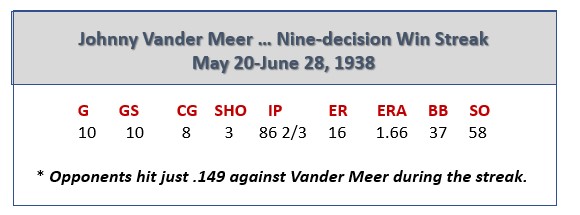
- Vander Meer’s two consecutive no-hitters came during a nine-decision winning streak that included eight complete games and three shutouts.
- Vander Meer led the National League in total strikeouts and whiffs per nine innings pitched in three consecutive seasons (1941-43).
- Vander Meer was the (first-ever) Sporting News Minor League Player of the Year in 1936 and the Sporting News Major League Player of the Year in 1938.
Making it Count
On September 18, 1940, Johnny Vander Meer not only pitched the Reds to a pennant-clinching victory, but also scored the winning run in the contest. Vander Meer started the game and gave up three runs over 12 innings of work (eight hits, five walks, ten strikeouts). Leading off the top of the thirteenth inning, Vander Meer doubled to left, was sacrificed to third and then scored the winning run on a sacrifice fly. Reliever Joe Beggs pitched the bottom of the thirteenth to save Vander Meer’s win.
- Vander Meer was a four-time All Star (1938, 1939, 1942, 1943).
- Vander Meer shares the record for strikeouts in an All Star game (six) with Carl Hubbell, Larry Jansen and Fergie Jenkins.
- Vander Meer pitched in three All Star games (1938, 1942, 1943), walking one and fanning 11 hitters in 8 2/3 innings. He gave up just five hits and one run (unearned) in those three appearances
A Hard Day’s Night
Johnny Vander Meer was the Reds starting pitcher in the longest MLB game ending in a scoreless tie. On September 11, 1946, he started against the Dodgers and pitched 15 shutout innings (seven hits, two walks and 14 strikeouts). (Dodger starter Hal Gregg went ten scoreless frames.) The game went 19 innings and was called (darkness) with both teams still scoreless. Note: On April 15, 1968, the Mets and Astros were both scoreless through 23 innings, with the Astros winning 1-0 in the bottom of the 24th frame. That is the most innings both teams remained scoreless in an MLB tilt.
Here’s a little more of the Vander Meer story.
Vander Meer made his professional debut with the C-level Dayton Ducks as an 18-year-old in 1933 – going 11-10, 4.28, with 132 strikeouts in 183 innings. After a couple of less than stellar minor league seasons, he opened some eyes as The Sporting News 1936 Minor League Player of the Year – after a 19-6, 2.65 season with the Class-B Durham Bulls. While, he had a powerful “swing and miss” fastball (Vander Meer fanned 295 batters in 214 innings), control was not his forte (he also walked 116).
On July 23, 1936, Johnny Vander Meer, pitching for the Durham Bulls, fanned 20 batters in a game against the Ashville Tourists.
Vander Meer’s 1936 performance earned him an invite to the Reds 1937 Spring Training camp and he went north with the team. However, control issues still plagued him and he was sent down to the Double-A Syracuse Chiefs in July – after posting a 3-4, 4.22 record with 55 walks (40 whiffs) in 64 innings. (He was called back up in September and ended the MLB season at 3-5, 3.84 with 69 walks and 52 strikeouts in 84 1/3 innings.)
Then came the 1938 season, when the 23-year-old seemed to find himself, going 15-10, 3.12 in 32 games (29 starts), fanning 125 batters in 225 1/3 innings (but still walking 103) – and, of course, tossing those consecutive no-hitters (June 11 versus the Bees and June 15 versus the Dodgers). For the season, Vander Meer’s 4.99 strikeouts per nine innings pitched were second in the National League (to Carl Hubbell); his 7.07 hits per nine innings pitched were the league low; and his 3.12 earned run average was tenth-best. There was still work to do on his command, as his 104 walks were fourth-highest in the league. Vander Meer also made his first All Star squad in 1938, started the game, threw three innings of no-run, one-hit ball and got the win. After the season, he was the named the Sporting News Major League Player of the Year.
After that sparkling 1938 season, Vander Meer appeared to be on his way. Those expectations were dashed in 1939, when illness and injury contributed to a 5-9, 4.67 record. He also got off to a slow start in 1940, being sent down to Double-A Indianapolis after four appearances (two starts) in which he pitched just 8 2/3 innings, fanning nine and walking 13, while putting up a 7.27 ERA. He seemed to find himself at Indianapolis, going 6-4, 2.40, which earned him a September call up – during which he went 3-1, 2.97 (31 strikeouts and 28 walks in 39 1/3 innings) and pitched 12 shutout innings to get the win in the Reds’ pennant-clinching game.
Vander Meer powered his way to a 16-13, 2.82 record in 1941; 18-12, 2.43 in 1942; and 15-16, 2.82 in 1943 – leading the NL in strikeouts all three seasons and making the National League All Star team in 1942 and 1943. Still, control remained an issue, as Vander Meer led the league in walks in 1943, allowed the NL’s second-most walks in 1942 and the fourth-most in 1941.
What Could Have Been
Johnny Vander Meer deserved better than his 15-16 record in 1943. His losses included two complete games in which he gave up a single run; two complete games in which he gave up just two runs; and a complete game which he lost 3-2 in the twelfth inning.
Vander Meer then missed the 1944 and 1945 seasons (military service) and, while he came back to pitch six more MLB campaigns (1946-51), he had trouble recapturing that 1941-43 fastball. Over those final six seasons, he went 44-55, 3.93 (as compared to 75-66, 3.11 from 1937 to 1943). Vander Meer’s final career line was 119-121, 3.44, with 1,294 strikeouts and 1,132 walks. He threw 131 complete games (286 starts) and thirty shutouts. He was a four-time All Star and won 15 or more games in five seasons. Overall, he was in the NL’s top ten in ERA four times; wins five times; fewest hits per nine innings six times; total strikeouts and strikeouts per nine innings seven times each; complete games five times; and shutouts eight times.
While he made his final MLB appearance on May 7, 1951 (Indians), Vander Meer continued to pitch in the minor leagues through 1955 and managed in the minors from 1953 through 1962.
Primary Resources: Baseball-Reference.com; National Baseball Hall of Fame; MLB.com; Baseball-Almanac.com
 Baseball Roundtable is on the Feedspot list of the Top 100 Baseball Blogs. To see the full list, click here.
I tweet baseball @DavidBBRT
Follow/Like Baseball Roundtable’s Facebook Page here. More baseball commentary; blog post notifications; PRIZES.
Member: Society for American Baseball Research (SABR); Negro Leagues Baseball Museum; The Baseball Reliquary.