Baseball Roundtable recently completed a reader survey regarding some of the issues and rules facing major league baseball. A total of 223 responses were received in the 24 hours the survey (using the Google survey tool) was open – although not all respondents replied to every question. (Thanks to all of those who responded. I appreciate your interest, thoughts and participation.) I’d like to share those responses, as well as a bit of commentary, in this post. One cautionary note: The survey group was self-selecting. The fact that the respondents took the time to fill out the somewhat lengthy survey would indicate the group is composed of individuals who follow the game more closely than casual fans. This is further amplified by the fact that a link to the survey was shared with such online groups as Baseball Fans of America, the Society for American Baseball Research, The Baseball Reliquary and Baseball Fans of America.
NOTE: COMING SOON – RESULTS OF BASEBALL ROUNDTABLE’S
(UNOFFICIAL) FAN HALL OF FAME BALLOT
LENGTH OF GAMES
Notably, respondents were split on whether MLB games need to be shortened, with 51.6 percent say “No” and 42.5 percent saying “Yes.”

ONE RESPONDENT’S COMMENT
As a lifelong fan, I believe the rule changes to speed up the game (among other results) are based on television viewership and not for the fans who watch live. I have never heard anyone complain about the length of games at a stadium. The complaints I hear there (at the ballpark) are ones involving delays (pitching changes, multiple mound visits, replays) and never about the pace of the actual game. I think the constant tinkering only creates more holes to fix.
Respondents’ pegged the ideal length of a game at 2 ½ – 3 hours, with 59.5 percent selecting a response within that time frame (which seem contrary to more than 50 percent saying games do not need to be shortened). Notably, 31.1 percent selected “However long it takes to have a winner.”
Ideal Length for an MLB Game – Top Five Responses
2 1/2 hours … 32.4%
However Long it takes to have a winner … 31.1%
3 hours … 14%
2 3/4 hours … 13.1%
2 1/4 hours … 4.1%
Only 1.4 percent picked a specific time over three hours (6.9% picked times of 1 1/2 – 2 hours).
MLB Average Length of Game (Time)
The average game time in 2021 was three hours and 11 minutes. The last time the average was under 3:00 was a decade ago (2011 – 2:56). The last time, it was 2:30 or less was in 1978 (2:30).
So, what about efforts, in place or being considered/experimented with, to shorten the game?
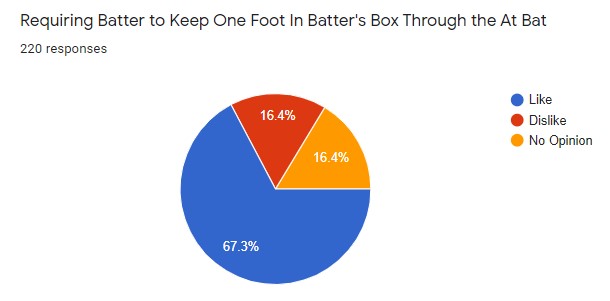
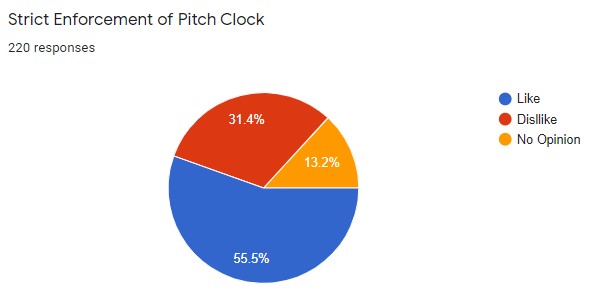
Among the most popular rules/proposals among respondents were: requiring batters to keep one foot in the batter’s box through the plate appearance; strict enforcement of a pitch clock; and limiting mound visits. There has been a 20-second pitch clock at Double-A and Triple-A since 2015, but baseball is looking at a shorter (15-second), more strictly enforced, limit). A personal observation: Despite being “old school,” I’d like to see batters required to keep one foot in the batter’s box (and not wander off to adjust their batting gloves, add pine tar or take a swing or two). I believe it was Bert Blyleven who said a great way to shorten the game would be to “ban Velcro.” I’d also be on board with requiring pitchers to remain on the mound between pitches – except for “mound visits.”

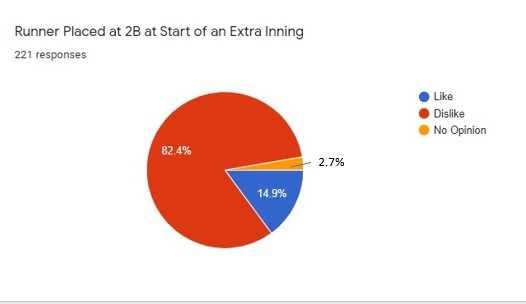
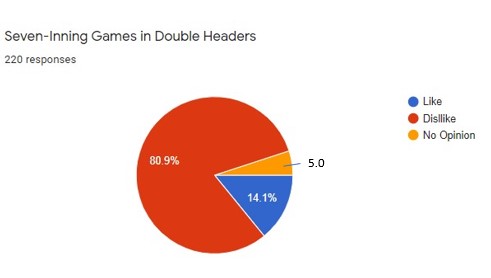
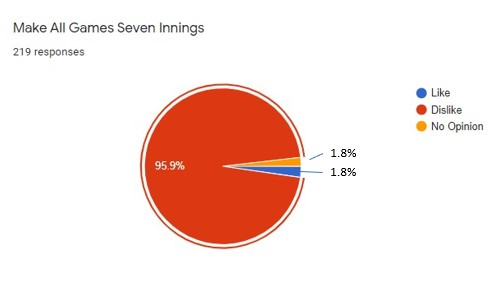
Respondents wanted little to do with seven-inning games; placing a runner at second base at the start of an extra inning; or allowing tie games after a specific number of extra frames. More than 80 percent of respondents disliked each of these. From Baseball Roundtable’s point of view, shortening games to seven innings would wreak havoc with the game’s history, record book and rule book. In a seven-inning game, how many innings are needed for a starter’s win? Or, how do you evaluate complete-games pitched records? Is a game “official” after 3 1/2 frames or still 4 1/2? You get the idea.
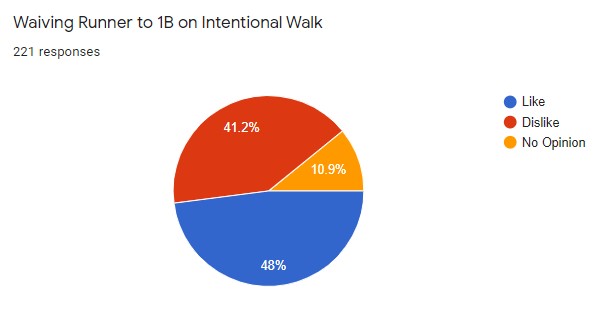
The split was more even on waiving a runner to first on an intentional walk, with 48 percent liking that change and 41.2 percent disliking it. (Are we just getting used to it?) Looks like we won’t ever again see a batter reach across the plate and poke an intentional “ball” to left for a double. I can live with it, although it seems a little “slow-pitch softball” for me.
RULE CHANGES AIMED AT REDUCING PITCHING CHANGES
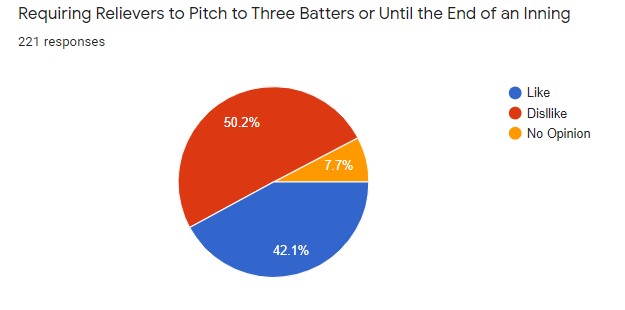
The split on the current MLB rule requiring a reliever (unless injured) to pitch to three batters (or to the end of an inning) was fairly even, with 50.2 percent disliking the rule and 42.1 percent liking it.
One respondent presented an idea for a similar approach to starting pitchers.
RESPONDENT’S COMMENT
Starting pitchers should be required to go five innings minimum unless they reach 100 pitches, allow four or more earned runs, or experience some type of injury.
This may seem a bit extreme, but in reality, it’s not much different in philosophy than the requiring a reliever to face three batters. It would effectively end “bullpen games.”
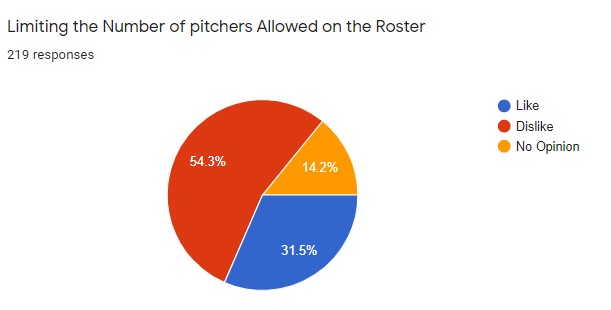
There has also been some discussion of limiting the number of pitchers on an MLB roster. This, it is reasoned would reduce mound options and, in turn, pitching changes. The opposition outweighed the support on this one. I sided with the “nays,” a team should be allowed to set up its own roster within the overall player limit. No, I don’t like those games in which we see an “opener” followed by a parade of bullpen arms. But the game is changing and teams should be able to set up rosters and employ pitching strategies they think can best enable them to compete and win. Still, it’s a change I could live with.
JUICING UP THE RUNNING GAME
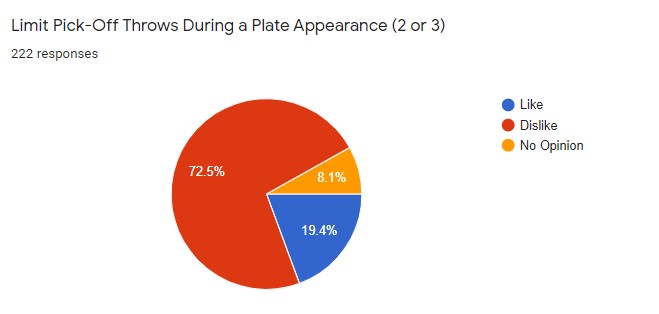
Another rule proposal which has been discussed (and experimented with at the minor-league level) would limit pick off throws during each plate appearance. We’ve all seen those at bats with seven or eight tosses to first base. Yes, it’s frustrating (although fans only seem to boo the opposing pitcher for such attention to a base runner). I’m for letting the pitcher hold the runner on, which is in line with the 72.5 percent of respondents who disliked this proposal.
There is also some discussion around requiring a pitcher to be completely off the rubber before attempting a pick-off (experimented with in the Atlantic League). The “off the rubber” proposal was liked by 34.2 percent of respondents; disliked by 37.4 percent, with 28.4 percent voicing “no opinion.” Both of these proposals are intended to boost the running game – and did seem to have that effect in minor-league trials.
ROBOT UMPIRES/ELECTRONIC STRIKE ZONE
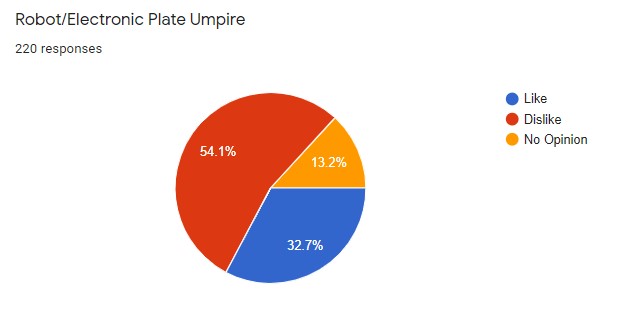
Okay, I’m being really “old school” here. I like watching a pitcher work to “expand the strike zone.” I find it an element of the craft of pitching. So, I’d opposed an electronic strike zone. Just over half of the respondents took that position, but nearly one-third would welcome such a change. I have a hunch it may be part of MLB’s future … just down the road a bit.
CHALLENGES/REPLAYS
Sticking with umpiring, this one surprised me. Approximately two-thirds of respondents like the current MLB challenge/replay system. Notably, they also “disliked” suggestions for limiting replays. For example, 67.1 percent disliked the idea of going back to replays only on fair/foul home run calls and 64.1 percent disliked the idea of allowing replays only at the umpires’ discretion (rather than allowing manager challenges).

RESPONDENT’S COMMENT
Allow only 30 seconds limit for manager to call for a challenge-review. If they are confident it was a bad call, they don’t need to check the replay first to challenge the call.
THE ONGOING DESIGNATED HITTER DEBATE
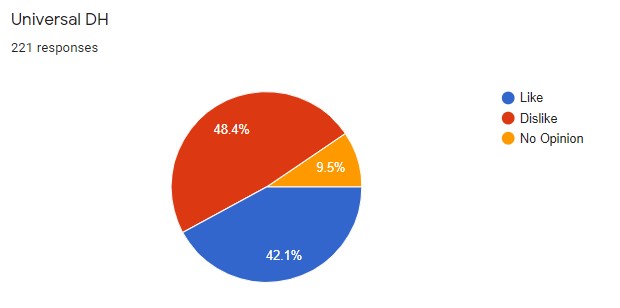
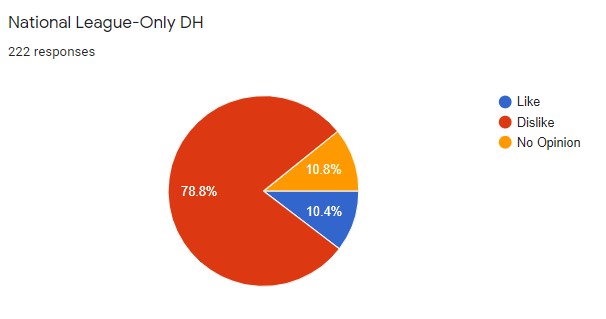
When will it end? The DH remains an ongoing point of contention … with about equal support for the application of designated hitter in both leagues (Universal DH) or the elimination the DH in both leagues. The key word is both. Respondents just want one system. Only one in ten respondents like the current AL/NL split on this rule. How close was the call on Universal versus No DH? 42.5 percent “liked” No DH; while 42.1 percent “liked” a Universal DH. It appears the biggest mistake MLB can make is to keep the current split.

After this post was initially published, a reader asked for a bit more clarity on the DH issue. In response, I conducted a brief survey (which went to a smaller, but similar – if perhaps a bit more diverse in the depth of their fandom – group) on the issue. In that effort, respondents had to selected their preferred treatment of the DH. (rather than comment on all three).
The results were:
Universal DH – 47.6%
Eliminate DH – 26.2%
NL-only DH – 11.9%
No opinion – 14.7%
INFIELD SHIFTS
Another surprise here. I expected an overwhelming dislike of the current trend toward infield shifts. Yet, more than half of the respondents did not like the idea of requiring two infielders on each side of second base. I guess, we’ll have to agree to disagree on this one.
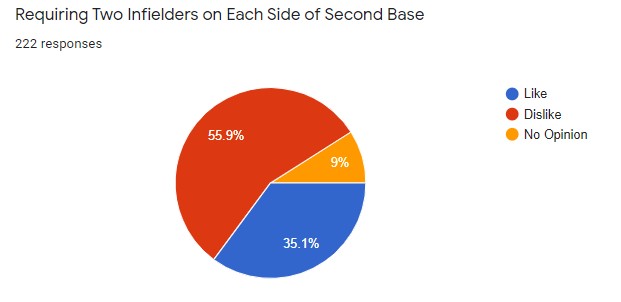
One respondent offered an interesting alternative – allowing the shift on no more than two batters in an inning, I kind of like that. It would require manager’s to make strategic decisions on which hitter(s) could effectively be stymied by a shift or in what game situations a shift would have the most positive potential impact. That would open the door for fan discussion, debate and second-guessing – and I like that.
LACK OF “ACTION”
We hear talk these days about the growth of the “three true results” – strike outs, home runs and walks – taking action out of the game. The Roundtable did ask respondents about these outcomes. Here’s what they said they’d like to see less of:
Fewer Strikeouts … 51.6%
Fewer Home Runs … 30.2%
Fewer Walks … 25.1%
No Opinion … 34.4%
A FEW MORE RESPONDENTS’ COMMENTS
- Many problems would be solved (especially too many players grooving swings to hit the ball over everybody, which increases K’s, HR’s and decreases interesting balls in play) by instituting the rule of two infielders, playing on dirt or INFIELD grass on either side of second base.
- Radical suggestion: revisit the current rule allowing unlimited foul balls. That is a big source of delays.
- The game does need to be sped up. Maybe less TV and radio commercials time would help. We need more day games during the playoffs. We need more programs that tell the younger generation about the history of the game.
- Game pace is the problem. Far too many 15-minute innings with too few balls in play. Call strikes so that the batter swings the bat.
- I love baseball, but to survive, more action is needed to compete with football. There needs to be more steals, more hit-and-run, and more contact.
- Shorten time between innings to 75 seconds and you’ll save 20 minutes in a 9-inning game. Just saying.
- What hurts the game most is dead time — pitching changes, replays, conferences, and general dicking around during at-bats. Combine that with all the non-action plays… and it just seems slower. I listened to a game last season when the announcer went nuts because he went 34 minutes without calling a fair ball.
Then there were these conflicting views voiced by a pair of respondents.
- Baseball is as near a thing to perfect as there can be in a competitive sport. Leave it alone!!! The old rules worked fine for years and don’t need to be tinkered with.
- The game needs to change and I’m really done with the “purists.” Did “purists” object when fielders started wearing gloves, when the pitcher was moved back to 60’6″.
A Final Observation
Not part of thee survey, but just an observation offered, as Rod Serling used to say, ‘for your consideration.” In 2021, 36.3 percent of the MLB season’s 181,818 (interesting number) plate appearances ended in a trot (back to the dugout, around the bases, to first base). I call this the Baseball Roundtable Trot Index and have been reporting this stat for a number of seasons. We’re talking about strikeouts, home runs, walks, hit by pitch and catcher’s interference – all outcomes that are, basically, devoid of action on the base paths or in the field. Here’s the 2021 breakout: strikeouts (23.2%); walks (8.7%); home runs (3.3%); HBP (1.2%); catcher’s interference (less than 1%). Note: Totals 36.4% due to rounding.
Now, to provide a little context. Here are a few selected annual Trot Index scores since I began watching baseball in earnest: 1950 – 22.8 %; 1960 – 25.1%; 1970 – 27.0%; 1980 – 23.1%; 1990 – 31.7%; 2000 – 29.9%; 2010 – 30.3%; 2021 – 36.6%.
 Baseball Roundtable is on the Feedspot list of the Top 100 Baseball Blogs. To see the full list, click here.
I tweet baseball @DavidBBRT
Follow/Like Baseball Roundtable’s Facebook Page here. More baseball commentary; blog post notifications; PRIZES.
Member: Society for American Baseball Research (SABR); Negro Leagues Baseball Museum; The Baseball Reliquary.






Your poll says “NL-only DH”. Of course people are going to be against that, when kid it is AL-ONLY!
I an all for leaving the DH only in the AL. Those who like it can get their fix there. Those, like me, who like strategy in the game can turn to the NL for baseball.
DH baseball is a bore!
Also, YES, limit the number of pitchers on a roster! This will keep games moving and will promote more offensive strategy.
I attend a lot of Fall League games. They are where most of these thongs are being tried out. I specifically like the 15 second pitch count…i knew they were using the shift rule (hate it)..but. never noticed it in any games went to. One question was asked about how many innings would a pitcher have to pitch in a 7 inn game..the Fall league has the official scorer grant the win to the pitcher, who the scorer considers the most effective pitcher. I like that. Thank you for an interesting post.
I reject every rule instituted from 1973 to the present. Baseball was perfect the way it was. If you don’t like baseball or its pace, watch something else. Fans will not miss you. No rule should ever be designed to appease baseball’s detractors at the expense of its enthusiasts.
I think imposing a strict time limit on pitchers is a ruinous idea. Players are not robots and should not be subject to control under a robotic time rule. Flexible time is an ESSENTIAL aspect of baseball, which distinguishes it from other major league sports (football, hockey, basketball) where a clock measures and controls all activity. In baseball, an inning can have any length whatsoever, from 10 minutes to 30 minutes. That is part of the BEAUTY of the game. If you destroy that kind of open timing, you’re really destroying the fabric of what a baseball game is: a sport where time speeds up and slows down and is NOT controlled.
We need to shorten the time between balls put in play. THAT is the root problem. There’s not enough baseball and too much Home Run Derby. Too much “Three True Outcomes.”
Currently, the average time between pitches is 25 seconds. The average nine-inning MLB game incudes about 300 pitches. So a 20-second pitch clock, enforced, saves 25 minutes of nothing happening. A 15-second pitch clock can save even more dead time. Time isn’t the problem; dead time is. The reason MLB isn’t attracting many new fans is that it has too much dead time.
Make batters stay in the box. Fully. If a pitcher takes too long to pitch, call a ball. If the batter steps out after the start of the at-bat, call a strike.
Kill launch angle and exit velocity. Fans don’t care, and as your numbers above show, we want more balls in play, despite what the baseball-illiterate MBAs in the MLB office in their “expertise” believe.
I’m with the end the DH crowd. The DH reduces strategy and accomplishes very little in terms of offense.
In 2019, AL teams (with a DH) averaged 4.88 runs per game, while NL teams (without it) averaged 4.78 runs per game. A difference of a tenth of a run per team per game. Insignificant.
Discrepancies in batting average and slugging percentage, which also ever so slightly favoring the AL, were similarly minuscule.
Yes, it’s true that pitchers can’t hit, although there is no good reason why they shouldn’t be able to. These numbers show that the players hitting in their place don’t hit much better.