Smoky Joe Wood’s baseball career took him from the Bloomer Girls to the Big Leagues to Babe Ruth Lite – and, eventually to Yale University … all for the love of the game.
With plenty of time to for baseball reading these days, it’s easy to come across intriguing stories about those who have taken the field at the major-league level. Smoky Joe Wood’s tale is one of those stories.
The Bloomer Girls
Joe Wood (he wasn’t Smoky yet, his major-league fastball would earn him that moniker) started playing baseball as a 16-year-old (1906) pitching town ball in Kansas. Wood, however, didn’t stay amateur for long. That fall he played his first games as a paid professional – for the barnstorming “Bloomer Girls.” Basically, the Bloomer Girls (there were several Bloomer Girls squads) were teams of female baseball players who traveled the country taking on all-male squads (usually town ball or semi-pro teams). Each team would have two or three young fellows willing to play wearing the bloomer-based uniforms (and often curly wigs). Wood played as “Lucy Totton” for the Kansas Bloomer Girls team.
All Wigged Out
Like Joe Wood, Hall of Famers Rogers Hornsby and Grover Cleveland Alexander also “suited up” for the Bloomer Girls before making their way to the major leagues. Because of the wigs male players often wore, the impersonators were known as “toppers.”
The Big Leagues
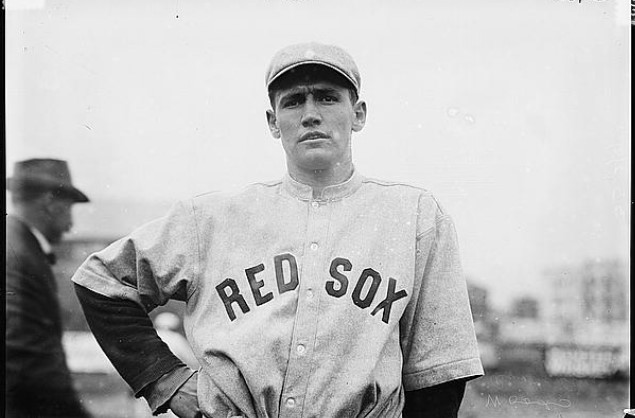
Library of Congress photo. George Grantham Bain Collection
Wood’s Bloomer Girls gig didn’t last long. In 1907, he was pitching for the Hutchinson Salt Packers in the Class C Western Association – where he would go 18-11 and fan more than 200 batters. In 1908, it was on to the Kansas City Blues of the Class A American Association. By August 1908, at just 18-years-old, Wood’s contract had been purchased by the Red Sox and he found himself in the major leagues. In his first MLB season, Wood made six appearances, two starts, and went 1-1, 2.38 with 11 strikeouts in 22 2/3 innings.
In the spring of 1909, Wood suffered a foot injury (reportedly while roughhousing with his roommate, Tris Speaker), that put him out of action until June (he made his first start on June 21 – a complete-game, two-hit, 4-1 win over the Athletics). Wood went 11-7, 2.18 on the season. He also lost a month of the 1910 season (ankle surgery), when he went 12-13, 1.69. Despite the injury layoff, Wood’s 1.69 ERA in 1910 was the second-lowest on the team and eighth-best in the AL and his 145 strikeouts led all BoSox hurlers and represented the sixth-highest total in the AL (his 6.6 strikeouts per nine innings pitched were second only to Walter Johnson).
Over the 1909 and 1910 seasons, Wood split his duties between starting and relieving (36 starts and 23 relief appearances). In 1911, Woods took his place as a primary member of the Red Sox’ rotation (starting 33 games and relieving in 11). His 23 wins (17 losses) were fourth-best in the league, his 2.02 ERA third-best; his 231 strikeouts second-best; his 7.54 whiffs per nine-innings the AL’s top ratio; and his 25 complete-games, fifth.
Smoky Joe Lights It Up
In the first game of a doubleheader on July 29, 1911, Smoky Joe Wood pitched a gem – a complete-game, 5-0 no-hitter against the St. Louis Browns. In the contest, Wood walked two, hit one batter and fanned a dozen.
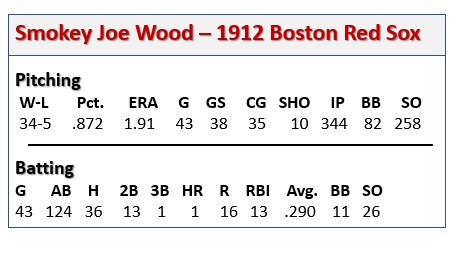
In 1912, Wood was even better – putting together one of the most dominant pitching seasons ever. He went 34- 5, 1.91 and won 16 games in a row between July 8 and September 15. During his 16-game streak. Wood made 16 starts and three relief appearances, tossed 14 complete games and recorded six shutouts. Notably, during the streak, Wood also hit .347 (17-for-49), with six doubles, a triple, seven runs scored, five RBI and five walks (a .407 on-base percentage). For the season, he led the league in wins, winning percentage (.872); complete games (35) and shutouts (ten); while fanning 258 batters (second to Walter Johnson) in 344 innings pitched. He topped off his season with three wins in the 1912 World Series, two as a starter and one in relief. Around baseball, one of the great debates was over who was the fastest pitcher alive – Joe Wood or Walter Johnson.
A Harbinger of Things to Come?
Commenting on his work in Game One of the 1912 World Series, Joe Wood said “I threw so hard, I thought my arm would fly right off my body.”
Wood got off to a solid start in 1913. He went into a July 18 game against the Tigers in Detroit sporting an 11-5, 2.37 record in 17 starts (plus four relief appearances), with 13 complete games. Then the injury bug struck again. In the start at Detroit, he slipped and fell on wet infield grass while making a fielding play – breaking his thumb and, apparently, jamming his shoulder. He pitched only one more inning that season – ending at 11-5, 2.29. That tumble – and perhaps the wear and tear already inflicted on his arm (Remember that “I thought arm would fly right off my body comment?) – changed the course of Wood’s career.
In Lawrence Ritter’s book, The Glory of Their Times, Wood described the change. “I’ don’t know whether I tried to pitch too soon after that, or whether I did something to my shoulder at the same time. But whatever it was, I never pitched again without a terrific amount of pain in my right shoulder.”
Wood was back in 1914, but due to an appendicitis attack, did not make his first start until late May. He ended that season at 10-3, with a 2.,62 ERA; but observers said he wasn’t quite the same. Despite pitching in pain, Wood managed a 15-5 record, with a league-best 1.49 earned run average in 1915. Good numbers, but on the negative side he made only 24 appearances (16 starts).
The combination of a pay dispute and a still ailing arm kept Wood off the field in 1916 – and an attempt to comeback with the Cleveland Indians in 1917 ended after just five mound appearances (one start). For many, their major-league career would have been over. The love of the game, however, would not let Wood stay home.
Babe Ruth Lite
Despite his shoulder, Wood soldiered (pun intended) on. And this is where “Babe Ruth Lite” comes in. In 1918, a 23-year-old southpaw pitcher named George Herman Ruth (who, over his first four MLB seasons, had gone 67-34, 2.07 and twice won 20 games) began his transition to the outfield. Before the 1918 season, Ruth had not appeared in any position other than pitcher and pinch-hitter. In 1918, he appeared in 59 games in the outfield, 13 at first base and 20 on the mound (where he went 13-7, 2.01), while leading the AL in home runs (11). The rest, as they say, is history.
In 1918, Smoky Joe Wood – although for different reasons – joined Ruth in transitioning from the mound to the field. That season, Wood started 95 games in the outfield, 19 at second base and three at first base – hitting .296 with five home runs and 66 RBI. He remained in the major leagues as an outfielder through the 1922 season, hitting .298, with 18 home runs and 275 RBI in 460 games. In 1921, in 66 games for the Indians, Wood hit .366-4-60.
Yale University
Wood retired as a player after the 1922 season, but his love for the game continued. In 1923, he was hired to coach the Yale University freshman baseball squad and, the following year, moved on to coach the varsity team – a position he held through 1942.
Baseball Roundtable (unofficial) fans’ Hall of Fame Ballot.
There is still time to vote in BBRT’s unofficial fans’ 2012 Hall of Fame balloting. Click here to access the ballot.
Primary Resources: Baseball-Reference.com; “The Glory of Their Times,” Lawrence S. Ritter, Harper Perennial Modern Classics; Baseball-Almanac.com; “She’s on first: Women in Baseball,” by Dawn Mitchell, IndyStar, May 13, 2016; “Baseball’s Barnstorming Bloomer Girls: Women and the National Pastime,” Massachusetts Historical Society, June 2018.
 Baseball Roundtable is on the Feedspot list of the Top 100 Baseball Blogs. To see the full list, click here.
I tweet baseball @DavidBBRT
Follow/Like Baseball Roundtable’s Facebook Page here. More baseball commentary; blog post notifications; PRIZES.
Member: Society for American Baseball Research (SABR); Negro Leagues Baseball Museum; The Baseball Reliquary.