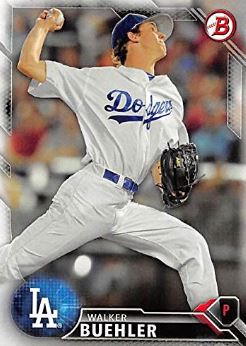
Walker Buehler got the win in the Dodgers’ combined no-hitter.
Yesterday – May 4, 2018 – the Dodgers no-hit the Padres 4-0 in a regular-season MLB game played in Monterrey Mexico – the first official MLB no-hitter ever thrown outside the United State or Canada.
It was also a rarity among no-hitters, being just the twelfth combined (more than one pitcher) no-hitter in MLB history, as well as the Dodgers’ MLB-best 23rd no-no. (The Padres, by the way, remain the only MLB that has never had a no-hitter thrown in their cause.) let’s take a look at yesterday’s white-washing, as well as the other eleven combined no-hitters in the national pastime’s past times.
Yesterday, right-hander Walker Buehler started for the Dodgers, and the 23-year-old – making just his third major league start (11th appearance) – went six innings (93 pitches), walking three and fanning eight. He was followed by relievers Tony Cingrani (one inning, two walks, one whiff); Yimi Garcia (one inning, no walks, two strikeouts) and Adam Libertore (one inning, no walks, two strikeouts). Buehler, by the way, also collected an unusual sixth inning single – as his groundball hit baserunner Alex Verdugo between first and second, resulting in Verdugo being called out (for the final out of the inning) and Buehler being credited with a single. That single, of course, meant Bueghler outhit the entire Padres’ lineup.
MORE PROOF THAT, IN BASEBALL, WE COUNT (AND TRACK) EVERYTHING
Yesterday, it was reported, was the first time in MLB history that a no-hitter and a 3,000th MLB hit (Albert Pujols) occured on the same day.
Now, a look at the other eleven MLB combined no-hitters and the circumstances that made many of them unique.
The first-ever combine no-hitter took place on June 23, 1917 – with the Red Sox topping the Senators 4-0 in Boston. This game is special for several reasons: it was the first MLB combined no-hitter; Babe Ruth was involved; it involved the most meager contribution by the starting pitcher (zero innings pitched); and, finally, it is arguably the most “perfect” combined no-hitter ever.
Babe Ruth, at that time plying his trade as a left-handed starting pitcher for the Boston Red Sox, opened the game by walking Washington’s lead-off hitter Roy Morgan. Ruth, and his catcher Pinch Thomas, took issue with umpire Brick Owens’ strike zone and, during the argument, Ruth made contact with the umpire (a glancing blow, it was reported). The ultimate result of the confrontation was the ejection of both Ruth and Thomas (with Ruth earning a $100 fine and ten-game suspension). Red Sox’ pitcher Ernie Shore was called in to replace Ruth and Sam Agnew took Thomas’ spot behind the plate. Morgan decided to test Agnew’s arm and was thrown out stealing, after which Shore retired the next 26 hitters in order – completing the first combined no-hitter and facing the minimum 27 batters.
Given the past propensity for pitchers finishing what they started, MLB’s second combined no-hitter came 50 seasons and 70 no-hitters later – on April 30, 1967, with the Tigers defeating the Orioles 2-1 in Baltimore. This combined no-hitter is unique because it was not a “no- no” (no hits – no runs), the team that threw the no-hitter lost (the only combined no-hitter loss) and it involved the briefest contribution by the relief staff (one pitcher/one-third inning pitched).
Orioles’ starter Steve Barber and was effectively wild, walking ten hitters and hitting two in 8 2/3 innings. The opposing hurler was Detroit’s Earl Wilson – who matched goose eggs with Barber for seven innings. In the eighth, Baltimore pushed across a run on three walks and a sacrifice fly (Wilson gave up only two hits and four walks in his eight innings of work) and victory was there if Barber could take it. He didn’t. Barber walked Tiger 1B Norm Cash to start the ninth. He then walked SS Ray Oyler. Earl Wilson, a good-hitting pitcher, bunted the runners to second and third, before Barber got the second out of the inning, inducing PH Willie Horton to pop up to the catcher. Now, just one out away from a 1-0, no-hit win, Barber uncorked a wild pitch that brought the tying run home. He then walked CF Mickey Stanley, ending his day on the mound. Stu Miller came in to get the final out, but not until an error allowed the go-ahead run to score.
Combined no-hitter number three came on September 28, 1975, with the A’s topping the Angels 5-0 in Oakland. This game was unique in that it is one of only three no-hitters thrown on the final day of an MLB season – and it made starting pitcher Vida Blue the first hurler to take part in both a solo and combined no-hitter. (Blue had thrown a solo no-hitter on September 21, 1970.) Blue went five innings and was followed by Glenn Abbott (one inning), Paul Lindblad (one inning) and Rollie Fingers (2 innings). This was also the first time more than two pitchers were involved in a combined no-hitter. Note: Blue has been joined by Kevin Millwood, Kent Mercker and Mike Witt as pitchers with both solo and combined no-hitters.)
The next combined no-hitter went back to the two-pitcher formula, as Blue Moon Odom (5 innings) and Francisco Barrios (4 innings) of the White Sox topped the A’s 2-1 in Oakland. In the July 28, 1976 game, Blue walked five and gave up one run in his five frames, and Barrios added two walks in his four.
Combined no-hitter number-five came on April 11, 1990 (again just two pitchers), with the Angels topping the Mariners 1-0 in Anaheim. Mark Langston started the game and went seven, and Mike Witt (the only pitcher to throw a perfect game – September 30, 1984 – and take part in a combined no-hitter ) threw the final two.
1991 saw seven MLB no-hitters including two combined no-nos. On July 13, the Orioles no-hit the A’s 2-0 in Oakland behind Bob Milacki (five innings), Mike Flanagan (one IP), Mark Williamson (one IP) and Gregg Olson (one IP). Then, on September 11, the Braves no-hit the Padres 1-0 in Atlanta, led by Kent Mercker (six innings), Mark Wohlers (two innings) and Alejandro Pena (one inning).
Combined no-hitter number eight came on July 12, 1997 – with the Pirates topping the Astros 3-0 in Pittsburgh. It was unique in that it was the only extra-inning combined “no-no.” Francisco Cordova started and went nine hitless frames (two walks, ten whiffs) and Ricardo Rincon threw one hitless inning in relief (for the win).
The next combined no hitter was a record breaker – as the Astros used a record six pitchers (since tied) to no-hit the Yankees 8-0 in an inter-league game at Yankee Stadium (the last no-hitter at Old Yankee Stadium). Roy Oswalt started, but succumbed to a groin injury after just one completed inning. Joining in the no-hitter were: Pete Munro (2 2/3 IP); Kirk Saarlos (1 1/3 IP); Brad Lidge (2 IP); Octavio Dotel (1 IP); and Billy Wagner (1 IP). Notably, the no-hitter also broke up the Yankee’s record streak of 6,980 games without being held hitless. They had not been held without a safety since September 20, 1958.
The very next combined no-hitter – another interleague game – saw the six-pitcher record tied, as the Mariners topped the Dodgers 1-0 in Seattle. Kevin Millwood started that one (six innings), followed by Charlie Furbush (2/3 IP), Stephen Pryor (1/3 IP), Lucas Luetge (1/3 IP), Brandon League (2/3 IP) and TomWilhemson (one IP).
In combined no-hitter number 11 – September 1, 2014- the Phillies used four pitchers to no-hit the Braves 7-0 in Atlanta. The pitchers involved were Cole Hamels, who started and went six innings (issuing five walks versus seven strikeouts); Jake Diekman (one inning, two strikeouts); Ken Giles (one inning, three strikeouts); and Jonathan Papelbon (one inning, no strikeouts).
Primary Resources: MLB.com; ESPN.com; Society for American Baseball Research.
I tweet baseball @DavidBBRT
Follow/Like the Baseball Roundtable Facebook page here.
Member: Society for American Baseball Research; The Baseball Reliquary; The Negro Leagues Baseball Museum.