Teixeira Moves Up Switch Hitter Heirarchy – Mantle Still King

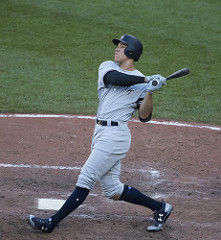
Mark Teixeira photo

Photo by Keith Allison

Yesterday (July 3, 2016), Yankees’ 1B Mark Teixeira got an early start on his Independence Day fireworks – clubbing a pair of home runs as the Bombers topped the Padres 6-3 in San Diego. It was an all-or-nothing kind of day for the New York slugger, who struck out in his first three at bats and homered in his final two.  (Teixeira is hitting just .192 on the season, with seven round trippers and 58 strike outs in 198 at bats.)

Teixeira’s round trippers not only helped the Yankees to a victory, they also had notable historic significance. They were Teixeira’s 400th and 401st  career home runs, making Teixeira just the fifth switch hitter to reach the 400 home run mark.  (Teixeira’s fellow Yankee Carlos Beltran reached 400 home runs on May 15 of this season.)

SWITCH HITTERS WITH AT LEAST 400 CAREER HOME RUNS

         Mickey Mantle            536

         Eddie Murray              504

         Chipper Jones              468

         Carlos Beltran             412 (still active)

         Mark Teixeira              401 (still active)

mantle

Mickey Mantle – King of the Switch Hitters

BBRT would like to use Teixeira’s accomplishment as a springboard to a look at some switch-hitting power records – which, by the way, provide evidence that, while Beltran and Teixeira moved up the switch-hitting hierarchy this season, Mickey Mantle is still the king.

  • The record for home runs in a season by a switch-hitter is 54, by Yankee great Mickey Mantle in 1961. Mantle is, in fact, the only switch-hitter ever to reach 50 homers in a campaign; and he did it twice, with 52 in 1956 and 54 in 1961. (Ironically, the year Mantle set the record, he did not win the HR crown. It went to teammate Roger Maris with 61.)
  • The NL record for home runs by a switch hitter belongs to the Braves’ Chipper Jones, with 45 in 1999. Like Mantle, Jones did not win the HR title in his record-setting season. Mark McGwire, then with the Cardinals, swatted 65.
  • Mickey Mantle is the only switch-hitter to ever win the Triple Crown (.353-52-130 for the Yankees in 1956).

Mickey Mantle won more HR crowns than any other switch-hitter.  Here are the switching hitting HR champs:

  • Walt Wilmot, Cubs, 1890 – 13 HRs
  • Ripper Collins, Cardinals, 1934 – 35 HRs
  • Mickey Mantle, Yankees, 1955 – 37 HRs
  • Mickey Mantle, Yankees, 1956 – 52 HRs
  • Mickey Mantle, Yankees, 1958 – 42 HRs
  • Mickey Mantle, Yankees, 1960 – 4 0HRs
  • Eddie Murray, Orioles, 1981 – 21 HRs (strike shortened)
  • Howard Johnson, Mets, 1991 – 38 HRs
  • Mark Teixeira, Yankees, 2009 – 39 HRs

Both of Teixeira’s home runs in yesterday’s game came as a left-handed batter – but I’d like to take a look at a more unique accomplishment, players who have hit a home run from both sides of the plate in the same game.  It’s not as rare a feat as you might think.  It’s been accomplished  291 times (174 in the American League, 117 in the National League).

  • The first player to homer from both sides of the plate in the same game was Wally Schange of the Philadelphia Athletics on September 8, 1916.
  • The most recent player to homer from both sides of the pate in the same game was Nick Swisher (for the Braves on August 22, 2015).
  • The career record for homering from both sides of the plate in the same games is 14 – shared by Mark Teixeira and Nick Swisher. Leaders among players homering from both side of the plate in the same game:
    • Mark Teixeira – 14 times
    • Nick Swisher – 14
    • Carlos Beltran – 12
    • Chili Davis – 11
    • Eddie Murray – 11
    • Tony Clark- 10
    • Ken Caminiti – 10
    • Mickey Mantle – 10
  • In 1996, the Padres’ Ken Caminiti hit a home run for both sides of the plate in the same game a record four times in a single season – three times in the month of August alone. Note: Caminiti also achieved the feat three times in a single month in September of 1995.

From 1955-1965, a game in which a player homered from both sides of the plate occurred in the AL 14 times, with 13 of those being Yankees (Mickey Mantle 10, Tom Tresh 3). 

The only non-Yankee to achieve the feat in the AL during that time span was the Red Sox’ Pumpsie Green (August 15, 1961). Green hit a total of just 13 home runs in his five-season MLB career.  BBRT Note: Green achieved historic significance as the first African-American player for the Boston Red Sox – the last MLB team to break the color line (1959). In the 1955-65 time span, there were only three NL games which saw a player homer from both sides of the plate – two by the Cubs’ Ellis Burton, one by the Dodgers’ Maury Wills.

  • Only three players have hit home runs from both sides of the plate in the same inning: Carlos Baerga, Indians (April 9, 1993); Mark Bellhorn, Cubs (August 29, 2002); Kendrys Morales, Angels (July 30, 2012).
  • In the post season, a game with a home run from both sides of the plate has been achieved just four times: Twice by the Yankees’ Bernie Williams (Game Three of the 1995 ALDS and Game Four of the 1996 ALDS); the Braves Chipper Jones (Game Four of the 2003 NLDS); and the A’s Milton Bradley  (Game Two of the 2006 ALCS).

I tweet baseball @DavidBBRT

Member: Society for American Baseball Research (SABR); The Baseball Reliquary; Baseball Bloggers Alliance
Photo by Keith Allison


19 Innings, 19 Pitchers – How the Game has Changed

baseball photo

Photo by theseanster93

Yesterday, the Cleveland Indians won their 14th straight game in spectacular fashion – 2-1 over the Blue Jays in 19 innings (on a Carlos Santana home run). The contest took six hours and 13 minutes and the two teams sent 19 pitchers (well, there were a couple of position players in that mix) to the mound.

All of that brought to mind just HOW MUCH THE GAME HAS CHANGED … and the fact that, back on May 1, 1920, Boston (NL) and Brooklyn  played 26 innings to a 1-1 tie (called on account of darkness) … and BOTH STARTERS WENT THE DISTANCE.


May 1, 1920

Brooklyn              000 010 000 000 000 000 000 000 00           1   9   2

Boston                  000 001 000 000 000 000 000 000 00           1 15  2

Starting pitchers Leon Cadore of Brooklyn and Joe Oeschger of Boston (NL) each threw more than 300 pitches (analysts estimate Cardore at 345 and Oeschger at 319) in completing their 26-inning, record-setting starts. Cadore gave up 15 hits and five walks, while fanning 7; while Oeschger allowed only nine hit and four walks, while also striking out seven batters.   Oh, and here’s another sign of how the game has changed, the time of the 26-inning contest was only 3 hours and 50 minutes.

For BBRT’s look at what has happened to the complete game in MLB, click here. 

I tweet baseball @DavidBBRT

Member:  Society for American Baseball Research; The Baseball Reliquary; Baseball Bloggers Alliance. 

Happy Fathers’ Day Baseball Fans!

Happy Fathers Day Baseball Fans!  Griffey Senior and Junior go back-to-back … now that’s father and son bonding at the old ball game.

Land of the Lost – Home Runs that Got Away

Yesterday (May 9), as the Marlins topped the Brewers 4-1 in Miami, Marlins’ catcher J.T. Realmuto had what would have been his third home run of the season turned into an out on the base paths and an RBI single. It came in the second inning, after Realmuto hit what appeared to be a two-run homer (Marlins’ CF Marcell Ozuna was on first base). Ozuna, however, thought Brewers’ CF Kirk Nieuwenhuis had a chance to track the ball down at the wall. So, Ozuna was returning to first base, in case he had to tag up – just as Realmuto was rounding the bag.  For a brief couple of seconds, Realmuto passed Ozuna on the base paths and, in accordance with the rules, was called out – resulting in a 409-foot, RBI single.

Land of the Lost – Let’s Look at Some “Lost” Long Balls

BBRT brings this play up not because it is so rare (there have been dozens of “lost’ home runs) or even because it had an impact on the outcome of the game (the Marlins still won 4-1).   Rather, I am using it as a segue into a look at my own very subjective list of the five most significant or interesting lost round trippers.

Now, for purposes of this post, I am eliminating unavoidably lost (from the players’ and coaches’ points of view) home runs.  This includes those lost under such circumstances as rain outs, bad calls by umpires, forfeited games, unusual ground rules (catwalks, speaker wires, etc.). I’ll focus on those home runs lost due to what I would consider avoidable circumstances –  such as players’ base running errors, coaches’ mistakes, batting out of order, etc.   So, here are BBRT’s five most significant or interesting lost home runs.

  1. Number-one on the list is pretty easy. It was not only a lost home run, but a lost “extra-inning, walk-off Grand Slam – IN THE POST SEASON. In fact, had it not been lost, it would have been the first walk-off, Grand Slam in MLB post-season history.
Robin Ventura - hit the true GRAND-daddy of lost home runs.

Robin Ventura – hit the true GRAND-daddy of lost home runs.

It came on October 17, 1999, in the fifteenth inning of Game Five of the National League Championship Series between the Braves and Mets (in New York). The Braves had a three games-to-one lead in the NLCS, and Game Five had been tied at 2-2 since the fourth inning. In the top of the fifteenth, Atlanta had taken a 3-2 lead on a single by SS Walt Weiss and a triple by 2B Keith Lockhart. The Mets, however, came right back in the bottom of the inning. It started with a single and stolen base by CF Shawon Dunston, followed by a walk to pinch hitter Matt Franco, a successful sacrifice by 2B Edgardo Alfonzo and an intentional walk to 1B John Olerud.  Catcher Todd Pratt then drew a walk to force in the tying run.  This brought 3B Robin Ventura to the plate with the game tied and the bases loaded – and that’s when the fun began.


Ventura launched a ball over the right field fence (off right-hander Kevin McGlinchy) for what appeared to be a game-winning, walk-off Grand Slam.  However, once the winning run crossed the plate, Pratt turned and ran back to Ventura to give him a celebratory hug. At about the same time, a cadre of Mets poured out of the dugout and onto the field to celebrate the victory. Since, in the chaos, each runner advanced only one base before Ventura passed Pratt on the base paths, the Mets’ 3B was credited not with a Grand Slam, but with an RBI-single.

The lost home run would have been the first game-ending, walk-off Grand Slam in MLB post-season history. Instead, that honor went to the Rangers’ Nelson Cruz, in Game Two of the 2011 American League Championship Series.

_____________________________________

2.   Number-two on my list of lost long balls, is significant for putting a dismal exclamation point on one of the best games ever pitched. Like number-one, it put an end to an extra-inning contest – this time in the thirteenth inning.  More significant, it put an end to a game in which the starting, and losing, pitcher had been perfect for 12 innings.  That’s right 36 up and 36 down going into the unlucky 13th.

Joe Adcock - spoiled Harvey Haddix' day.

Joe Adcock – spoiled Harvey Haddix’ day.

On May 26, 1959, the Pirates’ Harvey Haddix took the mound against the powerhouse Milwaukee Braves (who had won the National League pennant the previous two seasons and came into the game again leading the league).  Haddix retired the first 36 hitters in order (eight strikeouts), carrying a perfect game into the bottom of the 13th.  Unfortunately, the Braves’ Lew Burdette, despite giving up 12 hits and fanning only two, had held the Pirates scoreless. Braves 2B Felix Mantilla led off the Braves’ half off the 13th by reaching on error by Pirates’ 3B Don Hoak. Slugging Milwaukee 3B Eddie Mathews bunted Mantilla over to second, which led to an intentional walk to RF Hank Aaron, bringing up 1B Joe Adcock.  Adcock rapped a 1-0 pitch over the right field fence for what appeared to be a three-run home run.  However, the Braves, in celebrating the tension-filled victory, forgot how to run the bases. Adcock passed Aaron between second and third and, after some deliberation, Adcock was called out – changing his three-run homer to a one-run double. So, despite 12 perfect innings, Haddix lost the no-hitter, the shutout and the game itself.  Consolation for Adcock – all he lost was a home run and a couple RBI.

_________________________________________________

  1. Third place on this list goes to a lost home run that would have been the only home run in a player’s career.

On April 17, 1914, the Federal League Buffalo Blues were facing off against the Baltimore Terrapins in Baltimore. In that contest, Blues’ RF and cleanup hitter Luther Bonin bashed what he thought was his first major league home run.  As Bonin rounded third base, Blues’ manager Larry Schlafy, coaching third, patted him on the back. Now, the rules prohibit such contact (touching or holding a runner) if, in the judgment of the umpire, the contact “assists” the runner.  The umpire made that judgment and Bonin was called out on coach’s interference and credited with a triple.  The faux pas did not affect the outcome of the game– the Blues topped the Terrapins 4-3. It did affect Bonin’s line in the record books; robbing him of the only home run he hit in his 21-game MLB career.  On the bright side, it did earn him his only career three-bagger.

Honorable Mention. A lost home run that escaped Tigers’ SS Frank Sigafoos (had to get the name in here) on April 21, 1929 gets an honorable mention here. In a game in which the Tigers topped the Saint Louis Browns 16-9, Sigafoos hit what he thought was his first MLB home run. However, the umpire had called a balk on the pitch (which is why it doesn’t exactly fit the criteria for a spot on the list)– negating Sigafoos’ long ball.  While it didn’t affect the outcomes of the game, it did cost Sigafoos the only round tripper in his three-year, 55-game MLB career.

______________________________________

4. Number four on this list is significant in that it gave Babe Ruth a share of the 1931 home run title – which sets the record for HR titles in a career at 12, rather than 11.

It happened on April 26, 1931, with the Yankees facing the Senators in Washington. In the top of the first, with Yankee SS Lyn Lary on first base and two out, New York 1B Lou Gehrig hit a home run to center field (off Senators’ starter Firpo Marberry – not significant, just like the name).  The hard hit ball however, bounced back out of the bleachers to Senators’ CF Harry Rice.  Lary thinking the ball was caught, headed to the dugout – without touching the plate. Gehrig was declared out for passing Lary and credited with a triple.  This one did affect the game – which the Yankees lost 9-7 (after losing Gehrig’s two-run blast). Further, it cost Gehrig the outright AL home run crown, he ended the season tied with Ruth at 46. Gehrig also set the AL single-season RBI record at 185 in 1931, Had he not lost that home run, the record would be 187.

____________________________________________

5. No one likes to “lose” a home run – particularly a Grand Slam and, even more particularly, a pinch-hit Grand Slam.  And that combination takes the five-spot on the list.

It happened on July 9, 1970, with the Red Sox facing the Tigers in Detroit. In the bottom of the seventh inning of a 3-3 game – with two outs and the bases loaded – the Tigers called on Dalton Jones (who had been traded from the Red Sox to the Tigers in the off seasonto pinch hit for catcher Jim Price.  Jones launched a long ball into the right field upper deck for an apparent Grand Slam. For some reason (Remember, this ball was in the upper deck.), the base runner at first (Don Wert) decided to tag up – and was passed on the base paths by Jones. Jones was called out and credited with a three-run single. Dalton’s three RBI did help the Tigers win the contest by a 7-3 score. Note: It would have Jones first MLB Grand Slam.

Honorable Mention:  As I’ve noted, no one likes to lose a Grand slam – especially a pitcher. On September 20, 1972, Steve Busby started on the mound for the Royals against the Angels (in Anaheim). Rudy May started for California – and it was a rocky beginning. In fact, Busby – hitting in the nine-spot – came to bat in the top of the first with the bases loaded, four runs in (thanks to a Grand Slam by 1B John Mayberry) and just one out. Busby hit a Grand Slam off reliever Lloyd Allen – at least he thought he did. However, first base umpire had called time out before the pitch – negating the blast – which would have made Busby part of a record-tying two Grand slam inning. Busby did eventually touch Allen for a two-run single to center in his extended at bat, but I’m sure he would rather have had the Grand Slam.  (By the way, the Royals won 9-2, Busby pitched a complete-game seven-hitter – and collected three hits and three RBI of his own.


I tweet baseball @DavidBBRT

Member: Society for American Baseball Research (SABR); The Baseball Reliquary; Baseball Bloggers Alliance.

April Showers – and MLB Highlights

AprilDaysWell, April is behind us and – if you are from Minnesota, you are banking on the old “April showers bring May flowers” adage, because it’s been plenty wet here.  April not only brought showers to Minnesota, but also plenty of action to major league baseball – from the Dodgers opening the season with three straight shutouts to a no-hitter by the Cubs’ Jake Arietta (his second) to Rockies’ rookie Trevor Story’s ten April home runs (tying the MLB rookie record) to A.J. Pierzynski becoming just the ninth catcher to reach 2,000 hits.  It was an eventful month – and it’s time for BBRT’s traditional look at the past month of the MLB season. I hope you enjoy this look back at April – and come across a highlight or two you may have missed.  (Note:  April is always the easiest month to “wrap,” since monthly and year-to-date leaders are the same.) Before we get into detailed highlights and statistics, here are a few quick observations.

First a few quick observations:

  • MLB had only one qualifying .400 hitter through April 30 – the Cardinals’ 25-year-old rookie SS Aledmys Diaz at .423. (with four home runs and 13 RBI).
  • The NL West finished April with zero – yes, zero – teams playing .500 ball. The Dodgers, Giants and Rockies share the Division lead – all with losing records (one game under.500).
  • Two players were tied for the MLB lead in home runs at 10 – and they both played for the Rockies: 3B Nolan Arenado (Last season’s NL home run leader) and 23-year-old rookie SS Trevor Story. For those who track such things, the most HR’s ever hit in April is 14 – a record shared by Albert Pujols (Cardinals 2006) and Alex Rodriguez (Yankees, 2007). The most home runs in any month goes to Sammy Sosa, who hit 20 for the Cubs in June of 1998.
  • The Cubs’ Jake Arietta tied for the MLB lead in wins this April (5-0, 1.00 ERA) – and threw the season’s first no-hitter.
  • Jordan Zimmermann moved smoothly from the NL (Nationals) to the AL (Tigers), putting up MLB’s lowest ERA for the month (among qualifiers), going 5-0, with a 0.55 ERA. The Cubs’ Jason Hammel was the only other pitcher to finish the month with an ERA under 1.00 (3-0, 0.75).
  • Despite the presence of the DH in the AL, the top three scoring teams (and six of the top seven) in April were from the NL.
  • Cubs’ pitchers held batters to a .199 average, while the opposition hit over .300 (.301) against the Brewers’ staff.
  • Twenty-three individual players out-homered the Braves, who had just five long balls for the month.
  • In the “How the Game has Changed” department, April saw only seven complete games in MLB – and no team had more than one.
  • We saw two triple plays: one of the traditional third-to second-to first (5-4-3) variety and another which started in right field and ended up involving the first baseman, catcher, shortstop and third baseman. (More on that later).
  • As noted earlier, we saw one April no-hitter – and we also witnessed 17 Grand Slams.

A FEW HIGHLIGHTS – BEFORE THE STATISTICS

A Two-Edged Sword.

The Dodgers and Padres tied and broke a couple records in their opening series.  The Dodgers tied a record by opening a season with three straight shutouts, while the Padres set a record by failing to score in their first three games of the season.

  • On Opening Day (April 4) in San Diego, the Dodgers (behind Clayton Kershaw and two relievers) trounced the Padres 15-0, in the worst opening day shutout lost in MLB history.
  • The April 5 game, started by Dodger Scott Kazmir, was more competitive, as LA sTopped San Diego 3-0. Kazmir and a trio of relievers gave up just two hits, no walks and recorded 11 strikeouts.
  • Then, on April 6, LA’S Kenta Maeda and three relievers topped the Padres 7-0.

The only other team to open a season with three shutouts was the 1963 Cardinals (April 9, 10 and 13) – whose three-game opening shutouts stretch included two games on the road against the Mets (7-0, 4-0) and the home opener against the Phillies (7-0). Another illustration of “How the Game Has Changed” – The Cardinals string of three shutouts to open the season included three complete games (a two-hitter by Ernie Broglio; a four-hitter by Ray Washburn; and a 5-hitter by Curt Simmons).

Chicago – the WIN-dy City.

hChris Sale led the White Sox with five April Wins. Photo by: Keith Allison

hChris Sale led the White Sox with five April Wins.
Photo by: Keith Allison

No teams won more games this April than the Cubs (17-5) and White Sox (17-8) – and so Chicago stands atop both the AL and NL Central Divisions. (The Cubs were the only team with a .700+ winning percentage at .773.) The White Sox did it with pitching.  At the end of April, they ranked seventh in the AL in runs scored, but had given up the fewest run in the junior circuit (76 runs allowed, tied with the Mariners) and had the AL’s lowest ERA at 2.72 ERA. Over in the NL, the young Cubs did it all – posting the NL’s second-lowest ERA (2.39) and second-most runs scored (136).

Leading the way on the mound for the White Sox?  Pretty much everyone.  The ChiSox closed April with nine pitchers (three starters) with ERA’s under 2.00. Particular Kudos to starters Chris Sale (5-0, 1.66), Mat Latos ( 4-0, 1.84) and Jose Quintana (3-1, 1.47), as well as closer Dave Robertson (eight saves in nine opportunities and a 0.87 ERA).

The Cubs had things going on the mound and in the batter’s box. CF Derek Fowler surprised with a .347-3-15 line; 1B Anthony Rizzo may have hit only .218, but he chipped in eight home runs and 24 RBI; and 3B Kris Bryant went .289-4-15.  On the mound, as expected (on even better), Jake Arietta went 5-0, 1.00 – and he was joined by starters Jon Lester (2-1, 1.83) and Jason Hammel (3-0, 0.75) with ERA’s under 2.00. The Cubs’ starters were so good, closer Hector Rondon got only four saves opportunities, but he converted them all without giving up an earned run.

Windy City World Series anyone?

Braves Powerless to Turn Things Around?

The worst record in MLB through April? That belonged to the Atlanta Braves (5-18, .217 – already 11 games out.)  The Braves were last in the NL in runs scored (75 – only the Yankees scored few April runs at 74); second-to-last in the NL in average (.229); and dead last in MLB in home runs. The Braves closed April with just five home runs. The second-lowest home run total belonged to the Dodgers with 17; and the home run leaders were the Diamondbacks and Rockies with 37 each. On the mound, the Braves were one of only four teams with an ERA over 5.00 (at 5.05). Other teams in that unenviable position were the Brewers (5.64); Rockies (5.50); and Reds (5.42).

Over in the AL, the worst record belonged to the Twins and Astros (7-17, .292). The Twins were 11th in the AL in runs scored (80), while the Astros were ninth (90). The Astros, however, gave up the most April runs in the AL (123) and had the league’s highest ERA at 4.97. The Twins weren’t far behind (ahead?), giving up the AL’s second-most runs at 110, with the fifth-highest ERA at 3.97.

9-3-2-6-2-5 … Not it’s not a phone number.

On April 22, the White Sox turned a unique triple play against the Rangers. It came in the seventh inning and all started after the Rangers (trailing 5-0) loaded the bases with no outs. Texas’ 1B Mitch Moreland hit a liner into the corner that was caught by White Sox RF Adam Eaton.  Rangers’ LF Ian Desmond (the runner on first) had ventured too far off the bag, then overran the base coming back and was tagged out (in foul territory) by 1B Jose Abreu. Abreu, wanting to ensure no run scored, fired the ball to C Dioner Navarro, who saw that Rangers’ 3B Adrian Beltre (the runner at second) had decided to advance to third base on the play at first. There was one small (well, not so small) problem, DH Prince Fielder (the runner at third) was solidly anchored there.  Seeing Beltre hung up, Navarro threw to shortstop Tyler Saladino and Fielder decided to try to score on the expected rundown. Saladino threw back to Navarro, who threw to 3B Todd Frazier (who tagged Fielder) to complete MLB’s first-ever 9-3-2-6-2-5 triple play,

One Hit – One Win.

The Rangers managed to win their April 4 Opener (in Texas) by a score of 3-2 over Seattle – despite collecting only one hit.  All three Texas tallies came in the fifth inning off Mariners’ starter Felix Hernandez. 2B Rougned Odor led off with a walk; SS Elvis Andrus reached on an error by Seattle 3B Kyle Seager; C Robinson Chirinos sacrificed the runners to second and third; CF Delino DeShields drew a walk, loading the bases; RF Shin-Soo Choo walked, forcing in a run; DH Prince Fielder blooped a single (the Rangers only hit of the day) that fell between the left fielder and shortstop, scoring Andrus; 3B Adrian Beltre was safe on a error by SS Ketel Marte, scoring Deshields; finally, 1B Mitch Moreland and LF Ian Desmond went down swinging to end the brutal half-inning. Seattle outhit the Rangers 4-1 and punched two home runs, but still lost the contest.

Still teams, have won with fewer hits.  See the  box at the end of this post for a look at teams that have managed a victory without the benefit of a single base hit.

Your April Division Leaders

AL Central:  White Sox (17-8), followed by the Tigers, three games back.

AL East:  Orioles (14-9), just ½ game up on the Red Sox.

AL West: Rangers (14-10) in first, with just a ½ game lead on the Mariners.


NL East: A good race brewing with the Nationals (16-7), just a 1/2 up on the Mets.

NL Central:  Cubs (17-5), three games ahead of the second- place Pirates.

NL West: The Dodgers, Giants and Rockies tied for the lead – all one game under .500 – and the Diamondbacks just ½ game back.

If the season ended April 30, your post-season teams:

AL- Orioles, White Sox, Rangers. Wild Cards: Red Sox, with the Tigers and Mariners tied for the final spot.

NL – Nationals, Cubs, with the Dodgers, Giants and D-backs tied for the West title. Wild Cards: Mets, Pirates.

Full Standings can be found at the end of this post.

__________________________________________________________________

BEST AND WORST TEAM STATS FOR APRIL

BEST TEAM OFFENSIVE STATS

Batting average: Pirates (.293); Red Sox (.281).

Home Runs: D-backs and Rockies (37); Orioles and Cardinals (34).

Runs: Cardinals (142); Cubs (136); Pirates (128); Red Sox and Rockies (126).

SB: Red Sox (21); Indians (19); D-backs, Astros and Royals (18).

Walks Drawn: Cubs (121); Pirates (105); Giants (102); Note: AL Leader – Blue Jays (90).

Fewest Strikeouts: Angels (123); Giants (155).

WORST TEAM OFFENSIVE STATS

Batting Average: Brewers (.223); Rays (.225); Mariners (.227); Braves (.229).

Fewest HR’s: Braves (5); Dodgers (17); Red Sox, Reds and Padres (19).

Fewest Runs: Yankees (74( Braves (75); Rays (76); Royals (77).

Fewest SB’s: Angels (4); Orioles (4); Mets (5).

Fewest Walks Drawn: Reds (56); Rays and Royals (60).

Most Strikeouts: Astros (238); Blue Jays (232); Padres (230).

BEST TEAM PITCHING STATS

ERA: Nationals (2.36); Cubs (2.39); White Sox (2.72).

Strikeouts: Phillies (245); Red Sox (236)..

Fewest Walks: Yankees (51); Rays and Cubs (54)..

Batting Average Against: Cubs (.199); Nationals (.214); Mariners and Rays (.223).

WORST TEAM PITCHING STATS

ERA: Brewers (5.64); Rockies (5.50); Reds (5.42); Braves (5.05). Worrt in AL: Astros (4.97).

Fewest Strikeouts: Rangers (157); Brewers (158).

Most Walks: Reds (110); Pirates (104); Brewers (103); D-backs (101). Worst in AL: Royals (95).

Batting Average Against: Brewers (.301); Astros (.284).

______________________________________________________

Now let’s take a look at individual performances in April.

When looking for a Player and Pitcher of the Month in each league,  BBRT found the choice relatively easy when looking at the mound, less so when considering accomplishments in the batter’s box.

BBRT AL Pitcher of the Month: Jordan Zimmermann, Tigers. Made the transition to the American League look easy, going 5-0, with MLB’s lowest April ERA (0.55). Gave up just two earned runs in 33 innings.

BBRT NL Pitcher of the Month: Jake Arietta, Cubs. Won all five starts; averaged just over seven innings per outing; recorded a 1.00 ERA; tossed 2016’s first no-hitter.

BBRT AL Position Player of the Month:Josh Donaldson, Blue Jays.  Hit .292, with eight home runs (tied for AL lead) and 20 RBI (second in AL).

BBRT NL Position Player of the Month: Bryce Harper, Nationals: Put up a .286 average with nine homers (third in NL) and 24 RBI (tied for tops in MLB).  Added five stolen bases (fourth in NL) and drew 17 walks (versus just 13 strikeouts).


A FEW INDIVIDUAL HIGHLIGHTS THAT CAUGHT BBRT’S EYE IN APRIL

Home Cooking.

On April 15, Astros’ starter Dallas Keuchel went eight scoreless innings in beating the Tigers 1-0.  It was Keuchel’s 17th consecutive home victory (20 starts, three no-decisions).  In this continuing home streak, Keuchel’s home ERA is 1.36 (145 1/3 innings).

On April 28, with two outs in the fifth inning of the Cubs’ 7-2 Wrigley Field win over the Brewers, Jake Arrieta gave up a run-scoring double to Alex Presley. Why is that significant? It was the first run Arietta had given up at Wrigley Field since the sixth inning of a 3-1 win over the White Sox on July 12, 2015.   That gave Arietta a streak of 52 2/3 scoreless innings at home – longest-ever home scoreless streak in the NL and second only to White Sox’ Ray Herbert’s 54-inning home scoreless streak in 1962-63.

Double Your Pleasure. Double Your Fun.

On April 15, as the orioles topped the Rangers 11-5 in Texas, Mark Trumbo collected two home runs and five RBI – in the seventh inning.  Trumbo became one of 58 players in MLB history to collect two round trippers in an inning.  A more elite group – those  who have accomplished the feat twice  – includes The Giants’ Willie McCovey (1973 & 1977); Cubs’ Andre Dawson (1978 & 1985); Pirates’ Jeff King (1995 & 1996); and Yankees’ Alex Rodriguez (2007 & 2009).

Off to a Good Start.

On April 4, Rockies’ rookie SS Trevor Story let his bat tell the story – becoming the first rookie to hit two home runs, while making his MLB debut on Opening Day – as the Rockies topped the Diamondbacks 10-5 in Arizona. Story ended his MLB debut two-for-six, with two runs scored and four RBI.  And, the rookie just kept hitting.  As April closed, Story had become:

  • just the second rookie to hit 10 HR’s in April (Jose Abreu, White Sox, 2014);
  • the first player whose first four MLB hits were home runs;
  • the first player to homer in his first four MLB games;
  • the first player to hit seven HR’s in his team’s first six games of a season (and the first rookie to hit seven homers in his first six games).

Story also tied an MLB mark by homering (the fifth player to do so) in the first four games of a season; and tied the mark for the fewest games ever to reach 10 career home runs (21, George Scott, Red Sox, 1966).

Arietta – a Smashing No-Hitter.

On April 21st, the Cubs’ Jake Arietta threw 2016’s first no-hitter, as Chicago topped the Reds 16-0 in Cincinnati.  There was plenty to distinguish the no-no. For example, the 16-0 win was the second-worst drubbing ever in a no-hitter – trailing only the August 4, 1884 Pud Galvin no-hitter – when his NL Buffalo Bisons topped the Detroit Wolverines 18-0. (In a “How the Game has Changed” moment, future Hall of Famer Galvin’s record that year was 46-22, with a 1.99 ERA, 636 1/3 innings pitched,  71 complete games in 72 starts and 12 CG shutouts.)

Arietta’s no-hitter also made him the 29th pitcher to throw multiple no-hit games (he threw one on August 30th last season.)

What caught BBRT’s eye, however, was the fact that Arietta also collected two hits and a walk (five plate appearances) in the game. Arietta had a single in the second inning, a single in the fourth, a swinging strikeout in the sixth, a walk in the seventh and a ground out in the ninth.  Just another reason I am not fond of the DH. (In fact, the pitcher has collected a hit in each of the last eight no-hitters thrown under NL rules.)

A Grand Way to get to the Century Mark.

Bryce - BBRT Player of the Month hit a Grand Slam for his 100th career homer. Photo by: Matthew Straubmuller.

Bryce – BBRT Player of the Month hit a Grand Slam for his 100th career homer.
Photo by: Matthew Straubmuller.

On April 14, last year’s NL MVP Bryce Harper hit his 100th MLB home run – a third-inning Grand Slam off the Braves’ Julio Teheran, as Bryce’s Nationals topped Atlanta 6-2 (in Atlanta).  In the process, Harper became the eighth youngest player to reach 100 home runs. (BBRT reports this so that I can mention my all-time favorite player – Eddie Mathews.) Here are the ten youngest players to reach 100 HR’s:

  1. Mel Ott (22 years, 132 days), 1931 Giants
  2. Tony Conigliaro (22 years, 197 days), 1967 Red Sox
  3. Eddie Mathews (22 years, 293 days), 1954 Braves
  4. Alex Rodriguez (23 years, 16 days), 1998 Mariners
  5. Andruw Jones (23 years, 62 days), 2000 Braves
  6. Miguel Cabrera (23 years, 127 days), 2006 Marlins
  7. Johnny Bench (23 years, 161 days), 1971 Reds
  8. Bryce Harper (23 years, 181 days), 2016 Nationals
  9. Albert Pujols (23 years, 185 days), 2003 Cardinals
  10. Hank Aaron (23 years, 191 days), 1957 Braves

A New Name for the Leaderboard.

On April 27, as the Braves lost to the Red Sox 9-4 (at Fenway), Braves’ catcher A.J. Pierzynski made history. In the second inning, Pierzynski (in his 19th MLB season) lined a single to left (off Steven Wright) for his 2,000th MLB hit.  The safety made the 39-year-old Pierzynski one of just nine catchers to achieve 2,000 hits. While Ivan Rodriguez leads the group with 2,844 hits (out of A.J.’s reach), such backstops as Johnny Bench (2,048) and Gary Carter (2,092) seem within reach – and, perhaps, even Mike Piazza (2, 127) and Yogi Berra (2,150) could be considered future targets. Pretty heady company, I’d say.

INDIVIDUAL STATS LEADERS THROUGH APRIL

Batting Average: Aledmys Diaz, Cardinals (.423); Martin Prado, Marlins (.397); Daniel Murphy Nationals (.370).  AL Leader:  Nick Costellanos (.363).

Home Runs: Nolan Arenado, Rockies (10); Trevor Story, Rockies (10); Bryce Harper, Nationals (9); Neil Walker, Mets (9).  AL Leaders: Josh Donaldson, Blue Jays (8); Robinson Cano, Mariners (8).

Base Hits: Jean Segura, D-backs (37 with a .333 average); Manny Machado, Orioles (33, with a .344 average).

RBI: Robinson Cano, Mariners (24); Bryce Harper, Nationals (24); Anthony Rizzo, Cubs (24). .

Stolen Bases: Jose Altuve, Astros (9); Starling Marte, Pirates (7). Billy Burns, A’s (7); Rajai Davis, Indians (7).

On the negative side of the coin, the Tigers Justin Upton led all hitters with 38 April strikeouts (in 95 at bats), while carrying a .221 average with two home runs and eight RBI.

ERA (among qualifiers): Jordan Zimmerman, Tigers (0.55); Jason Hammel, Cubs (0.75).

Wins: Jordan Zimmermann, Tigers (5-0, 0.55); Jake Arietta, Cubs (5-0, 1.00); Chris Sale, White Sox (5-0, 1.66); Rick Porcello, Red Sox (5-0, 2.76).

Saves: Kenley Jansen, Dodgers (9); David Robertson, White Sox (8); Jeurys Familia, Mets (8); Jeanmar Gomez, Phillies (8); Ryan Madson, A’s (8); Jonathan Papelbon, Nationals (8); Sean Tolleson, Rangers (8).

Strikeouts: David Price, Red Sox (46); Chris Archer, Rays (43); Drew Smyly, Rays (41); Clayton Kershaw, Dodgers (40); Jose Fernandez, Marlins (40); Stephen Strasburg Nationals (40). Note: David Price led in strikeouts per nine innings (13.96), followed by the Mets’ Noah Syndergaard at 12.83.

Batting Average Against: Danny Salazar, Indians (.139); Jake Arietta, Cubs (.151); Drew Smyly, Rays (.151).

On the negative side: Among pitchers with at least four April starts, the Reds Alfredo Simon had the highest April ERA at 13.50 – (20 earned runs in 13 1/3 innings).

Now, a bonus bit of trivia.

Teams Earning A Victory Without the Benefit of a Base Hit

In MLB history, five teams have managed victory without the benefit of a base hit. Twice these winnings teams were victims (or victors) of an officially recognized MLB no-hitter.  In the other three, since the home team didn’t bat in the bottom of the ninth, the games are not recognized as no-hitters (MLB rules require a pitcher – or pitchers – throw at least nine innings to be credited with a no hitter.) Here are the teams that earned a win without a hit.

First, the official no-hitters – in both cases, the winning run scored in the top of the ninth.

  • On April 23, 1964, the Houston Colt .45’s Ken Johnson pitched nine innings of no-hit ball against the Reds – and lost 1-0. The winning run scored in the top of the ninth in an inning that went: ground out by Reds’ P Joe Nuxhall; 2B Pete Rose reaching (and going to second) on an error by Johnson, then advancing to third on a ground out by 3B Chico Ruiz; Rose scoring as Vada Pinson is safe on an error by 2B Nellie Fox. Johnson’s mound opponent (Nuxhall) pitched a complete game, five-hit shutout.
  • On April 30, 1967, the Orioles’ Steve Barber (8 2/3 innings) and Stu Miller (1/3 inning) combined to no-hit the Tigers in a 2-1 loss. The Orioles had just two hits in the game and actually scored first in the bottom of the eighth – in an inning in which they did not collect a hit. Detroit starter Earl Wilson was still in the game, having thrown seven innings of two-hit ball, when Orioles’ LF Curt Belfry led off with a walk and was sacrificed to second by 2B Woody Held; an intentional walk to PH Charlie Lau and a non-intentional pass to pitcher Steve Barber followed, before SS Luis Aparicio brought Blefary home with a sacrifice fly. End of eight, Orioles up 1-0, Barber three outs from a no-hit victory.  Then came the fateful top of the ninth. Barber walked 1B Norm Cash and weak-hitting SS Ray Oyler to open the inning; the pair were  bunted  to second and third by Tiger P Earl Wilson; pinch-hitter Willie Horton popped out (leaving Barber now just one out from a complete game, no-hitter victory).  With CF Mickey Stanley at the plate, Barber uncorked a wild pitch, with Dick Tracewski (running for Cash) scoring the tying run.  After Barber walked Stanley, Stu Milleer was brought in and a second run scored on a fielder’s choice..The Orioles went down in order in the bottom of the inning – and lost to the Tigers 2-1, despite a combined official no-hitter. .

Now the games not officially recognized as no-hitters, but in which the winning team did not collect a single safety.

  • July 1, 1990, the White Sox topped the Yankees (in Chicago, of course) 4-0, without collecting a single hit. All four runs scored in the bottom of the eighth – which began with Yankee starter Andy Hawkins getting the first two hitters on pop-up, putting him just four out away from a no-hit victory (provided the Yankees could score).  Then the wheels came off.  White Sox RF Sammy Sosa reached on an error by 3B Mike Bowers, and promptly stole second; SS Ozzie Guillen and CF Lance Johnson walked (loading the bases). Then, Robin Ventura was safe on a bases-clearing error by Yankee LF Jim Leyritz. The final run came  in on another error – with DH Ivan Calderon benefiting from the Yankees’ third error of the inning (this one by RF Jesse Barfield). Hawkins went eight hitless innings, giving up four unearned runs, while three White Sox hurlers combined for a four-hit shutout. Since the White Sox did not have to bat in the bottom of the ninth, Hawkins not only lost the game, but was denied an “official” nine-inning no-hitter.
  • On April 12, 1992, the Indians managed to beat the Reds Sox (in Cleveland) despite being outhit by Boston nine-to-zero. The Indians scored in the bottom of the first, as CF Kenny Lofton led off with a walk and stole second and third while DH Glenallen Hill was striking out. Lofton then scored on a throwing error by Red Sox SS Luis Rivera (on a ground ball by Indians’ 2B Carlos Baerga). The Tribe added a second run in the bottom of the third as SS Mark Lewis and Lofton led off with walks. Then, on a ground ball to shortstop, Lewis went to third, Lofton was forced at second and Hill was safe at first. Lewis went on to score on a fielder’s choice.  Boston scored their only run in on a two-out single by Rivera (after a single and walk). Matt Young pitched eight hitless innings for Boston, but was hurt by seven walks and, of course, that Rivera error. Three Cleveland pitchers gave up nine hits and six walks, but managed to hold the Red Sox to one  run.
  • On June 28, 2008, the Dodgers (at home) snuck by the Angels 1-0,without notching a single base hit. As usual, errors played the role in a hitless victory. Dodger s’ CF Matt Kemp led off the fifth inning and was safe on an error by Angels’ pitcher Jered Weaver. Kemp then stole second and advanced to third on a throwing error by catcher Mike Napoli. He then scored on a sacrifice by 3B Blake Dewitt.  And that was the scoring for the day. The Angels’ Jered Weaver (six innings) and Jose Arredondo (two innings) pitched eight innings of no-hit ball (one unearned run), while three Dodgers’ pitchers combined for a five-hit shutout.

______________________________________________________________

APRIL 30, 2016 (end of day) STANDINGS

AL EAST

Orioles             14-9     .609     …

Red Sox           14-10    .583     0.5

Rays                10-12   .478     3.0

Blue Jays         11-14   .440     4.0

Yankees            8-14    .364     5.5

AL CENTRAL

White Sox       17-8     .680     …

Tigers             13-10     .565     3.0

Royals            12-11     .522     4.0

Indians             10-11   .476     5.0

Twins                7-17   .292     9.5

AL WEST

Rangers           14-10   .583     …

Mariners          13-10   .524     0.5

A’s                   13-12   .520     1.5

Angels             11-13   .458     3.0

Astros               7-17   .292     7.0


NL EAST

Nationals         16-7     .696     …

Mets               15-7     .682     0.5

Phillies            14-10   .583     2.5

Marlins             12-11  .522      5.0

Braves             5-18   .217     10.5

NL CENTRAL          

Cubs                17-5     .773     …

Pirates             15-9     .625     3.0

Cardinals          12-12    .500     6.0

Reds                 9-15    .375     9.0

Brewers            8 -15    .348     9.5

NL WEST
Dodgers         12-13   .480     …

Giants            12-13   .480     …

Rockies          11-12   .478     …

D-backs          12-14   .462     0.5

Padres             9-15    .375     2.5


I tweet baseball @DavidBBRT

Member: Society for American Baseball Research (SABR); The Baseball Reliquary; Baseball Bloggers Alliance.


BBRT MLB 2016 Prospect “Watch List”

As each baseball seasons approaches, BBRT always like to pick a few “prospects” to keep an eye on during Spring Training (and as the season progresses).  My one criteria for the selection process it that the chosen players must still have official “rookie” status for the upcoming season.   For the 2016 season, I have chosen a mix of prospects that include:

  • Three players that have made their major league debuts, but are still rookies;
  • Three players who have to make their major league debut; and
  • Two “special circumstances” players.

Here, then is the 2016 BBRT Watch List.

Rookie Prospects Who Have Made Their MLB Debut

Corey Seager, SS, LA Dodgers

Corey Seager 5.4.14Seager, now 21-years-old, was a First Round pick in the 2012 MLB draft (out of Northwest Cabarrus High School in Concord, NH). Currently rated MLB’s number-one prospect by MLBPipeline.com, Seager showed his potential as an 18-year-old, hitting .309-9-33, with eight steals in 46 games with the Ogden Raptors of the Pioneer League (Rookie level). The 6’4”, 215-lb. left-handed hitter made his way to the Dodgers last September – and put up a .337-4-17 stat line in 27 games.  (Up to that point of the season, Seager had hit .293-18-76 in 125 games at AA and AAA.)  Seager should be the Dodgers starting shortstop in 2016 – and it should be fun to see what he can do in a full season.

Corey Seager comes from a good baseball blood line. His is the younger brother of Seattle 3B Kyle Seager, going into his fifth MLB season. Kyle was an AL All Star and Gold Glover in 2014, the same year Corey was the California League MVP.

Steven Matz, LHP, New York Mets

Steven MatzThe Mets know how to find young pitchers who can miss bats, and MLBPipeline.com’s  2016  number-15 prospect Steven Matz is a good example of that expertise – as well as of the Met’s patience. The 24-year-old, 6’2”, 200-lb. hurler was drafted by the Mets in the second round (number 72 overall) of the 2009 MLB draft (out of Ward Melville High School, East Setauket, NY).    The youngster had Tommy John surgery (2010) before he threw his first professional pitch, and in fact, didn’t make his professional (minor league) debut until 2012.  He’s clearly made up for lost time.  In 2012, he went 2-1, 1.55 ERA, with 34 K’s in 29 innings at Rookie-level Kingsport of the Appalachian League. By the time the Mets called him up in June of 2015, Matz had a 25-20 minor league record, with a miserly 2.25 ERA and 393 strikeouts in 380 2/3 innings. He also had a mid-90s fastball with movement, an effective change-up and an improving curveball.  The result?  In six 2016 starts for the Mets, Matz went 4-0, 2.27 with 34 strikeouts (10 walks) in 35 2/3 innings. (To top it off, he started three games in the post-season for NY and, while he was 0-1, pitched well (3.68 ERA). It will be fun (well, maybe not for hitters) to watch a full year of Matz in the Mets’ rotation.

Steven Matz put his name  in the record books in his very first start (June 28, 2015 versus the Reds), not only earning the win with 7 2/3 innings of 2-hit, 2-run ball, but also going three-for-three at the plate and driving in four runs – an MLB RBI record for pitchers making their debut. (Note: A good end, to a somewhat nerve-wracking start.  Matz’ first MLB pitch was a Wild Pitch and that first batter – Brandon Phillips – ended up hitting a home run.)

Byron Buxton, CF, Minnesota Twins

Byron BuxtonThe number-two prospect on MLBPipeline.com’s 2016 list, Byron Buxton was the second overall pick in the 2012 MLB draft (out of Appling County High School in Baxley GA). The 22-year-old, 6’2”, 190 lb. Buxton is considered a five-tool player, combing speed, power and on-the-field discipline – and has held a place among MLB’s top-ten prospects since his signing. He was the 2013 Baseball America Minor League Player of the Year, when he hit .334, with 19 doubles, 18 triples, 12 home runs, 109 runs scored, 77 RBI and 55 steals in 125 game at A and High A.  Buxton made his MLB debut for the Twins last June, but his playing time and performance suffered due to a thumb injury. His stat line for the Twins was .209-2-6, with two steals in 46 games. It will be interesting to see if Buxton can turn in at full season at his full potential for the Twins in 2016.

Twins’ prospect Byron Buxton has been followed by injury concerns. He opened the 2014 season on the Disabled List (wrist), re-injured the wrist just five games after being reactivated, then – later in the season – suffered a concussion in an outfield collision. In 2015, he lost time to a sprained thumb.

Prospects Who Haven’t Played Their First MLB Game

Jose Berrios, RHP, Minnesota Twins

The Twins signed RHP Jose Berrios (out of Papa Juan XXIII High School in Bayamon, Puerto Rico) in the Supplemental portion of the First Round of the 2012 draft.  Currently rated MLB’s number-10 prospect by MLBPipleine.com, Berrios – a shortstop until his senior season in high school – has developed fast. In four minor league seasons, Berrios has gone 36-20, 2.98, with 464 strikeouts in 440 1/3 innings. The 6’, 185-lb. 21-year-old sports a mid-90’s fastball, solid change and a breaking ball that is progressing well.  In 2015, he may have punched his ticket to a 2016 spot on the Twins’ roster by leading all minor league pitchers in K’s (175 in 166 1/3 innings, versus only 38 walks), while going 14-5, 2.87 at AA and AAA.  As a Twins’ fan, I am looking forward to seeing Berrios at Target Field in the near future.

Blake Snell, LHP, Tampa Bay Rays

Well, no “Watch List” would be complete without the previous season’s (Baseball America) Minor League Player of the Year.  That would be MLBPipeline.com’s number-14 prospect Blake Snell, a southpaw hurler in the Tampa Bay system. The Rays used the 52nd pick (Supplemental First Round) to draft Snell out of Shorewood High School in Shoreline, WA.  After four minor league seasons, the 6’4”, 180-lb. hurler has a 33-24 record, with a 2.75 ERA and 467 strikeouts in 422 innings.  He earned Player of the Year honors with a 2015 season (at High A, AA and AAA) that featured a 14-5 won-lost record, minor league-best 1.41 ERA and 163 K’s in 134 innings pitched. This past season opponents hit a minor league-low .182 against Snell.  Hopefully, we’ll be able to watch him twirl his low 90’s fastball, change and slider in the majors in 2016.

Orlando Arcia SS, Brewers

MLBPipeline.com’s number-six prospect, Orlando Arcia has been recognized as one of the top defenders in the minor leagues –a future Gold Glover with good hands, a strong and accurate arm and exceptional range. Signed as an International Free Agent (Venezuela) in 2010, the 6’, 165-pounder is also showing skill and discipline at the plate.  Last season, the Brewers’ 2015 Minor League Player of the Year hit  .307-8-69, with 25 steals at AA.  And, in 1,838 minor league plate appearances, he has a .285 averages and only 198 strikeouts – remarkable for a player entering his fifth pro season at age 21. Arcia may not start the season in the majors, but BBRT is going to keep an eye on him.  We may see him in Milwaukee by mid-summer.

Special Circumstances Watch List

Byung Ho Park, 1B/DH, Minnesota Twins

The MinnesotaTwins won the rights to – and successfully signed – ten-year Korean Baseball Organization veteran 1B Byung Ho Park. The 29-year-old right-handed hitter has crunched 210 home runs (with a .281 batting average) in his ten KBO seasons (868 games), but that’s not what makes him worth a watch.  First, by MLB, rules – despite his ten pro campaigns – he is still officially a major league rookie.  Second, the Twins are looking for a power bat and he has it. Third, and this is the big one, over the past TWO seasons (268 games), Park has hit .324, with 105 home runs and 270 RBI.  The 6’1”, 194-pounder, by the way, is also a Korean Gold Glove winner.  Worth a watch, don’t you think?

Raul Adalberto Mondesi, SS/2B, Royals

Only-20-years-old, Raul Adalberto Mondesi, began his pro career at age 16 and has hit .246-24-143 in four minor league seasons.  Rated MLB’s 37th-best prospect by MPBPipeline.com, Mondesi is seen as having a significant offensive upside as he matures. That’s not why BBRT is watching however.  It’s because the Royals thought enough of young Mondesi to make him an emergency call up for the 2015 World Series.  Mondesi struck out in his only World Series at bat – but he did become the only player to make his major league debut in the Fall Classic.  Couple that with the fact that Mondesi’s father – Raul Ramon Mondesi – a former NL Rookie of the Year (Dodgers 1994) – played 13 seasons as a major league outfielder and never took the field in the World Series, and the youngster’s progress is worth watching.  Already been to the World Series? Where do you go from there?

More Detail? For BBRT’S 2016 National League Predictions (Division Races and Awards), click here.  For 2016 AL Predictions, click here. 


For a different look at 2016’s new Hall of Famers – Griffey,  Jr. & Piazza, click here. 


Fan of baseball trivia?  BBRT has two 99 question (Ballpark Tours tested) trivia quizzes.  For BBRT’s 99 favorite questions, click here.   For a second 99, click here.


Ballpark Tours great 2016 excursion (10 days, 10 games, 7 cities), outlined here. 

I tweet baseball @DavidBBRT

Member:  Society for Americana Baseball Research (SABR); The Baseball Reliquary; Baseball Bloggers Alliance.
 

Ten Reasons to be Thankful for Baseball

DavidHappy Thanksgiving fellow baseball fans.  Just thought I’d share ten reasons why I am thankful for baseball (originally published here a few years ago under “Why I Love Baseball”).  Now, if a Thursday baseball game was only a Thanksgiving tradition (even if it had to be played in a domed stadium), turkey day would  be complete.  So, here are my ten reasons:

1.  Baseball comes along every spring,  accompanied by sunshine and optimism.

Baseball is the harbinger of better times.  It signifies the end of winter (not a small thing if you’re from Minnesota like BBRT) and the coming of spring, a season of rebirth, new life and abundant optimism.   Each season, you start with a clean slate.   Last year’s successes can still be savored, but last year’s failures can be set aside (although rival fans may try to refresh your memory), replaced by hope and anticipation.   On Opening Day, in our hearts, we can all be in contention.

 2.  The pace of the game invites contemplation.

Between innings, between batters or pitchers, and even between pitches, baseball leaves us time to contemplate what just occurred, speculate on what might happen next and even share those thoughts with nearby spectators.  Baseball is indeed a thinking person’s game.

3.  Baseball is timeless and, ultimately, fair in the offering of opportunity.

The clock doesn’t run out.  There is no coin flip to determine who gets the ball first in sudden death overtime.  No matter what the score, your team gets its 27 outs and an equal opportunity to secure victory.  What could be more fair?   And then there is the prospect of endless “extra” innings, bonus baseball for FREE.

4.  Plays and players are distinct (in space and time).

Baseball, while a game of inches, is also a game of considerable space.   The players are not gathered along an offensive line or elbow-to-elbow under a basket. They are widely spaced, each with his own area of responsibility and each acting (as part of a continuing play) in their own time frame.  (The first baseman can’t catch the ball, for example, until after the shortstop throws it.)   This enable fans to follow, understand  and analyze each play (maybe not always accurately) in detail.   And, baseball’s distinct spacing and timing makes it possible to see the game even when you are not there.  A lot of people grinned at President Gerald Ford’s comment that he “watched a lot of baseball on the radio.”  In my view, he was spot on.  You can see baseball on the radio – you can create a “visual” of the game in your mind with minimal description.    That’s why on summer nights, in parks, backyards and garages across the country, you’ll find radios tuned to the national past time.

 5. The scorecard.

Can there be anything more satisfying than keeping an accurate scorecard at the ball park?  It serves so many purposes.  The keeping of a scorecard ensures your attention to the happenings on the field.  Maintaining the score card also makes you, in a way understandable only to fellow fans, more a part of the game.   That magical combination of names, numbers and symbols also enables you to go back and check the progress of the game at any time.  “Oh, Johnson’s up next.  He’s walked and grounded out twice.”  It’s also a conversation starter, when the fan in the row behind you asks, “How many strikeouts does Ryan have today?”   And, it leaves you (if you choose to keep it) with a permanent record of the game, allowing you to replay it in your mind (or share it with others) at will.  Ultimately, a well-kept score card enhances the game experience and offers a true post-game sense of accomplishment.

6.  The long season.

Baseball, so many have pointed out, is a marathon rather than a sprint.  It’s a long season with ample opportunity to prove yourself and lots of chances to redeem yourself.  For fans, the long season also represents a test of your passion for the game.  Endurance is part of the nature of the true baseball fan.  And, and in the end, the rigors of a 162-game season prove your mettle and that of your team.   Not only that, but like a true friend … baseball is there for you every day.

 7.  Baseball invites, encourages, even demands , conversation.

Reason number two hinted at the importance of conversation, noting that the pace of the game offers time to contemplate the action (past and future) and share those thoughts with others.   I love that about the game, but I am also thankful for the fact that whenever baseball fans gather, their passion comes out in conversation – and they find plenty to talk about:

  •  Statistics,  statistics, statistics.  Baseball and its fans will count anything.  Did you know that Yankee Jim Bouton’s hat flew off 37 times in his 2-1, complete-game victory over the Cardinals in game three of the 1964 World Series?  More seriously, statistics are part of a common language and shared passion that bring baseball fans together in spirited conversation.  As best-selling author Pat Conroy observed “Baseball fans love numbers.  They love to swirl them around in their mouths like Bordeaux wine.”  I agree, to the fan, statistics are intoxicating.
  • Stories, stories, stories.  Baseball and its fans celebrate the game’s history.  And, I’m not talking just about statistics.  I’m talking about the stories that give this great game color, character and characters.  Ty Cobb sharpening his spikes on the dugout steps, Babe Ruth’s called shot, Louis Tiant’s wind-up, Willie Mays’ basket catch, Dock Ellis’s LSD-fueled no-hitter.
  • Trivia, trivia, trivia.  This may fall close to the “stories, stories , stories” category, but fans cherish the trivia that surrounds our national past time – whether that trivia is iconic or ironic.  For example, it’s ironic that the iconic Babe Ruth holds the best winning percentage against the Yankees of any pitcher with 15 or more decision against them (17-5, .773).

Basically, I took a long time to say I’m thankful that baseball fans will talk with passion about something that happened in today’s game, yesterday’s game, over time or even in a game that took place on August 4, 1947.  And, as a bonus, all this conversation – all the statistics, stories and trivia – make the games, moments within the games and the characters of the game (heroes, goats and mere participants) as timeless as baseball itself.

 8.  The box score. 

BBRT editor’s  mother used to refer to an accordion as “an orchestra in a box.”  That’s how I view the daily box score – the symphony of a game recorded in a space one-column wide by four inches deep.   Some would say the box score reduces the game to statistics, I would say it elevates the game to history.  What do you want to know about the contest?   Who played where, when?  At bats, hits, stolen bases, strikeouts, errors, caught stealing, time, attendance, even the umpires’ names?   It’s all there and more – so much information, captured for baseball fans in a compact and orderly space.  I am, of course, dating myself here, but during baseball season, the morning newspaper, through its box scores, is a treasure trove of information for baseball fans.

 9. The irony of a team game made up of individual performances.

While baseball and baseball fans live for individual statistics and, while the spacing of the players drives individual accountability, the game is, ironically, deeply dependent on the concept of “team.”

Consider the offense.  Unlike other sports , where you can deliver victory by giving the ball or puck – time and time again (particularly as the clock runs down) –  to your best runner, skater, receiver or shooter, in baseball, your line-up determines who will be “on the spot” and at the plate when the game is on the line.  It may be your .220-hitting second basemen, rather than your .320-hitting outfielder.  Yet, even as the team depends on the hitter, he is totally alone in his individual battle with the pitcher.  And, achieving individual statistics that signify exceptional performance also demands a sense of team.  You don’t score 100 runs without a team mate to drive you in (although the statistic remains yourmeasure of performance) …  and, you don’t drive in 100 runs if no one gets on base in front of you.   And, can you think of any other sport that keeps track of – and honors – the team-oriented “sacrifice.”

On defense, the story is the same.  A ground ball pitcher, for example, needs a good infield behind him to optimize his statistical presence in the “win” column.  And the six-four-three double play requires masterful teamwork as well as individual performance –  duly recorded in the record books as an assist for the shortstop, a putout and an assist for the second baseman and a put out for the first baseman.  Then there is the outfield assist – a perfect throw from a right fielder to nail a runner at third earns an assist – even if the third baseman drops the ball and earns an error.  Two individual results (one good / one bad) highlighted, but without the necessary team work – a good play on both ends – a negative outcome in terms of the game.

Ultimately, baseball is a game of individual accomplishments that must be connected by the thread of “team” to produce a positive outcome.

10. Baseball is a treat for all the senses.  (Indoor ballparks fall a bit short here).

The sight of a blue sky and bright sun above the ballpark or a full moon over a black sky above a well-lit stadium.  The feel of the warm sun or a crisp evening breeze.  The scent of freshly mowed grass or steaming hot dogs.  The taste of cold beer and peanuts.  The sound of the crack of the bat, the cheers (or moans) of the crowd, the musical pitch of the vendors.  Baseball assaults all the senses ―  in  a good way.

Now, I could list lots more reasons I’m thankful for this game: its combination of conformity (all infields are laid out the same) and individualism (outfield configurations not so much); its contributions to culture (literature and movies); its strategy (hit-and-run, run-and-hit, sacrifice bunts, infield / outfield positioning, pitching changes, the double-switch, etc.); triples; steals of home; the 6-4-3 double play; knuckleballs; Eddie Mathews (my boyhood hero); the 1957, ’65, ’87 and ’91 World Series; The Baseball Reliquary; hots dogs and cold beer; Twins’ Game 163 in 2009; The Society for American Baseball Research; and more.  But to protect myself – and BBRT’s readers – I’ve limited myself to ten.   I probably could have saved a lot of time and words  had I just started with this so-perfect comment from sportscaster Bryant Gumbel, “The other sports are just sports.  Baseball is love.”  That says it all.

I tweet baseball @DavidBBRT

Member: Society for American Baseball Research (SABR) ; The Baseball Reliquary; Baseball Bloggers Alliance.

BBRT Looks at the Baseball Hall of Fame Ballot

Baseball Hall of Fame - should see some new faces in 2016.

Baseball Hall of Fame – should see some new faces in 2016.

Last year, first-timers on the ballot dominated the voting – with newcomers Randy Johnson, Pedro Martinez and John Smoltz being elected, along with Craig Biggio (in his third year on the ballot). This year, two newcomers – Ken Griffey, Jr. and Trevor Hoffman –  seem likely first-ballot electees. A few other notable first-timers on the ballot include: Jim Edmonds; Billy Wagner; Troy Glaus; Mike Lowell; and Mike Sweeney – all with at least four All Star selections on their resumes. (A full list, with brief bios, of those on the ballot is included at the end of this post.)

If recent balloting is any indication, we can expect a significant number of writers will decline to vote for players having admitted to (or being highly suspected of) PED use, which seems a legitimate reason.  Others will hold back votes from first-timers to make a statement on “what it takes to be a first-ballot inductee” (which seems to me a less legitimate reason than the PED issue). Still others may hold send in blank ballots (for no apparent reason). However, recent voting patterns provide reason for optimism regarding 2016 inductions.

New Rules/New Attitudes/New Players

Whether it’s recent amendments to  Hall of Fame voting rules, a change in voters’ attitudes or an influx of Hall-worthy players, there is reason to be optimistic about inductions going forward.

  • In the two most recently completed HOF election years (for 2014 and 2015 inductions), seven players were elected through the regular BBWAA ballot and the voters supported an average of 8.40 players per ballot (up to ten votes allowed). Previous to the 2013 vote (for 2014 induction), the last year voters supported an average of eight or more players per ballot was 1983.
  • In the five years immediately preceding the past two, only six players were elected through the regular voting process, and voters selected an average of 5.75 players per ballot.
  • 2014-15 marked the first time since 1954-55 that three or more players were elected by the BBWAS to the Hall of Fame in consecutive years – and 2015 (voting in 2014) was the first time since 1955 that four players were elected by the BBWWA.
  • For induction years 1936 to 1995, only twice did voters support an average of less than six players per ballot. For induction years since 1935, the average number of players selected per ballot has dropped below 6.0 eleven times.

In this post, I’d like to give readers a quick look at how BBRT would vote (if I had a ballot), as well as my predictions for the actual BBWAA results and, finally, take a more detailed look at the players who would garner BBRT’s votes and a brief look at the additional nominees.

______________________________________________________

BBRT’s Hall of Fame Selections – if I had a vote – In Priority Order

First a quick list of BBRT’s selections, later a more detailed look at these ten players.

Group One – Should Be No Doubt

  1. Ken Griffey, Jr. – 22-year-MLB career; thirteen times an All Star; 1997 AL MVP; 630 career home runs (sixth all-time, four-times league leader); ten Gold Gloves; 1,662 runs scored; 1,836 RBI.
  2. Trevor Hoffman – 18-season MLB career; 1,035 appearances; 601 saves (second all-time); seven-time All Star; 2.87 career ERA; 1,133 strikeouts in 1,089 1/3 innings pitched.

Group Two – Debatable, But Clearly Deserving Support

  1. Lee Smith– 18-season MLB career; 478 saves (third all- time); seven-time All-Star; four-time league saves leader; 3.03 career ERA.
  1. Mike Piazza – 16-season MLB career; 12-time All Star; .308 career average; most home runs all time by a catcher.
  1. Mike Mussina – 18-season MLB career; five-time All Star; 270 wins; seven-time Gold Glove winner; 3.68 career ERA; 2,813 strikeouts.
  1. Jeff Kent – 17-year MLB career; five-time All Star; most home runs by a second baseman all time; drove 100+ runs eight times; 2000 NL MVP.

Group Three – More Debatable, But Would Still Get BBRT’s Vote

  1. Jeff Bagwell – 15-season MLB career; four-time All Star; 449 HRs; 202 steals; 1,529 RBI; 1991 NL Rookie of the Year; 1994 NL MVP; twice recorded seasons of 40 or more HRs and 30 or more steals.
  1. Tim Raines– 23-season MLB career; 808 stolen bases (fifth all time, led league four times); 2,605 hits (.294 career average); 1986 NL batting title; 1,571 runs scored.
  1. Jim Edmonds – 17-year MLB career; four-time All Star; eight-time Gold Glove winner; 393 home runs; .284 career average.
  1. Edgar Martinez – 18-season MLB career; seven-time All Star; .312 batting average (2,247 hits); two-time batting champion; defined Designated Hitter role.

BBRT Predictions as to Whom the Baseball Writers Will Vote In

BBRT projects that the BBWAA will elect (in order of likelihood):

Ken Griffey, Jr.

Trevor Hoffman

Mike Piazza

I also see two possible dark horse candidates, who should be helped by a shallower ballot than a year ago, but are likely to still fall short.

Jeff BagwellIt’s a bit leap from last year’s 55.7 percent, but a somewhat less crowded ballot may enable Bagwell to make the leap.

Mike Mussina – Those 270 wins look better with no 300-game winners joining the ballot this year.

Note: Last year, BBRT correctly predicted the elections of Randy Johnson, Pedro Martinez and Craig Biggio and listed John Smoltz (who was elected) as the number-one dark horse candidate. BBRT’s number-two dark horse, Mike Piazza, finished fifth with 69.9% out of the 75% needed for election.

Once again some very big names associated with the PED issue – they will not be named here, but the vote totals will tell you who they are – are likely to remain on the sidelines.


______________________________________________________

A More Detailed Look at BBRT’s Selections from This Year’s HOF Ballot

SHOULD BE ELECTED EASILY

BBRT believes this first group of players should be locks for 2015 Hall of Fame induction.

"The Kid" should be a lock for the HOF.

“The Kid” should be a lock for the HOF.

Ken Griffey Jr. (Center Field, 1989-2010 – first time on ballot)

“The Kid” put up some undeniably Hall of Fame numbers – topped by 630 home runs (sixth all time); 1,836 RBI (15th all time); ten Gold Gloves; 13 All Star selections; and an AL MVP Award (1997). Griffey led his league in home runs four times (with a high of 56 in 1997 and 1998); drove in 100+ runs eight times (leading the AL with a high a 147 in 1997); scored 100 or more runs six times (leading the AL with 125 in 1997); and hit over .300 eight times. Griffey is also tied for the most consecutive MLB games hitting a home run (eight, tied with Don Mattingly and Dale Long). Griffey played for the Mariners (1989-1999 and 2009-2010), Reds (2000-2008) and White Sox (2008).

Ken Griffey, Jr.’s Best Season: In 1997, Griffey was selected the AL MVP after a season in which he played in 157 games and led the league in home runs (56), runs scored (125), RBI (147), total bases (393), slugging percentage (.646) and intentional walks (23), while also hitting .304, stealing 15 bases in 19 attempts and winning a Gold Glove.

Back-to-Back Jacks by George!

On September 14, 1990, with the Mariners facing the Angels in Anaheim, Ken Griffey, Sr. was playing in left field and batting second, while Ken Griffey, Jr. was beside him in center field batting third.  Seattle second baseman Harold Reynolds led off the game with a walk against Angels’ starter Kirk McKaskill – setting the stage for history.  The number-two hitter, Ken Griffey, Sr., hit a two-run home run to left-center (on an 0-2 pitch). The next batter, Ken Griffey, Jr., took advantage of a 3-0 offering to belt a home run over the left-center fence as well – making George Kenneth Griffey, Sr. and Jr. the first (still only) father and son to hit back-to-back major league home runs.


The Hall of Fame should "save" a place for Hoffman in 2016.

The Hall of Fame should “save” a place for Hoffman in 2016.

Trevor Hoffman (Relief Pitcher, 1993-2010 – first time on the ballot)

Hoffman is one of only two relievers to reach 600 saves – trailing only Mariano Rivera (652). Not only is he one of only two pitchers to reach 600 saves, he and Rivera are the only closers to reach 500 saves. (Note: Hoffman was also the first pitcher to reach the 500 and 600 save mark.) Hoffman led the NL in saves twice and reached 30 or more saves 14 times (with a high of 53 in 1998). He had a career record of 61-75, with a 2.87 ERA over 1,089 1/3 innings in 1,035 games – averaging 9.4 strikeouts per nine innings. Hoffman pitched for the Marlins (1993), Padres (1993-2008) and Brewers (2009-10).

Trevor Hoffman’s Best Season: In 1998, Hoffman appeared in 66 games for the Padres, converting 53 of 54 save opportunities.  On the season, he was 4-2 with a 1.48 ERA, striking out 86 hitters in 73 innings, while walking just 21. He was selected to the NL All Star team, finished second in the Cy Young Award voting and seventh in the MVP race.

Forty-one at Thirty-seven

Trevor Hoffman made his final All Star team in 2008 –  at age 41 – in a season in which he recorded 37 saves for the Brewers.

DESERVING CANDIDATES WHO WOULD ALSO RECEIVE BBRT’S VOTE (if I had one)

This next group of candidates consists of players whose entrance into the Hall of Fame might prompt some discussion and debate – but when the discussion is done, BBRT is convinced they should be seen as deserving of election.

Lee Smith (Relief Pitcher, 1980-97 – 14th year on the ballot)

I firmly believe Lee Smith has earned his place in the “Hall.” However, last year, Smith got only 30.2 percent of the vote – not much more than his 29.9 percent of the year before – and time is running out on his candidacy (one more year).

Smith’s 478 saves put him third on the all-time list (he was number-one when he retired after the 1997 season), but the presence of Trevor Hoffman (and his 601 saves) may cost Smith votes this year.   Why BBRT’s support?  Smith led his league in saves four times and made seven All Star teams, while recording ten seasons of 30 or more saves and two campaigns of 40-plus saves.  Smith reached 30 or more saves in a season for four different teams (Cubs, Cardinals, Orioles, Angels). He had a 3.03 lifetime ERA and 1,251 strikeouts in 1,289 innings pitched.  Smith also hold the NL career record for games finished (802) and is one of only three pitchers with more than 800 games finished lifetime (Mariano Rivera and Trevor Hoffman are the others).  Couple all of this with the third most saves all time and Smith gets BBRT’s vote. Smith pitched for the Chicago Cubs (1980-87), Boston Red Sox (1988-90), St. Louis Cardinals (1990-93), New York Yankees (1993), Baltimore Orioles (1994), California Angels (1995-96), Cincinnati Reds (1996) and Montreal Expos (1997).

Lee Smith’s Best Season:  In 1991, as a Cardinal, Smith went 6-3, with a 2.34 ERA, 47 saves, 73 innings pitched, 67 strikeouts.

Flawless in the Field

Lee Smith holds the National League record for consecutive games without an error by a pitcher at 546.

Mike Piazza (C, 1992-2007 – fourth year on the ballot)

Mike Piazza’s stat sheet includes: a .308 career average; 427 home runs (an MLB-record 396 as a catcher); a Rookie of the Year Award; 12 All Star Selections; and ten Silver Slugger Awards as the best hitter at his position (most every by a catcher). Over his career, he collected 2,127 hits; 1,335 RBI; and scored 1,048 runs. Piazza topped 30 home runs in nine seasons, with a high of 40 in 1997 and 1999. He also topped 100 RBI six times.

Mike Piazza’s Best Season: In 1997, the Dodgers’ backstop hit .362, with 201 hits, 104 runs, 40 HR, 124 RBI.

Behind the Plate and At the Plate

In 1997, Mike Piazza became the first MLB catcher to record 200 or more hits in a season.

Mike Mussina (Starting Pitcher, 1991-2008 – third year on the ballot)

It may get a little easier for Mike Mussina this year.  In his first year on the ballot, he was overshadowed by fellow first-timers Greg Maddux and Tom Glavine (both 300-game winners). Last year, Mussina had to contend with ballot newcomers Randy Johnson (another 300-game winner) and Pedro Martinez.  Mussina’s 270 wins should look better to voters this year, but he’s not likely to gain enough traction (24.5 percent of the votes last year) to reach the necessary 75 percent.  If BBRT had a vote, however, Mussina would get it.

Mussina built a 270-153 record, with a career 3.68 ERA and 2,813 strikeouts over 18 seasons. While only a 20-game winner once (in his final season, at age 39), Mussina won 18 or 19 games five times, leading the AL with 19 wins in 1995. He was a five-time All Star and a seven-time Gold Glove winner. Mussina also recorded a .650 or better winning percentage in nine seasons, with a career (and league-leading) high of .783 in 1992).While the lack of a Cy Young Award on his resume may hurt him, he finished his career 117 games over .500 – and history says 100 or more wins than losses should be good for a ticket to the Hall.  Mussina appeared in 23 post-season games, with a 7-8 record and a 3.42 ERA. Mussina pitched for the Orioles (1991-2000) and Yankees (2000-2008).

Mike Mussina’s Best Season:  Mussina may have saved his best for last.  In his final season (as a Yankee), at age 39, he recorded his first twenty-win campaign.  That year, Mussina went 20-9, 3.37 – and proved his durability by leading the AL in starts with 34 starts.

The 700 Club

In his first three full seasons  in the major leagues (1992-94), Mike Mussina put up a .700 or better winning percentage each year (.783, .700, .762). His record over that span – for the Orioles – was 48-16.

Jeff Kent (Second Base/Third Base/First Base, 1992-2008 – third year on the ballot)

Kent dropped from 15.2 percent of  the vote in 2013’s balloting to 14 percent a year ago.  However, a less daunting ballot may help him this year (but likely not enough to close the gap). BBRT believes Kent is a deserving candidate.  Kent holds the all-time MLB record for home runs by a second baseman (351 of his 377 career round trippers were hit while playing second base). He has a healthy .290 career batting average; his 1,518 RBI are 51st all time; and his 560 doubles 25th.  Kent was a five-time All Star and the 2000 NL MVP.  As primarily a middle infielder, he hit 20 or more home runs in 12 seasons (a high of 37 in 2007) and topped 100 RBI eight times. He hit .276, with nine home runs and 23 RBI in 49 post-season games. Kent has the credentials, but BBRT has a hunch the writers will make keep him on the bench – a couple of Gold Gloves, at this traditionally defense-oriented position, would have really helped his case.  Kent played for the Blue Jays (1992), Mets (1992-1996), Indians (1996), Giants (1997-2002), Astros (2003-2004) and Dodgers (2005-2008).

Jeff Kent’s Best Season: With the Giants in 2000, Kent put up these stats:  159 games; 196 hits; .334 average; 33 home runs; 125 RBI; 114 runs; 12 steals. His performance earned him the NL MVP Award.

Middle Infield RBI Machine

Kent has nine more career RBI than Mickey Mantle.

MORE DEBATABLE, BUT WOULD STILL GET BBRT’S VOTE

More debate is likely to swirl around this final group, but they would be on BBRT’s ten-vote ballot.

Jeff Bagwell (First Base, 1991-2005 – sixth year on the ballot)

Jeff Bagwell earned Hall of Fame consideration with a 15-year career that included 2,314 hits; 449 home runs; 202 stolen bases; and a .297 average – along with a Rookie of the Year Award (1991); a Most Valuable Player Award (1994); one Gold Glove; and four All Star selections.  He twice recorded seasons of 40 or more homers and 30 or more steals.

Bagwell drove in 100 or more runs in eight seasons, leading the league with 116 in 1994 and reaching a high of 135 in 1997. He also led the NL in runs scored three times, with a high of 152 in 2000. His .297 career average was bolstered by six seasons over .300. Bagwell’s chances are hurt a bit by the fact that first base has been manned by so many power hitters over time.  Bagwell played his entire career with the Houston Astros.  BBRT would vote for Bagwell, who picked up 55.7 percent of the vote last year and should improve this season.

Jeff Bagwell’s Best Season:  In 1994, Bagwell hit .368, with 39 homers and 15 stolen bases, while leading the NL in runs (104) and RBI (116) and earning a Gold Glove.  Bagwell also won the NL MVP Award despite playing just 110 of the Astros’ 144 games in the strike-shortened season.

He Came to Play Every Day

Jeff Bagwell was a durable player – playing in all 162 of the Astros’ regular season games in four of his fifteen seasons – and playing in at least 155 games ten times.

Tim Raines (Outfield, 1979-2001 –  ninth year on the ballot)

Tim Raines hit .294 over his 23-season MLB career, collecting 2,605 hits, 1,571 runs scored, 170 home runs, 980 RBI and 808 stolen bases (fifth  all time). He was a seven-time All Star; led the NL in stolen bases four consecutive years (1981-84); had a streak of six seasons with at least 70 steals; won the NL batting title in 1986 with a .334 average; led the league in runs scored twice and doubles once. In 34 post-season games, he hit .270 with one home run, six RBI, 18 runs scored and three steals. Raines played for the Expos (1979-1990 and 2001)), White Sox (1991-1995), Yankees (1996-1998), A’s (1999), Orioles (2001) and Marlins (2002).

Tim Raines’ Best Season: BBRT did not select Raines’ 1986 batting title year, but rather his 1983 season with the Expos – 156 games, 179 hits, .298 average, league-leading 133 runs scored, 11 homers, 71 RBI, league-leading 90 steals.

Raines Was a Runner

Tim “Rock” Raines was always running:  Over 23 seasons, Raines average 35 steals a year (and that included six seasons in which he played in less than half his team’s games).  Over his MLB career – from age 19 to 42 – Raines averaged 52 stolen bases for every 162 games played.

Jim Edmonds (Center Field. 1993-2010 – first year on the ballot)

Okay, I admit it.  I am swayed by players who flash lumber and leather.  Jim Edmonds falls into that category with 393 home runs and eight Gold gloves in a 17-season MLB career. He was a four-time All Star; hit 25 or more home runs in ten seasons (a high of 42 in 2000 and 2004); exceeded 100 RBI four times and 100 runs scored four times; and hit over .300 four times. He retired with a .284 average; 393 HRs; 1,199 RBI; and 1,251 runs scored – add the Gold Glove-caliber defense and BBRT sees a Hall of Famer.  Edmonds also hit .274 with 13 home runs and 42 RBI in 64 post season games. The fact that this highlight-reel defender never led the league in any of the traditional offensive categories will hurt his vote-garnering abilities (particularly for those stingy with first ballot votes) – however, Edmonds’ leather and lumber together make him an eventual Hall of Famer in BBRT’s book. Edmonds played for the Angels (1993-1999), Cardinals (2000-2007), Padres (2008) and Cubs (2008).

Jim Edmonds’ Best Season: With the Cardinals in 2004, Edmonds hit .301 with 42 home runs, 101 RBI, 102 runs scored – and, of course, earned a Gold Glove.

A Great Nickname Can’t Hurt Your Hall Chances

Cardinals’ Fans affectionately  refer to Jim  Edmonds as “Jimmy Baseball.”

Edgar Martinez (Designated Hitter/Third Base, 1987-2004 – fourth year on the ballot)

We’ve seen some prejudice against designated hitters in past voting, but Edgar Martinez clearly, and expertly, defined the DH role. In an 18-season MLB career, Martinez was named to seven All Star teams; won a pair of batting titles (hitting a high of .356 in 1995); topped 100 RBI in six seasons (leading the league with 145 in 2000); and scored 100 or more runs five times (leading the league with 121 in 1995). He finished his career with a .312 average; 2,247 hits; 1,219 runs; 1,261 RBI;  309 home runs; and 514 doubles.  Martinez played his entire career for the Mariners.

Edgar Martinez’ Best Season: One of two here:  In 1995, Martinez led the league in batting average (.356), runs scored (121) and doubles (52 doubles), adding  29 home runs and 113 RBI.  In 2005, Martinez put up a .324 average, 37 home runs, league-leading 145 RBI and 100 runs scored.

What An “Awarding” Accomplishment

In 2004, MLB renamed the Outstanding Designated Hitter Award the Edgar Martinez Outstanding Designated Hitter Award.

So, there is how BBRT’s Hall of Fame Ballot would look (if I had one).  Now, here’s a brief look at the whole ballot (alphabetically) – with brief bios of those players not already discussed.

Anderson, Garret (Left Field, 1994-2010, first time on ballot)

Three-time All Star; twice led AL in doubles; .293 career average; 287 home runs.

Ausmus, Brad (Catcher, 1993-2010 – first time on ballot)

One-time All Star; three Gold gloves; one of eight MLB catchers ever with 1,500 hits (1,579) and 100 stolen bases (102).

Bagwell, Jeff  (First Base, 1991-2005 – sixth time on ballot; last year 55.7%)

Bonds, Barry  (Left Field, 1986-2007 – fourth time on ballot; last year 36.8%)

All-Time MLB leader in home runs (762); 14-time All Star; holds single-season home run mark (73);  seven-time MVP; two-time batting champion (.298 career); two-time HR leader; one-time leader in RBI (1,996 career RBI);  514 career stolen bases (high of 52 in 1990); 2,227 career runs scored.

Castillo, Luis (Second Base, 1996-2010 – first time on ballot)

Three-time All Star; three-time Gold Glover; .290 career average; 370 steals (twice lead league).

Clemens, Roger  (Starting Pitcher, 1984-2007 – fourth time on ballot; last year 37.5%)

Ninth all time in career victories (354); 11-time All Star; seven-time Cy Young Award winner; 1986 AL MVP; six seasons with 20 or more wins – led league in ERA seven times; strikeouts five times (third all-time in career strikeouts at 4,672); shutouts six times.

Eckstein, David (Shortstop/Second Base, 2001-2010 – first time on ballot)

Two-time All Star; 2006 World Series MVP; .280 career average; led NL second baseman in fielding percentage twice and AL shortstops in fielding percentage twice.

Jim Edmonds (Center Field, 1993-2010 – first year on ballot)

Garciaparra, Nomar (Shortstop, 1996-2009 – second year on ballot; last year 5.5%)

Six-time All Star; two-time batting champion; career .313 hitter (eight seasons .300+, high of .372 in 2000); 1997 Rookie of the Year – lead league one-time each in hits, doubles, triples and intentional walks.

Glaus, Troy (Third Base/First Base, 1998-2010 – first year on ballot)

Four-time All Star; 2002 World Series MVP;  320 career home runs (led league with 47 in 2000); hit 30 or more HRs in five seasons; topped 100 RBI four times.

Griffey, Jr., Ken (Center Field, 1989-2010 – first year on ballot)

Grudzielanek, Mark (Second Base/Shortstop, 1995-2010 – first year on ballot)

1996 All Star; 2006 Gold Glover; .289 career average (hit .300 or better four times); led NL with 54 doubles in 1997; topped 200 hits (201) in 1996.

Hampton, Mike (Starting Pitcher, 1993-2010 – first year on ballot)

Two-time All Star; led NL in wins and winning percentage in 1999 (22-4, .846); 148 career victories; solid hitting pitcher (five consecutive Silver Slugger Awards); 2003 Gold Glove Winner; 2000 NLCS MVP.

Hoffman, Trevor (Relief Pitcher,. 1993-2010 – first year on ballot)

Kendall, Jason (Catcher,  1996-2010- first year on ballot)

Three-time All Star; .288 career average (topped .300 six times); fourth in career hits among catchers (2,195); led league in games caught eight times; 189 career stolen bases (high of 26 in 1998).

Kent, Jeff (Second Base, 1992-2008 – third year on ballot; last year 14.0%)

Lowell, Mike  (Third Base, 1998-2010  – first year on ballot)

Four-time All Star; Gold Glove in 2005; .279 career average; 223 career home runs;  MVP of 2007 World Series.

Martinez, Edgar (Third Base/Designated Hitter, 1987-204 –  seventh year on ballot; last year 27.0%)

McGriff, Fred (First Base, 1986-2004 – seventh year on ballot; last year 12.9%)

Five-time All Star; 493 career home runs (led league twice, hit 30 or more  home runs in a season ten times); topped 100 RBI eight times (career total 1,550);  .284 career average.

McGwire, Mark  (First Base, 1986-2001 – tenth year on ballot; last year 10.0%)

Twelve-time All Star; 583 career home runs (led league four times, with a high of 70 in 1998); topped 30 HRs eleven times; collected 100 or more RBI in seven seasons (led NL  in 1999 with 147);  1987 AL Rookie of the Year; 1990 Gold Glove winner.

Mussina, Mike (Starting Pitcher, 1991-2008 – third year on the ballot; last year 24.6%)

Piazza, Mike (Catcher, 1992-2007 – fourth year on ballot; last year 69.9%)

Raines, Tim (Left Field, 1979-2002 – ninth year on the ballot; last year 55.0%)

Schilling, Curt (Starting Pitcher, 1998-2007 – fourth year on ballot; last year 38.2%)

Six-time All Star; 216 career wins (three seasons of 20 or more wins); fifth all time in strikeouts at 3, 116 (three season of 300 or more whiffs); 2001 World Series co-MVP – led league in wins twice, complete games four times, strikeouts twice, winning percentage once.

Sheffield, Gary (Outfield/Third Base, 1988-2009 – second year on ballot; last year 11.7%)

Nine-time All Star; 509 career home runs (topped 30 home runs in a season eight times, with a high of 43 in 2000); .292 career average (hit .300+ in eight seasons); won 1992 NL batting title; topped 100 RBI eight times; topped 100 runs scored seven times.

Smith, Lee (Relief Pitcher, 1980-1997 – fourteenth year on the ballot; last year 30.2%)

Sosa, Sammy (Right Field, 1989-2007 – fourth year on ballot; last year 6.6%)

Seven-time All Star; 609 career home runs (hit 30+ home runs in a season eleven times, 40 or more seven times, 50 or more four times, 60+ three times); collected 100 or more RBI in nine seasons (high of 160 in 2001); scored 100 or more runs in five seasons;  1998 NL MVP. Sosa led the league in home runs twice, RBI twice, runs scored three times, total bases three times, games played three times.

Sweeney. Mike (First Base/Catcher/Designated Hitter, 1995-2010 – first year on ballot)

Five-time All Star; .297 career average (five seasons at .300 or better); 215 career home runs (hit 20 or more six times); topped 100 RBI twice (high of 144 in 2000).

Trammel, Alan (Shortstop, 1977-1996 – fifteenth year on ballot; last year 25.1%)

Six-time All Star;  four-time Gold Glove winner; .285 career average (seven .300+ seasons); 236 stolen bases (high of 28 in 1987); three times scored 100+ runs in a season; 1984 World Series MVP.

Wagner, Billy (Relief Pitcher, 1995-2010 – first time on ballot)

Seven-time All Star; 422 saves (fifth all- time), with nine seasons of 30 or more; career ERA of 2.31; 1,196 career strikeouts in 903 innings; 47-40 won-lost record.

Walker, Larry  (Right Field/First Base, 1989-2005 – sixth year on ballot; last year 11.8%)

Five-time All Star; seven-time Gold Glove winner; three-time batting champion (career .313 average and nine season of .300 or better); 383 home runs (career high of 49 to lead the NL in 1997); 1997 NL MVP.

Winn, Randy (Outfield, 1998-2010 – first year on ballot)

2002 All Star; .284 career average (hit .300 or better three times); 215 stolen bases (topped 20 steals five times); in 2009, played 146 games in the outfield (all three positions) without an error.

So, there’s  BBRT’s regular Hall of Fame “selections.”

BBRT invites your comments on the upcoming Hall of Fame election.

I tweet baseball @DavidBBRT

Member:  Society for American Baseball Research (SABR); The Baseball Reliquary; Baseball Bloggers Alliance.

Unanimous MVPs – Voters Dig the Long Ball

Bryce Harper - powering his way to a unanimous MVP selection.

Bryce Harper – powering his way to a unanimous MVP selection.

In recently capturing all thirty first-place NL MVP votes, Nationals’ right fielder Bryce Harper became the fourth youngest MVP in MLB history, the youngest-ever unanimous MVP choice – and just the 18th unanimous MVP selection.

Despite the fact that the Nationals did not make the playoffs (all three NL MVP finalists came from teams that did not make the post season), Harper delivered the kind of season that has been expected from him since he won the NL Rookie of the Year Award (as teenager)  back in 2012. Harper led the league in such traditional categories as runs scored, home runs, on base percentage and slugging percentage – as well as in such new metrics as Wins Above Replacement, Offensive Win Percentage and Runs Created. He was also in the NL’s top five in batting average, total bases, doubles, runs batted in and walks.

There are solid indications that, if you want to earn a unanimous MVP selection, the power game is a good place to start. The 18 unanimous MVP selections include the most league leaders in home runs, RBI and slugging percentage (ten each); followed by runs scored and total bases (eight league leaders each) – as opposed to four leaders in on base percentage and three batting champions.

In this post, BBRT will provide a brief snapshot of MLB’s 18 unanimous MVP’s – but first a few facts about those who have earned that honor:

  • There have been ten unanimous MVP choices in the AL; eight in the NL.
  • First base is the most popular position with five unanimous MVPs; followed by right field (four); center field and third base (three each); pitcher (two); left field (one).
  • 14 unanimous MVPs came from first-place teams, the other four from second-place finishers.  (The Nationals .512 winning percentage was the lowest ever for a team boasting a unanimous MVP.)
  • While Bryce Harper was the youngest-ever unanimous MVP, the Giants’ Barry Bonds was the oldest ever – at age 37 (at the start of the 2002 season).
  • The average age of unanimous MVP winners (at start of their MVP seasons) is 29. The most popular age is 24, with five of the eighteen unanimous MVP winners starting their award-winning season at age 24.
  • The fourth MLB season seems to be the charm. It is the earliest point in a career that any player has earned a unanimous MVP selection – and more players have achieved unanimous MVP status in their fourth season (six of the eighteen) than any other career point. BBRT note: Hank Greenberg – counted among these six, essentially earned his unanimous MVP in three seasons. His first season included just one September plate appearance.
  • Only four players have earned unanimous MVP status in their tenth season or later – Orlando Cepeda (10th); Ken Caminti (10th); Frank Robinson (11th); Barry Bonds (17th).
  • Eight of the 18 unanimous MVP winners have won multiple MVP awards: Barry Bonds (seven); Albert Pujols, Mickey Mantle, Mike Schmidt (three each); Hank Greenberg, Carl Hubbell, Frank Robinson; Frank Thomas (two each).
  • Only two position players have earned 100 percent of the first place MVP votes without leading their league in any traditional offensive categories: Frank Thomas (AL, 1993) and Ken Caminiti (NL, 1996).
  • The two pitchers to earn unanimous MVP selection both led their league in wins and winning percentage – Carl Hubbell, 1936 and Denny McLain, 1938.
  • Three teams have had multiple unanimous MVP winners: The Tigers (Hank Greenberg, 1935 and Denny McLain, 1968); Giants (Carl Hubbell, 1936 and Barry Bonds, 2002); and the Cardinals (Orlando Cepeda, 1967 and Albert Pujols, 2009).


Now, here’s a “snap shot” of each of the eighteen unanimously selected MVPs. *=Hall of Famer

Hank Greenberg*, 1B, Tigers – 1935

Age (at start of MVP season): 24

MLB Season (in which the unanimous MVP was won): Fourth

Team Finish: First Place (93-58, .616)

MVP Awards: 1935, 1940

States … Games: 152    Avg.: .328    Hits: 203    Doubles: 46    Triples: 16    HRs: 36    Runs: 120    RBI: 168   Steals: 4

Led league in Home Runs (36); RBI (168); Total Bases (389)

_____

Carl Hubbell*, SP, Giants – 1936

Age: 32

MLB Season: Ninth

Team Finish: First Place (92-62, .597)

MVP Awards: 1933, 1936

Stat … W-L: 26-6 .813    ERA: 2:31    Innings Pitched: 304    Strikeouts: 123

Led League in: Wins (26); Winning Percentage. (813); ERA (2.31)

_____

Al Rosen, 3B, Indians – 1953

Age: 24

MLB Season: Seventh

Team Finish: Second Place (92-62, .597)

MVP Awards: 1953

Stats … Games: 155    Avg.:  .336    Hits: 201    Doubles: 27    Triples: 5    HRs: 43    Runs: 115    RBI: 145   Steals: 8

Led league in: Home Runs (43); Runs (115); RBI (145); Total Bases (367); Slugging Percentage (.613)

_____

Mickey Mantle*, Center Field, Yankees – 1956

Age: 24

MLB Season: Sixth

Team Finish: First Place (97-57, .630)

MVP Awards: 1956, 1957, 1962

Stats … Games: 150     Avg.: .353    Hits: 188    Doubles: 22    Triples: 5   HRs: 52    Runs: 132    RBI: 130   Steals: 10

Led league in: Average (.353); Home Runs (52); Runs (132); RBI (130); Total Bases (376); Slugging Percentage (.705)

_____

Frank Robinson*, Orioles – 1966

Age: 30

MLB Season: Eleventh

Team Finish: First Place (97-63, .606)

MVP Awards:  1961, 1966

Stats … Games: 155    Avg.:  .316    Hits: 182    Doubles: 34    Triples: 2    HRs: 49    Runs: 122    RBI: 122   Steals: 8

Led league in: Average (.316); Home Runs (49); Runs (122); RBI (122); Total Bases (367); On Base Percentage (.410); Slugging Percentage (.637)

______

Orlando Cepeda*, First Base, Cardinals – 1967

Age: 29

MLB Season: Tenth

Team Finish: First Place (101-60, .627)

MVP Awards: 1967

Stats … Games: 151    Avg.: .325    Hits: 183    Doubles: 37    Triples: 0    HRs: 525    Runs: 91    RBI: 111   Steals: 11

Led league in: RBI (111); HBP (12)

______

Denny McLain, SP, Tigers – 1968

Age: 24

MLB Season: Sixth

Team Finish: First Place (103-59, .636)

MVP Awards: 1968

Stats … W-L: 31-6, .838    ERA: 1.96    Innings Pitched: 336    Strikeouts:  280

Led league in: Wins (31); Winning Percentage. (.838); Innings Pitched (336); Starts (41); CG (28)

_____

Reggie Jackson*, RF, A’s – 1973

Age: 26

MLB Season: Seventh

Team Finish: First Place (94-68, .580)

MVP Awards: 1973

Stats … Games: 151    Avg.:  .293    Hits: 158    Doubles: 28    Triples: 2    HRs: 32    Runs: 99    RBI: 117   Steals: 22

Led league in: Home Runs (32); Runs (99); RBI (117); Slugging Percentage (.531)

_____

Mike Schmidt*, 3B. Phillies – 1980

Age: 30

MLB Season: Ninth

Team Finish: First Place (91-71, .562)

MVP Awards: 1980, 1981, 1986

Stats .. Games: 150   Avg.: .286    Hits: 157    Doubles: 25    Triples: 8    HRs: 48    Runs: 104    RBI: 21   Steals: 12

Led league in: Home Runs (48); RBI (121); Total Bases (342); Slugging Percentage (.624); Gold Glove

______

Jose Canseco, Right Field, A’s  1988

Age: 23

MLB Season: Fourth

Team Finish: First Place (104-58, .642)

MVP Awards: 1988

Stats … Games: 158   Avg.:  .307    Hits: 187    Doubles: 34    Triples: 0    HRs: 42    Runs: 120    RBI: 124   Steals: 40

Led league in: Home Runs (42); RBI (124); Slugging. Percentage (.569)

______

Frank Thomas*, First Base, White Sox – 1993

Age: 24

Major League Season: Fourth

Team Finish: First Place (94-68, .580)

MVP Awards: 1993, 1994

Stats … Games: 153    Avg.:  .317    Hits: 174    Doubles: 36    Triples: 0  HRs: 41    Runs: 106    RBI: 128   Steals: 4

Led league in: No  traditional offensive categories.

______

Jeff Bagwell, First Base, Astros – 1994

Age: 26

MLB Season: Fourth

Team Finish: Second Place (66-49, .574)

MVP Awards: 1994

Stats … Games: 110    Avg.: .368    Hits: 147    Doubles: 32    Triples: 2    HRs: 39    Runs: 104    RBI: 116   Steals: 15

Led league in: Runs (104); RBI (116); Total Bases (300); Slugging Percentage (.750); Gold Glove

______

Ken Caminiti, Third Base, Padres – 1996

Age: 32

MLB Season: Tenth

Team Finish: First Place (91-71, .562)

MVP Awards: 1996

Stats … Games: 146    Avg.:  .326   Hits: 178   Doubles: 37    Triples: 2    HRs: 40    Runs: 109    RBI: 130  Steals: 11

Led league in: No traditional  offensive categories; Gold Glove

______

Ken Griffey, Jr., Center Field, Mariners – 1997

Age: 27

MLB Season: Ninth

Team Finish: First Place (90-72, .556)

MVP Awards: 1997

Stats … Games: 157    Avg.:  .304    Hits: 185    Doubles: 34    Triples: 3    HRs: 56    Runs: 99    RBI: 147   Steals: 15

Led league in: Home Runs (56); Runs (125); RBI (147); Total Bases (393); Slugging Percentage (.646); Gold Glove

______

Barry Bonds, Left Field, Giants – 2002

Age: 37

MLB Season: Seventeenth

Team Finish: Second Place (95-66, .590)

MVP Awards: 1990, 1992, 1993, 2001, 2002, 2003, 2004

Stats … Games: 143    Avg.: .370    Hits: 149    Doubles: 31    Triples: 2    HRs: 46    Runs: 117  RBI: 110   Steals: 9

Led league in: Average (.370); On Base Percentage (.582); Slugging Percentage (.799)

______

Albert Pujols, First Base, Cardinals – 2009

Age: 29

MLB Season: Ninth

Team Finish: First Place (91-71, .562)

MVP Awards: 2005, 2008, 2009

Stats … Games: 160    Avg.:  .327    Hits: 186    Doubles: 45    Triples: 1    HRs: 47    Runs: 124    RBI: 135   Steals: 16

Led league in: Home Runs (47); Runs (124); On Base Percentage (.443); Slugging Percentage (.658); Total Bases (374)

______

Mike Trout, Center Field, Angels – 2014

Age: 22

MLB Season: Fourth

Team Finish: First Place (98-64, .605)

MVP Awards:  2014

Stats … Games: 157    Avg.:  .287    Hits: 173    Doubles: 39    Triples: 9    HRs: 36    Runs: 115     RBI: 111   Steals: 33

Led league in: Runs (115); RBI (111); Total Bases (338)

______

Bryce Harper, Right Field, Nationals – 2015

Age: 22

MLB Season (in which MVP earned): Fourth

Team Finish: Second Place (83-79, .512)

MVP Awards: 2015

Stats … Games: 153   Avg.: .330   Hits: 172   Doubles: 38    Triples: 1    HRs: 42   Runs: 118    RBI: 99   Steals: 6

Led league in: Home runs (42); Runs (118); On Base Percentage (.460); Slugging Percentage (.649)

I tweet baseball @DavidBBRT

Member: Society for American Baseball Research (SABR); The Baseball Reliquary; Baseball Bloggers Alliance
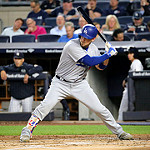
Ballpark Tours 2015 – Day Two – Wrigley

101 years of baseball at this location.

101 years of baseball at this location.

Day Two of my 2015 Ballpark Tours (BPT) trek began early Thursday morning in Chicago’s Gold Coast area. On the docket for “trekkers?” A day of sightseeing, a night game at Wrigley Field (Cubs/Giants) and maybe brews and blues post game. For information on Ballpark Tours and a report on Day One of this year’s trip, click here.

Early in the day, the BPT touring party fanned out in small groups heading for (among other places) – an on-the-river architectural tour, the Art Museum, the Museum of Science and Industry, Navy Pier and Magnificent Mile shopping – and those are just the excursions I heard about.  (Ballpark Tours always schedules free time for trekkers to take in local culture, entertainment, food, shopping, etc.)
Wrigleyville - Welcome to the neighborhood.

Wrigleyville – Welcome to the neighborhood.

By mid-afternoon – via the El, on-foot or by taxi – members of the group began making their way to Wrigleyville (Red Line Addison stop if you’re lucky enough to make a Cubs’ game). Our cadre headed for the Cubby Bear for pre-game food and beverage and – like most of the many Wrigleyville sports-oriented bars –  it was packed by 3 p.m. (before a 7:05 game).  BBRT’s suggestion – make it to Wrigleyville early and take in the atmosphere – sports bars packed with fans, bustling souvenir/memorabilia shops  and “hustling” outdoor stands and ticket sellers seemingly on every block.  Pre-game Wrigleyville is part of the Cubs’ experience.


As game time approached, the excitement in the bars and on the streets ratcheted up.  There was lots of Cubs’ Blue and Giants’ Orange.  This was a big series, with the Cubs trailing the Giants by just ½ game for the final Wild Card playoff spot.  Clearly, the fans (on both sides) were ready for meaningful baseball (and just over 41,000 would pack into Wrigley for the contest.

I got into the park early, collecting my promotional Cubbies Water Bottle – a give-away that I promptly gave away to a Cubs’ fan (didn’t need one more thing to cram into my suitcase). Now if it had been a bobble head …

On the way into Wrigley, I noted three things: 1) Lots of photo taking with the Ron Santo, Billie Williams and Ernie Banks statues; 2) Lots of street vendors selling water and peanuts; 3) Lots of Kyle Schwarber (#12) jerseys – more on that later.

For those of you who don’t track such things, there’s a great deal of messy construction in and around Wrigley Field this year (which will continue for quite some time), as the Cubs are restoring, improving and updating the century-old facility. The effort – deemed the 1060 Project – will cost about $575 million and should be completed by 2018. It includes improvements to Wrigley’s façade and infrastructure; upgraded restrooms, concourses, suites, press boxes and clubhouses; additional seating; a giant “jumbotron”; and even an adjacent hotel and office-retail complex.

Wrigley Field - new video board in left field may be a little too much.

Wrigley Field – new video board in left field may be a little too much.

Once inside Wrigley, we were witness to the most visible impacts of Phase 1 of Project 1060 – additional bleacher seating, a 3,990-square-foot video board in left field and a 2,250-square-video board in right field.  For BBRT at least, the changes take away some of the ancient lady’s charms.  Lost behind the video board in right field was the glimpse of Lake Michigan we used to enjoy – and cumulatively the expanded bleachers  and new video boards reduced the view of the Chicago skyline and Wrigleyville’s row house architecture. And, with all the usual video hoopla that comes with video boards – after spending all that money, you better maximize their use – Wrigley is no longer as much of a “step back in time” for fans.  BBRT’s take?  I like the tastefully sized right field video board, but find the massive left field video structure distracting and out of place with my image of Wrigley. Thank goodness they kept the ivy (Wrigley Field is the last remaining ballpark with ivy-covered outfield walls) and the manual scoreboard above the center field bleachers.

BBRT note: I set about informally surveying Cubs’ fans on how they felt about the changes and found out two things: 1) Cubs fans like the new video boards by about a 3-1 ratio (they appreciate joining the 21st century in terms of graphics and replay); 2) The Cubs make lots of money off visitors to Wrigley. On that second realization … I approached groups of fans in the ball park (concentrating on those in which at least one member was wearing Cubs’ apparel) for my survey and came fact-to-face with fans from California, Iowa, Ohio, Massachusetts, Arizona, Michigan, North Carolina and Louisiana before finding my first Chicagoan. Hopefully, changes to the park and adjacent area won’t cut into the attraction for fans from outside Chicago. 

Now to observations on the game.

Hunter Pence - MLB's highest stirrups?

Hunter Pence – MLB’s highest stirrups?

The Cubs jumped out to a 5-0 lead after two innings – and then held on for a 5-4 win, taking a half-game lead (for the final Wild Card spot) over the Giants – and sending the crowd into a rousing rendition of the “Go Cubs Go” victory song.  Good game, great fans in what is still a great place to watch a game. Some observations:

  • My obligatory score card got off to a bad start. Before the lineups were announced, I “inked” Cubs’ pitcher Jason Hammel into the nine spot.  “Clever” Joe Maddon, however, chose to bat the pitcher eighth, putting 2B Addison Russell in the nine-hole. Note: Hammel did lead off the second with a single – and later scored.
  • My Hammel lineup gaff hardly mattered. It’s hard to produce a “clean” scorecard, when the two teams use 35 players, including 12 pitchers and five pinch hitters.  Gotta love the National League and the double switch.
  • The Cubs’ 22-year-old rookie catcher Kyle Schwarber’s (#12) replica jerseys were all over the park. In the second inning, the 2014 first-round pick – and former High School and College All American – showed us why. He poled a three-run homer – and ended the contest hitting .342 with six homers and 18 RBI in 25 games.  Schwarber, who made his major league debut in mid-June, played in 147 minor league games in 2014-15, putting up a .333-34-102 line.
  • Kyle Schwarber is only one of many young players to watch on this exciting young Cubs’ team. Starting the game were: 3B Kris Bryant, 2B Addison Russell, RF Jorge Soler, SS Starlin Castro.
  • Giants’ RF Hunter Pence must have the highest stirrups in MLB.
  • The Giants’ offense was based on the “Brandon Principle.” Four runs on a pair of two-run homers – by 1B Brandon Belt (great baseball name) and SS Brandon Crawford.
  • It was a game of deep counts (on both sides). Twelve hurlers threw 315 pitches (136 balls, 179 strikes).


Ode to Cubbies/Giants


Young Cubbies take the day.

Put Champion Giants away.

Schwarber and Soler drive in five.

Two Brandons keep SF alive.


Still much to my dismay.

Not a single double-play.

And to top off my chagrin.                         

Also heard the Twinkies didn’t win.

Bad Bloody - somewhat saved by the Chicago Dog guy.

Bad Bloody – somewhat saved by the Chicago Dog guy.

Bloody Mary Review

When it comes to the traditional BBRT Bloody Mary Review, Wrigley won’t be flying the big “W” flag.  The $10 Bloody Mary, although featuring a generous vodka pour, suffered from a weak, very mild mix – and NO (that’s zero/nada) salt, pepper, tabasco or condiments (no pickles, olives, lime, celery, peppers, etc.). I actually ended up commandeering some celery salt, pepper and peppers from the Chicago Dog stand.


Decade Dogs

Decade Dogs - tastes for the ages.

Decade Dogs – tastes for the ages.

A final thought.  While in Wrigley, stop by the Decade Dogs booth featuring – on an alternating basis – ten specialty dogs to commemorate each of Wrigley’s ten decades.  On our day at the park, the featured item was “Mini Corn Dogs,” but you could also enjoy jumbo versions of the: Chicago Dog (a seven on a scale of ten according to one of our trekkers); Chili-Cheese Dog; Maxwell Street Polish; and (Ugh!) Veggie Dog.


And, now it’s on to Cleveland for the Twins, Dollar Dog Night and Two-dollar Bud Night. I’ll keep the Pepto ready for all three.


I tweet baseball @DavidBBRT – follow for notification of new blog posts.

me.