Unanimous MVPs – Voters Dig the Long Ball

Bryce Harper - powering his way to a unanimous MVP selection.

Bryce Harper – powering his way to a unanimous MVP selection.

In recently capturing all thirty first-place NL MVP votes, Nationals’ right fielder Bryce Harper became the fourth youngest MVP in MLB history, the youngest-ever unanimous MVP choice – and just the 18th unanimous MVP selection.

Despite the fact that the Nationals did not make the playoffs (all three NL MVP finalists came from teams that did not make the post season), Harper delivered the kind of season that has been expected from him since he won the NL Rookie of the Year Award (as teenager)  back in 2012. Harper led the league in such traditional categories as runs scored, home runs, on base percentage and slugging percentage – as well as in such new metrics as Wins Above Replacement, Offensive Win Percentage and Runs Created. He was also in the NL’s top five in batting average, total bases, doubles, runs batted in and walks.

There are solid indications that, if you want to earn a unanimous MVP selection, the power game is a good place to start. The 18 unanimous MVP selections include the most league leaders in home runs, RBI and slugging percentage (ten each); followed by runs scored and total bases (eight league leaders each) – as opposed to four leaders in on base percentage and three batting champions.

In this post, BBRT will provide a brief snapshot of MLB’s 18 unanimous MVP’s – but first a few facts about those who have earned that honor:

  • There have been ten unanimous MVP choices in the AL; eight in the NL.
  • First base is the most popular position with five unanimous MVPs; followed by right field (four); center field and third base (three each); pitcher (two); left field (one).
  • 14 unanimous MVPs came from first-place teams, the other four from second-place finishers.  (The Nationals .512 winning percentage was the lowest ever for a team boasting a unanimous MVP.)
  • While Bryce Harper was the youngest-ever unanimous MVP, the Giants’ Barry Bonds was the oldest ever – at age 37 (at the start of the 2002 season).
  • The average age of unanimous MVP winners (at start of their MVP seasons) is 29. The most popular age is 24, with five of the eighteen unanimous MVP winners starting their award-winning season at age 24.
  • The fourth MLB season seems to be the charm. It is the earliest point in a career that any player has earned a unanimous MVP selection – and more players have achieved unanimous MVP status in their fourth season (six of the eighteen) than any other career point. BBRT note: Hank Greenberg – counted among these six, essentially earned his unanimous MVP in three seasons. His first season included just one September plate appearance.
  • Only four players have earned unanimous MVP status in their tenth season or later – Orlando Cepeda (10th); Ken Caminti (10th); Frank Robinson (11th); Barry Bonds (17th).
  • Eight of the 18 unanimous MVP winners have won multiple MVP awards: Barry Bonds (seven); Albert Pujols, Mickey Mantle, Mike Schmidt (three each); Hank Greenberg, Carl Hubbell, Frank Robinson; Frank Thomas (two each).
  • Only two position players have earned 100 percent of the first place MVP votes without leading their league in any traditional offensive categories: Frank Thomas (AL, 1993) and Ken Caminiti (NL, 1996).
  • The two pitchers to earn unanimous MVP selection both led their league in wins and winning percentage – Carl Hubbell, 1936 and Denny McLain, 1938.
  • Three teams have had multiple unanimous MVP winners: The Tigers (Hank Greenberg, 1935 and Denny McLain, 1968); Giants (Carl Hubbell, 1936 and Barry Bonds, 2002); and the Cardinals (Orlando Cepeda, 1967 and Albert Pujols, 2009).


Now, here’s a “snap shot” of each of the eighteen unanimously selected MVPs. *=Hall of Famer

Hank Greenberg*, 1B, Tigers – 1935

Age (at start of MVP season): 24

MLB Season (in which the unanimous MVP was won): Fourth

Team Finish: First Place (93-58, .616)

MVP Awards: 1935, 1940

States … Games: 152    Avg.: .328    Hits: 203    Doubles: 46    Triples: 16    HRs: 36    Runs: 120    RBI: 168   Steals: 4

Led league in Home Runs (36); RBI (168); Total Bases (389)

_____

Carl Hubbell*, SP, Giants – 1936

Age: 32

MLB Season: Ninth

Team Finish: First Place (92-62, .597)

MVP Awards: 1933, 1936

Stat … W-L: 26-6 .813    ERA: 2:31    Innings Pitched: 304    Strikeouts: 123

Led League in: Wins (26); Winning Percentage. (813); ERA (2.31)

_____

Al Rosen, 3B, Indians – 1953

Age: 24

MLB Season: Seventh

Team Finish: Second Place (92-62, .597)

MVP Awards: 1953

Stats … Games: 155    Avg.:  .336    Hits: 201    Doubles: 27    Triples: 5    HRs: 43    Runs: 115    RBI: 145   Steals: 8

Led league in: Home Runs (43); Runs (115); RBI (145); Total Bases (367); Slugging Percentage (.613)

_____

Mickey Mantle*, Center Field, Yankees – 1956

Age: 24

MLB Season: Sixth

Team Finish: First Place (97-57, .630)

MVP Awards: 1956, 1957, 1962

Stats … Games: 150     Avg.: .353    Hits: 188    Doubles: 22    Triples: 5   HRs: 52    Runs: 132    RBI: 130   Steals: 10

Led league in: Average (.353); Home Runs (52); Runs (132); RBI (130); Total Bases (376); Slugging Percentage (.705)

_____

Frank Robinson*, Orioles – 1966

Age: 30

MLB Season: Eleventh

Team Finish: First Place (97-63, .606)

MVP Awards:  1961, 1966

Stats … Games: 155    Avg.:  .316    Hits: 182    Doubles: 34    Triples: 2    HRs: 49    Runs: 122    RBI: 122   Steals: 8

Led league in: Average (.316); Home Runs (49); Runs (122); RBI (122); Total Bases (367); On Base Percentage (.410); Slugging Percentage (.637)

______

Orlando Cepeda*, First Base, Cardinals – 1967

Age: 29

MLB Season: Tenth

Team Finish: First Place (101-60, .627)

MVP Awards: 1967

Stats … Games: 151    Avg.: .325    Hits: 183    Doubles: 37    Triples: 0    HRs: 525    Runs: 91    RBI: 111   Steals: 11

Led league in: RBI (111); HBP (12)

______

Denny McLain, SP, Tigers – 1968

Age: 24

MLB Season: Sixth

Team Finish: First Place (103-59, .636)

MVP Awards: 1968

Stats … W-L: 31-6, .838    ERA: 1.96    Innings Pitched: 336    Strikeouts:  280

Led league in: Wins (31); Winning Percentage. (.838); Innings Pitched (336); Starts (41); CG (28)

_____

Reggie Jackson*, RF, A’s – 1973

Age: 26

MLB Season: Seventh

Team Finish: First Place (94-68, .580)

MVP Awards: 1973

Stats … Games: 151    Avg.:  .293    Hits: 158    Doubles: 28    Triples: 2    HRs: 32    Runs: 99    RBI: 117   Steals: 22

Led league in: Home Runs (32); Runs (99); RBI (117); Slugging Percentage (.531)

_____

Mike Schmidt*, 3B. Phillies – 1980

Age: 30

MLB Season: Ninth

Team Finish: First Place (91-71, .562)

MVP Awards: 1980, 1981, 1986

Stats .. Games: 150   Avg.: .286    Hits: 157    Doubles: 25    Triples: 8    HRs: 48    Runs: 104    RBI: 21   Steals: 12

Led league in: Home Runs (48); RBI (121); Total Bases (342); Slugging Percentage (.624); Gold Glove

______

Jose Canseco, Right Field, A’s  1988

Age: 23

MLB Season: Fourth

Team Finish: First Place (104-58, .642)

MVP Awards: 1988

Stats … Games: 158   Avg.:  .307    Hits: 187    Doubles: 34    Triples: 0    HRs: 42    Runs: 120    RBI: 124   Steals: 40

Led league in: Home Runs (42); RBI (124); Slugging. Percentage (.569)

______

Frank Thomas*, First Base, White Sox – 1993

Age: 24

Major League Season: Fourth

Team Finish: First Place (94-68, .580)

MVP Awards: 1993, 1994

Stats … Games: 153    Avg.:  .317    Hits: 174    Doubles: 36    Triples: 0  HRs: 41    Runs: 106    RBI: 128   Steals: 4

Led league in: No  traditional offensive categories.

______

Jeff Bagwell, First Base, Astros – 1994

Age: 26

MLB Season: Fourth

Team Finish: Second Place (66-49, .574)

MVP Awards: 1994

Stats … Games: 110    Avg.: .368    Hits: 147    Doubles: 32    Triples: 2    HRs: 39    Runs: 104    RBI: 116   Steals: 15

Led league in: Runs (104); RBI (116); Total Bases (300); Slugging Percentage (.750); Gold Glove

______

Ken Caminiti, Third Base, Padres – 1996

Age: 32

MLB Season: Tenth

Team Finish: First Place (91-71, .562)

MVP Awards: 1996

Stats … Games: 146    Avg.:  .326   Hits: 178   Doubles: 37    Triples: 2    HRs: 40    Runs: 109    RBI: 130  Steals: 11

Led league in: No traditional  offensive categories; Gold Glove

______

Ken Griffey, Jr., Center Field, Mariners – 1997

Age: 27

MLB Season: Ninth

Team Finish: First Place (90-72, .556)

MVP Awards: 1997

Stats … Games: 157    Avg.:  .304    Hits: 185    Doubles: 34    Triples: 3    HRs: 56    Runs: 99    RBI: 147   Steals: 15

Led league in: Home Runs (56); Runs (125); RBI (147); Total Bases (393); Slugging Percentage (.646); Gold Glove

______

Barry Bonds, Left Field, Giants – 2002

Age: 37

MLB Season: Seventeenth

Team Finish: Second Place (95-66, .590)

MVP Awards: 1990, 1992, 1993, 2001, 2002, 2003, 2004

Stats … Games: 143    Avg.: .370    Hits: 149    Doubles: 31    Triples: 2    HRs: 46    Runs: 117  RBI: 110   Steals: 9

Led league in: Average (.370); On Base Percentage (.582); Slugging Percentage (.799)

______

Albert Pujols, First Base, Cardinals – 2009

Age: 29

MLB Season: Ninth

Team Finish: First Place (91-71, .562)

MVP Awards: 2005, 2008, 2009

Stats … Games: 160    Avg.:  .327    Hits: 186    Doubles: 45    Triples: 1    HRs: 47    Runs: 124    RBI: 135   Steals: 16

Led league in: Home Runs (47); Runs (124); On Base Percentage (.443); Slugging Percentage (.658); Total Bases (374)

______

Mike Trout, Center Field, Angels – 2014

Age: 22

MLB Season: Fourth

Team Finish: First Place (98-64, .605)

MVP Awards:  2014

Stats … Games: 157    Avg.:  .287    Hits: 173    Doubles: 39    Triples: 9    HRs: 36    Runs: 115     RBI: 111   Steals: 33

Led league in: Runs (115); RBI (111); Total Bases (338)

______

Bryce Harper, Right Field, Nationals – 2015

Age: 22

MLB Season (in which MVP earned): Fourth

Team Finish: Second Place (83-79, .512)

MVP Awards: 2015

Stats … Games: 153   Avg.: .330   Hits: 172   Doubles: 38    Triples: 1    HRs: 42   Runs: 118    RBI: 99   Steals: 6

Led league in: Home runs (42); Runs (118); On Base Percentage (.460); Slugging Percentage (.649)

I tweet baseball @DavidBBRT

Member: Society for American Baseball Research (SABR); The Baseball Reliquary; Baseball Bloggers Alliance

Ballpark Tours 2015 – Day Two – Wrigley

101 years of baseball at this location.

101 years of baseball at this location.

Day Two of my 2015 Ballpark Tours (BPT) trek began early Thursday morning in Chicago’s Gold Coast area. On the docket for “trekkers?” A day of sightseeing, a night game at Wrigley Field (Cubs/Giants) and maybe brews and blues post game. For information on Ballpark Tours and a report on Day One of this year’s trip, click here.

Early in the day, the BPT touring party fanned out in small groups heading for (among other places) – an on-the-river architectural tour, the Art Museum, the Museum of Science and Industry, Navy Pier and Magnificent Mile shopping – and those are just the excursions I heard about.  (Ballpark Tours always schedules free time for trekkers to take in local culture, entertainment, food, shopping, etc.)

Wrigleyville - Welcome to the neighborhood.

Wrigleyville – Welcome to the neighborhood.

By mid-afternoon – via the El, on-foot or by taxi – members of the group began making their way to Wrigleyville (Red Line Addison stop if you’re lucky enough to make a Cubs’ game). Our cadre headed for the Cubby Bear for pre-game food and beverage and – like most of the many Wrigleyville sports-oriented bars –  it was packed by 3 p.m. (before a 7:05 game).  BBRT’s suggestion – make it to Wrigleyville early and take in the atmosphere – sports bars packed with fans, bustling souvenir/memorabilia shops  and “hustling” outdoor stands and ticket sellers seemingly on every block.  Pre-game Wrigleyville is part of the Cubs’ experience.

As game time approached, the excitement in the bars and on the streets ratcheted up.  There was lots of Cubs’ Blue and Giants’ Orange.  This was a big series, with the Cubs trailing the Giants by just ½ game for the final Wild Card playoff spot.  Clearly, the fans (on both sides) were ready for meaningful baseball (and just over 41,000 would pack into Wrigley for the contest.

I got into the park early, collecting my promotional Cubbies Water Bottle – a give-away that I promptly gave away to a Cubs’ fan (didn’t need one more thing to cram into my suitcase). Now if it had been a bobble head …

On the way into Wrigley, I noted three things: 1) Lots of photo taking with the Ron Santo, Billie Williams and Ernie Banks statues; 2) Lots of street vendors selling water and peanuts; 3) Lots of Kyle Schwarber (#12) jerseys – more on that later.

For those of you who don’t track such things, there’s a great deal of messy construction in and around Wrigley Field this year (which will continue for quite some time), as the Cubs are restoring, improving and updating the century-old facility. The effort – deemed the 1060 Project – will cost about $575 million and should be completed by 2018. It includes improvements to Wrigley’s façade and infrastructure; upgraded restrooms, concourses, suites, press boxes and clubhouses; additional seating; a giant “jumbotron”; and even an adjacent hotel and office-retail complex.

Wrigley Field - new video board in left field may be a little too much.

Wrigley Field – new video board in left field may be a little too much.

Once inside Wrigley, we were witness to the most visible impacts of Phase 1 of Project 1060 – additional bleacher seating, a 3,990-square-foot video board in left field and a 2,250-square-video board in right field.  For BBRT at least, the changes take away some of the ancient lady’s charms.  Lost behind the video board in right field was the glimpse of Lake Michigan we used to enjoy – and cumulatively the expanded bleachers  and new video boards reduced the view of the Chicago skyline and Wrigleyville’s row house architecture. And, with all the usual video hoopla that comes with video boards – after spending all that money, you better maximize their use – Wrigley is no longer as much of a “step back in time” for fans.  BBRT’s take?  I like the tastefully sized right field video board, but find the massive left field video structure distracting and out of place with my image of Wrigley. Thank goodness they kept the ivy (Wrigley Field is the last remaining ballpark with ivy-covered outfield walls) and the manual scoreboard above the center field bleachers.

BBRT note: I set about informally surveying Cubs’ fans on how they felt about the changes and found out two things: 1) Cubs fans like the new video boards by about a 3-1 ratio (they appreciate joining the 21st century in terms of graphics and replay); 2) The Cubs make lots of money off visitors to Wrigley. On that second realization … I approached groups of fans in the ball park (concentrating on those in which at least one member was wearing Cubs’ apparel) for my survey and came fact-to-face with fans from California, Iowa, Ohio, Massachusetts, Arizona, Michigan, North Carolina and Louisiana before finding my first Chicagoan. Hopefully, changes to the park and adjacent area won’t cut into the attraction for fans from outside Chicago. 

Now to observations on the game.

Hunter Pence - MLB's highest stirrups?

Hunter Pence – MLB’s highest stirrups?

The Cubs jumped out to a 5-0 lead after two innings – and then held on for a 5-4 win, taking a half-game lead (for the final Wild Card spot) over the Giants – and sending the crowd into a rousing rendition of the “Go Cubs Go” victory song.  Good game, great fans in what is still a great place to watch a game. Some observations:

  • My obligatory score card got off to a bad start. Before the lineups were announced, I “inked” Cubs’ pitcher Jason Hammel into the nine spot.  “Clever” Joe Maddon, however, chose to bat the pitcher eighth, putting 2B Addison Russell in the nine-hole. Note: Hammel did lead off the second with a single – and later scored.
  • My Hammel lineup gaff hardly mattered. It’s hard to produce a “clean” scorecard, when the two teams use 35 players, including 12 pitchers and five pinch hitters.  Gotta love the National League and the double switch.
  • The Cubs’ 22-year-old rookie catcher Kyle Schwarber’s (#12) replica jerseys were all over the park. In the second inning, the 2014 first-round pick – and former High School and College All American – showed us why. He poled a three-run homer – and ended the contest hitting .342 with six homers and 18 RBI in 25 games.  Schwarber, who made his major league debut in mid-June, played in 147 minor league games in 2014-15, putting up a .333-34-102 line.
  • Kyle Schwarber is only one of many young players to watch on this exciting young Cubs’ team. Starting the game were: 3B Kris Bryant, 2B Addison Russell, RF Jorge Soler, SS Starlin Castro.
  • Giants’ RF Hunter Pence must have the highest stirrups in MLB.
  • The Giants’ offense was based on the “Brandon Principle.” Four runs on a pair of two-run homers – by 1B Brandon Belt (great baseball name) and SS Brandon Crawford.
  • It was a game of deep counts (on both sides). Twelve hurlers threw 315 pitches (136 balls, 179 strikes).


Ode to Cubbies/Giants


Young Cubbies take the day.

Put Champion Giants away.

Schwarber and Soler drive in five.

Two Brandons keep SF alive.


Still much to my dismay.

Not a single double-play.

And to top off my chagrin.                         

Also heard the Twinkies didn’t win.

Bad Bloody - somewhat saved by the Chicago Dog guy.

Bad Bloody – somewhat saved by the Chicago Dog guy.

Bloody Mary Review

When it comes to the traditional BBRT Bloody Mary Review, Wrigley won’t be flying the big “W” flag.  The $10 Bloody Mary, although featuring a generous vodka pour, suffered from a weak, very mild mix – and NO (that’s zero/nada) salt, pepper, tabasco or condiments (no pickles, olives, lime, celery, peppers, etc.). I actually ended up commandeering some celery salt, pepper and peppers from the Chicago Dog stand.


Decade Dogs

Decade Dogs - tastes for the ages.

Decade Dogs – tastes for the ages.

A final thought.  While in Wrigley, stop by the Decade Dogs booth featuring – on an alternating basis – ten specialty dogs to commemorate each of Wrigley’s ten decades.  On our day at the park, the featured item was “Mini Corn Dogs,” but you could also enjoy jumbo versions of the: Chicago Dog (a seven on a scale of ten according to one of our trekkers); Chili-Cheese Dog; Maxwell Street Polish; and (Ugh!) Veggie Dog.


And, now it’s on to Cleveland for the Twins, Dollar Dog Night and Two-dollar Bud Night. I’ll keep the Pepto ready for all three.


I tweet baseball @DavidBBRT – follow for notification of new blog posts.

me.


Ballpark Tours 2015 – Every Mile a Memory

This morning I departed on my annual Ballpark Tours’ (BPT) baseball trek, my 27th such journey.  Ballpark tours has taken me to major and minor league ball parks from Colorado to New York and pretty much all parts in between.  (Thank you, “tour master” Julian Loscalzo.) On this year’s trek, I’m joining 35 other baseball fans and fanatics for a week-long bus tour that is taking us to a minor league game in Schaumburg, IL (just outside of Chicago), as well as major league contests in Chicago (Cubs hosting Giants), Cleveland (Indians hosting our Twins), Detroit (Tigers hosting Red Sox), back to Chicago (White Sox entertaining the Angels) and then back to our home base of Saint Paul, MN (with a stop at a craft brewery in Wisconsin on the way home).

Before I begin my series of “reports from the road,” let me put in an unabashed plug.  For BBRT, there is no better baseball touring group than Ballpark Tours – just the right amount of chaos and discipline; comfortable transportation; great hotels; time in most cities to take in local culture, arts, food and nightlife (I’m planning on the Chicago’s Museum of Science and Industry and Cleveland’s Rock and Roll Hall of Fame on this trip); and, most important, the comradery – every year, without fail – of a great group of fun-loving baseball fans/friends.  How do others feel about Ballpark Tours?  On this trip, 35 of our 36 trekkers are repeat participants. How do I feel about BPT?  Hey, every morning for the next week I can get up knowing the most important item on my agenda is going to a ball game.  How can you beat that? For more on Ballpark Tours (and the upcoming Cuban trip), click here. 

I probably won’t post every day (we do have a busy schedule), but here’s first report from the tour.

DAY ONE

Scnuamburg tsnirtWe met our bus in Saint Paul’s Midway area at 9:30 a.m. Wednesday, August 5, and the parking lot was filled not just with our luggage, but also with hugs and handshakes, as old baseball- and tour-based friendships were renewed.   We loaded up quickly, with the rowdier trekkers heading for their seats at the back of the bus, and the less animated at the front (there is always a friendly competition between “the front of the bus” and the “back of the bus”).  The departure was toasted with coffee, juice, energy drinks (we’ll need them in the days ahead) – as well as an assortment of adult beverages.

The theme for this trip is Rock N’Roll Adventure (commemorative and complimentary T-shirts were handed out before we boarded the bus) and our theme would prove prophetic sooner than even I expected (but I don’t want to get ahead of myself).

As is Ballpark Tours’ tradition, early in the day, the K-Kwiz – a baseball trivia contest – was distributed and each trekker took the microphone and introduced themselves – usually with a baseball-related story. (Oh, and I shouldn’t forget, participants also described the books they each brought for the on-board baseball book exchange). It was during this phase that I began feeling like the Minnie Minoso of BPT – having been on BPT trips in four consecutive decades, beginning in the 1980s.  I should note here that Day One would feature other handouts – including a schedule of our games, hotels and arrival/departure times; a Ports-O-Call guide to restaurants, “watering holes,” museums, music, public transit, etc. in the cities we will visit; and entry forms for a contest based on predicting the total runs scored in MLB over the weekend. We will leave a paper trail.

You never know who'll show up on a Ballpark Tours trip.

You never know who’ll show up on a Ballpark Tours trip.

Around lunch time, we also had a visit from the “Assistant Pope” (aka Tom Smith) – who regaled the group with a laugh-provoking monologue worthy of a comedy club and then distributed assorted crackers, deli meats, cheeses and “sacred” eel pout (actually pickled herring) throughout the bus.  We lunched, pack your own, at a rest stop along the highway – with trekkers unveiling everything from deli sandwiches and beer to an elaborate picnic table buffet of baguettes, lox, assorted cheeses, stuffed olives and Napa Valley wine.

Then, it was back on the bus, when the Rock N’Roll Adventure began to rock.  Thanks to modern technology, the back of the bus began a long-lasting sing-along to 70’s rock – which included plenty of air guitar and dancing in the aisle of the bus. The moves being thrown down were a bit subdued given the limited space, but the singing was spirited (especially on Rolling Stones and Beatles numbers).

Great seats!

Great seats!

Of course, this is a baseball trip, and – we arrived in Schaumburg – for the Schaumburg Boomers/Southern Illinois Miners games.  The Boomers play in the independent Frontier League, so the names won’t be recognizable, but here are a few observations:

  • A nice park – I always like the old-style Red Brick – but it was empty (the over and under on fans was about 300 in a stadium that holds 7,365). It was almost like the tour group had a private showing.
  • The lighting, as in a number of minor league parks, was terrible (although only one fly ball – a foul pop-up was “lost” in the dark).
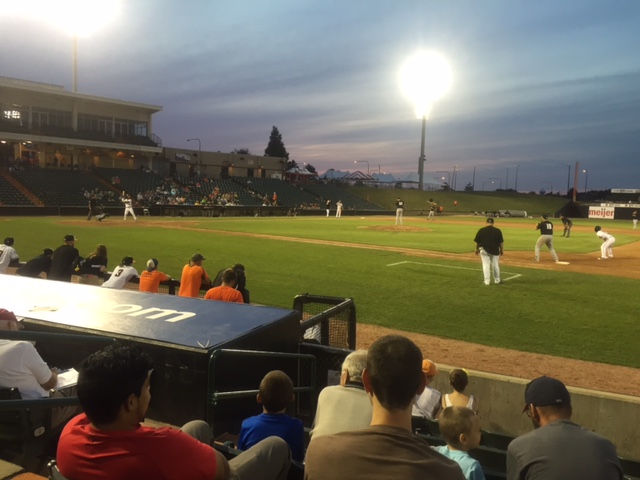
  • We had great seats, at the edge of the first base dugout – row six. (However, you could sit pretty much anywhere you wanted.)
  • The ball park was not kind to dead pull hitters – 355-feet down the left field line and 353-feet to the right field corner. One team representative informed me that the dimensions matched Wrigley Field because the mayor of Schaumburg “has a thing for the Cubs.”  Further digging showed deeper Cubs’ ties.  The stadium, which opened in 1999, is built on land purchased in the 1980s – reportedly as a potential site of a new home for the Cubs (the New Wrigley Field) if the team and the city of Chicago could not come to an agreement on night baseball.
  • Several small planes from the nearby Schaumberg Airport flew over the stadium during the game, seeming to clear the third-base-side light towers by about fifty-feet.
  • The team’s signature sandwich, the Schaumburger (a hamburger, topped with pulled pork and cole slaw for eight dollars) was both juicy and tasty. BBRT would recommend it.
  • There will be no Bloody Mary review for Schaumburg Boomers Stadium – the only adult beverage was beer.
  • There was general agreement among those of us keeping score sheets that the official scorekeeper had lost his or her red “error” pen – two or three errors were scored as base hits.

As for the game itself, Southern Illinois topped Schaumburg 4-1 in a fairly “quiet” contest – that’s what happens when you have 300 fans in the stands.  But there were a few highlights, at least from the BBRT point of view. Southern Illinois’ leadoff hitter CF Aaron Gates showed great speed, going three-for-four with a pair of well-placed bunt singles down the third base line. Schaumburg’s leadoff hitter 2B Mike Schulze also got on base three times – via three walks.  The stadium organ player was right on top of things, playing Fitz and the Tantrum’s song “The Walker” after Schulze’s last plate appearance. Schaumburg did turn a nifty third-second-first double play (TJ Bennett to Mike Schulze to Willi Martin) in the middle of Southern Illinois’ three-run third inning. (BBRT loves a good double play.) Southern Illinois’ starting pitcher Adam Lopez (who came into the game with a 1.88 ERA and 82 strikeouts in 76 1/3 innings) showed good stuff – giving up one run in six innings, with three hits, two walks and six strikeouts.

IndigoPost-game, we checked in to the Hotel Indigo, in Chicago’s Gold Coast neighborhood.  Another quality Ballpark Tours lodging choice. All in all, a great first day.


More on the tour in the days to come, including BBRT’s take on the changes to Wrigley Field – video screens, expanded bleachers, concourse/concession upgrades, etc.

I tweet baseball @DavidBBRT    (Note: Follow me on twitter for notification of new blog posts.)

Beltre’s Record-Tying Cycle

Adrian Beltre - Solid credentialq with the bat and the glove.

Adrian Beltre – Solid credentialq with the bat and the glove.

Adrian Beltre tied a MLB record yesterday (August 3) – as his Rangers topped the Astros 12-9 – becoming just the fourth player to hit for the cycle (single, double, triple, home run in a game) three times in a career. The 36-year-old Beltre, in his 18th major league season, joins John Reilly, Babe Herman and Bob Meusel with three career cycles. Beltre hit a triple in the first inning (getting the hard one out of the way, especially on 36-year-old legs), a double in the second, a single in the third and a home run in the fifth.  For the game, he went four-for-five, with two runs scored and three RBI.  Here are a few bits of trivia related to Beltre’s achievement:

Despite completing his cycle in the first five innings, Beltre does not have the fastest cycle in MLB history.  That distinction goes to Rockies’ Mike Lansing. On June 18, 2000, Lansing completed the cycle in just four innings – as the Rockies topped the Diamondbacks 19-2. In that game, Lansing went four-for-five with three runs scored and five RBI.  Lansing could have done more damage, but was lifted for a pinch hitter in the eighth.

– Beltre’s three cycles have come on September 1, 2008 (for the Mariners against the Rangers); August 24, 2012 (for the Rangers against the Twins); and August 3, 2015 (for the Rangers against the Astros).

– All three of Beltre’s cycles have come at Arlington, making him the only player to hit for multiple cycles in the same park for more than one team.  (As BBRT maintains, in baseball, we keep track of pretty much everything.)

– In his three cycles, Beltre has gone thirteen-for-fifteen (.867), with eight runs, nine RBI and three doubles, three triples, three home runs.

Beltre, by the way, is somewhat quietly building a resume that should earn him serious Hall of Fame consideration. To date, he had 2,697 hits; 404 home runs; 1, 304 runs scored; and 1,414 RBI – to go with a .284 career average. He’s a four-time All Star; four-time Gold Glove winner; and has led his league in hits, doubles and home runs once each.  In addition to now being one of just four players to hit for the cycle three times, he is also one of only five players to hit 100 or more home runs for three different teams (Dodgers, Marines, Rangers); joining Darrell Evans (Braves, Giants, Tigers); Reggie Jackson (A’s, Angels, Yankees); Jim Thome (Indians, Phillies, White Sox); and Alex Rodriguez (Rangers, Mariners, Yankees). While not a likely first-ballot electee, reaching 3,000 hits and 1,500 RBI should give Beltre a solid shot at the Hall.

For you trivia buffs, thanks to the Cubs’ long-time reluctance to install lights, Tim Foli of the Montreal Expos is the only MLBer to start a cycle on one day and complete it the next. On April 21, 1976, Foli collected a single, double and triple against the Cubs before the game was suspended due to darkness (top of the seventh. with the Expos up 11-3).  When play resumed on April 22, Foli added an eighth-inning home run – completing a somewhat unnatural “natural” (single, double, triple, home run in that order) cycle.   To date there have been just 14 natural cycles in MLB history. The Expos, by the way, won the game 12-6.  


I tweet baseball @DavidBBRT

Saint Paul Saints First Game at CHS Field – If Fun is Good. This is Great.

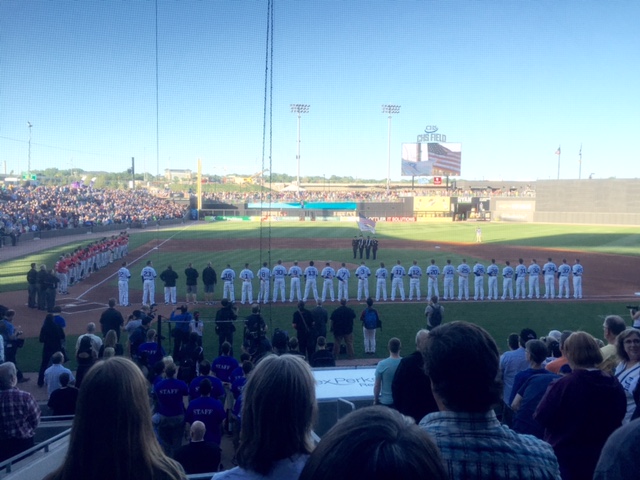
Teams line up for Saints Opening Day and inaugural game at CHS Field.

Teams line up for Saints Opening Day and inaugural game at CHS Field.

Thursday night (May 21), I was lucky enough to attend the Saint Paul Saints (independent American Association) home opener – which also marked the Saints’ first game and their brand new, downtown Saint Paul, CHS Field ballpark. (I was also at the 1993 first-ever Saints’ – this version – game and, thanks to a computer ticket printing glitch, even got to sit next to Bill Murray (yes, THAT Bill Murray) for awhile. My brother Bob still has the photo, ticket and autographed program, but that’s for another post. Let’s get back to the 2015 opener.)

This post – taking a look at my Saints-CHS Field experience may be of most interest to Minnesota BBRT readers.  To others, if you are ever in the area, you’ll want to take in a Saints game.  As Saints co-owner Mike Veeck would say “Fun is Good!” and, if that’s the criteria, the Saints and CHS Field are great!

Now, there was some concern among long-time Saints Fans that the fancy new digs – replacing aging Midway Stadium – might dampen the Saints’ penchant for quirkiness, irreverence and just plain fun.  Let me assure you, it is still all “fun and game(s)” at a Saints game.  CHS Field is a beautiful ballpark, set in Saint Paul’s Lowertown – the site lines are great, the facilities and concessions top notch and the staff accommodating and friendly.

The fire dancers, as they say, were hot.

The fire dancers, as they say, were hot.

The inaugural game also provided solid evidence that the character of the franchise will not change.  There was the familiar Saints (pig) mascot – this year named Pablo Pigasso.  You could still get a haircut at the ball game. There were mimes, fire dancers, “usher-tainers” and the Saints’ trademark host of zany between innings entertainment, most directly involving fans (like a giant game of spin the bottle, cow tipping, and a “real” tire race). On opening night, there was even a Mardi Gras-style parade (with a band playing, of course, “When the Saints Go Marching In” and a drone “flyover” (actually a fly around).

The usher-trainers were back in full force.

The usher-trainers were back in full force.

The Saints’ family atmosphere also carried over from Midway Stadium, as Saints grandstand regulars greeted each other with plenty of hugs, handshakes and high-fives.  Game one of 2015 was a bit of a reunion for this loyal group, who also go out of their way to welcome new fans to the Saints’ experience.  Saints co-owner Mike Veeck (see more on Veeck at the end of this post) also was personally greeting fans as he walked the concourse – embracing old friends and clearly making new ones.

Great sight lines no matter where you are in this very "walkable" park.

Great sight lines no matter where you are in this very “walkable” park.

So, there was plenty of fun – and there was plenty of “game” as well.  On opening night, the Saints sent the crowd home smiling (actually, we were smiling all night) with an 8-7 win over the Fargo-Moorhead Red Hawks.  The game – before 8.592 fans – provided plenty of excitement: including five home runs (three by the Saints); multiple ties and lead changes; four stolen bases; some sparkling defense (as well as a trio of errors – made by a pair of Saints’ third basemen).  I’ll get to some game action and stats, but first a few observations on CHS Field and the Saints’ fan- and fun-friendly approach to the national pastime.

  • This is a truly “walkable” ballpark. BBRT highly recommends that you walk the entire concourse.  The views are great, especially from the left field berm (where you get a nice panoramic view of the St. Paul city skyline).
  • All the seats are close to the action. The sight lines are great. (And the tickets reasonably priced – basically from five-dollars on the left field berm to $18 for home plate reserved. (There are some premium seats, suites, skuyboxes, etc.)
  • There are plenty of tasty concessions. BBRT can testify to the quality of the Cuban Panini (from the Yum Power Sandwich Lot). Fans I talked with also had great things to say about The Saints Blue Burger (Burger Depot); The Fajita Dog and Chicago Dog (The Dog Park); the malts from Snuffy’s; and the cupcakes from the Gingko cart. And, I’m just touching the surface.  On my list for the rest of the season are: the “Mudonna” Memphis-style pulled pork (Mud’s BBQ); five-patty Grand Slam Burger (Gallery Grill); Walleye Fingers (Fries and Pies): Philly Cheesesteak (Steakadelphia); Burrito (Salsa cart). Of course, there also are all the traditionals – hot dogs, fries, pizza, peanuts and the like.
  • What goes together better than beer and a ball game? How about a local craft beer and a ball game? More than a dozen craft brew houses are offering their best in the left field Craft Brew Corner.
Art with a purpose. Empowered Percussion (303 Prince Street, Suite 312, St. Paul) was exhibiting and demonstrating its hand-built cajon drums on Opening Day.

Art with a purpose. Empowered Percussion (308 Prince Street, Studio 312, St. Paul) was exhibiting and demonstrating its hand-built cajon drums on Opening Day.  empoweredpercussion@gmail.com

CHS Field and the Saints honor Saint Paul’s Lowertown artists’ community with a special outdoor gallery (in the concourse behind home plate) that will feature work from various members of the St. Paul Arts Collective at each home game – a total of 100 artists over the course of the season.


  • The Saints mascots “Mudonna” and Pablo Pigasso are on hand, as are a host of “usher-tainers.” There is never a dull moment between innings.
  • The Saints have also scheduled their usual diverse slate of “nights.” To give you some idea of the range – July 9 is “Pink It Up Night – A Salute to Jackie Kennedy”; July 20 is Larry Doby Night (first player to break the American League “color line”); and September 7 will see the Fan Appreciation Night Monster Food Truck Rally. Check the schedule, I’m sure the Saints will have a night made just for you.
  • For pre- and post-game fun, the Lowertown neighborhood offers a wide range of bars and restuarants – great places to socialize in the atmosphere of your choice – from hip and trendy to old school.  Get to the neighborhood early and take in the ambiance.
  • Parking is not the problem some predicted. Despite the capacity crowd, I parked just three blocks from the ballpark for $5.  (I did get there ninety minutes before game time, but there is plenty to do in the neighborhood.)

So, there’s my CHS Field experience.  My recommendation – get down there to a ball game as soon as you can.  It will truly be “fun and game(s).”

BBRT Note: Two minor criticisms. 1) As regular readers know, it’s a BBRT tradition to rate the Bloody Mary’s at each ballpark I visit.  Despite a number of alcohol serving locations on the main level, Bloody Mary’s, I was told, are “not on the menu.” 2) The Saints Store and gift stands offered no items commemorating the inaugural game/date (I heard several fans requesting just such an item).

Now, here are a few stats/facts from the game for you first-game trivia buffs (yes, as always, a complete and accurate score card was a BBRT priority).

CHS Field firsts:

  • First run scored – Red Hawks 2B Frank Salerna, top of the 1st
  • First base hit – Red Hawks CF Chad Mozingo, top of 1st, single
  • First RBI – Red Hawks 1B Stefan Gartrell, top of the first on a sacrifice fly
  • First Saints run scored – DH Ian Gac, bottom of the 2nd
  • First Saints RBI – C Vinny DiFazio, bottom of 2nd, on a single
  • First home run – Vinny DiFazio, bottom of the 4th
  • First pitcher’s strikeout – Red Hawks Brandon Mann (Saints’ Sam Maus in 1st)
  • First Saints pitcher’s strikeout – Pedro Hernandez (Red Hawks’ Chris Duffy in 2nd)
  • First pitcher’s victory – Saints’ Dylan Chavez
  • First four-hit game – Saints DH Ian Gax (four-for-four, HR, 2B, two singles)
  • First multi-homer game – Red Hawks RF Joe Dunnigan (two homers)
Mike Veeck - Fun IS Good - just ask him.

Mike Veeck – Fun IS Good – just ask him.

When it comes to the Saints, blending baseball and fun are a family tradition. For those not familiar with the Saints, one of forces behind the team (and one of its owners) is Mike Veeck – whose grandfather was president of the Chicago Cubs and whose father Bill Veeck made it into the Baseball Hall of Fame as an owner of the Saint Louis Browns, Cleveland Indians and Chicago White Sox. As an owner, Bill Veeck gained a reputation for innovation, irreverence (tweaking the baseball establishment), championing social justice and bringing his own version of “play” and “fair play” to life and to the ball park. (For more on Bill Veeck, check out the review of Paul Dickson’s book “Bill Veeck – Baseball’s Greatest Maverick” here.) Mike Veeck brings those same qualities to his own extensive business and baseball resume – and to the Saints. (Check out his book “Fun is Good – How to Create Joy and Passion in Your Workplace and Career.”) If fun is good, then the Saints are great!

BBRT note; Another Saints co-owner, actor Bill Murray is listed in the Saints Yearbook as the “Team Psychologist.” That should tell you something.


It's the Saints - It wasn't all PC.

It’s the Saints – It wasn’t all PC.


I tweet baseball @DavidBBRT

MLB Players to Win a Gold Glove and Silver Slugger in the Same Season

Adrian Gonzalez - only player to earn a Gold Glove AND a Silver Slugger in 2014.

Adrian Gonzalez – only player to earn a Gold Glove AND a Silver Slugger in 2014.

The 2014 Rawlings Golden Glove and (Hillerich and Bradsby) Silver Slugger Awards – honoring the best defensive and offensive  players in each league at each position are on the books – and Dodgers’ first baseman Adrian Gonzalez was the only player to capture both a Gold Glove and a Silver Slugger for this past season.  The 2014 season, in fact, marks the first time (since 1980, when the Silver Sluggers were first awarded) that only one player has earned both a Silver Slugger and Gold Glove in the same campaign. Note:  The Gold Glove award was established in 1957.

Since 1980, the combination of a Gold Glove/Silver Slugger has been achieved 169 times by 90 different players.  You’ll find a complete list of the players who have earned recognition as the offensive and defensive leader in their respective leagues at the end of this post. Since the Silver Slugger is awarded to three outfielders annually regardless of their position (LF, CF, RF), the lists in this post do not break outfielders out by position.  Before, we take a look at the full list, here are few SS/GG combination “factoids.”


  • Ivan Rodriguez (C), Ken Griffey, Jr. (OF) and Barry Bonds (OF) have each won the double (Silver Slugger/Gold Glove) crown in a season an MLB-record seven times.
  • Ivan Rodriguez won the SS/GG combo for his position a record six consecutive seasons (1995-1999).
  • Roberto Alomar (2B) is the only player to win the single-season Gold Glove/Silver Slugger combo with three different teams (Blue Jays-1992; Orioles-1996; Indians-1999, 2000)
  • Ivan Rodriguez has the longest time period between his first and last SS/GG double crown (11 seasons – 1994-2004).
  • Mike Hampton is the only pitcher to win the Silver Slugger and Gold Glove in the same season (Braves – 2003).
  • Scott Rolen (3B) is the only player to win the SS/GG combo in a season in which he played for two different teams (2002, Phillies/Cardinals). Rolen was traded from the Phillies to the Cardinals on July 29. He played 100 games for the Phillies and 55 for the Cardinals in his only SS/GG combo season.
  • Adrian Gonzalez (1B) and Matt Williams (3) are the only players to capture a SS/GG single-season combination in both the AL and NL. Gonzalez – Dodgers-2014; Red Sox-2011. Williams – Indians-1997; Giants-1993-1994.
  • 2014 saw the fewest SS/GG combination winners (1); 1984 saw the most (9).
  • Outfielders have achieved the SS/GG combo most often (65 times), but if you factor in the potential to achieve three combos each season, second baseman have been most successful, putting up 27 SS/GG seasons.
  • The only team to have three SS/GG winners in the same season is the 1993 Giants (Robby Thompson (2B), Matt Williams (3B), Barry Bonds (OF).
  • The top three teams in terms of SS/GG seasons are the Yankees (13); Rangers (12) and Mariners (11). The Cardinals lead the NL with nine. The White Sox and Marlins are the only teams to never have a player win a Gold Glove and Silver Slugger in the same season.
  • Eighteen players have captured a total of 22 MVP Awards in the same season they also won Silver Sluggers, led by Giants’ outfielder Barry Bonds, who achieved the MVP/SS/GG three times (1990, 1992, 1993). Two-time winners of the MVP/SS/GG include: Mike Schmidt (Phillies, 1981, 1986); Dale Murphy (Braves, 1982, 1983); Those accomplishing the MVP/SS/GG once are: Robin Yount (Brewers-1982); Ryne Sandberg (Cubs-1984); Willie McGee (Cardinals-1985);  Cal Ripken, Jr. (Orioles-1991);  Jeff Bagwell (Astros-1994); Barry Larkin (Reds-1995); Ken Caminiti (Padres-1996); Ken Griffey, Jr. (Mariners-1997); Larry Walker (Rockies-1997); Ivan Rodriguez (Rangers-1999); Ichiro Suzuki (Mariners-2001); Alex Rodriguez (Rangers-2003); Jimmy Rollins (Phillies-2007); Dustin Pedroia (Red Sox-2008); Joe Mauer (Twins-2009)


Ivan Rodriguez - did it behind the plate and at the plate. King of the Silver Slugger/Gold Glove combination winners. Seven overall, six consecutive.

Ivan Rodriguez – did it behind the plate and at the plate. King of the Silver Slugger/Gold Glove combination winners. Seven overall, six consecutive.

Here are your single-season SS/GG combination winners by year (with position and team).


Gold Glove/Silver Slugger Winners by Season

2014

Adrian Gonzalez, 1B, Dodgers

2013

Yadier Molina, C, Cardinals

Paul Goldschmidt, 1B, Diamondbacks

J.J. Hardy, SS, Orioles

Adam Jones, OF, Orioles

2012

Adam LaRoche, 1B, Nationals

Robinson Cano, 2B, Yankees

Chase Headley, 3B, Padres

Andrew McCutchen, OF, Pirates

2011

Adrian Gonzalez, 1B, Red Sox

Brandon Phillips, 2B, Reds

Adrian Beltre, 3B, Rangers

Troy Tulowitzki, SS, Rockies

Jacob Ellsbury, OF, Red Sox

Matt Kemp, OF, Dodgers

2010

Joe Mauer, C, Twins

Albert Pujols, 1B, Cardinals

Robinson Cano, 2B, Yankees

Troy Tulowitzki, SS, Rockies

Carl Crawford, OF, Rays

Carlos Gonzalez, OF, Rockies

2009

Joe Mauer, C, Twins

Mark Tiexeira, 1B, Yankees

Ryan Zimmerman, 3B, Nationals

Deterk Jeter, SS, Yankees

Matt Kemp, OF, Dodgers

Ichiro Suzuki, OF, Mariners

Torii Hunter, OF, Angels

2008

Joe Mauer, C, Twins

Dustin Perdroia, 2B, Red Sox

David Wrights, 3B, Mets

Grady Sizemore, OF, Indians

2007

Russell Martin, C, Dodgers

Placido Polanco, 2B, Tigers

David Wright, 3B, Mets

Jimmy Rollins, SS, Phillies

Carlos Beltran, OF, Mets

Ichiro Suzuki, OF, Mariners

2006

Derek Jeter, SS, Yankees

Carlos Beltran, OF, Mets

2005

Jason Veritek, C, Red Sox

Mark Tiexierea, 1B, Rangers

Derrek Lee, 1B, Cubs

Andruw Jones, OF, Braves


2004

Ivan Rodriguez, C, Tigers

Jim Edmonds, OF, Cardinals

2003

Brett Boone, 2B, Mariners

Edgar Renteria, SS, Cardinals

Alex Rodriguez, SS, Rangers

Mike Hampton, P, Braves

2002

Todd Helton, 1B, Rockies

Scott Rolen, 3B, Cardinals/Phillies

Eric Chavez, 3B, A’s

Edgar Renteria, SS, Cardinals

Alex Rodriguez, SS, Rangers

2001

Todd Helton, 1B, Rockies

Ichiro Suzuki, OF, Mariners

2000

Roberto Alomar, 2B, Indians

Darin Erstad, OF, Angels

1999

Ivan Rodriguez, C, Rangers

Robert Alomar, 2B, Indians

Larry Walker, OF, Rockies

Ken Griffey, Jr., OF, Mariners

Shawn Green, OF, Blue Jays

1998

Ivan Rodriguez, C, Rangers

Rafael Palmeiro, 1B, Rangers

Ken Griffey, Jr. OF, Mariners

1997

Ivan Rodriguez, C, Rangers

Craig Biggio, 2B, Astros

Chuck Knoblauch, 2B, Twins

Matt Williams, 3B, Indians

Larry Walker, OF, Rockies

Barry Bonds, OF, Giants

Ken Griffey, Jr, OF, Mariners

1996

Ivan Rodriguez, C, Rangers

Roberto Alomar, 2B, Orioles

Ken Caminiti, 3B, Padres

Barry Larkin, SS, Reds

Barry Bonds, OF, Giants

Ken Griffey, Jr. OF, Mariners

1995

Ivan Rodriguez, C, Rangers

Craig, Biggio, 2B, Astros

Barry Larkin, SS, Reds

1994

Ivan Rodriguez, C, Rangers

Jeff Bagwell, 1B, Astros

Craig Biggio, 2B, Astros

Matt Williams, 3B, Giants

Wade Boggs, 3B, Yankees

Barry Bonds, OF, Giants

Ken Griffey, Jr., OF, Mariners

1993

Robby Thompson, 2B, Giants

Matt Williams, 3B, Giants

Jay Bell, SS, Pirates

Barry Bonds, OF, Giants

Ken Griffey, Jr, OF, Mariners

1992

Roberto Alomar, 2B, Blue Jays

Larry Walker, OF, Expos

Andy Van Slyke, OF, Pirates

Barry Bonds, OF, Pirates

Kirby Puckett, OF, Twins

1991

Will Clark, 1B, Giants

Ryne Sandberg, 2B, Cubs

Cal Ripken, Jr., SS, Orioles

Barry Bonds, OF, Pirates

Ken Griffey, Jr., OF, Mariners

1990

Benito Santiago, C, Padres

Ryne Sandberg, 2B, Cubs

Kelly Gruber, 3B, Blue Jays

Barry Bonds, OF, Pirates

Ellis Burks, OF, Red Sox

1989

Ryne Sandberg, 2B, Cubs

Eric Davis, OF, Reds

Kirby Puckett, OF, Twins

Tony Gwynn, OF, Padres

1988

Benito Santiago, C, Padres

Ryne Sandberg, 2B, Cubs

Andy Van Slyke, OF, Pirates

Kirby Puckett, OF, Twins

1987

Don Mattingly, 1B, Yankees

Ozzie Smith, SS, Cardinals

Tony Gwynn, OF, Padres

Eric Davis, OF, Reds

Kirby Puckett, OF, Twins

Andre Dawson, OF, Cubs

1986

Don Mattingly, 1B, Yankees

Frank White, 2B, Royals

Mike Schmidt, 3B, Phillies

Tony Gwynn, OF, Padres

Kirby Puckett, OF, Twins

1985

Don Mattingly, 1B, Yankees

Ryne Sandberg, 2B, Cubs

Lou Whitaker, 2B, Tigers

Tim Wallach, 3B, Expos

George Brett, 3B, Royals

Willie McGee, OF, Cardinals

Dale Murphy, OF, Braves

Dave Winfield, OF, Yankees

1984

Lance Parrish, C, Tigers

Keith Hernandez, 1B, Mets

Eddie Murray, 1B, Orioles

Ryne Sandberg, 2B, Cubs

Lou Whitaker, 2B, Tigers

Mike Schmidt, 3B, Phillies

Buddy Bell, 3B, Rangers

Dave Winfield, OF, Yankees

Dale Murphy, OF, Braves

1983

Lance Parrish, C, Tigers

Eddie Murray, 1B, Orioles

Lou Whitaker, 2B, Tigers

Mike Schmidt, 3B, Phillies

Dale Murphy, OF, Braves

Dave Winfield, OF, Yankees

Andre Dawson, OF, Expos

1982

Gary Carter, C, Expos

Mike Schmidt, 3B, Phillies

Robin Yount, SS, Brewers

Dale Murphy, OF, Braves

Dave Winfield, OF, Yankees

1981

Gary Carter, C, Expos

Manny Trillo, 2B, Phillies

Mike Schmidt, 3B, Phillies

Andre Dawson, OF, Expos

Rickey Henderson, OF, A’s

Dwight Evans, OF, Red Sox

Dusty Baker, OF, Dodgers

1980

Keith Hernandez, 1B, Cardinals

Cecil Cooper, 1B, Brewers

Andre Dawson, OF, Expos

Willie Wilson, OF, Royals


Your  Gold Glove/Silver Slugger combo winners listed alphabetically:

 Alomar, Roberto … 1992; 1996; 1999; 2000

Baker, Dusty … 1981

Bagwell, Jeff … 1994

Bell, Buddy … 1984

Bell, Jay … 1993

Beltre, Adrian … 2011

Beltran, Carlos … 2006; 2007

Biggio, Craig … 1994; 1995; 1997

Boggs, Wade … 1994

Bonds, Barry … 1990; 1991; 1992; 1993; 1994; 1996; 1997

Boone, Brett … 2003

Brett, George … 1985

Burks, Ellis … 1990

Caminiti, Ken … 1996

Cano, Robinson … 2010; 2012

Carter, Gary … 1981; 1982

Chavez, Eric … 2002

Clark, Will … 1991

Cooper, Cecil …1980

Crawford, Carl … 2010

Dawson, Andre … 1980; 1981; 1983; 1987

Davis, Eric … 1987; 1989

Edmonds, Jim … 2004

Ellsbury, Jacob … 2011

Erstad, Darin … 2000

Evans, Dwight … 1981

Gonzalez, Adrian … 2011; 2014

Gonzalez, Carlos … 2010

Green, Shawn … 1999

Griffey, Ken Jr. … 1991; 1993; 1994; 1996; 1997; 1998; 1999

Gruber, Kelly … 1990

Gwynn, Tony … 1986; 1987; 1989

Hampton, Mike … 2003

Hardy, J.J. … 2013

Headley, Chase … 2012

Helton, Todd … 2002

Henderson, Rickey … 1981

Hernandez, Keith … 1980; 1984

Hunter, Torii … 2009

Jeter, Derek … 2006; 2009

Jones, Adam … 2013

Jones, Andruw … 2005

Kemp, Matt … 2009; 2011

Knoblauch, Chuck … 1997

Larkin, Barry … 1995; 1996

LaRoche, Adam  … 2012

Lee, Derrek … 2005

Martin, Russell … 2008

Mattingly, Don … 1985; 1986; 1987

Mauer, Joe … 2008; 2009; 2010

McCutchen, Andrew … 2012

McGee, Willie … 1985

Molina, Yadier … 2013

Murphy, Dale … 1982; 1083; 1984; 1985

Murray, Eddie … 1983; 1984

Palanco, Placido … 2007

Palmeiro, Rafael … 1998

Parrish, Lance … 1983; 1984

Pedroia, Dustin … 2008

Phillips, Brandon … 2011

Puckett, Kirby … 1986; 1987; 1988; 1989; 1992

Pujols, Albert … 2010

Renteria, Edgar … 2002

Ripken, Cal, Jr. … 1991

Rodriguez, Alex … 2002; 2003

Rodriguez, Ivan … 1994; 1995; 1996; 1997; 1998; 1999; 2004

Rolen, Scott … 2002

Rollins, Jimmy … 2007

Sandberg, Ryne … 1984; 1985; 1988; 1989; 1990; 1991

Santiago, Benito … 1988; 1990

Schmidt, Mike … 1981; 1982; 1983; 1984; 1986

Sizemore, Grady … 2008

Smith, Ozzie … 1987

Suzuki, Ichiro … 2001; 2007; 2009

Thompson, Robby … 1993

Tiexeira, Mark … 2005, 2009

Trillo, Manny … 1981

Tulowitzki, Troy … 2010; 2011

Van Slyke, Andy … 1988; 1992

Varitek, Jason … 2005

Walker, Larry … 1992; 1997; 1999

Wallach, Tim … 1985

White, Frank … 1986

Whitaker, Lou … 1983; 1984; 1985

Williams, Matt … 1993; 1994; 1997

Wilson, Willie … 1980

Winfield, Dave … 1982; 1983; 1984; 1985

Wright, David … 2007; 2008

Yount, Robin … 1982

Ryan Zimmerman … 2009

I tweet baseball @DavidBBRT

Bumgarner’s Performance – In Perspective

On the surface, the 2014 World Series wasn’t a fall “classic” –  the average margin of victory was five runs.  Still, it had a tight and tense Game Seven, plenty of dazzling (at times game-changing) defensive plays, some outstanding bullpen work, Pablo Sandoval looking like Pablo Picasso at the plate (12 hits in seven games) and Hunter Pence cashing in a dozen safeties as well.  But most of all, it had a truly classic performance by Giants’ “ace” Madison Bumgarner – and that made this a Series for the age.

Madison Bumgarner - historic performance by Series MVP.

Madison Bumgarner – historic performance by Series MVP.

Madison Bumgarner claimed his place in MLB World Series’ annals with 21 innings pitched (two starts and a relief appearance in Game Seven) and only one run allowed (0.43 ERA).  His two victories and a save earned Bumgarner World Series MVP honors.  (The scorer at first gave Bumgarner the win in Game Seven – which would have enabled him to tie the MLB record for victories in a single Fall Classic, but later changed that to a save.) The superlatives were flowing freely during the game coverage and still continue in the traditional and social media.  And, rightfully so.  The Series MVP started Game One and threw seven innings of three-hit, one-run ball; followed up with a three-hit complete-game shutout in Game Five; and wrapped it up by coming on in relief in Game Seven to toss five innings of two-hit ball in the Giants’ 3-2 victory. Over his twenty-one innings of work, Bumgarner allowed just one run, nine hits and one walk, while striking out seventeen.  For the Giants: No doubt, no Bumgarner, no Series title.

It was clearly a performance for the ages.  In fact, it may have been the best World Series pitching performance ever (particularly given the futility of the rest of the Giants’ pitching staff and Bumgarner’s short-rest Game Seven shutdown of the Royals).

All the talk about Bumgarner got BBRT to thinking about past World Series pitching performances – the likes of which we’ll likely never see again.   I’m talking about achievements like:

  • Starting five games in a single World Series (best-of-nine Series) in just 13 days – completing them all.
  • Throwing three complete-game shutouts – in a five-game series.
  • Notching three complete-game wins in a single World Series – as a rookie.

Why aren’t we likely to see these kinds of numbers in the future?  First, “going the distance” is no longer a priority, seven innings is considered going deep; second, the increasing adherence to pitch counts; third, “closers gotta close,” setting up your designated 7th, 8th and 9th inning hurlers has become integral game strategy; and, fourth, the extended post-season means starting pitchers have thrown a considerable number of high-pressure playoff innings by the time they get to the World Series.  (Bumgarner had started four 2014 post-season games before Game One of the World Series; going 2-1, 1.42 in 31 2/2 postseason innings before throwing his first World Series pitch.)  Applause and thanks to Giants’ manager Bruce Bochy for ignoring all these factors – and to Madison Bumgarner for rewarding his confidence.

Given all that, BBRT decided to look back on those World Series’ performances in which a pitcher not only notched three victories in a single Series, but also limiting the review to those instances in which all three wins were complete games.

Despite Bumgarner’s magnificent 2014 achievements, BBRT’s vote for the number-one World Series pitching performance ever still belongs to:

http://

1905 – Christy Mathewson  – Three complete-game shutouts in six days

In 1905, the great Christy “Big Six” Mathewson tossed a record three complete-game shutouts in a single World Series – and he did it in a five-game Series.  In just six days, the future Hall of Famer started and finished Games 1, 3 and 5 – tossing 27 innings, giving up just 13 hits and one walk, while fanning 18.

On October 9, in Game One, Mathewson tossed a four-hitter, never allowing more than one base runner in an inning (singles in the fourth and sixth innings, ground-rule doubles in the eighth and ninth), as the Giants prevailed over the Athletics 3-0.  Mathewson allowed no walks and fanned six.

On October 12, Mathewson tossed a second four-hit shutout in an easier 9-0 victory.  In this game, all four hits were singles and Mathewson also hit one batter and walked one (while fanning eight).

Then, on October 14, Big Six tossed a five-hitter (four singles and a double) in a 2-0 win. In this game, he logged no walks and four strikeouts.

Mathewson’s dominance was no surprise.  In his prime – and on the way to 373 MLB wins – he was coming off a league-leading 31 wins (9 losses), NL-best eight shutouts, league-high 206 strikeouts and league-low 1.28 regular season ERA. Just how good was Mathewson?  In 17 MLB seasons, he logged four seasons of 30+ wins and another nine campaigns of 20+ victories – while leading the his league in victories four times, ERA five times, and strikeouts four times.

Now, here’s a look – in chronological order – at all the other hurlers to log three complete-game victories in a single World Series.  Hall of Famers are first referenced in Bold Face/Red/Italics.

1903 World Series – Bill Dinneen AND Deacon Phillippe

Considered the first official AL/NL World Series, the 1903 Boston Americans/Pittsburgh Pirates match-up was a “best five-of-nine” that went eight games (and saw two pitchers win three World Series games).

The hero of the 1903 World Series was Boston Americans’ right-hander Bill Dinneen, who picked up three victories in four starts  – tossing four complete games in the process.  That the 27-year-old Dinneen was the Americans’ pitching star came as a bit of a surprise, since the Boston staff was led by righty Cy Young – who had just rung up a league-leading 28 regular season victories (nine losses), the 36-year-old veteran’s fifth time leading the league in wins. Of course, Dinneen was no slouch, having gone 21-13, 2.26 in the regular season (after a 21-21 record in 1902). The Americans’ staff boasted a third 20-game winner in Tom Hughes, who finished 20-7, 2.57 (his only twenty-win campaign). Young did have a good post-season 2-1, 1.85 in three starts and one relief appearance – while Hughes lasted only 2 innings in his only start.

It was Dinneen, however, who brought the World Championship to Boston, starting games 2, 4, 6 and 8 and picking up three wins versus one loss (Game Four, 5-4). His efforts included four complete games, as well as two shutouts (Game two and the Game Eight clincher). Dinneen gave up just eight earned runs in his four starts (2.06 ERA), pitching 35 innings – with 29 hits, eight walks and 28 strikeouts. The 1903 World Series was pretty much the highlight of the hard-throwing Dinneen’s 12-year MLB career, in which he went 170-177, 3.01 and made it to the post-season just the one time.  He did, however, win 20 or more games four times.

On the Pittsburgh Pirates’ side of the field, right-hander Deacon Phillippe did all he could to bring the first World Championship to Pittsburgh – starting, and completing, a still Series-record five games in 13 days (October 1 – October 13). Phillippe was truly the Pirates’ ace. He had gone 25-9, 2.43 in the regular season – his fifth straight twenty-win campaign. In the Series, he started Games 1, 3, 5, 7, and 8 (when he came up against the hot hand of Dinneen). Phillippe won his first three starts, but lost the final two.  Phillippe finished the Series 3-2, 3.07, tossing 44 innings, giving up 38 hits, 15 earned runs, three walks, and striking out 22. While Phillippe would have only one more twenty-win season after 1903, he did finish his 13-year MLB career with a 189-109, 2.59 record and led the NL in winning percentage (14-2, .875) in 1910 (at the age of 38).

1909 World Series – Babe Adams, the rookie

Although he had the proverbial “cup of coffee” in the major leagues in 1906-07 (appearing in five games), Charles “Babe” Adams still qualified as a rookie when he went 12-3, 1.11 for the Pittsburgh Pirates in 1909.  The rookie right-hander went on to pitch three complete-game victories for Pittsburgh (over Detroit) in the World Series, including a six-hit shutout in the final game (an 8-0 Pirates’ win). For the Series, Adams gave up just four earned runs, with 18 hits, six walks and 11 strikeouts. Adams went 194-140, 2.76 in 19 MLB seasons – walking only 430 hitters in 2,995 1/3 innings.  On July 17, 1914, Adams pitched a 21-inning complete game without issuing a single walk, which remains the longest game without a walk in MLB history.

1910 World Series – Jack Coombs, three wins in six days

Philadelphia Athletics’ Jack Coombs matched Christy Mathewson’s three complete-game victories in a five-game Series in 1910, as the Athletics topped the Cubs.  Coombs pitched Games 2, 3 and 5 giving up ten earned runs in his 27 innings of work (24 hits, 14 walks, 17 strikeouts). Like Mathewson, Coombs was coming off a spectacular regular season (his 31-9 mark was identical to Mathewson’s 1905 stats and he led the AL in wins). Coombs also had a minuscule 1.30 regular-season ERA. The 27-year-old rightly led the AL in wins again in 1911 with 28 and won 158 games in a 15-season MLB career.

1920 World Series – Stan Coveleski and three five-hitters

In 1920, the Cleveland Indians topped the Brooklyn Robins four games to three, with Stan Coveleski throwing three, complete-game five-hitters – winning Game Two 3-1, Game Four 5-1, and Game Seven 3-0.  The thirty-year-old Coveleski went 24-14, 2.49 in 1920 – the third of four consecutive twenty-win seasons.  He had perhaps his best season in 1925 (age 35), going 20-5 for Washington, leading the AL in winning percentage (.800) and ERA (2.84).  In 14 MLB seasons, he went 215-142, 2.89

1957 World Series – Lew Burdette leads underdog Braves

The 1957 Milwaukee Braves surprised the heavily favored Yankees behind the fidgety right-arm of Lew Burdette (who pitched in his first MLB game as a Yankee). Burdette started and completed Games 2, 5 and 7 of the Series.  In Game Two, he gave up seven hits and two runs, as the Braves won 4-2. He followed up with a pair of seven-hit shutouts (1-0, 5-0).  Burdette seemed an unlikely World Series “ace.”  At 17-9, 3.72, he was actually third on the Braves’ staff in regular season wins behind lefty Warren Spahn (21-11, 2.69) and righty Bob Buhl (18-7, 2.74) and fourth among starters in ERA (Gene Conley’s ERA was 3.16).   Burdette went 203-144, 3.66 in 18 MLB seasons – winning twenty or more games twice.

1967 World Series – Bob Gibson brings the heat

Cardinals’ ace Bob Gibson notched three complete-game victories over the Red Sox in the 1967 World Series (Games 1, 4 and 7), including a Game Four shutout.  For the Series, Gibson threw 27 innings, giving up just three runs on 14 hit and five walks, with 26 strikeouts.  In 1967, Gibson went 13-7, 2.98 – a mid-season leg injury limited him to 24 starts.   In the 1968 Series, while “only” going 2-1 in three starts, Gibson set the record for  strikeouts in a single World Series (35) and for a World Series game (17 in Game One). In a 17-year MLB career, Gibson went 251-174, 2.91 – with 3,117 strikeouts.

1968 World Series – Mickey Lolich on the big stage

In 1968, Detroit Tigers’ Mickey Lolich took a back seat to teammate Denny McLain – who went 31-6, 1.96 in the “Year of the Pitcher.”  Lolich, who had a solid season at 17-9, 3.19, however, stole the spotlight with three complete-game victories in the World Series.  Lolich’s 16-season MLB totals were 217-191, 3.44, including a 25-14, 2.92 season in 1971.

Very honorable mention in this post goes to four pitchers who earned three victories (just not complete-game victories) in a single World Series:  Joe Wood (1912 Red Sox/eight-game Series); Red Faber (1917 White Sox); Harry Brecheen (St. Louis Cardinals, 1946); and Randy Johnson (2001, Diamondbacks).

I tweet baseball @DavidBBRT

Baseball Bloggers Alliance 2014 Player Awards


GAME ONE:  Giants Find Missing “Sock” – use extra base hits to down Royals in K.C.

GAME TWO: How Do You Spell Relief ?   Not G-I-A-N-T-S – as Royals “Lorde” it over SF’s Relief Corps.

We now interrupt the World Series for this important announcement regarding the Baseball Bloggers Alliance (BBA) 2014 Awards.

After each season, members of the Baseball Bloggers Alliance (an organization of 200+ bloggers dedicated to the national pastime) vote on a series of awards for each league.  Those recognitions, announced in increments during the month of October, include:

  • Willie Mays Award (top rookie)
  • Walter Johnson Award (top starting pitcher)
  • Stan Musial Award (top player)
  • Goose Gossage Award (top relief pitcher)
  • Connie Mack Award (top manager)

The results for all the awards are now in and, in this post, BBRT will share the winners – and top five finishers – in each of the BBA categories, as well as  few comments on areas where the full BBA results differed from BBRT’s early-October ballot.  For a detailed look at BBRT’s entire ballot, click here. 


WILLIE MAYS AWARD – top rookie

Jose Abreu dominated BBA rookie balloting, but did not top BBRT's ballot.

Jose Abreu dominated BBA rookie balloting, but did not top BBRT’s ballot.

Chicago White Sox’ first baseman Jose Abreu was an overwhelming selection for the BBA Willie Mays Award for top rookie in the American League.  Abreu hit 36 home runs and drove in 107, while putting up a .317/.383/.964 line and an OPS+ of 169.

Note: OPS+ is a player’s On Base Percentage plus his Slugging Percentage adjusted for the park and the league in which he played. An OPS+ of 100 equals the league average. The higher the OPS+, the stronger the performance.

In the National League, New York Mets’ pitcher Jacob deGrom outdistanced runner-up Cincinnati Reds’ outfielder Billy Hamilton in the BBA balloting.  DeGrom went 9-6, 2.69, with better than a strikeout per inning in twenty-two 2014 starts.

While BBRT’s NL vote went to deGrom, my choice in the AL did not even make the BBA’s top five. My selection for top AL rookie was Los Angeles Angels’ pitcher Matt Shoemaker, who turned in a 16-4 record, with a 3.04 ERA (20 starts, seven relief appearances). Shoemaker moved passed Abreu (and others) on the BBRT ballot thanks to his performance under the pressure of the pennant race.  From August 1 to season’s end, Shoemaker went 8-1, with a 1.66 ERA.

The top five in the BBA Willie Mays Award voting:

American League

  1. Jose Abreu, White Sox
  2. Masahiro Tanaka, Yankees
  3. Collin McHugh, Astros
  4. Dellin Betances, Yankees
  5. Mookie Betts, Red Sox

National League

  1. Jacob deGrom, Mets
  2. Billy Hamilton, Reds
  3. Ender Inciarte, Diamondbacks
  4. David Peralta, Diamondbacks
  5. Ken Giles, Phillies

For the complete 2014 BBA top rookie voting, click here.  It may take a second click to reach the article. 

Prior BBA Willie Mays Award winners:

  • 2013: Wil Myers, Tampa Bay; Jose Fernandez, Miami
  • 2012: Mike Trout, Los Angeles of Anaheim; Bryce Harper, Washington
  • 2011: Eric Hosmer, Kansas City and Jeremy Hellickson, Tampa Bay; Craig Kimbrel, Atlanta
  • 2010: Neftali Feliz, Texas; Buster Posey, San Francisco
  • 2009: Andrew Bailey, Oakland; Andrew McCutchen, Pittsburgh


WALTER JOHNSON AWARD – top pitcher

Clayton Kershaw captured his fourth BBA top pitcher recognition.

Clayton Kershaw captured his fourth BBA top pitcher recognition.

The BBA vote for top pitcher in the AL was a close one, with the Indians’ Corey Kluber barely outpointing the Mariners’ Felix Hernandez (2010 Walter Johnson Award winner).  Kluber, who went 18-9 with a 2.44 ERA (152 ERA+), finished among the leaders in ERA (third), complete games (second, tie), strikeouts (second) and innings pitched (third).

Note: ERA+ adjusts a pitcher’s earned run average (ERA) according to the pitcher’s ballpark (whether the ballpark favors batters or pitchers) and the ERA of the pitcher’s league. Average ERA+ equals 100; a score above 100 indicates that the pitcher performed better than average, below 100 indicates worse than average.

It was a much different story in the National League, as Clayton Kershaw of the Los Angeles Dodgers won his third Walter Johnson Award in four years – more than doubling the voting total of the runner-up, the Cardinals’ Adam Wainwright. Kershaw missed a month of starts and still led the NL in wins (21), ERA (1.77 – his fourth consecutive ERA title) and complete games (6), while finishing third in strikeouts.

Kershaw was a shoe-in for the NL top pitcher on BBRT’s ballot as well, but I went “outside-the-box” with my top AL vote.  The BBA’s number-one and number-two choices did finish near the top of my ballot (second and third), but my number-one vote went to the Twins’ Phil Hughes.  Now, I am from Minnesota, but this is just not a “homer” vote. Hughes won 16 games for a team that went 70-92. Only three players in the AL won more games (they each had 18 victories), and all three pitched for teams with winning records.  Hughes, who went 16-10, 3.52, also set a new MLB record for strikeouts to walks ratio (11.63) and recorded the fewest walks ever for any hurler to reach 200 innings pitched in a season.

The top five in the BBA Walter Johnson Award vote:

American League

  1. Corey Kluber, Cleveland
  2. Felix Hernandez, Seattle
  3. Jon Lester, Boston/Oakland
  4. Chris Sale, Chicago
  5. David Price, Tampa Bay/Detroit

National League

  1. Clayton Kershaw, Los Angeles
  2. Adam Wainwright, St. Louis
  3. Johnny Cueto, Cincinnati
  4. Jordan Zimmerman, Washington
  5. Cole Hamels, Philadelphia

For the complete 2014 BBA top pitcher voting,click here.    It may take a second click to reach the article. 

Prior Walter Johnson Award winners:

  • 2013: Max Scherzer, Detroit; Clayton Kershaw, Los Angeles
  • 2012: Justin Verlander, Detroit; R.A. Dickey, New York
  • 2011: Justin Verlander, Detroit; Clayton Kershaw, Los Angeles
  • 2010: Felix Hernandez, Seattle; Roy Halladay, Philadelphia
  • 2009: Zack Greinke, Kansas City; Tim Lincecum, San Francisco


STAN MUSIAL AWARD – top player

Mike Trout, five-tool player, now a three-time Stan Musial award winner.

Mike Trout, five-tool player, now a three-time Stan Musial award winner.

Los Angeles Angels centerfielder Mike Trout easily captured his third straight BBA American League Stan Musial Award, finishing far ahead of runner-up Cleveland outfielder Michael Brantley.  Trout, who hit .287, finished in the top five in the AL in runs scored (115, first), RBI (111, first), home runs (36, third), slugging percentage (.561, third), walks (83, fourth) and triples (nine, third). He also added 16 steals in 18 tries and showed Gold Glove defensive skills.

In the National League, the Dodgers’ Clayton Kershaw executed a BBA double steal this year, taking both the Walter Johnson Award and Stan Musial Award (see the Walter Johnson Award text above for Kershaw’s statistics).  The race was closer than in the AL, with the NL’s second-place finish going to Pirates’ centerfielder Andrew McCuthchen.

BBRT’s ballot had Trout at the top of the AL, but listed the Pirates’ Andrew McCutchen ahead of Kershaw in the NL.  Explanation? In past award announcements, the Baseball Bloggers Alliance has referred to this award as recognizing the “top” or “premier” player in each league (as opposed to the Most Valuable Player). That distinction, coupled with the fact that the BBA has an award for the top pitcher (named after a pitcher) and this award for top player is named after a position player, swayed my vote.  (If the award had been labeled MVP, I would have gone with Kershaw.  This same controversy, by the way, influences MLB’s MVP and the Sporting News Player of the Year Awards.) Like Trout, McCutchen exhibits Gold Glove skills in the field, along with power and speed on offense. He finished 2014 (146 games) with a .314 average, 25 home runs, 83 RBI and 18 steals (in 21 attempts).

The Top five in the BBA Stan Musial Award vote:

American League

  1. Mike Trout, Los Angeles
  2. Michael Brantley, Cleveland
  3. Jose Bautista, Toronto
  4. Corey Kluber, Cleveland
  5. Victor Martinez, Detroit

National League

  1. Clayton Kershaw, Los Angeles
  2. Andrew McCutchen, Pittsburgh
  3. Giancarlo Stanton, Miami
  4. Jonathan Lucroy, Milwaukee
  5. Anthony Rendon, Washington

For the complete 2014 BBA top player voting click here.   It may take a second click to reach the article. 

Prior Stan Musial award winners:

  • 2013: Mike Trout, Los Angeles; Andrew McCutchen, Pittsburgh
  • 2012: Mike Trout, Los Angeles; Buster Posey, San Francisco
  • 2011: Jose Bautista, Toronto; Matt Kemp, Los Angeles
  • 2010: Josh Hamilton, Texas; Joey Votto, Cincinnati
  • 2009: Joe Mauer, Minnesota; Albert Pujols, St. Louis

GOOSE GOSSAGE  AWARD – top reliever

Craig Kimbrel - four straight Goose Gossage Awards.

Craig Kimbrel – four straight Goose Gossage Awards.

Atlanta Braves’ Craig Kimbrel continued his run as the BBA’s top National  League reliever, capturing his fourth-consecutive Goose Gossage Award – although this season he did get a bit of a challenge from Cincinnati Reds’ triple-digit closer Aroldis Chapman.  Kimbrel, who led the NL in saves for the fourth-consecutive year, finished 0-3, 1.61, with league-leading 47 saves and 95 strikeouts in 61 2/3 innings.  To show how dominating Kimbrel has been, BBA reports that his sparkling 227 ERA+ was actually significantly lower than his ERA+ in the two previous seasons (399 and 311, respectively). ERA+ explained in the Walter Johnson Award section of this post. 

In the American League, Yankees’ rookie reliever Dellin Betances edged out Kansas City reliever Wade Davis for Goose Gossage Award honors.  Betances, appeared in 70 games for the Yankees, putting up a 1.40 ERA (and a 277 ERA+), while striking out 135 in 90 innings.

BBRT’s ballot listed Kimbrel as the NL’s top reliever, but opted for the Royals’ Greg Holland – who went 1-3, with 46 saves, a 1.44 ERA and 90 strikeouts in 62 1/3 innings pitched – in the AL.

The top five in the BBA Goose Gossage Award vote:

American League

  1. Dellin Betances, New York
  2. Wade Davis, Kansas City
  3. Greg Holland, Kansas City
  4. Zach Britton, Baltimore
  5. Sean Doolittle, Oakland

National League

  1. Craig Kimbrel, Atlanta
  2. Aroldis Chapman, Cincinnati
  3. Kenley Jansen, Los Angeles
  4. Mark Melancon, Pittsburgh
  5. Jonathan Papelbon, Philadelphia

For the complete 2014 BBA top reliever voting click here.   It may take a second click to reach the article. 

Prior Goose Gossage Award winners:

  • 2013: Koji Uehara, Boston; Craig Kimbrel, Atlanta
  • 2012: Fernando Rodney, Tampa Bay; Craig Kimbrel, Atlanta
  • 2011: Jose Valverde, Detroit; Craig Kimbrel, Atlanta
  • 2010: Rafael Soriano, Tampa Bay; Brian Wilson, San Francisco


CONNIE MACK AWARD – top manager

Pirates' Manager Clint Hurdle - a second consecutive post-season berth and a second consecutive Connie Mack Award.

Pirates’ Manager Clint Hurdle – a second consecutive post-season berth and a second consecutive Connie Mack Award.

Baltimore Orioles’ manager Buck Showalter and Pittsburgh Pirates’ manager Clint Hurdle were named the 2014 Connie Mack Award winners, recognized as MLB’s top managers by the Baseball Bloggers Alliance.

This is the second straight year Hurdle has taken home the BBA’s top manager recognition in the NL.  After breaking the Pirates’ two-decade playoff drought in 2013, Hurdle again led Pittsburgh into the post season, securing a wild-card berth and finishing just two games shy of the Central Division Champion Cardinals.

Over in the American League, Showalter led the unheralded Orioles to their first American League East divisional title since 1997, winning the division by 12 games over the second-place New York Yankees. Baltimore won 96 games this season, despite injuries to key players (Matt Weiters and Manny Machado) and the sub-par season and later suspension for 2013 star Chris Davis.

BBRT’s vote went to Showalter in the AL, but I differed from my BBA peers in the NL, where my top selection was Bruce Bochy of the Giants. Bochy led his squad to an 88-74 record (and Wild Card spot), despite the difficulties facing Matt Cain and Tim Lincecum and injuries to Brandon Belt and Angel Pagan.  Counting on youngsters like Joe Panik and Andrew Susac, Bochy San Francisco on track.

The top five in the BBA Connie Mack Award vote:

American League

  1. Buck Showalter, Baltimore
  2. Ned Yost, Kansas City
  3. Mike Scioscia, Los Angeles
  4. Lloyd McClendon, Seattle
  5. Bob Melvin, Oakland

National League

  1. Clint Hurdle, Pittsburgh
  2. Bruce Bochy, San Francisco
  3. Matt Williams, Washington
  4. Don Mattingly, Los Angeles
  5. Mike Matheny, St. Louis

For the complete 2014 BBA top manager voting click here.   It may take a second click to reach the article. 

Prior Connie Mack Award winners:

  • 2013: John Farrell, Boston; Clint Hurdle, Pittsburgh
  • 2012: Bob Melvin, Oakland; Davey Johnson, Washington
  • 2011: Joe Maddon, Tampa Bay; Kirk Gibson, Arizona
  • 2010: Ron Washington, Texas; Bud Black, San Diego
  • 2009: Mike Scioscia, Los Angeles of Anaheim; Jim Tracy, Colorado


BaseballBloggersAlliance-thumb-200x155-12545The Baseball Bloggers Alliance was formed in the fall of 2009 to encourage cooperation and collaboration between baseball bloggers of all major league teams, as well as those that follow baseball more generally. As of the awards voting, the organization consists of 215 blogs spanning most of the 30 major league squads, as well as general baseball writing.

The BBA is organized under a similar structure as the Baseball Writers of America, where blogs that follow the same team are combined into “chapters” and only two votes from the chapter on an award are counted. The blog chapters that are focused on general baseball were allowed two votes as well, which they could use both on the same league or split between the two leagues.

Chapters generally followed one of two methods when casting their ballot.  Either representatives of the chapter were given the ballots for voting or a “group ballot” was posted, accounting for both of their votes.  Notably, though the BBA’s awards come out well before their official counterparts, the BBA selections have matched those of the Baseball Writers of America in many instances over the past five years.


I tweet baseball @DavidBBRT

More World Series’ Marks to Consider as the 2014 Fall Classic Opens

In my previous post, BBRT looked at some single-game World Series’ records that may be on players’ radar as the 2014 World Series gets under way click here for that post.  As promised, In this post, we’ll look at some overall World Series records.


Bobby Richardson - added a surprising bat to a polished glove in the post season.

Bobby Richardson – added a surprising bat to a polished glove in the post season.

We’ll start with the hitting marks.  As BBRT looked at the Fall Classic’s top accomplishments at the plate, one name really jumped out – Yankees’ 2B Bobby Richardson. Richardson drove in a World Series’ record 12 runs in 1960 (seven games).  This is particularly surprising in light of the fact that Richardson drove in only 26 runs in the entire 1960 regular season and never reached 60 RBI in a season in his career. Richardson also showed his post-season mettle in 1964, when the career .266 hitter (with a .267 average in 1964) banged out a record 13 World Series hits (later tied), averaging .406 for the seven games.

Here’s a look at some World Series hitting records.


Batting Average

Four-Game Series

.750 – Reds’ CF Bill Hatcher (1990, 9-for-12).

Five-Game Series

.529 – Tigers’ 1B/DH Sean Casey (2006, 9-for-17).

Six-Game Series

.688 – Red Sox’ 1B/DH David Ortiz (2013, 11-for-16).

Seven-Game Series

.500 – Cardinals’ CF Pepper Martin (1931, 12-for-24).

.500 – Pirates’ 2B Phil Garner (1979, 12-for-24).


Base Hits

Four-Game Series

10 – Yankees’ LF Babe Ruth (1928).

Five-Game Series

9 – by many players, only Phillies’ 3B Frank Baker notched two nine-hit, five-game Series (1910, 1913).

Six-Game Series

12 – Accomplished four times: First by Yankees’ 2B Billy Martin (1953).  Forty years later (1993), two players on the same team tied the six-game Series hits record: Blue Jays’ 2B Roberto Alomar and DH/3B/1B Paul Molitor. In 1996, Braves’ CF Marquis Grissom also enjoyed a six-game, 12-hit World Series.

Seven-Game Series

13 – Three players have managed 13 hits in a seven-game World Series: Yankees 2B Bobby Richardson (1964); Cardinals’ LF Lou Brock (1968); Red Sox’ 2B Marty Barrett (1986).


Home Runs

Four-Game Series

4 – Yankees’ 1B Lou Gehrig (1928).

Five-Game Series

3 – Mets’ 1B Donn Clendenon (1969).

Six-Game Series

5 – Yankees’ RF Reggie Jackson (1977); Phillies’ 2B Chase Utley (2009).

Seven-Game Series

4 – Achieved six times. Dodgers’ CF Duke Snider is the only player to reach four homers in a seven-game World Series twice (1952, 1955). Others on this list: Yankees’ LF/RF Babe Ruth (1926); Yankees’ RF Hank Bauer (1958); Athletics’ C/1B Gene Tenace (1972); Giants’ LF Barry Bonds (2002).


RBI

Four-Game Series

9 – Yankees’ 1B Lou Gehrig (1928).

Five-Game Series

8 – Athletics’ RF Danny Murphy (1910); Reds’ 1B Lee May (1970).

Six-Game Series

10 – White Sox’ 1B Ted Kluszewski (1959).

Seven-Game Series

12 – Yankees’ 2B Bobby Richardson (1960).


Runs Scored

Four-Game Series

9 – Yankees’ RF/LF Babe Ruth (1928); Yankees’ 1B Lou Gehrig (1932).

Five-Game Series

6 – Accomplished eight times.

Six-Game Series

10 – Blue Jays’ DH/1B/3B Paul Molitor (1993); Yankees’ RF Reggie Jackson (1977).

Seven-Game Series

8 – Accomplished eleven times.  Only Yankees’ CF Mickey Mantle had two eight-run, seven-game World Series (1960, 1964).


Total Bases

Four-Game Series

22 – Yankees’  RF/LF Babe Ruth (1928).

Five-Game Series

19 – Yankees’ SS Derek Jeter (2000).

Six-Game Series

25 – Yankees’ RF Reggie Jackson (1977).

Seven-Game Series

25 – Pirates’ 1B Willie Stargell  (1979).


Walks

Four-Game Series

7 – Giants’ 3B Hank Thompson (1954).

Five-Game Series

7 – Cubs’ LF Jimmy Sheckard (1910); Athletics’ C Mickey Cochrane (1929); Yankees’ 2B Joe Gordon (1941).

Six-Game Series

9 – Yankees’ 2B Willie Randolph (1981).

Seven-Game Series

13 – Giants’ LF Barry Bonds (2002).

A few others records of note: Phillies’ 1B Ryan Howard holds the record for strikeouts in a World Series (of any length), with 13 whiffs in 2009; Pirates’ CF Max Carey holds the World Series’ (any length) record for being hit by pitches at three (1925); and, while the record for triples in a 4-, 5- or 6-game Series is two, two players have hit three triples in a seven-game World Series (Yankees’ 3B Billy Johnson in 1947 and Braves’ 2B Mark Lemke in 1991). Lemke, by the way, did not play in Game One of that 1991 World Series


PITCHING RECORDS

The pitching records listed do not include the 1903 best-of-nine World Series between Boston and Pittsburgh (which went eight games).  In that match-up, Pittsburgh’s Deacon Phillipes set records for a World Series of any length in games pitched (5); innings pitched (44); hits allowed (38); and runs allowed (19) – while winning three, losing two and putting up a 2.86 ERA.

http://

As BBRT looked at pitching records, Braves’ right-hander Lew Burdette’s (photo above) numbers (good and bad) stood out.  In the 1957 World Series (against the favored Yankees), Burdette tied the single World Series mark for games won (3) and complete-game shutouts (2) – tossing three complete games and giving up just two runs (for a 0.67 ERA) and one home run.  The very next World Series (1958), against a nearly identical Yankee squad, Burdette set the World Series’ records for runs allowed (17) and home runs allowed (5) – going 1-2, 5.64 in three starts.


Here’s a look at a few World Series pitching records.


Games Pitched

Four-Game Series

4 – Yankees’ Jeff Nelson (1999); Red Sox’ Keith Foulke (2004).

Five-Game Series

5 – Dodgers’ Mike Marshall (1974).

Six-Game Series

6 – Royals’ Dan Quisenberry (1980).

Seven-Game Series

7 – Athletics’ Darold Knowles (1973).


Games Won

Four-Game Series

2 – Many times.

Five-Game Series

3 – Athletics’ Jack Combs (1910); Giants’ Christy Mathewson (1905).

Six-Game Series

3 – White Sox’ Red Faber (1917).

Seven-Game Series

3 – Pirates’ Babe Adams (1909); Indians’ Stan Coveleski (1920); Cardinals’ Harry Brecheen (1946); Braves’ Lew Burdette (1957); Cardinals’ Bob Gibson (1967); Tigers’ Mickey Lolich (1968); Diamondbacks’ Randy Johnson (2001).


Innings Pitched

Four-Game Series

18 – Braves’ Dick Rudolph (1914); Yankees’ Waite Hoyt (1928); Yankees’ Red Ruffing (1938); Dodgers’ Sandy Koufax (1963).

Five-Game Series

27 – Giants’ Christy Mathewson (1905); Athletics’ Jack Coombs (1910).

Six-Game Series

27 – Giants’ Christy Mathewson (1911); White Sox’ Red Faber (1917); Cubs’ Hippo Vaughn (1918).

Seven-Game Series

32 – Tigers’ George Mullin (1909).


Strikeouts

Four-Game Series

23 – Dodgers’ Sandy Koufax (1963).

Five-Game Series

18 – Giants’ Christy Mathewson (1905).

Six-Game Series

20 – Athletics’ Chief Bender (1911).

Seven-Game Series

35 – Cardinals’ Bob Gibson (1968).


Walks

Four-Game Series

8 – Indians’ Bob Lemon (1954).

Five-Game Series

14 – Athletics’ Jack Coombs (1910).

Six-Game Series

11 – Cubs’ Lefty Tyler (1918); Yankees’ Lefty Gomez (1936); Yankees’ Allie Reynolds (1951).

Seven-Game Series

11 – Senators’ Walter Johnson (1924); Yankees’ Bill Bevens (1947).

Other records of note : The record for hit batters in a World Series (any length) is three by the Tigers’ Wild Bill Donovan (1907) and the  Pirates’ Bruce Kison (1971); the Giants’ Christy Mathewson threw a single World Series’ record three complete-game shutouts in 1905 –  pitchers with two complete game shutouts in a single World Series include the Red Sox’ Bill Dineen (1903); Braves’ Lew Burdette (1957); Yankees’ Whitey Ford (1960); Dodgers’ Sandy Koufax (1965); Dodgers’ Orel Hershiser (1988); and Diamondbacks’ Randy Johnson (2001).


I tweet baseball @DavidBBRT

World Series – Individual Single-Game Records

With the World Series opening tomorrow, BBRT would like to take a look at some of the individual records that the Royals and Giants players may find themselves shooting for – or trying to avoid. We’ll start with World Series single-game hitting records – where, by the way, Albert Pujols holds a least a share of the record for hits, home runs, RBI, runs and total bases.


Albert Pujols has a piece of the World Series single-game records for hits, runs, RBI, home runs and total bases.

Albert Pujols has a piece of the World Series single-game records for hits, runs, RBI, home runs and total bases.

Most Hits in a Single World Series Game – Five

There have been only two five-hit games in World Series’ history.  The first was by Milwaukee Brewers’ lead-off  hitter and third baseman Paul Molitor, who hit five singles in six at bats as the Brewers (then in the AL) beat the Cardinals 10-0 on October 12, 1982. Molitor’s five safeties were matched on October 22, 2011, by Cardinals’ 1B Albert Pujols – who also went five-for-six, and slugged three home runs – as the Cardinals blasted the Rangers 16-7.

Most Home Runs in a Single World Series Game – Three

There have been five-three homer World Series games. We’ve already noted Albert Pujols’ three-HR effort (see the above section on most hits in a single World Series game).  The most recent three-homer World Series’ contest was by a player who will be taking the field for the 2014 Fall Classic.  San Francisco 3B Pablo Sandoval popped three round trippers as the Giants topped the Tigers 8-3 in Game One of the 2012 Series (October 24).  “Panda” went 4-4 and homered in the first, third and fifth innings – collecting four RBI. In the 2014 Series, he will have a chance to tie the only player to have two three-homer World Series games – Babe Ruth.  Ruth accomplished the powerful feat on October 6, 1926, as the Yankees beat the Cardinals 10-5. He victimized the Redbirds again on October 10, 1928 in a 7-3 New York win.  The Bambino started in LF in both those games.  The remaining three-homer World Series game belongs to Yankees’ RF Reggie Jackson (October 18, 1977).

Most RBI – Six

Three players have driven in six runs in a single World Series game – and, as you might expect – the Cardinals’ 1B Albert Pujols is one of them.  Pujols collected six RBI in his five-hit/three-homer game of October 22, 2011. The other six-RBI games belong to a pair of Yankees, although not the ones you might expect:  2B Bobby Richardson (October 8, 1960) and DH Hideki Matsui (November 4, 2009).

Most Runs Scored – Four

There have been ten World Series games in which a player has scored four runs – including, of course, that October 22, 2011 Albert Pujols’ game that keeps showing up here.  The others in chronological order: Yankees’ SS Frank Crosetti (October 2, 1926); Yankees’ LF Babe Ruth (October 6, 1926); Yankees’ CF Earl Combs (October 2, 1932); Cardinals’ RF Enos Slaughter (October 10, 1946); Yankees’ RF Reggie Jackson (October 18, 1977);  Twins’ CF Kirby Puckett (October 24, 1987); Athletics’ 3B Carney Lansford (October 27, 1989); Phillies’ CF Lenny Dykstra (October 20, 1993); and Giants’ 2B Jeff Kent (October 24, 2002).

Most Total Bases – 14

Short list here – Albert Pujols – again that October 22, 2011 game in which he collected three home runs and two singles.

Doubles – Four

Another short list. Chicago White Sox 2B Frank Isbell rapped four doubles on October 13, 1906, as the Sox beat the crosstown Cubs 8-6.  No other player has matched his four two-bagger performance.

Triples – two

A half dozen players have logged two triples in a World Series game, most recently on October 24, 1991, when Braves’ 2B Mark Lemke contributed a pair of three-baggers to Atlanta’s 14-5 trouncing of the Twins.  Others with a two-triple World Series game: Pirates’ 3B Tommy Leach (two triples in a four-hit game on October 1, 1903); Boston Americans’ (AL) LF Patsy Dougherty (October 7, 1903); Reds’ PITCHER Dutch Reuther, who also threw a complete game, six-hitter – one run, unearned – on the day he got his two World Series triples (October 1, 1919); Yankees’ 2B Bobby Richardson (October 12, 1960); and Dodgers’ LF Tommy Davis (October 3, 1963).

Most Stolen Bases – Three

Three bases have been stolen in a World Series game four times, by three different players. Pirates’ SS Honus Wagner stole second base three times (in four attempts) in an October 11. 1909, 8-6 WS win over the Tigers; and Dodgers’ CF Willie Davis stole second base three times in a 7-0 win over the Twins on October 11, 1965.  Cardinals’ LF Lou Brock stole second base twice and third base once in an October 12, 1967 Game Seven win over Boston and stole second base three times in an October 5, 1968 win over the Tigers.

Most Strikeouts – Five

Back on October 1, 1932, New York Yankee George Pipgras came to the plate five-times in a World Series game and whiffed on each and every trip. He also, however, was the winning pitcher, giving up four earned runs in New York’s 7-5 win over the Cubs.

Most Walks – Four (Intentional Walks – Three)

This one’s been done a half dozen times, although not since 1979.  Of more interest may be the October 23, 2002 World Series game in which Giants’ LF Barry Bonds was intentionally walked a World Series single-game record three times.


World Series Single Game Pitching Records


Fewest hits, Fewest Base runners – Zero

http://

Okay, Yankee Don Larsen’s October 8, 1956 perfect game set World Series single-game pitching records that can at best be tied. As a result, much of what is listed here will focus more on futility than accomplishment.

Most Strikeouts – 17


On October 2, 1968, the Cardinals’ Bob Gibson whiffed 17 Tigers on his way to a 4-0 win (five hits, one walk).

As an aside, Gibson and the White Sox’ Ed Walsh are the only pitchers to hurl a World Series complete game and strikeout at least one hitter every inning.  (On October 11, 1906, Walsh beat the Cubs 3-0; giving up two hits and one walk, while whiffing 12.


Most Hits Allowed – 15

On October 15, 1925, Washington Senators’ great Walter Johnson gave up 15 hits (nine runs, five earned) in a 9-7 complete game loss to the Pirates.

Innings Pitched – 14

Babe Ruth is the only player on both the World Series hitting and pitching single-game record sheet. On October 9, 1916, Ruth – then a southpaw hurler for the Red Sox – pitched a 14-inning complete game, giving up just 6 hits in beating Brooklyn 2-1.

Walks – ten

On October 3, 1947, the Yankees’ Bill Bevens gave up just one hit (8 2/3 innings) in a 3-2 loss to the Dodgers. Bevens, unfortunately, walked a World Series single-game record ten batters (one intentional), and free passes contributed to all the scoring.

Runs Given Up – Ten

Bill “Brickyard” Kennedy gave up a World Series single-game record ten runs on October 7, 1903, as his Pirates lost to the Boston Americans (AL) 11-2. Kennedy was matched up in a scoreless duel with Cy Young through five innings, before giving up six runs – all unearned – on three hits and three errors in the sixth and another four runs (all earned) in the seventh.

Earned Runs Given Up – Eight

Twice hurlers have given up eight earned runs in a World Series game. On October 5, 1928, Grover Cleveland Alexander (16-9, 3.36 in the regular season) lasted only 2 1/3 innings against the Yankees – giving up eight runs on six hits (one home run) and four walks. On November 3, 2001, Yankees’ reliever Jay Witasick came on in the third inning against the Diamondbacks, who already had roughed up starter Andy Pettitte for six runs (on seven hits and two walks) in just two innings. Witasick gave up a record-tying eight earned runs (plus one unearned) in 1 1/3 innings. While he gave up ten hits, Witasick walked none and recorded all four of his outs on strikeouts. Arizona scored 15 runs in the first four innings of a 15-2 win.

So, there’s a look at some World Series single-game records.  Watch for a post on records for a full series in the next day or two.


I tweet baseball @DavidBBRT