Baseball Roundtable Looks at the NLCS …. A Total Eclipse of the Heart

So far, this post season, I am running 50 percent on my predictions – about where I’d be if I simply flipped a coin and wrote about the frequency of heads and tails.  I’m not doing myself any favors with my NLCS pick either. In this case, however, my fan’s heart may have eclipsed my analytical (or common) sense.
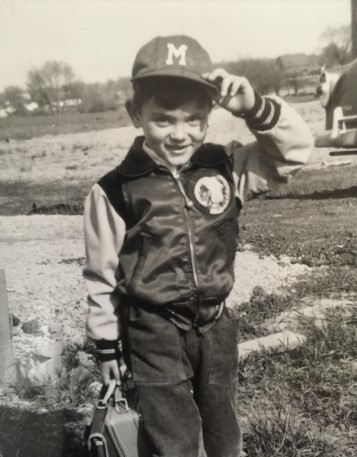
Me – A Braves’ fan since …

Smart money – and knowledgeable fans and analysts – are going with the Dodgers in the NL Championship Series.  I’m going against the grain – anticipating a hard-fought series and picking the Braves.  Let me explain part of the process that got me here.  I was a six-year-old living in Milwaukee when the Braves came to town.  I grew up on a baseball diet of Eddie Mathews, Hank Aaron, Warren Spahn, Lew Burdette, Billy Bruton (and many more, including the unexpected storm that was Bob “Hurricane” Hazle). The Braves were my first team and Eddie Mathews was my first hero (throughout my baseball and softball years, I always played third base and wore number 41).  I have loyally followed the Braves (and their third sackers) through Mathews, Terry Pendleton, Bob Horner and Chipper Jones – right up to Austin Riley.

So, take that all into consideration as you ponder this prediction – still I think I can at lease a small case for my position. (However, most of the stats I will report here admittedly point to the Dodgers as taking this series.)

The Dodgers, who won 106 games to the Braves 88, also finished strong. LA went 50-21 from August 1 on, while the Braves went 44-28. 

On offense, the Dodgers led the National League with 830 runs scored and 5.12 runs per game.  Still, the Braves were not far behind at 790 runs and 4.91 runs per game (both third in the league). Both teams put up a .244 average and the Braves out-homered the Dodgers by two long balls (239-237). (Yes, I do acknowledge that the Braves played in a decidedly weaker division – but remember, I’m shooting a bit form the heart here.)

The Dodgers’ offense features five players who hit 20 or more home runs, even without the injured Max Muncy’s .249-36-94 stats. The leaders coming into the Championship Series include 2B Trea Turner (.338-10-28 in 52 games for LA); 3B Justin Turner (.278-27-87); and RF Mookie Betts (.264-23-58). There is also plenty of punch available from C Will Smith (25 home runs and 76 RBI); SS Corey Seager (.306, with 16 home runs in 95 games); OF A.J. Pollock (.297-21-69); and versatile Gavin Lux and Cody Bellinger (who seems ready to contribute after a difficult injury-dampened 2021 regular season). This lineup is strong and deep.
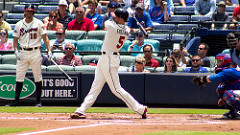
Freddie Freeman, steady power source. Photo by dougandme

Just as the Dodgers are missing the bat of Muncy, the Braves will miss Ronald Acuna Jr., who was .283-24-52 in 82 games, as well as trade deadline pickup Jorge Soler (.269-14-33 in 55 games for Atlanta). (Soler is on COVID restriction.) Still, they pack plenty of punch, with perhaps the most powerful infield in MLB right now: 1B Freddie Freeman (.300-31-83); 2B Ozzie Albies (.259-30-106); 3B Austin Riley (.303-33-107); and SS Dansby Swanson (.248-27-88).  The outfield will be some combination of Guillermo Heredia; Adam Duvall; Joc Pederson; and Eddie Rosario. While the Dodgers may be a bit deeper, I think the heart of the Braves’ lineup may be more explosive.
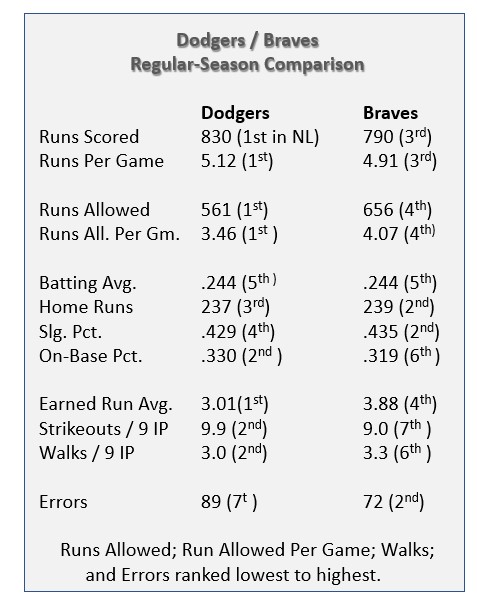
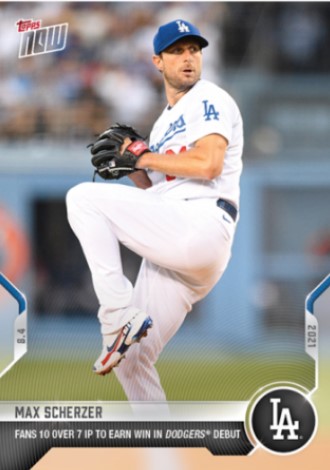
On the mound, it appears (at first examination) to be all Dodgers. Their 3.01 earned run average was the lowest in the majors . Even without Clayton Kershaw, they can put forth a starting trio of Walker Buehler (16-4, 2.47); Julio Urias (20-3. 2.96); and Max Scherzer (7-0, 1.98 for the Dodgers and 15-4, 2.46 overall). If a fourth starter is needed, Tony Gonsolin was 4-1, 3.23 (15 games / 13 starts).  The bullpen features Kenley Jansen (38 saves, 2.22 ERA); Blake Treinen (1.99 ERA in 72 games, with  seven saves); flame-throwing Brusdar Graterol (4.59 in 34 games); and Corey Knebel (2.45 in 27 games).

The Braves’ rotation looks solid: Charlie Morton (14-6, 3.34); Max Fried (14-7, 3.04); and Ian Anderson (9-5, 3.58). Will Smith (3.33 with 37 saves) will close, with support from Tyler Matzek (2.57 in 69  games); Luke Jackson (1.98 in 71 games); and A.J.Minter (3.78 in 61 games).

The Braves’ overall ERA of 3.89 does not compare well with the Dodgers 3.01 – but the Braves put up a 3.44 ERA after the All Star break,  (Side note:  the Dodgers’ ERA after the break was an even stingier 2.86).

So, given that the Dodgers’ lineup up and pitching staff both look deeper than the Braves, how can I pick Atlanta?  A few factors.  While the Braves were 2-4 versus the Dodgers during the regular season, the run totals were close (Dodges 27-Braves 23) and two of the Braves losses to the Dodgers were one-run games). Two, the Braves, who have home field advantage for the season, won two of three in Atlanta.  Three, the Dodgers had a tougher time getting to this point then the Braves (more competitive division, a Wild Card game, a tougher Division Series) – that may have taken a toll. Four, the Braves, by virtue of wrapping up their Series with the Brewers early, have had more time to set up their pitching staff. Five,  I’m not sure what the impact of the emotional high of getting past the Giants will have on the Dodgers going forward. Six, somehow I think the  Braves’ starting mound trio will be able to hold down the Dodgers’ offense better than the Dodgers can rein in the Braves’ big four. (Okay, so that’s more emotion than evidence.) Seven, Joc Pederson’s two pinch-hit home runs in the ALDS seem to have the “feel” of destiny. Finally, remember, this prediction is at least partially from the heart.

Ultimately, I expect a good series (much more competitive than most expect) and anticipate the Game One winner – Fried versus Scherzer – will take the Series.  I’ll go with the Braves – but logic seems to say otherwise.  MVP? Freddie Freeman or Max Fried. Besides, I’ve been fifty-fifty going with the “favorites.” Maybe it’s time to pick an underdog.

Side Note:  I have now lived in Minnesota for about five decades, so the Twins have my baseball fan’s heart.  However, I still have a soft spot for the Braves (my NL team of preference) – and I’ve even come to forgive them for the move to Atlanta.  (After all, Milwaukee did welcome them from Boston. )

Primary Resource: Baseball-Reference.com

BASEBALL ROUNDTABLE ON THE TOP 100 BASEBALL BLOG LIST

100Baseball Roundtable is on the Feedspot list of the Top 100 Baseball Blogs.  To see the full list, click here.

I tweet baseball @DavidBBRT

Follow/Like Baseball Roundtable’s Facebook Page here.  More baseball commentary; blog post notifications; PRIZES.

Member: Society for American Baseball Research (SABR); The Baseball Reliquary; The Negro Leagues Baseball Museum.


Baseball Roundtable AL Championship Series Pick

Okay, the Red Sox have surprised me more than once – beating the Yankees and the Rays – so I probably shouldn’t pick against them again.  However, I have to go with the Astros in the AL Championship Series.

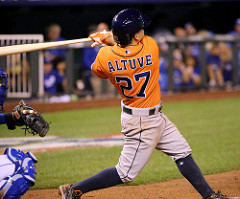
Jose Altuve – Potential ALCS MVP.
Photo by apardavila

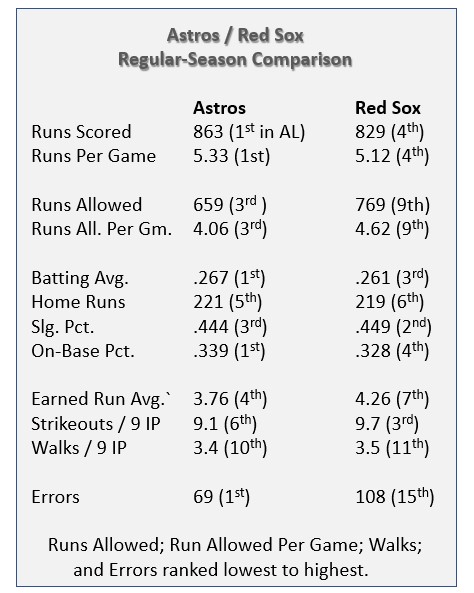
The reasons?  Pitching and defense – and, maybe, just a little bit of history. Clearly, these are two strong offensive clubs. During the regular season, the Astros averaged 5.33 runs per game (best in the AL), the Red Sox were close behind (fourth at 5.12). The Red Sox boast six players with 20+ home runs – and are led by 3B Rafael Devers (.279-38-113); DH JD Martinez (.286-28-99); RF Hunter Renfroe (.259-31-96); and SS Xander Bogaerts (.295-23-99). 1B Bobby Dalbec and CF Kiki Hernandez also have proven forces to be reckoned with.  The Astros counter with an equally strong lineup – three players with 30 or more 2021 home runs (plus 26 long balls out of SS Carlos Correa). Their offense is led by Correa (.279-26-92); RF Kyle Tucker (.294-30-92); DH Yordan Alvarez (.277-33-104); and 2B Jose Altuve (.271-31-83). And remember, this is a lineup in which 2021 AL batting champion 1B Yuli Gurriel (.319) hits seventh. And let’s not forget LF Michael Brantley and 3B Alex Bregman.  In short, both lineups are strong and deep.  Call it a wash.

Chris Sale – Will he be ready?
Photo by Keith Allison

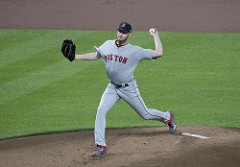
Now, how about pitching? On the season, the Astros’ 3.76 ERA was fourth in the AL, the Red Sox 4.26 seventh. Neither team can turn to an “ace” starter. The Red Sox had just two pitchers with at least ten wins  (Nathan Eovaldi … 11-9, 3.75 and Eduardo Rodriguez … 13-8, 4.74).  The likely third starter is Chris Sale, who was 5-1, 3. 16 (making his 2021 debut in mid-August after March 2020 Tommy John surgery). Sale, however, was touched by the Rays for five runs in one innings in his first 2021 post-season appearance.  The Red Sox need him to be ready. If he is the Chris Sale of old (a true “ace”), he could be a difference maker.  The Astros had four starters with at least ten wins and look to go with the trio of Lance McCullers, Jr. (13-5, 3.16); Framber Valdez (11-6, 3.14); and Luis Garcia (11-8, 3.80). On the season, Astros’ starters put up a 3.60 ERA, Red Sox starters 4.49). Edge: Houston.

The bullpens look evenly matched (Red Sox bullpen ERA at 3.99; Astros 4.06). Red Sox closer Matt Barnes had a 3.79 ERA with 24 saves); and he’ll be supported by Adam Ottavino (7-3, 11 saves, 4.21), Josh Taylor (3.40 in 61 games); and Garrett Whitlock 8-4, 1,96 in 46 games. Tanner Houck and Nick Pivetta could also come of the pen and play a key long relief role if a starter should falter (one of them could draw a start if Sale isn’t ready).  The Astros’ pen will be led by closer Ryan Pressly (26 saves, 2.25 ERA), with a supporting cast that will include: Kendall Graveman (3.13 in 23 games for the Astros); Ryan Stanek (3.42 in 72 games); and Christian Javier (3.55 in 36 games).

Finally, there is the defense – potentially critical in a tight series.  In 2021, the Astros made the fewest errors in the AL (69), the Red Sox the most at 108.  Notable edge: Astros.

Digging little deeper, The Astros won the season series against the Red Sox five games to two and outscored them  42-25.

Then again, the Red Sox come in “hot” on offense. In the Division Series, the Red Sox hit .341, with 56 hits, nine home runs and 26 runs against the  Rays’ lauded pitching staff.  The Astros hit “just” .288” with “only” 40 hits and four  home runs against the White Sox – but, they actually scored more runs in their four games set then the Red Sox did in theirs (31-26).  Another stat that caught my eye was that the Astros scored 18 two-out runs against the White Sox to eight for the Red Sox against the Rays. 

So, there it is.  I’m once again going against the Red Sox, but I expect a tough series with plenty of offense.   Astros in six.  Potential MVP?  I like Jose Altuve or Kyle Tucker.

Primary Resource:  Baseball-Reference.com


BASEBALL ROUNDTABLE ON THE TOP 100 BASEBALL BLOG LIST

100Baseball Roundtable is on the Feedspot list of the Top 100 Baseball Blogs.  To see the full list, click here.

I tweet baseball @DavidBBRT

Follow/Like Baseball Roundtable’s Facebook Page here.  More baseball commentary; blog post notifications; PRIZES.

Member: Society for American Baseball Research (SABR); The Baseball Reliquary; The Negro Leagues Baseball Museum.


Rosario Hits for the Cycle – and some “Cycling” Trivia

Yesterday (September 20, 2021),  Braves’ LF Eddie Rosario hit for the cycle (single, double, triple and home run all in one game) as Atlanta topped Giants 3-0  in San Francisco.  Rosario doubled to right in the second inning; tripled to right in the fifth; hit a solo home run to right in the seventh; and singled to center in the ninth.  It was the fourth cycle of the 2021 season and 333rd regular-season cycle in MLB history.

In celebration, Baseball Roundtable thought this might be a good time to revisit come cycle trivia.

The  Only Pitcher Ever to Record a Win and Hit for the Cycle in the Same Game

On July 28, 1888 – as the Chicago White Stockings topped the Detroit Wolverines, 21-17 –  Jimmy Ryan  started in CF for Chicago with Mark Baldwin on the mound.  In the bottom of the second – with two out, six runs scored in the inning and the bases loaded – Chicago Manager Cap Anson had Baldwin and Ryan changed places.  Ryan fanned Detroit pitcher Charles “Lady” Baldwin to end the inning, with the White Stockings trailing 7-4. Chicago tied the game at 8-8 in the top of the fourth and went on to win 21-17.

Ryan got the victory, pitching 7 1/3 innings, allowing ten runs. He also went five-for-six at the plate (a single, double, two triples and a home run), was safe on error, scored three runs, drove in four and stole a pair of bases.  In the process, he became the first (and still only) player to record a pitching victory and a cycle in the same game.  (For the season, Ryan hit .332, leading the National League in hits with 182, doubles with 33 and home runs with 16). On the mound, he was 4-0, 3.05 in eight appearances (two starts).  For his 18-season MLB career (1885-1900, 1902-03), Ryan hit.308-118-1,093, with 419 steals (2,014 games). On the mound he was 6-1, 3.62 in 24 games (five starts).

The Fastest Cycle Ever

On June 18, 2000, Colorado Rockies’ second baseman Mike Lansing completed the cycle in just four innings – making it  the quickest cycle in MLB history. Notably, Lansing was consistently behind in the counts and three of his four hits came with two strikes. Lansing, batting second in the order, hit:

  • An RBI triple to right in the first inning, on a 1-2 pitch;
  • A two-run home run (0-1 pitch) in the bottom of the second;
  • A two-run double (2-2 pitch) in the bottom of the third (as the Rockies scored nine times to take a 14-1 lead); and
  • A single (another 1-2 offering) to right in the fourth.

Lansing then struck out in the sixth, before being lifted for a pinch-hitter (Darren Bragg) in the eighth. Lansing ended the day four-for-five, with three runs scored and five RBI, as the Rockies torched the Diamondbacks 19-2 in Denver.

In addition to his fastest-ever cycle, Lansing shares the record for the most home runs in an inning (two). On May 7, 1997, he hit a two-run and three-run homer in a 13-run sixth inning, as the Expos topped the Giants 19-3 in San Francisco.  That was his best season in the majors, as he hit .281 and recorded his career highs in home runs (20), RBI (70) and doubles (45).

The “Slowest” Cycle Ever

The Expos’ Tim Foli is the only player to start a cycle one day and complete it the next. On April 21, 1976, Foli collected a single, double and triple in a contest against the Cubs that was suspended in the top of the seventh due to darkness. When play resumed the following day, Foli added an eighth-inning home run. (The Expos prevailed 12-6.)

The Most Cycles Ever

Only five  MLB players have hit for the cycle three times in their careers: John Reilly (Red Stockings, twice in 1883 and Reds in 1890); Babe Herman (Brooklyn Robins, twice in 1931 and Cubs in 1933); Bob Meusel (Yankees in 1921, 1922 and 1928); Adrian Beltre (Mariners in 2008, Rangers in 2012 and 2015); and Trea Turner (Nationals in 2017, 2019 and 2021).

The Most Cycles Ever in One Season

Only five players have collected two cycles in one season. Among those, Brewers’ outfielder Christian Yelich is the only one to hit for the cycle against the same team (the Reds) twice in the same campaign. In Yelich’s 2018 MVP season, he hit for the cycle on August 29, as the Brewers topped the Reds 13-12 in ten innings in Cincinnati. He doubled up on cycles on September 17, as the Brewers topped the Reds 8-0 in Milwaukee.

Longest Time Ever Between Cycles

Among players with multiple cycles, George Brett went the longest time between cycles – 11 years & 57 days. He hit for the cycle on May 28, 1979 (his age-26 season) and again on June 24, 1990 (his age-37 season).

Shortest Time Between Cycles

John Reilly (Reds) and Tip O‘Neill (St. Louis Brown Stockings, American Association) had the shortest time between cycles at just seven days. Reilly’s came on September 12 and September 19, 1883. O’Neill’s came on April 30 and May 7, 1887.

Something Old … Something New

The youngest MLB player ever to hit for the cycle is the NY Giants’ Mel Ott (age 20, cycle on May 16, 1929).  The oldest player to hit for the cycle is The Angels’ Dave Winfield (age 39, cycle on June 24, 1991).

Sharing the Wealth

Three players have hit for the cycle in both the NL and AL: Bob Watson (NL Astros-1977 and AL Red Sox-1979); John Olerud (NL Mets-1997 and AL Mariners-2001); Michael Cuddyer (AL Twins-2009 and NL Rockies-2014).

Quote the Raven, “Nevermore”

The Marlins are the only MLB team to never have a batter record a cycle.

Hitting (running) into an Out for the Cycle

Photo by rchdj10

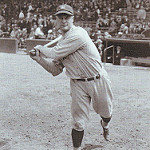
The Yankees’ 1B Lou Gehrig (kind of) earned a cycle by being tossed out at the plate.  On June 25, 1934, as New York topped Chicago 13-2  at Yankee Stadium, Gehrig hit two-run home run in the first inning; a  single in the third; and a double in the sixth. Gehrig came up needing just the triple for the cycle in the seventh and hit a smash to deep center (scoring Yankees’ CF Ben Chapman). Gehrig wasn’t satisfied with a three-bagger and was thrown out at home (8-6-2) trying for an inside-the-park home run – thus getting credit for the triple he needed for a cycle.


Nearly a Cycle – In One Inning

On June 27, 2003, Johnny Damon was playing CF and leading off for the Red Sox  as they took on the Marlins in Boston.  In a start that brought Boston fans up out of their seats, Damon was three-fourths of the way to the cycle bat the end of the first inning – and had tied an MLB record with three hits in an inning.  (The Red Sox scored 14 runs in the first inning, on their way to a 25-3 win over the Marlins at Fenway.) Damon who collected a single, double and triple in the bottom of the first, ended the game five-for-seven, with three runs scored, three RBI, a double, a triple and three singles.  He, unfortunately, did not get the cycle. In his final three at bats Damon: struck out; flied out to center; singled to right; singled past third base.

Here’s how that first inning went:

  • Johnny Damon – Double past first base down the line.  (Off starter Carl Pavano.)
  • Todd Walker – single, Damon scores.
  • Nomar Garciaparra – Double.
  • Manny Ramirez – Home run, scoring three.
  • David Ortiz – Double.
  • Kevin Millar – Single, Ortiz scores.

Michael Tejera replaces Pavano on the mound.

  • Trot Nixon – Single.
  • Bill Mueller – Walk, loading the bases.
  • Jason Varitek – Single, Millar and Nixon score.
  • Damon – Triple to deep right field, Mueller and Varitek score.
  • Walker – Single, Damon scores.

Allen Levrault takes over for Tejera – at this point, we’ve seen two pitchers, 11 batters, ten hits, one walk, nine runs and no outs.

  • Garciaparra – Foul pop out.
  • Ramirez – Single.
  • Ortiz – Walk, loading the bases.
  • Millar – Sacrifice fly, scoring Walker.
  • Nixon – Walk, loading the bases.
  • Mueller – Double, scoring Ramirez and Ortiz.
  • Varitek – Walk.
  • Damon – Line drive single to left, Nixon scores, Mueller is thrown out at the plate to end the inning.

Red Sox score 14 runs on 13 hits and four walks; Damon collects a single, double and triple.

The Cycle … From a Family Perspective

Only two father-son combinations have hit for the cycle at the Major-league level – and both involved rookies.

Gary Ward hit for the cycle as a rookie (in just his 14th game) for the Twins on September 18, 1980. His son Daryle hit for the cycle for the Pirates (against the Cardinals) on May 26, 2004 (in his seventh MLB season).

In 2018, Blues Jays’ rookie Cavan Biggio – in a September 17 game against the Orioles – hit for the cycle.  Cavan’s father, Hall of Famer Craig Biggio, hit for the cycle (for the Astros versus the Rockies) on April 8, 2002.

The Cycle … Sometimes it Skips a Generation

Pittsburgh Pirates’ outfielder Gus Bell hit for the cycle on June 4, 1951 – as the Pirates topped the Phillies 12-4 in Philadelphia. Fifty-three seasons later – on June 28, 2004 – Phillies’ 3B David Bell (Gus Bell’s grandson) hit for the cycle (also in Philadelphia), as the Phillies topped the Expos 14-6.   Gus and David Bell are the only grandfather-grandson combination to achieve MLB cycles.

Cycles … A Big Stage Perspective

Brock Holt is the only player to record a cycle in the post season. He did it on October 8, 2018, as the Red Sox beat the Yankees 16-1 in Game Three of the American League Division Series. Holt grounded out in the top of the second inning; had a single and a triple in the Yankees seven-run fourth; grounded out in the sixth; hit a ground-rule double in the eighth; and managed to finish his cycle  with a home run with two outs in the top of the ninth. It was Holt’s second career cycle.  He had a regular-season cycle for the Red Sox on June 16, 2015, as Boston topped Atlanta 9-4 at Fenway. He also completed that cycle with two outs in Boston’s last offensive inning – hitting a triple with two down in the bottom of the eighth.

Primary Resources:  Baseball-Almanac.com; Baseball-Reference.com; “July 28, 1888: Jimmy Ryan hits for cycle as Chicago White Stockings win 21-17 slugging match, ” by Mike Huber, SABR.


Baseball Roundtable Disclaimer:  The MLB records referenced in this (and previous) posts have the potential to change as Major League Baseball recognizes and incorporates Negro League records from 1920-46 into the MLB record book.

BASEBALL ROUNDTABLE ON THE TOP 100 BASEBALL BLOG LIST

100Baseball Roundtable is on the Feedspot list of the Top 100 Baseball Blogs.  To see the full list, click here.

I tweet baseball @DavidBBRT

Follow/Like Baseball Roundtable’s Facebook Page here.  More baseball commentary; blog post notifications; PRIZES.

Member: Society for American Baseball Research (SABR); The Baseball Reliquary; The Negro Leagues Baseball Museum.


Seth Beer’s Long Ball in his First MLB At Bat … The Roundtable Has Been Waiting

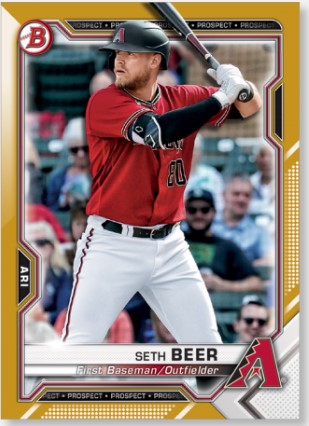
Yesterday (September 10, 2021), Seth Beer made his MLB debut for the Arizona Diamondbacks. He came on as a pinch hitter (for Christian Walker) in the top of the eighth inning with one out, no one  on and  the Diamondbacks trailing the Mariners 5-3.  Beer got his MLB career off with a bang, hitting a 1-1  pitch from Diego Castillo to deep right field for a home run. For Baseball Roundtable that was a much-awaited long ball.  Why? … you might ask.  After all, more than 120 players have homered in their first MLB at bat. True enough, but Baseball Roundtable had recommended readers keep an eye on Beer as long ago as 2017 – after his freshman year at Clemson University.  With that in mind, I’d like to:

  • Revisit that original post (from January 26, 2017); and
  • Update readers on Beer’s path to the big leagues.

First, that original post.

________________________________________________________________

Baseball and Beer – Clemson Baseball and Seth Beer – A Winning Combination

Published January 26, 2017 in Baseball Roundtable

Robin Ventura, Jason Varitek, Todd Helton, Mark Teixeira, Jered Weaver, Alex Gordon. David Price, Buster Posey, Stephen Strasburg, Kris Bryant.  What ballplayer wouldn’t want to be mentioned in the same breath as these stars?  Well, a young outfielder with a perfect baseball name – Seth Michael Beer – and tremendous baseball potential already is.

Seth Beer – first freshman Dick Howser Trophy winner – helped lead the Clemson Tigers to the 2016 ACC Title. Photo courtesy Clemson University.

Playing right field and batting in the three-spot for 2016 Atlantic Coast Conference (ACC) Champion Clemson University, the 6’3”, 200-pound Beer joined the previously noted MLB All Stars in earning the Dick Howser Trophy as the national college baseball player of the year.  And, he did it in dramatic fashion. Not only did Beer become the first freshman to earn the recognition, he did it after leaving high school early to attend Clemson.  Basically, he earned collegiate player of the year honors when he very well could have been enjoying  his senior year at Lambert (GA) High School.

Now, as regular followers of Baseball Roundtable know, during the off-season, this blog has a tendency to look back nostalgically at what some members of my family call “antique baseball.” Witness recent posts on Hall of Famer Richie Ashburn (click here) and 1957 Braves’ hero Bob “Hurricane” Hazle (click here). In this post, however, I’d like to look toward the future – and share with readers a little bit about an individual who is truly a player to follow as he continues his college – and moves on to a major league – career.

THE NUMBERS

A lot of Roundtable readers are deep into statistics, so let’s start our look at Seth Beer with a few numbers.

As a college freshman, Beer played in 62 games – hitting .369, with 13 doubles, 18 home runs, 70 RBI, 57 runs scored, 62 walks (versus 27 strikeouts) and 15 hit-by-pitches. He led Clemson to the Atlantic Coast Conference title, being selected team MVP – after leading the squad in batting average, home runs, slugging percentage, on-base percentage and outfield assists.  Can I say it again – as a freshman.

High School – A Precursor

Seth Beer’s performance on the diamond for the Clemson Tigers should be no surprise. In two seasons of high school baseball, Beer hit .537, with 12 home runs, 61 RBI, 44 runs scored, 30 walks (15 strikeouts) in 48 games.  As a pitcher, he went 3-1, with a 1.80 ERA, striking out more than a batter an inning. (High school stats from maxpreps.com.) Beer earned six high-school athletic letters (three in baseball, two in football and two in swimming) and was a national high-school All American in baseball as a sophomore and a junior.

THE CHARACTER

Seth Beer. Photo: Courtsy of Clemson University.

Then, of course, there is character.  Majoring in Parks, Recreation and Tourism Management, Beer was an Atlantic Coast Conference Academic Honor Roll Member and All-ACC Academic selection.

And, while he definitely has his sights set on a major-league career (and cites his parents as the biggest influence in his life and baseball), Beer told Baseball Roundtable that “After my playing career, I want to be involved in helping others, specifically with homeless shelters.”

Beer’s coach at Clemson, who has called Beer the best freshman he’s ever seen, also praised the young star’s work ethic and quiet leadership.  “Seth is more of a quiet leader and leader by example,” Clemson Coach Monte Lee said. “As he gets older, he will become more of a vocal leader. Players really look up to him because of his work ethic.”

Character is also reflected in Beer’s Dick Howser Trophy selection.  In presenting the Award, DH Trophy Chair David Feaster said “Seth Beer truly deserves this national honor.  His status as a national player of the year as a freshman is a history-making moment. In just a short time, he has exhibited the Dick Howser traits of excellent performance on the field, leadership, moral character and courage.”

ADDITIONAL RECOGNITION

I should emphasize here that the Dick Howser Trophy was not the only recognition Seth Beer earned as a college freshman.  Here are just a few of the additional honors Beer received in his first season at Clemson:

  • College Sports Madness Player of the Year (first freshman winner);
  • First Team All American by American Baseball Coaches Association, Baseball America, College Sports Madness, D1Baseball, National College Baseball Writers Association, and Perfect Game;
  • Atlantic Coast Conference Player of the Year (first freshman winner); and, of course;
  • A host of awards reserved for college freshman, including National Freshman Player of the Year by Baseball America, College Sports Madness, D1Baseball and Perfect game, as well as several freshman All-American honors.

Baseball Roundtable is introducing readers to Seth Beer in this post because I believe he is a player and young man to watch – and that, someday, you will be able to see his baseball skills, leadership and positive character on a major-league field near you.  I might add (see the box below), the odds seem to be in his favor.

The Dick Howser Trophy

The Dick Howser Trophy was established in 1987 to honor the national college baseball player of the year. The Award is named after Dick Howser – twice an All American shortstop at Florida State University, an eight-season major-league player (1961 All Star) and eight-season major league manager (1985 World Series Champion) – who passed away in 1987, at age 51, of brain cancer. From 1987-1998 the winners were selected by the American Baseball Coaches Association.  Since 1999, the National Collegiate Baseball Writers Association has made the selection.

How much of an indicator of future success is this honor?  Of the 28 winners (Brooks Kieschnick of the University of Texas is the only two-time winner):

  • 24 became MLB First-Round draft picks;
  • 24 went on to play in the major leagues;
  • 13 became MLB All Stars;
  • Three became Rookies of the Year – Jason Jennings, Buster Posey, Kris Bryant;
  • Two were selected first overall in the MLB draft – David Price,  Stephen Strasburg;
  • One went on to win a league MVP Award – Buster Posey; and
  • One captured a Cy Young Award – David Price.

Base ball Roundtable’s advice?  Track Seth Beer’s sophomore season – and beyond. If you are in a fantasy league with “reserve keepers,” consider drafting him now.  Start saving now for an MLB jersey with “Beer” and his number proudly displayed on the back.

In the meantime, BBRT says congratulations to Clemson and Seth Beer on a tremendous 2016 season – and the best of luck for the coming campaign.

______________________________________________________________________

So, that post was Baseball Roundtable’s readers’ introduction to Seth Beer (I have to get a Beer jersey, that just says baseball all the way). Now an update on Beer’s path to the “bigs.”

In 2017, Beer hit .298, with 16 homers and 53 RBI, 64 walks and 14 hit-by-pitches  (.478 on-base percentage). He led his Clemson squad in home runs, RBI, total bases, slugging percentage (.606), walks, intentional walks (17), hit by pitch and on-base percentage.  After winning the Dick Howser Trophy as a Freshman, Beer was a semi-finalist for the recognition in his second college season. Among his honors were a second-team all American selection by the National College Baseball Writers Association and a second-team All Atlantic Coast Conference Selection.

Target Practice

In three collegiate baseball seasons (188 games), Seth Beer was hit by a pitch 42 times. 

In 2018, Beer was once again a semi-finalist for the Dick Howser Award and was selected a first-team All American by the American Baseball Coaches Association, Baseball America, College Sports Madness, Collegiate Baseball, d1Baseball and the National College Baseball Writers Association – and was a first-team All Atlantic Coast Conference selection. He earned these (and more) honors with a .301-22-54 season, leading the Atlantic Coast Conference in homers, total bases (145) and slugging percentages (.642) – and finishing in the top five in walks (54), on-base percentage  (.456) and  runs scored (64). He was also hit by a pitch 13 times.

In 2018, Clemson was 20-2 in games in which Seth Beer hit a home run.

The list of collegiate accomplishments could go on and one, but you get the idea.

All of this earned Beer a first round (28th overall) selection in the 2018 MLB draft (Astros).

He launched his pro career (as an OF/1B) as a 21-year-old in 2018 – putting up  a .304-12-42 line at A and High-A (67 games). In 2019, he played at High-A and Double-A and went .289-26-103 in 122 games.  (He was traded to the Diamondbacks in July of that season, in a transaction that sent 2009 AL Cy Young Award winner Zack Grienke to the Astros).

Beer began the 2021 season at Triple A Reno and hit.287-16-59 in 100 games before his call up to the D-backs.

Still a Target

In three-minor-league seasons (289 games), Seth Beer has been hit by a pitch 72 times. 

All I can say is keep watching. It looks like  this might be quite a ride – a major-league Beer run.

Primary Resources: Baseball-References.com; ClemsonTigers.com


BASEBALL ROUNDTABLE ON THE TOP 100 BASEBALL BLOG LIST

100Baseball Roundtable is on the Feedspot list of the Top 100 Baseball Blogs.  To see the full list, click here.

I tweet baseball @DavidBBRT

Follow/Like Baseball Roundtable’s Facebook Page here.  More baseball commentary; blog post notifications; PRIZES.

Member: Society for American Baseball Research (SABR); The Baseball Reliquary; The Negro Leagues Baseball Museum.


Baseball Roundtable Looks at Team Single-Season Home Run Records

Yesterday (September 24), as the Braves fell 7-6 to the Rockies in Colorado, MLB had another of those #InBaseballWeCountEvrything moments. In the third inning, Braves’ 2B Ozzie Albies took Rockies’ starter German Marquez deep for his 25th home run of the year.  The “moment?” The solo shot made the Braves just the second team in MLB history to have its entire starting infield hit at least 25 home runs each.  For the Braves, it was:

1B Freddie Freeman – .292-28-72

2B Ozzie Albies – .261-25-88

3B Austin Riley – .305-28-84

SS Dansby Swanson – .258-26-80

At the close of play that day, the Braves (NL East Division leaders) were third overall and second in the National League in home runs with 198 (three behind the Giants and six behind the Blue Jays).

The only other team to accomplish this infield feat?  That would be the 2008 Miami Marlins.

1B Mike Jacobs – .247-32-93

2B Dan Uggla – .260-32-92

3B Jorge Cantu – .277-29-95

SS Hanley Ramirez – .301-33-67

That season, the Marlin finished third in the NL East at 84-77. Like the current Braves, they were third  overall and second in the National League in home runs (with 208).

As usual, with Baseball Roundtable one thing led to another and I was spurred on to look at some other team home run records.


The Yankees finished in first place in the American League that season (109-53), and won the World Series. Their 240 home runs were (at the time) MLB’s single-season team record.

Despite leading MLB in home runs with 206 and in runs scored with 799, the 1973 Braves finished in fifth place in the NL West with a 76-85-1 record. Their team earned run average of 4.25 was the worst in the NL and third-worst in MLB that season.

The 1996 Rockies’ 243 home runs led the NL and were fourth in MLB. The Rockies finished third in the NL West with a 83-79 record.  The Padres, who led the West Division at 91-71 hit 147 round trippers.

The 1997 Rockies’ 239 long balls led the NL and were second only to the Seattle Mariners’ 264 in MLB. The Rockies finished at 83-79, third in the NL West.  The Giants won the Division at 90-72 – hitting 172 home runs.

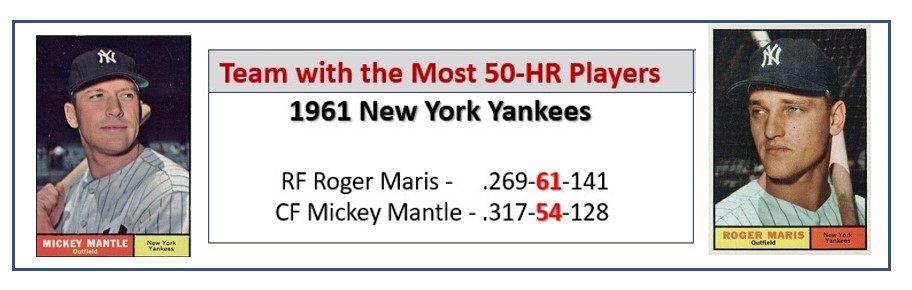
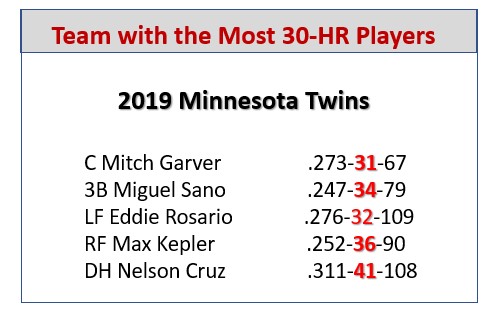
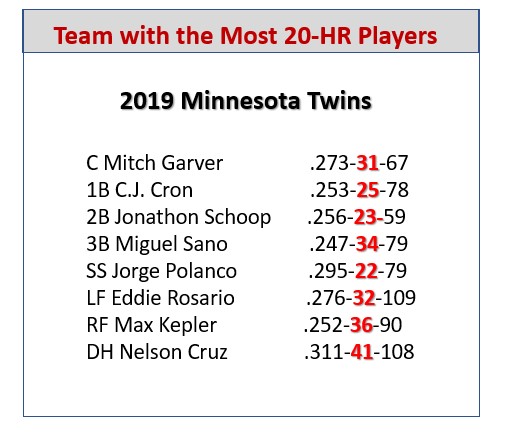
The 2019 Twins set a new MLB single-season record with 307 home runs – edging the Yankees by one. The Twins won the AL Central with a 101-61 record, while the Yankees topped the East at 103-59.  On the final day of the season, the Yankees got just one home run (Aaron Judge) in a 6-1 loss to Lance Lynn and the Rangers; while the Twins got home runs from C.J. Cron, Jake Cave and Jason Castro (in a 5-4 loss to the Royals) to claim the home run record. The Yankees got their revenge, sweeping the Twins three games-to-none in the ALDS.

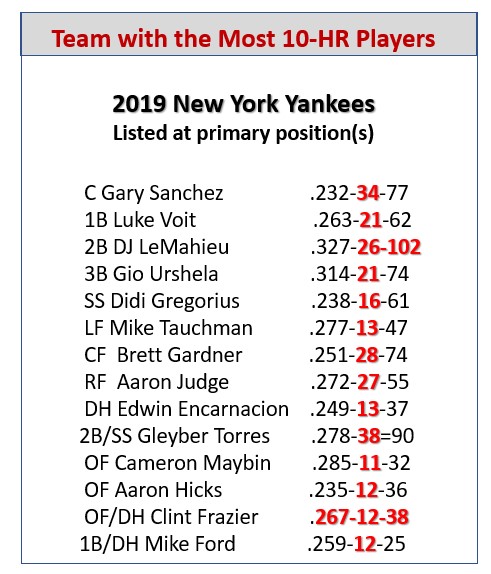
The 2019 Yankees, who finished just one home run behind the Twins for MLB’s all-time single-season high, set the record for the most players on a team with ten or more home runs. Notably, the Yankees used 18 players at DH (seven for ten or more games) – and got 41 home runs out of the position in the lineup.


Primary Resources: The Elias Book of Records, 201 Edition (Elias Sports Bureau, Inc.); Baseball-Reference.com


BASEBALL ROUNDTABLE ON THE TOP 100 BASEBALL BLOG LIST

100Baseball Roundtable is on the Feedspot list of the Top 100 Baseball Blogs.  To see the full list, click here.

I tweet baseball @DavidBBRT

Follow/Like Baseball Roundtable’s Facebook Page here.  More baseball commentary; blog post notifications; PRIZES.

Member: Society for American Baseball Research (SABR); The Baseball Reliquary; The Negro Leagues Baseball Museum.
 

Jim McAndrew … One Hard Luck Rookie Season

The inspiration for this post is the fact that, on this date (August 17) in 1968, Mets’ 24-year-old  rookie  right-hander Jim McAndrew made his fourth professional major-league start (and fourth MLB appearance) – and picked up his fourth MLB loss, despite a 1.82 earned run average.  The fact is, in his four starts, the Mets had not scored a single run.  That got me to thinking about another Mets’ starter, Jacob deGrom, who – fifty  seasons later – managed to finish just one game over .500 (10-9) despite an MLB-lowest 1.70 earned run average. Read on for more on both seasons – particularly how McAndrew’s trying 1968 campaign made deGrom look a bit like “Mr. Lucky” in 2018.  (I suppose I’m dating myself with that television reference,)

Quite a bit was said and written about deGrom and how he “deserved better” in 2018.  In his 10-9 campaign, deGrom gave up more than two earned runs in just six of 32 starts. In the 26 starts in which he limited the opposition to two earned runs or less, he won ten, lost seven and got nine no-decisions.  In May of 2018, deGrom started five games, gave up a total of two runs in 26 innings (0.69 ERA) and won just one game (four no-decisions). Still, his mound excellence, despite the 10-9 record, was recognized, as he was both an All Star and the NL Cy Young Award winner (getting 29 of 30 first-place votes). The Mets, by the way, were 77-85 in 2018.  Notably, the Mets’ Noah Syndegaard (13-4, 3.03) and Zack Wheeler (12-7, 3.31), put up better W-L records despite deGrom’s notably better overall numbers. DeGrom led Mets’ starters in ERA, innings pitched, strikeouts, strikeouts per nine innings, WHIP and strikeouts-to-walks ratio.

Jacob deGrom started the 2018 season 4-0, 1.75 (after nine starts) and went 6-9, 1.68 in his final 23 starts.  The Mets scored two runs or fewer in 12 of his 32 starts. 

Now, fifty years before deGrom’s 2018 campaign, McAndrew found himself looking for more support and ending up on the wrong side of a host of hard luck losses. In many ways, his 1968 season overshadows deGrom’s 1988 campaign in the “hard luck” category.

McAndrew was drafted by the Mets (out of the University of Iowa) in the 11th round of the 1965 MLB draft. By 1968, despite some recurring arm issues,  he had worked his way up to Triple A (Jacksonville Suns) – where he sported a 2.64 earned run average into mid-July (after 112 innings pitched).  That earned McAndrew a call up to the Mets – for a spot start on July 21.  That is where the “hard luck” really began to surface.

In that first MLB start (and appearance), McAndrew drew the Cardinals in St. Louis.  His mound opponent?  Future Hall of Famer Bob Gibson, in the midst of his best MLB season. (Gibson came into the game with a 12-5 record, a minuscule 1.06 ERA and  on a nine-start winning streak that included six shutouts.)

McAndrew acquitted himself well against Gibson, going six innings, giving up six hits and just one run, while fanning five and walking none. Gibson, however, was better – tossing a complete-game, seven-hit shutout and fanning 13, as the Mets lost 2-0.   Little did McAndrew know – a pattern was about to emerge.

After the spot start against Gibson, McAndrew was sent back down to Jacksonville, where he made another start, throwing five scoreless frames and bringing his record at Triple A to 8-3, 2.54.  By August 4, he was back n the majors, starting for the Mets against the Dodgers  in LA.

  • In his second MLB start (August 4), McAndrew was roughed up a bit, going 4 2/3 innings and giving up nine hits, but just two runs. The Dodgers’ Mike Kekich pitched a complete-game, one-hit shutout – fanning 11 and walking two – as the Mets’ fell 2-0.
  • In his third MLB start (August 10),  McAndrew faced the Giants and Bobby Bolin (in San Francisco). McAndrew pitched well, going seven innings and giving up just six its and one run. Bolin, however, like McAndrew’s first two mound opponents, pitched a complete-game shutout – four hits, one walk, nine strikeouts. The Mets lost 1-0.
  • In McAndrew’s fourth start (August 17), he was finally on the mound at home – facing the Astros and Don Wilson. McAndrew again pitched well – seven innings of six-hit, one-run ball. Wilson (seven innings) and reliever John Buzhardt, however, combined on a four-hit shutout.  The Mets and McAndrew lost 1-0.

I Could Use a Little Help from My Friends

In his first four MLB starts. Jim McAndrew was 0-4, despite a 1.82 earned run average (having given up a total of four runs in 24 2/3 innings).  In those starts, the Mets did not provide a single run of offensive support (for McAndrew or those who relieved him); losing by scores of 2-0, 2-0, 1-0,1-0.

McAndrew made a total of 12 starts for the Mets in 1968 and gave up more than two runs just once.  In those 12 starts, the Mets scored a total of 16 runs and were shutout five times.  McAndrew ended the season at 4-7, 2.28.  The Mets averaged 1.33 runs McAndrew’s 12 starts (they averaged just 2.9 runs per game on the season) and were shut out in 41.7 percent of those games.  By contrast, the Mets scored 3.5 runs per game in deGrom’s 32 2018 starts (they averaged 4.39 on the season) and were shut out three times (9.4 percent). Side note: In 1968 (it was the Year of the Pitcher), the Mets had six pitchers who made at least ten starts.  Five of those six had ERAs under 3.00: (Jerry Koosman (2.08); Tom Seaver (2.20); McAndrew (2.28); Dick Selma (2.75); Don Cardwell (2.95).  The outlier? Rookie Nolan Ryan at 3.09.  The Mets finished the season at 73-89-1. 

That First Win

After a painful lack of run support (and an 0-5 record), Jim McAndrew took matters into his own hands (arm). On August 26, 1968, he picked up his first MLB win, tossing a five-hit, complete-game shutout against the Cardinals in St. Louis. The score? No surprise here. Mets 1 – Cardinals 0.

After picking up his first win, shutting out the Cardinals for a 1-0 victory (bringing his record to 1-5, 2.53), McAndrew picked up a 2-1 loss in St. Louis (giving up two-runs on nine hits over eight innings) and a  2-1 loss in Pittsburgh (pitching seven-innings of six-hit, two-run ball).  At that point, he was 1-7, 2.53 and had given up more than two runs just once in eight MLB starts. He finally got win number-two on September 11 – against the Cubs in Chicago.  The score?  You guessed it … 1-0., with McAndrew giving up just two hits in 8 1/3 innings.

In 1968, the overall MLB earned run average was 2.98 and 13 teams had ERAs under 3.00.

Long story short, McAndrew finished his debut season at 4-7, 2.28 in 12 starts.  His only no-decision came in his final start of the year, when he gave up one run in 3 1/3 frames at Philadelphia. (The Mets lost 3-2).

McAndrew fought through a series of health and injury  issues (finger, shoulder, knee, ribs) to pitch in seven MLB seasons (1968-74), all but the final season with the Mets. He went 37-53, 3.65 His best season was 1972, when he went 11-8, 2.80 for the Mets.

Primary Resources:  Baseball-References.com; NationalPastime.com

BASEBALL ROUNDTABLE ON THE TOP 100 BASEBALL BLOG LIST

100Baseball Roundtable is on the Feedspot list of the Top 100 Baseball Blogs.  To see the full list, click here.

I tweet baseball @DavidBBRT

Follow/Like Baseball Roundtable’s Facebook Page here.  More baseball commentary; blog post notifications; PRIZES.

Member: Society for American Baseball Research (SABR); The Baseball Reliquary; The Negro Leagues Baseball Museum.
From Bobo and Bumpus to Ted and Tyler … Baseball Roundtable Looks at Pitchers with a No-Hitter in Their First MLB Start

Photo by andrewmalone

Yesterday (August 14, 2021), as the Diamondbacks topped the Padres 7-0 in Arizona,  the Diamondbacks’ 27-year-old rookie southpaw Tyler Gilbert tossed a no-hitter – one that proved not just memorable, but historic.  It was the eighth no-hitter of 2021, tying the major-league record for no-hitters in a season (set in 1884).  In addition, Gilbert became just the fourth player to toss a no-hitter in his first MLB start.  (Gilbert had three previous appearances this season, tossing 3 2/3 innings in relief.  Finally, for the frosting on the cake, it was Gilbert’s first professional complete game at any level.

Gilbert tossed 102 pitches in his no-hitter, allowing just three walks – all to Padres’ lead off hitter LF Tony Pham. Other than the three free passes to Pham, Gilbert only went to a three-ball count on one other batter.  Pham, by the way, was twice erased on groundball double plays, so Gilbert faced just 28 batters (one over the minimum) in his gem.

The Most – The Least

Although early pitch count records can be  sketchy, the fewest pitches tossed in a no-hitter is 74, by the Indians’ Addie Joss in his October 2, 1908, three-strike out perfect game against the White Sox in Cleveland.  The most pitches in a no-hitter? That would be 149 by the Diamondbacks’ Edwin Jackson – on June 25, 2010, when he no-hit the Rays in Tampa, winning by a 1-0 score.  Jackson  fanned six, walked eight, hit one batter and threw one wild pitch in his no-no.

Now, how about a look at the players before Gilbert who threw no-hitters in their first MLB starts.

Theodore “Ted” Breitenstein

Ted Breitenstein of the (then major-league) American Association Saint Louis Browns accomplished the feat,  as a 22-year-old rookie, on  October 4, 1891. (It was Breitenstein’s sixth  appearance for the Browns.) Breitenstein gave up just one walk as his Browns topped the Louisville Colonels 8-0.   Breitenstein went on to a 11-season MLB career, winning 160 games (losing 170) and putting up a 4.03 earned run average. He was a three-time 20-game winner and one time (1895) thirty-game loser (19-30, 4.37). He twice led the NL in complete games and once led in earned run average.

Charles “Bumpus” Jones

Bumpus Jones is the only player to throw a no-hitter not just in his first MLB start, but in his first MLB appearance. On October 15, 1892, the 22-year-old took the mound for the Reds (versus the Pirates) and tossed a no-hitter, with the Reds winning 7-1. He issued four walks and fanned three. In 1893, he appeared in seven games (Reds and Giants) and went  1-4, 10.19. While he continued to pitch in the minor leagues until 1900, Jones never returned to the “show.”

In 1892, before his MLB debut with the Reds, Jones was 24-3, 0.93 for the Joliet Convicts/Aurora Indians of the Illinois-Iowa League.

Alva “Bobo” Holloman

Bobo Holloman made his first MLB start (at the age of 30) for the St. Louis Browns on May 6, 1953. It was his fifth MLB appearance. That day, he shut won the Athletics 6-0, tossing a no-hitter (five walks, three strikeouts).  Note: In 1952, Holloman’s seventh professional season, he had opened some eyes with a 16-7, 2.51 season at Triple A Syracuse. Holloman finished the 1953 MLB campaign at 3-7, 5.23 in 22 appearances, ten starts. In July of that season, Holloman’s contract was sold to the International League Toronto Maple Leafs and, by the end of the 1954 season, he was out of baseball. Holloman was the first pitcher to toss a no-hitter in his first MLB start at the current pitching distance.

Bobo Holloman had just two its and three RBI in his MLB career and they all came in his May 6, 1953 no-hitter.  That was, as they say, his “day in the sun.”

Primary Resources:  Baseball-Reference.com; MLB.com; Baseball-Almanac.com.

Baseball Roundtable Disclaimer:  The MLB records referenced in this (and previous) posts have the potential to change (primarily additions) as Major League Baseball recognizes and fully incorporates Negro League records from 1920-48 into the MLB record book.


BASEBALL ROUNDTABLE ON THE TOP 100 BASEBALL BLOG LIST

100Baseball Roundtable is on the Feedspot list of the Top 100 Baseball Blogs.  To see the full list, click here.

I tweet baseball @DavidBBRT

Follow/Like Baseball Roundtable’s Facebook Page here.  More baseball commentary; blog post notifications; PRIZES.

Member: Society for American Baseball Research (SABR); The Baseball Reliquary; The Negro Leagues Baseball Museum.


200 Wins Without a 20-Win Season …. and a Statistical Rabbit Hole

In this blog, I’ve often written about how, when I  start delving into a hardball topic, “one thing leads to another.”  The main topic of this post was to be “Pitchers with the Most Career Wins Without a Twenty-Victory Season.” Well, as usual, on thing led to another, so I thought I’d give you a brief look at how I get pulled down the statistical rabbit hole.

Once I started looking into pitchers with the most wins without a twenty-win season, I was drawn into the topic of the pitchers with the most twenty-seasons.  On that front, I came up with the list below.


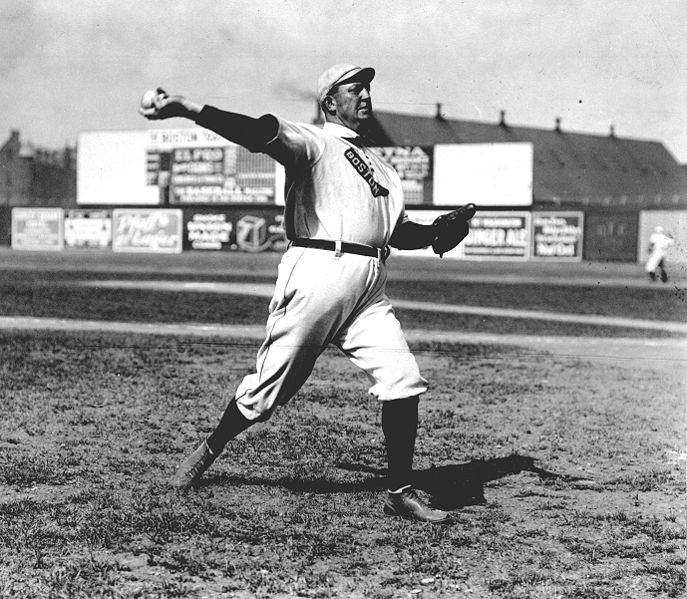
Cy Young – MLB’s winningest pitcher.

Now, I always try to verify stats and info I use in Baseball Roundtable from multiple sources.  And, that’s where I found an intriguing rabbit hole.  At the top of the  list is Cy Young, with 15 seasons of twenty or more victories.  However, I found some disagreement on that figure. While MLB.com, Baseball-Almanac.com, the Society for American Baseball Research (Cy Young by Bill Nowlin and David Southwick) and my most recent print version of The ESPN Baseball Encyclopedia all credit Young with 15 seasons of twenty or more wins, Baseball-Reference.com, the Baseball Hall of Fame’s Cy Young page and the 2021 Edition of the Elias Book of Baseball Records credit Young with 16 such seasons. That, of course, threw me off a bit – especially since the sources all agreed on Young’s 511 career wins.  So, deeper in the rabbit hole I went.  It turns out, those sources citing 15 seasons of 20 or more wins, credit Young with going 19-19 for the 1900 Cardinals, while those reporting 16 such seasons reported Young’s 1900 record as 20-18. That still didn’t explain how they all came to a total of 511 career wins.  So, deeper I went.  It turns out that 15-season cadre reported Young’s 1893 record at 34-16, while the 16-season cadre list Young’s 1893 won-lost total as 33-16.  Notably, if you check out Baseball-Reference.com, you will see Cy Young’s career record at 511-315, while MLB.com  list 511-316. Tough call on what to use in my chart, but (as a SABR member) I leaned toward the 15-season record.  Now, I have some more digging to do to see if I can resolve the discrepancies.  Fortunately, whichever measure you use, Young still holds the record for most twenty-win seasons.

Now, let’s get on with a look at the 20-win season leaders – and then the pitchers with the most career wins without a 20-win season.

Note:  When listing a pitcher’s age, it is their age as of June 30th of the season referenced.

Cy Young – 15 (maybe 16) Seasons of 20 or more Wins

Cy Young notched 511 wins and 315 losses (both MLB career records) in 22 MLB seasons (1890-1911). Young had his first 20-win season (at age 24) for the NL Cleveland Spiders (27-22, 2.85) and his final twenty-win campaign at age 41 for the 1908 Boston Red Sox (21-11, 1.26). He led is league in wins five times and recorded five seasons of 30 or more wins. Now, it you side with those who report that Young had 16 (as opposed to 15) 20-win seasons, he also ran off a record 14 straight seasons of twenty or more wins.  However, if you accept the  15 twenty-win season position, that record goes to the next hurler on this list – Christy Mathewson with 12 consecutive seasons of twenty or more wins.

Seeing the Job Through

Cy Young completed 749 of 815 MLB starts (91.9 percent). He threw forty or more complete games in nine seasons.

Christy Mathewson – 13 seasons of  Twenty or More Wins

Christy Mathewson put up a 373-188 record (with a 2.13 ERA) in 17 MLB seasons (1900-1916). His first twenty-win campaign came in his age-20 season – for the New York Giants (20-17). His final twenty-win campaign came in 1914 (age 33) also for the Giants (24-13.).  Mathewson had four seasons of 30 or more wins and 12 consecutive seasons of at least twenty victories.  From 1903 through 1905, he won at least 30 games in three consecutive seasons – going 94-34, 1.87. In his career, he led the NL in wins four times, ERA five times and strikeouts five times.  In the 1905 World Series, Mathewson threw three complete-game shutouts in three starts (over six days), allowing only 14 base runners (13 hits/one walk) in 27 innings.

One Final Tripe to the Mound

Christy Mathewson pitched in a total of 636 MLB games – in all but his final game, he wore a Giants’ uniform. On July 20, 1916, Mathewson (on the downside of his playing career and having voiced a desire to manage) was traded to the Reds, where he replaced Buck Herzog as manager.  He did take the mound one time for the Reds (September 4), picking up his final MLB win (a complete game in which he gave up 15 hits and eight runs), as the Reds topped the Cubs 10-8.

Warren Spahn – 13 Season of Twenty or More Wins

Warren Spahn went 363-245, 3.09 in 21 MLB seasons (1942, 1946-1965).  He would have put up even more impressive numbers if he hadn’t lost three prime years (1943-45) to military service.  His first twenty-win campaign came for the Braves in 1947 (at age 26), when he went 21-10, with a league-low 2.33 ERA.  His final twenty-win campaign was also for the Braves – 23-7, 2.60 in 1963 (at age 42.).  He was an All Star in 14 seasons. In eight of his 13 20-win season, he won 21 games.

Can’t Touch That

Warren Spahn led his league in wins an MLB record-tying eight times (tied with the Negro Leagues’ Ray Brown) – including five consecutive seasons from 1957 through 1961. 

Walter Johnson – 12 Seasons of Twenty or More Wins

Walter Johnson  pitched 21 MLB seasons (1907-27) – all for the Washington Senators. His 417 wins (279 losses) included two seasons of 30 or more wins –  a high of 36 in 1913, when he led the league in wins, winning percentage (.837), ERA (1.14), complete games (29), shutouts (11) and strikeouts (243). He had his first twenty-win season in 1910 at age 22 (25-17); and his final twenty-win season (20-7) in 1925 (age 37). Johnson led his league in strikeouts a record 12 times, including eight consecutive seasons (1912-19).

King of the Shutout

Walter Johnson’s 110 career-regular season shutouts are an MLB career record, as are his seven Opening Day shutouts and his seven seasons leading the league in shutouts (tied with Grover Cleveland Alexander and Cy Young).

Kid Nichols – Eleven Seasons of Twenty or More Wins

Kid Nichols played 15 MLB seasons (1890-1901, 1904-06), winning twenty or more games  in eleven seasons. He won thirty or more games in seven seasons (including four consecutively from 1891 through 1895). In the eight seasons from 1891 through 1898, he averaged 31 wins per campaign. He ultimately racked up a 362-208, 2.96 record.  His first twenty-win season (27-19) came at age 20 for the 1890 NL Boston Beaneaters.  His  final twenty-win season came in 1904 (age 34) for the Saint Louis Cardinals (21-13).  Nichols led the NL in wins in three consecutive seasons (1896-98). He also led the league in shutouts four times.

I Got This

In three seasons, Kid Nichols completed every game he started – 47 starts in 1890; 43 in 1895; 37 in 1899. Over his career, he completed 532 of 652 starts (94.7 percent). 

_____________________________________________________________________

Staying Power

Don Sutton had the fewest 20-win season of any pitcher with 300 MLB victories,  He won twenty games in a season just once (21-10, 3.06 for the 1976 Dodgers)  in his 23-season career (1966-88), he won 15 or more games 12 times and ten or more 21 times.

_______________________________________________________________________

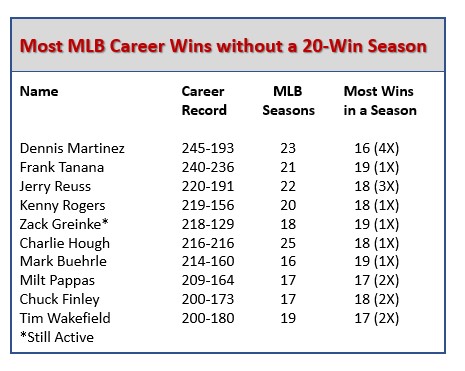
—-Most Career Wins Without a Twenty-Win Season—–

Now a look at the pitchers who racked up the most career wins, without ever winning twenty games.

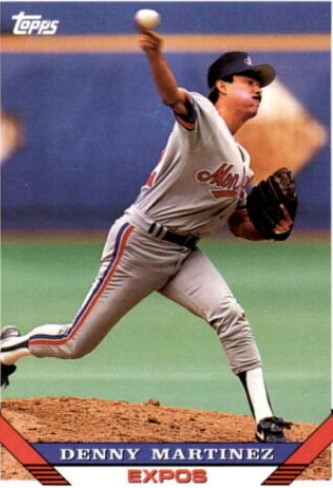
Dennis Martinez – 245 Wins

Dennis Martinez pitched in 23 MLB seasons (1976-98.) The four-time All Star, went 245-193, 3.70. He never won more than 16 games in a season, reaching that high mark four times.  He did lead the American League in wins in the strike-shortened 1981 seasons (14-5 for the Orioles. He won ten or more games in 15 seasons.

Whew! That was close.

Photo by Keith Allison

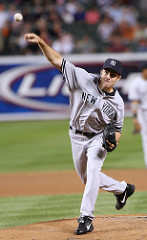
Mike Mussina nearly toppled Dennis Martinez from the top of the list for career wins without a twenty-win season. Going into the 2008 season (Mussina’s last), Mussina was 250-144 – without a twenty-win campaign on his resume (he had led the AL with 19 wins in 1995).  On September 28 of that season, he took the mound for his last MLB start with a 269-153 career record and a 19-9 record on the season (269 wins, with no twenty-win season).   In that final career start, he threw six shutout innings, got the win (his 20th of the season) and disqualified himself from this list.

Frank Tanana – 240 Wins

Frank Tanana started out as a fire-balling (mid-to-high 90’s fastball) workhorse  (lots of innings, strikeouts and complete games). In the late 1970’s, that workload took its toll (elbow and shoulder issues) and Tanana transformed himself into a finesse pitcher – with a skill set that kept him in the big leagues until 1993 (21 seasons). Despite that long career, Tanana, Baseball Roundtable believes, tends to be considerably underrated.   For example, among southpaws, his 240 MLB wins are the 15th most all time; his 2,773 strikeouts rank fifth among lefties; his 4,188 1/3 innings pitched are seventh; and his 616 games started seventh.  His final MLB line was 240-236, 3.66. He won 15 or more games in six seasons; ten or more in 14.

Tanana, a three-time All Star,  while never having a twenty-win season did win 19 games once (1976 Angels … 19-10, 2.43). That season, he took four losses in complete games in which he gave up no more than two runs.

He Deserved better

Detractors point to Frank Tanana’s 240-236 won-loss record, but Tanana spent much of his career pitching for teams that didn’t exactly excel at providing him run support.  Consider, for example, that from April 29 through July 3, 1977, Tanana threw fourteen consecutive complete games for the Angels.  In those contests, he tossed five shutouts, never gave up more than three runs and put up a 1.36 earned run average. This work earned him just nine wins versus five losses.

Jerry Reuss – 220 Wins

Jerry Reuss pitched in 22 MLB seasons (1969-90), going 220-191, 3.64. He was a two-time All Star and won a career-high 18 games in three seasons (and won 15 or more games in five campaigns and ten or more in 12).   His best season was 1980, when he went 18-6, 2.51 for the Dodgers, led the NL with six shutouts and finished second in the NL Cy Young Award voting to Steve Carlton.  Reuss pitched for eight different MLB teams.

So close!

On June 27, 1989, Jerry Reuss started for the Dodgers against the Giants and Vida Blue in San Francisco. The third batter of the game, Giants’ RF Jack Clark, was safe on an error by Dodgers’ SS Bill Russell. Clark would be the only batter to reach base that day, as Reuss pitched a no-hitter (two strikeouts) and missed a perfect game by that one miscue. The Dodgers, by the way, won 8-0.

Kenny Rogers – 219 Wins- LHP

Kenny Rogers went 219-156, 4.27 in 20 MLB seasons (1989-2008). He won a career-high 18 games (18-9, 4.76) for the 2004 Rangers, making just his second All Star team (at age 39). Rogers won 15 or more games in five  seasons and ten or more in fourteen. On July 28, 1994, Rogers threw a perfect game against the Angels (in Texas) – fanning eight. Notably, Rogers started his MLB career as a reliever – appearing in an average of 71.5 games per season from 1989  through 1992.  In 1992, the year before the Rangers converted him to a starter (33 starts in 1993), Rogers led the AL in appearances with 81.

Maturing Very Well

Kenny Rogers made his first All Star team in 1995 (his age-30 season) and didn’t make the All Star Squad again until his age-39 season (2004) – when he began of string of three straight All Star selections.  From his age-39 through his age 41 season, Rogers went 49-25, 4.04 – the moist productive three-season span in his career.

Zack Greinke – 218 Wins – RHP

Zack Greinke, the only active pitcher on this list, is in his 18th MLB season.  His record (as of this writing) is 218-129, 3.38. The six-time All Star, six-time Gold Glover and 2009 AL Cy Young Award winner won a career-high 19 games for the Dodgers in 2015 (when he also led the NL with a 1.66 earned run average). He has won 15 or more games in nine seasons, ten or more in 13.

Almost Dodged this Bullet

In his 19-win 2015 season, Greinke got a no-decision or a loss in eight games in which he pitched at least six innings and gave up no more than one earned run.

Charlie Hough – 216 Wins

Knuckleballer Charlie Hough had to work long (25 seasons … 1970-94) to make this list – at least partly because he spent his first 12 seasons primarily as a reliever (438 games, just 23 starts). He finished his career at 216-216, 3.75, with 61 saves. He was 174-173, 3.82 as a starter and 42-43, 3.45 out of the bullpen. Hough won a career-high 18 games in 1987 (18-13, 3.78) for the Rangers. He won 15 or more games six times and ten or more ten times.

Something Old, Something New

Forty-five-year-old Charlie Charlie Hough started the first regular-season game of the new Marlins’ franchise on April 5, 1993.  He went six innings (three earned runs) to earn the team’s first regular season victory and record the Marlins’ first-ever strikeout, fanning Dodgers’  leader off bitter Jose Offerman on three pitches in the top of the first inning.

Mark Buehrle – 214 Wins

Mark Buehrle won 214 games (160 losses) in 16 MLB seasons (2000-15) – winning a career high 19 in 2002 (19-12, 3.58 for the White Sox). He won 15 or more games six times and ten or more in all but his first season (when he made his MLB debut in mid-July). He was a five-time All Star and four-time Gold Glover.

If You’re Not Perfect – Keep Trying

On April 18, 2007, Mark Buehrle pitched a no-hitter (for the White Sox) against the Rangers (in Chicago). He came about as close to perfection as you can get – allowing just one base runner (a walk to Sammy Sosa, whom he promptly picked off first). Thus, he faced the minimum 27 batters in his eight-whiff masterpiece.    On  July 23, 2009, he did himself one better, tossing a perfect game against the Rays (again for the White Sox, again in Chicago). In that one he fanned six.

Milt Pappas – 209 Wins

Milt Pappas went 209-164, 3.40 in 17 MLB seasons (1957-73). Notably he reached a career-high 17 wins in two of his final three campaigns – both for the Cubs (17-14 in 1971 and 17-7 in 1972). He won 15  or more games in seven seasons and 10 or more in 14. He was an All Star in two seasons.

Another NO-NO one this List

On September 2, 1972, Milt Paper no-hit the Padres (8-0) for the Cubs (in Chicago). He walked one a and fanned six in the game.

Chuck Finley – 200 Wins

Chuck Finley  went 200-173, 3.85 in 17 MLB seasons (1986-2002). He won a career-high 18 games in both the 1990 and 1991 seasons – going 18-9 both times. Finley won 15 or more games in seven seasons and ten or more in 12.

I’ll Have One More, Please

Chuck Finley is the only MLB pitcher to have three four-strikeout innings in his career.

Tim Wakefield – 200 Wins

Knuckleballer Tim Wakefield played 19 MLB seasons (1992-93, 1995-2011), going 200-180, 4.41.  He won a career-high 17 games in two seasons (1998, 2007). The one-time All Star  won 15 or more games in four times and ten or more 11 times.  Wakefield reached 200 career wins despite never having a 20-win season and having an ERA under 4.50 in only eight of 19 campaigns. His best season was 1995, when he went 16-8, 2.95 for the Red Sox and finished third in the AL Cy Young Award balloting. He made his first All Star team at age 42, in his 17th season (2009). That season, he was 11-3, 4.31 in the first half – before injury (lower back straing)  limited  him to just four starts (0-2, 6.00 in the second half).

1992 NLCS

In the 1992 National League Championship series, Wakefield started Games Three and Six for the Pirates (versus the Braves) and pitched a pair of complete-game victories – giving up six runs in 18 innings.   The Pirates, however, lost the Series four games-to-three.

Primary Resrouces: Baseball-Reference,com; Baseball-Almanac.com


BASEBALL ROUNDTABLE ON THE TOP 100 BASEBALL BLOG LIST

100Baseball Roundtable is on the Feedspot list of the Top 100 Baseball Blogs.  To see the full list, click here.

I tweet baseball @DavidBBRT

Follow/Like Baseball Roundtable’s Facebook Page here.  More baseball commentary; blog post notifications; PRIZES.

Member: Society for American Baseball Research (SABR); The Baseball Reliquary; The Negro Leagues Baseball Museum.
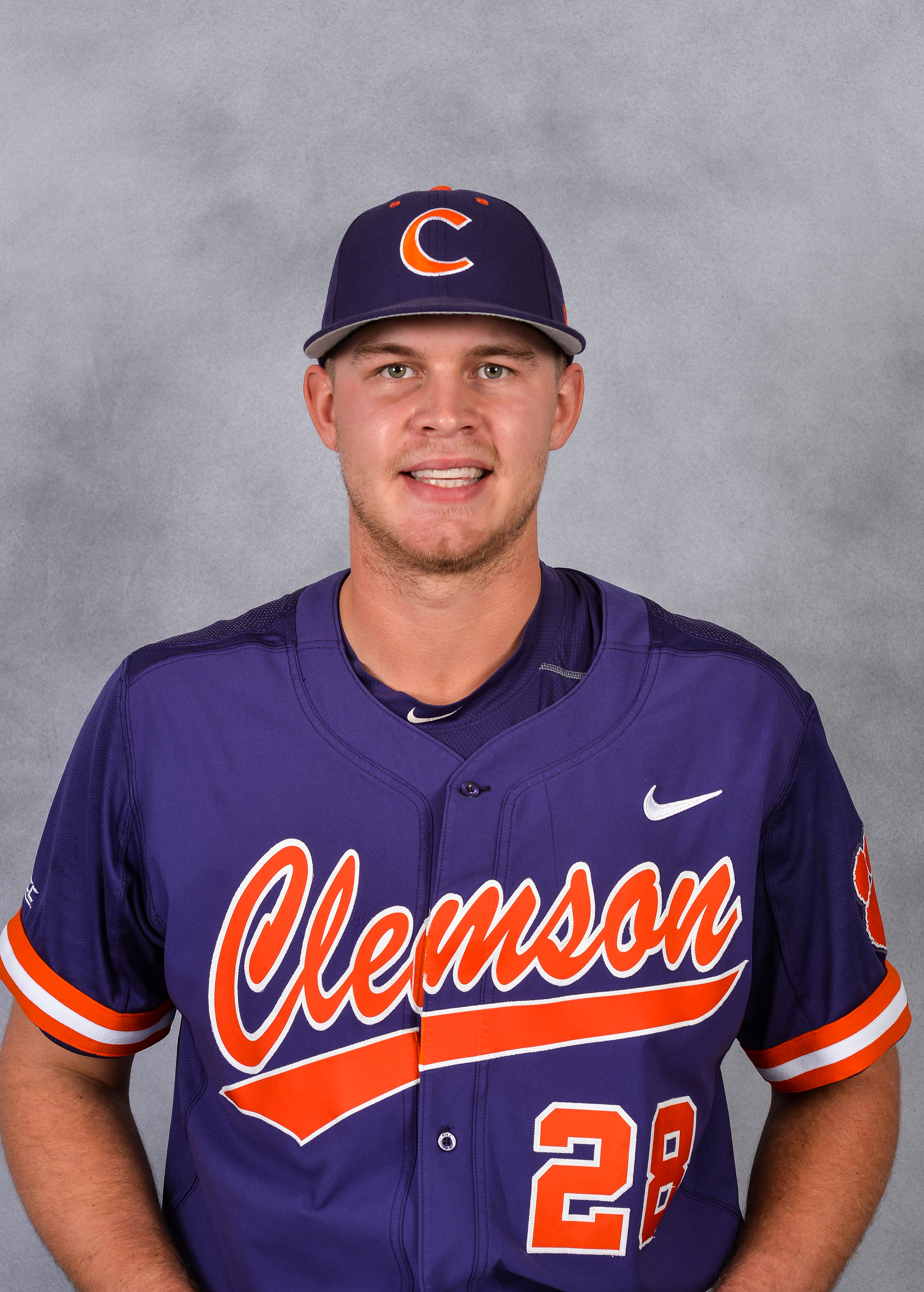


Sammy Sosa’s Long-Awaited First Grand Slam … and “Ducks-Full-Dingers” Tidbits

Photo by Ryosuke Yagi

On this date (July 27) in 1998, Cubs’ RF Sammy Sosa launched his 39th and 40th homers of the season – as the Cubs topped the Diamondbacks 6-2 in Arizona, with Sosa driving in all six runs. Just as significantly, the second of those homers – in the eighth inning off Alan Embree – was a Grand Slam. It came in Sosa’s tenth MLB season and was the 247th homer of his career. It was also Sosa’s first-ever Grand Slam, giving him (more proof of #InBaseballWeCountEverything) the MLB record for the most home runs ever for a player before hitting his first Grand Slam. After waiting more than nine seasons, 1,164 games and 246 home runs to hit his first round tripper with the bases full, Sosa’s next Grand Slam came just six innings later – in the fifth inning of the Cubs’  July 28 game against the Diamondbacks.  This time off Bob Wolcott (as the Cubs won 7-5).  Sosa ended his career with nine Grand Slams among his 609 regular-season home runs.

Now on the very same day that Sosa hit his first MLB Grand Slam, approximately 980 miles away, Tyrone Horne of the Double A Arkansas Travelers became the first (and still only) professional player to complete a home run cycle (solo, two-run, three run and Grand Slam home run all in the same game). He accomplished the feat on the road against the San Antonio Mission – in a 13-4 Arkansas win. For the full story on Horne and career, click here.

Well, these July 27th events, centering on Grand Slams, led Baseball Roundtable to dig a little deeper into “Ducks-Full Dingers.”

Did you know, for example, that hitting two Grand Slams in a game is even rarer than hitting four home runs in a contest or pitching a perfect game.?  Here’s the list.

And, here are a few tidbits about those two-Grand Slam games (you can check the details like teams and dates off the chart above):

  • Fernando Tatis (Sr.) is the only player to hit two Grand Slams in one inning. They were the first two Grand Slams of his MLB career. Tatis’ eight RBI in an inning also remain an MLB record.
  • Twelve of the thirteen two-Grand Slam games were accomplished on the road. Only Nomar Garciaparra hit his pair of bases-full blasts in front of a home crowd.
  • The Red Sox’ Bill Mueller is the only player to hit a Grand Slam from both batter’s boxes in the same game – and he hit them in the consecutive innings. In the seventh inning, right-handed off Rangers’  southpaw Aaron Fultz and, in the eighth inning, left-handed off righty Jay Powell.
  • The first National Leaguer to hit two Grand Slams in a game was Braves’ pitcher Tony Cloninger. He also threw a complete-game, seven-hitter that day (three runs, two walks, five strikeouts).
  • Rudy York and Fernando Tatis are the only two on the list to hit both Grand Slams off one pitcher. The Cardinals’ Tatis hit both of his off the Dodgers’ Chan Ho Park (and, of course, in the same inning – the third). The Red Sox’ York hit both of his Slams off the Athletics’ Ted Shirley (one in the second inning an done in the fifth).
  • Tony Lazzeri, Jim Tabor, Nomar Garciaparra and Bill Mueller each had three home runs in their two-Grand Slam Games.

Career Leaders in Grands Slams

Alex Rodriguez                  25

Lou Gehrig                          23

Manny Ramirez                 21

Eddie Murray                     19

Willie McCovey                 18

Robin Ventura                   18

Leader among active players: Albert Pujols – 15


A couple of single-season Grand Slam tidbits:

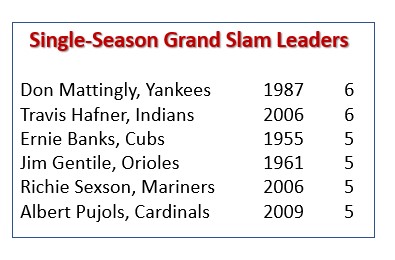
  • Yankee Don Mattingly’s single-season record six Grand Slams in 1987 were the only Grand Slams of his 14-season MLB career.
  • When the Orioles’ Jim Gentile hit a then-record-tying  five Grand Slams in 1961, everyone of his five bases-loaded blasts came in a game in which the Baltimore starter was Chuck Estrada.  Gentile, in face, hit only one other Grand Slam in his career – in a game started by (you guessed it) Chuck Estrada.

That’ll Do in a Pinch

Four players share the record for most career pinch-hit Grand Slams (three) – Ben Broussard (Indians/Mariners); Willie McCovey (Giants); Ron Northey (Cardinals/Cubs); and Rich Reese (Twins).

A trivia tidbit on Reese.  His record-tying three pinch hit Grand Slams  were the only Grand Slams in his 10-season MLB career (866 games/2225 plate appearances/200 pinch-hitting appearances).

Let’s Get this Party Started

While 126 players have homered in their first MLB at bat, only four of those long balls were Grand Slams.  The players with Grand Slams in their first at bat include: Bill Duggleby (Phillies – 1898);  Jeremy Hermida (Marlins – 2005); Kevin Kouzmanoff (Indians – 2006); Daniel Nava (Red Sox – 2010).   The last two of those, poked those four-run shots on the very first MLB pitch they ever faced.

  • Kevin Kouzmanoff started his first MLB game at DH (batting seventh) for the Indians on September 2, 2006. The opponents were the Rangers (in Texas), with Edison Volquez on the mound. In the top of the first, Kouzmanoff came to bat with the sacks full and two out – and rapped the first pitch from Volquez over the CF fence for a Grand Slam. It was his only hit in four at bats, as the Indians triumphed 6-5. Kouzmanoff played seven MLB seasons (2006-2011, 2014).  He hit .257-87-371, with three Grand Slams.
  • Daniel Nava made his first MLB start as a member of the Red Sox on June 12, 2010. He was batting ninth and playing left field, as the BoSox faced the Blue Jays (and starter Joe Blanton) in Fenway. In the bottom of the second frame, Nava came to bat for the first time in an MLB game – with the based loaded, no outs and the Red Sox up 1-0. He hit the first Blanton offering deep to RF for a Grand Slam. Nava had a home run and a double in four at bats, as the Red Sox won 10-2. Nava played seven MLB seasons (2010, 2012-17), hitting .266-29-206 in 589 games. He hit two Grand Slams.

The Ultimate Slam

I have often said “In baseball we count everything,” and, if it’s not already counted, we find a way to make it countable.  Hence, the “Ultimate Grand Slam” – a walk-off Grand Slam in the bottom of the final inning of a game when your team trails by three runs.   The “count” shows thirty such Ultimate Grand Slams – by thirty different players.  A handful stand out.

  • Babe Ruth, Jason Giambi and Ryan Roberts notched Ultimate Slam in extra innings.

Ruth hit his in the bottom of the tenth of a September 24, 1925 game against the White Sox at Yankee Stadium. The game had been tied 2-2 after nine frames, the White Sox tallied three in the top of the tenth, before Ruth’s Ultimate Slam put it away for New Yorkers 5-4.

Giambi hit his in the bottom of the fourteenth inning of a May 17, 2002 game between his Yankees and the Minnesota Twins. The game was tied at nine after nine. The Twins, like the White Sox above, plated three runs in the top of the 14th, before the Giambi Ultimate Slam gave New York the 13-12 win,

Roberts hit his Ultimate Slam in the tenth inning of a September 27, 2011 matchup between his Diamondbacks and the Dodgers. The game was knotted at 1-1 after nine innings, when the Dodgers exploded for five runs in the top of the tenth. The game looked safely packed away as Arizona reliever Blake Hawksworth retired the first two batters in the bottom of the inning.  What followed was a single by RF Cole Gillespie, a single by  C Miguel Montero (Gillespie going to third); a walk to CF Chris Young;  PH John McDonald safe on an error with one run scoring; a pitching change (Javy Guerra for Hawksworth); a walk to 2B Aaron Hill forcing in a run (leaving the base loaded and the score 6-3); and, finally, Roberts’ Ultimate Slam –  giving the Diamondbacks a 7-6 win, with six runs scoring after the Dodgers had the Diamondbacks down to their last out, with the bases empty.

  • For sheer excitement no Ultimate Slam can beat the one Roberto Clemente hit on July 25, 1956. The Pirate were trailing the Cubs 8-5, when Clemente came to the plate with the bases loaded and no outs. Facing Jim Brosnan, Clemente drove a high-and-inside pitch off the light standard in left field. As the ball ricocheted off the light standard and rolled along the warning track, all three runners scored – and then a sliding Clemente, beat the relay throw, and slid across the plate.  Note: Clemente ran through the coach’s stop sign at third base. It remains the only inside-the-park Ultimate Slam.
  • 2011 is the only year with three Ultimate Slams (Travis Hafner (Indians); Brian Bogusevic (Astros); Ryan Roberts (Diamondbacks).

Primary Resources:  Baseball-Reference.com; Baseball-Almanac.com

Baseball Roundtable Disclaimer:  The MLB records referenced in this (and previous) posts have the potential to change (primarily additions) as Major League Baseball recognizes and fully incorporates Negro League records from 1920-48 into the MLB record book.


BASEBALL ROUNDTABLE ON THE TOP 100 BASEBALL BLOG LIST

100Baseball Roundtable is on the Feedspot list of the Top 100 Baseball Blogs.  To see the full list, click here.

I tweet baseball @DavidBBRT

Follow/Like Baseball Roundtable’s Facebook Page here.  More baseball commentary; blog post notifications; PRIZES.

Member: Society for American Baseball Research (SABR); The Baseball Reliquary; The Negro Leagues Baseball Museum.
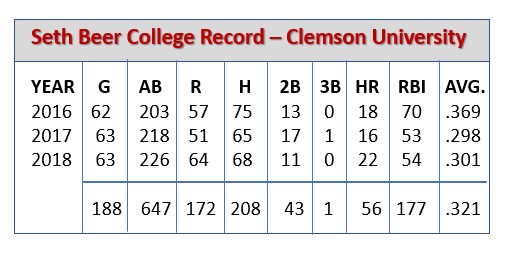


Whiffing Your Way into the Record Books – Fifty Years Ago Today

On this date (July 9), fifty years ago, the California Angels were in Oakland to take on the A’s.  It didn’t seem like much of a matchup.  The A’s were 55-29 in first place in the AL West, while the Angels were in fourth place, nine games under .500 (40-49) and 17 ½ games out.  Further, the A’s were starting ace Vida Blue 17-3, 1.51 at the time, while the Angels starter was Rudy May at 4-5, 3.24. Side note:  The 21-year-old Blue was on his way to a 24-8, 1.82 season that would earn him the AL Cy Young and MVP Awards.  The 26-year-old May would end the season 11-12, 3.02.

It proved, however, to be a very competitive matchup – going just over five hours (20 innings) and ending in a 1-0 score. Ironically the Angels lost to the A’s on a walk-off, run-scoring single by a player named Angel (A’s rookie RF Angel Mangual). In the process:

  • The two teams fanned a total of  43 times, at the time the MLB record for combined whiffs in a game (since broken) – and still the American League record. (On May 7, 2017, the Yankees and Cubs fanned a combined 48 times.)
  • Angels’ batters  whiffed 26 times – still a single-game, single-team record, but since tied by the: Yankees (vs. White Sox – May 7, 2017); Dodgers (vs. Brewers – June 2, 2017); and Mets (vs. Braves – August 8, 2019).
  • Career MLB strikeout leader Reggie Jackson started for the A’s, but did not strikeout in four plate appearances (one walk).
  • Twenty different batters struck out during the game (nine for the Angels, 11 for the A’s); 12 of those 20 struck out more than once.
  • The number-three and number-four Angels’ hitters accounted for just over  one-quarter of all the strikeouts: LF Billy Cowan, batting third, went 0-for-8, with six strikeouts and RF Tony Conigliaro, batting cleanup, went 0-for-8 with five strikeouts.
  • There were 18 hits in the contest – 17 singles and one double (Angels’ catcher Jerry Moses).
  • The hitting “star” of the game was the A’s Angel Mangual, not only did he drive in the winning run, he had three hits and a walk in nine plate appearance and did not strikeout. (The only other player to play the full game and not fan at least once was A’s 3B Sal Bando – four walks in four plate appearances).
  • 36 players were used: 20 by the A’s; 16 by the Angels.
  • A couple of A’s pitchers with good nicknames appeared, but not on the mound. Blue Moon Odom was used as a pinch runner and Catfish Hunter as a pinch hitter.
  • Tony LaRussa came into the game for the A’s at SS in the tenth, struck out in his only at bat (to end the 12th) and was lifted for a pinch hitter with the bases loaded and two out in the 14th.

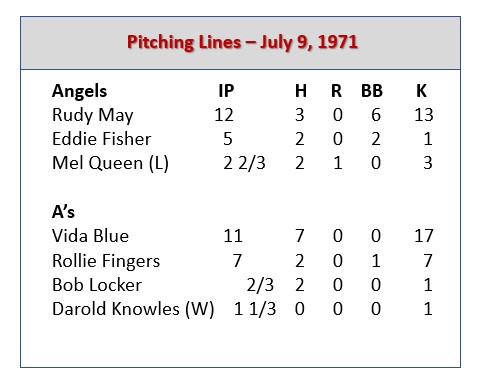
In the game, Vida Blue threw 11 scoreless frames (seven hits, no walks, 17 strikeouts; while May went 12 innings (just three hits, six walks and 13 strikeouts). Rollie Fingers pitched seven innings in relief (zero runs, two hits, one walk, seven strikeouts). The win went to Darold Knowles, the loss to Mel Queen.

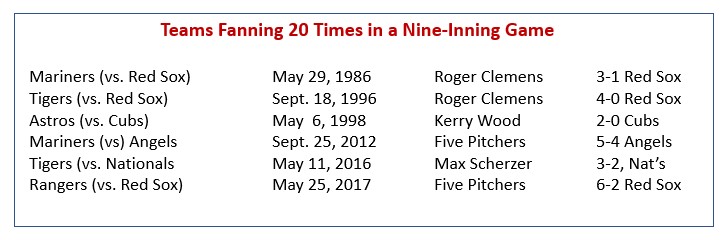
Twenty Strikeouts by One Team in a Nine-Inning Game.

The record for strikeouts by a team in a nine-inning game is twenty and it’s been done six times. Five of those were AL teams and one was an NL squad (and the NL team that fanned twenty times  has since moved to the AL).  Notably, in four of those games the starting pitcher went the distance.

In the four nine-inning games in which a single pitcher recorded 20 strikeouts – not a single walk was issued.

Side note: On May, 2001, Randy Johnson of the Diamondbacks fanned 20 batters  (no walks) over nine innings, but left the game with the scored tied 1-1.  The Diamondbacks eventually won 4-3 in 11 innings, with five D-backs’ relievers fanning only more batter over two innings. 

Primary Resources:  Baseball-Reference.com; Baseball-Almanac.com; NationalPastime.com


100Baseball Roundtable is on the Feedspot list of the Top 100 Baseball Blogs.  To see the full list, click here.

I tweet baseball @DavidBaseballRT

Follow/Like Baseball Roundtable’s Facebook Page here.  More baseball commentary; blog post notifications; PRIZES.

Member: Society for American Baseball Research (SABR); The Baseball Reliquary; The Negro Leagues Baseball Museum.