More Distractions From CBA Negotiations … Some No-Hitter Observations

Wise Words from a Pair of Bills

It never ceases to amaze me, how many of baseball’s wounds are self-inflicted.

Hall of Famer Bill Veeck

Baseball must be a great game to survive the fools who run it.

Hall of Famer Bill Terry

As Baseball Roundtable waits, less than patiently, for baseball’s owners and players to come to their senses (and thereby to an agreement), I continue to randomly search for baseball stories and stats that pique my interest. For example, looking at Giants’ right-hander Ted Lincecum’s stat line and game logs, I noticed that:

  • Lincecum threw only two complete games in the last five seasons of his 10-season (2007-16) MLB career; and
  • Both of those complete games were no-hitters.

As always with Baseball Roundtable, one thing led to another and I was reminded of the fact that Phil Humber threw just one complete game in his eight-season MLB career (2006-13) – and that outing was a Perfect Game.  That led to Mike Fiers’ two career complete games – both no-hitters.

These  observations led me to look even more deeply at pitchers who managed to throw MLB no-hitters, despite a minimal number of career complete games.  As I began the search, I set my sights on pitchers with one no-hitter and fewer than three career complete games and those with multiple MLB no-hitters and fewer than ten career complete games.  Since I do like charts, I developed two based on these criteria: one for pitchers no longer active and another for pitchers active in 2021 (who have a chance to pitch their way off the chart).  Side note:  As you might expect, given changes in the game (pitch counts, relief specialists, etc.), most of the pitchers on the charts began their MLB careers in the 2000’s.

In this post, I’ll present those charts, along with some info on each pitcher, as well as a couple of Baseball Round Table No-Hit Parade Extras.
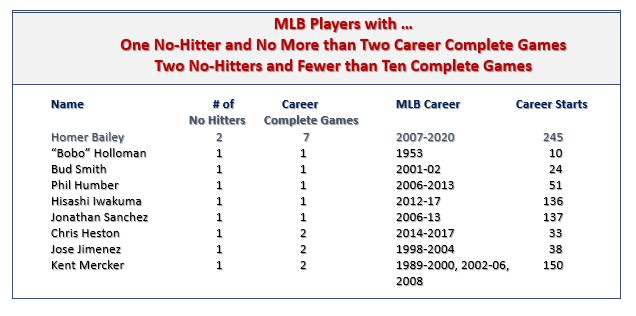
Homer Bailey …. Two No-Hitters, Seven Career Complete Games, 245 Career Starts

Homer Bailey threw the last MLB no-hitter of the 2012 season and the first no-hitter of the 2013 season. The right-hander made 245 MLB appearances – and never pitched in relief in the majors.  Bailey (with the Reds) no-hit the Pirates (in Pittsburgh) on September 28, 2012 (1-0), walking one and fanning ten. On July 2, 2013, he no-hit the Giants (in Cincinnati) by a 3-0 score, walking one and whiffing nine. Bailey pitched in 14 MLB seasons (2007-20 … Reds, Royals, A’s Twins) going  81-86, 4.56, with 1,157 strikeouts in 1,401 innings. Bailey’s  given name, by the way,  was David Dewitt Bailey Jr.  His “Homer” nickname (which seemed unfortunate for a pitcher) honored his great grandfather.

High School High Roller

Homer Bailey was a first-round pick (Reds) in the 2004 MLB Draft – out of La Grange (TX) High School, where he had gone 41-4, 0.90 with 536 strikeouts in 298 innings.

________________________________________________

Bobo Holloman … No-Hitter, One Career Complete Game, 10 Career Starts

Alva Lee “Bobo” Holloman threw a no-hitter in his first MLB start (fifth appearance). On May 6, 1953, righty Holloman and his St. Louis Browns no-hit the Philadelphia Athletics in a 6-0 whitewash. It was the only complete game in Holloman’s one season (1953) career. Holloman walked five and fanned three. Notably, he made the no-no hard work for himself, by walking three batters in the top of the ninth inning. He made nine more starts that season, going 2-5, 5.40 in those appearances.  His season and career stat line was 3-7, 5.23.

Making the Roundtable No-Hit Parade and Hit Parade

In Bobo Holloman’s first MLB start, he not only notched a no-hitter and his only MLB complete game, he also collected two hits and three RBI – his only major league hits and runs driven in.

____________________________________________

Baseball Roundtable No-Hit Parade Extra … Making Those Last Two Complete Games Count

Ted Lincecum had a pair of no-hitters, but his ten career complete games kept him off the chart. Lincecum, who led the National League with four complete games in 2009, had just two complete games over his final five MLB seasons (2012-16)  – both were no-hitters. On July 13, 2013 (Could 13 be Lincecum’s lucky number?), Lincecum no-hit the Padres (in San Diego) as the Giants won 9-0. He walked four and struck out thirteen. On June 25 of the following season, he no-hit the Padres again in San Francisco. The final was 4-0 and Lincecum walked one and fanned six. The four-time All Star went 110-89 in ten MLB seasons (2007-16 … Giants Dodgers). He was also 5-2, 2.50 in the post-season.

Bud smith … No-Hitter, One Career Complete Game, 24 Career Starts

Southpaw Bud Smith threw his no-hitter in his rookie season, in his 11th MLB start (September 3, 1001). It was the   21-year-old Cardinal rookie’s  fourth win (against two losses) in a season in which he would go a promising  6-3. 3.83.  Smith walked four and whiffed seven in a 4-0 win over the Padres (in San Diego). Smith’s early promise faded.  In 2002, he went 1-5, 6.94 and, in July,  was traded to the Phillies in a multi-player trade. He did not pitch again in the major leagues.,

_____________________________________________

Philip Humber … One No-Hitter, One Career Complete Game, 51 Career Starts
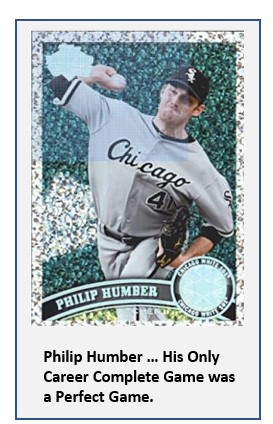
Phil Humber’s lone career complete game was not only a no-hitter, it was a PERFECT GAME. On April 21, 2012, Humber set down 27 straight Mariners in Seattle, with his White  Sox winning 4-0. He fanned nine in the effort and threw 67 strikes in 97 pitches (69 percent). In his very next start, Humber lasted just five innings against the Red Sox, giving up nine earned runs on eight hits and three walks. Humber was not exactly a candidate for a “perfecto.”  The righty pitched in eight MLB seasons (2006-13 … Mets, Twins, Royals, White Sox Astro), going  16-23, 5.31.  The year he pitched his perfect game, his final stat line was 5-5, 6.44.

We’ll Take Phil

Philip Humber was a First Round draft pick (Mets – third overall pick) in the 2004 MLB draft – out of Rice University, where he had gone 35-8, 2.80, with 422 strikeouts in 353 2/3 innings over three seasons.

_______________________________________________

Hisashi Iwakuma … One No-Hitter, One Career Complete Game, 136 Career Starts

Hisashi Iwakuma pitched 11 seasons in Japan (and had been an All Star in multiple campaigns) before signing with the Mariners (as a 31-year-old) in 2012. He adjusted to MLB quickly.  In his first three seasons with the Mariners, the right-hander went 38-20, 3.07 and was selected to the 2013 AL All Star squad.  On August 12, 2015, he no-hit the Orioles (in Seattle ), as the Mariners triumphed 3-0.  He walked three and fanned seven. In six MLB seasons (2012-17, all with the Mariners, Iwakuma went 63-39, 3.41.

Not First, But Almost

Hisashi Iwakuma was the second Japanese player to pitch an MLB no-hitter (after Hideo Nomo).

______________________________________________

Jonathan Sanchez … One No-Hitter, One Career Complete Game, 137 Career Starts

Giants’ lefty  Jonathan Sanchez threw his no-hitter on July 10, 2009 – shutting  down the Padres 8-0, while walking none and fanning 11. The first (and only baserunner) came with one out in the top of the eighth on an error by Juan Uribe, who had moved from 2B to 3B in the seventh inning. Sanchez came into the game 2-8, 5.30 on the season (16 appearances/13 starts). He  finished the season 8-12, 4.24. Sanchez pitched in eight MLB seasons (2006-13 … Giants, Royals, Rockies, Pirates) and went 39-58, 4.70.

Jonathan Sanchez’ Dad Can Thank Randy Johnson for This One

On the night he threw his no-hitter, Jonathan Sanchez was slated to work out of the bullpen.  Randy Johnson was scheduled to start for the Giants, but was a late (injury) scratch. And the rest is history. Oh, one final note, it was the first time that Sanchez’ father was in the stands to see  him pitch in an MLB game.

 ______________________________________

Baseball Roundtable No-Hit Parade Extra … A Good Start for Bumpus

Charles Leander “Bumpus” Jones is the only MLB pitcher to throw a no-hitter in his first-ever MLB appearance.  It happened a bit before my time –  on October 15, 1892. Bumpus earned the (very) late (final-day-of-the-season) start with the Reds after a 24-3, 0.93 record with the Joliet Convicts/Aurora Indians of the Illinois-Iowa League.  He tossed his no-hitter against the Pirates, striking out three and walking four in a 7-1 win.  Of note is the fact that Jones ‘s no-hitter was the last one thrown  with pitchers  throwing from a box with the front line 50-feet from home plate  and the back line 5 ½-feet farther back.  The following season, the distance was stretched to the current 60’6” and Bumpus could not recreate the magic of that first appearance. In 1893, he went 1-4, 10.19 and never pitched in the majors again.

Chris Heston … One No-Hitter, Two Career Complete Games, 33 Career Starts

Right-hander Chris Heston pitched his no-hitter on June 9 , 2015 – as his Giants topped the Mets 5-0 in New York. Heston fanned eleven and walked none.  It was the second – and final – complete game of Heston’s four- season MLB career (2014-17 … Giants, Mariners, Twins).  Earlier that season (May 12), Heston had pitched a two-hit, complete game in an 8-1 win over the Astros.  Heston ended the 2015 season at 12-11, 3.95.  He had only one other victory in his  MLB career. His final  MLB stat line was 13-13, 4.55.

This Will Hurt You More than it Hurts Me

In his no-hitter Chris Heston hit three batters – a record for a no-hit performance.

___________________________________

Jose Jimenez … One No-Hitter, Two Career Complete Games, 38 Career Starts

On June 25 1999, Cardinals’  right-hander Jose Jimenez (rookie status intact, he pitched in just four games in 1998), found himself facing the Diamondbacks (and the imposing figure of five-time All Star Randy Johnson) in Arizona. Johnson was 12-4, 3.36 at the time (and had 60 MLB career complete games under his belt.). Jimenez came into the game 3-7, 6.69 on the season and had yet to toss an MLB complete game. Sanchez went the distance, giving up no hit and two walks, while fanning eight, as the Cardinals prevailed 1-0.  (Johnson pitched a complete game five-hitter with 14 strikeouts.) Sanchez ended the season 5-14, 5.85. Johnson finished at 17-9, with a league-leading 2.48 ERA and a league -topping 364 strikeouts.

Sorry Randy, But I Got This

Jose Jimenez had only two complete games in his career. They came on June 25 and July 5, 1999. Both times, the opposing team was the Diamondbacks and the opposing starter was Randy Johnson.  Sanchez’ Cardinals won both contests by scores of 1-0. Sanchez gave up a total of two nits and fanned 17  in the 18 innings, Johnson gave up nine hits, two runs and fanned 29.

Jimenez pitched in seven MLB seasons (1998-2004 … Cardinals, Rockies), going 24-44, 4.92.  Notably, after his 1999 no-hitter season, he was traded to the Rockies, where he was converted to a reliever and racked up 102 saves over the next four seasons.  He added eight saves for the Indians in 2004.

_________________________________________

Kent Mercker …  One No-Hitter, Two Career Complete Games, 150  Career Starts

Southpaw Kent Mercker spent most of his 18-season MLB career as a reliever (542 relief appearances/150 starts). In his 150 starts, he pitched just two complete games. Both complete games came in 1994 and one was a no-hitter.  It came on April 8, in Mercker’s first appearance of the season. He faced the Dodgers (in LA) and Mercker picked up a win (6-0), no-hitting the Dodgers  (four walks, ten strikeouts). He threw the second and final complete game of his career on July 18 of that season –  a two-hit,  3-2 win over the Pirates. Mercker finished the season  9-4, 3.45. Mercker pitched for nine teams in 18 MLB seasons (1989-2000, 2002-2006, 2008 … Braves, Orioles, Indians, Reds, Cardinals, Red Sox, Angels, Rockies, Cubs). He was 74-67, 4.16, with 25 saves over that time.

There’s More Than One Way to Get This Done

Kent Mercker is one of only four MLB pitchers to start a complete-game no-hitter and also start a game which ended in a combined (multi-pitcher)  no-hitter.

__________________________________________


Mike Fiers …. Two No Hitters, Two Career Complete Games, 199 Career Starts

Mike Fiers has pitched just two complete games in 199 starts over eleven seasons – and both were no-hitters.  On August 21, 2015, the right-hander notched his first-ever complete game. Pitching for the Astros, he no-hit the Dodgers in a 3-0 win in Houston.  He walked three and fanned ten. Fiers came into the game at 5-9, 3.87 and finished the season at 7-10, 3.69.  His second career complete outing came on May 7, 2019, pitching for the A’s.  In that contest, he no-hit the Reds (a 2-0 win), walking two and fanning six. He came into that game 2-3, 6.81. The no-no seemed to turn his season around.  He won his next  11 decisions and finished the year at 15-4, 3.90.

Ups and Downs

Mike Fiers had his ups and down on May 7, 2015. He started for the Brewers against the Dodgers that day.  With the game tied at 1-1 in the top of the fourth, Fiers had an inning in which he issued  three four-pitch walks (one intentional) and gave up a pair of singles. (Two runs scored in the inning.) In his next frame, he pitched an Immaculate Inning – nine pitches, three outs, three strikeouts.  

Fiers has pitched in 11 MLB seasons (2011-21 … Brewers, Astros, Tigers, A’s), going 75-64, 4.07. He pitched in just two games in 2021 due to elbow issues.

_______________________________________

Jake Arrieta … Two No-Hitters, Six Complete Games, 279 Starts

Cubs’ Righty Jake Arrieta threw his first no-hitter in his sixth MLB season (2015) – a year when he led the National League in wins (22), starts (33), complete games (four) and shutouts (three).  Going into the season, Arrieta had just one complete game in 97 career starts.  He threw the no-hitter on August 30 in his 27th start of the 2015 seasons (his 124th career start), as the Cubs topped the Dodgers 2-0 in Los Angeles. Arrieta, in running his season record to 17-6, walked just one and fanned 12.  Arrieta finished the game with a flourish, leaving no doubt, as he struck out all three hitters he faced i the ninth inning.

Arrieta’s second no-hitter came just ten starts later – on April 21, 2016, as the Cubs clobbered the Reds 16-0 in Cincinnati. In that one, Arietta walked four and fanned six. Since that 2016 no-hitter, Arriet has started 118 games without going the distance. He finished the 2016 season at 18-8, 3.10.  Arrieta’s has pitched in 12 MLB seasons (2010-21 … Orikoles, Cubs, Phillies and Padres), going 115-93, 3.98.   In an injury-interrupted  2021 season, he was 5-14, 7.39 for the Cubs and Padres.

What a Second Half

Jake Arrieta, although he won the NL Cy Young Award in 2015, did not make the All Star team that season.  He was 10-5, 2.66 before the break and a sparkling 12-1, 0.75 after the break. 

_______________________________________

Tyler Gilbert … – One  No Hitter, One  Career Complete Game, Six Career Starts

Diamondbacks’ rookie left-hander Tyler Gilbert threw a no-hitter  on August 14 of last season – in his fourth MLB appearance and his first MLB start. The Diamondbacks topped the Rockies 7-0 in Gilberts no-no.  He walked three and struck out five.  Gilbert finished 2021 at 2-2, 3.15.

______________________________________

Alec  Mills … One No Hitter, One  Career Complete Game, 37 Career Starts

On September 13, 2020, Cubs’ righty Alex Mills – in his 15th MLB start – cruised to a 12-0 win over the Brewers in Milwaukee, walking three and fanning five. It was part of the 28-year-old’s  5-5, 4.48 record in his fourth MLB season.  Mills has played in five MLB seasons (2016, 2018-21 … Royals, Cubs), going 12-13, 4.60. In 2021, he was 6-7. 5.07 for the Cubs.

______________________________________

Spencer Turnbull …  One  No Hitter, One Career Complete Game, 53 Career Starts

Spencer Turnbull no-hit the Mariners (in Seattle), on May 18, 2021, winning by a 5-0 score. The 28-year-old righty (in his fourth MLB season)  walked two and fanned nine in the effort.  It was his first MLB complete game and came in his 51st MLB start.  Turnbull’s season was cut short in early Junie by arm issues that eventually required Tommy John surgery. He finished the season at 4-2, 2.88 and with a career mark of 11-15, 4.25.  Turnbull was selected by the Tigers in the second round of the 2014 MLB Draft (out of the University of Alabama).

_______________________________________

John Means …. One  No Hitter, One  Career Complete Game, 63 Career Starts

 On May 5 of last season, Orioles’ lefty John Means pitched the first (and still only) complete game of his four-season MLB career in a 6-0 Baltimore victory over the Mariners (in Seattle).  Means faced the minimum 27 batters, gave up no hits, did not walk a batter, did not hit at batter and there were no errors committed in the game.  Yet, he did not record a perfect game. In fact, he lost the perfect outing on a strikeout. At least it came early.  In the bottom of the third inning, Seattle left-fielder Sam Haggerty swung at a 1-2 breaking pitch in the dirt that catcher Pedro Severino couldn’t handle. Haggerty made it to first (advancing on the third-strike rule) on what was rule a wild pitch. (It was one of 12 Means’ strikeouts  in the game). On the very next pitch, Haggerty was caught stealing. And, as it turned out, he would be the only Seattle baserunner of the game. It’s the only MLB game in which a perfect game has been lost on a strikeout (dropped third strike or wild pitch.)

Making That First Pitch Count

In his May 5, 2021, no-hitter, John Means faced the minimum 27 batters and recorded a first-pitch strike on 26 of them.

Means who was 4-0, 1.37 after the no-hitter, ended the season 6-9, 3.62. After four seasons, all with Baltimore,  the 28 year-old’s MLB stat line is 20-24, 3.82.

________________________________________

Joe Musgrove … One  No Hitter, Two Career Complete Games, 114 Career Starts

On April 9, 2012, the Padres’ Joe Musgrove no-hit the Rangers (by a 3-0 score) in Texas.  He walked none and fanned ten.  The only base runner was Joey Gallo, hit by an 0-0 pitch in the fourth inning. It was Musgrove’s  first MLB complete game and came in his 85th MLB start. On August 27, the right-hander tossed his second complete game – a 5-0, two-hit (two walks/nine whiffs) road win over the Angels.   Musgrove finished the season 11-9, 3.18, with 203 strikeouts in 181 1/3 innings.  His career MLB record (2016-21 … Astros, Pirates, Padres) is 40-47, 4.02. He was a first round pick (Blue Jays) in the 2011 MLB Draft, right out of Grossmont High School in El Cajon, CA.

Like a Rocket

The season before his 2016 MLB debut, Joe Musgrove made a rapid climb in the Astros’ system.  He was 4-1, 1.88 for the A-Level Quad Cities River Bandits; 4-0, 2.40 for the High-A Lancaster JetHawks; and 4-0, 2.20 for the Double-a Corpus Christi Hooks. In 2016, he was 7-4, 2.74 at Double A and Triple A before his call up.

____________________________________

Carlos Rodon …. One  No Hitter, Two Career Complete Games, 116 Career Starts

The White Sox‘ Carlos Rodon notched his first complete game early in his MLB career –  in his rookie season and in just his 17th career start (August 17, 2015). Rodon went the distance in a 2-1 road loss to the Angels.  His next complete game came on August 14, 2021 – a no-hit, 8-0 win over the Tigers. In that one, he walked none and fanned seven. In that game, the lefty  was perfect with one-out in the ninth, when he hit Tigers’ catcher Roberto Perez with an 0-2 pitch. Perez proved to be the only Tigers’ baserunner in the game.  Rodon finished the 2021 season 13-5, 2.37.  His career record (2015-21), all with the White Sox, is 42-38, 3.79.  Rodon was a first round pick, (White Sox) in the 2014 MLB Draft – out of North Carolina State University, where he went 25-10, 2.24 with 436 strikeouts in 345 2/3 innings over three seasons.

_____________________________________________

James Paxton … One No Hitter, Two Career Complete Games, 137 Career Starts

Southpaw James Paxton has pitched in nine MLB seasons (2013-21 … Mariners, Yankees). He threw his first MLB complete game in his sixth MLB seasons (82nd career start) – and it was a no-hitter.  It came on May 8, 2018, in a 5-0 Seattle win over the Blue Jays in Toronto.  Paxton walked tree and fanned seven in that game.

Home Sweet Home

James Paxton is the first Canadian to pitch a no-hitter in Canada. 

Paxton’s second career complete game came just two starts later (May 19), in a 7-2 win over Detroit (in Seattle). Paxton finished the 2018 season at 11-6, 3.76.   His career record is 57-33, 3.59, with 831 strikeouts in 745 2/3 innings. Note: Paxton pitched in just one game in 2021 (Tommy John surgery).

How Rare is a Complete Game These Days?

James Paxton’s two complete games and one complete-game shutout in 2018 were good enough to tie for the MLB lead in those categories.  That points to plenty more pitchers making their way onto these charts in the future.

Primary Resources: Baseball-Reference.com; TheBaseballCube.com

 

100Baseball Roundtable is on the Feedspot list of the Top 100 Baseball Blogs.  To see the full list, click here.

I tweet baseball @DavidBBRT

Follow/Like Baseball Roundtable’s Facebook Page here.  More baseball commentary; blog post notifications; PRIZES.

Member: Society for American Baseball Research (SABR); Negro Leagues Baseball Museum; The Baseball Reliquary. 
 

Relief from Collective Bargaining Banter – Installment Three

Okay, we’re past the date when we should have heard or read those most exciting words – Pitchers and Catchers Report – and there’s no relief in sight. So, here’s another installment in Baseball Roundtable’s effort to provide some “relief” from CBA banter, focusing, appropriately, on relief pitchers.  (For Installment One, click here.  For Installment Two click here.)  Side note, the time it takes you just to read this post should be roughly equal to the time owners and players spent in the lat negotiating session. 

This time, I’ll focus on a relief pitcher who showed unexpected and bittersweet power at the plate – and a power hitter who showed unexpected and bittersweet talent on the mound.

The Rick Camp Game … The Perfect Storm

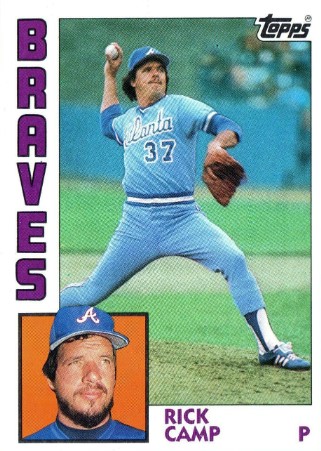
On July 4 (and July 5) , 1985, the Atlanta Braves and New York  Mets took part in one of the wildest games in either franchise’s history.  In Atlanta, it’s known as the “Rick Camp Game”  in honor of the role(s) the Braves’ reliever played in the 19-inning marathon.

That the game happened at all is a bit of a surprise.  The Independence Day contest did not start until 9:04, thanks to a 94-minute rain delay.  Still, attendance was reported at  44,947 (many fans likely attracted  by the planned post-game fireworks).  In addition, the hometown Braves were 34-41, in  fifth place, ten games off the pace.  I should also note here that the inclement weather continued, with another 40-plus minute delay in the third  inning.

The  fans who stayed in the park not only enjoyed the post-game fireworks, but plenty of in-game fireworks as well.  The 19-inning contest featured 29 runs and 46 hits. Mets’ first baseman Keith Hernandez hit for the cycle and Mets’ C Gary Carter collected five hits and a walk in ten plate appearance. Seven Mets had at least three hits in the game – including Howard Johnson, who didn’t come into the game until the ninth inning (and still went three-for-five, with a home run, a walk, four runs scored and two RBI).  Johnson, by the way, entered the game hitting just .194 (in 58 games) on the season. On the Braves’ side, LF Terry Harper went five-for-ten, with a home run, four RBI and three runs scored. Harper was one of four Braves with at least three hits in the game.

It was a back-and-forth battle, with the teams tied at one run apiece after one inning, the Braves up 3-1 after three, the Mets up 5-3 after four, the game tied at eight after nine and tied again at 10-10 after 13 – with more still to come.  You get the idea.

So, why, given all this, did the contest become known at the Rick Camp Game?

Let’s pick up the action in the top of the 17th, when Camp came on to pitch in a tie game (10-10). He held the Mets scoreless in the inning (one walk, two whiffs and a groundout). The Mets’ Tom Gorman returned the favor in the bottom of the inning and the game went into the 18th frame still knotted.  That’s when things got a little “Campy.”

Camp gave up a single to Mets’ SS Howard Johnson, LF Danny Heep attempted to sacrifice and was safe on an error by Camp, with Johnson going to third.  Johnson then scored the go-ahead run on a sacrifice fly by CF Lenny Dykstra. Camp retired the next two batters.

In the bottom of the eighteenth, Met’s reliever Tom Gorman retired the first two batters on easy ground outs.  That brought up Camp.  The Braves were out of position players, so Camp came to the plate.  At this point in his career, Camp was batting 0.60 (10-for-162), with no home runs and five RBI.  As you might expect, he quickly fell behind 0-2.  He was now one strike away from being the final out in the marathon (and, of course, taking the loss). Then the unexpected happened. On an 0-2 pitch, at approximately 3:30 a.m. on July 5, Camp hit what was to be the only home run in his MLB career – tying the game and sending it into the 19th inning. (After Camp’s home run, Gorman gave up a walk before getting the final out of the frame.)

In the July 4, 1984 contest, the Mets used 21 players (including seven pitchers), while the Braves used 22 players (including  seven pitchers).

Unfortunately, Camp did not avoid the “loss” for long. In the top of the nineteenth, Camp gave up five runs on four hits and two walks (both intentional).  But Camp’s Day was not over. In the bottom of the inning, facing Ron Darling, the Braves scored two runs and – with two outs – had two on and the tying run at the plate in the person of (Who else?) Rick Camp. Camp struck out to end the game. The time?  Approximately 3: 55 a.m. News reports indicate that about 8,000 fans stayed for the duration – and for the 4:00 a.m. fireworks.

The Mets’ Gary Carter caught all 19 innings of the game and, consequently, Mets’ backup catcher Ronn Reynolds was the only position player to not take the field that day. 

Rick Camp played in nine MLB seasons (1976-78, 1980-85), all for the Braves. He went 55-49, 3.37, with 57 saves  in 414 appearances (65 starts).  His best seasons were 1980 and 1981, when he went a combined 15-7, 1.86 with 39 saves. As a hitter, he went 13 for 175 (0.74), with one home run and seven RBI. He struck out in 43.1 percent of his plate appearances.

In is first six seasons, Rick Camp hit 0.26, with no home runs and no RBI (two hits in 78 at bats).  In his final three seasons, he “improved” to .113 (11-for-97) and collected his only home run and all seven of his career RBI.

____________________________________________________

One of my favorite all-time baseball cards.  For a look at 16 other “cardboard classics”  that brought me smiles, click here.

_______________________________________

A Camp-to-Foxx Segue

Rick Camp’s only MLB home run (see story above) came in his final season.  Jimmie Foxx also delivered some unexpected results in his final season. We all know about Foxx’s power. In 20 MLB seasons (1925-42, 1944-45). Foxx hit .325 and mashed 534 home runs. The three-time AL MVP led the league in home runs four times, hitting fifty or more twice. In 1932, he hit .364 and led the AL in home runs (53), RBI (169) and runs scored (151).

When Neil Armstrong set foot on the moon, he and all the space scientists were puzzled by an unidentifiable white object. I knew immediately what it was. That was a home run ball hit off me in 1933 by Jimmie Foxx.

                                                     Hall of Famer Lefty Gomez

In 1945, at age 37, Foxx delivered some unexpected results. He was playing for the Phillies at the time (he went .268-7-38 in what would be his last season as a player; which is what makes this pitching stat bittersweet). The Phillies were short on pitching (it was wartime, there were plenty of shortages). So, Foxx volunteered to take the mound. He had pitched in high school and in one game for the Red Sox in 1939 (one inning pitched – a 1-2-3 frame with one strikeout).  Foxx’s first two mound appearances for the Phillies were in relief – and he tossed 4 2/3 innings, giving up no runs, walking five and fanning two.  Those relief appearance qualify Foxx for this CBA relief post.  To make a long story short, Foxx finished the season having appeared on the mound in nine games (two starts), going 1-0 and putting up a 1.59 earned run average in 22 2/3 innings. In the process, he gave the Phillies some much needed relief. So, for his MLB career, this well-known power hitter, finished with a 1.52 ERA in ten mound appearances; eight (for the purposes of this post) in relief.

Primary Resources: Baseball-Reference.com; Remembering the Rick Camp Game, Cliff Corcoran, Sports Illustrated, April 26, 2013


100Baseball Roundtable is on the Feedspot list of the Top 100 Baseball Blogs.  To see the full list, click here.

I tweet baseball @DavidBBRT

Follow/Like Baseball Roundtable’s Facebook Page here.  More baseball commentary; blog post notifications; PRIZES.

Member: Society for American Baseball Research (SABR); Negro Leagues Baseball Museum; The Baseball Reliquary. 
More “Relief” From Collective Bargaining Agreement Banter … The GrayStone Chronicles

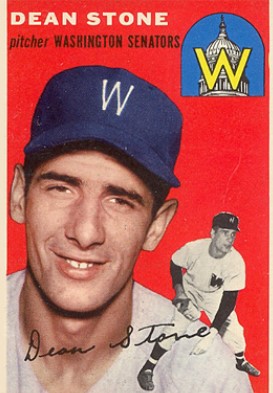
You’ve heard it before, when Baseball Roundtable starts researching  a hardball topic “one thing often leads to another.” In this case, the recent Roundtable post on exceptional, unique or interesting relief appearances (to see that post click here) – intended to provide a bit of relief from news of the CBA impasse –  led reader Leon DeHaven to point The Roundtable in the direction of Dean Stone’s 1954 All Star Game relief stint, when Stone picked up a win without retiring a single batter.

Thirteen pitchers were used in the 1954 All Star Game. It was the only career All Star selection for six of them: Carl Erskine; Marv Grissom; Sandy Consuegra; Bob Keegan; Bob Porterfield; and Dean Stone.

The game proved to be one of the highest scoring in All Star history – an 11-9 American League win – featuring home runs by Ted Kluszewski, Gus Bell, Al Rosen (two homers and five RBI), Ray Boone and Lary Doby. But back to Stone’s appearance.  Stone was called in to replace Bob Keegan with two outs in the bottom of the eighth inning, with runners on first (Al Dark) and third (Red Schoendienst). (Earlier in the inning, Keegan had given up a two-run, pinch-hit home run  to Gus Bell to give the National League a 9-8 lead.) The pitching change put the southpaw Stone up against lefty batting Duke Snider (who already had three hits and a walk in the game).

As Stone prepared to fire his third pitch to Snider, Schoendienst (apparently hoping to catch the rookie unaware) broke for home. Stone stepped off the rubber and threw to catcher Yogi Berra to retire Schoendienst and end the inning.  In the bottom of the ninth,  the AL scored three runs to take the lead – putting Stone in line for the win. The White Sox’ Virgil Trucks pitched a scoreless top of the ninth to save the victory.

Virgil Trucks, who went 177-135, 3.39 in 17 MLB seasons (1941-43, 1945-58) won 14 or more games in eight MLB seasons (a high of 20 in 1954). He is  best known for throwing  two no-hitters for the Tigers in 1952 – a season in which he won only give games (19 losses).

Over the years, Stones’ All Star Game win has not been without controversy.  While some report that Stone picked up an All Star Game victory “without retiring a batter,” others assert that – since Snider did not complete a plate appearance – Stone’s win came without “throwing an official pitch.”  That demanded further digging. Where did I go to seek an answer to this “thorny” question? To the best source I know for getting an accurate assessment of such issues – Stew Thornley. Thornley is one of MLB’s official scorers (assigned to then Twins),  a datacaster for the MLB.com website and  a member of the MLB Official Scoring Advisory Committee. He also has authored dozens of books and articles on professional baseball and basketball (for a list, click here.) Thornley has won national awards for his baseball research from McMillan Publishing Company, the Society for American Baseball Research, USA Today Baseball Weekly and The Baseball Reliquary. How did Thornley answer the Stone question? Here it is. “There is no ‘official count’ on pitches, but since he (Stone) stepped off, this was a play and not a pitch, so there were only two pitches … It is correct that Stone got a win without retiring a batter, but too often it’s been written that he got a win  without throwing a pitch.”

Thanks For This Story, Stew

In replying to my question on Dean Stone (Remember in Baseball roundtable, one thing always seems to lead to another), Stew Thornley recalled witnessing Jeff Gray pick up two MLB wins on just three pitches.

I did some digging, and here’s the story.  Gray was drafted (by the A’s) out of Missouri State University in the 32nd Round of the 2004 MLB Draft. At Missouri State, the 6’3”, 205-pound righty had gone 23-13, 4.29 over four seasons.  Gray made his MLB debut with the A’s  on September 8, 2008 (as a 26-year-old). He was up and down from 2008-11, going 1-2, 4.57 in 66 games (all in relief) for the A’s, Cubs White Sox and Mariners. In October of 2011, the Twins selected him off waivers (from the Mariners), which is how he came to Thornley’s attention.

Gray’s 2012 season with the Twins was his best in MLB, at least from a W-L standpoint (it was also his final season in the majors).  He went 6-1 (but with a 5.71 ERA). Gray pitched in 49 games for the Twins, but two games in April caught Thornley’s eye (and stuck in his memory). In those two games, Gray tripled his career win total (going from one to three). Put another way, after just one win over four-plus seasons, Gray picked up two victories in the span of three pitches. It went like this:

  • On April 11, 2012, the Twins faced the Angels (in Minnesota) and Gray was called in to relieve Carl Pavano in the top of the seventh inning with the Angels up 5-3, two outs and a runner on second. The Angels’ batter was CF and number nine-hitter Pete Bourjos and Gray induced a weak ground out (third-to-first ) on the first pitch he threw.  In the bottom of the inning, the Twins scored three to take the lead.  Glen Perkins replaced Gray in the top of the eighth and set the Angels down 1-2-3. Closer Matt Capps came on for the Twins in the ninth and held the Angels scoreless.  So, Gray picked up the win on one pitch (Perkins got the hold and Capps the save).
  • The very next day, again against the Angels, Gray was called in to replace reliever Brian  Duensing with the Angels up 7-6, two outs and a runner on first. The hitter wa 2B (and number-two in the lineup) Howie Kendrick. Gray got Kendrick to ground into a force out (short-to-second) on just his second pitch.  In the bottom of the eighth, the Twins scored four runs to take a 10-7 lead. Capps pitched the ninth and picked up a save, despite surrendering two runs on three hits.  Gray got the win.

Two days, two wins, three pitches.  That’s being in the right place at the right time. Jeff Grays’s career stat line was 7-3, 4.99, with one save (115 appearances.)

Let’s close with a little more a little more on 1954 All Star Game winner Dean Stone. He signed with the Cubs in 1949, right out of high school, but was released  that May and signed as a free agent with the Senators in June.  Stone  pitched pretty well in the Senators’ minor-league system –  including a 17-10, 3.16 season for the Class-B Charlotte Hornets in 1952. He earned a September 1953 call up after an 8-10, 3.33 season at for the Double-A Chattanooga Lookouts.  He appeared in three games for Washington (one start) and went 0-1, 8.31 in 8 2/3 innings.

In 1954, Stone made the Senators squad out of Spring Training. He jumped out to that 7-2, 3.47 start (before the 1954 All Star Game) and finished at 12-10, 3.22 (31 appearances, 23 starts, ten complete games, two shutouts). It would be his best season in the majors.  In fact, it would be  one of only two seasons in which he recorded a winning record.

From 1955-57, Stone pitched in 104 MLB contests (52 stars), going 12-23, 5.08 for the Senators and Red Sox.

From 1957-1963, Dean Stone pitched for six major-league clubs and four Triple-A squads.

Stone spent most of 1958-61 in the minor leagues (Red Sox and Cardinals systems.) He did into 18 games for the Cardinals in 1959, going 0-1, 4.20. At Triple-A, he showed promise, pitching in 153 games (81 starts) – going 43-31, 3.28. That got the attention of the expansion Houston Colt .45s, who picked him up in the November 1961 Rule Five Draft.  Stone  started the 1962 season with the Astros and threw a pair of complete-game shutouts in his first two appearances  – 18 innings pitched, eight hits, three walks,12 whiffs. He struggled after that hot start, going, 1-2, 6.82 in his next 13 appearances (five starts). He was traded to the White Sox on June 25, where he pitched well out of the pen (1-0, 3.26 with five saves in 27 appearances). After the season, he was sold to the Orioles and, in 1963 (his final MLB season), he went 1-2, 5.12,with one save in 17 relief stints.

Stone played in eight MLB seasons (1953-57, 1959, 1962-63 … Senators, Cardinals, Red Sox, Orioles, Colt  .45s, Orioles) – and put up a career line of 29-39, 4.47 in 215 games (85 starts), with ten complete game and five shutouts.

Primary Resources:  Baseball-Reference.com; The BaseballCube.com

100Baseball Roundtable is on the Feedspot list of the Top 100 Baseball Blogs.  To see the full list, click here.

I tweet baseball @DavidBBRT

Follow/Like Baseball Roundtable’s Facebook Page here.  More baseball commentary; blog post notifications; PRIZES.

Member: Society for American Baseball Research (SABR); Negro Leagues Baseball Museum; The Baseball Reliquary. 

Another Kind of Double Duty … Multi-Sport Major Leaguers

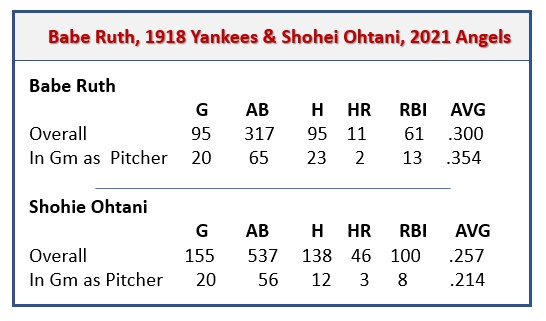
Negro Leagues star Ted Radcliffe earned the nickname “Double Duty” for his on-field performance as a pitcher and a catcher.  More recently, Shohei Ohtani has doubled up, showing “power”  as a starting pitcher and a designated hitter. This post focuses on a different kind of double duty: MLB players who have played other sports at the highest level – players who have made a splash on the basepaths and out of the backfield; on the mound and at the free throw line; on a field of grass and a sheet of ice.

In this post, Baseball Roundtable would like to present its 20 “favorite” players who reached the pinnacle in baseball and at least one other leading U.S. sport.  (There isn’t room to note all who qualify. As I began this post, various sources pointed to 69 players to play in both MLB and  the NFL,  13 to play in both MLB and the NBA and one to suit up in MLB and the NHL.) I labeled this list “favorites,” rather than the 20 “best” simply because I am taking into consideration more than their performance in both sports (with emphasis, of course, on baseball(), but also  accomplishments or stats that I  found unique or interesting.

Before we get started, a spoiler alert.  Here’s the kind of info you’ll find along the way:

  • Braves’ pitcher Gene Conley is the only person to play on both a World Series winner and an NBA championship team;
  • Hinkey Haines was the first player to play on a World Series and NFL Champion;
  • Bo Jackson is the only player to be an MLB All Star and an NFL Pro Bowler;
  • Deion Sanders is the only athlete to suit up for a Major League Baseball and National Football League game on the same day;
  • Carroll Hardy (the only player ever to pinch hit for Ted Williams) had a season in which he hit eight home runs for the Red Sox and another in which he scored four touchdowns for the San Francisco 49ers;
  • Famed Olympian Jim Thorpe – thought by many to be the greatest athlete of the 20th century – and lesser-known Steve “Flip” Flipowicz are the only two to play for the MLB New York Giants and NFL New York Giants;
  • James Riley is the only person to play in both MLB and the NHL.

So, how about those 20 favorites?  But first, a “Double Duty Extra.”

Double Duty Extra … Jim Thorpe (MLB/NFL)

Jim Thorpe gets a spot all to himself in this post.  Trying to make comparison would be both difficult and perhaps a bit unfair – given the legends that surround Thorpe’s history.  There are those who cite Jim Thorpe as the greatest American athlete of all Time … and they provide plenty of evidence to back up that claim.  After all, Thorpe took the Gold in the 1912 Summer Olympics in both the Pentathlon and Decathlon – winning eight of the fifteen events in the two all-around competition.  In college (Carlisle Indian Industrial School), he starred  in track and field, baseball, football and Lacrosse (and was an  All American in football).

_________________________________

Save the Last Dance

Jim Thorpe won the 1912 intercollegiate ballroom dancing championship. 

_________________________________

Thorpe played six MLB seasons (1913-15 & 1917-19, Giants, Reds, Braves), hitting .252, with seven home runs and 82 RBI in 289 games. His final season was his best – with a .327-3-26 line in 62 games.  He was also one of the first stars of National Football League.  Prior to 1920 (you’ll see why that is important in a minute), Thorpe had played with the Canton (Ohio) Bulldogs – leading them to thee Ohio League crowns.  In 1920, he was among the founders – and first president – of the American Professional Football Association, which became the National Football League.  As a player, he was also among the league’s first stars (and drawing cards). Although accurate records are difficult to track down and document, Thorpe was one of the league’s early stars (playing from 1920 through 1928). His bio on the Pro Football Hall of Fame website (he is a charter member) states “There is no question he was superb in every way. He could run with speed and bruising power. He could pass and catch passes with the best, punt long distances and kick field goals either by drop-kick or place-kick … He blocked with authority and, on defense, was a bone-jarring tackler.

Now that list.

Number One – Deion Sanders (MLB/NFL)

With his nine-season MLB career and 14-season NFL career (all between 1989-2005), Sanders tops this list on the basis of some unique accomplishments:

  • Only person to play in the Super Bowl (for the victorious San Francisco 49ers, 1995, and the winning Dallas Cowboys, 1996) and the World Series (for the losing Atlanta Braves, 1992);
  • Only person to hit a major-league home run and score an NFL touchdown in the same week;
  • Only person to “suit up” for an MLB and NFL game on the same day.


Now, that Would Have Been Quite the Doubleheader

On October 11, 1992, Sanders played for the Atlanta Falcons in an NFL day game against the Miami Dolphins and then flew to Pittsburgh to suit up for the Atlanta Braves’ League Championship Series game against the Pirates that night. (He did not, however, get into the game).

As an MLB player (1989-1995, 1997, 2001) Sanders manned the outfield for the New York Yankees, Atlanta Braves, Cincinnati Reds and San Francisco Giants, Sanders played in 641 regular-season games, compiling a .263 average with 39 Home runs, 168 RBI and 186 stolen bases.  His best year was 1992, when he played in 97 games for the Braves – going .304, with a league-leading 14 triples, along with eight home runs, 28 RBI, 54 runs scored and 26 stolen bases.  He followed that up by hitting .533 (8-for-17), with four runs scored, one RBI and five stolen bases in the World Series.

During his NFL career, Sanders earned his way into the Pro Football Hall of Fame  – intercepting  53 passes, returning nine for touchdowns;  returning 155 kickoffs for 3,523 yards and three TDs; returning 212 punts for 2,199 yards and six TDs; catching 60 passes for 784 yards and three TDs; and recovering four fumbles (one for a TD). He was an eight-time Pro-Bowler and the NFL’s 1994 Defensive Player of the Year. Sanders squeaks into the top spot on the list (over #2 Bo Jackson)  by virtue of his Football Hall of Fame selection.

Variety is the Spice of Life

During his NFL career, Sanders scored touchdowns  via a pass reception, a pass interception, rushing, punt return, kick-off return and fumble recovery.

_____________________________________________

Number Two – Bo Jackson (MLB/NFL)

Bo Jackson had an eight-season career as an MLB outfielder:  Kansas City Royals (1986-90); Chicago White Sox (1991, 1993); California Angels (1994). He also was a running back for the Los Angeles Raiders for four seasons (1987-90).  In 1989, he was selected as an MLB All Star (and MVP of the 1989 All Star Game) and, in 1990,  he was named to the AFC NFL Pro Bowl team.

His best year in MLB was 1989, when he hit .256, with 32 home runs, 105 RBI and 26 stolen bases for the Kansas City Royals.  That same year, he notched 950 yards rushing (5.5 yards per carry) and four rushing touchdowns for the Raiders.  That season he also caught nine passes for 69 yards.

In his MLB career, Jackson played in 694 games, hitting .250 with 141 home runs, 415 RBI and 82 stolen bases.

In his four seasons in the NFL, Jackson rushed for 2,782 yards (5.4 yards per carry) and 16 touchdowns.  He also caught 40 passes for 352 yards and two touchdowns.  Plenty of fans would place Jackson at number-one on this list (and I’d have little argument with that ).

Just think of what Jackson might have done had a not been for a career-altering 1991 hip injury.  Perhaps only “BO Knows”

Make Room on the Mantle

Bo Jackson is one of only two major leaguers to win the Heisman Trophy as the nation’s top college football player. Vic Janowicz, who appear later on this list was the first.

____________________________________________

Double-Duty Extra – “Last Night I Spent the Night in Detroit City

Matt Kinzer did not make this list, as his MLB and NFL careers lasted a combined nine games.  He did, however, earn a spot among the “Extras” for playing for both the Detroit Tigers and the Detroit Lions. During the 1987 NFL strike, Kinzer started one game as a punter for the Detroit Lions (seven punts for an average of 34 yards).  It was his only NFL game.  In 1990, he went to the mound in one game for the Tigers (giving up three runs in 1 2/3 innings). He also appeared in nine games for the Cardinals in 1989.

Number Three  – Gene Conley (MLB/NBA)

The 6’ 8” right-handed pitcher excelled at baseball and basketball and holds the distinction of being the only person to play on an NBA Championship squad (Boston Celtics in 1959, 60 & 61) and a World Series Champion (Milwaukee Braves, 1957).

His MLB career spanned 11 seasons:  Boston Braves/Milwaukee Braves (1954-58); Philadelphia Phillies (1959-60); Boston Red Sox (1961-63). Conley pitched in 276 games (214 starts), winning 91 and losing 96 with an ERA of 3.82.  He was a three-time All Star and the winning pitcher in the 1955 All Star Game.  His best year was 1954 when he went 14-9 with a 2.96 ERA.  He pitched in just one game in the 1957 World Series, giving up two runs in 1.2 innings of relief (the starts for Milwaukee went to Warren Spahn, Lew Burdette and Bob Buhl).

Conley’s NBA career was as strong as his MLB run.   At forward and center  –  playing for the Boston Celtics (1952-61) and New York Knicks (1962-64). He came off the bench to score 2,069 points, grab 2,212 rebounds and dish out 201 assists.  He averaged 16.5 minutes, 5.9 points and 6.3 rebounds per game.  In 33 playoff games, he averaged 14.6 minutes, 6.7 points and 5.1 rebounds.

I Do Love Beantown

Gene Conley is the only athlete to play for the Boston Braves, Celtics and Red Sox.

_________________________________________________

Number Four – Brian Jordan (MLB/NFL)

Brian Jordan patrolled considerable territory in his 15 seasons as an MLB outfielder (1992-2006) and three seasons as an NFL safety.  Jordan’s baseball career included time with the St. Louis Cardinals (1992-98); Atlanta Braves (1999-2001, 2005-06); LA Dodgers (2002-03); and Texas Rangers (2004).  He played in 1,456 games, hitting .282 with 184 home runs and 821 RBI.  He was an All Star in 1999, when he hit .282, with 23 home runs, 115 RBI and 13 stolen bases.

His brief NFL career, all as a defensive back with the Atlanta Falcons (1989-91), included five interceptions and four quarterback sacks in 36 games.

Take ‘Em Deep, Brian

In 38 MLB post-season games, Brian Jordan his  six home runs and drove in 27 (,250 average).

______________________________________________

Double Duty Extra – Twice a Giant  in the Big Apple

Steve “Flip” Flipowicz played big-time baseball and football in the Big Apple.  He played for the New York Baseball Giants (outfield) in 1944 and 1945 and for the NFL New York Giants in 1945-46 (running back). He hit two homes runs in 50 games for the baseball Giants and  scored two touchdowns in 21 games for the football Giants.  He also played one season for the Reds (1945). His final MLB line was .223-2-26 in 57 games.

Number Five –  Dick Groat (MLB/NBA)

Dick Groat had a 14-career as an MLB shortstop (1952, 1955-67) with the Pittsburgh Pirates, St. Louis Cardinals, Philadelphia Phillies and San Francisco Giants.  He was a five-time All Star and won the 1960 NL Most Valuable Player Award, while helping the Pirates earn the NL Crown (and win the World Series).  That season, he led the NL in batting at .325.  Groat was a career .286 hitter, with 2,138 hits, 39 home runs and 707 RBI.   He was on two World Series winners:  the 1960 Pirates and the 1964 Cardinals.

Groat also played one season (1952-53) for the NBA’s Fort Wayne Pistons, averaging 25.5 minutes, 11.9 points, 2.7 assists and 3.3 rebounds per game.

Deck the Halls – Plural that is

While at Duke University, Dick Groat was a two-time All-American in both baseball and basketball.  He was the first person selected to both the College Baseball and Basketball Halls of Fame (one of those unique stats that improved his spot on this list).

______________________________________________

Number Six –   Kevin “Chuck” Connors (MLB/NBA/Hollywood)

Six-foot-five with athletic skills and rugged good looks, Connors played for MLB’s Brooklyn Dodgers and Chicago Cubs and the Basketball Association of America (later rebranded as the NBA)  Boston Celtics (and was also drafted by the NFL Chicago Bears) before going on to play before even larger audiences as the star of the hit television series “The Rifleman.”   He makes this list more on the basis of his acting career (one of those unique or interesting facts that impact this subjective Roundtable list). Connors, ultimately,  appeared not only in The Rifleman, but in more than 40  movies, including a starring role in the classic “Old Yeller,” and made guest appearances on dozens of television shows.

His MLB career included one at bat with the Brooklyn Dodgers in 1949 and 66 games as a first baseman/pinch hitter for the Chicago Cubs in 1951.  He chalked up a .239 career average with two home runs and 18 RBIs.  In 1946-48, Connors played forward for the Boston Celtics, averaging 4.5 points per game in 53 games played.

Give Me a Break

Chuck Connors is credited with shattering the first professional backboard ever, during a November 1946 Celtics’ pregame warm-up.

______________________________________________________

Double Duty Extra – Is There a Draft in Here?

MLB Hall of Famer Dave Winfield was drafted coming out of college by the San Diego Padres (MLB); Atlantic Hawks (NBA); Utah Stars (ABA); and Minnesota Vikings (NFL).

MLB Hall of Famer Tony Gwynn was drafted by the NBA’s San Diego Clippers and the NL’s San Diego Padres – on the same day (June 10, 1981).

Number Seven –  Dave DeBusschere (NBA/MLB)

The best basketball player to ever play major-league baseball, Dave DeBusschere played 12 seasons in the NBA (1962-74, Detroit Pistons and New York Knicks), was an eight-time NBA All Star, six-time NBA All-Defensive Player and played on the Knicks’ 1970 and 1973 NBA Championship teams.  DeBusschere is a member of the National Basketball Hall of Fame.  Over his career (875 games), the 6’6” forward/guard averaged 35.7 minutes, 16.1 points, 2.9 assists and 11 rebounds per game.

DeBusschere’s MLB career was considerably shorter than his basketball tenure.  He joined the Chicago White Sox at age 22 in 1962 and pitched in the 1962 and 1963 seasons, logging 36 appearances (10 starts), a 3-4 record and a 2.90 ERA. His brief major league career did include one complete-game shutout.  On August 13, 1963, DeBusschere shut out the Indians 3-0 (in Chicago) on a complete-game, six-hitter – walking one and fanning three.

Let the Kid Do It

In the 1964-1965 season, DeBusschere, just 24-years-old, was appointed player-coach of the Detroit Pistons – becoming the youngest coach in NBA history (another of those unique facts that affects this listing).   From 1964-67, he coached the Pistons to a 79-143 record before going back to a player-only position. 

__________________________________________________

Number Eight  –  Frank Baumholtz (MLB/BAA)

Frank Baumholtz enjoyed a ten-season MLB career (1947-49, 1951-57) as an outfielder with the Cincinnati Reds, Chicago Cubs and Philadelphia Phillies.  He played in 1,019 games, finishing with a .290 average, 25 home runs, 272 RBI, 450 runs scored and 20 stolen bases.  His best season was his 1947 rookie year, when he played in 151 games, led the league with 711 plate appearances and hit .289 with five home runs, 45 RBI and 96 runs scored.

Baumholtz played one season of professional basketball (1946-47), as a guard for the Cleveland Rebels of the Basketball Association of America, forerunner of the NBA. He appeared in 45 games, averaging 14.0 points per game.

______________________________________________

Double Duty Extra – The Game with the Little Ball

Sammy Byrd had an eight-season MLB career (1929-34, Yankees and 1935-36 Reds), during which the outfielder hit .274 with 38 home runs and 220 RBI in 745 games. After leaving baseball, at the age of 29, to pursue a professional golf career, Byrd won six events on the PGA tour between 1942 and 1946. Byrd is the only person to play in both MLB’s World Series and the PGA Masters Tournament.

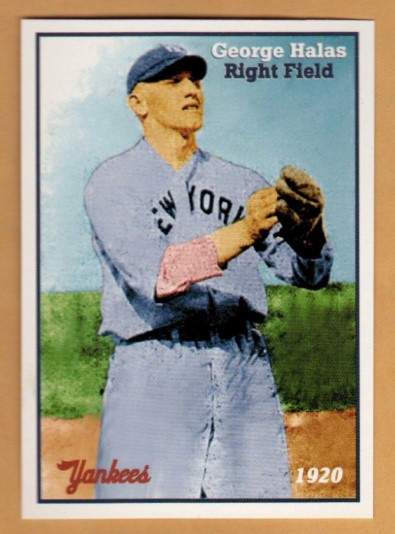
Number Nine  – George Halas (NFL/MLB)

While Football Hall of Famer George Halas may have been “Mr. Everything” in professional football for some six decades – player, coach, owner, promoter, innovator and pioneer – his MLB career was shorter and less noteworthy.  Halas played in 12 games (22 at bats, .091 average) as an outfielder for the 1919 Yankees.  Halas’ status as a charter member of the Pro Football Hall of fame, earned him a spot this high on the list.

During his pro-football playing career (1919-1928), Halas played defensive end and wide receiver for the Hammond All Stars, Decatur/Chicago Staleys and Chicago Bears.  A Bears’ owner from 1920 until his death in 1983, Halas coached the Chicago Bears (and their predecessor Staleys) for 40 seasons (1920-29, 1933-42, 1946-55. 1958-67).  Under his leadership, the Bears won nine Divisional titles, six NFL Championships and only six times finished with a losing record.

Let’s Try Something New

 George Halas is credited with developing football’s  T-formation.

________________________________________________

Number Ten –  James Riley MLB/NHL

Riley finishes in the top ten primarily because he is the only player I could find that played in MLB and the NHL. His baseball career was – and I write this generously – nondescript.  In two MLB seasons (1921 Browns and 1923 Senators), he appeared in just  six games and went zero-for-fourteen. He also played one season (wing) in the NHL, notching two assists in nine games and eight seasons in the Pacific Coast Hockey Association  (a rival to the NHL), where he scored 93 goals. Riley  played eleven seasons in baseball’s minor leagues.

____________________________________________

Double Duty Extra – Can’t Let This One  Skate

Hall of Famer Tom Glavine (a 305-game winner and two-time Cy Young Award recipient) was drafted in the fourth round of the 1984 National Hockey League draft — two rounds ahead of future National Hockey League Hall of Famer Brett Hull.   (Glavine scored 232 points and had 111 goals as a high school hockey player).

Number Eleven  – Clarence “Ace” Parker (MLB/NFL)

Clarence Parker got his MLB career off with a bang, homering in his first at bat for the 1937 Philadelphia Athletics.  It was downhill from there, as Parker played in just 94 games in 1937 and 1938 (SS-3B-OF) hitting .179 with two home runs and 25 RBI.

Parker proved more adept at football, making the Pro Football Hall of Fame as a multiple-threat player.  Playing from 1937 to 1946 for Brooklyn, Boston and New York (and winning the NFL MVP Award in 1940), he completed 335 of 718 passing attempts for 30 touchdowns, rushed 498 times for 1,292 yards and 13 TDs, had eight pass receptions for 229 yards and three TDs, returned 24 punts for 238 yards and one TD, returned five kickoffs for 98 yards, made 25 of 30 point-after-touchdown kicks (but only 1 of 5 field goal attempts) and punted 150 times for a 38.4 yard average.

_____________________________________________

Number Twelve – Ernie Nevers (NFL/MLB)

Ernie Nevers is a member of both the College and Pro Football Hall of Fame. As a pro, he played for the NFL’s Duluth Eskimos and Chicago Cardinals for five seasons between 1926 and 1931 – earning All-NFL recognition at running back in each of those campaigns. Nevers also pitched for three seasons  (1926-28) for the AL Saint Louis Browns, going 6-12, with a 4.44 ERA in 44 games (12 starts).

A Big Day for Ernie

 On November 28, 1929, Chicago Cardinals’ fullback Ernie Nevers scored six touchdowns and kicked four extra points, accounting for all the Cardinals’ scoring in a 40-6   victory over the Chicago Bears.  The forty points scored in a single game is still the individual NFL record.

_____________________________________________

Number Thirteen –  Danny Ainge (NBA/MLB)

Danny Ainge broke into the major leagues at age 20 (in 1979) with the Toronto Blue Jays.  He played just three seasons in the majors – 211 games, with a .220 average, two home runs and 37 RBI.  Primarily a second baseman, Ainge also saw time at third base, shortstop and all three outfield positions.  Notably, Ainge’s MLB career overlapped his college basketball career – Brigham University, 1977-81 – where he ran up average of 20.9 points, 4.6 assists and 4.6 rebounds per game and was the 1981 Collegiate Basketball Player of the Year.

Ainge’s NBA career began at age 22 and stretched over 14 seasons (1981-95) with the Boston Celtics, Sacramento Kings, Portland Trailblazer and Phoenix Suns.  The 6’ 4”, 175-pound guard totaled 11,964 points, 1,133 steals, 4,199 assists, 2,769 rebounds.    Ainge played in 193 NBA playoff games, averaging 26.1 minutes, 9.9 points, 3.4 assists and 2.3 rebounds.  He was a member of the Celtics 1984 and 1986 NBA Championship teams and a 1988 NBA All Star.

Now that’s an All-American

Danny Ainge was selected as a first team High School All-American in baseball, basketball and football.

___________________________________________

Number Fourteen –  Carroll Hardy (MLB/NFL)

Carroll Hardy was a multi-sport talent for the University of Colorado in the early 1950s, lettering in football, baseball and track – earning All-Conference honors in football and baseball.  Immediately out of college, Hardy signed on as a receiver with the NFL San Francisco 49ers.  In 1955, he caught 12 passes for 338 yards and four touchdowns, and returned three punts for  65 yards.  Hardy then chose to concentrate on baseball and played eight seasons (1957-64, 1967) as a major league outfielder, getting into 433 games for the Indians, Red Sox, Astros and Twins.  His career average was .225, with 17 home runs and 113 RBI.

Catch the Bench Ted

Carroll Hardy gets extra credit for being the only player to pinch hit for Ted William.

_____________________________________________

Number Fifteen – Hinkey Haines MLB/NFL

Henry “Hinkey” Haines played just one season in MLB, hitting .160 in 24 games for the 1923 World Series Champion Yankees. (He appeared in two games in the 1923 World Series.) He took a bigger bite out of the Big Apple in football, where he where he scored 22 touchdowns (14 rushing, six receiving, on punt return, one-kickoff return) over six seasons – and was a star for the 1927 NFL champion New York Giants. Haines rates this high on the list for that “Hinkey” nickname and the fact that he was  the first  player to play for a World Series Champion and NFL Champion during his career.

Nice Six Pack Hinkey

In two years at Penn State, Hinkey Haines earned two varsity letters each in baseball, football and basketball.

_____________________________________________

Number Sixteen  – Ron Reed (MLB/NBA)

A  6’6”, 217-pound, right-handed pitcher, Ron Reed,  enjoyed a 19-year career as an MLB starter and reliever (Atlanta Braves, 1966-75; St. Louis Cardinals, 1975; Philadelphia Phillies, 1976-83; and Chicago White Sox, 1984).  Reed’s MLB career record was 146-140, 103 saves, a 3.46 ERA and 1,481 strikeouts in 2,477 2/3 innings pitched.  His best season was 1969, when he went 18-10, 3.47 in 33 starts for the Braves. He had seven season of ten or more wins.

Reed also played forward for two seasons for the NBA Detroit Pistons (1965-66, 1966-67), averaging 18.9 minutes, 8.0 points and 6.4 rebounds per game.

__________________________________________

Number Seventeen –  Steve Hamilton (MLB/NBA)

The 6’6” left-handed reliever enjoyed a 12-year (1961-72) career with the Cleveland Indians, Washington Senators, New York Yankees, Chicago White Sox, New York Giants and Chicago Cubs – going 40-31 with 42 saves and a career ERA of 3.05.

Hamilton also played two seasons as a forward for the NBA Minneapolis Lakers (1958-60) – averaging 13.3 minutes, 4.5 points and 3.4 rebounds in 82 games.

_________________________________________

Number Eighteen –  Mark Hendrickson  (MLB/NBA)

Hendrickson, a 6’9” left-handed hurler, recorded 10 MLB seasons (328 appearances, 166 starts) with a 58-74 record and a 5.03 ERA.  Between, 2002-2011, he pitched for the Toronto Blue Jays, Tampa Bay Devil Rays, Los Angeles Dodgers and Baltimore Orioles.  His best MLB season was 2009, when he went 6-5 with a 4.37 ERA for the Orioles.

Hendrickson also played four seasons (1996-2000) as a power forward in the NBA for the Philadelphia 76ers, Sacramento Kings, New Jersey Nets and Cleveland Cavaliers.  In 114 games, he averaged 13.2 minutes, 3.3 points and 2.8 rebounds per game.

______________________________________________

Double Duty Extra – Short but Sweet

Drew Henson played quarterback for the Cowboys (2004-05) and Lions (2008).  He also appeared in eight games for the 2002-03 Yankees, going one-for-nine.  His NFL career consisted of just nine games played, and he completed a total of 11 of 20 passes with one TD and one interception.  Despite this “small sample size,”  he can lay claim to reaching the highest professional level in two sports – and to throwing and NFL Touchdown and collecting an MLB base hit.

Number Nineteen –  Vic Janowicz (MLB/NFL)

Janowicz got in 22 games as a halfback for the Washington Redskins (1954-55), gaining 410 yards on 99 carries with four touchdowns.  He also played 83 games at catcher and third base for the Pittsburgh Pirates over the 1953 and 1954 seasons – hitting .214 with two home runs and ten RBI.  His athletic career was cut short by injures received in an automobile accident (age 26).  He is on this list based on what might have been.

Top Notch College Player

Vic Janowicz, playing for Ohio State University, won the 1950 Heisman Trophy as college football’s best player.

________________________________________________

Number Twenty –  Howie Schultz (MLB/NBA)

Schultz played major league baseball for six seasons (1943-48), spending time at first base with the Brooklyn Dodgers, Philadelphia Phillies and Cincinnati Reds.  He played 470 games, hitting .241, with 24 home runs and 208 RBI.

In 1949, the 6’6” Schultz switched to basketball, beginning a three-year stint as an NBA center/forward.  He played for the NBA’s Anderson Packers, Fort Wayne Pistons and Minneapolis Lakers, averaging 5.3 points per game. Let’s face it, every list needs a Howie.

Primary Resources: Baseball-Almanac.com; Baseball-Reference.com; Pro-Football-Reference.com; Basketball-Reference.com; MLB.com; The Day Deion tried to play two, by Michael Clair, MLB.com, October 12, 2021; Dick Groat Bio, Duke Hall of Fame, GoDuke.com;  Legends Profile: Dave DeBusschere, NBA.com; In 1929 Ernie Nevers Scored 40 Points in a Single Game, Jon Turney, Pro Football Journal, September 22, 2019; Before he attained Olympic glory, Jim Thorpe was an athletic hero in Carlisle, by Leah Polakoff, Penn State Commmedia News, October 15, 2013.

100Baseball Roundtable is on the Feedspot list of the Top 100 Baseball Blogs.  To see the full list, click here.

I tweet baseball @DavidBBRT

Follow/Like Baseball Roundtable’s Facebook Page here.  More baseball commentary; blog post notifications; PRIZES.

Member: Society for American Baseball Research (SABR); Negro Leagues Baseball Museum; The Baseball Reliquary. 
Fred “Firpo” Marberry … Front-Line Starter/Premier Closer All-In-One

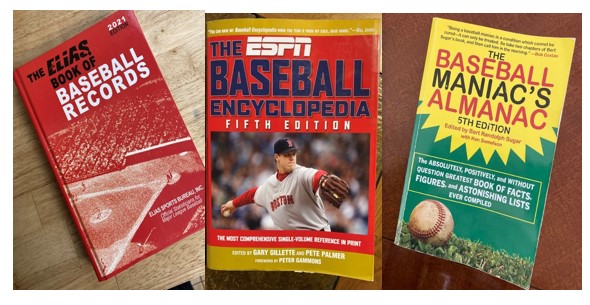
Minnesota winters are a good time to sit down and randomly browse through baseball statistics … looking to sources like the Elias Book of Baseball Records, The Baseball Maniac’s Almanac and The ESPN Baseball Encyclopedia, supplemented by online resources like Baseball-Reference.com, Baseball-Almanac.com and Retrosheet.org.

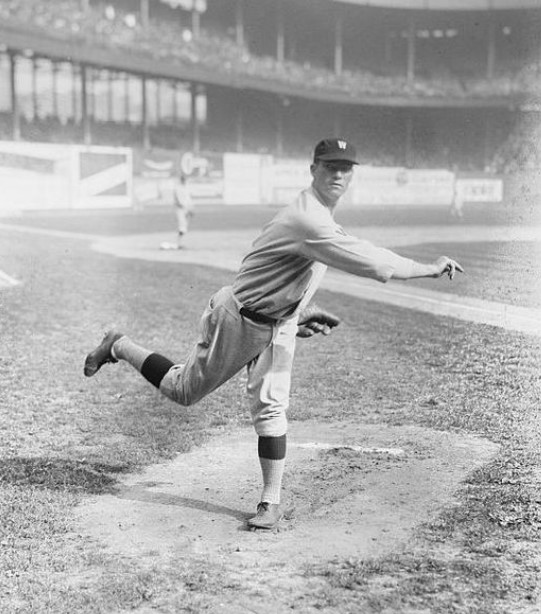
Fred Marberry …. Photo: Bain News Service, Public Domain, Wiki Commons

It’s always rewarding to run across a player or stat that makes you think “Why didn’t I already know that?”  Today was one of those days for me, as I came across the record of Fred “Firpo” Marberry, who may very  well have been MLB’s first-ever star relief specialist (perhaps even the first true “closer,”  or at least the first true “finisher”).  And, it’s quite likely that, at the time, very few recognized his status.  A bit of explanation here. The “save” statistic was first offered up in 1959 by  Chicago Sun-Times sportswriter Jerome Holtzman.  The save was officially adopted as an MLB stat in 1969 (and applied retroactively to previous seasons, which is why this post is possible).  Retroactively applied stats can, at times, prove challenging to confirm and, of course, do not always represent the thinking or strategies of the time.  Still, Fred Marberry’s career deserves review and recognition.

Had the save stat been developed during his career, Marberry and his peers would have known that he:

  • was the first MLB pitcher to record 15 saves in a season, becoming the single-season save record holder  (retroactively) as of 1924;
  • was the first MLB pitcher with 20 saves in season (22 saves in 1926);
  • held the single-season saves record for 25 years (1924-1949, when Joe Page saved 27 games);
  • was the first MLB pitcher to make fifty or more relief appearances in a season (1925);
  • was the first MLB pitcher to reach 100 career saves – maybe.

So, why the maybe on that last bullet point?  One of the challenges of digging into early (and especially retroactive) stats is determining their reliability.   I usually look for multiple, respected sources as I develop these posts.  In this case, ESPN.com; Baseball-Alamanc.com credit him with 101 career saves. Baseball-Reference.com and Retrosheet.org,  however, set the figure at 99. Either way, he was the first to get there.

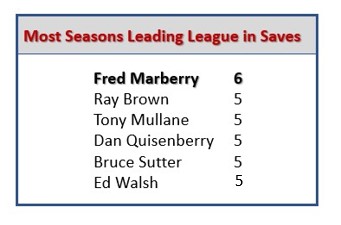
A few other facts from Marberry’s career.  He led his league in saves more times than any other MLB pitcher (six) … maybe.

Why the maybe?  A range of sources agree Marberry led the AL in saves in 1924, 1925, 1926, 1929 and 1932.  That’s five. Baseball-Reference.com and  Retrosheet.org credit Marberry with a sixth league-leading season (tying Wilcy Moore for the AL lead with eight saves) in 1931. Baseball Almanac.com and the Baseball Encyclopedia credit Moore with ten saves in 1931, which would give him the save title (on his own) in that campaign.  Still, depending on which source you prefer, Marberry either holds the record outright of shares it.


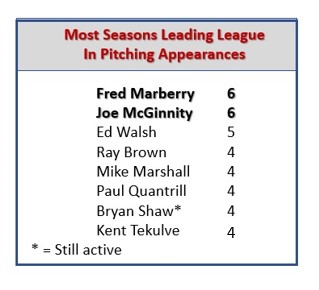
Marberry  led his league in pitching appearances in more seasons than any other major leaguer except “Iron” Joe McGinnity (with whom Marberry is tied in this category).

As usual, when Baseball Roundtable starts wandering through stats,  “one things leads to another.”

In August of 1903 , the Giants’ Joe McGinnity started both games of doubleheaders three times – and picked up six complete-game victories, surrendering a total of ten runs in the six games.  (The Giants played  eleven doubleheaders that month.) The surprise stat is that on the six days that August when he was called on to pitch just one game, McGinnity was 1-5 and gave up 28 runs.  Gives new meaning to Ernie Banks’ “Let’s Play Two!”

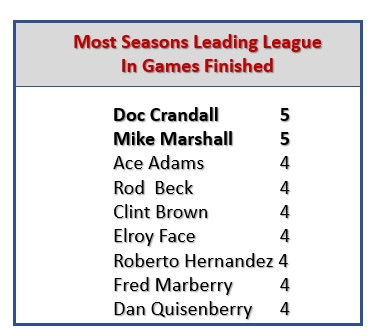
Marberry led the league in games finished four times – third all-time.

Marberry made his major-league debut with the Senators on August 11, 1923 – at the age of 24 – after going 11-10, 3.29 for the Class A Little Rock Travelers (23 starts/14 relief appearance).  After his call up, the big right-hander went  4-0, 2.82 in 11 appearances (four starts/two complete games) for Washington manager Donie Bush (who was leading the Senators to a 75-78-2 finish).  Marberry was primarily a high-kicking, fastball pitcher (he wouldn’t develop a curve util later in his career) with good control.

Bucky Harris took over the Senators’ helm in 1925 and put Marberry “to work” – getting him into a league-leading 50 games (14 starts) and using him to “finish”  31 contests (with Marberry recording – retroactively – a record 15 saves). Marberry went 11-12, 3.09 – with a 3.66 ERA as a starter and 2.82 as a reliever, impressing Harris with his durability, versatility, fearlessness and ability to get big outs in late innings.  Marberry’s  mound work helped the Senators to an AL-best 92-62-2 record, as well as to the World Series victory over the Giants. Note:  Marberry’s ERAs as a starter and a reliever were both well below the American League average of 4.23 that season.

Al “The Mad Hungarian” Hrabosky may have been channeling Fred Marberry with his “aggressive” demeanor on the mound. In Marberry’s Society for American Baseball Research bio, writer Mark Armour notes that Marberry had a reputation  for  stomping around the mound, throwing and kicking dirt, glaring angrily at the batter.

In 1925, Harris went all in on Marberry as a reliever. Marberry appeared in a league leading 55 games (all in relief). He finished a league-topping 39 games and recorded nine wins (five losses) and a league-leading 15 (Baseball-Almanac.com) or 16 saves (Baseball-Reference.com).  Much like today’s closers, Marberry pitched one inning or less in 22 of those appearances and averaged 1 2/3 innings (1.70 for those who want to be more exact) per trip to the mound.

In 1926, Marberry put up what was retroactively declared MLB’s first 20-save season, going 12-7, 3.00 with 22 saves. Notably, he still had the stamina to go deep as a starter. He started five games (out of a league-topping 64 appearances) and completed three of them.

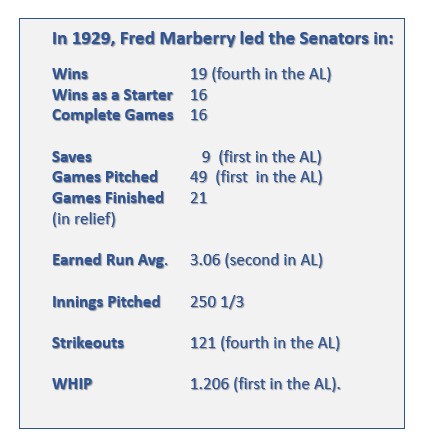
From 1927-32, Marberry was both a valued starter and ace reliever for the Senators. During that period, he went 81-45, 3.77, with 41 saves.  He started 109 games (53 complete games and five shutouts) and relieved in 176. His best season was 1929, when he went 19-12, 3.06, with a league-leading nine saves. (O0ps, another maybe. Baseball-Reference and Retrosheet each credit Marberry with a league-leading nine saves that season; Baseball-Almanac and the Baseball the ESPN Baseball Encyclopedia each credit him with a league-leading eleven saves.)  That season,  Marberry was 16-8, 2.86 as a starter (with 16 complete games) and 3-4, 4.40 as a reliever, with those nine (or eleven) saves and 21 games finished. He also led the AL in WHIP. The overall  AL earned run average was 4.24 in 1929.  He led the Senators in pitching appearances, wins, complete games, saves, innings pitched, earned run average and strikeouts – and was second in starts.

Between 1929 and 1932, Fred Marberry went 58-25, 3.60, with 31 saves for the Senators –  going 49-16 as a starter, tossing 44 complete games and  picking up 31 saves (leading the AL in saves three times).

In 1929, when he led the American League in saves, Marberry also led the Senators in wins and wins as a starter, complete games, innings pitched, ERA and strikeouts.

Marberry was traded to the Tigers in December of 1932 and pitched four more seasons in MLB (Tigers, Giants, Senators) continuing to start and relieve (54 starts and 32 relief appearances).  He went 31-19, 3.81 over that period, tossing a pair of  shutouts and saving five games. His final MLB stat line was 148-88, 3.63, with 101 (or 99) saves.

S0, how good was Marberry?  Let’s look at some more stats – comparing him with his on-the-field peers.

In twelve of his fourteen seasons, his earned run average was better than the league average – and in five of those it was more than one run better (in three additional seasons it was between 0.92 and 0.99 better.)

Marberry finished in the American League’s best six in ERA four times;  among  the best ten in WHIP six times (notching the league’s lowest WHIP twice);  and among the AL’s top ten in strikeouts per nine innings four times.

While  1936 was Marberry’s final MLB season, he pitched in the minors until 1941 – and had a 13-9, 3.07 season for the Texas League Fort Worth Cats as a 40-years-old in 1939,

There can be little doubt about Marberry’s talent, his durability or his desire to “take the ball.”  One wonders what kind of numbers he might have put up if he had been used solely  as a starter or reliever.  For much of his career, he showed the ability to be – at times in the same season – a front-line starter and top-drawer reliever.  Clearly, he deserves recognition  for his mound mastery.

Primary Resources:  Baseball-Reference.com; Baseball-Almanac.com, Retrosheet.org.

100Baseball Roundtable is on the Feedspot list of the Top 100 Baseball Blogs.  To see the full list, click here.

I tweet baseball @DavidBBRT

Follow/Like Baseball Roundtable’s Facebook Page here.  More baseball commentary; blog post notifications; PRIZES.

Member: Society for American Baseball Research (SABR); Negro Leagues Baseball Museum; The Baseball Reliquary. 


Readers Throw Shutout in Baseball Roundtable (unofficial) Hall of Fame Balloting

David “Big Papi” Ortiz – top vote getter in Baseball Roundtable’s (unofficial) fan/reader balloting.
Photo by Keith Allison

We’re just nine days away from the official announcement of whom the Baseball Writers Association of American (BBWAA) voted (or did not vote) into the Hall of Fame for 2022.  To help you pass the time (and maybe spur a discussion or two) between now and January 25, I’ll use this post to present the results of Baseball Roundtable’s (unofficial ) Hall of Fame fan/reader voting.

The 140 fans who voted indicated they are not ready to “forgive and forget” when it comes to the PED controversy.  Roundtable readers  tossed a shutout in the unofficial Hall of Fame balloting, with David Ortiz leading all nominees with 65 percent of the votes – well short of the 75 percent needed for induction.  Only four players, in fact, received at least 50 percent of the vote: Ortiz, Barry Bonds, Roger Clemens and Todd Helton. Rounding out the top ten were Jeff Kent, Billy Wagner, Alex Rodriguez, Curt Schilling, Scott Rolen and Gary Sheffield (there is a full chart later in the post).

Players with 50 percent of higher support:

  • David Ortiz… 65.0 percent
  • Barry Bonds …. 60.7
  • Roger Clemens … 59.3
  • Todd Helton … 51.4

By comparison, with 42. 9 percent of the official ballots announced/tracked (as of January 15), the 2022 Baseball Hall of Fame Vote Tracker also has Ortiz (83.7 percent), Bonds (77.7) and Clemens (76.5) as its top three vote getters on BBWAA ballots.

Baseball Hall of Fame Vote Tracker

To follow the announced ballots, go the www.bbhoftracker.com … The tracker team does a great job.  They provide not only publicly released (by voters) vote totals, but the votes cast on individual ballots (when the voter has released his or her name) and stats on such measures as votes gained or lost to date among returning voters and support among first-time voters.

It would appear that Ortiz has the best chance of election, with a nice cushion (but with close to 60 percent of the ballots untracked). In regard to Bonds and Clemens, past history (and conventional wisdom) shows vote percentages tend  to drop off as more votes become public. While Ortiz has built a nice cushion, Bonds and Clemens seem likely to again end up short.

For a look at Baseball Roundtable’s early predictions for  2022 voting and bios of the candidates, click here.

Overall, Baseball Roundtable readers spread their votes up and down the unofficial fan ballot, with just one candidate – Jonathon Papelbon – failing to receive at least five percent of the vote (the percentage needed  to stay on the ballot for 2023’s official voting). Looking at the BBWAA votes tracked thus far, it appears about a dozen players will drop off the official  ballot.

BASEBALL ROUNDTABLE (unofficial) 2022 FAN HALL OF FAME BALLOT RESULTS

Roger Clemens was the biggest gainer among returnees, going in from 23.7 percent in last year’s fan ballot to 59.3 percent this year. That, however, is an anomaly – as Clemens’ fn ballot totals have been mirroring Bonds’ (excluding last year’s unexplained drop).  In 2018, Bonds was at 46.7 percent in the fan ballot to Clemens’ 49.0. In 2019, it was Bonds 43.2 and Clemens 44.8. In 2020, the pair was again close 44.6 percent for Bonds and 46.9 percent for  Clemens.

Outside of Clemens, the biggest gainers on the 2022 fan ballot were Bonds (+16.8 percentage points) and Many Ramirez (+14.7). The biggest decline in the fan ballot went to Omar Vizquel, who went from 66.7 percent last year (another anomaly) to 30.0 percent this year) and Bobby Abreu, who dropped from 37.7 percent to 12.9 percent.

A few other observations:

  • Only three of the first-time candidates received more than 10 percent support among readers: David Ortiz …. 65 percent; Alex Rodriguez … 38.6 percent; and Ryan Howard …. 13.6 percent.
  • Jeff Kent (at 47.1 percent among readers) continued to poll better among fans than he has on the BBWAA ballot. In previous BBWAA Ballots Kent’s high-water mark is 32.4 percent. Among the others who have consistently performed better in the Roundtables fan ballot than in BBWAA voting are Billy Wagner and Andy Pettitte.

When asked which players not on the ballot belong in the Hall of Famer readers contributed 38 different names, led by Joe Jackson and Pete Rose with eight mentions each.  Notably, five of the 21 players  with more than one mention were selected for 2022 induction by the Era Committees.

Primary Resources:  Baseball-reference; bbhoftracker.com

100Baseball Roundtable is on the Feedspot list of the Top 100 Baseball Blogs.  To see the full list, click here.

I tweet baseball @DavidBBRT

Follow/Like Baseball Roundtable’s Facebook Page here.  More baseball commentary; blog post notifications; PRIZES.

Member: Society for American Baseball Research (SABR); Negro Leagues Baseball Museum; The Baseball Reliquary. 
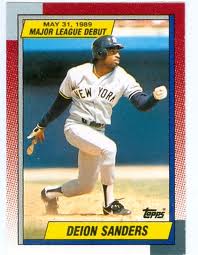
 

“Who’s Your Daddy?” … Robin Roberts Edition

In 1952, the Brooklyn Dodgers won the National League pennant – going  96-57-2 behind a lineup that included such stars as Duke Snider, Roy Campanella, Jackie Robinson, Gil Hodges, Pee Wee Reese and Carl Furillo. They faced the fourth-place Phillies with Robin Roberts on the hill, six times.  Roberts won all six matchups, threw six complete games, allowing just 16 earned runs (2.67 ERA). In Phillies/Dodgers games Roberts did not pitch that season, Brooklyn went 10-6.  

In this post, the 15th in the Baseball Roundtable “Who’s Your Daddy?” series, we’ll look at a Baseball Roundtable-selected  lineup that performed exceptionally well against Hall of Famer Robin Roberts over their careers. Not surprisingly, the starting nine includes eight Hall of Famers. More on that later, but first a look at what “Who’s Your Daddy?” is all about.

Who’s Your Daddy – A Baseball Roundtable Series

In this series, BBRT presents lineups of players who performed unexpectedly well against baseball’s top pitchers. (An explanation of the inspiration behind the Who’s Your Daddy? series can be found at the end of this post.)  As always, I would stress that the pitchers included in the Who’s Your Daddy? series are among the “best in the business.”  They are selected not because of the players who performed well against them, but rather because success among hitters when they were on the mound was the exception rather than the rule.  We’ve looked at pitchers from a wide range of eras – from Bob Feller to Nolan Ryan to Max Scherzer.  

Before we get started on this edition,  here are links to the previous editions of this series. Please note: For still active pitchers, the stats are as they stood on the date of the post.

  • Nolan Ryan, click here.
  • Sandy Koufax, click here.
  • Pedro Martinez, click here.
  • Bob Gibson, click here.
  • Randy Johnson, click here.
  • Greg Maddux, click here.
  • Justin Verlander, click here.
  • Bob Feller, click here.
  • Roger Clemens, click here.
  • Max Scherzer, click here.
  • Tom Seaver, click here.
  • Mariano Rivera, click here.
  • Warren Spahn, click here.
  • For Lefty Grove, click here.
  • For Steve Carlton, click here

I should note there’s not many surprises in this edition of “Whose Your Daddy?” Nothing like how Will Clark owned Nolan Ryan, Jerry Lynch’s .714 average versus Sandy Koufax or Junior Spivey’s six hits, one walk and one HBP in his first seven plate appearances versus Greg Maddux. This lineup is loaded with Hall of Famers; those you expect might do well against an exceptional moundsman.

Also, in this “Who’s Your Daddy?” post, I will diverge a bit from tradition.   I would like to both look at the lineup whose numbers seem to indicate they had Roberts’ number and also make my case for Roberts being among the game’s  most underrated pitchers (despite being in the Hall of Fame).

Robin Roberts enjoyed a 19-season MLB career (1948-66 … Phillies, Orioles, Astros, Cubs) – with 14 of those campaigns in a Phillies’ uniform. Roberts was a seven-time All Star, who won 20 or more games in six  consecutive seasons (1950-55).

The Fabulous ‘50s

From 1950-59, Robin Roberts went 199-149, 3.32.). During that period, his Phillies went 767-773-8.  In those ten seasons, Roberts threw 3,011 2/3 innings.  Yes, for a decade he averaged over 300 innings pitched per season. He also tossed 237 complete games and 30 shutouts.  From 1950-55 (six seasons), Roberts  led the NL in wins four times, starts six times, complete games four times, innings pitched five times and strikeouts twice.

Roberts wrapped up his career with a 286-245, 3.41 stat line, with 305 complete games and 45 shutouts. He is in MLB’s top 50 all-time in wins  (28th); innings pitched  (4,688 2/3 – 21st); games started (609 – 20th); complete games (38th); and shutouts (29th). Just to be fair on stats, he also led the league in home runs allowed five times and is second all-time in home runs allowed (505).

Robin Roberts won three varsity letters in basketball at Michigan State, serving as captain of the team for two seasons.  

Roberts’ best season was 1952, when he won an MLB-best 28 games (seven losses), put up a 2.59 ERA (third-best in the NL), led MLB in starts (37), complete games (30); and innings pitched (330). In August and September of that season, he appeared in  14 games (13 starts); going 12-1, 2.83 (with one save). Over those two months, he tossed 12 complete games, including a 17-inning outing against the Braves on September 6.

I Like to Finish What I Start

From August 28, 1952 through July 5 1953, Robin Roberts completed 28 consecutive starts.

So, why do I think Roberts is underrated and should be counted among the all-time greats? Let me make my case.

Consider the fact that Roberts won 136 more games than Sandy Koufax.  Of course, Koufax career was cut short (arm issues) – just 12 seasons to Roberts’ 19.  (I would maintain that Roberts 3,000+ inning workload in the 1950s had an impact on his arm and performance in the 1960s.) So, how about the best four seasons for Koufax and Roberts?  For Koufax that would be his final four campaigns (1963-1966).  In that period, Koufax won three Cy Young Awards and one MVP Award and was generally considered baseball’s best pitcher (some say the best ever).  Roberts’ four peak years would be 1952-55.  Let’s compare.

  • Koufax made 150 starts and won 97 games; Roberts made 154 starts and won an identical 97 games (Koufax did have 15 fewer losses).
  • Koufax led the NL in wins in three of those four seasons; Roberts led the NL in victories in all four of his peak seasons.
  • Koufax led the NL in strikeouts in three of the four seasons; Roberts in two of his four. (Koufax did have three 300+ strikeout seasons).
  • Koufax led in complete games twice; Roberts in all four of his peak seasons.
  • Koufax led in innings pitched twice, Roberts four times.
  • Koufax led in shutouts three times; Roberts did not lead in shutouts in any of his top four.
  • Koufax led  in games started once, Roberts in all four.
  • Koufax led in ERA four times; Roberts none.

Now, before anyone goes on the offensive, I am not saying Robin Roberts’ “peak four” matched Koufax, only that when you talk about MLB’s best pitchers, they should be discussed in the same paragraph. Clearly, you have to acknowledge, Koufax’s 1.86 ERA and 9.3 strikeouts per nine innings over his top four (as compared to 3.18 and 4.7 for Roberts. (But then again, how about Roberts 118 complete games to Koufax’s 89?)

This Kind of Surprised Me

Hall of Famer Greg Maddux was noted for challenging hitters – making them earn their way on base and not wasting a pitch.  Over his career, Maddux walked just 1.80 batters per nine innings. Roberts was even stingier at  1.73.

Let me take my argument in favor of Roberts being underrated a bit further.  How about Bob Gibson? In his 17-season MLB career (1959-75, Gibson won 251 games (174 losses); was a five-time twenty-game winner; led the league in ERA once, wins once, complete games once and strikeouts once. Now, Roberts did play two more seasons than Gibson, so let’s just look at Roberts’ first 17 campaigns. Roberts won 271 games (20 more than Gibson) in his first 17 campaigns (although he did have 54 more losses); won 20 or more games six times to Gibson’s five; led the league wins four times to Gibson’s once; never led the NL in ERA to Gibson’s one ERA title; led in compete games five times to Gibson’s once; and led in strikeouts twice to Gibson’s once.  Gibson did have a notable edge in ERA – 2.91 to 3.40 (again, over 17 seasons) and in strikeouts per nine innings 3,117 (7.2 per 9 innings) to 2,357 (4.5 per 9 innings). Still, I would maintain, Gibson and Roberts belong in the same sentence – particularly when talking about how they  measured up against their peers.

Side note: I received Joe Posnanski’s latest book “The Baseball 100” for Christmas (it was at the top of my list). I was pleased to read that Posnanski also sees Roberts as underrated and suggests he “belongs in every discussion of the greatest pitchers ever.”  By the way, if “The Baseball 100” is not in your library already, I highly recommend you add it.  

A final note:  If I had to vote for the greatest pitcher of all time, I’d most likely go with Walter Johnson.

__________________________________________________

He (Robin Roberts) looks like the kind of pitcher you can’t wait to swing at, but you swing and the ball isn’t where you thought it was.

                                                                                    Hall of Famer Willie Stargell

Now, let’s take a look at the Robin Robert’s “Who’s Your Daddy?” lineup.  One bit of explanation here. This is a “weighted” ranking.  Doing well against Roberts in the 1950s is counted more heavily than raking against him in the 1960s.  Why?  Consider:

  • From 1950 through 1959, Roberts went 199-149; averaging 19.9 wins, 23.7 complete games; 301 innings pitched per season.
  • From 1960 through his final season (1966), Roberts went 53-56, 3.49 … averaging 8.8 wins, eight complete games and 177 2/3 inning pitched per year.  (Did all those innings catch up to him?)

I will drop in the occasional “Better Late Than Never” player this post, acknowledging those who performed exceptional well versus Roberts in the latter part of his career,

Better Late Than Never Prime Example – Manny Jimenez

Kansas City Athletics’ outfielder Manny Jimenez (he also played for the Pirates and Cubs) is the perfect example of a “Better Late Than Never” player for this Robin Roberts’ post. Jimenez was a .217 career hitter (1962-64, 1966-69). Jimenez faced Roberts 28 times in his career (all in the 1962-64 time period). He went 13-for-27 against him – and that .481 average is the highest for any player with at least 25 careers at bats versus Roberts. Jimenez also had three home runs and six RBI in 10 games versus Roberts – and struck out just once.


Two Sides of the Coin

The Twins’ Sandy Valdespino played just two games against Roberts  – May 6 & 31, 1965. In four plate appearances he recorded three singles and a walk – the most plate appearances and at bats  of any batter never retired by Roberts.  On the other side of the coin. Cubs’ outfielder Jim Bolger faced Roberts nine times  (1955-58) and – although he fanned only once, in his very first plate appearance versus Roberts – he never reached base safely against him  His nine plate appearances are the most of any batter with a .000 batting average and on-base percentage versus Roberts

Finally, that lineup, the best (judged somewhat subjectively) lineup against Robin Roberts.  N0te: Game logs (via Baseball-Reference.com are not complete (particularly pre-1955).  I have noted instances were logs are missing from the records.

Catcher – Roy Campanella … 13 home runs in 56 games

Hall of Famer Roy Campanella – a star in the Negro Leagues (.322 average from 1937-45) – broke into the National League in 1948 (the 21-year-old Roberts rookie season).  Campy handled Roberts pretty well over his first three seasons, touching him up  for  a .341 average, with four home runs and nine RBI in 15 games.  Roberts caught up with Campanella a bit after that – holding him to a .247 career average against him. However, Campanella continued to be a thorn in terms of power and pressure. His 13 career home runs against Roberts are the third-most by any opponent and his 30 RBI are tied for fifth.

In his first at bat against Roberts, Roy Campanella struck out swinging.  In his next 14 plate appearances against him (over two seasons), Campanella went seven for ten, with three doubles, one home run, four walks and one more whiff.

Roy Campanella played 18 MLB seasons (1937-45 – Negro Leagues; 1948-1957 – National League). He was a three-time Negro League All Star and an eight-time National League All Star. He was also a three-time NL MVP. In 1942, while with the Baltimore Elite Giants, he led the Negro National League in batting average, runs scored, doubles, runs batted in and walks. His best season was in 1953 (Brooklyn Dodgers), when he hit  .312, with 41 home runs and a league-topping 142 RBI.  His final major league stat line was .283-260-1,017.

You Can Count on Me

Roy Campanella was on the field for a Robin Roberts’ “big moment.” It was the final day (October 1) of the 1950 season. The Dodgers (89-64) were facing the Phillies (90-63).  A Dodgers’s win would force a playoff for the pennant, a Phillies win gave them the crown.  The Dodgers went with big Don Newcombe, an All Star in 1949 and 1950 and 19-10, 3.71 coming into the game. The Phillies went with Robin Roberts (a 1950 All Star), who was 19-11, 3.06 coming into the contest.  On hitch, however, it was Roberts third start in five days. How did he do under immense pressure and on short rest? Roberts tossed a ten-inning complete game, giving up just five nits and one run, as the Phillies won the game (and the pennant), by a 4-1 score. 

Honorable Mentions: Joe Garagiola (a career .257 hitter) hit .449 versus Roberts (19 games). Five game logs are missing from Garagiola’s totals versus Roberts. Smokey Burgess went .337-5-10, with six walks and just one strikeout in 33 games (90 plate appearances) versus Roberts.   Bill Sarni enjoyed a five-season MLB career (1951-51, 1954-56 …. Cardinals & Giants) right in the midst of Robin Roberts’  prime. A .263 career hitter (in 390 games), Sarni hit .342 (13-for 38), with four home runs and six RBI in 11 games versus Roberts (two games are missing from the game logs).

First Base – Stan Musial  …  .384 average

Over his career, Stan Musial hit .331, with a .417 on-base percentage and a .559 slugging percentage.  Against Roberts, he bettered those number in all categories – .384, .432, .680, respectively.  Musial collected  the most hits and most  doubles against Roberts of any player and was tied for fourth in triples and second in RBI. Note: 10 game logs are missing from Stan Musial’s totals versus Roberts.

In Roberts’ six peak year -1950-55 – when he won 20 or more games every season and led the NL in wins four times (putting up an overall 138-78, 2.93 record) – Musial hit .395 against him, hitting over .400 against him in four of those campaigns.

In 220 plate appearances versus Roberts, Musial struck out only 12 times.  Musial faced Roberts in 13 seasons and hit .400 or better against him seven of them. From Opening Day 1955 through September 8, 1959, Musial faced Roberts 74 times and struck out once.

A Big Day for The Man

On June 22, 1955, Robin Roberts and his Phillies faced the Cardinals in St. Louis.  In that game, Musial hit a two-run home run in his first at bat, a solo home run in his second at bat, ground out in his third at bat and tripled in his fourth and final at bat. Roberts, by the way came into the game with a 9-6, 2.32 record on the season.  Notably, Roberts went the distance in a 9-6 Phillies win (despite giving up three homers and four runs in the bottom of the first inning.

Stan Musial played in 22 MLB seasons (1941-44, 1946-63), all for the Cardinals. He was an All Star in 20 seasons, a seven-time batting champ (he hit under .300 in only four seasons). He led the NL in runs scored five times, hits six times, doubles eight times (three times collecting 50 or more), triples five times (twice reaching 20), RBI twice, walks once and total bases six times. He was a three-time MVP. His best season was 1948, when he went .376-39-131 – leading the NL in average, RBI, runs, doubles, triples, on-base percentage, slugging percentage and total bases.

Honorable Mentions:  Soon-to-be-inducted Hall of Famer Gil Hodges hit .285-10-31 against Roberts in 73 games. The ten long balls are the sixth-most against Roberts, the 31 RBI tie for second and his 65 hits are third.  Bill White faced Robert 41 times and went .378-4-13. While 12 of White’s 41 plate appearances against Roberts came after 1959, his pre-1960 numbers against him were .393-2-7 in eight games.

Trivia Tidbit: Stan Musial had 1,815 career hits at home and 1,815 career hits on the road.

Better Late Than Never

Willie McCovey hit .452 versus Robin Roberts in 12 games from 1959-1966. In his very first game against Roberts (July 30, 1959), he went four-for -four, with two singles and two triples, three runs scored and two RBI.  Three of McCovey’s 14 career hits against Roberts went for extra bases – and all three were triples. He drove in  total of five runs versus Roberts.   Thanks to Roundtable Reader Jerry Stever for the comment that led to this “Better Late Than Never” addition. 

Second Base (tie) – Bill Mazeroski … .324 average; Jackie Robinson …  nine home runs

Hall of Famer Bill Mazeroski was a career .260 hitter with a Golden Glove (eight of them, actually) at second base.  He fared better at the plate against Robin Roberts, compiling a .324 average, with three home runs and seven RBI in 29 games. In eight seasons against Roberts, Mazeroski hit over .300 six times and struck out just four times in 80 plate appearances.

Off to a Good Start

In his first game against Robin Roberts (August 16, 1956), Bill Mazeroski went three-for-three with two singles and a home run – as the Pirates topped the Philllies 4-1 in Philadelphia. Mazeroski was a rookie and Roberts was in ninth season (and had led the NL in wins the four previous campaigns).

Mazeroski played 17 MLB seasons (2,163 games), going .260-138-853. He was an All Star in seven seasons. His best season was 1958, when he hit .275, with 19 home runs and 68 RBI (and won his first Gold Glove). Mazeroski makes this lineup by virtue of hitting 64 points above his career average versus Roberts.

Jackie Robinson hit below his .313 career average versus Roberts, but he made it here on the basis of his power and impact. His nine home runs tied for the seventh-most against Roberts, while his 21 RBI are 12th.

Hall of Famer Robinson played in eleven MLB seasons (1945, Kansas City Monarchs  …. 1947-56 Brooklyn Dodgers). In 1945, he hit .375 and led  the Negro American League in doubles (13), home runs (4) and on-base percentage (.449). With the Dodgers, he led the National League in stolen bases twice and won the NL batting championship with a .342 average in 1949. He was the NL Rookie of the Year in 1947 and the League MVP in 1949. His best season was clearly 1949, when he hit .342, with 203 hits, 122 runs scored, 38 doubles, 12 triples, 16 home runs, 124 RBI and a league-leading 37 steals.  Robinson’s final stat line was .313-141-761, with 200 stolen bases and 972 runs scored.

Honorable Mention: Jim Gilliam faced Roberts 196 times (between 1953 and 1966). A .266 career hitter, Gilliam hit .311 versus Roberts (in 53 games). Gilliam’s 57 hits are seventh-most against Roberts by any batter.

Third Base – Eddie Mathews … 11 homers and 30 RBI

Eddie Mathews faced Roberts 203 times in his career. The .271 career hitter, hit .323 versus Roberts, with 11 home runs and 30 RBI. Mathew’s 11 round trippers ties for the fourth-most against Roberts; his 30 RBI are fifth; his 13 doubles fourth; and his four triples tie for fourth.

Not a Great Start … Especially for a Power Hitter

In  Eddie Mathews’ first ten plate appearances against Robin Roberts, he tallied a bunt single, six fly outs and two strikeouts.

Mathews fanned 30 times against Roberts, second only to Duke Snider. Three games are missing from Mathew’s game logs versus Roberts.

Eddie, with an Exclamation Point

On June 5, 1955, as the Braves topped Roberts and the Philllies 5-4, Eddie Mathews (in five plate appearances) logged two home runs, a single and walk – with  two runs scored and three RBI. Roberts, as always expected,  went the full nine innings.

Mathews played 17 MLB seasons (1952-68 … Braves, Astros, Tigers). He was an All-Star in nine seasons, led the NL in home runs twice (topping forty long balls four times) and led in walks four times. He retired with a .271-512-1,453 stat line.  His best season was 1953, when he went .302-47-135 for the Braves.  In the nine seasons from 1953 through 1961, Mathews averaged 38 home runs and 104 RBI per year.

I’m a Travelin’ Man

Eddie Mathews is the only player to suit up for the Braves in Boston, Milwaukee and Atlanta – although it was a close call.  His stint as a Boston Brave encompassed only their final season in Boston (1952), while his Atlanta playing tenure included only the team’s first season in Georgia (1966). He did come back later to manage the Braves in Atlanta.

Why mention that here?  A segue to the fact that Robin Roberts is the only pitcher to beat the Boston, Milwaukee and Atlanta Braves. 

Honorable Mention: Ken Boyer faced Roberts 109 times  and collected 31 hits (.304) , six home runs and 18 RBI (33 games … one game missing from the game logs). Boyer had a .287-282-1,141 line in 15 MLB seasons, was an All Star in seven seasons, a five-time Gold Glover and the 1964 NL MVP.

I think I’ll Stick Around and See How This Ends

On September 6, 1952, rookie Eddie Mathews and his Boston Braves faced Robin Roberts and the Phillies in Philadelphia.  The Phillies trailed 6-1 going into the bottom of the eighth (with Roberts still on the mound), but tied it up in the bottom of the inning.  Roberts shut the Braves out for nine more frames, getting a 7-6, 17-inning complete game win. 

Shortstop – Ernie Banks … Fifteen home runs in 39 games

Only Duke Snider’s 19 home runs off Roberts outpaced the 15 long balls of Hall of Famer Ernie Banks – and Banks had exactly half as many plate appearances versus Roberts as Snider (Snider 260 – Banks 130).  In addition, Banks 31 RBI versus Roberts are second only to Snider’s 50. Banks, a .274 career hitter, hit .339 against Roberts.

Welcome to the Batter’s Box – I Own It

Hit by Pitches were a rarity for Robin Roberts – just 54 in 4,688 2/3 innings (676 appearances).  He did, however, hit Ernie Banks with a pitch the first time they faced off.

In 1957, Banks drove in ten runs in seven games versus Roberts. He had seven hits in those games – four home runs, two doubles and a single. In ten seasons versus Roberts, Banks hit .333 or better seven times (four times over .400).

Ernie Banks played 19 MLB seasons (1953-71) all for the Cubs. He hit .274, with 512 home runs and 1,636 RBI. He was an All Star in 11 seasons and won back-to-back NL MVP  Awards in 1958-59. Banks led the NL in games played six times, home runs twice (topping forty homers in five seasons), and RBI twice. In the four seasons from 1957 through 1960, Banks averaged .293-44-123, with 196 runs scored and 15 steals per season.

Got a Streak Goin’

Between August 20, 1957 and June 4, 1958, Ernie Banks homered in three consecutive games versus Roberts – going five for seven with three home runs, one double, one single and seven RBI.

Honorable Mention: Dick Groat faced Roberts 101 times between 1952 and 1961 and picked up 31 hits (.320 average), with two home runs and six RBI (32 games … one game log missing).  The five-time All Star and 1960 NL MVP was a career .286 hitter.

Bette Late Than Never

Yankee SS Tom Tresh faced Robin Roberts 38 times (12 games) between 1962-65 and touched him for 14 hits and three walks (.400 average), with four doubles a triple, one home run and four RBI.

Outfield – Duke Snider … 19 home runs and 50 RBI

Hall of Famer Duke Snider has to make this lineup. No one hit more home runs against Roberts than the Duke (19) and no one drove in more runs against him than Snider (50).  Couple that with a .295 average – approximately double it to make up a 500 at bat season and a full  Snider season against all Robin Roberts would be in the neighborhood of .295-40-100.

A Slow Starter

In his first three seasons versus Robin  Roberts (1948-50), Duke Snider went eight-for 45 (.178 average). In his next 11 seasons versus Roberts, he hit .321.

In 1954, when Roberts went 23-15, 2.97 and led the NL in wins, starts, complete games, innings pitched, strikeouts and WHIP, Duke Snider hit .545 (12-for-22 against him), with two homers and seven RBI.

Hall of Famer Duke Snider played 18 seasons (1947-64 … Dodgers, Mets, Giants) and put up a .295-407-1,333 stat line. He led the league in runs scored three times (scoring 100 or more runs six times), led in home runs once (hitting 40 or more in five consecutive seasons … 1953-57), led his league in RBI once (topping 100 six times) and led the NL in total bases three times. He was an eight-time All Star.

Outfield –  Walt Moryn …  .362 average, 16 RBI in 26 games

Wow! The only non-Hall of Fame position player in this starting lineup, Walt Moryn is a bit of a surprise, edging such stars as Hank Aaron and  Willie Mays for this spot.  A .266 career hitter, Moryn (1954-61 … Dodgers, Cubs, Cardinals, Pirates) hit .362 against Roberts, with six home runs and 16 RBI.

BOOM!

In 1957-58, Walt Moryn went 16-for-40 (.400) versus Roberts with four home runs and nine RBI in 16 games).

Walt Moryn played eight MLB seasons and put up a .266-101-354 stat line. He hit 20-home runs in two seasons and posted a career high 88 RBI in 1957. He played in 100+ games in five seasons.

Outfield – Ralph Kiner … Eight home runs in 94 plate appearances

Hall of Famer Ralph Kiner’s eight home runs off Robin Roberts are the eleventh-most all time.  However, Kiner accomplished the power feat in just 94 plate appearances. No one ahead of him on the list had fewer 125. In addition, Kiner’s 21 RBI versus Roberts ranked twelfth and, again,  no one ahead of him has fewer than 125 plate appearances.  Notably, in both cases, the player with 125 plate appearances is Hank Sauer – who had 11 homers and 22 RBI versus Roberts, but put up a .198 average against him.  Eight game logs are missing from Ralph Kiner’s totals versus Roberts.

Kiner was a six-time All Star. He led the league in home runs seven times, walks three times, RBI once and runs scored once. In ten MLB seasons (1,472 games), he hit .279, with 369 home runs and 1,015 RBI.  He hit 40 or more home runs in five seasons (50+ twice), drove in 100+ runs in six seasons and drew 100+ walks in six.

I’ll Just Hang on This, Thank You

Ralph Kiner led the NL in home runs as a rookie in 1946 – and repeated as home run champion in each of the next six seasons.

Kiner homered off Robin Roberts in every season he faced him (1948-54) except one – 1948, when he only appeared in one game against Roberts (he did hit a triple in that contest).

Honorable Mentions: Wally Moon, with a career stat line of .289-142-661, hit .344, with nine home runs and 22 RBI in 38 games versus Roberts (two games logs missing).  Another Wally, Wally Post, played in 10 games against Roberts (1952-57 and 1960) and hit .350, with five home runs and 13 RBI.

Better Late than never

Jimmie Hall faced Roberts 34 times (10 games) between 1963 and 1965. He went 15-for-32 (.469) with three walks, four home runs and five RBI.

Pitcher (tie) – Johnny Podres and Warren Spahn

Johnny Podres faced Robin Roberts in nine games (15 plate appearances) and hit an even .400 against him.  For his career, Podres was .190-2-50 at the plate (762 at bats).  In 15 seasons on the mound, he was 148-116, .561. In the eight games he pitched against Roberts (Podres was used once as a pinch hitter against him), Podres went 3-3, 4.28; while Roberts went 2-2, 5.25.  Trivia note:  Podres  finished his MLB playing career the Padres (5-6,4.31 in 1969).

Warren Spahn hit a healthy .286 versus Roberts, with  a home run and three RBI (in 14 games). Spahn was a career .194 hitter (in 2,056 plate appearances) over 21 seasons. His 35 career home runs are the third-most by a pitcher. He also had 57 doubles, six triples and  189 RBI. As pitcher, Spahn went 363-245, 3.09, leading the NL in wins eight times (winning 20 or more games in 13 seasons). In 13 mound matchups against Roberts, Spahn went 11-2, 1.88. In those matchups, Roberts went 3-8, 4.13.  Trivia tidbit: Spahn had 363 wins and 363 base hits.

Primary Resource:  Baseball-Reference.com

___________________________________

Who’s Your Daddy?  The Inspiration.

On September 24, 2004, in the middle of a tight pennant race, the Yankees handed future Hall of Famer Pedro Martinez and the Boston Red Sox a tough 6-4 loss.  Martinez went 7 1/3 innings giving up nine hits and five earned runs.  The game came just five days after (in his previous start) Martinez had lasted just five frames against the Bronx Bombers (eight hits, eight earned runs) in a 16-7 loss.

After that second loss, Martinez candidly commented, “What can I say? I just tip my hat and call the Yankees my daddy.”  Little did he know that his comment – and a Yankee fans’ chant of “Who’s your daddy?” would follow him into future starts in New York (all the way to his final MLB start – against the Yankees for the Phillies – in Game Six of the 2009 World Series).

The concept of “Who’s your daddy?” became the inspiration for Baseball Roundtable to take a look at the players who “had the number” of some of MLB’s premier pitchers.  Again, you can find links to the previous “editions” of “Who’s Your Daddy?” near the top of this post. 

_____________________________________

100Baseball Roundtable is on the Feedspot list of the Top 100 Baseball Blogs.  To see the full list, click here.

I tweet baseball @DavidBaseballRT

Follow/Like Baseball Roundtable’s Facebook Page here.  More baseball commentary; blog post notifications; PRIZES.

Member: Society for American Baseball Research (SABR); Negro Leagues Baseball Museum; The Baseball Reliquary. 
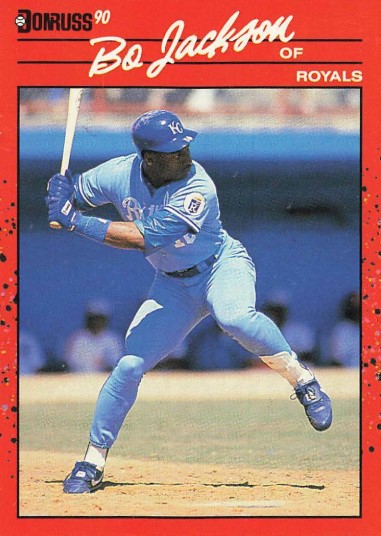
A Pitchers’ Hit Parade – Baseball Roundtable Looks at Top Seasons at the Plate for Hurlers

In 2021, Max Scherzer helped make the case for a universal designated hitter – setting a new MLB record for plate appearances in a season (63) while putting up a .000 on-base percentage.  Overall, Scherzer had 59 at bats, three sacrifice bunts and one sacrifice fly. (Yes, despite a .000 average, on-base percentage and slugging percentage, he did record an RBI.)  Scherzer came into the season with a career  .193 average and a .221 OBP – and finished at .168 and .194, respectively

For Those That Want to Know

The record  for at bats in a season with a .000 average belongs to Bob Buhl. In 1962, while putting up a 12-14, 3.87 record for the Braves and Cubs, Buhl went zero-for-70. He did, however, put up a 0.90 on-base percentage thanks to six walks and one hit by pitch.  He also had seven sacrifice bunts and one sacrifice fly (for an RB). Buhl  is not an unexpected record holder in this category. He logged a career batting average of .089 over 15 seasons – hitting under .100 in nine of them.  He had a career total of 76 hits – 74 singles and two doubles.  Buhl did significantly better on the mound than at the plate, with a career record of 166-132, 3.55 and five season of 15 or more victories. He was a one-time All Star and led the NL in winning percentages  at .720 (18-7, 2.74) for the 1957 Braves and in shutouts (four) for the Braves in 1959. 

Now, let’s switch gears.  Those who read Baseball Roundtable regularly know I am a bit “old school” and not an advocate of the DH.  So, in this post, I’d like to look a half-dozen of the  best hitting seasons for MLB pitchers.  It may surprise some readers to find that neither Babe Ruth nor Shohei Ohtani is on this list.  The reason is – as the chart below shows – they did most of their damage in contests in which they did not take the mound.  For example, of Ruth’s MLB-leading 11 home runs for the Red Sox  in  1918 (when he went 13-7, 2.22 on the mound), only two were hit in games in which Ruth pitched. (That season marked the biggest step in Ruth’s transition from pitcher to position player and – working to get his bat in the lineup – Boston used him at 1B, LF and CF.) In the case of Ohtani, only three of his 46 home runs and eight of his 100 RBI came in games in which he pitched. Ohtani appeared in 126 games at DH, as well as seven in the outfield.


So, who does make the Baseball RoundTable list for best hitting seasons (American and National Leagues) by a pitcher?

Number One – Wes Ferrell, 1931 Indians

Photo: Public Domain via Wiki Commons.

In 1931, Wes Ferrell not only went 22-21, 3.73 (with a league-leading 27 complete games) for the Indians, he also went .319-9-30 at the plate – setting the MLB record for home runs (9) and RBI (29) in a season by a pitcher (in games in which he pitched). That season, Ferrell was used eight times as a pinch-hitter, going hitless (drawing one walk) in that role. Ferrell had 11 multi-hit games that season.  His best game at the bat came in an August 31, 15-5 win over the White Sox, when he went three-for-five – with two home runs, four runs scored and five RBI. (It was one of five multi-homer games in Ferrell’s career.)

Ferrell, by the way, had a second season that would have put him on this list.  In 1935, when he led the AL with 25 wins (14 losses) and 31 complete games for the Red Sox, Ferrell hit .346, with seven home runs and 32 RBI (six of the long balls and 25 of the RBI came in games in which he pitched). That season Ferrell was used 35 times as a pinch-hitter.

I Can Handle This on My own

On April 29, 1931, Wes Ferrell threw a no-hitter against the St. Louis Browns (in Cleveland) – walking three and fanning eight as the Indians prevailed 9-0. Ferrell also excelled at the plate, going two-four with a double, a home run, two runs scored and four RBI. As a side note, catching for the Browns that day was Wes Ferrell’s brother Rick.

Ferrell played 15 MLB seasons (1927-41 … Indians, Red Sox, Senators, Yankees, Dodgers Braves) and went 193-128, 4.04 on the mound (with six seasons of 20 or more wins) and .280-38-208 (in 548 games) at the plate. Side Note:  Ferrell had just one minor -league season before taking a regular spot in the Indians’ rotation.  In 1920, at age 20, he went 20-8, 2.74 for the Class-B  Terre Haute Tots.  The following season, he was 21-10, 3.60 for the  Indians.

One (or 37) for the Record Books

Wes Ferrell hit 37 of his career 38 home runs in games in which he pitched – and that is the career record for pitchers.  The other long ball came as a pinch hitter.

—————————————————————-

Number Two – Walter Johnson, 1925 Senators

Photo: Harris & Ewing, photographer, Public domain, via Wikimedia Commons

With a career 417-279, 2.17 record on the mound, Walter Johnson is clearly one of – if not the – premier pitcher in the history of the national pastime. (More on that a bit later). In 1925, he also proved to be one of the game’s best hitters. Johnson, at 37 and in his 19th MLB season, not only went 20-7, 3.07 on the mound, but hit .433 in 97 at bats – striking out just six times in 107 plate appearances. Notably, in the 91 of those at bats that came in games he pitched (he was used six times as a pinch hitter), Johnson was even better – hitting .440.

Walter Johnson hit safely in 25 of the 30 In games he pitched in 1925. He started his season with a nine-contest hitting steak, during which he hit .500 (13-for-26).   He appeared as a pinch hitter in  two of those nine games.

Johnson hit .235 over his career – and, perhaps like fine wine, got better with age. His three highest batting average seasons came in his last four career seasons (ages 36-39).  In his final season (1927), at age 39, Johnson hit .348 in 26 games.

Now for that pitching resume. On the mound, Johnson was a master with a 417-279, 2.17 record. He led the AL in wins six times, topping 20 wins in a season 12 times (two of those 30+). The two-time AL MVP  also led the league in strikeouts an MLB -record 12 times; shutouts seven times; complete games six times; ERA three times; and winning percentage twice.  In addition, he topped the junior circuit in  strikeouts-to-walks ratio nine times; strikeouts per nine innings seven times; and WHIP six times.

——————————————————————

Pitchers’ Hit Parade Extra – Best Single Game

There were a few contenders for Best Single Game Hitting Performance by a pitcher – like: the Braves’ Jim Tobin’s three-homer, four-RBI game in his 6-5 complete-game win over the Cubs on May 13, 1942; the Phillies’ Rick Wise popping two home runs and driving in three runs during his June 23, 1971,  4-0 no-hitter victory over the Reds; or the Red Sox’ Babe Ruth’s five-for-five (with thee doubles and a triple) in his 4-3, ten-inning loss to the Senators on May 9, 1918 (Ruth went 9 2/3 innings). 

Baseball RoundTable will give this one to the Braves’ Tony Cloninger, who  – on July 3, 1966 – hit two Grand Slam home runs (and a single), drove in nine runs and pitched a complete-game seven-hitter, as his Braves topped the Giants 17-3 in San Francisco. Cloninger became not only the first  MLB pitcher with two Grand Slams in a game, but the first National Leaguer (any position) to achieve the feat.  He also set the record for RBI by a pitcher in a contest.  For the complete Cloninger story, click here.

———————————————————–

Number Three – Don Newcombe, 1955 Dodgers

Photo: Public domain, via Wikimedia Commons

In 1955, Don Newcombe hit .359-7-23 overall and .354-7-19 in games in which he appeared as a pitcher  Newcombe was proficient enough with the bat that he was used 23 times as a pinch hitter that season  – going 8-for-21 (.381) in that role (plus one walk and one HBP). Newcombe had 11 mufti-hit games in 1955, including four games with three or more hits. He also had seven multi-RBI games. In that 1955 season, Newcombe went 20-5, 3.20 on the mound.

In a 12-season MLB career (1944-45, 1949-51, 1954-1960 … Negro Leagues, National League and American League), Newcombe hit .269  with 15 home runs and 109 RBI (471 games).  He hit .300 or better in seven of those campaigns. On the mound, he was 153-96, 3.54 – with three seasons of 20 or more victories. In 1956, he went 27-7, 3.06 and won the NL Cy Young and MVP Awards. He was also the 1949 NL Rookie of the Year  (17-8, 3.17, with a league-leading five shutouts).

——————————————————

Number Four – Don Drysdale, 1965 Dodgers

DH?  I don’t need no stinkin’ DH!

The 1965 World Champion Dodgers had only on player with at least 100 at bats and an average of at least .300 – RHP Don Drysdale –  Drysdale  finished seventh on the team in home runs with seven.

Photo: Public Domain via Wiki Commons.

In 1965, Don Drysdale was not only a 23-game winner for the Los Angeles Dodgers (23-12, 2.77), he hit .300, with seven home runs and 19 RBI in 58 games (he was used 14 times as a pinch hitter).  In games he pitched, Drysdale was .305-7-17.

In 14 MLB seasons (1956-69), all for the Dodgers, Drysdale hit .186, with 29 home runs and 60 RBI (547 games).  While his 29 home runs indicated his power (he had two seasons of seven long balls), 1965 was  one of only two seasons in which he hit .200 or better (he hit .227 with seven home runs  in 1958). On the mound, Drysdale was 209-166, 2.95. He won the NL Cy Young Award in 1962 with an NL-leading 25 wins (nine losses, 2.83 ERA). He also led the league with 314 1/3 innings pitched and 232 strikeouts.  Overall, Drysdale had two seasons of 20+ wins and a total of seven seasons with at least 15 victories.  He led the NL in strikeouts three times and shutouts once. A feared competitor, he led the NL in batters hit by pitch in five seasons and plunked ten or matter batters in ten campaigns.


—————————————-

Pitchers’ Hit Parade Extra – Hitting Counts, by George

Hall of Famer George Brett was a pretty good hitter – (well, maybe more than that, with three batting titles, 3,154 hits and a .305 career average).  George’s brother Ken, who had a 14-season MLB career as a pitcher, could handle the bat as well. Between June 9 and June 23, 1973, Ken Brett (with the Phillies) set an MLB record for pitchers by hitting a home run in four consecutive games played.  In that stretch, he hit .308 (4-for-13) with four runs scored and four RBI.  For the season, he hit .250-4-16. During his  long-ball streak, Brett won all four games (4-0, 2.88), tossing three complete games. Over his 14-season career (1967, 1969-77, 1979), Ken averaged .262, with 10 home runs and 44 RBI in 255 games. He hit .300 or better in three seasons.  As a pitcher, he was 83-85, 3.93.  He was an All Star in 1974, when he went 13-9, 3.30 for the Pirates.

————————————————-

Number Five (tie) – Jack Bentley, 1923 Giants

Photo:: Blaire News Service, Public Domain via Wiki Commons

Certain “bright and shiny things” in baseball tend to attract Baseball Roundtable’s attention.  One of those is pitcher Jack Bentley’s “.427 average” for the 1923 New York Giants.  Bentley, who was used as a pinch hitter 22 times that season, hi t .406-0-8 in games he pitched.  As a pinch hitter, he went 10-for-21, with one walk, one home run and six RBI. Bentley, who was also used at 1B and RF during his career, hit .291-7-71 in 287 games over nine MLB seasons (1913-16, 1923-27 … Senators, Giants, Philllies).  As a pitcher, he went 46-33, 4.01 in 138 games (90 starts). His bet mound season was 1924 (Giants), when he put up a 16-5, 3.78


——————————————–

Number Five – (Tie) Micah Owings , 2007 Diamondbacks

Photo: Barry Stahl on Flickr, CC BY 2.0 <https://creativecommons.org/licenses/by/2.0>, via Wikimedia Commonshoto9:

Micah Owings broke in with the Diamondback as a 24-year-old rookie in 2007.  On the mound, he went 8-8, 4.30, but at the plate, he was .333-4-15.   He was one-for-four with two walks in six pinch-hitting appearances and .339-4-15 in games he pitched. On September 27 of that season, Owings went four-for-four with three doubles and three RBI – and pitched 6 1/3 scoreless innings – as the Diamondbacks topped the Pirates 8-0.

Owings pitched six MLB seasons (2007-12 … Diamondbacks, Reds, Padres), going 32-33, 4.86.  In 2011, he was 8-0 , 3.57 in 56 appearances (four starts) for the Diamondbacks. As a hitter, he went .283-9-35 in 174 games.

———————————————-

Pitchers’ Hit Parade Extra – Great Britton

In his rookie season (2011) with the Orioles, southpaw Zack Britton went 11-11, 4.61 in 28 starts.  He started three games in National League parks and went five-for-eight (.625), with one double and one RBI.  Over his next ten seasons (Orioles, Yankees), Britton (converted to a reliever in 2014) never came to the plate again – retiring with a .625 career average.


Primary Resources: Baseball-Reference.com; Baseball-Almanac.com


100Baseball Roundtable is on the Feedspot list of the Top 100 Baseball Blogs.  To see the full list, click here.

I tweet baseball @DavidBBRT

Follow/Like Baseball Roundtable’s Facebook Page here.  More baseball commentary; blog post notifications; PRIZES.

Member: Society for American Baseball Research (SABR); Negro Leagues Baseball Museum; The Baseball Reliquary. 
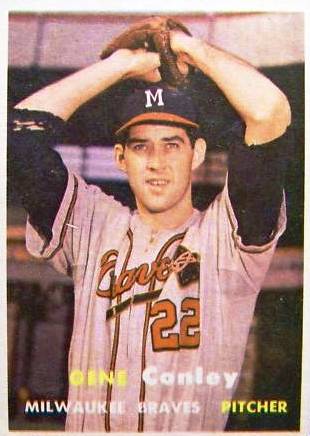
Baseball Roundtable Looks at the Hall of Fame Golden Days Era Candidates

. .

The Baseball Hall of Fame recently announced its candidates for 2022 election by the Golden Days  Era (1950-69) and  the Early Baseball Era (pre-1950) Committees. Voting will take place December 5 for 2022 induction.   In this post, Baseball Roundtable will take a look at the Golden Days Era candidates,  sharing:

  • What Baseball Roundtable’s Golden Days Era ballot would look (if I had one); and
  • Bios, comments and Roundtable rankings for all ten candidates;
  • A thought on what the Golden Days Era Committee might do.

In the coming days, I will do the same for the slate of Early Baseball ERA candidates.

Selecting from among the Golden Days Era candidates proved particularly challenging for several reasons:

  • Since the candidates were pre-screened by an Historical Overview Committee, they all could boast some deserving achievements and attributes;
  • Since I grew up in the Golden Era, I was able to see all the nominated players on the field – and find my choices mixing emotion with reason; and
  • The members of the committee are only allowed to vote for a maximum of four candidates and I limited myself to that same restriction.

The ERA Committees – Background

By way of background, the Hall of Fame Era Committees consider candidates passed over for election to the HOF in the annual Baseball Writers Association of America balloting. The current committees, which meet on a rotating basis are the: Early Baseball Era (prior to 1950);  Golden Days Era (1950-69); Modern Baseball Era (1970-87); and Today’s Game Era (1988 forward). Players to appear on each year’s ballot are selected by an Historical Overview Committee and then are considered by a 16-member Era Committee. Candidates must receive 75 percent support (12 votes) from Era Committee members to achieve election. Candidates whose careers overlap eras are considered on the basis of the time frame in which they made their most significant contributions to the national pastime.

Of the ten candidates  on this year’s Golden Days Era ballot – eight  are returnees from the 2014 Committee ballot (when no candidates were elected):  Dick Allen; Tony Oliva; Jim Kaat; Maury Wills; Minnie Minoso; Gil Hodges; Ken Boyer; and Billy Pierce. Newcomers to the ballot include: Roger Maris and Danny Murtaugh.

HOW BBRT WOULD VOTE IF I HAD A   BALLOT

Let me say, having been born in 1947, I grew up watching most of the candidates on the field.   I have fond memories of Tony Oliva’s knees bent-in stance – and ability to hit pretty much any pitch (in or out of the strike zone);  the drama of the Roger Maris/Mickey Mantle 1961 chase for Babe Ruth’s single-season home run record; the Go-Go White Sox, shaped in part by Minnie Minoso’s speed and never-waning hustle; Danny Murtaugh’s Pirates’  unexpected upset of the Yankees in the 1960 World Series; Maury Wills’ daring on the bases;  Dick Allen’s fierce presence and personality on and off the field; the ability of Gil Hodges and Ken Boyer to change a game with their bats or their gloves; and the way southpaws Jim Kaat and Billy Pierce filled the role of staff “ace” for the Twins and White Sox, respectively.   In rating all these candidates, I did my best to focus on exceptional performance in relation to their Golden Days Era peers – league leadership in key statistical categories, All Star selections, individual awards (Rookie of the Year, Cy Young, MVP, etc.).  I recognize that my selections, which I will present in priority order, may make me look like a bit of a “homer.” (My home base is  Minnesota and two of my top three selections are former Twins.) I do, however, think my reasoning will stand up to scrutiny – and those two candidates were among the top three cote-getters in 2014.
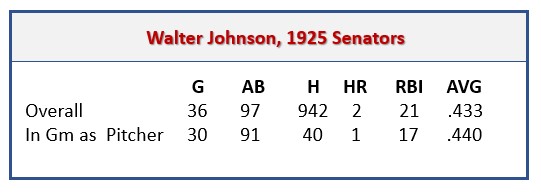
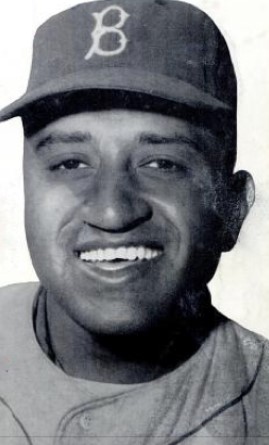
Now, let’s start with the three players, Baseball Roundtable considered no-brainers when deciding how I would vote if I was on the committee.

  1. Jim Kaat (LHP, 1959-83)

Photo: Public Domain via Wiki Commons

Jim Kaat is at the top of my list of players not in the Hall of Fame who should be.  Consider, the southpaw took the big-league mound in 25 seasons; his 283 wins  (237 losses) are 31st all time; his 2,461 strikeouts 44th.   (More than 50 pitchers currently in the HOF have fewer career wins than Kaat.)

A three-time All Star, Kaat won 20 or more games in three-seasons, leading the AL in wins with 25 in 1966.  Kaat also is among MLB’s top 25 hurlers in games started (625, 17th), innings pitched (4,530 1/3, 25th). Then, of course, there are his 16 Gold Gloves (tied with 3B Brooks Robinson) and second only to Greg Maddux for the most Gold Gloves all time. Further, Jim Kaat and Brooks Robinson share the record for consecutive Gold Gloves at 16.

One of the criticisms of Kaat raised during regular BBWAA balloting was that he his win total was inflated by the length of his career (Kaat average 11.3 wins per season over 25 seasons).  From a different perspective, BBRT believes the fact the Kaat had the skills and determination to compete on the major league level from age 20 to age 44 contributes to his Hall of Fame credentials.

In the 2014 Era Committee balloting, Kaat got ten of the necessary 12 votes for election. This should be his year.

Breaking the String – A Piece of Jim Kaat Trivia

From 1972 through 1986,  Steve Carlton started 14 of the 15 Phillies’ Opening Day games. The one year he missed (1976) cost him the record for consecutive Opening Day starts and consecutive opening Day starts for the same team. The pitcher who interrupted the streak was Jim Kaat – a three-time 20-game winner, and a 20-game winner and All Star the year before (for the White Sox). Carlton started the second game of the season.

Jim Kaat played for the: Washington Senators/Minnesota Twins (1959-73); Chicago White Sox (1973-75); Philadelphia Phillies (1976-79); New York Yankees (1979-1980); Saint Louis Cardinals (1980-83).

Jim Kaat’s Best Season: 1966 Twins … A league-leading 25 wins (13 losses), with a 2.75 ERA. That season, Kaat also led the AL in starts (41) and complete games (19). Kaat might have that all-important Cy Young Award on his HOF resume, except for the fact that MLB gave out only one CYA in 1966 (the move to a CYA for each league came the following year) and it went to National Leaguer Sandy Koufax (27-9, 1.73 for the Dodgers).

  1. Minnie Minoso (OF/3B, 1946-49, 1951-64, 1976, 1980)*

*Minoso made brief publicity-focused appearances for the White Sox in 1976 and 1980 – which allowed him to appear in MLB in five different decades.

Photo: Bowman Gum, Public domain, via Wikimedia Commons

In his first full American League  season (split between the Indians and the White Sox), the 25-year-old Minoso hit .326, leading the AL in triples (14), stolen bases (31) and hit by pitch (16) – finishing second to Yankees’ infielder  Gil McDougald in the Rookie of the Year balloting. Minoso had previously played three seasons in the Negro Leagues (111) games, averaging .313, with nine home runs, 66 RBI and 11 stolen bases. He was the starting 3B in the 1948 and 1948 Negro Leagues East-West All Star Games, before joining the Indians in 1949.

Minoso enjoyed  a 20-season MLB career in which he made nine All Star squads (two Negro League, seven American League), earned three Gold Gloves, led the AL in hits once, doubles once, triples three times, stolen bases three times, total bases once and hit by pitch an MLB-record ten times. He finished with 2,110 hits and a .299 average (topping .300 ten times), 195 home runs (hitting 20+ in a season four times), 1,225 runs (scoring more than 100 runs in a season four times), 1,093 RBI (besting 100 four times) and 216 stolen bases. In addition to those offensive marks, Minoso also led AL left fielders in assists six times, putouts four times and double plays four times.  Minoso was well into his career when the Rawlings Gold Glove Awards were established in 1957; yet he still earned Gold Gloves 1957, 1959 and 1960.

Adding to Minoso’s Hall of Fame resume is the fact that he was a groundbreaking “Black Latino” in major league baseball; bringing additional pressure and significance to his on- and off-field performance and persona.  Minoso was the first player of color for the Chicago White Sox (and quickly won over ChiSox fans with his constant hustle), the first Black Cuban to play in the major leagues and the first Cuban to play in the AL/NL All Star game.  His baseball legacy is further enhanced by the fact that he also  played and starred in the Cuban League. He is a member of the Cuban Baseball Hall of Fame; the Latino Baseball Hall of Fame; the Hispanic Heritage Hall of Fame;  The Baseball Reliquary Shrine of the Eternals; and the Negro Leagues Baseball Museum Jackie Robinson Lifetime Achievement Award.

All of this would earn Minoso Baseball Roundtable’s vote for the Hall – plus I’d like to see his full name Saturnino Orestes Armas (Arrieta) Minoso on that HOF plaque.  Minoso got eight votes in the ERA Committee 2014 balloting.

Minnie Minoso played for: New York Cubans (1946-48); Cleveland Indians (1949, 1951, 1958-59); Chicago White Sox (1951-57, 1961, 1964, 1976, 1980); Saint Louis Cardinals (1962); Washington Senators (1963).

Minnie Minoso’s Best Season:  1954 Chicago White Sox … 153 games, .320 average, 182 hits, 29 doubles, 18 triples (league-leading), 19 home runs, 119 runs scored, 116 RBI, 18 stolen bases.

  1. Tony Oliva (OF-DH, 1962-76)

Photo: Public Domain via Wiki Commons

Okay, having two former Twins on my ballot may make me look like a “homer,” but hear me out.  First, it’s ironic that Jim Kaat’s HOF qualifications have been criticized in the past because his career was too long (283 wins over 25 seasons), while Oliva’s HOF credentials have been criticized because – due to injury – his productive career was too short (only 11 seasons out of 15  in which he played at least 125 games, only seven of 140 games or more).

Oliva gets BBRT’s vote because, when he played, he was simply one of the best. In his first eight seasons full seasons (1964-71), he made the All Star team every year.  During that span he produced an annual average of 182 hits (.313 batting average), 22 home runs, 89 runs scored, 90 RBI and ten stolen bases.  During those seasons, Oliva won three batting titles and led the AL in hits  five times. Over his last five seasons, he was hampered by bad knees (eight knee operations) – averaging 96 games per season, with a .278 batting average.

As noted,  Oliva won three batting titles. He led the American League in hits in his first three full seasons and a total of five times. He also led the AL in doubles four times, and topped the AL one time each in runs scored, slugging percentage, total bases and intentional walks.   Tony-O also showed speed on the bases, finishing in double-digits in steals six times, with a high of 19 in 1965.  In his first eight seasons, he received MVP votes every year, finishing in the top six four times. Between 1964 and 1971, He also lead AL right fielders in putouts five times, in assists  twice and in double plays (three times).

Oliva also was a “’plus” defender with a rifle arm in right field, capturing a Gold Glove in 1966.

Oliva played in 15 major-league seasons, retiring with a .304 career average, 1,917 hits, 220 home runs, 870 runs scored and 947 RBI.  He received 11 of the needed 12 votes in the 2014 Era Committee balloting.

While critics might point to the fact that (again due to injury), Oliva’s career included  just 11 seasons in which he played 100+ games and just eight All Star campaigns, Baseball Roundtable would note that the Hall has acknowledge players whose career totals were also impacted by injury issues such as Ralph Kiner  (ten career seasons, six-time All Star) and Sandy Koufax (12 career seasons, six-time All Star.) I believe Oliva’s peak years, three batting titles and five season leading the AL in bits have earned him this vote.)

Tony Oliva played for:  Minnesota Twins (1962-76)

Tony Oliva’s Best Season:  In 1964, 25-year-old rookie, Tony Oliva led the AL in batting average (.323); hits (217); run scored (109); doubles (43); and total bases (374). His nine triples were third in the AL; his 32 home runs sixth; his 94 RBI ninth. He also led AL rightfielder in putouts. He finished fourth in the AL MVP voting. Oliva did not fall prey to the “sophomore jinx.” The following season, he again led the AL in hits and batting average, led the league’s right fielders  in putouts and was second in assists.

______________________________________

I debated on exercising a fourth vote (as allowed to Era Committee members – and once I decided there were additional worthy candidates, I was able to limit my consideration to two – Dick Allen and Gil Hodges.  It was close, but I would give my fourth vote to Allen.

__________________________________________

  1. Dick Allen (1B/3B, 1963-77)

Dick Allen’s traditional HOF candidacy suffered from a combination of career-shortening injuries and career-complicating controversy.  The fact is, Allen had a fierce presence and demeanor both on and off the field.  It is his on-the-field performance – specifically his at-the-plate performance – that earns Allen BBRT’s Golden Days vote. It is generally agreed that none of his peers hit the ball as consistently hard as Allen did in the pitching-dominated 1960s.

Allen came on with a bang, as a 22-year-old,  in his first full MLB season, leading the NL in runs scored (125), triples (13) and total bases (352), while hitting .318 with 29 home runs and 91 RBI.  His performance earned him the Rookie of the Year Award.  He went on to a 15-year MLB career, during which he was a seven-time All Star and collected 1,848 hits, 351 home runs and 1,119 RBI.  His career batting average was .292, and he topped .300 seven times.  He led the NL in home runs twice (hitting 30+ HRs six times), RBI once (besting 100 three times), walks once, on-base percentage twice, slugging percentage three times and total bases once. I would have liked to see a few more benchmark numbers (400 home runs, 1,500 RBI, .300 career average) or a few more instance of leading his league in key categories, but that was offset by his Rookie of the Year and 1972 AL MVP Award.

Allen fell one vote short in the 2014 Committee balloting.

Dick Allen played for: Philadelphia Phillies (1963-1969; 1975-76); Los Angeles Dodgers (1971); Chicago White Sox (1972-74); Oakland A’s (1977).

Dick Allen’ Best Season:  1972 Chicago White Sox … Played in 148 games, hitting .308, while leading the AL in home runs (37), RBI (113), walks (99), on-base percentage (.420) and slugging percentage (.603) – winning the AL MVP Award.

__________________________________________________

So, there are my four votes:  Now, for the remainder of the ballot (in BBRT ranking order).

___________________________________________________

  1. Gil Hodges (1B, 1943-63 – military service 1944-45)

Gil Hodges was a slick-fielding first baseman. (Rawlings launched the Gold Glove Award in 1957 and Hodges, already in his 12th MLB season at age 33, began a streak of three consecutive Gold Gloves at first base.) Hodges was also a potent offensive force – an RBI machine.  For the seven seasons from 1949 to 1955, he topped 100 RBI every year – averaging 112 runs driven in per campaign.   He also logged 11 consecutive seasons of 20+ home runs (1949-59), with a high of 42 in 1954.

Gil Hodges is one of only 18 MLB (NL/AL) players to hit four home runs in one game.

In 18 MLB seasons, Hodges was selected for eight All-Star teams, and helped his Dodgers capture seven NL pennants and two World Series championships.  In post-season play, he is remembered his 21 hitless at bats in 1952, but in his other six World Series, he hit .318, with five home runs and 21 RBI in 32 games.

Hodges’ put up a career average of .273, with 370 home runs, 1,274 RBI and 1,105 runs scored.  Without losing those two years to military service, he may well have exceeded the 400 home runs and 1,500 RBI marks. Hodges’ chances for the Hall are diminished a bit by the fact that he never led the league in any of the key offensive categories. After his playing days, he also managed the Washington Senators (1963-67) and New York Mets (1968-71), leading the “Miracle Mets” to the World Championship in 1969.

Gil Hodges – Respected Leader

Gil Hodges was a respected leader in the clubhouse and on the field.  Hall of Famer and Hodges’ teammate Pee Wee Reese once said of him, “If you had a son, it would be a great thing to have him grow up to be just like Gil Hodges.”

Gil Hodges played for: Brooklyn/Los Angeles Dodgers (1943-61); New York Mets (1962-63).

Gil Hodges’ Best Season:  1954 Dodgers … Hodges played in all 154 games that season, providing sparkling defense along with a .304 average, 42 home runs, 130 RBI and 106 runs scored.


________________________________________

Choosing Between Dick Allen and Gil Hodges

For, Baseball Roundtable, deciding on my  fourth vote – between Dick Allen and Gil Hodges – was a close call. Hodges .273 average worked against him, as did the fact that he never led his league in any of the key offensive categories (average, home runs, RBI, runs scored). His seven consecutive years with 100 of more RBI, his reputation for respected and respectful leadership and his status as a  plus defender worked in his favor, but could no outweigh Allen’s ROY and MVP Awards – and Allen’s .292 career average. How close were these two?  I did a little math, determining each player’s average output over 150 games (pretty much the definition  of a full-time, full season). Allen averaged out at .292-30-96, with 94 runs scored –  Hodges at  .272-27-92, with 80 runs scored.  

______________________________________________

      6. Ken Boyer (3B/1B/CF … 1955-69)

Ken Boyer was a Gold Glove fielder at third base.  In fact, he won five Gold Gloves in a six-season span (1958 to 1963).  He led all NL third baseman in assists twice, putouts once and double plays five times. And I guess he was able to console himself for losing the 1964 Gold Glove to the Cubs’ Ron Santo with the fact that Boyer was voted the NL MVP that season.

You may have heard about (or witnessed) Boyer’s defensive skills at the hot corner, but did you know his MLB career also included time in centerfield (111 games), as well as at first base (65 games) and shortstop (31 games)? In fact, in 1957 – with the Cardinals wanting to develop infield prospect Eddie Kasko and facing a gap in centerfield – Boyer agreed to move to the center of the outfield. In 105 games there, he made just one error and led NL outfielders with a .993 fielding average.  A combination of an injury to Kasko and the Cardinals acquisition of outfielder Curt Flood sent Boyer back to third base in 1958 (and he began a streak of four consecutive Gold Gloves).

In his fifteen-year MLB career, Boyer became known not just as a fine defensive player, but also as a consistent, quality hitter. He retired with 2,143 hits, a .287 average, 282 home runs, 1,104 runs scored and 1,141 RBI – topping .300 five times (with a high of .329 in 1961), hitting 20 or more home runs eight times (with a high of 32 in 1960), driving in 90 or more runs eight times (with a league-leading high of 119 in 1964) and scoring 90 or more runs five times (with a high of 109 in 1961).  The quality of Boyer’s play – in the field and at the plate – earned him seven All Star selections.  He’s held back in the voting by the fact that his offensive numbers are overshadowed by others at 3B – traditionally a power position.

Ken Boyer played for: Cardinals (1955-65); Mets (1966-67); White Sox (1967-68); Dodgers (1968-69).

Ken Boyer’s Best Season: In 1964, Boyer hit .295, with 24 home runs, a league -topping 119 RBI and 100 runs scored – and won the NL MP Award.

  1. Maury Wills (SS/3B, 1959-72)

Maury Wills, in 1962, not only became the first player in the modern era (post-1900) to steal 100 bases in a season (104), he topped the next highest player’s total by 72 swiped bags – and the Dodger shortstop actually stole more bases than every other MLB team.

In 14 MLB seasons, Wills hit .281, with 20 home runs and 458 RBI. However, he was a table-setter, not a middle of the lineup power source.  He scored 1,067 runs and stole 586 bases (20th all time). Wills was  an All Star in five seasons, a two-time Gold Glover and the 1962 National League MVP.  He led the NL in stolen bases six consecutive seasons (1960-65). He also won a pair of Gold Gloves (1961-62).

Wills played for the Dodgers (1959-66, 1969-72); Pirates (1967-68); Expos (1969).

Maury Wills’ Best Season: In 1962, Wills played in an MLB -leading 165 games, hit .299 with 208 hits, led the NL with 13 triples, stole an MLB-leading 104 bases and scored 130 runs. – capturing the NL MVP Award.

  1. Roger Maris , OF (1957-1968)

Roger Maris didn’t put up spectacular career numbers (.260-275-850 in 12 MLB seasons), but he put up some spectacular seasons – winning the American League MVP Award in 1960 and 1961. Maris, of course, is best known for breaking Babe Ruth’s’ single-season home run record, when Maris hit 61 long balls for the 1961 Yankees. He finished that season with a .269 average and leading the league in RBI (141) and runs scored (132). Maris was a four-time All Star and one-time Gold Glover and led the AL in home runs twice, runs scored once, RBI once, slugging percentage once, and total bases once.  He hit 20 or more home runs in six seasons, had 100 or more RBI in three.

Roger Maris is one off just 13 players to win back-to-back MVP Awards. 

Maris played for the Indians (1957-58), Athletics (1958-59); Yankees (1960-66) and Cardinals (1967-68).

Roger Maris’ Best Season: In 1961,Maris went .269-61-141, leading the league in home runs and RBI.  He also led the league in runs scored and total bases.

  1. Billy Pierce (LHP 1945, 1948-64)

Billy Pierce put up a 211-169 line in 18 MLB seasons.  The southpaw starter was an All Star in seven seasons and a two-time 20-game winner – leading the AL in wins (20) for the White Sox in 1957.  He led the AL in ERA (1.97 in 1955), in strikeouts (186) in 1953 and in complete games three consecutive seasons (1956-58). Pierce also led the league in strikeouts per nine innings in 1953 and 1954.

Home Cookin’

In 1962, Billy Pierce (traded to the San Francisco Giants in the off season), proved to really like home cooking – going 11-0 in eleven Candlestick starts, with  his overall 15-6 record helping the Giants tie the rival Dodgers for the pennant. Pierce started Game One of the three-game playoff and ran his 1962 home record to 12-0 (beating Sandy Koufax, tossing a three-hit shutout in an 8-0 win).

Billy Pierce played for the Tigers (1945, 1948); White Sox (1951-1961); and Giants (1962-64).

Billy Pierce’s Best Season: In 1956, Pierce went 20-12, 3.26 – leading the AL in wins, complete games (16)

  1. Danny Murtaugh, Mgr. (1957-64, 1967, 19780-71, 1973-76)

An Historic First

Danny Murtaugh was the first manager to start an entire line up of players of color (September 1, 1971.)  That lineup  included Rennie Stennett, 2B; Gene Clines; Roberto Clemente, RF; Willie Stargell, LF;  Manny Sanguillen, C; Dave Cash, 3B; Al Oliver, 1B; Jackie Hernandez, SS; Dock Ellis, P. The Pirates won the contest 10-7 over the Phillies, with Clemente, Stargell and Sanguillen each collecting two hits and two RBI.

Danny Murtaugh managed in the major leagues for 15 seasons, delivering World Series titles to Pittsburgh in 1960 and 1971. His overall managerial record was 1,115-950 for a .540 winning percentage. His managerial career could have included considerably more victories were it not interrupted (more than once) due to health issues.   Murtaugh was selected The Sporting News Manager of the Year in 1960 and 1970.

As a player, Murtaugh was on the field in nine MLB seasons (1941-43 and 1946-51) going .254-8-219 in 767 games  (playing 2B, 3B and SS). In 1948, he led NL second basemen in putouts, assists and double plays.

Danny Murtaugh managed: Pirates (1957-64, 1967, 1970-71, 1973-76).

Danny Murtaugh played for: Phillies (1941-43, 1946). Braves (1947); Pirates (1948-51).

Danny Murtaugh’s Best Season:  Hard to judge a managers’ best season, but 1960 was Murtaugh’s most memorable. He managed the Pirates to the NL pennant with a 95-59 record and then took on the favored Yankees in the World Series – where Murtaugh and the Pirates prevailed four games-to-three, despite  being outhit (.338 to .256), out-homered (ten-to-four) and outscored (55-to-27).

WHAT WILL THE GOLDEN ERA COMMITTEE DO?

Wow! Tough call here, since that last time there was a slate of Golden Days candidates, it was similar to this year and no one got the necessary 12 votes.  I don’t think that will happen again.  If I had to make a call, I expect no more tan two candidates to make it – and, more likely, just one.  My guess,  only as good as yours, is that Kaat makes it.  I also think Oliva, Minoso and Allen have a chance, but will again fall short. If I had to rate their chances. I’d go: Minoso, Oliva, Allen.

Primary Resources:  Baseball-Reference.com; The Baseball Hall of Fame; MLB.com; the Negro Leagues Baseball Museum.


BASEBALL ROUNDTABLE ON THE TOP 100 BASEBALL BLOG LIST

100Baseball Roundtable is on the Feedspot list of the Top 100 Baseball Blogs.  To see the full list, click here.

I tweet baseball @DavidBBRT

Follow/Like Baseball Roundtable’s Facebook Page here.  More baseball commentary; blog post notifications; PRIZES.

Member: Society for American Baseball Research (SABR); The Baseball Reliquary, The Negro Leagues Baseball Museum.

Baseball Roundtable Rates 2021 Potential Cy Young Candidates

The post season is over and now it’s awards season.  Here is Baseball Roundtable’s look (ratings, selections, predictions) at potential CY Young Award candidates.  For  a look at potential Rookie of the Year candidates, click here.  Coming soon: MVP candidates.

AMERICAN LEAGUE CY YOUNG AWARD

BBRT Choice: Robbie Ray

BBRT Prediction: Robbie Ray

  1. Robbie Ray, LHP, Blue Jays … Robbie Ray went 13-7, with a 2.84 earned run average (lowest among qualifying AL pitchers). He led the AL in strikeouts (248); innings pitched (193.1); games started (tied at 32); and WHIP (among qualifiers – 1.04). He fanned 11.55 batters per nine innings (third among AL starters). With a bit more run support, his record could have been even better.  He went just 1-0 in August, despite having six starts in which he went six or more innings and gave up two or fewer runs.  For the month, he averaged 6.8 innings per start, with a 1.76 ERA and 11.9 strikeouts per nine.  Ray’s was a dominant season.
  2. Gerrit Cole, RHP, Yankees … Gerrit Cole led the AL with 16 wins (versus eight losses) in 30 starts. He tied for the lead in complete games with two and trailed only Robbie Ray in strikeouts (243 to Ray’s 248 in 181 1/3 innings to Ray’s 193 1/3). Cole was also second in WHIP (among qualifiers) at 1.06 (to Ray’s 1.04) and second in the AL in strikeouts per nine innings  (12.06 to Dylan Cease’s 12.28). He was especially hot in the “dog days of August,” when he got three starts ad gave up one run in 17 2/3 innings (13 hits, four walks and 24 strikeouts.) This should be very close; but Ray and Cole are the front runners.
  3. Lance Lynn, RHP, White Sox … Lynn went 11-6 in 28 starts and, although he was five innings short of qualifying for the ERA title, he turned in a sharp 2.69 ERA, 1.07 WHIP and 10.1 strikeouts per nine innings. Lynn’s chances may be hurt a bit by having just 11 wins.
  4. Jose Berrios,  RHP Blue Jays …. Barrios, who went 12-9, 3.52 was second in the AL only to Robbie Ray in innings pitched (192 to Rays 193 1/3) and his 32 starts tied for the league lead.  He fanned 204 batters (fifth in the AL), his 1.06 WHIP tied for second among AL qualifiers, his 9.56 strikeouts per nine innings were ninth and his 4.53 strikeouts-per-walk ratio was fifth (all among qualifiers). Unfortunately for Barrios, he finished behind Ray and Cole in wins;  ERA; strikeouts and strikeout/nine innings; and WHIP (when you carry it out to three decimal points, Cole was 1.058, Barrios 1.063).  Still, Barrios was a quality, dependable starter for the Twins and Blue Jays and pitched at least six innings in 22 of 32 starts and seven or more frames in eight of those.
  5. Frankie Montas, RHP, A’s … Montas went 13-9, 3.37 (fourth among AL qualifiers) in 32 starts. His 187 innings pitched were third in the AL,  his 207 strikeouts fourth, his 9.96K/9 sixth and his 1.18 WHIP sixth.

NATIONAL LEAGUE CY YOUNG AWARD

I know there are no ties in baseball, but there is a three-way tie for fifth place on this list (with the reasoning explained).

BBRT CHOICE: Zack Wheeler

BBRT: Prediction: Max Scherzer

  1. Zack Wheeler, RHP, Phillies … Wheeler went 14-10, 2.78 (fifth-best NL ERA). His 213 1/3 innings pitched led MLB, and he led the NL in strikeouts with 247. He also tied for the  MLB lead in the “unicorn” categories – complete games (3) and complete-game shutouts (2), He finished fourth in the NL in strikeouts-to-walks ratio at 5.37.  His 14 wins tied for fifth in the NL and three of the four pitchers above him were Dodgers (Julio Urias, Walker Buehler and Max Scherzer).  While Scherzer may be considered a favorite here, the fact that three Dodgers are legitimate contenders may actually help Wheeler – particularly considering that the all of the other starters on this list benefited from higher run support than Wheeler. The Dodgers’ Julio Urias, Max Scherzer and Walker Buehler received more than five runs of support per nine innings (according to STATS), while Wheeler was at 3.67.
  2. Max Scherzer, RHP, Dodgers … Scherzer went 15-4, 2.46 (second among NL qualifies) on the season, with 236 strikeouts (second only to Zach Wheeler’s 247) in 179 1/3 innings pitched. His 0.86 WHIP was the lowest among MLB qualifiers. Scherzer will probably generate a bit of extra support for what he did after moving from the Nationals to the Dodgers (July 30 trade). He was 7-0, 1.98 in eleven starts for the Dodgers (and LA won in his four no-decisions). Notably, this included a hiccup in his final two starts (10 earned run sin 10 1/3 innings).  On the season, Scherzer gave up two earned runs or less in 24 of 30 starts – no earned runs in ten.
  3. Walker Buehler, RHP, Dodgers … Buehler went 16-4, 2.47 (numbers almost identical to Scherzer) in an NL–leading 33 starts. He fanned 212 batters in 207 2/3 innings (second-most IP in the NL), had a 0.97 WHIP and 9.2 strikeouts/nine innings. Finishing behind Scherzer in WHIP, K/9, BB/K ratio will likely deny him the CYA.
  4. Corbin Burnes, RHP, Brewers … Burnes went 11-5, 2.43 (lowest ERA among MLB qualifiers), with 232 strikeouts in just 167 innings.  His 12.6 strikeouts per nine led MLB qualifiers. Burnes also put up a 0.94 WHIP (second among MLB qualifiers to Max Scherzer). Burnes fanned ten or more batters in eight games,  A couple more victories would have helped his case.
  5. (Tie) Julio Urias, Josh Hader, Adam Wainwright

Julio Urias, LHP, Dodgers … There was a time when being MLB’s only 20-game winner would have practically guaranteed the CYA.  Well, Julio Urias was MLB’s only 20-game winner in 2021 (20-3, 2.96) and still finished fifth on this list.  He fanned 195 batters in 185 2/3 innings and put up a WHIP of 1.02. Still, he finished behind all four starters ahead of him on this list in ERA, strikeouts and WHIP.  For BBRT,  20 wins has got to get you at least on the short list.  He could do better than I expect, if enough voters share that old-school sentiment.

Josh Hader, LHP, Brewers … Brewers’ closer Hader went 4-2, with 34 saves in 35 opportunities and 102 strikeouts in just 58 2/3 innings – putting up a 0.84 WHIP and holding hitters to a .127 average.  That kind of lights-relief deserve recognition (and relievers are often underrepresented in the CYA competition.

Adam Wainwright, RHP, Cardinals … The 39-year-old Wainwright finished in the top ten in the NL in wins (second at 17, with 7 losses); ERA (3.05 – tenth); innings pitched (206 1/3 – third); WHIP (1.06 – ninth); complete games (three – tie for first). Have to give a nod to that kind of “veteran” performance (particularly at my age, we oldster need hope).

Primary Resource: Baseball-Reference.com


BASEBALL ROUNDTABLE ON THE TOP 100 BASEBALL BLOG LIST

100Baseball Roundtable is on the Feedspot list of the Top 100 Baseball Blogs.  To see the full list, click here.

I tweet baseball @DavidBBRT

Follow/Like Baseball Roundtable’s Facebook Page here.  More baseball commentary; blog post notifications; PRIZES.

Member: Society for American Baseball Research (SABR); The Baseball Reliquary