BBRT Review: Fifty-nine in ’84: Old Hoss Radbourn, barehanded baseball & the greatest season a pitcher ever had

Fifty-nine in ’84, by Edward Achorn,  Smithsonian Books (2010)
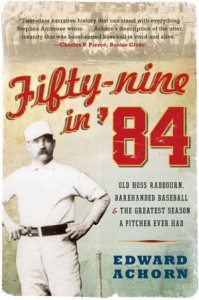
“Fifty-nine in 84” is story of grit, passion and accomplishment which – if it wasn’t  really true – would be truly unbelievable.  It’s the story of one of the greatest professional baseball players of the 19th century and a story of the (often sordid) conditions of the times.   It’s a story for baseball fans – for historians – and for those who just appreciate a well-written tale of adversity and achievement.

The centerpiece of Fifty-nine in 84 is the 1884 season of the National League pennant-winning Providence Grays  and star pitcher Charles Old Hoss Radbourn – who that season won a  record 59 games (against 12 losses), tossed 678 2/3 innings, struck out 441 and compiled a 1.38 era.  Need more proof of author Edward Achorn’s assertion that this was the “greatest season a pitcher ever had”?   Radbourn started 73 games and completed 73 games – and, as his plaque in the Baseball Hall of Fame notes, Old Hoss pitched the last 27 games of the season, winning 26.   For his 11-year big league career, Radbourn won 309 games, against 195 losses (with a 2.67 era), amassed more than 4,500 innings pitched, completed 489 of 503 starts, and struck out 1,830 batters.

But this book is not about statistical achievements, it’s about American life in the late 1800s – on and off the field.  It’s about a time when both baseball and life were hard fought, dirty and often dangerous undertakings.  It’s about the pain and pleasure of winning at a game that took a tremendous physical toll on its participants.  It’s also about passion, Radbourn’s passion for the game, for victory (at any cost), for recognition, and for Carrie Stanhorpe (who ran a very suspect “boarding house”).   And, it’s about pride, envy, anger, stubbornness, commitment and all the other emotions that go into an “epic” tale.   Ultimately, it provides a vivid picture of American society and culture – and the national pastime  –  in the 19th century.

Again, all of this centers primarily on the 1884 National League season of the Providence Grays, a season in which the Grays’ rotation was initially made up of the proven veteran Radbourn and a hot-shot, up-and-coming young hurler (Charlie Sweeney) who brought out the worst in Radbourn when they were team mates and the best in Radbourn later in the season (after Sweeney was expelled from the team due to a combination of insubordination, alcohol and womanizing).   In a less than altruistic move, Radbourn offers to essentially become a one-man rotation.  In return, Radbourn wants his and Sweeney’s salary and his unconditional release from his contract if he pitches the then second-place Grays to the pennant.   Motivated by arrogance, ambition and his desire to impress Carrie Stanhorpe, he does just that.

In a late-season run, Radbourn started  40 of the final 43 games (winning 36) – often pitching with such pain (primarily with alcohol as a pain reliever) that he needed help just putting on his shirt in the morning.   He followed that up by pitching Providence to victory in what many consider the first World Series – defeating the American Association’s New York Metropolitans three games to none, with (true to form) Radbourn pitching all three games, winning 6-0, 3-1, and 12-2 on consecutive days.  Ultimately, Radbourn retired at age 36, had an equally tumultuous life outside of baseball (dying in his forties of syphilis) and was elected to the Baseball Hall of Fame in 1938.

BBRT recommends Fifty-nine in 84 as a compelling true story about baseball, 19th century society and culture, love and life.
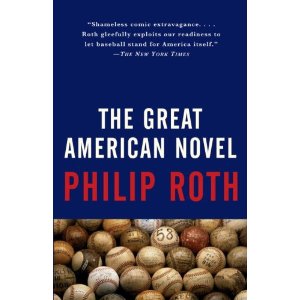
The Great American Novel – Review

The Great American Novel by Philip Roth

WARNING!  If you are looking for political correctness – avoid this book.

WARNING #2!  If you have an adverse reaction to laughing out loud – avoid this book.

Perhaps most famous for his novels  American Pastoral (which earned a Pulitzer), Goodbye Columbus and Portnoy’s Complaint (thanks in part to their translation to the big screen), Philip Roth has made a unique contribution to hardball literature – The Great American Novel.   BBRT considers this a must-read – well at least the first two-thirds of the book.  Readers should be forewarned, however, that – like the movie “The Loved One,” the Great American Novel can promise something to offend everyone.  Yet, it is this across-the-board irreverence that makes the offense tolerable and even comic.

The book, set in the 1940s, recounts the very-comic  sufferings of the Port Ruppert Mundys – a baseball team of limited skill and unlimited neurosis that (due to losing its stadium to the war effort) must play an entire season on the road.

Written from the perspective of retired sport journalist “Word Smith,”  The Great American Novel takes you into the hearts and (often dark) souls of a team made up of  ex-cons, alcoholics,  amputees, veteran players well  beyond their primes, 90-pound adolescents not ready for the big-time, and even extremely vindictive lilliputians – and into ballparks in places like Asylum, Ohio, Terra Incognita, Wyoming, and Kakoola, Wisconsin.  It also takes you from the dugout to an asylum (for an exhibition game) to the House UnAmerican Activities Committee.   The prologue includes Word Smith’s encounter with Earnest Hemingway and the book wraps up with a letter written by Smith to China’s Chairman Mao.

In short, the book covers a lot of ground and smashes a lot of myths along the way.  But, it’s first and foremost the story of a team of misfits and maniacs (when you read the book you’ll understand the alliteration) – and secondly a story of the Patriot League and a conspiracy (with roots deep in the Communist threat of the Cold War) to eliminate any reference to this third major league from the annals of baseball history.  It is, in fact, in the final one-third of the book, when Roth turns from sport to conspiracy that The Great American Novel bogs down a bit, but – even if you only read the first 200 or so pages – The Great American Novel provides a real “experience” for the baseball fan.

Give it a read and let BBRT know what you think.


BBRT’s Favorite BB Quotes

Baseball players sometimes say things that are as timeless as the national pastime itself.  I’d like to share BBRT’s top ten favorite baseball quotes – and invite readers to share their favorites in the comments section.


“There is always some kid (in stands) who might be seeing me for the first or last time.  I owe him my best.”

Joe Dimaggio … a touch of class from a classy ballplayer and individual.


“I’d walk through hell in a gasoline suit to pay baseball.”

Pete Rose … unbridled passion for the game.


“You spend your whole life gripping a baseball and, in the end, it turns out it was the other way around  all the time.”

Jim Bouton … more passion for our pastime.


“I have discovered in twenty years of moving around a ball park, that the knowledge of the game is usually in inverse proportion to the price of the seats. “

Bill Veeck … real fans are found in the cheap seats, with scorecards in their laps.


It actually giggles at you as it goes by.”

Rick Monday, on Phil Niekro’s knuckleball … best description ever of the futility of  facing the “floater.”


“If I had to hit all those singles like Pete, I’d wear a dress.”

Mickey Mantle, about Pete Rose … Home run hitters do drive Cadillacs.


“I’m throwing as hard as I ever did, but the ball is just not getting there as fast.”

Lefty Gomez … AARPsters (like me) should love this one.


“The best thing about baseball is you can do something about yesterday tomorrow.”

Manny Trillo … the blessing of a “long season.”


 “Baseball players are smarter than football players.  How many time to you see a baseball team penalized for too many men on the field?”

Jim Bouton … thanks, Jim, for putting my football-loving friends in their place.


“Baseball statistics are like a girl in a bikini.  They show a lot, but not everything.”

Toby Harrah … and still stat-geeks would prefer the box score to the bathing suit.


Honorable mention … for its unique nature.

“Ooh.  I just made a touchdown.”

Doc Ellis on successfully covering first base for an out in his LSD-fueled no-hitter.


Honorable Mention

Non-Player / Manager quote

 If a woman has to choose between catching a fly ball and saving an infant’s life, she will choose to save the infant’s life without even considering if there is a man on base.”

Dave Barry, comedian / author


Actually, my favorite baseball quote of all time … said or written often and by many … is as straightforward as can be.  The four most anticipated words in the English language:

“Pitchers and catchers report.”


Have  some favorite quotes?   Share them in the comments section.


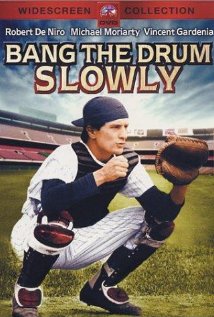
Bang the Drum Slowly – Movie Review

Bang the Drum Slowly – Book, TV Special, Movie – it’s all good.

Suppose you wrote a book about baseball that earned acclaim as one of the best sports books of all time, suppose it was good enough to be turned into a TV special starring Paul Newman, and suppose it eventually become a feature film starring Robert DiNero.  That would make you Robert Harris – and the novel, stage play, TV special and feature film would be “Bang the Drum Slowly.”  This review is about the 1973 feature film, but BBRT also recommends the TV special and book (as well as Harris’ novels The Southpaw, Ticket for a Seamstress and It Looked Like Forever).

Bang the Drum Slowly (Paramount) is consistently ranked among the top ten baseball movies of all time, and with good reason.  It’s a tragedy, a comedy and a sports movie that takes you from the Mayo Clinic, to the ball park to the gritty life (at least in baseball’s “golden age”) of a major league ballplayer.   As the title (a line from the poignant cowboy song “Streets of Laredo”) suggests, it’s a movie about dying, but it is equally a movie about living, about passion and compassion, about laughing and crying, and victory and defeat, and about baseball.  The principals are:

  • Star Left-hander hurler Henry Wiggen (Micheal Moriarty);
  • Mediocre catcher Bruce Pearson (Robert De Niro);
  • Gruff manager Dutch Schnell (Vincent Gardenia); and
  • A host of New York Mammoths team members, well chosen for the parts they play.

The story is basic.  Pearson, the mediocre and slow (in multiple ways) catcher is diagnosed with terminal (but not yet debilitating) Hodgkin’s Disease and, wanting to stay on the field, tells only Wiggen (the NY Mammoths’ star left-handed hurler).  Wiggen takes a vow of secrecy, fearing the team would cut Pearson if they found out about his health problems.  As you might expect, the secret is larger than Wiggen’s resolve and slowly spreads across the team.  Team members rally around Pearson, protecting him on and off the field and coming closer together themselves in the process..  And Pearson, now playing solely for his love of the game find a little extra power in his bat and zip in his arm (at least for awhile).

A bit sentimental at times, yes.  De Niro, in this early role, may overplay his part a bit.  But there is plenty of story, plenty of emotion and plenty of baseball.  And a couple of asides.  Bang the Drum Slowly will take you back to a different time, when even the “stars” had other jobs.  Wiggen, for example, the Mammoths’ “ace” pitcher sells insurance (and writes books) on the side.   Watch for TEGWAR, The Exciting (card) Game Without Any Rules, and see if you’d be willing to sit down to a hand or two with a major leaguer.  And finally, listen for the town of Cannon Falls (home of BBRT), mentioned nine times in the movie.