One Shot At Forever – A True and Truly Entertaining Tale

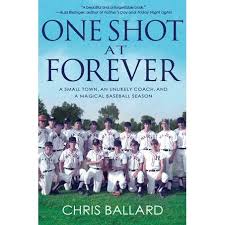
One Shot At Forever

A Small Town, An Unlikely Coach, And A Magical Baseball Season


By Chris Ballard


Hyperion Books, 2012, $14.99


One Shot At Forever is appropriately subtitled:  A Small Town, An Unlikely Coach, And A Magical Baseball Season.  If you didn’t know it was true, the tale told in this spirited (and thoroughly enjoyable) book by Sports Illustrated senior writer Chris Ballard would be unbelievable – instead, it is unforgettable.  BBRT thinks readers – and not just baseball fans – will find One Shot At Forever easy to read, hard to put down and  impossible to forget.

Like most classic sports tales, it’s a story of overcoming great adversity.  But it’s much more than that, it’s also an extraordinary story about relationships, rebellion and loyalty – for Macon, Illinois, is no ordinary community, their coach is no ordinary coach and their team is no ordinary team.  And, Ballard captures it all in compelling prose that pulls you along through the action that takes place on the field and off.

Overcoming adversity?  The Macon high baseball team – the Ironmen – makes its improbable way all the way to the 1971 Illinois State Championship game.  In that pursuit, Macon faces schools with enrollments not just ten, but as much twenty, times Macon High’s 250 students.  And, the budget and equipment – and even administrative support – disparities are just as large.  (This was back in 1971, before Illinois high school tournaments placed schools in various classes by size.)

The community?  Macon is a town of about 1,200  – conservative, rural and (as Ballard puts it) stuck in the Eisenhower era. and facing not only a drought that threatens the local economy, but an emerging social era that troubles many residents (antiwar protests,  the 18-year-old vote, the founding of Greenpeace, hippies, communes.)

The coach?  Lynn Sweet ( coach and English teacher) is not exactly a fit with Macon’s attitudes and values. His long hair, fu Manchu mustache and progressive approach to life, learning and baseball earn him comparisons with Frank Zappa, an unkempt Beatle, Abbie Hoffman in a ball suit and, by one sportswriter “a pinch of bad Mexican hombre, a fun-loving Joe Pepitone and a collegiate peacenik.”  Further, in attempts to oust him (as teacher and coach) at more than one school board meeting, community members label sweet everything from hippie to peacenik to a communist.

The team?  I don’t want to spoil the reader’s fun, so here are just a few snapshots of what makes the Macon Ironmen of 1970-71 different (and establishes them as Coach Sweet’s team).  Due to a limited budget, they wear well worn, mismatched uniforms from three different Macon High eras; as they arrive at games, they can usually be heard singing “Yellow Submarine” on the bus; a number of players choose to wear peace symbols on their hats (which do not disguise their ever-lengthening hair); and they take pregame warm-ups to the sounds of the rock opera “Jesus Christ Superstar” blaring from a boom box on the sidelines.  Getting the picture?  And, remember, this is a true story.

Coach Sweet is the protagonist of One Shot at Forever and his approach to authority – and life in general – is established early.  The day (in 1965) he is hired to teach English at Macon High (his first teaching job), the principal warns Sweet “There are three taverns in town and, as teachers, we don’t drink in them.  To set a good example, you understand.”  Sweet nods in understanding and then manages to sample the cold brew at Cole’s Tavern, Claire’s Place and the Nite Owl all in that same afternoon.

Sweet’s approach to authority and convention extend into the classroom, where he quickly replaces traditional desks with round tables and chairs (better exchange of ideas); decorates the walls with posters of the Rolling Stones, Grace Slick and Bob Dylan; scraps the traditional grammar books, announces unconventional assignments (like having the youngsters write their own obituaries) and develops  a reading list that for many Macon parents seems a bit too progressive (or even subversive).  He even sets up a barbeque grill outside his class, so students can join him in grilling over lunch.  As a teacher, Sweet, proves to be a polarizing force (key members of the administration and many parents are suspicious of his methods, while some parents are pleased that their children are learning, while having fun).  This class room controversy is just a foreshadowing of what is to come on the baseball diamond.

Sweet’s turn to coach the baseball team (he will be their third coach in three years) comes in 1970.  On the day of their first practice under their new coach, only fourteen players show up (by contrast, one of the teams they will eventually play in the 1971 state tournament has more than 400 freshman show up for annual team tryouts.). Looking over the team, a couple of facts became clear, “Those that weren’t small were scrawny.  And those that weren’t scrawny were small.”

Given the turnout, Sweet makes a quick judgment. “I’ve got good news, boys, you’ve all made the team.”  He also outlines his approach to coaching: few, if any, rules; practice is optional; no wind sprints, punishments or speeches; steal when you want; and decide among yourselves who will play where.  (It should be noted that Sweet, while without previous coaching experience, is not without baseball acumen.  He is a long time fan of the Cubs and played baseball on military bases as a boy and on a local semipro team while in college.)

Coach Sweet soon finds that this team of farm boys (as the team develops under Sweet, they are alternately referred to as hippies or hicks) are smooth and talented.  They have been neighbors, school mates and team mates all their lives and they play well together.  All they need, in Sweet’s view is “Someone to believe in them.”  And as the season(s), and the book progress, we learn about the strengths, weaknesses and motivations that each player brings to the Ironmen, as well as how Sweet works to build and protect their sometimes fragile teenage egos.  Sweet’s belief in, and genuine affection for his team (and their true commitment to each other, their school and town), are what carries the Macon Ironmen to success in the face significant odds.

BBRT won’t give away the whole story, it is just too much fun to read, but here are just a few examples of the adversity the Ironmen must face:

– After a successful 1970 season, the team is dropped from the playoffs due to a roster technicality (while no culprit is ever identified, some believed was deliberate sabotage).

– Sweet is fired as coach before the 1971 season, rehired as parents and players protest.

– Devoid of budget and low on equipment, the team usually has no more than four or five bats (this in in the age of wooden bats).  In one playoff game, against a talented, big school fast-baller, the team has three bats break.  Down to just one bat, the principal and student equipment manager rush (during the game) to a local hardware store to purchase four more bats.  As the Ironmen await more equipment, Sweet has each upcoming hitter return the lone bat to the equipment bag and then rummage around in the bag (as if searching for the right stick), so as not to alert the opposition to their predicament.

– Steve “Shark’ Shartzer, the team’s best player and most energizing field leader, is forced to play the final games of the 1971 Illinois State Tournament with a well-taped broken hand.

The Ironmen’s remarkable run is well-documented, with each player – expertly handled by Coach Sweet – making unique contributions to the team’s success along the way.  Ballard manages to give us a meaningful look not just into the players’ performance, but their personalities as individuals and, maybe even more important, their role in shaping the personality of the Ironmen as a team.

In the final section of the book, Ballard returns to Macon four decades after that magical season and visits with the coach and players, providing further evidence of how much they all mean to each other and to the community and how that “magical season” had a lasting impact on their lives.  Even this part of the book offers insight and inspiration, as the later life activities range from Sweet’s turning his land into a wildlife refuge under a state program called “Acres for Wildlife” to Ironmen outfielder Brian Snitker’s rise to third base coach for the Atlanta Braves.

One Shot at Forever is an entertaining and inspiring read.  The story and its telling (in Ballard’s prose) have joyous momentum.  Notably, that momentum continues.  Ballard’s story of Coach Sweet and the Macon Ironmen originally appeared as a Sport Illustrated article (The Magical Season of the Macon Ironmen, June 2010 issue), it surged forward as Ballard’s 2012 book and has continued its momentum with Legendary Entertainment (which gave us the Jackie Robinson film “42”) purchasing the movie rights.

BBRT’s advice – buy the book, see the movie, enjoy and share the story (and the stories within the story).
Stan Musial – An American Life


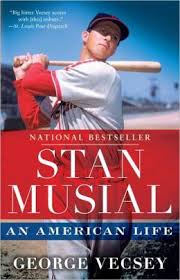
STAN MUSIAL – An American Life

By George Vecsey

2011

Ballantine Books. $26 (paperback $16)


Stan Musial – An American Life provides ample evidence that “nice guys can finish first,” but, perhaps, won’t be remembered as long (or revered as much) as their more controversial counterparts.  In 1999, Major League Baseball launched a fan vote to select the top twenty-five players of the twentieth century.  Saint Louis Cardinals’ outfielder/first baseman Stan Musial – a 20-time All Star, seven-time batting champ, three-time MVP and more – did not make the top twenty-five (in fact, he did not even make the top ten outfielders).

What were Musial’s credentials? It starts with a 22-year MLB career with the aforementioned 20 All Star selections, three MVP Awards and seven batting titles.  He also “finished first” in the NL in games played nine times; hits six times; runs five times; doubles eight times; triples five times; RBI twice; and total bases six times.  He ended his career with 3,630 hits and a .331 career average. He collected 1,377 extra base hits (475 home runs), and struck out only 696 times – never striking out 50 times in a season, and topping forty strikeouts only three times.

So, why didn’t the fan vote place Stan Musial among the top twenty-five?  What made him in this instance (unlike such peers as Joe DiMaggio and Ted Williams) forgettable?

Most speculate it’s because Stan Musial’s “story” was less compelling than his statistics.  He was substance without flash, competence without controversy, results without razzle-dazzle.  Musial was married to his high school sweetheart for more than 70 years, was never tossed out of a game, was an astute businessman who did not squander his money, never forgot his Catholic and Polish-American roots,and consistently avoided confrontation and controversy.  In short, while he was long on professionalism, he was deemed to be short on personality.

Fortunately, Baseball Commissioner Bud Selig had anticipated there would be “oversights” in the 1999 fan vote and had established a knowledgeable committee to add five players to the All–Century Team.  Their first addition was Stan Musial (followed by Christy Mathewson, Warren Spahn, Honus Wagner and Lefty Grove).

Notably, Musial remained true to form in handling the fans’ slight.  When reminded of how he was added to the All-Century Team, Musial (as always) took the high road.  “I wasn’t upset.  Not really.  There are 100 million fans, and only three million of them voted.  It’s what the fans wanted, and I’m happy to be here.  It’s human nature to look at your own generation.  It’s hard to analyze what happened fifty-sixty years ago.”

In Stan Musial –An American Life, New York Times sports columnist and best-selling author George Vecsey gives us a deeper look at Stan Musial.  It’s not your usual baseball biography – filled with on-field conflict and off-field controversy.  As you might expect, Musial comes off in the book as more interesting than exciting – and, in fact, the tales from Musial’s off-field life seem more compelling than what takes place on the field.  (BBRT would have liked to have seen a bit more on Musial’s on-field play and passion in the book.)

Still, readers will find plenty of anecdotes they will want to share. In the process, you will also gain some insight into the many individuals – some celebrities/some night – that became part of Musial’s life story.  Here are a few snippets that BBRT found interesting.

It’s pretty common knowledge that Musial started out as a pitcher and moved to outfield full-time after an arm injury.  What is less known is how well Musial did throw.  In his final season on the mound, playing for Daytona Beach (Class D) in 1940, Musial went 18-5, 2.62 with 223 innings pitched, 19 complete games and 176 strikeouts.  The minor league team carried only a 14-man rosters, so pitchers often found themselves in the outfield, where young Musial hit .311 in 113 games (and injured his arm diving for a ball).

Stan Musial was given his nickname Stan “THE MAN” not by Cardinals’ fans, but rather by Brooklyn Dodgers’ fans – out of respect for the way he manhandled Brooklyn pitching over the years.

Musial never forget his Polish and Catholic roots, making multiple trips to Poland; meeting with Nobel Prize winner Lech Walesa and even enjoying dinner and a small group private mass at the Vatican with Pope John Paul II (in 1988).   One of Musial’s travel mates on the trip described the Hall of Famer’s approach to the Pope as like “an altar boy in awe of the Pontiff.”

Musial was s staunch Democratic, hitting the presidential campaign trail for John Kennedy in 1960 as part of a group that included: Byron White (former football player and later Supreme Court Justice); James A. Michener (who became a close and long-time friend and traveling companion of Musial); Arthur Schlesinger; Ethel Kennedy; Joan Kennedy; actor Jeff Chandler; and actress Angie Dickinson. (Musial was also a George McGovern supporter in 1972).

Musial was a horrible poker player, a not-so-good magician and a decent harmonica player (who often, serenaded fans with “Take Me Out to the Ball Game.”

Musial trimmed his eyelashes to help him see the ball better.

Musial, always accommodating to the fans, began carrying autographed photos of himself to hand out, an idea he picked up during lunch with actor John Wayne.

Musial was always ready to model his unique corkscrew stance – even in later years, when he used his cane as a bat.

In presenting a mostly positive (openly admiring) picture of Stan the Man, Vecsey does not gloss over all criticism –  acknowledging Musial’s apparent avoidance of controversy and confrontation, particularly as it related to racial issues (or even general players’ rights) within baseball. Vecsey notes that some players, while seeing Musial as an inherently just man, felt he could have taken a stronger stance in relation to the issues facing baseball in his playing days.  As the Cardinals’ Curt Flood put it: “We admired Musial as an athlete. We liked him as a man. There was no conscious harm to him. He was just unfathomably naïve.”

Ultimately, Stan Musial – An American Life is an appropriate tribute to Stan the Man – a confident, gracious individual, who never forgot his humble roots and who choose quiet efficiency and inner optimism over controversy and the potential pitfalls of the limelight.

BBRT feels privileged to have seen Musial play – and to have felt the tension and anticipation that rippled across the stands when he went into his unique corkscrew stance.  BBRT wishes that tension could have emerged from the pages of Stan Musial – but, ultimately, the book reflects the inner character of its subject.  It’s a good read, especially if your interest is in the “man” and not just the ballplayer.

BBRT’s favorite anecdote from the book?  One of Musial’s team mates is reported to have told Stan that he felt so good, “I feel like going four-for-four today.”  To which Musial quickly replied, “Hell, I feel like that every day.”  And, as the statistics tell us,  justifiably so.

Summer of ’68 – Good Reading for the Summer of ’13


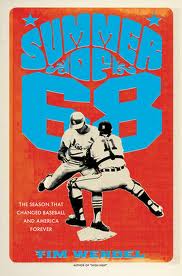
Summer of ’68: The Season that Changed Baseball, and America, Forever

By Tim Wendel

Da Capo Press, 2012 ($25)


No doubt, 1968 was one of the most challenging in America’s recent history – the assassinations of Martin Luther King and Robert Kennedy, riots in major cities, the violence surrounding the Democratic National Convention in Chicago, the Oakland shootout between the police and Black Panthers, and the public division over the Vietnam conflict.

It is against this backdrop that author Tim Wendel presents his chronicle of the 1968 MLB season – Summer of 68:  The Season that Changed Baseball and America, Forever – told primarily from the perspective of that year’s League Champions and World Series competitors, the Detroit Tigers and Saint Louis Cardinals.

I read this book while riding the bus on my annual Ballpark Tours baseball trip (see earlier posts).  It proved to be an enjoyable, thought-provoking and fast-paced read – going beyond the traditional on-the-field and in-the-locker room look at our sport, and drawing some important and interesting historical ties.

In 1968, baseball like America was making history.   For many fans, 1968 was the last pure season – when two league champions were crowned and went directly to the World Series. ( Expansion in 1969 led to Divisional play and playoffs.) It was also, for baseball, “The Year of the Pitcher” – highlighted on the field (and in Wendel’s prose) by the exploits of Denny McLain (a 31-game winner), Bob Gibson (1.12 ERA), Louis Tiant (.168 opponents’ batting average) and Don Drysdale (six consecutive shutouts and 58 consecutive scoreless innings).  Pitchers were so dominant that Carl Yastrzemski was the only American Leaguer to hit .300 – winning the batting crown at .301.  As a result, 1969 saw a smaller strike zone, lower mound and the establishment of the “save” as an official statistic.  And, there were other changes coming in the national past time, as players became increasing vocal on a wide range of issues – both within and outside the game.  Indeed, those controversies led to the resignation of Baseball Commissioner William Eckert after the 1968 season (with three years left on his contract) and marked a beginning in a shift of power toward the players.

Wendel does a fine job of tying the tumult in the nation with the changing face of baseball – and the interaction between the two.  Perhaps the most telling story of this relationship is tied to the Robert Kennedy assassination. President Lyndon Johnson had declared a National Day of Mourning (June 9) and, for some reason that is still unclear, Baseball Commissioner William Eckert decided to respond by postponing only two games on the MLB schedule:  The Angels/Yankees in New York and the Senators/Twins in Washington.  The result was a chaotic day for baseball, with some players (like the Rusty Staub, Maury Wills and Bob Aspromonte) and some teams (like the Mets, even under threat of forfeiture of the game) refusing to play.  As Wendel writes, the issue was most contentious in Cincinnati, where player representative Milt Pappas led a group opposed to playing that day’s contest against the Cardinals.  The first vote on whether to take the field was 12-12, with one player abstaining.  A second vote led to a 13-12 decision to play the game – despite continued protests from Pappas (who, within 72 hours, resigned as player representative and was traded to Atlanta).

Just as public happenings affected baseball, Wendel makes a case for baseball events impacting the public – providing a cooling escape from the controversies of the day.  As Mickey Lolich of the Tigers tells it; “I had some friends on the police.  They were in the city and had a good feel for what was going on.  They told us to please keep winning – that things were smoldering, like how it is before it starts burning all over again.  But if we could keep on winning then things might not explode like they had the year before.  In ’67, you’d see four or five guys standing on a street corner and they’d be looking for trouble.  In ’68, you’d see the same kind of guys standing on a street corner, but they’d have a transistor radio and they’d be gathered around, listening to Ernie (Harwell)  calling a Tiger game, and waiting to see if we could come back and win another one.”

Note:  1967’s Detroit riots had resulted in 43 deaths, more than 450 injuries, 7,000-plus arrests and more than 2,000 buildings burned.   Stepping back briefly into 1967, Summer of ’68 includes a look at the courage and commitment of Tiger outfielder Willie Horton, who left Tiger Stadium immediately after a June 23, 1967 doubleheader and showed up in full uniform (and at great personal risk) in one of the most strife-torn Detroit neighborhoods, urging calm amid the violence.)

In the process of exploring a changing society and the changes taking place in baseball, Wendel also provides the traditional sportswriter’s look at two of 1968’s most prominent teams – the Tigers and the Cardinals.  Through interviews with and the observation of players on both teams he gives us a look at how they made their way to the Fall Classic.

For baseball fans and trivia buffs, there is also insight into some of the 1968 season’s highlights – like a rare umpire’s ruling (on a hit batsman) that kept Don Drysdale’s string of scoreless innings and complete-game shutouts alive, Denny McLain’s “gift” home run to Mickey Mantle, Catfish Hunter’s perfect game, Frank Howard’s ten-homer week (defying the Year of the Pitcher) and Detroit Manager Mayo Smith’s then controversial move of Gold Glove center fielder Mickey Stanley to shortstop for the World Series.

Your BBRT editor also enjoyed the “Aftermath” chapter of  Summer of ’68, with Wendel giving an update on what happened to many of 1968’s principals (inside baseball and out) in the years and decades that followed.   The chapter examines the lives of such diverse characters as baseball’s Milt Pappas, Bob Gibson, Denny McLain, Curt Flood, Frank Howard and Catfish Hunter; football’s Joe Namath; basketball’s Bill Russell; Olympic runner Jim Ryun; sportscaster Roone Arledge; and political activist Tom Hayden.

All in all, Summer of ’68 is an enjoyable read – particularly for fans of the Tigers or Cardinals.  But there is also plenty for those who want to get a better feel for the culture of the nation and the state of baseball in 1968.

“42” – See It, You’ll Like It

BBRT spent just over two hours yesterday afternoon immersed in “42” – the recently released feature film depicting Jackie Robinson’s breaking of major league baseball’s “color line” in 1947.  At the conclusion of the inspiring film, the theater audience broke into applause – a tribute to both the quality of film and (even more) to the real-life courage, dignity and perseverance of its primary characters:  Jackie Robinson (played by Chadwick Boseman), Dodgers’ owner Branch Rickey (Harrison Ford) and Rachel Robinson (Nicole Beharie). BBRT highly recommends “42” – and not just for baseball fans.

This is much more than a movie about our national pastime.  It’s also documents a watershed moment in American history and even presents a true story of love under pressure.   

It’s a tale of how the often surly, but clearly idealistic, Branch Rickey – played to perfection by Ford – chose Jackie Robinson as his partner in efforts to break baseball’s unwritten, but long understood, color line.  Robinson had not only the playing skills Rickey sought (he was a Negro League star), but the strength of character.  He had been a multi-sport athlete at UCLA and an Army Officer.  In Rickey’s (correct) judgment Robinson had the intellect to understand the importance of taking his place in history and the courage and discipline to face the challenges it presented.  In Rickey’s words “the guts not to fight back.” 

The little-known Boseman fills his role ably, he not only looks and moves like an athlete, he blends on-field strength and stoicism with off-field sensitivity and rage to give us a bit of insight into how difficult being “the first” must have been.  As the movie takes us from Robinson’s original signing through his first season in the major leagues, we see the depth of prejudicial abuse Robinson must face – the segregation of accommodations,  racial taunts from fans and opposing players, shunning by even his own teammates, even death threats directed toward Robinson and his family.  And, Robinson must deal with all of this while playing ball well enough to prove he (and those who would follow him) belong in the up-to-then “white” major leagues. 

How difficult was it for Robinson not to fight back?  This was a man who had been court-martialed (found not guilty) in the Army for refusing an order to move to the back of a bus.  Robinson, as history and “42” shows us, maintained his public composure and dignity under fire – with the support of Rickey and the unflinching affection and confidence of his wife Rachel.    

There are, throughout the movie, moments with “messages.”  In one scene, a young boy is enjoying the pastoral beauty of the ball park with his father – until Robinson takes the field.  The boy’s father begins to hurl a string of racist epithets at Robinson and the child looks dismayed for a moment and then energetically parrots his father’s racist venom.  On the other side of the issue, we find a scene where Rickey tells Robinson of seeing a playground ball game in which a young white boy at the plate is mimicking Robinson’s moves and stance – “a young white boy pretending to be a black man,” now that is progress.

Not only is the story inspiring – and true – the baseball action is well-played and the cars, clothes and ball parks and (unfortunately at times) the attitudes are period-perfect.  It can be a walk down memory lane or, for those too young to remember, an eye-opening look at life in the ’40s.

It is, most certainly, a great and important story – well told.  For BBRT, “42” was an afternoon well spent.  I encourage you to see this film – and, if you can’t take peanuts and Cracker Jack, enjoy some popcorn.

Jackie Robinson – Dodgers number 42 – 1947 Rookie of the Year

151 games – .297 – 12 HRs – 125 runs – 48 RBI – 29 stolen bases 

Harmon Killebrew Ultimate Slugger – You Couldn’t Make This Up

Harmon Killebrew  Ultimate Slugger


By Steve Aschburner

Triumph Books, 2012

$25.95


Fact or fiction – a story about a strapping, 17-year-old country boy being signed by the Washington Senators after being discovered playing baseball by a U.S. Senator?  The Senators’ scout goes west to watch this teenager play a trio of games for the – Oh, let’s call them the Payette Packers – and all the kid does is go 11 for 13 with four home runs, two triples and a double.

But wait, the story gets better.  The phenom goes on to a 22-year career in which he is an 11-time All Star (the first player selected an All Star at three positions); hits 573 home runs (leading the league six times); drives in more than 1,500 runs (leading the league three times); and wins an AL MVP award.

But there’s more.  While his prestigious power earns him the nickname “Killer,” this ultimate slugger celebrates victories with milkshakes, has a humble and quiet disposition and spends time schooling teammates on how to sign a legible autograph for the deserving fans.

Had enough yet?  How about he visits a young burn victim in the hospital and tells him he’ll try to hit “a couple” of home runs for him (against the then vaunted Yankees no less) – and goes out and does it?  Oh, and for good measure, let’s say that, in addition to the Baseball Hall of Fame, he also earns a spot in the World Sports Humanitarian Hall of Fame

As movie, it would probably be considered a baseball fantasy.  As a book – Harmon Killebrew Ultimate Slugger – it is the real life story of the late Harmon Killebrew (as told by long-time journalist/sportswriter Steve Aschburner.)

I was seven-years-old when Harmon first came to the big leagues with the Senators in 1954, and was privileged to live in Minnesota and see him play for much of his career with the Twins.  I can confirm what the late Twins’ owner Calvin Griffith said about the excitement generated by this quiet star:  “If our fans knew Killebrew was coming up in the ninth inning, they never left the ball game, no matter what the score was.”  The fact is, we all knew the Killer was always a towering tape-measure drive waiting to happen.

All of this makes Ultimate Slugger a great read for anyone who had the fortunate opportunity to see Killebrew play.  Yet, in some ways, it may make the story less compelling for others.  Many of the stories about Killebrew are as modest as the man himself – no late-night carousing, no braggadocio, no feuds with pitchers or umpires.  Yet, the book is a good, and even inspiring, read.

Aschburner, in sparse journalistic style, captures the spirit, dignity and quiet strength of the Killer –  from his Idaho youth, across his HOF career, and finally through a series of family, financial and health issues.  He brings Killebrew to life not only with statistics and biographical information, but with stories and comments from those who played with him and against him.  He also gives readers a look at baseball in the 1950s and 1960s, referred to by many as the sport’s “golden years.”

But maybe more important, he gives us a look at a player who behaved in real life like the heroes we imagined in our youth.  Harmon Killebrew was the kind of man, the kind of role model, we’d all like to know (and have our kids get to know).  This book opens the door to that opportunity – and it is a BBRT recommended read for baseball fans of all ages.

It’s a good story, about a good man, who happened to be a great ballplayer.  For BBRT, there is one quote in the book that tells it all.  Asked to comment on the best day in his life (or career), Killebrew answered, “What’s the best day in my life?  I try to make every day in my life the best day.”  You couldn’t make that up.

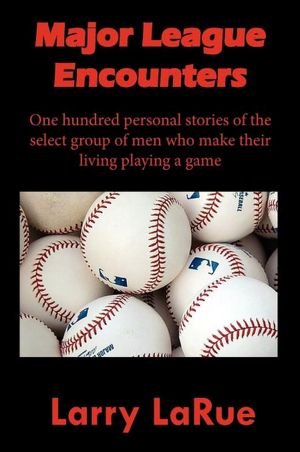
Major League Encounters – 100 Very Personal Stories that Get to the “Heart” of our National Pastime

Major League Encounters gets to the heart of the national pastime, and those privileged to play it at its highest level.

Major League Encounters

By Larry LaRue

Reader Publishing Group 2012


$11.95 print – eBook $3.99

Amazon.com

Barnesandnoble.com

Baseball Hall of Famer Bill Mazeroski earned his way into the HOF more with his glove than his bat – he was known as a second baseman who could capture a moving baseball and skillfully turn it into a double play.  In long-time sportswriter (more than three decades) Larry LaRue’s first book –  Major League Encounters – LaRue proves he can capture a moving baseball story and skillfully turn a phrase as he tells it.

In 100 real vignettes over 255 pages, LaRue gives readers a behind-the-scenes look at what drives the men – and boys – who earn the rare opportunity to play the game at its highest level.  Readers get the benefit not only of LaRue’s sportswriter’s access, but of his knowledge of the game, powers of observation, interview skills and way with words.

The stories range from heart-warming to heart-breaking and from comic, to tragic, to dramatic.   They are stories of weakness and stories of courage – of success, failure and perseverance – of veterans who enjoyed long careers and players with shorter, less-stellar stats sheets.   Most of all they are very personal stories, glimpses into the heart of the game and those who play it.  

You’ll read about:

–  The forces that drove Jim Abbot, who won 87 games and threw a no-hitter, despite being born with no right hand;

– The trials of Ken Caminiti, the 1996 NL MVP, who LaRue writes “kept his demons close and hid them well,” and who died at age 41 from “acute intoxication due to the combined effects of cocaine and opiates;”

– The passion for the game that drove utility man Rich Amaral, who LaRue tells readers “kept chasing baseball long after it stopped chasing him;”

– Hall of Famer hurler Bert Blyleven’s legendary sense of humor and skill at applying a devastating hot foot (when he was with the Angels, the team had a fire extinguisher in the dugout labeled “In case of Blyleven – Pull;”

Cal Ripken, Jr.’s love of the game “Every day, it’s like being a little kid again;”

– Pitcher Freddie Garcia, who had a “capacity for fun that might have killed a lesser man.”

In terms of reading enjoyment, not only are the stories compelling, LaRue has a way with words that gets right to the point and pulls you into (and through) each story.  Consider these opening lines:

The Barry Bonds’ story begins “Follow Barry Bonds for a few days and the three words most used to describe him – by friends, teammates and coaches – were ‘That’s just Barry.’  Occasionally, they were meant to be complementary.”

Then there are the opening lines for power hitting first baseman and 1995 AL MVP Mo Vaughn, “Mo Vaughn read newspapers, which never made him doubt his talent.  Occasionally, it made him wish he was illiterate.”

LaRue’s insight into two-time AL batting champion Edgar Martinez begins with “The first time the Seattle Mariners offered him a contract, Edgar Martinez turned them down because he had everything he wanted – a factory job and a new Toyota.”

Or Reggie Jackson:  “There were four or five Reggie Jacksons and I got to meet all of them in the year we were together with the California Angels.”

Depicting current Seattle Mariners pitcher Tom Wilhelmsen, who made it to the majors in 2011 at age 27, LaRue begins: “At 19, Tom Wilhelmsen faced a life-changing decision – continue his career as a highly rated minor league prospect or keep smoking dope.  For Wilhelmsen the choice was clear.  He walked away from baseball, became a bartender and traveled the world, smoking as he went.”

If you’re a baseball fan, this is a great book to keep on your bed stand, carry aboard an airplane, take to the beach, enjoy at a coffee shop or even read between innings at a ball game (when you put your scorecard down.)  The only problem is you’ll start out planning to pass the time by reading just a few stories and find yourself committing to “just one more” again and again.

Are all 100 stories absolute gems?  No, but LaRue’s batting average is well north of .900 – and that makes Major League Encounters highly entertaining, a hit with BBRT and recommended reading for the avid and casual fan.


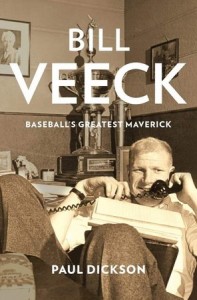
Bill Veeck – A Champion of Life … and a Great Read

Bill Veeck:  Baseball’s Greatest Maverick

By Paul Dickson

Walker & Company, 2012

$28.00


Where to start?  Where to end? What to include?

There is so much to like about Bill Veeck:  Baseball’s Greatest Maverick – and to like about Bill Veeck himself – that it’s difficult to write a review.   The best place to start is to say that I‘ve probably never had as much fun reading a book.  Nor have I ever interrupted my reading so many times to regale my family with passages and anecdotes.  If you haven’t picked this book up yet, the time is now.  If you are a baseball fan, a humanitarian, a history buff, someone who enjoys a good story, you’ll have a hard time putting it down.

If I had to describe Bill Veeck in  a single sentence (a truly impossible task), I would say he was an individual who lived life – every minute – to the fullest, and brought those whose lives he touched along for the ride.  That spirit pervades this book.  Bill Veeck – in his lifetime, a four-time major league team owner – ignores adversity, tweaks the baseball establishment, champions social justice and brings his version of “play” and “fair play” to life and to the ball park.

While he is often remembered for celebrating the fiftieth anniversary of the American League by bringing three-foot-seven-inch, 65-pound Eddie Gaedel to the plate for his St. Louis Browns or for the near-disastrous Disco Demolition night when he owned the White Sox, Bill Veeck’s legacy runs much deeper.  As you will learn on the pages of Dickson’s book, much of what you see as part of today’s game: promotional give-aways; scoreboards that celebrate home runs and victories by the home team; names on the backs of uniforms; expanded concessions; and even quality rest rooms can be traced by to the innovation and initiative of Bill Veeck.  Further, Veeck bullt teams that  captured two league championships and one World Series crown.  And along the way, he earned the love and respect of players and fans and, he would proudly point out, the animosity of fellow owners and baseball’s top administrators.

To Bill Veeck, life was meant to be both fun and fair – for everyone.  He was a man of privilege, who turned away from privilege – except when it meant he could avoid wearing a tie in places or circumstances that seemed to demand that formality.  In 1943, considering military service in World War II, Veeck (given his economic status and celebrity) was offered the opportunity of  an officer’s commission in the Army or Navy (and most likely a safe promotional assignment). Veeck’s sense of fair play instead led him to enlist as a private in the Marine Corps – a decision which would eventually cost him much of his right leg.

It was that same sense of fair play that made him a champion of civil rights and a force in the integration of baseball.  Dickson, in fact, devotes a chapter to Veeck’s plan to purchase the Philadelphia Phillies before the 1943 season, hold a mock all-white spring training and then show up on opening day with an all-Black or primarily Black team. (Veeck was convinced baseball could not turn away Black players while Black soldiers were fighting for the country in World War II.) Before Veeck could complete his purchase, however, word of the plan got out and the Phillies were taken over by the National League and an alternative buyer was sought. (In 1947, Veeck, then owner of the Cleveland Indians, signed Lary Doby as the American League’s first Black player.)

Ultimately, Bill Veeck was an innovator and promoter – a true impresario; a baseball man who knew how to build a winning team; a humanitarian; a social activist; and perhaps the most passionate fan and friend of baseball ever.

Now, I could relate story after story from the pages of Dickson’s book, but it would be more fun if you read it yourself.  So, here are just a few previews of what you’ll find on the book’s pages:

Bill Veeck hiring a young concessionaire named Jack Ruby (yes, the same Jack Ruby who later gunned down Lee Harvey Oswald in Dallas).

 Veeck talking baseball and art with Salvidor Dali.

 Veeck tricking Harry Carey into leading the fans in “Take Me Out To The Ballgame” and justifying it by telling Carey he was perfect for the role because his voice was so bad, the fans would be more than willing to sing along.  ”Hell, if you had a good voice, you’d intimidate them and nobody would join in.”

Veeck’s testifying in support of Curt Flood (and against Major League Baseball) in Flood’s historic 1970 challenge to baseball’s reserve clause.

The multiple times Veeck had vendors serve “drinks on the house” to fans in the stands.

Veeck’s loyalty to Satchel Paige, a loyalty that translated into making Paige MLB’s oldest-ever rookie – and, later, multiple major league opportunities for the Negro League legend.

 Vick’s penchant for joining the fans for a beer in the bleachers, shirtless and in shorts with his wooden leg on display – consistent with his commitment to the everyday fan and his comment that:  “I have discovered in twenty years of moving around a ball park, that the knowledge of the game is usually in inverse proportion to the price of the seats.”

Veeck’s voracious appetite for reading – 3-5 books each week.

Veeck overcoming adversity on the field, in the boardrooms of baseball and in the operating room.  (Veeck once described himself as “whole” – defining whole as having “a lung and an eighth, a leg and a quarter, 40 percent of my hearing and one legal eye.”

After Veeck’s death, Dickson reports, Chicago Magazine writer William Brashler had this to say “Somehow, we will have to muddle through Opening Day without him.  And we will have to adjust to a few sad facts:  the gross national consumption of beer has diminished, some say measurably.  Every day now, one good book goes unread.  And marches against handguns and for peace and civil rights have one fewer peg-leg pounding the pavement.”

Bill Veeck was more than a baseball man.  He was, as the last line on his Baseball Hall of Fame Plaque reads “A CHAMPION OF THE LITTLE GUY.”  I’d take it a step further, Bill Veeck was a champion of life.  As a result, this is more than a baseball book.  It’s a book about life – and about living it to the fullest.

I began this review wondering how to start and how to end.  Well, I finally came up with an ending.   All of us have at some time played that parlor game in which you answer the question, “If you could invite five people – past or present – to dinner, whom would you choose?”  I can’t imagine anyone who reads this book leaving Bill Veeck off their guest list.  Take the time to read a truly interesting and entertaining book about a truly interesting, entertaining and impactful fellow.

Calico Joe – a solid summer read

Calico Joe by John Grisham

Doubleday – 2012 ($24.95)

While John Grisham is best known for his detailed legal thrillers, he has set that aside to pen a baseball-focused tale of relationships and redemption that gives readers a look into the heart and soul of an “old school” hardballer, his family and the ultimate victim of his approach to life and the national pastime.

The story initially centers on Joe Castle – a hard hitting 21-year-old phenom from Calico Rock, Arkansas, who joins the Cubs during the 1973 season.  Castle homers in his first three major league at bats and continues on a tear that sees him with 21 home runs and an average near the .500 mark after 38 games.  Unfortunately for Calico Joe Castle, his last home run comes in his first at bat against Warren Tracey, a 34-year-old journeyman pitcher trying to hang on with the Mets – not a very good hurler and even less of a father, husband, friend or team mate.  Known for an “old school” attitude, a fierce temper and a penchant for hitting batters, Tracey takes his revenge in Castle’s next (and last) at bat with an intentional and nearly fatal bean ball that puts an end to both their careers.

In the stands for the game is Warren Tracey’s 11-year-old son Paul, who idolizes Castle as much as he dislikes his own often absent and always overbearing father.  Paul, who has been berated by his father for not knocking down hitters when he’s on the Little League mound, knows and dreads what’s coming when Calico steps in for his second at bat– and is among the most passionate non-believers when Warren later denies he hit Castle intentionally.

Years later, Paul still feels personal and family guilt.  With Warren– by now on wife number 6 and just as dour as ever – dying of cancer, Paul becomes determined to arrange a redemptive meeting between Warren and Joe.   Paul, however, finds plenty of opposition to the proposed meeting – from his father and Joe Castle’s very protective family and community.  Paul’s quest and the relationships he discovers and builds along the way are what Calico Joe is really all about.  It takes us all the way from a major league baseball diamond to two former big leaguers, both damaged in different ways, facing each other in folding chairs in small town ball park.

Now, if statistics are your priority, Calico Joe may not be for you (at times, some of the numbers just don’t seem to add up).  However, if you are a baseball fan looking for an enjoyable summer read, this book will capture you.  I recommend it for the story, for its ties to baseball and for the fact that Grisham has made it even more interesting by deftly intermingling real players and events with his fictional cast of characters.  Again, a fun summer read, ideal for the beach or campground.

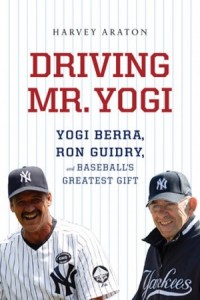
Book Review – Crossing Generations and DRIVING MR. YOGI

Driving Mr. Yogi:  Yogi Berra, Ron Guidry and Baseballs’ Greatest Gift

By Harvey Araton

Published (2012) by Houghton Mifflin Harcourt  ($26.00)


Take a first look at the cover of Driving Mr. Yogi and you’ll see two major league ballplayers, two Yankee all-stars and two sports celebrities.  Take another look after you’ve begun your passage through the book and you’ll see much more.  You’ll see two friends from different backgrounds and even different generations, brought together by a shared passion for baseball in general and Yankee baseball in particular –  but even more closely bonded  by mutual respect and genuine caring.

The book – a light (240-page), fun and feel-good summer read – ultimately is as much about friendship and loyalty as it is about baseball.

The tale begins in Yankee spring training 1999, when Yogi Berra returns to the Yankee-fold after a 14-year feud with team owner George Steinbrenner over the circumstances of Berra’s firing as Yankee manager.   Guidry is asked to pick up Berra at the airport and, despite the age difference – at 74 Berra was 15 years Guidry’s senior – the two hit it off.  The Berra/ Guidry camaraderie (including the annual airport pickup) becomes a true “right of spring.”

From 1999 forward, Guidry, a star in his own right, (14-year career with 170 wins and 91 losses, including 25-3 in 1978) picks up Berra at the airport in his Ford pick-up, on-time and ready to carry Berra’s luggage. During spring training, Guidry pretty much serves as Berra’s chauffer and not just from the hotel to the ballpark and back – to dinners (at Berra’s favorites), shopping malls, and the golf course.  The book, however, is not about the excursions themselves, but about what Berra and Guidry learn about and from each other as their friendship grows.  And, as Berra ages, Guidry’s role expands from chauffeur to protector (and always best friend.)

Driving Mr. Yogi is not always an easy task.  Berra is a stickler for punctuality – on time means early and he is quick to voice his displeasure at being late.  Yogi is also a creature of habit and routine, as Guidry puts it, no matter what the activity “Everything’s got to be just the way it was last time and the time before that.”

Guidry, however, knows just how to deal with Yogi – mixing the correct amounts of reverence and irreverence, in a way only true friends can.  He knows when to cajole, when to tease, when and how fast to give in, how to get a smile from Berra (who when it came to grins was known for not wasting any) and, most important, when and how to say no to Berra when he wants to push himself a little too far.   He also understands that Berra is a man who cares deeply about the others, who wants to earn his way and is committed to doing the right things the right way – all the time.

Oh, there’s plenty of baseball in this book as well.   The drama of Yogi Berra Day (July 18, 1999) at Yankee Stadium, when all of fandom became aware that Yogi’s feud with Yankee owner George Steinbrenner was officially over.   Araton takes us there as Yankee old-timer Don Larsen (who, in 1956, pitched the only perfect game in World Series history) throws out the first pitch to his battery mate for the masterpiece, Berra.  Then,  Araton takes us along for the tension-filled ride as Yankee pitcher David Cone tosses a perfect game of his own on this oh-so-perfect day for the Yankee faithful.

Araton alsp gives insight into other giants of Yankee lore, like Joe DiMaggio who wanted to be the last Yankee introduced at Yankee celebrations and “demanded reverence from everyone within a 200-mile radius.”

Sprinkled through the book, you’ll also find gifts for fans of Yogi’s renowned malapropisms (Yogi once described his reason for avoiding a certain St. Louis restaurant with the observation, ”Nobody ever goes there any more, it’s too crowded.”) Araton shares gems like Yogi’s comment during ceremonies at a Yankees’ Old-Timers game when the names of former Yankees who were deceased scrolled across the scoreboard – “I hope I never see my name up there.”

But mostly, this is a book about friendship, integrity, compassion, loyalty, humility and humanity.  At one point in the book, Berra – who could be stubborn and set in his ways – is described as an individual who could “charm the melancholy out of anyone.”  This book and its very real leading characters can do the same.

BBRT sees Driving Mr. Yogi as a good read about a couple of really good people.  The baseball tie is just the icing on the cake.

Apps You’ll Find on the BBRT IPhone

Here’s a look at the baseball apps you’ll find on BBRT’s IPhone – for baseballs news, statistical analysis, history or just plain fun.   Most of these run from free to $1.99, except for MLB At Bat 12 at $14.99, but worth it for a true baseball geek.

 Baseball News

MLB At Bat 12 … BBRT’s number one source of in-season info.  Lots of baseball news, schedules, box scores, Game Day pitch-by-pitch coverage, standings, stats leaders and good, timely video.   Free live video stream of one game a day, and you can listen to any game through your phone – just like the days of the good-old transistor radio, only with infinite range.  Pricey at $14.99, but well worth it.

EvriThing Baseball … Pulls baseball news from literally thousands of sources and organizes them for easy access (in what the app terms “channels”).  There’s Scoreboard and Standings channels, as well as channels for General BB news, Trade Talk, Roster Moves, Injury Reports and one for each ML team.  And, to top it all off, it’s free.  If you’re looking for a no-cost baseball news app, this is for you.

Sporting News Pro Baseball … Baseball info organized by News (general news), Scores, Stats and Fantasy News.  Identify your favorite team and have quick access to the latest developments.   Another  free source of baseball news.

 Analysis

Bill James Baseball IQ … For true BB stats geeks, in depth analysis of player strengths, weaknesses and trends – based on every pitch thrown over the past four seasons.  Goes way beyond traditional stats like batting average, RBIs, ERA, etc.  and into such areas as where, when and how a player gets his hits or makes his outs – or what pitch a hurler is likely to toss, in what location and on what count.    “Some” of the categories:  Hit Locators (where the batter is likely to hit the ball in a specific situation); Hit Zone (where the batter gets his hits); Pitch Location (where the pitcher is likely to spot the ball); Match-Ups (batter/pitcher lifetime results) – and MUCH more.  How detailed can you get?  I just looked up what pitch location Jered Weaver had used to strikeout Danny Valencia on two and two counts over the past four seasons.  Basically, as you learn to use this app, it will take you to statistical levels (depths and heights) you never reached before.    Again, free.  Ain’t life sweet?

History

Baseball Memories … This app makes more than 200,000 games played between 1871-2009 available to you (depending on records kept at the time).  You can access the final line score (with line-up), the box score, a text play-by-play or a play-by-play on-screen simulation.  You can pull up games by year, date and / or team.   A bit addicting for a baseball geek like me, but a treasure trove of history for $1.99.

Fun

Baseball Legends … More than 1,000 baseball trivia questions offered up in regular mode (ten seconds per question) or time trials (answer as many as you can in 90 seconds).   Degree of difficulty ranges from “gimmees” to “You’ve got to be kidding!”   No one gets shut out, but there are few four-for-fours either.  The points you earn for correct answers enable you to unlock video, photos and audio from baseball history –  such “fan treats” as Abbott and Costello’s famous “Who’s  on first?” routine, Babe Ruth’s speech announcing he is leaving the Yankees, Roger Clemens talking about his fifth Cy Young.  A fun pick-up for 99 cents.

Flick Home Run … Hitting homers with a flick of the finger (you can also swing and miss, foul one off or pop up).  Fun diversion when things are going slow, as you work to get the appropriate “flick” on an array of fast balls and floaters the move across your screen.  Points for distance – and you can “leave the park and hit buildings, automobiles, etc.   A free and 99-cent version – and you can purchase advanced skills.

Hit the Deck Baseball … Electronic version of the old classic mechanical baseball pinball game, with flippers, lights bells and all the excitement of being in an old-style arcade.   Had a little trouble with tracking all-time high score, but still loads of  retro fun for “geezers” like BBRT.    (99 cents)

ESPN Fantasy Baseball … Let’s me run my ESPN Fantasy Baseball team from the IPhone.  (Free)