BBRT Looks at 2012 Rookie and Manager of the Year Awards

In recent posts (Oct. 6/7), BBRT has shared its opinion on the AL & NL Most Valuable Player and Cy Young Awards.  In this post, we’ll take a look at two more major regular season recognitions – Rookie of the Year and Manager of the Year.   We’ll start with the easiest to guage, American League Rookie of the Year.


Mike Trout – likely unanimous AL ROY.

AL Rookie of the Year – Mike Trout (Angels)

If you don’t know the AL ROY is going to be the Angels’ Mike Trout, go back to Monday Night Football, you’re reading the wrong blog.

The (now) 21-year-old Trout, called up in late April, finished the season with a .326 average, 30 HRs, 83 RBI (from the lead-off spot) – while also leading the AL in runs scored (129) and stolen bases  (49) and likely earning Gold Glove consideration. In the process,  he became the youngest player to reach the “30-30 Club” (HRs and SBs), one of only 19 players to reach 30-40, and came within one stolen base of joining Eric Davis (1987) and Barry Bonds (1990) in the 30 HR-50 SB fraternity.   In fact, as BBRT completes this post, Trout is not only being talked about as a shoe-in Rookie of the Year, but as a leading AL Most Valuable Player candidate (see BBRT post of Oct. 7).

Honorable Mention would go out to the Rangers’ right-hander Yu Darvish, who posted a 16-9 record, with a 3.90 ERA, striking out 222 batters in 191 1/3 innings pitched.  The contest, however, is not even close.

NL Rookie of the Year – Wade Miley (Diamondbacks)

Wade Miley – stats on next year’s card will show why BBRT likes him as NL ROY.

BBRT sees a three-way battle here – one that could have been avoided except for a kink in the ROY eligibility rules (more on that later).  BBRT takes Arizona hurler Wade Miley over Bryce Harper of the Nationals and Norichika Aoki of the Brewers.

First, why Miley?  For the year, he posted a 16-11 record (leading the Diamondbacks in wins), with the league’s tenth-best ERA among qualifiers (3.33).  He took on a strong workload for a rookie (194 2/3) innings pitched – showing poise, control and power (only 37 walks against 144 strikeouts).

Second, why not Harper or Aoki (especially Harper, who was touted all year as the league’s top and most exciting rookie)?  For BBRT these two players, who took widely different paths to the NL (Harper a teenage sensation and Aoki a 30-year-old Japanese import), stole votes from each other.   Here’s the proverbial “tale of the tape.”

Games Played:  Aoki leads 151 to 139.

Hits:  Aoki tops Harper 150 to 144.

Batting Average:  Aoki bests Harper – .288 to .270.

Runs Scored:  Harper tops Aoki – 98 to 81.

Home Runs:  Harper well ahead of Aoki 22 to 10.

Doubles:  Aoki makes up for some of Harper’s HR-power, leading in two-baggers 37-26.

Triples:  Harper is more explosive, with 9 triples to Aoki’s 4.

RBI:  Despite the “overpowering” HR lead, the RBI race was closer than you would expect, with Harper leading 59 to 50.

Stolen Bases: Like Harper in HRs, Aoki has a big lead here, 30 to 18.  Also, Oaki was safe 89.5% of the time to 75.0% for Harper.

Walks:  Harper leads Aoki 56 to 43.

Strikeouts:  BBRT hates these wasted at-bats.  Aoki fanned only 55 times to Harper’s 120.

Excitement quotient:  Have to give the edge to Harper, who went all-out, all-the-time.

Harper had a fantastic season for a teenager, but just not enough to offset Wiley’s presence in the Diamondbacks’ rotation – and really not that far ahead of Aoki’s 2012 performance.

Honorable Mention:  BBRT regrets that Cardinal Lance Lynn did not qualify for ROY consideration (there was some debate early in the season).  He was well under the 50 innings pitched limit (getting in 18 games with 34 2/3 innings in 2011), but his early June  2011 call-up gave him more than the allowable 45 days of ML service (during the 25-man roster period – yes, it’s a technical rule).  Without that hitch, and time on the bench, Lynn would get BBRT’s vote hands down for his 18-7, 3.78, 176 innings pitched, 64-walk, 180-strikeout effort.

Notably, over in the AL, Mike Trout faced a pre-season ROY-eligibility dilemma himself.  According to reports last December, Trout was initially credited with 55 days on the Angels’ active roster (during the 25-player time period) in 2011. However, Trout was on the 25-man roster for just 38 days, with the remaining additional 17 days being credited after a short-term demotion to the minors.  MLB, in that case, ruled that while Trout retains 55 days of service time for accounting purposes, only the time he spent on the active roster will count against his rookie status.  Wow, I’m getting a headache, Mr. Commissioner.

AL Manager of the Year – Bob Melvin (A’s)
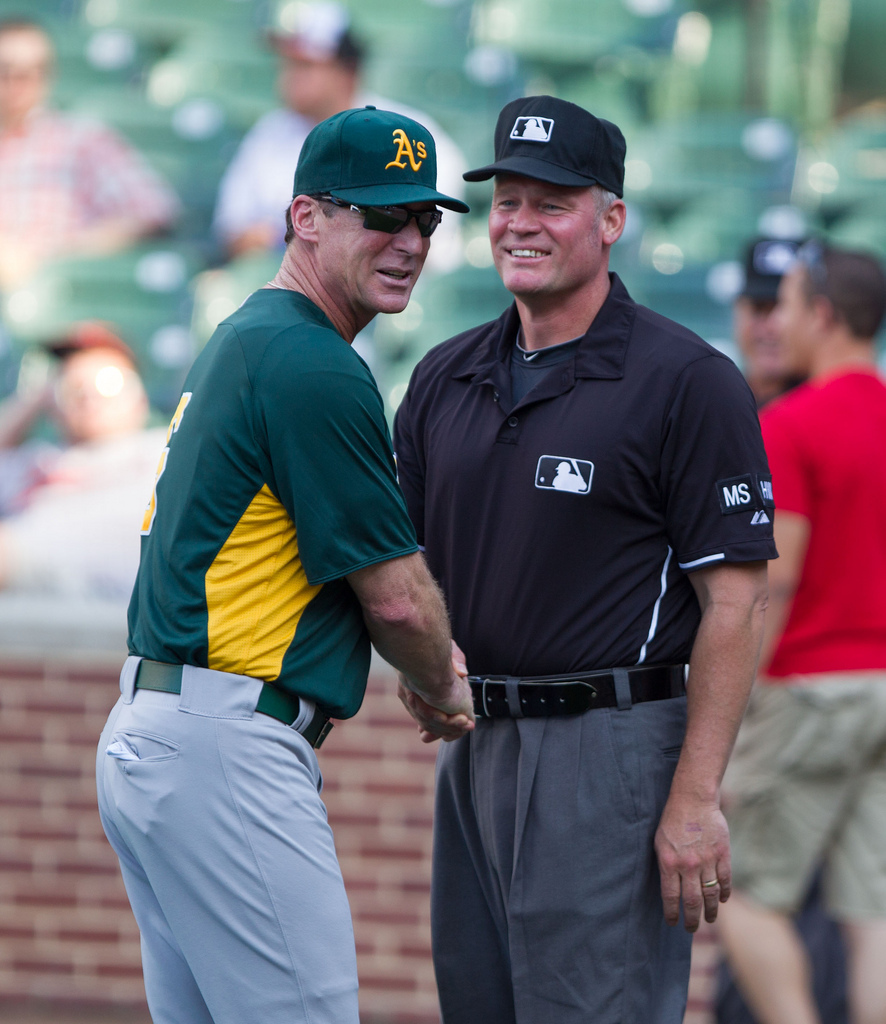
The A’s Bob Melvin – BBRT choice for AL Manager of the Year.

BBRT’s choice, Bob Melvin, brought a no-name, no-payroll club (picked for last place by many analysts) to the West Division Championship with a 94-68 record (second-best in the AL).  Along the way, his A’s overcame a 13-game deficit as of June 30; were nine games out at the All-Star Break, four back with eight to go; and two behind with three to go.  They had to sweep the first-place and favored Rangers in the last series of the year and needed to overcome a 5-1 deficit in game 162 to capture the Division title.  They did it all – and with the lowest payroll in the league.

They also did it with no 100-RBI men; no .300 hitters; only one player with 30 or more homers; no-pitcher with more than 13 victories; only one pitcher with 30+ starts; and no pitcher with 200 innings pitched. They had 54 wins from rookie pitchers, and started a rookie hurler in each of the last 14 games of the season.

Runner-up?  That would be Buck Showalter of the equally “disrespected-in-the-preseason” Orioles.  Showalter kept his Orioles in the race with the vaunted Yankees until the final weekend, finishing two games out of the Division title – winning a Wild Card spot with a 93-69 record.  Had Melvin’s A’s not captured the West, BBRT would have split its vote between the A’s and Orioles’ skippers.

NL Manager of the Year – Davey Johnson (Nationals)
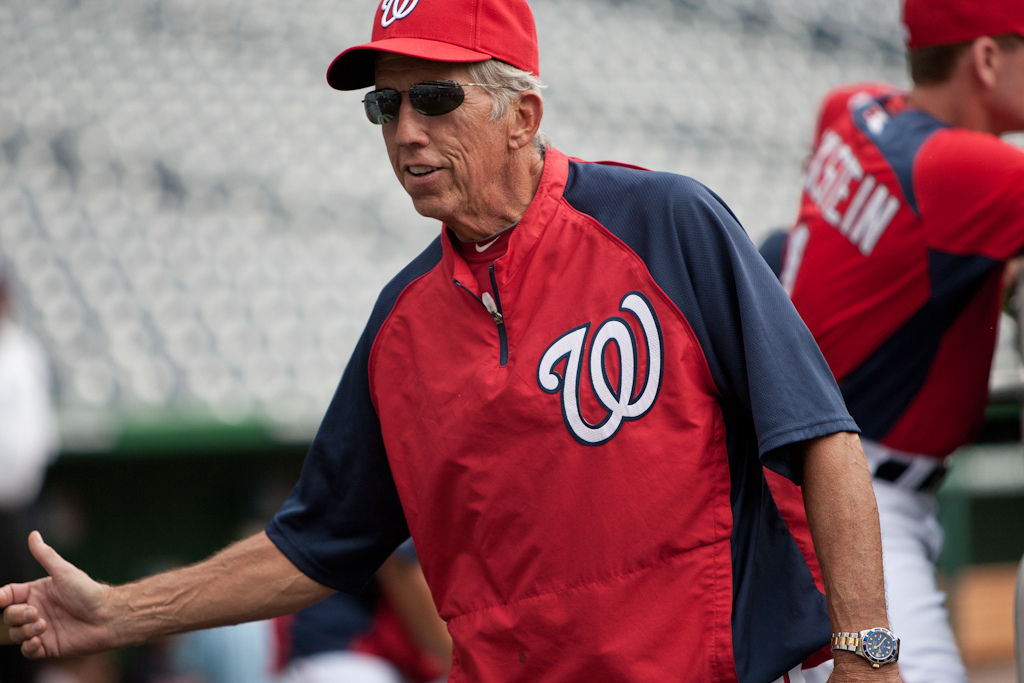
Davey Johnson – BBRT choice for NL Manager of the Year.

This was a close one for BBRT, with the Nationals’ Davey Johnson barely edging out Bruce Bochy of the Giants and Dusty Baker of the Reds not far behind.  All three managers brought 2011 non-playoff teams to Division Championships.  Johnson ends up with a slight edge for bringing his Nationals’ squad in at 98-64, MLB’s best record in 2012.

Here’s what BBRT saw over the season.  We’ll start with Johnson.  His Nationals improved from 2011’s third-place finish (80-81, 21 ½ games out) to 98-64 and an AL East Crown.  In the process, Johnson had to deal with injuries to key players like Michael Morse,  Jayson Werth and Ryan Zimmerman.  He also had to keep enthusiastic (can you be overly enthusiastic?) 19-year-old rookie Bryce Harper on as even a keel as possible and handle the Stephen Strasburg shut-down controversy.  Finally, he boosted the confidence and performance of middle-infielders Ian Desmond and Danny Espinosa, who came into the season with a combined 515 total games of MLB experience.  Those challenges, plus his deft handling of the pitching staff and MLB’s best record earn Johnson BBRT’s vote.

Close behind is the Giants’ Bruce Bochy.  The Giants didn’t have as far to come as the Nationals (which played a role in BBRT’s preference for Johnson), going from 2011’s second-place finish (86-76, eight games out) to 94-68.  Bochy, however, faced plenty of challenge along the way.  He lost his leading offensive player to a PED-related suspension, suffered through an off-year by staff ace Tim Lincecum (whose ERA went from 2011’s 2.74 to 5.18), dealt with injuries to key players like Pablo Sandoval, and faced the threat of the high-spending Dodgers.   Outside of the spectacular year from Buster Posey (.336, 24 HR, 103 RBI), the Giants’ HR and RBI leader would have been Sandoval, with only 12 HRs and 63 RBI.  Like the Nats, the Giants could count on a strong starting staff (Matt Cain, Ryan Vogelsong, Madison Baumgardner and a resurgent Barry Zito), which helped compensate for Lincecum’s 10-15 record. A key to the Giant’s strong season, however, was Bochy’s handling of the bullpen, consistently getting the “hot hand” in at the “right time.”  As a result, the bulk of the saves went to:  Santiago Casilla (25), Sergio Romo (14) and Javier Lopez (7).

BBRT gives third place in the Manager of the Year race to Dusty Baker of the Reds.  Baker brought the Reds from 2011’s third-place finish (79-83, 17 games back) to 97-65.  Over the course of the season, he had to deal with injuries to key players like Joey Votto (the center of the Reds’ offense) and Scott Rolen.  Baker, known as a player’s manager and motivator, responded by getting the best out of players like Jay Bruce and Ryan Ludwick.  Not blessed with a particularly strong bench, Baker proved a master (though an oft-criticized one) at juggling his line-up to keep the Reds on track.  Baker also has to be credited for the Mid-May decision to move hard-throwing Aroldis Chapman into the closer role.  Chapman responded with 38 saves, a 1.51 ERA and 122 K’s in 71 2/3 innings pitched.

Like Johnson and Bochy, Baker did benefit from a solid and stable (perhaps the most stable) starting rotation.  Baker’s five-man rotation (Johnny Cueto, Matt Latos, Homer Bailey, Bronson Arroyo and Mike Leake) accounted for 161 of the Reds’ 162 starts.  For you trivia buffs, the starter in that one “outlier” – the second game of an August 18 day/night doubleheader – was rookie Todd Redmond (his only ML appearance to date).

Overall, a great – maybe even award-worthy – managerial season for Baker.  However, both Johnson and Bochy had to deal with more “distractions” in bringing their squads home in first.

BBRT invites your comments on 2012 regular-season awards.
2012 Awards – NL MVP & the Cy Young(s)

With BBRT’s pick for the AL MVP out of the way – see the previous post on the very debatable junior circuit Most Valuable Player award – let’s move on to BBRT’s look at the remaining regular-season recognitions.  Not as much controversy here, but still plenty of good competition.

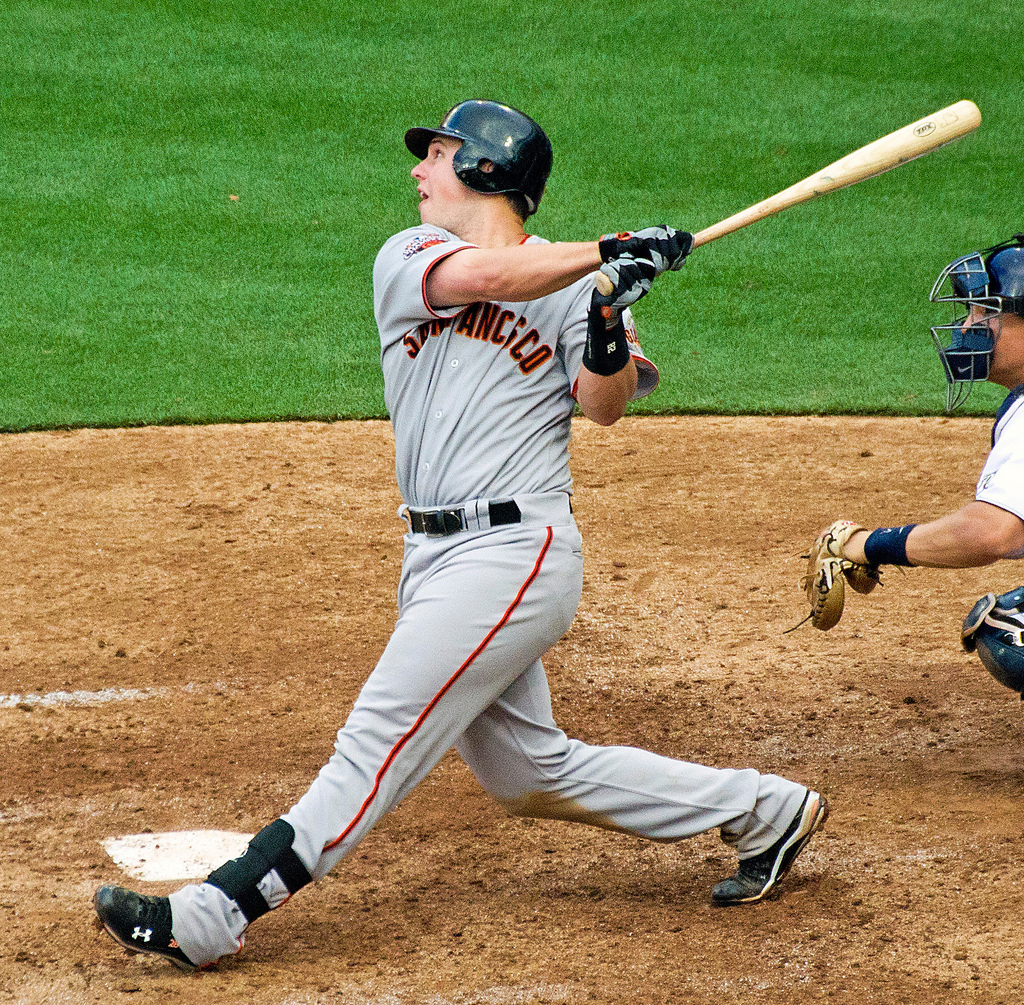
Buster Posey – BBRT choice for NL MVP.

NL MVP – Buster Posey (Giants)

BBRT sees a two-player race here and, surprisingly, both contenders make at least half their living in foul territory.  BBRT’s top candidates for NL MVP are catchers Buster Posey (SF) and Yadier Molina (St.L.).  BBRT is going with Posey, based on a combination of timing and circumstance.

Let’s look at Molina first.  A Gold Glove performer (who tosses out about half of the opponents’ potential base stealers), Molina put up some pretty gaudy offensive numbers for a backstop – .315, 22 HRs and 76 RBI.   His season was one of consistency:  .304, 13, 45 before the All-Star break, .328-9-31 in the second half.  Further, he called a great game and was a leader on the field.  Clearly, he made strong contributions to St. Louis run to a Wild Card spot.

BBRT’s MVP choice, however, contributed even more to his team’s results, helping lead the Giants to the West Division title (by 8 games over the Dodgers) despite the team’s on-field injuries and off-field difficulties.    Not only did Posey (like Molina) play the game’s most mentally and physically demanding position, he put up a line of .336, 24 HRs and 103 RBI.  In addition, Posey picked up the slack following Melky Cabrera’s PED-related suspension.  After a .289, 10 HR, 43 RBI first half, Posey delivered a .385 average with 14 HRs and 60 RBI after the break.  Further, Melky C.’s unfortunate (self-inflicted) circumstances, paved the way for Posey to become only the fourth catcher to win a league batting crown.   Ultimately, that strong (and much-needed) second-half push moves Posey ahead of Molina.

AL Cy Young – David Price

David Price – Edges Out Verlander for BBRT’s AL Cy Young.

Three starters dominated here – David Price, Justin Verlander and Jered Weaver.  BBRT goes with Price, barely over Verlander (due primarily to Price’s three extra wins) with Weaver dropping to third.  Let’s examine the competition.

Weaver, despite his 20-5 record, drops off due to having the fewest starts, fewest innings pitched, fewest strikeouts and highest ERA of the three.  Still he deserved consideration based on a 20-5 record, and 2.86 ERA.  It was the sub-200 innings pitched (188 2/3) and the less than dominating 142 strikeouts that put him third in this race.

Now to the top two contenders.  Verlander did lead the league in innings pitched and strikeouts (238 1/3 IP, 239 Ks). Price was not far behind at 211 IP and 205 Ks.  Verlander also led Price in starts, 33-31.  Price, on the other hand, led the league in ERA at 2.56, with Verlander second at 2.64 and Weaver third at 2.86.  Verlander also topped the AL in complete games with 6, to only 2 for Price (but today’s game really is not about going nine innings anymore).  Both pitchers logged 25 quality starts.  Ultimately, this could go either way, but for BBRT it comes down to Price’s three extra victories (20-5 versus 17-8) and the fact that Price edged Verlander by winning 22% of TB’s games, while Verlander picked up 19% of the Tigers’ victories.  BBRT can support either Price or Verlander, we just give the edge to tradition and the 20-game winner.

R.A. Dickey – Should Walk Off with NL Cy Young.

NL Cy Young – R.A. Dickey

This was a no-brainer for BBRT.  Yes, we love Braves’ closer Craig Kimbrel, 3-1 with 42 saves, a sparkling 1.01 ERA and a spectacular 116 strikeouts (and only 14 walks) in only 62 2/3 innings.   And there’s Gio Gonzalez of the Nationals, who was often buried in the Strasburg publicity and shut-down controversy, while quietly turning in a 21-8, 2.89 season with 207 K’s in 199 innings pitched.  A lesser case could also be made for the Reds’ Johnny Cueto (19-9, 2.78) and the Dodgers’ Clayton Kershaw (14-9, 2.53), who came on strong; just too late.

Hands down, however, the Cy Young has to go to the Mets’ R.A. Dickey – who went 20 – 6, 2.73 with a Mets’ team that had a faltering bullpen and finished 14 games under .500.  Dickey led the NL in:  Starts (33, tie); Innings Pitched (233 2/3); Strikeouts (230, one more than Kershaw); Quality Starts (27); and Complete Games (5).  He finished second in wins to Gonzalez’ 21 and second in ERA (at 2.73) to Kershaw’s 2.53.  And, Dickey walked only 54 against his 230 K’s – unusual control for a knuckleballer.  A great season, deserving of the Cy Young for a pitcher who came into 2012 with a career 41-50 record and a 4.34 ERA.

Watch soon for BBRT’s Rookie and Manager of the Year picks – and we invite your comments on the MVP and Cy Young. 

BBRT Weighs In On Post Season Awards – Starting with AL MVP

Miguel Cabrera – BBRT’s AL MVP.

In the next few posts, BBRT will be taking a look at the upcoming MLB 2012 Regular Season Awards – MVP, Cy Young, Rookie of the Year, Manager of the Year.  We’re starting with the most controversial award of 2012 – American League MVP.  The Tigers’ Triple Crown winner Miguel Cabrera and the Angels’ spectacular rookie Mike Trout each have plenty of supporters and statistics – from Batting Average to On Base Percentage to Wins Above Replacement – are being tossed around like hand grenades.

In a tight contest, BBRT would give the AL MVP to Cabrera over sure-thing Rookie of the Year Mike Trout – and not just on the basis of Cabrera’s rare Triple Crown achievement.  Let’s look at the logic.

First, of course, we all know that Cabrera won the first Triple Crown in 45 years.  How much an edge is that in the race for MVP?   For BBRT, the three legs of the Triple Crown are weighed equally with a host of other stats.  Let’s look.


Batting Average

This is close, Cabrera leads the league at .330, but Trout is right behind, second in the league, at .326.  Very slight edge to Cabrera.

Home Runs

Cabrera enjoys a big lead in total HRs with his AL best 44, but Trout showed solid power as well. His 30 round trippers ranked 13th in the AL.  BBRT gives a moderate edge to Cabrera. (Some might argue that Trout spent most of April in the minors, but for the season he had only 63 fewer at-bats.)

RBI

Big edge to Cabrera, a league-leading 139, to Trout’s 83 (13th in the league).  But we need to take into account that Trout is a lead-off hitter and Cabrera is a middle of the line-up guy.

With the big three out of the way, Cabrera has a bit of an edge.  Now, let’s look deeper.

Runs Scored

Trout led the AL at 129 (despite a late-April call-up).  Cabrera, however, was no slouch.  His 109 runs scored were second only to Trout.  And, here again, for different reasons, we must keep in mind that Trout was leading off.  Still, slight advantage Trout.

Hits

Cabrera’s 205 were second in the league, but Trout’s 182 placed him tenth (and, again, he was called up in late April.)  Call this one a draw.

Doubles/Triples

Cabrera had a large lead in doubles 40 to 27, but that was offset by Trout’s 8 to 0 lead in triples.  Another toss-up.

Stolen Bases

Trout by far, a league-leading 49 to Cabrera’s four – making Trout a unique power-speed threat.

On Base and Slugging Percentage

Trout’s .399 OBP was third in the league, just besting Cabrera’s .393 (AL 4th) – while Cabrera’s .606 league-leading Slugging Percentage topped Trout’s .564 (third).  Six of one, half-dozen of another here.

So, now we’re through most offensive stats – and it’s very close.  BBRT sees a slight edge to Cabrera, but it’s still debatable.

Now, some offensive stats not too many are talking about.

Bases on Balls

Surprisingly, not a lot of free passes for either of these offensive stars.  Trout’s 67 walks were one more than Cabrera.  Toss up.

Strikeouts

Let’s face it, K’s are pretty much wasted at-bats.  A surprise here, Trout fanned 139 times (not expected from your lead-off man) to 98 for Cabrera (a more respectable number for the middle of the line-up).  Trout fanned 41 more times – in 63 fewer at bats.  Edge – Cabrera.

Defense

Trout takes the lead here, a potential Gold Glove candidate.  But, we have to keep in mind that Cabrera moved over the third base to enable the acquisition of Prince Fielder – a valuable concession from a team point of view.   Ultimate advantage, still a healthy one for Trout, but not weighted as heavily here as in some other quarters.

Other factors

Remember, this is not a Best Player or even Best All-Around Player award; this is Most Valuable Player – what you mean to your team.

BBRT give Cabrera an edge here, with Detroit coming back to win the Division

Mike Trout – spectacular rookie a close second in BBRT’s book.

and the Angels at home watching the post season after finishing third in their Division and four games behind in the Wild Card race. The fact is, without Cabrera, the Tigers, like the Angels, would already be home.  Without Trout, the Angels would probably still have finished third – just a little closer to Seattle.  BBRT agrees that Trout did spark the Angels, just not enough to make a difference in the final division standings. 

And what about the impact as the pennant race unfolded?  Consider what the two accomplished through the “Dog Days” of August, and the critical September/October time frame.  As Bill Madden of the NY Daily News noted: from August 1 on, Cabrera .344, 19 HRs and 54 RBI – Trout .287, 12 HRs and 28 RBI.  As the race heated up, Cabrera got hotter, while Trout seemed to fade a bit.

Further, Cabrera went through the season with the expectations placed on a veteran leader – to inspire, mentor and motivate – to be a clubhouse leader.  Trout was a rookie, expected to learn from team leaders like Albert Pujols and Torii Hunter.

So yes,  Trout, at 21, became the first rookie and youngest member of the 30-40 club (30 homers and 40 stolen bases) – and, to BBRT even more impressive, was only one stolen base from joining the elite 30-50 club, which includes only Eric Davis and Barry Bonds. An argument may, in fact, be made for Trout being very close to – if not the – best all-around, five-tool player of 2012.

But, again, this award does not recognize the “best” player, but rather the “most valuable.”   When you add it all up, BBRT’s MVP vote goes to Miguel Cabrera (WAR not withstanding) – not just for for his full-season performance on the field (all those stats being tossed around), but also for his contributions down the stretch, his willingness to cross the diamond from first base to third base for the good of the team, and the expectations placed on him as a veteran and team leader.  

Watch BBRT for a soon-to-come (and briefer) look at the other 2012 Awards:  NL MVP; AL & NL Cy Young; AL & NL Rookie of the Year; and AL & NL Manager of the Year.  There’s some spirited competition, but far less controversy.

Ten BBRT “Hits” from the 2012 MLB Season

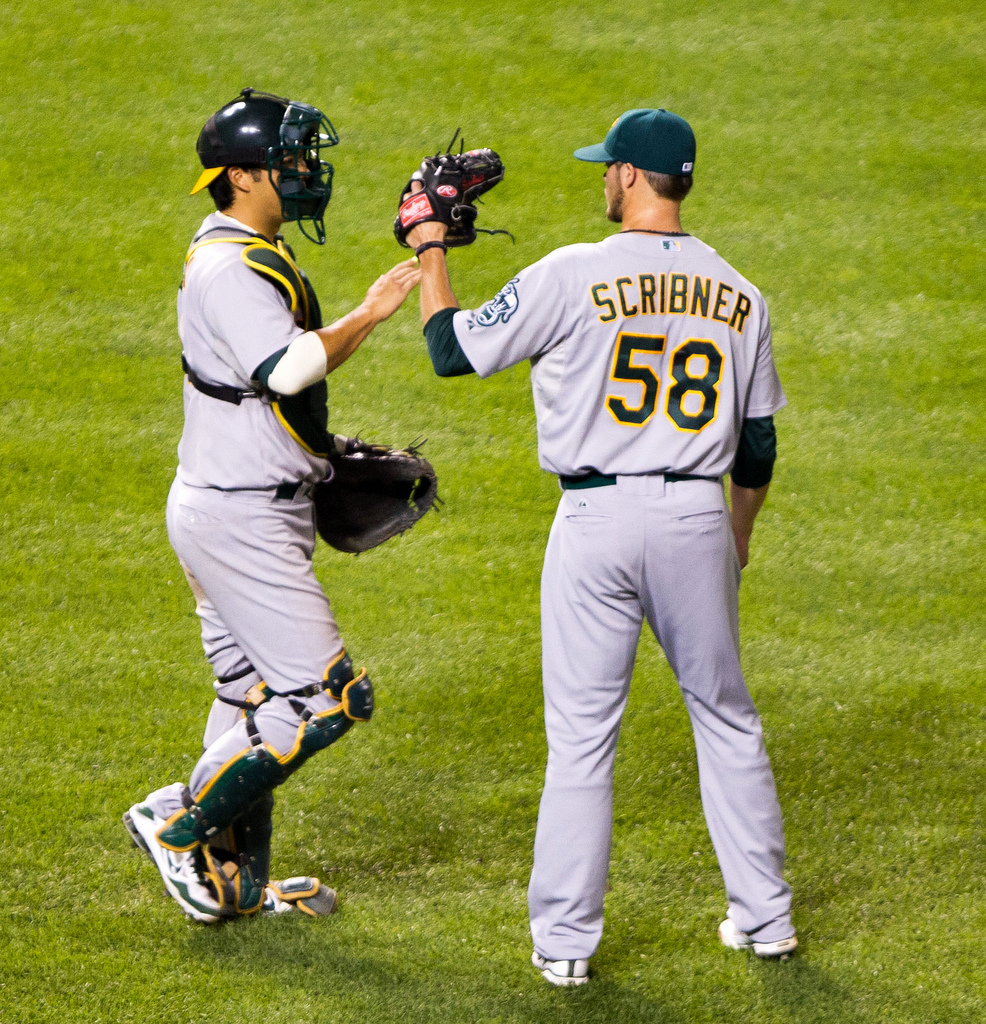
Evan Scribner was the winning pitcher in the A’s storybook finish – and AL West Title.

2012 was a remarkable season – and BBRT expects even more excitement in the post season.  Most readers may be too young to remember “Your Hit Parade,: an early TV show that featured the Top Ten music hits and a few “extras.”  Here are ten “hits” and a few extras that grabbed BBRT’s attention during the 2012 MLB regular season.

1.  The no-name, low-payroll Oakland A’s AL Western Division Championship.

The Oakland A’s started the 2012 season with the lowest payroll in the AL and second-lowest payroll in all of baseball ($55.3 million, with only the Padres lower), and with most analysts predicting a last-place finish in the AL West.   Yet, this no-name bunch – 13 games out of first on June 30 – completed a remarkable comeback with a dramatic final weekend sweep (and comeback from a 5-1 deficit in game 162) of the heavily favored Texas Rangers to grab the AL West title with a 94-68 record.  The heroes in that final contest included such “name” players as Evan Scribner, Derek Norris, Brandon Moss and Coco Crisp.

How improbable was this division championship? The A’s had no 100-RBI men; no .300 hitters; only one player with 30 or more homers (Josh Reddick, 32);  no-pitcher with more than 13 victories; only one pitcher with 30+ starts (Tommy Milone, 31); and no pitcher with 200 innings pitched. They had 54 wins from rookie pitchers, and started a rookie hurler in each of the last 14 games of the season.

Here is the list of A’s with at least 100 games played in 2012:  Brandon Moss, Coco Crisp; Josh Reddick; Chris Pennington; Yoenis Cespedes; Seth Smith; Jemile Weeks.

Oh, and by the way, the A’s had sole possession of first place on only one day all season – the day that counted.

For BBRT, the A’s story was number-one on the 2012 Hit Parade.

2.  Miguel Cabrera’s Triple Crown

Not accomplished since 1967 (the Red Sox Carl Yastrzemski), Cabrera’s Triple Crown included a .330 average, 44 homers and 139 RBI – a performance that led his Tigers to the AL Central crown.  His key challenges came from Josh Hamilton in home runs (who suffered a late season power slump) and a final rush from Curtis Granderson that brought him within one round tripper of Cabrera.  Cabrera also pushed aside batting average challenges from Joe Mauer and Mike Trout, with Miggy turning in a clutch four-hit performance in the Tigers’ October 1 Division Championship-clinching game.

3.  Mike Trout’s spectacular rookie season.

All the pre-season hype focused on Washington National’s phenom Bryce Harper.  Then on April 27th, the California Angels made a move that changed the playing field – calling up Mike Trout, a 20-year-old who was hitting a blistering .403, with one HR,  13 RBI and six stolen bases at Salt Lake City.  Despite missing a month of the MLB season, Trout, at 21, became the first rookie and youngest member of the 30-40 club (30 homers and 40 stolen bases), finishing with a line of .326; 30 HRs; 49 SBs; 129 runs; 83 RBI; and a good shot at a Gold Glove.  And, again, despite his late April call up, was only one stolen base from joining the elite 30-50 club, which includes only Eric Davis and Barry Bonds.  It was a marvel to witness – and think about how much more baseball Trout (and fans) have to look forward to in the seasons ahead.

Hit Parade Extra – Precognition or Coincidence?  We’ll take coincidence.  BBRT’s March 29th blog may have foreshadowed the current Cabrera versus Trout MVP discussions.  The blog was title “Triple Crown = MVP?  Not Always!” Visit that blog for more detail, but three players have been denied the MVP after winning the Triple Crown, one of them twice:  Lou Gehrig, in 1934, actually led both leagues in the Triple Crown categories and finished a distant fifth in MVP voting, while Ted Williams won the Triple Crown in 1942 and 1947 without being recognized as MVP and Chuck Klein had that distinction in 1933. For 2012, BBRT’s vote goes to Cabrera, since Trout’s solid season and strong supporting cast still could not bring the Angels a playoff spot. 

4.  Baltimore Orioles make playoffs for the first time since 1997.

Like the Oakland A’s, the Orioles came into the season as Division “also-rans.”  Yet they stayed in the hunt with the powerful Yankees until the final weekend – and earned a Wild Card spot.  Like the A’s, we are not looking at a group of established names.  The O’s did show power, with five 20+-HR players, led by Chris Davis (33) and Adam Jones (30).  However, they had no 100-RBI players (although Davis, Jones and Matt Wieters all topped 80) or .300 hitters.  The Orioles starters were led in wins by Wei-Yen Chen, the only hurler with more than 20 starts (12-11, 4.02) – but did benefit from Jim Johnson’s 51 saves.  Still, the Orioles played gritty, were fun to watch, and did bring home 93 wins.

5.  The Washington Nationals NL East Crown.

The Nationals are considered another surprise team in the playoffs by many (BBRT was among those predicting a playoff spot), but more surprising may be that they led the NL in wins (98) and how they did it –with the NL’s lowest ERA (3.33), even after shutting down Stephen Strasburg.  Staff leaders were Strasburg (15-8, 3.16) and Gio Gonzalez (21-8, 2.89), while seven pitchers logged saves, led by Tyler Clippard (32) and Henry Rodriguez (9).  A real interest grabber was what would happen once Strasburg left the rotation.  John Lannan filled in admirably.

Hit Parade Extra – What difference relief pitchers make.  The New York Mets led all of MLB in quality starts in 2012 (101) and yet finished with only 74 wins against 88 losses.  BBRT watched the self-destruction closely.

6. The Pittsburgh Pirates fall from grace.

BBRT predicted in March that the Pittsburgh Pirates would end 19-years of futility (under-.500 finishes) this season.  That looked like a pretty good bet on August 8, when the Pirates were 16 games over .500 at 63-47, just 2 ½ games behind the division-leading Reds.  In fact, just over a week later, the team sent out play-off ticket ordering instructions.  Well, from August 8 on, BBRT watched in dismay as the March prediction and the Pirate’s season went into free fall.  They played 20-games under .500 the rest of the way, finishing at 79-83 for their 20th consecutive losing season.  Ironically, the clinching 82nd loss came at home on Sunday, September 30 – the Pirates’ official Fan Appreciation Day.

7. Chipper Jones’ Final Season.

BBRT watched with interest (and respect) as the forty-year-old Chipper Jones went .287, 14 HR, 62 RBI in his final season, helping the Braves to a post-season slot.  The future Hall of Famer, always a pressure player, hit a single (as a pinch-hitter) in his final regular season at-bat.  Post-season to follow and BBRT hopes to see more of Chipper.

8.  Kris Medlen’s remarkable comeback.

Kris Medlen is a remarkable “find” for the Braves – a solid prospect lost for all of 2011 as he recovered from Tommy John surgery.  After the Braves moved him into the rotation on July 31 (after 38 relief appearances), he made 12 starts and went 9-0 with a 0.97 ERA.  For the year, he’s 10-1, 1.57.  But here’s what has grabbed BBRT’s attention.  Since 2010, the Braves have won 23 consecutive games started by Medlen, breaking a record shared by Hall of Famers Carl Hubbell and Whitey Ford.  As BBRT writes this post, Medlen is preparing to face the Cardinals in a Wild Card play-off game.

9. Melky Cabrera suspension and right decision.

BBRT was glad to see Melky Cabrera, baseball and the Giants do the right thing after Cabrera’s PED-related suspension, with Melky opting out of the batting race (see blog post of Sept. 22) and the Giants deciding not to activate him for the post season.   Notably, Melky’s “resignation” – with a .346 average – opened the door for the Giants’ Buster Posey (.336) to become only the fourth catcher to win a batting title.

10. Seven no-hitters and three perfect games.

Seems like BBRT has been posting about no-hitters and perfect games all season.  You can check them all out in posts of Sept. 29, August 16, July 12, June 14, June 9 and April 21.  Lots of no-hitter trivia and tidbits there.

 Hit Parade Extra – A Few Honorable Mentions:  Jamie Moyer becoming the oldest pitcher to win a major league game; the collapse of the Red Sox; the inability of the West Coast Dodgers and Angels to make the playoffs despite some aggressive signings and trades; R.A. Dickey’s remarkable season; the impact of the new Wild Card system; Yu Darvish; and my fantasy team – the KL Mundies – taking first place with 7200 total points, only 15 ahead of second place.

Any highlights to add – use the comments section, BBRT would love to hear your views on the 2012 season. 

Melky Did the Right Thing

Melky Cabrera did the right thing yesterday – pulling out of the NL batting race.  (See BBRT’s September 20 post for more on this issue.)  It was an honorable course of action and a giant (no pun intended) step toward vindication.   Now, it’s up to MLB and commissioner Bud Selig.  While Cabrera requested disqualification from the batting title (due to his 50-game PED suspension), making it happen took Selig’s one-season-only (2012) rules change to disqualify players who “served a drug suspension for violating the Joint Drug Program” from the individual batting, slugging and on-bases percentages championships. BBRT says “Thanks, Melky, for stepping up to the plate on this one” … and urges MLB to make the rules change a permanent one, providing baseball another asset in its efforts to remove PEDs from the game.


Two Homers in One Inning – Thoughts and Trivia

Adrian Beltre, long under-appreciated, has joined the “two-homers-in-one-inning” club.

On August 22, 2012, Adrian Beltre hit two home runs in the fourth inning of the Texas Rangers’ 12-3 victory over the Baltimore Orioles – becoming the 57th major leaguer to hit two dingers in one frame.

For BBRT, the feat brings to light how underappreciated Beltre has been for much of his career.  In his 15 seasons, Beltre has topped 20 home runs in a season ten times (only eight other third basemen can make that claim) and now has 332 home runs, 1,064 runs and 1,186 RBI to go with a .278 career batting average.  He’s also reached double digits in stolen bases six times and been awarded three gold gloves (though he deserved more.)  In 2004, he recorded an NL-leading 48 home runs, along with 121 RBI, 104 runs and a .334 batting average.

Despite these achievements, Beltre – who made it to the majors with the Dodgers in 1998 at age 19 – was not selected to his first All-Star team until 2010 (at age 31).  He repeated as an All Star in 2011 and 2012. Still only age 33, Beltre has a chance to put up career numbers that will place him among the games elite thirdsackers – and he is finally receiving appropriate recognition for his solid career.

So, there is my rave on Adrian Beltre, now a bit of two-home-run inning trivia, and then a list of the players who have gone yard twice in an inning.

Most notable on the list is the Cardinals’ Fernando Tatis who, on April 23, 1999, not only hit two homers in an inning – but hit two grand slams in one inning.  It was the 11-run third inning of the Cardinals 12-5 win over the Dodgers in LA.  Equally surprising to BBRT is the fact that Dodgers starter Chan Ho Park was on the mound for both grand slams (the second finally drove Park from the game).  Park’s inning went like this:  single – hit batsman – single – home run – ground out, first base to pitcher – home run – walk – walk – fielder’s choice – error by first baseman – single – fly out to right field – home run – relieved by Carlos Perez, who got the final out of the inning on a foul pop up.

On May, 2002, Brett Boone and Mike Cameron became the only two team mates to hit two home runs in one inning – and they did it in the same inning (a ten-run first in a 15-4 win over the White Sox) and they did it back-to-back.

Only three players have achieved two home runs an inning twice in their careers:  the Pirates’ Jeff King (April 8, 1995 and April, 30, 1996); the Giants’ Willie McCovey (April 12, 1973 and June 27, 1977); and the Expos’ Andre Dawson (June 30, 1978 and Sept. 24, 1985).

Also of note are the Indians’ Carlos Baerga (August 8, 1993), theCubs’ Mark Bellhorn (August 29, 2002) and the Angles Kendrys Morales (July 30, 2012) the only three players to homer from both sides of the plate in the same inning.  Finally, the Braves’ (Boston) Bobby Lowe (May 30, 1894) and Mariners’ Mike Cameron (May 2, 2002) each achieved a two-homer inning in the midst of a record  four-homer game.  Just 16 players, Lowe was the first, have hit four home runs in a single game.

Here is your two-homer inning list:

2012, August 22 … Adrian Beltre, Rangers

2012, July 30 … Kendry Morales, Angels

2011, Sept. 18 … Pablo Sandoval, Giants

2010, Sept. 23 … Juan Aribe, Giants

2009, August 23 … Michael Cuddyer, Twins

2008, August 12 … David Ortiz, Red Sox

2008, June 21 … Jim Edmonds, Cubs

2007, Sept. 5 … Alex Rodriguez, Yankees

2007, August 12 …  Magglio Ordonez

2007, May 7 … Benji Molina, Giants

2006, July 22 … Julio Lugo, Rays

2004, June 19 … Juan Rivera, Expos

2003, August 20 … Reggie Sanders, Pirates

2002, August 29 … Mark Bellhorn, Cubs

2002, August 9 … Aaron Boone, Reds

2002, July 26 … Carl Everett, Rangers

2002, July 23 … Nomar Garciaparra, Red Sox

2002, June 11 … Jared Sandberg, Rays

2002, May 2 … Mike Cameron, Mariners

2002, May 2 … Brett Boone, Mariners

2000, August 22 … Eric Karros, Dodgers

1999, April 23 … Fernando Tatis, Cardinals

1997, July 13 … Gary Sheffield, Marlins

1997, May 7 … Mike Lansing, Expos

1996, May 16 … Sammy Sosa, Cubs

1996, April 30 … Jeff King, Pirates

1996, Sept. 22 … Mark McGwire, As

1996, May 17 … Dave Nilsson, Brewers

1995, April 8 … Jeff King, Pirates

1994, June 24 … Jeff Bagwell, Astros

1993, Oct. 3 … Joe Carter, Blue Jays

1993, April 8 … Carlos Baerga, Indians

1990, August 27 … Ellis Burks, Red Sox

1989, July 27 … Dale Murphy, Braves

1985, Sept. 24 … Andre Dawson, Expos

1985, June 11 … Von Hayes, Phillies

1980, May 13 … Ray Knight, Reds

1978, July 30 …Andre Dawson, Expos

1977, June 30 … Cliff Johnson, Yankees

1977, June 27 … Willie McCovey, Giants

1974, April 29 … Lee May, Astros

1973, July 6 … John Boccabella, Expos

1973, April 12 … Willie McCovey, Giants

1966, April 30 … Rick Reichardt, Angels

1962, May 23 … Joe Pepitone, Yankees

1959, Sept. 4 … Jim Lemon, Senators

1955, April 17 … Al Kaline Tigers

1949, July 31 … Sid Gordon, Giants

1949, June 2 … Andy Seminick, Phillies

1936, June 24 … Joe DiMaggio, Yankees

1935, August 24 … Hank Leiber, Giants

1928, June 16 … Bill Regan, Red Sox

1925, July 1 … Hack Wilson, Giants

1922, August 7 … Kenny Williams, Browns

1894, June 6 … Jake Stenzel, Pirates

1894, June 30 … Bobby Lowe, Braves

1880, June 10 … Charly Jones, Braves

Saint Paul Saints – Veeck’s right, fun IS good!

Moving – in less than 24 hours – from the Minnesota Twins Champions Club at Target Field in Minneapolis(see the July 19 post) to “infield reserved” behind home plate as the American Association (independent league) Saint Paul Saints take on the Grand Prairie Airhogs at Midway Stadium is a quantum leap.  That’s the journey BBRT chose to make – leaving Target Field at about 11 p.m. on July 17th and entering Midway Stadium at about 12:30 p.m. on July 18th.

From a fan perspective, both experiences have a lot to offer.  This post will focus on the Saint Paul’s Saints – for more on the BBRT’s time in the Twins Championship Club, again, see the previous post.

One of the Saints’ primary owners –  Mike Veeck (part owner of a half dozen teams) –  is all about baseball, business and FUN– and attending a Saints game is ample proof of the Veeck family’s belief that baseball and fun make for good business.

What it’s all about!

Note: Mike’s grandfather Bill Veeck, Sr., was President of the Chicago Cubs and his father Bill Veeck gained fame as one of baseball’s great “mavericks” as owner of the Cleveland Indians, St. Louis Browns and Chicago White Sox (twice). To learn more about the Veeck family approach to the game Google (darn, I vowed never to use that verb) Lary Doby, Eddie Gaedel or Disco Demolition and to understand Mike Veeck’s approach to life and business read his book “Fun is Good.”

On July 18th, the fun began as I crossed the packed parking lot, where – as is always the case before Saints games – the tailgating was in full swing more than an hour before game time. It wasn’t a parking lot, it was a partying lot.  Cold beer, grilled burgers and brats, lawn games, loud music and an array of baseball apparel are the order of the day.  To add to the fun on this day, free hot dogs were being handed out to any and all comers.

Once in the park, the fun really began (after I picked up my free score card, of course).

No between innings lulls – not Lardashian and Hamphries at right center.

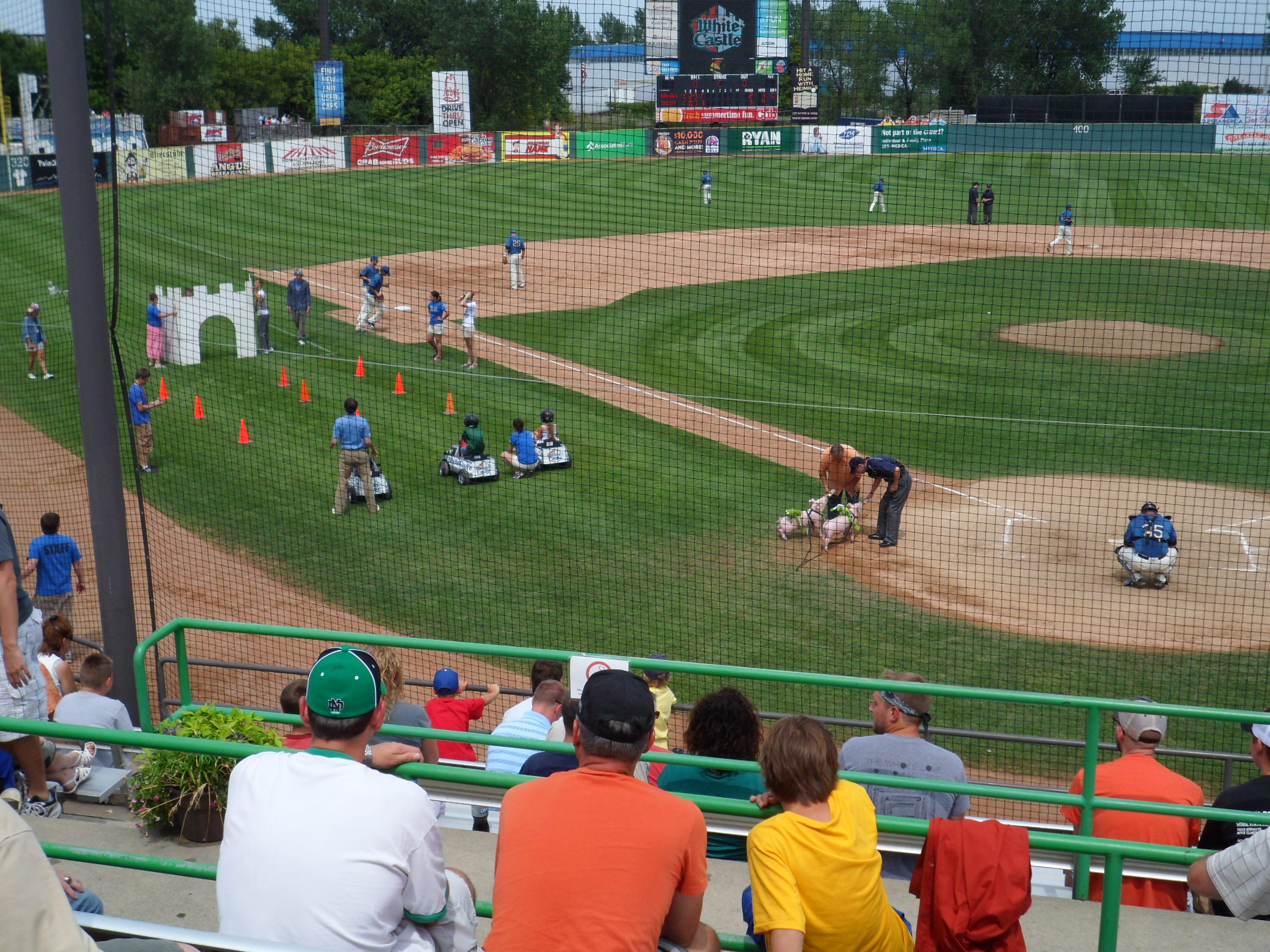
In the stands, fan interacted with the over-sized pink pig mascot Mudonna (who does a great bump-and-grind), as well as with a host of “ushertainers” like Gert the Flirt, Mr. Vegas and the Nerd.  We also witnessed the twenty-year Saints’ tradition of baseballs delivered to home plate by pigs (piglets at this time of year, but guaranteed to play a “larger” role over the course of the season).  This year the umpires accepted horsehides from a pair of pig mascots named Kim Lardashian and Kris Hamphries.  (Past Saints pigs have included such “celebrities” as Hammy Davis Junior, Kevin Bacon and the often maligned Bud Squealig.  A few years ago I suggested Amy Swinehouse, but never made the cut.)  There were also between-inning events ranging from a Piano Race to a Pizza Eating Contest to a players “Booty Call” where fans had to identify a player from a photo of his (uniformed) booty displayed on the centerfield scoreboard video screen.  In short, in addition to the action on the field, there was a lot going on off the field – no between inning lulls (which is true of most minor league experiences, even more true of independent league operations and a hallmark of Mike Veeck’s approach to the game-day experience.)

Another note:  A Saints game at Midway Stadium may be the only place where knowing the Wayne Newton recorded Danka Schoen can win you a prize or where a ballplayer sliding into home can win White Castle hamburgers (“sliders”) for the entire crowd.)

If fun is good – so is food – and there is plenty inside the ball park for those who didn’t fill up in the parking lot.  There are all the traditional items – hot dogs, brats, peanuts, cracker jacks, cold beer, ice cream – as well as such offerings as walleye sandwiches, gyros (my choice this day), chicken kabobs and more.  And, it’s major league quality at minor league prices. And what tastes better than a cold beer and a bratwurst – in the sun – at the ball park.

The fans at Midway Stadium (and most minor league parks) are a real family.  It’s like the pub on cheers.  In Midway “everybody knows your name” – the beer vendors call out to their customers by name and preference”  “Hey Marty, ready for another Pale Bud?”  And, if you a new, you’ll soon find yourselves surrounded by friends ready to talk baseball – or, I’ve observed at Saints games, politics.

What you won’t see here are ties or the wave – both banned.  BBRT:  The wave should be banned everywhere.

Then there’s the game itself.  For Wednesday’s game, the morning started out overcast, but the sun (apparently the weatherman agreed that fun is good and fun in the sun even better) came out at game time.  Then, as if on cue, it began to cloud up again as we moved close to the final inning of the 2 hour and 21 minute contest.

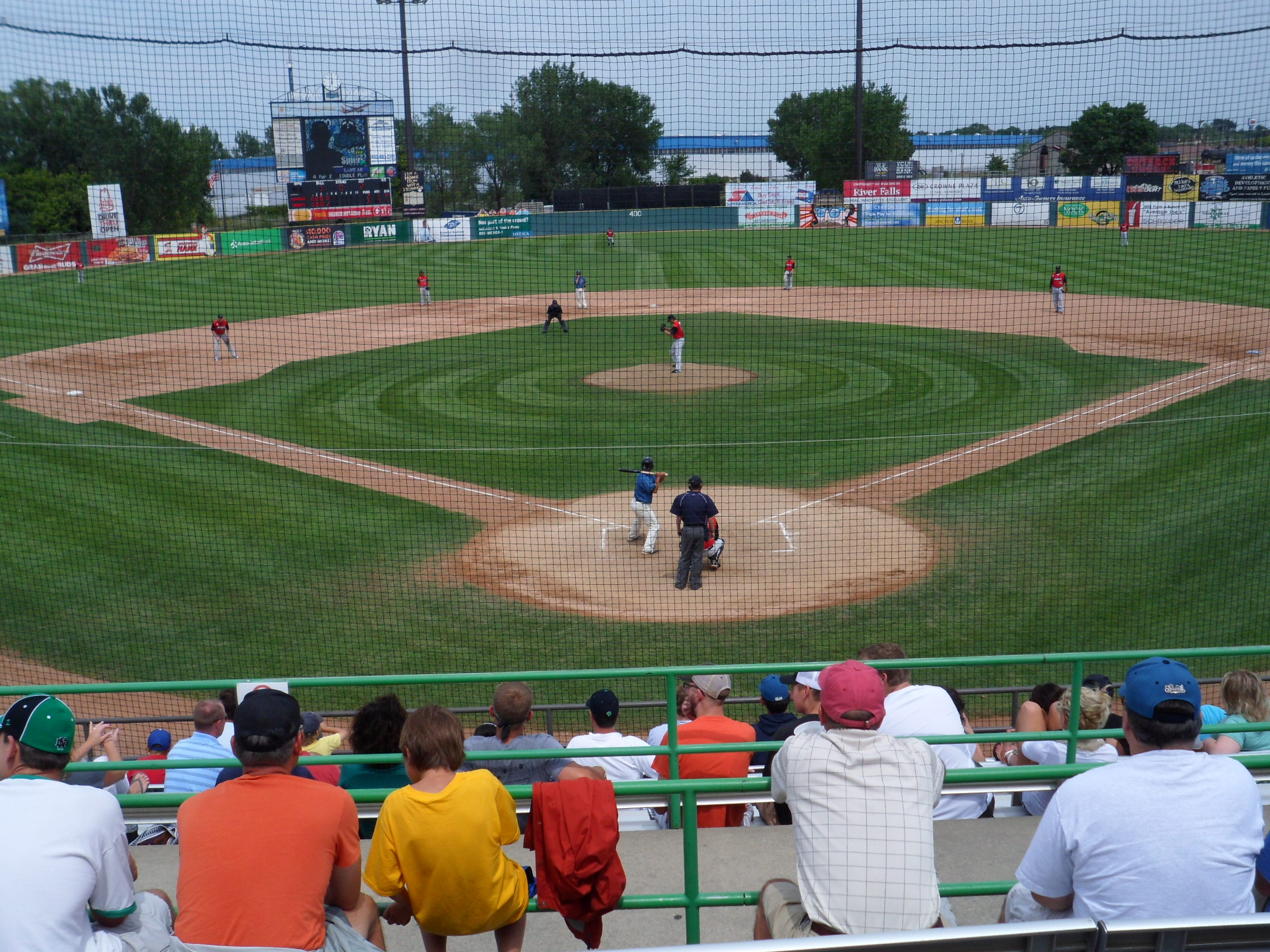
Good seats – at a great price.

For my $13 I got a great seat, right behind home plate about 15 rows back.  There are, however, really no bad seats in a park that holds about 10,000 (there were 6,034 on this Wednesday afternoon.)    We were treated to a pretty good ball game (the independent American Association is most often compared to “A” ball.) It included a couple of well-turned double plays, two nice diving catches, a nifty pick-off, and a power display by the home team (3 doubles, a triple and a home run among 13 hits for the Saints, while the Airhogs had only 5 singles and a double.)

The Airhogs took a 2-lead in the top of the second inning, which went walk, walk, pick-off of the runner at second, single, run-scoring sacrifice fly, run-scoring single, strikeout. It was a little like watching the White Sox of the late 1950s – a power-short team that worked to manufacture runs and victories (In 1959, the White Sox won the AL Pennant despite finishing last in the league in homers, sixth [out of eight teams] in batting average and seventh in slugging percentage – but third in On Base Percentage and first, by a wide margin, in stolen bases.)

The Saints took another route to home plate, turning two doubles, two singles and a triple into 3 runs in the fourth; adding a solo homer by clean-up hitter Ole Sheldon in the fifth; and then using a single, well-executed sacrifice bunt and a another single for a run in the eighth (an inning that ended on a 8-2-4 play as the hitter tried to advance on the play at the plate).  All in all, a satisfying 5-2 Saints win, with plenty of interesting baseball.

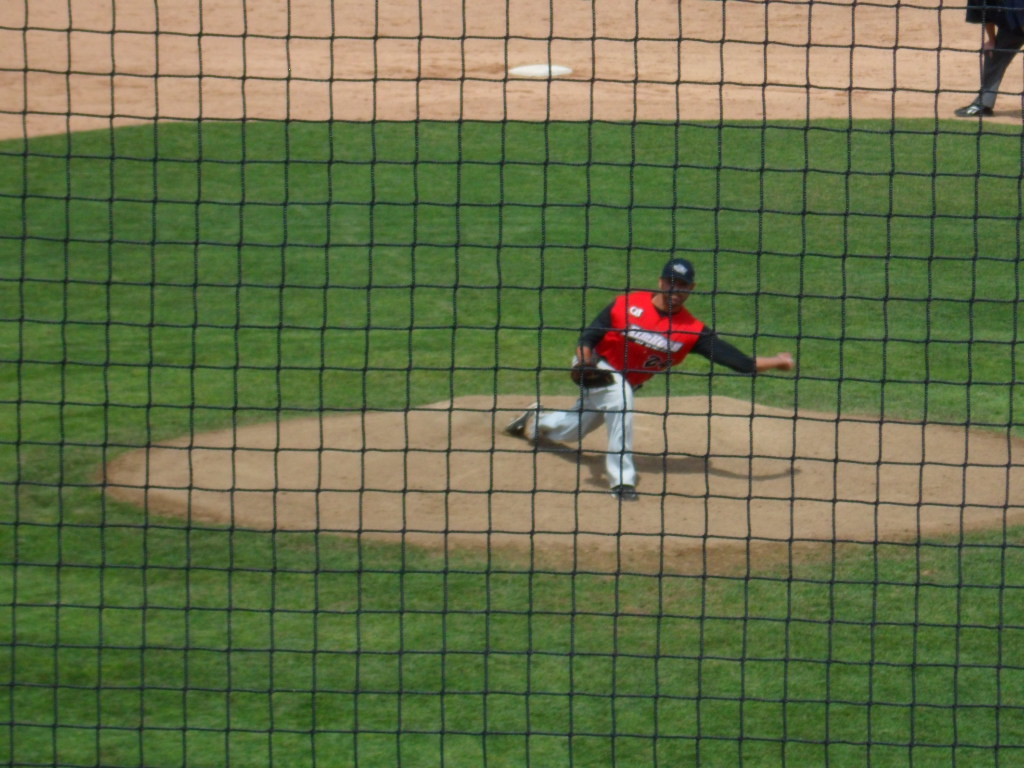
Ronnie Morales and his submarine delivery …

One highlight for BBRT was the opportunity to view, from my behind-home plate vantage point, the “submariner” pitching style of Airhogs’ reliever Ronnie Morales.  I’m dating my self here, but it reminded me of the Kansas City Royals 1980s closer Dan Quisenberry.

So that was my game day experience at Midway Stadium – BBRT, by the way, strongly supports a new Saints ball park in downtown Saint Paul, but that’s for another post.  I’d like muse a bit more on what you might see at an independent league game,

BBRT has written in earlier posts about how minor league baseball (particularly AAA) often offers the opportunity to see former and future major leaguers on their way up or down – or between ups and downs.  While that opportunity may not arise as often in independent league baseball, the Saints are proof you can still see players from, or destined for, the big leagues at these contests.  Over the years, the Saints roster has boasted such former major leaguers as:

Jack Morris …  who went 5-1, 2.61 for the Saints in 1996, at age 41 – following a major league career that included 254 wins, 5 All Star selections and an World Series MVP award.

Darryl Strawberry … the troubled outfielder who joined the Saints after a major league suspension (a former NL Rookie of Year and 8-time All Star with 297 major league homers).  Strawberry, rebuilding his image and career, played 29 games as a Saint, hitting .429 with 18 homers and 39 RBI.  One July 4, 1996, George Steinbrenner celebrated his 66th birthday by bringing Strawberry back to the Yankees for the 1996 pennant-winning stretch drive.   “The Straw” went on to play for Yankees until 1999 (on pennant winners in 1996, 98 and 99) and finished his career with 335 homers, 1,000 RBI and 221 stolen bases.

J.D. Drew … the Florida State college star drafted second overall by the Phillies in 1997 came to the Saints after contentious negotiating between the Phillies and J.D.’s agent Scott Boras (enough said). Boras uncovered a loophole in MLB’s draft rules that enabled Drew to sign with the Saints and be available for future drafts.  Drew played 44 games with the 1997 Saints, hitting .341 with 18 homers.  He was drafted fifth by the Cardinals in 1998 and went on to a 14-year MLB career (retiring quietly before the 2012 season) with a .278 average and 242 home runs.

Ray Ordonez … the slick-fielding 22-year-old Cuban signed with the Saints in 1993, hitting .286 and dazzling in the field.  In October of that year, he translated his opportunity with Saint Paul into a contract with the NY Mets organization, eventually going on to a nine-year major league career highlighted by three Gold Gloves.

Those are the Saints’ “big league” highlights, but they have featured other players with major league pedigrees including (but no limited to):  Leon“Bull” Durham; Matt Nokes; and Minnie Minoso.

While you are likely to see some former and future major leaguers in minor league and  independent league ball parks, you are also likely to see some promotions that will never make their way to the majors (and you are most likely to see these promotions in a Veeck-directed operation.)  Here are just a few examples (my favorites) from the Saints to give you a flavor of what you might be missing if you limit yourself to the major leagues.

I talked in my previous post about the Twins Championship club’s valet parking.  Well, Saint Paul’s Saints have featured “Ballet Parking” – where patrons’ cars were parked by ballerinas, complete with toes-hoes and tutus – not coming to a major league park near you soon.

The Saints have also feature hair cuts above the dugout; in-park therapeutic massage by a Catholic nun (Sister Rosalind); Mime-O-Vision (with a group of mimes acting out the instant replays; a free car wash for the dirtiest car in the lot (watch for your vehicle on the scoreboard screen); and a host of unique give-aways skewering such individuals as Mike Vick; Representative Andy Weiner; Randy Moss; and Senator Larry Craig.  (Look these up, we’re working to be PC here.)  My personal favorite was the 2002 give-away mocking major league baseball’s labor strife with a seat cushion featuring the face of MLB Commissioner Bud Selig on one side and Players Union Executive Donald Fehr on the other. You could voice your views by sitting on one face or the other – or maybe flipping the cushion between innings.

BBRT’s point is once again:  Baseball is like life – only better – no matter what ball park you are in.  So, go to a game – any game, anywhere – and, in the spirit of the Veeck baseball family, have fun!  See you at the ball park.

Cincinnati – Chicago – Home … Another Jam Packed Ballpark Tour Complete

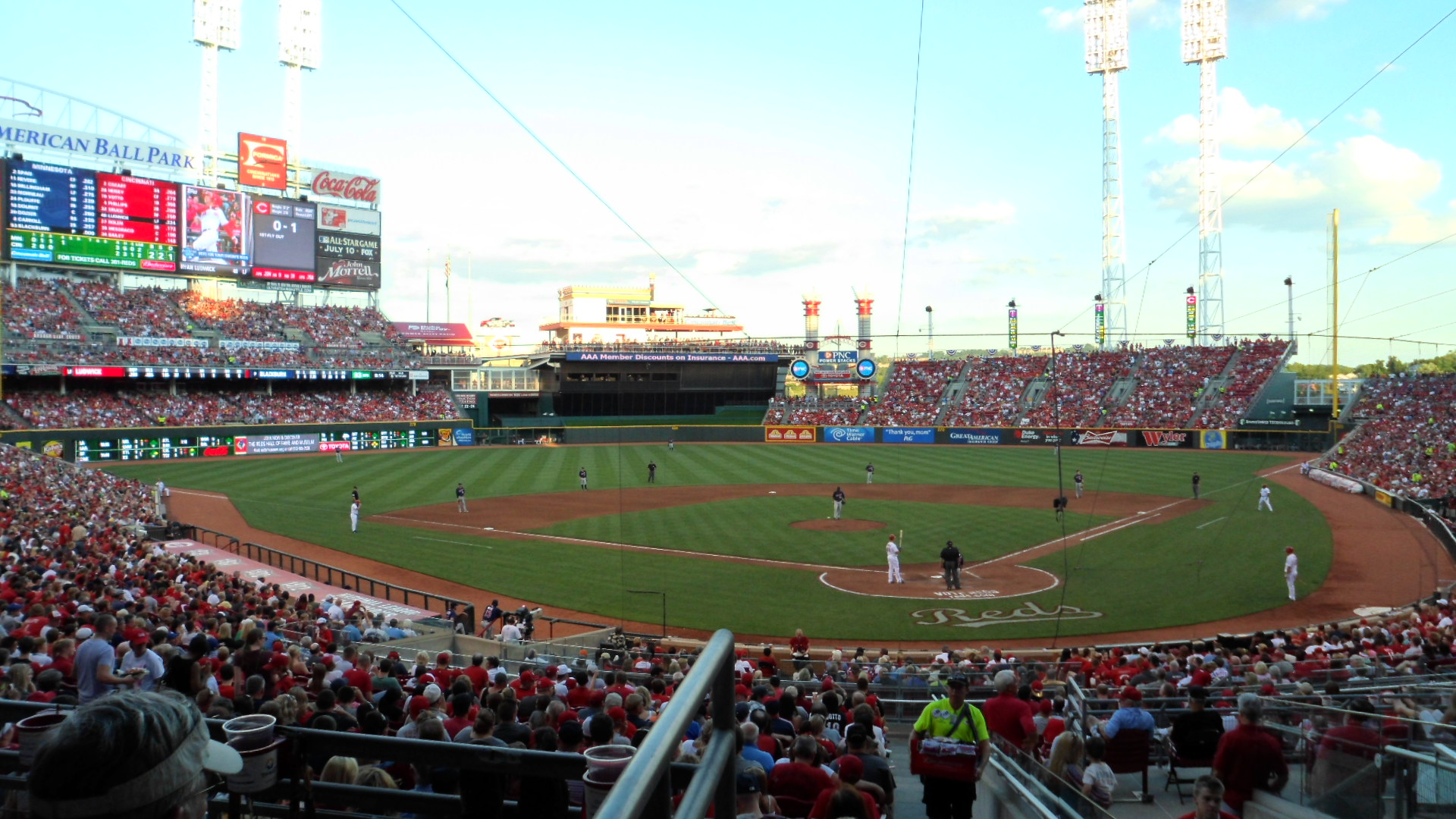
The Great American Ball Park – another great stop on the tour.

The 30th Anniversary Ballpark Tours (BPT) trek is complete – and this will be my last tour-related post.  (Back to more traditional commentary, reviews, etc. – Coming soon a review of John Grisham’s “Calico Joe;” a recipe for “Tokyo Dogs;” and a look at mid-season standings, achievements and disappointments.)


Note:  To get the chronological “feel” of the Ballpark tours trek, scroll down and being the with initial post in this series.  


The final days of the 2012 BPT trek took our band of about 40 baseball fanatics to:

Cincinnati … Where we saw our Twins slip by the Reds 5-4, despite a pair of Reds’ 2-run homers.

Chicago … Where we witnessed a see-saw battle as the White Sox topped the visiting Brewers 8-6.

Monroe, Wisconsin … Where we toured (and sampled the wares of) the Minhas Craft Brewery,

A few highlights of the final days/hours:

At our Friday game, Cincinnati was honoring the “Big Red Machine” of the ‘70s and we got to see post game interviews with George Foster, Dave Concepcion, Gary Nolan, Dan Driessen and Cesar Geronimo. Foster was particularly entertaining, as he reflected on his 1977 MVP season when he led the NL with 52 home runs, 149 RBI, 124 runs scored and posted a .320 batting average.  According to Foster, he could have plated a few more RBI if Dave Concepcion hadn’t “help up at third” so often.

The post-game interviews were followed by a fantastic fireworks show (the best most of us had seen at a ball park, or any other venue).   Other notables:  The Smokey Red Dogs made for great baseball fare; even the vendors in the stands featured steamed hot dog buns; the Twins’ young Ben Revere went 4 for 4 with a pair of stolen bases; and the Reds’ veteran Scott Rolen went 3 for 4 with a home run and a pair of RBI.   A moment to “rant” about.  In the fifth inning of a 4-3 game, Reds’ fans in centerfield tried to start “the wave,” a fortunately fruitless endeavor that they repeated in the sixth inning of a then 5-4 game.  BBRT remains steadfastly anti-wave, especially in a tight contest.

In Chicago, during Saturday’s final tour contest, we saw a combined 25 hits, 6 walks, 2 hit batsmen, 1 fielding error, 1 passed ball, 10 pitchers and 7 stolen bases in a less then cleanly played White Sox win.  On the plus side, we did witness two very well executed sacrifice bunts.

We also enjoyed another fireworks display – not up to Cincy’s standards, but still very good, well-timed to great music.   Among the food highlights were corn “off the cob” (I had mine with butter, salt and shredded mozzarella); loaded baked potatoes; and a variety of sausages (all available with grilled pepper and onions.)  On the beverage side, mango margaritas received some high praise. It was a beautiful night (some respite from the 90-degree heat) and, as usual, we had good seats (upper deck box behind home plate).  One of our group caught a T-Shirt in the between innings give-away and (as is BPT custom) quickly “gave it to a kid.”

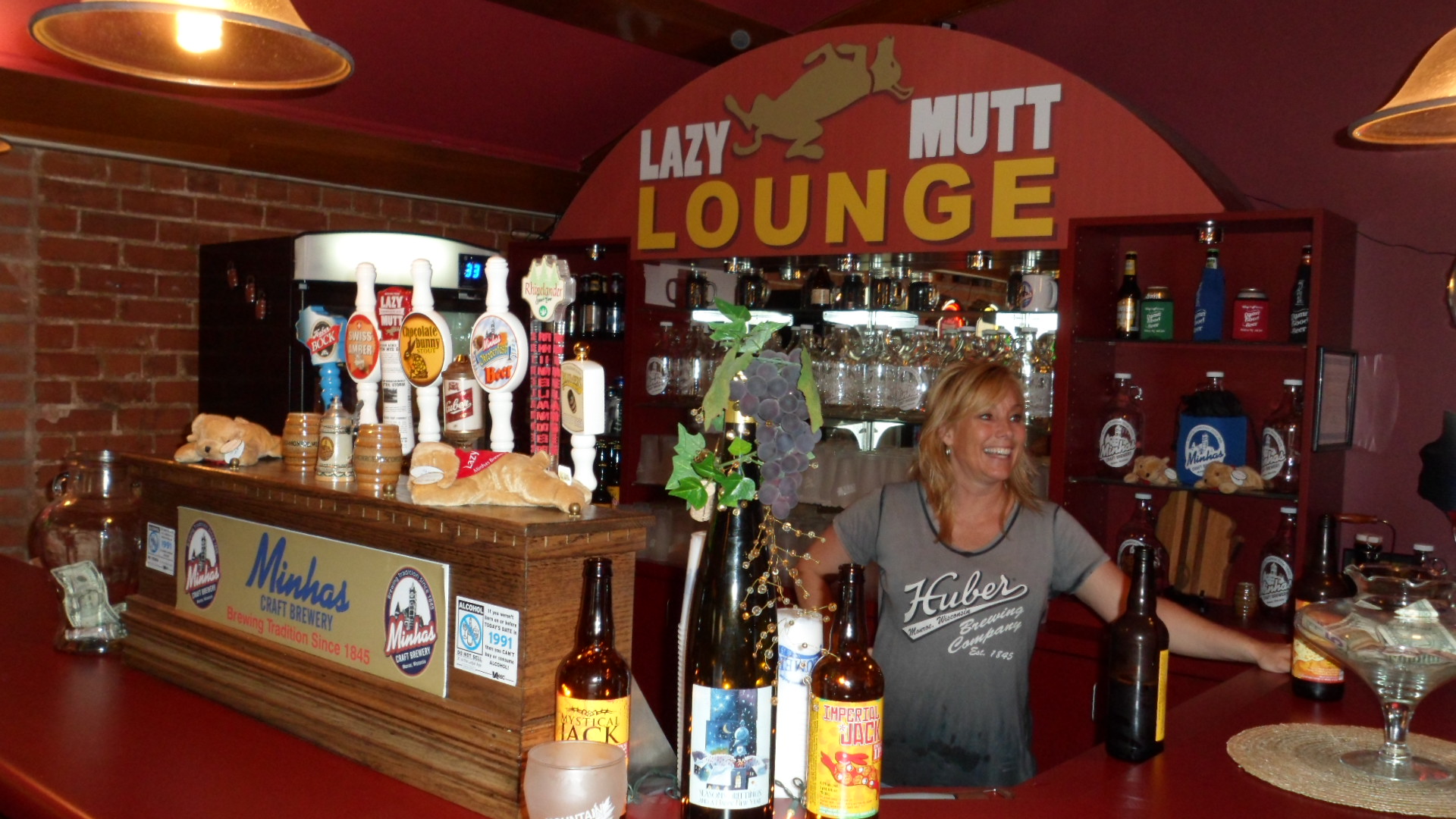
Sunday’s dash for home included a side trip off the main highway – to the small town of Monroe, Wisconsin, where we toured the Minhas Craft Brewery.  Great tour and great tasting – including the popular “Lazy Mutt” Brew and the tasty Huber Bock and Boxer Lager.  The stop in Monroe also included a visit to the Haydock Museum of Beer Memorabilia and time for lunch at one of the restaurants on the town square. I enjoyed a great burger with spicy garlic olives, Swiss cheese and horseradish mayo.  Of note, Minhas lays claim to being the oldest brewery in the Midwest (operating since 1845), now owned by the world’s youngest brewery owners (Ravinder and Manjit Minhas.)  We all received a Minhas “Damn Good Beer” glass for the tasting – with numerous refills available, as well as a five-pack (four beers and one root beer) of samples to take with us.  By the time we rolled out of Monroe, we had met and mingled with a host of locals – and several in our group were talking about coming back for Monroe’s Cheese Fest.

So, there you have it – in 9 days, a total of 205 ½ hours, my personal tally (which is representative of the group) included:

– 8 ball games … 5 major league, 3 minor league – in 5 cities in 4 states.

– 5 museums …  History, Science, Art, Bat Manufacturing, Beer Memorabilia

– 1 pregame tailgate party

– 3 fireworks displays

–  A host of freebies … A tour T-shirt; a Ball Park Tours 30th Anniversary windbreaker; a Roberto Clemente jersey; a Louisville Slugger mini-bat; a magnetic, baseball-oriented photo frame; a MLB.net mini backpack; a Minhas beer glass; a sampler five-pack (four beers and a root beer).

To wrap up BPT’s 30th Anniversary Tour, I had a great time with a lot of great people (old friends and new) who share a passion for the national past time.   How much fun are these tours?  At our Chicago hotel, a good share of the group was gathered in the bar laughing at tales of events from this trip (and a host of trips past), when the manager came over to our group.  Our first thought was that he was going to ask us to “keep it down” a bit.  Instead, he just wanted to comment on how great is was to see a group having such a good time in the lounge/bar.   That’s why Ballpark Tours is my choice for the premier baseball tour operation.

The Lazy Mutt Lounge – a highlight of the Minhas Brewery tour.


Our Literary Group Moves On – Pittsburgh and our Twins

PNC Park – beautiful place for a ball game.

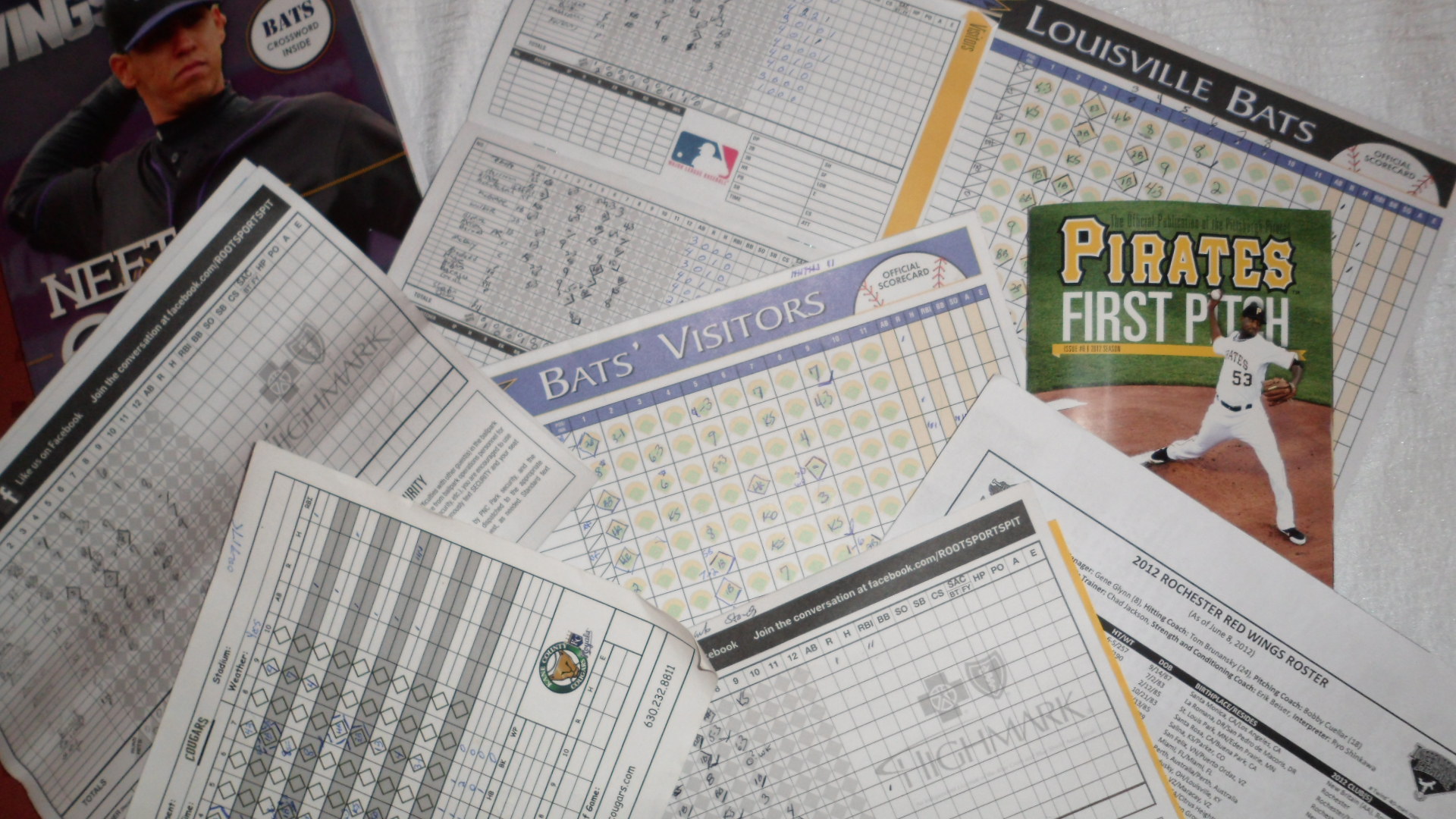
The programs and (dutifully completed) scorecards continue to mount up, as our BPT trek has moved on – through Pittsburgh to Cincinnati.  In addition, our band of bus riders continues to move through its on-trek reading material.  In this blog, BBRT will give you a look at the middle of this baseball tour, as well as what baseball fans (at least this group) choose to read.

In Pittsburgh, we witnessed a 7-2 Twins loss to the Pirates, followed by a 2-1 Twins win (on an eighth inning home run by Josh Willingham) and a 9-1 Twins loss on the final day (which prompted one of our group – in about the 7th inning – to proclaim loudly, “In the name of humanity, stop the game.”)  While we lamented the losses, we had plenty of company, as the stands held a large contingent of Twins-attired fans.

PNC Park, with the Roberto Clemente Bridge in the background, provided a beautiful setting for baseball.  We enjoyed different seats, with different vantage points for each game (down the third base line, behind the first base dugout and second deck behind home plate).  This gave our group a real flavor of the park and a chance to interact with a diverse range of Pirates fans.

Unique food flavors included stuffed Pierogies (dumplings with sour cream) and the delicious Primanti Brothers sandwiches (a meal between two slices of bread) that features your choice of cheese steak, ham and cheese and capicola and cheese – with the coleslaw and French fries mashed right into the sandwich.

Cold beer helped take the edge off the 90+ degree heat (and the Twins losses).  To add more local flavor, we were in Pittsburgh for “Pup Night” – lots of cute dogs at the ball park – and members of our group got their choice of a Roberto Clemente jersey or a Pirates hat as a group gift.  There were the usual between-inning stunts (still a sore spot with BBRT) including a Pierogi race, T-shirt toss and even the firing of hot dogs into the stands. All in all, a good ball park experience.

The Pittsburgh front office staff showed a sense of humor, picturing Minnesota players on the big scoreboard next to snow globes encasing the Twin Cities skyline, and playing “Let it Snow, Let It Snow, Let It Snow” between innings.

As usual, we stayed at a hotel close enough to downtown to enjoy the culture of the city.  I chose the Andy Warhol Museum, but other BPT-ers took bus, boat and even Segway tours.  In our free time, trekkers also visited the Carnegie Museum of Natural History, the Phipps Botanical Gardens, the Heinz Museum and Pittsburgh Zoo (among others);  rode the popular “inclines” for a better view of the city and its rivers; took the water taxi to the game; and shopped and dined at spots like Station Square, Market Square and the Strip. My lunches (all three games were evening affairs) included a spinach salad with hazel nuts, blueberries, raspberries, strawberries and feta cheese on one day, and a baked stuffed clam on another.

Basically, we enjoyed not only a great ball park, but an interesting and hospitable city.

Now, for a little on-the-bus culture.  BBRT did a survey of our BPT group, to find out what’s being read on the bus.  The results back up baseball as the most literary game, with the most literate of fans.

Here’s the list (14 non-fiction / 9 fiction) – judge for yourself:

 Non-fiction

– Baseball in the Garden of Eden – Secret History of the Early Game (John Thorn)

 – The Lady in the Tower – The Fall of Anne Boleyn (Alison Weir)

– Big Russ & Me (Tim Russert)

– On the Ground – Illustrated Annotated History of the 60’s Underground Press in the United States (Sean Stewart)

– Freakonomics (Steven Levitt and Stephen Dubner)

–  Bill Veeck – Baseball’s Greatest Maverick (Paul Dickson)

  Destiny of the Republic – A Tale of Madness, Medicine and the Murder of a President (Candice Millard)

– Moneyball (Michael Lewis)

– The First Girl Scout – The Life of Juliette Gordon Low (Ginger Wadsworth)

– Mayflower (Nathaniel Philbrick)

 – Health and Wellness Newsletter

 – D-Day (Stephen Ambrose)

– Lone Survivor (Marcus Luttrell)

October 1964 (David Halberstam)


 Fiction

 –The Art of Fielding (Chad Harbach)

– Hold Tight (Harlan Coben)

– The Mangrove Coast (Randy Wayne White)

 – 63: A Novel (Stephen King)

 – Sherlock Holmes Mysteries (Arthur Cannon Doyle)

 – Good Omen (Neil Gaiman & Terry Pratchett)

– Alias the Saint (Leslie Chartiers)

– Crewel World Framed in Lace (Monica Ferris)

 – Kill Shot (Vine Lloyd)

Yep, no Fifty Shades of Grey.  Maybe they all read it already.


Scorecards piling up.

More to come.

Ballpark Tour – Breakfast AND a Show!

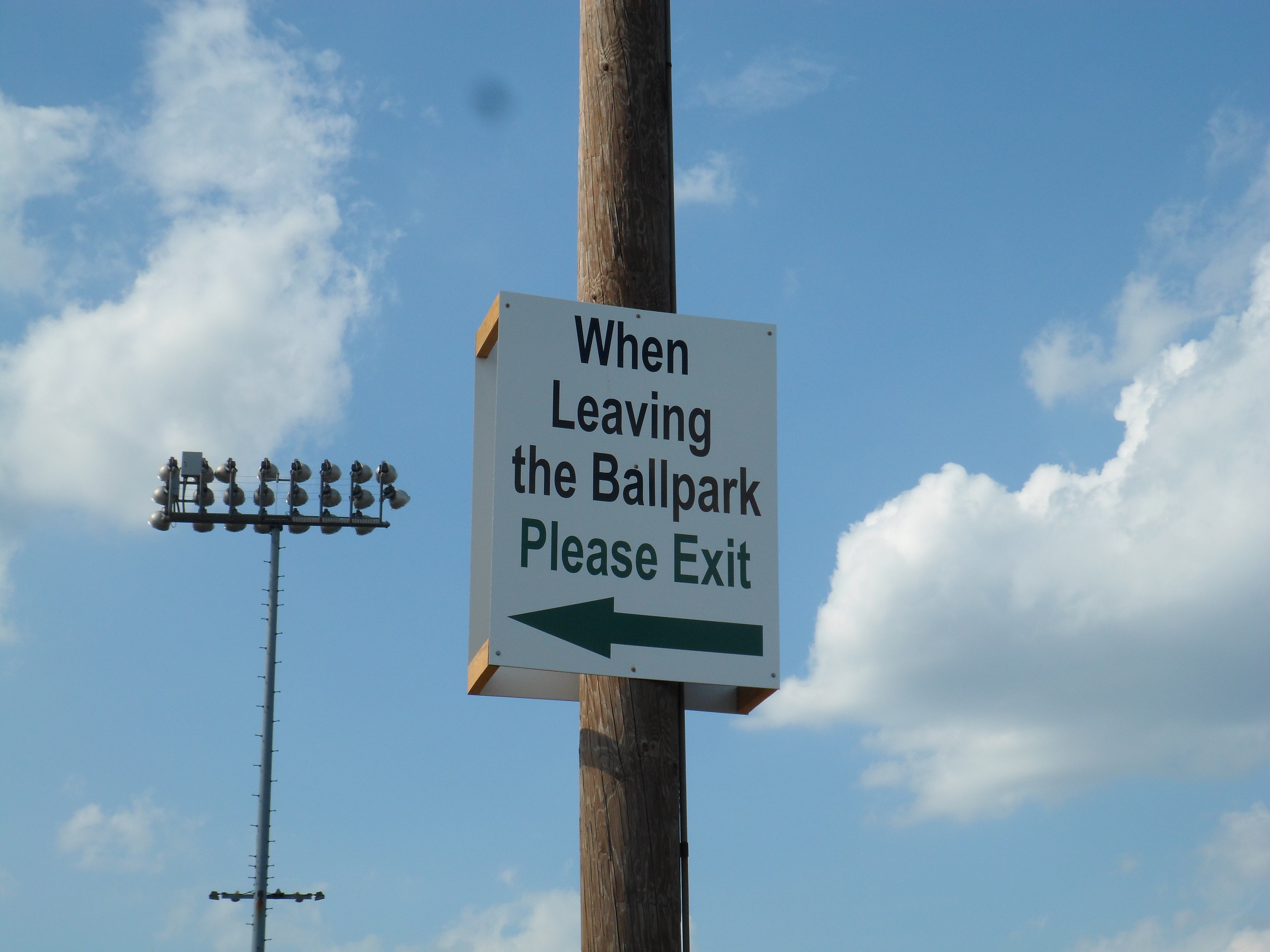
What else would you do? Enter?

Where does a sign like the one pictured here generate the greatest level of enjoyment?   That’s easy.  On a Ballpark Tours (BPT) trek.  The bigger question might be – “What else would you do when you leave?  Enter?”

On June 16, I began my annual baseball trek with Ballpark Tours – 9 days of fun (thank you, Julian) with a busload (about 35) of baseball fanatics. The trip, as noted in the previous post, was headed for Kane County, Louisville, Pittsburgh, Cincinnati and Chicago.  We’ve got Kane County and Louisville under our belts (or wheels – thanks, Dick) so far and, as usual, all is going well.  The “exit” sign, by the way, was outside Fifth Third Bank Park– the tour’s first stop and home of the Kane County Cougars.  In the next two or three posts, I’ll try to give you a flavor for what a BRT Trek is like.

We left St. Paul, MN, for Kane County (outside Chicago) at 9:00 a.m., our hands filled with a BPT 30th Anniversary T-Shirt, a special 30th Anniversary Windbreaker, the annual Baseball Triva “Kwiz” and a new twist – a competition to predict (guess)  how many runs major leaguers would score during our five weekdays of baseball nirvana.

Our first game was in Kane County (Class A ball), where we were treated to a pregame picnic (brats, hot dogs, burgers, chicken, potato salad, fruit and ice cream.)  The game was typical A-Ball, a 7-4 Kane County Cougars loss to the Cedar Rapid Kernels that featured a few too many hit batsmen, missed cut-off men, bases on balls and strikeouts – but just the right amount of drama and fun.

As is usual in lower-level minor league ball, lots of crazy entertainment in between half-innings.  “Mackerel Jordan” – a large fish in a basketball uniform who devoured everything in sight (including the bat boy) to the “Eat It!” parody of MJ’s beat it – seemed to be the tour favorite.  There was a vote or two for “Harry Canary,” prompted, apparently, by the trademark black-rimmed glasses.  In addition to filling up at the picnic, the group also fill up on souvenirs and beverages (probably in reverse order).

Day two, featured a stop at the Louisville Slugger Factory and Museum (after the Illinois-to-Kentucky bus ride), where we all got free (we love free on BPT) mini-bats and, in honor of Fathers’ Day, all the dads got special “Happy Fathers’ Day” versions.

That night’s game was Triple A, and much more crisply played (a 7-4 Rochester Red Wings win over the Louisville Bats.) Rochester is a Twins farm club, so all of us Minnesotans saw a host of familiar faces (Valencia, Nishioka, Thomas, Rivera, Waldrop).  Among minor league stops, AAA games are especially interesting.  You get to see young “risers” on their way up, current major leaguers rehabbing and waiting to come off the major league Disabled List, former productive major leaguers who have seen better times and are looking for one last shot, and players who love the game, have had a taste of the show and are giving it their best to get back.

A particular favorite in our section of the stands was 36-year-old Corky Miller (Louisville catcher) – in his 15th professional season.  Going into the 2012 season, Corky had gotten a taste of the major leagues in parts of  ten separate seasons – totaling 199 games with five teams   (Cincinnati, Minnesota, Boston, Atlanta, Chicago/AL).   He also had chalked up more than 900 minor league games with 9 teams including parts of 8 seasons (including 2012) with Louisville.  His numbers?  Doesn’t matter, he was there to play.  He’s puting his heart into the game.  And, we appreciate it.   By the way, on this particular night, Miller had two walks, a single, a fly out and an RBI.

Now, while BPT tours are about baseball, they are not all about baseball.  We stay in nice hotels, close the the local culture and night life.  We are seeing not just the ball teams, but the people and the cities.  As I awaited tonight’second game in Louisville, I also took in the Louisville Science Museum, The Frazier History Museum (saw at least 7 other “tour-ees” there) and lunch at Kentucky’s only urban winery (River Bend Winery) – a great Buffalo Chicken sandwich, homemade potato chips, a nice Meritage and a pleasing atmosphere of well-balanced “rustic elegance.”

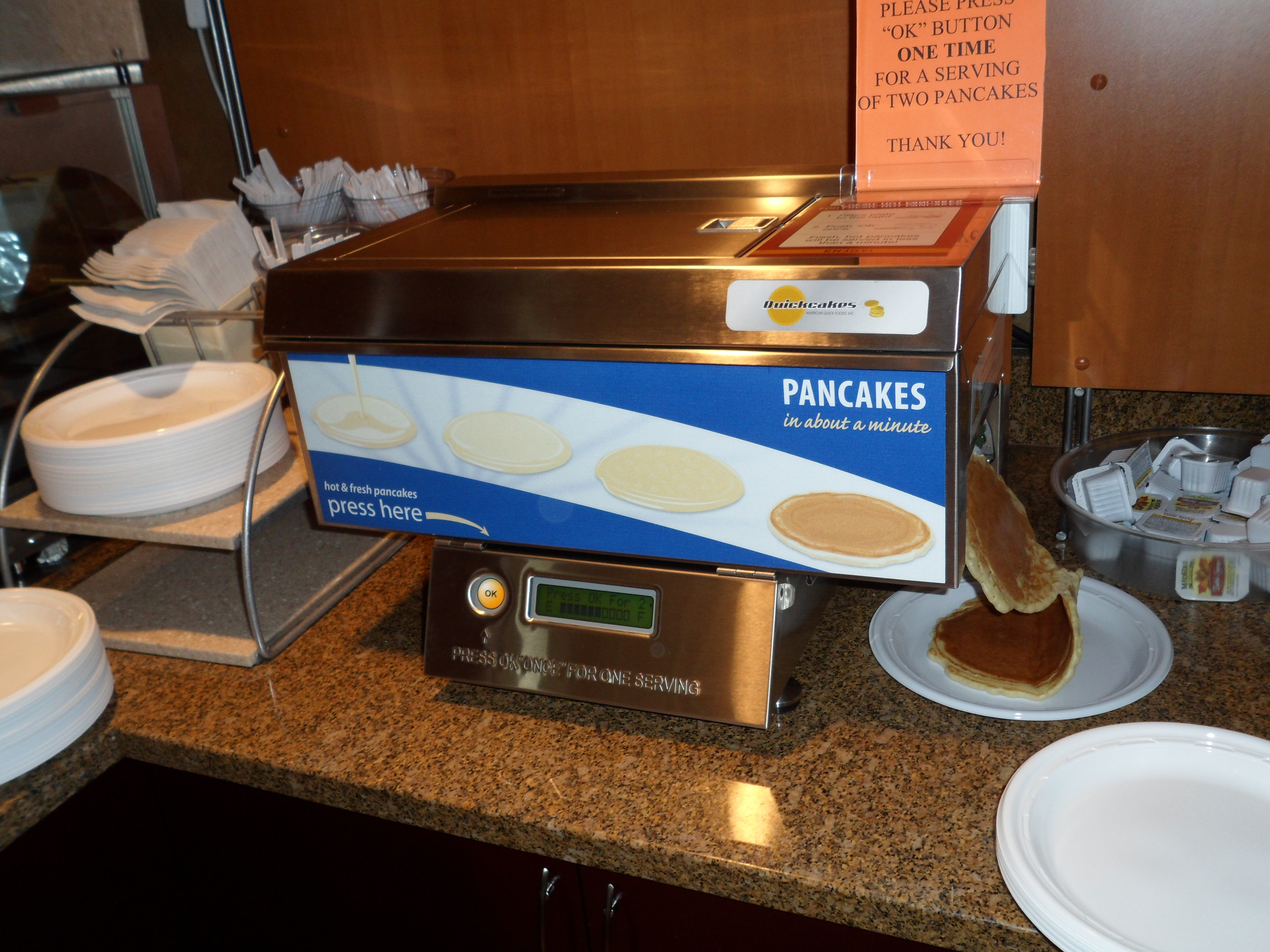
Breakfast AND a show.

Oh yes, our first hotel featured the pictured pancake machine – looked like a copy machine, but turned out two pancakes in sixty seconds, at the push of a button.  Breakfast AND a show, gotta love that.

So much is happening, I almost forgot, we’ve also been treated to a spectacular fireworks show.

More to come. (This blog falls into the “rave” category.)