Chris Davis on Pace for 648-RBI Season


Chris Davis – off to a record-setting and record-chasing start.

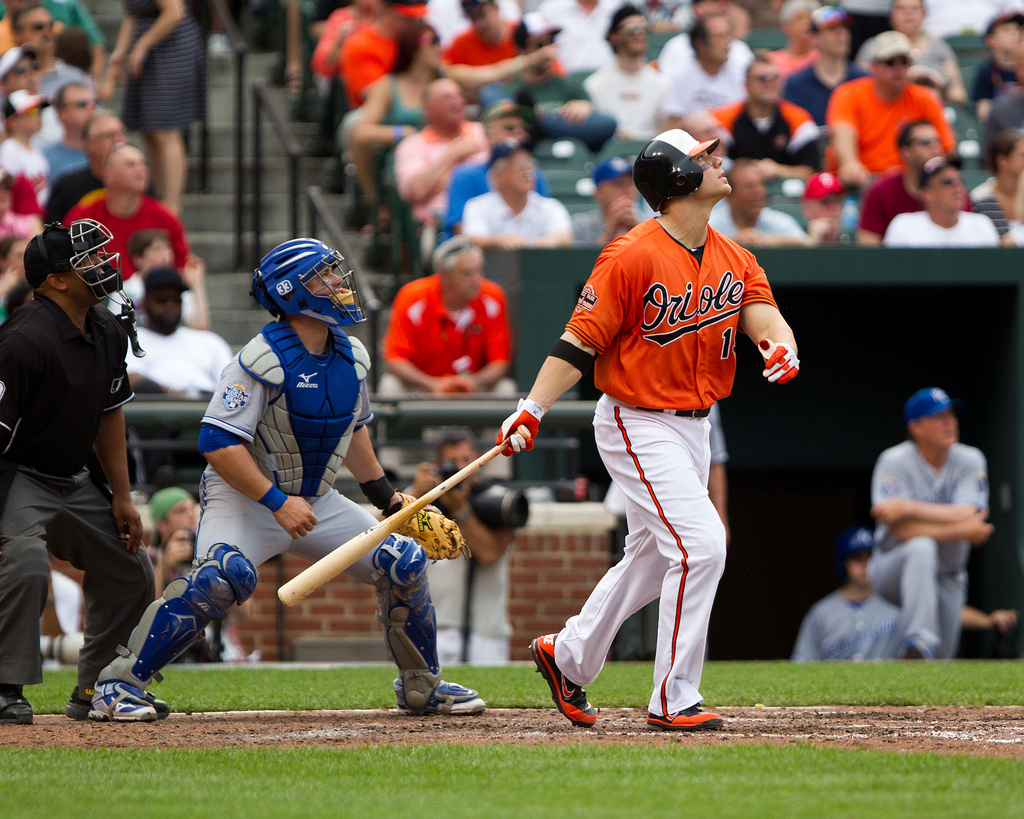
Orioles’ first baseman Chris Davis is making a lot of fantasy baseball owners – not to mention Orioles’ fans – happy.  He’s off to a blazing start.  After four games, including yesterday’s grand slam against BBRT’s beloved Twins, Davis is nine for 15 (.600 average), with four home runs and 16 RBI (more RBI than 25 of the thirty teams in MLB).

This is a truly record-setting pace.  Only three other players have started a season going deep in the first four games – Willie Mays (1971), Mark McGwire (1998), Nelson Cruz (2011).  No one has homered in the first five games of any season – so keep an eye on the Orioles/Twins today.  Davis also broke the RBI record for the first four games of a season – we do count everything in baseball, don’t we?  The previous record of 12 was shared by Dolph Camilli (1935), Mark McGwire (1998) and Charles Johnson (2000). 

Going forward, here are a few marks Davis can swing for: 

Most consecutive games with an RBI:  AL, 14 games, Tris Speaker, Philadelphia, 1928; NL & MLB, 17 games, Ray Grimes, Chicago (NL), 1922

Most RBI in April:  AL & MLB, 35, Juan Gonzalez, Texas, 1998

Most RBI any month:  NL & MLB, 61 RBI, Sam Thompson, Philadelphia, August 1894; AL, 53 RBI, Joe DiMaggio, New York, August 1939

Most consecutive games with a home run:  NL, AL & MLB, 8 games, Dale Long, Pittsburgh (NL), 1956; Don Mattingly, New York (AL), 1987; Ken Griffey, Jr., Seattle, 1993

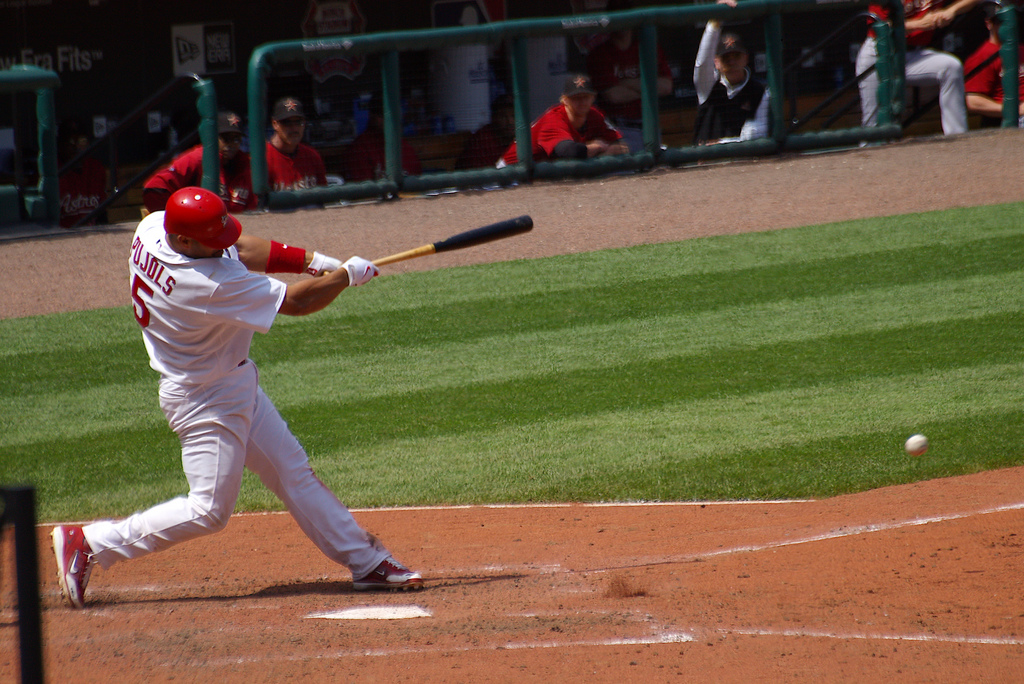
Most HR in April: AL. NL & MLB, 14 HRs, Alex Rodriguez, New York (AL), 2007; Albert Pujols, St. Louis, 2000

Most HR any month:  NL & MLB, 20 HR, Sammy Sosa, Chicago, June 1998; AL, 18 HR, Rudy York, Detroit, 1937

Chilly Beginning to Twins Season

Baseball is back in Minnesota – “cooler” than ever.

BBRT was in the stands – on the very chilly third deck – for the Twins home opening 4-2 loss to the highly-compensated Justin Verlander and the Detroit Tigers.  BBRT survived a brisk wind and temps that my IPhone indicated dropped into the twenties during the game (other sources quoted the low at 34 degrees), but came close to not surviving the $8 price tag on a cup of vendor-delivered hot chocolate.  Among the keys to my enjoyment were long underwear, two pair of gloves, boots and earmuffs – all Opening Day firsts for BBRT. All around me I saw stadium (ballpark) blankets, hoodies, hats with earflaps – and, of course, truly “ice cold” beer.  And I could have sworn I saw a couple of hitters sporting mittens instead of batting gloves.

Still it was baseball and the well-bundled crowd enjoyed the atmosphere of Opening Day.  As for BBRT, I dutifully kept my scorecard up to date until my pen stopped  delivering ink in the eighth inning, when I retreated to the already crowded (Kent) Hrbek’s Pub to catch the final nine outs on the big screen (in a crowd that drew warmth from each other).

Overall, the 3 ½-hour game was less than cleanly played, as the players, at times, seemed to have trouble getting the feel of the ball (2 errors, three wild pitches). Twins fans did get to see a lot of new faces, including the starting pitcher (Vance Worley), who proved his Minnesota-worthiness by taking the mound in bare-armed short sleeves and new leadoff man Aaron Hicks (who helped justify Verlander’s new contract with three early strikeouts).  And, there were MVPs in abundance – Verlander, Miguel Cabrera (also last year’s Triple Crown winner), Joe Mauer (also a three-time batting champ) and Justin Morneau. And, there was the tension of a close game – the Twins left twelve men on base in a 2-run game and just couldn’t seem to get the big hit (or sacrifice fly).  Having twelve batters go down on strikes will do that to you.  For BBRT, the season was officially welcomed in the second inning, with the first (witnessed by me) 6-4-3 (Florimon to Dozier to Morneau) double play.  For BBRT, double plays are a thing of beauty.

In addition, the beer was cold, the hot dogs steaming (as was my breath), the ball stark white against green grass and blue sky, the crack of the bat as sharp as ever, the scorecard cheap and informative, the home team garb plentiful throughout the sellout crowd – and there was a full slate of games being reported on the scoreboard.

So, all in all, despite the cold, there was plenty to enjoy at Target Field.  Most important, however, baseball is back!  BBRT note: Also enjoyed a truly cold pre-game brew with Ballpark Tours operator Julian Loscalzo on Cuzzy’s Bar & Grill’s outdoor patio – a markedly Minnesotan way to precede the opener.  (See www.ballparktours.net for info on this year’s trips.)  Julian’s beloved Phillies opened in Atlanta, where it was reportedly in the 70s. 

Clayton Kershaw – a shutout and a homer on Opening Day. LET THE PITCHERS HIT!

While Julian may have envied the fans in Atlanta, I was envious of those in Los Angeles, who not only enjoyed the California warmth, but saw HOFer Sandy Koufax toss out the first pitch – and then enjoyed their Dodgers beating the long-time rival Giants 4-0, behind Clayton Kershaw’s complete-game shutout.  They also witnessed Kershaw becoming the first pitcher since Bob Lemon (in 1953) to hurl a shutout and hit a homer on Opening Day.  The result reminded me – one more time – of why I still oppose the DH.  A couple of other reasons:  On June 23, 1971, Phillies’ right-hander Rick Wise no-hit the Reds at Cincinnati 4-0 (one walk, three strikeouts) and also drove in three runs with a pair of homers (he would hit six dingers that year) – making him the only pitcher to hit two homers in a no-hit performance.  Another reason?  The first National Leaguer to hit two grand slams in a single game?  Atlanta Braves pitcher Tony Cloninger, in a July 3,  1966, 17-3 road win over the Giants.  Cloninger also added a single and had nine RBI in the contest.  So, I say, let the hurlers hit.

In a final Opening Day thought – since April 1 was this year’s official Opening DAY (versus March 31, Opening NIGHT) – BBRT offers a tribute to late MLB umpire John McSherry, who suffered a fatal heart attack while working the plate at the Cincinnati Reds’ home opener (against the Expos) on April 1, 1996.  Seven pitches into the contest, McSherry called a timeout and began to walk toward the Reds’ dugout before stumbling and falling.  McSherry, a 25-year MLB umpiring veteran, had been diagnosed with an irregular heartbeat and was scheduled to see a doctor the next day. It was reported that McSherry had cancelled an earlier appointment because he didn’t want to miss Opening Day.   McSherry was rushed to a hospital, where the 51-year-old was pronounced dead about an hour later.   (The game was postponed and played, from its beginning, the following day.)

Well-respected and well-liked, McSherry worked a dozen post-season series, including the 1977 and 1987 World Series, as well as the 1975, 1982 and 1991 All Star games. He was behind the plate for Larry Dierker’s July 9, 1976 no-hitter, as well as for the 1977 World Series contest in which Reggie Jackson belted three home runs. He was also behind the plate, doing what he loved on April 1, 1996.

2013 NL Preview and Predictions

BBRT has posted its AL predictions (see post of February 28), now let’s shift to the Senior Circuit, where all three division races appear to offer some great  competition.  The East could go to the Nationals or Braves, the Dodgers seem ready to challenge the Giants in the West and the Cardinals may push the Reds in the Central.  Here is BBRT’s take on the NL.

MVP

Matt Kemp puts it all together to lead the Dodgers to the playoffs.  Kemp puts up a .300-30-100 season, and swaps 30 bags.  His main competition comes from Joey Votto of the Reds and a surprising season from the Braves’ Justin Upton.

Cy Young

The Dodgers’ Clayton Kershaw edges out the Nationals’ Stephen Strasburg and the Reds’ Johnny Cueto in a tight vote.

Rookie of the  Year

The Cardinals’ Shelby Miller wins 15 games to take the award from Travis d’Arnoud of the Mets, with the Diamondbacks Tyler Skaggs finishing a surpisring strong third.

Now for the division races:

NL EAST – Nationals

A full season of Stephen Strasburg will make the Nats even better.

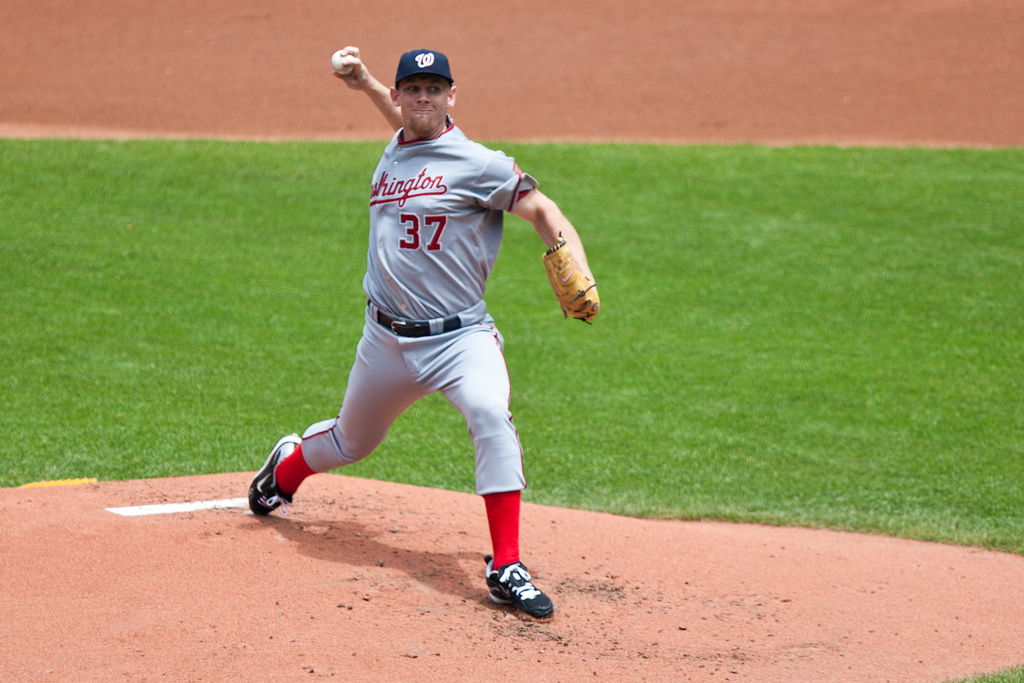
The Nationals had the best record in baseball last year, and they appear to have gotten stronger.  With the Nats, it all starts with pitching.  A full year of Stephen Strasburg (no shut down in 2013) should enable the D.C. star to top his 15-6, 3.16 season.  Then there’s 21-game winner (2.89) Gio Gonzalez, Jordan Zimmerman (12-8, 2.94), Ross Detwiler (10-8, 3.40) and newcomer Dan Haren, who had an injury-marred 2012 season with the Angels (12-14, 4.33), but who  has a 3.66 career ERA (10 seasons). The Nationals’ rotation had the lowest ERA in the NL a year ago, and they are likely to retain that crown.

The starting rotation is backed by a strong bullpen, led by closer Drew Storen (back after saving 43 games in 2011, but missing much of 2012). Tyler Clippard, who saved 32 games (3.72 ERA) in Storen’s absence, returns as a top setup man and insurance at closer.  Other key bullpen assets include Ryan Mattheus (5-3, 2.85 in 66 appearances) and Craig Stammen (6-1, 2.34 in 59 games).  Zack Duke, who looked strong in a late season call-up will handle long relief.

While it starts with pitching in the nation’s Capitol, it’s not all about pitching.  Phenom Bryce Harper (.270-22-59, with 98 runs and 18 steals) can be expected to build on his rookie season.  First baseman Michael Morse is coming off a .291-18-62 season – in just 102 games –  and outfielder Jayson Werth is recovered from a broken wrist that limited him to .300-5-31 in 81 games. Full seasons from Morse and Werth should help ease the loss of Adam LaRoche (271-33-100 last year).  Also providing offense are second baseman Ian Desmond (.292-25-73), third baseman Ryan Zimmerman (.282-25-95) and newcomer to the outfield Denard Span (.283, with 71 runs and 17 stolen bases for the Twins).

All in all, the Nationals are more than ready to defend their AL East Crown, they will be chased by (in order) the:

Braves … The Atlanta squad has a chance to upset the Nationals, using a combination of power and – like the Nationals – youth.  The offense starts in the outfield, with 23-year-old Jayson Heyward (.269-27-82, with 21 stolen bases and plenty of room to grow.)  He will be joined in the garden by newcomers Justin (.280, with 17 home runs, 107 runs scored and 18 steals for Arizona) and B.J. (.246-28-78, with 31 steals for Tampa Bay) Upton.  All three are under thirty and have the potential to push each other to greater heights in 2013.  The lineup also includes a couple of additional 23-year-olds in first basemanFreddie Freeman (23 homers and 94 RBI) and flashy fielding shortstop Andrelton Simmons, who hit .289 in 49 games last season.  Dan Uggla at second and Brian McCann behind the plate will add punch to the offense and a veteran presence in the clubhouse  – although there is a hole to file at third (Chipper Jones).

The Braves have perhaps the hardest throwing bullpen in baseball, led by closer Craig Kimbrel (42 saves, 1.01 ERA, 116 strikeouts  in 63 innings).  The difference between the Braves and Nationals is the starting rotation.  The Braves have some quality arms (Kris Medlen, Tim Hudson, Pat Maholm, and Mike Minor, with Julio Teheran and Randall Delgado fighting for a spot), but they have not proven the abilty to perform at the Nationals’ level.

Phillies … The Phils can keep it interesting behind the arms of Roy Halladay, Cliff Lee and Cole Hamels – as good a top three as there is in baseball.  The bullpen, beyond Jonathan Papelbon and newcomer Mike Adams, is suspect and the offense is starting to show  its age.   Comeback seasons from Ryan Howard and Chase Utley would go a long way toward making the Phillies a force in the pennant race.

Mets … The Mets have David Wright (.306-21-93) and Ike Davis (.227-32-90) to power the offense, as well as high hopes for rookie catcher Travis d’Arnaud (acquired in the trade of Cy Young  winner R.A. Dickey) – but a lot of holes to fill beyond that. 

Marlins … Fire Sale – come to see Giancarlo Stanton hit long bombs …  enough said.


NL Central – Reds

Joey Votto will power the Reds.

The Reds should repeat as NL Central Champs, but not without a fight from the Cardinals.  The Reds return a strong rotation and a solid everyday lineup.  In fact, during the offseason, the one thing the Reds truly were shopping for was a leadoff hitter.  They got one in the Indians Shin-Soo Choo (.283-16-67, with 21 steals for the Indians), who will patrol centerfield in 2013.

The middle of the lineup is once again strong:  first baseman Joey Votto (.337-14-56 in 111 games); left fielder Ryan Ludwick (.275-26-80); and right fielder Jay Bruce (.252-34-99).  With Choo leading off, second baseman Brandon Phillips will add power and speed (.281, 18 homers, 15 steals) from the number-two spot in the order.  At the bottom of the order, frosting on the cake, third baseman Todd Frazier and shortstop Zack Cozart contributed a combined 34 roundtrippers.

This 2013 squad has the ability to put runs on the board – and they have the ability to keep the opposition at bay as well.

The starting rotation is solid, with four starters topping 200 innings.  Number-one is Johnny Cueto, still improving at age 27 and coming off a 19-9, 2.78 season.  Then there’s Mat Latos (14-4, 3.48), Homer Bailey (13-10, 3.68) and Bronson Arroyo (12-10, 3.74).  Most likely joining, and improving, the rotation in 2013 is fire-balling reliever Aroldis Chapman.

The bullpen will be led by Jonathan Broxton, who saved 27 games with the Royals and Reds in 2012.  Support will come from the likes of Sean Marshall (5-5, 2.52, 9 saves in 73 appearances; Jose Arrendondo (6-2, 2.95 in 66 appearances); Alfredo Simon (3-2, 2.66 in 36 appearances; and Logan Ondrusek (5-2, 3.46 in 63 appearances).

Very simply, “The Red are Ready.”  This is a good team, top to bottom, and should repeat as Division champs, followed by the:

Cardinals … The loss of Chris Carpenter is a tough blow, but the Cardinals still have quality pitching with Adam Wainwright, Lance Lynn and Jake Westbrook (a combined 45 wins last year) and  potential Rookie of the Year Shelby Miller expected to make the rotation.  The starters are supported by a solid bullpen, led by closer Jason Motte (42 saves a year ago).  Offensively, Matt Holiday, Carlos Beltran, Yadier Molina, David Freese and Allen Craig all topped 20 home runs in 2013.  The Cards should keep it interesting

Pirates … Every year I expect them to break .500, maybe this is the year, but now I doubt it. It’s really the Andrew McCutchen and Garret Jones show on offense – and A.J. Burnett and Wandy Rodriguez on the mound.  In 2013, newcomer (C) Rusell Martin should boost  the offense and  good seasons by Pedro Alvarez and Neil Walker would help.  There seems to be more hope than help after A.J. Burnett and Wandy Rodriguez in the competition for the starting rotation.   

Brewers … The Brewers will go as far as their offense (Ryan Braun, Corey Hart, Aramis Ramirez) will take them – and drop as far as their pitching  will pull them (Yovani Gallardo will lead a relatively inexperience and unproven starting staff – supported by a bullpen that added fuel to plenty of fires a year ago). 

Cubs …  The Cubs have been headed in the wrong direction – winning fewer games each season since their 2008 playoff appearance.  2013 doesn’t look to reverse that trend.  Still, there are Anthony Rizzo’s bat, Darwin Barney’s glove, Starlin Castro’s speed to watch and Wrigley Field and Wrigleyville to enjoy. Just don’t expect too many wins.


NK WEST – Giants

Buster Posey to help Giants repeat.

It starts with pitching for the defending West Division champs – and there is enough of it to enable the Giants to defend the crown.  First is often unsung Cy Young candidate Matt Cain (16-5, 2.79).  Number-two is lefty Madison Bumgarner  (16-11, 3.37) – as good a right-lefty combo as you’ll findin the NL.  Three and four are Ryan Volgelson and Barry Zito, who won 14 and 15 games respectively in 2012.  The wild card is two-time Cy Young Award winner Tim Lincecum.  The wheels came off last year (10-15, 5.18) and the Giants still led the Division.  If the 29-year-old rights the ship, the Giants’ vaunted rotation gets even stronger.

With Brian Wilson gone, the bullpen is a little less set.  Sergio Romo 4-2, 1.79, 14 saves) has the advantage, but he’ll get plenty of support (and competition) from Santiago Casilla (7-6, 2.84, 25 saves).  Also in the pen are quality veterans Jeremy Affeldt and Javier Lopez.

The offense is not as potent as the pitching, but there is enough to get the job done.  At the 2-4-5 spots, the Giants have hard hitting (but injury prone) Pablo Sandoval, MVP Buster Posey and the overlooked Hunter Pence (.253-24-104 with the Phillies and Giants).  Setting the table are (CF) Angel Pagan and (2B) Marco Scutaro – who both had  career years in 2012.  Also contributing is the improving Brandon Belt.  Another Brandon – shortstop Brandon Crawford – solidified the infield with Gold Glove-caliber defense.  Ultimately, it’s not a flashy, star-powered offense, but it has the pieces to get the job done.  Following the Giants will be:

Dodgers … If things go right, the Dodgers (with MLB’s highest payroll) could unseat the Giants.  There is star power in LA, and not just in Hollywood.

Let’s start with the lineup.  The heart of the order is slated to include Adrian Gonzalez (1B), Matt Kemp (CF), Andre Ethier (RF) … a formidable trio, but not  without issues.  Kemp – with the potential to be a Triple Crown candidate (with speed) – is coming back from offseason elbow surgery and Gonzalez is still figuring out how to hit in Dodger Stadium.  Joining this trio as run-makers are shortstop Hanley Ramirez (.257-24-92, with 21 steals for Miami and LA) and speedy Carl Crawford (coming off elbow surgery). What makes this team even more interesting is bench strength – Jerry Hairston, Jr., Skip Schumaker, and Nick Punto are a high-quality, versatile bunch.

The rotation is sound – but just as the Giants don’t have the offensive stars of the Dodgers, LA’s stardom does not go as deep on the mound.  Still Cy Young candidate (maybe favorite) Clayton Kershaw, newly acquired Zack Grienke, Josh Beckett, Chad Billingsley and Korean Baseball sensation Hyun-Jin Ryu should keep the Dodgers in the race. The bullpen is also deep, with closer Brandon League and a support staff of Kenley Jansen, Javy Guerra and J.P. Howell.

If Crawford and Kemp are healthy and Grienke earns his contract, LA and SF will likely change places … both teams should make the playoffs.

Diamondbacks … Make no doubt about it, this is a pretty good team – just unfortunate to play in the NL West – and newcomer (in the Justin Upton trade) Martin Prado’s bat, versatile glove and attitude will make them better.  Prado – who played five positions last year – should take over third base for the Snakes.  With Atlanta in 2012, he hit .301 (he’s topped .300 in four of the last five seasons and has a .295 career average), with 10 home runs, 70 RBI, 81 runs and 17 steals.  He’ll probably slip into the five- or six-hole in the D-backs’ lineup, which includes quality reliable bats in catcher Miguel Montero (.286-15-88), outfielder Jason Kubel (.253-30-90), still improving first baseman Paul Goldschmidt (.286-20-82) and outfield Cody Ross (.267-22-82), along with platesetters Aaron Hill and Adam Eaton.

The rotation is solid, if not spectacular, led by righty Ian Kennedy (15-12, 4.02 – and a 21-game winner in 2011) and young lefty Wade Miley (16-11, 3.33), runner up to Bryce Harper for NL Rookie of the Year.  Trevor Cahill, Brandon and Patrick Corbin will round out the rotation.  The bullpen is in good hands with closer J.J. Putz (77 saves in the past two seasons), Health Bell and Brad Ziegler.

Padres … The offense is led by third baseman Chase Headley, who broke out with a .286-31-115 season (17 steals) – despite playing a pitcher’s park.  The offense drops off pretty fast.  Only one other Padre topped 50 RBI, rookie first baseman Yonder Alonso (.273-9-62) and only one other Padre reached 10 home run (Carlos Quentin, .261-16-46 in 86 games).  A full season of Quentin would help the Padres and provide some protection for Headley.  The pitching staff is without a true ace, Clayton Richard led the way with a 14-14, 3.99 record, followed by Edison Volquez at 11-11, 4.14.  It’s not a good thing when you play in one of MLB’s most pitcher-friendly parks and still have concerns about your rotation.  Huston  Street heads fairly strong bullpen (Luke Gregerson, Dale Thayer, Brad Bach). 

Rockies … The Rockies are long on offense (Carlos Gonzalez, Troy Tulowitski,  Todd Helton, Wilin Rosario, Micheal Cuddyer) if they are healthy.   Helton, Gonzalez and Tulo all fought the injury bug last season.  Pitching, however, is another story.  Yes, it’s Coors Field, but Colorado starters rang up MLB’s highest ERA at 5.81.  No starter reached 120 innings and reliever Rex Brothers led the team with eight wins.  The relief staff, led by closer Rafeal Betancourt (31 saves) is adequate – but suffers the consequences of overwork (the Rockies set an MLB record  with 657 relief innings last season.)  Still Betancourt, Brothers, Matt Belisle and Wilton Lopez are a game bunch out of the pen. A little improvement in the rotation would move the Rockies past the Padres. 


Wild Cards – Dodgers, Braves

NL Champions – Nationals

AL Division Winners – 2013 Predictions


The next couple of posts will take a look at BBRT’s annual “predictions,” starting with the American League – where I expect quite a shakeup at the top, including a playoff scenario that does not include the Red Sox (new attitude, not as much talent) nor the Yankees (age and injuries catching up).  First the individual awards, then the Division Winners and Wild Cards

MVP – Evan Longoria

Longoria puts in a full season and leads the Rays to a Wild Card spot.  He edges out Mike Trout and Albert Pujols of the Angels (who suffer the fate of playing on a team with three potential MVP’s – Trout, Pujols, Hamilton) and Miguel Cabrera, who splits support with Justin Verlander and Prince  Fielder.  Supporting evidence?  In 2012, the Rays were 47-27 with Longoria in the lineup, 43-45 without him. 

Cy Young – Justin Verlander

Justin Verlander brings home the trophy, finishing in the top three in pretty much every pitching category.  His main competition comes from the Rangers’ Yu Darvish and the Angels’ Jered Weaver

Rookie of the Year – Jurickson Profar

In a close race, Rangers’ switch-hitting infielder Jurickson Profar’s combination of power, speed and defensive ability enables him to not only earn an early season spot in the everyday lineup, but also to squeak by Rays outfielder Wil Myers in the ROY race.

Now for the Division Winners:

WEST – Angels

Albert Pujols will have even more help in the Angels lineup this season.

Once again, the Angels went big on the free agent market – adding Josh Hamilton to a line-up that already featured Albert Pujols, Mike Trout and Mark Trumbo.  Last season, that quartet put up 135 home runs and drove in 411 runners.  The Angels also have some speed, with Trout’s 49 steals, second baseman Kendricks’ 14 and shortstop Erick Aybar’s 20.  The starting pitching is solid at the top with Jered Weaver and C.J. Wilson, but it gets a bit thin at 3-5 (Jason Vargas, Tommy Hanson and Joe Blanton).  Of greater concerns is whether the relief corps goes deep enough with off-season acquisition Ryan Madson (tabbed as closer) recently suffering a setback in his Tommy John rehab.  Ernesto Frieri seems ready to fill that gap, having saved 23 games a year ago (80 strikeouts in 54 innings).  Still, BBRT thinks the offense will be enough to bring the Angels home in first place this  time.  The rest, in order of finish:

Rangers … Still plenty of offense (Adrian Beltre, Nelson Cruz, David Murphy, Elvis Andrus and Ian Kinsler) and pitching (Yu Darvish, Matt Harrison, Derek Holland and Joe Nathan.  But losing Josh Hamilton and missing out on Zach Grienke  will see them falling short.

A’s … Young pitching may keep them in the race, but not much offense after Yoenis Cespedes, Josh Reddick and Brandon Moss.

Mariners … Everything pretty thin after King Felix.

Astros … New league, same result.


EAST-Blue Jays

R.A. Dickey takes his knuckler … and Cy Young credentials … to the Blue Jays.

Used to be the off-season for the AL East was all about the Yankees and Red Sox making move and counter move in an effort to finish at the top.  Move over tradition – the Blue Jays are here.  There was the 12-player trade with the Marlins that brought Toronto the likes of shortstop Jose Reyes (considered to have had a bit of an off season in 2012, despite going .287, with 11 home runs and 40 steals); second baseman Emilio Bonifacio (30 steals in 2012); and a pair of solid starting pitchers in innings-eating lefty Mark Buehrle (13-13, 3.74) and Josh Johnson (8-14, but with a 3.81 ERA last season).  Then they added the NL Cy Young Award winner R.A. Dickey from the Mets.  Also new to the team is Melky Cabrera, out to prove his solid pre-suspension numbers for the Giants weren’t all PED-related.

These new cast members joined holdovers like righty Brandon Morrow (10-7, 2.96 in 21 starts); power-hitting Edwin Encarcion and Jose Bautista; and third-baseman Brett Lawrie (just 23), who went .273-11-48 in his first full season in the bigs.  The supporting cast looks just fine as well.  Catcher J.P. Arencibia contributed 18 roundtrippers and 56 RBI; and outfielder Colby Rasmus added 23 homers and 75 RBI.

The bullpen, led by Casey Janssen (1-1, 22 saves, 2.64 and 67 strikeouts in 64 innings), Sergio Santos and Darren Oliver may not have “star power,” but should be strong enough to help move the revamped Jays from last year’s 73 wins to 91 and first place in a very tight AL East.  The rest of the Division: 

Rays … Quality pitching and a full season of big banger Evan Longoria keeps them in the race, but they’re one bat short.

Yankees … Still a lot of talent on this squad, but age and injury  take their toll.

Red Sox … Clubhouse attitude should be vastly improved, product on the field just enough to climb out of the cellar.

Orioles … 2012 Cinderella team here’s the clock strike midnight.  No true ace on the pitching staff (Wei-Yin Chen led starters with 12 wins last year) and – despite balanced lineup, the Orioles comes back to reality.  Two things not likely to repeat:  a 29-9 record in one-run games and 51 saves from Jim Johnson (although 40 is a real possibility).  


AL CENTRAL – Tigers

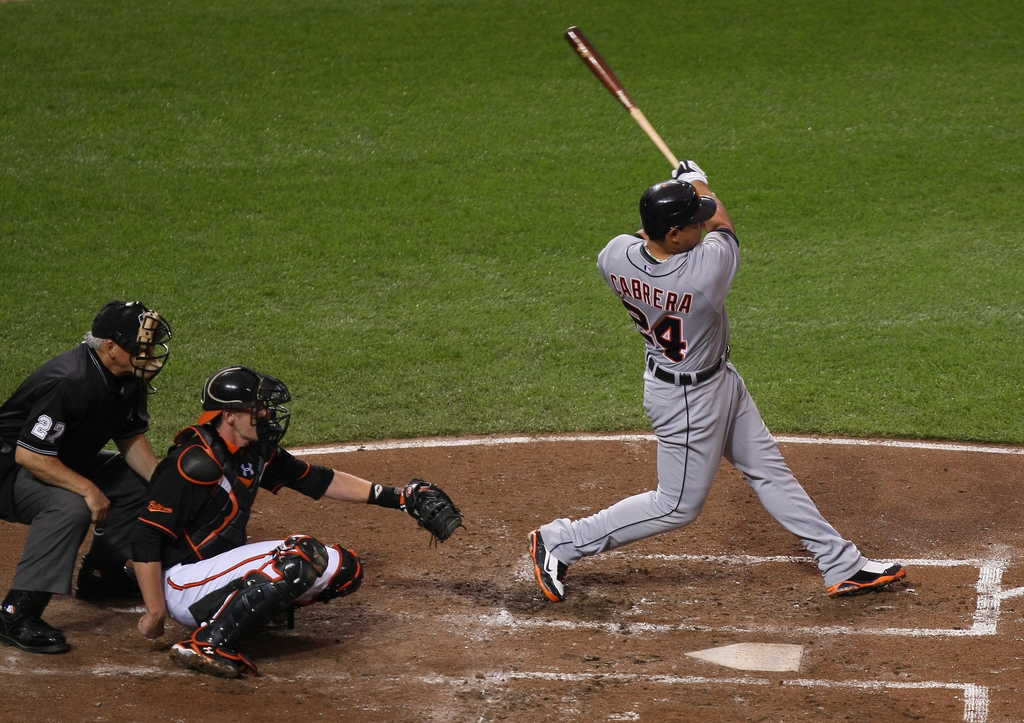
Miguel Cabrera will help power the Tigers back to the World Series.

Not much contention here.  Whether it’s power bats or power arms, the Tigers have what they need to take it all in the AL Central.  The offense is led (at the corners) by Triple Crown and MVP winner Miguel Cabrera (.327-44-139) and Price Fielder (.313-30-108), while the pitching staff boasts consistent Cy Young candidates Justin Verlander (17-8, 2.64) and Max Scherzer (16-7, 3.74) – who finished 1 & 2 in the AL strikeout race.

Offensively, the Tigers also expect solid contributions from centerfielder Austin Jackson in the leadoff spot (.300, with 103 runs, 16 home runs and 16 stolen bases a year ago.) They let post-season hero Delmon Young slip away in the off season, but added veteran outfielder Torii Hunter, who comes into the season at 37-years-old – but also off a .313-16-92 season with the Angels.  He should more than make up for Young’s loss at the plate, in the field and in the club house.  The Tiger are also excited about Andy Dirks and Avisail Garcia (27- and 22-years-old, respectively) – who both performed well in limited time last year. 

The coming season will also see the return of Victor Martinez (at DH), who missed all of last season (knee surgery).  In 2011, Martinez, with a lifetime .303 average over ten seasons, hit .330, with 12 home runs and 103 RBI.  A return to even near-form would be like adding a premier free agent.  At the bottom of the lineup, you’ll likely find steady shortstop Jhonny Peralta, catcher Alex Avila and second baseman Omar Infante, who will hold their own. 

Getting back to the starting rotation, 3-4-5 look to be Doug Fister, Anibel Sanchez and either Rick Porcello or Drew Smyly.  With the offense the Tigers bring to the plate, that rotation should be more than enough.

The only question mark is the relief staff.  The Tigers let closer Jose Valverde leave via free agency and the leading candidate to replace him appears to be 22-year-old flame-throwing rookie Bruce Rondon – who moved from A to AA to AAA a year ago, going a combined 2-1, 1.53 with 29 saves and 66 punch outs in 53 innings.  There’s plenty of experience in the rest of the pen, with Octovio Dotel, Joaquin Benoit and Phil Coke.  But, if Rondon falters, it wouldn’t be surprising to see the Tigers go out and get a bonafide ninth-inning hurler.

All in all, Detroit is a well-balanced squad that should easily win the Central – followed by:

White Sox … Solid starting pitching (Chris Sale, Jake Peavy, John Danks, Gavin Floyd) and some Punch in the lineup (Paul Konerko, Adam Dunn, Alex Rios and youngster Dayan Viciedo), plus off-season pickup (3B) Jeff Keppinger (.325 with the Rays last year) help keep the White Sox in the race.  Still the Sox have more questions (Danks’ recovery from surgery, Konerko’s age, can Flowers replace Pierzynski) and less talent up and down the roster than the Tigers.  

Royals … Took steps forward in the off-season, but after newcomers true “ace” James Shields and Wade Davis, the starting rotation lacks a record of consistency.  Still, a strong  bullpen and the bats of Alex Gordon, Billy Butler and Alcides Escobar should keep them at or near .500.  To go further, they need more from high-potentil corner  infielders Eric Hosmer and Mike Moustakas and a return to form at the back end of the rotation (Ervin Santana, Bruce Chen, Jeremy Guthrie).

Indians … The tribe made strides on offense with the addition of Nick Swisher and Micheal Bourn and they are strong up the middle with (c) Carlos Santana, (2B) Jason Kipnis, (SS) Asdrubal Cabrera and newly acquired speedy center fielder Drew Stubbs.  Questions remain at the corners and in the rotation – number-two looks like Ubaldo Jimenez (9-17, 5.4o last season).

Twins … The Twins’ off-season moves appear good for the future, but the outlook for 2013 is not as bright.  A revamped pitching staff  looks to include acquisitions Vance Worley, and Mike Pelfrey – both coming off surgery – as is holdover Scott Diamond, the Twins’ best 2012 starter.  Could be a lot of work for a solid bullpen, led by closer Glen Perkins. There is some potential in the lineup with former MVPs Justin Morneau and Joe Mauer, slugging outfielder Josh Willingham and steady Ryan Doumit.  Still, there are questions in the infield and center field (where the Twins traded away Denard Span and Ben Revere). But there is hope on the horizon, with prospects like pitchers Trevor May, Alex Meyer and Kyle Gibson (who could make the 2013 rotation) and infielder Miguel Sano in the wings.  

Wild Cards:  Rangers and Rays.

 AL Champion:  Tigers … Verlander and Scherzer provide the edge, as two offensive juggernauts (Angels/Tigers) face off. 

Coming soon … a look at the NL. 

BBRT’s Hall of Fame Balloting – I Stand Corrected

This year, as I noted with disappointment in my January 9 post, the Baseball Writers Association of America threw a shutout in the Hall of Fame balloting. While the steroids era “tainted” the 2013 election process, I felt that there were candidates who deserved election – and that the BBWAA could have made more of a statement by voting in a “clean” candidate or two and denying the “suspect” superstars on the list. I was pretty sure that most fans would feel pretty much the same way – and that a fan vote would have turned out differently. With that in mind, I sent out my own ballot – to Ballpark Tours Hot Stove League Banquet and Annual Tour participants, fantasy baseball league opponents and baseball-fan friends. The results are in – and I stand corrected.

BBRT voters put more zeroes up on the 2013 Baseball Hall of Fame scoreboard.

With just over 50 ballots in, the results of the BBRT balloting were not that different from the official BBWAA vote – and no one was elected. In the BBRT ballot, Craig Biggio topped all candidates with 65.3% of the vote, just as he topped the BBWAA ballot at 68.2%. Jack Morris and Mike Piazza tied for second on the BBRT ballot at 61.5%, while in the official voting, Morris finished second (67.7%) and Piazza fourth (57.8%). The main outlier at the top of the ballot was Jeff Bagwell, who finished fifth in the BBRT vote, but with only 38.5%, while the writers has him third at 59.6%.

BBRT voters were a bit harder than the BBWAA on PED-suspect candidates: Here are some notable with the BBRT vote percentage followed by the BBWAA percentages: Barry Bonds (19.2/36.2); Roger Clemens (19.2/37.6); Mark McGwire 15.4/16.9); Sammy Sosa (11.5/12.5); Rafael Pameiro (11.5/8.8).

I did take part in another mock ballot this year – conducted by the national Baseball Bloggers Alliance. In that vote, one candidate – Jeff Bagwell – was elected, with 76% support. As in the BBRT and BBWAA votes, Biggio and Piazza finished close with 69% each, but Morris fared much worse at only 32% (not too many folks who attended Game 7 in 1991, apparently). The suspect list also fared better with the blogger group.  Bonds got 62%, Clements 56%, McGwire 35%, Sosa 21% and Palmeiro 15%. Also of interest to me was the fact that Lee Smith, who captured 57.6% of the BBRT votes and 47.8% of the writers’ ballots, got only 25% from the bloggers’ group. (Visit the Baseball Bloggers Alliance Website for the full results of thee vote. )

BBRT saw three prevailing attitudes in the balloting, in the following order of frequency (I’ll share some of the comments I received at the end of this post):

1) Don’t let the suspects in, but I will vote for a couple of qualified “clean” candidates;

2) Don’t let the suspects and there are no candidates I see worthy of first-ballot election, and few or no returning candidates that really command my vote;

3) Let the records stand for themselves, as long as MLB has not declared candidates ineligible, like Pete Rose and Shoeless Joe Jackson, I will vote based on the numbers;

4) I think the game’s gone bad and here’s a blank ballot in protest.

So, here are the final BBRT results, with each candidate’s vote percentage followed by the BBWAA’s official tally:

Craig Biggio – 65.3% (68.2)

Jack Morris – 61.5% (67.7)

Mike Piazza – 61.5% (57.8)

Lee Smith – 57.6% (47.8)

Jeff Bagwell – 38.5% (59.6)

Edgar Martinez – 30.7% (35.9)

Alan Trammel – 30.7% (33.6%)

Roger Clemens – 19.2% (37.6)

Barry Bonds – 19.2% (36.2)

Curt Schilling – 19.2% (38.8)

Tim Raines – 19.2% (52.2)

Don Mattingly – 15.4% (13.2)

Mark McGwire – 15.4% (16.9)

Sammy Sosa – 11.5% (12.5%)

Larry Walker – 11.5% (21.6)

Rafael Pameiro – 11.5% (8.8)

Dale Murphy – 7.7% (18.6)

Bernie Williams – 7.7% (3.3)

Fred McGriff – 3.8% (20.7)

Julio Franco – 3.8% (1.1)

Note: The following BBWAA vote-getters did not get votes in the BBRT balloting: Kenny Lofton (3.2%, BBWAA) and Sandy Alomar Jr. (2.8%).

To wrap up, here excerpts from some selected comments BBRT received with its ballots.

I’ve got a real problem with voting for suspected PED-users – particularly on the first ballot. Beyond that I find this year’s HOF class uninspiring – and look forward to next year with Maddux, Glavine and the Big hurt eligible.    BK

If there was ever a year to justify a shutout, this would be it. It’s a pretty uninspiring ballot, all the more compared to recent years and what’s to come. On the drug issue, at this point I’m not willing to vote for them – realizing that ‘them’ is a slippery slope in some cases. My view may change over time as we have a longer historical lens and more knowledge with which to work. In 10 years, will I feel differently about Bonds or Clemens? Can’t answer that.

One other thing: I really believe there’s a distinction between a Hall of Famer and a “first-ballot Hall of Famer,” … I think that first-ballot election signifies being among the elite of the elite in all criteria of the game: Voting shall be based upon the player’s record, playing ability, integrity, sportsmanship, character, and contributions to the team(s) on which the player played.   HS

I’m tired or reading about drugs and money, rather base hits.  They’re spoiling the game, so I vote a blank ballot.   LW

I believe that the steroid users should never get in. If they can continue to keep Pete Rose out for gambling and refuse to acknowledge his accomplishments on the field sans drugs, then there is no way there is justification for putting the druggies in. I don’t care how many others do it and I don’t care how it enhances performance.  KC

Why doesn’t MLB take these guys off ballots? It seems to me that they asking voters to make up minds for MLB. Bud needs to step up and deny these guys (entry) into HOF as a ban.  PC

I agree with the MLB Baseball writers in not electing players into the hall every year. I think that there are some players that should be in, Jack Morris, Jim Kaat but the vote is the best process that can be used and if they do not concur for that year than so be it. It just makes the membership to the hall that much more exclusive … The debate that this year’s vote has brought on is what makes this sport so wonderful and timeless.   SB

 I am of the belief that it is not possible to tell who did or did not inhale, so trying to be drug-cops is, in the end ineffective. So my ballot is based on the fact that these players are part of the history of the game. It seems to me there are three key issues:

1) As fans of the national pastime, we accept the scoreboard as it is, regardless of any extenuating circumstances: no asterisks, no questions. The Game is the Game; the record is the record.

2) Betting on baseball is bad, Bad, BAD, REALLY BAD. Thou shalt forever be banned from the Hall. Is it a greater sin to bet on the game than to use drugs to improve your performance? If you agree, Pete and the Black Sox shall be forever banned, but Sammy, Mark et al. shall be eligible. I am not wise enough to make this call so close to the bag.

3) Performance enhancing drugs are worse /are not as bad as betting on the game. If you used steroids, you should/should not/should/should not/should/should not be admitted to the Hall of Fame. You hit the ball more, you scored more runs, but was it you or the drugs in your body allowed you to be that good? How well would Sammy, Roger, Barry, and Mark done if they had not used drugs? They might have done just as well. They were, after all, really good players. Sadly, we shall never know. What we do know now is that certain players were banned by the Commissioner for betting on the game, regardless of their performance record. End of story. If Pete Rose is ever inducted, I will have watched my last MLB game, unless at the same moment Shoeless Joe is also forgiven his sins. To the best of my understanding, their crimes were only about money.  From my professional perspective, using drugs to enhance performance is a deeper, more fundamental violation of the rules of the game. It seems to me that those who voted this year unambiguously agreed. So it should remain.   JT

BBRT’s 2013 Top MLB Prospects

As we approach Spring Training, it’s time to look ahead to some of the prospects who could make a splash in the season ahead.   Here’s BBRT’s top ten, based not on the long term, but on the potential to have an impact in 2013.

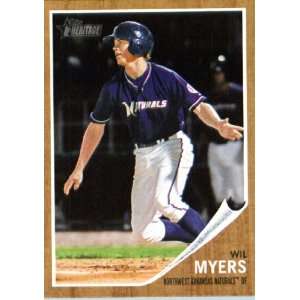
1.   Wil Myers, OF, Tampa Bay … 6’3”, 205 pounds, age 22

The power-hitting Myers should be in the Rays’ line up on opening day.  In 2012, in 124 games split at AA and AAA, Myers hit .314 with 37 homers and 105 RBI.  He’s hit at every level, with a .303 average over four minor league  seasons.

2. Shelby Miller, RHP, Saint Louis – 6’3”, 195 pounds, age 22

Don’t let Miller’s 11-10, 4.74 line at AAA fool you.  Over his last ten AAA starts, Miller went 7-2, 2.88, with 70 strikeout in 59 1/3 innings.  Then, in a late season call-up, he got in six games for the Cardinals, giving up just 2 runs and striking out 16 in 13 2/3 innings.  BBRT is confident the hard-throwing Miller is ready of a full year in the majors.

3.  Jurickson Profar,  SS,  Texas …  6’, 165 pounds, age 20

The young switch hitter (who got in 9 games with the Rangers last season) has shown power, speed and great defense minor league career – three-season totals: .276, 30 homers, 150 RBI, 47 steals.  The Rangers have Elvis Adrus and Ian Kinsler up the middle, but BBRT looks for Profar to get time in at SS and 2B (Kinsler to the OF?) during 2013.

4.  Dylan Bundy, RHP, Baltimore –  6’1”, 195 pounds, age 20

Bundy, who last season moved from class A to the majors (a pair of late season appearances for the Orioles) has been known to top 100 mph with his fastball,  In his first minor league season (2012), he pitched at three levels, going 9-3, 2.08 with 119 strikeouts in 103 2/3 innings pitched.  A solid – consistent – spring should be enough to keep him with the Orioles.  Otherwise, look for a mid-season call-up.  Also expect the Birds to be cautious with Bundy’s innings.

5. Oscar Taveras, OF, Saint Louis – 6’2”, 180 pounds, age 20

With plate discipline beyond his years, Taveras is another youngster to watch in spring.  Despite his young age, he has four minor league seasons under his belt, running up totals of .321, 40 homers, 243 RBI and 29 stolen bases.  Last season, he hit .386 in 78 games at Class A, and .321 (leading the Texas League) in 124 games at AA.  The only thing holding back Taveras may be the Cardinals’ wish to delay his free agency for a year.  BBRT expects to see him in St. Louis at some point during the season.

6. Trevor Bauer, RHP, Cleveland – 6’1”, 185 pounds, age 22

Great stuff, but some say he needs to harness his emotions and his command.  While his MLB debut with the Diamondbacks was a disappointing 1-2, 6.06 in four starts, he did strikeout 17 in 16 1/3 innings.  In two minor league seasons, Bauer has gone 13-4, 3.00 with 200 strikeouts in 156 innings.  BBRT is betting the move to Cleveland serves him well – and that he will crack the Indians rotation either out of spring or by the All Star break.

7. Avisail Garcia, OF, Detroit – 6’4”, 240 pounds, age 21

BBRT is higher on Garcia than some other observers.  Despite being only 21, Garcia has five minor league seasons under his belt (.281, 37 home runs, 242 RBI, 72 steals).  In 2012, he went .299-14-58 with 23 steals in 122 games at A/AA.  What is worrisome are his 95 strikeouts in 481 at bats.  What impresses BBRT is his late-season call up to the Tigers,  when he hit .319 (15 for 47) in 23 games – and followed it up by going .261 in 12 post-season contests.  Major league pitching seemed to handcuff his power a bit – his only extra base hit was a double in the post season – but Garcia showed considerable poise.  He may not be in the line-up every day, but BBRT expects him to be with the Tigers.

8. Billy Hamilton (OF) Cincinnatti – 6’1”, 160 pounds, age 22 Lot of folks – heads turned by Hamilton’s 155 stolen bases in 132 minor league games last season – rate him higher than BBRT.  He does have a strong track record (pun intended) with 320 steals in four minor league seasons – to go along with a .289 average, seven homers and 130 RBI.  No doubt, with his speed, Hamilton can be an MLB game-changer.  BBRT is cautioned by two things:  1) the need for more plate discipline (he struck out 113 times in 512 minor league at bats last year; 2) whether the outfield of Jay Bruce, Ryan Ludwick and Shin-Soo Choo offers the Reds the opportunity to keep Hamilton in the minors one more season to further develop his batting eye and plate discipline.

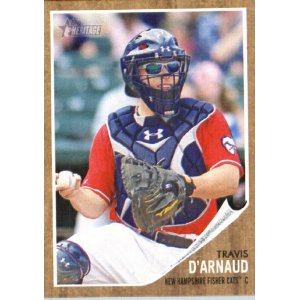
9.  Travis d’Arnaud (C) New York – 6’2”, 195 pounds, age 23

D’Arnaud appears to be a solid defensive catcher with a good bat, who came to the Mets in the R.A. Dickey trade.  In six minor league seasons, he hit .286, with 66 home runs and 289 RBI.  In the offense-heavy AAA Pacific Coast League last year, he rapped .333 with 16 home runs and 52 RBI.  A knee injury that shortened his 2012 season may be of some concern, but the Mets appear confident he’s healthy.  BBRT is betting the Mets will want to show a return sooner-rather-than-later from the Dickey trade, which means d’Arnaud makes the majors soon-rather-than-later.

10.  Take your pick, BBRT sees a trio of hurlers with potential for 2013.

Tyler Skaggs (LHP) Arizona, 6’3”, 195, age 21  

Taijuan Walker (RHP) Seattle – 6’4” 210 pounds, age 20

Gerrit Cole (RHP) Pittsburgh – 6’4”, 220 pounds, age 22

A Great Opportunity for One of Baseball’s Good Guys

Mike Redmond, 2011 Midwest League Manager of the Year … now leading the Miami Marlins.

BBRT says congratulations to one of its favorite “grinders,”  Mike Redmond, who was recently named manager of the Miami Marlins.    Redmond’s 13-year major league career – primarily as a backup catcher, included time with the Marlins, Twins and Indians.  His best season came with the Twins in 2007, when he hit .294. with 1 home run and 38 RBI in 82 games.  His career batting average was .287, with 13 homers and 243 RBI in 764 games.

As a player, Redmond enjoyed a well-earned reputation as a hard worker who got the most from his talents, was respected for his commitment to and knowledge of the game, and was appreciated for his clubhouse presence – knowing when to get fired up and when to loosen up.   He was also known for clutch hits, playing through pain, “smelling the RBIs” and taking naked batting practice (actually, he was wearing spikes and batting gloves.)

And, while his managing experience is brief, it’s pretty impressive.  The 41-year-old Redmond, who retired as a player after the 2010 season, managed the past two seasons in the Blue Jays’ minor league system.  In 2011, he started his managerial career by leading the Lansing Lugnuts to their best record ever (77-60), winning Midwest League Manager of the Year honors.   In 2012, he moved to the Florida State League, leading Dunedin to a 78-55 record and first-place divisional finish.

Redmond has plenty of work to do with the Marlins, who finished 69-93 under veteran manager Ozzie Guillen in 2012.  BBRT applauds the Marlins’ choice and wishes Mike Redmond the best – we know he will, as always, give the job his best.

Sandoval KOs Verlander – Game On!

Kung Fu Panda changes the tone of the World Series.

Now that the Panda-Monium surrounding Pablo Sandoval’s record-tying three homers in a single World Series game has waned (at least a little bit), BBRT would like to add its perspective on Kung Fu Panda’s historic game.

Sandoval may have already earned the World Series MVP award for changing the whole “tone” of the Series in three swings of the bat.  Remember, just a few days ago, Detroit was supposed to “over power” the Giants on the strength of big bats and strong arms. San Francisco, which had hit the fewest home runs in major league baseball over the course of the season (103) seemingly couldn’t match the power of the Miguel Cabrera / Prince Fielder-led Tigers (the Tigers hit 163 regular-season homers).  In addition, the power pitching of the Tigers, led by Justin Verlander and Max Scherzer – the first teammates to finish 1&2 in strikeouts since Mark Prior and Kerry Wood in 2003) – was supposed to be too much for the Giants peck-and-scratch lineup.  After all, the Tigers starters had the second-best ERA (3.76) in the AL and, going into game one of the Series, had a 2012 post-seasons ERA of 1.02.  And, besides, mound king Justin Verlander was starting game one.

So, what did Sandoval’s big game do?

  • Dispelled the notion that the Giants couldn’t generate series-winning power.
  • Dispelled the notion that Justin Verlander was the “invincible difference” in the Series.
  • Dispelled the notion that the Tigers starters would overpower the Giants hitters.

As Verlander mouthed after Sandoval’s second-dinger “Wow!”  It now appears to be a whole new ballgame.

BBRT would also like to congratulate the (in the past, much-maligned) Barry Zito – who despite his 85-mph fastball, outpitched Verlander (95-mph heater).  Zito joined the  Giants in 2007 with a $126-million contract after seven seasons with the Oakland A’s, where he never finished under .500 (102-63 overall), won the 2002 Cy Young, led the league in wins once (23-5 in 2002) and starts four times, and had an ERA over 4.00 only once.  In his first five years with the Giants, Zito went 43-61, never had an ERA under 4.00 (and topped 5.00 twice), led the league in only one category (17 losses in 2008) and was left off the 2010 post season roster.  It appears all is now forgiven,. Zito went 15-8, 4.15 in the regular season and delivered important wins in game five of the National League Championship Series and, of course, yesterday’s World Series game one.  BBRT congratulates a hurler who worked hard, persevered and is now proving to be a post-season difference maker.

So, as we move to game two – it’s “game on.”  The Tigers still have the advantage when it comes to starting pitching (although less so with Verlander’s loss) and home run power, with Giants having the edge in the bullpen (Valverde seems totally lost) and defense.  It should be a fun ride.

Move Over Reggie – For the Real Mr. October

Carlos “Big Game” Beltran – this guy can play the game.

Great players need great nicknames – like Mr. October, Big Train or the Baby Bull. Well, perhaps Carlos Beltran should be Carlos “Big Game” Beltran.  With his home run in game one of the 2012 NL Championship Series, Beltran added to his already spectacular post-season statistics.

In 29 post-season games, Beltran is hitting .370 with 14 home runs, 25 RBI., 38 runs scored and 9 stolen bases.  Not that he’s a regular season slouch.  In 15 seasons, the 1999 AL Rookie of the Year and nine-time All Star has rung up a .282 average, with 2,064 hits, 1,243 RBI and 1,267 runs scored.  He’s also a member of the 300-300 club, with 334 home runs and 306 stolen bases.  And, he tops it off with 3 Gold Gloves.  And, he’s done it all consistently and quietly, never leading the league in any of the key offensive categories.

BBRT Looks at 2012 Rookie and Manager of the Year Awards

In recent posts (Oct. 6/7), BBRT has shared its opinion on the AL & NL Most Valuable Player and Cy Young Awards.  In this post, we’ll take a look at two more major regular season recognitions – Rookie of the Year and Manager of the Year.   We’ll start with the easiest to guage, American League Rookie of the Year.


Mike Trout – likely unanimous AL ROY.

AL Rookie of the Year – Mike Trout (Angels)

If you don’t know the AL ROY is going to be the Angels’ Mike Trout, go back to Monday Night Football, you’re reading the wrong blog.

The (now) 21-year-old Trout, called up in late April, finished the season with a .326 average, 30 HRs, 83 RBI (from the lead-off spot) – while also leading the AL in runs scored (129) and stolen bases  (49) and likely earning Gold Glove consideration. In the process,  he became the youngest player to reach the “30-30 Club” (HRs and SBs), one of only 19 players to reach 30-40, and came within one stolen base of joining Eric Davis (1987) and Barry Bonds (1990) in the 30 HR-50 SB fraternity.   In fact, as BBRT completes this post, Trout is not only being talked about as a shoe-in Rookie of the Year, but as a leading AL Most Valuable Player candidate (see BBRT post of Oct. 7).

Honorable Mention would go out to the Rangers’ right-hander Yu Darvish, who posted a 16-9 record, with a 3.90 ERA, striking out 222 batters in 191 1/3 innings pitched.  The contest, however, is not even close.

NL Rookie of the Year – Wade Miley (Diamondbacks)

Wade Miley – stats on next year’s card will show why BBRT likes him as NL ROY.

BBRT sees a three-way battle here – one that could have been avoided except for a kink in the ROY eligibility rules (more on that later).  BBRT takes Arizona hurler Wade Miley over Bryce Harper of the Nationals and Norichika Aoki of the Brewers.

First, why Miley?  For the year, he posted a 16-11 record (leading the Diamondbacks in wins), with the league’s tenth-best ERA among qualifiers (3.33).  He took on a strong workload for a rookie (194 2/3) innings pitched – showing poise, control and power (only 37 walks against 144 strikeouts).

Second, why not Harper or Aoki (especially Harper, who was touted all year as the league’s top and most exciting rookie)?  For BBRT these two players, who took widely different paths to the NL (Harper a teenage sensation and Aoki a 30-year-old Japanese import), stole votes from each other.   Here’s the proverbial “tale of the tape.”

Games Played:  Aoki leads 151 to 139.

Hits:  Aoki tops Harper 150 to 144.

Batting Average:  Aoki bests Harper – .288 to .270.

Runs Scored:  Harper tops Aoki – 98 to 81.

Home Runs:  Harper well ahead of Aoki 22 to 10.

Doubles:  Aoki makes up for some of Harper’s HR-power, leading in two-baggers 37-26.

Triples:  Harper is more explosive, with 9 triples to Aoki’s 4.

RBI:  Despite the “overpowering” HR lead, the RBI race was closer than you would expect, with Harper leading 59 to 50.

Stolen Bases: Like Harper in HRs, Aoki has a big lead here, 30 to 18.  Also, Oaki was safe 89.5% of the time to 75.0% for Harper.

Walks:  Harper leads Aoki 56 to 43.

Strikeouts:  BBRT hates these wasted at-bats.  Aoki fanned only 55 times to Harper’s 120.

Excitement quotient:  Have to give the edge to Harper, who went all-out, all-the-time.

Harper had a fantastic season for a teenager, but just not enough to offset Wiley’s presence in the Diamondbacks’ rotation – and really not that far ahead of Aoki’s 2012 performance.

Honorable Mention:  BBRT regrets that Cardinal Lance Lynn did not qualify for ROY consideration (there was some debate early in the season).  He was well under the 50 innings pitched limit (getting in 18 games with 34 2/3 innings in 2011), but his early June  2011 call-up gave him more than the allowable 45 days of ML service (during the 25-man roster period – yes, it’s a technical rule).  Without that hitch, and time on the bench, Lynn would get BBRT’s vote hands down for his 18-7, 3.78, 176 innings pitched, 64-walk, 180-strikeout effort.

Notably, over in the AL, Mike Trout faced a pre-season ROY-eligibility dilemma himself.  According to reports last December, Trout was initially credited with 55 days on the Angels’ active roster (during the 25-player time period) in 2011. However, Trout was on the 25-man roster for just 38 days, with the remaining additional 17 days being credited after a short-term demotion to the minors.  MLB, in that case, ruled that while Trout retains 55 days of service time for accounting purposes, only the time he spent on the active roster will count against his rookie status.  Wow, I’m getting a headache, Mr. Commissioner.

AL Manager of the Year – Bob Melvin (A’s)

The A’s Bob Melvin – BBRT choice for AL Manager of the Year.

BBRT’s choice, Bob Melvin, brought a no-name, no-payroll club (picked for last place by many analysts) to the West Division Championship with a 94-68 record (second-best in the AL).  Along the way, his A’s overcame a 13-game deficit as of June 30; were nine games out at the All-Star Break, four back with eight to go; and two behind with three to go.  They had to sweep the first-place and favored Rangers in the last series of the year and needed to overcome a 5-1 deficit in game 162 to capture the Division title.  They did it all – and with the lowest payroll in the league.

They also did it with no 100-RBI men; no .300 hitters; only one player with 30 or more homers; no-pitcher with more than 13 victories; only one pitcher with 30+ starts; and no pitcher with 200 innings pitched. They had 54 wins from rookie pitchers, and started a rookie hurler in each of the last 14 games of the season.

Runner-up?  That would be Buck Showalter of the equally “disrespected-in-the-preseason” Orioles.  Showalter kept his Orioles in the race with the vaunted Yankees until the final weekend, finishing two games out of the Division title – winning a Wild Card spot with a 93-69 record.  Had Melvin’s A’s not captured the West, BBRT would have split its vote between the A’s and Orioles’ skippers.

NL Manager of the Year – Davey Johnson (Nationals)

Davey Johnson – BBRT choice for NL Manager of the Year.

This was a close one for BBRT, with the Nationals’ Davey Johnson barely edging out Bruce Bochy of the Giants and Dusty Baker of the Reds not far behind.  All three managers brought 2011 non-playoff teams to Division Championships.  Johnson ends up with a slight edge for bringing his Nationals’ squad in at 98-64, MLB’s best record in 2012.

Here’s what BBRT saw over the season.  We’ll start with Johnson.  His Nationals improved from 2011’s third-place finish (80-81, 21 ½ games out) to 98-64 and an AL East Crown.  In the process, Johnson had to deal with injuries to key players like Michael Morse,  Jayson Werth and Ryan Zimmerman.  He also had to keep enthusiastic (can you be overly enthusiastic?) 19-year-old rookie Bryce Harper on as even a keel as possible and handle the Stephen Strasburg shut-down controversy.  Finally, he boosted the confidence and performance of middle-infielders Ian Desmond and Danny Espinosa, who came into the season with a combined 515 total games of MLB experience.  Those challenges, plus his deft handling of the pitching staff and MLB’s best record earn Johnson BBRT’s vote.

Close behind is the Giants’ Bruce Bochy.  The Giants didn’t have as far to come as the Nationals (which played a role in BBRT’s preference for Johnson), going from 2011’s second-place finish (86-76, eight games out) to 94-68.  Bochy, however, faced plenty of challenge along the way.  He lost his leading offensive player to a PED-related suspension, suffered through an off-year by staff ace Tim Lincecum (whose ERA went from 2011’s 2.74 to 5.18), dealt with injuries to key players like Pablo Sandoval, and faced the threat of the high-spending Dodgers.   Outside of the spectacular year from Buster Posey (.336, 24 HR, 103 RBI), the Giants’ HR and RBI leader would have been Sandoval, with only 12 HRs and 63 RBI.  Like the Nats, the Giants could count on a strong starting staff (Matt Cain, Ryan Vogelsong, Madison Baumgardner and a resurgent Barry Zito), which helped compensate for Lincecum’s 10-15 record. A key to the Giant’s strong season, however, was Bochy’s handling of the bullpen, consistently getting the “hot hand” in at the “right time.”  As a result, the bulk of the saves went to:  Santiago Casilla (25), Sergio Romo (14) and Javier Lopez (7).

BBRT gives third place in the Manager of the Year race to Dusty Baker of the Reds.  Baker brought the Reds from 2011’s third-place finish (79-83, 17 games back) to 97-65.  Over the course of the season, he had to deal with injuries to key players like Joey Votto (the center of the Reds’ offense) and Scott Rolen.  Baker, known as a player’s manager and motivator, responded by getting the best out of players like Jay Bruce and Ryan Ludwick.  Not blessed with a particularly strong bench, Baker proved a master (though an oft-criticized one) at juggling his line-up to keep the Reds on track.  Baker also has to be credited for the Mid-May decision to move hard-throwing Aroldis Chapman into the closer role.  Chapman responded with 38 saves, a 1.51 ERA and 122 K’s in 71 2/3 innings pitched.

Like Johnson and Bochy, Baker did benefit from a solid and stable (perhaps the most stable) starting rotation.  Baker’s five-man rotation (Johnny Cueto, Matt Latos, Homer Bailey, Bronson Arroyo and Mike Leake) accounted for 161 of the Reds’ 162 starts.  For you trivia buffs, the starter in that one “outlier” – the second game of an August 18 day/night doubleheader – was rookie Todd Redmond (his only ML appearance to date).

Overall, a great – maybe even award-worthy – managerial season for Baker.  However, both Johnson and Bochy had to deal with more “distractions” in bringing their squads home in first.

BBRT invites your comments on 2012 regular-season awards.