MLB June in Review

July is with us, and that means it’s time for BBRT’s traditional look back at the previous month in MLB. So, what happened in June? First, a few items that BBRT found of interest – and then the statistical review.

Albert Pujols led the AL in HRs and RBI in June.

Albert Pujols led the AL in HRs and RBI in June.

He’s b-a-a-ck!

One of June’s big stories was the resurgence of 35-year-old Angels’ slugger Albert Pujols, who hit .303 for the month and led the AL with 13 home runs and 26 RBI. (The Tigers’ J.D. Martinez tied Pujols for June runs driven in.)

He’s b-a-ack to back!

On June 19th, the Yankees’ Alex Rodriguez became the 29th player in MLB history to join the 3,000-hit club. The last player to join the 3K club? Yankee Derek Jeter back in 2011. A-Rod’s hit marked the first time back-to-back new members of the 3,000-hit club have come from the same team. A-Rod also became just the third player to go yard for his 3,000th hit.  The last one to do it?  You guessed it. Derek Jeter – so Rodriguez and Jeter are also the only players to hit back-to-back (in a way) homers for their 3,000th safeties.

He has arrived.

Mets’ rookie pitcher Steve Matz announced his arrival in the big leagues with authority. He made his first MLB start on June 28 – going 7 2/3 innings (2 earned runs) as the Mets topped the Reds 7-2. AND, Matz also went 3-for-3 at the plate, with four RBI. Take that, DH rule.

He was just here – and now he’s gone.

Reds’ CF Billy Hamilton didn’t stay anywhere very long in June – as the speedster swiped a MLB-leading 19 bases (caught three times), despite a .226 average. No one else was even close (Colorado’s Charlie Blackmon had the second most June steals at 11). Hamilton has an MLB-best forty steals through June 30.

He’s still hot.

The White Sox Chris Sale was a popular pre-season prediction for the AL Cy Young Award. Sale lived up to his billing in June, striking out an MLB-best 75 hitters in just 44 1/3 innings – going 2-2, 1.83 in six starts. In his final June outing (June 30), Sale fanned 12 hitters in eight innings and, in the process, joined Pedro Martinez as the only pitchers to strike out ten or more hitters in eight consecutive games. In his eight games, Sale pitched 60 innings, striking out 97 and walking just nine.

He’s almost perfect.

MLB witnessed two no-hitters in June: by the Phillies’ Chris Heston on June 9 and the Nationals’ Max Scherzer on June 20th.  There were a total of four base runners in the two games – and, ironically,  they all got on via hit-by-pitch.  (Scherzer’s with two outs in the ninth.) For more on Scherzer’s game click here – Heston’s game click here.

We’ll have more on June’s player performances later. Let’s first take a look at June’s most – and least – successful teams.

June’s Best and Worst Records

MLB's winningest team plays here/

MLB’s winningest team plays here/

Three teams won an MLB-best 18 games in June: The Toronto Blue Jays (18-9) and Baltimore Orioles (18-10) in the AL and the Saint Louis Cardinals (18-8 – MLB’s top June winning percentage at .692) in the NL. The Cardinals’ strong June enabled them to stretch their NL Central lead from six games to eight – and end the month as the only MLB team with 50 or more wins on the season (51-25).  Meanwhile, Baltimore’s hot month moved the Orioles from third place (at the end of May) to a tie with the Rays for the top spot in the tight AL East (four teams separated by just one game) at the end of June. The Blue Jays needed all of their 18 wins to stay within one game (fourth place) of the Orioles.

Looking at the fewest June victories, the Philadelphia Phillies continued to suffer through a dismal season, logging MLB’s worst June record at 8-19.  As June closed, the Phillies trailed the Nationals by 17 games in the NL East.  The Brewers faced the biggest deficit at the end of the month – having fallen 21 ½ games behind the Cardinals. Over in the AL, the White Sox brought up the rear with only 10 June wins (10-16). Their 33-42 season record left them with the AL’s biggest deficit. They finished June 11 ½ games behind the AL Central-leading Royals.

If the Season Ended …   

So who’s on top?  If the season ended on June 30, the MLB playoff teams would be:

  • AL … Division Champions: Orioles or Rays (playoff to break tie); Royals; Astros. Wild Cards: Loser of Orioles/Rays playoff; Minnesota. (Note: The Angels, Yankees, Blue Jays, Tigers and Rangers are all within 1 ½ games of a Wild Card slot.)
  • NL … Division Champions: Nationals; Cardinals; Dodgers. Wild Cards: Giants; Pirates.

You can see the full June 30 standings at the end of this post.


A Few More Items of Interest

Before we get into June and season-through-June leaders, let’s look at a few more items of interest from the past 30 days or so.

  • On June 26, Brewers’ pitcher Kyle Lohse faced off against his original MLB team, the Minnesota Twins. It wasn’t a great performance (four earned runs in six innings, six hits, one walk, two strikeouts), but it was good enough for the win. It was also good enough to make the 36-year-old Lohse – in his 15th MLB season –  one of just 14 pitchers to record a victory against all 30 major league franchises.
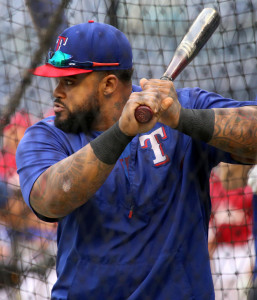
  • Prince Fielder joined his dad Cecil in the 300-club.

    Prince Fielder joined his dad Cecil in the 300-club.

    On June 26, Rangers’ 1B Prince Fielder hit his 12th home run of the season (in a 12-2 loss to the Blue Jays). Despite the outcome, it was an historic home run.  It was the 300th of Fielder’s career – and it enabled him to join his father Cecil Fielder (who hit 319 home runs in a 13-year MLB career) as only the second father-son tandem to both hit 300 round trippers.  The other?  Bobby and Barry Bonds.


  • Three is not always a crowd. On June 24, the Class A Batavia Muckdogs (off to an 0-5 start) reversed their fortunes. The Marlins’ affiliate sent Gabriel Castellanos (with had a 7-21, 5.15 career minor league record) to the mound against the Mahoning Valley Scrappers. Castellanos threw seven perfect innings, striking out twelve Mahoning Valley hitters, before giving way to reliever Brad Lilek, who struck out the side in the eighth. Lilek then passed the ball to Steven Farnworth, who pitched a perfect ninth (one strikeout) for the save – and to complete a 1-0, three-pitcher, perfect-game win.

_______________________________________________________________

STAT TIME

Here’s a few tidbits of information about June team performance:

  • The Oakland pitching staff put up the AL’s best June ERA at 3.06, while Yankees’ hurlers had the AL’s worse ERA for the month at 4.48.
  • In the NL, the Cardinals’ (2.33) and Pirates’ staffs (2.63) both had ERAs under 3.00, while the Rockies (5.39) and Phillies (5.36) both gave up more than five earned runs per contest.
  • Pitching counts. The Rockies topped the NL in runs scored for the month at 140, yet were five games under .500 (12-17) for June. The Cardinals, on the other hand, scored the tenth most runs in the NL (and 19th most in MLB) for June, but had the best June record in all of MLB.
  • Over in the AL, Toronto’s 18 wins were built on a combination of the league’s second-best ERA (3.17 to Oakland’s 3.06) and most June runs put on the board (156). In short, the Blue Jays were hot.
  • The long and short of June home runs. In the NL, the Dodgers hit a league-best 38 round trippers in June, while the Pirates hit the NL’s fewest long balls (13). In the AL, Houston continued to build success on power with a league-topping 45 June homers, while Seattle managed an AL-fewest 17.

Now, here are your month-of-June and through-June individual batting and pitching leaders:

Month of  June Batting Leaders

Average (minimum 75 plate appearances)

Miggy  put up MLB's highest June average.

Miggy put up MLB’s highest June average.

AL                                          

Miguel Cabrera, 1B, Tigers – .384

Manny Machado, 3B, Orioles – .365

Kevin Pillar, OF, Blue Jays – .365

NL

Troy Tulowitzki, SS, Rockies – .381

Bryce Harper, RF, Nationals – .370

Paul Goldschmidt, 1B, D-backs – .354

HRs

NL

Giancarlo Stanton, RF, Marlins – 12

Nolan Arenado, 3B, Colorado – 12

Todd Frazier, 3B, Reds – 9

AL

Albert Pujols, 1B, Angels – 13

J.D. Martinez, RF, Tigers – 11
Luis Valbeuna, 3B, Astros – 9

Mitch Moreland, 1B/DH, Texas – 9

RBI

Nolan Arenado's 33 June RBI led MLB.

Nolan Arenado’s 33 June RBI led MLB.

AL

Albert Pujols, 1B, Angels – 26

J.D. Martinez, RF, Tigers – 26

Mitch Moreland, 1B/DH, Texas – 25

NL

Nolan Arenado, 3B, Rockies – 33

Buster Posey, C, Giants – 27

Maikel Franco, 3B, Phillies – 24


Runs Scored

AL

Brett Gardner, CF, Yankees – 27

Albert Pujols, 1B, Angels – 23

NL

Nolan Arenado, 3B, Rockies – 24

Todd Frazier, 3B, Reds – 20

DJ LeMahieu, 2B, Rockies – 20

Charlie Blackmon, CF, Rockies – 20

Stolen Bases

NL

Billy Hamilton, CF, Reds –  19 (3 CS)

Charlie Blackmon, CF, Rockies – 11 (3 CS)

Ben Revere, LF, Phillies – 9 (1 CS)

AL

Billy Burns, CF, A’s – 7 (1 CS)

Five players with 6

Month-of-June Pitching Leaders

Wins

Four was the lucky number of victories in June, with 11 AL hurlers and 4 NL pitchers notching four wins. Of interest, at least to BBRT, is that the May ERAs for these four-game winners ranged from the 2.18 of the Cardinals’ Carlos Martinez to 5.54 for Charlie Morton of the Pirates. (Charles Tillman of the Orioles also won four games despite an ERA in excess of five – 5.13 – for the month).

ERA (minimum 20 innings pitched in the month)

AL
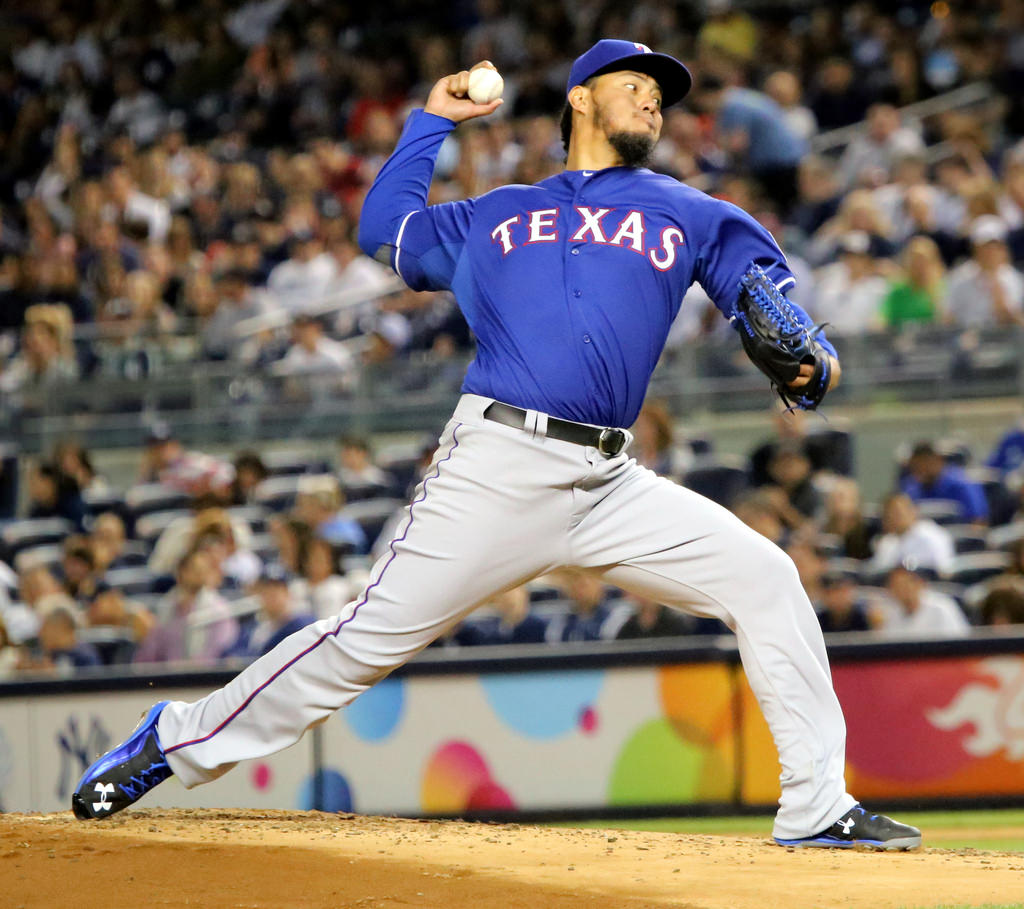
Yovani  Gallardo, June's lowest ERA.

Yovani Gallardo, June’s lowest ERA.

Yovani Gallardo, Rangers – 0.54

Erasmo Ramirez, Rays – 1.44

Mike Montgomery, Mariners – 1.62

NL

Jaime Garcia, Cardinals – 1.03

Lance Lynne, Cardinals – 1.09

Jacob DeGrom, Mets – 1.21


Strikeouts

AL

Chris Sale, White Sox – 75 (44 1/3 IP)

Chris Archer, Rays – 51 (41 IP)

Ubaldo Jiminez, Orioles – 42 (35 2/3 IP)

Dallas Keuchel,  Astros – 42 (42 2/3 IP)

NL

Clayton Kershaw, Dodgers – 57 (41 2/3 IP)

Madison Bumgarner, Giants – 49 (39 IP)

Max Scherzer, Nationals – 45 (38 2/3 IP)

Saves

AL

Greg Holland, Royals – 9

Zack Britton, Orioles – 9

Koji Uehara, Red Sox – 8

NL

Mark Melancon, Pirates – 11

Francisco Rosdriguez, Brewers – 9

Brad Zeigler, D-Backs – 9

Mark Melancon, Pirates – 8


And now the MLB Leaders Through June

Batting Average

NL

Paul Goldschmidt, 1B, D-backs – .354

Dee Gordon, 2B, Marlins – .351

Bryce Harper, RF, Nationals – .340

AL

Miguel Cabrera, 1B, Tigers – .349

Prince Fielder, 1B, Rangers – .347

Jason Kipnis, 2B, Indians – .346

HR

AL

Giancarlo Stanton - MLB home run leader.

Giancarlo Stanton – MLB home run leader.

Albert Pujols, 1B, Angels – 24

Mike Trout, CF, Angels – 20

J.D. Martinez, RF, Tigers – 20

NL

Giancarlo Stanton, RF, Marlins – 27

Todd Frazier, 3B, Reds – 25

Bryce Harper, RF, Nationals – 24


RBI

NL

Nolan Arenado, 3B, Rockies – 68

Giancarlo Stanton, RF Marlins – 67

Paul Goldschmidt, 1B, D-backs – 65

AL

Mark Teixeira, 1B, Yankees – 54

Miguel Cabrera, 1B, Tigers – 53

Stephen Vogt, C, A’s – 53

Runs

AL

Brian Dozier, 2B, Twins – 60

Brett Gardner, CF, Yankees – 58

Josh Donaldson, 3B, Blue Jays – 58

NL

Paul Goldschmidt, 1B, D-backs – 55

Todd Frazier, 3B, Reds – 54

Bryce Harper, CF, Nationals – 53

Stolen Bases

NL

Billy Hamilton, CF, Reds  – 40 (6 CS)

Dee Gordon, 2B, Marlins – 26 (11 CS)

Charlie Blackmon, CF, Rockies – 20 (7 CS)

AL

Jose Altuve, 2B, Astros – 21 (7 CS)

Billy Burns, CF, A’s – 16 (3 CS)

Brett Gardner, CF, Yankees – 15 ( CS)

Lorenzo Cain, CF, Royals – 15 (3 CS)

BBRT Note: The Padres’ LF Justin Upton has the most steals without getting caught (15).

Pitching Leaders Through June

Wins

NL

Gerrit Cole, Pirates – 11-3 (2.20)

Micheal Wacha, Cardinals – 10-3 (2.77)

Three with nine wins

AL

Dallas Keuchel, Astros – 10-3 (2.03)

Felix Hernandez, Mariners – 10-4 (3.05)

Four with nine wins

Strikeouts

AL

Chris Sale, White Sox – 141 (103 1/3 IP)

Chris Archer Rays – 133 (109 IP)

Corey Kluber, Indians – 127 (110 2/3 IP)

NL

Clayton Kershaw, Dodgers – 140 (107 IP)

Max Scherezer, Nationals – 130 (110 1/3 IP)

James Shields, Padres – 116 (97 2/3 IP)

Saves

AL

Glen Perkins, Twins – 25

Houston Street, Angels – 23

Zach Britton, Orioles – 22

NL

Mark Melancon, Pirates – 24

Drew Storen, Nationals – 23

Trevor Rosenthal, Cardinals – 23


______________________________________________

Finally, MLB standing as of June 30


AL East

Orioles             41-36   .532

Rays                 41-36   .532

Yankees           41-37   .526     0.5

Blue Jays          41-38   .519    1.0

Red Sox           36-43   .456     6.0

AL Central

Royals              44-30   .595

Twins               41-36   .532     4.5

Tigers               39-37   .513     6.0

Indians             25-41   .461     10.0

White Sox        33-42   .440     11.5

AL West

Astros              46-34   .575

Angels              41-37   .526     4.0

Rangers            40-38   .513     5.0

Mariners            35-42   .455     9.5

A’s                    35-45   .438     11.0


NL East

Nationals          43-34   .558

Mets                40-38   .513    3.5

Braves              26-41   .468    7.0

Marlins            32-46   .410     11.5

Phillies              27-52   .342     17.0

NL Central

Cardinals          51-25   .671

Pirates              43-33   .566     8.0

Cubs                40-35   .533     10.5

Reds                35-41   .461     16.0

Brewers           31-48   .392      21.5

NL West

Dodgers           44-35   .557

Giants              42-36   .538     1.5

D-Backs           37-40   .481     6.0

Padres              37-42   .468     7.0

Rockies            34-43   .442     9.0

I tweet baseball @David BBRT


Congrats Chris Heston – and Some Rookie No Hitter Observations

HestonCongratulation to Giants’ right-hander Chris Heston, who yesterday (June 9) threw a no-hitter as San Francisco topped the Mets 5-0 at New York’s Citi Field.  Heston fanned eleven, while allowing only three base runners – all on hit-by-pitch.  It was the first no-hitter of 2015 and the 288th no-hitter in MLB history.  Heston also collected two hits and drove in two runs in the game – just another reason BBRT hates the DH.

The 27-year-old rookie tossed the no-no in just his 13th major league start (15th appearance) and, according to STATS is the 35th MLB rookie to toss a complete game no-hitter. Notably, with Heston’s gem, the Giants became just the second team ever to record no-hitters in four consecutive seasons – Matt Cain (2012), Tim Lincecum (2013 and 2014). The only other team to record no-hitters in four consecutive seasons was, appropriately, the Giants’ archrival, the Los Angeles Dodgers.  The Dodgers were less democratic than the Giants, however, with all four no hitters credited to southpaw Hall of Famer Sandy Koufax.

A few other rookie no-hitter bits of trivia:

  • Only one MLB pitcher has thrown a no-hitter in his first-ever appearance. That would be righty Charles Leander “Bumpus” Jones. Pitching for the Reds, Jones no-hit the Pirates (7-1 final score) in his very first appearance – October 15, 1892 – the final day of the 1892 season. Jones came back to pitch for the Reds and Giants during the 1893 season, but went 1-4 with a 10.19 ERA. He never returned to major leagues, but did pitch in the minors until 1900.  (Note: When Jones tossed his no-hitter, the pitching distance was 50-feet.  The current 60’ 6” distance was adopted in 1893.)
  • The very first pitcher to throw a no-hitter in his first start was southpaw Ted Breitenstein of the Saint Louis Browns, who no-hit the Louisville Colonels of the then major league American Association on October 4, 1891 (like Jones, his chance came on the final day of the season). It was Breitenstein’s sixth appearance.  Breitenstein lasted longer in the big leagues than Jones, logging 160 wins, 170 losses and a 4.03 ERA between 1891 and 1901.  He led the NL in ERA once and complete games twice in his career, while also topping 20 wins in three different seasons (and losing 30 once). Like Jones, Breitenstein tossed his no-hitter when the pitching distance was 50-feet.
  • HollomanThe only MLB pitcher to toss a no-hitter in his first start (his fourth appearance) at the current pitching distance was Saint Louis Browns’ right-hander Alva (Bobo) Holloman, who held the Philadelphia Athletic without a safety on May 1, 1953 (6-0 final). A 30-year-old rookie, 1953 was Holloman’s only MLB season, his no-hitter was his only major league complete game and his two singles that day his only major league hits. He ended the season 3-7, with a 5.23 ERA. Holloman pitched for five different minor league teams in 1954, his last season on the field.

A “by-the-way” for BBRT’s Minnesota readers, yesterday’s hero (Heston) does have some tenuous Minnesota ties. He was initially drafted (out of community college) by the Twins in the 47th round of the 2007 draft, but choose not to sign.  He also declined to sign with the Nationals (29th round in 2008), before agreeing to terms with the Giants (12th round, 2009). Heston had a 46-45 record (3.56 ERA) in six minor league seasons.  He was slated to open the 2015 season at Triple A Sacramento until Matt Cain went on the Disabled List.  Heston is now 6-4 on the season, with a 3.77 ERA.

A No-Hitter – Lost in More Ways than One

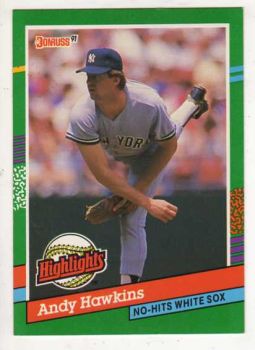
HawkinsNobody ever took a worse beating in a complete game without giving up a hit than the Yankees’ Andy Hawkins, who allowed no hits in a complete game against the Chicago White Sox on July 1, 1990 – and still ended up on the wrong end of a 4-0 score (and eventually even lost his place in the record books, but more on that later.)

The 1990 contest went into the bottom of the eighth tied 0-0, with the Yankees having managed just four hits – all singles – off two White Sox hurlers.  In the meantime,  Hawkins had held Chicago hitless and scoreless through seven innings – giving up just three walks.  He got the first two outs in the eighth before Sammy Sosa reached base on an error by New York third baseman Mike Blowers. Sosa stole second and Chicago’s Ozzie Guillen and Lance Johnson both walked, loading the bases. Then an error by New York LF Jim Leyritz – on what appeared to be an easy fly ball hit by Robin Ventura cleared the bases (and left Ventura at second). DH Ivan Calderon then reached on adropped fly ball by RF Jesse Barfield NY’s third error of the inning), allowing the fourth run of the inning to score. Hawkins then got the final out (Dan Pasqua) on an infield pop-up-. The Yankees failed to score in the top on the ninth and Hawkins got a loss – despite not giving up a hit (or an earned run).  Hawkins’ final line, 8 IP, 0 hits, 4 Runs, 0 ER, 5 walks, 3 strikeouts and a loss.

MLB added insult to injury the following year, when the MLB Committee for Statistical Accuracy officially defined a no-hitter as a game “when a pitcher (or pitchers) allows no hits during the entire course of a game, which consists of at least nine innings.”  Since Chicago was leading – and did not bat in the bottom of the ninth – Hawkins’ no-hitter – despite being a complete game – was erased.  So, he not only lost the game – he ultimately lost his no-hitter as well. Ouch!

The double loss was indicative of Hawkins’ 1990 season, when he went 5-12, 5.37.  For his career (10 seasons – Padres, Yankees, A’s), Hawkins went 84-91, 4.22. His best year was 1985, when he went 18-8, 3.15 for the Padres.

I tweet baseball @DavidBBRT

May-King An Impression – Last Month in MLB

We’ve just turned the calendar on another Month and May is gone. That means it’s time for BBRT’s traditional look back at the previous month in MLB. They say April showers bring May flowers – but what does May bring?  If you’re a baseball fan (particularly if, like me, you are a Twins fan), this May brought a shower of surprises. In this post, BBRT will recap some of the month’s performances, look at some statistical surprises and throw in a few diversions that impressed me along the way,

Let’s start by considering the teams with the most wins in the month of May. Only two teams notched 20 or win over the course of the month – the Minnesota Twins and the San Francisco Giants.

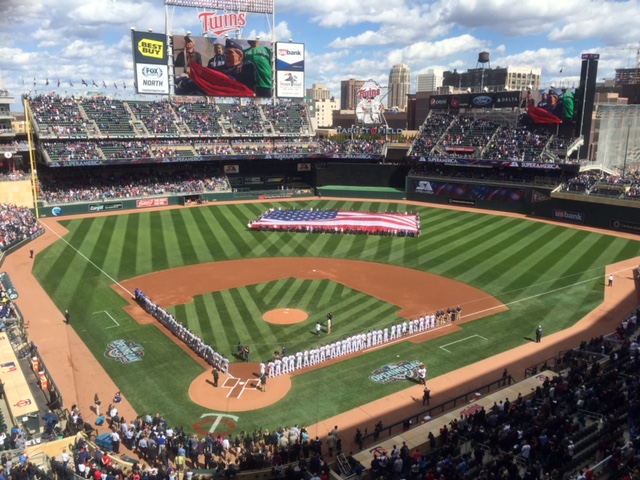
Lots of surprises at Minnesota's Target Field - like first place at the end of May.

Lots of surprises at Minnesota’s Target Field – like first place at the end of May.

The Twins were the real surprise, going 20-7 (.740) – MLB’s best winning percentage for the month – and closing May in first place in the AL Central. (Full MLB standings as of May 31 can be found at the end of this post). How surprising is this? Over the past four seasons, the Twins have gone 265-383 (averaging 96 losses) per season – and they started 2015 with just one win in their first seven games. I promised both surprising and impressive, so here are a few things I found impressive about the Twins’ May performance: 39-year-old (soon to be forty) RF Torii Hunter led a fairly balanced offense with a .333-6-25 month, RHP Ricky Nolasco won an AL-leading five games (5-0, 4.25 ERA) after going 0-1, 18.00 in April, RHP Kyle Gibson had an AL-low (among full-time starters) May ERA of 1.36 (three wins and one loss) and closer Glen Perkins saved an MLB-high 13 games.

Then we have the less-surprising and defending World Series Champion Giants, who ran up an MLB-best 21 wins (nine losses – .700 pct.) for the month. The Giants moved from last at the end of April to second (just ½ game behind the Dodgers) at the end of May. Looks like the Giants/Dodgers rivalry lives on!

More surprises?  How about the continuing success of the Houston Astros – who averaged more than 100 losses over the past four seasons (232-416)?    The Astros finished April leading the AL West by four games – and, closed May with a 31-20 record, still holding a four-game margin over the second-place Angels.

May-King An Impression

Houston Astros’ 22-year-old prospect Derek Fisher made quite a May impression. On May 30, Fisher made his first appearance for the Class A Advanced California League Lancaster JetHawks – having just been promoted from the Class A Quad Cities River Bandits of the Midwest League. Well, you only get one chance to make a first impression, and Fisher took it.  

The 6’ 1”, 207-pound Fisher, who started in left field and batted second, came up in the first inning and ripped a solo home run to right.  In the second, he came to the plate again – this time with the bases loaded – and scorched a Grand Slam to center. The JetHawks’ offense continued to pulverize the High Desert Mavericks pitching staff and. in the third inning, Fisher came to the plate with the bases loaded once again. He had already cleared the fences in right and center, so this time he drove a homer (his second Grand Slam of the game) to left.  In his first three innings played after his promotion, Fisher – hit to all fields, went three-for-three, rapped three home runs, scored three runs and drove in nine.  Pretty good first impression.  Oh, and later in the game (a 16-3 Lancaster win), Fisher rapped a bases-loaded double – giving him 12 RBI for the game (a new California League record.)  

While at Quad Cities, Fisher had gone .305-6-24 in 39 games. Fisher also is a former High School Gatorade Player of the Year (Cedar Crest High School, Lebanon, PA) and college Louisville Slugger Freshman All-American (University of Virginia). Impressive? Indeed.

On the other side of the surprise coin – the disappointing side – no team lost more games in May than the Boston Red Sox (early and popular AL East favorites). The Red Sox went 10-19 in May, ending the month at 22-29, in last place, but just four games out of first.  Other teams losing 19 for the month were less surprising – The Marlins went 10-19 in May, while the A’s went 11-19.

Michael Wacha- part of a pitching staff driving the Cardinals to MLB's best record through May.

Michael Wacha- part of a pitching staff driving the Cardinals to MLB’s best record through May.

Through May 31, only three teams were playing .600 or better:  The Saint Louis Cardinals (33-17, .660); Minnesota Twins (30-19, .612); Houston Astros (31-20. .608); and Kansas City Royals (29-19, .604). On the other end of the spectrum, four teams were performing at an under .400 pace: The Milwaukee Brewers (an MLB-worst 17-34, .333); Oakland A’s (20-33, .377); Philadelphia Phillies (19-33, .365); and Miami Marlins (20-31, .392).


So what’s it all add up to?  What if the season ended on – in this case – May 31? Your playoff teams would be:

  • AL … Yankees or Rays (playoff to break tie); Twins; Astros. Wild Cards: Royals; Tigers. (Note: Three AL Central teams.)
  • NL … Nationals; Cardinals; Dodgers. Wild Cards: Giants; Mets.

Another Impressive “First Impression”

On May 6, as the Twins took the measure of the Oakland A’s 13-0, Eddie Rosario made his major league debut – and he got off to a pretty fast start.  In his first at bat, in the third inning, the rookie right fielder hit a Scott Kazmir fastball into the left field bleachers – becoming 119th player to homer in his first MLB at bat.  More significantly, Rosario become only the 29th MLBer to homer on the very first pitch he ever saw in “the show.” For more on first-pitch-ever round tripper – including two first-pitch Grand Slams, click here. 

Just a few final team observations before we look at some individual performances and surprises.

  • Through May 31, no team had scored more runs than the Blue Jays (268) – who had scored 35 more runs than the second-highest-scoring AL team (Rangers) and the highest-scoring NL team (Diamondbacks), both at 233. The Blue Jays (six games under .500), however, had the AL’s worst ERA through May at 4.59. Fewest runs scored? The Phillies at 157.
  • The Houston Astros led all of MLB in home runs through May (68), with the Dodgers topping the NL at 64. The fewest? The Phillies again at 27, while the White Sox (with the DH) had the AL’s lowest total at 32.
  • Only three teams were hitting .270 or better through May – the Royals (.278); the Giants (.272); and the Tigers (.272). The Brewers had the lowest team batting average through May at .228.
  • From the mound, the Cardinals were the only team to carry a sub-3.00 ERA through May – at 2.73 (followed by the Pirates at 3.14 and the Dodgers at 3.16). Over in the AL, the Rays set the pace at 3.36 (followed by the Royals (3.40 and Astros (3.54).
  • The surging Twins proved they “pitch to contact.”  Through May, the Minnesota pitching staff had the fewest strikeouts 281 and the second-fewest walks (117 – only the NL Mets were lower at 103). Leading MLB in K’s was the Cubs’ staff at 476, while Houston led the AL with 464.

Now let’s look at some individual May performances.

Brycae Harper - 13 May home runs.

Brycae Harper – 13 May home runs.

Nobody raked the baseball more in May than the Nationals’ RF Bryce Harper, who put up a .360-13-28 line for the month – which made him the May leader in HRs and RBI (tied). But, we’ve all been waiting for this type of breakout from Harper.  There were, however, some impressive offensive performances and a few surprises in May.

  • Indians’ 2B Jason Kipnis hit .429 for the month, with four home runs, 17 RBI and a MLB-best 30 runs scored – after a disappointing .218-1-8 April.
  • Rangers’ 1B Prince Fielder, coming off 2014 neck surgery, started slowly with just one home run and ten RBI in April (although he did put up a .333 average). In May, the power returned, as Fielder went .379-9-28 and took over the AL batting race lead.
  • Marlins’ 2B Dee Gordon came back to earth. Carrying a .400 average as late as May 19th, Gordon’s average had dropped to .377 by May 31 – still enough to lead all of MLB.
  • Pirates’ C Francisco Cervelli’s .377 May average topped all NL hitters (with at least 75 plate appearances) for the month.
  • The bright spot for the struggling A’s was catcher Stephen Vogt, who hit .301, with seven homers and 23 RBI  in 83 May at bats. Vogt  had 38 RBI through May, just one off the AL lead.  The 30-year-old Vogt’s previous season-highs are .279-9-35.
  • Padres’ LF Justin Upton had the highest number of stolen bases without getting caught through May at 10.
  • Marlins’ RF Giancarlo Stanton hit only .185 in May, but still managed to rap nine home runs and drive in 23. Hitting just .228 through May, Stanton still leads MLB with 44 RBI.

The pitchers got into the act as well.

  • 42-year-old Mets’ hurler Bartolo Colon led all of MLB in victories through May with 8 (tied with Felix Hernandez of the AL’s Mariners) – despite a 4.72 ERA. In May, Colon went 4-2, with a 6.00 ERA in six starts. MLB’s other eight-game winner, Felix Hernandez was 8-1, with a 1.91 ERA.

    Corey Kluber - whiffed 18 on a very pecial day.

    Corey Kluber – whiffed 18 on a very pecial day.

  • The Indians’ Corey Kluber, the MLB strikeout leader for May and through May, saved his best for May 13 – the day the Indians officially opened their Bob Feller exhibit. Kluber threw eight innings of one-hit shutout ball in the Indians’ 2-0 win – walking none and tying Hall of Famer Feller’s Indians’ team single-game strikeout record with 18 whiffs. With the performance, Kluber became just the 29th pitcher in MLB history to fan 18 or more hitters in a game – and one of only five to accomplish the feat without issuing a single base on balls (joining Roger Clemens, Randy Johnson, Luis Tiant and Kerry Wood). An impressive showing on an appropriate day.
  • Only three pitchers managed five wins in May – the Pirates’ A.J. Burnett; Nationals’ Max Scherzer; and Twins’ Ricky Nolasco.

I’m Impressed – and so was the Baseball Hall of Fame

Katie Brownell – The “Perfect” Perfect Game

Here’s someone who “May-ed” their impression on a May day ten years ago. On May 14, 2005, eleven-year-old Katie Brownell – the only girl playing in the Oakfield-Alabama Little League (upstate New York) – took the mound for her team (the Dodgers) expecting to pitch three innings against the Yankees.  Six innings later, the Dodgers had an 11-0 win and Brownell was on her way to the Baseball Hall of Fame in Cooperstown.

Brownell not only threw a shutout that day, she threw a perfect game and struck out all eighteen batters she faced. She never went to a three-ball count the whole contest and the best at bat of the day went to the game’s final batter, who fouled off three 2-2 pitches before striking out. On July 7, 2005, Brownell’s traveled with her teammates to Cooperstown, New York to see her Dodgers Little League jersey ‘inducted” into the Baseball Hall of Fame. Note: Brownell’s dominance was no fluke, she was coming off a 14-strikeout game in her previous start.

Speaking of impressive performances, here are your May batting and pitching leaders.

Batting Average (minimum 75 plate appearances)

AL

Jason Kipnis, 2B, Indians – .429

Prince Fielder, 1B, Rangers – .377

David DeJesus, RF, Rays – .368

Chris Colabello, RF, Blue Jays – .368

NL

Francisco Cervelli, C, Pirates – .377

Paul Goldschmidt, 1B, D-backs – .365

Bryce Harper, RF, Nationals – .360

HRs

NL

Bryce Harper, RF, Nationals – 13

Paul Goldschmidt, 1B, D-backs – 10

Four with 9

AL

Josh Donaldson, 3B, Blue Jays – 10

Price Fielder, 1B, Rangers – 9

Evan Gattis, C/DH, Astros – 9

RBI

AL

Prince Fielder, 1B, Rangers – 28

Torii Hunter, RF, Twins – 25

Three with 23

 NL

Bryce Harper, RF, Nationals – 28

Ryan Braun, RF, Brewers – 28

Four with 23

Runs Scored

AL

Jason Kipnis, 2B, Indians – 30

Josh Donaldson, 3B, Blue Jays – 25

Brian Dozier, 2B, Twins – 25

NL

Bryce Harper, RF, Nationals – 24

Brandon Belt, 1B, Giants – 23

Ryan Braun, RF, Brewers – 22

Adrelton Simmons, SS, Braves, 22

Stolen Bases

NL

Dee Gordon, 2B, Marlins – 12 (1 CS)

Justin Upton, LF, Padres – 9 (0 CS)

Three with eight

AL

Delino DeShields, CF, Rangers – 10 (1 CS)

Billy Burns, CF, A’s – 9 (1 CS)

Wins

NL

A.J. Burnett, Pirates – 5 (no losses)

Max Scherzer, Nationals – 5 (one loss)

AL

Ricky Nolasco, Twins – 5 (no losses)

ERA (minimum 20 innings pitched in the month)

AL

Alex Wilson, Tigers – 0.86 (11 games, one start)

Kyle Gibson, Twins – 1.36

Chris Young Royals – 1.45

NL

Shelby Miller, Braves – 0.95

Zack Grienke, Dodgers – 1.05

Mike Bolsinger, Dodgers – 1.05

Strikeouts

AL

Corey Kluber, Indians – 60 (42 2/3 IP)

Chris Sale, White Sox – 46 (37 IP)

Chris Archer, Rays – 45 (35 2/3 IP)

NL

Max Scherzer, Nationals – 56 (43 IP)

James Shields, Padres – 47 (37 1/3 IP)

Francisco Liriano, Pirates – 45 (35 1/3 IP)

Saves

AL

Glen Perkins, Twins – 13

Brad Boxberger, Rays – 10

Luke Gregorson, Astros – 9

Zack Britton, Orioles – 9

NL

Drew Storen, Nationals – 11

Santiago Casilla, Giants – 9

Jason Grilli, Braves – 8

Mark Melancon, Pirates – 8


And now, a look at the MLB Leaders Through May.

Batting Average

NL

Dee Gordon, 2B, Marlins – .377

Paul Goldschmidt, 1B, D-backs – .354

DJ LeMahieu, 2B, Rockies – .340

AL

Prince Fielder, 1B, Rangers – .359

Jason Kipnis, 2B, Indians – .340

Nelson Cruz, RF/DH, Mariners – .335

HR

AL

Nelson Cruz, RF/DH, Mariners – 18

Josh Donaldson, 3B, Blue Jays – 15

Mark Teixeira, 1B, Yankees – 14

NL

Bryce Harper, RF, Nationals – 18

Todd Frazier, 3B, Reds – 16

Paul Goldschmidt, 1b, D-backs – 15

Giancarlo Stanton, RF, Marlins – 15

RBI

NL

Giancarlo Stanton, RF, Marlins – 44

Paul Goldschmidt, 1B, D-backs – 43

Bryce Harper, RF, Nationals – 43

AL

Josh Donaldson, 3B, Blue Jays – 39

Nelson Cruz, RF, Mariners – 38

Prince Fielder, 1B, Rangers – 38

Stephen Vogt, C, A’s – 38

Runs

Josh Donaldson, 3B, Blue Jays – 43

Brian Dozier, 2B, Twins – 41

Mike Trout, CF, Angels – 38

NL

Bryce Harper, RF, Nationals – 42

Paul Goldschmidt, 1b, D-backs – 39

Four with 34

Stolen Bases

NL

Billy Hamilton, CF, Reds  – 21 (3 CS)

Dee Gordon, 2B, Marlins – 20 (7 CS)

AL

Jose Altuve, 2B, Astros – 15 (9 CS)

Jacoby Ellsbury, CF, Yankees – 14 (6 CS)

Wins

NL

Bartolo Colon, Mets – 8-3 (4.72)

Gerrit Cole, Pirates – 7-2 (2.11)

Micheal Wacha, Cardinals – 7-1 (2.27)

AL

Felix Hernandez, Mariners – 8-1, 1.91

Dallas Keuchel, Astros – 7-1 (1.76)

Four with six

Strikeouts

AL

Corey Kluber, Indians – 96 (76 2/3 IP)

Chris Archer, Rays – 82 (68 IP)

Felix Hernandez, Mariners – 71 (70 2/3 IP)

Danny Salazae, Indians – 71 (54 2/3 IP)

NL

James Shields, Padres – 88 (68 1/3 IP)

Max Scherezer, Nationals – 85 (71 2.3 IP)

Clayton Kershaw, Dodgers – 83 (65 1/3 IP)

Saves

AL

Glen Perkins, Twins – 19

Houston Street, Angels – 17

Three with 15

NL

Drew Storen, Nationals – 16

Four with 15

______________________________________________________________

Finally, MLB standing as of May 31

AL East

Yankees          26-25   .510

Rays               26-25   .510

Orioles            23-26   .469     2.0

Blue Jays        23-19   .442     3.5

Red Sox          22-29   .433     4.0

AL Central

Twins              30-19   .612

Royals             29-19   .604     0.5

Tigers              28-24   .538     3.5

Indians            24-26   .480      6.5

White Sox        23-26   .469     7.0

AL West

Astros              31-20    .606

Angels             27-24    .529     4.0

Rangers           26-25     .510    5.0

Mariners          24-26     .480    6.5

A’s                  20-33     .377   12.0


NL East

Nationals          28-22     .560

Mets                28-23     .549    0.5

Braves             25-25     .500    3.0

Marlins             20-31    .392     8.5

Phillies             19-33   .365     10.0

NL Central

Cardinals         33-17     .660

Cubs               26-22    .542     6.0

Pirates             26-24   .520     7.0

Reds                22-27   .449     4.5

Brewers            17-34   .333    16.5

NL West

Dodgers          29-20    .592

Giants             30-22   .577     0.5

San Diego        25-27   .481     5.5

D-backs           23-26   .469     6.0

Rockies            22-26   .458     6.5


I tweet baseball @DavidBBRT


I tweet baseball @David BBRT
Roy Gleason – From the Ballfield to the Battlefield

JP AwardIn 2014, BRT launched its own baseball award – The John Paciorek Award – or JPA (which could stand for “Played Just Abit.”)  The JPA recognizes players who have had short, maybe very short, major league careers, but whose accomplishments, nonetheless, deserve recognition.  Just as the emergence of these players on the MLB scene was often unexpected, the JPA is awarded on no specific timetable.  BBRT, in fact, most often uncovers these brief, but bright, stars when researching some unrelated baseball topic.

(Note: Information on  John Paciorek’s career – the inspiration for the JPA – can be found at the end of this post.)

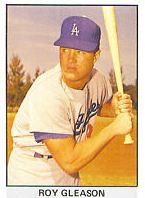
GleasonNow the timetable for these recognitions may not be specific, but that does not preclude the presentations from being “time appropriate.”  With that in mind, BBRT’s second JPA is being presented on this Memorial Day to Roy Gleason whose achievements include eight MLB appearances (Dodgers 1963), a career MLB batting average of 1.000, a World Series ring (more on that later) and a Purple Heart (earned in Vietnam). 

Roy Gleason was a top-rated prospect right out of high school, recruited (for the Boston Red Sox) by the likes of Ted Williams. A big (6’5”, 220-pound), speedy, switch-hitting outfielder, Gleason had his heart set on taking the field for the Los Angeles Dodgers. At least briefly, he lived the dream – signing with the Dodgers and making his major league debut at the age of 20, in just his second professional season (1963). He first appeared in a Dodgers game as a pinch runner on September 3 and, as the season wound down, got into seven games in that capacity – scoring two runs, but never coming to the plate.

Then, on September 28, 1963 – in the eighth inning of a game against the Phillies, Gleason was called on to pinch hit for LA pitcher Phil Ortego (the Dodgers were trailing 12-2 at the time). That first MLB at bat would prove to be Gleason’s only MLB plate appearance and he made the most of it – lining a 1-0 fastball off the Phillies’ Dennis Bennett for a standup double to left (and scoring later in the inning). Thus, Gleason ended his first MLB season – and his MLB career – with a 1.000 batting average, 1.000 on base percentage and 2.000 slugging percentage. And, although Gleason was not on the post-season roster, the Dodgers went on to win the 1963 World Series, earning Gleason a coveted World Championship ring.

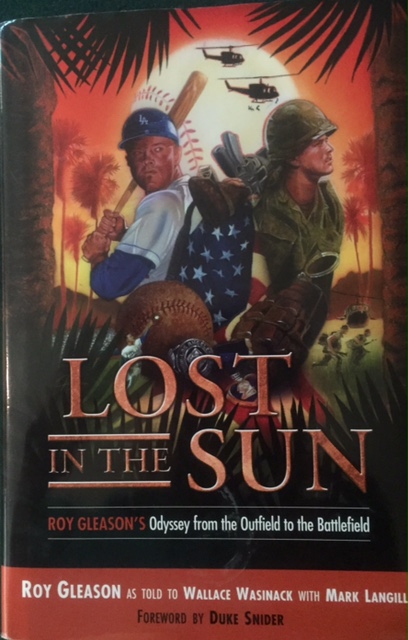
Gleason spent the next three seasons back in the minors – where he hit only .213, but showed a combination of power and speed with 44 home runs and 21 stolen bases. Gleason was maturing as a player and a return to the majors seemed on the horizon after he earned an invite to the Dodgers’ 1967 major league Spring Training camp. Gleason, however, received another invite that spring – a draft notice. That invite, as noted in Gleason’s book “Lost in the Sun” (by Roy Gleason as told to Wallace Wasinack and Mark Langill) took the young outfielder on an “Odyssey from the Outfield to the Battle Field.”

gleasonbookBBRT recommends Lost In The Sun – Roy Gleason’s Odyssey from the Outfield to the Battlefield. It’s moving story of dream chasing, perseverance, reluctant heroism, fear , survivor’s guilt, and the inside of major league negotiations (methods and motives) – with a helping of history, politics and cultural commentary thrown in.


Gleason, it turns out, was the only baseball player with major league experience on his resume to serve on the front lines in Vietnam. In Vietnam, Gleason earned his Sergeant’s stripes, as well as a Purple Heart (suffering leg and wrist wounds when his squad came under attack on July 24, 1968).  By his own admission, a reluctant hero (aren’t those the most heroic), Gleason nonetheless distinguished himself.  A few lines from his citation note that, after being wounded, Gleason “refused medical attention and continued to perform his duties as squad leader until all his wounded men had been evacuated.”  In his book Lost in the Sun, Gleason, describes the moments after he was wounded, “As I rolled on my belly to return fire, I didn’t have time to think about the reason I was there. Why am I fighting to the death – an enemy I didn’t even know – in a world far removed from the small mid-American town of LaGrange, Illinois. The sight of the blood-soaked mud was now the scene, and God … how I missed the lush green baseball fields I’d played on in America.”

Gleason was ultimately airlifted out of the combat area on an Army helicopter – and left behind was his foot locker and his 1963 World Championship ring, but not his major league dreams.

After recovering from his wounds and enduring extensive rehab, Gleason attempted a comeback – performing well in 1969 Spring Training before being returned to the minors. A truck accident (Gleason was working construction between the 1970 and 1971 seasons), however, resulted in an arm (rotator cuff) injury that ended his pursuit of major league career.

As a baseball fan and a veteran myself, I am honored to be able to recognize Roy Gleason for his service and his bright and shining major league moment in this Memorial Day post.

On September 20, 2003, the Dodgers held a special ceremony honoring Gleason before their game against the Giants.  Roy’s military and athletic accomplishments were recognized in a brief video and Gleason threw out the ceremonial first pitch.  Then came the surprise of the day, as Dodger Manager Jim Tracy stepped forward to present the ballfield phenom and battlefield hero with a replacement 1963 World Series ring.  Says Gleason, “I was in shock when he when he handed me the World Series ring, and it remains one of the most incredible instants in my life. I felt like I was finally back to where I always wanted to be – I felt lke I was 20-years-old again.”

By the way, remember I said BBRT often uncovers the stories of brief, but brilliant, baseball “stars” while researching other baseball stories.  Well, Roy Gleason’s name (and story) came up while I was looking into the career of former Dodgers’ (1949) and Cubs’ (1951) first baseman Chuck Connors – who gained fame as an actor (particularly as the star of the popular TV series The Rifleman. (For more on Connors, click here.)  Turns out, Gleason appeared with Connors in a 1966 episode of the TV Series “Branded.” Gleason’s television credits also included appearances in Batman and No Time for Sergeants.

Previous JPA Winners:

2014 – Brian Dallimore, San Francisco Giants infielder. Had a short (two-season/games played) MLB career.  In his first MLB start (as a 30-year-old rookie), Dallimore was on base five times in five plate appearances, had two singles and a home run (grand slam, for his first MLB hit) in three at bats, scored three runs and drove in four. For the full story, click here. 


Inspiration for the JPA

John Paciorek – signed out of Saint Ladislaus High School in Hamtramck, Michigan (where he had starred in football, basketball and baseball) – appeared in his first major league game on the final day of the 1963 season (September 29) at the age of 18.  The 6’ 1”, 200-pound outfielder had spent the 1963 season with Class A Modesto Colts. The Colts’ parent club, the Houston Colt .45s (that was the current Astros’ franchise name back then) was suffering through a difficult season – they were 65-96 going into that final game.  Looking to the future, Houston had, in fact, fielded and all-rookie lineup (average age 19) on September 27. Youth was still being served two days later when John Paciorek started his first MLB game. The results were surprising – and worthy of recognition.

Playing right field and batting seventh in a 13-4 win over the NY Mets, Paciorek ended up with three hits and two walks in five plate appearances, with four runs scored and three runs batted in.  Perhaps equally surprising is that it was not only Paciorek’s first major league appearance, it was his only MLB appearance.  Back pain the following spring, followed by surgery (he played 49 minor league games in 1964 and missed all of the 1965 season) put an end to his MLB playing days. (He did play in four more minor league seasons.)  Still, you will find John Paciorek in the Baseball Encyclopedia and his is arguably the greatest one-game MLB career ever.  Among one-gamers, he holds the record for times on base and runs scored, and shares the record for batting average, on base percentage and RBIs.  

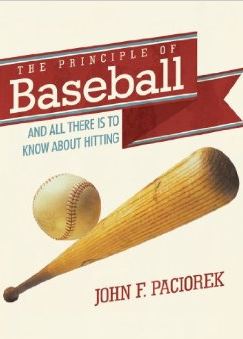
paciorekPaciorek, by the way, went on to become a high school teacher and multi-sport coach, and the author of two books (Plato and Socrates – Baseball’s Wisest Fans and The Principles of Baseball: And All There Is To Know About Hitting.) You also can enjoy Paciorek’s prose (and expertise)  directly at his highly recommended blog “Paciorek’s Principles of Perfect Practice” by clicking here. 

A final note. John Paciorek’s insight into the national pastime should come as no surprise. Paciorek comes from a true “baseball family.”  He was the first born of eight siblings and was followed to the big leagues by younger brothers Jim and Tom Paciorek.  (Like John, Jim’s MLB career was short – 48 games for the Brewers in 1987. Brother Tom, however, achieved a .282 average over an 18-season – 1,392 game – MLB career.) 

I tweet (on X) baseball @DavidBseballRT

Baseball Reliquary Shrine of the Eternals 2015 Electees announced

ReliquaryNewIf you follow Baseball Roundtable, you are probably aware of the fact that BBRT is proud to be a member of The Baseball Reliquary – a free-spirited organization dedicated to celebrating the human side of baseball’s history and heritage.  The Baseball Reliquary is truly a fans’ organization, committed to recognizing baseball’s place in American culture and to honoring the character and characters of the national pastime. The Reliquary pursues that mission through its collection of artifacts, traveling exhibitions, ties to the Whittier College Institute for Baseball Studies and (perhaps, most visibly) through its own version of the Baseball Hall of Fame – the Baseball Reliquary Shrine of the Eternals.  For more on the Baseball Reliquary, and why you should become a member, click here.

The Reliquary’s Board of Directors recently (May 4) announced its 2015 Shrine of the Eternals electees – each year, the top three vote getters (all Baseball Reliquary members may cast votes) are honored.  The induction ceremony for this 17th Shrine “class” will take place beginning at 2:00 p.m., July 19 in the Pasadena (CA) Central Library’s Donald R. Wright Auditorium.  Before we take a look at this year’s electees,  BBRT would like to share what the Baseball Reliquary has to say about its highest honor.

Similar in concept to the National Baseball Hall of Fame, the Shrine of the Eternals differs philosophically in that statistical accomplishment is not the principal criterion for election. It is believed that the election of individuals on merits other than statistics and playing ability will offer the opportunity for a deeper understanding and appreciation of baseball than has heretofore been provided by “Halls of Fame” in the more traditional and conservative institutions.

Criteria for election shall be: the distinctiveness of play (good or bad); the uniqueness of character and personality; and the imprint that the individual has made on the baseball landscape. Electees, both on and off the diamond, shall have been responsible for developing baseball in one or more of the following ways: through athletic and/or business achievements; in terms of its larger cultural and sociological impact as a mass entertainment; and as an arena for the human imagination.

The diversity of past honorees is a clear indication that the Baseball Reliquary and its member-voters are living up to the stated criteria. Past inductees include (among others) a one-armed major league outfielder, a pitcher who once threw a no-hitter while high on LSD, a team owner who sent a midget to the plate, a man in a chicken suit, a member of Major League Baseball’s 3,000-hit club, a manager who won eight World Championships, a surgeon, a labor leader, a statistical wizard and more than one best-selling author.

So, who are the Reliquary’s 2015 electees?  Diversity rules again.  The 2015 Class of the Shrine of the Eternals includes a baseball card designer; a West Coast minor league legend; and an MLBer who faced prejudice with his own brand of courage.

For BBRT, this may go down as the Class of the Killer B’s – (Sy) Berger; (Steve) Bilko; (Glenn) Burke. Here’s a look at the three electees through excerpts (in italics) from the Baseball Reliquary’s announcement.  For more detail, as well as a full listing of nominees and their vote totals, visit the post on the Baseball Reliquary’s web site by clicking here.  At the end of this post, I’ll also include a few comments on 2015 nominees that did not get elected, but did receive BBRT’s vote. Note: BBRT did cast votes for Berger and Burke.


Sy Berger (1923-2014) – “Father of the Modern Day Baseball Card” – 31% of the vote.

bERGERBorn in the Bronx, just blocks from Yankee Stadium, Berger joined the Brooklyn-based Topps Chewing Gum Company as an assistant sales manager in 1947 and headed its sports department for half a century.  During his tenure, he designed and oversaw the production of some of the most innovative and revered baseball cards of all-time.  He is often called the “Father of the Modern Day Baseball Card” for his work on the 1952 Topps baseball set, which he designed (with help from Woody Gelman) on his kitchen table and which for the first time incorporated team logos along with facsimile signatures, statistics, and personal information on the players.  This same format continues to the present day. 

Berger would remain with Topps as an employee for fifty years (1947-1997), and would serve as vice-president, and then consultant and board member.  He was still working as the company’s principle liaison between the players, teams, and leagues until his retirement in 2003.


Steve Bilko (1928-78) – West Coast Minor League Legend – 31% of the vote.

bILKOBilko was not a star in the big leagues.  Over a peripatetic ten-year career, he was a regular for only one season (1953, with the Cardinals), and he appeared in more than 100 games only one other time (1961, with the expansion Angels).  He could hit for power, but struck out too often.  He had no speed.  To explain the lingering mystique of this moon-faced, lumbering first baseman, we must look at the Pacific Coast League, with franchises located along the West Coast and featuring a prolonged weather-friendly playing season, competitive pennant races and playoffs, and a rabidly partisan fan base. 


The PCL produced great baseball until the Dodgers and Giants relocated to Los Angeles and San Francisco, respectively, in 1958.

In those waning years of PCL supremacy, Bilko was the slugging star for the Los Angeles Angels, who wowed fans with mammoth home runs and exceptionally fierce strikeouts.  He led the PCL in home runs for three consecutive seasons from 1955 to 1957, winning the league Triple Crown in 1956 with a .360 average, 55 HRs, and 164 RBI.  He was by far the biggest sports star in Los Angeles history prior to the arrival of the Dodgers. 

Recognizing his popularity with local fans, the Dodgers added Bilko to their roster as a gate attraction for their inaugural campaign in Los Angeles.  The Angels (the American League expansion team) did likewise in 1961, providing Bilko with a final chance to awe the fans at his old haunt, Los Angeles’s Wrigley Field.  For those who saw him play in the PCL, he will always be remembered as a superstar.  That his glory years coincided with the demise of a much-loved league adds a last wistful touch to his legend.

BBRT note: In ten MLB seasons, Bilko played in 600 games and put up a .249-76-276 stat line. In 13 minor league campaigns, he played in 1,533 games – hitting .312, with 313 home runs. As noted above, in 1956, with the Los Angeles Angels, he captured the Pacific Coast League Triple Crown with a .360 batting average, 55 home runs and 164 runs batted in. He followed that up, again for the Angels, with a .300-56-140 season in 1957.  Bilko was inducted into the PCL Hall of Fame in 2003.

Glenn Burke (1952-95) – Crossing the Barrier of Prejudice – 31% of the vote.

bURKEBurke was a fleet, capable outfielder for the Los Angeles Dodgers and Oakland Athletics during a four-year major league career from 1976 through 1979.  He was the first big league ballplayer to publicly acknowledge he was gay.  Although his public disclosure came after he had retired, Burke’s sexual preference was well known during his playing days, and he encountered widespread homophobia from locker rooms to board rooms. 

While never given an everyday opportunity with the Dodgers to show his mettle, Burke did make one lasting contribution to popular culture while with the team.  After Dusty Baker’s 30th home run at the end of the 1977 season — a feat which made the Dodgers the only team at that time to have four different players hit 30 or more taters — Burke raised his hands in celebration at home plate.  As Baker crossed the plate he reached up, slapped one, and the high-five was born.  

Having appeared in just over 100 games for Los Angeles during parts of three seasons, Burke was sent packing to Oakland.  Returning to his hometown didn’t make Burke’s life any easier.  A’s manager Billy Martin made public statements about not wanting a homosexual in his clubhouse, a clear reference to Burke.  After just two years with the A’s, Burke quit baseball in frustration.  He became active in amateur athletic competition after baseball, competing in the 1982 and 1986 Gay Games in basketball and track. Burke died of complications from AIDS-related illness in 1995.

A documentary, Out: The Glenn Burke Story, was released in 2010.  

BBRT note: In 2013, Burke was among the first group of inductees into the National Gay and Lesbian Sports Hall of Fame. Burke was also honored at a press conference prior to the 2014 MLB All Star game.  How good could Burke haven been? We’ll never know, but in 600 minor league games, he hit .293, with 48 home runs and 214 stolen bases.

So there’s the 2015 Shrine of the Eternals inductees.  Now here’s a look at those who got BBRT’s vote, but didn’t make the final three.

_____________________________________________________________

Mamie “Peanut” Johnson (1935 – *)

Johnson was one of three females to play for the Indianapolis Clowns during the declining days of the Negro Leagues.  Johnson took the mound to the Clowns for three seasons (1953-55), running up a 33-8 record.  Her exploits are chronicled in the children’s book A Strong Right Arm: The Story of Mamie “Peanut Johnson, by Michelle Y. Green.

Rube Waddell (1876-1914)

Rube Waddell is pretty much granted the title of the zaniest player in MLB history – but he was also one of the best (at least when he was focused on the game). Waddell was known to wrestle alligators, leave a ball game to chase a fire engine, miss a game he was scheduled to start because he was fishing or playing marbles with neighborhood kids, bring his outfielders in to sit on the grass and then proceed to fan the side – and frequently do battle with owners and managers.  Waddell was more interested in the freedom to enjoy life and do things his way than money.  But, when Waddell was on his game, he was arguably the best pitcher of his time. The 6’1”, 195-lb. lefty led the AL in strikeouts six consecutive seasons (1902-1907) – by a wide margin.

How good was Waddell?  In 1902, he joined the Philadelphia Athletics in June – making his first start on June 26 (with just 86 games left in the season.) Waddell proceeded to win 24 games (the league’s second-highest total) against seven losses, with a 2.05 ERA.  Perhaps more telling is that, despite his shortened season, he led the AL with 210 strikeouts, fifty more than the runner-up (none other than Cy Young, who had 16 more starts than Waddell).

In 1904, Waddell set a modern (post-1900) MLB record with 349 strikeouts that stood until 1965.  Waddell, elected to the National Baseball Hall of Fame in 1946, finished with a 193-143, 2.16 line – leading the AL in strikeouts six times, ERA twice, wins once and complete games once. For more on Waddell, BBRT suggests: Rube Waddell: The Zany, Brilliant Life of a Strikeout Artist, by Allan Howard Levy and Just a Big Kid: The Life and Times of Rube Waddell, by Paul Proia.

Pete Reiser (1919-81)

Combine Willie Mays’ skill set (younger folks, think Mike Trout) with Pete Rose’s hustle and Yasiel Puig’s on-field abandon and you have Pete Reiser. In his first MLB full season (CF, Dodgers), a 22-year-old Reiser dazzled defensively and led the NL in runs scored (117), doubles (39), triples (17), batting average (.343), total bases (299) and hit by pitch (11) – tossing in 14 home runs and 76 RBI for good measure. Unfortunately, unpadded outfield walls, helmet-less at bats (the fiery Reiser was a frequent target) and aggressiveness on the base paths (Reiser twice led the NL in stolen bases) took their toll.

In his ten-season career, Reiser endured five skull fractures, a brain injury, a dislocated shoulder and a damaged knee.  He was carted off the field 11 times during his career (six times unconscious) and once actually given last rites at the stadium – and he played on. The three-time All Star retired as a player with a .295 career average, playing in 861 games over ten seasons. No telling what he might have done with padded outfield walls and batting helmets.  Pete Reiser was a true – and talented – gamer. For more on Reiser, try Pete Reiser: The Rough and Tumble Career of the Perfect Ballplayer, by Sidney Jacobson.

Denny McLain (1944- *)

MLB’s last 30-game winner (31-6 for the Tigers in 1968), BBRT views McLain as the Pitcher of the Year in what baseball analysts often refer to as the Year of the Pitcher.  And, he wasn’t a one- year wonder.  McLain won 20 or more games three times, captured two Cy Young Awards (1968-69) and one AL MVP Award (1968).  McLain, who ran up a 131-91, 3.39 record in ten MLB seasons, was a colorful and complex a character off the field and on.  His life experience provides a tale of ups and downs – from being selected the 1968 Associate Press Male Athlete of the Year and Sporting News Major League Player of the Year to a six-year prison stint.

McLain is likely the only former major leaguer whose bio includes such varied terminology as MVP, Cy Young Award, All Star game starting pitcher, World Series opening game starter – as well as pilot, Capitol Records recording artist, talk show host, author and ex-con.  McLain’s story gives baseball fans plenty to talk about – and you can learn more by reading I Told You I Wasn’t Perfect, by Denny McLain and Eli Zaret.

Oh, and just one more bit on Denny McLain.  He started the 1966 All Star game (vs. Sandy Koufax) and retired all nine batters he faced (Mays, Clemente, Aaron, McCovey, Santo, J. Torre, Lefebvre, Cardenas, Flood) on just 28 pitches –striking out Mays, Aaron and Torre.  That alone justifies consideration for the Shrine of the Eternals.

Effa Manley (1900-81)

The first woman enshrined in the National Baseball Hall of Fame, during the 1930s and 1940s, Manley ran the day-to-day operations of the Negro National League Newark Eagles (owned by her husband Abe Manley) – at a time when baseball, on the field and in the executive offices, was considered a “man’s domain.”  Effa, often thought of as a light-skinned black, was actually white.  She, however, grew up with a black stepfather and mixed-race siblings and was active in the New Jersey branch of the NAACP and Citizen’s League for Fair Play.  Effa Manley deserves recognition for overcoming both racial and sexual barriers as she exercised leadership in the national pastime.

David Mullany (1908-90)

David Mullany was the inventor of the Wiffle® Ball (1953), which ultimately changed backyard baseball for millions of young (and old) players and fans. I know I loved my white perforated plastic ball and yellow plastic bat – and played more than one backyard World Series opener with them (without shattering a single window).  Today, there are Wiffle Ball fields, leagues and tournaments.  The company is still operated by the Mullany family and you can learn more by visiting their website (www.wiffle.com)

Charles M. Conlon (1868-1945)

One of the greatest baseball photographers ever, Conlon produced a tremendous library of portraits and action photos of baseball’s greats, near greats and also-rans. Conlon’s 1909 photograph of Ty Cobb sliding into third base with spikes flying and teeth clenched is considered by many to be the greatest baseball action picture ever taken. His photos appeared regularly in such publications as The Sporting News, Baseball Magazine, and the Spalding and Reach Base Ball Guides, but it was the 1993 book, Baseball’s Golden Age: The Photographs of Charles M. Conlon that finally brought the full impact of his contributions to the fore.

Vic Power (1927-2005)

In 1963, baseball held it first and only Latino All Star Game – October 12 at New York City’s Polo Grounds – featuring such Hispanic stars as Juan Marichal, Roberto Clemente, Louis Aparicio, Tony Oliva, Minnie Minoso, Felipe Alou, Orlando Cepeda and Vic Power.  In pre-game ceremonies, Vic Power was honored as the number-one Latino player – such was the power and popularity of Vic Power.

During his 12-year MLB career, Power proved a capable hitter (.284 lifetime average) and a flashy fielder, who won seven consecutive Gold Gloves at first base. Power’s contribution to the game went much further, however, Power served as mentor to many of the Latino/Hispanic player entering major league baseball in the 1950s and 1960s. Power was a trailblazer for today’s generation of Latino stars.

John Young (1949-*)

A 6’3”, 210-pound, left-handed first baseman, John Young hit .325, with four home runs, 60 RBI and 26 stolen bases (in 29 attempts) in 99 games at Single A Lakeland (Tigers’ farm team) as a twenty-year old (in 1969). The first-round draft choice (16th overall in the 1969 draft)  truly looked like a player with promise – and, in fact, enjoyed a big league cup of coffee with the Tigers in 1971 (two games, four at bats, two hits, one run, one RBI, one double). A wrist injury derailed his playing career, but didn’t dampen his love for the game and he went on to a long career as a scout. It was during his scouting days that Young developed a concern for the decline of baseball among young people – particularly in the inner cities.  In response, Young came up with the concept for the RBI (Reviving Baseball in Inner Cities) program. Officially launched in 1989, the RBI program is now supported by all thirty MLB clubs and is active in more than 200 communities – annually providing more than 260,000 youngsters the opportunity to play baseball and softball. (The program also includes educational and life skills components.) A few RBI alumni in the major leagues include: Carl Crawford, Justin Upton, CC Sabathia, James Loney and Manny Machado.

So, there’s my 2015 Baseball Reliquary Shrine of the Eternals ballot – and I’m already looking forward to next year.


I tweet baseball @DavidBBRT

May Day – A Look Back at MLB’s April

Opening Day, of course, leads to opening month.

Opening Day, of course, leads to opening month.

It’s May 1, which also means, it’s time for BBRT’s look back at the previous month in major league baseball.  This means touching upon:

  • the expected and unexpected – like the Dodgers (expected) and Astros (unexpected) sitting atop their respective NL and AL West Divisions;
  • the ups and downs – like the Mets’ eleven-game winning streak and the World Champion Giants’ eight losses in a row;
  • a few unique events that caught BBRT’s attention – like Nelson Cruz’ 483-foot home run (longest in the majors so far this year) and Paulo Orlando’s first three MLB base hits being triples; Mark Teixeira finishing a game a year older than when he started it; and
  • more.

First, however, I’d like to honor a May 1 anniversary that really brings home how the game has changed.

On May 1, 1920, the Brooklyn Robins (later Dodgers) took on the home team Boston Braves (later Milwaukee and Atlanta) in a 26-inning contest that was suspended due to darkness with the score tied 1-1.  It remains, in terms of innings, the longest MLB game ever. It is not just this game’s length that makes it special. On that day, 95 years ago, both starting pitchers (Leon Cadore of Brooklyn and Joe Oeschger of Boston) went the distance – each throwing more than 300 pitches.  And, as far as pace of game issues, it took the two squads just 3 hours and 50 minutes to complete 26 innings.

What prompted this look back was the Twins-Mariners contest of April 24, when the Mariners topped the Twins 2-0 behind Felix Hernandez.  Not only did both starting pitchers go the distance (Phil Hughes for Minnesota), but the game was completed in a nifty two hours and three minutes.

These days the likelihood of two opposing hurlers going the distance is pretty limited. In April, MLB saw only five complete games – and, in 2014, the 30 MLB teams achieved a total of only 118 CG, just 2.4 percent of games started and just under four complete games per team.  Here’s a look at the “devolution” of the complete game.

– In 1900, 82.3% of games started were complete games;

– 1925 – 49.2%

– 1950 – 40.3%

– 1975 – 27.2%

– 2000 – 4.8%

– 2014 – 3.9%

For a look at BBRT’s take on how the approach to pitching has changed over the years, click here to go to a post from May of 2012.

Now let’s take a look at some April observations. A number of things have gone as expected – The Dodgers and Cardinals, for example, sit atop their divisions and the Cubs, Mets and Padres all look improved. There also have been a few surprises – positives like the first-place Astros and Yankees and negatives like the last-place (defending World Champion) Giants and slow-starting Washington Nationals.

If the post season began May 1, the playing field would look like this:

AL: Division leaders – New York, Kansas City, Houston.  Wild Cards: Detroit , Tampa Bay/Boston (tie).

NL: Division Leaders – New York, Saint Louis, Los Angeles. Wild Cards: Chicago, Pittsburgh.

For the month, only the Saint Louis Cardinals played  .700-or better ball (15-6, .714) and only the Milwaukee Brewers ended the month below .300 (5-17, .227).

At the close of April, the closest race was in the AL East, where only one team was below .500 (Blue Jays 11-12) and only 2 ½ games separated first and last place.  The biggest gap between first and second was in the NL East, where the Mets finished April 4 ½ games ahead of the Braves and Marlins – and only the Mets were above .500.

For full standings, go to the end of this post.

Winning Streaks

No team got off to a better start than the Kansas City Royals, who shot out of the gate by winning their first seven contesLos Angeles Dodgers vs. New York Mets - April 25, 2013ts.  The longest winning streak during the month belonged to the Mets, who took advantage of a ten-game home stand to fuel an eleven-game winning streak – in which they won five one-run contests and outscored their opponents 57-31.  Note: The Mets nearly completed a perfect 11-0 home April. They lost their first home game – to the Nationals by an 8-2 score – on April 30.  The hottest team at the close of the month was the Houston Astros, who won their final seven April games.

Losing Streaks

On the negative side, The Brewers went the longest before their first victory – starting the season with four straight losses.  Milwaukee also shared April’s longest losing streak, an 8-gamer stretching from April 15 through April 22. During the streak, they scored a total of only 21 runs – with nearly half  of those coming in a 16-10 loss to the Reds on April 21.  The reigning World Champion Giants also suffered through an eight-game losing streak –  April 10 through April 17 – during which they were shut out three times and outscored 43-15.

Those Surprising Astros

Jose Altuve - Like the Astros, flying high.

Jose Altuve – Like the Astros, flying high.

Between 2010 and 2014, the Astros won 308 and lost 502, never finished higher than fourth, and ended up an average of 34 games out of first place. The Houston squad ended this April in first place in the AL West – staking their claim to a competitive season on the strength of their pitching. Houston ended April with the AL’s lowest ERA (3.04). The staff was led by starters southpaw Dallas Keuchel (3-0, 0.73 ERA) and righty Collin McHugh (3-0, 2.92) – a pair who showed their potential last season, both posting winning records and sub-3.00 ERAs for the 70-92 Astros.  Offensively, the team’s 103 runs scored area respectable eighth in the AL.  Notably, Houston led the AL in both home runs (29, tied with the Orioles and Yankees) and stolen bases (also 29) through April 30. Who is leading the charge?   A big guy and a little guy who both play up the middle.  Six-foot-four CF Jake Marisnik – hit .379 in April, with 2 home runs, 10 RBI, 12 runs scored and eight steals.  Right there with him was last year’s NL batting champ, Jose Altuve (at five-feet five-inches currently the shortest MLB player), who hit .367, with two  home runs, 16 RBI, 13 runs scored and  a league-leading nine steals for the month.

Ahh, the DH

As you might expect – given the DH – the top seven run-scoring teams for April were in the AL – led by the Toronto Blue Jays (122 runs)The retooled San Diego Padres – not known in the past for offense – led the NL with 105 runs (thank you very much newcomers – Kemp, Upton and Myers).

League Leaders – Runs Scored (through April 30)

AL

Blue Jays – 122

Royals – 119

Red Sox – 113

NL

Padres – 105

Nationals – 103

Dodgers – 100

The fewest runs plated in April? The Phillies in the NL with just 63 and the White Sox in the AL at 64.

Hitting .300 – AS A TEAM

Mike Moustakas - hit .356 in April.

Mike Moustakas – hit .356 in April.

The Kansas City Royals hit .306 – as a team – for April; twenty points ahead of the next best mark (Orioles and Tigers). The NL’s leading team batting average for the month was the Colorado Rockies’ .280. The Royals line up on April 30th included six .300+  hitters:  Alex Gordon (LF-.303); Mike Moustakas (3B-.356); Lorenzo Cain (CF-.329); Eric Hosmer (1B-.310); Kendrys Morales (DH-.315); Salvador Perez (C-.326).

The Rangers and Phillies had the lowest team batting averages for April, at .210 and .223, respectively.

A Couple of Free Agent Pickups that Really Worked Out

The off season saw the  Mariners signing free agent outfielder Nelson Cruz (the 2014 AL HR leader) and the Red Sox signing (the then soon-to-be) outfielder Hanley Ramirez. In response to the old “Where are they now?” question – they are tied for the AL and MLB lead in both home runs (10) and RBI (22) through April. To go along with the power, Cruz is hitting .322 and Ramirez .293

RBI Leaders (through April 30)

AL

Nelson Cruz, Seattle – 22

Hanley Ramirez – Boston – 22

NL

Giancarlo Stanton, Miami – 21

Paul Goldschmidt, Arizona – 20

HR Leaders

AL

Nelson Cruz, Seattle – 10

Hanley Ramirez, Boston – 10

NL

Adrian Gonzalez, Los Angeles – 8

Todd Frazier, Cincinnati – 7

Joey Votto, Cincinnati – 7

Trades Can Work Out, Too

Dee Gordon - Looking even better in a Miami uniform.

Dee Gordon – Looking even better in a Miami uniform.

The Miami Marlins picked up second baseman Dee Gordon in a trade with the Dodgers – and couldn’t be more pleased with the outcome. Through April, Gordon was leading all of MLB in batting average (.409) and base hits (38) and was second in the NL in steals with eight. Gordon is one of three players who closed out April at .400 or better.  Joining him in that rare air were another second baseman – DJ LeMahieu of the Rockies at .406 – and the AL batting leader, Baltimore CF Adam Jones at an even .400.

Batting Leaders

AL

Adam Jones, Baltimore – .400

Jose Iglesias, Detroit – .377

Miguel Cabrera, Detroit – .373

NL

Dee Gordon, Miami – .409

DJ LeMahieu, Colorado – .406

Adrian Gonzalez, Los Angeles – .383

Stolen Base Leaders

NL

Billy Hamilton, Cincinnati – 13

Dee Gordon, Miami – 8

AL

Jose Altuve, Astros – 9

Jake Marisnik, Astros – 8

George Springer, Astros – 8

Jacoby Ellsbury Yankees – 8

If You Really Like Offense

Now, if you really like offense, check out the Blue Jays and Red Sox in the AL.  The Blue Jays led all of MLB in runs scored in April (122), while the Red Sox were third (113).  They reversed the order when it came to runs given up.  The Red Sox gave up the most tallies for the month (119), the Blue Jays the third most (115).  How did this go in the W-L columns?  The Red Sox were 12-10, the Blue Jays 11-12.

If you have an NL interest, the Padres (as noted earlier) scored the most runs (105) and the Brewers gave up the most runs (118).

Team Power – Or Lack Thereof

Only two teams reached 30 home runs in April, the Dodgers with 32 and the Reds with 31.  The Orioles, Astros and Yankees tied for the top in the AL with 29 April dingers. At the bottom of the long ball list were the Twins and White Sox in the AL with 12 home runs and the Phillies and Marlins (despite Giancarlo Stanton) in the NL with thirteen.

Nationals Under-Achievers

Most analysts expected the Nationals to run away with the AL East, largely based on the strength of their pitching staff. Oops!  Through April, the Nationals had given up the fourth-most runs in the NL, on the way to a 10-13 record (fourth place). But, the pitching may not be to blame. The Nationals 3.69 ERA was the NL’s fifth best.  The team, however, led the major leagues in errors (24) and 24 of the 107 runs (22%) the Nationals gave up in April were unearned. Over in the AL, two teams in the West tied for the lead in errors at 21 – the Athletics and Rangers.

ERA Leaders (through April 30)

NL

Cardinals – 2.43

Pirates – 2.95

Mets – 3.33

AL

Astros – 3.04

Royals – 3.10

Yankees – 3.23

Strikeout Leaders (pitching)

NL

Dodgers – 202

Padres – 198

Pirates – 195

AL

Yankees – 208

Indians – 202

Red Sox 191

First To Four Pitching Victories

Seven pitchers picked up four wins in April, but the surprise was that the first to get there was 41-year-old Mets’ starter Bartolo Colon, who  picked up that fourth win on April 23.  Colon went 4-1, 3.31 for the month.  The remaining four-game winners were:  Garrett Cole (Pirates, 4-0, 1.76); Zack Greinke (Dodgers, 4-0, 1.93); Matt Harvey (Mets, 4-0, 3.04); Felix Hernandez (Mariners, 4-0, 1.82); Michael Wacha (Cardinals, 4-0, 2.42); and Alfredo Simon (Tigers, 4-1, 3.13).

Among qualifying ERA leaders, the Rangers’ Nick Martinez has the lowest mark in MLB (0.35 ERA in four starts), while the Reds’ Anthony DeSclafini holds sway in the NL at 1.04.  BBRT finds it interesting that all sub-1.00 ERA are in the AL, with its DH.

ERA Leaders (through April 30)

AL

Nick Martinez (Rangers, 2-0, 0.35)

Dallas Keuchel (Astros, 3-0, 0.73)

Chris Archer (Rays, 3-2, 0.84)

NL

Anthony DeSclafini (Reds, 2-1, 1.04)

Max Scherzer (Nationals, 1-2, 1.26)

Adam Wainwright (Cardinals, 2-1, 1.44)

Strikeout Leaders

AL

Chris Archer (Rays, 37 K/37 1/3 IP)

Felix Hernandez (Mariners, 36 K/34 2/3 IP)

Cory Kluber (Indians, 36  K/ 34 IP)

NL

Clayton Kershaw (Dodgers, 43 K/31 1/3 IP)

James Shields (Padres, 41 K/31 IP)

Johnny Cueto (Reds, 38 K/37 IP)

_______________________________________________________

A FEW OTHER OBSERVATIONS

One Very Cold Start

Evan Gattis, Houston’s new designated hitter, was anything but that to start the season – at one point even striking out eight times in eight plate appearances over two games (losses to Cleveland on April 8 and April 9).  The DH, in fact, didn’t get his first “H” until his 23rd at bat – and he had 13 strikeouts in those first 22 at bats.

And, On the Other Hand …

Adrian Gonzalez - a blazing start.

Adrian Gonzalez – a blazing start.

Dodgers’ first baseman Adrian Gonzalez  started 2015 as hot as Evan Gattis was cold.  Gonzalez went deep in the first three Dodger contests of the season – topped off by a three-homer game in LA’s 7-4 win over San Diego on April 8.  Baseball tracks pretty much everything, so we know that Gonzalez became the first MLBer to hit five home runs in a season’s first three games.  In those first three contests, Gonzalez was ten-for-thirteen, with five home runs, two doubles, seven runs and seven RBI.


Four Strikeouts on Just Twelve Pitches

Oakland 3B Brett Lawrie had a tough night on April 7 – just his second game as a member of the A’s.   After going one-for-four on Opening Day, Lawrie took the collar in game two (0-for-4).  It’s how he did it that drew notice.  Lawrie came to the plate four times in the 3-1 loss to the Rangers and struck out four times – on a total of just twelve pitches. Lawrie faced three different pitches, had a nice balance of six called strikes and six swinging strikes. His final swinging strike also marked the final out of the contest.

The Game Will Age You

On April 10 (and April 11), the Yankees and Red Sox engaged in the longest game at new Yankee Stadium  – 6 hour and 49 minutes (19 innings).

  • The game started at 7:05 p.m. on Friday and ended at 2:13 a.m. on Saturday; and included a 16-minute light failure delay.
  • The teams used a total of 42 players.
  • Seventeen of those players were pitchers and they threw a total of 628 pitches (332 by the Yankees, 296 by the Red Sox.)
  • Yankees’ first baseman Mark Teixeira (born on April 11, 1980) started the game as a 34-year-old, and finished it at age 35.
  • The Red Sox took a 3-2 lead into the bottom of the ninth, a 4-3 lead into the bottom of the 16th and a 5-4 lead into the bottom of the 18th – and gave up the tying run each time – until winning it 6-5 in the 19th.
  • The Red Sox’ Steve Wright pitched the last five innings – blowing two leads (16th and 18th innings), before earning the win in the 19th.

Triple Your Pleasure, Tripe Your Fun

On April 9, 29-year-old MLB rookie Paulo Orlando started in left field and hit in the eight spot for the Kansas City Royals.  In the bottom of the third inning, facing Chicago southpaw John Danks, Orlando walked in his first-ever MLB plate appearance. One inning later, the right-handed hitter achieved his first-ever MLB at bat and lashed a triple to deep center.  It was his only hit in a one-for-three day (remember that number … three.) His triple, however, was a sign of things to come.

Orlando’s next start came on April 12, against the Angels, in Los Angeles. The 6’ 2”, 210-pound rookie was once again manning left field and hitting eighth. This time he collected two hits in five at bats. His first hit of the day came leading off the top of the sixth.  Like his very-first (and until then only) MLB hit, it was a triple to deep center.  Sensing a pattern here?  Orlando picked up his second hit of the game in the eighth and switched things up a bit, lacing the ball to left field for – you may have guessed it – a triple.   So, after two games in the major leagues, Orlando had three hits – all triples. He was the first player ever to log triples for his first three MLB hits.

Slam-A-Rama

On April 21, the Brewers and Reds tied an MLB record by hitting a combined three grand slam home runs in a single game – as Cincinnati topped Milwaukee 16-10. The first grand slam came off the bat of the Reds’ Jay Bruce with two outs in the top of the third inning. One inning later, the Red’s Todd Frazier went deep with the bases full – again with two out.  The Brewers countered with a grand slam by Elian Herrara in the bottom of the sixth.  Overall, the game featured seven round trippers.

It was only the fourth time in MLB history that three grand slams were hit in a single game. The first time was in a 13-11 Texas win over Baltimore (at Baltimore on August 6, 1986) – featuring grand slams by Texas 2B Toby Harrah, Baltimore DH Jim Dwyer and Baltimore LF Larry Sheets.   The following season (June 3, 1987) saw the first NL three grand slam game, as the Cubs topped the Astros 22-7 in Chicago.  Cranking based loaded homers in that one were Astros’ CF Billy Hatcher, Cubs’ LF Brian Dayett and Cubs’ 3B Keith Moreland. Then on August 25, the Yankees became the first (and still only) team to manage three grand slams in a single game on their own – as they topped the A’s 22-9 in New York. The slams went to 2B Robinson Cano, CF Curtis Granderson and C Russell Martin.  The three Yankees totaled 16 RBI in the game.

The Fresh-Faced 100-100 Club

There's really not stopping Mike Trout - unless he wants to take a breather.

There’s really not stopping Mike Trout – unless he wants to take a breather.

On April 17, when Los Angeles Angels’ center  fielder Mike Trout came to the plate in the top of the sixth inning of a tie game (1-1) against the Astros, he was thinking “contact” not “history” – but he quickly made both.  Trout made contact, taking Astros’ pitcher Roberto Hernandez deep for a 3-1 Angels’ lead.  He made history by hitting his 100th career home run – becoming the youngest player ever to amass 100 career homers and 100 career stolen bases. Trout was 23 years and 253 days old, beating the previous mark for reaching 100-100 (Alex Rodriguez) by 56 days.

Not Exactly a Pitchers’ Duel

On April 11, the Minnesota State (Mankato) Mavericks (NCAA Division II) won the first game of their double header against the Bemidgi State Beavers 10-9 – but compared to game two, that was a pitcher’s duel. In the second game, the Mavericks  plated 41 runs (to “just” 20 for Bemidgi State). In a game that went eight innings (mercy rule), the line score looked like this:


Minnesota State     3   6   10   0   3   0   4   14      41   35   2

Bemidgi State        0   7     1   0   3   7   2      0     20   21   6

Minnesota State swept the four game series at Bemidgi – outscoring the home team 88-34.

________________________________________________________

MLB Standings through April 30

AL East

Yankees          13-9    .591

Red Sox          12-10   .545     1.0

Rays                12-10   .545     1.0

Orioles             10-10   .500     2.0

Blue Jays         11-12   .478     2.5

AL Central

Royals             15-7     .682

Tigers              15-8     .652     0.5

Twins              10-12   .455     5.0

White Sox         8-11   .421     5.5

Indians             7-14   .333     7.5

AL West

Astros              15-7     .682

Angels             11-11   .500     4.0

Mariners          10-12   .455     5.0

A’s                    9-14   .391     6.5

Rangers             7-14  .333     7.5


NL East

Mets                15-8     .652

Braves             10-12   .455     4.5

Marlins            10-12   .455     4.5

Nationals         10-13   .435     5.0

Phillies              8-15   .348     7.0

NL Central

Cardinals         15-6     .714

Cubs                12-8     .600     2.5

Pirates             12-10   .545     3.5

Reds                11-11   .500     4.5

Brewers           5-17    .227     10.5

 NL West

Dodgers          13-8     .619

Rockies           11-10   .524     2.0

San Diego       11-12   .478     3.0

D-backs           10-11   .476     3.0

Giants               9-13   .409     4.5


I tweet baseball @David BBRT

Three is a Pretty Lucky Number for Paulo Orlando

pauloOn April 9, 29-year-old MLB rookie Paulo Orlando started in left field and hit in the eight spot for the Kansas City Royals.  In the bottom of the third inning, facing Chicago southpaw John Danks, Orlando walked in his first-ever MLB plate appearance. One inning later, the right-handed hitter achieved his first-ever MLB at bat and lashed a triple to deep center.  It was his only hit in a one-for-three day (remember that number … three.) His triple, however, was a sign of things to come.

Orlando’s next start came on April 12, in Los Angeles against the Angels and starting pitcher (another lefty) C.J. Wilson.   The 6’ 2”, 210-pound rookie was once again manning left field and hitting eighth. This time he collected two hits in five at bats (and scored three runs). His first hit of the day came leading off the top of the sixth.  Like his very-first (and until then only) MLB hit, it was a triple to deep center.  Sensing a pattern here?  Orlando picked up his second hit of the game in the eighth (off reliever Fernando Salas, a righty this time) and Orlando switched things up a bit, lacing the ball to left field for – you may have guessed it – a triple.   So, after two games in the major leagues, Orlando had three hits – all triples. He was the first player ever to log triples for his first three MLB hits.  Bet we won’t be seeing that again.  But there is more to come.

On April 16, Orlando and the Royals found themselves in Minnesota, where Twins’ pitchers held the rookie (playing left field and batting seventh) to a mundane infield single in four trips to the plate. The string of triples was over, but Orlando’s penchant for three-baggers was not. The next day (yesterday), back in Kansas City facing the Oakland A’s, Orlando was in right field, batting eighth. He collected one hit (one run and one RBI) in  four at bats – a triple to deep right center in the eighth off right-handed reliever Dan Otero. So, Orlando – after playing in four major league games – had five hits (.313 average), and four of them were triples.

Of course, the speedster’s penchant for baseball’s rarest hit – the triple – should not come as a surprise. In nine minor league seasons, Orlando hit a total of 63 three-baggers – topping ten triples three times, with a high of 14 in 2008. Over 1,017 minor league games, Orlando hit .275, rapped 63 home runs (the identical total as his triples) and stole 200 bases. Last season, at AAA Omaha, Orlando hit .301 with nine triples, six homers and 34 steals in 136 games.

I tweet baseball @DavidBBRT

Twins Opening Day – From Festive to Restive

As the game time approaches, the sun seems a little brighter, the sky a little bluer, the grass a shade greener.  Once the game begins, the ball hops off the bat with an especially sharp crack, the pitches seem to have more zip and whir-r-r than ever and the fielders move with a unique combination of grace and energy.  In the stands, the beer is crisp and cold and the hot dogs steam in the cool of early spring.  The fans cheer on their old and new heroes and follow this opening contest with pennant race intensity – the most intense among them logging each play in the new season’s first scorecard.   Baseball Is Back!

                                                      Baseball Roundtable … March 26, 2013


OD scoreboard

April 13 was the Minnesota Twins 2015 (Home) Opening Day and, as usual, the Twins did it up right – to a point.  


BBRT note: The Twins came into their home opener six games into the season and already five games out of first place, so the level of optimism may not have been quite as prevalent as at some earlier Minnesota home openers – but the excitement surrounding the thought that Baseball Is Back still ran high.  

As is tradition, the day started with free breakfast on the Twins Plaza – and what says spring and baseball more than hot dogs, chips and ice cream in the morning, especially when accompanied by blue skies, plenty of sunshine and Twins’ mascot TC the Bear.  Breakfast was served from 6-9 a.m., with additional festivities (music and concessions) planned on the Plaza and at the Target Field (light rail) Station beginning at noon  The Plaza started to fill up before noon (the gates opened at 1 p.m.) – with nearby eating and drinking establishments, as well as parking lots, drawing big crowds even earlier.  (A word of advice from BBRT, when the Twins have a sell out – and this game was sold out – on a work day, get downtown early if you don’t want to spend some time looking for parking.)

The mood was festive, with most of the crowd outfitted in Twins-identified gear, concessions stands on the Plaza doing a brisk business and DJ Madigan spinning plenty of upbeat tunes from the balcony above the crowd.  (The mood would later go from festive to restive, but we’ll get to that.  Let’s enjoy the moment for now.) Photos with the various statues of Twins’ heroes or sitting in the “big glove” seemed the order of the day.

The Twins hoodies proved a popular Opening Day giveaway - for all 40,000+ fans.

The Twins hoodies proved a popular Opening Day giveaway – for all 40,000+ fans.

By one p.m., the Plaza was full of happy fans waiting for another Target Field Opening Day tradition, the opening of the gates by Twins’ legends.  What better way to enter the ballpark then through a gate opened that day by the likes of Tony Oliva, Kent Hrbek or Tom Kelly?  To top it off, once you got past the metal detectors, you were handed a free Twins hooded sweatshirt – a true Minnesota-focused promotion.  For a look at BBRT’s post on 2015 Twins’ promotions (and some unique items other teams are giving away), click here.  Day one of the 81-game home season was off to a great start.

Once inside the ballpark, fans rushed not to find their seats, but rather to secure a seat or place in line at one of Target Field’s many food and beverage locations. From Hrbek’s to Barrio to the Town Ball Tavern and from Red Cow to Kramarczuk’s to Andrew Zimmern’s Canteen, they were all kept busy – and for good reason, the food and drink options at Target Field remain exceptional.  (For BBRT’s recent post on 2015’s new Target Field food and beverage offerings click here.)

Shrimp corn Dogs - new ballpark food.

Shrimp corn Dogs – new ballpark food.

I made my way to Hrbek’s, where the new College Daze Bloody Mary – garnished with everything from cheese to pepperoncini to a slice of pepperoni pizza – was proving quite popular.  It seemed mandatory to have your picture taken with the new drink before consuming it.  I’m sure social media, like the tip of the pizza slice, was saturated.  My pre-game choice was the Shrimp Corn Dogs – jumbo shrimp (served on skewers) fried in jalapeno corn batter with a Chili Lime Aioli for dipping ($15).  Great shrimp flavor, just enough “zing” and a complementary tart sauce; and light enough to leave room for the obligatory Opening Day (old school) hot dog later in the day.

Then, with my freshly purchased scorecard in hand, I went in search of my seat – Section 213, Row 1, Seat 14 – and was pleasantly surprised.  I was just to the right of home plate, second deck, first row; and the view of the field was great.  It was also, particularly for Minnesota, a perfect day for an Opener.  Game time temps above 60 degrees, sunny, clear blue sky with just enough clouds to give it some depth.  And, as always seems to be the case on Opening Day, the grass was crisp green, the batting practice balls stark white and all the colors in the stadium (logos, bunting, base lines, etc.) especially vibrant.

As we all waited for game time, we enjoyed: a brief performance by recording artist Shawn Mendes; the introduction of both teams (players, coaches, videographers, trainers, etc.); the National Anthem (actress and singer Greta Oglesby), with two American Bald Eagles from the Minnesota Raptor Center present and a follow-up flyover by a pair of Minnesota Air National Guard F-16 fighters.

Meeting the team is an Opening Day tradition. The loudest and longest ovations went to Torii Hunter, Joe Maue and Brian Dozier.

Meeting the team is an Opening Day tradition. The loudest and longest ovations went to Torii Hunter, Joe Mauer and Brian Dozier.

BBRT would note here that the largest ovation during the introductions went to Torii Hunter (starting in right field), returning to the Twins after seven years (Los Angeles Angels and Detroit Tigers). The 39-year-old Hunter previously starred in center field for Minnesota (six-time Gold Glove winner and two-time All Star while with the Twins) and the team won four division titles during his tenure.  The fans clearly loved his style and his smile – and the applause intensified when this quote from the returning Twin appeared on the scoreboard: “This is where I need to be.  This is home to me.”

BBRT: Hunter’s popularity was also evidenced by the large number of new and old “Hunter – 48” jerseys in the crowd.  Sitting next to me were a father and son (about 2 ½ years old) in matching new (no pin stripes, the little extra gold trim) Hunter home jerseys.  Although, I must say, the youngster cheered loudest for his personal hero – Brian Dozier.

Notably, another returnee to the Twin Cities joined Hunter in throwing out the first pitch, as the crowd welcomed back the newest Timberwolves’ player Kevin Garnett – a member of the T-Wolves during their most successful seasons and now back with Minnesota after playing with the Boston Celtics (2007-13) and Brooklyn Nets (2013-15). Note: Garnett was a member of the Timberwolves from 1995-2007); and a ten-time All Star and NBA MVP (2004) during that time. Minnesotan Tyus Jones, who recently helped lead Duke to the NCAA National Basketball Championship, delivered the baseball to Garnett on the mound, and Garnett threw the ceremonial first pitch to Hunter.  All three hometown heroes received rousing ovations – and the pre-game excitement continued to ratchet up.

We saw a few too many "meetings on the mound" on Opening Day.

We saw a few too many “meetings on the mound” on Opening Day.

I won’t go into much detail about the game – a 12-3 loss to the Kansas City Royals – it’s been well dissected in the traditional and social media. Let’s just say it started out pretty well for the home team, with the Twins scoring first (Kenny Vargas singling home the doubling Brian Dozier with two outs in the bottom of the first); was fairly crisply played over the first five frames (Twins trailing 2-1 after five); got a little shaky in the sixth, with starting pitcher Trevor May giving up a single and two doubles to the first three hitters and Hunter making a throwing error (still, after seven innings the Twins were down by only 5-3); came completely unraveled in the eighth inning, when Minnesota used four pitchers and Kansas City scored six runs on two hits, three walks, two hit batsmen, an error and a passed ball.  Ouch!  It was at this time that the fans – many heading for the exits – finished the move from festive to restive.  Needless to say, it was pretty quiet – and a bit lonely – in the bottom of the ninth.

Fortunately, in baseball you don’t have a lot of time to dwell on today’s loss (or celebrate a win).  Unfortunately, the Twins have an off day today (Tuesday), but tomorrow they’ll be back at it and working to right the ship.  And, we’ll all have to keep in mind, it’s early and there is always something to see (and, these days, eat and drink) at the ballpark. For example, yesterday Twins’ third baseman Trevor Plouffe started a nifty 5-4-3 double play to end the fourth inning and homered to lead off the bottom of the seventh.  The simple fact is “Baseball Is Back” and we should all enjoy it!

Now, just so I don’t leave my Twins fan readers sharing only the frustration of a 12-3 loss.  Here are a trio of events from the first week of the season that caught BBRT’s attention:

  • On April 7, Oakland 3B Brett Lawrie had a tough night. Lawrie came to the plate four times in the A’s 3-1 loss to the Rangers and struck out four times – on a total of just twelve pitches. Lawrie faced three different pitchers, had a nice balance of six called strikes and six swinging strikes and whiffed on a combination of one fastball (the first pitch he faced), three curves and eight sliders. His final swinging strike also marked the final out of the contest.
  • TheYankees-Red Sox game of April 10 really aged New York first baseman Mark Teixeira. The 19-inning game started at 7:05 p.m. on Friday (April 10) and ended at 2:13 a.m. on Saturday (April 11). Teixeira (born on April 11, 1980) started the game as a 34-year-old, and finished it at age 35.
  • On Saturday April 11, Arizona Diamonbacks’ rookie pitcher Archie Bradley – in his first-ever MLB appearance – drew the unenviable task of facing reigning Cy Young Award winner Clayton Kershaw of the Dodgers. Bradley pitched six shutout innings for the victory (one hit, four walks, six strikeouts). You might think a rookie beating the reigning Cy Young Award winner in his first start is what attracted BBRT’s attention, but that would be wrong. Bradley was the fifth rookie pitcher to make his first MLB start against a reigning CYA winner and the fourth to earn a victory. What got BBRT’s attention was Bradley’s single off Kershaw in bottom of the second inning. Since Bradley didn’t give up a hit until the fourth inning, the young pitcher actually collected his first major league before he gave up his first major league hit.  I like that kind of stuff.


I tweet baseball @DavidBBRT

Thirty MLB Players to Watch – From Opening Day Forward

Opening Day is the most hopeful and optimistic day of each year.  At least for this one day, every team is a contender, every rookie a potential “phenom,”  every fading veteran a potential “Comeback Player of the Year,” and every new face in the lineup or on the bench a welcome addition.

Baseball Roundtable – March 26, 2013

Opening Day is upon us and – to celebrate – BBRT would like to focus this post on thirty players (one from each team), I’ll be watching with special interest this year – as well as a few “honorable mentions” that have caught my eye.  You may also find some of them interesting – and worth keeping track of during the season.

Also, for those who may have missed my pre-season predictions (and are interested), you’ll find them by clicking here –  AL   NL   Prospect Watch

Now, some players worth a look or two (or more) in 2015.  Spring Training numbers mean little, but I’ve included them to update you on how things have been going for the players on this watch list.

Arizona Diamondbacks

1B Paul Goldschmidt – Is this THE year?

Dodger-Killer, Paul GoldschmidtDiamondbacks 1B Paul Goldschmidt is a top flight run-producer who does not get the credit he deserves – and, at 27, he may be ready for a breakout season. In 2013, he led the NL in home runs (36), RBI (125) and total bases (332), while hitting .302 and stealing 15 bases. Last season, limited to 109 games after suffering a fractured hand from a hit by pitch, he went .300-19-69, with nine steals.  BBRT is looking for a career year out of the Diamondbacks’ first-sacker, who is also a plus defender. Ultimately, Goldschmidt may be headed for Jeff Bagwell-like numbers. Goldschmidt hit .293, with three home runs, in 22 Spring Training (ST) games.

Atlanta Braves

SS Andrelton Simmons – How many base hits will he steal?

If you want to watch defense, no one does it better than Braves’ shortstop Andrelton Simmons. In his first two full seasons, Simmons has captured two Gold Gloves, two Fielding Bible Awards and two Wilson Defensive Player of the Year recognitions. In the field, Simmons is well worth watching. At the plate, he’s still a bit of mystery (again worth watching). In 2013, his first full season, he hit .248, but popped 17 home runs.  Last season, the average was about the same (.244), but the power dropped off (seven home runs). BBRT will be watching that defensive range, and looking to see what Simmons’ potential is at the plate (his minor league stats indicate he may end up closer to the seven home runs than the 17). Simmons hit .340, with two homers and 13 RBI, in 18 ST games

Baltimore Orioles

1B Chris Davis – Will the real Chris Davis please step into the batter’s box?

Heading into 2014, the Orioles’ Chris Davis was on an upward swing – .270, with 33 home runs and 85 RBI  in 2012; .286-53-138 in 2013.  Then in 2014, Davis suffered through an Adderall-use related suspension and a .196 season (173 strikeouts in 127 games).  He still showed power, with 26 home runs and 72 RBI and – having now been given a therapeutic exemption for Adderall use – should get back to 30+ home run/100+ RBI performance in 2015. Hit .250-3-12 in ST.

Honorable mention: OF-1B Steve Pearce is a late bloomer who seemed to find his stroke last season (at age 31), hitting .293 with 21 homers in 102 games. His previous MLB career stats were 290 games (seven seasons), .238 average, 17 home runs. Will he continue his 2014 surge? He looked good this spring. Hit .302, with five home runs, in 17 ST games.

Boston Red Sox

Fenway Park 2012 Clay Buchholz - closeupRHP Clay Buchholz – Can he be the Red Sox’ top of the rotation “ace?”

The Red Sox re-armed for 2015, both in the batter’s box and on the mound (via the additions of Hanley Ramirez, Pablo Sandoval, Justin Masterson, Wade Miley, and Rick Porcello). The trade of Jon Lester last July, however, left them without a true number-one starter.  That role now falls to Clay Buchholz, who has shown flashes of brilliance (17-7, 2.33 ERA in 2010 and 12-1, 1.74 in 2013), but also proven fragile (Buchholz has spent time on the Disabled List in each of the past five seasons). The Red Sox need Buchholz, coming off an 8-11, 5.34 campaign in 2014) to step up his game. Buchholz put up a 2.84 Spring Training ERA, with 22 strikeouts in 19 innings.


Chicago Cubs

RF Jorge Soler – How good is this Cuban import?

In 24 games for the Cubs, Jorge Soler – who signed a nine-year deal in June of 2012 – hit .292, with five home runs (14 extra base hits) and 20 RBI.  In 2012, at the Rookie level, Soler hit .299, with five home runs, 25 RBI, 12 steals and 12 walks – in just 34 games.  In 2013, he put up a .281-8-35 stat line in 55 games at the High A level. Last season, Soler played at the Rookie League, AA and AAA levels before making his late-season MLB debut with the Cubs. In his three 2014 minor league stops, Soler hit .340-15-57. Soler should be fun to watch in “The Friendly Confines” of Wrigley Field.  Continued to rake in ST , posting a line of  .345-4-15 in 19 games.

Honorable mention:  3B Kris Bryant hit .325 with 43 home runs and 110 RBI in two  minor league stops (AA and AAA) last season – not to mention 15 steals.  Then he hit .425 with nine home runs in just 40 at bats in 2015 Spring Training.  He’ll start the season at AAA (some controversy there), but will be in Chicago soon. When he gets there, he’ll be well worth keeping an eye on.

Chicago White Sox

RHP Jeff Samardzija – How good will he be with the new White Sox offense to support him?

Jeff Samardzija (got to love that name on the back of a uniform), acquired in a trade with the Athletics, was a lot better in 2014 than his 7-13 record (Cubs and A’s) would indicate.  He put up a nifty 2.99 ERA and struck out 202 hitters in 219 2/3 innings. Samardzija is slotted in at the number-two spot in the White Sox rotation (assuming Chris Sale returns from injury in mid-April as expected) – and he looks ready to put up a solid season.  Samardzija had a rough spring giving up 20 runs (including 9 home runs) in 21 1/3 innings.

Honorable mention:  LHP Carlos Rodon, drafted (first round) out of NC State last year, looks ready for the major leagues at age 22.  In his first pro season, he moved from the Rookie League to High A to Triple A – posting a 2.96 ERA and 38 strikeouts in 24 1/3 innings. This spring, Rodon tossed 17 2/3 innings, going 3.06 with 12 whiffs and only five walks.  Rodon will start the season at Triple A, but BBRT will be watching for his call up.

Cincinnati Reds

Aroldis ChapmanCloser Aroldis Chapman – Just how hard can this guy throw?

The Reds may not be going anywhere this year, but LHP Aroldis Chapman’s fastball is going to be flying past hitters once again. Acknowledged as the hardest thrower in MLB, Chapman’s fastball routinely tops 100 mph. In 2014, Chapman saved 36 games (in 38 opportunities) – and struck out 106 batters in just 54 innings. If you watch Chapman, you may not see that fastball, but you’ll probably be able to hear it. Struck out 16 in 12 ½ innings in ST.


Cleveland Indians

2B Jason Kipnis – Can he come back from injury-interrupted 2014?

Second baseman Jason Kipnis, a 2013 All Star (.284-17-84, with 30 steals), missed most of May last season (oblique strain) and fell to .240-6-41, with 22 steals.  A return to health (and power plus speed) would give the Cleveland offense a boost.  Hit .229 with one home run in 13 ST games.

Colorado Rockies

SS Troy Tulowitzki – Will he play 150 games?

Shortstop Troy Tulowitzki is a key cog in the Rockies’ lineup, but in the eight seasons since his first full MLB season, he’s only reached 150 games played twice (2007 and 2009). The Rockies need their Gold Glove/power hitting shortstop to stay on the field. He’s coming off hip surgery, so it’s worth watching his progress closely. Tulo did look sound in Spring Training and, if healthy, he’s a potential .300-25-100 guy.  In 16 ST games, hit .381, with five home runs and 12 RBI.

Detroit Tigers

RHP Justin Verlander – Can he rebound?

With Rick Porcello (trade) and Max Scherzer (free agency) gone, there is pressure on Justin Verlander (who will start the season on the DL – his first ever DL stint) to recapture his old form. (Verlander – triceps soreness – is expected back by mid-April.)  Verlander has seen his ERA increase in each of the past four seasons (from 2.40 in 2011 to 4.54 in 2014) and his strikeouts per nine-innings drop from 9.0 to 6.9 in the same time span.  The Tigers need a return to form from the 2011 Cy Young winner if they are to retain the Central Division’s top spot. You can bet Tiger fans will be watching with interest. Had a 5.63 ERA, with 10 whiffs in 16 innings this ST.

Honorable mention:  1B Miguel Cabrera – Who wouldn’t like watching Cabrera do what he does best\?  Crush baseballs. The 2012 Triple Crown winner and two-time MVP hit .345, with three home runs in 11 ST games.

Houston Astros

2B  Jose Altuve – Is the 5’ 5” spark plug for real?

Jose Altuve digs in against Pirates P Jeff LockeJose Altuve, currently MLB’s shortest player, is fun to watch.  He puts the bat on the ball – often.  In 2014, the 24-year-old led the AL in hits (225), batting average (.341) and stolen bases (56). If that’s not a show worth watching, what is? Hit .333 in 16 ST games.


Kansas City Royals

RF Alex Rios – Can he put some pop back in his swing?

Free-agent signee Alex Rios was acquired to help offset the departures of Nori Aoki and Billy Butler. Rios brings a steady bat (.280 last season, .278 career) and speed (17 steals in 2014, 244 in eleven MLB seasons).  Notably, that combination was part of the Royals’ formula for success in 2014 – the team finished second in the AL in batting average and first in all of MLB in stolen bases (153, the only team to steal 150 bases.) They did, however, lack power, hitting only 95 home runs – the major’s lowest total.  Rios hit only four round trippers a year ago, but hit between 15 and 25 home runs every season from 2006 to 2013.  BBRT will be watching to see if Rios can recapture his power stroke. Hit .308, with three homers, in 20 ST games.

Honorable mention: With James Shields gone (free agency) RHP Yordano Ventura – 14-10, 3.20 in his first full season (2014)  – will be expected to step into the number-one slot in the rotation.  With his high 90s fastball, the 23-year-old looks ready to step up. Ventura produced a 4.50 ERA, with 16 whiffs in 18 ST innings.

Los Angeles Angels

CF Mike Trout – Another MVP?

Of course, BBRT will be watching Angels’ CF Mike Trout.  What baseball fan wouldn’t? Just 23-years-old, with three full MLB seasons on the books, Trout has one AL MVP Award (two second-place finishes), a Rookie of the Year Award, and has led the AL in runs three times and RBI and stolen bases once each.  He also has a .305 career average, with 98 homers.  Just have to watch to see what’s next from the future HOFer. Hit .441, with five homers, in 22 ST games.

Los Angeles Dodgers

LHP Clayton Kershaw – What’s the record for most Cy Young Awards again?

Who wouldn’t want to watch Clayton Kershaw deal from the mound?  Over the past four seasons, he’s 72-26, with a 2.33 ERA – leading the league in ERA four times, wins twice and strikeouts twice, while also earning three Cy Young Awards and one MVP Award. Hey, when Kershaw pitches, tune in. This ST, put up a 1.61 ERA, with 22 strikeouts in 22 1/3 innings.

Honorable mention:  OF Joc Pederson was the Pacific Coast League’s 2014 Most Valuable player – hitting .303 with 33 home runs, 106 runs, 78 RBI, 30 steals and, importantly, 100 walks (in 121 games). Despite the fact that Pederson hit .143, with 11 whiffs in 28 at bats for the Dodgers last September, BBRT thinks he’ll have a season worth watching as a Dodgers’ rookie in 2015.  Hit .338-6-13 in 26 ST games.

Miami Marlins

Giancarlo "Mike" Stanton (FLA) and Gerald LairdRF Giancarlo Stanton – Does anyone hit the ball farther – more consistently – than Stanton?

Giancarlo Stanton led the NL with 37 home runs last season, while hitting .288 with 105 RBI.  According to ESPN’s Home Run Tracker, his home runs averaged 415.3 feet, second in MLB only to Matt Holliday (418.3 feet), who hit 17 fewer homers. Stanton also hit three of the eight longest 2014 home runs – and, of the fifty 2014 MLB home runs of at least 450 feet, Stanton had seven. (No one else had more than two.)  Want to see long home runs, watch Giancarlo Stanton whenever you get the chance. Hit .313-4-14 in 19 ST games.

Milwaukee Brewers

RF Ryan Braun – Did thumb surgery do the trick?

No doubt the Brewers’ RF Ryan Braun has had problems in a career that started with a Rookie of the Year Award (2007), followed by five straight All Star selections – and the NL MVP Award in 20ll. Then there was a suspension in 2013 and injury issues in 2014.

When healthy, Braun has shown the ability to deliver speed and power (in 2012, he hit .319, with 41 home runs, 112 RBI and 30 steals).  He appears healthy again and BBRT is anxious to see if he comes back strong.  Looked good with a  .395 average and three home runs in 16 ST games.

Minnesota Twins

1B Joe Mauer – More batting titles in the future?

Twins’ 1B Joe Mauer, a three-time AL batting champion with a .319 career (11 seasons) batting average, hit only .277 in 2014. The 2009 AL MVP spent time on the disabled list in three of the past four seasons.  The Twins need a healthy and hitting Mauer and BBRT expects to see Mauer at or near his career average in 2015.  Hit .273 this ST.

New York Mets

RHP Matt Harvey – Is he ready fully recovered from Tommy John surgery?

Nearly 18 months after Tommy John surgery, Met’s starter Matt Harvey looks ready to step up and be the Mets’ ace. Remember, in 2013, Harvey went 9-5, 2.27 with 191 strikeouts (just 31 walks) in 178 1/3 innings. If he’s back, he’ll be fun to watch –unless you’re in the batter’s box. This ST, Harvey logged a 1.19 ERA with 21 strikeouts in 22 2/3 innings pitched.

New York Yankees

Closer Dellin Betances – Can he replace, not Mariano Rivera, but David Robertson?

In 2014, David Robertson was charged with replacing retired Yankee Mariano Rivera as closer and did so admirably, saving 39 games, with a 3.06 ERA and 96 strikeouts in 64 1/3 innings.  Robertson is now gone (free agency) and 26-year-old Dellin Betances moves into the NY closer’s role. Last season, Betances threw 90 innings (70 appearances), with a 1.40 ERA and 135 strikeouts (versus just 24 walks).  He looks ready. Struck out nine in 8 1/3 ST innings, with a 5.40 ERA.

Oakland Athletics

3B Brett Lawrie – Would YOU like to replace Josh Donaldson?

3B Brett Lawrie (acquired in a trade with the Blue Jays) is being asked to replace arguably the A’s best player for the past two seasons – Josh Donaldson (traded to the Blue Jays).   Donaldson – 53 homers, 191 RBI in 2013/2014 – will be a tough act to follow. Lawrie, who spent time on the Disabled List last year, did hit 12 home runs and drive in 38 in just 70 games. Hit .245-4-11 in 19 ST games.

Philadelphia Phillies

1B Ryan Howard – What does the former Rookie of the Year and NL MVP have left in the tank?

Ryan Howard won the 2005 NL Rookie of the Year Award, hitting .288, with 22 home runs and 63 RBI in just 88 games.  He followed up with a .313-58-149 season and an MVP Award in 2006 – and kept right on hitting.  From 2006 through 2011, Howard averaged just over 44 home runs and 113 RBI per season. However, time and injuries (knee and Achilles tendon) appear to have caught up with the Phillies’ slugger.  In 2012 and 2013, he played a total of 151 games and last season, his stat line (in 153 games) was .223-23-95.  Phillies’ fans will be watching to see if the 35-year-old can turn this around. Hit .176-3-10 in 26 games this ST.

Pittsburgh Pirates

CF Andrew McCutchen – Can he help drive the Pirates to the post season AGAIN?

Andrew McCutchenPirates CF Andrew McCutchen is well worth watching.  He’s a true five-tool player – a Gold Glove winner and the 2013 NL MVP (he’s finished in the top three in the NL MVP voting each of the past three years). Last season “Cutch” went .314-25-83, with 18 steals. He’s likely to do even better in 2015.  Hit .375 in 11 ST games.


Saint Louis Cardinals

RF Jason Heyward – More highlight reels in his future?

Although a lot of what happens in Saint Louis depends on the three “Matts” – Adams, Carpenter and Holliday – BBRT has special interest in the Redbirds’ new right fielder Jason Heyward (acquired in a trade with the Braves). We’re likely to see the two-time Gold Glover in plenty of defensive highlight videos and – at just 25-years-old – there is plenty of time to see his offensive skills develop further. (Heyward went .271-11-56, with 20 steals a year ago, but has shown 20-homer/20-steal potential.)  Hit .300, with one home run, in 17 ST games.

San Diego Padres

The entire outfield – Has San Diego finally found its offense?

Rather than watch just one Padres’ player, BBRT is interested in San Diego’s entirely new – and much more offensively potent – outfield:  Justin Upton (trade  with Braves); Will Myers (trade with Rays); and Matt Kemp (trade with Dodgers). If these three live up to their potential at the plate, the San Diego offense could be vastly improved. Consider that Upton went .279-29-103 last season; Kemp put up a .287-25-89 line and has a .324-39-126 season under his belt (2011); and 2013 Rookie of the Year Myers is still considered to have considerable upside at age 24.  This outfield may change San Diego’s approach to the game. This ST, Myers hit .259 with three homers; Kemp hit .370 with four round trippers; and Upton hit .314 with three long balls.
San Francisco Giants

LHP Madison Bumgarner – What does he do for an encore?

The post-season heroics of Madison Bumgarner should be no surprise, he also went 18-10, 2.98 with 219 strikeouts in 217 1/3 innings pitched during the 2014 regular season.  The question is, did the 2014 workload (he also threw 50+ posts season inning) take anything out of him. Watch for the answer.  He’s only 25, so BBRT anticipates, he’ll do just fine – and be among the top five in 2015 Cy Young voting.  Had a 4.91 ERA with 18 strikeouts in 18 1/3 innings this ST.
Seattle Mariners

RHP Felix Hernandez – Is it time for another Cy Young Award?

How good is Felix Hernandez?  The five-time All Star won the 2010 Cy Young Award with a 13-12 record. Now that’s respect. (He did have a league-low 2.27 ERA). The Mariners have worked to improve their offense (adding Nelson Cruz and his 40 home runs, for example) and that should mean even more victories for King Felix (15-6, 2.14, with 248 strikeouts in 236 innings pitched in 2014).  This Spring Training, Hernandez had a 10.2 ERA, with eight strikeouts in 12 1/3 innings.

Honorable mention: RHP Taijuan Walker, a 2010 first-round draft pick, has been the talk of Spring Training for the Mariners – and may soon be the “talk of the town” in Seattle.    Struck out 26 in 27 ST innings, with a sparkling 0.67 ERA.

Tampa Bay Rays

OF Steven Souza – Is he ready?

Acquired from the Washington Nationals, Steven Souza was the International League (AAA) Rookie of the Year and MVP in 2014 – hitting .350, with 18 home runs, 75 RBI and 26 steals in 96 games with Syracuse. Souza was a 2007 third-round draft pick as an 18-year-old.  It took the 6’ 4”, 225-pound right-handed hitter a few seasons to adjust (he hit just .227 over his first five minor league seasons). In 2012, Souza began to turn it on – hitting.297-23-85, with 14 steals in 97 games at A and High A.  In 2013, he proved 2012 was no fluke, going .297-15-46 with 22 steals at two levels (Rookie and AA).  Last season, Souza hit .345-18-99 with 28 steals, while working has way from A to AA to AAA.  Souza hit only .130 in a couple of major league call-ups (21 games), but he looks like another player well worth watching (at the major league level) this season.  Hit  .130 in 19 ST games.

Texas Rangers

1B Prince Fielder – Is he healthy, is he back?

The Rangers expected 1B/DH Prince Fielder to lead their offense when they acquired him before the 2014 season. After all, the big guy had averaged 36 home runs and 108 RBI over the previous seven seasons.  A neck injury limited Fielder to 42 games (three homers, 16 RBI) in 2014.  BBRT (and the Lone Star State) will be watching to see how Fielder rebounds from neck surgery.  Hit .341-1-7 in 17 ST games.

Toronto Blue Jays

LHP Daniel Norris – Was he really living in a van down by the Wal-Mart?

How can you not want to watch a guy with eye-popping stuff and a two-million-dollar signing bonus, who chooses to live (during Spring Training) in a Volkswagen van behind a Wal-Mart.  Norris will be in the Jay’s starting rotation. Look out!  Logged a 2.93 ST ERA, with 30 strikeouts in 27 2/3 innings.

Washington Nationals

The entire starting rotation – How good (great) can they be?

Kind of a cop out, but you really have to watch that entire starting rotation – anyone in it could be a Cy Young winner.  Here they are with their 2014 stats:  Max Scherzer (18-5, 3.15); Stephen Strasburg 14-11, 3.14); Jordan Zimmerman (14-5, 2.66); Doug Fister (16-6, 2.41); Gio Gonzalez (10-10, 3.57).  Their ST ERAs were: Scherzer (1.35); Gonzalez (2.79); Zimmerman (3.80); Strasburg (4.20); Fister (5.96).

Honorable mention: People keep waiting for Bryce Harper to become the NL’s Mike Trout. Well, keep an eye on him.  Remember, he’s only 22-years-old.  This could be the year.  Hit .267-3-8 in 19 ST games.

I tweet baseball @DavidBBRT

A Few Potential MLB Milestones for 2015

Alex Rodriguez could "hit" some statistical milestones in 2015.

Alex Rodriguez could “hit” some statistical milestones in 2015.

In this post, BBRT would like to take a look at some statistical milestones that may be reached during the 2015 season.  As we do that, it’s no surprise that the player most likely to make a “mark” or two in 2015 is the Yankees’ Alex Rodriguez – who has a shot at some significant milestones in base hits, total bases, RBI, runs scored and home runs.  You’ll also find names on the potential milestone markers list like C.C. Sabathia, Joe Nathan, Albert Pujols, David Ortiz, Carl Crawford, Ichiro Suzuki, LaTroy Hawkins and Mark Buehrle.

Base hits

The Yankees’ Alex Rodriguez is just 61 hits shy of becoming the 29th player in MLB history to collect 3,000 safeties.  He should reach that mark by mid-season and has a chance (if he can collect 140 hits in 2015) to move into 20th place all-time.  (Cap Anson is now at number 20 with 3,081 hits.)

Runs Batted In

Alex Rodriguez needs just 31 RBI to become only the third player in MLB history to reach 2,000 runs batted in.  The others are Hank Aaron (2,297) and Babe Ruth (2,218). This is another milestone that A-Rod, if he stays healthy (he does turn 40 in July), should reach before the All Star break.

The Angels’ Albert Pujols – beginning the season with 1,603 RBI – has a chance to become just the 24th player to reach 1,700 runs driven in. (Reggie Jackson is currently number 24, with 1,702, two behind Frank Thomas for number 23.)

Runs Scored

Alex Rodriguez needs 81 runs to become the eighth major leaguer to cross the plate 2,000 times.  That may be a stretch for Rodriguez, but there are some milestones in between his current 1,919 runs scored (10th all time) and 2,000. A-Rod needs just four runs to tie Derek Jeter for ninth on the list, and 30 runs will pull him into a tie for eighth with Stan Musial.

Home Runs

Albert Pujols should move up the HR and RBI lists in 2015.

Albert Pujols should move up the HR and RBI lists in 2015.

Alex Rodriguez is also on the home run milestone list – not for a new round number, but for his place on the list. Rodriguez is currently fifth among all-time home run hitters at 654 roundtrippers.  He needs just seven homers to pass Willie Mays for the number-four spot.  Beyond Mays, there are the out-of-reach Babe Ruth (714), Hank Aaron (755) and Barry Bonds (762).

The Red Sox’ David Ortiz is 34 home runs shy of becoming the 27th member of the 500 home run club.  While Ortiz did hit 35 dingers last season, it was the first time he reached at least 34 home runs since 2007. If he makes 500 this season, it will be late in the year. He’ll probably need to suit up for at least one more season to reach the half-century mark.

Albert Pujols starts 2015 with 520 home runs, good for 21st all-time.  He should vault up several spots this season (Willie McCovey, Frank Thomas and Ted Williams, for example, all sit at 521). If Pujols matches his 29 home runs of 2014, he will move into a tie for 15th place with Mike Schmidt.  (Pujols needs only 16 HRs to tie Mickey Mantle for 16th place all time.)

Total Bases

Alex Rodriguez is just 20 total bases shy of becoming the ninth player to reach 5,500 total bases – and 59 shy of tying Carl Yastrzemski for number-eight all-time. (Number seven is a ways off – Pete Rose at 5,752). Only three players have reached 6,000 total bases in their careers: Hank Aaron (6,856), Stan Musial (6,134) and Willie Mays (6,066).

Stolen Bases

Another Yankee, Ichiro Suzuki, needs just 13 stolen bases to become the 24th player to reach the 500 mark. He is, however, 41-years-old, so 14 steals is not a given. Still, he’s never stolen less than 14 in a season (15 steals in 2014), so he has a chance to reach the 500 mark late in 2015.

The Dodgers’ Carl Crawford is also closing in on 500 steals – with 470 going into the season. Crawford, however, hasn’t reached the 30-steal mark since 2010 (23 last season).  With the Dodgers still facing log jam in the outfield, Crawford (like Suzuki) is a long-shot to hit this milestone in 2014 . (If I had to pick either Ichiro or Crawford to reach 500 this year, I’d go with Suzuki.)

Strikeouts

The Yankees’ C.C. Sabathia needs just 63 strikeouts to become the 31st hurler to reach the 2,500 mark for his career. If he comes back from last season’s knee surgery, the 34-year-old southpaw should easily reach that mark. Sabathia currently stands at number 38 on the all-time K list (2,437) – between him and number 31 are Jamie Moyer (2,441), Andy Pettitte (2,448), San McDowell (2,453), Jim Kaat (2,461), Mark Langston (2,464), Jack Morris (2,478) and Don Drysdale (2,486). If Sabathia can notch 65 whiffs in 2015, he can move into a tie with Christy Mathewson for 30th all time (2,502).

Victories

Mark Buehrle’s first win for the Blue Jays in 2015 will be his 200th career win,

Games Pitched

The Rockies’ LaTroy Hawkins (who appeared in his 1,000th game last season), now stands at number 16 for pitching appearances all-time.  The 42-year-old Hawkins,  who made 57 appearances last season, needs to take the mound in 35 games to tie Trevor Hoffman for tenth all-time. BBRT is betting that Hawkins – who has announced he will retire after the 2015 season (his 21st MLB season) – will make that top ten mark.

Saves

Joe Nathan could take a high five for his 400th saves  this coming season.

Joe Nathan could take a high five for his 400th saves this coming season.

The Tigers’ Joe Nathan – coming off a disappointing 2014 – needs just 24 saves to become just the sixth pitcher to reach the 400 mark. Even with his 4.81 ERA of 2014, Nathan notched 35 saves. If the 39-year-old has enough left in the tank to hold onto the closer’s position, he should make it.  The chances, from here, look to be 50-50