David Ortiz – The Big Papi of 2016 MLB Promos … and more about the season’s giveaways

Twis promosMy hometown Minnesota Twins recently released their 2016 promotional schedule, which prompted BBRT to once again do a preliminary review of MLB giveaways for the upcoming season.  A few observations – all of which I will expand upon in this post – emerged from that review:

  • While 2016 giveaways will range from the traditional baseball caps, gloves and bats to Chia Pets, infinity scarves and even soccer jerseys – bobbleheads will continue as MLB’s number-one promotional give-away.
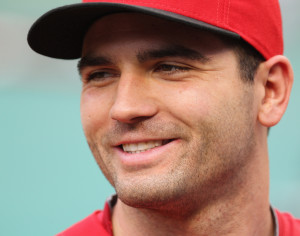
  • The Boston Red Sox have made retiring star David Ortiz 2016’s BBRT promotional All Star – featuring Big Papi in five giveaways.
  • The Red Sox also are distributing what BBRT considers 2016’s most creative promotional item – Spoiler Alert: The Pet Brock.
  • MLB giveaways continued to become even more creative. For example, this season’s giveaways include multi-player, talking, solar-powered, “vintage” and even Paint-Your-Own bobbleheads.  (In this post, BBRT will look at some of my favorite bobbleheads and non-bobblehead promotions.)
  • My hometown Twins, who led the American League last season with 46 giveaway dates, have put together another ambitious promotional schedule.
  • You can put together some pretty good All Star squads (AL, NL and All-Time) made up solely of players featured in 2016 bobblehead giveaways. (BBRT’s 2016 bobblehead All Star teams are listed in the final segment of this post.)

Keep in mind, this is a preliminary report. As this is being posted, some teams have not released their promotional schedules, have released only partial schedules or have not identified the players to be recognized in specific promotions.  In addition, promotional items and schedules are subject to change without notice. For a complete list and up-to-date details regarding 2016 Twins promotions (including dates, numbers of items, activities and eligibility) click here.  For details on promotions and events across MLB, visit each team’s website.

BOBBLEHEADS ARE NUMBER-ONE AT THE BALLPARK

According to Street and Smith’s Sports Business Journal, last season bobbleheads were the number-one MLB giveaway (for the fourth consecutive year). Smith and Street’s reports that MLB teams gave away 3.17 million bobbleheads as part of 133 promotional events – with the San Diego Padres the only team not holding a bobblehead give-away.  Notably, the two clubs with the most victories in 2015, the St. Louis Cardinals (100 wins) and the Pirates (98 wins) were also numbers one and two in the total number of promotional giveaway dates – 51 and 49, respectively.  The Minnesota Twins, whose promotional philosophy was explored in this blog last February, came in third overall and first in the American League with 46 giveaways. To read the post on the Twins’ promotional philosophy and processes, click here.

________________________

Red Sox Get Creative – Introducing BBRT’s Selection as 2016’s Most Creative promo … the Pet Brock – and Recognizing Big Papi as 2016’s Promotional All Star
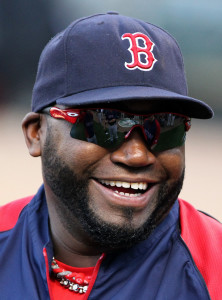
David "Big Papi" Ortiz - featured in five 2016 Red Sox giveawys. Photo by Keith Allison

David “Big Papi” Ortiz – featured in five 2016 Red Sox giveawys.
Photo by Keith Allison

The Boston Red Sox get BBRT’s nod for the most creative give-away of the 2016 season – the Pet Brock (July 19 vs. Giants) a tribute to versatile 2015 All Star Brock Holt and the 1970’s gift rage Pet Rock.  The first 15,000 fans will receive a uniquely Brock/Red Sox themed replica rock.

Red Sox Marketing & Promotions Coordinator Steven Oliveira said the Pet Brock idea came from a Red Sox Strategy and Analytics staffer.

“We asked folks throughout the organization to send in their ideas for new and creative giveaways, and we really loved the Pet Brock concept,” Oliveira said. “So we decided to run with it!”

Also in the running as 2016’s most creative giveaway were the Brewers’ Bob Uecker Talking Alarm Clock and the Cardinals’ bobblehead tribute to the truly “short” career of Eddie Gaedel.

The Red Sox also get kudos for their commitment to honoring DH/1B David Ortiz in his 20th and final MLB season (14 with the Red Sox).  Ortiz – a nine-time Star, 2013 World Series MVP, member of the 500-HR club and, of course, former Twin – gets BBRT’s vote as 2016’s promotional All Star.  Big Papi will be featured in five Red Sox giveaways:

  • David Ortiz 500 (HR) Necklace (April 12 vs. Orioles)
  • David Ortiz 2013 World Series MVP Ring Replica (May 24 vs. Rockies)
  • Papi Garden Gnome (June 21 vs. White Sox)
  • Build-A-Papi (July 26 vs. Tigers)
  • David Ortiz Talking Bobblehead (August 9 vs. Yankees).

Oliveira said Ortiz has more than earned his 2016 recognition.

“Once Ortiz announced that this would be his final season, we knew we had to celebrate his tremendous career in Boston,” Oliveira said.  “Although we will be honoring him in a number of ways throughout the year, it only feels right to have him be the focal point of our 2016 giveaways.  With all respect to the Red Sox legends of the past, I don’t know that any player in Red Sox history has meant more to this franchise and city than Big Papi.”

Also in the running for 2016 Promotional All Star were 2016 Hall of Fame Electees Ken Griffey Jr. (to be recognized with bobblehead promotions by two teams – Mariners and Reds – as well as with replica Hall of Fame plaque and jersey giveaways and a uniform-number retirement ceremony) and Mike Piazza (to be featured on a pair of premium giveaways (bobblehead and replica jersey), as well as in a uniform-number retirement ceremony.

Overall, the Red Sox will distribute more than 70,000 bobbleheads in 2016 (Mookie Betts, David Price, Jason Varitek, Xander Bogaerts and mascots Wally and Tessie). Also on the schedule are such items as towels, baseball caps and piggy banks.   It should be a great year at Fenway – particularly for fans of David Ortiz.  (I’d love to get my hands on a Pet Brock and an Ortiz Talking Bobblehead.) To view the most up-to-date Red Sox promo schedule, click here. 

On a final note, you will find Red Sox players DH David Ortiz, OF Mookie Betts and SP David Price on BBRT’s  American League 2016 Bobblehead All Star Team listed at the end of this blog post.

______________________

BBRT’s Favorite 2016 Bobbleheads

Here are BBRT’s favorite bobblehead giveaways for 2016.

  • The Dodgers’ three-player bobblehead … Recognizing the only time in MLB history three players shared the World Series MVP Award – Ron Cey, Steve Yeager, Pedro Guerrero in 1981. (July 2 vs. Rockies)
  • The Red Sox’ David Ortiz talking bobblehead … Can’t wait to hear what he is going to say. (August 9 vs. Yankees)
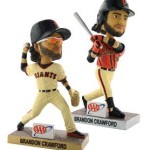
  • Brandon Crawford Silver Slugger and Gold Glover bobblheads.

    Brandon Crawford Silver Slugger and Gold Glover bobbleheads.

    The Giants’ dual bobblehead giveaway honoring SS Brandon Crawford (a 2015 All Star, Gold Glover and Silver Slugger). Fans will receive one of two Crawford bobbleheads, a Sliver Slugger or Gold Glove version. (May 7 vs. Rockies)

  • The Cardinals’ bobblehead honoring the Saint Louis Browns’ Eddie Gaedel – at 3’ 7”, the shortest player ever to appear in an MLB game. (Sept. 9 vs. Brewers)
  • The Brewers’ Kids Paint-Your-Own Bernie Brewer bobblehead (May 29 vs. Reds)
  • A trio of Yankees’ bobbleheads: Babe Ruth (April 23 vs. Rays); Mickey Mantle (June 24 vs. Twins); Roger Maris (Oct. 1 vs. Orioles). Talk about a powerful outfield.

It’s Not All About Bobbleheads

It’s not always about bobbleheads.  There are plenty of other ways players are being recognized in 2016 promotions. You could, for example, pick up a Dodgers’ Justin Turner or Nationals’ Bryce Harper Chia Pet.  There also are garden gnomes for the Giants’ Bruce Bochy; Cardinals’ Yadier Molina; Red Sox’ David Ortiz; Orioles’ Manny Machado; A’s Sean Doolittle; Mets’ Noah Syndergaard; and Pirates’ Josh Harrison. Baseball not your number-one sport? How about the Dodgers’ Magic Johnson garden gnome, Angels’ soccer scarf or Diamondbacks’ soccer jersey promotions?  Here are a few other non-bobblehead giveaways that BBRT would like to have on the home shelf.

  • The Brewers’ Bob Uecker Talking Alarm Clock (July 10 vs. Cardinals)
  • The Nationals’ (Election Night at Nationals Park) branded Donkey or Elephant figurines (Sept. 30 vs. Marlins)
  • Replica World Series Championship Trophies: 2006 Cardinals (June 3 vs. Giants); 2015 Royals (April 23 vs. Orioles)
  • Cubs’ 1916 Replica Throwback Jersey (July 6 vs, Reds)
  • The Giants’ “Beat LA” flag – nothing like keeping a rivalry alive. (April 9 vs. Dodgers)
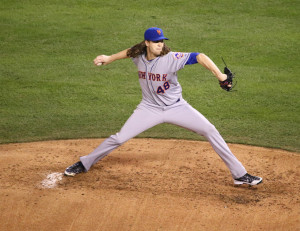
  • The Mets’ Jacob deGrom Hair Hat (Sept. 17 vs. Twins)

Or, how about some techie stuff?

  • The Giants’ Sergio Romo portable speakers (August 27 vs. Braves)
  • The Angels’ selfie stick (May 6 vs. Rays)

Or really practical:

  • Rays’ Laundry Hamper (Aug. 7 vs. Twins)

And, of course, there is much, much more.  Just check each team’s website for dates, quantities and eligibility.

________________________

Minnesota Twins’ Promotional Give-Aways

TwinsHoodieNow, let’s move on to my hometown Twins – last season’s American League team leader in giveaway dates.  The Twins kick off their promotional season on Opening Day in Minnesota (April 11 vs. the White Sox) – once again starting the home season with BBRT’s favorite Twins giveaway, the Twins hoodie sweatshirt.  This season, playing off the Twins’ new uniforms, the hoodies will be red and the first 30,000 fans through the “turn styles” will go home in Twins’ style.

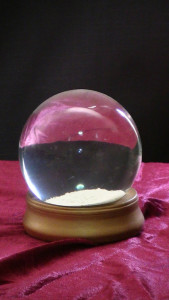
Among the other Twins giveaways that caught BBRT’s eye are the Brian Dozier Kids Baseball Glove (April 17 vs. Angels  – first 5,000 fans 14 and under); Brian Dozier adult jersey (June 11 vs. Red Sox  – first 10,000 adult fans); a quartet of bobbleheads (Miguel Sano on June 18; Ervin Santana on July 2; Torii Hunter on July 16; and a vintage bobblehead on July 31); the Miguel Sano snow globe (July 30 vs. White Sox – first 10,000); The Torii Hunter and John Gordon Twins Hall of Fame pins (July 17 vs. Indians – first 5,000); and the Twins 1991 World Championship Beer Stein (July 27 vs. Braves – first 10,000 fans 21 or over).

Overall, in 2016, Twins fans will go home with at least:

  • 60,000 stocking caps
  • 50,000 baseball caps
  • 40,000 bobbbleheads
  • 30,000 hoodie sweatshirts
  • 30,000 stocking caps
  • 20,000 magnetic schedules
  • 20,000 poster schedules
  • 20,000 MLB Network bags
  • 10,000 bomber hats
  • 10,000 travel bags
  • 10,000 pairs of socks
  • 10,000 beer steins
  • 10,000 umbrellas
  • 10,000 adult jerseys
  • 10,000 snow globes
  • 7,500 Wiffle bats
  • 5,000 kids jerseys
  • 5,000 beach towels
  • 5,000 Twins Hall of Fame pins
  • 5,000 beach towels
  • 5,000 kids baseball gloves

As noted earlier, promotional schedules can change.  Click here to go to the Twins website promotional page for the most up-to-date info on items, dates, quantities and eligibility.

And, Twins Fans, don’t forget, there are also a hot of special events and ticket values. Here is just a sampling.

SUNDAYS

SuperAmerica Knothole Kids Day

For Sunday games, up to two youngsters (14 and under) can receive $5 off a U.S. Bank Home Run Porch or Home Plate View ticket with the purchase of one full price adult ticket in the same section (when presenting a SuperAmerica Knothole Kids Day coupon). Before the game, youngsters can receive free autographs from a Twins player and they can run the bases (post-game) courtesy of Gillette Children’s Specialty Healthcare.

TUESDAYS

U.S. Bank Value Pack

Fans who purchase a U.S. Bank Home Run Porch View ticket for a Tuesday game receive a FREE Schweigert™ hot dog and Pepsi.

WEDNESDAYS

Student Day presented by Rasmussen College

Standing-room only tickets are available for Wednesday games at just $5 for students, and they can ride to the game free on Metro Transit. (Tickets available beginning at 9 a.m. on the day of game only at the Target Field Box Office – one ticket per student with valid ID).  The Metro Transit passes are downloadable at twinsbaseball.com/student.

Schweigert™ Dollar-A-Dog

At each Wednesday game, hot dogs are $1 at the Hennepin Grille and Taste of Twins Territory concession stands. (Limit 20,000 per game; 2 per person.)

Midwest Music Showcase presented by Go 96.3

Music performances by prominent local bands are scheduled for every Wednesday home game April 27 through September 7.

FRIDAYS

Fireworks Friday

Postgame fireworks will be featured each Friday from Memorial Day to Labor Day – accompanied by specific musical genre: June 3 – Minnesota Music; June 10 – Music of the ‘80s; June 17 – The British Invasion; July 1 – Salute to America; July 15 – Alternative pop; July 29 – music from 1991 (Twins’ last World Series win); September 2 – Latin pop.

ALL WEEKDAY DAY GAMES

Senior Days – Presented bv Treasure Island Resort & Casino

Fans 55 and better receive a $5 discount on Field Box and Pavilion tickets for all weekday day games (excluding April 11).  Offer available by phone and in-person only; subject to availability.

MONDAY-THURSDAY

Military Discount presented by FOX Sports North

Active military members or veterans with a valid ID (plus up to three guests) can purchase half-price Home Plate View tickets for every Monday through Thursday game (excluding April 11).  Tickets are available on the day of the game only. Visit twinsbaseball.com/promotions for a list of accepted forms of ID.

For more on Twins special events/ticket offers, click here to see the pre-season announcement or, for updated information, visit the Twins webpage.

___________________________

BBRT’s  2016 Bobblehead Giveaway All Star Teams

Here are BBRT’s NL, AL and All-Time All Star Teams made up of players who are featured in 2016 MLB bobblehead giveaways.  Some are recognized by individual bobbleheads, while others are featured jointly. (For example, the Angels are distributing a Mike Trout/Albert Pujols HR Bobblehead.  I’ve included the date of each giveaway for those interested in taking in the game and taking away the prize.

NATIONAL LEAGUE

C – Yadier Molina, Cardinals (June 4 vs. Giants)

1B – Paul Goldschmidt, Diamondbacks (July 2 vs. Giants)

2B – Howie Kendrick, Dodgers (Aug. 9 vs. Phillies)

3B – Nolan Arenado, Rockies (April 10 vs. Padres)

SS – Brandon Crawford, Giants (May 7 vs. Rockies)

OF – Bryce Harper, Nationals (May 11 vs. Tigers)

OF – Matt Holliday, Cardinals (July 22 vs. Dodgers)

OF – Ryan Braun, Brewers (May 1 vs. Marlins)

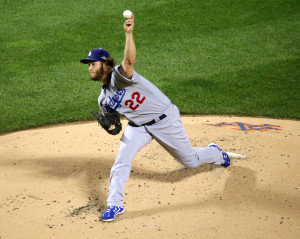
Starting Pitcher – Clayton Kershaw, Dodgers (April 25 vs. Marlins)

Closer – Trevor Rosenthal, Cardinals (April 30 vs. Nationals)

AMERICAN LEAGUE

C – Salvador Perez, Royals (Sept. 3 vs. Tigers)

1B – Albert Pujols, Angels (April 7 vs. Rangers)

2B – Robinson Cano, Mariners (July 16 vs. Astros)

3B – Josh Donaldson, Blue Jays (April 24 vs. A’s)

SS – Troy Tulowitzki, Blue Jays (July 3 vs. Indians)

OF – Mike Trout, Angels (April 7 vs. Rangers)

OF – Nelson Cruz, Mariners (April 30 vs. Royals)

OF – Mookie Betts, Red Sox (April 19 vs. Rays)

DH – David Ortiz, Red Sox (Aug. 9 vs. Yankees)

Starting Pitcher – David Price, Red Sox (May 10 vs. A’s)

Closer – Wade Davis, Royals (July 24 vs. Rangers)

ALL TIME (RETIRED)

C – Mike Piazza, Mets (July 31 vs. Rockies)

1B – Jim Thome, Indians (July 30 vs. A’s)

2B – Paul Molitor, Brewers (March 21 Spring Training vs. Angels).

3B – Chipper Jones, Braves (Sept. 10 vs. Mets)

SS – Edgar Renteria, Marlins (July 9 vs. Reds)

OF – Babe Ruth, Yankees (April 23 vs. Rays)

OF  – Ken Griffey Jr., Mariners (Aug. 5 vs. Angels); Reds (May 21 vs. Mariners)

OF – Mickey Mantle, Yankees (June 24 vs. Twins)

DH – Roger Maris, Yankees (Oct. 1 vs. Orioles)

Starting Pitcher – Bob Feller, Indians (Aug. 13 vs. Angels)

Closer – Don Newcombe, Dodgers (June 8 vs. Rockies) … had to move Newcombe to the pen to fill out this spot.


Looking ahead? For BBRT’S 2016 National League Predictions (Division Races and Awards), click here.  For 2016 AL Predictions, click here. 

Fan of baseball trivia?  BBRT has two 99 question (Ballpark Tours tested) trivia quizzes.  For BBRT’s 99 favorite questions, click here.   For a second 99, click here.

Ballpark Tours great 2016 excursion (10 days, 10 games, 7 cities), outlined here. 

I tweet baseball @DavidBBRT

Member: Society for American Baseball Research (SABR); The Baseball Reliquary; Baseball Bloggers Alliance.
 

MLB Comeback Player of the Year Candidates

Spring Training grows ever closer and BBRT continues to identify players to watch in the weeks and months ahead.  We’ve already looked at some of MLB’s to prospects – click here for that post.  Now, it’s time to examine some potential candidates for Comeback Player of the Year.  I’ve chosen to highlight one player in each division, based on a combination of how important a rebound by each player could be to his team and how well-positioned each player appears to be to achieve that level of “comeback.”

NATIONAL LEAGUE

East

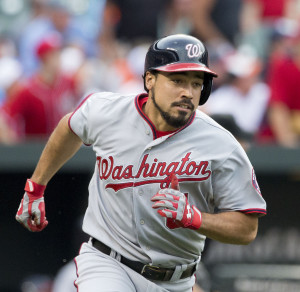
Anthony Rendon, 3B. Washington Nationals

Anthony RendonAnthony Rendon hit his stride with the Nationals in 2014. That season, Rendon played in 153 games, hitting .287, with 21 home runs, 83 RBI, 17 stolen bases (in 20 attempts) and a league-leading 111 runs scored. This performance earned Rendon a fifth-place finish in the MVP balloting.  Big things were expected from Rendon as the Nationals went into the 2015 season favored to take the NL East title.
Unfortunately, Rendon suffered knee, quad and oblique injuries – and played in just 80 games (often at less than 100 percent). His final numbers were .264-5-25. Rendon is just 26-years-old, so the Nationals are expecting a strong comeback.  They need his right-handed bat in the lineup if they are going to unseat the Mets atop the East Division. With Bryce Harper likely to follow Rendon in the Nats’ lineup, a solid season seems very likely.

Central

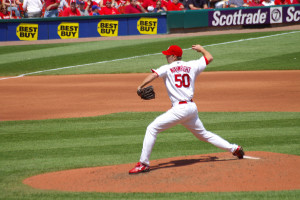
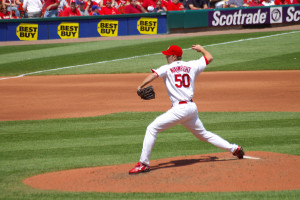
Adam Wainwright. RHP, Saint Louis Cardinals

Adam Wainwright's Fast BallThe Cardinals, having lost starting pitchers John Lackey (free agency, Mets) and Lance Lynn (Tommy John surgery), need Adam Wainwright to make a full recovery from last April’s Achilles Tendon tear and resume his role at the top of the rotation. (Note: Lackey and Lynn represented a combined 25 wins, 64 starts and 393 innings pitched.) Fortunately, Wainwright looks like a solid candidate for the Comeback Player of the Year Award.
Wainwright is 34-year-old, which raises some flags, but the fact that Wainwright came back early and strong indicates he should return to form in 2016.  Last season, Wainwright returned to the mound for three regular-season relief appearances (late September/early October) and three post-season relief appearances. In those outings, he went 8 1/3 innings, giving up just five hits and two earned runs, while fanning eight. A healthy Wainwright should be a Cy Young Award candidate.  In 2013-14 he finished second and third in the CYA balloting, while running up a combined 39-18 record, with a 2.67 ERA and 398 strikeouts in 468 2/3 innings.

West

Hunter Pence, RF, San Francisco Giants

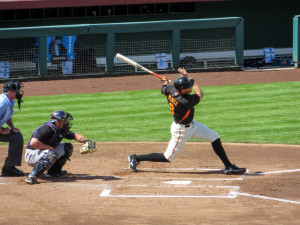
Pence Hitting one of his two Home Runs against the RockiesGoing into 2015 Spring Training, Hunter Pence was among the most durable players in the major leagues – having led the NL in games played (162) in 2013 and 2014, and having played in at least 154 games in each of the seven previous seasons. In 2014, he put up a .277-20-74 line, with 13 steals and 106 runs scored. Pence suffered a broken arm in Spring Training (hit by pitch) and, after his return from that setback, suffered wrist injury and oblique injuries.  Even playing through pain, Pence got in only 52 games, going .275-9-40, with four steals.
While not the kind of player who can carry a team on his own, Pence is a solid performer and professional hitter (three-time All Star) whose presence in the middle of the lineup will be needed if the Giants are to compete with the Dodgers and Diamondbacks in the NL West. Hunter will turn 33 shortly after the season opens and – given his history – a comeback season should be no problem.

A few others who may be in the NL Comeback Player mix: Freddie Freeman, 1B, Braves; Jose Fernandez, RHP, Marlins; Yasiel Puig, RF, Dodgers.

AMERICAN LEAGUE

East

Marcus Stroman, RHP. Toronto Blue Jays

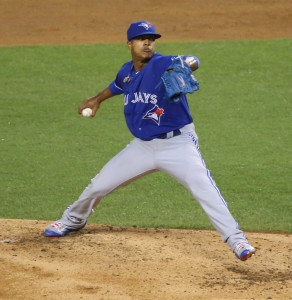
Marcus Stroman vs. Yankees: 9/12/2015Marcus Stroman burst onto the MLB scene in 2014, making his first appearance (in relief) in early May.  By season’s end, he had made 26 appearances (20 starts), going 11-6, 3.65 with 111 K’s in 130 2/3 innings.  The young Blue Jay (23-years-old when he made his MLB debut) may not be large in stature (5’8”, 180-lbs.), but he stood tall on the mound.
The 2015 season seemed to hold great promise, but Stroman’s progress was quickly derailed. A Spring Training knee injury was projected to put him out for the season. Stroman, however, surprised the Jays and was back on the mound in mid-September, going 4-0, 1.67 down the stretch and – perhaps more important – pitching 27 innings in four starts. Stroman followed up by going 1-0, 4.19 in three post-season starts.

With southpaw ace David Price now gone (free agency, Red Sox), the Blue Jays need Stroman to step into the number-one rotation slot.  BBRT expects he will do just fine in that role. Since he is coming off an injury-shortened year, he qualifies as a Comeback Player of the Year candidate.

Note: If you don’t think Stroman was “down” enough to make an award-winning comeback, a solid second choice would be Red Sox’ 3B Pablo Sandoval, who went .245-10-47 (all full-season career lows) after signing a five-year $95 million deal with Boston.  If Sandoval reports in shape and ready for the challenge, his bat could help the Red Sox (who added David Price and Craig Kimbrel in the off season) move back into relevance in the AL East.

Central

Victor Martinez, DH, Detroit Tigers

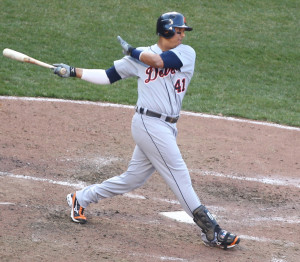
Orioles v/s Tigers April 4, 2011 Opening DayThe Detroit Tigers’ fall from grace was pretty rapid- from four consecutive first-place finishes in the Central Division (2011-14) to last place (20 ½ games out) in 2015. They took some solid steps to right the ship, adding RHP Jordan Zimmerman, RHP/closer Francisco Rodriguez, LF Justin Upton and CF Cameron Maybin (among others).  With all those moves, it’s likely Detroit will still need a rebound from DH Victor Martinez if they are going to go from “worst-to-first.”   In 2015, a troublesome knee hampered Martinez’ performance. Not only did he appear in just 120 games (he had topped 150 in each of the previous two season), but the career .302 hitter fell from 2014’s .335-32-103 to .245-11-65. The Tigers clearly need a healthy Martinez as they work to turn things around in 2016.
West

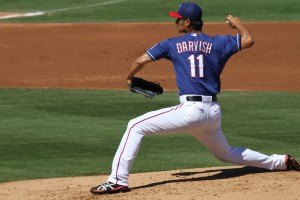
Yu Darvish, RHP, Texas Rangers

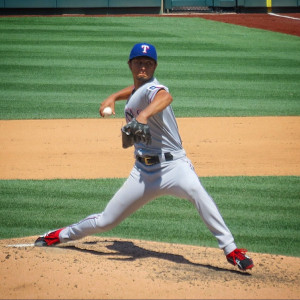
Texas Rangers Pitcher Yu DarvishRangers’ top-of-the-rotation ace Yu Darvish underwent Tommy John surgery last season (and didn’t pitch at all). He is slated to be ready to take the mound in mid-May this season.  With the Rangers facing a challenge from the aggressive and maturing Houston Astros, that May return could be just the lift Texas needs to hold off Houston.  What kind of performance (rebound) might Texas expect as Darvish comes off his surgery? In three MLB seasons, Darvish is 39-25, 3.27 – with 680 strikeouts in just 545 1/3 innings pitched.
Only 28-years-old, Darvish is a good candidate for the kind of rebound that could earn him Comeback Player of the Year honors – and help his Rangers hold on to the West Division title.

A few others  who may be in the AL Comeback Player of the Year Mix: Pablo Sandoval, 3B, Red Sox; Hanley Ramirez, 1B, Red Sox;  Matt Weiters, C, Orioles;   Josh Hamilton, LF Rangers. 

More Detail? For BBRT’S 2016 National League Predictions (Division Races and Awards), click here.  For 2016 AL Predictions, click here. 

Fan of baseball trivia?  BBRT has two 99 question (Ballpark Tours tested) trivia quizzes.  For BBRT’s 99 favorite questions, click here.   For a second 99, click here.

Ballpark Tours great 2016 excursion (10 days, 10 games, 7 cities), outlined here. 

I tweet baseball @DavidBBRT

Member:  Society for Americana Baseball Research (SABR); The Baseball Reliquary; Baseball Bloggers Alliance.

BBRT 2016 American League Predictions

As I am putting the final touches on this post, the Super Bowl 50 post-game show is wrapping up.  For BBRT, this means we’re getting very close to hearing four very special words. No, not “Football is finally over,” but rather “Pitchers and catchers report.”

Yes, Spring Training is right around the corner and it’s time for BBRT to drag out what I refer to as my “sometimes empty, often opaque and only occasionally accurate crystal ball” and make some predictions for the upcoming MLB season.   In this post, I’ll provide my predictions for the 2016 American League races, as well as for the AL Cy Young, Rookie of the Year and MVP awards.  Following a brief look at these races, I’ll also include (for baseball “fan-addicts”) an in-depth look at how each team appears to line up.  (Words of caution/Disclaimer: There are still a few free agents out there; Spring Training performance and injuries can alter Opening Day rosters and lineups; there’s neither time nor space to comment on every player expected to make an MLB roster; and these predictions are really just informed speculation.)

Read to the double blue line for the “executive summary,” go beyond for the in-depth analysis – more than you really need to know. (For the previously posted National League predictions, click here.)

Spoiler alert: The Blue Jays outscored their opponents by 221 runs in 2015 and look to be just as potent; BBRT see the Tigers last-place finish a year ago as an aberration and is impressed with their off-season activity; and the best race in the AL may involve two teams from Texas.

Trivia Fans – For our Enjoyment

If you are baseball trivia fan, you may want to try BBRT two 99-question trivia quizzes. Click here for Quiz One or here for Quiz Two.

So, let’s get to BBRT’s 2016 AL Forecast.  First, the “Executive Summary.”

AL EAST

Given Toronto’s returning offense and notable improvements on the mound for Boston and New York, BBRT sees a three-team race, with Toronto simply “overpowering” the Red Sox adn Yankees.

Division Champion – Toronto Blue Jays

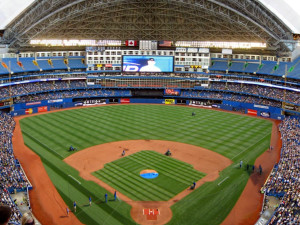
Grass at Rogers CentreIn winning the East in 2015, the Blue Jays led MLB baseball in almost every offensive category – in the process outscoring their opponents by 221 runs (891-670). Back are big bashers like Josh Donaldson, Jose Bautista, Edwin Incarnacion and Troy Tulowitzski.  Add in a serviceable starting rotation (although they will miss David Price) and an improved bullpen (Drew Storen) and the Blue Jays will be back on top.
Boston Red Sox – Second Place (Wild Card)

The Red Sox set the stage for a revival with the acquisition of two elite pitchers – David Price and Craig Kimbrel – taking pressure of the rest of the rotation and the bullpen.  They back that up with a lineup built on a combination of veteran players (Dustin Pedroia and David Ortiz) and emerging youngsters (Mookie Betts and Xander Bogaerts). Just a bit of bounce back from Hanley Ramirez and Pablo Sandoval should be enough to return the Red Sox to the playoffs.

New York Yankees – Third Place

The Yankees overcame age, injury and controversy last season to win 87 games and capture an unexpected (by many) Wild Card spot.  They return a very similar lineup – dependent more on power than speed (A-Rod, Mark Teixeira, Brian McCann, Carlos Beltran) – and facing some of the same age and potential injury issues.  However, they have a stronger, perhaps the league’s most dominant, bullpen (Aroldis Chapman acquisition, plus Andrew Miller and Dellin Betances), a seemingly healthier Masahiro Tanaka, a full year of Luis Severino’s high 90’s heater and a bit more lineup flexibility.  They Bombers seem capable of repeating last year’s performance. They should be in the fight for the East Division and/or a Wild Card spot.

Tampa Bay Rays – Fourth Place

A solid starting rotation (Chris Archer, Jake Ordozzi, Drew Smyly) will keep the Rays in a lot of games.  However, a thin offense (second-fewest runs in the AL last season) and a bullpen minus Jake McGee will keep Tampa Bay from challenging the top-three in the East.  If the Rays can add offense – perhaps trading from their surplus of starting pitchers – they could make a little noise, but are still likely to fall short of a post-season spot.

Baltimore Orioles – Fifth Place

The Orioles are the reverse of the Rays – plenty of offensive fire power, but a suspect pitching staff.  With Manny Machado, Adam Jones, Chris Davis, and Jonathan Schoop, the Birds have power – and boast solid defense as well.  Among their key needs to contend are a leadoff hitter (perhaps Korean import Hyun-soo Kim can handle that role) and a starting pitcher (or two).  Ultimately, the Orioles are likely to once again top 200 home runs and, once again, fall short of 85 victories.

AL CENTRAL

Worst-to-First use to be a rarity, but it’s happening far more often since the 1991 World Series, which featured the Twins and Braves – both last-place teams during the 1990 season. BBRT looks for the improved Tigers to make the leap this season, winning a relatively balanced Central Division – with Detroit and KC fighting for the top spot and Minnesota, Cleveland and Chicago competing closely for third place.

Division Champion – Detroit Tigers

Detroit Tigers LogoLots of new faces in Detroit this season, starting at the top: Jordan Zimmerman (top of the rotation); Francisco Rodriguez (top of the bullpen); Cameron Maybin (likely top of the batting order). Then, for the middle of the order and the outfield, there’s newcomer Justin Upton. Those additions, coupled with a return to form by Justin Verlander, better health (more production) from Miguel Cabrera and Victor Martinez, and the usual from J.D. Martinez should bring Detroit back to the top of the Division.
Kansas City Royals – Second Place

This is a solid team with a well-balanced lineup, respectable starting rotation, dominant bullpen and tight defense. Plus, they know how to win. They won it all last year – and without a 25-home run hitter or a 15-game winner.  That’s worrisome – as is the fact that their 2015 record included 41 come-from-behind victories.  To repeat as Division champions, the bullpen (led by Wade Davis, Kevin Herrera, newcomer Joakim Soria and Luke Hochevar) will have to continue to be lights out; the “put-the-ball-in-play” offense (led by Kendrys Morales, Eric Hosmer, Mike Moustakas and Lorenzo Cain) will have to keep pressure on opponents; and the starting rotation  (led by Edison Volquez and Yordano Ventura) will have to pitch well enough to get the game to the pen with a chance to win. I think the Royals will come close, but the Tigers may have improved just a little too much

Minnesota Twins – Third Place

The Twins surprised quite a few people with their second-place finish a year ago – and should be competitive again, as their emerging young stars gain experience.  The Twins go into the season looking for continued progress by power-hitting Miguel Sano (18 home runs in just 80 games as a rookie) – and with three potential Rookie of the Year candidates (CF Byron Buxton, RHP Jose Berrios and Korean signee, power-hitting Byung Ho Park). They also have a couple of dependable veteran hitters in 3B Trevor Plouffe and 1B Joe Mauer (although Mauer did have an off season in 2016). There some questions in the rotation (due to a lack of power arms) and the bullpen (closer Glen Perkins health). Ultimately, BBRT looks for the Twins to be competitive – just how competitive will depend on the development of young players like Buxton, Berrios and possibly last year’s Southern League Player of the year OF Max Kepler.

Cleveland Indians – Fourth Place

With Corey Kluber, Danny Salazar and Carlos Carrasco, the Indians have a chance to become just the fourth team in MLB history with three pitchers to log 200+ strikeouts in a season. Pitching is the Indians’ strength – a deep rotation and bullpen. The Tribe finished second in the AL in ERA, third in quality starts and first in strikeouts. Unfortunately, the pitching staff doesn’t get a lot of support. In 2015, the Indians finished eleventh in the AL in runs scored, eleventh in batting average and thirteenth in home runs. Add to that the fact that they start the season without their best offensive performer – LF Michael Brantley (off-season shoulder surgery) – and it could be a long season in Cleveland. There are some bright spots on offense to watch, however, including the potential impact of a full year of young SS Francisco Lindor, who went .313-12-51 in 99 games as a rookie. There just isn’t enough overall offense for BBRT to pick Cleveland higher than fourth.

Chicago White Sox – Fifth Place

The White Sox finished dead last in the AL in home runs and runs scored in 2015, but traded for a pair of big bats in the off season that should move them out of the basement in those categories – 3B Todd Frazier and 2B Brett Lawrie. The pair’s combined 51 home runs and 149 RBI equals about 38 percent of the Sox’ 2015 home run total and 25 percent of the Sox’ 2015 RBI total. With these two joining 1B Jose Abreu and CF Adam Eaton in the offense (and with, perhaps a rebound by Adam LaRoche), the White Sox offense will be notably improved. The rotation is led by three quality southpaws, potential Cy Young candidate Chris Sale, Carlos Rodon and Jose Quintana. In the bullpen, David Robertson is a quality closer, but there are some questions regarding getting the ball to him. The White Sox are indeed improved – and it was difficult to pick them last. The fact is, if Frazier and Lawrie perform as advertised – and if hitting is proven to truly “be contagious” – the Sox could finish as high as third in this extremely balanced division.

AL WEST

This one looks like a two-team race and a rerun of last year’s Rangers/Astros battle. It was so close in my mind, I originally wrote this blog with the Rangers picked for first (based on their experience). Further contemplation led me to reverse the Rangers/Astros order – primarily due to some health concerns related to the Rangers’ rotation. The Angels and Mariners should battle for third, with the A’s again finishing at the bottom.

Division Champion – Houston Astros

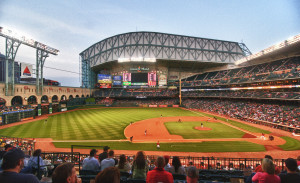
Minute Maid Park (HDR)The Astros have a unique offense, a perfect storm of power and speed.  Last season, they finished second in the league in home runs and first in stolen bases.  They were also first in strikeouts (23% of Houston’s total plate appearance ended in a K) and tenth in batting average. I do wish they would put the ball in play more, but given that the pitching staff recorded the league’s lowest ERA and the defense committed the third-fewest errors, the maturing Astros should have enough to take the West title in 2016. The offensive excitement this year should come from 2B Jose Altuve (coming off his second straight 200-hit campaign), emerging star RF George Springer, CF Carlos Gomez, 3B Luis Valbuena, LF Colby Rasmus – and from a full year of 2015 Rookie of the Year Carlos Correa. The pitching is solid. The rotation is led by Cy Young Award winner Dallas Keuchel and Lance McCullers and strengthened by free-agent signee Doug Fister.  The bullpen is strong, now led by new closer Ken Giles and his triple-digit fast ball.
Texas Rangers – Second Place (Wild Card)

The Rangers boast a potent, veteran lineup (sprinkled with some exciting youngsters) that has proven it can win under pressure – last season coming from eight games back on August 1 to capture the division title by two games over the Astros. For the Rangers, we can expect veterans 3B Adrian Beltre, DH Prince Fielder and RF Sin Soo Choo to lead the charge, with contributions from CF Delino DeShields, 1B Mitch Moreland and 2B Rougned Odor.  The Rangers, in short, are solid up and down the lineup. (The only offensive question being Josh Hamilton’s health.)

On the mound, there are some health concerns. Ace Yu Darvish is coming back from Tommy John surgery and not expected on the mound until May. (Keep in mind, of course, the Rangers won the division without Darvish in 2015.) If he returns to form, he could lead another second-half Rangers’ surge. Veteran lefty Cole Hamels would be the number-one starter with many teams, and Colby Lewis won 17 games last season. Texas is also counting on Derek Holland (shoulder injury last season) and Martin Perez (who came back from Tommy John surgery in mid-season). There could be a bit of a hiccup there. The bullpen led by closer Shawn Tolleson and benefiting from a full-year of 2015 trade deadline acquisitions Sam Dyson and Jake Diekman should be a strength. I see the Rangers in the post-season as a Wild Card, but if all the rotation health issues are answered positively, they could slip by the Astros again.

Los Angeles Angels – Third Place

The Angels have some star power – appropriate for California – in CF Mike Trout and 1B Albert Pujols, as well as some players on their way to star-level recognition in RF Kole Calhoun and SP Garrett Richards. However, the picture is less bright the deeper you go.  In fact, last year, despite the contributions of Trout, Pujols and Calhoun, the Angels finished twelfth in the AL in runs scored, sixth in HR’s and last in batting average. In the rotation, Richards is a solid number–one and southpaw Hector Santiago (9-9, 3.59) looks good in the number-two spot.  After that, the Angels are looking to a group of starters most of whom have some health concerns, are coming off down years or are short on major league experience.  The bullpen, led by closer Houston Street and key setup man Joe Smith, should be fine. All in all, there just doesn’t seem to be the depth necessary to compete with the Rangers and Astros.

Seattle Mariners – Fourth Place

Seattle had high expectations going into 2015, only to finish fourth at 76-86. The result was a busy off season, which could lead to four new names in the nine-man lineup and an almost totally revamped bullpen.  Joining the returning power trio of 2B Robinson Cano, DH Nelson Cruz and 3B Kyle Seager will be newcomers LF Nori Aoki, 1B Adam Lind, CF Leonys Martin and C Chris Ianetta. There should be some improvement in the offense, thirteenth in the league in runs a year ago. The rotation has the potential to be one the AL’s strongest – the key word being potential. Felix Hernandez, Hisashi Iwakuma and newcomer, innings-eater Wade Miley are set, but the Mariners would like to see young arms like Taijuan Walker, James Paxton and/or Nathan Karns emerge. The are some serious questions in the bullpen, which had the fourth-highest ERA and second most loses in the AL.  Free-agent signee closer Steve Cishek and new setup man Joaquin Benoit (trade) will help, and a lot of new faces (and arms) will be competing for the remaining spots.

There are a lot of new parts to the Seattle puzzle going into the season. It remains to be seen how well they fit together. BBRT anticipates they will fit into another fourth-place finish.

Oakland A’s – Fifth Place

The Oakland A’s finished with the worst record in baseball last season.  As you might expect, they had a lot of holes to fill for 2016 – none bigger than the ones in the bullpen. Last season the A’s had the AL’s worst bullpen ERA (4.63), second-most bullpen losses and fewest saves.   Free-agent signees Ryan Madson and John Axford will help. In addition, the A’s picked up Liam Hendriks and Marc Rzepczynski in trades. Also key to reworking the bullpen would be a successful recovery from last season’s shoulder issues by closer Sean Doolittle.  A’s fan can look forward to a more reliable relief corps in 2016.  Hard to say how many leads they will be given to protect. After All Star Sonny Gray (14-7, 2.73) and, perhaps, Jesse Hahn (6-6. 3.35), the stable of starting pitchers offers more questions than answers. In addition, the offense is not likely to produce at a level needed to climb out of the basement. While the A’s had six players with 15 or more home runs last season, only one Josh Reddick reached 20. The A’s may have solved their bullpen issues, but they still to come up with at least one more middle-of-the-lineup bat, as well as a reliable back of the rotation to move up in the standings.

_____________________________________________________

AL AWARD WINNERS

MVP

Miguel Cabrera

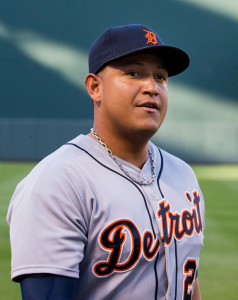
Miguel Cabrera

  1. Miguel Cabrera, Tigers – A combination of a healthy season. a return to his expected power numbers and a Tigers’ rise in the standings could give Cabrera his third MVP award.
  2. Mike Trout, Angels – MLB’s best all-around player has never finished lower than second in MVP balloting. Another great year for Trout, but no post-season for Angels costs him votes.
  3. Jose Altuve, Astros – This is the year voters recognize how important the Astros’ second basemen is to his team. Houston fights for the pennant, Altuve challenges for his second batting title, takes another stolen base crown and delivers another 200-hit campaign.

Cy Young Award

Chris Sale

Chris Sale

  1. Chris Sale, LHP, White Sox – The southpaw has finished no lower than sixth in the CYA voting over the past four seasons. He led the league in strikeouts last season (274 in 208 2/3 innings), while going 13-11, 3.41. Pitching with the White Sox puts him at a disadvantage for wins, but he has a shot at the CYA if he can put up 14 victories. Remember Felix Hernandez won the Cy Young in 2010 with a 13-12 record and a league-low 2.27 ERA. If Sale can top the league in ERA or K’s, he can win this thing.
  2. David Price, LHP, Red Sox – The 2012 CYA winner finished second in the balloting last year, after going 18-5,with a league-low 2.45 ERA and 225 strikeouts for Toronto and Detroit. Now on Boston’s big stage, he should help revive the Red Sox post-season hopes and that could earn him his second CYA.
  3. Dallas Keuchel, LHP, Astros – Many people felt Keuchel was a real surprise in 2015, as he won the Cy Young and put up a 20-8 record, with a 2.48 ERA. They apparently didn’t notice that his 2014 12-9 record also included an ERA under 3.00 (2.93) and a league-leading five complete games.  He’s for real and he’ll be near the top of the ballot again.

Rookie of the Year

 Byung Ho Park

  1. Byung Ho Park, 1B/DH, Minnesota Twins – The Korean star hit .324, with 105 home runs and 270 RBI over the past two seasons in the KBO (268 games). It would be unrealistic to look for those numbers in the AL, but a .280-28-85 season is not out of the question.
  2. Byron Buxton, CF, Minnesota Twins – Rated MLB’s number-one or number-two prospect in in nearly all the surveys, it’s time for Buxton to live up to the hype. He’s stumbled at the major league level, but he’s only 23 and has shown all the tools in the minors.
  3. Joe Berrios, RHP, Minnesota Twins … Nothing left to prove in the minors. Last season, Berrios went 14-5, 2.87 ERA at AA and AAA. He also led all minor leaguers in strikeouts with 175 in 166 1/3 innings (walking just 38). If he gets an early enough call to the Twins, he could surprise everyone and outpoll Park and Buxton.

So, there are BBRT’s 2016 AL predcitions.  Again, for the NL Forecast click here.

NOW, IF YOU ARE A “FAN-ADDICT” AND WANT THE FULL DETAIL – READ ON.

_________________________________________________________________________________________________


AL EAST

Toronto Blue Jays – First Place

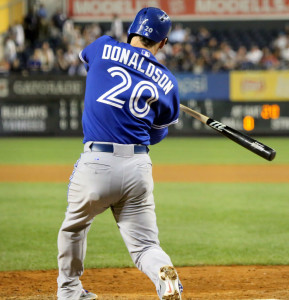
Josh Donaldson will again lead Blue Jays offense.

Josh Donaldson will again lead Blue Jays offense.

Last season the East Division-champion Blue Jays led all of baseball in runs scored (891) – by a margin of 127 over the second-highest scoring team (Yankees). They also finished atop all of MLB in home runs, RBI, total bases, slugging percentage, on base percentage – and fell just one percentage point short of tying the Tigers for the best team batting average (.269 to the Tigers’ .270). Gone from that team are rotation ace David Price (free agency) and leadoff hitter Ben Revere (traded for reliever Drew Storen). Still, returning are mashers Josh Donaldson, Jose Bautista, Edwin Incarnacion and Troy Tulowitzski.  BBRT thinks that will be plenty enough for the Jays to stay on top of the East.

Since offense is the name of the game for Toronto, let’s start with a look at the lineup.  With Revere gone, the Blue Jays are looking for a leadoff hitter.  BBRT thinks they only need to look as far as SS Troy Tulowitzski. Last season, Tulo hit .280, with 17 home runs and 70 RBI in 128 games (Colorado and Toronto).  In 2015, the Blue Jays won 22 of the 26 games in which Tulo lead off. Whoever bats leadoff will be setting the table for the big bats of 2015 AL MVP 3B Josh Donaldson (.297-41-123), RF Jose Bautista (.250-40-114) and DH Edwin Encarnacion (.277-39-111). At 1B, the Jays will get plenty of production out of right-handed hitting Chris Colabello (.321-15-54 in 101 games) and switch-hitter Justin Smoak (.226-18-59). Tulowitzski’s steady glove at short is complemented by defensive wiz Ryan Goins at 2B (.250-5-45). Also in the lineup are C Russell Martin (.240-23-77); CF Kevin Pillar (.278-12-56, with 25 steals); and likely LF Michael Saunders (coming off knee surgery). If Saunders isn’t ready (and it looks like he will be), the Blue Jays can turn to Dalton Pompey or Ezequiel Carrera.

With the loss of Price, the rotation lacks a true ace. The Blue Jays, however, think 24-year-old Marcus Stroman – recovered from a 2015 Spring Training torn ACL – can fill that bill. Stroman went 11-6, 3.65 in his rookie season (2014) and 4-0, 1.67 in four late-season starts last year. The number-two spot in the rotation likely will go to veteran Marco Estrada (13-8, 3.13), while number-three will be the really veteran 41-year-old knuckleballer (and former Cy Young Award winner) R.A. Dickey (11-11, 3.91). The Jays also brought free-agent J.A. Happ back based on his 7-2, 1.85 record with Pittsburgh last season. Happ started the year with the Mariners, where he went 4-6, 4.64. (Note:  Happ has a record of 39-35. 3.92 in seven NL seasons and 23-26, 4.46 in four AL seasons.) The final rotation spot will likely go to Jesse Chavez, picked up in a trade with the A’s. Chavez was 7-15, 4.18 for the A’s last season – but 8-8, 3.45 in 2014. Also competing for a rotation spot may be Drew Hutchinson (13-5 last year, but with a 5.57 ERA). Not a dominating rotation, but it should be good enough to get the job done given the expected run support.

The bullpen looks stronger this year (22 blown saves, fifth-most in the AL a year ago), with the acquisition of Drew Storen in the Revere trade.  Storen saved 29 games for the Nationals a year ago (3.44, 67 strikeouts in 55 innings), before losing his closing job to Nationals’ trade-deadline acquisition Jonathan Papelbon. Also in the closer mix could be Jays’ 2015 ninth-inning man, Roberto Osuna (20 saves, 2.58, 75 strikeouts in 69 2/3 innings). Whomever emerges, the Jays look to be strong in the eighth and ninth innings. Among the others likely to be in the pen are lefty Brett Cecil (2.48, with five saves and 70 whiffs in 63 innings); Aaron Sanchez (7-6, 3.22 in 41 games, 11 starts); Aaron Loup (4.46, with 46 strikeouts in 42 1/3 innings); Ryan Tepera (3.27 in 32 appearances); and Bo Schultz (3.56 in 31 games).

Ultimately, baseball’s most explosive offense, solid defense up the middle (Tulo, Goins, Pillar), an adequate rotation and an improved bullpen spell a repeat as East Division leaders.

Boston Red Sox – Second Place (Wild Card)

David Ortiz should finish his career in the post-season.

David Ortiz should finish his career in the post-season.

The Red Sox were my number-one East Division pick last season (I projected the Blue Jays for second place) on the strength of solid rotation, decent bullpen and an already potent lineup boosted by the addition of Hanley Ramirez and Pablo Sandoval.  Ouch! Ramirez and Sandoval went from a combined .291-29-144 in 2014 to .214-29-100 in 2015.  This year, the Red Sox focused their most dramatic off-season moves on the mound – elite closer Craig Kimbrel (trade with the Padres) and Cy Young candidate David Price (free agent).  BBRT sees improved performance by Ramirez and Sandoval, a strengthened rotation, deeper bullpen and continued growth by youngsters Mookie Betts and Xander Bogaerts as bringing Boston back to a spot near the top of the Division.

So, let’s take a look at the Boston offense.  Two veterans will play a key role in run production: 2B Dustin Pedroia (.291-12-42 in 93 games – hamstring) and 41-year-old DH David Ortiz (.273-37-108), who has announced this will be his last season. The middle of the lineup will likely consist of Ortiz, 1B Ramirez (.249-19-53) and rising star SS Xander Bogaerts, who went .320-7-81 in just his second full MLB season. Another emerging youngster, 23-year-old RF Mookie Betts, should be leading off.  Betts hit .291-18-77 last season.  Sandoval (a disappointing .245-10-47) should hold down 3B, with the bottom of the order consisting of LF Rusney Castillo (.253-5-29 in 80 games), C Blake Swihart (.274-5-31 in 84 games) and plus-defender CF Jackie Bradley (.249-10-43 in 74 games). The Sox added some outfield depth with the signing of free-agent (Yankees) Chris Young. The versatile and steady-hitting Brock Holt can fill in around the diamond. The 2015 All Star got in 129 games last season – playing every position except catcher and pitcher.

What will get Boston back the playoffs is the improved pitching staff.  It starts with 2012 AL Cy Young Award winner southpaw David Price – who went 18-5, with 225 strikeouts in 220 1/3 innings for Detroit and Toronto last season. Adding free-agent Price not only puts an “ace” at the top of the staff, it takes considerable pressure off the rest of the rotation.  If healthy, two-time All Star Clay Bucholz (7-7, 3.26 in 18 starts, before elbow issues) gives Boston a solid number-two starter.  (Unfortunately, Bucholz’ health cannot be taken for granted.  He has spent time on the Disabled List in each of the past six seasons). The Red Sox will also be looking for rebound by Rick Porcello (9-15, 4.92), a 15-game winner (for Detroit) as recently as 2014.  Twenty-two-year-old southpaw Eduardo Rodriguez (10-6, 3.85 in his 2015 rookie season) should provide quality innings, and Joe Kelly (10-6, 4.82) will be in the mix for the fifth spot, as could be Steven Wright (5-4, 4.09) and southpaws Henry Owens (4-4, 4.57) and Roenis Elias (5-8, 4.14).

The bullpen looks strong for 2016, led by new closer Craig Kimbrel (2.58, 39 saves, 87 strikeouts in 59 1/3 innings for San Diego). Last season’s closer, 40-year-old Koji Uehara (25 saves, 2.23, with 47 whiffs in 40 1/3 innings), takes over the key setup role. Also expected to contribute in the much deeper pen are Carson Smith (2.31, with 13 saves and 92 strikeouts in 70 innings), acquired in a trade with the Mariners, and Junichi Tazawa (4.14 in 61 games).

There are a couple of questions in the rotation, but it appears Boston has the offensive punch and bullpen strength to overcome them (unless Bucholz and Porcello both implode.) And, if Bucholz and Porcello both bounce back, a Division title does not seem out of the question.

New York Yankees – Third Place

The New York Yankee fooled a lot of “prognosticators” – including BBRT – last season by finishing second in the AL East and earning a post season slot. Those who saw the Bronx Bombers slipping cited age, injury and controversy. Interestingly, the Yankees felt the impact of all three: The Yankees did depend on “veteran” players like 38-year-old Carlos Beltran, 39-year-old Alex Rodriguez and 35-year-old C.C. Sabathia;  injuries did limit the seasons of key players like Jacob Ellsbury, Mark Teixeira and Masahiro Tanaka; and controversy continued to surround the Yankees (read A-Rod).  Still, they overcame all that and won 87 games.  BBRT sees the Yankees repeating that performance, and staying in the race for an AL Wild Card spot.

The lineup will again be powered by DH Alex Rodriguez (.250-33-86); 1B Mark Teixeira (.255-31-79); C Brian McCann (.232-26-94); and Carlos Beltran (.276-19-67). Setting the table will be the capable duo of leadoff hitter Jacob Ellsbury (.257-7-33, with 21 steals) and LF Brett Gardner (.259-16-66, with 20 steals). Chase Headley (.259-11-62) should handle 3B.  The only starters under 30 will be in the middle of the infield – 2B belongs to newcomer Starlin Castro (.265-11-69), acquired in a trade with the Cubs, and SS will likely be manned by Didi Gregorius (.265-9-56).  The Yankees will miss Greg Bird (1B/DH), out for the season due to shoulder surgery. The 23-yer-old Bird – who hit .261-11-31 after a mid-August debut – would have been a valuable asset in managing the playing time of veterans like Rodriguez and Teixeira. Dennis Ackley (.231-10-30 for Seattle and NY, but .288 in 23 games with the Yankees) and Aaron Hicks (.256-11-33) should see increased playing time as a result

The rotation is considerably younger than the lineup.  It starts with 27-year-old Masahiro Tanaka (who fought through wrist and forearm issues to go 12-7, 3.51 in 25 starts). The Yankees are also hoping for continued improvement from one-time elite prospect, 27-year-old Michael Pineda (12-10, 4.37 last season, with 156 K’s in 160 2/3 innings). Louis Severino (who will be 22 when the season opens) opened some eyes after his August MLB debut – going 5-3, 2.89 in 11 starts. Twenty-five-year-old Nathan Eovaldi also proved a workable starter (14-3, 4.20). The only southpaw in the rotation is likely to be 35-year-old C.C. Sabathia (6-10, 4.73), who has struggled with knee issues.

The bullpen is where the Yankees really upped their game in the off season – acquiring flamethrower Aroldis Chapman (1.63 ERA with 33 saves and 166 strikeouts in 66 1/3 innings) from the Reds. Key set up men will be 2015 closer Andrew Miller (2.04, 36 saves and 100 strikeouts in 61 2/3 innings) and Dellin Betances (1.50, with 131 strikeouts in 84 innings over 74 games).  Wow! The top three arms out of the NY bullpen for 2016, last year appeared in 199 games, threw 212 innings, struck out 347 hitters and ran up a combined 1.04 ERA. The elite bullpen will take a lot of pressure off the Yankee starters.

Tampa Bay Rays – Fourth Place

BBRT could have gone with the Rays or Orioles here – particularly after the O’s re-signed power source Chris Davis.  Very simply, of these two teams, the Orioles have the edge in the batter’s box, the Marlins on the mound.  BBRT gives pitching, and the Marlins, the edge.

The rotation starts with potential Cy Young candidate (fifth in the AL voting last season) Chris Archer (12-13, 3.23 ERA, with 252 strikeouts in 212 innings). Next up is lefty Drew Smyly, coming off shoulder issues, but also off a strong September (4-0, 2.50 with 45 whiffs in 36 innings). On the year, Smyly was 5-2, 3.11 in 12 starts, with 77 K’s in 66 2/3 innings. If he stays healthy, he’ll be a strong number-two. Slotted in at number three – or two, with Smyly at three – is Jake Odorizzi (9-9, 3.35). Also expected in the rotation is southpaw Matt Moore, now more than a year removed from Tommy John surgery. Moore was 3-4, 5.43 in 2015, but 2-1, 2.97 in September. He was a 17-game winner in 2013.  Erasmo Ramirez (11-6, 3.75) should round out the Rays’ talented rotation.   And, in the second half, the Rays anticipate the return of Alex Cobb (Tommy John surgery), who sat out the 2015 season. In 2013-14, Cobb went a combined 21-12, 2.82.  To back up this set of arms, there is also elite prospect southpaw Blake Snell (15-4, 1.41, with 153 K’s in 134 innings at three minor league stops last season).  Snell has nothing left to prove in the minors and BBRT expects to see him with the big club before year-end.  In short, the Rays have an abundance of quality options for the rotation.

The bullpen is neither as proven nor as deep.  It’s led by closer Brad Boxberger, who logged an AL-leading 41 saves, with a 3.71 ERA, a year ago.  Boxberger notched 74 strikeouts in 63 innings, but his 32 walks, 10 losses and six blown saves are points of concern.  The pressure will be on the bullpen this year, as the Rays traded their other option at closer and top setup man (and arguably their best reliever) Jake McGee to the Rockies for OF Corey Dickerson in an effort to add some offense.  In six seasons with the Rays, McGee had a 2.77 ERA with 319 strikeouts in 259 2/3 innings.  Among those the Rays may be looking to step up are: southpaw Xavier Cedeno (2.35 in 66 games); Steve Geltz (3.74 in 70 games); Alex Colome (3.94 in 43 appearances, 13 starts): and Danny Farquhar (5.12 in 43 appearances for the Mariners).

Only the White Sox scored fewer runs than the Rays in the AL last season and the outlook does not look significantly improved.  The Rays did add the bats of 1B/DH Logan Morrison (.225-17-54) and LF Corey Dickerson (.304-10-31 in 65 games) in trades with Seattle and Colorado, respectively. BBRT note:  Dickerson hit only .257 away from Coors Field. Both should get plenty of at bats with the Rays.  For Tampa Bay, the offense pretty much goes through three-time All Star and two-time Gold Glover 3B Evan Longoria, who delivered a .270-21-73 season in 2015.  Things fell off after Longoria (he was the only Ray to reach 20 home runs or 70 RBI).  However, Longoria should once again get help from 2B Logan Forsythe (.281-17-68), who had a career year in 2015.  And, while he does not have the traditional power stats of a corner infielder, James Loney is a steady hitter (.280-4-32) over at first. Missed will be SS Asdrubal Cabrera (free agency), who chipped in 15 home runs and 58 RBI in 2015.  SS now belongs to Brad Miller (.258-11-46 with Seattle), who will probably bat in the number-two spot, with either Dickerson, OF Steve Souza (.225-16-40, 12 steals) or OF Desmond Jennings (coming back from a knee injury) leading off.  CF belongs to elite defender Kevin Kevin Kiermaier (.263-10-40, with 18 steals). Kiemaier topped all of MLB in “Defensive Runs Saved” by a wide margin in 2015. Catching duties likely will fall to some combination of Rene Rivera (.178-5-26), Curt Casali (.238-10-18 in 38 games) and Hank Conger (.229-11-33 for Houston).  Last season, the Rays used pinch-hitters an AL-leading 218 times. We can expect to see continued juggling as the Rays try to squeeze all they can out of a lean offense.  Still, their pitching should keep them in the neighborhood of .500 – and ahead of the Orioles,

Baltimore Orioles – Fifth Place

The Orioles took a bit of a fall in 2015 – going from 2014’s Division title and a 96-66 record to an 81-81 mark and a third-place finish.  If you had to point to a reason, look toward the mound.  In 2014, the Orioles notched a 3.43 ERA (third-best in the AL). In 2015, Orioles’ ERA was 4.05, good for ninth in the AL.  Yes, the Birds did miss the offense of Nick Markakis and Nelson Cruz, but pitching – particular starting pitching – had the biggest impact on their post-season hopes. It looks like a similar story for 2016 – unless we see some significant turn-arounds in the rotation.

At the top of the 2016 rotation will be Chris Tillman – a disappointing 11-11, 4.99 last season, but 13-6, 3.34 for the Orioles in 2014 and a 16-game winner in 2013. Also returning to the starting five are Miguel Gonzalez (9-12, 4.91 – after a 10-9, 3.23 record in 2014); Ubaldo Jimenez (12-10, 4.11); Kevin Gausman (4-7, 4.25 – after a 7-7,  3.57 record in 2014); and a fifth starter likely drawn from among Mike Wright (3-5, 6.04), Tyler Wilson (2-2, 3.50) and Vance Worley (4-6, 4.02).

While the starting staff has a lot of questions, the bullpen remains a strength.  It’s led by closer Zach Britton, a converted starter who has saved 73 games for Baltimore over the past two seasons (1.92 ERA with 36 saves last year, with 79 K’s in 65 2/3 innings). There is further quality in set-up man Darren O’Day (1.52 ERA in 68 appearances, 82 K’s in 65 1/3 innings) and a supporting class that includes southpaw Brian Matusz (2.94 in 58 games, with 56 K’s in 49 innings) and Brad Brach (2.72 in 62 games, with 89 K’s in 79 1.3 innings).

The lineup has plenty of pop. In fact, the Orioles have managed 200+ home runs for four consecutive seasons. However, the Birds also had the third-highest strikeout total in the AL (1,331 K’s, one of only four AL teams to whiff 1,300 times) and had the third-fewest walks.  Definitely a swing-away offense.  3B Manny Machado (.286-35-86) and a Gold Glove-level defender may be leading off. He replaced the departed Nick Markakis in the role last season, but would seem better suited for the middle of the lineup. Nolan Reimond (.246-6-20 in 61 games last season) is another leadoff possibility, as is Korean signee Hyun-Soo Kim, who put up a .318 average and .406  on base percentage in 10 seasons in the KBO. The Orioles have a surplus of outfielders, so expect competitive auditions in Spring Training.  Among the key offensive resources (beyond Machado) are Chris Davis (1B/DH), who hit .262, with a league-leading 47 home runs and 117 RBI; CF Adam Jones (.269-27-82, with four Gold Gloves) and 2B Jonathan Schoop (.279, with 15 home runs in 86 games).  Three-time Gold Glover, 33-year-old J.J. Hardy returns at SS. Hampered  by  injuries in recent seasons, Hardy hit just .219-8-37 in 114 games last year, but has topped 20 home runs five times in 11 MLB seasons.  The Orioles are looking for a comeback season from Hardy.  Matt Wieters, returning form ligament surgery, should handle the bulk of the catching. He was .267-8-25 last season, but should be good for 20 round trippers if healthy.   The Orioles actually have a lot of flexibility in putting together their daily lineup.  They can look to free-agent signee Mark Trumbo (.262-22-64 with the Diamondbacks and Mariners), who can slot in at 1B, DH  or a corner OF spot; switch-hitter Jimmy Paredes (.275-10-42), who  can fill in at 2B and 3B; and Ryan Flaherty (.202-9-31) can play pretty much anywhere you put him.

Ultimately, the Orioles have a lot off offensive weapons, but not enough pitching to contend in the East.  Trading some of that HR power for a top of the line starter could improve their chances.

AL CENTRAL

Detroit Tigers – First Place

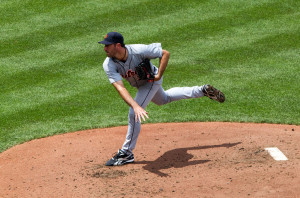
A strong season by Justin Verlander could do a lot to help the Tigers return to the top.

A strong season by Justin Verlander could do a lot to help the Tigers return to the top.

Going out on a limb here and betting that Detroit’s 2015 last-place finish in the AL Central was an aberration.  Looking for the Tigers – who topped the Division four straight season from 2011-2014 – to rebound.  This is largely based on the impact of newcomers free agent Jordan Zimmerman (at the top of the rotation), free agent Francisco Rodriguez (at the top of the bullpen) and trade acquisition Cameron Maybin (at the top of the lineup). Couple that with an offense led by the likes of Miguel Cabrera, Victor Martinez and J.D. Martinez and BBRT expects the Tigers to roar back into contention.

Let’s start with the pitching staff. Newcomer Jordan Zimmerman (replacing David Price, who was traded in mid-season) could be the “ace.” He comes over from the Nationals after a 13-10, 3.66 season – and has won 46 games over the past three seasons. He will have an impact.  Justin Verlander may have something to say about who leads this staff, despite a 5-8, 3.38 record in 20 starts (triceps) last season. In the second half of 2015, Verlander went 5-6, 2.80 in 15 starts, with 95 strikeouts in 103 innings. If Verlander can maintain his late-season form, the Tigers will have a solid 1-2 at the top of the rotation. Anibel Sanchez (10-10, 4.99) slots in at number-three – and should rebound (last season was the first time since 2008 that his ERA reached 4.00). Free agent Mike Pelfrey is likely to join the rotation (6-11, 4.26 for the Twins), which should be rounded out by youngster Daniel Norris (of VW-van fame), a southpaw who went 2-1, 3.68 when the Tigers gave him a look last season.  All in all, it looks like an improved rotation (with a few question marks).

The real improvement for the Tigers, however, is in the bullpen (where the Tigers had the fourth-highest ERA in MLB a year ago.) The new closer will be free-agent signee Francisco Rodriguez (2.21 with 38 saves for Milwaukee). A pair of newcomers likely will get the ball to Rodriguez: free agent Mark Lowe (1.96 ERA in 57 appearances for Seattle and Toronto, with 61 strikeouts in 55 innings) and lefty Justin Wilson (trade with the Yankees), who had a 3.10 ERA in 74 appearances.  Also manning what is now a deep bullpen should be Blaine Hardy (3.08 in 70 games) and Alex Wilson (2.19 in 59 games).

Moving to the lineup, the leadoff spot looks to belong either to free-agent signee Cameron Maybin (most likely in CF) or returnee 2B Ian Kinsler (.296-11-73, with ten steals).   Maybin, who started his career with Detroit, went .267-10-50, with 23 steals for the Braves last season. The Tigers added power and speed with the signing of three-time All Star Justin Upton.  Slated for LF, Upton hit .251-26-81, with 19 steals in San Diego last season (and has a .271 career average). His potent bat may be headed for the number-two slot in the lineup.  Right in the middle (3-4-5), the Tigers could put forward 1B Miguel Cabrera (.338-18-76), who won the batting title in an injury-dampened season, and looks to add more power in 2015; DH Victor Martinez, who also suffered through health issues (knee) last season, and went .245-11-64; and RF J.D. Martinez (.282-38-102).  Victor Martinez’ .245 average was the lowest of his career; look for him to finish 2016 closer to his .302 career mark. Rounding out the lineup are likely to be SS Jose Iglesias, who hit .300-2-23, with 11 steals, but is a health risk; 3B Nick Castellanos (.255-15-73); and C James McCann (.264-7-41).  As the Tigers work to manage the playing time of veterans, or respond to health concerns, utility man Mike Aviles (.231-5-17 in 98 games for Cleveland) should be a valuable asset; as should switch-hitting infielder Andrew Romine and OF Anthony Gose.

The Tigers have retooled for 2016 – a new arm at the top of the rotation; a new leader in the bullpen; a couple of new bats in the lineup – and more.  BBRT thinks they will surprise a lot of people, including the Royals.

Kansas City Royals – Second Place

The Royals proved a point last year.  You can win it all without a 25-HR hitter in the lineup, or a 15-game winner in the rotation.  What you need is a solid team, with a well-balanced line up, a respectable starting rotation, an exceptional bullpen and tight defense.  That’s what brought Kansas City success in 2015, and it’s what will keep them near the top of the AL Central.  In Kansas City, baseball is truly a team game –and that will again be fun to watch.

Now, I have often asserted my love of the 3-2 game and the 6-4-3 double play.  Very simply, I love good defense, and that is where the Royals’ success begins.  Look around the field – Eric Hosmer a three-time Gold Glover at 1B, Alcides Escobar the 2015 AL Gold Glover at SS, Alex Gordon a four-time Gold Glover in LF, Salvador Perez a three-time Gold Glover behind the plate. And the rest of the defense follows the example of these exceptional defenders – making all the plays they should, and some that tend to surprise.

On offense, the Royals are well-balanced and well-disciplined. The Royals, in fact, put the ball in play more than any other team.  They struck out the fewest times of any team last season – the only team to whiff fewer than 1,000 times. They also had the second-fewest walks of any team (373). While they were 24th in home runs among MLB’s 30 teams, the Royals did pressure opponents on the bases.  They finished tied for second in team batting average, third in doubles (one of only three teams with at least 300 two-baggers), sixth in triples, and fifth in stolen bases (one of just six teams with at least 100 steals).

So, let’s look at that offense.  Again, while the Royals did not have a single player reach 25 home runs, they did have six players hit between 13 and 22 long balls.  Back in the middle of the lineup will be DH Kendry Morales (.290-22-106); 1B Eric Hosmer (.297-18-93, 7 steals); and 3B Mike Moustakas (.284-22-82).  Setting the table for these three likely will be SS Alcides Escobar (.257-3-47, 17 stolen basis) and rising star CF Lorenzo Cain (.307-16-72, 28 steals). There are steady bats all the way down to the six- and seven-spots in the order – catcher Salvador Perez (.260-21-70) and LF Alex Gordon (.271-13-48). The final two spots in the lineup appear slated for 2B Omar Infante (.220-2-44) and in RF either (or some combination of) Jarrod Dyson (.250-2-18 in 90 games) or Paulo Orlando (.249-7-27 in 86 games).

In the rotation, the Royals did lose Johnny Cueto to free agency (Giants).  While last season’s mid-year pickup would have been a welcome addition to the 2016 rotation, Cueto was only 4-7, 4.76 after coming over from the Reds (where he was 7-6, 2.62). Heading the 2016 rotation will once again be Edison Volquez (13-9, 3.55).  The number-two slot should go to the fiery Yordano Ventura (13-8, 4.08) – who had his ups and downs last season, but has a live arm and went 14-10, 3.20  in 2014.  The Royals added a veteran arm to the rotation with recent signing of Ian Kennedy (9-15, 4.28 for the Padres). The final two spots should be decided in a competition among southpaw Danny Duffy (7-8, 4.08, after a 9-12, 2.53 campaign in 2014); Chris Young (11-6, 3.06 in 34 games, 18 starts); and Kris Medlen (6-2, 4.01 in 15 games, after returning from his second Tommy John surgery). Medlen, who did not pitch in 2014, was a 15-game winner (3.11 ERA) for the Braves in 2013.

The rotation, while not dominant, is good enough to keep the Royals in games – and get the game to KC’s solid bullpen. The quality of that pen, coupled with the pressure applied by the Royals “put-the-ball-in play” offense is why KC led the AL in come-from-behind wins in 2015 (41) and also notched eight come-from-behind victories in the 2015 post-season.  The bullpen will be led by “lights out” Wade Davis, who took over for closer Greg Holland (32 saves), who was lost to a ligament tear late in the season. On the year, Davis was 8-1, with a 0.94 ERA and 17 saves (in 18 opportunities), with 78 strikeouts in 67 1/3 innings pitched.  Getting the game to Davis will once again be Kevin Herrera (2.71 ERA in 72 appearances), as well as newcomer (free agent) Joakim Soria, who last season went 3-1, 2.53 with 24 saves for the Tigers and Pirates.  Luke Hochevar (3.73 ERA in 49 games) also returns.

Baseball will once again be fun to watch in Kansas City – high pressure, fast-paced contests.  The Royals have the resources to compete – a balanced “attack,” solid defense, steady rotation and “lights out” bullpen.  It should be enough for second place, but BBRT sees fewer come-from-behind victories, which should open the door for the improved (and hungry) Tigers.

Minnesota Twins – Third Place

The Twins surprised a lot of people with their second-place finish in 2015, when they went 83-79, breaking a string of four straight 90+ loss seasons. The Twins should be competitive again in 2016, as their emerging young stars gain more experience.  In fact, if a couple of the pitching prospects come through, they could challenge the Royals.  However, Minnesota may be a season or two (or a dominant arm or two) away from the kind of run Minnesota enjoyed form 2001-2010 (six Central Division titles).

With the Twins, it all starts with the potential of the team’s youngsters. In fact, there is a good chance the Twins could have three players in the hunt for AL Rookie of the Year:  CF Byron Buxton (rated MLB’s top prospect by MLB Pipeline); 1B/DH Byung Ho Park (who joins the Twins after hitting .343-53-146 in the Korea Baseball Organization last season); and RHP Jose Berrios (rated number 20 by MLB Pipleine).

The Twins’ lineup should provide some added fireworks in 2016.  Somewhere in the middle of the order, Minnesota will enjoy a full year of Miguel Sano (being converted from a corner infielder to a corner outfielder). Sano made his MLB debut in early July last season and hit .269, with 18 home runs and 52 RBI in 80 games. What remains to be seen is how well Sano (6’4”, 260-lbs.) will adjust to the change in position. Byung Ho Park (primarily a first baseman in Korea) should see considerable time at DH. The 29-year-old Park is a veteran of nine seasons in the KBO (but still an MLB Rookie).  He has a .281 KOB career average, with 210 home runs – and punched 105 round trippers in 268 games over the past two seasons.  The Twins would be happy with 25 home runs from Park in his inaugural MLB season.  The third bat in the middle of the lineup belongs to 3B Trevor Plouffe (.244-22-86). At the top of the order, the Twins expect power from 2B Brian Dozier (.236-28-77, 12 steals) and continued clutch-hitting (and a better batting average) from three-time batting champion 1B Joe Mauer (.265-10-66). Rounding out the Twins’ offense, you will likely see LF Eddie Rosario (.267-13-50, with 11 steals), SS Eduardo Escobar (.262-12-58), C Kurt Suzuki (.240-5-50 in an off year for Suzuki, who hit .288 for the Twins in 2014), and top prospect Byron Buxton CF.  Buxton, who retained his rookie status, hit only .209 in 46 games for the Twins last season.  Buxton, however, is rated the number-one or number-two MLB prospect b nearly every rating system. The Twins truly have a young lineup with lots of potential – and there is more in the pipeline. Looking for an opportunity are outfielder Oswaldo Arcia (.276-2-8 in 19 games and only 24) and OF Max Kepler, who will be just 23 when the season opens, and was named the 2015 Southern League Player of the Year. Kepler put up a .322-9-71 stat line, with 18 steals in 112 games at AA Chattanooga.  In addition, the Twins have Eduardo Nunez as a capable backup (.282-4-20, with 8 steals in 72 games) at 2B, 3B and SS.

On the hill, the rotation was improved last season – with Twins starters moving from the major league’s worst ERA in 2014 to the middle of the pack (16th) last season.  More help may be on the way.  The number-one and two spots are earmarked for Ervin Santana (7-5, 4.00 after coming off an 80-game PED suspension) and Phil Hughes, who struggled with back issues and finished 11-9, 4.40.  If those two return to form, they provide a reliable front of the rotation.  Twins fans are also excited about Kyle Gibson (11-11, 3.84) and Tyler Duffey (5-1, 3.10 in ten starts after an August call-up).  In four minor league seasons, the 25-year-old Duffey, went 29-17, with a 3.20 ERA.  Also in the mix are veterans Rickey Nolasco (5-2, 6.75 in 9 games, ankle surgery) and southpaw Tomy Milone (9-5, 3.92).  Overall, the Twins have the resources to put together a competent rotation and, waiting in the wings, might be the best of them all. Twenty-one-year-old Jose Berrios led all of minor league baseball in strikeouts last season – fanning 175 hitters in 166 1/3 innings at AA and AAA. His overall record was 14-5, 2.87.

The bullpen has some question marks.  Closer Glen Perkins has saved 64 games over the past two seasons, but has also faced neck and back issues in the second half of both seasons. To contend – and stabilize the bullpen – the Twins need a full season of health from Perkins. Also returning to the pen will be Kevin Jepsen acquired from Tampa Bay last July.  Jepsen had a 2.33 ERA on the season (75 appearances) and saved 15 games for the Twins when Perkins went down.  Also in the bullpen mix are Ryan Pressley (2.93 in 27 games), Casey Fien (3.55 in 62 games), former starter Trevor May (8-9, 4.00 in 48 games/16 starts).

The Twins have a developing lineup and an adequate rotation – which should be enough to keep them competitive, but not enough to earn a playoff spot.  They could use one more starter (with the ability to miss bats – Berrios, perhaps); a stable and lengthened bullpen; and a year from Byron Buxton that reflects his top prospect status.  If all those pieces fell into place, the Twins could surprise even more than they did a year ago.

Cleveland Indians – Fourth Place

With the Cleveland Indians success comes in “starts.”  In 2015, The Indians pitching staff had the second-lowest ERA in the AL (3.67, second only to the Astros’ 3.57), the third most quality starts (91) and the most strikeouts (1,407 – one of only two MLB teams to record 1,400+ K’s) and complete games.  Unfortunately, those quality arms didn’t get a lot of support, as the Cleveland offense finished eleventh out of 15 teams in runs scored, eleventh in batting average and thirteenth in home runs.  The Indians added free agents Rajai Davis (Tigers) and Mike Napoli (Rangers) to improve the offense, but given the off-season improvement in most of the AL Central, it’s not likely to be enough.  Still, never discount quality pitching. If things fall right, the Indiasn could repeat their third-place finish of a year ago.  BBRT doesn’t think that’s likely, however

Let’s start with Cleveland strength, the pitching staff.  The ace of the staff is 2014 Cy Young Award winner Corey Kluber. Kluber went from 18 wins in 2014 to leading the AL with 16 losses in 2015.  However, he deserved better.  Kluber fought off a foot injury to go 9-16 – but his 3.49 ERA was thirteenth among AL qualifiers, he was second in innings pitched (222), third in strikeouts (245 in 222 innings), tied for first in complete games (4) and had the third-best Walks & Hits Per Inning Pitched (WHIP) at 1.054.  He deserved better than nine wins and should be back on the winning track with just a little better support in 2016..  Following Kluber in the rotation are a pair of 14-game winners who also have a record of missing bats: Carlos Carrasco (14-12, 2.63, with 216 strikeouts in 183 2/3 innings) and Danny Salazar (14-10, 3.45, with 195 whiffs in 185 innings). The last two spots in the rotation look to belong to Trevor Bauer (11-12, 4.55) and Cody Anderson (7-3, 3.05 in 15 starts after a late June call up). If the Indians want to go with a left-hander, they could work in veteran Josh Tomlin, who went 7-2, 3.02 in ten starts after recovering from shoulder surgery.  The bullpen is led by closer Cody Allen (2.99 ERA, with 34 saves and 99 strikeouts in 69 1/3 innings) and key setup man Bryan Shaw (2.95 in 74 games). There is pretty good depth in the pen, including Zach McAllister (3.00 ERA in 61 appearances), Jeff Manship (0.92 in 32 games) and Austin Adams (3.78 in 28 games).

Things are not as bright on the offensive side of the ledger. Already short on run-producing resources, the Indians are likely to start the season without LF Michael Bradley (off-season shoulder surgery), arguably the team’s best offensive asset (.310-15-84, with 15 steals a year ago). The Indians are hoping free-agent signee 1B/DH Mike Napoli (.224-18-50) can take up some of the slack.  He’ll bat in the middle of the order, along with DH Carlos Santana (.231-19-85, with 11 steals) and 2B Jason Kipnis (.309-9-52, with 12 steals). Leadoff may go to free agent Rajai Davis, who will likely take over LF until Brantley returns.  The Indians also have the option of returning Kipnis to leadoff, where he was effective last year, and putting SS Francisco Lindor in the three-spot.  Lindor made his MLB debut in June and hit .313-12-51, with a dozen stolen bases, in 99 games.  A couple of things are sure about the Indians’ lineup: wherever Lindor bats, the Tribe will benefit from a full year of his production; and Brantley’s absence at the start of the season creates some lineup issues for the team.  Rounding out the lineup, it appears we will see CF Abraham Almonte (.250-5-24 in 82 games); C Yan Gomes (.231-12-45 in 95 games); RF Lonnie Chisenhall (.246-7-44 in 106 games); and 3B Giovany Urshela (.225-6-21 in 81 games).  Joey Butler and Collin Cowgill are available if manager Terry Francona decides to try to optimize the offense and do some outfield platooning.

The Indians clearly have the pitching staff to be competitive.  Corey Kluber’s 2016 won-lost record, however, helps illustrate just how much they need to improve on offense to contend.  Could be a long season at Progressive Field.

Chicago White Sox – Fifth Place

The White Sox finished dead last in runs scored and home runs in the AL in 2015, and were twelfth in batting average. With that in mind, they did go out and secure a couple of bats (via trades) that should improve their offensive output – 3B Todd Frazier (Reds) and 2B Brett Lawrie (A’s). The pair hit a combined 51 home runs and drove in 149 in 2015.

Frazier (.255-35-89, with 13 steals for the Reds) should drop right into the middle of the lineup. Not only will that add power, it will also provide protection (read “more fastballs”) for 1B Joe Abreu, the Sox’ main returning offensive asset (.290-30-101). Also batting in the middle, perhaps in the five-hole, will be DH Adam LaRoche. LaRoche, who came over to the Sox from the Nationals last season, disappointed Sox fans with a .207-12-44 stat line. In the previous three seasons (with Washington), LaRoche averaged .256-26-84. The Sox would like to see a rebound from LaRoche. What is worrisome, however, is that he seemed to regress as the season progressed (LaRoche hit .222 in the first half and only .182 after the break). We may see Lawrie’s bat higher in the lineup if LaRoche doesn’t come around.  Setting the table at the top of the order should be CF Adam Eaton (.287-14-56, with 18 steals) and LF Melky Cabrera (.273-12-77). On a positive note, both put up better numbers in the second half than the first half.  Rounding out the starting nine will be 2B Brett Lawrie (.260-16-60 for the A’s) and RF Avisail Garcia (.257-13-59).  We may see competition at SS – with Tyler Saladino (.225-4-20 in 68 games) moving over from 3B or Carlos Sanchez (.224-5-31 in 120 games) making the transition from 2B. Also in the infield mix is utility man Leury Garcia, yet to prove he can handle major league pitching, but just off a solid season (.298-3-31, with 30 stolen bases at AAA). Could be an interesting spring for those three.  Catching looks to be split primarily between free-agent signees Alex Avila (.199-4-13 in 67 games for Detroit) and Dioner Navarro (.246-5-20). Clearly, with Frazier and Lawrie joining Eaton and Abreu, the offense will be much improved, but there are still too many holes for the White Sox to be a force.

The White Sox do have the luxury of sending a true Cy Young candidate to the mound every fifth Day. Southpaw Chris Sale was 13-11, 3.41 in 31 starts last year – leading the AL in strikeouts with 274 (208 2/3 Innings) in what he might consider an off year. (Sale has a career 2.91 ERA). While Sale is the clear “ace,” the number-two spot is not as clear. That distinction goes either to hard-throwing Carlos Rodon (9-6, 3.75, with 139 K’s in 139 1/3 innings in his first full MLB season) or Jose Quintana (9-10, 3.36). Rodon and Quintana, like Sale, are both left-handers.  Also in the rotation, we should see John Danks (7-15, 4.71) and Erik Johnson (3-1, 3.34 in 6 starts, after being named the International League’s Most Valuable Pitcher). The 26-year-old should spend the full campaign with Chicago.

The bullpen will be led again by closer David Robertson (3.41, with 34 saves and 86 K’s in 63 1/3 innings). Getting to Robertson may be a bit of a challenge.  He is fronted by a pen that includes Jake Pertrikca (3.63 ERA in 62 games, but only 33 strikeouts in 52 innings) and Zach Putnam (64 K’s in 48 2/3 innings, but also 24 walks and a 4.07 ERA). Nate Jones, coming back from Tommy John surgery, looked good late in the season (3.32 in 19 games, with 27 strikeouts in just 19 innings) and has a shot at the eighth inning.

So, what can we say about the Sox?  First, off-season acquisitions should improve the offense – but there are still some holes.  Second, the starting rotation, particularly the front half, looks solid. Third, there are questions in the bullpen.  It all appears to add up to a fight for fourth place with the Indians, whose pitching may give them an edge over the White Sox.   That said, if things fall right, Frazier and Lawrie spark the offense, Erick Johoson is as good as advertised and the bullpen steps up,  Chicago could move up a spot or two.

AL West

Houston Astros – First Place

Jose Altuve - Like the Astros, flying high.

Jose Altuve – Like the Astros, flying high.

Last season, the Astros finished second in the AL to Toronto in homes runs (232-230) and first in the league in stolen bases – a nice power/speed combination to drive the offense.  They were fifth in runs scored, gave up the leagues fewest runs (with a league-low 3.57 ERA), were sixth in opponent strikeouts, gave up the third-fewest walks and made the third-fewest errors.  Repeating that performance should be enough to earn the Astros another postseason berth.  And, with another year of experience under their belts, Houston’s youthful roster should be even better. Good enough, in fact, to unseat Texas at the top of the West.

The lineup has a nice mix of young “veterans” and “emerging” youngsters.  Right at the top is the shortest (and one of the most exciting) players in baseball. Five-foot-six-inch (25-year-old) Jose Altuve – a three-time All Star already in his sixth season – leads off and gets things started for the Astros. The 2014 AL batting champ hit .313 last season and had his second consecutive 200-hit campaign. He also led the AL with 38 steals and threw in an unexpected 15 home runs.  He will continue to be a force. Right behind Altuve is RF George Springer (26-years-old). Although a right wrist fracture e (hit by pitch) shortened his 2015 season to 102 games, Springer hit .276-16-41, with 16 stolen bases.  A full year of Springer, going into just his third MLB season, should add to the offense.  He’s one of the Astros’ “emerging” players – and a potential 30-30 contributor. In the middle of the lineup 21-year-old Carlos Correa continues the Astros’ power AND speed theme.  Last season’s AL Rookie of the Year, who made his debut in early June, put up a .279-22-68 line, with 14 seals.  LF Colby Rasmus (29-years-old and in his eighth MLB season) adds power in the clean-up spot (.238-25-61 a year ago). Likely to bat fifth is another power/speed guy, CF Carlos Gomez (turned 30 in December), acquired from Milwaukee in a 2015 trade deadline move.   The energetic, spark plug went .255-12-56, with 17 steals for Milwaukee and Houston last season.  Gomez’ 2014 numbers (.284-23-73, 34 steals) are more like what Houston expects of him in 2016. Rounding out the lineup are eight-season veteran, 30-year-old 3B Luis Valbuena (.224-25-56); 29-year-old DH Evan Gattis (.246-27-88), who has topped 20 home runs in each of his three MLB seasons; C Jason Castro (.211-11-31 – 28-years-old); and 24-year-old 1B Jon Singleton.  Singleton, however, still needs to prove himself. He has shown good power in the minor leagues – .254-22-83 at Triple A last year – but has a .171 average in 144 major league games.  If Singleton doesn’t earn the first base nod, Valbuena can play first, and utility man Marwin Gonzalez (.279-12-34) could play third.

Pitching should be strength for the Astros.  The number-one spot in the rotation belongs to southpaw Dallas Keuchel, last year’s AL Cy Young award winner (20-8, 2.48). Next up is fireballer Lance McCullers. The 22-year-old hits the high-90s with his fastball and last season (his rookie year) went 6-7, 3.22 with 129 K’s in 125 2/3 innings after a mid-May MLB debut. Hitters then must transition from McCuller’s power to Collin McHugh’s (19-7, 3.89) finesse. The Astros strengthened the back end of the rotation with the signing of free agent Doug Fister. The 32-year-old veteran went 5-7, 4.19 for the Nationals last season, but the previous two years (Detroit and Washington) went a combined 30-15, 3.11. The Astros likely would settle for something in the middle. There should be healthy competition for the final spot led Scott Feldman (5-5, 3.90 in 18 starts); Mike Fiers (7-10, 3.69 with Milwaukee and Houston).

The bullpen should be improved, primarily by the addition of Ken Giles (trade from the Phillies). Last year, Giles – who has a triple-digit fastball – saved 15 games for Phillies, with a 1.80 ERA and 87 K’s in 70 innings. Key setup men include 2015 closer Luke Gregerson (31 saves, 3.10 ERA in 64 appearances) and Tony Sipp (1.99 in 60 appearances).  Among the other expected contributors: Will Harris (1.90 in 68 appearances); Josh Fields (3.55 in 54 appearances); and the always interesting Pat Neshek (3.62 in 66 games).

The Astros still have one of the youngest rosters in the major leagues, which puts them in a good position to get better – and stay at a high level for quite some time.  This year, BBRT thinks they will hold off Texas in a tight race and take the West

Texas Rangers – Second Place (Wild Card)

The Rangers could get a boost from the return of Yu Darvish.

The Rangers could get a boost from the return of Yu Darvish.

If the Rangers can stay close until Yu Dervish’s expected mid-May return (Tommy John surgery), and if Derek Holland and Martin Perez are healthy, they should be in a good position to repeat as West Division Champions. BBRT is not convinced all the rotation pieces will fall into place – and, despite a potent offense, expects the Rangers to make the post season as a WildCard.

In the middle of the lineup are Adrian Beltre (.287-18-83), not only a proven offensive force (400+ home runs and a .285 career average), but also a four-time Gold Glover and a team leader.  However, time – and 18 seasons of wear and tear – are catching up with the Beltre, who will turn 37 in April.  Last season, he hit .287, with 18 home runs and 83 RBI.  In fact, over the past two seasons, Beltre has hit just 37 home runs – after averaging 33 home runs per season in 2011-13. The Rangers need Beltre on the field – and in the clubhouse. Sandwiched around Beltre in the lineup should be DH Prince Fielder (.305-23-98) and LF Josh Hamilton (.253-8-25 in 50 games). Hamilton may be a question mark for this team, having played in only 139 games over the past two seasons.  Joining Hamilton in the outfield, look for leadoff hitter CF Delino DeShields (.261-2-37, with 25 steals in his rookie season) and RF Sin Soo Choo (.276-22-82), who should do a good job of setting the table. The remainder of the lineup includes quality defender 1B Mitch Moreland (.278-23-85); SS Elvis Andrus (.258-7-62); 2B Rougned Odor (who finished strong to put up a .261-16-61 line and .273-12-37 after the break); and C Robinson Chirinos (.232-10-34). The offense looks plenty potent, particularly given the second-half performance of several members of the lineup.  Hamilton’s health may be a concern.  If he should falter, top prospect Joey Gallo – who hits the ball hard and misses it often – could be moved to the OF and get the nod.

The Rangers’ rotation starts with Yu Darvish, coming back from Tommy surgery and not expected on the big league mound until May. From 2012-14, Darvish went 39-25, 3.27 with 680 K’s in 545 1/3 innings.  Texas will be waiting anxiously for Darvish’s return, but keep in mind, they won the West without him a year ago. Veteran southpaw Cole Hamels, acquired from the Phillies last season to take up the slack, is back and will head the rotation.  Hamels went 13-8, 3.65 for the Phils and Rangers – but, more important, 7-1, 3.66 in 12 starts for Texas.  He is proficient at missing bats, last season recording 215 strikeouts in 212 1/3 innigs. Following Hamels is another veteran – Colby Lewis – 17-9, 4.66 last season. The Rangers will be counting on a couple of left-handers coming back from injury in the three- and four- spots. Derek Holland missed most of the season with a shoulder injury, and went 4-3, 4.91 in 10 starts. Martin Perez, came back from Tommy John surgery mid-season and went 3-6, 4.46 in 14 starts.  The Rangers clearly need these two to be healthy. To start the season, the final rotation spot will likely go to Chi Chi Gonzalez (4-6, 3.90).  We’ll have to wait and see, but after Hamels and Lewis (and before the return of Darvish); the rotation could cause some problems for Texas.

The bullpen will be strength – a must for contenders these days. Shawn Tolleson (3.17, 35 saves in 37 opportunities in his first year as a closer) will close. Last year he whiffed 76 hitters in 66 innings and looks to be a dependable ninth-inning hurler. The Rangers should also benefit from having two trade deadline pickups – Sam Dyson and Jake Diekman with the team for a full season. Dyson had a 2.63 ERA in 75 innings for the Marlins and Rangers, while southpaw Diekman finished with a 4.01 in 67 appearances for the Phillies and Rangers (but had a 2.08 ERA in 26 appearances for Texas.)  Overall, Diekman struck out 69 in 58 1/3 innings.  There also is 22-year-old Keone Kela, who put up a 2.39 ERA in 69 games in his rookie season – striking out 68 in 60 1/3 innings. Former closer Tom Wilhelmson is likely to get plenty of work after coming over in a trade. Wilhemson had a 3.19 ERA in 53 games for Seattle last season.

Los Angeles Angels – Third Place

Okay, let’s get it out of the way right away.  The Angels have the best all around player in baseball – CF Mike Trout (.299-41-90, with 11 steals). Trout is just 24-years-old and can already look back on a Rookie of the Year Award and an AL MVP Award.  In fact, in four full seasons, he has never finished lower than second in the AL MVP balloting. This is a guy to build a franchise around.  The Angels, however, still have some building to do   There is a bit of a supporting cast in future Hall of Fame 1B Albert Pujols (.244-40-95), Gold Glove RF Kole Calhoun (.256-26-83) and number-one starter Garrett Richards (15-12, 3.65).  After that, things thin out.  In fact, even with the three bangers noted above, The Angels were twelfth in runs scored in the AL – and, while they were sixth in home runs, they were dead last in the AL in batting average.

Let’s start with bright spot, the middle of the lineup.  Plenty of fireworks here with Trout, Pujols and 26-year-old DH/1B C.J. Cron (.262-16-41 in 113 games.)  Cron may never hit for high average, but after two seasons, it seems reasonable to expect 20-homer power.  The top of the order should consist of Calhoun and veteran Yunel Escobar (.314-9-56), acquired in a trade with Washington) at 3B.  Filling out the lineup are defensive wizard Andrelton Simmons (.265-4-44), acquired in a trade with Atlanta and then whomever emerges from Spring Training (or whomever has the hot hand during the year) at 2B and LF. Among the likely2B  candidates are Johnny Giavotella (.272-4-49) and Cliff Pennington (.210-3-21 for Arizona and Toronto). In LF there are Daniel Nava (.194-1-10 in 60 games for Boston and Tampa Bay) and Craig Gentry (.120-0-3 in 26 games for the A’s). BBRT expects other candidates to emerge as the Angels audition those positions in Spring Training. The bulk of the work behind the plate should go to Carlos Perez (.250-4-21 in 86 games), who showed solid defensive skills last season.

Looking to the rotation, Garrett Richard is for real 28-16, 3.46 over the past two seasons. Lefty Hector Santiago also looks like he could be a stable contributor after going 9-9, 3.59 in 32 starts a year ago. After that, there are a lot of question marks. C.J. Wilson (8-8, 3.89 in 21 starts) is coming back from elbow surgery. Tyler Skaggs (5-5, 4.30 in 2014) is coming back from Tommy John surgery. Former ace Jered Weaver (7-12, 4.64) is coming off a down year – but on the bright side, if you consider last season an anomaly, Weaver’s record from 2006-2014 was 131-69, with a 3.29 ERA. If the 33-year-old, 6’7” hurler can recapture his form, it will be a major plus for the Halos. Twenty-four–year-old southpaw Andrew Heaney should also be in the mix after going 6-4, 3.49 in 18 starts a year ago. Another pitcher the Angels would like to see rebound is Matt Shoemaker. A rookie sensation in 2014 (16-4, 3.04), Shoemaker regressed to 7-10, 4.46. What he will bring to the Angels in 2016 remains to be seen. There just seem to be too many question marks for the Angels’ rotation to turn out good enough to keep LA in contention.

The bullpen will be led by veteran closer (315 career saves) Huston Street, who saved 40 games (45 opportunities) in 2015, with a 3.18 ERA and 57 K’s in 62 1/3 innings. The primary setup man should be Joe Smith (3.58 ERA in 70 games). After that, the competition for relief innings includes such arms as Fernando Salas (4.24 ERA in 72 games), Mike Morin (6.37 in 47 games, 41 K’s in 35 1/3 innings), Al Alburquerque (4.21 in 67 games for Detroit), southpaw Christian Freidrich (5.25 in 68 appearances) and others.

All in all the Angels come up a little short in the lineup – despite boasting some star-quality players – are counting on too many starting pitchers to bounce back from injury or off seasons; and could use more bullpen depth.

Seattle Mariners – Fourth Place

The Mariners, who entered 2015 with high hopes and optimistic expectations. They went on to have a tough year, finishing thirteenth in the AL in runs scored and giving up the league’s fifth-most runs.  The result was a 76-86 record, a fourth-place finish and a busy off-season.  Opening day, in fact, could see a lineup with new faces in LF, CF and at 1B and C, as well as an almost totally revamped bullpen.  It could be another long year, as Seattle works to fit the pieces together. Still there are some reasons to be optimistic.

The middle of the lineup is solid with 2B Robinson Cano (.287-21-79, despite playing through injuries); DH Nelson Cruz (.302-44-93); and 3B Kyle Seager (.266-25-74) all providing plenty of pop. At the top of the order will be one of the many new faces in Seattle, free-agent signee LF Nori Aoki (.287-5-26, with 14 steals in 93 games for the Giants).  Aoki also provides some flexibility, as he can handle CF. Expected in the number-two hole is shortstop Ketel Marte.  Last year, in his rookie season, Marte hit .283-2-17, with 8 steals in 57 games. Likely to complete the lineup are 1B Adam Lind  (.270-20-86), acquired in a trade with the Brewers; RF Seth Smith (.248-12-42); CF Leonys Martin (.219-5-25), acquired in a trade with Texas; and free-agent C Chris Ianetta (.188-10-34 in 92 games for the Angels), focused on coming back from an off year in LA. Why take a chance on Ianetta?  Ianetta’s .188 would have been an improvement on the production LA got out of players filing the catcher’s spot in the Seattle lineup last season. Fourth OF Franklin Guitterrez (.292-15-35 in 59 games) could also see notable playing time.

The Mariners’ rotation has the potential to be one of the best in the AL, but the key word is potential.  It starts with staff ace Felix Hernandez (18-9, 3.53, with 191 K’s in 201 2/3 innings).  The 2010 Cy Young Award winner has been the foundation of the Mariners’ staff for a decade, shows no signs of slowing down and is only 29-years-old (turning 30 in early April). In the number-two spot is Hisashi Iwakuma, who spent some time on the DL last season, but still went 9-5, 3.54 in twenty starts. In 2014, Iwukama was a 15-game winner for Seattle. The third starter is likely to be southpaw Wade Miley, acquired in a trade with the Red Sox. Miley is more of a steady innings eater – four straight seasons of at least 190 innings – and last season went 11-11, 4.46 with the Red Sox.  Now we get down to the “potential” part of the rotation.  The Mariners have several young hurlers who could open some eyes this season. Perhaps the biggest upside belongs to 23-year-old Taijuan Walker. Last year, in his first full major league season, Walker went 11-8, 4.56, with 157 K’s in 169 2/3 innings. Walker has top-of-the-rotation potential, just needs to add some consistency – his month by month ERAs: April-6.86; May-5.74; June-2.36; July-4.95; August-3.73; Sept./Oct-4.86. The Mariners also like southpaw James Paxton, who went 3-4, 3.90 in 13 starts and has a 3.16 ERA over 30 career starts (three seasons). Paxton, however, has had some health issues in the past – so he’s not a sure thing. Also competing for a spot in the rotation is Nathan Karns, acquired in a trade with the Rays. Karns went 7-5 3.67 last year, with 145 K’s in 147 innings as a rookie.  Karns clearly has solid upside, but with a sample based on only 32 MLB appearances (8-7, 4.00) he still has to prove himself.

Seattle’s totally revamped its bullpen in the off-season. In 2015, the Mariners’ bullpen had the fourth-highest ERA in the AL and their 36 losses were second only to the Rays. The closer would appear to be free-agent signee (Cardinals) Steve Cishek (3.58 in 59 games in 2015). Cishek, who saved 73 games for the Marlins in 2013-14, is ready to assume the Seattle ninth-inning role. The key setup man will be Joaquin Benoit, acquired in a trade with the Padres. Benoit had a 2.34 ERA in 67 games for San Diego. Another relatively new face who could earn a spot in the bullpen is rookie Tony Zych, who put up a 2.45 ERA, with 24 strikeouts in 18 innings during a September callup. At AA and AAA last season, Zych put up a 2.98 ERA with 55 K’s and only nine walks in 48 innings. Also in the potential mix are Evan Scribner (acquired in a trade with the A’s), Justin DeFratus (released by the Phillies after the 2015 season), southpaw holdover Victor Nuno (who was acquired during the 2015 season from Arizona), and lefty Charlie Furbush (2.08 in 33 games for Seattle).  It should be an interesting Spring Training as a host of pitchers compete for spots and roles in the Seattle bullpen.

Oakland A’s – Fifth Place

The A’s gave up the fifth-most runs in the AL and  scored the ninth-most, which would seem to point, perhaps not to .500 ball but, to better than the worst record in all of MLB (68-94). The clincher in the A’s performance was the bullpen’s AL-worst 4.63 ERA, second-most bullpen losses and fewest saves; all of which are reflected in the A’s 19-35 record in one run games, and 12-18 record in two-run games.  The fact is, however, the A’s are pretty thin on offense and the mound – lacking both power bats and power arms.

At the top ofthe lineup is capable CF Billy Burns (.294-5-42, with 26 steals). In the two-spot should be 2B Jed Lowrie (.222-9-30 in 69 games), who came back to the A’s in a trade with the Astros. In the middle of the lineup, are C Stephen Voigt (.261-18-72), one of the better hitting catchers in the AL; 3B Danny Valencia (.290-18-66 in 105 games for Toronto and Oakland); and RF Josh Reddick (.272-20-77, with 10 steals). That’s just not the kind of production contenders get form the 3-4-5 spots. To compound matters, Yonder Alonso, the likely starter at first base (a traditional power/run production position), hit .282 in 103 games for the Padres last season, but notched only five home runs and 31 RBI. Alonso hit a career-high nine home runs in 155 games in 2012. Coco Crisp (.175-0-6) played only 44 games a year ago (neck problems), so he is an “if” for LF. If Crisp is not ready, look for some combination of Mark Canha (.254-16-70) and either Sam Fuld or Jake Smolinski (who both hit under .200 a year ago). Given the A’s need for power Canha should get plenty of work regardless of Crip’s status.  He can play LF, 1B or perhaps spell DH Billy Butler (.251-15-65).  Mark Semien showed some pop at SS (.257-15-45), but also led the AL in errors (35). His defense, however, improved as the season progressed. Overall, this is not a lineup that will score the kind of runs needed to support an unproven pitching staff.

Sonny Gray (14-7, 2.73) is the acknowledged number-one starter – and he’s a good one. After that, however, little seems settled.  Here are a few of the candidates. Jesse Hahn, who looked good in going 6-6, 3.35 in 16 starts, has some real potential. There are also Kendall Graveman (6-9, 4.04 in 21 rookie starts), Chris Bassittt (1-8, 3.56), Rich Hill (2-1, 1.55 for the Red Sox in four starts). In addition, the A’s may be looking at Jarrod Parker, coming back after a second Tommy John surgery AND a fractured elbow, (12-8, 3.97 in 2013) and Henderson Alvarez, coming back from shoulder surgery, but 12-7, 2.65 for the Mariners in 2014. If Alvarez is ready at the start of the season, he could be an interesting add to the rotation. Ultimately, after Gray – and maybe Hahn – the competition seems wide open.  And, while there are some interesting possibilities, there also seems to be plenty of risk.

We ‘ve already looked at the the team’s bullpen woes.  The A’s did attempt to address that issue in the off season – although the biggest factor may be how well returning closer Sean Doolittle recovers from last year’s shoulder issues. Doolittle appeared in only 12 games in 2015 (3.95, four saves, 15 K’s in 13 2/3 innings).  In 2014, he saved 26 games, put up a 2.73 ERA and fanned 89 in 62 2/2 innings.  A healthy Doolittle would be a major part of any remedy of the A’s relief problems. They are also looking for help from free-agent signees (Royals) Ryan Madson (2.13 in 68 outings) and (Rockies) John Axford. Axford put up a 4.20 ERA in 60 games with 62 strikeouts in 55 2/3 innings – and, importantly, a 2.70 ERA in games away from Coors Field.    The A’s also are looking at Liam Hendriks (.2.92 in 58 games, with 71 K’s in 64 2/3 innings), acquired in a trade with Toronto; and Marc Rzepczynski (trade with San Diego), who put up a 5.66 ERA in 72 games last season, but has a 3.96 career ERA.  Holdovers from 2015 include Fernando Rodriguez (3.84 in 56 games) and Felix Doubront (5.50 in 16 games with Toronto and Oakland.)  Overall, the bullpen should be  improved.  The real question is how many leads they will be given to protect.  The answer, from BBRT’s perspective, is not enough to make a difference in the standings.

I tweet baseball @DavidBBRT

Member: Society for American Baseball Research (SABR); The Baseball  Reliquary; Baseball Bloggers Alliance.

Ballpark Tours – Bleacher Bums XXXIV – Baseball Heaven (on many levels)


ballpark tours

Bleacher Bums XXXIV – Tennessee Three Step

(August 12-21, 2016)

Ten Games – Seven cities – Ten Days

Independent – A- AA- AAA-  & Major League

There is really nothing like a Ballpark Tours trek. It is the perfect way to enjoy the national pastime – good times with good friends (old and new) who share a passion for baseball and adventure.  It’s would not be an exaggeration to say that once you get on a Ballpark Tours bus, every mile is a memory.

Note:  This is an unsolicited BBRT endorsement/recommendation.  I’ve been on 27 Ballpark Tours trips, and on every one I’ve made some great friends, had some great times and seen some great baseball.  I highly recommend the 2016 trek and, later in this post, there is a link that will take you directly to Ballpark Tours site.

This year’s jaunt, leaving out of Saint Paul, Minnesota promises to be a true southern adventure.   August 12-21, trekkers will enjoy ten games in seven cities in ten days.  And, if you’ve ever wanted to compare the quality of play at various levels (as well as culture of the game and the towns and cities in which it is played), this trip is for you. It includes professional baseball at almost every level – from the Independent Leagues through the Major Leagues. You’ll not only see the Minnesota Twins and defending World Champion Kansas City Royals, but some of the top minor league prospects of the Twins, Diamondbacks, Mariners, A’s, Cardinals, Rays and Astros.

BPT Kauff

In addition, you’ll be able to enjoy the culture, cuisine, history and arts of the cities along the way, including two nights each in Memphis, Nashville and Kansas City – talk about the opportunity for Blues, Brews, Barbeque and Baseball, not to mention a little Country and Bluegrass thrown in. As always with Ballpark Tours, you can expect good hotels, well-located – and all the usual high spirits, hi-jinx and BPT hoopla. For a look at some of BPT’s past trips, there are BBRT’s Ballpark Tours Daily Roundups, just click here.  To learn more (like pricing), just click here to go right to Ballpark Tours website.  Really anxious to sign up, here’s a downloadable order form – click here.  You can also click on the Ballpark Tours link (logo) on the lower right hand side of the page.

BallPark Tour Show Me State Ramble group - and our home on the road.

For those who want more detail – here are the teams featured on this year’s trek.

Independent- Frontier League

Gateway Grizzlies at Southern Illinois (Marion) Miners

Class A – Midwest League

Quad Cities River Bandits at the Peoria Chiefs

Double A – Southern League

Montgomery Biscuits at Chattanooga Lookouts

Triple A Pacific Coast league

Tacoma Raniers at Memphis Redbirds

Reno Aces at Nashville Sounds

Major League – American

Minnesota Twins at Kansas City Royals

I tweet baseball @DavidBBRT

Member: Society for American Baseball Research (SABR); The Baseball Reliquary; Baseball Bloggers Alliance. 

BBRT 2016 National League Predictions

The Crystal BallSpring Training is approaching and it’s time, once again, for BBRT bring out my sometimes empty, often opaque and only occasionally accurate crystal ball.  In this post, I’ll provide my predictions for the upcoming National League races, as well as for the NL’s key awards (Cy Young, Rookie of the Year, MVP winners).  Following a brief look at these races, I’ll also provide (for baseball “fan-addicts”)  an in-depth look at how each team appears to line up.  (Keep in mind, there are still a few free agents out there, and Spring Training performance and injuries can also alter Opening Day rosters. Plus, of course, the predictions are really just informed speculation.) Read to the double blue line for the “executive summary,” go beyond for the in-depth analysis. (Coming soon, will be the American League prediction post.)
Spoiler alert: Overall, BBRT expects close races in each and every NL Division – with plenty of smiles from the East Coast (New York City) to the Central States (Chicago) to the West Coast (San Francisco). So, let’s get to it. 

Trivia Fans

If you are baseball trivia fan, you may want to try BBRT two 99-question trivia quizzes. Click here for Quiz One or here for Quiz Two.


NATIONAL LEAGUE EAST

A close race, with the Mets edging the Nationals.

Mets logoDivision Title – NY Mets …. A host of quality young arms in the rotation (Jacob deGrom, Matt Harvey, Noah Syndergaard, Steve Matz), a solid bullpen and the retention of Yoenis Cespedes (for both his bat and the emotional boost) in the Lucas Duda/Curtis Granderson-led lineup will be enough to defend the East title.  Veteran 2B Neil Walker replaces post-season hero Daniel Murphy, and the Mets don’t skip a beat.


Second Place – Washington Nationals … Had the Nationals spirited Yeonis Cespedes away from the rival Mets, BBRT might have flip-flopped the NL East prediction.  The Nats have a rotation  (Max Scherzer, Stephen Strasburg, Gio Gonzalez, Tanner Roark and Joe Ross) that would be the envy of many teams – just not the Mets.  They also have a potentially powerful lineup led by MVP Bryce Harper.  Still, to overtake their New York rivals, Washington needs better health from key members of the offense (Ryan Zimmerman, Anthony Rendon and Jayson Werth – none of whom played 100 games a year ago).

Third Place – Miami Marlins

Miami’s will offer some interesting baseball – Giancarlo Stanton’s power; Dee Gordon’s speed and defense; Jose Fernandez’ live arm – there’s just not enough depth or experience to compete with the Mets and Nationals.

Fourth Place – Philadelphia Phillies

Still rebuilding, enough said.  The Phillies were outscored by 184 runs last year – another tough campaign ahead.

Fifth Place – Atlanta Braves

Gone are big names like Andrelton Simmons, Justin Upton, Craig Kimbrel, Shelby Miller, Evan Gattis. Fans may want to track the progress on the new stadium – and its future inhabitants  – like Dansby Swanson, Sean Newcomb and Aaron Blair.

NATIONAL LEAGUE CENTRAL

Cubs and Cardinals fight it out for first place – second place finisher captures a Wild Card Spot. Pirates fall just short of post-season.

'Cubs Win! Cubs Win!' -- 10:41 am CDT April 13, 2012, Wrigley Field Chicago (IL)Division Title – Chicago Cubs
 

The Cubs did not rest on their 2015 (97-win) laurels.  They raided the division-rival Cardinals for CF Jason Heyward and number-three starter John Lackey, and added the steady and versatile Ben Zobrist.   They also return 2015 Cy Young Award-winner Jake Arietta (a 22-game winner), Rookie of the Year Kris Bryant and a host of young talent.   Add in Joe Maddon again at the helm and you have the East Division winner.

Second Place – St. Louis Cardinals – Wild Card

The Cardinals were the only team to win 100 games last year, and still edged out the number-two and three teams in their Division by just three games.  Now they’ve lost two key free agents (CF Jason Heyward and SP John Lackey) to one of those rivals and number-two starter Lance Lynn to Tommy John surgery.

Still, the Redbirds have a well-balanced veteran line up, led by Matt Carpenter, Matt Holliday and Johnny Peralta, as well as a solid rotation (particularly with staff ace Adam Wainwright, who missed most of last season, back). The bullpen, led by closer Trevor Rosenthal, is also strong.  What may determine the Cardinals’ ability to repeat as Division leader is how quickly Yadier Molina (a team leader and arguably the best catcher in baseball) returns from a pair of off-season thumb surgeries. BBRT’s see the Cardinals as the Wild Card, but a division title is not out of reach – remember they won 100 games a year ago, when Wainwright started only four games.

Third Place – Pittsburgh Pirates

The Pirates have made the playoff three seasons in a row, but they may fall one starting pitcher and one more potent infield bat short of the playoffs this year.  Their strength remains in the OF – manned by consistent MVP candidate CF Andrew McCutchen, rising star LF Starling Marte and the emerging Gregory Polanco in right. The infield provides less offense – particularly if 3b Jung Ho Kang (broken leg late last season) is not ready for Opening Day. The starting rotation is led by Gerrit Cole (19-8, 2.60) and 12-game winner Francisco Liriano, but still has some question marks in the back end.  The bullpen, led by closer Mark Melancon should again be a strength.  Look for a winning season, but not a playoff spot.

Fourth Place – Milwaukee Brewers

The Brewers are building for the future – and it looks to be more than a season away. The bright spots are RF Ryan Braun’s 2015 performance (.285 -25- 84,with 24 steals); LF Khris Davis’ 25+ homer power; starting pitcher Zach Davies’ potential; and Jonathan Lucroy’s improved health. The situation in Milwaukee may be best reflected in Lucroy’s off-season request to be moved to a contender.   On the mound, the rotation offers no true ace, and the bullpen (since the trade of Francisco Rodriguez) no proven closer (although it does have a number of quality arms).

 Fifth Place – Cincinnati Reds

This off-season, the Reds’ signaled their intentions for 2015, when they traded away Aroldis Chapman’s power arm and Todd Frazier’s power bat. Already gone in mid-season trades were experienced starters Johnny Cueto and Mike Leake. While the Reds rebuild, All Star 1B Joey Votto (.314-29-80) will still be worth watching.  However, fans may spend a lot of time watching him walk to first base. Last season, Votto drew a league-leading 143 walks.  With less protection in the lineup, he may surpass that total in 2016.

NATIONAL LEAGUE WEST

A tough race headed up by the Giants, with the Dodgers earning a Wild Card spot.  If the Dodgers’  incoming starting pitchers falter, the Diamondbacks could grad the Wild Card bid.

San Francisco GiantsDivision Title – San Francisco Giants

The Giants win the World Series in even-numbered years (see 2010-2012-2014).  Who am I to contradict the baseball Gods.  Actually, BBRT likes the Giants on the basis of: 1) the free-agent signings of starters Johnny Cueto and Jeff Samardzija – complementing staff ace Madison Bumgarner, resurgent Jake Peavy and Chris Heston; 2) a well-balanced under-rated line up (Buster Posey, Brandon Belt, Brandon Crawford, Joe Panik, Hunter Pence and more; 3) the rival Dodgers loss of Zack Greinke; and 4) the Diamondbacks’ lack of offensive depth.

 Second Place – Los Angeles Dodgers – Wild Card

They may have lost Zack Greinke, but the Dodgers still have MLB’s best pitcher in Clayton Kershaw. And, you can expect LA to get the most out of the rest of the rotation including two important off-season acquisitions – Scott Kazmir and Japanese star Kenta Maeda. The lineup looks solid, led by run-producing machine 1B Adrian Gonzalez (.275-28-90) and early Rookie of the Year favorite SS Corey Seager.  There are some questions, however, like can OF Joc Pederson retain his power and cut down on his strikeouts and just exactly what role will Yasiel Puig play.  Still, the Dodgers look to have enough to earn a Wild Card spot.

Third Place  – Arizona Diamondbacks

Anytime you can start a roster with Paul Goldscmidt (.321-33-110, with 21 steals) and free-agent signee Zack Greinke (19-3, 1.66), you’ve got something going for you.  Add five-tool CF A.J. Pollock (.315-20-76, 38 steals); LF Dave Peralta (.312-17-78, with nine steals); and number-two starter (another free-agent) Shelby Miller – and you can expect to be in the hunt.  The Diamondbacks will be there.  They just don’t seem to have the depth of the Giants or Dodgers, so – unless one of those two falter – third place seems the most realist finish.  However, if the Dodgers’ off-season acquisitions don’t deliver, the Diamondbacks could easily move past the LA squad.

Fourth Place – San Diego Padres

The Padres are rebuilding and the future looks bright – ff fans can be patient.  How focused on the future is San Diego?  In a two-day span this past November, the Padres moved  veterans Joaquin Benoit and Craig Kimbrel in trades that brought them five of their current top twenty prospects.

Fifth Place – Colorado Rockies

Lots of offense, particularly at home – and MLB’s worst earned run average. Until the Rockies can attract pitchers who can adjust to the  Coors Field factor (and actually want to pitch there), they are unlikely to contend. Still, they have foundation in players like Nolan Arenado (with 40-homer power and three Gold Gloves); 2B DJ Le Mahieu (a speedy .300 hitter with a GoldcGlove of his own); and the likes of CF Charlie Blackmon and  RF Carlos Gonzalez.

NATIONAL LEAGUE AWARD WINNERS – TOP CONTENDERS

 MVP

  1. Bryce Harper, Nationals – Big (Miguel Cabrera-like) bat keeps Nationals in the race, earns him a second MVP Award.
  2. Paul Goldschmidt, D-Backs – Arizona’s 1B does it all (average, power, speed) as Diamondback stay close to Giants and Dodgers; perhaps grab a playoff spot.
  3. Clayton Kershaw, Dodgers – Kershaw picks up the Greinke-loss slack, leads LA to Division title.

CY Young Award

  1. Clayton Kershaw, Dodgers – Best pitcher in baseball is challenged to up his game after Greinke loss, and he responds.
  2. Jake Arietta, Cubs – Proves 2015 no fluke. Remember: 1st half ERA of 2.66; 2cnd half ERA of 0.75.
  3. Zack Greinke, Diamondbacks – Accepts the pressure of being number-one starter, keeps Arizona in the race.

Rookie of the Year

  1. Corey Seager, Dodgers – SS retained rookie status, while hitting .337-4-17 in 27 2015 games.
  2. Steven Matz, Mets – Still a rookie, Matz started six games for Mets last season, went 4-0, 2.27.
  3. Jose Peraza, Reds – A long shot, but rebuilding Reds may give versatile Peraza (2B, SS, OF) a call up. He hit .293 with 33 steals at Triple A last season, and has a .302 average over five minor league seasons.

________________________________________________________________

_________________________________________________________________

READ ON ONLY IF YOU ARE A “FAN-ADDICT

DETAILED LOOK AT ALL NL TEAMS

NL EAST

New York Mets – First Place

The Mets solidified their bid to repeat as champions of the East when they resigned Yeonis Cespedes (in the process, keeping his bat away from the rival Nationals).  The foundation for their 2016 success, however, is their starting rotation – which may be even better in 2016.

Mets' starter Jacob deGrom.

Mets’ starter Jacob deGrom.

The Mets’ rotation starts with Jacob deGrom and Matt Harvey. Twenty-seven-year-old deGrom went 14-8, with a 2.54 ERA and 205 strikeouts in 191 innings, while Harvey (in his first year back from Tommy John surgery) gave the Mets 13 wins versus eight losses, with a 2.71 ERA in 29 starts. Harvey, who will be 27 when the season opens, struck out 188 batters in 189 1/3 innings.  Twenty-three-year-old Noah Syndergaard has long been touted as a top prospect. He started last season at Triple A (3-0, 1.82), making his major league debut in mid-May.  The 6’ 6” hurler lived up to his hype and his height, going 9-7, 3.24 in 24 starts.  Syndergaard whiffed 166 batters in 150 innings. Next up is 24-year-old Steven Matz (BBRT likes low-scoring games and reviewing this Mets’ rotation is like being a kid looking over the offerings in a candy shop).  Last season, Matz went a combined 8-4, 2.05 in 19 games at High A, AA and AAA before a June call up.  For the Mets, the southpaw went 4-0, 2.27 in six starts, striking out 34 batters in 35 2/3 innings.  He threw few enough innings to retain his rookie status, and is an early Rookie of the Year favorite. The fifth starter (at least until Zack Wheeler’s expected mid-season return from Tommy John surgery) brings some truly veteran savvy to the staff.  It’s likely to be Bartolo Colon (who turns 43 in early April). The ageless Colon went 14-13, with a 4.16 ERA for the Mets last season – and had his best year at the plate, with eight hits and four RBI. Chalk one up for us oldsters.  When Wheeler (who sat out the 2015 season) comes back, he’ll be another under-thirty starter (he turns 26 in May). In 2014, Wheeler went 11-11, 3.54 and fanned 187 hitters in 184 1/3 innings. The “Young Guns Plus Bartolo” rotation is backed up by a relief corps with a pretty good arsenal of its own. Closer Jeurys Familia went 2-2, 1.85 with 43 saves in 2015, striking out better than a batter per inning. Set-up man Addison Reed notched a 3.38 ERA in 55 appearances (and could close for many teams) – and there was more support from the likes of Erik Goedell, Hansel Robles and lefty Sean Gilmartin.

Offensively, the Cespedes signing was a key. After coming over to the Mets from the Tigers in a mid-2015 trade, Cespedes hit .287, with 17 home runs and 44 RBI in 57 games (on the full season, Cespedes hit .291-35-105). Even with Cespedes’ production, the Mets’ scored the seventh-most runs in the NL and had the second-lowest batting average, so keeping his bat in the fold was critical.  While the pitching staff looks to the under-30 set to lead the way, the offense is not quite as young.  Cespedes is 30 and the Mets are also counting on offense from  34-year-old 3B David Wright (.289-5-17 in 38 games – back issues), 1B Lucas Duda (who will be thirty in February – and who went .244-27-73 last season) and RF Curtis Granderson (35 on Opening Day and .259-26-70, with 98 runs and 11 steals a year ago). At 2B, 30-year-old Neil Walker (.269-16-71 for the Pirates) replaces departed (free agency) post-season hero Daniel Murphy. You can expect to see free-agent signee Asdrubel Cabrera (also 30-years-old) at SS.  Cabrera was .265-15-58 for the Rays last season.  The addition of Cabrera and Walker adds flexibility to the Mets’ lineup, as last year’s starting SS, Wilmer Flores (.263-16-58), should see plenty of playing time at 2B, 3B and SS. Travis d’Arnaud (.268-12-41 in 67 games) should be behind the plate as long as his health holds up.  Last season d’Arnaud suffered through a broken hand (hit by pitch) and elbow injury (home plate collision).  The final lineup spot (LF) likely will be contested by Michael Conforto, Juan Lagares and Alejandro De Aza, with Conforto BBRT’s expected winner. Any of these three could also be packaged in a trade.

Ultimately, the Mets have more than enough pitching – and, with Cespedes on board, just enough offense to repeat as East Division Champions.

Washington Nationals – Second Place

As the 2015 season opened, the Washington Nationals were the defending AL East Champions (having won the Division by a 17-game margin in 2014), were led by 2014 NL Manager of the Year Matt Williams, had added 2013 AL Cy Young Award winner Max Scherzer to their staff and were odds-on favorites to repeat.  Then, RF Bryce Harper went on to capture the 2015 NL MVP award, Scherzer threw two no-hitters, the team led the East in runs scored and allowed the second-fewest runs in the Division – and still finished second to the NY Mets, costing Williams his job.  With Washington’s lack of success in the off-season market place  (they missed on Jason Heyward, Ben Zobrist and Cespedes), it appears another second place finish is in store in 2016. .

Don’t get me wrong, there is plenty of talent on this team – if they can stay healthy. The Nationals opened the 2015 season with six players on the Disabled List – and that proved a portent of thing to come. It was a tough year with such key players as 1B Ryan Zimmerman, 3B Anthony Rendon, LF Jayson Werth, now-departed CF Denard Span and number-two starter Stephen Strasburg all spending time on the DL – and the Nationals still finished just seven games behind the Mets.

The Nats are hoping for better health (and results) in 2016. Their opportunity to make up ground on the Mets starts with the pitching staff – and it’s a good one, headed by  Scherzer (14-12, 2.79 with 276 strikeouts in 228 2/3 innings) and Strasburg (11-7, 3.46, with 155 whiffs in 127 1/3 innings, but only 23 starts).  Behind these two, there are southpaw Gio Gonzalez 11-8, 3.79), Tanner Roark (4-7, 4.38, but just one season removed from 15-10, 2.85) and youngster Joe Ross (5-5. 3.64 after an early June MLB debut).  It’s a staff that would be the envy of many teams, just not the Mets. The Nationals clearly will miss Jordan Zimmerman (13-10. 3.66 last season – and 46-24 for Washington over the past three seasons), who signed as a free agent with Detroit.  (Payback for Washington’s free-agent signing of former-Tiger Scherzer?)

The bullpen appears solid, with closer Jonathan Papelbon (2.13 ERA, 24 saves in 26 opportunities) back, supported by (among others) Felipe Rivero (2.79 in 49 games), Blake Treinen (3.86 in 60 games) and free-agent signee Yusmeiro Petit (3.67 in 42 games for the Giants). The real question in the pen may be whether last season’s Papelbon/Harper dust-up has been put behind them.

MVP Bryce Harper

MVP Bryce Harper

On a positive note, it appears things have calmed in the clubhouse. The Nationals indicated confidence in Papelbon with the trade of Drew Storen (29 saves in 2015) to the Blue Jays for CF/lead-off hitter Ben Revere (.306-2-45, with 84 runs and 31 steals).  Of course, the key to the offense is 2015 MVP Bryce Harper – just 23 and entering his fifth MLB season. In 2015, Harper delivered the season the Nationals have been waiting for (.330-42-99). Additional power should be provided by veterans 1B Ryan Zimmerman (.249-16-73 in just 95 games a year ago) and LF Jayson Werth (.221-12-42 in 88 games). Youngster Anthony Rendon (25-years-old), going into just his fourth MLB season, fought through injuries in 2015 and hit .264 with five home runs and 25 RBI in 80 games.  In 2015, he played a full season and went .287-21-83. The Nationals could use that healthy production. Free-agent signee (Mets) Daniel Murphy (.281-14-73 last year) will take over as 2B, while Danny Espinosa (.240-13-37) returns to handle SS (at least until prospect Trea Turner, who hit .322 at Double and Triple A last year, is ready). Wilson Ramos provides bottom of the order pop (.229-15-68) at catcher.

Overall, the Nationals have talent and they’ll again give the Mets a run for their money.  Too many things, however, have to fall into place for them to take the Division title.  Before the Cespedes signing, BBRT saw the NL East as a toss-up. Cespedes give the Mets the edge they need – offensively and, perhaps, psychologically – to hold off the Nationals in a close race.

Miami Marlins – Third Place

In 2015, the Marlins finished 29th among MLB’s 30 teams in runs scored, home runs, RBI and total bases. (Fortunately for them, the team that finished dead last in those categories, Atlanta, plays in the same division.)  Despite the dismal offense and disappointing attendance (28th in MLB and lowest in the NL), there is some interesting baseball to see in Miami.

Giancarlo Stanton

Giancarlo Stanton

RF Giancarlo Stanton is a premier power hitter (his home runs are frequent and far, despite the reputation of Marlins Park for swallowing long balls.)  The former NL HR champion hit 27 home runs in just 74 games last season (broken hand) and is touted as MLB’s next 50-homer player. Dee Gordon is a speed merchant (NL stolen base leader the last two seasons), who captured the 2014 NL batting championship.  Jose Fernandez is a former Rookie of the Year and projects as a future Cy Young Award winner if healthy (he’s already had Tommy John Surgery). Last year, Fernandez went 6-1, 2.92 in 11 starts). Gordon and SS Adeiny Hechavarria provide highlight reel defense up the middle. Gordon earned a Gold Glove last season and Hechavarria was a finalist. Still, the lineup does have holes, particularly in the power department, and the pitching staff appears thin.

The top of the batting order is solid. Leading off is Gordon (who won the NL batting title at .333, led the league in hits with 205 and also topped the NL in steals at 58). Batting second is 3B Martin Prado, a steady MLB hitter (.288-9-63 in 2015), with a 291 career average (10 seasons). There is, however, little protection for Stanton in the middle of the line-up. Surrounding the long-ball specialist are LF Christian Yelich, who hit .300 in 126 games, but only notched seven home runs and 44 RBI) and CF Marcell Ozuna (.259-10-44).  At the bottom of the order, it looks to be 1B Justin Bour (.262-23-73), catcher J.T.  Realmuto (.259-10-47) and SS Hechavarria (a decent bat at .281-5-48).

Moving to the mound, there’s a notable drop off after Fernandez. Among the likely starters are Tom Koehler (11-14, 4.08) and Jarred Cosart (2-5, 4.52 in 13 starts, but a 13-game winner in 2014).  The rotation also may include a couple of young southpaws who made their major league debut with the Marlins this past June: Adam Conley (who was 9-3, 2.52 at Triple A; and then 4-1, 3.76 for the Marlins) and Justin Nicolino (7-7, 3.52 at Triple A; 5-4, 4.01 for the Marlins).  Also in the mix are veterans Edwin Jackson and Brad Hand. The bullpen is led by capable closer A.J. Ramos (2.30 ERA with 32 saves), supported by Carter Capps (1.16 in 30 games), Mike Dunn (4.50 in 72 games) and Bryan Morris (3.14 in 67 appearances).

Baseball in Miami should be interesting – from Jose Fernandez’ live arm to Giancarlo Stanton’s power bat to the speed and defense of Dee Gordon.  There’s just not enough depth to compete with the Mets and Nationals.  BBRT sees another third-place finish for the Marlins.

Philadelphia Phillies – Fourth Place

How times have changed. In 2011, the Phillies went 102-60 and outscored the opposition by 183 runs. In 2015, the Phillies went 63-99 and were outscored by 184 runs.  That pretty much sums up the recent direction of the now-rebuilding Phillies.

Naikel Franco.

Naikel Franco.

A big question for the 2016 Phillies is how many games will Ryan Howard play?  Going back to 2011, Howard hit .253, with 33 home runs and 116 RBI – his sixth straight season of 30+ HR and 100+ RBI.  In 2015, Howard hit .229-23-77 – his fourth straight campaign of less than 25 HRs and less than 100 RBI. At this point speculation is that Howard will share 1B and a spot in the middle of the lineup with Darin Ruf (.235-12-39 in 106 games.). Third base and a spot in the 3-, 4- or 5-hole seems to be reserved for 23-year-old Maikel Franco, who looked solid in 2015 (.280-14-50 in 80 games). Franco, in fact, may be the best hitter on this team. Second base could go to Cesar Hernandez (.272-1-35 with 19 steals), although there has  been talk of converting 23-year-old CF Odubel Herrera (.297-8-41, 16 steals) to the keystone sack.  Herrera, a former Rule 5 pick-up, looks to be part of the future for the rebuilding Phillies wherever he plays. If that should be second base, Hernandez can be a valuable utility man for this team. He made his MLB debut last year, after running up a .294 average in six minor league seasons. Shortstop should be handled by Freddy Galvis (.263-7-50), with Cameron Rupp (.233-9-28) and Carlos Ruiz (.211-2-22 in 86 games) again splitting the catching.  Before the year is out, we may see top prospect J.P Crawford at SS. At this point, the outfield appears unsettled.  If Herrera moves to 2B, the likely OF starters are Peter Bourjos (.200-4-13) in CF; flanked at times by flycatchers drawn from: Aaron Altherr (.241-5-22 in 39 games); Cody Asche (.245-12-39); and, possibly, Rule 5 draftee Tyler Goeddel (.279-12-72, with 28 steals at Double A).Twenty-two-year-old  Nick Williams  could also get a long look (although he may need more seasoning), after going .303-17-55 in two Double A stops last season.

Going to the mound, we see much the same story.  In 2011, the Phillies had the NL’s lowest ERA at 3.02. Last season, they were 14th in the NL at 4.69 (only Colorado was worse at 5.04).  The rotation will be led Jeremy Hellickson (9-12, 4.62 for the D-Backs last season) and Charlie Morton (9-9, 4.81 for the Pirates).  There are also indications some youthful help might be on the way.  Available from the start of the season will be 22-year-old Aaron Nola (6-2, 3.59 in 13 starts after a July debut; 10-4, 2.39 at Double A/Triple A) and 25-year-old Jerad Eickhoff (3-3, 2.65 after an August call up; 12-5, 3.85 at Double A/Triple A). Southpaw Adam Morgan (5-7, 4.48 could grab the fifth spot), with competition from Brent Oberholtzer and Vincent Velasquez (who both came over, in a trade, from the Astros).  With Ken Giles gone, there is no proven closer on board, so we may say plenty of auditions for ninth-inning role, with speculation focusing on David Hernandez (4.28 in 40 games with Arizona), Luis Garcia (3.51 in 72 appearances) and Jeanmar  Gomez (3.01 in 65 games). Once a closer is selected the rest of the bullpen roles should fall into place.

The Phillies are working to stock the prospect pipeline and, as they rebuild, fourth place seems the most realistic outcome.

 Atlanta Braves – Fifth Place

Like the Phillies, the Braves’ are in a rebuilding mode.  This off season, they traded shortstop wizard Andrelton Simmons, OF Cameron Maybin and starting pitcher Shelby Miller. Already gone were such names as Jason Heyward, Justin Upton, Craig Kimbrel and Evan Gattis.  Where is Atlanta going?  To a new stadium in 2017 – and to a new, youthful line-up (hopefully, by that same year). In the meantime, wins may be scarce, as the returns from recent trade activity mature in the minors.

Freddie Freeman.

Freddie Freeman.

The offense – which last year finished dead last in MLB in runs, home runs, RBI, and total bases may be improved a bit. At the top of the order, you’ll find 25-year-old CF Ender Inciarte, picked up in the Shelby Miller trade. Inciarte looks like a good long-term investment. He hit .303, with 6 home runs, 45 RBI and 21 steals in 2015.   The primary power source remains 1B Freddie Freeman (.276-18-66 in an injury-dampened season – 118 games).  Freeman’s “protection” in the lineup comes in the form of a pair of players who were 30-year-old rookies last season. First, there is 3B Adonis Garcia (.277-10-26 in 58 games). Adonis, a switch-hitter, made his MLB debut last season and despite only 191 at bats was second on the Braves in home runs). You just have to root for a guy who hangs around to be a 30-year-old rookie – and who is named Adonis.  Then there is September call-up Hector Olivera – who played for six minor league teams (Rookie League, A, AA, AAA) before his late-season MLB debut with the Braves.  For Atlanta, Oliveras – who showed solid power in Cuba – hit .253 with two home runs and 11 RBI in 24 games. It appears the Braves may be intent on converting the former infielder to a corner OF spot.  The other OF position will likely go to veteran returnee Nick Markakis, who hit .296-3-53 a year ago. Nick Swisher and Michael Bourn provide depth. Other likely starters include Erik Aybar (.270-3-44, with 15 steals for the Angels) at SS, Jace Peterson (.239-6-52) at 2B and the steady A.J.  Pierzynski (.300-9-49) behind the plate. It would not be surprising, however, to see some new faces emerge if any of these falter.

The starting rotation is in better shape than the offense.  It will be led by Julio Teheran (11-8, 4.04 last season and a 14-game winner, with a 2.89 ERA, in 2014). Twenty-three-year old Matt Wisler may slot in at number-two after going 8-8, 4.71 in 19 starts.  Newcomer Bud Norris had a tough 2015 (3-11, 6.72 with the Orioles and Padres), but is just one season removed from a 15-win campaign. Others in the mix are Williams Perez (7-6, 4.78), southpaw Manny Banuelos (1-4, 5.13; 6-2, 2.23 at Triple A) and Mike Foltynewicz (4-6, 5.71).  The bullpen will be led by expected closer Arodys Vizcaino (3-1, 1.60 with nine saves in 10 opportunities) and a potential cast of many.

All in all, it looks like a long season for Braves fans. I’d suggest following the progress of such players prospects as SS Dansby Swanson, LHP Sean Newcomb and RHP Aaron Blair.

NL CENTRAL

Chicago Cubs – First Place

It’s been a long time since Cubs’ fans have had it this good. Coming off a 97-win season – fueled a young and powerful line-up, Cy Young Award winner Jake Arrieta and a solid bullpen led by closer Hector Rondon (along with Justin Grimm, Pedro Strop and Travis Wood) – the Cubs didn’t sit on their laurels.  In the off season, they improved their lineup and their pitching, while also adding depth and versatility.

Kris Bryant.

Kris Bryant.

Consider the lineup.  In the middle, the Cubbies return 2015 Rookie of the Year, 24-year-old Kris Bryant (.275-26-99, 13 steals) at third base; proven power source, 25-year-old Anthony Rizzo  (.278-31-101; 86 HR’s in the past three seasons) at 1B; and 23-year-old Kyle Schwarber (.246-16-43 after a mid-June call up) in LF.  Setting the table from the one and two spots are a pair of free-agent signees – CF Jason Heyward (Gold Glove defense and .293, with 16 HRs and 23 steals, for the Cardinals a year ago – and a chance to improve in hitter-friendly Wrigley) and Ben Zobrist (.276, with 13 HRs, for Oakland and KC last season) at 2B.  Rounding out the line-up should be returnees Miguel Montero at C, Jorge Soler in RF and Addison Russell at SS. Overall, the Cubs’ lineup could be one of the top two or three in the NL.  And there’s plenty of depth.  Schwarber can catch and play outfield; Zobrist can play 2B, 3B and OF; and the bench has plenty of quality with the likes of Javier Baez (2B-SS), Chris Coghlin (OF) and Tony La Stella (2B-3B). Manager Joe Maddon clearly has plenty of room and resources to maneuver.

On the mound, Cy Young winner Jake Arrieta (22-6, 1.77) will again lead the way. The number-two spot appears in good hands with southpaw Jon Lester (11-12, 3.34 – only one season removed from a 16-11, 2.46 campaign). The Cubs raided the division-rival Cardinals for their number-three starter, free-agent signee John Lackey (13-10. 2.77 for the Redbirds).  The end of the rotation – 10-game winner Jason Hammel and eight-game winner Kyle Hendriks should hold its own.  If any of these should falter, Adam Warren (acquired from the Yankees for Starlin Castro) is ready to step in. If not, Warren joins a strong bullpen (fourth-lowest NL bullpen ERA last season), headed by closer Hector Rondon (6-4, 1.67 with 30 saves). 

Saint Louis Cardinals – Second Place (Wild Card)

The Cardinals were the only MLB team to win 100 games a year ago – and still ended the season with the Cubs and Pirates both within three games.  Then they saw the 97-victory Cubs sign away Cardinals’ free-agents Jason Heyward and John Lackey and also lost number-two starter Lance Lynn to Tommy John surgery.   Still, Saint Louis has a capable lineup, a solid rotation and a “plus” bullpen.  They will be in the hunt.  BBRT just doesn’t think they have enough to hold off the Cubs.

The power for the Cardinals starts at the top, with veteran lead-off hitter and 3B Matt Carpenter, who hit .272-28-84 last season (while also scoring 101 runs).  While it’s Carpenter’s first season of more than 11 round trippers, he also led the NL with 44 doubles, so 20 home runs seems sustainable.  The number-two spot will likely go to RF Steve Piscotty (who was hitting .272 with 11 HRs at Triple A when called up in June). Piscotty delivered a .305-7-39 line in 63 games for the Cardinals. In the middle of the order are CF Randy Grichuk, LF Matt Holliday and SS Jhonny Peralta.  Grichuk showed power potential in the minors (hitting 25 HRs in 108 games at Triple A in 2014). Last season, Grichuk went .276-17-47 in 103 games for Saint Louis. Cleanup hitter Holliday managed only 73 games a year ago (quadriceps) and went .279-4-35. A healthy Holliday should be a dependable (15-20 HR) power source.  Last season was the first time since 2005 that he has failed to reach 20 home runs and the first time since 2004 that he has driven in less than 75.  Peralta (.275-17-71 a year ago) provides a steady glove and bat in the middle of the diamond.  The lineup is rounded out by 2B Kolten Wong (.262-11-61, 15 steals) and the likely platoon of Brandon Moss and Matt Adams at 1B (both have shown decent power in the past).  Catcher may prove a trouble spot, since seven-time All Star and eight-time Gold Glover Yadier Molina had a pair of off-season thumb surgeries. A healthy Molina provides MLB’s best defense behind the plate, a solid bat (.283 career average) and on-field leadership.  It looks like, at least early in the season, backup backstop free-agent signee Bryan Pena (Reds) will see plenty of playing time.  Pena hit .273-0-18 in 108 games last season. While they weren’t especially active in the off season, the Cardinals did pick up free-agent utility player Jedd Gyorko (.247-16-57 for the Padres), who can play anywhere in the infield.

Adam Wainwright.

Adam Wainwright.

Despite the loss of Lance Lynn (Tommy John surgery) and John Lackey (free agent), the pitching looks solid.  Number-one starter Adam Wainwright (who missed most of 2015 – Achilles tendon) appears healthy. In 2013-14, Wainwright went 39-18, 2.67) – and, remember, the Cardinals won 100 games last season, when Wainwright won just two (2-1, 1.61 in a handful of late-season appearances). Returning to the rotation are lefty Jaime Garcia (10-6, 2.43), Carlos Martinez (14-7, 3.01) and Michael Wacha (17-7, 3.38). Replacing Lance Lynn (12-11, 3.03 last season) is free-agent signee Mike Leake (11-10, 3.70 for the Reds and Giants). The bullpen had a 2.83 ERA last year (contributing to the Cardinals’ MLB-lowest 2.94 overall ERA) and will be strong again. Closer Trevor Rosenthal (2-4, 2.10, with 48 saves in 51 opportunities, will be supported by the likes of southpaw Kevin Siegrist, Seth Maness and Jonathan Broxton.  The Cards may have bolstered the pen with the signing of Korean star Seung Hwan Oh, who had a 1.81 ERA over 11 seasons in Korea and Japan.

It looks to BBRT like the Cardinals will have the pitching to compete and the offense to make the playoffs (as a Wild Card) – they just don’t seem to have the depth or versatility to hold off the Cubs for the Division title.

Pittsburgh Pirates – Third Place

The Pirates won 98 games a year ago – and still finished second to the Cardinals. And while the Pirates will field a strong squad again in 2015 – they’ve made the playoffs in each of the past three seasons – BBRT expects the Bucco’s to fall just short (short by one quality starter and a bit more offense from the infield) of the playoffs this season).

Andrew McCutchen.

Andrew McCutchen.

The strength of the Pirates resides in the outfield – manned by Andrew McCutchen, Starling Marte (gotta love that name) and the still improving Gregory Polanco.  The key to the Pirates’ success is CF McCutchen – a five-time All Star and 2013 NL MVP.  In an injury-dampened “off” season in 2015, McCutchen provided “plus” defense, a .293 average, 23 HR, 96 RBI and 11 steals. The Pirates expect even more in 2016.  LF Marte  will likely bat fourth (and provide protection for McCutchen).  Last season, Marte went .287-19-81, with 30 steals – this follows a 2014 line of .291-13-56, with 30 steals. Clearly, Marte will continue as an offensive force.  2015 was 24-year-old RF Polanco’s first full MLB season and he wasn’t overmatched (.256-16-85, with 27 steals). Polanco should lead off and likely improve on his 2014 numbers. Around the infield, the potential is not as strong.  First base looks like a platoon between Michael Morse (.231-5-19 in 98 games) and free-agent signee John Jaso (.286-5-22 in 70 games for Tampa Bay). At second base, Josh Harrison replaces the popular Neil Walker (traded to the Mets). Harrison hit .287 in 114 games a year ago (just four home runs, however, as compared to Walker’s 16). Third base could be a power source – depending on how well Jung Ho Kang rebounds from a leg injury suffered late last season.  At the time, the 28-year-old rookie (Korean All Star) was hitting .287, with 15 home runs. Returning at the final two sports are SS Jody Mercer (.244-3-34) and catcher Francisco Cervelli (.295-7-43).  The Pirates do have some depth, backup outfield Sean Rodriguez (.246-4-17) can also play 2B and 3B, Jaso can handle a corner outfield spot and Harrison could slide over to 3B.

The pitching staff is led by Gerrit Cole (19-8, 2.60) and southpaw Francisco Liriano (12-7, 3.38), but has some question marks at the back end of the rotation. Left-hander Jeff Locke (8-11, 4.49) returns, but Pittsburgh lost J.A. Happ (free agency), who went 7-2, 1.61 for the Pirates after being acquired last July.  The Pirates worked to fill in their rotation gaps with the Walker trade (for lefty Jon Neise, 9-10. 4.13, with the Mets) and the signing of free-agent Ryan Vogelsong (9-11, 4.67 with the Giants). While there are question marks in the rotation, the bullpen – which boasted the NL’s lowest ERA (2.67) last season – should again be a strength.   Mark Melancon (3-2, 2.23, with 51 saves) will close . He’ll be supported by the likes of left-hander Tony Watson (1.91 ERA in 77 games) and Jared Hughes (2.28 in 76 games).

The Pirates should put a winning record on the board again this season, but they play in a tough division and third place looks like an appropriate expectation. 

Milwaukee Brewers – Fourth Place

Jonathon Lucroy.

Jonathon Lucroy.

2015 was a tough season for Brewer fans – and 2015 doesn’t look to be much better.  The Brewers are rebuilding and the future is probably more than a season or two away. Among the bright spots for the Brewers are RF Ryan Braun’s .285-25-84 production (with 24 stolen bases), C Jonathan  Lucroy’s improved health, underrated LF Khris Davis’ power (.247-27-66 in 121 games) and Zach Davies’ performance after his September call-up (3-2, 3.61 in six starts). But there is another side to the coin even for those highlights.  Braun had back surgery after the season (although it appears he will be ready for Opening Day) and Lucroy has indicated a desire to move on to a contender.  So, what can fans expect from the Brew Crew – besides a fourth-place finish?

The middle of the lineup should include Braun, plus Davis and free-agent signee 1B Chris Carter (.199-24-64). Setting the table for this group are likely to be returning 2B Scooter Gennett (.264-6-29) at the lead-off spot and, perhaps, Lucroy at number-two. CF Domingo Santana showed a bit of pop last season –  .238-8-26 in 50 games.  The bottom of the order is likely to include returning SS Jean Segura (.257-6-50, 25 SB) and new 3B Jonathan Villar (.284-2-22, 7 steals in 53 games for the Astros).  Brewers’ fans may see SS prospect Orlando Arcia sometime during the season – Arcia went .307-8-69, with 25 SB, at AA in 2015.

On the mound, there may be some promise.  An all right-handed rotation should include Davies (who could build off that successful late season call up), as well as Taylor Jungmann, who made his MLB debut last June and went 9-8, 3.77.  Also in the mix are Wily Peralta (5-10, 4.72), Jimmy Nelson (11-13, 4.11) and veteran Matt Garza (6-15, 5.62).  In the wings are Jorge Lopez (who went 12-5, 2.26 at AA last season, but gave up 14 hits and five walks in ten September innings for the Brewers) and Ariel Pena (2-1, 4.28 in a late-season call up).  The bullpen, which will likely get plenty of work, has some capable arms in southpaw Will Smith (2.70 ERA in 76 appearances), Jeremy Jeffress (2.65 in 72 games), Michael Blazek (2.43 in 45 games) and Corey Knebel (3.22 in 48 games).  A closer needs to emerge (the Brewers traded closer Francisco Rodriguez to the Tigers), and the most likely candidates appear to be Smith and Jeffress.

Cincinnati Reds – Fifth Place

The Reds, like the Brewers, are rebuilding, which is why fans at the Great American Ballpark won’t be seeing Aroldis Chapman’s power arm or Todd Frazier’s powerful bat (both traded away) this coming season. It’s also why the Reds are likely to find themselves fighting with the Brewers for fourth place in the NL Central.

Joey Votto.

Joey Votto.

Still, there will be some highlights.  Expect another strong season from 1B Joey Votto – a four-time All Star and 2010 MVP.  Last season, Votto put up his standard .314-29-80 stat line, and added 11 stolen bases.  This is all without much protection in the line-up, as evidenced by Votto’s NL-leading 143 walks.  Votto, in fact, has led the NL in walks in four of the past five seasons.  With Frazier’s 30-HR power gone, Votto may draw even more free passes.  The middle of the Reds’ lineup is also likely to include RF Jay Bruce (.226-26-87) and C Devin Morasco, who came into his own in 2014, hitting .273, with 25 home runs and 80 RBI, but missed nearly all of last season with a sore hip that eventually required surgery.  There is a veteran presence at the top of the line-up in lead-off hitter SS Zack Cozart, coming back from a torn tendon and ligaments (.258-9-28 in 53 games) and 2B Brandon Phillips (.294-12-70). Phillips could also slot into the lead-off role.  CF belongs to Billy Hamilton , who brings defense and speed (57 steals), but hit only .226 (.274 on base percentage) a year ago. Eugenio Suarez is likely to hold down Frazier’s 3B spot. Suarez hit .280, with 13 home runs, in 97 games a year ago.  We could see competition for the final outfield spot in Spring Training among Adam Duvall, Scott Schebler and Jesse Winkler. Also in the mix for an infield or utility spot is prospect Jose Peraza.  Peraza and Schebler both came over in Frazier trade – and both have considerable upside.

If resources look at little thin at the plate, the rotation may be thinner – particularly when you weigh experience.  The Reds, in fact, went with an all-rookie rotation over the last couple month of the 2015 season. (Experienced starters Johnny Cueto and Mike Leake were traded mid-season, while Homer Bailey succumbed to Tommy John surgery.) Bailey isn’t expected to be ready on Opening Day, so the starting staff is likely to be Anthony DeSclafani (9-13, 4.05); Raisell Iglesias (3-7, 4.15); lefty John Lamb (1-5, 5.80); Jon Moscot (1-1, 4.63); southpaw Brandon Finnegan (5-2, 3.56).  These five have a total of 69 career MLB starts among them. Look for a tough learning curve, particularly in the hitter-friendly Great American Ballpark.  With the Chapman trade, bullpen roles will need to be adjusted.  The new closer may be J.J. Hoover (8-2, 2.94 in 67 games), although BBRT is rooting for 6’4”, 280-pound Jumbo Diaz (2-1, 4.18 in 61 games, but with 70 strikeouts in 60 1/3 innings). Also likely in the pen are Carlos Contreras (0-0, 4.82 in 22 appearances), lefty Tony Cingrani (0-3, 5.67 in 35 games) and Mike Lorenzen (4-9, 5.40 in 27 games, 21 starts).

Ultimately, it’s too early in the rebuilding process to expect much – and (given the state of the pitching staff) the Reds seem likely to lose the fourth-place battle to the Brewers.

NL WEST

San Francisco Giants – First Place

Tough call – should be a close race among the Giants, Dodgers and Diamondbacks. The Giants, however, were World Series Champs in 2010, 2012 and 2014 – and who am I to anger the baseball Gods or defy even-year irony. Actually, I like the Giants to take the Division based on: 1) their free-agent signings (Johnny Cueto and Jeff Samardzija); 2) a balanced and largely underrated lineup; 3) the Dodgers’ loss of 2014 Cy Young winner Zack Grienke; and 4) the Diamondback’s lack of offensive depth.

Madison Bumgarner.

Madison Bumgarner.

Let’s start with the pitching staff. The Giants lost three members of their starting rotation – Tim Lincecum and Ryan Vogelsong to free agency and Tim Hudson to retirement. Those three went 24-24, and pitched a combined 335 innings to a 4.46 ERA. In response, the Giants signed free agents Johnny Cueto (Royals) and Jeff Samardzija (White Sox) – who last season went a combined 22-26, with an ERA of 4.20 in 426 innings.  (Cueto also is just one season removed from his 2014 twenty-win campaign.)  Both pitchers should benefit from a more pitcher-friendly park and a better lineup (Cueto started with the Reds last season). Notably, neither  Cueto nor Samardzija will be expected to lead the staff.  The number-one rotation spot goes to lefty Madison Bumgarner, a true “ace” who went 18-9, 2.93 with 234 strikeouts in 218 1/3 innings (numbers almost identical to his 2014 stats of 18-10, 2.98). Cueto will be slotted in at number-two.  And, there is plenty of talent to choose from for the three-through-five slots, including: Samardzija; Jake Peavy, who went 8-6, 3.58 in 19; Chris Heston (12-11, 3.95); and Matt Cain, injury plagued the past couple of seasons, but a three-time All Star.  The bullpen should also be a strength, thanks to manager Bruce Bochy’s acknowledged ability to put relievers in situations where they can succeed. Santiago Casilla (4-2, 2.79 with 38 saves) will lead the pen, with support from the likes of Sergio Romo (2.98 in 70 appearances), Javier Lopez (1.60 in 77 games), George Kontos (2.33 in 73 games) and Hunter Strickland (2.45 in 55 games).

You’ll find bigger names in some NL line-ups, but the Giants have plenty of players who will give you quality at bats.  2012 MVP (catcher) Buster Posey is at the heart of the attack and is coming off a typical Posey season (.318-19-95). Joining Posey in the middle of the line are a couple of underrated hitters (at least in BBRT’s opinion), 1B Brandon Belt (.280-18-68, with nine steals) and RF Hunter Pence (.275-9-40 in 52 games – fractured forearm and wrist tendonitis). Pence will be joined in the outfield by a combination drawn from Denard Span (.301-5-22 , with 11 steals in 61 games for the Nationals), Angel Pagan (.262-3-37, 12 steals) and George Blanco (.291-5-26, 13 steals). In the infield, Belt’s steady power is complemented by 2B Joe Panik (.312, with eight home runs), SS Brandon Crawford (.256-21-84) and 3B Matt Duffy, who – in his first full MLB season – hit .295, with 12 home runs, 77 RBI and 12 steals in 12 attempts.

A solid, well-balanced line up, quality rotation and well-managed bullpen should bring the Giants home in first place.

Dodgers – Second Place

Ouch! You lose half of perhaps MLB’s best one-two pitching punch – and to a division rival. For a team that has always been known for its pitching, that can make for a long season. Still the Dodgers do have arguably the best pitcher in baseball in Clayton Kershaw, and they managed to sign Scott Kazmir to help fill the Greinke hole. They also have a solid closer in Kenley Jansen, a Rookie of the Year favorite in SS Corey Seager and a consistent run producer in 1B Adrian Gonzalez.  BBRT see that as enough to hold off the surging Diamondbacks, but not enough to take down the Giants.

Clayton Kershaw.Let’s start with the rotation – right at the top is every pre-season’s Cy Young favorite, lefty Clayton Kershaw. Last season, in what some might call a “down” year, Kershaw went 16-7, 2.13 – with 301 strikeouts in 232 2/3 innings. Sorry, MLB batsmen, but Kershaw will be back for his 30+ starts.  In the number-two slot is free-agent signee lefty Scott Kazmir (7-11, but with a solid 3.10 ERA for the A’s and Astros last season). The remainder of the rotation looks to come from among southpaw Brett Anderson (10-9, 3.69), lefty Alex Wood (12-12, 3.84 with the Braves and Dodgers), recently signed  Kenta Maeda (97-67, 2.39 in eight seasons in Japan) and lefty Hyun-Jin Ryu (who missed last season due to shoulder surgery, but went 14-7,3.38 for the Dodgers in 2014). In short, even without Grienke, this is a quality rotation.  Behind closer Kenley Jansen (2-1, 2.41, with 30 saves and 80 strikeouts in 52 1/3 innings) and J.P. Howell (6-1, 1.43 in 65 games) in the pen are Chris Hatcher (3.69 ERA in 49 games), Luis Avilan (4.05 in 73 games), Pedro Baez (3.35 in 52 games), and Carlos Frias (4.06 in 17 games/13 starts).
Moving to the line-up, 1B Adrian Gonzalez is the big bat (.275-28-90) in the middle of an order that produced the most home runs in the NL last season (187) – but also only the eighth-highest runs total.  Still, the Dodger outscored the opposition  667-595. With Greinke gone, however, they may need a little more production. That may come from a group of youngsters including: 21-year-old SS Corey Seager, who hit .337-4-17 in 27 games after a late season call-up and is the early Rookie of the Year Favorite; 23-year-old CF Joc Pederson, who hit 26 home runs a year ago, but needs to cut down on his strikeouts (he hit just .210 and whiffed 170 times in 151 games); and 25-year-old Yasiel Puig (.255-11-38, recurring hamstring issue), who has a .294 average with 46 home runs in 331 major league games.  Joining Puig and Pederson in the OF mix are 34-year-old Carl Crawford (.265-4-16 in 69 games) and 33-year-old Andre Either (.294-14-53). Filling out the order are 31-year-old 3B Justin Turner (.294-16-60, coming off knee surgery), 2B 37-year-old Chase Utley  (.212-8-39) and C Yasmil Grandal (.234-16-47).

Diamondbacks – Third Place

Okay, the D-backs have some ground to make up – 13 games behind the Dodgers and five behind the Giants in 2015.  They got a good start on closing those gaps when they signed free-agent starter Zack Greinke (19-3, 1.66 for the Division-rival Dodgers last season). They also added Shelby Miller in a trade with the Braves.  Miller was 6-17 with the Braves, who lost 95 games a year ago, but his 3.02 ERA and 205 innings pitched say more about his ability. (In 2013-14, he went 25-18 for the Cardinals with a 3.41 ERA.) With these two, the rotation is off to a good start. Couple that with an offense centered around MVP candidate Paul Goldschmidt (.321-33-110, with 21 stolen bases) – and things should be interesting in Arizona.

What might surprise you most about the D-Backs is the-line up.  A.J. Pollock is likely to lead off – bringing power and speed (.315-20-76, with 39 steals). The D-Backs get a similar combination from LF David Peralta (.312-17-78, with nine steals). The D-Backs also expect good things from Yasmany Tomas.  Last year, his rookie season, Tomas hit .273, with nine homers, 48 RBI and five steals in 118 games – shuttling primarily between RF and 3B. This season right field should be his.  Third base likely goes to Jake Lamb (.263 with six homers in 107 games);  2B to Chris Owings (.227 with four homers in 147 games; and SS to Nick Ahmed (.226, with nine home runs in 134 games). Arizona could use a bit more offense out of that trio. Catcher Wellington Castillo appears to have found a home in Arizona, his third team last season.  In 80 games for the D-Backs, Castillo hit .255 with 17 long balls.

Zack Grenke leads the Diamonbacks' rotation now.

Zack Grenke leads the Diamonbacks’ rotation now.

On the mound, Greinke and Miller will lead the rotation.  They will likely be followed by Rubby De La Rosa (14-9, 4.67) and Patrick Corbin (who had Tommy John surgery and missed the 2014 season before going 6-5, 3.60 in sixteen 2015 starts). Corbin was 14-8, 3.41 in 2013. Top candidates for the final rotation spot include lefty Robbie Ray (5-12, 3.52) and right-hander Chase Anderson (6-6. 4.30).

The bullpen will be led by 36-year-old Brad Zeigler (1.85 ERA, with 30 saves).  Zeigler is not your typical closer – notching only 36 strikeouts in 68 innings – but he has a 2.47 ERA over eight MLB seasons. Setting up Ziegler will be: Daniel Hudson (3.86 in 54 games); John Collmenter (3.79 in 44 games); Matt Reynolds (4.61 in 18 games); and Randall Delgado (3.25 in 64 games).

Overall, the Diamondbacks are putting a quality team on the field.  However, they may be a little short on depth and have little margin for error or injury.  Still, I wouldn’t bet against them to make the post-season.

San Diego Padres – Fourth Place

Going into the 2016 season, Padres’ fans need patience and a prospect list, as the team has intensified its focus on building from ground (youth) up. For example, in a two-day span in November, the Padres shipped quality reliever Joaquin Benoit to Seattle for prospects RHP Enyel De Los Santsos and IF Nelson Ward, and then moved elite closer Craig Kimbrel to the Red Sox for OF Manuel Margot, SS Javier Guerra, 2B/3B Carlos Asuaje and LHP Logan Allen. Five of those six are now ranked among the Padres’ farm systems’ top-20: Margot (1); Guerra (3); De Los Santos (15); Allen (19); and Asuaje (20).  2018 looks like a very good year in San Diego.  2016, not as good.

Derek Norris.The heart of the 2015 lineup should be comprised of RF Matt Kemp (.265-23-100, 12 steals), 3B Yangveris Solarte (.270-14-63) and catcher Derek Norris (.250-14-62).  The rest of the line-up is a less settled. At the top, we will most likely see a pair of hitters recovering from wrist issues: 1B Wil Myers (.253-8-29, with five steals in 60 games) and LF Jon Jay (.210-1-19 in 79 games for the Cardinals).  Myers, the 2013 AL Rookie of the Year, has played in only 147 games over the past two seasons. If healthy, he does have the potential for double-digit home runs and a respectable average. Jay, who will be 30 when the season opens may have the most immediate upside of the pair.  In six MLB seasons, he has a .287 average and is known as a solid defender.  Candidates for the lower end of the lineup include: 2B Cory Spangenberg (.271-4-21, nine steals), free-agent signee SS Alexei Ramirez (.249-10-62 for the White Sox) and CF Melvin Upton (.259-9-17).  There is also a good chance that Padre’s number-two prospect, OF Hunter Renfroe, could make his major league debut in 2016. Renfroe hit .272, with 20 home runs and 78 RBI at Double A and Triple A in 2015.
On the mound, the starting rotation seems less more settled than the lineup.  The number-one spot goes to proven veteran James Shields (13-7, 3.91, with 216 strikeouts in 202 1/3 innings for the Padres last year), with nine consecutive seasons of double-digit wins under his belt. Tyson Ross put up decent numbers (10-12, 3.26) and will hold down the number-two slot – a pitch-to-contact hurler, he could use a little better defense behind him (not to mention more offensive support). The number-three spot goes to Andrew Cashner (6-16, 4.34). Competing for the final two spots are: lefty Robbie Erlin (1-2, 4.76; after 7-6, 5.60 at Triple A); Colin Rea (2-2, 4.26; 5-4, 1.95 at Double A and Triple A); and Drew Pomeranz (5-9, 3.99, primarily out of the bullpen).  There is no established closer or setup man – the Padres traded away their closer (Kimbrel) and a key setup man (Benoit) –  but auditioning candidates could include: Pomeranz; Brandon Mauer (3.00 in 53 games); Kevin Quakenbush (4.01 in 57 games); and Jon Edwards (4.32 in 22 games for Texas and San Diego). I’m rooting for Quackenbush – I like the name.


Colorado Rockies – Fifth Place

You’re not going to win many games with a 5.04 team ERA  (worst in MLB) – not even when you score the fifth most runs.  The fact is, the Rockies haven’t had a winning season since 2010, and they are not likely to break the streak in 2016.

Nolan Arenado.

Nolan Arenado.

Not that they don’t have some talent, particularly on offense.  But to really evaluate where the Rockies stand, you have to consider the impact of Coors Field.  Last season, for example, the Rockies hit .302 with 102 HR and 449 runs scored at home. Away from what is truly the “friendly confines” (my apologies Cubs’ fans), the Rockies hit .228, with 84 home runs and 288 runs scored. With that in mind, let’s look at the Rockies lineup.  Right at its heart – and sure to stay there for a while – is the talented, 24-year-old 3B Nolan Arenado, who not only turned in a .287-42-130 season, but picked up his third Gold Glove.  This is a pretty good player to build on.  Note: While Arenado hit .316 to .258 home and away, he actually hit more home runs on the road (22) than at home (20). If Arenado looks to his left, past shortstop Jose Reyes (.274-7-53, with 24 steals), he will see another of the Rockies’ building blocks – 2B DJ Le Mahieu (.301-6-61, with 23 steals and a Gold Glove of his own). Then there is the OF: CF Charlie Blackmon (.287-17-58, with 43 steals leading off); LF Carlos Gonzalez in the three-spot, contributing a .271 average, 40 home runs and 97 RBI; and Corey Dickerson (.304-10-31 in 65 games) in LF , batting fifth.  Note:  This trio hit .325 at home and .243 on the road.  The power numbers were closer – 36 round trippers at Coors, 31 on the road.    1B may end up a platoon involving the right-handed hitting Mark Reynolds (.230-13-48 for St. Louis) and left-handed batter Ben Paulsen (.277-11-48). Catching belongs to Nick Hundley (.301-10-43).

Now to the mound.  You’ve seen the hitters’ splits, would you want to pitch in Coors? Last season, the mound staff ran up a 5.69 ERA at home and 4.37 on the road.  The telling point?  Even had the Rockies matched their 4.37 road ERA at home, they would have had the third-worst overall ERA in the NL.  Clearly, the Rockies have to develop – or acquire – some pitching that can handle the rigors of Coors.  And, given Coors’ reputation that might not be easy.  For 2016, the rotation starts with Jorge De La Rosa (9-7, 4.17) – who clearly is not intimidated by Coors Field (in eight season with Colorado, his ERA is 4.17 at Coors and 4.22 on the road.)  Chad Bettis showed promise last season, going 8-6, 4.23 in 20 starts. From there, the Rockies can choose from among Jordan Lyles (2-5, 5.14); fastballer Jon Gray (0-2, 5.53 last season; after going 6-6, 4.33 at Triple A); Tyler Chatwood (returning from Tommy John surgery, who went 8-5, 3.15 for the Rockies in 2013); and southpaw Chris Rusin (6-10, 5.33).   Looking to the bullpen, ideally, the Rockies would like Adam Ottavino to complete his comeback from Tommy John surgery and take charge of the closer’s role. In 2014, pre-surgey, he put up a 3.60 ERA in 75 games, striking out 70 batters in 65 innings. He got in ten games late last season, striking out ten in 10 1/3 innings, giving up just three hits, two walks and no runs. The Rockies brought in a couple of free agents to bolster the bullpen competition: Jason Motte (3.91 in 57 games with the Cubs) and Chad Qualls (4.38 in 60 games with the Astros). A few others in the mix could be Christian Freidich, Christian Bergman, and lefty Boone Logan.

Ultimately, Colorado will again put up considerable offense – but it won’t be enough to reach the .500 mark.

So there’s BBRT’s pre-season NL predictions.  Hope you enjoyed them – kinda hope a few of you made it this far.

I tweet baseball @DavidBBRT

Member: Society for American Baseball Research; The Baseball Reliquary; Baseball Bloggers Alliance.

A Different Look at Griffey and Piazza

Ken Griffey, Jr. - top Hall of Fame vote-getter ever (%).

Ken Griffey, Jr. – top Hall of Fame vote-getter ever (%) – with a 630-HR swing.

Ken Griffey Jr. and Mike Piazza this week were elected to the Baseball Hall of Fame  – and much was made of their respective places at the far ends of the MLB draft spectrum. Griffey is the earliest draft pick – the first “first overall”  pick (1987) elected to the Hall – while Piazza is the latest draft pick ever elected (62nd round of the 1988 draft, the 1,390th player picked).  In this post, BBRT will look at some other Griffey and Piazza firsts and lasts, as well as a few similarities between the two.  For example, both doubled to center in their first MLB at bats, both were replaced by pinch runners in their final MLB games, both made their first All Star teams in their second seasons, both had (arguably) their best seasons in 1997, and both can look back on one-run games book-ending their MLB careers (Piazza a pair of one-run victories, Griffey two one-run losses.) Note: For a look at BBRT’s comments on the All Star ballot (November post), click here.

  • Griffey played his first major league game on April 3, 1989 – and it was a one-run affair, as Griffey’s Mariners lost to the A’s in Oakland by a score of 3-2. The 19-year-old started in CF (batting second) and went one-for-three with a walk. In his first at bat (and first plate appearance), Griffey doubled to center on an 0-1 pitch from Oakland’s Dave Stewart. He later scored his first major league run, after walking (off Steward) in the sixth. Griffey stayed with the Mariners for the entire season, playing in 127 games and going .264-16-61, with 16 steals. He finished third in the Rookie of the Year voting.
  • Piazza played his first major league game on September 1, 1992 – and it was a one-run contest, as Piazza’s Dodgers beat the Cubs 5-4 (13 innings) in Chicago. Like Griffey, the 23-year-old Piazza doubled to center (left-center by some accounts) in his first official MLB at bat (on the first pitch from Cubs’ starter Mike Harkey in the fourth). It was not, however, Piazza’a first plate appearance. Starting at catcher and batting sixth, Piazza’s first plate appearance was a five-pitch walk off Harkey in the top of the second. For the game, Piazza went three-for-three (plus the walk), but neither scored nor drove in a run. Piazza got into only 21 games after his call-up (.232-1-7), preserving his rookie status. In 1993, he went .318-35-112 and was the NL Rookie of the Year.
  • Griffey played his final MLB game on May 31, 2010 – another one-run affair, with Griffey’s Mariners losing to the Twins 5-4 in Seattle. In his last MLB at bat, Griffey (then 40) pinch hit for Mariners’ catcher Rob Johnson in the bottom of the ninth with the Mariners trailing 5-4 and Seattle shortstop Josh Wilson on first base. Griffey grounded to shortstop (on an 0-1 pitch from Twins’ reliever Jon Rauch) and reached first on a fielder’s choice (the Twins forcing Wilson at second). In his last MLB appearance, Griffey was replaced by a pinch runner (Michael Saunders).
  • Piazza’s final at bat came on September 30, 2007 – and, yes, it was a one-run game, with Piazza’s Athletics topping the Angels 3-2 in Oakland. Piazza (then 39) started the game at DH batting fifth. He went 1-for-4, getting a single to right on a 1-0 pitch from Angels’ reliever Chris Bootcheck leading off the ninth inning of a 2-2 game. It was Piazza’s final major league at bat and, like Griffey, in that final appearance, he was lifted for a pinch runner (Shannon Stewart, who scored the game-winning run).
  • Both Griffey and Piazza made their first All Star team in their second major league season – Griffey in 1990, Piazza in 1993.
  • Both Griffey and Piazza were All Star Game MVPs – Griffey in 1992, Piazza in 1996.
  • Griffey and Piazza each had six post-season home runs –Griffey in 18 games, Piazza in 32.

By the numbers:

Home runs:  Griffey – 630, sixth-most all time, with four league HR titles;  Piazza 427, 396 as a catcher (most for the position).

All Star Selections: Griffey – 13; Piazza – 12.

Silver Slugger Awards: Griffey – 7; Piazza – 10.

Gold Gloves: Griffey – 10.

MLB Seasons:  Griffey – 22; Piazza – 16.

Career Batting Average: Griffey – .284; Piazza – .308.

RBI: Griffey – 1,836; Piazza – 1,335.

On Base and Slugging Percentage:  Griffey –  .370, .538; Piazza  .377, .545.

Griffey’s Best Season: 1997 Mariners, 157 games, .304, 56 home runs, 147 RBI, 15 steals.

Piazza’s Best Season: 1997 Dodgers, 152 games, .362, 40 home runs, 124 RBI, 5 steals.

 I tweet baseball @DavidBBRT

Member: Society for American Baseball Research (SABR); The Baseball Reliquary; Baseball Bloggers Alliance.


MLB Rule Five Draft – 2015, 2014, All Time

Suitcase Simpson – The Legend … Joey Bats – The Reality

Suitcase Simpson - his nickname was more about shoes than suitcases.

Suitcase Simpson – his nickname was more about shoes than suitcases.

Harry “Suitcase” Simpson began his professional baseball career with the Philadelphia Stars of the Negro National League in 1946 – and by 1951 was playing in the outfield for the Cleveland Indians. Legend has it that Simpson earned his nickname because he played for so many teams, he never really unpacked his suitcase.  Legend, however, does not mirror reality. Simpson actually picked up the “Suitcase” moniker during his time the Philadelphia Stars based on his size-13 feet – which reminded a sportswriter of a cartoon character (from the comic strip Toonerville Folks) named Suitcase Simpson and known for feet the size of suitcases. Harry Simpson actually played for only ten teams in his 14-year professional career (Negro Leagues, Major Leagues, minor leagues, Mexican League). In the major leagues, the one-time All Star (1956 Kansas City Athletics) played for just five teams in eight seasons. BBRT Note:  Over his MLB career, Simpson hit .266, with 73 home runs and 381 RBI. He did lead the AL in triples twice – and his best year was 1956, when he hit .293, with 22 doubles, a league-leading eleven triples, 21 home runs and 105 RBI.

Jose Bautista - Rule Five Draftee Joey Bats lived up to the "Suitcase" Simspon legend in 2004.

Jose Bautista – Rule Five Draftee Joey Bats lived up to the “Suitcase” Simspon legend in 2004.

Why is BBRT looking back on the Suitcase Simpson “legend.” Because for Blue Jays’ All Star Jose Bautista, reality does mirror legend. In his  first season in the major leagues, Bautista was on the roster of as many major league teams as Simpson was in his entire career – and this all ties back ot the ultimate topic of this post:  MLB’s Rule Five Draft. Here’s “Joey Bats” (yes, that’s Bautista’s nickname) story. In 2000, a 19-year-old Jose Baustista was drafted by the Pirates in the 20th round of the 2000 MLB draft. He  played in the Pirate’s minor league system until 2003. In those three seasons,  he played in 349 games, hitting .287, with 24 home runs and 100 RBI – never rising above High A ball. The Pirates left Bautista unprotected in the 2003 Rule Five Draft  – and thus began perhaps the Rule Five Draft’s strangest odyssey. Drafted by the Orioles, Bautista started the season on the Baltimore roster, but seldom left the bench. In fact, by early June, he had only 11 at bats – and the Orioles placed him on waivers.  Bautista was claimed by the Tampa Bay Devil Rays on June 3, but got only 12 at bats between then and June 28, when his contract was purchased by the Kansas City Royals. Within a month (and 25 at bats), the Royals traded Bautista to the Mets, who put him on their major league roster and then (on the same day) included him in a trade with the Pirates (Remember them – Bautista’s original team).  The Pirates kept him on the major league roster for the remainder of the season (40 more at bats) – making Bautista the first (and still only) player to be on five different Major League rosters in one season. How did Joey Bats do in his post Rule Five Draft season – five major league rosters, four major league teams played for, 64 games, 88 at bats, a .205 average, zero home runs and two RBI.  From that highly traveled start, this Rule Five draftee grew up to be a Blue Jay and one of the AL’s most feared power hitters.  It didn’t happen overnight, but since 2010, Bautista has made six All Star teams and led the AL in home runs twice (hitting 54 long balls in 2010). In the  past six seasons, he has hit .268, with 227 (of his career 286) home runs and driven in 582 (of his career 793) runs.  That earns Jose Bautista BBRT’s rating as the third most successful (career-wise) Rule Five draftee ever. (The top five are listed later in this post.)  Now, here’s the segue – MLB’s Rule Five Draft is what this post is all about. Read on if you are interested past and present Rule Five Draft results.


The MLB Rule Five Draft

On December 10, Major League Baseball held its annual Rule Five Draft.  BBRT will take a look at the specific rules for the draft later in this post, but basically the Rule Five Draft is designed to open the door to advancement to minor leaguer players/prospects who might otherwise find their opportunity to reach the major leagues delayed by logjams within their current organizations.  This post will focus the results of the Rule Five Draft in a five-by-five format. BBRT will look briefly at:

  • The top (first) five players taken in the 2015 Rule 5 Draft – who range from: a third baseman turned outfielder who reached career highs in average, home runs and RBI at AA in 2015 to a left-handed pitcher, with a hard to spell name, who walked 21 and struck out 82 in 61 2/3 innings this past season.
  • The five most successful players taken in the 2014 Rule Five Draft (based on 2015 major league performance) – including, right at the top, a pair of middle infielders converted to middle outfielders.
  • The five most successful (career-wise) players ever taken in the Rule Five Draft – including a member of the 3,000-hit club (who won four batting titles); and a two-time Cy Young Award winner (who was an ERA leader in both the AL and NL).

Let’s start with a look at the first five players (in the order picked) taken in this December’s Rule Five Draft.

  1. Tyler Goeddel, outfield – taken by the Phillies (from the Rays)

Goeddel was originally drafted in the first round of the 2011 draft by the Rays. The 6’4”, 186-pound, right-handed hitter spent 2012-14 as a third baseman, but was converted to a corner outfielder for 2015. He spent last season with the Southern League (Double A) Montgomery Biscuits, where he showed a combination of power and speed (as well as a strong outfield arm).  At Montgomery, Goeddel reached career highs in games (123); average (.279); hits (132); home runs (12); RBI (72); and Runs (68); while also stealing 28 bases. In four minor league seasons, he has put up a .262-31-244 line, with 108 steals. The Phillies, who led the majors with 99 losses last season, are in rebuilding mode. Couple that with the 23-year-old Goeddel’s solid 2015 season and the success of Philllies’ 2014 Rule Five pick Odubel Herrera and my money is on Goedell sticking with Philadelphia. Goeddel is the younger brother of Mets’ reliever Erik Goeddel.

  1. Jake Cave, outfield – taken by the Reds (from the Yankees)

The now 23-year-old Cave taken originally was taken by the Yankees in the sixth round of the 2011 Major League Draft.  Cave’s career was set back when he suffered a fractured knee cap in his first minor league game.  He ended up missing the 2011 and 2012 seasons, but came back to perform well at A, High A and Double A in 2013-14.   In 2015, Cave split time between the Double A Trenton Thunder (Eastern League) and Triple A Scranton Wilkes-Barre Raiders (International League). He had a solid year, showing good speed, but little power (.279-2-35, with 17 steals in 132 games). Cave has a .285 average over four minor league seasons. Does a lot of small things well, and has a chance to stick as a fourth outfielder.  At 6’, 200-pounds, the Reds likely are hoping Cave begins to show at least modest power.

  1. Evan Rutckyj , pitcher – taken by the Braves (from the Yankees)

The 6’5”, 213-lb. Rutckyj (pronounced RUT-ski) was taken in the 16th round of the 2010 draft.  Since that time, he has shown potential as a power pitcher. In 2015 – playing for the High A Tampa Yankees and Double A Trenton Thunder – Rutckyj went 3-2, 2.63, with one save in 36 relief appearances. In 61 2/3 innings, Rutckyj fanned 82 batters, walking just 21. Rutckyj began his professional career primarily as a starter and, for four seasons in that role, put up a 4.53 ERA, with 7.62 strikeouts per nine innings. In two seasons as a reliever, the 23-year-old southpaw has recorded a 3.15 ERA with 11.31 whiffs per nine innings.  With Atlanta’s bullpen needs and the rarity of power lefties, BBRT figures major league announcers will spend the full 2015 season mispronouncing Rutckyj’s name. 

  1. Luis Perdermo, pitcher – taken by the Rockies (from the Cardinals)

Perdomo was taken in the Rule Five Draft by the Rockies (not a positive prospect for any hurler), but was quickly traded to the Padres (who offer a more pitcher-friendly ballpark). The 22-year-old, 6’2”, 160-pound Dominican was originally selected by the Cardinals as an International Free Agent in 2010. In 2015, Perdomo pitched for the Class A Peoria Chiefs (Midwest League) and High A Palm Beach Cardinals (Florida League) – going a combined 6-12, 3.98 in 22 starts, fanning 118 and walking 37 in 126 2/3 innings. He’s shown good stuff in five minor league seasons, including a mid-90s fastball and tight slider.  Still, he’s never pitched above High A, so a jump to a full season at the major league level does not seem likely. If the Padres do keep the righty, they’ll be betting on the future and likely start him out in the bullpen (see Johan Santana in the section on the best Rule Five picks ever) – a full season at the major league level seems a bit of a stretch.

  1. Colin Walsh, outfield/second base/ third base – taken by the Brewers (from the A’s)

The now 26-year-old Walsh was signed by the Cardinals (out of Stanford University) as a 13th round pick in the 2010 major league draft.  After four seasons in the Cardinals’ organization (Rookie League through AA and Fall League), he was released and signed with the A’s for 2014.  While in the Cardinals’ organization, Walsh hit .267, with 31 home runs, 172 RBI and 31 steals – while playing six different positions. Walsh upped his game after signing with the A’s.  In 2014 – at High A, Double A and Triple A – he hit a combined .290, with four home runs and 32 RBI.  Last season, at Double A Midland (Texas League), the switch-hitting Walsh hit .302-13-49 with seven steals. Versatility may be Walsh’s ticket to a 2016 stay with the Brewers – a switch hitter who plays multiple positions can be a handy asset on the bench. It will all depend on how well he hits this coming spring.

A few other Rule Five draftees BBRT thinks have a decent chance to stick in the major leagues this coming year:

Josh Martin, right-handed pitcher – taken by the Padres (from the Indians)

At 6’5”, 230-pounds, Martin is an imposing presence on the hill – and the past couple of season he has lived upped to that presence. At Double A Akron last season, Martin (in 44 games) went 8-1, 2.27, fanning 80 and walking just 19 in 67 1/3 innings.  The Padres need bullpen help and a good spring could earn Martin a spot in the pen.

Joey Rickard, outfield  – taken by the Orioles (from the Rays)

The Orioles are looking for outfield help and Rickard has solid credentials.  In 2015, he hit .321, with 23 steals at High A, Double A and Triple A.  Lacking in power, just two home runs last season, he still brings plenty to the table as a spare outfielder.

Dan Stumpf, left-handed pitcher – taken by the Phillies (from the Royals)

In four minor league seasons, Stumpf  has gone 20-23, with a solid 3.21 ERA and 306 strikeouts in 311 1/3 innings.  As noted earlier, the Phillies are rebuilding and the 24-year-old Stumpf could be a fit.

How the Rule 5 Draft Works

The rules have changed over the years, but the current format gives good idea of how the draft works to open major league doors to players who might otherwise have been stuck in the minors.

Which players eligible to be drafted?  Players not on their parent team’s 40-man major league roster who were: signed when they were 19 or older and have played professionally for four years; or signed at 18, who have played for five years. (Players placed on a team’s 40-man major league roster are protected from the draft.)

Which teams can draft players?  Any team with an opening on their 40-man major league roster can draft a player or players. Teams draft in the reverse order of their place in the standings the previous season.

What does it cost? The team that selects a player in the Rule Five Draft pays $50,000 to the team from which he was selected.

What happens to the player? The drafted the player must remain on his new team’s 25-man major league roster for the entire next season, and must be “active” (not on the disabled list) for at least 90 days. If these conditions are not met the player must be offered back to the team from which he was drafted for $25,000.

Can a drafted player be traded?  Yes.  However, the new team must still abide by the Draft terms (kept on major league roster, active at least 90 days).

Now, how about a look at the 2014 Rule Five Draft’s top five 2015 “success” stories – based on their 2015 seasons. 

Keep in mind, the Rule Five Draft consists of players whose parent franchises chose not to protect on their 40-man rosters. Baseball America reports that about one-in-four Rule Five picks stay with their new team for the season immediately following their pick. Given those odds, just staying in the majors for the full year has the potential to put a player on this top five list (fourteen players were chosen in the 2014 Rule Five draft). Here are the top five 2014 Draftees – again, not in draft order, but in terms of 2015 performance.

  1. Odubel Herrera, outfield – taken with the eighth pick by the Phillies (from the Rangers)

Herrera was a middle infielder (2B-SS) for his six minor league seasons – starting just 11 games in the outfield (405 at second base/132 at shortstop). He showed a solid bat (.297 minor league average) and speed (128 steals). In 2014, at High A and Double A, he hit a combined .315 with 21 steals.  The Phillies liked that speed, picking up Herrera in the 2014 Rule Five Draft and converting him to a full-time centerfielder. He responded by playing 147 games, defending capably and putting up a .297 average, unexpected power (eight home runs) and expected speed (16 steals). Herrera’s 2015 performance makes him the real deal and the real steal of the 2014 Rule Five Draft.

  1. Delino DeShields, Jr., outfield – taken with the third pick by the Rangers (from the Astros)

DeShields, son of 13-year major leaguer Delino DeShields, was a first-round pick (number eight overall) of the Astros in the 2010 MLB draft. In six minor league seasons, he hit .268 with 37 home runs and 241 steals. He played about 75 percent of his minor league games at second base, but the Rangers converted him to a full-time outfielder.  In 2015, he started 85 games in center field and 25 in left field for Texas.  He hit .261 with two home runs, 37 RBI and 25 steals.

  1. Mark Canha, first base/outfield taken with the second pick by the Rockies (from the Marlins) and traded to the A’s

Mark Canha was drafted by the Marlins (out of the University of California Berkeley) in the seventh round of the 2010 MLB draft. He showed offensive potential in five minor league seasons – hitting .285, with 68 home runs and 303 RBI in 496 games. With the A’s in 2015, Canha played 124 games and hit .254 with 16 home runs and 70 RBI. Any time you can get 70 RBI out of a Rule Five pick, you can expect to see his name on this list. Oh, and Canha even tossed in seven steals (equaling his minor league high) in nine attempts.

  1. Sean Gilmartin, left-handed pitcher – taken with tenth pick by the Mets (from the Twins)

Gilmartin was drafted by the Braves (out of Florida State University, where he was an All American) in the first round (28th overall) of the 2011 MLB Draft. In three minor league seasons (Rookie to Triple A and Fall League) for the Braves, Gilmartin went 14-21, with a 4.24 ERA  in 314 1/3 innings (with 249 strikeouts and 82 walks). After the 2013 season, Gilmartin was traded to the Minnesota Twins. In 2014, he went 9-7, 3.71 in 26 starts at Double A and Triple A – posting a 3.71 ERA.  Gilmartin pitched even better as a reliever for the Mets. In 2015, the 25-year-old appeared in 50 games, going 3-2, with a 2.67 ERA, walking just 18 and striking out 54 in 57 1/3 innings.

  1. J.R. Graham – taken with fifth pick by the Twins (from the Braves)

Graham was drafted in the fourth round of the 2011 MLB draft (out of Santa Clara University) by the Atlanta Braves. He pitched three seasons in the Braves’ minor League system – moving from Rookie League to AA, compiling a 19-12 record and 3.37 ERA, striking out 240 and walking 83 in 312 1/3 innings. For the Twins, in 2015, he went 1-5, with a 5.58 ERA in 27 games (19 starts).

Okay, so we’ve seen that you don’t have to be a star to be counted among the Rule Five success stories.

Now let’s look at some players who were left unprotected – and became not only Rule Five draftees, but also went on to career greatness. 

As you will see, their success was not necessarily immediate.  Finding (and developing) true “gems” through the Rule Five Draft demands perspective (the ability to recognize potential), perseverance and patience. (A little blind luck probably helps as well.) So, here are  BBRT’s top five players all time who went unprotected – and changed teams – in the Rule Five Draft.

Number One – Roberto Clemente, outfield

clementeIdentifying the most successful Rule Five draftee ever was easy – the Baseball Hall of Fame did it form me back in 1973. Roberto Clemente was picked up by the Pirates (from the Dodgers) in the 1954 Rule Five Draft. Clemente was 20 at the time, coming off a .257-2-13 season (in 87 games) at Triple A Montreal (International League). In his first season with the Pirates, Clemente had modest success – .255-5-47 over 124 games. Long-term, he proved a pretty good bargain. Clemente was an All Star in 12 of 18 seasons, all with the Pirates. He compiled a .317 average, 3,000 hits, 240 home runs, 1,305 RBIs – as well as four batting titles, 12 Gold Gloves, the 1966 NL MVP Award and the 1971 World Series MVP Award.


Number Two – Johan Santana, left-handed pitcher

Johan SantanaJohan Santana takes the second spot on this list. Signed as a free agent by the Astros in 1995, Santana spent three seasons in the Astros’ minor league system (Rookie League to A level).  As an Astros’ farmhand, Santana, still a teenager, went 15-18 with a 5.05 ERA. Left unprotected in the 1999 Rule Five Draft, Santana was picked up by the Minnesota Twins – in a deal that still seems a bit mystifying.  The Twins had the first pick that year and drafted pitcher Jared Camp, while the Marlins (with the second pick) took Santana.  Then, per an earlier agreement, the Twins sent Camp to the Marlins in return for Santana and $50,000 cash (which covered the cost of the Santana pick). In his first season with the Twins, Santana (working primarily in relief) suffered through a 2-3 record, with a 6.49 ERA – walking 54 and striking out 64 in 86 innings. Santana, in fact, didn’t transition to full-time starter until well into the 2003 season.  He ended 2003 with a 12-3 record (3.07 ERA) and his career rising fast (he was the AL 2004 Cy Young Award winner).  In Santana’s 12-year MLB career he has been an All Star four times, won two Cy Young Awards, and led his league in ERA and strikeouts three times each. Santana, who has not pitched in the major leagues since 2012 due to injuries, has indicted he will attempt a comeback (he is currently in the Blue Jays’ system) in 2016.

Number Three – Jose Bautista, outfield/third base

See the Bautista story at the top of this post.

Number Four – Darrell Evans, third base

Evans signed with the Kansas City Athletics in 1967 and showed promise in the minor leagues until a shoulder injury hindered both his hitting and throwing. The Athletics, grooming Sal Bando for third base, left Evans unprotected  in the 1968 Rule Five Draft and he was claimed by the Braves (who have proven pretty adept at putting quality players at the hot corner … Eddie Mathews, Chipper Jones, Clete Boyer, Terry Pendleton).  That first season with the Braves, Evans played in only 19 games – hitting just .231 with no home runs and one RBI. Evans, in fact, didn’t became an everyday player for the Braves until 1972 (Remember – perspective, perseverance, patience).  In a 21-season career (Braves, Giants, Tigers), Evans went on to hit .248 with 414 home runs (49th all time) and 1,354 RBI. He also drew 1,605 career walks, twelfth-most  all time. A few other notable facts about Evans:  In 1973, Evans hit 41 home runs – joining Braves’ teammates Hank Aaron (40 HRs) and Dave Johnson (43 HRs) as the first trio of teammates to top 40 long balls; in 1985 (as a Tiger), Evans led the AL in home runs (40) at age 38; Evans’ MLB career lasted from 1969-1989 and he was an All Star in each year that ended in a three (1973, 1983 – his only two All Star appearances).

Number Five – Bobby Bonilla, outfield

The final spot on this list of the five most successful Rule Five draftees of all time was a tough (and admittedly very debatable) decision – among the contenders (in alphabetical order) were George Bell, Paul Blair,  Bobby Bonilla, Josh Hamilton and Shane Victorino. A close call, but BBRT gives the final spot to Bonilla. Bonilla signed out of high school (as an amateur free agent) with the Pirates. The year was 1981 and Bonilla stayed in the Pirates’ system until the 1985 Rule Five Draft (he had suffered a broken leg in an on-field collision in Spring Training that year). The White Sox drafted Bonilla and he hit .269-2-26 in 75 games for the Sox in 1986.  In mid-season, the Sox traded Bonilla back to Pittsburgh  – and he finished the season  at .256-3-43.  He went on to a 16-year-career that included six All Star selections, a .279 average, 287 home runs and 1,173 RBI.

So, there is a look at the Rule Five Draft by the “fives” – five  from this year, five from last year  and five all-time.

I tweet baseball @DavidBBRT

Member: Society for American Baseball Research (SABR); The Baseball Reliquary; Baseball Bloggers Alliance.

Harry Stovey Leads BBRT Pre-Integration ERA Baseball HOF Choices

Baseball Hall of Fame should make room for Harry Stovey in 2016. .

Baseball Hall of Fame should make room for Harry Stovey – and early offensive leader –  in 2016.

In BBRT’s post of November 24, I reviewed the traditional Baseball Hall of Fame ballot, which will see the qualifying members of the Baseball Writers Association of America (BBWAA) voting on HOF induction for 32 players (17 ballot holdovers and 15 first-timers). That post also included BBRT’s preferences and predictions for 2016 HOF induction. To view that post, click here.

In this post, we’ll take a look at the special Pre-Integration Hall of Fame ballot.  The 10 Pre-Integration Era nominees included on the ballot were selected by the BBWAA-appointed Historical Overview Committee. The candidates are drawn from managers, umpires, executives and players who had a significant impact on baseball from its earliest days through 1946. Eligible candidates included: players who played in at least 10 major league seasons, have been retired for at least 21 years and are not on MLB’s ineligible list; and managers, umpires and executives with 10 or more years in baseball. The final nominees included six former players, three executives and one of the game’s earliest organizers. A 16-member Committee will vote on the nominees on December 7, and any nominee receiving at least 75 percent support will be inducted into the HOF during this coming year’s (July 24, 2016) ceremonies. (Voting results  will be announced on January 6, 2016).

As with BBRT’s review of the regular Hall of Fame ballot, I’ll share my predictions and preferences.  We’ll start with predictions on whom the Committee will elect, move on to a detailed look at the players BBRT would vote for and close with a briefer review of the remainder of the ballot.

Who Will the Committee Send to Cooperstown?

BBRT projects the Pre-Integration Committee will provide the necessary 12 votes to:

  • Harry Stovey …  A stellar offensive performer, who – at various times – led his league in home runs, doubles, triples, runs scored, runs  batted in, slugging percentage, total bases and stolen bases.
  • Doc Adams … For his work in defining, refining and standardizing baseball rules, as well as the development of (and his play at) the shortstop position.

BBRT also sees a pair of dark horse candidates, who could join the above pair for 2016 induction:

  • Chris Van der Ahe … An early baseball “maverick” credited with bringing us – among other things – Sunday baseball and beer at the ballpark.
  • Bucky Walters – With six All Star selections, three years leading his league in wins and a 1939 MVP Award – plus, he was he was a two-time ERA champion, three-time leader in complete games, one-time leader in shutouts, three-time leader in innings pitched and one-time leader in strikeouts.   


Now, let’s take a look at the nominees that BBRT would support, in order of preference:


  1. HARRY STOVEY – Power and Speed in MLB’s Early Days
Harry Stovey - BBRT's number-one choice from the Pre-Integration Era Hall of Fame candidates.

Harry Stovey – BBRT’s number-one choice from the Pre-Integration Era Hall of Fame candidates.

Had they selected All Star teams in the 1880s and 1890s, Harry Stovey would have been on plenty of them.  Stovey’s 14-year career included stints in the National League (1880-82 and 1891-93) – as well as the American Association (1883-1889) and Players League (1890), considered major leagues at the time. The fleet outfielder-first baseman was a true offensive threat, leading his league in home runs five times, triples four times, runs scored four times, slugging percentage three times, total bases three times, stolen bases two times and doubles and RBI once each. Stovey was the first player to reach 100 career home runs and when he retired in 1893, he held the career home run record at 122. He remained among the top five in career round trippers until 1924. In 1889, playing for the Philadelphia Athletics  of the American Association, Stovey hit .308 – and led the league in runs scored (152), home runs (19), RBI (119), slugging percentage (.525) and total bases (292), tossing  in 63 steals. Stovey is also credited as the first player to wear sliding pads and the first to perfect the feet-first slide.  Stovey finished his career with a .289 average, 122 home runs, 906 RBI, 1,492 runs scored, 174 triples and 509 stolen bases.  He played for the Worcester Ruby Legs, Philadelphia Athletics, Boston Reds, Boston Beaneaters, Baltimore Orioles and Brooklyn Grooms.

All those finishes atop key offensive categories make Stovey a worthy Hall of Famer.

  1. DANIEL “DOC” ADAMS – We Still Play by His Rules

“Doc” Adams came by his nickname fairly – he graduated from Yale University in 1835 and acquired a medical degree from Harvard in 1938 (eventually practicing medicine in Mount Vernon, Boston and New York City).  In addition to his medical and educational pursuits, Adams was an exceptional athlete with a strong interest in baseball.  In 1840, he joined the New York Baseball Club and, five years later, became one of the earliest members of the influential New York Knickerbocker Base Ball Club – joining in 1845 and being elected its president in 1846. In 1856, he headed a convention of representatives of a dozen baseball teams focused on defining, refining and standardizing the rules of the game.  Among the “firsts” attributed to Adams – the first to play (and establish) the shortstop position and the first umpire to call non-swinging strikes.  He is also considered one of the earliest advocates of (and driving forces behind) a game of nine innings, the 90-foot distance between bases and the establishment of nine players to a side.

For helping shape the game, Adams would get BBRT’s Vote

  1. SAM BREADON – Building Saint Louis’ Baseball Tradition

Sam Breadon – a successful businessman who owned a group of Pierce Arrow automobile dealerships – purchased a minority interest in the struggling St. Louis Cardinals in 1917.  By 1920, he was the club’s majority owner and president – a position he held until 1947. Breadon placed Branch Rickey in the position of General Manager and the pair created what turned out to be the model for MLB’s farm system – with minor league clubs feeding players to their parent organizations. That move turned the Saint Louis organization around.  In the five years prior to Breadon taking majority ownership, the team had a record of 346-405 – finishing seventh twice, eighth once, sixth once  and third once. Under Breadon (from 1920 to 1947), the team had only four sub-.500 seasons, produced nine pennant winners and six World Series championships, and put up a .574 overall winning percentage (2,470-1,830).

Helping turn Saint Louis into a long-term baseball hotbed should earn Breadon the Hall of Fame nod.

  1. CHRIS VON DER AHE – Nothing Like a Cold Beer and a Sunday Doubleheader

Chris Van der Ahe was the owner of the Saint Louis Browns from 1881-1988 – and brought home the American Association championship in four consecutive years (1985-1988). It was, however, Von der Ahe’s, reputation as an innovator and promoter that earned him a spot on the Pre-Integration ballot. (Imagine an earlier, and perhaps even more “maverick,” version of Hall of Fame owner Bill Veeck.)

In the late 1870s and early 1880s, “base ball” (it was two words back then) was facing significant challenges – impacted by the depression of the 1870s, the influence of gambling interests, elitist (read often stodgy) ownership and a reputation for less than gentlemanly (and sometimes even corrupt) players.  Despite all of this, Van der Ahe – who immigrated to the United States in 1867 and knew very little about baseball, but a lot about beer – saw potential in the sport. Van der Ahe, who had settled in St. Louis (then the nation’s sixth-largest city), started as a grocery clerk, but had acquired ownership in a grocery store, a saloon and boarding house.  At the same time as Van der Ahe’s fortunes were rising, Saint Louis baseball was on the decline.  In 1878, in fact, Saint Louis had lost its National League franchise – and fans’ had to make do with the semi-pro St. Louis Brown Stockings. Van der Ahe saw this situation as an opportunity.  He sank his life savings into the Brown Stockings in the hopes of returning the team to the National League (and making a solid return on his investment) – a move that the leaders of the NL rejected.  Turned away by the National League, Van der Ahe’s Brown Stockings initially played as an independent – offering a new kind of “base ball” – accessible to the average wage earner (admission prices only half of the NL’s 50-cents); played on Sunday (the NL banned Sunday ball); with alcoholic beverages (also banned by the NL) available at the ballpark; and offering a range of promotional activities and entertainment.  The Saint Louis team’s rising popularity and financial success is credited with the 1881 formation of the major league American Association (Saint Louis, Baltimore, Cincinnati, Louisville and Pittsburgh).  This success did lead to Van der Ahe’s achieving his goal of returning Saint Louis to the NL.  Prior to the 1893 season, the American Association merged with the National League, with St. Louis a prize catch for the new league.

Now, I happen to love spending a sunny, Sunday afternoon at the ballpark – cold beer and scorecard in hand.  That is enough for me to give a Hall of Fame thumbs up to Chris Van der Ahe. For more on Van der Ahe and the American Association, read The Summer of Beer and Whiskey, reviewed here.

______________________________________________________

Now, here are the remaining candidates on the Pre-Integration Ballot, in alphabetical order.

BILL DAHLEN

Bill Dahlen was primarily a shortstop during his 21-year National League career (1891-1911). Considered an excellent fielder and an accomplished hitter, Dahlen compiled a .272 batting average (2,461 hits) with 84 home runs, 1,234 RBI, 1,590 runs scored and 548 stolen bases. He scored 100 or more runs six times, stole 30+ bases nine times and exceeded 100 RBI once. Playing for the Cubs in 1894, Dahlen put up a .359 average, with 15 home runs, 108 RBI and 43 steals.

AUGUST “GARRY” HERRMANN

August Hermann was president of the Cincinnati Reds from 1902 to 1927 and chairman of MLB’s ruling body – the National Commission – from 1903 to 1920. His contributions to the game earned him the title “Father of the World Series” – as he played a key role in negotiating the “National Agreement” that brought peace between the bickering National and American Leagues in 1903 – an agreement which led to the establishment of the World Series.

MARTY MARION

Considered one of (if not the) top fielding shortstops of his era and a natural leader on the field, Marty Marion was a seven-time All Star and the 1944 NL MVP (despite hitting just .267 with just six home runs, 50 runs scored, 63 RBI and one stolen base) as he led the Cardinals to the NL pennant and World Series crown. In 13 MLB seasons, Marion hit .263 (1,448 hits) with 36 home runs and 624 RBI.  During his career, he helped lead the Cardinals to four pennants (1942-43-44-46) and three World Championships (1942-44-46).

FRANK MCCORMICK

First baseman Frank McCormick was an eight-time All-Star (in 13 MLB seasons), who earned a reputation for a solid bat and glove. He was named the 1940 NL MVP – after a season in which he led the Reds to a World Series title and led the NL in at bats (618), hits (191) and doubles (44), while hitting .309, with 19 home runs, 127 RBI and 91 runs scored. McCormick led the NL in hits three times, doubles once and RBI once. He hit .299 for his career, with 128 home runs and 954 BI.

BUCKY WALTERS

Bucky Walters started his career as a third baseman (1931-34) before switching to the  mound full-time in 1935 (and becoming a six-time All Star as a pitcher). In his 16 seasons on the hill, Walters won 198 games (160 losses) and put up a 3.30 ERA with 1,107 strikeouts in 3,104 innings. He won 20+ games in three seasons (1939, 1940, 1944), leading the league in victories each time.  He won the 1939 NL MVP Award, posting a 27-11 record, with a 2.29 ERA. That season, he led the NL in wins, ERA, strikeouts (137), games started (36), complete games (31) and innings pitched (319).  In his career, he was a three-time league leader in wins, two-time ERA champion, three-time leader in complete games, one-time leader in shutouts, three-time leader in innings pitched and one-time leader in strikeouts.  He was 2-2, with a 2.79 ERA for the Reds in four World Series appearances (1939-40), which included three complete games and one shutout. Walters played for the Phillies, Reds and Braves.

WES FERRELL

Wes Ferrell took the mound in 15 MLB seasons (1927-41) – for the Indians, Red Sox, Senators, Yankees, Dodgers and Braves.  He put up a 193-128 record, with a 4.04 career ERA and 985 strikeouts in 2,623 innings.  He was a six-time 20-game winner, with a league-leading high of 25 for the Red Sox in 1935. Ferrell also lead his league in complete games four times and innings pitched three times.  Ferrell is acknowledged as the best-hitting pitcher of all time, with a .280 career average and 38 home runs (the record for pitchers). He also holds the single season home run record for pitchers at nine.

I tweet baseball @DavidBBRT

Member: Society for American Baseball Research (SABR); The Baseball Reliquary; Baseball Bloggers Alliance.

Longest Home Run of 2015? Still Debatable.

Longest HR of 2015 - Kris Bryant? Could be.

Longest HR of 2015 – Kris Bryant? Could be.

One of the great things about baseball is that it has always been “highly debatable.” Within the game – safe or out on a close play; ball or strike on a close pitch; fair or foul (over the bag or by the fair pole); clean catch or trap. You get the idea. Our national pastime has also stirred conversation (and controversy) on a broader scale. Who hit the longest home run? Who had the best fastball? Best outfield arm? Widest range at shortstop? And, on and on.  Well now it seems that technology may be taking some of the oh-so-sweet uncertainty out of the game.  Or is it?

Or maybe it was Giancarlo Stanton.

Or maybe it was Giancarlo Stanton.

Consider the first question listed: Who hit the longest home run?  Not so many years ago, long ball distances were estimates that seemed to come down magically  from somewhere in the boxes on the second deck – stirring plenty of debate.  (My dad and I spent some time discussing whether Harmon Killebrew or Bobby Darwin hit the longest left-field, second-decker at the Twins’ old Metropolitan Stadium.) Now technology definitively tells us not only distance each home run would have traveled if unimpeded, but also pitch speed, bat speed, velocity off the bat and more.  Or does it?

I am happy to say, debate lives on.  In 2015, home run distance was “measured” (using high technology) by both MLB.com’s Statcast and ESPN’s Home Run Tracker.  According to Statcast, the regular season’s longest home run would have traveled 495 feet – and it was hit by Cubs’ third baseman Kris Bryant off D-backs’ right-hander Rubby De La Rosa on September 6. Over at ESPN (Home Run Tracker), the longest of the long balls is credited to the Marlins’ Giancarlo Stanton, who stroked home runs projected at 484 feet on June 6 and June 23.  Bryant’s smash comes in at 467 feet – and at number 20 –  on the ESPN list.  Stanton does a little better on the Statcast ranking.  His Home Run Tracker-leading blasts come in eighth on Statcast list. One area of agreement, Stanton is the only player to appear among the top ten of 2015’s longest home runs multiple times on both lists – 8,9,10 on the Statcast ranking and 1, 2, 9 and 10 (tie) on Home Run Tracker.

Here are the top ten long-distance blasts for each tracking system.

MLB.com Statcast

Kris Bryant, Cubs                    495.3 feet        September 6

Michael Taylor, Nationals         492.8               August 20

Jonathan Schoop, Orioles         484.5               August 26

Nelson Cruz, Mariners               482.7               April 29

Josh Donaldson, Blue Jays        481.2               April 23

Hanley Ramirez, Red Sox          480.5               June 21

Pedro Alvarez, Pirates               478.9               October 4

Giancarlo, Stanton, Marlins         478.8               June 23

Giancarlo, Stanton, Marlins         478.4               May 16

Giancarlo, Stanton, Marlins         478.4               June 5


ESPN Home Run Tracker

Giancarlo Stanton, Marlins           484 feet            June 23

Giancarlo, Stanton, Marlins          484                   June 6

Paul Goldschmidt, D-backs          482                  August 26

Joc Pederson, Dodgers                480                  June 2

Michael Taylor, Nationals             479                  August 20

Alex Rodriguez, Yankees             477                  April 17

Jung Ho Kang, Pirates                476                  September 8

Brett Lawrie, A’s                         476                  August 28

Giancarlo, Stanton                      475                  May 16, 2015

Jarrett Parker, Giants                  474                  September 25

Giancarlo, Stanton, Marlins         474                  May 15

                                 Aroldis Chapman Brings the Heat.

Aroldis ChapmanDoes Aroldis Chapman bring more heat than Steve Dalkowski?  We’ll never know, but he’s clearly the fastest pitcher out there today. In 2015, according the MLB.com’s Statcast, there were 32 pitches of 103 mph or more thrown during the regular MLB season – and all 32 were thrown by Chapman. In fact, the Reds’ fireballer (who, in 2010, threw the fastest pitch ever recorded at 105.1 mph) threw the 62 fastest pitches of the 2015 regular season.  The first non-Chapman pitch on the velocity list (and the fastest pitch thrown in the AL) belonged to the Yankee’s Nathan Eovaldi (102.35 mph).  Ironically, both hurlers saved their best for Twins’ All Star second baseman Brian Dozier.  Dozier took that 102 mph fastball from Eovaldi for a ball (August 19 at Yankee Stadium), and he fouled off Chapman’s fastest offering of the season (103.92 MPH) on June 29 at Cincinnati’s Great American Ball Park.  What kind of results did Chapman’s heater produce? His 2015 stat line: 4-4, 1.63 ERA, 33 saves, 116 strikeouts in 66 1/3 innings (15.7 whiffs per nine innings).  Chapman’s strikeouts per nine innings were down from 2014 – when he fanned 17.7 batters per nine.


I tweet baseball @DavidBBRT

Member: Society for American Baseball Research; The Baseball Reliquary; Baseball Bloggers Alliance.

BBRT Looks at the Baseball Hall of Fame Ballot

Baseball Hall of Fame - should see some new faces in 2016.

Baseball Hall of Fame – should see some new faces in 2016.

Last year, first-timers on the ballot dominated the voting – with newcomers Randy Johnson, Pedro Martinez and John Smoltz being elected, along with Craig Biggio (in his third year on the ballot). This year, two newcomers – Ken Griffey, Jr. and Trevor Hoffman –  seem likely first-ballot electees. A few other notable first-timers on the ballot include: Jim Edmonds; Billy Wagner; Troy Glaus; Mike Lowell; and Mike Sweeney – all with at least four All Star selections on their resumes. (A full list, with brief bios, of those on the ballot is included at the end of this post.)

If recent balloting is any indication, we can expect a significant number of writers will decline to vote for players having admitted to (or being highly suspected of) PED use, which seems a legitimate reason.  Others will hold back votes from first-timers to make a statement on “what it takes to be a first-ballot inductee” (which seems to me a less legitimate reason than the PED issue). Still others may hold send in blank ballots (for no apparent reason). However, recent voting patterns provide reason for optimism regarding 2016 inductions.

New Rules/New Attitudes/New Players

Whether it’s recent amendments to  Hall of Fame voting rules, a change in voters’ attitudes or an influx of Hall-worthy players, there is reason to be optimistic about inductions going forward.

  • In the two most recently completed HOF election years (for 2014 and 2015 inductions), seven players were elected through the regular BBWAA ballot and the voters supported an average of 8.40 players per ballot (up to ten votes allowed). Previous to the 2013 vote (for 2014 induction), the last year voters supported an average of eight or more players per ballot was 1983.
  • In the five years immediately preceding the past two, only six players were elected through the regular voting process, and voters selected an average of 5.75 players per ballot.
  • 2014-15 marked the first time since 1954-55 that three or more players were elected by the BBWAS to the Hall of Fame in consecutive years – and 2015 (voting in 2014) was the first time since 1955 that four players were elected by the BBWWA.
  • For induction years 1936 to 1995, only twice did voters support an average of less than six players per ballot. For induction years since 1935, the average number of players selected per ballot has dropped below 6.0 eleven times.

In this post, I’d like to give readers a quick look at how BBRT would vote (if I had a ballot), as well as my predictions for the actual BBWAA results and, finally, take a more detailed look at the players who would garner BBRT’s votes and a brief look at the additional nominees.

______________________________________________________

BBRT’s Hall of Fame Selections – if I had a vote – In Priority Order

First a quick list of BBRT’s selections, later a more detailed look at these ten players.

Group One – Should Be No Doubt

  1. Ken Griffey, Jr. – 22-year-MLB career; thirteen times an All Star; 1997 AL MVP; 630 career home runs (sixth all-time, four-times league leader); ten Gold Gloves; 1,662 runs scored; 1,836 RBI.
  2. Trevor Hoffman – 18-season MLB career; 1,035 appearances; 601 saves (second all-time); seven-time All Star; 2.87 career ERA; 1,133 strikeouts in 1,089 1/3 innings pitched.

Group Two – Debatable, But Clearly Deserving Support

  1. Lee Smith– 18-season MLB career; 478 saves (third all- time); seven-time All-Star; four-time league saves leader; 3.03 career ERA.
  1. Mike Piazza – 16-season MLB career; 12-time All Star; .308 career average; most home runs all time by a catcher.
  1. Mike Mussina – 18-season MLB career; five-time All Star; 270 wins; seven-time Gold Glove winner; 3.68 career ERA; 2,813 strikeouts.
  1. Jeff Kent – 17-year MLB career; five-time All Star; most home runs by a second baseman all time; drove 100+ runs eight times; 2000 NL MVP.

Group Three – More Debatable, But Would Still Get BBRT’s Vote

  1. Jeff Bagwell – 15-season MLB career; four-time All Star; 449 HRs; 202 steals; 1,529 RBI; 1991 NL Rookie of the Year; 1994 NL MVP; twice recorded seasons of 40 or more HRs and 30 or more steals.
  1. Tim Raines– 23-season MLB career; 808 stolen bases (fifth all time, led league four times); 2,605 hits (.294 career average); 1986 NL batting title; 1,571 runs scored.
  1. Jim Edmonds – 17-year MLB career; four-time All Star; eight-time Gold Glove winner; 393 home runs; .284 career average.
  1. Edgar Martinez – 18-season MLB career; seven-time All Star; .312 batting average (2,247 hits); two-time batting champion; defined Designated Hitter role.

BBRT Predictions as to Whom the Baseball Writers Will Vote In

BBRT projects that the BBWAA will elect (in order of likelihood):

Ken Griffey, Jr.

Trevor Hoffman

Mike Piazza

I also see two possible dark horse candidates, who should be helped by a shallower ballot than a year ago, but are likely to still fall short.

Jeff BagwellIt’s a bit leap from last year’s 55.7 percent, but a somewhat less crowded ballot may enable Bagwell to make the leap.

Mike Mussina – Those 270 wins look better with no 300-game winners joining the ballot this year.

Note: Last year, BBRT correctly predicted the elections of Randy Johnson, Pedro Martinez and Craig Biggio and listed John Smoltz (who was elected) as the number-one dark horse candidate. BBRT’s number-two dark horse, Mike Piazza, finished fifth with 69.9% out of the 75% needed for election.

Once again some very big names associated with the PED issue – they will not be named here, but the vote totals will tell you who they are – are likely to remain on the sidelines.


______________________________________________________

A More Detailed Look at BBRT’s Selections from This Year’s HOF Ballot

SHOULD BE ELECTED EASILY

BBRT believes this first group of players should be locks for 2015 Hall of Fame induction.

"The Kid" should be a lock for the HOF.

“The Kid” should be a lock for the HOF.

Ken Griffey Jr. (Center Field, 1989-2010 – first time on ballot)

“The Kid” put up some undeniably Hall of Fame numbers – topped by 630 home runs (sixth all time); 1,836 RBI (15th all time); ten Gold Gloves; 13 All Star selections; and an AL MVP Award (1997). Griffey led his league in home runs four times (with a high of 56 in 1997 and 1998); drove in 100+ runs eight times (leading the AL with a high a 147 in 1997); scored 100 or more runs six times (leading the AL with 125 in 1997); and hit over .300 eight times. Griffey is also tied for the most consecutive MLB games hitting a home run (eight, tied with Don Mattingly and Dale Long). Griffey played for the Mariners (1989-1999 and 2009-2010), Reds (2000-2008) and White Sox (2008).

Ken Griffey, Jr.’s Best Season: In 1997, Griffey was selected the AL MVP after a season in which he played in 157 games and led the league in home runs (56), runs scored (125), RBI (147), total bases (393), slugging percentage (.646) and intentional walks (23), while also hitting .304, stealing 15 bases in 19 attempts and winning a Gold Glove.

Back-to-Back Jacks by George!

On September 14, 1990, with the Mariners facing the Angels in Anaheim, Ken Griffey, Sr. was playing in left field and batting second, while Ken Griffey, Jr. was beside him in center field batting third.  Seattle second baseman Harold Reynolds led off the game with a walk against Angels’ starter Kirk McKaskill – setting the stage for history.  The number-two hitter, Ken Griffey, Sr., hit a two-run home run to left-center (on an 0-2 pitch). The next batter, Ken Griffey, Jr., took advantage of a 3-0 offering to belt a home run over the left-center fence as well – making George Kenneth Griffey, Sr. and Jr. the first (still only) father and son to hit back-to-back major league home runs.


The Hall of Fame should "save" a place for Hoffman in 2016.

The Hall of Fame should “save” a place for Hoffman in 2016.

Trevor Hoffman (Relief Pitcher, 1993-2010 – first time on the ballot)

Hoffman is one of only two relievers to reach 600 saves – trailing only Mariano Rivera (652). Not only is he one of only two pitchers to reach 600 saves, he and Rivera are the only closers to reach 500 saves. (Note: Hoffman was also the first pitcher to reach the 500 and 600 save mark.) Hoffman led the NL in saves twice and reached 30 or more saves 14 times (with a high of 53 in 1998). He had a career record of 61-75, with a 2.87 ERA over 1,089 1/3 innings in 1,035 games – averaging 9.4 strikeouts per nine innings. Hoffman pitched for the Marlins (1993), Padres (1993-2008) and Brewers (2009-10).

Trevor Hoffman’s Best Season: In 1998, Hoffman appeared in 66 games for the Padres, converting 53 of 54 save opportunities.  On the season, he was 4-2 with a 1.48 ERA, striking out 86 hitters in 73 innings, while walking just 21. He was selected to the NL All Star team, finished second in the Cy Young Award voting and seventh in the MVP race.

Forty-one at Thirty-seven

Trevor Hoffman made his final All Star team in 2008 –  at age 41 – in a season in which he recorded 37 saves for the Brewers.

DESERVING CANDIDATES WHO WOULD ALSO RECEIVE BBRT’S VOTE (if I had one)

This next group of candidates consists of players whose entrance into the Hall of Fame might prompt some discussion and debate – but when the discussion is done, BBRT is convinced they should be seen as deserving of election.

Lee Smith (Relief Pitcher, 1980-97 – 14th year on the ballot)

I firmly believe Lee Smith has earned his place in the “Hall.” However, last year, Smith got only 30.2 percent of the vote – not much more than his 29.9 percent of the year before – and time is running out on his candidacy (one more year).

Smith’s 478 saves put him third on the all-time list (he was number-one when he retired after the 1997 season), but the presence of Trevor Hoffman (and his 601 saves) may cost Smith votes this year.   Why BBRT’s support?  Smith led his league in saves four times and made seven All Star teams, while recording ten seasons of 30 or more saves and two campaigns of 40-plus saves.  Smith reached 30 or more saves in a season for four different teams (Cubs, Cardinals, Orioles, Angels). He had a 3.03 lifetime ERA and 1,251 strikeouts in 1,289 innings pitched.  Smith also hold the NL career record for games finished (802) and is one of only three pitchers with more than 800 games finished lifetime (Mariano Rivera and Trevor Hoffman are the others).  Couple all of this with the third most saves all time and Smith gets BBRT’s vote. Smith pitched for the Chicago Cubs (1980-87), Boston Red Sox (1988-90), St. Louis Cardinals (1990-93), New York Yankees (1993), Baltimore Orioles (1994), California Angels (1995-96), Cincinnati Reds (1996) and Montreal Expos (1997).

Lee Smith’s Best Season:  In 1991, as a Cardinal, Smith went 6-3, with a 2.34 ERA, 47 saves, 73 innings pitched, 67 strikeouts.

Flawless in the Field

Lee Smith holds the National League record for consecutive games without an error by a pitcher at 546.

Mike Piazza (C, 1992-2007 – fourth year on the ballot)

Mike Piazza’s stat sheet includes: a .308 career average; 427 home runs (an MLB-record 396 as a catcher); a Rookie of the Year Award; 12 All Star Selections; and ten Silver Slugger Awards as the best hitter at his position (most every by a catcher). Over his career, he collected 2,127 hits; 1,335 RBI; and scored 1,048 runs. Piazza topped 30 home runs in nine seasons, with a high of 40 in 1997 and 1999. He also topped 100 RBI six times.

Mike Piazza’s Best Season: In 1997, the Dodgers’ backstop hit .362, with 201 hits, 104 runs, 40 HR, 124 RBI.

Behind the Plate and At the Plate

In 1997, Mike Piazza became the first MLB catcher to record 200 or more hits in a season.

Mike Mussina (Starting Pitcher, 1991-2008 – third year on the ballot)

It may get a little easier for Mike Mussina this year.  In his first year on the ballot, he was overshadowed by fellow first-timers Greg Maddux and Tom Glavine (both 300-game winners). Last year, Mussina had to contend with ballot newcomers Randy Johnson (another 300-game winner) and Pedro Martinez.  Mussina’s 270 wins should look better to voters this year, but he’s not likely to gain enough traction (24.5 percent of the votes last year) to reach the necessary 75 percent.  If BBRT had a vote, however, Mussina would get it.

Mussina built a 270-153 record, with a career 3.68 ERA and 2,813 strikeouts over 18 seasons. While only a 20-game winner once (in his final season, at age 39), Mussina won 18 or 19 games five times, leading the AL with 19 wins in 1995. He was a five-time All Star and a seven-time Gold Glove winner. Mussina also recorded a .650 or better winning percentage in nine seasons, with a career (and league-leading) high of .783 in 1992).While the lack of a Cy Young Award on his resume may hurt him, he finished his career 117 games over .500 – and history says 100 or more wins than losses should be good for a ticket to the Hall.  Mussina appeared in 23 post-season games, with a 7-8 record and a 3.42 ERA. Mussina pitched for the Orioles (1991-2000) and Yankees (2000-2008).

Mike Mussina’s Best Season:  Mussina may have saved his best for last.  In his final season (as a Yankee), at age 39, he recorded his first twenty-win campaign.  That year, Mussina went 20-9, 3.37 – and proved his durability by leading the AL in starts with 34 starts.

The 700 Club

In his first three full seasons  in the major leagues (1992-94), Mike Mussina put up a .700 or better winning percentage each year (.783, .700, .762). His record over that span – for the Orioles – was 48-16.

Jeff Kent (Second Base/Third Base/First Base, 1992-2008 – third year on the ballot)

Kent dropped from 15.2 percent of  the vote in 2013’s balloting to 14 percent a year ago.  However, a less daunting ballot may help him this year (but likely not enough to close the gap). BBRT believes Kent is a deserving candidate.  Kent holds the all-time MLB record for home runs by a second baseman (351 of his 377 career round trippers were hit while playing second base). He has a healthy .290 career batting average; his 1,518 RBI are 51st all time; and his 560 doubles 25th.  Kent was a five-time All Star and the 2000 NL MVP.  As primarily a middle infielder, he hit 20 or more home runs in 12 seasons (a high of 37 in 2007) and topped 100 RBI eight times. He hit .276, with nine home runs and 23 RBI in 49 post-season games. Kent has the credentials, but BBRT has a hunch the writers will make keep him on the bench – a couple of Gold Gloves, at this traditionally defense-oriented position, would have really helped his case.  Kent played for the Blue Jays (1992), Mets (1992-1996), Indians (1996), Giants (1997-2002), Astros (2003-2004) and Dodgers (2005-2008).

Jeff Kent’s Best Season: With the Giants in 2000, Kent put up these stats:  159 games; 196 hits; .334 average; 33 home runs; 125 RBI; 114 runs; 12 steals. His performance earned him the NL MVP Award.

Middle Infield RBI Machine

Kent has nine more career RBI than Mickey Mantle.

MORE DEBATABLE, BUT WOULD STILL GET BBRT’S VOTE

More debate is likely to swirl around this final group, but they would be on BBRT’s ten-vote ballot.

Jeff Bagwell (First Base, 1991-2005 – sixth year on the ballot)

Jeff Bagwell earned Hall of Fame consideration with a 15-year career that included 2,314 hits; 449 home runs; 202 stolen bases; and a .297 average – along with a Rookie of the Year Award (1991); a Most Valuable Player Award (1994); one Gold Glove; and four All Star selections.  He twice recorded seasons of 40 or more homers and 30 or more steals.

Bagwell drove in 100 or more runs in eight seasons, leading the league with 116 in 1994 and reaching a high of 135 in 1997. He also led the NL in runs scored three times, with a high of 152 in 2000. His .297 career average was bolstered by six seasons over .300. Bagwell’s chances are hurt a bit by the fact that first base has been manned by so many power hitters over time.  Bagwell played his entire career with the Houston Astros.  BBRT would vote for Bagwell, who picked up 55.7 percent of the vote last year and should improve this season.

Jeff Bagwell’s Best Season:  In 1994, Bagwell hit .368, with 39 homers and 15 stolen bases, while leading the NL in runs (104) and RBI (116) and earning a Gold Glove.  Bagwell also won the NL MVP Award despite playing just 110 of the Astros’ 144 games in the strike-shortened season.

He Came to Play Every Day

Jeff Bagwell was a durable player – playing in all 162 of the Astros’ regular season games in four of his fifteen seasons – and playing in at least 155 games ten times.

Tim Raines (Outfield, 1979-2001 –  ninth year on the ballot)

Tim Raines hit .294 over his 23-season MLB career, collecting 2,605 hits, 1,571 runs scored, 170 home runs, 980 RBI and 808 stolen bases (fifth  all time). He was a seven-time All Star; led the NL in stolen bases four consecutive years (1981-84); had a streak of six seasons with at least 70 steals; won the NL batting title in 1986 with a .334 average; led the league in runs scored twice and doubles once. In 34 post-season games, he hit .270 with one home run, six RBI, 18 runs scored and three steals. Raines played for the Expos (1979-1990 and 2001)), White Sox (1991-1995), Yankees (1996-1998), A’s (1999), Orioles (2001) and Marlins (2002).

Tim Raines’ Best Season: BBRT did not select Raines’ 1986 batting title year, but rather his 1983 season with the Expos – 156 games, 179 hits, .298 average, league-leading 133 runs scored, 11 homers, 71 RBI, league-leading 90 steals.

Raines Was a Runner

Tim “Rock” Raines was always running:  Over 23 seasons, Raines average 35 steals a year (and that included six seasons in which he played in less than half his team’s games).  Over his MLB career – from age 19 to 42 – Raines averaged 52 stolen bases for every 162 games played.

Jim Edmonds (Center Field. 1993-2010 – first year on the ballot)

Okay, I admit it.  I am swayed by players who flash lumber and leather.  Jim Edmonds falls into that category with 393 home runs and eight Gold gloves in a 17-season MLB career. He was a four-time All Star; hit 25 or more home runs in ten seasons (a high of 42 in 2000 and 2004); exceeded 100 RBI four times and 100 runs scored four times; and hit over .300 four times. He retired with a .284 average; 393 HRs; 1,199 RBI; and 1,251 runs scored – add the Gold Glove-caliber defense and BBRT sees a Hall of Famer.  Edmonds also hit .274 with 13 home runs and 42 RBI in 64 post season games. The fact that this highlight-reel defender never led the league in any of the traditional offensive categories will hurt his vote-garnering abilities (particularly for those stingy with first ballot votes) – however, Edmonds’ leather and lumber together make him an eventual Hall of Famer in BBRT’s book. Edmonds played for the Angels (1993-1999), Cardinals (2000-2007), Padres (2008) and Cubs (2008).

Jim Edmonds’ Best Season: With the Cardinals in 2004, Edmonds hit .301 with 42 home runs, 101 RBI, 102 runs scored – and, of course, earned a Gold Glove.

A Great Nickname Can’t Hurt Your Hall Chances

Cardinals’ Fans affectionately  refer to Jim  Edmonds as “Jimmy Baseball.”

Edgar Martinez (Designated Hitter/Third Base, 1987-2004 – fourth year on the ballot)

We’ve seen some prejudice against designated hitters in past voting, but Edgar Martinez clearly, and expertly, defined the DH role. In an 18-season MLB career, Martinez was named to seven All Star teams; won a pair of batting titles (hitting a high of .356 in 1995); topped 100 RBI in six seasons (leading the league with 145 in 2000); and scored 100 or more runs five times (leading the league with 121 in 1995). He finished his career with a .312 average; 2,247 hits; 1,219 runs; 1,261 RBI;  309 home runs; and 514 doubles.  Martinez played his entire career for the Mariners.

Edgar Martinez’ Best Season: One of two here:  In 1995, Martinez led the league in batting average (.356), runs scored (121) and doubles (52 doubles), adding  29 home runs and 113 RBI.  In 2005, Martinez put up a .324 average, 37 home runs, league-leading 145 RBI and 100 runs scored.

What An “Awarding” Accomplishment

In 2004, MLB renamed the Outstanding Designated Hitter Award the Edgar Martinez Outstanding Designated Hitter Award.

So, there is how BBRT’s Hall of Fame Ballot would look (if I had one).  Now, here’s a brief look at the whole ballot (alphabetically) – with brief bios of those players not already discussed.

Anderson, Garret (Left Field, 1994-2010, first time on ballot)

Three-time All Star; twice led AL in doubles; .293 career average; 287 home runs.

Ausmus, Brad (Catcher, 1993-2010 – first time on ballot)

One-time All Star; three Gold gloves; one of eight MLB catchers ever with 1,500 hits (1,579) and 100 stolen bases (102).

Bagwell, Jeff  (First Base, 1991-2005 – sixth time on ballot; last year 55.7%)

Bonds, Barry  (Left Field, 1986-2007 – fourth time on ballot; last year 36.8%)

All-Time MLB leader in home runs (762); 14-time All Star; holds single-season home run mark (73);  seven-time MVP; two-time batting champion (.298 career); two-time HR leader; one-time leader in RBI (1,996 career RBI);  514 career stolen bases (high of 52 in 1990); 2,227 career runs scored.

Castillo, Luis (Second Base, 1996-2010 – first time on ballot)

Three-time All Star; three-time Gold Glover; .290 career average; 370 steals (twice lead league).

Clemens, Roger  (Starting Pitcher, 1984-2007 – fourth time on ballot; last year 37.5%)

Ninth all time in career victories (354); 11-time All Star; seven-time Cy Young Award winner; 1986 AL MVP; six seasons with 20 or more wins – led league in ERA seven times; strikeouts five times (third all-time in career strikeouts at 4,672); shutouts six times.

Eckstein, David (Shortstop/Second Base, 2001-2010 – first time on ballot)

Two-time All Star; 2006 World Series MVP; .280 career average; led NL second baseman in fielding percentage twice and AL shortstops in fielding percentage twice.

Jim Edmonds (Center Field, 1993-2010 – first year on ballot)

Garciaparra, Nomar (Shortstop, 1996-2009 – second year on ballot; last year 5.5%)

Six-time All Star; two-time batting champion; career .313 hitter (eight seasons .300+, high of .372 in 2000); 1997 Rookie of the Year – lead league one-time each in hits, doubles, triples and intentional walks.

Glaus, Troy (Third Base/First Base, 1998-2010 – first year on ballot)

Four-time All Star; 2002 World Series MVP;  320 career home runs (led league with 47 in 2000); hit 30 or more HRs in five seasons; topped 100 RBI four times.

Griffey, Jr., Ken (Center Field, 1989-2010 – first year on ballot)

Grudzielanek, Mark (Second Base/Shortstop, 1995-2010 – first year on ballot)

1996 All Star; 2006 Gold Glover; .289 career average (hit .300 or better four times); led NL with 54 doubles in 1997; topped 200 hits (201) in 1996.

Hampton, Mike (Starting Pitcher, 1993-2010 – first year on ballot)

Two-time All Star; led NL in wins and winning percentage in 1999 (22-4, .846); 148 career victories; solid hitting pitcher (five consecutive Silver Slugger Awards); 2003 Gold Glove Winner; 2000 NLCS MVP.

Hoffman, Trevor (Relief Pitcher,. 1993-2010 – first year on ballot)

Kendall, Jason (Catcher,  1996-2010- first year on ballot)

Three-time All Star; .288 career average (topped .300 six times); fourth in career hits among catchers (2,195); led league in games caught eight times; 189 career stolen bases (high of 26 in 1998).

Kent, Jeff (Second Base, 1992-2008 – third year on ballot; last year 14.0%)

Lowell, Mike  (Third Base, 1998-2010  – first year on ballot)

Four-time All Star; Gold Glove in 2005; .279 career average; 223 career home runs;  MVP of 2007 World Series.

Martinez, Edgar (Third Base/Designated Hitter, 1987-204 –  seventh year on ballot; last year 27.0%)

McGriff, Fred (First Base, 1986-2004 – seventh year on ballot; last year 12.9%)

Five-time All Star; 493 career home runs (led league twice, hit 30 or more  home runs in a season ten times); topped 100 RBI eight times (career total 1,550);  .284 career average.

McGwire, Mark  (First Base, 1986-2001 – tenth year on ballot; last year 10.0%)

Twelve-time All Star; 583 career home runs (led league four times, with a high of 70 in 1998); topped 30 HRs eleven times; collected 100 or more RBI in seven seasons (led NL  in 1999 with 147);  1987 AL Rookie of the Year; 1990 Gold Glove winner.

Mussina, Mike (Starting Pitcher, 1991-2008 – third year on the ballot; last year 24.6%)

Piazza, Mike (Catcher, 1992-2007 – fourth year on ballot; last year 69.9%)

Raines, Tim (Left Field, 1979-2002 – ninth year on the ballot; last year 55.0%)

Schilling, Curt (Starting Pitcher, 1998-2007 – fourth year on ballot; last year 38.2%)

Six-time All Star; 216 career wins (three seasons of 20 or more wins); fifth all time in strikeouts at 3, 116 (three season of 300 or more whiffs); 2001 World Series co-MVP – led league in wins twice, complete games four times, strikeouts twice, winning percentage once.

Sheffield, Gary (Outfield/Third Base, 1988-2009 – second year on ballot; last year 11.7%)

Nine-time All Star; 509 career home runs (topped 30 home runs in a season eight times, with a high of 43 in 2000); .292 career average (hit .300+ in eight seasons); won 1992 NL batting title; topped 100 RBI eight times; topped 100 runs scored seven times.

Smith, Lee (Relief Pitcher, 1980-1997 – fourteenth year on the ballot; last year 30.2%)

Sosa, Sammy (Right Field, 1989-2007 – fourth year on ballot; last year 6.6%)

Seven-time All Star; 609 career home runs (hit 30+ home runs in a season eleven times, 40 or more seven times, 50 or more four times, 60+ three times); collected 100 or more RBI in nine seasons (high of 160 in 2001); scored 100 or more runs in five seasons;  1998 NL MVP. Sosa led the league in home runs twice, RBI twice, runs scored three times, total bases three times, games played three times.

Sweeney. Mike (First Base/Catcher/Designated Hitter, 1995-2010 – first year on ballot)

Five-time All Star; .297 career average (five seasons at .300 or better); 215 career home runs (hit 20 or more six times); topped 100 RBI twice (high of 144 in 2000).

Trammel, Alan (Shortstop, 1977-1996 – fifteenth year on ballot; last year 25.1%)

Six-time All Star;  four-time Gold Glove winner; .285 career average (seven .300+ seasons); 236 stolen bases (high of 28 in 1987); three times scored 100+ runs in a season; 1984 World Series MVP.

Wagner, Billy (Relief Pitcher, 1995-2010 – first time on ballot)

Seven-time All Star; 422 saves (fifth all- time), with nine seasons of 30 or more; career ERA of 2.31; 1,196 career strikeouts in 903 innings; 47-40 won-lost record.

Walker, Larry  (Right Field/First Base, 1989-2005 – sixth year on ballot; last year 11.8%)

Five-time All Star; seven-time Gold Glove winner; three-time batting champion (career .313 average and nine season of .300 or better); 383 home runs (career high of 49 to lead the NL in 1997); 1997 NL MVP.

Winn, Randy (Outfield, 1998-2010 – first year on ballot)

2002 All Star; .284 career average (hit .300 or better three times); 215 stolen bases (topped 20 steals five times); in 2009, played 146 games in the outfield (all three positions) without an error.

So, there’s  BBRT’s regular Hall of Fame “selections.”

BBRT invites your comments on the upcoming Hall of Fame election.

I tweet baseball @DavidBBRT

Member:  Society for American Baseball Research (SABR); The Baseball Reliquary; Baseball Bloggers Alliance.