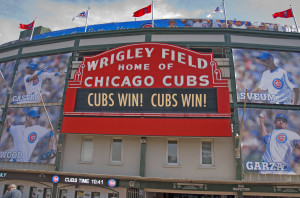
The last time the Cubs won the World Series, there were only 46 stars on the American flag.
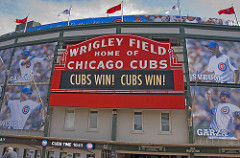
Photo by Ron Cogswell 
Back in early February, BBRT picked the Cubs to break their World Series Championship drought (since 1908) and win the 2016 World Series. (I did, however, have them winning over the Boston Red Sox – the Cleveland Indians were hardly on my post-season radar.) I’m going to stick with the Cubbies based on a combination of:
- Starting pitching (three potential 2016 Cy Young Award candidates);
- Lineup flexibility (particularly MVP candidate Kris Bryant, youngster Javier Baez and veteran Ben Zobrist); and
- A nice balance of young and veteran players.
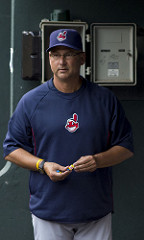
The wild card in this prediction – and, most likely the Indians’ best asset if they are to win the Series – is Cleveland’s strong bullpen (particularly ALCS MVP Andrew Miller and Cody Allen). The bullpen is even more of an asset given Indians’ manager Terry Francona’s adept, if somewhat unorthodox in today’s game, handling of his pitching staff. (Consider that the Indians won the ALCS four games-to-one over the Blue Jays in a series in which: the 44 Cleveland innings pitched were split exactly equally between the starters and the bullpen; no starter went more than 6 1/3 innings; and the Indians won Game Three 4-2, using seven pitchers and none more than 1 2/3 innings.)
Before looking at the two squads in detail, let’s look at some overall stats from the 2016 season. (Keep in mind, the DH impacts some of these numbers.)
Wins: Cubs – 103; Indians – 94
Run Differential. Cubs – +252; Indians +101
___________________________________________
Batting Average: Indians – .262; Cubs – .256
Runs Scored: Cubs – 808; Indians 777
Home Runs: Cubs – 199; Indians – 185
Stolen Bases: Indians – 134; Cubs – 66
Walks Drawn: Cubs – 656; Indians 531
Batters’ Strikeouts: Cubs – 1,339; Indians – 1,246
__________________________
ERA: Cubs – 3.15; Indians – 3.84
Strikeouts: Cubs – 1,441; Indians – 1,398
Saves: Cubs – 38; Indians – 37
WHIP: Cubs – 1.11; Indians – 1.24
Home Runs Surrendered: Cubs – 163; Indians – 186
__________________________________________
Fewest Errors: Indians -89; Cubs – 101
Fielding Percentage: Indians – .985; Cubs – .983
Taking all this into consideration, BBRT is going with the Cubs in six games if Trevor Bauer is ready to pitch – and five games if the Indians’ are forced to bypass Bauer.
Now, let’s take a look at the two squads – and who has the edge where.
Starting Pitching
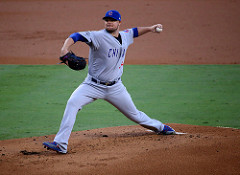
Jon Lester – Game One Cubs’ starter. Photo by apardavila
The Cubs’ rotation boasts MLB ERA leader righty Kyle Hendricks (16-8, 2.13); veteran southpaw Jon Lester (19-4, with MLB’s second-best ERA at 2.44); and last year’s Cy Young Award winner Jake Arrieta (18-8, 3.10 this season). If any of the big three should falter, there’s also veteran John Lackey (11-8, 3.35.) In the post-season, Cubs’ starters have thrown 56 1/3 innings in ten starts, with a 2.57 ERA.
The Indians have made it to the World Series despite a starting staff hit by injuries. They lost right-handed starter Carlos Carrasco (11-8, 3.32) in mid-September, lost Danny Salazar for a portion of the season to elbow issues (11-6, 3.87) and had Trevor Bauer (12-8, 4.26) suffer an off-field, post-season injury (cutting a pinky finger while working on a drone) that forced him from his ALCS Game Three start after just 2/3 of an inning. Then, there is Josh Tomlin, slated to start Game Three of the World Series. Tomlin was 9-2, 3.51 in the 2016 season’s first half and 4-7, 5.59 in the second half. How deep did the issues facing the Indians starting staff go? In Game Five of the ALCS, they started Ryan Merritt, a southpaw with just 11 MLB innings under his belt.
Still, it’s not all bad news. Indians’ starters have a pitched total of 38 2/3 innings this post season, with a stingy 1.88 ERA. (However, they have averaged less than five innings per start, putting a lot of pressure on the bullpen.) Staff ace Kluber is well-rested for Game One, Bauer has had additional time for his stitched pinky to heal and says he’ll be ready for Game Two, and Game Three starter Tomlin appears to have “righted the ship,” going 2-1, 1.69 after September 1 and giving up just three earned runs in 10 2/3 2016 post-season innings. And, if Bauer is not ready, Danny Salazar may be able to step up. Ultimately, however, there are too many questions marks in the Indians’ rotation.
Starting Pitching: Advantage – Cubs
________________________________
Bullpen
The Cubs’ bullpen is led by the hardest thrower in baseball – Aroldis Chapman. Chapman was 4-1, 1.55 with 36 saves and 90 strikeouts in 58 innings for the Yankees and Cubs during the regular season. Chapman has, however, looked “a bit” more hittable in the 2016 post-season, giving up three earned runs and striking out 10 in eight innings pitched. Chapman is ably supported by the likes of Hector Rondon (3.53 with 18 saves in 54 games); Travis Wood (2.95 in 77 games); and Pedro Strop )(2.85 in 54 games).
The Cleveland pen is led by ALCS MVP Andrew Miller, whom manager Terry Francona will call on at any time. Pitching for the Yankees and Indians in 2016, Miller went 10-1, 1.45 with 12 saves and 123 strikeouts in 74 1/3 innings. He’s been even better in the post season – pitching 11 2/3 inning in six appearances, fanning 21 batters, giving up no earned runs, picking up a win and a save. Miller is joined in the Cleveland pen by Cody Allen (2.51 ERA with 87 K’s in 68 innings); Dan Otero, 1.53 ERA in 62 appearances); Jeff Manship (3.12 in 53 appearances); and Bryan Shaw (3.24 in 75 appearances).
Overall, the bullpens are very close. However, given Miller’s post-season performance thus far and the skill Francona has shown in handling the bullpen, BBRT will give e slight edge to the Indians. The question, of course, is whether the Indians’ rotation issues will result in too much work for the relief staff.
Bullpen: Advantage – Indians
____________________________________
Now, how about the position players?
Catcher
The Cubs rely on a catching committee, with most of the recent work going to Wilson Contreras (.282-12-35 in 76 games). Others taking a spot behind the plate include Jon Lester’s designated catcher David Ross (.229-10-32 in 67 games) and Miguel Montero (.216-8-33 in 86 games). Contreras, by the way, is hitting an even .400 (8-for-20) in the 2016 post season.
Catching duties for Cleveland belong to Roberto Perez – an excellent game-caller and defensive backstop. Perez, however, hit just .183-3-17 in 61 regular-season games, and is hitting just .174 in the post season. (By contrast, Cubs’ pitcher Jake Arrieta hit .262-2-7 in 31 games.)
Catcher: Advantage – Cubs
___________________________________
First Base
It’s the Cubs’ Anthony Rizzo (.292-32-109) versus the Indians’ Mike Napoli (.239-34-101) at first base. The 34-year-old Napoli, in his eleventh MLB season, is a big reason the Indians took the AL Central title. He reached career highs in games played, hits, runs scored, home runs and RBI. In eight games this post season, however, he is hitting just .179 with one home run and two RBI. The 26-year-old Rizzo matches Napoli’s power, makes contact more often, and is on a hot steak (.320-2-5 in the NLCS).
First Base: Advantage – Cubs
___________________________________
Second Base
Here again it’s a young Cub versus a veteran Indian. At the keystone sack for the Cubs you can expect to see 23-year-old Javier Baez, who hit .273-14-59 with 12 steals in 142 games – and started games at 3B, 2B, SS and 1B during the season. This post-season, Baez is hitting .342, with one home run and seven RBI in ten games.
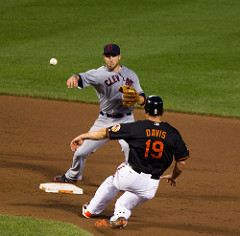
Jason Kipnis handles 2B for the Tribe. Photo by Keith Allison
Second base for Cleveland is handled by 29-year-old, six-year MLB veteran, Jason Kipnis a two-time All Star who hit .275-23-82, with 15 steals. This post season, Kipnis is hitting .167 (five-for-thirty) with two home runs and four RBI. In the field, BBRT would give an edge in reliability to Kipnis.
Second Base: Advantage – Indians
_________________________________________________
Third Base
Both the Indians and Cubs boast young stars who had career years at third base.
The Indians’ Jose Ramirez – like Napoli at 1B – had a career year, hitting .312, with 11 home runs, 76 RBI and 22 steals in 152 games (and getting starts at 3B, LF, 2B and SS). Any team would be glad to have a 24-year-old versatile infielder/outfielder who could put up those kinds of numbers. (Note: Ramirez is hitting .222 this post season.)
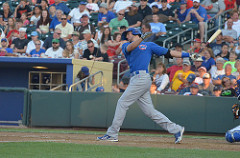
MVP candidate Kris Bryant. Photo by Minda Haas Kuhlmann
However, the Cubs have an equally versatile defender at the hot corner, who put up MVP-level numbers in 2016. Kris Bryant, also 24-years-old, played in 155 games this past season – hitting .292, with 39 home runs, 102 RBI and a league-leading 121 runs scored. Bryant got starts at 3B, LF, RF and 1B during the season. Thus far in the post season, he is hitting .333, with one home run and three RBI.
Third Base: Advantage – Cubs
_________________________________
Shortstop
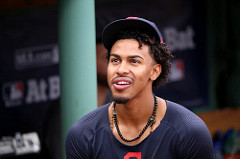
Francisco Lindor, Indians’ star shortstop. Photo by apardavila
Addison Russell, the Cubs’ up and coming 22-year-old shortstop showed solid defense and good power in 2016 – .238-21-95 in 151 games. However, he is outpaced in the field and at the plate by the Indians’ Francisco Lindor, who – in just his second MLB season – showed Gold Glove-worthy defense, while hitting .301-15-78, with 19 steals in 158 games. In the post season, Lindor has been hot – .323-2-4 in eight games. Russell’s 2016 post-season stat line is .189-2-4.
Shortstop: Advantage – Indians
______________________________________________
Left Field
Versatile veteran Ben Zobrist (11 major league seasons) will be in left field for the Cubs. He was an All Star this season, hitting .272, with 18 home runs, 94 runs scored and 76 RBI. He is also a veteran of 47 post-season games, although he has managed only six hits in 36 at bats this post-season.
The Indians seem likely to platoon in LF with switch-hitter Coco Crisp and the right-handed hitting Brandon Guyer. The veteran Crisp (15 MLB seasons), who hit.231-13-55, with ten steals, in the regular season has gotten most of the time in LF this post season. He’s delivered three hits in 14 at bats in the ALDS and ALCS. Guyer seems to offer more potential on offense. This past season, he hit .266, with nine home runs and 32 RBI in 101 games (Rays and Indians). Thus far, he’s gotten only eight at bats in the post season, but delivered three hits, two runs and an RBI. We may see more of him in the World Series.
Left Field: Advantage – Cubs
_________________________________________
Center Field
This is another situation in which the position seems more stable with the Cubs, who put Dexter Fowler out in center nearly every game. The 30-year-old Fowler, in his ninth season, was an All Star for the first time in 2016. He hit .276-13-48, with 84 runs scored and 13 steals in 125 games. This post season, Fowler is hitting .262, with one home run, four RBI and six runs scored.
The Indians can look to left-handed hitting Tyler Naquin and right-handed Rajai Davis to handle the center of the garden – both offer good defense, speed and enough offense at the position. Naquin, a 25-year-old rookie hit .296-14-43, with six steals and 52 runs scored in 116 games (90 starts in center), while Davis (an 11-season MLB veteran) hit .249-12-48, but led the AL with 43 steals in 134 games (66 starts in CF). Naquin is hitting just .188 in the post season, while Davis has yet to get a hit in 13 2016 post-season at bats.
Center Field: This is a draw, Fowler is the steadier option, but if Naquin or Davis can heat up a bit, the potential to do more damage is there.
__________________________________________
Right Field
I’m making a big assumption here – that the Cubs keep sending Jason Heyward, an offensive disappointment, out to right field. Heyward hit just .230-7-49 during the regular season. Those numbers were all MLB-season lows for him. Still he brings Gold Glove defense (which may be keeping him in the lineup despite just two hits in 28 at bats this post season) and the Cubs have enough offense to opt for his leather.
The Indians send Lonnie Chisenhall out to right field – and he fared a lot better in the regular season than Heyward. The left-handed hitting Chisenhall hit .286-8-57 in 126 games; and has delivered a .269 average this post season. Heyward delivers superior defense, but I have to go with Chisenhall on this one.
Right Field: Advantage – Indians
________________________________________
Designated Hitter
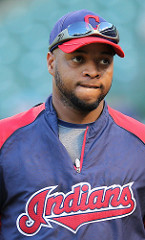
Carlos Santana – brings experience and powerf tgo DH role. Photo by Keith Allison
Both teams have versatile players who could play in the field or at DH in AL parks. Most likely, however, the Indians will go with Carlos Santana (who can all fill in at 1B or C in a pinch) and the Cubs with Jorge Soler or Kyle Schwarber (coming off the DL). Santana is a proven power hitter, who delivered a .259-34-87 season and is hitting .250 in the post season. He’s also familiar and comfortable with the DH role.
Jorge Soler hit .238-12-31 in 86 games for the Cubs (56 starts in the OF) and is hitless in eight at bats this post season. The Cubs also have Kyle Schwarber back from a torn ACL that has shelved him for nearly the entire season. If the 23-year-old – who hit .246 with 16 home runs in 69 games after a 2015 call up – has his timing back, he could add to the Cubs’ offense. Still, Santana has more to offer – at a significantly lower risk,
DH: Advantage – Indians
I tweet baseball @David BBRT
Member: Society for American Baseball Research (SABR); The Baseball Reliquary; Baseball Bloggers Alliance.
 There were no tight Divisional races as September came to a close. Your Division champs were the Indians, Red Sox, Rangers, Nationals, Cubs and Dodgers – and, as of September 30, all had leads of at least five games (Red Sox over Orioles), with the Cubs having the largest margin at 18 ½ games over the second-place Cardinals.

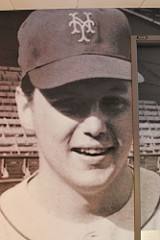
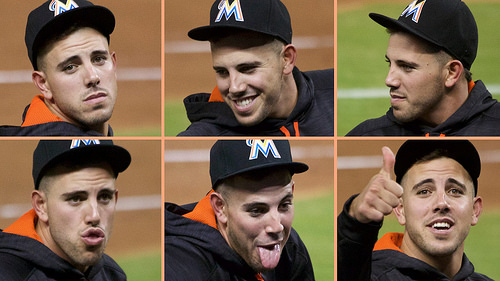
 It’s September first and that means it’s time for Baseball Roundtable’s look at the month of August – winners, losers, streakers, pacesetters and more. Here’s just a few of the things we saw in MLB during the “Dog Days” of August:

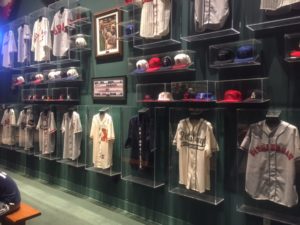 If you are a baseball fan, you can’t afford to miss the Negro Leagues Museum, which gives you a look at some of the richest – and some of the most poignant – times of our baseball history. Located in the 18th and Vine district, the museum takes you through the history of the Negro Leagues – and individuals of color – across baseball history. The story is told with a wide range of films, audio visual exhibits, photographs and memorabilia of all kinds. It is indeed a history lesson. You’ll learn a lot not just about baseball, but also about American history, race relations and attitudes.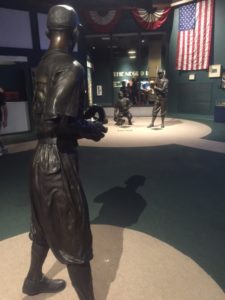
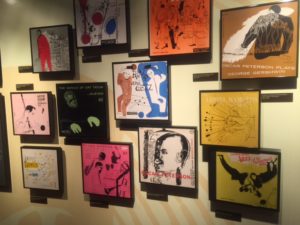 From the Negro Leagues Museum, we made our way to the American Jazz museum (housed in the same building) – where we were able to get and eyeful and earful of the greats from this unique American music genre. The museum included plenty of listening stations to enjoy the greats (and even separate the music into the parts that make up the whole) and visual impressions of the history of jazz (from photographs and films of jazz greats to album cover art to jazz club neon). If you are a fan of jazz, this visit is a must.
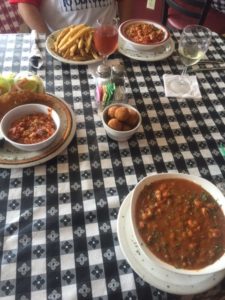 After our museum visit, we took the advice of the locals and headed to Danny’s Big Easy – practically across the street from the museums – for Cajun food. There were four of us in our group and the reaction was unanimous – WOW! Great, and we really mean great, Cajun food; as well as a server whose “life is a party and you are all invited” attitude made the experience even more enjoyable. Among the items we had: Crawfish Etouffee; Jambalaya; Catfish Po’ Boy; mac ‘n cheese; wings; specially seasoned house fries; and hush puppies. We washed it down with wine, but when one of our group asked about a beverage called “Living Easy,” they brought us a free one with four straws. (Also of interest was the fact that they had Kool-Aid on the menu for three dollars.)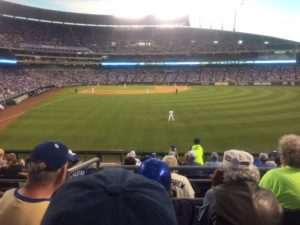
 An additional bit of information on Day Seven – for the full day, click
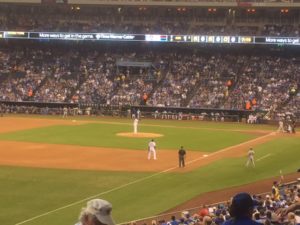
 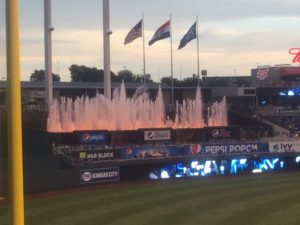 Arriving at Kaufmann Stadium, you first notice the higher level of security (as opposed to all our minor league stops) … bag searches and metal detectors were the order of the day. Once inside the stadium, which opened in 1973 and underwent significant renovation in the late 2000’s, you notice the steep upper deck, massive “Crown Vision” scoreboard/video board in center field and the right field fountain area.
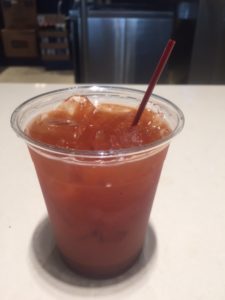 The Bloody Mary – $10 at the Boulevard Pub – was adequate: good pour; spicy, but not over bearing (it could have used a touch more tabasco and a bit of celery salt); it included a lime wedge, but I do like more substance in a Bloody Mary (maybe a celery stick, olives or a pickle spear.) Still at $10, it was a better bargain than the $11 beer. (One of our group reported paying $27 for two beers and a bag of peanuts.)
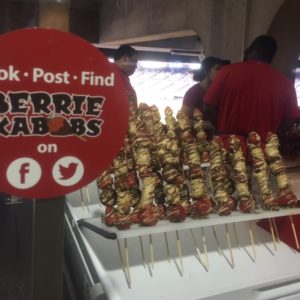 One popular concession item with our group was the “Berrie Kabob” – available for $7 at a nearby concession stand or from strolling vendors. They consisted of chocolate dipped strawberries, bananas and brownies (in various combinations) on a stick – and were delicious. If you are looking for dessert, this one is a hit.
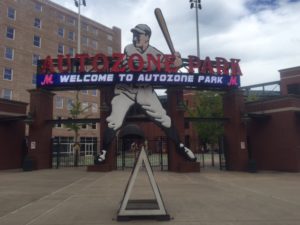 Day Three of Ballpark Tours XXXIV sees us remaining in Memphis, with a second Tacoma Raniers/Memphis Redbirds game slated for 6:05 p.m.
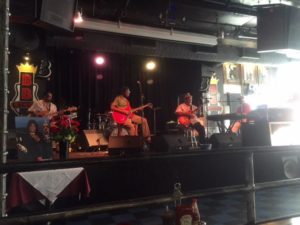 Being as major fan of the blues, I headed toward the Beale Street Entertainment District, where the barbeque is sweet and the live music starts at 11 a.m. and runs straight through to 3 a.m. It’s also where I saw quite a few of my fellow tour participants. I stopped to take in a few tunes at a handful of clubs before heading for lunch at my previously selected destination – B.B. King’s Blues Club. I could not miss visiting the original B.B. King’s location. I was not disappointed. The house band was great – back in Minnesota they’d be headliners – and so were the Memphis-style dry-rub ribs. I hung out at B.B. King’s for a couple of hours (or a couple of brews, depending on how you measure) before heading over to Autozone Park for the evening’s ball game (6:05 p.m. start),
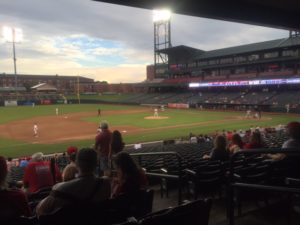 It was another heavy, humid day – with storms predicted –which may have contributed to the very small crowd (as might the Redbirds sub-.500 record). We did not, however, get rained on. The announced attendance was 3,517, but I’d be surprised if there were more than 2,500. – and they were a quiet bunch, despite Memphis’ 6-2 win. We tried to get something going, but often all you heard was the “sound of one fan clapping.” Good seats again, by the way, third-base side this time.
 At 9:00 a.m. on Friday, August 12, 32 baseball fans – myself included – set out on
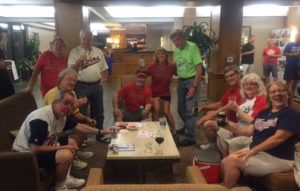
 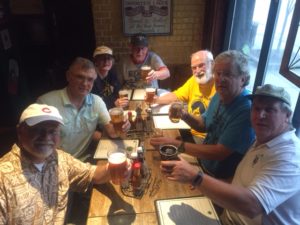 Libation and laughter (as well as supper) were the order of the evening. The group I joined headed to Ulrich’s Rebellion Room – a nearby Irish-style pub. Despite the rain, and some disappointment with the cancelled game (and missed fireworks and lost bobbleheads), there were plenty of smiles, laughter and toasts to our national pastime. And, imagine, the response, when the group learned the pub didn’t close until 4:00 a.m. and the kitchen was open until 3:00. That’s hospitality.