Remember that Time When … Andy Hawkins Lost the Same No-Hitter TWICE

Passing time browsing Baseball-Reference.com while I wait for the owners and players to come to their senses, I ran across an interesting boxscore – Andy Hawkins’ 1990 no-hitter, which he lost 4-0 and then later lost … Oops, getting ahead of the story here.

Andy Hawkins’ Double-Lost No-Hitter
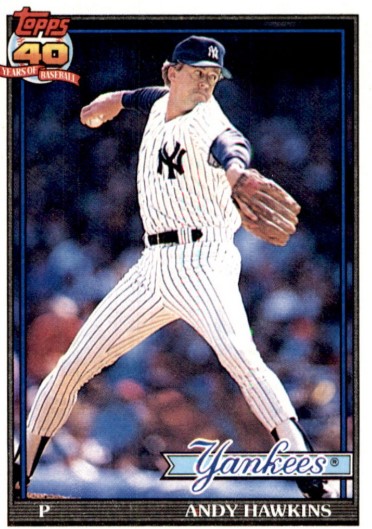
As Yankees’ righthander Andy Hawkins took the mound on July 1, 1990, the fans may not have expected a victory and almost certainly would not have been expecting a no-hitter.  Yet, Hawkins – who brought a 4-9 record (13 games/12 starts) and  a 6.40 earned run average into the game – would get (temporarily) the least expected of the two.

The game was being played in Chicago and Hawkins’ mound opponent was southpaw Greg Hibbard, who was 8-6, 2.49 at the time. After seven  frames the game was knotted at 0-0, and Hawkins had given up no hits, while walking two and fanning three. Hibbard had also tossed seven scoreless innings (four hits, no walks, four whiffs).

Barry Jones came to the mound for the ChiSox in the top of the eighth and held the Yankees without a run.  In the bottom of the eighth, the baseball Gods began to “mess with” Hawkins’ game.  It started out fine, with ChiSox catcher Ron Karkovice and 2B Scott Fletcher both going down on infield pop ups.  Then, RF Sammy Sosa  (batting in the eight-hole) reached first on an error by Yankee third baseman Mike Blowers (a bobbled ground ball). Hawkins followed by walking SS Ozzie Guillen on a 3-2 pitch and then issuing a four-pitch walk to CF Lance Johnson. Sacks full, but shutout, no-hitter and the chance of a much-needed win still intact. Next up was 3B Robin Ventura,  who hit a playable flyball to rookie Jim Leyritz in LF. The ball clanked off Leyritz’ glove for an error and – with the runners moving (two outs) – all three  scored (Ventura ended up on second).  Next up was DH Ivan Calderon, who hit a fly to RF that Jesse Barfield lost in the sun and dropped (another error) enabling the fourth run of the inning to score.  Hawkins then retired LF Dan Pasqua to end the inning.

The Yankees went scoreless off reliever Scott Radinsky in the top of the ninth, ending the game. At that moment, Andy Hawkins had a complete-game, no-hitter, 4-0 loss. Little did Hawkins know; he was going to lose this no-hitter a second time.

In September of the following season (1991), MLB ruled that official no-hitters had to be at least nine innings.  Since the White Sox had not batted in the bottom of the ninth, Hawkins, despite the complete game, no longer had an official no-hitter.

It Was That Kind Of Season

In Andy Hawkins’ next start, just five days after his July 1, 1990 no-hit loss, Hawkins carried a NO-HIT, shutout into the twelfth inning (against the Twins in New York).  Unfortunately, the Twins’ Allan Anderson and Juan Berenguer held the Bombers scoreless (despite ten hits).  The Twins got to Hawkins for two runs (two walk and two hits) in the twelfth and Rick Aguilera set down the Yankees without a run in the bottom of the inning. So, 11 no-hit innings for Hawkins and the end result was another loss.  That gave Hawkins a streak of 19 consecutive hitless innings over the two games – with two losses to show for it. 

Hawkins finished 1990 at 5-12, 5.37. Hawkins pitched in 10 MLB seasons (1982-91 … Padres, Yankees, A’s), going 84-91, 4.22. His best season was 1985, when he went 18-8. 3.15.

_______________________________________

Looking into Hawkins’ lost (in more ways than one) no-hitter, set me to looking for other unusual no-hitter outings.

A.J. Burnett …  A Walk on the Wild Side
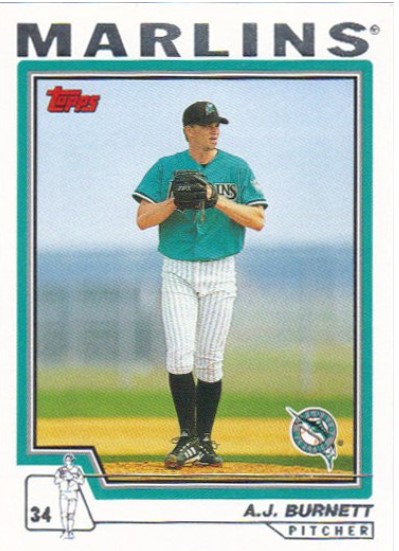
In A.J. Burnett’s May 12, 2001 no-hitter for the Marlins, a 3-1 win over the Padres, every starting position player for the Padres reached base at least once.   (Burnett walked nine and hit one batter).  Burnett’s nine walks are the most ever in a nine-inning, one-pitcher no-hitter. Burnett threw 65 strikes and 64 balls in the game – his 50.4 percent strike-to-ball ratio is the worst ever in a no-hitter.

His game looked like this:

  • First inning – One (four-pitch) walk, one left on base.
  • Second inning- Two walks (both on 3-2 pitches), one left on base.
  • Third inning – Two walks (on  3-1 and 3-2 counts), one wild pitch, two left on base.
  • Fourth inning – One walk (3-1 pitch), one hit by pitch (3-2 count), two left on base.
  • Fifth inning – Three up, three down.
  • Sixth inning – Three up, three down.
  • Seventh inning – One walk (four-pitch), one left on base.
  • Eighth inning – Two walks (on four-pitch, one on a 3-2 count), two left on base.
  • Ninth inning – Three up, three down.

A.J. Burnet pitched in 17 MLB seasons (1999-2015 … Marlins, Blue Jays, Yankees, Pirates, Phillies), going 164-157, 3.99. He won ten or more games in 11 seasons (a high of 18 for the Blue Jays in 2008).

A First for A.J.

A.J. Burnett made his first All Star team in his final MLB season (at age 38 in 2015). He was 2-4, 2.53, for the Pirates, at the All Star break.  He went 7-3, 3.89 the rest of the way. 

Ken Johnson … How About a Little Help from My Friends?
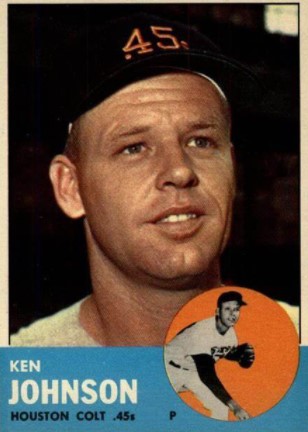
On April 23, 1964, the Houston Colt .45s’ Ken Johnson had held the Reds hitless through eight innings (in Houston) – walking two and fanning nine. However, the Reds’ Joe Nuxhall also had a shutout going, although he had given up five hits.   A couple of errors in the ninth cost Johnson the game – but not the no-hitter.  In the top of the ninth, Nuxhall led off against Johnson and grounded out (third-to-first). The next batter, 2B Pete Rose, attempted to end the no-no with a bunt to the third base side of the infield.  Johnson fielded the bunt, but threw wildly toward first base.  Rose ended up on second (a two-base error). Chico Ruiz followed up with a line drive off Johnson that was fielded by 3B Bob Aspromonte, who threw Ruiz out at first (with Rose going to third). Next up was Reds’ CF Vada Pinson, who was safe on an error by Houston 2B Nellie Fox (Rose scoring). Johnson then retired RF Frank Robinson on a routine fly to left.  The no-hitter was intact, but the damage was done – one unearned run. Nuxhall  held the Colt .45s scoreless in the bottom of the inning and Johnson had MLB’s only complete-game, official no-hitter loss.

Edwin Jackson – Who’s Counting?

On June 25, 2010,  the Diamondbacks’ Edwin Jackson got off to a wild start against the Rays.  Jackson’s pitch count was up to 70 after just three innings – during which he gave up seven walks, threw one wild pitch and fanned two.  He settled down after that – walking just one more batter, fanning four more and holding the Rays hitless.  Jackson threw 149 pitches, the most ever in a no-hitter, as the Diamondbacks prevailed 1-0.

Jackson pitched in 17 MLB seasons (2003-2019 … Dodgers, Rays, Tigers, Diamondbacks, White Sox, Cardinals, Nationals, Cubs, Braves, Marlins, Padres, Orioles, A’s, Blue Jays).  His career MLB stat line was 107-133, 4.78.

I’m a Travelin’ Man

Edwin Jackson pitched at the major-league level for more teams (14) than any other player in MLB history. In the five seasons between 2009 and 2013, he pitched for six different MLB teams (Tigers, Diamondbacks, White Sox, Cardinals, Nationals, Cubs).  He pitched for two MLB teams in six of his 17 MLB campaigns. 

Steve Barber – One for the Books

The most walks in a no-hitter by one pitcher is ten by Steve Barber in a combined no hitter.  Barber took a no-hitter, albeit with seven walks, and a 1-0 lead into the top of the ninth as his Orioles played the Tigers in Detroit on April 30, 1967.  Barber walked the first two batters in the final inning. Then a sacrifice moved them to second and third.  A wild pitch followed, plating the tying run.  Barber walked the next hitter, and was relieved by Stu Miller. Miller finished up the no-hitter, but the go-ahead run scored on an error, giving the Tigers a 2-1 win without the benefit of a hit.

Barber enjoyed a 15-season MLB career (1960-74 … Orioles, Yankees, Pilots, Cubs, Braves, Angels., Giants), going 121-106, 3.36. He was a two-time All Star and a 20-game winner (20-13, 2.75) in 1963 (Orioles).

Jim Maloney …  You Win Some, You Lose Some (not necessarily in that order) … or a Very Larry Tale

On June 14, 1965, the Reds’ Jim Maloney held the New York Mets hitless for ten innings (in Cincinatti) – walking one and fanning 17.  Unfortunately, the Mets’ Frank Lary and Larry Bearnarth held the the Reds scoreless through ten frames (on six hits).  Mets’ RF J0hnny Lewis led off the tenth with a home run off Maloney, the Reds did not score in the bottom of the inning and all Maloney had to show for his effort was a loss.

Maloney, however, was not to be denied a 1965 no-hitter. On August 19, he held the Cubs hitless over the first nine innings (in Chicago). The Cubs’ Larry Jackson, however, had matched him zero-for-zero … in what was a wild game, at least for Maloney.  As they went into the tenth, Maloney had walked nine, hit one batter and fanned 12, while Jackson had surrendered seven hits, walked none and fanned five. Reds” SS and number-eight hitter Leo Cardenas touched Jackson for a solo home run in the top of tenth and Maloney walked one and then got a fly out and a 6-4-3 double play to end the game and  get the no-phit victory.  Side note: In  his very first start of the 1965 season (April 19 at Milwaukee), Maloney had taken a no-hitter into the eighth, only to have it broken up a a Denis Menke single (the only hit of the game for the Braves). 

Maloney pitched in a dozen MLB seasons (1970-71 … Reds, Angels), going 134-84, 3.19. He won 15 or more games six times and was twice a 20-game winner (23-7, 2.77 for the 1963 Reds and 20-9, 2.54 for the 1965 Reds).

Johnny Vander Meer … Working Hard to Finish
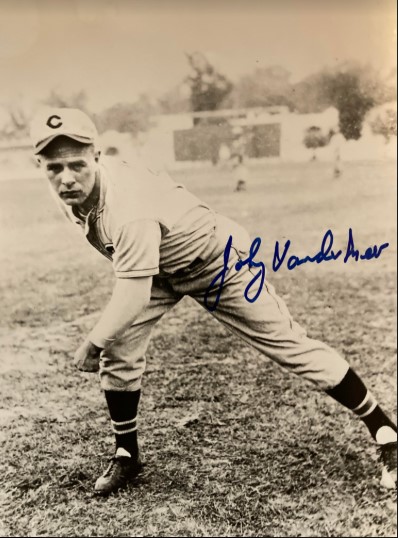
Most fans know that Johnny Vander Meer is the only MLB pitcher to toss consecutive no-hitters (June 11 and 15, 1938 – in the 23-year-old southpaw’s second MLB season). But, were you aware of the wild finish to the second no-no?  On June 15, facing the Dodgers in Brooklyn, the Reds’ Vander Meer took a no hitter and a 6-0 lead into the ninth inning.  At this point, he had walked five and fanned seven. He got the first batter of the frame,  Buddy Hassett, on a weak grounder to the mound.  Then things got a little wild – as he walked the bases loaded (C Babe Phelps, 3B Cookie Lavagetto and 1B Dolph Camilli). Next up was CF Ernie Koy, who hit a grounder to third that resulted in a force out at the plate.  Sacks still full, with the shutout and no-hitter intact. SS Leo Durocher was up next and Vander Meer got him a fly out to center.

Vander Meer pitched in 13 MLB seasons (1937-43, 1946-51 … losing two prime years to military service).  He pitched for the Reds, Cubs and Indians.  Vander Meer was a four-time All Star (all before his military years) and won 15 or more games in five seasons. He led the National League in strikeouts in each of the three seasons before his military break. Vander Meer’s final MLB stat line was 119-121, 3.44.

This One May Top Them All … Especially if You Like Pitchers’ Duels

On May 2, 1917, the Cubs faced the Reds in Chicago – with Fred Toney (4-1, 1.88) starting for the Reds and Jim “Hippo” Vaughn  (3-1, 2.25) on the mound for the Cubs. (Side note: In 1917, the MLB overall earned run average was 2.68. ) At the end of nine frames, the game was scoreless and the fans had yet to witness a hit by either team. There had been only five base runners in the game (four walks and one safe on an error ). In fact, only seven  batted balls had even reached the outfield. In the top of the tenth, the Reds broke through, scoring a run on two singles and an error. Toney held firm in the bottom of the inning, recording a 1-2-3 frame (two strikeouts) and putting a no-hitter into the record books. Toney finished the season at 24-16, 2.20 (and had a career line of 139-102, 2.69 in 12 seasons); while Vaughn went 23-13, 2.01 in 1917 and 178-137, 2.49 in 13 MLB seasons. 

Primary Resources:  Baseball-Reference.com; Baseball-Almanac.com

 

100Baseball Roundtable is on the Feedspot list of the Top 100 Baseball Blogs.  To see the full list, click here.

I tweet baseball @DavidBBRT

Follow/Like Baseball Roundtable’s Facebook Page here.  More baseball commentary; blog post notifications; PRIZES.

Member: Society for American Baseball Research (SABR); Negro Leagues Baseball Museum; The Baseball Reliquary. 
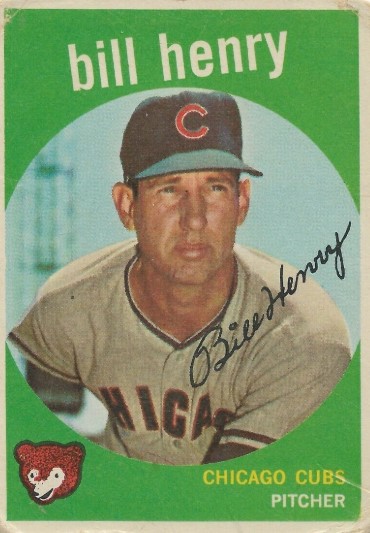
 

Willie, Mickey and the Duke … With a Side Trip on the Bill(s)

The outlook isn’t brilliant for baseball fans today,

As owner and players squabble, we can only look on in dismay.

It seems they are willing to take our game away.

And keep us in suspense about “When is Opening Day?”


When can we have a hot dog and a vendor-delivered beer?

When can we salute our favorites with a loud and lengthy cheer?

When will there be double plays, stolen bases and home runs?

When will the players and owners see it’s a game and should be fun?


We don’t know when will there be scorecards, so carefully filled in.

Or when we can gasp at a fastball near a batter’s chin.

Or when can we view that most welcome sight of all;

An umpire pointing at the mound and shouting the words “Play Ball.”


So, as the financial squabbling  seem to drag on and on, 

We can only think fondly of baseball days bygone.

So, here in Baseball Roundtable, as the baseball lockout lasts,

We’ll entertain ourselves with memories of baseball from the past. 

______________________________________

Spoiler Alert – A Tale of Two Bills and a Duke

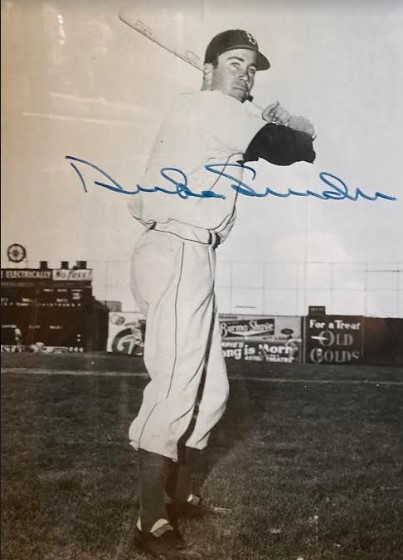
Duke Snider faced hard-throwing Bill Pierro just five times in his career and never made an out. In fact, he hit for the cycle against Pierro (plus a walk).  On the other side of the coin,  Snider faced Bill Henry five times in his career and all Snider had to show for it were four strikeouts and a groundout.

That Bill Pierro and Bill Henry made their way onto this page is another example of “how one thing always seems to  lead  to another” when researching for Baseball Roundtable topic.   Normally, at this time of year, I would be busy putting together predictions for the upcoming season.  However, with so many free agents still out there and the start date for the 2022 season delayed and  “up in the air,”  that seems a bit premature.  So, I find myself  searching for topics that might provide some fan entertainment during the  owners/players squabble. In my search, I came across an old Baseball Digest article in which Mickey Mantle name Dick Radatz as the toughest pitcher he ever faced. (Notably, I also came across instances were Mantle put Sandy Koufax and Herb Score on that list.) The lyrics to “Talkin’ Baseball” also came up as I searched for Mantle quotes – and that led me to consider a post on which pitchers were toughest on “Willie, Mickey and the Duke.”  In the Duke Snider portion of that research, I was distracted by the tales of Bill Pierro and Bill Henry (versus Duke Snider) – which I would like to share before I get to the Willie, Mickey and the Dule portion of this post.

___________________________________________________

A Baseball Double Bill

Bill Pierro, was a hard throwing 6’1”, 155-pound right-hander signed by the Pirates in 1947. He quickly became one of the Pirates’ top pitching prospects. Pierro went 8-9. 4.30 with the Class-D Bartlesville Oilers of the Kansas-Oklahoma-Missouri League in his first pro-season (1947).  The 21-year-old then went 17-8, 2.15, reportedly fanning 300 in 230 innings, for Bartlesville in 1948. The following year, he was promoted to the Class-B (Big State League) Waco Pirates, where he went 18-11, 2.96 and fanned 275 hitters in 255 innings. (There were some cautionary signs.  In addition to the 275 whiffs, he walked 126 batters and hit 16.) Pierro  started 1950 with the Double-A Indianapolis Indians and was 8-3,  2.60 when the Pirates called him up. With Pittsburgh, Pierro went 0-2, 10.55 in 12 appearances (three starts) – walking 28 batters in 29 innings.   MLB never got to see if Pierro could harness his command and deliver on his early promise, In 1951, he  contracted encephalitis, which nearly ended his life and did end his pitching career.

Cycling the Pierro/Snider story. Duke Snider faced Bill Pierro just five times in his career – all between July 22 and September 19, 1950. In a span of three games and 13 pitches, Snider hit for the cycle against Pierro –  collecting  a single, double, triple, home run and walk. On July 22, with Pierro starting against the  Dodgers in Pittsburgh, Snider walked on a 3-1 pitch in the first and singled (on a 1-0 pitch) in the third inning. Exactly one month later, on August 22, Pierro came on in relief (third inning) against the Dodgers (again in Pittsburgh).  In the fourth, Snider hit Pierro’s first pitch to him for an RBI triple. Then, on September 9, Pierro  again came on in relief against the Dodgers, this time in Brooklyn. Pierro relieved Vern Law in the top of the second, with the Dodgers up 6-1, no outs and runners on first and third.  The first batter he faced? You guessed it. Duke Snider. Snider hit  his first offering for a two-run double. With Dodgers up 10-2, Pierro was still around when Snider led off the bottom of the fourth – with a solo home run on a 2-1 pitch – and the cycle against Pierro was complete. (Snider never faced Pierro again.) Side note: If you eliminate that first at-bat walk, Snider actually completed the cycle against Pierro in eight pitches.

Putting a Good Swing on the Bill Henry Story. The other Bill provides The Roundtable with a totally different (and much longer) story. Bill Henry did not show the early potential of Bill Pierro.  Toiling in the minors he went 44-52 over his first four seasons (1948-52). Still, he made his MLB debut on April 17,  1952. From 1952 through 1956, he bounced between the major and minors (Red Sox), appearing in 75 MLB games and 68  minor-league contests. Then, in January 1957, the 30-year-old was traded from the Red Sox to the Cubs and his perseverance began to pay off. In 1957, he went 14-6 as a starter for the  Double-A Memphis Chicksaws. In 1958, the Cubs converted him to a reliever – and opportunity came knocking in a big way. That season, Henry went 5-3, 3.60 for the Triple-A Portland Beavers (17 games/two starts) and 5-4, 2.88, with six saves for the Cubs. In 1959, at age 31, Henry played his first full season in the majors (Cubs), going 9-8, 2.68, with 12 saves, while appearing in a league-leading 65 games.  (I warned you this was a long story.) The conversion to reliever worked well. From his age-30 season forward, Henry made 452 MLB mound appearances (just two starts).  Ultimately,  Henry enjoyed  a 16-season MLB career (1953-55, 1958-69 … Red Sox, Cubs, Reds, Giants, Pirates Astros), pitching in the majors until he was 41-years-old. He went 46-50, 3.26, with 90 saves  in 527 appearances. He made one All Star Team (1960).

Now, we FINALLY get to why Henry is in this post.  Duke Snider’s record against Bill Henry was kind of the opposite of how he fared against Bill Pierro. Snider faced Henry five times in his career (five games over three seasons … 1959, 1961, 1963). Those five at bats resulted in one infield groundout and four strikeouts. Henry, by the way,  put up some solid  numbers against an impressive lineup of future Hall of Famers.  Just a few examples; Frank Robinson (a .059 average in 17 at bats); Stan Musial (.167 in 18 at bats); Roberto Clemente (.154 in 13 at bats); Yogi Berri (.091 in 11 at bats); Eddie Mathews (.188 om 32 at bats).

_____________________________________________________

Now, on to Willie Mickey and the Duke … and the Pitcher Who Were Tough on Them

Willie Mays

When looking pitchers Willie Mays found particularly tough, I came across a YouTube video (posted by Joe McNamara) in which Mays lists some of the usual suspects 0 Don Drysdale, Sandy Koufax and Bob Gibson – but also drop in a surprise in the form of Bob Rush.

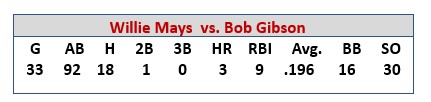
Looking at the numbers, Mays did well against Don Drysdale – .330-13-30 in 60 games.  Sandy Koufax was a bit tougher on Mays – .278-5-14 in 43 games. Bob Gibson, however, truly earned his spot at the top of Mays’ list, holding him to a .196 average and fanning in him in 30 of 108 plate appearances (27.8 percent).  Mays bit over .250 against Gibson in just three of the 143 seasons he faced him,

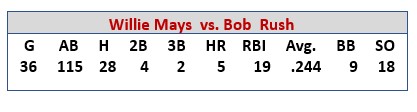
As for the surprise from Mays’ interview, Bob Rush.  Rush faced Mays between 1951 and 1960, some of Mays’ most productive seasons. In those nine seasons (1953 lost to military service), Mays hit .317-279-812, was the Rookie of the Year (1951), the NL MVP (1954) and an All Star seven times. Rush held him to a .244 average and struck him out 18 times (to nine walks) in 36 games.

Bob Rush pitched 13 MLB seasons (1948-60, primarily with the Cubs). He went 127-152, 3.65. The two-time All Star won 13 or more games in five season.

Tom Sturdivant faced Mays between 1961 And 1964 –  again, some of Mays’  prime years (he was an All Star all four seasons and hit .307-174, 478 over that span. Sturdivant held Mays to a .105 average and did not give up an extra-base hit to Mays, fanning him five times and walking him just once.Sturdivant pitched in 10 MLB seasons (1955-64 … Yankees, Athletics, Red Sox, Senators, Pirates, Tigers, Mets). He went 59-51, 3.74, with 17 saves in 335 appearances (101 starts). His best season were as a Yankee.  In 1956, he went 16-8, 3.30 for New York and in 1957, he went 16-6, 2.54 for the Bombers.

Steve Arlin and Bill Singer also did well against Mays, but their appearances against him came later in Mays’ career.

Arlin  faced Mays 28 times between 1971 and 1973 (the final three years of Mays career), holding him to a .125 average and fanning him ten times in 28 plate appearances. Singer faced Mays in 17 games between 1966-71, holding him to a .171 average and notching 14 whiffs versus Mays (with just four walks).

Arlin had a six season MLB career (1969-74), during which he went 34-67, 4.33.   Bill Singer pitched in 14 MLB seasons (1964-77… Dodgers, Angels, Rangers, Twins, Blue Jays.) The two-time All Star went 188-127, 3.39 and was twice a 20-game winner.

In two of the seasons Steve Arlin faced Willie Mays, Arlin led the NL in losses (9-19, 3.48 for the 1981 Padres and 10-21, 3.60 for the 1972 Padres).  In those  two seasons, he held Mays to two hits in 20 at bats.

Of course, it wouldn’t be fair to not  at least mention a few pitchers that Mays raked. For example, he hit .632-2-7 against Danny McDevitt in 19 games (Mays’ highest average against any pitcher he faced at least 25 times) and .500-6-18 against Jay Hook in 17 contests.  And, as the chart below shows, He also handled Warren Spahn pretty well. His 18 home runs and 40 RBI against Spahn are Mays most against any pitcher and his 68 hits are second only to his 75 safeties verse Don Drysdale.

Willie Mays first-ever major league hit was a home run off Warren Spahn.

_______________________________________________________

Mickey Mantle

Looking Mickey Mantle, I came across an old Baseball Digest article in which he noted just how tough Dick Radatz was on him – and the numbers back up that assessment. Radatz faced Mantle 19 times between 1962 and 1966 and fanned him in twelve (63.2 percent) of the plate appearances.

In 1962, when MIckey Mantle went .321-30-89 and was the AL MVP,   rookie righty Dick Radatz face him six times. The result? Five strikeouts and a walk.

Radatz, at 6.6’, 230-pounds, was an imposing presence on the mound (and could bring the high heat). In a seven-season MLB career (1962-67, 1969 … Red Sox, Indians, Cubs, Tigers, Expos), Radatz made 381 appearances (all in relief) and went 52-43, 3.13 with 120 saves. The two-time All Star led the AL in saves as a rookie in 1962 and again in 1964.

There are few other pitchers who could make Mantle’s toughest list (at least the stats would seem to indicate that.)

Luis Tiant held Mantle to a .111 average (the lowest for Mantle against any pitcher he faced at least 25 times) and struck Mantle out in ten of thirty plate appearances.

Then, there’s: Saul Rogovin, who faced Mantle early in his career (1951-55) and held him to a .150 average and no extra base hits in 15 games; Jack Urban, who faced Mantle in 1957-58 and held him to a . 143 average with no extra-base hits in ten games; and finally, Joe Sparma who face Mantle from 1964 to 1968  and held him to a .162 average in 14 games (and struck Mantle out in 30 percent to his plate appearances).

Rogovin went 48-48 in eight MLB seasons (1949-53, 1955-57 … Tigers, White Sox, Orioles, Phillies). He won ten or more games in three seasons (a career-best 14-9 for the 1952 White Sox) and led the AL in ERA in 1951 at 2.78. Urban pitched in just three MLB seasons (1957-59 … Athletics, Cardinals), going 15-15, 4.83. Sparma pitched in seven MLB seasons (1964-70 … Tigers, Expos). Primarily a starter, he went 52-52, 3.94. In 1967, he was 16-9, 3.76 for the Tigers.

It wouldn’t be fair to not take a look at a couple of pitcher Mantle did well against. Conder longtime White Sox ace Billy Pierce. Mangle got more career hits, doubles, triples and RBI versus Pierce than against any other pitcher.

Pierce pitched 18 MLB seasons (1945, 1948-64 … Tigers, White Sox, Giants). He was a seven-time All Star and a two-time 20-game winner.  He final stat line was 211-169, 3.27 and he led the AL in wins once, ERA once, strikeouts once and complete games three times.

Mantle also hit .500 (25-for-50), with five homers and 21 RBI in 32 games  against Hank Aguirre. Aguirre had a 16-season MLB career (1955-70 … Indians, Tigers, Dodgers, Cubs). He went 75-72, 3.25, with 33 saves.  In 1965, he made his only All Star team, while going 16-8 and leading the AL with a 2.21 ERA. That season, he started 22 games (completing 11) and relieved in 20 contests.  For his career he had 149 starts in 447 appearances.

_________________________________________________

Duke Snider

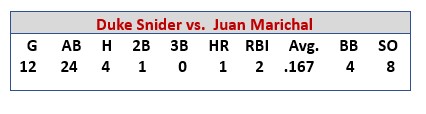
Looking into Duke Snider, the name Juan Marichal kept emerging when he was asked about the toughest pitchers he ever faced, along with Bob Gibson. Not a bad pair  to start with. Gibson did hold Snider to a .212-3-5 line in 12 games, but Marichal was even tougher on the Duke.

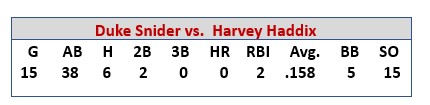
Baseball Roundtable would add a couple of other pitchers to the “tough on the Duke” list, starting with Harvey Haddix, who held Snider to a .158 average over 15 games and fanned him in 34.1 percent of his plate appearances. In 1954, when Snider hit .341-40-130, Haddix faced him 12 times in three starts – and fanned him six times (giving up a lone single and two walks in 12 plate appearances).

Harvey Haddix pitched in 14 MLB seasons (1952-65 … Cardinals, Phillies, Reds, Pirates, Orioles), going 136-113, 3.63.  He was a three-time All Star and won ten or more games in nine seasons (a high of 20 in 1953, when he went 20-9, 3.06 and led the NL with six shutouts among his 19 complete games_.

Luis Arroyo also handled Snider pretty well, holding him to a .125 average in 10 games and fanning him in nine of 16 plate appearances between 1955 and 1957.

It wouldn’t be fair not to list at least a couple of hurlers that Snider took the measure of, like Warren Hacker, whom Snider  hit for a .363 average, with ten home runs and 15 RBI in 40 games. Hacker had a 12-season MLB career (1948-58, 1961 … Cubs, Reds, Phillies), going 62-89, 4.21, with 17 saves (306 appearances/157 starts). Then, there’s Hall of Famer Robin Roberts, whom Snider touched for a .295 average, with 19 home runs and 50 RBI in 73 games (the most RBI and home runs he had against  any pitcher. (Also, the most home runs and RBI Roberts gave up to any hitter.)

Duke Snider Face Robin Roberts in 14 MLB seasons. Over the first three, he hit .178, with three home runs and three RBI in 14 games.  Over the next 11, he hit .321-16-47 in 59 games.

Primary Resource: Baseball-Reference.com

Coming Soon:  More Lockout Reading – How Andy Hawkins Lost the Same No Hitter … Twice – and other wild no-hitter stories.

100Baseball Roundtable is on the Feedspot list of the Top 100 Baseball Blogs.  To see the full list, click here.

I tweet baseball @DavidBBRT

Follow/Like Baseball Roundtable’s Facebook Page here.  More baseball commentary; blog post notifications; PRIZES.

Member: Society for American Baseball Research (SABR); Negro Leagues Baseball Museum; The Baseball Reliquary. 


A Little “Relief” from the CBA Banter – Baseball Roundtable Look at Unique Relief Performances

Want a little relief from all the Collective Bargaining Agreement banter?  How about a look at some of the best – or most unique – relief pitching accomplishments/events?   That’s one way Baseball Roundtable is passing the time, while I wait to see if – and when – players take the field in 2022.

Greatest Relief Performance Ever

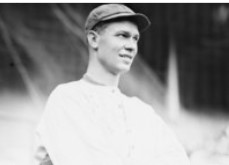
Ernie Shore – Photo: Library of Congress. Harris & Ewing Collection

When talking about great relief performances, the first that usually comes to mind first is Ernie Shore’s relief outing (taking over for Babe Ruth) on June 23, 1917. Ruth, carrying a 12-4, 2.35 record (with 14 complete games in 16 starts) started on the hill for the Red Sox (in Boston.) against the Senators.  Ruth, however, did not last long. He walked Senators’ lead-off batter 2B Ray Morgan and, to put it mildly, did not agree with umpire Brick Owens’ strike zone. An argument and melee ensued during which landed a punch to the side of Owens’ head. Ruth was tossed after the one batter (and later fined $100 and suspended for ten games).

In came Ernie Shore (8-7, 2.63, with nine complete games in 18 starts). Along with Shore came catcher Sam Agnew, replacing starting backstop Pinch Thomas.  The Agnew-for-Thomas switch paid off quickly. Morgan attempted to steal second and was gunned down by Agnew.  Shore went on to prove himself masterful in relief, retiring the next 26 batters in order, completing a perfect outing that – due to that opening walk by Ruth – is now on the books as a combined no-hitter. The Red Sox topped the Senators 4-0.

Shore ended the season 13-10, 2.22 – with 27 starts and just two relief appearances. Ruth finished the year, 24-13, 2.01, with a league-leading 35 complete games. Shore played six MLB seasons (1912, 1914-17 and 1919-20 … Giants, Red Sox, Yankees), going 65-43, 2.47 (121 starts and 39 relief outings).

Staying Pretty Darn Close to the Shore

Now, Shore’s  perfect outing deserves the top spot here, but 38-seasons later,  Hal  Brown of the Orioles came pretty darn close.  On August 31, 1955, the Orioles faced the Indians in Cleveland. Starting for Baltimore was Bill Wright (3-5, 2.53 at the time, with 28 appearances and four complete games in eight starts). On the mound for Cleveland was rookie sensation Herb Score, 13-10, 3.21,  with eight complete games in 27 starts. (The 22-year-old Score would go 16-10 and lead the American League in strikeouts with 245 that season, taking AL Rookie of the Year honors.)

It was not to be Wright’s day. In  the bottom of the first, he faced seven batters, giving  up five runs on  three singles, two doubles and two walks – failing to record a single out.  Hal Brown came on in relief  and proceeded to throw eight no-hit innings (the Indians, with a 5-1 lead, did not bat in the bottom of the ninth). In his no-hit relief outing, Brown walked five and fanned ten. I rate Brown’s performance close to Shore since the Indians clearly  came in with their hitting shoes on – and Brown quickly “tied those shoes up.”  Those ten whiffs were also impressive, as the average strikeouts per nine innings in MLB that season was 4.4 (compared to 8.9 in 2021).

Brown finished the season, 1-4, 3.98 in seventeen games (five starts). He  had a 14-season MLB career (1951-64 …. Orioles, Red Sox, Colt .45s, White Sox , Yankees – going 85-92. 3.81 (11 saves) in 211 starts and 147 relief appearances.

____________________________________________

So, there you have a couple of the all-time great relief performances.  Let’s take a look at a few others that stand out for Baseball Roundtable – in no particular order.

Record-Setting Whiffs … Not so Long Ago

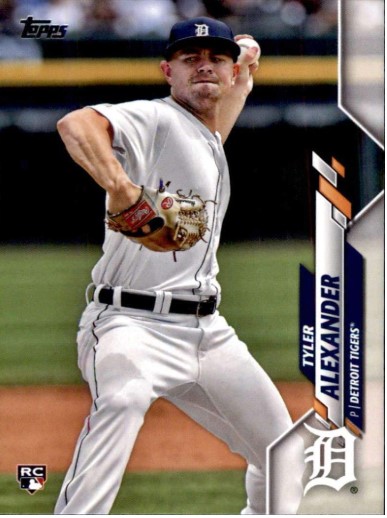
On August 2, 2020, the Tigers faced the Reds in Detroit in one of those short-season, seven-inning doubleheader matchups. Game One saw The Tigers’ Rony Garcia starting against the Reds’ Anthony DeSclafani. Garcia gave up a two-run home run to Reds’ RF Nick Castellanos in the first inning and a solo shot to Castellanos to open the top of the third.  That brought Tyler Alexander in from the pen – and he did his job, fanning the first nine hitters he faced, setting an MLB record for consecutive strikeouts in a game by a reliever and tying the MLB record for most consecutive strikeouts from the first batter faced in an appearance.   His whiff streak went like this:

  • 2B Mike Moustakas, striking out swinging on a 2-2. Foul tip.
  • 3B Eugenio Suarez, strikeout on an 0-2 pitch, taking all three strikes.
  • DH Jesse Winker, strikeout an 0-2 pitch, swinging at all three strikes… ending the third.
  • CF Nick Senzel, strikeout swinging on a 1-2 pitch to open the fourth inning.
  • 1B Josh VanMeter, strikeout looking on an 0-2 pitch.
  • SS Freddy Galvis, strikeout swinging on a 3-2 offering … an 8-pitch at bat that ended the inning.
  • C Tucker Barnhart, strikeout looking on a 1-2 pitch to open the fifth inning.
  • LF Shogo Akiyama, strikeout looking on a 1-2 pitch
  • RF Nick Castellanos, strikeout swinging on a 2-2 pitch to end the inning.

Alexander was now in position to tie all-time record for consecutive strikeouts in a game (10 – held by Tom Seaver, Aaron Nola and Corbin Burnes) in the top of the sixth.  And, it looked like he might do just that, as he had Moustakas down one-ball/two-strikes before hitting him with a pitch to end the streak.  What did the next batter do? Saurez went down swinging on a 1-2 pitch.   Travis Jankowski, running for Moustakas, was caught stealing during pinch hitter Matt Davidson’s at bat (Alexander to 1B C.J. Cron to 2B Jeimer Candelario).  Davidson eventually walked and Carson Fulmer replaced Alexander on the mound.  In his outing, Alexander three 38 strikes in 55 pitches (69/1 percent).

Alexander went 2-3, 3.96 in 14 appearances in 2020, fanning 34 batters in 36 1/3 innings.  At the close of the 2021 season, the 26-year-old southpaw was 5-11, 4.13 in 68  MLB appearances over three seasons.

As a high school senior (Carroll Senior High in Southlake, Texas), Tyler Alexander was 12-1, with a 0.66 ERA. Then, in two seasons as Texas Christian University, he went 16-6, 2.71. He was a 23rd round draft pick in 2013.

Making a Good First Impression

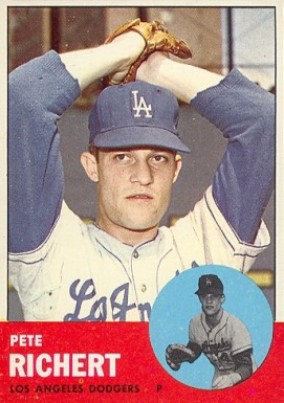
They say you only get once chance to make a first  impression. Well, when it comes to taking the major-league mound, Pete Richert did just that.

Richert was signed right out of high school (Sewanhaka High School, Floral Park, Florida), where – despite his small statue – he was noted for an impressive fastball. (Adam Ulrey’s Society for American Baseball Research bio on Richert indicates Richert was 5’7” and 150 pounds in high school and 5’11”/165-pounds when he made it to the major leagues as a 22-year-old).

Richert made his MLB debut on April 12, 1962 – with the Dodgers facing the Reds in Los Angeles. Stan Williams started for the Dodgers versus Joey Jay (one of my favorite baseball names) for the Reds. With two outs in the top of the second, the Dodgers already trailed 4-0 and the Reds had another runner in scoring position.  Williams was clearly not on his game having already  given up two hits and four walks – and committed a balk.  Dodger Manager Walt Alston called  to the pen and Richert came to the mound. History was about to be made.

The first batter Richert faced was the number-three hitter in the Reds’ lineup – CF Vada Pinson. Rookie jitters? No problem.  Richert fanned Pinson  on three pitches.

Things didn’t get any easier for the rookie in the top of the third.  First up was future Hall of  Famer RF Frank Robinson.  Richert struck him out on four pitches. Then came 1B Gordy Coleman – another three-pitch strikeout (but Coleman reached first on a passed ball).  So, now Richert had thrown just ten MLB pitches, facing the three-four-five hitters in the Reds’ lineup and had recorded three whiffs.  But he wasn’t done yet. Next up was LF Wally Post – another four-pitch strikeout. Post was followed by C Johnny Edwards.  Perhaps, Richert was tiring. It took him five pitches to fan Edwards and end the inning.

Third baseman Tommy Harper led off the top of the fourth and Richert recorded another three-pitch strikeout.  So, now his MLB career consisted  of 22 pitches, 18 strikes, four balls and six strikeouts – and he had the MLB record for the most consecutive strikeouts at the start of an MLB career. Ironically, Reds’ starting pitcher Joey Jay (who would hit .114 for his 13-season MLB career and strikeout in 42.7% of his at bats) broke the whiff string, grounding out to first base on an 0-1 offering.  Richert went 3 1/3 innings in the contest, giving up no hits, no walks and fanning seven. The Dodgers came back for an 11-7 win and Richert got the victory.  Overall, Richert threw 41 pitches – 33 strikes (including balls put in play) and just eight balls.

Pete Richert is the only major leaguer with a four-strikeout inning in his MLB debut.

Richert finished his rookie season at 5-4, 3.87 (19 games, 12 starts), with 75 strikeouts in 81 1/3 innings. The two-time All Star enjoyed a 13-season MLB career (1962-74 … Dodgers, Senators, Orioles, Cardinals, Phillies) – going 80-73, 3.19 with 51 saves (429 games/122 starts).

Working Overtime … NO, Really Working Overtime

Zip Zabel. Photo: Bain News Service, Public Domain

On June 17, 1915, the Cubs faced off against the Brooklyn Robins (Dodgers) in Chicago, with Bert Humphries (3-2, 0.59) starting for the Cubs and Jeff Pfeffer (5-4, 2.61) on the mound for the Robins. With two out and one-run across in the top of the first inning, George Washington “Zip” Zabel was called on to relieve Humphries, who had been hit on the pitching hand by a line drive

To make a lo-o-o-ng story short – Zip Zabel was still on the mounds in the 19th inning, with the score knotted at 3-3. His 18 1/3 innings (nine hits, two runs, one walk, six strikeouts) remains the longest relief effort in MLB history. The Robins pushed across a run in the bottom of the nineteenth to give Zabel the win.   Notably, Pfeffer (Cubs’ starter) tossed a complete game in the loss.

Zabel finished the season at 7-10, 3.20 in 36 games/17 starts. His MLB career lasted just three seasons (1913-15), all with the Cubs, and he went 12-14, 2.71, (It was reported that Zabel came up with a sore arm after his 18 1/3 inning relief stint.     Zabel was 5-4, 2.25 on the season through June 17 and was 2-6, 4.15 after the outing.  It was his final major-league season, although he did pitch two more season in the minors.)

Tomorrow, Tomorrow … It’s only a Day Away

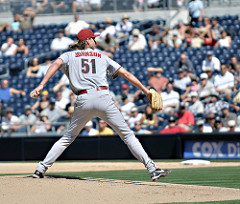
Randy Johnson. Photo by SD Dirk

On June 18, 2001, the Diamondbacks were facing the Padres in San Diego, with the Diamondbacks starting Curt Schilling on the mound against the Padres’ Woody Williams.  The game was suspended in the top of the third inning, with Arizona up 1-0 – after an electrical malfunction knocked out part of the outfield lighting.  The suspended game was to be completed before the following day’s regularly schedule game.  Southpaw Randy Johnson was slated to start the regularly scheduled contest, but D-back’s manager Bob Brenly (with the Padres’ lineup in the resuming game set for righty Schilling) moved Johnson up to begin the suspended game. Williams returned to the mound for the Padres.  Johnson pitched seven scoreless, one-hit innings for the win (3-0). More important for the record books, he fanned 16 batters, still the record for strikeouts in a single relief appearance. Notably, it was Johnson’s only relief appearance of the season and his first relief assignment since September 27, 1997.

Johnson finished the 2001 season 21-6, 2.49, with 372 strikeouts in 249 2/3 innings. The Hall of Famer enjoyed a 22-season MLB career (1988-2009 … Expos, Mariners, Astros, Diamondbacks, Yankees and Giants). He went 303-166, 3.29 and fanned 4,875 batters in 4,135 1/3 innings. In 22 seasons, he made just 15 relief appearances (603 starts).

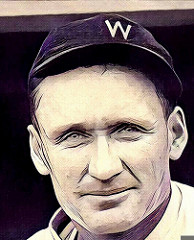
Walter Johnson. Photo by pingnews.com

If you want to know the strikeout record for an AL relief appearance (and for a relief appearance that took place on the same day the game started), that would go to  another Johnson: Hall of Famer Walter Johnson. The St, Louis Browns were facing the Washington Senators in Washington on July 25, 1913. George Baumgardner(7-11, 2,47) was on the mound for St. Louis, Joe Engel (8-13, 3.67) for the Senators. Neither was around for long. Baumgardner lasted just 1/3 of an inning, giving up two runs on three hits (two home runs).  Engel fared a bit better, lasting three frames and giving up four runs (three earned). Tom Hughes followed Engel, but lasted just two-thirds of an inning, before Johnson was called in with the Senators trailing 7-6. Washington tied it in the fifth, but St. Louis scored a run off Johnson to take an 8-7 lead in the seventh, only to have Washington retie then score in the eighth.  The game ended in an 8-8 tie and Johnson had gone 11 1/3 innings, giving up seven hits, two runs (one earned), walking two and fanning an AL still single-game record for relief pitchers 15 batters.

One that Stands Out

Walter Johnson led the League in strikeouts an MLB-record 12 times.  Ironically, despite working primarily as a starter (666 career starts/136 relief appearance). His highest single-game strikeout total came (15) came in the above noted  July 25, 1913 relief appearance

Walter Johnson pitched 21 MLB seasons (1907-1927), going 417-279, 2.17. He won 20 or more games in 11 seasons ( 30+ in two of those) and led the AL in wins six times, ERA five times, strikeouts 12 times, complete games six times and shutouts seven times.

Let’s Keep that Plate Clean

The longest scoreless relief outing was fourteen innings – by the Cubs’ Bob Osborn on May 17, 1927, facing the Boston Braves (in Boston). Surprisingly, Osborn did not come into the game until ninth inning.  At that point, the game was knotted 3-3. Osborn went on to pitch 14 scoreless frames, giving up just six hits (all singles), while walking two and fanning just one. The Cubs scored on a walk, sacrifice and single in the top of the 22nd inning to give Osborn a well-earned win.  Braves’ starter Bob Smith went the distance – giving up four runs (three earned) in 22 innings – on 20 hits and nine walks (that was one tough day at the office).  Osborn finished the season at 5-5, 4.18 in 24 appearances (12 starts). He pitched in six MLB seasons (1925-27, 1930-31 … Cubs, Pirates), going 27-17, 4.32 in 121 games (43 starts).

Shortest-ever Relief Appearance … and It Lasted an Entire MLB Career

Larry Yount, brother of Hall of Famer Robin Yount, made his MLB debut on September 15, 1971 – coming on in the top of the ninth to replace Skip Guinn (who had been pinch hit for in the previous half inning).   The score was 4-1 and, if all worked out, Yount would face LF Ralph Garr, 1B Hank Aaron and C Earl Williams.  All did not work out. Yount had experienced a bit of elbow pain in the bullpen warming up  and, as he continued to warm up on the mound, it only got worse. He called the trainer to the mound and, after a bit of discussion, Yount walked off the field – officially registering an MLB appearance, but not tossing s single pitch. Yount pitched two more season in the minors, but never came to the major-league mound again.

Another Short Relief Appearance that Didn’t End a Career, but Did End a Game

On July 15, 2005, Mike Stanton of the Nationals was called into a game in a tough spot. It was the bottom of the tenth inning, the Nationals and Brewers were tied at 3-3 and the Brewers had runners on first and third with one out when Stanton came to the mound to take over from Luis Ayala.  Conventional wisdom? Intentionally  walk Lyle Overbay to load the bases and set up a possible double play. Unconventional outcome. The game resumes after Stanton’s warmup and, before tossing a pitch, Stanton balks in the winning run.  Game over, without Stanton throwing a single pitch.

Stanton, for those who like to know such things, pitched 19 years in the major leagues (1989-2007 …. Braves, Yankees, Red Sox, Mets, Nationals, Giants, Rangers, Reds), appearing in 1,178 games, picking up 69 wins (63 losses), with 84 saves and a 3.92 ERA. He made one start in his career.  On May 9, 1999 – for the Yankees against the Mariners – going four innings (two hits, no runs, one walk, three strikeouts) and leaving with a 4-0 lead (but getting no decision).

A Few More Short Stories

Disappointed with the major-leagues bargaining this off-season? Think about how Oliver Perez must have felt on June 29, 2018.  With the Indians down 2-0 to the Athletics in the bottom of the seventh, and the Athletics threatening to break the game open (runners on second and third and two out), Indians’ manager Terry Francona brought in southpaw Perez to face left-handed (leadoff) hitter CF Dustin Fowler.   Athletics’ Manager Bob Melvin countered by pinch hitting with  right-handed hitter Mark Canha (who would be followed by left-handed hitting LF Matt Joyce).  Now, the managerial wheels were turning. Francona had Perez intentionally walk Canha to load the bases and get to lefty Joyce. (Remember, this was with the new “wave ‘em to first” intentional walk rule, so Perez had yet to throw a pitch.)  Melvin made another managerial move, having righty Chad Pinder hit for Joyce.  Francona countered by pulling Perez and bringing in righty Zach McAllister. So, Perez was out of the game without tossing a pitch. He was also credited with a walk and, if that runner on third scored, it would go against his ERA.  Ouch!   Fortunately, McAllister fanned Pinder on four pitchers and Perez was off the hook.

There are also a few instances of pitcher actually getting a decision (win or save) without throwing a pitch.  Keeping in mind that batter counts pre-1980 are not readily available, here are three such instances I could document (baseball-reference.com).  I’d welcome info on any other such instances.

On April 28, 1989, The Cubs were leading the Padres 3-0 going into the bottom of the ninth – with Paul Kilgus on the mound for the Cubs and the 3-4-5 hitters due up for San Diego.  Kilgus got CF Tony Gwynn on a fly to deep left, but then 1B Jack Clark doubled to right; C Benito Santiago reached on an error (Clark going to third); LF Carmello Martinez reached on a fielder’s choice (as Clark was cut down at the plate – third-baseman Curt Wilkerson to catcher Rick Wrona); and RF Luis Salazar singled Santiago home, with Martinez going to third. Manager Don Zimmer brought in Mitch Williams to face SS Garry Templeton. Before tossing a pitch to Templeton, Williams picked Martinez off second (SS Shawon Dunston covering) ending the inning and the game – and giving William a “save” without a pitch. Williams ended the season 4-4, 2.76 with 36 saves and a league-leading 76 appearances.  Williams pitched in 11 MLB seasons (1986-95, 1997 … Rangers, Cubs, Phillies, Astros, Angels, Royals) going 45-58, 3.65 with 192 saves. (He had three seasons of 30 or more saves, a high of 43 in 1993).

On May 1, 2003, the Orioles faced off against the Tigers in Detroit. The game was tied at 1-1 in the bottom  of the seventh, when the Tigers scored the go-ahead run off Pat Hentgen (in his fifth inning of relief).  With two out and a runner (Omar Infante) on first , Orioles’ manager Mike Hargrove brought B.J . Ryan in to face Tigers’ RF Bobby Higginson. Before tossing a pitch, Ryan caught Infante off base and he was retired Ryan to 1B  Jeff Conine to shortstop Deivi Cruz.  The Orioles scored three in the top of the eighth to take the lead. Ryan was replaced by Buddy Groom to open the bottom of the eighth. The Orioles went on to win 5-2 and  Ryan picked up an MLB victory without tossing a pitch. Ryan finished the season 4-1, 3.40 in 76 appearances. He pitched in 11 MLB seasons (1999-2009 … Reds, Orioles, Blue Jays), going 21-28, 3,37, with 117 saves in 560 appearances (all in relief). Ryan was an All Star in 2005 and 2006, saving 36 and 38 games in those two seasons, respectively,

On July 7, 2009, the Rockies took on the Nationals in Denver. The two teams went into the eighth innings tied at four apiece, with Joel Peralta (the Rockies’ fourth pitcher of the ay) on the mound for the Rox. With two outs, a runner (Austin Kearns) on first base and Washington’s leadoff hitter, lefty CF Nyjer Morgan, due up, Rockies’ manager Clint Hurdle called in southpaw Alan Embree. Before tossing a pitch, Embree caught Kearns off first and he was retired in a rundown (Embree to 1B Todd Helton to SS Troy Tulowitzki and back to Embree for the putout). Seth Smith pinch hit for Embree as The Rockies scored the winning run in the bottom of the inning,. Huston Street came in to toss a 1-2-3 ninth and Embree had a win without throwing a pitch.

Now, let’s move on to some “longer” relief accomplishments.

We’ll Never See This Again

In 1974, the Dodgers’ Mike Marshall put up the grand-daddy of all relief seasons – becoming the first reliever to win the Cy Young Award and setting the still-standing record for appearances with 106 and relief innings pitched in a season at 208 1/3. He finished the season 15-12, with a league-topping 21 saves and a 2.42 ERA.  Marshall was called on to go more than one inning in 74 games (68.5 percent of the time) and toiled three or more innings 22 times.  Marshall’s longest stint came on August 19, when he came on in the seventh inning of a 7-7 game against the Cubs – and went six innings, earning the win as the Dodgers topped the Cubs 8-7 in twelve innings.

In 1974, Mike Marshall took the mound every day from May 17 through May 24 (8 days) … pitching 14 2/3 innings and giving up just one earned run.

Lucky  Number 13

Just two relievers have pitched in 13 consecutive games:

Mike Marshall appeared in 13 consecutive games for the Dodgers from June 18 through July 3, 1974 – going 6-0, 1.69 with two saves.

In his rookie season (1986), the Rangers’ Dale Mohorcic appeared in 13 consecutive games from August 6 through August 20  – going 0-1, 3.86 with two saves. He finished the season 2-4, 2.51, with seven saves in 58 appearances. Mohorcic played five MLB seasons (1986-90 … Rangers, Yankees, Expos), going 16-21, 3.49 with 33 saves. His best season was 1987, when he went 7-6, 2.99, with 16 saves for the Rangers.

Dale Mohorcic, who played college baseball at Cleveland State University, made his professional debut at age 22, with the low-A Victoria Mussels. He made his MLB debut in his ninth pro season, at age 30. After minor-league stops at Victoria, Dunedin (Blue Jays), Salem (Pirates), Portland (Beavers), Buffalo (Bisons), Hawaii (Islanders), Lynn (Sailors), Nashua (Pirates) and Oklahoma City (89ers).

84 Straight Saves

Eric Gagne. Photo: OctopusHat, CC BY-SA 2.0 <https://creativecommons.org/licenses/by-sa/2.0>, via Wikimedia Commons

From August 28, 2002 through July 3, 2004  the Dodgers’ Eric Gagne converted a record 84 consecutive save opportunities, during that stretch he appeared in 123 games, going 6-3 (the three losses did not come in “save” situations), with a  1.98 earned run average and 207 strikeouts in 132 innings.

__________

Bookends

The Blown Save that preceded the start of Eric Gagne’s 84-saves streak came against the Diamondbacks on August 26, 2002.  Gagne came into the game in the ninth to protect a 3-2 Dodger lead, but a single by Steve Finley and a double by David Dellucci tied the game (the Dodgers lost 6-3 in twelve frames). The Blown Save the ended the string came on July 5, 2005 – again versus the Diamondbacks. Gagne came on in the top of the ninth to protect a 5-3 lead, but gave up two runs on a Shea Hillenbrand single, Louis Gonzalez double and Chad Tracy single.

__________

Gagne pitched in 10 MLB seasons, going 33-26, 3.47 with 187 saves. He was a three-time All Star and won the 2003 NL Cy Young Award when he went 2-3, 1.20 with 55 saves in 55 save opportunities.

A What Might Have Been Story

Eric Gagne made his MLB debut with the Dodgers in 1999,  as a 23-year-old starting pitcher. In his first three seasons with LA, he was a middling 11-14, 4.61 in 56 appearances (48 starts) at the back of the Dodger rotation.  Then, in 2002, Dodgers’ closer Jeff Shaw retired and Gagne was one of the arms the Dodgers took a look at for the role.  The rest is history. From 2002 through 2004, he was the best in the business – earning  the nickname Eric “Game Over” Gagne.   In those three seasons, Gagne went 13-7, 1.79, saved 152 games in 158 opportunities and fanned 365 batters in 247  innings – making three All Star teams and picking up the 2003 NL Cy Young Award along the way.  Finishing the 2004 season at 28-years-old, the sky seemed the limit.  However, it was not to be. Over the next four seasons (2005-08), Gagne went 9-5, 4.28, with just 35 saves and 114 strikeouts in 113 2/3 innings.

What happened? The frailties of the human arm.  First, you need to know that Gagne had Tommy John surgery (elbow) in 1997.  He had elbow surgery again in 2005 and 2006 – and also had back surgery (herniated disc) in 2006. (He appeared in only 16 games in 2005-06.) Gagne also suffered a shoulder injury in 2008 (his final MLB season … Brewers).

Baseball Roundtable Obligatory Chart

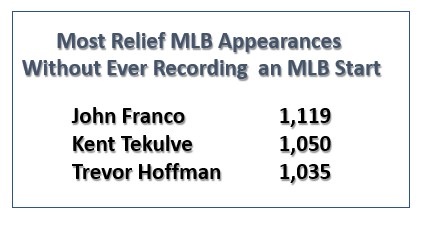
The MLB record holder in relief appearances is Jesse Orosco, who came out of the bullpen 1,248 times. Orosco, however, had four starts early in his 24-season MLB career.  All-time saves leader (652) Mariano Rivera had ten starts in his first year with the Yankees and all-time leader in career wins in relief Hoyt Wilhelm made 52 starts over his 21-season MLB career.   As starters, Orosco was 0-2, 6.38; Rivera was 3-3, 5.94; and Wilhelm was 19-19, 2.68 (with 20 complete games and five shutouts).

Roy for the Win

In 1959, the Pirates’ Roy Face set the (still-standing) MLB record for relief wins in a season – going 18-1, 2.70 with 10 saves. In that season, Face pitched two or more innings in 24 of his 57 relief appearances.  Ten of his 18 victories came in extra-inning games; four wins came in games in which he also recorded a blown save (retroactively); his longest outing was five innings; and his lone loss came on September 11, after 17 wins to start the season.

Face began his professional career as a starting pitcher, going 69-27 in four minor-league seasons (1949-52), earning a spot on the Pirates in 1953.  At the time, the  Face relied on a fastball and curveball, but at about 5’8” and 160 pounds, he was not your classic fastball/curve power pitcher. And major league hitters made that clear.  In 1953, Face was 6-8, 6.58 – and in 1954 he was sent back down to Double-A, where he developed the forkball that eventually defined his career.

He was back with the Pirates in 1955, working primarily as a reliever and going 5-7, 3.58 with five saves in 42 games (ten starts).  From there his career as a reliever took off, and he appeared in 50 or more games in 11 of the next 12 seasons (twice leading the league in games and three times in saves).

Face ultimately played 16 MLB seasons (1953, 1955-69 …Pirates, Tigers, Expos) going 104-95, 3.48, with 191 saves.

Primary Resources: Baseball-Reference.com; Baseball-Almanac.com; Gagne to have back surgery, miss rest of season, Associated Press, July 7, 2008.

100Baseball Roundtable is on the Feedspot list of the Top 100 Baseball Blogs.  To see the full list, click here.

I tweet baseball @DavidBBRT

Follow/Like Baseball Roundtable’s Facebook Page here.  More baseball commentary; blog post notifications; PRIZES.

Member: Society for American Baseball Research (SABR); Negro Leagues Baseball Museum; The Baseball Reliquary. 


For the Love of the Game … John Lindsey’s Long Climb to the Majors

I have often noted in this  blog how  – when I start digging into one baseball event, career or question – “one thing leads to another.”  This post is no exception.  I started with the intention of looking at who the newest, oldest-ever MLB rookie is, now that Satchel Paige has had to relinquish that crown (with the classification of the 1920-48 Negro Leagues as major leagues).  I got a bit sidetracked as my research took me to the player who had the longest minor-league career (16 seasons) before making his MLB debut.  We’ll get to Paige’s successor, but first a look at John Lindsey’s remarkable climb to the majors.

How many of  us – as baseball fans – would  have given anything for even just one at bat in the  leagues? Or, if we were really lucky, one hit (or one strikeout or one mound win)?  Getting our picture on a big-league baseball card – or our name on a page in The Baseball Encyclopedia would have been heaven.

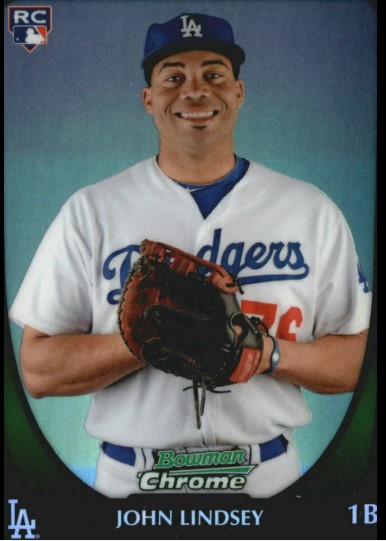
Well, John Lindsey accomplished that dream – and, in doing it, showed more perseverance than any major leaguer before or since.  Lindsey spent 16 seasons and a combination of 1,571 minor-league games, as well as four seasons and 141 games in the Mexican, Dominican and Venezuelan Winter Leagues, before his September 8, 2010 MLB debut with the Dodgers. Lindsey’s was the longest minor-league  “internship” ever before an MLB debut.  In fact, before he put on the Los Angeles uniform, he had he had played in the Rockies, Mariners and Dodgers’ systems, suiting up for the:

  • Arizona Rookie League Rockies;
  • Northwest League Portland Rockies;
  • South Atlantic League Asheville Tourists (two seasons);
  • Carolina League Salem Avalanche (three seasons);
  • California League San Bernardino Stampede;
  • Florida State League Jupiter Hammerheads;
  • Independent Canadian-American Association New Jersey Jackals (two seasons);
  • Pacific Coast League Las Vegas 51s (two seasons);
  • Dominican Winter league Estrellas de Oriente (San Pedro de Macoris);
  • Pacific Coast League New Orleans Zephyrs;
  • Southern League Jacksonville Suns;
  • Mexican Pacific Winter League Hermosillo Naranjeros and Mazatlán Venados; and
  • Pacific Coast League Albuquerque Isotopes.

Let’s take a look at the remarkable perseverance and positive attitude that got Lindsey to the big-leagues as a player and what happened once he got there (and beyond).

Lindsey was a signed as a teenager, right out of Hattiesburg (MS) High School, where he played football and baseball.  He was a 13th round pick of the Rockies in the 1995 MLB Draft. He got off to a bit of a slow start, with averages ranging from .208 to .275 over his first five seasons – although the big first baseman did have a solid season in 1998 at Class-A Asheville (.275-14-73 in 126 games).  Promoted to High-A Salem the next season (1999), he struggled (.208-4-35 in 75 games), but then turned it around and hit .280-16-88 in 155 games over  the next two  seasons (both at Salem).

Lindsey  was granted free agency after the 2001 season and signed with the Mariners – who assigned him to High-A San Bernardino, where he showed a solid bat with power,  hitting .297-22-93 in in 127 games. That earned him a promotion.  In 2003 – now 26 and in his eighth pro season – he moved up to Double-A (San Antonio), where he had two very solid years:  .296-22-93 and .282-19-72.  Despite those  solid campaigns, Lindsey again found himself as a free agent after the 2004 season. He signed with the Cardinals in October of 2004, was released by St.  Louis in March 2005. He ended up starting the 2005 season with the New Jersey Jackals of the Independent  Canadian-American Association – still determined to earn that big-league opportunity. That season, he hit .321-9-62 in 56 games and earned a spot on the Can-Am 2005 All Star Team. His performance also earned him a  contract (signed that July) from the Marlins  – who assigned him to High-A Jupiter, where Lindsey hit just .219 in 30 games.   After the 2005 season, he once again found himself a free agent.

Some might have given up the dream, but Lindsey just kept working.  In 2006, it was back to New Jersey, where he hit .311-10-41 in 69 games and attracted the attention of the Dodgers, who signed him in January 2007.   The Dodgers sent him to Double-A Jacksonville, where a .286-11-33 line (in 56 games)  finally earned him – at age 30 and in his apparently lucky 13th minor-league season – a shot at Triple-A ball.  One step closer to the dream. 

Lindsey continued to improve.  In 2007, he hit .333-19-88 in 77 games at Triple-A Las Vegas.  He followed that up with .316-26-100 in 133 games at Las Vegas in 2008.  He once again displayed average, power and clutch performance – and still no call up. By this time, he was 31-years-old, with 13 minor-league seasons under his belt. The clock was ticking on the dream. In fact, the Dodgers let him get away, as a free-agent signee with the Marlins for a second time. As a Florida farmhand, Lindsey turned in a .251-19-83 season at Triple-A New Orleans in 2009.

The Dodgers must have remembered what they liked about Lindsey, as they resigned him after the 2009 season. In 2010, he found himself at first base for the Triple-A Albuquerque Isotopes. At Albuquerque, he continued to impress the Dodgers – and boasted a .353-25-97 line when he was called up in  early September.  Goal one – making it to the bigs – accomplished.  Now,  to get that at bat and hit.  We’ll get to that in a minute, but first more about Lindsey’s path to Dodger blue.

Over this arduous journey, Lindsey earned a reputation for his perseverance, professionalism, positive attitude, relentless work ethic, passion for the game – and seemingly never missing smile.

What Kind of Character It Really Takes … A Great Lesson in Never Giving up

About a week before John Lindsey’s 2010 call up, the Dodgers’s (then) Farm System Director De Jon Watson said this about Lindsey, “He is unbelievable for our young guys. He shows what it takes to persevere in this game. He’s a quality human being with a great work ethic and integrity.  You want those kinds of people around  your young guys that are on their way to the big leagues, so they don’t forget what this game really takes, what kind of character it really takes, what kind of resolve it takes to come in every single day and keep grinding away.” 1

Commenting on Lindsey’s call up, Dodgers’ (then) manager Joe Torre said “ That’s a great lesson in never giving up.  That’s the simple way to put it … he’s got this big smile on his face all the time.  Very polite, very respectful and just worked at getting himself better.” 2

______________________________________________________________

John Lindsey’s First MLB Appearance (Kind Of)  …. and His Final MLB Appearance (Kind Of)

John Lindsey “kind of” made his first MLB appearance on September 8, 2010 – as the Dodgers faced the Padres in San Diego. It came in the eighth inning, with the Dodgers trailing San Diego 4-0, with runners on first and second and no outs. Lindsey was called in to pinch hit for left-handed hitting LF  Scott Podsednik against southpaw Joe Thatcher – producing that traditionally preferred lefty-right matchup.  Finally, Lindsey was coming to the plate in a major-league game – almost.  Padres’ manager Bud Black pulled Thatcher and brought in right-hander Luke Gregerson.  Dodgers’ skipper Joe Torre quickly countered, calling Lindsey back to the dugout and sending up  lefty-swinging Andre Ethier.  So, while Lindsey is officially credited with his first major-league game that day – he did not appear in the batter’s box, on the basepaths or in the field. To add insult to injury, Ethier grounded into a second-to-first double play on Gregerson’s very first pitch.

Lindsey appeared in ten more games as the season wound down – primarily as a pinch hitter He did start two games at first base).  He got one hit in 12 at bats – a pinch hit single off the Astros’ Nelson Figueroa on  September 12.

On September 25, Lindsey got his second (and final) start of the season at first base. In the seventh inning, he was hit on the right hand by a pitch (on a 1-2 count)  from the Diamondbacks’ Daniel Hudson.  The broken hand ended his season  – again kind of – and required surgery.

Then on the final day of the season (October 3), Dodgers’ manager Joe Torre chose to honor Lindsey’s attitude and perseverance.  He “officially” called on  Lindsey to pinch hit for pitcher Ted Lilly in bottom of the seventh (with the Dodgers leading the Diamondbacks 2-1) – and then immediately removed him for pinch-hitter Trent Oeltjen (who popped up to the pitcher on a bunt attempt).  That would turn out to be the last MLB game of Lindsey’s career.  So, in both his first and late official MLB appearances, he did not “appear” in the batter’s box. on the basepaths or in the field.

_____________________________________________________

While that October 3, 2010 game was Lindsey’s last in the major leagues, it was not his last as a professional. He continued to play  for five more years – taking the field for  teams in the International League,  Canadian-American Association (yes, back to the New Jersey Jackals), Mexican League and Mexican Pacific Winter League.  While his MLB record is one single and one hit-by-pitch in 13 plate appearances, overall Lindsey is credited with 21 pro seasons, 2,277 games, 2,291 hits, a .284 average, 377 home runs, 1,536 RBI – and a never diminished passion for the national pastime.  We could all learn a lesson about passion, perseverance and a strong work ethic in pursuing our dreams from major-leaguer John Lindsey.

  1. John Lindsey Waits for his chance, by Ramona Shelburne, ESPN, ?August 29, 2010.
  2. Dodgers’ Lindsey finally a big leaguer, by David Wassen, The Press Enterprise, September 7, 2010.

Back to My Original Search

Who holds the title of MLB’s oldest rookie?  For years, of course, that crown has belonged to Satchel Paige … who debuted for the Cleveland Indians on July 9, 1948  (at a reported 42-years and two-days old). But with the recent changes assigning major league status to the Negro Leagues (1920-48), Paige’s major-league debut now came as a 20-year-old with the 1927 Birmingham Black Barons.  Your new oldest MLB rookie would be Dominican-born southpaw Diomedes Olivo – who was 41-years and 227-days of age when he debuted for the Pirates on September 5, 1960.  By the time he reached the major leagues, Olivo had  pitched in Mexico, Puerto Rico, Cuba, Venezuela, Nicaragua and Columbia. As you might expect, his MLB career was short. He was 5-6, 3.10 in 85 games (one start) over three MLB seasons (1960, 62-63). As a 43-year-old in 1960, he went 5-1, 2.77 with seven saves in 62 games for the Pirates.

Primary Resources:  Baseball-Reference.com; Baseball-Almanac.com; Where Nobody Knows Your Name: Life in the Minor Leagues of Baseball, by John Feinstein, Anchor Books, 2014

100Baseball Roundtable is on the Feedspot list of the Top 100 Baseball Blogs.  To see the full list, click here.

I tweet baseball @DavidBBRT

Follow/Like Baseball Roundtable’s Facebook Page here.  More baseball commentary; blog post notifications; PRIZES.

Member: Society for American Baseball Research (SABR); Negro Leagues Baseball Museum; The Baseball Reliquary. 


Baseball Roundtable’s All 2021 MLB Debut Lineup

From the Cubs’ Corey Abbott to the Royals’ Angel Zerba and from 20-year-old Wander Franco to 33-year-old Mickey Jannis, 265 players made their MLB debuts in 2021.  In this post, I’d like to present a lineup (by position) of what Baseball Roundtable rates as 2021’s  “best” debut games.  But first, a few  2021 trivia tidbits:

  • 2021 debuts included 164 pitchers and 101 position players (including designated hitters).
  • The Orioles saw the most 2021 MLB debuts at 16, followed by the Angels and Cubs at 15.
  • The Braves and Cardinals saw the fewest debuts at three, followed by the White Sox and A’s at four each.
  • April first (Opening Day) was the earliest 2021  debut date – with nine players making their first major-league appearance on that date.
  • Two players made their debuts on October 3 – the season’s final day.
  • National League Rookie of the Year Jonathon India of the Reds made his debut in 2021; American League Rookie of the Year Randy Arozarena of the Rays made his MLB debut in 2019 (with the Cardinals) and had played 42 regular-season MLB games and 25 post-season games before the 2021 season opened.
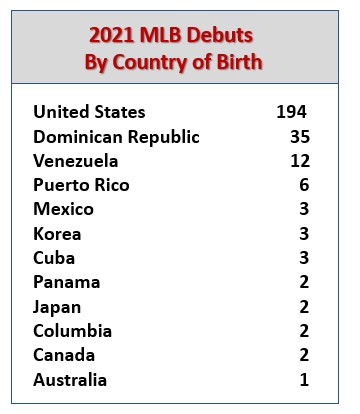
  • Twelve countries were represented among the debut players.

Baseball Roundtable Rates the Top 25 (All-Time) MLB Debuts

For Baseball Roundtable’s rating of the top 25 MLB debuts, click here.  You’ll find players from stars like Willie McCovey (four-for-four with two triples in his debut) to record-setters like Karl Spooner (15 strikeouts in his debut) to lesser-known players like Ray Jansen (with four hits in his only MLB game, which was also his first-ever  professional game at any level).

Now, that All-2021 Debut Lineup.

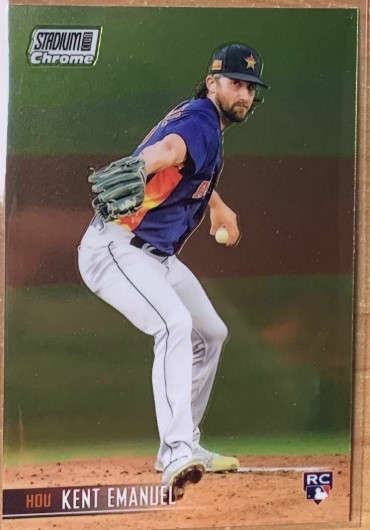
Kent Emanuel, Astros … April 24, 2021

  • 8 2/3 IP, five hits, two earned runs, zero walks, five strikeouts

There were a handful of pitchers whose 2021 MLB debuts deserved consideration. Pirates’ 23-year-old  righty Max Kranick, for example, made his debut on June 27 (starting against the Cardinals) and pitched five perfect innings (three strikeouts), picking up his first MLB win. Or there’s the Rangers 25-year-old right-hander Glenn Otto, who debuted on August 27  – starting against the powerful Astros – and gave up just two hits (no runs) over five innings, while fanning seven.  But, for Baseball Roundtable, the most striking (pun intended) 2021 pitching debut belonged to the Astros’ 29-year-old southpaw Kent Emanuel.

The rookie, who had already spent seven seasons in the minors, settled into the Astros’ bullpen ready to watch Houston starter Jake Odorizzi go to work,  He didn’t get to watch for long.  Odorizzi retired  leadoff hitter David Fletcher on five pitchers, but then had to  had to leave the game with forearm tightness – and suddenly Emanuel found himself heading to an MLB mound for the first time. Emanuel finished the game, tossing 8 2/3 innings, giving up just five hits and two runs (on home runs by Albert Pujols and Shohei Ohtani), walking none and fanning five. He threw 90 pitches, 55 for strikes. Emanuel picked up the win, as the Astros triumphed 16-2.

Emanuel pitched in nine more games for the Astros, before an elbow injury (requiring surgery) ended his season in late May. He never pitched more than two innings in any of those appearances and ended the season at 1-0, 2.55, with a total of 17 2/3 MLB innings on his resume.  In November,  the Astros placed Emanuel on waivers and he was claimed by the Phillies.

Emanuel was drafted in the third round of the 2013 MLB Draft (out of the University of North Carolina, where he had gone 28-10, 2.52 in three seasons).

Kent Emanuel was name Atlantic Coast Conference Pitcher of the ear in 2013.

In seven minor-league seasons – interrupted by 2015 Tommy John surgery,  Emanuel went 35-25, 4.77. In 2019, he was 8-2, 3.90 with the Triple-A Round Rock Express.

———————————————————-

Catcher – Nick Fortes, Marlins … September 18, 2021

  • Two-for-three, one run, two RBI, HR

Nick Fortes was drafted by the Marlins in the fourth round of the 2018 MLB Draft (out of the University of Mississippi, where he had played 126 games over three seasons, going .308-16-82,with 14 stolen bases). In three minor-league campaigns he hit .232-10-84 in 190 games.

He made his MLB debut on September 18, catching and batting seventh for the Marlins (versus the Pirates in  Miami).  In his first at bat (leading off the bottom of the third against the Pirate starter Bryse Wilson), he hit an 0-1 pitch for a groundball single up the middle. He came up against Wilson again in the fifth, with a runner on first, one out and the Marlins trailing 5-0. In that at bat, he hit Wilson’s first offering for a home run to deep left. In his third at bat, he grounded out to short, The Marlins lost the game 6-3,

Fortes got in 14 games for the Marlins in 2022, hitting .290, with four home runs, seven RBI, six runs scored and one stolen  base.

—————————————————-

First Base –  Alfonso Rivas III, Cubs … August 29, 2021

  • Two-for-three, one double

Rivas was drafted by the Oakland Athletics  in the fourth round of the 2018 MLB Draft (out of the University of Arizona, where he hit .323-15-141, with nine steals in 173 games over three seasons). In two minor-league seasons in the Oakland system (183 games), Rivas hit .289-10-88. Then, in January 2020, he was traded to the Cubs.  When called up in 2021, Rivas was hitting .284-4-32 (58 games) for the Iowa Cubs.

In his first MLB game, he was at first base, batting eighth, as the Cubs faced the White Sox. The White Sox’ Dylan Ceases (10-6, 3.92 at the time) started and went six innings (four hits, one run, 11 strikeouts) for the win. Cease retired the first seven Cubs he faced, before Rivas singled up the middle on the first MLB pitch he saw (top of the third). He came up again in the fifth – again facing Cease –  with the Cubs down 3-1, and doubled down the left field line. (Cease showed his “stuff” by fanning the next three Cubs.) In the seventh, Rivas flied out to  center off reliever Ryan Tepera.

In his next four games, Rivas went zer0-for-ten, but he  then hit safely in 11 of his final 13 2021 games, ending the season at .318-1-3 in 18 contests.

____________________________________

Second Base – Jonathan India, Reds … April 1, 2001

  • Two-for-four, one double

Jonathan India was a first-round pick (fifth overall) for the Reds in the 2018 MLB Draft (out of the University of Florida, where he it .310-31-126, with 41 steals  in 194 games over three season).

In 2018, Jonathon India was a first-team All American and the SEC Player of the Year. In that season, he went .350-21-52, with 15 steals in 68 games. 

 In two minor- league seasons, India hit.254-17-67, with 17 steals in 165 games.

The 24-year-old made his first start for the Reds on April 1, 2021,  playing second base and batting seventh against the Cardinals in Cincinnati. It was a less than auspicious start, as the Cardinals’ Jack Flaherty fanned him looking on a 3-2 pitch to end the second inning. India got the better of Flaherty in the fourth inning (with the Reds already down 11-3), doubling to left. India then led off the sixth with a single to left center off reliever Ryan Hensley, before flying out to right in his final at bat of the day (bottom of the seventh.). India got off to a good start overall, with 10 hits (.476 average) and 10 RBI in his first six MLB games.  He ended the season at .269-21-69, with 12 steals and 98 run scored in 150 games – capturing the Rookie of the Year honors.

_________________________________________

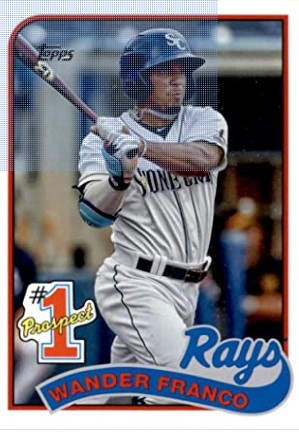
Third Base, Wander Franco, Rays…  June 22, 2021

  • Two-for-four, two runs, three RBI, one double, one home run, one walk

Wander Franco was considered  a top international  prospect when he signed (as a 16-year-old) with the Rays during the 2017 international signing period. He immediately began delivering on his potential with a .351-11-57 season (61 games) at Rookie-Level ball in 2018. In 2019, he hit .327-9-53 at  A and High-A.  In 2021, still just 20-years-old, he was hitting  Triple-A pitching for a .313 average, with seven homers and 35 RBI in 40 games.

The switch-hitting Franco made his first start  for the Rays on June 22, 2021 (batting second and playing third base against the Red Sox) and kept right on raking. In his first MLB plate appearance, he showed great discipline for a 20-year-old, working a six-pitch walk off starter Eduardo Rodriguez (the only walk Rodriguez would surrender in six innings of work). Wander later scored on a single by Francisco Mejia.

Wander worked the count to 3-2 again leading off the third, before flying out to center. Then in the fifth, with the Rays trailing 5-2, he jumped on the first pitch from Rodriguez for a game-tying three-run home run to left. Wander wasn’t done yet, as he doubled to left off reliever Josh Taylor in the seventh. He came up again in the bottom of the ninth needing a triple for the cycle, but grounded out to pitcher Matt Barnes. The Red Sox won in 11 innings by a 9-5 score.

Franco went on to play 70 games for the Rays in 2021 (starting 61 at SS).  He’s at third base here because that was his debut position.  He hit .288, with seven home runs and 39 RBI for the season.  He then went on to hit .368-2-4  in AL Division series (verso Boston).

___________________________________

MLB Debut Extra – A Long Time A’Comin’

Orioles’ pitcher Mickey Jannis, at 33-years-old, was the oldest player to make his MLB debut in 2021. It came on June 23 – in his eleventh professional season.  He came in in the top of the fifth, with the Astros leading the Orioles 6-0 and the number four-five-six hitters coming up.  The knuckleballer fanned the first MLB hitter he ever faced (DH Yordan Alvarez); got SS Carlos Correa on a flyout to right; and walked RF Kyle Tucker (who was erased trying to steal). Unfortunately, things didn’t go as well after that inning, as Jannis gave up seven runs in 3 1/3 innings.  Still, his perseverance did get him to the major-league mound.

Shortstop, Oneil Cruz, Pirates … October 2, 2021

  • Two-for-five, one run, one RBI

Cruz almost didn’t make this lineup.  First, he didn’t get make his MLB debut until the second-to-last game of the Pirates’ season.  Second, Wander Franco might seem like the logical choice here, but the fact that Franco made his debut at third base,  left the shortstop spot open on in this lineup.

Cruz made his MLB debut for the Pirates, playing Shortstop and batting eighth. It came on October 2, 2021. The late-season call up recognized Cruz’ fine 2021 season at Double-A and Triple-A – .310-17-47, with 19 steals in 68 games.

When Oneil Cruz stepped onto the field  on October 2 in Pittsburgh, he – at 6’-7” – became the tallest shortstop to start an MLB game.

In his first MLB at bat, Cruz grounded out to short to end the bottom of the second. He came up again in the fifth, with the Pirates trailing 5-0, with two runners on and no outs. In that plate appearance, he hit an RBI single through the right side of the infield, helping spark a six-run Pirates’ rally. He batted again the inning, striking out. He later added  single in the seventh inning and a strikeout in the eighth. Cruz was in the lineup again for the season finale, going one-for-four and collecting his first MLB home run.

Cruz was signed out of the Dominican Republic by the Dodgers (as a 16-year-old) in July of 2015.   In 2016, he hit .294, with 23 RBI and 11 steals (no home runs) in Rookie-Level ball. Then, in 2017, he was hitting .240-8-36 at A-Level, when the Dodgers traded him to the Pirates (July 31). Cruz has played in five minor-league seasons, hitting .281-49-207, with 60 steals (404 games).

____________________________________________

Left Field, Akil Baddoo, Tigers … April 4, 2021

  • One-for-three, solo home run

Akil Baddoo made his debut playing left field and batting ninth, as the Tigers faced the Indians in Detroit.  His first plate appearance came leading off the bottom of the third inning (Tigers ahead 2-1) and he hit the first MLB pitch he ever saw (from Aaron Civale) for a home run to left field. It was one of only three Tiger hits that afternoon, as Detroit fell 9-2.

“Hitting” the Ground Running

In his first four MLB games, Akil Baddoo went five-for-eleven (.455), with a triple, two home runs and seven RBI.

Badoo finished his rookie MLB season at .259-13-55 in 124 games.  He also had seven triples and was successful on 18 of 22 steal attempts.

Baddoo was signed by the Twins (out of Salem High School in Conyers, GA) in the second round of the 2016 MLB draft. While he struggled as a 17-year old in the Gulf Coast Rookie League (hitting .178 in 38 games), he found his footing the following season, when he hit .323-4-29 in 53 Rookie-Level games. In four minor-league seasons in the Twins’ organization, he hit .249-21-93, with 47 steals (in 233 games).  Baddoo had Tommy John surgery in 2019 (and, of course, did not play in 2020 due to the Corona virus).  The Twins left him available in the Rule Five draft and he went to the Tigers, where a  strong Spring earned him a roster spot.

___________________________________________________

MLB Debut Extra … I Get Around

Luke Williams made his MLB debut for the Phillies, as a pinch hitter, on June 8, 29012 – bunting  for a single to lead off the fifth inning and eventually scoring a run.  That’s not what gets him in as an “Extra” in this post.  What gets him here is that, in his debut MLB season, he appeared (and handled fielding chances) at every position except pitcher and catcher.

_______________________________________

Center Field Jarren Duran, Red Sox … July 17, 2021

  • One- for-two, one run, one walk

Jarren Duran debuted for the Rd Sox, manning center field and batting seventh, as they took on the Yankees and Gerrit Cole in New York. On the very first MLB pitch he saw (from Cole), Duran singled  to deep center – eventually coming around to score on a single by Red Sox’ second baseman Christian Arroyo (scoring the only run in a 3-1 Red Sox loss). Duran also drew a five-pitch walk against Cole, who pitched all six innings of the rain shortened game (Cole gave up five hits, two walks and fanned 11).  So, Duran was on base in two of  three plate appearances versus the Yankee “ace.”

Duran was drafted by the Red Sox in the seventh round of the 2018 MLB Draft (out of Californian State University, Long Beach, where he hit .294-3-66, with 49 steals in 169 games over three seasons). In three minor-league seasons, he hit .307-24-109, with 86 steals in 259 games. In his first MLB season, Duran hit .215-2-10 in 33 games. His MLB season was cut short by an early September positive COVID test. After returning from the COVID list, he was sent down to Triple A.

___________________________________________

Right Field, Kyle Isbel, Royals … April 1, 2021

  • Three-for-five, one run, two RBI

After just two (uneven)  minor-league seasons (.327 average in 2018 & .233 in 2019), Kyle Isbel found himself in the starting lineup (RF, batting seventh) for the Royals (versus Rangers) on Opening Day of the 2021 season. And, he acquitted himself well. In the bottom of the fist inning, he lashed an RBI single to right. He struck out on four pitches leading off the third inning, but came back with a single to left in the fourth. Like his up and down minor-league seasons, he fanned again on four pitches in the fifth, but came back with a run-scoring single in the seventh – giving him a nice three-for-five debut in the Royals’ 14-10 win.

Isbel got in 12 April games for the Royals, hitting .265,with one extra base hit (a triple) and three RBI.  However, he had just two walks versus 15 strikeouts in 36 plate appearances. In late April, Isbel was sent down to the Royals’ alternate training site (and then to Triple-A Omaha, where his .269-15-55 and 22 steals in 105 games earned him another look from the Royals). Called back up in mid-September, he hit .286-1-4 for the Royals in 16 games between September 12 and August 3. His final  line in his first MLB season was .276-1-7 in 28 games.

Isbel was drafted by the Royals in the third round of the 2018 MLB Draft (out of the University of Nevada, where he went .322-21-110 in three seasons (170 games).

In 2016, Kyle Isbel was the Mountain West Conference Co-Freshman of the Year. In  2018, he  earned First-Team All Mountain West Conference recognition.  

____________________________________________

Designated Hitter – Yohei Pozo, Rangers … August 13, 2021

  • Two-for-three, one run, three RBI, one home run

A catcher by trade, Yohei Pozo made his debut for the Rangers as a DH, batting eighth. He had quite a day, knocking in three of the Rangers’ runs in an 8-6 win over the Athletics (in Texas).

He started with a single leading off the bottom of the second. Then, a taste of reality in the big leagues, a three-pitch strikeout in the fourth. He followed that with a three-run home run off veteran Sergio Romo in the sixth and finished with a foul pop up in the seventh.

Pozo ended up the MLB season, hitting .284-1-9 in 21 games.

Pozo was signed by the Rangers (out of Venezuela) as a 16-year-old in 2013.  By age 22 he had six minor-league seasons under his belt (.278-25-192 in 444 games).  Then, in November of 2020, he was signed as a minor-league free agent by the Padres.  The Rangers, however, got him back in the fold a month later in the Rule Five Draft.  It proved to be a good move. Assigned to Triple-A to start the season, Pozo hit .337 with 19 home runs in 66 games to earn his call up to the Rangers. Note: Pozo was sent back down to Triple A in late September.

________________________________________

Debut Post Extra – Show about a Beer?

How can you not include the MLB debut of a ballplayer names “Beer?”  There’s jersey I have to have. Seth Beer made his MLB debut as a pinch hitter for the Diamondbacks on September 10, 2021.  And he did it in style.  Beer, In the eighth inning of that contest, in his first MLB plate appearance, stroked a pinch-hit home run to right field off reliever Diego Castillo to pull the Diamondbacks to within one run of the Mariners (4-5, the eventual final score). Seth Beer played in five 2021 games for Seattle, going four-for-nine with four runs scored, one home run and three RBI.  His season was cut short by a shoulder injury (which required surgery).  When called up by the Mariners, Beer was hitting  .287-16-59 (100 games) for the Triple-A Reno Aces.  Baseball Roundtable first wrote about the player with the perfect baseball name back in 2017.  For that post, click here.

Primary Resource:  Baseball-Reference.com

100Baseball Roundtable is on the Feedspot list of the Top 100 Baseball Blogs.  To see the full list, click here.

I tweet baseball @DavidBBRT

Follow/Like Baseball Roundtable’s Facebook Page here.  More baseball commentary; blog post notifications; PRIZES.

Member: Society for American Baseball Research (SABR); Negro Leagues Baseball Museum; The Baseball Reliquary. 
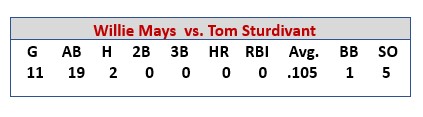
 

Trivia Heroes – A Few Off the Wall Tidbits to Stump Your Baseball Friends

In this post, I’d like to share just a few oddball trivia tidbits I’ve come across over time.  It’s kind of a stream of consciousness post, going whatever direction the baseball winds (and my whims) take me.  (My mind does tend to wander in the off season.) The goal is to present a few tidbits that may offer you a chance to stump your baseball friends when you start to throw around trivia questions over an adult beverage or two (or on a Ballpark Tours bus ride).

Many Questions – One Answer

Jimmy Sheckard has become one of my trivia heroes.   Sheckard enjoyed a 17-season MLB career, during which time he became the answer to:

  • Who was the first MLB player to poke a walk-off hit in a World Series game?
  • Who was the first MLB player to lead the league in stolen bases and home runs in the same season?
  • Who was the first – and still only – player to hit inside-the-park Grand Slam home runs in consecutive games?
  • Who was one-half of the only pair of teammates to hit inside-the-park Grand Slams in the same game.?

In addition, Sheckard is the answer to:

  • Who holds the MLB single-season record for double plays started by an outfielder?
  • Who holds the MLB career mark for assists by a left fielder?

Any of these questions would make a pretty good trivial puzzler.  Wrap them altogether and you’ve got the makings of a true “trivia hero.”  I’ll provide a bit more on Sheckard – his career and his firsts – and then touch on a few additional trivia heroes.

Sheckard played in the majors from 1897 through 1913 (Brooklyn Bridegrooms/Superbas, Baltimore Orioles, Chicago Cubs, St. Louis Cardinals, Cincinnati Reds). He was known as a speedy, strong-armed outfielder.  During his career, he led the league in stolen bases twice (a high of 77 in 1899), home runs once, triples once (with eight seasons of ten or more), runs scored once (three season of 100+), walks twice, on-base percentage once and slugging percentage once. He also led in assists, putouts and double plays as a LF four times each. He is, as already noted, the career assist leader among left fielders (243)  and number-eight in assists for outfielders overall (307).

Sheckard, at times, showed the talent to be a real star on the diamond.  However, inconsistency, worked against him.   For example, he hit a career-high .354 in 1901, fell to .265 in 1902, jumped back to  .332 in 1903 and dropped to .239 in 1904.  Similarly, his nine home runs led the NL in 1903, but  he hit a total of nine home runs over the next six campaigns.  You get the idea.

So, what about those potential trivia stumpers?

Sheckard’s Chicago Cubs came into Game Four of the 1910 World Series (October 22) trailing the Athletics three games-to-none. To that point, they had been outscored 25-to-9.  Playing in Chicago, the Cubs were tied with the Athletics 3-3 going into the bottom of the tenth inning.of Game Four. With future Hall of Famer Charles “Chief” Bender on the hill for Philadelphia, Cubs’ SS  Joe Tinker led off the bottom of the inning with a pop out to shortstop, catcher Jimmy Archer followed with a double to left, a groundout by pitcher Mordecai Brown moved Archer to third and Sheckard singled to left bringing in Archer with the winning  – and notching the first-ever World Series walk-off hit. (Unfortunately, Sheckard’s heroics only staved off defeat for a day, as the Cubs lost Game Five and the series the next day.  They couldn’t blame Sheckard. In 21 plate appearances he was one base 12 times (seven walks, five hits) and scored five of the tam fifteen runs.

How about being the first to lead the league in home runs and stolen bases in the same season? In 1903, playing for Brooklyn, Sheckard led the NL in home runs with nine and steals with 67 (tied with Frank Chance).  His .332 average was seventh in the league, his 99 runs seventh, his 29 doubles seventh, 75 RBI eighth; and 75 walks fifth.

Those inside-the-park Grand Slams in consecutive days?  They came in a September 23, 1901 in a Brooklyn 25-6 win over Cincinnati and on September 24 in a  16-2 win (again Brooklyn over Cincinnati). In the two games, Sheckard was six-for-twelve, with four runs scored and ten RBI. In 1901, the 22-year-old Sheckard set career highs for average (.354), home runs (11), RBI (104). He also scored 116 runs and had a career-high 196 hits (in 133 games).  Notably, in that September 23 25-run outburst, Sheckard’s teammate Joe Kelly also hit an inside-the-park Grand Slam, marking the only time two teammates hit ITP Grand Slams in the same game. 

Let’s move on now to a few additional Baseball Roundtable Trivia Heroes.

This Yankee Shortstop Brought ‘Em Home

The New York Yankees have had a lot of great shortstops over time: Derek Jeter; Phil Rizzuto; Tom Tresh; Frank Crosetti to name just a few.  So, who is the answer to the question: “Who holds the New York Yankees Franchise record for RBI in a season by a shortstop?”

That would be Lyn Lary, who drove in 107 tallies for the 1931 Yankees – stat line .280-10-107, with 100 runs scored and 13 steals. Lary spent six of his 12 MLB season with the New Yorkers. Notably, 1931 was the only season in his career  in which he drove in more than 77 runs (one of only two in which he reached 60 RBI). In fact, his 107 RBI in 1931 represent just over 20 percent of his career total. In 12 MLB seasons (1929-40 … Yankees, Indians, Browns, Senators, Dodgers, Cardinals, Red Sox), Brown went .269-38-526. Side note: In 1931, the Yankees scored 1,067 runs  and had six player score 100 or more runs.  Want to change up the question? ”

You’ll Have to Earn Your Way On … The Old-Fashioned Way

Here’s another surprise.  How about looking at the question: “What qualifying pitcher has the lowest single-season walks per nine innings mark since the four-ball walk rule was instituted?” (Four balls became a walk in 1888, prior to that walks were – at varying times – nine, eight, six and five balls.)  The answer? Carlos Silva, who – as a Twin in 2005 – walked just nine batters (and one of those was intentional) in 188 1/3 innings – a stingy 0.430 walks per nine frames rate.

You could follow up this question with: “How many right-handed hitters did Carlos Silva walk in 2005?”  The answer is one – the Tigers’ Craig Monroe – and that was Silva’s one intentional walk.  So, not a single righty was able to “work him” for a walk all-season.  Monroe, by the way, drew only 40 walks in 623 plate appearance n 2005.   You might also be interested to know that Silva is the only pitcher – among the 25 best single-season walks per nine rates – whose landmark season came after the four-ball walk rule came into effect.

Silva pitched nine MLB seasons (2002-10 … Phillies, Twins, Mariners, Cubs) and went 70-70, 4.68. He walked 238 batters in 1,241 2/3 innings – 1.5 per nine frames – 2005 was his only season under 1,5 walks per nine.

Rookie Fever

How about this set of questions?

  • Who was the first pitcher to throw a shutout in a deciding seventh game of a World Series?
  • Who was the first rookie to start a deciding Game Seven of a World Series?
  • Who was the fist rookie to win three games in a single World Series?

The answer to all three?  Babe Adams.

Right-hander Charles “Babe” Adams came into the 1909 seasons having had brief  MLB “looks” in 1906-07 — no wins, three losses 7.96 in five games (so, his rookie status was intact.). Pitching in the minors in Louisville in 1908, he went 22-12. In 1909, he stuck with the Pirates, getting in 25 games (12 starts/seven complete games) and putting up a 12-3, 1.11 record.  Adams was far from the star of the Pirate  staff which included Howie Camnitz (25-6, 1.62), Vic Willis (22-11, 2.24) and Lefty Leifield (19-8, 2.37).  But manager Fred Clarke like liked Adam’s composure on  the mound, his strong finish to the season and how Adam’s  stuff  and style matched up against the Tigers.  So, Adams got the Game One start and the rest is history.

Adams earned complete-game wins in Games One and Five, giving up just four earned rust  Then came the deciding Game Seven.  (The World Series’ first-ever deciding seventh game. Adams again went the distance, shutting out the tigers on six hits (one walk and one whiff).  Thus, he pitched and won the first deciding Game Seven (as a rookie) and also became the first rookie to win three games in a best-of-seven World Series.

Adams pitched 19 MLB seasons (1906-07, 1909-16, 1918-26 … all but 1906 with the Pirates). He went 194-140, 2.76, twice was a 20-game winner, five times led the league in WHIP, four times allowed the fewest walks per nine innings (among qualifiers) and four time led   in strikeouts-to-walks ratio.

BONUS TRIVIA TIDBIT

Red Sox rookie Hugh Bedient has the unique distinction of being the  only rookie to start Game Eight of a best-of-seven World Series.  (Game Two of the 1912 Series ended in 6-6 tie after 11 innings due to darkness). Bedient, a 22-yer-old right-hander had gone 20-9, 2.92 in his rookie campaign.  In the World Series against the Giants, he tossed one scoreless inning of relief in Game Two’s 11-inning tie; one scoreless inning in relief in Game Three’s 2-1 Red Sox loss; and threw a complete-game in Boston’s Game Five 2-1 win.  He then started Game Eight (versus Christy Mathewson) and tossed seven scoreless  innings in a 3-2 Boston victory.  Bedient pitched just four MLB seasons, going 60-53, 3.08.

I Get By With a Little Help from My Friend

In 1961, the Orioles’ Jim Gentile tied an MLB record (since broken) for Grand Slams in a season (five). Who were the starting pitchers in the games in which Gentile launched a Grand Slam?  Two-word answer: Chuck Estrada. 

Here’s how it went.  In 1961 – with Yankee sluggers Mickey Mantle and Roger Maris dominating headlines in their chase of Babe Ruth’s record 60 home runs in a season – Jim Gentile of the Orioles quietly put up quite a season of his own. Gentile hit .302, with 46 home runs (including those five Grand Slams) and a league-topping 141 RBI.   In addition, he tied an MLB record with two Grand Slams in a game – May 9.

Orioles’ pitcher Chuck Estrada was the main beneficiary of Gentile’s 1961 offensive outburst – every one of Gentile’s record-tying five four-run blasts was hit in a game started by Estrada (who, as you would expect, picked up a victory in all four contests).  Notably, Gentile hit only one other Grand Slam in his career (June 26, 1960) and – you guessed it – the starting and winning pitcher in that contest was Chuck Estrada.

In 1961, Jim Gentile was pretty much an offensive juggernaut when paired with Chuck Estrada.  He played in 29 of Estrada’s 31 starts.  In those 29 games, he hit .356, with 15 home runs and 47 RBI. How potent is that?

For those of you who like a little more – Don’t baseball fans always want that next fact or stat? – here’s some background. Gentile was in the majors with the Dodgers (1957-58), Orioles (1960-63), A’s (1964-65), Astros (1965-66) and Indians (1966). In nine MLB campaigns, he was an All Star in three seasons (1960-61-62) and 1961 was his best year. His career stat line was .260-179-549. That’s 1961 season saw Gentile reach his all-time career highs in nearly every offensive category.  It was the only season in which he reached a .300 batting average, 100 or more RBI and 40 or more home runs (he had a total of five seasons of at least 20 homers – including the 46 in 1961 and 33 in 1962).

Estrada’s best season was his rookie year (1960) with the Orioles, when the 22-year-0ld led the AL with 18 wins (11 losses and a 3.58 ERA). He finished second in the AL Rookie of the Year balloting to his Orioles’ teammate, shortstop Ron Hansen, who hit .255, with 22 home runs and 86 RBI.  Estrada was an All Star in just one season – his rookie campaign –  in a career that saw him win 50 and lose 44, with a 4.04 ERA. He pitched for the Orioles (1960-64), Cubs (1966) and Mets (1967).

How to (Not) Play Your Way into the Record Book

Charles “Cap” Peterson’s name does not come up in a host of baseball discussions.  An outfielder, Peterson played in eight MLB seasons (1962-69 … Giants, Senators, Indians).  His career stat line was .230-19-122 and he played in 100 or more games just once. In 1967 (with the Senators), he set career highs in games (122), hits (97), home runs (8) and RBI (46).  On June 12 of that season, he tied an MLB record (for inactivity) and became part of the answer to the question: Who holds the record for the longest game played in the field without recording a single fielding chance (putout, assist, error)?  It’s a two-player answer.  Billy Bruton and Cap Peterson each managed to play a 22-inning game without recording a fielding chance – Bruton in CF for the Tigers on June 24, 1962 and Peterson in RF for the Senators on June 12, 1967.

Peterson’s “chance-less” game in the outfield came in a 22-inning win over the White Sox in Washington D.C.  Peterson was a bit more active at the plate in the contest going four-for-nine with two home runs, two runs scored and three RBI. It was the only multi-homer game of his career.   Bruton’s came in a 22-inning 9-7 loss to the Yankees (in Detroit). In his game, Bruton was two-for nine (with two walks) in 11 plate appearances, with two runs scored and a stolen base.  Bruton, by the way, played 12 MLB seasons (1953-64 … Braves, Tigers). He hit .273-94-545 in 1,610 games. He also stole 207 bases leading the NL in steals in each of his first three seasons.

 If I Could Pose an Off-the-Wall Trivia Question

If I could write a zany trivia question, it might read like this:  “What is the most times on base in a doubleheader by a shortstop who had zero fielding chances in that doubleheader?  The answer is eight.  On June 25, 1976 the Texas Rangers faced the Chicago White Sox in a doubleheader (in Texas). There was plenty of action in the field, as the Rangers won Game One 8-4 and lost Game Two 14-9.  Surprisingly, Rangers’ shortstop Toby Harrah, who played all 18-innings, did not record a single fielding chance (an MLB doubleheader first for shortstops).  I might add that it’s not like the ball was not being hit around the infield. In the two games, the Rangers’ three other  infielders (we’ll leave the catcher out of it since he get a putout on a strikeout) recorded 26 putouts, 14 assists and three errors.  In response to my question, at the plate, Harrah was six-for-eight, with two walks, two runs, eight RBI, two home runs and a stolen base. 

For those that like to know these things, the Rockies’ Trevor Story holds the record for the longest game without recording a fielding chance as a shortstop. On September 24, 2019 – as the Rockies beat the Giants 8-5 in 16 innings (in San Francisco), Story played all 16 innings without recording a putout, assist or error. 

Primary Resources:  Baseball-Reference.com; The ELIAS Book of Records, ELIAS Sports Bureau, 2021

____________________________________

100Baseball Roundtable is on the Feedspot list of the Top 100 Baseball Blogs.  To see the full list, click here.

I tweet baseball @DavidBBRT

Follow/Like Baseball Roundtable’s Facebook Page here.  More baseball commentary; blog post notifications; PRIZES.

Member: Society for American Baseball Research (SABR); Negro Leagues Baseball Museum; The Baseball Reliquary. 
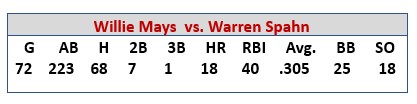
 

From Mound Visits to Replays to Banning the Shift … Baseball Roundtable’s Baseball Rules Survey Results

Baseball Roundtable recently completed a reader survey regarding some of the issues and rules facing major league baseball.  A total of 223 responses were received in the 24 hours the survey (using the Google survey tool) was open – although not all respondents replied to every question.  (Thanks to all of those who responded.  I appreciate your interest, thoughts and participation.)  I’d like to share those responses, as well as a bit of commentary, in this post.  One cautionary note:  The survey group was self-selecting. The fact that the respondents took the time to fill out the somewhat lengthy survey would indicate the group is composed of individuals who follow the game more closely than casual fans.  This is further amplified by the fact that a link to the survey was shared with such online groups as Baseball Fans of America, the Society for American Baseball Research, The Baseball Reliquary and Baseball Fans of America.

NOTE: COMING SOON – RESULTS OF BASEBALL ROUNDTABLE’S

(UNOFFICIAL) FAN HALL OF FAME BALLOT

LENGTH OF GAMES

Notably, respondents were split  on whether MLB games need to be shortened, with 51.6 percent say “No” and 42.5 percent saying “Yes.”

ONE RESPONDENT’S COMMENT

As a lifelong fan, I believe the rule changes to speed up the game (among other results) are based on television viewership and not for the fans who watch live. I have never heard anyone complain about the length of games at a stadium. The complaints I hear there (at the ballpark) are ones involving delays (pitching changes, multiple mound visits, replays) and never about the pace of the actual game. I think the constant tinkering only creates more holes to fix. 

Respondents’ pegged the ideal length of a game at 2 ½ – 3 hours, with 59.5 percent selecting  a response within that time frame (which seem contrary to more than 50 percent saying games do not need to be shortened).  Notably, 31.1 percent selected “However long it takes to have a winner.”

Ideal Length for an MLB Game – Top Five Responses

2 1/2 hours  … 32.4%

However Long it takes to have a winner … 31.1%

3 hours … 14%

2 3/4 hours … 13.1%

2 1/4 hours … 4.1%

Only 1.4 percent picked a specific time over three hours (6.9% picked times of 1 1/2 – 2 hours).

MLB Average Length of Game (Time)

The average game time in 2021 was three hours and 11 minutes. The last time the average was under 3:00 was a decade ago (2011 – 2:56). The last time, it was 2:30 or less was in 1978 (2:30). 

So, what about efforts, in place or being considered/experimented with, to shorten the game?

Among the most popular rules/proposals among respondents were: requiring batters to keep one foot in the batter’s box through the plate appearance; strict enforcement of a pitch clock; and limiting mound visits.  There has been a 20-second pitch clock at Double-A and Triple-A since 2015, but baseball is looking at a shorter (15-second),  more strictly enforced, limit).  A personal observation: Despite being “old school,” I’d like to see batters required to keep one foot in the batter’s box (and not wander off to adjust their batting gloves, add pine tar or take a swing or two).  I believe it was Bert Blyleven who said a great way to shorten the game would be to “ban Velcro.”   I’d also be on board with requiring pitchers to remain on the mound between pitches – except for “mound visits.”


Respondents wanted little to do with seven-inning games; placing a runner at second base at the start of an extra inning; or allowing tie games after a specific number of extra frames. More than 80 percent of respondents disliked each of these.  From Baseball Roundtable’s point of view, shortening games to seven innings would wreak havoc with the game’s history, record book and rule book.  In a seven-inning game, how many innings are needed for a starter’s win? Or, how do you evaluate complete-games pitched records? Is a game “official” after 3 1/2 frames or still 4 1/2?  You get the idea.

The split was more even on waiving a runner to first on an intentional walk, with 48 percent liking that change and 41.2 percent disliking it.  (Are we just getting used to it?)  Looks like we won’t ever again see a batter reach across the plate and poke an intentional “ball” to left for a double. I can live with it, although it seems a little “slow-pitch softball” for me.

RULE CHANGES AIMED AT REDUCING PITCHING CHANGES

The split on the current MLB rule requiring a reliever (unless injured) to pitch to three batters (or to the end of an inning) was fairly even, with 50.2 percent disliking the rule and 42.1 percent liking it.

One respondent presented an idea for a similar approach to starting pitchers.

RESPONDENT’S COMMENT

Starting pitchers should be required to go five innings minimum unless they reach 100 pitches, allow four or more earned runs, or experience some type of injury.

This may seem a bit extreme, but in reality, it’s not much different in philosophy than the requiring a reliever to face three batters.  It would effectively end “bullpen games.”

There has also been some discussion of limiting the number of pitchers on an MLB roster.  This, it is reasoned would reduce mound options and, in turn, pitching changes. The opposition outweighed the support on this one.  I sided with the “nays,” a team should be allowed to set up its own roster within the overall player limit. No, I don’t like those games in which we see an “opener” followed by a parade of bullpen arms. But the game is changing and teams should be able to set up rosters and employ pitching strategies they think can best enable them to compete and win.  Still, it’s a change I could live with.

JUICING UP THE RUNNING GAME

Another rule proposal which has been discussed (and experimented with at the minor-league level) would limit pick off throws during each plate appearance. We’ve all seen those at bats with seven or eight tosses to first base.  Yes, it’s frustrating (although fans only seem to boo the opposing pitcher for such attention to a base runner). I’m for letting the pitcher hold the runner on, which is in line with the 72.5 percent of respondents who disliked this proposal.

There is also some discussion around requiring a pitcher to be completely off the rubber before attempting a pick-off (experimented with in the Atlantic League). The “off the rubber” proposal was liked by 34.2 percent of respondents; disliked by 37.4 percent, with 28.4 percent voicing “no opinion.”  Both of these  proposals are intended to boost the running game – and did seem to have that effect in minor-league trials.

ROBOT UMPIRES/ELECTRONIC STRIKE ZONE

Okay, I’m being really “old school” here.  I like watching a pitcher work to “expand the strike zone.”  I find it an element of the craft of pitching.  So, I’d opposed an electronic strike zone. Just over half of the respondents took that position, but nearly one-third would welcome such a change.  I have a hunch it may be part of MLB’s future … just down the road a bit.

CHALLENGES/REPLAYS

Sticking with umpiring, this one surprised me.  Approximately two-thirds of respondents like the current MLB challenge/replay system.  Notably, they also “disliked” suggestions for limiting replays. For example, 67.1 percent disliked the idea of going back to replays only on fair/foul home run calls and 64.1 percent disliked the idea of allowing replays only at the umpires’ discretion (rather than allowing manager challenges).

RESPONDENT’S COMMENT

Allow only 30 seconds limit for manager to call for a challenge-review. If they are confident it was a bad call, they don’t need to check the replay first to challenge the call.


THE ONGOING  DESIGNATED HITTER DEBATE

When will it end? The DH remains an ongoing point of contention … with about equal support for the application of designated hitter in both leagues (Universal DH) or the elimination the DH in both leagues.  The key word is both. Respondents just want one system. Only one in ten respondents like the current AL/NL split on this rule. How close was the call on Universal versus No DH?  42.5 percent “liked” No DH; while 42.1 percent “liked” a Universal DH. It appears the biggest mistake MLB can make is to keep the current split.

After this post was initially published, a reader asked for a bit more clarity on the DH issue. In response, I conducted a brief survey (which went to a smaller, but similar – if perhaps a bit more diverse in the depth of their fandom – group) on the issue.  In that effort, respondents had to selected their preferred treatment of the DH.  (rather than comment on all three).

The results were:

Universal DH – 47.6%

Eliminate DH – 26.2%

NL-only DH – 11.9%

No opinion – 14.7%

 INFIELD SHIFTS

Another surprise here. I expected an overwhelming dislike of the current trend toward infield shifts. Yet, more than half of the respondents did not like the idea of requiring two infielders on each side of second base.  I guess, we’ll have to agree to disagree on this one.


One respondent offered an interesting alternative – allowing the shift on no more than two batters in an inning,  I kind of like that.  It would require manager’s to make strategic decisions on which hitter(s) could effectively be stymied by a shift or in what game situations a shift would have the most positive potential impact.   That would open the door for fan discussion, debate and second-guessing – and I like that.

LACK OF “ACTION”

We hear talk these days about the growth of the “three true results” – strike outs, home runs and walks – taking action out of the game. The Roundtable did ask respondents about these outcomes.  Here’s what they said they’d like to see less of:

Fewer Strikeouts … 51.6%

Fewer Home Runs … 30.2%

Fewer Walks … 25.1%

No Opinion … 34.4%


A FEW MORE RESPONDENTS’ COMMENTS

  • Many problems would be solved (especially too many players grooving swings to hit the ball over everybody, which increases K’s, HR’s and decreases interesting balls in play) by instituting the rule of two infielders, playing on dirt or INFIELD grass on either side of second base.
  • Radical suggestion: revisit the current rule allowing unlimited foul balls. That is a big source of delays.
  • The game does need to be sped up. Maybe less TV and radio commercials time would help. We need more day games during the playoffs. We need more programs that tell the younger generation about the history of the game.
  • Game pace is the problem. Far too many 15-minute innings with too few balls in play. Call strikes so that the batter swings the bat.
  • I love baseball, but to survive, more action is needed to compete with football. There needs to be more steals, more hit-and-run, and more contact.
  • Shorten time between innings to 75 seconds and you’ll save 20 minutes in a 9-inning game. Just saying.
  • What hurts the game most is dead time — pitching changes, replays, conferences, and general dicking around during at-bats. Combine that with all the non-action plays… and it just seems slower. I listened to a game last season when the announcer went nuts because he went 34 minutes without calling a fair ball.

Then there were these conflicting views voiced by a pair of respondents.

  • Baseball is as near a thing to perfect as there can be in a competitive sport. Leave it alone!!! The old rules worked fine for years and don’t need to be tinkered with.
  • The game needs to change and I’m really done with the “purists.” Did “purists” object when fielders started wearing gloves, when the pitcher was moved back to 60’6″.

A Final Observation

Not part of thee survey, but just an observation offered, as Rod Serling used to say, ‘for your consideration.”  In  2021, 36.3 percent of the MLB season’s 181,818 (interesting number) plate appearances ended in a trot (back to the dugout, around the bases, to first base). I call this the Baseball Roundtable Trot Index and have been reporting this stat for a number of seasons. We’re talking about strikeouts, home runs, walks, hit by pitch and catcher’s interference – all outcomes that are, basically, devoid of action on the base paths or in the field. Here’s the 2021 breakout: strikeouts (23.2%); walks (8.7%); home runs (3.3%); HBP (1.2%); catcher’s interference (less than 1%). Note: Totals 36.4% due to rounding.

Now, to provide a little context. Here are a few selected annual Trot Index scores since I began watching baseball in earnest:  1950  – 22.8 %; 1960 – 25.1%; 1970 – 27.0%; 1980 – 23.1%; 1990 – 31.7%; 2000 – 29.9%; 2010 – 30.3%; 2021 – 36.6%.


100Baseball Roundtable is on the Feedspot list of the Top 100 Baseball Blogs.  To see the full list, click here.

I tweet baseball @DavidBBRT

Follow/Like Baseball Roundtable’s Facebook Page here.  More baseball commentary; blog post notifications; PRIZES.

Member: Society for American Baseball Research (SABR); Negro Leagues Baseball Museum; The Baseball Reliquary. 

MLB Expansion Drafts … Best, First, Most Interesting

Today, December 14, marks the 61st Anniversary of the 1960 MLB Expansion Draft – which officially launched what we now often hear referred to as “The Expansion Era.”  With that in mind, I’d like to use this post to look at MLB Expansion Drafts since that time – rating (totally subjectively) what Baseball Roundtable believes are the top Top Five Expansion Picks all-time (well, since 1960), as well as commenting on each expansion team’s first and most interesting picks. Note:  The first and most interesting picks section is  updated and expanded from a 2016 Baseball Roundtable post on this topic.)

This post is indeed a labor of love. Expansion drafts have fascinated me since I was just a kid – drafting Strat-O-Matic or baseball card teams with my baseball buddies.  That interest was re-energized as an adult, when I began annually drafting fantasy teams.

Notably, first-pick selections in MLB’s seven Expansion Drafts ranged from a utility player with only 13 MLB at bats (Bob Bailor) to a former AL MVP (Bobby Shantz). And, when you further examine Expansion Draft first picks, you also find a pitcher who had started Game Four of the previous season’s World Series (Tony Saunders) and a veteran outfielder with a .292 career average (over seven seasons) who would go on to a 20-season MLB career (Manny Mota). But enough teasers, let’s get started with a look at Baseball Roundtable’s choices for top expansion picks all-time,

———TOP MLB EXPANSION DRAFT PICKS ALL-TIME——–

One caveat here, these players are chosen on the basis of what they did while playing for the teams that drafted them.  For example, Bobby Abreu, drafted by the Devil Rays (from the Astros) with the sixth pick in the 1997 draft may have had the best offensive post-draft career of any Expansion Draft player.  Prior to the 1997 Expansion Draft, the 23-year-old had played in 620 minor-league games and 74 games for the Astros (1996-97), with a .248-3-27 MLB stat line. (Abreu was signed out of Venezuela and began his pro career as a 17-year-old.) Post-draft, Abreu played another 16 seasons, hitting .292, with 285 home runs, 1,336 RBI, 1,430 runs scored and 393 stolen bases (bringing his career line to .291-288-1,363 with 400 steals). However, not one bit of that offense was recorded for the team that drafted him.  After being drafted he was quickly traded to the Philllies for SS Kevin Stocker.  Oops!  Or there is Hoyt Wilhelm, drafted by the Royals (from the White Sox) with the 49th pick in the 1968 Expansion Draft.  The 45-year-old Wilhelm was already on his way to the Hall of Fame – with 17 MLB seasons, 937 appearances, 130 wins and 197 saves under his belt. Before their inaugural season, the Royals traded Wilhelm to the Angels.   He played four more seasons, adding 133 appearances, 13 wins and 31 saves to his career totals.  These are just a couple of examples of players with notable career achievements who did not make the best picks list because they had little (and sometimes no) direct impact on the expansion teams that drafted them.

So, here’s Baseball Roundtable’s Top-Five Expansion Draft picks.

NUMBER ONE – Jim Fregosi, SS … drafted by Angels (from Red Sox) with the 35th pick of the 1960 Expansion Draft.

Fregosi was signed by the Red Sox right out of high school and, at 19-years-old, had just one minor-league season to his credit (.267-6-58 in 112 games at Class-D) when the Angels snatched him from the Red Sox. In is first two seasons in the Angels’ system, he got in 214 games at Triple-A Dallas Fort Worth (.263-7-64). He was called  up to the Angels briefly in 1961 (11 Sept./Oct. games). In 1962,  he was called up in July and went .291-3-23 in 58 games. Fregosi was with the Angels through 1971, playing in 1,429 games (.268-115-546, with 691 runs scored). The six-time All Star and one-time Gold Glover provided solid leadership and a steadying presence in the Angels’ infield and line up. Fregosi received MVP votes in eight Angels’ seasons. He ultimately played in 18 MLB seasons, going .265-151-706).

After the Fact

Although, these factors did not play a role in  this ranking, Jim Fregosi did have an impact on the Angels well past his days on the field with the team. In 1961, the Angels traded Fregosi to the Mets for four players – one of whom was Nolan Ryan. (That worked out pretty well.)  Then, in 1978, he came back to the manage the Angels (1978-81). 

___________________________________________

NUMBER TWO – Vinny Castilla, SS/3B … drafted by the ROCKIES (from the Braves) with the 40th pick in the 1992 Expansion draft.

Castilla showed modest power potential in the Braves’ minor-league system – 31 home runs in 399 games (primarily as a shortstop) before the Rockies picked him in the 1992 Expansion Draft.  Odds are, the Rox got even more than they expected – as a switch to third base and the “Rocky Mountain Air” seemed to agree with Castilla. From 1993-99, Castillo hit .299 for Colorado, with 203 home runs and 610 RBI. He made two All Star teams, hit 40 or more home runs in three seasons and drove in 100+in four (a high of 144 RBI in 1998). In 1999, after a .275-33-102 season, he was traded to the Rays for Rolando Arrojo and Aaron Ledesma.  Castilla came back for a couple of stints with the Rox, including a .271-35-131 season in 2004. In 16 MLB seasons, Castilla hit .276, with 320 home runs and 1,105 RBI.

____________________________________

NUMBER THREE – Nate Colbert, 1B/OF… drafted by the Padres (from the Astros)  with the 18th pick in the 1968 Expansion Draft. 

While Colbert had a .133 average in 39 games with the Astros (1966 & 1968), he had shown potential in the minors (including a .289-28-67 season at Double-A/Triple-A in 1967). Colbert immediately began delivering on that potential with the Padres. The 23-year-old hit .255 with 24 home runs and 66 RBI in his first season in San Diego, went on to earn three All Star berths and hit 163 home runs in six seasons for the team (still the record for carer homers in a Padres’ uniform). His best season was 1972, when he went .250-38-111 for the Padres. Colbert gained further fame on August 1, 1972, when he hit a record-tying five home runs in a double header.

_____________________________


NUMBER FOUR- Turk Farrell, RHP … drafted by the Colt .45s (from the Dodgers) with the fourth pick (premium phase) of the 1961 Expansion Draft.

The 26-year-old righty had a five-season MLB record of 37-31, 3.70 and one All Star selection on his MLB resume (1958 Phillies) when the Colt .45s selected him in the 1961 Expansion draft. It turned out to be a pretty good move.  Farrell was with Houston through May of 1967.  During those six seasons, he was a three-time All Star –  and went 53-64, 3.45 (during that time, Houston went 402-568.).  In 1963, Farrell put up a 14-13, 3.02 stat line for a team that finished 30 games under .500.  Farrell started 132 games for Houston (completing 41) and relieved in 49 (eight saves). Farrell pitched in 14 MLB seasons, going 106-111, 3.45

__________________________________________

NUMBER FIVE – Jim Clancy, RHP … drafted by the Blue Jays  (from the Rangers) with the sixth pick in the 1976 Expansion Draft.

Jim Clancy had four minor-league seasons on his professional resume when the Blue Jays drafted him, but they were far from attention gathering results – a 20-37 record, with a 5.30 earned run average.  His first three seasons with the Blue Jays were marginally better, 16-28, 4,58.   Then in 1980 – as a 24-year-old – he seemed to progress (13-16, but with a 3.30 ERA for the 67-95 Blue Jays.)  Clancy get this spot  partially on the basis of longevity. He stayed with the Blue Jays for 12 seasons – putting up a 128-140 record, with a 4.10 ERA. He gave the Blue Jays double-digit wins in eight seasons and twice led the AL in games started. In 1982, he was an ll Star and put up a 16-14, 3.,71 record.  He pitched in 15 MLB seasons, going 140-167, 4.23.

_______________________________________


HONORABLE   – Tommy Harper, OF …  drafted by the Seattle Pilots (from the Indians) with the third pick in the 1968 Expansion Draft.  

Harper deserves a mention for providing a lot of thrills for fans, early in an expansion club’s existence. He had appeared in 778 MLB games (Reds & Indians) by the time the Pilots selected him in the 1968 Expansion Draft.  He had a .251 career average, with 50 home runs, 203 RBI, 492 runs scored and 135 stolen bases. In 1965, he had hit .257 for the Reds and led the National League in runs scored with 126. The best, it seems,was yet to come.

In his first year as a Pilot, Harper may have hit only .235, but he led MLB with 73 stolen bases. But, the best was yet to come.

In 1969, the Pilots moved to Milwaukee and became the Brewers – and Tommy Harper became an All Star, a Brewers fan favorite and a 30-30 player.  For the Brewers, he hit .296, with 31 home runs, 38 stolen bases, 82 RBI and 104 runs scored. The following season (1971), he regressed, hitting .258-14-52, with 25 steals. After the season, he was traded to the Red Sox in a multi-player deal.  The Brewers sent Pat Skrable, Lew Krausse and Marty Pattin to the BoSox for Ken Brett, Billy Conigliaro, Joe Lahoud, Jim Lonborg, Don Pavletich and George Scott. (You can figure that one out.)  Harper played 15 MLB seasons (1962-76), going .257-146-567, with 408 steals.  Clearly the Pilots/Brewers got Harper’s best.

__________________________________________


Now let’s look at each expansion team’s first and, in Baseball Roundtable’s view, most interesting picks.


——1960 EXPANSION DRAFT – For 1961 Season——

Eli Grba – RHP – First pick of the Angels, taken from the Yankees.

Eli Grba – first player taken in MLB’s first expansion draft.

Eli Grba was the first-ever Expansion Draft selection (the Angels had first pick). The 25-year-old Grba had appeared in a total of 43 games (15 starts) and 131 major-league innings for the Yankees in the 1959-60 seasons – going 8-9 with a 4.74 ERA and one save. He was considered a solid prospect (who already had some seasoning), coming off a 1960 season in which he went 7-1, 1.80 at Triple-A before putting up a 6-4, 3.68 line for the Yankees.  Grba had a good season for the Angels in 1961 – winning 11 and losing 13, with a 4.25 ERA in 211 2/3 innings pitched.  Grba, however, was out of the major leagues by 1964, finishing with a 28-33, 4.67 (4 saves) record over five seasons.

Angels’ most interesting pick – 20-year-old RHP Dean Chance, taken from the Orioles … kind of .

The 1960 expansion draft had a complex set of rules- among them that no existing team could lose more than seven players and no expansion team could take more than four players from any one existing team. As the draft unfolded, these rules were not followed to the letter – particularly the restriction on how many players from any one team any one expansion team could draft.  As a result, AL President Joe Cronin had to step in and mandate trades to bring teams into compliance.   And, that’s where Dean Chance becomes an interesting pick. One of the mandated trades sent Joe Hicks, originally drafted by the Angels to the Senators for Chance (originally drafted by Washington).  Chance was clearly a “prospect pick.” Just 20, he already had two minor-league seasons behind him (in which he had gone 22-12, with a 3.06 ERA). Chance spent most of 1961 at Triple-A, getting into just five games with the Angels at the end of the season (0-2, 6.87 in 18 1/3 innings). In 1962, he was a 14-game winner for the Angels and, by 1964, he was an All Star and AL Cy Young Award winner (20-9, 1.65 with 11 complete-game shutouts).  A nice pick who had an 11-year MLB career, six seasons with the Angels (74-66, 2.83).  If it hadn’t been for that “interesting” draft-day trade, Chance would have made my five best picks list.  His career stat line was 128-115, 2.92.

_______________________________________________________

Bobby Shantz – LHP – First pick of the Senators, taken from the Yankees.

The expansion Senators appeared to go for experience in their first pick – selecting 35-year-old left-hander Bobby Shantz; a 12-year MLB veteran, three-time All Star and 1952 AL MVP.  Shantz, however, never played for the Senators. He was quickly traded to the Pittsburgh Pirates for RHP Bennie Daniels, 3B Harry Bright and 1B R.C. Stevens. The players the Senators received for Shantz did provide some value. Daniels led the Senators in wins in 1961, going 12-11, 3.44. He stayed with the team four more seasons, picking up 25 more victories. Harry Bright hit .240-4-21 in 72 games for Washington in 1961, then set career highs at .273-17-67 for the team the following year (after which he was traded to the Reds). R.C. Stevens played in only 33 games for the Senators – hitting .129 in his last of four MLB season.

Senators’ most interesting pick – LHP Bobby Shantz (see the full Shantz story below).

Bobby Shantz – The Most Interesting Player in TWO MLB Expansion Drafts

Bobby Shantz - Boyhood Hero.

Bobby Shantz – Boyhood Hero.

Like the Dos Equis beer campaign’s “most interesting man in the world,”  Bobby Shantz was the most interesting player in not one, but two, MLB Expansion drafts – at least in BBRT’s estimation.

First, a disclaimer. As a youngster, I had a personal interest in the 5’ 6 “ Shantz.  My Dad was just 5’ 1” and it looked like I might follow in his (short stride and) footsteps.  Luckily, a growth spurt in my teens got me past my Dad’s mark to a more average 5′ 9″. Before that growth spurt, however, Shantz was my assurance that the vertically challenged could succeed in the national pastime.

Let’s take a look at this most interesting of Expansion Draft picks (actually one of the more interesting MLB players period). Shantz – who was still under five-feet tall when he graduated from high school – was a natural athlete, excelling in everything from baseball to diving to gymnastics to ping-pong. Still, when it came to professional opportunities, he was considered too small. Fortunately, a late growth spurt (some of which occurred during his military service) pushed Shantz up to 5’ 6″ and just shy of 140 pounds. After his discharge, some excellent results in sandlot ball earned Shantz a contract with the Philadelphia Athletics (most teams passed on Shantz due to his size).  In his first season of pro-ball (1948 … for the Class A Lincoln A’s), Shantz went 18-7, with a 2.82 ERA and 212 strikeouts in 214 innings – showing great control and a baffling curve ball. Shantz was on his way. By 1951, he was an All Star for the Athletics, finishing the season 18-10, with a 3.94 ERA. The following season, he reached his peak. While the Athletics finished barely above .500 (79-75, fourth place), Shantz went 24-7, 2.48 – leading the league in wins and winning percentage and throwing 27 complete games in 33 starts.  The campaign was topped off when Shantz was named the AL MVP.

The following season, however, Shantz fell victim to a shoulder injury that would create problems for him on-and-off for the remainder of his career. In 1957, Shantz was included in a 13-player trade (Athletics and Yankees). He proved a valuable addition to the Bronx Bombers, going 11-5, with a league-low 2.45 ERA (30 games, 21 starts). That year, he made his third and final All Star squad. He also started Game Two of the 1957 World Series, taking the loss in a 4-2 Braves victory.

In addition to making it to the World Series, Shantz also started an enviable streak in 1957.  Remember the earlier note that Shantz was a natural athlete? Well, in 1957, the first Gold Gloves were awarded. In that initial year, one Gold Glove was awarded for each position (not one for each position in each league) and Shantz was the first pitcher to earn a Gold Glove. The following season, Gold Gloves were awarded by league and Shantz won the AL Gold Glove for pitchers in each of the next three seasons. He moved to the NL in 1961, and won four more consecutive Gold Gloves (1961-64).

So, as we look to the 1960 Expansion Draft, we find Shantz – at the time a former MVP, three-time All Star and four-time Gold Glover – left unprotected by the Yankees. Shantz was the first pick of the Senators, who – two days later – traded him to the Pirates. As a reliever and spot starter for Pittsburgh, Shantz went 6-3, 3.32, with two saves (43 games, six starts).

Then came the 1961 draft. The Pirates did not protect Shantz and the former MVP was again a “draftee,”  selected by the Houston Colt .45’s with the number-21 pick.  Shantz started the first-ever game for Houston (April 10, 1962), beating the Cubs 11-2 on a complete game five-hitter.  He got three starts for Houston (1-1, 1.31) before a May 7 trade to the Cardinals (for OF Carl Warwick and P John Anderson). Shantz had a solid season as a reliever for Saint Louis – 5-3, 2.18 with four saves, and finished out his career as a reliever with the Cardinals, Cubs and Phillies He retired after the 1964 season with a 119-99, 3.38 record (48 saves) in 16 seasons – and BBRT’s vote as the most interesting player in the first – and second – Expansion Drafts.


——1961 MLB EXPANSION DRAFT——

Eddie  Bressoud – SS/2B/3B – First pick of the Colt. .45s, taken from the Giants.

The 29-year-old Bressoud had been utility infielder with the Giants (1956-61) – versatile and capable in the field, with a .239 career batting average. Like Bobby Shantz (see above), Bressoud was not to play a single game for the team that made him their first draft pick.  He was traded to the Boston Red Sox for shortstop Don Buddin – which proved an unproductive move.  Buddin played in 40 games for the 1962 Colt .45s, hitting just .163 in 80 at bats before being moved to the Detroit Tigers for cash in mid-season. The slick-fielding Bressoud remained in the major leagues for six more seasons, making the AL All Star team in 1964, when he hit .293 in 158 games as the regular shortstop for the Red Sox. Bressoud closed out his MLB career as a member of the 1967 World Champion Cardinals.

Colt .45’s most interesting pick – Bobby Shantz, taken from the Pirates (see full story in box above).

___________________________________________

Hobie Landrith – C – First pick of the Mets, taken from the Giants.

Hobie Landrith had a dozen MLB seasons under his belt (primarily as a backup catcher, although he did play in 100+ games in 1956 and 1959) when the Mets made him their first Expansion Draft pick.  When asked about the reasoning behind this first pick, Met’s manager Casey Stengel is famously said to have replied, “You have to have catchers or you’re going to have a lot of passed balls.”  Like so many of these first expansion picks, Landrith was not long for his new team.  He played in just 23 games for the Mets (.289-1-7) before being traded to the Orioles to complete a trade that brought the Mets future team “legend” Marvelous Marv Throneberry. Landrith only played one more season in the big leagues. Throneberry was with the Mets in 1962 and 1963 (his last MLB season) – hitting .240 with 16 home runs and 50 RBI in 130 games. Marvelous Marv later gained fame as a spokesperson for Miller Lite beer.

Mets’ most interesting pick – 1B Gil Hodges, taken from the Dodgers. 

The Mets took 37-year-old veteran 1B Gil Hodges from the Dodgers with the 14th pick of the 1961 draft – bringing a Brooklyn Dodgers’ fan favorite back to New York. Hodges was an eight-time All Star, all with Brooklyn. He was also a three-time Gold Glover – one with Brooklyn, two with Los Angeles.  At the time he was drafted, Hodges had a .276 career average, 361 home runs and 1,254 RBI.  Hodges got in just 65 games in two seasons with the Mets, hitting .248, with nine homers and 20 RBI.  Hodges, appropriately, did hit the first home run in Mets’ history – on April 11, 1962. He was traded to the Washington Senators (for OF Jimmy Piersall) on May 23, 1963 – immediately retiring as a player to take over as the Senators’ manager (the purpose of the trade.)

——1968 EXPANSION DRAFT——

Ollie Brown – OF – First pick of the Padres, taken from the Giants.

Ollie “Downtown” Brown, a plus defender with a strong arm, was the first pick of the expansion Padres – and it worked out well for Brown and the team.  A part-timer with the Giants (181 games from 1965-68), Brown became a staple in the outfield for the Padres.  In 1969, he played in 151 games for San Diego, hitting .264, with 20 HR’s and 61 RBI.  He did even better the following season – .292-23-89 in 139 games. He was a regular in the Padres’ OF until he was traded to Oakland in 1972. Brown stayed in the majors through 1977 (13 seasons), putting up a career average of .265, with 102 home runs and 454 RBI.

Padres’ most interesting pick – 1B Nate Colbert, taken from the Houston Astros.

You can read more about Colbert in the “Best Picks” section at the top of this post. Adding to the “interest factor” for BBRT is the fact that on August 1, 1972, Nate Colbert hit five home runs in a double header (remember those).  The only other time this feat has been accomplished (by Stan Musial on May 2, 1954), Colbert (then 8-years-old) was a fan in the stands.

_________________________________________________

Manny Mota – OF – First pick of the  Expos, taken from the Pirates.

Manny Mota, the Expos’ first-pick in the 1968 draft, played only 31 games for the team before being traded to the Los Angeles Dodgers. Mota and Expos’ SS Maury Wills were traded to the Dodgers for OF/1B Ron Fairly and IF Paul Popovich in mid-June of the 1969 season. Mota was with the Dodgers until 1982 (an All Star in 1973), becoming one MLB’s most adept pinch hitters; while Wills (who started his career with the Dodgers) stayed with LA through the 1972 season. Fairly was a Montreal regular (and a 1973 All Star). In six seasons with the Expos, he hit .276, with 86 home runs and 331 RBI. Popovich was immediately traded to the Cubs for OF Adolfe Phillips and RHP Jack Lamabe. (Phillips hit .216 in 58 games for the Expos that season, Lamabe spent the season in the minors and never pitched in the major again.)

Expos’ most interesting pick – SS Maury Wills, taken from the Pirates.

The Expos selected Dodger SS Maury Wills with the 21st pick of the NL Expansion Draft.  The 36-year-old Wills was a five-time All Star, two-time Gold Glover, 1962 NL MVP and had led the NL in stolen bases six times. He’d spent most of his career with the Dodgers, but in the year preceding the Expansion Draft, he had hit .278, with 52 steals for the Pirates – who did not protect him in the draft. (Wills was traded by the Dodgers to the Pirates after the 1966 season, reportedly over a disagreement over payment for a team post-season tour of Japan.)  The 36-year-old Wills got into 47 games for the Expos (.222, 15 steals), before being traded back to his original team (the Dodgers), where he hit .297 with 25 more steals. Wills retired as a Dodger in 1972, with a .281 average and 586 stolen bases.

____________________________________________________

Roger Nelson – RHP – First pick of the Royals, taken from the Orioles.

Roger Nelson had gone 4-3, 2.41 in 19 games (six starts) for the Royals in 1968 – after starting the season 3-0, 1.29 at AAA Rochester. At 24-years-old, he already had 6 years of professional experience when the Mariners made him their first choice.  Nelson started 29 games for the Royals, going 7-13, 3.31. He was with the team for three more seasons, his best being 1972, when he went 11-6, 2.08 at a starter and reliever. After the 1972 season, he was traded (along with OF Richie Scheinblum) to the Reds for OF Hal McRae and RHP Wayne Simpson. McRae would spend 15 seasons with Kansas City, compiling a .293 average for the team, earning three All Star selections and leading the  AL in doubles twice (54 in 1977 and 46 in 1982) and RBI once (133 in 1982).

Royals’ most interesting pick – RHP Hoyt Wilhelm from the Chicago White Sox.

Future Hall of Famer Hoyt Wilhelm was already 45-years-old, a four-time All Star and had appeared in more than 900 games when the Royals made him the 49th pick in the AL Expansion Draft. Who would have thought the ageless knuckleballer still had four seasons (including one All Star campaign) left in his arm. Apparently not the Royals, who quickly traded Wilhelm to the California Angels for a pair of catchers – Ed Kirkpatrick and Dennis Paepke. Kirkpatrick hit .248 with 56 home runs in six seasons with the Royals, while Paepke got in just 80 games (.183 average) in four Royals’ seasons. Wilhelm split the 1969 season with the Angels and Cubs, going 7-7, 2.19 (14 saves) in 52 appearances. In 1970, he split time with the Braves and Cubs, going 6-5, 3.40 with 13 saves and making his final All Star game. Wilhelm retired after the 1972 season (his 21st MLB campaign) having appeared in 1,070 games (none for the Royals), with a 143-122 record, 228 saves and a 2.52 career ERA.

_________________________________________________

Don Mincher – 1B – First pick of the Pilots, taken from the Angels.

Don Mincher had established himself as a steady source of power when the Seattle Pilots made him their first choice in the 1968 Expansion Draft. In nine MLB seasons (Washington/Minnesota/California), Mincher had hit .248, with 130 home runs (despite averaging just 98 games per season), topping 20 homers in a season three times. The 31-year-old played in 140 games for Seattle in 1969, hitting .246, with a team-leading 25 home runs and 78 RBI (second on the Pilots to Tommy Davis’ 80). The Pilots, of course, moved to Milwaukee (to become the Brewers) in 1970 – but Mincher did not make the trip. The Pilots’ leading source of power was traded (along with infielder Ron Clark) to the Oakland A’s for pitchers Lew Krausse and Ken sanders, OF Mike Hershberger and C Phil Roof.

Pilots’ most interesting pick –OF Lou Piniella taken from the Indians. 

Wow, the Pilots had several interesting picks – Mike Marshall, who would go on to set records for relief appearances in a season in both the NL and AL; two-time batting champ Tommy Davis; and a 28-year-old outfielder named Tommy Harper, who would lead the AL in stolen bases for the Pilots with 73 in 1969 and join the 30-30 (HR/SB) club in 1970.

For BBRT, their most interesting pick was a 25-year-old outfielder named Lou Piniella, taken from the Indians with the 28th pick. The Pilots traded Piniella to the Royals (appropriately on April Fool’s Day) before the season opened (for RHP John Gelnar and OF Steve Whitaker).  The Pilots looked a bit foolish when Piniella went on to earn Rookie of the Year honors with the Royals – and then enjoyed an 18-season MLB career (.291 average, 102 home runs, 766 RBI), as well as a long career as an MLB manager.

——1976 EXPANSION DRAFT——

Ruppert Jones – OF –  First pick of Mariners, taken from the Royals.

Ruppert Jones began his professional career at age 18 (1973), hitting .301 in 61 games for the Royals’ rookie-level Billings (Montana) Mustangs. The next season – at Class A – he hit .320 with 21 home runs and 24 stolen bases.  In 1975 and 1976, he held his own at AAA (.243-13-54, with 12 steals; .262-19-73, with 16 steals). In 1976, he was called up to the Royals and made his MLB debut in August, but hit just .216 in 28 games.  The Mariners, however, recognized Jones’ potential and made him their first choice.  In his initial season with Seattle, Jones got in 160 games, hitting .263, with 24 home runs, 76 RBI and 13 steals – earning his first of two All Star selections (he was also an All Star with the 1982 Padres). Jones was with the Mariners for three seasons, before being traded to the Yankees in a six-player deal in November of 1979. Jones hit.250 with 147 home runs and stole 143 bases in a 12-year MLB career.

Mariners’ most interesting pick – OF Dave Collins, taken from the Angels.  

The Mariners used their number-14 pick in the 1976 Expansion Draft to add some speed to their roster – in the form of 24-year-old, switch-hitting outfielder Dave Collins. Collins had spent a good portion of the 1975-76 seasons with the Angels, getting into 192 games and hitting .265 with 56 stolen bases. In 1977, he hit .239 (120 games) for the Mariners, and swiped 25 bags.  After the season, the Mariners traded Collins to the Reds for LHP Shane Rawley. Collins went on to a 16-year MLB career in which he hit .272, with 395 steals (a high of 79 for the Red in 1980.)  Collins hit over .300 thee times, with 1980 his best overall season – .303 average, 79 steals, 94 runs scored.) What makes Collins most “interesting” to BBRT is that he is one of a handful of players who played in the short-lived Senior Professional Baseball Association (for retired and released players over age 35) and made it back to the major leagues.  (For the story on the SPBA, click here.)

_________________________________________________

Bob Bailor – Utility – First pick of the Blue Jays, taken from the Orioles.

In 1975 and 1976, Bob Bailor got the proverbial ”cup of coffee” in the big leagues – 14 games and 13 at bats with the Orioles. The versatile player had put up some pretty good minor-league numbers – with a solid average and plenty of speed.  (In 1975, he hit .293 and swiped 21 bases at AAA.) Toronto made Bailor their first choice in the 1976 Expansion Draft and he responded with arguably his best MLB season, In 1977, Bailor put up a .310 average, with 5 home runs and 15 steals in 122 games; while playing all three OF spots and shortstop. Bailor hit.264 over an 11-year MLB career (four seasons with the Blue Jays) in which he spent time at every position except pitcher, catcher and first base.

Blue Jays’ most interesting pick – DH Rico Carty, taken from the Indians.  

While the Blue Jays went with diversity (of positions) with their first pick, their most interesting pick might have been a more limited player taken at number ten – Designated Hitter and former batting champ (.366 for the Braves in 1970) Rico Carty. Now here’s where (and why), it gets interesting – and yo-yo like.  The 37-year-old Carty was traded by the Blue Jays TO the Indians (for OF John Lowenstein and C Rick Cerone). Carty went on to a .280-15-80 season as the Indians’ primary DH. Then, during Spring Training 1978, the Blue Jays traded LHP Dennis DeBarr to the Indians FOR Carty.  The DH hit .284-20-68 for Toronto in 104 games before being traded TO the Oakland A’s (for DH Willie Horton and RHP Phil Huffman) in August.  In 41 games for Oakland, Carty hit .277 and added another 11 round trippers. That gave the DH a respectable .282-31-99 season. Then, in October 1978, the Blue Jays again ACQUIRED Carty (for cash this time). In 1979, with Toronto – his last MLB season –  Carty hit .256-12-55.  Carty probably should have retired one year earlier. In his 15-season MLB career, Carty hit .299 (204 home runs, 890 RBI). a .300 average would have been nice.

——1992 EXPANSION DRAFT——

David Nied – RHP – First pick of the Rockies, taken from the Braves.

By the time of the 1992 draft, David Nied looked like a true prospect. In 1992, he had gone 14-9, 2.84 at Triple-A and then 3-0, 1.17 in a call up to the Braves.  (In five minor-league seasons, Nied had a 57-36 record, with a 3.26 ERA). The Rockies couldn’t resist and made Nied their number-one choice in the Expansion Draft. That first season, the 24-year-old Nied went 5-9, 5.17.He did start the first-ever Rockies’ game and pitch Colorado’s first-ever complete game and shutout.  The following year, he improved to 9-7, 4.80. Then in 1995, an elbow injury proved the first step in shortening his career (he was out of baseball by age 28).  In parts of four seasons with the high-air Rockies, Nied went 14-18, 5.47.

Rockies’ most interesting pick –  SS/3B Vinny Castilla, taken from the Braves.

You can read about Castilla in the “Best Picks” section at the top of this post. 

____________________________________________________

Nigel Wilson – OF – First pick of the  Marlins, taken from the Blue Jays.

Being the Mariners’ first choice in the 1992 Expansion Draft was one of the highlights of Nigel Wilson’s MLB career – which was comprised of 22 games and 36 plate appearances, over three seasons (1993-95-96) with three teams (Marlins, Reds, Indians). That’s not to say Wilson had not shown promise.  In 1992, he hit .274, with 26 home runs and 13 stolen bases at Double-A Knoxville.  This after a .301 season (12 homers, 27 steals) at High-A Dunedin in 1991.  In 1993, Wilson got in only seven games for the Marlins, going zero-for-sixteen – although he did hit .293 with 17 home runs and eight steals for the Marlins’ AAA farm club.  Somehow, that minor-league success never translated to the majors. Wilson’s final MLB line shows a .086 average (3-for-35) with two home runs and five RBI. Wilson did go on to have three seasons of 30+ home runs in Japan.

Marlins’ most interesting pick – RHP Trevor Hoffman, taken from the Reds.

Yes indeed, the Reds left Trevor Hoffman (who would go on  to log 601 MLB saves) unprotected in the 1992 draft – and the Marlins grabbed him with the number-eight pick. Hoffman had not yet pitched in the major leagues and, in 1992, he had gone 7-6, 3.41 as a starter and reliever at Double-A and Triple-A. While the Reds didn’t protect him, the Marlins didn’t keep him. (Two wrongs don’t make a right.) Hoffman got in 28 games for the Marlins (2-2, 3.28, 2 saves) before being traded to the Padres (along with two minor-league pitchers) for Gary Sheffield and relief pitcher Rich Rodriguez. The rest is history, 601 career saves (552 with San Diego), seven All Star selections, 14 seasons of over 30 saves, with a high of 53 in 1998. 

——1997 EXPANSION DRAFT——

Tony Saunders – LHP – First Pick of the Devil Rays, taken from the Marlins.

Signed by the Marlins in 1992, Tony Saunders made it t0 the major leagues in 1997 – after several strong minor-league seasons. Between 199 and 1996, Saunders went 34-15, with a 2.85 ERA in nearly 400 minor league innings.  In 1997, he went 4-6, 4.61 in 22 games (21 starts) for the Marlins – and got a start in both the National League Championship Series and World Series. In his first season with the Devil Rays, Saunders went 6-15, 4.12 in 31 starts. The following year, his last in the major leagues, he went 3-3, 6.43 – before a broken arm (May 26) cut his season (and eventually his career) short. (In 2000, he broke the arm again during a rehab assignment.)

Devil Rays’ most interesting pick – UT Brooks Kieschnick, taken from the Cubs.

Okay, I thought of going with Saunders – based on his pitching in the World Series shortly before being given up in the draft. However, I was afraid you’d think I was getting lazy (this is a pretty long post), so I went with Kieschnick.  You’d be right to ask why, particularly since Kieschnick spent all his time with the Devil Rays in their minor-league system. Kieschnick piqued my interest because he was a bit of a jack of all trades.  In 2003, while with the Brewers, Kieschnick became the first player to hit home runs as a pitcher, designated hitter and pinch hitter in the same season. For his MLB career, Kieschnick played 784 games at pitcher, 50 in the outfield, four at DH and two at 1B – and none for the Devil Rays.

____________________________________________________

Brian Anderson – LHP – First pick of the Diamondbacks, taken  from the Indians.

Twenty-five-year-old southpaw Brian Anderson already had 58 major-league appearances (20-16, 5.25 ERA) under his belt when the Diamondbacks made him their first choice in the 1997 draft. Like Devil Rays’ first pick Tony Saunders, Anderson pitched in the 1997 post season – making a combined six appearances in relief in the American League Championship Series and World Series. He pitched well in both, going 1-0 with a 1.80 ERA in ten innings. Still, like Saunders, he was left unprotected. The southpaw had a solid season for the expansion team in 1998, going 12-13, 4.33 in 32 starts. He stayed with Arizona for four more seasons ending his Diamondbacks’ tenure with a 41-32 record and 4.52 ERA. Anderson pitched for four teams in 13-season MLB career, going 82-83, 4.74.

Diamondback’s most interesting pick –  LHP Brian Anderson.

This is based on his World Series’ performance (see above) – just weeks before he was left unprotected in the draft.  Kind of a cop out, but I did need to recognize that the 1997 draft included two pitchers who, just weeks before, had been on the mound in the World Series.

Primary Resource:  Baseball-Reference.com


STILL TIME TO VOTE IN BASEBALL ROUNDTABLE’S HALL OF FAME FAN BALLOT.

The Baseball Roundtable (unofficial) Baseball Hall of Fame Fan Ballot is open until December 28, still plenty of time to vote.  To access the ballot click here. For a look at the thirty candidates (and some Roundtable predictions), click here (there are also links to the ballot the bio/prediction post.) For a report on early voting, click here. 


100Baseball Roundtable is on the Feedspot list of the Top 100 Baseball Blogs.  To see the full list, click here.

I tweet baseball @DavidBBRT

Follow/Like Baseball Roundtable’s Facebook Page here.  More baseball commentary; blog post notifications; PRIZES.

Member: Society for American Baseball Research (SABR); Negro Leagues Baseball Museum; The Baseball Reliquary. 
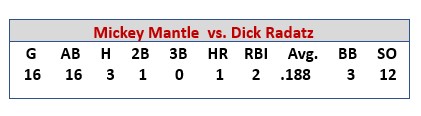
Frank Howard … The Week of the Hitter in the Year of the Pitcher

It was 1968 and, in the major leagues, pitching was dominant.  So much so, that season became forever known as “The Year of the Pitcher.”  In fact, pitchers appeared to have such an “upper” hand that MLB went into the 1969 season with a lower mound (10 inches) and a smaller strike zone.  Consider, in 1968:

  • The MLB earned run average was 2.98.
  • Six qualifying pitchers put up ERAs under 2.00.
  • Bob Gibson’s 1.12 ERA was (and still is) the fourth-lowest in MLB history (and was the lowest since 1914).
  • Only six qualifying hitters hit .300 or better.
  • Carl Yastrzemski won the AL batting title with a .301 average, and a .274 average was good enough for the AL top ten.
  • Denny McLain won 31 games, becoming the first 30-game winner since 1934 (Dizzy Dean).
  • Pitchers Denny McLain (Tigers) and Bob Gibson (Cardinals) won the AL and NL Cy Young and MVP awards, respectively.

.

In 1968, there were 339 shutouts in MLB – with 20.9  of the season’s losses (or victories,   depending on which side you are on) coming in whitewashings.

I could go on, but you get the idea.

Yet, somehow – in the midst of all this pitching dominance – the Washington Senators’ big (6’8” – 260-lb.) OF/1B Frank Howard put together one of the most explosive offensive weeks in MLB history. From Sunday May 12 through Saturday May 18, in just 25 plate appearances (in six games), Howard banged out thirteen hits – including ten home runs and one double – and drew one walk (for a .542 average).  He also scored ten times and drove in 17 tallies. Side note: Surprisingly, the Senators went 3-3 over Howard’s streak.  Howard’s ten home runs remain MLB’s record for home runs in a week.  

Howard’s game lines during the streak looked like this:

  • May 12 … two-for-four, two runs scored, two RBI, two home runs.
  • May 14 … three-for-four, two runs scored, three RBI, two home runs.
  • May 15 … two-for-four, one run scored, two RBI, one double, one home run.
  • May 16 .… two-for-four, two runs scored, four RBI, two home runs.
  • May 17 … one-for-four, one run scored, two RBI, one home run.
  • May 18 … three-for-five, two runs scored, four RBI, two home runs.

Howard picked on some pretty good hurlers during his streak.  Three of the long balls came off the Tigers’ Mickey Lolich,  who went 17-9, 3.19 on the season and won three games in the 1968 World Series. Another pair of the record-setting round trippers came off “Sudden” Sam McDowell, who – while he only went 15-14 that season – put up a 1.81 earned run average and led the AL with 283 strikeouts.   Howard also showed he could “hit ‘em anywhere.” Only two of the ten long balls came at home – and his streak also included home runs in Boston, Cleveland and Detroit.

Howard came into the streak with a.300 average on the season (which he raised to .347 during the six games). Notably, he didn’t “come in hot,” he had  just three hits (.130 average) over his previous six games.

All-Around Athlete

Frank Howard was All American in both baseball and basketball for Ohio State University – and still holds the Ohio State record for rebounds in a game at 32.

Howard was signed out of Ohio State University by the Dodgers. The 21-year-old began his professional career in 1958 – with the Class B Green Bay Blue Jays, where he hit .333, with 37 home runs and 119 RBI in 129 games, was named the  Three-I League MVP and began building his reputation for hitting the ball hard and far.  (Today’s exit-velocity fans would have loved him.)  That performance earned him a September call up to the Dodgers, where he hit .241, with one long ball in eight games.

His early career did feature a few “ups and downs.”

In 1959, Howard began his season with the Double-A Victoria Rosebuds (Texas League), where he raked at a .371-27-79 pace over 63 games – earning a mid-June call up to Los Angeles. That stay lasted only about a week, during which Howard went 2-for-19 (.105).  He was sent down to Triple-A Spokane, where he continued to dominate minor-league pitching, with a .319-16-47 line in 76 games. That earned him another call up and he went one-for-two (with a home run) in two September pinch-hitting appearances.

Howard again started the season at Spokane in 1960, hitting .371-4-24 in 26 games and earning a May call up.  For LA, he hit .268-23-77 in 117 games, earning National League Rookie of the Year honors. (For those who like to know such things, the Phillies’ Poncho Herrera finished second in the ROY balloting and  Howard’s teammate Tommy Davis finished fifth.)

That One’s Outta Here

In the fourth game of the 1963 World Series, Frank Howard became the first player to hit a home run into Dodger Stadium’s loge level (upper deck) in left field – a feat that wouldn’t be matched for four decades.

Howard stayed with the Dodgers through the 1964 season, showing solid, but not spectacular power (.271-98-297 in four seasons … 1961-64). His best campaign for LA came in 1962, when he hit .296, with 31 home runs and 119 RBI (going .297-20-71 in 76 games after the All Star break). In December of 1964, he was sent to the Washington Senators as part of a seven-player trade.

Frank Howard Knocks Out Duke Snider

In the fifth inning of a September 16, 1958 game against the Reds, with Duke Snider leading off third base, Frank Howard hit a rocket (foul) down the third base line.  The ball hit Snider on the shoulder and ricocheted the bottom his helmet – knocking Snider out and ending his season.

It was in Washington that Howard seemed to refine his uppercut swing and  his bating eye  (he often credited Gil Hodges, Jim Lemon and Ted Williams for the tutelage) and finally reach his “big man” potential. The 1967-1971 seasons (ages 30-34) were clearly Howard’s best in the majors.  In that five-season span, he made four All Star teams and hit .278, with 198 home runs and 515 RBI. He topped 40 home runs in three straight seasons (1968-70) and also topped 100-RBI in each of those campaigns. Howard led the AL in long balls in 1968 and 1970, as well as in RBI in 1970.

In Washington, “Hondo” Howard became known as “The  Washington Monument” and the “Capitol Punisher” – one of the game’s most powerful hitters and a true second-deck threat.  He also continued his reputation as one of the game’s  most popular, humble, gracious and accommodating  stars.

He’ s the most pleasant giant of a man I know.

Dusty Baker about Frank Howard

Howard ultimately played in 16 MLB seasons (1958-73 … Dodgers, Senators, Rangers, Tigers).  He put up a .273-382-1,119 stat line. Howard hit 30 or more home runs in five seasons and drove in 100+ runs in four.  The four-time All Star also led his league in total bases twice, slugging percentage once, walks once, intentional walks twice and, as noted earlier, home runs twice and RBI once.

“No one hit the ball harder than Frank Howard. He was the strongest I ever saw.  I saw him hit a line drive off Whitey Ford at the (Yankee) Stadium that Whitey actually jumped for, it was hit that low.  It ended up hitting the speakers behind the monuments in dead center.

                                                                                  Mickey Mantle about Frank Howard

No one pitcher took more punishment from Howard then the Orioles’ three-time All Star Dave McNally. In 35 games over nine seasons, Howard hit .336 against McNally with 13 home runs and 24 RBI (his most HR and RBI versus any MLB pitcher).  Still, he seemed to have an even greater affinity for the offerings of Bob Hendley (Brewers/Giants).  In just 16 games against Hendley, Howard hit eight home runs and drove in 16 tallies (with a .366 average).

Sam McDowell seemed most prone to pitch around the big guy. In 28 games (95 plate appearances), McDowell walked Howard 25 times (26.3 percent of those plate appearances). That figure includes  nine intentional passes – the most any pitcher awarded to Howard. (The 25 total walks were also Howard’s high against any pitcher.)

Howard’s lowest batting average (minimum 25 at bats) versus any pitcher came against the Orioles’ Tom Phoebus  at .083 (3-for-36, although two of the three were home runs). Notably, Jim Maloney, Reds and Angels, held Howard to a .118 average over 12 games and fanned him in 50 percent of  the times he faced him (17 whiffs in 34 plate appearances).

Primary Resources: Baseball-Reference.com; “Frank Hondo Howard – The Gentle Giant,”  LADodgerTalk.com, August 21, 2020; “The Dodgers Troubled Giant.”  Sports Illustrated, May 25, 1964;  “IT’S OUTTA HEEERRE!!: A New Generation of Sluggers Invites Tape-Measure Comparisons,” Los Angeles Times, June 21, 1986.


STILL TIME TO VOTE IN BASEBALL ROUNDTABLE’S HALL OF FAME FAN BALLOT.

The Baseball Roundtable (unofficial) Baseball Hall of Fame Fan Ballot is open until December 28, still plenty of time to vote.  To access the ballot click here. For a look at the thirty candidates (and some Roundtable predictions), click here (there are also links to the ballot the bio/prediction post.) For a report on early voting, click here. 


100Baseball Roundtable is on the Feedspot list of the Top 100 Baseball Blogs.  To see the full list, click here.

I tweet baseball @DavidBBRT

Follow/Like Baseball Roundtable’s Facebook Page here.  More baseball commentary; blog post notifications; PRIZES.

Member: Society for American Baseball Research (SABR); Negro Leagues Baseball Museum; The Baseball Reliquary. 

Preliminary Baseball Roundtable (unofficial) Hall of Fame Fan Balloting Report

As Baseball Roundtable’s awaits today’s announcement of the Hall of Fame Golden Days and Early  Baseball Era Committee balloting, I decided to pass time taking a look at early voting in the Baseball Roundtable Baseball Hall of Fame (unofficial) Fan Balloting (reader votes on the thirty candidates being considered by the Baseball Writers Association of America -BBWAA).   (Note: If you are interested in Baseball Roundtable’s take on the Golden Days and Early Era  Committee candidates, click here for Golden Days and here for Early Baseball.

Now, for a look at the Roundtable Fan ballot among traditional candidates.

BBRT Fan Ballot Still Open

The Baseball Roundtable (unofficial) Baseball Hall of Fame Fan Ballot is open until December 28, still plenty of time to vote.  To access the ballot click here. For a look at the thirty candidates (and some Roundtable predictions), click here (there are also links to the ballot the bio/prediction post.)

With 32 votes now in, readers have voted for an average of 6.8 candidates per ballot. At this point, only David Ortiz (83.8 percent) is running ahead of the 75 percent needed for election in the BBWAA) official balloting.  It appears fans are giving Ortiz the benefit of the doubt for a positive (but possibly erroneous) 2003 PED test.  Ortiz is one of only six candidates polling more than 50 percent in the reader balloting.  Here are the current top ten:

  • David Ortiz (83.9%)
  • Jeff Kent (61.3)
  • Roger Clemens (58.1)
  • Billy Wagner (58.1)
  • Barry Bonds (51.6)
  • Todd Helton (51.6)
  • Andy Pettitte (48.4)
  • Alex Rodriguez (48.4)
  • Omar Vizquel (45.2)
  • Scott Rolen (35.4)

A few other observations:

Fan voters appear to be taking Curt Schilling’s request to be taken off the ballot seriously.  In fan voting, he dropped from 51.4 percent a year ago, to 22.8 percent so far in this year’s unofficial balloting. Roger Clemens and Barry Bonds are both above 50 percent, but do not seem to gaining traction (in the Roundtable fan ballot or among the BBWAA voters).  Clemens did have an unexplained “blip” in Roundtable balloting.  His vote total in the fan ballot over the past five years:  50.2 percent; 44.8 percent; 46.9 percent; 24.3 percent; and 58.1 percent this year.
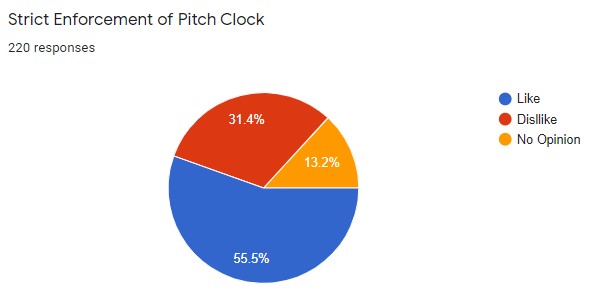
Among first-year candidates, David Ortiz and Alex Rodriguez currently lead among Roundtable vote-casters (first-time HOF candidates occupy eight of the nine bottom slots on the preliminary Roundtable balloting.

The Baseball RoundTable unofficial fan ballot also asked voters to indicate players not on the ballot that they through belong in the Hall.  Leading the way thus far, with six mentions, is Jim Kaat. Next comes a group with three mentions each: Gil Hodges, Pete Rose and  Joe Jackson. At two mentions are Tony Oliva, Don Baylor, Bobby Grich and Don Mattingly.  (A full list of those mentioned at least once will be included in a future post.)

Here are the Baseball Roundtable reader votes so far.

Baseball Roundtable 2022 (unofficial) Baseball Hall of Fame Fan Ballot

As of December 4 – Voting open through December 28.

Again, to access the ballot, click here.  For a deep dive into the thirty candidates, click here. 


Primary Resources: National Baseball Hall of Fame; Baseball-Reference.com; Baseball-Almanac.com

100Baseball Roundtable is on the Feedspot list of the Top 100 Baseball Blogs.  To see the full list, click here.

I tweet baseball @DavidBBRT

Follow/Like Baseball Roundtable’s Facebook Page here.  More baseball commentary; blog post notifications; PRIZES.

Member: Society for American Baseball Research (SABR); Negro Leagues Baseball Museum; The Baseball Reliquary.