2012 Early Season Surprise – Albert Who-Jols? And a bit of history … the last .300 hitting team.

Eleven games into the season, the now Pujols-less Cardinals are riding high (8-3, first place) and leading the National League in Batting Average (.293), Hits (114), Runs (59), HRs (16) and RBI (59), as well as On Base and Slugging Percentage.  Pujols, meanwhile, is hitting .267 with no HRs and 4 RBI in 45 at bats (his longest streak of season-opening at bats without a long ball).  BBRT thinks this puts Pujols on a pace for 37 HRs – realistic math versus actual math.

Among the key Cardinal contributors:  Matt Carpenter (.409-1-11); David Freese (.371-3-11); Carlos Beltran (.351-4-5); and Yadier Molina (.324-3-10).  Clearly these Redbirds have picked up the slack.

A little bit of history from the BBRT “Baseball Geezer.”

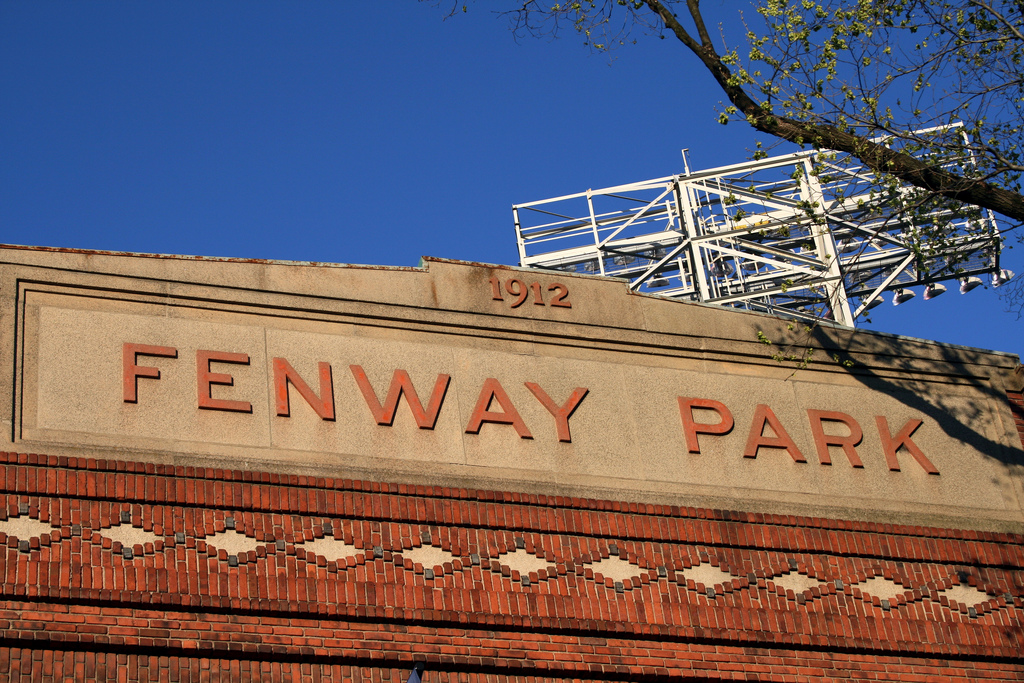
Even a .300-hitting team couldn't bring a pennant to Fenway.

Hot hitting does not always bring pennants.  Consider the 1950 Boston Red Sox – the last major league team to average .300 for a season (.302).  On any given day, that line-up featured 7 or 8 .300 hitters, and the lowest average among regulars was .294.   And there was Billy Goodman, who won the league batting title with a .354 average, but did not have a “regular” spot in the field.  In the course of the season, Goodman played OF, 1B, 2B, 3B and SS.   The Sox finished first in Batting Average, led the league in Runs Scored, finished second in HRs and finished third (behind the Yankees and Tigers) at 94-60.

The hard-hitting line-up:

C             Birdie Tebbets                   .310

1B           Walt Dropo                        .322

2B           Bobby Doerr                      .294

3B           Johnny Pesky                    .312

SS           Vern Stephens                  .295

LF            Ted Williams                     .317

CF           Dom DiMaggio                  .328

RF           Al Zarilla                           .325

UT          Billy Goodman                   .354


The team closest to .300 in the .2000s?  Only 3 teams have reached the .290 mark – the 2000 Rockies (.294); 2001 Rockies (.292); and the 2007 Yankees (.290).

Tom Cheney’s 21 Strikeouts – What Pitch Count?

With the Washington Nationals pitching staff leading the NL in ERA (see post of April 15) and putting the Nats in first place, it seems a good time to reflect on Washington Senators’ Tom Cheney’s record-setting performance of September 12, 1962.  On that day, Cheney set the major league’s single game record for strikeouts, with 21 Ks in a 16-inning complete game 2-1 win over the Orioles.

Cheney’s line included just the one run, on 10 hits, with 4 walks and 21 punch outs.  Notably, Cheney – who threw 228 pitches – seemed to get stronger as the game progressed, holding the Orioles hitless (with 10 Ks) over the final eight innings.

Cheney’s inning-by-inning strikeouts:

1st-0; 2cnd-1; 3rd-3; 4th-1; 5th-3; 6th-1; 7th-0; 8th-2; 9th-2; 10th-2; 11th-2; 12th-0; 13th-0; 14th-2; 15th-1; 16th-1.

Cheney was 5-8 going into the game, with 3 complete game shutouts.  He  finished the year 7-9, with a 3.17 ERA and 147 Ks in 173 innings.

Cheney’s 21 Ks, by the way, are  not the “professional” record.  The record for strikeouts in a professional game belongs to Mario Picone. On June 15, 1944, the 18-year-old right-hander went 19 innings for the Bristol (Virginia) Twins (Class D, Appalachian League) in a 3-2 complete game win over the Johnson City Cardinals – whiffing 28 batters in the process. While Picone had a successful minor league career (13 seasons, 129-98, 3.95), in three MLB campaigns, he went 0-2, 6.30.

BBRT Note: Bristol may, indeed be the strikeout capitol of baseball. On May 13, 1952, the Bristol Twins’ Ron Necciai tossed a no-hitter, and set the record for whiffs in a nine-inning game with 27 punch outs. He followed that performance with a 24-strikeout, 2-hitter in his next start.  Later that season, Necciai was called up to the Pirates, where he went 1-6 with a 7.08 earned run average – before his career fell victim to stomach ulcers and a torn rotator cuff.

Timing Can Be Everything

Timing can be everything, just ask Minnesota Twins’ reliever Jeff Gray.  On April 11th, Gray came in and threw one pitch (inducing a groundout by the Angels Peter Bourjos) to end the seventh inning with the Twins trailing the Angels 5-3.  The Twins scored 3 in the bottom of the inning to take the lead, and held on to give Gray a one batter-one pitch victory.  The very next day, Gray came in with two outs in the eighth and the Twins again trailing the Angels (7-6).  This time, he took two pitches to get Howie Kendrick to ground into an inning-ending fielder’s choice.  The Twins came back with four runs in the bottom of the inning and eventually won 10-9, giving Gray a one batter-two pitch victory.  Two days, two batters, three pitches – and two major league wins.  Now that’s timing.

Gray still has a long way to go to match Pirates reliever Elroy Face when it comes to timing, however.  In 1958, Face set the record for winning percentage for a hurler with at least 15 decisions (.947) going 18-1, with 20 saves, all in relief.  Face didn’t lost his first game until September 11, when he was 17-0 on the season.   For the year, Face appeared in 57 games, throwing 93 innings

Why We Go To The Ball Park!

Attended my first game of the 2012 season yesterday – my Twins versus the Angels at Target Field – and was reminded once again of why we go to the ball park.

First completed scorecard of 2012 ... for more on how BBRT feels about an accurate scorecard, see number five in the Ten Reasons Why I Love Baseball post of March 28, 2012.

It all starts with the camaraderie.  My little group of 20-somethings  included: my daughter, who has been going to games and keeping the scorecard since she was nine-years-old (and has to get there early enough to get all the “snacking” out of the way before we get down to the serious business of watching the game); my son-in-law, who is new to this country (and baseball), a soccer fanatic, player and coach and, who after just two ML games, defended baseball as the national pastime – commenting that “There is so much drama in baseball”; and my co-worker, who still asserts that the Twins/Tigers 2009 “Game 163” matchup for the Al Central crown (which we attended together) represents the greatest day of his life.

There was also the crowd in our section, many keeping meticulous scorecards and debating such topics as whether the Twins should pitch to Pujols in the eighth inning of a one-run game and why Twins’ manager Ron Gardenhire didn’t replace Ryan Doumit (C-1B-OF-DH) with the speedier Ben Revere in right field in the ninth.  

Then there is the game itself.  For the diehard fan, there is something memorable at EVERY game and this one was no exception.

  • The winless (0-4) Twins beat the Angels (and their “ace” Jered Weaver), 6-5 – scoring as many runs in this game as they had in the previous 4.
  • There were plenty of lead changes.  The Angels took the first lead of the game 1-0 in the top of the fourth; The Twins took their first lead of the season (3-1) in the bottom of the inning; the Angels came back to lead 4-3 in the top of the fifth and added an insurance run in the top of the seventh; the Twins came back with three in the bottom of the seventh to take back the lead (6-5).
  • There was a “traditional” 407-foot home run by the Twins Josh Willingham and a 14-second, inside-the-park homer by Pete Bourjos of the Angels.
  • The winning and losing pitchers each faced only ONE BATTER; and the winner, Jeff Gray, threw only ONE PITCH, inducing a groundout to third by the speedy Bourjos.  (The losing hurler, Hisanori Takahashi, gave up a triple to Twins first baseman Chris Parmalee – who scored the winning run – on an 0-2 count.)
  • Albert Pujols was caught in a five-throw rundown between first and second.
  • With fans looking for the “semi-intentional” walk to Pujols in the eighth inning of a one-run ball game, Twins’ fireballer Glenn Perkins struck him out. 

Finally, the game is etched into history by my accurately kept scorecard (for more on how BBRT feels about an accurate scorecard see reason number Five in the Ten Reasons Why I Love Baseball post.  There a links to the post at the top the blog or on the right hand side).

All this and it’s only the fifth game of the season.  It’s going to be a great seven months.

3 Games In – 3 Games Out. Ouch!

"21" was not lucky for the Baltimore Orioles

After the first weekend of the 2012 MLB season, five teams stand at 0-3:  Yankees; Giants; Red Sox; Braves; and Twins (listed in order of BBRT surprise at the slow starts).  All five are the maximum 3 games behind the leaders.

Still, they all have a long way to go to match the 1988 Baltimore Orioles for the worst start in baseball history.  That year the Orioles lost their first 21 games, capturing their initial win of the season (9-0 over the White Sox) on April 29.  The O’s gave indications something momentous could be on the horizon, being outscored 30-2 over their first four games.  They went on to be outscored 129-44 in their record- setting, season-opening losing streak.  The streak included only 4 one-run losses (three in a row April 14-16, losses 9-11).  Eight of the 21 losses were at home, sparing the Baltimore fans, particularly since losses 13-21 were on the road.  The O’s finished the year 54-107, 34 ½ games off the pace.

Back to 2012, our five winless teams, as might be expected, are finding lots of different ways to drop games.  Consider Sunday’s losses, the third for each team.

Baltimore’s Jason Hammel took a no-hitter into the eighth inning, as the Orioles topped the Twins 3-1.

Boston blew a 10-7 ninth-inning lead, before losing to Detroit 13-12 in eleven innings.

San Francisco led 6-0 after three innings, but lost 7-6 to Arizona in a game that featured 8 errors, but no unearned runs.

Jeremy Hellickson came within one out of a complete game shutout as the Rays beat the Yankees 3-0 in an errorless game.

The Braves lost in a more traditional/predictable manner, trailing the Mets 7-0 after six innings (but coming back to make the final score 7-5).

Dunn Ties Opening Day Mark – In Some Powerful Company

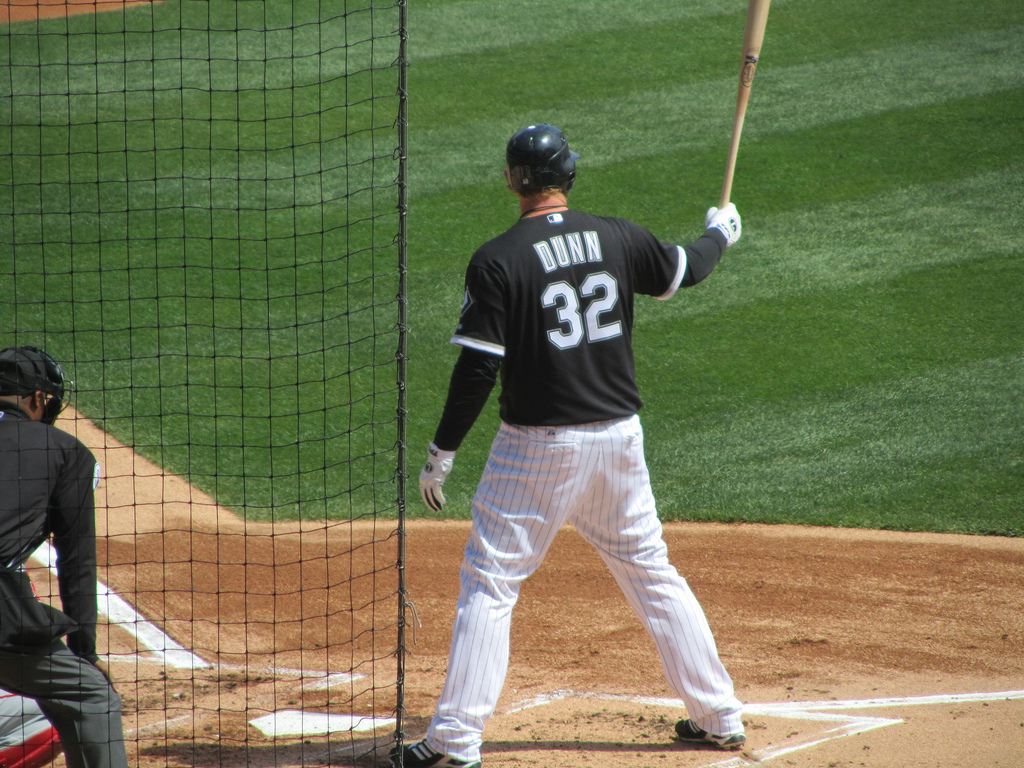
Adam Dunn of the White Sox tied the major league record for career  Opening Day home runs (eight) as Chicago lost to Texas on April 6.  Dunn moved into some powerful company, as he now shares the record with Hall of Farmer Frank Robinson and future Hall of Famer Ken Griffey, Jr.   Dunn seemed an unlikely record setter, coming off a 2011 season in which he hit .159 with 11 homers and struck out in more than 40% of his at bats  (177 strikeouts in 415 at bats in 122 games). 

Dunn’s fast start follows a strong spring, in which his off season regimen seemed to pay off – and which may see the imposing (6’6”, 275) slugger begin to pay dividends on his four-year, $56 million contract with the Chisox.  There is good reason to believe in the comeback, as Dunn entered the 2012 season with 365 career roundtrippers and five seasons of forty or more home runs.

So, Dunn is clearly not the most unlikely Opening Day record-setting slugger.  That honor goes to Karl “Tuffy” Rhodes, who shares the single game HR record for Opening Day with three dingers for the Cubs on day-one in 1994. Rhodes hit 13 home runs in his  six-year career and he hit a season high of 8 HRs in 1994.

Looking deeper into Dunn’s record, he has gone deep in six Opening Day games – and shares the record (at two) for multiple home run openers.  Robinson and Griffey each homered in eight openers to earn their share of the record.

Let’s look at some of the Opening Day record holders.


Three HRs in one opener:

George Bell, Toronto Blue Jays, 1988 … Career HRs – 265; Single season high – 47 HRs (24 in 1988).

 Karl Rhodes, Chicago Cubs, 1994 … Career HRs – 13; Single season high – 8 HRs (8 in 1994).

 Dmitri Young, Detroit Tigers, 2005 … Career HRs – 171; Single season high – 29 (21 in 2005).


Multiple Home Runs (2 HRs in each instance) in a season opener more than once:

Eddie Mathews, Milwaukee Braves, 1954, 1958 … Career HRs – 512; Season high – 47.

 Joe Torre, Milwaukee Braves, 1965; Atlanta Braves, 1966 … Career HRs – 252; Season high – 36.

 Juan Gonzalez, Texas Rangers, 1993; Cleveland Indians, 2001 … Career HRs – 434; Season high – 46.

Raul Mondesi, LA Dodgers, 1995, 1999 … Career HRs – 271; Season high – 33.

Adam Dunn, Cincinnatti Reds, 2005, 2007 … Career HRs – 364 (entering 2012 season); Season high – 46.

 Xavier Nady, San Diego Padres, 2005; Pittsburgh Pirates, 2008 … Career HR – 97 (entering 2012 season); Season high – 25.

Albert Pujols, St. Louis Cardinals, 2006, 2010 … Career HRs – 445 (entering 2012 season); Season high – 47.

Happy Opening Day!!!

Baseball RoundTable’s “Happy Opening Day” gift to all our fans.  For those who love baseball, this may be as funny as it gets.  Enjoy!!!

Triple Crown = MVP? Not always.

The Triple Crown (Batting Avg. – HRs – RBI) … Does it spell “R-E-S-P-E-C-T?”  Not if respect is spelled MVP.


Matt Kemp came close in 2011, but MLB has had only 15 Triple Crown winners
– from Paul Hines of Providence in 1878 to Carl Yastrzemski of the Red Sox in 1967.   There have been nine Triple Crown winners since the Baseball Writers Association began voting on the Most Valuable Player award in 1931 and only five of those nine were honored as MVPs.   Let’s take a look at those who didn’t get votes, in order of the “level of injustice.”


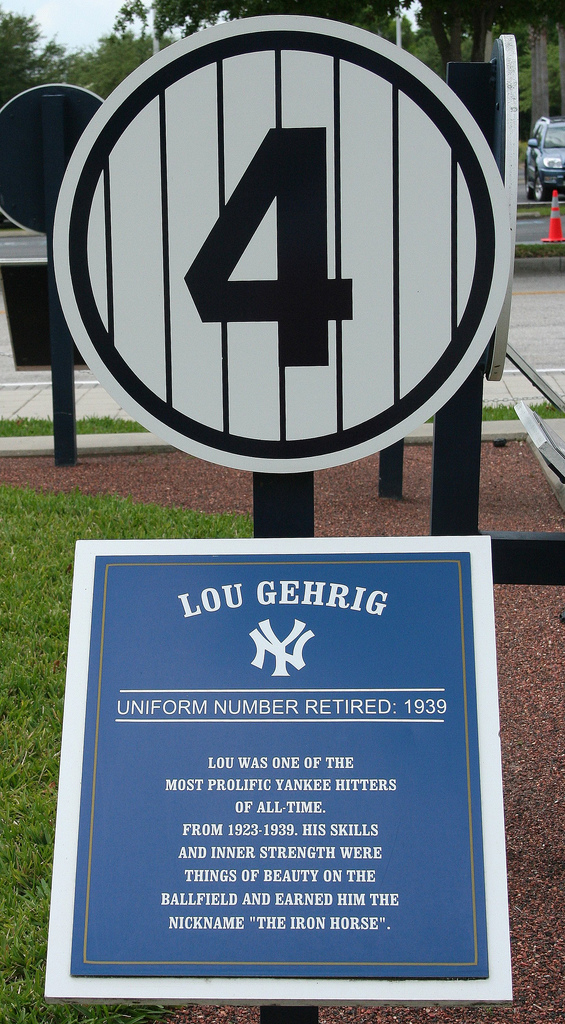
1.  Lou Gehrig, Yankees, 1934.

Gehrig’s .363 – 49 – 165 not only topped the American league in Average, HRs, and RBI, he finished ahead of the NL leaders in all three categories as well.  (Gehrig is one of only five players to win the “Major League Triple Crown.”)   Gehrig also led both leagues in on base percentage, slugging percentage and total bases.  But that’s not what earns him a five-star injustice rating.  Despite capturing the Triple Crown, Gehrig finished a distant FIFTH in the AL MVP voting; behind three members of the pennant-winning Tigers (the Yankees finished, 94-60, seven games out.)

The MVP winner, Detroit catcher Mickey Cochrane, ran up a .320 – 2 – 76 total and did not lead the league in a single offensive category.   Others finishing ahead of Gehrig were Detroit second basemen Charlie Gehringer (at .356 – 11 – 127 and the AL leader in runs and hits,  also probably more deserving than Cochrane); Yankee hurler  Lefty Gomez (26-5, 2.33 era, who led the league in wins, ERA, complete games, shutouts, and innings pitched); and Detroit pitcher Schoolboy Rowe (24.-8, 345).

2.  Ted Williams’ 1942 season earns him second place on the lack-of-respect list among Triple Crown winners. 

In 1942, the Splendid Splinter led both leagues in all three Triple Crown categories (.356 – 36 -137), as well as in runs scored, on base percentage, slugging percentage, total bases and bases on balls.

This dominance earned him a second place finish in the MVP balloting (Boston also finished second, to the Yankees, at 93-59, nine games behind).  The MVP winner?  Yankee second baseman Joe Gordon (.322 – 18 – 103), who led the league in two offensive categories, strikeouts and grounding into double plays.  Williams, like Gehrig, earns a five-star injustice rating.

3.  Ted Williams gets a three-star injustice rating for his 1947 Triple Crown year.

This is not so much because of a lack of respect for his dominance, but because it was the second time he earned the Triple Crown, but was denied the MVP.  In 1947, Williams led the AL with .343 – 32 -114, and also led in runs scored, bases on balls, on base percentage and total bases.   The MVP winner was Yankees’ centerfielder Joe DiMaggio (the Yankees won the pennant, Boston finished third, fourteen games out.)  DiMaggio’s season totals were .315-20-97 and he finished in MLB’s top five in runs, runs batted in, hits, total bases, doubles and triples – trailing Williams, however, in all but triples.  Still, not a major “disrespect,” unless you pile it on top of the 1942 voting.

4.  Chuck Klien is the fourth Triple Crown winner to be denied an MVP award.

Klien, however, was probably not surprised.  First, Triple Crowns were a bit commonplace that year – 1933 – the only season in which both leagues boasted a Triple Crown winner.  They were even from the same city, Jimmy Foxx of the Philadelphia Athletics and Chuck Klien of the Phillies.  Foxx got his MVP, despite the As third-place finish (79-72, 19.5 games behind), but Klien was hurt by the Phillies 60-92 record and seventh place finish (31 games behind the NY Giants).  Klien finished at .368 – 28 – 120, also leading the league in hits, doubles, on base percentage, slugging percentage and total bases.  The MVP went to Carl Hubbell of the pennant-winning Giants, who pitched his way to a 23-12 record and a 1.66 ERA – leading the NL in wins, ERA, shutouts and innings pitched.

BBFF – Talkin’ Baseball and “Lord Charles”

BBFF … Yes, baseball will be your friend forever, but in this case the FF is “fun facts.”  This one is about talkin’ baseball.

Here are a few baseball terms for the curve ball.  Toss ’em into your conversation at the old ballyard.

Yakker, Hook, Bender, The Old 12 to 6.  These are the basics, you can’t go wrong with these.

Deuce.  Named for the two fingers catchers have long used to signal the curve.  Takes your baseball personna up just a notch.

Uncle Charlie – a good curve; Lord Charles – a great curve.   Brings a little extra snap to your comment.

BBRT would add two more:  The “Bertie,” the “Holland Hook,” or the “Prince Aalbert” – acknowledging the “Lord Charles” that took Bert Blyleven to the Hall of Fame.