Dingers by the Decade

In 1920, Yankee slugger Babe Ruth out-homered every other AL team.

Pirate rookie outfielder Ralph Kiner won the NL home run crown as rookie in 1946 – and then went on to hold the crown for a record seven consecutive seasons.

Mark McGwire is the only player ever traded in the midst of a 50+ homer season.

Reggie Jackson is the only member of the 500-HR club to never have back-to-back seasons of at least 30 homers.

Eddie Murray’s career high in home runs was 33, the lowest for any member of the 500+ HR club.

You’ll come across these tidbits and more in this post, as BBRT looks at MLB home runs leaders by numerical decade, in any ten-year span and over the first ten years of an MLB career.  In the lists that follow, Hall of Famers are noted in bold face and career homers are noted in parentheses.

Decade-by- Decade Home Leaders


1870-79

Lipman Lip Pike                       21 (21)

Outfielder-first baseman Lip Pike is generally acknowledged as the leading major league home run hitter of the 1870s, with 21. Playing for the National Association’s Troy Haymakers, Baltimore Canaries, Hartford Dark Blues, Saint Louis Brown Stockings, Cincinnati Reds and Providence Grays, Pike led the league in home runs in 1871, 1872, 1873 and 1877.  Pike is also recognized as one of the game’s first “professional” players – accepting a salary to play baseball as early as 1866 (a reported twenty dollars a week from the Philadelphia Athletics). With the National Association of Professional Base Ball Players (NAPBBP), founded in 1871, considered the first professional baseball league, Pike ico-holds the title of professional baseball’s first-ever home run champion – with four home runs in 1871 (tied with Chicago’s Treacey and Philadelphia’s Levi Meyerle).

1880-89

Harry Stovey                              89 (122)

Dan Brouthers                          77 (106)

Fred Dandelion Pfeffer                 71 (94)

Jerry Denny                               70 (74)
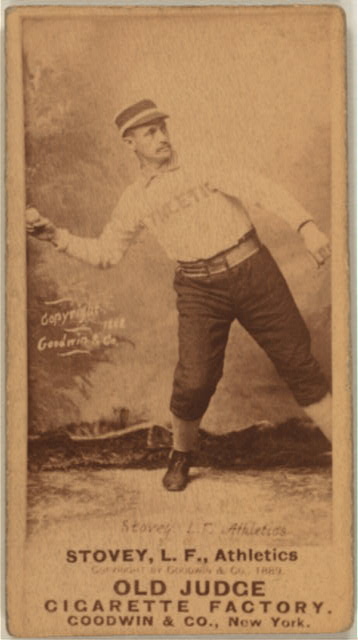
StoveyPhiladelphia Athletics OF-3B Harry Stovey tops the list for the 1880s, leading the NL in homers once and the then major league American Association three times in the decade, with a high of 19 in 1889. Stovey was also considered one of the best defensive outfielders and top base-stealers of his time, and has been credited with popularizing the feet-first slide and inventing protective sliding pads.

Number two on the list, Dan Brouthers, was the first player (along with Jim O’Rourke) to appear in a major league game in four different decades.

Number three, Cubs second baseman Fred Pfeffer was never a league leader in home runs, but did rap a career-high 25 homers in 1884, when teammate third baseman Ned Williamson hit 27 dingers.  Only five times did a player reach the twenty-home-run mark in a season during the 1880s – and four of those campaigns were recorded for the 1884 Cubs: Williamson, Pfeffer, first baseman Abner Dalrymple (22) and outfielder Cap Anson (21).  The other 20-homer season belonged to Philadelphia’s (NL) Sam Thompson, who hit 20 HRs for the Quakers in 1989.

1890-99

Hugh Duffy                               83   (106)

Ed Delahanty                           79   (101)

Mike Silent Mike Tiernan            77  (106)

Sam Thompson                       75   (126)

Boston outfielder/shortstop Hugh Duffy tops the 1890s list, and led the NL in home runs twice in the decade – including a career-high 18 in 1884, when he also led the NL with a .440 batting average; the highest single season average in MLB history.

Outfielder/first baseman Ed Delahanty comes in a close second – and finished with double-digit HRs seven times in the 1890s, winning the HR title twice.

Both Mike Tiernan and Sam Thompson were two-time HR champions during the decade.

1900-09

Harry Davis                              67 (75)

Charles Hickman                      58 (59)

Wahoo Sam Crawford            57 (97)

John Buck Freeman                 54 (82)

Ralph Socks Seybold               51 (51)

Honus Wagner                       51 (101)

Harry Davis, who tops the list, was a true power hitter for his time. The Philadelphia Athletics outfielder led the AL in home runs four consecutive seasons (1904-07) during the decade – with annual HR totals of 12-8-10-8.

Despite being the second most prolific power hitter of the decade, Charles Hickman was a defensive liability and played for six teams in that ten-season span – including playing for two AL teams in each of  four seasons – Boston/Cleveland in 1902, Cleveland/Detroit in 1904, Detroit/Washington in 1905, Washington/Chicago in 1907.

Reds’ outfielder Sam Crawford is best known for holding the career record in triples (309) and the single season record for inside-the-park home runs (12).

The other Hall of Famer on this list, Pittsburgh shortstop Honus Wagner never led his league in home runs (over a 21-year career), but between 1900-09 did lead the NL in doubles seven times.  Wagner was one of the five members of the Baseball Hall of Fame’s first inducted class.

1910-19

Clifford Gavvy Cravath               116  (119)

Fred Luderus                               83  (84)

Frank Home Run Baker              76  (96)

Frank Wildfire Schulte                   75 (92)

List leader outfielder Gavvy Cravath was one of only three players to top 20 home runs between 1910-19, rapping 24 for the Phillies in 1915 (Frank Schulte hit 21 for the Cubs in 1911 and Babe Ruth hit 29 homers for the Yankees in 1919). Cravath, who hit his 116 homers in 8 seasons (1912-19), led the NL in round trippers six times in that eight-season stretch.

Phillies’ first-sacker Fred Luderus had the decade’s second-most HRs, despite never leading the league, but he did hit double digits in homers for four consecutive seasons (1911-14).

Philadelphia Athletics’ third baseman Home Run Baker earned his nickname, leading the AL in HRs in four consecutive seasons (1911-14).

Cubs’ outfielder Wildfire Schulte led the NL in HRs twice in the decade, but is best known as one of only seven players (and the first) to have a MLB 20-20-20 season – in 1911 he hit 30 doubles, 21 triples and a league-leading 21 homers.

1920-29          

Babe Ruth                              467  (714)

Rogers Hornsby                     250  (301)

Cy Williams                             202  (251)
Babe Ruth

Babe Ruth

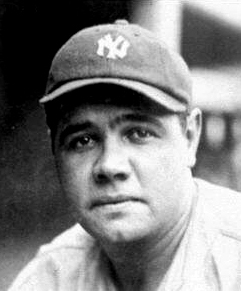
The 1920s were all about Babe Ruth, who out-homered the number-two man on the decade list by more than 200 home runs.  In 1920, Ruth broke his own season home run record of 29, crashing an unimagined 54; and he broke that record twice more in the decade. To further illustrate the Bambino’s dominance, there were fourteen 40+ homer seasons in the decade and Ruth had nine of them (as well as 7 of 8 of the 45+ homer seasons).  In 1920 and 1927, the Yankee slugger actually out-homered every other AL team.

Cardinals’ second baseman Rogers Hornsby led the NL in homers twice in the decade (42 in 1922 and 39 in 1925), but is better known for his seven batting titles in the 1920s – and for topping .400 three times.  Only Ty Cobb, Ed Delahanty and Hornsby can boast three .400+ qualifying seasons.

Phillies’ outfielder Cy Williams led the NL in home runs three times during the decade, with a career-best total of 41 in 1923.

1930-39

Jimmie Double XX Foxx       415  (534)

Lou Iron Horse Gehrig           347 (493)

Mel Ott                                   308 (511)

Jimmie Foxx manned first base, third base and catcher for the Philadelphia Athletics and Boston Red Sox during the ’30s, and nabbed four HR titles in the decade, topping 50 homers twice. During his career, he hit at least thirty homers in 12 consecutive seasons.

Yankee first baseman Lou Gehrig grabbed three AL home run titles during the same span, and while he never hit 50 HRs in a season, he did reach 49 twice in the decade.

Over in the NL, Giants’ outfielder Mel Ott captured five HR titles in the 1930s, despite never reaching forty homers in a season (he did park a career-high 42 long balls in 1929).

1940-49

Ted Williams                          234  (521)

Johnny Mize                           217  (359)

Bill Nicholson                           211  (235)

No, there wasn’t a power outage in the 1940s, there was World War II and the decade’s HR leader, Ted Williams, lost three years to military service.  In the seven seasons he did play, The Red Sox’ Splendid Splinter won four HR titles and averaged just over 33 homers a campaign.  His .406 average in 1941 marks the last time an MLB batting champion finished at .400 or better.

Number-two on the decade’s dinger list, Johnny Mize, also lost three years to military service. In the 1940s, he still managed three NL HR titles (for the Cardinals and the Giants) and hit a career-high 51 long balls in 1947.

Cubs’ outfielder Bill Nicholson rounds out the top three. Nicholson played all ten seasons (1940-49) and led the NL in home runs and RBI in 1943 and 1944. Nicholson is officially listed as one of six major league hitter to draw an intentional walk with the bases loaded (1944).  The others are Abner Dalyrmple (1881), Napoleon Lajoie (1901), Barry Bonds (1998) and Josh Hamilton (2008).

1950-59

Edwin Duke Snider                 326  (407)

Gil Hodges                               310  (370)

Eddie Mathews                       299  (512)

Mickey Mantle                        280  (536)
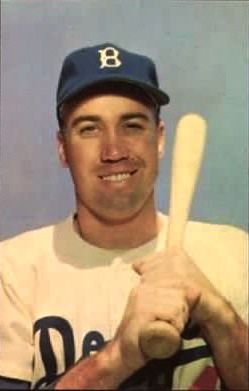
Duke Snider

Duke Snider

A pair of Dodgers topped the decade of the 1950s – centerfielder Duke Snider and first baseman Gil Hodges were number one and two in home runs – despite winning only one HR title between them (Snider with 43 in 1956).  Snider did reach 40 homers five straight seasons, collecting 207 of his round trippers from 1953 to 1957.

The Brooklyn/LA pair were followed by a couple of power-hitting future Hall of Famers in Braves’ third baseman Eddie Mathews and Yankees’ centerfielder Mickey Mantle, who came up to the majors in 1952 and 1951, respectively. Mantle won three AL HR crowns in the decade, while Mathews led the NL twice.  A couple of notes of interest, Mathews is the only player to play for the same franchise in three cities (Boston, Atlanta, Milwaukee Braves) and was on the cover of the first issue of Sports Illustrated  (August 16, 1954);  in 1997, the Topps Baseball Card company retired Mantle’s number seven from its base sets.  Topps brought number seven out of retirement in 2006, but reserves it for cards featuring Mantle.

1960-69

Harmon Killebrew                  393  (573)

Hank Aaron                            375  (755)

Willie Mays                            350  (660)

Washington Senator/Minnesota Twin Harmon Killebrew led all of MLB with 393 homers in the 1960s, topping 40 six times during the decade – in which he also led the AL in homers six times.  In 1965, Killebrew was elected to start at first base for AL All Star team, becoming the first player elected to an All Star Team at three positions (Killebrew had previously been elected to start at 3B and LF).

The number-two home run hitter of the decade was Milwaukee/Atlanta Braves’ outfielder Hank Aaron, whose 375 HRs led the NL. Hank hit 40 or more five times during the decade, capturing three NL HR titles.

Third on the list for the ’60s is Giants’ centerfielder Willie Mays, who also took three HR titles and is the only one of the top three to reach the seats 50 times in a season (52 in 1965).

1970-79

Willie Stargell                        296  (475)

Reggie Jackson                     292  (563)

Johnny Bench                        290  (389)

Pirates’ outfielder Willie Stargell won two league HR titles on his way to an MLB-tops 296 home runs in the 1970s.

Reggie Jackson, who spent time in the 1970s with the Athletics and the Yankees, finished second during the decade with 292 homers – despite never reaching forty in that ten-year span (he did top 40 twice in his career). During the decade, Jackson led the AL with 32 HRs in 1973 and 36 in 1975. On another career note, Jackson is the only member of the 500-HR club to never hit 30 or more homers in consecutive seasons.

Cincinnati catcher Johnny Bench captured two HR titles and two NL MVP awards, while hitting 290 long balls in the decade.

1980-89                      

Mike Schmidt                         313  (548)

Dale Murphy                             308  (398)

Eddie Murray                          274  (504)

Mike Schmidt was “winding down” his career in the 1980s (1989 was his last season) and would have gone well beyond his 313 HR total for the decade if it hadn’t been for reduced playing time and only 18 home runs his final two seasons.  Still, the Phillies’ third baseman did earn five of his eight home run titles and all three of his NL MVP Awards during the decade.

Braves’ centerfielder Dale Murphy finished second to Schmidt in 1980s’ long balls, with two HR titles and a high of 44 in 1987. Murphy also earned consecutive NL MVP Awards in 1982-83.

Eddie Murray won only one HR title in his career, with 22 homers for the Orioles’ in the strike-shortened 1981 season.  The switch-hitting Murray’s career high in homers in a season was 33 (in 1983), the lowest career-best for any member of the 500-HR club.

1990-99                      

Mark McGwire                          405  (583)

Ken Griffey, Jr.                         382  (630)

Barry Bonds                             361  (762)

Albert Belle                              351  (381)

The Athletics/Cardinals’ Mark McGwire topped 400 homers for the decade, despite hitting a total of only 18 in the 1993-94 seasons (when he played only 74 games). He led the league in homers three times in the decade; and led all of baseball with 58 homers in 1997, but led neither league (he was traded at the end of July after hitting 34 homers for the AL Athletics, and went on to hit 24 for the NL Cardinals). McGwire is the only player to be traded in the midst of a 50-homer season. McGwire hit 245 homers in the last four seasons of the decade, including a high of 70 for the Cardinals in 1998.  During that stretch he homered a remarkable once in every 8.5 at bats.Ken Griffey, Jr. played the entire decade with the Seattle Mariners, leading the AL in homers four times. From July 20 to July 28, 1983 Griffey homered in eight straight games, tying a MLB record (Don Mattingly/1987 and Dale Long/1956).

All-time career and single-season home run leader Barry Bonds (who patrolled the outfield for the Pirates and Giants in the 1990s) surprisingly led the NL in homers only twice in his career and just once in the decade of the ‘90s (46 in 1993).  Of course, leading the NL in walks twelve times (five times in the 1990s) may have something to do with that. Notably, Bonds is the career leader in intentional walks (688).  As of 2013, Hank Aaron ranked second (293) and still active Albert Pujols third (275).

Albert Belle played outfield/DH for the Indians, White Sox and Orioles during the 1990s.  He led the AL in home runs in 1995 – also becoming the only player to hit 50 or more doubles and 50 or more homers in the same season.

2000-09

Alex Rodriguez                        435  (654)

Jim Thome                              368  (612)

Albert Pujols                            366  (492)

The 2000s’ HR leader, Alex Rodriguez, played for three teams over the course of the decade: Seattle Mariners (2000), Texas Rangers (2001-03) and New York Yankees (2004-09). He led the AL in home runs five times in that span, topping 50 three times. In 2001, Rodriguez hit 52 home runs setting a new MLB single-season record for shortstops (the Cubs’ Ernie Banks had the previous high at 47). Rodriguez broke his own record with 57 round trippers in 2002 and remains the only shortstop to hit 50 or more homers in a season.  (His third 50-homer season – 54 HRs – came in 2007 as a third baseman.)

First baseman/DH Jim Thome spent time with four teams during the decade: Cleveland Indians (2000-2002); Philadelphia Phillies (2003-05); Chicago White Sox (2006-09); LA Dodgers (late 2009).  He won his only home run crown with the Phillies (47 HRs in 2003) and hit 52 dingers for the Indians in 2002.

Then Cardinal, now Angel, Albert Pujols started his MLB career with a bang in 2001 – collecting 37 home runs, 130 RBI and a .329 average as a rookie. For the decade, he never hit fewer than 32 home runs, plated fewer than 116 RBIs or hit under .314 in any season. He won the NL home run crown in 2009.  Now primarily a first baseman, Pujols came up as a player without a position (other than a predominant spot in the batter’s box).  In 2001, he played 39 games in left field, 39 in right field, 42 at first base and 55 at third base.  In 2002, he spent most of his time in left field, but also played first base, third base and even notched a few innings in right field and at shortstop.

Most Home Runs in Any Ten-Season Span

When you look at the most home runs in a decade from another angle (a decade being any ten-season period, regardless of dates), the results are dominated by two players from two different eras – Sammy Sosa and Babe Ruth.  The fact is, only three players have average 45 home runs a season over any ten-year span – Sosa, Ruth and Alex Rodriguez.


479 HRs       Sammy Sosa                1995-2004

469              Sammy Sosa                1994-2003

467              Babe Ruth                   1920-1929

462              Babe Ruth                   1921-1930

462              Sammy Sosa                1993-2002

457              Sammy Sosa                1996-2005

455              Babe Ruth                   1923-1932

454              Alex Rodriguez              1998-2007

450              Babe Ruth                   1919-1928

When you consider eras, Babe Ruth’s appearances on this list reflect a far greater level of dominance than Sosa’s.  In the fourteen seasons (1919-32) that make up Ruth’s four appearances on the list, Ruth led his league in home runs eleven times.  Sosa’s appearances on the list span thirteen seasons (1993-2005), during which he led his league in home runs only twice.  Sosa, in fact, is the only player to notch three seasons of 60 or more home runs – and he did not lead the league in any of those years.  Further evidence of Ruth’s dominance is that, again for the period that makes up his appearances on this list, four players racked up a total of 13 seasons of 45 or more homers – and nine of those belong to Ruth. During the years that make up Sosa’s appearances on the list, 29 players achieved a total of 58 45+-HR campaigns – and five of those belonged to Sosa.

Most Home Runs First Ten Seasons

Now let’s look at players who got a fast start on the major league slugging careers – those who averaged at least 35 home runs a year over their FIRST ten seasons.


Albert Pujols                408      2001-10     (492)

Eddie Mathews          370      1952-61      (512)

Ralph Kiner                369      1946-55    (369)

Adam Dunn                  354      2001-10    (440)

Ken Griffey, Jr.             350      1989-98     (630)

Albert Pujols

Albert Pujols

Albert Pujols came up at age 21with the Cardinals and is the only player to achieve at least 30 homers, 100 RBI and a .300+ average in each of his first ten seasons. Pujols won two HR titles in those first ten seasons, and topped 40 home runs five times.

Eddie Mathews joined the Boston Braves at age 21, hitting 25 homers as a rookie and went on to win his first HR title the following year –with 47 for the transplanted Milwaukee Braves.  He won one more HR title in is first ten seasons, hit more than 30 for nine of the ten years and topped 40 homers four times.

Ralph Kiner deserves special mention.  Kiner won the NL home run crown as a 23 year-old Pirates’ rookie in 1946 – and went on to capture the next six NL home run titles.   As the result of a back injury, Kiner retired at the age of 32 – after ten seasons split among the Pirates, Cubs and Indians.

Adam Dunn joined the Cincinnati Reds in 2001, and (at the age of 21) slugged 19 homers in just 66 games.  While Dunn has not yet won a home run title, he has been a paragon of power consistency – from 2004-2010, his yearly HR totals were 46-40-40-40-40-38-38.  In his first decade, Dunn patrolled the outfield and played some first base for the Reds, Diamondbacks and Nationals.

Ken Griffey, Jr. joined the Mariners at age 19, and didn’t get off to as fast a start as some of the others on this list – averaging just under 22 home runs a season over his first four campaigns. Between 1994 and 1998, however, he turned on the after burners – winning three AL HR titles, and topping 50 home runs twice.  In addition, the power hitting centerfielder won nine Gold Gloves in his first ten seasons.

Hope you enjoyed this look at dingers by the decade.
The Cy Young Award – Facts & Figures

On November 13, MLB announced the 2013 Cy Young Award winners – and to no one’s surprise they were the Tigers’ Max Scherzer in the AL and the Dodgers’ Clayton Kershaw in the NL. Scherzer finished 21-3, with a 2.90 ERA and 240 strikeouts in 214 1/3 innings.  His 21 victories led the AL and he also had the top winning percentage (.875).  Kershaw went 16-9, with an NL- and MLB-lowest 1.83 ERA and also led the NL with 230 K’s in 236 innings pitched. (The significance of these stats will become clear in a few paragraphs.) Scherzer became only the third starting pitcher to win the Cy Young Award without a single complete game, joining Roger Clemens (2001 & 2004) and Jake Peavy (2007).  BBRT, would like to use this post to take a look at the Cy Young Award; its heritage, historic milestones and unique “factoids.”

[Read more…]

Paul Strand – 325 Hits in a Single Season

Suppose you hit .384 in the Pacific Coast League – with 289 hits, 28 home runs and 138 RBI – and still didn’t get a call up to the major leagues.  What would you do?  Paul Strand did just that and, when he didn’t get a call up, he just went out and had a better year (in all four categories) the next season. In fact, many feel he went on to turn in one of the best – in not the best – minor league season ever.  (BBRT will give a brief nod to a couple of other outstanding minor league stat lines at the end of this post.  First, however, Paul Strand’s story.

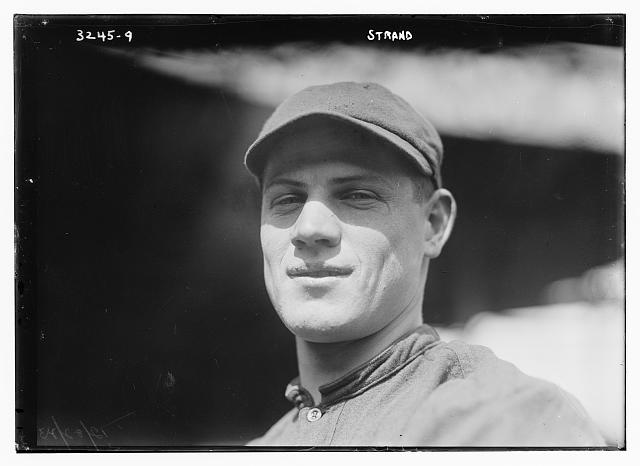
Paul Strand - 325 hits in a single Pacific Coast League Season.  Photo:  Library of Congress; George Grantham Bain Collection.

Paul Strand – 325 hits in a single Pacific Coast League Season. Photo: Library of Congress; George Grantham Bain Collection.


In 1913, 19-year-old southpaw Paul Strand – after two seasons in the Northwestern League – found himself on the mound for the Boston Braves.  Strand pitched in just 7 games and put up a 0-0 record and a 2.12 ERA.  The following season, pitching for the 1914 “Miracle Braves” surprise NL pennant winners, Strand went 6-2, 2.44.  Then in 1913, Strand’s professional baseball career took an unexpected turn. Just 21, Strand was 1-1 with a 2.38 ERA (in 6 games) when a serious arm injury marked the end his major league pitching career.  Sold to Toledo of the American Association, Strand converted to the outfield, but hit only .215 in 61 games.

The 6’, 190-pounder didn’t give up, but honed his hitting skills while bouncing around the minor leagues (Toledo, Seattle, Peoria, Joplin, Yakima) before joining the Pacific Coast League’s Salt Lake City Bees early in the 1921 season.

Note:  Strand did not immediately abandon the mound.  In 1916-17, in addition to taking a spot in the outfield he went 16-12 as a pitcher (Toledo Iron Men and Seattle Giants), including a perfect game for Seattle on May 13, 1917 – a 1-0 win  over the Spokane Indians. His advancing offensive skills, however, eventually made him a full-time position player. 

It was with Salt Lake City that Strand made professional baseball history, putting together perhaps the best minor league season ever and earning both a spot in the Pacific Coast League Hall of Fame and a return (if brief) to the major leagues.  It began somewhat quietly. In 1921, in 157 games (for Seattle and Salt Lake City), Strand hit .314, with nine homers and 95 RBI. But the PCL rocket was just leaving the launching pad.

Playing solely for Salt Lake City in 1922, Strand led the league in hits, home runs and batting average.  Strand’s stat line looked like this:

G       AB    R       H     2B  3B    HR    RBI   Avg.     SB

178*   752   138   289   52   13    28     138   .394     10

*The PCL, at the time, regularly played 200 games or more (a high of 230 for the 1905 San Francisco Seals.)

Surprisingly, those numbers did not earn the 28-year-old Strand a call to the majors.  More surprisingly, Strand’s best performance was yet to come.  In 1923, still with Salt Lake City, he had what some have called the best minor league season ever – topping his 1922 performance in every offensive category except triples (he hit 13 triples in each season).   In fact, that year Strand set (and still holds) the professional baseball record for base hits (325) in a season.  He also rapped 43 homers, scored 180 runs, drove in 187 and stole 22 bases.  Here’s Strand’s 1923 stat line:

G       AB    R       H    2B  3B   HR    RBI    Avg.   SB

194   825   180   325   66   13    43     187   .394    22

That second consecutive eye-catching season, actually did “catch the eye” of several major league teams.  Ultimately, the Philadelphia Athletics Connie Mack offered Salt Lake City three players and cash that was reported at $100,000 to secure the hot-hitting outfielder.  Strand, perhaps as shrewd off the field as he was talented on it, turned down the Athletics initial contract offer and held out for several weeks, finally signing for a reported $5,000.

Securing that contract would turn out to be Strand’s most significant achievement with the Athletics. Whatever the reason – some said he was overwhelmed by the publicity and expectations – the 30-year-old Strand hit only .228, with no homers and 13 RBI in 47 games for Philadelphia.  (The Athletics also had Strand change his unorthodox cross-handed grip on the bat.)  Mack gave up on Strand quickly, and shipped him off to Toledo of the American Association in late June.

From 1925-28, Stand once again found himself bouncing around the minor leagues, spending time with Toledo, Portland, Columbus, Atlanta and Little Rock.  He hit at just about every stop – an overall average of .330 – but his reputation as a major league bust followed him and Strand never got another shot at the big leagues.  Strand was out of baseball in 1929, with a lifetime minor league average of .334 and a major league mark of .224 (and a major league pitching record of 7-3, 2.37).

To close, let’s take a brief look at a couple of other outstanding minor league seasons.  We’ll start with first baseman Joe Bauman, who had a remarkable season in 1954 (although at a much lower level than Strand’s great year).  Playing for the C-level Longhorn League Roswell Rockets that season, the 32-year-old Bauman hit .400, with 72 homers (still the minor league record) and 224 RBI.  Bauman, notably, never made it to the major leagues.  In fact, only 102 of his 1,019 games were played above B-level (and only one game at AAA). Bauman retired after nine minor league seasons with a .337 career average, 337 home runs and 1,057 RBI.  His legend does live on. Each year, the Joe Bauman Award is presented to the the minor leagues’ leading home run hitter.

Of course, not all great minor league seasons belong to players who failed to impress at the major league level.  In 1925. Future MLB Hall of Famer Tony Lazzeri put up a .355 average, with 60 home runs and 222 RBI for the Salt Lake City Bees. Like Strand, his season earned him a shot in the majors – only Lazzeri capitalized on it.  He went on to a 14-year MLB career as a shortstop/third baseman, primarily with the Yankees (also the Cubs, Dodgers and Giants). Lazzeri played in 6 World Series with the Yankees and one with the Cubs.  As an 18-year-old Lazzeri was a teammate of Strand’s at Salt Lake City during the outfielder’s spectacular 1922 and 1923 seasons.  For the Bees, Lazzeri hit .192 in 45 games in 1922 and then showed his promise by hitting .354 in 39 games the following season.

BBRT Casts Votes on Baseball Bloggers Alliance 2013 Awards

After each season, members of the Baseball Bloggers Alliance (BBA) vote on a series of awards for each league:

Stan Musial Award (top player in each league);

Walter Johnson Award (top starting pitcher);

Willie Mays Award (top rookie)

Goose Gossage Award (top relief pitcher)

Connie Mack Award (top manager)

BBRT will provide a link to the BBA site when the winners are announced (voting ends when the World Series begins).  In this post, I’d like to share BBRT’s votes, as well as some background on my selections and those that were “close” to getting BBRT’s vote.  Your comments on the BBRT selections are welcomed.


STAN MUSIAL AWARD – Top Player

AMERICAN LEAGUE


Mike Trout

Mike Trout

Mike Trout, Center Field, Los Angeles Angels

Remember this award says “best” player”, not “most valuable” player.  That said, the 22-year-old Trout wins hands down for his five-tool performance.  Trout boasted a .323 average (AL’s third-best); 190 hits (AL’s fourth-best); A league-leading 109 runs; 97 RBI (AL’s ninth-best); 27 home runs (14th in AL); 33 stolen bases (8th in AL); and a league-topping 110 walks.  Couple that with his sterling defense, and you have BBRT’s choice for the AL Stan Musial Award.  (Note: If I could change on thing about Trout, it would be to see him cut down on his strikeouts – 136 in 2013.  Imagine his numbers then.)

Mike Trout – 2013

G       AB     R        H      2B   3B    HR  RBI   Avg.   SB

157   589   109     190    39     9     27   110  .323     33

A couple of other players merited serious consideration for this recognition. You can’t ignore the Tigers’ third baseman Miguel Cabrera and his .348-44-137 follow-up to his 2012 Triple Crown. Had Miggy not been hampered by a groin injury late in the season, he might have been the first repeat Triple Crown winner.  As it is, he won his third straight batting title and earned BBRT’s respect for playing through pain.  Also near the top, but short of Trout, were the Orioles’ first sacker Chris Davis who led the league in home runs (53) and RBI (138), while hitting .286; and Yankee second baseman Robinson Cano, who played solid middle-infield defense, while chipping in .314-27-107 at the plate. Cano also was still successful on seven of eight steal attempts.

NATIONAL LEAGUE

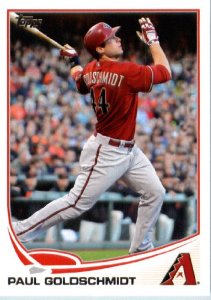
FoldyPaul Goldschmidt, First Base, Arizona Diamondbacks.

The smart money seems to be on Andrew McCutchen here, but BBRT is going with the Diamondbacks’ 26-year-old first baseman Paul Goldschmidt – for his combination of power, speed and defense.  Goldschmidt, one of MLB’s top defensive first baseman, came of age in 2013 – leading the NL in home runs (tied at 36) and RBI (125), while finishing eleventh in average at .302 – and he tossed in 15 steals.   Goldschmidt’s emergence should come as no surprise. Before a 2011 call up to the Diamondbacks, he hit .316, with 82 homers and 263 RBI in 313 minor league games (2009-11).


Paul Goldschmidt – 2013

G     AB       R    H    2B   3B   HR  RBI   Avg.   SB

160   602   103 182   36    3     36   125  .302     15

Also in the mix (BBRT was attempted to split this vote), was the Pirates’ center fielder Andrew McCutchen, the likely NL MVP winner, who brought Gold Glove caliber defense, a .317-27-84 line, and 27 steals to the Pittsburgh lineup.  Cardinals’ catcher Yadier Molina earns BBRT’s third spot for combining game-calling skills, a likely fifth straight Gold Glove and a .319-12-80 offensive line – despite knee and wrist injuries (catchers do take a beating).


WALTER JOHNSON AWARD – Top Starting Pitcher

AMERICAN LEAGUE


Max Scherzer

Max Scherzer

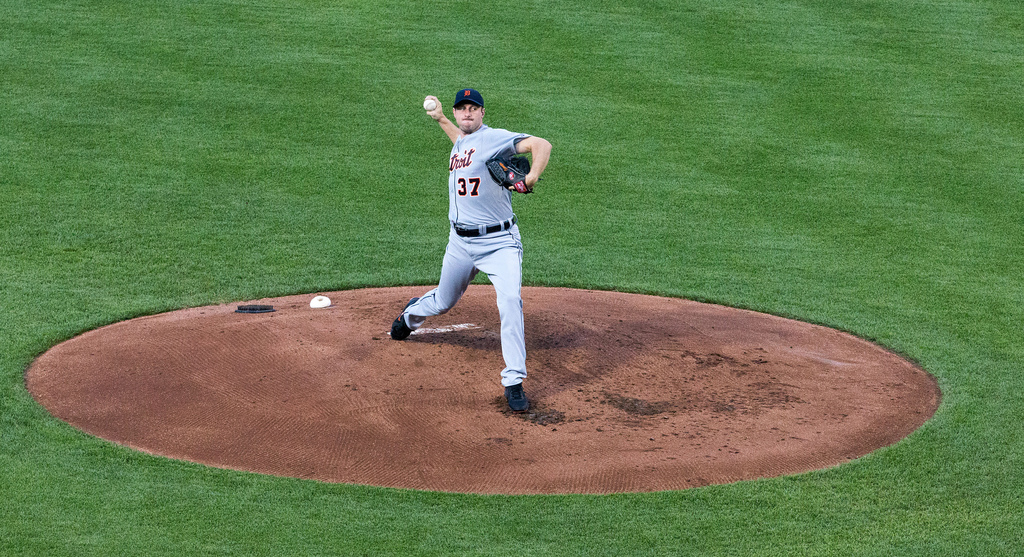
Max  Scherzer, Detroit Tigers

Being “old school,” BBRT could not ignore MLB’s only twenty-game winner.  So, my AL Walter Johnson Award vote goes to 21-3 Max Scherzer – but the 25-year-old Detroit right-hander did plenty more to win my vote.  His 2.90 ERA was fifth in the AL; his 240 strikeouts (in 214 1/3 innings – AL’s fifth-highest) were second only to K-machine Yu Darvish; he allowed hitters a league second-lowest .198 batting average against; and he was the only AL pitcher to notch a WHIP (walks and hits per inning pitched) of less than one (0.97).

Max Scherzer – 2013

W-L     ERA    GS  CG    ShO       IP       H     ER     BB    SO

21-3     2.90      32    0        0      214.1  152    69       56    240

Two other hurlers who garnered BBRT consideration were: Rangers’ righty Yu Darvish (13-9, 2.83 and a league-topping 277 strikeouts in 209 2/3 innings pitched); and Scherzer’s teammate, right-hander Anibel Sanchez (14-8 with a league-low 2.57 ERA and 202 whiffs in 182 innings). Three hurlers with sub 3.00 ERA, 200+ strikeouts, so twenty wins make the difference.

NATIONAL LEAGUE


Clayton Kershaw

Clayton Kershaw

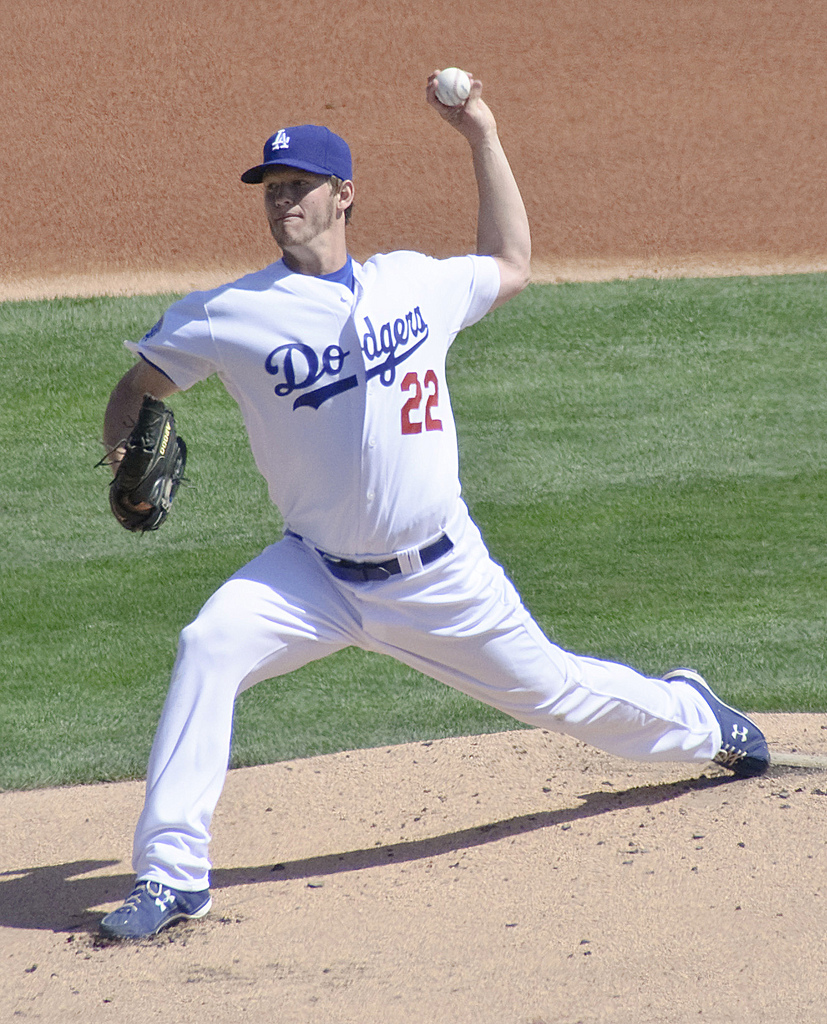
Clayton Kershaw, Los Angeles Dodgers

First choice in the NL, not too difficult.  The 25-year-old Kershaw was once again masterful on the mound and appears headed for his second Cy Young Award (he won in 2011, finished second in 2012).  Kershaw keeps hitters off balance with a lively mid-90s (four-seam) fastball, a mid-80s slider and a curve in the low 70-mph range. The southpaw’s 16-9 record in 2013 hovers over a MLB-lowest 1.83 ERA (his third straight NL ERA crown). Kershaw also led the NL with 232 strikeouts (in 236 innings – second in the NL).  He had the second-lowest batting average against (.195) and his 0.92 WHIP (walks and hits per inning pitched) was MLB’s lowest.  BBRT anticipates Kershaw will be in the running for the BBA Walter Johnson Award for many years to come.


Clayton Kershaw – 2013

W-L     ERA    GS  CG    ShO       IP       H     ER     BB    SO

16-9     1.83      33    3        2       236    164    48       52    232

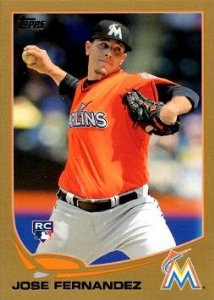
Without a late season shutdown, the Miami Marlins’ rookie right-hander Jose Fernandez might have given Kershaw an even stronger run for the money.  As it is, Fernandez finished 12-6 on a Marlins team that lost 100 games.  His 2.19 ERA was second only to Kershaw and, at .098, he was one of only four major leaguers with a WHIP under 1.00.  Fernandez also struck out 187 hitters in 172 2/3 innings, and his .182 batting average against was the best in MLB.  Also in BBRT’s top four for the NL Walter Johnson Award were: Cardinals’ right-hander Adam Wainwright, 19-9 (NL most wins), 2.94, 219 strikeouts  (third in the NL), and a league-leading 241 2/3 innings pitched, five complete games and two shutouts; Mets’ righty Matt Harvey, who would have challenged Kershaw for BBRT’s vote (9-5, 2.27, 191 Ks in 178 1/3 innings), but for late-season arm injury;  and Phillies’ southpaw Cliff Lee, who quietly put together a 14-8 record, with a 2.87 ERA and 222 strikeouts  in 222 2/3 innings for the under-performing Phils.


WILLIE MAYS AWARD– Top Rookie

AMERICAN LEAGUE


Wil Myers

Wil Myers

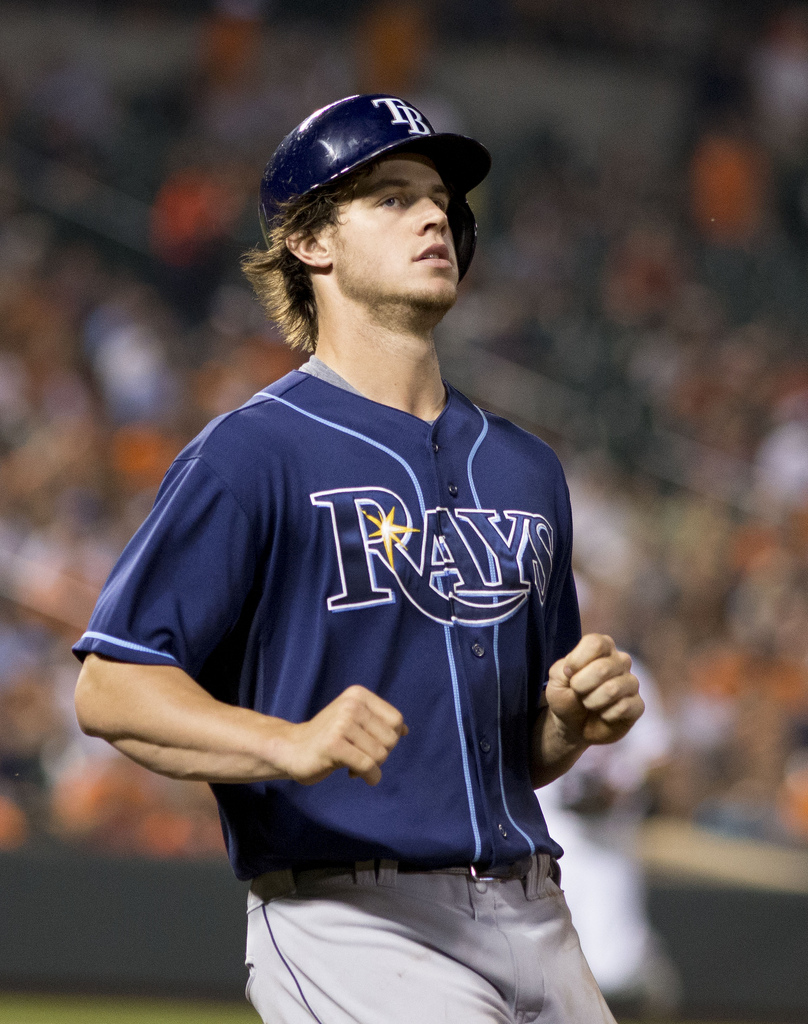
Wil Myers, Outfielder, Tampa Bay

Myers, the 2012 Minor League Player of the year (.314-37-109 in 134 games), was acquired by the Rays in the James Shields trade. The 22-year-old Myers was called up to Tampa in mid-June.  At the time, he was hitting .286-14-57 at AAA Durham – and once he joined Tampa, he got even better. Myers played in 88 games for the Rays and put up a .293-13-53 line, with 50 runs, 23 doubles and five steals – despite a bit of a slump in August.  A strong September secured BBRT’s vote.

Wil Myers – 2013

G     AB    R       H    2B   3B    HR   RBI  Avg.    SB

88    373   50     98     23    0     13    53   .293      5

Following Myers in BBRT’s consideration was his teammate, Rays’ right-handed pitcher Chris Archer (9-7, 3.22, 101 strikeouts in 128 2/3 innings pitched – including two complete-game shutouts in 22 starts).  Ranking third for BBRT was Detroit shortstop Jose Iglesias (who started the year with Boston). Iglesias played highlight-reel defense and put up a .303-3-29 line in 109 games.  Iglesias, however, tailed off in the second half. He hit .330 in 63 games with the Red Sox and .259 in 46 games for the Tigers.

NATIONAL LEAGUE

FernandezJose Fernandez, Pitcher, Miami Marlins

My top rookie vote in the NL goes to Miami Marlins’ right-handed pitcher Jose Fernandez.  Let me reaffirm (and add to) what I wrote about the 21-year-old rookie in the Walter Johnson Award section.  Fernandez finished 12-6 on a Marlins team that lost 100 games.  He had the NL’s second-best ERA (2.19 ERA) and MLB’s second-best batting average against (.182).  He was also one of only four major leaguers with a WHIP under 1.00 and struck out 187 hitters in 172 2/3 innings.  If he hadn’t been shut down after passing the 170-inning mark, Fernandez might have put up even better numbers (perhaps three more starts). In his two September starts (facing the Braves and Nationals),  Fernandez went 2-0 – giving up just 6 hits, 5 walks and one run, while striking out 14 in 14 innings. Fernandez produced his 2013 record with a 93/94-mph fastball, a sharp-breaking overhand curve and a change-up that he is still      working on (imagine when he masters that pitch).

Jose Fernandez – 2013

W-L     ERA    GS  CG    ShO      IP        H     ER     BB    SO

12-6     2.19     28   0        0      172.2    111    47       58    187

Also in the running for BBRT’s NL rookie vote was Cardinals’ right-hander Shelby Miller, who put up a 15-9 record with a 3.06 ERA and 169 strikeouts in 173 1/3 innings pitched.  Dodgers’ outfielder Yasiel Puig also deserves mention. Puig played in only 63 minor league games before his June 3, 2013 call up – hitting .328-13-52 with 21 steals. His 2013 line reads .319-14-42 with 11 steals in 104 games for LA, and he played a key role in the Dodgers comeback to win the division.


GOOSE GOSSAGE AWARD – Top Relief  Pitcher

AMERICAN LEAGUE


Greg Holland

Greg Holland

Greg Holland, Kansas City

Even though BBRT thinks it may be time to rename this the Mariano Rivera Award, I have to go with Royals right-handed closer Greg Holland as the AL’s premier reliever.  The 27-year-old Holland notched 47 saves (with two wins and a loss), with just three blown saves, in 2013. With a 95-mph fastball, a wicked bat-missing slider and an occasional splitter, Holland notched a 1.21 ERA, with 103 strikeouts in only 67 innings. For the season, left-handers hit .172 versus Holland, right-handers .168.


Greg Holland – 2013

W-L    SV    ERA   G       IP       H     ER     BB    SO

2-1     47    1.21     68     67      40      9       18     103

Close behind Holland is the Rangers’ veteran righty Joe Nathan, who went 6-2, 1.39, with 43 saves and just three blown saves.  Nathan doesn’t miss as many bats as Holland, but he still struck out better than one per inning (73 whiffs in 64 2/3 innings).  Lefties hit .171 versus Nathan and righties a miniscule .152.  Also in the mix, but trailing both Holland and Nathan, were: retiring Yankee legend, right-hander Mariano Rivera, who rode his cutter to a 6-2 record, with 44 saves and a 2.11 ERA; and Orioles’ righty Jim Johnson, who went 3-8, 2.94, with an AL-leading 50 saves. Both Rivera and Johnson dropped down due to the number of blown saves (nine for Johnson, seven for Rivera) and higher ERAs and lower strikeout rates than the top two.

NATIONAL LEAGUE


Craig Kimbrel

Craig Kimbrel

Craig Kimbrel, Atlanta Braves

When you look at the whole package, the 25-year-old Kimbrel had little competition for the 2013 NL Goose Gossage crown.  Kimbrel used a 96-97 mph fastball (that occasionally tops 100 mph) and a power curve to run up a 4-3 record, with an NL-leading 50 saves (only four blown saves) and a 1.21 ERA.  Kimbrel has led the NL in saves the past three years (46-42-50).  In 2013, He whiffed 98 hitters in 67 innings, with twenty walks. Overall, lefties hit .211 against him, while he dominated right-handers (.116).

Craig Kimbrel – 2013

W-L    SV    ERA   G       IP       H     ER     BB    SO

4-3      50     1.21    68     67        39      9       20    98

BBRT also considered (but it was really no contest) Reds’ lefty Aroldis Chapman, who went 4-5, 2.54 with 38 saves (versus five blown saves).  Chapman throws a fastball consistently in the high 90s (and has reached 105 mph), as well as a devastating slider.  In 2013, he struck out 112 hitters in just 63 2/3 innings (29 walks).  Lefties hit .137 against him, while right-handers averaged .172.

(BBRT obseervation – Greg and Craig – my two Goose Gossage Award voter getters – had remarkably similar stats.  Both pitched in 68 games, threw 67 innings and gave up nine earned runs for a 1.21 ERA.  Holland gave up 40 hits, one more than Kimbrel; while Kimbrel gave up 20 walks, two more than Holland.  Holland struck out 103 to Kimbrel’s 98.)


CONNIE MACK AWARD – Top Manager

AMERICAN LEAGUE


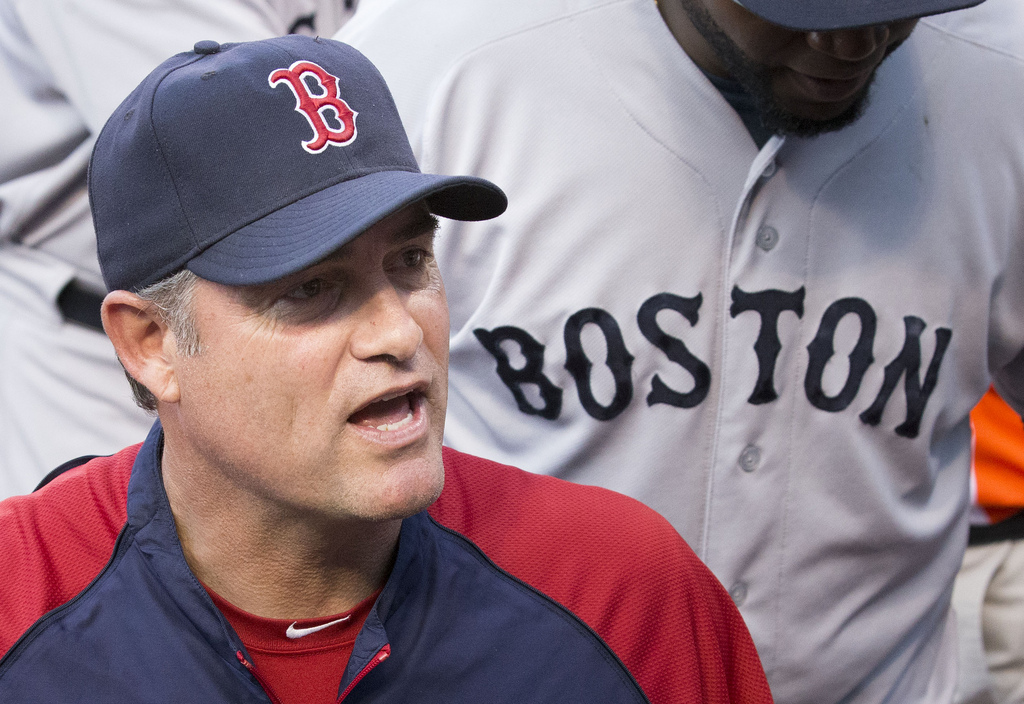
John Farrell

John Farrell

John Farrell – Boston Red Sox

Farrell leads a strong set of candidates for top AL manager.  Farrell took a team that finished last (under Bobby Valentine) in 2012 to the top of the AL East in 2013.  This last-to-first surge included a 28-game won-lost improvement (from 69-93 to 97-65).

Farrell also “righted” what seemed to be a sinking club house culture. In doing so, he effectively brought together a lot of new faces (Mike Napoli, Shane Victorino, Kuji Uehara, Stephen Drew, Ryan Dempster) with some long-time Red Sox veterans (David Ortiz, John Lester, Dustin Pedroia).

Very Simply, Farrell led a turnaround on and off the field.  That earns him BBRT’s Connie Mack Award vote.

Others in the running:  Terry Francona (led the unheralded Indians to a 24-game improvement and an AL Wild Card spot); Bob Melvin (led the A’s, with the AL’s fourth-lowest payroll, to another West Division title);  Joe Girardi (led the Yankees to an  85-77 finish, overcoming age, injuries and the A-Rod controversy). BBRT also gives a shout out to Twins’ manager Ron Gardenhire.  A manager who can turn a third consecutive 90+ loss season into a two-year contract extension must be doing something right.

NATIONAL LEAGUE


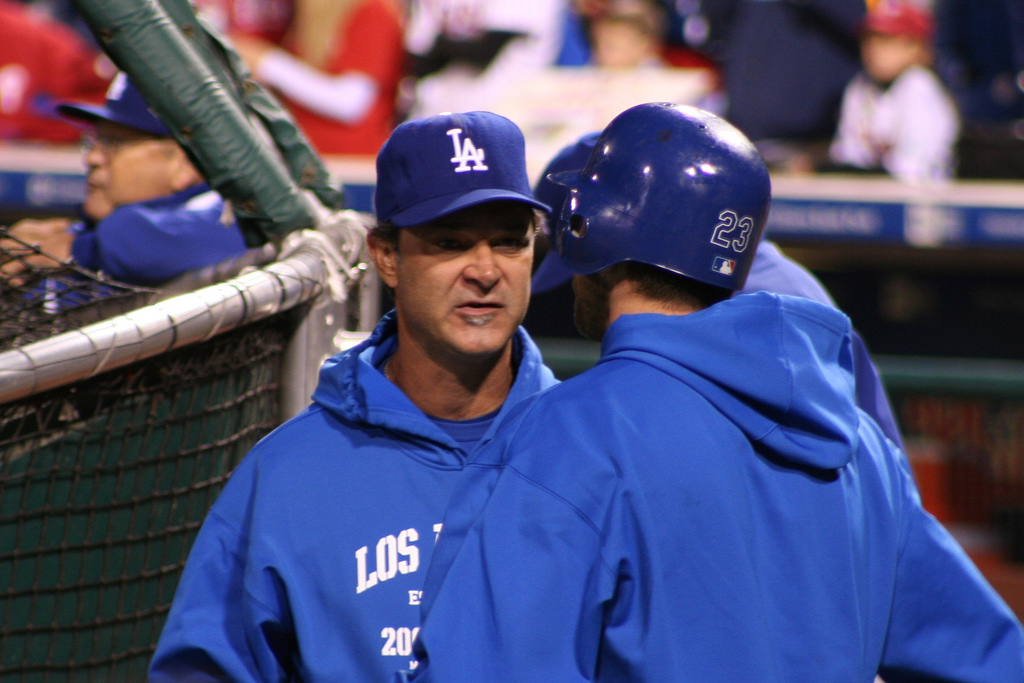
Don Mattingly

Don Mattingly

Don Mattingly, Los Angeles Dodgers

Okay, Mattingly did have the “horses” and the payroll, but he wins for keeping the Dodgers from disintegrating in the first half, and launching a ferocious second-half comeback.  The Dodgers were in last place in the West Division on  July 1 – and, just 80 days later, were the first MLB team to clinch a 2013 division title.  In fact, on June 21, the Dodgers were 12 games under .500 (30-42), in last place and 9 ½ back of the Diamondbacks.  Under Mattingly’s leadership, they kept grinding and went 62-28 the rest of the way.  A steady hand during a stormy first half, coupled with a dramatic comeback, wins Mattingly BBRT’s NL Connie Mack Award vote.

Also deserving recognition is Pirates’ skipper Clint Hurdle, who ended the Pittsburgh’s streak of 20 consecutive losing seasons and brought post-season baseball to Pittsburgh – and who may very well win MLB’s 2013 Manager of the Year Award.


So there are BBRT’s votes for the Baseball Bloggers Alliance (BBA) 2013 season awards.  Watch for a link to the BBA announcement of this year’s winners once voting is complete.  And you call follow BBRT on Twitter at @DavidBBRT.  For more on the BBA, click the link on the lower right hand side of the BBRT home page. 

Common and Uncommon Observations on the 2013 MLB Season

With the regular season over and playoffs on everyone’s minds, BBRT is taking a break from post-season tension to reflect on just a few regular season occurrences that grabbed my attention.

Payroll Didn’t Drive Placement

Looking at the teams that made it into the post-season three of the top five opening day payrolls were there (#2 Dodgers, #4 Boston and #5 Detroit), but so were three of the bottom five payrolls (#26 Pittsburgh, # 27 Oakland, # 28 Tampa).  Of note, the Dodgers’ $220 million payroll exceeded the combined opening day payrolls of playoff bound Oakland ($61 million), Pittsburgh ($80 million) and Tampa Bay ($58 million). (Figures from CBSsports.com.)

Tough to be YU!

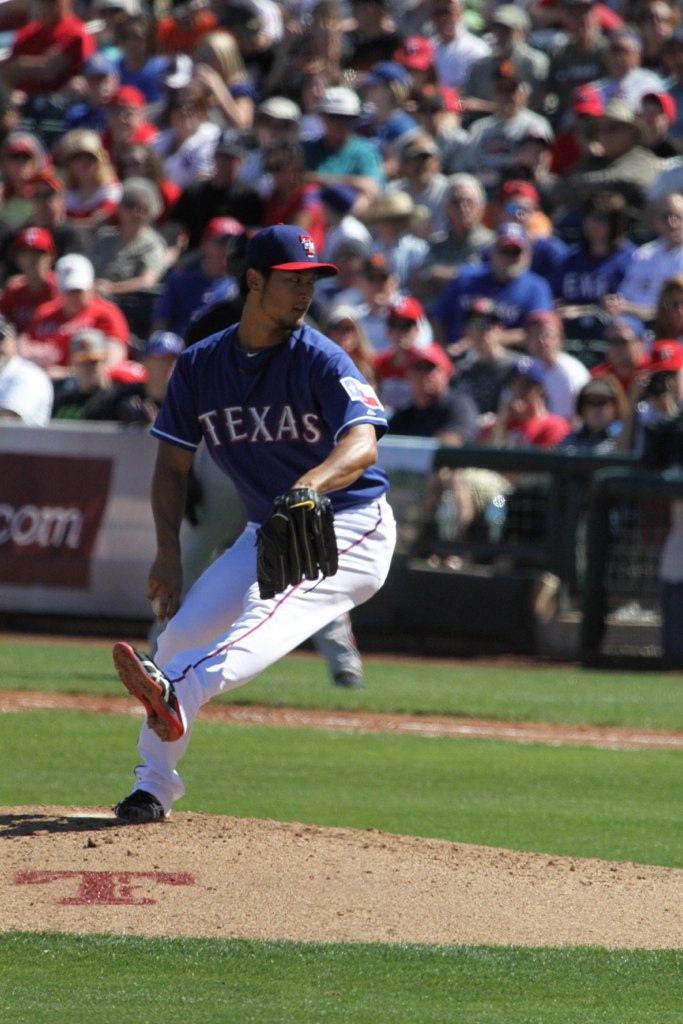
Two guys named YU – The Rangers’ Yu Darvish and Giants’ Yusmiel Petit – both came with one batter of perfect games this season.

Yu Darvish - one of two YUs to lose a perfect game after 26 outs.

Yu Darvish – one of two YUs to lose a perfect game after 26 outs.

On April 2, Darvish was on the mound with two-out in the bottom of the ninth inning, holding a 7-0 lead over the Astros, having retired the first 26 hitters he faced (striking out 14). At the plate was Astros’ shortstop Marwin Gonzalez, who had grounded out and struck out in his first two appearances. Darvish started Gonzalez with a fastball – and the result was a low bouncer that skirted between Darvish’s legs and on into center field for a single. After 111 pitches, Darvish’s night was over and Micheal Kirkman came on to get pinch hitter J.D. Martinez to end the game.

On September 6, Yu number-two – Yusmiel Petit of the Giants – went into the top of ninth inning with a 3-0 lead over the Diamondbacks, having retired the first 24 Arizona hitters, striking out six.  He got shortstop Chris Owning with his seventh strikeout, then right fielder Gerardo Parra grounded out second-to-first.  That left just pinch hitter Eric Chavez between Petit and perfection. Petit got with one strike of a perfect game, only to see Chavez single to right field (just out of the reach of a diving Hunter Pence) on a 3-2 pitch. Chavez and was replaced by pinch runner Tony Campana before Petit induced Diamondback center fielder A.J. Pollock to ground out third-to-first to end the game.  The 95-pitch effort was Petit’s first MLB complete game.

Not So Easy To Be An Astro Either

The Houston Astros finished with an MLB-worst record of 51-111 this season, but that’s not what attracted BBRT attention.  Over the course of the season, Astro’s hitters struck out an All Time MLB record 1,535 times – breaking the Diamondbacks’ 2010 record of 1,529.  Here’s what caught BBRT’s eye.  Having moved to the American League, the Astros set the new record without the benefit of their pitchers flailing (and failing) at the plate.  In 2010, 119 of the Diamondbacks’ record-setting whiffs were credited to pitchers at the plate.

The NL Batting Race

Michael Cudyer - NL Batting Champ

Michael Cudyer – NL Batting Champ

The National League batting race was decided in the final eight days of the season – with two somewhat unlikely contenders.  On September 21, Braves’ third baseman Chris Johnson (who came into 2013 with a four-year career average of .276) was leading the NL at .332.  On his heels (at .331) was the Rockies’ Michael Cuddyer (who came into the season with a 12-year career average of .271 and a single-season high of .284).  Over the final eight days, Cuddyer went 7-for-21 to finish at a league leading .331, while Johnson faded to .321 (going 2-for-23.) Cuddyer’s final line was .331-20-84, and he even added ten stolen bases.


Lots Of Great Young Stars To Watch

Mike Trout, Bryce Harper, Wil Myers, Manny Machado, Yasiel Puig, Jose Fernandez, Shelby Miller – and the list goes on an on.  There were – and still are – simply a lot of great young stars to watch.  For more – and a look at BBRT 2013 Young Star Team click  https://baseballroundtable.com/bbrts-2013-mlb-young-star-team-born-in-the-90s/

The Pirates are Back!  The Pirates are Back!

The Post Season comes to Pittsburgh.

The Post Season comes to Pittsburgh.

The unfolding story of the Pirates, going 94-68 and making the playoffs after a twenty consecutive losing seasons. By contrast, the Yankees have not had a losing season since 1992 – and have had only 22 losing seasons in the history of the franchise (1901-2013 in Baltimore and NY).   The Pirates led by such players as MVP candidate Andrew McCutchen, speedy tablesetter Sterling Marte, NL HR co-leader Pedro Alvarez, starting pitcher and Comeback Player of the Year candidate Francisco Liriano and relievers Jason Grilli and Mark Melancon should remain  fun to watch.

The Pirates Are Back!  So Is Francisco Liriano!

Speaking of the Pirates, starting pitcher Francisco Liriano (who won the first Wild Card playoff game) was a great story and an unlikely hero in the Bucs return to the post season.  The Pirates signed Liriano after a 2012 season when he went 6-12, 5.34 (his second consecutive season with an ERA north of 5.00) for the Twins and White Sox. Then Liriano broke his non-pitching arm in the off-season and didn’t make his first start until May 11.  He ended the season as the Pirates’ ace, rediscovering his wicked slider and going 16-8, 3.02, with 163 strikeouts in 161 innings. How important was Liriano the Pirates?  No other Pittsburgh starter won more than ten games.

The Dodgers’ Remarkable Comeback 

Yasiel Puig helped sparked Dodger comeback.

Yasiel Puig helped sparked Dodger comeback.

As of July 1, the underachieving Dodgers were in last place in the NL West (38-43, 3 ½ back).  Just 80 days later – on September 19 – with a 7-6 win over the Diamondbacks, LA became the first team to clinch a 2013 playoff berth.  It also made the Dodgers just the fourth team (along with the 1914 Boston Braves, 1973 New York Mets and 1995 Seattle Mariners) to finish in first place after holding last place as of July 1 or later.  The comeback is even more remarkable when you consider that on June 21, the then last-place Dodgers stood at 30-42, 12 games under .500 and 9 ½ back of Arizona.  From that point, they went 62-28 – finishing 22 games over and 11 games ahead of second-place Arizona. Looking for reasons?

Mike Trout Avoids “Sophomore Jinx

Mike Trout’s 2012 Rookie of Year season: .326, 129 runs, 30 homers, 83 RBI, 49 steals.

Mike Trout 2013:  .323, 109 runs, 27 homers, 97 RBI, 33 steals. Next Willie Mays? Enough said.

Old Guys Rule!

Mariano Rivera - making his best last.

Mariano Rivera – making his best last.

Took great pleasure in watching a couple of forty-year olds defy father time.  Mariano Rivera (age 43) goes 6-2, 2.11 with 44 saves.  Bartolo Colon (age 40) goes 18-6, 2.65.

Oh yes, and let’s not forget 41-year-old Raul Ibanez and his 29 home runs, tying Ted Williams for the most ever by a 41-year-old.

Josh Hamilton’s Fall

Josh Hamilton may have been the biggest disappointment on the disappointing Angels. In the three years before signing a five-year/$133 million contract with the Halos, Hamilton hit .313 with 100 home runs and 322 RBI.  In his first year with LA, he dropped to .250-21-79.  Of course, Albert Pujols has also fallen short of his big contract (10 year/$240 million) expectations.  In 11 years with the Cardinals, the average season for the three-time MVP was .327-40-121.  In that time, Pujols played in more than 140 games every season, hit under .300 only once (.299 in 2011), never hit less than 32 home runs in a season, and collected less than 100 RBI only once (99 in 2011).  His 2013 numbers for LA were 99 games (foot injury), .258-17-64.  This follows a first year in LA during which he put up: .285-30-105 in 154 games (decent numbers, but still short of expectations – at the time, they were Pujols’ lowest average, lowest HR total and second-lowest RBI count).

Cabrera Wins Third Batting Title/Davis Tops 50 HR

Chris Davis - newest 50-homer guy.

Chris Davis – newest 50-homer guy.

For much of the season, BBRT was on a Miguel Cabrera Triple Crown repeat watch; with the Oriole’s Chris Davis Cabrera’s main obstacle in two of the three categories.  While abdominal issues slowed Miggy late in the season, Cabrera still won his third consecutive batting crown (the first player to win three straight titles since Wade Boggs won four between 1985-88).  Meanwhile, Davis gave us the pleasure of watching him chase 50 home runs.  At season’s end, Davis led all of MLB with 53 home runs and 138 RBI (Cabrera finished second in both at 44-137). Davis became the 27th player to reach the 50-homer mark, and his 53 HRs are the 26th most in an MLB season (for more on the 50 homer club, click https://baseballroundtable.com/chris-davis-newest-member-of-50-homer-club/

The Yankees’ .500+ Record

Joe Girardi for Manager of the Year.  It could happen, considering how he managed the Yankees to a third-place finish, eight games over .500 (85-77) despite age, injuries and the A-Rod controversy.  Girardi did a great job of guiding the Yankees through troubled waters with lots of fill-ins at the oars.

The Blue Jays Disappointing Performance

With a host of off-season acquisitions – Jose Reyes, R.A. Dickey, Josh Johnson, Mark Buehrle, Melky Cabrera, Emilio Bonifacio – the Blue Jays moved into the top ten in payroll and became a popular pick to win the AL East.  They were, however, never a factor – finishing at 74-88, last in the division, 23 games out. Lots of reasons, with 2012 NL CY Young winner R.A. Dickey (20-6, 2.73 for the Mets in 2012) at or near the top of the list.  Dickey was a significant disappointment at 14-13, 4.21 for the Jays.  (Maybe it shouldn’t have been a surprise, eliminating 2012, Dickey’s MLB record – ten seasons – would be 55-63, 4.31.) Jose Reyes performed well when he was in the lineup (.293-10-37, with 15 steals), but injuries limited him to 93 games.  Josh Johnson, who came to the Jays with a career line of 56-37, 3.15 was limited by triceps and forearm issues – and turned in 2-8 record with a 6.20 ERA in just 16 starts. And so it went for the Jays – injuries and underperformance derailing what should have been a promising season.

The First Place Boston Red Sox

Lots of excitement at Fenway this year.

Lots of excitement at Fenway this year.

In 2012, the Boston Red Sox finished in last place in the AL East, 69-93 and 26 games out.  The Sox dumped first-year manager Bobby Valentine and brought in John Farrell. They also made changes to the team during the off-season – changes that didn’t seem to excite analysts or fans. Joining the Red Sox were not the biggest name free agents, but players like Mike Napoli, Shane Victorino, Koji Uehara, Stephen Drew, and Ryan Dempster.  The Sox, in fact, were picked to finish at our near the bottom of the division. Unlike the Blue Jays, the Red Sox strategy paid off in the W-L column, as they won the East with a 97-65 record.  Napoli contributed  23 HRs and 92 RBI, Victorino hit .294 with 21 steals, and Uehara notched 21 saves to go with a 1.09 ERA. Red Sox veterans chipped in as well.  David Ortiz went .309-30-103; Dustin Pedroia’s line was .301-9-83 (17 steals); John Lester rebounded with a 15-8 record and 3.75 ERA; and, despite injuries that limited him to 16 starts, Clay Bucholz went 12-1, 1.74.

Oakland Athletics Get High(s) – Win The AL West

The A’s must have been rewatching “Moneyball.”  Despite MLB’s 27th highest (or fourth lowest) opening day payroll, Oakland topped the AL West, which is also home to the game’s sixth- (Angels) and eighth-highest (Rangers) payrolls.  The A’s went 96-66, driven to success by such “name” players as Brandon Moss, Jed Lowrie, Eric Sogard, Josh Donaldson, Jarrod Parker, A.J. Griffin, and Dan Straily. (There were a lot a “career highs” along the way – like Moss’ career-high 30 HRs, Donaldson’s career-high .301 average, Lowrie’s career-topping 75 RBI, Griffin’s career-best 14 wins; and much more).  There also were some better-known names making contributions: Coco Crisp (with a career-high 22 HRs), Yeonis Cespedes (career-high 26 HRs) and 40-year-old starter Bartolo Colon, who went 18-6, 2.65.

Washington Nationals – A Fade, But Not A Collapse

The Washington Nationals were a popular pick to win the AL East in 2013, after 98 wins and an East Division title in 2012.  The team has taken a lot of heat for falling behind the Atlanta Braves early and failing to make the playoff.  But really, they still finished 10 games over .500 (86-76) and have a solid foundation in place for 2014.  BBRT urges Nats’ fans not to overreact.

“Kinda-Unlikely” No hitters

There were three no-hitters thrown in 2013, all by pitchers who started their no-hitters with a losing record on the season – and also would finish their season with a losing record. Let’s look at these “kinda-unlikely” outcomes.

"Homer" Bailey, unlikely name for no-hitter hurler.

“Homer” Bailey, unlikely name for no-hitter hurler.

On July 2, Reds’ right-hander Homer Bailey threw the first no-hitter of the 2013 season.  Given that Bailey also threw the last no-hitter of 2012 (September 28, 2012), the no-no is not entirely unlikely.  It just seems to BBRT a bit unexpected that a pitcher with the unfortunate name of “Homer” would toss a no-hitter.  This year’s no-no came in Cincinnati’s hitter-friendly Great American Ballpark, with Bailey shutting down the Giants 3-0 on 109 pitches, walking just one, striking out nine. With the final out, Bailey became just the 31st pitcher to throw multiple no-hitters.  Bailey, by the way, went into the game with a 4-6 record and a 3.88 ERA.  He finished the season 11-12, 3.49.

On July 13, the Giants’ Tim Lincecum no hit the Padres 9-0 in San Diego.  Why did this seem so unlikely – after all, Lincecum is a two-time Cy Young Award winner?  True, but the Lincecum who took the mound this past July was not the hurler who in 2008-09 went 33-12, with a 2.55 ERA and 526 strikeouts in 452 1/3 innings. This was a Lincecum coming off a 2012 season in which he went 10-15 with a 5.18 ERA.  It was a Lincecum with a 2013 record of 4-9, 4.61. (He would end the season at 10-14, 4.37.)  Ultimately, Lincecum threw an unlikely (career-high) 148 pitches in his no-hit game, striking out 13 batters (while walking four).

On the final day of the season (September 29), the Marlins’ Henderson Álvarez was matched up against Detroit’s Justin Verlander – a pitcher much more likely than Alvarez to toss a no-hitter – in Miami.  Alvarez joined the Marlins after compiling a 9-14 record (4.85 ERA) for the Blue Jays in 2012.  He came into the season finale with a 2013 mark of 4-6, 3.94 (and would finish the season 5-6, 3.59).  Alvarez and Verlander matched zeros across the board and, as the Marlins batted in the bottom of the ninth, Alvarez had completed nine no-hit innings with one walk and four strikeouts.  In the bottom of the ninth, Miami turned two singles and a walk into a bases-loaded/one-out situation.  Then, with Alvarez on deck, the winning run scored (in an unlikely manner) on a wild pitch.

So, there are a few things that caught BBRT’s attention in 2013.  Got any to add?  Feel free to comment.

Greg Harris – Switch Hitter & Switch Pitcher

Greg Harris' six-finger glove worked on either hand - and, apparently, as a hat.

Greg Harris’ six-finger glove worked on either hand – and, apparently, as a hat.

Greg Allen Harris pitched 15 years in the major leagues (1981-95), spending time with the New York Mets, Cincinnati Reds, Montreal Expos, San Diego Padres, Texas Rangers, Philadelphia Phillies, Boston Red Sox and New York Yankees.  He appeared in 703 games, primarily as a reliever (just 98 starts), turning in a 74-90 record with a 3.69 career ERA and 54 saves.  His best years were, arguably, 1986 (10-8, 2.83, 20 saves for the Rangers) and 1990 (13-9, 4.00 as a starter for the Red Sox).

Harris’ fifteen years in the majors clearly establishes him as a serviceable major league hurler, but it is was what Harris did in his next-to-last MLB appearance that put him in the record books – and got his glove into the Hall of Fame.   On September 28, 1995, Harris (then a Montreal Expo) was called in from the bullpen to pitch the top of the ninth, with the Expos trailing the Reds 9-3.  In that memorable ninth inning, Harris went from a decent, switch-hitting pitcher (.221 career average in 68 at bats) to the first (and still only) post-1900 “switch pitcher” to throw from the mound both left-handed and right-handed in the same game.

A natural right-hander, Harris had worked to develop his left-handed pitching skills.  He had a unique six-fingered baseball glove that could be worn on either hand, and was often seen warming up left-handed in the bullpen (and on occasion took a turn pitching batting practices right- and left-handed).  Harris was considered somewhat of a “character,” perhaps better suited to be part of the eccentric clan of lefties, but management was reluctant to let him switch to the port side in a game.   He finally got his opportunity to prove his southpaw skills in that September 28th game – and he was prepared.  He came to the mound with his six-fingered glove and, apparently, two handfuls of determination.

Starting out right-handed, he got righty-hitting outfielder Reggie Sanders on a ground ball to short.  Then he switched his glove to the opposite hand and faced lefty-hitting first baseman Hal Morris as a southpaw.  Harris’ first-ever in-game lefty offering sailed wide of Expos’ catcher Joe Siddal, and Harris walked Morris on four pitchers.  Next up was the Reds’ left-handed hitting catcher Ed Taubensee. Harris continued to throw left-handed, running up a 3-2 count before getting Taubensee to top the ball in front of the plate. Siddal picked up the weak grounder and fired to first for the second out, with Morris advancing to second.  The next hitter was right-handed hitting Brett Boone.  Harris switched back to his natural right-handed delivery and got Boone on a come backer to the mound.  The Expos, by the way, scored four runs in the bottom of the ninth to close the gap to 9-7 and nearly make Harris the last ambidextrous pitcher to record a win.

Previous to Harris’ right-lefty appearance, the last MLB pitcher to pitch with both hands was Tony Mullane in 1893.


BBRT’s Mo-Ment – One More On The Bandwagon

MO

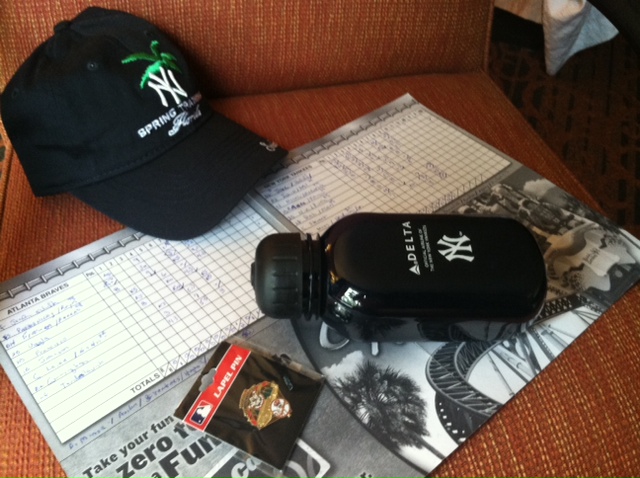
Never let it be said that BBRT “missed the bandwagon.”  It’s time to share my Mariano Rivera “Mo-Ment.”  No, I wasn’t in the stands for any of the 2013 regular season’s  heartfelt farewells – but I was at Steinbrenner Field in Tampa for a Rivera “first-Last”:  Rivera’s first appearance of his last Spring Training.  (Photos above.)

What can you say about Rivera that hasn’t already been said – the best closer ever and a class act on and off the field.  How good was Mo?  The numbers (as of September 27) speak for themselves.

  • 652 regular-season saves, best ever.
  • 42 post-season saves, best ever.  (He also had 8 post-season wins – and only one loss – with a 0.70 post season ERA (lowest ever).
  • Thirteen-time All Star, five-time Rolaids Relief Man of the Year, three-time Delivery Man of the Year.
  • Three-time AL leader in saves – topped 50 saves twice, topped 40 saves nine times.
  • A lifetime ERA of 2.21 (19 seasons, 1,116 games, 1,283 2/3 innings pitched) – ERA below 3.00 every season except 1995 (rookie season, included his only 10 starts, 5.51) and 2007 (3.15).  Eleven seasons with an ERA below 2.00 – lowest was 1.38 in 2005 (71 appearances).

Looking back on a career of consistent achievement, Rivera (in BBRT’s estimation) saved the best for last.  On May 3, 2012, after nine appearances, Rivera tore his ACL in a freak accident (while shagging fly balls in the outfield before the game).   Many thought the injury would mark the end of the 42-year-old hurler’s career.  Rivera vowed he would be back and has delivered on his word.  Through September 7 – at age 43 – Rivera is 6-2, with a 2.11 ERA and 44 saves (third in the AL.)  That is a comeback for the ages  – from a closer for the ages.  Mo will be missed. BBRT is looking forward to the Hall of Fame acceptance speech.

Souvenirs from Mariano Rivera's FIRST appearance of his LAST (2013) Spring Training.

Souvenirs from Mariano Rivera’s FIRST appearance of his LAST (2013) Spring Training.

Photos by D. Karpinski


Satchel Paige – He Loved and Lived to Pitch

satch1On this day (September 25) in 1965, Leroy “Satchel” Paige got up out his rocking chair in the bullpen and took the mound for the Kansas City Athletics (against a tough Boston Red Sox line up) – making Paige (at a generally accepted 59 years, 2 months and 18 days of age) the oldest player  ever to appear in a major league game.  I say generally accepted since, like much of the Satchel Paige legend, his birth date (officially listed at July 7, 1906) is difficult to document.   There are a few facts about Paige, however, that will never be in doubt.  He loved and lived to pitch, he was one of the greatest, if not the greatest, hurlers to ever take the mound; and he was also one of baseball’s biggest and brightest personalities.

But,  back to September 25, 1965.  The 59-year-old Paige pitched three scoreless innings that day, striking  out one and giving up only one hit, a double to Red Sox left fielder Carl Yastrzemski.  That appearance that was just the cherry atop the Satchel Paige legend.

Right here, BBRT will add another “fact.”  The fact that Paige was unable to cross MLB’s color line until age 42 (in 1948, when Paige became MLB’s oldest-ever “rookie” and the first African-American to pitch in the American League) was MLB’s loss.

When Paige came to the major leagues the year after Jackie Robinson broke the game’s color line, he was already a hardball legend, having established his dominance – and his ability to fill stadiums –  in semipro ball, the Negro Leagues, Dominican League, Mexican League, Cuban League, Puerto Rican League and with a host of barnstorming teams.  Let’s use the anniversary of his record-breaking Kansas City appearance to reflect on Paige’s remarkable career.

Satch2Overall, it is estimated that Paige pitched more than 2,500 games between 1924 and his his last professional game on June 21, 1966, for the Peninsula Grays of the Carolina League – recording 2,000+ wins, 300 shutouts and more than 50 no-hitters.  Just how good was Paige?

Here’s what a few Baseball Hall of Famers had to say:

Dizzy Dean  … “My fastball looks like a change of pace alongside that little pistol bullet Satchel shoots up to the plate.”

Joe DiMaggio … Paige is “the fastest and best pitcher” I ever faced.

Hack Wilson … Paige’s heater “starts out like a baseball and when it gets to the plate, it looks like a marble.”

Bob Feller … “The best pitcher I ever saw.”

Ted Williams … “Satch was the greatest pitcher in baseball.”

In his prime, Paige’s fastball was reportedly measured (by the primitive technology of the day) at 103 mph.  As for control, in a 1953 article published in Colliers, author Richard Donovan shared a story of Paige placing a matchbox on a stick near home plate and then knocking it off on thirteen of twenty pitches.  That is the stuff of which legends are made.

Further, as a hurler-for-hire and perhaps baseball’s highest-paid gate attraction (Paige would pretty much take the mound for any team that could afford him), Satchel regularly pitched more than 100 games a year (and, at times, two in a day).

In 1948, Cleveland Indians owner Bill Veeck signed the 42-year-old Paige to a major league contract – in what some called a pure publicity stunt.  Sporting News writer J.G. Taylor Spink, in fact, asserted that “To bring in a pitching rookie of Paige’s age is to demean the standards of baseball.”  Paige, as he almost always did, got the last laugh, noting “I demeaned the big leagues considerable that year. I won six and lost one.”

Paige pitched in 21 games in 1948, with seven starts, three complete games, two shutouts, one save and a 2.48 ERA.  For his six-year MLB career (all after age 42), Paige went 28-31, 3.29 with 32 saves.  Did the over-40 Paige belong in the big leagues?  Here’s what Casey Stengel had to say, “If we don’t get ahead in the first six innings, the Browns bring in that damned old man, and we’re sunk.”

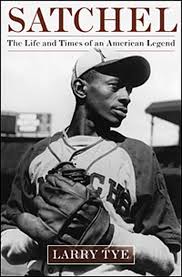
sATCH 3There isn’t room here to touch on all Paige’s “legendary” exploits (pitching 29 games in one month with only a single loss; pitching no-hitters in two cities on the same day; going 135-37 in three seasons with the Negro League’s Pittsburgh Crawfords; consistently defeating barnstorming teams that included major leaguers; winning three games in the 1942 Negro League World Series; and more). There’s not even space to detail all of his beloved pitches, to which he gave names like the Bat Dodger, Hurry-Up Ball, Four-Day Creeper, Long Tom, Smoke Ball, Midnight Rider and renowned Hesitation Pitch.  BBRT suggests you take the time to learn more about Satchel’s remarkable mound prowess. (Satchel Paige … The Life and Times of an American Legend by Larry Tye and Maybe I’ll Pitch Forever by Leroy Satchel Paige are good places to start.) In the meantime, here are some of philosopher Paige’s words to live by:


About Life

“Work like you don’t need the money. Love like you’ve never been hurt. Dance like nobody’s watching.”

“Age is a question of mind over matter. If you don’t mind, it doesn’t matter.”

“Ain’t no man can avoid being born average, but there ain’t no man got to be common.”

“Don’t look back. Something might be gaining on you.”

“You win a few. You lose a few. Some get rained out. But you got to dress for all of them.”

About Baseball

“I never threw an illegal pitch. The trouble is, once in a while I would toss one that ain’t never been seen by this generation.”

“Just take the ball and throw it where you want to. Throw strikes. Home plate don’t move.”

Chris Davis – Newest Member of 50-Homer Club

Chris Davis - newest member of the 50-Homer Club.

Chris Davis – newest member of the 50-Homer Club.

Today (September 13, 2013), the Orioless Chris Davis notched MLB’s 43rd fifty-home run season, becoming the 27th player to reach that mark.  BBRT did a blog post focused on 50-homer seasons earlier this month (to commemorate Mickey Mantle’s 50th dinger of the 1961 season.  With Davis now in the Fifty-Homer Club, I’ll update that post, add some new facts about 50-homer seasons (like fewest strikeouts and most stolen bases in a 50-homer campaign) and add the full list of 50+ home run seasons.

  • The first 50-homer season belongs, as you might expect, to Babe Ruth (54 homers in 1920).
  • In hitting 54 HRs in 1920, Babe Ruth broke his own MLB record of 29 HRs, thus becoming the first player to reach 30 & 40 HRs as well.  Ruth also outhomered every MLB team except the NL’s Phillies, who hit 64 that year.
  • Hack Wilson, with 56 HRs in 1930, became the second member (and first NL member) of the 50-homer club.  (Before Wilson’s season, Ruth also topped 50 dingers in 1921, 1927 and 1928).
  • Of the 27 players to notch in the Fifty-homer Club, there have been 15 right-handed hitters, 11 left-handers and one switch hitter)
  • Mickey Mantle is the only switch-hitter to reach 50-homers in a season.
  • The Yankees  have had the most 50-homer players (four):  Babe Ruth, Mickey Mantle, Roger Maris and Alex Rodriguez all reached the mark while in pinstripes.
  • Roger Maris and Mickey Mantle are the only two teammates to reach 50 home runs in the same season – 1961, Maris 61 and Mantle 54.
  • Babe Ruth, Sammy Sosa and Mark McGwire each achieved a record four 50-homer seasons.
  • Sammy Sosa and Mark McGwire share the record for consecutive 50-homer campaigns at four.
  • The record for 50-homer hitters in a single season is four (1998 & 2001):  1998 – Greg  Vaughn (50), Ken Griffey Jr. (56), Sammy Sosa (66), Mark McGwire (70); 2001– Alex Rodriguez (50), Louis Gonzalez (57); Sammy Sosa (64); Barry Bonds (73).
  • Mickey Mantle - all over the 50-Homer Club - only switch hitter to reach 50 HRs; only player with 50 homers in Triple Crown year; half of only pair of teammates to reach 50 HRs in same season (with Roger Maris, 1961); one of record four Yankees in 50-Homer Club.

    Mickey Mantle – all over the 50-Homer Club – only switch hitter to reach 50 HRs; only player with 50 homers in Triple Crown year; half of only pair of teammates to reach 50 HRs in same season (with Roger Maris, 1961); one of record four Yankees in 50-Homer Club.

    Willie Mays is the only player to hit 50 homers for the same franchise in two different cities – 51 HRs for the New York Giants in 1955 and 52 for the San Francisco Giants in 1965).

  • Willie Mays also holds the mark for seasons (11 including each 50-homer year) between 50-homer campaigns (as well, for the length of time between a first and last 50-homer season.)
  • Mark McGwire is the only player to be traded in the course of a 50-homer season.  In 1997, McGwire finished July as an Oakland A, with 34 homers and 81 RBI.  On July 31, he was traded to the St. Louis Cardinals, where he played in 51 more games, rapping another 24 homers and driving in 42.
  • The 50-homer club boasts only one father/son combinationCecil Fielder (51 HRs for the Tigers in 1990) and Prince Fielder (50 HRs for the Brewers in 2007).
  • The youngest player to record a 50-homer club season is Prince Fielder (23), the oldest,  Barry Bonds (37).
  • Only one player with fifty-homer seasons has no other season of at least 30 homersBrady Anderson’s (50 HRs in 1996) second-highest HR total in his 15-year career was 24 HRs in 1999. Anderson sandwiched his 50-homer campaign between seasons of 16 HRs (1995) and 18 HRs (1997).
  • Only three players have hit fifty homers for more than one team Jimmie Foxx (Philadelphia Athletics 1932, Boston Red Sox 1938); Mark McGwire (Oakland A’s 1996, Oakland A’s/St. Louis Cardinals 1997, St. Louis Cardinals 1998, 1999); Alex Rodriguez (Texas Rangers 2001, 2002 and New York Yankees 2007).
  • Mark McGwire is the only player to have a fifty-homer season in both the NL and AL.
  • Mark McGwire and Barry Bonds are the only players to reach 70 homers in a season; McGwire 70 in 1998, Bonds 73 in 2001.
  • Sammy Sosa is the only player to top 60 home runs in a season three times and, ironically, did not lead his league in any of those seasons: 1998 – Sosa 66 HRs/McGwire 70; 1999 – Sosa 63/McGwire 65; 2001 – Sosa 64/Bonds 73.
  • A player has hit fifty or more homers and not led his league ten times: Jimmie Foxx (1938); Mickey Mantle (1961); Brady Anderson (1996); Mark McGwire (1997, McGwire led all of baseball with 58 HRs, but was traded from AL to NL during the season and led neither league); Sammy Sosa (1998, 1999, 2001); Greg Vaughn (1998); Louis Gonzalez (2001); Jim Thome (2002).
  • Only one 50-homer season has been part of a Triple Crown yearMickey Mantle (1956) .353-52-130.
  • The most stolen bases in a 50-homer season is 24, by Willie Mays (1955) and Alex Rodriguez (2007).  Only four players have stolen 20 bases in a 50-season: Mays, Rodriguez, Brady Anderson and Ken Griffey, Jr.  (Babe Ruth came close, swiping 17 bags in 1921, when he hit 59 long balls.)
  • The most runs scored in a 50-homer season is 177 (Babe Ruth, 1921); the most RBI is 191 (Hack Wilson, 1930 – the all-time, MLB single-season high.)
  • The fewest runs scored in a 50-homer season is 86 (Mark McGwire, 1997); the most runs scored is 177  (Babe Ruth, 1921).
  • The highest batting average in a 50-homer campaign is .378  (Babe Ruth, 1921); the lowest average is .260 (Jose Bautista, 2010).  Only three hitters have hit under .270 while bashing fifty dingers: Bautista, Roger Maris (.269, 1961) and Andruw Jones (.263, 2005).
  • Johnny Mize holds the record for the fewest strikeouts in a 50-homer season, 42 in 1947.
  • Since 1920 (first 50-HR season), the longest period without a 50-HR hitter has been 12 seasons (1977-89); the longest streak of consecutive seasons with a 50-HR player was eight (1995-2002)
  • In the seventy-six seasons since the first 50-homer season (1920-95), there were a total of nineteen 50-homer seasons. Between 1996-2013 (18 seasons) there were twenty-three 50-homer campaigns; and from 1997-2006 (ten seasons), there were eighteen 50-homer campaigns.

50-Homer Club (Career total in parens- as of Sept. 13, 2013), active players in Bold/Blue

Year    HRs

1920    54        Babe Ruth, Yankees (714)

1921    59        Babe Ruth, Yankees

1927    60        Babe Ruth, Yankees

1928    54        Babe Ruth, Yankees

1930    56        Hack Wilson, Cubs (244)

1932    58        Jimmie Foxx, Athletics, Phil.  (534)

1938    50        Jimmie Foxx, Red Sox

1938    58        Hank Greenberg, Tigers (331)

1947    51        Johnny Mize, Giants, NY (359)

1947    51        Ralph Kiner, Pirates (369)

1949    54        Ralph Kiner, Pirates

1955    51        Willie Mays, Giants, NY (660)

1956    52        Mickey Mantle, Yankees (536)

1961    54        Mickey Mantle, Yankees

1961    61        Roger Maris, Yankees (275)

1965    52        Willie Mays, Giants, SF

1977    52        George Foster, Reds (348)

1990    51        Cecil Fielder, Tigers (319)

1995    50        Albert Belle, Indians (381)

1996    50        Brady Anderson, Orioles (210)

1996    52        Mark McGwire, Athletics, Oak. (583)

1997    56        Ken Griffey, Jr., Mariners (630)

1997    58        Mark McGwire, Athletics, Oak. & Cardinals

1998    50        Greg Vaughn, Padres  (355)

1998    56        Ken Griffey, Jr., Mariners

1998    66        Sammy Sosa, Cubs (609)

1998    70        Mark McGwire, Cardinals

1999    63        Sammy Sosa, Cubs

1999    65        Mark McGwire, Cardinals

2000    50        Sammy Sosa,  Cubs

2001    52        Alex Rodriguez, Rangers (653)

2001    57        Luis Gonzalez, Diamondbacks (354)

2001    64        Sammy Sosa, Cubs

2001    73        Barry Bonds, Giants, SF (762)

2002    52        Jim Thome, Indians (611)

2002    57        Alex Rodriguez, Rangers

2005    51        Andruw Jones, Braves, ATL  (433)*

2006    58        Ryan Howard, Phillies (311)

2006    54        David Ortiz, Red Sox (428)

2007    54        Alex Rodriguez, Yankees

2007    50        Prince Fielder, Brewers (284)

2010    54        José Bautista, Blue Jays (211)

2013    50??    Chris Davis, Orioles (127)

*2013 Playing in Japan

Negro League All Star Game – 30 Consecutive Seasons

Let’s start off this blog post, dedicated to the Negro League East West All Star Game, with a quick trivia question.

Who is the only player to hit a home run in both the Negro League All Star Game and the MLB All Star Game?

Jim "Junior" Gilliam, homered in Negro League and MLB All Star Games.

Jim Gilliam, homered in Negro League and MLB All Star Games.

Answer:  Jim “Junior” Gilliam, who hit a home run in the Negro League East West All Star Game (August 20, 1950 at Comiskey Park), representing the Baltimore Elite Giants; and also went deep in the MLB All Star Game (August 3, 1959 at Los Angeles Park), representing the Los Angeles Dodgers.


Now back to a look at the Negro Leagues’ All Star contest – the first of which took place on this date (September 10) in 1933 – about two months after the initial MLB All Star Game (July 6, 1933). Both games took place at Chicago’s Comiskey Park, with the MLB game drawing 47,595 fans and the Negro League East West All Star contest attracting 19,568.   You may be surprised to learn that the Negro League All Star game was held annually through 1962 – 35 games in 30 years, two games in 1939, 42, 46, 47 and 48).

Here’s a little background on that first East West All Star match up.

Line Score

East    0 0 0    3 2 0   0 0 2        7    11    3

West   0 0 0   3 0 3   3 1 x         11   15   3

Starting Lineups

East

CF-Cool Papa Bell (Pittsburgh Crawfords)

RF-Rap Dixon (Philadelphia Stars)

1B-Oscar Charleston (Pitt)

C- Biz Mackey (Phil)

3B-Jud Wilson (Phil)

SS-Dick Lundy (Phil)

LF-Vic Harris (Pitts)

2B-John Henry Russell (Pitt)

P- Sam Streeter (Pitts)

West

CF-Turkey Stearnes (Chicaga American Giants)

SS-Willie Wells (Chic)

LF-Steel Arm Davis (Chic)

3B-Alex Radcliffe (Chic)

1b-Mule Suttles (Chic)

2B-Leroy Morney (Cleveland Giants)

RF-Sammy Bankhead (Nashville Elite giants)

C- Larry Brown (Chic)

P- Willie Foster (Chic)

Mule Suttles was the hitting star of the game, going 2-4, with a double, the game’s only homer, two runs and three RBI.  Willie Foster pitched a complete game victory for the West, which played only nine of its 16 players.

Buck Leonard - Eleven-time Negro League All Star.

Buck Leonard – Eleven-time Negro League All Star.

Other factoids:

  • Buck Leonard and Alex Radcliffe share the record for the most Negro League All Star Game selections, 11 each.
  • Ted “Double Duty” Radcliffe, pitched in three East West All Star Games and played catcher in three as well.
  • Comiskey Park hosted 27 of the games, four were played at Yankee Stadium and one game each was held at New York City’s Polo Grounds, Washington D.C.’s Griffith Stadium, Cleveland’s Municipal Stadium and Kansas City’s Municipal Stadium.
  • The final Negro League All Star Game was held August 27, 1962 at Kansas City, with the West winning 5-2.
  • In 1943, the game drew a record 51,723 to Comiskey Park.

Now, I’ll close – as promised – with another trivia offering.

What MLB Park played host to the Major League All Star Game, the Negro League East West All Star Game and the MLB Hispanic All Star Game?

Answer:  New York City’s Polo Grounds:  MLB All Star Game (1934, 1942); Negro League East West All Star Game (1947); the first (and last) Hispanic All Star game (1963).  For more on that Hispanic All Star game click here:   https://baseballroundtable.com/latino-all-stars-and-the-first-and-last-hispanic-all-star-game/   .