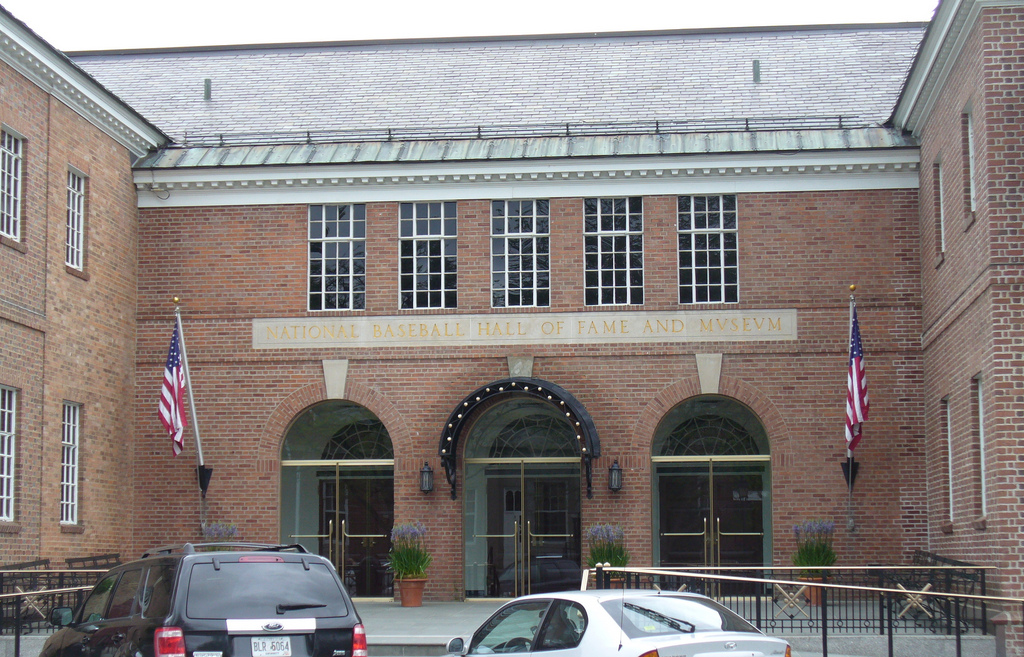
Baseball Hall of Fame “95 Percent” Club

Randy Johnson - Big Unit scored on 97 percent of HOF ballots.

Randy Johnson – Big Unit scored on 97 percent of HOF ballots.

The Baseball Writers Association of America’s (BBWAA) Hall of Fame Ballots are in – and so are Randy Johnson, Pedro Martinez, John Smoltz and Craig Biggio.  Johnson, named on 97.27 percent of the ballots, joined some elite company.  His percentage was the eighth-highest ever in the official BBWAA balloting – and he became one of only 14 players to receive at least 95 percent support since the first election back in 1936. No playernot even the likes of Babe Ruth, Ty Cobb, Hank Aaron or Christy Mathewson – has ever received unanimous support. (Cy Young, with his record 511 mound wins, was elected in 1937 with 76.12 percent of the vote.) The all-high in balloting is 98.84 percent, achieved by Tom Seaver. (We’ll take a quick look at “resumes” of the fourteen members of the 95 percent club later in this post.)

Over the years, 118 players have been elected to the HOF through the regular balloting; with just 11.86 percent of those reaching the 95 percent support threshold.  Ten of those fourteen have come since 1989, three (Ty Cobb, Babe Ruth and Honus Wagner) were in the first-ever HOF class, and just one honoree achieved 95 percent support between 1936 and 1989 (Hank Aaron, 1982).

Here’s a breakdown of  “95-percenters” in ten-year increments:

1936-45           3

1946-55           0

1956-65           0

1966-75           0

1976-85           1

1986-95           3

1996-2005       3

2006-15           4


Now, a look at the Hall of Fame’s all-time top vote getters.

 1. Tom Seaver (RHP) – 98.84% – 1992       Nickname – Tom Terrific

Tom Seaver won 311 games (205 losses) in a 20-year MLB career (1967-86). He won 20 or more games in five seasons; leading his league in victories three times, ERA three times and strikeouts five times. Seaver finished his career with a 2.86 ERA and 3,640 strikeouts. He was the National League Rookie of the Year with the Mets in 1967, a 12-time All Star, and won the Cy Young Award three times (1969, 1973, 1975).  He threw one no-hitter.  Seaver pitched for the Mets (1967-77, 1983); Reds (1977-82); White Sox (1984-86); and Red Sox (1986).

Tom Seaver fact: On April 22, 1970, in beating the Padres 2-1 at Shea Stadium, Seaver set the MLB record for consecutive strikeouts in a game – fanning the last ten hitters of the contest (five looking/five swinging). In the complete game win, Seaver allowed one run on two hits, walked two and fanned 19.

2. Nolan Ryan (RHP) – 98.79% – 1999         Nickname – The Ryan Express

Nolan Ryan won 324 games in 27 MLB seasons (292 losses, a 3.19 ERA) and holds the All Time MLB strikeout record (5,714). Ryan was an eight-time All Star and a two-time twenty-game winner.  He led his league in strikeouts eleven times (topping 300 whiffs in a season six times) and recorded a league-low ERA twice. He also threw an MLB-record seven no-hitters. Ryan pitched for the Mets (1966, 1968-71); Angels (1972-79); Astros (1980-88); and Rangers (1989-93).

Nolan Ryan fact: Despite his Hall of Fame career, Nolan Ryan never won a Cy Young Award.

3. Cal Ripken Jr. (SS/3B) – 98.53% – 2007            Nickname – Iron Man

Cal Ripken will likely be most remembered for his all-time MLB record of 2,632 consecutive games played.  He will also be remembered for playing them well.  In a 21-season MLB career, Ripken was an All Star 19 times. He was also the AL Rookie of the Year in 1982 and twice was the league’s Most Valuable Player (1983, 1991). He collected 3,184 hits (.276 lifetime average), 431 home runs, 1,695 RBI and 1,647 runs scored. He won eight Silver Slugger Awards (as the best offensive player at his position) and two Gold Gloves (as the best defensive player at his position). Ripken played his entire career (1981-2001) with the Orioles.

Cal Ripken fact:  In 1991, Cal Ripken Jr. won the All Star Game Home Run Derby (and was the AS Game MVP).

4. Ty Cobb (OF) – 98.23% – 1936                     Nickname – The Georgia Peach

A member of the HOF’s inaugural class, Ty Cobb holds MLB’s highest career batting average (among qualified players) at .366, is second all-time in hits (4,189) and runs scored (2,246). Cobb won an MLB-record 12 batting titles (including nine in a row from 1907 to 1915). He hit over .400 three times (1911, 1912, 1922). In addition to his batting titles, Cobb led the league in hits eight times, runs five times, doubles three times, triples four times, home runs once, RBI four times and stolen bases six times.  Cobb played for the Tigers (1905-26) and the Athletics (1927-28).

Ty Cobb fact: Ty Cobb stole home an MLB-record 54 times.

5.  George Brett (3B) – 98.18% – 1999                   Nickname – Mullet

A .305 lifetime hitter (21 seasons), George Brett collected 3,105 hits and three batting crowns – including a high of .390 in 1980.  Brett was a thirteen-time All Star and the 1980 AL Most Valuable Player.  In addition to his three batting titles, Brett led the league in hits three times, doubles twice, triples three times.  He finished with 317 home runs, 1,596 RBI and 1,583 runs scored.  Brett played his entire MLB career (1973-93) for the Royals.

George Brett fact:  George Brett is the only MLBer to win a batting title in three different decades (1976, 1980, 1990).

6. Hank Aaron (OF) – 97.83% – 1982        Nickname(s) – The Hammer, Hamerin’ Hank

Hank Aaron stands number-two on the all-time home run list with 755 round trippers, and number-one in RBI (2,297), extra base hits (1,477) and total bases (6,856).  He was an All Star in 21 of his 23 seasons and the 1957 NL Most Valuable Player.  Aaron led his league in batting average twice, home runs four times, RBI four times, doubles four times, hits twice, runs scored three times and total bases eight times.  He also earned three Gold Glove Awards.  Aaron is one of only two players with 500 home runs (755), 3,000 hits (3,771) and a .300 batting average (.305). (The other is Willie Mays.) Aaron played for the Braves (1954-74) and Brewers (1975-76).

Hank Aaron fact:  Hank Aaron and fellow Brave and HOFer Eddie Mathews hit more home runs while teammates (863) than any other duo – edging out Babe Ruth and Lou Gehrig (859).

7. Tony Gwynn (OF) – 97.61% – 2007                  Nickname(s) – Mr. Padre, Captain Video

Tony Gwynn was fifteen-time All Star in his 20-season career.  A lifetime .338 hitter, Gwynn was an eight-time batting champion, as well as a five-time Gold Glover. He led the NL in hits seven times (topping 200 in five seasons) and runs once.  He hit 135 home runs, scored 1,383 runs and drove in 1,138. He collected 3,141 hits – all for the Padres (1982-2001).

Tony Gwynn fact:  Tony Gwynn put the bat on the ball, striking out only 434 times in 20 seasons (10,232 plate appearances). In his career, he only struck out more than once in a game 34 times.

8.  Randy Johnson (LHP) – 97.26% – 2015                     Nickname – The Big Unit

The 6’ 10”  Randy Johnson won 303 games (166 losses), with a 3.29 ERA, over 22 seasons.  He finished his career second all-time in strikeouts (4,875) and led his league in whiffs nine times (topping 300 in a season six times). He was a 20-game winner twice, leading the NL with 24 wins in 2002. Johnson won the Cy Young Award five times, including four consecutive seasons (1999-2002). He also led his league in winning percentage four times, ERA four times, complete games five times and shutouts twice.   The ten-time All Star threw two no-hitters (one a perfect game).  Johnson pitched for the Expos (1988-99); Mariners (1989-98); Astros (1998); Diamondbacks (1999-2004, 2007-08); Yankees (2005-06); and Giants (2009).

Randy Johnson fact:   Randy Johnson is one of only three pitchers to win the Cy Young Award in both the American and National League (Pedro Martinez and Gaylord Perry are the others).

9.  Greg Maddux (RHP) – 97.20% – 2014           Nickname(s) – Mad Dog, The Professor

Greg Maddux won 355 games (227) losses, with a 3.16 ERA over 23 MLB seasons.  He was an eight-time All Star and won four consecutive Cy Young Awards (1992-95). He also won more Gold Glove Awards than any other player in MLB history (18). He led his league in wins three times, winning percentage twice, ERA four times, games started seven times, complete games three times and shutouts five times. Maddux pitched for the Cubs (1986-92, 2004-2006); Braves (1993-2003); Dodgers 2006, 2008); and Padres (2008).

Greg Maddux fact:   While Maddux finished with 3,371 regular season strikeouts, he only reached 200 whiffs in a season once.

10.  Mike Schmidt (3B) – 96.52% – 1995              Nickname – Schmitty

Mike Schmidt pounded out 548 home runs in 18 big league seasons – and also earned ten Gold Gloves at third base. The twelve-time All Star was the NL Most Valuable Player three times (1980, 1981, 1986).  He led the NL in home runs eight times and RBI four times. A career .267 hitter, Schmidt finished with 548 home runs, 1,595 RBI and 1,506 runs scored. Schmidt played his entire MLB career (1972-89) for the Phillies.

Mike Schmidt fact:   On April 17, 1976, Schmidt tied an MLB record by hitting four home runs in a single game – driving in eight runs as the Phillies topped the Cubs 18-16 in ten innings at Wrigley Field.

11.  Johnny Bench (C) – 96.42% – 1989               Nickname – Little General

In his 17-season MLB career, Johnny Bench was an All Star 14 times, was twice the NL MVP (1970, 1972) and was the World Series MVP in 1976.  He was also the NL rookie of the Year in 1968, when (as a 20-year old), he hit .275, with 15 home runs and 82 RBI – while also earning a Gold Glove at catcher.  Bench went on to hit 389 home runs (leading the NL twice) and earn a total of ten Gold Gloves.  He finished his career with a .267 average, 1,091 runs scored and 1,376 RBI (leading the league in that category three times). Bench played his entire career (1967-83) with the Reds.

Johnny Bench fact:  Johnny Bench was the first catcher to win a Rookie of the Year Award and the first rookie catcher to win a Gold Glove.

12.  Steve Carlton (LHP) – 95.82% – 1994                         Nickname – Lefty

Steve Carlton won 329 games (244 losses), with a 3.22 ERA over a 24-year MLB career.  He was a ten-time All Star and won a total of four Cy Young Awards (1972, 1977, 1980, 1982). Carlton led the NL in wins four times, winning percentage once, ERA once, complete games three times and strikeouts five times (a high of 310 in 1972). He is one of only four pitchers to surpass 4,000 strike outs (4,136). Carlton pitched for the Cardinals (1965-71); Phillies (1972-86); Giants (1986); White Sox (1986); Indians (1987); and Twins (1987-88).

Steve Carlton fact:  In 1972, Steve Carlton won an MLB-record 46 percent of his team’s games – going 27-10, 1.97 for a last-place Phillies’ team that finished at 59-97.  That season, Carlton led the NL in wins, ERA, games started (41), complete games (30), innings pitched (346 1/3), and strikeouts (310).

13.  Babe Ruth (OF/P) – 95.13% – 1936                 Nickname(s) – Babe, The Bambino, The sultan of Swat

Babe Ruth made his mark first as a pitcher and then as the game’s first true power hitter.  As a pitcher, Ruth went 94-46, with a 2.28 ERA in 163 games (147 starts) – including two twenty-plus victory seasons (23-12 in 1916 and 24-13 in 1917 for the Red Sox).  In 1916, he led the AL in ERA (1.75), games started (40) and shutouts (9) – with 23 complete games and 323 2/3 innings pitched.  He threw 300+ innings again the following season (326 1/3) and led the league in complete games (35).  He also ran up a 3-0 post season (World Series) record, giving up just three runs in 31 post-seasons innings (1.06 ERA.)

At the plate, converting to the outfield full-time, Ruth proved even more powerful than he was on the mound.  In a twenty-two season MLB career, Ruth hit .342, with 714 home runs, 2,214 RBI and 2,174 runs scored. Ruth led the AL in home runs twelve times, runs scored eight times, RBI six times and batting average once.  In 41 World Series games, he hit .326, with 15 home runs and 33 RBI.   Ruth played for the Red Sox (1914-19); Yankees (1920-34); and Braves (1935).

Babe Ruth fact:  Among pitchers with at least twenty decisions against the Yankees, Babe Ruth has the top winning percentage at .773 (17-5) – all while with the Red Sox.

14.  Honus Wagner (SS) – 95.13% – 1936                 Nickname – The Flying Dutchman

In his 21-season MLB career, Honus Wagner captured eight batting titles (tied for the most in the NL with Tony Gwynn).  He also led the NL in RBI five times, runs scored twice, hits twice, stolen bases five times, doubles seven times, triples three times and total bases six times. Overall, Wagner collected 3,320 hits (a .328 career average), 101 home runs, 1,733 RBI, 1,739 runs scored, 643 doubles, 252 triples and 722 (or 723 depending on the source) stolen bases. Wagner played for the Louisville Colonels (1897-99) and Pirates (1900-17).

Honus Wagner fact:  While primarily a shortstop, Honus Wagner – a gifted and versatile athlete – played every position except catcher during his career.

So, there’s a look at the Hall of Fames “95-percenters.”   Now, if you are into the rounding of percentages, there are three more players who would have made the cut – all outfielders and all elected in a year ending in “nine”:  Ricky Henderson (94.81 percent, 2009); Willie Mays (94.68%, 1979); and Carl Yastrzemski (94.67 percent 1989).


A side note: BBRT’s HOF predictions (made by in early December – see the BBRT Hall of Fame Post here.) were pretty close.  BBRT predicted Johnson, Martinez, Biggio and Smoltz would be elected by the writers – and that they would finish 1-2-3-4 as listed.  The quartet was elected, but they finished 1-2-4-3. BBRT also projected Mike Piazza would gain some traction, but finish fifth in the voting and fall short of election (with 66-68 percent of the votes.) Piazza finished fifth at 69.9 percent.


I tweet baseball @DavidBBRT

Baseball Bloggers Alliance Announces Its HOF Recommendations

BaseballBloggersAlliance-thumb-200x155-12545As a member of the Baseball Bloggers Alliance (BBA), I am pleased to share the BBA’s announcement that seven players from this year’s Baseball Writers Association of America (BBWAA) Hall of Fame ballot were recommended for enshrinement in the Baseball Hall of Fame by the BBA membership – with Randy Johnson the only unanimous recommendation. (The BBA is an organization of more than 200 baseball bloggers.)

In the official release regarding the BBA balloting, it is noted that –  given the backlog of quality players on the ballot – the BBA adopted the “binary ballot” process suggested by St. Louis Post-Dispatch columnist Derrick Goold. Each player on the ballot was given a “yes” or “no” vote by BBA voters and those receiving over 75 percent were then recommended for induction. (There was no ten-vote maximum as in the official BBWAA balloting.) Using this method, only 13 percent of BBA members turned in a ballot with less than ten names selected, while 40 percent turned in a ballot with 15 or more names selected.  Note:  BBRT is highly supportive of the adoption of binary balloting by the BBWAA.)

Within this format, the following player received the necessary support from Baseball Bloggers Alliance members:

Randy Johnson (LHP, 1988-2009) – Unanimous BBA support

The Big Unit should be headed for the Hall of Fame.

The Big Unit – BBA’s unanimous HOF recommendation.

Randy Johnson notched 303 wins (166 losses) and 4,875 strikeouts (second all-time) in 4,135 innings pitched.  Johnson’s 10.61 strikeouts per nine innings ranks number-one among qualifying starting pitchers.  Johnson, who held hitters to a .221 average (eighth lowest all-time), was a ten-time All-Star and five-time Cy Young Award winner (second only to Roger Clemens). He led his league in strikeouts nine times, ERA four times, complete games four times, winning percentage four times and victories once.  He earned four straight NL Cy Young Awards (1999-2002) and threw two no-hitters (one a perfect game.) He was also the 2001 World Series MVP – going 3-0. 1.04 in three starts (striking out 19 in 17 1/3 innings).

Johnson itched for the Montreal Expos (1988-89); Seattle Mariners (1989-98); Houston Astros (1998); Arizona Diamondbacks (1999-2004, 2007-08); New York Yankees (2005-2006); and San Francisco Giants (2009).

Pedro Martinez (RHP, 1992-2009) – 95 percent

Pedro Martnez brought an arsenal of "plus" pitches and elite control to the mound.

Pedro Martnez brought an arsenal of “plus” pitches and elite control to the mound.

Martinez ran up a 219-100 record, a 2.93 ERA and 3,154 strikeouts in 18 seasons.  Among qualifying starting pitchers, only Randy Johnson recorded more strikeouts per nine innings than Martinez’ 10.04. He captured three Cy Young Awards (1997, 1999, 2000) and was an eight-time All Star.  He notched a league-low ERA in five seasons, and a league-high in strikeouts three times.  Martinez is one of only four pitchers to log 3,000+ strikeouts with fewer than 1,000 walks. His .687 winning percentage is the third-highest all-time; second-highest in the modern era (behind Whitey Ford’s .690; 238-106).

Martinez pitched for the Los Angeles Dodgers (1992-93); Montreal Expos (1994-97); Boston Red Sox (1998-2004); New York Mets (2005-08); and Philadelphia Phillies (2009).

Craig Biggio (2B/C/OF, 1988-2007) – 90 percent

Craig Biggio getting his bat on the ball for 3,000+ hits should be his ticket to the Hall of Fame.

Craig Biggio getting his bat on the ball for 3,000+ hits should be his ticket to the Hall of Fame.

Biggio recorded 3,060 base hits (20th all time), 1,884 runs (154h all time), hit 291 home runs and stole 414 bases.  He was a seven-time All Star and a four-time Gold Glove winner. He led the NL in runs twice, doubles three times, stolen bases once and hit-by-pitch five times.  His 668 doubles are the most ever by a right-handed hitter (and fifth all time). He holds the NL record for home runs to lead off a game (53) and for hit-by-pitch (285).

Biggio played his entire 18-year MLB career with the Houston Astros.


John Smoltz (RHP, 1988-2009) – 89 percent

Smoltz delivered as a starter and reliever.

Smoltz delivered as a starter and reliever.

Smoltz is the only MLB hurler to notch 200+ wins (213) and 150+ saves (154) in his career – and one of only two pitchers to have a 20-win season and a 50-save season.  In 1996, he went 24-8 as a starter for the Braves, leading the NL in wins, winning percentage (24-6, .750), strikeouts( 276)  and innings pitched (253 2/3). Five seasons later, after Tommy John surgery, Smoltz led the NL in saves with 55. Smoltz was an eight-time All Star, who won the NL Cy Young Award in 1996 and was the Rolaids Relief Man of the Year in 2005. He led the NL in wins twice, winning percentage twice, strikeouts twice, innings pitched twice and saves once.  He finished his career at 213-155, 3.33, with 154 saves and 3,084 strikeouts in 3,473 innings pitched.

Smoltz pitched for the Atlanta Braves (19988-99, 2001-08); St. Louis Cardinals (2009); and Boston Red Sox (2009).

Mike Piazza (C, 1992-2007) – 85 percent

Mike Piazza - above the HOF bubble in BBA voting.

Mike Piazza – above the HOF bubble in BBA voting.

Mike Piazza’s achieved a .308 career average, 427 home runs (a MLB-record 396 as a catcher), a Rookie of the Year Award, 12 All Star Selections and ten Silver Slugger Awards as the best hitter at his position. He collected 2,127 hits, 1,335 RBI and scored 1,048 runs. Piazza played for the Los Angeles Dodgers (1992-98); Florida Marlins (1998); New York Mets (1998-2005); San Diego Padres (2006); and Oakland A’s 2007.


Jeff Bagwell (1B, 1991-2005) – 77 percent

Jeff Bagwell’s 15-year career MLB-career included 2,314 hits, 449 home runs, 202 stolen bases and a .297 average – along with a Rookie of the Year Award, a Most Valuable Player Award, one Gold Glove and four All Star selections.  He also twice recorded seasons of 40 or more homers and 30 or more steals. Bagwell played his entire MLB career with the Houston Astros,

Tim Raines (OF, 1979-2001) – 77 percent

Tim Raines hit .294 over his 23-season MLB career, collecting 2,605 hits, 1,571 runs scored, 170 home runs, 980 RBI and 808 stolen bases (#5 all time).  Raines was successful on 83.5 percent of his career steal attempts. He was a seven-time All Star, led the NL in stolen bases four consecutive years (1981-84), had a streak of six seasons with at least 70 steals, won the NL batting title in 1986 with a .334 average, led the league in runs scored twice and doubles once. Raines played for the Montreal Expos (1979-90, 2001)); Chicago White Sox (1991-95); New York Yankees (1996-98); Oakland A’s (1999); Baltimore Orioles (2001); and Florida Marlins (2002).

All seven of these players received BBRT’s HOF support – as did Lee Smith, Jeff Kent and Mike Mussina.  For more details on the BBA recommended candidates and BBRT’s ballot, click here to go to my December 3, 2014 Hall of Fame Post.

The rest of the BBA voting was as follows:

Edgar Martinez  71%

Curt Schilling 68%

Mike Mussina 67%

Barry Bonds 65%

Roger Clemens 63%

Alan Trammell 53%

Jeff Kent 44%

Gary Sheffield 38%

Larry Walker 37%

Fred McGriff 33%

Mark McGwire 33%

Don Mattingly 31%

Lee Smith 31%

Sammy Sosa 23%

Carlos Delgado 19%

Nomar Garciaparra 13%

Cliff Floyd 4%

Brian Giles 4%

Rich Aurilia 3%

Darin Erstad 3%

Troy Percival 3%

Aaron Boone 1%

Jason Schmidt 1%

Jermaine Dye 0%

Tom Gordon 0%

Eddie Guardado 0%

The official website of the BBA is located at baseballbloggersalliance.wordpress.com. The BBA can be found on Twitter by the handle @baseballblogs and by the hashmark #bbba. For more information, contact Niko Goutakolis at baseballbloggersalliance@gmail.com.


I tweet baseball @DavidBBRT

Baseball Hall of Fame – Golden Era Voting – BBRT’s Take

baseball_hall_of_fame-300x225We are just days away (Monday, December 8) from the announcement of the Golden Era candidates (if any) who will be inducted into the Baseball Hall of Fame in 2015.  In this post, I will share how BBRT’s ballot would look (if I had one), as well as my predictions as to who the committee will chose to send on to the Hall of Fame.

Selecting from among the Golden Era candidates proved more challenging then working my way through BBRT’s predictions and preferences for the regular Baseball Writers Association of American Hall of Fame voting.  (For BBRT’s regular Hall of Fame Ballot predictions, click here.) There were several reasons for that:

  • Since the Golden Era candidates were prescreened by an Historical Overview Committee, they all had some very deserving achievements and attributes;
  • Since I grew up in the Golden Era, I was able to see all the nominated players on the field – and find my choices mixing emotion with reason;
  • You can only vote for five of ten candidates, no matter how deserving you feel six or seven may be; and
  • Predicting how the Committee will vote is complicated by the fact that its membership changes so much from election to election (only four of the 16 members of the previous Golden Era Committee are back this year).


By way of background, the Hall of Fame Eras Committees consider candidates passed over for election to the HOF in the annual Baseball Writers Association of America – BBWAA –  balloting. The committees, which meet on a rotating basis (each committee meeting once every three years), are the: Pre-Integration ERA (prior to 1946); Golden Era (1947-72); and Expansion Era (1973 forward). Players to appear on each year’s ballot are selected by an Historical Overview Committee and candidates must receive 75 percent support from Era Committee members to achieve election.  Era Committee members may vote for or up to five candidates.   Candidates whose careers overlap eras are considered on the basis of the time frame in which they made their most significant contributions to the national pastime.

There are ten candidates on this year’s Golden Era ballot and, unlike the regular Hall of Fame election, their fate is not in the hands of the members of the Baseball Writers Association of America. Instead, their election depends on garnering 75 percent of the votes from a16-member panel that, this election cycle, includes:

  • Already enshrined Hall of Famers: Jim Bunning, Rod Carew, Pat Gillick (executive), Ferguson Jenkins, Al Kaline, Joe Morgan, Ozzie Smith and Don Sutton
  • Baseball executives: Jim Frey, David Glass, Roland Hemond and Bob Watson
  • Historian: Steve Hirdt
  • Media representatives: Dick Kaegel, Phil Pepe and Tracy Ringolsby

The returning members from 2011 are Gillick, Kaline, Hemond and Kaegel.

Note:  The last time the Golden Era Committee convened (2011), only former Cubs’ third baseman Ron Santo received the required 75 percent of the vote.

2014 Golden Era Baseball Hall of Fame Voting (for 2015 induction)

Candidates – Those returning from the 2011 voting are in bold face, with voting percentages for the top vote-getters noted.

Dick Allen, Ken Boyer, Gil Hodges (56.3%), Bob Howsam (executive),  Jim Kaat (62.5%), Minnie Minoso (56.3%), Tony Oliva (50.0%), Billy Pierce, Luis Tiant and Maury Wills.


How BBRT would use its five votes – if I had a ballot.

When considering players, it’s difficult to put sentiment aside.  Being born in the initial year of the Golden Era, I grew up watching all of these players.  I can find a reasons – beyond basic statistics – to vote for every one.

Beyond overall statistics (more on those later), here are just a few of the candidates’ unique achievements:

  • Maury Wills, Ken Boyer and Dick Allen have all won league MVP Awards
  • Jim Kaat shares the MLB record for consecutive Gold Gloves won (16) with Brooks Robinson
  • Gil Hodges is one of only 16 MLB players to hit four home runs in one game
  • Tony Oliva is the only player to win his league batting title in his rookie and sophomore seasons
  • Maury Wills, in 1962, not only became the first player to steal 100 bases in a season (104), he topped the next highest player’s total by 72 – and the Dodger shortstop actually stole more bases than every other MLB team
  • Minnie Minoso led the AL in hit by pitch an MLB record 10 times
  • In 1962, Billy Pierce (traded to the San Francisco Giants in the off season), proved to really like home cooking – going 11-0 in eleven Candlestick starts, with  his overall 15-6 record helping the Giants tie the rival Dodgers for the pennant. Pierce started Game One of the three-game playoff and ran his 1962 home record to 12-0 (beating Sandy Koufax, tossing a three-hit shutout in an 8-0 win).
  • Dick Allen is one of only 39 players since 1900 to hit two inside-the-park homers in a one game. Since Allen hit his two inside-the-park HRs on May 31, 1972, the feat has been equaled only once in MLB – by the Twins’ Greg Gagne in 1986. (Three inside-the-park homers in a game has been achieved only once, by Tom McCreery of Louisville of the NL in 1897.)

The uniqueness of this class of candidates goes beyond the numbers. Consider:

  • Tony Oliva’s knees bent-in stance – and ability to hit pretty much any pitch (in or out of the strike zone)
  • Luis Tiant’s twisting (and deceptive) delivery
  • Minnie Minoso’s groundbreaking efforts on behalf of Latin American players
  • Dick Allen’s fierce presence and personality on and off the field

I could go on and on, but the point is – each of these players offers up good (and diverse) reasons to secure the votes of the Golden Era Committee (and BBRT).  Still, the Committee members are limited to five votes, so I decided to follow the same rules for BBRT’s “ballot.”   I did my best to focus on exceptional performance in relation to their Golden Era peers – league leadership in key categories, All Star selections, individual awards (Rookie of the Year, Cy Young, MVP, etc.)  I recognize that my selections, which I will present in priority order, may make me look like a bit of a “homer.” (I’m from Minnesota and two of my selections are former Twins.) I do, however, think my reasoning will stand up to evaluation.


1. Minnie Minoso (OF/3B, 1949-1964*)

*Minoso also made brief publicity-focused appearances for the White Sox in 1976 and 1980 – which allowed him to appear in MLB in five different decades.

GEMinosoIn his first full MLB season (split between the Indians and the White Sox), Minoso hit .326, leading the AL in triples (14), stolen bases (31) and hit by pitch (16) – finishing second to Yankees’ infielder  Gil McDougald in the Rookie of the Year balloting.

BBRT note: Minoso’s statistics for the year – 146 games, 530 at bats, 173 hits, 34 doubles, 14 triples, 10 home runs, 76 RBI, 31 steals and a .326 average – topped McDougald in every category except home runs.

Minoso went on to a 17-season MLB career in which he made seven All Star squads, earned three Gold Gloves, led the AL in hits once, doubles once, triples three times, stolen bases three times, total bases once and hit by pitch an MLB-record ten times. He finished with 1,963 hits and a .298 average (topping .300 eight times), 186 home runs (hitting 20+ in a season four times), 1,136 runs (scoring more than 100 runs in a season four times), 1,023 RBI (besting 100 four times) and 205 stolen bases. In addition to those offensive marks, Minoso also led AL leftfielders in assists six times, putouts four times and double plays four times.  Minoso was well into his career when the Rawlings Gold Glove Awards were established in 1957; yet he still earned a Gold Glove in left field in 1957, 1959 and 1960.

Adding to Minoso’s Hall of Fame resume is the fact that he was a groundbreaking “Black Latino” in major league baseball.  He was the first player of color for the Chicago White Sox, the first Black Cuban to play in the major leagues and the first Cuban to play in the major league All Star game.  His baseball legacy is further enhanced by the fact that he played (and starred) not only in the major leagues, but in the Negro Leagues (where he played in the East West All Star Games of 1947 and 1948) and Cuban League – and is a member of the Cuban Baseball Hall of Fame, the Latino Baseball Hall of Fame and the Hispanic Heritage Hall of Fame.

All of this puts Minoso at the top of the BBRT Golden Era ballot – plus I’d like to see his full name Saturnino Orestes Armas (Arrieta) Minoso on that HOF plaque.

Minnie Minoso played for: Cleveland Indians (1949, 1951, 1958-59); Chicago White Sox (1951-57, 1961, 1964, 1976, 1980); Saint Louis Cardinals (1962); Washington Senators (1963).

Minnie Minoso’s best season:  1954 Chicago White Sox … 153 games, .320 average, 182 hits, 29 doubles, 18 triples (league-leading), 19 home runs, 119 runs scored, 116 RBI, 18 stolen bases.


2. Jim Kaat (LHP, 1959-83)

GEKaatJim Kaat – 283 wins, 3oth all-time.  That might say enough right there.  Kaat, however, also is among MLB’s top 35 hurlers in games started (625, 17th), innings pitched (4,530 1/3, 25th) and strikeouts (2,461, 34th). One of the criticisms of Kaat raised during regular BBWAA balloting was that he his win total was inflated by the length of his career (Kaat average 11.3 wins per season over 25 seasons).  From a different perspective, BBRT believes the fact the Kaat had the skills and determination to compete on the major league level from age 20 to age 44 contributes to his Hall of Fame credentials.

Overall, Kaat went 283-237, 3.45.  He was a three-time All Star, and won 20 or more games three times. He led his league in games started twice and wins, complete games and shutouts once each. Then, of course, there are those sixteen (consecutive) Gold Gloves.  Kaat finished second (with 62.5 percent of the vote) in the previous Golden Era balloting.  This should be his year.

Jim Kaat played for the: Washington Senators/Minnesota Twins (1959-73); Chicago White Sox (1973-75); Philadelphia Phillies (1976-79); New York Yankees (1979-1980); Saint Louis Cardinals (1980-83).

Jim Kaat’s best season: 1966 Twins … A league-leading 25 wins (13 losses), with a 2.75 ERA. That season, Kaat also led the AL in starts (41) and complete games (19). Kaat might have that all-important Cy Young Award on his HOF resume, except for the fact that MLB gave out only one CYA in 1966 (the move to a CYA for each league came the following year) and it went to National Leaguer Sandy Koufax (27-9, 1.73 for the Dodgers).


3. (Tie) Tony Oliva (OF-DH, 1962)

GEOlivaOkay, having two former Twins on my ballot may make me look like a “homer,” but hear me out.  First, it’s ironic that Jim Kaat’s HOF qualifications have been criticized in the past because his career was too long (283 wins over 25 seasons), while Oliva’s HOF credentials have been criticized because – due to injury – his productive career was too short (only 11 seasons in which he played at least 125 games, only seven of 140 games or more).

Oliva gets BBRT’s vote because when he played he was simply one of the best. In his first eight seasons full seasons (1964-71), he made the All Star team every year.  During that span he produced an annual average of 182 hits (.313 batting average), 22 home runs, 89 runs scored, 90 RBI and ten stolen bases.

Oliva won three batting titles (and the 1964  Rookie of the Year Award) – and is the only player to win the batting crown in both his rookie and sophomore seasons.  He also led the AL in base hits five times, doubles four times, and topped the AL one time each in runs scored, slugging percentage, total bases and intentional walks.   Tony-O also showed speed on the bases, finishing in double-digit in steals six times, with a high of 19 in 1965.

Oliva also was a “’plus” defender with a rifle arm in right field, capturing a Gold Glove in 1966. Even after knee issues forced to serve primarily as a DH (1972-76), he continued to be a feared hitter.  Oliva played in 15 major league seasons, retiring with a .304 career average, 1,917 hits, 220 home runs, 870 runs scored and 947 RBI.

Tony Oliva played for:  Minnesota Twins (1962-76)

Tony Oliva’s best season:  1964 Twins … In his rookie year, Oliva led the AL in batting average (.232), hits (217), doubles (43), total bases (374) and runs scored (109). He threw in 32 home runs, 94 RBI and 12 stolen bases for good measure.  Oliva did not fall prey to the “sophomore jinx.” The following season, he again led the AL in hits and batting average.

 3. (Tie) Dick Allen (1B/3B, 1963-77)

GEAllenDick Allen’s traditional HOF candidacy suffered from a combination of career-shortening injuries and career-complicating (often racially motivated) controversy.  The fact is Allen had a fierce presence both on and off the field.  It is on-the-field performance – specifically his at-the-plate performance – that earns Allen BBRT’s Golden Era vote.  It is generally agreed that none of his peers hit the ball as consistently hard (and far) as Allen did in the pitching-dominated 1960s.

Allen came on with a bang in his first full season, leading the NL in runs scored (125), triples (13) and total bases (352), while hitting .318 with 29 home runs and 91 RBI.  His performance earned him the Rookie of the Year Award.  He went on to a 15-year career during which he was a seven-time All Star and collected 1,848 hits, 351 home runs and 1,119 RBI.  His career batting average was .292, and he topped .300 seven times.  He led the NL in home runs twice (hitting 30+ HRs six times), RBI once (besting 100 three times), walks once, on base percentage twice, slugging percentage three times and total bases once.

Dick Allen played for: Philadelphia Phillies (1963-1969; 1975-76); Los Angeles Dodgers (1971); Chicago White Sox (1972-74); Oakland A’s (1977).

Dick Allen’ best season:  1972 Chicago White Sox … Played in 148 games, hitting .308, while leading the AL in home runs (37), RBI (113), walks (99), on base percentage (.420) and slugging percentage (.603).  Won the AL MVP Award.


5. Gil Hodges (1B, 1943-63 – military service 1944-45)

GEHodgesGil Hodges was a slick-fielding first baseman. (Rawlings launched the Gold Glove Award in 1957 and Hodges, already in his 12th MLB season at age 33, began a streak of three consecutive Gold Gloves at first base.) Hodges was also a potent offensive force – an RBI machine.  For the seven seasons from 1949 to 1955, he topped 100 RBI every year – averaging 112 runs driven in per campaign.   He also logged 11 consecutive seasons of 20+ home runs (1949-59), with a high of 42 in 1954.

In 18 MLB seasons, Hodges was selected for eight All-Star teams, and helped his Dodgers capture seven NL pennants and two World Series championships.  In post season play, he is best remembered his 21 hitless at bats in 1952, but in his other six World Series he hit .318, with five home runs and 21 RBI in 32 games.

Hodges’ put up a career average of .273, with 370 home runs, 1,274 RBI and 1,105 runs scored.  Without losing those two years to military service, he may well have exceeded the 400 home run, 1,500 RBI marks. After his playing days, he also managed the Washington Senators (1963-67) and New York Mets (1968-71), leading the “Miracle Mets” to the World Championship in 1969.

Gil Hodges played for: Brooklyn/LosAngeles Dodgers (1943-61); the New York Mets (1962-63).

Gil Hodges’ best season:  1954 Dodgers … Hodges played in all 154 games that season, providing sparkling defense along with a .304 average, 42 home runs, 130 RBI and 106 runs scored.

Note: Hodges finished third in the previous Golden Era voting, with 56.5 percent.

 

So, there’s the BBRT Golden Era ballot.  But I can’t resist taking just a little liberty.  If I only had one more vote, it would go to:


Ken Boyer (3B/1B/CF … 1955-69)

GEBoyerKen Boyer was a Gold Glove fielder at third base.  In fact, he won five Gold Gloves in a six-season span (1958 to 1963).  He led all NL third baseman in assists twice, putouts once and double plays five times. And I guess he was able to console himself for losing the 1964 Gold Glove to the Cubs’ Ron Santo with the fact that Boyer was voted the NL MVP that season.

You may have heard about (or witnessed) Boyer’s defensive skills at the hot corner, but did you know his MLB career also included time in centerfield (111 games), as well as at first base (65 games) and shortstop (31 games)? In fact, in 1957 – with the Cardinals wanting to develop infield prospect Eddie Kasko and facing a gap in centerfield – Boyer agreed to move to the center of the outfield. In 105 games there, he made just one error and led NL outfielders with a .993 fielding average.

Note: A combination of an injury to Kasko and the Cardinals acquisition of outfielder Curt Flood sent Boyer back to third base in 1958 (and he began a streak of four consecutive Gold Gloves).

In his fifteen-year MLB career, Boyer became known not just as a fine defensive player, but also as a consistent, quality hitter. He retired with 2,143 hits, a .287 average, 282 home runs, 1,104 runs scored and 1,141 RBI – topping .300 five times (with a high of .329 in 1961), hitting 20 or more home runs eight times (with a high of 32 in 1960), driving in 90 or more runs eight times (with a league-leading high of 119 in 1964) and scoring 90 or more runs five times (with a high of 109 in 1961).  The quality of Boyer’s play – in the field and at the plate – earned him seven All Star selections.


WHAT WILL THE GOLDEN ERA COMMITTEE DO?

With only four of the sixteen members from the previous Golden Era Committee (which elected on Ron Santo) returning, this becomes a tough call. Given the make-up of the 2014 committee, I expect they will be a little more generous in the balloting.

Likely to be elected:  I expect Jim Kaat (who came so close in 2011) and Minnie Minoso to receive the necessary support.

Dark horse candidates:  I also think Tony Oliva (thanks to Rod Carew’s presence on the panel) and Gil Hodges (who got 56.3 percent last time around) have a chance – but I am less confident they will garner three-quarters of the votes.

So, in order of likelihood, Kaat, Minoso, Oliva, Hodges.


BBRT invites your comments on the Golden Era ballot.


I tweet baseball @DavidBBRT

The Babe Ruth of the Minors – Buzz Arlett

Buzz Arlett - the minor league's greatest player - during his time with the Minneapolis Millers.

Buzz Arlett – the minor league’s greatest player – during his time with the Minneapolis Millers.

Russell Loris “Buzz” Arlett made his major league debut (for the Phillies) on Opening Day (April 14) 1931 – and he made the most of it.  A 32-year-old rookie, with 13 minor-league seasons (the first five as a pitcher) under his belt, Arlett started in right field, batting sixth.  He went two-for-four, with a double and a run scored.  He went on to play in 121 games (RF/1B) that season, hitting .313, with 18 home runs (fourth in the NL) and 72 RBI.  Despite showing this promise, Arlett was back in the minor leagues in 1932, where he remained for six more seasons before leaving the professional ranks.

So, why did I choose to dedicate this BBRT post to Buzz Arlett? The decision was based on his minor-league accomplishments, but also influenced by my current geography.

First, his minor-league accomplishments.  While Arlett made a pretty good “splash” in his lone MLB season, he was a big fish in a small pond in the minor leagues – as a pitcher and a hitter. In fact, baseball pundits (including sabermetrics guru Bill James) have labeled Arlett the Babe Ruth of the minor leagues.

  • As a pitcher, Buzz Arlett picked up 106 minor league wins – and, while at the top of his game (1919-1922), he went 95-71 for the Oakland Oaks of the Pacific Coast League. His best PCL season on the mound was 1920, when he pitched a league-leading 427 1/3 innings, won a league-high 29 games (17 losses), and notched a 2.86 ERA.
  • When Arlett’s strong right arm succumbed to overwork, he switched to the outfield/first base. In his first season as primarily a position player, Arlett hit .330, with 19 home runs and 101 RBI. He went on to hit .341, with 432 home runs and 1,786 RBIs in his minor-league career. His 432 home runs were the U.S. minor-league record, until passed by Mike Hessman in 2015. Hessman finished with 433 long balls in 19 minor-league seasons. (The non-MLB record belongs to Hector Espino, who hit 484 home runs in the Mexican leagues).

In 1984, the Society for American Baseball Research named Arlett (already a member of the Pacific Coast League Hall of Fame) the “All-Time Greatest Minor League Player.”

Then, there is the influence of geography. BBRT calls Minnesota home and Arlett’s Minnesota ties piqued my interest.  Arlett spent three seasons at the end of his playing career with the American Association’s Minneapolis Millers – hitting .334, with 81 home runs and 285 RBI in 312 games. Arlett joined the Millers in late May of 1934, coming over from the Birmingham Barons of the Southern Association, yet still managed to league the American Association in home runs with 41, while hitting .319 with 132 RBI in 166 games. The following season, at the age of 36, he hit .360, with 25 home runs and 101 RBI in 122 games for the Minneapolis squad.

After retiring from professional baseball,  Arlett (who served as a minor-league manager and major-league scout after his playing days) settled in the Twin Cities (Minneapolis/Saint Paul) and operated a successful restaurant and bar (Arlett’s Place, near Nicolett Park, where he had played for the Millers.) His final resting place is Lakewood Cemetery (Minneapolis).

And the impact of geography goes further. As I noted in my most recent post, I am on a family road trip from Cannon Falls to Davis, California.  As I write this I am in Davis – about 2,000 miles from home, but just 18 miles from Arlett’s Elmhurst, California birthplace and 70 miles from Oakland, where Arlett played most of his minor-league career.  Seems like serendipity to me.

So, here’s a look at Buzz Arlett’s baseball story.

Russell Loris Arlett was born January 3, 1989 in Elmhurst, California – a Sacramento suburb, which also happened to be about 85 miles from the home of the Oakland Oaks Pacific Coast League (PCL) baseball team.   Russell had three brothers and the boys were known to be avid and talented baseball players.  His oldest brother Al – eight years Russell’s senior – began playing professionally in 1911, primarily in the Pacific Coast League. In 1918, Al “Pop” Arlett, was playing for the Oakland Oaks and the Arlett family, including 18-year-old Russell, decided to make a family trip and join Al at Spring Training.  By this time, the youngest of the Arlett brothers had grown to a strapping (for the times) 6’3”, 185-pounds – and had shown some amateur pitching prowess (his nickname “Buzz” came from his ability to cut through opposing lineups like a buzz saw).

During spring training that year, the Oaks were hit hard by injuries and found themselves short of players for an intra-squad game. Buzz Arlett boldly offered to fill the gap and  Oaks’ manager Del Howard decided to give the youngster an unplanned chance to pitch. The kid showed good stuff – earning a few more opportunities spring training and, eventually, a spot on the team.

With Arlett’s signing a PCL legend was about to be born, but it didn’t look that way at first, as Arlett won four and lost nine that first season.  In 1919, however, Arlett mastered a devastating spitball (to complement a solid fastball and curve) and came into his own as a pitcher. His record over those four seasons was 95-71, 3.20.  Here’s a look at Arlett’s four best seasons as a hurler:

  • 1919 … 22-17, 3.00 earned run average
  • 1920 … 29-17, 2.89
  • 1921 … 19-18, 4.37
  • 25-19, 2.77

More important, Arlett tossed 1,468 1/3 innings in 212 games over those four seasons – an average of 367 innings per year.  By 1923, his right arm was pretty much worn out, and that season he took the mound in only 28 games, duplicating the 4-9 record of his rookie campaign. Not content to sit on the bench and wait for his arm to recover, Arlett, who had been used as a pinch hitter over the previous five seasons, begged his way into the everyday lineup as an outfielder. Still favoring his lame right arm, the natural right-handed hitter also spent hours in the batting cage developing left-handed hitting skills.  (Arlett is considered to be one of – if not the first – power-hitting switch hitters.) In his first primarily  “offensive” season, Arlett hit .330, with 19 homers and 101 RBI.  That was just the beginning. Consider these offensive stats.  As a minor leaguer (19 seasons), Buzz Arlett:

  • Hit over .300 twelve times, with a high of .382 for the Pacific Coast League Oakland Oaks in 1926.
  • Topped 30 home runs eight times (including two seasons of forty-plus homers and a high of 54 for Baltimore of the International League in 1932).
  • Drove in more than 100 runs in a season twelve times, with a high of 189 for the PCL Oakland Oaks in 1929.
  • Recorded a 1929 Oakland Oaks’ season of 200 games played, 270 hits, a .374 average, 39 home runs, 189 RBI, 146 runs, 70 doubles and 22 stolen bases.
  • Playing for the International League Baltimore Orioles in 1932, Arlett hit four home runs in a single game twice in one season (June 1, July 4). Each game featured three left-handed and one right-handed blast from Arlett’s 44-ounce bat.
  • In a July 4, 1932 double header, Arlett hit home runs in the last four at bats of Game One (see above bullet) and another in his first plate appearance of game two – giving him home runs in five consecutive at bats.

So, why did a player with all this talent spend so little time in the major leagues?

Arlett was unfortunate enough to play at time when there was no draft and minor-league teams controlled their own players.  Further, the Pacific Coast League (PCL) was considered one of the top – if not the top – regional minor leagues.  Quality players, solid attendance figures and a weather-aided long season (sometimes more than 200 games) enabled the PCL to pay major league-level salaries and offer major-league playing conditions.  Teams demanded high compensation for top players (who not only won games, but put fans in the seats) and the Oaks were reportedly asking the princely sum (at the time) of $100,000 for Arlett.  While Arlett garnered some interest as a pitcher, the fact that he relied heavily on the spitball (banned by MLB in 1920) diminished his value.  Further, as interest from MLB teams began to rise, Arlett’s arm problems were also on the rise.  Later, Oakland’s high asking price kept the power-hitting Arlett in the minors until – facing a changing major league draft policy,  and an aging (and now up to a conservatively estimated 230 pounds) and somewhat-injury prone Arlett – the Oaks sold Arlett to the Phillies before the 1931 season.

Why did Arlett last only one year in the big leagues?

Again, age and injury were taking their toll.  That, coupled with the now “larger” Arlett’s reputation (correct or not) as a less than adequate fielder, resulted in his release by the Phillies.  The fact that, after being released, Arlett played six more minor-league seasons (actually five, in his final season – for Syracuse of the International League – he logged just four at bats) and hit .337, with 177 home runs and 598 RBI (in 657 games) indicates MLB gave up on Arlett when there was still plenty of lightening left in his bat.

Primary Resources: Baseball-Reference.com; Buzz Arlett SABR bio (by Cort Vitty); Runs, Hits and an ERA – The Pacific Coast League 1903-58, by Paul Zingg and Mark D. Medeiros, University of Illinois Press, 1994;  On to Nicollet, by Stew Thornley, Nodin Press, 2000.

This post updated, August 2022.


100Baseball Roundtable is on the Feedspot list of the Top 100 Baseball Blogs.  To see the full list, click here.

I tweet baseball @DavidBaseballRT

Follow/Like Baseball Roundtable’s Facebook Page here.  More baseball commentary; blog post notifications; PRIZES.

Member: Society for American Baseball Research (SABR); The Baseball Reliquary; The Negro Leagues Baseball Museum.


Kershaw in Good Company – 22 Pitchers have Won MVPs

Clayton Kershaw - 22nd hurlr to win a league MVP Award.

Clayton Kershaw – 22nd hurlr to win a league MVP Award.

In Baseball we count everything, so – with Clayton Kershaw’s recent MVP recognition –  it’s appropriate to note that Kershaw set a new mark for the fewest games appeared in by a league MVP at 27. The previous mark was 30 games – by the Yankees’ Spud Chandler in 1943.  Like Kershaw, Chandler led his league in victories, earned run average, won/lost percentage and complete games.  (Chandler also led in shutouts.)

As always, there was some controversy over a pitcher winning the MVP – particularly a pitcher that (due to injury) started only 27 games.  There is however, plenty of precedence for a pitcher to be recognized as a league’s Most Valuable Player.  Kershaw, in fact, is the twenty-second pitcher to capture a league Most Valuable Player Award (denoted at different times as the MVP Award, League Award or Chalmers Award). With Walter Johnson (1913, 1924), Carl Hubbell (1933, 1936) and Hal Newhouser (1944, 1945) each winning the MVP award twice, a total of 25 MVP Awards have gone pitchers.

A complete list of pitchers earning the MVP follows, but here’s a few tidbits of info about pitchers and MVP Awards.

  • Of the 25 MVP awards won by pitchers, only four went to relievers: Jim Konstanty (Phillies, 1950); Rollie Fingers (Brewers, 1981); Willie Hernandez (Tigers, 1984); Dennis Eckersley (A’s, 1992).
  • The MVP has been awarded to a pitcher in the AL fourteen times and the NL eleven.
  • Sixteen of the twenty-five MVP winning seasons have been put up by right handers.
  • Nine of the 22 pitchers with MVP Awards are in the Baseball Hall of Fame.
  • Wins seem the most critical factors in a pitcher’s ability to capture an MVP Award. Nineteen of the award-winning seasons saw the honored hurler leading the league in victories. Factor out the four MVP Awards that went to relievers and 90 percent of the “starter-winners” led their league in victories. Next was ERA leadership (16), followed by strikeouts and winning percentage (both at 11).
  • The Tigers’ Hal Newhouser is the only pitcher to win consecutive MVP Awards (1944, 1945). His combined record for the two seasons was 54-18, with a 2.01 ERA, 54 complete games and fourteen shutouts. Over the two seasons, he appeared in 87 games (70 starts), pitched 625 2/3 innings and even threw in four saves.
  • The MVP winners in both leagues were pitchers in two seasons: 1924 (Walter Johnson, Senators and Dazzy Vance, Dodgers) and 1968 (Denny McLain, Tigers and Bob Gibson, Cardinals).
  • Pitchers captured at least one league MVP in four consecutive seasons from 1942-45.
  • The fewest appearances (as noted earlier) by a pitcher MVP winner is 27 (Clayton Kershaw, 2014). The most is 80 (The Tigers’ Willie Hernandez, 1984).

Pitchers winning the BBWAA MVP Award (presented 1931-present)

*Denotes relief pitcher

2014 – Clayton Kershaw, LHP, Dodgers

21-3/1.77 ERA … Led NL in wins (21), ERA (1.77), W/L percentage (.875), complete games (6).

2011 – Justin Verlander, RHP, Tigers

24-5/2.40 ERA … Led AL in wins (24), W/L percentage (.828), ERA (2.40), games started (34), innings pitched (251), strikeouts (250).

1992 – Dennis Eckersley, RHP*, Athletics

7-1/51 saves/1.91 ERA … Led AL in saves (51). Allowed six walks versus 93 strikeouts in 80 innings.

1986 Roger Clemens, RHP, Red Sox

24-4/2.48 ERA …. Led AL in wins (24), W/L percentage (.857), ERA (2.48).

1984  Willie Hernandez, RHP*, Tigers

9-3/32 saves/1.92 ERA … Led AL in games pitched (80). Allowed eight walks versus 112 strikeouts in 140 1/3 innings.

1981 – Rollie Fingers, RHP*, Brewers

6-3/28 saves/1.04 ERA … Led AL in saves (28). Allowed five walks versus 61 strikeouts in 78 innings.

1971 – Vida Blue, LHP, Athletics

24-8/1.82 ERA … Led AL in ERA (1.82), shutouts (8).

1968

Denny McLain, RHP, Tigers

31-6, 1.96 ERA … Led AL in wins (31), starts (41), complete games (28), innings pitched (336).

Bob Gibson, RHP, Cardinals

22-9/1.12 ERA … Led NL in ERA (1.12), shutouts (13), strikeouts 268.

1963 – Sandy Koufax, LHP, Dodgers

25-5/1.88 ERA … Led NL in wins (25), ERA (1.88), shutouts (11), strikeouts (306).

1956 – Don Newcombe, RHP, Dodgers

27-7/3.06 … Led NL in wins (27), W/L percentage (.794).

1952 – Bobby Shantz, LHP, Athletics

24-7/2.48 ERA … Led AL in wins (24), W/L percentage (.774).

1950 – Jim Konstanty, RHP*, Phillies

16-7/2.66 ERA … Led NL in games (74), saves (22).

1945 – Hal Newhouser, LHP, Tigers

25-9/1.81 ERA … Led AL in wins (25), ERA (1.81), starts (36), complete games (29) shutouts (8), innings pitched 313 1/3, strikeouts (212).

1944 – Hal Newhouser, LHP, Tigers

29-9/2.22 ERA … Led AL in wins (29), strikeouts (187).

1943 – Spud Chandler, RHP, Yankees

20-4/1.64 ERA … Led AL in wins (20), W/L percentage (.833), ERA (1.64), complete games (20), shutouts (5).

1942 – Mort Cooper, RHP, Cardinals

22-7/1.78 ERA … Led NL in wins (22), ERA (1.78), shutouts (10).

1939 – Bucky Walters, RHP, Reds

27-11/2.29 ERA … Led NL in wins (27), ERA (2.29), starts (36), complete games (31), innings pitched (319), strikeouts (137).

1936 – Carl Hubbell, LHP, Giants

26-6/2.31 ERA … Led NL in wins (26), ERA (2.31), W/L percentage (.813).

1934 – Dizzy Dean, RHP, Cardinals

30-7/2.66 ERA… Led the NL in wins (30), W/L percentage (.811), strikeouts (195).

1933 – Carl Hubbell, LHP, Giants

23-12/1.66 ERA … Led the NL in wins (23), ERA (1.66), shutouts (10), innings pitched (308 2/3).

1931 – Lefty Grove, LHP, Athletics

31-4/2.06 ERA … Led AL in wins (31), ERA (2.06), W/L percentage (.886), complete games (27), shutouts (4), strikeouts (175).

League Award (presented 1922-29)

1924

Dazzy Vance, RHP, Dodgers

28-6/2.16 ERA … Led NL in (wins 28), ERA (2.16), complete games (30), strikeouts (262).

Walter Johnson, RHP, Senators

23-7/2.72 ERA … Led AL in wins (23), ERA (2.72), W/L percentage (.767), starts (38), shutouts (6), strikeouts (158).


Chalmers Award (presented1911-14)

1913  Walter Johnson, RHP, Senators

36-7/1.14 ERA … Led the AL in wins (36), ERA (1.14), W/L percentage (.837), complete games (29), shutouts (11), innings pitched (346), strikeouts (243).


I tweet baseball @DavidBBRT

More World Series’ Marks to Consider as the 2014 Fall Classic Opens

In my previous post, BBRT looked at some single-game World Series’ records that may be on players’ radar as the 2014 World Series gets under way click here for that post.  As promised, In this post, we’ll look at some overall World Series records.


Bobby Richardson - added a surprising bat to a polished glove in the post season.

Bobby Richardson – added a surprising bat to a polished glove in the post season.

We’ll start with the hitting marks.  As BBRT looked at the Fall Classic’s top accomplishments at the plate, one name really jumped out – Yankees’ 2B Bobby Richardson. Richardson drove in a World Series’ record 12 runs in 1960 (seven games).  This is particularly surprising in light of the fact that Richardson drove in only 26 runs in the entire 1960 regular season and never reached 60 RBI in a season in his career. Richardson also showed his post-season mettle in 1964, when the career .266 hitter (with a .267 average in 1964) banged out a record 13 World Series hits (later tied), averaging .406 for the seven games.

Here’s a look at some World Series hitting records.


Batting Average

Four-Game Series

.750 – Reds’ CF Bill Hatcher (1990, 9-for-12).

Five-Game Series

.529 – Tigers’ 1B/DH Sean Casey (2006, 9-for-17).

Six-Game Series

.688 – Red Sox’ 1B/DH David Ortiz (2013, 11-for-16).

Seven-Game Series

.500 – Cardinals’ CF Pepper Martin (1931, 12-for-24).

.500 – Pirates’ 2B Phil Garner (1979, 12-for-24).


Base Hits

Four-Game Series

10 – Yankees’ LF Babe Ruth (1928).

Five-Game Series

9 – by many players, only Phillies’ 3B Frank Baker notched two nine-hit, five-game Series (1910, 1913).

Six-Game Series

12 – Accomplished four times: First by Yankees’ 2B Billy Martin (1953).  Forty years later (1993), two players on the same team tied the six-game Series hits record: Blue Jays’ 2B Roberto Alomar and DH/3B/1B Paul Molitor. In 1996, Braves’ CF Marquis Grissom also enjoyed a six-game, 12-hit World Series.

Seven-Game Series

13 – Three players have managed 13 hits in a seven-game World Series: Yankees 2B Bobby Richardson (1964); Cardinals’ LF Lou Brock (1968); Red Sox’ 2B Marty Barrett (1986).


Home Runs

Four-Game Series

4 – Yankees’ 1B Lou Gehrig (1928).

Five-Game Series

3 – Mets’ 1B Donn Clendenon (1969).

Six-Game Series

5 – Yankees’ RF Reggie Jackson (1977); Phillies’ 2B Chase Utley (2009).

Seven-Game Series

4 – Achieved six times. Dodgers’ CF Duke Snider is the only player to reach four homers in a seven-game World Series twice (1952, 1955). Others on this list: Yankees’ LF/RF Babe Ruth (1926); Yankees’ RF Hank Bauer (1958); Athletics’ C/1B Gene Tenace (1972); Giants’ LF Barry Bonds (2002).


RBI

Four-Game Series

9 – Yankees’ 1B Lou Gehrig (1928).

Five-Game Series

8 – Athletics’ RF Danny Murphy (1910); Reds’ 1B Lee May (1970).

Six-Game Series

10 – White Sox’ 1B Ted Kluszewski (1959).

Seven-Game Series

12 – Yankees’ 2B Bobby Richardson (1960).


Runs Scored

Four-Game Series

9 – Yankees’ RF/LF Babe Ruth (1928); Yankees’ 1B Lou Gehrig (1932).

Five-Game Series

6 – Accomplished eight times.

Six-Game Series

10 – Blue Jays’ DH/1B/3B Paul Molitor (1993); Yankees’ RF Reggie Jackson (1977).

Seven-Game Series

8 – Accomplished eleven times.  Only Yankees’ CF Mickey Mantle had two eight-run, seven-game World Series (1960, 1964).


Total Bases

Four-Game Series

22 – Yankees’  RF/LF Babe Ruth (1928).

Five-Game Series

19 – Yankees’ SS Derek Jeter (2000).

Six-Game Series

25 – Yankees’ RF Reggie Jackson (1977).

Seven-Game Series

25 – Pirates’ 1B Willie Stargell  (1979).


Walks

Four-Game Series

7 – Giants’ 3B Hank Thompson (1954).

Five-Game Series

7 – Cubs’ LF Jimmy Sheckard (1910); Athletics’ C Mickey Cochrane (1929); Yankees’ 2B Joe Gordon (1941).

Six-Game Series

9 – Yankees’ 2B Willie Randolph (1981).

Seven-Game Series

13 – Giants’ LF Barry Bonds (2002).

A few others records of note: Phillies’ 1B Ryan Howard holds the record for strikeouts in a World Series (of any length), with 13 whiffs in 2009; Pirates’ CF Max Carey holds the World Series’ (any length) record for being hit by pitches at three (1925); and, while the record for triples in a 4-, 5- or 6-game Series is two, two players have hit three triples in a seven-game World Series (Yankees’ 3B Billy Johnson in 1947 and Braves’ 2B Mark Lemke in 1991). Lemke, by the way, did not play in Game One of that 1991 World Series


PITCHING RECORDS

The pitching records listed do not include the 1903 best-of-nine World Series between Boston and Pittsburgh (which went eight games).  In that match-up, Pittsburgh’s Deacon Phillipes set records for a World Series of any length in games pitched (5); innings pitched (44); hits allowed (38); and runs allowed (19) – while winning three, losing two and putting up a 2.86 ERA.

http://

As BBRT looked at pitching records, Braves’ right-hander Lew Burdette’s (photo above) numbers (good and bad) stood out.  In the 1957 World Series (against the favored Yankees), Burdette tied the single World Series mark for games won (3) and complete-game shutouts (2) – tossing three complete games and giving up just two runs (for a 0.67 ERA) and one home run.  The very next World Series (1958), against a nearly identical Yankee squad, Burdette set the World Series’ records for runs allowed (17) and home runs allowed (5) – going 1-2, 5.64 in three starts.


Here’s a look at a few World Series pitching records.


Games Pitched

Four-Game Series

4 – Yankees’ Jeff Nelson (1999); Red Sox’ Keith Foulke (2004).

Five-Game Series

5 – Dodgers’ Mike Marshall (1974).

Six-Game Series

6 – Royals’ Dan Quisenberry (1980).

Seven-Game Series

7 – Athletics’ Darold Knowles (1973).


Games Won

Four-Game Series

2 – Many times.

Five-Game Series

3 – Athletics’ Jack Combs (1910); Giants’ Christy Mathewson (1905).

Six-Game Series

3 – White Sox’ Red Faber (1917).

Seven-Game Series

3 – Pirates’ Babe Adams (1909); Indians’ Stan Coveleski (1920); Cardinals’ Harry Brecheen (1946); Braves’ Lew Burdette (1957); Cardinals’ Bob Gibson (1967); Tigers’ Mickey Lolich (1968); Diamondbacks’ Randy Johnson (2001).


Innings Pitched

Four-Game Series

18 – Braves’ Dick Rudolph (1914); Yankees’ Waite Hoyt (1928); Yankees’ Red Ruffing (1938); Dodgers’ Sandy Koufax (1963).

Five-Game Series

27 – Giants’ Christy Mathewson (1905); Athletics’ Jack Coombs (1910).

Six-Game Series

27 – Giants’ Christy Mathewson (1911); White Sox’ Red Faber (1917); Cubs’ Hippo Vaughn (1918).

Seven-Game Series

32 – Tigers’ George Mullin (1909).


Strikeouts

Four-Game Series

23 – Dodgers’ Sandy Koufax (1963).

Five-Game Series

18 – Giants’ Christy Mathewson (1905).

Six-Game Series

20 – Athletics’ Chief Bender (1911).

Seven-Game Series

35 – Cardinals’ Bob Gibson (1968).


Walks

Four-Game Series

8 – Indians’ Bob Lemon (1954).

Five-Game Series

14 – Athletics’ Jack Coombs (1910).

Six-Game Series

11 – Cubs’ Lefty Tyler (1918); Yankees’ Lefty Gomez (1936); Yankees’ Allie Reynolds (1951).

Seven-Game Series

11 – Senators’ Walter Johnson (1924); Yankees’ Bill Bevens (1947).

Other records of note : The record for hit batters in a World Series (any length) is three by the Tigers’ Wild Bill Donovan (1907) and the  Pirates’ Bruce Kison (1971); the Giants’ Christy Mathewson threw a single World Series’ record three complete-game shutouts in 1905 –  pitchers with two complete game shutouts in a single World Series include the Red Sox’ Bill Dineen (1903); Braves’ Lew Burdette (1957); Yankees’ Whitey Ford (1960); Dodgers’ Sandy Koufax (1965); Dodgers’ Orel Hershiser (1988); and Diamondbacks’ Randy Johnson (2001).


I tweet baseball @DavidBBRT

BBRT September Wrap – Post-Season Predictions

September’s regular season games are on the books, the races are over and the post season lies ahead.  That means it’s time for BBRT monthly and season-ending wrap up. (You’ll also find BBRT’s post-season predictions along the way.)


MVP candidate Mike Trout helped Angels to MLB's best 2014 record.

MVP candidate Mike Trout helped Angels to MLB’s best 2014 record.

Most the MLB playoff teams showed their mettle in September. In the AL, the teams with the top-four September records (Orioles, Tigers, Royals and Angels) were all playoff bound.  The only exception was the A’s, who held on to a Wild Card spot despite September’s AL-worst record. In the NL, the story was much the same, the top-four September records went to the Nationals, Cardinals, Pirates and Dodgers – all headed to the post season.  The Giants, who complete the NL post-season lineup, finished September at 13-12.  Clearly, the teams that make up this year’s slate of post-season contenders are nearly all entering the playoffs with positive momentum.

Here are your playoff teams and a look at September performance (full results with won-lost records for the season and month are listed are the end of this post).

American League

Division Champions: Orioles, Tigers, Angels.  The Orioles continued to roll, putting up the AL’s best September record (17-10, .630 – following a 19-9 August and a 17-8 July), winning the AL East by 12 games. The Tigers won the Central Division title, finishing September with the AL’s second-best record (16-10, .615), topping the Royals by one game in the standings. The Royals tied the AL West champion Angels for the AL’s third-best September record at 15-11, .577.

Wild Cards: Royals, A’s.  The Royals made the playoffs and challenged for the AL Central title, finishing strong by playing .577 ball in September (after sharing August’s MLB-best record with the Orioles at 19-9). The A’s limped into the post-season – capturing the second AL Wild Card spot on the final day of the season, despite an AL- worst record for September (10-16, .385).

National League

Division Champions: Nationals, Cardinals, Dodgers. The Nationals had MLB’s best record in September (19-8, .704), lengthening their lead to 17 games over the second-place Braves (who went a dismal 7-18, .280) for the month, dropping to 79-83 and a second-place tie with the Mets. The Cardinals took the Central title with a 17-9, .654 month (tied with the Pirates for the third-best September in the NL). The strong finishes for St. Louis and Pittsburgh, coupled with a late-season slump by the Brewers (9-17 in September), pushed Milwaukee (which led the division most of the season) out of the post-season picture. The Dodgers finished strong, with the NL’s second-best record at 17-8, .680.  Arizona had MLB’s worst record for September (7-19, .269) and for the season (64-98, .395).

Wild Cards: Giants, Pirates. The Giants finished September 13-12 and took the final NL Wild Card spot.

The Early and Late of It

On September 15th, the Angels became the first team to clinch a 2014 play-off spot topping Seattle 8-1.  The win gave the Angels a 94-68, .627 record – one of only two MLB teams playing .600 ball through September 15 (the other was the Baltimore Orioles at 90-60, .600).  The following day, the Washington Nationals and Baltimore Orioles became the first teams to clinch 2014 division titles (the Angels clinched at least a wild card berth the day before, but did not wrap up the AL West title until September 17).

The last team to clinch a post-season berth was the Oakland A’s, who didn’t wrap up their spot until their last game of the season, beating the Rangers 4-0 to keep their one-game lead over the Mariners (who also won, beating the Angels 4-1).


Despite a combination pf ppwer arms and power bats, The Tigers were the last team to clinch their division.

Despite a combination of power arms and power bats, The Tigers were the last team to clinch their division.

The last team to clinch their division was the Tigers. On the final day of the season, the Tigers topped the Twins 3-0, to maintain a one-game lead over the Royals, who beat the White Sox 6-4.   The NL Central was nearly as close, with the Cardinals going into the final day with a one-game edge over the Pirates.  The Pirates’ loss was on the books, assuring St. Louis the title, before the Redbirds shut out the Diamondbacks 1-0 to take the Division by two games.

On the Road Again

The Dodger finished with MLB’s best road record at 49-32, followed by the AL’s Royals (47-34.) The Orioles, Angels and Mariners round out the top five road teams, with 46 road wins each.

The Angels ran up the best home record at 52-29, followed by the Nationals, Cardinals and Pirates at 51-30. The Orioles were the only other team with 50 home wins (50-31).

Twenty-one of MLB’s 30 teams had winning records at home (nine in the AL, 12 in the NL); while ten teams had winning road records (seven in the AL, three in the NL).

Uniquely, every team in the NL Central had a winning home record and played below .500 on the road.

Season and September Batting Leaders

Five-foot-six Jose Altuve had MLB's loftiest batting average.

Five-foot-six Jose Altuve had MLB’s loftiest batting average.

Number one on the hit parade this season was Astros’ 2B Jose Altuve, whose 225 hits and .341 average led all of MLB. Over in the NL, Rockies’ 1B Justin Morneau captured the batting crown at .319 (the second ex-Twin in the past two seasons to win the NL title after moving to the Rockies).  The September batting leaders (minimum 50 plate appearances) were Dodgers’ LF Carl Crawford in the NL at .448, 30-for-67) and Indians’ LF Michael Brantley in the AL at .416 (42-for-101). They were the only two hitters to best .400 for the month.

Baltimore DH Nelson Cruz was the only MLB hitter to reach 40 home runs, topping the AL. Over in the senior circuit, Marlins’ RF Giancarlo Stanton (despite missing considerable time) was the league leader with 37 dingers. September’s HR leaders, for the most part, helped propel their teams to the play offs.  Leading all hitters was Dodgers’ LF Matt Kemp with nine September round trippers. Following up with eight were Dodgers’ 1B Adrian Gonzalez, Tigers’ 1B Miguel Cabrera and Yankees’ C Brian McCann.

The Dodgers’ Adrian Gonzalez was the NL RBI leader for the season at 116 – and also tied teammate Matt Kemp for the highest September total at 25.  In the AL, Angels’ CF Mike Trout led with 111 RBI on the season, with teammate 1B Albert Pujols topping the AL for September with 22 runs driven in.

In the speed department, Dodgers’ 2B Dee Gordon led the NL with 64 swipes (19 caught stealing); while Astros’ 2B Jose Altuve topped the AL with 56 steals in 65 attempts. Two players (one in each league) reached nine steals in September: Phillies’ CF Ben Revere (9-for-12) and Rangers’ CF Leonys Martin (9-for-11).

Pitching Leaders Season and September

Clayton Kershaw - most wins, lowest ERA - missed a month.

Clayton Kershaw – most wins, lowest ERA – missed a month.

Despite missing about a month of the season, Dodgers’ left Clayton Kershaw led all of MLB in victories at 21 (versus 3 losses) and ERA 1.77 (becoming the first pitcher to lead his league in ERA four consecutive years). There were two other 20-game winners, both in the NL, both right-handers and both at 20-9:  the Cardinals’ Adam Wainwright and Reds’ Johnny Cueto   Wainwright and Kershaw shared the NL (and MLB) lead in September wins, both running up five wins against no losses. The NL ERA leader for September (at least 20 innings pitched) was Cubs’ right-hander Jake Arrietta, with a 0.95 ERA in four starts.  He was the only MLBer with an ERA under 1.00 for the month.

There was a three-way tie (all right-handers) for most wins in the AL: the Tigers’ Max Scherzer (18-5); Angels’  Jered Weaver (18-9); and Indians’ Corey Kluber (18-9). Seattle righty Felix Hernandez captured the AL ERA crown at 2.14, edging White Sox southpaw Chris Sale (2.17).  For September, Kluber was the only Al pitcher to reach five wins (versus one loss), while the ERA leader for the month was Rangers’ left-hander Derek Holland at 1.46.

Tigers (and Rays) left-hander David Price led MLB in strikeouts with 271 in 248 1/3 innings, holding of the Indians’ Corey Kluber (269 Ks in 235 2/3 innings).  There was a tie for the strikeout crown in the NL, with right-handers Johnny Cueto of the Reds (243 2/3 innings) and Stephen Strasburg of the Nationals (215 innings) each reaching 242 K’s.  Kershaw, with seven fewer starts than the two leaders, fanned 239 (198 1/3 innings).

The Mariners’ Fernando Rodney led all closers with 48 saves (three blown saves), while Atlanta’s Craig Kimbrel led the NL with 47 saves (four blown saves). The runners-up in each league came from post-season qualifiers: the Royals Greg Holland (46 saves, two blown saves) and the Cardinals’ Trevor Rosenthal (45 saves, six blown saves). The Nationals’ Drew Storen was the only closer to reach 10 saves for the month of September (two blown saves), while Seattle’s Fernando Rodney topped the AL with nine September saves (no blown saves).

The Other Side of Leadership

No hitter struck out more times than Phillies’ 1B Ryan Howard this season (190 K’s in 569 at bats) – to go with a .223-23-95 line. The AL strikeout leader might surprise you – Angels’ star CF Mike Trout (184 K’s in 602 at bats). Even with all those whiffs, Trout hit .287, scored 115 runs, drove in 111, hit 36 homers, swiped 16 bases and is considered an MVP candidate. The September strikeout leader was Cubs’ 2B Javier Baez, who hit .149 for the final month, fanning 46 times in 101 at bats. Again, the AL leader in K’s for September might come as a surprise:  Tigers’ outfielder J.D. Martinez, who fanned 34 times in 96 at bats, but still managed a .354 average for the month.

Nobody walked more hitters than Phillies’ righty A.J. Burnett (96 walks in 213 2/3 IP – but also 190 K’s). The AL leader in free passes was the Angels’ lefty C.J. Wilson (85 walks in 175 2/3 IP). Notably, the two hurlers had similar ERA’s (4.59 for Burnett, 4.51 for Wilson), but Burnett ended the season 8-18, while Wilson won 13 and lost 10.  Burnett’s 18 losses led all of MLB, while the AL loss leader was Rangers’ righty Colby Lewis 10-14,  Eight hurlers lost four games in September, with three teams having two four-game losers: Atlanta’s Mike Minor and Julio Teheran; San Francisco’s Tim Hudson and Ryan Vogelsong; Milwaukee’s Yovani Gallardo and Jimmy Nelson; Detroit’s Rick Porcello; Miami’s Nathan Eovaldi.


Before we look at a few September “tid bits” BBRT found interesting – here’s my post-season predictions.


AL Wild Card play-in.  A’s  reverse their September course behind Lester and knock off the Royals.

ALDS:  Angels too strong for A’s.   Tigers edge Orioles.

ALCS: Detroit starting pitching the difference as Tigers move on to World Series.


NL Wild Card play-in: Giants over Pirates.

NLDS: Nationals too much for Giants.  Dodgers’ pitching shuts down Cardinals’ offense.

NLCS:  Kershaw/Grienke the difference as Dodgers go to World Series.


World Series:  Tigers in seven, good pitching both sides. LA pitches around Miguel Cabrera, but Victor and J.D. Martinez light up Tiger offense.  


 A Few September Tid Bits

 Where Have All the Starters Gone?

Jordan Zimmerman put an exclamation point on the Nationals NL-East leading 2014 season, tossing a no-hitter on the season’s final day.  Zimmerman walked just one and struck out ten in the 1-0 victory over the Marlins. The no-hitter was saved by a spectacular leaping catch (with two out in the ninth) by Nats’ LF Steven Souza, Jr., who had come into the game as a defensive replacement for Ryan Zimmerman. In fact, all seven Nationals’ fair-territory fielders when the game ended were defensive replacements – only Zimmerman and catcher Wilson Ramos remained in place from the original lineup. ELIAS indicated this is the first time that has happened in an MLB no-no.

Here are a few other tid bits about the no-hitter:  It was the fifth no-hitter thrown on the final day of an MLB season; the fifth no-hitter of the 2014 season (all in the NL); and the fifth no-hitter in the history of the Expos/Nationals.

Under Control

One September 24, Twins’ hurler Phil Hughes beat the Arizona Diamondback 2-1 in Minneapolis – giving up one run on five hits in eight innings pitched. It gave Hughes a 16-10 record and 3.52 ERA for a Twins team that ended the season 70-92.  In his final start of the 2014 campaign, Hughes did not walk a batter, while striking out five – and that proved significant.  On the season, Hughes pitched 209 2/3 innings (more on that later), striking out 186 versus only 16 walks.  That gave Hughes a strikeout-to-walk ratio of 11.63 on the year – the highest single-season strikeout-to-walk ratio (among pitchers with qualifying innings) in MLB history. Bret Saberhagen had the previous record at 11.00 in 1994. That 209 2/3 innings pitched is also significant.  Hughes needed to log 210 innings to earn a $500,000 bonus (he had already earned bonuses at two previous IP levels, but left the game 1/3 inning short of the next bonus level following a one-hour- plus rain delay).  The Twins did offer Hughes a chance to pitch in relief in the final days of the season, but he declined, indicating it was more important to protect his health for 2015.  And, no whining, either.  Class act!

A Walk-Off Walk-Off

Derek Jeter - had to inclede a picture of the captain.

Derek Jeter – had to inclede a picture of the captain.

One September 25, Derek Jeter played his last game in Yankee Stadium – and he put a typical Jeter touch on his final at bat there – hitting a game-winning, walk-off RBI single in the bottom of the ninth (giving New York a 6-5 win).

Eight Straight and Then the Pitcher

On September 15, New York Mets’ rookie Jacob deGrom got off to a blazing start – striking out the first eight Miami Marlins he faced and tying the MLB modern-day record for strikeouts to start a game.  Ironically, the string of whiffs was broken on a base hit by the opposing pitcher Jarred Cosart – just another reason I don’t like the DH.  DeGrom went seven innings, giving up three runs on six hits, while striking out one and fanning thirteen.

For the Tie and the Win

On September 8, the Chicago White Sox were down to their last strike, trailing the Oakland A’s 4-3 with two outs in the bottom of the ninth and a 2-2 count on C Tyler Flowers.  Flowers, however, delivered a home run down the left field line, sending the game into extra innings.  Flowers was not done yet. In his next at bat, in the bottom of the twelfth inning, he hit the first pitch to him from reliever Jesse Chavez for a walk-off, game-winning round tripper.

The Hit (By Pitch) Parade

On September 12, Marlins’ right fielder Giancarlo Stanton was leading the NL in home runs (37) and RBI (105), when he came to the plate in the top of the fifth inning (facing Brewers’ right-handed pitcher Mike Fiers) with two outs and runners on the corners.  On an 0-1 count, Fiers threw an 88- mile-per-hour fastball that ran up and in as Stanton turned toward the pitch.  The pitch struck Stanton below the left eye, resulting in a bloody laceration, multiple fractures and dental damage.

First-base umpire D.J. Reyburn ruled that Stanton was swinging at the pitch, so – after Stanton was carried from the field  – pinch hitter Reed Johnson came to the plate with an 0-2 count.  That’s when things got even more intense – and strange.  Fiers first pitch to Johnson hit him on the right hand and the umpires again ruled that the hitter (Johnson) was swinging – resulting in a strikeout (logged against Stanton’s record).  The benches cleared, warnings were issued and a couple of ejections (Marlins’ Manager Mike Redmond and 3B Casey McGehee) ensued.  Meanwhile, what looked on the surface like a pair of hit batsman went into the record books as a strikeout for Fiers.

In the sixth inning, tempers remained hot and Marlins’ acting manager Rob Leary and pitcher Anthony DeSclafini were ejected after DeSclafani hit the Brewers’ Carlos Gomez with a pitch (left elbow).

September 12 turned out to be a pretty “wild” day on the mound and in the batters’ box across major league baseball – with 15 hit batsmen in 11 games (and, remember, Stanton and Johnson did not go in the books as “hit by pitch”). Here’s a little wrap up of the HBPs for the day:

  • Carlos Gomez hit by Anthony Desclafini after the Stanton injury.
  • The Mets’ Bartolo Colon hit the Nationals’ Ian Desmond (the first batter after Colon gave up a first-inning home run to Adam LaRoche. Then, in the fourth inning, Colon hit Jayson Werth with a pitch after giving up a home run to Anthony Rendon.  (Colon and Mets’ manager Terry Collins were ejected.) In the eighth inning, the Nationals’ Matt Thornton hit the Mets’ Daniel Murphy.
  • The Rangers’ Nick Martinez hit Mike Trout with pitches in the third and fifth innings of   the Angels 7-3 win in Texas. Angels’ reliever Joe Smith hit the Rangers’ Tomas Telis with a pitch to lead off the  bottom of the ninth, resulting in a warning to both benches.
  • The Royals’ Liam Hendriks hit the Red Sox’ Yoenis Cespedes in the top of third inning of Boston’s 6-3 win. The Red Sox’ Clay Buchholz hit Royals’ outfielder Josh Willingham in the back leading off the sixth inning of the same game.
  • The Rays’ Brad Boxberger hit the Yankees’ Derek Jeter on the elbow in the eighth inning of the Rays’ 5-4 loss to NY. In the ninth, the Rays’ Jake McGee hit Yankee 3B Chase Headley.
  • The Indians’ T.J. House hit the Twins’ 2B Brian Dozier in the top of the sixth inning of the Indians’ 2-0 win in the second game of a double header.
  • The Reds’ Johnny Cueto plunked the Cardinals’ Jon Jay in the top of the first in the Reds’ 1-0 home win.
  • The Giants’ Javier Lopez hit the Diamondbacks’ Cliff Pennington in the top of the eighth, as SF topped Arizona 6-2.
  • The Phillies’ A.J. Burnett hit the Pirates’ Stirling Marte in the second inning of the Pirates 4-1 victory.

 Thanks, Dad

On September 14, Giants’ manager (and former major league catcher) Bruce Bochy became the first manager to call in his own son from the bullpen.  It came in the sixth inning, and Bochy showed no favoritism to his son Brett – bringing him in for his major league debut with the bases loaded.  Brett, who ran up a record of 14-8,with a 3.03 ERA in four minor league seasons, walked in a run before logging the final out of the inning, and then allowed a two-run home run to Scott Van Slyke (also the son of a former major leaguer – Andy Van Slyke) in the seventh.  The first-place Dodgers trounced Bochy’s second-place Giants 17-0.

Whiff City

The Cleveland Indians’ pitching staff missed a lot of bats this season, fanning an MLB record 1,450 hitters– helping MLB pitchers set a season strikeout record of 37,441.

Hmm?

The Saint Louis Cardinals’ pitching staff led all of baseball with 23 shutouts in 2014 – yet their league-leading complete game total was just eight. Tampa Bay which had an AL leading 22 shutouts, had only three complete games.  #HowTheGameHasChanged

Some other team leaders.

Batting Average: AL – Tigers .277          NL – Rockies .276

Runs Scored:  AL – Angels 773            NL Rockies 755

HRs: AL – Orioles 211            NL – Rockies 186

Stolen Bases: AL – Royals 153             NL – Dodgers 138

ERA: AL – Mariners 3.17            NL – Nationals 3.03


 Final Standings and September Records


TEAM                W        L          PCT     GB       (Sept/)

AL East

Baltimore          96        66        .593                 (17-10)

NY Yankees      84        78        .519     12.0     (14-13)

Toronto              83        79        .512     13.0     (14-12)

Tampa Bay       77        85        .475     19.0     (11-14)

Boston               71        91        .438     25.0     (11-15)

AL Central

Detroit              90        72         .556                (16-10)

Kansas City      89        73        .549     1.0       (15-11)

Cleveland         85        77        .525     5.0       (14-13)

Chicago WS     73        89        .451     17.0     (11-14)

Minnesota        70        92        .432     20.0     (11-14)

AL West

LA Angels        98        64        .605                 (15-11)

Oakland           88        74        .543     10.0     (10-16)

Seattle              87        75        .537     11.0     (14-13)

Houston           70        92        .432     28.0     (11-13)

Texas               67        95        .414     31.0     (14-12)


NL East

Washington      96        66        .593                 (19-9)

Atlanta             79        83        .488     17.0     (7-18)

NY Mets          79       83        .488      17.0     (15-10)

Miami               77        85        .475     19.0     (11-16)

Philadelphia     73        89        .451     23.0     (11-15)

NL Central

St. Louis           90        72        .556                 (17-9)

Pittsburgh        88        74        .543      2.0       (17-9)

Milwaukee         82        80        .506     8.0       (9-17)

Cincinnati          76        86        .469     14.0     (10-15)

Chicago Cubs    73        89        .451     17.0     (12-13)

NL West

LA Dodgers      94        68        .580                 (17-8)

San Francisco  88        74        .543      6.0     (13-12)

San Diego        77        85        .475      17.0      (13-14)

Colorado          66        96        .407      28.0     (12-13)

Arizona            64        98        .395      30.0     (7-19)


I tweet baseball @DavidBBRT

Ed Reulbach Day – How the Game has Changed

On this date (September 26) in 1908, Chicago Cubs’ right-handed hurler Ed Reulbach did something that is (and, undoubtedly will remain) unique in MLB history.  On that date, Reulbach (known for his high-kicking delivery and sharp-breaking curveball) started both games of a double header (versus Brooklyn) for the Cubs.  And, starting both games of a double header is not what’s unique – it’s been done more often than you’d think and as recently as 1973.  There’s also been an instance of both teams starting the same pitcher in both games of a double bill and a major league hurler who started both ends of a double header three times in one month.  More on all of that later, let’s get back to Ed Reulbach. It is, after all, his day.

Reulbach won both games of that September 26, 1908 doubleheader and – as was expected at the time – went the distance in both contests.  But that still is not what makes Reulbach’s afternoon of work unique.  In MLB history, 42 different pitchers have accounted for two complete game victories in one day a total of 52 times (The requirements being that the pitcher start and finish the contest regardless of innings.)  Note: 26 NL pitchers/35 times; nine AL pitchers/nine times; four American Association pitchers/five times; three Players League pitchers/three times.)

Ed Reulbach - two shutouts in one day.

Ed Reulbach – two shutouts in one day.

What makes Reulbach’s accomplishment unique is that he is the only MLB pitcher to throw two complete game SHUTOUTS on the same day. The Cubs were involved in a heated pennant race and the pitching staff was reportedly growing arm weary.  So, Cubs’ player-manager Frank Chance called on Reulbach to toe the rubber in both ends of a double header against the Brooklyn Superbas (Dodgers). Reulbach responded by shutting down the Brooklyn squad 5-0 in game one and 3-0 in game two – giving up just eight hits in 18 innings on the day.  The extra work didn’t seem to bother the right-hander, as he came back after four days rest to shut out the Reds in his next start.  Just how critical were Reulbach’s two September 26 wins? The Cubs won the 1908 pennant with a 99-55 record – one game ahead of both the Pirates and the Giants.

Reulbach’s accomplishment should not have been a surprise.  “Big Ed” was on the way to a 24-7, 2.03 season in which he would lead the NL in winning percentage for the third consecutive year.  Reulbach’s final major league tally, over 13 seasons, was 182 wins, 106 losses and a 2.28 ERA. His MLB accomplishments also include a 17-game winning streak, a 44-inning scoreless streak and a World Series one-hitter (1906).

Now, a few other facts about pitchers who started both ends of a double bill.

Knuckleballer Wilbur Wood was the last pitcher to start both ends of a twin bill – although (unlike with Reulbach) that was not the original plan. On July 20, 1973, Wood started the first game of a double header for the White Sox (against the Yankees).  He got off to a good start, whiffing Yankee lead-off hitter 2B Horace Clarke on a wicked knuckler. Unfortunately, the pitch also fooled catcher Ed Hermann and Clarke reached first on a passed ball – which proved the highlight of Wood’s game.  In order, he followed up with: a walk to RF Matty Alou; a two-run double to LF Ron White; a run-scoring single to CF Bobby Murcer; an RBI single to catcher Thurmon Munson; a run-scoring single to 3B Graig Nettles; and an early exit in an eventual 12-2 loss. Given Wood’s short stint on the mound (reported at less than 30 pitches) and the lack of stress placed on a knuckleballer’s arm, Sox manager Chuck Tanner sent Wood back to the mound to start game two. The results were marginally better.  Wood lasted 4 1/3 innings, giving up seven hits and five runs, earning his second loss of the day as the Yankees triumphed 7-0.  Workhorse Wood, by the way, ended the 1973 season with 24 wins and 20 losses, the last American Leaguer to win and lose 20 games in the same season (Phil Niekro did it in the NL in 1979).

Joe McGinnity started, and completed, both end of a double header three times in a single month- and won all six games.

Joe McGinnity started, and completed, both end of a double header three times in a single month- and won all six games.

Then there is Joe McGinnity, who started both ends of a double header a record five times in his career, and three times in a single month.  Notably, in August 1903, McGinnity not only started both ends of a double header three times, he also won all six games and completed all six.

Pitching for the New York Giants, on August 1, 1903, McGinnity won the first game of a double header against the Braves 4-1 and came back to win the second game 5-2. Just a week later (August 8), he repeated the feat, beating Brooklyn by scores of 6-1 and 4-3. Then on August 31, he topped the Phillies 4-1 and 9-2.  McGinnity finished the season 31-20, 2.43 and recorded 246 wins, 142 losses and a 2.66 ERA in ten MLB seasons, during which he led the NL in wins five times.

Then there is Bob Newsom, who started both ends of a double header four times (1934, 1937, 1938, 1945) for three different teams (Browns, Red Sox, Athletics) in his 20-year MLB career. (Newsom went 211-222, 3.98 for nine teams from 1929-53. He was a four-time All Star and a three-time 20-game winner, as well as a three-time twenty-game loser.)

The Newsom double-header/double-start that attracted my attention came on September 14, 1934 – mostly for the total between-game turnaround by Newsom.  Pitching for the St. Louis Browns, Newsom started the first game of a double header against the Athletics – and walked the first four hitters before being pulled.  Brooklyn Manager Rogers Hornsby (for some reason) sent Newsom back out to start game two.  This time, he totally reversed his fortunes, striking out the first four hitters and picking up a complete game 5-2 win.  Newsom’s other instances of starting both ends of a double header were more traditional – and resulted in two wins and three losses.

When the Braves and Phillies faced off in a double header on August 12, 1921, they collaborated to make MLB history – with both teams sending the same starting pitcher to the mound in both games for the only time ever.  George Smith was the Phillies’ double-starter, while Jack Scott did the same for the Braves. Scott was the losing hurler in both games, while Smith tossed a 12-hit shutout to win game two.  (Both pitchers were knocked out of game one by the third inning, Scott taking the loss, Smith getting a no-decision.) Smith, by the way, was on course for a 4-20, 4.76 season, while Scott would finish the year 15-13, 3.70.  Both hurlers had career records under .500.

To end, here are a few other hurlers who started both ends of a doubleheader: Cy Young, Old Hoss Radbourn, Grover Alexander, Babe Ruth, Don Newcombe, and Rube Waddell – as well as Hippo Vaughn, Mule Watson and Happy Finneran.


With that, let me just say – Happy Ed Reulbach Day.

I tweet baseball @DavidBBRT

“Courtesy” Runners, Fielders and Hitters – How the Game Has Changed

Those BBRT readers who play softball – particularly if you play in a senior (over-60) league like I do – are pretty familiar with the concept of a “courtesy” runner, fielder or even hitter.  You may not be aware, however, that it wasn’t so long ago (well, at least it was in my lifetime) that courtesy players were allowed in the major leagues.  The last “legal” courtesy player (more on that distinction later) was deployed in 1949.  Following that season, MLB instituted rule 3.04:

“A player whose name is on his team’s batting order may not become a substitute runner for another member of his team.  

Rule 3.04 Comment: This rule is intended to eliminate the practice of using so-called courtesy runners. No player in the game shall be permitted to act as a courtesy runner for a teammate. No player who has been in the game and has been taken out for a substitute shall return as a courtesy runner. Any player not in the lineup, if used as a runner, shall be considered as a substitute player.”

In this post, BBRT would like to take a look at a few instances involving courtesy players – as well as circumstances surrounding those situations how they reflect changes in the way the national pastime is played.

Jim Hegan - last legal courtesy player.

Jim Hegan – last legal courtesy player.

The last legal use of a courtesy player came on July 2, 1949.  With one out, in the bottom of the ninth inning, the Saint Louis Browns (there’s a change right there) were leading the Cleveland Indians 4-0, when Indians’ SS Ray Boone was hit by a pitch and unable to continue. Indians’ manager Lou Boudreau (who also started the game at 3B for the Tribe – a player-manager, there’s another change) brought in Jim Hegan (who had started the game – and was still in – at catcher) as a courtesy runner for Boone. Boudreau needed the permission of Browns’ manager Zach Taylor to make the switch, which is why the slow-footed Hegan was used.  Note: Given the need for approval from the opposing manager, courtesy players – particularly runners – were often chosen from among the less fleet-footed players available.  Hegan scored on a sacrifice fly as the Indians closed the gap to 4-2. Since the courtesy substitution came in the bottom of the ninth, neither Hegan nor Boone returned to their position.  Note: Most instances (more than half) of courtesy players, particularly runners, have followed a hit by pitch – although base running injuries (spikings, sprains, collisions) and to a lesser extent equipment changes (damaged shoes) have also contributed.

The previous use of a courtesy player (July 2, 1949) also involved Boudreau’s Indians and, while it is less significant (not being the last legal use), it does serve to illustrate more about how the game has changed. Instead of the ninth inning, this switch came in the first.  This time, the Indians were playing the Red Sox in Boston.  Sox starter Joe Dobson got into trouble quickly: single by SS Ray Boone; walk to LF Allie Clark; double by 3B Ken Keltner (bringing home Boone); intentional walk to CF Larry Doby (loading the bases); Grand Slam by 2B Joe Gordon.  The next batter (here’s another of those changes), as was the often and accepted practice following a home run, was hit by a pitch.  That hitter was player-manager Lou Boudreau (starting at 1B that day).  Keltner, who had batted earlier in the inning, came in as a courtesy runner for Boudreau and scored (here’s another change, at least for AL fans) on a hit by Indians’ starting pitcher Bob Feller.  When the Indians took the field in the bottom of the inning Keltner was at third base and Boudreau back at first.

These two examples represent the final two “legal” uses of courtesy players.  On August 10, 1952, Pittsburgh fans witnessed the illegal use of a courtesy fielder.  It came in game two of a double header against the visiting Cubs.  In the top of the ninth of a 4-3 game (Cubs leading), Pirates’ catcher Clyde McCullough was injured.  The Pirates, however, had used their two remaining catchers as pinch hitters – Ed Fitz Gerald in the sixth inning and Joe Garagiola in the eighth. Cubs’ manager Phil Caverretta (a player-manager, by the way) agreed to let Pirates’ skipper Billy Meyer bring Fitz Gerald in to catch. The umpires mistakenly allowed the switch, which was was no longer legal under rule 3.04.

heffnerCourtesy fielders are much less common than courtesy runners in MLB history. The last documented legal courtesy fielder came into play on July 24, 1934.  It happened in the bottom of first inning in a game between the Bronx Bombers and the Saint Louis Browns.  Yankees’ 2B Tony Lazzeri got something in his eye and had to leave the field to have it attended to.  Don Heffner came off the bench to replace Lazzeri and finish the inning at second base.  Lazzeri’s spot in the batting order came up in the top of the second and he took his turn at the plate and then returned to second base in the bottom of the inning.

Even rarer are courtesy batters.  The only documented occasion being on July 12, 1915 in a game between the Senators and White Sox (in Chicago). With one out in the top of the third and the White Sox up 3-2, Senators’ 1B Chick Gandil wrenched his knee swinging at a pitch and could not continue the at bat.  Sox manager Pants Rowland (don’t hear nicknames like that anymore) agreed to let Senators’ manager Clark Griffith bring in Rip Williams to finish the plate appearance (Williams grounded out).  Gandil’s knee was popped back into place in the dugout and he took his position at first base in the bottom of the inning – finishing the game one-for-three, with a double, run scored and RBI.

Note:  The information used here was obtained free of charge from and is copyrighted by Retrosheet.  Interested parties may contact Retrosheet at www.retrosheet.org


I tweet baseball @DavidBBRT

Longest Winning Streak – 29 Games to Celebrate Independence

Cooperstown - home to 1987 Salt Lake City Trappers memorabilia.

Cooperstown – home to 1987 Salt Lake City Trappers memorabilia.

When the Single A (Rookie) Pioneer League Salt Lake City Trappers topped the Pocatello Giants 12-6 on June 25, 1987, no one – including the Trappers themselves – could have predicted it would be more than a month before they would taste defeat.  The Trappers would, in fact, go on to win a total of 29 consecutive games – in a winning streak that ran from June 25 through July 26 and remains the longest unbeaten streak in professional baseball.

The Trappers – an independent team in a rookie league that featured teams affiliated with the Reds, Dodgers, Brewers, Blue Jays, Braves and Giants – were made up of players who went undrafted or unsigned by baseball’s major league franchises.  Despite the fact that major league franchises had the inside track on signing the best players (deeper pockets, advanced scouting, more opportunity) and in spite of the support from their major league parent clubs enjoyed by most of the Trappers’ competition, the Salt Lake City team enjoyed considerable  success and, in 1987,  were on their way to a third consecutive Pioneer League championship.

The team stocked its roster through relatively open tryouts, but there seemed to be an emphasis on former college players who felt they had something to prove to the MLB franchises that had “rejected” them in the draft or during the signing period.  (Some argued that the Trappers, despite going unsigned, were older and more experienced than many of their developing competitors.  However, the team’s average age was only about eight months older than the overall Pioneer League average.) While 13 members of the 1987 Trappers’ squad eventually signed with major league organizations, none made it to the major leagues.

During the 29-game winning streak, the Trappers outscored the opposition 255-122.  The streak included 15 road and 14 home games, three extra-inning contests, four one-run victories and a doubleheader sweep.  Notably, the Trappers went on to record a 49-21 season, finish first in their division and beat the Helena Brewers in the League Championship Series.

The Trappers relied on their bats to carry the day, scoring the most runs in the eight-team league (543, with their nearest rival – the Helena Brewers – trailing by 92), while giving up the fifth-most runs.  The Trappers’ .320 team batting average led the Pioneer League, while their 4.65 team ERA was fourth (the Great Falls Dodgers had the league’s lowest ERA at 3.48).

Here’s a bit of background on some of the 1987 Trappers’ key players:

Adam Casillas (OF) … Casillas played in 60 of the Trappers’ 70 games in 1987, putting up a .385-1-44 (avg.-HR-RBI) line. Signed by Reds after playing with the Trappers (also later played in Royals’ system and the Mexican League), Casillas had the longest professional career among the 1987 Trappers. In nine minor league seasons, he got as high as AAA. He hit over .300 in five seasons, including .307 for the AAA Omaha Royals (89 games) in 1992.  Notably, his minor-league resume includes three batting titles:  1989, Midwest League – .327 for the Cedar Rapids Reds; 1990, Southern League – .336 for the Chattanooga Lookouts; 1994, Mexican League – .367 for Monterrey Industriales.  In 4,109 minor league at bats, Casillas struck out only 190 times.

Frank Colston (1B) … Hit .397-1-46 in 52 games for the 1987 Trappers. Signed by the Mariners, Colston lasted two seasons, never playing above Class A. He hit .209 in 67 games for the Wausau Timbers (Mariners’ affiliate) in the Midwest League in 1988. He finished his pro playing career in 1989 with the unaffiliated Miami Miracle.  Colston played college ball (1985-86) for Louisiana Tech, where he was an All Southland Conference player both seasons and was later selected to the 1980’s Southland Conference All Decade Team.  He went .352-20-98 in 105 games for Louisiana Tech.

Jim Ferguson (SS) … Hit .327-3-40, while holding down SS position in 65 games for the 1987 Trappers. Ferguson then signed with the Cardinals, where he reached High A, hitting .251, with one homer and 30 RBIs in 126 games (1989) for A-Level Savannah Cardinals. His  last professional season was 1990.  Ferguson was an All New England player for University of New Haven (1983-86).

Eddie Citronelli (OF-C) … Citronelli hit .303-10-57 in 67 games for 1987 Trappers, in what was his only professional season.

Mike Malinak (OF) … Malinak played 69 games for the 1987 Trappers, hitting .321-12-57 (the 12 home runs led the league). Signed by the Reds, Malinak hit .232-17-66 in two seasons in their system, both for the Class A Cedar Rapids Reds (Midwest League).His last pro season was 1989.  Before joining the Trappers, Malinak had been a star for Baylor University and his career record for hits was broken in 1996.

Mathis Huff (OF) … Huff hit a Pioneer League-leading .417 (48 games) for the 1987 Trappers, with 7 home runs and 37 RBI. The six-foot-seven, Samoan-born Huff played one more season – for the unaffiliated Miami Miracle (A level), hitting .239-4-31.

Kent Hetrick (RHP) … Hetrick went 9-2, 4.84 for 1987 Trappers (26 walks/63 strikeouts in 70 2/3 innings). Signed by the Reds, Hetrick played two seasons in their system, getting as high as the AA El Paso Diablos of the Texas League.   Hetrick went 11-14, 3.71 in those two seasons in the Reds’ system.

Tim Peters (RHP) … Reliever Peters appeared in 38 of the 1987 Trappers’ 70 games, going 9-3, 2.10 with 11 saves (29 walks/83 strikeouts in 87 innings). Signed by the Expos (also played in Indians’ system), Peters went 11-9, 2.15 with 37 saves in three seasons with MLB affiliates.  1990 was his final professional season.

Michael Humphrey (RHP) … In 1987, went 5-2, 3.29 for the Trappers (after a 5-3, 4.17, Trapper season in 1986).  1987 was his last pro season. Humphrey played his college ball at Indiana University, leading the team in victories (10) in 1985 and still holding the IU career record for complete games (22 …1982-85).

While the players from the 1987 Salt Lake City Trappers may not have made it all the way to the show, they did make it to the Baseball Hall of Fame – which includes memorabilia from that 1987 29-game winning streak.


I tweet baseball @DavidBBRT