From “Biscuit Pants” to “Death to Flying Things” – MLB Nicknames Tell a Story

From "Iron Man" to "Biscuit Pants," Lou Gherig was on of the kings of baseball nicknames.

From “Iron Man” to “Biscuit Pants,” Lou Gherig was one of the kings of baseball nicknames.

Nicknames have always been a part of our national pastime – some complimentary (Joe “The Yankee Clipper” DiMaggio); some less so (Fred “Bootnose” Hoffman). In this post, BBRT will present two purely subjective nickname-based lineups – one focused on baseball’s best nicknames, the other on some of the national pastime’s worst. Lou Gehrig, by the way, is the only player to make both line-ups – by virtue of a pair of nicknames that followed him during his career: The Iron Horse and Biscuit Pants.

But, I’m getting ahead of myself.  Let get to the lists, leading off with some of MLB’s worst nicknames – often cruel, but always descriptive and almost always interesting.

—–WORST NICKNAME LINEUP—–

P – Hugh “Losing Pitcher” Mulcahy … Ouch! Mulcahy “enjoyed” a nine-season major league career (1935-47, minus five WWII years), during which he earned his nickname. He ran up a career record of 45-89, with a 4.49 ERA (primarily with the Phillies), leading the NL in losses twice, hits allowed once, earned runs allowed twice, walks allowed once, hit batsmen twice and wild pitches once. Notably, he made one MLB All Star squad; in 1944, when he led the NL with 22 losses (versus 13 wins), despite a respectable 3.60 ERA.

C – Gabby “Old Tomato Face” Hartnett … The Hall of Fame catcher reportedly picked up his nickname as he gained weight and developed a ruddy complexion. Notably, even “Gabby” was a nickname (real name Charles Leo Hartnett) – reflecting Hartnett’s career-long shyness and reluctance to speak to anyone, particularly reporters. Harnett played 20 MLB seasons (1922-41, all but the last season with the Cubs), hitting .297, with 236 home runs and 1,179 RBI. He was a six-time All Star and the 1935 NL MVP.

1B – Lou “Biscuit Pants” Gehrig  Great player with multiple nicknames –ranging from Biscuit Pants on the low end to Buster in the middle to Iron Man on the high side.  The Biscuit Pants monitor acknowledged Gehrig’s baggy uniform pants, thick legs and sturdy derriere. A Hall of Famer, Gehrig played 17 seasons with the Yankees (1923-39), producing a .340 career average, with 493 home runs, 1,995 RBI and 1,888 runs scored. He was a seven-time All Star, two-time AL MVP, won one batting, title, led the AL in home runs three times, RBI five times, runs scored four times, doubles three times and triples once.

2B – Charlie “Piano Legs” Hickman …  At 5’9” and 215-pounds, it’s easy to imagine the source of Hickman’s nickname. Hickman played 1B, 2B and OF during his 12-year MLB career (1897-1908), delivering a .295 career average, with 50 home runs and 614 RBI. Hickman led the AL in hits and total bases in 1902, when he split time between Boston and Cleveland.

3B – Gary “The Rat” Gaetti … Despite hjis less then complimentary nickname, Gary Gaetti was anything but a rat on the field. Also known as G-Man, Gaetti had a 20-season MLB career (1981-2000 with the Twins, Angels, Royals, Cardinals, Cubs and Red Sox). He was a career .255 hitter, with 360 home runs and 1,341 RBI.  Gaetti was a two-time All Star, four-time Gold Glover at third base and the 1987 American League Championship Series MVP.

SS – Bill “Wagon Tongue” Keister … Unlike Gabby Hartnett (see the catcher on this list), Bill Keister just wouldn’t shut up.  In a seven-season MLB career (1896-1903), Keister played for Brooklyn, Boston, Saint Louis, and Philadelphia in the NL and Baltimore and Washington in the AL.  He hit .312, with 18 home runs, 400 RBI and 131 stolen bases – spending time at shortstop, third base and second base.   In the field, Wagon Tongue did not put his money where his mouth was.  In 1901, he set the all-time MLB low for fielding average by a shortstop (.851) – making 97 errors in 112 games (650 total chances).

LF – Johnny “Ugly” Dickshot … Not the best looking of men, it’s reported that Dickshot granted himself the title of the ugliest man in baseball.  Clearly, the combination of his nickname and actual name earns Dickshot a spot on this list of worst baseball nicknames.  In six major-league seasons (spread over 1936-45), he played in 322 games (Pirates, Giants, White Sox), hitting .276, with seven home runs and 116 RBI. More than half his career offensive production came in his final season (1945, White Sox), when he hit .302, with seven home runs and 58 RBI.

CF – Hunter “Captain Underpants” Pence … I hadn’t heard this one before, but as I searched for nicknames from a variety of sources, this came up for Pence. The story has it that, during a minor league game, an aggressive heckler thought that (on the minor league PA system) “Hunter Pence” sounded a lot like “Under Pants” and proceeded to taunt him with the Underpants chant, which  apparently had more staying power when teammates promoted Mr. Underpants to “Captain .”  In nine MLB seasons (2007-19; Astros, Phillies, Giants, Rangers), the still-active Pence has put up a .280-242-936 line, with 120 steals.  He is a four-time All Star – and has also hit .254, with two home runs and 16 RBI in 43 post-season games.  Primarily a right fielder, Pence has started 1,399 games in right, 95 in center and 53 in left.

RF – “Bucketfoot” Al Simmons … Another Hall of Famer on this list, Simmons’ nickname (which he disliked) was drawn from his batting stance.  The bucketfoot stance seemed to work for him. In 20 MLB seasons (1924-1944; Athletics, White Sox, Tigers, Senators, Braves, Reds, Red Sox), Simmons hit .334, with 307 home runs and 1,828 RBI. He led his league in batting average, hits and total bases twice each and RBI once.

So, there is BBRT’s worst nickname lineup. If I had a bench, it would be manned by such notables as: Fred “Bootnose” Hoffman; Walt “No Neck” Williams; Jeff “Penitentiary Face” Leonard; Bill “Dummy” Hoy; Ernie “Schnozz” Lombardi; Harry “Stinky”Davis; Don “The Gerbil” Zimmer;  Mike “The Human Rain Delay” Hargrove; Dick “Dr. Strangeglove” Stuart; and Bris “The Human Eyeball” Lord.

—–BEST NICKNAME LINEUP—–

Now, here’s the BBRT lineup based on a very subjective judgment of the  best baseball nicknames.  As you will note, solid performance often results in a solid (and memorable) nickname.

P – “Sudden” Sam McDowell … Yes, there are some Hall of Fame Pitchers with great nicknames. Walter “Big Train” Johnson, “Rapid Robert” Feller are  just two. However, that  “Sudden” nickname is my favorite.  McDowell – whose blazing heater could be past you with amazing suddenness – was a six-time All Star and five-time league strikeout leader. In a 15-year MLB career (1961-75 with the Indians, Giants, Yankees and Pirates), McDowell went 141-134, 3.17 and fanned 2,453 hitters in 2, 492 1/3 innings.

C – Johnny “Little General” Bench … Catchers are supposed to take charge on the field and this nickname fits Hall of Famer Johnny Bench both behind and at the plate. Bench was a leader for the Reds for 17 seasons (1967-83). He was a 14-time All Star, ten-time Gold Glover, two-time league HR leader, two-time league MVP, 1968 Rookie of the Year and 1976 World Series MVP

1B – Lou “The iron Horse” Gehrig … Hall of Fame slugger Lou Gehrig (see his career achievements in the worst nickname lineup under Biscuit Pants) earned this nickname for his combination of power and durability (until it was broken by Cal Ripken, Jr. in 1995, Gehrig held the record for consecutive games played at 2,130). Gehrig was also known as “iron Man” and “Buster” at various times.

2B – Felix “The Cat” Millan … The Cat earned his nickname for his slick fielding around the keystone sack.  In 12 MLB seasons (1966-77, with the Brave s and Mets), Millan was a three-time All Star and two-time Gold Glover. He put up respectable offensive numbers with a career line of .279-22-403, with 699 runs scored.

3B – Pete “Charlie Hustle” Rose … BBRT could have put the ultimate hustler in at nearly any place on the diamond, but I like his aggressive play at the hot corner – where Rose started 627 games in his career. MLB’s all-time hits leader (4,256), Rose played 24 seasons in the majors (1963-86) – with the Reds (19), Phillies and Expos. Known for his hustle and aggressive play, Rose was a 17-time All Star, three-time batting champion and two-time Gold Glover, as well as the 1963 NL Rookie of the Year and 1973 NL MVP. He led the NL in games played five times, hits seven times, double five times, and runs scored four times.

SS – Ozzie “The Wizard of Oz” Smith … In his 19 MLB seasons (1978-96) Padres, Cardinals), Hall of Famer Smith’s defensive wizardry earned him 13 Gold Gloves. The 15-time All Star had a career average of .262, with 28 home runs, 793 RBI, and 1,257 runs scored.

Ted Williams collected nicknames like he collected base hit - The Splendid Splinter, The Kid and Teddy Ballgame among them.

Ted Williams collected nicknames like he collected base hit – The Splendid Splinter, The Kid and Teddy Ballgame among them.

LF – Ted “The Splendid Splinter” Williams Williams’ nickname – the Splendid Splinter – reflects his lanky, splinter-like build and his splendid skills.  Notably, Williams’ play earned him a team’s worth of nicknames – The Kid, Teddy Ballgame and The Thumper also among them.  Williams’ career on -base percentage of .482 is the best in baseball history.  Think about it – reaching base, basically, one of every two trips to the plate. Williams was a 19-time All Star, two-time MVP and two-time Triple Crown winner.  In 19 seasons with the Red Sox (1939-60, time lost for service in WWII and the Korean Conflict), Williams won six batting titles, and lead the AL in runs six times, RBI four times, home runs four times, doubles twice, walks eight times and total bases six times. He retired with a .344-521-1,839 stat line – and is the last MLBer to hit .400 for a season (.406 in 1941).

CF – Franklin “Death to Flying Things” Gutierrez … Now a lot of people probably expected to see Joe “The Yankee Clipper” DiMaggio or Ty “The Georgia Peach” Cobb in this spot.  However, based on the quality of the nickname, far-ranging outfielder Frank “Death to Flying Things” Gutierrez belongs here. In ten big-league seasons (2005-15, Indians and Mariners), Gutierrez captured one Gold Glove and put up a .258-82-314 stat line and was recognized with one awesome nickname.  Note: two players from the 1800s – Jack Chapman and Bob Ferguson also  were honored with this nickname.

RF – Stan “The Man” Musial … Hall of Famer Musial (who started more than 1,800 of his 3,026 game played in the outfield) was indeed “The Man” – and not just in Saint Louis (where he played from 1941-63).  He was respected for his bat and his attitude around baseball.  Musial was a seven-time batting champ and three-time MVP, who also led the NL in hits six times, runs scored five-times, doubles eight times, triples five times, and RBI twice. He retired with a .331 average, 3,630 hits 1,946 runs scored and 1,951 RBI.

If I had a bench for this squad, you might find such players as: Joe “The Yankee Clipper” DiMaggio;  “Rapid Robert” Feller; Babe “The Sultan of Swat” Ruth; Jimmy “The Beast” Foxx;  Don “Donnie Baseball” Mattingly; Roger “The Rocket” Clemens, Reggie “Mr. October” Jackson; Al “The Mad Hungarian” Hrabosky; Frank “The Big Hurt” Thomas; and Dwight “Dr. K” Gooden.

Again, all these choices are subjective.  BBRT would love to hear from readers on some of your favorite MLB nicknames.

100Baseball Roundtable is on the Feedspot list of the Top 100 Baseball Blogs.  To see the full list, click here.

I tweet baseball @DavidBBRT

Follow/Like Baseball Roundtable’s Facebook Page here.  More baseball commentary; blog post notifications; PRIZES.

Member: Society for American Baseball Research (SABR); The Baseball Reliquary; The Negro Leagues Baseball Museum.
MLB Rule Five Draft – 2015, 2014, All Time

Suitcase Simpson – The Legend … Joey Bats – The Reality

Suitcase Simpson - his nickname was more about shoes than suitcases.

Suitcase Simpson – his nickname was more about shoes than suitcases.

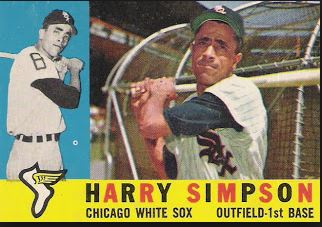
Harry “Suitcase” Simpson began his professional baseball career with the Philadelphia Stars of the Negro National League in 1946 – and by 1951 was playing in the outfield for the Cleveland Indians. Legend has it that Simpson earned his nickname because he played for so many teams, he never really unpacked his suitcase.  Legend, however, does not mirror reality. Simpson actually picked up the “Suitcase” moniker during his time the Philadelphia Stars based on his size-13 feet – which reminded a sportswriter of a cartoon character (from the comic strip Toonerville Folks) named Suitcase Simpson and known for feet the size of suitcases. Harry Simpson actually played for only ten teams in his 14-year professional career (Negro Leagues, Major Leagues, minor leagues, Mexican League). In the major leagues, the one-time All Star (1956 Kansas City Athletics) played for just five teams in eight seasons. BBRT Note:  Over his MLB career, Simpson hit .266, with 73 home runs and 381 RBI. He did lead the AL in triples twice – and his best year was 1956, when he hit .293, with 22 doubles, a league-leading eleven triples, 21 home runs and 105 RBI.

Jose Bautista - Rule Five Draftee Joey Bats lived up to the "Suitcase" Simspon legend in 2004.

Jose Bautista – Rule Five Draftee Joey Bats lived up to the “Suitcase” Simspon legend in 2004.

Why is BBRT looking back on the Suitcase Simpson “legend.” Because for Blue Jays’ All Star Jose Bautista, reality does mirror legend. In his  first season in the major leagues, Bautista was on the roster of as many major league teams as Simpson was in his entire career – and this all ties back ot the ultimate topic of this post:  MLB’s Rule Five Draft. Here’s “Joey Bats” (yes, that’s Bautista’s nickname) story. In 2000, a 19-year-old Jose Baustista was drafted by the Pirates in the 20th round of the 2000 MLB draft. He  played in the Pirate’s minor league system until 2003. In those three seasons,  he played in 349 games, hitting .287, with 24 home runs and 100 RBI – never rising above High A ball. The Pirates left Bautista unprotected in the 2003 Rule Five Draft  – and thus began perhaps the Rule Five Draft’s strangest odyssey. Drafted by the Orioles, Bautista started the season on the Baltimore roster, but seldom left the bench. In fact, by early June, he had only 11 at bats – and the Orioles placed him on waivers.  Bautista was claimed by the Tampa Bay Devil Rays on June 3, but got only 12 at bats between then and June 28, when his contract was purchased by the Kansas City Royals. Within a month (and 25 at bats), the Royals traded Bautista to the Mets, who put him on their major league roster and then (on the same day) included him in a trade with the Pirates (Remember them – Bautista’s original team).  The Pirates kept him on the major league roster for the remainder of the season (40 more at bats) – making Bautista the first (and still only) player to be on five different Major League rosters in one season. How did Joey Bats do in his post Rule Five Draft season – five major league rosters, four major league teams played for, 64 games, 88 at bats, a .205 average, zero home runs and two RBI.  From that highly traveled start, this Rule Five draftee grew up to be a Blue Jay and one of the AL’s most feared power hitters.  It didn’t happen overnight, but since 2010, Bautista has made six All Star teams and led the AL in home runs twice (hitting 54 long balls in 2010). In the  past six seasons, he has hit .268, with 227 (of his career 286) home runs and driven in 582 (of his career 793) runs.  That earns Jose Bautista BBRT’s rating as the third most successful (career-wise) Rule Five draftee ever. (The top five are listed later in this post.)  Now, here’s the segue – MLB’s Rule Five Draft is what this post is all about. Read on if you are interested past and present Rule Five Draft results.


The MLB Rule Five Draft

On December 10, Major League Baseball held its annual Rule Five Draft.  BBRT will take a look at the specific rules for the draft later in this post, but basically the Rule Five Draft is designed to open the door to advancement to minor leaguer players/prospects who might otherwise find their opportunity to reach the major leagues delayed by logjams within their current organizations.  This post will focus the results of the Rule Five Draft in a five-by-five format. BBRT will look briefly at:

  • The top (first) five players taken in the 2015 Rule 5 Draft – who range from: a third baseman turned outfielder who reached career highs in average, home runs and RBI at AA in 2015 to a left-handed pitcher, with a hard to spell name, who walked 21 and struck out 82 in 61 2/3 innings this past season.
  • The five most successful players taken in the 2014 Rule Five Draft (based on 2015 major league performance) – including, right at the top, a pair of middle infielders converted to middle outfielders.
  • The five most successful (career-wise) players ever taken in the Rule Five Draft – including a member of the 3,000-hit club (who won four batting titles); and a two-time Cy Young Award winner (who was an ERA leader in both the AL and NL).

Let’s start with a look at the first five players (in the order picked) taken in this December’s Rule Five Draft.

  1. Tyler Goeddel, outfield – taken by the Phillies (from the Rays)

Goeddel was originally drafted in the first round of the 2011 draft by the Rays. The 6’4”, 186-pound, right-handed hitter spent 2012-14 as a third baseman, but was converted to a corner outfielder for 2015. He spent last season with the Southern League (Double A) Montgomery Biscuits, where he showed a combination of power and speed (as well as a strong outfield arm).  At Montgomery, Goeddel reached career highs in games (123); average (.279); hits (132); home runs (12); RBI (72); and Runs (68); while also stealing 28 bases. In four minor league seasons, he has put up a .262-31-244 line, with 108 steals. The Phillies, who led the majors with 99 losses last season, are in rebuilding mode. Couple that with the 23-year-old Goeddel’s solid 2015 season and the success of Philllies’ 2014 Rule Five pick Odubel Herrera and my money is on Goedell sticking with Philadelphia. Goeddel is the younger brother of Mets’ reliever Erik Goeddel.

  1. Jake Cave, outfield – taken by the Reds (from the Yankees)

The now 23-year-old Cave taken originally was taken by the Yankees in the sixth round of the 2011 Major League Draft.  Cave’s career was set back when he suffered a fractured knee cap in his first minor league game.  He ended up missing the 2011 and 2012 seasons, but came back to perform well at A, High A and Double A in 2013-14.   In 2015, Cave split time between the Double A Trenton Thunder (Eastern League) and Triple A Scranton Wilkes-Barre Raiders (International League). He had a solid year, showing good speed, but little power (.279-2-35, with 17 steals in 132 games). Cave has a .285 average over four minor league seasons. Does a lot of small things well, and has a chance to stick as a fourth outfielder.  At 6’, 200-pounds, the Reds likely are hoping Cave begins to show at least modest power.

  1. Evan Rutckyj , pitcher – taken by the Braves (from the Yankees)

The 6’5”, 213-lb. Rutckyj (pronounced RUT-ski) was taken in the 16th round of the 2010 draft.  Since that time, he has shown potential as a power pitcher. In 2015 – playing for the High A Tampa Yankees and Double A Trenton Thunder – Rutckyj went 3-2, 2.63, with one save in 36 relief appearances. In 61 2/3 innings, Rutckyj fanned 82 batters, walking just 21. Rutckyj began his professional career primarily as a starter and, for four seasons in that role, put up a 4.53 ERA, with 7.62 strikeouts per nine innings. In two seasons as a reliever, the 23-year-old southpaw has recorded a 3.15 ERA with 11.31 whiffs per nine innings.  With Atlanta’s bullpen needs and the rarity of power lefties, BBRT figures major league announcers will spend the full 2015 season mispronouncing Rutckyj’s name. 

  1. Luis Perdermo, pitcher – taken by the Rockies (from the Cardinals)

Perdomo was taken in the Rule Five Draft by the Rockies (not a positive prospect for any hurler), but was quickly traded to the Padres (who offer a more pitcher-friendly ballpark). The 22-year-old, 6’2”, 160-pound Dominican was originally selected by the Cardinals as an International Free Agent in 2010. In 2015, Perdomo pitched for the Class A Peoria Chiefs (Midwest League) and High A Palm Beach Cardinals (Florida League) – going a combined 6-12, 3.98 in 22 starts, fanning 118 and walking 37 in 126 2/3 innings. He’s shown good stuff in five minor league seasons, including a mid-90s fastball and tight slider.  Still, he’s never pitched above High A, so a jump to a full season at the major league level does not seem likely. If the Padres do keep the righty, they’ll be betting on the future and likely start him out in the bullpen (see Johan Santana in the section on the best Rule Five picks ever) – a full season at the major league level seems a bit of a stretch.

  1. Colin Walsh, outfield/second base/ third base – taken by the Brewers (from the A’s)

The now 26-year-old Walsh was signed by the Cardinals (out of Stanford University) as a 13th round pick in the 2010 major league draft.  After four seasons in the Cardinals’ organization (Rookie League through AA and Fall League), he was released and signed with the A’s for 2014.  While in the Cardinals’ organization, Walsh hit .267, with 31 home runs, 172 RBI and 31 steals – while playing six different positions. Walsh upped his game after signing with the A’s.  In 2014 – at High A, Double A and Triple A – he hit a combined .290, with four home runs and 32 RBI.  Last season, at Double A Midland (Texas League), the switch-hitting Walsh hit .302-13-49 with seven steals. Versatility may be Walsh’s ticket to a 2016 stay with the Brewers – a switch hitter who plays multiple positions can be a handy asset on the bench. It will all depend on how well he hits this coming spring.

A few other Rule Five draftees BBRT thinks have a decent chance to stick in the major leagues this coming year:

Josh Martin, right-handed pitcher – taken by the Padres (from the Indians)

At 6’5”, 230-pounds, Martin is an imposing presence on the hill – and the past couple of season he has lived upped to that presence. At Double A Akron last season, Martin (in 44 games) went 8-1, 2.27, fanning 80 and walking just 19 in 67 1/3 innings.  The Padres need bullpen help and a good spring could earn Martin a spot in the pen.

Joey Rickard, outfield  – taken by the Orioles (from the Rays)

The Orioles are looking for outfield help and Rickard has solid credentials.  In 2015, he hit .321, with 23 steals at High A, Double A and Triple A.  Lacking in power, just two home runs last season, he still brings plenty to the table as a spare outfielder.

Dan Stumpf, left-handed pitcher – taken by the Phillies (from the Royals)

In four minor league seasons, Stumpf  has gone 20-23, with a solid 3.21 ERA and 306 strikeouts in 311 1/3 innings.  As noted earlier, the Phillies are rebuilding and the 24-year-old Stumpf could be a fit.

How the Rule 5 Draft Works

The rules have changed over the years, but the current format gives good idea of how the draft works to open major league doors to players who might otherwise have been stuck in the minors.

Which players eligible to be drafted?  Players not on their parent team’s 40-man major league roster who were: signed when they were 19 or older and have played professionally for four years; or signed at 18, who have played for five years. (Players placed on a team’s 40-man major league roster are protected from the draft.)

Which teams can draft players?  Any team with an opening on their 40-man major league roster can draft a player or players. Teams draft in the reverse order of their place in the standings the previous season.

What does it cost? The team that selects a player in the Rule Five Draft pays $50,000 to the team from which he was selected.

What happens to the player? The drafted the player must remain on his new team’s 25-man major league roster for the entire next season, and must be “active” (not on the disabled list) for at least 90 days. If these conditions are not met the player must be offered back to the team from which he was drafted for $25,000.

Can a drafted player be traded?  Yes.  However, the new team must still abide by the Draft terms (kept on major league roster, active at least 90 days).

Now, how about a look at the 2014 Rule Five Draft’s top five 2015 “success” stories – based on their 2015 seasons. 

Keep in mind, the Rule Five Draft consists of players whose parent franchises chose not to protect on their 40-man rosters. Baseball America reports that about one-in-four Rule Five picks stay with their new team for the season immediately following their pick. Given those odds, just staying in the majors for the full year has the potential to put a player on this top five list (fourteen players were chosen in the 2014 Rule Five draft). Here are the top five 2014 Draftees – again, not in draft order, but in terms of 2015 performance.

  1. Odubel Herrera, outfield – taken with the eighth pick by the Phillies (from the Rangers)

Herrera was a middle infielder (2B-SS) for his six minor league seasons – starting just 11 games in the outfield (405 at second base/132 at shortstop). He showed a solid bat (.297 minor league average) and speed (128 steals). In 2014, at High A and Double A, he hit a combined .315 with 21 steals.  The Phillies liked that speed, picking up Herrera in the 2014 Rule Five Draft and converting him to a full-time centerfielder. He responded by playing 147 games, defending capably and putting up a .297 average, unexpected power (eight home runs) and expected speed (16 steals). Herrera’s 2015 performance makes him the real deal and the real steal of the 2014 Rule Five Draft.

  1. Delino DeShields, Jr., outfield – taken with the third pick by the Rangers (from the Astros)

DeShields, son of 13-year major leaguer Delino DeShields, was a first-round pick (number eight overall) of the Astros in the 2010 MLB draft. In six minor league seasons, he hit .268 with 37 home runs and 241 steals. He played about 75 percent of his minor league games at second base, but the Rangers converted him to a full-time outfielder.  In 2015, he started 85 games in center field and 25 in left field for Texas.  He hit .261 with two home runs, 37 RBI and 25 steals.

  1. Mark Canha, first base/outfield taken with the second pick by the Rockies (from the Marlins) and traded to the A’s

Mark Canha was drafted by the Marlins (out of the University of California Berkeley) in the seventh round of the 2010 MLB draft. He showed offensive potential in five minor league seasons – hitting .285, with 68 home runs and 303 RBI in 496 games. With the A’s in 2015, Canha played 124 games and hit .254 with 16 home runs and 70 RBI. Any time you can get 70 RBI out of a Rule Five pick, you can expect to see his name on this list. Oh, and Canha even tossed in seven steals (equaling his minor league high) in nine attempts.

  1. Sean Gilmartin, left-handed pitcher – taken with tenth pick by the Mets (from the Twins)

Gilmartin was drafted by the Braves (out of Florida State University, where he was an All American) in the first round (28th overall) of the 2011 MLB Draft. In three minor league seasons (Rookie to Triple A and Fall League) for the Braves, Gilmartin went 14-21, with a 4.24 ERA  in 314 1/3 innings (with 249 strikeouts and 82 walks). After the 2013 season, Gilmartin was traded to the Minnesota Twins. In 2014, he went 9-7, 3.71 in 26 starts at Double A and Triple A – posting a 3.71 ERA.  Gilmartin pitched even better as a reliever for the Mets. In 2015, the 25-year-old appeared in 50 games, going 3-2, with a 2.67 ERA, walking just 18 and striking out 54 in 57 1/3 innings.

  1. J.R. Graham – taken with fifth pick by the Twins (from the Braves)

Graham was drafted in the fourth round of the 2011 MLB draft (out of Santa Clara University) by the Atlanta Braves. He pitched three seasons in the Braves’ minor League system – moving from Rookie League to AA, compiling a 19-12 record and 3.37 ERA, striking out 240 and walking 83 in 312 1/3 innings. For the Twins, in 2015, he went 1-5, with a 5.58 ERA in 27 games (19 starts).

Okay, so we’ve seen that you don’t have to be a star to be counted among the Rule Five success stories.

Now let’s look at some players who were left unprotected – and became not only Rule Five draftees, but also went on to career greatness. 

As you will see, their success was not necessarily immediate.  Finding (and developing) true “gems” through the Rule Five Draft demands perspective (the ability to recognize potential), perseverance and patience. (A little blind luck probably helps as well.) So, here are  BBRT’s top five players all time who went unprotected – and changed teams – in the Rule Five Draft.

Number One – Roberto Clemente, outfield

clementeIdentifying the most successful Rule Five draftee ever was easy – the Baseball Hall of Fame did it form me back in 1973. Roberto Clemente was picked up by the Pirates (from the Dodgers) in the 1954 Rule Five Draft. Clemente was 20 at the time, coming off a .257-2-13 season (in 87 games) at Triple A Montreal (International League). In his first season with the Pirates, Clemente had modest success – .255-5-47 over 124 games. Long-term, he proved a pretty good bargain. Clemente was an All Star in 12 of 18 seasons, all with the Pirates. He compiled a .317 average, 3,000 hits, 240 home runs, 1,305 RBIs – as well as four batting titles, 12 Gold Gloves, the 1966 NL MVP Award and the 1971 World Series MVP Award.


Number Two – Johan Santana, left-handed pitcher

Johan SantanaJohan Santana takes the second spot on this list. Signed as a free agent by the Astros in 1995, Santana spent three seasons in the Astros’ minor league system (Rookie League to A level).  As an Astros’ farmhand, Santana, still a teenager, went 15-18 with a 5.05 ERA. Left unprotected in the 1999 Rule Five Draft, Santana was picked up by the Minnesota Twins – in a deal that still seems a bit mystifying.  The Twins had the first pick that year and drafted pitcher Jared Camp, while the Marlins (with the second pick) took Santana.  Then, per an earlier agreement, the Twins sent Camp to the Marlins in return for Santana and $50,000 cash (which covered the cost of the Santana pick). In his first season with the Twins, Santana (working primarily in relief) suffered through a 2-3 record, with a 6.49 ERA – walking 54 and striking out 64 in 86 innings. Santana, in fact, didn’t transition to full-time starter until well into the 2003 season.  He ended 2003 with a 12-3 record (3.07 ERA) and his career rising fast (he was the AL 2004 Cy Young Award winner).  In Santana’s 12-year MLB career he has been an All Star four times, won two Cy Young Awards, and led his league in ERA and strikeouts three times each. Santana, who has not pitched in the major leagues since 2012 due to injuries, has indicted he will attempt a comeback (he is currently in the Blue Jays’ system) in 2016.

Number Three – Jose Bautista, outfield/third base

See the Bautista story at the top of this post.

Number Four – Darrell Evans, third base

Evans signed with the Kansas City Athletics in 1967 and showed promise in the minor leagues until a shoulder injury hindered both his hitting and throwing. The Athletics, grooming Sal Bando for third base, left Evans unprotected  in the 1968 Rule Five Draft and he was claimed by the Braves (who have proven pretty adept at putting quality players at the hot corner … Eddie Mathews, Chipper Jones, Clete Boyer, Terry Pendleton).  That first season with the Braves, Evans played in only 19 games – hitting just .231 with no home runs and one RBI. Evans, in fact, didn’t became an everyday player for the Braves until 1972 (Remember – perspective, perseverance, patience).  In a 21-season career (Braves, Giants, Tigers), Evans went on to hit .248 with 414 home runs (49th all time) and 1,354 RBI. He also drew 1,605 career walks, twelfth-most  all time. A few other notable facts about Evans:  In 1973, Evans hit 41 home runs – joining Braves’ teammates Hank Aaron (40 HRs) and Dave Johnson (43 HRs) as the first trio of teammates to top 40 long balls; in 1985 (as a Tiger), Evans led the AL in home runs (40) at age 38; Evans’ MLB career lasted from 1969-1989 and he was an All Star in each year that ended in a three (1973, 1983 – his only two All Star appearances).

Number Five – Bobby Bonilla, outfield

The final spot on this list of the five most successful Rule Five draftees of all time was a tough (and admittedly very debatable) decision – among the contenders (in alphabetical order) were George Bell, Paul Blair,  Bobby Bonilla, Josh Hamilton and Shane Victorino. A close call, but BBRT gives the final spot to Bonilla. Bonilla signed out of high school (as an amateur free agent) with the Pirates. The year was 1981 and Bonilla stayed in the Pirates’ system until the 1985 Rule Five Draft (he had suffered a broken leg in an on-field collision in Spring Training that year). The White Sox drafted Bonilla and he hit .269-2-26 in 75 games for the Sox in 1986.  In mid-season, the Sox traded Bonilla back to Pittsburgh  – and he finished the season  at .256-3-43.  He went on to a 16-year-career that included six All Star selections, a .279 average, 287 home runs and 1,173 RBI.

So, there is a look at the Rule Five Draft by the “fives” – five  from this year, five from last year  and five all-time.

I tweet baseball @DavidBBRT

Member: Society for American Baseball Research (SABR); The Baseball Reliquary; Baseball Bloggers Alliance.

HOFer Richie Ashburn Leads Expansion Mets – Yellow Tango, Indeed!

 “To be voted the most valuable player on the worst team in the history of major league baseball is a dubious honor for sure.  But I was awarded a 24-boat with a galley and sleeping facilities for six. After the season ended, I docked the boat in Ocean City, New Jersey, and it sank.

            Richie Ashburn – 1962 NY Mets (40 wins-120 losses) MVP

On this date (December 8) in 1961, the expansion New York Mets acquired future Hall of Famer Richie Ashburn from the Chicago Cubs. The 34-year-old outfielder was nearing the end of his MLB career (in fact, his 1962 season with the Mets would be his last in the major leagues), but he brought significant credentials – the slick fielding centerfielder was a four-time All Star, two-time batting champion and had led the NL in walks four times, on-base-percentage four times, hits three times, triples twice and stolen bases once. BBRT note:  Ashburn was noted for his speed, rather than his power. In his fifteen-year MLB career (12 with the Philllies), he achieved a .308 average and collected 2,574 hits (2,119 singles), but only 29 home runs. On the speed side, he stole 234 bases (topping 25 in three seasons) and legged out 109 triples.

For the Mets, Ashburn proved a valuable pick-up – literally, since after the season, Ashburn was chosen as the MVP of the 40-120 Mets (who finished tenth, 60 1/2 games behind the Giants).   In his final season, Ashburn was also the Mets’ only All Star team selection. He finished the year with a .306 average in 135 games, collected 119 hits (102 singles) and 81 walks (for a .424 on base percentage) and surprised a lot of people with a career-high seven home runs. The 1962 season was, in fact, the only year in which Ashburn didn’t hit more triples than round trippers.

But all of that (not to mention Ashburn’s 3 ½ decades as a Phillies’ broadcaster), is not why BBRT is featuring him in this column.  Rather, it’s because Ashburn’s career is “rich” in unique baseball stories.   Here are just a few Ashburn stories and statistics that BBRT found of interest.

  • Ashburn began his minor league career (at the age of 18) as a catcher with the Utica Blue Sox of the Class A Eastern League. Ashburn’s father had groomed the youngster as a backstop, figuring that position offered the fastest path to the major leagues. Only Ashburn was too “fast” for that path. The story has it that on one groundball hit to the right side, Ashburn tossed off his mask, came out from behind the plate and didn’t just back up the play at first base, but beat the runner there and took the throw for the putout. It wasn’t long thereafter that Ashburn was the team’s centerfielder.
  • Ashburn made it to the Phillies as a 21-year-old in 1948 and was the only rookie on the NL All Star team. Ashburn hit lead-off, collected two hits (singles, of course), stole a base and scored a run in the NL’s 5-2 loss.  Ashburn hit .333 in 117 games his rookie campaign (a broken finger cut into his playing time), collected 154 hits (131 singles), played outstanding outfield defense  and led the NL with 32 stolen bases.
  • On August 17, 1957, as the Phillies took on the Giants in Philadelphia, Ashburn lined a foul ball into the Press Box behind third base – hitting Alice Roth (wife of the Philadelphia Bulletin’s sports editor Earl Roth) in the face, breaking her nose. The game was stopped momentarily as Mrs. Roth was attended to – and eventually taken from her seat on a stretcher. Play resumed and on the very next pitch, Ashburn hit another foul ball – which again hit the now prone, stretcher-bound Alice Roth in the leg.
  • Between 1949 and 1958, Ashburn led the NL in outfield put outs nine-times (tying the Pirates’ Max Carey for the most times leading the league in that category).
  • Ashburn collected more hits (1,875) in the decade of the 1950’s than any other player.

Yellow Tango, Indeed

In his final MLB season (as a Met), Ashburn found himself playing in center field, often behind second baseman/shortstop Elio Chacon, who did not speak English. Both were aggressive fielders and despite Ashburn’s calls of “I got it.  I got it.”, there were times when Chacon would range into center field, precipitating a collision.  Finally, Ashburn picked up the phrase “Yo la tengo.” – the Spanish equivalent of “I got it.”  The problem appeared solved – that is until a game in which a fly ball was headed for the no-man’s land in short left-center.  Ashburn rushed in, pounded his glove and confidently declared, “Yo la tengo.” As expected, Chacon pulled up. Unfortunately, left fielder Frank Thomas continued charging in, colliding with Ashburn, while the ball fell in between them. As they got to their feet, the story goes, the non-Spanish-speaking Thomas asked “What the *** is Yellow Tango?”, while Mets’ manager Casey Stengel just shook his head in the dugout.  BBRT note:  The story is credited as being the inspiration for the name of the alternative rock band Yo La Tengo – originally established by long-time Mets’ fan Ira Kaplan and Georgia Hubley.


I tweet baseball @DavidBBRT

Member:  Society for American Baseball Research (SABR); The Baseball Reliquary; Baseball Bloggers Alliance.

Cleveland Indians’ Duster Mails – He Promised … He Delivered

Duster_MailsJohn Walter “Duster” Mails did not have what one might call a distinguished major league career.  In seven seasons, between 1915 and 1926, he went 32-25 with a 4.10 earned run average.  However, late in the 1920 season, Mails was one of the best pitchers in baseball – literally unbeatable as he helped the Cleveland Indians to the AL pennant and the franchise’s first World Series championship.

Duster, in fact, was so  “hot” in 1920 that, when told he would start Game Six of the World Series versus the Brooklyn club (Mail’s original major league team), he announced “Brooklyn will be lucky to get a foul tip off me today. If Spoke (the Indians’ star outfielder and manager Tris Speaker) and the boys will give me one run, Cleveland will win.”  Did Duster deliver?  More on that in a bit.  First, let’s take a look at how Duster Mails got into the spotlight on MLB’s biggest stage.

Mails signed with the Class B Northwestern League’s (NWL) Seattle Giants in 1914 (out of Saint Mary’s College, where he played both baseball and basketball). The 19-year-old southpaw split four decisions in his first NWL season, but in his second campaign for Seattle, Mails blossomed – going 24-18 before earning a late-September major league look from the NL’s Brooklyn Robins.  Mails pitched just five innings for Brooklyn – going 0-1 with a 3.60 ERA.  In those five innings, he gave up six hits (two home runs) and five walks, while fanning three.  The following season, again with the Robins, Mails went 0-1, 3.63 (all in relief) – giving up 15 hits and nine walks in just 17 1/3 innings (although he did fan 13 batters). After the season, the Robins designated Mails for assignment and he was claimed by the Pirates. He never took the mound for Pittsburgh, but spent the 1917 with the Pacific Coast League (Double A) Portland Beavers.

After taking off the 1918 season, Mails came back to the Pacific Coast League (pitching for the Seattle Rainiers and Sacramento Senators).  He seemed to have found his control – going a combined 19-17, 2.14 – with only 99 walks in 301 innings.  He continued this positive performance with Sacramento the following season – when he was 18-17, with a 3.23 ERA in 292 2/3 innings before the Indians purchased his contract on August 21st.  (At the time the Indians were 72-43, in second place, just 1 ½ games behind the White Sox.)

Mails made his first start for the Indians on September 1, and the rest is history. Between September 1 and October 1 – in the heat of the pennant race – Mails pitched in nine games (eight starts). He went 7-0, with a 1.85 ERA, six complete games and two shutouts – as the Indians edged the White Sox (two games back) and Yankees (three games out) for the pennant. Needless to say, but I’ll still say it, “They couldn’t have done it without him.”

Then came the World Series, against the team that had given up on Mails – the Brooklyn Robins.  The two teams split the first two games and Mails did not make an appearance.  He was called upon in relief in Game Three, as Indians’ starter Ray Caldwell gave up two runs, while recording only one out in the first inning.  Mails continued his regular season form, blanking the Robins for 6 2/3 innings. Brooklyn won Game Three 2-1 despite Mails’ performance.  Cleveland then took Games Four and Five – which brings us to Mails’ start (and that shutout he so brashly promised) in Game Six. Did he deliver? Indeed. He asked for one run – and that’s all his Indians game him.  Mails got the win 1-0, going the distance with a three-hitter.  (The Indians would go on to win Game Seven – and take the best-of-nine World Series five games to two.)

Now, I’d like to say that the 25-year-old Duster Mails went on to a long and brilliant major league career.  That, however, was not to be.  In 1921, he went 14-8, 3.94 with Cleveland, but found himself back in the bullpen. In 1922, he slipped to 4-7, 5.28. In 1923, Mails was back in the Pacific Coast League, where he would spend most of the next 14 seasons. (Mails pitched a total of 18 minor league seasons, winning 226 games, versus 210 losses). He did resurface in the major leagues in 1925, going 7-7, 4.60 for the Cardinals and again in 1926, pitching in one game for those same Cardinals.

So, there we have the MLB playing career of Duster Mails, who – for just over a month in 1920 – was one of the best pitchers ever to take the mound.  And, who had the audacity to promise a shutout in the World Series – and delivered.

I tweet baseball @DavidBBRT

Member: Society for American Baseball Research; The Baseball Reliquary; Baseball Bloggers Alliance.

Longest Home Run of 2015? Still Debatable.

Longest HR of 2015 - Kris Bryant? Could be.

Longest HR of 2015 – Kris Bryant? Could be.

One of the great things about baseball is that it has always been “highly debatable.” Within the game – safe or out on a close play; ball or strike on a close pitch; fair or foul (over the bag or by the fair pole); clean catch or trap. You get the idea. Our national pastime has also stirred conversation (and controversy) on a broader scale. Who hit the longest home run? Who had the best fastball? Best outfield arm? Widest range at shortstop? And, on and on.  Well now it seems that technology may be taking some of the oh-so-sweet uncertainty out of the game.  Or is it?

Or maybe it was Giancarlo Stanton.

Or maybe it was Giancarlo Stanton.

Consider the first question listed: Who hit the longest home run?  Not so many years ago, long ball distances were estimates that seemed to come down magically  from somewhere in the boxes on the second deck – stirring plenty of debate.  (My dad and I spent some time discussing whether Harmon Killebrew or Bobby Darwin hit the longest left-field, second-decker at the Twins’ old Metropolitan Stadium.) Now technology definitively tells us not only distance each home run would have traveled if unimpeded, but also pitch speed, bat speed, velocity off the bat and more.  Or does it?

I am happy to say, debate lives on.  In 2015, home run distance was “measured” (using high technology) by both MLB.com’s Statcast and ESPN’s Home Run Tracker.  According to Statcast, the regular season’s longest home run would have traveled 495 feet – and it was hit by Cubs’ third baseman Kris Bryant off D-backs’ right-hander Rubby De La Rosa on September 6. Over at ESPN (Home Run Tracker), the longest of the long balls is credited to the Marlins’ Giancarlo Stanton, who stroked home runs projected at 484 feet on June 6 and June 23.  Bryant’s smash comes in at 467 feet – and at number 20 –  on the ESPN list.  Stanton does a little better on the Statcast ranking.  His Home Run Tracker-leading blasts come in eighth on Statcast list. One area of agreement, Stanton is the only player to appear among the top ten of 2015’s longest home runs multiple times on both lists – 8,9,10 on the Statcast ranking and 1, 2, 9 and 10 (tie) on Home Run Tracker.

Here are the top ten long-distance blasts for each tracking system.

MLB.com Statcast

Kris Bryant, Cubs                    495.3 feet        September 6

Michael Taylor, Nationals         492.8               August 20

Jonathan Schoop, Orioles         484.5               August 26

Nelson Cruz, Mariners               482.7               April 29

Josh Donaldson, Blue Jays        481.2               April 23

Hanley Ramirez, Red Sox          480.5               June 21

Pedro Alvarez, Pirates               478.9               October 4

Giancarlo, Stanton, Marlins         478.8               June 23

Giancarlo, Stanton, Marlins         478.4               May 16

Giancarlo, Stanton, Marlins         478.4               June 5


ESPN Home Run Tracker

Giancarlo Stanton, Marlins           484 feet            June 23

Giancarlo, Stanton, Marlins          484                   June 6

Paul Goldschmidt, D-backs          482                  August 26

Joc Pederson, Dodgers                480                  June 2

Michael Taylor, Nationals             479                  August 20

Alex Rodriguez, Yankees             477                  April 17

Jung Ho Kang, Pirates                476                  September 8

Brett Lawrie, A’s                         476                  August 28

Giancarlo, Stanton                      475                  May 16, 2015

Jarrett Parker, Giants                  474                  September 25

Giancarlo, Stanton, Marlins         474                  May 15

                                 Aroldis Chapman Brings the Heat.

Aroldis ChapmanDoes Aroldis Chapman bring more heat than Steve Dalkowski?  We’ll never know, but he’s clearly the fastest pitcher out there today. In 2015, according the MLB.com’s Statcast, there were 32 pitches of 103 mph or more thrown during the regular MLB season – and all 32 were thrown by Chapman. In fact, the Reds’ fireballer (who, in 2010, threw the fastest pitch ever recorded at 105.1 mph) threw the 62 fastest pitches of the 2015 regular season.  The first non-Chapman pitch on the velocity list (and the fastest pitch thrown in the AL) belonged to the Yankee’s Nathan Eovaldi (102.35 mph).  Ironically, both hurlers saved their best for Twins’ All Star second baseman Brian Dozier.  Dozier took that 102 mph fastball from Eovaldi for a ball (August 19 at Yankee Stadium), and he fouled off Chapman’s fastest offering of the season (103.92 MPH) on June 29 at Cincinnati’s Great American Ball Park.  What kind of results did Chapman’s heater produce? His 2015 stat line: 4-4, 1.63 ERA, 33 saves, 116 strikeouts in 66 1/3 innings (15.7 whiffs per nine innings).  Chapman’s strikeouts per nine innings were down from 2014 – when he fanned 17.7 batters per nine.


I tweet baseball @DavidBBRT

Member: Society for American Baseball Research; The Baseball Reliquary; Baseball Bloggers Alliance.

Baseball’s “Heavy Metal” Double Play – a Gold Glove and a Silver Slugger in the Same Season

Baseball’s “heavy metal” double play – The 2015 Rawlings Gold Glove and Louisville Slugger Silver Slugger Awards – honoring the best defensive and offensive  players in each league at each position are on the books – and a handful (four fingers and a thumb) of players were honored for their excellence both at the plate and in the field.  The five players who captured both a Gold Glove and Silver Slugger for the 2015 season were: Astros’ second baseman Jose Altuve; Diamondbacks’ first baseman Paul Goldschmidt; Marlins’ second baseman Dee Gordon; Giants’ shortstop Brandon Crawford; and Rockies’ third baseman Nolan Arenado.  This year’s Sliver Slugger and Gold Glove winners’ lists each included nine first-time honorees. So, it’s no surprise that all five double-winners captured a Gold Glove and a Sliver Slugger in the same year for the first time.

Paul Goldschmidt – heavy metal hero – a 2015 Gold Glove and Silver Slugger; and he even threw in 21 stolen bases.


Since 1980, the combination of a Gold Glove/Silver Slugger has been achieved 174 times by 95 different players.  You’ll find a complete list of the players who have earned recognition as the offensive and defensive leader in their respective leagues at the end of this post. (I’m also including lists of 2015’s individual Silver Slugger and Gold Glove winners). Since the Silver Slugger is awarded to three outfielders annually regardless of their position (LF, CF, RF), the Sliver Slugger and GG/SS combo lists in this post do not break outfielders out by position.  Before, we take a look at the full lists, here are few bits of SS/GG combination trivia.

  • The fewest GG/SS combo winners in a single season is one – Dodgers’ 1B Adrian Gonzalez in 2014.
  • The most players to achieve the GG/SS combo in a season is nine – back in 1984: Lance Parrish, C, Tigers; Keith Hernandez, 1B, Mets; Eddie Murray, 1B, Orioles; Ryne Sandberg, 2B, Cubs; Lou Whitaker, 2B, Tigers; Mike Schmidt, 3B, Phillies; Buddy Bell, 3B, Rangers; Dave Winfield, OF, Yankees; Dale Murphy, OF, Braves.
  • Ivan Rodriguez (C), Ken Griffey, Jr. (OF) and Barry Bonds (OF) have each won the double (Silver Slugger/Gold Glove) crown in a season an MLB-record seven times.
  • Ivan Rodriguez won the SS/GG combo for his position a record six consecutive seasons (1995-1999).
  • Roberto Alomar (2B) is the only player to win the single-season Gold Glove/Silver Slugger combo with three different teams (Blue Jays-1992; Orioles-1996; Indians-1999, 2000)
  • Ivan Rodriguez has the longest time period between his first and last SS/GG double crown (11 seasons – 1994-2004).
  • Mike Hampton is the only pitcher to win the Silver Slugger and Gold Glove in the same season (Braves – 2003).
  • Scott Rolen (3B) is the only player to win the SS/GG combo in a season in which he played for two different teams (2002, Phillies/Cardinals). Rolen was traded from the Phillies to the Cardinals on July 29. He played 100 games for the Phillies and 55 for the Cardinals in his only SS/GG combo season.
  • Adrian Gonzalez (1B) and Matt Williams (3B) are the only players to capture a SS/GG single-season combination in both the AL and NL. Gonzalez – Dodgers-2014; Red Sox-2011. Williams – Indians-1997; Giants-1993-1994.
  • The only team to have three SS/GG winners in the same season is the 1993 Giants (Robby Thompson (2B), Matt Williams (3B), Barry Bonds (OF).
  • Eighteen players have captured a total of 22 MVP Awards in the same season they also won Silver Sluggers, led by Giants’ outfielder Barry Bonds, who achieved the MVP/SS/GG three times (1990, 1992, 1993). Two-time winners of the MVP/SS/GG include: Mike Schmidt (Phillies, 1981, 1986); Dale Murphy (Braves, 1982, 1983); Those accomplishing the MVP/SS/GG once are: Robin Yount (Brewers-1982); Ryne Sandberg (Cubs-1984); Willie McGee (Cardinals-1985); Cal Ripken, Jr. (Orioles-1991);  Jeff Bagwell (Astros-1994); Barry Larkin (Reds-1995); Ken Caminiti (Padres-1996); Ken Griffey, Jr. (Mariners-1997); Larry Walker (Rockies-1997); Ivan Rodriguez (Rangers-1999); Ichiro Suzuki (Mariners-2001); Alex Rodriguez (Rangers-2003); Jimmy Rollins (Phillies-2007); Dustin Pedroia (Red Sox-2008); Joe Mauer (Twins-2009)
  • Outfielders have achieved the SS/GG combo most often (65 times), but if you factor in the potential to outfielders to achieve three combos each season, second baseman have been most successful, putting up 29 SS/GG seasons.
  • The top team in terms of SS/GG seasons is the Yankees (13)
  • The White Sox are the only teams to never have a player win a Gold Glove and Silver Slugger in the same season.

2015 Silver Slugger Award Winners

Catcher

Brian McCann, Yankees

Buster Posey, Giants

First Base

Miguel Cabrera, Tigers

Paul Goldschmidt, Diamondbacks

Second Base

Jose Altuve, Astros

Dee Gordon, Marlins

Third Base

Josh Donaldson, Blue Jays

Nolan Arenado, Rockies

Shortstop

Xander Bogaerts, Red Sox

Brandon Crawford, Giants

Outfield

Mike Trout, Angels

Nelson Cruz, Mariners

J.D. Martinez, Tigers

Andrew McCutchen, Pirates

Bryce Harper, Nationals

Carlos Gomez, Rockies

Pitcher

Madison Bumgarner, Giants

DH

Kendrys Morales, Royals

_______________________________________________________________

2015 Awards Recognizing Fielding Excellence

The three most significant defensive recognitions are:

Rawlings Gold Glove … This is the most senior (and most recognized and publicized) defensive award, established in 1957. It is also considered the most subjective, with 75 percent of the results dependent on a vote of MLB managers and coaches and 25 percent on statistical defensive metrics (provided by MLB and the Society for American Baseball Research – SABR).

The Fielding Bible Award … Established in 2006, the Fielding Bible Awards are considered to be less subjective than the Gold Gloves. These awards are voted on by a panel of twelve sabermetrically-inclined and experienced journalists (and bloggers).

Wilson Defensive Player(s) of the Year … Established in 2012, this recognition is based on scouting reports, traditional defensive statistics and sabermetric measures like Defensive Runs Saved (DRS), Defensive Wins Above Replacement (dWAR) and other less self-explanatory statistics.

2015FieldingChart

______________________________________________________________

Full List of Same Year Gold Glove/Silver Slugger Winners by Season


2015

Jose Altuve, 2B, Astros

Paul Goldschmidt, 1B, Diamondbacks

Dee Gordon, 2B, Marlins

Nolan Arenado, 3B, Rockies

Brandon Crawford, SS, Giants.

2014

Adrian Gonzalez, 1B, Dodgers

2013

Yadier Molina, C, Cardinals

Paul Goldschmidt, 1B, Diamondbacks

J.J. Hardy, SS, Orioles

Adam Jones, OF, Orioles

2012

Adam LaRoche, 1B, Nationals

Robinson Cano, 2B, Yankees

Chase Headley, 3B, Padres

Andrew McCutchen, OF, Pirates

2011

Adrian Gonzalez, 1B, Red Sox

Brandon Phillips, 2B, Reds

Adrian Beltre, 3B, Rangers

Troy Tulowitzki, SS, Rockies

Jacob Ellsbury, OF, Red Sox

Matt Kemp, OF, Dodgers

2010

Joe Mauer, C, Twins

Albert Pujols, 1B, Cardinals

Robinson Cano, 2B, Yankees

Troy Tulowitzki, SS, Rockies

Carl Crawford, OF, Rays

Carlos Gonzalez, OF, Rockies

2009

Joe Mauer, C, Twins

Mark Tiexeira, 1B, Yankees

Ryan Zimmerman, 3B, Nationals

Deterk Jeter, SS, Yankees

Matt Kemp, OF, Dodgers

Ichiro Suzuki, OF, Mariners

Torii Hunter, OF, Angels

2008

Joe Mauer, C, Twins

Dustin Pedroia, 2B, Red Sox

David Wright, 3B, Mets

Grady Sizemore, OF, Indians

2007

Russell Martin, C, Dodgers

Placido Polanco, 2B, Tigers

David Wright, 3B, Mets

Jimmy Rollins, SS, Phillies

Carlos Beltran, OF, Mets

Ichiro Suzuki, OF, Mariners

2006

Derek Jeter, SS, Yankees

Carlos Beltran, OF, Mets

2005

Jason Veritek, C, Red Sox

Mark Tiexierea, 1B, Rangers

Derrek Lee, 1B, Cubs

Andruw Jones, OF, Braves

2004

Ivan Rodriguez, C, Tigers

Jim Edmonds, OF, Cardinals

2003

Brett Boone, 2B, Mariners

Edgar Renteria, SS, Cardinals

Alex Rodriguez, SS, Rangers

Mike Hampton, P, Braves

2002

Todd Helton, 1B, Rockies

Scott Rolen, 3B, Cardinals/Phillies

Eric Chavez, 3B, A’s

Edgar Renteria, SS, Cardinals

Alex Rodriguez, SS, Rangers

2001

Todd Helton, 1B, Rockies

Ichiro Suzuki, OF, Mariners

2000

Roberto Alomar, 2B, Indians

Darin Erstad, OF, Angels

1999

Ivan Rodriguez, C, Rangers

Robert Alomar, 2B, Indians

Larry Walker, OF, Rockies

Ken Griffey, Jr., OF, Mariners

Shawn Green, OF, Blue Jays

1998

Ivan Rodriguez, C, Rangers

Rafael Palmeiro, 1B, Rangers

Ken Griffey, Jr. OF, Mariners

1997

Ivan Rodriguez, C, Rangers

Craig Biggio, 2B, Astros

Chuck Knoblauch, 2B, Twins

Matt Williams, 3B, Indians

Larry Walker, OF, Rockies

Barry Bonds, OF, Giants

Ken Griffey, Jr, OF, Mariners

1996

Ivan Rodriguez, C, Rangers

Roberto Alomar, 2B, Orioles

Ken Caminiti, 3B, Padres

Barry Larkin, SS, Reds

Barry Bonds, OF, Giants

Ken Griffey, Jr. OF, Mariners

1995

Ivan Rodriguez, C, Rangers

Craig, Biggio, 2B, Astros

Barry Larkin, SS, Reds

1994

Ivan Rodriguez, C, Rangers

Jeff Bagwell, 1B, Astros

Craig Biggio, 2B, Astros

Matt Williams, 3B, Giants

Wade Boggs, 3B, Yankees

Barry Bonds, OF, Giants

Ken Griffey, Jr., OF, Mariners

1993

Robby Thompson, 2B, Giants

Matt Williams, 3B, Giants

Jay Bell, SS, Pirates

Barry Bonds, OF, Giants

Ken Griffey, Jr, OF, Mariners

1992

Roberto Alomar, 2B, Blue Jays

Larry Walker, OF, Expos

Andy Van Slyke, OF, Pirates

Barry Bonds, OF, Pirates

Kirby Puckett, OF, Twins

1991

Will Clark, 1B, Giants

Ryne Sandberg, 2B, Cubs

Cal Ripken, Jr., SS, Orioles

Barry Bonds, OF, Pirates

Ken Griffey, Jr., OF, Mariners

1990

Benito Santiago, C, Padres

Ryne Sandberg, 2B, Cubs

Kelly Gruber, 3B, Blue Jays

Barry Bonds, OF, Pirates

Ellis Burks, OF, Red Sox

1989

Ryne Sandberg, 2B, Cubs

Eric Davis, OF, Reds

Kirby Puckett, OF, Twins

Tony Gwynn, OF, Padres

1988

Benito Santiago, C, Padres

Ryne Sandberg, 2B, Cubs

Andy Van Slyke, OF, Pirates

Kirby Puckett, OF, Twins

1987

Don Mattingly, 1B, Yankees

Ozzie Smith, SS, Cardinals

Tony Gwynn, OF, Padres

Eric Davis, OF, Reds

Kirby Puckett, OF, Twins

Andre Dawson, OF, Cubs

1986

Don Mattingly, 1B, Yankees

Frank White, 2B, Royals

Mike Schmidt, 3B, Phillies

Tony Gwynn, OF, Padres

Kirby Puckett, OF, Twins

1985

Don Mattingly, 1B, Yankees

Ryne Sandberg, 2B, Cubs

Lou Whitaker, 2B, Tigers

Tim Wallach, 3B, Expos

George Brett, 3B, Royals

Willie McGee, OF, Cardinals

Dale Murphy, OF, Braves

Dave Winfield, OF, Yankees

1984

Lance Parrish, C, Tigers

Keith Hernandez, 1B, Mets

Eddie Murray, 1B, Orioles

Ryne Sandberg, 2B, Cubs

Lou Whitaker, 2B, Tigers

Mike Schmidt, 3B, Phillies

Buddy Bell, 3B, Rangers

Dave Winfield, OF, Yankees

Dale Murphy, OF, Braves

1983

Lance Parrish, C, Tigers

Eddie Murray, 1B, Orioles

Lou Whitaker, 2B, Tigers

Mike Schmidt, 3B, Phillies

Dale Murphy, OF, Braves

Dave Winfield, OF, Yankees

Andre Dawson, OF, Expos

1982

Gary Carter, C, Expos

Mike Schmidt, 3B, Phillies

Robin Yount, SS, Brewers

Dale Murphy, OF, Braves

Dave Winfield, OF, Yankees

1981

Gary Carter, C, Expos

Manny Trillo, 2B, Phillies

Mike Schmidt, 3B, Phillies

Andre Dawson, OF, Expos

Rickey Henderson, OF, A’s

Dwight Evans, OF, Red Sox

Dusty Baker, OF, Dodgers

1980

Keith Hernandez, 1B, Cardinals

Cecil Cooper, 1B, Brewers

Andre Dawson, OF, Expos

Willie Wilson, OF, Royals

Your  Gold Glove/Silver Slugger combo winners listed alphabetically:

Alomar, Roberto … 1992; 1996; 1999; 2000

Altuve, Jose … 2015

Arenado, Nolan … 2015

Baker, Dusty … 1981

Bagwell, Jeff … 1994

Bell, Buddy … 1984

Bell, Jay … 1993

Beltre, Adrian … 2011

Beltran, Carlos … 2006; 2007

Biggio, Craig … 1994; 1995; 1997

Boggs, Wade … 1994

Bonds, Barry … 1990; 1991; 1992; 1993; 1994; 1996; 1997

Boone, Brett … 2003

Brett, George … 1985

Burks, Ellis … 1990

Caminiti, Ken … 1996

Cano, Robinson … 2010; 2012

Carter, Gary … 1981; 1982

Chavez, Eric … 2002

Clark, Will … 1991

Cooper, Cecil …1980

Crawford, Brandon … 2015

Crawford, Carl … 2010

Dawson, Andre … 1980; 1981; 1983; 1987

Davis, Eric … 1987; 1989

Edmonds, Jim … 2004

Ellsbury, Jacob … 2011

Erstad, Darin … 2000

Evans, Dwight … 1981

Goldschmidt, Paul … 2015

Gonzalez, Adrian … 2011; 2014

Gonzalez, Carlos … 2010

Gordon, Dee … 2015

Green, Shawn … 1999

Griffey, Ken Jr. … 1991; 1993; 1994; 1996; 1997; 1998; 1999

Gruber, Kelly … 1990

Gwynn, Tony … 1986; 1987; 1989

Hampton, Mike … 2003

Hardy, J.J. … 2013

Headley, Chase … 2012

Helton, Todd … 2002

Henderson, Rickey … 1981

Hernandez, Keith … 1980; 1984

Hunter, Torii … 2009

Jeter, Derek … 2006; 2009

Jones, Adam … 2013

Jones, Andruw … 2005

Kemp, Matt … 2009; 2011

Knoblauch, Chuck … 1997

Larkin, Barry … 1995; 1996

LaRoche, Adam  … 2012

Lee, Derrek … 2005

Martin, Russell … 2008

Mattingly, Don … 1985; 1986; 1987

Mauer, Joe … 2008; 2009; 2010

McCutchen, Andrew … 2012

McGee, Willie … 1985

Molina, Yadier … 2013

Murphy, Dale … 1982; 1083; 1984; 1985

Murray, Eddie … 1983; 1984

Palanco, Placido … 2007

Palmeiro, Rafael … 1998

Parrish, Lance … 1983; 1984

Pedroia, Dustin … 2008

Phillips, Brandon … 2011

Puckett, Kirby … 1986; 1987; 1988; 1989; 1992

Pujols, Albert … 2010

Renteria, Edgar … 2002

Ripken, Cal, Jr. … 1991

Rodriguez, Alex … 2002; 2003

Rodriguez, Ivan … 1994; 1995; 1996; 1997; 1998; 1999; 2004

Rolen, Scott … 2002

Rollins, Jimmy … 2007

Sandberg, Ryne … 1984; 1985; 1988; 1989; 1990; 1991

Santiago, Benito … 1988; 1990

Schmidt, Mike … 1981; 1982; 1983; 1984; 1986

Sizemore, Grady … 2008

Smith, Ozzie … 1987

Suzuki, Ichiro … 2001; 2007; 2009

Thompson, Robby … 1993

Tiexeira, Mark … 2005, 2009

Trillo, Manny … 1981

Tulowitzki, Troy … 2010; 2011

Van Slyke, Andy … 1988; 1992

Varitek, Jason … 2005

Walker, Larry … 1992; 1997; 1999

Wallach, Tim … 1985

White, Frank … 1986

Whitaker, Lou … 1983; 1984; 1985

Williams, Matt … 1993; 1994; 1997

Wilson, Willie … 1980

Winfield, Dave … 1982; 1983; 1984; 1985

Wright, David … 2007; 2008

Yount, Robin … 1982

Ryan Zimmerman … 2009

I tweet baseball @DavidBBRT

Member: Society for American Baseball Research (SABR); The Baseball Reliquary; Baseball Bloggers Alliance.

A Look at the World Series’ Longest Games

Alcides Escobar - Toured the bases for an inside-the-park home run in the first (of 14) inning(s).

Alcides Escobar – Toured the bases for an inside-the-park home run in the first (of 14) inning(s).

Last night, the Mets and Royals gave baseball fans a real treat – a 14-inning Game One of the World Series (won by the Royals 5-4). A lot has been written about that contest:

  • Tied for the most innings in World Series history.
  • Second-longest WS game by time at five hours and nine minutes.
  • Longest Game One in terms of innings and time.
  • Alcides Escobar hitting just the 12th inside-the-park homer in World Series history.
  • The Mets’ Bartolo Colon becoming the oldest pitcher to lose a WS game (42 years and 157 days)
  • Two critical errors (Royals’ 1B Eric Hosmer and Mets’ 3B David Wright), both made by players with multiple Gold Gloves on their MLB resumes.
  • Mets’ OF Mike Conforto becoming just the third player to play in the Little League, College and MLB World Series – and the first to drive in a run in all three.

I could go on, but I will leave that to other observers.  In this post, BBRT would like to focus on the three 14-inning games in World Series history – and how different they were.

Those three contests were:

  • Game Two of the 1916 World Series (Dodgers/Red Sox) on October 9, 1916.
  • Game Three of the 2005 World Series (White Sox/Astros) on October 25, 2005.
  • Game One of the 2015 World Series (Mets/Royals) on October 28, 2015.

Here’s a teaser to entice you to read on:  The number of pitchers used in each game ranged from just two to 17; the time of each game ranged 5:41 to 2:32; two of the games featured first-inning, inside-the-park home runs; and the winning team in each game went on to win the Series. Interested?  If so, read on.

Pitchers Used … 2-17-13

Babe Ruth went the distance in 14-inning, 2-1 Series win. 

In the Red Sox’ 1916 win, the teams used a combined TWO pitchers.  Boston ace Babe Ruth (who had been 23-12 for the Red Sox with a league-low 1.75 ERA in the regular season) went the distance in a 2-1 victory, setting the record for most innings pitched in a single World Series game (14). Ruth gave up just six hits and one run, walking three and fanning four. The Dodgers’ Sherry Smith (14-10, 2.34 in the regular season) also went the distance (13 1/3 innings completed when the winning tally scored), giving up two runs on seven hits and six walks, while fanning two.

In the 2005 White Sox’ win (by a score of 7-5), 17 pitchers were used – nine by the White Sox and eight by the Astros. Last night, the Mets and Royals combined to use 13 hurlers – seven by the Royals, six by the Mets.

Players Used … 43-22-21

In the White Sox/Astros’ contest, a WS single-game record 43 players were used – including five pinch hitters and two pinch runners. In the Mets/Royals’ game, 22 players took the field (just one pinch hitter and one pinch runner).  The Dodgers and Red Sox used only 21 players (the Dodgers the minimum nine), with two pinch hitters and one pinch runner.

Time of Game

The White Sox/Astros’ tilt was the longest game in World Series’ history in terms of time at 5 hours and 41 minutes.  Last night’s Mets/Royals’ game was the second-longest at five hours and nine minutes.  The Dodgers and Red Sox took only two hours and 32 minutes to complete their 14-inning matchup. (My how the game has changed.)

Inside-the-Park Home Runs

The Dodger/Red Sox’ and Mets/Royals’ contests each featured an inside-the-park home run – and both came in the first inning (Dodger’ CF Hi Meyers and Royals’ SS Alcides Escobar). Total long balls: The Mets/Royals and White/Sox Astros each featured three home runs; the Dodger/Red Sox just one.

Walks and Whiffs

The Mets/Royals featured nine walks and 22 strikeouts; with the Royals being most efficient at three free passes and 15 strikeouts.  The White Sox/Astros’ game saw a whopping 21 walks in 14 innings, with 25 strikeouts. The Astros’ staff walked nine and whiffed 11, while the Sox walked 12 and struck out 14. The Dodgers/Red Sox put the ball in play – a total of only nine walks and six strikeouts combined.

Attendance – Pretty Darn Close

Mets/Royals … 40,320

White Sox/Astros … 42,848

Dodgers/Red Sox … 47,373

Total Hits, Runs and Errors

Last night’s Mets/Royals’ contest featured 22 hits, nine runs and two errors. The White Sox/Astros combined for 22 hits, 12 runs and four errors.  The Dodgers/Red Sox were stingier at 13 hits, three runs and three errors.

Who Won the Series?

Omen? Who knows. In the 1916 and 2005 World Series, the teams that won the 14-inning contests went on to win the Series.

How the Games Ended

Mets/Royals … With the Mets’ Bartolo Colon on the mound in the bottom of the 14th, Royals’ SS Alcides Escobar led off by reaching third base on an error by NY third baseman David Wright. 2B Ben Zobrist singled to put runners on first and third.  CF Lorenzo Cain was walked to load the bases and 1B Eric Hosmer hit a “walk-0ff” sacrifice fly to right to end the game – on an unearned run. Colon, the Mets’ sixth pitcher got the loss. Chris Young, the Astros’ seventh pitcher got the win (three innings of hitless, scoreless relief – one walk, four strikeouts).

Dodgers/Red Sox … With starter Sherry Smith still on the mound for the Dodgers, Red Sox’ 1B Dick Hoblitzell led off the bottom of the fourteenth with a walk. LF Duffy Lewis bunted him to second. At this point, the Red Sox brought in Mike McNally to run for Hoblitzell and Del Gainer to pinch hit for 3B Larry Gardner (zero-for-five at that point). The moves worked, Gainer singled to left, bringing home McNally with the winning run – in what we would now term “walk-off” fashion.

White Sox/Astros … Unlike the Dodgers/Red Sox and Mets/Royals, this game did not end in a walk-off.  The White Sox scored the winning run(s) in the TOP of the fourteenth.

The two teams went into the fourteenth tied at 5. The Astros pulled a double switch – bringing Ezequiel Astacio in to pitch (and bat sixth), pulling 2B Craig Biggio and putting Jose Vizcaino (who had pinch hit in the bottom of the 13th) in at 2B.  White Sox RF Jermaine Dye led off with a single to right field, but 1B Paul Konerko hit into a 5-4-3 double play.  So, two outs and no one on base. That’s when things got ugly.  ChiSox 2B Geoff Blum (the sixth player to hold the number-five spot in the batting order), who had come into the game defensively in the 13th, homered to give the Sox the lead.  BBRT note:  It would be Blum’s only at bat in the Series.

Next came a single by CF Aaron Rowand, a single by 3B Joe Crede and a walk to SS Juan Uribe to load the bases. Astacio then walked C Chris Widger to force in an insurance run – and was replaced on the mound by Wandy Rodriguez, who fanned LF Scott Podsednik to end the inning.  In the bottom of the inning, Damasco Marte and Mark Buehrle combined to hold the Astros scoreless – although, thanks to a walk and an error, the tying runs were  on  base when Buehrle got Houston SS Adam Everett to pop out to end the game. Marte, the Sox’ eighth pitcher got the win, Buehrle the save. Astacio, the Astros’ seventh hurler, took the loss.


I tweet baseball @DavidBBRT


Member:  Society for American Baseball Research (SABR); The Baseball Reliquary; Baseball Bloggers Alliance.

World Series’ Futility – Getting There and Playing There

The New York Yankees have lost more World Series than any other team (13). Of course, they've won more as well (27).

The New York Yankees have lost more World Series than any other team (13). Of course, they’ve won more as well (27).

As the Mets and Royals face off in the 2015 World Series, we can be assured that a World Championship drought of at least 28 years will be broken. The Royals last won MLB’s Fall Classic in 1985, the Mets in 1986.  Still, neither is close to the Cubs’ run of futility – Chicago’s NL entry last won a World Series 107 seasons ago (1908).  And, among non-expansion teams, the Cubs’ have the worst won-lost record – having won the title just twice in ten trips to the Series. Further – again among non-expansion teams – the Cubs have gone the longest since last appearing in the World Series – all the way back to 1945.

Among expansion teams,we have the Nationals/Expos and Mariners, who have never been to the World Series – and the Rays, Rockies, Padres, Brewers, Astros and Rangers, who have never won a Series title.  

In this post, BBRT would like to look at some of the World Series’ records for futility – both in terms of reaching the Fall Classic and performance on the big stage. For the more positive side of the record book, you can get a look at World Series’ single-game records, by clicking here.  For even more on the World Series’ records, click here. 

Long Careers Without Reaching the World Series

 Phil Niekro – A Man for Many Seasons

Phil Niekro - earned a statue and a plaque (Hall of Fame), but never got a chance to earn a win in the Fall Classic.

Phil Niekro – earned a statue and a plaque (Hall of Fame), but never got a chance to earn a win in the Fall Classic.

No player took the field for more seasons without playing in the World Series than hurler Phil Niekro (24 seasons; 1964-87). The Hall of Fame knuckleballer also holds the record for the most wins for any pitcher never appearing in the Fall Classic at 318 (versus 274 losses). During his career, Niekro pitched for the Braves (in Milwaukee and Atlanta); Yankees; and Blue Jays.  He was a five-time All Star, two-time 20–game winner (leading the NL in wins in 1974 and 1979), led the NL in winning percentage (17-4, .810) in 1982 and even won five Gold Gloves. On the other side of the coin, Niekro also led the NL in losses for four consecutive seasons (1977-1980), when he went a cumulative 71-76.  Notably, Phil’s brother Joe nearly matched his World Series’ drought. Joe Niekro pitched 22 years in the big leagues – and didn’t make his first World Series appearance until his 21st season (1987, with the Twins).

The only other pitcher to win 300 games and not appear in the World Series is Gaylord Perry (314-265 over 22 seasons). BBRT note: Phil Niekro and Gaylord Perry are both part of MLB’s winningest brother combinations.  Phil and Joe Niekro rank first (a combined 539 MLB wins) and Gaylord and Jim Perry rank second (529 wins).

Among position players, the most seasons played without appearing in a World Series is 23 (Julio Franco; 1982-94, 1996-97; 1999; 2001-07).

Phil Niekro – 20/20 Vision

Phil Niekro, who went 21-20 for the Atlanta Braves in 1979, is the last MLB pitcher to lead his league in wins and losses in the same season – and the last MLBer to win and lose 20 or more games in the same season. That same season, Phil’s brother Joe went 21-11 for the Houston Astros, marking the only season in which  two brothers have tied for the league lead in victories.

Rafael Palmeiro – Stretching for October

Rafael Palmeiro played the most regular-season games without making it to baseball’s finals 2,831 from 1986-2005. Palmeiro also has the most at bats without playing in a World Series (10,472) and is one of only two players with at least 3,000 hits not to make it to the Fall Classic .(Palmeiro retired with 3,020 hits; Rod Carew amassed 3,053 hits without ever making it to the Series.) With 569 career homers, Palmeiro has the third-most of any player not to appear in the World Series (Ken Griffey, Jr. is number-one at 630, followed by Sammy Sosa at 609. The only other member of the 500+ HR Club not to play in the World Series is Ernie Banks at 512.)

Rafeal Palmeiro – The No-So-Golden Glove

In 1999, Rafael Palmeiro won his third-consecutive Gold Glove at first base – in a season in which he started only 25 games at the position (and played first base in only 28 games) – while starting 128 games as a Designated Hitter.

______________________________________________________________________

Of course, getting to the World Series is only half the battle.

World Series’ Futility – On the Playing Field

Whitey Ford – Leading in Losses (not to mention starts and wins)

Whitey Ford holds the record for most career World Series losses at eight, but that came in 22 starts and was accompanied by an MLB-best 10 World Series wins.


Four by Four: No WS Wins – Four Losses

The most career WS losses without a win is four:

Charlie Liebrandt … 0-4, 4.84 in five WS starts – Royals in 1985, and Braves 1991 and 1992.

Don Newcombe … 0-4, 8.59 in five WS starts – Dodgers in 1949, 1955 and 1956.

Bill Sherdel … 0-4, 3.26 in four WS starts – Cardinals in 1926 and 1928.

Ed Summers … 0-4, 5.73 in four WS starts – Tigers  in 1908 and 1909.


Three Losses in a Single Series

The record for the most losses in a single World Series belongs to George Frazier of the Yankees, who went 0-3, with a 17.18 ERA versus the Dodgers in 1981. Frazier appeared in three games, giving up seven runs in 3 2/3 innings.


An 0-For World Series Career at the Plate

As you might expect, the record for World Series’ futility at the plate belongs to a player who earned his keep on the mound. Philadelphia Athletics’ pitcher George Earnshaw holds the record for most career World Series at bats without a hit at 22 – accumulated over eight games in three Fall Classics (1929, 1930, 1931).  As a pitcher, Earnshaw went 4-3, 1.58, with five complete games in his eight WS starts. Note: Earnshaw was a 20-game winner in all three of his WS seasons – winning 66 games and losing just 28 from 1929-31.

Among position players, catcher Bill Sullivan (Senior) holds the record for most World Series at bats without a hit.  Sullivan went 0-for-21 for the White Sox in the 1906 Series and never made it back to October baseball.


Worst Single Series

In 1968, Cardinals’ shortstop Dal Maxvill, who hit a career-high .253 and won a Gold glove in the regular season, went 0-for-22 as the Cardinals lost the World Series (in seven games) to the Tigers. In the process, Maxvill set the record for the most at bats in a single series without a safety. Dodger Gil Hodges had gone 0-for-21 in the 1952 Series. Maxvill played in four World Series over his career, hitting .115 (7-for-61). The slick fielding infielder hit .217 over a 14-year MLH career.


I tweet baseball @DavidBBRT

Member:  Society for American Baseball Research (SABR); The Baseball Reliquary; Baseball Bloggers Alliance.

A Tale of Two Murphys – A Hero and A Goat

MURPHY – THE HERO

Daniel Murphy - THE HERO.

Daniel Murphy – THE HERO.

Yesterday, the Mets ended the Cubs 2015 post-season run in a four-game sweep, winning the NLCS and punching their ticket to the World series behind some powerful arms and the bat of a hero named Murphy. Mets’ second baseman Daniel Murphy went 4-for-5 (two runs and two RBI) in the New Yorkers’ 8-3 Game Four victory. Murphy went 9-for-17 (.529) with four home runs, six RBI and six runs scored in the NL Championship Series. He homered in all four games, in the process setting a new MLB record by going yard in six consecutive post-season contests.  His performance earned Murphy the NLCS 2015 Most Valuable Player Award.

Through yesterday’s game, Murphy’s 2015 post-season stat line reads, .421-7-11 (with 11 runs scored). He stands just one home run shy of the HR record for a single post season.  For a look at the single and career post-season records, click here.

The 30-year-old Murphy’s power surge is a bit of surprise. In his seven MLB seasons, he has accumulated a regular-season batting average of .288 and hit just 62 home runs (about one HR every 14.5 games) and collected 402 RBI (one every 2.1 games). Still in 2015, he did enjoy perhaps his best season at the plate, going .281-14-73.

That a player named Murphy should doom the Cubs, however, is no surprise. Read on.

MURPHY-THE GOAT

Chicago Cubs on way to reversing the curse - behind the arm of Jake Arrieta.

Chicago Cubs on way to reversing the curse – behind the arm of Jake Arrieta.

On October 6th,1945, with the Cubs up two games to one in the World Series (having beaten the Tigers two out of three at Detroit’s Briggs Stadium), happy Cubbies’ fans were lined up to get into Wrigley Field. One of those fans was Greek William “Billy Goat” Sianis, owner of the Billy Goat Tavern. Sianis purchased two tickets to the game – one for him and one for his “lucky” pet goat – named Murphy. As he moved to enter Wrigley – this well-documented legend has it – Murphy was turned away and Sianis was informed that animals were not allowed in the ball park.

Sianis reportedly appealed the usher’s ruling all the way up to Cubs’ owner P.K. Wrigley, who reportedly told the tavern owner the goat could not be let in because of its less than appealing odor (only in stronger terms). As the popular and oft-told story goes, Sianis put a curse on the Cubs – vowing they would not win another World Series until Murphy was allowed in the ballpark. The Cubs, without Murphy in the stands, lost game four (4-1) and the Series (four games to three). After the Series, Sianis sent Wrigley a telegram reading “Who stinks now?”  Sianis’ curse appears to have worked long and well – as, over the years, the Cubs have become affectionately known as the “Loveable Losers” – and have not captured another World Series title.

A side note:  How seriously is the curse taken in some quarters? On the Fourth of July, 1973 – with the Cubs in first place (six games up on second-place Saint Louis) –  William Sianis’ nephew (and new Billy Goat Tavern owner) Sam Sianis and Chicago Tribune columnist Dave Condon arranged to bring one of Murphy’s descendants (a goat name Socrates)  to Wrigley in an attempt to lift the curse. The goat arrived at Wrigley Field in a limousine accompanied by Sianis and a sign that read “All is forgiven. Let me lead you to the pennant. Your Friend, Billy Goat.”  Well, not all lessons are easily leaned.  Like Murphy before him, Socrates was denied entrance to the Wrigley.  The Cubs?  They faded to fifth place- five games out.  Over the years, Murphy’s descendant has been allowed on the Wrigley Field more than once and even made a pennant race road trip (to Houston) in attempts to break the curse.

Second side note; The Billy Goat Tavern reportedly was the inspiration for the Saturday Night Live’s Olympia Cafe – “Cheezeborger – No fries. Cheeps – No Coke. Pepsi.” 


I tweet baseball @DavidBBRT


Member: Society for American Baseball Research; The Baseball Reliquary; Baseball Bloggers Alliance.

Murphy’s Law – Post-Season Records Are Made To Be Broken (or at least challenged)

Daniel Murphy - "In the zone" in the post season.

Daniel Murphy – “In the zone” in the post season.

Last night (October 20), as the Met’s topped the Cubs 5-2 to take a 3-0 lead in the NLCS,  Mets’ second baseman Daniel Murphy batted his way into the record books. Murphy homered into the center field bleachers at Wrigley Field – marking the record-tying fifth straight post-season game in which he has gone yard.  Murphy joins Carlos Beltran (Astros, 2004) as the only two players to homer in five straight post-season contests. It was also Murphy’s sixth home run of the 2015 post-season, leaving him just two shy of the MLB single-post-season record – with plenty of games to go.  Murphy has touched up such some pretty good pitching in his run – including Zack Greinke, Clayton KershawJake Arrieta, Jon Lester and Kyle Hendricks..  Through his first eight games of the 2015 post season, Murphy is hitting .364, with six home runs, nine runs scored and nine RBI. How surprising are those numbers?  In his seven regular seasons at the major league level, Murphy has hit a total of 62 home runs in 903 games, or about one every 14.5 games.  (He did, however, hit a career high 14 in 130 games this past season.)  If Murphy continues to rake, he has a good chance of reaching the all-time record for home runs in a single post-season of eight – held by Carlos Beltran (Astros, 2004). Barry Bonds (Giants, 2002) and Nelson Cruz (Rangers, 2001).

Special note: The pet goat, denied entrance to Wrigley Field in 1945, and alleged to have been the force behind the “Cubs’ Curse” was named “Murphy.”

Beltran’s eight-homer post-season, at least for BBRT, is the most impressive of the three eight-homer post-seasons. Bonds and Cruz both benefited from post-season runs that went all the way to the World Series, with both Cruz’ and Bonds’ eight long balls coming in 17 games (70 plate appearances for Cruz and 74 for Bonds).  Beltran’s Astros made it only as far as the NL Championship Series and he hit his eight homers in 12 games (56 plate appearances, 46 at bats). In those 12 post-season contests, Beltran hit .435, collecting 20 hits, 14 RBI, 21 runs scored (also the record for a single post-season), while tossing in nine walks and six stolen bases.  In the 2004 post season, Beltran homered in seven of the 12 games he played (including the previously noted five in a row). In the Astros’ six wins, Beltran went 14-for-23 (.609) with six home runs, 11 RBI and 14 runs scored. In the team’s six losses, Beltran’s line was .261 (6-for-23), with two homers, three RBI and seven runs scored – including an 0-for-5 with three strikeouts in a 4-2 loss to Atlanta in Game Two of the NLDS.

Schwarber also Shoots for the Record Books

While Daniel Murphy was garnering yesterday’s headlines, Cubs’ rookie C/OF Kyle Schwarber homered his way into the post-season record books as well. Schwarber hit his fifth home run of the 2015 post-season – becoming the youngest player (at 22) to homer five times in a single post-season. Schwarber is just one short of the all-time rookie record of six HRs in a single post season (Evan Longoria, Tampa Bay, 2008), but time is running out on the Cubbies.

With Murphy having already earned a spot in the post-season record bools, it seems like a good time to take a look at some of the single post-season marks this year’s crop of playoff participants will be shooting for. As you might expect, most of the records were set after the play offs were expanded to multiple rounds.  Current 2015 post-season leaders listed are as of the close of play on October 20.

For BBRT’s past look at World Series’ single-game records, click here.  For even more on the World Series’ record book, click here. 

 SINGLE POST SEASON RECORDS

 Batting Average

.727 … Lloyd McClendon (Pirates, 1992); 8-for-11 over five games. The current 2015 post-season leader: the Dodgers’ Justin Turner at .526.

Home Runs

8 … Barry Bonds (Giants, 2002), Carlos Beltran (Astros, 2004), Nelson Cruz (Rangers, 2011) – Bonds and Cruz each hit their eight home runs in 17 games played, while Beltran launched his in 12 games. Current 2015 leader: the Mets’ Daniel Murphy at 6.

RBI

21 … David Freese (Cardinals, 2011) – in 18 games. Current 2015 post-season leaders: Royals’ Kendrys Morales and Eric Hosmer at 10.

Runs Scored

21 … Carlos Beltran (Astros, 2004) – in 12 games. Current 2015 post-season leaders: Royals’ Ben Zobrist, Mets’ Daniel Murphy and Royals’ Alcides Escobar at 9.

Base Hits

26 … Pablo Sandoval (Giants, 2014) – in 17 games. Current 2015 post-season leader: Royals’ Alcides Escobar at 15.

Total Bases

50 … David Freese (Cardinals, 2011) – in 18 games. Current 2015 post-season leader: Mets’ Daniel Murphy at 31.  Note: Freese was the MVP of both the NL Championship Series and the World Series in 2011. In his 18 post season games, he hit .397 (25-for-63) with five home runs, eight doubles and one triple – driving in 21 runs and scoring 12.

Doubles

8 … Albert Pujols and David Freese (both Cardinals, 2011) – in 18 games. Current 2015 post-season leader: Dodgers’ Justin Turner at six.

Triples

4 … Tommy Leach (Pirates, 1903) – in eight  games. Note: In an eight-game World Series, Leach went 9-for-33, hitting two triples in game one, one in game four and one in game five. Current 2015 post-season leader: Royals’ Alicides Escobar at two.

Walks

27 … Barry Bonds (Giants, 2002) – in 17 games. Current 2015 post-season leaders: Blue Jays’ Jose Bautista, Astros’ Colby Rasmus and Mets’ David Wright at 7.  Note: Bonds was walked in 35 percent of his 2002 post-season plate appearances – and 13 of his 27 free passes were intentional. In his 45 at bats, Bonds hit .356 (16-for-45) with eight home runs and 16 RBI.

Stolen Bases

11 … Rickey Henderson (A’s, 1989) and Kenny Lofton (Indians, 1995). Henderson swiped 11 bags in 9 games, Lofton in 15 contests. Current 2015 post-season leader: Mets’ Curtis Granderson at three.

Strikeouts

26 … Alfonso Soriano (Yankees, 2003) – in 17 games. Current 2015 post season leader: Mets’ Lucas Duda at 13.

Slugging Percentage

1.727 … Lou Gehrig (Yankees, 1928) – in 11 at bats over four games. Note: Gehrig went 6-for-11 with a double and four home runs. Current 2015 post-season leader: Astros’ Colby Rasmus at 1.176.


Derek Jeter – King of the Post-Season Record Book

Derek Jeter - had to inclede a picture of the captain.

Derek Jeter – king of the post season.

Derek Jeter (Yankees) sits atop the post-season career record book in nine categories.  In fact, with a record 158 post-season games, he has played the equivalent of a regular full season – in the playoffs. Jeter-held career post-season records:

Games Played … 158

At bats … 650

Plate Appearances …. 734

Runs Scored … 111

Hits …. 200

Total Bases … 302

Doubles … 32

                                                                        Triples … 5 (tie with Rafael Furcal & George Brett

                                                                        Strikeouts … 135

More post-season career marks are listed after the single post-season pitching records.

Wins

5 … Randy Johnson (2001, Diamondbacks) and Francisco Rodriguez (Angels, 2002). Note:  Johnson went 5-1 in five starts and one relief appearance; Rodriguez went 5-1 in 11 relief appearances.  Current 2015 post-season leader:  Jacob deGrom (Mets) at three.

A Rookie Makes His Mark in the Record Books

Francisco Rodriguez - five post-season wins (tying the single post-season record) before his first regular season decision.

Francisco Rodriguez – five post-season wins (tying the single post-season record) before his first regular-season decision.

When twenty-year-old right-hander Franscisco Rodriguez made his major league debut on September 18, 2002, little did he know that he would notch five post-season wins before he garnered his first-ever regular-season win (in fact, before his first regular-season decision of any kind  – win, loss or save). Rodriguez pitched in just five regular season games, totaling 5 2/3 innings of work.  In that brief stint, he gave up just three hits and two walks, while fanning 13.  It was enough to earn him spot on the post-season roster – and he responded with five wins (tying the record for a single post season) against one loss in 11 appearances.  He tossed 18 2/3 innings, giving up 10 hits, five walks, and five earned runs, while striking out 28. It was a portent of things to come. Between 2005 and 2008,  Rodriguez  saved 193 games, leading the AL in saves three of those four seasons and notching an MLB–record 62 saves in 2008. He closed out the 2015 season with 386 saves.


Saves

7 … Six pitchers have notched seven saves in a single post-season – and, no, Mariano Rivera is not one of them.  Here they are: John Wetteland (Yankees, 1996); Troy Percival (Angels, 2002); Robb Nen (Giants, 2002); Brad Lidge (Phillies, 2008); Koji Uehara (Red Sox, 2013); Greg Holland (Royals, 2014). Current 2015 post-season leader: Jeurys Familia (Mets) at five.

Winning Percentage

1.000 … Many players have notched a 1.000 winning percentage for a single post season – but only ten achieved at least four victories without a loss: Dave Stewart (A’s, 1989); Jack Morris (Twins, 1991); Livan Hernandez (Marlins, 1997); David Wells (Yankees, 1998); Curt Schilling (D-backs, 2001); Josh Beckett (Red Sox, 2007); Cole Hamels (Phillies, 2008); Cliff Lee (Phillies, 2009); Andy Pettitte (Yankees, 2009); Chris Carpenter (Cardinals, 2011). Current 2015 leader: Jacob deGrom at 3-0; at 2-0 are Matt Harvey (Mets) and Dallas Keuchel (Astros). There are six players at 1-0.

Earned Run Average

0.00 … Christy Mathewson (Giants, 2005) and Waite Hoyt (Yankees, 1921).  While there are several pitchers with 20 or more innings pitched and an ERA of zero, Mathewson and Hoyt had the most innings pitched in a single post-season without an earned run at 27. Current 2015 post-season leader (at least ten innings pitched): Jacob deGrom (Mets) at 1.80.  Mets’ reliever Jeurys Familia has pitched the most innings without giving up a run this post-season (8 2/3).

Strikeouts

56 … Curt Schilling (D-backs, 2001) – in six starts, 48 1/3 innings pitched. Current 2015 post-season leader: Jake Arrieta at 28, in 19 2.3 innings pitched.

Games Pitched

14 … Paul Assenmacher (Indians, 1997). Current 2015 post-season leaders: Aaron Sanchez (Blue Jays) and Jeurys Familia (Mets) at seven games.

Innings Pitched

52 2/3 … Madison Bumgarner (Giants, 2014) – in six starts and one relief appearance.  Current 2015 post-season leader: Jacob deGrom (Met) at 20 IP.

Games Started

6  … Curt Schilling (D-backs, 2001); Chris Carpenter (Cardinals, 2011); Madison Bumgarner (Giants, 2014).  Current 2015 post-season leaders, all at three starts: Johnny Cueto (Royals): Jake Arrieta (Cubs); Yordano Ventura (Royals): Marcus Stroman (Blue Jays); and Jacob deGrom (Mets).

Complete Games

5 … Deacon Phillippe (Pirates, 1903) – in five starts (World Series was five-out-of-nine) over eight days. Note: Phillippe went 3-2, 3.07 in the Series.  Current 2015 post-season leader: Jake Arrieta (Cubs) at one.

Complete Game Shutouts

3 … Christy Mathewson (Giants, 1905). Current 2015 post-season leader: Jake Arrieta (Cubs) at one.

Those are your single post-season record holders. Now, lets take a look at a few career post-season marks that aren’t held by Derek Jeter.

CAREER POST-SEASON RECORDS

Batting Average

.439 … Bobby Brown (Yankees) – over 17 games in four post seasons.

Home Runs

29 … Manny Ramirez (Indians, Red Sox, Dodgers) – over 111 games in 11 post seasons.

RBI

80 … Bernie Williams (Yankees) – over 121 games in 12 post seasons.

Walks

72 … Manny Ramirez (Indians, Red Sox, Dodgers) and Chipper Jones (Braves) – Ramirez over 121 games in 12 post seasons; Jones over 93 games in 12 post seasons.

Stolen Bases

34 … Kenny Lofton (Indians, Braves, Giants, Cubs, Yankees, Dodgers) – over 95 games in 11 post seasons.

On the mound, the career post-season record holders are:

Wins

Andy Pettitte - 19 career post-season wins.

Andy Pettitte – a record 19 career post-season wins, a record 44 post-season starts and a record 276 2/3 post-season innings.

19 … Andy Petitte (Yankees, Astros) – over 44 appearances in 14 post seasons.  Note: All but one of those victories came with the Yankees.

Losses

16 … Tom Glavine (Braves, Mets) – over 35 appearances in 12 post seasons (versus 14 wins). Note: All but one of the losses came with the Braves. .


Saves

42 … Mariano Rivera (Yankees) – over 96 appearances in 14 post seasons.

Winning Percentage (minimum six decisions)

1.000 (6-0) – Left Gomez (Yankees) – over seven appearances in five post seasons.

Earned Run Average (minimum 30 IP)

0.70  … Mariano Rivera (Yankees) – over 96 appearances (142 innings) in 16 post seasons. Note: The fourth-lowest post-season ERA (0.87 in 31 IP) belongs to Babe Ruth.

Strikeouts

199 … John Smoltz (Braves, Cardinals) – over 41 appearances and 209 innings pitched in 14 post seasons. Note:  All but one appearance and five strikeouts for the Braves.

Games Pitched

96 … Mariano Rivera (Yankees) – over 16 post seasons.

Games Started

44 … Andy Pettitte (Yankees, Astros) – over 14 post seasons. Note: 40 of those starts were as a Yankee.

Innings pitched

276 2/3 … Andy Pettitte (Yankees, Astros) – over 14 post seasons.

Complete Games

10 … Christy Mathewson (Giants) – over 11 starts in four post seasons. Note: Mathewson also holds the post-season record for CG shutouts at four.


I tweet baseball @DavidBBRT

Member: Society for American Baseball Research (SABR); The Baseball Reliquary; Baseball Bloggers Alliance.