On this date 15 years ago (August 6, 2001), Boston Red Sox catcher Scott Hatteberg had a unique day at the office – one that earned his bat a spot in the Baseball Hall of Fame.
The Red Sox were facing the Rangers that day and Hatteberg (catching and batting ninth) made four plate appearances. In his first and last appearance, he did not put the ball in play (a swinging strikeout in the bottom of the second and a walk in bottom of the eighth).
In his middle two at bats, however, Hatteberg made history. In the bottom of the fourth, he came up with runner and first and second and no one out and lined a 3-2 pitch to Rangers’ shortstop Alex Rodriguez. A-Rod turned the liner into a short-to-second (Randy Velarde) triple play.
Just two innings later, in his very next at bat, Hatteberg redeemed himself. Coming up with the bases loaded and no outs, he took a 2-1 pitch over the right-center field fence for a Grand Slam – becoming the first (and still only) player to hit into a triple play and hit a Grand Slam in the same game. The Red Sox won the contest 10-7 – and the bat Hatteberg used to make history made its way to the Baseball Hall of Fame.
Hatteberg was in his seventh season with the Red Sox at the time – and finished the campaign with a .245 average, just three home runs and 25 RBI. He played in 14 MLB seasons – (Red Sox/A’s/Reds) and hit .273-106-527. Hatteberg was known for his ability to get on base (.361 lifetime on base percentage) – a reputation documented in the book and film Moneyball. He also played in 17 post-season games, hitting .286, with one home run and four RBI; which included a .500 average (7-for-14), with a home run, five runs scored, three RBI, three walks and zero strikeouts for Oakland in the 2002 ALDS.
For those who like to know such things, Hatteberg was drafted by the Boston Red Sox (sandwich pick) between the first and second rounds of the 1991 June MLB draft – after starring as a catcher for the Washington State Cougars. Hatteberg was also MVP of his high school baseball and basketball teams, as well as a football letterman and played for the United States in the 1990 Baseball World Cup.
I tweet baseball @DavidBBRT
Member: Society for American Baseball Research (SABR); The Baseball Reliquary; Baseball Bloggers Alliance.
 Baseball Roundtable declares July 31, 2016


 July is upon us, and that means it’s time for BBRT’s look at the previous month. Clearly, things heated up a bit in June:



 In 2014, BRT launched its own baseball award –
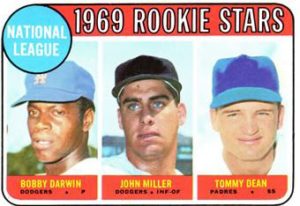
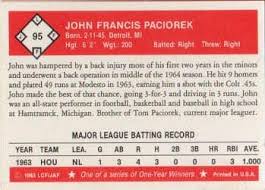 John Paciorek – signed out of Saint Ladislaus High School in Hamtramck, Michigan (where he had starred in football, basketball and baseball) – appeared in his first major league game on the final day of the 1963 season (September 29) at the age of 18. The 6’ 1”, 200-pound outfielder had spent the 1963 season with Class A Modesto Colts. The Colts’ parent club, the Houston Colt .45s (that was the current Astros’ franchise name back then), was suffering through a difficult season. The team was 65-96 going into that final game. Looking to the future, Houston had, in fact, fielded an all-rookie lineup (average age 19) on September 27. Youth was still being served two days later when John Paciorek started his first MLB game. The results were surprising – and worthy of recognition.
 Paciorek, by the way, went on to become a high school teacher and multi-sport coach and is the author of two books (Plato and Socrates – Baseball’s Wisest Fans and The Principles of Baseball: And All There Is To Know About Hitting.) You also can enjoy Paciorek’s prose (and expertise) directly at his blog “Paciorek’s Principles of Perfect Practice” by clicking
 The MLB season has now moved into June, which means it’s time for BBRT’s traditional lengthy (Cut me come slack here, we are reviewing an entire month.) monthly wrap up.
 Three players share the record for the most franchises played for in a single day at two. The first two to accomplish this feat were Max Flack and Cliff Heathcote, who were traded for each other between games of a Memorial Day 1922 Cubs/Cardinals doubleheader. The two outfielders each suited up against their previous team for Game Two. Both went hitless in game one of the doubleheader and both collected hits for their new teams in the second game (Flack a single in four at bats, Heathcote a pair of singles in four trips to the plate).