Pitch Counts? This Guy Made Everyt Pitch Count!

BarrettOn this date (May 10) in 1944, 29-year-old RHP Charles “Red” Barrett faced a daunting challenge.  Barrett – 6-11, 4.53 on the season – was starting for the (43-60) Boston Braves against the (55-45) Cincinnati Reds.  His mound opponent was veteran and six-time All Star Bucky Walters, who took the mound with a 16-5, 2.36 record. Note:  Walters would finish the season 23-8, 2.40, while Barrett would go 9-16, 4.06.

On this day, however, Barrett would prevail 2-0, tossing a complete-game, two-hit shutout.  In the process, Barrett would set the record for the fewest pitchers ever thrown in an MLB nine-inning complete game – just 58 tossed to the plate.  Barrett walked none and struck out none, facing 29 batters (two pitches per plate appearance).  Clearly, if you stepped into the batter’s box that day, you better be ready to hit – Barrett was in no mood to “waste” a pitch.

Walters probably deserved better that day.  The losing pitcher gave up two runs (one earned) on just six hits, with one walk and one strikeout.  Together, Barrett and Walters combined to throw the shortest (time-wise) MLB night game ever – just 75 minutes.

RED BARRETT MAY HAVE CALLED HIS SHOT

The Braves’ Red Barrett, who used only 58 pitches to complete a 2-0 win over the Reds on May 10, 1944 (the fewest pitches ever in a nine-inning MLB complete game), may have “called his shot” six years earlier.

Here are a couple of excerpts from Barrett’s comments in a November 9, 1938 Los Angeles Times article:

         “These strikeout pitchers are chumps. Me, I try to make them hit the          first ball.”

“My idea is to throw as few pitches as possible. Even when you strikeout a batter, it generally takes four-to-seven, and sometimes even more, pitches. I’d rather get that batter out on one pitch and save my arm.”

Barrett was truly a “pitch to contact” hurler.  In eleven MLB seasosns, he went 69-69, 3.53 and, in 1,263 1/3 innings, walked just 312 batters and fanned 333.

Barrett's fine 1945 season earned him a spot on the cover of "life."

Barrett’s fine 1945 season earned him a spot on the cover of “life.”

Barrett’s best season came in 1945.  In mid-May he was a disappointing 2-3, 4.74; when he was traded to the Cardinals. He went on to win 21 games for the Redbirds – ending the campaign at 23-12, 3.00 and leading the NL in wins. complete games (24) and innings pitched (284 2/3). He made his only All Star squad that season, but the game was not played due to World War II travel (fuel-saving) restrictions. It was the only season Barrett won more than 12 games. (He was 12-18 in 1943 and 11-12 in 1947).


LONG LINE AT THE CONCESSION STAND. DID I MISS ANYTHING?

On September 28, 191, the New York Giants topped the Philadelphia Phillies in a nine-inning contest that took just 51 minutes – tho shortest nine-inning game in MLB history. What is somewhat surprising is that, while both pitchers – Lee Meadows (Phillies) and Jesse Barnes (Giants) – went the distance, the game featured seven runs, 18 hits and three walks.  Meadows gave up six runs (five earned) on 13 hits, while Barnes surrendered just one run on five safeties.

For those interested in such things, the shortest-ever 18-inning doubleheader (Remember those?) in MLB history took place between the Yankees and (St. Louis) Browns on September 26, 1926 – taking just two hours and seven minutes. The Brown swept the Bombers, winning Game One 6-1 in one hour and 12 minutes and taking Game Two 6-2 in just 55 minutes (the shortest-ever American League contest). The two games featured 45 hits and seven walks.  My, how the game has changed.

Barrett, while “starring” in only one MLB season, did show promise in the minors. He went 159-122, with a 3.41 ERA in 12 minor league seasons – including four seasons of twenty or more victories. In 1942, Barrett was the (Double A) International League’s Most Valuable player (for the Syracuse Chiefs), leading the league with 20 wins (12 losses); 34 starts; 25 complete games; and seven shutouts.  He also fanned a league-topping 114 batters in 268 innings.

Key resources:  Society for American Baseball Research; Baaseball-Reference.com; Baseball-Almanac.com.

I tweet baseball @DavidBBRT

Follow/Like Baseball Roundtable’s Facebook page, here.

Member: Society for American Baseball Research (SABR); The Baseball Reliquary; The Negro Leagues Baseball Museum; Baseball Bloggers Alliance

Walk Up Music for the July Trade Deadlines Top Buyers

It’s All Over Now – The Rolling Stones (the cover was their first #1 hit)

The July 31 (Non-Waiver) Trade Deadline has passed and, as always, there was a flurry of activity as contenders looked to bolster their squads for the division races and post season – and non-contenders looked to bring new prospects into their systems.  In this post, Baseball Roundtable will take a look at some of the most significant acquisitions – made by the most active “buyers.”  Here’s my take on the nine teams that most improved their chances to be a part of the 2017 post-season – with a Walk-Up Song for each.

YANKEES – GRADE: A

Gray Skies Are Gonna Clear up – from Tony Bennet’s “Put On A Happy Face”

Sonny Gray Photo by Keith Allison

Sonny Gray    Photo by Keith Allison

The Bronx Bombers – in a battle with the rival Red Sox for the AL East – added pitching and power. They won the sweepstakes for much sought after right-handed starter (2015 All Star) Sonny GRAY of the A’s and added lefty starter Jaime Garcia (67-52, 3.65 over nine seasons) from the Braves (after Garcia made a one-appearance cameo with the Twins). Those moves addressed the Yankees’ biggest shortcoming – starting pitching.

The Yankees, however, did not stop there.  The pinstripers also added bullpen strength in David Robertson and Tommy Kahnle from the White Sox. Robertson is a former closer, with a 2.95 ERA over 561 career appearances, while Kahnle boasted a 2.50 ERA in 37 appearances this season.   And, to put just a little frosting on the cake, they picked up veteran power hitter Todd Frazier – also from the White Sox.  It was quite a July haul for the Bombers.

_________________________________

DODGERS – GRADE: A

It Had to Be Y(o)u … Frank Sinatra

It had to be Yu Darvish. Photo by mikelachance816

It had to be Yu Darvish. Photo by mikelachance816

While they may have the best record in baseball, the Dodgers did not rest on their laurels – they were wheeling and dealing right up until the final bell. In fact, at the bell, they picked up the top prize of the trading season – four-time All Star RHP YU Darvish from the Rangers.  Darvish makes an already strong rotation even stronger; fills a temporary void left by Clayton Kershaw’s stint on the DL; and sets up a post-season rotation of Kershaw, Darvish, Rich Hill and Alex Wood.

But Darvish isn’t the only factor in Los Angeles’ “A” rating. The Dodgers also needed to bolster their portside bullpen options.  They earned a Tony Award there, with the acquisition of lefty relievers Tony Watson from the Pirates (3.66 ERA in 47 appearances this season) and Tony Cingrani (a 17-save season in 2016) from the Reds.  Watson is likely make the biggest difference of that pair.

So, the team with the best record in baseball got even better.  That’s clearly worth an A.

WHAT’S THE BIG HURRY?

For those who don’t know why there is such a rush to beat the deadline – trades after the July 31 Non-Waiver Deadline get a bit more complicated.  Before the deadline, teams can make trades without putting the affected players on waivers. After July 31, traded players must clear (revocable) waivers. This means any other team may claim the player – with claims considered in reverse order the teams’ won-loss records. The team with the worst record gets the first opportunity to make a claim, the team with the second-worst record (if the first team does not make a claim) gets the next opportunity and on up the line.

If a claim is made, the team putting the player’s name up can: 1) Make a trade with the claiming club; 2) Let the player go to the claiming club for no return; 3) Keep the player (take him off waivers). So, in order to make a preferred trade, the player has to make it through the waivers process (at least up the line to the waiver position of the team that the offering team wants to deal with.)

NATIONALS – GRADE: B+

Feelin’ Stronger Everyday – Chicago

The Nationals may be running away with the AL East, but they recognized the need to build a STRONGER bullpen (with its ERA north of 5.00) if they were going to advance in the post season. (Read, “Get past the Dodgers.”)

They earned a solid B+  by getting that job done.  The Nationals added Twins’ All Star closer Brandon Kintzler (28 saves this season) and two relievers from the A’s:  Ryan Madson (a 12-year veteran with a 2.06 ERA with Oakland this season and a 30-save season in 2016) and Sean Doolittle (an All Star closer for the A’s in 2014.)  Suddenly, a weakness has the potential to be a strength.

Earlier in July, Washington also added versatile Howie Kendrick – a dependable bat off the bench – who was hitting .340 in 39 games for the Phillies at the time of the trade. Kendrick a 12-year MLB veteran has a career average just over .290.

IN THE BLINK OF AN EYE … FROM “BUYER” TO “SELLER”

The Twins went into their July 24 game with a 49-48 record, trailing the AL Central leading Indians by just 2 ½ games.  In the trade deadline market, they were buyers (not sellers) announcing the acquisition of Braves’ starting pitcher Jaime Garcia to bolster a suspect Minnesota rotation.  A week – and five losses in six games –  later,  the Twins were 50-53, seven games out and had become “sellers.”   Garcia, after just one start (the team’s lone win while he was on the Minnesota roster), was gone to the Yankees. Soon after, Twins’ All Star closer Brandon Kintzler (and his 28 saves) was on his way to the Nationals.

CUBS – GRADE: B+

This Could be the Start of Something Good – Exile

jOSE qUINTANA photo

Jose Quintana –   Photo by Keith Allison

The defending World Champions, who recently chased down the Brewers to take first place in the NL Central, made one of the earlier moves of the July “trading season,” acquiring STARTer Jose Quintana from the White Sox. The 2016 All Star was off to a bit of a rough start this season (4-8, 4.49 for the ChiSox), but went 2-1, 2.37 in three starts since moving across town. He should provide plenty of quality starts down the stretch and into the post season.

The Cubs also added reserve catcher Alex Avila and southpaw reliever Justin Wilson from the Tigers.  Avila provides a bit more punch from the backup-backstop spot, but the gem in the Tigers’ trade is Wilson – a proven power arm for the pen. At the time of the trade, Wilson had a 2.68 ERA in 42 appearances and had fanned 55 batters in 40 1/3 innings.

__________________________

DIAMONDBACKS – GRADE B

The Force Behind the Power – Diana Ross

jd MARTINEZ photo

Photo by GabboT

The D-backs added Tigers’ slugger J.D. Martinez (hitting .305-16-39 for Detroit) – adding a veteran POWER source to the lineup.  Martinez was the best offensive player moved in July.  Martinez’ bat bolsters the middle of the D-backs’ lineup and provides much-need protection for Arizona MVP candidate Paul Goldschmidt. (Martinez hit five home runs in his first nine games for the D-backs.)

The D-backs also traded for A’s utility player Adam Rosales – to compensate for injuries to the infield corps – and added  veteran reliever David Hernandez from the Angels (2.23 ERA in 38 appearances this season) to help out in the bullpen. Not as flashy as some of the other contenders, but positive additions. Considering where the Dodgers are, the Diamondbacks are fighting for a Wild Card spot – and Martinez should win a few games for them.

__________________________________

RED SOX – GRADE: B

Sparks Will Fly – Rolling Stones

Boston added depth to their offense by picking up Eduardo Nunez from the Giants. Nunez brings plenty of offensive SPARK.  In 2016, he hit .288, with 16 home runs and 40 stolen bases for the Twins/Giants – and he can hold his own defensively at multiple positions. The Red Sox also added hard-throwing southpaw Addison Reed to serve a key setup role in the pen. Reed consistently fans 1+  batters per inning and has 125 MLB saves to his credit.  Still, the Yankees appear to have won the July trade market battle – and perhaps the East Division as well.

_________________________________________

ROCKIES – GRADE: B-

Catcher in the Rye – Guns and Roses  (Dang, couldn’t come up with a Pat song)

Like Arizona, Colorado is a legitimate Wild Card contender. (Unfortunately, in the AL West 14 games over .500 leaves you 14 games out of the division lead.) The Rockies took a cautious approach to the July trade market, but did add to the offense and the bullpen.  Veteran reliever Pat Neshek (a two-time All Star with a 2.77 ERA over 11 seasons), acquired from the Phillies, should give the Rockies some solid innings. Neshek was an All Star this season and brought a 3-2 record with a 1.12 ERA to the Rocks.

In addition, the acquisition of CATCHER Jonathan Lucroy (Rangers) gives the Rockies a veteran presence to help a young pitching staff.  Lucroy – who hit .292, with 24 home runs, in 2016 – has the potential add to the offense (particularly in Coors’ light air).  At the time of the trade, he was hitting .242, with four homers and 27 RBI (in 77 gamers) for the Rangers. He’ll need to up is game to help the Rockies.

____________________________

RAYS – GRADE: B

Zip-A-Dee-“DOO-DAH ” – Johnny Mercer

lucas duda photo

Lucas Duda.     Photo by slgckgc

The Rays are trying to stay in the AL East chase, but a Wild Card spot seems more likely.  They added a needed power-bat in 1B/OF Lucas DUDA from the Mets. Duda is a solid 20-30 home run power source – and hit three homers in his first four games as a Ray. In addition, the Rays bolstered their bullpen with the acquisitions of three veteran arms in Sergio Romo (who was having a rough season with the Dodgers, but has a career 2.79 ERA over 10 campaigns);  Steve Cishek (who was carrying a 3.15 ERA with the Mariners and has a 2.81 ERA over eight MLB seasons) and Dan Jennings (with a 2.88 ERA over six seasons).

_______________________________

ROYALS – GRADE: C

Hey, Hey, We’re the Melky(s) – The Monkees (Okay, I took some liberties here>)

The Royals reinserted themselves into the AL Central race and became buyers in the July marketplace. They added MELKY Cabrera from the White Sox. Cabrera was hitting .295-13-56, typical of the production you can expect from him.  The Royals also bolstered the rotation by picking up Trevor Cahill form the Padres (where he had a 3.69 ERA in 11 starts this season). Newcomers Brandon Mauer (Padres) and Ryan Buchter (Padres) may provide bullpen help.  Overall, Cabrera is likely to be the biggest difference maker. Still looks like the Indians have too much to be overtaken.

I tweet basesball @DavidBBRT

Like/Follow Baseball Roundtable’s Facebook page, here.

Member:  Society for American Baseball Research (SABR); The Baseball Reliquary; The Negro Leagues Baseball Museum; Baseball Bloggers Alliance.

JULY WRAP – One team rakes at a .323 pace, another puts up a 2.60 ERA.

It’s August 1, which means it’s time for Baseball Roundtable’s look back at July – the stats, the stories and the highlights. We could call July Dodger Month, Beltre Month, Altuve Month,  Paxton Month or maybe even Devers Month.  Here are a few notable highlights:

  • Adrian Beltre had a milestone month – picking up his 3,000th base hit (July 30); 5,000th total base (July 7); and 1,600th RBI (July 14). Better start clearing a sport on the wall at Cooperstown.
  • The Dodgers went a sparkling 20-3 for the month, expanding their NL West Division lead to 14 games over the Diamondbacks.
  • The Astros’ Jose Altuve’s month of July included a 19-game hitting streak, during which he hit .524.
  • James Paxton was the only pitcher to win six games – going 6-0, with a 1.37 ERA for the Mariners – who went only 8-12 in the games Paxton didn’t start.
  • Boston Red Sox’ rookie Rafael Devers was a .296 hitter over four minor league seasons, but he appears to like major league pitching even better. The 20-year-old made his major league debut on July 25 (becoming MLB’s youngest active player) and, in six July games, hit .417 (10-for-24) with two home runs, four RBI and four runs scored.
  • The Astros hit a remarkable .323 at a team for July (the only team above .300), while the Dodgers put up a stingy 2.60 ERA for the montk (the only team below 3.00).

Still, the best moniker for July might be trade deadline month – as lots of players were moved as we approached the July 31 trade deadline.   We’ll take a look at all this and the month’s highlight and statistical leaders coming up.  But first the standings and Baseball Roundtable’s Players and Pitchers of the Month.

THE STANDINGS

The Dodgers went 20-3 for the month (an .870 winning percentage) and are now 74-31 on the season – the only team playing .700 ball. Pitching led the way for the boys from LA, as their 2.60 earned run average was far and away the lowest in MLB for the month. While the Dodgers 107 runs scored in July ranked 22nd among MLB teams, they still managed to outscore the opposition by 38 runs.  Leading the way for the Dodgers in July was the now DL-ed Clayton Kershaw (3-0, 0.72 ERA); the surprising Rich Hill (4-0, 1.45); and, of course, Kenley Jansen with nine saves in ten opportunities.

If you are looking for offense, the Astros rode a month in which they led the majors in runs scored (174); batting average (a resounding .323); and home runs (44) to a 15-9 July record – despite MLB’s ninth worst ERA for the month (5.08).  Leading the way for the Astros were Jose Altuve (.485 for the month); George Springer (.403); Alex Bregman (.329); and Evan Gattis (.322).

Other squads putting up solid July results (at least 15 wins) were the Cubs and Nationals (16-8), Royals (16-10) and Indians  (15-11).

The worst July record belonged to the White Sox (6-19) in the AL and the Reds (8-18) in the NL.

If the season ended July 31, your playoff teams would be.

AL:  Division Leaders – Yankees, Indians, Astros. Wild Cards: Red Sox and Royals.

NL: Division Leaders: Nationals, Cubs and Dodgers; Wild Cards: Diamondbacks anad Rockies/

Notably, there are three competitive division races: In the NL Central, the Cubs lead the Brewers by 2 ½ games; in the AL Central the Royals are two games back of the Indians; and in the AL East, the Yankees jhold just a ½-game dge on the Red Sox.

A full chart of July 31 standings and month of July won-lost records appears at the end of this  post. 

_______________________________________________________________

BASEBALL ROUNDTABLE PLAYERS AND PITCHERS OF THE MONTH

NL Player of the Month – Nolan Arenado, 3B, Rockies

I love those players who give you plenty of offense AND defense and no one does it better than four-time (in four seasons) Gold Glover at third base Nolan Arenado. He’s also a two-time NL RBI leader (and current 2017 leader) and two-time league home run champ. So, what did he do to earn Player of the Month for July? He hit .389, with eight home runs, 18 runs scored and an MLB-leading 30 RBI (in just 22 games played). Also under consideration were Rockies’ CF Charlie Blackmon, who hit .370, with seven home runs, 13 RBI and an MLB-leading 29 July runs scored. Blackmon also had three triples in July, adding to his season total of 13 three-baggers – six more than the next-best total.  I also took a look at the Marlins’  RF Giancalo Stanton. who led MLB with 12 July home runs – to go with a .289 average and 23 RBI. 

NL Pitcher of the Month – Rich Hill, LHP, Dodgers

This was a tough choice, but I went with Dodgers’ veteran Rich Hill. He went 4-0 in five starts (no NL pitcher won more than four games in July), with a nifty 1.45 ERA (behind only fellow Dodger Clayton Kershaw and the Phillies’ Aaron Nola among National Leaguers with at least 25 innings pitched in July).  The 37-year-old southpaw also walked just five batters, while fanning 40, in 31 innings. Also in the running were Kershaw (3-0, 0.72 in four starts); Nola (3-1, 1.32 with 43 strikeouts in 34 innings); and Max Scherzer (3-0, 2.84 with a league-topping 50 strikeouts in 31 2/3 innings.)

AL Player of the Month – Jose Altuve, 2B, Astros

What can you say about a guy who hits an MLB-leading .485 for the month, raps out an MLB-tops 48 hits, gives you a little power (four home runs) and speed (eight stolen bases), while also scoring 22 times and driving  in 21? Jose  Altuve’s July totals incuded a 19-game hitting streak, during which he hit .524, with ten doubles, one triple, four home runs, 21 runs scored and 19 RBI. Clearly, Altuve does it all – and is a deserving Player of the Month.  Also considered were Rangers’ 3B Adrian Beltre who – as noted earlier –  achieved several milestone including his 3,000th MLB hit.  At age 38, Beltre went .341-4-14 for the month.  Clearly, twenty years into an MLB career and Beltre can still rake.   Orioles’ 2B Jonathan Schoop was also on the radar for this recognition after a .343-9-28 month of July. 

AL Pitcher of the Month – James Paxton, LHP, Mariners

James Paxton photo

Photo by hj_west

Mariners’ southpaw James Paxton put up stellar numbers in July – going 6-0, with a 1.37 ERA in six starts.  (Numbers which look even better given Seattle’s 14-12 record for the month.) Paxton also fanned 46 batters, while walking just six, in 39 1/3 Innings. The 28-year-old Paxton is now 11-3 on the season, with a 2.68 ERA.  So, how does it add up?  For July, Paxton was in the AL’s top five  in starts, wins, inning pitched, strikeouts and ERA. Coming into 2017, Paxton was 18-15, 3.43 in fifty MLB starts over four seasons.  Also in the running was Red Sox’ ace Chris Sale (3-1, 1.04 with a league-leading 56 strikeouts in 34 2/3 innings.)  

________________________________________________________

NOW FOR SOME JULY HIGHLIGHTS

WHAT GOES AROUND, COME AROUND

On July 15,  Cody Bellinger become the first Dodgers’  rookie to hit for the cycle – going four-for-five  – with the requisite single, double, triple and home run – notching three RBI and two runs scored in a 7-1 Dodgers’ win over the Marlins. It was the first four-hit game of the 22-year-old rookie’s career – and his 26th home run of the season. For a look at all the MLB rookies who have hit for the cycle, click here.

IT’S NOT ALL ABOUT THE HOME RUN – HOW ABOUT A WALK-OFF WALK

Dodgers’ rookie Cody Bellinger added four home runs to his rookie-season total in July – and ended the month at 28.  However, it wasn’t all about the long ball. On July 8, Bellinger propelled the Dodgers to their 60th win of the season (the first team to reach 60 wins in 2017) by waiting out a bases-loaded walk in the bottom of the tenth inning – giving  the Dodgers a 5-4 win over Rays in LA.  Of course, as it seems is always the case this year, the long ball did play a part. Bellinger had tied the game with a home run in the bottom of the eighth. Keep an eye of this rookie.  After nine home runs in May and 13 in June, he slipped to four in July.  Time for some adjustment?

LOOK OUT JOE! HERE COMES THE JUDGE!

Aaron Judge YANKEES photo

Photo by apardavila

On July 7, Yankees’ rookie phenom Aaron Judge hit his 30th home run of the season – eclipsing Joe DiMaggio’s Yankee rookie record of 29 home runs – with plenty of season left. Judege ended July with a stat line of .303-34-75 – leading MLB in home runs and slugging percentage and topping the AL in runs scored and walks. Oh yeah, and he won the All Star Game Home Run Derby.


CRUZIN’ TO NUMBER 300

On July 7, Seattle DH Nelson Cruz hit his 300th round tripper as the Mariners bested the Oakland A’s 7-2 to snap an eight-game losing streak – it was his 16th home run of the season and his second in July.  He finished the month with seven July homers, 21 on the season and 305 career blasts.

WOMEN BELONG IN BASEBALL

On July 15, Stacy Piagno made her first start on the mound for the  Sonoma Stompers of the  (independent) Pacific Association of Professional Baseball Clubs – as they took on the Pittsburg Diamonds. Piagno pitched seven innings, giving up just one run on four hits and notching four strikeouts as Sonoma prevailed 16-1.  With that outing, Piagno became the third women to notch a professional baseball victory since the 1950s – following Ila Borders and Eri Yoshida to victories from the hill.

HOW ABOUT SHOWING A LITTLE RESPECT

Max Scherzer - ambushed by the Diamondbacks. Photo by Keith Allison

Max Scherzer –
ambushed by the Diamondbacks.
Photo by Keith Allison

Two-time Cy Young Award winner Max Scherzer came into his July 21 start against the Diamondacks with an  11-5, record and a sparkling 2.01 ERA.  The Diamondbacks showed the Nationals’ ace very little respect, however.  After three batters and just ten pitches, the Diamondbacks had three homne runs and a 3-0 lead.  Lead off hitter/RF  David Peralta homered to deep  right, followed by CF  A.J. Pollock’s blast down the left field line and 3B Jake Lamb’s RF home run. The three round trippers tied the MLB record for consecutive home runs to start a game.

How unexpected was the three-homer barrage? Scherzer had allowed just one home run over 34 2/3 innings in his past five starts. Scherzer did settle down and lasted five innings (eight hits, two walks, five runs and nine strikeouts – no decision) as the Nationals fell to the D-backs 6-5.

PARITY?

The MLB All Star competition is as even as can be: 43 AL wins, 43 NL wins, two ties – AND both teams have scored exactly 361 runs over the 88 games.

ONE FOR THE RECORD BOOKS

On July 23, The Orioles’ Zach Britton set a new AL record by converting his 55th straight save opportunity – pitching a scoreless ninth in a 9-7 win over the Astros.   Britton extended his record with saves (versus the Rangers) on July 29 and July 30.  He’s still a long way form the MLB record, however.  That belongs to  the Dodgers’ Eric Gagne, with 84 straight  conversions from August 28, 2002 to July 3, 2004.

A BALANCED ATTACK

Carlos Santana Indians photo

Photo by Keith Allison

On July 24, 1B Carlos Santana provide some well-balanced offense for the Indians.  The switch hitter homered both left-handed and right-handed, as the Indians stopped the Reds 6-2. It was the fourth time in his career that Santana had homered from both sides of the plate in the same game. For those interested – through June of this year, the feat had been accomplished 312 times at the major league level.  In 2017 alone, the Indians have accomplished it four times (Jose Ramirez twice, Francisco Lindor and Santana). Others to go yard from both sides in a game this season include the Yankees’ Aaron Hicks, Astros’ Marwin Gonzalez, Blue Jays’ Kendrys Morales, Dodgers’ Yasmani Grandal and Phillies’ Freddie Galvis. Nick Swisher and Mark Tiexiera share the MLB record for career games with home runs both left- and right-handed at 13.


MINOR LEAGUE NO-O-OTE

On Sunday, July 23, the Rookie Level Gulf Cost League (GCL) Nationals used four pitchers to throw a pair of seven-inning no-hitters. In Game One of a doubleheader (a 4-0 Nationals’ win over the Marlins), Joan Baez went six innings (no hits, one walk, seven strikeouts), with Jose Jimenez throwing the final frame. Game Two (Nationals 1 – Marlins 0) saw Jared Johnson go four no-hit innings (one walk, two strikeouts), with Gilberto Chu tossing the final three (no walks, four whiffs.)

A TRIPLE PLAY PRODUCES A RUN – A FIRST FOR FRAZIER

On July 25, in his first at bat at Yankee Stadium, Todd Frazier came to the plate in the bottom of the second inning, with the sacks full and no one out. Matt Holliday was on third, Didi Gregorius on second and Chase Headley on first.  All had reached via singles. Frazier, facing rookie starter Luis Castillo, hit a one-hopper to Reds’ SS Jose Peraza. Peraza tagged second for out number one, then threw to 1B Joey Votto for the second out.  As this traditional double play was completed, Holliday scored from third. Things then got interesting. Gregorius, who had been on second, stopped between second and third and basically found himself in the proverbial “pickle” between Reds’ 3B Eugenio Suarez and Peraza.   In the end, the Reds recorded a 6-6-3-3-5-6 triple play and the Yankees recorded a run.  Ultimately, the Bronx Bombers prevailed 4-2 – but it was a pretty memorable first Yankee Stadium at bat for Frazier.  It also was just the tenth time (in 712 triple plays) that a run has scored on an MLB triple killing.

BACK – TO BACK-TO BACK-TO BACK  … AND THEN SOME

On July 27, the Washington Nationals put an exclamation point on what some are calling “The Year of the Home Run” by tying a pair of MLB long-ball records – powering an MLB-record-tying four consecutive home runs and a record-tying five home runs  in an inning. The third-inning outburst led to seven runs as Washington topped the Brewers 15-2 in D.C.  It was the only the sixth time an MLB team has notched a five-dinger inning (and the eighth time a team had rapped four consecutive home runs) and featured long balls by CF Brian Goodwin (his tenth of the season); SS Wilmer Difo (third of the season); RF Bryce Harper (27th); 1B Ryan Zimmerman (21st); and 3B Anthony Rendon (21st).  For full details on the other record holders, click  here.

WORKING ON THE SOUTH 40

No player has ever hit 40 home runs in a Royals’ uniform (they are the only team without a 40-HR player in their history), but Mike Moustakas seems to be on his way. On July 28, Moustakas ripped his 30th home run of the 2017 season – a three-run shot as the Royals topped the Red Sox 4-2 in Boston.  (It was the streaking Royals ninth straight win.)  The home run made “Moose” the fastest Royal to reach thirty long balls – coming in his 364th at bat of the season. Previously, another third sacker – Gary Gaetti – was the quickest Royal to thirty dingers in a campaign at 410 ats bats (in 1995).  Gaetti hit 35 that season, one short of Steve Balboni’s Royals’ record.  Nicknames seem to be all the rage for Royals’ home run hitters – Moustakas is known as “Moose,” Gaetti as “G-Man” or “Rat” and Balboni as “Bye Bye.”


——STAT TIME … FOR THE MONT OF JULY AND YEAR-TO-DATE (throogh July 31)—-

—–TEAM BATTING LEADERS … MONTH OF JULY—–

Average (MLB Average – .257)

NL:  Rockies- .297;  Marlins – .279; Dodgers – .275; Nationals – .275

AL: Astros – .323; Tigers – .280; Royals – 279

Runs Scored (MLB Average – 117)

NL: Rockies – 148; Marlins – 139; Nationals – 128

AL: Astros  – 174; Royals – 141; Indians – 135; Tigers – 135

WE’LL TAKE THE LOW ROAD

The White Sox and Angels plated the fewest runs in MLB in July – with only 88 runners  crossing the plate for each squad.  (The Reds were the lowest in the NL with 93 tallies.) The White Sox also had the lowest batting average for the month at .229; while the Giants showed the least power with an MLB-low 14 round trippers during the month. The Astros hit more than 100-points higher than the White Sox and bashed more than three times as many home runs as the Giants. 

Home Runs (MLB Average – 31)

NL: Cubs  – 40; Nationals – 37; Marlins – 35; Dodgers – 35

AL:  Astros – 44; Rangers – 41; Royals – 38

Stolen Bases (MLB Average – 12)

NL: Brewers – 20; Reds – 15; Braves – 15

AL: Astros – 23; Royals – 22; Indians – 20

I THINK I’LL JUST WAIT HERE

The Mets attempted (and achieved) MLB’s fewest stolen bases in July – going three-for-five in steals. The Blue Jays had the worst rate of success – swiping four bags in eight tries.

Walks (MLB Average – 82)

NL: D-backs – 101; Reds – 96; Marlins – 91

AL: A’s – 112; Indians – 106;  Blue Jays – 105

GRABBING A LITTLE AIR

The Brewers led all of MLB in strikeouts in July with 254 whiffs – which equates to just over ten per game. 

—–TEAM PITCHING LEADERS … MONTH OF JULY—–

Earned Run Average (MLB Average – 4.37)

NL: Dodgers – 2.60; Cardinals – 3.06; D-backs – 3.48

AL:  Red Sox – 3.24; Indians – 3.36; Mariners – 3.68

PUTTING UP SOME CROOKED NUMBERS

Eleven teams had ERA’s over 5.00 for July. The White Sox led (trailed?) all of MLB at 5.68, while the Rockies gave up an NL-leading 5.38 earned runs per nine innings.

Fewest Runs Allowed (MLB Average – 117)

NL: Dodgers – 69; D-backs – 87; Cardinals -94; Pirates – 94.

AL: Indians – 94; Red Sox – 101;  Angels – 102

IT’S OUTTA HERE

Your team leader in home runs allowed in July was the White Sox – the ChiSox staff gave up 47 long balls; while the Reds topped the NL with 44. On the other side of the coin, the Dodgers gave up an MLB-low 17 July dingers.

Strikeouts (MLB Average – 209)

NL: Nationals – 229; Reds – 227; Brewers – 220

AL: Red Sox – 265; Yankees – 264; Indians – 251

Fewest Walks Allowed (MLB Average – 82)

NL: Dodgers – 49; D-backs – 62; Cardinals – 64

AL: Twins – 65; Indians – 68;  Orioles – 72

LET ME TAKE YOU ON A FREE RIDE

The Blue Jays gave up an MLB-high 118 walks in July; while the Braves provided an NL-leading 108 free passes.  The only other teams to exceed 100 walks allowed were the White Sox and Marlins (106 each).    

Saves (MLB average – 6)

NL: Dodgers – 10; Padres – 10; five with seven

AL: Rays – 9; Mariners – 8; two with seven

OUCH!

The Diamondbacks had the worst save/opportunity percentage in July – blowing five of seven save opportunities – for a 28.6 percent success rate.  The MLB average for the month was 66.0 percent. 

______________________________________________________________

—–INDIVIDUAL BATTING LEADERS FOR THE MONTH OF JUlY—–

Average (minimum 50 at bats)

NL:  Gerardo Parra, Rockies .443; Chris Taylor, Dodgers  – .394; Anthony Rendon, Nationals – .392

AL: Jose Altuve, Astros – .485;  George Springer, Astros – .403; Alex Pressley, Tigers – .380

Home Runs

NL: Giancarlo Stanton, Marlins – 12; Bryce Harper, Nationals – 9; three with eight

AL: Rougned Odor, Rangers – 10; Mike Moustakas, Royals – 9; Jonathan Schoop, Orioles – 9

IT SEEMS LIKE HE’S ALWAYS ON BASE

Among players with at least 50 July at bats, only two got on base at least half the time.  Your on-base-percentage leaders were: Jose Altuve, Astros – .523; Anthony Rendon, Nationals – .500.

RBI

NL: Nolan Arenado, Rockies – 30;  Marcel Ozuna Marlins – 27; Giancarlo Stanton, Marlins – 23

AL: Jonathan Schoop, Orioles – 28; Dustin Pedroia, Red Sox – 25; Mookie Betts, Red Sox – 23

Runs Scored

NL: Charlie Blackmon, Rockies – 29; Bryce Harper, Nationals – 26; Giancarlo Stanton, Marlins – 25

AL: Alex Bregman, Astros – 24; Eric Hosmer, Royals – 22; Jose Altuve – Astros -22

WAIT FOR IT. WAIT FOR IT.

The Blue Jays’ Josh Donaldson was MLB’s most patient hitter in July – averaging 4.83 pitched per plate appearance – edging the Twins’ Joe Mauer at 4.82. 

Stolen Bases

NL:  Billy Hamilton, Reds – 11; Dee Gordon, Marlins – 9; four with five

AL: Rajai Davis, A’s – 9; Whit Merrifield, Royals – 9; Jose Altuve, Astros – 8

Walks

NL:  Joey Votto, Reds – 23; Paul Goldschmidt, D-backs – 22; two with 19

AL: Edwin Encarnacion, Indians – 20; Brett Gardner , Yankees – 20; Josh Donaldson, Blue Jays – 19

WAY BELOW THE M-LINE

The lowest average (minimum 50 June at bats) for the month went to the Twins’  Jorge Polanco at .078 (four-for-51).  

—–INDIVIDUAL PITCHING LEADERS … THE MONTH OF JULY—–

Wins

NL:  Seven pitchers with four

AL:  James Paxton, Mariners – 6-0, 1.37;  three with four

ERA (Minimum 25 July innings)

NL:  Clayton Kershaw, Dodgers  – 0.72;  Aaron Nola, Phillies – 1.32; Rich Hill, Dodgers – 1.45

AL:  Chris Sale, Red Sox – 1.04; James Paxton, Mariners – 1.37; Sonny Gray, A’s – 1.48

GETTING UP THERE A BIT

The worst ERA among pitchers with at least four starts or 15 innings pitched in July went to the Marlins’ Tom Koehler, who had four July starts and put up a 9.87 ERA in 17 1/3 innings. Using those same parameters in the AL,we find the  Astros’ Lance McCullers Jr., with an ERA of   9.64 in four June starts (18 2/3 innings). 

Strikeouts

NL: Max Scherzer – 50 (31 2/3 IP); Aaron Nola, Phillies 43 (34 IP); Rich Hill, Dodgers – 40 (31 IP)

AL: Corey Kluber, Indians – 56 (34 1/3 IP); Chris Sale, Red Sox – 56 (34 2/3 IP); three with 46

Saves

NL:  Kenley Jansen, Dodgers – 9; Greg Holland, Rockies – 7; A.J. Ramos, Mets/Marlins – 7

AL: Alex Colome, Rays – 9; Edwin Diaz, Mariners – 8; two with seven

TOUGHEST OUTING OF THE MONTH

The Blue Jays’ Glenn Sparkman may have had the toughest outing of the month.  The rookie righty was brought into a July 2 game against the Red Sox in the top of the seventh and the Blue Jays already down 7-1.  Sparkman’s appearance went: single; single; single; strikeout; double; single; double; double. Ultimately, he gave up seven earned runs  in 1/3 of an inning – for a July ERA of 189.00.  In his only previous MLB appearance (June 30), also against the Red Sox, he went 2/3 of an inning, giving up no earned runs, despite allowing two hits and a walk.  There is clearly a potential for better things to come – Sparkman has a 2.65 ERA in five minor league seasons, with 267 strikeouts in 268 1/3 innings. 

_________________________________________________

NOW THE YEAR-TO-DATE STATS (Still with me?)

—–TEAM BATTING … YEAR-TO-DATE LEADERS—–

Average  (MLB Average – .255)

NL:  Nationals – .275; Rockies – .274; Marlins – .266

AL: Astros – .292; Indians – .264; Yankees – .262

THAT’LL DO IN A PINCH

No  team pinch hits more successfully than the St. Louis Cardinals – whose batters have gone 45-for-141 in pinch-hitting appearances this season, leading MLB in pinch hits and PH batting average (.319).  Just down I-70, you’ll find the Royals, with the fewest pinch hits (two) and the lowest pinch-hitting average through July (.105). 

Runs Scored (MLB average – 490)

NL: Nationals – 575; Rockies – 564; Dodgers – 535

AL: Astros – 623; Yankees – 557; Rangers – 516

THE LONG AND THE SHORT OF IT

Only the Astros topped 600 runs (through July) at 623.  The Padres, on the other hand, have scored more than 200 times fewer than Houston, with San Diego notching just 400 runs. The Astros also lead the majors with 172 home runs, with the Giants the only team under 100 round trippers (82).

Home Runs (MLB Average – 132)

NL: Nationals – 158; Brewers – 156; Mets – 152

AL:  Astros – 172; Rangers – 160;  Rays – 154

A SWING AND A MISS

Only two teams had more than 1,000 batters’ whiffs through July: the Brewers (1,040) and Rays (1,037).  Looks like a tight race for the most free-swinging squad. 

Stolen Bases (MLB Average – 55)

NL: Brewers – 89; Reds – 83; D-backs – 72

AL: Angels- 88; Rangers – 81; Red Sox – 65

—–TEAM PITCHING LEADERS … YEAR-TO-DATE (July 31)—–

Earned Run Average (MLB average – 4.35)

NL: Dodgers – 3.09; D-backs – 3.43; Cardinals – 3.82

AL: Red Sox 3.70; Indians –  3.71;  Yankees – 3.83

I’D GIVE IT A FIVE

Only two teams had ERA’s over five through July – The Reds at 5.28 and the Orioles at 5.07. 

Fewest Runs Allowed (MLB average – 490)

NL: Dodgers – 350; D-backs –  404; Cardinals – 445

AL: Indians – 409; Boston – 435; Yankees – 438

DODGERS’ STAFF AT THE TOP

The Dodgers’ rotation had the best starters’ ERA in the MLB (through July) at 3.25; while the Astros’ starters were best in the AL at 3.96.  In the bullpen, Cleveland ruled at 2.77.  The Dodgers had the best bullpen ERA in the NL (and second-best in MLB) at 2.83.

If you’re wondering why the Nationals (despite a big lead) were active in the trade deadline market for relievers, Washington was one of only two teams with a  bullpen ERA over 5.00 through July 31 – the Tigers at 5.25 and the Nationals at 5.05.

Strikeouts (MLB average – 866)

NL: Dodgers – 991; D-backs – 971; Nationals – 949

AL: Astros – 1064; Indians – 1022; Red Sox – 1007

Fewest Walks Allowed (MLB average – 343)

NL: Dodgers – 275; Pirates  – 297; Cardinals – 314

AL:  Indians – 288; Red Sox – 293; Yankees – 318

PUTTING UP SOME GOOD RATIOS

Through July, the Dodgers lead the NL in strikeout-to-walk ratio at 3.60; while the Indians top the AL at 3.55. Other teams with a better than three-to-one ratio: Red Sox (3.44); Astros (3.16); Yankees (3.12); D-backs (3.02). Common denominator? We’ll likely see all of them in the post season.   Also, only two teams are averaging at least ten strikeouts per nine innings: Astros (10.18); Indians (10.01).  

Saves (MLB Average – 25)

NL: Rockies – 35; Dodgers – 33; Brewers – 32

AL: Rays – 35; Twins – 29; Blue Jays – 29

LETS CONVERT 

The major-league team average for save conversions through July was 64 percent.  No team was under 50 percent, but Texas (17-for-34) was right at the low-water mark.  

—–INDIVIDUAL BATTING LEADERS YEAR TO DATE—-

Average (qualifying)

NL:  Justin Turner, Dodgers – .356; Daniel Murphy, Nationals – .332; Bryce Harper, Nationals – .329

AL: Jose Altuve, Astros – .368; Eric Hosmer, Royals – .323; Jean Segura, Mariners – 322

Home Runs

NL: Giancarlo Stanton, Marlins – 33; Cody Bellinger, Dodgers – 28; four with 27

AL: Aaron Judge, Yankees – 34;  Mike Moustakas, Royals – 30; Justin Smoak, Blue Jays – 30

HE KEEPS HITTING THOSE THREES

The Rockies’ Charlie Blackmon has 13 triples through July – no other player has more than seven.

RBI

NL: Nolan Arenado, Rockies – 91; Marcell Ozuna, Marlins – 81; two at 80

AL: Nelson Cruz, Mariners – 79;  Jonathan Schoop, Orioles – 77;  Aaron Judge, Yankees – 75

Runs Scored

NL: Charlie Blackmon, Rockies – 93; Bryce Harper, Nationals – 86; Paul Goldschmidt, D-backs – 82

 AL: Aaron Judge, Yankees – 83; George Springer, Astros – 82;  Jose Altuve, Astros – 74

Stolen Bases

NL:  Billy Hamilton, Reds – 44; Dee Gordon, Marlins – 38; Trea Turner, Nationals – 35

AL: Cameron Maybin, Angels – 25; Jarrod Dyson, Mariners – 23; Jose Altuve, Astros 22

LEADERS IN A FEW OTHER CATEGORIES

Base Hits: Jose Altuve Astros (AL) – 148; Charlie Blackmon, Rockies (NL) – 141

On Base Pct: Justin Turner, Dodgers (NL) – .455; Jose Altuve, Astros  (AL) – .430

Slugging Pct: Aaron Judge, Yankees (AL) – .639; Bryce Harper, Nationals (NL) – .627

Strikeouts:  Miguel Sano, Twins (AL) – 144; Will Myers,Padres (NL) – 127

—–PITCHING LEADERS … YEAR TO DATE (July 31)—–

Wins

NL:  Clayton Kershaw, Dodgers – 15-2, 2.04; Zack Greinke, D-backs – 13-4, 2.84; four with 12

AL:  Chris Sale, Red Sox – 13-4, 2.37; Jason Vargas, Royals – 13-4, 3.00;  two with 11

ONE (or more) THAT GOT AWAY

Rick Porcello of the Red Sox leads MLB in pitcher’s losses – with 14 losses (versus just four wins) to go with a 4.55 ERA (that would indicate he deserved better).  Over in the NL the loss leader is the Padres’ Clayton Richard (5-12, 5.40).

ERA (qualifying) 

NL:  Clayton Kershaw, Dodgers – 2.04; Max Scherzer, Nationals – 2.23; Gio Gonzalez, Nationals – 2.66

AL:  Chris Sale, Red Sox – 2.37; James Paxton, Mariners – 2.68; Corey Kluber, Indians – 2.90

Strikeouts

NL: Max Scherzer, Nationals – 201 (145 1/3 IP); Clayton Kershaw, Dodgers – 168 (141 1/3 IP); Jacob deGrom, Mets – 162 (139 2/3 IP)

AL: Chris Sale, Red Sox – 211 (148  1/3 IP); Chris Archer, Rays – 177 (142 IP); Corey Kluber, Indians – 161 (114 2/3 IP)

LIKE THE LONG BALL?

If you like big flys, show up when the Angels’ Ricky Nolasco or the Yankees’ Masahiro Tanaka are on the mound.  They share the MLB lead in home runs allowed at 27.

Saves

NL:  Greg Holland Rockies – 33; Kenley Jansen, Dodgers – 27; three  with 22

AL: Alex Colome, Rays – 39; Brandon  Kintzler,Twins – 28; Robert Osuma, Blue Jays – 26

A PITCHER’S BEST FRIEND

No one has induced more double play grounders  this season (through July) than Marcus Stroman of the Blue Jays with 23 … to go with a 9-5, 3.08 record.


JulyStandings

Primay sources:  Baseball-Reference.com; MLB.com; Society for American Baseball Research.

I tweet baseball @David BBRT


Follow/Like Baseball Roundtable’s Facebook page, here.


Member: Society for American Baseball Research (SABR); The Baseball Reliquary; The Negro Leagues Baaseball Museum; Baseball Bloggers Alliance. 

Pitch Counts? We Don’t Need No Stinkin’ Pitch Counts!

Don’t Worry Boss I Got This … One Pitch – Three Outs – One Win

One and done, that was Ken Ash’s day on July 27, 1930 – when he threw just one pitch, but recorded three outs and earned a major league victory.

ASHKen Ash was a journeyman right-hander who spent more time in the minor leagues than in the majors. Between 1924 and 1940, he toiled in the minors for 14 seasons – appearing in 462 games – winning 176, losing 153.  He did make it to the big leagues in four of those seasons (1925, ’28, ’29, ’30), going 6-8, with a 4.96 ERA in 55 games. He also made his way into the record books as the only MLB hurler to record three outs on one pitch.

It happened 87 years ago today and here’s how it went down.

The Cubs were batting against Ash’s Reds in the top of the sixth, down 2-1, when Reds’ starter Larry Benton got into trouble. He started the inning by giving up a triple to Cubs’ 3B Woody English. This was followed by a run-scoring single to RF Kiki Cuyler, a run-scoring double to CF Hack Wilson, a wild pitch (moving Wilson to third) and, ultimately, a walk to LF Danny Taylor.  That was all for Benton and Ash came in from the bullpen to face Cubs’ first sacker Charlie Grimm.

Grimm grounded Ash’s first pitch to Reds’ shortstop Hod Ford.  Wilson moved off the bag at third – expecting the Reds to take the double play, allowing him to score.  Ford, instead, fired the ball to Reds’ third baseman Tony Cuccinello, as Wilson broke for home.  Cuccinello sent the horsehide on to catcher Clyde Sukeforth, who tagged Wilson for the first out of the inning. Seeing the potential for a rundown between third and home,  Grimm rounded first and headed for second.  Oops!  Taylor was still at second.  Grimm reversed toward first, but Sukeforth threw to Reds’ first baseman Joe Stripp, who laid the tag on Grimm for the second out.  Not to be outdone by Grimm’s base running miscue, Taylor broke for third. Stripp threw to Cuccinello who tagged Taylor to complete a 6-5-2-3-5 triple play. Red Lucas pinch hit for Ash in the bottom of the inning – as the Reds took a 6-3 lead.  The lead held and Ash got the win – as well as the distinction of recording three outs on a single pitch. Thanks, in part, to some remarkably aggressive – and inept – Cubs’ baserunning.

NO PITCH COUNT NEEDED – NO PITCH NEEDED

Although the Reds’ Ken Ash did record a victory and get three outs on just one pitch (on July 27, 1930) he does not hold the record for the fewest pitches thrown in a major league win.  Although tracking is not complete, there have been at least two instances of pitchers “earning” a victory without throwing a single pitch to the plate. The most recent no-pitch win came on July 7, 2009 – and went to Alan Embree of the Rockies. Embree came into a game against the Nationals in the top of the eighth inning with the contest knotted at four runs apiece, two out and the Nats’ Austin Kearns on first. Embree’s first throw was not to the plate, but rather to Rockies’ first baseman Todd Helton. Kearns was caught off base and broke for second. He was eventually tagged out by Embree in a 1-3-6-1 run down.  Seth Smith pinch-hit for Embree in the bottom of the inning as the Rockies scored (and held on) to give Embree the win – without tossing a single pitch.

The Orioles’ B.J. Ryan also earned a victory without tossing a pitch – in a very similar situation. On May 1, 2003. Ryan came on in the bottom of the seventh with the Tigers up on the Orioles 2-1. There were two outs and the Orioles’ SS Omar Infante was one first. Ryan’s first toss went to 1B Jeff Conine and Infante broke for second – where SS Deivi Cruz took the throw from Conine and applied the tag. The Orioles scored three times in the top of the eighth to take the lead, Buddy Groom pitched the eighth for Detroit and Jorge Julio closed it out in the ninth – giving Ryan a no-pitch victory.

Primary sources:  MLB.com; Baseball-Reference.com; Society for American Baseball Research


I tweet baseball @DavidBBRT

Follow/Like the Baseball Roundtable Facebook page, here

Member: Society for American Baseball Research (SABR); The Baseball Reliquary; The Negro Leagues Baseball Museum; Baseball Bloggers Alliance   

Baseball In Its Purest Form

Just a couple of days ago, this blog looked at a Roseville (MN) Youth Baseall Championship game.  (I love this game at all levels – and this may be its purest.)  For that post click, here.  It was a see-saw contest that ended on a legitimate triple play.  Unfortunately, I didn’t have a camera with me – just my phone. Fortunately, Douglas and Tamar Saum were shooting the game for the Roseville youth baseball organization. Baseball Roundtable thanks them both for letting BBRT share these great shots that reflect what our national pastime really is all about. I wanted to share them with all BBRT readers because I believe they will rekindle memories of that time when baseball – from pick-up games to Little League to Wiffle Ball (TM) in the backyard to World Series shutouts tossed into a pitchback to games we invented using the statisticas on the back of baseeball cards – first became part of our lives.  All photos by Douglas and Tamar Saum. 

I hope you enjoy this look at baseball being played (as well as coached and umpired) for the love of the game.

Coming soon:  A guest post from Ross Uitts of Old Sports Cards on his ten favorite baseball cards o(f all time. 


Good form, intense concentration, getting that force out at the two bag.

Good form, intense concentration, getting that force out at the two bag.

The crowd rewards a safety as the runer gets to first.

The crowd rewards a safety as the runer gets to first.

Making contact is so satisfying.

Making contact is so satisfying.


The opposition agrees. ... getting the bat on the ball is a tension reliever.

The opposition agrees … getting the bat on the ball is a tension reliever.


The dugout can be a stressful place when you find your team trailing.

The dugout can be a stressful place when you find your team trailing.


A triple play - a victory - a chanmpinship - and a hat toss for the Red Sox.

A triple play – a victory – a championship – and a hat toss for the Red Sox.


Thanks to Cody Bellinger – A Look at Rookie Cycles

Okay, what do Cody Bellinger and Eric Valent have in common?  Or Dave “King Kong” Kingman and Michael “Pinky” Higgins?   Or  Mox McQuery and Oddibe McDowell?

BellingerThe answer: They all hit for the cycle as major league rookies.  On July 15, as much was made of Cody Bellinger becoming the first Dodger rookie to hit for the cycle, I started  wondering just how many of MLB’s 310 cycles were achieved by rookies. I’ve identified 25 such occurences and we’ll take a look at each of those players in this post, but first a few bits of trivia.

No Cliff Hanger – Getting the Cycle Out of the Way

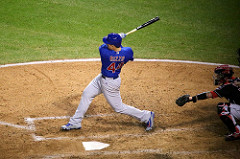
heatcoteCliff Heathcote (Cardinals, 1918) is the youngest rookie to hit for the cycle (20 years, 171 days), but not the youngest player ever to achieve the feat. On May 16, 1929, the Giants’ Mel Ott hit for the cycle at 20 years, 75 days of age – but he was already in his fourth MLB season.

Heathcote does hold the record for record a cycle earliest in a major league career.  His came in just his sixth MLB appearance – and included his first-ever MLB double, triple and home  run.
 

A few other “stats”:

  • Of the 25 rookie cycles, six (24 percent) were achieved by center fielders batting lead off;
  • In five of the 25 rookie cycles, the home run was the players’ first major league round tripper.
  • The Giant’s Fred Lewis completed a rookie cycle on May 13, 2007 that included his first MLB triple, first MLB home run and just his second MLB double.
  • Carlos Gomez, still active, is the only player to (thus far) to achieve a second cycle after notching a rookie cycle. Gomez’ rookie cycle came in 2008, his second cycle this April.

Eight is Enough?

We’ve already seen five cycles this season: Wil Myers (April 10); Trea Turner (April 25); Carlos Gomez (April 29); Nolan Arenado (June 18); Cody Bellinger (July 15). The most cycles achieved in any one season? Eight. Those came in 1933 (Pepper Martin, Chuck Klein, Arky Vaughn, Mickey Cochrane, Pinky Higgins, Jimmie Foxx, Earl Averill, Babe Herman) and 2009 (Orlando Hudson, Ian Kinsler, Michael Cuddyer, Melky Cabrera, Troy Tulowitzki, Felix Pie, B.J. Upton).

Now here are the 25 player to hit for the cycle as rookies:

Cody Bellinger, Dodgers … July 7, 2017

The Dodgers’ 22-year-old All Star rookie was in his 72nd MLB game, playing at 1B and batting cleanup when he completed his cycle in a 7-1 LA victory over the Marlins.  Bellinger went four-for-five with two runs scored and three RBI – in a game that included his 16th double, second triple and 26th home run.  As I write this post, Bellinger stands at .268-26-61 on the season and his MLB career.  Note:  I was going to get this out a day earlier, but I took time out to attend a youth baseball game (see more on that here.)

Brandon Barnes … Astros, July 19, 2013

The 27-year-old outfielder hit for the cycle in his 119th MLB game. He went five-for-five in the game with three runs scored and two RBI, as the Astros lost to Seattle 10-7. The triple was his only three-bagger of the season. Barnes finished 2013 at .240-8-41 (11 steals) in 136 games.  In five MLB seasons, he went .242-19-100.

Carlos Gomez, Twins … May 7, 2008

Twenty-two-year-old Gomez remained a rookie in 2008, despite his 127 MLB at bats in 2007.  He hit for the cycle in his 86th career game. Gomez, leading off and playing CF, went four-for-six with two runs scored and three RBI in the game (he struck out in his other two at bats) – as the Twins ripped the White Sox 13-1. Gomez finished the season at .258-7-59 and remains active in MLB (as this is written, his career line is .256-128-485).

Fred Lewis, Giants … May 13, 2007

Lewis was 26-years-old and playing in just his 16th MLB game when he completed his cycle. Lewis was leading off and playing CF in the Giants’ 15-2 thrashing of the Rockies.  Lewis went five-for-six in the game (two singles), with three runs scored and four RBI.  The extra-base hits were the second double, first triple and first home run of his career. Lewis finished the campaign at .287-3-19 in 58 games. He played seven seasons in the majors, with a .266-27-136 line (535 games). Notably, he hit nearly as many triples (21) as home runs (27) in his career.

Luke Scott, Astros … July 28, 2006

The 28-year-old Scott (playing right field) was in his 45th MLB game when he hit for the cycle in perfect reverse order – home run in the fourth inning, triple in the fifth, double in the seventh, single in the eleventh. Scott went four-for-six in the contest, which the Astros lost to the Diamondbacks 8-7 in eleven innings. Scott scored once and drove in five. Scott had his best MLB season in 2006, going .336-10-37 in 65 games. In a nine-year MLB career, he went .258-135-436.
Eric Valent, Mets … July 29, 2004

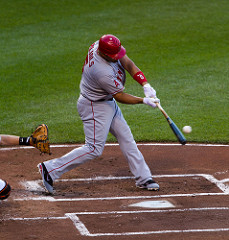
The 27-year-old rookie had already spent part of three seasons (2001-2003) in the majors, but still qualified as a rookie (he had appeared in just 47 MLB games) when he entered the 2004 season. On July 29, Valent was playing left field and batting seventh for the Mets, who would go on to beat the Expos 10-1. Valent went four-for-four, with three runs scored and three RBI (he also drew a walk). The season was the best of Valent’s MLB career (205 games in five seasons) – and the only campaign in which he played in more than 28 MLB games. In 2004, he went .267-13-34 in 130 contests.  His career line was .234-13-37.

Travis Hafner, Indians … August 14, 2003

The 26-year-old Hafner was in his 81st career MLB game (in the DH spot) when he collected his cycle.  He went four-for-five that day, with three runs scored and two RBI. His Indians topped the Twins 8-3. It was his first triple of the season. He ended  2013 at .254-14-40 and hit .273-213-731 over 12 MLB seasons.

Chris Singleton, White Sox … July 6, 1999

Singleton was a 26-year-old rookie when he hit for the cycle – in his 61st MLB game. Playing center field and batting second, Singleton went five-for-six (an extra single thrown in) with three runs scored and four RBI. Chicago still lost to Kansas City 8-7.  Singleton finished the season at .300-17-72 and hit .273-45-276 in six MLB campaigns. His rookie season saw Singleton achieve career highs in hits (149), doubles (31), triples (6), home runs (17), RBI (72) and batting average (.300).

Alex Ochoa … Mets, July 3, 1996

Alex Ochoa was a 24-year-old Mets’ rookie when he hit for the cycle. Ochoa started in right field and went five-for-five (the extra hit was a double) as the Mets beat the Phillies 10-6. Ochoa scored three times and collected three RBI in the game. He finished the 1996 season at .294-4-33 (in 82 games).  Ochoa played in eight MLB campaigns, hitting .279-46-261.

Ray Lankford, Cardinals … September 15, 1991

Lankford, at 24-years-old, hit for the cycle in his 170th career game, as the Cardinals bested the Mets 7-2. Lankford, leading off and playing center field, went four-for-four with four runs scored and one RBI.  Lankford ended 1991 at .251-9-69 – also stealing 44 bases and leading the NL in triples with 15. He had a 14-season MLB career, hitting .272-238-874 and swiping 258 bags. He twiced topped 30 home runs and exceeded 30 steals three times.

Oddibe McDowell, Rangers … July 23, 1985

The 22-year-old McDowell was in his 59th career game when he hit for the cycle – leading off and playing CF as the Ranger topped the Indians 8-4. McDowell went five-for-five that day (an extra single), scoring three times and driving in three. He finished his rookie campaign at .239-18-42 and went .262-74-266 in seven MLB campaigns.

Gary Ward, Twins, September 18, 1980

The 26-year-old Ward achieved the cycle in just his 14th career MLB game.  He went four-for-five, with two runs and two RBI as the Twins lost to the Brewers 9-8. It was Ward’s second double, second triple and first home run of the season and his career. (He was leading off and playing left field.)  Ward finished 1980 at .463-1-10 in 13 games and went on to a 12-season MLB career and a line of .276-130-597.

Dave Kingman, Giants … April 16, 1972

Kingman was 23-years-old and in his 43rd MLB game when he hit for the cycle – scoring three runs and driving in six as his Giants  topped the Astros 10-6. The big guy was at third base for the game, in which he went four-for-five. In what would turn out to be typical Kingman fashion, he hit .225-29-83 for the year (with 140 strikeouts in 135 games). For his 16-season MLB career, Kingman hit .236-442-1,210. He also picked up two home run titles and hit a high of 48 dingers in 1979.

Vic Wertz, Tigers, September 14, 1947

Wertz hit for the cycle in his 88th career game (at age 22) – as his Tigers bested the Senators 16-6  in the first game of a doubleheader.  Wertz went four-for-five, with five runs scored (he also drew a walk) and four RBI. The left fielder finished the season at .288-6-44 and enjoyed a 17-season MLB career (.277-266-1,178), hitting 20 or more home runs in six seasons and topping 100 RBI five times.

Bill Salkeld, Pirates …  August 4, 1945

The 28-year-old rookie was in his 60th MLB game, starting behind the plate for the Pirates, when he completed his cycle.  Salkeld went five-for-five (an extra single), scored once and drove in five.  The RBI are notable, since they were the Pirates entire output in a 6-5 loss to the Cardinals.  He finished the season at .311-15-52 (95 games) and played 356 games over six MLB campaigns (.273-31-132).  Salkeld hit only two triples in his MLB career.
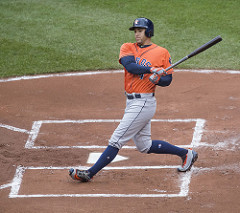
Leon Culberson, Red Sox … July 3, 1943

The 24-year-old Culberson was in just his 31st career game when he hit for the cycle – and did it in natural order with a single in the first inning, a double in the third, a triple in the sixth (the first of his career) and a home run in the eighth (of the inside-the-park variety). Culberson, playing CF and leading off, went four-for-five with three runs scored and two RBI as the Red Sox topped the Indians 12-4. Culberson hit .272-3-34 that season, and .266-14-131 over a six-season MLB career.

Bobby Rosar, Yankees, July 19, 1940

The 26-year-old was in his 72nd career game when he hit for the cycle.  He went four-for-five with four runs scored and four RBI as the Yankees blasted the Indians 15-6. The New York catcher finished the season at .298-4-37 in 73 games. He had a 13-season MLB career and a stat line of .261-18-367. Despite his low batting average, Rosar – a fine defensive catcher – was a five-time All Star and still holds a share of the AL record for consecutive games in a season without an error by a catcher (117).

Moose Solters, Red Sox … August 19, 1934

A 28-year-old rookie, Solters was in his 76th career game when he hit for the cycle as the Red Sox lost to Detsroit 8-6 in the first game of a doubleheader.  The Boston center fielder went four-for-five, with two runs scored and three RBI. (He went zero-for-four in Game Two.) Solters finished the season at .299-7-58 in 101 games.  His line over a nine-season MLB career was .289-83-599.

Roy Carlyle, Red Sox … July 21, 1925

Carlyle was 24-years-old and in his 48th career MLB game when he hit for the cycle in the first game of a doubleheader.  The Boston left fielder went four-for-five  with two runs scored and four RBI as the Red Sox beat the White 6-3. Carlyle finished the season at .325-7-49 in 94 games.  He played only one more MLB campaign (1926) and ended his MLB career at .312-9-76 in 174 games. It was his glove that did him in. Carlyle’s career fielding percentage was just .910.  In 233 career chances in the outfield, he booted nearly one in ten (21 errors).

Pinky Higgins, Athletics … August 6, 1933

The 24-year-old third baseman was in his 115th MLB game when he achieved the rookie cycle.  Higgins went four-for-five in the game, with three runs scored and five RBI as his A’s beat the Senators 12-8. Higgins finished the season at .314-13-99 (34 doubles and 12 triples). In a 14-season MLB career, Higgins hit .292-140-1,075.

Cliff Heathcote, Cardinals … June 13, 1918

The 20-year-old Cardinals’ center fielder hit for the cycle in just his sixth major league game – a feat only slightly diminished by the fact that he had nine at bats in the 19-inning, 8-8 tie with the Phillies. Heathcote went four-for-nine in the game, with two runs scored and three RBI. The extra base hits were the first double, first triple and first home run of his MLB career. Heathcote finished the season at .259-4-32 in 88 games.  In a 15-season MLB career, he hit .275-42-448. Like so many of the rookies on this list, Heathcote was leading off and playing center field.

Bill Collins, Doves (Boston) … October 6, 1910

The 28-year-old rookie outfielder achieved the first natural cycle (single, double, triple and home run in that order) as the Doves (Braves) beat the Phillies 20—7.  I have not tracked the specifics, but I do know it was either the 150th or 151st game of Collins’ MLB career.  That season, Collins finished .241-3-40 in 151 games – and he would play only 77 more MLB games, ending at .224-3-54.  But he will always be the first play to achieve a cycle in natural order.

Pre-1900 things get a bit sketchier (and records less complete), but I have identified three “rookie cyclers” from the era.  Note: I made some subjective judgments (rookie eligibility was not clearly defined back then). Basically, I took  into consideration what is generally considered major league experience.  For example, Fred Carroll hit for the cycle on May 2, 1887 – in his first year with the Pittsburgh Alleghenys of the National League.  While it was his first year with the NL version of the Alleghenys, he had spent the previous two seasons with the American Association (considered a major league) Alleghenys, which joined the National League in 1887.  With that in mind, I did not include his 1887 cycle as a rookie achievement.

Bill Van Dyke, Toledo Maumees (American Association) … July 5, 1890

The 26-year-old outfielder/third baseman finished the season at .257-2-54.  He went on to play one season each for the National League Saint Louis Browns (1892) and Boston Beaneaters (1893). His final major league stats – .253-2-56 in 136 games.  The home run included in his cycle was his first MLB round tripper. Despite Van Dyke’s game, the Maumees lost to the Syracuse Stars 13-12.

James “Chippy” McGarr, Philadelphia Athletics (American Association) – September 23, 1886

Before joining the Athletics in 1886, McGarr had just 19 games and 70 at bats with the Union Association Chicago/Pittburgh team (also known as the Chicago Browns/Pittsburgh Stogies). That stint came in 1884, the only year of the franchise. In 1886, he joined the Athletics and put together a .266-2-31 season (71 games at shortstop). On the day the 23-year-old hit for the cycle, his Athletics topped the St. Louis Cardinals 15-6.   McGarr put up ten major league seasons, with a line of .269-9-388. The home run included in his cycle was his first major league long ball.

 William “Mox” McQuery, Detroit Wolverines (National League) … September 28, 1885

The 24-year-old first baseman was in his second major league season (first in the NL), but had only 132 at bats with the Union Association’s Cincinnati Outlaw Reds the previous year (so still qualified as a rookie under today’s rules). McQuery hit .273-3-30 in 70 games for Detroit in 1995 and .271-13-160 in five major league seasons (Union Association, National League, American Association). The Wolverines topped the Providence Grays 14-2 on McQuery’s big day.

All in A Days (or two days) Work

The Expos’ Tim Foli is the only player to start a cycle one day and complete it the next. On April 21, 1976, Foli collected a single, double and triple in a contest against the Cubbies that was suspended in the top of the seventh due to darkness. When play resumed the following day, Foli added an eighth-inning home run. (The Expos prevailed 12-6.)

Key sources for this post:  Baseball-Reference.com; The Society for American Baseball Research (SABR); Baseball-Almanac.com; The Baseball Encyclopedia.

I tweet baseball @DavidBBRT

Follow/Like Baseball Roundtables Facebook page, here

Member: Society for American Baseball Research (SABR); The Baseball Reliquary; The Negro Leagues Museum; Baseball Bloggers Alliance. 

Youth Baseball – A Championship Sunday

The players gave it their all - and so did the coaches, umpires and fans. (Oh yes, and the concessions crew.)

The players gave it their all – and so did the coaches, umpires and fans. (Oh yes, and the concessions crew.)

Okay, I love writing (made a career of it).  Now that I’m retired, I love writing about baseball.  Even more I love watching baseball – at any level.  So, I took a break from a blog post I’m working on – focused on all the MLB rookies who have hit for the cycle – to take in a game between the Red Sox and Angels.  They were playing for all the marbles – the Roseville (MN) Youth Baseball League Championship in their classification. (I have a nearby neighbor who coaches and whose son plays – and made the league All Star Team.  The AS Game, by the way is next week.)

Let me say, this game was all that the national pastime is about.  Those youngsters were intense and competitive, yet still having fun (and enthusiastically encouraged by their coaches and fans).  Not only that, they were on the field – together – playing and supporting each other as a team; no matter what the skill level.  (And, of course, they were out in the sunshine – not on their computers or smartphones.)

LL scoreboardIt was, as the photo of the scoreboard indicates, a see-saw battle, with plenty of tension to go around.  We saw a couple of nice running catches in the outfield, some well-handled grounders, some very well-hit balls, a few walks and strikeouts and, yes, a few misplays.  We also saw a group of youngsters giving 110 percent all the way – with neither side giving in.  The Red Sox (my neighbor’s team) prevailed 16-12.  And, for those who like to know such things, the game ended on a legitimate triple play!  Top of the last inning, Red Sox up 16-12 and the Angels get the first two players on base (first and second).  The next batter hit a hard – HARD – line drive that everyone (myself included) thought was headed for right-center.  Somehow the pitcher leapt and captured the liner in the webbing of his glove.  The runners were moving and a quick toss to first and relay to second and 1-3-4 (maybe 1-3-6) – Triple Play – Game Over – Championship Secured.  If you want to really see the joy of the game, watch a group of grade school youth baseball players celebrate a champinship clinched with a  triple play.

LLtrophies

Playing for the love of the game – and these, of course.

Oh yes, admission was (of course) free and the concessions (profits supporting youth baseball) were great.  I managed to get by on a hot dog, chips and two Diet Cokes ($5.00 total).  The Shaved Ice – blueberry, lime and cherry – was (from my observation) the crowd favorite.

All I can say is, if you ever get a chance to take in some youth baseball – TAKE IT. It was a wonderful, uplifting way to spend an afternoon.  And, it will make you feel even better about this great game of ours.  I want to thank all the players, coaches, umpires and fans who made BBRT’s summer Sunday a special one.


The fans took their shade where they couldfind it.

The fans took their shade where they could find it.


Coming up: Posts on MLB rookies who hit for the cycle and The Baseball Reliquary’s Shrine of the Eternals induction ceremonies (which took place today).

I tweet baseball @DavidBBRT


Follow/Like Baseball Roundtable’s Facebook page, here.


Member: Society for American Baseball Research (SABR); The Baseball Reliquary; The Negro Leagues Baseball Museum; and Baseball Bloggers Alliance. 

Julio Franco – The Definition of “Oldest To …”

SPOILER ALERT – A HINT AS TO WHAT THIS BLOG POST is ALL ABOUT

On July 29, 2006, the Mets’ Julio Franco became the oldest player ever put into an MLB game as a pinch runner (47 years, 340 days).   In that contest, the Mets’ first baseman and cleanup hitter Carlos Delgado was hit by a pitch in the top of the third inning in the New Yorkers’ 11-3 win at Atlanta.  Franco came in as a pinch runner (stayed in at first base, going two-for-three) and promptly stole second base, going to third on an errant throw. 

Four days ago (July 7), my home town Minnesota Twins signed 44-year-old RHP Bartolo Colon to a minor league contract with hopes that he could work his way into the Minnesota rotation.  That is not as “long” a shot as one might think. While Colon was just 2-8 (8.14 ERA) with the Braves this season, from 2013 (his age-40 season) to 2016, the big right-hander was 62-40, 3.59 and twice an All Star (2013 and 2016).

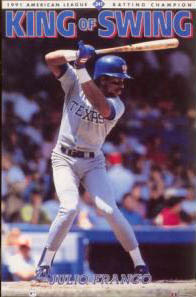
Julio Franco - Old Guys rule and he is their king!

Julio Franco – Old Guys rule and he is their king!

As happens so often (even more now that I am approaching another “landmark” birthday), this piece of current baseball news led me to reflect on a past baseball occurrence.  In this case, it was balloting for the 2013 Baseball Hall of Fame class – in which no players were elected – and, in which, Julio Franco (a 23-season major leaguer, with 2,586 hits and a .298 career average) got only six (1.1 percent) votes.  That made Franco a “one-and-done” HOF candidate (at least until his name comes up for Era Committee consideration).

In the meantime, BBRT would like to make a blatant pitch – Julio Franco for the Baseball Reliquary Shrine of the Eternals.  For those of you not familiar with The Baseball Reliquary – a unique, fan-focused, baseball organization – click here for information on the Reliquary, its Shrine of the Eternals and the upcoming 2017 “enshrinement” ceremonies (2:00 p.m., July 17 at the Pasadena (CA) Central Library).  Note: If you are a baseball fan and not a Baseball Reliquary member, I highly recommend joining.

Now, for that blatant pitch.  Just what is it that makes Julio Franco so special?  For one thing, when he was Bartolo Colon’s age (44), Franco still had five major league seasons left in his bat and glove.  By virtue of that longevity – and his status as a truly professional hitter – Franco holds a host of MLB “oldest to” offensive marks.  For another, Franco’s professional (not just major league) playing career stretches from his teens into his mid-50s. Finally, he took his steady bat around the world – playing in the U.S., Japan, Mexico, Venezuela, the Dominican Republic and Korea.  Side thought: If you were an MLB general manager and someone brought you a player guaranteed to deliver a .298 average over 23-seasons, how quickly would you sign him?

TWENTY FOR TWENTY-FIVE … NOT TOO BAD

Only 25 Major League home runs have been hit by players who have passed their 45th birthday – and Julio Franco hit 20 of them. Cap Anson had three (all in 1897 – the year of his 45th birthday); Jack Quinn had one (in 1930, just shy of his 47th birthday); and Carlton Fisk had one (in 1993 at 45-years, 102-days old).

Consider the long -ball records held by the ageless Franco:

  • The oldest player to homer in a MLB game. Franco went deep at age 48 years, 254 days, hitting a two-run shot off Arizona’s Randy Johnson as Franco’s Mets topped the Diamondbacks 5-3 on April 26, 2006).  In that same game Franco also became the second-oldest MLB player to steal base – and, thus, the oldest player to homer and steal a base in the same game.
  • The oldest player to hit a grand slam (46 years, 308 days) – connecting as a pinch hitter for the Atlanta Braves in a 7-2 win over the Marlins on June 27, 2005.
  • The oldest player to record a multi-homer game, belting a pair of homers on June 18, 2005 (age 46 years, 299 days), as his Atlanta Braves topped the Reds at Great American Ball Park. Franco started at first base and went two-for-four with two homers and three RBI.
  • The oldest player to hit a pinch-hit home run, in the eighth inning of a Mets’ 7-2 win over the Padres at San Diego (April 20, 2006 – 47 years, 240 days).

A NOD TO TODAY’S 2017 ALL STAR GAME

Cal Ripken Jr. holds one of the “oldest to” records to elude Julio Franco. Ripken is the oldest player to homer in an All Star Game. It came in 2001, -hen Ripken – at 400 years, 320-days of age – not only homered, but also took home the game’s MVP Award. Ripken’s blast came leading off the bottom of the third against the Dodgers’ Chan Ho Park.  It was Ripken’s 19th All Star Game and the Iron Man’s final MLB season. 

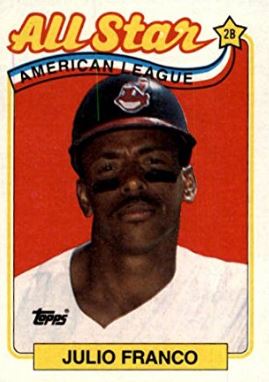
fRANCO aLL sTARJulio Franco not only holds a host of “oldest” marks for power, he also proved that you can run right past age 40.  On June 16, 2005 – at age 46 years, 297 days – Franco became the oldest player to have a multi-stolen base (2) game, as his Braves topped the Reds 5-2; as well as the oldest player to steal two bases in an inning.  Franco singled to lead off the seventh inning, and stole second and third (around an Andruw Jones groundout) before scoring on a Johnny Estrada double.

A COUPLE OF OTHER OLDIES, BUT GOODIES

Charlie O’Leary of the St. Louis Browns – on September 30, 1934 … at 58-years, 350-days of age – rapped a pinch-hit single and scored a run, as the St. Louis Browns lost to the Detroit Tigers 6-2 in the last game of the regular season. The feat made O’Leary the oldest MLB player to record a hit and the oldest to score a run.  Side note: O’Leary’s last at bat (and last MLB hit) before that day came on October 5, 1913 – a 21-season gap.

In a bit of irony, the oldest major leaguer to record an RBI was a pitcher – the Rockies’ Jamie Moyer, who, on May 16, 2012 – at the age of 49 years, 180 days – drove in two runs in a 6-1 Rockies’ win over the Diamondbacks.  Moyer also went 6 1/3 innings in picking up his second win of the 2012 season.  Moyer is also the oldest pitcher to notch a major league victory – at 49-years, 150-days old). 

Need more convincing as to Franco’s “Shrine-worthiness?”  Let’s look at his career in a bit more depth. Franco (full name Julio Cesar Franco Robles) started his professional career in 1978 at the age of 19 – hitting .305 with the Butte Copper Kings of the Pioneer League (Rookie level).  A Phillies’ farm hand, the young Dominican infielder hit .300 or better each minor league season (A, AA. AAA) until making his major league debut in 1982.

JULIO FRANCO – FOR BASEBALL RELIQUARY SHRINE OF THE ETERNALS

If  you believe “Old Guys Rule” – Julio Franco should be your king. 

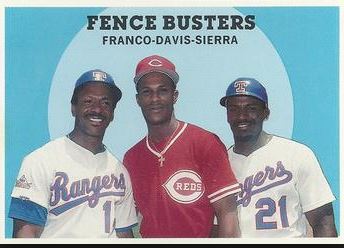
fRANCOfBFrom 1982 to 1994, Franco played primarily as a middle infielder and DH for the Phillies, Indians, Rangers and White Sox – making three All Star teams (MVP of the 1990 All Star Game), earning five Silver Slugger Awards and leading the American League in hitting at .341 for the Rangers in 1991. In that 1991 campaign, Franco collected 201 hits, 15 homers, 78 RBI, 108 runs scored and 36 steals in 45 attempts. At season’s end, he had hit .300+ in five of the past six seasons – the lone exception being .296 in 1990.  In that six-year span, Franco hit .313, with 67 home runs and 155 stolen bases.

In 1994, when the remainder of the MLB season was lost to a strike, Franco was in the midst of possibly his best campaign.  After 112 games, he was hitting .319, with 138 hits, 20 home runs, 98 RBI, 72 runs scored, and eight steals.

JULIO FRANCO MISSED THIS ONE

Jason Giambi is the oldest player to hit a walk-off, game-winning home run (42 years, 202 days), as his Indians topped the White Sox 3-2 on July 29, 2013.

Franco was determined to keep swinging the bat and signed to play in Japan with the Pacific League Chiba Lotte Marines.  In the 1995 Japanese season, Franco hit .306 and won the league’s equivalent of the Gold Glove at first base. Franco returned to MLB in 1996, joining the Cleveland Indians, hitting .322-14-76 in 112 games. In August of the following season, the Indians released Franco – who was hitting .284-3-25 at the time. He finished the 1997 campaign with the Brewers, hitting .241 in 14 games with Milwaukee.

In 1998, at age 39, Franco was back in Japan playing for Chiba Lotte; where he hit .290, with 18 home runs and 77 RBI in 131 games. Then in 1999, he celebrated turning 40 (when most ballplayers are retired or coaching) by hitting for a .423 average in the Mexican League and getting one late season MLB at bat with Tampa Bay.

As he moved into his forties, Franco was far from finished as a player. He played in South Korea in 2000 (age 41), hitting .327-22-110.  In 2001, the well-traveled batsman was back in the Mexican League (Mexico City Tigers), where stellar play (a .437 average in 110 games) earned him a spot on the Atlanta Braves’ roster in September. Franco hit .300, with three home runs and 11 RBI over the final 5 ½ weeks of the MLB season.

From 2001 to 2007, the ageless wonder – professional hitter and pretty darn good first sacker – played for the Braves and Mets.  From 2001 through 2006 – ages 42 to 47 – Franco averaged .290 over 581 games.  He hit .222 in 55 games in his final MLB season – 2007 with the Mets and Braves.

Even at 49, Franco was not done battering baseballs. In 2008, he could be found at first base with the Tigres de Quintana Roo of the Mexican League (where he hit .250 in 36 games). That season, Franco – after 23 Major League seasons and 30 years after his first professional baseball game –  announced his retirement as a player.

Oops? Not so fast. In 2014, at the age of 55, he appeared in seven games for the Fort Worth Cats of the independent United League – going six for 27.   Then in 2015, Franco was signed as player-manager of the Ishikawa Million Stars of the Japanese independent Baseball Challenge League (identified as a semi-pro league); and he is currently listed as a hitting coach with the KBO (Korea) League Lotte Giants organization.  Note: Franco has also managed in the Gulf Coast League (Rookie level), Venezuelan Winter League and Mexican League.

Need more evidence to support Franco’s candidacy for the Shrine of the Eternals?   In 23 MLB seasons, Franco hit .298, with 2,586 hits, a .298 average, 173 homers, 1,285 runs, 1,194 RBI and 281 stolen bases. He also collected 618 minor league (U.S) hits, 316 in the Mexican League, 286 in Japan, 267 in the Dominican Winter League and 156 in South Korea and six in independent ball (U.S.).

Clearly, Julio Franco is a player whose skills were evident across time and geography and whose contributions and character deserve Baseball Reliquary consideration.


I tweet baseball @DavidBBRT


Follow/Like Baseball Roundtable’s Facebook page, click here.  Baseball commentary, blog post notifications and PRIZES. 


Member: Society for American Baseball Research (SABR); The Baseball Reliquary; The Negro Leagues Baseball Museum; Baseball Bloggers Alliance. 

2017 Home Run Derby Brings out the “BIG” Guns

Giancarlo Stanton defends his 2016 Home Run Derby Crown - and has home field advantage. Photo by Corn Farmer

Giancarlo Stanton defends his 2016 Home Run Derby Crown – and has home field advantage. Photo by Corn Farmer

The 2017 Home Run Derby participants have been announced, and it’s clearly a  “big boys” contest.

The average size of 2017’s All Star Home Run Derby contestants: Just over 6’ 3 ½” tall; and slightly more than 239 pounds.

As we look at this year’s lineup of HR Derby bashers, the Royals’ Mike Moustakas is the “little guy” at a mere 6’, 215 pounds.  At the other end of the spectrum is the Yankees’ Aaron Judge at 6’7”, 282-pounds.

Before we look at each contestant separately, here are a few factoids about the field.  ALL STATS AS OF JULY 3.

  • The average age is 26 years (and one month), with the Rockies’ Charlie Blackmon the oldest contestant at 31, the Dodgers’ Cody Bellinger the youngest at 21.
  • The field averages just over four MLB seasons each, with the Marlins’ Giancarlo Stanton leading the way (in his eighth MLB season at age 27) and Cody Bellinger in just his first MLB season. (Note: The Yankees’ Aaron Judge also qualifies as a rookie, but he did see some MLB time in 2016.)
  • The eight contestants have 164 home runs this season (as of July 30) – an average of 20.5 each.
  • Aaron Judge leads the field with 27 home runs as of July 3; his Yankee teammate Gary Sanchez has the fewest at 13.
  • The eight players have 633 total career home runs (79.1 average), with Giancarlo Stanton leading the way at 229 and Cody Bellinger with the fewest at 24.
  • The two rookies in the field are also the two MLB league home run leaders – Aaron Judge leading the AL with 27 and Cody Bellinger tied for the NL lead with 24.
  • Perhaps, surprisingly, the participants include the MLB’s 2017 triples leader – the Rockies’ Charlie Blackmon with ten (no other MLBer has more than five).
  • Three of the contestants have at least five stolen bases this season – Charlie Blackmon and Aaron Judge with six, Cody Bellinger with five.
  • The field includes the defending HR Derby Champion – Giancarlo Stanton won in 2016.
  • Giancarlo Stanton leads the field with two previous HR Derby appearances – it is the first appearance for all of the other seven contestants.
  • Giancarlo Stanton is the only contestant with a 30-home run season and/or a league HR title on his resume (.289-37-105, capturing the 2015 NL HR crown). He also topped thirty in 2011 and 2012.
  • Charlie Blackmon has more career stolen bases (107) than home runs (92).
  • All eight participants have played with only one MLB team in their careers.
  • All the outfield seats should offer fly ball opportunities – four of the hitters swing from the left side, four from the right.

Now, let take a look at each participants (alphabetical order) – all statistics as of July 3.

If BBRT had to pick the top three finishers, I’d go with: 1) Giancarlo Stanton; 2)Miguel Sano; 3) Aaron Judge.

Cody Bellinger, LH, OF/1B, Dodgers – 2017 stats: .260-24-56

The 6’4”, 210-pound Dodgers’ rookie is tied for the NL lead in home runs (24) at just 21-years-old. He also had five homers in 18 Triple A games before being called up.  The 2017 HR Derby’s youngest participant, Bellinger already has six multi-homer games under his best, as well as a streak of ten home runs in ten games. Showed his power potential in the minors, with 56 home runs in the 2015-16 seasons.

Charlie Blackmon, LH, OF, Rockies – 2017 stats: .313-18-59

The 6’3”, 210-pound Blackmon – in his seventh MLB season – is the oldest competitor in this year’s HR Derby at 31. Blackmon, who has a total of 92 career home runs, seems to be maturing into his power. His best season was 2016, when he hit .324-29-82, his only season with at least 20 round trippers. Blackmon has 107 career stolen bases – with a high of 43 in 2015. The remaining seven Derby competitors have a total of 63 career steals – and 35 of those belong to Giancarlo Stanton.

Justin Bour, LH, OF, Marlins – 2017 stats:  .289-18-54

The 6’3”, 265-pound Bour is in his fourth MLB season. The 29-year-old has 57 career round trippers (329 games) and hit a career-high 23 (.262-23-73) in 2015.  Bour is one of five National League Final Vote candidates for an All Star roster spot. Perhaps the home field advantage will work for him in the voting and the HR Derby,

Aaron Judge, RH, OF, Yankees – 2017 stats: .330-27-62

At 6’7”, 282-pounds, the 25-year-old Judge is the “big” gun of this competition.  He’s still a rookie, despite playing 27 games for the Yankees (four home runs) in 2016. His 27 homers lead the AL – and he launched the longest Statcast™-measured home run of 2017 – 495-feet on June 12.  Judge hit 60 home runs in 372 minor league games.  Playing in New York probably prepares you for the pressure of the Derby. Judge has 31 career MLB home runs.

Mike Moustakas, LH, 3B,  Royals – 2017 stats: .270-23-56

The 6’, 200-pound Moustakas is in his seventh MLB season – and I’m not sure anyone saw those 23 home runs (by July 3) coming. The 28-year-old has 104 career home runs and this is only the third time he has reached 20 in a season.  Only Moustakas and Giancarlo Stanton – among the eight competitors – has at least 100 MLB round trippers.  Moustakas’ previous high was 22 (.284-22-82) in 2015.  He is showing real “pull” power this season, ripping 21 of his 23 homers to right.  (And, there is no shift in the HR Derby.)

Gary Sanchez, RH, C,  Yankees – 2017 stats: .294-13-40

A 6’2”, 240-pounds, Sanchez is in the middle of the Derby field when it comes to size. The 24-year-old only has 13 home runs on the season, but don’t let that number fool you. The Yankee backstop has missed 21 games due to injury. In just 107 MLB games over two seasons, Sanchez has 33 career home runs.  He can go deep.

Miguel Sano, RH, 3B, Twins – 2017 stats: .278-20-60

The 6’4”, 260-pound Sano – at 24-years-old – continues to mature as a hitter. In his third MLB season, Sano has 63 MLB home runs in 272 games.  Last season, he hit .236-25-66 in 116 games and he is sure to pass all those marks this year. Hits them long, high and hard.  In 2012-13, he hit 67 home runs and drove in 217 in 274 minor league games.

Giancarlo Stanton, RH, OF, Marlins – 2017 stats: .262-21-50

The 6’6”, 245-pound Stanton –  at 27-years-old – is already in his eighth MLB season. He has 229 career round trippers and has topped 20 long balls in each of his MLB campaigns. His best season was 2014, when he hit .288-37-105.  He is the defending HR Derby Champion – and also competed in the 2014 HR Derby. He holds the record for the longest home run in the Statcast™  era at 504-feet (August 16, 2016). He also holds the record for home runs in a single Home Run Derby (61 in 2016).  Hitting in his home park, Stanton looks like the favorite to me.

I tweet baseball @DavidBBRT

Follow/Like the Baseball Roundtable Facebook Page, click here.  Yes, there are prizes – as well as baseball commentary and notifications of new blog posts. 

Member:  Society for American Baseball Research (SABR); The Baseball Reliquary; The Negro Leagues Baseball Museum; Baseball Bloggers Alliance. 

BBRT June Wrap Up – It’s Raining Dingers

It’s July 1, and that means it’s time for Baseball Roundtable’s June Wrap Up – all you wanted to know about the month of June in MLB (and probalby more.)  As usual, the monthly wrap will take a look at the stats and stories that captured BBRT’s attention over the previous month – as well as the standings and batting and pitching leader boards.  Full standing at the FAR, FAR end of this post.

On thing for sure about June, it was raining long balls all month. Major League Baseball set a new recrod for home runs in a month, with 1,101 June round trippers.  Just a few highlights:

  • Seven players hit 10 or more home runs in June, led by Dodgers’ rookie Cody Bellinger’s 13 long balls – including four multi-homer games and one streak of ten home runs in ten games;
  • The Reds’ Scooter Gennett may have hit “only” nine long balls in June, but four of them came on June 6 – making him just the 17th player in MLB history with a four-homer game.
  • June ended with eleven players already having at least 20 homers on the season – and rookies leading both leagues in long balls (Yankees’ Aaron Judge at 27; Dodgers’ Cody Bellinger at 24).
  • Albert Pujols hit hjis 600th home run; Adrian Beltre his 450th.
  • Nolan Arenado topped off a cycle with a walk-off home run.
  • On June 3, a single-day record seven MLB Grand Slams left the park(s).

Not all the highlights, however, ended up on the other side of the fence.

  • Royals’ southpaw Jason Vargas started six games – and won them all – giving up just three roundt trippers (1.98 ERA for the month).
  • The Nationals’ Max Scherzer put up a sparkling 0.99 ERA for the month (in five starts) – yet managed to grab just three wins (versus two losses).
  • In contrast to Max Scherzer (see above bullet), Gerrit Cole went 4-2 on the month – despite a 6.17 ERA.
  • Mariners’ catcher Mike Zunino – who came into the month with 139 RBI in 383 MLB games – drove in a MLB June-high 31 runs in 23 games.

THE NOT SO TERRIBLE TWOS

The Royals’ Jason Vargas is leading the AL in wins at 12 and Earned Run Average at 2.22.He was also born on 2-2-1983.  

More abut these (and other) stories later – but first the standings and the BBRT Players and Pitchers of the Month.

First, no team was hotter in June than the Dodgers – the only team with 20 or  more wins (21-7, a .750 percentage). Other teams to win more than 15 games during the month were the Diamondback (17-9) and the Astros (16-11).   The Dodgers did a lot of things right in June. Their batters led all of MLB in June home runs and the pitching staff led the NL in strikeouts. Overall, the Dodgers allowed the fewest runs (96, the only MLB team under 100 for the month) and scored the NL’s second-most (157).  They also finished in the NL’s top three for the month  in stloen bases, earned run average and saves.  In the AL, the Astros hit an MLB-high .294 for the month and, offensively, finished in the top three in runs scored and home runs.

At the other end of the spectrum, the Giants continued to fade – and were the only squad not to reach at least ten wins (9-18).  The team had the NL’s highest June batting average (.281) and fourth-most June runes scored, but the second-worst June ERA in the league at 5.71. Over in the AL, the Tigers had the worst June record at 10-15. Like the Giants, the Bengals posted an ERA over five (5.12), but they also suffered on offense (tenth-most runs). A telling stat:  The Tigers blew five of seven save opportunities.

If the season ended on June 30, the playoff teams would be:

AL:  Astros, Red Sox and Indians; Wild Cards: Yankees; Twins or Rays..  Note: In the AL, the Angels, Royals, Mariners and Orioles are all within 1 1/2 games of a Wild Card spot.

NL: Nationals, Brewers, Dodgers; Wild Card: Diamondbacks and Rockies.  No other teams are closer than seven games to a Wild Card spot. 

_____________________________________________________________

BASEBALL ROUNDTABLE JUNE 2017 PLAYERS AND PITCHES OF THE MONTH

AL Player of the Month – Mike Zunino, Catcher, Mariners 

Mike Zunino photo

Photo by Keith Allison

Yankees’ rookie phenom Aaron Judge may have gotten a lot of (well-deserved) publicity as he continued bashing baseball into the stratosphere in June, but the Mariners’ 26-year-old catcher Mike Zunino (somewhat quietly) put up fantastic June numbers. In just 79 at bats, Zunino rapped ten home runs and drove in an MLB June-best 31, while  hitting at a .304 clip and scoring 14 times.  (His 32 strikeouts are of some concern, but it’s hard to ignore 31 RBI in a month.) How surprising is Zunino’s June outburst?   Now in his fifth MLB season, the 2012 first-round draft pick (third overall) has a .201 average and just 61 home runs in 406 MLB games. Still, when playing for the University of Florida, Zunino was the 2011 Southeastersn Conference Player of the Year and, in 2012, won the Golden Spikes Award, Dick Howser Trophy and Johnny Bench Award. He also put up a .288 average over five minor league seasons. That potential earned Zunino a $4 million signing bonus.  Could he be hitting his stride?

BBRT also gave strong consideration to the Yankees’ Aaron Judge (.324-10-25 in June) and the Astros’ George Springer (.337-11-21).

______________________________________________________________

NL Player of the Month – Cody Bellinger, Outfield/First base, Dodgers

21-year-old Cody Bellinger led MLB with 13 June home runs and tied for the NL RBI lead at 27 – while hitting .288 for the month. Not bad for a rookie.  Bellinger had four multi-homer games in June (and has six multi-home games on the year) – and also became the first rookie to hit ten home runs in a ten-game span.  Drafted right out of high school, Bellinger is already in his fifth professional season.  When called up to the Dodgers in late April, he was hitting .343, with five home runs and 15 RBI, in 18 games at Triple A Oklahoma City.    Bellinger, by the way, was drafted by the Dodgers in the fourth round of the 2013 MLB Draft and signed for $700,000 – which is looking like quite a bargain. Just think, ten years ago, Bellinger was playing in the Little League World Series. 

Also high on BBRT’s list were: the D-backs Paul Goldschmidt (.347-7-27 for the month); the Braves’ Matt Adams (.314-10-25), who plugged the hole left when Freddie Freeman went down; and the Cubs’ Anthony  Rizzo (.320-6-20), who made a powerful statement when moved into the leadoff spot.

_______________________________________________________________

AL Pitcher of the Month – Jason Vargas, Royal

Royals’ southpaw Jason Vargas started six games in June – and won them all.  He was MLB’s only six-game winner in the month.  He also pitched to a nifty 1.98 earned run average.  He started the month (June 2) with a seven-hit, compelte game shutout of division rival Cleveland and ended it (June 30) with a two-hit, one-run victory over another Central rival (the Twins). Vargas now stands at 12-3, 2.22 on the year. His sterling performance in June helped put the Royals back in the Central Division race – and earned Vargas BBRT Pitcher of the month.  Vargas was a second-round pick (our of Long Beach State) of the Marlins in the 2004 MLB Draft and made his MLB debt with Florida in 2005. His career MLB record (12 seasons) is 79-73, 4.03. His best year – until 2017, of course – was 2012 (14-11, 3.85 for Seattle). 

BBRT also took a long hard look at Indians’ power right-hander Corey Kluber, who started six games in June and picked up four wins (no losses), fanned an MLB-high 64 batters and had a June ERA of 1.26. In addition, BBRT considered 22-year-old Blue Jays’ closer Roberto Osuna – who notched eight saves in eight opportunities – with 19 strikeouts in 11 1/3 innings and a 0.79 ERA for the month.  But Vargas’ six-pack of wins was just too much to pass on. 

_____________________________________________________________

NL Pitcher of the Month – Tie … Max Scherzer & Clayton Kershaw

Clayton Kershaw photo

Photo by SD Dirk

Wow, two hurlers with five Cy Young Awards between them.  No surprise , the Dodgers’ Clayton Kersahw and Nationals’ Max Scherzer are BBRT NL Pitcher(s) of the Month.

Kershaw started six games in June and earned an NL-best five wins.  In the process, he fanned 57 batters (another NL-best for the month) in 40 1/3 innings and posted a 2.23 ERA.  Kershaw, by the way, was the seventh overall selection in the 2006 MLB Draft (right out of high school) – signing for an estimated $2.3 million.  He was starting for the Dodgers by age 20 (2008) and a Cy Young Award winner by 2011. 

Photo by Keith Allison

Photo by Keith Allison

The June BBRT “Co-NL Pitcher of the Month” only went 3-2 over June’s 30 days. The Nationals’ Scherzer, however, got a total of two runs from his teammates in his two losses.  In his five June starts, Scherzer pitched 36 1/3 innings, giving up just four earned runs – for an MLB-best 0.99 June ERA.  He also gave up just 14 hits and six walks over the course of June – fanning 51 batters.  He deserved better than 3-2.

 Scherzer, a two-time Cy Young Award winner, was drafted in the first round of the 2006 MLB Draft by the Diamondbacks.  He could not reach agreement with the club and signed instead with the Fort Worth Cats of the American Association (independent league).  After three games with Fort Worth, he signed with the D-backs for $4.3 million. 

BBRT also considered Dodgers’ closer Kenley Jansen (a league-topping ten saves in ten opportunities, with a 0.00 ERA in 14 innings pitched).

______________________________________________________________

BEFORE WE GET INTO THE STATS, LET’S LOOK AT SOME JUNE HIGHLIGHTS

More #WhyIHateTheDH

The month of June started out with another case against the DH. With the Dodgers facing the Cardinals (in St. Louis) on June 1, Adam Wainwright gained his sixth win of the season – shutting out LA over six innings of work (four hits, two walks, six strikeouts).  In addition, Wainwright drove in all the runs in the contest, with a two-run home run in the second inning. It was Wainwright’s second home run of the season – and 10th of his 12-season MLB career. (Oh yes, it was also his sixth win.) Wainwright has a .200 career average and, in 2007, hit .290, with one home run and six RBI in 62 at bats.

Get A Whiff of This

On June 2, the Dodgers took on the Brewers at Miller Park, with Clayton Kershaw starting against Jimmy Nelson. It proved a true pitchers’ duel – a 2-1, 12-inning Dodgers’ win in which 58 percent of all the outs were recorded via the strikeout. Kershaw and Nelson set the tone, with Nelson fanning two in the top of the first and 11 in eight innings of work. Kershaw also recorded two strikeouts in the first and 14 in seven innings.   Brewer’s batters tied an MLB record with 26 strikeouts in the contest and the two teams’ combined 42 K’s set an NL single-game record.

Scooter Joins the Likes of the Iron Horse, Rocky and the Hammerin’ Hoosier

On June 6, the Reds’ Scooter Gennett joined the likes of Lou Gehrig, Rocky Colavito and Chuck Klein – as one of just 17 MLB player to crank four home runs in a single game.   Full story here. 

Veteran Savvy

On June 10, 14-year MLB veteran Jose “Joey Bats” Bautista took “taking the extra base” to a new level. With the score Blue Jays 3, Mariners 2, the bases empty and two out, Bautista drew a walk from Mariners’ reliever Tony Zych.  As he trotted to first base, the veteran noticed that Zych wasn’t paying w whole lot of attention and neither the second baseman or shortstop was anywhere near the two bag. So, Bautista slowed briefly as he reached first base – as if to stop – and then dashed (safely) to second bases. Kendrys Morales, the next hitter, grounded out to end the inning – but still it was a very cool veteran move. The Blue Jays, by the way, won 4-2.

The Young and Restless

Aaron Judge, the Yankees’ 25-year-old rookie RF, ended June at .326-27-62 leading the AL home runs and RBI and second in average – a rookie Triple Crown contender. And, on June 12, he smashed what both Statcast TM and the ESPN Home Run Tracker have measured as the longest home run in MLB baseball this season. Statcast computed the shot off the Orioles’ Logan Verrett at 495 feet, ESPN at 496 feet.  For the game, Judge was four-for-four, with two home runs and a double, four runs scored, three RBI and a walk – as the Yankees tiopped Baltimore 14-3.

Cycle on Outta Here

On June 18, Rockies’ 3B Nolan Arenado delivered his first-ever cycle (single, double, triple and home run in a single game) – and did it in walk-off (or cycle-away) fashion. Arenado started with a triple in the bottom of the first. He added a single in the fourth and a double in the sixth and a strikeout in the eighth, before coming up in the bottom of the ninth with two on, one out and his Rockies trailing the Giants 5-4.  His three-run homer completed the cycle and gave Colorado a 7-5 victory.  It was, by the way, Arenado’s 15th home run of the 2017 season.


More From the “Baseball Keeps Track of Everything” File

The Elias Sports Bureau reports that Nolan Arenado’s cycle-completing home run of June 18 was the first walk-off, cycle-completing home run hit with the batter’s team trailing.

There have been four other cycle-completing, walk-off homers – but all game with the games tied: Cardinals’ Ken Boyer (Sept. 14, 1961); Twins’ Cesar Tovar (Sept. 19, 1972); Red Sox Dwight Evans (June 28, 1984); Rockies’ Carlos Gonzalez (July 31, 2010).

Youth Will Be Served

Recently, BBRT unveiled its 2017 Under-25 MLB All Star Lineup – click here for that post.  Now, baseball does track pretty much everything, and on June 20 – as the Dodgers pasted the Mets 12-0 – two youngsters in the lineup combined for four home runs.  Twenty-three-year old SS Corey Seager poled three out of the park, while 21-year-old LF Cody Bellinger added one.  Notably, it was Bellinger’s tenth home over the previous ten games – making him the first MLB rookie (modern era) to hit ten round trippers in a span of ten contests.  It was also his 22nd homer of the year (and career) in just his 52nd career game – giving him the record for the fewest career games to reach the 22-HR mark. Oh yes, the night before, he set the record for the fewest career games to each the 21-HR mark. (As I‘ve said before, in baseball we do track everything.)

One, Two, Three and They Are Out (of the park)

On June 24, The Oakland A’s RF Matt Olson, CF Jaycob Brugman and 2B Franklin Barreto all went deep as Oakland bested the White Sox 10-2.   Now, three home runs by three teammates isn’t all that rare.  However, three home runs in the same game all being the first career round trippers for rookie players on the same squad is.  Olson, Brugman and Barreto are only the second trio of rookies from the same team ever to collect their first MLB home runs in the same game. The only other such group is Duke Kenworth, Art Kruger and John Potts of the Federal League Kansas City Packers back on April 26. 1914.

Rizzo Likes It At The Top

aNTHONY rIZZO photo

Photo by apardavila

Anthony Rizzo (.292-32-109 in 2016) has all the markings of a middle-of-order guy.  However, the Cubs have struggled form the lead-off spot this season – using Kyle Schwarber, Ben Zobrist, Jon Jay, Ian Happ and Javier Baez at the top of the order.

On June 13, Manager Joe Maddon decided to think a bit out of the box, moving 1B Anthony Rizzo from the number-three spot in the order to lead off.  Thirteen proved to be a pretty lucky number. Here’s how Rizzo first seven games as the Cubs’ first hitter of the contest went:


  • June 13 – Home Run
  • June 14 – Home Run
  • June 16 – Walk
  • June 17 – Single
  • June 18 – Double
  • June 19 – Single
  • June 20 – Home Run

Finally, on June 21, in his eighth game as the leadoff hitter, Rizzo started the Cubs’ offense with an out – a fly out to right.  In his first seven games in the number-one slot in the order, Rizzo went 12-for-28 (.429), with two doubles, one triple four home runs, seven runs scored, 10 RBI, four walks and five strikeouts.

Number One for Number One

Let me say, as a Twins’ fan, I was as surprised as everyone when they made high schooler Royce Lewis the number-one overall pick in the recent MLB Draft.  (I expected a less risky college-age pick.) Still, scouts say the 18-year-old is a multi-tool player who has also shown leadership skills.  Well, young Mr. Lewis certainly got off to a good start.  In his first at bat, in the first inning of his first professional game (for the Gulf Coast League Twins), the first overall pick rapped his first professional home run (also, of course, collecting his first professional run scored and RBI.) I expect the Twins’ brass were all smiles after that beginning.

Big Bang Theory – Make ‘Em Count

On June 27, Rangers’s third baseman Adrian Beltre continued his march toward the Hall of Fame by banging out his 450th MLB home run – and he made it count. The blast came in the top of the ninth inning, off Indians’ closer Cody Allen, giving the Rangers a 2-1 victory over the Tribe. It was the third consecutive game Beltre had done deep, giving him five on the season.   Beltre finished June with a .277-5-22 line on the season – and just 30 hits shy of 3,000 for his 20-year MLB career. One of those true leather and lumber guys, Beltre has four Silver Slugger Awards and five Gold Gloves on his resume.

Even More #WhyIHateTheDH

On June 27, Nationals’ ace Max Scherzer picked up his ninth win of the season – as Washington topped the Cubs 2-1 in D.C.   During his six frames, Scherzer gave up two hits and one run – and also collected two hits and one RBI of his own.  (Note: He also fanned six – versus no walks – in his six-inning stint.) Scherzer ended June 9-5, 2.06 on the year.

A Walk Off Strikeout

We’ve all seen or read about walk-off hits, home runs, walks and even balks, but how about a walk-off whiff?  On June 28, the Angels and Dodgers were tied at 2, with the Halos batting in the bottom of the ninth.  Here’s how it went down. Pedro Baez came on in relief for the Dodgers and got Angels’ 2B Danny Espinosa and a grounder to first. LF Ben Revere than reached on an error by LAD SS Chris Taylor – and went to second on a wild pitch to CF Cameron Maybin. Maybin later struck out swinging, but Dodgers’ catcher Yasmani Grandal couldn’t handle the pitch (passed ball) – with Revere bolting for third. Grandal then compounded his mistake by throwing wildly to first to try to get Maybin. In the meantime, Revere had advanced to third and then came in with the winning run on the throwing error. Basically, a walk-off (really run-off) strikeout.

A Grand Way to Celebrate 600 – and Other Join In

albert Pujols photo

Photo by Keith Allison

One June 3, as the Angels topped the Twins 7-2, Albert Pujols ripped his 600th career round tripper – becoming just the ninth player to reach that number.  It was an histsoric feat and Pujols did it in grand style.  The home run was a fouth-inning Grand Slam – making Pujols the first player to hit a Grand Slam for number 600 –  off the Twins’ ace Erwin Santana.  It was also one of seven grand Slams hit that day – a new major-league record for four-run blasts in a single day.


On June 3, a single-day record seven Grand Slams were hit in MLB.  The full list of “Grand Slamers:”

Albert Pujols, Angels

Kyle Schwarber, Cubs

Matt Adams, Braves

Ian Desmond, Rockies

Chris Taylor Dodgers

Travis Shaw, Brewers

Mike Zunino, Mariners

A Little Spring(er) at the Top of the Lineup

George Springer Astros photo

Photo by Keith Allison

On June 29, Astros’ RF and leadoff hitter George Springer led off Houston’s first inning wth a home run to deep right field.  It was his 24th dinger of the season and 11th of June. It also was the ninth time in 2017 he has homered as the first Astro to go to the plate. Springer’s nine leadoff home runs lead the majors and are an Astro’s single-season record. Alfonso Soriano’s 13 leadoff long balls in 2003 are the MLB record and Springer has more than a half season left to top that mark.


SO MUCH FOR THE STORIES. NOW – FOR DIEHARDS –  THE STATS

FIRST FOR THE MONTH OF JUNE

—–TEAM BATTING LEADERS … MONTH OF JUNE—–

Average

NL:  Giants .281; Nationals – .280; Rockies – .276

AL: Astros – .294; Mariners – .288; Tigers – .281

Runs Scored

NL: Nationals – 161; Dodgers – 157; D-backs 152

AL: Yankees – 177; Mariners – 160; Astros – 157

Home Runs

NL: Dodgers – 53; Mets – 50; Brewers – 49

AL:  Yankees – 47; Rangers – 47; Astros – 46

A SWING AND A MISS

The Brewers struck out an MLB-leading 290 times in June – 29.6 percent of their official at bats. The A’s led the AL in whiffs at 285 – also 29.6 percent of their official at bats.

Stolen Bases

NL: Nationals – 32; Brewers – 26; Dodgers & Marlins – 21

AL: Angels- 31; Rangers – 30; Rays – 19

GOTCHA!

The Orioles swiped the fewest bases in all of MLB last month – just four in five tries. The Braves had the fewest steals in the NL – five in nine tries – for an MLB-low 55.5 percent success rate.  The Royals attempted just seven steals – but were successful all seven times.

Walks

NL: Dodgers – 131; Cardinals – 110; Cubs – 100

AL: Yankees – 115; Indians – 102; A’s – 97

CAN’T SEEM TO GET THE DUCKS OFF THE POND

Only two teams scored fewer than 100 runs in June:  The Phillies (94) and the Blue Jays (96); Surprisingly, the Rockies tied the Phillies for the fewest home runs for the month (24), but they did play just nine of 27 games at Coors Field.

—–TEAM PITCHING LEADERS … MONTH OF JUNE—–

Earned Run Average (MLB Average – 4.63)

NL: D-backs – 3.04; Dodgers – 3.29; Cubs 3.98

AL: Indians – 3.71; Yankees – 3.85; Red Sox – 3.91

THAT’ S A LOTTA RUNS

Eight teams had ERA’s over 5.00 for June. Topping the AL – the Orioles at 6.27.  In the NL – the Reds at 5.97.

Fewest Runs Allowed (MLB Average – 134)

NL: Dodgers – 96; D-backs – 101; Cubs – 113

AL: Indians – 109; Royals – 114; Red Sox – 116

Strikeouts (MLB Average – 225)

NL: Dodgers – 280; Nationals – 263; D-backs – 244

AL: Astros – 293; Indians – 267; Yankees – 258

Fewest Walks Allowed (MLB Average – 86)

NL: Padres – 75; Pirates – 68; – Nationals & Dodgers – 79

AL: Royals – 68; Rays – 71; Red Sox – 73

NOTHING LIKE A FREE PASS

The Orioles gave up an MLB-high 117 walks in June.  The Brewers’ staff gave up an NL-highest 102 walks during the month.

Saves (MLB average – 6)

NL: Dodgers – 12; Brewers – 11; Padres & Cubs – 8

AL: Rays – 9; four with eight

BLEW THAT ONE

The Yankees and Marlins each recorded six blown saves in June. However, the worse save percentage went to the Tigers, who had just two saves in seven changes (28.6%).

______________________________________________________________

—–BATTING LEADERS FOR THE MONTH OF JUNE—–

Average (minimum 50 at bats)

NL:  Justin Turner, Dodgers – .415; Andrew McCutcheon, Pirates – .411; Denard Span, Giants – .374

AL: Ben Gamel, Mariners – .393; Josh Reddick, Astros – .389; Lonnie Chisenhall, Indians – .373

Home Runs

NL: Cody Bellinger, Dodgers – 13; Matt Adams, Braves – 10; two with nine

AL: George Springer, Astros – 11; four with ten

LET’S GO FOR THREe

The Rockie’s Nolan Arenado hit an NL-leading four triples in June.

RBI

NL: Cody Bellinger, Dodgers – 27; Paul Goldschmidt, D-backs – 27; Nolan Arenado, Rockies – 27

AL: Mike Zunino, Mariners – 31; Gary Sanchez, Yankees – 27; Justin Upton, Tigers – 27

Runs Scored

NL: Charlie Blackmon, Rockies – 25; three with 23

AL: Aaron Judge, Yankees – 30; Joe Ramirez, Indians – 26; three with 24

Stolen Bases

NL:  Trea Turner, Nationals – 22; Dee Gordon, Marlins – 13; Chris Taylor, Dodgers 9

AL: Cameron Maybin, Angels – 11; Delino DeShields, Rangers – 10; Elvis Andrus, Rangers – 8

Walks

NL:  Matt Carpenter, Cardinals – 22; Anthony Rizzo, Cubs – 19; five with 18

AL: Aaron Judge, Yankees – 30; Shin-Soo Choo, Rangers – 19; Carlos Santana, Indians – 18

BELOW THE M-LINE

The lowest average (minimum 50 June at bats) for the month went to Padres’ outfielder Allen Cordoba at .148 (8-for-54). In the AL, the Rangers’ Joey Gallo was in the basement at .162 (11-for-68).  

Matt Davidson of the White Sox and Khris Davis of the A’s led all of MLB in June strikeouts with 42. Davidson achieved his whiffs in just 88 at bats (a 47.7 percent K rate. Still, he hit .239-7-13. Remarkably, Davis hit  .299 for the month (.299-5-22), despite the 42 strikeouts. Early-season sensation Eric Thames of the Brewers had a rough June – hitting just .163 and leading the NL in strikeouts (39 in 92 at bats.)

—–INDIVIDUAL PITCHING LEADERS … THE MONTH OF JUNE—–

Wins

NL:  Clayton Kershaw, Dodgers – 5-0, 2.23; Josh deGrom, Mets – 4-1, 2.75;  Gerrit Cole, Pirates – 4-2, 6.17

AL:  Jason Vargas, Royals – 6-0, 1.98; Jordan Montgomery, Yankees – 4-0, 2.59; Jose Berrios, Twins – 4-1, 3.21; Chris Sale, Red Sox – 4-1. 2.78

ERA (Minimum 25 June innings)

NL:  Max Scherzer, Nationals – 0.99; Chase Anderson, Brewers 1.56; Alex Wood, Dodgers – 2.10

AL:  Corey Kluber, Indians – 1.26; Jose Quintana, White Sox – 1.78; Jason Vargas, Royals, 1.98

GETTING UP THERE A BIT

The worst ERA among pitchers with at least four starts or 15 innings pitched in June went to the Reds’ Amir Garret, who put up a 12.15 ERA in four June starts (13 1/3 innings).  In the AL. given those parameters, We find th Orioles’ Chris  Tillman at 9.69.  

Strikeouts

NL: Clayton Kershaw, Dodgers – 57 (40 1/3 innings); Max Scherzer – 51 (36 1/3); Jimmy Nelson, Brewers – 50 (40 2/3)

AL: Corey Kluber, Indians – 64 (43 innings); Chris Sale, Red Sox – 45 (35 2/3); Yu Darvish, Rangers – 43 (37 1/3)

I WALK THE LINE

The Marlins’ Edison Volquez gave up the most walks in June (20 in 35 2/3 innings). He also gave up just 20 hits – finishing with a 3-1, 3.28 record for the month.

Saves

NL:  Kenley Jansen, Dodgers – 10; Corey Knebel, Brewers – 10; four with seven

AL: Brandon Kintzer, Twins – 8; Roberto Osuma, Blue Jays – 8; Cragi Kimbrel, Red sox – 8.

_________________________________________________

NOW THE YEAR-TO-DATE STATS (Still with me?)

—–TEAM BATTING … YEAR-TO-DATE LEADERS—–

Average  (MLB Average – .254)

NL:  Nationals – .277; Rockies – .268; Braves & D-backs  – .264

AL: Astros – .283; Yankees – .270; Red Sox & Mariners – .266

Runs Scored (MLB average – 373)

NL: Nationals – 447; Dodgers – 428; D-backs – 422

AL: Astros – 449; Yankees – 445; Mariners – 398

TIME TO POWER UP

Only the Padres (291) and the Phillies (299) have plated fewer than 300 runs through June.  San Diego also has the lowest team batting average at just .227. In the AL, the Royals have put up the fewest tallies at 314, while the Rangers are hitting an AL-low .239.

Home Runs (MLB Average – 101)

NL: Brewers – 123; Nationals – 121; Mets – 118

AL:  Astros – 128; Yankees & Rays  – 123

A SWING AND A MISS

Tampa Bay hitterS have played a lot of air ball this year, as the Rays are the only team to strike out 800 times (802) through June. The Rays are, however, tied for second in home runs at 123.

Stolen Bases (MLB Average – 41)

NL: Brewers – 69; Reds – 68; Nationals – 62

AL: Angels- 74; Rangers – 73; Mariners – 50

NOT SO FAST!

The Orioles hace MLB’s fewest stolen bases through June and are the only team with under 20 steals (just 16 in 21 tries). From a percentage point of view, the Rockies are the least successful thieves (28 steals in 50 attempts – 56 percent). Compare that to the Royals, with 36 steals in 44 tries (82 percent).

—–TEAM PITCHING LEADERS … YEAR-TO-DATE—–

Earned Run Average (MLB average – 4.34)

NL: Dodgers – 3.24; D-backs – 3.41; Cardinals – 4.04

AL: Indians –  3.83; Yankees – 3.83; Red Sox – 3.86

I’D GIVE IT A FIVE

Only two teams have ERA’s over five through June – The Reds at 5.26 and the Orioles at 5.02. NotablY, the Orioles are just one game under .500, while the are 11 games away from break even.

Fewest Runs Allowed (MLB average – 373)

NL: Dodgers – 281; D-backs –  317; Cardinals – 351

AL: Indians – 315; Astros & Yankees – 333

LET’S GET THIS PARTY STARTED

The Dodgers’ rotation has the best starters’ ERA in the NL at 3.40; while the Astros’ starters top the AL at 3.83.  The other end of the spectrum? Reds’ starters at 6.18 and Orioles’ starters at 5.57.

Interested in the end game? The Indians’ pen is best at 2.57, while the Dodgers pen has the NL’s lowest ERA at 2.95.  As far as throwing fuel the fire – The Tigers’ and Nationals’ pens are the only relief staffs with ERAs over five (5.15 and 5.07, respectively).

Strikeouts (MLB average – 657)

NL: Dodgers – 783; D-backs – 750; Nationals – 720

AL: Astros – 830; Indians – 771; Red Sox – 742

Fewest Walks Allowed (MLB average – 261)

NL: Dodgers & Pirates  – 226; Nationals – 238

AL:  Red Sox – 205; Indians – 220; Yankees – 234

Saves (MLB Average – 19)

NL: Rockies – 28; Brewers – 76; Cardinals & Dodgers – 23

AL: Rays – 26; Red Sox – 24; Astros – 23

THE ONES THAT GOT AWAY

The Rangers lead all of MLB in blown saves with 16 – and, in fact, five of the top six teams in blown saves are from the AL. The Nationals lead the NL with 13 miffed save opportunities.  Only the Rangers and Phillies have been successful in fewer than half their save opportunities – Rangers 14-for-29/44.8 percent and Phillies 13-for-24/45.8 percent.

—–INDIVIDUAL BATTING LEADERS YEAR TO DATE—-

Average

NL:  Buster Posey, Giants – .341; Ryan Zimmerman, Nationals – 339; Daniel Murphy, Nationals – .336

AL: Jose Altuve, Astros – .330; Aaron Judge, Yankees – .326; Corey Dickerson, Rays .326

Home Runs

NL: Cody Bellingers, Dodgers – 24; Joey Votto, Reds – 23; Giancarlo Stanton, Marlins – 21

AL: Aaron Judge, Yankees – 27; George Springer, Astros – 24; two with 22

THREE IS NOT A CROWD, BUT IT IS A BUNCH

The Rockies’ Charlie Blackmon has ten triples through June – no other player has more than five.

RBI

NL: Paul Goldschmidt, D-backs – 66; Jake Lamb,D-backs – 65; Ryan Zimmeerman, Nati0nals – 62

AL: Aaron Judge, Yankees – 62; Nelson Cruz, Mariners – 59; Robinson Cano, Mariners – 57

Runs Scored

NL: Paul Goldschmidt, D-backs – 69; Charlie Blackmon, Rockies – 64; Bryce Harper, Nationals – 60

AL: Aaron Judge, Yankees – 70; George Springer, Astros – 63; Corey Dickerson, Rays – 60

Stolen Bases

NL:  Trea Turner, Nationals – 35; Billy Hamilton, Reds – 33; Dee Gordon, Marlins – 29

AL: Cameron Maybin, Angels – 24; Elvis Andrus, Rangers – 20; Jarrod Dyson, Mariners – 19

Walks

NL:  Matt Carpenbter, Cardinals – 56; Joey Votto, Reds – 55; Kris Bryant, Cubs – 53

AL: Aaron Judge, Yankees – 58; Shin-Soo Choo, Rangers 47; Edwin Encarnacion, Indians – 47.

OUCH!

Only four playes have fanned 100+ times through June: Khris Davis, A’s and Joey Gallo, Rangers – 107 each; Miguel Sano, Twins – 106; Keon Broxton, Brewers – 104.

—–PITCHING LEADERS … MONTH OF JUNE—–

Wins

NL:  Clayton Kershaw, Dodgers – 12-2, 2.32; five with nine

AL:  Jason Vargas, Royals – 12-3, 2.22; Chris Sale, Red Sox – 10-3, 2.77; Ervin Santana, Twins – 10-5, 3.09

ERA (Minimum 25 June innings)

NL:  Max Scherzer, Nationals – 2.06; Clayton Kershaw, Dodgers – 2.32; Gio Gonzalez, Natonals – 2.87

AL:  Jason Vargas, Royals – 2.22; Lance McCullers Jr., Astros – 2.69; Chris Sale, Red Sox – 2.77

NOT EXACTLY THE YEAR OF THE PITCHER

In this year of the home run, five pitchers havce already given up 20 or more long balls: John Lackey, Cubs (24); Bronson Arroyo, Reds (23); Ricky Nolasco, Angels (23); Masahiro Tanaka (21)l Jordan Zimmerman , Tigers (20).

Strikeouts

NL: Max Scherzer, Nationals – 151 (113 2/3 innings); Clayton Kershaw, Dodgers – 135 (116 1/3); Robbie Ray, D-backs – 128 (100)

AL; Chris Sale, Red Sox – 155 (113  2/3 innings); Chris Archer, Rays – 131 (110 1/3); Yu Darvish, Rangers – 115 (107)

Saves

NL:  Greg Holland Rockies – 26; Fernando Rodney, D-backs – 20; Kenley Jansen, Dodgers – 18

AL: Craig Kimbrel, Red Sox – 23; Brandon Kintzer, Twins – 23; Alex Colome, Rays 21

RESCUE ME

Three pitches have accumulated six blown saves (the MLB high); The Tigers’ Francisco Rodriguez; Marlins’ David Phelps; and Pirates’ Tony Watson. Their saves totals? Watson ten, Rodriguez six, Phelps zer0.

_______________________________________________________________

FINALLY!!! THE STANDINGS


jUNEsTAND


Main Sources for stats in this post:  ESPN.com; MLB.com; Society for American Baseball Research; Baseball-Reference.com; Baseball-Almanac.com


I tweet baseball @DavidBBRT


Follow/Like the Baseball Roundtable Facebook page, here. 


Member: Society for American Baseball Research (SABR); The Baseball Reliquary; Negro Leagues Baseball Museuml Baseball Bloggers Alliance.