All Star Game …. More Whiffs and Wacks … BBRT “Trot Index” 49.5%

Baseball Roundtable has been providing a monthly “Trot Index” … tallying MLB plate appearances that involve no action on the basepaths or in the field, but rather end in a trot (to first base on a walk, hit by pitch or catcher’s inteference – back to the dugout on a strikeout – around the bases on a home run). Through June, a full 35 percent of all 2018 MLB plate appearances were “trotters.”  The 2018 All Star Game was even more of the same  with 49.5 percent of the 91 plate appearances ending in a trot.  It went like this:

  • Strikeouts – 27.5% of plate appearances
  • Home runs  11.0%
  • Walks – 9.9%
  • Hit by pitch – 1.1%

A few other observations:  In line with the hard-throwing/free-swinging trend in MLC,  All Star Game strikeouts (25) outpaced hits (20) and half of the base hits in the game left the yard.

And now, we will have a short break from baseball, as Chili Pepper and I attend the annual Vintaqe Triumph Register convention/show/competition in LaCrosse, Wisconsin.

THE BRITISH ARE COMING!  THE BRITISH ARE COMING!

TRLogoTR6TR2tr4TR5

Baseball Roundtable Looks at June – Another Month of Whacks and Whiffs

It’s July 1, and – as always – the start of a new month signals Baseball Roundtable’s wrap up of the previous month.  So, here we go with another (perhaps, too) detailed look at the stats and stories that grabbed BBRT’s attention in June, as well as a look at the standings and stars (BBRT’s players/pitchers of the month).  This post does tend to run a bit long, but I’m confident that – along the way – you’ll find a treasure or two that appeals to you.

BBRT TROT INDEX … THROUGH JUNE

Through June 30, 35.0 percent of all MLB 2018 plate appearances had ended in a trot (back to the dugout, around the bases, to first base). We are talking about strikeouts, home runs, walks, hit-by-pitch and catcher’s interference – all outcomes that are, basically, devoid of action on the base paths or in the field (unless of course a hit batsman should charge the mound).  Here’s the breakout:

  • Strikeouts – 22.4% of all plate appearances;
  • Walks – 8.6%;
  • Home Runs – 3.0%;
  • Hit By Pitch – 1.0%;
  • Catcher’s Interference – .0.02%.

_________________________________________________________________

POST-SEASON SQUADS

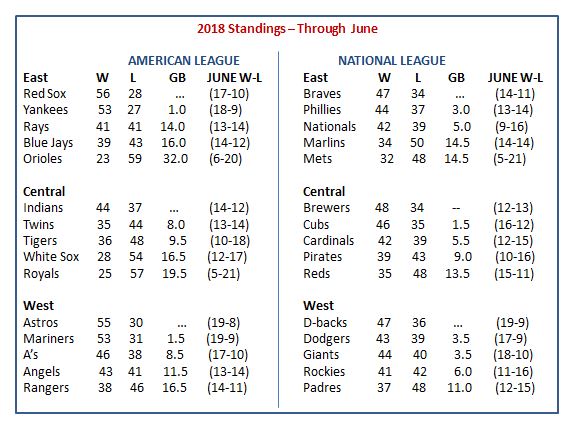
If the season ended as the month of June came to a close, your post-season teams would be …

American League: Red Sox; Astros; Indians.  Wild Cards: Yankees, Mariners.

National League: Brewers; Braves; Diamondbacks. Wild Cards: Cubs, Phillies.

Full standings as of the end of play June 30 – and each team’s record for June can be found in a chart later in this post. 

_______________________________________________________________________

BEFORE WE LOOK AT JUNE PERFORMANCE AND HIGHLIGHTS …

LET’S SEE BBRT’S PLAYERS AND PITCHERS OF THE MONTH

American League

Player of the Month – Alex Bregman, 3B, Astros

Alex Bregman photo

Photo by Keith Allison

The 24-year-old Alex Bregman really upped his game in June.  He came into the month hitting .262, with five home runs, 23 RBI and 28 runs scored in 56 games.  In twenty-five June games, he raised his season average 15 points, tripled his home run total, more than doubled his  RBI total and nearly doubled his runs scored.  For the month, Bregman hit .306, rapped 11 home runs (tied for the most in the AL with the Mariners’ Nelson Cruz), drove in 30 runs (tied for first in the AL with the Astros’ Evan Gattis) and scored 24 (tied for the most in the AL with the Twins’ Eddie Rosario).

Other contenders: Nelson Cruz, DH, Mariners – who powered the Seattle offense with a .326-11-24 June line (and scored 20 runs); Jose Altuve, 2B, Astros – who topped the AL in June average (.354) and base hits (34 – a four-player tie), scored 22 runs, drove in 12, hit three home runs and swiped six bags in seven tries; Mike Trout, CF, Angels – who was second in the AL with a June average of .352 and had an eye-popping .496 on-base percentage for the month. Trout also popped six home runs and drove in 13.

Pitcher of the Month – TIE: Luis Severino, Yankees & Tyler Skaggs, Angels

Yankee righty Luis Severino went 4-1 in five June starts (no AL starter picked up five June wins) and put up the AL’s second-best ERA (among pitchers who tossed at least 25 June innings) at 1.60. Severino also fanned 40 batters in 33 2/3 frames, while walking just five.  Now 12-2, 2.10 on the season, he’s putting himself into Cy Young Award contention.

Angels’ southpaw Tyler Skaggs, went 3-1 in five June starts with an MLB-best 0.84 earned run average.His June performance included 36 strikeouts in 32 innings (versus eight walks and 27 hits). On the season, Skaggs is 6-5, 2.64 in 16 starts.

Other contenders: Indians’ right-hander Trevor Bauer has to be right at the top of this list. In fact, with a little better run support, he could have been BBRT’s pitcher of the month. Bauer went 3-3, 2.18 in six June starts (the Indians got him a total of four runs in his three losses). Bauer also led the AL  with 62 strikeouts in June, with just 11 walks in 41 1/3 innings; Tampa Bay lefty Blake Snell also deserves mention  here, after a 3-1, 1.74 June, during which he also fanned  37 batters in 31 innings.

National League

Player of the Month – Paul Goldschmidt, 1B, Diamondbacks

Paul Goldschmidt led all MLB players (with at least 75 plate appearances in June) with a .364 June average –  tied for tops in the NL with ten home runs in the month (the Brewers’ Jesus Aguilar and Dodgers’ Max Muncy also had ten); led the NL with 25 runs scored; and was second in the league with  25 June RBI.   How badly did Goldschmidt need a big June? He came into the month hitting just .209 (Goldschmidt began the season with a .299 career average over seven MLB campaigns), with just seven home runs and 17 RBI.  Clearly, he’s turned his season around.

Other contenders: There were plenty of solid contenders for this recognition in June. BBRT’s leaders are: Cardinals’ OF Marcell Ozuna, with a .333-7-21 month; Brewers’ 1B Jesus Aguilar at .313-10-24; Dodgers’ 1B Max Muncy at .289-10-16; and Phillies’ 3B Rhys Hoskins, who put up a .312-8-22 month.

Pitcher of the Month – Zach Eflin Phillies

The 24-year-old Phillies’ right-hander tied for the most June wins in MLB at five – going 5-0, with the NL’s third-best earned run average (among pitchers with at least 25 June  innings) at 1.76. He also fanned 28 hitters in 30 2/3 innings, walking just six. On the season, Eflin is 6-2. 3.02.

Other Contenders: Cubs’ southpaw Jon Lester went 5-0, 1.13 in June, giving up just four earned runs in five starts (32 innings) – proving you don’t have to be a power pitcher to succeed (he fanned just 20 hitters in those 32 frames.); If Mets right-hander Jacob deGrom pitched for the other New York squad, he surely would have won more than one game in June – given his 2.36 earned run average and NL-topping 49 June strikeouts (42 innings). However, he went only 1-4 in six starts for the month. In the five starts in which he did no pick up a win, the Met tallied a total of seven runs.

________________________________________________________

JUNE’S TOP TEAMS

American League

The Astros and Mariners had June’s top records in the AL, 19-8 and 19-9, respectively.  The Astros tied for the AL lead in June scoring (144 runs in 27 games); while the Mariners plated the fifth-most runs (126). Both squads also were among the league’s top-five in June home runs. Among the key offensive contributors for Houston were: Jose Altuve, who hit .354 for the month; Evan Gattis, who drove in a league-topping 30 runs, despite a .265 average; and Alex Bregman (BBRT Player of the Month), who put up a .306-11-30 line (which tied him for the most June home runs and RBI.)  Seattle got exceptional offensive performances from Nelson Cruz (.326-11-24 for the month) and Mitch Haniger (.284-6-21). Houston also got solid pitching, with the league’s third-best June earned run average (3.17), while Seattle’s ERA (3.99) was middle of the pack.  Also putting up a solid June record: The Yankees (18-9), behind an MLB-best June team earned run average of 2.62, led by Luis Severino (4-1, 1.60), C.C. Sabathia (3-2, 1.93) and a lights out bullpen.  The A’s and Red Sox each went 17-10.

Only two AL teams failed to win ten games in June: The Royals (5-21) and the Orioles (6-20). Their problems were deep, as they  finished thirteenth and fifteenth in the AL in runs scored and earned run average. 

National League

Three teams acheived at least 17 June wins in the NL and they were all in the NL West: Diamondbacks (19-9); Giants (18-10); and Dodgers (17-9).  No surprise, these three finished 1-2-3 in earned run average for June: Giants (2.70); D-backs (3.48); Dodgers (3.70). In addition, they put up respectable offensive numbers, with the D-backs scoring 152 runs (second in the NL); the Dodgers plating 140 (fourth); and the Giants 118 (seventh).  The Diamondbacks got great June results from a couple of key veterans – Zack Greinke (5-1, 2.97 for the month) on the mound and a resurgent Paul Goldschmidt (.364-10-23) at the plate.  The Dodgers got surprising offense (and double-digit June long balls) out of Joc Pederson (.283-10-14) and Max Muncy (.289-10-16). Overall, LA mashed 55 June roundtrippers, eleven more than the nearest runner-up (Yankees) and 18 more than the second-highest NL total for the month (Cardinals – 37). The Giants put up middle-of-the pack offensive numbers, but found quality on the mound. Starters Madison BumgarnerAndre Suarez  and Derek Holland all put up earned run averages under 3.00.  The Giants also put the bullpen to good use: Tony Watson (a 0.00 ERA in 13 games); Will Smith (0.75 in 12 appearances);  Ty Blach (1.33 in ten games/20 1/3 innings). On offense, Brandon Crawford (.326-4-14) and Andrew McCutchen (.303-6-17) played important roles.

Two teams failed to win ten June contests in the NL and they were both in the NL East:  Mets (5-12); National (9-16). They both finished among the league’s four worst June teams in terms of runs scored and earned run average. 

______________________________________________

 A FEW QUICK OBSERVATIONS BEFORE WE GET INTO DETAIL 

  • Twenty-three players with at least 75 June at bats hit under .200 – and 17 of them were in the American League.
  • Ten pitchers (who threw at least 25 innings) put up earned run averages under 2.00 – led by the Angels’ Tyler Skaggs at 0.84
  • The Reds had two  pitchers hit Grand Slam home runs in June – Anthony DeSclafani and Michael Lorenzen.

You Want a Piece of Me?  The Yes and No of it.

  • YES … The Rays’ C.J. Cron led all of MLB in being hit by a pitch through June with 14 plunkings.
  • NO …  The Angels’ Mike Trout led MLB in intentional walks through June with 11.
  • No one pitched more June innings without giving up a run than Ryne Stanek of the Rays, who appeared in 12 games and tossed 15 2/3 scoreless frames – fanning 19 hitters.
  • Thirty-five pitchers with at least 20 June innings pitched averaged at least one strikeout per inning. The Rockies’ Jon Gray led the NL a 14.33, while Trevor Bauer led the AL at 13.50.
  • Dodgers’ pitcher Ross Stripling fanned 30 batters in 29 June innings – and walked just one; while going 3-1, 2.48.

____________________________________________________________

—TEAM STATISTICS (leaders) FOR THE MONTH OF JUNE—

RUNS SCORED … MLB Team Average – 116

AL: Astros & A’s (144); Red Sox (135)

NL: Rockies (153); D-backs (152); Reds (146)

The Royals scored an MLB-fewest 58 runs (26 games) in June and also hit an MLB-low .193 for the month.

BATTING AVERAGE … MLB Team Average – .244

AL: Astros (.275); Red Sox (.267); Mariners (.265)

NL: Reds (.281); Rockies (.272); Cubs (.268)

HOME RUNS … MLB Team Average – 31

AL: Yankees (44); A’s (43); Astros (41)

NL: Dodgers (55); D-backs & Cardinals (37)

STOLEN BASES … MLB Team Average – 13

AL: Indians (29); Red Sox (25); White Sox (17)

NL: Brewers (23); Nationals (21); Cubs (17)

The Blue Jays and Cardinals stayed on the bag(s) in June – each swiping an MLB-low four bases. 

STRIKEOUTS … MLB Team Average – 226

AL: White Sox (285); Rays (252)’ Tigers (249)

NL: Phillies (254); Cubs (253); Marlins (251)

The Pirates topped the major in pinch hits in June with 13 and their .333 pinch-hitting average (13-for-39) for the month trailed only the A’s at .444 (8-for-18) and Mariners at .400 (two-for-five).

EARNED RUN AVERAGE … MLB Average – 4.04

AL:  Yankees (2.62); Rays (2.92); Astros (3.17)

NL:  Giants (2.70); D-backs  (3.48); Dodgers (3.70)

ERA North of Six

The Rockies put up June’s worst team earned run average at 6.20. Only two other teams even reached 5.00 – Royals (5.11) and Phillies (5.26).

STRIKEOUTS … MLB Average – 276

AL:  Astros (290); Yankees (282); Indians (248)

NL: Phillies (257); Rockies (247); D-backs (238)

The Astros had MLB best strikeouts per nine innings ratio at 10.70 – and nine  of MLB’s 30 teams recorded a strikeout or more per inning for the month.

SAVES … MLB Average – 7

AL: Mariners (13); Yankees & A’s (11); Rangers (10)

NL: Dodgers (10); Reds & Phillies (9)

The Yankees (11 saves), Marlins (8 saves) and Indians (7 saves) were the only teams without a blown save in June.

______________________________________________________________________

Now let’s take a look at some plays and achievements that caught BBRT’s eye.

—–A FEW HIGLIGHTS FROM JUNE—-

Diamondbacks Show June Likely to be a “More of the Same” Month

BBRT has written often about the current era of home runs and strikeouts (hard-throwing/free-swinging baseball).  The Diamondbacks started June with a performance that promised a continuation of that trend. Not only did D-backs’ pitchers fan ten Marlins in a 9-1 win, Diamondbacks’ hitters tied a franchise record with six home runs in the game (Ketel Marte –two and one each for Daniel Descalso, Jake Lamb, David Peralta, John Ryan Murphy).

One Snell of a Start

Blake snell pitcher photo

Photo by petestokke

Another harbinger of more of the same – a season of whacks (home runs) and whiffs (strikeouts) came on June 3. Blake Snell started on the mound for the Rays (at the Mariners). Snell fanned the first seven Mariners he faced, tying the American League record for K’s to open a game. Snell got a no-decision in the contest, won by the Mariners 2-1. The Rays’ starter gave up just two hits (no runs) and fanned twelve in six innings.


More #WhyIHateTheDH

Max Scherzer is arguably the currently the best pitcher in baseball – and, apparently, no slouch with the bat. On June 2, the Nationals were locked in a 13-inning two-two tie with the Braves in Atlanta. In the top of the 14th, with no one on, one out and pitcher Justin Miller due to hit, the Nats went to the bench for a little offense – bringing in Scherzer to pinch hit.  The three-time Cy Young Award winner delivered a pinch-hit single and eventually scored the winning run.

Need more? Read on.

LorensenIn the bottom of the fifth inning of a June 7 contest against the Rockies, the Reds found themselves trailing 3-1. Starting pitcher Tyler Mahle was the slated batter, so the Reds sent up a pinch-hitter – relief pitcher Michael Lorenzen.  Lorenzen laced a single off Tyler Anderson and (even though I’m not a fan of these new statistics) Statcast TM measured the ball’s exit velocity at 116.5 MPH (the highest of any Reds’ batter on the season and the hardest hit by a pitcher in the Statcast era.).

Just seventeen days later (June 24), Lorenzen was called on to pinch hit again – coming up with two outs in the bottom of the fifth and the Reds trailing the Cubs 5-0. This time, he took Cubs’ starter Mike Montgomery deep, punching a solo home run down the left field line for the Reds’ first tally.  (The Reds eventually prevailed by an 8-6 score.)

And Lorenzen wasn’t done yet.  The Reds’ reliever homered again on June 29.

Wait, there’s more.

On June 30, the Reds called on Lorenzen to pinch hit once again.  This time with the bases loaded in the bottom of the seventh of a game in which the Reds led the Brewers 6-3.  Lorenzen delivered a Grand Slam. So, between June 24 and June 30, Lorenzen made four plate appearances and went three-for-three, with three home runs, a walk, three runs scored and six RBI.

Still not convinced?

On June 23, Reds’ starting pitcher Anthony DeSclafani came to the plate with two outs, the bases loaded. Facing Cubs’ reliever Brian Duensing, DeSclafani worked the count to 3-2 and then laced a Grand Slam home run to deep left. Yes, the Reds got Grand Slams from two different pitchers in the same month.

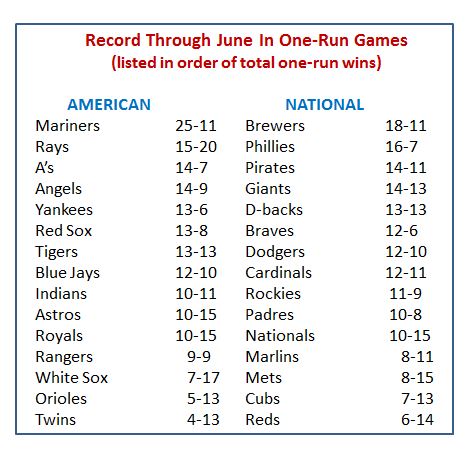
GOTTA WIN THE CLOSE ONES

On June 27-28, the Mariners topped the Orioles 8-7 in eleven innings and 4-2 in ten innings – making them:

  • 3-0 in extra inning contests in June;
  • 8-0 in extra frames on the season;
  • and on a streak of 14 consecutive overtime wins dating back to July 16 of last season. (At the other end of the spectrum, the Angels have the worst 2018 record in extra-inning games – through June – at 1-7.)

The Mariners, who ended June with a 53-31 record, have shown a propensity to win the close ones.  Twenty-five of their 2018 victories have been by a single tally.

Onerun2


Youth Will Be Served – and More of “Yes, we track everything.”

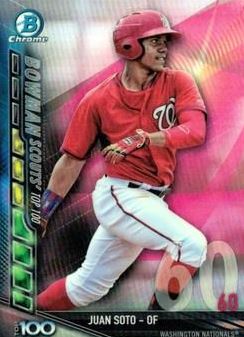
SOTOOn June 13, the Nationals’ rookie sensation – 19-year-old  Juan Soto – bashed a pair of home runs as the Nats prevailed 5-4 over New York at Yankee Stadium.  The two long balls not only led to a Nationals’ victory, but made Soto just the fourth teenager to record a multi-homer game at Yankee Stadium (old or new). The others were the Mariners’ Ken Griffey, Jr. (May 30,. 1989); The Braves’ Andruw Jones (in Game One of the 1996 World Series); and – the most unlikely of the quartet – the White Sox’ Brian McCall (September 30, 1962).  Why was McCall the most unlikely? His MLB career was comprised of only seven games and his two home runs and three RBI in the Yankee Stadium tilt were his career totals in both categories.


Base Hits Not Foreign to Beltre

On  June 13, in the fourth inning of a Rangers 3-2 loss to the Dodgers in LA, Texas’ 3B Adrian Beltre lined a 2-2 pitch to center, for a double off LA’s Kent Maeda.  The hit, coming in Beltre’s 21st MLB season, was his 3,090th – pushing him past Ichiro Suzuki for the most base hits by a foreign-born major leaguer. The 39-year-old Beltre is showing little sign of slowing down.  He ended June hitting .311 on the season – and extended his hit total to 3,107 (21st all-time)

Not Too Handy

On June 18, Giants’ closer Hunter Strickland blew more than his fourth save of the campaign – he also blew six-to-eight weeks of his 2018 season.   That day, Strickland came into a contest against the Marlins with his Giants up 4-2 in the top of the ninth. Seeking his 14th save of 2018, Strickland started by walking Brian Anderson after a tough eight-pitch battle.  J.T. Realmuto then hit a first-pitch double, scoring Anderson – and Strickland’s troubles were just beginning.  He followed with a five-pitch walk to Justin Bour (with Jose Urena coming in to pinch run).  Then Strickland induced a grounder to short out of Cameron Maybin.  The Giants took the force at second, leaving runners on first and third, with one out and San Francisco still up by a run. Line drive singles off Strickland by Lewis Brinson and Miguel Rojas followed – giving the Marlins a 5-4 lead and ending  Strickland’s outing with a blown saves and a loss.

Frustrated, Strickland punched a door after leaving the field, breaking his right index finger.  He went on the Disabled List with 3-3, 2.84 stat line (13 saves).

OUCH!
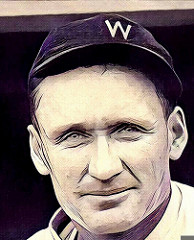
The June 18, punch-out injury to Hunter Strickland (see above) does not rank very high among unusual relief pitcher mishaps. Let’s not forget these classics from the past: the Tigers’ Joel Zumaya, who strained his wrist playing Guitar Hero; the Brewers’ Steve Sparks, who dislocated his shoulder tearing a phone book in half; or the Rangers’ Greg Harris who strained his elbow flicking sunflower seeds.

A Scorecard Nightmare …. or …We Used to Do This In Little League

On June 13, Cubs’ manager Joe Maddon took a page right out of Little League – using four left fielders in one inning.  It happened in the top of the eighth inning of a Brewers’ 1-0 win over the Cubs.  The inning – a nightmare for those keeping scorecards – went like this:

  • Cubs’ Albert Almora, Jr., who had pinch hit for Brewers’ 3B Tommy La Stella in the top of the eighth, stayed in the game in center field.
  • Ian Happ, who had started in center for Chicago, moved to third base.
  • Right-hander Steve Cishek was brought in to pitch, replacing southpaw Justin Wilson.
  • Brewers’ shortstop Orlando Arcia singled off Cishek.
  • Brewers’ Eric Thames was announced as the pinch-hitter for Milwaukee reliever Josh Hader, with Cishek on the mound.
  • Maddon brought in lefty Brian Duensing to face Thames, sending Cishek from the mound to left field and left fielder Kyle Schwarber to the dugout.
  • Duensing did his job, fanning Thames.
  • Next up was left fielder Lorenzo Cain.
  • Maddon brought Cishek back to the mound and sent Duensing to left field.
  • Cishek got Cain on a ground out, second-to-first.
  • Next up was right fielder Christian Yelich.
  • Maddon then brought Duensing back to the mound and brought Willson Contreras (usually a catcher) from the bench to play left field.
  • Yelich flied out to Contreras.

Made for a very messy scorecard.

The Tools of Persistence

On June 17, Cardinals catcher Yadier Molina was behind the plate for the Cardinals 5-0 victory over the Cubs in Saint Louis. Molina not only caught/called a scoreless game, he collected a double, RBI and run scored in four trips to the plate. It was his 1,756 game at backstop for the Cardinals – tying him with the Cubs’ Gabby Hartnett for the most games caught for one team in MLB history. On June 18, he was even better – breaking the tie with Hartnett – and going three-for-four with a double, home run, RBI and two runs scored.  Now every time he puts on the “tools of persistence,” he sets a new record.

Back to the Future

On June 18, Washington Nationals’ rookie outfielder Juan Soto hit a pinch-hit, two-run home run in the bottom of the sixth inning of a Nationals’ 5-3 wins over the Yankees.  The long ball came as the Yankees and Nationals completed a May 15 game – five days before Soto made his MLB debut – that had been suspended due to weather in the sixth inning.  Due to a scoring technicality, the stats from that game (including Soto’s home run) will be officially counted as occurring on May 15; while Soto’s MLB debut datse will remain as May 20. Further, while he will be credited with a May 15 home run, a long ball he hit May 21 will remain as his official first MLB home run.

Colon Add a Couple Exclamation Points

On June 18, the Rangers’ Bartolo Colon won his 244th MLB game – topping Hall of Famer Juan Marichal for the most victories by a Dominican-born pitcher. The 45-year-old Colon evened his 2018 record at 4-4 – giving up three runs over six frames as Texas topped Kansas City 6-3. Colon picked up his 245th career win on the last day of the month – moving into a tie with Nicaraguan-born Dennis Martinez for the most victories by a Latin American.

Even More “In Baseball We Track Pretty Much Everything”

On June 22, Elias Sports reports, Brewer’s 1B Jesus Aguilar became the first player in the Expansion Era – noted as since 1961 – to break up a no-hit bid of at least five innings with a home run and also hit a walk-off home run to win the game. Aguilar’s home run with one out in the seventh inning was the first hit off Cardinals’ starter Jack Flaherty and his ninth-inning long ball off Redbirds’ reliever Bud Norris gave the Brew Crew a 2-1 win.  They were Aguilar’s 15th and 16th round trippers of the season.

Odubel herrera photo

Photo by apardavila

Give Me Five, Bro

On June 22, the Phillies’ Odubel Herrera hit his seventh home run of the season – a two-run shot in third inning of a 12-2 Phillies win over the Nationals.  It was part of a four-for-five day for the Philadelphia center fielder – and also his fifth consecutive game with a dinger, tying a Phillies’ franchise record.  Other Phillies to homer in five straight contests include: Dick Allen (1969); Mike Schmidt (1979); Bobby Abreu (2005); Chase Utley (2008 – two times); and Rhys Hoskins (2017). The following day, Hwerrera took an zero-for-four to halt the streak.


Does It Have to be About the Long Ball?

On June 24, as the A’s loss to the White Sox 10-3 in Chicago, Oakland got a solo home run from CF Mark Canha. With that long ball, the A’s set an MLB record – hitting at least one homer in 25 consecutive road games.  (The Orioles had held the record at 24 since 1996).  The A’s added to the record with a two-homer game (LF Chad Pinder & 3B Jed Lowrie) in a 9-7 win at Detroit on June 26. They were finally kept in the park on the road on June 27, in a 3-0 A’s win over the Tigers.

Lucky Number Seven

BBRT is pretty fond of numerical coincidences. You know, like when a batter comes up with his team trailing by two runs, with two on and two out and runs up 2-2 count. Well, on June 24, the Reds earned their seventh consecutive victory, behind a seven-hit, seven-run, seventh inning. The Reds came into the bottom of the seventh, trailing the Cubs by five runs (6-1).  They scored seven times to take an 8-6 lead (the eventual final score).

13 … Not So Unlucky

Edwin Jackson pit photo

Photo by Keith Allison

On June 25, 34-year-old right-hander Edwin Jackson started on the mound for the Oakland A’s in Detroit. Jackson pitched well, giving up just six hits and one run over six innings, while fanning seven – and he made a bit of history along the way.   Jackson was playing for his thirteenth team – tying Octavio Dotel for the most franchises played for in an MLB career. Jackson’s collection of uniforms includes: The Dodgers, Rays, Tigers, Diamondbacks, White Sox, Cardinals, Nationals, Cubs, Braves, Marlins, Padres, Orioles and A’s. For the full story, click here.


_____________________________________________

—INDIVIDUAL LEADERS FOR THE MONTH OF JUNE—

BATTING AVERAGE (75 or more plate appearances)

AL:  Jose Altuve, Astros (.354); Mike Trout, Angels (.352); Shin-Soo choo, Rangers (.347)

NL: Paul Goldschmidt, D-backs (.364); Alberto Amora, Jr., Cubs (363); Gerardo Parra, Rockies (.354)

The lowest June average among players with at least 75 plate appearances in the month belonged to the Royals’ Alicides Escobar at .115 (10-for-87). In the NL, that (dis)honor gelonged to D-backs’ Jarrod Dyson at .158.

HOME RUNS

AL: Nelson Cruz, Mariners (11); Alex Bregman, Astros (10); five with 8.

NL: Paul Goldschmidt, D-backs (10); Jesus Aguilar, Brewers (10); Max Muncy, Dodgers (10)

RUNS BATTED IN

AL: Evan Gattis, Astros (30); Alex Bregman, Astros (30); Nelson Cruz, Mariners  (24)

NL: Jesus Aguilar, Brewers (24); Paul Goldschmidt, D-backs & Nolan Arenado, Rockies (23)

RUNS SCORED

AL: Eddie Rosario, Twins & Alex Bregman, Astros (24); three with 22

NL: Paul Goldschmidt, D-backs (25); Matt Carpenter, Cardinals  (24); D.J. LeMahieu, Rockies (22)

HITS

AL: J.D. Martinez, Red Sox; Jose Altuve, Astros; Eddie Rosario, Twins; Matt Duffy, Rays – all with 34

NL: Paul Goldschmidt, D-backs (39); Trevor Story, Rockies (37); four with 34

STOLEN BASES

AL: Jose Ramirez, Indians (7); Jose Altuve, Astros, Delino DeShields, Rangers & Andrew Benintendi, Red Sox

NL: Starling Marte, Pirates (8); Billy Hamilton, Reds,  Javier Baez, Cubs & Trea Turner, Nationals (6)

BATTER’S STRIKEOUTS

AL:  Yoan Moncada, White Sox (45); Matt Davidson, White Sox (40); Aaron Judge, Yankees (38)

NL: Brandon Nimmo, Mets (39); Bryce Harper, Nationals (33); Ian Desmond, Rockies (32)

Show me what you got.

The Tigers’ Jeimer Candelario saw an MLB-best (among players with at least 75 plate appearances) 4.68 pitches per plate appearance in June.

WALKS DRAWN

AL:  Mike Trout, Angels (24); Shin-Soo Choo, Rangers & Jose Ramirez, Indians (20)

NL: Joey Votto, Reds & Carlos Santana, Phillies (28); Max Muncy, Dodgers (25)

Among players with at least 75 June plate appearance, the Phillies’ Carlos Santana had the best walks-to-strikeouts ratio at 2.15-to-one (28 walks versus just 13 strikeouts). As a result, despite a .235 June average, his on-base percentage for the month was .417. 

PITCHING VICTORIES

AL:  Luis Severino, Yankees; Gerrit Cole, Astros; David Price, Red Sox; Lou Trivino, A’s – all at  (4-1)

NL:  Jon Lester, Cubs & Zach Eflin, Phillies (5-0); Zack Greinke, D-backs (5-1)

Jakob Junis of the Royals, Jason Hammel of the Royals and Mychal Givens of the Orioles shared  the lead in June losses – going 0-5, with ERA, respectively, of 7.14, 6.43 and 6.46. 

EARNED RUN AVERAGE (minimum 25 June innings)

AL:  Tyler Skaggs, Angels (0.84); Luis Severino, Yankees (1.60); Blake Snell, Rays (1.74)

NL:  Jon Lester, Cubs (1.13); Ivan Nova, Pirates (1.75); Zach Eflin, Phillies (1.76)

The highest ERA among pitchers with at least 25 May innings or four June starts belonged to the Rockies’ Chad Bettis – five June starts and an 8.54 ERA in 26 1/3 innings.

STRIKEOUTS

AL:  Trevor Bauer, Indians (62 in 41 1/3 innings pitched); Chris Sale (60 in 41 IP); Justin Verlander (46 in 37 1/3 IP).

NL: Jacob deGrom (49 – 42 IP); Max Scherzer, Nationals (45 – 35 IP); Jon Gray, Rockies (43 – 27 IP);

Among pitchers with at least 20 inning pitched in May, the Dodgers’ Ross Stripling  had the best strikeouts versus walks ratio at 30-to-one; the AL leader was the Indians’ Corey Kluber at nine-to-one.

SAVES

AL: Edwin Diaz, Mariners (12); Aroldis Chapman, Yankees (11); two with eight

NL: Kenley Jansen, Dodgers (9); Sean Doolittle, Nationals & Kyle Barraclough (7)

Dellin Betances of the Yankees and Alex Colome (Mariners/Rays) topped the Al  in “holds” in June, with nine.  In the NL, Tony Watson of the Giants had nine holds. Betances appeared in 12 games and fanned 22 batters in 12 innings – without giving up a run. Betances and Watson put up 0.00 ERA’s in 12 and 13 appearances, respectively.

_____________________________________________________________________

junestdind


—–LEAGUE LEADERS – TEAMS –  YEAR-TO-DATE (through June 30)—–

RUNS SCORED … MLB Team Average – 361

AL:  Red Sox (438); Astros (431); Yankees (406)

NL: Cubs (409); Braves (407); Rockies (388)

The Royals scored the fewest runs through June at 288.  The only other team to plate fewer than 300 runners was the Orioles (297). The lowest total in the NL went to the Marlins at 309.

BATTING AVERAGE … MLB Team Average – .246

AL: Red Sox (.267); Astros (.263); Mariners (.261)

NL: Cubs (.265); Braves (.262); ; Reds (.257)

The Orioles had the lowest team batting average through June (.226); while the Diamondbacks were at the bottom of the NL (.227).

HOME RUNS … MLB Team Average – 94

AL: Yankees (131); Red Sox (120); Indians (114)

NL: Dodgers (111); Brewers (105); Rockies (104)

Only three teams had fewer than 70 home runs through June: Marlins (66); Royals (66); Tigers (67)

STOLEN BASES … MLB Team Average – 40

AL: White Sox & Red Sox (64); Indians (58)

NL: Nationals (64); Brewers (63); Braves (47)

If you like speed on the base paths avoid Oakland …

The A’s swiped the fewest bases through June (16), and also had the worst success rate at 53.3 percent (tossed out fourteen times in 30 attempts). By contrast, the Red Sox were the most successful sack thieves, stealing 64 bags in 77 attempts (83.1 perent).

BATTERS’ STRIKEOUTS … MLB Team Average – 703

AL: Rangers (790); White Sox (780); Orioles (732)

NL: Padres (796); Phillies (777); D-backs (759)

EARNED RUN AVERAGE … MLB Average – 4.07

AL:  Astros (2.83); Yankees (3.43); Red Sox (3.50)

NL:  D-backs (3.43); Cubs (3.53); Brewers (3.54)

PITCHERS’ STRIKEOUTS … MLB Average – 703

AL:  Astros (888); Yankees (818); Red Sox (810)

NL: Dodgers (782); Nationals (750); Phillies (744)

Through June, the Astros were averaging MLB-tops 10.43 strikeouts per nine innings. The only other team averaging at least 10 K’s per game was the Yankees (10.17). 

SAVES … MLB Average – 22

AL: Mariners (33); Red Sox (27); A’s  (25)

NL: Nationals & Rockies (26); Padres (25)

Complete Game A Rarity

Cleveland led all teams with four complete games through June.  While no team in the NL had more than one. Sixteen of the thirty MLB tams have yet to record a complete game in 2018.

__________________________________________

–INDIVIDUAL LEADERS FOR YEAR TO DATE (through June) —

BATTING AVERAGE (qualifiers)

AL:  Mookie Betts, Red Sox (.341);  Jose Altuve (.338); Jean Segura, Mariners (.336)

NL: Scooter Gennett, Reds & Albert Amora, Jr. , Cubs (.332); Nick Markakis, Braves (.324)

The lowest average (through June) among qualifying players belonged to the Orioles’ Chris Davis at .155 (38-for-245).  The Marlins’ Lewis Brinson had the lowest average in the NL at .186 (52-for-279).  

HOME RUNS

AL: J.D. Martinez, Red Sox (25):  Jose Ramirez, Indians & Mike Trout, Angels (24)

NL: Bryce Harper, Nationals & Nolan Arenado, Rockies (20); Jesus Aguilar, Brewers (19)

RUNS BATTED IN

AL: J.D. Martinez, Red Sox (67); Mitch Haniger, Mariners (62); Manny Machado, Orioles (57)

NL: Eugenio Suarez, Reds (60); Javier Baez, Cubs (59); Trevor Story, Rockies (58);

Among players with at least 25 plate appearances with runners in scoring position, the Pirates’ Josh Harrison has the highest average in those spots at .433 (13-for-30). In the AL, the Astros’ Yuli Gurriel leads thw way at .422 (27-for-64).  At the other end of the spectrum was the Indians’ Greg Allen with no hits (one RBI) in 26 at bats with RISP.

RUNS SCORED

AL: Francisco Lindor, Indians & Mike Trout, Angels (66); Mookie Betts, Red Sox (64)

NL: Ozzie Albies, Braves (64); Charlie Blackmon, Rockies (60); Cesar Hernandez, Phillies (57)

HITS

AL: Jose Altuve, Astros (114); Jean Segura, Mariners (108); Nick Castellanos, Tigers (101)

NL: Nick Markakis, Braves (104); Scooter Gennett, Reds (101); Freddie Freeman, Braves (99)

The Angels’ Mike Trout had an MLB-best .461 on base percentage through June (among qualifiers); while the Reds’ Joey Votto topped the NL at .429.  Just five players were at .400 or above.  In addition to Trout and Vott0, they were: Mookie Betts, Red Sox (.431); Freddie Freeman, Braves (.408); and Jose Altuve, Astros (.407). Barry Bonds holds the single season on base percentage record at .609 (2004). 

STOLEN BASES

AL: Dee Gordon, Mariners (21); Tim Anderson, White Sox (17); three with 16

NL: Michael Taylor, Nationals (23); Trea Turner, Nationals (22); Ender Inciarte, Braves (21);

BATTER’S STRIKEOUTS

AL:  Joey Gallo, Rangers & Yoan Moncada, White Sox (116); Aaron Judge, Yankees (109)

NL: Paul Goldschmidt, D-backs (96); Trevor Story, Rockies & Lewis Brinson, Marlins (91);

Andrelton Simmons of the Angels has drawn an MLB leading 1.86 walks per strikeout through June (26 walks versus 14 K’s in 270 at bats) – second is the Phillies’ Carlos Santana, well behind at 1.34. Only nine qualifying players have drawn as many walks as they have recorded whiffs.

WALKS DRAWN

AL:  Mike Trout, Angels (74); Aaron Judge, Yankees (56); Shin-Soo Choo, Rangers (53)

NL: Bryce Harper, Nationals (65); Joey Votto, Reds (63); ; Carlos Santana, Phillies (62)

PITCHING VICTORIES

AL:  Luis Severino, Yankees (12-2); Corey Kluber, Indians (11-4); three with 10

NL:  Jon Lester, Cubs & Aaron Nola, Phillies (10-2); Max Scherzer, Nationals (10-4)

EARNED RUN AVERAGE (qualifiers)

AL:  Luis Severino, Yankees (2.10); Justin Verlander, Astros (2.12); Blake Snell, Rays (2.31)

NL:  Jacob deGrom, Mets (1.84); Max Scherzer, Nationals (2.04); Mike Foltynewicz, Braves (2.14)

STRIKEOUTS

AL:  Chris Sale, Red Sox (164 – 116 IP); Gerrit Cole, Astros (151 – 111 2/3 IP); Trevor Bauer, Indians (148 – 113 2/3 IP)

NL: Max Scherzer, Nationals (165– 114 2/3 IP); Patrick Corbin, D-backs (134 – 106 IP) & Jacob deGrom, Mets (134 – 107 IP)

Among pitchers with at least 80 inning pitched through June, the Nationals’ Max Scherzer had the highest rate of strikeouts per nine innings at 12.95. The only other hurlers above 12.00 were Chris Sale (12.72) of the Red Sox and Gerrit Cole of the Astros (12.17).

Using the 80-inning qualifier, the Indians’ Corey Kluber had the best strikeouts per walk ratio at 8.85 (just 13 walks versus 115 whiffs in 113 1/3 innings pitched). Kluber far outdistanced the next best ratio – Max Scherzer at 6.11. Among pitchers with ats least 80 2018 innings on the mound, the White Sox Luis Giolito had the worst BB/K ratio at 1.00 (51 walks and 51 whiffs in 84 2/3 innings). 

SAVES

AL:  Edwin Diaz, Mariners (31); Craig Kimbrel, Red Sox (24); Aroldis Chapman, Yankees (23)

NL: Wade Davis, Rockies & Brad Hand, Padres (23); Kenley Jansen, Dodgers & Sean Doolittle, Nationals (21)

Don’t Face These Guys at Contract Time

Only seven qualifying pitchers (one inning pitched for each team game), held batters to an under .200 batting average – and three of that group were in the Astroa’ rotation. Here they are: : Max Scherzer, Nationals (.172); Gerrit Cole, Astros (.173); Chris Sale, Red Sox (.179); Blake Snell, Rays (.182); Justin Verlander, Astros (.183); Mike Foltynewicz, Braves (.191); Charlie Morton, Astros (.195).

Primary Resources:  ESPN.com; MLB.com; Baseball-Reference.com

I tweet baseball @DavidBBRT

Follow/Like the Baseball Roundtable Facebook page here.

Member: Society for American Baseball Research; The Baseball Reliquary; The Negro Leagues Baseball Museum. 


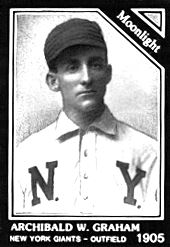
Moonlight Graham’s MLB Debut

GrahamFor fans of W.P. Kinsella’s book “Shoeless Joe” or the movie “Field of Dreams,” today (June 29, 2018) marks the 113th anniversary of Archibald “Moonlight” Graham’s only MLB appearance. Graham’s major league experience – which consisted two defensive innings (in which he had no fielding chances) in right field for the Giants – was, of course, immortalized in the book and movie. In real life, Graham was brought in to play right field in the bottom of the eighth (for trivia buffs, replacing George Browne).  The Giants were up 10-0 over the Brooklyn Superbas (Dodgers) at the time. Graham was scheduled to bat fifth in the top of the ninth. The Giants almost got him that elusive MLB at bat, scoring one run in the top of the ninth, but leaving Graham on deck when the final was made.

Graham’s professional baseball career stretched from 1902 to 1908 – with minor league stops in Portsmouth, Virginia; Charlotte, North Carolina; Nashua, New Hampshire; Manchester, New York; Scranton, Pennsylvania; Binghamton, New York; and Memphis, Tennessee.  His best season was 1906, when hit .329 in 136 games, while splitting time between the Scranton Miners (Class B) and Memphis Egyptians (Class A).   After leaving baseball, Graham went on to a medical career, serving the people of Chisholm, Minnesota for five decades.

Some Moonlight Graham Tidbits:

  • Graham was born in Fayetteville, North Carolina on November 12, 1879.
  • It would be an understatement to say the Graham family was “well-educated.” Moonlight Graham’s parents both held college degrees – and Moonlight and his eight siblings ALL earned college degrees.
  • Graham earned a Bachelor’s Degree (1901) from the University of North Carolina, where he played three seasons of varsity baseball (and captained the team).
  • Even while pursuing a professional baseball career (after graduating from UNC), Graham continued his education – at The University of Maryland (Baltimore) Medical School. Under the collegiate rules at the time, his professional status did not prevent him from playing college sports, and Graham played football and baseball at Maryland in 1905 and 1905.
  • Graham joined the New York Giants In May of 1905, shortly after graduating from the University of Maryland School of Medicine.
  • In 1906, his .336 average with the B-Level Scranton Miners led the New York State League.
  • After retiring from professional baseball and setting up medical practice in Chisholm, Minnesota, Graham played on a number of local town ball and semi-pro clubs in the area.
  • Graham served as the official physician for the Chisholm School system for more than forty years; he also gained significant recognition was his  resarch on childhool hypertension and his reported to never have missed a day’s work in his 40+ years on the job.
  • In 1993, the Doc Graham Scholarship Fund was established, each year providing financial recognition to a pair of Chisholm High School graduating seniors.

For more on Moonlight Graham’s life and career – in baseball and medicine – BBRT suggests the book Chasing Moonlight: The True Story of Field of Dreams’ Doc Graham by Brett Friedlander and Robert Reising.

COMING SOON – BBRT’S JUNE MLB WRAP UP.

Primary Resources:  Society for American Baseball Research; ChasingMoonlight: The True Story of Field of Dreams’ Doc Graham (Brett Friedlander & Robert Lansing; 2011, John F. Blair Publisher); Baseball-Reference.com

Two Pudges – both headed for the Hall of Fame – Cross Paths, while Going in Different Directions

On this date (June 22), twenty-five years ago (1993), 45-year-old Carlton “Pudge” Fisk started at catcher for the White Sox – in a game against the Texas Rangers in Chicago. That contest proved historic for reasons both expected and unexpected.

The contest was Fisk’s 2,499th major league game and his 2,226th behind the plate. At the time, it gave the future Hall of Famer sole possession of the MLB record for games played at catcher – moving him one past Bob Boone (whose career stretched from 1972-1990). Fisk, of course, knew that achievement was coming when he took the field.  What he didn’t’ know was that it would be his last MLB game. Fisk was unexpectedly released by the White Sox six days later (June 28).

Carlton Fisk was the first American League unanimous Rookie of the Year Selection (1972).

Fisk probably also was unaware that the young (born two years after Fisk’s MLB debut) fellow starting behind the plate  for the Rangers that day – another Pudge – Ivan “Pudge”  Rodriguez would not only join Fisk in the Hall of Fame someday, but would also break his record for games played at catcher. The 21-year-old Rodriguez was in just his third season, playing his 272nd MLB game – 263rd at catcher.  Rodriguez would surpass Fisk’s record for games played at catcher on June 17, 2009 – and go on to raise the mark to 2,427.

Carlton Fisk – on May 9, 1984 (or maybe May 8) – set the record for innings caught in a single game.  He was behind the plate for all 25 innings of a eight-hour (and six-minute) White Sox 7-6 win over the Brewers.  Fisk went three-for-eleven at the plate (with a walk, one run, one RBI and three whiffs). Behind the dish, he recorded 17 putouts and five assists, throwing out four of six would-be base stealers.  Fisk did,however, get a bit of a “rest” in the contest.  The game began on May 8, was suspended after 18-innings and completed on May 9. 

For those who are interested, during his 24-season (1969, 1971-1993), 2,499-game MLB career, Carlton Fisk hit ..269, collecting 2,356 safeties, 376 home runs, 1,276 runs scored, 1,330 RBI and 128 stolen bases. He was the 1972 AL Rookie of the year, an All Star in eleven seasons and a Gold Glover once. His best season was 1977, when he went .315-26-102 for the Red Sox. He hit a career-high 37 home runs in 1985 (White Sox), swiped a career high 17 bases in 1982 & 1985 (White Sox) and led the AL in triples in 1972 with nine (Red Sox).

The only MLB catchers to lead their league in triples are: Buck Ewing (20 for the 1884 Giants);  Tim McCarver (13 for the Cardinals in 1966);  Carlton Fisk (nine for the Red Sox in 1972).     

Ivan Rodriguez, played 21 MLB seasons (1991-2011), hitting .296, with 3,844 hits, 311 home runs, 1,354 runs scored and 1,332 RBI. He was an All Star in 14 campaigns, a 13-time Gold Glover and the 1999 American League MVP. . His best season was his 1999 MVP year (Rangers), when he hit .332-35-113 and tossed in 25 of his 127 career stolen bases.

Catcher Who Won MLB MVP awards:

AL: Mickey Cochrane (Athletics, 1928 & Tigers, 1934); Yogi Berra (Yankees, 1951, 1954, 1955); Elston Howard (Yankees, 1963); Thurmon  Mundson (Yankees, 1976); Ivan Rodriguez (Rangers, 1999); Joe Mauer (Twins, 2009).

NL: Bob O’Farrell (Cardinals, 1926); Gabby Hartnett (Cubs, 1935); Ernie  Lombardi (Reds, 1938); Roy Campanella (Dodgers, 1951, 1953, 1955); Johnny Bench ( Reds, 1970, 1972); Buster Posey (Giants, 2012). 


I tweet Baseball @DavidBBRT

Follow/Like the Baseball Roundtable Facebook page here.

Member: Society for American Baseball Research; The Baseball Reliquary; The Negro Leagues Baseball Museum.  

Mike Lansing – Celebrating MLB’s Fastest-Ever Cycle

LansingBaseball Roundtable, as regular readers know, likes to bring attention to baseball achievements and occurrences that both rare and unlikely to be seen again.  Now, hitting for the cycle (single, double, triple and home run in the same game) would not qualify as one of those – it’s been done more than 300 times at the major-league level.  Unique and rare, however, does describe the path Colorado Rockies’ second baseman Mike Lansing took to achieve his cycle.

On this date (June 18), 18 years ago, Lansing completed the cycle in just four innings – making his the quickest cycle in MLB history – and earning him the “yellow jersey” of baseball cyclists.  Notably, Lansing was consistently behind in the counts and three of his four hits came with two strikes.

Quickest Cycle Ever … Career Perspective

Minnesota Twins outfielder Gary Ward hit for the cycle in just his 14th MLB game (September 18, 1980 against the Brewers) – the earliest in an MLB career anyone has ever accomplished the feat. For more on rookies who have hit for the cycle, click here. 

Lansing, hitting second in the order, hit an RBI triple to right in the first inning (getting the most difficult leg of the cycle out of the way ) on a 1-2 pitch, added a two-run home run (0-1 pitch) in the bottom of the second, hit a two-run double (2-2 pitch) in the bottom of the third (as the Rockies scored nine times to take a 14-1 lead), and then completed the cycle with a single (another 1-2 offering) to right in the fourth. Lansing then struck out in the sixth, before being lifted for a pinch-hitter in the eighth. (For trivia buffs, the pinch-hitter was Darren Bragg and he fanned swinging.)  Lansing ended the day four-for-five, with three runs scored and five RBI, as the Rockies torched the Diamondbacks 19-2 in Denver.

Drafted (in the sixth round of the MLB draft) out of Wichita State, where he was a 1989 All American, the 6-foot/175-lb. right-hander was primarily a second baseman in his nine-season major league career – although he also saw considerable time at third base and shortstop. He hit .275 with 14 home runs, 120 RBI and 90 stolen bases in three minor league seasons (193 games) before making the Montreal Expos roster in 1993.  In his rookie season, Lansing appeared in 141 games, going .287-3-45, with 23 steals.

Never an All Star, Lansing proved a valuable, reliable and versatile roster addition during his MLB career (Expos/Rockies/Red Sox) – finishing with a .271 average, 84 home runs, 440 RBI and 119 steals in 1,110 games. Lansing reached 20 home runs once (1997), topped 20 steals three times (1993-95-96), and hit 40 or more doubles twice (1996-97). That 2000 season was the only campaign in which he hit more than two triples (a career-high six).

In addition to his fastest-ever cycle, Lansing shares the record for the most home runs in an inning (two). On May 7, 1997, he hit a two-run and three-run homer in a 13-run sixth inning as the Expos topped the Giants 19-3 in San Francisco.  That was his best season in the majors, as he hit .281 and recorded his career highs in home runs (20), RBI (70) and doubles (45).

As long as we’re looking at cycles.  Here are a few tidbits of cycle-driven trivia;

  • Four players have hit for the cycle a record three times: Adrian Beltre (Mariners-2008, Rangers-2012 and 2015); Bob Meusel (Yankees-1921, 1922 and 1928); Babe Herman (Brooklyn Robins-1931 twice and Cubs-1933); John Reilly (Red Stockings-1883 twice and Reds 1890).

Gotta Love the Texas – and More of “We Track Pretty Much Everything in Baseball”

Adrian Beltre’s record-tying three cycles – although hit for two different teams – all took place at the Texas Rangers’ home park (Globe Life Park in Arlington).  He cycled there twice for the hometown Rangers and once for the visiting Mariners, making him the only player to hit for the cycle in the same stadium for two different teams.

  • Four players have hit for cycle twice in the same season: John Reilly (American Association Red Stockings-1883); Tip O’Neill (American Association St. Louis Browns-1887); Babe Herman (NL Brooklyn Robins/Dodgers-1931); Aaron Hill (NL Arizona Diamondbacks-2012). No American Leaguer has ever completed two cycles in the same season.
  • John Reilly (Reds) and Tip O‘Neill (St. Louis Brown Stockings, American Association) had the shortest time between cycles at just seven days. Reilly’s came on September 12 and September 19, 1883. O’Neill’s came on April 30 and May 7, 1887. Reilly and Aaron Hill (Diamondbacks) are the only players with two cycles in the same calendar month. Hill achieved his on June 18 and 29, 2012.

It’s Been a Hard Day’s Night

foliThe Expos’ Tim Foli is the only player to start a cycle one day and complete it the next. On April 21, 1976, Foli collected a single, double and triple in a contest against the Cubbies that was suspended (pre-Wrigley lights) in the top of the seventh due to darkness. When play resumed the following day, Foli added an eighth-inning home run. (The Expos prevailed 12-6.)


  • The longest time between cycles for a player with multiple cycles goes to the Royals’ George Brett (May 28, 1979 and July 25, 1990) at 11-years-58 days.
  • The youngest MLB player ever to hit for the cycle is the NY Giants’ Mel Ott (age 20, cycle on May 16, 1929).
  • The oldest player to hit for the cycle is The Angels’ Dave Winfield (age 39, cycle on June 24, 1991).

Like Father … Like Son

When Twins outfielder Gary Ward hit for the cycle in just his 14th MLB game (September 18, 1980), he not only recorded the earliest (in terms of MLB games played) cycle ever, he also set the stage for an event that would add to the “rare and unique” nature of his cycle nearly a quarter-century later.   On May 26, 2004, Ward’s son Daryle Ward – playing 1B and batting third for the Pirates as they took on the Cardinals in St. Louis – also hit for the cycle. Gary and Daryle Ward are the only father-son combination (to date) to hit for the cycle.

  • Three players have hit for the cycle in both the NL and AL: Bob Watson (NL Astros-1977 and AL Red Sox-1979); John Olerud (NL Mets-1997 and AL Mariners-2001); Michael Cuddyer (AL Twins-2009 and NL Rockies-2014).

The Marlins are the only MLB team to never

have a batter record a cycle.

  • Only one player has hit for the cycle for teams in two different leagues, but from, the same city. John Reilly hit for the cycle for the American Association Cincinnati Red Stockings twice in 1883 and then for the Cincinnati Reds of the National League in 1890.

Cycled, But Not Quite All the Way Home

Photo by rchdj10

Photo by rchdj10

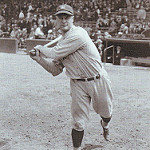
The Yankees’ 1B Lou Gehrig (kind of) earned a cycle by being tossed out at the plate.  On June 25, 1934, as New York topped Chicago 13-2  at Yankee Stadium, Gehrig hit two-run home run in the first inning; a  single in the third; and a double in the sixth. Gehrig came up needing just the triple for the cycle in the seventh and hit a smash to deep center (scoring Yankees’ CF Ben Chapman). Gehrig wasn’t satisfied with a three-bagger and was thrown out at home (8-6-2) trying for an inside-the-park home run – thus getting credit for the triple he needed for a cycle.


  • On June 17 of last season, the Rockies’ Nolan Arenado completed his cycle with a bottom-of-the-ninth walk-off home run as Colorado topped San Francisco 7-5. It was just the sixth cycle to end in a walk-off long ball: Ken Boyer, Cardinals (September 14, 1961); Cesar Tovar, Twins (September 19, 1972); George Brett, Royals (May 28, 1979); Dwight Evans, Red Sox (June 28, 1984); Carlos Gonzalez, Rockies (July 31, 2010.)
  • The most cycles (all MLB teams) in any given season is eight (1933 and 2009).

Skipping a Generation, but Still Hitting the Cycle Bell

Pirates’ RF Gus Bell and Phillies’ 3B David Bell are the only grandfather-grandson combination to hit for the cycle (June 4, 1951 and June 28, 2004, respectively) The Bells did have opportunities for three generation of cycles.  Here are the Bell family major leaguers:

First Generation … Gus Bell, Outfield … (MLB 1950-64)

Second Generation … Buddy Bell, 3B … (MLB 1972-89)

Third Generation … David Bell, 3B-2B … (MLB 1995-2006) & Mike Bell, 3B … (MLB 20000)

Only once in professional baseball has a player hit for the “Home Run Cycle” – solo, two-run, three-run and GrandSlam homers in the same game.  Read that story here.

Primary Resources: Society for American Baseball Research; Baseball-Reference.com; MLB.com; Baseball-Almanac.com


 I tweet baseball @DavidBBRT

Follow/Like Baseball Roundtyable’s Facebook page here.

Member: Society for American Baseball Research; The Baseball Reliquary; The Negro Leagues Baseball Museum. 

Four Consecutive Long Balls in an Inning … and Eddie Started It All

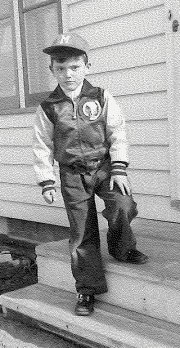
Baseball, especially when you are young, is all about heroes – and, for most fans, the status of those earliest heroes seems to last a lifetime. At my first-ever MLB game – back in April of 1953 – my Milwaukee Braves (newly moved from Boston) easily dispatched the Reds at County Stadium.David

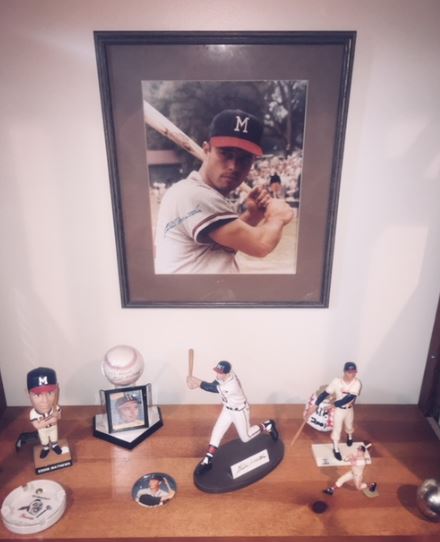
MathewsThere were plenty of stars in that game for a youngster of six to idolize, like the Reds’ powerful first baseman and cleanup hitter Ted Kluszewski (I was Polish, after all), but he was on the wrong squad.  The Braves’ offered speedy CF Billy Bruton; slick SS Johnny Logan and muscular first-sacker Joe Adcock.  I, however, latched onto a fast-rising young star, future Hall of Famer Eddie Mathews, manning the hot corner for Milwaukee. Mathews hit a pair of home runs that day – the first one in the bottom of the first inning of my first MLB game.  (As I recall, Logan hit one out as well.) On that day a hero was born. BBRT Note: The 21-year-old Mathews would go on to cement his hero status by leading the National League with 47 home runs in that first Milwaukee campaign (.302-47-135).

To this day, Mathews is my all-time favorite player – and I try not to miss an opportunity to mention him in these posts. Today offers one such opportunity – for it is the anniversary of the date in 1961, when Mathews hit the first home run, of the first-ever MLB streak of four consecutive round trippers in an inning.  Let’s look at the seven teams to share that mark.

—-TEAMS TO HIT FOUR CONSECUTIVE HOME RUNS IN AN INNINGS—-

Braves (vs. Reds) – June 8, 1961 – Seventh Inning

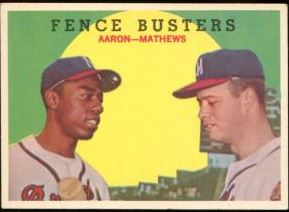
FenceOn this date (June 8) in 1961, the Braves became the first MLB team to launch four consecutive home runs in an inning. It happened in the top of the seventh (versus the Reds) with the Braves trailing 10-2.  As you would expect, it involved the heart of the Braves’ order, the 3-4-5-6 hitters.  The key for me – the first round tripper of the streak was a two-run shot by Eddie Mathews.  Oh, and right behind him came Hank Aaron.  It seems fitting that the pair who hit more career home runs while teamates than any other MLB duo should get this party started.  Here are the four home run hitters – and their career totals.

3B Eddie Mathews (two-run HR) … Career: 512 HR

CF Hank Aaron … Career: 755

1B Joe Adcock … Career: 336

LF Frank Thomas … Career: 286

Despite getting a home run from pitcher Warren Spahn and a second shot from Mathews in the game, the Braves lost 10-8.  They are the only team to have four consecutive home runs in an inning and still lose the contest.

Indians (vs. Angels) – July 31, 1963 – Sixth Inning

On the final day of July in 1963, the Indians became just the second team (and the first American League squad) to pop four consecutive home runs in an inning. It came in the bottom of the sixth, with the Indians already up on the Angels by a 5-1 score.  Surprisingly, this uprising began not in the middle of the order, but with the number eight hitter (and included pitcher Pedro Ramos).  Here are the hitters and their career long ball totals.

2B Woodie Held (solo) … Career: 179 HR

P Pedro Ramos … Career: 15

LF Tito Francona … Career: 125

SS Larry Brown … Career: 47

The Indians won the game 9-5 – and also had a second home run by pitcher Ramos and one by 1B Fred Whitfield.

EIGHT IS ENOUGH

They didn’t rap four in a row, but on September 4, 1999, the Reds (vs. the Phillies) had an MLB-record eight different players go yard in the same game. The hitters were: C Ed Taubensee (two homers); 2B Pokey Reese; 3B Aaron Boone; LF Greg Vaughn; CF Jeffrey Hammonds; RF Dmitri Young; C Brian Johnson (who did not start); 3B Brian Lewis (who did not start). The Reds prevailed over the Phillies by a 22-3 score – and had six players with at least three RBI.  

The record for home runs by a team in a game is ten, by the Toronto Blue Jays in an 18-3 win (September 14, 1987) over the Orioles in Toronto.  The bashers were: C Ernie Whitt (three homers); 3B Lance Milliniks (two HR); LF George Bell (two HR); CF LLoyd Moseby; DH Fred McGriff; CF Rob Ducey (who didn’t start).

Twins (vs. KC Athletics) – May 2, 1964 – Eleventh Inning

On May 2, 1964, the Twins and Athletics went into the eleventh inning (at KC) tied a three runs apiece. Tony Oliva – batting in the two-hole – led off with a home run and was followed by round trippers from Bob Allison, Jimmie Hall and, appropriately for the Twins, Harmon Killebrew.  Here are the players and their career long ball totals.

RF Tony Oliva … Career: 220 HR

1B Bob Allison … Career: 256

CF Jimmie Hall … Career: 121

LF Harmon Killebrew: Career: 573

The Twins topped the Athletics 7-3 – and are still the only MLB team to bash four consecutive home runs in an “extra inning.”

Red Sox (vs. Yankees) – April 22, 2007 – Third Inning

The Red Sox power surge (on April 22, 2007) had to be especially satisfying, as their four consecutive home runs came in Fenway against the rival Yankees.  It all started in the bottom of the third, with two outs, no one on base cleanup hitter Manny Ramirez at the plate with the Red Sox trailing 3-0.  It ended with the Red Sox up 4-3 and on their way to a 7-6 win.  Here are the home run sluggers and their career long ball totals.

LF Manny Ramirez … Career: 555 HR

RF J.D. Drew … Career: 242

3B Mike Lowell … Career: 223

C Jason Varitek … Career: 193

Lowell, by the way, hit a second home run in the seventh inning of the game.

White Sox (vs Royals) – August 14, 2008 – Sixth Inning

On August 14, 2008, the White Sox torched the Royals 9-2 in Chicago – driven in large part by a six-run sixth that included four consecutive home runs from the fifth through eighths spots in the batting order.  The Sox were up 3-2, when they started their half of the sixth with walks to Ken Griffey and Carlos Quentin, sandwiched between a pair of outs. Jim Thome then belted a three-run homer, followed by solo shots from Paul Konerko, Alexei Ramirez and Juan Uribe.  Here are the home run hitters and their career totals.

DH Jim Thome … Career: 612

1B Paul Konerko … Career: 439

2B Alexei Ramirez … Career: 115

3B Juan Uribe … Career: 199

Diamondbacks (vs. Brewers) – August 11, 2010 – Fourth Inning

The Diamondbacks picked up a 8-2 win over the Brewers (in Milwaukee) in a game that featured four consecutive home runs – by the fourth through seventh hitters in the lineup – in the top of the fourth. The barrage started with one out and the Diamondbacks down 2-0, thanks to consecutive home runs by the Brewers’ Prince Fielder and Casey McGehee to open the bottom of the second.  Here are the Diamondbacks’ home run hitters and their career totals.

1B Adam LaRoche … Career: 255 HR

C Miguel Montero … Career: 126 (still active)

3B Mark Reynolds … Career: 287 (still active)

SS Stephen Drew … Career: 123

The 2010 Diamondbacks are one of only two teams (the other is the 1961 Braves) to hit four consecutive home runs in an inning on the road. Five teams have given home town fans the joy of four consecutive yard blasts. 

Nationals (vs. Brewers) – July 27, 2017 – Third Inning

In trouncing the Brewers 15-2 (in Washington) on July 27, 2017, the Nationals bashed eight home runs, including two each by Bryce Harper and Ryan Zimmerman. Four of those long balls came consecutively in the bottom of the third. It started with a two-run shot by Brian Goodwin, followed by homers from Wilmer Difo, Bryce Harper (his second of the game) and Ryan Zimmerman. The quartet was batting in the 1-4 spots in the order.  Here are the hitters and their career home run totals.

CF Brian Goodwin … Career: 14 (still active)

SS Wilmer Difo … Career: 9 (still active)

RF Bryce Harper … Career: 168 still active0

1B Ryan Zimmerman … Career: 256 (still active)

The Nationals launched a fifth home run after their four consecutive shots – a fly out to center interrupted the home run string – in the third inning of that July 27, 2017 game.  That one by 3B Anthony Rendon. The fifth homer tied the MLB record for most home runs in an inning by a team.  Six teams have notched five long balls in an inning and four times the victims of the feat have been the Reds.  For the full story on five-HR innings, click here.


I tweet baseball @DavidBBRT

Follow/like the Baseball Roundtable Facebook page here.  A new bubblehead giveaway coming soon.

Member: Society for American Baseball Research; The Baseball Reliquary; The Negro Leagues Baseball Museum.

A True Doubleheader … Gotta Love It!

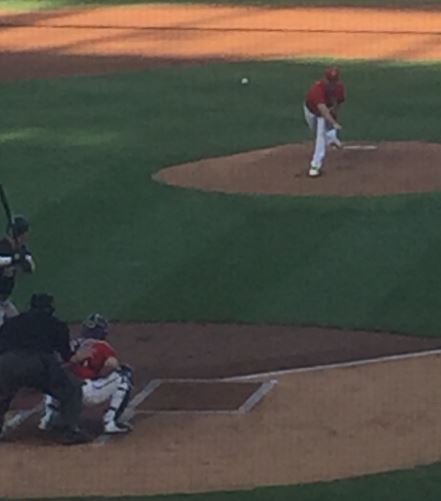
This Tuesday (June 5, 2018). I was lucky enough to attend my first true doubleheader (two games – one admission) in quite some time (White Sox at Twins). In this post, I’d like to share a few (a dozen to be precise) random thoughts – no earth-shaking insight or statistical wonders – from the experience.

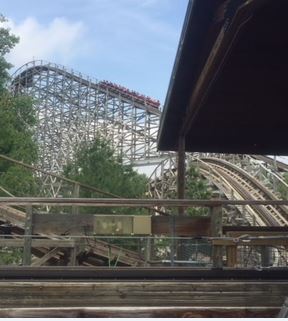
DH CoasterNote: I would have shared these thoughts yesterday, but I spent the day celebrating a family birthday with a combination of roller coasters and champagne.  Appropriately in that order.


So, here are a few thoughts that came to me as I took in nearly six hours of baseball during an eight-hour stay at Target Field.

One – Eight hours passes pretty darn quickly when you are at the ballpark.

Got to Target Field at about 2:00 p.m. (3:10 start), left at about 10:00 p.m. In between, saw five hours and 44 minutes of baseball. A great day!  Oh yes, and you can make a lot of friends in eight hours.  It seems that those who are willing – actually anxious – to take in two MLB games in a day are also ready to talk baseball.  (And, it was a knowledgeable crowd, as well.)   Had some great conversations about the MLB draft, the day’s lineup(s), the DH, pitch counts, the preponderance of strikeouts and home runs – and even the beauty of the double play.

Two – Two accurately completed scorecards bring twice the satisfaction.

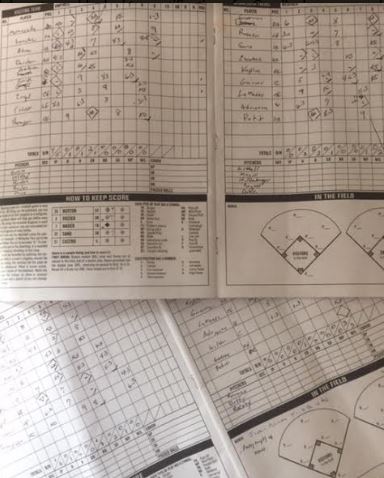
DH ScorecardKeeping score is one of the joys of the game (for me, at least).  Two completed scorecards in one day – Double your pleasure. Double your fun.  And kudos to the Twins for offering a scorecard in the FREE Twins Magazine.  As a side observation, as I looked around my section, it appears that keeping a scorecard has gone the way of the sacrifice bunt.


TWIN BILL TIDBIT

The 1945 Boston Braves played an MLB-record 46 doubleheaders.

Three – A split doubleheader is not as frustrating as it used to be.

Back when twin bills were more commonplace – almost a Sunday tradition in my family – doubleheader splits were a frustrating experience.  With true doubleheaders now a rare opportunity, that frustration is overwhelmed by the satisfaction of an MLB two-for-one deal.  Win or lose, the true twin bill is a baseball bargain.

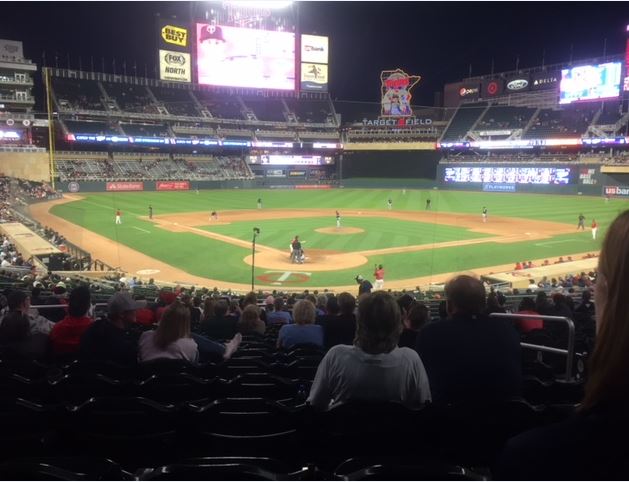
DH Game one

Capture.JPGH Game2Four – Day and night baseball on the same date.  Genius!

The contrast between a sunny afternoon game – bright blue sky, crisp green grass, stark white baseball (you get the idea) – and a night game, when you occupy a well-lit space in the blue-black atmosphere of the evening is right on the edge of spectacular.


TWIN BILL TIDBIT

The 1928 Boston Braves played a record nine consecutive doubleheaders over a 12-day span (September 4-15). During the streak, they swept one doubleheader, were swept six times and split two – for a four win/fourteen loss record.

Four – A book is a wonderful thing – pre-game and between games.

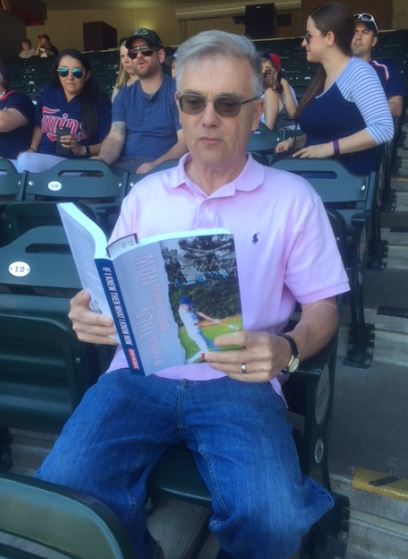
DHbookGet there early and catch up on some baseball reading before the game and (in that quiet time, 30-45 minutes) between games. I chose John Paciorek’s latest book “If I Knew THEN What I Know NOW,”  reflections from the MLB player with, arguably, major league baseball’s greatest one-game career. Paciorek’s stat line: One MLB game (Houston Colt .45’s), five plate appearances, three hits and two walks (Yep, he never made an out on an MLB field), four runs scored and three RBI. You might want to check out Paciorek’s blog at johnpaciorek.com


Five – You always see something new at a ball game.

DHLittellThis time, we got to see the MLB debut of the Twins’ Zack Littell. Rough outing, but he did strike out the first MLB hitter he ever faced (Yoan Moncada) and I was lucky enough to be seated near what seemed to be a “personal” cheering sections of fans, family and friends. Every out – in fact, every strike – brought an appreciative roar.

Six – Baseball is about heroes, especially if you are young.

When the Twins’ Eduardo Escobar powered a Twins’ comeback (and a 4-2 win) in Game One with an eighth-inning, three-run home run to deep center, a youngster (about five-years-old) in our section – who had been cheering wildly for Brian Dozier’s every move – proudly announced that he now had two favorite players.  Escobar justified his new status, going five-for-eight (three doubles and a home run) and driving in five in the Twins’ twin bill.


TWIN BILL TIDBIT

On May 2, 1954, Cardinals’ right fielder Stan Musial hit five home runs in doubleheader (versus the Giants in Saint Louis). Sitting in the stands that day was 8-year-old Nate Colbert who – On August 1, 1972 – would become just the second player ever to hit five home runs in a twin bill. Colbert was playing first base for the Padres, who were taking on the Braves in Atlanta. (Note: Musial and Colbert are still the only to MLBers with five long balls in a doubleheader.)

Seven – I still don’t like pitch counts.

White Sox’ starter Reynaldo Lopez had a one-hit shutout (and a 2-0 lead) after seven innings in the first game, but he’d reached 106 pitches – and so his day was done. (By the way, that would probably not have happened in the days when true doubleheaders were commonplace.)  The results? A Twins’ four-run eighth inning rally. I’ll take the win, but do find it disappointing that pitchers finishing what they started has gone the way of fans keeping scorecards and players laying down successful sacrifices.

TWIN BILL TIDBIT

On September 26, 1908 Cubs’ righty Ed Reulbach started both games of a doubleheader against Brooklyn.  He went the distance in both contests, giving up just eight hits over the 18 innings.  Reulbach is the only MLB pitcher ever to record two complete-game shutouts in a single day.

Eight – Sponsors – Sponsors – Sponsors

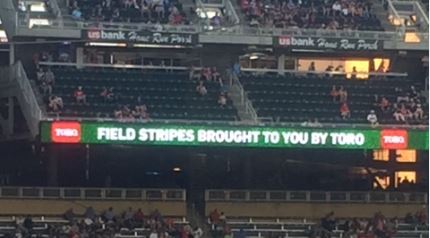
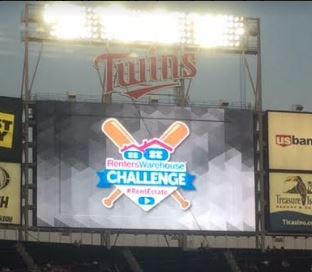
It seems like we now have sponsors for everything,  like the (pictured) field stripes brought to you by Toro or the Renters Warehouse Challenge.

DHSignOneDHsigntwo


Nine – Freebies are still fun.

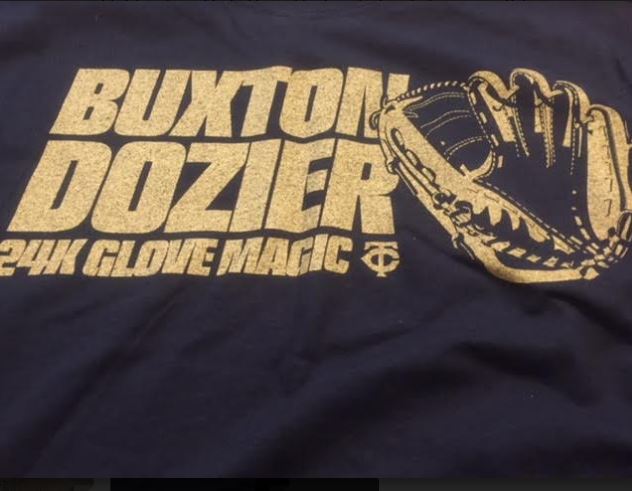
DHShirtWe were all rewarded for our endurance with a Dozier-Buxton Gold Glove T-Shirt.  Actually, they gave them to us on the way into the park; but nearly all fans stuck around and earned the “prize.”


TWIN BILL TIDBIT

On May 31, 1964, Mets fans faced a long day of suffering.  Not only did the New Yorkers lose both ends of a doubleheader to the San Francisco Giants – it took them a doubleheader-record 32 innings (9 hours and 52 minutes) to do it. The Giants won game one 5-3 in a brisk 2:29.  The second game, however, went 23 innings (7:23), with the Giants winning 8-6.   This is the longest doubleheader by innings and the longest in time –  without a weather delay.

On July 2, 1993, the Padres and Phillies split a twin bill in Philadelphia that kept the fans (who stayed on) in the park for more than 12 hours. Consider the patience needed.  The game was delayed one hour and ten minutes before the first pitch; another one hour and 56 minutes in the fourth inning; and two hours and 48 minutes in the sixth. The teams began play at 4:35 p.m. on Friday, July 2 and wrapped up at 4:40 a.m. Saturday – a doubleheader record 12 hours and five minutes.

Ten – I still don’t like the “shifty” trend in baseball.

As John Dewan tells us in his “Shift Update” (in the 2018 edition of The Bill James Handbook), MLB teams are “shifting” more than ten times as often as they did in 2011 (26,705 times in 2017). For me (remember I keep a basic scorecard), when the third baseman moves over to the right field side of second base and the second baseman becomes a RF “rover,” the baseball universe seems out of balance. On top of that, if the ball is hit to the third basemen, playing where the second baseman usually crouches, penciling in “5-3” on the scorecard just doesn’t feel right.

Eleven – Baseball food is better than ever.

Okay, I’m pretty old school – don’t care for the DH, the challenge or the “Wave ‘em to first” intentional walk – but I must say I don’t miss the good old days when your concession choices were pretty much limited to pop and beer, hot dogs, peanuts, Cracker Jack and licorice ropes.   In game one, I munched on a gyros wrap that was delicious and, in game two, it was a smoked beef sandwich on a garlic bun. For my post on great new ball park offerings in 2018, click here.

Twelve – Ernie Banks was right.

Cubs’ Hall of Famer Ernie Banks was quoted often as saying “Let’s play two!”  He was right!

Primary Resources:  Baseball-Reference.com; Baseball-Almanac.com; MLB.com

100Baseball Roundtable is on the Feedspot list of the Top 100 Baseball Blogs.  To see the full list, click here.

I tweet baseball @DavidBBRT

Follow/Like Baseball Roundtable’s Facebook Page here.  More baseball commentary; blog post notifications; PRIZES.

Member: Society for American Baseball Research (SABR); The Baseball Reliquary; The Negro Leagues Baseball Museum.

The Wizards of Whiff … All about pitchers fanning 9+ batters per nine innings.

In today’s hard-throwing/free-swinging version of the national pastime, strikeouts continue to increase annually (and from BBRT’s point of view, alarmingly).  In fact, the MLB total strikeout record has been broken in each of the past ten MLB seasons. In this post, Baseball Roundtable will take a look at the “Wizards of the Whiff” – the best of MLB’s strikeout artists – those who averaged at least one strikeout per inning over the course of an entire season.  What you may find surprising is that a pretty good number of these mound aces, pitched before the recent spike in strikeouts. (Note: I’ll be using the same qualifications as MLB uses for the earned run average title – at least one inning pitched for each game the team has played.)

HERB SCORE-d The First 9+ Season in 1955

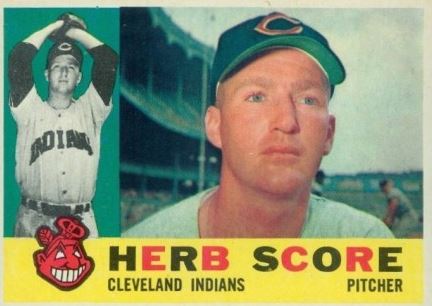
The Indians’ Herb Score, in 1955, became the first major league pitcher to average at least nine-strikeouts per nine innings (9.70).  His performance earned him 16 wins (10 losses); a 2.85 earned run average, the league leadership in strikeouts, the AL Rookie of the Year Award and a place in MLB history.

ScoreIt was April 15, 1955 and a 22-year-old southpaw named Herb Score was making his major league mound debut for the Cleveland Indians (versus the Tigers in Detroit). Score was signed by the Indians on June 7, 1962 – which also happened to be his 19th birthday. The 6’2”, 185-pounder proved to be a remarkable talent, and he made his way to the major leagues by Opening Day 1955. (It 1954, Score went 22-5, 2.62 with 330 strikeouts in 251 innings for the Triple A Indianapolis Indians of the American Association, earning recognition as the Sporting News Minor League Player of the Year.)

In his first MLB start, Score went the distance in a 7-3 Indians’ win and foreshadowed things to come by fanning nine batters in nine frames. He went on to pitch in 32 games (33) starts; go 16-10 and strike out 245 batters in 227 1/3 innings – setting a new rookie-season strikeout record (broken by the Mets’ Dwight Gooden, with 276 in 1984, but still the AL rookie record). Score also became the first qualifying pitcher to average nine or more strikeouts per nine innings (9.70). The following season, he recorded MLB’s second season of 9+ strikeouts per nine innings at 9.49. Those were the only two 9+ seasons in MLB history until 1960, when the Dodgers’ Sandy Koufax made this a club of two. (More on Koufax later).

Unfortunately, Score’s career was cut short by arm trouble, which some felt was related to injuries suffered in 1957, when a line drive off the bat of the Yankees’ Gil McDougald struck Score in the face. (He pitched in only 17 games in 1957-58.) Speculation was that Score altered his motion after that injury. Score himself said the arm issues were unrelated – but that’s another story. After going 36-19, 2.68 in his first two seasons (and leading the AL in whiffs each campaign), Score ended an eight-season MLB career at 55-46, 3.36 with 837 strikeouts in 858 1/3 innings pitched.

FirstToK9

SOMETHING’S HAPPENING HERE

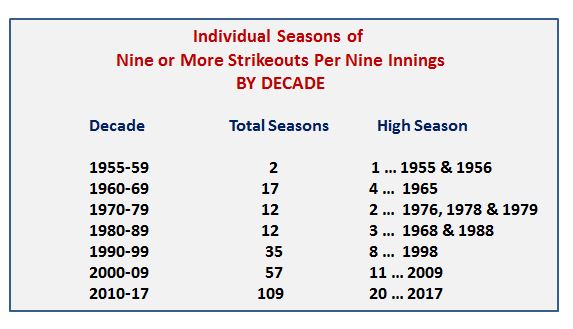
As you might expect, as overall strikeouts have soared, so have the number of pitchers who are whiffing a batter per inning or more. There were no such season before 1955 – and only two in the 1950’s. Of the total of 244 such campaigns, 109 (44.7 percent) occurred between 2010-2017.

IT’S A NEW AGE

Through 2017, 104 MLB pitchers have put together a total of 244 campaigns of nine or more strikeouts per nine innings. Fifty of those 104 pitches (48 percent) are currently active.

In 2017, we saw a record 20 pitchers achieve nine or more strikeouts per nine innings: Chris Sale (12.93); Robbie Ray (12.11); Max Scherzer (12.02); Corey Kluber (11.70); Chris Archer (11.15); Luis Severino (10.71); Jacob deGrom (10.78); Stephen Strasberg (10.47); Clayton Kershaw (10.39); Jimmy Nelson (10.21); Carlos Carrasco (10.17); Yu Darvish (10.08); Trevor Bauer (10.00); Jose Quintana (9.87); Aaron Nola (9.86); Masahiro Tanaka (9.79); Justin Verlander (9.57); Zack Greinke (9.56); Carlos Martinez (9.53); Drew Pomeranz (9.02).

K9Decade

OOPS! I DID IT AGAIN.

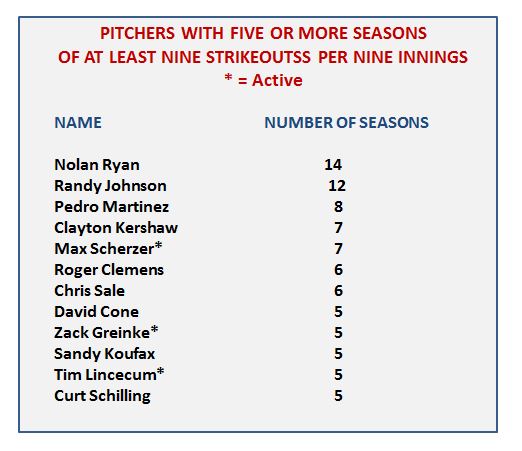
No one racked up more seasons averaging at least one strikeout per inning than all-time MLB strikeout king (5,714 career whiffs) Nolan Ryan.  The Hall of Fame righty met that standard in 14 of his 27 MLB campaigns. Second on the list (and first among southpaws) is Randy Johnson with 12 such seasons. Those two are responsible for 10.7 percent of MLB’s 9+ strikeouts per nine innings campaigns.

K95times

STRANGE BUT TRUE

Rickey Nolasco had more seasons averaging 9+ strikeouts per nine innings (1) than Bob Gibson and Bob Feller combined. Gibson’s high was 8.39 K/9 in 1970 and Feller’s top was 8.43 in 1946. Nolasco fanned 9.49 per nine innings for the Marlins in 2009. 

Among active pitchers, the Nationals’ Max Scherzer and Dodgers’ Clayton Kershaw lead the way with seven seasons each of nine or more strikeouts per nine innings.

ONE FOR THE AGES

Dwight Gooden is the only teenager to have a major league season in which he averaged nine or more whiffs per nine innings. In his rookie season, the 19-year-old Mets’ righty fanned a rookie-record and NL-leading 276 batters (218 innings pitched) for a K/9 ratio of 11.39.

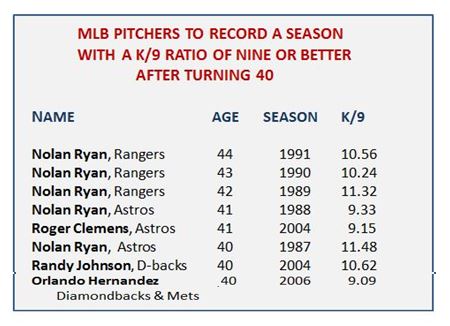
Nolan Ryan recorded a season of one of more strikeouts per inning at the oldest age. He was 44-years-old when he fanned 203 batters in 173 innings (10.56 K/9) for the Rangers in 1991. Overall, there have been eight 9+ K/9 seasons by pitchers in their forties.

K940

The most popular age bracket for recording a season of one or more whiff per nine frames is 25-29 – 126 of the 244 seasons (51.6 percent) have been recorded by pitchers in the age group.  Other age range percentages: 20-24 (20.9%); 30-34 (18.9%); 35-39 (4.9%); 40+ (3.3%).

THE BEST OF THE BEST

Randy Johnson photo

Photo by SD Dirk

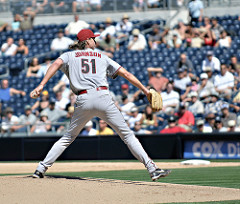
To date, the highest strikeout per nine innings ratio recorded over a season came in 2001, when 37-year-old Randy Johnson (then with the Diamondbacks) notched 13.41 strikeouts per nine innings.  The Big Unit went 21-6 that season, with a league-low 2.49 ERA and a league-topping 372 strikeouts in 249 2/3 innings – earning his third of four straight Cy Young Awards. As I put this post together, Max Scherzer stands at 13.56 strikeouts per nine innings for the 2018 season.

13 CAN BE A LUCKY NUMBER

Only two pitchers have recorded seasons in which they fanned 13+ per nine innings.  Randy Johnson (Diamondbacks) in 2001 at 13.41 and Pedro Martinez (Red Sox) in 1999 at 13.29.

There have been ten seasons of 12+ (in addition to the 13+ seasons noted above) strikeouts per nine inningS.  Five of those belong to Randy Johnson (1995, 1997, 1998, 1999, 2000).  The following hurlers each have one season of 12+ K/9: Kerry Wood (1998); Jose Fernandez (2016);  Chris Sale (2017); Max Scherzer (2017); and Robbie Ray (2017).

AS EASY AS 1-2-3

The 2017 season marked the first time in MLB history that a team could boast three qualifying pitchers with K/9 ratios of nine or better:

  • Cleveland Indians – Corey Kluber (11.71); Carlos Carrasco (10.17); and Trevor Bauer (10.00)

Note: Up until (and including) 1995, there had been only six seasons with at least three 9+ K/9 pitchers in all of MLB.  Four in 1965 and three each in 1986, 1987, 1990, 1991, and 1995.

Cleveland was also the first team to have at least two pitchers reached the 9+ K/9 mark – back in 1965, when Sam McDowell (10.71) and Sonny Siebert (9.11) did it.

HOW TIMES HAVE CHANGED

As I post this, 2018 statS show 31 qualifying pitchers with K/9 rates of nine or better – with Max Scherzer on top at 13.56 and the Astros boasting four starters at that whiff-level (Gerrit Cole -12.78; Charlie Morton (11.34); Justin Verlander (10.72); and Lance McCullers, Jr. (9.35).

THE BIG TRAIN COULD MOW THEM DOWN

wALTER joHNSON BASEBALL photo

Photo by pingnews.com

Walter Johnson (Senators … 1907-1927) was clearly the power pitcher of his time; He led his league in strikeouts an MLB-record 12 times and in strikeouts per nine innings six times. Still, his highest-ever K/( rate was 7.6 and, in 1921, he led the AL at 4.9.


A final thought:  As I post this (as of June 4), six of the top ten career leaders in strikeouts per nine innings are active; It goes like this, with *=Active:

*Chris Sale – 10.64

Randy Johnson – 10.61

*Stephen Strasburg – 10.55

* Max Scherzer – 10.33

Kerry Wood – 10.32

Pedro Martinez – 10,04

*Corey Kluber – 9.87

*Clayton Kershaw – 9.86

* Chris Archer – 9.66

Nolan Ryan – 9.55

Primary Resources: Baseball-Reference.com; ESPN.com; MLB.com


I tweet baseball @DavidBBRT

Like/Follow the Baseball Roundtable Facebook page here.

Member: Society for American Baseball Research; The Baseball Reliquary; The Negro Leagues Baseball Museum

Carl Hubbell’s Remarkable Streak – And a Day of Legend-Making

HubbellToday (May 27, 2018) is the 81st anniversary of the 24th victory in Giants’ Carl Hubbell’s MLB-record 24-decision winning streak (July 17, 1936 – May 27, 1937). “King Carl” Hubbell started the streak with a complete-game, nine-hit shutout of the Pirates – as the Giants topped the Bucs 6-0 in Pittsburgh.  The last win in the streak came as the result of a two-inning relief stint (May 27. 1937).  Hubbell came on in the seventh inning with the Giants trailing the Reds 2-1 in Cincinnati. He retired six straight in the eighth and ninth frames and the Giants scored in the top half of each of those innings to give Hubbell the win. The 6’, 170-pound hurler (known for his knee-buckling screwball) saw his streak end in his next trip to the mound (May 31), when the rival Dodgers reached him for five runs on seven hits and three walks in just 3 1/3 innings. (The Dodgers prevailed by a 10-3 score).

Over the course of his streak, Hubbell pitched in 27 games – starting 22 (two of the 24 wins came in relief).  He notched 19 complete games and put up a 1.82 earned run average over 207 2/3 innings (158 hits, 38 walks, 104 strikeouts).  In games he started,  Hubbell gave up two or fewer runs 17 times and picked up ten one-run victories.

King Carl Versus Dizzy Dean – Memorable Matchups

The toughest game in Hubbell’s 24-decision streak of victories came against fellow future Hall of Famer Dizzy Dean. On July 21, 1936, Hubbell faced Dean and his Cardinals in New York.  After nine innings, Hubbell and Dean were both still in the game, which was knotted at 1-1. Dean had actually outpitched Hubbell to that point, giving up one run, four hits and two walks – while fanning six. Hubbell had fanned just two and had given up one run, nine hits and four walks. Both runs had scored on solo homers: Giants’ catcher Gus Mancuso had gone deep against Dean in the bottom of the fifth inning; Cardinals’ right fielder Pepper Martin had answered with a solo shot in the top of the sixth.

In the top of the tenth, Hubbell gave up a walk to Pepper Martin, got LF Joe Mediwick to hit into a double play and then fanned 1B Ripper Collins. Dean got the first two outs in his half of the tenth before Giants’ SS Dick Bartell hit a walk off home run to give Hubbell win number-three in the streak.

Note: Hubbell faced St. Louis four times during the streak and Dean appeared in all four contests – three times as a starter and once in relief. On September 3, 1936, Dean and Hubbell both went the distance in a 2-1 contest. On September 14, Hubbell picked up his 14th win of the streak with five-innings of one-run relief and Dean pitched 2 1/3  scoreless innings out of the pen for St. Louis.  The final Hubbell/Dean matchup during the streak came on May 19, 1937, when Hubbell picked up his 22nd consecutive win, topping Dean 4-1 (only two of the four tallies against Dean were earned), as they both again went the distrance.  In those four matchups, Dean put up a 1.80 ERA over thirty innings – and all he got to show for it was three losses as a starter and a no decision in relief.

Hubbell finished the 1936 season on a 16-decision winning streak, with a league-leading 26 wins against just six losses (for a league-best .813 winning percentage), as well as a league-lowest 2.31 earned run average. He started 8-0 in 1937 and finished the year with a league-leading 22 wins (versus eight losses), a league-topping .733 winning percentage and a 3.20 ERA.  Over a 16-season career, the Hall of Famer was 253-154, 2.98. He led the NL in wins three times, ERA three times, complete games once, shutouts once and strikeouts once.


THE STUFF OF LEGENDS

1934In the 1934 All Star Game, Carl Hubbell created his own piece of MLB history – fanning five future Hall of Famers consecutively: Babe Ruth, Lou Gehrig, Jimmie Foxx, Al Simmons and Joe Cronin. Hubbell, who started the game for the National League actually fanned a sixth future Hall of Famer in his three-inning stint – AL starting pitcher Lefty Gomez.

Of course, the game was ripe for some type of legendary achievement.  Of the 18 players who started that contest, seventeen – all but NL CF Wally Berger – were future Hall of Famers.  Here’s how Hubbell’s now legenday appearance went.

First Inning …

Charlie Gehringer – Single, taking second on an erro by Giants’ CF Wally Berger

Heinie Manush – Walk

Babe Ruth – Strikeout

Lou Gehrig – Strikeout

Jimmie  Foxx – Strikeout


Second Inning …

Al Simmons – Strikeout

Joe Cronin – Strikeout

Bill Dickey – Single

Lefty Gomez – Strikeout


Thrid Inning …

Charlie Gehringer – Flyout ro right

Heinie Manush – Groundout to second

Babe Ruthg – Walk

Lou Gehrig – Flyout to right


I tweet baseball @DavidBBRT

Follow/Like the BaseballRoundtable Facebook page here.  Blog post notifications, additional baseball commentary, prizes.

Member: Society for American Baseball Research; The Baseball Reliquary; The Negro Leagues Baseball Museum.

An Historic … “We’ll Never See That Again” … Day – Rookie Pat Caraway Fans Joe Sewell TWICE!

Joe Sewell - a true contact hitter. Struck out twice in a game only twice in his Hall of Fame career.

Joe Sewell – a true contact hitter. Struck out twice in a game only twice in his Hall of Fame career.

Baseball Roundtable is drawn to on-field events that we are not likely to see again.  You know, like a pitcher winning 30 or more games in a season, a reliever topping 200 innings in a season, a batter hitting .400 for a campaign, or a player stealing home eight times in a season or more than 50 times in a career.

On this date (May 26) in 1930, MLB saw an event that is sure to never happen again. There are several reasons for that assertion. One is that the primary players involved – Joe Sewell and Pat Caraway – both passed away quite some time ago.  Another is how the game has changed, becoming a harder-throwing/freer-swinging affair.  Finally, and most important, we are not likely to ever see a hitter like Joe Sewell again.

The event?  On May 26, 1930, a 24-year-old rookie southpaw named Pat Caraway (White Sox) fanned Indians’ third baseman Joe Sewell in two consecutive plate appearances. What’s so unique about that?  Well, the 5’6”, 155-pound infielder was known for his uncanny ability to put his bat on the ball. As Rod Serling would have said, “We offer, for your consideration” the following facts:

  • Caraway’s consecutive whiffs of Sewell would be the only time in Hall of Famer Sewell’s entire 14-season MLB career (1,903 games and 8,333 plate appearances) that he struck out in consecutive at bats.
  • In that 1930 season, Sewell only struck out one more time – just three whiffs in 353 at bats (414 plate appearances).
  • Joe Sewell fanned twice in a game only twice in his career.

Caraway also seemed an unlikely candidate to fan Sewell in consecutive plate appearances. A rookie in 1930, Caraway would last just three MLB seasons – going 22-40 with a 5.35 career earned run average and 151 strikeouts in 478 innings. BBRT Note:  The only other time Joe Sewell fanned twice in one game (May 13, 1923), he was facing another rookie lefthander – Wallace Walter “Cy” Warmoth – who (like Caraway) appeared in only three MLB campaigns, going 8-5. 4.26.

In 2017, 96 major leaguers fanned more times than Joe Sewell did in his entire career. (Keep in mind that only 300 MLB players reached 250 at bats last season.)

Notably, Sewell’s two-strikeout game against Warmoth did not come during the infielder’s “free-swinging” days.  In his first five MLB seasons (1920-24), Sewell struck out 66 times in 2,794 plate appearances – once every 42.3 times he came to the plate. He tightened things up over his final nine campaigns (1925-33), fanning just 48 times in 5,539 plate appearances – once every 115.4 time he stepped up to the dish.

In 1920, Joe Sewell graduated from the University of Alabama – where he played varsity baseball and football, belonged to the Pi Kappa Phi fraternity and was elected Class President in his Senior year.

A few other Sewell tidbits that fall into BBRT’s “We’ll Never See That Again” category:

  • In 1929, Sewell played an MLB (modern) record 115 consecutive games without striking out (May 19-September 19). During his 115-game streak, Sewell racked up 436 at bats and 143 hits (.328), with 27 doubles, two triples, seven HR and 56 RBI.
  • In 1932, Sewell struck out just three times in 503 at bats – one strikeout for every 167.7 at bats, the MLB single-season record.
  • Sewell struck out in consecutive games only three times in his career – two of those in his first two MLB seasons.
  • For his career, Sewell fanned 114 times in 7,132 at bats – or once each 62.6 at bats. That puts Sewell second on the career list (among players who played after 1900) to Wee Willie Keeler, who fanned just once every 63.2 at bats in 19 MLB seasons (1892-1910). It’s a notable drop to third place – Lloyd Waner at 44.9 at bats per strikeout.
  • Baseball, apparently, was in the Sewell DNA.  Joe Sewell’s brothers, Luke and Tommy Sewell, also played in the major leagues.

Another “We’ll Never See That Again” or “They Don’t Make ‘Em Like They Used To” Tale

Now this tale may seem apocryphal, but is has enough “legs” to have made it into Joe Sewell’s Society for American Baseball Research biography and his New York Times obituary. It has been reported that when Sewell first made it to the major leagues in 1920, Indians’ teammate first baseman George Burns – seeing that Sewell did not have what he thought was a decent bat for the big leagues – gave young Joe a forty-ounce bat to use.  Joe is said to have cared for that bat – and used it for the rest of his career.  It is now on display at the Alabama Baseball Hall of Fame at the University of Alabama’s Sewell-Thomas Stadium. (Sewell was a star player for Alabama from 1917-1920 and the school’s baseball coach from 1964-69.)

Joe Sewell was inducted into the National Baseball Hall of Fame in 1977. He is also a member of the National College Baseball Hall of Fame and the Alabama Sports Hall of Fame.

Primary Resources: Society for American Baseball Research; Baseball-Refeence.com; TideSports.com


I tweet baseball @DavidBBRT

Follow/Like the BaseballRoundtable Facebook page here.  Blog post notifications, additional baseball commentary, prizes.

Member: Society for American Baseball Research; The Baseball Reliquary; The Negro Leagues Baseball Museum.