Indians on the Verge of History – Soon to Boast Four 200K Hurlers

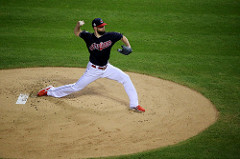
Corey Kluber photo

Photo by apardavila

Tonight (September 18), Indians’ starter Corey Kluber fanned 11 batters in eight innings, as Cleveland topped the White Sox 5-3 in Cleveland.  Kluber’s performance enabled the Indians to tie a MLB record  – and put them on the cusp of breaking that record.

Kluber ran his season strikeout total to 205 (in 203 innings) – joining two other Cleveland starters with 200+ strikeouts this season – Carlos Carrasco (206 strikeouts/176 innings) and Trevor Bauer (214 strikeouts/166 innings).  This makes the Indians just the fourth team in MLB history with three pitchers notching 200 or more whiffs in the same season.

The others are:

  • 1967 Minnesota Twins: Dean Chance (220 Ks), Jim Kaat (211), Dave Boswell (204);
  • 1969 Astros: Don Wilson (235), Larry Dierker (222), Tom Griffin (200);
  • 2013 Tigers: Max Scherzer (240), Justin Verlander (217), Anibel Sanchez (202).

Now, perhaps, the even bigger news. A fourth Indians’ starter – Mike Clevinger – currently stands at 196 strikeouts in 188 1/3 innings – which means MLB will likely soon see the first team ever with four pitchers notching 200 or  more strikeouts in the same season.

Special thanks to Baseball Roundtable reader Benjamin Thobe for alerting BBRT to the Indians’ march toward the new record.

Side note: The Houston Astros should  end the season with three 200+ strikeout pitchers. Currently, Justin Verlander stands at 269 strikeouts, Gerrit Cole at 260 and Charlie Morton at 195.

For an earlier post with more detail on the first three teams to have three 200K starters in the same season, click here.

I tweet Baseball @DavidBBRT

Follow/Like the Baseball Roundtable Facebook page here.

Member: Society for American Baseball Research; The Baseball Reliquary; The Negro Leagues Baseball Museum.
Two “PainFul” Careers – and a Combination of Connection and Coincidence.

There is, at least from a Baseball Roundtable perspective, a certain satisfaction in coming across MLB events that, although seemingly unrelated at the time they occurred, later create lasting connections (and impressions).  This blog post is about a pair of “hit-by-pitches” that occurred fifty seasons apart, but brought the players together both in the record books and (57 years after the first HBP) in Marlins Park.

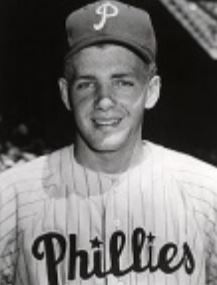
FRED VAN DUSEN

Van DIt all started with a left-handed throwing and hitting outfielder named Fred Van Dusen.  As a 16- and 17-year-old, Van Dusen showed promise – a steady and powerful bat, speed on the base paths and in the field, as well as a strong arm. The 6’3”, 180-pound outfielder caught the attention of a number of scouts and, just 20 days after his 18th birthday, signed as a “Bonus Baby” with the Philadelphia Phillies.

Less than a month after signing, Van Dusen got his first MLB plate appearance. It came in the second game of a September 11, 1955 double header versus the Braves (in Milwaukee). Van Dusen came to the plate as a pinch hitter – for pitcher Lynn Lovenguth – in the top of the ninth, with one out, one on and the Phillies trailing 9-1. (For those who like to know those things, the pitcher was Humberto Robinson.). As he stepped up to the dish, Van Dusen became the youngest player to appear in an MLB game in 1955.  But, there was more to come.

Van Dusen quickly fell behind 0-2 – remember that count, it will come into play later. On his third pitch, Robinson hit the rookie on the knee with a sweeping curveball. As he was left stranded at first, Van Dusen could hardly have expected that he had just experienced his first – and final – MLB plate appearance; and 2) that 57 years later that lone MLB plate appearance would be the catalyst for an appearance on the MLB Miami Marlins’ mound.  More on that in a bit, let’s get back to Van Dusen’s professional career.

His sophomore professional season  saw Van Dusen playing for the Wilson Tobs of the Class B Carolina League, where he hit .252, with 11 home runs in 140 games. He went on to play five more minor league seasons, hitting .260, with 86 home runs.  His best season was 1957, when he hit .310, with 25 long balls for the High Point – Thomasville Hi-Toms of the Carolina League; and was named the Carolina League’s Player of the Year. Despite that strong season, Van Dusen started the next campaign with the Triple A Miami Marlins (remember that Marlins connection, it too will come into played) and he never appeared in another MLB game.

Until 2005, Van Dusen was the only player who was hit by a pitch in his only plate appearance, in his only MLB game; and who also never appeared in the field (in the majors) defensively. (Just more evidence of BBRT’s contention that “In baseball we track everything.”)

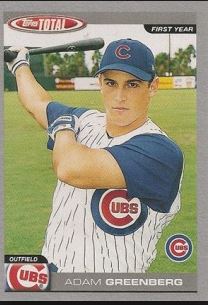
ADAM GREENBERG

GreenbrgThen, in 2005, 24-year-old rookie Adam Greenberg (another promising southpaw outfielder), doubled the size of Van Dusen’s list (one MLB game, one MLB plate appearance, hit by pitch, never played in the field) – and he stayed there until October 2, 2012.

Greenberg made his MLB debut with the Cubs on July 9, 2005.  It came in the top of the ninth inning with the Cubs leading the Marlins 4-2. (Remember the Van Dusen minor league Miami Marlins connection? BBRT likes that kind of coincidence.) Greenberg was called on to hit for pitcher Will Ohman with one out and no one on base. The very first MLB pitch Greenberg ever saw came from Marlins’ lefty Valerio De Los Santos. Remember that name, it also comes into play later.  It was a 92-mph fastball that got away and hit Greenberg in the back of the head – resulting in a concussion that sent him directly to the hospital (rather than first base) and led to recurring positional vertigo, vision issues and headaches – and contributed to a very short MLB career.

But I’m getting ahead of myself.  Let’s look at how Greenberg got to that plate appearance.

Greenberg was a star athlete at Guilford (Connecticut) High School – a four-year letterman in baseball, basketball and soccer – and team captain in both baseball and soccer.  He then went to the University of North Carolina, where he was named to the ACC All-Conference team in 2002 – after hitting .337, with 17 home runs and 35 stolen bases.

The Cubs selected Greenberg in the ninth round of the 2002 MLB Draft and he began his professional career in the Cubs’ system that year. He showed considerable promise.  As a 21-year-old he hit a combined .286, with 17 stolen bases in 77 games at Class A (Lansing Lugnuts) and High A (Daytona Cubs). In 2003, he hit .299 with 26 steals at Daytona and, in 2004, he hit a combined .285, with six homers, 17 triples and 19 steals – while moving from High A (Daytona) to Double A (Western Tennessee Diamond Jaxx) to Triple A (Iowa Cubs).  When he got the 2005 call up to the Cubs he was having a solid season at Western Tennessee.  Then, of course, came the beaning – and the aftermath.

Greenberg was released by the Cubs in in June of 2006 – after disappointing performance at Iowa and Western Tennessee He then bounced around the minors in Dodgers’, Royals and Angels’ systems, as well as with the (Independent) Atlantic League Bridgeport Bluefish – continuing to chase his maj league dream.

Another Coincidence/Connection

Valerio De Los Santos – who hit Adam Greenberg with that fateful 2005 pitch – enjoyed a nine-season MLB career. His last MLB appearance was with Colorado in 2008. In 2011, De Los Santos (then 38-years-old) was playing his last professional season – with the Long Island Ducks of the (Independent) Atlantic League.  Greenberg was playing for the Bridgeport Bluefish in the same league and found himself facing De Los Santos once again.

In an interview with the Shoreline Times, Greenberg said this of his second professional at bat versus De Los Santos,”It was a big deal. As much as I try to pretend it wasn’t. It’s been 5 ½ years and to face him again in a game that meant something … It brings things full circle.  You have the what-if stuff – What if he threw that first pitch for a strike 5 ½ years ago? That’s the fun stuff. The fact is, it happened.  And that we’re both still playing is awesome.”

2012 – AND THINGS REALLY GOT INTERESTING

In October of 2012 – perhaps responding to a national social media campaign aimed at getting Greenberg a major league at bat (rather than just a plate appearance) – the Miami Marlins signed Greenberg to a one-day major league contract. Keep in mind the Van Dusen connection.  At this point in time, Van Dusen and Greenberg were the only two players in MLB history to be hit by a pitch in their only MLB plate appearance, in their only MLB game, without appearing in a defensive position on the field.

Knowing that Greenberg’s appearance  in a Marlins’ game would once again make Van Dusen the sole holder of the “one game, one plate appearance, hit-by-pitch and never appearing in the field” record, the Marlins called on the then 75-yedar-old Van Dusen to throw out the ceremonial first pitch for the contest.   So, two events – somewhat similar, but 50 years apart – eventually brought Greenberg and Van Dusen together on the same day on the same major league diamond. BBRT likes that symmetry.

One Game, One Plate Appearance, One Hit by Pitch

There are three other players who qualify for the one game, one plate appearance, one hit by pitch club – but those three all played a defensive position in their single game.  They are: The Giants’ Ham Wade (September 9, 1907); Indians’ Harvey Grubb (September 27, 1912); and Phillies’ Cy Malis (August 17, 1934). 

Pitcher Charles “Victory” Faust of the 1911 Giants came close – with just one career plate appearance – hit-by-pitch, two stolen bases and one run scored.  Faust, however, appeared in two games. His story, as the good luck charm of the 1911 Giants, is unique in the lore of baseball superstitions – and will get its own post here in the near future.

Now to Greeberg’s 2012 at bat. He came up as a pinch hitter (for LF Bryan Petersen),  leading off the bottom of the sixth, with the Marlins up 2-0. Greenberg was facing 20-game winner, and eventual 2012 NL Cy Young Award winner, knuckleballer R.A. Dickey.

Greenberg’s Walk up music was, appropriately, Aerosmith’s “Dream On.”  He came to the plate accompanied by a standing ovation – and struck out on three pitches.  (Remember, Van Dusen was hit by an 0-2 pitch? So, in the totality of Van Dusen’s and Greenberg’s MLB careers, every major league pitch they ever saw that didn’t hit one of them was a strike.).

Even after getting that elusive MLB at bat, Greenberg was not done.  His heart was in the game and, in December of 2012, he signed with the Orioles as a minor-league free agent.  He was, however, released by Baltimore in March of 2013. He still, however, felt the urge to be on the field and played 30 games back with the Bridgeport Bluefish in 2013.  It was his final professional baseball season.

Primary Resources:  Baseball-Reference.com, Society for American Baseball Research.


I tweet baseball @DavidBBRT

Like/Follow the Baseball Roundtable Facebook page here.  

Member: Society for American Baseball Research; The Baseball Reliquary; The Negro Leagues Baseball Museum.
How Close Can You Get? Perfect Games Lost with Two Outs in the Ninth … or Later

Saturday(September 8), Kansas City Royals’ rookie right-hander Jorge Lopez took a 4-0 lead over my hometown Twins into the bottom of the ninth.  More important (particularly since neither the Twins nor Royals are in the post-season hunt), the 25-year-old Lopez also took a perfect game into the ninth. History, however, was not to be made. Lopez walked Twins’ RF Max Kepler on five pitches to start the inning (and lose the perfect game) and then gave up a single to center by LF Robbie Grossman (on a 1-2 pitch) to lose the no-hitter (Kepler going to third). Wily Peralta came on in relief and gave up a sacrifice fly (there went the shutout), but closed out Lopez’ 4-1 victory.

Lopez’ near-perfect outing led BBRT to reflect on past games when MLB pitchers got even closer to perfection.  So, here’s a post on perfect games lost with two outs in the ninth inning – or even later.  I’ll rate the top ten on the bases of heartbreak (or irony) … and throw in the remainder as “Honorable Mentions.”

______________________________________________

NUMBER ONE – I’m “Calling” This the Toughest Perfect Game “Missed” Ever

Armando Galarraga, Tigers … June 2, 2010

Photo by Kevin.Ward

Photo by Kevin.Ward

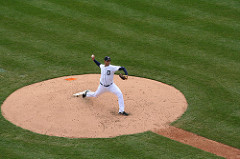
Perhaps the most heartbreaking “no-hitter breakup” took place on June 2, 2010, when Detroit Tigers’ righty Armando Galarraga found himself on the mound in the top of the ninth 26 outs into a perfect game (three strikeouts).  The Tigers led 3-0 and Galarraga was facing Indians’ second baseman Jason Donald. Galarraga induced Donald to ground to right side of the infield. Detroit first baseman Miguel Cabrera moved to his right to make a fine play, spinning and throwing to Galarraga covering first (who clearly beat Donald to the bag). Umpire Jim Joyce called Donald safe, a mistake he admitted and apologized for after the game. (Talk about a bad time for a bad call.)

The official scorekeeper gave Donald an infield single, ending both the perfect game and the no-hitter. Galarraga retired the next batter – CF Trevor Crowe – on a groundout. Joyce’s call, despite the post-game mea culpa, stood, and Galarraga, painfully, joined the list of pitchers losing a perfect game with two outs in the ninth.

Galarraga had a five-season MLB career (2007-2012), going 26-34, 4.78 for the Rangers, Tigers, Diamondbacks and Astros. His near-perfect game was one of only two complete games in 91 career starts.

NUMBER TWO – Unlucky 13, Indeed!

HaddixFor another hard luck story involving near-perfection, consider the plight of Pittsburgh Pirates’ southpaw Harvey Haddix, who took a perfect game into the 13th inning – AND LOST.

On May 26, 1959, Haddix took the mound against the first-place and defending NL Champion Milwaukee Braves.  Haddix retired the first 36 hitters in order – fanning eight, carrying a perfect game into the bottom of the 13th. A 20-game winner in 1953, the 33-year-old Haddix had come into the game 4-2, with a 2.67 ERA in seven starts – and had thrown complete games in his two previous outings. (He would end up 12-12, 3.13 on the year.)

Unfortunately,  the Pirates’ lineup had given him no support.  (Yes, the heartbreak here is that he continued that “perfecto” past the ninth and his teamates still could not give hime a run.)  Braves’ righty Lew Burdette, despite giving up 12 hits and fanning only two, had held the Pirates scoreless. Milwaukee 2B Felix Mantilla led off the 13th by reaching on a throwing error by Pirates’ third baseman Don Hoak. Future Hall of Famer 3B Eddie Mathews bunted Mantilla over to second, which led to an intentional walk to another future Hall of Famer (RF Hank Aaron), bringing up 1B Joe Adcock.

Adcock launched a 1-0 pitch over the right field fence for what appeared to be a three-run home run.  However, the Braves, in celebrating the tension-filled victory, forgot how to run the bases. Adcock passed Aaron between second and third and, after some deliberation, Adcock was called out – ultimately changing his three-run homer to a one-run double. So, despite 12 perfect innings, Haddix lost the no-hitter, the shutout and the game itself.  But he did etch his name forever into baseball lore; and countless trivia quizzes. He still holds the record for the most consecutive hitters retired from the start of a game – and the second spot on this heartbreak, near-perfect list. 

Haddix spent 14 seasons (1952-65) in the major leagues (Cardinals, Phillies, Reds, Pirates, Orioles), going 136-113, 3.48.  His best seasons were with the Cardinals in 1953-54. In those two campaigns, Haddix put up lines of 20-9, 3.06 and 18-13, 3.57.  The 5’9”, 170-pounder was a three-time All Star and led the NL in shutouts (six) in 1953.

NUMBER THREE – Not Just One Out, One Strike, Away.

Max Scherzer, Washington Nationals … June 20, 2015 

Photo by Corn Farmer

Photo by Corn Farmer

Washington Nationals’ right-hander Max Scherzer came within one out – within one strike actually – of a perfect outing on June 20, 2015. Missing by just one swing and miss – and having four chances to sneak that final strike by – earns him number-three on the hard-luck, near-perfect roster.

Scherzer entered the top of the ninth with a 6-0 lead over the Pittsburgh Pirates – having retired the first 24 batters, striking out ten.  In the ninth, Scherzer retired the first two batters (RF Gregory Polanco on a pop out to the catcher and SS Jordy Mercer on a liner to center) and then worked the 27th hitter (pinch hitter Jose Tabata) to a 2-2 count.  Tabata fouled off three 2-2 pitches before Scherzer lost the perfect game in perhaps the most painful way (in more ways than one) possible – by hitting Tabata with a pitch (a breaking ball to the elbow).  Scherzer then got Pirates’ second baseman Josh Harrison on a fly ball to left, completing the no-hitter – and earning a 6-0 victory.  Scherzer, by the way, was not the first pitcher to lose a perfect game by hitting the 27th batter (see George Wiltse, next in this post).

Scherzer, still active, is in his eleventh major league season (Diamondbacks, Tigers, Nationals).  He is a six-time All Star, two-time twenty-game winner and three-time Cy Young Award winner (2013-2016). In 2015, he went 14-12, 2.79, but led the NL with four complete games and three shutouts.  As this post is written his career record is 158-81, 3.20 – with ten complete games, five shutouts and two no-hitters.

______________________________________________________

NUMBER FOUR – Another Bad “Call” – Another “Missed” Perfecto – Another “Not Missed” Batter.

George “Hooks” Wiltse, New York Giants … July 4, 1908

Giants’ southpaw curveballer George Wiltse – like Max  Scherzer (above) – got not just within one out, but within one strike, of perfection.  And, as in the Armando Galarrago near-perfect game, the umpire later admitted that Wilste threw that strike, and had the out, he just didn’t get the call.

It looked, for the longest time, like Wiltse was going to have plenty to celebrate on Independence Day 1908. The Giants’ southpaw retired the first 26 Phillies before hitting Philadelphia pitcher George McQuillan with a pitch on a 2-2 count (after not getting the call on a very close pitch on his previous delivery – a call umpire Cy Rigler later admitted he missed).  Wilste retired the next batter. However, despite nine no-hit/no-run innings, he wasn’t done yet.  He and McQuillan were embroiled in a 0-0 duel (like Harvey Haddix, Wiltse got little support in his near-perfecto).  Wiltse went on to pitch-a 1-2-3 tenth (preserving the no-hitter) and the Giants managed to push across a run to give Wiltse a 1-0, no-hit victory. Wilste is one of only three pitchers to date to complete a no-hitter of more than nine innings. Wilste finished the 1908 season 23-14, with a 2.34 ERA. He was also a twenty-game winner in 1909 (20-11, 2.00) and went 139-90, 2.47 in twelve MLB seasons.  He finishes a spot behind Scherzer’s two-strike hit batsman only because, even if he had gotten the strike out, the perfect game would not have been completed (since the game itself was not completed). Given his 1-2-3 tenth, however, that missed call cost him a perfect outing.

___________________________________________________

NUMBER FIVE – Another One-Strike-Away Performance

Mike Mussina, Yankees … September 2, 2001 

Photo by Keith Allison

Photo by Keith Allison

Fifth-place on the list goes to another one-strike-away, near-perfect performance. On September 2, 2001, the Yankees’ Mike Mussina squared off against the rival Red Sox at Fenway Park. After eight innings, Mussina and Red Sox starter David Cone were locked in a 0-0 duel. Mussina hadn’t allowed a base runner, striking out twelve. Cone had given up just four hits and three walks (fanning eight), while holding New York scoreless.  The Yankees pushed across a run in the top of the ninth on a single, an error and a double by 3B Enrique Wilson. Mussina, looking for his 14th victory of the campaign, went to work on his perfect game (which would have been the first ever at Fenway) – notching a ground out (pinch hitter Troy O’Leary) and a strikeout (2B Lou Merloni) and taking pinch hitter Carl Everett to a 1-2 count before Everett singled to left. Mussina retired Trot Nixon for the final out, in a 1-0 one-hit win.

Mussina finished the season 17-11, 3.15. In an 18-season MLB career (1991-2008), Mussina went 270-153, 3.68 with 57 complete games and 23 shutouts. The five-time All Star won 17 or more games eight times and, ironically, had only one 20-win season – his last. As a 39-year-old, Mussina went 20-9, 3.37 for the Yankees in 2008. In the major leagues from 1991 to 2008, Mussina pitched for the Orioles and Yankees.

_________________________________________________

NUMBER SIX

Dave Stieb, Blue Jays … August 4, 1989 … Worked Really Hard for a No-Hitter

Dave StiebOn August 4, 1989, Blue Jays’ right-hander Dave Stieb took a 2-0 lead and a perfect game into the top of the ninth inning against the Yankees. Stieb started the inning as though ready to make history, fanning pinch hitters Hal Morris and Ken Phelps on nine pitches (his tenth and eleventh strikeouts of the game).  Then Steib fell behind the number-nine hitter – CF Roberto Kelly – 2-0. Stieb had to throw a strike and Kelly knew it – and hit it. He broke up the perfect game and the no-hitter with a double to left.  Second baseman Steve Sax followed with a run-scoring single, before left fielder Luis Polonia grounded out to end the game.  So, Stieb lost the perfect game, the no-hitter and the shutout – but did get the win.

Stieb ended the season 17-8, 3.35 – one of six seasons in which the seven-time All Star logged 16 or more wins.  In a 16-season MLB career (1979-1992, 1998), Stieb went 176-137, 4.83 for the Blue Jays and (for one season) White Sox.   Steib takes sixth-place on this list based not soley on that 1989 game – but also on the fact that it came after he lost two no-hitters (not perfect games) with two outs and two strikes on the batter the previous season. (See box below.)

DAVE STIEB – SO CLOSE AND YET SO FAR

In 1988, Dave Stieb – who would lose a perfect game with two outs in the ninth on August 4, 1989 – twice came within one strike of a no-hitter – and in consecutive starts. On September 24, 1988 (against the Indians) and September 30. 1988 (versus the Orioles), he lost no-hitters with two outs in the ninth inning and two strikes on the hitter (2 and 2 counts both times).  Stieb did get two complete-game shutouts, 1-0 over the Indians and 4-0 over the Orioles. The games were his final two starts of the 1988 season, so he had the entire off-season to contemplate his bad luck. Stieb did finally get his no-hitter – the first in Toronto Blue Jays’ history – a 3-0 win (four walks/nine strikeouts) over the Indians in Cleveland on September 2, 1990.


NUMBER SEVEN – Unfortunately, A Walk In The Park.

Milt Pappas, Cubs … September 2, 1972

On September 2, 1972, the Cubs’ Milt Pappas held an 8-0 lead over the San Diego Padres – and had a perfect game going (with six strikeouts) as the Padres batted in the ninth.  After retiring the first two batters in the final frame, Pappas walked pinch hitter Larry Stahl on a very close 3-2 pitch.  Pappas then retired pinch hitter Garry Jestadt on a pop out to second base. So, while he lost the perfect game, he did save the no-hitter. Pappas – who went 209-164, 3.40 in 17 MLB seasons (1957-73) – had his best year in 1972, going 17-7, 2.77. It was the 33-year-old’s 16th MLB campaign (he retired after the 1973 season). The two-time All Star (1962 and 1965) spent time with the Orioles, Reds, Braves, and Cubs.

______________________________________________

NUMBER-EIGHT – Once Again, One Strike Away.

Ron Robinson, Reds … May 2, 1988

Reds’ right-hander Ron Robinson was one strike away from a perfect game on May 2, 1988. He had a 3-0 lead, two outs in the ninth, nary a base runner allowed (three strikeouts) and a 2-2 count on Expos’ pinch hitter Wallace Johnson – and then hung a curveball that Johnson hit for a single. Tim Raines followed with a two-run home run, and Red’s closer John Franco was brought in to get the final out.  So, on the verge of a perfect game (with two out and two strikes in the ninth), Robinson lost the no-hitter, the shutout and the complete game. (He did get the win.)

In his nine MLB seasons (1984-92 – Reds and Brewers), Robinson recorded eight complete games and two shutouts – and had a respectable 48-39 record, with a 3.63 ERA and 19 saves. His best season was 1990, split between the Reds and Brewers, when he went 14-7, 3.26 and notched three seven of his complete games and both of his career shutouts.

_____________________________________________

NUMBERS NINE & TEN (tie) … Yu Can’t Always Get What You Want

Yu Darvish and Yusmeiro Petit

Ninth and tenth place tie – double Yu’s; and as much irony as heartbreak.  In 2013, two pitchers named Yu – Yu Darvish and Yu Petit lost perfect games with two outs in the ninth.  Those two share ninth place, just for the irony of having two “Yu’s” lose a perfect game with two outs in the ninth in the same season.

Yu Darvish, Rangers … April 2, 2013

In his first start of the 2013 season (April 2), Rangers’ Ace Yu Darvish stifled the Houston Astros without a base runner for 8 2/3 innings – fanning 14. All he had to do to gain perfection was retire the Rangers’ number-nine hitter, Marwin Gonzalez. (Gonzalez had hit .234 in 80 games as a rookie in 2012, and would hit .221 in 72 games in 2013.)

Gonzalez hit Darvish’s first pitch up the middle – through Darvish’s legs – for a single. It was Darvish’s 111th pitch and he was relieved by Michael Kirkman, who finished off the 7-0 win. So, despite a sterling effort, Darvish was denied a perfect game, a no-hitter, a complete game and even a personal shutout.  He did get the win.  Darvish, still active, finished the 2003 season 13-9, 2.83. As this post is written, his career record is 57-45, 3.49 and he has two complete games and one shutout in 139 starts (2012-14, 2016-18).

Yusmeiro “Yu” Petit, Giants … September 6, 2013

On September 6, 2013, the San Francisco Giants’ Yusmeiro (Yu) Petit joined the unlucky “almost perfect” rotation. With two out in the ninth, Petit – with a 3-0 lead over the Diamondbacks – had retired all 26 batters he had faced, fanning seven.  The Diamondbacks sent up pinch hitter Eric Chavez, who worked the count full. Then, just one strike away from perfection, Petit gave up a single to right field (that dropped just out of the reach of a diving Hunter Pence).  Petit retired the next hitter CF A.J. Pollock on a grounder to third – settling for a one-hit shutout.  This made Petit the second pitcher name “Yu” to get within one out of a “perfecto” during the 2013 season.  Petit finished the season a 4-1, 3.86 (eight games, seven starts). Still active (2006-17), his MLB record as this post is written is 24-32, 4.47.

______________________________________________

HONORABLE MENTIONS

THE REMAINING HURLERS WHO LOST NO-HITTERS WITH TWO OUTS IN THE NINTH INNING.

Brian Holman, Mariners … April 20, 1990

On April 20, 1990, the Mariners’ Brian Holman retired the first 26 hitters (six strikeouts), shutting down the defending World Champion Oakland A’s. Holman had a perfecto and a comfortable 6-0 lead with two outs in the bottom of the ninth, before giving up a first-pitch home run to pinch hitter Ken Phelps (and, of course, losing the perfect game, no-hitter and shutout).  It was Phelps only home run of the 1990 season and the last of his 123 career round trippers. Holman then struck out Rickey Henderson for the final out in a 6-1 Mariners’ win.  It was one of only two complete games in Holman’s four MLB seasons (37-45, 3.71). Holman finished the 1990 season 11-11, 4.03 – the only season he finished at .500 or better. He played for the Expos and Mariners (1988-91).

———-

Milt Wilcox, Tigers … April 15, 1983

With two outs in the bottom of the ninth – in an early-season game (April 15, 1983) –  Tigers’ right-hander Milt Wilcox had yet to allow a White Sox hitter to reach base (and had struck out eight). Pinch hitter Jerry Hairston ended that with his first hit of the season – a clean single. (As with the hit that broke up Brian Holman’s perfect game, Hairston’s came on the first pitch of his at bat.) Wilcox retired the next batter (CF Rudy Law) for a 6-0 (one-hitter) win. Wilcox finished the season 11-10, 3.97. He won 119 games (113 losses) in 18 MLB seasons (1970-75, 1977-86) with the Reds, Cubs, Tigers, Mariners. His career ERA was 4.07, with 73 complete games and 10 shutouts. Wilcox’ best season was 1984, when he went 17-8, 4.00.

———-

Billy Pierce, White Sox … June 27, 1958

White Sox’ lefty Billy Pierce was on a roll when he faced the Senators on June 27, 1958.  Despite a slow start to the season (his record was 6-5 on the year), Pierce was coming off back-to-back complete-game shutouts of the Red Sox and Orioles.  Pierce retired the first 26 hitters he faced (eight strikeouts) and then gave up a double to Senators’ pinch hitter Ed FitzGerald before striking out AL 1958 Rookie of the Year Albie Pearson to gain a 3-0 win (and his third consecutive,complete-game shutout).

Pierce finished the season 17-11, 2.68.  He was a seven-time All Star and two-time twenty-game winner and won 211 games (versus 169 losses) with a 3.27 in 18 MLB seasons (1945, 1948-64). He threw 193 complete games and 38 shutouts.

———-

Tommy Bridges, Tigers … August 5, 1932

On August 5, 1932, the Tigers’ Tommy Bridges was coasting along with a 13-0 lead, seven strikeouts and a perfect game with two outs in the ninth, when he gave up a single to Washington Senators’ pinch-hitter Dave Harris.  Bridges then got the final out for a 13-0 win. Bridges went 14-12, 3.36 that season, but hit his stride two years later – winning 20+ games in 1934, 1935 and 1936. The six-time All Star finished a 16-season MLB career (1930-43, 1945-46) with a 194-138, 3.57 record. He pitched 200 complete games and recorded 33 shutouts.

Primary Resources:  Baseball-Reference.com; Society for American Baseball Research; MLB.com.


I tweet baseball @ DavidBBRT

LIKE/FOLLOW Baseball Roundtable’s Facebook Page, here. More baseball commentary, blog post notifications and more bobblehead giveaways coming. 

Member:  Society for American Baseball Research (SABR); The Baseball Reliquary; The Negro Leagues Baseball Museum; Baseball Bloggers Alliance.

August Wrap Up … Sister Mojo, Big Al, The Women’s Baseball World Cup, The Ultimate and the Immaculate … and more

Well, it’s September 1, which means – among many other things – that it’s time for Baseball Roundtable’s August Wrap Up.  So, let’s take a look at the stories, statistics and stars that caught BBRT’s attention over the past month.

Christian Yelich photo

Photo by hueytaxi

Six-for-Six … And The Cycle

There is no way you can leadoff the August lineup with anything  other than the remarkable offensive display put on by Brewers’ outfielder  Christian Yelich on August 29. In an wild, ten-inning, 13-12 Brewers’ win over the Reds at Great American Ballpark, Yelich not only hit for the cycle (single, double, triple and home run), he also collected six hits in six at bats – becoming, according to ESPN, just the fourth player since 1920 to combine a cycle with a six-hit game.  Yelich scored twice and drove in three in the contest.

Move Over Suitcase Simpson, “Backpack Drake” is On The Way

Suitcase with baseball photo

Photo by wwarby

On August 4, right-hander Oliver Drake took the mound for the Minnesota Twins in the top of the ninth – with the Twins  leading the Royals (at Target Field) 8-2.  Drake pitched a 1-2-3 ninth, but that was not the big news. 

In that appearance, Drake toed the rubber for his fifth major league team – DURING THE 2018 SEASON.  That is the MLB record for the number of teams played for in a single campaign. Blake started the season with the Brewers (appearing in 11 games); was purchased from the Brewers by the Indians on May 5 (four games); selected off waivers by the Angels May 31 (eight games); selected off waivers by the Blue Jays July 26 (two games); and, finally, selected off waivers by the Twins August 3 (ten August games). 

Overall, August was a pretty unique month.  We saw:

  • A nun with a curveball and a Little Leaguer who”hits dingers” steal baseball’s thunder;
  • Women take center stage in the Women’s Baseball World Cup;
  •  Both the Ultimate (Grand Slam) and the Immaculate (Inning); and
  • Some noteworthy accomplishments by players both young (Ronald Acuna, Jr. and Juan Soto) and old (Bartolo Colon and Albert Pujols).

We’ll get into all this (and more), but first a look at BBRT Players and Pitchers of the Month.

________________________________________

NATIONAL LEAGUE

Player of the Month … Ronald Acuna, Jr., OF, Braves

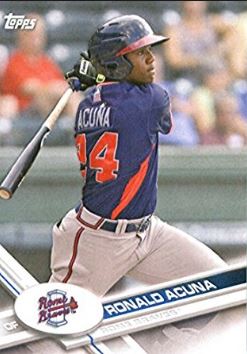
AcunaThe Braves’ 20-year-old rookie outfielder – Ronald Acuna, Jr. – scorched NL pitching in August. He hit .336, smashed an MLB-high (tied with the Brewers’ Christian Yelich) eleven round trippers, drove in 19 runs (eighth in the NL) and scored an MLB-high (tied with the Red Sox’ Mookie Betts) 25 times.  Later, in the individual  highlights, you can learn more about this rookie’s historic August power output.  Oh yes, and he swiped six bases in nine tries.

Other Contenders: The Dodgers’ 3B Justin  Turner turned it on in August, hitting an NL-best  .402 for the month, tied Acuna for the NL lead in hits with 39, popped  six home runs, drove in 20 (fifth in the NL) and scored 22 (second in the NL).  David Peralta of the Diamondbacks (.361-10-21) and the Padres’ Hunter Renfroe, with a .302 average, nine homers and a league-best 27 August RBI also deserve mention.

Pitcher of the Month – Cole Hamels, Cubs

There were lots of contenders for this recognition, as 13 National pitchers who logged at least 25 innings put up August earned run averages under 2.00.  BBRT will go with the lowest of the low.  It is, in fact, looking like the Cubs may have made the best July trading deadline move when they acquired Cole Hamels from the Rangers. Hamels, who was 5-9, 4.72 with Texas, put up a 4-0 record with a microscopic and MLB-lowest (among pitchers with at least 25 innings pitched in August) 0.69 earned run average in his first month with Chicago. Hamels went 39 innings in six starts, walking eleven and fanning 38.

Other Contenders: The Mets’ Jacob deGrom went 3-2 in six starts, but deserved better. The Mets scored just one run in each of his losses.  For the month, deGrom led MLB with 60 strikeouts and 43 2/3 inning pitched and put up the NL’s sixth-best August ERA at 1.24.  BBRT also looked at the Cardinals’ Jack Flaherty, who went 4-0, 1.13 in five starts. Another Cardinals’ rookie – Austin Gomber – deserves recognition as MLB’s only five-game  winner in August. Gomber  went 5-0, 2.38 in seven August appearances (six starts).  The Phillies’ Aaron Nola pitched some big  games (against some big names – outdueling Max Scherzer and Noah Syndergaard) on his way to a 3-0, 1.06 August (with 35 strikeouts in 34 innings).

AMERICAN  LEAGUE

Player of the Month –  Tie: J.D. Martinez, RF, Red Sox & Miguel Andujar, 3B, Yankees

BBRT is celebrating a veteran and rookie in the AL this month.  Boston’s veteran DH J.D. Martinez not only hit .373 for the month, he smacked seven home runs and drove in 25 (third in the AL). He also scored 24 times (second in the AL) and had the league’s highest on base + slugging percentage among qualifiers at 1.139.

Yankees’ rookie 3B Miguel Andujar tore it up in August – to the tune of .320-10-29; finsihing with the AL’s highest August home run total (tied with the A’s Khris Davis) and MLB’s highest RBI total (tied with the Rangers’ Rougned Odor). Andujar also scored 21 runs (seventh in the AL).

Other Contenders: Texas’ 2B Rougned Odor tied Andujar for the MLB lead in August RBI with 29, and scored 23 times, while hitting .269 with seven long balls. The Astros’ Marwin Gonzalez was also a contender, with an August stat line of .303-8-20 – along with 19 runs scored. And, the Astros’ Tyler White made a splash, with a .325-8-23 August.

Pitcher of the Month – Blake Snell, Rays

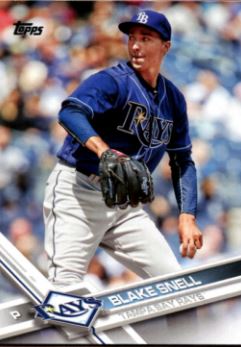
snellBlake Snell went 4-0, with an AL-lowest (among pitchers with 25 August innings) 1.04 earned  run average. He also fanned 34 batters in 26 innings – giving up 11 hits and three walks (a league-low 0.65 WHIP). He was the class of the AL field in August.

Other Contenders:  Mariners’ closer Edwin Diaz (who already has 50 saves on the season) racked up an MLB-best ten August saves (in 11 opportunities) fanning 21 hitters (no walks) in 11 innings and putting up a 1.64 ERA.  The Indians’ Carlos Carrasco went 4-2, 1.85 in six starts and fanned an AL-high 50 batters (tied with Justin Verlander) in 39 innings.


___________________________________________________________

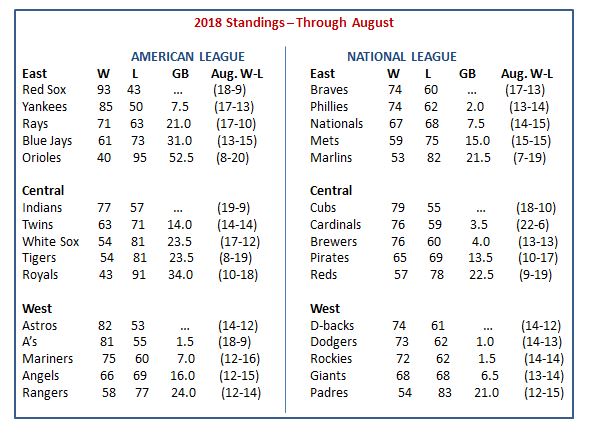
Now, how about those standings … and August team performance?

IF THE SEASON ENDED ON AUGUST 31, YOUR PLAYOFF TEAMS WOULD BE …

American League: Red Sox, Indians, Astros.   Wild Cards: Yankees, A’s

The most interesting AL race appears to be in the AL West, where the A’s trail the Astros by just 1 ½ games. Side Note: Baltimore is a whopping 52 ½ out in the tough AL East.

National League: Braves, Cubs, Diamondbacks.  Wild Cards: Brewers, Cardinals

Things are tighter in the NL, with the Diamondbacks, Rockies and Dodgers separated by just 1 1/2 games in the West; the Phillies just two back of Atlanta in the East; and the Cardinals having  surged to just 3 1/2 behind the Cubs in the Central.  

Here’s a few observations on August’s best and worst teams.

NATIONAL LEAGUE – AUGUST’S BEST (Cardinals) & THE REST

The Cardinals were baseball’s hottest team in August –  going 22-6. They were, in fact, the only team to reach 20 wins for the month. They did it primarily on the strength of their pitching staff – which put up an MLB-lowest 2.75 earned run average for the month. The club gave up just 82 runs (76 earned) in 28 games.  (They were actually no slouches on offense, leading the NL with 148 August runs scored.) On the mound, the Cardinals’ surge was led by 22-year-old righty Jack Flaherty and 24-year-old southpaw Austin Gomber. Gomber went 5-0, 2.38 (the majors only five-game winner in August). while Flaherty went 4-0, 1.13. Good news for Cards’ fans – both are rookies.  The Redbirds also got eight saves and a 1.86 ERA out of reliever Bud Norris.  On offense, RF Jose Martinez continued to put up MVP-consideration numbers – going .376-3-18 for the month. 1B Matt Carpenter hit only .255 in August, but chipped in some big hits (including  eight home runs). Carpenter scored 21 times in August, second in the NL.

Other NL teams having strong Augusts included:  The Cubs at 18-10 and the Braves at 17-13.  The Cubs finished the month 18-10  despite outscoring their opposition by only 13 runs (the Braves outscored their  foes by 26 tallies, the Cardinal had a plus-66 run differential).  The Cubs may have made the deadline pickup of the season – getting a 4-0, 0.69 month out of Cole Hamels. The offense was driven by 1B Anthony Rizzo (.340-7-17) and 2B Javier Baez (.288-7-16).

Like the Cardinals, the Braves relied on pitching – with a 3.03 ERA for the month, third-best in the NL.  Key contributors were newcomer Kevin Gausman (4-1, 1.69) and Mike Foltynewicz (3-2, 2.09). The Braves also got solid offense from a core group of young players like LF Ronald Acuna, Jr. (.336-11-21 in August) and 3B Johan Carmargo (.327-3-18), as well as steady production from  veterans like Ender Inciarte (.286-3-15) and Freddie Freeman (.283-2-13)The team is showing solid balance for the stretch run.

Bringing up the rear  of the National League (in August) were two teams that failed to win ten games – Marlins (7-19) and Reds (9-19).

AMERICAN LEAGUE – Rotation – Rotation – Rotation

The Indians led the AL in August wins at 19-9; relying largely on their starting rotation. (Close behind the Indians  were the Red Sox and A’s – both at 18-9.) The Tribe’s 3.10 staff ERA for August was the third-best in the AL, while there 132 runs scored was fifth. The Indians’ had a balanced offense in August with three players contributing five home runs and 16 RBI each. CF Melky Cabrera (.293-5-16), DH Edwin Encarnacion (.241-5-16) and 3B Jose Ramirez (.245-5-16). Also important were LF Michael  Brantley (.333 – with 16 runs scored and 13 RBI) and SS Francisco Lindor (who hit just .263, but crossed the plated 18 times).  It was, however, the rotation of Carlos Carrasco (4-2, 1.85); Corey Kluber (4-1, 2.81); Mike Clevinger (3-0, 2.21); and Shane Bieber (3-0, 3.81) that kept the Indians rolling toward the Central Division Crown.

Boston picked up 18 August victories more with a hammer than a scalpel. The team gave up 127 runs – by comparison, the Astros, A’s, Indians and Rays all gave up less than 95 – but the Bosox scored an MLB-high 166 tallies.  Missing “ace” Chris Sale (shoulder) for most of August didn’t help, although veteran David Price picked up the slack with a 3-0, 2.10 month. Still, there was enough offense to support the team’s 4.18 August ERA.  DH J.D. Martinez went .373-7-25 and scored 24 runs; RF Mookie Betts  went .354-4-14 with 25 runs scored; SS Xander Bogaerts drove in 21, to go with three homers and a.303 average; LF Andrew Benintendi hit .270 and scored 20 August runs – and the list of offensive contributors went on.

The A’s got strong performances from a couple of pitchers who did not start the season in Oakland – Mike Fiers (who came over from Detroit in early August) went 3-0, 2.73 in six starts for the A’s, while Edwin Jackson (released by the Nationals and signed by the A’s in June) went 2-1, 2.60 (but the A’s did win four his his five starts). The A’s offense flowed primarily through 3B Matt Chapman (.319-9-18 in August), 2B Jedd Lowrie (.293-4-16) and DH Khris Davis, who hit only .222 for the month, but belted ten home runs (tops in the AL) and drove in 20.

Two teams a failed to win ten games in the AL in August – Orioles (8-20) and Tigers (8-19). 

FULL STANDINGS AND AUGUST WON-LOST RECORDS CAN BE FOUND IN A GRAPHIC  NEAR THE END OF THIS POST. 

____________________________________________________________________________

TROT INDEX … A REGULAR BBRT FEATURE

Through August 31, , more than one-third (34.6 percent) of all MLB 2018 plate appearances have ended in a trot (back to the dugout, around the bases, to first base). We are talking about strikeouts, home runs, walks, hit by pitch and catcher’s interference – all outcomes that are, basically, devoid of action on the base paths or in the field. Here’s the breakout: strikeouts (22.1%); Walks (8.4%); home runs (3.0%); HBP (1.0%); Catcher’s Interference (less than .001%).  

______________________________________________________________

*HERE’S A LOOK AT THE AUGUST TEAM STATS*

—-LEAGUE LEADERS – TEAMS – FOR AUGUST—–

RUNS SCORED … MLB Team Average – 123

AL: Red Sox (166); Yankees (155); Rangers (143)

NL: Cardinals (148); Mets (145); Nationals (137)

Three teams tallied fewer than 100 runs in August: Marlins (86); Giants (93); Pirates (94). The Tigers were the lowest-scoring  team in the AL at 101 runs. 

BATTING AVERAGE … MLB Team Average – .253

AL: Red Sox (.275); Blue Jays (.260); Orioles (.260)

NL: Brewers (.273); Cardinals (.273); Reds (.265)

The Giants had the lowest batting average for August at .217, as well as the fewest home runs (15), and second-fewest runs scored.

HOME RUNS … MLB Team Average – 33

AL:  Yankees (53); Blue Jays (41); A’s (39)

NL: Dodgers (45); Brewers (44); Cardinals (40)

The Brewers led MLB in slugging percentage for August at .471. By contrast, the Giants slugging percentage was an MLB-low .319. The MLB team average was .416.

STOLEN BASES … MLB Team Average – 15

AL: Rays (33);  Indians (25); Royals (25)

NL: Dodgers (28); Rockies (22); Nationals (19)

The Twins had their difficulties on the base paths in August – swiping an MLB-low three bases and being tossed out on six-of-nine steal attempts. 

BATTERS’ STRIKEOUTS … MLB Team Average – 227

AL: White Sox (298); Yankees (242); Twins (238)

NL: Mets (260); Dodgers (255); Padres (254)

Ouch!

Cardinals’ batters appeared to be popular targets in August, as the team suffered an MLB-high 21 hit batters – nearly twice the major league average (11) for the month.

EARNED RUN AVERAGE … MLB Average – 4.14

AL:  Rays (2.76); A’s (3.02); Indians (3.10)

NL: Cardinals (2.75); D-backs (2.96); Braves (3.03)

Six teams recorded August earned run averages over 5.00, but only one – the Orioles –  topped 6.00 (6.42). 

PITCHERS’ STRIKEOUTS … MLB Average – 227

AL:  Yankees (317); Indians (280); Astros (260)

NL: Braves (267); Mets (266); Dodgers (256)

In August, the Orioles’ pitching staff gave up an MLB-high 51 home runs in 28 games. The Cardinals, by contrast, gave up just 16 long balls  in 28 games. 

SAVES … MLB Average – 7

AL:  Indians (10); Mariners (10); Twins (10)

NL: Cardinals (12); five with eight

The Royals converted only two of eight save opportunities in August – for an MLB-low 25 percent save rate. The lowest conversion rate in the NL went to the Marlins (four saves in 11 opportunities – 36.4 percent). The Rangers and Mets put up 100 percent save conversion rates in August – with eight and six saves, respectively,

________________________________________________________

——————HOW ABOUT A FEW AUGUST HIGHLIGHTS?——————————

A Sister Gets A Bobblehead

The highlight of August may very well have came at the hands (and strong right arm) of Sister Mary Joe Sobiek – who threw out (maybe “fired” is a better word) the cermonial first pitch at a White Sox game on August 18.  Sobiek, who teaches theology at Marian Cath0lic High School in Chicago Heights, IL, opened with a showy bounce of the baseball off her right bicep and  then tossed a curve ball for a strike (from the mound) to the White Sox’ Lucas Giolito. Sister Sobiek (called “Sister Mojo” by her students) was a three-sport athlete in college (College of Saint Scholastica, Duluth, MN) and says her athletic ability and energy help her relate to her students. For Minnesota readers, Sister Sobiek not only went to college in the state, she grew up in Saint Cloud and is a long-time Tweins fan.

In honor of the feat, the National Bobble Head Hall of Fame has created (and is selling) an “inspirationaL” bobble of Sister Sobiek in full windup.

Robbie Grossman on Players Weekend Nicknames

On the weekend of August 24-26, MLB celebrated its second annual Players’ Weekend – sporting colorful uniforms and equipment; sleeve patches honoring those who inspired them on their way to majors; and the MLB “Evolution” logo –showing a progression of five player images reflecting the progress from Little League to youth leagues to the major leagues.  Perhaps of greatest interest, however, were the names on the back of the jerseys, as players were able to choose a nickname for display that reflected their own personalities, passions or sense of humor.  For more on Players Weekend and a look at some of the best nicknames, click here.

There were a number of players who choose not to go with a nickname and BBRT appreciated the explanation offered by the Twins’ Robbie Grossman – “I worked to hard to get my name on the back of a major league jersey … that I don’t want to wear anything else.” Makes sense to me. 

_________________________________________________________________________

The Little League Classic …

On Sunday, August 26, Hawaii captured Little League World Series 2018 title with a 3-0 win over South Korea in Williamsport, PA. Hawaii went undefeated in the 16-team tournament, outscoring their opponents by a 26-3 margin.

While Hawaii may have captured the LLWS title, the combination of Little Leaguers and Major Leaguers captured a lot of hearts – as the Phillies and Mets traveled to Williamsport on Sunday, August 19th, for the Second Annual Little League Classic (a regular-season game played at BB&T Ballpark at Historic Bowman Field during the LLWS).  BBRT Note: Bowman Field, just a short distance from the Little League International Complex, is the second oldest minor league  ballpark in the United States (opened in 1926). The Mets won the game 8-2, in  front of a crowd of 2,429.

The real action, however, was the up-close interaction between the Major Leaguers and the Little Leaguers – plenty of smiles, handshakes and high fives, autographs, selfies and the sharing of hitting, fielding and pitching tips.  The Phillies’ Rhys Hoskins and “Big Al” Delia of the Mid-Atlantic Little League squad provided one of the day’s highlights, as they went on social media to share their mutual love of “hitting dingers.”  A number of the big leaguers took time to catch some Little League action in the afternoon – and, of course, the Little Leaguers and their fans and families returned the favor during the evening’s Mets/Phillies  tilt.  Oh, and “Big Al” was center stage again – catching the ceremonial first pitch from Mets’ 3B Todd Frazier, who was a member  of the Toms River East team that won the 1998 LLWS title.

A good time, it was said, was had by all.

Final Note: The Little League dinger machine showed up again oin August 28th, this time at batting practice before a White Sox/Yankees game, apparently exchanging long-ball stories with his Giancarlo Stanton and also admiring Aaron Hicks’ “Big Al Hits Dingers” t-shirt.

ULTIMATE AND IMMACULATE – BOTH IN THE SAME MONTH

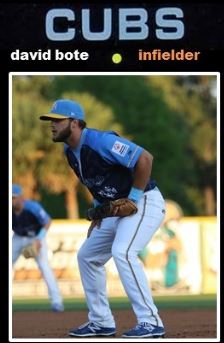
BoteIn the “What’s in a name?” category.  On August 12th, Cubs’ rookie infielder David Bote hit was is referred to as an “Ultimate Grand Slam” – a walk-off, Grand Slam home run coming when your team is down by three runs. He came to plate as a pinch-hitter – facing the  Nationals’  Ryan Madson with two outs, the bases loaded and the Cubs down 3-0.  Bote laced a 2-2 offering over the center field fence for an Ultimate Grand Slam.  (Note:  It wasn’t exactly a great inning for Madson, who loaded the bases on an infield single and two hit batters.) MLB.com reports that Bote’s was the 25th known Ultimate Grand Slam, just the fifteenth with two outs and the sixth by a pinch hitter.

August also saw two MLB pitchers toss “Immaculate Innings” … a 1-2-3 frame, with three strikeouts on nine pitches. On August 8, the Rockies’ German Marquez accomplished it against the Pirates (fourth inning – Corey Dickerson, Starling Marte and Gregory Polanco). On August 19, the Dodgers’  Zac Rosscup threw and Immaculate (ninth) Inning versus the Mariners (Kyle Seager, Ryon Healy, Cameron Maybin). More detail on Rosscup’s inning later in this post.

Colon Puts Exclamation Point on Career

On August 7, Rangers’ 45-year-old righty Bartolo Colon worked seven innings – giving up four runs on eight hits – in picking up an 11-4 win over the Mariners.  It was Colon’s 246th MLB victory, moving him past Dennis Martinez for the most victories by a Latin American born pitcher.  Colon added another win on August 13 to add to his mark – and finished August 10-15, 5.45 on the season and 247-187, 4.10 on his 21-season MLB career.

Youth Will Be Served

On August 14th, Braves’ 20-year-old rookie outfielder Ronald Acuna Jr. led off the bottom of the first inning against the Marlins with his 18th home run of the season.  That long ball was significant for a number of reasons:

  • It made the youngest MLB player to homer in five straight games.
  • It made him the youngest and just the second player (of any age) in MLB history to open three consecutive games with a first-inning leadoff home run. (The other was Brady Anderson in April of 1996).

But Acuna’s August accomplishments go even further. On August 13th, he hit first-inning leadoff home runs in both games of a doubleheader – becoming just the fourth player to accomplish that feat (Harry Hooper – May 30, 1913; Ricky Henderson – July 6, 1993; and Brady Anderson (August 21, 1999).

Most Home Runs by a Player in Their Age-20 MLB season …

Frank Robinson, Reds … 38 (1956)

Alex Rodriguez, Mariners … 36 (1996)

Tony Conigliaro, Red Sox … 32 (1965)

Ted Williams, Red Sox… 31 (1939)

Mike Trout, Angels … 30 (2012)

Al Kaline, Tigers … 27 (1955)

Ed Mathews, Braves … 25 (1952)

Orlando Cepeda, Giants … 25 (1958)

Note: Conigliaro also had 24 home runs in his 10-year-old season (1964).

Something for the Veterans as Well

Albert Pujols photo

Photo by bk1bennett

On August 10th, as the Angels topped the A’s 4-3, Angels’ DH Albert Pujols stroked a single to left in the sixth inning.  It was Pujols 1,000th American League safety – making him just the ninth MLB player to collect at least 1,000 hits in each league. (Pujols had 2, 073 hits with the Cardinals.)  Others on the list are: Frank Robinson, Fred McGriff, Dave Winfield, Carlos Lee, Vlad Guerrero, Orlando Cabrera, Alfonso Soriano and Carlos Beltran.


A GIANT BBRT RANT – Oh, The Insanity

On August 6, the Florida State League (Class A) Clearwater Threshers (Phillies’ farm club) faced off against the Tampa Tarpons (Yankees’ affiliate) in a double header. In the second game, Tarpons’ starter Deivi Garcia tossed seven perfect innings, with 12  strikeouts  (minor league doubleheaders are seven-inning games), but the Tarpon had also failed to score.

In the top of the eighth, the first extra inning, the Threshers (via a new minor league rule) started with a runner on second (against Tampa reliever Christian Morris). That runner scored on an error and a fielder’s choice.  Tampa remained scoreless in the bottom of the inning.  The end result – Tampa lost 1-0, despite tossing a no-hit game.  A few other oddities:

  • Christian Morris got the loss – despite the fact that he had nothing to do with the runner who crossed the plate.
  • The runner was treated as though he reached on an error (in terms of the pitcher’s earned run average) – although there was no error charged to a fielder or the team.
  • The base runner was credited with a run scored – despite getting a 180-foot head start.
  • Had Morris pitched a 1-2-3 inning, the perfect game would have been intact. (The”placed” runner does not affect a perfect game or a no-hitter.)

From BBRT’s standpoint, this “placed” runner rule should be scrapped.

Not So One-Der-Ful

In a five-game stretch from August 16th through August 21, the Chicago Cubs scored exactly one run in each game – and, in each contest, that lone run came on a solo homer. Surprisingly, despite the meager offensive output, the Cubbies won two and lost three over that span.

  • August 16th, Cubs top Pirates 1-0 in Pittsburgh. The only run scores on a fourth-inning Ian Happ home run.
  • August 17th, Cubs again best Pirates 1-0. This time on a second-inning solo home run by Kyle Schwarber.
  • August 18th, Cubs lose to Pirates 3-1 and the only Cubs’ tally comes on a third-innings solo shot by Ben Zobrist.
  • August 19th, Cubs lose to Pirates 2-1, the only Cubs’ run a second-inning home run off the bat of Kyle Schwarber.
  • August 21, Cubs lose 2-1 to Tigers (in Detroit), with the only Cubs’ run a sixth-inning home run by Anthony Rizzo.


It’s a Teen Kind of Thing

Juan Soto Nationals photo

Photo by pdeonarain

On August 29, 19-year-old Nationals’ rookie LF Juan Soto rapped his 16th home run of the season – a two-run shot that came in the third inning of an 8-6 Nationals loss to the Phillies.  The long ball moved Soto into a tied for the fourth-most MLB home runs home runs by a teenager (tie with Ken Griffey, Jr.). Still ahead, Mel Ott (19), Bryce Harper (22) and Tony Conigliaro (24).  In 89 games this season,Soto is hitting .292, with 16 home runs, 50 RBI and 62 runs scored.

Record Number of Twin Killings Secure 1-0 Win

On August 17th, the Cubs nipped the Pirates 1-0 in Pittsburgh – and, in the process, tied a major league record by turning seven double plays in a nine-inning game.  For the full story, click here.

A Walk-Off and a Balk-Off … Tough on a Pitcher

How about giving up a walk-off walk and a walk-off balk in the span of one week?  That got to be a little disheartening.

Saturday August 18, Dodgers’ reliever Dylan Floro was brought into a 4-4 tie (in Seattle) in the bottom of the tenth inning. At the time, the Mariners had runners on first (Robinson Cano) and second (Cameron Maybin) and one out.  Floro walked the powerful Nelson Cruz to load the bases – and then the fun began. With the sacks full, Dodgers’ 3B Justin Turner faked a move to the third base bag (a faux pick-off), the base runner (Maybin) flinched and Floro (also apparently “deked”) dropped his hands and stepped off the rubber – balking in the  winning run.

The August 18 balk-off came just six days after Flora gave up an August 12 walk-off walk in a 4-3 Dodgers’ loss at Colorado.  In that game, Flora came to open the bottom of the ninth of a 3-3 tie. He gave up a single to Rockies’ 2B DJ LeMahieu, who went to second on an error by right fielder Yasiel Puig.  Flora then fanned SS Trevor Story on four pitches. Next came an intentional walk to David Dahl to set up the double play. However, Ian Desmond was out on a slow  roller to third base – with the runners moving up to second and third. Another intentional walk (to Ryan McMahon) brought up catcher Chris Ianetta, with a force available at any base. A five-pitch walk plated the game-ending, game-winning run.  Side note:  Thinking about that new intentional walk (wave ’em to first) rule – Flora actually gave up three walks on five pitches.

By the way, don’t get the wrong idea about Floro. At the end of August he was 1-1, 1.66 with the Dodgers and 4-3, 2.33 on the season.

A Verlander Milestone

Justin Verlander photo

Photo by Keith Allison

On August 19th, the Astros’ Justin Verlander did not appear to be on the top of his game.  In the first inning of a critical game against the Oakland A’s (challenging Houston for the AL West Crown), Verlander gave up home runs to Oakland 3B Matt Chapman and DH Khris Davis – and after three innings, the two teams were knotted at 4-4. Verlander settled down and held the A’s scoreless into the sixth, with the Astros eventually picking up a much-needed 9-4 win.  The win was Verlander’s twelfth of the season (12-8, 2.65 ERA) and also the 200th of his 14-season MLB career.

MVP & Cy Young … A Winning Combination

Justin Verlander is one of just ten pitchers to win the Cy Young Award and Most Valuable Player Award in the same season. Note: One-half of the ten were Tigers (3) or Dodgers (2).  Here they are:

Don Newcombe – 1956 Dodgers – 27-7, 3.06 earned run average.

Sandy Koufax – 1963 Dodgers – 25-5, 1.88

Denny McLain – 1968 Tigers – 31-6, 1.96

Bob Gibson – 1968 Cardinals – 22-9, 1.12

Rollie Fingers – 1981 Brewers – 6-3, 28 saves, 1.04

Willie Hernandez – 1984 Tigers – 9-3, 32 saves, 1.92

Roger Clemens – 1986 Red Sox – 24-4, 2.48

Dennis Eckersley – 1992 A’s – 7-1, 51 saves, 1.91

Justin Verlander – 2011 Tigers – 24-5, 2.40

Clayton Kershaw – 2014 Dodgers – 21-3, 1.77

Fifty is Nifty

Edwin Diaz photo

Photo by THE Laura Smith

On August 25, Seattle closer Edwin Diaz came into a game (against the Diamondbacks) n the bottom of the tenth inning with the Mariners up 4-3. It wasn’t easy, but Diaz did pick up the save – despite giving up two hits and having one runner tossed out at home.  So, what makes this rather rocky save worthy of mention here? It was the 24-year-old right-hander’s 50th save of the season.  Diaz is the 14th (and youngest) player ever to record 50 saves. Three pitchers have had two 50-save campaigns: Eric Gagne, Mariano Rivera and Jim Johnson. Diaz, who had 34 saves in 2017, ended August with a 0-3, 1.97 record, with 50 saves and 108 strikeouts in 64 innings.


Top Five Most Saves in a Season

62 … Francisco Rodriguez, Angels (2008)

57 … Bobby Thigpen, White Sox (1990)

55 … John Smoltz, Braves (2002)

55 … Eric Gagne, Dodgers (2003)

53 … Randy Myers, Cubs (1993)

53 … Trevor Hoffman, Padres (1998)

53 … Mariano Rivera, Yankees (2001)

Zimmerman Hits 11th Walk Off Long Ball

It took a video review to get the job done, but on August 22, Nationals’ 1B Ryan Zimmerman bashed a two-run home run – with two-outs in the bottom of the ninth – to give the Nationals an 8-7 walk-off win over the Phillies.  It was Zimmerman’s 11th career walk-off home run, putting him just two behind all-time MLB leader in walk-off homers – Jim Thome. Standing between Zimmerman and Thome at 12 walk-off dingers each are: the still-active Albert Pujols and a group of Hall of Famers (Babe Ruth, Jimmie Foxx; Stan Musial, Mickey Mantle, Frank Robinson).

Guess that Single run Broke the ice.

On August 26th, the Nationals took on the Mets in New York.  Washington came into the game having failed to score in 27 consecutive innings – losing their previous three games by 2-0; 3-0; and 3-0. On the 25th, it looked like more of the same, as the Nats and Mets were tied 0-0 at the end of five (running Washington’s scoreless streak to 32 innings). Washington finally eked out a run in the top of the sixth on a double, single and RBI groundout.  That apparently broke the ice.  Over the final three innings of the game, the Nationals scored 14 more times (eight runs in the eighth and six more in the ninth) for a 15-0 win.

Double Your Pleasure … Double Your Fun

Matt Carpenter photo

Photo by d-deee

On August 26, Cardinals 1B/Leadoff hitter Matt Carpenter broke out of a bit of an August slump – and tied the MLB record for a nine-inning game with four doubles (as St. Louis topped the Rockies 12-3 in Colorado).

Carpenter, who came into the game hitting just .221 for the month, but with eight August round trippers,  got off to a good start, hitting two doubles to right off Tyler Anderson in the very first inning. (The Cardinals batted around and scored six times.)  He doubled to center off Chad Bettis in his next at bat (third inning); grounded out second-to-first to end the fifth; and doubled to center off Bryan Shaw in the seventh. On the day, Carpenter was four-for-five, scoring twice and driving in two.  Carpenter’s four doubles in a nine-inning contest ties him with 47 other players.  Albert Belle is the only player to accomplish the feat twice – on August 29 and September 23, 1999.

Seven Not Always So Lucky

Between August 19 and August 26th, Blue Jays’ 1B/DH Kendrys Morales went yard in seven straight games – coming within one of the MLB record.  Morales streak ended on August 27th, when he went zero-for-three with a walk. The Blue Jays won five of seven during Morales streak.  He hit .481 (13-for-27), with eight home runs, 13 RBI and nine runs scored during his run. Oh, and in the category of “In Baseball We Count Everything” – Morales did set the record for consecutive games with a home run by a switch-hitter.

The record of eight straight contests with a home run is shared by The Pirates’ Dale Long (May 19-28, 1956); Yankees’ Don Mattingly (July 8-18, 1987); and Mariners’ Ken Griffey, Jr. (July 20-28, 1993).

Walking ‘Em Off

On August 29th, Houston’s Tyler White hit a walk-off home run in the bottom of the ninth to give the Astros a 5-4 win over the vistiting A’s.  It was the 81st Walk off home of the season – breaking the single-season record for walk-off dingers (80) set back in 2004 … and we still have a month of baseball left.  Note:  At the end of August, the record was up to 83 walk-off home runs this  season.

Women’s Baseball World Cup …United States Finishes Fourth

Womens BaaseballThe Women’s Baseball World Cup wrapped up on August 31 (in Viero, Florida), with Japan winninng its sixth straight World Cup – topping Chinese Taipei 6-0.  Japan took the Gold, Taipei the Silver and Canada the Bronze (by topping the U.S. team 8-5 in ten innings in the third-place game). Japan went 9-0 in the 12-team tournament, while Taipei, Canada and the U.S. all went 6-3. 

Starring for the U.S. Team was OF/DH Megan Baltzell, who hit .500 for the tournament (third-best); hit a tourney-high two home runs; was second in RBI with 11.  Ayami Sato of Japan was named tournament MVP – going 3-0 in four pitching appearances with a o.37 earned run average and 18 strikeouts in 19 innings.

A tale of two Megans: Two Americans were selected to the All World Team – Megan Baltzell at DH (stats already noted) and relief pitcher Megan Meidlinger, who pitched in five games, picked up one save and allowed no runs on three hits and a walk (with three strikeouts) in five innings.

_______________________________________________________________________

You’ve read the highlights,now the stats.

—INDIVIDUAL LEADERS FOR AUGUST —

BATTING AVERAGE (minimum 75 August plate appearances)

AL:  Mallex Smith, Rays (.389); J.D. Martinez, Red Sox (.373); Whit Merrifield, Royals (.358)

NL: Justin Turner, Dodgers (.402); Jose Martinez, Cardinals (.389); David Peralta, D-backs (.361)

The lowest August average among players with at least 75 plate appearances during the month belonged to the Rays’ Jeff Bauers at .105 (8-for-76, with 17 walks). 

HOME RUNS

AL: Khris Davis, A’s (10); Miguel Andujar, Yankees (91); three with nine

NL:  Christian Yelich, Brewers (11); Ronald Acuna, Jr., Braves (11); David Peralta, D-backs (10)

The highest August Slugging Percentage (at least 75 plate appearances) was run up by the D-backs’ David Peralta (.732) in the NL and Astros’ Tony White (.711) in the AL.  The only other player over .700 was the Dodgers’ Justin Turner at .722.

RUNS BATTED IN

AL: Miguel Andujar, Yankees (29); Rougned Odor, Ranger (29); J.D. Martinez, Red Sox (25)

NL: Hunter Renfroe, Padres (27); Paul DeJong, Cardinals (22); David Peralta, D-backs (21); Ronald Acuna, Jr., Braves (21)

RUNS SCORED

AL: Mookie Betts, Red Sox (25); J.D. Martinez, Red Sox (24); Aaron Hicks, Yankees (24)

NL: Ronald Acuna, Jr., Braves (25); Justin Turner, Dodgers (22); Matt Carpenter, Cardinals (22); Christian Yelich, Brewers (22)

HITS

AL: Mitch Haniger, Mariners (41); Whit Merrifield, Royals (39); Miguel Andujar, Yankees (39)

NL: Justin Turner, Dodgers (39); Ronald Acuna, Jr., Braves (39); Lorenzo Cain, Brewers (37); Jose Martinez, Cardinals (37)

Among players with at least 75 August plate appearances, the Dodgers’ Justin Turner had the top on-base percentage at .491; the Rays’ Mallex Smith led the AL at .476.  The only other players over .450 were Boston’s Mookie Betts (.460) and J.D. Martinez (.453).

STOLEN BASES

AL: Aldaberto Mondesi, Royals (10); Mallex Smith, Rays (9); Jonathan Villar, Orioles (8); Greg Allen, Indians (8)

NL: Trevor Story, Rockies (9); Trea Turner, Nationals (8); Billy Hamilton, Reds (7); Amed Rosario, Mets (7)

The Pirates’ Starling Marte led all of MLB in caught-stealing in August – being tossed out in five of ten tries. 

BATTER’S STRIKEOUTS

AL: Yoan Moncada, White Sox (42); Chris Davis, Orioles (41); Giancarlo Stanton (40); Teoscar Hernandez, Blue Jays (40)

NL: Michael Conforto, Mets (42); Austin Jackson, Mets (38); Chris Taylor, Dodgers (33)

WALKS DRAWN

AL:  Aaron Hicks, Yankees (23); Mookie Betts, Red Sox (19); Jose Ramirez, Indians (18)

 NL: Juan Soto, Nationals (24); Matt Carpenter, Cardinals (20);  Andrew McCutchen, Giants (19); Brian Dozier, Dodgers (19)

Kyle Schwarber of the Cubs drew an MLB-high seven intentional walks in August. 

PITCHING VICTORIES

AL:  J.A. Happ, Yankees (4-0): Blake Snell, Rays (4-0); Jalern Beeks, Rays (4-0); Corey Kluber, Indians (4-1); Carlos Carrasco, Indians (4-2)

NL:  Austin Gomber, Cardinals (5-0); Cole Hamels, Cubs (4-0); Jack Flaherty, Cardinals (4-0); Zack Wheeler, Mets (4-1);  Kevin Gausman, Braves (4-1); Jhoulys Chacin, Brewers (4-2)

White Sox Rookie Dylan Covey appeared in eight August contests (four starts) – and went 1-6, 5.11,  leading all of MLB in August losses. On the season, he ended August 5-12. 5.61

EARNED RUN AVERAGE (at least 25 August innings)

AL:  Blake Snell, Rays (1.04); Carlos Rodon, White Sox (1.80); Carlos Carrasco, Indians (1.80)

NL:  Cole Hamels, Cubs (0.69); Aaron Nola, Phillies (1.06); Zack Wheeler, Mets (1.13); Jack Flaherty, Cardinals (1.13)

STRIKEOUTS

AL:  Justin Verlander, Astros (50 – 32 1/3 IP); Carlos Carrasco, Indians (50- 39 IP); Rick Porcello, Red Sox (45 – in 37 IP)

NL:  Jacob deGrom, Mets (60 – 43 2/3 IP); German Marquez, Rockies (53 – 42 IP); Max Scherzer, Nationals (49 – 38 IP)

SAVES

AL:  Edwin Diaz, Mariners (10); Blake Treinen, A’s (7); Ken Giles, Blue Jays (7); Jose LeClerc, Rangers (7)

NL: Bud Norris, Cardinals (8); Pedro Strop, Cubs (6); Brad Boxberger, D-backs (6); Brad Hand, Indians (6)

Being Stingy

Among pitchers with at least 25 August innings, Black Snell was the stingiest – giving up just 0.65 walks plus hits per inning pitched (WHIP). Snell allowed just 11 hits and six walks in 26 innings.

___________________________________________________________________

StandingSpet 1

—–LEAGUE LEADERS – TEAMS –  YEAR-TO-DATE (through August)—–

RUNS SCORED … MLB Team Average – 600

AL: Red Sox (738); Yankees (701); Indians (679)

NL: Cubs (644); Dodgers (638);  Braves (635)

The Marlins scored the fewest runs through August at 505 – while the Royals were at the bottom of the AL at 507.

BATTING AVERAGE … MLB Team Average – .249

AL: Red Sox (.269); Indians (.258); Astros (.256); Mariners (.256)

NL: Cubs (.263); Braves (.260); Reds (.259)

The Mets had the lowest team batting average through August (.235); while the Orioles were at the bottom of the AL’s (.238). Surprisingly, despite not having the DH, three of the top four MLB team batting averages (through August) belonged to NL teams. 

HOME RUNS … MLB Team Average – 156

AL: Yankees (221); A’s (186); Blue Jays (183)

NL: Dodgers (189);  Brewers (179); Cardinals (175)

The Tigers and Marlins suffered through MLB’s worst power outage through August, with just 112 home runs each. 

STOLEN BASES … MLB Team Average – 67

AL: Indians (109); Red Sox (101); Rays (98)

NL: Brewers (102); Nationals (95); Padres (81)

The A’s swiped the fewest bases through August (31). In fact, only three teams stole ‘fewer than 40 sacks through August – The A’s, Blue Jays (35) ad Twins (39).

BATTERS’ STRIKEOUTS … MLB Team Average – 1,137

AL: White Sox (1,302); Rangers (1,257); Yankees (1,178)

NL: Padres (1,297); Phillies (1,259); Brewers (1,233)

The Indians were the only team to fan less than 1,000 times through August at 976.

EARNED RUN AVERAGE … MLB Average – 4.15

AL:  Astros (3.14); Red Sox (3.61); Rays (3.69)

NL:  Dodgers (3.43); D-backs (3.52); Cardinals (3.66)

Three teams carried ERA’s of 5.00 or higher through July –  the Royals (5.18), Orioles (5.15) and Rangers (5.00)

PITCHERS’ STRIKEOUTS … MLB Average – 1,137

AL:  Astros (1,,411); Yankees (1,367); Red Sox (1,297)

NL: Dodgers (1,295); Phillies (1,209); D-backs (1,200)

Through August, the Astros were averaging MLB-tops 10.46 strikeouts per nine innings. The only other team averaging 10 or more was the Yankees at 10.10.   The Dodgers topped the NL at 9.48 strikeouts per nine innings.  Six MLB teams were averaging at least one whiff per inning. 

SAVES … MLB Average – 35

AL: Mariners (52); Yankees (42); Red Sox (40); Rays (40)

NL: Rockies (43); Dodgers (41); Phillies (39); Cubs (39)

BULLPEN AND STARTING STAFF ERAS

The best bullpen earned run average through August belonged to the Astros at 3.02. The D-backs bullpen ERA was the NL’s best at 3.09. Bullpens putting up ERAs of 5.00 or higher included the:  Marlins (5.31); Royals (5.18); Mets (5.02); Rockies (5.00).

The Dodgers put up the best ERA among starters (through August) at 3.17, while the Astros’ starters were the AL’s best at 3.19. Six starting staffs put up ERAs over 5.00 through August: Rangers (5.50); Orioles (5.41); Blue Jays (5.21); Reds (5.21); Royals (5.19; Padres (5.08).  Those six teams were a combined 180 games undeer .500 at the end of August.

__________________________________________

—INDIVIDUAL LEADERS FOR YEAR TO DATE (through August) —

BATTING AVERAGE (qualifiers)

AL:  Mookie Betts, Red Sox (.341); J.D. Martinez, Red Sox (.333); Jose Altuve, Astros (.326)

NL: Christian Yelich, Brewers (.317); Scooter Gennett, Reds (.317); Jose Martinez, Cardinals (.314)

The lowest average (through August) among qualifying players belonged to the Orioles’ Chris Davis at .173 (72-for-417).   Davis, who also has 16 home runs and 48 RBI, is the only qualifying batter hitting under .200.

HOME RUNS

AL: Khris Davis, A’s (39); J.D. Martinez, Red Sox (39): Jose Ramirez, Indians (37)

NL: Matt Carpenter, Cardinals (35); Nolan Arenado, Rockies (31); Paul Goldschmidt, D-backs (31); Jesus Aguilar, Brewers (31)

Astros’ 1B Yuli Gurriel leads MLB in grounding into double plays through August (22.)

RUNS BATTED IN

AL: J.D. Martinez, Red Sox (114); Khris Davis, A’s (104) Jose Ramirez, Indians (94)

NL: Javier Baez, Cubs (98); Eugenio Suarez, Reds (96); Jesus Aguilar, Brewers (93)

Among players with at least 25 plate appearances with runners in scoring position, the Twins’ Jorge Polanco has the best average with RISP through August at .436 (17-for-39). Another Twin is second on that list – Joe Mauer at .412 (28-for-68). Others at (or above) .400 with RISP are the Red Sox; J.D. Martinez (.403); Astros’ Yuli Gurriel (.402); Orioles’ Craig Gentry (.400). 

RUNS SCORED

AL: Francisco Lindor, Indians (110); Mookie Betts, Red Sox (109); J.D. Martinez, Red Sox (100)

NL: Charlie Blackmon, Rockies (96); Christian Yelich, Brewers (94); Ozzie Albies, Braves (90); Matt Carpenter, Cardinals (90)

The Rays’ Carlos Gomez appears to be MLB’s number-one target;  being hit by an MLB-high 20 pitches through August. 

HITS

AL: J.D. Martinez, Red Sox (164); Jean Segura, Mariners (159); Whit Merrifield, Royals (158)

NL: Nick Markakis, Braves (160); Freddie Freeman, Braves (160); Scooter Gennett, Reds (157)

The Angels’ Mike Trout had an MLB-best .458 on-base percentage (among qualifiers) through August; while the Reds’ Joey Votto topped the NL at .420.  Just five players were at .400 or above. 

STOLEN BASES

AL: Dee Gordon, Mariners (30); Jose Ramirez, Indians (29); Whit Merrifield, Royals (29)

NL: Trea Turner, Nationals (34): Sterling Marte, Pirates (30); Billy Hamilton, Reds (29)

War. Good God. What is it Good For?

Not a big fan of all the new stats, but I know some readers are.  So, your leader in WAR (Wins Above Replacement) through August is the Red Sox’ Mookie Betts at 9.0. The Brewers’ Lorenzo Cain leads the National League at 5.9. 

BATTER’S STRIKEOUTS

 AL:  Yoan Moncada, White Sox (186); Giancarlo Stanton, Yankees, (178); Joey Gallo, Rangers (175)

NL: Chris Taylor, Dodgers (158); Paul Goldschmidt, D-backs (147); two at 143

WALKS DRAWN

 AL:  Mike Trout, Angels (105); Jose Ramirez, Indians (88); Shin-Soo Choo, Rangers (82)

 NL: Bryce Harper, Nationals (96); Joey Votto, Reds (92); Carlos Santana, Phillies (92)

Mike Trout led all MLB players through July in intentional free passes with 20. The Cubs’ Kyle Schwarber led the NL with 19. 

PITCHING VICTORIES

AL:  Luis Severino, Yankees (17-6); Corey Kluber, Indians (17-7); Blake Snell Rays (16-5); Carlos Carrasco, Indians (16-7)

NL:  Max Scherzer, Nationals (16-6); Aaron Nola, Phillies (15-3); three at 14

EARNED RUN AVERAGE (qualifiers)

AL:  Chris Sale, Red Sox (1.97);  Blake Snell, Rays (2.05); Trevor Bauer, Indians (2.22)

NL:  Jacob deGrom, Mets (1.68); Aaron Nola, Phillies (2.10); Max Scherzer, Nationals (2.22)

STRIKEOUTS

AL:  Justin Verlander, Astros (240 – 181 IP); Gerrit Cole, Astros (234 – 170 2/3 IP); Chris Sale, Red Sox (219 – 146 IP)

NL: Max Scherzer, Nationals (249 – 186 2/3 IP); Jacob deGrom, Mets (224 – 182 IP); Patrick Corbin, D-backs (207 – 168 2/3 IP);

Among pitchers with at least 100 innings pitched through August, the Red Sox’ Chris Sale had the highest ratio of strikeouts per nine innings at 13.50. The only other hurlers above 12.00 were Gerrit Cole of the Astros (12.34) and Max Scherzer of the Nationals (12.01).   Forty pitchers with more than 100 innings logged through August struck out at least nine batters per nine innings.

SAVES

AL:  Edwin Diaz, Mariners (50); Craig Kimbrel, Red Sox (37); Blake Treinen, A’s (34)

NL: Wade Davis, Rockies (36); Kenley Jansen, Dodgers (33): Brad Boxberger, D-backs (31)

Pitchers Wins Above Replacement

The Phillies’ Aaron Nola  led all hurlers (through August) in Wins Above Replacement at 9.3, followed by the Nationals’ Max Scherzer at 8.0. Chris Sale was the AL leader at 6.5.


Primary Resources:  ESPN.com; Baseball-Reference.com; MLB.com

I tweet baseball @DavidBBRT.

Follow/Like the Baseball Roundtable Facebook page here.

Member: Society for American Baseball Research; The Baseball Reliquary; The Negro Leagues Baseball Museum


How the Game Has Changed – A Look at Rube Waddell

This post was triggered by yesterday’s (August 18) complete-game, 3-1 victory over the Phillies – logged by the Mets’ Jacob deGrom.  It was, as reported, his first complete game of 2018 and the third complete outing of his career.  He also lowered his earned run average to an MLB-best (among qualifiers) 1.71.  The outing made deGrom just the 29th pitcher to toss a complete game this season, with the five pitchers sharing the MLB lead with two 2018 complete games.

It led me to reflect on one of my favorite ballplayers of all time – Rube Waddell – who put up three seasons with earned run averages under 2.00 of his own. Please note that this post is not a criticism of today’s game (and the heavy use of relievers), but rather just an opportunity to share a look at one of MLB’s past “characters.” (No, I’m not only enough to have seen him play, just going on reputation.)

WaddellOn this date (August 19) in 1900, Rube Waddell took the mound for manager Connie Mack’s Milwaukee Brewers of the (then minor league) American League in the first game of a Sunday doubleheader.  (Note: The American League was designated a major league in 1901.)  Waddell was facing Charles Comiskey’s Chicago White Stockings – embroiled in a tough race with the Brewers for the American League championship.

Let’s set the stage. On the previous Sunday (August 12), Waddell had tossed a twelve-inning complete game, giving up just one run as Milwaukee topped Kansas City.  Four days later, he again went 12-innings – in a game against the White Sox that ended in a 1-1 tie.  Facing the White Sox again on August 19, Waddell went 17 innings in a 2-1 victory in the first game of a twin bill. Manager Connie Mack knew Game Two was critical to the pennant race and so he asked Waddell if he could pitch the second contest as well – promising him three days off to go fishing if he took on the task (knowing time off to play was the way to Waddell’s heart, head … and arm).  Waddell agreed to the deal and picked up a 1-0, one-hit win over Chicago – in a game shortened to five innings so that the Brewers could catch a train.

So, basically, Waddell threw four complete games (three of them extra innings) and 46 innings in eight days – including 22 innings in winning both ends of that August 19 doubleheader.  Waddell finished the 1900 season with Pittsburgh of the National League, where he went 8-13, despite an NL-low 2.37 earned run average.

Rube Waddell is almost universally recognized as the zaniest player in MLB history – but he also was one of the best (when he was focused on the game). Waddell was known to: leave a ball game to chase fire engines; miss a game he was scheduled to start because he was fishing or playing marbles with neighborhood kids; bring his outfielders in to sit on the grass and then proceed to fan the side (only in exhibition games of course); wrestle alligators in the off-season; enjoy more than an occasional libation; and (frequently) do battle with owners and managers.  Waddell simply was more interested in enjoying life in his own way than in money or professional stability.

Still, when Waddell set his mind and his heart to it, he could be something pretty special on the mound.  Thanks to his unpredictability, however, his professional career included stints with five major league clubs (13 seasons) and numerous minor league, independent, semi-pro and barn-storming teams. For BBRT’s Minnesota readers, Waddell was a 20-game winner for the 1911 American Association champion Minneapolis Millers.

Rube Waddell was born on Friday the 13 of October in 1876 and died on April Fools day 1914.  There is some symmetry there.

How good was Rube Waddell?  In 1902, he joined the Philadelphia Athletics in June – making his first start on June 26 (with just 86 games left in the season). Waddell proceeded to win 24 games (the league’s second-highest total) against seven losses, with a 2.05 ERA.  Despite his shortened season, he led the AL with 210 strikeouts, fifty more than the runner-up (none other than Cy Young). The 6’1”, 195-lb. lefty (fugures Waddell would be a southpaw) went on to lead the AL in strikeouts six consecutive seasons (1902-1907) – by a wide margin. (Note:  The Athletics, just two games over the .500 mark when they signed Waddell, finished at 83-53 and won their first American League pennant.)

In 1904, Waddell set a modern (post-1900) MLB record with 349 strikeouts that stood until 1965 (when Sandy Koufax fanned 382).   The next highest total in 1904 went to the Giants’ Jack Chesbro, a full 110 whiffs behind Waddell – despite pitching 71 2/3 more innings. That season, Waddell average 8.2 strikeouts per nine innings, at a time when the league average was 3.8.

Waddell, elected to the National Baseball Hall of Fame in 1946, finished with a 193-143, 2.16 stat line.  In the four seasons from 1902-1905, pitching for the Philadelphia Athletics, Waddell went 97-52, with a 1.88 earned run average and 1,148 strikeouts (versus 330 walks).  In those four peak campaigns, he threw 1,312 innings (an average of 328 innings per season), completed 126 of 145 starts and twirled 22 shutouts.

For more on Waddell, BBRT suggests: “Rube Waddell: The Zany, Brilliant Life of a Strikeout Artist,” by Allan Howard Levy and “Just a Big Kid: The Life and Times of Rube Waddell,” by Paul Proia.  They are both good reads.

Primary Resources: Society for American Baseball Research; Baseball-Reference.com; and the above-mentioned books.

I tweet baseball @DavidBBRT

Follow/Like the Baseball Roundtable Facebook page here.

Member: Society for American Baseball Research; The Baseball Reliquary; The Negro Leagues Baseball Museum.
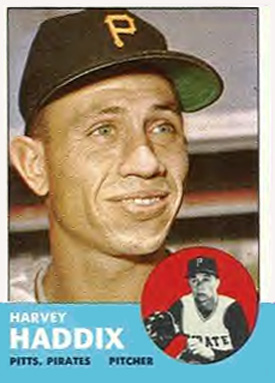
Home Runs Off Two Bob Millers – Ronald Acuna’s Streak – Some BBRT Rants and Raves

Double Vision – Or, “That’s Your Uncle(s) Bob.”

DemeterOn August 15, 1962, the Phillies topped the Mets 9-3 in the first game of a doubleheader at the Polo Grounds.  No big surprise there, as the Mets’ record going into the game was 30-88. What was more surprising was that Phillies’ outfielder Don Demeter hit his 19th and 20th home runs of the season in the game – off a right-handed and a left-handed “Bob Miller.” Oh yes, and he did it while playing two different defensive positions.

In the third inning, with the Phillies’ up 2-0, Demeter (who had started the game in left field and in the five-spot in the order) smacked a solo shot off starter (right-hander) Robert Lane Miller. Then in the ninth inning, Demeter – who had moved to center field in the seventh – hit a three-run homer (extending the Phillies’ lead to 9-2) off southpaw reliever Robert Gerald Miller. Two homers, in one game, off two Bob Millers, a right-hander and a port-sider.

Demeter, notably, was on the way to his best-ever major league season. In 1962 (his sixth of eleven MLB seasons), he achieved his career highs for average (.307), home runs (29), RBI (107), runs scored (85), hits (169) and doubles (24). The two Millers?  Starter Bob Miller went 1-12, 4.89 in 1962 (69-81, 3.37 with 52 saves in 17 MLB seasons). Reliever Bob Miller went 2-2, 7.08 in 1961, the last of his five MLB seasons (6-8, 4.72).

AcunaNow, events like Don Demeter’s home runs in the same game off a righty and lefty both named Bob Miller are just the kind of thing that catches BBRT’s eye. But, even more eye-catching is the recent work of Atlanta Braves’ 20-year-old rookie outfielder Ronald Acuna, Jr.  As of Tuesday night, Acuna was hitting .288, with 19 home runs and 43 RBI in 67 games.  And, he’d tossed in eight stolen bases in ten tries.  And, there is more. See the bullets below for just a few of the landmarks Acuna has reached.

In the past five games (August 11-14), the Braves’ Ronald Acuna Jr. has hit .500 (10-for-20), with six home runs, 12 RBI and nine runs scored. He’s walked three times and fanned just twice.

  • Acuna has homered in five straight games – becoming the youngest player to accomplish that feat.
  • Acuna homered, in his first at bat, as the leadoff  hitter, in the three most recent of those contests – becoming the youngest player ever to accomplished that feat (and just the second all-time … Brady Anderson had leadoff  homers for the Orioles in four straight in 1996).
  • As part of the three-game leadoff homer streak, Acuna led off both games of a doubleheader (August 13) with a home run – becoming the youngest ever and just the fourth player in MLB history to accomplish that feat (Harry Hooper in 1913; Rickey Henderson in 1993; Brady Anderson in 1999).

—THE OLD AND NEW OF IT – SOME RANTS AND RAVES—

Yep, I’m kind of old school, but after returning from my annual Ballpark Tours trip (seven games in three cities in ten days) here are few random observations (that readers may or may not agree with):

  • I don’t care much for the DH or challenges/replays. My gut says bad calls even out – and it is still a “game.”
  • I’m okay with defensive shifts. Good hitters should learn to “hit the other way.”
  • I can’t stand the “wave ‘em to first” intentional walk. Too much like slow-pitch softball.
  • The food options at ballparks are better than ever. I do NOT miss the days when the extent of the menu seemed to be hot dogs, beer, popcorn, cotton candy, licorice ropes and Frosty Malts. Let’s eat!

I’m all for more emotion on the ball field. 

On Sunday, Cubs’ rookie David Bote came into Chicago’s contest against the Nationals as a pinch-hitter with two outs in the bottom of the ninth, the sacks full of Cubs (Jayson Heyward, Albert Amora and Kyle Schwarber) and the Cubs trailing 3-0.  With the Cubs down to their last strike (a 2-2 count on Bote), Bote took Ryan Madson  deep for what is termed an “Ultimate Slam” – a walk-off Grand Slam when your club is down by three runs.

An excited Bote celebrated with what could best be described as a “subdued” bat flip. The rookie later apologized for the show of emotion. From Baseball Roundtable’s point of view, no apology necessary. The nation’s “game” could use more on-the-field emotion – from bat flips, to high fives to fist bumps.

  • I like the drama of a “closer” coming into the game with ominous or aggressive walk-on music (not as enthusiastic about having seventh- and eighth-inning specialists).
  • I care about how many home runs a player has hit and how far the long ball I just witnessed traveled. Launch angle and exit speed?  Not so much.
  • Today’s crop of young ballplayers is the best/most-exciting I’ve seen in decades. I’m reminded of the group I witnessed coming up in the ‘50s.
  • I’m disappointed by the ever-declining number of people who keep a score card at the game – and the ever-increasing number of people who seem glued to their smart phones.
  • I kind of like the video board activities between innings, especially those that focus on fans having fun – Kiss Cam, Air Guitar, etc.  (With the condition that it be between innings.)
  • Three hours doesn’t seem that long to me when I’m in a ballpark.
  • Bunting seems to be a lost art – although National Leaguers appear to be marginally better at the sacrifice.
  • I’m not much for video boards urging fans to “make noise.” Fans should know when there’s a reason to cheer, shout or clap.
  • I don’t care for the characters in costume races (sausages, presidents, dental care products, etc.). The one exception is “The Freeze” in Atlanta. I love that guy.  (I also like when they have a youngster come out between innings to “steal” a base in 20-or-30 seconds. Let’s get the kids involved.)
  • Ban the wave – Or, please, don’t start it with two on and no outs in a one-run game (that happened on my recent baseball trip).
  • It’s great to see youngsters running the bases on Kids’ Days at various ball parks – and also great to see an adult snag a foul ball and give it to a kid.
  • Fireworks Fridays work for me.
  • Players who sign autographs for fans are good for the game.
  • Any more than three ceremonial “first” pitches are too many. One minor league game on our trip featured 17 folks making tossing a first pitch (with varying degrees of success and comedy).
  • The national anthem is supposed to be sung at a brisk pace.
  • Walk-up music is great, especially when you can make the connection to the player.
  • If I catch a home run, I’m not throwing the ball back, no matter which team hit it.
  • Players’ Weekend nickname jerseys? Genius! I wish MLB players had more regular nicknames –  miss the days of Stan the Man, The Splendid Splinter, Dr. Strangeglove, The Mad Hungarian, etc.  Who knows, maybe some of the Players’ Weekend monikers will stick.
  • Don’t people know that you stop walking to your seat and turn and face the flag when the National Anthem begins?
  • I understand those 50-50 or 60-40 charity raffles support good causes, but they seem a little “carnival-like” to me.
  • Not a fan of pitch counts, especially when the starter is cruising along with a shutout (or even a no-hitter.)
  • The biggest differences observed between Triple and Major League ball was pitchers’ control and fielding skills.
  • Possible dumbest rule ever? Starting extra innings with a runner at second.
  • Robot umpires calling balls and strikes? Please, NO! Pitchers and batters adjusting to the umpires “zone” is part of the game.  I, personally, like to watch how pitchers and catchers work to try and expand the zone.
  • In general, it seem to me that we need more vendors in the stands.
  • I really like concourses thet let you go all around the ballpark/playing field. 
  • Not fond of the areas you seem in some parks that have everything from mini-golf, to merry-go-rounds to batting cages.  Who’s watching the game?
  • Team Hall of Fames are a great place to visit – before the game.
  • I appreciate fans who arrive early and stay until the last out.  At one contest, I saw a group take their seats in the bottom of the third and then leave (their squad was down by four runs)  in the seventh.
  • Best play in baseball?  Tough one.  I love the ballet of the 6-4-3 and 4-6-3 double play.  Stolen home runs are spectacular. Triples (or the rare inside-the-park home run) always get me up out of my seat – as does a steal of home (only seen three of those).  Side note: Through July, about 35 percent of MLB plate appearances ended in a trot (to first base on a walk, hit by pitch or catchers’ interference; back to the dugout on a strikeout; or around the bases on a home run). I prefer more actions in the field or on the basepaths.

Well, now that I’ve gotten all that off my chest.  Have a great day and “Play Ball!”

I tweet baseball @DavidBBRT.

Like/Follow the Baseball Roundtable Facebook page here.

Member: Society for American Baseball Research; The Baseball Reliquary; The Negro Leagues Baseball Museum.
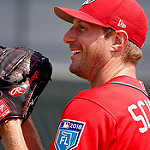
Ballpark Tours Rocky Mountain High Redux (Day Five) – Charlie Blackmon’s 1000th Hit … Don Drysdale’s 1961 Dodgers uniform … Taco Tuesday … and more.

busDay Five (Game Four) of the Rocky Mountain High Redux started with the familiar complimentary hotel breakfast – and moved on to a trip to the National Ballpark Museum. Before I get to that, however, a couple of observations on Denver and our tour group.

In Denver (on a visit) the 16th Street Mall is the place to be (stay near there if you visit).  As noted earlier, the free up-and-down the Mall shuttle runs from 5 a.m. until 2 a.m. – and most of the eating, drinking and entertainment locations remain open until 2 a.m.  There are also plenty of shopping opporunities for luxuries, souvenirs and even essentials. (Hey, Minnesotans, there’s a Target right on 16th Street.)  Near the 16th Street Mall you will also find a host of museums – ranging from the National Ballpark Museum to the American Museum of Western Art to the Colorado History Center. (More on museums coming.)  The Holiday Inn Express our Ballpark Tours stayed at was within walking (or free shuttle) distance of all of the above. That’s one of the advantages of BPT’s lodging philsophy of always staying near the action and attractions.

limeThere are other advantages when traveling with a group like BPT. For example, yesterday – at about lunch time – I received a text from a fellow BPT trekker that informing me of Taco Tuesday at a nearby Mexican Taverna – great tacos for a dollar, and walking distance.  My roomate and I were there to enjoy this “find” within 20 minutes.  To your left, is an example of the dollar tocos, which were available in hard or soft, flour or corn and beef, chicken, carnitas, seafood and vegetable.  The only requirement?  You had to buy a beverage – which was no problem for our group.


THE GAME – PIRATES 10 – ROCKIES 2

coors outzsideNow, we did go to the National Ballpark Museum before the Pirates/Rockies game, but let’s take a look at the game first.  Viewing baseball is, after all, the number-one purpose of this trek.

Game four of our seven-game trip was another 6:40 p.m. Pirates at Rockies contest.  Contest may be a misnomer, as the Pirates jumped out 10-0 lead after five innings and held on to win 10-2. A few observations and highlights (or low-lights) from the game:

  • Power was the order of the day. Both teams had ten hits, but the Rockies had eight singles (two doubles), while the Pirates had six singles, a double and three home runs (Starling Marte – solo in the first; Jody Mercer – three-run shot in the fourth; Josh Harrison – two-run dinger in the fifth).
  • We did see a 2018 rarity, Pirates’ starter Jameson Taillon pitched a complete game, despite giving up ten hits. (He finished off the Rockies on 107 pitches (70 strikes), walking just one and fanning three, while allowing two runs.)

HOW THE GAME HAS CHANGED

Last night, Jameson Taillon became the first National League pitcher to log two complete games in 2018. 

  • I got to see a pair of double plays (1-4-3 and 5-4-3) both off the bat of Rockies’catcher Chris Ianetta.
  • Pittsburgh scored ten times and left just two men on base.
  • The game – despite 20 hits and 12 runs – moved right along, wrapping up in two hours and 34 minutes. The pitchers deserve the credit.  For the most part, they practiced a “get-the-ball, throw-the-ball” mound style.
  • Despite ten hits, the Rockies were a woeful one-for-twelve with runners in scoring position.

CHARLIE BLACKMON’S 1000th SAFETY

Rockies’ CF Charlie Blackmon lined a single to right with one out in the top of the sixth inning (eventually coming around to score the Rockies’ first run).  It was Blackmon’s 1,000th career base hit. Blackmon had been zero-for-twelve since collecting his 1, 999th hit.  The Rockies’ leadoff hitter and 2017 NL batting champion (.331) ended the game hitting .279-21-49 on the season and .302 over is eighth-season MLB  career. He got a nice standing ovation that he seemed reluctant to bask in. (The Rockies were down 10-0 when he got the base hit and he is “gamer.”)


You can buy "outside" food, beverages and souvenirs at bargain prices right up to the main gate. Just look for the vendors tall signs.

You can buy “outside” food, beverages and souvenirs at bargain prices right up to the main gate. Just look for the vendors tall signs.

A few additional thoughts.  You can save a lot of money on snacks if you buy them outside the game – and the Rockies have few rules about outside food or beverage.  In fact, amateur vendors work the area right up to the main gates.

For this game, our seats were in right field and (for those Minnesotans who remember sitting above the RF “baggie” at the HHH Metrodome) we did miss a two or three plays in deep right or center.

tripleplaydogBBRT’s new, semi-official correspondent Mike Bailey tried one of the Rockies’ newest concessions – the Triple Play Dog (hot dog topped with pulled pork bacon bit and purple slaw). Just $7, he said it was a meal in itself and gave it two thumbs up.  “It was so good, I didn’t even want to put mustard on it. I just wanted to enjoy the taste.” The sweet Berry Kabobs ($8) also drew kudos.  More on concession in my next post; when I will look at (consume) the Rocky Mountain Oyster Po’ Boy and Baseball Roundtable’s traditional ballpark Bloody Mary.

Now, let’s step back in time to BBRT’s pre-game visit to the National Ballpark Museum.

The National Ballpark Museum

We made it down to the National Ballpark Museum – 1940 Blake Street, just a half-block from the stadium. A great visit ($10 Adults – $5 Seniors – Kids under free). Here, you enter through a 1909 entrance turnstile from Shibe Park and are treated to artifacts from 14 classic ballparks and more. Among the most prominent displays are: Shibe Park/Connie Mack Stadium (Philadelphia); Crosley Field (Cincinnati); Tiger Stadium (Detroit); Comiskey Park (Chicago); Sportsman’s Park (Saint Louis); Fenway Park (Boston); Yankee Stadium and The Polo Grounds (New York City); and Ebbetts Field (Brooklyn).  And that’s just the tip of the iceberg in this store front-sized museum.

Minnesota Fans May be Interested in this Harmon Killibrew Item

KillerMuseum Manager Raelee Frazier, who you are likely to find on site, is a knowledgeable historian and adept story teller.  I came across a poster of old Griffith Stadium (one-time home of the Washington Senators) signed by Harmon Killebrew.  It read “A whiff of ‘Bond Bread’ for B’s Ballpark Museum, Harmon Killebrew, HOF ’84.” Ms. Frasier filled me in on the notation.  The “B” was for Bruce (B or Mr. B) Hallerstein, who created the museum.  The reference to a whiff of Bond Bread was noting Killebrew’s appreciation of the  sweet smell of the product of the General Baking Company, which was located near Griffith Stadium.

The museum visit was a wild and wonderful trip back in a baseball time machine, thanks to the museum’s creator and curator Bruce “B” Hallerstein. You’ll find such items as seats and usher uniforms from classic (and, in many cases, long-gone ballparks); concourse lights from Ebbetts Field; and a piece of the Fenway Wall.  You can also spot more personal items like autographed baseballs and bats from stars of the past, like Don Drysdale’s 1961 Dodgers uniform and a Reggie Jackson commemorative bat.  And, there are unique and quirky items like a commemorative statue of Don Larsen’s World Series perfect game; a Chicago Cubs pinball machine; and menus from Mickey Mantle’s New York City restaurant.

There is all of this and much more.  Definitely worth a visit if you are a baseball fan or a history buff.  You should leave yourself plenty of time to peruse this jam-packed, but well-organized and labeled collection.  Here are a few photos to help tell the story.

Sign from Shnibe Park from the days when kids of all ages came to the ballpark on thier own,

Sign from Shnibe Park – from the days when kids of all ages came to the ballpark on their own,

These usher's uniforms were once a common sight at Fenway Park.

These usher’s uniforms were once a common sight at Fenway Park.


Concourse lights from Ebbetts Field.

Concourse lights from Ebbetts Field.


seats

Seats and histotic information from parks long gone. Did you know, for example, that exactly 11,111 home runs were hit at old Tiger Stadium?


Tomorrow, another Pirates-Rockies game, food and beverage reviews and a a museum visit that covers everything from Babe Ruth’s baseball glove to John Denver’s guitar to the 2014 Denver County Fair’s “World’s First Pot Pavilion.”


I tweet baseball @DavidBBRT

Follow/Like the Baseball Roundtable Facebook page here.

Member: Society for American Baseball Research; The Baseball Reliquary; The Negro Leagues Baseball Museum. 
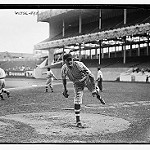
July MLB – Led By Kiké and the Babe

Well, we’ve reached August  – and with July’s games,  the All Star Game, the Hall of Fame ceromonies and the trade deadine behind us, it’s time for Baseball Roundtable’s monthly wrap-up.  So, let’s take a look at the MLB stats and stories that caught BBRT’s eye in the month of July, as well as BBRT’s Players and Pitchers of the month, the standings and 2018’s batting and pitching leaders.  But first a look at the July connection between Kiké Hernández and Babe Ruth.

Kiké and The Babe … Sharing the Record Book

HernandezRegular readers know how BBRT loves an iconic or ironic coincidence.  Well, on July 24, a truly “bad day at the office” for Dodgers’ utility man Enrique “Kiké” Hernández led to just that. So, Hernández will lead off BBRT’s July Wrap.

Hernández started the game (at home against the Phillies) at 2B , moved to RF in the 14th inning and ended up on the mound (as the Dodgers’ ninth pitcher of the game) in the 16th.  The results?  Hernandez went zero-for-seven at the plate – AND got the loss, giving up a three-run, walk-off home run to Trevor Plouffe, as the Dodgers went down 7-4 in 16 frames. That long ball made Hernández the first MLB full-time position player ever to give up a walk-of home run. (How often are position players on the mound with the game still on the line?)

So, what does this have to do with The Babe?

RuthOnly two players in MLB history have played the infield, outfield and given up at least three runs on the mound all in one game.  Hernández and George Herman “Babe” Ruth (LF-1B-P on October 1, 1921).

Ironically, Hernández shares another record with the iconic Ruth. They are both among the 10 players top launch a record three-home runs in a post-season game. Babe Ruth (who did it twice) was the first – in Game four of the 1926 World Series. Hernández is the most recent – in Game Five of last year’s NCLS.

Side note:  In that 1921 game, Ruth started in LF, later moved to 1B and then took the mound in the top of the eighth, protecting a 6-0 Yankee lead over the Philadelphia Athletics.  The Bambino gave up a game-tying six runs in the eighth frame, but pitched a scoreless ninth, tenth and eleventh to get the win (7-6).

_______________________________________________________

Now it’s time to move on a look at BBRT Players and Pitchers of the Month.

AL PLAYER OF THE MONTH … Jose Ramirez, 3B Indians

Photo by Keith Allison

Photo by Keith Allison

It was a close contest for BBRT American League player of the month, but – appropriately – speed won the race. The Indian’s Jose Ramirez hit .322 for the month, bashed eight round trippers (fourth in the league), tied for second in July RBI (25) and was third in runs scored (21).  The other two top contenders had similar number across all those categories, but did not match Ramirez in the speed department, as the Indians’ third sacker stole an MLB-tops 11 bases (12 attempts) in July.

Other contenders: A’s RF Khris Davis. Whoa. Where did that come from? The A’s Khri Davis came into July hitting just .231 (but with 20 home runs). Davis raked at a .323 pace for the month, launching nine (second in the AL) home runs and driving in an MLB-tops 29. Davis also scored 18 times.  And he did all this while striking out in in nearly one of every three at bats (32 whiffs in 99 at bats).   The Angels’ Kole Calhoun earned consideration by putting up a .322 average, an AL-leading ten June home runs, 25 RBI (second only to Davis) and 20 runs scored (fourth in the AL).

AL PITCHER OF THE MONTH … Chris Sale, LHP, Red Sox

Chris Sale REd Sox photo

Photo by Keith Allison

Chris Sale tossed 25 innings in four July starts – and gave up just one (yes, one) earned run. That amounted to an MLB-best (among qualifiers) 0.36 July earned run average.  Sale won three games (no losses). In his one no-decision, he went six innings, giving up no runs on three hits and two walks while fanning ten. For the month, the dominating southpaw also fanned 43 batters, while walking just four. All of this made him a pretty easy choice for BBRT AL Pitcher of the Month.

Other contenders:  Indians RHP Carlos Carrasco went 4-0 for July, with a 2.59 earned run average and 32 strikeouts in 24 1/3 innings. He started four games and even came on in relief for one appearance – a clean two-strikeout eighth inning against the Yankees on July 15 (that earned him a win). Also considered was Mariners’ closer Edwin Diaz, who saved nine games (tied for the AL lead); pitched ten innings (in ten appearances); fanned 19; gave up just two hits and two walks (one unearned run, which cost him a loss). Diaz now leads MLB with 40 saves; seven more than the next best (Craig Kimbrel).

NL PLAYER OF THE MONTH …  Christian Yelich, CF, Brewers

YelichYou simply can’t ignore the fact that Brewers’ outfielder Christian Yelich hit at a .400 pace for the month of July (the highest average among players with at least 75 plate appearances). While he popped just four home runs, his 23 RBI tied for the most in the NL for the month and his 20 runs scored were the NL’s third-best. Yelich had an MLB-tops 42 hits in July, and he had 15 multi-hit games (out of 26). In the process, he raised his season average from .289 to .321. Yelich also swiped three bases in four attempts.

Cardinals’ 1B Matt Carpenter’s bat came alive in July. After hitting .259, with 15 home runs through June (76 games), Carpenter upped his game in July (in 26 contests). He hit .333 for the month and led the league in July home runs (11, which led all of MLB), topped the NL in runs scored (22), and was fifth in RBI (21). Nineteen of his 31 hits went for extra bases, and his .774 slugging percentage for the month led MLB.

Other contenders: BBRT also looked at Cubs’ 2B Javier Baez (.343-6-23, with six stolen bases) and the Rockies’ slick-fielding, hard-hitting 3B Nolan Arenado (.307-8-22).

NL PITCHER OF THE MONTH … Zack Greinke, RHP, Diamondbacks

Zack Greinke photo

Photo by jnashboulden

Zack Greinke went 4-0 in five July starts for the D-backs. He 1.60 earned run average was the lowest among NL qualifiers (at least one inning pitched for each game his team played) and his 35 strikeouts (33 2/3 innings) ranked fourth in the NL. He walked just five hitters.

Other contenders: Phillies’ RHP Aaron Nola only went 2-1 in five starts for the month, but he tied for fourth with 35 strikeouts (33 innings), while walking just seven and also put up a nifty 1.91 earned run average.  BBRT also considered the Brewers’ Jhoulys Chacin, who went 4-0 for the month (five starts), with 27 strikeouts (30 2/3 innings) and a 2.64 earned run average.

_________________________________________________ 

Let’s move on to bit of a July overview.

AMERICAN LEAGUE

Nobody outplayed the Boston Red Sox in July, as they went an MLB-best 19-6 for the month – holding off the Yankees who had the league’s third-best record at 15-10.  The A’s had the second-best month in the AL at 17-8.

The Red Sox scored the AL’s fourth -highest run total for July at 134 and gave up the league’s fewest runs (87). Their  July offense was led by the likes of Mookie Betts (.330-5-15) and J.D. Martinez (.310-7-22); while Chris Sale (with his July ERA of 0.36) and closer Craig Kimbrel  (with an AL-best nine saves) led the mound staff. The Yankees relied heavily on power, launching a league-topping 37 July home runs (scoring 140 times); while surrending the fifth-lowest AL run total (102).  Surprisingly, despite leading the AL in home  runs for the month, the New York squad had no one in July’s top-ten.  Topping New York in home run sfor the month was Aaron Hicks with six, followed by Giancarlo Stanton and Aaron Judge  with five each. The A’s surrended the sixth-fewest runs in the AL, and scored the fifth most (133).  Critical to the A’s success was Khris Davis with a .323 July average, nine home runs and an MLB-best 29 RBI.

Those closest races in the AL see the Red Sox out in front of the Yankees by 5 games in the East and the Astros, Mariners and A’s separated by five games in the West. The Orioles go into August 42 games off the pace in the tough AL East.

NATIONAL LEAGUE

In the NL, the Rockies and Pirates were July’s hottest teams, each winnnig 17 contests. (The Rockies lost just six gameS, the Pirates nine.)

Pittsburgh scored the fourth-most July runs in the NL, topped the league in home runs (36) and were second only to the Rockies in batting average (.275 to .278).  Key to their attack were Starling Marte (.341-7-20) and Gregory Polanco (.301-8-18). The Rockies, as noted, led in batting average and popped the third-most July homers  in the league (34). The Rockies spread the offense around, with three players at .345 or above for July – Trevor Story (.358-4-11); Charlie Blackmon (.351-7-14); and Carlos Gonzalez (.345-6-18) – and Nolan Arenado chipped in with .307-8-22.  The Rocks also surprised with July’s second-lowest NL earned run average (3.16) – led by Jon Gray (2-0, 1.66 for the month); Tyler Anderson (1-0, but 2.16 in five starts); and Kyle Freeland (2-0, 2.54).

The NL West is the race to watch, as the D-backs, Rockies and Dodgers entered August separated by just 1/2 game. The Wild Card could also be a fight to the finish.  We entered August  with the Braves,  Rockies and Cardinals basically tied for the final NL Wild Card spot.

The Least Successful Squads

The Padres had MLB’s worst July record, winning just five and losing 20. No other team in the NL won fewer than ten games. In the AL, four teams failed to win ten games in July: Rangers (8-17); Royals (8-16); Orioles (9-16); Blue Jays (9-15).

If the season ended July 31, your playoff teams would be:

American League: Red Sox, Indians Astros.  Wild Cards: Yankees, Mariners.

National League: Phillies, Cubs, D-backs. Wild Cards: Brewers and Braves, Rockies or Cardinals.

___________________________________________

TROT INDEX … A REGULAR BBRT FEATURE

Through July 31, more than one-third (34.8 percent) of all MLB 2018 plate appearances have ended in a trot (back to the dugout, around the bases, to first base). We are talking about strikeouts (we’ve still seen more strikeouts than base hits this season), home runs, walks, hit by pitch and catcher’s interference – all outcomes that are, basically, devoid of action on the base paths or in the field (unless of course a hit batsman should charge the mound). Here’s the breakout: strikeouts (22.2%); Walks (8.6%); home runs (3.0%); HBP (1.0%); Catcher’s Interference (less than .001%).  

 ________________________________________________________

HOW ABOUT SOME TEAM STATS FOR JUlY?

TEAM STATISTICS (leaders) FOR THE MONTH OF JUlY

RUNS SCORED … MLB Team Average – 117

AL: Indians (153); Twins (142); Yankees (140)

NL: Nationals (140); Cardinals (131); D-backs (131)

The Mariners scored an MLB-fewest 77 runs (23 games) in July, while the Padres put up the fewest tallies in the NL (89 in 25 games).

BATTING AVERAGE … MLB Team Average – .255

AL: Indians (.284); Yankees (.281); Rays (.274)

NL: Rockies (.278); Pirates (.275); Nationals (.273)

HOME RUNS … MLB Team Average – 29

AL: Yankees (37); Indians (36); three  with 35

NL: Pirates (36); Nationals (35); Rockies (34)

The Giants, with just 16 dingers, were one of only two teams with fewer than 20 long balls in July.  (The Mariners had 19.)

STOLEN BASES … MLB Team Average – 12

AL: Indians (26); Red Sox (18); Rangers (17)

NL: Brewers (21); Pirates (19); Padres (17)

The Dodger did not do Maury Wills proud in July, swiping an MLB-low two bags in just seven attempts.

STRIKEOUTS … MLB Team Average – 207

AL: Rangers (257); Royals (230); Twins (227)

NL: Brewers (259); Phillies (251); Padres (247)

The Indians fanned the fewest timesin July at 139, while the Rockies were the most “on the ball” in the NL with a league-low 182 whiffs. 

WALKS DRAWN … MLB Average – 81

AL: A’s (101); Yankees (97); Twins (91)

NL: Dodgers (109); Nationals (106); D-backs (102)

The Rays led in the “Ouch Factor,” with 24 hit by pitches – the next highest was 16 (Marlins) and the MLB average was 11.

EARNED RUN AVERAGE … MLB Average – 4.41

AL:  Red Sox (3.36); A’s (3.88); Astros (3.95)

NL:  Dodgers (3.01); Rockies (3.16); Phillies (3.26)

ERAs North of Five

The White Sox put up July’s worst team earned run average at 5.98. Five other teams were north of five: Royals (5.63); Rangers (5.54); Padres (5.46); Blue Jays (5.31); Marlins (5.03).  The six teams mentioned went a combined 51-96 for the month.

STRIKEOUTS … MLB Average – 207

AL: Astros (263); Red Sox (245); Twins (232); Yankees (232)

NL: Dodgers (257); D-backs (239); Brewers (236)

The Astros had MLB best strikeouts per nine inning ratio for July at 10.94. Seven of MLB’s 30 teams recorded a strikeout or more per inning for the month,

SAVES … MLB Average – 6

AL: Red Sox (9); Yankees (9); Mariners (9)

NL: Dodgers (12); Cubs (8); Brewers (8); Rockies (10)

____________________________________________

A FEW JULY HIGHLIGHTS

Here arfe a few things that cuaght BBRT’s eye in July.

 More #Why I hate the DH

 On July 2, the Red Sox’ Rick Porcello was matched up in a pitching duel with Nationals’ ace Max Scherzer. Porcello not only went seven innings (Two earned runs on seven hits, two walks and five strikeouts) for the win, his bases-loaded, bases-clearing double in the second inning sparked the 4-3 Boston win.

Double-digit RBI

On July 7, Nationals’ 1B-3B Mark Reynolds became just the 15th major league player to drive in ten or more runs in a game – as the Nationals pounded the Marlins 18-4 n Washington  D.C.

Reynolds’ five-for-five, two-homer, ten-RBI night at the ball yard went like this:

  • Bottom of the second inning – Two-run home run
  • Bottom of the fourth – RBI double
  • Bottom of the fifth – Two-run single
  • Bottom of the sixth – Three-run home run
  • Bottom of the seventh- Two-run single

TEN OR MORE RBI IN A GAME

12 RBI IN A GAME

Jim Bottomley, Cardinals – September 16, 1924

Mark Whiten, Cardinals  – September 7, 1993

11 RBI

Tony Lazzeri, Yankees – May 24, 1936

Phil Weintrub, Giants – April 30, 1944

10 RBI

Rudy York, Red Sox – July 27, 1946

Walker Cooper, Reds – July 6, 1949

Norm Zauchin, Red Sox – May 27, 1955

Reggie Jackson, A’s – July 14, 1969

Fred Lynn, Red Sox – June 18, 1975

Nomar Garciaparra, Red Sox May 10, 1999

Alex Rodriguez, Yabnkees – April 26 2005

Garret Anderson, Angels – August 21, 2007

Anthony Rendon, Nationals – April 30, 2017

Scooter Gennett, Reds – June 6, 2017

Mark Reynolds, Nationals – July 7, 2018

 Pujols Move Up The Line

On July 25, as the Angels bested the White Sox 11-3, Angels’ 1B Albert Pujols hit his 17th home run of the season – which was also the 631st of his career – moving him past Ken Griffey, Jr. and into sixth place all time.  Next up is Willie Mays at 660.

The Diamondbacks had three starters finish in the top four in the NL for strikeouts in July.  Zack Godley (first); Robbie Ray (third); Zack Greinke (fourth).

An even dozen – just to get there.

ArciaIt took Angels’ catcher Francisco Arcia a dozen seasons to get to the major leagues, but only two games to reach double-digits in RBI.   And, that is significant.  In fact,  Arcia’s ten runs plated in his first two MLB games is a major-league record.

The 28-year-old left-handed hitter (throws right, he is a catcher, after all) went two-for-five with a three-run home runs and a run-scoring single in his first MLB game (a 12-8 Angels’ win over the White Sox on July 26) and then (after sitting out a July 27 game) rapped another three-run homer, as well as a pair of doubles – while driving in six runs – in four at bats in a July 28 Angels’ 11-5 win over the Mariners.

The record-setting outburst was hardly expected from Arcia, who put up a .244 average, with 25 home runs, over a dozen minor-league seasons (584 games). At the time of his call up, he was hitting .283-3-26 at Triple A Salt Lake (42 games). Arcia was originally signed by the Yankees , out of Venezuela, as a 16-year-old, in 2006 and granted free agency in 2015. He then signed with the Mariners, who released him after one minor-league season.  The Angels picked him up in 2016, granted him free agency in 2017 and re-signed him in 2018.

It’s All About the Long Ball

On July 27, Nationals’ 19-year-old rookie right fielder Juan Soto joined some pretty heady company – rapping his 13th home run of the season and tying Mickey Mantle for sixth place in MLB history for home runs hit as a teenager. (It was also Soto’s third straight contest with a long ball.)  Soto ended the month .313-13-36 on the season. .

The Red Sox’ Tony Conigliaro holds the record for MLB home runs as a teenager with 24. Bryce Harper is the only other player with at least 20 long balls as a teen – with 22.

Also on July 27, Oriole’s second baseman Jonathon Schoop hit his 16th home run of the season, as the O’s pounded the Rays 15-5.  In the process, Schoop tied the record for consecutive games with a home run by a second baseman at five. The streak ended on the 28th, when Schoop (who hit 32 home runs in 2017) had a single in five at bats versus the Rays. In his five-game long-ball streak, Schoop went 11-for-24 (.458), with five home runs, 11 RBI and sevcn runs scored.

Zack Godley, who led the NL in July strikeouts with 34, kept batters loose – leading MLB in July hit batters with seven.

Or maybe it’s all about the strikeout

On July 27, Red Sox’ ace Chris Sale pitched six shutout innings, with three hits, two walks and ten strikeouts – as the Red Sox topped the Twins 4-3 (Sale got a no-decision). Notably, Sale recorded all three first-inning outs via the K – giving him 200 on the season and giving him (yes, another instance in which baseball counts everything) the record for the fewest innings pitched to reach 200 whiffs in a season (136). Of course, it wasn’t as momentous as one might think.  Sale broke his own record of 141 1/3 innings, set just last season.

Photo by Corn Farmer

Photo by Corn Farmer

On the same night as Sale’s gem, Max Scherzer of the Nationals celebrated his 34th birthday by picking up his 14th win of the season (9-1 over the Marlins)   The eleven K’s Scherzer notched in the game gave him 200 whiffs for the seventh consecutive season – tying him for the second-longest such streak in MLB history. (Walter Johnson and Roger Clemens also have seven straight 200K campaigns, pretty good company)  Scherzer went eight innings, giving up just one run (unearned) on three hits, a walk,


Tom Seaver accumulated a record streak of nine straight seasons of at least 200 strikeouts).

Strong and Swift  … and more “We count everything”

On July 31, Mike Trout belted his 30th home run of the season, joining Willie Mays as one of only two players to hit 30 home runs and steal 20 bases in three seasons before their 26th birthday.

Justin Verlander fanned 46 batters in 30 July innings – and walked just three.

A Moving Experience

A report from baseball analyst Scott Lindholm indicated more than 130 players changed MLB organizations in July – as we approached the MLB trade deadline.  There is not space to look at all those moves, but here’s a few BBRT thinks are pretty significant (from the buyers point of view) in terms of the post-season.

  • The Dodgers picking up Manny Machado and Brian Dozier – more than making up for the (injury) loss of Corey Seager.
  • The Pirates adding starter Chris Archer and reliever Keone Kela.
  • The Brewers adding Joakim Soria to bolster their bullpen and Mike Moustakas to add a little power to the lineup.
  • The Red Sox adding Ian Kinsler (Dustin Pedroia injury); a starting pitcher in Nathan Eovaldi; and Ryan Pressley for late-inning relief.
  • The Diamondbacks bolstering the infield and lineup with the versatile Eduardo Escobar.
  • The Indians patching the outfield defense with Leonys Martin and the Mariners doing the same with the pickup of Cameron Maybin.

___________________________________________

Aug1Standings

________________________________________________

—–LEAGUE LEADERS – TEAMS –  YEAR-TO-DATE (through July)—–

RUNS SCORED ... MLB Team Average – 481

AL: Red Sox (572); Indians (547); Yankees (546)

NL: Cubs (531); Rockies (510); Dodgers (506)

The Royals scored the fewest runs through July at 388 – making them the only team to score under 400 tallies on the season.  The lowest total in the NL went to the Padres at 405.

BATTING AVERAGE … MLB Team Average – .248

AL: Red Sox (.268); Indians (.259); Astros (.257)

NL: Cubs (.266); Braves (.261); Reds (.257)

The Mets had the lowest team batting average through July (.229); while the Orioles were at the bottom of the AL’s (.234).

HOME RUNS … MLB Team Average – 123

AL: Yankees (168); Indians (150); Angels (148)

NL: Dodgers (144); Rockies (138); Brewers (135); Cardinals (135)

Only four teams had fewer than 100 home runs through July: Tigers (87); Marlins (88); Royals (92); Padres (93).

STOLEN BASES ... MLB Team Average – 52

AL: Indians (84); Red Sox (82); White Sox (77)

NL: Brewers (84); Nationals (76); Padres (63)

The A’s swiped the fewest bases through July (25). The A’s also had the worst success rate at 58.1 percent (25 steals in 43 attempts). The Angels had the highest success rate at 83.1 percent (54-for-65).

BATTERS’ STRIKEOUTS … MLB Team Average – 910

AL: Rangers (1,047); White Sox (1,004); Yankees (936)

NL: Padres (1,043); Phillies (1,028); Brewers (1,000)

The Indians make a practice of putting the ball in play, recording the fewest batters’ whiffs through July at 802.

EARNED RUN AVERAGE … MLB Average – 4.15

AL:  Astros (3.08); Red Sox (3.47); Yankees (3.56)

NL:  Dodgers (3.47); Brewers (3.60); D-backs (3.65)

Two teams carried ERAs over 5.00 through July: the Royals (5.30) and the White Sox (5.03). Not surprisingly, those two squads finished July a combined 72 games under .500.

PITCHERS’ STRIKEOUTS … MLB Average – 910

AL:  Astros (1,151); Red Sox (1,055); Yankees (1,050)

NL: Dodgers (1,039); Phillies (972); D-backs (959)

Through July, the Astros were averaging an MLB-high of 10.55 strikeouts per nine innings – the only team averaging 10 or more. Seven teams were averaging at least one whiff per inning.

SAVES … MLB Average – 28

AL: Mariners (42); Red Sox (36); Yankees (33)

NL: Dodgers (36); Rockies (36); Cubs (31)

BULLPEN AND STARTING STAFF ERAS

The best bullpen earned run average through July belonged to the Yankees at 2.91. The D-backs bullpen ERA was the NL’s best at 3.05. Bullpens putting up ERAs of 5.00 or higher included the: Royals (5.35); Rockies (5.12); Marlins (5.09); Mets (5.07); Indians (5.00).

The Astros put up the best ERA among starters (through July) at 3.03, while the Dodgers’ starters were the NL’s best at 3.35. Six starting staffs put up ERAs over 5.00 through July: White Sox (5.27); Rangers (5.26); Orioles (5.26); Royals (5.26); Reds (5.14); Padres (5.09).

__________________________________________

—INDIVIDUAL LEADERS FOR YEAR TO DATE (through June) —

BATTING AVERAGE (qualifiers)

AL:  Mookie Betts, Red Sox (.338); Jose Altuve, Astros (.329); J.D. Martinez, Red Sox (.323)

NL: Christian Yelich, Brewers (.321), Nick Markakis, Braves (.319); Corey Dickerson, Pirates (.318)

The lowest average (through July) among qualifying players belonged to the Orioles’ Chris Davis at .157 (51-for-324).   Just three more qualifying players had averages below “The Mendoza Line” (under .200): Joey Gallo, Rangers (.187); Logan Morrison, Twins (.193); Alcides Escobar, Royals (.197).

HOME RUNS

AL: J.D. Martinez, Red Sox (32): Jose Ramirez, Indians (32); Mike Trout, Angels (30)

NL: Nolan Arenado, Rockies (28); Matt Carpenter, Cardinals (26); Jesus Aguilar, Brewers (25);; Bryce Harper, Nationals (25)

The most at bats for any player without a home run is 130 –the Marlins’ J.B. Shuck. Honorable mention should go to the Mariners’ Dee Gordon, who has just one round tripper among his 403 at bats and 117 hits (98 singles). Side note: In 1972, The Twins; Rod Carew won the AL batting crown (.318) and had zero – yes, zero – home runs in 535 at bats.

RUNS BATTED IN

AL: J.D. Martinez, Red Sox (89); Khris Davis, A’s (84) Jose Ramirez, Indians (78)

NL: Javier Baez, Cubs (82); Eugenio Suarez, Reds (81); Nolan Arenado, Rockies (79)

Among players with at least 25 plate appearances with runners in scoring position, the Red Sox’ (former Blue Jay) Steve Pearce had the best average in those spots through July at .464 (13-for-28). The Padres’ Wil Myers topped the NL in this category at .406.  Others hitting over .400 with RISP through July were the Twins’ Joe Mauer (.418) and the Astros’  Yuli Gurriel (.416).

RUNS SCORED

AL: Francisco Lindor, Indians (92); Mookie Betts, Red Sox (84); Mike Trout, Angels (82)

NL: Charlie Blackmon, Rockies (80); Ozzie Albies, Braves (77); Christian Yelich, Brewers (72)

HITS

AL: Jose Altuve, Astros (134) Jean Segura, Mariners (130); Eddie Rosario, Twins (128)

NL: Nick Markakis, Braves (130); Freddie Freeman, Braves (128); Scooter Gennett, Reds (123)

The Angels’ Mike Trout had an MLB-best .461 on base percentage (among qualifiers) through July; while the Reds’ Joey Votto topped the NL at .423.  Just five players were at .400 or above.

STOLEN BASES

AL: Dee Gordon, Mariners (25); Jose Ramirez, Indians (25); Whit Merrifield, Royals (23)

NL: Trea Turner, Nationals (26): Sterling Marte, Pirates (25); Michael Taylor, Nationals (24)

War, Good God, What is it Good For?

Not a big fan of all the new stats, but I know some readers are.  So, your leader in WAR (Wins Above Replacement) through July is the Angels’ Mike Trout at 7.9. The Brewers’ Lorenzo Cain leads the National League at 5.3.

BATTER’S STRIKEOUTS

AL:  Joey Gallo, Rangers (144); Yoan Moncada, White Sox (141); Giancarlo Stanton, Yankees (138)

NL: Paul Goldschmidt, D-backs (126); Chris Taylor, Dodgers (125); Bryce Harper, Nationals (117)

Andrelton Simmons of the Angels drew an MLB leading 1.40 walks per strikeout through July (28 walks versus 20 K’s in 398 plate appearanes).  Only seven players drew more walks than whiffs. After Simmons are: Jose Ramirez, Indians (1.37); Carlos Santana, Phillies (1.25); Joey Votto, Reds (1.15); Jesse Winker, Reds (1.07); Alex Bregman, Astros (1.03); Mike Trout, Angels (1.02).

WALKS DRAWN

AL:  Mike Trout, Angels (98); Jose Ramirez, Indians (70); Shin-Soo Choo, Rangers (68); Aaron Judge, Yankees (68)

NL: Bryce Harper, Nationals (85); Joey Votto, Reds (82); Carlos Santana, Phillies (81)

Mike Trout led all MLB players through July in intentional free passes with 20 – six more than any other player.

PITCHING VICTORIES

AL:  Luis Severino, Yankees (14-4); Rick Porcello, Red Sox (13-4); Corey Kluber, Indians (13-6)

NL:  Max Scherzer, Nationals (14-5); Jon Lester, Cubs (12-3); Aaron Nola, Phillies (12-3); Zack Greinke, D-backs (12-5)

The Nationals’ Max Scherzer led MLB in quality starts through July at 19.  The Astros’ Justin Verlander; Indians’ Corey Kluber; and Indians’ Trevor Bauer tied for the AL lead with 18 QS. each.

EARNED RUN AVERAGE (qualifiers)

AL:  Chris Sale, Red Sox (2.04); Justin Verlander, Astros (2.24); Blake Snell, Rays (2.27)

NL:  Jacob deGrom, Mets (1.82); Max Scherzer, Nationals (2.30); Aaron Nola, Phillies (2.35)

STRIKEOUTS

AL:  Chris Sale, Red Sox (207 – 141 IP); Gerrit Cole, Astros (194 – 141 1/3 IP); Trevor Bauer, Indians (192 – 147 1/3 IP)

NL: Max Scherzer, Nationals (200– 148 2/3 IP); Patrick Corbin, D-backs (166 – 135 1/3 IP); Jacob deGrom, Mets (164 – 138 1/3 IP)

Among pitchers with at least 80 innings pitched through June, the Red Sox’ Chris Sale had the highest ratio of strikeouts per nine innings at 13.21. The only other hurlers above 12.00 were Gerrit Cole of the Astros (12.35) and Max Scherzer of the Nationals (12.11).   Thirty-six qualifying hurlers struck out at least nine batters per nine innings.

SAVES

AL:  Edwin Diaz, Mariners (40); Craig Kimbrel, Red Sox (33); Aroldis Chapman, Yankees (28)

NL: Wade Davis, Rockies (30); Kenley Jansen, Dodgers (30): Brad Boxberger, D-backs (25)

The Wins Above Replacement (WAR) leader through July (among starting pitchers) was the Phillies’ Aaron Nola at 6.7. The AL leader was the Red Sox’ Chris Sale at 6.4. Among closers with at least ten saves, the WAR leader was the A’s Blake Treinen at 2.6. The Nationals’ Sean Doolittle topped the NL at 2.2.

Primary resources for this post: MB.com; ESPN.com; Baseball-reference.com; Society for American Baseball Research.

I tweet baseball @DavidBBRT

Like/Follow Baseball Roundtable on Facebook here.

Member: Society for American Baseball Research; The Baseball Reliquary; The Negro Leagues Baseball Museum.
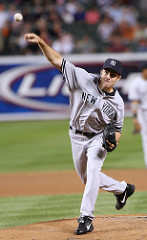
My Chilly Evening At AT&T Park … And A Bit Of Old-Style Hardball

Yesterday, I added the 29th entry to my list of MLB parks in which I have enjoyed a ballgame – the San Francisco Giants’ AT&T Park; the beauty by the Bay.  Unfortunately, it was pretty much an “in (for one game) and out” experience, since I was in the Bay Area on family rather than baseball business.  Still, I would like to share just a few observations.

You’re as Cold As Ice … Foreigner

Foreigner music photo

Photo by RalphArvesen

There are three things I will always remember about my first experience at AT&T Park – the Juan Marichal, high-kicking statue, the view of McCovey Cove and the shiver-inducing wind chill (All the people with hoodies, multiple layers and stadium blankets I saw heading into the park should have been a hint.)


Location-Location-Location … The Bay

First, this is one beautiful ballpark – thanks primarily to its location on San Francisco Bay.  The views of the Bay Bridge and McCovey’s Cove are spectacular(ly) unique. The ships, boats and kayaks that dot McCovey Cove, many waiting to join in spirited competition over long balls that splash down beyond the right field wall, just add to the ambiance.  (AT&T is one of the few parks that justify the word ambiance over atmosphere.)

History-History-History

Make sure you take in the statues – Willie Mays, Juan Marichal, Willie McCovey, Orlando Cepeda, Gaylord Perry — on the approach and at the entrances to the ballpark. Also visit the Giant Vault, lots of great Giants’ memorabilia.  Located just inside the Lefty O’Doul Gate entrance, the rotating exhibit currently includes such items as a Willie Mays’ 1957 jersey, the last home plate from the Polo Grounds, the first home run ball hit in San Francisco and much more.

Picture This-Picture This-Picture This … Photo Ops

maricha;Lots of great photo ops.  Just a few: With one of the Giants’ stars statues – Juan Marichal’s is located near the main park entrance and you can get a nice shot with the ATT&T Park “gateway” in the background; the #44 Cable Car on the right-center field concourse; from the second deck behind home plate with the field, Bay Bridge and McCovey Cove in the background. I’m sure you’ll find other photo-worthy spots (like seated on the park bench with “” in the bar area below the left-center bleachers.)

Location-Location-Location … Your Seats

If you want the full panoramic experience of “Baseball By the Bay” get a seat in the infield area of the grandstand, second deck. (The pictures below show the difference in what you see from lower-level outfield (bleacher) seats versus (infield) View seats. (View seats on the top.) Also, if you have back issues avoid going for the bleacher bargain.  These are true bleacher seats (although reserved), with no seat backs. Locals providing free advice say to avoid Arcade Level seats in the 150’s and Left Field Reserve in the mid-330s due to difficult views.  (I didn’t get there to check them out.)

ATT1


att2


THERE WAS A GAME …and it was a bit old style.

We took in the Brewers and the Giants – won by the Brew Crew 3-1.  With today’s game dominated by strikeouts and home runs, this contest was a bit old-style (great for me, I’m a bit OLD-style myself). Consider these observations:

  • No home runs and only eleven strikeouts.
  • The game moved briskly, only two hours and 33 minutes.
  • The starting pitchers each had two at bats.
  • Giants’ starter (and losing pitcher) Madison Bumgarner went eight innings (before being lifted for a pinch hitter).

Old-style small ball made the difference.

After the Gaints took the lead in the second on a pair of doubles (C Buster Posey and SS Brandon Crawford), the Brewers tied it in the sixth – without getting the ball out of the infield. It went: Leadoff hitter/CF Keon Broxton was safe on a throwing error by Giants’ 3B Evan Longoria; RF  Christian Yelich walked; 1B Jesus Aguilar grounded out short-to-first (with runners going) and Broxton and Yelich each moved up a base; LF Ryan Braun grounded out second-to-first, Broxton scoring and Yelich taking third. 3B Tyler Saladino flies out. The Brewers manufactured a run on no hits, a walk, an error, a stolen base and a couple of ground outs.

The Brewers then further used small ball to take the lead in the top of the seventh. Hernan Perez rolled a ground single through the right side to open the inning; Manny Pina sacrificed Perez to second (nice bunt to the right side, with Pina thrown out by Bumgarner with 2B al Nansen covering first); Perez then stole third and scored on an Orlando Arcia ground out (third to first).  A successful sacrifice – now that’s old-style hardball.

Milwaukee added an insurance run in the eighth on a Christian Yelich double and a Ryan Braun run-scoring single.

Those who follow BBRT know how much I love the 6-4-3 and 4-6-3 double killing.  Well, I got one in the bottom of the seventh, as the Giants’ 1B Pable Sandoval hint into a nifty second-to-short-to first, inning-ending double play (with Evan Longoria, who had walked on first).

The crowd (40,000+) had been pretty quiet – perhaps literally frozen in their seats –  until the Giants tried to rally in the eighth, loading the bases (two ground ball singles and a walk) for Buster Posey (with two out). Chants of “Posey – Posey” rippled across the stadium. Posey is clearly an SF favorite. Unfortunately, he ended the threat, grounding out third-to-first.
Food-Food-Food … But bring your wallet.

This IS San Francisco, where the locals love to eat, so there are plenty of great options – from sausage to sushi to … clam chowder to caramel corn (hand tossed) … and Ghirardelli chocolate to garlic fries.  Again, this IS San Francisco, so you can expect a little sticker shock.  I recommend walking the concourse (they are a bit narrow by the way), to take in the sights and smells before making your decision. A few recommendations:  Garlic Fries are really an AT&T staple; Crazy Crab’s Dungeness Crab sandwich on sourdough is a local favorite; clam chowder in a sourdough bread bowl is perfect for cold, breezy SF evenings (aren’t they all); and, if you have a sweet tooth, you cannot beat the Ghirardelli Chocolate’s Hot Fudge Sundae.  There are some bargains to be found. For example, hot dogs, brats and the like are grilled (not steamed or boiled) around the park and can be reasonably priced.  I tried the Giant Dog – grilled and served with fried onions – form The Doggie Diner for just $6.50.  Also, you’ll see lots of “independents” selling grilled sausages and other treats on the way into the park. Well worth a try and you can bring food into AT&T.

Service-Service-Service … Now that’s an usher.

Okay, one bit of gripe – maybe the Twins have spoiled me – no free scorecards (the Twins scorecard is inside the free Twins Magazine.) I searched for a scorecard for about 20 minutes and with game time getting close, I asked an usher where I could find one.  I learned that the scorecard is included in the five-dollar program. I was about to look for a souvenir booth offering programs, but the usher (seeing we were close to game time and not wanting me to miss any action) took down my section and seat number and said he would find one, bring it to me and I could pay him then. Three batters into the contest, he showed up with my program and I was good to go.  Now that is fan-friendly service.
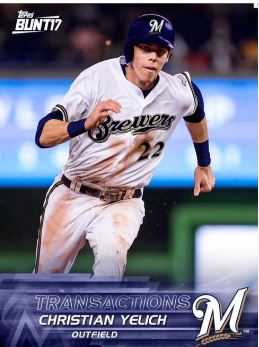
Wind-Wind-Wind … Bring your jacket

A night game on the Bay can get pretty cold.  After my AT&T experience, I’ll never complain about a Twins’ Opener again.  It was in the low 50’s with a chilly breeze off the Bay.  Lots of blankets, hoodies and jackets in use throughout the game – and after the sun set, it was shivering cold.

Fans-Fans-Fans … Did you lose your watch?

Okay, a watch is old school and, maybe, showing up for the first inning is as well.  The stands were only about half-full at game time and not looking like the announced 40,000 until by the fourth.  A few of other general observations: I saw literally no one near me keeping score; the crowd didn’t really seem to get into the game until the Giants loaded the bases late; and, at one point, I looked down my row and saw fiveof the eight people closest to me looking at the cell phones (mid-inning). Seemed like a subdued crowd – possibly a combination of recent World Series Championships and this years around-.500 squad?  Anecdotally, I’ve heard that Giants’ fan are a good crowd, might just have been the chill of the eventing.  Yes, I’m back to that again. 


Photo by mvmarconi

Photo by mvmarconi

Lou Seal … the Giants’ mascot … have a very mininmal presence during the game (a blessing for us old-school fans.  In fact, I only recall one t-shirt tossing trip around the field. As a side note, my daughter and I actually thought Lou was a mouse.  Look at the photo, what do you think. 


Beverages-Beverages-Beverages – For Adults that is.

danilesPlenty of wine, spirits and brews around the park – but again, bring your wallet.  One person in our group, for example, paid $19.25 for a 24-ounce craft beer. (Team Marketing Report found the Giants had MLB’s fourth-highest average beer cost.) As usual, I tried a ballpark Bloody Mary – from the Jack Daniels Barrel House under the left-center field bleachers (a very cozy social area worth a visit. It ran $14, included a generous pour of vodka, spicy mix with added tobacco, three olives, a wedge of lemon and a wedge of lime.  It could have used a bit more seasons (celery salt and pepper, for example), but was still a solid (not spectacular) Bloody Mary.  Kind of in the middle in terms of my ballpark Bloody Mary experiences, but near the top in terms of price.


Getting There-Getting There-Getting There .. Use public transit.

Parking is a bit difficult (and expensive), but public transit options abound.  I’d use them.


I tweet baseball @DavidBBRT

Follow/Like Baseball Roundtable’s Facebook page here.

Members: Society For American Baseball Research; The Baseball Reliquary; The Negro Leagues Baseball Museum

Tyrone Horne and Pro Baseball’s First (and for a long time only) “Home Run Cycle.”

Time to celebrate “Tyrone Horne Day” … and professional baseball’s first “Home Run Cycle” (solo, two-run, three-run and Grand Slam homer all in one game).

Tyrone Horne - Sultan of Swat on this day 20 years ago.

Tyrone Horne – Sultan of Swat on this day 20 years ago.

It was on this date (July 27) in 1998 that (Roger) Tyrone Horne, playing for the Double-A Arkansas Travelers, became the first professional player to hit for the “Home Run Cycle” – bashing a solo, two-run, three-run and grand slam home run all in the same game (a 13-4 win over the San Antonio Mission).  (Update:  This record was tied by the Springfield Cardinals’ Chandler Redmond in 2022. They were the only home runs in the game, in which Arkansas collected 13 hits.  Horne ended the day four-for-five, with four runs scored and ten RBI.

Horne hit three of his four dingers off San Antonia starter Pete Zamora – a two-run shot in the first inning, a grand slam in the second and a solo homer in the fifth. His final homer, a three-run long ball, came in the sixth off reliever Miguel Garcia.  The Cardinals’ farmhand came up once more, with two on, in the eighth, but reliever Jeff Kubenka struck him out.

Horne’s feat was the highlight of an outstanding Double-A season, in which the 27-year-old outfielder would go .312 with 37 home runs, 139 RBI, 94 runs scored and even throw in 18 stolen bases in 123 games for Arkansas. His performance at Double-A earned Horne a call up to the Triple-A Memphis Redbirds at the end of the season, where ht hit .364 (four-for-eleven) in three games, with one double, one run scored and one RBI. (The 5’10”, 185-pounder showed good speed throughout his minor-league career, racking up 185 steals in 13 seasons, hitting double digits in steals eight times and topping 20 twice.  He also hit double digits in home runs seven times, but only topped 20 twice.)

Appropriately, right after his historic “homer cycle” game, Horne headed off to the Texas League All-Star Game where he proceeded to win the Home Run Derby.

Horne never made it to the major leagues – completing a 13-year (1,286 games; 1989-2001) minor-league career (in the Expos, Yankees, Mets, A’s, Marlins, Cardinals and Phillies systems) with a .288 average and 143 home runs.  The bat he used on his historic day with Arkansas, however, has made it to the Baseball Hall of Fame in Cooperstown.

Here’s the line score of the game.

July 27, 1998

Arkansas      2 5 0  0 2 3  0 1 0       13  13  0

San. Ant.      2 0 0  0 0 0  0 2 0        4   8   3

Time: 2:40   Attendance:  5,010

100Baseball Roundtable is on the Feedspot list of the Top 100 Baseball Blogs.  To see the full list, click here.

I tweet baseball @DavidBaseballRT

Follow/Like Baseball Roundtable’s Facebook Page here.  More baseball commentary; blog post notifications; PRIZES.

Member: Society for American Baseball Research (SABR); The Baseball Reliquary; The Negro Leagues Baseball Museum.