Baseball Roundtable March/April Wrap Up – Stats, Stories, Standings and the Trot Index

It’s May 1 and that means it’s time for Baseball Roundtable’s traditional previous month wrap up – statistics, standings and stories that caught BBRT’s eye over the previous month as well as the BBRT Players and Pitches of the Month and the BBRT Trot index.  This post will cover March and April.  Here’s the kind of thing you’ll read about – if you last to the end of the post. 

  • Kind of a surprise.  When you look at stolen base total through April 30, only seven teams had at least 20 thefts – and six of them were in the American League.
  • The Dodgers’s Cody Bellinger led all of MLB in on-base percentage through April – just north of .500 (.508). He, in fact, led in almost every offensive category.
  • Diamondbacks’ right-hander Zack Greinke not only won five games om March/April, he went .375 at the plate (six-for-sixteen, with two doubles, a triple and two home runs – scoring five times and driving in four). Just more #WhyIHateTheDH.
  • 2018 was the first season in which we saw more strikeouts than base hits in major league baseball.  In March/April, there were 7,748 strikeouts and 7,221 base hits.
  • We saw three different MLB players commit three errors in an inning.
  • We saw a player, appropriately named KieBOOM, homer in his first MLB at bat.
  • C.C. Sabathia became just the third southpaw to reach 3,000 strikeouts and Albert Pujols passed Lou Gehrig and Barry Bonds on the all-time RBI list.

Life Just Ain’t Fair

The Blue Jays’ Marcus Stroman pit up a 1.43 ERA in six March/April starts and won one, while losing three. The Brewers’ Brandon Woodruff put up a 5.17 ERA in six starts and won three, while losing one. 

________________________________________________

BBRT NATIONAL PLAYER OF THE MONTH – Cody Bellinger, Dodgers, 1B/RF
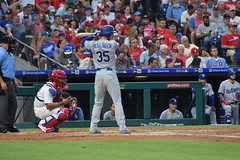
No contest here, the Dodgers’ Cody Bellinger has had a monster start to his season.  As of April 30, the 23-year-old, left-handed hitter  led the major leagues in batting average (.431), hits (47) home runs (14); RBI (37); run scored (32) on-base percentage (.508); slugging percentage (.890) and total bases (97). In addition, he’d walked more times (19) than he had struck out (15).  The 6’4”, 203-pounder has already had 15 multi-hit games this season – in which he has played in all 31 Dodger games (starting 30). In addition, his 14 home runs ties the MLB record for home runs before May 1;  his 37 RBI are the most-ever before May 1.

Contenders: That Bellinger is BBRT’s NL Player of the month is no surprise.  What is surprising is that he had competition.  Last year’s NL MVP Christian Yelich also came out of the gate swinging – putting up a March/April line of .353-14-34 in 29 games.  In addition, Yelich swiped six bases in six tries, to Bellinger’s five in eight attempts.

Side note: Four of Bellinger’s home runs and eight of his RBI came in March  – so Alex Rodriguez and Albert Pujols continue to share the record for April home runs at 14. Similarly, Juan Gonzalez’ April RBI mark of 35 still stands. Bellinger and the Brewers’ Christian Yelich share the NL March RBI record (8), with the Mariners’ Domingo Santana holding the AL and overall MLB March RBI record at 10.  All three totals were achieved this March. Bellinger also holds a share of the March home run record at four. Others with four March homers include the A’s Khris Davis, Cardinals’ Paul Goldschmidt and Brewers’ Christian Yelich.  Again all four four-homer March outbursts came this season.

BBRT NATIONAL LEAGUE PITCHER OF THE MONTH – Luis Castillo, RHP, Reds
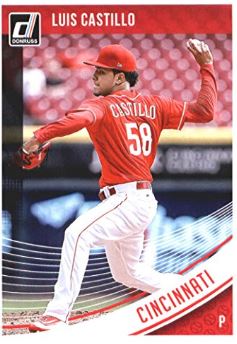
CastilloThe 6’2”, 190-pound righty started seven games in March/April, going 3-1 for the last-place Reds and chalking up MLB’s third-lowest qualifying earned run average at 1.45.  He also was one of just six pitchers to fan 50 batters (50 exactly) by April 30; and his 43 1/3 innings pitched were MLB’s sixth most.

Castillo never gave up more than two runs in any of his starts – and his lone loss was a 1-0 defeat (versus the Brewers), when he went seven innings and gave up just one run on one hit, while walking four and fanning nine.

Contenders: It was a close call between Luis Castillo and Padres’ closer Kirby Yates and the Diamondbacks’ Zack Greinke. Yates,  who led all of MLB with 14 March/April saves (in 14 opportunities), fanned 25 batters in 16 innings and put up a 0.56 ERA.   Zach Greinke of the Diamondbacks (5-1, 3.27 with 46 strikeouts in 44 innings) was also in the running.   Castillo’s overall body of work – six starts of two runs or less gave him the edge.

BBRT AMERICAN LEAGUE PLAYER OF THE MONTH – Tim Anderson, SS, White Sox
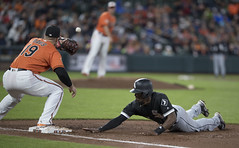
Tim Anderson White Sox photo

Photo by Keith Allison

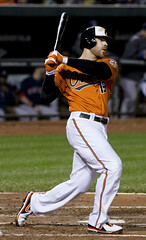
Anderson put it all together this March/April. His .375 average led the AL, his 21 runs scored and 36 hits were each sixth and his ten stolen bases in ten tries led the league – and he added six home runs and 18 RBI.

Contenders:  Seattle’S Domingo Santana – .292, with six homers and a AL-best 30 RBI – deserved a look; as did the Rangers’ Elvis Andrus (.361-5-20, with five steals and an AL-leading 39 hits through April) and the Orioles’ Trey Mancini (.355-6-14, with 39 hits and 23 runs).  It was close, but Anderson’s 10-for-10 on the base paths swayed me.

BBRT AMERICAN LEAGUE PITCHER OF THE MONTH – Tyler Glasnow, RHP, Rays
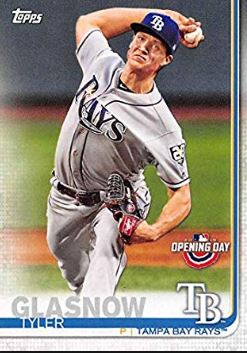
GlasnowGlasnow was one of just four MLB pitchers to win five games in March/April – going 5-0 in six starts.  In addition, the 6’8” power pitcher put up a 1.75 earned run average (second-best among AL qualifiers) and fanned 38 batters in 36 innings – while walking just seven.   Glasnow is a bit of a surprise (he came into the 2019 season with an MLB career record of 4-16, 5.35). It now appears a change in his windup has helped Glasnow harness his high-90s fastball

Contenders: BBRT looked at the Yankees’ Domingo German, who stepped into a depleted NY rotation and went 5-1, 2.56 in six March/April appearances (5 starts). German walked nine and fanned 32 in 31 2/3 innings.   Coming into the season, German was 2-7 5.22 in 28 MLB appearances (14 starts).  Still, he had shown promise with 120 strikeouts in 100 MLB innings –  and a 2.64 ERA in eight minor league seasons. Then, there was the Mariners’ Marco Gonzalez, who went 5-1, 2.80 in seven March/April starts – fanning 34 in 45 innings. Among these three five-game winners, Glasnow had the best overall numbers.

_______________________________________________

TROT INDEX … A REGULAR BBRT FEATURE

Through April,  37.0 percent of all MLB’s 33,296 2019 plate appearances ended in a trot (back to the dugout, around the bases, to first base). We’re talking about strikeouts, home runs, walks, hit by pitch and catcher’s interference – all outcomes that are, basically, devoid of action on the base paths or in the field. Here’s the breakout: strikeouts (23.3%); Walks (9.2%); home runs (3.4%); HBP (1.1%); Catcher’s Interference (less than .001%). Personally, I’d like more action in the field of play.

For the 2018 season, 34.8 percent of all MLB’s 185,139 plate appearances ended in a trot.  

___________________________________________________

If the season ended April 30, Your playoff teams would be …

NL: Phillies; Cardinals; Dodgers.  Wild Cards: Diamondbacks & Padres.

AL: Twins; Rays; Astros.  Wild Cards: Yankees & Indians.

The Best and Worst of Teams

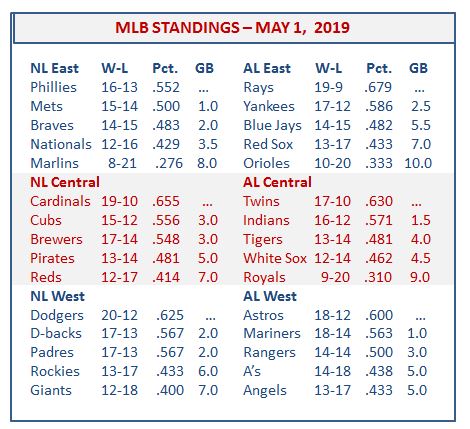
Only five teams played .600 or better ball in March/April:  Rays (.679); Cardinals (.655); Twins (.630); Dodgers (.633); Astros (.600).

The biggest surprise here is probably the Rays, who have leveraged their pitching into MLB’s best 2019 winning percentage. The Rays put up MLB’s best ERA over the period at 2.95, while scoring the 17th most runs.  The Rays’ staff was led by starters Tyler Glasnow (5-0, 1.75); Charlie Morton (3-0, 2.76); and Blake Snell (2-2, 2.54). Their unique approach to pitching (openers versus starters on some bullpen days) also enabled Ryne Stanek (1.20 ERA in 15 innings, 12 games, seven starts) and Yonny Chironos (3.48 ERA, four wins/no losses, in six game, three starts and 31 innings) to contribute.

Three teams played under .400 ball through April: Marlins (.276); Royals (.310); and Orioles (.333). No surprises here.  The Orioles had MLB’s worst ERA through April at 6.05, with the Royals third-worst at 5.39.  The Marlins are a bit better on the mound (10th-worst at 4.70), but you’ll find them at the bottom of baseball in runs scored with 82. By comparison, the Mariners scored 189 runs through April 30. MarchApril2019standing
—–LEAGUE LEADERS – TEAMS —–

(as of May 1, 2019) 

RUNS SCORED … MLB Team Average – 135

AL: Mariners (189); Rangers (166); Yankees (156)

NL: Dodgers (174); Cardinals (158); D-backs (158)

The Marlins scored an MLB-low 82 runs in March/April. The Tigers were at the bottom of the AL with 94.  Other teams scoring fewer than 100 runs through April were the Giants (96) and the Pirates (90).

BATTING AVERAGE … MLB Team Average – .245

AL: Astros (.271); White Sox (.263); Rangers (.260)

NL: Cardinals (.267); Braves (.266); D-backs (.265)

Only three teams were hitting below .220 through April: Reds (.212); Giants (.214); and Indians (.215)

HOME RUNS … MLB Team Average – 38

AL: Mariners (60); Twins (50); Astros (48)

NL: Brewers (57); Dodgers (52);  Nationals & Padres (43)

If you want to see long balls, avoid the Tigers, Pirates and Marlins, with league-low home run totals of 21, 23 and 23, respectively.

STOLEN BASES … MLB Team Average – 14

AL: Royals (29); Mariners (25); Rangers (25)

NL: Nationals (20); Brewers (16); Cardinals (16)

BATTERS’ STRIKEOUTS … MLB Team Average – 258

AL: Mariners (317); Blue Jays (284); Rays (276)

NL: Brewers (293); Padres (287); Rockies (287)

Angels’ hitter fanned an MLB-fewest 177 times through April. No other team fanned fewer than 200 times. The Pirates were the lowest in the NL at 238.

WALKS DRAWN … MLB Average – 99

AL: Mariners (136); Yankees (115); Astros (115)

NL: Dodgers (139); Phillies (128); Braves (126)

Who crowds the plate?  The Cubs led MLB in hit-by-pitch through April at 21 (the MLB team average was 12).

_______________________________________

EARNED RUN AVERAGE … MLB Average – 4.36

AL:  Rays (2.95); Blue Jays (3.36); Astros (3.37)

NL:  Reds (3.39); Padres (3.47); Pirates (3.55)

One team finished April with an ERA over 6.00 – the Orioles at 6.05. 

STRIKEOUTS … MLB Average – 258

AL:  Red Sox (284); Astros (284); Rays (.280)

NL: Mets (281); Dodgers (270); Nationals (278)

It’s a New ERA.

Tampa Bay, with it’s combination of traditional starters, openers and bullpen days had the lowest starter’s earned run average at 2.04 – more than a run better than the second-best Blue Jays (3.16). The White Sox were at the other end of the spectrum with an MLB-high 6.18 starters’ ERA through April.

The Astros boasted the lowest bullpen earned run average at 2.91 (the only bullpen under 3.00). Meanwhile, the Orioles’ pen lit more fires than they put out; with an ERA though April of 6.59.  Side note: The Rays bullpen had the ninth-best ERA through April at 3.86. 

SAVES … MLB Average – 8

AL: Mariners (12); Rays (12); Tigers (12)

NL: Padres (15); Cardinals (13); Dodgers & D-backs (10)

The Twins had the highest March/April save conversion rate (90.9 percent – 10 saves in 11 opportunities). The Brewers led the NL at 81.8 percent (9-for-11). The Royals are at the bottom of this list, with just four saves in 12 opportunities (33.3 percent conversion).

FEWEST WALKS SURRENDERED … MLB Average – 102

AL: Astros (74); Rays (81); Twins (89)

NL: Pirates (75); Giants (84); Padres (84)

The Indians were the only team to average at least 10 strikeouts per nine innings through April – at 10.18. The Astros were at the top of the heap in strikeouts-to-walks ratio at 3.84.

__________________________________________

Now let’s  look at some of the highlights of the month – and then the individual statistics. 

OPENER IN JAPAN

The first game of the 2019 MLB season took place on March 20 – in Tokyo, Japan. MLB tried to fool us all by calling it the first game of the “Opening Series,” but it was – in fact – the Opening Day of the new season. (Note:  It was the earliest regular-season MLB game ever.)  The two-game Opening Series was, of course, a tribute to sure Hall of Famer Ichiro Suzuki – who hadn’t played in an MLB game since last May and announced his retirement after the two-game match up was completed.  (For BBRT’s thought on the turn of events, click here.)

Game One of 2019 was slug fest, won by the Mariners 9-7. It featured home runs by Mariners’ SS Tim Beckham and LF Domingo Santana; and long balls by A’s DH Khris Davis, 1B Matt Chapman and RF Steve Piscotty. True to last season’s first (the first MLB season with more strikeouts than base hits), there were 18 whiffs and 16 hits. Seattle, by the way, also won Game Two – by a 5-4 score.

DODGERS SET NEW OPENING DAY DINGER MARK

The Dodgers topped the Diamondbacks (in LA) on Opening Day (March 28) by a 12-5 score.  In the process, the Dodgers smacked an Opening Day single-team home run record with eight long balls. Joc Pederson and Enrique Hernandez each went deep twice, while Corey Seager, Max Muncy, Cody Bellinger and Austin Barnes added one apiece.

BELLINGER TIES ONE OF THOSE OBSCURE MARKS

xx Eddie MathewsThe Dodgers’ Cody Bellinger had six home runs and 16 RBI through the first eight games of the season, which (according to STATS) has only been accomplished twice before: by Eddie Mathews (Braves) in 1953 and Alex Rodriguez (team) in 2007. After the contest, Bellinger noted “That’s cool to be with A-Rod.”  His did not mention my favorite all-time player – Eddie Mathews.  So, I decided to give Eddie a shout out in this post.


THE BASEBALL VERSION OF THE DOUBLE-DOUBLE

On March 28, for just the second time in MLB history, both starting pitchers in an Opening Day game notched double-digit strike outs. Of course, it should be no surprise, they were the 2018 National League Cy Young Award Winner (Jacob deGrom) and a three-time CYA winner and 2018 runner-up Max Scherzer.

As the Mets topped the Nationals 2-0, deGrom got the win – going six scoreless innings, with five hits, on walk and ten whiffs. Scherzer took the loss, despite giving up just two hits (and two earned runs) in 7 2/3 frames, with three walks and 12 strikeouts.

The only other time two hurlers notched double-digit whiffs on Opening Day was April 7, 1970, when the Orioles topped the Indians 8-2 in Cleveland.  Orioles’ starter Dave McNally went the distance, giving up two runs on four hits, with three walks and 13 strikeouts.  Cleveland starter Sam McDowell went 6 1/3 innings before walking the bases loaded with one out in the seventh.  In his 6 1/3 frames, McDowell (who took the loss) was credited with giving up three earned runs on three hits, with five walks and eleven strikeouts.

CATCH ME IF YOU CAN

On Saturday March 30, the Dodgers made short work of the Diamondbacks, leading 5-1 by the third inning, 11-2 by the end of the sixth and 11-3 going into the bottom of the seventh. That’s when D-backs’ manager Torey Lovullo went, not to his bullpen, but to his bench – bringing backup catcher John Ryan Murphy to the mound. Murphy did pretty well in the bottom of the seventh. Despite giving up a walk and two singles, he held the Dodgers scoreless. The eighth was a little more difficult, as Murphy gave up seven runs on six hits and two walks.  Not be outdone, Dodgers manager Dave Roberts also brought a catcher off the bench and to the mound – calling on veteran backstop Russell Martin to protect an 18-3 lead.  Martin got out of the inning (ground out, ground out, fly out) on ten pitches (eight strikes).

Notably, neither Murphy nor Martin had ever pitched in an MLB game before.

THREE FOR THE ROAD

Yipes! Between 2013 and 2018, only one player was guilty of committing three errors in an inning.  Already this season, that has happened, appropriately, three times.

March 30 – Mariners’ 3B Dylan Moore

April 5 – Mariners’ SS Tim Beckham

April 8 – Pirates’ SS Kevin Newman

FOUR IN THE FOURTH

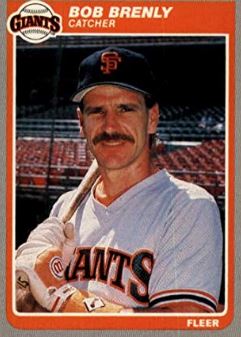
BrenlyOn September 13/14, 1986, ,  Giants’ catcher Bob Brenly found himself playing third base (due to an injury).  In the fourth inning of that game (against the Braves) Brenly tied an MLB record by making four errors in one inning.  Others “accomplishing” this feat include: Milwaukee’s James T. Burke – May 27, 1901; Cubs’ SS Leonard Meruello – September 13, 1942; and Indians’ SS Ray Chapman – June 20, 1914. 

Brenly, by the way, did hit a pair of homers (four RBI) in the Giants 7-6 win.


MORE #WhyIHateTheDH
zack Greinke photo

Photo by jnashboulden

On April 2, Diamondback starting pitcher Zack Grienke went six innings, giving up three runs on six hits and striking out ten, as the D-backs topped the Padres 8-5 in San Diego.  Oh yes, and Greinke also hit two home runs and drove home four tallies.

BETTER BRING A CROWBAR IF JACK MORRIS IS ON THE MOUND

On April 4, Cleveland’s Trevor Bauer had a no-hitter going after seven innings – with the Indians leading 4-0.  After seven, he had tossed 117 pitches and Indians’ skipper Terry Francona pulled him from the game.  (The no-hitter was broken up in the top of the ninth.)

Not saying if it was right or wrong, but try to imagine what it would have taken to get the horsehide out of Jack Morris’ hand after seven no-hit frames.

TEE (off) FOR TWO

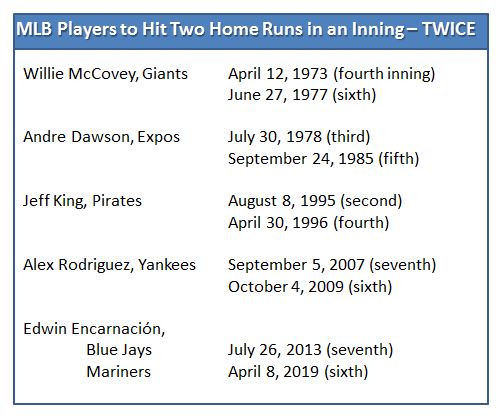
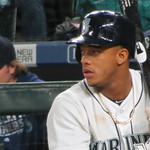
On April 8, Mariners Edwin Encarnacion hit his third and fourth home runs of the 2019 season.  For the day, Encarnacion was two-for-four with two runs scored and four RBI. Of importance is the fact that they both came in the sixth inning of Seattle’s 13-5 win over the Royals.  Of, perhaps, even more importance is that it was the second time in his career that Encarnacion has one deep twice in tone inning.  And, that ties an MLB record.  Tewo home runs

SPEED KILLS

On April 9, Royals’ CF Billy Hamilton found a somewhat unique way to “take that extra base.” In a game against Seattle, Hamilton, one of MLB’s fastest players, was on second, via an error, in the bottom of the third inning, when Aldaberto Mondesi sent a drive to the warning track in center field. Mariners’ center fielder Mallex Smith made a tumbling catch and Hamilton – off with the catch – rounded third and never broke stride; scoring from second base on a sacrifice fly.

https://youtu.be/ARQwItsSDIA


13 LUCKY FOR CHRIS DAVIS

On April 13, the Orioles’ Chris Davis ended an MLB-record 54-at bat hitless streak that stretched all the way back to September 14 of 2018. Davis’ hit (off Red Sox’ starter Rick Porcello) came in the top of the first inning – a single to short right-center that plated two Orioles’ runs. Davis ended the game (a 9-6 Orioles win) with three hits (two double and a single), four RBI and, very likely, a sigh of relief.

YIPES! IN BASEBALL WE DO COUNT EVERYTHING
Joey Votto photo

Photo by haydenschiff

On April 17, MLB.com reported that – in the eighth inning of a 3-2 loss to the Dodgers in LA – Reds’ 1B Joey Votto popped up to first base.  According to MLB.com, it was the first time Votto had popped up to first base in his career 6,829 plate appearances.  For trivia buffs, the pitcher was Pedro Baez, the pitch a change up and the pop up was caught by Cody Bellinger. Stop the insanity!

GOING OUT IN STYLE

From March 20 through April 16, the Mariners went deep in every game they played – an MLB-record 20 straight games (to start a season) with at least one home run. During those 20 games, the Mariners went 13-7, putting up a .270 average, with 42 home runs and 132 runs scored.  When the streak ended, it ended in style – with the Cleveland Indians’ Carlos Carrasco (eight innings) and Nick Wittgren (one inning) shutting out the Mariners on just three hits (two walks and 14 strikeouts).

During the streak, a dozen different players went deep for Seattle.  Here are their streak totals.

Jay Bruce                    8 home runs

Dan Vogelbach           6

Edwin Encarnacion     5

Mitch Haniger             5

Tim Beckham              4

Domingo Santana       4

Ryon Healy                 3

Omar Narvaez             3

Dee Gordon                1

Dylan Moore               1

Tom Murphy               1

Mallex Smith               1

SOMEBODY HAS TO BE FIRST

On April 14, the Rockies’ German Marquez threw the first complete game of the 2019 MLB season, a sparking one-hitter (nine strikeouts) – as the Rox topped the Giants 4-0 in San Francisco.  By the end of April, MLB had seen only five 2019 complete games.

ONLY ONE CHANCE TO MAKE A FIRST IMPRESSION – UPON REVIEW

On April 19, Cardinals’ rookie Lane Thomas was called on to pinch hit with two outs and one Redbird on base and the Cardinals trailing the Mets 5-1  in the sixth inning. It was the rookie prospect’s first MLB at bat.  He made his appearances at the plate count, smacking an 0-1 slider form Seth Lugo that just cleared the RF wall.  (It actually took an umpires’ review to confirm that home run.) Thomas became the 121st MLB player and just the tenth Cardinal to homer on his first at bat.  For more on first-at bat homers, click here.

FREDDY GALVIS CATCH – A PICTURE IS WORTH A THOUSAND WORDS

https://youtu.be/6OWFseWAXhQ

PUTTING UP A BIG NUMBER
Photo by apardavila

Photo by apardavila

On April 26, the Nationals’ Max Scherzer entered the sixth inning of his game against the Padres with 2,499 strikeouts.  He went to work and whiffed the first Padres’ batter of the frame (Manuel Margot) on three pitches , then followed up by fanning Matt Strahm and Fernando Tatis, Jr. on a total of eight more pitches.  He ended the night with ten strikeouts in seven innings and 2,503 for his career.  In the process, he became the 35th pitcher to reach 2,500 whiffs in MLB history and he did it in 344 games – faster than any pitches except Randy Johnson (313 appearances) and Nolan Ryan (338).  That’s pretty good company. (Side note: Scherzer has led the N L in strikeouts in each of the past three seasons and has seven consecutive seasons of 230+ whiffs, with a high of 300 in 2018.)

PUTTING UP A BIGGER NUMBER
CC Sabathia photo

Photo by Keith Allison

On the last day in April,  the Yankees’ C.C. Sabathia became just the 17th MLB pitcher to reach 3,000 strikeouts – and only the third left hander.  He started the game – against the D-backs – with 2,997 career whiffs.  He did not notch a strikeout in the first two innings, but fanned the side in the third (David Peralta, Christian Walker and John Ryan Murphy) – around a home run and a single – to reach 3,000. (Like Max Scherzer, see above tidbit, Sabathia fanned the side in the landmark inning.)  Sabathia gave up two runs in 5 1/3 innings, ultimately fanning five. He took the loss in a 3-1 D-backs’ victory.  The only other southpaws to fan 3,000 hitters are Steve Carlton and Randy Johnson.

WELL, SHUT ME OUT

C.C. Sabathia is the only pitcher ever to lead both the National and American Leagues in complete-game shutouts in the same season. In 2008. he started the season with the Cleveland Indians and was traded to the Milwaukee Brewers on July 7. He went 6-8, 3.83 with Cleveland and tossed two shutouts (good enough to tie for the American League lead). He then went 11-2, 1.65 with the Brewers and tossed three more shutouts (good enough to tie for the NL lead.)

Kie-BOOM

On April 26, the Nationals’ 21-year-old rookie shortstop Carter Kieboom made his first MLB start – batting, by the way, in the number-nine hole behind pitcher Max Scherzer. Leading off the bottom of the eighth (against the padres’ Craig Stammen) Carter went kieBOOM – hitting a home run to deep CF for his first MLB hit. Side note:  Carter is not the first Kieboom to play for the Nationals.  His brother Spencer (a catcher) spent time with the Washington club in 2016 and 2018.

ONE FOR THE BOOKS

On April 28, When Zack Eflin tossed a complete game 5-1 win over the Marlins, it was the first Phillies’ complete game since September 10, 2017.  In fact, Eflin now has as many complete games this season as the Phillies had in 2017 and 2018 combined. That, of course, would be one. Eflin gave up seven hits and one earned run over the nine innings – throwing 77 strikes in 107 pitches.

YOUTH WILL BE SERVED

On April 28, the Nationals’ Juan Soto, Victor Robles and Carter Kieboom each homered for Washington, who topped the Padres 7-6. It was the first time that three players 21-years-old or younger homered in the same MLB games (according to Elias). The three youngsters (Soto – 20; Robles – 21 and Kieboom – 21) drove in five of the National seven tallies.  More of #InBaseballWeCountEverything.

ANOTHER BIG NUMBER

Albert Pujols began the 2019 season with 1,982 RBI – good for eighth place on the all-time RBI list.  He drove in 15 runners in March April, bringing his career total to 1,997 – and moving him past Lou Gehrig (1,995) and Barry Bonds (1,996) into fifth place.  Next up, Cap Anson at 2, 075. Pujols has had 14 100+ RBI season in his 19-season MLB career – tying Alex Rodriguez for the most 100 RBI seasons all-time.

NOW FOR THE INDIVIDUAL MARCH/APRIL LEADERS

________________________________________

—INDIVIDUAL LEADERS FOR MARCH/APRIL 2019—

BATTING AVERAGE (qualifying hitters)

AL:  Tim Anderson, White Sox (.375); Elvis Andrus, Rangers (.361); Trey Mancini, Orioles (.355)

NL: Cody Bellinger (.431); Jeff McNeil, Mets (.370): Christian Yelich, Brewers (.353)

The lowest average among qualifying players belongs to the Red Sox’ Jackie Bradley, Jr. at .148 (13-for-88).  In the NL, that dubious distinction goes to the Pirates’ Francisco Cervelli at .175 (14-for-80).

HOME RUNS

AL: Eddie Rosario, Twins  (11); Khris Davis, A’s (10); Joey Gallo, Rangers (10)

NL: Cody Bellinger, Dodgers (14); Christian Yelich, Brewers (14); Marcell Ozuna, Cardinals  (10); Joc Pederson, Dodgers (10)

The Red Sox Rafael Devers had the most  most March/April at bats without a home run (102).

RUNS BATTED IN

AL: Domingo Santana, Mariners (30); Luke Voit, Yankees (25); Joey Gallo, Rangers (25)

NL: Cody Bellinger, Dodgers (37); Christian Yelich, Brewers  (34); Marcell Ozuna, Cardinals (28)

The Dodgers’s Cody Bellinger (who else) led all of MLB with a .508 on-base percentage through April.  Mike Trout led the AL at .481.

RUNS SCORED

AL: Mitch Haniger, Mariners (28); Trey Mancini, Orioles (23); three with 22

NL: Cody Bellinger, Dodgers (32); Christian Yelich, Brewers  (26); Paul DeJong, Cardinals (26)

STOLEN BASES

AL: Tim Anderson, White Sox (10); Jose Ramirez, Indians (9); four with 8

NL: Victor Robles, Nationals (7); Trevor Story, Rockies (6); Fernando Tatis, Jr., Padres (6); Christian Yelich, Brewers (6)

BATTER’S STRIKEOUTS

AL:  Jorge Soler, Royals (45); Domingo Santana, Mariners (38); Joey Gallo, Rangers (38)

NL: Wil Meyers, Padres (39); Bryce Harper, Phillies (38); Travis Shaw, Brewers (38)

Mike Trout of the Angels had the best ratio of walks-to-strikeouts at 2.07 (the only player with twice as many walks as whiffs) – 29 walks/14 strikeouts.

WALKS DRAWN

AL:  Mike Trout, Angels (29); Alex Bregman, Astros  (22); Tommy Pham, Rays & Joey Gallo, Rangers (21)

NL: Bryce Harper, Phillies  (23); Andrew McCutchen, Phillies (23); Michael Conforto, Mets (22)

In March/April, no one wore a bigger target than the Phillies Maikel Franco, hit by a pitch an MLB-high eight times.  Next, at six, were the Angels’ Mike Trout and the Brewers’ Christian Yelich.  Pretty good company.

PITCHING VICTORIES

AL:  Tyler Glasnow, Rays (5-0); Marco Gonzalez, Mariners (5-0); Domingo German, Yankees (5-1)

NL:  Zack Greinke, D-backs (5-1); Jake Arrieta, Phillies (4-2); many with three

No one lost more games in March/April than the Red Sox Chris Sale, who went 0-5, 6.30.  Ouch!

EARNED RUN AVERAGE (qualifying)

AL: Marc Stroman, Blue Jays (1.43); Tyler Glasnow, Rays (1.75); Aaron Sanchez, Blue Jays (2.32)

NL:  Zach Davies, Brewers (1.38); Luis Castillo, Reds (1.45); Chris Paddock, Padres (1.91)

STRIKEOUTS

AL:  Gerrit Cole, Astros (65 – 43 1/3 innings pitched);  Trevor Bauer, Indians (55 – in 47 2/3 IP); Justin Verlander, Astros (53 – 44 IP)

NL: Max Scherzer, Nationals (54 – 39 1/3 IP); Luis Castillo, Reds (50 – in 43 1/3 IP); Stephen Strasburg, Nationals (48 – 37 2/3 IP)

Among pitchers with at least 20 innings pitched in March/April, Mets’ starter Jacob deGrom had the highest rate of strikeouts per nine innings at 14.48 (43 strikeouts in 26 innings).  The high K-rate translated to a 2-3 record and 4.85 ERA.

Others meeting the 20-inning threshold and fanning 13 or more batters per nine inning were the Astros’ Gerrit Cole (13.38); Indians’ Carlos Carrasco (13.34); and Yankees’ James Paxton (13.24). Cole was 1-4, 4.71; Carrasco was 2-3, 5.86. Paxton was 3-2, 3.38.

SAVES

AL:  Shane Greene, Tigers (12); Brad Hand, Indians (9); Robert Osuna, Astros  & Ken Giles, Blue Jays (7)

NL: Kevin Yates, Padres (14); Kenley Jansen, Dodgers (10); Jordan Hicks, Dodgers (9)

INNINGS PITCHED

AL: Trevor Bauer (47.2); Marco Gonzalez, Mariners (44); Justin Verlander, Astros (44)

NL: German Marquez, Rockies (45); Zack Greinke, D-backs (44); Luis Castillo, Reds (43 1/3)

GAMES PITCHED

AL: Joakim Soria, A’s (16); Hansel Robles, Angels (16); many with 15

NL: Alex Claudio, Brewers  (17); six with 16

Primary Resources: Baseball-Reference.com; Baseball-Almanac.com; MLB.com

BASEBALL ROUNDTABLE ON THE TOP 100 BASEBALL BLOG LIST

100Baseball Roundtable is on the Feedspot list of the Top 100 Baseball Blogs.  To see the full list, click here.

I tweet baseball @DavidBBRT

Follow/Like Baseball Roundtable’s Facebook Page here.  More baseball commentary; blog post notifications; PRIZES.

Member: Society for American Baseball Research (SABR); The Baseball Reliquary; The Negro Leagues Baseball Museum.
Eleven is a Lucky Number – The City of Brotherly Love – Tee (off) for Two …. All You Even Wanted to Know about MLB’s Four-Homer Games

Four-homer games (by a single player) are a relative rarity in major league baseball.  For example, only 18 players have launched four homers in a single game, while 23 pitchers have tossed perfect games.  In this post, Baseball Roundtable takes a look at MLB’s four-homer games.  If you joined this post via a link from a BBRT Trivia Teaser, the answer is in the box below.

Baseball Roundtable Trivia – The City of Brotherly Love

Despite playing for Philadelphia – The City of Brotherly Love – Phillies’ third baseman Mike Schmidt showed no love for the Reuschel brothers on April 17, 1976.  On that day, as the Phillies topped the Cubs in an 18-16 slug fest, Schmidt popped an MLB-record (tying) four home runs – including two off starter Rick Reuschel and one off his brother Paul Reuschel.  It’s the only time brother have shared victim status in a four-dinger assault.

Now, before we look at each four-homer game in detail, here are a fewer four-homer game trivia tidbits.

Homers, Just Not at Home …

Just five of the 18 four-homer games were achieved by batters hitting at home.

  • In four-homer games, the team boasting the four-homer performer has won 16 of the 18 contests.
  • Four-homer games have been recorded by 11 right-handed hitters; six lefties; and one switch hitter.
  • Two batters have included a two-home run inning in their four-homer games; Mike Cameron, Mariners (2002) and Bobby Lowe, Beaneaters/Braves (1894).
  • Only two batters were walked during their four-dinger outbursts – Rocky Colavito (1959) and Pete Seerey (1948), with one free pass each. (Mike Cameron was hit by a pitch in the midst of his powerful 2002 performance. I’m a bit surprised he’s the only one.)

This Side Seems to be Working Today …

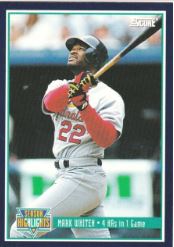
Mark Whiten, the only switch hitter with a four-homer game, hit all four of his dingers from the left-hander’s batters’ box.

  • The Braves’ franchise has had the most four-homer games with three – one each in Boston (Beaneaters); Milwaukee; and Atlanta. The hitters were Bobby Lowe (1894); Joe Adcock (1954); and Bob Horner (1986).
  • By position, six first basemen have put up four-homer games; five right fielders; three center fielders; two left fielders; one second baseman; and one third baseman. No catchers, shortstops or pitchers have smacked four homers in a game.
  • Five Hall of Famers had four-homer games: Ed Delahanty (1896); Lou Gehrig (1932); Chuck Klein (1936); Willie Mays (1961); and Mike Schmidt (1976).
  • Three players needed extra innings to get that fourth home run: Chuck Klein (1936); Pete Seerey (1948); and Mike Schmidt (1976).

It Was an Inside Job …

Two of the home runs in Ed Delahanty’s July 13, 1986 four-homer game were of the “inside-the-park” variety.  He is the only player to include an inside-the-park round tripper in a four-homer outburst.

  • Appropriately, seven of the players turning in four-homer games were batting cleanup; five were batting third; two each were in the fifth and sixth spots; and one each occupied the lead-off and number-seven holes. No second, eighth or ninth batter has turned in a four-homer game.
  • Shawn Green set the top marks for runs and hits in a four-homer game at six. In his May 23, 2002, performance for the Dodgers (who beat the Brewers 16-3­) he also set the MLB single-game record for total bases at 19 (four homers, a double and a single).
  • The age window for four-homer games is narrow. The youngest player ever to record one was Pat Seerey (25 years – 123 days).  The oldest was Chuck Klein (31 years – 257 days).
  • In 14 of the 18 games, the four-homer performance got exactly four hits.

I Like a Little Company …

The most RBIs in a four-homer game belong to the Cardinals’ Mark Whiten, who drove in an MLB single-game, record-tying dozen Cardinals’ teammates – as St. Louis topped the Reds 15-2 on September 7, 1993.  On the other side of the coin, Mike Cameron drove in the minimum four tallies with his four round trippers, as his Mariners beat the Sox 15-4 on May 2, 2002.

  • July is the most popular month for four-homer games, with five occurrences. It’s happened four times in May, three each in June and September, twice in April and once in August.
  • Only three players have collected their four home runs off four different pitchers: Gil Hodges (1950); Joe Adcock (1954); and J.D. Martinez (2017).
  • Only two players have logged all four round trippers on their big day against just one pitcher: Ed Delahanty, Quakers/Phillies (1896); Bobby Lowe, Beaneaters/Braves (1894).
  • Teams having a player belt four homers in game have outscored their opponents by a 246-124 margin – reaching a high of 20 runs scored twice.
  • The fewest runs scored by a team with a player stroking four round trippers in a game is eight – and, in both cases, the eight runs were not enough to win. Ed Delahanty’s Phillies lost 9-8 (July 13, 1896) and Bob Horner’s Braves lost 11-8 (July 6, 1986).

_________________________________________________________

Now let’s look at these offensive outbursts game–by-game, starting with the most recent and working our way back.

J.D. Martinez, Diamondbacks – September 4, 2017

JD Martinez photo

Photo by GabboT

Martinez – batting fourth and playing RF – started the evening slowly, with a swinging strikeout off Dodgers’ starter Rich Hill leading off the second inning. He went on to hit: a two-run homer to left-center off Hill in the fourth; a solo shot to right field leading off the seventh against Pedro Baez; another solo homer, this time to right-center, off Josh Fields in the eighth; and a second two-run blast (left field) off Wilmer Font in the top of the ninth.  The D-backs won 13-0 and Martinez was 4-for-5, with four runs scored and six RBI.

Martinez logged his four-homer game after being traded mi-season. (He was traded form the Tigers to the Diamondbacks on July 18).  He ended the 2017 season with a .303-45-104 line.  Still active, he is now in his ninth season and has a career line of .294-199-619 as this is written (as of April 28). He has topped 30 home runs in three seasons, with a high of 45 in 2017 and 43 in 2018.

___________________________________________

Scooter Gennett. Reds – June 6, 2017

Scooter Gennett photo

Photo by haydenschiff

Okay, four-homer guys have (well-earned)  nicknames like The Iron Horse, Rocky and The Hammerin’ Hoosier.  Ryan “Scooter” Gennett is a bit of an  exception to that rule.

Gennett started the Reds’ game against the Cardinals batting fifth and playing left field. Going into the contest, he was hitting .270, with just three round trippers and 20 RBI on the season (46 games played).  He dramatically improved those numbers that early June evening.

Gennett started simply enough, with a run-scoring single off Adam Wainwright in the bottom of the first. The next time he faced Wainwright was in the third, with the bases loaded and one out.  Gennett responded with a Grand Slam to deep right. So far, two-for-two with a homer and five RBI, but the night was young. With the Reds up 8-0, Gennett faced reliever John Gant in the fourth inning – and stroked a two-run home run to deep center. Two innings later, with Gant still in the game and the Reds up 10-0, Gennett went yard again – a solo short to down the left field line. Then in the eighth, apparently wanting to prove this power surge was no fluke, he added another two-run shot, this time off John Brebbia.

Gennett’s night? He went five-for-five, with four homers, four runs scored and ten RBI – as the Reds won 13-1.  In that one game, he raised his average 30 points (.270 to .302); more than doubled his season home run total (from three to seven); and raised his RBI total by 50 percent (20 to 30). He finished the season at .295-27-97. Still active, Gennett (on the IL so far this season), has a .289 average, with 85 home runs and 349 RBI over six MLB seasons. He hit 20+ home runs in 2017 and 2018.

__________________________________________

Josh Hamilton, Rangers – May 8, 2012

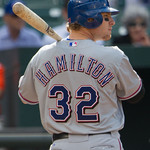
JOsh Hamilton photo

Photo by Keith Allison

Good things apparently come in twos.  Hamilton popped four two-run homers on his big night. They were his numbers 11-14 for this season.  Hamilton was batting third and playing CF.

The 2010 AL MVP started with a two-run shot off the Orioles’ Jake Arrietta in the top of the first inning; touched Arrietta for another two-run blast in the third; doubled to right off Arrietta in the fifth; homered with a runner on off Zach Phillips in the seventh; and capped it off with another blast (this one off Darren O’Day) in the eighth. His final line for the day: five-for-five (four homers and a double), four runs scored and eight RBI.

Hamilton finished the season at .285-43-128. He hit .290, with 200 home runs in nine MLB seasons.

___________________________________________________

Carlos Delgado, Blue jays – September 25, 2003

By the time Carlos Delgado had his four-homer game, he already had 299 MLB round trippers and was in his seventh consecutive campaign of 30 or more home runs. In his big game, Delgado was playing first and batting cleanup. The slugger hit a three-run shot off the Rays’ Jorge Sosa the bottom of the first inning.  His next three round trippers would all come leading off an inning:  a solo short off Sosa leading off the fourth; another solo home run leading off the sixth, off Joe Kennedy; and a final solo homer off Lance Carter to start the eighth.

Delgado ended the day four-for-four, with four home runs and six RBI.  He finished 2003 with a .302 average, 42 home runs and an AL-leading 145 RBI (his sixth straight campaign of 100+ RBI). He retired in 2009, with a .280 career average, 473 home runs and 1,512 RBI in 17 MLB seasons.

_______________________________________________

Shawn Green, Dodgers – May 23, 2002

GreenGreen was batting third and playing right field for the Dodgers on his big day – arguably the best day anyone ever had at the plate.  Not only did he bang out four home runs, he added a double and a single in a six-for-six performance.

Green’s day went like this: RBI double off Glendon Rusch in the top of the first; three-run homer off Rusch in the second inning; lead-off homer of Brian Mallette in the fourth; solo shot of Mallette in the fifth; single off Jose Cabrera in the eighth; a solo home run with two out in the ninth off Cabrera. Green’s ninth-inning shot was one of three back-to-back home runs in the inning (3B Adrian Beltre – Green – 2B Dave Hansen).  The Dodgers topped the Brewers (in Milwaukee) 16-3 – hitting eight home runs in the process.

Shawn Green’s 19 total bases on May 23, 2002, stand as the MLB single-game total-base record.

Green ended the season at .285-42-112, notching his third 40+ home run season. He finished his 15-season MLB career at .283-328-1,070.

______________________________________________

Mike Cameron, Mariners, May 2, 2002

Cameron, starting in RF and batting third, got his four-homer game off to a good start, going yard twice in the top of the first inning (as the Mariners scored ten times). Those round trippers came off Jon Rauch and Jim Parque.  (Rauch retired only one of the nine batters he faced.)

Tee (off) for Two …

Each of the home runs that Mike Cameron hit in the first inning of that May 2, 2002 Mariners’ game against the White Sox was immediately preceded by a home run off the bat of Mariners’ 2B Brett Boone.  It is the only time two MLB players hit back-to-back home runs TWICE in the same inning.

Cameron added solo home runs off Parque in the third and fifth innings – giving him four home runs in the first five innings (and the Mariners as 13-1 lead). His next at bat came in the seventh, but his didn’t get a chance to make history with a fifth long ball. He was hit, in the leg, by a pitch from Mike Porzio – causing even the White Sox home crowd to boo.  Cameron did get one more at bat – lining out to the warning track in right field in the top of the ninth. For the day, he was four-for-five, with four runs scored, four RBI and, of course, four home runs. Seattle won the contest 15-4.

Cameron finished the season at .239-25-80 – one of eight seasons (in a 17-season MLB career) in which he topped 20 home runs (he hit a career-high 30 in 2004). For his 17-season MLB career, Cameron was .249-278-968, with 297 steals.

__________________________________________

Mark Whiten, Cardinals, September 7, 1993

WhitenWhiten was playing CF and batting seventh for the Cardinals (at Cincinnati) when he had his four -homer day.  It was in the second game of a double header.  In the contest, Whiten went four-for-five with four runs scored and 12 RBI – as St. Louis won 15-2. (The Redbirds had lost the opener 14-13. So, despite scoring 28 rims in the twin bill, all they got was a split).

Mark Whiten’s 12 Runs batted in Game Two of that September 7, 1993 twin bill is the MLB RBI record (tied with Jim Bottomley) for a single game.

Whiten hit a Grand Slam off Larry Leubbers in the top of the first; popped to third off Leubbers in the fourth; knocked a three-run homer off Mike Anderson in the sixth; smacked a  two-run shot off Anderson in the seventh; and launched a two-run shot off Rob Dibble in the ninth.  (Hit, knocked, smacked, launched – so many ways to describe a long ball.)

While Whiten is a switch hitter, he hit all four of his homers in his record-tying game left-handed.

Whiten finished the season at .253-25-99, with 15 steals. It was one of only two seasons in which he would hit at least 20 home runs.  His career line was .259-105-423.

__________________________________________

Bob Horner, Braves, July 6, 1986

Horner was playing first base and batting cleanup on the day he put four balls out of the yard. And, despite his efforts, the Braves lost to the Expos (in Atlanta) by a 13-8 score. Horner homered to lead off the bottom of the second (off Andy McGaffigan); hit another solo shot off McGaffigan in the fourth; hit a three-run homer (again off McGaffigan) in the fifth (ending McGaffigan’s outing);  fouled out off Tim Burke in the seventh; and touched Jeff Reardon for a solo homer in the bottom of the ninth. (Touched – a softer way to say blasted.)

Horner ended the game four-for-five, with four runs scored and six RBI. He finished the season at .273-27-87 and his career line was .277-218-685 (10 MLB seasons). He hit 20 or more home runs in seven season and topped 30 three times.

_______________________________________________

Mike Schmidt, Phillies, April 17, 1976

Schmidt – playing third base and batting sixth as his Phillies faced the Cubs in Chicago – got off to a slow start on his four-homer day.  He flied out to center in the second inning and singled to left in the fourth.  Not only that, the game was looking pretty much out of hand, and not in the way you might have expected.  When Schmidt poked his first home run – a two-run shot in the fifth off Rick Reuschel – it cut the CUBS’ lead to 13-4.   Two innings later, Schmidt popped his second homer, a solo shot off Reuschel – reducing the Cubs lead to 13-7. In the eighth, with the Phillies storming back, Schmidt homered again.  This time it was off reliever Mike Garman – a three-run blast that got the Phillies within one at 13-12.

Then a bit of luck intervened to give Schmidt his shot at four long balls in one a game. The Phillies took the lead 15-13 in the top of the ninth, without Schmidt coming to the plate.  It looked like his day was over. The Cubs, however, tied it at 15 in the bottom of the inning, and Schmidt hit a two-run homer of Paul Reuschel (Rick’s brother) in the top of the tenth.  The Phillies eventually won 18-15 and Schmidt went five-for-six, with four runs scored and eight RBI.

Schmidt finished the season hitting .262, with 107 RBI and a NL-leading 38 home runs (it was his third consecutive NL home run crown).  He eventually led the league in round trippers eight times and put up a .267-548-1,595 line. Notably, Schmidt’s also stole 174 bases in his 18-season MLB career – with a high of 29 in 1975. The three-time MVP also earned 10 Gold Gloves.

_______________________________________________

Willie Mays, Giants – April 30, 1961

The Say Hey Kid started in center field, batting third, against the Braves (in Milwaukee) on April 30, 1961.  He took Lew Burdette deep (solo) in the first inning; added a two-run shot off Burdette in the third; flew out to center off Moe Drabowsky in the fifth; hit a three-run shot off Seth Morehead in the sixth; and topped off his day with a two-run homer of Don McMahon in the eighth. The Giants won 14-4, with Mays going four-for-five, with four runs scored and eight RBI.

Mays finished the 1961 season at .308-40-123. In his 22-season MLB career, he had six seasons with forty of more home runs (two of those with 50+) and won four league home runs crowns and four league stolen base titles.  His final stat line was .302-660-1,903, with 3,283 hits and 338 stolen bases.

__________________________________________

Rocky Colavito, Indians – June 10, 1959

Colavito was playing RF and batting cleanup for the Indians (at the Orioles) when he put up his four-homer day. He walked in the first – appropriately by Orioles’ starter Jerry Walker – which might have been a good strategy for the day. He then hit a two-run home run off Walker in the third (driving in Vic Power who had been walked by Walker). In his next at bat, in the top of the fifth, Colavito hit a solo home run off Arnie Portocarrero. He added to his day in the sixth, with another homer (two-run) off Portocarrero and, in the ninth, with a solo shot off Ernie Johnson.   The Indians prevailed 11-8, with Colavito going four-for-four, with five runs scored and six RBI.

Colavito ended the 1959 season with a .257 average, a league-topping 42 home runs and 111 RBI. In his 14-season MLB career he topped 30 home runs in seven seasons (40+ homers three times).  His career line was .266-374-1,159.

After his league-leading 42 home runs in 1959 (and, of course, his four-homer game), Rocky Colavito was traded by the Indians to the Tigers for 1959 AL batting champ (.353) Harvey Kuenn. The only time a defending HR champion has been traded for a batting champion.

__________________________________________

Joe Adcock, Braves – July 31, 1954

Adcock was playing first base and batting fifth (versus the Dodgers in Brooklyn), when the Milwaukee Brave had a four-homer day.  Surprisingly, the two hitters immediately preceding him in the lineup – future Hall of Famers Hank Aaron and Eddie Mathews – never accomplished the feat.  Adcock started his assault with a home run off Don Newcombe leading off the second inning. He then doubled off Erv Palica in the third (at this point in the game, Mathews had two home runs and Adcock one).  Adcock added a three-run homer off Erv Palica in the fifth; a two-run shot off Pete Wojey in the seventh; and solo round tripper off Johnny Padres leading off the ninth.  The Braves won the game 15-7, with Adcock going five-for-five (four homers and a double), with five runs scored and seven RBI.

Adcock finished the 1954 season with a .308-23-87 stat line and was .277-336-1,122 in a 17-season MLB career (topping 20 home runs in seven campaigns).

The day after his four-homer game, Joe Adcock collected one double in two at bats before being hit by a Clem Labine fastball to the batting helmet (knocking Adcock out of the game – pun intended) in the fourth inning. The Braves were ahead 8-2 at the time.

__________________________________________

Gil Hodges, Dodgers – August 31, 1950

Hodges was playing first base and batting sixth for the Dodgers when he exploded for four home runs against the Boston Braves (in Brooklyn). He started in style with a two-run home run off lefty Warren Spahn in the second inning.  He went on to hit a three-run homer off Normie Roy in the third; a two-run homer off Bob Hall in the sixth; a single off Johnny Antonelli in the seventh; and a two-run home run off Antonelli in the  eighth.     He also grounded out off Mickey Haefner in the fourth inning.

The Dodgers won 19-3, with Hodges going five-for-six (four homers and a single), scoring five times and plating nine. Hodges went .283-32-113 for the season.  In his career, he put up a .273-370-1,274 stat line in 18 seasons.  He hit 20 or more home runs in 11 seasons (with a high of 42 in 1954).

_________________________________________

Pete Seerey, White Sox – July 18, 1948

Seerey got his four-homer game in the first game of a double header. Seerey was in left field batting cleanup that day; as his White Sox took on the Athletics in Philadelphia.

It didn’t start out that well for Seerey, as he struck out of Carl Scheib to open the second inning. He warmed up in the fourth, touching Scheib for a home run to open the inning. He added a two-run home run off Scheib in the fifth and a three-run long ball off Bob Savage in the sixth.  He then popped out to the catcher (off Bubba Harris) in the seventh and walked (off Joe Coleman) in the ninth.

Fortunately for Seerey, eleven proved to be a lucky number.  The game was knotted at 11-11 after nine, so he got another chance to hit.  That came in the 11th inning – and Seerey delivered a home run off Lou Brissie.  The White Sox won 12-11 and Seerey went four-for-six, with four runs scored, seven RBI, a walk and a strikeout.

Seerey finished the season at .229 with 18 home runs and 64 RBI. In a seven-season MLB career (mostly in the WW II years), Seerey hit .224 with 86 home runs and 261 RBI. He led the AL in strikeouts in four of his seven campaigns.

____________________________________________

Chuck Klein, Phillies – July 10, 1936

KleinKlein was batting third and playing right field when his four-homer day helped the Phillies defeat the Pirates in Pittsburgh by a 9-6 score. Klein hit a three-run homer off Jim Weaver in the first inning; popped out against Weaver in the third; led off the fifth with a homer (again off Weaver); and hit a solo shot off Mace Brown in the seventh.

Ah, Lady Luck. The game went into the bottom of the ninth with the Phillies up 6-4 and Klein sitting on three home runs.  The Buccos scored twice to tie it and Klein got another at bat – leading off the tenth – in which he popped his fourth home run; this one a lead-off shot off Bill Swift.

Klein ended the game four-for-five with four runs scored and six RBI. He hit .306 for the season, with 25 home runs and 104 RBI.   He finished his 17-season MLB career at .320-300-1,201 and was a four-time league leader in home runs.

1933 A Royal Year for Philadelphia Baseball

Chuck Klein won the NL Triple Crown with the Phillies in 1933 – going .368-28-120.  It was the only season in which both the NL and AL featured a Triple Crown winner and they were both from the same city – as the crosstown AL Philadelphia Athletics’ Jimmy Foxx took the AL Triple Crown (.356-48-163).  

________________________________________

Lou Gehrig, Yankees. – June 3, 1932

Lou Gehrig was the first player to notch a four-homer game post-1900. On June 3, 1932, as the Yankees took on the Athletics in Philadelphia, Gehrig was at first base and batting cleanup. And cleanup he did, starting with a two-run homer in the first inning off George Earnshaw, followed by a solo shot off (again off Earnshaw) leading off the fourth, another solo homer off Earnshaw in the fifth (back-to-back with Babe Ruth) and a solo home run off Roy Mahaffey leading off the seventh.  In his final two at bats, he grounded out against Lew Krausse in eighth and hit a fly to wall in center off Eddie Rommel in the ninth (that came close to being home run number five).

Gehrig ended the day four-for-six with four runs and six RBI, as the Yankees topped the Athletics 20-13.  Gehrig finished the 1932 season at .349-34-151 – and put up a career line (17 seasons) of .340-493-1,995. He led the AL in home runs three times (and had five seasons of 40+ homers), RBI five times and won one batting title.

___________________________________________

Ed Delahanty, Phillies (Quakers) – July 13, 1896

Delahanty was playing 1B and batting cleanup as his Phillies took on the Cubs in Chicago on July 13, 1896.  In the first inning of that contest, Delahanty hit a two-run, inside-the-park home run off William “Adonis” Terry (who would pitch the whole game). In the third, he added a single and the fifth inning he launched a three-run shot over the right field scoreboard.  In the seventh, with his team down 9-6, Delahanty hit a drive to deep center for a second inside-the-park home run and, finally in the ninth, Delahanty homered for the record-tying fourth time. Despite Delahanty’s heroics, the Philadelphia squad lost 9-8.

Delahanty ended the day five-for-five, with four runs scored and seven RBI. He finished the 1896 season at .397, with an NL-leading 13 home runs and a league-topping 126 RBI. Over his 16-season MLB career, Delahanty hit .345, with 101 home runs and 1,466 RBI – as well as 456 stolen bases.  He won two batting titles (and hit over .400 in three seasons), led the league in doubles five times, RBI three times, home runs twice, triples once and stolen bases once.

_______________________________________

Bobby Lowe, Beaneaters (Braves) – May 30, 1894

Lowe was playing second base and leading off for the Boston Beaneaters (versus the Cincinnati Reds in Boston) when he enjoyed his four-homer afternoon.  It came in the second game of a split-admission double header. (Boston won the morning contest 13-10.)

Lowe was put out to start the game, but homered twice in the third inning off Reds’ hurler Elton “Icebox” Chamberlain (who would pitch the entire game – despite falling behind 11-2 after three frames). Lowe homered again in the fifth and sixth innings and added a single in the seventh – as Boston prevailed 20-11.   He ended the day five-for-six with four runs scored and six RBI – and finished the season at .346-17-115, notching what would prove to be career highs in all three categories. For his 18 MLB seasons, Lowe went .273-71-989, with 303 stolen bases.

Primary resources:  Baseball-Reference.com; Baseball-Almanac.com; MLB.com

BASEBALL ROUNDTABLE ON THE TOP 100 BASEBALL BLOG LIST

100Baseball Roundtable is on the Feedspot list of the Top 100 Baseball Blogs.  To see the full list, click here.

I tweet baseball @DavidBBRT

Follow/Like Baseball Roundtable’s Facebook Page here.  More baseball commentary; blog post notifications; PRIZES.

Member: Society for American Baseball Research (SABR); The Baseball Reliquary; The Negro Leagues Baseball Museum.
Let’s Get This Party Started – First At Bat Home Runs

This post updated April 20, 2019.

UPDATE – ADD ANOTHER FIRST-AT BAT HOME RUN

How appropriate. Not long after this post was published, Cardinals’ pinch hitter Lane Thomas joined the list of players with a home run in their first MLB at bat (the stats in the post have been updated to reflect his April 19 blast. ). His long ball was a two-run shot in the bottom of  sixth inning of the Redbirds’ 5-4 loss to the Mets. Notably, the homer to right barely cleared the wall. In fact, it took an umpire’s review to confirm that Thomas had indeed joined the first-at bat HR Club. Thomas, of course, is now part of the group of first-at bat home run hitters with only one career round tripper. Given the fact that his is coming off a 2018 Double A season that included 21 homers, that may not last long.

On this date (April 19) in 1938, the Dodgers (of Brooklyn) opened the season against the Phillies in Philadelphia.  Yes, that’s right, Opening Day on April 19 (How the times have changed).   That day a couple of rookies showed they truly knew how to “get the party started” – hitting home runs in their first MLB at bats on Opening Day.

Batting third for Brooklyn was 28-year-old rookie left fielder Ernie Koy. In his first-ever MLB at bat, he took Phillies’ starter Wayne LaMaster deep to give the Dodgers a 1-0 lead.  Leading off for Philadelphia in the bottom of the inning was 25-year-old rookie second baseman Heinie Mueller.  In his first MLB at bat, Mueller homered off Dodgers’ starter Van Lingle Mungo to tie the game.  It was the first time in MLB history that two players homered in their first MLB at bat in the same game – a feat that would not be matched for nearly 80 years (2016).

The Dodgers, by the way, won 12-5; with Koy going 3-for-5 with two runs scored and an RBI. Mueller went 2-for-3, with two walks, three runs scored and one RBI. In that rookie season, Koy hit .299, with a career-high 11 home runs.  He played six MLB seasons (558 games) and put up a .279-36-260 line. Mueller finished 1938 with a .250-4-34 stat line and went .253-17-127 in four MLB seasons.

Aaron Judge photo

Aaron Judge. Photo by Keith Allison

Photo by slgckgc

Tyler Austin. Photo by slgckgc

It wasn’t until August 13, 2016, that two players again homered in their first MLB at bat in the same game. This time, they were on the same team – and accomplished the feat back-to-back. It came in the bottom of the second inning, with the Yankees facing the Rays. With two outs and the bases empty, Yankee rookie 1B Tyler Austin took Rays’ starter Matt Andriese deep to right field to give the Bronx Bombers a 1-0 lead.  Rookie RF Aaron Judge immediately followed up with a home run of his own (also in his first MLB at bat); this one to straight-away center.  Austin ended the season with five home runs in 31 games, while Judge got in just 17 games and hit just .179 with four home runs.  Note: By virtue of that limited playing time, Judge kept his rookie status for 2017 – when he went .284-52-114, setting a new MLB rookie record for home runs and leading the AL in runs scored (128), home runs, walks (127) and whiffs (208), while winning the AL Rookie of the Year Award. 

Here are a few other first at-bat home run factoids.

  • A total of 123 players (AL. NL, AA) have homered in their first MLB at bat.
  • Twenty-nine of those players hit their home run on the very first MLB pitch they ever saw.
  • Just four players have hit a Grand Slam home run in their first MLB at bat: Bill Duggleby, Phillies, April 21, 1898; Jeremy Hermida, Marlins, August 31, 2005; Kevin Kouzmanoff, Indians, September 2, 2006; and Danial Nava, Red Sox, June 12, 2010. Notably, Kouzmanoff and Nava put a little icing on the cake, hitting their Grand Slams on the first MLB pitch they ever saw.
  • Twenty pitchers, including the first player to hit a Grand Slam in his first at bat, homered in their first-ever MLB at bat.

PitcherHr

  • Only two players have homered in their first two at bats: Bob Nieman, Browns, 1952 and Keith McDonald, Cardinals, July 4, 2000. Note: McDonald collected just three base hits in his MLB career – and they were all home runs.  For that story, click here.
  • Only three players have hit (run) for an inside-the-park homer in their first MLB at bat: Luke Stuart, Browns, August 8, 1921; Walter Mueller, Pirates, May 7, 1922; and Johnnie LeMaster, Giants, September 2, 1975.
  • The first recorded instances of a player homering in their first MLB at bat came on April 16, 1887 – Orioles’ OF Mike Griffin and Red Stockings’ OF George Tebeau (in separate games).
  • Twenty-three of the players to homer in their first MLB at bat ever have only one MLB home run on their resumes (three are still active).


ONEHR


Primary Resources: Baseball-Reference.com; Baseball-Almanac.com; MLB.com

BASEBALL ROUNDTABLE ON THE TOP 100 BASEBALL BLOG LIST

100Baseball Roundtable is on the Feedspot list of the Top 100 Baseball Blogs.  To see the full list, click here.

I tweet baseball @DavidBBRT

Follow/Like Baseball Roundtable’s Facebook Page here.  More baseball commentary; blog post notifications; PRIZES.

Member: Society for American Baseball Research (SABR); The Baseball Reliquary; The Negro Leagues Baseball Museum.


Baseball Roundtable Trivia Teaser – I Got This Under Control

Yesterday (April 17, 2019), the Cubs and Marlins faced off in Miami.  It wasn’t a particularly memorable game – the Cubs won 6-0.  Something did catch BBRT’s attention, however.  In the nine-inning contest, only one walk was issued (by Marlins’ starter Sandy Alcantara).  That compares to a 2019 MLB average of 5.26 walks (combined) per game through yesterday.  That spurred me to take a look at pitchers who “took control of the situation” – and prompted today’s Baseball Roundtable Trivia Teaser.

BASEBALL ROUNDTABLE TRIVIA TEASER

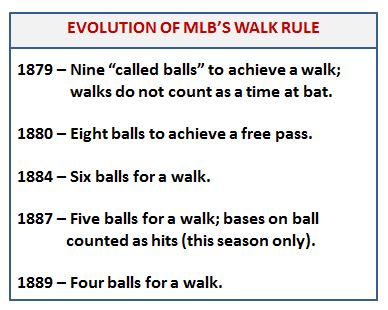
When you look at the MLB leaders in fewest walks per nine innings in a season, one thing stands out.  Only one of the top 25 qualifying seasons occurred since 1900. (Keep in mind, the four-ball walk rule didn’t come into play until 1889.)  Your question: Who is the only post-1899 MLB player to record one of the 25 lowest-ever  walks-per-nine innings rates? 

A couple of hints:  He came in at a very respectable number seven – and he exhibited that control not just post-1899, but also post-1999.

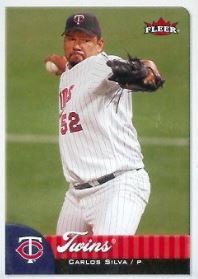
SilvaAnswer:  Twins’ right-hander Carlos Silva, who – in 2005 – walked just nine batters (two of those intentionally) in 188 1/3 innings (a 0.4301 batters-per nine rate).  This gives Silva the best single-season walks-per nine rate since 1900, the seventh-best all time and makes him one of only eleven pitchers in MLB history to record a qualifying season of less than .50 walks-per nine.  Silva went 9-8, 3.44 in 27 starts that season.  Silva had a nine season MLB career (2002-2010 for the Phillies, Twins, Mariners And Cubs) – going 70-70, 4.68.  In 1,241 career innings, he walked 238 and fanned 554.  His best season was 2004, when he went 14-8, 4.21 for Minnesota.

Note: If you are wondering, the best-ever BB/9 ratio belongs to George Zettlein of the 1876 National League Philadelphia Athletics, who walked just six batters in 234 innings. (0.2308 per nine frames pitched). Keep in mind that, in 1876, it took eight balls outside the zone to work a walk.  Zettlein, by the way, went 4-20, 3.88 that seasonEvolution.

A TALE OF TWO BUBBA’S

The MLB record for the most consecutive innings pitched without issuing a free pass belongs to the Kansas City Athletics’ Bill Fischer – at 84 1/3.  Fischer walked the first batter he faced (the Indians’ Bubba Phillips) in a start on August 3, 1962 and didn’t walk another batter that game.  (He went the distance in a 1-0 loss.)  In fact, he didn’t walk another batter until the final day of the season (September 30), when he issued a free pass to the Tigers’ Bubba Morton in the bottom of the fifth inning. In between, he tossed his 84 1/3 walk-less frames and put up 12 straight walk-less appearances (11 starts).

As you might guess, the best career walks-per nine inning rates are dominated by pitchers whose careers ended before 1900.  The best of all?  That was Hall of Famer Candy Cummings, whose career spanned six seasons (1872-77). Cummings walked 113 batters in 2,149 2/3 innings – for a ratio of 0.4731. His final stat line was 145-94, 2.42, with 233 complete games in 241 starts.

The first primarily post-1899 hurler to appear on the career list is Deacon Phillipe, whose career spanned 13 seasons (1899-1911).  The Pirates’ righty walked 363 batter in 2,607 innings pitched (1.2532 per nine innings) for 16th place.  The only other post-1900 players in the top twenty are Babe Adams (19 seasons between 1906 and 1926 and a 1.2910/9 ratio) in the 18th spot and Dan Quisenberry (1979-90, with a 1.3974/9 ratio) at number twenty..

OKAY, SO WE DIDN’T ALWAYS TRACK EVERYTHING

Bartolo colon photo

Photo by apardavila

MLB didn’t really get into pitch-by-pitch record keeping until 1988.  However, since that time, the then Oakland A’s Bartolo Colon holds the record for consecutive strikes thrown in a game (strikes, foul balls, balls put in play) at 38. His string started with the second pitch of the fifth inning (against the Angels in Anaheim) and went through the seventh pitch of the eighth frame.  In between, he put together a string of 11 batters without tossing a “ball.” Colon, by the way, threw eight innings of four-hit shutout ball in the 6-0 Athletics’ victory.  He threw 82 strikes and 26 balls.

Primary Resource: Baseball-Reference.com

BASEBALL ROUNDTABLE ON THE TOP 100 BASEBALL BLOG LIST

100Baseball Roundtable is on the Feedspot list of the Top 100 Baseball Blogs.  To see the full list, click here.

I tweet baseball @DavidBBRT

Follow/Like Baseball Roundtable’s Facebook Page here.  More baseball commentary; blog post notifications; PRIZES.

Member: Society for American Baseball Research (SABR); The Baseball Reliquary; The Negro Leagues Baseball Museum.
BASEBALL ROUNDTABLE TRIVIA TEASER – The King of the Four-Whiff Inning(s)

 baseball photoA pitcher recording four strikeouts in an inning is relatively rare.  It’s happened just 90 times in MLB history (There was also one instance of two pitchers combining for four strikeouts in a single frame.) By contrast, there have been 265 official single-pitcher MLB no-hitters, as well as 12 no-hitter spun by multiple pitchers.

This Trivia Teaser will focus on those four-strikeout innings.

Baseball Roundtable Trivia Teaser

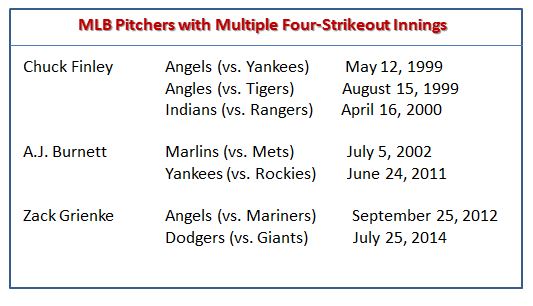
Only three pitchers have recorded multiple four-strikeout innings and only one pitcher has recorded three such frames.  Your question:  Who was that pitcher? Hints:  All three were for American League Teams.  The last one on April 16, 2000.

The answer is Chuck Finley. 

4x

On May 12, 1999, starting against the Yankees (at New York) for the Angels, Finley’s third inning went: Single to left by Yankees’ LF Shane Spencer; three-pitch strikeout  (looking) of 3B Scott Brosius; C Joe Girardi safe on an error; (wild pitch advances both runners); strikeout (swinging) of Yankees’ 2B Chuck Knoblauch on a 2-2 pitch; strikeout (swinging) of SS Derek Jeter on a 3- 2 wild pitch, with Jeter safe at first; strikeout (swinging) of RF Paul O’Neill on a 2-2 pitch.  No runs scored, three left on base, two wild pitches, one error.  Finley went eight innings, giving up no runs on three and two walks, with eleven strikeouts. He got the win in a 1-0 ball game.

On August 15, 1999, Finley faced off (again for the Angels) against the Tigers in Detroit. In the bottom of the first, he gave up a ground ball single to CF Kimera Bartee, followed by: a swinging strikeout (on a 1-2 wild pitch) of SS Deivi Cruz, Cruz out and Bartee going to second; a swinging strikeout (on a 2-2) pitch of LF Juan Encarnacion; a swinging strikeout on a 1-2 wild pitch to 3B Dean Palmer, with Palmer safe at first and Bartee going to third; a swinging strikeout of Tony Clark on a 1-2 pitch.  No rusn scored on a hit and two wild pitches, with two men left on base. Finley went 6 2/3 innings to get the win, giving up two runs on six hits and two walks, with 12 whiffs.

In 1999, Chuck Finley led the American League with 15 wild pitches. 

On April 16, 2000, Finley – pitching for the Indians against the Rangers in Cleveland – tossed his third four-whiff inning. It came in the top of the third and went like this: a single by Rangers’ 2B Luis Alicea; a strikeout of 3B Tom Evans (swinging on a 2-2 pitch); a strikeout of SS Royce Clayton (swinging on a 1-2 pitch); a stolen base by Alicea; a strikeout of LF Chad Curtis on a 2-2 pitch, with Curtis reaching on a passed ball and Alicea going to third; a run-scoring single by C Ivan Rodriguez; and a strikeout looking (on a 3-2 pitch) by Rafael Palmeiro.  One unearned run scored on two hits and a passed ball. Finley got the win by a 2-1 score, going the full nine innings, giving up five hits, the one unearned run, with four walks and 13 strikeouts.

On April 14, the Blue Jays’ Tom Pannone threw the second “immaculate inning” – nine pitches/three strikeouts – of 2019. For the story and some immaculate inning trivia, click here.

Primary Resources: Baseball-Reference.com; Baseball-Almanac.com


BASEBALL ROUNDTABLE ON THE TOP 100 BASEBALL BLOG LIST

100Baseball Roundtable is on the Feedspot list of the Top 100 Baseball Blogs.  To see the full list, click here.

I tweet baseball @DavidBBRT

Follow/Like Baseball Roundtable’s Facebook Page here.  More baseball commentary; blog post notifications; PRIZES.

Member: Society for American Baseball Research (SABR); The Baseball Reliquary; The Negro Leagues Baseball Museum.

2019 John Paciorek Award – Harley Hisner – For the Love of the Game

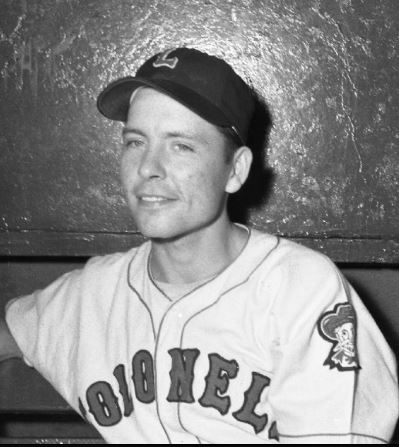
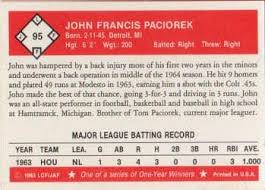
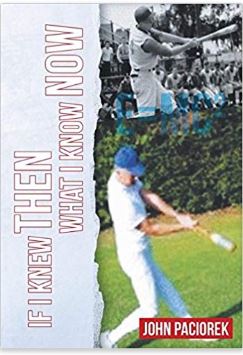
JPAFIn 2014, Baseball Roundtable launched the John Paciorek Award (JPA). The JPA recognizes players who have had short, often very short, major league careers, but whose accomplishments, nonetheless, deserve recognition.  Past winners have included a player whose every MLB hit (three in nine career at bats) were home runs;  a player who had only MLB bat, but won a World Series Ring and a Purple Heart; a player who had just two home runs in 61 MLB at bats (for the vaunted Yankees and Dodgers), but whose “body of work” made him one of just two players in MLB history to homer in their first and final official appearances in a major league batter’s box;’ and more.  

(Note: Information on John Paciorek’s career – the inspiration for the JPA – can be found at the end of this post. Paciorek’s day in the sun constitutes arguably the best one-game MLB career ever.)

For an interesting take on topics related to baseball’s past, present and future, BBRT also recommends a visit to BaseballHappenings.net.  Click here to take a peek.

________________ 2019 JPA Winner – Harley Parnell Hisner  _______________

Harley Hisner. Photo: Courtesy of BaseballHappneings.net

Harley Hisner.
Photo: Courtesy of BaseballHappneings.net

This year’s JPA honoree did, indeed, have a short MLB career (just six innings).

Harley Hisner‘s MLB tenure encompassed the day of September 30, 1951 – when the Red Sox called upon the 6’1″, 180-pound, 24-year-old righty to face the New York Yankees.    It was also, in some way historic. He earns his spot here, as much for his love of the game, as for his place in MLB history.  But I’m getting ahead of myself. Let’s start with a look at how Hisner got to the Yankee stadium mound.

Hisner, whose nickname was “Jim,” grew up on a farm near Fort Wayne, Indiana. The youngest of four brothers, Harley was an solid athlete (basketball and baseball). In fact, the Hisner brothers seemed naturals and three of the four boys were signed to contracts by the Red Sox. (Only Harley would make it to the big club.) Harley was signed in 1945, for a $5,000 bonus, right after graduating from high school.  He was also, however, drafted into the U.S. Army at about the same time. World War II was winding down and Hisner did not leave the states and, in fact, was able to keep his baseball skills sharp playing the game at Fort Benjamin Harrison.

Hisner’s minor league career was a bit up-and-down, due in part to recurring arm/shoulder issues.  In 1947, the 20-year-old Hisner went 7-14, 5.21 for the Class C San Jose Red Sox and the Class A Scranton Red Sox.   Then, in 1948, he helped Scranton win the Eastern League title with an 11-3, 2.48 record (although Hisner missed a portion of the season with chronic bursitis).  The following  season, was down again – as Hisner went 6-11, 4.47 in stop at Scranton and Triple A Louisville.  More of the same in 1950 (5-6, 4.65 at Louisville).  In 1951, Hisner struggled early and ended up 7-13, 6.26 at Louisville.  However,  he came on strong at the end of the season; winning his last four starts.  That earned him  a late-season call up to the Red Sox – and a big-league start in the final game of the season.

HARLEY HISNER’S BIG GAME

Taking the MLB mound for  the first (and, as it would turn out, final) time, Hisner found himself facing a daunting challenge – a first-place Yankee lineup that included five future Hall of Famers: Mickey Mantle in RF; Joe DiMaggio in CF; Phil Rizzuto at SS; Johnny Mize at 1B; and Yogi Berra behind the plate.  In retelling the tale, however, Hisner often said he was made more nervous by the size of the partisan crowd (35,814)  than the Yankee lineup.

Hisner got off to a good start.  The first MLB batter he faced was rookie RF Mickey Mantle, who went down on strikes. He then gave up a single to SS Phil Rizzuto, before getting LF Hank Bauer to hit into a short to second fielder’s choice.  That brought up Yankee icon Joe DiMaggio, who hit an infield single – putting Hisner into the baseball history books.  That single was DiMaggio’s the final regular-season hit of DiMaggio’s great career Hisner, by the way pitched out of the jam, getting 1B Johnny Mize to fly out to right.  So, in his first MLB inning – a scoreless one at that – Hisner faced five batters; four of them future Hall of Famers. He went on to pitch a total of six frames, giving  up three runs on seven hits and four walks (with three strikeouts). He faced Mickey Mantle four times and it went like this:  First inning – strikeout; second inning – strikeout; fourth inning – walk; sixth inning – pitcher to short to first double play.

Hisner’s final career stat was 0-1, 4.50, with six innings pitched, seven hits, three earned runs, four walks and three strikeouts.

Harley Hisner batted twice in his lone MLB appearance, collecting a ground out to first (unassisted) and a single to right field – finishing his MLB career with a .500 average. 

The following year, Hisner was cut from the Red Sox on the final day of Spring Training and never made it back to the major leagues.  He played two more years of professional ball – going 3-7, 3.86 in two minor league stops in 1952 and, in 1953, helping the Wichita Falls Spudders capture the Big State League (Class B) title by going 14-5, 3.87. At this point, Hisner (tired of the travel and dissapointed with his progress) retired from professional baseball to pursue a career as a machinist.

FOR THE LOVE OF THE GAME

After leaving the professional ranks, Hinser did not lose he passion for the game. Hisner played semi-pro baseball through 1961; before becoming a youth coach. He was a member of the Fort Wayne team that won the 1956 National Baseball Congress Championship and Global World Series. Then, in 1957, as the Fort Wayne team finished second in the National Baseball Congress Tournament, Hinser tied Satchel Paige’s tourney record  with four wins, while  throwing 38 innings in 11 days.  The following year, Hinser threw a no-hitter for the Anderson, Indiana squad in the tournament.  Hisner also was a long-time board member of the Northeast Indiana Baseball Association.

In 1976,  Harley Hisner was inducted into the Northeast Indiana Baseball Association Hall of Fame and in 2010 he received the organization’s Colin Lister Award for “dedication to the game of baseball and its historic legacy.” 

Primary Resources: Indiana-Born Major League Baseball Players: A biographical dictionary 1871-2014 (by Pete Cava); The Society for American Baseball Research; Baseball-Reference.com.

________________________________________________________

PAST JOHN PACIOREK AWARD WINNERS:

2014 – Brian Scott Dallimore

In his first start (not his first game) for the 2004 Giants, Dallimore had two singles, a Grand Slam (his first MLB hit and only MLB home run), a walk and a hit by pitch.  For the full JPA take on Dallimore’s 27- game MLB career, click here.

2015 – Roy Gleason

Gleason played in just eight MLB games, had a double in his only MLB at bat – but also earned a World Series ring (1963) and a Purple Heart. Ultimately, he was the only ballplayer with MLB experience to serve on the front lines in Vietnam. For the full JPA take on Gleason, click here. Note: Gleason’s life is detailed in the book “Lost in the Sun – Roy Gleason’s Odyssey from the Outfield to the Battlefield.”

2016 – John Allen Miller

Miller played just 32 MLB games (during the 1966 and 1969), taking the field (at 1B/LF/3B/2B) for the Yankees and Dodgers. Miller collected ten hits in 61 MLB at bats (.164 average) and hit just two home runs – but he made those long balls count.  Miller made his MLB debut with the Yankees on September 11, 1966 and hit a two-run homer in his first big league at bat –  making him (surprisingly) the first Yankee ever to homer in his first MLB at bat. (Little did Miller know he would not get another home run or RBI until the final at bat of his MLB career.)  Miller’s final at bat came as a Dodger (September 23, 1969) and he stroked a solo home run.  That narrow “body of work” made Miller one of just two players in MLB history to homer in their first and final official appearances in a major league batter’s box. For more on Miller, click here.

2017 – Chris Saenz

RHP Chris Saenz’ big day came on April 24, 2004 – when he was called up from Double A Huntsville (where he was 1-1, 3.86) to make a spot start against the Saint Louis Cardinals, whose powerful lineup included the likes of Albert Pujols, Scott Rolen, Jim Edmonds and Reggie Sanders.   The rookie went six innings, giving up just two hits, three walks and no runs, while fanning seven. There was some speculation (primarily among sportswriters and fans) that Saenz’ performance might earn him another start or two, but two days after his debut, he was on his way back to Huntsville.  Unfortunately, his minor league season included a September elbow injury that required Tommy John surgery and he never returned to the majors. Statistics before 1900 can be sketchy, but baseball-reference.com shows that Saenz is the only pitcher to complete a one-game MLB career of at least five innings pitched, without giving up a single run (earned or unearned). For more details on this JPA honoree, click here.

2018 – Keith McDonald

Keith McDonald’s MLB career (Cardinals 2000-2001) covered just eight games and 11 plate appearances (nine at bats) and three hits – but he made them count.  All of McDonald’s safeties were home runs – making him the only MLB player with more than one career hit who can look back on major league career in which  his every hit was a home run.  McDonald is also one of only two players – and the only National Leaguer – to homer in his first two major league plate appearances.  For the full story, click here.


—–INSPIRATION FOR THE JPA—-

John Paciorek – signed out of Saint Ladislaus High School in Hamtramck, Michigan (where he had starred in football, basketball and baseball) – appeared in his first major league game on the final day of the 1963 season (September 29) at the age of 18.  The 6’ 1”, 200-pound outfielder had spent the 1963 season with Class A Modesto Colts. The Colts’ parent club, the Houston Colt .45s (that was the current Astros’ franchise name back then), was suffering through a difficult season. The team was 65-96 going into that final game.  Looking to the future, Houston had, in fact, fielded an all-rookie lineup (average age 19) on September 27. Youth was still being served two days later when John Paciorek started his first MLB game. The results were surprising – and worthy of recognition.

pACIOREKPlaying right field and batting seventh in a 13-4 win over the NY Mets, Paciorek ended up with three hits and two walks in five plate appearances, with four runs scored and three runs batted in.  Perhaps equally surprising is that it was not only Paciorek’s first major league appearance, it was to be his only MLB appearance.  Back pain the following spring, followed by surgery (he played 49 minor league games in 1964 and missed all of the 1965 season), put an end to his MLB playing days. (Paciorek did play in four more minor league seasons.)  Still, you will find John Paciorek in the Baseball Encyclopedia and his is arguably the greatest one-game MLB career ever.  Among one-gamers, he holds the record for times on base and runs scored, and shares the record for batting average, on base percentage and RBIs.

jpcOVERPaciorek, by the way, went on to become a high school teacher and multi-sport coach and is the author of three books (Plato and Socrates – Baseball’s Wisest Fans; The Principles of Baseball: And All There Is To Know About Hitting; and If I Knew Then What I Know Now.  You also can enjoy Paciorek’s prose (and expertise) directly at his blog “Paciorek’s Principles of Perfect Practice” by clicking here. You can find out even more about Paciorek in Steven Wagner’s 2015 book “Perfect: The Rise and Fall of John Paciorek, Baseball’s Greatest One-Game Wonder.”  (See the review of “Perfect” by clicking here.)

A final note. John Paciorek’s insight into the national pastime should come as no surprise. Paciorek comes from a true “baseball family.”  He was the first born of eight siblings and was followed to the big leagues by younger brothers Jim and Tom Paciorek.  (Like John, Jim’s MLB career was short – 48 games for the Brewers in 1987. Brother Tom, however, achieved a .282 average over an 18-season MLB career.)Books


BASEBALL ROUNDTABLE ON THE TOP 100 BASEBALL BLOG LIST

100Baseball Roundtable is on the Feedspot list of the Top 100 Baseball Blogs.  To see the full list, click here.

I tweet (on X) baseball @DavidBaseballRT

Follow/Like Baseball Roundtable’s Facebook Page here.  More baseball commentary; blog post notifications.

Member: Society for American Baseball Research (SABR); The Baseball Reliquary; The Negro Leagues Baseball Museum.
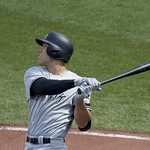
Baseball Roundtable Trivia Teaser – Celebrating Box Scores and Blizzards.

tearsOkay, it April 11 (2019) and I am looking out of the windows of my Roseville, Minnesota home at a blizzard (snow, wind, rain, sleet and even hail) that has closed schools, roads and even businesses.  I did brave the weather to retrieve my morning paper from a snowbank – I prefer my box scores be accompanied by the scents of hot coffee and newsprint.

At times like these, I console myself by thinking “baseball” and pursuing baseball oddities. Certainly that beats reflecting on yesterday’s Twins’ game, when the boys gave up six runs on two hits, six walks and a hit batsman in the fifth inning of a 9-6 loss to the Mets – talk about a blizzard of wildness.    Hence, today’s trivia question … which you’ll find below the wintry photo.

Who is the only player to both surrender a home run to the first MLB batter he faced and hit a home run in his first MLB appearance as a hitter. Hint:  Although it may not help (except perhaps to date the player in question), this player acted as the body double for Kevin Costner in the 1990 movie “For the Love of the Game.”  Also, this player is in the International League Hall of fame. 

The answer is right-hander Dave Eiland, who made his debut with the Yankees on August 3, 1988. Eiland actually pitched a pretty good game against the Brewers that day – giving up just one run on three hits and two walks (three strike outs) over seven innings. The first batter he faced was future Hall of Famer Paul Molitor, leading off and playing third base for the Brew Crew.  Molitor popped a 1-2 pitch for a home run – and the only run Eiland would surrender that day.

Fast forward to 1992. Eiland had been released by the Yankees and signed (as a free agent) by the Padres.  In the National League, of course, he found himself not just on the mound, by (for the first time) in an MLB batter’s box.  In his very first at bat (April 10, 1992), Eiland took the Dodgers’ Bob Ojeda deep to left-center for a two-run home run.  Eiland pitched four scoreless innings in the 8-3 Padres’ win, but did not get the decision.  Note: Eiland would go 2-for-22 as a hitter in his MLB career – scoring twice  and driving in two.

EilandHere’s a bit more on Eiland. He was an all-around athlete, playing baseball, football, basketball and golf in high school.  He received a athletic scholarship to the University of Florida (where he played football)  in 1985 and transferred to the University of South Florida in 1986 (focusing on baseball) – where he earned All-Sun Belt Conference recognition.

The Yankees’ seventh-round draft choice in 1987,  Eiland pitched in ten MLB seasons (1988-91 and 1995 for the Yankees; 1992-93 for the Padres; 1998-2000 for the Devil Rays). Eiland went 12-27, with a 5.74 earned run average in an MLB career cut short by a pair of Tommy John surgeries.  While he didn’t find great success in the major leagues, Eiland did make a mark in the minors. In 1990, he was named the International League Pitcher of the Year  and the Yankees’ Minor League Pitcher of the Year after going 16-5, 2.87 for Columbus (27 games/26 starts). In 2012, he was elected to the International League Hall of Fame. His International League record was 82-42, 3.44.  Overall, he pitched parts or all of 14 seasons in the minors, going 109-58, 3.42.

Eiland’s pitching expertise is exemplified by the fact that he has gone on to a successful MLB coaching career (Yankees 2008-10; Royals 2011-17; Mets 2018-current);  notably serving as the pitching coach for the 2009 World Champion Yankees.

Primary Resources:  Baseball-Reference.com; NationalPastime.com

BASEBALL ROUNDTABLE ON THE TOP 100 BASEBALL BLOG LIST

100Baseball Roundtable is on the Feedspot list of the Top 100 Baseball Blogs.  To see the full list, click here.

I tweet baseball @DavidBBRT

Follow/Like Baseball Roundtable’s Facebook Page here.  More baseball commentary; blog post notifications; PRIZES.

Member: Society for American Baseball Research (SABR); The Baseball Reliquary; The Negro Leagues Baseball Museum.
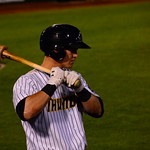
From Both Sides Now – Yesterday’s Pair of Batting Records

Records (we’re talking vinyl; here) have two-sides.  Yesterday (April 8, 2019), a couple of MLB hitting records were broken or tied – and they were, figuratively, on both sides of the offensive album.  On one side, the Orioles’ Chris Davis set a new record for futility in the batter’s box, while on other side the Mariners’ Edwin Encarnación tied an MLB record for success beyond the reaches of the ball field.

Chris Davis photo

Photo by Keith Allison

Let’s start with Davis. Yesterday, Davis went zero-for-five, with two strikeouts, as the Orioles pounded out 15 hits in a 12-4 thrashing of the A’s in Oakland.  In the process, Davis set a new MLB record for consecutive at bats without a base hit at 49 (and still counting).  Davis’ streak started after the second inning of a game on September 14, 2018 (when he doubled off James Shields). Since then, he has played in another 14 games, collected 32 plate appearances and 49 at bats – with no hits, six walks, 29 strikeouts, one run and two RBI.  As Sonny and Cher might sing on vinyl – “And the streak goes on.”

Last season, Chris Davis set the MLB record for the lowest batting average by a player qualifying for the batting title, when he hit .168 (79-for-470).    To be fair, Davis is also one of only 29 MLB players to hit 50 home runs in a season. In 2013, Davis hit .286, and led the AL with 53 home runs and 138 RBI.

The previous record of 46 consecutive at bats without a hit was held by Eugenio Vélez – who went hitless from a game on July 20, 2010 until his final MLB game on August 20, 2011.  Over that time, Vélez played in 29 MLB games, getting 52 plate appearances, 46 at bats) – with no hits, three walks and 12 whiffs.  He did score one run and drive in one. Vélez started his streak as a Giant and it ended as a Dodger.  (Well, it didn’t really end, Vélez’ streak was still active when he was released by the Dodgers.  He has since played in the U.S. Minor Leagues, the Dominican Winter League, The Mexican League and Mexican Pacific Winter League – but has not made it back to the majors. In 2018-19, he went a combined .281-1-9 in 27 games in the Dominican and Mexican Winter Leagues.  Maybe someone should give the 36-years-old another shot at extending or breaking the streak.

____________________________________________

Now, for the other side of the record book.

Edwin Encarnacion photo

Photo by james_in_to

Yesterday, the Mariners’ Edwin Encarnación hit his third and fourth home runs of the 2019 season. For the day, Encarnación was two-for-four with two runs scored and four RBI. Of importance is the fact that they both came in the sixth inning of Seattle’s 13-5 win over the Royals.  Of, perhaps, even more importance is that it was the second time in his career that Encarnacion has gone deep twice in one inning.  And, that ties an MLB record.  Fifty-six different players have hit two home runs in one MLB inning (MLB.com) – but only five players have accomplished the feat twice.

rECORDS

A few other two-home run inning tidbits:

  • Fernando Tatis of the Cardinals is the only player to hit two Grand Slams in one inning – the third frame of a Cardinals’ 12-5 win over the Dodgers on April 23, 1999. Maybe a greater surprise is that Dodgers’ starter Chan Ho Park was on the mound for both long balls.
  • On May 2, 2002, as the Mariners beat the White Sox 15-4, Seattle’s Brett Boone and Mike Cameron both hit two home runs in the first inning. It’s the only time two teammates have hit two home runs in an inning in the same game – and they did it back-to-back. Boone was hitting third and Cameron fourth.
  • Only three players have hit home runs from both sides of the plate in the same inningCarlos Baerga, Indians (versus Yankees) – April 8, 1993; seventh inning; Mark Bellhorn, Cubs (Brewers) – August 29, 2002; Fourth inning; and Kendrys Morales, Angels (versus Rangers) – July 30, 2012; sixth inning.

Primary Resources:  MLB.com; Baseball-Almanac.com; Baseball-Reference.com


BASEBALL ROUNDTABLE ON THE TOP 100 BASEBALL BLOG LIST

100Baseball Roundtable is on the Feedspot list of the Top 100 Baseball Blogs.  To see the full list, click here.

I tweet baseball @DavidBBRT

Follow/Like Baseball Roundtable’s Facebook Page here.  More baseball commentary; blog post notifications; PRIZES.

Member: Society for American Baseball Research (SABR); The Baseball Reliquary; The Negro Leagues Baseball Museum.
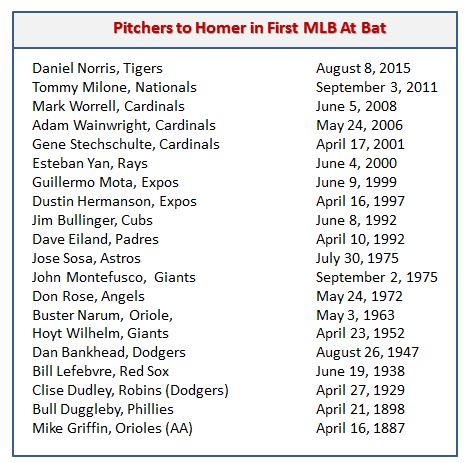
Foreign-born Players Represent 28.5 Percent of Opening Day Rosters – Twins and Pirates Lead the Way

Major League baseball recently reported that MLB Opening Day rosters included a total of 251 players (active and inactive) born outside the United States – that represented 28.5 percent of the  Opening Day MLB player pool.   Twenty countries and territories were represented in the international roll call, with the Dominican Republic leading the way, with 102 Dominican-born players on Opening Day rosters. That give the Dominican 40.6 percent of all foreign-born players and far ahead of runner up Venezuela, with 68 players.  Coming in a distant third was Cuba, with 19 players.

The Minnesota Twins and Pittsburgh Pirates tied for the lead in foreign players, with each squad having 14 on their Opening Day roster; while the Dodgers, Yankees and A’s are tops in the number of countries represented on their rosters with seven.   Let’s take a look at a Dominican-born 2019 All Star team, and then at the foreign-born continents on the Twins and Pirates rosters.

CURRENT BBRT ALL-DOMINICAN SQUAD (Drawn from players on 2019 MLB Rosters)

C         Gary Sánchez, Yankees

The 26-year-old was an All Star just two seasons ago, when he put up a .278-33-90 line, after poking 20 homers in just 53 games as a rookie in 2016.  Still, he almost lost this spot with a disappointing 2018 season, marked by a groin injury, some criticism of his on-field hustle, a .186 batting average and a league-topping 18 passed balls in 89 games. But he has come back sharply, with six homers in his first eight 2019 appearances.  Sánchez’ top competition comes from the White Sox’ Welington (one “l” short) Castillo – now in his tenth MLB season. Castillo’s best season was 2017, when he went .282-20-53 in 96 games for the Orioles. The veteran backstop put a .259-86-298 career line over his first nine campaigns (658 games). Castillo was .259-6-15 in 49 games last season.

1B       Albert Pujols, Angels

Albert Pujols photo

Photo by bk1bennett

The 39-year-old Pujols is showing signs of age, but you can’t leave off arguably the best hitter ever to come out of the Dominican Republic. As I write this, Pujols is in his 19th MLB season, with a .302 career average, 3,090 hits, 634 home runs, 1,984 RBI and 111 stolen bases – and he is still active. He is a Rookie of the Year (NL- 2001); three-time MVP (NL-2005, 2008. 2009); 10-time All Star; and two-time Gold Glover.  He has a batting title on his resume, as well as two home run crowns, seven seasons of at least 40 round trippers, 14 campaigns of 100+ RBI and ten seasons with a batting average over .300. Hall of Fame, get that plaque ready.

In 2018, Pujols hit .246, with 19 home runs and 64 RBI in 117 games.

Pujols main competition was Edwin Encarnación, now in his 15th MLB season and, as of this writing, posting a .264-382-1,161 line – and still going strong, having topped 30 home runs in each of the last seven seasons and notching 100+ RBI  in each of the last four. In 2018, he was .246-32-107.

HONORABLE MENTION

Okay, he’s not eligible for this team because, of course, he is not an active player.  However, you can’t talk Dominican players without at least a nod to Juan Marichal. The right-hander won 243 games (142 losses) over 16 seasons (1960-75), with a 2.89 ERA and 244 complete games. The Hall of Famer was a 10-time All Star and six times won 20 or more games in a season.

2B       Robinson Canó, Mets

Canó is in his 15th MLB season – and he makes this lineup despite last season’s 80-game suspension. (He hit .303-10-50 in 80 games for the Mariners.) Over his first 14 season, Canó put up a .304 average, with 311 home runs and 1,233 RBI. He has been an All Star eight times and a Gold Glover twice. His resume includes eight seasons of 20 or more home runs (a high of 39 in 2016) and four season of 100+ RBI.

3B       José Ramírez, Indians

Ramírez, 26-years-old and now entering his seventh MLB season, really came into his own in 2016. To that point, he had a .239 batting average, with eight home runs and 20 stolen bases in 180 games.  In 2016, he hit .312, with 11 homers, 76 RBI and 22 steals.  He followed it up with .318-29-83, with 17 steals in 2017; and, in 2018, joined the 30-30 club, with a .270 average, 39 home runs, 195 RBI and 34 steals.  The two-time All Star has earned this spot.

SS        Jean Segura, Phillies

Segura is entering his eighth MLB season. He started the year with a .287 career average, 64 home runs, 316 RBI, 171 steals and 484 runs scored. Over the past three seasons (2016-18), however, he has a .308 average, with 41 homers, 172 RBI, 273 runs scored and 75 steals. The two-time All Star’s best season is 2016, when his 203 hits led the NL and he put up a .319 average, with 20 homers, 64 RBI, 102 runs scored and 33 steals.

OF       Juan Soto, Nationals

In 2018, his first major league season, Soto (just 19-years-old) hit .292, with 22 home runs and 70 RBI in just 116 games – finishing second in the Rookie of the Year balloting. His call up came after hitting .362-14-52 in 39 2018 games at three minor league levels.  He’s a keeper.

OF       Starling Marté, Pirates

Marté is a two-time Gold Glover with speed and a steady bat.  In his first eight MLB seasons (2012-18), he hit for a .286 average, with 85 home runs (a high of 20 in 2018) and 216 stolen bases (a high of 47 in 2016).

OF       Nomar Mazara, Rangers

Just 24-years-old and already in his fourth MLB season, Mazara can already look back on three straight 20-homer campaigns. Over his first three seasons, he hit .258-60-242.

DH      Nelson Cruz, Twins

It doesn’t get much better at DH than Cruz. In his 15th season (at age 38) Cruz is a six-time All Star and, over the last five seasons, he has averaged just over 40 home runs and 104 RBI per campaign.  Going into 2019, his career average was .274 – with 360 round trippers and 1,011 RBI.

SP        Luis Severino, Yankees

Although he started the 2019 season on the IL (rotator cuff inflammation), Luis Severino has earned this roster spot. He is 41-25, 3.15 over four MLB seasons. More important, he was an All Star in 2017 (14-6, 2.98) and 2018 (19-8, 3.39). He will be at the top of the Yankee rotation as soon as he is ready to get back on the mound.

RP       Jeurys Familia, Mets – Fernando Rodney, A’s – José Leclerc, Rangers

Couldn’t really decide between these three, each at a different stage of their career.  You can have your choice. Their stats going into 2019:

Familia … Seven seasons, 17-19, 2.73, 124 saves; 343 games; 352 2/3 IP; 369 strikeouts.

Rodney … 16 seasons; 48-67; 3.37, 325 saves; 902 games; 890 2/3 IP; 898 strikeouts.

Leclerc … Three seasons; 4-6, 2.51, 14 saves; 118 games; 118 1/3 IP; 160 strikeouts,

Countries/Territories of Origin of Foreign-Born Players

on MLB 2019 Opening Day Rosters

Dominican Republic – 102

Venezuela – 68

Cuba – 19

Puerto Rico – 18

Mexico – 8

Japan and Canada – 6 each

Curacao and South Korea – 5 Each

Columbia – 4

Aruba, Australia, Brazil, Germany, Lithuania, Netherlands, Nicaragua, Panama, Taiwan and U.S. Virgin Islands – 1 each.

Now the two teams with the most foriegn-born players.

___________________________________________

Minnesota Twins … 14 foreign-born players on open day roster.

Catcher-Utility

Willians Astudillo – Barcelona, Venezuela

Infielders

2B – Jonathon Schoop – Willemstad, Curacao

Utility – Marwin González – Puerto Ordaz, Venezuela

SS – Jorge Polanco – San Pedro de Marcoris, Dominican Republic

Utility – Ehire Adrianza, Guarenas, Venezuela

Outfielders

Eddie Rosario – Guayama, Puerto Rico

Max Kepler – Berlin, Germany

DH

Nelson Cruz – Las Matas de Santa Cruz, Dominican Republic

Pitchers

José Berríos – Bayamon, Puerto Rico

Michael Pineda – Yugaute, Dominican Republic

Martín Pérez – Guanare, Venezuela

Adalberto Majía – Bonao, Dominican Republic

Injured List

P – Gabriel Moya – Cabimas, Venezuela

3B – Miguel Sanó – San Pedro de Macorís, Dominican Republic

__________________________________________

Pittsburgh Pirates – 14 foreign-born players on Opening Day Roster.

Catcher

Francisco Cervelli – Valencia, Venezuela

Infielders

2B – Erik González – Puerto Plata, Dominican Republic

SS – Jung Ho Kang – Gwangui, South Korea

Outfielders

Melky Cabrera – Santo Domingo Dominican Republic

Starling Marté – Santo Domingo, Dominican Republic

Pablo Reyes – Santo Domingo, Dominican Republic

Pitchers

Francisco Liriano – San Cristobal, Dominican Republic

Richard Rodríguez – Santiago, Dominican Republic

Felipe Vázquez – San Felipe, Venezuela

Injured list

OF – Gregory Polanco- Santo Domingo, Dominican Republic

C – Elias Díaz – Maracaibo, Venezuela

P – Dovydas Neverauskas – Vilnius, Lithuania

OF/1B – José Osuna – Trujillo, Venezuela

P- Edgar Santana – Puerto Plata, Dominican Republic

Primary Resources:  MLB.com; Baseball-Reference.com; ESPN.com

COMING SOON – THE 2019 BBRT JOHN PACIOREK AWARD


BASEBALL ROUNDTABLE ON THE TOP 100 BASEBALL BLOG LIST

100Baseball Roundtable is on the Feedspot list of the Top 100 Baseball Blogs.  To see the full list, click here.

I tweet baseball @DavidBBRT

Follow/Like Baseball Roundtable’s Facebook Page here.  More baseball commentary; blog post notifications; PRIZES.

Member: Society for American Baseball Research (SABR); The Baseball Reliquary; The Negro Leagues Baseball Museum.

Ketel Marte Homers from Both Batters’ Boxes … and Some Switch Hitter Trivia

Ketel Marte photo

Photo by THE Laura Smith

Yesterday (April 5, 2019), the Diamondback’s Ketel Marte hit a pair of 400-foot+ home runs, as the Arizona squad belted five round trippers while drubbing the Red Sox 15-8. Marte scored two and drove in five in the game.  What BBRT found noteworthy (or post-worthy) was the fact that, for the second time in his five-season career, the switch-hitting infielder hit home runs from both side of the plate in the same game.  That prompted BBRT to look into the roster of players who have gone yard from both batters’ boxes in the same game.

It’s really not as rare an occurrence as you might think.  It’s been done in the regular season a total of 330 times, and by 112 different players.

A LITTLE MORE OF A UNICORN

Only three players have homered from both sides of the plate in a post-season game.

Bernie Williams, Yankees       ALDS Game Three (October 6, 1995

Bernie Williams, Yankees       ALDS Game Four (October 5, 1996)

Chipper Jones, Braves             NLDS Game Four (October 4, 2003)

Milton Bradley, A’s                ALCS Game Two (October 10, 2006)


The first player to homer from both sides of the plate in the same game was Wally Schange of the Philadelphia Athletics on September 8, 1916.

The career record for homering from both sides of the plate in the same game is 14 – shared by Mark Teixeira and Nick Swisher. Leaders among players homering from both side of the plate in the same game:

Mark Teixeira – 14 times

Nick Swisher – 14

Carlos Beltran – 12

Chili Davis – 11

Eddie Murray – 11

Tony Clark- 10

Ken Caminiti – 10

Mickey Mantle – 10

In 1996, the Padres’ Ken Caminiti hit a home run from both sides of the plate in the same game a record four times in a single season – three times in the month of August alone. Note: Caminiti also achieved the feat three times in a single month in September of 1995.

No team has had more instances of a player hitting long balls from both sides of the plate in a game than the Yankees – 56 times.  Here are the perpetrators:

Mickey Mantle (10X)

Mark Teixeira (9X)

Bernie Williams (8X)

Jorge Posada (8X)

Roy White (5X)

Nick Swisher (5X)

Tom Tresh (3X)

Aaron Hicks (2X)

Roy Smalley

Ruben Sierra

Tony Clark

Melky Cabrera

Carlos Beltran

Neil Walker

BIG BOMBS IN THE BIG APPLE

From 1955-1965, a game in which a player homered from both sides of the plate occurred in the AL 14 times, with 13 of those being Yankees (Mickey Mantle 10, Tom Tresh 3).

The only non-Yankee to achieve the feat in the AL during that time span was the Red Sox’ Pumpsie Green (August 15, 1961). Green hit a total of just 13 home runs in his five-season MLB career.  BBRT Note: Green achieved historic significance as the first African-American player for the Boston Red Sox – the last MLB team to break the color line (1959). In the 1955-65 time span, there were only three NL games which saw a player homer from both sides of the plate – two by the Cubs’ Ellis Burton, one by the Dodgers’ Maury Wills.

Only three players have hit home runs from both sides of the plate in the same inning:

  • Carlos Baerga, Indians (April 9, 1993);
  • Mark Bellhorn, Cubs (August 29, 2002);
  • Kendrys Morales, Angels (July 30, 2012).

SHARE IT AROUND

Carlos Beltran and Nick Swisher share the record for hitting a home run from both side of the plate in a single game for the most teams at five:  Beltran – Mets, Cardinals, Royals, Astros, Yankees; Swisher – A’s, Yankees, White Sox, Indians, Braves.


Bonus chart

SWITCH HITTERS WITH AT LEAST 400 CAREER HOME RUNS

         Mickey Mantle            536

         Eddie Murray              504

         Chipper Jones              468

         Carlos Beltran             435

         Mark Teixeira              409


BASEBALL ROUNDTABLE ON THE TOP 100 BASEBALL BLOG LIST

100Baseball Roundtable is on the Feedspot list of the Top 100 Baseball Blogs.  To see the full list, click here.

I tweet baseball @DavidBBRT

Follow/Like Baseball Roundtable’s Facebook Page here.  More baseball commentary; blog post notifications; PRIZES.

Member: Society for American Baseball Research (SABR); The Baseball Reliquary; The Negro Leagues Baseball Museum.