Let’s Get This Party Started – First At Bat Home Runs

This post updated April 20, 2019.

UPDATE – ADD ANOTHER FIRST-AT BAT HOME RUN

How appropriate. Not long after this post was published, Cardinals’ pinch hitter Lane Thomas joined the list of players with a home run in their first MLB at bat (the stats in the post have been updated to reflect his April 19 blast. ). His long ball was a two-run shot in the bottom of  sixth inning of the Redbirds’ 5-4 loss to the Mets. Notably, the homer to right barely cleared the wall. In fact, it took an umpire’s review to confirm that Thomas had indeed joined the first-at bat HR Club. Thomas, of course, is now part of the group of first-at bat home run hitters with only one career round tripper. Given the fact that his is coming off a 2018 Double A season that included 21 homers, that may not last long.

On this date (April 19) in 1938, the Dodgers (of Brooklyn) opened the season against the Phillies in Philadelphia.  Yes, that’s right, Opening Day on April 19 (How the times have changed).   That day a couple of rookies showed they truly knew how to “get the party started” – hitting home runs in their first MLB at bats on Opening Day.

Batting third for Brooklyn was 28-year-old rookie left fielder Ernie Koy. In his first-ever MLB at bat, he took Phillies’ starter Wayne LaMaster deep to give the Dodgers a 1-0 lead.  Leading off for Philadelphia in the bottom of the inning was 25-year-old rookie second baseman Heinie Mueller.  In his first MLB at bat, Mueller homered off Dodgers’ starter Van Lingle Mungo to tie the game.  It was the first time in MLB history that two players homered in their first MLB at bat in the same game – a feat that would not be matched for nearly 80 years (2016).

The Dodgers, by the way, won 12-5; with Koy going 3-for-5 with two runs scored and an RBI. Mueller went 2-for-3, with two walks, three runs scored and one RBI. In that rookie season, Koy hit .299, with a career-high 11 home runs.  He played six MLB seasons (558 games) and put up a .279-36-260 line. Mueller finished 1938 with a .250-4-34 stat line and went .253-17-127 in four MLB seasons.
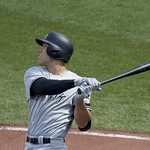
Aaron Judge photo

Aaron Judge. Photo by Keith Allison

Photo by slgckgc

Tyler Austin. Photo by slgckgc

It wasn’t until August 13, 2016, that two players again homered in their first MLB at bat in the same game. This time, they were on the same team – and accomplished the feat back-to-back. It came in the bottom of the second inning, with the Yankees facing the Rays. With two outs and the bases empty, Yankee rookie 1B Tyler Austin took Rays’ starter Matt Andriese deep to right field to give the Bronx Bombers a 1-0 lead.  Rookie RF Aaron Judge immediately followed up with a home run of his own (also in his first MLB at bat); this one to straight-away center.  Austin ended the season with five home runs in 31 games, while Judge got in just 17 games and hit just .179 with four home runs.  Note: By virtue of that limited playing time, Judge kept his rookie status for 2017 – when he went .284-52-114, setting a new MLB rookie record for home runs and leading the AL in runs scored (128), home runs, walks (127) and whiffs (208), while winning the AL Rookie of the Year Award. 

Here are a few other first at-bat home run factoids.

  • A total of 123 players (AL. NL, AA) have homered in their first MLB at bat.
  • Twenty-nine of those players hit their home run on the very first MLB pitch they ever saw.
  • Just four players have hit a Grand Slam home run in their first MLB at bat: Bill Duggleby, Phillies, April 21, 1898; Jeremy Hermida, Marlins, August 31, 2005; Kevin Kouzmanoff, Indians, September 2, 2006; and Danial Nava, Red Sox, June 12, 2010. Notably, Kouzmanoff and Nava put a little icing on the cake, hitting their Grand Slams on the first MLB pitch they ever saw.
  • Twenty pitchers, including the first player to hit a Grand Slam in his first at bat, homered in their first-ever MLB at bat.
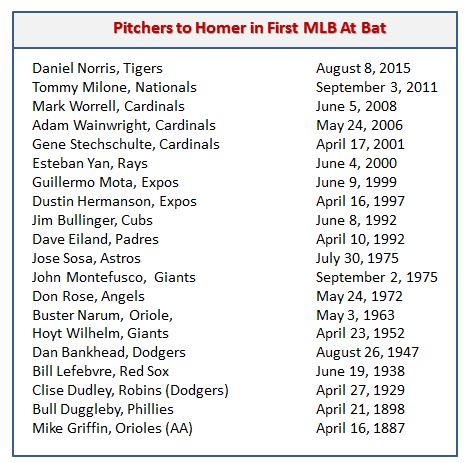
PitcherHr

  • Only two players have homered in their first two at bats: Bob Nieman, Browns, 1952 and Keith McDonald, Cardinals, July 4, 2000. Note: McDonald collected just three base hits in his MLB career – and they were all home runs.  For that story, click here.
  • Only three players have hit (run) for an inside-the-park homer in their first MLB at bat: Luke Stuart, Browns, August 8, 1921; Walter Mueller, Pirates, May 7, 1922; and Johnnie LeMaster, Giants, September 2, 1975.
  • The first recorded instances of a player homering in their first MLB at bat came on April 16, 1887 – Orioles’ OF Mike Griffin and Red Stockings’ OF George Tebeau (in separate games).
  • Twenty-three of the players to homer in their first MLB at bat ever have only one MLB home run on their resumes (three are still active).


ONEHR


Primary Resources: Baseball-Reference.com; Baseball-Almanac.com; MLB.com

BASEBALL ROUNDTABLE ON THE TOP 100 BASEBALL BLOG LIST

100Baseball Roundtable is on the Feedspot list of the Top 100 Baseball Blogs.  To see the full list, click here.

I tweet baseball @DavidBBRT

Follow/Like Baseball Roundtable’s Facebook Page here.  More baseball commentary; blog post notifications; PRIZES.

Member: Society for American Baseball Research (SABR); The Baseball Reliquary; The Negro Leagues Baseball Museum.
 

Baseball Roundtable Trivia Teaser – I Got This Under Control

Yesterday (April 17, 2019), the Cubs and Marlins faced off in Miami.  It wasn’t a particularly memorable game – the Cubs won 6-0.  Something did catch BBRT’s attention, however.  In the nine-inning contest, only one walk was issued (by Marlins’ starter Sandy Alcantara).  That compares to a 2019 MLB average of 5.26 walks (combined) per game through yesterday.  That spurred me to take a look at pitchers who “took control of the situation” – and prompted today’s Baseball Roundtable Trivia Teaser.

BASEBALL ROUNDTABLE TRIVIA TEASER

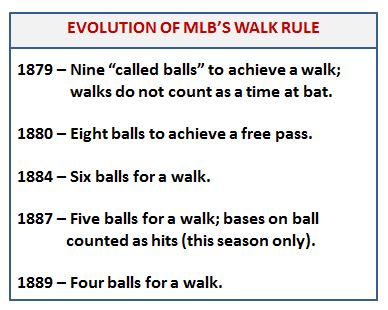
When you look at the MLB leaders in fewest walks per nine innings in a season, one thing stands out.  Only one of the top 25 qualifying seasons occurred since 1900. (Keep in mind, the four-ball walk rule didn’t come into play until 1889.)  Your question: Who is the only post-1899 MLB player to record one of the 25 lowest-ever  walks-per-nine innings rates? 

A couple of hints:  He came in at a very respectable number seven – and he exhibited that control not just post-1899, but also post-1999.

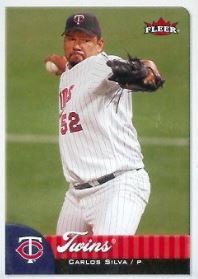
SilvaAnswer:  Twins’ right-hander Carlos Silva, who – in 2005 – walked just nine batters (two of those intentionally) in 188 1/3 innings (a 0.4301 batters-per nine rate).  This gives Silva the best single-season walks-per nine rate since 1900, the seventh-best all time and makes him one of only eleven pitchers in MLB history to record a qualifying season of less than .50 walks-per nine.  Silva went 9-8, 3.44 in 27 starts that season.  Silva had a nine season MLB career (2002-2010 for the Phillies, Twins, Mariners And Cubs) – going 70-70, 4.68.  In 1,241 career innings, he walked 238 and fanned 554.  His best season was 2004, when he went 14-8, 4.21 for Minnesota.

Note: If you are wondering, the best-ever BB/9 ratio belongs to George Zettlein of the 1876 National League Philadelphia Athletics, who walked just six batters in 234 innings. (0.2308 per nine frames pitched). Keep in mind that, in 1876, it took eight balls outside the zone to work a walk.  Zettlein, by the way, went 4-20, 3.88 that seasonEvolution.

A TALE OF TWO BUBBA’S

The MLB record for the most consecutive innings pitched without issuing a free pass belongs to the Kansas City Athletics’ Bill Fischer – at 84 1/3.  Fischer walked the first batter he faced (the Indians’ Bubba Phillips) in a start on August 3, 1962 and didn’t walk another batter that game.  (He went the distance in a 1-0 loss.)  In fact, he didn’t walk another batter until the final day of the season (September 30), when he issued a free pass to the Tigers’ Bubba Morton in the bottom of the fifth inning. In between, he tossed his 84 1/3 walk-less frames and put up 12 straight walk-less appearances (11 starts).

As you might guess, the best career walks-per nine inning rates are dominated by pitchers whose careers ended before 1900.  The best of all?  That was Hall of Famer Candy Cummings, whose career spanned six seasons (1872-77). Cummings walked 113 batters in 2,149 2/3 innings – for a ratio of 0.4731. His final stat line was 145-94, 2.42, with 233 complete games in 241 starts.

The first primarily post-1899 hurler to appear on the career list is Deacon Phillipe, whose career spanned 13 seasons (1899-1911).  The Pirates’ righty walked 363 batter in 2,607 innings pitched (1.2532 per nine innings) for 16th place.  The only other post-1900 players in the top twenty are Babe Adams (19 seasons between 1906 and 1926 and a 1.2910/9 ratio) in the 18th spot and Dan Quisenberry (1979-90, with a 1.3974/9 ratio) at number twenty..

OKAY, SO WE DIDN’T ALWAYS TRACK EVERYTHING

Bartolo colon photo

Photo by apardavila

MLB didn’t really get into pitch-by-pitch record keeping until 1988.  However, since that time, the then Oakland A’s Bartolo Colon holds the record for consecutive strikes thrown in a game (strikes, foul balls, balls put in play) at 38. His string started with the second pitch of the fifth inning (against the Angels in Anaheim) and went through the seventh pitch of the eighth frame.  In between, he put together a string of 11 batters without tossing a “ball.” Colon, by the way, threw eight innings of four-hit shutout ball in the 6-0 Athletics’ victory.  He threw 82 strikes and 26 balls.

Primary Resource: Baseball-Reference.com

BASEBALL ROUNDTABLE ON THE TOP 100 BASEBALL BLOG LIST

100Baseball Roundtable is on the Feedspot list of the Top 100 Baseball Blogs.  To see the full list, click here.

I tweet baseball @DavidBBRT

Follow/Like Baseball Roundtable’s Facebook Page here.  More baseball commentary; blog post notifications; PRIZES.

Member: Society for American Baseball Research (SABR); The Baseball Reliquary; The Negro Leagues Baseball Museum.
BASEBALL ROUNDTABLE TRIVIA TEASER – The King of the Four-Whiff Inning(s)

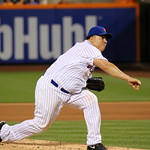
 baseball photoA pitcher recording four strikeouts in an inning is relatively rare.  It’s happened just 90 times in MLB history (There was also one instance of two pitchers combining for four strikeouts in a single frame.) By contrast, there have been 265 official single-pitcher MLB no-hitters, as well as 12 no-hitter spun by multiple pitchers.

This Trivia Teaser will focus on those four-strikeout innings.

Baseball Roundtable Trivia Teaser

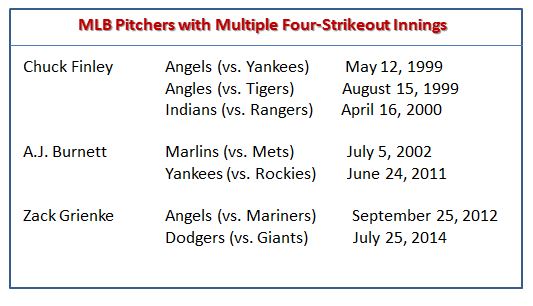
Only three pitchers have recorded multiple four-strikeout innings and only one pitcher has recorded three such frames.  Your question:  Who was that pitcher? Hints:  All three were for American League Teams.  The last one on April 16, 2000.

The answer is Chuck Finley. 

4x

On May 12, 1999, starting against the Yankees (at New York) for the Angels, Finley’s third inning went: Single to left by Yankees’ LF Shane Spencer; three-pitch strikeout  (looking) of 3B Scott Brosius; C Joe Girardi safe on an error; (wild pitch advances both runners); strikeout (swinging) of Yankees’ 2B Chuck Knoblauch on a 2-2 pitch; strikeout (swinging) of SS Derek Jeter on a 3- 2 wild pitch, with Jeter safe at first; strikeout (swinging) of RF Paul O’Neill on a 2-2 pitch.  No runs scored, three left on base, two wild pitches, one error.  Finley went eight innings, giving up no runs on three and two walks, with eleven strikeouts. He got the win in a 1-0 ball game.

On August 15, 1999, Finley faced off (again for the Angels) against the Tigers in Detroit. In the bottom of the first, he gave up a ground ball single to CF Kimera Bartee, followed by: a swinging strikeout (on a 1-2 wild pitch) of SS Deivi Cruz, Cruz out and Bartee going to second; a swinging strikeout (on a 2-2) pitch of LF Juan Encarnacion; a swinging strikeout on a 1-2 wild pitch to 3B Dean Palmer, with Palmer safe at first and Bartee going to third; a swinging strikeout of Tony Clark on a 1-2 pitch.  No rusn scored on a hit and two wild pitches, with two men left on base. Finley went 6 2/3 innings to get the win, giving up two runs on six hits and two walks, with 12 whiffs.

In 1999, Chuck Finley led the American League with 15 wild pitches. 

On April 16, 2000, Finley – pitching for the Indians against the Rangers in Cleveland – tossed his third four-whiff inning. It came in the top of the third and went like this: a single by Rangers’ 2B Luis Alicea; a strikeout of 3B Tom Evans (swinging on a 2-2 pitch); a strikeout of SS Royce Clayton (swinging on a 1-2 pitch); a stolen base by Alicea; a strikeout of LF Chad Curtis on a 2-2 pitch, with Curtis reaching on a passed ball and Alicea going to third; a run-scoring single by C Ivan Rodriguez; and a strikeout looking (on a 3-2 pitch) by Rafael Palmeiro.  One unearned run scored on two hits and a passed ball. Finley got the win by a 2-1 score, going the full nine innings, giving up five hits, the one unearned run, with four walks and 13 strikeouts.

On April 14, the Blue Jays’ Tom Pannone threw the second “immaculate inning” – nine pitches/three strikeouts – of 2019. For the story and some immaculate inning trivia, click here.

Primary Resources: Baseball-Reference.com; Baseball-Almanac.com


BASEBALL ROUNDTABLE ON THE TOP 100 BASEBALL BLOG LIST

100Baseball Roundtable is on the Feedspot list of the Top 100 Baseball Blogs.  To see the full list, click here.

I tweet baseball @DavidBBRT

Follow/Like Baseball Roundtable’s Facebook Page here.  More baseball commentary; blog post notifications; PRIZES.

Member: Society for American Baseball Research (SABR); The Baseball Reliquary; The Negro Leagues Baseball Museum.
2019 John Paciorek Award – Harley Hisner – For the Love of the Game

JPAFIn 2014, Baseball Roundtable launched the John Paciorek Award (JPA). The JPA recognizes players who have had short, often very short, major league careers, but whose accomplishments, nonetheless, deserve recognition.  Past winners have included a player whose every MLB hit (three in nine career at bats) were home runs;  a player who had only MLB bat, but won a World Series Ring and a Purple Heart; a player who had just two home runs in 61 MLB at bats (for the vaunted Yankees and Dodgers), but whose “body of work” made him one of just two players in MLB history to homer in their first and final official appearances in a major league batter’s box;’ and more.  

(Note: Information on John Paciorek’s career – the inspiration for the JPA – can be found at the end of this post. Paciorek’s day in the sun constitutes arguably the best one-game MLB career ever.)

For an interesting take on topics related to baseball’s past, present and future, BBRT also recommends a visit to BaseballHappenings.net.  Click here to take a peek.

________________ 2019 JPA Winner – Harley Parnell Hisner  _______________

Harley Hisner. Photo: Courtesy of BaseballHappneings.net

Harley Hisner.
Photo: Courtesy of BaseballHappneings.net

This year’s JPA honoree did, indeed, have a short MLB career (just six innings).

Harley Hisner‘s MLB tenure encompassed the day of September 30, 1951 – when the Red Sox called upon the 6’1″, 180-pound, 24-year-old righty to face the New York Yankees.    It was also, in some way historic. He earns his spot here, as much for his love of the game, as for his place in MLB history.  But I’m getting ahead of myself. Let’s start with a look at how Hisner got to the Yankee stadium mound.

Hisner, whose nickname was “Jim,” grew up on a farm near Fort Wayne, Indiana. The youngest of four brothers, Harley was an solid athlete (basketball and baseball). In fact, the Hisner brothers seemed naturals and three of the four boys were signed to contracts by the Red Sox. (Only Harley would make it to the big club.) Harley was signed in 1945, for a $5,000 bonus, right after graduating from high school.  He was also, however, drafted into the U.S. Army at about the same time. World War II was winding down and Hisner did not leave the states and, in fact, was able to keep his baseball skills sharp playing the game at Fort Benjamin Harrison.

Hisner’s minor league career was a bit up-and-down, due in part to recurring arm/shoulder issues.  In 1947, the 20-year-old Hisner went 7-14, 5.21 for the Class C San Jose Red Sox and the Class A Scranton Red Sox.   Then, in 1948, he helped Scranton win the Eastern League title with an 11-3, 2.48 record (although Hisner missed a portion of the season with chronic bursitis).  The following  season, was down again – as Hisner went 6-11, 4.47 in stop at Scranton and Triple A Louisville.  More of the same in 1950 (5-6, 4.65 at Louisville).  In 1951, Hisner struggled early and ended up 7-13, 6.26 at Louisville.  However,  he came on strong at the end of the season; winning his last four starts.  That earned him  a late-season call up to the Red Sox – and a big-league start in the final game of the season.

HARLEY HISNER’S BIG GAME

Taking the MLB mound for  the first (and, as it would turn out, final) time, Hisner found himself facing a daunting challenge – a first-place Yankee lineup that included five future Hall of Famers: Mickey Mantle in RF; Joe DiMaggio in CF; Phil Rizzuto at SS; Johnny Mize at 1B; and Yogi Berra behind the plate.  In retelling the tale, however, Hisner often said he was made more nervous by the size of the partisan crowd (35,814)  than the Yankee lineup.

Hisner got off to a good start.  The first MLB batter he faced was rookie RF Mickey Mantle, who went down on strikes. He then gave up a single to SS Phil Rizzuto, before getting LF Hank Bauer to hit into a short to second fielder’s choice.  That brought up Yankee icon Joe DiMaggio, who hit an infield single – putting Hisner into the baseball history books.  That single was DiMaggio’s the final regular-season hit of DiMaggio’s great career Hisner, by the way pitched out of the jam, getting 1B Johnny Mize to fly out to right.  So, in his first MLB inning – a scoreless one at that – Hisner faced five batters; four of them future Hall of Famers. He went on to pitch a total of six frames, giving  up three runs on seven hits and four walks (with three strikeouts). He faced Mickey Mantle four times and it went like this:  First inning – strikeout; second inning – strikeout; fourth inning – walk; sixth inning – pitcher to short to first double play.

Hisner’s final career stat was 0-1, 4.50, with six innings pitched, seven hits, three earned runs, four walks and three strikeouts.

Harley Hisner batted twice in his lone MLB appearance, collecting a ground out to first (unassisted) and a single to right field – finishing his MLB career with a .500 average. 

The following year, Hisner was cut from the Red Sox on the final day of Spring Training and never made it back to the major leagues.  He played two more years of professional ball – going 3-7, 3.86 in two minor league stops in 1952 and, in 1953, helping the Wichita Falls Spudders capture the Big State League (Class B) title by going 14-5, 3.87. At this point, Hisner (tired of the travel and dissapointed with his progress) retired from professional baseball to pursue a career as a machinist.

FOR THE LOVE OF THE GAME

After leaving the professional ranks, Hinser did not lose he passion for the game. Hisner played semi-pro baseball through 1961; before becoming a youth coach. He was a member of the Fort Wayne team that won the 1956 National Baseball Congress Championship and Global World Series. Then, in 1957, as the Fort Wayne team finished second in the National Baseball Congress Tournament, Hinser tied Satchel Paige’s tourney record  with four wins, while  throwing 38 innings in 11 days.  The following year, Hinser threw a no-hitter for the Anderson, Indiana squad in the tournament.  Hisner also was a long-time board member of the Northeast Indiana Baseball Association.

In 1976,  Harley Hisner was inducted into the Northeast Indiana Baseball Association Hall of Fame and in 2010 he received the organization’s Colin Lister Award for “dedication to the game of baseball and its historic legacy.” 

Primary Resources: Indiana-Born Major League Baseball Players: A biographical dictionary 1871-2014 (by Pete Cava); The Society for American Baseball Research; Baseball-Reference.com.

________________________________________________________

PAST JOHN PACIOREK AWARD WINNERS:

2014 – Brian Scott Dallimore

In his first start (not his first game) for the 2004 Giants, Dallimore had two singles, a Grand Slam (his first MLB hit and only MLB home run), a walk and a hit by pitch.  For the full JPA take on Dallimore’s 27- game MLB career, click here.

2015 – Roy Gleason

Gleason played in just eight MLB games, had a double in his only MLB at bat – but also earned a World Series ring (1963) and a Purple Heart. Ultimately, he was the only ballplayer with MLB experience to serve on the front lines in Vietnam. For the full JPA take on Gleason, click here. Note: Gleason’s life is detailed in the book “Lost in the Sun – Roy Gleason’s Odyssey from the Outfield to the Battlefield.”

2016 – John Allen Miller

Miller played just 32 MLB games (during the 1966 and 1969), taking the field (at 1B/LF/3B/2B) for the Yankees and Dodgers. Miller collected ten hits in 61 MLB at bats (.164 average) and hit just two home runs – but he made those long balls count.  Miller made his MLB debut with the Yankees on September 11, 1966 and hit a two-run homer in his first big league at bat –  making him (surprisingly) the first Yankee ever to homer in his first MLB at bat. (Little did Miller know he would not get another home run or RBI until the final at bat of his MLB career.)  Miller’s final at bat came as a Dodger (September 23, 1969) and he stroked a solo home run.  That narrow “body of work” made Miller one of just two players in MLB history to homer in their first and final official appearances in a major league batter’s box. For more on Miller, click here.

2017 – Chris Saenz

RHP Chris Saenz’ big day came on April 24, 2004 – when he was called up from Double A Huntsville (where he was 1-1, 3.86) to make a spot start against the Saint Louis Cardinals, whose powerful lineup included the likes of Albert Pujols, Scott Rolen, Jim Edmonds and Reggie Sanders.   The rookie went six innings, giving up just two hits, three walks and no runs, while fanning seven. There was some speculation (primarily among sportswriters and fans) that Saenz’ performance might earn him another start or two, but two days after his debut, he was on his way back to Huntsville.  Unfortunately, his minor league season included a September elbow injury that required Tommy John surgery and he never returned to the majors. Statistics before 1900 can be sketchy, but baseball-reference.com shows that Saenz is the only pitcher to complete a one-game MLB career of at least five innings pitched, without giving up a single run (earned or unearned). For more details on this JPA honoree, click here.

2018 – Keith McDonald

Keith McDonald’s MLB career (Cardinals 2000-2001) covered just eight games and 11 plate appearances (nine at bats) and three hits – but he made them count.  All of McDonald’s safeties were home runs – making him the only MLB player with more than one career hit who can look back on major league career in which  his every hit was a home run.  McDonald is also one of only two players – and the only National Leaguer – to homer in his first two major league plate appearances.  For the full story, click here.


—–INSPIRATION FOR THE JPA—-

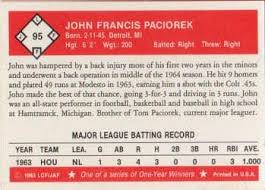
John Paciorek – signed out of Saint Ladislaus High School in Hamtramck, Michigan (where he had starred in football, basketball and baseball) – appeared in his first major league game on the final day of the 1963 season (September 29) at the age of 18.  The 6’ 1”, 200-pound outfielder had spent the 1963 season with Class A Modesto Colts. The Colts’ parent club, the Houston Colt .45s (that was the current Astros’ franchise name back then), was suffering through a difficult season. The team was 65-96 going into that final game.  Looking to the future, Houston had, in fact, fielded an all-rookie lineup (average age 19) on September 27. Youth was still being served two days later when John Paciorek started his first MLB game. The results were surprising – and worthy of recognition.

pACIOREKPlaying right field and batting seventh in a 13-4 win over the NY Mets, Paciorek ended up with three hits and two walks in five plate appearances, with four runs scored and three runs batted in.  Perhaps equally surprising is that it was not only Paciorek’s first major league appearance, it was to be his only MLB appearance.  Back pain the following spring, followed by surgery (he played 49 minor league games in 1964 and missed all of the 1965 season), put an end to his MLB playing days. (Paciorek did play in four more minor league seasons.)  Still, you will find John Paciorek in the Baseball Encyclopedia and his is arguably the greatest one-game MLB career ever.  Among one-gamers, he holds the record for times on base and runs scored, and shares the record for batting average, on base percentage and RBIs.

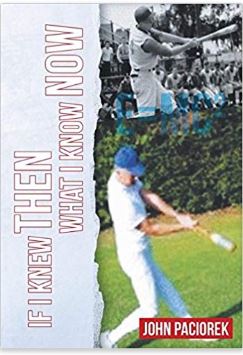
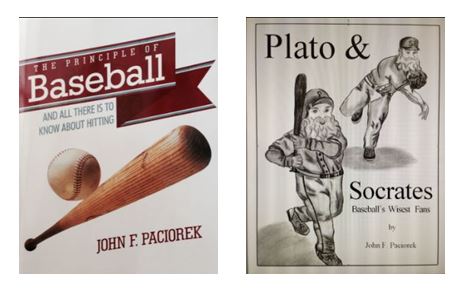
jpcOVERPaciorek, by the way, went on to become a high school teacher and multi-sport coach and is the author of three books (Plato and Socrates – Baseball’s Wisest Fans; The Principles of Baseball: And All There Is To Know About Hitting; and If I Knew Then What I Know Now.  You also can enjoy Paciorek’s prose (and expertise) directly at his blog “Paciorek’s Principles of Perfect Practice” by clicking here. You can find out even more about Paciorek in Steven Wagner’s 2015 book “Perfect: The Rise and Fall of John Paciorek, Baseball’s Greatest One-Game Wonder.”  (See the review of “Perfect” by clicking here.)
A final note. John Paciorek’s insight into the national pastime should come as no surprise. Paciorek comes from a true “baseball family.”  He was the first born of eight siblings and was followed to the big leagues by younger brothers Jim and Tom Paciorek.  (Like John, Jim’s MLB career was short – 48 games for the Brewers in 1987. Brother Tom, however, achieved a .282 average over an 18-season MLB career.)Books


BASEBALL ROUNDTABLE ON THE TOP 100 BASEBALL BLOG LIST

100Baseball Roundtable is on the Feedspot list of the Top 100 Baseball Blogs.  To see the full list, click here.

I tweet (on X) baseball @DavidBaseballRT

Follow/Like Baseball Roundtable’s Facebook Page here.  More baseball commentary; blog post notifications.

Member: Society for American Baseball Research (SABR); The Baseball Reliquary; The Negro Leagues Baseball Museum.

Baseball Roundtable Trivia Teaser – Celebrating Box Scores and Blizzards.

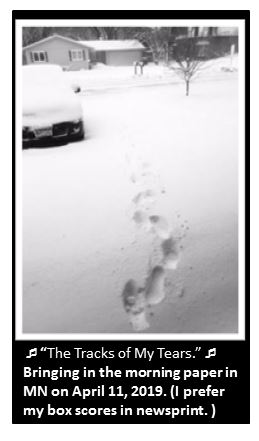
tearsOkay, it April 11 (2019) and I am looking out of the windows of my Roseville, Minnesota home at a blizzard (snow, wind, rain, sleet and even hail) that has closed schools, roads and even businesses.  I did brave the weather to retrieve my morning paper from a snowbank – I prefer my box scores be accompanied by the scents of hot coffee and newsprint.

At times like these, I console myself by thinking “baseball” and pursuing baseball oddities. Certainly that beats reflecting on yesterday’s Twins’ game, when the boys gave up six runs on two hits, six walks and a hit batsman in the fifth inning of a 9-6 loss to the Mets – talk about a blizzard of wildness.    Hence, today’s trivia question … which you’ll find below the wintry photo.

Who is the only player to both surrender a home run to the first MLB batter he faced and hit a home run in his first MLB appearance as a hitter. Hint:  Although it may not help (except perhaps to date the player in question), this player acted as the body double for Kevin Costner in the 1990 movie “For the Love of the Game.”  Also, this player is in the International League Hall of fame. 

The answer is right-hander Dave Eiland, who made his debut with the Yankees on August 3, 1988. Eiland actually pitched a pretty good game against the Brewers that day – giving up just one run on three hits and two walks (three strike outs) over seven innings. The first batter he faced was future Hall of Famer Paul Molitor, leading off and playing third base for the Brew Crew.  Molitor popped a 1-2 pitch for a home run – and the only run Eiland would surrender that day.

Fast forward to 1992. Eiland had been released by the Yankees and signed (as a free agent) by the Padres.  In the National League, of course, he found himself not just on the mound, by (for the first time) in an MLB batter’s box.  In his very first at bat (April 10, 1992), Eiland took the Dodgers’ Bob Ojeda deep to left-center for a two-run home run.  Eiland pitched four scoreless innings in the 8-3 Padres’ win, but did not get the decision.  Note: Eiland would go 2-for-22 as a hitter in his MLB career – scoring twice  and driving in two.

EilandHere’s a bit more on Eiland. He was an all-around athlete, playing baseball, football, basketball and golf in high school.  He received a athletic scholarship to the University of Florida (where he played football)  in 1985 and transferred to the University of South Florida in 1986 (focusing on baseball) – where he earned All-Sun Belt Conference recognition.

The Yankees’ seventh-round draft choice in 1987,  Eiland pitched in ten MLB seasons (1988-91 and 1995 for the Yankees; 1992-93 for the Padres; 1998-2000 for the Devil Rays). Eiland went 12-27, with a 5.74 earned run average in an MLB career cut short by a pair of Tommy John surgeries.  While he didn’t find great success in the major leagues, Eiland did make a mark in the minors. In 1990, he was named the International League Pitcher of the Year  and the Yankees’ Minor League Pitcher of the Year after going 16-5, 2.87 for Columbus (27 games/26 starts). In 2012, he was elected to the International League Hall of Fame. His International League record was 82-42, 3.44.  Overall, he pitched parts or all of 14 seasons in the minors, going 109-58, 3.42.

Eiland’s pitching expertise is exemplified by the fact that he has gone on to a successful MLB coaching career (Yankees 2008-10; Royals 2011-17; Mets 2018-current);  notably serving as the pitching coach for the 2009 World Champion Yankees.

Primary Resources:  Baseball-Reference.com; NationalPastime.com

BASEBALL ROUNDTABLE ON THE TOP 100 BASEBALL BLOG LIST

100Baseball Roundtable is on the Feedspot list of the Top 100 Baseball Blogs.  To see the full list, click here.

I tweet baseball @DavidBBRT

Follow/Like Baseball Roundtable’s Facebook Page here.  More baseball commentary; blog post notifications; PRIZES.

Member: Society for American Baseball Research (SABR); The Baseball Reliquary; The Negro Leagues Baseball Museum.

From Both Sides Now – Yesterday’s Pair of Batting Records

Records (we’re talking vinyl; here) have two-sides.  Yesterday (April 8, 2019), a couple of MLB hitting records were broken or tied – and they were, figuratively, on both sides of the offensive album.  On one side, the Orioles’ Chris Davis set a new record for futility in the batter’s box, while on other side the Mariners’ Edwin Encarnación tied an MLB record for success beyond the reaches of the ball field.

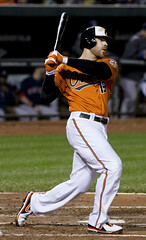
Chris Davis photo

Photo by Keith Allison

Let’s start with Davis. Yesterday, Davis went zero-for-five, with two strikeouts, as the Orioles pounded out 15 hits in a 12-4 thrashing of the A’s in Oakland.  In the process, Davis set a new MLB record for consecutive at bats without a base hit at 49 (and still counting).  Davis’ streak started after the second inning of a game on September 14, 2018 (when he doubled off James Shields). Since then, he has played in another 14 games, collected 32 plate appearances and 49 at bats – with no hits, six walks, 29 strikeouts, one run and two RBI.  As Sonny and Cher might sing on vinyl – “And the streak goes on.”

Last season, Chris Davis set the MLB record for the lowest batting average by a player qualifying for the batting title, when he hit .168 (79-for-470).    To be fair, Davis is also one of only 29 MLB players to hit 50 home runs in a season. In 2013, Davis hit .286, and led the AL with 53 home runs and 138 RBI.

The previous record of 46 consecutive at bats without a hit was held by Eugenio Vélez – who went hitless from a game on July 20, 2010 until his final MLB game on August 20, 2011.  Over that time, Vélez played in 29 MLB games, getting 52 plate appearances, 46 at bats) – with no hits, three walks and 12 whiffs.  He did score one run and drive in one. Vélez started his streak as a Giant and it ended as a Dodger.  (Well, it didn’t really end, Vélez’ streak was still active when he was released by the Dodgers.  He has since played in the U.S. Minor Leagues, the Dominican Winter League, The Mexican League and Mexican Pacific Winter League – but has not made it back to the majors. In 2018-19, he went a combined .281-1-9 in 27 games in the Dominican and Mexican Winter Leagues.  Maybe someone should give the 36-years-old another shot at extending or breaking the streak.

____________________________________________

Now, for the other side of the record book.

Edwin Encarnacion photo

Photo by james_in_to

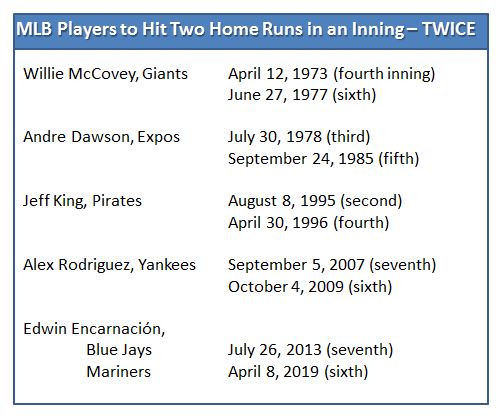
Yesterday, the Mariners’ Edwin Encarnación hit his third and fourth home runs of the 2019 season. For the day, Encarnación was two-for-four with two runs scored and four RBI. Of importance is the fact that they both came in the sixth inning of Seattle’s 13-5 win over the Royals.  Of, perhaps, even more importance is that it was the second time in his career that Encarnacion has gone deep twice in one inning.  And, that ties an MLB record.  Fifty-six different players have hit two home runs in one MLB inning (MLB.com) – but only five players have accomplished the feat twice.

rECORDS

A few other two-home run inning tidbits:

  • Fernando Tatis of the Cardinals is the only player to hit two Grand Slams in one inning – the third frame of a Cardinals’ 12-5 win over the Dodgers on April 23, 1999. Maybe a greater surprise is that Dodgers’ starter Chan Ho Park was on the mound for both long balls.
  • On May 2, 2002, as the Mariners beat the White Sox 15-4, Seattle’s Brett Boone and Mike Cameron both hit two home runs in the first inning. It’s the only time two teammates have hit two home runs in an inning in the same game – and they did it back-to-back. Boone was hitting third and Cameron fourth.
  • Only three players have hit home runs from both sides of the plate in the same inningCarlos Baerga, Indians (versus Yankees) – April 8, 1993; seventh inning; Mark Bellhorn, Cubs (Brewers) – August 29, 2002; Fourth inning; and Kendrys Morales, Angels (versus Rangers) – July 30, 2012; sixth inning.

Primary Resources:  MLB.com; Baseball-Almanac.com; Baseball-Reference.com


BASEBALL ROUNDTABLE ON THE TOP 100 BASEBALL BLOG LIST

100Baseball Roundtable is on the Feedspot list of the Top 100 Baseball Blogs.  To see the full list, click here.

I tweet baseball @DavidBBRT

Follow/Like Baseball Roundtable’s Facebook Page here.  More baseball commentary; blog post notifications; PRIZES.

Member: Society for American Baseball Research (SABR); The Baseball Reliquary; The Negro Leagues Baseball Museum.

Foreign-born Players Represent 28.5 Percent of Opening Day Rosters – Twins and Pirates Lead the Way

Major League baseball recently reported that MLB Opening Day rosters included a total of 251 players (active and inactive) born outside the United States – that represented 28.5 percent of the  Opening Day MLB player pool.   Twenty countries and territories were represented in the international roll call, with the Dominican Republic leading the way, with 102 Dominican-born players on Opening Day rosters. That give the Dominican 40.6 percent of all foreign-born players and far ahead of runner up Venezuela, with 68 players.  Coming in a distant third was Cuba, with 19 players.

The Minnesota Twins and Pittsburgh Pirates tied for the lead in foreign players, with each squad having 14 on their Opening Day roster; while the Dodgers, Yankees and A’s are tops in the number of countries represented on their rosters with seven.   Let’s take a look at a Dominican-born 2019 All Star team, and then at the foreign-born continents on the Twins and Pirates rosters.

CURRENT BBRT ALL-DOMINICAN SQUAD (Drawn from players on 2019 MLB Rosters)

C         Gary Sánchez, Yankees

The 26-year-old was an All Star just two seasons ago, when he put up a .278-33-90 line, after poking 20 homers in just 53 games as a rookie in 2016.  Still, he almost lost this spot with a disappointing 2018 season, marked by a groin injury, some criticism of his on-field hustle, a .186 batting average and a league-topping 18 passed balls in 89 games. But he has come back sharply, with six homers in his first eight 2019 appearances.  Sánchez’ top competition comes from the White Sox’ Welington (one “l” short) Castillo – now in his tenth MLB season. Castillo’s best season was 2017, when he went .282-20-53 in 96 games for the Orioles. The veteran backstop put a .259-86-298 career line over his first nine campaigns (658 games). Castillo was .259-6-15 in 49 games last season.

1B       Albert Pujols, Angels

Albert Pujols photo

Photo by bk1bennett

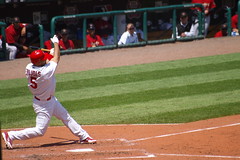
The 39-year-old Pujols is showing signs of age, but you can’t leave off arguably the best hitter ever to come out of the Dominican Republic. As I write this, Pujols is in his 19th MLB season, with a .302 career average, 3,090 hits, 634 home runs, 1,984 RBI and 111 stolen bases – and he is still active. He is a Rookie of the Year (NL- 2001); three-time MVP (NL-2005, 2008. 2009); 10-time All Star; and two-time Gold Glover.  He has a batting title on his resume, as well as two home run crowns, seven seasons of at least 40 round trippers, 14 campaigns of 100+ RBI and ten seasons with a batting average over .300. Hall of Fame, get that plaque ready.

In 2018, Pujols hit .246, with 19 home runs and 64 RBI in 117 games.

Pujols main competition was Edwin Encarnación, now in his 15th MLB season and, as of this writing, posting a .264-382-1,161 line – and still going strong, having topped 30 home runs in each of the last seven seasons and notching 100+ RBI  in each of the last four. In 2018, he was .246-32-107.

HONORABLE MENTION

Okay, he’s not eligible for this team because, of course, he is not an active player.  However, you can’t talk Dominican players without at least a nod to Juan Marichal. The right-hander won 243 games (142 losses) over 16 seasons (1960-75), with a 2.89 ERA and 244 complete games. The Hall of Famer was a 10-time All Star and six times won 20 or more games in a season.

2B       Robinson Canó, Mets

Canó is in his 15th MLB season – and he makes this lineup despite last season’s 80-game suspension. (He hit .303-10-50 in 80 games for the Mariners.) Over his first 14 season, Canó put up a .304 average, with 311 home runs and 1,233 RBI. He has been an All Star eight times and a Gold Glover twice. His resume includes eight seasons of 20 or more home runs (a high of 39 in 2016) and four season of 100+ RBI.

3B       José Ramírez, Indians

Ramírez, 26-years-old and now entering his seventh MLB season, really came into his own in 2016. To that point, he had a .239 batting average, with eight home runs and 20 stolen bases in 180 games.  In 2016, he hit .312, with 11 homers, 76 RBI and 22 steals.  He followed it up with .318-29-83, with 17 steals in 2017; and, in 2018, joined the 30-30 club, with a .270 average, 39 home runs, 195 RBI and 34 steals.  The two-time All Star has earned this spot.

SS        Jean Segura, Phillies

Segura is entering his eighth MLB season. He started the year with a .287 career average, 64 home runs, 316 RBI, 171 steals and 484 runs scored. Over the past three seasons (2016-18), however, he has a .308 average, with 41 homers, 172 RBI, 273 runs scored and 75 steals. The two-time All Star’s best season is 2016, when his 203 hits led the NL and he put up a .319 average, with 20 homers, 64 RBI, 102 runs scored and 33 steals.

OF       Juan Soto, Nationals

In 2018, his first major league season, Soto (just 19-years-old) hit .292, with 22 home runs and 70 RBI in just 116 games – finishing second in the Rookie of the Year balloting. His call up came after hitting .362-14-52 in 39 2018 games at three minor league levels.  He’s a keeper.

OF       Starling Marté, Pirates

Marté is a two-time Gold Glover with speed and a steady bat.  In his first eight MLB seasons (2012-18), he hit for a .286 average, with 85 home runs (a high of 20 in 2018) and 216 stolen bases (a high of 47 in 2016).

OF       Nomar Mazara, Rangers

Just 24-years-old and already in his fourth MLB season, Mazara can already look back on three straight 20-homer campaigns. Over his first three seasons, he hit .258-60-242.

DH      Nelson Cruz, Twins

It doesn’t get much better at DH than Cruz. In his 15th season (at age 38) Cruz is a six-time All Star and, over the last five seasons, he has averaged just over 40 home runs and 104 RBI per campaign.  Going into 2019, his career average was .274 – with 360 round trippers and 1,011 RBI.

SP        Luis Severino, Yankees

Although he started the 2019 season on the IL (rotator cuff inflammation), Luis Severino has earned this roster spot. He is 41-25, 3.15 over four MLB seasons. More important, he was an All Star in 2017 (14-6, 2.98) and 2018 (19-8, 3.39). He will be at the top of the Yankee rotation as soon as he is ready to get back on the mound.

RP       Jeurys Familia, Mets – Fernando Rodney, A’s – José Leclerc, Rangers

Couldn’t really decide between these three, each at a different stage of their career.  You can have your choice. Their stats going into 2019:

Familia … Seven seasons, 17-19, 2.73, 124 saves; 343 games; 352 2/3 IP; 369 strikeouts.

Rodney … 16 seasons; 48-67; 3.37, 325 saves; 902 games; 890 2/3 IP; 898 strikeouts.

Leclerc … Three seasons; 4-6, 2.51, 14 saves; 118 games; 118 1/3 IP; 160 strikeouts,

Countries/Territories of Origin of Foreign-Born Players

on MLB 2019 Opening Day Rosters

Dominican Republic – 102

Venezuela – 68

Cuba – 19

Puerto Rico – 18

Mexico – 8

Japan and Canada – 6 each

Curacao and South Korea – 5 Each

Columbia – 4

Aruba, Australia, Brazil, Germany, Lithuania, Netherlands, Nicaragua, Panama, Taiwan and U.S. Virgin Islands – 1 each.

Now the two teams with the most foriegn-born players.

___________________________________________

Minnesota Twins … 14 foreign-born players on open day roster.

Catcher-Utility

Willians Astudillo – Barcelona, Venezuela

Infielders

2B – Jonathon Schoop – Willemstad, Curacao

Utility – Marwin González – Puerto Ordaz, Venezuela

SS – Jorge Polanco – San Pedro de Marcoris, Dominican Republic

Utility – Ehire Adrianza, Guarenas, Venezuela

Outfielders

Eddie Rosario – Guayama, Puerto Rico

Max Kepler – Berlin, Germany

DH

Nelson Cruz – Las Matas de Santa Cruz, Dominican Republic

Pitchers

José Berríos – Bayamon, Puerto Rico

Michael Pineda – Yugaute, Dominican Republic

Martín Pérez – Guanare, Venezuela

Adalberto Majía – Bonao, Dominican Republic

Injured List

P – Gabriel Moya – Cabimas, Venezuela

3B – Miguel Sanó – San Pedro de Macorís, Dominican Republic

__________________________________________

Pittsburgh Pirates – 14 foreign-born players on Opening Day Roster.

Catcher

Francisco Cervelli – Valencia, Venezuela

Infielders

2B – Erik González – Puerto Plata, Dominican Republic

SS – Jung Ho Kang – Gwangui, South Korea

Outfielders

Melky Cabrera – Santo Domingo Dominican Republic

Starling Marté – Santo Domingo, Dominican Republic

Pablo Reyes – Santo Domingo, Dominican Republic

Pitchers

Francisco Liriano – San Cristobal, Dominican Republic

Richard Rodríguez – Santiago, Dominican Republic

Felipe Vázquez – San Felipe, Venezuela

Injured list

OF – Gregory Polanco- Santo Domingo, Dominican Republic

C – Elias Díaz – Maracaibo, Venezuela

P – Dovydas Neverauskas – Vilnius, Lithuania

OF/1B – José Osuna – Trujillo, Venezuela

P- Edgar Santana – Puerto Plata, Dominican Republic

Primary Resources:  MLB.com; Baseball-Reference.com; ESPN.com

COMING SOON – THE 2019 BBRT JOHN PACIOREK AWARD


BASEBALL ROUNDTABLE ON THE TOP 100 BASEBALL BLOG LIST

100Baseball Roundtable is on the Feedspot list of the Top 100 Baseball Blogs.  To see the full list, click here.

I tweet baseball @DavidBBRT

Follow/Like Baseball Roundtable’s Facebook Page here.  More baseball commentary; blog post notifications; PRIZES.

Member: Society for American Baseball Research (SABR); The Baseball Reliquary; The Negro Leagues Baseball Museum.

Ketel Marte Homers from Both Batters’ Boxes … and Some Switch Hitter Trivia

Ketel Marte photo

Photo by THE Laura Smith

Yesterday (April 5, 2019), the Diamondback’s Ketel Marte hit a pair of 400-foot+ home runs, as the Arizona squad belted five round trippers while drubbing the Red Sox 15-8. Marte scored two and drove in five in the game.  What BBRT found noteworthy (or post-worthy) was the fact that, for the second time in his five-season career, the switch-hitting infielder hit home runs from both side of the plate in the same game.  That prompted BBRT to look into the roster of players who have gone yard from both batters’ boxes in the same game.

It’s really not as rare an occurrence as you might think.  It’s been done in the regular season a total of 330 times, and by 112 different players.

A LITTLE MORE OF A UNICORN

Only three players have homered from both sides of the plate in a post-season game.

Bernie Williams, Yankees       ALDS Game Three (October 6, 1995

Bernie Williams, Yankees       ALDS Game Four (October 5, 1996)

Chipper Jones, Braves             NLDS Game Four (October 4, 2003)

Milton Bradley, A’s                ALCS Game Two (October 10, 2006)


The first player to homer from both sides of the plate in the same game was Wally Schange of the Philadelphia Athletics on September 8, 1916.

The career record for homering from both sides of the plate in the same game is 14 – shared by Mark Teixeira and Nick Swisher. Leaders among players homering from both side of the plate in the same game:

Mark Teixeira – 14 times

Nick Swisher – 14

Carlos Beltran – 12

Chili Davis – 11

Eddie Murray – 11

Tony Clark- 10

Ken Caminiti – 10

Mickey Mantle – 10

In 1996, the Padres’ Ken Caminiti hit a home run from both sides of the plate in the same game a record four times in a single season – three times in the month of August alone. Note: Caminiti also achieved the feat three times in a single month in September of 1995.

No team has had more instances of a player hitting long balls from both sides of the plate in a game than the Yankees – 56 times.  Here are the perpetrators:

Mickey Mantle (10X)

Mark Teixeira (9X)

Bernie Williams (8X)

Jorge Posada (8X)

Roy White (5X)

Nick Swisher (5X)

Tom Tresh (3X)

Aaron Hicks (2X)

Roy Smalley

Ruben Sierra

Tony Clark

Melky Cabrera

Carlos Beltran

Neil Walker

BIG BOMBS IN THE BIG APPLE

From 1955-1965, a game in which a player homered from both sides of the plate occurred in the AL 14 times, with 13 of those being Yankees (Mickey Mantle 10, Tom Tresh 3).

The only non-Yankee to achieve the feat in the AL during that time span was the Red Sox’ Pumpsie Green (August 15, 1961). Green hit a total of just 13 home runs in his five-season MLB career.  BBRT Note: Green achieved historic significance as the first African-American player for the Boston Red Sox – the last MLB team to break the color line (1959). In the 1955-65 time span, there were only three NL games which saw a player homer from both sides of the plate – two by the Cubs’ Ellis Burton, one by the Dodgers’ Maury Wills.

Only three players have hit home runs from both sides of the plate in the same inning:

  • Carlos Baerga, Indians (April 9, 1993);
  • Mark Bellhorn, Cubs (August 29, 2002);
  • Kendrys Morales, Angels (July 30, 2012).

SHARE IT AROUND

Carlos Beltran and Nick Swisher share the record for hitting a home run from both side of the plate in a single game for the most teams at five:  Beltran – Mets, Cardinals, Royals, Astros, Yankees; Swisher – A’s, Yankees, White Sox, Indians, Braves.


Bonus chart

SWITCH HITTERS WITH AT LEAST 400 CAREER HOME RUNS

         Mickey Mantle            536

         Eddie Murray              504

         Chipper Jones              468

         Carlos Beltran             435

         Mark Teixeira              409


BASEBALL ROUNDTABLE ON THE TOP 100 BASEBALL BLOG LIST

100Baseball Roundtable is on the Feedspot list of the Top 100 Baseball Blogs.  To see the full list, click here.

I tweet baseball @DavidBBRT

Follow/Like Baseball Roundtable’s Facebook Page here.  More baseball commentary; blog post notifications; PRIZES.

Member: Society for American Baseball Research (SABR); The Baseball Reliquary; The Negro Leagues Baseball Museum.

A Look at the Six Players to Go Deep in the First Four Games of a Season

One for the money … to for the show … three to get ready … four to go!

The Brewers’ Christian Yelich, the reigning NL MVP, did not hit a home run in yesterday’s 4-3 Brewers win over the Reds (although he did double in the ninth and score the winning run). Now, that normally wouldn’t make news, but in this case, it was the first Brewers’ game of the 2019 season in which Yelich did not go yard – as he tied a major-league record for consecutive games with a home run from the start of a season (four).

In his four-game streak, Yelich hit an even .500 (6-for-12), with a double, four home runs, six runs scored, eight RBI and six walks.  He also only struck out once.  The Brewers, by the way, won three of the four contests, all against the Cardinals.

Now, let’s take a look at the other five players to homer in the first four games of a season.

Trevor Story, Rockies, 2016

Over the first four games of the 2016 season, Story hit .368 (7-for-19) with six home runs, 11 RBI and six runs scored.  Story’s feat was even more memorable since those four contests were also his first four MLB games.  Story finished these season at .272-27-72 in 97 games (thumb surgery).The Rockies split those first four games, despite scoring 26 runs (they gave up 32).

Quite a Story

Trevor Story’s blazing start to the 2016 season – and his MLB career – gave him quite a display case of records.

  • First player to homer in his first four MLB games.
  • First player to hit two home runs in his first MLB game on Opening Day, and just the fifth to hit two long balls in their MLB debut (no matter what the day).
  • A MLB all-time record of six home runs in the first four games of a season.

Just a note, three of the four games were on the road.

Chris Davis, Orioles, 2013

Over the first four games of the 2013 campaign, Davis hit a robust .600 (9-for-15), with three doubles, four home runs, 16 RBI, and five runs scored.  He also drew one free pass.

Davis stayed hot all season, finishing at .286 (he came into the season with a .258 career average), and topping the league in home runs (53) and RBI (138). The Orioles won three of the four games; with Davis driving 16 of their 29 runs (55 percent).

Nelson Cruz, Rangers, 2011

Cruz’ hit .429 (6-for-14) over 2011’s first four games, with four home runs, five runs scored, four RBI and two walks.  He finished the season at .263-29-87.  The Rangers won all four games, outscoring the opposition 32-15.

Mark McGwire, Cardinals, 1998

Over the first four games of the Redbirds’ 1998 season, Big Mac hit .438 (7-for-16), with one double and four home runs.  He drove in 12 tallies and scored five.  That hot start was a sign of things to come.  For the season, McGwire hit .299-70-147. He led the league in home runs, walks (162), as well as on-base and slugging percentage. The Cardinals won three of the four games.

Willie Mays, Giants, 1971

In the first four games of the 1971 season, Mays produced a .389 average (7-for-18), with one double, one home run, nine RBI and five runs scored.  He also drew a pair of walks.  Overall, it was a bit of an off-year for the 40-year-old Mays, who sent .271-18-61 (but still stole 23 bases) in 136 games. Even in his age-40 season, he was a feared hitter, leading the NL with 112 walks. The Giants won three of their first four games, outscoring their opponents 24-14.

Primary Resources: Baseball-Reference.com; Baseball-Almanac.com

FOR LINKS TO BASEBALL ROUNDTABLE’S 2019 PENNANT RACE AND MAJOR AWARDS PREDICTIONS, CLICK HERE. 

BASEBALL ROUNDTABLE ON THE TOP 100 BASEBALL BLOG LIST

100Baseball Roundtable is on the Feedspot list of the Top 100 Baseball Blogs.  To see the full list, click here.

I tweet baseball @DavidBBRT

Follow/Like Baseball Roundtable’s Facebook Page here.  More baseball commentary; blog post notifications; PRIZES.

Member: Society for American Baseball Research (SABR); The Baseball Reliquary; The Negro Leagues Baseball Museum.

March Madness of Another Kind … a 50-3 Baseball Score

While waiting not only for the Final Four to jump (ball) off here in the Twin Cities, but also (more importantly to me) to see if Christian Yelich can start the 2019 MLB season by homering in the first five games of the campaign (which would be a new record), I passed the time by perusing the NCAA baseball record book.  Here’s a bit of what I found.

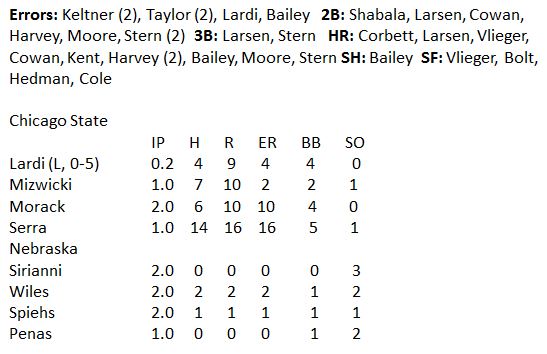
On March 16, 1999 in front of a Buck Belzer Stadium crowd of 654, the Nebraska University Cornhuskers took two-hours and 34-minutes to dispatch the Chicago State Cougars by a score of 50-3.  No, it wasn’t football – and, no, there will not be an “April Fools” at the end of this post.  Rather, it was, and remains, the most lopsided baseball game in NCAA history.  It was, by the way, also the second game of a doubleheader (Nebraska won the first contest by a 15-3 score).  A little background: Chicago State came into the game with a 2-7 record, Nebraska was 10-6.  The Cougars (as reported in the Omaha World-Herald) had flown into Omaha that morning and bused to Lincoln – arriving less than an hour before the game (and had lost several players to academic and disciplinary problems before the season opened).

In the contest – stopped in the seventh due to the 12-run “mercy rule” – Nebraska pounded out 35 hits, including nine home runs (by eight different players).   Nebraska, in fact, had a 23-0 lead before Chicago state had its first base runner (in the top of the fourth inning).    The Cornhuskers not only set the NCAA record for the biggest margin of victory, but also from the most runs scored and the most RBI (48) in an NCAA contest.

You’ll find the box score below and – at the end of the post – a few more NCAA baseball records  you may find of interest.

Neb1NE2

_______________________________________________

Now here are a few NCAA records you may find of interest.

TEAM

Runs Scored

Inning: 21 – Wichita State, March 3, 1984; Penn, May 25, 1983

Game: 50 – Nebraska, March 16, 1999

By Both Teams: 62 – Denver (33) – Air Force (29) on May 13, 1968. Air Force holds the record form most runs in a loss.

Home Runs

Inning: 7 – Southern Utah, April 22, 2001; Belmont, March 29, 2015

Game: 14 – Georgia Southern, March 15, 2008

Season: 188 (70 games) – LSU, 1997

Earned Run Average

Season: 0.65 – Missouri, 1964 (19 earned runs in 264 innings)

Shutouts

Season:  24 (70 games) – Arizona State, 1972

INDIVIDUAL

Batting Average

Season (at least 75 at bats):  .551 – Keith Hagman, New Mexico, 1980 (125-for-227)

Career:  .465 – Rickie Weeks, Southern University, 2001-03 (254-for-546)

Hitting Streak

58 games – Robin Ventura, Oklahoma State, 1987

Consecutive Base Hits

14 – Larry Patterson, Gonzaga, 1977

Home Runs

Game: 6 – Marshall McDougall, Florida State, May 9, 1999

Season: 48 (75 games) – Pete Incaviglia, Oklahoma State, 1985  For the story, click here. 

Career: 100 – Pete Incaviglia, Oklahoma State (1983-85)

Marshall McDougall, Florida State, holds the NCAA single-game records for home runs (6); total bases (25); runs batted in (16). That story here.

Pitching Victories

Season:  20 – Derek Tatsuno, Hawaii, 1979 (20-1); Mike Loynd, Florida State, 1986 (20-3)  Tatsuno’s story, click here.

Career: 51 – Don Heinkel. Wichita State, 1979-82 (11 losses)

ERA (lowest) 

Season (50+ innings): 0.26 – Sal Campisi, LIU Brooklyn, 1964 (three earned runs in 104 innings)

Career (100+ innings); 0.56 – Keith Weber, Missouri, 1963-64, (nine earned runs in 144 innings)

Strikeouts

Inning: 5 – Mike Wollet, Air Force, March 4, 1990; Will Hunt, UNCW,  April 29, 2003

Game:  26 – Buddy Schultz, Miami (OH), April 3, 1971

Season: 234 (174 1/3 innings) – Derek Tatsuno, Hawaii, 1979

Career: 602 (477 innings) – John Powell, Auburn, 1991-94

George Plender, Vermont, 1954-55 holds the NCAA record for consecutive scoreless innings at 60.


FOR LINKS TO BASEBALL ROUNDTABLE’S 2019 PENNANT RACE AND MAJOR AWARDS PREDICTIONS, CLICK HERE. 

BASEBALL ROUNDTABLE ON THE TOP 100 BASEBALL BLOG LIST

100Baseball Roundtable is on the Feedspot list of the Top 1oo Baseball Blogs.  To see the full list, click here.

I tweet baseball @DavidBBRT

Follow/Like Baseball Roundtable’s Facebook Page here.  More baseball commentary; blog post notifications; PRIZES.

Member: Society for American Baseball Research (SABR); The Baseball Reliquary; The Negro Leagues Baseball Museum.