July 28 … A Tough Day for a Couple of Hall of Famers

Three was not always a lucky number for Hall of Famers Stan Musial and Brooks Robinson … at least not on July 28.  That date marks two unlikely outcomes – the only time that Stan Musial struck out three times in a game and the only time Brooks Robinson made three errors in a contest.  Here’s are the stories.

Stan Musial’s Three Whiffs… July 28, 1963
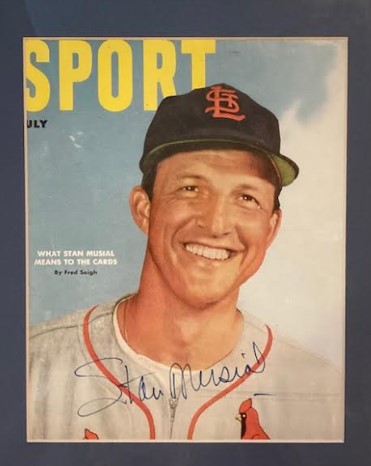
StanleyIn his 22-season career, Stan Musial fanned only 696 times.  Here I’ll do the math – that translates to once every 4.3 games or once every 18.3 plate appearances.  Further, Stan the Man had only one three-strikeout game in his entire career – and that came on July 28, 1963 (Musial’s final MLB season). It was the 2,980th regular-season game of Musial’s 3,026 game career. Further, the strikeouts came in three consecutive plate appearances (Musial’s only trips to the batter’s box in the game).

It came in the first game of a Cardinals/Cubs doubleheader at Wrigley Field. Twenty-three-year-old southpaw Dick Ellsworth (on his way to a 22-10, 2.11 season for the Cubs) fanned Musial – who started in left field, batting sixth – in the second, fourth and sixth innings. (In the bottom of the sixth Cardinals’ starting RF Charlie James moved to LF, Gary Koth came into to play RF and Musial went to the bench.)  The Cubs, by the way, won 5-1 and Ellsworth pitched a complete-game, seven-hitter, with one walk and ten strikeouts.

Baseball’s Up and Downs

Southpaw Dick Ellsworth, who went 22-10, 2.11 in 1963 (when he fanned Stan Musial three times in one game) had lost twenty games the year before (9-20, 5.09). Ellsworth would go 115-137, 3.72 over 13 MLB seasons.  

A little refresher on why Hall of Famer Stan Musial was “The Man.”  He was an All Star in 20 seasons, a three-time Most Valuable Player and a seven-time batting champion. He finished with a .331 average (3,630 hits), 475 home runs, 1,951 RBI and 1,949 runs scored. Stan Musial stuck out just four times in 23 post-season (all World Series) games – in 99 plate appearances. He also led the NL in hits six times, doubles eight times and triples five times.

So-o-o Close

In 1948, Stan Musial – with 39 home runs – fell just one  home run short of tying Johnny Mize and Ralph Kiner for the National League home run crown (despite his 475 long balls Musial never led his league in homers).  He lost one homer to a rain out that season.  Without that rain out, Musial would have had an offensive sweep, leading the National League in average (.376), hits (230), doubles (46), triples (18), homers, runs scored (135), RBI (131), on-base percentage (.450), slugging percentage (.702), and total bases (429).  Oh, and he struck out just 34 times in 698 plate appearances. 

___________________________________________________

Brooks Robinson’s Three Boots …  July 28, 1971

Rpobbies2

Sixteen-time Gold Glover Brooks Robinson made just 263 errors in his 23 MLB seasons (2,896 regular-season games).  Again, I’ll do the math.  That’s one error each 11 games.  (It’s also one error every 34.8 chances – .971 fielding percentage). However, on July 28, 1971 (eight years, to-the-date, after Stan Musial’s only three-strikeout game), Robinson had the only three-error game of his career. Even more surprising, all three errors came in the same inning (on two of only three balls handled by Robinson in the game).

It all came down with the A’s batting against Robinson’s Orioles in the top of the fifth inning of a scoreless game.

It started out harmlessly enough, with Orioles’ starter Mike Cueller getting the first two A’s batters (the number seven and eight hitters).  Cueller then walked A’s pitcher Blue Moon Odom.  Speedy SS CF Bert Campaneris bunted for a base hit, but (attempting to make the play) Robinson threw the ball past first baseman Boog Powell for an error that let Odom go to third and Campaneris to second. Next up was CF George Hendricks, who grounded to third.   Robinson booted the grounder (error number two) and then threw wildly to first (error number three). Odom and Campaneris both scored and Hendrick ended up on second base. Cueller then RF fanned Reggie Jackson to end the inning.

The score stayed 2-0 until the bottom of the ninth when Frank Robinson bailed out Brooks by rapping a three-run, walk-off home run off A’s closer Rollie Fingers.

Brooks Robinson was a 16-time Gold Glover, the 1964 AL Most Valuable Player and an All Star in 15 seasons. He finished with a .267-268-1,357 career stat line. He is the all-time leader at third base in games played, putouts, assists and double plays.  He led AL third sackers in fielding percentage 11 times, putouts four times, assists nine times and double plays four times.  In 39 post-season games, Robinson made four errors in 145 chances (.972 fielding percentage).

Triple Plays – Two Sides of the Coin

Brooks Robinson’s renowned glove was involved in three triple plays during his career.  His bat was, however, part of our triple killings.  Robinson holds the MLB record for hitting into triple plays at four.

Primary Resources … Baseball-reference.com; Stathead.com; NationalPastime.com

100Baseball Roundtable is on the Feedspot list of the Top 100 Baseball Blogs.  To see the full list, click here.

I tweet baseball @DavidBBRT

Follow/Like Baseball Roundtable’s Facebook Page here.  More baseball commentary; blog post notifications; PRIZES.

Member: Society for American Baseball Research (SABR); The Baseball Reliquary; The Negro Leagues Baseball Museum.
From Both Sides Now – Going Yard from Both Sides in a Single Game

Leury Garcia photo

Photo by rchdj10

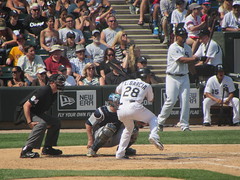
Yesterday (July 25, 2020), Chicago White Sox’ 2B Leury Garcia went deep twice against the Twins, as the White bounced Minnesota 10-3, behind a five-home barrage. Garcia – batting in the nine-hole – went three-for-four in the game, with two runs scored and four RBI.  Side note:  It’s nice to write about something that happened this season for a change. 

What made Garcia’s game a bit special in BBRT’s view is that the switch hitter homered from both sides of the plate. He hit a solo shot left-handed to lead off the fifth (off Zack Littell) and added a three-run home run – right-handed – with two outs in the seventh off Devin Smeltzer.  It was only the second two-homer game for Garcia (in his eighth MLB season), who has a .257-25-123 stat line in 464 MLB games.

Now, homering from both sides of the plate is not as rare an occurrence as you might think.  It’s been done in the regular season a total of 341 times, and by 118 different different players. Still, it a feat the deserve recognition.   And, now, here are a few more “From Both Sides Now” tidbits:

  • The first player to homer from both sides of the plate in the same game was Wally Schange of the Philadelphia Athletics on September 8, 1916.
  • The career regular-season record for homering from both sides of the plate in the same game is 14 – shared by Mark Teixeira and Nick Swisher. Leaders among players homering from both side of the plate in the same game:

____________________________________________________________________

Both sidews

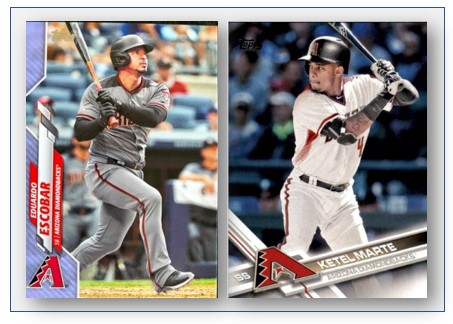
In 2019, two Diamondbacks homered from both sides of the plate in three games each: Ketel Marte (April 5, April 24, May 3) and Eduardo Escobar (June 10, July 17 and August 3.

_________________________________________________________________________

Players to Homer from Both Sides of the Plate in Ten or More Games

Mark Teixeira – 14 times

Nick Swisher – 14

Carlos Beltran – 12

Chili Davis – 11

Eddie Murray – 11

Tony Clark- 10

Ken Caminiti – 10

Mickey Mantle – 10

  • Only three players have hit home runs from both sides of the plate in the same inning: Carlos Baerga, Indians (April 9, 1993); Mark Bellhorn, Cubs (August 29, 2002); Kendrys Morales, Angels (July 30, 2012).
  • In 1996, the Padres’ Ken Caminiti hit a home run from both sides of the plate in the same game a record four times in a single season – three times in the month of August alone. Note: Caminiti also achieved the feat three times in a single month in September of 1995.

_____________________________________________________________

No team has had more instances of a player hitting long balls from both sides of the plate in a game than the Yankees – 56 times.  Here are the perpetrators:

Mickey Mantle (10 time)

Mark Teixeira (9)

Bernie Williams (8)

Jorge Posada (8)

Roy White (5)

Nick Swisher (5)

Tom Tresh (3)

Aaron Hicks (2)

Roy Smalley

Ruben Sierra

Tony Clark

Melky Cabrera

Carlos Beltran

Neil Walker

_____________________________________________________________________

BIG BOMBS IN THE BIG APPLE

From 1955-1965, a game in which a player homered from both sides of the plate occurred in the AL 14 times, with 13 of those being Yankees (Mickey Mantle 10, Tom Tresh 3).

The only non-Yankee to achieve the feat in the AL during that time span was the Red Sox’ Pumpsie Green (August 15, 1961). Green hit a total of just 13 home runs in his five-season MLB career.  BBRT Note: Green achieved historic significance as the first African-American player for the Boston Red Sox – the last MLB team to break the color line (1959). In the 1955-65 time span, there were only three NL games which saw a player homer from both sides of the plate – two by the Cubs’ Ellis Burton, one by the Dodgers’ Maury Wills.

  • Carlos Beltran and Nick Swisher share the record for hitting a home run from both side sof the plate in a single game for the most teams at five:  Beltran – Mets, Cardinals, Royals, Astros, Yankees; Swisher – A’s, Yankees, White Sox, Indians, Braves.

Only three players have homered from both sides of the plate in a post-season game.

Bernie Williams, Yankees       ALDS Game Three (October 6, 1995

Bernie Williams, Yankees       ALDS Game Four (October 5, 1996)

Chipper Jones, Braves             NLDS Game Four (October 4, 2003)

Milton Bradley, A’s                ALCS Game Two (October 10, 2006)

Primary Resources:  Baseball-Reference.com; Stathead.com; Baseball-Almanac.com

100Baseball Roundtable is on the Feedspot list of the Top 100 Baseball Blogs.  To see the full list, click here.

I tweet baseball @DavidBBRT

Follow/Like Baseball Roundtable’s Facebook Page here.  More baseball commentary; blog post notifications; PRIZES.

Member: Society for American Baseball Research (SABR); The Baseball Reliquary; The Negro Leagues Baseball Museum.
 

Some Less Than Significant Observations from Opening Days 2019 & 2010

As the 2020 MLB season opened, I wondered what impact the strange start to this campaign might have on the players and the game – if any.  What would the difference be between a July 23 start, with a brief Summer (Spring) Training and the usual March start with a traditional Spring Training (using last season).

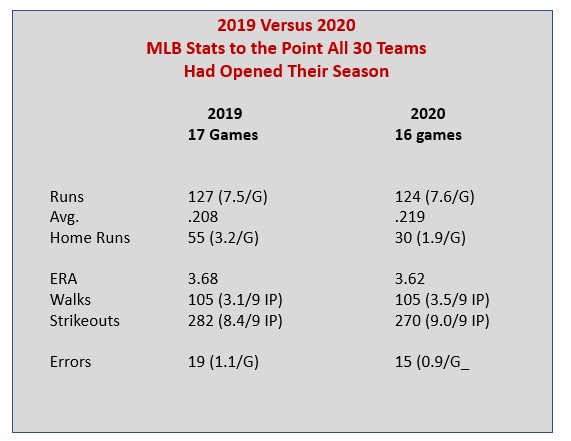
Now, I know this is a small sample and pretty meaningless – so I consider this post to be observation, rather than analysis.  Basically, I used “all the games played until all the teams had played a game.” For 2019, that was 17 games (The two Mariners/A’s games in Tokyo on March 20 and 21 and the full slate on March 28). For 2020, it was 16 games (Yankees/Nationals and Giants/Dodgers on July 23 and the remaining teams – plus a second Giants/Dodgers game – on July 24),

2019 bersu 2020

So, what did I observe?  As the chart shows most of the stats were pretty similar (again in a small sample size). There were 7.5 runs per game in 2019’s first 16 games compared to 7.6 RPG in 2020’s first 16 contests. The earned run averages in the span were 3.68 for 2019 and 3.62 for 2020.  In both samples, pitchers had the upper hand – which you would expect, on Opening Day you get the “aces” – although average-wise, hitters fared a bit better in 2020 (.219 to .208 in 2019).

The major difference was in home runs. The 2019 sample showing 3.2 long balls per game, versus 1.9 in 2020. The raw number on dingers are even more surprising – 55 homers in 2019’s first 17 games, just 30 in 2020’s first sixteen.  Lots of possibilities here – adjustments to the baseball, how a ball travels in an empty ballpark, hitters timing due to short preparations. Ironically, there were actually more games with zero home runs in the 2019 sample (seven) than in the 2020 sample (three).  Why?  In the 2020 “Opener Sample,” the most home runs in any game was three.  The 2020 sample had eight games with more than three (one with ten, one with six, three with five and three with four).

Here are a few more statistical observations.

  • The fist seventeen games in 2019 saw five shutouts, the first sixteen in 2020 saw four shutouts.
  • The 2019 sample had four teams scoring ten or more runs in a game, 2020’s sample just two.
  • In 2019’s first seventeen games, both teams played error-free ball in seven contests, versus six such games in 2010’s first 16 match ups.

Ultimately, no conclusions to be drawn. Just thought I share a few numbers with my fellow stats freaks.  (By the way, I am into both stats and stories.)

For a poetic look at Opening Day, click here.  For some Opening Day records, click here.

Primary resources:  Baseball-Reference.com;  Stathead.com.


100Baseball Roundtable is on the Feedspot list of the Top 100 Baseball Blogs.  To see the full list, click here.

I tweet baseball @DavidBBRT

Follow/Like Baseball Roundtable’s Facebook Page here.  More baseball commentary; blog post notifications; PRIZES.

Member: Society for American Baseball Research (SABR); The Baseball Reliquary; The Negro Leagues Baseball Museum.
Pressed (for answers) While You Wait … Opening Day Trivia and More

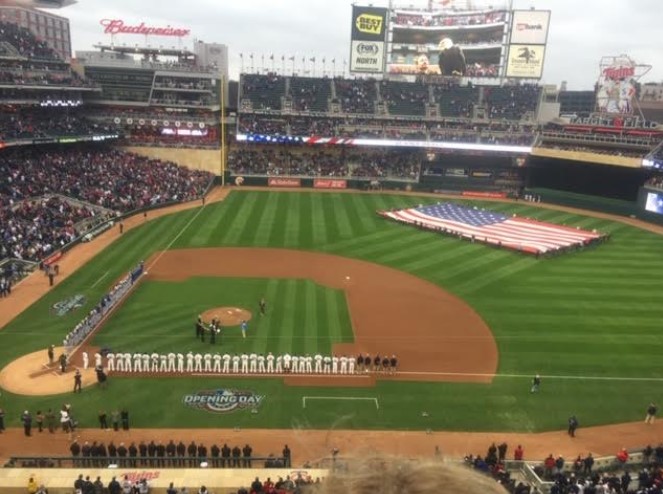
Okay, so Opening Day won't be quite the same. At least, it's on the way.

Okay, so Opening Day won’t be quite the same. At least, it’s on the way.

How about a little Opening Day trivia, as we eagerly anticipate the first pitch the counts in the 2020 MLB season?  Here are a half-dozen quick questions – and answers – followed by lots more Opening Day facts and figures.  Mull them over a bit before you read on.

  1. Who was the first MLB pitcher to throw nine no-hit innings in an Opening Day start? Hint: It’s not the Feller you may be thinking of.
  2. Which player became a “victim of circumstance” and set an Opening Day single-game record by fanning five times? Hint:  Well, it was against Randy Johnson, whose 107 career Opening Day strikeouts are an MLB record.
  3. Steve Carlton started 14 of the 15 Phillies’ Opening Day games from 1972 through 1986. The one year he missed cost him the record for consecutive Opening Day starts and consecutive Opening Day starts for the same team. Who was the pitcher who interrupted Carlton’s streak?  Hint: Like Carlton, a lefty (and one who ought to be in the Hall of fame, but isn’t).
  4. Can you name the pitcher who holds the record for the most walks surrendered in an Opening Day game (11)?  Hint, despite the 11 free passes, the opposition only scored three runs (two earned) off him in 11 innings.
  5. Which pitcher holds the mark for the most strikeouts in an Opening Day game? Kinda tossing you a curve on this one.
  6. Which player holds the record for the most hit-by-pitches in an Opening Day game – getting plunked three times? Hint:  These pitches were to (Glenn) close for comfort.

Read on for the answers and more Opening Day facts and figures.

  1. Who was the first MLB pitcher to throw nine no-hit innings in an Opening Day start? Hint: It’s not the Feller you may be thinking of.   Answer: Leon “Red” Ames.

On April 16, 1940, 21-year-old Bob Feller (already in his fifth MLB season) threw the first – and still only – Opening Day no-hitter in MLB history – topping the White Sox 1-0 in Chicago. It was the first no-hitter (of an eventual three) for Feller, who walked five and struck out eight. During the season, Feller would go on to lead the AL in wins (27), ERA (2.61), strikeouts (261), games pitched (43), games started (37), complete games (31), innings pitched (320 1/3) and shutouts (4).

Feller, however, is not the answer to this trivia question.  Back on April 15, 1909 – as the Giants opened against the Superbas (Dodgers) in Brooklyn – Giants’ righty Red Ames started and, with just the minimum of support, could have made history. Ames held Brooklyn hitless for nine innings, but got nary a run of support from his batsmen.  Ames finally gave up a hit with one out in the tenth and, while he kept the shutout going through the 12th inning, eventually lost 3-0 in 13 innings.  How the game has changed:  Both Ames and Brooklyn starter Irvin “Kaiser” Wilhelm went the distance.  Ames, by the way, had a 17-season MLB career (1903-10), going 183-167, 2.63. His best season was 1905 (Giants), when he went 22-8, 2.74.

—————————————————————————————

  1. Which player became a “victim of circumstance” and set an Opening Day single-game record by fanning five times? Hint:  Well, it was against Randy Johnson, whose 107 career Opening Day strikeouts are an MLB record.  Answer:  Ron Karkovice.

On March 31, 1996, White Sox’ catcher Ron Karkovice set an MLB Opening Day record by striking out five times as Chicago lost 3-2 in Seattle.  Karkovice, however, may have been a victim of circumstance.

First, future Hall of Famer Randy Johnson started on the mound for the Mariners – striking out 14 in seven innings (including Karkovice three times).

Randy Johnson holds the record for the most career Opening Day strikeouts with 107 and for the most Opening games with double-digit strikeout totals (four).

Second, the White Sox could muster only two runs on four hits over the first nine innings – taking a slim 2-1 lead into the bottom of the ninth (at that point, Karkovice had fanned just three times).

Third, the Mariners tied the contest in the ninth, and the game went to 12 innings before the Mariners prevailed 3-2.  In those three extra innings, Karkovice struck out against Norm Charlton (tenth inning) and Edwin Hurtado (twelfth inning) to set the Opening Day record.

———————————————————————————-

  1. Steve Carlton started 14 of the 15 Phillies’ Opening Day games from 1972 through 1986. The one year he missed cost him the record for consecutive Opening Day starts and consecutive opening Day starts for the same team. What pitcher interrupted Carlton’s streak?  Hint: Like Carlton, a lefty (and one who ought to be in the Hall of fame, but isn’t.  Answer: Jim Kaat.

In 1976, Jim Kaat- a three-time 20-game winner, and an All Star the year before – got the Opening Day nod from the Phillies. For those who may be wondering whether Carlton’s health played an issue in Kaat’s Opening Day start, Carlton started the second game of the season and went on to a 20-7 record in 35 starts. Side note:  Kaat was not only a 283-game winner, but also a 16-time Gold Glover. Kaat pitched for the Phillies from 1976-79, putting up a 27-30, 4.23 record. He spent 15 of his 20 seasons with the Senators/Twins.

——————————————————————–

  1. Can you name the pitcher who holds the record for the most walks surrenders in an Opening day game (11)?  Hint, despite the 11 free passes, the opposition only scored three runs (two earned) off him in 11 innings. Answer: Herb Score.

On April 16, 1957, Cleveland southpaw Herb Score set the Opening Day record for pitcher’s walks, delivering eleven free passes to the visiting White Sox.  Despite Score’s wildness, it was a close contest, with Score going the distance in a 3-2, 11-inning loss. Score struck out ten and gave up just seven hits and two earned runs – stranding 14 Chicago base runners.

Herb Score was the 1955 AL Rookie of the Year, when the 22-year-old lefty went 16-10. 2.85 and led the league in strikeouts with 245.  In 1956, he was even better, going 20-9, 2.53 and again topping the league in whiffs (263). His 1957 season ended on May 7, when he was it in the face by a line drive off the bat of Yankee Gil McDougald.  Score suffered a broken nose, as well as damage to is right cheek bone and right eye.  He was hospitalized for about three weeks and did not return to the mound that season.

Score came back in 1958, but suffered an elbow injury early in the season (some wondered if he had changed his delivery after the McDougald incident, but Score denied that – and had been pitching well to that point). At any rate,  from 1958 until he retired in 1962, Score was 17-26, 4.43. 

————————————————————————

  1. What pitcher holds the mark for the most strikeouts in an Opening Day game? Hint: Kind of tossing you a curve on this one. Answer: Camilo Pascual.

On April 18, 1960, Camilo Pascual (known for his sweeping curve ball) took the mound at Griffith Stadium for the Washington Senators (against the Boston Red Sox). In 1959, the Senators had finished in last place in the AL, but Pascual had gone 17-10, 2.64, leading the league with 17 complete games and six shutouts. As the Senators’ Opening Day starter in 1960, Pascual picked up right where he left off – tossing a complete game three-hitter, walking three and striking out a still Opening Day record 15 batters in a 10-1 win over the Red Sox.

Pascual pitched 18 MLB seasons (1954-71), winning 174 and losing 170, with a 3.63 earned run average. He was a five-time All Star, two-time twenty-game winner and led the league in complete games, shutouts and strikeouts three times each.

———————————————————————

  1. Which player holds the record for the most hit-by-pitches on Opening Day – getting plunked three times? Hint:  These pitches were too (Glenn) Close.   Answer: Glenn Davis.

On April 9, 1990, Astros’ first baseman and cleanup hitter Glenn Davis was hit by a pitch an Opening Day record three times. Davis came to the plate six times and never put the ball in play – but still made only one out.  Davis (who led the league in HBP that season with eight) was hit by a pitch three times, walked twice and struck out once as the Astros lost to the visiting Reds 8-4.  Davis finished Opening Day with a batting average of .000, but an on-base percentage of .833.

Glenn Davis played 10 MLB seasons (1984-93), hitting .259, with 190 home runs and 603 RBI.  He was hit buy a pitch 55 times.

—————————————————————————

Now, let’s look at some additional Opening Day tidbits.

Let’s get this party started.

No pitcher started more Opening Day games than Hall of Famer Tom Seaver (16). Seaver opened for Mets eleven times, the Reds three times and for the White Sox twice.  Seaver recorded seven wins, two losses and seven no decisions on Opening Day,

“They call him the streak.”

Hall of Famer Jack Morris holds the record for the most consecutive Opening Day starts at 14 (eleven for the Tigers, one for the Twins and two for the Blue Jays).

Rockin’ Roberts

Hall of Famer Robin Roberts, holds the record for the most consecutive Opening Day starts for the same team at 12 – for the Phillies from 1950-1961.

In the “How the Game has Changed” category, in the 1950’s (1950-59), Robin Roberts won 199 games and threw 3,011 2/3 innings – for an AVERAGE of 20 wins and 301 innings pitched per season.

Opening Day Starts – Gimme five!

Gaylord Perry was honored by the most teams with Opening Day starts. He started on Opening Day for an MLB-record five different teams (Giants, Indians, Rangers, Padres and Mariners).

The Longest Day – 15 Shutout Innings

On April 13, 1926, the Senators’ Walter Johnson pitched a 15-inning, complete-game shutout (six hits, three walks, nine strikeouts) as Washington topped the Philadelphia Athletics 1-0 in Washington.  The opposing starter, Eddie Rommel tossed the second-most innings in an Opening Day appearance – going 14 1/3, as Washington scored the winning run with one out in the 15th.  Johnson, by the way, was 38-years-old at the time.

U Can’t Touch This – 7-0 on Opening Day

Jimmy Key holds the record for Opening Day wins without a loss at seven – and he did in the minimum seven starts (Blue Jays, Yankees and Orioles). In those seven wins, he threw 44 1/3 innings, with a 3.05 ERA.

Knock Three Times – Most Home Runs in an Opening Day Game

The Opening Day, single-game record of three home runs is shared by four players – the Blue Jays’ George Bell, Cubs’ Tuffy Rhodes, Tigers’ Dmitri Young and White Sox’ Matt Davidson.

On April 4, 1988, George Bell – batting clean-up and serving as the DH – became the first major leaguer to hit three home runs in an Opening Day game, as his Blue Jays topped the Royals 5-3 in Kansas City. Bell’s power outburst was no surprise. He was coming off a 1987 season in which he hit 47 homers, drove in 134 runs and was the AL MVP. Bell went three-for-four with three runs scored and four RBI, hitting all three home runs off Royals’ starter Brett Saberhagen.

On a windy April 4, 1994, Karl “Tuffy” Rhodes (leading off and playing CF for the Cubs in Chicago) hit three solo shots off Mets’ starter Dwight Gooden. Rhodes also had a single and a walk in five plate appearances. Despite Rhodes’ record-tying performance, the Cubs lost to the visiting Mets 12-8. At the time, Rhodes had played 107 MLB games in four seasons – hitting a total of five home runs. His MLB career consisted of 225 games in six seasons, with a .224 average and just 13 round trippers (with a high of eight in 1994). Rhodes did go on to hit 474 home runs in eleven seasons in Japan.

On April 4, 2005 the Tigers’ Dmitri Young joined Bell and Rhodes on the list of batters with three home runs in an Opening Day game – as the Tigers topped the Royals 11-2 in Detroit. Young started at DH and went four-for-four with four runs and five RBI.  Young, an All Star in 2003 and 2007, hit a total of 21 home runs in 2005 – and 171 in 13 MLB seasons. He hit a career-high 29 round trippers in 2003.

On March 29, 2018, as the White Sox topped the Royals 14-7 in Kansas City, DH and (appropriately) cleanup hitter Matt Davidson opened the season with a three-homer, five-RBI game. He went three-for-four with a walk, four runs scored and five RBI. Davidson went deep off three different pitchers: solo shots in the fourth and fifth off Danny Duffy and Blaine Boyer and a three-run blast in the eighth off Brian Flynn. Davidson, in his fourth MLB season, went on to a .228-20-62 campaign.  In his 273 MLB games (2013, 1015-18), Davidson has just three multi-homer contests. and a total of 49 round trippers.

Bringing the boys home, sweet home

The Opening Day single-game record for RBI (seven) is shared by the Twins’ Brant Alyea and the Cubs’ Corey Patterson.

On April 7, 1970 – in his very first game as a Twin – LF Brant Alyea drove in an Opening Day record seven runs as Minnesota topped the White Sox 12-0 in Chicago. Batting fifth, Alyea went four-for-four, with two home runs, two singles and two runs scored.  The game, it turned out, would foreshadow a strong April for Alyea.  In 17 April games, he hit .415, with seven runs, 23 RBI, four doubles and five home runs.

On March 31, 2003, the Cubs’ CF Corey Patterson tied Alyea’s record. In a 15-2 win over the Mets in New York, Patterson, batting seventh, drove in seven runs, going four-for-six with two home runs and two runs scored.

Corey Patterson, a career .252 hitter (12 seasons), was a true Opening Day All Star. In seven Opening Day appearances, Patterson hit .440, with seven runs, 12 RBI and three home runs.

Eight is Enough

On Opening Day 2019 (March 28), as the Dodgers topped the Diamondbacks 12-5 in Los Angeles, the Californians launched an Opening Day record eight home runs (two by LF Joc Pederson, two by 2B Enrique Hernandez and one each by C Austin Barnes, SS Corey Seager, 1B Max Muncy and RF Cody Bellinger. Before the Dodger outburst, the Opening Day record for team long balls was six (1988 Mets and 2018 White Sox.)

Eight is also a career magic number for Opening Day. Frank Robinson, Ken Griffey, Jr. and Adam Dunn Share the career record for Opening Day home runs with eight each.  Robinson’s were all hit in one-homer games, giving him the record for the most Opening Days with a home run.

BBRT KINGS OF OPENING DAY – IN THE BATTER’S BOX AND ON THE MOUND

Ted Williams photo

Photo by Wicker Paradise

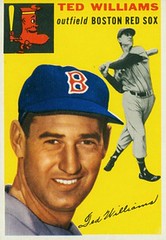
Perhaps no one looked forward to Opening Day more than Ted Williams – the king of the Opening Day batter’s box.  A career .344 hitter, Williams was even better on Opening Day.  Teddy Ballgame played in fourteen “Openers” and was never held without a hit.  He compiled a .449 Opening Day average (22 hits in 49 at bats), with three home runs, eight doubles, one triple, nine runs scored, 14 RBI and eleven walks.  His Opening Day on-base percentage was .550 and his season-opener slugging percentage was .837. (Side note:  The highest career Opening Day average – at least 50 Opening Day at bats –  is .467 shared by Gabby Hartnett, Jeff Kent and Adrian Gonzalez.

The Washington Senators’ Walter Johnson can be crowned king of the Opening Day hill.  On his first-ever Opening Day start (April 14, 1910), the 22-year-old Johnson tossed a 3-0 one-hit shutout against the Philadelphia Athletics.  Sixteen years (and 13 Opening Day starts) later, a 38-year-old Johnson fulfilled his last Opening Day assignment with a 15-inning, complete-game, 1-0 win (6 hits, 3 walks, 9 strikeouts) over the A’s.  Johnson holds the record for Opening Day pitching victories with nine (against five losses) and also threw a record seven Opening Day shutouts.

Primary Resources:  Baseball-Reference.com, Stathead.com; Baseball-Almanac.com; MLB.com

100Baseball Roundtable is on the Feedspot list of the Top 100 Baseball Blogs.  To see the full list, click here.

I tweet baseball @DavidBBRT

Follow/Like Baseball Roundtable’s Facebook Page here.  More baseball commentary; blog post notifications; PRIZES.

Member: Society for American Baseball Research (SABR); The Baseball Reliquary; The Negro Leagues Baseball Museum.
Baseball Roundtable “Who’s Your Daddy?” Series … Tom Seaver Edition

Rick Monday … Figured It Out

Cubs’ CF Rick Monday’s first game against the Mets’ Tom Seaver (August 12, 1972) did not hold out much promise for the future. Monday struck out in his first three at bats against Seaver (second, fourth and sixth innings). Apparently having given up laying good wood on Seaver’s stuff, Monday attempted to bunt for a hit in the bottom of the ninth (with the game tied at one), but was thrown out third-to-first. 

Surprisingly, after that slow (to put it kindly) start, Monday hit .366 versus Seaver over the remainder of his career – and his 11 home runs off Tom Terrific are the most Seaver gave up to any batter, as well as the most Monday hit against any pitcher.

_____________________________________________________

Who’s Your Daddy?  What’s it all about?

That’s right, it’s time for the next edition of Baseball Roundtable’s  “Who’s Your Daddy?” series … focusing on some of  MLB’s premier pitchers – like Bob Feller, Bob Gibson, Sandy Koufax and Nolan Ryan, as well as contemporary hurlers like Justin Verlander and Max Scherzer.

In this series, BBRT presents lineups of players who performed unexpectedly well against baseball’s top pitchers. (An explanation of the inspiration behind the Who’s Your Daddy? series can be found the end of this post.)  As always, I would stress that the pitchers included in the Who’s Your Daddy? series are among the “best in the business.”  They are selected not because of the players who performed well against them, but rather because success among hitters when they were on the mound was the exception rather than the rule.

Before we get started on this edition – focusing on Hall of Famer Tom “Tom Terrific” Seaver, here are links to the previous editions of this series:

  • Nolan Ryan, click here.
  • Sandy Koufax, click here. 
  • Pedro Martinez, click here.
  • Bob Gibson, click here
  • Randy Johnson, click here
  • Greg Maddux, click here. 
  • Justin Verlander, click here. 
  • Bob Feller, click here
  • Roger Clemens, click here
  • Max Scherzer, click here. 

____________________________________________

Now, let’s take a look at Tom Seaver and the players who seem to have his number (that would be “41,” by the way).

SeaverpnotoHall of Famer right-hander Tom Seaver’s recognitions include three Cy Young Awards (1969, 1973, 1975) and the 1967 Rookie of the Year Award. During his 20-season MLB career (1967-86 …. ages 22 through 41 … Mets, Reds, White Sox, Red Sox), Seaver was a 12-time All Star. He won 20 or more games in five seasons and 15 or more in 13 campaigns.  He retired with a 311-205, 2.86 record – and his 311 wins are 18th all-time.  Seaver ranks in MLB’s all-time top ten in strikeouts (3,640 for sixth) and shutouts (61 for seventh). Seaver held hitters to a .226 batting average over his career.

Seaver led his league in wins three time, strikeouts five times (ten seasons with 200 or more whiffs), earned run average three times, shutouts twice, complete games once, strikeouts per nine innings six times and strikeouts-to-walks ratio three times.  His best season was 1969, when he went 25-7, 2.21.

That’s a No-No

On June 16, 1978, Tom Seaver pitched a no-hitter in a 4-0 Reds’ win over the Cardinals.  He walked three and fanned three and allowed only six fair balls out of the infield.

____________________________________________

On April 27, 1970, Tom Seaver was  particularly dominant.  Not only did he fan 19 batters in a complete-game, two-hit, 2-1 win over the Padres, he got stronger as the game went on. Seaver set an MLB single-game record for consecutive strikeouts with ten – and they were the last ten Padres’ hitters of the game.

_______________________________________________

So, who could hit Tom Terrific?

SeaverCareerCatcher – Ted Simmons … 33 hits, 14 walks

Ted Simmons had the sixth-most career, regular-season hits (33) against Tom Seaver and the seventh-most walks (14).  That gave the Hall of Fame catcher a .297 career average and .373 on-base percentage in 37 games versus Seaver.  Simmons’ best year against the righty was 1972 (when Seaver went 21-12, 2.92). That season, Simmons collected seven hits and two walks in 13 plate appearances over four games (.636 average/.692 OBP).  The first two games in which Simmons faced Seaver that campaign, he got on base seven times in seven plate appearances: walk; single; single; two-run home run; RBI single; single; double.

SimmonsTom

The switch-hitting Simmons was an eight-time All Star, who finished his 21-season MLB career (1968-88 … Cardinals, Brewers, Braves) with a .285 average (2,472 hits), 248 home runs and 1,389 RBI. He hit 20 or more homes runs in six seasons, had 100 or more RBI three times and hit .300+ in seven full seasons. He also led the league in intentional walks twice.  Among players who played primarily at catcher, Simmons is second all-time in in hits and doubles (Ivan Rodriguez is first) and second only to Yogi Berra in RBI.  His best season was 1975, when he appeared in 157 games for the Cardinals (starting 148 at catcher) and hit .332, with 18 home runs and 100 RBI.  Behind the plate, Simmons led the league in games played at catcher three times, and his 1,7771 games crouching behind the plate are 16th all-time.

Might as Well Be First

Ted Simmons was the first catcher to start in All Star games for both National League and the American League.

______________________________________________________

Catcher John Tamargo (1976-80 … Cardinal, Giants, Expos) had the most plate appearances against Seaver without ever being retired.  In four plate appearances over two games, he had two singles, a double and a walk. Tamargo was a .242 career hitter.

On the other side of the coin, among non-pitchers, Rance Mulliniks had the most plate appearances against Seaver without ever getting on base – zero-for-sixteen, with seven whiffs, over five games. (Among all players, pitcher Don Sutton holds this dubious mark against Seaver at zero-for twenty-two.)

_________________________________________________________

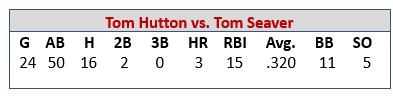
First Base – Tom Hutton … .320 average, 15 RBI, 11 walks versus five strikeouts

Tom Hutton drove in 15 runs versus Tom Seaver in 24 games – and, while Hutton was a career .248 hitter, Hutton hit .320 versus Tom Terrific and hit .333 or better in six of the nine seasons in which he faced him.

hUTTON tOMHutton had a 12-season MLB career (1966, 1969, 1972-81 … Dodgers, Phillies, Blue Jays, Expos).  Known more his glove than his bat, Hutton hit for a .248 career average, with 22 home runs and 186 RBI in 952 games.

Picking on Tom Terrific

Tim Hutton had more hits (16), home runs (3), RBI (15) and walks (11) against Tom Seaver than he had against any other pitcher.

Honorable mention at first base: Ten-time All Star Steve Garvey put up strong numbers versus Tom Seaver – .318-5-19 in 35 games.  Hutton gets an edge on two counts.  He did nearly as much damage (15 RBI to Garvey’s 19) in 11 fewer games – and Hutton has 11 walks and just five strikeouts versus Seaver, compared to Garvey’s six walks and 17 whiffs.  (Hutton’s on-base percentage versus Seaver was .435 to Garvey’s .354.

___________________________________________

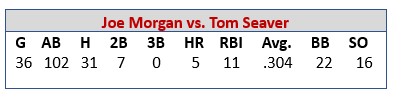
Second Base – Joe Morgan … .304 average, 22 walks, .425 OBP

Hall of Famer Joe Morgan’s 22 walks are the most Tom Seaver surrendered to any batter and Morgan’s five round trippers are the sixth-most against Seaver.  In 36 games versus Seaver, Morgan went .304-5-11 (he also had seven doubles).  That Morgan ended up getting those 22 free passes versus Seaver is no surprise. He walked in his first plate appearance versus Seaver (May 5, 1967) and, in his first two games against him, had three walks (and a single) in nine plate appearances.

MorganTom

Joe Morgan enjoyed a 22-season MLB career (1963-1984 … Astros, Reds, Giants, Phillies, A’s). He had a career average of .271 (2,517 hits), with 268 home runs, 1,153 RBI, 1,650 runs scores and 689 stolen bases (eleventh all-time). Morgan was a ten-time All Star, five-time Gold Glover and two-time MVP.

He led his league in runs scored once (scoring 100 or more runs in eight seasons); triples once (with ten or more three times); walks four times; and on-base percentage four times.  While he never led the league in stolen bases, he stole 40 or more bags in nine seasons, with a high of 67 in 1973 and 1975.  In the field, Morgan led NL second basement in putouts three times, assists once, double plays once and fielding percentage three time.  He is third all-time at second base in assists (6,937), fourth in putouts (5,742) and sixth in double plays (1,505). He is fiftieth in errors (244).

Lucky 13

Joe Morgan is one of only 13 players to win back-to-back league MVP Awards (Reds – 1975 & 1976). For a look at BBRT’s lineup of players who belong to the Back-to Back MVP club, click here.

___________________________________________

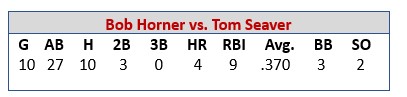
Third Base – Bob Horner …  .370, with four home runs in ten games

Bob Horner put up a .370 average (10-for-27) in ten games against Tom Seaver.  Further, seven of his ten hits went for extra bases (three doubles and four home runs), for a .926 slugging percentage. On October 3, 1981, as the Braves downed Seaver and the Reds 4-3, Horner went two-for-two (sacrifice fly, solo home run, solo home run). He had a third at bat in the game, singling off reliever Tom Hume and eventually scoring the winning run.

HornerTom

Four Dingers … For the Loss

Bob Horner is one of just 18 players to hit four home runs in a single MLB game – and one of only two to do it in a game his team lost.

Horner had his four-homer day on July 6, 1986. As his Braves faced the Expos in Atlanta, Horner homered leading off the bottom of the second (off starter Andy McGaffigan) to give Atlanta a 1-0 lead. After the Expos scored one run in the third and three in the fourth, Horner homered again (off McGaffigan) with two out in the bottom of the fourth inning, cutting the deficit to 4-2. Montreal put up a six-spot in the top of the fifth, with Atlanta coming back with five in the bottom of the inning – with Horner again taking McGaffigan deep, this time a three-run shot.  Still the Braves trailed 10-7. Horner popped out to first in the seventh (Braves trailing 11-7 at the time) and then added a solo home run in the bottom of the ninth (off Jeff Reardon), as the Braves lost 11-8 despite Horner’s four homers and six RBI.

Horner had a ten-season MLB career (with the Braves from 1978 through 1986 and Cardinals in 1988). He was a one-time All Star and finished with a career line of .277-218-685. He hit 30+ home runs in three seasons and drove in a high of 98 runs in 1979 (arguably his best season at .314-33-98).

Honorable mention at third base: Steve Ontiveros hit .500 (9-for-18) against Seaver in ten games, with two home runs and two RBI.  Ontiveros also drew ten walks versus Seaver (for a .679 on-base percentage).  In a nine-plate appearance streak against Seaver – over three games from May 7, 1974 to August 22, 1975 – Ontiveros got on base nine straight times (six walks, two singles, one home run). So why does Horner get the nod? Horner hit four home runs and drove in nine tallies in his ten games against Seaver, while Ontiveros has two home runs and just two RBI.  BBRT will go with damage done.

Mikey Doesn’t Like It

Hall of Fame 3B Mike Schmidt did not have much luck against Seaver. He had just 16 hits in 30 games against him (.188 average) and fanned 35 times in 85 at bats.

___________________________________________

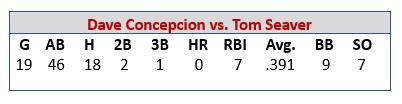
Shortstop – Dave Concepcion … .391 average

Dave Concepcion hit a healthy .391 (18-for-46) versus Seaver over 18 games. He also drew nine works versus the Hall of Fame right-hander – for a .491 on-base percentage. In his last eight trips to the plate (during the 1983 season), Concepcion had four walks, three singles and a ground out.

Concepcion

Concepcion had a 19-season MLB career (1970-88), all with the Reds. He was a career .267 hitter (2,326 hits, poked 101 home runs, drove in 950, scored 993 and stole 321 bases.  A more than solid defender, Concepcion was a nine-time All Star and five-time Gold Glover. He twice hit .300+ and had seven seasons with 20+ steals. He hit career highs in home runs (16) and RBI (84) in 1979. In the field, Concepcion led NL shortstops in assists twice (and his 6,591 assists at the position are eleventh all-time); led NL shortstops in putouts once (and his 3,670 are 21st); and led the NL in double plays turned at shortstop once (his 1.,290 are ninth all-time). Concepcion hit .297-2-13 with 30 runs scored and seven steals in 34 post-season games.

All Star MVP

Dave Concepcion was selected MVP of the 1982 All Star Game, in which he went one-for-three, with a two=run home run off American League starter Dennis Eckersley. Yes, “Eck” started for the AL. That season, Eckersley was 13-13 in 33 starts for the Red Sox (11 complete games). At the All Star break, Eckersley was 9-7, 3.20, with nine complete games in 18 starts.

Honorable mention at SS: Cal Ripken, Jr. hit a nice round .400 (8-for-20), with three home runs and six RBI in seven games versus Seaver.  That would seem to put him in this lineup (added power) over Concepcion.  BBRT, however, factors in that Ripken’s at bats against Seaver came from 1984 through 1986 (Seaver’s last three MLB seasons), when Seaver was 38-35, 3.83.  Concepcion faced Seaver from 1971 through 1983, when Tom was more Terrific, 198-126, 2.82.

_____________________________________________

Outfield – Ricky Monday … .349 with 11 round trippers

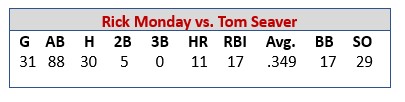
Rick Monday’s 11 home runs versus Tom Seaver are the most Seaver gave up to any hitter and Monday’s 17 RBI are sixth-most. Couple those numbers with Monday’s .349 average against Seaver and you can see why Monday is in this line up.

MOndayTom

Ricky Monday played 19 MLB seasons (1966-84 … A’s, Cubs, Dodgers). He was a two-time All Star (once in each league). Monday was a career .264 hitter (1,619 hits), and finished with 241 home runs, 775 RBI, 950 runs scored and 98 steals. He hit 20 or more home runs in three seasons. His best campaign was 1976, when he went .272, with a career high in home runs (32), RBI (77) and runs scored (107) for the Cubs.  After the season (January 1, 1977), he was traded by the Cubs (along with Mike Garman) to the Dodgers (for Bill Buckner, Ivan de Jesus and minor-leaguer Jeff Albert).

First of the First

Rick Monday was the first player selected in the first-ever MLB draft (1965 – by the Kansas City Athletics).  Note: In 1965, Monday was the Sporting News National (College) Player of the Year – after hitting .359 with 11 home runs for Arizona State University (1965 College World Series Champions) in his sophomore season.  Monday also was selected for the 1965 NCAA University Division Baseball Tournament All-Tournament Team.

_________________________________________________________

Outfield – Willie Davis … 42 hits, .389 average

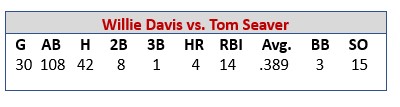
Willie Davis’ 42 hits (in 30 games) against Tom Seaver are the most safeties Sever gave up to any hitter. Davis faced Seaver in ten seasons (1967-76), hitting over .350 against him in six of them.  Davishit safely in 27 of his thirty games against Seaver – with 11 mufti-hit games.

DavisTom

Willie Davis played 18 MLB seasons (1960-76, 1979 …. Dodgers, Expos, Rangers, Cardinals, Padres, Angels), 14 with the Dodgers. The two-time All Star hit .279 for his career (2,561 hits), topping .300 in three full seasons.  He hit 182 home runs (a high of 21 in 1962), drove in 1,053 tallies (a high of 93 in 1970), scored 1,217 runs (a high of 103 in 1962) and swiped 398 bases (20 or more in 13 campaigns). He also led the league in triples twice and hit double-digits in three baggers four times.  Davis was also a three-time Gold Glover.

On the Big Stage

Willie Davis can lay claim to a couple of World Series records – one on each side of the ledger. 

In Game Five of the 1965 World Series (against the Twins), Davis earned a share of the World Series’ single-game record for stolen bases with three – stealing second base in the third, fourth and eighth innings.  Others with three steals in a WS Game – Lou Brock (1967 & 1968), Honus Wagner (1908). 

The following season, in Game Two of the Series against the Orioles, Davis (who would go on to become a three-time Gold Glover) set a World Series record by committing three errors in a single inning. The errors came on consecutive plays in the fifth inning. Coming into the top of the fame, the game was a scoreless tie (not unexpected, with Sandy Koufax versus Jim Palmer).  Boog Powell led off with a single to left, followed by a Davey Johnson pop out on a fouled bunt attempt. Then, Davis lost a Paul Blair fly in the sun for an error – ending up with Powell on third and Blair on second. The sun got to Davis on the very next batter (Andy Etchebarren) resulting in a dropped fly ball, followed by Davis’ errant throw to third. Both Powell and Blair scored and Etchebarren ended up on third. Sadly, this was to be the last game ever pitched by Koufax, who retired before the following season.  In a 7-0 loss, the Dodgers made a total of six errors, five during the six innings Koufax was in the game. Koufax gave up four runs (one earned) on six hits (two walks – two strikeouts) and took the loss in his last MLB mound appearance.

________________________________________________

Outfield – Dusty Baker … .347, 20 runs batted in

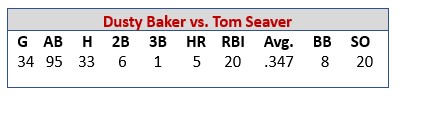
Dusty Baker’s 20 RBI versus Tom Seaver ties Willie Stargell for the most career RBI against the Hall of Fame righty.  Baker’s 33 hits (in 34 games) are the sixth-most against Seaver, as are his five home runs.

BakerTonBaker played 19 MLB seasons (1968-86 … Braves, Dodgers, Giants, A’s), hitting .278 (1,981 hits, with 242 home runs, 1,103 RBI, 964 runs scored and 137 stolen bases). He was a two-time All Star and one-time Gold Glover.  Baker hit 20 or more home runs in five seasons, topped 100 runs scored one, reached a career-high 99 RBI in 1973 and hit .300 or better three times.  Baker’s best season was 1980, when he hit .297-29-97 and stole 12 bases. In 40 post-season games, Baker went .282-5-21.

High Five History

On the last day of the 1977 season (October 2), Baker and the Dodgers were playing the Houston Astros in Los Angeles. At that point, three Dodgers had reached the thirty-home run mark, 1B Steve Garvey with 33, RF Reggie Smith with 32 and 3B Ron Cey with 30.  LF Dusty Baker stood just one long ball away from 30 dingers – which would make the Dodgers the very first MLB club with four 30-HR players in a single season.   Baker gave the Dodgers the record by taking J.R. Richard deep in the bottom of the sixth. 

Legend has it that, as Baker crossed the plate, his rookie teammate Glenn Burke was waiting, right arm  high in the air in celebration.  Baker reportedly didn’t know exactly what to do, so he reached up and slapped Burke’s hand. That, they say, is when the “high five” was born (and it quickly became a symbol of Dodger pride).  Burke, by the way, batted next and hit his first MLB home run.  Note:  There are other stories regarding the origin of the high five, the most notable involving the University of Louisville basketball team.  But being a baseball fan, I’m sticking with the Baker-Burke tale. Also The Burke-Davis high five preceded, in time, the other most credible story (Louisville).  

While the four 30-HR player mark would be tied over the years, it wasn’t topped until 2019, when the Twins broke the record with five 30-HR players(Nelson Cruz, Max Kepler, Eddie Rosario, Mitch Garver, Miguel Sano).

Honorable mention, outfield: Terry Puhl probably should have been a fourth outfielder – or at least a DH in this lineup. It’s just that this outfield lineup was tough to crack. In 17 games against Seaver, Puhl hit .444 (20-for-45), with two home runs and eight RBI. Puhl, by the way, hit .280 over a 15-season MLB career (1977-91) with the Astros. He had 62 career home runs, 435 RBI, 676 runs scored and 217 steals.

_______________________________________________

Pitcher – Ray Sadecki … three-for-six

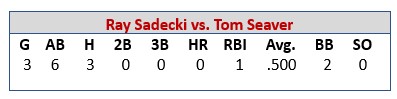
Ray Sadecki faced Tom Seaver nine times (in three games) and came a away with three singles, two walks, a sacrifice bunt, two ground outs and a fly out (no strikeouts) for a .500 average and a .625 on-base percentage.

SadekiTom

In his three games versus Tom Seaver, southpaw Ray Sadecki went 2-1, pitching 21 2/3 innings, giving up five earned runs (2.08 ERA), on 13 hits and four walks, while fanning 26. Seaver went 1-2, going 20 2/3 innings, giving up five earned runs (2.18), on 20 hits, 11 walks, with 16 strikeouts,.

Sadecki had a 18-season MLB career (1960-77 … Cardinals, Giants, Mets, Braves, Royals, Brewers).  He went 135-131, 3.78 in 563 appearances (328 starts). He threw 20 shutouts and fanned 1,614 batters in 2,500 1/3 innings. His best season was 1964, when he went 20-11, 3.68.  As a hitter, Sadecki averaged .191 (151-for-789) and had five home runs and 56 RBI.

__________________________

Primary Resources:  Baseball-Reference.com; Stathead.com; MLB.com

Who’s Your Daddy?  What It’s All About.

On September 24, 2004, in the middle of a tight pennant race, the Yankees handed future Hall of Famer Pedro Martinez and the Boston Red Sox a tough 6-4 loss.  Martinez went 7 1/3 innings giving up nine hits and five earned runs.  The game came just five days after (in his previous start) Martinez had lasted just five frames against the Bronx Bombers (eight hits, eight earned runs) in a 16-7 loss.

After that second loss, Martinez candidly commented, “What can I say? I just tip my hat and call the Yankees my daddy.”  Little did he know that his comment – and a Yankee fans’ chant of “Who’s your daddy?” would follow him into future starts in New York (all the way to his final MLB start – against the Yankees for the Phillies – in Game Six of the 2009 World Series.)

The concept of “Who’s your daddy?” became the inspiration for Baseball Roundtable to take a look at the players who “had the number” of some of MLB’s premier pitchers.  Again, you can find links to the previous “editions” of “Who’s Your Daddy?” near the top of this post. 

100Baseball Roundtable is on the Feedspot list of the Top 100 Baseball Blogs.  To see the full list, click here.

I tweet baseball @DavidBaseballRT

Follow/Like Baseball Roundtable’s Facebook Page here.  More baseball commentary; blog post notifications; PRIZES.

Member: Society for American Baseball Research (SABR); The Baseball Reliquary; The Negro Leagues Baseball Museum.
 

A Look at Rookies with 200-hit Seasons … Another Waiting for Baseball Diversion

Ichiro photo

Photo by OlympianX

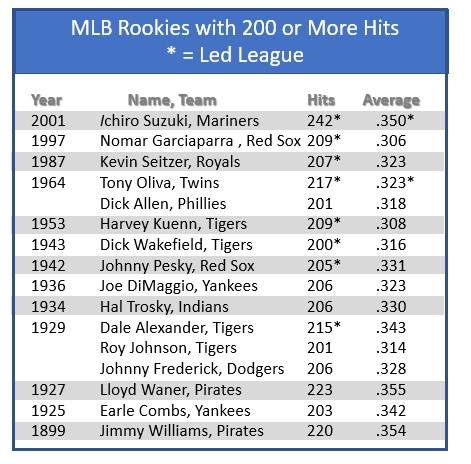
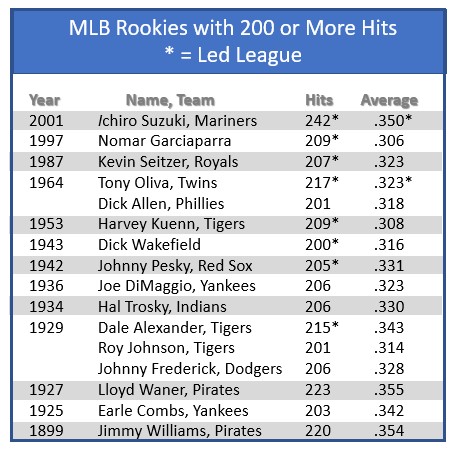
Baseball Roundtable continues to reflect on past seasons, while looking forward to the return of “new” baseball.  In this post, I’m taking a look at players who delivered 200 or more base hits in their rookie season.  By the way, that’s not a very large group. Only 16 MLB rookies have collected 200 or safeties.

Now, to perhaps entice readers to make their way through this post, here are a handful of questions about this sweet sixteen.  And, to help you on your way, here is a hint – the initials of the sixteen players sin reverse chronological order. IS; NG; KS; TO; D (or R) A; JP; JD; HT; DA; RJ; JF; LW; EC; JW.

Now the questions:

_______________________________________________________________________

  1. Which one of the six 200-hit rookies who achieved the feat after the Rookie of the Year Award was established in 1947 did not win the ROY?
  2. Which three of the 16 players with 200-hit rookie seasons are in the Hall of Fame?
  3. Only one of the 200-hit rookies whose rookie season occurred after the first MLB all Star Game never made an MLB All Star team. Name him.  Extra hint here: HT
  4. Seven of the 16 rookies with 200-hit seasons never reached 200 safeties in another campaign. How many can you name/guess?
  5. Which four 200-hit rookies led their league in triples in their initial 200-safety season? Hint: One from the 1990s; one from the 1960s; one from the 1930s; and one from the 1890s. 

Rookie Hits

________________________________________________________________________
Before we take an in-depth look at these 200-hit rookies, here are the answers to the questions.

  1. Kevin Seitzer
  2. Joe DiMaggio, Lloyd Waner, Earle Combs
  3.  Hal Trosky
  4. Nomar Garciaparra, Kevin Seitzer, Dick Allen, Dick Wakefield, Dale Alexander, Roy  Johnson, Jimmy Williams
  5.  Nomar Garciaparra, Dick Allen, Joe DiMaggio, Jimmy Williams

___________________________________________________________

Now a closer look at MLB’s 200-hit rookie seasons.

Ichiro Suzuki, Mariners, 2001

Ichiro Suzuki holds the record for  the most hits by any MLB rookie, racking up 242 safeties for the Mariners in 2001.  That season, he led the American League in hits, batting average (.350) and stolen bases (56) – earning Rookie of the Year and Most Valuable Player honors.   A free-swinger, he drew only 30 walks (and ten of those were intentional) in a league-topping 738 plate appearances.  There are those who would support an asterisk by this rookie-hits record (I’m not one of them), since Suzuki came to MLB (as a 27-year-old rookie) after nine seasons with Japanese Baseball’s Orix Blue Wave – where he put up a .353 batting average (1,278 hits) in 951 games.

Suzuki played 19 MLB seasons (2001-2019 … Mariners, Yankees, Marlins), collecting 3,089 hits (.311 average), leading the league in hits seven times and setting the all-time, single-season hits record of 262 in 2004.  He was a ten-time All Star, a two-time batting champion and ten-time Gold Glover in the outfield.  Over his MLB career, he scored 1,420 runs (topping 100 in eight seasons), hit 117 home runs, drove in 780 and stole 509 bases (topping 30 steals ten times).

Keep the Line Moving

After collecting 242 hits in his rookie campaign, Ichiro Suzuki garnered 200 or more safeties in each the next nine seasons. His ten consecutive 200-hit seasons are an MLB record. and tie him with Pete Rose for the most 200-hit seasons in a career. Over his first ten MLB seasons, Suzuki’s average season was .331, with 224 hits, 105 runs scored, 56 RBI, nine home runs and 38 steals.

Nomar Garciaparra, Red Sox, 1997

Nomar Garciaparra kept his rookie status into 1997, after hitting .241-4-16 in 24 games in 1996.  In his 1997 Rookie of the Year season, the Red Sox ‘shortstop hit .306 (a league-leading 209 hits), with 30 home runs, 98 RBI, 122 runs scored and 22 stolen bases. He also led the American League in triples with 11.

Home Cookin’

Nomar Garciaparra is one of only 13 players with two Grand Slams in a single game – and the only one to do it in his home park.

In a 14-season MLB career (1996-2009 … Red Sox, Cubs, Dodgers, A’s), Garciaparra (while never again reaching 200 hits), was a six-time All Star and two-time batting champion (.357 in 1999 and .372 in 2000 – both with the Red Sox). Garciaparra also led the league in doubles once (topping 50 doubles in two season), scored 100+ ruins six times, topped 100 RBI four times and hit 20 or more round trippers in seven seasons.  His career average was .313, with 229 home runs, 936 RBI, 927 runs scored and 95 stolen bases.  He also hit .321-7-24 in 32 post-season contests.

Kevin Seitzer, Royals, 1987

Kevin Seitzer hit .323 in a September 1986 call up (28 games).  (His trip to the Royals came after a .318-13-75 season at Triple A and Double A.) In 1987, still retaining his rookie status, Seitzer proved 1986 was no fluke, hitting an identical .323 (207 hits) over 161 games. He also had 11 home runs, 83 RBI, 105 runs scored and 12 stolen bases. In most seasons, that would be good enough for Rookie of the Year honors. In 1987, however, Seitzer finished a distant second in the voting, as all the first-place AL votes went to Mark McGwire, who put up a .289-49-118 line.

Big Day for a Rookie

On August 2, 1987, as the Royals topped the Red Sox 13-5, in Kansas City, Kevin Seitzer has a six-for-six day, with two home runs, four runs scored and seven RBI.  Seitzer is one of only two Royals with a six-for-six day at the plate.  (The other is Bob Oliver.)

Seitzer went on to a 12-season MLB career (1986-97 … Royals, Brewers, A’s, Indians).  He collected 1,557 hits (never again reaching 200 in a season) for a .295 average, with 74 home runs, 613 RBI, 739 runs scored and 30 steals.  He was twice an All Star (1987 and 1995). His rookie campaign saw him record his career highs in games, plate appearances, at bats, runs, hits, triples, home runs and RBI. Over his career, he started 1,014 games at 3B, 208 at 2B, 119 at DH, nine in the OF and one at SS.

Tony Oliva, Twins, 1964

Twins outfielder Tony Oliva enjoyed two brief call ups (1962-63) before his first full MLB season (in 1964, when he still retained rookie status, having played in just 16 games – hitting .438 – in two previous stints with the Twins). In that 1964 campaign, Oliva led the American League in hints (217), batting average (.323), runs scored (109), doubles (43) and total bases (374), while also launching 32 home runs, driving in 94 runs and swiping 32 bases.

T(ony) for Two

Tony Oliva is the only player to win a batting title in his rookie and sophomore MLB seasons – .323 in 1964 and .321 in 1965.

Oliva went on to lead the AL in hits in four of the next six seasons (reaching 200+ safeties once more), as well as to earn a third batting title (1971). He played 15 MLB seasons (1962-76), all for the Twins and was an eight-time All Star and one-time Gold Glover.  Oliva hit .300 or better in six of the eleven seasons when he played at least 100 games.  The eight-time All Star also led the league in doubles four times. He retired from the playing fields with a .304 average (1,917 hits), 220 home runs, 947 RBI and 870 runs scored.  Oliva hit .314, with three home runs, in 13 post-season games.

Pinson

Dick Allen, Phillies, 1964

In 1963, Dick Allen played ten games for the Phillies after a September call up – primarily as a LF (one appearance at 3B).  Then, in his 1964, Rookie of the Year season, he became the Phillies’ full-time third baseman and quickly showed his power.  That season, Allen hit .318, with 29 home runs and 91 RBI.  He led the NL in runs scored (125), total bases (352) and triples (13).  He went on to a become a seven-time All Star and the 1972 American League MVP – when he hit .308-37-133 for the White Sox, leading the league in home runs and RBI. Allen played 15 MLB seasons (1963-77 … Phillies, Cardinals, Dodgers, White Sox, A’s). He put up a .292 career average (hitting .300 or better in seven seasons); 351 home runs (leading his league twice and topping 30 long balls in six campaigns); and driving in 1,119 runs (leading the league once).  Known more for his power than his speed, Allen had 79 career triples, and had ten or more three-baggers in four seasons. He also swiped 133 bases, with a high of 20 steals (in 25 attempts) in 1967. Over his career, Allen started 795 games at 1B; 646 at 3B; and 249 in the outfield.  Allen had two brothers Hank and Ron, who also played in the major leagues.

Music to My Ears

Dick Allen was also an accomplished doo-wop singer, performing professionally with his band “Rich Allen and the Ebonistics. Click below for a sample. 


Harvey Kuenn, Tigers, 1953

After a brief call up in 1957 (19 September games), Harvey Kuenn settled in as the Tigers’ full-time shortstop in 1958 – earning a spot on the AL All Star team, as well as Rookie of the Year honors.  That season, Kuenn led the AL in hits (209), while batting .308. He scored 94 runs, drove in 48, hit two homers and stole six bags.  Kuenn went on to make the AL All Star squad in every season from 1953 through 1960, batting over .300 in all but one of those campaigns and leading the league with a .353 average in 1959. Over his career, Kuenn led his league in hits four times (with 200+ hits twice) and doubles three times.

Even Exchange.  I’ll give You One Harvey Kuenn for … 

After leading the AL with a .353 batting average in 1959, Kuenn was traded (just before the start of the 1960 season) to the Cleveland Indians for 1959 home run champion Rocky Colavito (42 home runs).

Kuenn played 15 MLB seasons (1952-66 … Tigers, Indians, Giants, Cubs, Phillies).  He put up a .303 average (2,092 hits), with 87 home runs, 671 RBI, 950 runs scored.  Starting primarily as a SS, he eventually shifted to the outfield.  During his career, he started 758 games in the OF, 742 at SS, 130 at 3B and 16 at 1B. After retiring as a player, Kuenn, tried his hand at managing and led the 1982 Brewers to the American League Championship.

Dick Wakefield, Tigers, 1943

Dick Wakefield’s Rookie of the Year season was a bright one – as the Tigers’ outfielder (just 22-years-old) led the American League in games (155), hits (200) and doubles (38), while hitting .316, with seven home runs, 79 RBI and 91 runs scored.   It seems the highly touted rookie was on his way to a great career.

The Old College Try

Dick Wakefield was a star in his only college season – 1941, University of Michigan – hitting .368, with nine home runs in 26 games. That summer, he was invited for tryout with a number of MLB teams and eventually signed with the Tigers for a reported $52,000 and a new automobile (makes sense for Detroit). How significant was that bonus?  At that time, Hank Greenberg was MLB’s highest paid player at $55,000 – and he was a two-time MVP.

Wakefield’s early success did not come as a surprise. After a short, but stellar, college career, he spent most of the 1941 seasons at B-Level Winston Salem, but got a taste of the major leagues, appearing in seven games as a 20-year-old. In 1942, he was assigned to the High-A Beaumont Exporters, where he hit .345 in 149 games and earned Texas League Most Valuable player honors.

The big (6’4”, 210-pound) outfielder came back strong in 1944, hitting .355-12-53 in 78 games in a season interrupted by military service. He missed the entire 1945 season and, when he returned to the Tigers in 1946, he seemed to have lost a bit of his edge – a situation amplified by a pair of injuries (broken wrist/HBP and broken left forearm/collision with outfield wall). He averaged just .268 for the remainder of his MLB career.

Wakefield played all or part of nine seasons in the majors (1941, 1943-44, 1946-50, 1952 … Tigers, Yankees, Giants). He finished with a .293 career average, 56 home runs, 315 RBI and 334 runs scored.

Johnny Pesky, Red Sox, 1942

Twenty-three-year old Red Sox’ shortstop Johnny Pesky had a strong rookie campaign (1942), leading the American League with 205 hits and putting up a .331 average, with two home runs, 51 RBI, 105 runs scored and 12 steals.

.325 Can be a Lucky Number

Johnny Pesky played two minor-league seasons before joining the Red Sox in 1940, he played 136 games with the Class-B Rocky Mountain Red Sox and hit .325.  Promoted to the Double-A Louisville Colonels in 1941, he played 146 games and again hit .325.

Pesky’s major league career was interrupted by three years of military service (1943-45), but when he returned, he picked up right where he left off. – leading the league in hits in 1946 (208 hits, .335 average) and 1947 (207 hits, .324 average).

Pesky played ten MLB seasons (1942, 1946-54 … Red Sox, Tigers, Senators).  His career average was .307, with 17 home runs, 404 RBI and 867 runs scored.  He scored 100+ runs in six seasons and hit for a .300+ average in six campaigns. He was an All Star in 1946. Over his career, Pesky started 579 games at SS, 455 at 3B and 104 at 2B.

Rounding the Bases, Again and Again and Again

Johnny Pesky was the first American Leaguer to score six runs in a nine-inning game (still the AL record, since tied by Spike Owen and Joe Randa). The only MLB player to reach seven runs scored in nine innings is Guy Hecker – for the 1886 American Association Louisville Colonels.

Joe DiMaggio, Yankees, 1936

Yankee outfielder Joe DiMaggio made his MLB debut as a 21-year-old on May 3, 1936 – and he had a pretty good day.   DiMaggio went three-for-six, with two singles and a triple, scoring three runs and driving in one – as the Yankees topped the Browns 14-5 in New York. Joltin’ Joe went on to play 138 games, put up a .323 average, with 206 hits, 29 home runs, 125 RBI and 132 runs scored.  He also led the American League with 15 three-baggers.

Despite missing three seasons due to military service (1943-45), DiMaggio played 13 MLB seasons (1936-42, 1946-52), all with the Yankees. He was an All Star in every season, a three-time Most Valuable Player, a two-time batting champ (ten times hitting .300+), a two-time RBI leader (nine seasons of 100+), a two-time home run leader (seven seasons of 30 or more) and once lead the AL in runs scored (eight seasons of 100+).  He retired with a .325-361, 1,537 stat line.

56? Been There, Done That

Joe DiMaggio 56-hitting streak in 1941 remains the longest in MLB history. DiMaggio, however, had a longer steak in the minors – 61 games, as an 18-year-old rookie, for the Pacific Coast League San Francisco Seals in 1933. The only longer streak in professional baseball history belong to Joe Wilhoit, who hit in 69 consecutive games for the Wichita Jobbers of the Western League in 1919.

Hal Trosky, Indians, 1934

Hal Trosky got an 11-game taste of the major leagues, as a 20-year-old, late in the 1933 season.  Then in 1934 – rookie-status still intact – Trosky played in all 154 games at first base for the Indians. Trosky collected 206 hits, launched 35 home runs and drove in 142 in that rookie campaign. He went on to play in 11 MLB seasons (1933-41, 1944, 1946 …. Indians, White Sox). From 1933 through 1938, Trosky averaged .314, hit 155 home runs and drove in 663.  In 1938, migraines began to take a toll on his skills and ability to stay in the game. He missed the entire 1942 and 1943 seasons.

Tough Competition

Hal Trosky may be one of the best players to never make an All Star team.  Then again, his competition at first base included Lou Gehrig, Jimmie Foxx and Hank Greenberg.

Over his 11 MLB seasons, Trosky hit .302 (four times topping .300), with 228 home runs (three times hitting 30+) and 1,012 RBI (topping 100 in six seasons). He led the American league with 162 RBI and 405 total bases in 1936, when he went .343-42-162.

Kayff

Dale Alexander, Tigers, 1929

Dale Alexander’s story is one of a potential Hall of Fame career derailed by a freak injury.  Alexander made it to the major leagues, with the Tigers, as a 26-year-old rookie in 1929. This came after six minor-league seasons in which he hit ,333 in 783 games.

As a rookie with the Indians, Alexander played in all 155 games, hitting .343 and collecting a league-leading 215 hits – plus 25 home runs, 137 RBI and 110 runs scored.  The following season, he again played in every Indian’s contest (154 games) – hitting .326-20-135. Over the next two seasons, he continued his torrid batsmanship, hitting .325 in 1931 and winning the American League batting title at .367 in 1932 (a season he split between the Tigers and Red Sox).

Then misfortune struck. On Memorial Day in 1933, Alexander suffered a knee injury that was addressed with a new, electric, deep-heating treatment.  Alexander was left on the machine for too long – suffering third-degree burns and a subsequent infection (at one point amputation was even considered).  While he did come back to play that season, his speed and mobility were limited by the aftermath of the injury and treatment. He finished the season with a .281 average in 94 games – and 1933 marked his last season in the major leagues.  Dale Alexander’s MLB career was finished at five seasons (1929-33 … Tigers, Red Sox.  He played in 662 games and put up a .331 average, with 61 home runs and 459 RBI.

Keep on Keeping ON

Dale Alexander did not leave baseball after his 1933 health issues derailed his MLB career. He played nine more season in the minor leagues – hitting .336 over 976 games. He notably served as a player-manager in four of those seasons. He later continued to be involved as both a minor-league manager and scout (for the Giants and Braves).

Roy Johnson, Tigers, 1929

Rookie Roy Johnson patrolled the outfield for the Tigers in 1929, collecting 201 hits (.314 average), ten home runs, 69 RBI, 128 runs scored and 20 stolen bases.  He also led the AL with 45 doubles.  It was Johnson’s only 200-hit campaign.

Chasing ’em Down

In 1931, Roy Johnson led American League right fielders in putouts (309), assists (24) and double plays (8).  He was also third in errors with 15.

Johnson played ten MLB seasons (1929-38 …. Tigers, Red Sox, Yankees, Bees). He hit .296 (1,292 hits), topping .300 four times.  He finished with 58 home runs, 555 RBI, 716 runs scored (with 100+ runs in three seasons) and 135 steals (reaching 20 in two seasons).  He also led The AL in triples, with 19 for the Tigers in 1931.

Johnny Frederick, Dodgers, 1929

Johnny Frederick made his debut as an outfielder with the Brooklyn Dodgers in April of 1929.  He played in 148 games in his rookie season, collecting 206 hits (.328 average), with 24 home runs, 75 RBI, 127 runs scored and a league-leading 52 doubles. He followed that up with a 1930 campaign that again saw him rap 206 hits, this time with a .334 average, 17 homers, 76 RBI and 120 runs scored.

Good in a Pinch

In 1932, Johnny Frederick went 10-for 32 as a pinch hitter (.313), and hit a then-record six pinch-hit home runs – a PH-homer record that stood until Dave Hansen hit seven pinch-hit long balls in 2000.

Frederick was a solid hitting outfielder over six MLB seasons (1929-34), all with the Dodgers. He had a .308 career MLB average with season marks of .328, .334, .270, .299, .308, and .296. He drove in 377 runs, scored 498 and stole 23 bases.  In December of 1934, he was traded by the Dodgers to Sacramento of the Pacific Coast League for Frenchy Bordagary. Frederick played six more season in the PCL, averaging .329 over 978 games, but never again appeared in an MLB box score.

Lloyd Waner, Pirates, 1927

Hall of Fame outfielder Lloyd Waner collected 223 hits (.355 average) in his 1927 rookie seasons (age 21). He had just two home runs and 27 RBI (in fact, he had just 25 extra base hits), but the Pirate led the NL in runs scored with 133. Waner stroked 200+ hits in four of his first five season, only missing the magic number in 1930, when he plated in only 68 games.

Brotherly Love

Lloyd Waner and his brother Paul – known as “Little Poison” and “Big Poison,” respectively – both hit their way into the MLB Hall of Fame. Together they collected the most hits by any MLB brothers (5,611 …  3,152 for Paul and 2,459 for Lloyd).

Lloyd Waner played 18 MLB seasons (1922-42, 1944-45 … Pirates, Braves, Reds, Phillies, Dodgers). He put up a .316 career average (2,59 hits), hit 27 home runs, drove in 598 and scored 1,201, The one-time All Star led his league in hits once (topping 200 four times); runs once (topping 100 three times); triples once (20 in 1929). Of his 2,459 hits only 426 went for extra bases.

Earle Combs, Yankees, 1925 

Yankee CF Earle Combs got in 24 games for the Bronx Bombers in 1924 – going 10-for-35 (.400). His inaugural MLB season was cut short by a broken ankle suffered in mid-June. In 1925, with his rookie status still intact, he built upon that “cup of coffee,” hitting .342-3-62 and notching 203 hits.  He also scored 113 runs and stole 12 bags. The Hall of Famer went to have a 21-season MLB career (1924-35), all with the Yankees; averaging .325 (,300 or better in all but two seasons), with 58 home runs, 633 RBI and 1,186 runs scored.  He had three 200+ hit seasons and eight seasons in which scored 100+ runs. He led the AL in hits once and triples three times, hitting 20+ three-baggers in each of those seasons.

Bad Timing, Earle

Earle Comb’s best season was 1927, when he hit .356, scored 137 runs and led the AL with 231 hits and 23 triples. He didn’t get the attention he deserved for those numbers; since teammate Babe Ruth went .356-60-165 that year.

Jimmy Williams, Pirates, 1899

Jimmy Williams made his major league debut in 1889 as a third baseman for the Pittsburgh Pirates. The 22-year-old, who would spend most of his career as a second basemen, hit .354-9-116, with 126 runs scored and 26 steals that season. (It would be the only times he reached 160 hits in his 11-season MLB career). He led the NL with 27 triples that season.  In his rookie season, William set his career highs in games (153); hits (220); average (.354); RBI (116); runs (126); home runs (9); triples (27); and total bases (329).

Three Standing Tall

Jimmy Williams’s 27 triples for the Pittsburgh Pirate in 1899 remains the rookie record for three-baggers.

Jimmy Williams played 11 MLB seasons (1899-1909 … Pirates, Orioles, Highlanders, Browns). His career average was .275, although he hit .300 or better in three of his first four seasons. He scored 100+ runs in two seasons, led the league in triples three times, hit 49 home runs and drove in 796, while scoring 780 times and stealing 151 bases.

Primary Resource:  Baseball-Reference.com; Stathead.com;  Dick Wakefield, SABR bio, by Warren Corbett; Dale Alexander, SABR Bio, by Bill Nowlin.

100Baseball Roundtable is on the Feedspot list of the Top 100 Baseball Blogs.  To see the full list, click here.

I tweet baseball @DavidBBRT

Follow/Like Baseball Roundtable’s Facebook Page here.  More baseball commentary; blog post notifications; PRIZES.

Member: Society for American Baseball Research (SABR); The Baseball Reliquary; The Negro Leagues Baseball Museum.


Baseball Roundtable “Who’s Your Daddy?” Series … Max Scherzer Edition

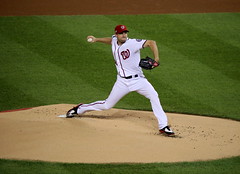
Max Scherzer photo

Photo by apardavila

The Baseball Roundtable  “Who’s Your Daddy?” series focuses primarily on premier pitchers from the past – like Bob Feller, Bob Gibson, Sandy Koufax and Greg Maddux.  Readers have requested that I occasionaly toss in a currently active moundsman, so this edition will take a look at three-time Cy Young Award winner Max Scherzer.

Max Scherzer, by the way, is nicknamed “Mad Max” due to his intensity on the mound, at the plate and in the field.

“Max goes to a different level with everything; hitting, base running, pitching – all aspects of the game.”

                                Derek Lilliquist, Washington Nationals Pitching Coach.

___________________________________________________

Who’s You Daddy?  What it’s all about.

Those of you who read Baseball Roundtable regularly are familiar with the “Who’s Your Daddy?” series – presenting lineups of players who performed unexpectedly well against some of baseball’s top pitchers. (An explanation of the inspiration behind the Who’s Your Daddy? series can be found the end of this post.)  As always, I would stress that the pitchers included in the Who’s Your Daddy? series are among the “best in the business.”  They are selected not because of the players who performed well against them, but rather because success among hitters when they were on the mound was the exception rather than the rule.

Note:  The stats in this post as of June 2020. 

Before we get started on Max Scherzer, here are links to the previous editions of this series:

  • Nolan Ryan, click here.
  • Sandy Koufax, click here. 
  • Pedro Martinez, click here.
  • Bob Gibson, click here
  • Randy Johnson, click here
  • Greg Maddux, click here. 
  • Justin Verlander, click here. 
  • Bob Feller, click here
  • Roger Clemens, click here

Next up, by the way, Tom Seaver.

_______________________________________________________

Now, on to Max Scherzer.

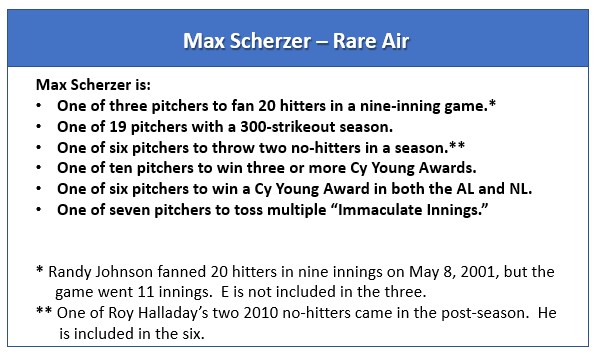
Rare Air

Max Scherzer comes at hitters with a high-nineties four seamer, a cutter, change  up and curve.  The 6’3″, 215-pound righty has averaged 10.6 strikeouts per nine innings over his 12-season MLB career (2008-09/Diamondbacks; 2010-14/Tigers; 2015-19/Nationals), and has struck out 12 or more batters per nine frames in each of the past three seasons.  He is a three-time Cy Young Award winner; seven-time All Star; and has led his league in wins four times. He has also led his league in starts twice; complete games three times; shutouts twice; innings pitched twice; strikeouts three times; strikeouts per nine innings three times; and strikeout-to-walk ratio four times.

Notably, Scherzer was a bit of a late bloomer, making his first All Star team in his sixth major league season (2013) at age 28 – but he has made up for lost time, being selected to the All Star squad in every season since.

Scherzer Stat

His career stat line to date is 170-89, 3.20, with 2,692 strikeouts in 2,290 2/3 innings pitched. Scherzer is 7-5, 3.38 in 22 post-season appearances; with 137 strikeouts in 112 innings.

Max Scherzer’s career strikeouts per nine innings rate (to date) of 10.58 is fifth all time; and his strikeouts per walk ratio of 4.356 is eighth.

___________________________________________________

Now, let’s look at the Max Scherzer “Who’s Your Daddy?” lineup.

Career Max

Catcher – A.J. Pierzynski … nine RBI versus Scherzer; Salvador Perez … .621 slugging percentage

There haven’t been very many ties in the “Who’s Your Daddy?” lineup series, but when it came to picking a catcher for this squad, I was fit to be tied – bouncing between A.J. Pierzynski’s body of work and Salvador Perez’ blazing start.

To date, no one has driven in more runs against Max Scherzer than A.J. Pierzynski, who collected nine RBI (tied with Michael Brantley), 13 hits and a .302 average in 16 games versus Scherzer.  Then there is Salvador Perez, who has ten hits in 11 games (.345 average), with four of those safeties going for extra bases.  In his first five plate appearances against Scherzer, Perez went double, home run, single, single, home run. Those trips to the dish came in 2011, when Scherzer went 15-9, 4.32 for the Tigers.AJ MaxPerex Max

A.J. Pierzynski played 19 MLB seasons (1998-2016 … Twins, Giants, White Sox, Rangers, Red Sox, Cardinals, Braves). The two-time All Star had solid .280 career average (2,043 hits), with 188 home runs, 909 RBI and 807 runs scored. He hit .300 or better in four seasons in which he played at least 100 games.

A.J. Pierzynski shares the American League record for consecutive error-free games at catcher (117 games, April 19, 2005 – October 2, 2005).

Salvador Perez has played eight MLB seasons (2011-18), all with the Royals. He missed the 2019 campaign due to Tommy John surgery. Perez is a six-time All Star and five-time Gold Glover, has a .266 career average, has hit 20+ home runs in four seasons and reached 80 RBI twice.  His career line to date is .266-141-503.

A Handy Man

Salvador Perez captured the AL Gold Glove at catcher every year from 2013 through 2018 except 2017, when the award went to the Angels’ Martin Maldonado.

_______________________________________________________________

I Know this Piece Fits in Here Somewhere …

Brad Miller has appeared in four games against Max Scherzer … for three different teams (Mariners, Rays and Phillies), starting at three different positions (SS, 3B and LF; also appearing once as a PH). He has done alright for himself:  five hits in ten at bats, one double, three home runs and seven RBI. Notably, in every at bat in which he hasn’t gotten a hit, Miller has struck out swinging.

____________________________________________________________

First Base – Jim Thome … .438 average

Jim Thome went seven-for-sixteen (.438) in seven games versus Max Scherzer and hit his only long ball against Scherzer in his first at bat against him.  Thome’s plate appearances versus “Mad Max” came in 2010-12 (a period when Scherzer went 43-27, 3.89), all before Scherzer’s first Cy Young Award.  They were also the final three seasons of Thome’s MLB career (his age 39-41 seasons).

Thome Max

Hall of Famer Jim Thome played 22 MLB seasons (1991-2012 … Indians, Phillies. White Sox, Dodgers, Twins, Orioles). The five-time All Star hit 30 or more home runs 11 times (a high of 52 in 2002). He led the AL in home runs with 47 in 2003 – and hit 190 home runs between 2001 and 2004 (four seasons). Thome also topped 100 RBI in nine seasons, 100 runs scored in eight and drew 100 or more walks nine times.

Over his career, Thome went .276-612-1,699, with 1,583 runs scored.   His 612 regular-season home runs are eighth all-time.   Thome also had 17 post-season home runs (71 games … .211-17-37). His best season was 2002, when he went .304-52-118 for the Indians. He became a free agent after that campaign and signed with the Phillies, where he led the NL in home runs with 47 in 2002.

A Trivia Tidbit for Minnesota Readers …

Jim Thome record the first “walk-off” hit at Target Field on August 17, 2010. It was a two-run home run, in the bottom of the tenth inning, off the White Sox’ Matt Thornton, in a Twins’ 7-6 win.  It should come as no surprise, since Thome currently holds the career record for walk-off home runs (13) and shares the record for extra-inning walk off home runs at eight (shared with Frank Robinson an Albert Pujols).

Second Base – Dustin Pedroia … three home runs and six RBI in eight games

The Red Sox’ Dustin Pedroia hit a two-run home run in his first at bat against Max Scherzer and has gone on to hit .304, with three home runs and six RBI in eight games against him.

Pedrois MaxDustin Pedroia has played in 14 MLB seasons (2006-2019), all with the Red Sox. He is a four-time All Star, four-time Gold Glover, a one-time MVP and was the 2007 AL Rookie of the Year. Pedroia has led the league in runs scored twice (topping 100 runs in four seasons), base hits once (topping 200 hits twice) and doubles once (54 in 2008).  He has also stolen 20 or more bases in four season and hit .300+ in five campaigns.

Not a Bad Start

Dustin Pedroia was the 2007 American League Rookie of the Year, and followed that up in 2008 by being recognized as the league’s Most Valuable Player.

Pedroia has a .299 career average, 140 home runs, 725 RBI, 922 runs scored and 138 stolen bases.

_______________________________________________________

My Kingdom for a Hit …

Rhys Hoskins and Wilmer Flores have the most at bats against Scherzer without ever getting a hit (17). They each drew one walk against him.  Hoskins fanned ten times in those 17 at bats, Flores eight.  Ryan Braun has the most plate appearances (14) without every getting on base against Scherzer.

_____________________________________________________________

Third Base – Martin Prado … .455 average; Jake Lamb … 1.545 slugging percentage

For the first time ever, the “Whose Your Daddy?” series has a tie at two positions in the lineup.  At third base, it came down to Martin Prado’s prolonged excellence and Jake Lamb’s flashy power.

Martin Prado 20 hits (in 14 games versus Scherzer) are second only to Nick Markakis’ 21 safeties (and Markakis has had 65 at bats against Scherzer to Prado’s 44). Prado’s 20 hits include five doubles and one home run. Scherzer has held Prado hitless in only one of 14 games against him. Prado’s best game against Scherzer came (for Miami) on May 25, 2018, when came to the plate four times and had two doubles, a single and was safe on an error. That season, Prado had seven plate appearances against Scherzer and collected five hits (three doubles).

Prado Max

Jake Lamb has touched Scherzer for six hits (.545 average), including two doubles and three home runs, in just five games (1.545 slugging percentage). He has also drawn four walks against Scherzer (versus three strikeouts), giving him a .667 on-base percentage (to date).

Lamb Max

Still active, Martin Prado has been in the majors for 14 seasons (2006-2019 … Braves, Diamondbacks, Yankees, Marlins). He is a one-time All Star and carries a .287 career average, with 100 home runs, 609 RBI and 644 runs scored.

A Prado-Lamb Link…

On July 31, 2014, the Diamondbacks traded 3B Martin Prado to the Yankees (for Pete O’Brien and a player to be named later). A week later, they promoted Jake Lamb from Triple A to take Prado’s place at the hot corner.

Like Prado, still active, Lamb has spent the past six seasons with the Diamondbacks – earning an All Star berth in 2017. He has a .242 career average, with 81 home runs and 302 RBI.  His best season was 2017, when he went .248-30-105.

Shortstop – Miguel Rojas … .321 average, nine hits

Despite being a career .263 hitter, Miguel Rojas has hit .321 in 12 games versus Scherzer.  Further in 2018-19 – when Scherzer was going 29-14, 2.70 with 543 strikeouts in 393 innings – Rojas went 7-for-18 (,389) against him.

Rojas Max

Rojas has played in six MLB seasons (2014-2019 … Dodgers, Marlins). He is .263 career hitter, with 20 home runs and 165 RBI.

Honorable Mention at shortstop: Brandon Crawford could easily have taken this spot. The Giants’ shortstop has hit .400 (6-for-15) is six games against Scherzer (and has driven in five runs).  So, why isn’t he in the lineup?  Perhaps my own bias, but I took into consideration the fact that Crawford has fanned seven times in 16 plate appearances versus Scherzer and that half of Crawford’s hits against Scherzer came in a single game (June 10, 1918, when he had a single, double and home run).

_______________________________________________

The Royal Treatment …

The Royals’ Chris Getz has the most plate appearances against Scherzer without ever striking out (17). In those trips to the plate he had five hits (.357), two walks and a sacrifice.

__________________________________________________

Outfield – Shin-Soo Choo … .583 average, .667 on-base percentage, 1.125 slugging percentage

Shin-Soo Choo has faced off against Max Scherzer in ten games and acquitted himself well.  He has gone 14-for-24 and drawn six walks (against four whiffs). He also collected two doubles, a triple, three home runs and six RBI. At one point, Choo got on base against Scherzer in seven straight plate appearances. It started on September 29, 2010, when Choo collected a groundball single, a bunt single and a two-run home run (as Choo’s Indians topped Scherzer and the Tigers 4-0 and Scherzer gave up four runs in five innings). Choo next faced Scherzer the following April 29 and went walk-single-walk.  Their next matchup was June 16 of that season and Choo again prevailed with an RBI triple in his first at bat.

Choo Max
Ouch! 150 times over.

Shin-Soo Choo has been hit by a pitch 150 times (the most among active players), including a league-leading 26 in 2013.

Shin-Soo Choo, still active, has played in 15 MLB seasons (2005-2019 … Mariners, Indians, Red, Rangers). He is a one-time All Star.  Choo has topped 100 runs scored and 100 RBI once each, has hit 20 or more home runs in four seasons, hit .300 or better in three campaigns and stole 20 or more bases four times. His current career stat line is .275-213-767, with 948 runs scored and 151 steals.

Outfield – Alex Gordon …. 16 hits, .390 average, .510 on-base percentage

In 16 games versus Scherzer, Alex Gordon has collected 15 hits (.390 average) and ten walks (.500 on-base percentage). His hits include five doubles and three round trippers.  He has gotten on base via hit or a walk in 15 of the 16 games in which he has faced Scherzer. In his most recent game against Scherzer – July 6 of last season – Gordon went walk, double, single – as his Royals lost to Scherzer and the Nationals 6-0.  In that game, Scherzer gave up just four hits and one walk, while fanning 11 in seven innings.

Gordon Max

Alex Gordon has played 13 MLB seasons (2007-19), all for the Royals. He is a three-time All Star and seven-time Gold Glover His best season was 2011, when he went .303-27-87, with 101 runs scored and 17 steals – career highs (to date) in all categories.  His career stat line (1,703 games) is .258-186-738, with 852 runs scored and 113 steals.

Gonna Need a Bigger Trophy Case …

In 2005, playing for the University of Nebraska, Alex Gordon went .372-19-66, with 23 steals in 72 games (as a third baseman). He performance earned him the Golden Spikes Award, Dick Howser Trophy, Baseball American National Player of the Year Award, Brooks Wallace Award and American Baseball Coaches Association Rawlings Player of the Year Award.  He was the second overall pick in the 2005 MLB draft, behind only high school shortstop Justin Upton (Diamondbacks).

Outfield – Michael Brantley … Eight doubles, nine RBI, .341

Michael Brantley’s nine RBI (to date) are the most of any hitter against Scherzer (tied with A.J. Pierzynski).  Ten of his fifteen hits against Scherzer have gone for extra bases, including eight doubles (the most of any hitter against the three-time Cy Young Award winner). Notably, Brantley also has struck out only once in 49 plate appearances versus Scherzer. In 2014, a season in which Scherzer led the American League with 18 wins (18-5, 3.15, 252 strikeouts in 222 1/3 innings), Brantley went 7-for-13 against him (.538) without a single strikeout.

Slow Start …

In his first nine plate appearances against Scherzer, Michael Brantley went 0-for-9 and only got two balls out of the infield.  In his subsequent forty plate appearances, he has collected 15 hits (,375) and three walks (.450 on-base percentage).

Michael Brantley, still active, has played 11 MLB seasons (2009-2019), ten with the Indians, one (2019) with the Astros. He is a four-time All Star (including each of the past three seasons). His best campaign was 2014, when he hit .327-20-97, with 94 runs scored, 23 steals and 200 base hits – career highs (to date) in all categories except home runs.   His career stat line (1,199 games) is .297-109-618, with 631 runs scored and 121 stolen bases.  He has hit .300+ in four full seasons, reached 20 or more home runs twice and stolen ten or more bases eight times.

Honorable Mention(s) in the outfield:  Nick Markakis has a .323 average against Scherzer in 23 games and his 21 hits are the most of any batter against Scherzer.  He didn’t make the starting lineup on largely because his 21 hits include only seven extra-base hits (all doubles) and produced only four RBI.  He also fanned 13 times against Scherzer.  Joe Bautista has hit a lusty .478 against Scherzer in nine games, with two homers and five RBI.

Pitcher – Jamie Moyer … Two-for-two

Jamie Moyer only faced off against Scherzer once (May 5, 2008). In two plate appearances, he had a double, single and an RBI.  He gets the nod here because Moyer, who pitched in the majors until age 49, was 45 -years-old when he got his two knocks against Scherzer. Note: Scherzer lasted just four innings in the game, won by Moyer and the Phillies (over the Diamondbacks) 11-4.

Moyer Max

Moyer pitched 25 MLB seasons (1986-91, 1993-2010, 2012 … Cubs, Rangers, Orioles, Red Sox, Mariners, Phillies, Rockies). He went 269-209, 4.25.  The one-time All Star twice won 20 or more games in a season and won fifteen or more five times.

As a hitter, Moyer has a .128 average (51-for-400) with just five extra base hits (all doubles).

Primary Resources:  Baseball-Reference.com; Stathead.com; MLB.com

Who’s Your Daddy?  What It’s All About.

On September 24, 2004, in the middle of a tight pennant race, the Yankees handed future Hall of Famer Pedro Martinez and the Boston Red Sox a tough 6-4 loss.  Martinez went 7 1/3 innings giving up nine hits and five earned runs.  The game came just five days after (in his previous start) Martinez had lasted just five frames against the Bronx Bombers (eight hits, eight earned runs) in a 16-7 loss.

After that second loss, Martinez candidly commented, “What can I say? I just tip my hat and call the Yankees my daddy.”  Little did he know that his comment – and a Yankee fans’ chant of “Who’s your daddy?” would follow him into future starts in New York (all the way to his final MLB start – against the Yankees for the Phillies – in Game Six of the 2009 World Series.)

The concept of “Who’s your daddy?” became the inspiration for Baseball Roundtable to take a look at the players who “had the number” of some of MLB’s premier pitchers.  Again, you can find links to the previous “editions” of “Who’s Your Daddy?” near the top of this post. 

100Baseball Roundtable is on the Feedspot list of the Top 100 Baseball Blogs.  To see the full list, click here.

I tweet (x)  baseball @DavidBaseballRT

Follow/Like Baseball Roundtable’s Facebook Page here.  More baseball commentary; blog post notifications; PRIZES.

Member: Society for American Baseball Research (SABR); The Baseball Reliquary; The Negro Leagues Baseball Museum.
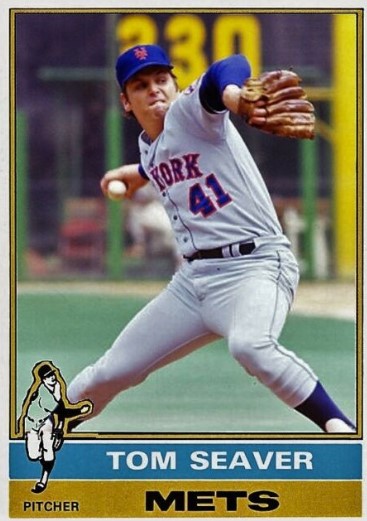


ble

More Looking Back, While Looking Forward to Baseball … The Zany Career of Rube Waddell

WaddellOn this date (July 1) in 1902, Philadelphia Athletics southpaw George Edward “Rube” Waddell became the first American League pitcher (and second major leaguer) to toss an “Immaculate Inning” (three strikeouts on nine pitches).  It came in the sixth inning of a 2-0 Athletics win over the Baltimore Orioles.  (The victims were Billy Gilbert, Harry Howell and Jack Cronin).  In the two-hit shutout, Waddell faced the minimum  27 batters, fanning 13. Side note:  The first-ever Immaculate Inning was thrown on June 4, 1889, by John Clarkson of the National Leaguer Boston Beaneaters versus the Philadelphia Quakers. 

How good was Waddell in 1902?  The lefty started the 1902 season in the minors, with Los Angeles Angels of the California League – where he had  pitched to a 12-8 record by late June.  The Philadelphia Athletics’ Connie Mack took notice and signed Waddell. At the time Waddell made his first appearance for the Athletics (June 26), the team was in fourth place, just one game over .500 (26-25) and  six games behind the league-leading  the White Sox. With Waddell showing the way,  they would go 57-28 over the rest of the season, taking the AL pennant, finishing five games up on the second-place Saint Louis Browns.  Let’s look at what Waddell accomplished in 1902.

Now, it’s important to remember Waddell made his first mound appearance on June 27,  with just 86 games left in the season. He proceeded to win 24 games (the league’s second-highest total, behind only Cy Young’s 32 wins; and Young had 43 starts to Waddell’s 27 and 45 appearances to Waddell ‘s 33). Waddell also put up the league’s second-best earned run average (2.05).  Despite his shortened season, Waddell led the AL with 210 strikeouts, fifty more than the runner-up (again Cy Young, who pitched 384 2/3 innings to Waddell’s 276 1/3). Waddell went on to lead the AL in strikeouts over the next five seasons – by wide margins. The lefty  who relied primarily on an exceptional fastball and hard curve also led the NL in strikeouts per nine innings in 1900 and the AL  every season from 1902 through 1907. (He finished second in the NL in K/9 in 1901 and fourth in the AL in 1909.) He also allowed the fewest hits per nine frames in the NL in 1900 and the AL in 1905 – and finished in his league’s top five in five seasons.

Waddell 1902

Waddell – A Truly Eccentric Lefty

Now southpaws are acknowledged (whether justifiably is debatable) in baseball lore to, at times, be a bit “eccentric.”  Waddell was clearly NOT “the exception that proved the rule.” He is recognized (justifiably) as one of the zaniest player in MLB history – but he also was one of the best (when he was focused on the game). Waddell was known to: leave a ball game to chase fire engines; miss a game he was scheduled to start because he was fishing or playing marbles with neighborhood kids; bring his outfielders in to sit on the grass and then proceed to fan the side (only in exhibition games, of course); wrestle alligators in the off-season; enjoy more than an occasional libation; and (frequently) do battle with owners and managers.  (It has also been reported that Waddell, during his career, found time to ride ostriches, spontaneously join and lead parades, assist fire fighters on the job, go into the stands to confront hecklers – and was once even bitten by a lion that he had, for some reason, decided to punch.  This is the stuff of legends.)  Waddell simply was more interested in enjoying life in his own way than in money or professional stability.

Still, when Waddell set his mind and his heart to it, he could be something pretty special on the mound.  Thanks to his unpredictability, however, his professional career included stints with five major league clubs (13 seasons) and numerous minor league, independent, semi-pro and barn-storming teams. For BBRT’s Minnesota readers, Waddell was a 20-game winner for the 1911 American Association champion Minneapolis Millers.

Symmetry

Rube Waddell was born on Friday the 13 of October in 1876 and died on April Fools day 1914. 

Waddell – A Strikeout “Artist”

In 1904, Waddell set a modern (post-1900) MLB record with 349 strikeouts that stood until 1965 (when Sandy Koufax fanned 382).   The next highest total in 1904 went to the Giants’ Jack Chesbro, a full 110 whiffs behind Waddell – despite pitching 71 2/3 more innings. That season, Waddell averaged 8.2 strikeouts per nine innings, at a time when the league average was 3.8.

Have a Seat, Batter

Rube Waddell fanned 302 batters in 1903 and 349 in 1904, making him the first modern-era (post 1900) pitcher to record two 300-strikeout seasons.  To date, only nine pitchers have recorded multiple 300-whiff campaigns, led by Nolan Ryan and Randy Johnson with six each. Only 19 pitcher have recorded 300-strikeout seasons since 1900.

The Pitcher’s Triple Crown – Wins, ERA, Strikeouts

Waddell had his best season in 1905, when he led the American League in wins (27 – versus ten losses); earned run average (1.48); winning percentage (.730); and strikeouts (287). He tossed 27 complete games and seven shutouts in 34 starts.

Waddell, elected to the National Baseball Hall of Fame in 1946, finished with a 193-143, 2.16 stat line.  In the four seasons from 1902-1905, pitching for the Philadelphia Athletics, Waddell went 97-52, with a 1.88 earned run average and 1,148 strikeouts (versus 330 walks).  In those four peak campaigns, he threw 1,312 innings (an average of 328 innings per season), completed 126 of 145 starts and twirled 22 shutouts.

A Peer Review

In my opinion, and I suppose if there is any subject I am qualified to discuss it is pitching, Rube Waddell had more sheet pitching ability than any man I ever saw.”

                           Hall of Famer Walter Johnson (Source, National Baseball Hall of Fame)

For more on Waddell, BBRT suggests: “Rube Waddell: The Zany, Brilliant Life of a Strikeout Artist,” by Allan Howard Levy and “Just a Big Kid: The Life and Times of Rube Waddell,” by Paul Proia.  They are both good reads.

Primary Resources: Baseball-Reference.com; MLB.com; “Rube Waddell: The Zany, Brilliant Life of a Strikeout Artist,” by Allan Howard Levy and “Just a Big Kid: The Life and Times of Rube Waddell,” by Paul Proia. 

Coming Soon:  The Baseball Roundtable “Who’s Your Daddy?” Series – Max Scherzer edition.

BASEBALL ROUNDTABLE ON THE TOP 100 BASEBALL BLOG LIST

100Baseball Roundtable is on the Feedspot list of the Top 100 Baseball Blogs.  To see the full list, click here.

I tweet baseball @DavidBBRT

Follow/Like Baseball Roundtable’s Facebook Page here.  More baseball commentary; blog post notifications; PRIZES.

Member: Society for American Baseball Research (SABR); The Baseball Reliquary; The Negro Leagues Baseball Museum.
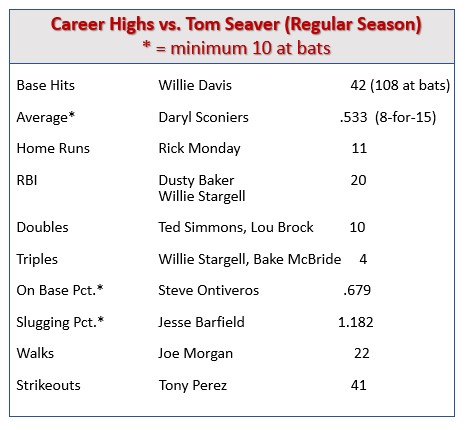
Putting Up a Win … Without the Benefit of a Base Hit

As I look “forward” to the late-July start of the 2020 baseball season (although I must admit the recent Covid resurgence and spate of “positives” among players has me worried), I am passing the time by looking “backward” at significant (at least in my view) MLB events from the past. Today’s homage to the past is triggered by a Los Angeles Angels (of Anaheim)-Los Angeles Dodger matchup that took place on this date (June 28) in 2008.

The Dodgers’ 1-0 win that day marked the fifth (and most recent) time in MLB history that a team has come away with a victory without the benefit of a single base hit.

Let’s take a look at those contests.

Angels 0 – Dodgers 1 … Dodger Stadium, June 28, 2008

In this game, the Dodgers were no-hit by losing pitcher Jered Weaver (six innings, three walks, six strikeouts, one unearned run) and Jose Arredondo (two perfect frames with three strikeouts). The Dodgers scored their lone run in the bottom of the fifth.  CF Matt Kemp led off and reached on an error by Weaver (bobbling a weak ground ball between home plate and the mound). Two pitches later, with 3B Blake DeWitt at the plate, Kemp stole second and advanced to third on a throwing error by Angels’ catcher Jeff Mathis.  DeWitt, with a 1-1 count, then hit a sacrifice fly to deep right – and that was all the scoring for the day. So, in a sequence of four pitches, the game was lost.

Weaver, of course, was credited with the defeat.  The win went to Dodgers’ starter Chad Billingsley, who went seven innings and gave up three hits and three walks, while fanning seven.  He got relief help from Jonathan Broxton (hold) and Takashi Sato (save).  Side note:  The Angels did not record an “official” MLB no-hitter, since the Dodgers did not bat in the bottom of the ninth (an official no-hitter must go at least nine innings).

Red Sox 1 – Indians 2… Cleveland Stadium, April 12, 1992

While the Indians failed to get a hit over eight innings against Red Sox’ starter Matt Young, they scored in their very first inning – in fact, within the first three hitters.  It started with four-pitch walk to the leadoff hitter, speedy center fielder  Kenny Lofton. Lofton stole second while the number two hitter – Glenallen Hill – was at the plate.  Hill ran the count to 3-2 and, as he went down swinging, Lofton swiped third.  The next hit hitter was 2B Carlos Baerga, who reached first on an error (bad throw) by Red Sox’ SS Luis Rivera, allowing Lofton to score.

The Indians plated an insurance run in the third – and a four-pitch walk again played a role. Indians SS and number-nine hitter Mark Lewis led off and drew a four-pitch walk off  Young. Lofton then walked on five pitches, sending Lewis to second. Hill then grounded to short, forcing Lofton, but reaching first on a fielder’s choice. Hill stole second, while Baerga was at the plate. Then, Lewis scored on a Baerga grounder to short.

The Red Sox came back with a run in the top of the fourth, on a walk and two singles, but it was not enough.

Matt Young took the loss (a complete-game) tossing eight innings of no-hit ball (seven walks and six strikeouts) and giving up two unearned runs. Indians’ starter Charles Nagy got the win – giving up eight hits and one run (four walks, ten whiffs) over seven innings, with help from Brad Arnsberg (hold) and Derek Lilliquist (save). As in the June 28, 2008, Angels-Dodgers game, a no-hitter was not credited, since the Indians did not bat in the bottom of the ninth.  (Personally, I think that rule needs a look.)

Yankees 0 – White Sox 4 … July 1, 1990 at (old) Comiskey Park

In this one, Yankee starter Andy Hawkins and White Sox starter Greg Hibbard were locked in a scoreless pitching duel after seven frames. Hibbard had given up just four hits (no walks, four strikeouts), while Hawkins was working on a no-hitter (three walks, three whiffs). Barry Jones relieved Hubbard in the top of the eight and held New York scoreless.  In the bottom of the inning, Hawkins retired the first two batters on easy pop flies.  Then it all unraveled.  RF Sammy Sosa (hitting in the number-eight spot) reached on error by 3B Mike Blowers and stole second with SS Ozzie Guillen at the plate.  Guillen then walked on a 3-2 pitch and CF Lance Johnson followed with a four-pitch walk. Bases loaded with two out – still no hits.

Robin Ventura then appeared to fly out to left, but the ball hit off of left fielder Jim Leyritz’ glove and rolled away, while all three runners scored.  Next up was DH Ivan Calderon, who flied to right.  This time, the ball popped out of RF Jesse Barfield’s glove and a fourth run scored.  Hawkins got the next batter (LF Dan Pasqua) on a pop up, by the damage was done and the game was gone.

Hawkins took the loss – an eight-inning, complete game (five walks, three hits, four unearned runs), The win went to reliever Barry Jones (who pitched the top of the eighth). Scott Radinsky pitched the ninth for Chicago. Hawkins not only did not get the win, he was not credited with a no-hitter, having pitched just eight innings.

We Interrupt this Post for a Brief Diversion

On this Date (April 22) in 1959, the Chicago White Sox completed what may be the weirdest MLB offensive inning ever – and while it was not a no-hit inning – it was close.  In the seventh inning of a 20-6 road win over the Kansas City A’s, the Chicago White Sox scored 11 runs on just one base hit. In fact, they got only one ball out of the infield.  In that inning:

  • The Sox sent 17 batters to the plate, but collected just one hit – and, in fact, got only one ball out of the infield.
  • Sox’ hitters stepped into the box with runners in scoring position 14 times.
  • Sox hitters batted with the bases loaded 12 times and never got the ball past the pitcher.
  • Eight different White Sox’ players drew walks.
  • The Sox drew eight bases-loaded walks (and had one bases-loaded hit batsman). and
  • White Sox 2B Nellie Fox walked twice with the bases loaded in the inning.

Here’s how it went that inning (per baseball-reference.com):

  • 1B Ray Boone is safe on a throwing error by A’s shortstop Joe DeMaestri.
  • RF Al Smith attempts to sacrifice Boone to second (score was 8-6 at the time) and reaches safely on an error by A’s third baseman Hal Smith.
  • LF Johnny Callison singles to right. Scoring Boone and Smith (with the help of an error by A’s right fielder Roger Maris). Callison ends up on third.
  • SS Louis Aparicio walks – steals second (runners now on second and third).
  • P Bob Shaw walks (loading the bases).
  • PH Earl Torgeson (batting for 3B Sammy Esposito) walks (scoring Callison).
  • 2B Nellie Fox walks (scoring Aparicio).
  • CF Jim Landis reaches on fielder’s choice – grounding back to pitcher Mark Freeman, who takes the force at home (bases still loaded).
  • C Sherman Lollar walks (scoring Torgeson, bases still loaded).
  • Ray Boone makes his second plate appearance of the inning and walks (scoring Nellie Fox).
  • Al Smith makes his second plate appearance of the inning and walks (scoring Landis).
  • Johnny Callison, who had the only hit of the inning in his first plate appearance, is hit by a pitch (scoring Lollar, bases still loaded). Lou Skizas comes in to run for Callison.)
  • Louis Aparicio draws his second walk of the inning (scoring Boone, bases still loaded).
  • Bob Shaw strikes out.
  • PH Bubba Phillips (batting for Torgeson, who batted for Esposito earlier in the inning) walks (scoring Smith, bases still full).
  • Nellie Fox draws his second bases loaded walk of the inning (scoring Skizas).
  • Jim Landis grounds out pitcher to first to end the inning.


Now, back to our regularly scheduled posting – victories without the benefit of a hit.

Tigers 2 – Orioles 1 … April 30, 1967 at Memorial Stadium

BarberThis Tigers-Orioles contest was scoreless through seven innings, with the Orioles’ Steve Barber tossing a no-hitter and the Tigers’ Earl Wilson having surrendered just two hits.  Still, it did appear Wilson had the better stuff that day.  He had given up just one walk, while fanning four.  Barber, despite having a no-hitter in the works, had walked five batters and hit two (three strikeouts). In the top of eighth, Barber walked two more (one intentional), but escaped without damage – no-hitter and shutout intact.

In the bottom of the inning, the Orioles finally broke through against Wilson, ironically, without the benefit of a hit – as Wilson seemed to “lose the plate”.  LF Curt Blefary led off with a walk and was sacrificed to second by 2B Woodie Held. Charlie Laue then pinch hit for catcher Andy Etchebarren and was intentionally walked to put the double play on the table. Wilson, still struggling, walked Barber to load the bases and Orioles’ SS Luis Aparicio got him home with a sacrifice fly to right. Barber was now going into the top of the ninth with a no-hitter and a 1-0 lead.  (But, remember, he had already walked seven and hit two batters).  Barber started the inning by walking 1B Norm Cash (who was replaced on the bases by pinch runner Dick Tracewski).  Barber then walked SS Roy Oyler, bringing up Wilson, who sacrificed the pair of runners to second and third.  Barber than got dangerous PH Willie Horton on a foul pop.  He was now just one out away from a no-hit win. Oops! Tracewski came into score on a wild pitch.  Then Barber walked CF Mickey Stanley and Orioles’ manager Hank Bauer brought in Stu Miller, who got the final out of the inning.  Holding a one-run lead, Tiger manager Mayo Smith brought in Fred Gladding, who pitched a 1-2-3 ninth to save the win for Wilson.

The game, by the way, went in the books as an official (combined) no-hitter – be it a wild one, as Steve Barber walked ten, hit two and threw a wild pitch), while twirling 8 2/3 no-hit innings and losing the game.

Reds 1 – Colt .45s 0 … April 23, 1964

JohnsonThis contest went into the ninth inning tied at zero, with the Reds’ Joe Nuxhall having given up five hits (one walk, four strikeouts) and the Colt .45s’ Ken Johnson working on a brilliant no-hitter (two walks, nine whiffs). In the top of the ninth, errors robbed Johnson of a victory, but not of a complete-game no-hitter. Johnson got Nuxhall on a grounder to third to open the inning. Next 2B Pete Rose attempted to bunt for a hit and reached on a throwing error by Johnson (Rose went to second on the play). Third baseman Chico Ruiz then grounded out, with Rose moving to third. With two-out and the shutout and no-hitter still intact, CF Vada Pinson grounded to second, but reached on an error by Nellie Fox, allowing Rose to score.  Johnson got RF Frank Robinson for the final out of the inning, but the damage was done. Nuxhall, pitched a scoreless ninth and Johnson had a no-hitter (two walks, nine strikeouts) and a loss.

Ken Johnson is the only MLB pitcher to throw a complete-game, official  MLB no-hitter and lose.


Primary Resources:  MLB.com; Baseball-Reference.com

BASEBALL ROUNDTABLE ON THE TOP 100 BASEBALL BLOG LIST

100Baseball Roundtable is on the Feedspot list of the Top 100 Baseball Blogs.  To see the full list, click here.

I tweet baseball @DavidBBRT

Follow/Like Baseball Roundtable’s Facebook Page here.  More baseball commentary; blog post notifications; PRIZES.

Member: Society for American Baseball Research (SABR); The Baseball Reliquary; The Negro Leagues Baseball Museum.
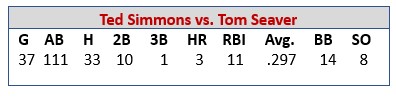
Baseball Roundtable “Who’s Your Daddy?” Series … Roger Clemens Edition

Everyone kind of perceives me as being angry. It’s not anger, it’s motivation.

                                                                  Roger Clemens

This Edition of “Who’s Your Daddy?” focuses on 354-game winner Roger Clemens, long noted as one of the most aggressive competitors in the game.

Who’s You Daddy?  What it’s all about.

Those of you who read Baseball Roundtable regularly are familiar with the “Who’s Your Daddy?” series – presenting lineups of players who performed unexpectedly well against some of baseball’s top pitchers. In the past, BBRT has featured such moundsmen as Nolan Ryan, Bob Gibson and Pedro Martinez.  (An explanation of the inspiration behind the Who’s Your Daddy? series can be found the end of this post.)  This post looks at a lineup of hitters who found success against Roger “The Rocket” Clemens/  As always, I would stress that the pitchers included in the Who’s Your Daddy? series are among the “best in the business.” They are selected not because of the players who performed well against them, but rather because success among hitters when they were on the mound was the exception rather than the rule.

Before we get started on Clemens, here are links to the previous editions of this series:

  • Nolan Ryan, click here.
  • Sandy Koufax, click here. 
  • Pedro Martinez, click here.
  • Bob Gibson, click here
  • Randy Johnson, click here
  • Greg Maddux, click here. 
  • Justin Verlander, click here. 
  • Bob Feller, click here

Coming soon, Max Scherzer.

Now, on to Roger Clemens.

ClemensRoger Clemens pitched in 24 MLB seasons (1984-2007 … Red Sox, Blue Jays, Yankees, Astros). He was an 11-time All Star and his seven Cy Young Awards are the most earned by any pitcher. In 1986, he went 24-4, 2.48 – leading the league in wins, winning percentage (.857), ERA – capturing the Al Cy Young and Most Valuable Player Awards.

Clemens won 20 or more games in six seasons, leading his league in wins four times. He also led in winning percentage three times, earned run average seven times, strikeouts five times, complete games three times, shutouts six times and innings pitched twice.  Notably, he recorded his leagues’ lowest qualifying ERA for the first time in 1986 (age 23) and for the last time in 2005 (age 42).  He notched 354 career wins (ninth all-time) against 184 losses, put up a 3.12 in 4,916 2/3 innings and fanned 4,672 batters (third all-time).  Over his career, Clemens held hitters to a .229 average and fanned one of every 4.3 batters he faced. In the post-season Clemens went 12-8, 3.75 in 35 games (34 starts), fanning 173 batter in 199 innings.

20-20 … More than a Vision

For most pitchers, fanning 20 batters in nine innings is no more than a “vision.”  Only four pitchers have turned that vision into reality: Roger Clemens, Kerry Woods, Max Scherzer and Randy Johnson. Of those only Roger Clemens has achieved this feat twice.  He was, in fact, both the first and second pitcher to whiff 20 batters in a nine-inning game – and he did it ten years apart (April 29, 1986 and September 18, 1996. Side note: Randy Johnson’s 20 strikeouts came in the first nine-innings of an eleven-inning contest (he was relived after nine frames by Byung-Hyun Kim).  All the others were nine-inning complete games.

So, who could hit Clemens’ stuff? Let’s take a look.  Keeping in mind, these lineup selections are subjective (but informed) choices – open for discussion and debate.  Note:  Unless otherwise noted the stats here are regular-season only. Clemens Career

Now, the “Who’s Your “Daddy?” lineup versus The Rocket.

Catcher – Mike Piazza … .421 average, 1.105 slugging percentage

Mike Piazza clearly “had Clemens’ number” – and he put up the numbers of his own to prove it.  In eight regular-season games against Clemens, Piazza hit .421 (8-for-19) and drove in ten runs.  Further, five of his eight hits were for extra bases (one double and four home runs). That gave Piazza a 1.105 slugging percentage against The Rocket – the highest among batters with at least ten at bats versus Clemens.   Piazza got on base via hit, walk or hit by pitch at least once in every regular-season game he faced Clemens.  Notably, only 12 players notched at least four regular-season home runs against Clemens. Piazza accomplished the feat in 19 at bats. Everyone else with at least four dingers versus Clemens had at least 56 at bats against him.
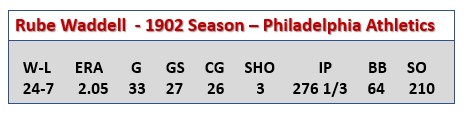
Piazza Clem

Hall of Famer Mike Piazza played 16 MLB seasons (1992-2007 … Dodgers, Marlins, Mets, Padres, A’s). He was the 1993 NL Rookie of the Year (.318-35-112 for the Dodgers) and a 12-time All Star.

Looking for the Long Ball

Mike Piazza hit an MLB-record (for catchers) 396 home runs as a backstop.

While he never led his league in any of the key offensive categories, Poazza topped 30 home runs in nine seasons (reaching 40 twice); had six seasons of 100+ RBI; and hit .300 or better nine times  Over his career, Piazza hit .308 (2,127 hits), with 427 home runs, 1,335 RBI, 1,048 runs scored.  His best season was 1997, when he hit .362-40-124 in 152 games for the Dodgers.  He hit .242-6-15 in 32 post-season games.

__________________________________________

Making Contact… or Not – A Couple of Players with Twins Ties

Brian Harper made pretty consistent contact versus The Rocket.  In 23 regular season plate appearances against Clemens, he never struck out (the highest total of PA against Clemens without a whiff of any player).  He also never walked, and collected seven hits (for a .304 average).

On the other side of the coin, Torii Hunter faced Clemens 27 times, fanned 14 and never got a hit (two walks).  His 25 at bats are the most of any player with a .000 average versus Clemens. 

First Base – Jim Thome … Eight home runs and 19 RBI versus Clemens

Hall of Famer Jim Thome’s eight home runs and 19 RBI are the most of any hitter versus Clemens – and his .373 average (Thome was a career .276 hitter) wasn’t bad either (understatement there). Thome had 22 career hits (in 23 games) against Clemens – 15 of which went for extra bases.

Thome Clem

Jim Thome played 22 MLB seasons (1991-2012 … Indians, Phillies, White Sox, Dodgers, Twins, Orioles). The five-time All Star hit 30 or more home runs 11 times (a high of 52 in 2002). He led the AL in home runs with 47 in 2003 – and hit 190 home runs between 2001 and 2004 (four seasons). Thome also topped 100 RBI in nine seasons, 100 runs scored in eight and drew 100 or more walks nine times.

Walk, Don’t Run

Going into the 2020 season (we hope), Jim Thome leads all of MLB with 13 career walk-off home runs. He also shares the MLB lead with walk-off home runs in extra innings at eight (tied with Frank Robinson and Albert Pujols).

For his career, Thome went .276-612-1,699, with 1,583 runs scored.   His 612 regular-season home runs are eighth all-time.  Side note: His career 2,548 strikeouts are second all-time.  Thome also had 17 post-season home runs (71 games … .211-17-37). His best season was 2002, when he went .304-52-118 for the Indians. He became a free agent after that campaign and signed with the Phillies, where he led the NL in home runs with 47 in 2002.  Side note:  In his first game facing Clemens, (August 13, 1992), Thome played third base and batter eighth. 

Honorable Mention at 1B: Paul Konerko only faced Clement in eight games, but he made the most of them – going 10-for-20 (.500), with two home runs and six RBI; Will Clark went eight-for-20 (.400), with two home runs and six RBI in nine games versus Clemens.

______________________________________________

Where was that pitch?

Greg Vaughn clearly had trouble with Roger Clemens’ heat – fanning 25 times in just 49 plate appearances (45 at bats), putting up a .089 average and driving in just one run in 15 games. Vaughn was a career .242 hitter (15 MLB seasons), who fanned in 21.4 percent of his plate appearances. He went down on strikes in 51 percent of his plate appearances versus Clemens.

Second Base – Lou Whitaker … .338 average. .444 on-base percentage

Lou Whitaker hit a healthy .338 against Roger Clemens and also drew 14 walks (in 24 games). Whitaker reached Clemens for three home runs and drove in eight runs against him. In his final game against Clemens (August 2, 1995), Whitaker reached him for two walks and hit a long home run in three plate appearances.

Whitaker Clem

Lou Whitaker played 19 MLB seasons (1977-95), all with the Tigers. He was the 1978 AL Rookie of the Year (.285-3-58 in 139 games), a five-time All Star and three-time Gold Glover. His best season was 1983, when he hit .320 (206 hits), with 12 home runs, 72 RBI, 94 runs scored and 17 steals.  Over his career, Whitaker hit 20 or more home runs four times, and scored 100+ runs twice.

Double Your Pleasure, Double Your Fun

The Tigers’ vaunted double-play combination – Lou Whitaker and Alan Trammel – did pretty well against Clemens: Whitaker hit .338 against him in 65 at bats; Trammel .364 in 66 at bats.

Whitaker was a career .276 hitter (2,369 hits in 2,390 games), with 244 home runs, 1,084 RBI, 1,386 runs scored and 143 stolen bases.

____________________________________________

Third Base – Paul Molitor … 33 hits

Yes, I know Paul Molitor spent most of his career (and made the Hall of Fame) primarily as a DH, but he started five of his first ten games against Clemens at third base (four at DH and one at 2B).

Molitor’s 33 hits against Clemens are the most safeties The Rocket gave up to any hitter. They are also the most hits Molitor had off any pitcher (he also had 33 off Jack Morris). Molitor’s performance against Clemens is dampened a bit by his 18 strikeouts (versus seven walks), but he did put up a .308 batting average.

MOlly Clem

Molitor played 21 MLB seasons (Brewers, Blue Jays, Twins). He was a seven-time All Star … and hit .306.  His 3,319 base hits rank tenth all-time. He finished with 234 regular-season home runs, 605 doubles, 114 triples, 1,307 RBI, 1,782 runs scored and 504 stolen bases. Molitor led his league in hits three times (topping 200 hits in four seasons); runs scored three times (with five campaigns of 100+); doubles once and triples once. He stole twenty or more bases in 13 seasons, reaching forty or more steals four times.

Three for 300

Paul Molitor and Ichiro Suzuki are the only MLB players to triple for their 3,000th MLB hit.

Molitor was even more of a force on the big stage, putting up a .368-6-22 line in 29 post-season games – and earnings MVP honors in the 1993 World Series (for Toronto), when he had 12 hits in 24 at bats (.500), two home runs, eight RBI and ten runs scored.

Honorable Mention at 3B: Gary Sheffield, who faced Clemens in five games (three at 3B, one at SS, one at DH), went 11-for-18 against him for a .611 average (nine singles, two doubles). In his first game versus Clemens (June 27, 1989), he went single, single, double, walk.

___________________________________________

Shortstop – Alex Rodriguez …. .377 average in 18 games

Alex Rodriguez collected 20 hits in 18 games off Roger Clemens – for a nifty .377 average.  He had two home runs, six doubles and nine RBI.   Interestingly (at least to BBRT), when Rodriguez first faced Clemens (in A-Rod’s 1994 rookie season), he batted ninth in the lineup.

A-Rod ClemRodriguez played 22 MLB seasons (1994-2013, 2015-16 … Mariners, Rangers, Yankees). He was a 14-time All Star, three-time AL Most Valuable Player and a two-time Gold Glover at shortstop.  He won one batting title (as a 20-year-old in 1996, when he hit a career-high .358) – and hit .300 or better in nine seasons. Rodriguez was also a five-time home run leader and topped 50 home runs in three seasons. He hit 30 or more dingers in 14 campaigns. In addition, he led the AL in runs five times (scoring 100 or more runs in 13 consecutive seasons) and RBI twice (driving in 100+ tallies in 14 seasons – 13 consecutively). He also led the league in hits once, doubles once and total bases four times.

Rodriguez retired with a .295 batting average (3,115 hits), 696 home runs (fourth all-time), 2,086 RBI (third all-time), 2,021 runs scored (eighth all-time) and 329 stolen bases (in 405 attempts). He hit .259-13-41 in 76 post-season games.

40-40

Alex Rodriguez is one of only four players to record 40 or more home runs and 40 or more stolen bases in a single season (Jose Canseco, Barry Bonds and Alfonso Soriano are the others).  In 1998, Rodriguez his .310, with 42 home runs and 46 steals.

Honorable Mention at SS: Allen Trammel went .364-2-14 in 20 games against Clemens.

______________________________________________

Outfield – Ken Griffey Jr. … Six home runs and 16 RBI

Ken Griffey Jr. hit .311 in 30 games versus Clemens.  His six home runs off The Rocket are second only to Jim Thome’s eight round trippers and Griffey’s 16 RBI trail only Thome (19), B.J, Surhoff (18) and Gary Gaetti (18). Griffey Jr.’s first five plate appearances against Clemens produced three ground outs, one fly out and one strikeout – a nice round 0-for-5. He then got on base six straight times – walk, single, single, double, walk, walk. In 1994, Griffey Jr. faced Clemens six times in two games and collected five hits (four singles and a home run).

Like Son, Like Father

Ken Griffey, Sr. also touched up Clemens pretty well. While he faced him only 11 times (three games), he recorded five hits (all singles) and two walks (.556 average, .636 on-base percentage).

Ken Griffey Jr. played 22 MLB seasons (1989-2010 … Mariners, Reds, White Sox). The Hall of Famer was a 13-time All Star, ten-time Gold Glover and the 1992 AL Most Valuable Player. He was a four-time home run leader (hitting 40 or more home runs in seven seasons – 56 in a season twice); led the league in RBI once (getting 100 or more RBI in eight seasons); led the league in runs scored once (scoring 100 or more runs in six campaigns);  He also hit .300 or better seven times.  Griffey finished his MLB career with 2,781 hits (.284 average); 630 home runs (seventh all-time), 1,836 RBI, 1,662 runs scored and 184 stolen bases.  His best season was 1997 (Mariners), when he hit .304 and led the league in home runs (56), RBI (147), run scored (125) and total bases (393) – and threw In a Gold Glove to ice the cake.

Some Pretty Good Players, by George

What do Babe Ruth, Ken Griffey Sr. and Jr., George Brett, and Tom Seaver have in common?

Their first names:  George Herman Ruth; George Kenneth Griffey Sr. and Junior; George Brett; and George Thomas Seaver.

__________________________________________

Outfield – Harold Baines … 32 hits, 17 walks, .402 on-base percentage

Harold Baines came to the plate more times against Clement than any other player (122 plate appearances in 37 games-) He collected the second-most hits against him (32, one behind Paul Molitor) and tied for the most walks (17, tied with Rafael Palmeiro and John Olerud).  That added up to a .305 average and a .402 on-base percentage.

Baines Clem

Baines played 22 MLB seasons (1980-2001 … White Sox, Rangers, A’s, Orioles, Indians.)  The Hall of Famer was a five-time All Star. He collected 2,866 hits (.289), 384 home runs and 1,628 RBI. Baines hit 20 or more home runs in 12 seasons, drove in 100+ runs twice and hit .300 or better in eight campaigns.

______________________________________

Making Them Count

Gary Gaetti hit only .194 against Clemens (13-for-67  in 23 games) – but he made those hits count.  His 18 RBI against Clemens are the second most of any batter.  Gaetti had seven extra base hits against Clements (two doubles, one triple and four home runs). He has one of only six Grand Slam hit off Clemens. 

Outfield – Trot Nixon … .371 average, .476 on-base percentage

Christopher Trotman “Trot” Nixon faced Roger Clemens 42 times in 15 regular-season games and came away with 13 hits (35 at bats) and seven walks (.372 average, .476 OBP). Of his thirteen hits, eight went for extra bases – four doubles, one triple and three home runs (.800 slugging percentage).

Nixon Clem

Nixon played in 12 MLB seasons (1996, 1998-2008 … Red Sox, Indians, Mets). He hit .274 (995 hits), with 137 home runs, 555 RBI and 579 runs scored. Nixon hit 20 or more home runs in three seasons and scored 100 runs in one campaign. His best season was 2003, with the Red Sox, when he went .306-28-87. Nixon was a solid post-season performer, hitting .283, with six home runs and 25 RBI in 42 games.

Honorable Mention in the OF: Carmello Castillo faced Roger Clements in ten games (1986 and 1991) and hit .385 (10-for-26), with three home runs and five RBI; Dave Winfield went .308-3-13 in 20 games versus Clemens.

__________________________________________

Pitcher – Jon Rauch & Shawn Estes … Only pitchers to go deep versus Clemens

Pitchers, as a whole, didn’t fare well against The Rocket, so I give you the only pitchers to take Clemens yard during his career.

Rauch ClemEstes Clem

Rauch hit a two-run homer in an Expos’ August 13. 2004, 6-5 win over the Astros. (Clemens got a no-decision, as did Rauch, who pitched 4 2/3 innings of scoreless ball.) It is easy to see where Rauch’s power came from – at 6’11, 290 pounds. Rauch pitched 11 MLB seasons (2002, 2004-13 … White Sox, Expos/Nationals, Diamondbacks, Twins, Blue Jays, Mets, Marlins).  He went 43-40, 3.90 with 62 saves. As a hitter, he went 2-for 21 (15 strikeouts) and his home run against Clemens was his only MLB long ball.

Estes hit his dinger against Clemens on June 15, 2002. It came in an 8-0 Mets win over Clemens and the Yankees. It was two-run shot in the bottom of the fifth that gave the Mets a 3-0 lead.  Estes went seven innings (five hits, no runs, one walk, eleven strikeouts) for the victory.  Estes pitched 13 MLB seasons (1995-2006, 2008 … Giants, Mets, Reds, Cubs, Rockies, Diamondbacks, Padres). He went 101-93, 4.71 and was an All Star in 1997, when he went 19-5, 3.18 for the Giants. As a hitter, he went 79-for-498 (.159) with four home runs and 28 RBI.

Primary Resources:  Baseball-Reference.com; Stathead.com; MLB.com; Baseball-Almanac.com

Who’s Your Daddy?  What It’s All About.

On September 24, 2004, in the middle of a tight pennant race, the Yankees handed future Hall of Famer Pedro Martinez and the Boston Red Sox a tough 6-4 loss.  Martinez went 7 1/3 innings giving up nine hits and five earned runs.  The game came just five days after (in his previous start) Martinez had lasted just five frames against the Bronx Bombers (eight hits, eight earned runs) in a 16-7 loss.

After that second loss, Martinez candidly commented, “What can I say? I just tip my hat and call the Yankees my daddy.”  Little did he know that his comment – and a Yankee fans’ chant of “Who’s your daddy?” would follow him into future starts in New York (all the way to his final MLB start – against the Yankees for the Phillies – in Game Six of the 2009 World Series.)

The concept of “Who’s your daddy?” became the inspiration for Baseball Roundtable to take a look at the players who “had the number” of some of MLB’s premier pitchers.  Again, you can find links to the previous “editions” of “Who’s Your Daddy?” near the top of this post. 


BASEBALL ROUNDTABLE ON THE TOP 100 BASEBALL BLOG LIST

100Baseball Roundtable is on the Feedspot list of the Top 100 Baseball Blogs.  To see the full list, click here.

I tweet (x) baseball @DavidBaseballRT

Follow/Like Baseball Roundtable’s Facebook Page here.  More baseball commentary; blog post notifications; PRIZES.

Member: Society for American Baseball Research (SABR); The Baseball Reliquary; The Negro Leagues Baseball Museum.