Sweet Memories – A Look Back (and ranking) of World Series Walk-Off Home Runs

With the 2020 World Series Game Four on the horizon, my mind wandered back to past Fall Classics – in particular Game Four of the first World Series I ever took a truly fan-atic interest in.  It was 1957 and, as a ten-year-old Milwaukee-born youngster, I was glued to the television (and its black-and-white, grainy portrayal of the national pastime) as my hometown Braves took on the mighty (and heavily favored) Yankees.  It was, of course. the Braves’ first trip to the Fall Classic since moving to Milwaukee in 1953 – and the franchise’s’ first World Series appearance since 1948 (only their second since 1914).  The Yankees, on the other hand, had appeared in seven of the eight most recent World Series (1949-56), bringing home six World Championships.  (Yankee-hating was a popular baseball pastime.)

The Yankees featured future Hall of Famers Mickey Mantle, Whitey Ford and Yogi Berra; while my Braves countered with Hank Aaron, Eddie Mathews and Warren Spahn. (Although, it would turn out that the star of the Series would be Braves’ right-hander “Fidgety” Lew Burdette.)

Lew Burdette Tames the Evil Empire

Lew Burdette pitched three complete games in the 1957 World Series – including shutouts in Games Five and Seven (October 7 and October 10). He put up a 0.67 earned run average in his 27 innings of work.
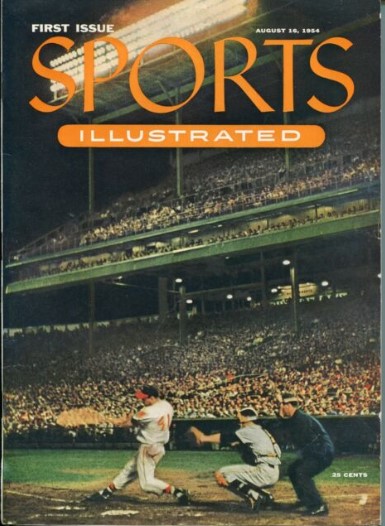
Eddie Mathews was on the cover of the inaugural issue of "Sports Illustrated. "

Eddie Mathews was on the cover of the inaugural issue of “Sports Illustrated. “

That 1957 Game Four that I recall so fondly took place at Milwaukee’s County Stadium on October 6.  The Braves were down two games-to-one and the Bronx Bombers had trounced them the day before by a 12-3 score behind two home runs by Milwaukee-native Tony Kubek and one by Mantle. Sadly, my Braves had not only given up 12 runs on nine hits, they had walked 11 batters (the Braves had used six pitchers and every one had given up at least one free pass).  Now, at the time, my favorite player was Eddie Mathews. (He still is, by the way. True boyhood heroes last.) Happily, Mathews was destined to provide one of my most exciting childhood “big-league memories.”

The game was played on a Sunday and my mother made sure I was ready for the action.  There was buttered popcorn (which I was allowed, for this day, to eat on the good couch in front of the TV).  There was also A&W Root Beer (an upgrade from the usual Kool Aid).

To make this long story a bit shorter, the Braves went into the ninth inning with a 4-1 lead behind the pitching of Warren Spahn and h0me runs by CF Hank Aaron (Aaron started in CF, with phenom Bob “Hurricane” Hazel in RF) and 1B Frank Torre.   Spahn retired Yankee RF Hank Bauer and CF Mickey Mantle to open the ninth and the Braves were one out away from tying the Series.  I was in baseball heaven.  However, the bubble quickly burst as Spahn gave up singles to C Yogi Berra and SS Gil McDougald and a three-run home run to 1B Elston Howard to tie the contest. The Braves were scoreless in the bottom of the inning – and it was on to extra frames.

With Spahn still on the mound, the Yankees scored in the top of the tenth on a two-out infield single by Tony Kubek and a triple to deep center by Bauer.  My heart sank.  Little did I know, one of the best moments of my hardball childhood was soon to come. Nippy Jones pinch hit for Spahn to open the Braves’ tenth and was hit by a pitch (the now immortalized “shoe polish-proven” plunking). This was, by the way, Jones’ last-ever MLB trip to the plate. With Felix Mantilla running for Jones, 2B Red Schoendienst sacrificed him to second and SS Johnny Logan doubled him home.  That tied the game and brought up my hero – Eddie Mathews – who popped a two-run home run to right on a 2-2 pitch from Bob Grim (appropriate name if you are going to give up a walk-off) to win the game.

Thanks for the Stick, Joe

When Ed Mathews came to the plate in the tenth inning of Game Four of the 1957 World Series, he was not using his own bat.  He hit the walk-off home run with teammate Joe Adcock’s stick.  Mathews had come into the game zero-for-eight (but with five walks) in the Series and thought a change of lumber might help.  He doubled and homered with the borrowed weaponry.

Mathews’ game-winning blast should not have come as a big surprise.  The future Hall of Famer was the 1953 NL home run champion at age 21; had hit 222 home runs over his first six MLB seasons; and had just completed his fourth consecutive season with 30 or more round trippers (a streak that would eventually run to nine seasons, with four of those of forty or more long balls). Mathews’1957 stat line was .292-32-94.  Over his 17-season career, Mathews hit .271-512-1,453, was an All Star in mine seasons, led the NL in home runs twice and in walks four times.

Seeing Double

Hank Aaron and Eddie Mathews, while Braves teammates, hit more combined home runs than any other pair of teammates in MLB history (863). Second place?  Babe Ruth and Lou Gehrig at 859.

Anyway, the memory of Mathews’ walk-off World Series home run, sent me to thinking about other World Series’ games that ended on a walk-off homer – so here’s the list along with my very subjective ranking of significance.  (In that ranking I looked at such factors as the inning in which the winning long ball was launched, the number of outs in the inning, the overall course of the game, whether the game was needed to stave off elimination, the creation of “iconic” moments or images and the likelihood of heroics by the particular player involved.)

A bit of a spoiler alert, of the 16 World Series walk-off home run:

  • six came in the bottom of the ninth – ten in extra innings;
  • the latest of any of the extra-inning walk-off came in the 18th inning;
  • six were hit by players now in the  Hall of Fame.
  • just one came in a Game Seven;
  • two came when the winning team was behind on the scoreboard;
  • one was hit by a pinch hitter;
  • two were hit in cases where the winning team was on the brink of elimination – three if you include the Game Seven walk-off; and
  • only two teams have had more than one player hit a World Series walk-off home run – the Yankees (4) and the Dodgers (2).

NUMBER ONE – Bill Mazeroski, Pirates – 10th Inning, 1960 World Series Game Seven– October 13, 1960

If I am going to pick this as my number-one World Series walk-off home run, I better set the stage.

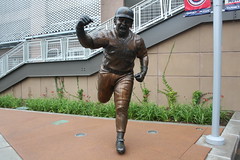
Mazeroski's 1960 home run trot earned him a immortalized at PNC Park.

Mazeroski’s 1960 home run trot earned him a statue at PNC Park.

I was thirteen and an avid baseball fan.  The television Game of the Week, the radio – especially the radio – and an occasional trip to the ballpark were my tickets to the national past time.

At the time, the Yankees were baseball’s dynasty.  Since my birth in 1947, the Bronx Bombers had been to 11 World Series (including the 1960 Series) and had won eight World Championships.   The opposing Pirates had last appeared in the Fall Classic in 1927 and last won it in 1925.

Fans from pretty much everywhere but New York had made Yankee-hating a tradition.  I was no exception.  Milwaukee-born, I was a steadfast Braves fan, still smarting from the Yankees’ 1958 World Series comeback, when they downed my Braves after trailing three games-to-one. The Yankees were in the 1960 Series – and I had an emotional interest in seeing them lose.

Put all of this together and you can see why I looked to the 1960 World Series with excitement – and why I was rooting for the underdog Pirates.

The prognosticators foresaw a Yankee win in five or six games.  They pointed out that the Yankees came into the Series with the momentum of a 15-game, season-closing winning streak, while the Pirates lost four of their final seven.  They also lauded the Yankees’ post-season experience and heralded the Yankees’ power (the Yankees led the AL with 193 home runs and 746 runs scored, while the Pirates led the NL with 734 runs scored, but had only 120 round trippers). The Yankees’ Game-One starting lineup had belted 152 regular season homers to 98 for the Pirates’ starters.  When it came to mound work, things appeared more balanced, maybe even a shade in favor of the Pirates.  While the Yankees’ 3.52 ERA was the lowest in the AL, the Pirates’ NL third-best ERA (at 3.49) slightly bettered the Bombers’ mark.  The Pirates did have the clear advantage in strikeouts (811-712) and fewest walks allowed (an NL-low of 386 to an AL-worst 609 for the Yankees).

To the surprise of many fans (and analysts), the Series was tied after six games – despite the fact that the Bronx Bombers had outscored the Pirates 46 to 17, outhit them .341 to .232 and out-homered them 8 to 1.  (The Yankees had won Game Two 16-3, Game Three 10-0 and Game Six 12-0.  The Pirates had prevailed in Game One 6-4, Game Four 3-2 and Game Five 5-2).

Then came Game Seven and Bill Mazeroski’s historic home run.

The Pirates started Vernon Law, 20-9, 3.08 on the season and the winner of Games One and Four.  The Yankees countered with Bob Turley, 9-3, 3.27 on the season.  Turley had won Game Two, despite giving up 13 hits and three walks in 8 1/3 innings.  The Pirates had their top left-handed hitter, Bob Skinner (injured in Game One), back at the number-three spot in the order, while the Yankees were missing Elston Howard (broken finger, Game Six).  An upset did seem possible.

Pittsburgh jumped out to a 4-0 lead after two innings, a score that held until the fifth

Casey’s Goodbye

Casey Stengel, despite ten pennants and seven World Series titles in 12 seasons as manager of the Bronx Bombers, was fired by the Yankees five days after the 1960 Game Seven loss to the Pirates.

Law handcuffed the Yankees through four innings, giving up only two singles.  In the fifth, Yankee first sacker Moose Skowron made the score 3-1 with a lead-off homer just inside the right field foul pole.  Law did not let the round tripper upset him, retiring C Johnny Blanchard, 3B Clete Boyer and P Bobby Shantz (who came on to pitch for New York in the third) in order.

The Yankees closed the gap – and then some – in the top of the sixth.  Pesky 2B Bobby Richardson (who already had nine hits in the series) led off with a single to center, and SS Tony Kubek followed with a walk.  With the Bombers appearing on the verge of a rally, Murtaugh replaced Law  with Elroy Face,  his top reliever.   Face got RF Roger Maris on a foul pop to Don Hoak at third base, but CF Mickey Mantle followed with a “seeing eye” single up the middle, scoring Richardson. LF Yogi Berra followed with an upper deck home run (like Skowron’s just inside the right field foul pole) to give New York a 5-4 lead.

In the top of the eighth, the Yankees seemed to dash the Pirates’ upset hopes – using a walk, two singles and a double to produce two more runs and a 7-4 lead.   Notably, Stengel’s pitching decisions again came into play.  He let reliever Bobby Shantz bat with two out and runners at second and third (Boyer and Skowron) and a chance to extend the Yankee lead.  Shantz flied out and the press-box managers were quick to point out:  1) the lost scoring opportunity; 2) the fact that Stengel left Shantz in for a sixth inning of work, despite the fact that Shantz had not gone more than four innings in the regular season.

So, that was the situation as the game went into the bottom of the eighth – when the Pirates (and Forbes Field) proved they still has some life left in them.  Gino Cimoli pinch hit for Face and stroked a single to right-center.  Shantz, who had already induced two double plays, appeared to have worked his magic again, as CF Bill Virdon hit a hard ground ball right at Yankee shortstop Tony Kubek.  Just as Kubek was ready to field the ball and begin the sure twin killing, it appeared to hit a pebble (the Yankees had already been critical of the condition of the Forbes Field infield) and ricocheted into Kubek’s throat.  Kubek went down, gasping for air and spitting up blood.  The end result?  Kubek sent to the hospital and replaced by Joe DeMaestri and the Pirates had two on and no outs, instead of none on and two outs.

Pirates’ shortstop Dick Groat took advantage of Kubek’s mishap and lined singled to left, scoring Cimoli.  Stengel came to the mound and replaced Shantz with right-hander Jim Coates (despite the fact that left-handed hitting LF Bill Skinner was coming to the plate).  The righty-lefty match-up made little difference, as Skinner sacrificed the runners up one base.  Next was 1B Rocky Nelson, who flied out to medium right, with the Pirates choosing not to test Roger Maris’ powerful arm.   So, two outs, two on and the Yankees still in front 7-5.   That brought up the Pirates’ best hitter, RF Roberto Clemente, who had been held hitless in his first three at-bats. Coates made a good pitch, getting Clemente to hit a weak ground ball toward first.   A hustling Clemente beat both Coates and Skowron’s throw to the bag, while Virdon scored and Groat moved to third.  Now, 7-6 and the Pirates still had life.

Pitching to Contact

The seventh game of the 1960 Series is the only World Series game in which neither team recorded a strikeout.  Think about that. A ten-inning game in which 19 runs are scored and not a single batter goes down on strikes.  #HowTheGameHasChanged.

That brought up backup catcher Hall Smith, who took a 2-2 Coates’ pitch over the left-field wall for a 9-7 Pittsburgh lead.  The Pirates, with only one round tripper in the first six games had homered twice for five runs in Game Seven.

To protect the lead in the ninth, Pirates’ Manager Danny Murtaugh called on starter Bob Friend, who had lost Games Two and Six, giving up seven earned runs in six innings (and had pitched in relief only once all season).  Yankee leadoff hitter Bobby Richardson started off the ninth with a single to left.  Veteran and former-Pirate Dale Long, pinch hitting for Joe DeMaestri (who had replaced the injured Kubek) singled to right and Friend was gone, replaced by Game Five starter Harvey Haddix.  Haddix got Maris on a foul out, but Mantle drove in Richardson with a single to right center.   Berra followed with a ground ball down the first base line.  Rocky Nelson made a nice backhanded stop, but was out of position for a first-to second-to first, game-ending double play.   Nelson took the sure out, stepping on the first base bag and retiring Berra, while Gil McDougald (pinch running for Long) headed toward home.  It was at this point that Nelson realized Mantle had not run to second.  Mantle, sizing up the situation, was returning to first (with the force at second now off). It was an unorthodox base-running move, but as Mantle dove head first back to the bag (avoiding Nelson’s desperate attempt to tag him), McDougald scored the tying run.  Skowron then grounded out to Mazeroski (forcing Mantle) to end the inning in a 9-9 tie.

Stengel, like Murtaugh, was now using starters in relief, bringing Game Four-loser Ralph Terry in to pitch the ninth.  Number-eight hitter 2B Bill Mazeroski led off the inning.  Terry’s first pitch was a high and inside fastball.  The second pitch, another fastball, was in the strike zone and Mazeroski deposited it over the 406-foot marker in left center.  Not sure the ball would carry out in the deep part of the park, Mazeroski ran full speed with his head down to first and toward second, before seeing the umpire making the circular home run signal.  Mazeroski removed his helmet, waving his way to home plate, where his team mates awaited the first player in major-league history to end the World Series with a Game Seven walk-off home run.  This one had it all – a Game Seven, an underdog winner, a see-saw Series and final game and an unlikely hero.

Mazer0ski More Leather than Lumber

Future Hall of Famer Mazeroski was an unlikely “home run hero” – known more for his glove (1960 was his third straight Gold Glove season and he would pick up eight GG in his 17-season MLB career) than his bat (.273-11-64 in 1960 and a career .260 hitter with just 138 regular-season long balls). In that 1960 Fall Classic Game Seven, Mazeroski was batting eighth in the Pirates’ lineup. 

Bill Mazeroski played 17 MLB seasons (.260-138-853). He was an All Star in seven seasons and a Gold Glover in five. Despite that .260 career regular-season average, he hit .323-2-5 in 12 post-season games. He led NL second baseman in assists nine times, putouts five times and double plays eight times.

For a look at the entire 1960 World Series and “signs of the times,” click here here.  

NUMBER TWO – Max Muncy, Dodgers – 18th inning, 2018 World Series Game Three – October 27, 2018
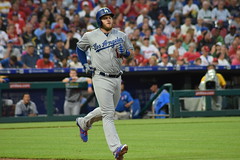
Max Muncy photo

Photo by IDSportsPhoto

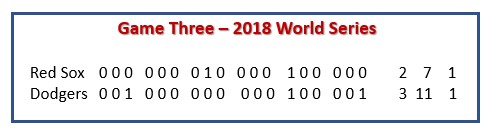
Some may dispute the date of Max Muncy’s walk-off World Series blast.  The game actually started on October 26, but ended – with Muncy’s long ball – at approximately 12:40 a.m. October 27.  Muncy’s heroics makes number-two on this list by virtue of putting an exclamation mark on the ending of the longest World Series game ever – both in terms of innings (18) and time (seven hours and twenty minutes).

How the Game Had Changed

Game Three of the 2018 World Series involved more total playing time (seven hours and twenty minutes) than the entire 1939 Fall Classic. In the 1939 Series (seven hours and five minutes), the Yankees topped the Reds in four straight games.  Game one went to New York 2-1 in one hour and 33 minutes; Game Two ended 4-0 in one hour and 27 minutes; Game three, a 7-3 Yankee win, took two hours and one minute; and the finale, a 7-4 Yankee win in ten innings, took  a whopping two hours and four minutes.

The Dodgers struck first on a third-inning home run (off Rick Porcello) by LF Joc Pederson. The Red Sox tied it on an eighth inning homer by starting CF Jackie Bradley, Jr.

Moving About in the Red Sox’ Garden

Red Sox’ starting CF Jackie Bradley Jr. moved to LF in the eighth; back to CF to open the ninth; back to LF with two outs in the ninth; back to CF to open the tenth; back to LF with two outs in the tenth; back to CF to open the eleventh.  Starting RF Mookie Betts made an equal number of moves between RF and CF; J.D. Martinez, who started in LF, bounced bounced between LF and RF; and starting 2B Brock Holt also saw time in LF and RF.

Neither team scored again until the top of the 13th inning, when The Red Sox’ Brock Holt opened with a walk (on a 3-2 pitch) off Scott Alexander, stole second and scored on a single (and an Alexander throwing error) by 3B Eduardo Nunez. The Dodgers retied the score in the bottom of the inning which – like the Red Sox half-inning – started with a 3-2 walk. Muncy drew a walk from Nathan Eovaldi, advanced to second on a foul pop out by CF Cody Bellinger and scored on a single by RF Yasiel Puig.  The score remained 2-2 until the bottom of the eighteenth, when Muncy led off the inning by launching  a 3-2 pitch from Eovaldi over the fence in left-center for the game-winning home run – sending the LA faithful home tired but happy. Muncy finished the game two-for-six, with two runs scored, one RBI and two walks in eight plate appearances. The long ball accounted for his only home run and only RBI in the Series. (He hit .263 with 35 home runs during the regular season).  The 18-inning triumph was the Dodgers only win in the Series. Muncy, who started the game at first base, played the final four innings at second base. 18
Trivia Tidbits:

  • The Dodgers and Red Sox used a World Series’ record 46 players in the game.
  • The top four spots in the Red Sox lineup went a combined zero-for-28.
  • Dodgers’ pitcher Clayton Kershaw, a three-time Cy Young Award winner, did not take the mound in the game. He was, however, used as a pinch hitter in the 17th inning – lining out to right field.
  • There were a record 35 strikeouts in the contest (19 by the Boston hitters).

Max Muncy has played five MLB seasons (2015-16, 2018-20). His career stat line is .236-87-221 in 432 games.  In 2018, he hit .251-35-98 (his second consecutive season with 35 home runs).

NUMBER THREE – Kirby Puckett, Minnesota Twins – 11th inning, 1991 World Series, Game Six – October 26, 1991
Kirby Puckett photo

Photo by compujeramey 

The Twins went into the Sixth Game of the World Series down three games-to two … and CF Kirby Puckett took the must-win contest in hand.  In the first inning, Puckett hit an RBI triple and later scored the inning’s second run. Then, in the third frame, he leapt high, glove above the Plexiglas(r) fence in deep left center, to rob Braves’ CF Ron Gant of a two-run home run.   In the fifth, after the Braves had tied the game 2-2 in the top of the inning on a home run by 3B Terry Pendleton, a Puckett sacrifice fly brought in Twins’ LF Dan Gladden to regain the lead. The Braves retied it at three in the top of the seventh and that’s where the score stayed until the until Puckett led off the bottom of the twelfth inning with a game-ending home run off Charlie Liebrandt (on a 2-1 pitch).   The Twins went on to win Game Seven and the Series 1-0, as Jack Morris threw a ten-inning, complete game shutout in the “winner-takes-all” finale.

The 1991 World Series saw five games decided by one run – three of those in extra innings.

Hall of Famer Kirby Puckett played 12 MLB seasons – retiring at age 35 due to eye issues (glaucoma). He finished with a .318 career average, 207 home run and 1,085 RBI. He was a ten-time All-star, collected 200+ hits in five seasons, leading the AL in safeties four times. He earned one batting title, hitting .300 or better in eight seasons, and earned six Gold Gloves.

Book ‘Em Dano

August 1, 1986 was a big day for Twins fans gathered at the Metrodome – as a pair of future Hall of Famers wrote their names in the record books.  In that contest, in which the Twins topped the A’s 10-1, Twins’ starting pitcher Bert Blyleven recorded his 3,000th career strikeout and Twins’ CF Kirby Puckett hit for the cycle. Puckett went four-for-five, with three runs scored and two RBI; while Blyleven pitched a complete-game, two hitter with 15 strikeouts.

Puckett’s home run edges out the next two “iconic” blasts because of its importance in keeping the Twins alive  in the Series, the tight nature of the 1991 Fall Classic, the overall way in which Puckett took over the game and the fact the the Twins won Game Seven to take the title.

NUMBER FOUR (tie) – Kirk Gibson, Dodgers – Ninth inning, 1988 World Series Game One – October 15, 1988
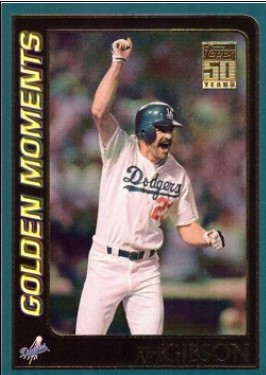
GibsonHow many times have we seen the iconic video of the injury-hobbled Dodgers’ Kirk Gibson moving gingerly to the plate to pinch hit in the ninth inning of Game One of the 2018 World Series – with the Dodgers trailing 4-3 and down to their last out. How serious were Gibson’s injuries? Well, he was suffering from a severe left hamstring pull and a swollen right knee. The pain was serious enough that Gibson – the key to the Dodgers’ lineup, who would be voted the 1988 National League Most Valuable Player – got only one at bat in the entire 1988 World Series. But it was a big one – a game-winning, walk-off, two-run home run in the bottom of the ninth.

MVP, But Not an All Star

While Kirk Gibson was the 1988 NL Most Valuable Player (.290-25-76, with 31 steals), he was not selected to the All Star Team that season.  In fact, in his 17-season MLB career, Gibson never made an All Star Squad.

So, here’s how it went down – or up and out, if you prefer.  While the Dodgers were falling behind the favored A’s, Gibson spent a great deal of time not on the field, not even in the dugout, but in the trainer’s room – watching the game on TV and taking physical therapy (although, as the game progressed he did, reportedly, spend a bit of time in the batting cage).

Gibson’s chance to create a lasting World Series memory came, as one might expect, in the bottom of the ninth. The A’s led 4-3 and starter Dave Stewart was relieved by All Star closer Dennis Eckersley, who had the led the majors in saves with 45, while winning four games, losing two and putting up a 2.35 earned run average (a record that would earn him a second-place finish in AL Cy Young Award voting).  Eckersley quickly got Dodgers’ catcher Mike Scioscia on a pop out to shortstop and 3B Jeff Hamilton on a called third strike. Dodgers’ manager Tommy Lasorda then brought in Mike Davis to pinch hit for SS Alfredo Griffin.  Davis drew a five-pitch free pass from the usual walk-stingy Eckersley, which brought up the pitcher’s spot in the lineup and – to the surprise of fans and broadcaster alike – a limping Kirk Gibson emerged from the dugout to pinch hit.

In what all could see was a painful experience, Gibson fouled off the first two pitches – and the Dodgers were down to their last strike. Gibson fouled off another pitch, took a a ball, fouled off another tough Eckersley offering, took ball two and ball three (while Davis stole second). Then on a 3-2 pitch, Gibson lined a home run to deep right and did a limp-laden, arm-raising and fist-pumping trot around the basses as the Dodger won 5-4. (One of only two World Series gamers featuring a walk-off home run while the winning team was trailing on the scoreboard.) While Gibson would not come to the plate again in the Series, his dramatic long ball set the tone – and the Dodgers topped the favored A;s in five games.

Baseball Roundtable Rant

Dodgers’ pitcher Orel Hershiser won the 1988 World Series MVP Award after giving up just two runs (seven hits, six walks, 17 strikeouts) in two nine-inning, complete-game wins.  BBRT always thought one of my favorite players – the energetic Mickey Hatcher – should have at lease been co-MVP of the Series.  Hatcher, called upon to play a key role due to Kirk Gibson’s injuries – responded by hitting .368 in the Series and leading all hitter in base hits (7), runs scored (5), home runs (2) and RBI (5). During the 1988 season, Hatcher had hit .293, with one home run and  25 RBI in 88 games.

Kirk Gibson played 17 MLB seasons. He hit .268, with 255 home runs, 870 RBI and 284 stolen bases. He hit 20+ home runs in six seasons and stole 20+ bases in six campaigns. Gibson’s best season was 1985, when he hit .287, with 29 home runs, 97 RBI and thirty stolen bases for the Tigers.   The 29 homers and 97 RBI were his career highs. In 21 post-season contests, Gibson hit .282, with seven home runs and 21 RBI. He was MVP of the 1984 ALCS.

NUMBER FOUR (tie) – Carlton Fisk, Red Sox – 12th inning, 1975 World Series Game Six – October 21, 1975

FiskLike Kirk Gibson’s limping, fist-pumping home run trot, Carlton Fisk’s 1975 World Series walk-off homer gave fans a lasting video image – this time of Fisk frantically waving the ball, which hit the Fenway Park left field four pole, fair.  It came about in the twelfth inning of Game Six of the 1975 World Series – a game the Red Sox needed to stay alive in the Fall Classic.

It had been a tense first five games, with the Reds holding a three games-to-two lead over the Red Sox and three of the first five contests decided by one run (one in extra innings). In Game Six, the Red Sox struck first on a three-run home run by CF Fred Lynn (off Gary Nolan) in the bottom of the first. The Reds came back to tie it with a trio of runs in the top or the fifth – highlighted by a (RF) Ken Griffey Sr. two-run triple and an RBI single by C Johnny Bench (both off Red Sox’ starter Luis Tiant). The Reds then pushed ahead 5-3 on a seventh-inning, two-run double by LF George Foster and grew the lead to 6-3 on a Cesar Geronimo (CF) solo homer in the eighth.  The see-saw battle continued as the Red Sox came back to tie it in the bottom of the eighth inning on two-out, three-run homer by pinch hitter Bernie Carbo.  (Carbo stayed in to play left field.)

The score was still 6-6 when Fisk led off the bottom of the twelfth against reliever Pat Darcy (the Reds’ eighth pitcher of the game). Fisk who already had a single and two intentional walks (in five plate appearances) hit a 1-0 pitch (at precisely 12:35 a.m. October 22) off the foul pole high above the “Green Monster” in left field – creating a lasting image of him leaping up and down and frantically waving the high fly fair.  Fisk’s walk-off led to a Game Seven, which Boston lost 4-3 (the Series had five one-run games). In 2005, the Red Sox named the foul pole the “Fisk Foul Pole” in honor of the blast.

Fisk hit .240 in the series with two home runs, four RBI, five runs scored and seven walks (three intentional).

Rookie of the Year

In 1972, Carlton Fisk was the American League’s first unanimous Rookie of the Year selection. That season, he went .293-22-61 in 131 games and led the AL in triples with nine. Only two MLB  catchers have led their league in three-baggers –  Fisk in 1972 and Tim McCarver of the Cardinals in 1966.

Hall of Famer Carlton Fisk had a 24-season MLB career (1969, 1971-93) during which he was an 11-time All Star. He hit .269-376-1,330 for his career.

A Hard Day’s Night

On May 8, 1985, Carlton Fisk set a record by catching all 25 innings of his Chicago White Sox’ 7-6 win over the Milwaukee Brewers. Actually, he set the record on May 9, since the game – which took eight hours and six minutes to complete – was suspended at 1:05 a.m. (after 17 innings) and completed before the regularly scheduled May 9 Brewers/White Sox matchup.  Fisk went three-for-eleven, with a walk, in the 25-inning game.  Notably, while Fisk did not start the regularly slated May 9 game, he he came in as a pinch runner in the bottom of the seventh and caught the final two innings of that contest.  

NUMBER SIX – David Freese, Cardinals – 11th inning, 2011 World Series Game Six – October 27, 2011
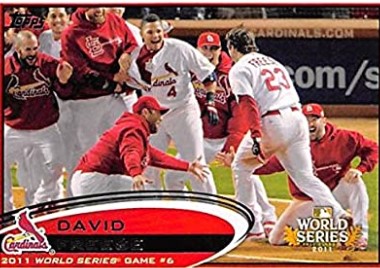
fREESEThe Cardinals were down three games-to-two to the Rangers, when Game Six of the 2011 Series opened in St. Louis.  As they went into the bottom of the ninth, the Redbirds were trailing 7-5 and on the verge of losing the Series. Facing the Rangers’ hard-throwing closer Neftali Feliz, 2B Ryan Theriot went down swinging to open the frame – putting the Cardinals just two outs from elimination. 1B Albert Pujols followed with a double to CF. The next batter, RF Lance Berkman, drew a walk, putting the double play on the board. While he didn’t get the DP, Feliz did get the out, fanning LF Allen Craig to bring up 3B David Freese with the Cardinals one out from losing the Series.  Freese got down in the count 1-2 (now the Cards were one strike from going home for the winter) and then laced a triple to right – scoring Pujols and Berkman and tying the game. The Rangers took the lead again with two-run home run by LF Josh Hamilton in the top of the tenth.  The Cardinals, however, refused to fold and prolonged their season with two runs on three singles and a walk in the bottom of the inning.

Everybody Gets to Play

Game Six of the 2011 World Series saw the Rangers and Cardinals use a combined 42 players (15 pitchers). 

Then, after reliever Jake Westbrook held the Rangers scoreless in the top of the eleventh, David Freese came up big again, hitting a 3-2 pitch from reliever Mark Lowe for a 10-9 Cardinals’ win.  The Cardinals went on to take Game Seven by a 6-2 score.

MVP-MVP

David Freese was the MVP in both the 2011 NLCS (when he hit .545-3-9) and the 2011 World Series (.348-1-7), Between Game Two of the 2011 NL Division Series and Game Four of the 2011 World Series, Freese ran up a 13-game, post-season hitting streak.

Freese played 11 MLB seasons, hitting .277-113-535. His best season was 2012, when he went .293-20-79 (career highs in HR and RBI). In 2011, he went .297-10-55 in 97 games.

NUMBER SEVEN – Eddie Mathews – 10th inning, 1957 World Series Game 4 – October 6, 1957

See the opening paragraphs for this one.

NUMBER EIGHT– Tommy Heinrich, Yankees – 9th inning, 1949 World Series Game One – October 5, 1949

HenrichGame One of the 1949 World Series pitted two tough New York rivals – the Yankees and Dodgers. It also showcased stars like Duke Snider, Jackie Robinson, Pee Wee Reese, Carl Furillo, Gil Hodges. Roy Campanella, Phil Rizzuto, Joe DiMaggio and Yogi Berra.  And, it featured a pitching duel between Dodgers’ rookie and 17-game winner Don Newcombe and the Yankees ’32-year-old veteran (also 1949 17-game winner) Allie Reynolds.  The ultimate star of the game – at Yankee Stadium – would be Yankees ‘1B Tommy Henrich.  (Note: Henrich got extra credit in BBRT’s rankings for hitting the first-ever World Series walk-off home run.)

As the game went into the bottom of the ninth, both teams were scoreless and both starting pitchers were still at work. Reynolds had pitched nine frames, giving up just two hits and walking four, while fanning nine. Newcombe may actually have been just a bit more dominating.  In eight innings, he had surrendered just four hits, while walking none and fanning eleven.

Tommy Henrich put an end to the contest leading off the bottom of the ninth and taking a 2-0 Newcombe fastball over right-field wall for a 1-0 Yankees win. The Yankees went on to win the Series four games-to-one. Henrich hit .263 in the Series and his walk-off represented his only home run and RBI.

Henrich played in 11 MLB seasons (1937-50, missing three seasons for military service), all for the Yankees. The first-baseman-outfielder hit .282-183-795 and led the American League in triples twice and runs scored once (138 in 1948). He was a five-time All Star. Henrich played in four World Series (1938-41-47-49) and hit one home run in each (.262-4-8 in 21 World Series games).

NUMBER NINE –  Dusty Rhodes, New York Giants – 10th inning, 1954 World Series Game One – September 29, 1954
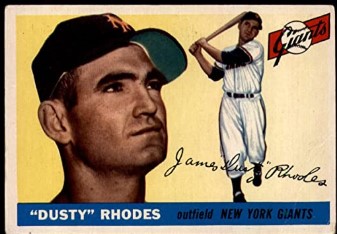
rHODESWhen fans think about Game One of the 1954 World Series, they generally focus on “The Catch” – Willie Mays’ spectacular eighth-inning, over-the-shoulder, running grab of the Indian’s Vic Wertz’ long drive to deep center field.  Mays’ stunning catch and equally spectacular spinning throw back to the infield (holding Indians’ runners on first and second) preserved a 2-2 tie.

The game stayed knotted at two runs apiece until the bottom of the tenth inning, when Dusty Rhodes was called on to pinch hit for LF Monte Irvin (who was zero-for-three) with runners on first and second and one out.  Rhodes hit the first pitch from Indians’ starter and future Hall of Famer Bob Lemon (23-7, 2.72 that season) just over the Polo Grounds’ right-field wall – 257-feet from home plate – giving the Giants a 5-2 win. Rhodes got points in this ranking for knocking the only pinch-hit, World Series, walk-off home run.

Rhodes, who hit .253-54-207 in a seven-season MLB career (1952-57 and 1959) hit .667 in the 1954 Fall Classic (won by the Giants in a sweep), going four-for-six with two home runs and seven RBI. Often coming off the bench. Rhodes played in 100 or more games in only one season.   1954 was his best campaign, he hit .341-15-50 in 82 games (164 at bats) – and .326 as a pinch hitter.

Your Guy in a Pinch

Dusty Rhodes was known as a guy who could come off the bench and deliver a big hit. In fact, 21 percent of his regular-season 1,316 plate appearances came in a pinch-hitting role. 

NUMBER TEN – Alex Gonzalez, Marlins – 12th inning, World Series Game Four, October 22, 2003
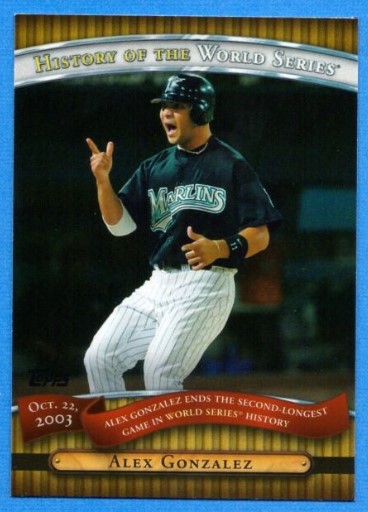
gONZALEZThe underdog Marlins came into Game Four of the 2003 World Series trailing the Yankees two games-to-one and facing Roger Clemens.

How deep was the 2003 Yankee pitching staff? Roger Clemens (17-9 in the regular season) didn’t get a start in the World Series until Game Four.  Preceding him were: David Wells; Andy Pettitte and Mike Mussina.

The Marlins jumped on Clemens for three runs in the bottom of the first inning on a two-run home run by RF Miguel Cabrera and a run-scoring single by 1B Derrek Lee.  Clemens settled down after that and held the Marlins scoreless over the next six innings.  The Marlins, in fact, would be held without a run for 10 straight frames.  In the meantime, the Yankees scored one in the top of the second (the only run surrendered by Marlins’ starter Carl Pavano over eight innings) and two in the top of the ninth on a two-strike (3-2 count), two-run triple by pinch hitter Ruben Sierra (off Marlins’ closer Ugueth Urbina).

The Marlins’ escaped a two-on, nobody-out Yankee threat in the top of the eleventh and, as the game went into the bottom of the twelfth, it was still 3-3.  Gonzalez led of the Marlins’ half of the twelfth inning, by going yard on a 3-2 from Jeff Weaver.  That win seemed to turn the Series on end – as the Marlins won the next two games to take home the championship.

Gonzalez played 16 MLB seasons, hitting .245-157-690. He was an All Star just once, in his first full MLB season (age 22), when he hit .277-14-59 in 136 games. His walk-off homer in the World Series was his only long ball in 83 post-seasons at bats (24 games).

NUMBER-ELEVEN – Joe Carter, Blue Jays – 9th inning, 1993 World Series, Game Six – October 23, 1993
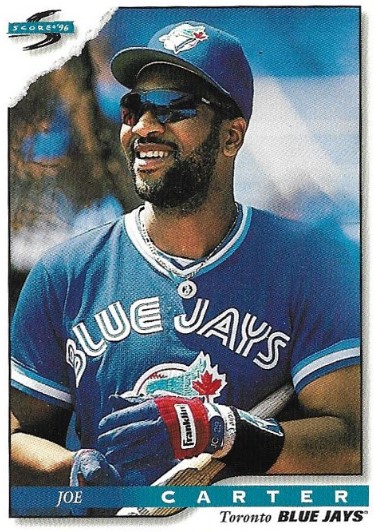
carterJoe Carter’s World Series’ walk-off is one of only two in which the home team was trailing (rather than tied) at the time of the blast (and would have finished higher on this list if it had come late in extra innings or if the Blue Jays had needed the win to stay alive in the Series). Carter’s Blue Jays, up three games-to-two, looked to have the game in hand early – leading the Phillies 5-1 after six innings.  The Phillies, however, shocked the home crowd with a five-run top the seventh. Jays’ starter Dave Stewart, who had given up just one run over the first six innings, walked SS Kevin Stocker (in a ten-pitch at bat) to start the inning, then gave up a single to  2B Mickey Morandini (the number-nine hitter) and a three-run home run to CF Lenny Dykstra. That brought on reliever Danny Cox, who got just one out, while surrendering three singles and a walk – leaving with one run already in and the bases loaded. Next to the mound was Al Leiter, who gave up a sacrifice fly before recording the final out of the frame.  Suddenly, a 5-1 Blue Jays’ advantage had turned to 6-5 Phillies.

It stayed that way until the bottom of the ninth, when Phillies’ closer Mitch Williams walked Blue Jays’ LF Rickey Henderson on four pitches to start the inning.  CF Devon White then flied to left for the first out.  DH Paul Molitor followed with a single, which set up RF Carter’s game-winning three-run home run – giving the Blue Jays a four game-to-two Series win – and creating a memory that lives on in Blue Jays’ lore.

Power and Speed

Joe Carter had six seasons of 30 or more home runs and six campaign of 20 or more stolen bases.  In 1987, he had a 30-30 season – .264-32-106, with 31 steals.

Carter payed 16 MLB seasons, going .259-396-1,445, with 231 stolen bases.  He was a five-time All Star and ten times drove in 100+ runs. In 1993, he hit .254, with 33 home runs and 121 RBI in the regular season and .280-2-9 in the World Series.

NUMBER TWELVE –  Derek Jeter, Yankees – 10th inning, 2001 World Series Game Four – October 31, 2001
dEREK jETER photo

Photo by Pat Guiney

The Yankees came into Game Four of the 2001 World Series down two games-to-one to the Diamondbacks – and facing Curt Schilling, who had gone 22-6 and fanned 293 batters in the regular season and had held the Yankees to two hits and one run in seven innings (picking up the win) in Game One.

The Yankees jumped out on top 1-0 in the bottom of the third on a home run by LF Shane Spencer. The Diamondbacks came right back with a home run by 1B Mark Grace (off Orlando Hernandez) in the top of the fourth and took a two-run lead in the top of the eighth on a single, double and fielder’s choice. The Bronx Bombers, in danger of falling behind three games-to-one, tied it on a two-run home run by 1B Tino Martinez (off Byung-Hyun Kim) with two outs in the bottom of the ninth.

Mariano Rivera pitched a 1-2-3 top of the tenth – and Derek Jeter ended it by taking Kim deep on a 3-2 pitch with two out in the bottom of the inning. (The Diamondbacks eventually won the Series four games-to-three.)

Two decades of Safeties

Derek Jeter’s 3,465 MLB hits are sixth all time.

Hall of Famer Derek Jeter played 20 MLB seasons – going .310-260-1,311, with 358 steals. He was a 14-time All Star and the 1996 AL Rookie of the Year.  Jeter scored 100 or more runs in 13 seasons, hit .300 or better 12 times, had 200+ hits in eight seasons and 20+ stolen bases in eight campaigns.  He was also a five-time Gold Glover.

October Baseball in His Blood

Derek Jeter leads MLB in post-season games played (158), base hits (200), runs scored (111), doubles (32), triples (5-tied) and total bases (302). 

NUMBER THIRTEEN –  Scott Podsednik, White Sox – 9th inning World Series Game Two – October 23, 2005

While White Sox’ LF Scott Podsednik’s home run didn’t come in extra innings or in a Series-winning or Series-extending game, it did come as a surprise.  That’s because during the 2005 season, Podsednik had gone without a single round tripper (507 at bats). The White Sox, who had topped the (then) National League Astros 5-3 in Game One of the Series, carried a 6-4 lead into the ninth inning of Game Two. They brought in closer Bobby Jenks to seal the deal, but a pair of singles and a walk (and two outs) later, Jenks was gone and the game was tied.  The Astros brought in Brad Lidge in the bottom of the inning to keep it there.  After getting number-nine hitter SS Juan Uribe to fly out, Lidge gave up a surprising home run to the power-starved Podsednik to end the contests and send the White Sox on the way to a four-game sweep. Podsednik by the way, had put up a .290 average and stolen 59 bases during the regular season.

Dangerous on the Base Paths

In the four seasons from 2003 through 2006, Scott Podsednik stole 212 bases, including a league-leading 70 in 2004.

Podsednik played 11 MLB seasons, hitting .281-42-812 with 309 stolen bases. Despite not showing a lot of regular-season power, Podsednik’s 14 post-season hits (in 12 games) included one double, three triples and two home runs.  His post-season slugging percentage was .551, compared to a regular-season career slugging percentage of .379.

NUMBER FOURTEEN – Mickey Mantle, Yankees – 9th inning, 1964 World Series, Game Three – October 10, 1964
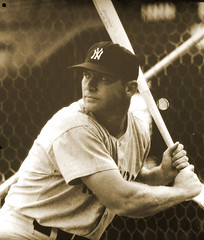
You had to expect Mickey Mantle to appear on this list. After all, he hit a record 18 World Series home runs in his career. His only walk-off Fall Classic long ball came against the Cardinals in Game Three of the 1964 Series. The Cards and Yankees had split the first two contests in a couple of lopsided slugfests. The Cards won Game One 9-5, while the Yankees prevailed 8-3 in Game Two. Moving to New York for Game Three, a pair of 18-game winners (Curt Simmons of the Cards and Jim Bouton of the Yankees) held the opposing offenses in check – with the game tied 1-1 after eight innings. Simmons had given up one run on four hits – in the second inning, 3B Clete Boyer had plated C Elston Howard with an RBI single.  Bouton have given up one run on six hits, as Simmons helped his own cause, driving in C Tim McCarver with a fifth-inning single.

In the top of the ninth, Bouton pitched around an error by SS Phil Linz on a McCarver grounder and a walk to pinch hitter Carl Warwick – holding the score at 1-1. Barney Schulz came on in relief of Simmons and Mantle hit his first offering for a walk-off homer to right. The Cardinals went on to win the Series four games-to-three, despite Mantle hitting .333, with three home runs and 8 RBI.

The World Series Belong to Mick

Mickey Mantle, who played in 65 World Series Games, holds the career records for World Series walks (43); extra-base hits (26); home runs (18); runs batted in (40); runs scored (42); total bases (123); and strikeouts (54). He hit .257 in Fall Classic play.

The Hall of Famer played in 18 MLB seasons and was an All Star in all but two of them. (1951 & 1956). He was a three-time AL MVP and four-time AL home run leader. Hi collected 2,415 career hits (.298 average); 536 home runs; and 1,509 RBI. Mantle won the AL Triple Crown in 1956 with a .353-52-130 line and was a three-time AL Most Valuable Player.

NUMBER FIFTEEN – Mark McGwire, A’s – 9th inning, 1988 World Series, Game 3 – October 18, 1988

mACThe Oakland A’s went into the 1988 World Series as favorites, but ended up losing to the Dodgers four games-to-one.  Mark McGwire’s walk-off home run in Game Three gave the A’s their only victory.

With the low final score (2-1), you might expect that the game was a classic pitching duel between the Dodgers’ John Tudor (10-8, 2.32 during the season) and A’s Bob Welch (17-9, 3.64). Not the case, as Tudor was gone after just 1 1/3 innings – pulled due to an elbow injury after retiring the first four batters he faced.  Welch fared a bit better giving up just one run in the first five innings– but having thrown a lot of pitches under stress (four hits and two walks over the first five frames).  Welch was pulled after the sixth inning started with the A’s loading the bases (double, single, walk) with no outs.

The bullpens pretty much took care of business in this one, with the score knotted at one run apiece after eight innings. In the top of the ninth, the A’s Rick Honeycutt set the Dodgers down in order (he retired six straight batters in his two-inning stint).  Jay Howell came on for the Dodgers in the bottom of the inning and, after getting Jose Canseco to pop out, gave up a game-ending home run to McGwire on a 2-2 pitch (in a tough eight-pitch at bat).

The 1988 World Series is the only Fall Classic with two games ending on walk-off home runs – Games One and Three.

McGwire’s walk-off home run in Game Three of the 1988 World Series was his only hit in the Series (17 at bats).

In 1988, Mark McGwire hit .260-32-99 – a season after a .289-49-118 rookie campaign (and the American League Rookie of the Year Award). McGwire played 16 MLB seasons, was a 12-time All Star and four-time league home run champ. His final MLB stat line was .263-583-1,414.  In 1998, McGwire hit 70 round trippers. He followed that up with 65 long balls in 1999.  McGwire is one of just three players with four seasons of fifty or more home runs (McGwire, Babe Ruth, Sammy Sosa).

On the Move, In the Groove

In 1997, Mark McGwire led all of M LB with 58 home runs, but did not win a league home run championship. He hit 34 home runs in 105 games for the A’s, before being traded to the Cardinals, for whom he hit 24 home runs in 51 contests.

NUMBER SIXTEEN –  Chad Curtis, Yankees – 10th inning, 1999 World Series Game Three- October 26, 1999
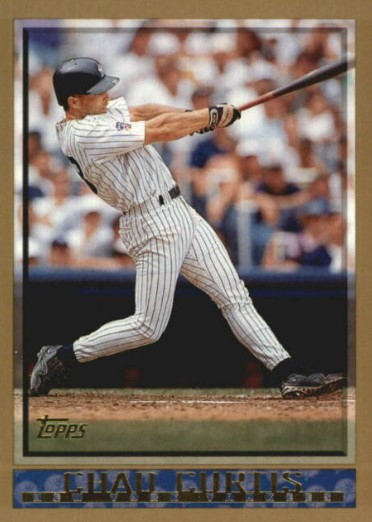
CURTISThe Yankees were already up two games-to-none on the Braves going into Game Three of the 1999 World Series, but the Braves came out of the gate hot, building a 5-1 lead over the first four innings. The Yankees, however, tightened up on the mound (getting 6 1/3 scoreless innings from three relievers) and slowly chipped away.  LF Chad Curtis got one back with a home run off Tom Glavine in the fifth. 1B Tino Martinez added a solo shot off Glavine in the seventh. And 2B Chuck Knoblauch hit a two-run homer in the eighth. Not so suddenly, the game was tied.  Both teams were scoreless in the ninth to send the contest into extra innings. The Braves pulled out all the stops in the top of the tenth, using a trio of pinch hitters (among four batters) – Ozzie Guillen, Ryan Klesko and Greg Myers, but did not score.  Curtis led of the bottom of the tenth with his second home run of the game – joining the list of players with walk-off World Series dingers.

Curtis played 10 MLB seasons, hitting .264-101-461, with 212 stolen bases. He stole 20+ bases five times and hit a career-high 21 home runs for the Tigers in 1995.

Chad Curtis stole 91 bases in his first two MLB season (1992-93) with the Angels.

Primary Resource: Baseball-Reference.com

100Baseball Roundtable is on the Feedspot list of the Top 100 Baseball Blogs.  To see the full list, click here.

I tweet baseball @DavidBBRT

Follow/Like Baseball Roundtable’s Facebook Page here.  More baseball commentary; blog post notifications; PRIZES.

Member: Society for American Baseball Research (SABR); Negro Leagues Baseball Museum; The Baseball Reliquary
The League Championship Series – Plenty of Long Ball Highlights

The League Championship Series are behind us – and here’s a look back at what caught Baseball Roundtable’s attention in this round.

First – and, perhaps, most important – the two teams with the best records are moving on to the World Series.  As the Astros advanced, I did fear the expanded “tournament” format might render the season-long results relatively meaningless.

Second, we are seeing two teams at opposite end of the financial spectrum. According to MLB.com, the Dodgers have the highest pro-rated payroll, while the Rays have the third-lowest.

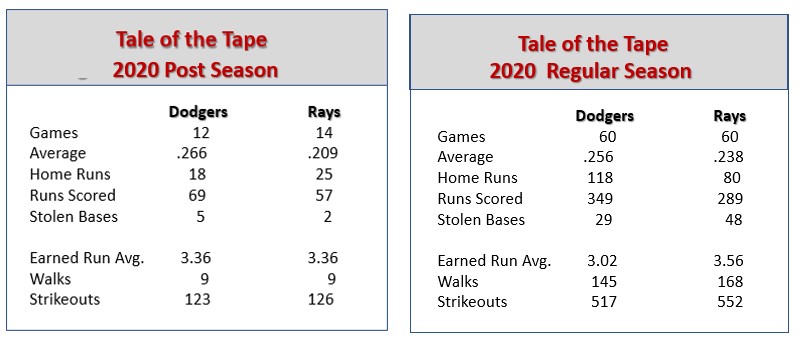
Third – at least this far into the post season – the two squads took different paths to the Fall Classic.  This post season, for example, the Rays have scored 72 percent of their runs via the home run, compared to 42 percent for the Dodgers. As the “The Tale of the Tape” charts below show, you might have expected the Dodgers to look to the long ball more than the Rays. I was also a bit surprise to see that the Dodgers used an average of 5.1 pitchers per game, while the Rays used an average of 4.3. (I fully expected the Rays would make more pitching changes.)

Tape

Then there is the traditional BBRT Trot Index (plate appearances that result in a trot to first base or back to the dugout, rather than action on the field). As you can see, the percentage of overall plate appearances resulting in a “trot” were fairly level across the regular season and post season – with between 37 and 39 percent of plate appearances ending in a trot.  Still, we have seen a bit of an uptick in home run frequency in the post-season (perhaps in part due to the Rays’ newly found power).

Trot

Now, a few highlights from the League Championship Series.

Ouch.  Hard to Dodge(r) Those Bullets

In Game Three of the NLCS (October 14), the Dodgers put up 11 runs in the first inning against the Braves. The 11 tallies are the most scored by any team in any inning of a post-season contest. That Dodger big inning featured three home runs (Joc Pederson, Edwin Rios, Max Muncy); two doubles; two singles; three walks; and one hit-by-pitch.

Good to the Very Last Out

Ten of the eleven runs scored in the Dodgers’ big inning versus the Braves came after two outs. Going into the 11-run inning, Braves’ pitchers had given up just 12 runs in 67 2020 post-season frames (1.61 ERA). 

There’s Always a First Time

On October 14, in Game Three of the Dodgers/Braves NLCS, Atlanta’s number-nine hitter, rookie CF Cristian Pache, hit his first major league home run. It came in the bottom of the third inning and, while the Braves were trounced 15-3, Pache did make a little bit of history. He became just the seventh major leaguer to hit his first long ball in the post season. The 21-year-old rookie had just four at bats in the regular season (one hit, two strikeouts). In four minor-league seasons, Pache hit .283 with 21 home runs.

Here’s a snapshot of the others on this list.  Four of them were pitchers and for three it was the only MLB home run of their careers.

Rosy Ryan, Giants, Pitcher – October 6, 1924 – World Series Game Six

Ryan, who came on in relief in the top of the fourth inning of the 1924 World Series sixth game, took the Senators’ Allen Russell deep (solo shot) in the bottom of the inning – expanding the Giants’ lead to 4-2 in a game they eventually won 6-4.  Ryan played in ten MLB seasons, going 51-47, 4.14. As a hitter, he was .190-1-12 in the regular season and .250-1-2 in four post-season at bats.

Frank Demaree, Cubs, CF – October 2, 1932 – World Series Game Four

Frank Demaree was just 22-years-old, with only 22 regular-season games for the Cubs, when he started in CF, batting fifth, for Chicago in Games Two and Four of the 1932 World Series (against the Yankees). Demaree had an RBI single in four trips in Game Two, then marked his place in post-season history with his first MLB home run (a three-run shot) in the bottom of the first inning of Game Four.   Demaree went on to play 12 MLB seasons, hitting .299-72-591.

Mickey Lolich, Pitcher, Tigers – October 3, 1968 – World Series Game Three

Mickey Lolich hit his first AND ONLY MLB home run in Game Two of the 1968 World Series (Tiger versus Cardinals). The solo shot came in the top of the third inning of a Tigers’ 8-1 win in St. Louis. Lolich also drew a bases-loaded walk in the ninth inning, had a single in the eighth and pitched a complete-game, six-hitter – for a pretty good day at the ballpark. Lolich went 217-191, 3.44 in sixteen MLB seasons – and hit .110-0-31.

Don Gullett, Pitcher, Reds – October 4, 1975 – NLCS Game One

Gullet’s first MLB home run was a two-run shot in the bottom of the fifth inning of the Reds’ 8-3 win over the Pirates in Game One of the 1975 NLCS.  Gullett also had an RBI single in the second inning and tossed a three-run, eight-hit complete game.  Like Lolich, Gullet’s post-season dinger was his ONLY MLB home run. Gullet pitched in nine MLB seasons, going 109-50, 3.11 and hitting .194-0-36. He was a better post-season hitter, going .292-1-6 in 24 at bats over eleven post-season series.

Melvin Mora, CF, Mets – October 13, 1999 – NLCS Game Two

Melvin Mora, a 27-year-old rookie, replaced Ricky Henderson in the second inning Game Two of the 1999 NLCS, (versus the Braves).  In 31 regular-season at bats, Mora had hit .161 with no home runs and just one RBI. In the fifth inning of this game, he hit his first MLB home run, a solo shot off Kevin Millwood that tied the game at one apiece. Mora would play 13 MLB seasons, hitting .277-171-754. His best campaign was 2004, when he hit .340 with 27 home runs, 101 RBI, 111 runs scored and 11 stolen bases for the Orioles.

Joe Blanton, Pitcher, Phillies – October 26, 2008 – World Series Game Four

Joe Blanton’s home run in Game Four of the 2008 World Series was his first AND ONLY  MLB long ball. The solo shot came against the Rays’ Edwin Jackson in the top of the fifth with the Phillies leading 5-2.  Blanton would pitch 13 MLB seasons going 101-97, 4.38 and hitting .106-0-6 (216 at bats).  The home run off Jackson was Blanton’s only hit in 15 post-season plate appearances (one hit, one walk, ten strikeouts).

Bookends, Indeed

On October 15, as the Astros topped the Rays in Game Five of the ALCS. Astros’ leadoff hitter George Springer hit the very first pitch in the bottom of the first inning for a home run to deep LF. Eight innings later, in the bottom of the ninth, with the game knotted at 3-3, Astros; SS Carlos Correa hit the last pitch of the game (a 1-1 offering from reliever Nick “Anderson) out of the park to CF for a walk-off game winner. To prove that “in baseball we track everything,” it was noted that this was the first instance of a team hitting the first and last pitch it saw in a post-season game for a pair of home runs.

What a Relief to Start

On October 16, in Game Five of the NLCS, southpaw A.J. Minter of the Braves made his first-ever MLB start – holding the Dodgers to one hit and no runs, while walking none and fanning seven (over three innings).   The Dodgers, by the way, won the Game 7-3. Up until that game, the 26-year-old Minter had made 139 regular-season and five post-season appearances – all in relief.  While he came away with a no-decision, he did make a mark as the first MLB pitcher to make his very first start in the post season.

K-Rod … Post-Season Decision-Maker

Francisco Rodriguez made his MLB debut (with the Angels) on September 18, 2002 and  went on to appear in five 2002 regular-season games (5 2/3 innings pitched and 13 strikeouts) – with no decisions (wins, losses or saves). In the 2002 post-season, he appeared in 11 games and picked up five wins and one loss (18 2/3 innings pitched, 28 strikeouts). Thus, Rodriguez tied (Randy Johnson, 2001) for the record for the most wins in a single post-season (five) before having a single regular-season decision. (Stephen Strasburg joined Johnson and Rodriguez with five wins in the 2019 post season.)

Rodriguez went on to pitch 16 MLB seasons (2002-2017), was a six-time All Star, and led the AL in saves three times.  He holds the MLB record for saves in a season, with 62 in 2008.  His final career stat line was 52-53, 2.86, with 437 saves and 1,142 strikeouts in 976 innings.

Which Mr. Smith was That?

On October 16, as the Dodgers topped the Braves 7-3 in Game Five of the NLCS, Dodgers’ catcher Will Smith was a hero, hitting a go ahead three-run home in the top of the sixth inning.  But it was not all celebration for the game’s Wil Smith(s). Dodger Will Smith hit his homer off Braves’ reliever Will Smith – who earned a blown save and a loss.

Not in the Post Season, but in the Same Vein as the Two Will Smiths

On August 15, 1962, the Phillies topped the Mets 9-3 in the first game of a doubleheader at the Polo Grounds.  No big surprise there, as the Mets’ record going into the game was 30-88. What was more surprising was that Phillies’ outfielder Don Demeter hit his 19th and 20th home runs of the season in the game – off a right-handed and a left-handed “Bob Miller.” Oh yes, and he did it while playing two different defensive positions.

In the third inning, with the Phillies’ up 2-0, Demeter (who had started the game in left field and in the five-spot in the order) smacked a solo shot off starter (right-hander) Robert Lane Miller. Then in the ninth inning, Demeter – who had moved to center field in the seventh – hit a three-run homer (extending the Phillies’ lead to 9-2) off southpaw reliever Robert Gerald Miller. Two homers, in one game, off two Bob Millers, a right-hander and a port-sider.

Demeter, notably, was on the way to his best-ever major league season. In 1962 (his sixth of eleven MLB seasons), he achieved his career highs for average (.307), home runs (29), RBI (107), runs scored (85), hits (169) and doubles (24). The two Millers?  Starter Bob Miller went 1-12, 4.89 in 1962 (69-81, 3.37 with 52 saves in 17 MLB seasons). Reliever Bob Miller went 2-2, 7.08 in 1961, the last of his five MLB seasons (6-8, 4.72).

Another There’s Always a First Time

On October 17, Braves’ starter Max Fried took a loss for the first time in 2020. Fried had gone 7-0. 2.25 in 11 regular-season starts and had three no-decisions in his three 2020 post-season assignments. (He had gone 0-0, 2.65, with 18 whiffs in 17 innings in those three starts.) In the October 17 start versus the Dodgers, Fried gave up three runs in the first inning of a 3-1 loss. Then pitched 5 2/3 scoreless frames.

MVP-MVP

corey seager photo

Photo by apardavila

The MVPs of the two Championship Series were Rays’ rookie Randy Arozarena – who became the first rookie position player to win a League Championship Series (or World Series) MVP Award – and Dodgers’ SS Corey Seager.

Seager came close to literally “tearing the cover off the ball.”  In the seven-game NLCS, he hit .310, with five home runs and 11 RBI – the only National Leaguer to reach those homer and RBI numbers in a single post-season series.

Cruzin’ to a Record

Nelson Cruz holds the AL and MLB record for the most home runs in a single post-season series. In the 2011 ALCS, Cruz (then with the Rangers) hit six home runs and drove in 13 tallies, as Texas topped Detroit in six games

RandyArozarena hit .321 in the ALCS (9-for-28), with four home runs, four RBI and six runs scored.  Over the first three rounds of the playoffs he hit .382, with seven homers and ten RBI.   Note:  While the 25-year-old outfielder retained his rookie status this season, he did see post-season action in 2019 (after an August call up to the Cardinals); going 0-4 in five NLDS and  NLCS games with the Redbirds. His seven homers are an MLB rookie record for a single post-season and he is only one dinger off the overall MLB record of eight (Barry Bonds, 2002; Carlos Beltran, 2004; Nelson Cruz, 2011).  He’s got plenty of time to join or surpass that trio of stars.

A Winner in Winner-Takes-All

Charlie Morton baseball photo

Photo by jmd41280

Rays’ Game Seven ALCS starter Charlie Morton picked up his MLB-record fourth victory in a “Winner-Takes-All” contest.  In addition to this year’s ALCS Game Seven, he picked up victories in Game Seven of the 2017 ALCS and Game Seven of the 2017 World Series (as a member of the Astros), as well as for the Rays in last season’s Wild Card Game.

In those four contests, he pitched a total of 19 2/3 innings, giving up 11 hits and just one earned run (two runs), while walking six and fanning 19. In the 2020 post-season, Morton is 3-0, with a 0.57 earned run average in three starts (15 2/3 innings pitched).


—–Top 2020 Post-Season Hitters Going into the World Series—-

AVERAGE

Dodgers:  Mookie Betters (.311); Corey Seager (.298) Cody Bellinger (.250)

Rays: Randy Arozarena (.382); Manuel Margot (.256); Joey Wendle (.225)

HOME RUNS

Dodgers: Corey Seager, Dodgers (6); Cody Bellinger, Dodgers (3); Enrique Hernandez (2); Max Muncy (2); Edwin Rios (2)

Rays: Randy Arozarena (7); Manuel Margot (5); Ji-Man Choi (2); Austin Meadows (2)

RBI

Dodgers: Corey Seager (15); Will Smith, Dodgers (11); Cody Bellinger, Dodgers (10)

Rays: Manuel Margot (11); Randy Arozarena (10); Mike Zurino, Rays (8)

RUNS SCORED

Dodgers: Corey Seager (13); Mookie Betts (10); Justin Turner (10)

Rays: Randy Arozarena (14); Manuel Margot (7); Joey Wendle (7)

—–Top 2020 Post-Season Pitchers Going into the World Series—–

EARNED RUN AVERAGE (at least ten innings pitched)

Dodgers:  Julio Urias (0.56); Walker Buehler (1.89); Clayton Kershaw (3.32)

Rays: Charlie Morton (0.57); Blake Snell (3.20); Tyler Glasnow (4.66)

WINS

Dodgers: Julio Urias (4); Clayton Kershaw (2)

Rays: Charlie Morton (3); Tyler Glasnow (2); Blake Snell (2)

STRIKEOUTS

Dodgers: Walker Buehler (30); Clayton Kershaw (23); Julio Urias (16)

Rays: Tyler Glasnow (25); Blake Snell (19); Charlie Morton (17)

APPEARANCES

Dodgers: Blake Treinen (8); Brusdar Graterol (6); Kenley Jansen (6)

Rays: Nick Anderson (7); Diego Castillo (7); John Curtiss (6); Pete Fairbanks (6); Ryan Thompson (6)

SAVES

Dodgers: Kenley Jansen (2); Brusdar Graterol (1); Joe Kelly (1)

Rays: Pete Fairbanks (3); Diego Castillo (2); Nick Anderson (1)

WHO WIN THE WORLD SERIES? I LEAN TOWARD THE DODGERS, BUT THIS SHOULD BE A GREAT ONE TO WATCH. 

Primary Resources: MLB.com; Baseball-Reference.com; Stathead.com; ESPN.com

100Baseball Roundtable is on the Feedspot list of the Top 100 Baseball Blogs.  To see the full list, click here.

I tweet baseball @DavidBBRT

Follow/Like Baseball Roundtable’s Facebook Page here.  More baseball commentary; blog post notifications; PRIZES.

Member: Society for American Baseball Research (SABR); Negro Leagues Baseball Museum; The Baseball Reliquary

Baseball Roundtable Post-Season Predictions … Should Have Just Flipped a Coin

Wow!  Baseball Roundtable’s predictions for Round One (Wild Card Series) of this year’s post-season left a bit to be desired.  I got only four of the eight match ups right.  You ought to be able to do that by simply flipping a coin.  Note:  I tried the coin flip before writing this post, giving the higher seed “heads “each flip, and came up with four-for-eight.

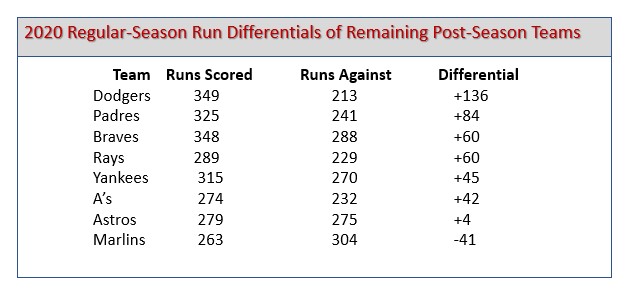
I just didn’t see the Astros, with their 29-21 record (and 9-23 road mark) topping the Twins (36-24 overall and 24-7 at home). Maybe, it was my home town “glasses.”  I also thought the Reds’ starting combination of Trevor Bauer, Luis Castillo and Sonny Gray could handle the Braves’ offense. I didn’t foresee the Braves staff totally stifling the Reds’ offense.  Bauer and Castillo (the Reds two starters) did deliver as expected, pitching a combined 13 innings and giving up just one run, while fanning 19.  The Braves’ starers (Max Fried and Ian Anderson) were just a touch better (13 scoreless frames) and the Braves’ bullpen was lights out. I also fanned on the Cubs/Marlins (swayed by the Marlins’ -41 regular-season run differential) and was maybe just a little too impressed by the White Sox’ (versus A’s) offense. The Sox put up 306 regular-season runs to the A’s 274; out hit them .261 to .225 and out-homered them 96-71. In a close series the A’s outscored the Sox 12-11, to take two of three.

What did I get right? The Rays topping the Blue Jays; Dodgers over the Brewers; Padres over the Cardinals; and Yankees over Cleveland.  Not too many fans/readers would have missed those.  I’ve got another round of predictions at the end of this post, as well as a round of coin-flip projections. But first, a look back at the Wild Card Round.

Despite the strange and short season and the crowded post-season “tourney,” the Wild Card Round did give us some post-season highlights and history.

It’s a Brave(s) New World

The Braves swept the Reds 1-0 and 5-0 and, in the process, the Braves and Reds found themselves on opposite sides of the record book.  The Reds’ 20-consecutive scoreless frames represent the most consecutive scoreless innings ever  to start a post season. (Conversely, the Braves pitching staff put up the most consecutive scoreless frames to start a post-season.) The two-game series was easy work for scorekeepers, as the Reds had just 13 hits in 22 innings (.169) – with five walks and 28 whiffs.  The Braves’ didn’t fare much better, with a .195 average with five walks and 35 strikeouts.

The Other Side of the Coin

While the Reds managed zero runs against the Braves, the Yankees managed to hit .409, slug seven home runs and score 22 times  in two games against the Indians (whose staff had the AL’s lowest regular-season earned run average at 3.29). All those Yankee offensive figures are 2020 Wild Card Series MLB highs.  The Yankee offense spread the wealth around: 3B Gio Urshela had five RBI, while CF Brett Gardner, C Gary Sanchez, DH Giancarlo Stanton, and SS Gleyber Torres had three each.
Trot Index Pretty Stable

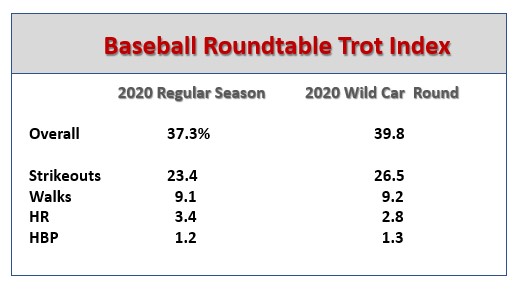
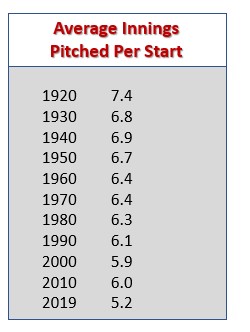
Baseball Roundtable’s traditional Trot Index – documenting the percentage of plate appearances which end in a trot (back to the dugout, around the bases, to first base) – was fairly stable in the Wild Card Round. We’re talking about strikeouts, home runs, walks, hit by pitch and catcher’s interference – all outcomes that are, basically, devoid of action on the base paths or in the field. Here’s the breakout:

BBRT

As you can see, the number of plate appearances ending in a trot was up just slightly from the regular season, with the post-season’s improved pitching resulting in strikeouts up a bit and home runs down a bit.

Gotta Like Those Round Numbers

In Game Two of the Cardinals/Padres Series (October 1), Redbirds’ catcher Yadier Molina played in his 100th career post-season game (sixth all-time) and also collected his 100th post-season hit – both all with the Cardinals. Molina, a nine-time All Star, finished the Wild Card Series with a .280 career post-season average, with 101 hits, four home runs and 36 RBI in 101 games.

You’re Up Next … Pass It On

On Friday (October 3), as the Padres won Game Three of their Wild Card Series against the Cardinals by a 4-0 score, they set a modern-era (post-1900) record by using nine pitchers to complete a nine-inning shutout – with no hurler tossing more than 1 2/3 innings.  The lineup of pitchers went: starter RH Craig Stammen (1 2/3 IP); LH Tim Hill (1 IP); RH Pierce Johnson (1/3 IP); LH Adrian Morejon (1 2/3 IP); RH Austin Adams (1/3 IP); RH Luis Patino (1 IP); RH Emilio Pagan (1 IP); LH Drew Pomeranz (1 IP); RH Rosenthal (1 IP).  The nine pitchers gave up a total of four hits and three walks, while fanning eight (three of those by Rosenthal in the final frame).

Of course, it should have been no surprise. That Padres used eight pitchers in Game One (a 7-4 loss) and nine in Game 2 (an 11-9 win).   For those keeping score, that’s 26 pitchers to complete 27 innings (despite the new rules on relievers). Johnson, Pagan, Pomeranz and Rosenthal all appeared in all three games.

Ruth and Gehrig, Make Room for Tatis and Myers

On October 1, as the Padres topped the Cardinals 11-9 in San Diego, Fernando Tatis, Jr. and Wil Myers each bashed a pair of home runs. The only other time teammates have shared multi-homer games in a post-season contest was in 1932 – and the bashers were the Yankees’ Babe Ruth and Lou Gehrig, Tatis and Myers matched Ruth and Gehrig exactly 88 years after the Yankee pair accomplished the feat (October 1, 1932 in a 7-5 World Series win over the Cubs).  Not bad company, Tatis ended the game three-for-five with two runs scored and five RBI, while Myers ended two-for-four with two runs scored and four RBI.  Ruth ended his two-homer World Series game two-for-four with two runs and four RBI, while Gehrig was two-for-five with two runs scored and two RBI.

A Kirilloff-ty Start

The Twins’ Alex Kiriloff got his MLB career off to a lofty start.  On September 30, Kiriloff started in right field as the Twins took on the Astros in Game Two of their post-season match up. Kiriloff became just the third player to make his MLB debut in a post-season game and the first to make his MLB debut as a starter in a post-season contest.  Kirilloff notched a single in the fourth inning, becoming the first player whose first MLB hit came in the post-season.  Others to make their MLB debut in the post season were: Adalberto Mondesi (Royals, 2015 World Series) and Mark Kiger (A’s, 2006 AL Championship Series).

Mondesi made his MLB debut as a pinch-hitter in Game Three of the 2015 World Series, striking out against the Mets’ Noah Syndergaard. It was Mondesi’s only appearance in the Series. He made his MLB regular-season debut the following July and is still with the Royals. Mondesi remains the only player to debut in the World Series and, at the time, much was made of the fact that Mondesi’s father, Raul Mondesi, played played 13 MLB seasons and never appeared in a World Series.

Kiger debuted as a defensive replacement in Game Three of the 2006 ALCS (A’s versus Detroit). He also came on late in Game Four. He didn’t come to the plate in either contest – and never appeared in an MLB game again. Overall, he played 1 2/3 MLB innings and recorded one put out. (Between 2002 and 2009, Kiger played in 878 minor-league games, hitting .264, with 47 home runs and 331 RBI.

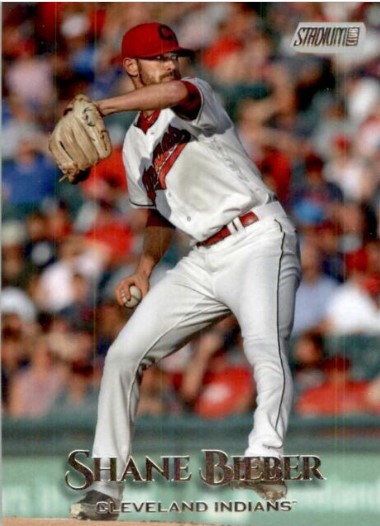
No pitcher gave up more earned runs in the 2020 Wild Card Round than the American  League’s anticipated Cy Young Award winner, Shane Bieber (Indians) – who gave up seven earned runs on nine hits in 4 2/3 innings versus the Yankees. 

18 and Over (for the season)

The Astros with a 29-31 record and the AL’s second-worst road record (9-23) went into Minnesota to play the Twins (36-24, with an MLB-best 24-7 home record this season). Houston pulled off  the upset – and, in the process, helped the Twins achieve a record 18 consecutive post-season losses. The Twins’ last post-season win came on October 5, 2004 (Game One of the ALDS) – when the Twins topped the Yankees 2-0 (in New York) behind the pitching of Johan Santana and a home run by Jacque Jones.  The next day, the Twins lost to the Bombers 7-6 in 12 innings and the streak began.

It’s been a Hard Day’s Night

Game Two of the Yankees/Indians Wild Card series (September 30) – slated to start at 7 p.m., but delayed by rain – stretched on into Thursday, finishing up at 1:14 a.m. The 10-9 Yankee win involved four-hours and 50 minutes of playing time – making it the longest nine-inning contest in MLB history. The two teams combined for 19 runs, 18 hits, 19 (time-consuming) walks and 24 (also time-consuming) strikeouts,

Cole and Kershaw … Tossing Strikes

The Dodgers’ Clayton Kershaw, at times criticized for his post-season performance (he came into the 2020 post-season with a 9-11, 4.48 post-season record), had his best post-season start ever during the recent Wild Card Round.  As the Dodgers stopped the Brewers 3-0 on October 1, Kershaw went eight shutout innings, giving up three hits and one walk, while fanning 13.  He was the only starter to go eight innings during the Wild Card Round and his 13 strikeouts tied the Yankees’ Gerrit Cole who fanned a baker’s dozen in seven frames during his start against the Indians on September 29. Cole gave up two runs on six hits (no walks) in that game.

No one had more base hits during the recent Wild Card Round than the White Sox’ Tim Anderson, who went 9-for-14. The Padres’ Fernando Tatis, Jr. and Yankees’ Gio Urshela notched the most RBI in the round,with five; while six players each had two home runs. On the other side of the coin, no batter fanned more than the Cardinals’ Harrison Bader – with seven whiffs in nine at bats (11 plate appearances). 

Now, for another shot at predictions (better term is guess this post season).

Americana League Division Series

Astros over A’s … Going for the upset here.  Logic says the Athletics’ superior pitching (particularly their bullpen, with its 2.72 ERA) should bring them out on top.  I admit here that the Astros regular-season performance was at best mediocre – giving up 275 runs and scoring 279. The Astros’ plus-four run differential compares to the A’s plus-42. But I underestimated the Astros against the Twins, and learned a lesson.  Houston seems to be jelling at the right time and playing with a bit of swagger and a sense of purpose.  That and the Astros’ considerable post-season experience leads me to take them over the A’s.

Yankees over Rays … Yes, the Rays topped the Yankees eight games-to-two in the regular season, but the Yankees are fully healthy and playing their best baseball of the season.  Despite a rash of injuries, the Yankees still launched 94 home runs (to the Rays’ 80) and scored 315 runs (to the Rays’ 289) during the regular season. The Rays do have the better pitching (3.45 ERA to the Yank’ 4.35), but Gerrit Cole being available for a pair of starts should help even that out. Maybe the Bronx Bombers pounding of the Indians’ well-respected pitching staff during the Wild Card Round is that bright shiny thing that distracted me, but I’m going with New York’s potent lineup – led by DJ LeMahieu, Aaron Judge and Giancarlo Stanton.  Should be a good series.

Differ

National League Division Series

Braves over Marlins … The Braves’ offense is pretty well stacked and should be too much for the upstart Marlins. The Braves finished second in average (the Marlins’ 18th); second in home runs (the Marlins 25th); and second in runs scored (Marlins 21st). The Braves are a little weak in the starting rotation after Max Fried and rookie Ian Anderson, which is a disadvantage with the lack of off days.  However, the Marlins bullpen put up a regular-season ERA north of 5.00 (the Braves’ bullpen ERA was 3.40, second-best in the National League).  I look for the Braves, led by Marcell Ozuna, Freddie Freeman and Ronald Acuna, Jr.  to take advantage of the Marlins’ pen and win this one.

Dodger over Padres … The Padres’ offense was solid this season, but the Dodgers were even better. The Dodgers led MLB in runs scored (349, with the Padres third at 325); home runs (118, with the Padres fourth at 95); and, while the Dodgers finished 11th in average at .256, the Padres just edged them out in that category at .257. Even if we look at the two offenses as a tossup, the Dodgers 3.02 earned run average was the best in baseball.  The Padres can make it interesting, but BBRT expects the Dodgers to prevail. Lots of players to watch in this one. Difference makers could be the Dodgers’ Mookie Betts and Clayton Kershaw or the Padres’ Fernando Tatis Jr. and Manny Machado.
Side note: I tried the coin flip approach and got: A’s; Yankees; Braves; Padres.  I think I should be able to beat dumb luck this time. 

Picks for the NL  & Al Championship Series

Dodgers over Braves

Yankees over Astros

World Series Pick

Dodgers over Yankees

Primary Resources:  Baseball-Refeence.com; Stathead.com; MLB.com

100Baseball Roundtable is on the Feedspot list of the Top 100 Baseball Blogs.  To see the full list, click here.

I tweet baseball @DavidBBRT

Follow/Like Baseball Roundtable’s Facebook Page here.  More baseball commentary; blog post notifications; PRIZES.

Member: Society for American Baseball Research (SABR); The Baseball Reliquary; The Negro

From Triple Plays to No-Hitters to Some True (Big) Fly Fishing … Baseball Roundtable’s September Wrap Up

MLB’s 2020 regular-season has come to an end and  it’s time for Baseball Roundtable’s traditional monthly wrap up:

  • A look at the previous (in this case, final) month of the season, and the stories and stats that caught BBRT’s eye;
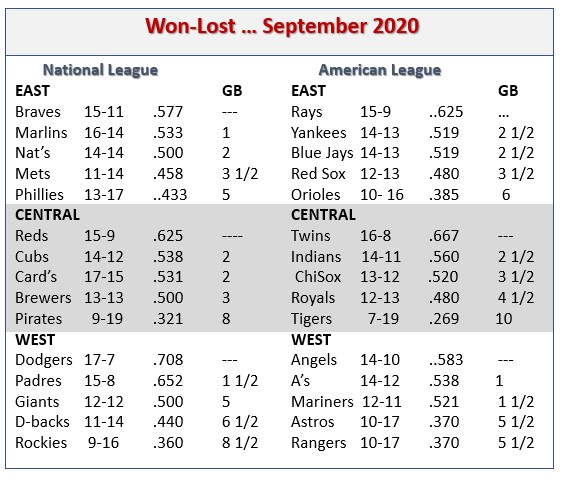
  • September and final won-lost records;
  • BBRT’s Players and Pitchers of the month; and
  • BBRT’s “Trot Index”.

In this post, I’ll also share a few thoughts/predictions on the post-season.  Before we get into the details, here are a few events that helped shape September 2020 (more on these and other September “happenings” in the “Highlights” section).

  • Six National Leaguers shared the September lead in triples (2) – two were catchers (D-backs’ Daulton Varsho & Giants’ Joey Bart).
  • Everyone speculated the Astros might become HBP targets this season. Twenty-three Astros were plunked – slightly below the MLB average of 27. (The Cubbies “felt” 52 plunkings.)
  • Fly Fishing.  Mike Trout topped Tim Salmon‘s Angels’ franchise long-ball record.
  • The Rays put the first all-lefty MLB lineup on the field.
  • Alex Mills threw 2020’s second no-hitter – in his first MLB complete game.
  • Indians’ 3B Jose Ramirez led MLB (qualifiers) in September slugging percentage at .841 – 91 percentage points up on the NL leader and 174 points up on second-best in the NL.
  • Billy Hamilton made it home the easy way (home run) and the hard way (steal of home) … in the same game.
  • The Brewers turned MLB’s first 2020 triple play … on the final day of the regular season.
  • DJ LeMahieu became the first player to win a batting championship in both the NL and AL.
  • The top seven pitchers (and 12 of the top 15) in September strikeouts were National Leaguers.
  • Three pitchers were trusted with an MLB-high six starts in September … they went a combined 3-7, 4.92.

Again more on these and other September “stories” in the highlights section.  Before we get deeper into September and year-end stats, let’s look at BBRT’s Players and Pitchers of the Month.

—–PLAYERS AND PITCHERS OF THE MONTH (SEPTEMBER)—–

NATIONAL  LEAGUE

Player of the Month – Marcell Ozuna, OF/DH. Braves

Marcell Ozuna photo

Photo by hueytaxi

Marcell Ozuna was a dominant force for the Braves in September – and still barely edged out teammate Freddie Freeman for this honor. Looking at MLB stats for the month, Ozuna’s .394 average led MLB (Freeman was second at .375); Ozuna’s 33 RBI also led MLB (Freeman was second at 32). Ozuna’s ten home runs were second only to teammate Adam Duvall’s eleven and Ozuna’s 41 hits led MLB (Freeman was third at 36). In addition, Ozuna tied with Freeman for the NL’s top slugging percentage at .750.  For the month, Ozuna had a hit in 23 of 26 games -including ten multi-hit games. He opened the month (September 1) with a three-homer, six-RBI performance against the Red Sox.

Braves

Honorable Mentions: As noted above Freddie Freeman was in the running. In fact, he had a couple of things going for him: he spent more time on the field (rather than DH) than Ozuna; he struck out only 14 times to Ozuna’s 25.   Ultimately, the margin was razor thing between Freeman and Ozuna.  Also have to put in a good word for the Phillies’ 24-year-old rookie 3B Alec Bohm, whose 40 September hits were second only to Ozuna’s 41.  Bohm hit .367 for the month, with three home runs,16 RBI and 17 runs scored.

Pitcher of the Month – Corbin Burnes, RHP, Brewers

BurnesWhat can you say about Corbin Burnes?  He was pretty much lights out in September until suffering an oblique strain that knocked him out of his last start.  To that point in the month, he was 3-0, with a tiny 0.38 earned run average in four starts.  Even with that last start hiccup, Burnes finished with a September record of 3-1, with a 1.32 earned run average (second in the NL only to the Reds’ Trevor Bauer’s 1.29) and 42 strikeouts (only seven walks) in 27 1/3 innings. His 13.8 strikeouts per nine frames in September trailed only Jason deGrom and Shane Bieber in MLB – pretty good company.

Corbin Burnes has had an up-and-down MLB run. Called up to the Brewers in July of 2018. He appeared in 30 games for Milwaukee that season (all in relief) and went 7-0, 2.61. Then in 2019, he appeared in 32 games for the Brew Crew (four starts) and went 1-5, 8.82. This season, he appeared in 12 contests (nine starts) and went 4-1, 2.11.

Honorable Mentions: The Reds’ Trevor Bauer also deserves recognition, despite going just 2-2 for the month. Bauer pitched to a 1.29 earned run average and fanned 46 batters (second in MLB), with just six walks in 35 innings. Luis Castillo, also of the Red gets shout out for picking up four wins in five September starts (the only MLB pitcher with four September victories), with a 2.20 earned run average, one complete game and 37 strikeouts in 32 2/3 innings. Like Burnes, Castillo is a surprise in this competition. Going into the month, he was 0-5, with 4.10 earned run average.    Finally, there is hard-luck Padre Dinelson Lamet, who started five times, produced a 1.76 ERA and fanned 42 batters in 27 innings, but got only one win and four no-decisions (despite the fact that San Diego won all five of his September starts.

AMERICAN LEAGUE

Player of the Month – Jose Ramirez, Indians, 3B

RamJose Ramirez’ hit a robust .366 in September (second in the AL), with an AL-topping (and MLB’s second-best) ten home runs. Ramirez drove in 24 runs (fourth in the AL) and scored 18.  Ramirez also swiped two bases and had more walks (11) than strikeouts (10). Nineteen of Ramirez’ 30 hits went for extra bases and His .841 slugging percentage far outdistanced the pack (second best in MLB was .750).

Honorable Mentions: Ramirez inched out White Sox ‘1B Jose Abreu, who hit .320, drove in 28 September runs (first in the AL); scored 19 times (fifth in the AL); and popped seven home runs. Abreu’s 29 September hits were third in the AL and seventh in MLB.  Blue Jays’ outfielder Lourdes Gurriel, Jr. was also in the chase, after hitting an AL-best .368 in September, with seven home runs, 16 RBI and 19 runs scored.


Pitcher of the Month – Tie: Gerrit Cole, Yankees & Chris Bassitt, A’s

basscoleGerrit Cole came through for the Yankees in the stretch – going 3-1, giving up just three earned runs in 27 innings pitched (1.00 September ERA.) Cole’s 34 strikeouts were fourth-best in the AL – and he walked just five.  His September performance included a 6-0, complete game, two-hit shutout over the Orioles (seven innings). Chris Bassitt of the A’s went 3-0, 0.34 and gave up just one run in 26 2/3 September innings. (four starts). Bassitt fanned 25 batters (five walks) in 26 2/3 innings.  This was really a toss=up for me.

Honorable Mentions:  Can’t leave out the White Sox’ Dallas Keuchel, who may have only gotten one win in four starts, but pitched to a 0.45 earned run average. We should also recognize Indians’ closer Brad Hand, who picked up six September saves (in six opportunities) and two wins in eleven appearances, while putting up a 0.79 ERA and fanning 16 in 11 1/3 innings.

Surprise Player of the Month – Jared Walsh, Angels, 1B

WalshJared Walsh came into September 41 career MLB games on his resume – with a .173 average, one home run and five RBI. Further, in July and August of this season, he was zero-for-thirteen in ten games.  Then came September. Walsh got in 22 games and went 29-for-86 (.337), with four doubles, two triples, nine home runs and 26 RBI. Drafted in 39th round of the 2015 MLB draft (out of the Universality of Georgia), Walsh has been a two-way player. In 2019, he pitched in five games for the Halos, putting up a 1.80 earned run average with five strikeouts in five innings.


______________________________________________________

TROT INDEX … A REGULAR BBRT FEATURE

For 2020, 37.3 percent of MLB’s 66,506 2020 plate appearances ended in a trot (back to the dugout, around the bases, to first base). We’re talking about strikeouts, home runs, walks, hit by pitch and catcher’s interference – all outcomes that are, basically, devoid of action on the base paths or in the field. Here’s the breakout: strikeouts (23.4%); walks (9.1%); home runs (3.4%); HBP (1.2%); catcher’s interference (less than 1%). Personally, I’d like more action in the field of play.

The 37.4 percent figure is up from 2019’s (full season) 36.2 percent and 2018’s 34.8 percent Trot Index. 

_________________________________________________

You’ll find full standings and stats near the end of this post, but here are your Round One opponents and seeding.  Side note:  I see this as fine for this strange season (it did add interest), but I’m not a fan for the future. This year, for example; the Astros and Brewers made “the tournament” with sub-.500 records.  I prefer fewer teams and recognition (again next season) of the marathon that is an MLB season.

Rpouind One

Some minor predictions for Round One.  Predictions on late rounds coming soon.  Wanted to get this out before tomorrow’s games.

  • Rays over Blue Jays.  Rays’ pitching slows  Jays’ offense and not vice versa.
  • Yankees over Indians.  Yankees offense and Gerrit Cole should edge the Tribe.
  • Twins over Astros.  Twins 24-7 at home. Astros 9-23 on the road. Enough said.
  • White Sox over A’s.  Pretty even match up, but White Sox offense should prevail.
  • Dodgers over  Brewers.  Brewers seem over matched to me.
  • Padres over Cardinals.  Really a toss up, but home field helps and it feels like a Padres year to me.
  • Cubs over Marlins. Two run-of-the-mill offenses, but Cubs have a pitching edge.
  • Reds over Braves.  This is all about Reds pitching versus Braves offense. Betting that Bauer, Castillo and Gray can slow down Acuna, Ozuna and Freeman.  This is my long-shot prediction.

___________________________________________

t new

Among the hottest teams in September were the Dodgers (17-7), Twins (16-8), Padres (15-8) and Reds (16-9) … and they illustrated the value of pitching. All four squads registered among the six lowest September earned run averages. Notably, the 17-7 Dodgers also put up some solid offense. Their 145 September runs were third among the 30 MLB teams.  LA kind of had the best of both worlds. Meanwhile the Padres were 16th in scoring, the Twins 18th and the Reds 25th.  Clearly, pitching was of premium value. On the other end of the mound spectrum, , the Tigers (7-19) and Rockies (9-19) boasting two of the three worst September records, also recorded two of the three worst September ERA’s.

Looking for exceptions to prove the rule? The Blue Jays had September’s second worst ERA at 5.85, but overcame that with solid offense (fourth-most runs scored) to put up a 14-13 record and the Braves led MLB in September runs scored (173), helping overcome a 4.64 ERA (11th worst) to produce a 15-11 record.

————-September 2020 Team Statistical Leaders August——————-

RUNS SCORED

National League – Braves (173); Dodgers (145); Phillies (138)

American League – Yankees (153; Blue Jays (144); Red Sox (130)

The Pirates scored the fewest runs in September (91); while the Tigers were at the bottom of the American league at 97.  The only other team to score fewer than 100 September runs was the Mariners (98). For a bit of comparison, the Braves averaged 6.7 runs per game for the month, the Pirates averaged 3.3.

BATTING AVERAGE

National League – Mets (.284); Giants (.279);Braves (.277)

American League – Red Sox (.277); Angels (.270); Blue Jays (.264)

The Reds averaged an MLB-low .206 for the month.  The Mariners had the lowest average in the AL at .216. 

ON-BASE PERCENTAGE

National League – Braves (.372); Giants (.355); Mets (.349)

American League – Yankees (.348); Red Sox (.345); Angels (.345)

HOME RUNS

National League –  Braves (55); Dodgers (50); Mets (43)

American League – Twins (42); Yankees (41); Red Sox (38)

Doing a bit to factor out the differences in games (and innings) played, the Dodgers had the most powerful “at bats per home run” ratio at 16.44  The fewest at bats per long ball in the American League went to the Twins at 18.43.

WALKS

National League – Braves (126); Phillies (121);  Reds (105)

American League – Yankees (128); A’s (98); Blue Jays (91)

The Braves’ had the highest on-base percentage in August (.372).  The Yankees led the AL at .348.

STOLEN BASES

National League – Padres (24); Nationals (24); Rockies (21)

American League – Rays (31); Royals (25); Red Sox (20); Rangers (20)

The Mets stole the fewest bases during September – just four in nine attempts. (The Rays were also “caught stealing” five times during the month, but were successful 31 times.)

BATTER’S STRIKEOUTS

National League – Cardinals (282); Marlins (257); Phillies (254)

American League –  Rays (275); Rangers (268); Tigers (253)

EARNED RUN AVERAGE

National League – Padres (3.15); Reds (3.37); Cubs (3.38)

American League – Twins (3.28); Rays (3.32); Indians (3.89)

The highest ERA for September belonged to the Rockies at 5.42. In the American League that “high” (low?) mark went to the Blue Jays at 5.85.  Overall, eight of the 30 teams had ERAs north of 5.00. 

STRIKEOUTS

National League – Phillies (268); Cardinals (268); Brewers (261)

American League – Indians (261); Yankees (245); Astros (238)

Whiff-Masters

Six  teams fanned at least ten batters per nine frames in September: Brewers (10.78); Padres (10.64); Indians (10.58); Reds (10.45); Mets (10.29); Phillies (10.01).

WALKS (fewest)

National League – Dodgers (47); Padres (58); Brewers (66)

American League – Rays (60); Twins (61); A’s (63)

The Dodgers’ staff showed the greatest control with 1.96 walks per nine innings in September, while the Rays were best in the AL at 2.58. The Blue Jays’ staff walked an MLB-high 4.67 batters per nine innings over September. The Dodgers, by the way, also led in strikeouts per walk at 4.55. The Indians led the junior circuit at 3.95.  

SAVES

National League – Cardinals (8); Diamondbacks (7); Marlins (7)

American League – Blue Jays (9); Royals (8); Rays (8)

The Pirates had just two save (in nine save opportunities) for September. The only other teams successful in less than half their save opportunities were the Rangers (two-for-six);Tigers (four-for-nine); and Phillies (six-for-thirteen). 

——-Individual Statistical Leaders September ———-

AVERAGE (minimum 75 at bats)

National League – Marcell Ozuna, Braves (.394); Freddie Freeman, Braves (.375); Jeff McNeil, Mets (.356)

American League –  Lourdes Gurriel, Jr., Blue Jays (.368); Jose Ramirez, Indians (.366); Adalberto Mondesi,  Royals (.356)

The lowest August average (minimum 75 at bats) belonged to the Cubs’ Kyle Schwarber at .130 (10-for-77). The AL’s lowest could be found across town – the White Sox’ Luis Robert at .136 (11-for-81). 

HOME RUNS

National League – Adam Duvall, Braves (11); Marcell Ozuna, Braves (10); AJ Pollock, Dodgers (10)

American League – Jose Ramirez, Indians (10); George Springer, Astros (9); Jared Walsh, Angels (9); Luke Voit, Yankees (9)

No player had more at bats without a long ball in September than Rangers’ 2B Nick Solak (93).

RUNS BATTED IN

National League – Marcell Ozuna, Braves (33); Freddie Freeman, Braves (32);  Chris Taylor, Dodgers (23); Trea Turner, Nationals (23)

American League – Jose Abreu, White Sox (28); Jared Walsh, Angels (26); Luke Voit, Yankees (26)

HITS

National League – Marcell Ozuna, Braves (41); Alec Bohm, Phillies (40); Freddie Freeman, Braves (36)

American League – DJ LeMahieu, Yankees (36); Lourdes Gurriel, Jr., Blue Jays (35); Will Castro, Tigers (34)

DOUBLES

National League –  Freddie Freeman, Braves (12); Dominic Smith, Mets (9); Alex Dickerson, Giants (9)

American League – Eloy Jimenez, White Sox (9); Jose Ramirez, Indians (9); DJ LeMahieu, Yankees (9);  Cavan Biggio, Blue Jays (9)

TRIPLES

National League – Daulton Varsho, D-backs (2); Ke’Bryan Hays, Pirates (2); Asdrubal Cabrera, Nationals (2); Trea Turner, Nationals (2); Joey Bart, Giants (2); Trevor Story, Rockies (2)

American League – Cedric Mullins, Orioles (3); Yoan Moncada, White Sox (3); nine with two

The Indians’ Jose Ramirez led MLB in September slugging percentage at a robust .841. Second, and sharing the NL lead were the Braves’ Freddie Freeman and Marcell Ozuna far behind at .750. 

STOLEN BASES

National League –  Trea Turner, Nationals (9); Trevor Story, Rockies (7); three with six

American League – Adalberto Mondesi, Royals (16); Manual Margot, Rays (8); Leody Taveras, Rangers (7); Jonathan Villar, Blue Jays (70)

Trea Turner stole the most September bases without being caught (9). 

WALKS

National League – Juan Soto, Nationals (28); Christian Yelich, Brewers (26); Bryce Harper, Phillies (25)

American League – Aaron Hicks, Yankees(21); Cavan Biggio, Blue Jays (20); Mike Trout, Angels (18)

The Nationals’ Juan Soto had September’s highest on-base percentage (.533). No other player reached the .500 mark.

BATTER’S STRIKEOUTS

National League – Keston  Hiura, Brewers (37); Christian Yelich, Brewers (36); Paul DeJong, Cardinals (36)

American League – Miguel Sano, Twins (39); Evan White, Mariners (37); Matt Olson, A’s (36); Joey Gallo, Rangers (36)

PITCHING VICTORIES

National League – Luis Castillo, Reds (4-1); nine with three

American League – 12 with three

The Nationals’ Patrick Corbin led MLB in September losses, going 0-5, 5.64 in five starts. 

EARNED RUN AVERAGE (minimum 20 IP)

National League – Trevor Bauer, Reds (1.29); Corbin Burnes, Brewers (1.32); Kyle Hendricks, Cubs (1.45)

American League – Chris Bassitt, A’s (0.34); Dallas Keuchel, White Sox (0.45); Gerrit Cole, Yankees (1.00)

Eight pitchers with at least four September starts posted ERAs under 2.00. Of those, three notched just one win each: Dallas Keuchel, White Sox (1-0, 0.45); Dinelson Lamet, Padres (1-0, 1.76); Carlos Carrasco, Indians (1-1, 1.97). 

STRIKEOUTS

National League – Aaron Nola, Phillies (48/35 1/3 IP); Trevor Bauer, Reds (46/35 IP);  Jacob deGrom, Mets (46/27 IP)

American League – Shane Bieber, Indians (38/24 2/3 IP); Carlos Carrasco, Indians (37/32 IP); Framber Valdez, Astros (36/32 1/3 IP)

September’s leader in strikeouts per nine innings was the Mets’ Jacob deGrom at 15.33; followed by the Indians’ Shane Bieber (Indians) at 13,86.

INNINGS PITCHED

National League – Kyle Hendricks, Cubs (37 1/3); Aaron Nola, Phillies (35 1/3); Trevor Bauer, Reds (35)

American League – Zach Plesac, Indians (34 1/3); Jordan Lyles, Rangers (33 1/3); Lance Lynn Rangers (32 2/3)

The Phillies’ Aaron Nola was the only pitcher with two complete games in September. He also led MLB with six starts (tied with Kyle Freeland of the Rockies and Jon Lester of the Cubs).  Nola went 2-3, 3.57. 

SAVES

National League – Stefan Crichton, D-backs (5); Brandon Kintzler, Miami (5); Josh Hader, Brewers (5)

American League – Ryan Pressley, Astros (6); Matt Barnes, Red Sox (6); Brad Hand, Indians (6)

Jimmy Cordero of the White Sox and Mike Mayers of the Angels took the mound in the most September games (11 each). 

—–SEPTEMBER 2020 HIGHLIGHTS —-

Elvis Has Left the Building

On September 2, the Rangers’ Elvis Andrus hit his first home run of the 2020 season – off the Astros’ Ryan Pressley. Nice coincidence there.  Oh, and it was meaningful one, tying the game at four apiece in the top of the ninth. (The Rangers won 6-5 in ten innings.)  Truly, Elvis (off Pressley) left the building.

More COVID Weirdness … Home Away from Home

On September 5, the Angels swept a doubleheader from the Astros by the narrowest of margins … 10-9 and 7-6. While both games were played at Angels Stadium (before a crowd of zero), thanks to COVID scheduling, the Astros were the visiting team in Game One and the home squad quad in Game Two.

Trout Rounds the Bases with Number 300 … Takes Angels’ Franchise Lead (Something fishy there?)

Mike Trout photo

Photo by A.Rutledge

On September 5, during the Angels “Home & Away” doubleheader against the Astros, Mike Trout hit a two-run homer in the third inning of game one (a 10-9 Angels win). Side note: As the two teams players to a 10-9 final, the game time temperature was an Angel Stadium 109 degrees. See what I did there?

Trout‘s long ball was his 300th career homer – a nice round number that also gave him sole possession of the Angels’ franchise mark.  (He had been tied with Tim Salmon at 299).

No need to Round Up, It’s 1,500

On September 9, as the Braves pummeled the Marlins 29-9 in Atlanta, Freddie Freeman popped a two-run home in the third inning – notching his 1,500th MLB hit.  The Braves 29-tally outburst set a post-1900 National League record and was one shy of the post-1900 MLB record of thirty runs in a game – set by the Rangers in 2007.  For more on high-scoring games and big innings, click here.

Baseball has its Up and Downs

Gerrit Cole photo

Photo by boomer-44

The Yankees’ Gerrit Cole won his first four decisions in 2020 – giving him a 20-decision winning streak dating back to May of 2019.  Then, on August 28, the Braves broke the streak – topping Cole and the Bronx Bombers 5-1 in Atlanta. (Notably, the pitcher who finally bested Cole, Ian Anderson, was making his first MLB appearance.)

Cole went on to lose his next two starts (to the Rays and Orioles) In those three consecutive losses, he surrendered 14 runs (ten earned) in 16 innings. He righted the ship thereafter, winning his next three decisions to finish the season 7-3, 2.84.

For more on Cole’s streak and other hurlers who won 20 or more consecutive decisions, click here. 

We Do Like Round Numbers

Shane Bieber‘s 2020 season has been special – as he led all of MLB with  122 strikeouts (in 77 1/3 innings).  He added a complementary touch to this performance on September 12, when he fanned eight batters in seven frames – despite taking the loss (3-1 to the Twins). Bieber fanned Twins’ C Ryan Jeffers in the fifth inning for his sixth strikeout of the game. It also was his 100th whiff of the season.  He reached that round number in 62 2/3 innings – the fastest ever in a season by an MLB pitcher.  His pace edged out Max Scherzer, who reached the 100K mark in 63 innings in 2018.

Look at Life from Both Sides Now … Or Not

On September 11, the Rays (often hailed for the innovative pitching strategies) put together a unique offensive lineup. Facing Red Sox righty Andrew Triggs, the Rays started (reportedly for the first time in modern base baseball – since 1900 – history) an all left-handed batting lineup. It went like this: Austin Meadows LF; Joey Wendle SS; Brandon Lowe 2B; Ji-Man Choi 1B; Kevin Kiermaier CF; Yoshi Tsutsugo 3B; Nate Lowe DH; Brett Phillips RF; Michael Perez C.

Despite the fact that no one in the lineup had an average over ,259 (seven of the nine were under .230), the port-sided Rays bashed 12 hits on their way to an 11-1 win. DH Nate Lowe, who came into the game with just one-hit in 14 at bats (.071 on the season) and no RBI, led the way going three-for-four with two home runs and four RBI. The Red Sox kind of played into the Rays’ strategy, they used six pitchers in the contest – five of them right-handed.  Of note, is that fact that starter Triggs had actually looked pretty good against left handers (one-for-fourteen against him to that point in the season). Trigg left the contest after just one inning (neck issues). It should be noted that the Rays did score four of their runs off the only southpaw used by the Red Sox (Matt Hall) and that Hall (again the only southpaw used by the BoSox) took the loss.

No Run of the Mill(s) Start

MillsOn September 13, Cubs’ 28-year-old righty Alec Mills picked up his sixth major-league win (15th career start and 29th MLB appearance – in four season). To that point in his career, he was 5-4 with a 4.19 earned run average. So, what did he do on the unlucky 13th?  He threw the second 2020 no-hitter, shutting down the Brewers 12-0 in Milwaukee. In his nine-inning stint, Mills walked three and fanned five – throwing 114 pitches (74 for strikes). It was his first major-league complete game. Mills was a 22nd round draft pick (Royals) in 2012 – traded to the Cubs in 2017. In eight minor league seasons, he went 32-29, 3.69 – with one complete game in 115 starts.

That Yankee Offense Goes Pretty Deep

From September 15 through September 17, the New York Yankees – in sweeping the Toronto Blue Jays – bashed a total of 19 home runs.  That gave them a number of records including most home runs in a three-game series and most consecutive games with six or more home runs. Included in this run of long balls was a record-tying five home run inning (September 17).   For more detail on this power outburst (and other five-homer frames), click here.

Gerrit Cole and a Nice Round Number

On September 16, as the Yankees routed the Blue Jays 13-2 in New York, Gerrit Cole notched his 100th career victory – Cole went seven innings, giving up one run and three hits, while walking two and fanning eight. The win came in Cole’s 203rd career start (eighth MLB season) and ran Cole’s career record to 100-55, 3.20, with 1,423 strikeouts in 1,261 innings pitched.

Plesac’s Immaculate Inning

On September 18, Indians’ starter Zach Plesac pitched 7 2/3 innings of scoreless ball (five hits, one walk and eleven strikeouts) as the Tribe defeated the Tigers 1-0 in Detroit.  The highlight of Plesac’s fourth win of the season may have come in the second frame, when Plesac struck out Tigers’ LF Jorge Bonafacio, 2B Niko Goodrum and C Austine Romine on nine pitches – becoming the 93rd MLB pitcher to log an immaculate inning.

Immaculate InningsA few other immaculate Inning tidbits.

  • The Athletics’ Lefty Grove (1928) and Red Sox’ Chris Sale (2019) the only pitchers to throw two immaculate innings in one season.
  • Nolan Ryan (Mets & Angels) is the only pitcher to throw an Immaculate Innings in both the NL and AL.
  • The Royals’ Danny Jackson is the only pitcher to throw an Immaculate Inning in the World Series (Game 5, 1985).

Albert Pujols hit three home runs in September, giving him six on the season and 662 for his career – pulling him past William Mays (660) into fifth place all time. Next target for the 40-year-old Pujols? Alex Rodriguez (696).

Pulled While Throwing a No-Hitter … But No Surprise

On September 20, Dylan Cease started for the first-place Chicago White Sox against the Reds in Cincinnati. Cease came into the fourth inning having allowed no hits – and he did not give up a safety to any of the first three batters of the inning. Still, he was pulled, no-hitter intact.  But it was no surprise. Cease had a 1-2-3 first inning., In the second frame, he gave up two walks and hit a batter (but held the Reds scoreless). He gave up two more walks, but no runs, in the third – and then walked the first three hitters in the fourth, before being replaced by Ross Detwiler. Cease’s final line was three innings pitched, no hits, five walks, one hit batsman, five strikeouts and three earned runs.  Cease threw a total of 80 pitches – 43 balls and 37 strikes.  The White Sox lost the game 7-3 and, in the process, walked 11 and hit three Reds’ batters.

Another Round Number

On September 20, Twins’ outfielder Max Kepler popped his eighth home run of the 2020 season – and the 100th of his MLB career. Kepler, in his sixth MLB season, increased his home run total each season from 2015-2019 … zero in 2015 (just seven at bats); 17 in 2016; 19 in 2017; 20 in 2018; 36 in 2019.

Big Day for a Big Guy

On September 21, as the Blue Jays topped the Yankees 11-5 in Toronto, 21-year-old Blue Jays’ rookie catcher Alejandro Kirk had a big day at the plate. Kirk came into the hitting .200 (two-for-ten in five games).  In the September 21 contest, Kirk went four-for-four (his first MLB multi-hit game), scored three times, collected his first MLB extra base hit (a double) to lead off the fifth and added his first MLB home run and RBI (a solo shot leading off the seventh). Why the “Big Guy” in the headline.  Kirk looks more like and NFL player than an MLB player …  5’8″, 265-pounds.  The big guy has proven he can wield a big  bat.  In three minor league seasons (151 games), Kirk hit .315, with 17 home runs and 101 RBI.

Yadi’s Big Day – A Walk -Off Out of the Park

Yadiel Hernandez, a 32-year-old rookie for the Nationals, hit his first MLB home run on September 22 – and he made it count. It was a walk-off game-winner in the bottom of the eighth inning, in the second game of a double bill against the Phillies (in Washington D.C.). The 5’9′, 185-pound outfielder was signed by the Nationals after defecting from Cuba in 2015.  He was a .324 hitter in six seasons in the Cuban National Series. in 2019, Hernandez hit .323-33-90 in 126 games for the Triple A Fresno Grizzlies.

Another Yadi’s Landmark

In the vein of round numbers, on September 24, Cardinals’ catcher Yadier Molina –  a nine-time All Star, nine-time Gold Glover and .281 career hitter – slapped a single to shallow center in the seventh inning of the Cardinals’ 4-2 win over the Brewers.  It was Molina’s 2,000 MLB hit (in 17 seasons, all for the Cardinals).  The home town crowd would have gone wild.  If there had been one.

Put a Flight Attendants on the One

On September 25, as the Braves topped the Red Sox  8-7 (11 innings) in Atlanta, still rising star Ronald Acuna, Jr,  hit the longest home run (as measured by Statcast) of the 2020 season – a 495-footer off the Red Sox’ Chris Mazza to lead oft the bottom of the first.  It was the 22-year-old’s 14th home run of the short season. In 2019, Acuna went .280-41-101 in 156 games and lead the National League with 37 stolen bases.  Some of Acuna’s long-ball thunder may have been stolen on the 25th, as Braves’ 1B  Freddie Freeman ended the contest with a walk-off home run to open the bottom of the 11th inning. It was Freeman’s 13th of the campaign.

Two Paths to that First MLB Hit

On September 26, two members of the Angels collected their first MLB base hits – both in their first MLB at bats; and in back-to back at bats.  The similarities end there, as the pair took widely different paths to those first MLB safeties.  It happened with one out in the top of the third.  First, rookie second baseman Jahmai Jones single to center on the first MLB pitch he ever saw. Next up was rookie SS Elliot Sot0. Like Jones, it was Soto’s first MLB at bat.  Soto, singled to right on the second MLB pitch he ever saw.

Those different paths to first base? Jones, a second-round pick in the 2015 draft) made the majors at age 23, in his sixth professional season. Soto was a “touch” senior, making his MLB debut at age 31.  He was a 13th-round pick in the 2007 draft and was in his 11th pro season.

Double Your Pleasure, Double Your Fun

When the scorebooks closed on the Yankees’ September 27 5-0 loss to the Marlins, New York’s DJ LeMahieu had logged a pair of singles – to finish the 2020 regular season with a .364 average. That made LeMahieu, who won the National League batting crown (.348) with the Rockies in 2016, the American League’s 2020 batting leader.  It also made him the first player to win undisputed batting titles in both the AL and NL.

Saving the Best for Last

On the final day of the 2020 season (September 27), the Brewers turned 2020’s first triple play. It came in the bottom of the eighth of the Brew Crew’s 5-2 loss to the Cardinals.  It was a “natural” around-the-horn triple-killing.  The Cardinals’ Yadier Molina came up with runners on first and second. Molina grounded to Brewers’ third baseman Jace Peterson (who had made on error on the previous play to set up the triple play possibility). Peterson gloved the grounder and stepped on the bag for out number one and threw to second baseman Keston Huira for out number two. Huira then relayed the ball to first baseman Jedd Gyorko for the final out. One up, three down.

Power and Speed

On September 27,  the Cubs’ Billy Hamilton surprised a lot of people – perhaps even himself.  First, in the second inning of the Cubs’ game against the crosstown White Sox, Hamilton (after a walk and a single by Cameron Maybin) found himself on third base, one out and Maybin on first.  Maybin took a long lead and made a move toward second while pitcher Carlos Rodon still had the ball.  Rodon made a throw to first baseman Jose Abreu who threw to shortstop Tim Anderson covering  – and Hamilton broke for home. Hamilton beat the throw from Anderson to the plate with a head first slide.  Then in the fourth, Hamilton  surprised, perhaps even himself, by popping a home run to left-center – his first round tripper since August 29, 2018.  A steal of home and a home run – a surprising day.


Final Standings

——-Individual Statistical Leaders Final ———-

AVERAGE (qualifying, 3.1 plate appearances per team game played)

National League – Juan Soto, Nationals (.351); Freddie Freeman, Braves (.341); Marcell Ozuna, Braves (.338)

American League – DJ LeMahieu, Yankees (.364); Tim Anderson, White Sox (.322); David Fletcher, Angels (.319)

The lowest August average among qualifiers belonged to the Mariners’ Evan White at .176 (32-for-182). In the National League,  it was the Cubs’ Kyle Schwarber at .188 (38-for-191). Others falling below the Mendoza line (under .200) included:  Joey Gallo, Rangers (.181); Matt Olson, A’s (.195); Bryan Reynolds, Pirates (.189); Max Muncy, Dodgers (.192); Carlos Santana, Indians (.199)

HOME RUNS

National League – Marcell Ozuna, Braves (18); Fernando Tatis, Jr., Padres (17); Mookie Betts, Dodgers (16); Adam Duvall, Braves (16); Manny Machado, Padres (16); Kole Calhoun, Diamondbacks (16); Pete Alonso, Mets (16): AJ Pollock, Dodgers (17)

American League – Luke Voit, Yankees (22); Jose Abreu, White Sox (19);  Jose Ramirez, Indians (17); Mike Trout Angels (17)

Reds’ OF Shogo Akiyama had the most 2020 at bats without a home run (155). Akiyama hit .245, scoring 16 runs and driving in nine (in 54 games played). 

RUNS BATTED IN

National League – Marcell Ozuna, Braves (56); Freddie Freeman, Braves (53);  Manny Machado, Padres (47)

American League – Jose Abreu, White Sox (60); Luke Voit, Yankees (52); Mike Trout, Angels (46); Jose Ramirez, Indians (46)

HITS

National League – Trea Turner, Nationals (78); Marcel Ozuna, Braves (77); Freddie Freeman, Braves (73)

American League – Jose Abreu, White Sox (76); DJ LeMahieu, Yankees (71); Whit Merrifield, Royals (70)

DOUBLES

National League – Freddie Freeman, Braves (23); Dominic Smith, Mets (21); Christian Walker, D-backs (18)

American League – Cesar Hernandez, Indians (20): Jose Iglesias, Orioles (17); five with 16

 Freddie Freeman led MLB with 32 extra-base hits.  

TRIPLES

National League – Trevor Story, Rockies (4); Mike Yastrzemski, Giants (4); Trea Turner, Nationals (4)

American League – Kyle Tucker, Astros (6); six with three

Juan Soto of the Nationals led qualifiers in slugging percentage .695. Jose Abreu of the White Sox topped the AL at .617. 

STOLEN BASES

National League –  Trevor Story, Rockies (15); Roman Quinn, Phillies (12);  Trea Turner, Nationals, (12)

American League – Adalberto Mondesi, Royals (24); Manuel Margot, Rays (12); Dylan Moore, Mariners (12); Whit Merrifield, Royals (12)

Jonathan Villar stole the second most bases in MLB (16) – nine for the Marlins and seven for the Blue Jays.  

WALKS

National League – Bryce Harper, Phillies (49 ); Christian Yelich, Brewers (46); Freddie Freeman, Braves (45)

American League – Carlos  Santana, Indians (47); Cavan Biggio, Blue Jays (41); Aaron Hicks, Yankees (41)

The Nationals’ Juan Soto drew the most intentional walks with 12.  

BATTER’S STRIKEOUTS

National League – Keston  Hiura, Brewers (85); Christian Yelich, Brewers (76); Javier Baez, Cubs (75)

American League – Miguel Sano, Twins (90); Evan White, Mariners (84); Joey Gallo, Rangers (79)

A’s /Angels’ 2B Tommy La Stella had the best walks-to-strikeouts ratio at 2.25 (27 walks/12 strikeouts).  By comparison, MLB whiff leader Miguel Sano (Twins) recorded 90 whiffs and just 18 walks (205 plate appearances.)

PITCHING VICTORIES

National League – Yu Darvish, Cubs (8-3); Max Fried, Braves (7-0);  Zach Davies, Padres (7-4)

American League – Shane Bieber, Indians (8-1); Marco Gonzalez, Mariners (7-2); Gerrit Cole, Yankees (7-3)

The Diamondbacks’ Luke Weaver (1-9, 6.58) was the MLB leader in losses.

EARNED RUN AVERAGE (at least one inning pitched for reach team game played)

National League – Trevor Bauer, Reds (1.73); Yu Darvish, Cubs (2.01); Dinelson Lamet (2.09)

American League – Shane Bieber, Indians (1.63); Dallas Keuchel, White Sox (1.99): Chris Bassitt, A.s (2.29)

The Tigers’ Matt Boyd had the highest earned run average among pitchers with enough innings to qualify. He was 3-7, 6.71 in 12 starts. 

STRIKEOUTS

National League – Jacob deGrom, Mets (104/68 IP); Trevor Bauer, Reds (100/73 IP); Aaron Nola, Phillies (96/71 1/3 IP)

American League – Shane Bieber, Indians (122/77 1/3 IP); Lucas Giolito, White Sox (97/72 1/3 IP); Gerrit Cole, Yankees  (94/73 IP)

The leader in strikeouts per nine innings was the Indians’ Shame Bieber at 14.20.  The Mets’ Jacob deGrom topped the NL at 13.76.  

On the control side of the mound, the Cubs’ Kyle Hendricks walked the fewest batter per nine frames (0.89), with eight walks in 81 1/3 innings pitched. The only other qualifier under one walk per nine innings was the Mariners’ Marco Gonzalez at 0.90 (seven free passes n 69 2/3 innings). 

COMPLETE GAMES

National League – Trevor Bauer, Reds (2); Adam Wainwright, Cardinals (2): Aaron Nola, Phillies (2)

American League – Gerrit Cole, Yankees (2); many with one

INNINGS PITCHED

National League – German Marquez, Rockies (81 2/3); Kyle Hendricks, Cubs (81 1/3); Yu Darvish, Cubs (76)

American League – Lance Lynn Rangers (84); Shane Bieber, Indians (77 1/3);  Aaron Civale, Indians (74)

SAVES

National League – Josh Hader, Brewers (13); Brandon Kintzler, Marlins (12 ); Kenley Jansen, Dodgers (11); Mark Melancon, Braves (11)

American League – Brad Hand, Indians (16); Liam Hendriks, A’s (14); Alex Colome, White Sox (12); Ryan Pressley, Astros (12)

The Indians’ Brad Hand was a perfect 16-for-16 in save opportunities for the season.

————-Team Statistical Leaders Through August 31——————-

RUNS SCORED – Team Average … 278

National League – Dodgers (349); Braves (348); Padres (325)

American League – Yankees (315); White Sox (306); Blue Jays (302)

The Pirates and Rangers scored the fewest runs in 2020 – 219 and 224, respectively.  To add some perspective, The Dodgers scored an average of 5.82 runs per game – the Pirates 3.65.  

BATTING AVERAGE – Team Average …  .245

National League – Mets (.272); Braves (.268); Nationals (.263)

American League – Red Sox  (.265); White Sox (.261); Orioles (.258)

The lowest team batting average for the season was .212 for the Reds. The Ranger were at the bottom of the AL at .217.

ON-BASE PERCENTAGE – Team Average … .322

National League – Braves (.349); Mets (.348); Phillies (.342)

American League – Yankees (.342); Angels (.332); Red Sox (.330)

HOME RUNS – Team Average … 77

National League – Dodgers (118); Braves (103; Padres (95)

American League – White Sox (96); Yankees (94); Twins (91)

The Cardinals hit the fewest home runs (51) – averaging 0.87 per game. By comparison, the Dodgers averaged 1.97 per game. 

SLUGGING PERCENTAGE – Team Average … .418

National League – Dodgers (.483); Braves (.483);  Padres (.466)

American League – White Sox (.453); Yankees (.447); Red Sox (.445)

WALKS – Team Average … 203

National League – Braves (239); Reds (239); Phillies (229)

American League – Yankees (251); Rays (243); Angels (239); Indians (239)

Crowding the Plate

No team got plunked (HBP) more than the Cubs, who had 52 batters reach base via the Hit-By-Pitch.   In the America League, the A’s led the way with 39 plunkings. The Rockies had the fewest hit batters (10), while the MLB team average was 27.  

STOLEN BASES – Team Average … 29

National League – Padres (55); Marlins (51); Rockies (42)

American League – Mariners (50); Rangers (49); Royals (49)

The Twins stole the fewest bases (14) and made the fewest attempts (21). The average number of attempted steals was 39. 

BATTER’S STRIKEOUTS – Team Average … 520

National League – Brewers (582); Braves (573); Cubs (568)

American League – Rays (608); White Sox (571); Tigers (567)

EARNED RUN AVERAGE – Team Average … 4.44

National League – Dodgers (3.02); Reds (3.84); Padres (3.86)

American League – Indians (3.29); Rays (3.56); Twins (3.58)

The highest 2020 ERA belonged to the Tigers  at 5.63. The Rockies were the highest in the NL at 5.59.

STRIKEOUTS – Team Average … 520

National League –  Reds (615); Brewers (614); Mets (574)

American League – Indians (621); Rays (552); Red Sox (537)

As noted earlier, Strikeout totals have been affected by games played (particularly with the COVID  and civil protest postponements), as well as by seven-inning doubleheader games.  So, let’s look at strikeouts per nine innings. Only four  teams fanned at least ten batters per nine frames: Reds (11.o); Brewers (10.7); Indians (10.4); Mets (10.1).  The MLB average was 9.1.

WALKS (Fewest) – Team Average … 203

National League – Dodgers (145); Padres (170); Cubs (182)

American League – Indians (157); A’s (165); Rays (168)

No team walked fewer hitters per nine innings than the Dodgers at 2.4.  No team issued more free passes per nine frames than the Pirates at 4.4.   

SAVES – Team Average … 14

National League – Marlins (18); Cubs (16); Rockies (16)

American League – Rays (23); Indians (20); Royals (19)

Primary Resources:  MLB.com; Baseball-Reference.com; MLB.com; ESPN.com

100Baseball Roundtable is on the Feedspot list of the Top 100 Baseball Blogs.  To see the full list, click here.

I tweet baseball @DavidBBRT

Follow/Like Baseball Roundtable’s Facebook Page here.  More baseball commentary; blog post notifications; PRIZES.

Member: Society for American Baseball Research (SABR); The Baseball Reliquary; The Negro Leagues Baseball Museum.

Yankees “chase” Anderson … and other Five-Homer Innings

Yesterday (September 17, 2020), the surging New York Yankees faced off (In New York) against the Blue Jays and starter Chase Anderson – and chase Anderson they did, as the Bronx Bombers prevailed 10-7.

The big damage came in the bottom of the fourth inning. Third baseman (number-six hitter) Gio Urshela started it with a line out to deep center, followed by a walk to RF Clint Frazier.  Then the wheels came off. Catcher Gary Sanchez doubled to left on a 1-0 pitch, LF Brett Gardner followed by hitting the first pitch in his at bat out of the park (to RF) and 2B DJ LeMahieu hit the first pitch he saw over the RF fence. Not to be outdone, 1B Luke Voit slashed the first pitch he saw for a home run to right-center. CF Aaron Hicks followed by fanning on three pitches. DH Giancarlo Stanton went back to the established trend for the inning, lacing the first pitch he saw for a home run to right-center. SS Gleyber Torres then worked the count full before hitting a home run to left-center – and that was all for Chase Anderson.  Wilmer Font came on and retired the next two Yankee batters (Urshela and Frazier) to end the frame with the Yankees having plated seven runs to take a 9-2 lead (in a game they would win 10-7).

In the process, the Yankees became just the seventh MLB team to record a five-homer inning. More on that in a bit, but it should be noted the Yankees popped six home runs in the contest, making them the first team to collect six or more homers in three straight games and 19 home runs in a three-game series. The New York homers in that series belonged to Luke Voit (4); DJ LeMahieu (4); Kyle Higashioka (3); Gary Sanchez (2); Clint Frazier (2); Glyber Torres (1); Giancarlo Stanton (1); Aaron Hicks (1); Brett Gardner (1).

Now for those five-homer innings.  First, few observations:

  • Four of the seven five-homer innings in MLB history have been fashioned against the Reds. Ouch!
  • The home team has launched the five-homer fireworks in six of the seven instances.
  • Sixteen of the 35 home runs have come with two outs.
  • The Milwaukee Brewers are the only team to both smash and surrender a five-home inning.
  • Andy Seminick is the only player to strike two home runs in a team’s five-homer inning.
  • Two of the five-homer innings includes an inside-the-park round tripper.
  • Two of the five-homer innings included a home run by a pitcher.
  • A total of 57 runs scored in the seven five-homer innings – the fewest at six, the most at 12.

Now a closer look.

June 6, 1939 …. Giants 17- Reds 3 …. In New York

Pitcher Manny Salvo hit an inside-the-park home run in Giants five-homer inning.

Pitcher Manny Salvo hit an inside-the-park home run in Giants five-homer inning.

The first-ever five-homer inning also may be the most unlikely five-homer inning. It included the only home run of Giants’ pitcher Manny Salvo’s season and career (quite an historic salvo) – and that four-bagger was an inside-the-parker. It also included 2B Burgess Whitehead’s first homer of the season, one of only two he would hit that year. Among the five blasts were also LF Jo-Jo Moore’s second of the year and CF Frank Demaree’s second of the season. The pitchers who suffered the indignity of the five-homer fourth inning had a couple of great baseball names. Peaches Davis and Wesley Livengood.

1939

In this game, the sixth-place Giants (20-24 record) surprised the league-leading Reds (29-15) by a 17-3 score, plating all 17 runs in the first five innings.

The record-setting five-homer power display came in the bottom of the fourth inning, with the Giants already up 6-0.  Peaches Davis, who had relieved Johnny Vander Meer in the first inning (Vander Meer had given up six hits and three runs in 2/3 of an inning), retired Giants’ LF Jo-Jo Moore and SS Billy Jurges to start the inning. Then things went awry. C Harry Danning laced a home run to center (his sixth). Next, clean-up hitter Mel Ott drew a walk, 1B Zeke Bonura singled and CF Frank Demaree hit the second home run of the inning.  That ended Davis’ day and brought Wesley Livengood (whose MLB career would consist of five appearances and a 9.53 ERA) to the hill. Livengood was not living so good. He walked Tony Lazzeri and then gave up a home run to 2B Burgess Whitehead.  Giants’ pitcher Manny Salvo was up next. A weak hitter (at best), Salvo surprised everyone in the ball park with the only home run of his five-season MLB career – an inside-the-park round tripper off the right field fence.  Next up was lead-off hitter Jo-Jo Moore, who hit the fifth and final homer of the inning.  Jurges then drew a walk and, finally, Danning fanned to end the inning.

June 2, 1949 … Phillies 12 – Reds 3 … in Philadelphia

Andy Seminick hit two round trippers in the Phillies' five-homer inning.

Andy Seminick hit two round trippers in the Phillies’ five-homer inning.

In this one, Phillies’ catcher Andy Semincik hit three home runs in the game and two in the five-homer eighth inning.  Notably, the outburst blew open a close game. Phillies’ pitcher Schoolboy Rowe, who had relieved Curt Simmons in the top of the eight, hit one of the five round trippers.  It was his only homer of the season.

As already noted, this started out as a close game, with the Reds actually leading 3-2 after seven innings behind a strong performance by starting pitcher Ken Raffensberger (who would win 18 games that season). Things, however, went south in the bottom of the eighth.

1949

CF Del Ennis (the Phillies’ clean-up hitter) led off the inning with a home run (his seventh of the season), which was followed by C Andy Seminick’s second home run of the game – marking Raffensberger’s exit. Jess Dobernic came on in relief and retired RF Stan Hollmig on a liner to short before giving up a home run to 3B Willie Jones (his third of the year). Dobrenic then induced a soft fly ball out to second base by 2B Eddie Miller, bringing up P Schoolboy Rowe, who had relieved Philadelphia starter Curt Simmons in the top of the eighth (Stan Lopata had pinch hit for Simmons in the bottom of the seventh). Rowe promptly rapped a home run to left (the only home run of the year for the 39-year-old veteran, in his last MLB season). Kent Petersen came on in relief of Dobernic and added fuel to the fire in this order:  walk to CF Richie Ashburn; double to SS Granny Hamner; 1B Eddie Waitkus safe on an error (Ashburn scores); an Ennis’ single to right (Hamner scores); and Seminick’s second home run of the inning (third of the game and seventh of the season). That was the end of the home runs, but the inning continued with the Phillies adding another run on a hit batsman and a triple.  Suddenly a 3-2 Reds lead was a 12-3 deficit.

August 23, 1961 … Giants 14 – Reds 0 … in Cincinnati

Lots of big names going yard in this one: Willie Mays, Orlando Cepeda, Felipe Alou.  You get the idea.

Notably, this five-homer, 12-run ninth inning broke open a tight contest.  Note: While in the chart Cepeda is listed as the right fielder – the position at which he started the game, he was a left fielder when he hit his home run. Felipe Alou had just come into the game in the eighth inning, replacing LF Ed Bailey.  At that point, Cepeda moved to LF and Alou took over in RF.

1961

Jim Davenport contributed a three-run inside-the-park homer to the Giants record-tying inning.

Jim Davenport contributed a three-run inside-the-park homer to the Giants record-tying inning.

As the game moved into the ninth inning, the Reds trailed the San Francisco Giants 2-0 and both starters (Juan Marichal for the Giants and Joey Jay for the Reds) were still in the game.  A low-scoring game had been expected, Marichal came into the contest with a 12-7 record for the third-place Giants, while Jay was 18-7 for the first-place Reds.

In the top of the ninth, however, the Giants broke the contest wide open.  First baseman  Willie McCovey opened with a double off Jay and then scored on an error by Reds’ 2B Don Blasingame (after a Willie Mays’ pop out). LF Orlando Cepeda and RF Felipe Alou followed with a pair of deep home runs (to center and left, respectively). It was Cepeda’s 36th of the year and Alou’s 15th.  That brought Jim Brosnan in from the bullpen – and led to a fly ball out by C John Orsino, singles by SS Jose Pagan and Marichal, 2B Joey Amalfitano reaching on an error by Reds’ third baseman Gene Freese (Pagan scoring), a three-run inside-the-park home run by 3B Jim Davenport (his eighth homer of the year) and a single to McCovey.  Next in the line of fire (relieving Brosnan) was Bill Henry, who gave up a two-run homer to Willie Mays (his 34th of the season), a single to Cepeda, and had Alou reach on Freese’s second error of the inning (and the Reds’ third miscue of the frame). Orsino then took Henry deep (just his second of the year) before Pagan struck out to mercifully end the 12-run, ninth-inning uprising.

June 9, 1966 … Twins 9 – 4 … In Minnesota

The Twins trailed 4-3 in the seventh, when they broke the game open with a five-homer, six-run inning.

Minnesota

Things did not start out well for the Twins on the day of their historic power display.  With the game being played at Metropolitan Stadium (Bloomington, MN), the Athletics got off to a fast start, knocking out Twins’ ace Camilo Pascual in the top of the first. (Pascual lasted 2/3 of an inning, giving up four runs on three hits and a walk.) With Catfish Hunter on the mound, the Twins’ chances looked slim.  The Twins scored one in the fifth and two in the sixth (on a Harmon Killebrew home run) and then, trailing 4-3, broke the game open with five home runs in the seventh.

It started innocently enough with a Catfish Hunter walk to C Early Battey, followed by an infield fly out for 2B Bernie Allen. That brought pinch hitter (for the pitcher) Rich Rollins to the plate, and he hit the inning’s first homer (just the second of ten HRs Rollins would hit in 1966). Lead-off hitter SS Zoilo Versalles followed with his fifth homer of the year – and Paul Lindblad replaced Hunter on the mound. Lindblad got Twins’ LF Sandy Valdespino on a grounder to short, but then gave up consecutive round trippers to RF Tony Oliva (his 14th) and 1B Don Mincher (his sixth). That brought John Wyatt in from the bullpen and he quickly gave up a home run to 3B Harmon Killebrew (his second of the day and 11th of the year). Wyatt then gave up a double to RF Jimmie Hall and C Earl Battey reached on an error before 2B Bernie Allen ended the inning on a ground ball (catcher to first).

April 22, 2006 … Brewers 11 – Reds 0 … in Milwaukee

The Brewers were less than hospitable hosts to the Reds on April 22, 2006 – when they pounded the visitors 11-0, racking up the fourth five-homer inning against the Reds’ franchise along the way.   The outburst came in the bottom of the fourth inning with starter Brandon Claussen still on the mound and the Reds trailing 3-0.

2006

Milwaukee 3B Bill Hall (the number-six hitter) started it with a home run (his third of the young season). Then 2B Richie Weeks singled to left, scoring on C Damian Miller’s home run (his first of the year). That seemed to establish a (brief) HR-1B-HR pattern, as Brewers’ pitcher Dave Bush followed the Miller home run with a single and CF Brady Clark backed up the Bush single with his first home run of 2006. SS J.J. Hardy broke the pattern with a home run (his third of the year).  At this point, Claussen had faced six batters in the inning, giving up four home runs and two singles – and his day was done.  Chris Hammond came on in relief and provided just that, striking out the first two batters he faced (RF Geoff Jenkins and LF Carlos Lee).  Then Prince Fielder gave the Brewers a piece of the five-homers in one inning record, hitting his third of the year. The carnage ended on a fly out to center by Hall.

July 27, 2017 … Nationals 15 – Brewers 2 … in Washington

The Nationals (60-39, running away with the NL East) faced off (at home) against the Milwaukee Brewers, who were trying to keep pace with the division-leading Cubs in the NL Central. Washington was starting its staff “ace” – Max Scherzer – going for his twelfth win. Milwaukee countered with Michael Blazek getting his first start of the season (fifth appearance). It was also the first start of Blazek’s four MLB seasons (109 appearances).  After Scherzer worked a 1-2-3 top of the first, Blazek gave up a two-run home run to Bryce Harper to fall behind 2-0. Neither team scored in the second and Scherzer continued to hold the Brewers scoreless in the top of the third.

2017

In the bottom of the third, Scherzer drew a walk to start things off. Center fielder and leadoff hitter Brian Goodwin followed with a home run to right (his tenth HR of the season). Then SS Wilmer Difo hit one out to right-center (his third HR of the season). Next, RF Bryce Harper hit his second long ball of the game (27th of the season) to left-center and Ryan Zimmerman added the fourth consecutive blast of the inning (his 21st of the year) to left-center. Daniel Murphy then flew out to center, and 3B Anthony Rendon followed with the fifth homer of the inning (his 21st), this one to straight-away center.  That prompted a pitching change. New Brewers’ moundsman Wily Peralta gave up two singles and a double – and one more run – before getting out of the inning.

September 17, 2020 …. Yankees 10 – Blue Jays 7 … in New York

The details of this one were discussed at the top of this post; but here’s the obligatory BBRT chart.

2020

Primary Resource:  Baseball-Reference.com

100Baseball Roundtable is on the Feedspot list of the Top 100 Baseball Blogs.  To see the full list, click here.

I tweet baseball @DavidBBRT

Follow/Like Baseball Roundtable’s Facebook Page here.  More baseball commentary; blog post notifications; PRIZES.

Member: Society for American Baseball Research (SABR); The Baseball Reliquary; The Negro Leagues Baseball Museum.


Missing and Musing About Complete Games

Yesterday (July 3, 2021), Rays starter Ryan Yarbrough (in the past known for his role as a long-inning reliever following the Ray’s short-stint “opener’) tossed his first MLB complete game. It was the Rays’ first-complete game since May 14, 2016 – a span of 731 games.  In the 9-2 win, Yarbrough gave up two runs on six hits, with no walks and six strikeouts.  He threw 113 pitches.  That set Baseball Roundtable to thinking it might be an appropriate time to update a past post on the MLB unicorn known as the complete game.

This season, through June 3, there have been 1,672 MLB starts – of which 26 have resulted in a complete-game by the starting pitcher.  Those 26 complete games represent just 1.6 percent of the total starts.  In addition nine (34.6 percent) of those complete games have come in MLB’s new seven-inning doubleheader contests. Factor those out and just 1.0 percent of 2021 starts have resulted in traditional complete game performance.  Compare that to 1980, when the future topped 20 percent of even 1990 when it was still slightly over ten percent.  (More on those stats coming in this post.

Jim Devlin, A Complete-Game Machine

In 1877, Jim Devlin of the National League’s Louisville Grays started and completed all 61 of the team’s games– the only pitcher ever to pitch all of a team’s innings in a season.  This, by the way, came one season after he started all but the final game of the Grays’ season (a record 68 consecutive games pitched in) and finished 66 of them.  Devin logged a total of 1,181 innings. Side Note: Sadly, Devlin’s career was cut short when he was banned after the 1877 season, as the result of a game-fixing scandal. 

So, I dug a little deeper and found that (even with the seven inning doubleheader games) the Jays, Braves, Twins and Red Sox have no complete games in 2020-21). Further, in the 2019 season (the last full MLB season on the books), MLB saw a total of just 45 complete games – one every 108 starts.  And, in 2019, seven teams recorded zero complete games and, overall, MLB teams used an average of 4.41 pitchers (per team) per game.  As usual with Baseball Roundtable, “one thing led to another.”   So, here’s a look at what I discovered as I was drawn deeper into the topic.

I would note here that this is an observation not an opinion piece.  The game has changed – more strikeouts, more home runs, more defensive shifts, fewer complete games, fewer bunts – and I have adjusted my expectations.  (Although I would still like to see the occasional mound workhorse reach double digits in complete games.)

The age of the 20-complete-game season (maybe even ten) and the 300-innings-pitched (or even, perhaps, 250 innings) are over.  And, it’s not all the pitchers’ fault. (I’ll get into some of the reasons later, but let’s look at some numbers first.)

First, how about the steady decline in complete games?  Back in 1900. more than 80 percent of starts resulted in complete games.  As the chart below shows, that number declined fairly steadily – and was at less than 1 percent in 2019 (the last full season), with just 45 complete games in 4,858 starts.  As you saw in the first chart, even with the seven-inning doubleheader games, MLB has stayed around the 1 percent mark in complete games in 2020-21.
CG Percent

Some observations from my examination of this trend. It wasn’t until 1955 that we saw a league leader in complete games with less than 20 finished starts (Whitey Ford, Yankees, 18 CGs).  And, 1980 was the first year that a league leader notched less than 14 complete games.  The last time, we saw 20 complete games in a season?  Fernando Valenzuela in 1986.  James Shields, in 2011, became the first pitcher to reach double-digits (11) in complete games in a dozen years – and earned a reputation as an iron man. In 2019, Shane Bieber and Lucas Giolito shared the MLB complete-game lead – with three each.

Jack Taylor and Will White – Finishing What They Started.

Between 1901 and 1906 (Cubs and Cardinals),  Jack Taylor threw a record 187 consecutive complete games (with 15 relief appearances interspersed).  Then there’s Will White (Cincinnati), who, in 1879, completed a single-season record 75 complete games (in 75 starts).  White went 43-31 that year, with a 1.99 ERA and 680 innings pitched.  For his career, White completed 394 of 401 starts. 

How different is today’s game?  In 2019, the MLB co-leaders in complete games (Shane Bieber and Lucas Giolito) tossed a total of six complete games combined. in 1968, Don Drysdale set a record by tossing six consecutive complete-game shutouts.  Then there’s Walter Johnson, who threw a career record 110 complete-game shutouts and, in September of 1908, threw three complete-game shutouts in four days – and might have done it in three days, except for baseball’s sabbath laws.

The record for career complete games belongs to Cy Young at 749.  Young completed 91.9 percent of his starts. The active leader in career games is Justin Verlander with 26 in 454 starts over 16 seasons.  (Verlander may not pitch in 2021, as he recovers from Tommy John surgery.) Among pitchers pitching this season, Clayton Kershaw and Adam Wainwright share the lead in career complete games at 25.  The combined 76 complete games twirled by Verlander, Kershaw and Wainwright would place them 548th on the all-time list.  Babe Ruth, by the way, tossed 107 complete games in 147 career starts. 

As complete games have dropped, the numbers of pitchers used in each game have risen.  In the 1950’s, when I started watching major league baseball, you were likely to see four pitchers per game (the average in 1950 was 2.01 pitchers per team/per game).  In 2019, you were more likely to see between eight and nine players take the mound in a game.  MLB attempted to address that trend (and its impact on game time) with a new rule in 2020 – requiring each pitcher to either face at least three hitters or complete the half-inning.  The jury’s still out on the impact of this rule change.  Thus far, in 2021, team are actually using 4.27 pitchers per team/per game – up from 2019’s 4.41.

Pitchers used

So, why the dramatic decline in complete games?

Five-man Rotations … and. more recently “openers” and “bullpen games.”

In baseball’s early days, team got by with two or three primary starters. Even in the 1960’s a four-man rotation was pretty common. As we moved into the 1970s, teams started moving to five-man pitching rotations.  Fewer starts, fewer opportunities for wins, complete games, innings pitched.   (Notably, swifter travel  – trains not planes – has contributed somewhat to this.  In the days of train travel, more travel time meant more days between series and fewer pitchers were needed. )

In 1968, when Bob Gibson went 22-9, 1.12 for the Cardinals, he tossed 28 complete games (13 shutouts) in 34 starts. 

 More recently, in a strategy first led by the Rays, teams are going to the use of relief pitchers as “openers,” sometimes followed by a primary pitcher and late-inning relievers – or even entire “bullpen” games, with a series of reliever each taking on one or two innings.

The “Quality” Start

In today’s game, six innings and three or fewer runs is a quality start.   Starting pitchers, as recently as the 1980’s, would have considered six innings pitched a day off.  The quality start has helped change the way we (as well as managers and pitchers) look at starting pitchers’ performances. Pitchers simply are no longer  expected to finish what they start.

Innings per start

In 2021, through June 3, starting pitchers are averaging 5.1 innings per start.

The Advent of the Save

Years ago, relief pitchers were mostly starters past their prime brought in to “mop up.”   In fact, the “save” was not even established as a statistic until 1969 (saves were awarded retroactively for seasons prior to 1969).  Today, relievers are more valued and respected then ever – which leads us to the next point – the rise of relief specialists.

The Rise of Relief Specialists

Today, not only does the manager look to the closer (primarily for the ninth inning), the bullpen also features key “set up” men, earmarked for the seventh or eighth inning.  And, not only do most teams have their seventh- and eighth-inning specialists, we also see “arms” in the bullpen ready for long- and middle-relief.  Recently, until this  year’s rule change,(requiring a pitcher to faced at least three batters or finish an inning), even one-batter (lefty or righty), specialists were stalwarts in MLB bullpens. No wonder managers are so quick with the hook.  They’ve got to keep that multi-million dollar bullpen happy.

The Dreaded Pitch Count

And, of course, there is the “pitch count,” considering the financial investment teams have in pitchers, the thinness of pitching staffs (we do, after all, now have thirty teams), pitchers are treated with great care, often held to pitch counts in the neighborhood of 100 – no matter how well they are throwing.  Pitchers simply are throwing less these days.

Phil Humber threw only one complete game in his eight-season MLB career – and it was a perfect game.  Why is it included in this pitch count section? He needed just 95 pitches to complete the outing. 

Strikeouts

The growing emphasis on strikeouts has also contributed to the  decline in complete games (particularly when combined with pitch counts).  The fact is, it most often takes more pitches to rack up strikeouts than to pitch to weak contact.  (In most cases, it also requires an increased focus on velocity, also tougher on the arm.) Consider the record of Warren Spahn, who led the National League in complete games an MLB-record nine times, won 20 or more games in 13 seasons and led the league in strikeouts four times – yet averaged just 4.4 strikeouts per nine innings, never struck out 200 batters nor six batters per nine innings in a season.  In 2019, MLB pitchers averaged 8.9 strikeouts per nine frames – and the MLB leader in wins (Justin Verlander) fanned 300 batters in 223 innings (12.1 per nine innings), but threw only two complete games.

In 2021, through June 3, we are seeing 9.2 strikeouts per nine innings – up from 8.9 in 2019 (MLB’s last full season). In 2020, the average was 9.1. 

K per nine

Sidebar – Innings Pitched Leaders

From 1950-59, Robin Roberts AVERAGED 301 innings pitched (and 23.7 complete games) per season.  And, if you pick any decade from 1900 through 1979, the average innings pitched for the league leaders was over or very near 300.  However, innings pitched have dropped significantly since Steve Carlton became the most recent pitcher to hurl 300 innings in (1980).  For the last decade, the average for league leaders has been shy of 250.   

Here’s the chart of average innings pitched by league leaders (by decade) with major strike-shortened seasons deleted:

Decade                 Average Innings Pitched by League Leaders

1909-09                                                350

1910-19                                                348

1920-29                                                318

1930-39                                                304

1940-49                                                305

1950-59                                                294

1960-69                                                303

1970-79                                                327

1980-89                                                279

1990-99                                                261

2000-09                                                244

2010-19                                                 231

A final tidbit on complete games. Put this one in the “We won’t see that again” column. On August 29, 1926, Cleveland Indians’ right-hander Emil “Dutch” Levsen became the last pitcher to record two complete-game victories in a doubleheader – winning by scores of 6-1 and 5-1, giving up just four hits in each contest and not fanning a single batter. For more on pitchers with two complete-game victories in a single day, click here. 


So, there are BBRT’s musings about complete games.  I do kind of miss them, but that the way today’s game is played.

Primary Resources:  Baseball-Reference.com; MLB.com; Baseball-Almanac.com.

100Baseball Roundtable is on the Feedspot list of the Top 100 Baseball Blogs.  To see the full list, click here.

I tweet baseball @DavidBBRT

Follow/Like Baseball Roundtable’s Facebook Page here.  More baseball commentary; blog post notifications; PRIZES.

Member: Society for American Baseball Research (SABR); The Baseball Reliquary; The Negro Leagues Baseball Museum.


Big Games … Big Innings …. Baseball Roundtable Looks at Offensive Explosions

Yesterday (September 9, 2020), the Atlanta Braves set a post-1900 National League record for runs scored (by one team) in a game – trouncing the Miami Marlins 29-9 in Atlanta. The fell just one run short of the overall post-1900 record of 30 runs (the Texas Rangers topped the Orioles – in Baltimore, sadly –  30-3 in the first game of a doubleheader (also sadly) on August 22, 2007.  Yesterday’s Braves’ outburst also fell short of the all-time MLB and National League  mark of 36 runs, set by the Chicago Colts (Cubs) on June 29, 1897. (More on both the Rangers and Colts’ onslaughts in a bit.)

Photo by Gamma Man

Photo by Gamma Man

The star of the game was Braves’ LF Adam Duvall, hitting out of the seven-spot, who came within one of hitting for the home run cycle (solo, two-run, three-run and Grandl Slam homers in one game). Duvall hit a two-run home run in the second inning, a three-run shot in the fifth and a Grand Slam in the seventh.)  His nine RBI in the game tied the Braves’ all-time record – set by pitcher Tony Cloninger back on July 3, 1966, when Cloninger became the first National Leaguer (any position) to hit two Grand Slams in a game.


The Home Run Cycle (solo, two-run, three-run and Grand Slam homer in one game)

On July 27, 1998, Tyrone Horne, playing for the Double A Arkansas Travelers became (and still is) the only professional ballplayer to hit for the home run cycle. For the full story, click here

Other offensive stars for the Braves in the game, were Freddie Freeman (three-for-six with six RBI) and Ronald Acuna, Jr. (three-for-four with five driven in).  Surprisingly, despite taking a 13-5 lead into the top of the third, starter Tommy Milone did not hang around for the win. He was knocked out of the game with one out in the third inning – and ended up giving up eight earned runs in the outing. The win went to Grant Dayton, who pitched 1 2/3 innings of scoreless relief.

BravesMarlins

The loss in the game went to Marlins’ starter Pablo Lopez who gave up seven runs on four hits and four walks in 1 2/3 innings. The most damage was done, however, against reliever Jordan Yamamoto, who surrendered 13 runs (12 earned) on 11 hits and two walks in 2 2/3 innings. Ouch! All nine Braves starters collected a least one hit – with five players having three-hit games.

Highest One-Team Scoring Binge Ever

On June 29, 1897, the National League’s Chicago Colts (Cubs) set the all-time MLB record for runs scored by a team in a game – topping the Louisville Colonels 36-7 in Chicago.  The star of that contest was Colts’ shortstop Barry McCormick, who had six hits in eight at bats – including a triple and one of the game’s two home runs (the other four-bagger was rapped by Colt’ RF Jimmy Ryan).  McCormick also had two of the Colts’ six stolen bases.  (The 22-year-old McCormick finished the season with a ..267 average, two home runs, eight doubles, ten triples and 44 steals).

Colts

As you might expect, every Colts’ player had a least one hit, with starting pitcher Nixey Callahan (who went the distance), going five-for-seven, with two doubles.

Jim Jones – Tough Debut

Twenty-year old Jim Jones of the Louisville Colonels made his MLB debut in the record-breaking loss, relieving Louisville starter Chick Fraser in the third frame.   Jones gave up 22 runs (14 earned) on 19 hits and five walks over 6 2/3 innings.  Jones – who was converted to an outfielder (no surprise there) –  appeared on an MLB mound only once more (1901 Giants), giving up six runs in a five-inning stint. In three MLB seasons (1897, 1901, 1902), he also appeared in 87 games in the outfield, putting up a .270-0-19 stat line.

Overall, the Colts collected 32 hits and were aided by ten walks, two hit batsman, and  nine Louisville errors (16 of the Colts runs were unearned). We need to keep in mind that baseball gloves at the time were web-less, thin-leather affairs, more akin to what we would consider a workman’s glove today.

Thirty-Six Tallies … It Might Not have been

At the time the Chicago Colts set the MLB record for runs in a game, MLB rules allowed the home team (in this case, the Colts) to decide if they wanted to bat first or second.  The Colts decided to bat first. They ended up scored eight of their record-setting tallies in the top of the ninth – when they already had a 28-7 lead.   

A look at #HowTheGameHasChanged – despite the offensive fireworks, the contest took just two hour and 18 minutes.

This game, by the way, was not a matchup of NL juggernauts.  The Colonels finished the season with a 52-78 record (eleventh in the 12-team league), while the Colts finished in ninth place with a 59-073 mark.

MLB Post-1900 Record

On August 22, 2007, the Texas Rangers were in Baltimore for a twi-night double header (first game start 5:05 p.m.) against the Orioles.  Baltimore fans, it proved, were in for a long evening.  The first game started out pretty well for the Birds, who carried a 3-0 lead into the top of the fourth inning – starter Daniel Cabrera had allowed three hits over the first three frames (all singles), while fanning two. Things thing began to unravel, as the Rangers plated five runs in the top of the fourth – three on a home run by number-nine hitter, 3B Ramon Vazquez. That proved to be just the top of the iceberg, as the Rangers blasted their way to a 30-3 win (scoring nine runs in the sixth, ten in the eighth and six in the ninth). Overall, the Rangers collected 29 hits (six home runs).

Rangers

The offensive stars of the game were the Rangers’ number-eight and number-nine hitters, C Jarrod Saltalamacchia and Vazquez, respectively. The each collected four hits, two home runs and seven RBI. Cabrera took the loss for the Orioles giving up six runs on nine hits in five innings – although the relievers did the Birds no favors.  Brian Burres surrendered eight runs in 2/3 of an inning, Rob Bell gave up seven tallies in 1 1/3 frames and Paul Shuey was touched for nine runs in two innings.  All the Rangers runs were earned.

Rangers’ starter Kason Gabbard got the win, holding the O’s to three runs in seven innings and running his 2007 record to 6-1, 3.65.  Gabbard would finish the season at 6-1, 4.65 – and would have jut nine wins (seven losses) in his three-season MLB career (4.53 earned run average).

After sitting through the thee-hour and 21-minute debacle, Oriole fans got to see their squad lose the second game 9-7 – with that contest ending at 29 minutes after midnight.  A long evening, but at least the say some baseball history.

Most Runs By Both Teams in a Game

On August 25, 1922, the Phillies visited the Cubs and the Chicago faithful got to see plenty of fireworks – despite the Cubbies’ loss. The two teams combined for a still MLB-record 49 runs, with the Cubs prevailing 26-23. Up just 1-0 after the first inning, the Cubbies scored ten runs in the second and 14 in the third, to take a 25-6 lead.

Phils

The Phillies, however, stormed back late – scoring 14 runs over the eighth and ninth innings to lose by a “more respectable” 26-23 score). The two teams combined for a still MLB-record 51 hits, 21 walks (which is far short of the record for a nine-inning game … 30) and nine errors.  Phillies’ starter Jimmy Ring took the loss, giving up 16 runs (just six earned) in 3 1/3 innings), while the Cubs’ Tony Kaufmann was awarded the win, after giving up six runs (three earned) over four frames.

The two hitting stars of the game were the Cubs’ LF Hack Miller (four-for-five with two home runs and six RBI), SS Charlie Hollocher (three-for-six, with one double and six RBI) and CF Cliff Heathcote (five-for-five, with two doubles, five runs scored and four RBI.) On the Phillies’ side, leadoff hitter 3B Russ Wrightstone had the best day (four for seven, with a triple, three runs scored and four RBI).  Eleven different players collected hits for the Philliles and nine players collected safeties for the Cubs. As one might expect, there were no outstanding pitching performances.

Side Note:  The second-highest scoring game (both teams) also involved the Cubs and Phillies – at Wrigley Field.  On May 17, 1979, the Cubs topped the Phillies 23-22 in ten innings. In that one, the two squads combined for fifty hits. The two team scored 13 runs in the very first inning (Phillies 7 – Cubs 6). Notably , all nine Phillies’ starting players had at least one hit in the contest. Eight of the nine Cubs starters had at least one safety, the only exception being starting pitcher Dennis Lamp, who didn’t make it out of the top of the first. Donnie Moore, who relieve Lamp, however, did collect a hit.

18 Tallies … One Inning

On September 6, 1883, the National League Chicago White Stockings (Cubs) carried a 6-3 lead over the over the Detroit Nationals into the bottom of the seventh.  The Chicago club then exploded for 18 tallies – still the biggest half-inning in MLB history. In the inning, Chicago scored 13 runs – on 13 hits and one error – before the first out was recorded. They added five more hits (and one safe on an error) and five more runs before the inning closed. Overall, the White Stockings collected 11 singles, five doubles, one triple and one home run in the frame.

It’s also of note that the first three batters of the inning: Ned Williamson, Tom Burns and Fred Pfeffer each collected an MLB record three hits in the inning – with Burns rapping two doubles and a home run (he’s still the only MLB player with extra base hits in one inning) and Williamson and Pfeffer each knocking a double and two singles. The only other MLB players to collect three hits in an inning are the Red Sox Gene Stephens (June 18, 1953) and Johnny Damon (July 27, 2003).  For more on three hit innings, click here.

Chicago, by the way, won the contest 26-6.

Primary Resources:  Baseball-Reference.com; MLB.com; Baseball-Almanac.com;  “June 29, 1897: The Chicago Colts Record Romp for 36 Runs,” by Bill Felber, in “Inventing Baseball: The 100 Greatest Games of the 19th Century.”


100Baseball Roundtable is on the Feedspot list of the Top 100 Baseball Blogs.  To see the full list, click here.

I tweet baseball @DavidBBRT

Follow/Like Baseball Roundtable’s Facebook Page here.  More baseball commentary; blog post notifications; PRIZES.

Member: Society for American Baseball Research (SABR); The Baseball Reliquary; The Negro Leagues Baseball Museum.

From Giolito’s No-No to a “Lead Off” Sacrifice Fly to the “Trot Index” … Baseball Roundtable’s August Wrap

It’s the first of the month (September) and that means it’s time  for Baseball Roundtable’s (previous) Monthly Wrap Up – a BBRT tradition that continues even in this unusual, truly up-and-down season.  Those familiar with BBRT know that the wrap up includes a host of stats and stories (from the previous month) that caught BBRT’s eye, BBRT’s Players/Pitchers of the Month and “Trot Index,” and MLB’s standings and leaders. (month and year-to-date).  Before, we get into the details, here are a few events that helped shape August 2020.

  • The Dodgers’ Mookie Betts had his sixth (and MLB record-tying) three-homer game.
  • The White Sox Lucas Giolito threw 2020’s first no-hitter.
  • We saw our first MLB extra-inning runner placements; and our first seven-inning doubleheader games.
  • Power proved ageless,as the MLB home run leaders at the close of play on August 31 were 21-year-old Fernando Tatis, Jr. (Padres), 29-year-old Luke Voit (Yankees) and 40-year-old Nelson Cruz (Twins) with 13 each.
  • We saw a “Lead Off” sacrifice fly.
  • The Tigers had a game in which they hit four home runs (and a single) before the first out was recorded.
  • The Dodgers set a new National League record for home runs in a calendar month (57); and puts up the only team ERA under  3.00.
  • The White Sox became just the tenth team to hit back-to-back-to-back-to back home runs.
  • The Braves’ Max Fried and Cubs Yu Darvish each went 5-0 for the month, with earned run averages under 1.50.
  • National shortstop Trea Turner hit .408 for the month.
  • A’s closer Liam Hendriks was lights out in August 2-0, 0.64 with nine saves in nine opportunities.
  • The Twins’ Miguel Sano struck out in 41 percent of his August plate appearances – and still hit .284-7-15 for the month.

You’ll find these stories and more in the highlights section later in this post.  But let’s start with a look at BBRT’s Players and Pitchers of the  Month for August.

—–BASEBALL ROUNDTABLE PLAYERS AND PITCHERS OF THE MONTH—–

AMERICAN LEAGUE

Player of the Month – Jose Abreu, 1B, White Sox

Jose Abreu mlb photo

Photo by rrescot

Jose Abreu led the surging White Sox to a 19-9 August, hitting .330, with 11 home runs (tied for first in MLB) and an MLB-topping 29 August RBI. August RBI. His 38 hits led the American League – and his .330 average was third in the junior circuit. Abreu was held without a hit in only five of 28 August games and ended the month on a 14-game hitting streak.

Honorable Mentions: The Angels’ Mike Trout tied Abreu for the most August home runs in MLB and finished just one RBI behind Abreu at 28.  His .263 average was the difference maker (although he was closer in on-base percentage – .359 to Abreu’s .374). Also high on my list were the Yankees’ Luke Voit (.326-11-21 for the month) and the White Sox’ Eloy Jimenez (.295-10-24).

Pitcher of the Month (tie) … Shane Bieber,  Indians

BieberShane Bieber tied for the American League lead in August victories, going 4-0, 1.63 (the AL’s second-lowest August ERA).   Bieber fanned 57 batters in 38 2/3 August innings (six starts) tying Lucas Giolito for the most whiffs in MLB for the month. (Bieber averaged 13.3 strikeouts per nine innings for August.)  He fanned ten or more hitters in three of his August starts and had now fanned ten or more in five of eight 2020 starts. He currently has an MLB-leading six 2020 wins (tied with Yu Darvish and Max Fried) and an MLB-best 1.20 ERA.

Honorable Mention: At 6’6” and 245 pounds, Lucas Giolito looks big on the mound – and he lived up to that appearance in August.  Giolito went 3-1, 2.12 in his six August starts and, on August 25, threw a no-hitter (missing a perfect game by one walk), with 13 whiffs versus the Pirates. How close was he to Bieber?  Bieber’s one extra win and sub-2.00 ERA made the difference.  BBRT also considered the Blue Jays’ Hyun-Jin Ryu, who had the lowest earned run average among American League qualifiers at 1.29. Ryu never gave up more than one earned run in any of his five August starts. However, he, went only 2-0 and average just 5.6 innings per start.

NATIONAL LEAGUE

Player of the Month – (Tie) Fernando Tatis, Jr., SS, Padres; Trea Turner, SS, Nationals

TatisFernando Tatis Jr. raked at a .315 pace for August, tied for the MLB lead in home runs for the month with 11 and scored an MLB-high 29 runs.  He also drove in 22 runs (third-best in the NL) and even stole four bases.  The 21-year old had  eleven multi-hit games in August, homered in four straight games (August 5-9) and had a seven-RBI game (August 17).

TurnerWhile Tatis’ numbers were outstanding, BBRT could not ignore the MLB-best .408 average and 42 hits put up by the Nationals’ Trea Turner, who also had six long balls, 16 RBI and 26 runs scored.   For BBRT, a .400 average is also a “bright and shiny thing” that attracts my attention.  Turner ended August on a 16-game hitting streak.

Honorable Mentions:  BBRT also considered the Dodgers’ Mookie Betts (.315-10-21) and National League August RBI leader, Padre Manny Machado (.324-9-25).


National League Pitcher of the Month – Yu Darvish, Cubs

Yu Darvish photo

Photo by mikelachance816

Yu Darvish was one of just two  MLB pitchers with five wins (no losses) in August – and the only one to do it in five starts.   In addition, his 1.09 earned run average was the lowest among MLB qualifiers and his 40 strikeouts (in 33 innings pitched) were fourth in the National League. In his five August starts, Darvish never gave up more than one earned run in an outing – averaging 6.6 innings pitched per start.  A dominating month for the 6’5” righty, now in his eighth MLB season.  Darvish’s overall record for the season (through August 31) is 6-1, 1.47 with 52 strikeouts and just eight walks in 43 innings.

Honorable Mentions. BBRT also looked at the Braves’ Max Fried, MLB’s only other pitcher to earn five August wins.  Fried went 5-0, 1.35 in six starts, fanning 31 hitters in 33 1/3 innings – falling just a bit behind Darvish.  The Mets’ Jacob deGrom (2-1, 1.80 with 46 strikeouts in 30 innings) also deserves mention here, as does the Dodgers’ Clayton Kershaw, who went 4-1, 1.80 for the month.

__________________________________________

TROT INDEX … A REGULAR BBRT FEATURE

Through August, 37.4 percent of MLB’s 37,952 2020 plate appearances ended in a trot (back to the dugout, around the bases, to first base). We’re talking about strikeouts, home runs, walks, hit by pitch and catcher’s interference – all outcomes that are, basically, devoid of action on the base paths or in the field. Here’s the breakout: strikeouts (23.3%); walks (9.3%); home runs (3.5%); HBP (1.3%); catcher’s interference (less than 1%). Personally, I’d like more action in the field of play.

The 37.4 percent figure is up from 2019’s (full season) 36.2 percent and 2018’s 34.8 percent Trot Index.   

August wl

Above, you can see the won-loss records for August.  No surprise to the see the Dodgers at 21-7, they had the lowest team ERA in August, as well as the most home runs and runs scored. The Padres are surprising a lot of people in the National League. Never known as a offensive team, they combined youth and veteran presence (from Fernando Tatis, Jr. to Manny Machado) to deliver  the National League’s second-highest batting average, home runs and runs scored in August. (And they made some solid trade deadline moves., indicating they are serious about the 2020 post-season.)

Over in the American League, the White Sox may be the biggest surprise. They came on strong in August, topping the AL in August average, home runs and runs scored – driven by the bats of Jose Abreu, Eloy Jimenez, Luis Robert and Tim Anderson. Add the arms of Lucas Giolito and and Dallas Keuchel and they look to be in the race to stay.

You’ll find full current (through August 31) standings and statistics toward the end of this post, but here’s a look at hoe the post-season would look (under COVID Rules) if the season ended August 31.

Post-Season Qualifiers if the Season Ended August 31

American League:  Division Champions and Second-Place Teams: White Sox, Rays, A’s; Indians; Blue Jays; Astros.  “Wild Cards:” Yankees, Twins.

National League: Division Champions and Second-Place Teams: Cubs, Braves; Dodgers; Cardinals, Marlins; Padres; “Wild Cards:” Phillies, Rockies.


Now, some August stats – and then some August highlights. 

————-August 2020 Team Statistical Leaders August——————-

RUNS SCORED

National League – Dodgers (164); Padres (159);Phillies (153)

American League – White Sox (154); Rays (147); A’s (140)

Looking at runs scored per game (to factor out the differences in games played), the top scoring teams for August were  the Dodgers (5.86 runs per game), Phillies (5.67), White Sox (5.50), Padres (5.48) and Rays 5.25).  At the bottom of the list were the Reds (3.61); Rangers (3.88), Brewers (3.96); and Mariners (3.97).  Note:  Even runs per game is not a totally solid indicator, given the proliferation of seven-inning double head games. 

BATTING AVERAGE

National League – Nationals (.276); Padres (.271); Braves (.268)

American League – White Sox (.278); Orioles (.262); Tigers (.261)

The only teams hitting under .220 for August were the Cubs (.217). Brewers (.217) and Reds (.219).

ON-BASE PERCENTAGE

National League – Cardinals (.351); Mets (.350); Nationals (.344)

American League – Rays (.345); White Sox (.342);  Yankees (.338)

HOME RUNS

National League –  Dodgers (57); Padres (56); Reds (42)

American League – White Sox (54); Blue Jays (43); A’s (42)

Again, doing a bit to factor out the differences in games played, the Dodgers had the most powerful “at bats per home run” ratio at 16.33. Others averaging under 20 at bats per long ball were the Padres (17.36) and the White Sox (17.85). The Cardinals were at the other end of the spectrum – 42.53 at bats per August homer.  

WALKS

National League – Cubs (115); Mets (103); Reds (98)

American League – Indians (123); Rays (121); Angels (117)

STOLEN BASES

National League – Marlins (30); Phillies (19); Rockies (18)

American League – Mariners (29); Rangers (24); Royals (21)

BATTER’S STRIKEOUTS

National League – Brewers (271); Cubs (260); Marlins (256)

American League –  A’s (277); White Sox (261); Rays (261)

EARNED RUN AVERAGE

National League – Dodgers (2.98); Cardinals (3.60); Reds (4.02)

American League – Indians (3.09); White Sox (3.09); A’s (3.46)

The highest ERA for August belonged to the beleaguered Red Sox at 6.26. In the National League that “distinction” goes to the Nationals at 5.77. 

STRIKEOUTS

National League – Brewers (288); Reds (274); Padres (260)

American League – Indians (266); White Sox (261); Rays  (251)

Whiff-Masters

Strikeout totals were, of course, affected by games played (particularly with the COVID  and civil protest postponements), as well as by seven-inning doubleheader games.  So, let’s look at strikeouts per nine innings. Only three  teams fanned at least ten batters per nine frames: Reds (10.80); Brewers (10.52); Mets (10.18). The Indians led the AL, with 9.89 whiffs per nine frames. 

WALKS (fewest)

National League – Dodgers (69); Rockies (76); Cubs (77)

American League – Tigers (76): Indians (77);  Yankees (78)

The Dodgers’ staff show the greatest control with 2.51 walks per nine innings in August, while the Indians were best in the AL at 2.86. The Pirates’ staff walked an MLB-high 4.47 batters per nine innings in August. 

SAVES

National League – Marlins (10); Cubs (9); Rockies (9)

American League – Rays (13); A’s (11); Indians (10);

There were only nine complete games thrown in August – two by the Reds (both Trevor Bauer) and one each by the White Sox, Indians, Angels, Giants, Mariners, Cardinals and Rangers.

——-Individual Statistical Leaders for August ———-

AVERAGE (minimum 75 at bats)

National League – Trea Turner, Nationals (.408); Jesse Winker, Reds (.369); Paul Goldschmidt, Cardinals (.359)

American League – Jeimer Candelario, Tigers (.356); Yandy Diaz, Rays (.355); Jose Abreu, White Sox (.352)

The lowest August average (minimum 75 at bats) belonged to Mariners’ 2B Shed Long Jr. at .145 (12-for 83). 

HOME RUNS

National League – Fernando Tatis, Jr., Padres (11); Juan Soto, Nationals (11);  Jesse Winker, Reds (10); Cody Bellinger, Dodgers (10); Mookie Betts, Dodgers (10)

American League – Jose Abreu, White Sox (11); Mike Trout, Angels (11); Luke Voit, Yankees (11);  Eloy Jimenez, White Sox (10); Nelson Cruz, Twins (10)

RUNS BATTED IN

National League – Manny Machado, Padres (25); Juan Soto, Nationals (25); Fernando Tatis, Jr., Padres (24)

American League – Jose Abreu, White Sox (29); Mike Trout, Angels (28); Steve  Piscotty, A’s (26)

HITS

National League – Trea Turner, Nationals (42); Charlie  Blackmon, Rockies (38); Fernando Tatis, Jr., Padres (36); Manny Machado, Padres (36)

American League – Jose Abreu, White Sox (38); Hanser Alberto, Orioles (34); Eloy Jimenez, White Sox (33); David Fletcher, Angels (33)

DOUBLES

National League – Dominic  Smith, Mets (12); Nick Markakis, Braves (10); Christian  Walker, Diamondbacks (9); Freddie Freeman, Braves (9)

American League – Alex Verdugo, Red Sox (12)Anthony Santander, Orioles (11); Cesar Hernandez, Indians (10):

TRIPLES

National League – Ten with two

American League – Kyle Tucker, Astros (6); Jeimer Candelario, Tigers (3); six with two

STOLEN BASES

National League –  Jonathan Villar, Miami (9); Jon Berti, Marlins (8); Trevor Story, Rockies (6); Roman Quinn, Phillies (6)

American League – Jose  Ramirez, Indians (7); Adalberto Mondesi, Royals (7); Dylan Moore, Mariners (6); Whit Merrifield, Royals (6)

WALKS

National League – Brandon Nimmo, Mets (21); Ian Happ, Cubs (20); Bryce Harper, Phillies (20)

American League – Carlos  Santana, Indians (26); Cavan Biggio, Blue Jays (19); four with 18

The Cardinals’ Paul Goldschmidt led MLB in on-base percentage in August – at .512. He had nearly as many hits as walks – 23 hits and 20 walks in 21 games. Goldschmidt also had the best walks-per-strikeout ratio at 2.250 (20 walks versus 8 whiffs). 

BATTER’S STRIKEOUTS

National League – Keston  Hiura, Brewers (42); Javier Baez, Cubs (40); Ryan McMahon, Rockies (36); Trent Grisham, Padres (36);

American League – Miguel Sano, Twins (43); Jorge Soler. Royals (39);  Renato Nunez, Orioles (38)

The Twins’ Miguel Sano fanned in 41.3 percent of his August plate appearances (43 whiffs in 104 trips to the plate.)  Despite those numbers, he hit .284 -7-15 for the month. 

PITCHING VICTORIES

National League – Yu Darvish, Cubs (5-0); Max Fried, Braves (5-0); Clayton Kershaw, Dodgers (4-1); Zach Davies, Padres (4-2)

American League – Matt Foster, White Sox (4-0); Shane Bieber, Indians (4-0); Dylan Cease, White Sox (4-1); Randy Dobnak, Twins (4-1); Mike Fiers, A;s (4-1)

EARNED RUN AVERAGE (minimum 25 IP)

National League – Yu Darvish, Cubs (1.09); Max Fried, Braves (1.35); Jacob deGrom, Mets (1.80)

American League – Hyun-Jin Ryu, Blue Jays (1.29); Shane Bieber, Indians (1.63); Framber Valdez, Astros (1.89)

STRIKEOUTS

National League – Jacob deGrom, Mets (46/30 IP); Trevor Bauer, Reds (41/31 2/3 IP);  Aaron Nola, Phillies (41/30 2/3 IP)

American League – Shane Bieber, Indians (57/38 2/3 IP); Lucas Giolito, White Sox (57/39 IP); Gerrit Cole, Yankees (48/34 1/3 IP)

August’s leader in strikeouts per nine innings was the Mets’ Jacob deGrom at 13.80; followed by the Indians’ Shane Bieber at 13.27. 

COMPLETE GAMES

National League – Trevor Bauer, Reds (2); Tyler Anderson, Giants (1); Adam Wainwright, Cardinals (1)

American League – Aaron Civale, Indians (1); Dylan Bundy, Angels (1); Lance Lynn, Rangers (1); Lucas Giolito, White Sox (1); Marco Gonzales, Mariners (1)

Both of Trevor Bauer’s complete games were shutouts. 

INNINGS PITCHED

National League – Antonio Senzatela, Rockies (38 1/3); German Marquez, Rockies (36 1/3);  Zach Davies, Padres (36 1/3)

American League – Aaron Civale, Indians (40); Lance Lynn Rangers (39 1/3); Lucas Giolito, White Sox (39)

SAVES

National League – Kenley Jansen, Dodgers (8); Josh Hader, Brewers (7); Brad Kintzler, Marlins (6)

American League – Liam Hendriks, A’s (9); Brad Hand, Indians (8); five with six

——————————-August 2020 Highlights ———————–

150 Wins and counting

On August 5, Rick Porcello won his first game as a Met and picked up the 150th win of his 12-season MLB career – going seven innings and giving up just one run on five hits and no walks as the Mets top the Nationals 3-1.  That game was the bright spot this far this season for the 2016 American League Cy Young Award winner, who ended the month with a 2020 stat line  of 1-4, 6.00.

Walk, Don’t Run (until you have to)

Christian Yelich photo

Photo by IDSportsPhoto

August 6 was a unique day at the plate for Brewers’ LF Christian Yelich – with five
leisurely and one explosive plate appearance. He was able to casually stroll to first base in four plate appearances (walks in the first, third, sixth and eighth innings). He could also take his time walking back to the dugout after his ninth-inning strikeout.  In the only plate appearance that didn’t result in a “stroll,” it was full afterburner – as Yelich dashed out an inside-the-park home run in the fifth frame. It came as White Sox’ LF Eloy Jimenez made an attempt to catch a Yelich fly to left field and stumbled into the protective netting down the LF line.  As Jimenez struggled to right himself, Yelich circled the bases.  The Brewers, by the way, prevailed 8-3.

Four Homers Before the First Out

In recent seasons, home runs have been flying off MLB bats.  This August 8, the Tigers were out to continue the trend.  In a game against the Pirates (in Pittsburgh), the Bengals poked four home runs before the game’s first out was recorded  The top of the first inning started like this: SS Niko Goodrum, homer to left on a 1-0 pitch; 2B Jonathan Schoop, single to left on an 0-1 pitch; DH Miguel Cabrera, homer to left on an 0-2 pitch; 1B, C.J. Cron, homer to left-center on an 0-2 pitch; RF Jeimer Candelario, homer to left-center on the first pitch of his at bat.  So, starter Derek Holland – just 11 pitches into the game – had given up a single, four home runs and five runs. Holland’s line for the game (which the Tigers won 11-5) was five innings pitched, with nine runs allowed on 13 hits and one walk (six strikeouts.)

Blue Jays Take Wing(s) in Buffalo

It took a while for the Toronto Blue Jays to find a COVID-season home, but they ended up at Sahlen Field in Buffalo, New York.  They played their first “home” game in Buffalo on August 11 and the fans got their money’s worth.  (Oh, wait, there were no fans.)   At any rate, the Jays topped the Marlins in that first Buffalo game on a walk-off, run-scoring single by 3B Travis Shaw in the bottom of the tenth inning.  (Had there been fans, they would have gotten their money’s worth. )

100, That’s a Nice Round Number

On August 9, Lance Lynn of the Rangers (in his ninth MLB season) won his second game (against no losses) of the 2020 season.  More notably, it was his 100th career win.   Lynn gave up two runs on four hits and three walks (six strikeouts), as the Rangers topped the Angels 7-3.  Lynn got four  more August starts, running his 2020 record to 4-1, 1.93 and his career mark to 102-69, 3.53.  Lynn won 15 or more games in four of his first eight MLB campaigns.

Six-for-Three (not three-for-six)

On August 13, the Dodgers’ Mookie Betts tied an MLB all-time record by recording his sixth three-homer game, as the Dodgers manhandled the Pirates 11-2.  In the game, Betts was four-for-four, with three home runs, four runs scored and five RBI.  The only other players with six three-homer games are Johnny Mize and Sammy Sosa.  It’s a good bet that Betts will eventually have the three-dinger record all to himself.  For more on Betts’ accomplishment,click here.

1,000, Another Nice Round Number

On August 11, Dodgers’ 3B Justin Turner opened up the bottom of the second inning (of a 6-2 loss to the Padres) with a double to left off San Diego starter Garrett Richards.  It didn’t have an impact on the game, but it was Turner’s 1,000th career safety.

Another COVID Quirk … A Lead Off Sacrifice Fly – A Perfect Inning and a Loss

August 15, as the Angels and Dodgers squared off on the West Coast (Anaheim), the perfect storm led to the quintessential COVID-Era play – MLB’s first-ever leadoff sacrifice fly (Dang, I can’t unsee that). The game went into the tenth inning tied at five apiece.  In the top of the inning, with the Angels’ Kenyan Middleton taking over on the mound, Dodgers’ LF Chris Taylor (last out of the LA ninth) was placed (via “COVID Rules”) at second base.  With LA 3B Max Muncy leading off the inning, Taylor stole third on an 0-2 pitch that missed the plate.  On the next offering, Muncy lifted a fly ball to warning track in right field for a run-scoring, leadoff sacrifice fly that proved to be the game-winning run. Middleton then got PH Joc Pederson and C Austin Burnes on ground outs.  The Angels did not score in the bottom of the inning, so Middleton pitched a 1-2-3 ninth, yet was charged with the loss on a truly unearned (at least from a pitcher’s point of view) run.  Ouch!

Four-For-Four

On August 16. The 2020 Chicago White Sox became just the tenth MLB team to hit four consecutive home runs in an inning. The four four-base blasts came with two outs in the bottom of the fifth inning of a game against the Cardinals.  At the time, the White Sox were up by a 1-0 score.   White Sox’ 3B Yoan Moncada started it off with a three-run shot to right; next was a home run to right by C Yasmani Grandal, then a dinger to left field by 1B Jose Abreu and, finally, another home to right by LF Eloy Jimenez. At that point, Roel Ramirez (who gave up all four home runs) was replaced by Seth Elledge, who fanned DH Edwin Encarnacion for the final out of the inning.  Ramirez’ line for the game, won by the White Sox 7-2, was 2/3 inning pitched, six hits, one walk on strikeouts and six earned runs.

BBBB

Grand Slam-Diego

On August 20, the San Diego Padres’ became the first MLB to record a Grand Slam home run in four straight games.  The streak started with a Grand Slam by SS Fernando Tatis, Jr. in the top of the eighth inning of an August 17 14-4 Padres’ route of the Rangers. (Tatis also had a three-run homer in the seventh inning).  On August 18, as the Padres again topped the Rangers (this time by a 6-4 score), San Diego RF Wil Myers popped a first-inning Grand Slam.   The Padres continued to have the Rangers’ number, winning 6-3 on August 19 – behind a walk-off Grand Slam by 3B Manny Machado in the bottom of the tenth.  (This one aided by the rule placing a runner on second base to start each extra frame).  August 20th saw another Padres ‘extra-inning, walk off win over the Rangers (8-7 in ten innings).  In that game, 1B Eric Hosmer launched a fifth-inning Grand Slam.

A new opponent for the Padres ended the streak on August 21, as the Astros held the Padres without home run in San Diego’s 4-3 win at home.  San Diego was back at it again on August 22, with 2B Jake Croenworth popping a second-inning Grand Slam in a 13-2 Padres win over the Astros.

300 for Longo

On August 21, in a 6-2 win over the Diamondbacks, Giants’ third baseman Evan Longoria became the 150th major leaguer to reach 300 career home runs. Longoria’s blast, a two-run shot to left-center gave the Giants a two-run lead.  Longoria’s 300th long ball (his third HR of the season) came in the 34-year-old’s 13th MLB campaign. Longoria has hit 20 or more home runs in nine seasons, topping 30 four times.

Tigers Finally Growl at the Indians

On August 21, the Tigers topped the Indians 10-5 in Cleveland, ending a streak of 20 consecutive losses to the Tribe. For a deeper look into the 20-loss streak and the Orioles’ MLB-record 23 straight wins over the Royals, click here.

Quite a “Feet”

BertiOn August 25, Marlins’ CF/leadoff batter Jon Berti became the 44th MLB player to “steal for the cycle” – pilfering second, third and home all in the same inning. It came in the sixth inning of a 3-0 Marlins win over the Mets (part of a doubleheader sweep) – and represented the definition of a “manufactured” run.

Berti opened the inning (Marlins up 2-0) with a five-pitch walk off the Mets’ Jeurys Familia. He then stole second on the first pitch to DH Jesus Aguilar, who later lined out to center.  On the second pitch to the next batter (LF Corey Dickerson), Berti swiped third – where he was held when Dickerson grounded out second-to-first. Next up was 3B Brian Anderson and, with the count, 0-2, Berti swiped home.  Anderson was eventually hit by a pitch and 1B Lewin Diaz followed with a ground out to end the inning.  Berti ended the game zero-for-one with two walks, two runs scored and three stolen bases.

Ty Cobb and Honus Wagner share the career record for stealing second, third and home in one inning, having each done it four times.

Lucas “No-No” Giolito

Lucas Giolito photo

Photo by IDSportsPhoto

On August 25, Lucas Giolito tossed the first no-hitter of the 2020 season – shutting down the Pirates 4-0, with the only base runner being Pirates’ shortstop Erik Gonzalez, who drew a four-pitch walk to open the fourth inning. Giolito needed just 101 pitches (74 strikes) to complete the no-no, in which he fanned 13 batters. Going into the game, Giolito had a 2-2, 3.89 record and had averaged 5.8 innings pitched over six starts.  He ended August with a 3-2, 3.14 record on the season.

Pujols Climbs RBI List – To Where?

Albert Pujols photo

Photo by Dirk DBQ

In the top of the fifth inning of an August 24 game against the Astros, Albert Pujols found himself facing Framber Valdez with runners on first and third and two-out (with the Angels trailing 3-5). Pujols laced an 0-1 pitch to left to drive in Mike Trout from third.  While the run meant little in the Angels’ ultimate 11-4 loss, the RBI was a significant one for Pujols.  It was his 2, 087th career MLB RBI and moved him past Alex Rodriguez into sole possession of third place (or perhaps second place) on the all-time MLB RBI list (Hank Aaron is the all-time leader at 2,297 career runs driven in).

Why do I say second or third for Pujols? Well, RBI were not an official stat until 1920 – and the Elias Sports Bureau lists only Aaron, Pujols and Rodriguez as members of the 2,000 RBI Club.  Other sources, like Baseball Reference, have worked to attribute pre-1920 RBI retroactively and, as of August 24,  their list read:  Hank Aaron (2,297); Babe Ruth (2,214); Albert Pujols (2,087); Alex Rodriguez (2,086); Cap Anson (2,075).   Then, of course, there’s MLB.com which does not include Cap Anson and lists Babe Ruth at 2,013.  Note:  At month’s end Pujols had brought his RBI total up to 2,090.

No matter how you count them, Pujols has brought a lot of runs home over his career.

Another Streak Comes to an End

On August 26, Braves rookie Ian Anderson – making his major-league debut – pitched a gem.  Anderson went six innings, giving up just one run on one hit (a Luke Voit home run), while fanning six and walking two – as the Braves topped the Yankees 5-1.  Not only did, he pick up his first MLB victory, he became the first pitcher to best Cole since May 22, 2019 – breaking Cole’s streak of twenty regular-season winning decisions.  For more on Cole’s streak, click here.

Long Ball Outfield

On August 30, as the Cubs trounced the Reds 10-1, the Chicago squad became the first MLB team to get multi-homer games from all three starting outfielders in the same contest (more of #InBaseballWeTrackEverything).  The long balls came off the bats of LF Kyle Schwarber (a solo shot in the fourth inning and a Grand Slam in the ninth), CF Ian Happ (a two-run shot in the fifth and a solo homer in the seventh) and RF Jason Heyward (solo dingers in the fourth and sixth).  All ten Cubs runs scored on the six round trippers.

Happy Birthday Waino

Adam Wainwright photo

Photo by bk1bennett

Adam Wainwright celebrated his 39th birthday (August 30) in style.  The 6’7” righty, in his 15th MLB season, threw his first complete game since 2016, as his Cardinals topped the Indians 7-2 in Cleveland. Wainwright gave up two earned runs on four hits and two walks, while fanning nine – bringing his 2020 record to 3-0, 2.65.

I Get by With a Little Help from Designated Hitters

The Dodgers, with a little help from the expansion of the Designated hitter to the National League, set a new National League team record for home runs in a calendar month with 57 – seven of which were hit out of the DH slot.   The MLB record is 74, set by the Yankees in August 2019.

Move Over Babe and Mickey, Here Comes Gary

Gary Sanchez photo

Photo by BeGreen90

With the Yankees’ long history as the Bronx Bombers – written by players with names like Babe, Mickey, Joe, Roger and Aaron – it seemed doubtful there were any long-ball feats that had eluded the Yankee heritage. Oops, just a minute there.  On August 30, Gary Sanchez delivered the first-ever, pinch-hit, extra-inning Grand Slam home run in Yankee history.  Oh, to add to its uniqueness, it came in eighth inning of the second game of one of the COVID-era’s seven-inning doubleheader contests.


__________________________________________________


Standings Spet 1

——-Individual Statistical Leaders Year-To-Date (through August 31) ———-

AVERAGE (qualifying, 3.1 plate appearances per team game played)

National League – Trea Turner, Nationals (.377); Juan Soto, Nationals (.367); Charlie Blackmon, Rockies (.351)

American League – Tim Anderson, White Sox  (.330); Kyle Lewis, Mariners (.328); Hanser Alberto, Orioles (.321)

The lowest August average among qualifiers belonged to the A’s Matt Olson at .169 (21-for-124). 

HOME RUNS

National League – Fernando Tatis, Jr., Padres;  (13) Mookie Betts, Dodgers (11); Manny Machado, Padres (11); Juan Soto, Nationals (11)

American League – Nelson Cruz, Twins (13); Luke Voit, Yankees (13); Jose Abreu, White Sox (12); Teoscar Hernandez, Blue Jays (12);  Mike Trout, Angels (12)

The Royals’ Adalberto Mondesi had the most at bats through August 31  without a home run (129). The Royals’ SS had a .186 average, with 11 runs scored and two RBI in 35 games. 

RUNS BATTED IN

National League – Fernando Tatis, Jr., Padres (33); Manny Machado, Padres (30); Charlie Blackmon, Rockies (28)

American League – Jose Abreu, White Sox (32); Mike Trout, Angels (32); Anthony Santander, Orioles (29); Nelson Cruz, Twins (29); Kyle Tucker, Astros (29)

HITS

National League – Trea Turner, Nationals (49); Charlie  Blackmon, Rockies (47); Fernando Tatis, Jr. Padres (46)

American League – Jose Abreu, White Sox (45); David Fletcher, Angels (45); Hanser Alberto, Orioles (45)

DOUBLES

National League – Christian  Walker, Diamondbacks (13); Dominic  Smith, Mets (12); Freddie Freeman, Braves (11); Ketel Marte, D-backs (11); Mike Yastrzemski, Giants (11)

American League – Anthony Santander, Orioles (13); Hanser Alberto, Orioles (12); Willy Adames, Rays (12); Cesar Hernandez, Indians (12): Alex Verdugo, Red Sox (12)

Orioles’ LF Anthony Santander had the most extra-base hits through August 31 at 24; followed by Padres’ SS Fernando Tatis, Jr. at 23. 

TRIPLES

National League – Mike Yastrzemski, Giants (3); Jake Cronenworth, Padres (3); 12 with two

American League – Kyle Tucker, Astros (6); Jeimer Candelario, Tigers (3); 11 with two

Juan Soto of the Nationals led qualifiers in slugging percentage through August 31 at an even .800. Luke Voit of the Yankees led American League qualifiers at .709.  They were the only players above .700. 

STOLEN BASES

National League –  Jonathan Villar, Marlins (9); Jon Berti, Marlins (8); Trevor Story, Rockies (8)

American League – Jose  Ramirez, Indians (8); Adalberto Mondesi, Royals (8); Whit Merrifield, Royals (7)

Indians’ 3B Jose Ramirez had the most steals without being thrown out through August 31 at 8. 

WALKS

National League – Freddie Freeman, Braves (25); Bryce Harper, Phillies (24); Rhys Hoskins, Phillies (24); Mike Yastrzemski, Giants (24)

American League – Carlos  Santana, Indians (33); Anthony Rendon, Angels (25); Yandy Diaz, Rays (23)

The Phillies’ Bryce Harper drew the most intentional walks through August 31, with five. 

BATTER’S STRIKEOUTS

National League – Keston  Hiura, Brewers (48); Javier Baez, Cubs (47); Ryan McMahon, Rockies (46)

American League – Miguel Sano, Twins (51); Jorge Soler, Royals (50); Niko Goodrum, Tigers (49)

A’s 2B Tony La Stella had the best walks-to-strikeouts ratio through August 31 at 2.14 (15 walks/seven strikeouts).  Next was Cardinals’ 1B Paul Goldschmidt at 1.69 (22 walks/13 whiffs).  

PITCHING VICTORIES

National League – Max Fried, Braves (6-0); Yu Darvish, Cubs (6-1); Sony Gray, Reds (5-1); Zach Davies, Padres (5-2)

American League – Shane Bieber, Indians (6-0); Randy Dobnak, Twins (5-2); Dallas Keuchel, White Sox (5-2)

Five pitchers had lost five games through August: Luis Castillo, Reds (0-5, 4.10); Mike Minor, Rangers (0-5, 5.60); Trevor Williams, Pirates (1-5, 5.50); Luke Weaver, D-backs (1-5, 8.23); and German Marquez, Rockies (2-5, 4.88). 

EARNED RUN AVERAGE (minimum 30 IP)

National League – Yu Darvish, Cubs (1.47); Max Fried, Braves (1.60); Jacob deGrom, Mets (1.76)

American League – Shane Bieber, Indians (1.20); Lance Lynn, Rangers (1.93); Framber Valdez, Astros (2.35)

The Tigers’ Matt Boyd had the highest earned run average among pitchers with at least 30 innings pitched through August.  He was 1-4, 7.27 in seven starts (34 2/3 innings pitched).

STRIKEOUTS

National League – Jacob deGrom, Mets (58/41 IP); Sonny Gray, Reds (55/41 2/3 IP); Max Scherzer, Nationals (55/37 1/3 IP); Dinelson, Padres (51/38 1/3 IP)

American League – Shane Bieber, Indians (84/52 2/3 IP); Lucas Giolito, White Sox (66/48 2/3 IP);  Gerrit Cole, Yankees  (60/46 IP)

The leader in strikeouts per nine innings through August was the Indians’ Shame Bieber at 14.35.  The Nationals’ Max Scherzer topped the NL at 13.26. 

COMPLETE GAMES

National League – Trevor Bauer, Reds (2); Tyler Anderson, Giants (1); Kyle Hendricks, Cubs (1); Max Scherzer, Nationals (1); Adam Wainwright, Cardinals (1)

American League – Aaron Civale, Indians (1); Dylan Bundy, Angels (1); Lance Lynn, Rangers (1); Lucas Giolito, White Sox (1); Gerrit Cole, Yankees (1); Marco Gonzales, Mariners (1)

INNINGS PITCHED

National League – German Marquez, Rockies (48); Max Fried, Braves (45); Kyle Hendricks, Cubs (44);

American League – Shane Bieber, Indians (52 2/3); Lance Lynn Rangers (51 1/3); Lucas Giolito, White Sox (48 2/3)

SAVES

National League – Kenley Jansen, Dodgers (9); Josh Hader, Brewers (8); four with seven);

American League – Brad Hand, Indians (10); Liam Hendriks, A’s (10); Zack Britton, Yankees (9)

The Indians’ Brad Hand was a perfect 10-for-10 in save opportunities through August.

————-Team Statistical Leaders Through August 31——————-

RUNS SCORED – Team Average … 145

National League – Padres (211); Dodgers (204); Braves (175)

American League – Rays (188); White Sox (184); Astros (176)

With Teams having played such a varying number of games – from the Cardinals 26 to 37 for the Padres and Mariners, the following chart probably better illustrates scoring.

RPG

BATTING AVERAGE – Team Average … .244

National League – Nationals (.270); Padres (.266); Mets (.264)

American League – White Sox (.270); Orioles (.259); Red Sox  (.257)

The lowest team batting average through August 31 was .212 for both the Brewers and  .212 the Rangers.

ON-BASE PERCENTAGE – Team Average … .322

National League – Mets (.348); Phillies (.343); Padres (.343)

American League – Rays (.340); Yankees (.336); White Sox (.333)

HOME RUNS – Team Average … 44

National League – Dodgers (68); Padres (67); Reds (54)

American League – White Sox (65); Blue Jays (54); Yankees (53)

The Cardinals hit the fewest home run (21), but also played the fewest games (26). By way of comparison, the MLB average was 1.31 home runs per game, the Cardinals’ average was 0.81.

SLUGGING PERCENTAGE – Team Average … .419

National League – Padres (.493); Dodgers (.471); Phillies (.465)

American League – White Sox (.485); Yankees (.449); Blue Jays (.443)

WALKS – Team Average … 117

National League – Cubs (142); Dodgers (134); Reds (134)

American League – Rays (158); Angels (154); Indians (152)

Crowding the Plate

No team got plunked (HBP) more than the Cubs, who had 29 batter reach base via the Hit-By-Pitch.   In the America League, the A’s led the way with 25 plunkings. The Rockies had the fewest hit batters (4), while the MLB team average was 16.  The Astros, popularly speculated as potential targets, suffered 14 hit batsmen (below the overall team average).  

STOLEN BASES – Team Average … 16

National League – Padres (31); Marlins (31); Rockies (21)

American League – Mariners (37); Rangers (29); Royals (24)

BATTER’S STRIKEOUTS – Team Average … 295

National League – Braves (335); Cubs (334);  Brewers (331)

American League – A’s (340); Rays (333); Mariners (311)

EARNED RUN AVERAGE – Team Average … 4.45

National League – Dodgers (2.76); Cardinals (3.59); Reds (4.18)

American League – Indians (2.87); A’s (3.51); Blue Jays (3.72)

The highest ERA through August belonged to the Red Sox at 6.04 – the only team north of six. 

STRIKEOUTS – Team Average … 295

National League –  Reds (367); Brewers (353); Padres (332)

American League – Indians (360); Rays (336); White Sox (314)

As noted earlier, Strikeout totals have been affected by games played (particularly with the COVID  and civil protest postponements), as well as by seven-inning doubleheader games.  So, let’s look at strikeouts per nine innings. Only three  teams fanned at least ten batters per nine frames: Reds (1.38); Brewers (10.61); Indians (10.32).

WALKS (Fewest) – Team Average … 117

National League – Cardinals (89); Phillies (94); Rockies (96)

American League – Indians (91); Yankees (94); Tigers (98)

No team walked fewer hitters per nine innings than the Indians at 2.61, also under three walks per nine frames were the Dodgers (2.73) and Rockies (2.78). No team issued more free passes per nine frames than the Pirates at 4.60.   

SAVES – Team Average … 8

National League – Rockies (11); Marlins (11); Dodgers (10); Cubs (10)

American League – Rays (15); Indians (14); A’s (13)

Primary Resources:  MLB.com; Baseball-Reference.com; MLB.com; ESPN.com; The Official Rules of Baseball Illustrated, by David Nemec, Sports Publishing, 2020


100Baseball Roundtable is on the Feedspot list of the Top 100 Baseball Blogs.  To see the full list, click here.

I tweet baseball @DavidBBRT

Follow/Like Baseball Roundtable’s Facebook Page here.  More baseball commentary; blog post notifications; PRIZES.

Member: Society for American Baseball Research (SABR); The Baseball Reliquary; The Negro Leagues Baseball Museum.

Gerrit Cole’s Winning Streak Halted at Twenty … Let’s Look at the 20+ “Streakers”

Gerrit Cole’s consecutive winning-decision streak stopped a twenty.

coleThe Braves topped the Yankees and Gerrit Cole yesterday (August 26) by a 5-1 score – behind the arm of rookie righty Ian Anderson (making his first MLB appearance) and the bats of Ronald Acuna Jr., Dansby Swanson and Marcell Ozuna (who all homered of Cole).  Anderson went six innings in his MLB debut, giving up just one run on one hit, while walking two and fanning six in the seven-inning contest. Cole gave up five runs on five hits over five innings.  He walked two and fanned nine.

The loss was Cole first after twenty consecutive regular-season winning decisions.  With that in mind, let’s take a look at the pitchers with steaks of twenty of more consecutive  regular-season winning decisions. First a few trivia tidbits and the obligatory Baseball Roundtable chart.

  • Carl Hubbell’s streak included 19 complete games (the most of any of the streakers). He notched 21 wins as a starter and three as a reliever.  So, Hubbell holds the overall record for consecutive winning decisions at 23, as well as the record for pitchers in a starting role at 21.
  • Jake Arrieta’s 20-win streak included a pair of no-hitters. His 0.97 earned run average during his streak is the lowest in-streak earned run average of any of the pitchers on this list.
  • Roy Face is the only reliever to notch 20 consecutive positive decisions, obviously giving him the record for consecutive winning decisions in relief (22). He spread his victory streak over 75 appearances.  Face has 20 saves during his streak.
  • 19 of Rube Marquard’s 20 consecutive winning decision came in 1912, giving him the records for the most connective wining decisions within a single season and to start a season.
  • Gerrit Cole’s streak included only one complete game – and that was a five-inning (weather-shortened) performance on Opening Day (July 23) of this season.
  • Roger Clemens pitched for two teams during his streak – with 15 wins for the Blue Jays in 1998 and five for the Yankees in 1999.
  • After his 20 consecutive winning decisions, Rube Marquard went 0-3, 6.08 in his next three appearances (two starts).
  • In the first 13 wins his streak (August 4, 2015 – April 4, 2016), Jake Arrieta gave up just four earned runs in 95 1/3 innings pitched in 14 starts – a 0.38 earned runs average.
  • Gerrit Cole averaged 13.3 strikeouts per nine innings during his steak – the highest on the list. Next is Roger Clemens at 10.2 whiffs per nine.

Here are the stats put up by these streakers during their streaks – from the first victory to the final win recorded.  Stats from no decisions within the streak are counted, while those from a no decisions just before the first win or after the final win in the streak, but before the first loss, are  NOT counted.

streaks final 20

Primary Resources:  Baseball-Reference.com; Stathead.com; MLB.com

100Baseball Roundtable is on the Feedspot list of the Top 100 Baseball Blogs.  To see the full list, click here.

I tweet baseball @DavidBBRT

Follow/Like Baseball Roundtable’s Facebook Page here.  More baseball commentary; blog post notifications; PRIZES.

Member: Society for American Baseball Research (SABR); The Baseball Reliquary; The Negro Leagues Baseball Museum.

Hey Mother Nature, Is that All You got? Ray Caldwell’s Electrifying (or electri-denying) Performance.

CaldwellWe’ve all seen baseball fans reward a player (with a loud round of applause) for getting up, dusting himself off and trotting to first base after getting hit by a pitch.  (Well, maybe not this season.)

But how about a player who gets up, dusts himself off and continues to play – after getting leveled by a lightning bolt.  It happened on this day (August 24) back in 1919, when hard-nosed, hard-living, Cleveland Indians’ hurler Ray Caldwell was knocked out by a lightning strike – only to get to his feet, “shake it off” and complete the game.   (BBRT has commented on thjs event in the past, but it remains one of my favorite hardball stories and deserves revisiting. )

Caldwell

Bain News Service photo.

As a ballplayer, Ray Caldwell was known as someone who played hard – on and off the field.  The 6’2”, 190-pound, right-hander was thought by many to be a potential team “ace” on the mound.  However, his career was derailed by ongoing arm troubles and a penchant for “living large” … with a noted preference for liquor and the ladies.  His days in MLB were marked with multiple fines and suspensions related to alcohol and absenteeism.  As New York Yankees’ manager Miller Huggins described it, “Caldwell was one of the best pitchers that ever lived, but he was one of the characters that kept a manager in constant worry.”

Caldwell, like most pitchers of his day (his MLB career lasted from 1910 though 1921), liked to finish what he started.  He, in fact, finished more than 70 percent of his starts (184 complete games in 259 starts).  Not only was it difficult for opposing hitters to drive him from the mound, even Mother Nature couldn’t get the best of him.

Hey guys, I think we’ve got a keeper.

Ray Caldwell’s electrifying performance came in his first appearance for the Cleveland Indians.

On August 24, 1919, Caldwell made his initial appearance for the Cleveland Indians (after being released by the Red Sox, with a 7-4 record and 3.94 ERA).  Cleveland manager Tris Speaker, with the Indians involved in a tight pennant race with the White Sox, thought he could handle the problematic Caldwell, and it turned out he was right.  Caldwell went 5-1, 1.71 in six starts down the stretch, including a September 10th no-hitter against the Yankees.  (He also hit .348, 8-for-23, with four doubles in his six starts for Cleveland.)  But let’s get back to that August 24 game.

Caldwell started his first game in Cleveland – against the lowly Philadelphia Athletics – and, despite threatening weather, was cruising along with a four-hitter and a 2-1 lead.  With two outs in the bottom of the ninth, Caldwell faced not only the threat of the  A’s number-five hitter (shortstop Jumpin’ Joe Dugan), but also the ominous presence of Mother Nature – dark skies, rumbling thunder, occasional lightening and intermittent rain.  As witnesses reported, with Dugan at the plate, a lightning bolt blazed from the sky, hit near the press box, traveled down the ball park railings, exited and crossed the infield, dropping Caldwell (some said that it hit him in the top of the cap) as though he had been struck by a line drive.

The fans gasped, some even screamed, and the umpires rushed to the mound, where Caldwell lay face up, arms outstretched.  Various reports have Caldwell prone for three-to-five minutes. He then slowly sat up, got to his feet and shook his head to clear the cobwebs – refusing any suggestion that he leave the mound.   Instead, he demanded the ball and retired Dugan on a grounder to third base on the very next pitch.

Caldwell finished 1919 strong for Cleveland and, in 1920, his 20-10, 3.86 season helped Cleveland capture the AL pennant.  By 1922, at the age of 33, however, Caldwell’s history of arm and disciplinary problems had brought his major-league career to an end.  He kept playing, however, logging a dozen more minor league seasons – and despite two twenty-win minor league campaigns, never again toed a major league pitching rubber.

Ray Caldwell – Some Highlights

In addition to bouncing back to complete a game after being hit by lightning, Ray Caldwell had some other electrifying career moments:

– On June 10 and 11, 1915, Caldwell was used in consecutive games as a pinch hitter for the New York Yankees.  He delivered consecutive home runs – a solo homer and a three-run shot. (This was in a year when the AL leader stroked only seven long balls.) More #WhyIHateThe DH. Then, on June 12, Caldwell’s turn to pitch came up – at home against the Saint Louis Browns. Caldwell went the distance in a 9-5 win and, for the third consecutive day, hit a home run.  Over the three-day, three-game stretch, Caldwell was three-for-six, with three home runs, three runs scored and seven RBI. 

–  On June 23, 1917, Caldwell started both ends of a Yankees/Athletics doubleheader – winning both games.  He pitched six scoreless innings in Game One (leaving with a 9-0 lead in an eventual 10-4 Yankees’ win); then he threw a complete game six-hitter in Game Two (as the Yankees won 2-1). A good day at the office, for sure.

– In 1915, Caldwell started 36 games and completed 31.

– He was a 20-game winner (20-10, 3.86) for the Indians in 1920.

– In 1914, he won 18 games for the Yankees and posted a 1.94 ERA (fourth-best in the league).

– In 1915, he finished fifth in the AL in pitching victories (19), and ninth in home runs HIT (4).

– His career batting average was .248 and in 1918 and 1919, respectively, he hit .291 and .296. 

Caldwell’s final MLB stats (Yankees, Red Sox, Indians) included a 134-120 record and a 3.22 ERA.  In addition to his 20-win season with the Indians, he went 18-4, 1.94 for the 1914 Yankees and 19-16, 2.89 for the 1915 New York AL club.  A versatile athlete, Caldwell was also often used in the outfield, first base or as a pinch hitter. In 1918, he pitched in 24 games (21 starts) for the Yankees and also hit .291 in 169 at bats – playing in 65 games and taking the field at first base and in all three outfield positions (most often center field).  In 1915, his four home runs were ninth in the AL (Braggo Roth got the bragging rights, leading the league with seven dingers), despite Caldwell having 200 at bats fewer than anyone else in the top ten.  (League-leader Roth hit his seven homers in 384 at bats; Caldwell hit his four homers in 155 at bats.)

Ray Caldwell – the hurler who best Mother Nature.

Primary Resources:  Baseball-Reference.com; Society for American Baseball Research (article by Steve Steinberg)

100Baseball Roundtable is on the Feedspot list of the Top 100 Baseball Blogs.  To see the full list, click here.

I tweet baseball @DavidBBRT

Follow/Like Baseball Roundtable’s Facebook Page here.  More baseball commentary; blog post notifications; PRIZES.

Member: Society for American Baseball Research (SABR); The Baseball Reliquary; The Negro Leagues Baseball Museum.