Baseball Roundtable “Who’s Your Daddy?” Series … Lefty Grove Edition

Tex Vache … Perfect Against Lefty Grove 

Boston Red Sox outfielder  Ernest Lewis “Tex” Vache faced Hall of Fame southpaw Lefty Grove just four times in his MLB career – but went four-for-four (three singles and a double) – the most hits against Grove of any player to put up a 1.000 batting average against him. 

Vache (who served on a U.S. Navy minesweeper in World War I and left the Navy in 1919) did not  make his professional (minor-league)  debut until age 31 and made his first MLB roster in 1925 (at age 35). Vache played just one MLB season, hitting .313-3-48 in 110 games for the Red Sox.   After the season,Vache was traded to the Tigers, who then sent him on to Fort Worth of the Texas League. (Vache eventually played the 1926 season with the Pacific Coast League Mission Bells, hitting .302 in 88 games).  He toiled in the minor leagues until 1929, but never appeared in the majors again (most often attributed to his age and fielding issues.) 

From Ted Vache’s one-season MLB career, we segue into the Lefty Grove Edition of  the Baseball Roundtable’s “Who’s Your Daddy?” series.

____________________________________________________

Who’s Your Daddy?  What’s it all about?

In this series, BBRT presents lineups of players who performed unexpectedly well against baseball’s top pitchers. (An explanation of the inspiration behind the Who’s Your Daddy? series can be found the end of this post.)  As always, I would stress that the pitchers included in the Who’s Your Daddy? series are among the “best in the business.”  They are selected not because of the players who performed well against them, but rather because success among hitters when they were on the mound was the exception rather than the rule.  We’ve looked at pitchers from a wide range of eras – from Bob Feller to Nolan Ryan to Max Scherzer.  We going even farther back in this post – to the players who seemed to be able to deal with the offerings of Hall of Famer Robert Moses “Lefty” Grove.

Before we get started on this edition, focusing on the Hall of Fame southpaw, here are links to the previous editions of this series:

  • Nolan Ryan, click here.
  • Sandy Koufax, click here. 
  • Pedro Martinez, click here.
  • Bob Gibson, click here
  • Randy Johnson, click here
  • Greg Maddux, click here. 
  • Justin Verlander, click here. 
  • Bob Feller, click here
  • Roger Clemens, click here
  • Max Scherzer, click here. 
  • Tom Seaver, click here.
  • Mariano Rivera, click here. 
  • Warren Spahn, click here. 

_____________________________
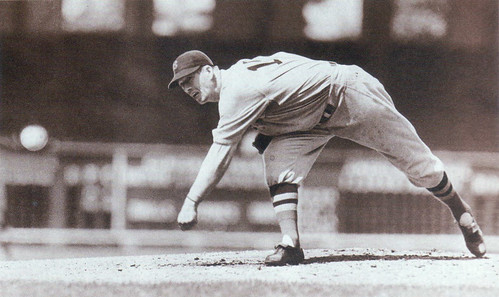
lefty Grove photo

Photo by rchdj10

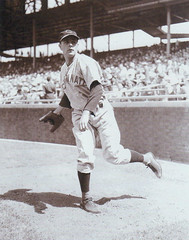
Lefty Grove – considered by many to be the best left-handed pitcher of all time – was known for having a white-hot fastball and a red-hot temper.

Grove finished his 17-season (1925-41) MLB career with 300 wins and a .680 winning percentage (141 losses). The six-time All Star (remember, the first All Star Game took place in 1935) led the American League in wins four times, winning percentage five times, earned run average nine times, complete games three times, shutouts three times and strikeouts seven times.

Going deeper, Grove also led the league in WHIP five times, strikeouts per nine innings five times and strikeouts-to-walks ratio seven times. His nine ERA titles are the most all time.

I’ll Take Grove for the Win

Lefty Grove’s .680 winning percentage is the best among pitchers with 300 or more MLB victories.

Grove won 20 or more games in seven seasons and threw 20 or more complete games in nine campaigns. He was 4-2, 1.75 in eight World Series appearances (five starts).

MVP-MVP

Lefty Grove was the 1931 American League MVP, when he went 31-4, 2.06 for the Philadelphia Athletics – winning one of his two pitching Triple Crowns (Wins-ERA-Strikeouts). That season, he ran off a sixteen-decision winning streak (June 8-August 19), during which he started 14 games and relieved in four (two saves), He notched 13 complete games (with a 2.30 ERA in that span).  The streak was broken on August 23, when Grove lost a 1-0 complete game to Dick Coffman and the St. Louis Browns.  (Coffman pitched a three-hit shutout.) After that tough loss, Grove went on to win his next six decisions – during which he threw five complete games in six starts and notched an even stringier 1.61 ERA.
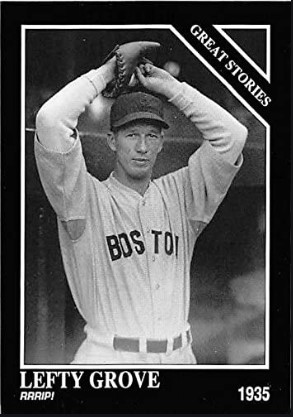
grove 2Grove did not get his first taste of organized ball until he was 19 (town ball), where he quickly earned a reputation for dispatching hitters via the strikeout, He was signed at the age of 20 by the Class D Martinsburg Mountaineers – and went 3-3, 1.68, with 60 strikeouts in 59 innings before the International League (Double-A) Baltimore Orioles came calling. That season, Grove went 12-2, 3.80 at Baltimore, where he stayed until 1924. (From 1920-24, he went 111-39, 2.90 in the minors.) Before the 1925 season, Grove was purchased from the Orioles by the Philadelphia Athletics for $100,600 (just under $1.5 million in today’s dollars) and started his MLB career in 1925.  The rest, as they say, is history.

Still, Grove didn’t dominate every hitter who stepped into the batter’s box.   There were these batmen:
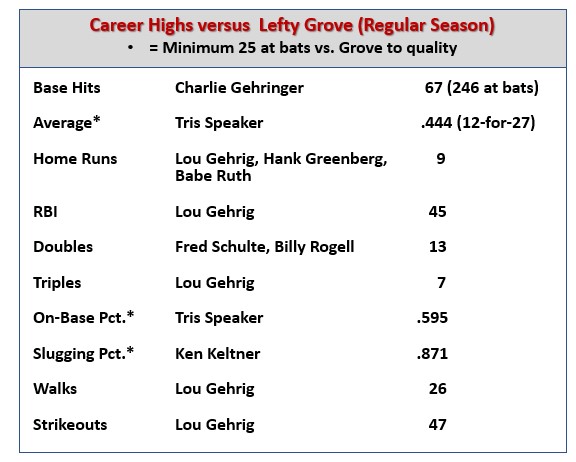


Career HighsGove

Note on chart: Baseball-References indicates game logs before 1973 are not complete. In the chart above, game logs (versus Grove) are missing for Charlie Gehringer (four games); Hank Greenberg (two games); Fred Schulte (one game); and Billy Rogell (three games).  Throughout this post, I have noted instances of incomplete game logs. 

Now, let’s take a look at the Lefty Grove “Who’s Your Daddy?” position-by-position line up.

_____________________________________________________

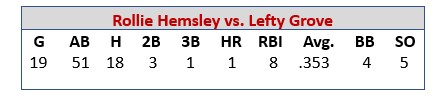
Catcher – Rollie Hemsley (.353 average)

In 1938, a season in which Lefty Grove went 14-4 and had the American League’s lowest qualifying earned run average at 3.08, Indians’ catcher Rollie Hemsley faced him in just one game (June 27). At the time, Grove was 11-2 on the season with a 2.98 earned run average. Hemsley, batting in the eight-hole, came into the game hitting .215 on the season and had played in just 20 the team’s first 58 contests. In the course of the game, Hemsley would go four-for-four (a double and three singles), raising his average 46 points.  In the eight seasons he faced Grove, Hemsley hit .333 or better in four.
Hemsley

The Right Place at the Right Time

Rollie Hemsley caught Bob Feller’s (April 16, 1940) Opening Day no-hitter – the only Opening Day No-No in MLB history. That, of course, makes Hemsley the only MLB player to catch an Opening Day no-hitter. Hemsley also had two of the Indians’ six hits and drove in the game’s only run with a two-out, fourth-inning triple. Side note:  Hemsley did gain some notoriety as Feller’s “personal catcher.”

Hemsley played 19 major league seasons (1928-44 … missing 1945 due to military service). He suited up for the Pirates, Cubs, Reds, Browns, Indians, Yankees and Phillies. (Hemsley played in 100 or more games in just six of those 19 seasons.) He was a five-time All Star, with a final career stat line of .262-31-555. His best season was 1934, when he hit .309, with 31 doubles, seven triples, two home runs, 52 RBI and six steals for the Saint Louis Browns.  (The average, triples, RBI and steals were all career highs.)

Honorable Mention: Rick Ferrell, a career .281 hitter, hit .313, with one home run and ten RBI in 29 games versus Grove. Note: Two games (logs) versus Grove are missing from Ferrell’s totals.

_____________________________________________

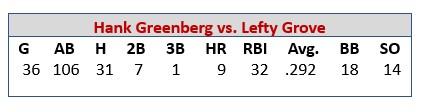
First Base – Hank Greenberg (nine home runs, 33 RBI)

Hank Greenberg’s nine home runs versus Lefty Grove tied him for the most career long balls against the Hall of Fame southpaw.  The others with nine dingers against Grove are Yankee stars Babe Ruth and Lou Gehrig. Greenberg, however, faced Grove in 38 fewer games than Gehrig and 13 fewer games than Ruth. Greenberg’s 32 RBI versus Grove also trail only Gehrig (45) and Ruth (33).
Greeberg

As noted earlier, two games (logs) versus Grove are missing from Greenberg’s totals.

Tea (me up) – for Two…

Hank Greenberg is one of only six players with a season of 60 or more doubles.  Here they are: Earl Webb (1931 – 67 doubles); George Burns (1926 – 64 doubles); Joe Medwick (1936 – 64 doubles); Hank Greenberg (1934 – 63 doubles); Paul Waner (1932 – 62 doubles); Charlie Gehringer (1936 – 60 doubles).

Greenberg played 13 MLB seasons (1933-47, missing 1942-44 for military service). He played all but his final season with the Tigers … suiting up for the Pirates in 1947. The Hall of Famer was a career .313 hitter (.412 on-base percentage), with 331 home runs, 1,274 RBI and 1,046 runs scored.  Greenberg was a two-time AL Most Valuable Player and a four-time All Star. He led the American League in home runs four times (a high of 58 in 1938), RBI four times (topping 100 in seven seasons), doubles twice (topping 40 five times) and runs scored once (with 100+ in six seasons). His best season could be called for either 1937 (.337-40-184) or 1938 (.315-58-147). Take your pick.

All or Nothing

On September 21, 21, 1937, Hank Greenberg had a truly “all or nothing” game against Grove. He came to the plate five times versus the Hall of Fame southpaw and went: strikeout; strikeout;  two-run home run; three-run home run; strikeout.  (It was one of two multi-home games Greenberg had against Grove.)  Grove, by the way, went the distance in a 12-7 Red Sox win over Greenberg’s Tigers – giving up seven runs (four earned).

Honorable Mention: Lou Gehrig hit .306 against Grove over his career.  In addition, Gehrig’s nine home runs tied for the most career long balls versus Grove (with Babe Ruth and Hank Greenberg, pretty good company); his 45 RBI against Grove were the highest of any hitter; his twelve doubles third; his 66 hits second; and his 26 walks first. Still, Greenberg gets this spot in the lineup for having done his damage in far fewer games and plate appearances.  Consider:  Gehrig’s slugging percentage against Grove was .551 to Greenberg’s .632 and his .380 on-base percentage versus Grove trailed Greenberg’s .395).  In addition, Greenberg had more walks (18) than strikeouts (14) versus Grove, while Gehrig fanned 47 times (versus 26 walks) versus Lefty.

_________________________________________________

Second Base – Aaron Ward (.342 average/.409 on-base percentage.

Aaron Ward reached Lefty Grove for a .342 average and .409 on-base percentage in 17 games – getting off to a good start by collecting a bases-loaded walk and a three-run home run in his two plate appearances in his  first game against Grove (May 4, 1925 (Grove’s rookie campaign.)   In three seasons facing Grove, Ward (a .268 career hitter) put up averages of .313, .333 and .368.Ward
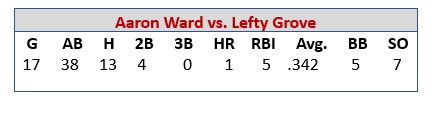
Note: One game (log) is missing from Ward’s totals versus Grove.

House the Ruth Built

It may have been “The House the Ruth Built,” but the first Yankee to collect a hit in the original  Yankee Stadium was second baseman Aaron Ward – a single to lead off the third inning. (The first hit, overall, was off the bat of Red Sox’ first baseman George Burns in the top of the second.  Side note: The Yankees, behind Bob Shawkey’s complete game, won 4-1 – and Babe Ruth hit the first home run in the new ballpark, a three-run shot in the bottom of the third inning.

Ward played 12 MLB seasons (1917-1928), the first ten with the Yankees and then one season each with the White Sox and Indians.  Known as one the best fielders of his era, Ward played in 1,059 games, hitting .268 with 50 home runs and 446 RBI. In 1923, he led AL second baseman in fielding percentage and assists and was second in both putouts and double plays.  He also led the league in assists in 1923 and was in the top-three AL second basemen in fielding percentage four times. His best offensive season was 1922, when he hit .284 with 10 home runs and 81 RBI.

_________________________________________

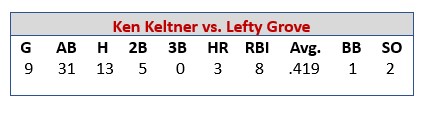
Third Base – Ken Keltner  (.419, three home runs)

Ken Keltner hit .419, with power, in nine games versus Grove. His batting average was the fifth-highest among players with at least 25 at bats versus Grove and his .871 slugging percentage was tops among that group.  Keltner had only one hit in his first seven at bats (first two games) versus Grove – and went 12-for-24 in his next seven contests against him.
Keltner

Keltner played 13 MLB seasons (1937-50, missing 1945 due to military service).  He played all but his final season with the Indians.  Keltner, a seven-time All Star and one of the slickest fielding third basemen of his time, was a career .276 hitter (1,526 games), with 163 home runs and 852 RBI. His best campaign was 1946, when he went ..297-31-119 (with career highs in home runs and RBI).  He twice topped 100 RBI and hit a high of .325 in 1939. Keltner led American League third basemen in double plays five times, assist four times, fielding percentage three times and putouts once.

The Culprit

Joe DiMaggio often referred to Keltner as “The Culprit.” On July 17. The Yankees were playing the Indians in Cleveland and DiMaggio was looking to extend his record-setting hitting streak to 57 games.  He went zero-for-three (with a walk) in that game and two of the three outs were the result of exceptional backhand grabs (and throws) on sharp ground balls down the third baseline – Keltner’s territory.  (DiMaggio, by the way, famously hit safely in his first sixteen games after the streak was halted.)

Honorable Mention: Ben Chapman suited up against Lefty Grove in 35 games between 1930 and 1940, picking up 33 hits in 100 at bats (.330), with six doubles, one triple, two home runs and 15 RBI.

____________________________________________

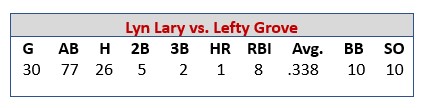
Shortstop Lyn Lary (.338 average)

Lyn Lary, a .269 career hitter over 12 MLB seasons, hit .338 in 30 games against Lefty Grove. He also drew ten walks against Grove, for a .414 career on-base percentage.Lary
Lary played 12 MLB seasons (1929-40), taking the field for the Yankees, Indians, Senators, Browns, Dodgers and Cardinals. He played 1,302 games, hitting .269 with 38 home runs, 526 RBI, 805 runs and 162 stolen bases. His best season was for the 1931 Yankees, when he .280, with 10 long balls, 107 RBI and 100 runs scored in 155 games.

One for the Bombers

Lyn Lary drove in 107 runs for the Yankees in 1931 – still the most RBI in a season ever for a Yankee shortstop. (Derek Jeter is second with 102 in 1999.) In his first three season in the major leagues – Yankees … 1929-31 – Lary hit .289-18-185 in 352 games.

Over his career, Lary scored 100 or more runs in three seasons, stole 20+ bases in four seasons (leading the AL with 37 steals in 1936) and hit .280 or higher in five campaigns.

Honorable Mention: Luke Appling (.324-0-14 in 39 games against Grove). Note: Two games (logs) are missing from Appling’s totals versus Grove.

_______________________________________________

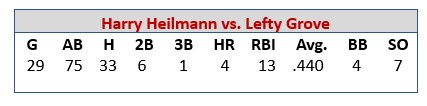
Outfield – Harry Heilmann (33 hits – 11 for extra bases – and a .440 average)

Harry Heilmann hit .440 against Lefty Grove, second only to Tris Speaker’s .444 among hitters with at least 25 at bats against the Hall of Fame lefty. Heilmann also tied for the fifth-most regular season home runs versus Grove and had the second-highest on-base percentage and second-highest slugging percentage (again among those with at least 25 at bats versus Grove).  Heilmann drops to fourth in batting average and on-base percentage if you drop the qualifying at bats to twenty.  In the five seasons he faced Grove (1925-20), Heilmann hit under .400 against him only once (.278 in 1928) and hit .500 or better in three seasons.
Heilmann

Note: Three games (logs) are missing from Heilmann’s totals versus Grove.

Heilmann played 17 MLB season (1914, 1916-29 for the Tigers and 1930 and 1932 for the Reds). The Hall of Famer collected 2,660 hits for a .342 average – winning four batting titles along the way (and hitting a high of .403 in 1932.).  Heilmann’s  final line was .342-183-1,543. He led the AL in hits once (and topped 200 hits in four seasons); led the league in RBI once (with 100+ RBI eight times); topped the AL in doubles once (with 40 or more two-baggers in eight seasons); scored 100+ ruins in four seasons; stole 10+ bases in four; and recorded double digits in triples nine times.

Just Your Oddly AVERAGE Guy

In the seven seasons from 1921-1927, Harry Heilmann hit .380, with 104 home runs, 815 RBI and 727 runs scored. He won the American League batting title in each odd-numbered years during that span.

_______________________________________________

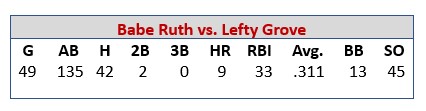
Outfield – Babe Ruth (Nine homers, .311 average)

Babe Ruth tied Lou Gehrig and Hank Greenberg for the most home runs against Lefty Grove (nine) and only Gehrig drove in more runs against Grove (45) than Ruth (33) – and Ruth put up this numbers in 25 fewer games and 97 fewer at bats against Grove than Gehrig. While Grove held Ruth below his .342 career average, the Bambino hit a respectable .311 versus Lefty. Ruth had a pair of multiple home run games against Grove.
Ruth

Ouch:

In 1933, Babe Ruth blasted off to a good start against Lefty Grove, homering in his first two at bats against him. He came to the plate against Grove 15 more times that season and collected just one hit (a single) and one walk, while fanning eight times and getting the ball out of the infield just twice (his lone single and a fly out to RF).  To be fair, Ruth did go eight-for-eighteen (.444) against Grove in 1926.

What can’t you say about the Babe?  He put up a .342-714-2,214 line, and recorded a record 12 home run crowns (11 seasons of 40 or more long balls); eight times led the league in runs scored (12 season of 100+); five times topped the league in RBI (11 season of 100+); led his league 11 time in walks; and captured one batting crown.

  • In 1920, Babe Ruth popped 54 home runs for the Yankees – more than any other TEAM in the American League.
  • Babe Ruth put up a 0.87 World Series earned run average, giving up just three runs in 31 WS innings pitched. His World Series batting average (in 41 games) was .326.
  • In 1918, Babe Ruth led the American league in home runs (11) and hit an even .300, while also gong 13-7, 2.22 and tossing 18 complete games (19 starts) as a pitcher.
  • Babe Ruth broke the all -time MLB Home run record in three straight seasons (1919-1920-1921).
  • Babe Ruth still holds the record for the longest mound outing in a World Series game – going 14 innings in a 2-1 complete-game win (for Boston) in the 1916 World Series.

Comparing Strong Left Arms

Babe Ruth’s pitching skills mirrored those of Lefty Grove.  Ruth was 94-46, for a .671 winning percentage, just shy of Grove’s .680.  Ruth completed 72.7 percent of his 147 starts, while Grove finished 65.2 percent of his 457 starting assignments.  Ruth did put up a 2.28 ERA to Groves’ 3.06 – but Ruth pitched primarily before the live ball ERA.  When you look at their earned run averages versus standards of their time, Grove has a bit of an edge.   Grove did hold a notable edge in strikeouts averaging 5.2 per nine innings to Ruth’s 3.6 whiffs per nine innings.  Note: Ruth was a two-time 20-game winner and topped the American league in ERA, complete games and shutouts once each (in just three seasons of more than 20 starts).

___________________________________________________

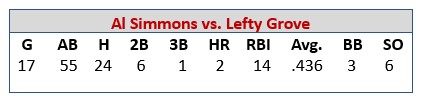
Outfield – Al Simmons (.436 average).

Al Simmons .436 average against Grove is the fifth-highest among hitters with at least 20 at bats versus Grove (if you set the bar at 25 at bats, he moves up to third.)  Among those with at least 20 at bats against Grove, Simmons’  .691 slugging percentage is the fourth-highest and his .466 on-base percentage ranks fifth. In addition, Simmons drove in 14 runs against Grove in just 17 games. Simmons faced Grove in six seasons (1933-38) and hit .357 or better versus Grove in all of those campaigns.  In 1936, he went .467 (seven-for-fifteen) versus Grove, with two home runs and six RBI in five contests.
Simmons

Note: Two games (logs) are missing from Simmons’ totals versus Grove.

Simmons played in 20 MLB seasons (1924-41, 1943-44), playing for the Athletics, White Sox, Senators, Braves, Red Sox and Reds.  He complied a .334 career average, hitting .300+ in 13 full seasons and winning a pair of batting titles (.381 in 1930 and .390 in 1931). The three-time All Star led the league in hits twice (collecting 200 or more safeties in six seasons), runs scored once (topping 100 runs in six seasons) and RBI once (topping 100 in 12 seasons). He had four seasons of 40+ doubles, seven season with double-digits in triples and three seasons of 30+ home runs. His best campaign was 1931, when he hit .381, with 36 home runs, 165 RBI and 152 runs scored in 138 games.  His career stat line was .334-307-1,828, with 1,507 runs scored.

That’s Right!

Al Simmons’ 253 base hits in 1925 are the most ever for a right-handed hitter and the fifth-most all-time behind lefty swingers Ichiro Suzuki (262 in 2004), George Sisler (257 in 1920),  Lefty O’Doul (254 in 1929) and Bill Terry 254 in 1930).

Honorable Mentions:  Honorable mentions in the outfield include: Tris Speaker, who hit .444-0-7 in eight games against Grove (and who needed more games or a bit more power to crack this lineup);  Joe DiMaggio (.361-2-10 in 22 games versus Grove); and Harry Rice (.324-3-15 in 29 games against Grove. Note: Three games (logs) are missing from Rice’s totals versus Grove.

Joe D Finds His Grove Groove

In 1939, when Lefty Grove went 15-4 with an AL-best 2.54 earned run average, Joe DiMaggio raked him for nine hits in five games (a nifty .692 average), with two doubles, one home run, two walks and just one whiff.  That season, the Yankee Clipper led the American League with a .381 average.

______________________________________________

Pitcher – Jimmie DeShong

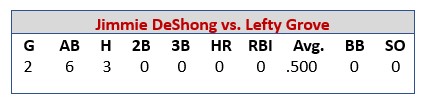
Righty Jimmy DeShong (47-44, 5.08 in seven MLB seasons) found himself on the mound and at the plate against Lefty Grove just twice in his career.   He took the loss in both games – but, the career .198 hitter acquitted himself well at the plate, going three-for-six (all singles).  In DeShong’s best season (1936), he went 18-10, 4.63 for the Washington Senators.
DeShong

A Big Oh-Fer

Pitcher Red Faber set the record for futility against Lefty Grove. Faber faced Grove 16 times and drew one walk, while fanning 12 times (without getting a single hit.)  Two other players, Johnny Allen (pitcher) and Dick Bartell (shortstop) also managed to put up a .000 average in 16 plate appearances against Lefty. 

___________________________________

Who’s Your Daddy?  The Inspiration.

On September 24, 2004, in the middle of a tight pennant race, the Yankees handed future Hall of Famer Pedro Martinez and the Boston Red Sox a tough 6-4 loss.  Martinez went 7 1/3 innings giving up nine hits and five earned runs.  The game came just five days after (in his previous start) Martinez had lasted just five frames against the Bronx Bombers (eight hits, eight earned runs) in a 16-7 loss.

After that second loss, Martinez candidly commented, “What can I say? I just tip my hat and call the Yankees my daddy.”  Little did he know that his comment – and a Yankee fans’ chant of “Who’s your daddy?” would follow him into future starts in New York (all the way to his final MLB start – against the Yankees for the Phillies – in Game Six of the 2009 World Series.)

The concept of “Who’s your daddy?” became the inspiration for Baseball Roundtable to take a look at the players who “had the number” of some of MLB’s premier pitchers.  Again, you can find links to the previous “editions” of “Who’s Your Daddy?” near the top of this post. 

______________________________________________________

Primary Resource:  Baseball Reference.com; MLB.com; Baseball-Almanac.com; New England Historical Society.

100Baseball Roundtable is on the Feedspot list of the Top 100 Baseball Blogs.  To see the full list, click here.

I tweet baseball @DavidBaseballRT

Follow/Like Baseball Roundtable’s Facebook Page here.  More baseball commentary; blog post notifications; PRIZES.

Member: Society for American Baseball Research (SABR); Negro Leagues Baseball Museum; The Baseball Reliquary. 


Sam “Toothpick” Jones …Dangerously, and Effectively, Wild

Sam "Toothpick" Jones - the definition of "effectively wild."

Sam “Toothpick” Jones – the definition of “effectively wild.”

On May 12, 1955, Cubs’ right-hander Sam “Toothpick” Jones came into the top of the ninth of a game against the Pirates having given up no-hits, with four walks and three strikeouts. Despite the four free passes, he had faced only one more than the minimum number of hitters.  The Pirates’ number-five hitter, power-hitting first baseman Dale Long, had walked in all three of his plate appearances. In the second inning, Long was tossed out on an attempted steal; in the fifth he was the lead out in a short-to second-to first double play; and, in the eighth, he was doubled off first on a line drive to third.  The only other Pittsburgh base runner to that point was catcher Toby Atwell, who led off the third with a walk, but was stranded as Jones induced a pop out, strikeout and ground out.  Meanwhile, the Cubs had scored four runs on fifteen hits off the Pirates’ Nellie King and Vern Law.

With a 4-0 lead and the eight, nine and lead-off hitters scheduled to bat, Jones –ironically, you will see – seemed in control.  That would not last long. Jones started the inning by walking the number-eight hitter, second baseman Gene Freese.  The Pirates sent Preston Ward (hitting .152 at the time) up to hit for pitcher Vern Law and, during the at bat, a Jones’ wild pitch sent Freese to second.  The WP didn’t matter much, since Jones went on to walk Ward, bringing up lead-off hitter/center fielder Tom Saffell (zero-for-three on the day and zero-for-fifteen on the season).  Jones walked Saffell to load the bases with no outs.

Coming up?  The heart of the order.  Shortstop Dick Groat (a future batting champion and NL MVP, who would strike out only 26 times in 151 games that season); future Hall of Famer RF Roberto Clemente (who came into the game hitting .304); and left fielder/clean-up hitter Frank Thomas.  With the bases loaded and the no-hitter, shutout and even the game in jeopardy, Cubs’ manager Stan Hack made a trip to the mound. Apparently, whatever he said, struck a chord with Jones.  After the visit, Jones used just 11 more pitches to strike out Groat (looking), Clemente (swinging) and Thomas (looking) – putting the final touches on his no-hitter.

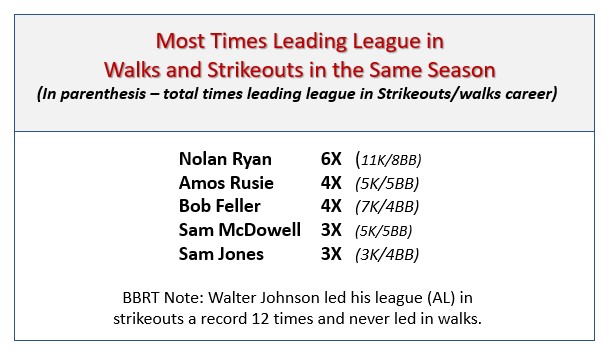
The final inning of Jones’ no-hitter – three walks and three strikeouts – was pretty indicative of Jones’ pitching style. Jones, would in fact, lead his league in strikeouts and walks in the same season three times – 1955, 56, 58.   The year of the no-no was Jones‘ first full MLB season (he had pitched in two games for the Indians in 1951 and 14 games for the Tribe in 1952). In 1955, Jones led the National League in walks (185 in 214 2/3 innings), strikeouts (198), hit batsmen (14) and losses (20 against 14 wins).  Let me do the math for you. During the season, Jones walked 6.5 batters and fanned 7.4 per nine innings.

BBK

One Thing Leads to Another …

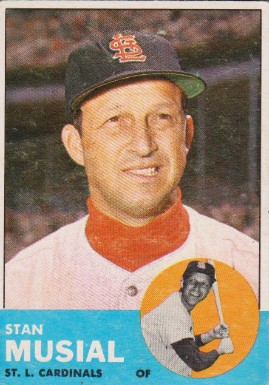
Baseball Roundtable readers know that often, when I am researching one topic, I get drawn into another. In this case, I was working on a post on hitters who had Hall of Famer Warren Spahn’s “number.”  (See that post here). One of hitters was Stan Musial, who had the most career base hits off Spahn. In the process, I saw that Sam Jones had been particularly effective against Musial – holding the career .331 hitter to a .122 career average (6-for-49, with 11 strikeouts).  That prompted me to look a little deeper into the career of Sam “Toothpick” Jones.

Jones’ early professional experience was garnered with the Negro American League Cleveland Buckeyes – whom he signed with in 1947 after leaving the Army.  He also pitched in Panama and the Southern Minnesota League (semipro) before signing with the Indians.

As an Indians’ farmhand, Jones had a pair of solid minor league seasons (17-8, 2.71 for the Class A Wilkes-Barre Indians in 1950 and 16-13, 2.76 for the Triple A San Diego Padres in 1951). He then made his MLB debut with the Indians (in Detroit) on September 22, 1951.  During this period, Jones also pitched in the Puerto Rican Winter League – topping that circuit (1951-52 season) in strikeouts (146), while putting up a 13-5, 2.51 record.

A bit of Irony …

StanMusialSam Jones was truly Stan Musial’s nemesis, (as noted earlier) holding the Hall of Famer to a .122 career average over 49 at bats.  That was Musial’s lowest average against any pitcher he faced at least 15 times. Jones also fanned Musial him in one of very 4.5 at bats – compared to Musial’s career average of one whiff for every 15.8 at bats.  In a bit of irony, Jones and Musial were teammates on the Cardinals from 1957-58. (Jones had been part of a nine-player Cubs/Cardinals trade in December of 1956.)   At that point, “Stan the Man” was 1-for-14 against Jones.

On May 13, 1958, Musial was on the Redbirds’ bench as they took on the Cubs in Chicago. Musial was  not only sitting on the bench, he was sitting on 2,999 career hits and manager Fred Hutchinson wanted to give him the opportunity to collect the landmark safety the next day in St, Louis.  Starting on the mound that day was none other than Sam “Toothpick” Jones.  In the sixth inning, with the Cardinals trailing 3-1, a runner on second, one out and Jones due to hit, Hutchinson decided to act and put in Musial to pinch hit. Musial doubled, collecting his 3,000th hit while pinch-hitting for Jones (who would deny Musial plenty of hits over his career.)

Jones spent the early part of 1952 with the Indians (a 7.25 ERA and 37 walks in 36 innings before being sent down to Triple A Indianapolis).  He then spent the 1953 and 1954 seasons at Indianapolis (before being traded to the Cubs).  While he continued to have control issues, Jones did show significant potential. In 1954, he was 15-8, 3.75 at Triple A, throwing 12 complete games (31 starts) and four shutouts. In 199 innings, he walked 129 and fanned 178.

Warming Up in the Winter

Sam Jones pitched in the 1954-55 Puerto Rican Winter League season, leading the league in wins (14 versus four losses), ERA (1.77) and strikeouts (171). Side note: Tommy Lasorda finished third in the league in strikeouts that season with 86.   

Then came Jones’ first full MLB season (1955 Cubs), when, as noted, he led the league in walks and strikeouts – showing swing-and-miss stuff and miss-the-plate command.  He followed up with a 9-14, 3.91 season in 1956, again leading the league in walks and strikeouts. Following the 1956 season, the Cubs traded Jones to the Cardinals.  For the Redbirds in 1957, Jones pitched trough elbow issues (getting just 27 starts (to go 12-9, 3.60). In 1958, he got his full complement of starts and finished 14-13, 2.88 – and, for the third time in four years, led the league in both strikeouts and walks.

Shortly before the 1959 season opened, the Cardinals traded Jones to the Giants, where he continued to be dangerously – but even more effectively – wild. In 1959, he tied for the league-lead in wins (21 versus 15 losses), recorded the league;s lowest warned run average (2.83), finished second in strikeouts (209) and, true to form, led the league with 109 walks. He followed that up with an 18-14, 3.19 season in 1960.

In 1961, Jones went 8-8, 4.49 – and got only 17 starts in 37 appearances. The decline was enough for the Giants to leave him unprotected in the expansion draft and he was taken by the Colt .45’s, who traded him to Detroit.

Effectively Wild Even as an All Star

In his two All Star appearances, (1955, 1959) Sam Jones’ line was consistent with the term “effectively wild” – 2 2/3 innings pitched, one hit, one run (unearned), four walks, four strike outs, one hit by pitch.

During Spring Training 1962, Jones was diagnosed with cancer of the lymph nodes and subsequently underwent surgery and radiation treatments. Although Jones did go into remission, from 1962-64, he appeared in only 48 more MLB games, going 4-4, 4.12; but still striking out 87 batters in 102 2/3 innings. His last major-league appearance came on October 3, 1964 for the Orioles. He pitched 1 1/3 scoreless innings of relief, striking out one batter (the Tigers’ Gates Brown). Between 1963 and 1967, Jones also pitched in Triple A, as well as in Nicaragua and the Dominican Republic.  One wonders what Jones’ career would have looked like without that bout with cancer. (Jones died from cancer in 1971 at age 45.)

The Times They Are A’Changin’

With Major League Baseball designating Negro League records from 1920-1948 as major-league records – a couple of Sam Jones “landmarks” may bite the dust. On May 3, 1951, Jones came on in relief for the Indians (versus the Senators). His catcher was Quincy Trouppe – and, together, they formed the first all African-American major league battery.   In addition, Jones’ 1955 no-hitter was the first major -eague no-hitter by an African-Americana pitcher.  As noted, those records may soon be changing.

Jones pitched in MLB in all or parts of 12 seasons (1951-52, 1955-64), taking the mound for the Cleveland Indians, Chicago Cubs, St. Louis Cardinals, Detroit Tigers, San Francisco Giants and Baltimore Orioles. Jones finished his MLB career with 102 wins, 101 losses and a 3.59 ERA. He led the league in wins once, earned run average once, strikeouts three times, strikeouts pr nine innings pitched four times and walks four times.

Primary Resources:  Baseball-reference.com; Baseball-almanac.com; Beisbol101.com, January 24, 2020 Tom Van Heyning,

100Baseball Roundtable is on the Feedspot list of the Top 100 Baseball Blogs.  To see the full list, click here.

I tweet baseball @DavidBBRT

Follow/Like Baseball Roundtable’s Facebook Page here.  More baseball commentary; blog post notifications; PRIZES.

Member: Society for American Baseball Research (SABR); Negro Leagues Baseball Museum; The Baseball Reliquary. 
Giving Johnny Vander Meer His Due


Kids are always chasing rainbows, but baseball is a world where you can catch them.

                                                           Johnny Vander Meer, Major League Southpaw

Johnny Vander Meer photo

Photo by rchdj10

Johnny Vander Meer did indeed catch some baseball rainbows.  Most memorably – or, at least, most historically – his tossing of two consecutive no-hitters for the Cincinnati Reds in 1938.  That still-unmatched feat is what Vander Meer is most known for.  That’s not surprising when you consider his career (13 seasons – 1937-43 & 1946-51 … Reds, Cubs, Indians) 119-121 record and the fact that he walked nearly as many hitters as he fanned. Still, early in his career, the hard-throwing southpaw was compared to another up and coming fireballer – future Hall of Famer Bob Feller.   Still, when Baseball Roundtable looked a little deeper, there was a lot more to Vander Meer’s career than those two no-hitters.  Here’s just a sampling.

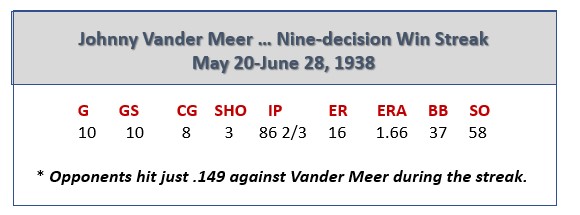
  • Vander Meer’s two consecutive no-hitters came during a nine-decision winning streak that included eight complete games and three shutouts.

Vandy Streak

  • Vander Meer led the National League in total strikeouts and whiffs per nine innings pitched in three consecutive seasons (1941-43).
  • Vander Meer was the (first-ever) Sporting News Minor League Player of the Year in 1936 and the Sporting News Major League Player of the Year in 1938.

Making it Count

On September 18, 1940, Johnny Vander Meer not only pitched the Reds to a pennant-clinching victory, but also scored the winning run in the contest.  Vander Meer started the game and gave up three runs over 12 innings of work (eight hits, five walks, ten strikeouts). Leading off the top of the thirteenth inning, Vander Meer doubled to left, was sacrificed to third and then scored the winning run on a sacrifice fly. Reliever Joe Beggs pitched the bottom of the thirteenth to save Vander Meer’s win.

  • Vander Meer was a four-time All Star (1938, 1939, 1942, 1943).
  • Vander Meer shares the record for strikeouts in an All Star game (six) with Carl Hubbell, Larry Jansen and Fergie Jenkins.
  • Vander Meer pitched in three All Star games (1938, 1942, 1943),  walking one and fanning 11 hitters in 8 2/3 innings. He gave up just five hits and one run (unearned) in those three appearances

A Hard Day’s Night

Johnny Vander Meer was the Reds starting pitcher in the longest MLB game ending in a scoreless tie. On September 11, 1946, he started against the Dodgers and pitched 15 shutout innings (seven hits, two walks and 14 strikeouts). (Dodger starter Hal Gregg went ten scoreless frames.) The game went 19 innings and was called (darkness) with both teams still scoreless. Note: On April 15, 1968, the Mets and Astros were both scoreless through 23 innings, with the Astros winning 1-0 in the bottom of the 24th frame. That is the most innings both teams remained scoreless in an MLB tilt.

Here’s a little more of the Vander Meer story.

Vander Meer made his professional debut with the C-level Dayton Ducks as an 18-year-old in 1933 – going 11-10, 4.28, with 132 strikeouts in 183 innings. After a couple of less than stellar minor league seasons, he opened some eyes as The Sporting News 1936 Minor League Player of the Year – after a 19-6, 2.65 season with the Class-B Durham Bulls.  While, he had a powerful “swing and miss” fastball (Vander Meer fanned 295 batters in 214 innings), control was not his forte (he also walked 116).

On July 23, 1936, Johnny Vander Meer, pitching for the Durham Bulls, fanned 20 batters in a game against the Ashville Tourists.

Vander Meer’s 1936 performance earned him an invite to the Reds 1937 Spring Training camp and he went north with the team.  However, control issues still plagued him and he was sent down to the Double-A Syracuse Chiefs in July – after posting a 3-4, 4.22 record with 55 walks (40 whiffs) in 64 innings.  (He was called back up in September and ended the MLB season at 3-5, 3.84 with 69 walks and 52 strikeouts in 84 1/3 innings.)

Then came the 1938 season, when the 23-year-old seemed to find himself, going 15-10, 3.12 in 32 games (29 starts), fanning 125 batters in 225 1/3 innings (but still walking 103) – and, of course, tossing those consecutive no-hitters (June 11 versus the Bees and June 15 versus the Dodgers). For the season, Vander Meer’s 4.99 strikeouts per nine innings pitched were second in the National League (to Carl Hubbell); his 7.07 hits per nine innings pitched were the league low; and his 3.12 earned run average was tenth-best.  There was still work to do on his command, as his 104 walks were fourth-highest in the league.  Vander Meer also made his first All Star squad in 1938, started the game, threw three innings of no-run, one-hit ball and got the win.  After the season, he was the named the Sporting News Major League Player of the Year. 

After that sparkling 1938 season, Vander Meer appeared to be on his way. Those expectations were dashed in 1939, when illness and injury contributed to a 5-9, 4.67 record. He also got off to a slow start in 1940, being sent down to Double-A Indianapolis after four appearances (two starts) in which he pitched just 8 2/3 innings, fanning nine and walking 13, while putting up a 7.27 ERA.  He seemed to find himself at Indianapolis, going 6-4, 2.40, which earned him a September call up – during which he went 3-1, 2.97 (31 strikeouts and 28 walks in 39 1/3 innings) and pitched 12 shutout innings to get the win in the Reds’ pennant-clinching game.

Vander Meer powered his way to a 16-13, 2.82 record in 1941; 18-12, 2.43 in 1942; and 15-16, 2.82 in 1943 – leading the NL in strikeouts all three seasons and making the  National League All Star team in 1942 and 1943. Still, control remained an issue, as Vander Meer led the league in walks in 1943, allowed the NL’s second-most walks in 1942 and the fourth-most in 1941.

What Could Have Been

Johnny Vander Meer deserved better than his 15-16 record in 1943. His losses included two complete games in which he gave up a single run; two complete games in which he gave up just two runs; and a complete game which he lost 3-2 in the twelfth inning.  

Vander Meer then missed the 1944 and 1945 seasons (military service) and, while he came back to pitch six more MLB campaigns (1946-51), he had trouble recapturing that 1941-43 fastball.  Over those final six seasons, he went 44-55, 3.93 (as compared to 75-66, 3.11 from 1937 to 1943).  Vander Meer’s final career line was 119-121, 3.44, with 1,294 strikeouts and 1,132 walks. He threw 131 complete games (286 starts) and thirty shutouts.  He was a four-time All Star and won 15 or more games in five seasons.  Overall, he was in the NL’s top ten in ERA four times; wins five times; fewest hits per nine innings six times; total strikeouts and strikeouts per nine innings seven times each; complete games five times; and shutouts eight times.

While he made his final MLB appearance on May 7, 1951 (Indians), Vander Meer continued to pitch in the minor leagues through 1955 and managed in the minors from 1953 through 1962.

Primary Resources: Baseball-Reference.com; National Baseball Hall of Fame; MLB.com; Baseball-Almanac.com

100Baseball Roundtable is on the Feedspot list of the Top 100 Baseball Blogs.  To see the full list, click here.

I tweet baseball @DavidBBRT

Follow/Like Baseball Roundtable’s Facebook Page here.  More baseball commentary; blog post notifications; PRIZES.

Member: Society for American Baseball Research (SABR); Negro Leagues Baseball Museum; The Baseball Reliquary. 
Nineteen runs …. with Nineteen Different Players Touching the Plate

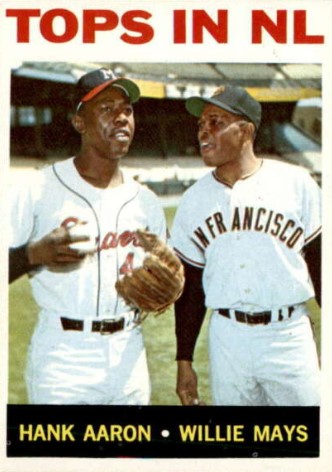
Hank and Willie - starting center fielders in this big game.

Hank and Willie – starting center fielders in this big game.

I have often commented in this blog about how when researching “one things leads to another” – how, while looking into one Baseball Roundtable blog topic, it’s not unusual for me to be distracted an accidentally unearthed hardball tidbit.  No surprise, it’s happened again.

While looking into the stats for my all-time favorite players – Braves’ Hall of Famer Eddie Mathews – I came across a game that caught my attention.  I found this contest – a June 4, 1958 matchup between the Braves and Giants in San Francisco – intriguing for several reasons:

  • It was a meaningful contest – the Braves and Giants came into the game tied for first place;
  • It involved some of MLB’s biggest offensive “names” at the time, like Hank Aaron, Willie Mays, Eddie Mathews and Orlando Cepeda;
  • It ended in an 11-inning, 10-9 Braves’ win;
  • THE NINETEEN RUNS IN THE GAME WERE SCORED BY NINETEEN DIFFERENT PLAYERS; and
  • The game-winning RBI went to pinch-hitter and Hall of Fame pitcher Warren Spahn.

But I’m getting ahead of myself.  Let’s take a look at this matchup. The Braves opened the series in San Francisco with veteran righty Bob Rush (4-2, 2.06) on the mound, while the Giants countered with 19-year-old southpaw Mike McCormick (4-1, 4.21). The youngster outlasted the veteran, as Rush lasted just 1 2/3 innings – giving up four runs on six hits and a walk. After just three innings, the Giants seemed in control, leading by a 7-1 score.  (The Braves would go on to use seven pitchers to the Giants four.) McCormick was pulled with two out in the seventh, with the Giants still up 7-2 (a third run would be charged to McCormick before the frame was over). That’s when things got interesting. The Braves added a run in the eight to cut the lead to three and then tied it with a two-out, three-run home run in the ninth by Wes Covington. Milwaukee scored twice in the top of the tenth on a two-out bases-loaded single by Eddie Mathews and the Giants came right back with two tallies in the bottom of the inning on two-out solo home runs by Hank Sauer and Bob Schmidt.  That set the stage for Warren Spahn’s eleventh-inning offensive heroics.

Spahn won 363 regular-season games on the mound. He won this one from the batter's box.

Spahn won 363 regular-season games on the mound. He won this one from the batter’s box.

Wes Covington opened the top of the eleventh with a walk off Giants’ reliever Stu Miller, with speedster Billy Bruton being brought in as a pinch runner. Johnny Logan bunted Bruton to second and when Andy Pafko flied out to right, pitcher Ernie Johnson was due up with a runner in scoring position and two out.  Braves’ manager Fred Haney, who had already used four pinch-hitters, called upon star southpaw Warren Spahn to hit for Johnson. Spahn drove a run-scoring single to center to plate what proved to be the winning run (the Giants went down in order in the borrow of the inning).

Here are a few notable “stats” from that game.

  • The nineteen runs scored were scored by nineteen different players.
  • The two team used five catchers sin the game and each catcher scored a run. (For the Braves: Del Crandall, Del Rice and Carl Sawatski. For the Giants: Valmy Thomas and Bob Schmidt.

10-9

  • The Braves used 23 players; the Giants 19.
  • In the final (eleventh) inning, both teams used pitchers as pinch hitters. The Braves’ Warren Spahn hit for reliever Ernie Johnson and the Giants’ Johnny Antonelli came to the plate for pitcher Stu Miller.  Spahn collected the game-winning RBI, Antonelli fanned to end the contest.

Who Says Pitcher Can’t Hit?

The 37-year-old Warren Spahn came into the Braves/Giants game of June 4, 1958 hitting .361 on the season (13-for-36, with three doubles, one triple and six RBI). He finished the campaign at .333 (36-for-108), with six doubles, one triple, two home runs and 15 RBI – add in his seven walks and he produced a .381 on-base percentage. Over his career, Spahn his .194-35-109. His 35 career home runs are the third-most by a pitcher.  Side note Spahn earned 363 regular-season victories and collected 363 regular season hits.

  • The starting center fielders in the game were a pair of Hall of Famers – Hank Aaron and Willie Mays. Mays led the Giants with four hits (he also had two stolen bases), while Aaron led the Braves with three safeties. Each, of course, scored one run. The other players with more than one hit in the game (all with two) were RF Andy Pafko and 1B Joe Adcock for the Braves and pitcher Mike McCormick for the Giants.
  • Each team had three home runs. For the Braves: Felix Mantilla (solo); Del Crandall (solo); Wes Covington (three-run). For the Giants, it was Bob Speake, Hank Sauer and Bob Schmidt (all solo).

Baseball Roundtable (unofficial) fans’ Hall of Fame Ballot.

There is still time – about one week –  to vote in BBRT’s unofficial fans’ 2012 Hall of Fame balloting.  Click here to access the ballot. 

Ballot


Primary Resource for this Post:  Baseball-Reference.com

100Baseball Roundtable is on the Feedspot list of the Top 100 Baseball Blogs.  To see the full list, click here.

I tweet baseball @DavidBBRT

Follow/Like Baseball Roundtable’s Facebook Page here.  More baseball commentary; blog post notifications; PRIZES.

Member: Society for American Baseball Research (SABR); Negro Leagues Baseball Museum; The Baseball Reliquary. 
From Bloomer Girls to the Big Leagues to Babe Ruth Lite … Smoky Joe Wood

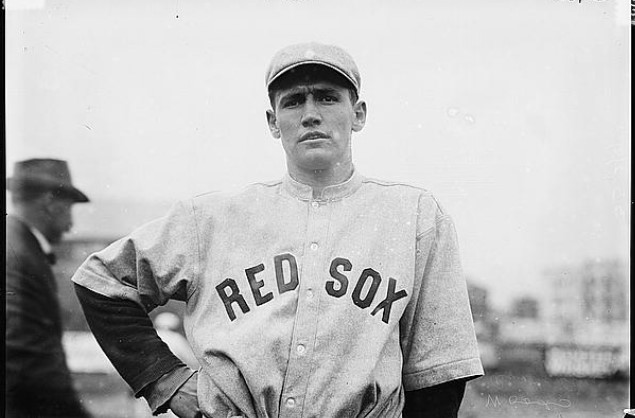
Smoky Joe Wood’s baseball career took him from the Bloomer Girls to the Big Leagues to Babe Ruth Lite – and, eventually to Yale University … all for the love of the game. 

With plenty of time to for baseball reading these days, it’s easy to come across intriguing stories about those who have taken the field at the major-league level.  Smoky Joe Wood’s tale is one of those stories.

The Bloomer Girls

Joe Wood (he wasn’t Smoky yet, his major-league fastball would earn him that moniker) started playing baseball as a 16-year-old (1906) pitching town ball in Kansas.  Wood, however, didn’t stay amateur for long. That fall he played his first games as a paid professional – for the barnstorming “Bloomer Girls.”  Basically, the Bloomer Girls (there were several Bloomer Girls squads) were teams of female baseball players who traveled the country taking on all-male squads (usually town ball or semi-pro teams).  Each team would have two or three young fellows willing to play wearing the bloomer-based uniforms (and often curly wigs). Wood played as “Lucy Totton” for the Kansas Bloomer Girls team.

All Wigged Out

Like Joe Wood, Hall of Famers Rogers Hornsby and Grover Cleveland Alexander also “suited up” for the Bloomer Girls before making their way to the major leagues. Because of the wigs male players often wore, the impersonators were known as “toppers.”


The Big Leagues

Library of Congress photo. George Grantham Bain Collection

Library of Congress photo. George Grantham Bain Collection

Wood’s Bloomer Girls gig didn’t last long. In 1907, he was pitching for the Hutchinson Salt Packers in the Class C Western Association – where he would go 18-11 and fan more  than 200 batters.  In 1908, it was on to the Kansas City Blues of the Class A American Association.   By August 1908, at just 18-years-old, Wood’s contract had been purchased by the Red Sox and he found himself in the major leagues.  In his first MLB season, Wood made six appearances, two starts, and went 1-1, 2.38 with 11 strikeouts in 22 2/3 innings.

In the spring of 1909, Wood suffered a foot injury (reportedly while roughhousing with his roommate, Tris Speaker), that put him out of action until June (he made his first start on June 21 – a complete-game, two-hit, 4-1 win over the Athletics).   Wood went 11-7, 2.18 on the season. He also lost a month of the 1910 season (ankle surgery), when he went 12-13, 1.69.  Despite the injury layoff, Wood’s 1.69 ERA in 1910 was the second-lowest on the team and eighth-best in the AL and his 145 strikeouts led all BoSox hurlers and represented the sixth-highest total in the AL (his 6.6 strikeouts per nine innings pitched were second only to Walter Johnson).

Over the 1909 and 1910 seasons, Wood split his duties between starting and relieving (36 starts and 23 relief appearances).  In 1911, Woods took his place as a primary member of the Red Sox’ rotation (starting 33 games and relieving in 11). His 23 wins (17 losses) were fourth-best in the league, his 2.02 ERA third-best; his 231 strikeouts second-best; his 7.54 whiffs per nine-innings the AL’s top ratio; and his 25 complete-games, fifth.

Smoky Joe Lights It Up

In the first game of a doubleheader on July 29, 1911, Smoky Joe Wood pitched a gem – a complete-game, 5-0 no-hitter against the St. Louis Browns.  In the contest, Wood walked two, hit one batter and fanned a dozen.

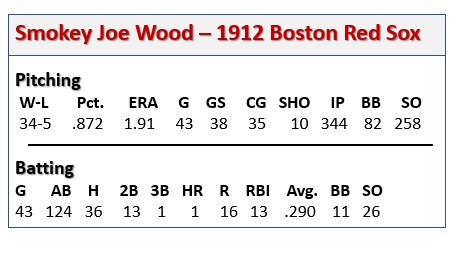
In 1912, Wood was even better – putting together one of the most dominant pitching seasons ever. He went 34- 5, 1.91 and won 16 games in a row between July 8 and September 15. During his 16-game streak. Wood made 16 starts and three relief appearances, tossed 14 complete games and recorded six shutouts. Notably, during the streak, Wood also hit .347 (17-for-49), with six doubles, a triple, seven runs scored, five RBI and five walks (a .407 on-base percentage). For the season, he led the league in wins, winning percentage (.872);  complete games (35) and shutouts (ten); while fanning 258 batters (second to Walter Johnson) in 344 innings pitched. He topped off his season with three wins in the 1912 World Series, two as a starter and one in relief.  Around baseball, one of the great debates was over who was the fastest pitcher alive – Joe Wood or Walter Johnson.

Smoky Chart

A Harbinger of Things to Come?

Commenting on his work in Game One of the 1912 World Series, Joe Wood said “I threw so hard, I thought my arm would fly right off my body.”

Wood got off to a solid start in 1913.  He went into a July 18 game against the Tigers in Detroit sporting an 11-5, 2.37 record in 17 starts (plus four relief appearances), with 13 complete games. Then the injury bug struck again.  In the start at Detroit, he slipped and fell on wet infield grass while making a fielding play – breaking his thumb and, apparently, jamming his shoulder.  He pitched only one more inning that season – ending at 11-5, 2.29.  That tumble – and perhaps the wear and tear already inflicted on his arm (Remember that “I thought arm would fly right off my body comment?) – changed the course of Wood’s career.

In Lawrence Ritter’s book, The Glory of Their Times, Wood described the change.  “I’ don’t know whether I tried to pitch too soon after that, or whether I did something to my shoulder at the same time. But whatever it was, I never pitched again without a terrific amount of pain in my right shoulder.”

Wood was back in 1914, but due to an appendicitis attack, did not make his first start until late May.  He ended that season at 10-3, with a 2.,62 ERA; but observers said he wasn’t quite the same.  Despite pitching in pain, Wood managed a 15-5 record, with a league-best 1.49 earned run average in 1915. Good numbers, but on the negative side he made only 24 appearances (16 starts).

The combination of a pay dispute and a still ailing arm kept Wood off the field in 1916 – and an attempt to comeback with the Cleveland Indians in 1917 ended after just five mound appearances (one start).  For many, their major-league career would have been over.  The love of the game, however, would not let Wood stay home.

Babe Ruth Lite

Despite his shoulder, Wood soldiered (pun intended) on. And this is where “Babe Ruth Lite” comes in.  In 1918, a 23-year-old southpaw pitcher named George Herman Ruth (who, over his first four MLB seasons, had gone 67-34, 2.07 and twice won 20 games) began his transition to the outfield. Before the 1918 season, Ruth had not appeared in any position other than pitcher and pinch-hitter. In 1918, he appeared in 59 games in the outfield, 13 at first base and 20 on the mound (where he went 13-7, 2.01), while leading the AL in home runs (11). The rest, as they say, is history.

In 1918, Smoky Joe Wood – although for different reasons – joined Ruth in transitioning from the mound to the field.  That season, Wood started 95 games in the outfield, 19 at second base and three at first base – hitting .296 with five home runs and 66 RBI. He remained in the major leagues as an outfielder through the 1922 season, hitting .298, with 18 home runs and 275 RBI in 460 games.  In 1921, in 66 games for the Indians, Wood hit .366-4-60.

Yale University

Wood retired as a player after the 1922 season, but his love for the game continued. In 1923, he was hired to coach the Yale University freshman baseball squad and, the following year, moved on to coach the varsity team – a position he held through 1942.

Baseball Roundtable (unofficial) fans’ Hall of Fame Ballot.

There is still time to vote in BBRT’s unofficial fans’ 2012 Hall of Fame balloting.  Click here to access the ballot. 

Primary Resources:  Baseball-Reference.com; “The Glory of Their Times,” Lawrence S. Ritter, Harper Perennial Modern Classics; Baseball-Almanac.com; “She’s on first: Women in Baseball,” by Dawn Mitchell, IndyStar, May 13, 2016; “Baseball’s Barnstorming Bloomer Girls: Women and the National Pastime,” Massachusetts Historical Society, June 2018. 


100Baseball Roundtable is on the Feedspot list of the Top 100 Baseball Blogs.  To see the full list, click here.

I tweet baseball @DavidBBRT

Follow/Like Baseball Roundtable’s Facebook Page here.  More baseball commentary; blog post notifications; PRIZES.

Member: Society for American Baseball Research (SABR); Negro Leagues Baseball Museum; The Baseball Reliquary. 
Early Returns for Baseball Roundtable’s (unofficial) Fan 2021 Hall of Fame Balloting

Photo by Keith Allison

Photo by Keith Allison

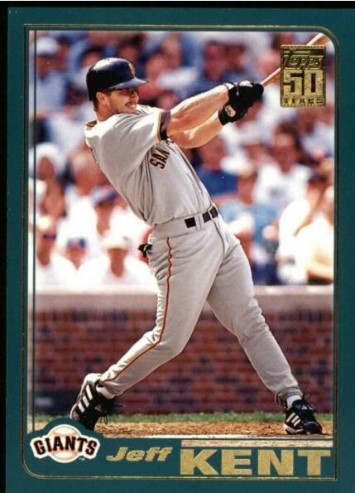
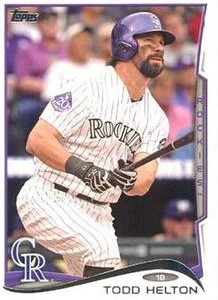
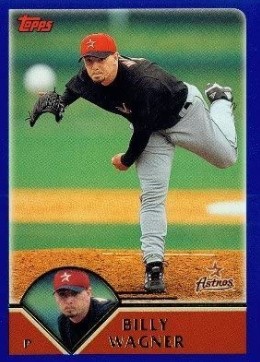
With 74 votes cast in the Baseball Roundtable (unofficial) fan 2021 Baseball Hall of Fame voting, no candidates are showing the 75 percent level of support necessary to achieve election into the Hall. Leading the way are: Omar Vizquel (with his eleven Gold Gloves and 2.877 hits); Todd Helton (with his .316 career average and 2000 NL batting crown); Jeff Kent (the 2006 NL MVP and all-time home run leader among second basement); Billy Wagner (with his 422 saves – sixth all-time); and Curt Schilling (with 216 career wins and 3,116 strikeouts.) This differs from early publicly released BBWAA ballots – which also see no candidates at 75 percent, but which have Barry Bonds, Roger Clemens and Curt Schilling leading the way. (Scott Rolen, Omar Vizquel and Todd Helton round out the top half dozen.)  Note: Totals as of 9:00 a.m., December 13.

Still Time to Vote in the BBRT Balloting

There is still time to cast your vote in the BBRT unofficial fan 2012 Hall of Fame balloting.  Click here to access the ballot and/or here for a post on BBRT’s predictions and preferences (as well as candidate bios). Note: The prediction post also includes a link to the ballot.

The BBRT ballot also asks reader which players (no longer eligible for the ballot) they think are most deserving of a spot in the Hall. Pete Rose currently leads the way with seven mentions. Followed by Dick Allen, Steve Garvey, Jim Kaat and Al Whitaker with three each.  Overall, 35 players have mentioned in the responses.

Here are the leading BBRT vote-getters thus far:

Omar Vizquel                     66.2%

Todd Helton                       58.1

Jeff Kent                            56.8

Billy Wagner                       56.8

Curt Schilling                      52.7

Barry Bonds                        46.9

Andy Pettitte                       37.8

Andruw Jones                     36.5

Bobby Abreu                       32.4

Scott Rolen                         31.1

Gary Sheffield                     31.1

Roger Clemens                  27.0

Torii Hunter                        25.7

Sammy Sosa                     24.3

Mark Buehrle                    20.3

Aramis Ramirez                 14.9

Manny Ramirez                 13.5

Shane Victoria                   13.5

Tim Hudson                        8.1

LaTroy Hawkins                 6.8

Barry Zito                            6.8

A.J. Burnett                        4.1

Michael Cuddyer                4.1

Nick Swisher                      4.1

Dan Haren                           –

Baseball Roundtable will post the final voting results, with a comparison to the Baseball Writers Association of America (BBWAA) final results once balloting is completed and announced. 


100Baseball Roundtable is on the Feedspot list of the Top 100 Baseball Blogs.  To see the full list, click here.

I tweet baseball @DavidBBRT

Follow/Like Baseball Roundtable’s Facebook Page here.  More baseball commentary; blog post notifications; PRIZES.

Member: Society for American Baseball Research (SABR); Negro Leagues Baseball Museum; The Baseball Reliquary. 
Baseball Roundtable “Who’s Your Daddy?” Series … Mariano Rivera Edition

Rivera

Inducing Weak Contact

Ray Durham faced Mariano Rivera 26 times in his career – and went hitless.  (The most at bats of any player with a .000 average versus Rivera.) He did reach base against River once in those 26 at bats – on an infield error. Surprisingly, Durham struck out only three times in those 26 at bats. Durham, by the way, was a .277 career hitter over 14 seasons.

We’re well into the off-season (although the whole 2020 season seemed just a bit off), and it seems an appropriate time to offer up the next edition of Baseball Roundtable’s “Who’s Your Daddy?” series … focusing on some of MLB’s premier pitchers – like Bob Feller, Bob Gibson, Sandy Koufax and Nolan Ryan, as well as contemporary hurlers like Justin Verlander and Max Scherzer.

Who’s Your Daddy? What’s it all about?
In this series, BBRT presents lineups of players who performed unexpectedly well against baseball’s top pitchers. (An explanation of the inspiration behind the Who’s Your Daddy? series can be found the end of this post.)  As always, I would stress that the pitchers included in the Who’s Your Daddy? series are among the “best in the business.”  They are selected not because of the players who performed well against them, but rather because success among hitters when they were on the mound was the exception rather than the rule.

Before we get started on this edition – focusing on Hall of Famer Mariano “The Sandman” Rivera.”  here are links to the previous editions of this series:

Nolan Ryan, click here.

Sandy Koufax, click here.

Pedro Martinez, click here.

Bob Gibson, click here.

Randy Johnson, click here.

Greg Maddux, click here.

Justin Verlander, click here.

Bob Feller, click here.

Roger Clemens, click here.

Max Scherzer, click here.

Tom Seaver, click here.

Now, to Mariano Rivera.  This is the first reliever featured in the series, but with Rivera being the first-ever unanimous Hall of Fame selection, he is a natural for the spot.  Of course, focusing on a reliever, particularly a closer, offered some challenges.  Sampling sizes are a whole lot smaller when you’re looking at one- (or two-) inning stints. For example, when examining hitter performance against Nolan Ryan, there were ten hitters with more than 100 regular-season plate appearances versus Ryan and 86 hitters with 50 or more.  With Rivera, over his 19 seasons, not a single batter logged 50 regular-season plate appearances against him and only seven had 25 or more. Still, as I think you will see, there was enough data to select a “Who’s Your Daddy?” lineup. So, let’s get on with it.

Rivera was the Yankee closer for 17 or his 19 seasons (1995-2013, all with the Yankees).  He saved an MLB-record 652 games (also had 82 wins and 60 losses), put up a 2.21 career earned run average and fanned 1,174 batters in 1,283 2/3 innings. Rivera, a thirteen-time All Star, led the AL in saves three times and saved 40 or more games in 10 seasons (two seasons of 50 or more). In his final campaign (2013), he saved 44 games at age 43. Rivera recorded an ERA under 2.00 in 11 campaigns.  Rivera’s career WHIP (Walks and Hits Per Inning Pitched) of 1.0003 is third-lowest among pitchers with at least 1,000 career innings pitched.

Off to a Slow “Start”

Called up to the Yankees in mid-May of 1995. Rivera began his MLB career as a starter. In his first four MLB starts he went 1-2, with a put up a 10.20 ERA, lasing just 15 innings in those four appearances. By mid-June was back a Triple A. He was back with the Yankees in July, back at Triple A Columbus in August and then back with the big club in September. For that initial MLB season, Rivera was 5-3, 5.51 in 19 games (ten starts). Rivera pitched for the Yankees for 18 more season, but never made another start.  After that up-and-down first campaign, Rivera pitched to a 2.03 earned run average and held hitters to a .211 average over 1,096 regular-season appearances. 

Rivera was even better in the post season, going 8-1, with record 42 post–season saves in 96 appearances – and posting a minuscule 0.70 earned run average.

Mariano Rivera’s Best Season:  A lot to choose from here, but I’ll go with 2004, when Rivera went 4-2, with an MLB-topping 53 saves and a 1.95 ERA.

Double Your Pleasure …

On July 8, 2000, Mariano Rivera earned two saves in two different stadiums.  The first came in a day game at Shea Stadium as the Yankees topped the Mets 4-2 and Rivera pitched a 1-2-3 bottom of the ninth. The two teams then headed to Yankee stadium for an evening tilt – again won 4-2 by the Yankees, with Rivera pitching a scoreless top of the ninth.

So, let’s take a look at a lineup of hitters who proved they could hold their own against Rivera’s dominating cutter.  As in past “Who’s Your Daddy?” posts, the stats are for the regular season.  (Although I’ll give a nod to Rivera’s post-season excellence on occasion.)

DH – Edgar Martinez

Photo by clare_and_ben

Photo by clare_and_ben

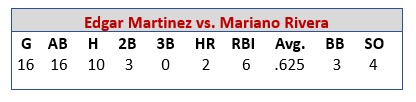
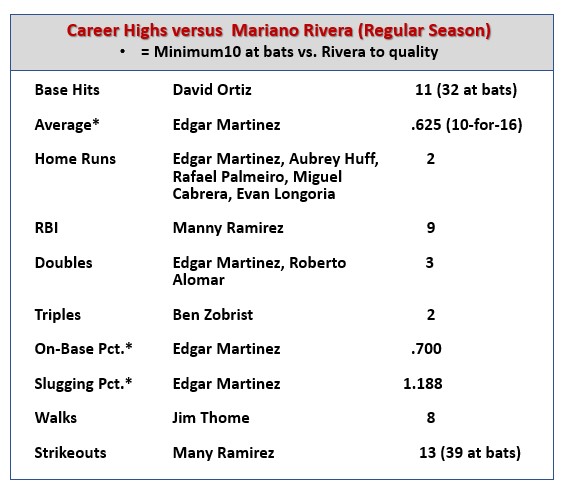
We’ll start with the DH spot.  (I’ve included pitchers’ batting stats in other posts in this series, but Rivera pitched his entire career in the American League’s DH era.)  Very simply, no one has numbers against Mariano Rivera like Hall of Famer Edgar Martinez.  Among those with at least ten at bats against Rivera, Martinez has the highest average (.625), highest on-base percentage (.700) and highest slugging percentage (1.188).  He also has the second-most base hits (10-tied), most doubles (3-tied), most home runs (2-tied); and fourth-most RBI (6-ted).

Now, some will argue that Martinez did a lot his damage in Mariano’s rookie season – when Rivera bounced (less than successfully) between starter and reliever.  Martinez faced Rivera seven times in that 1995 season and had five hits and a walk, with two home runs and five RBI. However, between 1996 and 2004, Martinez faced Rivera 13 more times and delivered five hits and two walks (a .500 average and a .615 on-base percentage). He earned this spot.

MartinezMo

Edgar Martinez had a .500 or better on-base percentage in six of the seven season he faced Rivera. The exception was 2003, when he came up against the Yankee closer four times, grounding out once and striking out three times. In the post season, Martinez went one-for-three (a single) versus Rivera in his career.  This was actually a pretty easy selection since Rivera, in numerous interviews, has called Martinez the toughest hitter he ever faced.

R-E-S-P-E-C-T …

In 2004, MLB changed the name of the Designated Hitter Award to the Edgar Martinez Award.   

Edgar Martinez played 18 MLB seasons (1987-2004), all with the Mariners. He was a seven-time All Star, won two batting titles and led his league in runs scored once, doubles twice and RBI once. His final stat line was .312-309-1,261, with 1,219 runs scored (in 2,055 games).

Edgar Martinez’ Best Season:  In 2000, Martinez he hit .324 and notched career highs in home runs (37) and RBI (145).

Honorable Mention: David Ortiz’ 11 regular-season hits versus Ramirez are the most of any batter.  He put up a .344 average, with one home run and four RBI against The Sandman.

RaveraBest

Catcher – Jason Varitek

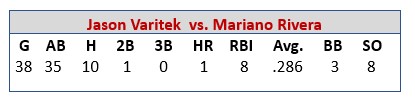
While Jason Varitek didn’t put up the flashy batting averages against Rivera that we see from many of the players in this lineup, he did some damage.  Varitek hit .286 against Rivera, but his ten hits against the Hall of Fame reliever were second only to David Ortiz and his eight RBI second only to Manny Ramirez (some pretty potent company in those two). In 2005, Varitek faced Rivera four times and delivered a home run and two singles. Varitek’s line against Rivera would have looked little better if not for 2009 season, when the 37-year-old backstop faced Rivera three times and fanned all three. (Varitek has two singles in seven post-season at bats versus Rivera.)

VaritekMO

Jason Varitek played 15 MLB seasons (1997-2011), all with the Red Sox. He was a three-time All Star and hit .256, with 193 home runs and 757 RBI in 1,546 games. Varitek hit 20 or more home runs in three seasons and drove in 70 or more runs in four.

Jason Varitek’s Best Season: From BBRT’s perspective, Varitek’s best season was 2004, when he hit .296-18-73 and even swiped ten bases.

A Good Luck Charm …

Jason Varitek is one of only two catchers to catch four no-hitters. (The other is Carlos Ruiz.)

First Base – Rafael Palmeiro

Making Contact

Rafael Palmeiro faced Mariano Rivera 30 times during the regular seasons and never went down on strikes – the most plate appearances against River for any batter who didn’t take a “K.”

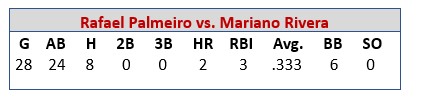
Rafael Palmeiro’s eight hits off Mariano Rivera tied for the fourth-most among opposing batters and his two home runs tied for the most off “Mo.”  While he hit .333 off the Yankee closer, Palmeiro’s six walks gave him an on-base percentage of .467 tying for the eighth-highest.

PlmeiroMO

Palmeiro played 29 MLB seasons (1986-2005 … Cubs, Rangers, Orioles), putting up a .288-569-1,835 stat line. The four-time All Star hit 30+ home runs in 10 seasons (40+ in four of those campaigns) and drove in 100+ runs in ten seasons. He was also a three-time Gold Glover.  In the post-season, Palmeiro faced Rivera four times and went one-for-three with a walk.  Rivera also got that elusive strikeout against Palmeiro, fanning Palmeiro once in the post-seasons.

Hmmm?

In 1999, Palmeiro won his third consecutive Gold Glove at first base, despite starting just 28 games at the position (and 128 sit DH). It’s the fewest defensive games ever for a Gold Glover.

Rafael Palmeiro’s Best Season: In 1999, Palmeiro (Rangers) hit .324, with 47 home runs and 148 RBI.

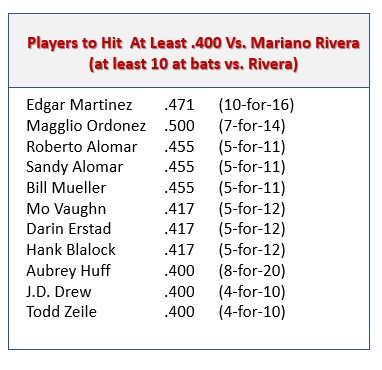
Honorable Mention(s): Aubrey Huff was a solid candidate for this spot, hitting .400 versus Mariano Rivera with his eight safeties (tied for fourth against the ace reliever) and four RBI (tied) for eighth. Huff’s two home runs off Rivera are tied for the most of any player. Huff, however, didn’t started only four games at 1B against Rivera (he also started three times in the OF, five at 3B and eight at DH in games he eventually faced Mo).  Huff could be a utility man on this squad. BBRT also looked at Mo Vaughn (.417-1-4 against Rivera in 12 at bats) and Jeff Conine (.357-1-5 in 14 at bats), but Palmeiro’s six walks (versus no whiffs) gave him a slight edge.

Second Base – Roberto Alomar

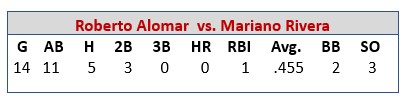
Between June 28, 1996 and May 1, 2000, Roberto Alomar faced Mariano Rivera seven times (in seven games) and got on base every time – three doubles, two singles and two walks.  The string was broken when Alomar was called on to drop down a sacrifice bunt against Rivera May 3, 2000.  At that point, Alomar was six-for-seven with two walks against Rivera in his career.

AlomarMO

Hall of Famer Roberto Alomar played 17 MLB seasons (1988-2004 … Blue Jays, Padres, Indians, Orioles, Mets, White Sox Diamondbacks). He hit an even .300, with 210 home runs, 1,134 RBI and 1,508 runs scored and 474 steals.  The 12-time All Star was also a ten-time Gold Glover. Alomar hit 20 or more home runs in three seasons, drove in 100 or more runs twice, stole 30 or more bases in eight seasons (a high of 55 in 1993) and scored 100 or more run six times.

Like Brother … Like Brother

The Alomar brothers (Roberto and Sandy, Jr.) did pretty well against Mariano Rivera, each going five-for-eleven (.455) in their careers against The Sandman – with five of their ten hits going for extra bases (all doubles).  In addition, Sandy Alomar hit one of only two post-season home runs hit against Rivera (Game Four, 1997 ALDS).    The other post-season dinger off Rivera came in Game Two of the 2000 World Series (Mets/Yankees).  It was a ninth-inning three-run shot off the bat of Jay Payton. (Despite Payton’s heroics, the Yankees won 6-5.)

400Mo

Third Base – Bill Mueller

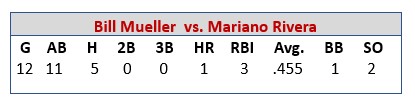
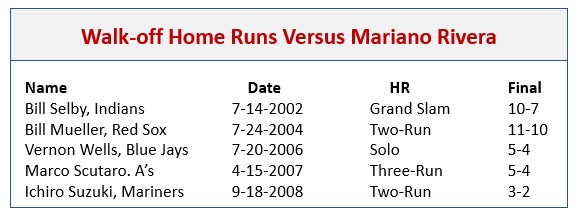
Bill Mueller hit .455 against Rivera and his one long ball against the New York closer was one of just five walk-off homers Rivera gave up in his career. Mueller was one for six versus Rivera in the post-season.

Mueller Mo

Bill Mueller played 11 MLB seasons (1996-2006 … Giants, Cubs, Red Sox, Dodgers). He hit .291, with 85 home runs and 493 RBI over that span.  While he never made an All Star team, Mueller did win the American League batting crown with a .326 average for the Red Sox in 2003.

Bill Mueller’s Best Season: In 2003, Mueller  hit .326-19-85 – all career highs. (Mueller did hit .330 as a Giants rookie in 1996, but only played in 55 games.)

A Grand Day at the Plate …

A switch hitter, Bill Mueller is the only MLB player to hit a Grand Slam from both sides of the plate in the same game. Mueller, with the Red Sox, slammed a bases-loaded homer (right-handed) off Aaron Fultz in the seventh inning and another (left-handed) off Jay Powell in the eighth.  He also hit a solo shot off R.A. Dickey in the third.  For the day, Mueller was three-for-nine, with three runs scored and nine RBI. 

Shortstop – Nomar Garciaparra

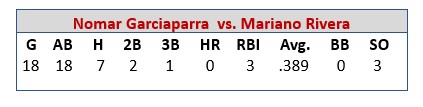
Nomar Garciaparra went seven-for-eighteen (.389) against Mariano Rivera, with his seven hits tying for the tenth-most against Rivera.

NomarMPO

Garciaparra played in 14 MLB seasons (1996-2009 …Red Sox, Cubs, Dodgers, A’s). For his career, he hit .313-229-936. The six-time All Star (and 1997 AL Rookie of the Year) was nearly unstoppable in 1999 and 2000, winning batting titles in each year.  Over those two seasons, he played in 275 games for the red Sox and hit .365, with 48 home runs and 200 RBI. In addition to his two batting titles, Garciaparra led the league in doubles once and triples once.  He collected 100+ RBI in four seasons and scored 100+ runs in six. He also hit 20 or more home runs in seven campaigns and hit over .300 in eight seasons. Garciaparra hit .321-7-24 in 32 post-season games – although he was just one-for-five against Mariano in the post-season.

The Old College Try, and Then Some …

While playing for the Georgia Tech Wildcats, Nomar Garciaparra was a two-time All American (1993 & 1994).

Honorable Mention: Omar Vizquel hit .375 (six-for-sixteen) against Rivera in the regular season.

Outfield – Ichiro Suzuki

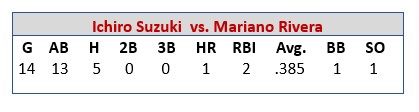
Ichiro Suzuki hit Mariano Rivera at a .385 pace (5-for-13) and, as you might expect. most of those safeties were singles. Suzuki did, however, hit one of five regular-season, walk-off home runs off Mariano. It came on September 18, 2009, with the Mariners trailing the Yankees 2-1, with two outs and one on (Mike Sweeney) in the bottom of the ninth. Suzuki ended the game, taking River’s first pitch to him over the right field fence.IchiroMo

A Hitting Machine …

Ichiro Suzuki collected an MLB-record 262 hits in 2004.

Ichiro Suzuki played 19 MLB seasons (2001-20019 … Mariners, Yankees, Marlins). For his career, he hit .311 (3,089 hits), with 117 home runs, 780 RBI, 1,420 runs scored and 509 stolen bases. He won a pair of batting titles and hit over .300 in 11 seasons. Suzuki, a ten-time All Star also led the AL in hits seven times – collecting 200+ hits in ten (consecutive) seasons. He was also the recipient of ten Gold Gloves.  In the post-season, Suzuki went one-for-two versus Rivera (a double).

Ichiro Suzuki’s Best Season: In 2004 (mariners), Suzuki won the batting title (.372), collected 262 hits, poked eight home runs, drove in 60, scored 101 and stole 36 bases.

Wal;k Offr MO

COMING SOON …

AN UPDATE ON BASEBALL ROUNDTABLE’S FAN BALLOTING FOR THE 2021 HALL OF FAME CLASS. THERE IS TILL TIME TO CAST YOUR (UNOFFICIAL ) VOTE(S), JUST CLICK HERE TO ACCESS THE BALLOT. 

Outfield – Magglio Ordonez

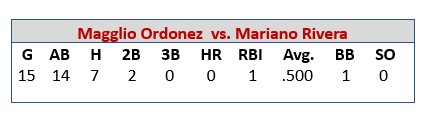
Magglio Ordonez hit .500 against Mariano Rivera (7-for-14) and also never struck out against The Sandman. From 2006 to 2008, he came up against Mariano four times and collected two doubles and two singles.

MaggyMO

Ordonez played 15 MLB seasons (1997-2011 … White Sox Tigers) – going .309-294-1,236. He was a six-time All Star and won the 2007 batting title (Detroit) with a .363 average. That same year he led the AL with 54 doubles. Ordonez hit 30 or more home runs in four seasons and drove in 100+ in seven.

A Two-for-One Deal?

Magglio Ordonez is one of 56 MLB players to hit two home runs in one inning. He did in the second inning of a Tigers’ 11-6 win over the A’s on August 12, 2007.  In the game, Ordonez was two-for-three, with two walks, two runs scored and four RBI.

Magglio Ordonez’ Best Season: In 2007, Ordonez hit .363-28-130, collected 216 hits, scored 117 runs  and led the AL with 54 doubles.

Outfield – Manny Ramirez

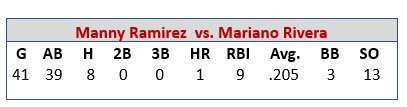
At first glance, I didn’t expect to be putting Manny Ramirez in this line.  After all, he only hit .205 versus Mariano Rivera and his 13 strikeouts were the most of any batter against “Mo” (as were his 39 at bats).  But, then again, Ramirez’ eight hits tied for the fourth-most against Rivera and his nine regular season RBI led all batters.  Ramirez really “learned” his way into this lineup, by figuring Rivera out. In Ramirez’ first 13 plate appearances against Rivera (1995-2000), he was 0-for-12 (one run-scoring sacrifice fly), with seven strikeouts. Then on April 12, 2001, Ramirez poked a walk-off, game-winning, two-run single off Rivera and the tide seem to change.  In Ramirez’ final 31 plate appearances (2001-2010) against The Sandman, Ramirez went 8-for-27 (.296), with three walks, one hit-by-pitch, two “safe-on-error” and six strikeouts.

MannyMO

Manny Ramirez played 19 MLB seasons (1993-2011 … Indians, Red Sox, Dodgers, Rays, White Sox – putting up a .312-555-1,831 line. He was a 12-time All Star and one-time batting champion, He also led the AL in home runs and RBI once each. He hit 30 or more home runs in 12 seasons (five seasons over 40), drove in 100+ runs in 12 times, scored 100+ runs six times and hit .300 or better in a dozen campaigns.

Manny Ramirez’ Best Season: In 1999 (Indians), Ramirez hit .313, with 44 home runs, 165 RBI and 131 runs scored.

Ramirez hit .285-29-78 in 111 Post-season games. Ramirez was three-for-eigt in the post-season versus Rivera.

Manny Being Manny?

Manny Ramirez’ 29 post-season home runs are the most all-time; his 78 RBI second; his 223 total bases second (tie); his 67 runs third; and his 19 post-season doubles fifth (tie).

___________________________________________________________________

Who’s Your Daddy?  The Inspiration.

On September 24, 2004, in the middle of a tight pennant race, the Yankees handed future Hall of Famer Pedro Martinez and the Boston Red Sox a tough 6-4 loss.  Martinez went 7 1/3 innings giving up nine hits and five earned runs.  The game came just five days after (in his previous start) Martinez had lasted just five frames against the Bronx Bombers (eight hits, eight earned runs) in a 16-7 loss.

After that second loss, Martinez candidly commented, “What can I say? I just tip my hat and call the Yankees my daddy.”  Little did he know that his comment – and a Yankee fans’ chant of “Who’s your daddy?” would follow him into future starts in New York (all the way to his final MLB start – against the Yankees for the Phillies – in Game Six of the 2009 World Series.)

The concept of “Who’s your daddy?” became the inspiration for Baseball Roundtable to take a look at the players who “had the number” of some of MLB’s premier pitchers.  Again, you can find links to the previous “editions” of “Who’s Your Daddy?” near the top of this post. 

______________________________________________________

Primary Resources: Baseball-Reference.com; Baseball-Almanac.com; MLB.com

100Baseball Roundtable is on the Feedspot list of the Top 100 Baseball Blogs.  To see the full list, click here.

I tweet baseball @DavidBaseballRT

Follow/Like Baseball Roundtable’s Facebook Page here.  More baseball commentary; blog post notifications; PRIZES.

Member: Society for American Baseball Research (SABR); Negro Leagues Baseball Museum; The Baseball Reliquary. 
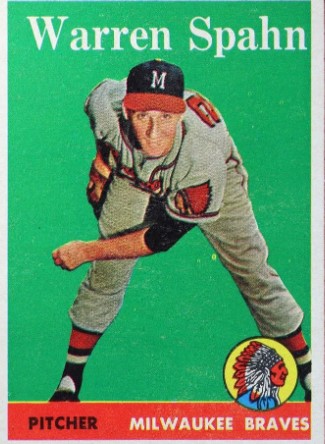
 

Baseball Roundtable Offers the Chance to Vote in BBRT’s Unofficial 2021 Baseball Hall of Fame Balloting

BBRT’s Baseball Hall of Fame 2020 Debate Season is officially open!  The Baseball Writers Association of America (BBWAA) 2021 Hall of Fame ballots were distributed yesterday and the results will be announced in January, with the honorees inducted on July 21. This year’s traditional ballot includes 14 holdovers from last year, along with 11 newcomers.

Skip the post (although I hope you will read on) and go right to the ballot, click here. 

In this post, BBRT will share:

  • Predictions on the 2021 BBWAA voting;
  • BBRT’s ballot (if I had one);
  • A deep look into all the candidates on the ballot;
  • A link to BBRT’s unofficial fan ballot – please take a few minutes to follow the link and cast your votes.

–PARTICIPATE IN BASEBALL ROUNDTABLE’S  2021 FANS’ HALL OF FAME BALLOT—

Baseball Roundtable is once again conducting an unofficial fan ballot – to cast your vote(s), click here.  Remember, you can vote for up to ten of the nominees for 2021 induction.  If you want to read through the nominees’ bios first, there is another link to the BBRT Fan Ballot following the bios (near the end of this post).  BBRT will be providing updates on the fan balloting, as well as a post-election comparison of fan votes as compared to the final BBWAA results.  Voting on the BBRT Fan Ballot will remain open until January 1, 2021.

Also, if you leave your email or Facebook address in the comments section at the end of the ballot, you will be entered in a bobblehead and baseball card “surprise-prize” drawing.

Ballot

Again, to cast your votes, click here

As you consider this year’s slate of candidates, BBRT would stress that all the players on the ballot – even those who remain for only one voting cycle – deserve recognition. To rise to the major leagues, last ten years and make it past the Hall of Fame Screening Committee is a significant accomplishment in itself.  In fact, the annual ballot release is a highlight for BBRT, as it provides a chance to acknowledge the accomplishments of all the candidates – not just the favorites for election.  For example, a review of the ballot gives us the opportunity to honor Mike Buehrle’s n0-hitter and perfect game; Bobby Abreu’s 400 stolen bases; Billy Wagner’s 400 saves; A.J.Burnett’s nine-walk no-hitter; Torii Hunter’s nine Gold Gloves; LaTroy Hawkins’ 1,042 games pitched; Barry Zito’s Cy Young season; and more.

Now on to the official 2021 Baseball Hall of Fame election process itself – and, then, a look at the players on the ballot for 2021.

BASEBALL HALL OF FAME ELIGIBILITY/CRITERIA FOR ELECTION

The basic rules for eligibility are that a player must have played at least ten seasons and be retired for at least five years. In addition, the player must be approved for the ballot by the Hall of Fame Screening Committee.

A player can remain on the ballot for up to ten years, but must receive at least five percent of the vote in the preceding year’s ballot to remain on the ballot.  Each voter can vote for up to ten candidates.  Election requires that a player be named on at least 75 percent of the ballots cast.

The criteria for election: “Voting shall be based upon the player’s record, playing ability, integrity, sportsmanship, character, and contributions to the team(s) on which the player played.”

A couple of preliminary comments.

  • This year’s ballot is not as crowded with strong newcomers as those  as we have seen in that recent years.  In the last five balloting sessions, for example, we have seen Derek  Jeter, Mariano Rivera, Roy Halladay, Chipper Jones, Jim Thome, Ivan Rodriguez and Ken Griffey Jr. all elected on their first ballots.
  • The 2021 ballot also includes no players in their final year of eligibility – a group that generally gains some additional momentum (and pulls votes from other nominees).
  • The PED-controversey is appears to still be having on impact on voting, with some key players gaining support in recent voting – but not at a pace that points to election.
  • The holdovers are players that at least 70 percent BBWAA voters found a reason not to support for 2020 election.(Curt Schilling had the highest percentage of votes  among those no elected at 70 percent.) In addition, there are no newcomers on the ballot who can boast those “Oh, yes, you’re in” statistical achievements.  No members of the 500- (or even 400-) home run club;  no members of  3,000-  (or even 2,500-) hit club; no members of the 3,000-strikeout club (and only pitcher with 2,500 whiffs); and no members of the 300 (or even 250) victories club.

In short, this year’s ballot has a lot of holdovers who are not sure things and a lot of very good  newcomers, but no shoe-ins.  It will be interesting to see how BBWAA voters view this year’s list (as well as hoe BBRT’s voters react). Now, let’s take a look at whom BBRT predicts will be elected by the BBWAA; how BBRT would vote if I had a ballot; and, along the way, the bios of these year’s candidates.

 —–LIKELY BASEBALL HALL OF FAME ELECTEES FOR 2021—–

BBRT’s Prediction for 2021 …

Last November, Baseball Roundtable released its 2020 BBWAA balloting predictions, projecting the election of Derek Jeter and Larry Walker – and predicting “dark horse” candidate Curt Schilling would fall closer to 70 percent than 75.  Jeter and Walker were elected and Schilling fell short (at 70 percent). Two years ago, BBRT projected the election of Mariano Rivera and Edgar Martinez and listed Mike Mussina and Roy Halladay as “dark horse” candidates with a chance to generate the needed 75 percent support.   It was a bit of a swing and miss (maybe a foul ball), as all four were elected.  Three years ago, BBRT predicted the election of Chipper Jones, Jim Thome, Vlad Guerrero and Trevor Hoffman (with Mike Mussina as a “dark horse” candidate). Jones, Thome, Guerrero and Hoffman made it, with Mussina garnering 64.5 percent (sixth-most).

For 2021, BBRT is not optimistic about the balloting.  I see just one truly likely candidate – Curt Schilling, who has seen his vote percentage increase by more than 5 percent in each of the past four years: 45.0 percent in 2017; 51.2 in 2018; 60.0 in 2019; and 70.0 last year. Another 5 percent-plus increase would put him over the top. Further, if you go back to 2018, when Schilling finished with the ninth-highest vote total, six of the eight players who finished ahead of him are now in the Hall of Fame (the exceptions being Barry Bonds and Roger Clemens).

I’d add one dark horse candidate.  Omar Vizquel (52.5 percent one year ago) – who should be helped by this year’s “slimmer” ballot – has a chance to gain some ground. However, it’s more likely he moves to about the 60-65 percent level percent this year.

Let’s move on to BBRT’s hypothetical – if I had one –  ballot and bios of the players I would vote for; followed by a look at the remainder of the 2021 candidates.

Side note: You will not find those caught up in the PED-controversy on my ballot. While I think the best of them will eventually be elected/inducted, if I had a ballot, I’d prefer they made the 75 percent without my vote.  Still, given their place in the history of the game, I’d probably break down and vote for the top players in this group when they reached their final year of eligibility.

So, here is BBRT’s Hall of Fame Ballot – again, if I had one – with the players listed in BBRT’s order of preference.

— PLAYERS WHO WOULD GET BBRT’S VOTE …

Jeff Kent – (Second Base/Third Base/First Base, 1992-2008) …  Eighth year on the ballot, 27.5 percent last year.

KentBBRT has long believed Jeff Kent is a deserving candidate, but he has not been getting much support from the writers.  Kent holds the all-time MLB record for home runs by a second baseman (351 of his 377 career round trippers were hit while in the lineup at second base). He has a healthy .290 career batting average; his 1,518 RBI are 54th all time; and his 560 doubles 30th.  His 984 extra base hits are 43rd all-time.

Kent was a five-time All Star and the 2000 NL MVP.  As primarily a middle infielder, he hit 20 or more home runs in 12 seasons (a high of 37 in 2007) and topped 100 RBI eight times. He hit .276, with nine home runs and 23 RBI in 49 post-season games.

Running with the Big Boys …

Jeff Kent has more career runs batted in (1,509 in 17 seasons) than such noted Hall of Famers (who played a comparable number of seasons) as Mickey Mantle (1,508 in 18 seasons), Billy Williams (1,475 in 18 seasons), Eddie Mathews 1,453 in 17 seasons), Duke Snider (1,333 in 18 seasons) and Orlando Cepeda (1,365 in 17 seasons). Not bad for a middle infielder.

Kent has the credentials, but BBRT has a hunch the writers may keep him on the bench – a couple of Gold Gloves, at this traditionally defense-oriented position, would have really helped his case.  Kent played for the Blue Jays (1992), Mets (1992-1996), Indians (1996), Giants (1997-2002), Astros (2003-2004) and Dodgers (2005-2008).

Jeff Kent’s Best Season: With the Giants in 2000, Kent put up these stats – 159 games; 196 hits; .334 average; 33 home runs; 125 RBI; 114 runs; 12 steals. His performance earned him the NL MVP Award.

Kent gets BBRT’s vote – and I believe the BBWAA’s support is overdue (but not forthcoming).  This is one HOF “snub” that somewhat confuses BBRT.

_________

Todd Helton – (First Base, 1997-2013) … Third year on the ballot, 29.2 percent last year.

HeltonTodd Helton moved from 16.5 percent of the vote to 29.2 percent between his first and second years on the ballot. He faced some pretty strong ballot competition in those first two years and this year’s lighter ballot should help boost his numbers.  I expect he might reach 40-45 percent). Still, he is hampered by the fact that he spent his entire 17-year career with the Rockies (playing half his games in hitter-friendly Coors field).  Helton, who put up a .316 career average, hit .345 at home and .287 on the road. Despite that home/road split, Helton’s body of work deserves HOF consideration.

Helton was a five-time All Star, three-time Gold Glover and four-time Silver Slugger. He hit over .300 in 12 seasons – and won the NL batting crown in 2000 with a .372 average. His 59 doubles that season are the seventh-most all-time. Helton drove in 100 or more runs in five seasons and scored in triple figures six times. His 1,335 walks (36th all-time) indicate the respect he earned at the plate.  Helton also ranks fifth in games played at first base, second in career assists at the position, 13th in putouts and third in double plays.

The Denver 400

Todd Helton is one of only 18 players to reach 400 or more total bases in a season – and one of only seven players to have multiple 400+ total base campaigns. He is also the only player to collect 100 extra-base hits in two consecutive seasons (2000-2001).

Todd Helton’s Best Season: In 2000, Helton won the NL batting crown with a .372 average – and also led the league in base hits (216), doubles (59), RBI (147), on-base percentage (.463), slugging percentage (.698) and total bases (405).  He also scored 138 runs and hit 42 home runs.

Helton will stay on the ballot and has a chance at entry into the HOF – he’s just not likely to overcome the Coors Field-bias in the short-term future.  He gets BBRT’s vote (as he has in the past).

__________

Omar Vizquel – (Shortstop/Third Base, 1989-2012) … Fourth year on the ballot, 52.6 percent last year.

Photo by Keith Allison

Photo by Keith Allison

Omar Vizquel got off to a good start toward a HOF plaque, grabbing 37 percent support on his first-ballot year, moving up to 42.8 percent in his second year and 52.6 percent last year.  Vizquel once again earns BBRT’s vote – and should make his way into the Hall of Fame over time.  When he does, it will be more with his glove (eleven Gold Gloves) than his bat.  However, voters should be mindful of the fact that he finished his 24-season MLB career just 123 hits short of that milestone 3,000 safeties.

Vizquel delivered premier defense to the Mariners (1989-1993), Indians (1994-2004), Giants (2005-2008), Rangers (2009), White Sox (2010-2011) and Blue Jays (2012). He was a three-time All Star – and put together a string of nine straight Gold Gloves at shortstop (1993-2001).

Sacrificing for the Team

Omar Vizquel led his league in sacrifice bunts four times.

In the field, Vizquel has the highest career fielding percentage (.9847) among shortstops with at least 500 games at the position.  Vizquel is also the all-time leader among shortstops in double plays (1,734), ranks third at the position for career assists and 11th in putouts. He shares the record (with Cal Ripken, Jr.) for the fewest errors by a shortstop in a season of at least 150 games played (three).  For those who are into advance metrics, Vizquel also had the highest career Defensive Wins Above Replacement (War) among shortstops at 44.2.

On offense, Vizquel put up a serviceable .272 career average, with 80 home runs, 951 RBI and 1,445 runs scored. The 1,445 runs put him in the top 100 players all-time (83rd); while his 2,877 hits put him in the top 50 (43rd and fourth all-time among switch-hitters). He also swiped 404 bases – topping twenty steals eight times (a high of 42 in 1999) – putting him at number-72 on the all-time list. Vizquel played in 57 post-season games, hitting .250-0-20.

Omar Vizquel’s Best Season: In 1999, with the Indians, Vizquel hit a surprising .333, with five home runs, 66 RBI, 112 runs scored and 42 stolen bases – and, of course, won a Gold Glove at shortstop.

Vizquel would get BBRT’s vote, but the BBWAA voters likely will make him wait a bit longer – showing a preference for a bit more offense.  He does have a chance, however, given that his 2,877 base hits are at the top of this class.

__________

Billy Wagner – (LHP 1995-2010) … Sixth year on the ballot, 31.7 percent last year.

WagnerBilly Wagner played for the Astros (1995-2003), Phillies (2004-2005), Mets (2006-2009), Red Sox (2009) and Braves (2010). Wagner was a seven-time All Star, who amassed 422 saves (sixth all-time) in a 16-season MLB career.  He had nine seasons of 30 or more saves; a career ERA of 2.31; 1,196 career strikeouts in 903 innings; and 47-40 won-lost record.

Whiff-and-Poof

In 1992, playing for Ferrum College, Billy Wagner set an NCAA record for strikeouts per nine innings in a season at 19.3.

Billy Wagner’s Best Season: In 2003, Wagner went 1-4, 1.78 for the Astros, saving 44 games and fanning 105 batters in 86 innings.

BBWAA voters have been very demanding of relievers (although the recent induction of Mariano Rivera and Trevor Hoffman may be a good sign – but they, of course, both had 600+ saves). It also helps that Lee Smith (478 saves) was elected by the Today’s Game Committee in 2019.  BBRT thinks Wagner belongs in the Hall (based on his 400+ saves) – and hopes that momentum continues to build.  Wagner has been gaining more support lately – 31.7 percent last year; 16.7 percent in 2019; 11.1 percent in 2018; 10.2 percent in 2017. He should gain more ground in this year’s ballot, but 75 percent is still a long way off.  I’d like to see Wagner at least jump past the 50 percent mark.  He gets my vote.

__________

Andy Pettitte – (LHP/Starter, 1995-2010, 2012-13) … Third year on the ballot, 11.3 percent last year.

Andy Pettitte - 19 career post-season wins.

Andy Pettitte – 19 career post-season wins.

I had to think for a while on this one (and will probably get some push back from readers), largely because a major part of Andy Pettitte’s HOF resume was achieved in the post-season and there was some PED-controversey surrounding Pettitte.  (Note: Pettitte admitted to using HGH while recovering from elbow surgery – a couple of years before the substance was banned.  He took responsibility and apologized.)

Pettitte holds the MLB post-season marks for most wins (19 … versus 11 losses), innings pitched (276 2/3), games started (44) and is fourth in strikeouts (183). His post-season accomplishments include a 3.81 career ERA and the 2001 American League Championship series MVP Award.

Pettitte, however, was no slouch in the regular season (Yankees – 1995-2003, 2007-2010, 2012-13) and Astros (2004-06).  He finished with 256 wins (153 losses) and a 3.85 ERA. Pettitte won 20 games in two seasons and 14 or more games 12 times – leading the AL with 21 wins in 1996. The three-time All Star struck out 2,448 batters (45th all-time) in 2,316 innings.

Ready, Willing and Able …

Andy Pettitte started 30 or more games in a season 12 times, leading his league three times (1997, 2006, 2007.)

Pettitte’s post-season numbers, plus 256 regular-season victories and the fact that he had 100+ more career wins than losses secure BBRT’s vote. He still has a long way to go with the BBWAA voters, however.

Andy Pettitte’s Best Season: In 1997, following a 21-8 campaign in 1996, Pettitte went 18-7, with a 2.88 ERA (fourth-best in the AL), leading the league in starts with 35, finishing third in innings pitched (240 1/3) and eighth in strikeouts (166).

__________

Bobby Abreu – (OF, 1996-2012, 2014) … Second Year on the ballot, 5.5 percent one year ago.

AbreuA solid .291 career hitter (2,470 base hits), Abreu hit .300 or better in six seasons. He hit 20 or more round trippers in 10 campaigns, stole 20 or more bases 12 times (a high of 40 in 2004), drove in 100 or more runs eight times and scored at least 100 runs eight times.   Abreu also walked 1,476 times – including 100 or more free passes in eight straight seasons (1999-2006).

In the Top 50 … 

Bobby Abreu’s 1,476 walks are 20th all-time; his 574 doubles are 25th; his putout as a RF are 12th; and his assists as a RF 28th. 

Abreu played for the Astros (1996-97, Phillies (1999-2006), Yankees (2006-2008), Angels (2009-1012), Dodgers (2012) and Mets (2014).

In 20 post-season games, Abreu went 19-for-67 (.284), with one home runs and nine RBI.

Bobby Abreu’s Best Season: In 2004, as a Phillie, Abreu hit .301, with 30 home runs and 40 steals. An All Star that season, he also drove in 105 runs and scored 118.

Abreu’s 400 steals are an HOF plus, as his 30-40 season in 2004 and his eight campaigns with 100 or more RBI.  Had he reached 300 home runs; it would have really boosted his status with the writers.  He’s also hurt by the fact that he only made two All Star teams in his 18 seasons.  Still, I have votes left and his body of work earns one of them.

__________

So, with BBRT’s unofficial ballot covered, let’s look at the remainder of candidates – in alphabetical order.  Note: Here you will find a host of players with solid (but perhaps not HOF-level) career numbers and accomplishments – as well as a few that remain on the sidelines for other reasons.

—–THE REST OF THE BALLOT—–

Barry Bonds – (Outfield, 1986-2007) … Ninth year on the ballot, 60.7 percent a year ago.

Barry Bonds played for the Pirates (1986-1992) and the Giants (1993-2007). There is no doubt about Bond’s credentials – .298 average, 2,935 hits, MLB-record 762 home runs, 1,996 RBI, MLB-record 2,558 walks. He was also a 14-time All Star; 12-time Silver Slugger Award winner; his league’s MVP a record seven times; and an eight-time Gold Glove winner.  In 2001, Bonds hit .328, with an MLB-record 73 home runs and 177 RBI.  He drove in 100 or more runs 12 times and also scored 100 or more runs in a dozen seasons.  And, I could go on and on.

Base Open?  Makes Sense to Me …

Barry Bonds drew an MLB-record 688 intentional walks in his career. Second place?  Albert Pujols, with 32. In 2004 alone, Bonds drew a record 120 intentional passes. He led his league in IBB 12 times.

Still, there are there is that pesky PED-controversey – an elephant in the room (and on the ballot) that I think will keep Bonds out of the Hall for at least another year. The dam may very well break and we will see some of the major stars now under a PED cloud take places in the Hall very soon.  BBRT is not ready to cast that vote yet – and I don’t think 75 percent of the BBWAA is either. We can expect Bonds back on the ballot next year.

Barry Bonds’ Best Season: In 2001, Bonds crushed an all-time record 73 home runs, while hitting .328, driving in 137 runs, scoring 129 – all while drawing 177 walks.

_________

Mark Buehrle – (LHP, 2000-15) …. First year on the ballot.

Mark Buehrle pitched in 15 MLB campaigns – White Sox (2000-11), Marlins (2012), Blue Jays (2013-15) – and threw 200 or more innings in all but his rookie and final seasons. Buehrle was a five-time All Star and put up a 214-160, 3.81 record, with 1,870 strikeouts in 3,283 1/3 innings. He twice led his league in starts and twice topped his league in innings pitched. He won ten or more games in 15 consecutive seasons and six times won 15 or more.  Buehrle also four Gold Glove Awards.

Near-Perfect and Perfect

Mark Buehrle’s HOF resume is bolstered by a no-hitter tossed on April 18, 2007 – when his White Sox topped the Rangers 7-0 and Buehrle faced the minimum 27 batters.  The only Texas’ base runner came on a fifth inning, one-out walk to Sammy Sosa, whom Buehrle then picked off first base.  Buehrle notched eight strikeouts in the game, which was so-o-o very close to a “perfecto.”

Buehrle got his perfect game two years later (July 23, m 2009), when he recorded a clean slate in a 5-0 ChiSox win over the Rays.  He fanned six in that one.

Mark Buehrle’s Best Season:  In 2005, Buehrle went 16-8, 3.12 for the White Sox.

If he had 250 wins to go with the no-hitter, perfect game and four Gold Gloves, Buehrle would have had my vote.  With just 214 wins, no Cy Young Award and no 20-win season, he’s short of what BBRT looks for in a first-ballot inductee.  I fully expect he will be back on the 2022 ballot.

__________

A.J. Burnett – (RHP, 1999-2915) … First year on the ballot. 

A.J. Burnett pitched for five teams in his 17 MLB seasons:  Marlins (1999-2005); Blue Jays (2006-08); Yankees (2009-11); Pirates (2012-13, 2015); Phillies (2014).  He went 165-157, with a 3.99 earned run average. He made one All Star squad, in his final season (at age 38). He finished that campaign at 9-7, 3.18, but was 7-3, 2.11 at the All Star break. Burnett led his league in games started twice and strikeouts once.  He won ten or more games in 11 of his 17 seasons.

One Wild No-No …

On May 12, 2001, A.J. Burnett pitched one of MLB’s wildest no-hitters.  While his Marlins topped the Padres 3-0, Burnett notched no-hit, no-run game that included nine walks, a hit batsman and a wild pitch. Burnett walked one in the first inning; two in the second; two in the third; walked one and hit one in the fourth; walked one in the seventh; and walked two more in the eighth. H fanned seven in the 129-pitch outing

A.J. Burnett’s Best Season:  In 2008, Burnett went 18-10, 4.07 for the Blue Jays and lead the AL with 231 strikeouts in 221 1/3 innings.

Eight games over .500 is just not enough to get BBRT’s vote – and likely will not keep Burnett on the ballot for 2022.

_________

Roger Clemens – (RHP, 1984-2007) … Ninth year on the ballot, 61.0 percent last year.

Roger Clemens pitched in 24 MLB seasons; for the Red Sox (1984-1996), Blue Jays (1997-1998), Yankees (1999-2003, 2007) and Astros (2004-2006).  Clemens has Hall-worthy stats:  354 wins (ninth all-time), 4,672 strikeouts (third all-time), an MLB-record seven Cy Young Awards and the 1986 AL MVP Award. The eleven-time All Star was a five-time 20-game winner (led the league in wins four times), seven-time ERA leader, five-time league leader in strikeouts and six-time leader in shutouts.  He won the AL pitching Triple Crown (Wins/ERA/Strikeouts) three times.  Clemens also has 12 post-season wins, with 173 strikeouts in 199 post-season innings.

Grab Some Bench, Buddy

Roger Clemens shares the record for strikeouts in a nine-inning game (20) with Kerry Wood and Max Scherzer. Clemens is the only pitcher to achieve 20 whiffs in a nine-inning game twice.

Roger Clemens’ Best Season: Lots to choose from here. Like 21-6, 1.93 in 1990 – or 1987, with a 20-9 record, 2.97 ERA, 18 complete games and seven shutouts.  I take 1986. Clemens went 24-4. 2.48 and won both the Cy Young (his first) and AL MVP Awards for the Red Sox.  He led the AL in wins, winning percentage (.857) and earned run average. He was fifth in innings pitched (254) and second in strikeouts (238).

Yes, he’s got the numbers (those listed and more), but the PED controversy seems to stand between him and the Hall. Don’t think the BBWAA is ready yet, but he’ll continue on the ballot – and will likely gain a bit of ground toward that 75 percent requirement.  This year could be the springboard toward a 2022 trip to the Hall.

________________

Michael Cuddyer – (RF/1B/3B, 2001-15) …. First Year on the ballot.

Michael Cuddyer spent his 15-season MLB career with the Twins (2001-11), Rockies (2012-14) and Mete (2015).  He was a two-time All Star and put up a .277-197-794 line in 1,536 games.  Cuddyer hit 20 or more home runs in four seasons (a high of 32 in 2009). He scored 100+ runs in one season and drove in 100+ in one campaign.  He won the National League batting title with a .331 average (Rockies) in 2013. Cuddyer hit well in the post season – .306-2-8 in 28 games.  (There are those who would like to attribute Cuddyer’s 2013 batting title to Coors Field, but while Cuddyer did hit.356 at home, he also hit a healthy .311 on the road that season.)

Two-for-One

In 2009, as a Twin, Michael Cuddyer hit for the cycle on May 22, 2009 and then on August 23 of that season hit two home runs in one inning (seventh) against the Royals, He’s the only MLB player to accomplish both feats in the same season.

Michael Cuddyer’s Best Season: In 2013, Cuddyer went .331-20-84, with ten stolen bases, for the Rockies.

A solid player and an all-around good guy (and a pretty good magician), but HOF stats are just not quite there.

__________

Dan Haren  – (RHP. 2003-15) … First year on the ballot.

Dan Haren’s 13 MLB seasons saw him pitch for the Cardinals (2003-04), A’s (2005-07), Diamondbacks (2008-10), Angels (2010-12), Nationals (2013), Dodgers (2014), Marlins (2015) and Cubs (2015). Haren went 153-131, 3.75 over his MLB career, fanning 2,013 batters in 2,419 2/3 innings. He was a three-time All Star and won 15 or more games in three seasons  and ten or more in eleven.  He started 30 or games in 11 seasons and had an ERA under 3.50 in five campaigns. Haren was 2-0, 3.26 in seven post-season appearances (two starts).

Got ‘em All …

Dan Haren is one of 19 pitchers to record at least one win versus all 30 major league teams.

Dan Haren’s Best Season: Haren’s best season was probably 2008, when he went 16-8, 3.33 for the Diamondbacks.

____________

LaTroy Hawkins – (RHP 1995-2015) … First Year on the ballot.

LaTroy Hawkins might be the least well-known two-decade major leaguer. Hawkins came up to the big leagues as a 22-year-old and finished his MLB playing career at age 42 – a pretty nice run. During that time, he pitched for the Twins (1995-2003), Cubs (2004-05), Giants (2005), Orioles (2006), Rockies (2007 & 2014-15), Yankees (2008), Astros (2008-09) Brewers (2010-11), Angels (2012), Mets (2013) and Blue Jays (2015). Hawkins began his MLB tenure as a starting pitcher – from 1995-99 – going 26-44, 6.16 in 99 games (98 starts). Hawkins moved to the bullpen in 2000 and found his niche. Between 2000 and 2015, he appeared in 943 games – all in relief – going 49-50, 3.30 with 127 saves. He had three seasons of 20+ saves.

Put Me in ,Coach …

LaTroy Hawkins in number-ten all time in games pitched (1,042).

LaTroy Hawkins’ Best Season: From BBRT’s perspective, Hawkins’ best season was either 2004 (Cubs), when he went 5-4, 2.63 with 25 saves or 2003, when he went 9-3, 1.86 with two saves for the Twins.

BBWAA voters (and BBRT) are hard on relievers – and it’s particularly tough if you’re not a closer.

_____________________________

Tim Hudson, – (RHP.  1999-2015) … First year on the ballot.

Tm Hudson pitched in 17 MLB seasons: A; s (1999-2004), Braves (2005-2013); and Giants (2014-15). He was a four-time All Star – making the All Star squad with the A’s, Braves and Giants.  Hudson’s career mark was 222-133, 3.49, with 2,080 strikeouts in 3, 126 2/3 innings pitched.  He won 15 or more games in a season eight times, leading the AL in wins with 20 in 2000, his second MLB season. He led his league in games started twice, nine times starting 30+ games, and in shutouts twice.

A Two-way Player …

In 1997, Tim Hudson played in 65 games for Auburn University.  As a pitcher he went 15-2, 2.97 and, as a hitter, he went .396-18-95. Appropriately, he was named SEC Player of the Year and was a consensus All American. (He was also named All-SEC at both pitcher and outfield.)

Tim Hudson’s Best Season:  In 2000, with the A’s,  Hudson went 20-6, 4.14, leading the AL in wins and winning percentage (.769).  Also, in the running is 2001, when he went 18-9, with a 34.37 ERA.

Nearly 100 more wins than losses and four All Star selections should garner enough support to keep Hudson on the ballot.

__________

Torii Hunter – (OF, 1997-2015) … First year on the ballot.

Torii Hunter played 19 MLB seasons, suiting up for the Twins (1997-2007, 2015), Angels (2008-12) and Tigers 2013-14). He was a five-time All Star, and nine-time Gold Glover. For his career, Hunter hit .277 (2,452 hits), with 353 home runs, 1,391 RBI, 1,296 runs scored and 195 stolen bases. He hit 20+ home runs in 11 seasons, drove in 100+ runs twice and stole 20+ bases in three campaigns. Hunter hit .274-4-20 in 48 post-season games. Hunter led his league in CF assists three times, CF putouts once and double plays turned out of CF four times. He also led his league’s right fielders in putouts, assists and double plays once each.

Spider-Man

Torii Hunter earned the nicknamed spider-man for his outstanding outfield play.

Torii Hunter’s Best Season:  In 2007 (Twins), Hunter hit .287, with 28 home runs, 107 RBI, 94 runs scored and 18 steals – although he can look back on at least four seasons with very similar numbers.

If I was going to add another player to my ballot, it would probably be Hunter. Nine Gold Gloves, five All Star selections and 353 home runs represent some pretty good credentials.  What may hurt Hunter is his consistency.  He could have used a couple of standout/spectacular/memorable seasons mixed in with all those very good campaigns that fans came to expect.

__________

Andruw Jones – (CF 1996-2012 )…. Fourth Year on the ballot, 19.4 percent last year.

Andruw Jones played for the Braves (1996-2007), Dodgers (2008), Rangers (2009), White Sox (2010) and Yankees (2011-2012). In a 17-season career – primarily patrolling centerfield – he won ten Gold Gloves (consecutively, 1998-2007). At the plate, he hit .254, with 434 home runs (47th all time), 1,289 RBI and 1,204 runs scored. He topped 25 home runs in ten seasons (six over thirty and a league-leading and career-high of 51 in 2005). He scored 100 or more runs four times, drove in 100+ five times and stole twenty or more bases in a season four times.  Jones appeared in 76 post-season games, hitting .273, with ten home runs and 34 RBI.

On the Big Stage ,,,

In the 1996 World Series, Andruw Jones – just 19-years-old – hit .400 (8-for-20) with two home runs and six RBI, becoming the youngest player to go yard in the Fall Classic.

Andrew Jones’ Best Season: In 2005, Jones hit only .263, but led the NL in home runs (51) and RBI (128) – finishing second in the MVP voting to Albert Pujols (.330-41-117).

Jones’ ten Gold Gloves work in his favor, but – over the long haul – that .254 average (he only hit .300 or better once and over .270 only four times) dampen his HOF chances.

____________________________

Aramis Ramirez – (3B ,1998-2915) …. First year on the ballot

Aramis Ramirez may be the most under-appreciated player joining the ballot this year. Ramirez played 18 major league seasons, hitting .283, with 386 home runs, 1,417 RBI and 1,098 runs scored.  He played for the Pirates (1998-2003), Cubs (2003-11) and Brewers (2012-2015).  The three-time All Star hit 20+ home runs in ten seasons, had 100+ RBI seven times and hit .300 or better six times.   In 2012, he led his league in doubles with 50.

Ouch.

Aramis Ramirez could have put up even more impressive numbers were it not for numerous injuries: quadriceps (2005), shoulder (2009), thumb (2010), knee (2013).

Aramis Ramirez’ Best Season: In 2004, with the Cubs, he hit .318-36-103, with 99 runs scored.

Trivia Tidbit …

In the 2003 National League Championship Series (Game Four), Aramis Ramirez hit the Cubs’ first-ever post-season Grand Slam.

I really wanted to vote for Ramirez. Like Torii Hunter, he needed a couple of spectacular seasons mixed in with all those “really good” campaigns.  Still, I think, he will get enough support to stay on the ballot.  Ramirez is one of those “bubble” guys.  Had he reached 400 homers and 1,500 RBI, I’d probably have checked his unofficial box.

__________

Manny Ramirez – (Outfield, 1993-2011) – Fifth year on the ballot, 28.2 percent last year.

Manny Ramirez played 19 MLB seasons, collecting 2,574 hits, a .312 batting average, 555 home runs (15th all-time) and 1,831 RBI (19th all-time). Ramirez was a 12-time All Star and led the AL in average (2002), home runs (2004) and RBI (1999) once each.  Ramirez won nine Silver Slugger Awards, including eight consecutive (1999-2006), hit .285 with 29 home runs in 111 post-season games and was the 2004 World Series MVP.  He hit 30 or more home runs in twelve seasons (five of 40+), scored 100 or more runs six times, hit .300 or better in 11 seasons and topped 100 RBI 12 times.

It’s Post Time …

Manny Ramirez’ 29 post-season home runs are first all-time, while his 78 post-season RBI rank second. In addition, he is the all-time post-season leader in walks (72, tied with Chipper Jones) and ranks third in post-season hits (117) and runs scored (67).

Ramirez clearly put up HOF-caliber numbers, but two PED-related suspensions continue to hurt his chances. Not this year, but he’ll be back for another shot. Still he’s got a long way to do. Ramirez played for the Indians (1993-2000), Red Sox (2001-2008), Dodgers 2009-2010) and Rays (2011).

Manny Ramirez’ Best Season: In 1999, with Cleveland, Ramirez hit .333, with 44 home runs and 165 RBI (14th most in a season all-time) in 140 games.

__________

Scott Rolen – (Third Base, 1996-2012) … Fourth year on the ballot, 35.3 percent last year.

Scott Rolen played for the Phillies (1996-2002), Cardinals (2002-2007), Blue Jays (2008-2009) and Reds (2009-2012). The seven-time All Star (including in two of his final three seasons) flashed leather and lumber, collecting eight Gold Gloves and rapping 316 home runs. He finished with a .281 average, 316 home runs, 1,287 RBI, 1,211 runs scored and 188 stolen bases. Rolen hit 25 or more home runs seven times, with a high of 34 in 2005.  He also put up five 100+ RBI seasons, scored 100+ runs in two campaigns and reached double digits in steals five times.

Off to a Good Start …

Scott Rolen was the NL Rookie of the Year in 1997 (.283-21-92, with 16 steals).

Scott Rolen’s Best Season: In 2004, with the Cardinals, Rolen hit career highs in average, home runs and RBI (.314-34-124) and won a Gold Glove.

Those Gold Gloves should keep Rolen on the ballot.   If only he had reached 200 steals or 400 home runs.

__________

Curt Schilling – (RHP, 1988-2007) … Ninth year on the ballot, 70.0 percent last year.

Curt Schilling pitched for the Orioles (1988-1990), Astros (1991), Phillies (1992-2000), Diamondbacks (2000-2003) and Red Sox (2004-2007).  Schilling was a six-time All Star, with 216 career wins (three seasons of 20 or more wins) over a 20-season MLB career. He recorded the 15th most career MLB strikeouts at 3,116 (three seasons of 300 or more whiffs), led his league in wins twice, complete games four times, innings pitched twice and strikeouts twice. He was also the 2001 World Series co-MVP – and has an impressive 11-2, 2.23 ERA post-season record (19 starts).

Putting the “K” in StriKeout …

Curt Schilling is one-half of one of only two tandems of teammates to strike out 300 batters in the same season. In 2002, Schilling fanned 316 batters for the Diamondbacks, while teammate Randy Johnson whiffed 324.  In 2019, Gerrit Cole (326) and Justin Verlander (300 K) joined this club.

Curt Schilling’s Best Season: In 2001, Schilling went 22-6 for the Diamondbacks (with a 2.98 ERA).  That year, he led the league in wins, starts (35), complete games (six), innings pitched (256 2/3).

It looks like Schilling will get in this year … he just needs a five-percent improvement.  For me he is on the cusp for the HOF – reaching 250 wins would help sway me (although Jim Kaat, with 283 wins and 16 Gold Gloves is still not in the HOF – a Minnesota gripe here).  However, Schilling’s outspoken views and the lack of a Cy Young Award have been working against his vote-getting capacity. (All these things play a factor in my holding my unofficial vote.)

__________

Gary Sheffield … (Outfield/Designated Hitter/Third Base/Shortstop, 1988-2009) … Seventh year on the ballot, 30.5 percent last year.

Gary Sheffield played for the Brewers (1988-1991), Padres (1992-1993), Marlins (1993-19998), Dodgers (1998-2001), Braves (2002-2003), Yankees (2004-2006), Tigers (2008) and Mets (2009).  Sheffield was a nine-time All Star (in 22 MLB seasons). He launched 509 career home runs (26th all time) and topped 30 home runs in a season eight times (a high of 43 in 2000). He also maintained a .292 career average (hit .300+ in eight seasons); and collected 1,676 RBI (30th all-time).  Sheffield won the 1992 NL batting title (.330); topped 100 RBI eight times; and scored 100 or more runs in a season seven times.

From the Spring to the Winter of a Baseball Life …

Gary Sheffield is one of only four players to hit MLB home runs as teenagers and in their 40’s. The others are Ty Cobb, Rusty Staub and Alex Rodriguez.

Gary Sheffield’s Best Season: In 1996 (Marlins), Sheffield hit .314, with 42 home runs, 120 RBI, 188 runs scored and 16 steals.

Sheffield has the offensive numbers, but defensive questions and the shadow of PEDs are likely to keep him on the outside looking in for now.  He did jump from 13.6 percent of the vote in two years ago to 30.5 percent last year – so that’s progress.  I don’t see as big a gain in this year’s balloting.

_______________

Sammy Sosa – (Outfield, 1989-2007) … Ninth year year on the ballot, 13.9 percent last year.

Sammy Sosa played for the Rangers (1989, 2007), White Sox (1989-1991), Cubs (1992-2004) and Orioles (2005).  Sosa hit 609 home runs (9th all-time) in 18 MLB seasons – winning two HR titles, topping sixty three times and also hitting 50 one year.  In the four seasons from 1998 to 2001, Sosa averaged 60 home runs and 149 RBI per season. His career numbers include a .273 average, 1,667 RBI (31st all-time), 1,475 runs scored and 234 stolen bases (a high of 36 steals in 1993). Sosa was the 1998 NL MVP (Cubs), led his league in home runs twice, runs scored three times and RBI twice.

Sixty Home Runs and All I Got was this Lousy T-Shirt …

Sammy Sosa has the most 60-home run seasons in MLB history with three – yet he did not lead the league in home runs in any of them. In 1998, he hit 66 home runs (Mark McGwire hit 70); in 1999, Sosa launched 63 (McGwire had 65); and, in 2001, he hit 64 (Barry Bonds hit 73).  Talk about unfortunate timing.

Sammy Sosa’s Best Season: In 1998 (Cubs), Sosa hit .308, with 66 home runs, a league-leading 158 RBI and a league-leading 134 runs scored – and even tossed in 18 stolen bases.

Why is the seven-time All Star not in the Hall?  The PED shadow continues to cloud his chances.

__________

Nick Swisher – (RF/1B, 2004-15) … First Year on the ballot.

I always thought “Swisher” was an unfortunate name for a hitter, but switch-hitter Nick Swisher overcame that moniker to hit .249-245-803, with 895 runs scored over 12 MLB seasons – A’s (2004-07), White Sox (2008), Yankees (2009-12), Indians (2013-15) and Braves (2015).  The one-time All Star hit 20 or more home runs in nine seasons, with a high of 35 in 2006.

Swisher’s Best Season: BBRT sees a pair of possibilities here.  In 2006, Swisher hit .254-35-95 for the A’s and in 2010 (his All Star season), he hit .288-29-89 for the Yankees.

Just one All Star selection is not enough for Hall voters.

__________

Shane Victorino – (OF, 2003, 2005-15) … First year on the ballot.

Known as the Flyin’ Hawaiian, primarily for his speed and defensive skills, Shane Victorino played 12 MLB seasons – Padres (2003), Phillies (2006-12), Red Sox (2013-15) and Angels (2015). Victorino was a two-time All Star and four-time Gold Glover.  During his career he led the NL in triples twice.  He scored 100+ runs in two seasons and stole 20+ bases in six (a high of 39 in 2012).  He also hit 10 or more home runs in seven seasons, with a high of 18 in 2010.

Shane Victorino’s Best Season: In 2009 (Phillies), Victorino hit .292, with 10 home runs, a league-leading 13 triples, 102 runs scored, 62 RBI and 25 steals.

Victorino needed either more offense or more Gold Gloves to gain significant HOF support.

_____________

Barry Zito – (LHP, 2000-13, 2015) ….First time on the ballot. 

Barry Zito, who won the 2002 AL Cy Young Award, was a true workhorse on the mound – four times leading his league in games started and starting 30+ games in 11 of his 15 MLB seasons.  Zito pitched for the A’s (2000-06, 2015) and Giants (2007-13).  Over his career, he went 165-143, 4.04, with 1,885 strikeouts in 2,576 2/3 innings pitched. He was a three-time All Star and won 14 or more games in six seasons (a league-leading high of 23 in 2002).

Barry Zito’s Best Season:  Easy one here.  In 2002 (A’s), Zito went 23-5, 2.75 and won the AL Cy Young Award.

Being just 22 games over .500 with an ERA slightly north of 4.00 is not enough to make the Hall.

________

BASEBALL ROUND TABLE EXTRA ….

Here’s a player who didn’t make it past the Hall of Famer Screening Committee, but whom I would like to have seen on the ballot (even if for just one year) – in honor of potential not realized.

Grady Sizemore – (CF 2004-2011 & 2014-15) …. Not on the ballot.

Surgery-requiring knee and back surgeries took a toll on the career of Grady Sizemore, who played ten MLB seasons – with the Indians (2005-2011), Red Sox (2014), Pirates (2014), Phillies (2014-15) and Rays 2015.  In his first five seasons (four full seasons), Sizemore was an All Star three times and went .279-111-349, with 117 steals in 682 games. Over his final five seasons, he went .238-39-169, with 26 stolen bases in 419 games.

Sizemore was a three-time Star and led his league in runs scored once and doubles once. He also won a pair of Gold Gloves. In his first five campaigns (and in his career), he hit 20+ home runs four times (30+ once), drove in 100+ run once, scored 100+  runs four times and stole 20+ bases in four seasons. Sizemore had a 30-30 season in 2008, hitting .268, with 33 home runs and 39 steals for the Indians. He also won his second Gold Glove that season.

Grady Sizemore’s Best Season: In 2006 (Indians), Sizemore hit .290, with 28 home runs, a league-leading 53 doubles, 11 triples, 76 RBI, a league-topping 134 runs scored and 22 stolen bases.

No, I wouldn’t have given him my vote, but I would like to have seen him on the ballot.

Again, to vote in Baseball Roundtable’s unofficial Fan Baseball Hall of Fame Ballot, click here.

Primary Resources: National Baseball Hall of Fame; Baseball-Reference.com; Baseball-Almanac.com

100Baseball Roundtable is on the Feedspot list of the Top 100 Baseball Blogs.  To see the full list, click here.

I tweet baseball @DavidBBRT

Follow/Like Baseball Roundtable’s Facebook Page here.  More baseball commentary; blog post notifications; PRIZES.

Member: Society for American Baseball Research (SABR); Negro Leagues Baseball Museum; The Baseball Reliquary. 
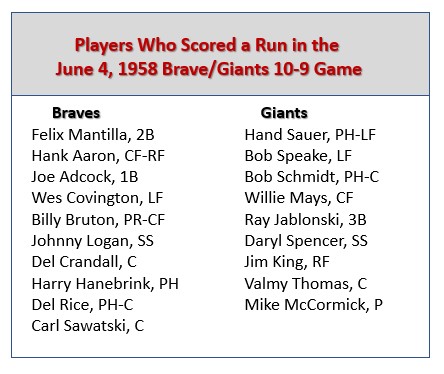
 

Baseball Roundtable’s 2020 All-Rookie Lineup

Early this week, we saw the announcement of MLB’s 2020 Jackie Robinson Rookies of the Year.  Congratulations to Mariners’ multi-tool CF Kyle Lewis (the unanimous AL choice) and Brewers’ lights-out reliever Devin Williams (the first reliever to win the ROY Award since Craig Kimbrel in 2011 and the first reliever ever to win ROY without recording a single save).  You’ll read more on these two players later in this post, as Baseball Roundtable presents its 2020 All-Rookie lineup.  Note:  If you would like a look at BBRT’s All-Time, All-Rookie of the Year lineup, click here after finishing this post. 


—-BASEBALL ROUNDTABLE 2020 ALL-ROOKIE LINEUP —-

Catcher – Sean Murphy, Oakland A’s

MurphypicSean Murphy was drafted by the A’s in the third round of the 2016 MLB draft (out of Wright State University, where he was a two-time All-Horizon League player). He showed solid defensive skills and hit .309-14-105 in 155 games at Wright State. Murphy got a taste of the majors in 2019 – hitting .245-4-8 in 20 games – and came into the 2020 season as the A’s number-three prospect. Retaining his rookie status in 2020, the 25-year-old hit .233 with seven home runs and 14 RBI in 43 games.  Murphy’s 27 hits, seven home runs, 14 RBI and 21 runs scored led all MLB rookie catchers. His seven home runs and 21 runs scored each ranked eighth among MLB rookies. The 26-year-old is also considered a potential Gold Glove defender.

MurphyC

First Base – Jared Walsh, Los Angeles Angels

WalshpicOkay, he’s not Shohei Ohtani, but Jared Walsh is another Angels’ two-way player. Walsh was drafted in the 39th round of the 2015 MLB draft (yes, the 39th round).  In his final season at the University of Georgia, Walsh hit .306, with three home runs and 22 RBI in 66 games and also put up a 5-2, 2.60 record in 14 mound appearances.

Walsh showed his power potential in 2019, when he hit .325-36-86 at Triple-A Sale Lake City – and put up a 1-0, 4.15 record in 13 mound appearance.  (In 2019, Walsh hit .203-1-5 in 31 games with the Angels; while also recording a 1.80 earned run average in five relief appearances.) In 2020, still retaining hie rookie status, Walsh hit .293-9-26 for the Halos – and struck out only 15 times in 108 plate appearances.  The 27-year-old Walsh is looking like an ongoing power source for the Angels, although his days on the mound may be numbered. (Walsh did not appear on the mound in 2020. ) Side note:  After making the Opening Day Roster, Walsh got off to a slow start.  In his July and August, he was zero-for-13 in ten games. Then in September he hit .337, with nine home runs and 26 RBI in 22 games.

SWalsh1B

Jared Walsh’s nine homers led all MLB rookie first sackers and were third overall among rookies – as were his 26 RBI.

2B – Nick Madrigal, Chicago White Sox

MadrigalpicNick Madrigal did not get the publicity of some of the other 2020 rookies (or even some of his young ChiSox teammates), but he had a rookie campaign worthy of recognition.

Madrigal was selected fourth overall in the 2018 MLB draft – after a stellar three seasons at Oregon State University. Over his three NCAA campaigns (151 games), he hit .361, with eight home runs, 103 RBI, 126 runs scored and 39 steals. In his first two minor-league seasons, Madrigal hit a combined .309-4-71, with 43 stolen bases.

While his 2020 MLB rookie campaign was interrupted by injury (separated shoulder), he hit .340 in 29 games, with four walks and just seven strikeouts.  At just 23-years-old, he appears to have a bright future as an MLB middle infielder  – with solid defensive skills and the ability to make contact at the plate.

Madrigal2B

 Nick Madrigal’s .340 average ranked third among 2020 rookies with at least 50 at bats. 

3B – (Tie) Alec Bohm, Philadelphia Phillies & Ke’Bryan Hayes, Pittsburgh Pirates

BohmpicklAlec Bohm.  Bohm surprisingly, was not drafted out of high school (Roncalli Catholic High School in Omaha, Nebraska), despite hitting over .500 as both a junior and senior. He went on to Wichita State University, where he was named a First-Team Freshman All-American after a .303-6-30 2017 season. I won’t go into the numbers, but Bohm was selected to the First-Team All-Missouri Valley Conference team as a sophomore and First-Team All-American as a Junior. He also starred in both the collegiate Coastal Plain League and Cape Cod League.

Bohm was the third-overall pick (Phillies) in the 2018 MLB draft and had two solid minor-league seasons (.293-21-97 in 165 games) before playing in 44 games for the Phillies in 2020. Bohm hit .338-4-23 in his first taste of the big leagues and certainly appears ready to stay.

Bohm3B

Alec Bohm’s 23 RBI were seventh among MLB 2020 rookies and led all rookie third sackers. His 24 runs scored topped all rookie third baseman and were sixth overall among 2020 rookies. 

HayespicKe’Bryan Hayes. When you look at Bohm’s credential,s you may wonder why there is a tie at third base. Well the Pirates’ Ke’Bryan Hayes’ .376 average topped all rookies with at least 50 at bats. Hayes was drafted 32nd overall in the 2015 MLB draft – right out of Concordia Lutheran High School (Tomball, Texas); choosing to decline a scholarship offer to the University of Tennessee.  (In his senior year in high school, Hayes hit .436, with 16 doubles, one triple, three home runs, 27 RBI and 12 stolen bases.)

N0 surprise that  the Pirates drafted him, not only did he show his potential on the field, he comes from good genes. Hayes is the son of Charlie Hayes, who enjoyed a 14-season MLB career (.262-144-740) and, in 1993, hit .305-25-98 for the Rockies, while leading the NL in doubles with 45.

Hayes3BKe’Bryan Hayes hit .279-25-202, with 66 steals in five minor-league seasons (461 games). He made his MLB debut September 1, 2020

The 23-year-old Ke’Bryan Hayes was held hitless in only four of 24 games in his rookie MLB season and finished the campaign on an eight-game hitting streak, during which he hit .516 (16-for-31) with four doubles and three home runs.

SS – Willi Castro. Detroit Tigers

Castro picThe Puerto Rican-born Willi Castro signed with the Indians as an international free agent in July of 2014 and was traded to the Tigers (for Leonys Martin and Kyle Dowdy) in late July, 2018. Castro made his MLB debut in August of 2019 (age 22) and hit .230-1-8 in 30 games.  He retained his rookie status in 2020, when he hit .349, with six home runs, 24 RBI, and 21 runs scored in 36 games – and also proved his versatility, primarily playing shortstop, but also appearing at third base and second base.  The Tigers seem confident that Castro’s at will keep him in the lineup somewhere.

CastroSS

Willi Castro’s .349 average was second among 2020 rookies with at least 50 at bats and his six home runs topped all rookie shortstops. His 24 RBI were fifth overall among rookies and tops among rookie shortstops,

LF – Nick Solak, Texas Rangers

solakNick Solak was signed by the Yankees in the second round of the 2016 MLB June draft (out of the University of Louisville). In three seasons at Louisville, Solak hit .346, with 10 home runs, 94 RBI and 36 steals in 159 games.   He was named a College Freshman All-American in 2014 and a College All-American in 2016.

He continued to show offensive firepower and speed in the minor leagues’ hitting .294, with 61 homers and 48 steals over four minor-league campaigns. (Note: Solak was traded from the Yankees to the Rays as part of a three-team trade in February of 2018 and then moved from the Rays to the Rangers in July of 2019.)  Solak made his MLB debut with the Rangers in August of 2019 and hit .293-5-17 over 33 games.  Retaining his rookie status, he earned a regular spot in the Rangers’ lineup for 2020 (appearing in 58 games), hitting .268 with two home runs, 23 RBI, 27 runs scored and seven steals. Solak started 23 games in LF, 13 in CF, 16 at 2B and 5 at DH.

Solal LF

Among 2020 MLB eligible rookies, Nick Solak finished first in base hits; fourth in doubles; fourth in runs scored; f0urth in stolen bases; and seventh in RBI.

CF – Kyle Lewis, Seattle Mariners

lewis picKyle Lewis was MLB’s unanimous choice for American League Rookie of the Year, but I’m pretty sure he took the honor in stride – Lewis has a lot of experience with recognition. As a freshman at Mercer University (2014), he hit .294-1-17 in 41 games.  Then in his sophomore season he was named Southern Conference Player of the Year, as well as co-winner of the Gregg Olson Award (college baseball Breakout Player of the Year), after going .367-17-56 n 54 games. He kept right on rolling as a junior, going .395-20-72 in 61 games – again being named Southwest Conference Player of the Year and also earning All-American honors, as well as Baseball America’s College Player of the Year, the American Association of Baseball Coaches Association Division 1 Player of the Year and the Golden Spikes Award.

All of this earned him the 11th overall selection in the 2016 MLB Draft.  By September 2019, he was in the major leagues – hitting .268 with six home runs and 13 RBI in 18 games for Mariners. For Seattle in 2020, Lewis played in 58 games, going .262, with 11 home runs, 37 runs scored and 28 RBI – and providing plus defense in CF.

LewsiCF

Kyle Lewis’ 11 home runs tied the White Sox’ Luis Robert for the most by a rookie in 2020. His 28 RBI were second only to Robert and his 37 runs scored led all MLB rookies.

RF – Austin Hays, Baltimore Orioles

Austin Hays played college ball at Seminole State College and Jacksonville University. In two seasons at Jacksonville (2015 and 2016), Hays hit .310-19-78, with 24 steals (110 games). After being drafted in the third round of the 2016 MLB draft, he played 38 2016 games with the A-Level Aberdeen Ironbirds, hitting .336-4-21, with four steals. Hays hit .329-32-95 at A and Double-A in 2017, earning a late-season call up to the Orioles, where he hit .217-1-8 in 20 games (as a 21-year-old).

Hays got off to a slow start at Double-A in 2017 and later was hampered by an ankle injury. He did not return to the major leagues until September of 2019, when he went .309-4-13 in 21 games for the Orioles.

In 2019, Hays played for the Low-A Aberdeen Ironbirds; High-A Frederick Keys; Double-A Bowie Baysox; Triple-A Norfolk Tides; and Baltimore Orioles.

In 2020, despite some time on the disabled list (broken rib on a hit-by-pitch), Hays hit .279-4-9, with 20 runs scored in 33 games for the Orioles.  In September, a healthy Hays played in 14 games for the Birds, hitting .377 with three home runs, four RBI and 12 runs scored.HaysRf

DH – Luis Robert, Chicago White Sox

RobeticlLuis Robert, who defected from Cuba in November of 2016, was considered a top (if not THE top) international prospect – and with good reason.  Playing in the tough Cuba Serie Nacional during the 2016-17 season, the 18-year-old Robert hit .401-12-40, with 11 steals in 53 games. Once signed by the White Sox (2017), Robert delivered on his promise – hitting .312-35-12, with 63 stolen bases in 200 minor-league games (three seasons). This performance earned Roberts the starting CF job for the ChiSox in 2020 and he delivered again.

Luis Robert tied another CF (the Mariners’Kyle Lewis) for rookie home runs in 2020 with 11. Robert’s 31 RBI led all rookies (Lewis was second) and his 33 runs scored were second only to Lewis 37.  In addition, Lewis’ nine steals led all 2020 rookies.  Lewis edged out Robert for the CF spot by virtue of a 29-point edge in batting average (.262 to .233).  So, in this lineup, when Lewis needs a break, I’d just switch him to DH and put Robert in CF. Side note: Robert fanned 73 times in 202 at bats in 2020 – as he cuts down on whiffs, we can expect some monster seasons.

SP – Tie  … Christian Javier, Houston Astros and Josh Fleming,  Tampa Bay Rays

Javierpic Christian Javier.   Astros’ right-hander Christian Javier signed with Houston as an international free agent (out of the Dominican Republic) – bringing a mid-90s fastball, solid slider and respectable curve to the fray. In his first pro (minor-league) season – as an 18-year-old – he went 4-0, 2.13 with 50 strikeouts in 42 1/3 innings pitched. As he moved up through the minors, he added an effective change to his repertoire. (In 2019, Javier fanned 170 batters in 113 2/3 innings with three minor league clubs.)  Over five minor-league seasons, Javier went 26-11, 2.22 with 512 whiffs in 377 innings.  With the Astros in 2020, he continued to establish his reputation for putting batters away, going 5-2, 3.48 and fanning 54 batters in 54 1/3 innings pitched.

JavioerSP

The Astros’ 23-year-old  right-hander Christian Javier was 5-2, 3.48 in 12 games/ten starts). Javier’s 54 1/3 innings pitched were fifth among MLB 2020 rookies and his 54 strikeouts were third.

flemingpicJosh Fleming.  Southpaw Josh Fleming was signed by the Rays in the fifth round of the 2017 MLB draft – out of Webster University, where he went 12-2, 1.28 with 165 strikeouts in 127 innings pitched (over two seasons).  In 2019, Josh Fleming was named MVP of the Double-A Montgomery Biscuits – after going 11-4, 3.31 in 21 games (17 starts).

For the Rays in 2020, the 24-year-old Fleming went 5-0, with a nifty 2.78 earned run average in seven games/five starts).  He also had a 3.6 strikeouts-to-walks ratio (seven walks and 25 whiffs in 32 ½ innings). He relies on a pitching low in the zone with a heavy sinker, cutter and change up.

Fleming

RP – Devin Williams, Milwaukee Brewers

williamspickNo ties here.  Righty Devin Williams – the NL Rookie of the Year – was clearly the most dominant rookie reliever in 2020. Williams had the lowest earned run average among rookies with at least ten innings pitched – a sparking 0.33. In 27 innings, he gave up just four runs – and only one earned – and fanned 53 batters (fourth-most among rookies); just one whiff shy of two per frame.  He kind of walks away with this one.

Williams signed with the Brewers out of Hazelwood (Missouri) West High School in the 2013 MLB draft (54th overall selection). In his final high-school season, William went 6-2, 1.15, allowing only 19 hits and fanning 101 batters in 55 innings.  In his first four pro season (minors), Williams went 15-24 ( 3 saves), 3.79 with 288 strikeouts in 287 1/3 innings pitched, He then missed the 2017 season (and pitched only 34 innings in 2018) after Tommy John surgery (torn ulnar collateral ligament). In 2018, he appeared fully recovered and, perhaps, stronger than ever – going 7-2, 2.36 in 31 minor-league appearances – fanning 82 batters in 57 innings (and earning a call up to the Brewers).  He got roughed up a bit in his MLB-debut season (5.93 ERA in 13 2/3 innings), but came back with a vengeance in 2020.

WilliamsRF

Devin Williams refers to his high-movement circle change as the “Airbender.” 

Primary Resources:  Baseball-Reference,.com; MLB.com

100Baseball Roundtable is on the Feedspot list of the Top 100 Baseball Blogs.  To see the full list, click here.

I tweet baseball @DavidBBRT

Follow/Like Baseball Roundtable’s Facebook Page here.  More baseball commentary; blog post notifications; PRIZES.

Member: Society for American Baseball Research (SABR); Negro Leagues Baseball Museum; The Baseball Reliquary. 

From a Perfect Game to a Ten-Hitter … Baseball Roundtable’s Top Ten World Series Complete-Game Shutouts

Since the first AL/NL World Series matchup opened on October 1, 1903, there have been 678 World Series games played. Of those contests, 118 have ended with one team held scoreless, with 91 of those featuring complete-game shutouts.  Eighteen of those complete-game shutouts have been “under maximum pressure,” ending in a 1-0 score.

Yankee Killer

Southpaw Art Nehf of the Giants is the only pitcher to win two World Series’ 1-0 complete games, tossing a four-hit shutout in Game Eight of the (best-of-nine) 1921 World Series against the Yankees and a six-hit shutout (again against the Yankees) in Game Three of the 1920 World Series.  Nehf pitched 15 MLB seasons, going 184-120, 3.20, winning twenty or more games in two campaigns. He was 4-4, 2.16 in 12 World Series appearances (nine starts).

In this post, Baseball Roundtable would like to present its top-ten World Series complete-game shutouts.  Keep in mind, these ratings, while based on BBRT criteria (additional value placed, for example, on Game Seven shutouts, contests that ended 1-0, extra-inning shutouts or unique accomplishments like Bob Gibson’s 17 strikeouts or Spud Chandler’s ten-hit, two-walk scoreless outing),  these ranking are subjective and clearly invite discussion and debate.  Isn’t discussion and debate what makes the national pastime great?


THE GRANDDADDY OF ALL WORLD SERIES SHUTOUTS –

A “PERFECT” CHOICE FOR NUMBER ONE

Larsen


ONE – WITH A BULLET – Don Larsen, Yankees, Game 5, 1956 World Series … October 8, 1956

A no-brainer here.  How could you not put the only World Series perfect game at the top of this list?

When Don Larsen took the mound to start Game Five of the 1956 World Series for the Yankees (against the rival Brooklyn Dodgers at Yankee stadium) expectations may not have been very high.  Larsen (11-5, 3.26 on the season) was coming off a Game Two start (in Brooklyn three days earlier) when he lasted just 1 2/3 innings and gave up four runs (none earned) on one hit and four walks. In that contest a double play got him out of a scoreless first after issuing a pair of walks — and the Yankees scored once in the first and five times in the top of the second to give Larsen a nice 6-0 lead.  But in the second inning, the wheels came off.  Larsen’s second frame went: single by Dodgers’ 1B Gil Hodges; LF Sandy Amoros safe on an error by 1B Jim Collins; walk to RF Carl Furillo to load the bases; sacrifice fly by C Roy Campanella scoring Hodges; foul pop out by PH Dale Mitchell; walk to 2B Jim Gilliam reloading the bases. Johnny Kucks then replaced Larsen on the mound and gave up a two-run single to SS Pee Wee Reese. Tommy Byrne then replaced Kucks and gave up a three-run home run to CF Duke Snider before fanning 3B Jackie Robinson to get out of the inning.  End result?  Six Dodger runs to tie the game and, ultimately, lead to a 13-8 Dodger win.

N0w, There’s a Trade that Worked Out for Someone

In the two seasons before his trade to the Yankees (1953-54), Don Larsen had gone 10-34, 4.27 for the St. Louis Browns/Baltimore Orioles).  In five seasons as a Yankee, Larsen went 45-24, 3.50 in the regular season and 3-2, 3.33 in six World Series starts. 

Larsen, however, was in complete control in Game Five – fanning seven in a 97-pitch, perfect game – a 2-0 Yankee win. In the game, Larsen went to a three-ball count on only one batter, started 14 hitters off 0-1 and – if you count the four batters who hit the first pitch for an out –  threw a first-pitch strike to 18 of 27 hitters.

Bookends

Don Larsen opened his World Series perfect game with a five-pitch strikeout (looking) of Dodgers’ 2B Jim Gilliam and closed it out with a five-pitch strike out (looking) of pinch-hitter Dale Mitchell.

FewestHitsWS

___________________________________________________

TWO – Christy Mathewson, Giants … Game 5, 1905 World Series … October 14, 1905

Photo by trialsanderrors

Photo by trialsanderrors

Christy Mathewson threw a nifty six-hit shutout (no walks, four strikeouts) in beating the Philadelphia Athletics 2-0 in Game Five of the 1905 World Series – giving the Giants the Series four games-to-one.  It was not just future Hall of Famer Mathewson’s excellence in this game that earned him spot number-two on this ranking. It’s that this was Mathewson’s’ third-consecutive, complete-game shutout in the 1905 series – and he threw those three whitewashings over a period of just six days.  On October 9, Mathewson shutout the Athletics 3-0, giving up just four hits.  Then, on October 12, he threw another four-hitter, this time shutting down the Athletics 9-0. Then in Game Seven, it was the five-hit. 2-0 win.  For the Series, Mathewson gave up just 13 hits (and, of course no runs) and one walk in 27 innings, fanning 18.

Trivia Tidbits from the 1005 World Series

  • The Giants’ four wins all came via the shutout – three by Christy Mathewson and one by Joe McGinnity.
  • The Athletics’ only win also came via the shutout – a four-hitter tossed by Chief Bender in a 3-0, Game Two victory. 
  • The Giants gave up just three runs in the Series – all unearned, giving them an unbeatable single World Series’ record 0.00 earned run average.
  • The Giants used only three pitchers in the entire series – Christ Mathewson (27 innings pitched); Joe McGinnity (17 innings pitched); and Red Ames one inning pitched. Yep, and entire World Series and only one “call to the pen.”

Mathewson was coming off a 31-9, 1.28 1905 season in which he led MLB in wins, ERA and shutouts (tied with eight), and led the NL in strikeouts (206). In his career, he led his league in ERA five times, strikeouts five times, wins four times and shutouts four times. He finished with a 373-188, 2.13 record.

mi;ti[l;eShutots_______________________________________________________________

THREE – Bob Gibson, Cardinals … Game One, 1968 World Series … October 2, 1961

Gibson1968 was the Year of the Pitcher and, in the National League, Bob Gibson was the Pitcher of the Year.  Gibson went 22-9 that season, with a microscopic, MLB-best 1.12 earned run average. In addition, 13 of his wins were complete-game shutouts (another 1968 MLB-best).  He also led the NL in strikeouts with 268 in 304 2/3 innings pitched.  Gibson’s 1968 earned run average of 1.12 was the third-lowest, post-1900, qualifying MLB ERA – and his 13 complete-game shutouts are the second-most in a single season since 1900.

They Call Him the Streak

Over June, July and August of 1968, Bob Gibson started 18 games, completed 17, won 16 (one loss/one no-decision), threw 11 shutouts, and put up a 0.77 ERA.

It’s no surprise that the Redbirds selected Gibson to start Game One (against the Tigers’ 31-game winner Denny McLain) – and Gibson did not disappoint. He threw a five-hit shutout, walking just one and fanning a World Series record 17 batters. Gibson fanned everyone in the Tigers’ starting lineup at least once, struck out at least one batter in every inning and fanned three batters in two frames. Despite Gibson’s heroics, the Cardinals lost the Series four games-to-three behind three complete-game wins from Mickey Lolich. Gibson also started and completed three games, going 2-1, 1.67. He took the loss in Game Seven giving up four runs on eight hits and one walk, while Lolich gave up just one tally on five hits and three walks.

Hall of Famer Gibson pitched in 17 MLB seasons (all for the Cardinals). He won two Cy Young awards and, in 1968, won both the NL Cy Young and MVP Awards. Gibson was a five-time 20-game winner, leading the NL in wins once, ERA once, complete games once, strikeouts once and shutouts four times. His career mound record was 251-174, 2,91, with 3,117 strikeouts in 3,884 1/3 innings. He also won nine Gold Gloves and hit .206 with 24 career homers.  In nine World Series starts, Gibson won seven and lost two, pitching eight complete games, posting a 1.89 earned run average and fanning 92 batters in 81 innings.

Ks InSeriesGame

_____________________________________________________

FOUR – Jack Morris, Game Seven, 1991 World Series … October 27, 1991

MorrisThere have only been three extra-inning World Series complete-game shutouts, ten Game Seven complete-game shutouts and 18 World Series complete-game wins ending in a 1-0 score.  And, there has been only one game that met all three criteria – Jack Morris’ performance in the finale of the 1991 World Series – a ten-inning seven-hit, two walk, eight-whiff gem that gave the Twins a 1-0 Game Seven win over the Atlanta Braves.  This performance earned extra credit for Morris, since it came at a time when complete games were at a premium.  As was widely reported, Twins’ Manager Tom Kelly was ready to pull Morris after nine innings and 118 pitches – but Morris was having none of it (and voiced his objection in no uncertain terms).   And, the rest, as they say, is history.
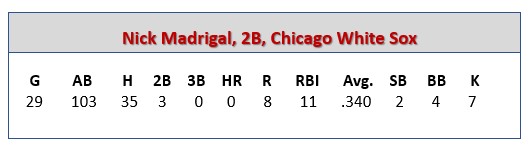
Hall of Farmer Morris pitched in 18 MLB seasons, going 254-186, 3.90. He was a five-time All Star and led his league in wins twice (winning twenty or more games in three seasons), and in complete games, shutouts and strikeouts once each. (He also led the league in wild pitches six times.) Morris was 4-2, 2.96 in seven World Series starts and was MVP of the 1991 World Series.
10nningWS

_____________________________________________

FIVE – Christy Mathewson, Giants, Game Two, 1913 World Series …. October 8, 1913

Yes, Christy Mathewson holds two spots on the top ten – and he earned them. The Giants won only one game in the 1913 World Series (against the Athletics) and it was a good one (at least for Giants’ starter Christy Mathewson).  That day Mathewson tossed his still-record fourth World Series complete-game shutout, as well as one of only (to date) three extra inning, complete-game Fall Classic whitewashings. In addition, when the Giants finally broke the scoreless tie in the top of the tenth inning, Mathewson plated the first run with an RBI single off Athletics’ starter (and future Hall of Famer) Eddie Plank and later came around to score the second run in the Giants’ 3-0 win. (Mathewson was two-for-three at the plate in the game.) On the mound, Mathewson gave up eight hit and one walk, while fanning five in his ten scoreless frames.

_____________________________________________

BONUS CONTENT – The First and Last (most recent) World Series Complete-Game Shutouts

Bill Dinneen … The first-ever World Series complete-game shutout came in Game Two of the first-ever AL/NL World Series (October 2, 1903). The AL Boston Americans’ southpaw Bill Dinneen shut down the Pittsburgh Pirates 3-0 on three hits and two walks. He fanned 11 in his nine frames. Eleven days later (October 13), Dinneen threw the second-ever World Series complete-game shutout, blanking the Pirates (again by a 3-0 score) in Game Eight of the best of nine matchup. (The Americans won the Series five games-to-three). Dinneen pitched in 12 MLB seasons, going 170-177, 3.01 with 306 complete games in 352 starts. He won twenty or more games in four seasons. In 1903, he went 21-13, 2.26.  

Madison Bumgarner … The most-recent World Series complete-game shutout was tossed by the Giants’ Madison Bumgarner in Game Five (October 26) of the 2014 World Series. Bumgarner shut down the Royals 5-0, giving up four hits and no walks, while fanning eight in nine innings of work.  In that Series, Bumgarner started and won two games and then picked up a five-inning save in Game Seven. He was on the mound for 21 innings in the Series and gave up just nine hits, one walk and one earned run, earning Series MVP honors. Bumgarner played in his twelfth MLB season in 2020 and has a 120-96, 3.20 record. 

SIX – Spud Chandler, Yankees, 1943 World Series, Game Five … October 11, 1943

ChandlerWhen Spud Chandler topped the Cardinals (in St, Louis) 2-0 in Game Five (giving the Yankees the Series four games-to-one), he had to work for it. Chandler gave up the most hits ever in a World Series complete-game shutout (ten) and was in and out of trouble the whole game. The Yankee righty stranded two runners in the first inning, two in the second, two in the fourth, one in the seventh, two in the eighth and two in the ninth – while the Yankees got him a sparse two runs in the sixth. He had only two hit-free innings in the game (the second and fifth).  Chandler comes in at number six on the basis of pure grit.

Chandler pitched in 11 MLB seasons, going 109-43, 2.84. In 1943, he led the AL in wins (20 against four losses), earned run average (1.64), winning percentage (.833), complete games (20) and shutouts (5).  The four-time All Star was also a twenty-game winner in 1946 and, in his final season (1947), at age 39, led the American League in ERA at 2.46 (although he would not qualify under today’s rules, having pitched just 128 innings in a 154-game season).

In six post-season appearances (four starts), Chandler went 2-2, 1.62.

__________________________________________________

SEVEN … Clem Labine, Dodgers, 1956 World Series, Game Six … October 9, 1956

LabineClem Labine took the mound for the Dodgers the day after Don Larsen pitched his World Series perfect game against them. Brooklyn was down three games to two and, given the excitement of the day before, needed someone to turn things around revive their hopes.  Labine proved up to the task, pitching ten innings of seven-hit, two-walk (five strikeout) shutout ball against the vaunted Yankees’ lineup.  And he needed to be that good, for after nine frames, Yankees’ starter Bob Turley also had a shutout going, having given up just three hits (but six walks), with 11 strikeouts. The Dodgers finally gave Labine the run he needed – and a victory – on two walks and a Jackie Robinson RBI single in the bottom  of the tenth.

Clem Labine pitched 13 MLB seasons, putting up a 77-56 record (94 saves). He gets extra credit in this rating for his Game Six start because he had spent the bulk of the 1956 season working in relief. An All Star that campaign, he had appeared in 62 games (just three starts) and gone 10-6, 3.35, with an NL best 19 saves (statistically noted after the save rule was enacted). Over his career, Labine appeared in 475 regular-season games as a reliever and 38 as a starter.  His ten-inning Game Six shutout was his only start in 13 World Series appearances.

______________________________________________

EIGHT – Sandy Koufax, Dodgers, Game Seven, 1965 World Series …. October 14, 1965

KoufaxSandy Koufax started Game Two of the 1965 World Series against the Twins (in Minnesota) and took the loss (Twins 5 – Dodgers 1), despite giving up just two runs (one earned) in six innings. He came back to throw a nifty four-hit, complete-game shutout in Game Five  (in LA) – with one walk and ten strikeouts. Then, with the Series tied at three games apiece, he took the mound for Game Seven on just two days rest and produced another gem – a three-hit, three-walk, ten-strikeout shutout – as the Dodgers won 2-1. The short rest give him an edge when looking a Game Seven shutout winners.

Hall of Famer Sandy Koufax pitched in 12 MLB campaigns, winning 165 games (87 losses) and putting up a 2.76 earned run average. In his final four seasons (he retired at age 30 due to arm issues), he won three Cy Young Award (1963-65-66), led the league in wins three times, ERA four times, complete games twice, shutouts three times and strikeouts three times. His record over those four seasons was 97-27, 1.88, with 1,228 strikeouts in 1,192 2/3 inning pitched. He tossed 89 complete games and 31 shutouts over those four seasons.  For his career, Koufax was 165-87, 2.76. In eight World Series appearances (seven starts), he was 4-3, despite a stingy 0.95 ERA.

___________________________________________

NINE – Jesse Haines, Cardinals, Game 3, 1926 World Series … October 5, 1926

hainesJesse Haines gets in the top ten as the only hurler to hit a home run while throwing a World Series shutout. Hines threw a five-hit, three-walk, three-strikeout shutout for the Cardinals (against the Yankees – with the likes of  Babe Ruth, Lou Gehrig and Bob Meusel in the center of the lineup) in Game Three of the 1926 World Series.  The Cardinals, who won 4-0, scored three times in the fourth inning, with Haines popping a two-run home run to right field. Haines also had a single in his three at bats.

Hall of Famer Haines pitched in 19 MLB seasons, going 210-158, 3.64. Haines was a three-time twenty-game winner and led the NL in complete games (25) and shutouts (6) in 1927. Haines was 3-1, 1.67 in six World Series appearances (four starts).


_______________________________________

TEN – Orel Hershiser, Dodgers, 1988 World Series, Game Two …. October 16, 1988

HershOrel Hershiser pitched a three-hit, two walk, eight-whiff shutout as the Dodgers topped the A’s 6-0 in Game Two of the 1988 World Series. But that’s not what got him the ten-spot here.  He is the only pitcher to collect three hits in a World Series game in which he also pitched a complete-game shutout. He got those three safeties – which included two doubles – in three at bats, He also had one run scored and one RBI – not a bad complement to his pitching prowess.  Hershiser had two starts in the Series, pitching a pair of complete games and giving up just seven hits and two runs in 18 innings (fanning 17).  His performance earned earned him the World Series MVP Award.

“O” is for Orel

“O”rel Hershiser holds the MLB record for the most consecutive regular-season scoreless innings pitched at 59 – set from August 30 through September 28, 1988. The streak included five consecutive complete-game shutouts in September.  In his sixth (and final) September start, Hershiser pitched ten scoreless innings before being relieved in a game the Dodgers lost to the Padres 2-1 in 16 innings.  Talk about a big finish, in his last nine starts of the 1988 season, Hershiser threw eight complete games, going 7-2, with a 0.44 earned run average and six shutouts.

Orel Hershiser had an 18-season MLB career, going 204-150, 3.48, with 2,014 strikeouts in 3,130 1/3 innings. He was a three-time All Star and, in 1988, led the National League in wins (23), complete games (15), shutouts (8) and innings pitched (267). In six World Series starts, Hershiser was 3-3, 4.07 and, in a total of 22 post-season appearances, he was 8-3, 2.59.  He was voted MVP of of the 1988 NLCS, 1988 WS and 1995 ALCS. As a hitter, Hershiser hit .201 (163-for-810), with no homers, but 50 RBI.  He was a .208 hitter in the 24 post-seasons at bats.

Hershiser Tidbit

Orel Hershiser twice led the National League in losses (1989 and 1992).

Bonus World Series Shutout – Babe Ruth

Why a bonus?  Because it’s Babe Ruth, that’s why.  In Game One of the 1918 World Series, Red Sox’ southpaw Babe Ruth shutout the Cubs on six hits over nine innings – the BoSox winning 1-0. Ruth’s mound opponent that day was the Cubs’ Hippo Vaughn, who had led the NL in wins (22), ERA (1.74), shutouts (8), and strikeouts (148).  Ruth was a pretty good World Series hurler, going 3-0, with a 0.87 earned run average in three starts (two complete games).

Primary Resources:  Baseball-Reference,.com; “The World Series,,” Richard Cohen, David Neft, Roland Johnson, Jordan Deutsch,  Dial Press, New York (1976)

100Baseball Roundtable is on the Feedspot list of the Top 100 Baseball Blogs.  To see the full list, click here.

I tweet baseball @DavidBBRT

Follow/Like Baseball Roundtable’s Facebook Page here.  More baseball commentary; blog post notifications; PRIZES.

Member: Society for American Baseball Research (SABR); Negro Leagues Baseball Museum; The Baseball Reliquary