“The daily box score – the symphony of a game recorded in a space one- column wide by four-inches deep. Some would say the box score reduces the game to statistics, I would say it elevates the game to history.”
Baseball Roundtable
Ten Reasons Why I Love Baseball
March 18, 2012
Spring Training games are once again underway and one of my favorite things about baseball – the box scores – are back. Each preseason, the first round of box scores coming in from Arizona and Florida takes me back to my youth, when I would get up a half hour early once the baseball season started, just so I could fully digest the previous day’s box scores along with my morning juice and cereal. As an adult, breakfast fare shifted to coffee and toast or bagels – but the box scores remained a morning staple. I may be dating myself here but, while I do recognize the immediacy and portability of box scores provided by smartphones and other devices, for me these icons of our national pastime are best devoured first thing in the morning – over the smell of hot coffee and newsprint.
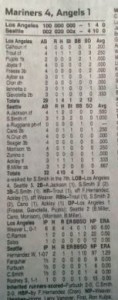
Today’s box score can be a thing of beauty.
The box scores – one-newspaper-column-wide by four-inches-deep summaries of each day’s baseball action – provide a staggering amount of information. Depending on the publication, these icons of baseball past and present can answer a wide range of questions for the baseball fan. What do you want to know about the contest? Who played what positions and where did they bat in the order? How about each player’s (and team totals) at bats, hits, extra base hits, runs scored or batted in, stolen bases (and caught stealing), strikeouts and walks? Or for the pitchers, how many: innings pitched; hits allowed; walks issued; hit batsmen; batters struck out; runs and earned runs allowed? Or you may want to know who got credit for a win, loss, save or blown save. You can even find the number of pitches (and number of strikes) thrown by each hurler. Players errors also are documented as are participants in double plays. It’s all there – as are a line score, game time, weather, attendance, runners left on base, and more.
“A box score is more than a capsule archive. It is a precisely etched miniature of the sport itself, for baseball, in spite of its grassy spaciousness and apparent unpredictability, is the most intensely and satisfyingly mathematical of all our outdoor sports. Every player in every game is subjected to a cold and ceaseless accounting; no ball is thrown and no base is gained without an instant responding judgment – ball or strike, hit or error, yea or nay – and an ensuing statistic. This encompassing neatness permits the baseball fan, aided by experience and memory, to extract from a box score the same joy, the same hallucinatory reality, that pickles the scalp of a musician when he glances at a page of his score of Don Giovanni and actually hears bassos and sopranos, woodwinds and violins.”
Roger Angell
The Summer Game
Today’s expanded box scores not only provide fans a look at each day’s competitions and performances, but also provide a perspective on the season. In many publications, batting averages (on the season-to-date) are listed to the far right of each players line, as are each pitcher’s earned run average (season-to-date). The number of extra base hits or RBI on the season are provided for players who added to their totals on that day; pitchers’ won-lost records or total saves (and total save opportunities) are similarly provided for those hurlers who added to their totals in the particular contest captured in the box score.
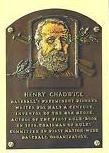
So, who do we salute for making this tiny, rectangular treasure trove of information available to baseball fans? Hats off to Baseball Hall of Famer Henry Chadwick – the only sportswriter elected to the non-writers portion of the BB HOF.
Henry Chadwick (1824-1908)
Elected to Baseball Hall of Fame in 1938
Henry Chadwick – his development of the box score helped earn him a spot in the Baseball Hall of Fame.
Born in Exter, England, Henry Chadwick was a fan (and player) of ball-and-bat games like rounders and cricket in his early years. Chadwick moved to the United States in 1837 and was employed as a cricket reporter for the New York Times. It’s been reported that, while not initially a big fan of base ball (it was two words back then), Chadwick took in a very well-played base ball game between New York City’s Gotham and Eagle squads in 1856 – and changed his views of America’s bat-and-ball competition. Chadwick later spoke of how he was enthralled by the game and truly felt it reflected the spirit of America.
As a result of this encounter with base ball, Chadwick dedicated himself to putting baseball in the hearts and minds of the American public. From covering the sport for the times, he moved on to writing regular columns on base ball for the New York Clipper and Sunday Mercury newspapers – quickly earning a reputation as one of (if not the) top chroniclers of the game. Just three years after taking in that Gothams-Eagles contest, Chadwick put forth his first modern box score – detailing a game between the Brooklyn Excelsior and Brooklyn starts – documenting such statistics as hits, runs, put-outs, assists, errors and strikeouts. He went on to further refine his box score, as a means to enable his newspaper audience to see the game at home.
Chadwick’s contributions, however, went well beyond the box score. He also set himself to the task of documenting player performance and providing a source of player comparison – developing such enduring statistics as batting average and earned run average. Chadwick is also credited with authoring baseball’s first rule book and the sport’s first player and statistical reference books.
How enduring were Chadwick’s contributions? The box score, while expanded, remains firmly based in Chadwick’s work. Batting and earned run averages remain key statistics for evaluating player performance. Then there are all those “K’s” fans hang on the railing when their home-team fireballer is mowing down opposing batters. It was Henry Chadwick who developed the use of “K” (the last letter in the word struck) to denote a strikeout on the score sheet. He also was a leader in such rules changes as the extension of a tie game into extra innings and requiring a ball be caught on the fly for an out (rather than on the fly or first bounce).
Chadwick’s successful contributions to expansion of baseball’s hold on the hearts and minds of the American public were so significant that, after his death in 1908, flags in every major league park were flown at half-mast and he is the only sportswriter ever elected to the non-writers section of the Baseball Hall of Fame.
So, each morning, as I peruse the box scores (in my local daily newspaper), I raise my cup of coffee in a toast to Henry Chadwick.
The box score, by the way, is only one of the many reasons I love baseball – for a top ten list, click here.
Looking ahead? For BBRT’S 2016 National League Predictions (Division Races and Awards), click here. For 2016 AL Predictions, click here.
Fan of baseball trivia? BBRT has two 99 question (Ballpark Tours tested) trivia quizzes. For BBRT’s 99 favorite questions, click here. For a second 99, click here.
Ballpark Tours great 2016 excursion (10 days, 10 games, 7 cities), outlined here.
I tweet baseball @DavidBBRT
Member: Society for American Baseball Research (SABR); The Baseball Reliquary; Baeball Bloggers Alliance.