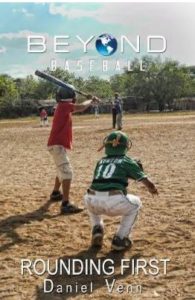
 Beyond Baseball – Rounding First
By Daniel Venn
World Beyond Publishing, 2016
$12.00
A bat, a ball, a glove. For most of us these are symbols of the national pastime. For those involved with the charitable organization Helping Kids Round First, they are symbols – and tools – of hope, motivation and empowerment.
Each year, Helping Kids Round First travels to Nicaragua, the second-poorest country in the Western Hemisphere, and delivers hope and empowerment to hundreds of youngsters in the form of baseball equipment. For more information on Helping Kids Round First, click here.
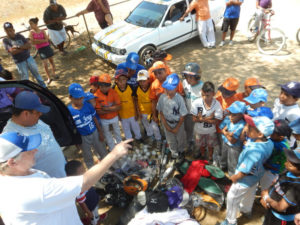
Helping Kids Round First delivers baseball equipment, hope and empowerment across Nicaragua. Photo courtesy of Daniel Venn.
Daniel Venn joined the Helping Kids Round First team on its January-February 2016 trip to Nicaragua and found himself in a nation of breathtaking scenic beauty and equally breathtaking poverty – all wrapped up with a national passion for baseball that ranks second only to religion. Venn, a former college pitcher, took part in the delivery of baseball and softball equipment to youngsters in more than 25 communities – many of them in the very poorest regions of the country. The final tally for Helping Kids Round First in Nicaragua this year was an estimated 6,000 baseballs and softballs, 800 gloves, 1,400 bats, 700 helmets, more than 1,000 uniforms distributed – and countless hearts raised and smiles generated.
Fortunately, for readers, Venn (also an author and educator) has chronicled his experiences in the soon-to-be released book Beyond Baseball – Rounding First.
It’s a good read – and serves a good cause (part of the proceeds will be donated to Helping Kids Round First). Venn does a great job of presenting the importance of baseball to Nicaraguans, bringing the impact of all that donated equipment to life and providing some entertaining glimpses into the trials and tribulations presented by Nicaragua’s culture, politics and infrastructure. The book is available for pre-order now for $12 at www.danvenn.com and will be on Amazon/Barnes & Noble next month.
Most of all, Venn’s book presents a story of hope and empowerment. As former major league outfielder Marvin Bernard (a native of Nicaragua who played nine seasons for the San Francisco Giants) describes it in the Foreword, “Baseball gives children hope in Nicaragua, and hope is motivating. Baseball has the potential to change the lives of young players here, and equipment donations from charities like Helping Kids Round First help make that possible.”
Venn’s book makes it clear that we are not just talking just about having a chance to make the big leagues, we are talking about the hope, motivation and empowerment that comes with the combination of knowing someone cares and being given the opportunity to participate and compete.
Let me use just a couple of stories from the book to illustrate that point.
Helping Kids Round First was scheduled to visit the island of Omatepe this year. The plan was to get the vehicles (a pickup truck and a taxi) filled with equipment to the island early in the day (via ferry crossing). However, weather conditions, an erratic ferry schedule and a (fake) ticket scam put them on an alternative ferry that not only got them to the island in the late evening, but also delivered them to a port on the opposite side of Omatepe – far from the waiting youth baseball team. The Helping Kids Round First team managed, despite spotty cell service, to notify the local baseball coach – Effrain – of the delay and new docking location. The coach walked more than seven miles to meet the group (and guide them to the ball field) and had waited a good portion of the day by the side of the road to welcome them. When they finally met up, Effrain was apologetic “I was going to walk all the way (about 15 miles), but I needed to take a break. I’m sorry I didn’t make it.”
In Venn’s words, here’s what happened when they arrived at the field.
Every one of Effrain’s players was waiting when we arrived. Their parents had given up and gone home hours ago, but the youngsters’ faith had not wavered.
As Craig gave his customary introductory speech to the players, a high pitched electrical shriek cut through the air, and the streetlight we were standing under went dark. All of the lights in the community followed immediately after, and we were left in pitch darkness.
“Happens all the time,” Effrain told us. “The electricity here isn’t very reliable.”
He sent his players home to get flashlights. They scampered off, each returning in minutes with a light. By the glow of their small flashlights alone, we unloaded the gear and presented it to the children. It didn’t take much light to see their smiles.
Note: Venn added that when he touched base with Effrain after returning to the U.S., he learned the coach had used the equipment not only to outfit his team, but also to start two new leagues for kids of different ages on the island.
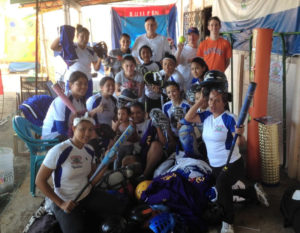
Helpng Kids Round First gave a boost to the young women and girls of the Academia Mimadas Rubilena Rojac. Photo courtesy of Daniel Venn.
Venn also shares the story of a meeting he found especially rewarding – the delivery team’s visit with the young women of Academia Mimadas Rubilena (Ruby) Rojas – Nicaragua’s only softball academy. Their field was dry, uneven dirt. A piece of board dropped in place served as the pitcher’s rubber. There were no fences, bases or dugouts. The academy had little equipment and much of what they had was homemade. For example, the “weight room” was just a pile of rocks of different sizes. As Venn said in an interview for this review, “Still, the girls were working so hard because they simply love softball and because the sport is a path to a possible college scholarship they wouldn’t have the opportunity to pursue otherwise.”
In his book, Venn recounts his conversation with Denis Martinez, who operates the academy.
“This is a very dangerous neighborhood,” he told me. “There is a lot of crime, a lot of drugs, and a lot of abuse here. Without softball, many of these girls would be on the streets. Some were homeless, some were addicted to drugs, most were in broken homes when they came here. Some already have children of their own.” He gestured towards a small toddler running back and forth between the girls, a batting helmet bouncing up and down as she ran, a glove on each of her hands.
“Here, they can have different lives. They have food here. They have a place to sleep here. For many, this is their home, and this is their family. Scholarships are available through sports, so softball gives them an opportunity for an education and a career they could not afford otherwise. We are able to meet their basic needs here and give them the chance to do more with their lives.
“We train the girls physically here to be better athletes and better softball players. But we also focus on training them mentally. Women are not respected here, especially in this neighborhood. Abuse against women is common. We work hard to improve their self-esteem and their confidence. We want to…” Sergio, who had been translating the conversation for me, paused.
“I’m not sure how to say that word in English.” He pulled out his phone to translate the word. “Empower. They want to empower women in this neighborhood.”
“Girls can turn to softball to give them a reprieve from what they are facing away from the field. The relationships they make, the lessons they learn, and the importance of teamwork and unity they experience will carry over to help them in many facets of their life. It gives them hope, which you can’t put a price tag on.”
Ruby Rojas, Olympic Softball Player
From Beyond Baseball – Rounding First
These are just two of the heart-warming and eye-opening stories that make up Beyond Baseball – Rounding First. The book also looks at the delivery of children’s books to a day care center, the organization’s efforts to help improve agricultural yields and incomes, efforts to leverage softball equipment into an opportunity to deliver hospital equipment to the country, and even the challenges Nicaraguans face getting to (and surviving in) the major leagues.
And, there is a personal side to Venn’s story. He not only shares the satisfaction he found in his work in Nicaragua, he talks about finding baseball in its most pure form there (played solely for the love of the game), and even shares a tale of another kind of love, a lost relationship. (Every song about love or heart break brought her to my mind. It got so bad that songs that didn’t remind me of her reminded me of her, simply because they didn’t remind me of her.)
“Baseball was everywhere I looked. Fathers and sons played catch in front of their homes. Pickup games far short of full teams played in pastures next to cows. Kids hit rocks they picked up off the street with sticks. In many ways, northern Nicaragua was hell. But for baseball at its purest, it was heaven.”
Daniel Venn
From Beyond Baseball – Rounding First
So, what did Venn take away from his experience?
He told BBRT, “The biggest takeaway for me was simply the amount of good any one of us can do if we decide to. Helping Kids Round First was started by one man with a suitcase of baseball gear – just looking to help a few kids find more opportunity. Now, the non-profit is shipping ocean containers full of baseball and softball equipment, entire hospitals, helping catalyze legitimate social change and empower women, and helping put food on the table for over a hundred farming families. It all started with one person just trying to help a few kids. It has evolved into such an impactful organization – any one of us could do that, whether internationally or right here at home.”
Oh, and by the way, Venn intends to stay involved with Helping Kids Round First.
BBRT recommends both the book – an entertaining and inspiring read – and the cause. Just as one person can make a difference, so can one contribution. Again, to preorder Beyond Baseball – Rounding First, click here.
Daniel Venn – Ballplayer, Teacher, Humanitarian, Author
Daniel Venn was born and raised in Cannon Falls, Minnesota – but his baseball life has taken him far beyond his home town and home state. As a pitcher/outfielder in high school, he earned All-Conference and Academic All-Star honors. In college (Gustavus Adolphus College in St. Peter, MN), Venn majored in Social Studies Secondary Education and was a three-year letter winner (pitcher) on the Golden Gusties baseball team. While in college, Venn spent the summer of 2012 playing baseball in Central America with Beyond Study Abroad. The team of college ballplayers barnstormed across Costa Rica, Nicaragua, and Panama playing anyone who would show up – from top talent like Costa Rica’s 18U national team and the pro prospects at Dennis Martinez’s baseball academy in Nicaragua to cobbled together teams made up of the fathers of youngsters who attended clinics put on by the college players. In 2014, Venn published his first book – Beyond Baseball – about his experiences playing baseball (from exhilaration to embarrassment) in Central America. The following year, Venn’s summer trip to visit a foreign exchange student in Ecuador turned into a year teaching English in Ecuador, the Galapagos Islands and Peru. After his graduation from Gustavus Adolphus in 2015, Venn completed a stint with the Peace Corps in Western Samoa before heading to Nicaragua with Helping Kids Round First.
Note: Venn’s first book is available at Amazon.com (paperback – $7.00) or at $0.99 for the Kindle.
Looking for more baseball book reviews? Click here.
I tweet baseball @DavidBBRT
Member: Society for American Baseball Research; The Baseball Reliquary; Baseball Bloggers Alliance.