On this date (June 27) in 1958, White Sox’ southpaw Billy Pierce, one of my childhood heroes, took the mound against the Washington Senators (in Chicago) – and pitched what may have been the best game of his career. (Note: I had many childhood heroes – most of whom wore spikes and carried a glove – but Pierce was a bit special. More on that later, I’m getting ahead of myself here.)
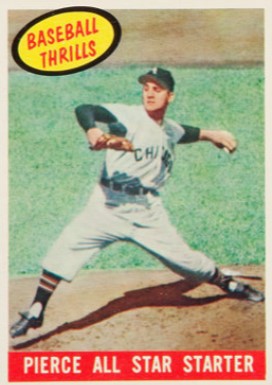 Pierce was 6-5, 3.21 at the time, while his mound opponent (right-hander Russ Kemmemer) was 4-5, 4.04. Pierce, who had led the American League with 20 wins the year before (20-12, 3.26) was clearly “on his game” (the phrase “in the zone” was not yet on the scene) that day. After eight innings, he held on to a 3-0 lead, had not allowed a single base runner. He had fanned seven batters and allowed just five balls out of the infield. Senators ‘2B Ken Aspromonte led off the ninth and grounded out shortstop-to-first (Luis Aparicio-to-Ray Boone). Next up was catcher Steve Korcheck, who became Pierce’s eighth strikeout victim. Pierce was just one out away from perfection and a spot in the MLB history books. Due up was Kemmemer, and Senators’ Manager Cookie Lavagetto looked to his bench, where he found 34-year-old Ed Fitz Gerald. The veteran was in his 11th and next-to-last season and had been used primarily as a pinch hitter (he served as a pinch hitter in 18 of the 23 games he appeared in so far that season). At the time, Fitz Gerald was hitting .313 (10-for-32, all singles). Fitz Gerald lofted a first-pitch curve ball down the right field line that landed about 12 inches fair and ended Pierce’s bid for perfection. Pierce then proceeded to fan CF and leadoff hitter Albie Pearson on three pitches to record a more mundane one-hit shutout. (Pierce would throw four one-hitters in his MLB career.)
Now remember, I said Pierce was one of my special baseball heroes. That’s because, as a youngster, I was a bit undersized (in 1958, I was eleven-years-old and often mistaken for seven or eight … an issue corrected by an age 12-13 growth spurt). Pierce was also a bit undersized (for a major league pitcher) at 5’10’, 160-pounds. Yet, he became a true power pitcher. Between 1952 and 1957, he finished in the top five in the American League in strikeouts every season (leading the league in 1953) and among the top five in strikeouts per nine innings in all but one campaign (leading the AL in 1953 and 1954). But again, I’m getting ahead of myself. Let me just say here, I truly believe Billy Pierce’s major-league accomplishments do not often get the attention they deserve. Hence, this post.
Mr. Zero
Billy Pierce, did not look overpowering as a youngster (shy of 150 pounds as a high school senior), but he pitched beyond his stature. He threw so many shutouts for his Highland Park (Michigan) High School team that he became known as “Mr. Zero.” He was selected to play in the first All American Boys Game (sponsored by Esquire Magazine and played at the Polo Grounds in New York City). Appropriately, Mr. Zero pitched six shutout innings and got both the victory and most-valuable player recognition as the East team triumphed.
The slight of build (but heavy in potential) Michigan high-school phenom signed with the Detroit Tigers at age 17 and found himself on a major-league mound at age 18 (MLB debut – June 1, 1945). He showcased great stuff, but also some command issues. Pierce appeared in five Tigers’ games that season and gave up just six hits and two runs, while fanning ten in ten innings. However, he also walked ten batters. Pierce spent 1946 and 1947 in the minors with the Triple A Buffalo Bisons, where he also pitched in 1945. In 1946 and 1947, he went 17-12, 4.04, with 169 walks and 170 strikeouts in 207 innings. Still, Pierce’s 14-8, 3.87 record at Triple A in 1947 earned him a return ticket to the Tigers in 1948 – but he pitched in only 22 games, putting up a 3-0 record, dampened by a 6.34 earned run average and 51 walks in 55 1/3 innings. In November of 1948, Detroit traded Pierce to the White Sox for catcher Aaron Robinson (the Tigers also threw in $10,000). It would prove to be: Advantage- White Sox and Pierce.
His first two seasons in Chicago were not rosy, as Pierce went 19-31, 3.94 – fanning 213 and walking 249 in 391 innings. In 1951, however, things changed. Pierce developed better command over his pitches – fastball, curveball, change – and developed a slider. The result was a 15-14, 3.03 record, with 113 whiffs and just 73 walks in 240 1/3 innings – and a dramatic change in Pierce’s career trajectory.
Over the next ten seasons with Chicago, Pierce went 152-107, 3.08 with 1,470 strikeouts and 730 walks in 2,299 2/3 innings. He completed 142 oi 308 starts and notched 33 shutouts. During that span he made seven All Star teams, was a twenty-game winner twice (leading the league in win in 1957); led the AL in ERA in 1955 (1.97); three times led the league in complete games; and once the league in strikeouts.
After the 1961 season, coming off an 10-9, 3.80 record (and an All Star selection), Pierce found himself traded to the San Francisco Giants (along with Don Larsen) for Bob Farley, Eddie Fisher, Dom Zanni and Verle Tiefenthaler (who was a player to be named later in the deal). The result? Advantage – Giants and Pierce.
Billy Pierce – A Giant Among Giants
As the 1962 season closed with the Giants and Dodgers tied at 101-61, veteran lefty Billy Pierce (acquired by San Francisco in the off-season) was 15-6, 3.72 – and, perhaps most important, 11-0 at Candlestick Park. Giants’ Manager Al Dark felt confident starting Pierce in the first game of a three-game tie-breaking playoff for the pennant (opening at Candlestick Park). Pierce’s opponent was another southpaw – Sandy Koufax (coming off a hand injury). Koufax was 14-6, 2.41 on the season (and in the process of winning his first of five straight ERA titles). Fans looked forward to a pitchers’ duel – which did not materialize. The Giants knocked Koufax out of the game in the top of the second (with no outs) having already scored three runs on four hits (including home runs by Willie Mays and Jim Davenport). Pierce went on to pitch a complete-game, three-hit shutout (one walk and six strikeouts), giving the Giants the lead in the best-of-three playoff.
The Dodgers came back to win a squeaker (8-7) in Game Two. Game Three saw the Dodgers match Johnny Podres against the Giants’ Juan Marichal, with neither pitcher figuring in the decision. Los Angeles took an 4-2 lead into the top of the ninth inning, but the Giants scored four times to take the lead. And, who did Dark call upon to save the win that put San Francisco into the World Series? It was Game One playoff winner Billy Pierce, who set the Dodgers down in order to get the save. Note: The Giants lost the 1962 World Series to the Yankees in seven games, with Pierce taking the loss in Game Three and winning Game Six. He pitched 15 innings in the Series, giving up four earned runs on eight hits (2.40 ERA).
After helping the Giants get to the World Series with his 16-6 record (including a victory and a save in the three-game tie-breaking playoff with the Dodgers), Pierce pitched two more years for the Giants – going 6-11, 3.59, with 11 saves in 72 appearances (14 starts). He retired after the 1964 season – at age 37 – with a career record of 211-169, 3.27, 193 complete games, 38 shutouts, 33 saves and 1,999 strikeouts in 3,306 2/3 innings pitched. As noted, he was a seven-time All Star, and led his league in victories, earned run average and strikeouts once each.
Pierce is also noted for his charitable efforts and served 46 years as a committee member of the Chicago Baseball Cancer Charities (20 years as its president).
Billy Pierce started on the mound for the AL All Star team in 1953, 1955 and 1956.
In a statement after Pierce’s death in 2015, Chicago White Sox owner Jerry Reinsdorf said “It was an absolute privilege to consider Billy a friend. He epitomized class, not just as a ballplayer on those great Go-Go White Sox teams of the 1950s, but as a gentleman and human being who devoted so much of his life to helping others.”
For me, Billy Pierce’s career is worth reflecting on.
Primary Resources: Baseball-Reference.com; Stathead.com; “Go-Go To Glory, The 1959 Chicago White.” Society for American Baseball Research, edited by Don Zminda, article by Rob Neyer.
BASEBALL ROUNDTABLE ON THE TOP 100 BASEBALL BLOG LIST
 Baseball Roundtable is on the Feedspot list of the Top 100 Baseball Blogs. To see the full list, click here.
I tweet baseball @DavidBBRT
Follow/Like Baseball Roundtable’s Facebook Page here. More baseball commentary; blog post notifications; PRIZES.
Member: Society for American Baseball Research (SABR); The Baseball Reliquary; The Negro Leagues Baseball Museum.