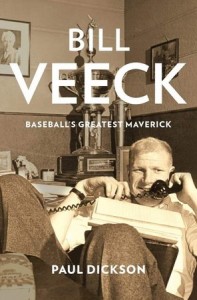
 Bill Veeck: Baseball’s Greatest Maverick
By Paul Dickson
Walker & Company, 2012
$28.00
Where to start? Where to end? What to include?
There is so much to like about Bill Veeck: Baseball’s Greatest Maverick – and to like about Bill Veeck himself – that it’s difficult to write a review. The best place to start is to say that I‘ve probably never had as much fun reading a book. Nor have I ever interrupted my reading so many times to regale my family with passages and anecdotes. If you haven’t picked this book up yet, the time is now. If you are a baseball fan, a humanitarian, a history buff, someone who enjoys a good story, you’ll have a hard time putting it down.
If I had to describe Bill Veeck in a single sentence (a truly impossible task), I would say he was an individual who lived life – every minute – to the fullest, and brought those whose lives he touched along for the ride. That spirit pervades this book. Bill Veeck – in his lifetime, a four-time major league team owner – ignores adversity, tweaks the baseball establishment, champions social justice and brings his version of “play” and “fair play” to life and to the ball park.
While he is often remembered for celebrating the fiftieth anniversary of the American League by bringing three-foot-seven-inch, 65-pound Eddie Gaedel to the plate for his St. Louis Browns or for the near-disastrous Disco Demolition night when he owned the White Sox, Bill Veeck’s legacy runs much deeper. As you will learn on the pages of Dickson’s book, much of what you see as part of today’s game: promotional give-aways; scoreboards that celebrate home runs and victories by the home team; names on the backs of uniforms; expanded concessions; and even quality rest rooms can be traced by to the innovation and initiative of Bill Veeck. Further, Veeck bullt teams that captured two league championships and one World Series crown. And along the way, he earned the love and respect of players and fans and, he would proudly point out, the animosity of fellow owners and baseball’s top administrators.
To Bill Veeck, life was meant to be both fun and fair – for everyone. He was a man of privilege, who turned away from privilege – except when it meant he could avoid wearing a tie in places or circumstances that seemed to demand that formality. In 1943, considering military service in World War II, Veeck (given his economic status and celebrity) was offered the opportunity of an officer’s commission in the Army or Navy (and most likely a safe promotional assignment). Veeck’s sense of fair play instead led him to enlist as a private in the Marine Corps – a decision which would eventually cost him much of his right leg.
It was that same sense of fair play that made him a champion of civil rights and a force in the integration of baseball. Dickson, in fact, devotes a chapter to Veeck’s plan to purchase the Philadelphia Phillies before the 1943 season, hold a mock all-white spring training and then show up on opening day with an all-Black or primarily Black team. (Veeck was convinced baseball could not turn away Black players while Black soldiers were fighting for the country in World War II.) Before Veeck could complete his purchase, however, word of the plan got out and the Phillies were taken over by the National League and an alternative buyer was sought. (In 1947, Veeck, then owner of the Cleveland Indians, signed Lary Doby as the American League’s first Black player.)
Ultimately, Bill Veeck was an innovator and promoter – a true impresario; a baseball man who knew how to build a winning team; a humanitarian; a social activist; and perhaps the most passionate fan and friend of baseball ever.
Now, I could relate story after story from the pages of Dickson’s book, but it would be more fun if you read it yourself. So, here are just a few previews of what you’ll find on the book’s pages:
– Bill Veeck hiring a young concessionaire named Jack Ruby (yes, the same Jack Ruby who later gunned down Lee Harvey Oswald in Dallas).
– Veeck talking baseball and art with Salvidor Dali.
– Veeck tricking Harry Carey into leading the fans in “Take Me Out To The Ballgame” and justifying it by telling Carey he was perfect for the role because his voice was so bad, the fans would be more than willing to sing along. ”Hell, if you had a good voice, you’d intimidate them and nobody would join in.”
– Veeck’s testifying in support of Curt Flood (and against Major League Baseball) in Flood’s historic 1970 challenge to baseball’s reserve clause.
– The multiple times Veeck had vendors serve “drinks on the house” to fans in the stands.
– Veeck’s loyalty to Satchel Paige, a loyalty that translated into making Paige MLB’s oldest-ever rookie – and, later, multiple major league opportunities for the Negro League legend.
– Vick’s penchant for joining the fans for a beer in the bleachers, shirtless and in shorts with his wooden leg on display – consistent with his commitment to the everyday fan and his comment that: “I have discovered in twenty years of moving around a ball park, that the knowledge of the game is usually in inverse proportion to the price of the seats.”
– Veeck’s voracious appetite for reading – 3-5 books each week.
– Veeck overcoming adversity on the field, in the boardrooms of baseball and in the operating room. (Veeck once described himself as “whole” – defining whole as having “a lung and an eighth, a leg and a quarter, 40 percent of my hearing and one legal eye.”
After Veeck’s death, Dickson reports, Chicago Magazine writer William Brashler had this to say “Somehow, we will have to muddle through Opening Day without him. And we will have to adjust to a few sad facts: the gross national consumption of beer has diminished, some say measurably. Every day now, one good book goes unread. And marches against handguns and for peace and civil rights have one fewer peg-leg pounding the pavement.”
Bill Veeck was more than a baseball man. He was, as the last line on his Baseball Hall of Fame Plaque reads “A CHAMPION OF THE LITTLE GUY.” I’d take it a step further, Bill Veeck was a champion of life. As a result, this is more than a baseball book. It’s a book about life – and about living it to the fullest.
I began this review wondering how to start and how to end. Well, I finally came up with an ending. All of us have at some time played that parlor game in which you answer the question, “If you could invite five people – past or present – to dinner, whom would you choose?” I can’t imagine anyone who reads this book leaving Bill Veeck off their guest list. Take the time to read a truly interesting and entertaining book about a truly interesting, entertaining and impactful fellow.