Yesterday (September 9, 2020), the Atlanta Braves set a post-1900 National League record for runs scored (by one team) in a game – trouncing the Miami Marlins 29-9 in Atlanta. The fell just one run short of the overall post-1900 record of 30 runs (the Texas Rangers topped the Orioles – in Baltimore, sadly – 30-3 in the first game of a doubleheader (also sadly) on August 22, 2007. Yesterday’s Braves’ outburst also fell short of the all-time MLB and National League mark of 36 runs, set by the Chicago Colts (Cubs) on June 29, 1897. (More on both the Rangers and Colts’ onslaughts in a bit.)
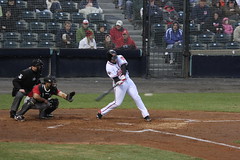
Photo by Gamma Man 
The star of the game was Braves’ LF Adam Duvall, hitting out of the seven-spot, who came within one of hitting for the home run cycle (solo, two-run, three-run and Grandl Slam homers in one game). Duvall hit a two-run home run in the second inning, a three-run shot in the fifth and a Grand Slam in the seventh.) His nine RBI in the game tied the Braves’ all-time record – set by pitcher Tony Cloninger back on July 3, 1966, when Cloninger became the first National Leaguer (any position) to hit two Grand Slams in a game.
The Home Run Cycle (solo, two-run, three-run and Grand Slam homer in one game)
On July 27, 1998, Tyrone Horne, playing for the Double A Arkansas Travelers became (and still is) the only professional ballplayer to hit for the home run cycle. For the full story, click here.
Other offensive stars for the Braves in the game, were Freddie Freeman (three-for-six with six RBI) and Ronald Acuna, Jr. (three-for-four with five driven in). Surprisingly, despite taking a 13-5 lead into the top of the third, starter Tommy Milone did not hang around for the win. He was knocked out of the game with one out in the third inning – and ended up giving up eight earned runs in the outing. The win went to Grant Dayton, who pitched 1 2/3 innings of scoreless relief.

The loss in the game went to Marlins’ starter Pablo Lopez who gave up seven runs on four hits and four walks in 1 2/3 innings. The most damage was done, however, against reliever Jordan Yamamoto, who surrendered 13 runs (12 earned) on 11 hits and two walks in 2 2/3 innings. Ouch! All nine Braves starters collected a least one hit – with five players having three-hit games.
Highest One-Team Scoring Binge Ever
On June 29, 1897, the National League’s Chicago Colts (Cubs) set the all-time MLB record for runs scored by a team in a game – topping the Louisville Colonels 36-7 in Chicago. The star of that contest was Colts’ shortstop Barry McCormick, who had six hits in eight at bats – including a triple and one of the game’s two home runs (the other four-bagger was rapped by Colt’ RF Jimmy Ryan). McCormick also had two of the Colts’ six stolen bases. (The 22-year-old McCormick finished the season with a ..267 average, two home runs, eight doubles, ten triples and 44 steals).

As you might expect, every Colts’ player had a least one hit, with starting pitcher Nixey Callahan (who went the distance), going five-for-seven, with two doubles.
Jim Jones – Tough Debut
Twenty-year old Jim Jones of the Louisville Colonels made his MLB debut in the record-breaking loss, relieving Louisville starter Chick Fraser in the third frame. Jones gave up 22 runs (14 earned) on 19 hits and five walks over 6 2/3 innings. Jones – who was converted to an outfielder (no surprise there) – appeared on an MLB mound only once more (1901 Giants), giving up six runs in a five-inning stint. In three MLB seasons (1897, 1901, 1902), he also appeared in 87 games in the outfield, putting up a .270-0-19 stat line.
Overall, the Colts collected 32 hits and were aided by ten walks, two hit batsman, and nine Louisville errors (16 of the Colts runs were unearned). We need to keep in mind that baseball gloves at the time were web-less, thin-leather affairs, more akin to what we would consider a workman’s glove today.
Thirty-Six Tallies … It Might Not have been
At the time the Chicago Colts set the MLB record for runs in a game, MLB rules allowed the home team (in this case, the Colts) to decide if they wanted to bat first or second. The Colts decided to bat first. They ended up scored eight of their record-setting tallies in the top of the ninth – when they already had a 28-7 lead.
A look at #HowTheGameHasChanged – despite the offensive fireworks, the contest took just two hour and 18 minutes.
This game, by the way, was not a matchup of NL juggernauts. The Colonels finished the season with a 52-78 record (eleventh in the 12-team league), while the Colts finished in ninth place with a 59-073 mark.
MLB Post-1900 Record
On August 22, 2007, the Texas Rangers were in Baltimore for a twi-night double header (first game start 5:05 p.m.) against the Orioles. Baltimore fans, it proved, were in for a long evening. The first game started out pretty well for the Birds, who carried a 3-0 lead into the top of the fourth inning – starter Daniel Cabrera had allowed three hits over the first three frames (all singles), while fanning two. Things thing began to unravel, as the Rangers plated five runs in the top of the fourth – three on a home run by number-nine hitter, 3B Ramon Vazquez. That proved to be just the top of the iceberg, as the Rangers blasted their way to a 30-3 win (scoring nine runs in the sixth, ten in the eighth and six in the ninth). Overall, the Rangers collected 29 hits (six home runs).

The offensive stars of the game were the Rangers’ number-eight and number-nine hitters, C Jarrod Saltalamacchia and Vazquez, respectively. The each collected four hits, two home runs and seven RBI. Cabrera took the loss for the Orioles giving up six runs on nine hits in five innings – although the relievers did the Birds no favors. Brian Burres surrendered eight runs in 2/3 of an inning, Rob Bell gave up seven tallies in 1 1/3 frames and Paul Shuey was touched for nine runs in two innings. All the Rangers runs were earned.
Rangers’ starter Kason Gabbard got the win, holding the O’s to three runs in seven innings and running his 2007 record to 6-1, 3.65. Gabbard would finish the season at 6-1, 4.65 – and would have jut nine wins (seven losses) in his three-season MLB career (4.53 earned run average).
After sitting through the thee-hour and 21-minute debacle, Oriole fans got to see their squad lose the second game 9-7 – with that contest ending at 29 minutes after midnight. A long evening, but at least the say some baseball history.
Most Runs By Both Teams in a Game
On August 25, 1922, the Phillies visited the Cubs and the Chicago faithful got to see plenty of fireworks – despite the Cubbies’ loss. The two teams combined for a still MLB-record 49 runs, with the Cubs prevailing 26-23. Up just 1-0 after the first inning, the Cubbies scored ten runs in the second and 14 in the third, to take a 25-6 lead.

The Phillies, however, stormed back late – scoring 14 runs over the eighth and ninth innings to lose by a “more respectable” 26-23 score). The two teams combined for a still MLB-record 51 hits, 21 walks (which is far short of the record for a nine-inning game … 30) and nine errors. Phillies’ starter Jimmy Ring took the loss, giving up 16 runs (just six earned) in 3 1/3 innings), while the Cubs’ Tony Kaufmann was awarded the win, after giving up six runs (three earned) over four frames.
The two hitting stars of the game were the Cubs’ LF Hack Miller (four-for-five with two home runs and six RBI), SS Charlie Hollocher (three-for-six, with one double and six RBI) and CF Cliff Heathcote (five-for-five, with two doubles, five runs scored and four RBI.) On the Phillies’ side, leadoff hitter 3B Russ Wrightstone had the best day (four for seven, with a triple, three runs scored and four RBI). Eleven different players collected hits for the Philliles and nine players collected safeties for the Cubs. As one might expect, there were no outstanding pitching performances.
Side Note: The second-highest scoring game (both teams) also involved the Cubs and Phillies – at Wrigley Field. On May 17, 1979, the Cubs topped the Phillies 23-22 in ten innings. In that one, the two squads combined for fifty hits. The two team scored 13 runs in the very first inning (Phillies 7 – Cubs 6). Notably , all nine Phillies’ starting players had at least one hit in the contest. Eight of the nine Cubs starters had at least one safety, the only exception being starting pitcher Dennis Lamp, who didn’t make it out of the top of the first. Donnie Moore, who relieve Lamp, however, did collect a hit.
18 Tallies … One Inning
On September 6, 1883, the National League Chicago White Stockings (Cubs) carried a 6-3 lead over the over the Detroit Nationals into the bottom of the seventh. The Chicago club then exploded for 18 tallies – still the biggest half-inning in MLB history. In the inning, Chicago scored 13 runs – on 13 hits and one error – before the first out was recorded. They added five more hits (and one safe on an error) and five more runs before the inning closed. Overall, the White Stockings collected 11 singles, five doubles, one triple and one home run in the frame.
It’s also of note that the first three batters of the inning: Ned Williamson, Tom Burns and Fred Pfeffer each collected an MLB record three hits in the inning – with Burns rapping two doubles and a home run (he’s still the only MLB player with extra base hits in one inning) and Williamson and Pfeffer each knocking a double and two singles. The only other MLB players to collect three hits in an inning are the Red Sox Gene Stephens (June 18, 1953) and Johnny Damon (July 27, 2003). For more on three hit innings, click here.
Chicago, by the way, won the contest 26-6.
Primary Resources: Baseball-Reference.com; MLB.com; Baseball-Almanac.com; “June 29, 1897: The Chicago Colts Record Romp for 36 Runs,” by Bill Felber, in “Inventing Baseball: The 100 Greatest Games of the 19th Century.”
 Baseball Roundtable is on the Feedspot list of the Top 100 Baseball Blogs. To see the full list, click here.
I tweet baseball @DavidBBRT
Follow/Like Baseball Roundtable’s Facebook Page here. More baseball commentary; blog post notifications; PRIZES.
Member: Society for American Baseball Research (SABR); The Baseball Reliquary; The Negro Leagues Baseball Museum.