Once again, it’s time for Trivia(l) Tidbit Tuesday. I hope you are enjoying this weekly presentation of baseball occurrences that for some reason caught The Roundtable’s eye. (I’m particularly fond of unexpected performances or statistical coincidences.) These won’t necessarily be momentous occurrences, just events, statistics or coincidences that grabbed my attention. This week, my goal was to focus on some of the worst (or, at least, most disappointing) MLB debuts. Although, it would be hard to be disappointed about making it to the big leagues.
To narrow the field, I decided for limit my candidates to Modern Era pitchers who failed to record a single out in their MLB debuts. More than 100 pitchers matched those criteria. Of those, a more manageable 18 gave up four or more runs without recording an out. So that’s where I started. I then took into consideration such factors total runs, earned runs, home runs, expectations, immediate aftermath (i.e., a quick trip to the minors), eventual redemption.
Side note: Individual game details (play-by-play) for the Negro Leagues from 1920-48 have not been fully documented and incorporated into MLB record books, so this list could grow in the future.
He Deserved Better
Cubs’ righty Bill McAfee made his MLB debut against the Giants on May 12, 1930 – and is one of just five Modern Era pitchers to give up at least five tallies without recording an out in their first big-league appearance. McAfee deserved much better. All five of the runs surrendered by McAfee were unearned. He came into the game in the top of the third inning, with the bases empty, two out and his Cubs trailing 8-0. The first MLB batter he faced (Giants’ 2B Pat Crawford) reached second on a two-base error by CF Hack Wilson – which should have been the final out of the inning. A wild pitch to SS Travis Jackson moved Crawford to third, before an error by Cubs’ SS Woody English sent Crawford home and put Jackson on first. (Again, the grounder should have ended the frame). Then things spiraled, with an RBI double by CF Andy Reese, an RBI single by C Shanty Hogan and a two-run home run by P Larry Benton (which knocked McAfee out of the game). It was, by the way, one of just two home runs for Benton in his 13-season MLB career (738 plate appearances).
McAfee, ultimately, pitched in five MLB seasons (1930-34 … Cubs, Braves, Nationals, Browns), going 10-4, 5.69.
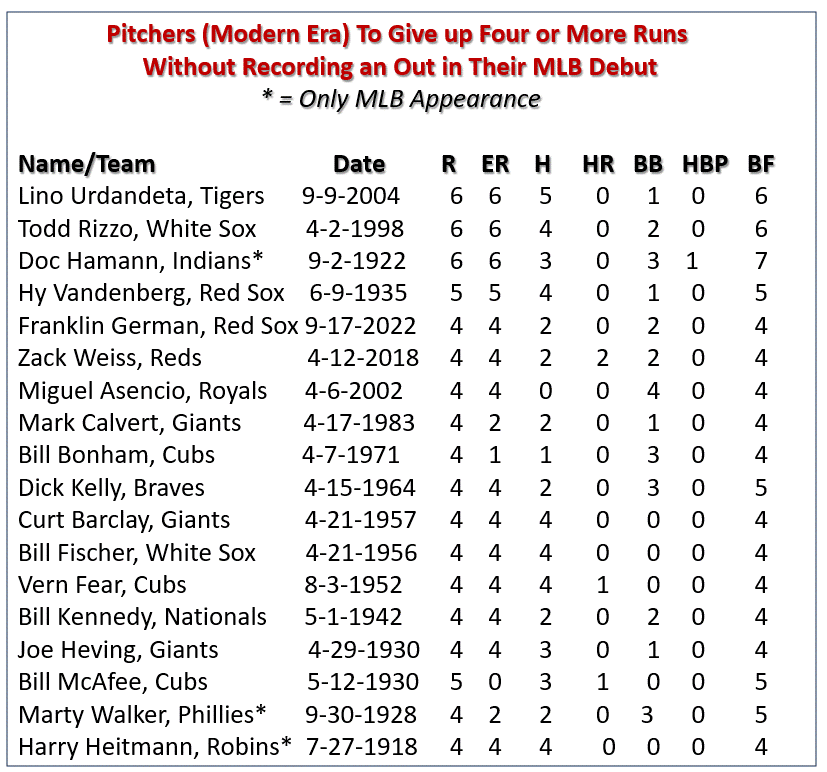 Now, a look at those disappointing MLB pitching debuts that caught my eye. These by the way are subjective calls – and are presented in no particular order.
Miguel Asencio, Royals … April 6, 2002
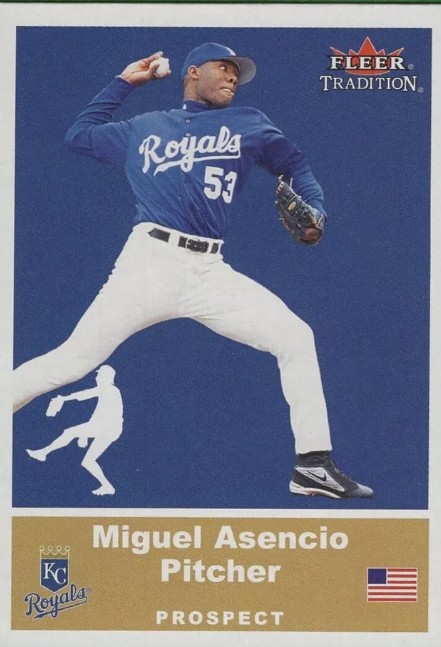 Asencio signed with the Phillies (out of the Dominican Republic) as a teenager in 1998. After a 12-5, 2.84 season for the High-A Clearwater Phillies, he was selected by the Royals in the Rule Five Draft – and made the Royals’ MLB squad out of Spring Training in 2002.
Asensio made his MLB debut on April 2, 2002 and it wasn’t pretty. In fact, he makes this posting because he not only didn’t record an out in his first MLB appearance, he didn’t throw a single strike. He took the mound to open the eighth inning, with his Royals already trailing the White 9-0. His inaugural appearance went like this.
- White sox’ CF Kenny Lofton – four-pitch walk;
- 2B Ray Durham – four-pitch walk;
- 1B Frank Thomas – four-pitch walk;
- RF Magglio Ordonez – four-pitch walk.
At this point, Asencio was relieved by Corey Bailey, who gave up a walk and a single – enabling the three runners he inherited from Asencio to score. (Later, one of his own scored as well).
So, Asencio’s debut included four earned runs, four walks – and 16 pitches without once every finding the strike zone. Asencio spent the entire 2002 season with the Royals, going 4-7, 5.33 (the Royals did go 62-100 that year). Asencio played in three seasons (2002-03, 2006… Royals, Rockies), going 7-8, 5.12 in 42 games (30 starts). His last professional season was 2008.
Zack Weiss, RHO, Reds … April 12, 2018
Weiss was a sixth-round pick (Reds) in the 2013 MLB draft – out of UCLA, where he went 10-7, 3.29 in three seasons. Used primarily in relief, in his first three minor-league seasons (2013-15), he went 5-1, 2.55 with 33 saves. (In 2015, he was 1-3, 1.98 with 30 saves at High-A and Double-A.) He then missed the 2016 season with elbow issues that required surgery. Weiss bounced back in 2017, going 4-5, 2.63 with ten saves at High-A and Double-A (fanning 56 batters in 41 innings). Weiss, recapturing his solid prospect status, opened the 2018 season with the Reds.
He made his major-league debut on April 12th – coming on to open the seventh inning in a game in which his Reds trailed the Cardinals 5-4. It went like this:
- 1B Jose Martinez hit a 2-0 pitch for a solo home run;
- C Yadier Molina hit a 2-0 pitch for a solo home run;
- SS Paul DeJong walked on four pitches;
- 2B Kolton Wong walked on five pitches.
Weiss was then relieved by Tanner Rainey.
Rainey, by the way, did not fare much better. He walked the first three batters he faced, forcing in the two runners he inherited from Weiss.
So, Weiss’ début? A total of 15 pitches to four batters, with two home runs – and 12 of the 13 pitches that reached the catcher’s mitt were outside the strike zone. Two of the three that were “in the zone” ended up as home runs.
This debut rated “high” on this list because, two days later, Weiss was sent back to the minors and he didn’t reappear in an MLB box score until the 2002 season (Angels). To date, he has pitched in three MLB seasons (2018, 2022-23 … Reds, Angels, Red Sox), going 1-1, 4.61 in 25 relief appearances.
Yoan Lopez, RHP, Diamondbacks – September 9, 2018
Lopez makes the cut because – despite the fact that he faced just three batters and threw just eight pitches in his zero-out MLB debut, he gave up a startling 11 total bases. Lopez came on in the ninth inning (against the Braves) , with Atlanta up 6-4 on the Diamondback , one out and the bases empty. His MLB debut went like this:
- PH Lucas Duda – home run on a 1-0 pitch.
- LF Ronald Acuna, Jr. – triple on a 2-1 pitch;
- 3B Johan Camargo – two-run home run on a 0-1 pitch.
James Sherfy then replaced Lopez.
I like Lopez here because of the total bases – and the fact that he “turned things around” quickly. Lopez pitched in eight more games that September, logging nine innings and giving up just four hits, with no runs, one walk and 11 strikeouts. He pitched in five MLB seasons (2018-2022 … Diamondbacks, Mets), going 3-8, 4.39 in 121 games.
Wilson Alvarez, LHP, Rangers … July 24, 1989
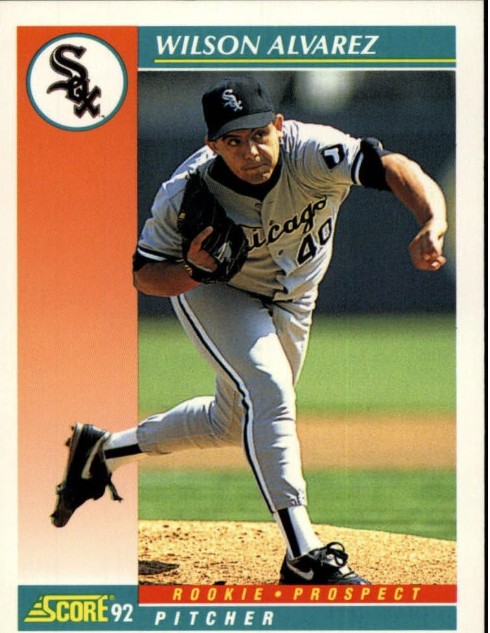 The third player to give up two home runs in a zero-out MLB debut was Wilson Alvarez of the Rangers – in a start against the Blue Jays. Note: Alvarez gave up just three runs in his zero-out debut, but (for reasons I’ll explain) deserves this spot. In the top of the first, Alvarez gave up a:
- single to CF Junior Felix;
- two-run home run to SS Tony Fernandez;
- solo homer to 3B Kelly Gruber;
- walk to LF George Bell;
- walk to 1B Fred McGriff.
Alvarez was then replaced on the mound by Cecilio Guante.
Alvarez was returned to the minors after soon thereafter and did not pitch again in the major leagues until August 11, 1991 (with the White Sox). He makes it here because of a remarkable turnaround. In his first MLB appearance after his zero-out debut start, Alvarez pitched a no-hitter in a White Sox’ 7-0 win over the Orioles.
In a 14-season MLB career (1989, 1991-99, 2002-05 … Rangers, White Sox, Giants, Rays, Dodgers), Alvarez went 102-92, 3.96.
Doc Hamann, RHP, Indians … September 21, 1922
As the 1922 season headed for a close, a fading Cleveland team was basically holding tryouts at the major-league level, looking for some help for the future. One of those players they looked at was Doc Hamann, who had not pitched professionally, but who had earned a reputation pitching for a semi-pro team in New Ulm Minnesota (a 16-6 record in 1921).
Hamann came into the game in the ninth inning of a September 21, 1922 game, with Cleveland trailing the Red Sox 9-5. His day went:
- SS Johnny Mitchell – walk;
- C Ed Chaplin – walk;
- P Jack Quinn – hit-by-pitch, loading the bases;
- LF Mike Menosky – walk, forcing in a run;
- CF Elmer Miller, three-run triple;
- 1B George Burns – RBI single;
- 2B Del Pratt
Hammann was then replaced on the mound by George Winn.
Hamann’s final MLB line (he never pitched professionally again): zero innings pitched; three hits; three walks; six earned runs; seven batters faced. The six runs tie the MLB Modern Era record for most runs allowed in a MLB debut in which the pitcher recorded zero outs – and the seven batters stand alone in that category,
- Doc Hamann starred in both basketball and baseball at Saint Thomas College.
The only other players to allow six runs in a zero-out MLB debut are: Lino Urdaneta, Tigers, September 9, 2004 and Todd Rizzo, White Sox (April 2, 1998).
The Old “With Baseball Roundtable One Things Always Seems to lead to Another
The most batters (MLB Modern Era) a pitcher faced in any game in which that hurler did not retire a single batter is nine. The victim was Hank Borowy of the Tigers and the game was played on August 18, 1951 (versus the Browns in St, Louis). Borowy, an All Star in 1944 and a 21-game winner in 1945, was in his tenth and final MLB season. He came into the game in the bottom of the seventh, with one out, two runners on and the game tied at nine runs apiece. The tie did not last long. Here’s how Borowy’s outing went;
- C Matt Batts – RBI single;
- RF Cliff Mapes – RBI single;
- 1B Hank Arft – three-run home run;
- LF Ken Wood – infield single;
- 3B Fred Marsh – single;
- SS Bill Jennings – walk, loading the bases;
- PH Fred Saucier – walk, forcing in a run;
- CF Jim Deising – walk, forcing in a run.
Borowy was then replaced on the mound by Fred Hutchinson, who got out of the inning – but not before allowing all three inherited runners to score.
So, Borowy’s line was zero innings pitched, nine batters faced, five hits, four walks and nine earned runs. He did not, by the way, get the loss. The first run of the 11-run inning was charged to Hal White who opened the frame. (The Tigers lost 20-9.)
Borowy pitched in the majors from 1942-1951), going 108-82, 3.50. In his final season, he went 2-2, 6.95. He was at his best in the war years. From 1942-1945, he was 67-32, 2.66, with 64 complete games and 12 shutouts.
Larry Yount, RHP, Astros …. September 15, 1971
Larry Yount, brother of Hall of Famer Robin Yount, made his MLB debut on September 15, 1971 – coming on in the top of the ninth to replace Skip Guinn (who had been pinch hit for in the previous half inning). The score was 4-1 and, if all worked out, Yount would face LF Ralph Garr, 1B Hank Aaron and C Earl Williams. All did not work out. Yount had experienced some elbow pain in the bullpen warming up and, as he continued to warm up on the mound, it only got worse. He called the trainer to the mound and, after a bit of discussion, Yount walked off the field – officially registering an MLB appearance, but not tossing a single pitch. Yount pitched two more season in the minors, but never came to the major-league mound again. Note: This was before the pitch-tracking era began, but has between widely enough reported to earn its spot. Yount makes this post by virtue of the shortest appearance in a zero out MLB debut.
(I did find one other pitcher who is not credited with facing a batter in his zero-out MLB debut. It was Dolan Nichols of the 1958 Cubs. On April 15 of that season, Nichols came on in the bottom of the seventh to replace Jim Brosnan. At the time, the Cubs trailed the Cardinals 3-0 and the Redbirds had a runner on first with no outs. The batter was SS Eddie Kasko and (still digging into details), Nichols replaced Brosnan after the at bat had already started. He walked Kasko – actually completing a walk that Brosnan started (and which was charged to Brosnan). Nichols was then replaced by Ed Mayer, completing an MLB debut in which he was credited with an appearance, but zero batters faced. His next outing came four days later and Nichols tossed two scoreless innings. The 1958 season was Nichols’ only MLB campaign and he went 0-4, 5.01 in 24 appearances.)
A Roundtable “One Thing Always Seems to Lead to Another” Bonus
The most runs ever surrendered in an MlB pitching debut is 24 by Allan Travers. It came on May 18, 1912 -as the Tigers faced the Athletics, in Philadelphia. Tigers players were, at the time, refusing to play in protest to the suspension of star Ty Cobb for attacking a fan (on May 15 in New York). To avoid a fine and forfeit, the Tigers recruited a team of amateurs (some with little or no baseball experience) to take on the Athletics. Starting on the mound was 21-year-old Aloysius Travers, a junior at St. Joseph’s College – and the Assistant (student) Manager of the St. Joseph’s’ baseball squad (who would eventually become a priest). Long story short, Travers assisted Philadelphia Bulletin sportswriter Joe Nolan in recruiting a squad to take on the Athletics.) Each of the “subs” was paid $25 for their participation and when no one wanted the daunting task of pitching to the major leaguers, the team offered an extra $25 for to anyone who would take the mound. Travers accepted and pitched pitch a complete-game, 26-hitter in a 24-2 loss. After the loss, and at Cobb’s urging, the Tigers’ players decided to return to the field of play – and Allan Traver’ MLB career was over.
Primary Resources: Baseball-Reference.com; ClevelandBaeballHistory.com; CaseballCube.com; JewishBaseballMuseum.com; “Four Years After His MLB Debut, Reliever Zack Weiss Makes His Second Big League Appearance,” Los Angeles Times, September 2, 2022, by Sarah Valenzuela; Doc Hamann, SABR Bio, by Chris Rainey.
THERE IS STILL TIME TO VOTE IN BASEBALL ROUNDTABLE’S READER/FAN BASEBALL HALL OF FAME BALLOTING
For a post on this year’s candidates, as well as The Roundtable’s predictions and preferences, click here. To skip the post and go directly to the fan ballot, click here.
Baseball Roundtable – Blogging Baseball Since 2012.
 Baseball Roundtable is on the Feedspot list of the Top 100 Baseball Blogs. To see the full list, click here.
I tweet (on X) baseball @DavidBaseballRT
Follow Baseball Roundtable’s Facebook Page here. More baseball commentary; blog post notifications; PRIZES.
Member: Society for American Baseball Research (SABR); Negro Leagues Baseball Museum; The Baseball Reliquary.
P 1080