It’s time again for Baseball Roundtable’s Trivia(l) Tidbit Tuesday. I hope you are enjoying this weekly presentation of baseball occurrences that for some reason caught The Roundtable’s eye. (I’m particularly fond of unexpected performances and statistical coincidences.) These won’t necessarily be momentous occurrences, just events, statistics or coincidences that grabbed my attention. I’m also drawn to baseball “unicorns,” one-of-a-kind MLB accomplishments or statistics.
At times, as I prepare these tidbits, my mind begins to wander towards statistical queries of questionable significance, like: “What are the fewest wins in a season by a pitcher with at least thirty starts?” It turns out you get the same answer, even if you add more qualifiers, like: “What are the fewest wins in a season by a pitcher who made at least 30 starts in the course of the season and was his team’s Opening Day starter?”
The answer to both queries is Herman John (Jack) Nabors of the 1916 Philadelphia Athletics – or, perhaps more appropriately, the woeful 1916 Athletics. Nabors’ record that season was 1-20, 3.47 in forty appearances. His record in his thirty starts was 1-20, 3.35 (11 complete games).
Side Note: When you consider the dubious records noted in this post, keep in mind, the players “achieved” these marks, while being among the small percentage of players who reach the major-league level.
Nabors started the Opener for the Athletics (at Boston, with Babe Ruth on the mound). Nabors was pulled in the top of the fifth (for a pinch hitter) with the game scoreless. At that point, he had gone four innings (two hits, no runs, three walks, no strikeouts). The Red Sox eventually prevailed 2-1, aided by four Philadelphia errors (both Boston runs were unearned, as was the sole Athletics’ tally).
Nabors got touched up for ten hits and three runs over six innings in his next start (an April 18 loss to the Yankees). His next outing was a complete game 6-2 win over the Red Sox (in Philadelphia) in which he gave up two runs on eight hits. It would be the last time in the 1916 season (and actually the only time in his MLB career) that Nabors would see a “W” next to his name.
The 1916 Athletics had a 36-117 record (worst in MLB) and finished 54 1/2 games out of first place. They scored the fewest runs in MLB at 447 (2.90 per game) and gave up the most tallies at 776 (5.04 runs per game). In addition, they led MLB with 314 fielding errors, leading to an MLB-highest 191 unearned runs.
During the 1916 season, the Athletics:
- scored a total of 81 runs in Nabor’s 30 starts;
- scored zero or one run in ten of Nabors 30 starts;
- made 68 errors in Nabors’ starts, leading to 25 unearned runs (26.6 percent of the runs Nabors surrendered in those starts).
As those stats show, Nabors did not have much to work with. He did, in fact, deserve much better than his 1-20 record. His 3.47 earned run average was actually better than the average AL ERA of 3.68 and was second-best among the Athletics’ primary starters. (Twenty-two-year-old rookie righthander Elmer Meyers won 14 games for the Athletics – 23 losses – despite an ERA 0.19 higher than Nabors.)
A little more on Nabors
Nabors’ minor-league achievements included a 1915 12-1 record in the Class D Georgia-Alabama League, including a 13-inning no-hitter (11 strikeouts, no walks) and a 15-inning, three-hit shutout. The Georgia-Alabama League season ended July 14 and the Athletics won a spirited bidding war for his services.
He made his MLB debut August 9 against the White Sox and it might have been an omen. He pitched a complete game, but lost 8-4. Although he did give up 12 hits, seven walks and one hit batter, he wasn’t helped by the Athletics six errors (two by Nabors), which helped the White Sox to three unearned runs. In the Society for American Baseball Research Jack Nabors bio, Stephen V. Rice notes that the White Sox took advantage of Nabors’ inexperience fielding his position, pointing to an August 10, 1915 Philadelphia Inquirer article that noted “six of the first seven hits credited against him being safe bunts that were beaten out, while the other one was a hit that (first baseman Stuffy) McInnis fielded and Nabors forgot all about covering first. “
Still, after putting up a 9.45 ERA in his first two MLB appearances, Nabors appeared to have righted the ship. He made eight more appearances and pitched to a 3.98 ERA (0-3 record) over those mound outings. Nabors finished the 1915 season at 0-5, 5.50 in ten games (seven starts). His late-season improvement earned Nabors the nod to start the 1916 Opener and the rest (in the form of a 1-20 season record) is history.
While Nabors started the 1917 season with the Athletics, he pitched in just two games before being traded to the Indianapolis Indians of the Double-A American Association, who sent him to the Class-A Denver Bears of the Western League, where he pitched to a 9-17 record. In 1918, Nabors enlisted in the Army (WWI), where he was sent to Camp Dodge Iowa, where he pitched for the camp baseball squad. He fell victim to the influenza pandemic of 1918-19 and did not pitch again. He passed away in 1923 (at 35 years of age) of tuberculosis.
Bonus: Tidbit
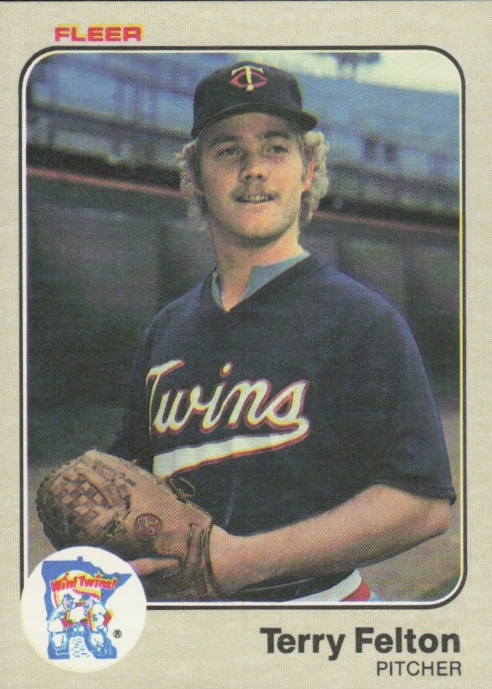
RHP Terry Felton, who spent parts of four seasons with the Minnesota Twins has unicorn status (for Baseball Roundtable) – holding the records for the most consecutive losses to start an MLB career and the most losses for any pitcher without single MLB win on his resume (16) – and sharing the record (with Hulon Stamps of the 1927 Negro National League Memphis Red Sox) for most losses in a season with no wins (13). Felton’s career MLB record is 0-16, 5.53, with three saves, in 55 appearances.
Felton signed with the Twins out of the 1976 MLB Draft (second round). He made his MLB debut (as a 21-year-old) September 28, 1979 (after a 7-10, 3.42 campaign at Triple-A). He got into just one game with the Twins that season – retiring six straight batters over the final two innings of a Twins’ 10-1 loss to the Brewers.
He spent most of 1980-81 in the minors, getting in just six games with the Twins (four starts) and going 0-3, 9.47. In 1982, he stuck with the big club (48 appearances – six starts) and pitched his way into the record books. He went 0-13, 4.99 in 48 games (six starts). Felton did not pitch in the major leagues again, toiling at Triple-A and Double-A in the Twins and Dodgers systems (1983-84), before leaving pro ball.
Primary Resources: Stathead.com; Jack Nabors, SABR Bio, by Stephen V. Rice
Baseball Roundtable – Blogging Baseball Since 2012.
Baseball Roundtable is on the Feedspot list of the Top 100 Baseball Blogs. For the full list click here.
I tweet (on X) baseball @DavidBaseballRT
Follow Baseball Roundtable’s Facebook Page here. More baseball commentary; blog post notifications; PRIZES.
Member: Society for American Baseball Research (SABR); Negro Leagues Baseball Museum; The Baseball Reliquary.

P 1127