It’s time again for Baseball Roundtable’s Trivia(l) Tidbit Tuesday. I hope you are enjoying this weekly presentation of baseball occurrences that for some reason caught The Roundtable’s eye. (I’m particularly fond of unexpected performances and statistical coincidences.) These won’t necessarily be momentous occurrences, just events, statistics or coincidences that grabbed my attention. I’m also drawn to baseball “unicorns,” one-of-a-kind MLB accomplishments or statistics. This week, we’re looking at MLB’s original (perhaps) “Wild Thing” – Tommy Byrne. Need to add the usual disclaimer: Negro League game-by-game records are not yet fully incorporated into the MLB record books.
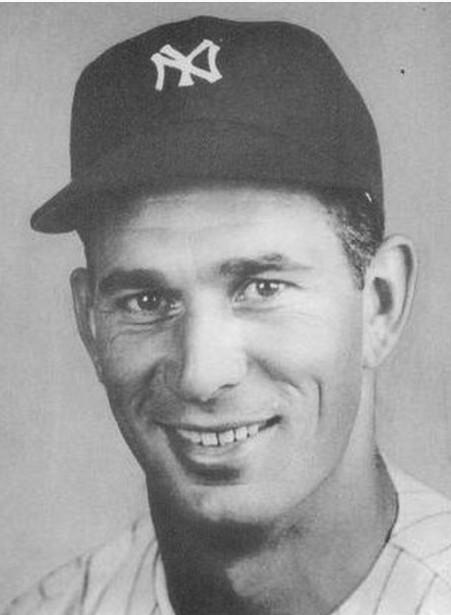
Photo: Jay Publishing via tradingcarddb.com, Public domain, via Wikimedia Commons
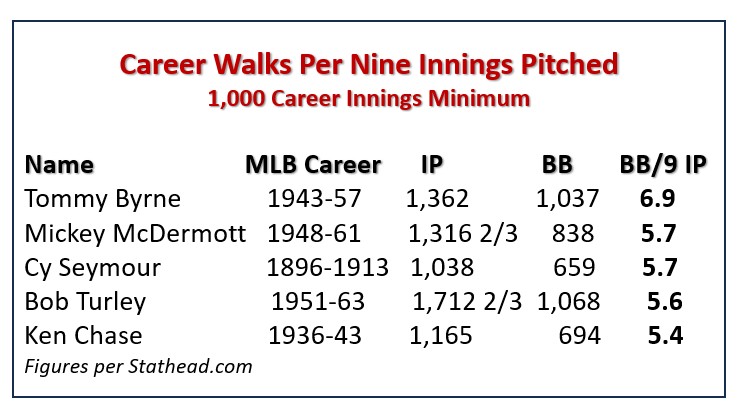
When it comes to issuing free passes, Byrnes is a bit of an MLB unicorn. Among pitchers with at least 1,000 MLB innings pitched, his 6.9 career walks per nine innings makes him the only qualifying (1,000+ career innings) pitcher with a ratio of 6+. Further, when you look at MLB pitchers with at least 100 mound innings in a season, Byrne again tops the free pass list. In 1952 (Yankees/Browns), Byrnes walked 150 batters in 143 2/3 innings – or 9.4 per nine frames – making him the only major leaguer to walk nine or more batter per nine innings in a season in which he pitched at least 100 innings. Second on this list would be the Rangers’ Bobby Witt, who (in 1987) walked a league-leading 140 batters in 143 innings (8.8 BB/9).
Further, when you look at “qualifying” pitchers (those who qualified for certain statistical leadership – like earned run average – having pitched at least one inning for each game his team played), Bryne again tops the single-season list at 8.2 walks per nine innings in 1949 (179 walks in 196 innings).
Bryne may have been at his “peak” from 1949 through 1951, when he led the American League in walks and hit batsmen each season. Surprisingly, during those wild seasons, he won more than he lost – going 36-27, 4.24. Side note: Byrne led the AL in hit batsman in five straight seasons (1948-52).
Wildly Effective or Effectively Wild? Take Your PIck.
In 1949, Tommy Bryne (pitching for the Yankees) went 15-7, 3.72. That season, he was wild enough to lead major-league baseball in total walks (179) and hit batsmen (13). as well as to lead MLB qualifying pitchers in most walks per nine innings (8.2). On the flip side, Byrne was effective enough to lead qualifying MLB pitchers in fewest hits allowed per nine innings (5.7) and strikeouts per nine innings (5.9). The end result? A 15-7, 3.72 season with 12 complete games and three shutouts in 30 starts (32 appearances).
On June 8 of that season, Bryne walked a season-high 13 batters (and hit one) in an 11-inning, 3-2 Yankee loss to the Tigers (in Detroit). Bryne gave up just four hits (all singles) and fanned six in his 10 2/3 innings. Fittingly, the Tigers’ winning run scored on three walks and a single. Oh, and the 13 walks tied for the most given up in a game by a pitcher that season.
Byrne shares the record for most walks in a single MLB game at 16. Bryne walked 16 (and gave up 11 hits) in a 3-1, 13-inning Browns’ loss to the Red Sox on August 22, 1951. There has been only one other 16-walk outing in the Modern Era (post-1900): The Athletics’ Bruno Haas, in a 15-7 loss to the Yankees on June 23, 1915, in his major-league and professional debut. In that one, Haas gave up 15 runs (eight earned) on 13 hits and 16 walks (the Athletics chipped in seven errors and Haas added three wild pitches), while tossing a nine-inning complete game. Haas played just the one MLB season (six appearances, two starts … 0-1, 11.93 stat line). He went on to play in 21 minor-league seasons (including 11 with the Saint Paul Saints), primarily as an outfielder. In his 11 seasons with the Saints, Haas hit .300+ in nine. In 1921-22, Haas also played tailback for the Akron Pros, Cleveland Indians and Daytona Triangles of the American Professional Football Association/National Football League.
Two More, By George
There have been two additional (pre-1900) sixteen-walk games by MLB pitchers: the White Stockings’ George Van Haltren in a 17-11 loss to the Beaneaters on June 27, 1887; and the Giants’ Bill George 1n May 30, 1887 12-11 loss to the White Stockings.
Byrne pitched in 13 MLB seasons (1943, 1946-57 … Yankees, Browns, White Sox, Nationals), going 85-69, 4.11, with 65 complete games and 12 shutouts in 170 starts (281 total appearances). He was also 1-1, 2.53 in six World Series appearances (three starts). The one-time All Star’s best season was 1955, when he went 16-5, 3.36 for the Yankees.
Bryne seemed to find the plate (at least with more consistency) later in his career. From 1943-53, he played in nine MLB seasons and walked 7.4 batters (while fanning 5.2) per nine innings. In his final four seasons (1954-57), he lowered his walk rate to 5.4 per nine innings (fanning 4.8).
More “With the Roundtable One Thing Always Seems to Lead to Another.”
The most walks Tommy Bryne ever issued in a shutout was eight (in a 7-0 two-hit win over the Tigers (in Detroit) on June 27, 1948. That led to a look at the most walks ever issued in a shutout. The most walks ever issued in an MLB shutout is 11, by Hall of Famer Lefty Grove, who gave up 11 walks and five hits in a 7-0 Yankee win over the Browns on August 1, 1941. Gomez nearly lost the shutout in the ninth, when – after retiring the first two batters – he issued three straight walks (with a wild pitch tossed in for good measure) before recording the final out.
_____________________________________
Never Expected To Find This One
The Modern Era record for hit batsmen by a pitcher in a game is four shared by 49 hurlers (only Doc Newton had two four-HBP games, both while with the Reds in 1901). While researching these posts, I often come upon the unexpected. In this case, it was learning Orel Hershiser recorded four hit batsmen, while recording the fewest outs of any of the pitcher who made the list. On April 19, 2000, in a start against the Astros, Hershiser faced just 14 batters (and retired just four), giving up seven runs on four hit batsmen, two walks and four hits (there was a wild pitch in there as well.) The wild outing came in Hershiser’s final (and age-41) MLB season, when he went 1-5, 13.14 in 10 appearances (six starts). Over his 18-season MLB career (1983-2000 … Dodgers, Indians, Giants, Mets), Hershiser went 204-150, 3.48. He won the NL Cy Young Award in 1988 (23-8, 2.26 for the Dodgers), was a three-time All Star and won 15 or more games in six seasons. For those who like to know such things, Baseball-Almanac.com reports a recrod six-hit batsman game by Ed Knouff of the American Association Baltimore Orioles on April 25, 1887.
_________________________________
Postscript:
Of course, you can’t do a post on hard- (and wild) throwing pitchers without at least mentioning Steve Dalkowski – perhaps the hardest and wildest thrower of his time (or all-time) – and said to be the inspiration for Nuke LaLoosh of Bull Durham fame.
Dalkowski, a slight, hard-throwing left-hander, with thick-lensed glasses, was the true definition of a fireballer. He fastball (and his lack of control) inspired fear in batters and almost mythical stories. Unfortunately, he never harnessed his unprecedented velocity and never made it into a major-league game. Still, many veteran ballplayers, including Hall of Famer Ted Williams, said Dalkowski was the fastest pitcher they ever saw (or in Williams’ case, didn’t see – the eagle-eyed Williams is reported to haver said he didn’t see Dalkowski’s fastball pass him by).
 Baseball-Reference.com documents that in nine minor-league seasons, he fanned 1,324 batters (in 956 innings), but also walked 1,236 and threw 145 wild pitches. As an 18-year-old in Class-D Ball, Dalkowski went 1-8, 8.13 in 15 games (10 starts) and struck out 121 batters in just 62 innings, but also walked 129 and threw 39 wild pitches. That divided out into 3.2 hits, 18.7 walks and 17.6 strikeouts per nine innings. The following season (at three levels C, B and A), he fanned 203 batters in 104 innings, but also walked 207 and threw 26 wild pitches. In 1960, at C-level Stockton, he fanned 262 batters in 170 innings and also walked 262. Getting the picture?
The stories surrounding Dalkowski’s fire-balling career are many – some are fact, others myth, but all are legend. For example, he reportedly:
- Once hit a batter with a pitch that tore off part of the hitter’s ear;
- Threw a baseball through a wooden fence to win a bet;
- Hit an umpire with a wild pitch that broke the umpire’s protective mask in three places and sent him to the hospital for three days;
- Once threw a Northern League one-hitter, but lost 9-8 (15 strikeouts, but 17 walks);
- Once threw a ball from home plate over the centerfield fence at Elmira – some 400+ feet on the fly;
- Occasionally would throw pitches through the protective netting behind home plate, scattering fans;
- In one extra-inning contest, threw 283 pitches (fanning 27 and walking 16).
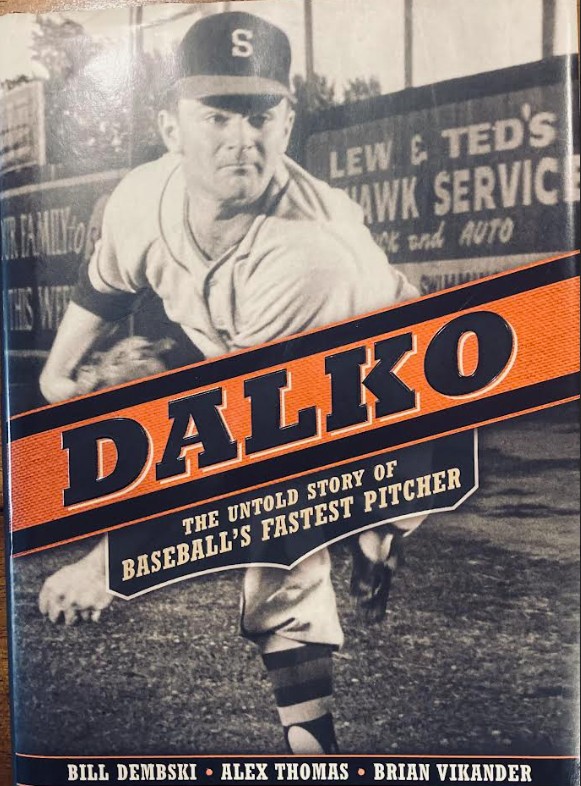
The fact is, while Dalkowski never pitched in the major leagues, his exploits were legendary enough to spur a book “Dalko: The Untold Story of Baseball’s Fastest Pitcher” by Bill Dembski, Alex Thomas and Brian Vikander, as well as a PBS television documentary “Far from Home: The Steve Dalkowski Story” (available on PBS.com and YouTube … see link below).
Primary Resources: Stathead.com; Baseball-Almanac.com; Dalko: The Untold Story of Baseball’s Fastest Pitcher, by Bill Dembski, Alex Thomas and Brian Vikander, Influence Publishers, 2020; A Look Back at Steve Dalkowski, One of Baseball’s Mythical Fireballers, by Matt Monagan, Cut4, MLB.com.
Baseball Roundtable – Blogging Baseball Since 2012.
Baseball Roundtable is on the Feedspot list of the Top 100 Baseball Blogs. For the full list click here.
I tweet (on X) baseball @DavidBaseballRT. Follow me there for post notifications and links.
Follow Baseball Roundtable’s Facebook Page here.
Member: Society for American Baseball Research (SABR); Negro Leagues Baseball Museum; The Baseball Reliquary.

P 1142