It’s time again for Baseball Roundtable’s Trivia(l) Tidbit Tuesday. I hope you are enjoying this weekly presentation of baseball occurrences that for some reason caught The Roundtable’s eye. (I’m particularly fond of unexpected performances and statistical coincidences.) These won’t necessarily be momentous occurrences, just events, statistics or coincidences that grabbed my attention. I’m also drawn to baseball “unicorns,” one-of-a-kind MLB accomplishments or statistics. As June winds down, it seems appropriate to focus on a record that was set many moons (and many Junes) ago. The bit of trivia we are looking g at is ”What MLB pitcher holds the record for the most victories in a calendar month?”
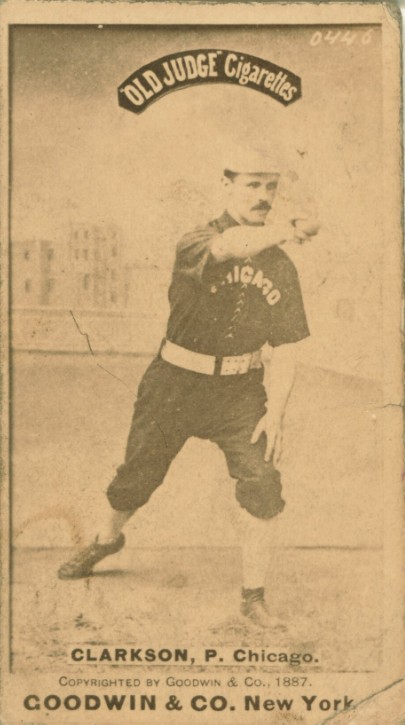
Photo: Goodwin & Co., sponsor, Public domain, via Wikimedia Commons
J0hn Clarkson
That distinction, by a wide margin goes to Hall of Fame righty John Clarkson and his remarkable 15-win June for the the 1885 Chicago White Stockings. It was, of course, a different game back then (for example a 50-foot pitching distance, six balls for a walk and pitchers throwing from a flat surface). Still, consider this: 1) The White Stockings played 23 games that month – and Clarkson started 16 of them; 2) Chicago won 22 games that June and Clarkson won 15 of them (setting the previously noted record for wins in a month by a pitcher). Clarkson’s lone mark in the defeat column that month was a June 25 2-0 loss to the Phillies. Note: Clarkson was called into heavy duty on the mound due to an injury to Larry Corcoran.
Clarkson finished the 1885 season with a 53-16, 1.85 record in 70 games (all starts – 15 more than his nearest competitor). He recorded 68 complete games (a 13-game advantage over second place) and ten shutouts (a three-game lead). He also led the league in innings pitched (623 – 131-inning advantage), and strikeouts (308 – a 50-whiff lead).
Over a 12-season MLB career (1882, 1884-94 … Worcester Ruby Red Legs, Chicago White Stockings, Boston Beaneaters, Cleveland Spiders), Clarkson went 328-178, 2.82. He led the league innings pitched four times; in wins, starts, complete games and strikeouts three times each; shutouts twice; and ERA once. With the Beaneaters in 1889, he won the pitching Triple Crown, leading the league in wins, ERA and strikeouts.
Now, I did note that baseball was a bit of a different game back then, so I also looked into the pitchers who share the record for the most wins in a month in the modern Era (post 1900) at ten. That would be the 1910 Philadelphia Athletics’ Jack Coombs and, depending on your preferred sources, possibly Rube Waddell of the 1902 Athletics. For more on those two, read on.
Jack Coombs … Philadelphia Athletics, July 1910
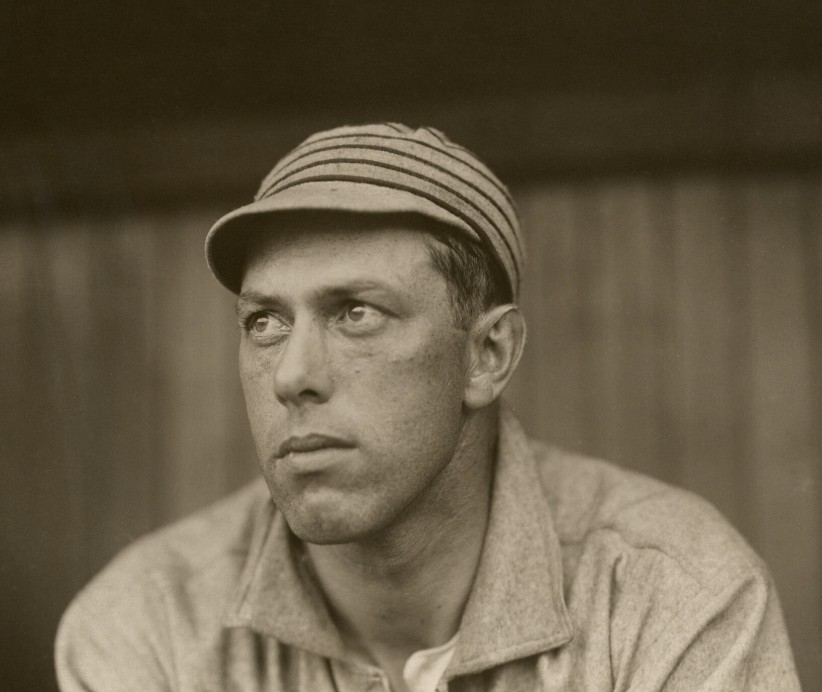
Photo: Paul Thompson, Public domain, via Wikimedia Commons
Athletics’ righthander Jack Coombs pitched in 11 games (10 starts) in July of 1910. He went 10-1, 1.10. Coombs completed all ten of his starts and threw five shutouts. In games he started, he was 10-1, with a 0.91 earned run average. (The American League overall earned run average was 2.52.) Coombs’ only loss during the month came against the Nationals in Washington on July 7, when he pitched a complete game in a 4-1 loss. Coombs gave up four runs (two earned) on nine hits and five walks in that game. For the season, Coombs was 31-9, 1.30 in 45 games (38 starts). He threw 35 complete games (second in the league) in 38 starts and led the AL with 13 shutouts. He was also first in WHIP (0.820), second in the league in earned run average and hits per nine innings (5.892) and third in innings pitched (353) and strikeouts (224). Despite a heavy workload, as the season wore down, from September 5 through September 25, he threw a then-record 53 consecutive scoreless innings, still the fourth-longest single-season scoreless inning streak in the Modern Era.
Winning The Big One
After leading the 1910 Athletics to the American League pennant, Jack Coombs pitched three complete games (all wins) in six days, as the Athletics topped the Cubs in the World Series in five contests. During the Series, Coombs went 3-0-3.33 on the mound and .385 (5-for-18) with three RBI at the plate.
Coombs pitched in 14 MLB seasons (1906-1918, 1920 … Athletics, Robins, Tigers), going 158-110, 2.78 in 354 games (268 starts), with 187 complete games and 35 shutouts. From 1910 through 1912, he went 80-31, 2.64, twice leading the league in victories. Side note Coombs lost considerable time in 1913 and 1914 (Typhoid Fever) getting in just four games over the two seasons.
George “Rube” Waddell, Philadelphia Athletics, July 1902 … MAYBE
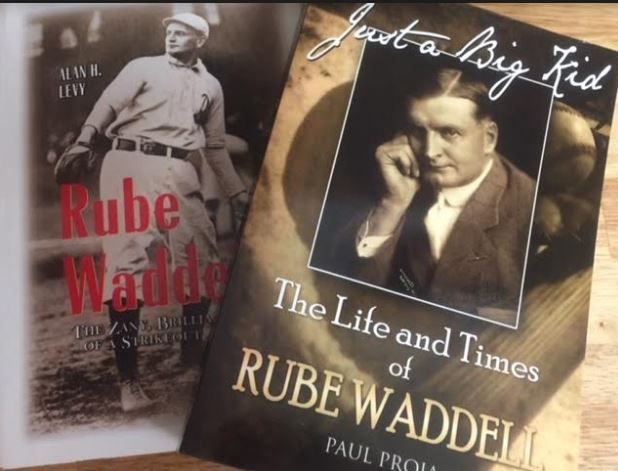 Now this is a pretty unique player and an equally unique situation, Waddell did not join the Athletics until late June of 1902. He had been pitching for Los Angeles Looloos of the independent California League (a look at Waddell’s life story and reputation as, perhaps, the zaniest player in MLB history makes the Looloos an appropriate landing spot).
Long story short, Waddell was lured from California to Philadelphia, making his debut with the Athletics on June 26. In the month of July, Waddell appeared in 12 games and went 10-1 (or 9-1) with three (or two) of his victories coming in relief.
Now, here is the unique “situation” I addressed earlier. On July 8, Waddell came on in relief in the fifth inning with the A’s up 9-6 (starter Bert Husting had been touched for six runs in four innings). Waddell retired the side in order in the fifth. The A’ then scored 12 in the top of the sixth and manager Connie Mack pulled Waddell and brought in Lewis Wiltse. Now, at the time, the rules for awarding a win were more like flexible guidelines for the scorekeeper. (The five-inning minimum for a starter to earn a win, for example was not on the books.) Various sources disagree on whether Waddell got the win. In his article “Rube Waddell in 1902,” published in the 1979 Baseball Research Journal (SABR), researcher/writer Peter Palmer credits Waddell with the win (he also notes that “The McMillan Research team gave him (Waddell) the win in this game, but other sources, including Sporting Life, did not.” Digging further, I found that Baseball-Almanac.com credits Waddell with the win and Baseball-Reference.com and Retrosheet.org do not. Those latter two sources credit the win to Bert Husting, who left the game with a 9-6 lead after four innings on the mound. I’ll let the reader be the judge. The fact is, Waddell’s July 1902 run deserves recognition one way or the other.
Making UP For Lost Time!
In 1902, despite not joining the Athletics until late June, Rube Waddell went 24-7, 2.05 – finishing second in the AL in wins and ERA, while also leading the league in strikeouts with 210 (50 ahead of second-place finisher Cy Young). Not bad for joining the team and league with 40 percent of the season over.
Waddell pitched in 13 MLB seasons (1897, 1899-1910 … Louisville Colonels, Pittsburgh Pirates, Chicago Orphans, Philadelphia Athletics, St. Louis Browns), going 193-143, 2.16 in 407 games (340 starts), with 261 complete games and 50 shutouts.
Power Pitching
In 1904, Rube Waddell fanned 349 batters for the Athletics (110 more than the runner-up in Ks). It set a modern record for strikeouts in a season that lasted until 1965 (Sandy Koufax – 383). IN 1904, Waddell averaged 8.2 strikeouts per nine innings. The next highest was 6.6 (Chief Bender) and the MLB average was 3.8.
For a lot more on the Waddell, a truly eccentric lefty, click here.
Primary Resources: Baseball-Reference.com; Baseball Almanac.com; “Rube Waddell in 1902,” by Peter Palmer, published in the 1979 Baseball Research Journal; “The Great Pennant Race of 1885,” by John J. O’Malley, published in the 1977 Baseball Research Journal.
Baseball Roundtable – Blogging Baseball Since 2012.
Baseball Roundtable is on the Feedspot list of the Top 100 Baseball Blogs. For the full list click here.
I tweet (on X) baseball @DavidBaseballRT. Follow me there for post notifications and links.
Follow Baseball Roundtable’s Facebook Page here.
Member: Society for American Baseball Research (SABR); Negro Leagues Baseball Museum; The Baseball Reliquary.

P 1175