Once again, it’s time for Baseball Roundtable’s Trivia(l) Tidbit Tuesday. I hope you are enjoying this weekly presentation of baseball occurrences that for some reason caught The Roundtable’s eye. (I’m particularly fond of unexpected performances and statistical coincidences.) These won’t necessarily be momentous occurrences, just events, statistics or coincidences that grabbed my attention. I’m also drawn to baseball “unicorns,” one-of-a-kind MLB accomplishments or statistics.
It just so happens that on this date (September 16) in 1940, St. Louis Browns’ 2B Johnny Lucadello, playing in his 24th MLB game, hit his first two MLB home runs and, in the process, became just the fourth MLB player to homer from both sides of the plate in a game. Notably, the two long balls would be his only home runs of the season (he played in just 17 games) and would be two of just five home runs he would hit over his six MLB seasons (239 games). Well, that got me to thinking about players to homer from both sides of the plate in a game, which is not exactly a rare feat. After all, as Baseball-Almanac.com reports, there have been 385 instances in which a player has homered from both sides of the plate in a game. (This season alone, the feat has been accomplished by the Mariners’ Cal Raleigh; Yankees’ Jasson Dominguez; Angels’ Luis Rengifo; Twins’ Brooks Lee; Diamondbacks’ Ketel Marte; Mets’ Francisco Lindor; Braves’ Ozzie Albies; and Nationals’ Josh Bell. Disclaimer: Negro League game-by-game records for the 1920-48 seasons have not been fully incorporated into MLB records.
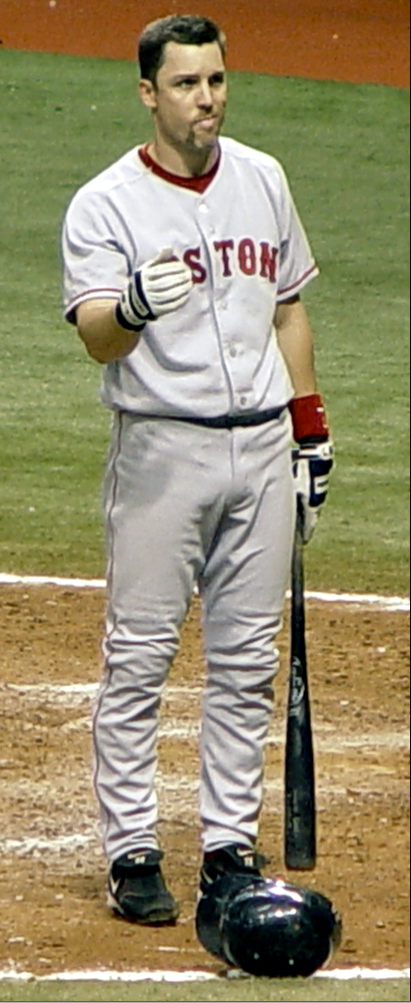
Photo: Googie man, CC BY-SA 3.0 <http://creativecommons.org/licenses/by-sa/3.0/>, via Wikimedia Commons
So, how do you achieve unicorn status within this group? The Red Sox’ Bill Mueller is the only MLB player to hit a Grand Slam home run from both sides of the plate in a game. It happened on July 29, 2003, as the Red Sox topped the Rangers 14-7 in Texas. It was quite a day for Mueller, who was also on his way to his best MLB season. Mueller came into the game with a .326-10-45 line on the season – having reached double-digits in home runs for just the second time in his eight MLB campaigns.
Mueller, batting eighth, got his first at bat leading off the top of the third inning, with the Red Sox down 2-0. Batting left-handed, he laced the first pitch he saw from righty R.A. Dickey for a solo home run to right. It was a sign of things to come.
Mueller grounded out to second (off Dickey) in the fourth inning and lined out to third in the sixth (off Erasmo Ramirez).
Then in the seventh inning, Mueller came to the plate (batting right-handed) with the bases loaded and Boston now up 5-4 (they had already scored three times in the inning). He took a 2-2 pitch from southpaw Aaron Fultz to deep left for a Grand Slam. Then fate stepped in, the Red Sox kept hitting and Mueller came to the plate the very next inning with Boston now up 10-4, two out and the bases again loaded. This time against righthander Jay Powell – switching Mueller to the left-hander’s batter’s box. On the second pitch from Powell, BOOM, Mueller’s second Grand Slam of the game.
The 2003 season, Mueller’s first with the Red Sox (he signed as a free agent in January 2003), was Mueller’s best in MLB. His .326 average earned him the AL batting title and he set personal career highs for average, home runs (19); RBI (85); doubles (45); triples (5); and hits (171). Over 11 MLB seasons (1996-2006 … Giants, Cubs, Red Sox, Dodgers), Mueller hit .291-85-493 in 1,216 games.
Mueller, by the way, is a bit of a surprise in terms of a power-focused unicorn status. A fifteenth-round draft pick (Giants, 1993) out of the Missouri State University, Mueller was known more for his plate discipline and ability to make solid contact than for pure power. (When he graduated, he held the school’s single-season record for hits, runs, singles and the career marks for runs, hits, walks, total bases and stolen bases. Over his four years at Missouri State, he averaged .376. All of this earned him spots in the Missouri State Athletics and Missouri Valley Conference Halls of Fame.
In four minor-league seasons before an injury to Giants’ power-hitting third baseman Matt Williams earned Mueller an opportunity for extended MLB playing time over the last half of 1996, Mueller hit.308 over 413 games (but with just 13 home runs). In 55 games for the Giants that season, Mueller hit .330-0-19. (In the off-season, Williams was traded (to the Indians), with Trent Hubbard, for Jose Vizcaino, Julian Tavarez, Joe Roa and Jeff Kent.
ANOTHER SWITCH-HITTING UNICORN
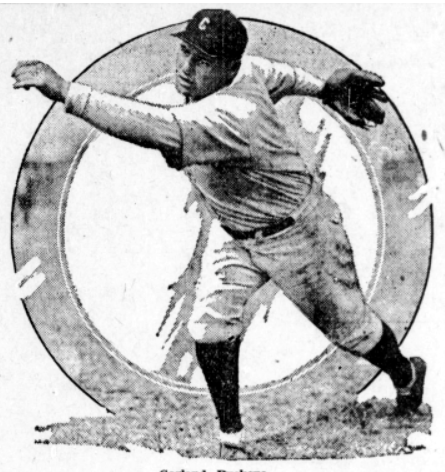
Image: Public domain, via Wikimedia Commons https://commons.wikimedia.org/wiki/File:Garland_Buckeye_newspaper.png
On September 10, 1925 – in Game Two of an Indians/Tigers doubleheader in Detroit – southpaw Garland Buckeye started for the Indians and pitched a nifty four-hit, two-run (one earned) complete game in a 7-2 win, picking up his twelfth victory of the season (seven losses). More important for this Tidbit, he went two-for-four at the plate, with five RBI. A switch hitter, Buckey homered from the right side off lefty Ed Wells in the seventh inning and from the left-handed batter’s box off righty Jess Doyle in the ninth. He remains the only pitcher to homer from both sides of the plate in a game – making him a true unicorn.
Buckey went 30-39, 3.91 as a pitcher over five MLB seasons (1918, 1925-28 … Nationals, Indians, Giants). As a hitter, he went .230-5-23.
A few other tidbits about batters with home runs from both sides of the plate in one game:
- No players accomplished the feat more often than Mark Teixeira and Nick Swisher (14 times each);
- Nick Swisher also shares the record for homering from both sides of the plate in a game for the most franchises at five (Athletics, Yankees, White Sox, Indians, Braves) – Carlos Beltran also accomplished the feat with five different teams (Mets, Cardinals, Royals, Astros, Yankees);
- The most games with homers from both sides of the plate in a season is four, achieved by Ken Caminiti (1996) and Anthony Santander (2022);
- Three players have homered from both sides of the plate in the same inning: Carlos Baerga (April 8, 1993); Mark Bellhorn (April 29, 2002); Kendrys Morales (July 30, 2012);
- The season with the most player-games with home runs from both sides of the plate was 1996, with 15: four by Ken Caminiti; two each by Melvin Nieves, Roberto Alomar and Todd Hundley; one each by Raul Casanova, J.T. Snow; Ruben Sierra; Chris Davis; and Bernie Williams;
- Three players have homered from both sides of the plate in a post-season game: Bernie Williams (1995 AL Division Series & 1996 AL Division Series); Chipper Jones (2003 NL Divisions Series); and Milton Bradley (2006 AL Championship Series).
Primary Resources: Baseball-Almanac.com; Stathead.com; Bill Mueller, Society for American Baseball Research Bio, by Kevin Bley
Baseball Roundtable – Blogging Baseball Since 2012.
Baseball Roundtable is on the Feedspot list of the Top 100 Baseball Blogs. For the full list click here.
I tweet (on X) baseball @DavidBaseballRT
Follow Baseball Roundtable’s Facebook Page here.
Member: Society for American Baseball Research (SABR); Negro Leagues Baseball Museum; The Baseball Reliquary.

P 1134