It’s time again for Baseball Roundtable’s Trivia(l) Tidbit Tuesday. I hope you are enjoying this weekly presentation of baseball occurrences that for some reason caught The Roundtable’s eye. (I’m particularly fond of unexpected performances and statistical coincidences.) These won’t necessarily be momentous occurrences, just events, statistics or coincidences that grabbed my attention. I’m also drawn to baseball “unicorns,” one-of-a-kind MLB accomplishments or statistics. And sometimes, like this week, it’s an event in the category of “We’ll probably never see that again.”
This week’s Tidbit focuses on a September, 12, 1969 Mets/Pirate doubleheader. Right away, the odds against a repeat are high, since this was a single-admission Twilight-Night Twin Bill. (How many of those can we expect in the future?) But it gets rarer. The Mets won both games by 1-0 score. Side note: You would think that is the fewest runs ever scored in a doubleheader, but there was, in fact, one Twin Bill that saw only one run scored (more on that later). Finally, to top off the uniqueness of this doubleheader: In each game the only (and, of course, winning) run was driven in by the starting (and winning) pitcher. With the paucity of single-admission doubleheaders and the universal DH now in force, I think we can safely say, we’re looking at a unicorn.
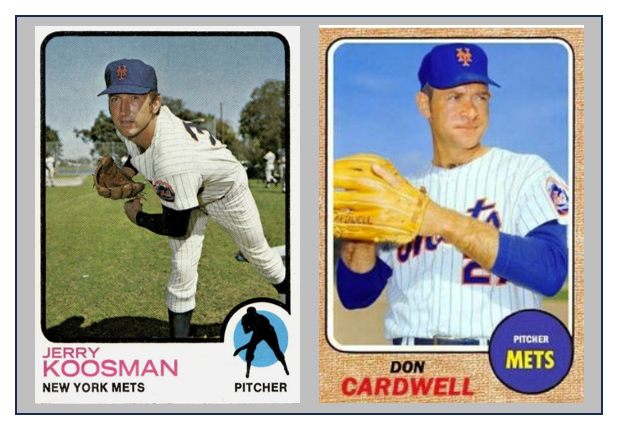
In Game One (scheduled to makeup a July 5 rainout), southpaw Jerry Koosman started on the mound for the Mets (Koosman, a 1969 All Star, was 13-9, 2.48 at the time). Opposing him was the Pirates’ righty Bob Moose (10-2, 3.30). The expected pitcher’s duel materialized, as the two matched zeroes over the first four innings. Then, in the top of the fifth, Mets’ 3B Bobby Pfeil singled to LF after RF Ron Swoboda opened the frame with a strikeout. C Duffy Dyer then singled to CF, sending Pfeil to third (Dwyer went to second as the throw in went to third). Koosman (3-for-69 on the season) was up next and singled to RF – driving in what proved to be the game’s only tally (and Koosman’s only RBI of the season). Koosman, ultimately, went the distance, tossing a three-hit shutout (three walks, four strikeouts). Moose gave up one run over eight innings (five hits, three walks, ten whiffs). Chuck Hartenstein pitched a scoreless ninth for the Pirates.
The Game Two pitching matchup was less “anticipated.” It featured starters Don Cardwell (6-9, 3.10) for the Mets and Dock Ellis (9-15, 3.92) for the Pirates. However, another pitchers’ duel did materialize. The only tally came early, in the top of the second, as the Mets again edged the Pirates by a 1-0 score. The run scored when Mets SS Bud Harrelson doubled of Ellis with two outs and no one on – and was then driven home on a Don Cardwell single. (Cardwell was hitting .171 – 7-for-41 at the time). It was Cardwell’s fifth RBI of the campaign.
Ultimately, Cardwell went eight innings and gave up four nits (one walk and three strikeouts). Closer Tug McGraw pitched a scoreless ninth for the victorious Mets. Ellis also went eight frames, giving up one run on six hits, with three walks and eleven strikeouts. Hartenstein again pitched a scoreless ninth for the Pirates.
To illustrate how times have changed. That September 12 Twin Bill was the 19th of 21 doubleheaders the Mets would play that season and the 15th of 19 doubleheaders played by the Pirates. Further, in 1969, 17.3 percent of all NL games and 18.9 percent of all AL games played were part of doubleheaders. In 2025, there were a total of 30 doubleheaders (about 1.2 percent of all games), no team had more than six (Cardinals and Orioles) and nine teams played no Twin Bills (Rays, Mariners, Astros, Rangers, A’s, Angels, Dodgers, Giants, Diamondbacks). For an intriguing look at the origin, rise and decline of doubleheaders in MLB, I suggest The Hardball Times three-part Series “History of the Doubleheader” by Chris Jaffe.
Now for a few more Twin Bill Tidbits.
A Bit of a Scoring Drought
The fewest runs scored in a doubleheader? It may surprise you (because it’s not two.) The answer is one. On September 4, 1902, the Pittsburgh Pirates and Boston Beaneaters matched up in a doubleheader in Boston. Game One went to Boston 1-0 (in one hour and twenty minutes). Game Two ended in a nine-inning 0-0 tie (one hour and 30 minutes)
A Bit of a Scoring Deluge
The record for runs scored in a doubleheader – both teams – is 54. It has been done twice. On August 21, 1894, the National League Boston Beaneaters swept a doubleheader from the Cincinnati Reds by score of 18-3 and 25-8. Then, on Independence Day in 1939, there were lots of fireworks on the field in Philadelphia, as the Red Sox topped the Athletics 17-7 and 18-12.
The most hits in a doubleheader is 73, in a July 6, 1929 Cardinals/Phillies Twin Bill (in Philadelphus), In Game one the Phillies toped the Cardinals 10-6, with the Cardinals outhitting the Phillies 15-13. The Phillies got revenge in game two, blasting the Phillies 28-6 and outhitting them 28-17. Sign of the times: Each of these high-scoring games took slightly less than 2 ½ hours to complete.
18 Games in 12 Days
The 1928 Boston Braves played a record nine consecutive doubleheaders over a 12-day span (September 4-15). During the streak, they swept one doubleheader, were swept six times and split two – for a four win-fourteen loss record. Notably, six players played every inning of those games (RF Lance Richbourg; LF Eddie Brown; 1B George Sisler; 2B Rogers Hornsby; 3B Les Bell; SS Doc Farrell). The team used eight different starting pitchers during the 18-game stretch – none more often than Bob Smith, who started four contests (including both ends of one doubleheader).
Nearly 60 percent doubleheaders … Now, that’s a Tough Schedule
The 1945 Boston Braves played an MLB-record 46 doubleheaders. Let’s put that in perspective – 59.7 percent of the games they played that season were part of doubleheaders. How did they do? They won 42 of those games, lost 48 and tied two. Basically, they played .466 ball in twin bills, a bit better than their .403 winning percentage on days when they played just one game. By the way, just so you don’t think those 46 doubleheaders were a one-off event, the 1943 White Sox hold the AL record for doubleheaders in a season at 44. Both extreme totals can be attributed to wartime scheduling.
Let’s Play …. Three?
While, there have been three occasions in which major-league teams have played three games in a single day, research by Society for American Baseball Research (SABR) member Bill Nowlin indicates there has been only one “true” (read single-admission) triple header. That came on October 2, 1920, with the 80-69 Reds facing the 77-73 Pirates at Pittsburgh’s Forbes Field. With four contests left in the season, the previous two Pirates-Reds games cancelled due to weather and third place and a World Series’ share at stake, the teams faced off in a one-day, three-game series starting at noon. Long story short, the Reds won the first two games (13-4 and 7-3), while the Pirates took the final game 6-0 (called – darkness – after six innings). Only five players played in all three games (making them all, of course, single-day MLB record holders). They were the Reds’ Morrie Rath (2B-RF) and Pat Duncan (LF) and the Pirates’ Cotton Tierney (2B-SS), Clyde Barnhart (3B) and Fred Nicholson (PH-RF-LF).
Two other instances of three-games-in-a-day matchups have occurred – on September 1, 1890 (Brooklyn Bridegrooms versus Pittsburgh Innocents) and September 7, 1896 (Baltimore Orioles versus Louisville Colonels). In both of those, the first contest was a separate-admission morning game, with a second admission required for the afternoon doubleheader.
A Good Day’s Work (Back to our “Pitchers’ Rule Focus)
On September 26, 1908, Cubs’ righty Ed Reulbach started both games of a doubleheader against Brooklyn (Superbas). He went the distance in both contests, giving up just nine hits – and no runs – over the 18 innings. Reulbach is the only MLB pitcher ever to record two complete-game shutouts in a single day. The final scores were 3-0 and 6-0.
Don’t Worry – I Got This
In August of 1903, the Giants’ Joe McGinnity started both games of a doubleheader three times – August 1, August 8 and August 31. In those starts, he picked up six complete-game victories – giving up a total of 10 runs in the six contests. By the way, the Giants played 11 doubleheaders that month. Surprisingly, on the August days when he pitched only one game (another six starts), McGinnity went 1-5 and gave up 28 runs. For the season, he was 31-20, 2.43, with 44 complete games in 48 starts. No wonder his nickname was “Iron Joe.”
Primary Resources: Baseball-Reference.com; Baseball-Almanac.com; History of the Doubleheader, by Chris Jaffe, July 2010; October 2, 1920: Reds, Pirates Split Three Games in the Last Major-League Tripleheader, Bill Knowlin, Society for American Baseball Research.
Baseball Roundtable – Blogging Baseball Since 2012.
 Baseball Roundtable is on the Feedspot list of the Top 100 Baseball Blogs. For the full list click here.
I tweet (on X) baseball @DavidBaseballRT. Follow me there for post notifications and links.
Follow Baseball Roundtable’s Facebook Page here.
Member: Society for American Baseball Research (SABR); Negro Leagues Baseball Museum; The Baseball Reliquary.
P 1151