It’s time again for Baseball Roundtable’s Trivia(l) Tidbit Tuesday. I hope you are enjoying this weekly presentation of baseball occurrences that for some reason caught The Roundtable’s eye. (I’m particularly fond of unexpected performances and statistical coincidences.) These won’t necessarily be momentous occurrences, just events, statistics or coincidences that grabbed my attention. I’m also drawn to baseball “unicorns,” one-of-a-kind MLB accomplishments or statistics.
This week, it’s a walk down memory lane … back to 1968. Some of The Roundtable’s more experienced readers (Sounds better than “older,” doesn’t it?) will remember most of these tidbits. For younger readers, there may be a few eye openers.
The usual disclaimer: Negro Leagues game-by-game stats are not yet fully incorporated into MLB records.
The 1968 MLB season was known as “The Year of the Pitcher.” In fact, pitchers were so dominant in 1968 that (effective for the 1969 season), MLB lowered the height of the pitcher’s mound from 15 inches to ten inches, set uniform rules for the slope of the mound and reduced the size of the strike zone from the top of the batter’s shoulder to his knees to between the batter’s armpits and knees.
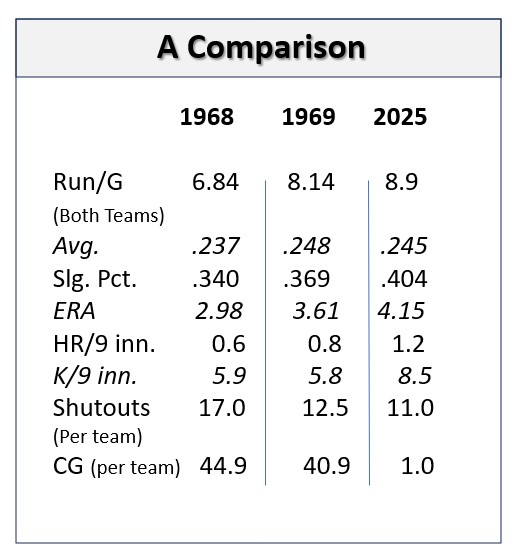
I include the chart below to show the impact of the 1969 changes … and I added 2025 to give some indication of how today’s game compares with the late 1960s. As you can see, from 1968-69 we did see a moderate increase in runs scored per game, batting average and slugging percentage and, from the pitchers’ point of view, earned run averages were up and shutouts were down. Now, I do digress from topic here, but my attention was drawn to how major-league baseball today is a “power” game. While batting averages in 2025 were about the same as in 1969 (and hits per nine innings were 8.4 in both 1969 and 2025), runs per game, slugging percentage, home runs per nine innings were up, as was earned run average. And, from the power pitching point of view, strikeouts are up – from 5.8 per nine innings in 1969 to 8.5 in 2025. Of course, a lot goes into this: pitchers are throwing harder than ever, batters are looking for the long ball, relief specialists have become the norm (and let’s not forget the dreaded pitch counts). But all of this is fodder for a future post.
Just sayin’ …
In 2025, with 30 MLB teams, fans saw just 29 total complete games pitched and no pitcher tossed more than one shutout. In 1969, with 24 teams, there were 982 complete games and it took five shutouts to make MLB’s top ten shutout list.
But, I digress (as I often do). Now, back to our regularly scheduled topic – trivia from 1968. A few obvious tidbits:
- Denny McLain became the first 30-game winner since Dizzy Dean in 1934 (and there hasn’t been another since), putting up a 31-6, 1.96 mark, with 28 complete games and six shutouts in 41 starts. Side note: McLain’s 28 complete games were just one less than all 30 MLB teams combined in 2025. (Juan Marichal led MLB in complete games in 1968 withs 30 … in 38 starts.)
- Carl Yaszrremski won the American League batting championship with what remains the lowest average ever for a league leader at .301. He was the AL’s only .300 hitter.
Hey, Looks Like Those Rule Changes Worked
In 1968, the NL & AL saw just six qualifying batters hit .300 or better. After the rules changes, the 1969 season saw 18 qualifying batters hit .300+. (There were four more teams).
- In 1968, for the only time (in a non-shortened season) neither the AL nor the NL had a player score at least 100 runs. (Cubs’ 2B Glenn Beckert led the NL with 98; Tigers’ 2B Dick McAuliffe led the AL with 95.) The only other seasons when neither the AL or NL had a player score 100 runs were the shortened seasons of 1918 (WWI); 1981 (strike); 2020 (Covid).
- Bob Gibson led MLB with 13 shutouts. The highest in a season by a pitcher since 1916. (More on Gibson’s remarkable season later in this post.).
Now, a little more detail on some other 1968 tidbits I found interesting.
Longest Ever 1-0 Game
On April 15, the Mets and Astros, playing in Houston, set the tone for the season, playing the longest 1-0 game in MLB history (24 innings) … and the winning run scored on an error. In the bottom of the 24th, with Les Rohr on the mound for the Mets, Houston RF Norm Miller led off with a single to right; Rohr balked Miller to second; then intentionally walked LF Jimmy Wynn. 1B Rusty Staub grounded out second-to-first (with Miller going to third and Wynn to second). John Bateman came in to pinch it for C Hal King and was intentionally walked to load the bases. 3B Bob Aspromonte then reached on an error by Mets’ SS Al Weiss and, on the play, Miller scored the game’s only run. (Given the current placed runner in extra innings rule, I doubt this record for the longest 1-0 game will ever be broken.)
The two teams each had just 11 hits in the 24 innings (79 at bats each) … a .139 average for the game. There were just two extra-base hits in the game (one double for each team). The two squads were 1-for-23 with runners in scoring position. Those among the 14,219 fans who stayed to the end, got six hours and six minutes of “entertainment” for the price of a ticket.
Don Drysdale Get Stingy

Photo: Public Domain via Wiki Commons.
Here’s another mark that will likely never be broken. From May 14 through June 4, Dodgers’ righty Don Drysdale made six starts. He went the distance in all six games … and did not give up a single run. The six consecutive shutouts remain the MLB record. Over the six games, Drysdale gave up just 27 hits and nine walks, while fanning 42. Surprisingly, despite the streak (and a total of eight shutouts in 1968), Drysdale ended the season at 14-12, 2.15 in 341 starts. The six consecutive shutouts were part of a record (since broken) 58-innings scoreless streak. To further illustrate how dominant the pitching was in 1968, Drysdale lost six games in which he gave up two or fewer earned runs and his 2.15 ERA did not even put him among the ten best qualifying pitchers (he was number 12).
Hall of Famer Drysdale, an All Star in eight seasons, finished his 14-season MLB career (1956-69 … Dodgers) at 209-168, 2.95, with 167 CG and 49 shutouts in 465 starts. He recorded an ERA under 3.00 in eight seasons.
Side Note; Dodgers’ righty Orel Hershiser broke Drysdale’s scoreless innings streak in 1988, with a 59-inning streak of goose eggs. Hershiser did not break Drysdale’ shutout streak, however. Hershiser’s streak included five consecutive shutouts in September. Then, in his final start of the season, he went ten scoreless frames before being relieved in a Dodgers 2-1 loss to the Padres, reaching 59 scoreless frames. In the first inning of his first start of the 1969 season, he gave up a run to the Reds.
Bob Gibson Squeezes that ERA
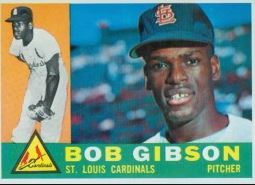 In 1969, the Cardinals’ Bob Gibson put up a 22-9 mark with a 1.12 earned run average, with 28 complete game and 13 shutouts in 34 starts. His ERA was the fifth-lowest for a season (among pitchers with at least 100 innings pitched in the season) in MLB history and the lowest since 1906 (Dutch Leonard – 0.96). Between June 6 and September 2 of that season, Gibson started 18 games, going 16-1, with a 0.60 earned run average. The streak included 17 complete games and 12 shutouts. The only game he did not finish in the span was came on August 4, when he went 11 innings (four earned run) in a Cardinals’ 6-5, 13-inning loss to the Cubs.
Don’t Worry Boys, I Got This
Bob Gibson threw 13 shutouts in 1968; equaling 2025’s total of one pitcher shutouts for all of MLB.
Hall of Famer Gibson pitched 17 MLB seasons (1959-75 … Cardinals), going 251-174, 2.91, with 255 complete games and 56 shutouts in 482 starts. In 1968-69, he completed 56 of 69 starts. He was an All Star in eight seasons and won 20 or more games in five.
Side note: In 1944, the Kansas City Monarchs’ (Negro American League) Satchel Page finished with a 6-4, 1.10 record in 16 starts (98 1/3 innings).
Pitchers Dominate 1968 All Star Game
The 1968 All Star Game – which featured some of MLB’s all-time hitting greats (like Hank Aaron, Willie McCovey, Willie Mays, Rod Carew, Carl Yastrzemski, Harmon Killebrew, Mickey Mantle, and Johnny Bench) – saw only one run and eight total hits (20 strikeouts). Further, it is the only All Star game that did not feature single earned run or RBI. The winning run scored in the bottom of the first (off AL starter Luis Tiant). Mays led off with a single and went to second on a flubbed pickoff attempt. Curt Flood then walked, with Mays going to third on a wild pitch. Willie McCovey batted next and hit into a 4-6-3 double play, with Mays scoring what would be the game’s only run.
A couple of side notes: After SS Jim Fregosi opened the top of the first with a double, 20 consecutive AL hitters were retired in order. RF Tony Oliva broke the AL drought with a two-out double in the seventh. The two teams were a combined 0-for-14 with runners in scoring positions.
Temporary Unicorn Status
On September 17, Gaylord Perry pitched a no-hitter for the Giants (in San Francisco) as they defeated Bob Gibson and the Cardinals 1-0. Perry walked two and fanned nine in the no-no. The very next day, the Cardinals’ Ray Washburn returned the favor – no-hitting the Giants in a 2-0 win. It was the first time – in 93 seasons and after 164 previous no-hitters (per MLB.com*) – that MLB saw no-hitters, involving the same two teams, in consecutive games (and in the same ballpark).
*- Does not include the National Association, which baseball-reference.com lists as having one no-hitter tossed in 1875. And, as noted earlier, Negro Leagues game-by-game stats from 1920-48 are not yet fully documented and incorporated into MLB records.
Unicorn status was achieved, but it didn’t last long. The very next season, the Reds and Astros duplicated the feat. On April 30, 1969, the Reds’ Jim Maloney tossed a no-hitter, as the Reds topped the Astros in Cincinnati. The next day (May 1), the Astros’ Don Wilson held the Reds hitless in a 4-0 win. These are still the only two instances in which no-hitters were tossed in consecutive games involving the same two teams.
Bucking the 1968 “Pitchers Rule” Trend
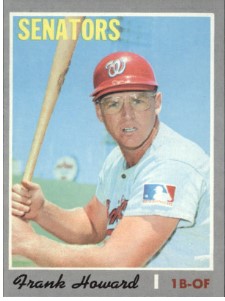 From May 12 through May 18, 1968, the Senators’ Frank Howard turned The Year of the Pitcher into The Week of the Hitter (at least for Howard). In that span, Howard set the (still-standing) MLB record for home runs in any one-week (seven-day) period. In six games, he hit 10 home runs (at least one in each contest), drove in 17 runs, scored 10 and collected 13 hits in 24 at bats (.542). Pitchers must have believed in The Year of the Pitcher. They only walked Howard once during that surge. Surprisingly, his Senators went just 3-3 over the six-game Howard binge. Howard finished the 1968 season at .274-44-106, leading MLB in home runs (he was the only player to reach 40 homers that season).
Howard played in 16 MLB seasons (1958-73 … Dodgers, Senators/Rangers, Tigers), hitting .273-382-1,119. A four-time All Star, he led the league in home runs twice and RBI once. He was the 1960 NL Rookie of the Year (Dodgers), after a .268-23-77 season.
We’ll close with a pitcher who both honored and defied the 1968 Pitchers’ Rule trend.
From Both Sides Now
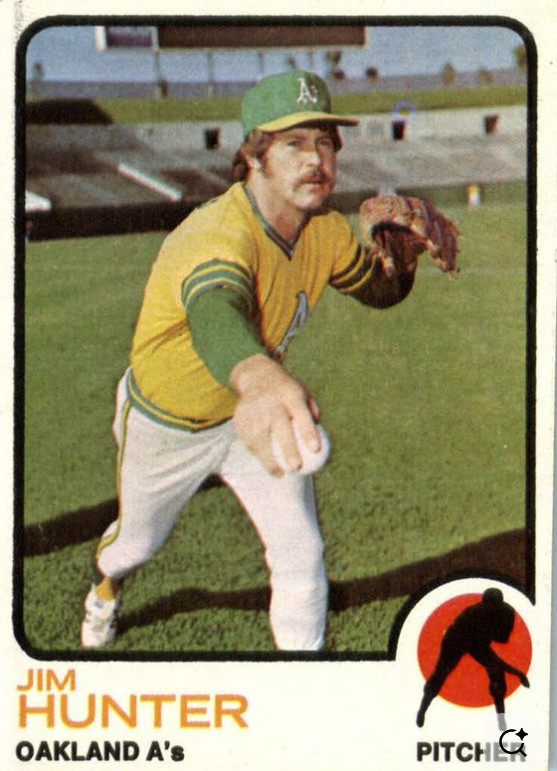 The Athletics’ Catfish Hunter added a bit of emphasis on The Year of the Pitcher on May 8, when he tossed a perfect game in a 4-0 victory over the Minnesota Twins (in Oakland). But he also defied the odds. For, in this Year of the Pitcher, he collected three hits and drove in three runs (both all-time offensive records for pitchers tossing Perfect Games). Hunter is, in fact, the only pitcher to collect more than one hit while tossing a perfecto. Overall, in MLB’s 24 perfect games, only six pitchers have collected hits (although in ten of those games the pitcher did not bat).
Hunter finished 1968 13-13, 3.35 on the mound, with 11 complete games and two shutouts. At the plate, he hit .232-1-8. The Hall of Famer played in 15 MLB seasons (1965-79 … Athletics, Yankees), going 224-166, 3.26 with 181 complete games and 42 shutouts in 476 starts. He was an eight-time All Star, five times won 20 or more games (consecutively, 1971-75) and was the 1974 AL Cy Young Award winner.
DH? I don’t need no stinkin’ DH!!
Catfish Hunter’s .232 batting average in 1968 topped the American League’s overall average of .230.
Primary Resources: Stathead.com; Baseball-Almanac.com
Baseball Roundtable – Blogging Baseball Since 2012.
 Baseball Roundtable is on the Feedspot list of the Top 100 Baseball Blogs. For the full list click here.
I tweet (on X) baseball @DavidBaseballRT. Follow me there for post notifications and links.
Follow Baseball Roundtable’s Facebook Page here.
Member: Society for American Baseball Research (SABR); Negro Leagues Baseball Museum; The Baseball Reliquary.
P 1156



Speak Your Mind