How often have we hears the phrase, “You have only one chance to make a first impression?” Well, this post is about 25 players who made a grand first impression in their major-league debut games.
Note/Disclaimer: This post does not include Negro Leagues’ debuts. Baseball Roundtable has not yet found a solid and accessible source of game logs for the Negro Leagues of 1920-48; now officially major leagues. I would welcome suggestions either for a source of Negro Leagues’ game logs or of individual players – and their debut-game stats – whose Negro League debuts you believe would put them on this list.
The ratings here, of course, are subjective. They take into account not only the bare stats, but such factors as how unique ( a record 15 strikeouts or five base hits in a debut appearance) they might be; how unexpected (a great debut, which turns out to encompass an entire MLB career): the immediate follow-up (a debut shutout is great, but you get extra credit for following up with a game-two shutout); the pressure of the moment (recognition of the significance of Opening Day, traditional rivalries or Hall of Fame opposition), So, let’s get to it.
1. Jason Jennings, RHP, Colorado Rockies … August 23, 2001 … A Shutout and a Homer
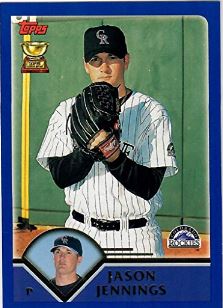 Jason Jennings, a 22-year-old right-hander (who batted left – you’ll see the significance in a bit), was called up by the Rockies in late August after going 9-8, 4.42 in 26 starts at Double-A and Triple A. Jennings made his MLB debut on August 23 against the Mets in New York. He proceeded to throw a nine-inning, complete-game shutout – five hits, four walks, eight strikeouts. At that point, he had thrown three complete games and one shutout in 68 minor-league starts (three seasons).
As a bonus, Jennings also went three-for-five at the plate, with a home run, one run scored and two RBI – becoming the first MLB player to pitch a shutout and hit a home run in his first MLB appearance. Jenning’s day included a pop out to third base in the first inning; a single to left in the third; a ground out to first in the fifth; an RBI single to right-center in the seventh; and a homer to right in the top of the ninth. (The Rockies won the contest 10-0).
Collegiate Star
Jason Jennings was a first-round draft pick (Rockies, 16th overall) in 1999 (out of Baylor University). In his three years at Baylor (1997-99), he was a three-time All American and, in 1999, won both the Golden Spikes Award and Dick Howser Trophy. He posted a three-year pitching record of 27-11, 3.56 and a .344 batting average with 39 home runs in 172 games. He is generally considered the best player in Baylor baseball history.
Jennings went 4-1, 4.58 in seven 2001 starts; hitting .267 (four-for-fifteen). He followed up by winning the NL Rookie of the Year Award in 2002, with a 16-8, 4.52 record for the Rox – and a .306-0-11 batting line (in 68 plate appearances). That proved to be his best season, as he appeared to succumb to command and injury issues and went 42-65, 5.06 over his final seven MLB seasons. He retired as an active player after the 2012 season, when he went 10-2, 3.58 for the (Independent) American Association Grand Prairie Ground Hogs. His final MLB line (2001-2009 … Rockies, Astros, Rangers) was 62-74, 4.95. As a hitter, he went 68-for-329 (.207), with two home runs and 26 RBI.
Post playing days, Jennings has been involved in The Keeper of the Game Foundation, The Miracle League, The Michael Young Foundation and MLB Baseball Assistance Team.
2. Karl Spooner, LHP, Dodgers … September 22, 1954 … a Shutout, with 15K
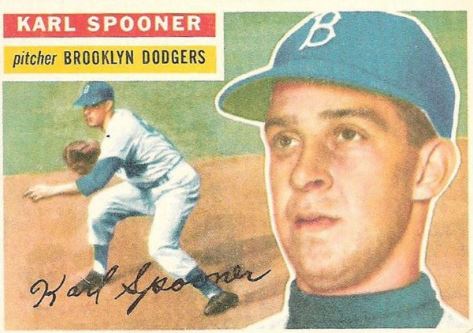 Spooner was called up to the Dodgers in late 1954 – after going 21-9, 3.14 for the Double-A Fort Worth Cats. He was an immediate sensation – pitching a complete-game, three-hit shutout against the rival Giants in his September 22 debut. In the 3-0 win, Spooner walked three and fanned 15 batters – still the MLB record (since tied) for a pitcher in his first MLB appearance.
Spooner, notably, did not get off to a great start – giving up a single and two walks in the first frame – but pitching out of trouble. Not a single batter reached second base after the first inning and in the seventh and eighth, Spooner faced the minimum six batters and fanned them all (swinging) on a total of 29 pitches. Spooner cemented the number-two spot on this list (whether it’s a fair way to “score” or not) with his second MLB appearance – another complete-game shutout. This time a four-hit, 1-0 win over the Pirates (September 25) in which he walked three and fanned a dozen. So, in his first two MLB appearance, Karl Spooner did not give up a run and fanned 27 batters in 18 innings – in a season in which the average strikeouts per nine innings among MLB pitcher was 4.2. Side note: J.R, Richard, who (in 1971) tied Spooner’s record of 15K in an MLB debut did not “score” as high as Spooner for two reasons: 1) His debut game was not a shutout; 2) He fanned just five (in five innings) in his second game. More on Richard later in this listing.
Clearly, with Spooner, it looked like the Dodgers had an “ace” in the making. That, however, was not to be. In 1955, a Spring Training shoulder injury took its toll and Spooner pitched only 98 2/3 innings that season – going 8-6, 3.65 in 29 appearances (14 starts). He spent the next three seasons in the minor leagues, before retiring at age 27. His MLB career (1954-55 … Dodgers) stat line was 10-6, 3.09, with 105 strikeouts in 116 2/3 innings.
3. Billy Rohr, LHP, Red Sox … April 14, 1967 … One Strike Away from History
Billy Rohr got a higher than expected spot on this list at least in part based on the pressure of the moment. He made his debut against the Red Sox’ rival Yankees, at the New Yorkers’ 1967 home opener, and his mound opponent was Yankee ace, hero and future Hall of Famer Whitey Ford.
How did the 21-year-old rookie fare? Well, with two out in the bottom of the ninth, he was protecting a 3-0 lead and had yet to give up a hit (five walks, two strikeouts). In addition, he was dealing with the effects of a sixth-inning line drive off the bat of Yankee’s RF Bill Robinson that had ricocheted off Rohr’s shin to third baseman Joe Foy who threw to first for the out. Rohr had to argue with manager Dick Williams to stay in the game. Now, with two down in the ninth, all that stood between Rohr and a no-hitter was Yankee catcher Elston Howard. Rohr got ahead of Howard 1-2 and was one strike away from a no-hitter in his first MLB appearance. The next pitch was called a ball (Red Sox catcher Russ Gibson would forever maintain it was a strike). Then, on a 2-2 count, Howard hit a soft, looping liner over second baseman Reggie Smith – putting an end to the no-hitter. On the very next pitch, Yankees’ 3B Charley Smith flied out to right and Rohr had a one-hit shutout in his MLB debut.
One week later (April 21), Rohr made his second major-league appearance. Again, he faced the Yankees, this time in Boston. He sparkled once more, holding a 6-0 lead after seven innings. The New Yorkers finally scored off the rookie in the eighth, one an RBI single by Rohr’s debut nemesis Elston Howard.
So, after two MLB appearances, Rohr was 2-0, with two complete games and 0.50 earned run average. It looked like the youngster was on his way. He was not. Rohr made eight more appearances (six starts) through June 1, going 0-3, 7.71, before being sent back down to Triple A. (He did make one more appearance, in relief, for Boston in September.) Early in the 1968 season, he was sold to the Indians, where he went 1-0, 6.87 in 17 relief appearances. He made his last MLB appearance on June 26, 1967, although he did toil in the minors until 1972. After that 2-0, 0.50 start, Rohr ended with an MLB line (1967-68 … Red Sox) of 3-3, 5.64. Rohr, by the way, was originally signed by the Pirates out of Bellflower (CA) High school, where he went 23-6 with four no-hitters.
4. Russ Van Atta, LHP, Yankees April 25, 1933 … A Shutout and Four Hits
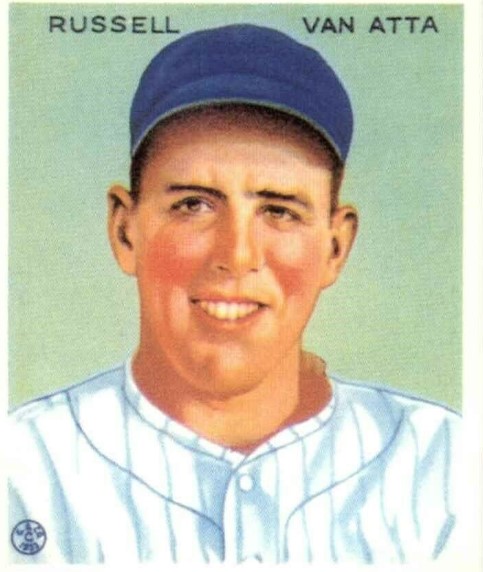 Maybe it’s the “Ohtani Effect,” but two of my top four on this list are pitchers that threw shutouts and also hit the ball well in their MLB debuts. Russ Van Atta was a pitching star at Penn State, where he reportedly lost only one game in four college seasons (before signing with the Yankees in 1928). Van Atta pitched in the minors from 1928 through 1932 (four years with the Double-A American Association Saint Paul Saints, where he went 22-17 in 1932). He made his debut for the Yankees on April 25, 1933, facing the Washington Senators. (Note: These were not the Senators of later years. In 1933, the Senators went 99-53-1 and finished first in the American League.)
In his debut, Van Atta threw a five-hit, complete-game shutout (three walks, five strikeouts) as his Yankees won 16-0. Not only that, he went four-for-four (all singles) at the plate, scoring three runs and driving in one. Van Atta had as many hits in the game as teammates Babe Ruth and Lou Gehrig combined.
Van Atta finished his rookie season 12-4, 4.18, in 26 games (22 starts) with ten complete games – and with a .283 average in 60 at bats.
Van Atta looked to be on the cusp of a solid MLB career, only to see it derailed by a “unique” injury. Between the 1933 and 1934 seasons, he injured the index finger on his pitching hand rescuing a dog from a home fire – and it affected his mound performance. He went 3-5, 6.34 in 1934 (28 games, nine starts). After that season, he was primarily a relief pitcher – leading the AL in appearances in 1935 and 1936. Van Atta had a seven-season MLB career (1933-39 … Yankees, Browns) and went 33-41, 5.60. As a batter, he went .228-2-17 in 206 at bats.
5. Juan Marichal, RHP, Giants … July 19, 1960 … Taking a Perfect Game into the Seventh
Juan Marichal was signed in 1958 as a 20-year-old out of the Dominican Republic – and made his MLB debut (at age 22) on July 19, 1960. When called up, he was 11-5, 3.11 in 18 Triple-A starts for the season. The future Hall of Famer showed his credentials as “The Dominican Dandy” right from that very first appearance. He tossed a complete-game, one-hit shutout against the Phillies in San Francisco. Allowing jut one walk and fanning a dozen (the Giants won 2-0). He retired the first 19 MLB batters he ever faced (until a seventh-inning error by SS Eddie Broussard put Phillies’ 2B Tony Taylor on base). The first hit against Marichal didn’t come until there were two outs in the eighth (a single by catcher Clay Dalrymple). In the game, only one Phillie reached second base. In his first three MLB starts, Marichal tossed three complete-game victories (one a ten-inning contest) and gave up just three runs in 29 frames.
Marichal pitched 16 MLB seasons (1960-75 … Giants, Red Sox, Dodgers), going 243-142, 2.89. He was an All Star in nine seasons and a seven-time winner of 20+ games. Despite seasons of 25-8, 2.41 (1963), 25-6, 2.23 (1966) and 26-9, 2.43 (1968), he never won a Cy Young Award. In fact, he did not get a single CYA vote in any of those three seasons. The unanimous NL winners were Sandy Koufax in 1963 and 1966 and Bob Gibson in 1968.
6. (tie) Starlin Castro, SS, Cubs … May 7, 2010 … Six-RBI Debut
It’s about time we got a position player in here, don’t you think? Starlin Castro made his debut with the Cub on May 7, 2010 (versus the Reds in Cincinnati) at age 20 – and started with a bang. Batting in the eight-hole, Castro got his first MLB at bat with two-on and no one out in the top of the second inning. He hit a 2-2 pitch for a three-run home run off (appropriately) Homer Bailey (I always thought that was an unfortunate name for a pitcher; like Nick Swisher for a hitter). In his second at bat, Castro lined out to center (leading off the fourth). He came up again in the fifth, this time with the bases loaded and two outs. The result? A triple to deep left center. So, three at bats into his major league career, Castro had six RBI. (He was retired in his final two plate appearances.)
Starlin Castro’s six RBI are the MLB record for a player in his first MLB game.
Castro played in 125 games in that rookie season, going .300-3-41, and finished fifth in the NL Rookie of the Year balloting. (The winner was Giants’ C Buster Posey, who hit .305-18-67). As of the completion of the 2021 season, Starlin had 12 seasons of MLB service (Cubs, Yankees, Marlins, Nationals), with a stat line of .280-138-678 (1,573 games). The four-time All Star has had three seasons with a .300 or better average, two with 20+ home runs and two with 20+ steals. He led the NL in hits with 207 in 2011, when he hit .307 with 10 homers, 66 RBI and 22 steals. Over his career, he had played SS, 3B and 2B.
6. (Tie) Trevor Story, SS, Rockies …. April 4, 2016 … Two Homers in First Game; Six in First Four
Talk about getting the party started! Rockies’ SS Trevor story made his debut (at age 23) on Opening Day 2016 – as the Rockies faced the Diamondbacks in Arizona. The 2011 Rockies’ first-round draft pick was coming off a .279-20-80, 22-stolen base season at Double-A and Triple-A. Right from his first game, he started powering his way into the record books. After grounding out in the first, he hit a three-run home to right in the third and a solo home run to left in the fourth. He ended the day two-for-six, with four RBI, as the Rockies won 10-5.
Story got a little extra credit (and moved up a couple of spots on this list) for what he did immediately after that multi-homer debut game – going deep in his first four MLB games. Between April 4 and April 8, Story went seven for 19 (.368). Six of his seven hits were home runs and, in the four games, he scored six times and drove in 11. In the process he became the first MLB player to homer in their first three and first four games, as well as the first with two multi-homer games in their first four MLB contests. One wonders what Story could have done in his rookie season if it were not for an early-August injury (thumb) that ended his season., Still, he went .272-27-72 in 95 games. At the end of the 2021 season, the Rockies’ two-time All Star had a stat line of .272-158-450 – with 100 steals.
8. J.R. Richard, RHP, Astros … September 4, 1971 … A 15K Debut
Public Domain via Wiki Commons.
J.R. Richard was called up in September 1971, after going 12-7, 2.45, with 202 strikeouts in 173 innings for the Triple-A Oklahoma City 89ers. In his very first MLB start (September 4 versus the Giants), Richard went the distance, giving up three runs (two earned) on seven hits, while walking three and fanning 15 (in a 5-3 win). Richard places this high on the list because his 15 whiffs place him in a tie for strikeouts in a debut MLB game. Richard went on to a ten-season MLB career (cut short by a stroke in July of 1980) – all for the Astros. He went 107-71, 3.15, with 1,493 strikeouts in 1,606 innings pitched. He twice topped 300 strikeouts in a season (leading the league both times) and led the league in ERA at 2.71 in 1979. From 1976 until his stroke in mid-season 1980, Richard went 84-55, with a 2.79 ERA and 1,163 strikeouts in 1,239 1/3 innings; also recording 66 complete games and 17 shutouts. A little extra credit here for a dominating career cut short.
9. (Tie) Jay Hughes, RHP, Baltimore Orioles (NL) … April 18, 1898 … A Two-Hit Shutout and then He Got Better
Sacramento, CA-born Jay Hughes made his MLB debut for the National League’s Baltimore Orioles on April 18, 1898 (the Sacramento connection’s importance will become clear soon). The 24-year-old Hughes embarked on his major-league career with a two-hit, complete-game shutout in a 9-0 win over the Washington Senators (Yes, in 1898, the Senators and Orioles were both in the NL) in Washington. He followed it up with an 8-0, complete-shutout over the Boston Beaneaters in Baltimore. He gets an edge over a handful of other hurlers who started their MLB careers with consecutive shutouts because Hughes’ second MLB start produced not just a shutout, but a no-hitter. Now, some may be quick to interject that time were different then and maybe the two shutouts were not that impressive. But wait, in 1898, the MLB team average runs per game was 4.96 and Hughes “victims” – Washington and Boston – averaged 4.54 and 5.74 runs per game, respectively. This compares pretty well to the 2021 season, when AL teams averaged 4.60 runs per game and NL squads averaged 4.46.
Back to Hughes, he finished his rookie season at 23-12, 3.20 and followed up with a 28-6 season for the Brooklyn Superbas in 1899. Now, of course, this was in the days before the big major-league contracts and Hughes missed his West Coast home territory. So, in 1900, he left the National League and went back to Sacramento (got married) and put up a 23-9 record for the Sacramento Beavers of the California League. He was lured back the Brooklyn for the 1901-02 MLB seasons – going 17-12, 3.27 and 15-10, 2.94. Still, the West Coast was calling and, in 1903, he made his way to the Pacific Coast League Seattle Siwashes, where he went 34-15, 2.35. He played three more seasons in the PCL before retiring as a player, Hughes’ MLB career was, by is own choice, short – but what a start he had, a two-hitter and a no-hitter in his first two games. His career (1898-99 & 1901-02 … Orioles, Superbas) was 83-40, 3.02.
9. (Tie) Charles “Bumpus” Jones, RHP, Cincinnati Reds … October 15, 1892 … A No-Hitter First Time Out
Bumpus Jones makes an appearance here in part because he is the answer to a baseball trivia question – “Who is the only major leaguer to throw a complete-game, no-hitter in his very first MLB appearance?” At first glance, one might be tempted to reply “Bobo Holloman” – but, while Bobo threw a no-no in his first MLB start, it was preceded by four relief appearances. Bumpus, however, threw a no-hitter in his first-ever MLB mound appearance. It came on October 15, 1892 (the final day of the season) against the Pittsburgh Pirates. Jones walked four and struck out three in the game – a 7-1 Reds’ win. The only Pirates’ run scored in the third inning on a walk, a stolen base and an error by Jones.
A couple of additional notes here. In 1892, the pitcher’s box was 50-feet from home plate (and Bumpus had made a name for himself pitching at that distance in the minor leagues). In 1893, the mound was moved to 60’ 6” and Jones did not recapture the magic of that no-hitter. In 1893, he was 1-4, 10.19 for the Red Stockings and Giants. He continued to play professionally, (at least until 1901), but never again pitched in the major leagues. (For my Minnesota Readers, all evidence points to Jones’ last professional start coming on May 4, 1901 – for the St. Paul Apostles). Jones played two MLB seasons (1892-93 … Giants, Reds), going 2-4, 7.99.
11. Fred Clarke, LF, Louisville Colonels (National League) … June 30, 1884 … Five-Hit Debut
In his first MLB game, 21-year-old Fred Clarke rapped our four singles and a triple in five at bats (in a 13-6 loss to the Phillies). He remains the only player to record five hits in a nine-inning MLB-debut game. On the season, Clarke hit .274-7-48 in 76 games. He delivered on that debut-game promise in 1895, hitting .347 in 132 games. Clarke went on to a 21-season Hall of Fame career (1894-1911, 1913-15 … Colonels, Pirates), putting up a stat line of .312-67-1,015, hitting over .300 in ten seasons in which he played at least 100 games (a high of .390 in 130 games in 1897). Clarke also stole 509 career bases and recorded 220 triples (14 seasons of double-digits in triples). He also enjoyed a 19-season managerial career (1,602 wins, 1,181 losses … four pennants, one World Series title).
12. Willie McCovey, 1B, Giants … July 30, 1959 … Four-for-Four, Two Triples
 Twenty-one-year old McCovey was called up to the Giants in July of 1959. At the time, he was already in his fifth pro season, hitting .372-29-92 (95 games) for the Triple-A Phoenix Giants. San Francisco dropped the prospect right into the number-three slot in the lineup – and he delivered. As the Giants topped the Phillies 7-2 in San Francisco, McCovey made his MLB debut with a single (off future Hall of Famer Robin Roberts) in the first inning; a triple off Roberts in the fourth; an RBI single off Roberts in the fifth; and a second RBI triple off Roberts in the seventh. McCovey finished his MLB debut game four-for four – with three runs scored, two RBI and, of course, those two triples. McCovey shares the record for triples in a debut game.
Notably, McCovey started his MLB career with a seven-game hitting streak, during which he hit .467 (14-for-30), with three home runs, two doubles, two triples, nine runs scored and nine RBI. He went .354-13-38 on the season – winning the NL Rookie of the Year Award, despite playing in just 52 games. McCovey went on to a 22-season Hall of Fame career (1959-80 – all with the Giants), hitting .270, with 521 home runs and 1,555 RBI. He was an All Star in six seasons, led the NL in home runs three times (hitting 30 or more home runs seven times) and RBI twice. He was the 1969 NL Most Valuable Player.
13. Cecil Travis, 3B, Senators … May 16, 1933 … Five-Hit Debut (just took a little longer)
Only Fred Clarke (at number-eleven) and Cecil Travis collected five hits in their MLB debut game. Travis, however, did not pick up his fifth hit until the bottom of the tenth (in a game in which his Senators beat the Indians in 12 innings by an 11-10 score). In the game, Travis went five-for-seven (all singles) and scored three runs. Travis’ hot start should not have been a surprise. In 1931, as a 17-year-old with the Class-A Chattanooga Lookouts, he hit .429 in 13 games. In 1932, still with Chattanooga, he raked at a .356 pace in 152 games. He was again hitting well over .300 for Chattanooga when the Senators called him up to replace injured third baseman Ossie Bluege. Travis got in nine games between May 16 and May 24 (going nine-for-29 – all singles) before Bluege reclaimed the third base position. Travis got in another nine contests in September/October and finished the season at .302 for Washington (13-for-43 – with just one extra-base hit) and .352 for Chattanooga. He won the Senators’ third base job outright in 1934.
Travis enjoyed a 12-season MLB career (1933-41, 1945-47 … Senators) finishing at .314-27-657 – but without the impact of World War II, his numbers could be notably more impressive. Travis lost nearly four years to military service (all of 1942-44 and most of 1945). In his nine MLB seasons before military service, he went .327-25-581. In the three seasons after his return, he went .241-7-26. In 1941, the season before he began his military service, he hit .359 and led the American League with 218 hits. He also scored 106 runs and drove in 101 that season
14. Kazuo Matsui, 2B, Mets …. April 6, 2004 … Home Run, Two Doubles, a Pair of Walks
In his MLB debut game, Kazuo Matsui came to the plate five times and got on base five times – two doubles, one home run and two walks; scoring once and driving in three as his Mets topped the Braves 7-2 in Atlanta.
Matsui came to Mets after nine seasons in Japan (1995-2003), during which he hit .309, with 150 home runs and 320 stolen bases. He showed unexpected power with 69 home runs over the 2002-03 seasons. As noted, he was three-for-three with two walks in his MLB debut. In addition, he hit the first MLB pitch he ever saw (and the first pitch of the Mets’ 2004 season) for a home run. His day went: solo home run in the first inning; RBI double in the second; bases-loaded walk in the third; double in the fifth; and intentional walk in the seventh. Matsui’s first-pitch home run, in retrospect, was unexpected. In seven MLB seasons (2004-10 … Mets, Rockies, Astros), he hit just 32 round trippers (.267 average, 211 RBI, 330 runs scored and 102 steals).
According the Elias Sports Bureau, Kaz Matsui is the only MLB player to homer in his first plate appearance in three consecutive seasons (2004-05-06).
After the 2010 season, Matsui returned to Japan, where he played through 2018.
15. Mark Quinn, OF, Royals … September 14, 1999 … Two Homers and a Double
Mark Quinn made his debut as a designed hitter, batting fifth as the Royals took on the Angels in Kansas City. He earned his call up with .360-25-84 season (107 games) at Triple-A Omaha. In his first MLB game, the 25-year-old popped out in the first inning; doubled to lead off the fourth; hit a two-run home run in the sixth; added another two-run homer in the eighth to finish three-for-four with three extra-base hits, while driving in four of the Royals’ five runs in a 6-5 loss to the Angels.
Quin played in 293 MLB games (1999-2002 … Royals), going .282-45-167. In 2000, he had his best season with a .294-20-78 line in 135 games.
16. John Paciorek, RF, Colt .45’s … September 29, 1963 … 1.000 Career Average
Signed out of Saint Ladislaus High School in Hamtramck, Michigan (where he had starred in football, basketball and baseball), John Paciorek appeared in his first major-league game on the final day of the 1963 season (September 29) at the age of 18. The 6’ 1”, 200-pound outfielder had spent the 1963 season with Class-A Modesto Colts; where he hit .219-9-49 in 78 games. The Colts’ parent club, the Houston Colt .45s (that was the current Astros’ franchise name back then), was suffering through a difficult season. The team was 65-96 going into that final game. Looking to the future, Houston had, in fact, fielded an all-rookie lineup (average age 19) on September 27. Youth was still being served two days later when John Paciorek started his first MLB game. The results were surprising – and worthy of recognition.
Playing right field and batting seventh in a 13-4 win over the NY Mets, Paciorek ended up with three hits and two walks in five plate appearances, with four runs scored and three runs batted in. Perhaps equally surprising is that it was not only Paciorek’s first major-league appearance, it was to be his only MLB appearance. Back pain the following spring, followed by surgery (he played 49 minor league games in 1964 and missed all of the 1965 season), put an end to his MLB playing days. (Paciorek did play in four more minor-league seasons.) Still, you will find John Paciorek in the Baseball Encyclopedia and his is arguably the greatest one-game MLB career ever. Among one-gamers, he holds the record for times on base and runs scored, and shares the record for batting average, on base percentage and RBIs.
17. Ray Jansen, 3B. Browns … September 30, 1910 … Four Hits in First Pro Game
Like John Paciorek (above), Ray Jansen’s MLB debut game was his only major-league appearance. Unlike Paciorek, however, Jansen’s MLB debut was also his professional debut. The 1910 season was winding down and the St. Louis Browns were 54 ½ games behind in the American League race – and apparently decided to give some local talent a “look-see.” (Jansen was born and raised in St. Louis.) So, on September 19, 1910, we find the 21-year-old Jansen – who had never played professionally at any level – starting at third base and hitting second for the Browns (against the White Sox in St. Louis). Jansen had a good day at the plate – four singles in five at bats, which gives him the record for the most hits by a player with a one-game MLB career (more #InBaseballWeCountEverything). He was a little less adept at the hot corner (which may help explain his one-game MLB career), making three errors. To be fair, the Browns did make seven errors that day (and led the league with 385 on the season). Jansen’s lone game did have an unusual line score. The White Sox scored nine runs on nine hits (there were four walks and, of course, those seven errors). The Browns tallied just one run on 16 hits (two triples and 14 singles), with the White Sox making just one error and surrendering no free passes. Jansen did continue his career in the minors, where he played until 1918, hitting .266 with ten home runs in 616 games.
18. Bert Campaneris, SS, A’s … July 23, 1964 … Three-for-Three, Two Home Runs, Stolen Base
Bert Campaneris was not a power threat. In 19 MLB seasons, he hit more than eight home runs in just one campaign (22 long balls in 1970). Still, he did manage to go deep on the very first MLB pitch he ever saw (off the Twins’ Jim Kaat).
Campaneris was called up to the A’s in July of 1964 due to an injury to A’s starting SS Wayne Causey. The 22-year-old Campaneris was in his third professional season and was having a solid season with the Double-A Birmingham Barons (he was hitting .325 with 25 steals for the Barons). In his MLB debut game, Campaneris (playing SS and batting second) hit a solo home run in the first; singled in the third; reached on a Fielder’s Choice and stole second in the fifth; hit a two-run homer in the seventh; and walked in the tenth. The A’s won 4-3 in 12 innings. Campaneris went three-for-for, with two runs scored, three RBI.
Campaneris enjoyed a 19-season MLB career (1964-81, 1983 … A’s, Rangers, Angels, Yankees), hitting .259-79-646 with 649 stolen bases. He was a six-time All Star; six-time stolen base leader (with ten consecutive seasons of 30 or more steals).
19. Daniel Ponce de Leon, RHP, Cardinals …. July 23, 2018 … A Comeback after a Comebacker

Public Domain via Wiki Commons
Okay, first, how can you not put a guy named Ponce de Leon on any list. And, while Daniel Ponce de Leon didn’t pick up a win in his MLB debut (in fact, didn’t get a victory in his first MLB season), getting to the mound was a victory in itself. He deserves a spot here on the virtue of pure grit and determination.
Ponce de Leon was drafted out of Embry-Riddle Aeronautical University (Daytona Beach, Florida) – in 2014. By 2017, at age 25, he had worked his way up the Triple-A Memphis Redbirds – where, on May 9, he was hit in the head by a line drive up the middle, fracturing his skull. At the time, he was 2-0, 2.17 on the season. The injury required surgery, he spent three weeks in the hospital and did not return to action until Spring Training 2018. He started the 2018 season back at Memphis, where he was 5-2, 2.41, with 71 strikeouts in 59 2/3 innings before a July call up to the Cardinals – just 13 months after what many thought was a career-ending injury.,
So, how did he do in that first MLB appearance? How about seven no-hit innings against the Reds in Cincinnati (three walks, three strikeouts). Ponce de Leon left the game with a 1-0 lead, but the Reds scored two in the ninth to win the game. He made a total of 11 appearances in 2018 (four starts) and went 0-2, 2.73 with one save. Ponce de Leon was up and down several times (between St, Louis, Memphis and Springfield) in 2018 through 2021 – and was released by the Cardinals in September of this year. To date, his MLB record is 3-8, 4.33 in 57 games (22 starts).
20. J.P. Arencibia, C, Blue Jays … August 7, 2010 … Three Extra-Base Hits
J.P. Arencibia was a first round pick (21st overall) of the Blue Jays (out of the University of Tennessee) in the 2007 draft. He showed a solid power the minors: .254-3-25 in 63 games at Low-A in 2007; .298-27-105 in 126 games at High-A and Double-A in 2008; .236-21-75 in 116 games at Triple-A in 2009; and .301-32-85 in 104 Triple-A Games in 2010. He made his MLB debut on August 7, 2010 in Toronto as the Blue Jays faced the Rays. It was a slugfest (a 17-11 Jays win) and Arencibia was glad to take part. He homered off James Shields in the bottom of the second (a two-run shot on the first MLB pitch he ever saw); doubled in the third; singled (and later scored) in the fifth; hit a solo home run in the sixth; fouled out in the seventh; finishing the day four-for-five, with three runs scored, three RBI and three extra base hits.
Arencibia struggled after that first big game. He played ten more games for the Jays that season and had just one single in 30 at bats. Arencibia eventually played in six MLB seasons (2010-15 … Blue Jays, Rangers, Rays), going .212-80-245. He topped 20 home runs in two seasons.
21. (Tie) Al Jurisch, RHP, Cardinals … April 26, 1944 … Working Overtime
Al Jurisch made his MLB debut on April 26th, 1944, as his Cardinals took on the Reds in Cincinnati. Despite throwing 12 scoreless innings that day, the 22-year-old righty got the loss when he gave up a run on a walk-off home run (to 1B and cleanup hitter Frank McCormick) with two outs in the bottom of the unlucky 13th. (Jurisch had struck out the first two batters in the inning.) The 12 2/3 innings remains the longest debut outing by an MLB pitcher. For the game, Jurisch gave up eight hits, walked four and fanned seven.
Jurisch went 7-9, 3.39 in 1944 – appearing in thirty games (seven starts) with five complete games and two shutouts. It was his best MLB campaign. He pitched in the majors through 1947 (Cardinals, Phillies), with a final stat line of 15-22, 4,24.
21. (Tie) Al Worthington, RHP, Giants …. July 6, 1953 … Start with a Shutout, Follow Up with a Shutout
Al Worthington made a name for himself in the major leagues as a reliever – running off a string of seven seasons of double-digits in saves and leading the AL with 18 saves for the Twins in 1969. Worthington gets irony points here, since the respected reliever made this list by virtue of throwing two, complete-game shutouts in his first two MLB appearances. The 24-year-old was in his third pro season and was 9-5, 2.90 for the Minneapolis Millers when he was called up by the Giants. In his MLB debut game on July 6, 1953, he shut down the Philllies on two hits (four walks, six whiffs) as his Giants won 6-0 in New York. Five days later he started again and shut out the Dodgers 6-0 on four hits (one walk, seven strikeouts, It was the only time the NL Champion Dodgers were shutout that season. Things went a little south after that, as his next eight decision were all losses (0-8, 5.13 in that span). He ended his rookie campaign at 4-8, 3.44. Worthington went on to a 14-season MLB career, going 75-82, 3.39 with 111 saves (533 relief appearances, 69 starts). He was 16-31, 3.99 as a starter and 59051 (with those 111 saves), 3.11 as a reliever
23. Joe Doyle, RHP, New York Highlanders … August 25, 1906
Known as Slow Joe Doyle for his pace on the mound, Doyle made his MLB debut for the Highlanders (Yankees) on August 25, 1906, shutting out the Indians 2-0 (in New York) on six hits (two walks, five strikeouts). He followed it up August 30 with another complete-game shutout. This time a two-hitter (no walks, six strikeouts) as the Highlanders beat the Senators 5-0. He finished his rookie season at 2-1, 2.38 and went on to five-season MLB career (1906-10) with a 22-21, 2.85 line.
24. Johnny Marcum, RHP, Athletics … September 7, 1933 … A Pair of Five-Hitters
The Philadelphia Athletics called up 23-year-old Johnny Marcum in September of 19-33 – after a 20-13, 3.74 season for the Double-A Louisville Colonels. He showed his “stuff” right away, In his first appearance, September 7, he tossed a five-hit (six walks, four whiffs) shutout, as the Athletics topped the Indians 6-0 in Philadelphia. He started again on the 11th and tossed another five-hit shutout (three walks, three whiffs) as the Athletics topped with White Sox 8-0. He finished his rookie season at 3-2, 1.70 and went 65-63 in a seven-season (1933-39) MLB career.
25. Steve Woodard, RHP, Brewers … July 28, 1997 … Topping Roger Clemens
Steve Woodard was drafted in the fifth round of the 1994 MLB Draft, out of Hartselle (AL) High School. He made a pretty quick impression, going 8-0, 2.40 in the Arizona (rookie) League as a 19-year-old (1994). Over the next three seasons, Woodard went 34-16, as he worked his way up the minor-league system. He was called up to the Brewers in July of 1997 – and made his first appearance against the Blue Jays on July 28 in Milwaukee. To add to the pressure – and garner Woodard extra “points” in this listing – his mound opponent was Roger Clemens, who was 16-3, with a 1.54 ERA going into the game. Woodard proved up to the task, pitching eight innings and giving up just one hit and one walk, while fanning 12. And, he needed to be that good, as Clemens tossed an eight-frame complete game, giving up four hits and one run, while walking one and striking out ten.
Notably, the lone hit the Blue Jays got off Woodard came on the third pitch of the game – a double to Blue Jays lead-off hitter CF Otis Nixon. Nixon stole third with one out, and then Woodard settled down and struck out LF Joe Carter and 1B Carlos Delgado on nine pitches. The only base runner he allowed over the next seven innings came on a third-inning, one-out walk to SS Alex Gonzalez. Again, he bore down with a runner on base and struck out the next two batters. With one inning of relief from Mike Fetters, Woodard collected a 1-0 win.
Woodard’s debut season did not follow the path of that first game. He ended 1997 at 3-3, with a 5.15 earned run average. Woodard had a seven-season MLB career (1997-2003 … Brewers, Indians, Rangers, Red Sox), during which he went 32-36, 4.94. His best season was 2003, when he went 11-8, 4.52 for the Brewers.
The 25 debut games on this list, of course, are subjective calls. Want to switch someone out? Below are a few choices that Baseball Roundtable considered. Or add you own suggestions on the list or its order in the comments.
Steven Strasburg, RHP, Nationals … June 8, 2010. The much-publicized debut of Strasburg went well. He gave up just four hits and two runs over seven innings, with no walks and 14 strikeouts (third most in an MLB debut) – while his Nationals topped the Pirate 5-2.
Joey Gallo, 3B, Rangers … June 2, 2015. Highly-rated prospect Gallo went three-for-four, with a double, home run (and a walk), scoring three times and driving in four, as the Rangers topped the White Sox 15-2 in Texas.
Tom Phoebus, RHP, Orioles … September 15, 1966. Phoebus made his MLB debut with a four-hit (two walks, eight strikeouts), 2-0, complete-game win over the Angels. In his second appearance, he threw another shutout – a five-hit, 4-0 win over the Athletics.
Freddy Peralta, RHP, Brewers … May 13, 2018. Peralta only pitched 5 2/3 innings in his debut (a start against the Rockies in Colorado). Despite the mile-high air and a lineup that included DJ LeMahieu, Charlie Blackmon, Trevor Story, Nolan Arenado and Carlos Gonzalez, Peralta gave up just one hit (two walks) and struck out 13, He fanned five of the first six MLB hitters he ever faced (LeMahieu, Blackmon, Arenado, Gonzalez and Story).
Kirby Puckett, CF, Twins … May 8, 1964 … Minnesota fan favorite Puckett rapped four singles in five at bats in his debut game – and went on to hit safely in his first seven MLB contests (16-for-33, .485).
Primary Resources: Baseball-Reference.com; Baseball-Almanac.com; the following SABR bios: Bumpus Jones, by Chris Rainey; Fred Clarke, by Angelo Luisa; Billy Rohr, by Alexander Edelman; Bert Campaneris, by Rick Schabowski; Jay Hughes, by Bill Lamb; and “A Most Spectacular Debut” (Russ Van Atta), by Randolph Linthurst.
BASEBALL ROUNDTABLE ON THE TOP 100 BASEBALL BLOG LIST
 Baseball Roundtable is on the Feedspot list of the Top 100 Baseball Blogs. To see the full list, click here.
I tweet baseball @DavidBBRT
Follow/Like Baseball Roundtable’s Facebook Page here. More baseball commentary; blog post notifications; PRIZES.
Member: Society for American Baseball Research (SABR); The Baseball Reliquary; The Negro Leagues Baseball Museum.