Near No-Hitters – Not Uncommon

NOTE:  SINCE THIS POST WAS PUBLISHED, MAJOR LEAGUE BASEBALL HAS CHANGED A SEVENTH INNING ERROR (ON A BALL HIT BY DAVID ORTIZ) IN DARVISH’S MAY 10 GAME TO A BASE HIT – MEANING DARVISH’S NO-HITTER IS NOW CONSIDERED LOST IN THE SEVENTH INNING, RATHER THAN WITH TWO OUTS IN THE NINTH.
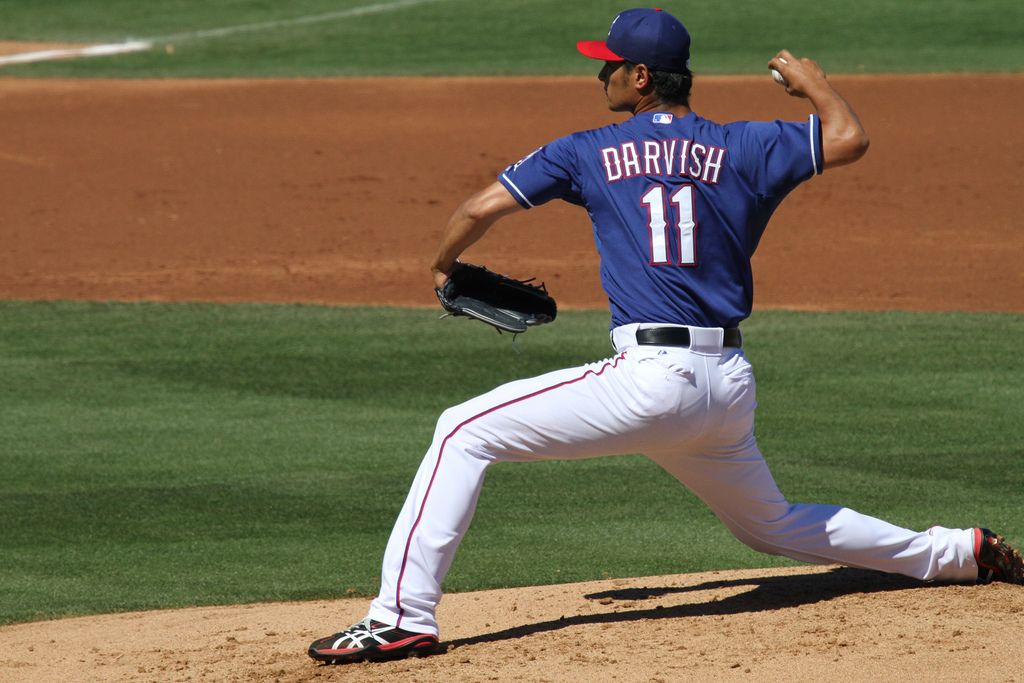
Yu DarvishYesterday (May 10, 2014), Yu Darvish lost a no-hit bid with two outs in the ninth inning, as Boston Red Sox’ DH David Ortiz hit a ground ball single to right.  The Rangers were up 8-0 at the time and Darvish – who had walked two and struck out 12 – was at the 126-pitch point (drat, those pitch counts).  Given the lead and the pitch count, Rangers’ manager Ron Washington brought in Alexi Ogando, who retired Mike Napoli (fly out to left to end the game.)  It left Darvish still waiting to achieve not only his first no-hitter, but also his first major league complete game.

And, it wasn’t the first time Darvish found himself in that situation.  Last April 2, Darvish went into the ninth inning of a game against Houston with a 7-0 lead and a perfect game in progress. He started the inning in fine form, getting DH Jason Castro and catcher Carlos Corporan on ground outs (to SS and 2B, respectively).  Then Astros’ shortstop Marwin Gonzalez hit the first pitch in his at bat (and Darvish’s 111th pitch) up the middle for a ground ball single.  Again, Darvish’s day was done, as Washington brought in Micheal Kirkman to close it out (which he did with a single and a strikeout).

Losing a no-hitter or a perfect game with two outs in the ninth – a rarity?  Not so much.  (Losing both a no-hitter and a perfect game in such fashion, on the other hand, is rare – but has been done, see Dave Stieb below.)  In MLB history, twelve perfect games and at least 48 additional no-hitters have been broken up with two outs in the ninth. (BBRT has found conflicting reports on a 49th such instance.)  In addition, there have been five games in which a no-hitter was broken up with two outs in the ninth inning of a tie game, which then went extra innings, so even if the ninth-inning third out had been made, the no-hitter would not have been completed at the inning’s end.

Here’s a few near no-no stories.

Perfect Games Become No-Hitters

Looking further at those twelve broken perfect games, two of them did end up as no-hitters.  On July 4, 1908, New York Giants’ hurler Hook Wiltse (who would win 139 games in 12 MLB seasons), retired the first 26 Phillies before hitting Philadelphia pitcher George McQuillan with a pitch on a 2-2 count.  It was a scoreless game through nine, and Wiltse went on to pitch a hitless tenth (at least preserving the no-hitter) as the Giants won 1-0. On September 2, 1972, Milt Pappas of the Cubs had an 8-0 lead over the Padres – and a perfect game in progress – as San Diego batted in the top of the ninth.  After retiring the first two batters, Pappas walked pinch hitter Larry Stahl on a 3-2 pitch.  Pappas retired the next hitter, so while he lost the perfect game, he did save the no-hitter.

No-Hitter Lost with Two Out in Ninth in the World Series

Only one of the no-hitters lost with two outs in the ninth came in post season play.  On October 3, 1947, Yankees’ right-hander Bill Bevens was on the verge of World Series history.  Bevens went into the ninth with a 2-1 lead over the Dodgers and had yet to yield a hit (the Dodgers had scored one run in the fifth inning on two walks, a sacrifice bunt and a fielder’s choice). Bevens sandwiched a fly out and foul out around a walk to Dodgers’ center fielder Cal Furillo (Bevens’ ninth walk of the game), and so was just one out from a World Series win and no-hitter.  That’s when the wheels came off. The dangerous Pete Reiser was sent in to pinch hit for pitcher Hugh Casey.  Al Gionfriddo, pinch-running for Furillo, stole second and Reiser was walked intentionally – putting runners on first and second with two outs, the Yankees still with a one-run lead, the no-hitter intact and Cookie Lavagetto pinch hitting for Eddie Stanky (Eddie Miksis was also brought in to run for Reiser). Lavagetto doubled to right on Bevens’ second pitch, both runners scored and Bevens lost the no-hitter and the game.

Dave Steib’s Hard Luck
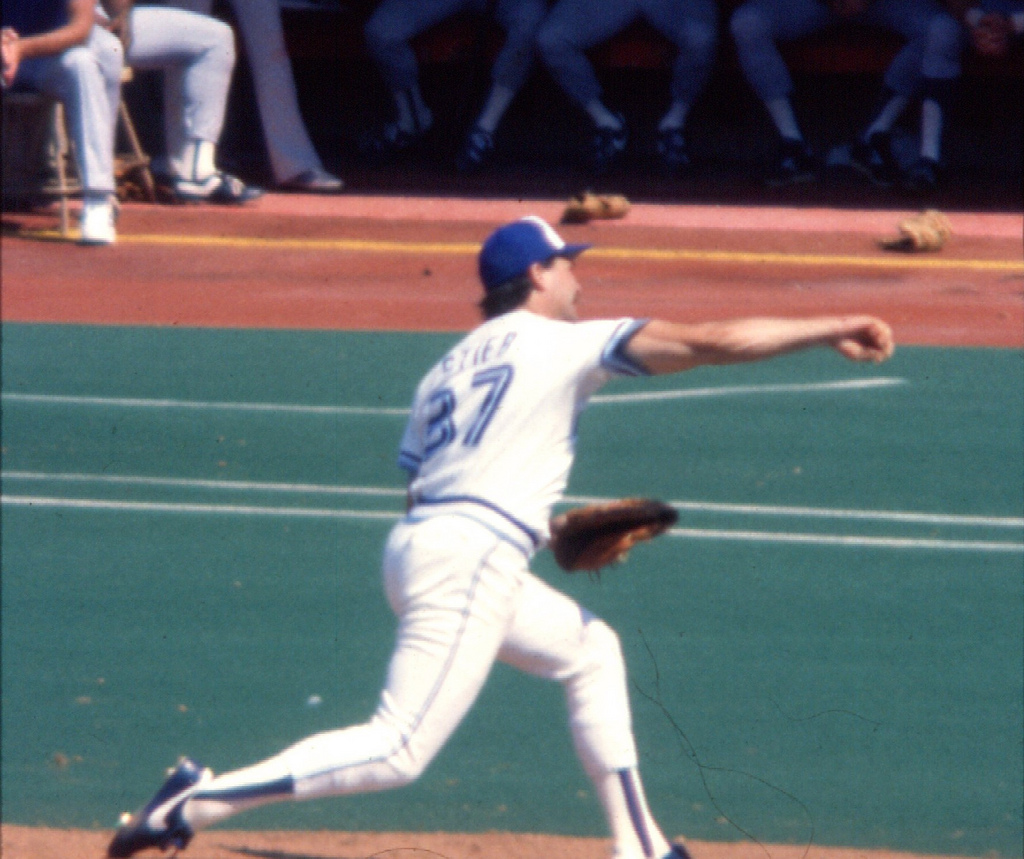
Dave StiebThe Blue Jays’ Dave Stieb took the mound on September 24 and September 30, 1988 (consecutive starts) against the Indian and Orioles, respectively, and produced the same result. In both games, he lost a no-hitter with two outs in the ninth (and a two-ball/two-strike count on the batter). Stieb did get two complete-game shutouts, 1-0 over the Indians and 4-0 over the Orioles. The games were his final two starts of the season, so he had the entire off-season to contemplate his bad luck.  The following season (on August 4, 1989), Stieb found himself again on the brink, this time taking a perfect game in the ninth inning, holding a 2-0 over the Yankees.  He started the inning as though ready to make history, striking out pinch hitters Hal Morris and Ken Phelps on nine pitches.  Then the number-nine hitter, center fielder Luis Polonia, broke up the “perfecto” and no-hitter with a double to left.  Second baseman Steve Sax followed with a run-scoring single, before left fielder Polonia grounded out to end the game. Stieb did finally get his no-hitter on September 2, 1990.

Harvey Haddix’ Worse Luck

For a real hard luck story, there’s the Pittsburgh Pirates’ Harvey Haddix (who is not even on the “lost a perfect game or no-hitter in the bottom of the ninth” list).  On May 29, 1959, Haddix took the mound against the powerhouse Milwaukee Braves (who had won the National League pennant the previous two seasons and came into the game again leading the league.  Haddix retired the first 36 hitters, carrying a perfect game into the bottom of the 13th.  Unfortunately, the Braves Lew Burdette, despite giving up 12 hits and fanning only two, had also held the Pirates scoreless. Felix Mantilla led off the 13th by reaching on error by Pirates’ third baseman Don Hoak. Slugger Eddie Mathews bunted Mantilla over to second, which led to an intentional walk to Hank Aaron, bringing up Joe Adcock. Adcock rapped a 1-0 pitch over the right field fence for what appeared to be a three-run home run.  However, the Braves, in celebrating the tension-filled victory, forgot how to run the bases. Adcock passed Aaron between second and third and, after some deliberation, Adcock was called out – changing his three-run homer to a one-run double. And, on that drive, Haddix lost the perfect game, the no-hitter, the shutout and the game itself.  But he did etch his name forever into baseball lore.

For same past thoughts on completed no-hitter, click here.


I tweet baseball @DavidBBRT

Best Day at the Plate – EVER!

Last July, BBRT posted an article on Tyrone Horne, who on July 27, 1998, became the only professional ballplayer to hit for the “home run cycle” – a solo home run, two-run homer, three-run round tripper and grand slam all in the same game. Horne accomplished the feat at Double A ball, as his Arkansas Travelers topped the San Antonia Mission 13-4.  You can read that post by clicking here.

Today, I’d like to celebrate a college player who also hit for the home run cycle – AND MORE – on this day 15 years ago (May 9, 1999).  The player was Florida State Seminoles’ infielder (3B/2B) Marshall McDougall and on that day – in a 26-2 victory over the Maryland Terrapins – McDougall not only hit for the Home Run Cycle, but added a couple of additional round trippers for good measure.  That day, in fact, he set a still-standing NCAA single game records for home runs (6), RBI (16) and total bases (25). And, as you will see in the video – there were no cheap shots for McDougall on that record-setting day.


I should not here that the game was not one of those early season, out-of-conference mismatches that coaches schedule to build team confidence.  It was an Atlantic Coast Conference game, played at Maryland’s Shipley Field.  Still, it was a bit of a mismatch. Florida State came in with a 43-10 record and a top-five national ranking (the Seminole would finish with a 57-14 record and make it all the way to the title game of the College World Series), while Maryland’s record stood at 21-26 (6-14 in the conference).

McDougall’s, a junior at Florida State was in his first season with the Seminoles, having played and schooled at Santa Fe Community College as a freshman and sophomore (where he was an all-state selection both years).  McDougall continued his strong performance after moving up to Florida State – he was hitting .405, with 17 homers, 70 RBI and 11 stolen bases coming into the May 9 contest.

The day started out mildly enough for McDougall – with a single in the top of the first inning.  But thing heated up from there.  Here’s how his at bats went:

  • First inning – single
  • Second inning – solo home run
  • Fourth inning – three-run home run
  • Sixth inning – two-run home run
  • Seventh inning – three-run home run
  • Eighth inning – grand slam (completing the HR Cycle)
  • Ninth inning – three-run home run

McDougall went on to finish the season, playing 71 games, with a .419 average, 104 runs, 26 doubles, three triples, 28 home runs, 106 RBI and 22 stolen bases in 25 attempts.  He topped all of Division 1 in hits, runs, RBI and total bases –  earning recognition as a first-team All-American and Athletic Coast Conference Player of the Year.  And, McDougall wasn’t done yet.  In the 1999 College World Series, McDougall hit .385, with three doubles, three home runs, six runs scored, eight RBI and one stolen base in six games.  McDougall finished in the top five in nearly every offensive category and lead the Series outright in hits, runs scored, total bases, while also tying for the lead in doubles and home runs.  He was selected to the All-Tournament Team and as the Series’ Most Valuable Player (despite the fact that Florida State lost to Miami 6-5 in the final game).

His senior season was not as spectacular – 72 games, .342 average, 22 doubles, five triples, 15 home runs, 67 RBI and 15 steals – but still earned him the Oakland A’s ninth-round draft pick in 2000.

McDougall spent 5 ½ seasons in the minors (A’s, Indians and Rangers systems) – compiling a .281 average, with 69 home runs, 380 RBI and 52 steals in 563 games – before being called up to the Rangers in June of 2005.  At the time of his call up, he was hitting .341, with 11 home runs and 64 RBI (in 57 games) at Triple A Oklahoma. He got in just 18 games with the Rangers – 18 at bats, three hits, ten strikeouts.

The “rest of the story” reflects McDougall’s passion for the national past time. He started the 2006 season back in the minors (where injuries,wrist and knee, began to take their toll) and from 2006 through 2008 played in the Rangers, Dodgers and Padres systems.  He then went on to play in the Mexican League, independent ball and even in Taiwan.  In 2012, at age 33, McDougall put up a .341-10-32 line in 35 games for the Reynosa Broncos of the Mexican League. In August of 2013, McDougall was named head baseball coach at Wiregrass High School (Wesley Chapel, Florida), leading the team to a District Championship in his first season.

How appropriate that an individual with such a passion for the game would have, arguably, the best day at the plate EVER.


I tweet baseball @DavidBBRT

Baseball Reliquary Announces 2014 Shrine of the Eternals Electees

One of the baseball organizations I am most proud to be a member of is the Baseball Reliquary.  It is an organization truly dedicated to the character and characters of baseball – from the fans’ point of view.  With its passionate, but sometimes  irreverent approach to the national pastime, BBRT likes to think of the Reliquary as “Mardi Gras” for baseball fans.   Each year, the Baseball Reliquary selects inductees to its Shrine of the Eternals, the Reliquary’s version of the National Baseball Hall of Fame.  A few of the Reliquary’s diverse list of past inductees include: National Baseball Hall of Famers Yogi Berra and Robert Clemente; fierce competitor Dock Ellis (who once threw a no-hitter while on LSD); maverick owner Bill Veeck, Jr.; Tommy John surgery pioneer Dr. Frank Jobe; and the San Diego Chicken.  This week, the Baseball Reliquary announced it 2014 Shrine of the Eternals electees.  That follows is the official press release – as well as some closing comments noting non-elected nominees that BBRT voted for (and why). For more on the Baseball Reliquary click here.  I think you’ll enjoy the read.


DIZZY DEAN, DON ZIMMER, AND RACHEL ROBINSON

ELECTED TO THE SHRINE OF THE ETERNALS FOR 2014

BBRThe Board of Directors of the Baseball Reliquary, Inc., a Southern California-based nonprofit organization dedicated to fostering an appreciation of American art and culture through the context of baseball history, is pleased to announce the sixteenth class of electees to the Shrine of the Eternals.  The Shrine of the Eternals is the national organization’s equivalent to the Baseball Hall of Fame.

Dizzy Dean, Don Zimmer, and Rachel Robinson were elected upon receiving the highest number of votes in balloting conducted during the month of April 2014 by the membership of the Baseball Reliquary.  The three electees will be formally inducted into the Shrine of the Eternals in a public ceremony on Sunday, July 20, 2014 at the Donald R. Wright Auditorium in the Pasadena Central Library, Pasadena, California.

Of the fifty eligible candidates on the 2014 ballot, Dizzy Dean received the highest voting percentage, being named on 37% of the ballots returned.  Following Dean were Don Zimmer with 33% and Rachel Robinson with 31%.  Runners-up in this year’s election included Bo Jackson (29%), Glenn Burke (27%), Sy Berger (26%), Effa Manley (25%), Charlie Brown (24%), Bob Costas (24%), Ernie Harwell (24%), Steve Bilko (23%),  and Rocky Colavito (23%).

Dizzy DeanDIZZY DEAN

Elected to the Shrine of the Eternals in his fourteenth year on the ballot, hurler, free-spirit, and malapropster extraordinaire, Dizzy Dean (1910-1974), had a long and eventful life in baseball, both as a pitcher and a broadcaster.  The son of an Arkansas sharecropper, Jay Hanna “Dizzy” Dean signed in 1930 with the St. Louis Cardinals and spent the next two seasons in the minors, peaking with Houston in the Texas League in 1931.  Promoted to the big club permanently in 1932, the boastful Dean quickly became the cornerstone of the Cardinals’ rotation.  The rough and tumble Depression-era Cardinals (dubbed “The Gashouse Gang”) rode Diz’s tongue and golden arm (30-7, 2.65 ERA) to the NL pennant in 1934, besting the Tigers in a memorable seven-game World Series.  Between 1932 and 1936, Dean averaged 25 victories per season and seemed destined to become one of the National League’s winningest pitchers ever until struck on the toe by a line drive during the 1937 All-Star Game.  The injury forced Dean to alter his pitching motion, leading to arm problems which nipped his career in the bud.

After retiring in 1941, Dean immediately moved to the broadcast booth, where he earned a huge local following as the radio voice of the St. Louis Browns, peppering play-by-play with his colorful reinventions of the English language.  To the dismay of English teachers everywhere, Dean became hugely popular with national audiences in the 1950s as the primary broadcaster for network television’s Game of the Week. The subject of a Hollywood bio-pic (The Pride of St. Louis) and numerous biographies, Ol’ Diz was elected to the Hall of Fame in 1953.

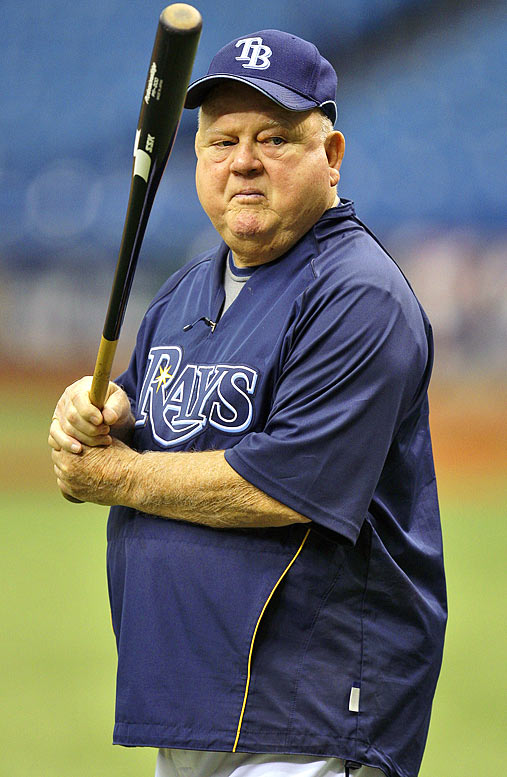
Don ZimmerDON ZIMMER

Elected to the Shrine of the Eternals in his tenth year on the ballot, Don Zimmer (born 1931) is part of a vanishing breed – the baseball lifer.  Now in his eleventh year as a senior advisor for the Tampa Bay Rays (serving as a coach/advisor during spring training and for pregame practices at home games, as well as assisting the Rays in the area of community affairs), Zimmer wears the number 66, representing his 66th year in professional baseball.  He has noted often, and proudly, that every paycheck he’s ever gotten came from baseball, and has never held a job in any other profession.  Zimmer was told his playing days were over after a disastrous beaning in the minor leagues in 1953, but he made it to the Brooklyn Dodgers in 1954, beginning a twelve-year big league career as an infielder.  After the Los Angeles Dodgers’ World Championship season in 1959, Zimmer bounced around with a series of truly bad teams, including the Chicago Cubs and New York Mets, before retiring as a major leaguer with the Washington Senators in 1965.

In 1971, he began a long tenure as a coach and manager for major league teams all over North America, including the Montreal Expos, San Diego Padres, Boston Red Sox, Texas Rangers, Chicago Cubs, San Francisco Giants, and Colorado Rockies.  Zimmer served three coaching stints for the New York Yankees, the last one finding him dispensing his baseball wisdom as bench coach/yogi from 1996-2003, during which time the team won four World Series titles under the helm of Joe Torre.  Zimmer is often remembered for his “brawl” with Pedro Martinez during the 2003 AL Championship series, when he ran at and was thrown to the ground by the Red Sox pitcher.  Nicknamed “Popeye” for his facial resemblance to the cartoon character, Zimmer is still a warrior at age 83.  He has written two autobiographies, Zim: A Baseball Life and The Zen of Zim, and serves as a member of the advisory board of the Baseball Assistance Team, a nonprofit organization dedicated to helping former players through financial and medical difficulties.

Rachel RobinsonRACHEL ROBINSON

Elected to the Shrine of the Eternals in her first year on the ballot, Rachel Robinson (born 1922) is arguably the most important woman in baseball history, as the widow of baseball and civil rights pioneer Jackie Robinson.  Rachel met Jackie while they were students at UCLA and they were married in 1946, the year before Jackie broke major league baseball’s color barrier and changed America forever.  Rachel counseled, consoled, and supported Jackie throughout his career, giving him strength when his will faltered, and she endured with him countless affronts to their dignity.  Jackie often attested, without his wife, he could never have withstood the intense pressures of being the first African American in the major leagues.

Once described by Dodger baseball executive Branch Rickey as Jackie’s “tower to lean on,” Rachel kept her husband’s legacy alive after his premature death in 1972 by founding the New York-based Jackie Robinson Foundation, a nonprofit with the mandate of providing college scholarships and leadership training to promising and talented young people.  “As a nurse [Robinson] has devoted her life to caring for others,” writes Albert Kilchesty, the Baseball Reliquary’s Archivist and Historian.  “She has been honored and celebrated in and out of baseball, and has always been gracious when being acknowledged for her husband’s courage and determination.   But she is more than deserving of applause and recognition on her own merits.  I have never met her.  I have never spoken to her.  Yet I have more admiration and respect for her than nearly any other woman in public life.  She has never played the game – she is the game.”

Dizzy Dean, Don Zimmer, and Rachel Robinson will join 45 other baseball luminaries who have been inducted into the Shrine of the Eternals since elections began in 1999, including, in alphabetical order, Jim Abbott, Dick Allen, Roger Angell, Emmett Ashford, Moe Berg, Yogi Berra, Ila Borders, Jim Bouton, Jim Brosnan, Bill Buckner, Roberto Clemente, Steve Dalkowski, Rod Dedeaux, Jim Eisenreich, Dock Ellis, Eddie Feigner, Mark Fidrych, Curt Flood, Ted Giannoulas, Josh Gibson, Jim “Mudcat” Grant, Pete Gray, William “Dummy” Hoy, Shoeless Joe Jackson, Bill James, Dr. Frank Jobe, Bill “Spaceman” Lee, Roger Maris, Marvin Miller, Minnie Minoso, Manny Mota, Lefty O’Doul, Buck O’Neil, Satchel Paige, Jimmy Piersall, Pam Postema, Jackie Robinson, Lester Rodney, Pete Rose, Casey Stengel, Luis Tiant, Fernando Valenzuela, Bill Veeck, Jr., Maury Wills, and Kenichi Zenimura.

In the coming weeks, leading up to the Shrine of the Eternals Induction Day on Sunday, July 20, 2014, further details will be announced, including the recipients of the 2014 Hilda Award (named in memory of Hilda Chester and honoring a baseball fan’s exceptional devotion to the game) and the 2014 Tony Salin Memorial Award (presented annually to an individual dedicated to the preservation of baseball history).

Paul Dickson, the prolific author and historian, and former recipient of the Tony Salin Memorial Award (2011), will be the keynote speaker for the Shrine of the Eternals 2014 Induction Day.  Dickson’s books include the award-winning Bill Veeck: Baseball’s Greatest Maverick and the most authoritative and comprehensive guide to baseball terminology ever compiled, The Dickson Baseball Dictionary.


BBRT’S SHRINE OF THE ETERNALS BALLOT 

Now, here’s a look a BBRT’s ballot.  I did vote for 2014 honorees Dizzy Dean and Rachel Robinson,whose  contributions are described in the Baseball Reliquary’s release. Here’s a look at the “who and why” of my remaining votes (* indicates still living):

Mamie “Peanut” Johnson (1934 – *)

Johnson was one of three females to play for the Indianapolis Clowns during the declining days of the Negro Leagues.  Johnson took the mound to the Clowns for three seasons (1953-55), running up a 33-8 record.  Her exploits are chronicled in the children’s book A Strong Right Arm: The Story of Mamie “Peanut  Johnson, by Michelle Y. Green.

Rube Waddell (1876-1914)

Rube Waddell is pretty much granted the title of the zaniest player in MLB history – but he was also one of the best (at least when he was focused on the game). Waddell was known to wrestle alligators, leave a ball game to chase a fire engine, miss a game he was scheduled to start because he was fishing or playing marbles with neighborhood kids, bring his outfielders in to sit on the grass and then proceed to fan the side – and frequently do battle with owners and managers.  Waddell, who had an issue with alcohol consumption, was more interested in the freedom to do things his way than money.  But, when Waddell was on his game, he was arguably the best pitcher of his time. The 6’1”, 195-lb. lefty led the AL in strikeouts six consecutive seasons (1902-1907) – by a wide margin.

How good was Waddell?  In 1902, he joined the Philadelphia Athletics in June – making his first start on June 26 (with just 86 games left in the season.) Waddell proceeded to win 24 games (the league’s second-highest total) against seven losses, with a 2.05 ERA.  Perhaps more telling is that, despite his shortened season, he led the AL with 210 strikeouts, fifty more than the runner-up (none other than Cy Young, who had 16 more starts than Waddell). In 1904, Waddell set a modern (post-1900) MLB record with 349 strikeouts that stood until 1965.  In 1904, Jack Chesbro finished second in the AL in strikeouts – 110 behind Waddell – while NL leader Christy Mathewson trailed Waddell by 137 Ks.  Rube Waddell, elected to the National Baseball Hall of Fame in 1946, finished with a 193-143, 2.16 line – leading the AL in strikeouts six times, ERA twice, wins once and complete games once. For more on Waddell, BBRT suggests: Rube Waddell: The Zany, Brilliant Life of a Strikeout Artist, by Allan Howard Levy and Just a Big Kid: The Life and Times of Rube Waddell, by Paul Proia.

Pete Reiser (1919-81)

Combine Willie Mays’ skill set (younger folks, think Mike Trout) with Pete Rose’s hustle and Yasiel Puig’s on-field abandon and you have Pete Reiser. In his first MLB full season (CF, Dodgers), a 22-year-old Reiser dazzled defensively and led the NL in runs scored (117), doubles (39), triples (17), batting average (.343), total bases (299) and hit by pitch (11) – tossing in 14 home runs and 76 RBI for good measure. Unfortunately, unpadded outfield walls, helmet-less at bats (the fiery Reiser was a frequent target) and aggressiveness on the base paths (Reiser twice led the NL in stolen bases) took their toll. In his ten-season career, Reiser endured five skull fractures, a brain injury, a dislocated shoulder and a damaged knee.  He was carted off the field 11 times during his career (six times unconscious) and once actually given last rites at the stadium – and he played on. The three-time All Star retired as a player with a .295 career average, playing in 861 games over ten seasons. No telling what he might have done with padded outfield walls and batting helmets.  Pete Reiser was a true – and talented – gamer. For more on Reiser, try Pete Reiser: The Rough and Tumble Career of the Perfect Ballplayer, by Sidney Jacobson.

Denny McLain (1944- * )

MLB’s last 30-game winner (31-6 for the Tigers in 1968), BBRT views McLain as the Pitcher of the Year in what baseball analysts often refer to as the Year of the Pitcher.  And, he wasn’t a one- year wonder.  McLain won 20 or more games three times, captured two Cy Young Awards (1968-69) and one AL MVP Award (1968).  McLain, who ran up a 131-91, 3.39 record in ten MLB seasons, was a colorful and complex a character off the field and on.  He life experience provides a tale of ups and downs – from being selected the 1968 Associate Press Male Athlete of the Year and Sporting News Major League Player of the Year to a six-year prison stint.  McLain is likely the only former major leaguer whose bio includes such varied terminology as MVP, Cy Young Award, All Star game starting pitcher, World Series opening game starter – as well as pilot, Capitol Records recording artist, talk show host, author and ex-con.  McLain’s story gives baseball fans plenty to talk about – and you can learn more by reading I Told You I Wasn’t Perfect, by Denny McLain and Eli Zaret.   Oh, and just one more bit on Denny McLain.  He started the 1966 All Star game (vs. Sandy Koufax) and retired all nine batters he faced (Mays, Clemente, Aaron, McCovey, Santo, J. Torre, Lefebvre, Cardenas, Flood) on just 28 pitches –striking out Mays, Aaron and Torre.  That alone justifies consideration for the Shrine of the Eternals.

Glenn Burke – (1952-95)

An outfielder for the Dodgers and the Athletics from 1976 to 1979, Burke was the first major league ball player to admit he was gay.  Much like the first African-American players, Burke had to face prejudice on and off field, both overt and covert.  Burke should be honored for the courage to announce his sexual preference in this environment.

In four trying MLB seasons, Burke appeared in 226 games, going .237-2-38, with 35 steals. In August 2013, Burke was among the first class selected to the National Gay and Lesbian Sports Hall of Fame. A documentary film: Out: The Glenn Burke Story was released in 2010. In addition, Burke co-authored (with Erik Sherman) Out at Home: The Glenn Burke Story.

In a less significant event, Burke is credited with teaming up with Dusty Baker to create the “high five.”  In the final game of the 1977 season, Baker rapped his 30th home run of the year (making the Dodgers the first team to boast four players with 30 home runs in the same season). When Burke ran onto the field to congratulate Baker he raised his hands over his head. Not sure how to respond, Baker chose to slap one of Burke’s hands and – legend has it – the high five was born.

Effa Manley (1900-81)

The first woman enshrined in the National Baseball Hall of Fame, during the 1930s and 1940s, Manley ran the day-to-day operations of the Negro National League Newark Eagles (owned by her husband Abe Manley) – at a time when baseball, on the field and in the executive offices, was considered a “man’s domain.”  Effa, often thought of as a light-skinned black, was actually white.  She, however, grew up with a black stepfather and mixed race siblings and was active in the New Jersey branch of the NAACP and Citizen’s League for Fair Play.  Effa Manley deserves recognition for overcoming both racial and sexual barriers as she exercised leadership in the national pastime.

David Mullany (1908-90)

David Mullany was the inventor of the Wiffle® Ball (1953), which ultimately changed backyard baseball for millions of young (and old) players and fans. I know I loved my white perforated plastic ball and yellow plastic bat – and played more then one backyard World Series  opener with them (without shattering a single window).  Today, there are Wiffle Ball fields, leagues and tournaments.  The company is still operated by the Mullany family and you can learn more by visiting their website (www.wiffle.com)


I tweet baseball @DavidBBRT

Stan Musial & Nate Colbert – Linked in MLB History

http://

On this day six decades ago – May 2, 1954 – Stan “The Man” Musial had one of the greatest days at the plate in major league history.  That day, the New York Giants faced Musial’s Cardinals in a double header before 26,662 fans at Busch Stadium (I).   (Keep that number of fans in mind, it will come into play later.)

As the Cardinals won Game One 10-6, Musial was brilliant, recording four hits and a walk in five plate appearances – including a solo home run in the third inning, a two-run homer in the fifth and a three-run blast in the eighth.  It was the first time Musial had hit three round trippers in a single game.  He ended with contest with three runs scored and six RBI.

Musial reportedly enjoyed a between-games sandwich and glass of milk before going out to face knuckleballer Hoyt Wilhelm in Game Two.  If Stan was going to continue his long-ball heroics, he would have to provide his own power – and he did.

In Game Two, Musial collected two hits and a walk in five plate appearances – including a two-run homer in the fifth inning and a solo shot in the seventh, scoring three runs and driving in three in a 9-7 Cardinals loss.

So, for the doubleheader, Stan Musial was six-for-eight, with two walks, six runs scored, nine RBI and five home runs.


The Musial/Colbert Link

Musial, that day, became only the first MLBer to hit five home runs in a double header.  Ironically, among the 26,662 fans witnessing Musial’s feat was eight-year-old Nate Colbert – who, on August 1, 1972, would become the second player in MLB history (and there are still only two) to hit five round trippers in a double header.

http://

On August 1, 1972, lightning struck again.  This time from the bat of Nate Colbert, whose San Diego Padres faced the Atlanta Braves in a double header before a meager crowd of 5,784 at Atlanta.  Colbert got his day off to a quick start, as the Padres’ clean-up hitter hit a three-run homer in the top of the first inning.  Colbert went on to add a run-scoring single in the third, another single in the fourth, and a solo homer in the seventh before striking out to open the ninth.  For the game, won by the Padres 9-0, Colbert was four-for-five, three runs scored, five RBI and two home runs.  COLBERT WAS JUST GETTING STARTED.

Game two started out quietly enough, with Colbert drawing a first-inning walk. Things heated up fast, as Colbert added a grand slam in the second, a ground out to third base in the fourth, a two-run homer in the seventh and a day-topping two-run round tripper with  two out in the ninth.  In the process, he went three-for-four with three runs scored and eight RBI – becoming only the second player with five home runs in a double header. (The Padres, by the way, won game two 11-7.)

For the double header, Colbert was seven-for-nine, with a walk, seven runs scored, 13 RBI and five home runs.  Stan Musial, however, was not in the stands.


I tweet baseball @DavidBBRT

BBRT Looks Back at April

Those old days.With the first full month on the 2014 season behind us, it’s time for BBRT’s monthly observations – tidbits from the previous 30 (or 31) days that caught my attention – some long, some short, some (hopefully) interesting.   So, here we go – all statistics are through April 30.


What If the Post Season Began May 1

If the post season began May 1, your playoff teams would be:

AL:  Division Leaders – Yankees, Tigers, A’s; Wild Cards: Royals, Rangers.

NL:  Division Leaders – Braves, Brewers, Giants; Wild Cards: Mets, Nationals.

Jose Abreu’s Fast Start

On April 25, White Sox 27-year-old rookie first baseman Jose Abreu (who defected from Cuba in August 2013) rapped a pair of home runs (including a walk-off grand slam) in a Chicago 9-6 win over Tampa. The blasts were Abreu’s 8th and 9th of April, moving him past Albert Pujols (Cardinals-2001), Carlos Delgado (Blue Jays-1994) and Kent Hrbek (Twins-1982), who had shared the rookie record for April home runs at eight.  Abreu ended the month with a new rookie records for April in home runs (10) and RBI (32) – both of which also led all of MLB.

Colabello Bringing Home Runs

If it weren’t for White Sox rookie Jose Abreu’s MLB-leading 32 RBI, the talk of baseball might well be Twins’ outfielder Chris Collabello – second in the AL with 27 RBI.  Colabello is one of the “feel good” stories of the 2014 season, signed by the Twins in 2012 after seven seasons in independent league ball.

http://

Albert Pujols’s Called “Shots”

Albert Pujols continued his march toward the Hall of Fame this April.  On Tuesday, April 22, Pujols hit a pair of home runs – becoming just the 26th player to reach 500 round trippers and the first to hit numbers 499 and 500 in the same game.  Even more impressive, teammates reported that Pujols, disappointed with an 0-for-five the night before, predicted before the game that he would hit a pair of homers.  Pujols closed April with a .279-9-23 line.

Royals Lack of Punch

The Kansas City Royals, as a team, out-homered MLB home run leader Jose Abreu by just one (11-10) and Albert Pujols by two through April.

Milwaukee Brewers – Surprising Road Warriors

Most analysts predicted a tight race in the NL Central – involving the Cardinals, Reds and Pirates.  If April is any sign, they were wrong on both counts.  Clearly the surprise team of the 2014 season (thus far), the Milwaukee Brewers ended April with 20-8 record – the best in baseball – and a 5 ½ game lead over the second-place Cardinals.  And, they did it on the road, compiling an 11-2 road record through April 30.  Further, it was no easy “away” schedule.  The Brewers road start included three-game sweeps of the Red Sox and Phillies; three victories in four games against the Pirates; and two wins in three games at Saint Louis.

The Brew Crew has been led on offense by Ryan Braun (proving himself after his  PED-suspension) at .318-6-18; Carlos Gomez (proving 2013 wasn’t a fluke) at .293-7-15; and Aramis Ramirez (.277-3-19).  In addition, their top four starters (Yovani Gallardo, Wily Peralta, Kyle Lohse, Marco Estrada) went 11-3, with a 2.41 ERA.

But the MVB (Most Valuable Brewer) has to be closer Francisco Rodriguez, leading all of  MLB with 13 saves (in 13 save opportunities), and not touched for a single run (earned or unearned) in 16 April appearances – 16 innings pitched, no runs, seven hits, four walks and 23 strikeouts.

Unexpected Leaders

When the Dodgers and Twins faced off in Minneapolis on April 30, two of MLB’s unexpected offensive leaders were on the field.  There was Twins’ second baseman Brian Dozier – leading all of MLB with 25 runs scored, despite a .216 batting average. Dozier, however, had also collected 19 walks (for a .347 on-base-percentage). Also of note, Dozier had seven home runs, but only nine RBI.  On the other side of the contest was Dodgers’ second baseman Dee Gordon, who (despite all the preseason publicity surrounding the Reds’ Billy Hamilton’s speed) was leading all of baseball with 13 stolen bases (in 14 tries). Hamilton, by the way, had 11 steals in 16 attempts.

Brewers’ Free Swinger

Brewers outfielder Khris Davis may be MLB’s freest swinger.  Through April 30, in 105 plate appearances, Davis had drawn just one walk, against 32 strikeouts (hitting .238, with three home runs and eight RBI.)

A Free Swinger Who Makes Contact

Braves’ shortstop Andrelton Simmons is nearly as hard to walk as Khris Davis, drawing only two walks in 94 plate appearances through the end of April.  Simmons was nearly as difficult to strike out as walk, however, whiffing only three times in that span (while hitting .289). Clearly, you can expect Simmons to put the ball in play.

Starters Injured – Just Adjust

The lowest ERAs in baseball belong to the Braves (leading the NL at 2.59) and the Athletics (atop the AL at 2.78) – two teams that suffered significant losses to their starting rotations.

The Braves looked to be in trouble as they approached the season with 60 percent of their starting rotations on the shelf –  Kris Medlen and Brandon Beachey out for the season after Tommy John surgery and Mike Minor on the DL with a sore shoulder.  The Braves, however, didn’t sit back and fret, they signed veterans Ervin Santana and Aaron Harang and plugged in rookie David Hale (6-9, 3.22 at AAA last season). The result – the Braves have ridden the revised rotation to a 17-8 record and first place in the NL East.  At the end of April, the Braves had the lowest ERA in the NL (2.59) – and their starters records were: Harang 3-2, 2.97; Santana (3-0, 1.95); Hale (1-0, 2.31) and holdovers Julio Teheran (2-1, 1.47) and Alex Wood (2-4, 2.93).

Like the Braves, Oakland looked to be in pitching trouble at the start of the 2014 season – losing key rotation members Jarrod Parker and A.J. Griffin.  The result? A month into the season, the As have the AL’s lowest ERA at 2.78 – with a starting corps led by Sonny Gray (4-1, 1.76); Jesse Chavez 2-0, 1.89; and Scott Kazmir (4-0. 2.11)

http://

Ike Davis – Grand Slams

Continued evidence of BBRT’s assertion that in baseball we keep track of everything, on April 21 Pittsburgh first baseman Ike Davis became the first player to hit grand slams for two different teams in the same April. Davis also had the distinction of hitting two grand slams against the same opponent for two different teams in the same month. Davis’ April 21 slam helped the Pirates defeat the Reds 6-5 in Pittsburgh. Davis, who had been traded from the Mets to the Pirates just three days before, hit a game-winning, ninth-inning pinch hit grand slam for the Mets as the New Yorkers beat thee Reds 6-3 on April 5. Davis is also just the third player to belt grand slams for different teams against the same opponent in the same season. Oh, and those grand slams were Davis’ only home runs through April.

Rockies’ Charlie Blackmon Leads NL Batting Race

In 2013, the Colorado Rockies Michael Cuddyer – with a previous batting average high of .284 in his 12-year MLB career – surprised the NL by hitting a league-leading .331.  Through this April, Cuddyer hit at a .317 pace, but that was 57 points short of league-leader Charlie Blackmon (.374), another surprising Rockie.  Still, Blackmon should be less of a surprise than Cuddyer.  The 24-year-old Blackmon hit .309 in six minor league seasons and .309 in 82 games for the Rockies last season. Blackmon does appear to like the Rocky Mountain air. Through April 30 he was hitting .478 at home and .283 on the road.

Angels Finding A Way To Lose

The Angels ended April with the second-highest positive run differential in baseball, outscoring their opponents 140 to 109, yet were just one game over .500 (14-13 and trailing Oakland and Texas in the AL West).

Yankees Finding Ways to Win

The Yankees had a negative-eleven run differential (scored 110, gave up 121), yet still stood on top of the AL East at 15-11.

The Over and Under

The AL East ended April with just one team over .500 (Yankees), while the NL East had only one team under .500 (Miami at 13-14).  Further, through April 30, all five AL Teams had given up more runs than they have scored.

Worst Records Well-Earned

The Arizona Diamondback, with the NL’s worst record through April (9-22), were outscored by 62 runs (179-117) in their first 31 games. Holding the AL’s worst record  (9-19), the Houston Astros were outscored by a 54 runs in 28 games.

Two Five-Game Winners

April closed with two five game winners in MLB, The Dodgers’ Zach Greinke (5-0, 2.04) and the Cardinals Adam Wainwright (5-0, 1.20).

Tanaka and Fernandez for Real

A couple of questions raised before the 2014 season: 1) Was the Yankees’ investment in Masahiro Tanaka (24-0, 1.27 in Japan in 2013) justified?  2) Was Miami’s Jose Fernandez really that good (after winning NL Rookie of the Year with a 12-6, 2.19 record in 2013)?  The answers:  Yes and Yes.  Tanaka ended April 3-0, with a 2.27 ERA and 46 strikeouts in 35 2/3 innings, while Fernandez was 4-1, 1.59 with 55 strikeouts in 39 2/3 innings.


I tweet baseball @David BBRT

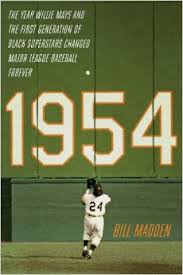
Book Review – 1954 by Bill Madden – A fun, and thought-provoking, read

1954

1954 – The Year Willie Mays and the First Generation of Black Superstars Changed Baseball Forever


By Bill Madden


Da Capo Press 2014


$25.99


Baseball is often referred to as America’s most literary sport, and there is no doubt that Bill Madden has contributed to that reputation.  In 2010, Madden was recognized with the J.G. Taylor Spink Award – the highest honor given by the Baseball Writers’ Association of America – and enshrined in the writers’ wing of the National Baseball Hall of Fame.  Fortunately, for fans of baseball and its literature, Madden did not choose to rest on his laurels. Instead, he continues to add to his reputation, which gets another boost from latest book: 1954 – The Year Willie Mays and the First Generation of Black Superstars Changed Baseball Forever.

Within the back drop of the 1954 pennant races and World Series, Madden gives readers a look at how attitudes toward race – in baseball and across American society – were changing. Consider what was going in baseball in 1954:

  • Larry Doby, the first black player in the American League (Indians, 1947), led the AL in home runs and RBI while helping Cleveland achieve an 111-43 record – breaking a five-season Yankee stranglehold, not just on the AL pennant, but also on the World Series championship.
  • Willie Mays returned from military service to top the NL with a .345 average and capture the MVP Award, while leading the Giants to the NL title.
  • Hank Aaron who, in 1953, had led the Class A Sally League in batting average, RBI, runs and hits, made the jump from Class to the majors, as well as the move from second base to the outfield – where he would join Billy Bruton, the 1953 NL stolen base leader (and first black player to make the major leagues without previous Negro League experience).
  • The Cubs began the season with the first all-black, shortstop-second base, double play combo – Ernie Banks and Gene Baker, who had both seen action when the team integrated in  late in 1953.
  • On July 17, 1954, the Brooklyn Dodgers broke baseball’s unspoken, but implied, racial quota by starting a line up with more blacks than whites.
  • The World Series, for the first time ever, saw black players on both teams’ rosters.

Madden deals with these and other historically and socially significant on-the-field achievements and advancements, and also gives readers a look at the intolerance and indignities black players faced in the early 1950s. He recounts the roadblocks many highly talented black players faced in even getting to the majors (keep in mind, as Spring Training opened in 1954, only eight of the major leagues sixteen teams had integrated).  And, things were not much easier once a player made the leap to the majors (and found on-field success).  Black players found themselves having to stay in separate hotels or negotiating the right to stay in the team’s chosen hotel only if the they agreed to stay out of such areas as the lobby, dining room or swimming pool. Madden, through observation and interviews, provides unique insight in how different players – Jackie Robinson, Larry Doby, Hank Aaron, Don Newcombe and others – handled these (and even more glaring) slights, inequities and prejudices.  (I found Madden’s reporting of the fiercely negative reaction to the the first Sports Illustrated cover to feature an athlete of color – April 11, 1955, with Leo Durocher, Durocher’s wife, actress Laraine Day and Willie Mays – particularly telling.)

While 1954 provides an important (and, I am sure for many, eye-opening) social commentary on the times, it also includes plenty of baseball action, told in the words of the participants, news coverage of the day and Madden’s own captivating prose.  There are accounts of key games, great plays and clutch hits that carry the reader through the 1954 season and World Series.

Overall, 1954 gives the reader the “feel” of the season and the times.  You can feel the anger and frustration of black players striving not just for recognition, but basic respect and fairness, as well as the tension of on-field rivalries and tough pennant races.  As you read, you also get a feel for the churn and change taking place in the game (on the field, in the club house and in the executive offices).  Ultimately, 1954 provides insight into how baseball in the 1950s – despite its flaws and shortcomings – was actually out in front of the curve when it came to the acceptance of black Americans.

And, there are “back stories” as well.

  • How – had the Red Sox been less reluctant to integrate or the Giants willing to part with just $100 a month more – baseball might have seen Willie Mays sharing the outfield with Ted Williams or Hank Aaron.
  • The fact that, with just one game left in the season, the NL batting race saw three players separated by .0004: Don Mueller at .3426, Duke Snider at .3425 and Willie Mays at .3422.
  • The tough, grind-it-out attitude of the players in the 1950s, illustrated particularly well in an injured Al Rosen‘s 3-hit, 2-homer, five-RBI performance in the 1954 All Star Game.
  • The negative reaction of players, managers and coaches to a 1954 rule change that required players to bring their gloves into the dugout when their team came to bat. (It had been baseball custom until then for fielders to leave their gloves on the field when they came in to bat, and just pick them up when back on defense.)
  • Mickey Mantle’s own assessment of the “Who was New York’s best center fielder  – “Willie (Mays), Mickey (Mantle) or the Duke (Snider)?” question.
  • Minnie Minoso’s thoughts on why he led the AL in hit-by-pitches ten times from 1951-1960.

1954 is a solid addition to Madden’s work and to the overall library of baseball literature. It provides readers not only with a look at one of baseball’s most exciting seasons, but also insight into the racial tensions being felt not just across the national past time, but across the nation.  It works on many levels, as a sports book, history book and social commentary.  It  is a fun, but also thought-provoking, summer read for baseball fans.


Other books by Bill Madden:

Steinbrenner: The Last Lion of Baseball

Pride of October: What It Was to Be Young and a Yankee

Zim, A Baseball Life (with Don Zimmer)

Damned Yankees: Choas, Confusion, and Craziness in the Steinbrenner Era (with Moss Klien)


I tweet baseball @DavidBBRT

Instant Replay Too Long? How About A Run Added Three Innings Later?

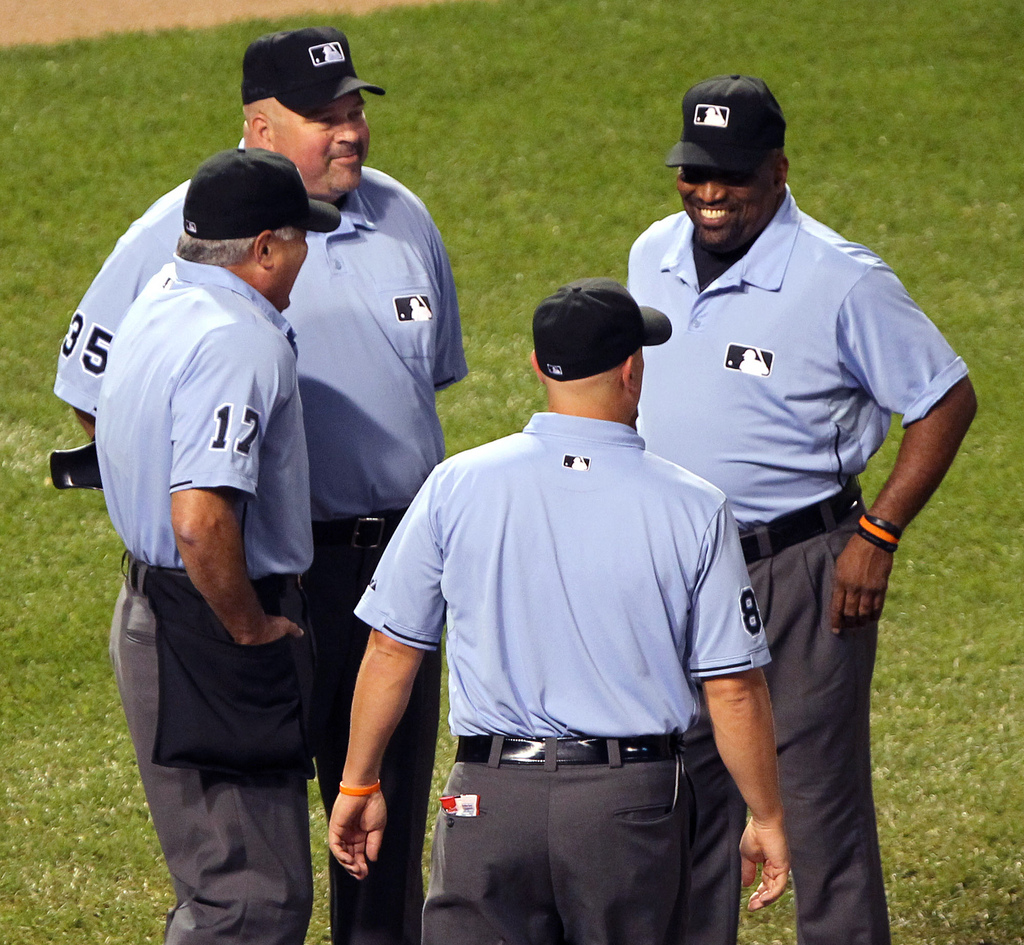
Even these guys need to consult the rule book sometimes.

Even these guys need to consult the rule book sometimes.

Are you, like me, dismayed by “instant” replay decisions that are occasionally taking four minutes or more? How about a ruling that took three innings?

In an April 28, 2007, game at Cleveland, the Baltimore Orioles were awarded a run, on an overturned umpire’s ruling, three innings after the base runner crossed the plate.  It was a situation that tested the “language of the law.”

It all started with the game tied 1-1 in the top of the third.  With Jeremy Sowers on the mound for the Indians, Orioles’ lead-off hitter and second baseman Brian Roberts singled past third base and then stole second. Baltimore third baseman Melvin Mora then walked (putting runners on first and second). Right fielder Nick Markakis followed with a weak grounder to Indians’ shortstop Jhonny Peralta, who tossed to Josh Barfield at second for the force out (remember that term – “force out”).  On the play, Roberts moved to third base and Markakis was safe at first on a fielder’s choice. Next up was Orioles’ clean-up hitter and shortstop Miguel Tejada, who singled to right, scoring Roberts and sending Markakis to third.

Then the fun began. With Markakis on third and Tejada on first with one. Orioles’ catcher Ramon Hernandez laced a line drive to center field that looked like a sure base hit. Speedy Indians’ outfielder Grady Sizemore, however, made a diving catch. Markakis tagged up, headed for home and appeared to cross the plate before Tejada, who had been off with the hit, was doubled off first. Plate umpire Marvin Hudson waved off the run – apparently in line with the rule that if the third out of an inning is recorded on a force out (or by a batter who failed to reach first) a run cannot score on the play,

No one protested at the time, the call stood and the game continued.  In the top of the fourth, however, Orioles’ coach Tom Trebelhorn raised concerns about the ruling with the umpires.   The game continued and, between innings, so did the umpires’ discussion of the call. After considerable discussion and a check of the rulebook, the umpires’ – in the sixth inning – put the Markakis’ third-inning run on the scoreboard. This prompted the Indians to play the game under protest, not because of the ultimate ruling, but on its timing. Cleveland maintained the run could not be added after the game had continued.

What was all the confusion?  It comes to those key words “force out.”  First, we can set aside the rule that a run cannot score on a play if the third out is recorded by a batter failing to reach first base.  The catch of Hernandez’ fly was the second out.  But what about the stipulation that a run cannot score if the final out of an inning is a force out.  Here’s where the language of the law comes into play. The rules define a force situation as occurring when a base runner is forced to leave his time-of-pitch base because the batter has become a runner. A runner at first base is forced to attempt to advance to second base when the batter becomes a runner and runners at second or third base are forced to advance when all bases preceding their time-of-pitch base are occupied by other base runners (who are also forced to advance). However, a runner who fails to tag up and is thrown out, even though he is required to retreat to his time-of-pitch base and a tag is unecessary, is not considered to have been retired through a  forced out.  Therefore, since Markakis touched home plate before Tejeda was doubled off first (his time-of-pitch base), the run counted.

By the way, the Indians protest was denied on the grounds that, since the umpires’ error involved specific rules and not a judgment call, and because there was nothing in the Official Baseball Rules to address exactly when umpires can make a such a correction, the umpires could correct the mistake retroactively.

For those with the need to know, Baltimore won the game 7-4.


I tweet baseball @DavidBBRT

BBRT’s John Paciorek Award


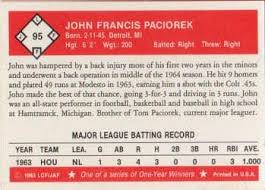
JP AwardBBRT today launched its own baseball award – The John Paciorek Award – or JPA (which could stand, in this case for “Played Just Abit.”  The JPA will recognize players who have had short, maybe very short, major league careers, but whose accomplishments, nonetheless, deserve recognition.  Just as the emergence of these  players on the MLB scene was often unexpected, the JPA will be awarded on no specific/expected timetable.  BBRT, in fact, most often uncovers these brief, but bright, stars when researching some unrelated baseball topic.  Spoiler Alert – the first JPA winner is San Francisco Giants’ infielder Brian Dallimore, but first a bit about John Paciorek, whose MLB career is the inspiration for this recognition. (Note: Just as the Cy Young is the answer to the trivia question, “Who is the best pitcher to never win a Cy Young Award?”, BBRT hopes John Paciorek will be the answer to: “Who is the most interesting MLBer to never be recognized with the John Paciorek Award?”

John Paciorek’s baseball history and heritage is, indeed, interesting.  First, John Paciorek made it to the major leagues at a very young age.  Signed out of Saint Ladislaus High School in Hamtramck, Michigan (where he had starred in football, basketball and baseball), Paciorek appeared in his first major league game on the final day of the 1963 season (September 29) at the age of 18.  Second, Paciorek comes from a true baseball family.  He was the first born of eight siblings and was followed to the big leagues by younger brothers Jim and Tom Paciorek.  (Like John, Jim’s MLB career was short – 48 games for the Brewers in 1987. Brother Tom, however, achieved a .282 average over an 18-season – 1,392 game – MLB career.)

But, back to John.  The 6’ 1”, 200-pound outfielder, had spent the 1963 season with Class A Modesto Colts, hitting just .219 in 78 games.  The parent club, the Houston Colt .45s (that was their name then), however, was suffering through a difficult season – they were 65-96 going into that final game.  The September 1963 Colt .45s were all about the future and, in fact, on September 27, had fielded an all-rookie lineup (average age 19). So, John Paciorek’s spot in the season’s final starting lineup was no surprise. What he did that day, however, was.

pACIOREKPlaying right field and batting seventh in a 13-4 win over the NY Mets, Paciorek ended up with three hits and two walks in five plate appearances, with four runs scored and three runs batted in.  Perhaps equally surprising is that it marked Paciorek’s only MLB appearance.  Back pain the following spring, followed by back surgery (he played 49 minor league games in 1964 and missed all of the 1965 season) put an end to his MLB playing days. (He did play in four more minor league seasons.)  Still, you will find John Paciorek in the Baseball Encyclopedia and his is arguably the greatest one-game MLB career ever.  Among one-gamers, he holds the record for times on base and runs scored, and shares the record for batting average, on base percentage and RBIs.  You can find more details on Paciorek’s lone major league game here.

Paciorek, by the way, went on to become a high school teacher and multi-sport coach, and the author of two books (Plato and Socrates – Baseball’s Wisest Fans and The Principles of Baseball, and all there is to know about hitting.) You can enjoy Paciorek’s prose directly at his blog “Paciorek’s Principles of Perfect Practice.”

So much for the inspiration – now, on to the first JPA winner.

Brian Scott Dallimore did not, like John Paciorek, make it to the big leagues at a young age.  He was, in fact, a 30-year-old veteran of eight-plus minor league seasons when he finally got the call. He was, in baseball parlance, a true journeyman.  He had journeyed from minor league city to minor league city, seven teams in those eight years.  He had also journeyed from one parent team system to another (Astros, Diamondbacks and Giants).  And, he had traveled around the infield, playing third base, second base and shortstop. What he had never done was give up on the dream.  And, things were looking up.

From 1996-2000, Dallimore played in 468 minor league games (never above AA), compiling a .264 average (with a high of .275 in 2000).  Then, in 2001, things seemed to click, as Dallimore hit .327, with eight home runs, 67 RBI and 11 stolen bases for the Diamondbacks’ AA affiliate El Paso Diablos.  He followed that up with a .294-6-50, 13 SB season at AAA Tucson.  He was, however, 28 and the Diamondbacks did not resign him.

Dallimore signed a minor league deal with the Giants and went on to hit .352 in 91 games with AAA Fresno in 2003. That performance didn’t earn him a September call up, but it helped get him his first-ever invite to major league camp for  2004 Spring Training, where he hit .279 in 21 games.  While he started the 2004 season back at Fresno, the minor league veteran had been noticed.  The Giants’ players selected Dallimore as the winner of the 2004 Harry S. Jordan Award, annually recognizing a player in his first Spring Training whose performance and dedication to the game best reflected the spirit of the San Francisco Giants.

Dallimore didn’t know it then, but he was only a poor Giants’ start and an injury to Ray Durham away from finally making his major league dream come true.  Dallimore was called up to the big club and made his debut as a pinch hitter (grounding out) on April 29th, 2004.  It was his performance on April 30th, however, that earns Dallimore the first-ever BBRT John Paciorek Award.  In fact, if it wasn’t for that April 29th pinch hitting appearance, Dallimore would have recorded one of the best first games ever in the MLB history.  As it was, he still carries the honor of having his first major league hit be a grand slam home run.  In a game won by the Giants 12-9 (and in which the score stood at 9-9 after just two innings), Dallimore walked and scored in the first inning, crashed a grand slam home run for his first MLB hit in the second, singled in the third, singled and scored in the fifth, and was hit by a pitch in the sixth. So, for his first start, Dallimore was on base five times in five plate appearances, had two singles and a home run (grand slam) in three at bats, scored three runs and drove in four.

Dallimore ended up hitting .279 with one home run and seven RBI in 20 games for the Giants that year – he also went .324-8-65 in 111 games back at Fresno. He played seven more games at the major-league level in 2005, hitting a double in seven at bats (he also hit .302-8-45 in 100 games at Fresno that season.)

Dallimore signed as a free agent with the Brewers after the 2005 season, but retired before the 2006 season began.  Despite his short stint in the majors, on April 30, 2004, Brian Scott Dallimore truly had his day in the sun – or in this case under the lights. So, for that – and for his love of the game – BBRT selects him as the first JPA winner.


                                                   BRIAN DALLIMORE


BBRT invites your nominations for the JP Award – players with short, but notable, stays in the major leagues.

I tweet (on X) baseball @DavidBaseballRT.


Pitchers Gone Wild!

NOT ALWAYS THAT EASY TO CONTROL!!!

NOT ALWAYS THAT EASY TO CONTROL!!!

Earlier this week (Wednesday, April 16), The Red Sox topped the White Sox 6-4 in a game in which nine White Sox pitchers (including infielder Leury Garcia, who took the loss) issued 15 walks.  The Red Sox used a pair of free passes and a double to score two runs in the top of the 14th inning to pull out the victory.  The very next day, in the second game of a split doubleheader, BBRT’s home team Twins – trailing the Blue Jays 5-3 in the bottom of the eighth – put together a six-run, game-winning rally on the backs of eight walks, three wild pitches and one lone hit (a Jason Kubel single).

Those two games got BBRT thinking about what events might be found if they made a low-budget video of “Pitchers Gone Wild.”

First, while the games mentioned above might make the cut, they would be far from the headliners.  Those fifteen walks by the White Sox fell short of the record (for one team) for walks in a game.  The record for a nine-inning contest stands at 18, accomplished twice.  First, on May 9, 1916, three Philadelphia Athletics hurlers walked 18 Tigers in a 16-2 loss at home. Lefty Carl Ray, whose MLB career consisted of just five appearances, took the brunt of the punishment.  Ray came on in a mop-up role with the Athletics down 9-0 after two innings.  He threw the final seven frames, giving up seven runs on six hits and twelve walks.  By the way, the Tigers also contributed to the Pitchers Gone Wild audition in this game – the two Tiger pitchers gave up a combined 12 walks, playing a solid supporting role in setting the record for most walks by both teams in a nine-inning contest (30).  The magic number of 18 walks in nine innings was reached again on May 20, 1948, when a pair of Red Sox pitchers walked 18 in a 13-4 loss to the Indians in Cleveland.

Note: The pre-1900 record for walks by one team in a nine-inning game is 20, by the American Association (then a major league) Cleveland Blues (versus the Louisville Colonels) on September 21, 1987.  The National League record of 17 has been reached three times.

The record for walks in a single game (including extra innings) is held by the Cleveland Indians, whose used seven pitchers and issued 19 free passes in a 20-inning 8-6 loss to the Washington Senators on September 14, 1971.  Here again, the opposition held up its send of the Pitchers Gone Wild script, with the Senators using nine pitchers to issue eleven walks, setting the extra-inning walks record by both teams at 30 (equal to the nine-inning record.) Notably, two well-known starters were in the game at the end, with former Tiger and last MLB single season 30-game winner Denny McLain picking up the win for the Senators, and Cleveland’s hard-throwing Sudden Sam McDowell taking the loss.

Turning now to the eight walks the Blue Jays “gave” to the Twins in a single inning – again, the total is short of the record.  On September 11, 1949, four Washington Senators’ pitches gave up 12 runs to the Yankees in the bottom of the third inning of a 20-5 loss to the Bronx Bombers – courtesy of a record (for a single inning) eleven walks, accompanied by two doubles, two singles and an error.  During the inning, a record four Yankees were walked twice – Cliff Mapes (RF), Charlie Keller (LF), Joe Collins (1B), and Jerry Coleman (2B). The Yanks, by the way, scored their twenty runs on a combination of 17 hits and 17 free passes.

Pitchers Gone Wild was the theme in the seventh inning of the White Sox/Athletics game of April 22, 1959 – when the Sox scored eleven runs off three As’ pitchers on just one hit (a single). The inning started off with two errors (by the shortstop and third baseman) and a single (actually three errors, the third hitter, Johnny Callison, hit a run-scoring single and a second run scored on an error by the right fielder).  It was then that the fun began.  The Sox went on to collect 10 bases on balls (a record eight with the bases loaded) and one hit-by-pitch (with the bases loaded) for eleven runs.

Pitchers Not As Wild As You Might Think. Sometimes looks can be deceiving.  On May 2, 1956, The Giants and Cubs (playing in Chicago) matched up in a 17-inning contest (won by the Giants 6-5) that featured 19 bases on balls.  The pitchers, however, were not that “out of control” – a record 11 of those were intentional walks – and ten of the eleven worked as planned.

  • In the bottom of the second, with a man on second and two out, the Giants’ Al Worthington intentionally walked Cubs’ catcher Hobie Landreth to get to pitcher Russ Meyer (who grounded to end the inning, preserving a 1-1 tie).
  • The next intentional pass didn’t come until the top of the eighth (with the Giants up 5-4), when the Cubs’ Russ Meyer intentionally walked Giants’ catcher Wes Westrum with a man on second and two out to bring up pitcher Don Liddle (who flied out to end the inning).
  • Things got a little more complicated in the bottom of the ninth, when – with the game tied 5-5 – Giants’ reliever Hoyt Wilhelm faced Cubs’ slugger Ernie Banks with the winning run on second base. Wilhelm intentionally walked Banks, then Steve Ridzik was brought in and intentionally walked Cubs number-five hitter Walt Moryn to load the bases.  Ridzek than fanned Monte Irvin and Gene Baker to end the inning.
  • In the top of the eleventh, the Giants put a man on second with two out and center fielder Willie Mays due up. Cubs’ pitcher Jim Davis intentionally walked Mays to bring up Bob Lennon (who was zero-for-five with two strikeouts).  The Giants countered with pinch hitter, Bobby Hoffman, who grounded out pitcher-to-first.
  • The Giants threatened again in the top of the twelfth – with runners on second and third (single, single, sacrifice) and one out.  Giants’ catcher Westrum got his second intentional pass, bringing up pitcher Steve Ridzik.  Wayne Terwilliger hit for Ridzik and struck out. Davis then got leadoff hitter Whitey Lockman to foul out, again preserving the tie.
  • In the top of the sixteenth, the Cubs’ fifth pitcher, Jim Brosnan, gave up a double to Giants’ third baseman Foster Castleman with two outs, and the intentional-pass parade continued.  Brosnan intentionally walked Don Mueller and  pinch hitter Hank Thompson to load the bases and bring pitcher Windy McCall to the plate. Benches were getting short (ultimately 48 players would appear in the game), so the Giants used pitcher Johnny Antonelli as a pinch hitter. Antonelli grounded out to end the threat.
  • In the bottom of the sixteenth, the Cubs’ fleet outfielder Solly Drake attempted to bunt for a hit and reached on an error (ending up at second base) to start the inning. Dee Fondy sacrificed him to third and Banks was again intentionally walked before the Giants’ Joe Margoneri retired Walt Moryn and Monte Irvin to escape unscathed and send the contest into the 17th inning.
  • The Giants finally pushed across the winning run in the top of the 17th, but not without a struggle.  Al Dark doubled with one out and went to third on a Brosnan wild pitch.  Willie Mays and Dusty Rhodes were walked intentionally, loading the bases before Dark scored on a sacrifice fly by Daryl Spencer. (The Cubs did have one last hope in the bottom of the inning, putting a runner on second with two outs before the Giants brought in Ruben Gomez, who fanned Don Hoak to finally end the contest).

Finally, we can’t simply malign pitchers.  We need to give credit where credit is due. So, we’d like to acknowledge Montreal Expos’ pitchers Pascual Perez, Tim Burke, Bryn Smith, Zane Smith, Rich Thompson and Dennis Martinez, who – on August 23, 1989 – combined to pitch twenty-two innings without giving up a single walk (17 strikeouts). They did give up 20 hits and it was the 20th safety (leading off the 22th inning) – a home run by catcher Rick Dempsey – that gave the visiting Dodgers a 1-0 victory that day.  The Expos still hold the record for the longest game without giving up a walk.


I tweet baseball @DavidBBRT

Bob Feller – Very Good, Very Young, Very Long


On this date (April 16) in 1940, 21-year-old Bob Feller threw the first – and still only – Opening Day not hitter in MLB history.  That makes this an appropriate day to reflect on just how talented the pitcher, who would become known as “Rapid Robert” and “The Heater from Van Meter” was.

Bob Feller was very good – very early.  He didn’t just go directly from high school to the major leagues; he went to the major leagues while he was still in high school.  In fact, he earned a share of the major league single-game strikeout record before he earned his high school diploma.

But, I’m getting ahead of myself.  If Van Meter, Iowa native Robert William Andrew Feller wasn’t born to be a baseball player (BBRT would argue he was), he certainly was raised to be one. Feller’s father William was an avid baseball fan and started tutoring Bob at a very young age and, by the time Bob was twelve, Feller’s father had built a baseball field, complete with scoreboard and bleachers, on the Feller farm.  The field was called Oakview Park and was home to the Oakviews, a team (including Bob Feller) of semi-pro and high school players.  In Feller’s formative years, he played not only for the Oakviews, but also for the Adel American Legion team, the local Farmers Union team and his high school team.

In 1935, Feller, sixteen-years-old and still in high school, was signed by the Cleveland Indians – reportedly for one dollar and an autographed baseball. The next year, Feller made his major league debut as a 17-year-old, pitching one scoreless inning in relief on July 19, 1936. In his first six games, all in relief, Feller totaled eight innings pitched, giving up 11 hits, seven runs, eight walks, and notching nine strikeouts. Despite those stats, the Indians felt the youngster – who had shown a blazing fastball and knee-buckling curve – was ready for his first major league start.  It came on August 23, 1936, against the St. Louis Browns.  In that initial start, Feller threw a complete game 4-1 victory, giving up six hits and four walks and striking out 15. The teenager suffered a pair of losses (to the Red Sox and Yankees) before evening his record at 2-2 with another complete game win over the Browns in which he fanned ten.  Then, on September 13, Feller bested the Athletics 5-2, throwing a complete game two-hitter, walking nine, but striking out seventeen – which, at that time, tied the MLB single-game strikeout record.  Feller finished the 1936 season with a 5-3 record, 3.34 ERA and five complete games in eight starts.  He walked 47 and fanned 76 in 62 innings. And, of course, he had yet to complete high school.

In his first start of the 1937 season (April 24 against the Browns), the teenage phenom – who had been featured on the cover of the April 19, 1937 issue of Time magazine – came up with a sore elbow.  Feller ended up pitching six innings, striking out 11, in a 4-3 loss and didn’t appear in another game until mid-May, then was shelved again until June 22.  The break did give Feller time to complete high school (his graduation was broadcast live on NBC Radio).  He finished the year, 9-7, 3.39, with 106 walks and 140 strikeouts in 148 2/3 innings. Not bad for an 18-year-old, but the best was yet to come.

From 1938 to 1941, Feller won 93 games (44 losses) – making the All Star team all four seasons and leading the AL in wins three times, ERA once, complete games twice, shutouts twice, innings pitched three times, and strikeouts all four seasons.  At the end of the 1941 season, Feller had 107 major-league victories.  And, he was all of 22-years-old.

In that four-season span, Feller also set a then major league record for strikeouts in a single game (18 versus the Tigers on October 2, 1938) and threw the previously noted Opening Day no-hitter.  Note: That 1940 opener was an omen of what was to come, as 1940 proved to be, perhaps, Feller’s greatest season.  He led the league in wins (27), ERA (2.61), complete games (31), shutouts (4), innings pitched (320 1/3), and strikeouts (261) – finishing second to Hank Greenberg in the MVP voting.

The career of Bob Feller – baseball’s most rapidly rising comet – was, however, about to be interrupted. Two days after the Japanese attack on Pearl Harbor brought the U.S. into World War II, Feller became first professional athlete to enlist in the U.S. armed forces; eventually serving as a Gun Captain aboard the USS Alabama. Feller was discharged from the Navy in late August, 1945, having missed 3 ½ MLB seasons. He immediately rejoined the Indians and finished up the season with a 5-3, 2.50 record, completing seven of nine starts and striking out 59 in 72 innings.

In his first full season after his discharge, Feller picked up right where he left off before the war,  leading the league in wins (26), complete games (36), shutouts (10), innings pitched (371 1/3) and strikeouts (a then MLB-record 348), while posting a 2.18 ERA.   In the first three full seasons after his post-war return, Feller led the league in wins twice, complete games once, shutouts twice, innings pitched twice, and strikeouts three times.  Makes one wonder what Feller would have done without the war-time interruption.  You can get a pretty good idea when you consider that, in the six full seasons surrounding his military service, (three before/three after), Feller’s average season was 24-12, 2.80 ERA, 26 complete games, five shutouts, and 239 strikeouts.

Ultimately, Rapid Robert Feller finished an 18-season career with 266 wins, 162 losses, a 3.25 ERA, 3,827 innings pitched, 279 complete games, 44 shutouts and 2,581 strikeouts. He made eight All Star teams, threw three no-hitters (12 one-hitters), led the AL in strikeouts seven times, wins six times, innings pitched five times, shutouts four times, complete games three times and ERA once.

Just how good was Bob Feller? In his December 15, 2010 obituary, the New York Times described Feller like this: “Joining the Indians in 1936, Feller became baseball’s biggest draw since Babe Ruth, throwing pitches that batters could barely see — fastballs approaching 100 miles an hour and curveballs and sinkers that fooled the sharpest eyes.”  The statistics back that assessment up and so do the hitters.  Accomplished batsmen from Stan Musial to Joe DiMaggio to Ted Williams have described Feller as one of the best – if not the best – pitcher of his time. In DiMaggio’s words: “I don’t think anyone is ever going to throw a ball faster than he (Feller) does. And his curveball isn’t human.”

Finally, I would be remiss to not note that I was privileged to meet Bob Feller at a minor league baseball game (long after his retirement as a player) and he was a true gentleman who retained his love for (and insight into) the game and his appreciation of the fans (no one was denied an autograph or a smile that day.)


Bob Feller – very good, very early, very long.   And, very much missed.


I tweet baseball @DavidBBRT