MLB in Oakland – Fans Come for the Action, Not the Ambiance

Sunday, May 17th, I took in a game at my 28th major league ballpark – as the Oakland Athletics took on the Chicago White Sox at Oakland’s O.co (Overlook.com) Coliseum – and while (at many levels) it wasn’t very pretty, for a baseball fan, it was a pretty good time.

My son-in-law Amir and I had great seats for the Oakland-Chicago contest- (Thanks to my daughter Elan.) Note the tarp covering the third deck seats and "Mount Davis" in the outfield - part of what you get when you're housed in the last facility serving MLB and the NFL.  The A's fans were loud, loyal and knew the game. One fan noted that "Fans come

We had great seats for the Oakland-Chicago contes.  (Thanks go out to my daughter Elan.) Note the tarp covering the third-deck seats and the warehouse-like  “Mount Davis” in the outfield – part of what you get when you’re housed in the last multi-purpose facility serving MLB and the NFL teams. The A’s fans were loud, loyal and knew the game. One fan cautioned  “Don’t expect anything fancy here. Fans come here to see the game – not to be seen at the game.

The A’s came into the game with the major league’s worst record and an MLB-leading 38 errors. In dropping the contest to the ChiSox by a 7-3 margin, the home team added four more errors, and made it 14 consecutive games with at least one fielding miscue. In short, it wasn’t a very pretty game – and it wasn’t played in a very pretty setting.

Like all baseball games, however, there was still plenty to see – and remember.  I’m a fan of the artful 6-4-3 and 4-6-3 double plays – and we got to see one of each. Notably, one of those was started by A’s shortstop Marcus Semien – on a tough short-hop grounder that could easily have handcuffed him. Earlier that same inning (top of the fifth), Semien had made his MLB-leading 13th error.

washington2BBRT Note: Three days after this game, the A’s hired former Twins’ infielder (and former A’s coach and  Rangers’ Manager) Ron Washington to work with the A’s players on their defense. Washington played six seasons with the Twins and also played in the majors with the Dodgers, Orioles, Indians and Astros. In addition, he was an A’s coach for eleven seasons (1996-2007) and managed the Rangers for eight seasons – taking the team to its first World Series in 2010.

Max Muncy, promoted to the A's (from AAA Nashville)  April 25 hit his first MLB home run May 17.

Max Muncy, promoted to the A’s (from AAA Nashville) April 25 hit his first MLB home run May 17.

We also saw an impressive performance by former Athletic Jeff Samardzija, who came to the White Sox from the A’s in an off-season trade that included Semien. Samardzija (pronounce that one) earned the win with a solid eight innings, consistently reaching the mid-90s with his fastball.  In addition, we witnessed a sliver of history, as A’s first baseman Max Muncy rapped his first major league home run – a two-run shot to right center in the bottom of the fourth, just out of the reach of a leaping Adam Eaton. Oakland’s leadoff hitter Billy Burns (great baseball name) stung three singles and “burned”  (couldn’t resist that one) Samardzija and the Sox for his third stolen base. Oakland reliever Dan Otero got a well-deserved mini-standing ovation from A’s fans who appropriately appreciated his 3 1/3 one-hit innings of relief.

But, this post is really more about the Coliseum than the game – which, as you will see as your read on, is a bit ironic.

If you want to step back in time – to an era in which all ballplayers weren’t millionaires, when fans spent the time between innings talking baseball (as opposed to texting or taking selfies), when attending the game was all about the action and not the amenities, when a complete and accurate scorecard was a source of pride, and when a double play was more important than a double martini – the O.co Coliseum may be just the ticket for you. 

As my son-in-law Amir, who joined me at the game, commented, “This (O.co Coliseum) seems like the home of blue collar baseball.”  And, as I learned from talking to Oakland A’s fans, despite their complaints about the condition of the Coliseum, they take pride in the fact that it is their ballpark, home to their team and “makes the game the thing.”  As I was chatting with fans in the line at the Herradura Bar concession stand (more on that later), a gentleman in a A’s jersey, jeans and an A’s cap cautioned me, “Don’t look for anything fancy here. Fans come here to see the game – not to be seen at the game.”  (The  “like at some other ballparks” seemed implied at the end of his comment.) That turned out to be a wise observation.  From BBRT’s perspective, the A’s deserve (need) a new or at least improved home, but there is an atmosphere at the Coliseum that makes a ball game at a not-so-pretty stadium a pretty good experience. In this post, I’d like to share a few thoughts on my first visit to Oakland’s Coliseum.

The O.co Coliseum (originally known as the Oakland-Alameda County Stadium) opened as the home of the American Football League’s Oakland Raiders in 1966 and began its tenure as a home to Major League Baseball when the Kansas City Athletics moved west in 1968.   While baseball facilities around the major leagues have changed over the years, the Coliseum seems to have remained firmly rooted in the 1960s (or maybe as far forward as the 1970s).  As a long-time Twins’ fan who remembers the days of Metropolitan Stadium (original home to both the Twins and Vikings), my visit to the Coliseum was a somewhat nostalgic journey back in time.

Getting There

First, there’s an old saying that “Getting there is half the fun.”  Clearly not the case for many of today’s urban ballparks. Driving downtown and finding a parking spot (particularly for a midweek day game) can be a frustrating and expensive experience. The good news in Oakland is that getting to the Coliseum is not likely to test your nerves. The ballpark is close to major freeway exits (off Interstate 880) and (like the old Metropolitan Stadium) has its own parking lot ($20).  The ballpark is also accessible via BART, transit buses and even Amtrak has a Coliseum stop. Take public transport and you’ll be traveling to and from the game with a host of other baseball fans.  In short, the Coliseum is one of the most accessible ballparks around.

The Parking Lot

The Oakland experience starts in the parking lot.

The Oakland experience starts in the parking lot.

BBRT suggests that, to get the full Oakland A’s experience, you drive to the game – and pack some food, beverages, music and, if possible, a barbeque grill. This, by the way, is a good news/bad news situation. The good news is that, for many A’s fans, the game-day  experience starts in the parking lot, where tailgating is energetic and popular. The bad news is that, while many MLB facilities have moved into downtown areas, or seen the nearby neighborhoods develop as pre- and post-game food, beverage and entertainment destinations, the Coliseum is firmly entrenched in an industrial park. The parking lot is, out of necessity, the pre-game destination of choice. Translation – Pretty much the only choice.  But, it can be a good one.

Our stroll from the “D” section of the lot again took me back to the early days of the Twins, when the Metropolitan Stadium parking lot would begin to fill up (and the celebration of baseball and Minnesota’s short summer would move into full swing) well before game time.  As you cross the Coliseum’s ample lot, you are pleasantly assailed by the smell of grilling sausages of all ethnicities and the sound of music of nearly all genres. Baseballs, softballs, bean bags and even an occasional football (the Oakland Raiders do share the stadium, after all) fill the air; green and gold Athletics gear provides the color; and an often booming base line is complemented by plenty of laughter and animated baseball conversation. All of this works to get fans truly “ready” for the game ahead.

Inside the Park

Once inside the ballpark, there is again good news and bad news.

Good News: Ticket prices are reasonable (the A’s are in the bottom-third of MLB in terms of average ticket prices and MLB Team Marketing Reports found the A’s to have the sixth-lowest total cost for attending a game. We had great seats – between home plate and third base, just 26 rows from the field – for just $46 each.

More Good News:  The grass is brilliant green, the ball stark white, the sky deep blue and the field in major league shape. Very simply, you are at a baseball game – what could be better (Okay, maybe a doubleheader)?

Bad News:  The fact that the Coliseum is the only remaining stadium to serve an NFL and MLB team does baseball fans no favors.  To reduce seating for baseball (the Coliseum holds approximately 63,000 for football and 35,000 for baseball), the A’s have covered pretty much all of the upper deck seats with a green tarp that appears to have seen better days. (See the photo at the top of the post.)

Even the bullpens are "old school" at the Coliseum - located on the field in the ball parks wide foul territory.

Even the bullpens are “old school” at the Coliseum – located on the field in the ball parks wide foul territory.

Then there is the infamous (among A’s fans) “Mount Davis.” In 1996, additional seating (including luxury boxes) was added in centerfield (part of the efforts to lure the Raiders, who had fled Oakland for Los Angeles in 1982, back to Oakland). These added seats gave baseball fans a center field view worthy (or unworthy) of the stadium’s industrial area location. Oakland fans I talked to reminisced about the previous outfield vista – the hills above the Coliseum – and referred to this outfield section as “Mount Davis” (a negative reference to the late Oakland Raiders owner Al Davis).

More Bad News:  The stadium’s concrete walls could use a good power washing (both outside and in the concourses) – and it wouldn’t hurt to paint over the graffiti in the restrooms.

Food and Drink

Good News: The A’s have what is likely MLB’s most fan- and family-friendly policy regarding outside food and beverage. You can actually bring in your own food and non-alcoholic beverages. The family of four sitting down the row from us had brought in two shopping bags full of goodies – from sandwiches to chips to soda (plastic bottles – no metal or glass containers).They were munching the whole game – and never reached for their wallets. (I was jealous – and it was a lesson learned for when I get back to Oakland.)

Bad News: If you don’t bring in your own food, the choices (and ambiance) fall short of the unique fare and facilities at many ballparks. (I might be a bit spoiled by the food and facilities at Minnesota’s Target Field – which you can read about by clicking here.)

What could be more "old school" than a Malt Cup (with wooden spoon) balanced on an accurately kept scorecard.

What could be more “old school” than a Malt Cup (with wooden spoon) balanced on an accurately kept scorecard.

Good News:  In January 2014, the Coliseum signed up with a new food service provider and food choices are said to be on the upswing. A few recommendations BBRT received from fans and A’s staff: Visit the “Bar and Grille” in section 215 (sit-down service there); Try the Brick Oven Pizza or Calzones; While at the ballpark, don’t miss the Garlic Fries; If you like ribs, try Ribs & Things (section 104); You can fill up on the Super Chicken Nachos; The double corn dog is a winner.  For BBRT, a visit to the Coliseum cries out for traditional (old school) ballpark fare – hot dogs, polish sausages or brats; Cracker Jack; peanuts; malt cups (with wooden spoons); beer; and maybe a “stretch” to those Super Chicken Nachos – all eaten at your seat, while balancing an accurately maintained scorecard.

Good News:  There are plenty of vendors working the aisles – and, unlike some ballparks, they didn’t seem to disappear in the late innings.  You don’t really have to leave your seat (and scorecard) if you don’t want to.

OakBloodyBad News:  BBRT, as regular readers know, likes to try (and then rate) the Bloody Mary offerings at each ball park.  The Herradura Bar (Section 126) was recommended as a good spot to order up the prerequisite beverage.  How was it?  Look at the photo to the left. Enough said, back to beer and peanuts. For a look at some other ballpark Bloody Marys, click here, here and here.

The Fans

Good News:  It’s all good news here. A’s fans are knowledgeable, loud and love their baseball and their team. They appreciate and applaud good plays by the home team and visiting team, heckle with gusto when appropriate and seem to spend less time on their smart phones than fans I’ve seen at other ball parks. While they are more than willing to express their frustration with the early portion of the 2015 season, they are also quick to acknowledge (and point out) that the A’s have a pretty consistent record of success – and a reputation for getting the most out of their budget and players. (And, they’re right about that. The A’s can look back to first-place finishes in 1971-72-73-74-75-81-88-89-90-92-2000-02-03-06-12-13 and, in 2014, made the post season as an AL Wild Card team).OakRace
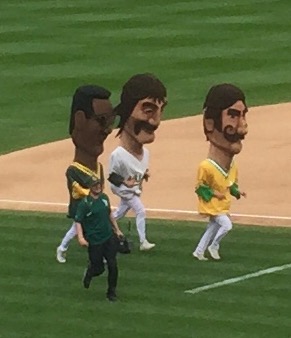
In short, the A’s have a reputation for putting a consistently good team on the field. For more on that, rent the movie “Moneyball.”

Ultimately, while attending an Oakland A’s home game may not be that “pretty” – it’s likely to be a pretty good time. I’m looking forward to my next California trip – and hoping the A’s are in town. If you get out that way, I suggest taking in the Oakland A’s experience.

Ron Necciai – Baseball’s Highest Flying Rocket

On this day (May 13) in 1952, the Appalachian League’s leading team – The Bristol Twins – was about to take the field against its closest pursuers, the second-place Welch Miners. The Miners’ hitters (and the approximately 1,200 fans gathered at Bristol, Virginia’s Shaw Stadium) were blithely unaware of what lay in store for them – and that they were about to “earn” a place in baseball history that will likely never be relinquished. 

necciaiuseStarting on the mound for Bristol was a stripling thin, 19-year-old right-hander (6’ 5”, 185-pounds) with a hard to spell and equally difficult to pronounce name – Ron Necciai (netch-eye). By the end of the night, the Miners would find Necciai’s fastball and curve equally difficult to make contact with (a record 27 strikeouts in a nine-inning game) and Necciai’s name would be hard to forget as well.

Necciai brought to the mound a blazing, moving fastball and devastating breaking ball – as well as a case of painful stomach ulcers that would force him to consume milk and cottage cheese between innings. He also carried with him a reputation as a major-league prospect who was finally finding his groove after two less than sterling minor league seasons (5-14, 6.24 ERA for three teams in the Pirates’ system).  Necciai had the proverbial “stuff,” he just hadn’t harnessed it yet. (In those first two seasons, he walked 137 batters in 142 innings.) But that seemed to be changing in 1952.   There were those, in fact, who said he would have gone north with the Pittsburgh Pirates that spring had his ulcer not flared up as the team broke Spring Training.

That day in Bristol, a nervous Necciai put it all together – and history was made.  The first inning proved to be an omen, as Necciai struck out all three Welch batters. By the time they got to the top of the ninth, Necciai had a 7-0 lead – and Welch had put only two balls in play – a ground out (shortstop to first) in the second and a second grounder to shortstop in the third that resulted in an error and a base runner. Only two other batters had reached base – via a walk and a hit-by-pitch.

So, Necciai strode to the mound for the ninth inning – fortified with milk, cottage cheese and a Banthine pill – on the verge of a no-hitter. Perhaps even more impressive was the fact that he had logged 23 strikeouts.  His stomach may have been the only thing in the ballpark that was hotter than his fastball. Necciai proceeded to fan the first two hitters in the ninth (bringing his total to 25). He then notched strikeout number 26 to apparently end the contest and preserve the no-hitter, but the ball got by the catcher (passed ball) and the flailing hitter reached first. So, Necciai stood at 26 whiffs, no-hits, one on and two out. Fittingly, Necciai ended the game by notching his fourth strikeout of the inning and his professional baseball record 27th  for a nine-inning contest.

In his first start after the 27 strikeout effort, Necciai proved his May 13 performance was no fluke, fanning 24 batters in a two-hitter. That start earned him a promotion to the Class-B Burlington-Graham Pirates of the Carolina League.  In his six 1952 appearances at Bristol, Necciai had logged 43 innings, given up just 10 hits and two earned runs (0.42 ERA), walked 20, hit two batters and fanned 109 (nearly 22.8 per nine innings).

At Burlington-Graham, Necciai whiffed 14 in his first start and a league-leading 172 in 126 innings, compiling a 7-9 record with a 1.57 ERA. By early August, Necciai – now known as “Rocket Ron” and drawing comparison to the likes of a young Bob Feller – was up with the Pirates, making his MLB debut on August 10.

Perhaps due to his nervous nature, Necciai didn’t fare well with Pittsburgh, going 1-6, 7.08 in 12 games (nine starts), with 31 strikeouts in 54 2/3 innings. (Ironically, in his only win – August 24 – Necciai struck out only one batter in eight innings of work, giving up three runs on seven hits in a 4-3 victory over the Boston Braves.) Still he showed flashes of his Rocket Ron reputation (in his final outing of the season – September 28 at Cincinnati – he gave up two runs on eight hits over seven innings, striking out eight), and the Pirates were hoping Necciai would get over his rookie season nerves and “right the ship” in 1953.  It was not to be.

Necciai was drafted into the Army in early 1953, where his stomach difficulties intensified. Given a medical discharge, he returned to the Pirates in April and – pushing himself to make up for lost time and a missed Spring Training – suffered an arm (likely rotator cuff) injury. This, of course, was pre-Tommy John surgery and Necciai never recovered. He never made it back to the big leagues and by 1955 was out of baseball.

However, for a brief period in 1952 – and one May 13 in particular – Rocket Ron Necciai was baseball’s highest flyer.

Primary Resources: MLB.com; Baseball-Reference.com


100Baseball Roundtable is on the Feedspot list of the Top 100 Baseball Blogs.  To see the full list, click here.

I tweet baseball @DavidBaseballRT

Follow/Like Baseball Roundtable’s Facebook Page here.  More baseball commentary; blog post notifications; PRIZES.

Member: Society for American Baseball Research (SABR); The Baseball Reliquary; The Negro Leagues Baseball Museum.


Getting Off to a Good Start – First-Pitch Home Runs

Rosario useOn May 6, as the Twins took the measure of the Oakland A’s 13-0, Eddie Rosario made his major league debut – and he got off to a pretty fast start.  In his first at bat, in the third inning, the rookie right fielder hit a Scott Kazmir fastball into the left field bleachers – becoming 119th player to homer in his first MLB at bat.  More significantly, Rosario become only the 29th MLBer to homer on the very first pitch he ever saw in “the show.”

This piqued BBRT’s curiosity.  Who were those 29 first-pitch, first-swing sultans of swat – and what did they do after their auspicious inaugural plate appearances?  What I learned was a little surprising.


  • Two MLB players have enjoyed the ultimate satisfaction of squaring up for a Grand Slam on the first major league pitch they ever saw: Kevin Kouzmanoff for the Indians on September 2, 2006 and Daniel Nava for the Red Sox on June 12, 2010.

Of the 29 first-pitch-ever HRs, 19 were solo shots, five were two-run homers, three were three-run home runs and two were grand slams.

  • Their first-pitch home runs represent the only MLB round trippers for eight of the 29 players (although this includes Rosario and Twins’ pitcher Tommy Milone (recently sent down to Triple A Rochester) – both still active.

 Angels’ right-handed pitcher Don Rose’s first-pitch-ever home run was not only his only MLB round tripper, it was the difference in the Angels 6-5 win over the A’s at Oakland, which happened to also be Rose’s only major league victory (he went 1-4, 4.14 over three seasons).

  • The most career home runs by a player who homered on the first MLB pitch he ever saw is 195 by Jay Bell (first-pitch HR at 2B for the Indians on September 29, 1986 – 18-season MLB career). The most home runs hit the season the player hit his first-pitch HR is 14 by outfielder Chris Richard (first-pitch homer for the Cardinals on July 17, 2000).  Notably, that first-pitch shot was the only one Richard would hit for the Cardinals (or in the National League).  After appearing in just six games with the Cardinals, Richard was traded to the Baltimore Orioles for pitcher Mike Timlin.  Richard played in 56 games for Orioles that season – adding another 13 round trippers. (He finished the season at .265-14-37.)

The most home runs hit in any subsequent season by a member of the first-pitch-ever HR club is 38 by Bell (for the Diamondbacks in 1999).

  • Seven of the 29 players to hit first-pitch-ever dingers were pitchers (actually eight if you count Gene Stechschulte, who was being used as a pinch hitter when he accomplished the feat for the Cardinals on April 17, 2001).

By the position they were playing, here’s the first-pitch home run hitter count: pitchers (7); pinch hitters (7); left fielders (4); right fielders (3); first baseman (2); shortstops (2); designated hitters (2); second baseman (1); catchers (1).  Among the pinch-hitters and DHs, the primary positions played when they appeared in the field were RF (3) and LF (2); third base (2); pitcher and first base (1 each).

  • Seven players came through with first-pitch HRs as pinch hitters. The most interesting of these was Gene Stechschulte. The 6’ 5”, 210-pound Cardinals’ right hander is the only MLB pitcher to homer on the first pitch he ever saw, while being used as a pinch-hitter.  Stechschulte’s homer (a two-run shot) came in the sixth inning of a Cardinals’ 17-4 loss to the Diamondbacks (April 17, 2001). It was only Stechschulte’s second professional at bat – and his second extra base hit.  He had one minor league at bat (in 204 games) collecting a double.
  • Only two players hit a second round tripper in the same game in which they achieved their first-pitch HR. On July 23, 1964, A’s shortstop Bert Campaneris went three-for-four, with two homers, two runs and three RBI as his Kansas City Athletics topped the Twins 4-3 in eleven innings. On August 2, 2010, Blue Jays catcher J.P. Arencibia went four-for-five with two homers, a double, three runs and three RBI as the Blue Jays topped Tampa Bay 17-11.  Arencibia is the only member of the first-pitch-ever HR club to also collect four hits in the same game.
  • The 29 first-pitch home runs have been pretty well split: 15 by American Leaguers and 14 by National Leaguers, as well as 15 by the home team and on the road.
  • If you’re superstitious, a first-pitch home runs is a pretty good sign. The team whose rookie achieved the historic blast has won 21 of the 29 contests.
  • The Cardinals have had more players homer on the first pitch they ever saw than any other team – four. The American League leader is Toronto with three. Washington has seen the feat accomplished in both the AL (Senators) and NL (Nationals).

Finally, the list:

Walter Mueller, RF, Pirates … May 7, 1922

Clise Dudley, P, Robins (Dodgers) … April 27, 1929

Eddie Morgan, PH, Cardinals … April 14, 1936

Bill LeFevbre, P, Red Sox … June 10, 1938

Clyde Vollmer, LF, Reds … May 31, 1942

George (Sam) Vico, 1B, Tigers … April 20, 1948

Chuck Tanner, PH, Braves … April 12, 1955

Bert Campaneris, SS, Athletics (KC) … July 23, 1964

Brant Alyea, PH, Senators … September 12, 1965

Don Rose, P, Angels … May 24, 1972

Al Woods, PH, Blue Jays … April 7, 1977

Jay Bell, 2B, Indians … September 29, 1986

Junior Felix, DH, Blue Jays … May 4, 1989

Jim Bullinger, P, Cubs … June 8 1992

Jay Gainer, 1B, Rockies … May 14, 1993

Esteban Yan, P, Rays … June 4, 2000

Chris Richard, LF, Cardinals … July 17, 2000

Gene Stechschulte, PH, Cardinals … April 17, 2001

Marcus Thames, RF, Yankees … June 10, 2002

Kaz Matsui, SS, Mets … April 6, 2004

Andy Phillips, PH, Yankees … September 26, 2004

Adam Wainwright, P, Cardinals … May 24, 2006

Kevin Kouzmanoff, DH, Indians …September 2, 2006

Mark Saccomanno, PH, Astros … September 8, 2008

Daniel Nava, LF, Red Sox … June 12, 2010

J.P. Arencibia, C, Blue Jays … August 7, 2010

Tommy Milone, P, Nationals … September 3, 2011

Starling Marte, LF, Pirates … July 26, 2012

Eddie Rosario, RF, Twins … May 6, 2015


winery 1Note: Apologies for being a little late with this post.  I’ve been out of town, on the road and a little distracted – see the photo to the left. Despite the lure of the Napa Valley, I did find time to take in a UC Davis baseball game – which the home squad won 10-2 over CSUN (see photo at the end of this post). I hope you enjoyed the first-pitch homer factoids.

AGGIES


Baseball Reliquary Shrine of the Eternals 2015 Electees announced

ReliquaryNewIf you follow Baseball Roundtable, you are probably aware of the fact that BBRT is proud to be a member of The Baseball Reliquary – a free-spirited organization dedicated to celebrating the human side of baseball’s history and heritage.  The Baseball Reliquary is truly a fans’ organization, committed to recognizing baseball’s place in American culture and to honoring the character and characters of the national pastime. The Reliquary pursues that mission through its collection of artifacts, traveling exhibitions, ties to the Whittier College Institute for Baseball Studies and (perhaps, most visibly) through its own version of the Baseball Hall of Fame – the Baseball Reliquary Shrine of the Eternals.  For more on the Baseball Reliquary, and why you should become a member, click here.

The Reliquary’s Board of Directors recently (May 4) announced its 2015 Shrine of the Eternals electees – each year, the top three vote getters (all Baseball Reliquary members may cast votes) are honored.  The induction ceremony for this 17th Shrine “class” will take place beginning at 2:00 p.m., July 19 in the Pasadena (CA) Central Library’s Donald R. Wright Auditorium.  Before we take a look at this year’s electees,  BBRT would like to share what the Baseball Reliquary has to say about its highest honor.

Similar in concept to the National Baseball Hall of Fame, the Shrine of the Eternals differs philosophically in that statistical accomplishment is not the principal criterion for election. It is believed that the election of individuals on merits other than statistics and playing ability will offer the opportunity for a deeper understanding and appreciation of baseball than has heretofore been provided by “Halls of Fame” in the more traditional and conservative institutions.

Criteria for election shall be: the distinctiveness of play (good or bad); the uniqueness of character and personality; and the imprint that the individual has made on the baseball landscape. Electees, both on and off the diamond, shall have been responsible for developing baseball in one or more of the following ways: through athletic and/or business achievements; in terms of its larger cultural and sociological impact as a mass entertainment; and as an arena for the human imagination.

The diversity of past honorees is a clear indication that the Baseball Reliquary and its member-voters are living up to the stated criteria. Past inductees include (among others) a one-armed major league outfielder, a pitcher who once threw a no-hitter while high on LSD, a team owner who sent a midget to the plate, a man in a chicken suit, a member of Major League Baseball’s 3,000-hit club, a manager who won eight World Championships, a surgeon, a labor leader, a statistical wizard and more than one best-selling author.

So, who are the Reliquary’s 2015 electees?  Diversity rules again.  The 2015 Class of the Shrine of the Eternals includes a baseball card designer; a West Coast minor league legend; and an MLBer who faced prejudice with his own brand of courage.

For BBRT, this may go down as the Class of the Killer B’s – (Sy) Berger; (Steve) Bilko; (Glenn) Burke. Here’s a look at the three electees through excerpts (in italics) from the Baseball Reliquary’s announcement.  For more detail, as well as a full listing of nominees and their vote totals, visit the post on the Baseball Reliquary’s web site by clicking here.  At the end of this post, I’ll also include a few comments on 2015 nominees that did not get elected, but did receive BBRT’s vote. Note: BBRT did cast votes for Berger and Burke.


Sy Berger (1923-2014) – “Father of the Modern Day Baseball Card” – 31% of the vote.

bERGERBorn in the Bronx, just blocks from Yankee Stadium, Berger joined the Brooklyn-based Topps Chewing Gum Company as an assistant sales manager in 1947 and headed its sports department for half a century.  During his tenure, he designed and oversaw the production of some of the most innovative and revered baseball cards of all-time.  He is often called the “Father of the Modern Day Baseball Card” for his work on the 1952 Topps baseball set, which he designed (with help from Woody Gelman) on his kitchen table and which for the first time incorporated team logos along with facsimile signatures, statistics, and personal information on the players.  This same format continues to the present day. 

Berger would remain with Topps as an employee for fifty years (1947-1997), and would serve as vice-president, and then consultant and board member.  He was still working as the company’s principle liaison between the players, teams, and leagues until his retirement in 2003.


Steve Bilko (1928-78) – West Coast Minor League Legend – 31% of the vote.

bILKOBilko was not a star in the big leagues.  Over a peripatetic ten-year career, he was a regular for only one season (1953, with the Cardinals), and he appeared in more than 100 games only one other time (1961, with the expansion Angels).  He could hit for power, but struck out too often.  He had no speed.  To explain the lingering mystique of this moon-faced, lumbering first baseman, we must look at the Pacific Coast League, with franchises located along the West Coast and featuring a prolonged weather-friendly playing season, competitive pennant races and playoffs, and a rabidly partisan fan base. 


The PCL produced great baseball until the Dodgers and Giants relocated to Los Angeles and San Francisco, respectively, in 1958.

In those waning years of PCL supremacy, Bilko was the slugging star for the Los Angeles Angels, who wowed fans with mammoth home runs and exceptionally fierce strikeouts.  He led the PCL in home runs for three consecutive seasons from 1955 to 1957, winning the league Triple Crown in 1956 with a .360 average, 55 HRs, and 164 RBI.  He was by far the biggest sports star in Los Angeles history prior to the arrival of the Dodgers. 

Recognizing his popularity with local fans, the Dodgers added Bilko to their roster as a gate attraction for their inaugural campaign in Los Angeles.  The Angels (the American League expansion team) did likewise in 1961, providing Bilko with a final chance to awe the fans at his old haunt, Los Angeles’s Wrigley Field.  For those who saw him play in the PCL, he will always be remembered as a superstar.  That his glory years coincided with the demise of a much-loved league adds a last wistful touch to his legend.

BBRT note: In ten MLB seasons, Bilko played in 600 games and put up a .249-76-276 stat line. In 13 minor league campaigns, he played in 1,533 games – hitting .312, with 313 home runs. As noted above, in 1956, with the Los Angeles Angels, he captured the Pacific Coast League Triple Crown with a .360 batting average, 55 home runs and 164 runs batted in. He followed that up, again for the Angels, with a .300-56-140 season in 1957.  Bilko was inducted into the PCL Hall of Fame in 2003.

Glenn Burke (1952-95) – Crossing the Barrier of Prejudice – 31% of the vote.

bURKEBurke was a fleet, capable outfielder for the Los Angeles Dodgers and Oakland Athletics during a four-year major league career from 1976 through 1979.  He was the first big league ballplayer to publicly acknowledge he was gay.  Although his public disclosure came after he had retired, Burke’s sexual preference was well known during his playing days, and he encountered widespread homophobia from locker rooms to board rooms. 

While never given an everyday opportunity with the Dodgers to show his mettle, Burke did make one lasting contribution to popular culture while with the team.  After Dusty Baker’s 30th home run at the end of the 1977 season — a feat which made the Dodgers the only team at that time to have four different players hit 30 or more taters — Burke raised his hands in celebration at home plate.  As Baker crossed the plate he reached up, slapped one, and the high-five was born.  

Having appeared in just over 100 games for Los Angeles during parts of three seasons, Burke was sent packing to Oakland.  Returning to his hometown didn’t make Burke’s life any easier.  A’s manager Billy Martin made public statements about not wanting a homosexual in his clubhouse, a clear reference to Burke.  After just two years with the A’s, Burke quit baseball in frustration.  He became active in amateur athletic competition after baseball, competing in the 1982 and 1986 Gay Games in basketball and track. Burke died of complications from AIDS-related illness in 1995.

A documentary, Out: The Glenn Burke Story, was released in 2010.  

BBRT note: In 2013, Burke was among the first group of inductees into the National Gay and Lesbian Sports Hall of Fame. Burke was also honored at a press conference prior to the 2014 MLB All Star game.  How good could Burke haven been? We’ll never know, but in 600 minor league games, he hit .293, with 48 home runs and 214 stolen bases.

So there’s the 2015 Shrine of the Eternals inductees.  Now here’s a look at those who got BBRT’s vote, but didn’t make the final three.

_____________________________________________________________

Mamie “Peanut” Johnson (1935 – *)

Johnson was one of three females to play for the Indianapolis Clowns during the declining days of the Negro Leagues.  Johnson took the mound to the Clowns for three seasons (1953-55), running up a 33-8 record.  Her exploits are chronicled in the children’s book A Strong Right Arm: The Story of Mamie “Peanut Johnson, by Michelle Y. Green.

Rube Waddell (1876-1914)

Rube Waddell is pretty much granted the title of the zaniest player in MLB history – but he was also one of the best (at least when he was focused on the game). Waddell was known to wrestle alligators, leave a ball game to chase a fire engine, miss a game he was scheduled to start because he was fishing or playing marbles with neighborhood kids, bring his outfielders in to sit on the grass and then proceed to fan the side – and frequently do battle with owners and managers.  Waddell was more interested in the freedom to enjoy life and do things his way than money.  But, when Waddell was on his game, he was arguably the best pitcher of his time. The 6’1”, 195-lb. lefty led the AL in strikeouts six consecutive seasons (1902-1907) – by a wide margin.

How good was Waddell?  In 1902, he joined the Philadelphia Athletics in June – making his first start on June 26 (with just 86 games left in the season.) Waddell proceeded to win 24 games (the league’s second-highest total) against seven losses, with a 2.05 ERA.  Perhaps more telling is that, despite his shortened season, he led the AL with 210 strikeouts, fifty more than the runner-up (none other than Cy Young, who had 16 more starts than Waddell).

In 1904, Waddell set a modern (post-1900) MLB record with 349 strikeouts that stood until 1965.  Waddell, elected to the National Baseball Hall of Fame in 1946, finished with a 193-143, 2.16 line – leading the AL in strikeouts six times, ERA twice, wins once and complete games once. For more on Waddell, BBRT suggests: Rube Waddell: The Zany, Brilliant Life of a Strikeout Artist, by Allan Howard Levy and Just a Big Kid: The Life and Times of Rube Waddell, by Paul Proia.

Pete Reiser (1919-81)

Combine Willie Mays’ skill set (younger folks, think Mike Trout) with Pete Rose’s hustle and Yasiel Puig’s on-field abandon and you have Pete Reiser. In his first MLB full season (CF, Dodgers), a 22-year-old Reiser dazzled defensively and led the NL in runs scored (117), doubles (39), triples (17), batting average (.343), total bases (299) and hit by pitch (11) – tossing in 14 home runs and 76 RBI for good measure. Unfortunately, unpadded outfield walls, helmet-less at bats (the fiery Reiser was a frequent target) and aggressiveness on the base paths (Reiser twice led the NL in stolen bases) took their toll.

In his ten-season career, Reiser endured five skull fractures, a brain injury, a dislocated shoulder and a damaged knee.  He was carted off the field 11 times during his career (six times unconscious) and once actually given last rites at the stadium – and he played on. The three-time All Star retired as a player with a .295 career average, playing in 861 games over ten seasons. No telling what he might have done with padded outfield walls and batting helmets.  Pete Reiser was a true – and talented – gamer. For more on Reiser, try Pete Reiser: The Rough and Tumble Career of the Perfect Ballplayer, by Sidney Jacobson.

Denny McLain (1944- *)

MLB’s last 30-game winner (31-6 for the Tigers in 1968), BBRT views McLain as the Pitcher of the Year in what baseball analysts often refer to as the Year of the Pitcher.  And, he wasn’t a one- year wonder.  McLain won 20 or more games three times, captured two Cy Young Awards (1968-69) and one AL MVP Award (1968).  McLain, who ran up a 131-91, 3.39 record in ten MLB seasons, was a colorful and complex a character off the field and on.  His life experience provides a tale of ups and downs – from being selected the 1968 Associate Press Male Athlete of the Year and Sporting News Major League Player of the Year to a six-year prison stint.

McLain is likely the only former major leaguer whose bio includes such varied terminology as MVP, Cy Young Award, All Star game starting pitcher, World Series opening game starter – as well as pilot, Capitol Records recording artist, talk show host, author and ex-con.  McLain’s story gives baseball fans plenty to talk about – and you can learn more by reading I Told You I Wasn’t Perfect, by Denny McLain and Eli Zaret.

Oh, and just one more bit on Denny McLain.  He started the 1966 All Star game (vs. Sandy Koufax) and retired all nine batters he faced (Mays, Clemente, Aaron, McCovey, Santo, J. Torre, Lefebvre, Cardenas, Flood) on just 28 pitches –striking out Mays, Aaron and Torre.  That alone justifies consideration for the Shrine of the Eternals.

Effa Manley (1900-81)

The first woman enshrined in the National Baseball Hall of Fame, during the 1930s and 1940s, Manley ran the day-to-day operations of the Negro National League Newark Eagles (owned by her husband Abe Manley) – at a time when baseball, on the field and in the executive offices, was considered a “man’s domain.”  Effa, often thought of as a light-skinned black, was actually white.  She, however, grew up with a black stepfather and mixed-race siblings and was active in the New Jersey branch of the NAACP and Citizen’s League for Fair Play.  Effa Manley deserves recognition for overcoming both racial and sexual barriers as she exercised leadership in the national pastime.

David Mullany (1908-90)

David Mullany was the inventor of the Wiffle® Ball (1953), which ultimately changed backyard baseball for millions of young (and old) players and fans. I know I loved my white perforated plastic ball and yellow plastic bat – and played more than one backyard World Series opener with them (without shattering a single window).  Today, there are Wiffle Ball fields, leagues and tournaments.  The company is still operated by the Mullany family and you can learn more by visiting their website (www.wiffle.com)

Charles M. Conlon (1868-1945)

One of the greatest baseball photographers ever, Conlon produced a tremendous library of portraits and action photos of baseball’s greats, near greats and also-rans. Conlon’s 1909 photograph of Ty Cobb sliding into third base with spikes flying and teeth clenched is considered by many to be the greatest baseball action picture ever taken. His photos appeared regularly in such publications as The Sporting News, Baseball Magazine, and the Spalding and Reach Base Ball Guides, but it was the 1993 book, Baseball’s Golden Age: The Photographs of Charles M. Conlon that finally brought the full impact of his contributions to the fore.

Vic Power (1927-2005)

In 1963, baseball held it first and only Latino All Star Game – October 12 at New York City’s Polo Grounds – featuring such Hispanic stars as Juan Marichal, Roberto Clemente, Louis Aparicio, Tony Oliva, Minnie Minoso, Felipe Alou, Orlando Cepeda and Vic Power.  In pre-game ceremonies, Vic Power was honored as the number-one Latino player – such was the power and popularity of Vic Power.

During his 12-year MLB career, Power proved a capable hitter (.284 lifetime average) and a flashy fielder, who won seven consecutive Gold Gloves at first base. Power’s contribution to the game went much further, however, Power served as mentor to many of the Latino/Hispanic player entering major league baseball in the 1950s and 1960s. Power was a trailblazer for today’s generation of Latino stars.

John Young (1949-*)

A 6’3”, 210-pound, left-handed first baseman, John Young hit .325, with four home runs, 60 RBI and 26 stolen bases (in 29 attempts) in 99 games at Single A Lakeland (Tigers’ farm team) as a twenty-year old (in 1969). The first-round draft choice (16th overall in the 1969 draft)  truly looked like a player with promise – and, in fact, enjoyed a big league cup of coffee with the Tigers in 1971 (two games, four at bats, two hits, one run, one RBI, one double). A wrist injury derailed his playing career, but didn’t dampen his love for the game and he went on to a long career as a scout. It was during his scouting days that Young developed a concern for the decline of baseball among young people – particularly in the inner cities.  In response, Young came up with the concept for the RBI (Reviving Baseball in Inner Cities) program. Officially launched in 1989, the RBI program is now supported by all thirty MLB clubs and is active in more than 200 communities – annually providing more than 260,000 youngsters the opportunity to play baseball and softball. (The program also includes educational and life skills components.) A few RBI alumni in the major leagues include: Carl Crawford, Justin Upton, CC Sabathia, James Loney and Manny Machado.

So, there’s my 2015 Baseball Reliquary Shrine of the Eternals ballot – and I’m already looking forward to next year.


I tweet baseball @DavidBBRT

May Day – A Look Back at MLB’s April

Opening Day, of course, leads to opening month.

Opening Day, of course, leads to opening month.

It’s May 1, which also means, it’s time for BBRT’s look back at the previous month in major league baseball.  This means touching upon:

  • the expected and unexpected – like the Dodgers (expected) and Astros (unexpected) sitting atop their respective NL and AL West Divisions;
  • the ups and downs – like the Mets’ eleven-game winning streak and the World Champion Giants’ eight losses in a row;
  • a few unique events that caught BBRT’s attention – like Nelson Cruz’ 483-foot home run (longest in the majors so far this year) and Paulo Orlando’s first three MLB base hits being triples; Mark Teixeira finishing a game a year older than when he started it; and
  • more.

First, however, I’d like to honor a May 1 anniversary that really brings home how the game has changed.

On May 1, 1920, the Brooklyn Robins (later Dodgers) took on the home team Boston Braves (later Milwaukee and Atlanta) in a 26-inning contest that was suspended due to darkness with the score tied 1-1.  It remains, in terms of innings, the longest MLB game ever. It is not just this game’s length that makes it special. On that day, 95 years ago, both starting pitchers (Leon Cadore of Brooklyn and Joe Oeschger of Boston) went the distance – each throwing more than 300 pitches.  And, as far as pace of game issues, it took the two squads just 3 hours and 50 minutes to complete 26 innings.

What prompted this look back was the Twins-Mariners contest of April 24, when the Mariners topped the Twins 2-0 behind Felix Hernandez.  Not only did both starting pitchers go the distance (Phil Hughes for Minnesota), but the game was completed in a nifty two hours and three minutes.

These days the likelihood of two opposing hurlers going the distance is pretty limited. In April, MLB saw only five complete games – and, in 2014, the 30 MLB teams achieved a total of only 118 CG, just 2.4 percent of games started and just under four complete games per team.  Here’s a look at the “devolution” of the complete game.

– In 1900, 82.3% of games started were complete games;

– 1925 – 49.2%

– 1950 – 40.3%

– 1975 – 27.2%

– 2000 – 4.8%

– 2014 – 3.9%

For a look at BBRT’s take on how the approach to pitching has changed over the years, click here to go to a post from May of 2012.

Now let’s take a look at some April observations. A number of things have gone as expected – The Dodgers and Cardinals, for example, sit atop their divisions and the Cubs, Mets and Padres all look improved. There also have been a few surprises – positives like the first-place Astros and Yankees and negatives like the last-place (defending World Champion) Giants and slow-starting Washington Nationals.

If the post season began May 1, the playing field would look like this:

AL: Division leaders – New York, Kansas City, Houston.  Wild Cards: Detroit , Tampa Bay/Boston (tie).

NL: Division Leaders – New York, Saint Louis, Los Angeles. Wild Cards: Chicago, Pittsburgh.

For the month, only the Saint Louis Cardinals played  .700-or better ball (15-6, .714) and only the Milwaukee Brewers ended the month below .300 (5-17, .227).

At the close of April, the closest race was in the AL East, where only one team was below .500 (Blue Jays 11-12) and only 2 ½ games separated first and last place.  The biggest gap between first and second was in the NL East, where the Mets finished April 4 ½ games ahead of the Braves and Marlins – and only the Mets were above .500.

For full standings, go to the end of this post.

Winning Streaks

No team got off to a better start than the Kansas City Royals, who shot out of the gate by winning their first seven contesLos Angeles Dodgers vs. New York Mets - April 25, 2013ts.  The longest winning streak during the month belonged to the Mets, who took advantage of a ten-game home stand to fuel an eleven-game winning streak – in which they won five one-run contests and outscored their opponents 57-31.  Note: The Mets nearly completed a perfect 11-0 home April. They lost their first home game – to the Nationals by an 8-2 score – on April 30.  The hottest team at the close of the month was the Houston Astros, who won their final seven April games.

Losing Streaks

On the negative side, The Brewers went the longest before their first victory – starting the season with four straight losses.  Milwaukee also shared April’s longest losing streak, an 8-gamer stretching from April 15 through April 22. During the streak, they scored a total of only 21 runs – with nearly half  of those coming in a 16-10 loss to the Reds on April 21.  The reigning World Champion Giants also suffered through an eight-game losing streak –  April 10 through April 17 – during which they were shut out three times and outscored 43-15.

Those Surprising Astros

Jose Altuve - Like the Astros, flying high.

Jose Altuve – Like the Astros, flying high.

Between 2010 and 2014, the Astros won 308 and lost 502, never finished higher than fourth, and ended up an average of 34 games out of first place. The Houston squad ended this April in first place in the AL West – staking their claim to a competitive season on the strength of their pitching. Houston ended April with the AL’s lowest ERA (3.04). The staff was led by starters southpaw Dallas Keuchel (3-0, 0.73 ERA) and righty Collin McHugh (3-0, 2.92) – a pair who showed their potential last season, both posting winning records and sub-3.00 ERAs for the 70-92 Astros.  Offensively, the team’s 103 runs scored area respectable eighth in the AL.  Notably, Houston led the AL in both home runs (29, tied with the Orioles and Yankees) and stolen bases (also 29) through April 30. Who is leading the charge?   A big guy and a little guy who both play up the middle.  Six-foot-four CF Jake Marisnik – hit .379 in April, with 2 home runs, 10 RBI, 12 runs scored and eight steals.  Right there with him was last year’s NL batting champ, Jose Altuve (at five-feet five-inches currently the shortest MLB player), who hit .367, with two  home runs, 16 RBI, 13 runs scored and  a league-leading nine steals for the month.

Ahh, the DH

As you might expect – given the DH – the top seven run-scoring teams for April were in the AL – led by the Toronto Blue Jays (122 runs)The retooled San Diego Padres – not known in the past for offense – led the NL with 105 runs (thank you very much newcomers – Kemp, Upton and Myers).

League Leaders – Runs Scored (through April 30)

AL

Blue Jays – 122

Royals – 119

Red Sox – 113

NL

Padres – 105

Nationals – 103

Dodgers – 100

The fewest runs plated in April? The Phillies in the NL with just 63 and the White Sox in the AL at 64.

Hitting .300 – AS A TEAM

Mike Moustakas - hit .356 in April.

Mike Moustakas – hit .356 in April.

The Kansas City Royals hit .306 – as a team – for April; twenty points ahead of the next best mark (Orioles and Tigers). The NL’s leading team batting average for the month was the Colorado Rockies’ .280. The Royals line up on April 30th included six .300+  hitters:  Alex Gordon (LF-.303); Mike Moustakas (3B-.356); Lorenzo Cain (CF-.329); Eric Hosmer (1B-.310); Kendrys Morales (DH-.315); Salvador Perez (C-.326).

The Rangers and Phillies had the lowest team batting averages for April, at .210 and .223, respectively.

A Couple of Free Agent Pickups that Really Worked Out

The off season saw the  Mariners signing free agent outfielder Nelson Cruz (the 2014 AL HR leader) and the Red Sox signing (the then soon-to-be) outfielder Hanley Ramirez. In response to the old “Where are they now?” question – they are tied for the AL and MLB lead in both home runs (10) and RBI (22) through April. To go along with the power, Cruz is hitting .322 and Ramirez .293

RBI Leaders (through April 30)

AL

Nelson Cruz, Seattle – 22

Hanley Ramirez – Boston – 22

NL

Giancarlo Stanton, Miami – 21

Paul Goldschmidt, Arizona – 20

HR Leaders

AL

Nelson Cruz, Seattle – 10

Hanley Ramirez, Boston – 10

NL

Adrian Gonzalez, Los Angeles – 8

Todd Frazier, Cincinnati – 7

Joey Votto, Cincinnati – 7

Trades Can Work Out, Too

Dee Gordon - Looking even better in a Miami uniform.

Dee Gordon – Looking even better in a Miami uniform.

The Miami Marlins picked up second baseman Dee Gordon in a trade with the Dodgers – and couldn’t be more pleased with the outcome. Through April, Gordon was leading all of MLB in batting average (.409) and base hits (38) and was second in the NL in steals with eight. Gordon is one of three players who closed out April at .400 or better.  Joining him in that rare air were another second baseman – DJ LeMahieu of the Rockies at .406 – and the AL batting leader, Baltimore CF Adam Jones at an even .400.

Batting Leaders

AL

Adam Jones, Baltimore – .400

Jose Iglesias, Detroit – .377

Miguel Cabrera, Detroit – .373

NL

Dee Gordon, Miami – .409

DJ LeMahieu, Colorado – .406

Adrian Gonzalez, Los Angeles – .383

Stolen Base Leaders

NL

Billy Hamilton, Cincinnati – 13

Dee Gordon, Miami – 8

AL

Jose Altuve, Astros – 9

Jake Marisnik, Astros – 8

George Springer, Astros – 8

Jacoby Ellsbury Yankees – 8

If You Really Like Offense

Now, if you really like offense, check out the Blue Jays and Red Sox in the AL.  The Blue Jays led all of MLB in runs scored in April (122), while the Red Sox were third (113).  They reversed the order when it came to runs given up.  The Red Sox gave up the most tallies for the month (119), the Blue Jays the third most (115).  How did this go in the W-L columns?  The Red Sox were 12-10, the Blue Jays 11-12.

If you have an NL interest, the Padres (as noted earlier) scored the most runs (105) and the Brewers gave up the most runs (118).

Team Power – Or Lack Thereof

Only two teams reached 30 home runs in April, the Dodgers with 32 and the Reds with 31.  The Orioles, Astros and Yankees tied for the top in the AL with 29 April dingers. At the bottom of the long ball list were the Twins and White Sox in the AL with 12 home runs and the Phillies and Marlins (despite Giancarlo Stanton) in the NL with thirteen.

Nationals Under-Achievers

Most analysts expected the Nationals to run away with the AL East, largely based on the strength of their pitching staff. Oops!  Through April, the Nationals had given up the fourth-most runs in the NL, on the way to a 10-13 record (fourth place). But, the pitching may not be to blame. The Nationals 3.69 ERA was the NL’s fifth best.  The team, however, led the major leagues in errors (24) and 24 of the 107 runs (22%) the Nationals gave up in April were unearned. Over in the AL, two teams in the West tied for the lead in errors at 21 – the Athletics and Rangers.

ERA Leaders (through April 30)

NL

Cardinals – 2.43

Pirates – 2.95

Mets – 3.33

AL

Astros – 3.04

Royals – 3.10

Yankees – 3.23

Strikeout Leaders (pitching)

NL

Dodgers – 202

Padres – 198

Pirates – 195

AL

Yankees – 208

Indians – 202

Red Sox 191

First To Four Pitching Victories

Seven pitchers picked up four wins in April, but the surprise was that the first to get there was 41-year-old Mets’ starter Bartolo Colon, who  picked up that fourth win on April 23.  Colon went 4-1, 3.31 for the month.  The remaining four-game winners were:  Garrett Cole (Pirates, 4-0, 1.76); Zack Greinke (Dodgers, 4-0, 1.93); Matt Harvey (Mets, 4-0, 3.04); Felix Hernandez (Mariners, 4-0, 1.82); Michael Wacha (Cardinals, 4-0, 2.42); and Alfredo Simon (Tigers, 4-1, 3.13).

Among qualifying ERA leaders, the Rangers’ Nick Martinez has the lowest mark in MLB (0.35 ERA in four starts), while the Reds’ Anthony DeSclafini holds sway in the NL at 1.04.  BBRT finds it interesting that all sub-1.00 ERA are in the AL, with its DH.

ERA Leaders (through April 30)

AL

Nick Martinez (Rangers, 2-0, 0.35)

Dallas Keuchel (Astros, 3-0, 0.73)

Chris Archer (Rays, 3-2, 0.84)

NL

Anthony DeSclafini (Reds, 2-1, 1.04)

Max Scherzer (Nationals, 1-2, 1.26)

Adam Wainwright (Cardinals, 2-1, 1.44)

Strikeout Leaders

AL

Chris Archer (Rays, 37 K/37 1/3 IP)

Felix Hernandez (Mariners, 36 K/34 2/3 IP)

Cory Kluber (Indians, 36  K/ 34 IP)

NL

Clayton Kershaw (Dodgers, 43 K/31 1/3 IP)

James Shields (Padres, 41 K/31 IP)

Johnny Cueto (Reds, 38 K/37 IP)

_______________________________________________________

A FEW OTHER OBSERVATIONS

One Very Cold Start

Evan Gattis, Houston’s new designated hitter, was anything but that to start the season – at one point even striking out eight times in eight plate appearances over two games (losses to Cleveland on April 8 and April 9).  The DH, in fact, didn’t get his first “H” until his 23rd at bat – and he had 13 strikeouts in those first 22 at bats.

And, On the Other Hand …

Adrian Gonzalez - a blazing start.

Adrian Gonzalez – a blazing start.

Dodgers’ first baseman Adrian Gonzalez  started 2015 as hot as Evan Gattis was cold.  Gonzalez went deep in the first three Dodger contests of the season – topped off by a three-homer game in LA’s 7-4 win over San Diego on April 8.  Baseball tracks pretty much everything, so we know that Gonzalez became the first MLBer to hit five home runs in a season’s first three games.  In those first three contests, Gonzalez was ten-for-thirteen, with five home runs, two doubles, seven runs and seven RBI.


Four Strikeouts on Just Twelve Pitches

Oakland 3B Brett Lawrie had a tough night on April 7 – just his second game as a member of the A’s.   After going one-for-four on Opening Day, Lawrie took the collar in game two (0-for-4).  It’s how he did it that drew notice.  Lawrie came to the plate four times in the 3-1 loss to the Rangers and struck out four times – on a total of just twelve pitches. Lawrie faced three different pitches, had a nice balance of six called strikes and six swinging strikes. His final swinging strike also marked the final out of the contest.

The Game Will Age You

On April 10 (and April 11), the Yankees and Red Sox engaged in the longest game at new Yankee Stadium  – 6 hour and 49 minutes (19 innings).

  • The game started at 7:05 p.m. on Friday and ended at 2:13 a.m. on Saturday; and included a 16-minute light failure delay.
  • The teams used a total of 42 players.
  • Seventeen of those players were pitchers and they threw a total of 628 pitches (332 by the Yankees, 296 by the Red Sox.)
  • Yankees’ first baseman Mark Teixeira (born on April 11, 1980) started the game as a 34-year-old, and finished it at age 35.
  • The Red Sox took a 3-2 lead into the bottom of the ninth, a 4-3 lead into the bottom of the 16th and a 5-4 lead into the bottom of the 18th – and gave up the tying run each time – until winning it 6-5 in the 19th.
  • The Red Sox’ Steve Wright pitched the last five innings – blowing two leads (16th and 18th innings), before earning the win in the 19th.

Triple Your Pleasure, Tripe Your Fun

On April 9, 29-year-old MLB rookie Paulo Orlando started in left field and hit in the eight spot for the Kansas City Royals.  In the bottom of the third inning, facing Chicago southpaw John Danks, Orlando walked in his first-ever MLB plate appearance. One inning later, the right-handed hitter achieved his first-ever MLB at bat and lashed a triple to deep center.  It was his only hit in a one-for-three day (remember that number … three.) His triple, however, was a sign of things to come.

Orlando’s next start came on April 12, against the Angels, in Los Angeles. The 6’ 2”, 210-pound rookie was once again manning left field and hitting eighth. This time he collected two hits in five at bats. His first hit of the day came leading off the top of the sixth.  Like his very-first (and until then only) MLB hit, it was a triple to deep center.  Sensing a pattern here?  Orlando picked up his second hit of the game in the eighth and switched things up a bit, lacing the ball to left field for – you may have guessed it – a triple.   So, after two games in the major leagues, Orlando had three hits – all triples. He was the first player ever to log triples for his first three MLB hits.

Slam-A-Rama

On April 21, the Brewers and Reds tied an MLB record by hitting a combined three grand slam home runs in a single game – as Cincinnati topped Milwaukee 16-10. The first grand slam came off the bat of the Reds’ Jay Bruce with two outs in the top of the third inning. One inning later, the Red’s Todd Frazier went deep with the bases full – again with two out.  The Brewers countered with a grand slam by Elian Herrara in the bottom of the sixth.  Overall, the game featured seven round trippers.

It was only the fourth time in MLB history that three grand slams were hit in a single game. The first time was in a 13-11 Texas win over Baltimore (at Baltimore on August 6, 1986) – featuring grand slams by Texas 2B Toby Harrah, Baltimore DH Jim Dwyer and Baltimore LF Larry Sheets.   The following season (June 3, 1987) saw the first NL three grand slam game, as the Cubs topped the Astros 22-7 in Chicago.  Cranking based loaded homers in that one were Astros’ CF Billy Hatcher, Cubs’ LF Brian Dayett and Cubs’ 3B Keith Moreland. Then on August 25, the Yankees became the first (and still only) team to manage three grand slams in a single game on their own – as they topped the A’s 22-9 in New York. The slams went to 2B Robinson Cano, CF Curtis Granderson and C Russell Martin.  The three Yankees totaled 16 RBI in the game.

The Fresh-Faced 100-100 Club

There's really not stopping Mike Trout - unless he wants to take a breather.

There’s really not stopping Mike Trout – unless he wants to take a breather.

On April 17, when Los Angeles Angels’ center  fielder Mike Trout came to the plate in the top of the sixth inning of a tie game (1-1) against the Astros, he was thinking “contact” not “history” – but he quickly made both.  Trout made contact, taking Astros’ pitcher Roberto Hernandez deep for a 3-1 Angels’ lead.  He made history by hitting his 100th career home run – becoming the youngest player ever to amass 100 career homers and 100 career stolen bases. Trout was 23 years and 253 days old, beating the previous mark for reaching 100-100 (Alex Rodriguez) by 56 days.

Not Exactly a Pitchers’ Duel

On April 11, the Minnesota State (Mankato) Mavericks (NCAA Division II) won the first game of their double header against the Bemidgi State Beavers 10-9 – but compared to game two, that was a pitcher’s duel. In the second game, the Mavericks  plated 41 runs (to “just” 20 for Bemidgi State). In a game that went eight innings (mercy rule), the line score looked like this:


Minnesota State     3   6   10   0   3   0   4   14      41   35   2

Bemidgi State        0   7     1   0   3   7   2      0     20   21   6

Minnesota State swept the four game series at Bemidgi – outscoring the home team 88-34.

________________________________________________________

MLB Standings through April 30

AL East

Yankees          13-9    .591

Red Sox          12-10   .545     1.0

Rays                12-10   .545     1.0

Orioles             10-10   .500     2.0

Blue Jays         11-12   .478     2.5

AL Central

Royals             15-7     .682

Tigers              15-8     .652     0.5

Twins              10-12   .455     5.0

White Sox         8-11   .421     5.5

Indians             7-14   .333     7.5

AL West

Astros              15-7     .682

Angels             11-11   .500     4.0

Mariners          10-12   .455     5.0

A’s                    9-14   .391     6.5

Rangers             7-14  .333     7.5


NL East

Mets                15-8     .652

Braves             10-12   .455     4.5

Marlins            10-12   .455     4.5

Nationals         10-13   .435     5.0

Phillies              8-15   .348     7.0

NL Central

Cardinals         15-6     .714

Cubs                12-8     .600     2.5

Pirates             12-10   .545     3.5

Reds                11-11   .500     4.5

Brewers           5-17    .227     10.5

 NL West

Dodgers          13-8     .619

Rockies           11-10   .524     2.0

San Diego       11-12   .478     3.0

D-backs           10-11   .476     3.0

Giants               9-13   .409     4.5


I tweet baseball @David BBRT

Catch of the Day – Worth Another Look

Twenty-six years ago today (April 26, 1989), Giants’ left fielder Kevin Mitchell made a spectacular bare-handed catch of a long line drive – ironically off the bat of Saint Louis Cardinals’ shortstop Ozzie Smith, an eventual 13-time Gold Glove winner known for his truly acrobatic play in the infield. BBRT thinks it’s worth another look.  Hope you enjoy it.  Note: Mitchell was better known for his bat than his glove.  He was the NL MVP in 1989, leading the league in home runs (47) and RBI (125), while hitting .291.  

Oh, and just to show I wasn’t exaggerating about Smith being “acrobatic” in the field, here’s another little video snippet.


I tweet baseball @DavidBBRT

Three is a Pretty Lucky Number for Paulo Orlando

pauloOn April 9, 29-year-old MLB rookie Paulo Orlando started in left field and hit in the eight spot for the Kansas City Royals.  In the bottom of the third inning, facing Chicago southpaw John Danks, Orlando walked in his first-ever MLB plate appearance. One inning later, the right-handed hitter achieved his first-ever MLB at bat and lashed a triple to deep center.  It was his only hit in a one-for-three day (remember that number … three.) His triple, however, was a sign of things to come.

Orlando’s next start came on April 12, in Los Angeles against the Angels and starting pitcher (another lefty) C.J. Wilson.   The 6’ 2”, 210-pound rookie was once again manning left field and hitting eighth. This time he collected two hits in five at bats (and scored three runs). His first hit of the day came leading off the top of the sixth.  Like his very-first (and until then only) MLB hit, it was a triple to deep center.  Sensing a pattern here?  Orlando picked up his second hit of the game in the eighth (off reliever Fernando Salas, a righty this time) and Orlando switched things up a bit, lacing the ball to left field for – you may have guessed it – a triple.   So, after two games in the major leagues, Orlando had three hits – all triples. He was the first player ever to log triples for his first three MLB hits.  Bet we won’t be seeing that again.  But there is more to come.

On April 16, Orlando and the Royals found themselves in Minnesota, where Twins’ pitchers held the rookie (playing left field and batting seventh) to a mundane infield single in four trips to the plate. The string of triples was over, but Orlando’s penchant for three-baggers was not. The next day (yesterday), back in Kansas City facing the Oakland A’s, Orlando was in right field, batting eighth. He collected one hit (one run and one RBI) in  four at bats – a triple to deep right center in the eighth off right-handed reliever Dan Otero. So, Orlando – after playing in four major league games – had five hits (.313 average), and four of them were triples.

Of course, the speedster’s penchant for baseball’s rarest hit – the triple – should not come as a surprise. In nine minor league seasons, Orlando hit a total of 63 three-baggers – topping ten triples three times, with a high of 14 in 2008. Over 1,017 minor league games, Orlando hit .275, rapped 63 home runs (the identical total as his triples) and stole 200 bases. Last season, at AAA Omaha, Orlando hit .301 with nine triples, six homers and 34 steals in 136 games.

I tweet baseball @DavidBBRT

April 17th – A Good Day for a Debut

The Ford Mustang debuted 51 years to the day before Kris Bryant's first MLB game.

The Ford Mustang debuted 51 years to the day before Kris Bryant’s first MLB game.

The Ford Mustang, like the Cubs’ Kris Bryant, made its debut on April 17.  The Mustang was launched on April 17, 1964 at the World’s Fair in Flushing, New York. The new “pony car” got off to a better start that Bryant – who fanned in his first three at bats and went zero-for-four on the day.

Still, there is plenty of evidence that the Cubs’ 23-year-old top prospect – who started his first day in the major leagues playing third base and batting cleanup – will have a long and successful career; like many of those who debuted on that day before him.  In addition to the Ford Mustang (still going strong), April 17th also saw the debut of some pretty good ballplayers – Mickey Mantle (MLB debut April 17, 1951); Roberto Clemente (MLB-debut April 17, 1955); and Frank Robinson (MLB-debut, April 17, 1956).\ among them.

Hang on to these cards!

Hang on to these cards!

First-game jitters aside, let’s look at the evidence.  Kris Bryant has proven himself at every level he ever played at.  He hit over .400 as a high school player (four varsity seasons for Bonanza High School in Las Vegas).  As a high school senior, he hit .429, with 22 home runs and 51 RBI – being named a Baseball America and USA Today High School All American.

Bryant went on to play – and excel – for the University of San Diego.  As a college player, Bryant was a Freshman All American (2011); Baseball America All American (2012); and a Louisville Slugger First Team All American (2013).  In 2013, Bryant led all collegiate players with 31 home runs and won the 2013 Golden Spikes Award and Dick Howser Trophy (both recognizing the top collegiate baseball player in the nation) and the College Baseball News National Player of the Year award.  In three years with San Diego University, he played in 172 games, collected 225 hits (.353 average), hit 54 home runs and drove in 155 runs. He might have done even more damage, if it wasn’t for the 138 walks. Selected in the 18th round of the 2010 MLBH draft by the Blue Jays, Bryant’s college accomplishments moved him up to the first round (second overall) of the 2013 draft.

Bryant did not skip a beat in moving from the college ranks to the Cubs’ minor league system.  In his first season, he went from rookie ball to High A (three stops), hitting a combined .336, with nine home runs and 32 RBI.  Last season, he made a two-stage jump – Double A and Triple A – hitting a combined .325, with 43 home runs, 110 RBI and 15 steals.  Then, in 2015 Spring Training, he really opened up some eyes, hitting .425 with nine home runs (leading all players this spring) in just 40 at bats. He started the 2015 season at Triple A Iowa, where he hit .321 with three home runs and ten RBI in seven games before his call up.  All the evidence says this young man is here to stay.

Now, here’s a brief look at three players April 17th has delivered to big league fans in the past.

Mickey Mantle – April 17, 1951

MantleA promising young (19-years-old) outfielder debuted in right field for the New York Yankees on April 17, 1951.   Mickey Mantle, batting third that day (Joe DiMaggio was playing center and batting cleanup), had a single, with a run scored and a run driven in, in four at bats – as the Yankees topped the rival Red Sox 5-0.   His first MLB at bat resulted in a ground out, second to first.

Mantle’s credentials as a prospect were undeniable.  Signed right out of high school (as a shortstop) he hit .313 with seven home runs for the 1949 Independence (KS) Yankees at D Level and then, as an 18-year-old, he hit .383 with 26 home runs and 136 RBI in 137 games for the 1950 Joplin Miners (C Level).  Notably, Mantle slumped early in his rookie MLB season and was sent down to the Yankees’ Triple A farm club (Kansas City Blues), where he earned his way back to the major leagues by hitting .361, with 11 home runs and 50 RBI in 40 games.  Brought back up, Mantle finished his rookie MLB season hitting .267, with 11 home runs and 65 RBI in 96 games.  And the rest is history. In an 18-season MLB career, Mantle was an All Star in 16 seasons, a three-time AL MVP and a Triple Crown winner. He retired with a .298 career average, 536 home runs, 1,509 RBI, 1,676 runs scored and 153 steals. He played his entire career with the Yankees.

April 17, 1955 – Roberto Clemente

clementeApril 17, 1955 saw the MLB debut of 20-year-old Roberto Clemente. Clemente led off and played center field for the Pittsburgh Pirates that day – hitting a double and a single, and scoring a run, in four at bats.  His very first MLB at bat was a ground out third to first.  The previous season, Clemente hit .257, with two home runs and 12 RBI in 87 games with the Brooklyn Dodgers’ Triple A affiliate Montreal (Royals). He had also played two seasons with the Santurce Cangrejeros in Puerto Rico before signing with the Dodgers. In the November 1954 rookie draft, he was picked up by the Pirates. He finished his first season with Pittsburgh hitting .255, with five home runs and 47 RBI in 124 games.

Clemente would go on to an 18-year MLH career – cut short by a tragic (December 31, 1972) plane crash while on a humanitarian mission to his native  Puerto Rico.  He was an All Star in 12 of those seasons, a four-time batting champion, a 12-time Gold Glover.  He ended his career with a .317 batting average, 3,000 hits, 240 home runs, 1,305 RBI and 1,416 runs scored. He played his entire MLB career with the Pirates.

April 17, 1956 – Frank Robinson

RobinsonApril 17, 1956 marked the MLB debut of Frank Robinson – with the twenty-year-old starting in left field and batting seventh for the Cincinnati Reds. In four plate appearances, Robinson collected a double, a single and an intentional walk. His first MLB at bat produced a ground rule double.

Robinson had shown his potential in the minors, hitting .348 with 17 home runs (as a 17-year-old) in 72 games for the Class C Ogden Reds in 1953; a .332 average with 25 home runs at A and Double A in 1954; and .263 with 12 homers in 80 games at single A in 1955. In his rookie season with the Reds, Robinson hit .290, with 38 home runs, 83 RBI and a league-leading 122 runs scored.   He went on to a 21-year MLB career, in which he was an All Star in 12 seasons; NL Rookie of the Year; MVP in both the NL and AL; a Triple Crown Winner; a World Series MVP; and All Star Game MVP.  Robinson finished his career with a.294 average, 586 home runs, 1,812 RBI, 1,829 runs scored, and 204 steals.

Perhaps someday, we’ll see reports on a new April 17th MLB debut and Kris Bryant will be listed among the premier players that launched their MLB careers that day. Note:  They weren’t all hitters, Hall of Fame hurler Don Drysdale took to the MLB mound for the first time on April 17, 1956.

Note:  Mantle, Clemente and Robinson picked up the nicknames: The Commerce Comet, The Great One and The Judge.   Any suggestions for Mr. Bryant?


I tweet baseball @DavidBBRT

Twins Opening Day – From Festive to Restive

As the game time approaches, the sun seems a little brighter, the sky a little bluer, the grass a shade greener.  Once the game begins, the ball hops off the bat with an especially sharp crack, the pitches seem to have more zip and whir-r-r than ever and the fielders move with a unique combination of grace and energy.  In the stands, the beer is crisp and cold and the hot dogs steam in the cool of early spring.  The fans cheer on their old and new heroes and follow this opening contest with pennant race intensity – the most intense among them logging each play in the new season’s first scorecard.   Baseball Is Back!

                                                      Baseball Roundtable … March 26, 2013


OD scoreboard

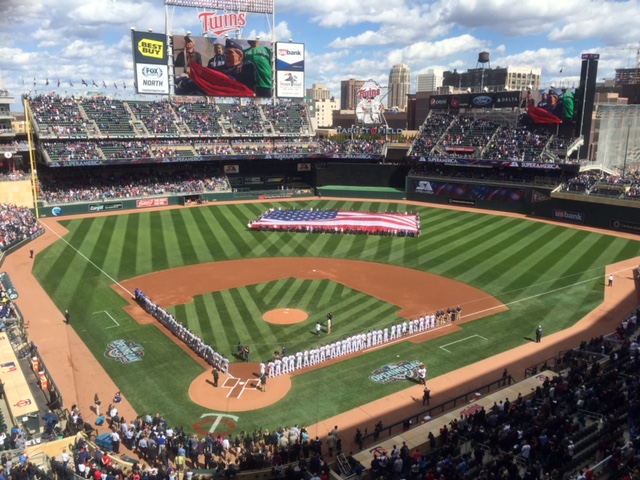
April 13 was the Minnesota Twins 2015 (Home) Opening Day and, as usual, the Twins did it up right – to a point.  


BBRT note: The Twins came into their home opener six games into the season and already five games out of first place, so the level of optimism may not have been quite as prevalent as at some earlier Minnesota home openers – but the excitement surrounding the thought that Baseball Is Back still ran high.  

As is tradition, the day started with free breakfast on the Twins Plaza – and what says spring and baseball more than hot dogs, chips and ice cream in the morning, especially when accompanied by blue skies, plenty of sunshine and Twins’ mascot TC the Bear.  Breakfast was served from 6-9 a.m., with additional festivities (music and concessions) planned on the Plaza and at the Target Field (light rail) Station beginning at noon  The Plaza started to fill up before noon (the gates opened at 1 p.m.) – with nearby eating and drinking establishments, as well as parking lots, drawing big crowds even earlier.  (A word of advice from BBRT, when the Twins have a sell out – and this game was sold out – on a work day, get downtown early if you don’t want to spend some time looking for parking.)

The mood was festive, with most of the crowd outfitted in Twins-identified gear, concessions stands on the Plaza doing a brisk business and DJ Madigan spinning plenty of upbeat tunes from the balcony above the crowd.  (The mood would later go from festive to restive, but we’ll get to that.  Let’s enjoy the moment for now.) Photos with the various statues of Twins’ heroes or sitting in the “big glove” seemed the order of the day.

The Twins hoodies proved a popular Opening Day giveaway - for all 40,000+ fans.

The Twins hoodies proved a popular Opening Day giveaway – for all 40,000+ fans.

By one p.m., the Plaza was full of happy fans waiting for another Target Field Opening Day tradition, the opening of the gates by Twins’ legends.  What better way to enter the ballpark then through a gate opened that day by the likes of Tony Oliva, Kent Hrbek or Tom Kelly?  To top it off, once you got past the metal detectors, you were handed a free Twins hooded sweatshirt – a true Minnesota-focused promotion.  For a look at BBRT’s post on 2015 Twins’ promotions (and some unique items other teams are giving away), click here.  Day one of the 81-game home season was off to a great start.

Once inside the ballpark, fans rushed not to find their seats, but rather to secure a seat or place in line at one of Target Field’s many food and beverage locations. From Hrbek’s to Barrio to the Town Ball Tavern and from Red Cow to Kramarczuk’s to Andrew Zimmern’s Canteen, they were all kept busy – and for good reason, the food and drink options at Target Field remain exceptional.  (For BBRT’s recent post on 2015’s new Target Field food and beverage offerings click here.)

Shrimp corn Dogs - new ballpark food.

Shrimp corn Dogs – new ballpark food.

I made my way to Hrbek’s, where the new College Daze Bloody Mary – garnished with everything from cheese to pepperoncini to a slice of pepperoni pizza – was proving quite popular.  It seemed mandatory to have your picture taken with the new drink before consuming it.  I’m sure social media, like the tip of the pizza slice, was saturated.  My pre-game choice was the Shrimp Corn Dogs – jumbo shrimp (served on skewers) fried in jalapeno corn batter with a Chili Lime Aioli for dipping ($15).  Great shrimp flavor, just enough “zing” and a complementary tart sauce; and light enough to leave room for the obligatory Opening Day (old school) hot dog later in the day.

Then, with my freshly purchased scorecard in hand, I went in search of my seat – Section 213, Row 1, Seat 14 – and was pleasantly surprised.  I was just to the right of home plate, second deck, first row; and the view of the field was great.  It was also, particularly for Minnesota, a perfect day for an Opener.  Game time temps above 60 degrees, sunny, clear blue sky with just enough clouds to give it some depth.  And, as always seems to be the case on Opening Day, the grass was crisp green, the batting practice balls stark white and all the colors in the stadium (logos, bunting, base lines, etc.) especially vibrant.

As we all waited for game time, we enjoyed: a brief performance by recording artist Shawn Mendes; the introduction of both teams (players, coaches, videographers, trainers, etc.); the National Anthem (actress and singer Greta Oglesby), with two American Bald Eagles from the Minnesota Raptor Center present and a follow-up flyover by a pair of Minnesota Air National Guard F-16 fighters.

Meeting the team is an Opening Day tradition. The loudest and longest ovations went to Torii Hunter, Joe Maue and Brian Dozier.

Meeting the team is an Opening Day tradition. The loudest and longest ovations went to Torii Hunter, Joe Mauer and Brian Dozier.

BBRT would note here that the largest ovation during the introductions went to Torii Hunter (starting in right field), returning to the Twins after seven years (Los Angeles Angels and Detroit Tigers). The 39-year-old Hunter previously starred in center field for Minnesota (six-time Gold Glove winner and two-time All Star while with the Twins) and the team won four division titles during his tenure.  The fans clearly loved his style and his smile – and the applause intensified when this quote from the returning Twin appeared on the scoreboard: “This is where I need to be.  This is home to me.”

BBRT: Hunter’s popularity was also evidenced by the large number of new and old “Hunter – 48” jerseys in the crowd.  Sitting next to me were a father and son (about 2 ½ years old) in matching new (no pin stripes, the little extra gold trim) Hunter home jerseys.  Although, I must say, the youngster cheered loudest for his personal hero – Brian Dozier.

Notably, another returnee to the Twin Cities joined Hunter in throwing out the first pitch, as the crowd welcomed back the newest Timberwolves’ player Kevin Garnett – a member of the T-Wolves during their most successful seasons and now back with Minnesota after playing with the Boston Celtics (2007-13) and Brooklyn Nets (2013-15). Note: Garnett was a member of the Timberwolves from 1995-2007); and a ten-time All Star and NBA MVP (2004) during that time. Minnesotan Tyus Jones, who recently helped lead Duke to the NCAA National Basketball Championship, delivered the baseball to Garnett on the mound, and Garnett threw the ceremonial first pitch to Hunter.  All three hometown heroes received rousing ovations – and the pre-game excitement continued to ratchet up.

We saw a few too many "meetings on the mound" on Opening Day.

We saw a few too many “meetings on the mound” on Opening Day.

I won’t go into much detail about the game – a 12-3 loss to the Kansas City Royals – it’s been well dissected in the traditional and social media. Let’s just say it started out pretty well for the home team, with the Twins scoring first (Kenny Vargas singling home the doubling Brian Dozier with two outs in the bottom of the first); was fairly crisply played over the first five frames (Twins trailing 2-1 after five); got a little shaky in the sixth, with starting pitcher Trevor May giving up a single and two doubles to the first three hitters and Hunter making a throwing error (still, after seven innings the Twins were down by only 5-3); came completely unraveled in the eighth inning, when Minnesota used four pitchers and Kansas City scored six runs on two hits, three walks, two hit batsmen, an error and a passed ball.  Ouch!  It was at this time that the fans – many heading for the exits – finished the move from festive to restive.  Needless to say, it was pretty quiet – and a bit lonely – in the bottom of the ninth.

Fortunately, in baseball you don’t have a lot of time to dwell on today’s loss (or celebrate a win).  Unfortunately, the Twins have an off day today (Tuesday), but tomorrow they’ll be back at it and working to right the ship.  And, we’ll all have to keep in mind, it’s early and there is always something to see (and, these days, eat and drink) at the ballpark. For example, yesterday Twins’ third baseman Trevor Plouffe started a nifty 5-4-3 double play to end the fourth inning and homered to lead off the bottom of the seventh.  The simple fact is “Baseball Is Back” and we should all enjoy it!

Now, just so I don’t leave my Twins fan readers sharing only the frustration of a 12-3 loss.  Here are a trio of events from the first week of the season that caught BBRT’s attention:

  • On April 7, Oakland 3B Brett Lawrie had a tough night. Lawrie came to the plate four times in the A’s 3-1 loss to the Rangers and struck out four times – on a total of just twelve pitches. Lawrie faced three different pitchers, had a nice balance of six called strikes and six swinging strikes and whiffed on a combination of one fastball (the first pitch he faced), three curves and eight sliders. His final swinging strike also marked the final out of the contest.
  • TheYankees-Red Sox game of April 10 really aged New York first baseman Mark Teixeira. The 19-inning game started at 7:05 p.m. on Friday (April 10) and ended at 2:13 a.m. on Saturday (April 11). Teixeira (born on April 11, 1980) started the game as a 34-year-old, and finished it at age 35.
  • On Saturday April 11, Arizona Diamonbacks’ rookie pitcher Archie Bradley – in his first-ever MLB appearance – drew the unenviable task of facing reigning Cy Young Award winner Clayton Kershaw of the Dodgers. Bradley pitched six shutout innings for the victory (one hit, four walks, six strikeouts). You might think a rookie beating the reigning Cy Young Award winner in his first start is what attracted BBRT’s attention, but that would be wrong. Bradley was the fifth rookie pitcher to make his first MLB start against a reigning CYA winner and the fourth to earn a victory. What got BBRT’s attention was Bradley’s single off Kershaw in bottom of the second inning. Since Bradley didn’t give up a hit until the fourth inning, the young pitcher actually collected his first major league before he gave up his first major league hit.  I like that kind of stuff.


I tweet baseball @DavidBBRT

Big Day for Big Klu – Anniversary of Angels’ First-Game Hero

On this date (April 11) in 1961, the expansion Los Angeles Angels played their first official American League game and one of my boyhood heroes – Ted Kluszewski – started them off with a “bang” and a victory. As this boyhood hero of BBRT had done for much of his career, Big Klu made powerful contact with the baseball.

In the top of the first inning, Big Klu – batting clean-up – came to the plate with two outs and little Albie Pearson on first (after a walk). Kluszewski was 6’ 2” and pushing 240 pounds, while his roommate Albie Pearson was  5’5”, 140 pounds.  Kluszewski, facing Orioles’ right-hander Milt Pappas (a 15-game winner the previous season), collected the Angels’ first-ever hit, first-ever home run and first-ever RBI – blasting a home run to deep right field.  The very next inning, the 36-year-old Kluszewski (starting his final big league season) came up against Orioles’ rookie reliever John Papa with Angels’ right-fielder Pearson and second baseman Ken Aspromonte on base. Big Klu  hit his second home run of the day – bringing his RBI total to five, as the Angels won their premier game by a 7-2 score.

To no one’s surprise, Kluszewski put the ball in play in every at bat that day. The big slugger was known for both his power and his bat control. In fact, no one in MLB logged has more seasons of 40 or more home runs, coupled with fewer strikeouts than round trippers.


http://

Ted “Big Klu” Kluszewski (below) cut the sleeves from his jersey to enable a freer swing of his powerful arms – and, just perhaps, to intimidate opposing hurlers.

Kluszewski’s was one of my favorite players long before that Opening Day performance, thanks to the fact that he was Polish, powerful and patient.  In fact, from 1953 to 1956, he was one of the most feared hitters in baseball.  During that span, Kluszewski was an All Star every year.  Over those four-seasons, he hit .315, with 171 home runs, 464 RBI – and only 140 strikeouts (versus 248 walks). How impressive is that?  Only ten times in MLB history has a player hit 40 or more homers, while striking out fewer times than he hit round trippers. Three of those seasons (more than any other player) belong to Kluszewski – and they came in succession (1953, 1954, 1955). The string was broken in 1956, when Big Klu hit only 35 home runs,  but he also struck out only 31 times (against 49 walks).  Kluszewski, by the way, was also agile in the field for a big man – leading NL first baseman in fielding percentage every year from 1951 through 1955.

A few side notes:

  • Of the six players who have accomplished a season of 40 or more home runs with fewer strikeouts than round trippers, Kluszewski is the only one who wasn’t a Yankee or a Giant.
  • Only once has a player hit fifty or more homers and struck out less than 50 times – Johnny Mize in 1947.
  • The fewest strikeouts ever by a league home run leader is nine – by the Boston Braves’ Tommy Holmes, when he led the NL with 28 home runs in 1945.

Here’s the list of MLB seasons of at least 40 homers and fewer strikeouts than round trippers, with home runs, strikeouts, walks and batting averages for each season.  Hall of Famers are in red, league leadership in blue.

1929 … Mel Ott (NY Giants),  42 HR, 38 K, 113 BB, .328

1934 … Lou Gehrig (Yankees), 49 HR, 31 K, 109 BB, .363

1936 … Lou Gehrig (Yankees), 49 HR, 46 K, 130 BB, .354

1937 … Joe DiMaggio (Yankees), 46 HR, 37 K, 64 BB, .346

1947 … Johnny Mize (NY Giants), 51 HR, 42 K, 74 BB, .302

1948 … Johnny Mize (NY Giants), 40 HR, 37 K, 94 BB, .289

1953 … Ted Kluszewski (Reds), 40 HR, 34 K, 55 BB, .316

1954 … Ted Kluszewski (Reds), 49 HR, 35 K, 78 BB, .326

1955 …   Ted Kluszewski (Reds), 47 HR, 40 K, 66 BB, .314

2004 … Barry Bonds (SF Giants), 45 HR, 41 K, 232 BB, .362

A final thought on Ted Kluszewski, he carried his combination of power and patience (and fielding consistency) to the post season.  Late in the 1959, Kluszewski – then with the Pirates – was traded to the Chicago White Sox, who were looking for some additional power as they worked to clinch the AL pennant.  The White Sox made it to the World Series and, despite the Sox loss to the Dodgers (in six games), Kluszewski  (in his only post season) led all hitters in home runs (three), RBI (ten), and batting average (.391, tied with the Dodgers’ Gil Hodges) – without a single strikeout.  He also led all fielders in chances (62) and put outs (59) – without an error.

A 1956 back injury took its toll on Kluszewski, robbing him of much of his power and shortening his career (he averaged only 90 games a year and hit a total of only 34 home runs over his last five seasons). In his final season, with the 1961 expansion Angels, Kluszewski hit .243, with 15 home runs and 39 RBI in 107 games.  He retired with a .298 career average, 279 home runs, 1,028 RBI – and just 365 strikeouts in 6,469 at bats (492 walks).


I tweet baseball @DavidBBRT.