Happy Fathers Day Baseball Fans! Griffey Senior and Junior go back-to-back … now that’s father and son bonding at the old ball game.
Some MLB “Cycle” Trivia in honor of Freddie Freeman’s Overtime Accomplishment
June 16, 2016 by
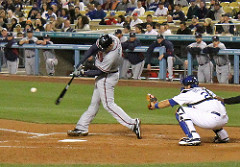
Photo by Neon Tommy 
The Braves may be having a dismal season, but last night (June 15) in Atlanta, Freddie Freeman worked overtime to give Atlanta fans something to cheer about. As the Braves topped the Reds 9-8 in 13 innings, the Atlanta 1B hit for the cycle – doubling in the third, legging out a triple in the fourth, launching a (game-tying) solo home run in the sixth and notching single in the eleventh. For the night, Freeman was four-for-seven, with two runs scored and one RBI.
In MLB history, 276 player have hit for the cycle a total of 309 times; with 25 players collecting two cycles and four players achieving the feat a record three times.
As we note Freeman’s addition to the cycle list, here’s a bit of cycle trivia.
- On June 18, 2000, Colorado Rockies’ second baseman Mike Lansing set an MLB record by completing a cycle in just four innings. As the Rockies topped the Diamondbacks 19-2, Lansing – hitting second in the order – hit an RBI triple to right in the first inning, added a two-run home run in the bottom of the second, hit a two-run double in the bottom of the third (as the Rockies scored nine times to take a 14-1 lead), and then completed the cycle with a single to right in the fourth. Lansing then struck out in the sixth, before being pinch hit for in the eighth. Lansing’s day? Four-for-five, three runs, five RBI.
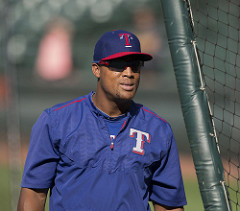
Adrian Beltre, sitting on a record three cycles. Photo by Keith Allison
- Four players have hit for the cycle a record three times: Adrian Beltre (Mariners-2008; Rangers-2012; Rangers-2015); Bob Meusel (Yankees-1921; Yankees-1922; Yankees-1928); Babe Herman (Brooklyn Robins-1931; Robins-1931; Cubs – 1933); John Reilly (Reds-1883; Reds-1883; Reds-1890).
- The Expos’ Tim Foli is the only player to start a cycle one day and complete it the next. On April 21, 1976, Foli collected a single, double and triple in a contest against the Cubbies that was suspended in the top of the seventh due to darkness (no lights at Wrigley yet). When play resumed the following day, Foli added an eighth-inning home run. (The Expos, by the way, won 12-6.)
- Adrian Beltre has hit a record-tying three cycles – all at Arlington (twice for the home Rangers and once for the visiting Mariners, making him the only player to hit for the cycle in the same stadium for two different teams. In those three cycles, Beltre hit .867 (13-for-fifteen), with eight runs, nine RBI, four singles and three doubles, triples and home runs.
- The Marlins are the only team to never have a player hit for the cycle.
- Four players have hit for cycle twice in the same season: Babe Herman (NL Brooklyn Robins-1931); Aaron Hill (NL Diamondbacks-2012); Tip O’Neill (American Association St. Louis Browns-1887); John Reilly (American Association Red Stockings- 1883). No AL player has hit for the cycle twice in a season.
- The youngest MLB player ever to hit for the cycle is the NY Giants’ Mel Ott (age 20, cycle on May 16, 1929).
- The oldest player to hit for the cycle is The Angels’ Dave Winfield (age 39, cycle on June 24, 1991).
- Three players have hit for the cycle in both the NL and AL: Bob Watson (NL Astros-1977; AL Red Sox-1979); John Olerud (NL Mets-1997; AL Mariners-2001); Michael Cuddyer (AL Twins-2009; NL Rockies-2014).
- Yankees’ 1B Lou Gehrig actually made an out while completing a cycle. On June 25, 1934, as New York topped Chicago 13-2 at Yankee Stadium, Gehrig hit two-run home run in the first inning; a single in the third; and a double in the sixth. Gehrig came up needing just the triple for the cycle in the seventh and hit a smash to deep center (scoring NY CF Ben Chapman). Gehrig wasn’t satisfied with a three-bagger and was thrown out at home (CF-SS-C) trying for an inside the park home run – thus getting credit for the triple he needed for a cycle.
THE HOME RUN CYCLE
On July 27, 1998, Tyrone Horne, playing for the Double A Arkansas Travelers, became the only professional player (to date) to hit for the “Home Run Cycle” – bashing a solo, two-run, three-run and grand slam home run all in the same game (a 13-4 win over the San Antonio Mission). For full details, click here.
I tweet baseball @DavidBBRT
Member: Society for American Baseball Research; The Baseball Reliquary; Baseball Bloggers Alliance.
Book Review – Calvin: Baseball’s Last Dinosaur … A good read on many levels.
June 11, 2016 by
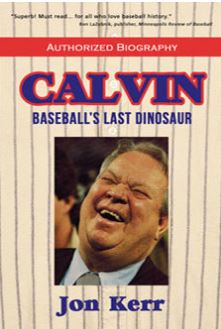 Calvin: Baseball’s Last Dinosaur
By Jon Kerr
Calumet Editions, 2016
$16.99
“He was very tight with a buck, but he was honest with his heart.”
Dave Boswell (Minnesota Twins pitcher, 1964-70)
Describing Twins’ owner Calvin Griffith
Calvin – Baseball’s Last Dinosaur is ostensibly about Calvin Griffith and his 30-year tenure at the helm of the Washington Senators/Minnesota Twins. But it really is about much more. It is about the Griffith family’s passion for the national pastime; it is about family loyalties and family turmoil; it’s a true rags-to-riches story; and it is a tale about the changes wrought by the ending of the reserve clause, free agency, expansion and arbitration.
Calvin: Baseball’s Last Dinosaur was originally published in 1990. This second, revised edition was released April 10, 2016 – reflecting its “legacy” value; particularly as it relates to the history of (and major changes in) the national pastime.
JUNE 20TH – A “CALVIN EVENT” AT SUBTEXT BOOKS
(DOWNTOWN SAINT PAUL)
On Monday, June 20, 2016 (7:00 p.m.-8:00 P.M.), author Jon Kerr will discuss Calvin: Baseball’s Last Dinosaur at Subtext Books, 6 West Fifth Street, downtown Saint Paul. There will be readings, Q&A, lots of great baseball talk and, of course, a book signing. If you are a fan of baseball, the Minnesota Twins, Calvin Griffith or just a history buff, this promises to be an enjoyable evening.
The book presents the life of Calvin Griffith – with all its virtues and flaws – in the context of the history of the national pastime. That context is appropriate since the history of the Griffith family was deeply influenced, in fact shaped, by baseball – and, conversely, the Griffith family had a significant influence on the history of the game. With that in mind, this is a book that has a lot to offer, not just for Minnesota Twins fans, or past Washington Senators fans, or Calvin Griffith fans (or detractors) – but for all fans of our national pastime. And, the story is made better in the telling by a combination of author Jon Kerr’s meticulous research, Calvin Griffith’s long (well-documented) record of honestly speaking his mind; and Griffith’s position at the center of such issues as the integration of the game, expansion, stadium financing, free agency and arbitration.
HONEST TO A FAULT
When preparing this post, I asked author John Kerr what he found most surprising about Calvin and the Griffith family. Kerr’s answer:
“Their down-to-earth honesty. They were elite in the sense of their long role in the baseball fraternity. Yet, they never forgot their humble roots. On a personal level, they were also not the cheapskates as commonly portrayed. This is true even though Calvin was clearly very aware of his family’s financial limitations in baseball’s new world of free agency and arbitration.”
The Griffith saga really begins with Baseball Hall of Famer Clark Griffith. Known as the Old Fox, Clark Griffith built a life around baseball as a player, manager and owner. As a right-handed hurler, Griffith went 237-146 in his MLB career (winning twenty or more games seven times); as a manager, he went 1,491-1367 and led the Chicago White Stockings to the first AL pennant; and as an owner, he brought the World Series to Washington D.C. in 1925-1925 and 1933.
Of essential importance to Kerr’s biography of Calvin Griffith is the fact that Clark Griffith – whose life was so deeply dedicated to baseball – was the single most significant influence on Calvin Griffith (both inside and outside of baseball).
Clark Griffith’s story was one of hard work and unstoppable determination. He went from a poverty-defined, hardscrabble upbringing in Missouri to a Hall of Fame baseball career to team ownership. And, the odds were seldom in his favor. Despite his 5’6”, 156-pound stature, he fashioned a Hall of Fame career as a major league pitcher – and later risked his baseball earnings (and a Montana ranch) to join the ranks of baseball owners. Along the way, he learned the ins-and-outs of baseball – from the field to the front office. He also, as Kerr explains, developed a passion for the game, a deep work ethic, a sense of frugality and an aversion to debt.
Through it all, Clark Griffith maintained a strong commitment to family – and it is that commitment that brought Calvin into the game. I don’t want to give away too much of Kerr’s book, but Calvin Griffith was born Calvin Robertson, and Clark Griffith was his uncle. Like his uncle Clark, Calvin grew up in poverty (in a family of nine). In 1922, Clark Griffith’s sense of family led him and his wife Addie to take two of the Robertson’s children into their home (and lives) – 11-year-old Calvin and his nine-year-old sister Thelma. While never adopting the pair (Calvin and Thelma later changed their names legally to Griffith), Clark and his wife Addie raised them as their own – and Calvin and Thelma inherited the Washington Senators when Clark Griffith passed away in 1955.
How much of an influence was this hardworking, baseball-focused, frugal, family man and father figure on Calvin? Kerr quotes Calvin in his book, “He (Clark Griffith) was only 5-foot-six or five-foot-seven, but he had the – what’s the word? – statue of a giant. He was an individual who was impossible to copy. He was a saint. Next to God, Clark Griffith was it.”
It was the move to Clark Griffith’s home in Washington D.C. that brought Calvin to the baseball life detailed in Kerr’s book. Starting his first summer as a “Griffith,” young Calvin found himself as bat boy for Clark Griffith’s Washington Senators – mingling with the likes of Babe Ruth, Walter Johnson and Ty Cobb. His future was sealed.
CALVIN GRIFFITH – SUPERIOR ATHLETE
Calvin Griffith, often pictured in later life as significantly out of shape, was quite an athlete in his younger days: captain of the Staunton Military Academy (high school) Virginia State Champion baseball AND basketball teams; and later catcher and star pitcher for George Washington University. It was, in fact, only his Uncle Clark’s insistence that the real future in baseball was in the front office that led Calvin to walk away from a contract offer from the Chicago Cubs.
True to his commitment to work ethic and family, once Calvin left George Washington University and joined the Senators’ organization, Clark Griffith demanded his anticipated heir learn the ropes – from the bottom up – in baseball; starting in the front office of the Senators’ Chattanooga Lookouts farm team and moving on to the Charlotte Hornets.
CALVIN GRIFFITH – LEARNING THE ROPES
Excerpt from Calvin: Baseball’s Last Dinosaur
But it was hardly of bed of roses for Calvin either, who operated most of four years at Charlotte as a combination of front office executive, manager, coach, batting practice pitcher, and in other assorted roles. Included was his return to active player, as catcher for a hard-throwing pitcher named Ruben Ortiz.
“We had two catchers, both of them got their hands broken up,” remembers Calvin of the unusual circumstances. ”I went to General Crowder, manager of the Winston-Salem club, and I said, ‘How ‘bout me catchin’ it, or we’re gonna have to forfeit and you’re gonna have to give the money back to the fans.’”
With Crowder’s agreement, Griffith took his place at catcher for the fast-balling Cuban. “I went out there and I said, ‘Give me a chance to see the damn ball. We’re gonna start with some curves or something, so I can see the spin on the ball.’”
“First goddam pitch is a fastball over my head,” recalls Calvin. “It went over my head and hit the screen. I said ‘Uh, this ain’t gonna be good.’ It was a goddam doubleheader. The next day I was so stiff, all I could do was lay in Epsom salts for a couple of hours.”
It wasn’t long (1942) before Calvin joined Uncle Clark with the Senators, initially as head of concessions – working his way up the organization until he and his sister Thelma inherited team ownership in 1955. It was then that Calvin began the saga of baseball ownership that ended with his 1984 sale of the team – and took him through the struggles of team movement, expansion, race relations, stadium financing, free agency and arbitration. As Kerr details, Calvin worked hard to keep baseball a family operation, but he knew the writing was on the wall.
From now on, baseball owners are going to have to be associated with other businesses, so they won’t have to depend on sports to feed their kids. Or they are going to have to be men who were born wealthy, who have zillions of dollars and are looking for a team to buy so they can have something to do with their time and money.
Calvin Griffith, 1975
From Calvin: Baseball’s Last Dinosaur
Kerr’s book take readers through Calvin’s tenure as an owner, detailing the negotiations surrounding the move from Washington D.C. to Minnesota (and previous attempts to move the franchise); the early, glory years of the Twins – the 1965 AL Pennant and 1969-70 Division Championships; right up to the 1984 sale of the club to the Pohlad family (and Griffith’s later misgivings about the transaction).
There also are insights into the players (and Calvin’s relationships with them). Fans know the names: Killebrew, Carew, Allison, Versalles, Grant, Oliva, Hrbek, Blyleven, Puckett, Gaetti and more.
And, there is the joy of Calvin’s many malapropisms. (On the warm reception he received as he was selling the team: “The fans were really great. I’ve been hung in apathy before, so I didn’t know what to expect.”) BBRT note: There is a book dedicated to Calvin’s thought process and unique use of the English language … Quotations from Chairman Calvin by David Anderson.
Kerr also give readers a look at the what was going on behind the scenes all that time: family squabbles, particularly with his son Clark; the logic behind key trades; salary, free-agent and arbitration battles; “Billybrawl;” the departure of fan favorites like Harmon Killebrew and Rod Carew; players strikes; opportunities to move the team; the move to the Metrodome; Calvin’s second-thoughts about the sale of the team; and even the ill-considered and politically incorrect presentation by Calvin at the Waseca Lions Club. It’s all there – and all worth reading.
Notably as Kerr points out, Griffith fought long and hard to keep baseball in the family, surviving longer them most (perhaps even Calvin) expected. Here’s a final quote from Jon Kerr that I think sums up why Calvin: Baseball’s Last Dinosaur makes a great summer read:
“Calvin was also a distinctly different animal than any other modern baseball owner. His battle with change in the game was based as much on history and moral beliefs as financial analyses. Whether based on stubbornness or principle, he was the last holdout in an era of baseball that will never return.”
Jon Kerr
Jon Kerr is a former sportswriter for United Press International (who covered the Twins) and a member of the Society for American Baseball Research. His freelance writing has appeared in a wide range of publications. He currently is the director of a non-profit doing work in Nicaragua (Interfaith Services to Latin America), where he also gets to see plenty of baseball. He also continues his work as a freelance journalist (along with other writing projects).
FOR MORE BASEBALL BOOK REVIEWS, CLICK HERE.
I tweet baseball @DavidBBRT
Member: Society for American Baseball Research (SABR); The Baseball Reliquary; Baseball Bloggers Alliance.
Third Annual BBRT John Paciorek Award
June 9, 2016 by
 In 2014, BRT launched its own baseball award – The John Paciorek Award (JPA). The JPA recognizes players who have had short, maybe very short, major league careers, but whose accomplishments, nonetheless, deserve recognition. Just as the emergence of these players on the MLB scene was often unexpected, the annual JPA is awarded on no specific timetable. BBRT, in fact, most often uncovers these brief, but bright, stars when researching some unrelated baseball topic.
(Note: Information on John Paciorek’s career – the inspiration for the JPA – can be found at the end of this post. Paciorek’s day in the sun constitutes arguably the best one-game MLB career ever.)
________________ 2016 JPA Winner – John Allen Miller _______________
This year, BBRT honors John Allen Miller with the JPA – for crashing just two homers in his MLB career, but making them both historic.
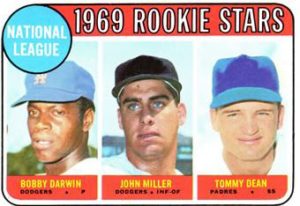
John Miller (center) made his two MLB home runs historic.
John Allen Miller played parts of two seasons in the major leagues (1966 and 1969, with the Yankees and Dodgers, respectively). An outfielder/first baseman, Miller played in a total of just 32 major league games, getting 61 at bats and just ten hits (.164 career average), two home runs and three RBI. With that output, however, Miller earned a special place in the MLB record books. Miller’s two round trippers came in his very first and very last MLB at bats – making him just one of two players in MLB history to homer in their first and final official appearances in a major league batter’s box. The other is Paul Gillespie – whose MLB career spanned three seasons during World War II (1942, 1944, 1945), all with the Cubs. Gillespie, a catcher, appeared in 89 games – hitting .283, with six home runs and 31 RBI; and went zero-for-six in the 1945 World Series.
Miller made his MLB debut with the Yankees on September 11, 1966. The 22-year-old was in his fifth professional season and had hit a promising .294, with 16 home runs and 59 RBI in 113 games at AA and AAA that season. Miller started that debut game (against the Red Sox at Fenway) in LF, batting seventh. In his very first big league at bat, he hit a two-out, two-run (Yankee starting CF Joe Pepitone was on base) home run off of Red Sox starter Lee Stange. Despite the Yankees’ long heritage of home run hitters, Miller’s long ball made him the first Yankee to homer in his first MLB at bat. (Little did Miller know he would not get another home run or RBI until the final at bat of his MLB career.) Miller came to the plate four more times, notching a single and three strikeouts. Miller got in five more games in 1966, going zero-for-18.
The following April, Miller was traded (along with pitcher Jack Cullen and $25,000) to the LA Dodgers for utility infielder John Kennedy. Miller spent 1967 and 1968 at Triple A Spokane – putting up respectable numbers. In 1969, he made it back to the big leagues, getting in 26 games (just 38 at bats) for the Dodgers. In the first 37 of those at bats, Miller collected seven hits (one double and six singles), scored twice, but did not collect an RBI. Miller’s last at bat of the season (and what turn out to be the last at bat of his MLB career) came as a pinch hitter (September 23) in the eighth inning of a game at Cincinnati. The Dodgers, trailing 6-2 sent Miller to the plate for pitcher Al McBean. In that final MLB at bat, Miller stroked a solo home run off Reds’ starting pitcher Jim Merritt. (Thus, not only did Miller homer in his first and final MLB at bats, all of his MLB RBI came in those two plate appearances as well.)
What further makes Miller’s case for the JPA is how close he came to not homering in his final at bat. Miller almost came to the plate one more time – on September 27, as the Dodgers and Giants faced off at Dodger Stadium. That game was tied 1-1 in the bottom of the eleventh inning. Southpaw Ron Bryant was on the mound for the Giants and, after getting Dodger SS Maury Wills to pop out, he gave up singles to LF Manny Mota and CF Willie Davis. Dodgers’ manager Walt Alston sent the right-handed hitting Miller up to hit for LA pitcher Jim Brewer. Giants’ skipper Clyde King –playing the percentages – brought in veteran righty Don McMahon to pitch. Alston countered by calling Miller back and sending up left-handed swinging Len Gabrielson (who singled in the winning tally.) Without the switch, that final at bat home run could have become just an obscure next-to-last at bat dinger. Note: Miller did go on to play three seasons (1970-72) in Japan, hitting .249 with 72 home runs and 222 RBI in 382 games for the Chunichi Dragons.
________________________________________________________
PAST JOHN PACIOREK AWARD WINNERS:
2014 – Brian Scott Dallimore – In his first start (not his first game) for the 2004 Giants, Dallimore had two singles, a Grand Slam (his first MLB hit and only MLB home run), a walk and a hit by pitch. For the full JPA take on Dallimore’s 27- game MLB career, click here.
2015 – Roy Gleason – Gleason played in just eight MLB games, had a double in his only MLB at bat – but also earned a World Series ring (1963) and a Purple Heart. Ultimately, he was the only ballplayer with MLB experience to serve on the front lines in Vietnam. For the full JPA take on Gleason, click here. Note: Gleason’s life is detailed in the book “Lost in the Sun – Roy Gleason’s Odyssey from the Outfield to the Battlefield.”
INSPIRATION FOR THE JPA
John Paciorek – signed out of Saint Ladislaus High School in Hamtramck, Michigan (where he had starred in football, basketball and baseball) – appeared in his first major league game on the final day of the 1963 season (September 29) at the age of 18. The 6’ 1”, 200-pound outfielder had spent the 1963 season with Class A Modesto Colts. The Colts’ parent club, the Houston Colt .45s (that was the current Astros’ franchise name back then), was suffering through a difficult season. The team was 65-96 going into that final game. Looking to the future, Houston had, in fact, fielded an all-rookie lineup (average age 19) on September 27. Youth was still being served two days later when John Paciorek started his first MLB game. The results were surprising – and worthy of recognition.
Playing right field and batting seventh in a 13-4 win over the NY Mets, Paciorek ended up with three hits and two walks in five plate appearances, with four runs scored and three runs batted in. Perhaps equally surprising is that it was not only Paciorek’s first major league appearance, it was to be his only MLB appearance. Back pain the following spring, followed by surgery (he played 49 minor league games in 1964 and missed all of the 1965 season) put an end to his MLB playing days. (Paciorek did play in four more minor league seasons.) Still, you will find John Paciorek in the Baseball Encyclopedia and his is arguably the greatest one-game MLB career ever. Among one-gamers, he holds the record for times on base and runs scored, and shares the record for batting average, on base percentage and RBIs.
Paciorek, by the way, went on to become a high school teacher and multi-sport coach and is the author of two books (Plato and Socrates – Baseball’s Wisest Fans and The Principles of Baseball: And All There Is To Know About Hitting.) You also can enjoy Paciorek’s prose (and expertise) directly at his blog “Paciorek’s Principles of Perfect Practice” by clicking here. You can find out even more about Paciorek in Steven Wagner’s 2015 book “Perfect: The Rise and Fall of John Paciorek, Baseball’s Greatest One-Game Wonder.” (BBRT will be reviewing “Perfect” in the near future.
A final note. John Paciorek’s insight into the national pastime should come as no surprise. Paciorek comes from a true “baseball family.” He was the first born of eight siblings and was followed to the big leagues by younger brothers Jim and Tom Paciorek. (Like John, Jim’s MLB career was short – 48 games for the Brewers in 1987. Brother Tom, however, achieved a .282 average over an 18-season MLB career.)
I tweet baseball @DavidBaseballRT
Member: Society for American Baseball Research; The Baseball Reliquary; Baseball Bloggers Alliance.
May MLB Wrap – David Ortiz, Daniel Murphy, Clayton Kershaw and More
June 1, 2016 by
 The MLB season has now moved into June, which means it’s time for BBRT’s traditional lengthy (Cut me come slack here, we are reviewing an entire month.) monthly wrap up.
There is plenty to write about in MLB for May. It was a month in which the Giants (after a sub-.500 April) caught fire and were the only team to win twenty games (21-8); the Red Sox hit .305 as a team; three players with a minimum of 75 plate appearances hit .400 or better for the month (led by the Nationals’ Daniel Murphy at .416); reigning NL MVP Bryce Harper had a game in which he reached based seven times in seven plate appearances, without ever putting the ball in play; Clayton Kershaw went “old school,” going 5-0, with a 0.91 ERA and three complete games; and 40-year-old David Ortiz proved “old school” can be a good thing, hitting .347, for the month, with nine home runs and an MLB-leading 28 RBI. And, there was plenty more that caught my attention over the past month. You can read the details in the Caught My Eye section of this post (in blue), but here’s a few more teasers from May’s play:
- During the month, two pitchers – both with last-place teams – recorded four strikeouts in an inning.
- On May 29, the Yankees topped the Rays 2-1, despite getting only one hit in the game – becoming the second team this season to win a game in which they collected only one safety.
- Aroldis Chapman didn’t take the mound until May 9 (suspension) – and still recorded the 21 fastest pitches thrown in 2016 – with a high of 103.1 MPH.
- The Astros’ Marwin Gonzalez rapped a two-run home run on May 6, which wouldn’t be unusual except that it was his 26th career round tripper – and the first 25 were solo shots.
- On May 11, the Nationals’ Max Scherzer became just the fourth pitcher in MLB history to fan 20 batters in nine innings – and, like all those before him, didn’t walk a single hitter.
- The White Sox turned their second triple play of the season – the record for a full campaign is three.
- First basemen named Chris proved to be May’s freest swingers – the Brewers’ 1B Chris Carter led the NL with 43 strikeouts in the month, while Orioles’ 1B Chris Davis led the AL with 42.
- And much, much more.
BBRT Players of the Month
AL: David Ortiz (DH, Red Sox) — hit .347, with nine home runs and 28 RBI (tops in MLB) in 98 May at bats. Maybe life does begin at 40.
NL: Daniel Murphy (2B, Nationals) — hit .416 (tops among players with at least 75 plate appearances), with seven home runs, 23 RBI and 17 runs scored in 113 at bats.
BBRT Pitchers of the Month
AL: Zach Britton (Closer, Orioles) — had eight saves and one win in ten appearances, struck out 13 in 11 innings and gave up zero runs.
NL: Clayton Kershaw (Starter, Dodgers) — went 5-0 in six starts, struck out 65 in 49 2/3 innings, threw three complete games, had an ERA of 0.91 for the month.
BBRT Teams of the Month
AL: Boston Red Sox — went 18-10 (AL’s best May record) and led all of MLB in runs scored, home runs and batting average.
NL: San Francisco Giants — had MLB’s best May record (21-8), driven by the month’s lowest team ERA.
Before we get into the specific events that caught BBRT’s eye, let’s take a look (statistically) at who was hot and who was not for May – starting from a team perspective.
HOT AND NOT – FROM A TEAM POINT OF VIEW
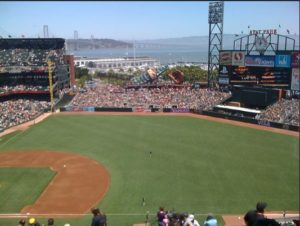
At&T Park was a happy place in May.
Photo by Saul Mora.
Wins and Losses – San Francisco and Boston Lead the Way
No team was hotter in in May than the San Francisco Giants, who took control of the NL West by winning 21 of 29 games during the month (MLB’s best May 2016 record). The Giants did it with pitching – logging the month’s lowest ERA (2.66), while finishing 23rd among the 30 MLB teams in runs scored. Leading the way for the Giants were starting pitchers Madison Bumgarner (4-0, 1.05 in May), Johnny Cueto (4-0. 2.03) and Jeff Samardzija (4-2, 2.08). Closer Santiago Casilla also racked up eight saves with a 1.38 ERA.
Over in the AL, the best record went to the Boston Red Sox at 18-10. The Red Sox rolled to their 18 wins on the strength of a potent offense – leading all of MLB for the month in batting average (.305), runs scored (182) and home runs (46) – while posting the 17th best ERA. Boston got particularly strong performances at the plate from SS Xander Bogaerts (.395-5-20); CF Jackie Bradley, Jr. (.381-8-24); and DH David Ortiz (.347-9-28).
The worst record for May: Only two teams won fewer than ten games in May: The Reds in the NL (8-20) and the Twins in the AL (8-19). Both finished with the worst May ERA in their respective leagues (Twins at 5.96; Reds at 6.17). The Twins were second-t0-last in the AL in runs scored for the month (111, Baltimore scored one fewer), while the Reds finished near the middle (ninth) in the NL.
MAY’S TOP TEAM STATISTICS
Won-Lost
NL: Giants … 21-8; Cubs … 18-10; Dodgers … 16-12
AL: Red Sox … 18-10; five teams with 17 wins
Offensive Leaders for May
Runs Scored
AL: Red Sox (182); Mariners (156); Indians (147)
NL: Cardinals (150); Cubs (139); Rockies (137)
Batting Average
AL: Red Sox (.305); Royals (.288); Mariners (.283); Angels (.283)
NL: Rockies (.276); Pirates (.273); Diamondbacks (.273); Marlins (.273)
Home Runs
AL: Red Sox (46); Mariners (45); Rays (44)
NL: Nationals (43); Mets (40); Reds (39)
Stolen Bases
NL: Brewers (31); Giants (26); Pirates (22)
AL: Rangers (23); Astros (23); Royals (20)
On the other side of the offense coin:
Fewest Runs Scored
NL: Phillies (84); Braves (86)
AL: Orioles (110); Twins (111)
Fewest Home Runs
NL: Braves (16); Phillies (18)
AL: Royals (24); White Sox (24)
Lowest Team Batting Average
NL: Mets (.211); Padres (.215)
AL: Yankees (.232); Astros (.236)
Pitching Leaders for May
ERA
NL: Giants (2.66); Cubs (2.81); Dodgers (3.18)
AL: Blue Jays (3.44); Mariners (3.64); Yankees (3.72)
Strikeouts
NL: Nationals (287); Dodgers (285); Cubs (245)
AL: Astros (267); Indians (249); Yankees (243)
Fewest Walks Allowed
AL: Yankees (64); Twins (72); Mariners (74)
NL: Mets (66); Giants (67); Cardinals (72)
The other side of the pitching coin:
Worst May ERA
NL: Reds (6.17); Diamondbacks (4.83)
AL: Twins (5.96); A’s (5.70)
______________________________________________________________
TOP TEAM STATISTICS THROUGH MAY 31
Now that we’ve had a look at May’s team statistics, like look at the year-to-date (through May 31). As we move into June, only one team is playing .700 ball (Cubs at 35-15, .700, and holding a 6 1/2 game lead in the NL Central). Other teams with at least 30 wins include division leaders Washington (32-21, .604), San Francisco (33-21, .611), Boston (32-20, .615). Conversely, only two teams are playing under.300 ball; the Twins and Braves both stand at 15-36, .294.
IF THE SEASON ENDED MAY 31
If the season ended at the close of play on May 31, your playoff teams would have been:
AL … Division Champions: Red Sox, Royals, Rangers. Wild Cards: Orioles Mariners.
NL … Division Champions: Nationals, Cubs, Giants. Wild Cards: Mets, Pirates.
Now, let’s look at some of the stats behind the standings. (Note: You can find the full May 31 standings at the end of this post.)
__________________________________________________
TEAM OFFENSIVE LEADERS THROUGH MAY 31
Runs Scored
AL: Red Sox (308); Mariners (256); Rangers (246)
NL: Cardinals (292); Cubs (275); Rockies (262)
BBRT Note: Despite the impact of the DH, NL teams make up four of the top five in runs scored.
Batting Average
AL: Red Sox (.294); Royals (.272); Rangers (.262)
NL: Pirates (.283); Rockies (.277); Marlins (.272)
Home Runs
AL: Mariners (77); Rays (71); Orioles (69)
NL: Mets (73); Cardinals (71); Nationals (69)
Stolen Bases
NL: Brewers (44); Pirates (38); Diamondbacks (36)
AL: Astros (42); Royals (38); Indians (37)
On the other side of the offensive coin:
Fewest Runs Scored
AL: Twins (191); Yankees (193)
NL: Braves (161); Phillies (164)
Fewest Home Runs
NL; Braves (21); Phillies (39)
AL: Royals (44); Angels (47)
Lowest Team Batting Average
NL: Padres (.226); Braves (.228)
AL: Yankees (.232); Astros (.236)
Fewest Stolen Bases
AL: Orioles (8); Mariners, Tigers, Angels (16 each)
NL: Mets (10); Marlins (13)
TEAM PITCHING LEADERS THROUGH MAY 31
ERA
NL: Cubs (2.65); Nationals (2.95); Mets (3.25)
AL: Mariners (3.37); White Sox (3.47); Blue Jays (3.64)
Strikeouts
NL: Nationals (492); Dodgers (483); Phillies (457)
AL: Red Sox (463); Yankees (444); Astros (444)
Saves
NL: Marlins (20); Phillies (19); Mets (18); Pirates (18)
AL: Rangers (18); Orioles (17); three teams with 16
Fewest Walks Allowed
AL: Yankees (115); Rays (137)
NL: Mets (122); Giants (135)
On the other side of the pitching coin:
Worst ERA
NL: Reds (5.83); Rockies (5.13)
AL: Twins (5.01); A’s (4.70)
Highest Batting Avg. Against
AL: Twins (.284); Tigers (.275)
NL: Rockies (.279); Reds (.277)
Most Walks Given Up
NL: Reds (239); Padres (220)
AL: Red Sox (178); Royals (178)
_____________________________________________________________
CAUGHT MY EYE
Now, let’s give the statistics a rest – and look at some unusual on-the-field occurrences over the month of May.
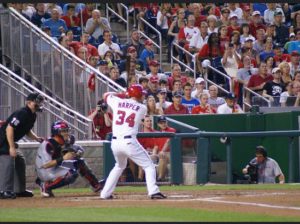
Patience can be a virtue.
Photo by Richard Martin.
R-E-S-P-E-C-T
The Nationals’ Bryce Harper was treated with an unusual amount of respect (even for a reigning MVP) on May 8. In a game that saw the Cubs top Harper’s Nationals 4-3 in 13 innings, Harper came to the plate seven times and reached base seven times – without ever putting the ball in play. Harper drew six walks (tying the MLB single-game record) and was hit by a pitch. (Harper’s reaching base seven times in a game without an official at bat is also a record.) Three of the walks to Harper were intentional – one shy of Barry Bonds’ single-game record. (BBRT Note: Harper scored just one run in the game.)
Oh-SOLO-Mee-Oh
Here’s something else you don’t often see –a two-run home run by the Astros’ Marwin Gonzalez. On May 6, as the Astros topped the Mariners 6-3, Gonzalez (starting at first base) hit a two-run shot in the second inning. Why did this catch BBRT’s eye? It was Gonzalez’ 26th home run in five MLB seasons – and his first home run with a man on base. That’s right, Marwin started his career with an MLB-record 25 solo home runs. (By the way, second place on this “list” is 11 solo shots before connecting with a man on base.)
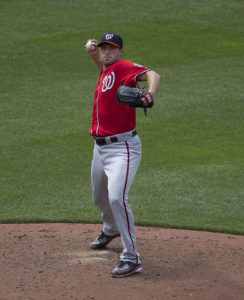
Photo by Keith Allison
Stay Whiff Me on This
On May 11, the Nationals’ Max Scherzer tied an MLB record by fanning twenty batters in nine innings – joining Roger Clemens (twice), Kerry Wood and Randy Johnson as the only pitchers to accomplish that feat. Like all those before him, Scherzer notched his twenty K’s without issuing a single walk. Scherzer, by the way, gave up the most hits (6), most runs (2) and most home runs (2) ever in a nine-inning, 20-strikeout performance. Scherzer did get the victory, as the Nationals topped the Tiger 3-2 in Washington. For more on Scherzer’s gem and other 20-strikeout performances, click here.
Triple Your Pleasure – Doubly
On May 18, the White Sox turned their second triple play of 2016 (the record for a season is three), while losing to the Astros 5-3. This one went in the “classic” 5-4-3 style (third base to second base to first) – as compared to their first triple killing of the year (April 22), which was scored 9-3-2-6-2-5.
Triple Play Trivia
The Minnesota Twins are the only team to turn two triple plays in a single game – a July, 17, 1990, contest that they lost to the Red Sox by a 1-0 score.
Hall of Famer Brooks Robinson hit into an MLB-record four triple plays in his career.
On May 16, 1913 the Philadelphia Athletics turned a triple play against the Cleveland Naps in which the ball changed hands an MLB-record nine times: 6-2-5-1-5-4-5-6-5-7.
The Whiffing-Poof Song
Depending on how you look at it, the Astros/Orioles Series of May 24-26 resulted in either fame or infamy. In the Series, Astros’ pitchers became the first staff ever to record 15 or more strikeouts in three consecutive games. The Astros swept the O’s by scores of 3-2 (13 innings), 4-3 and 4-2 and struck out 19, 18, and 15 batters in each game, respectively. The 52 whiffs – 56 percent of all the Orioles’ outs – were also a record for a three-game series. The most frequent whiff victim was Orioles’ 1B Chris Davis, who fanned eight times in 14 at bats (he also had two walks). Houston hitters struck out a total of 31 times in the three games – which means that 47 percent of all the outs in the three-game set came via the strikeout.
Boston – Streak City
May 26 marked the first Red Sox game in the month of May that didn’t feature a base hit by CF Jackie Bradley. Jr. Bradley’s 29-game hitting streak stretched just over a month (April 24 to May 25). During the streak, the 26-year-old OF hit .423 (44-for-104), with eight home runs, 30 RBI and 19 runs scored (and Boston went 21-8). When Bradley started his streak he was hitting just .233, with no home runs – at the end of the streak his average was up to .350. Bradley had 19 one-hit games in keeping his streak alive – and also had six consecutive multi-hit games (May 8-13), when he went 15-for-25.
Bradley wasn’t the only Red Sox “streaker” in May. May 5 marked the last game in the month that didn’t feature a hit by Boston SS Xander Bogaerts. The 23-year-old Bogaerts ran off a 24-game hitting streak (still alive) – that began on May 6. During his streak, Bogaerts has hit .394 (42-for-107), with five home runs, 16 RBI and 22 runs scored. When he began his streak he was hitting .309, with one home run. At the end of May, he was hitting .350.
King of the Hill – Another Streak
When Jake Arrieta picked up the win (in a 9-8 Cubs victory over the Cardinals) on May 24, it not only marked a 9-0 start to the season for the Cubs’ ace, it also marked the 23rd consecutive Arietta start in which the Cubs earned a victory (tying a record set in 2012 by Kris Medlen). The last time the Cubs had lost a game that Arietta started was on July 25, 2015. The streak, however, was broken on the last day of May, when the Dodgers topped the Cubs 5-0 at Wrigley – despite Arrieta’s seven shutout innings. Arrieta left the game with the scored tied at 0-0, but the Cubs went on to take the loss (breaking the Arrieta streak). In his last 24 starts, Arrieta has picked up up 20 wins and four no-decisions.
Won One – With One
On May 29, the Yankees topped the Rays 2-1 in Tampa Bay, despite collecting only one hit (Tampa had six). Ray’s starter Jake Ordozzi actually carried a no-hitter and a 1-0 lead into the top of the seventh, when a one-out walk to Yankee LF Brett Gardner and a home run by Starlin Castro resulted in two Yankee runs. For the game, the Yankees had only three base runners – Gardner, Castro and 1B Dustin Ackley (safe on an error in the sixth). It was the second game won by a team with just one hit this season. The Rangers also won their April 4 Opener (in Texas) by a score of 3-2 over Seattle – despite collecting only one hit.
By the way, a win on just one hit is not a record. Five teams have managed victories without collecting a single safety. You can find details on those in the box at the end of the April Wrap Up – click here to go to that post.
Who’s On First?
MLB’s longest home run (thus far) of the 2016 season was hit in May. Who hit it and when? Ah, that’s is, indeed, the question(s). According to Statcast™ that honor goes to Rangers’ rookie Nomar Mazara – with a 491-foot shot on May 25 off the Angels’ Hector Santiago. But, not so fast! ESPN Home Run Tracker gives the honor to the Marlins’ Giancarlo Stanton, with a 490-footer on May 6 off the Phillies’ Hector Neris. (Note: Statcast lists Stanton’s shot at 475 feet, while ESPN’s Home Run Tracker has Mazara’s blast at just 453 feet. Hopefully, someone will hit a 500-foot shot and put this discrepancy behind us.)
Four Whiffs in One Inning
The month of May saw two pitchers – one from each league – join the group of (now 74) pitchers who have struck out four batters in a single inning.
On May 8, the Minnesota Twins’ Tyler Duffy went into the bottom of the seventh trailing the White Sox 2-1. Tuffy got Sox’ 2B Brett Lawrie on a swinging strikeout to open the frame, then whiffed DH Avasail Garica, who reached first base as the final strike came on a wild pitch that got by Twins’ catcher Juan Centeno. After a run-scoring double by Sox’ C Dioner Navarro, Duffey fanned CF Austin Jackson, walked RF Adam Eaton intentionally and struck out SS Jimmy Rollins for the final out. Duffey took the loss in a game in which he gave up three runs on six hits and two walks (while fanning nine) in seven innings.
On May 24, Atlanta Braves’ Julio Teheran took the mound against the Brewers in the top of the second of a scoreless game. Teheran fanned Brewers’ C Jonathan Lucroy and 1B Chris Carter (both swinging) to start the inning, CF Kirk Nieuwenhuis then swung at a third-strike wild pitch (reaching first base on the strikeout). After giving up a single to 3B Aaron Hill, Teheran fanned RF Ramon Flores to end the inning. Teheran got a no decision (the Braves lost 2-1), going seven innings – giving up just one run on three hits, walking none and striking out a dozen.
For those interested in such things, Chuck Finley holds the record for four-strikeout innings at three. The only other pitchers to accomplish the feat more than once are A.J. Burnett and Zack Greinke (twice each).
_______________________________________________________________
Now, let’s get back to May’s statistical leaders.
It was quite a month, with three NL hitters topping the .400 mark (Daniel Murphy, Marcell Ozuna and Ben Zobrist); 40-year-old David Ortiz leading MLB in RBI with 28; Clayton Kershaw (no surprise there) dominating the NL pitching statistics (5-0, 0.91 ERA, 65 strikeouts); the A’s Rich Hill (some surprise here) turning in five wins and the AL’s lowest ERA; and the Reds’ Adam Duvall and A’s Khris Davis leading the NL and AL, respectively, in home runs.
LEADING INDIVIDUAL BATTING PERFORMANCES IN MAY
Batting Average (75 minimum plate appearances)
NL: Daniel Murphy (2B, Nationals) – .416; Marcell Ozuna (CF, Marlins) – .411; Ben Zobrist (2B, Cubs) – .406
AL: Xander Bogaerts (SS, Red Sox) – .395; Jackie Bradley, Jr. (CF, Red Sox) – .381; Ryan Bruan (LF, Brewers) – .364
Home Runs
AL: Khris Davis (LF, A’s) – 11; David Ortiz (DH, Red Sox) – 9; Mark Trumbo (RF, Orioles) – 9; Todd Frazier (3B, White Sox) – 9
NL: Adam Duvall (LF, Reds) – 11; Jonathan Lucroy (C, Brewers) – 9; Chris Carter (1B, Brewers) – 8; Yoenis Cespedes (CF, Mets) – 8
RBI
AL: David Ortiz (DH, Red Sox) – 28; Mike Trout (CF, Angels) – 27; Eric Hosmer (1B, Royals – 27)
NL: Ben Zobrist (2B, Cubs) – 25; Adam Duvall (LF, Reds) – 24; Brandon Crawford (SS, Giants) – 23; Daniel Murphy (2B, Nationals) – 23
Stolen Bases
AL: Danny Santana (CF, Twins) – 8; five players with six
NL: Jonathan Villar (SS, Brewers) – 14; Starling Marte (LF, Pirates) – 10: Matt Duffy (3B, Giants) – 7
Walks Drawn
AL: Carlos Santana (DH, Indians) – 23; Mike Trout (CF, Angels) – 21; Jose Bautista (RF-Blue Jays) – 19; George Springer (RF Astros) – 19
NL: Bryce Harper (RF, Nationals) – 31; Paul Goldschnidt (1B, Diamondbacks) – 24; Jonathan Villar (SS-Brewers) – 20
On the other side of the coin:
There were nearly two dozen players with at least 75 May plate appearances who hit under.200 – including Ryan Howard (Phillies), who went 7-for-69, averaging .101 for the month. A couple of first baseman named Chris finished atop of the strikeout list. Milwaukee 1B Chris Carter led the NL with 43 whiffs in May (to go with a .198 average, eight home runs and 16 RBI); while Orioles’ 1B Chris Davis fanned an AL-leading 42 times in May (.210-3-11).
BEST INDIVIDUAL PITCHING STATS FOR MAY
ERA (minimum 30 innings pitched)
AL: Rich Hill (A’s) – 2.13; Marco Estrada (Blue Jays) – 2.14; Martin Perez (Rangers) – 2.23
NL: Clayton Kershaw (Dodgers) – 0.91; Madison Bumgarner (Giants) – 1.05; Steven Matz (Mets) – 1.26
Wins
AL: Joe Quintana (White Sox) … 5-0; Nathan Eovaldis (Yankees) … 5-0; Rich Hill (A’s) … 5-1
NL: Clayton Kershaw (Dodgers), Stephen Strasburg (Nationals) and Jose Fernandez (Marlins) … all at 5-0.
Strikeouts
AL: Danny Salazar (Indians) – 46 (in 37 1/3 IP); Justin Verlander (Tigers) – 46 (in 42 2/3 IP)
NL: Clayton Kershaw (Dodgers) – 65 (in 49 2/3 IP); Max Scherzer (Nationals) – 60 in 42 1/3 IP);
Saves
AL: Francisco Rodriguez (Tigers), Luke Gregorson (Astros) and Zach Brzitton (Orioles) – 8 each
NL: Jake McGee (Rockies); Mark Melancon (Pirates); Jeanmar Gomez (Phillies); and Jeurys Familia (Mets) – all with 9
The other side of the coin:
Three pitchers took five losses in May: Michael Wacha of the Cardinals went 0-5, 6.75; Carlos Martinez of the Cardinals went 1-5, 5.18; and Taijuan Walker of the Mariners went 0-5, with a 4.91 ERA. Ubaldo Jimenez had an 8.28 ERA in six starts (one win and four losses) and tied for the AL lead in walks allowed (with the Orioles’ Chris Tillman) at 19. Alfredo Simon (Reds) had an ERA of 7.67 in five May starts (one win and two losses). Tom Koehler led MLB in walks allowed for the month, with 24 in 34 IP (six starts).
__________________________________________________
STATISTICAL LEADERS THROUGH MAY
Now let’s look at the statistical leaders on the season as a whole. A few observations: Nationals’ 2B Daniel Murphy continues to flirt with a .400 average (.397); the Rockies’ 3B Nolan Arenado, who led the NL in HR’s and RBI last season, is again atop the league in both categories; David Ortiz (.335-14-47) is proving that life may begin at 40; Clayton Kershaw (7-1, 1.56) and Jake Arrieta (9-0, 1.56), tied for MLB’s lowest ERA, are performing as advertised; the Marlins’ Jose Fernandez (8-2, 2.53. 96K in 67 2/3 innings) and A’s Rich Hill (8-3, 2.25) are catching a few people by surprise; and Robinson Cano (.291-15-45) is back.
BATTING LEADERS THROUGH MAY 31
Batting Average (150 plate appearances)
NL: Daniel Murphy (2B, Nationals) – .397; Ryan Braun (LF, Brewers) – .348; Ben Zobrist (2B, Cubs) – .345
AL: Xander Bogaerts (SS, Red Sox) – .350; Victor Martinez (DH, Tigers) – .343; Eduarado Nunez (SS, Twins) – .340
Home Runs
AL; Todd Frazier (3B, White Sox) – 16; Robinson Cano (2B, Mariners) – 15; Mark Trumbo (RF, Orioles) – 15
NL: Nolan Artenado (3B, Rockies) – 16; Yeonis Cespedes (CF, Mets) – 15; Trevor Story (SS, Rockies) – 14
RBI
AL: David Ortiz (DH, Red Sox) – 47; Robinson Cano (2B, Mariners) – 45; three with 40
NL: Nolan Arenado (3B, Rockies) – 43; Anthony Rizzo (1B, Cubs) – 37; Kris Bryant (3B, Cubs) – 37; Yoenis Cespedes (CF, Mets) – 37
Runs Scored
AL: Mookie Betts (RF, Red Sox) – 49; Ian Kinsler (2B, Tigers) – 44; Xander Bogaerts (SS, Red Sox) – 42
NL: Gregory Polanco (RF, Pirates) – 38; Ben Zobrist (2B, Cubs) – 37; Kris Bryant (3B, Cubs) – 37; Nolan Arenado (3B, Rockies) – 37
Stolen Bases
NL: Jonathon Villar (SS, Brewers) – 19; Starling Marte (LF Pirates) – 17; Melvin Upton, Jr. (LF, Padres) – 10; Billy Hamilton (CF, Reds) – 10
AL: Jose Altuve (2B, Astros) – 15; Billy Burns (CF, A’s) – 12; Rajai Davis (CF, Indians) – 11; Jacob Ellsbury (CF, Yankees) – 11
Walks Drawn
NL: Paul Goldschmidt (1B-Diamondbacks) – 49; Bryce Harper (RF, Nationals) – 48; ; Brandon Belt (1B, Giants) – 36
AL: Jose Bautista (RF, Blue Jays) – 40; Mike Trout (CF, Angels) – 35; Joe Mauer (1B, Twins) – 31; Carlos Santana (DH, Indians) – 31
On the other side of the coin:
The following players with at least 150 plate appearances are all hitting below the “Mendoza Line” (under .200): Ryan Howard (Phillies) – .154; Chris Coghlan (A’s) – .157; Yan Gomes (Indians) – .171; Derek Norris (Padres) – .179; Erik Aybar (Braves) – .182; Mark Teixeira (Yankees) – .190; Kendrys Morales (Royals) – .193; Prince Fielder (Rangers) – .194; Russell Martin (Blue Jays) – .197); Peter Bourjos (Phillies) – .199; Danny Espinoza (Nationals) – .199
In the strikeout race, only four players have whiffed 70 or more times: Trevor Story (Rockies) – 76K in 204 at bats; Justin Upton (Tigers) – 72 K in 184 at bats; Miguel Sano (Twins) – 71K in 179 at bats); Chris Davis (Orioles) – 70K in 185 at bats
BEST STATISTICS BY PITCHERS THROUGH MAY 31
ERA (at least 50 innings pitched)
NL: Clayton Kershaw (Dodgers) – 1.56; Jake Arrieta (Cubs) – 1.56; Noah Syndergaard (Mets) – 1.84
AL: Jose Quintana (White Sox) – 2.13; Rich Hill (A’s) – 2.25; Chris Sale (White Sox) – 2.29
Wins
NL: Jakes Arrieta (Cubs) – 9-0; Stephen Strasburg (Nationals) – 9-0; Johnny Cueto (Giants) – 8-1; Jose Fernandez (Marlins) – 8-2
AL: Chris Sale (White Sox) – 9-1; Rich Hill (A’s) – 8-3; five with seven wins
Strikeouts
NL: Clayton Kershaw (Dodgers) – 105; Jose Fernandez (Marlins) – 96; Max Scherzer (Nationals) – 90; Stephen Strasburg (Nationals) – 90
AL: David Price (Red Sox) – 79; Justin Verlander (Tigers) – 77; Chris Sale (White Sox) – 76
Saves
NL: Jeanmar Gomez (Phillies) – 17; Jeurys Familia (Mets) – 17; Mark Melancon (Pirates) – 16; A.J. Ramos (Marlins) – 16
AL: Wade Davis (Royals) – 15; Francisco Rodriguez (Tigers) – 14; ; Zach Britton (Orioles) – 14
On the other side of the coin:
The leaders in losses are: Phil Hughes (Twins) 1-7; Jared Eickhoff (Phillies) 2-7; James Shields (Padres) 2-7; Drew Smyly (Rays) 2-7; Matt Harvey (Mets) 4-7. Six pitchers with at least fifty innings pitched have ERA’s over 6.00: Micheal Pineda (Yankees) – 6.92; Anibel Sanchez (Tigers) – 6.67; Wily Peralta (Brewers) – 6.51; Ubaldo Jiminez (Orioles) – 6.36; Jake Peavy (Giants) – 6.34; Clay Bucholz (Red Sox) – 6.24
______________________________________________________________
Now the Standings
MAY 31, 2016 STANDINGS (May W-L in parenthesis)
AL EAST
Red Sox 32-20 .615 … (18-10)
Orioles 28-22 .560 3.0 (14-13)
Blue Jays 28-26 .519 5.0 (17-12)
Yankees 24-27 .471 7.5 (16-13)
Rays 22-28 .440 9.0 (11-16)
AL CENTRAL
Royals 29-22 .569 … (17-11)
White Sox 28-25 .528 2.0 (11-17)
Indians 26-24 .520 2.5 (16-13)
Tigers 24-27 .471 5.0 (11-17)
Twins 15-36 .294 14.0 (8-19)
AL WEST
Rangers 31-21 .596 … (17-11)
Mariners 30-21 .588 0.5 (17-11)
Angels 24-28 .462 7.0 (13-15)
Astros 24-29 .431 7.5 (17-12)
A’s 24-29 .453 7.5 (11-17)
NL EAST
Nationals 32-21 .604 … (16-14)
Mets 29-22 .569 2.0 (14-15)
Marlins 27-25 .519 4.5 (15-14)
Phillies 26-26 .500 5.5 (12-16)
Braves 15-36 .294 16.0 (10-18)
NL CENTRAL
Cubs 35-15 .700 … (18-10)
Pirates 29-22 .569 2.0 (14-13)
Cardinals 28-25 .528 8.5 (16-13)
Brewers 23-29 .442 13.0 (15-14)
Reds 17-35 .327 19.0 (8-20)
NL WEST
Giants 33-21 .611 … (21-8)
Dodgers 28-25 .528 4.5 (16-12)
Rockies 24-27 .471 7.5 (13-15)
D-backs 23-31 .426 10.0 (11-17)
Padres 20-33 .377 12.5 (11-18)
__________________________________________________________
CATFISH HUNTER IMMORTALIZED IN SONG
Let’s wrap up the May Wrap Up with a musical interlude. May 24 happened to be Bob Dylan’s 75th birthday – and Dylan once immortalized A’s pitcher Catfish Hunter in song (a tune appropriately titled “Catfish,” recorded by Dylan and covered by Joe Cocker. And, here it is.
I tweet baseball @DavidBBRT
Member: Society for American Baseball Research (SABR); The Baseball Reliquary; Baseball Bloggers Alliance.
Book Review – Under One Roof – The Integration of Spring Training
May 25, 2016 by
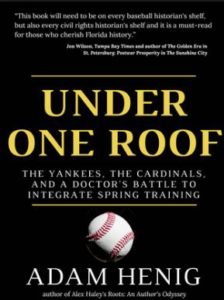 Under One Roof – The Yankees, The Cardinals
and a Doctor’s Battle to Integrate
Spring Training
By Adam Henig
Wise Ink Creative Publishing – 2016
$9.95
Under One Roof – The Yankees, The Cardinals and a Doctor’s Battle to Integrate Spring Training is more than a baseball book. It is also a biography and a history book – with an important story to tell about perseverance, courage and the battle for civil rights in the Jim Crow south; specifically in St. Petersburg, Florida.
It is the story of African American physician Ralph Wimbish in particular, but also of his family, and their impact on the city of Saint Petersburg, the pursuit of civil rights and Major League Baseball’s Spring Training. While Wimbish’s fight to change the treatment of black ballplayers in Spring Training provides the central hook for the book, readers also learn about the work of Ralph Wimbish and his wife Bette to help integrate public facilities from hospitals to restaurants to golf courses and beaches. For the Wimbishes, civil rights were truly a family affair. Here are just a few highlights:
- Ralph Wimbish organized St. Petersburg’s Ambassadors’ Club – comprised of the city’s African American leaders in business, education, law and medicine – to help finance and spur St. Petersburg’s civil right movement. Wimbish also later served as President of the St. Petersburg Branch of the NAACP.
- Wimbish’s wife Bette, a teacher and later an attorney, also was an active civil rights crusader and the first person of color to serve on the St. Petersburg City Council;
- Wimbish’s daughter Barbara was the first African American student to attend St. Paul’s Catholic High school in St. Petersburg.
- Wimbish’s son Ralph Jr., integrated the city’s all-white Little League.
As Henig accurately portrays, the Jim Crow South was no easy place for African Americans – particularly those who were willing to step forward in the cause of civil rights. Henig shares the story of how the Ralph and Bette Wimbish came to live in St. Petersburg, despite finding what seemed to be the perfect house in Tampa. In Henig’s words:
It was located in a predominantly white neighborhood, but since the previous owner was an African American, Bette felt comfortable that her neighbors would be agreeable or at least tolerant. She signed the papers.
The day before she was scheduled to move, the house was torched and burned down. The suspected arsonist was a nearby store owner and active member of the Ku Klux Klan. He was never charged. Distraught, Bette began looking elsewhere for her family to settle. Tampa was out, so the couple decided to start looking across the bay to Ralph’s hometown of St. Petersburg.
The rest, as they say, is history.
The level of Wimbish’s commitment and the depth of his influence are perhaps illustrated by the opposition’s response – more than one cross burning in the Wimbish’s front yard, a fire bomb thrown at their home and numerous death threats. Even without the baseball ties, this book tells an important story about an important (and risky) struggle.
Still, at the center of Henig’s book are Ralph Wimbish’s efforts to ensure that black baseball players who came to St. Petersburg for spring training were allowed to live and eat in the same places as their white teammates. Here’s Cardinals’ black first baseman Bill White (who would go on to become President of the National League) describing the situation in 1961:
I can’t stay at the same hotel as the white players. These players are my friends, yet I can’t go swimming with them. I can’t even go to the movies with them. Driving on the highways, I’ve got to be on the lookout for a Negro restaurant to eat because they won’t let me eat where the white folks eat.
The fact is, Black players for years had been forced to live in the homes of Black families and often take their meals with them, while the white players enjoyed St. Petersburg’s best (and segregated) hotels and restaurants.
In early 1961, Wimbish decided the unequal treatment of Black ballplayers taking part in Spring Training in St. Petersburg had gone on long enough. No longer would he tolerate separate housing for Black players in St. Petersburg (hence the title Under One Roof). It became a personal crusade. As Henig notes in the book:
If Major League Baseball had not heard of Dr. Ralph Wimbish. it soon would. He was about to turn its world upside down.
Henig does a great job of telling and documenting the tale of Wimbush’s fight to bring all ballplayers under one roof in St. Petersburg; as well as introducing us to his allies (and opposition) and the ultimate impact of his efforts.
Hall of Famer Bob Gibson’s recollection of the Cardinals’ 1961 move to the integrated Doctors’ Motel in St. Petersburg:
It was such a novelty in St. Petersburg to have an integrated hotel that the team’s residence soon became a “local tourist attraction,” as recalled by African American pitcher Bob Gibson. “People would drive by to see the white and black families swimming together.”
Ultimately, Under One Roof is a story well-worth telling (and reading) – well told. To order Under One Roof from Amazon.com, click here.
BBRT Note: Having lived in the pre-integration South in my youth (military family) – and witnessed first-hand such inequities as theaters that restricted black movie-goers to the balcony, restaurants that served white customers out front and black customers at tables in the kitchen, segregated restrooms and even separate water fountains – I took a special interest in Henig’s book (and would recommend it to anyone not familiar with the culture of segregation at the time).
Adam Henig is the author of Alex Haley’s Roots: An Author’s Odyssey. His writings have appeared in the San Francisco Book Review, Tulsa Book Review, Medium, The Biographer’s Craft and Blogcritics. He’s also been featured on the podcast, New Books Network: African American Studies. Adam is an active member of the Biographers International Group (BIO).
For more baseball book reviews, click here.
I tweet baseball @DavidBBRT
Member: Society for American Baseball Research; The Baseball Reliquary; Baseball Bloggers Alliance.
Dotel, Bautista, Youngblood – Kings of MLB “Journey-men”
May 22, 2016 by
Trades, Free Agency, Waiver Wire – There are lots of ways to move from team to team on a player’s major league journey. In this post, BBRT will take a look at a handful of players who could be considered the kings of that journey. I’m talking about the MLB record holders for teams played for in a career, a season and a single day.
Octavio Dotel – 13 MLB Teams Played For in His MLB Career
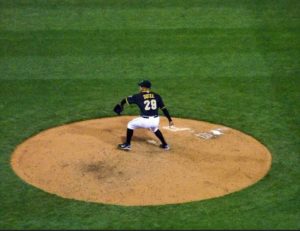
Photo by: Jon Dawson
Dominican-born Octavio Dotel traveled a long way to get to the major leagues. And, after spending four of his first five MLB seasons with the Houston Astros, his travels were just beginning. The 6-foot, 230-pound right-handed pitcher would take the mound for 11 more teams over the next ten seasons – and holds the record for the most MLB franchises played for in a career at 13. Dotel, who retired at the age of 40, appeared in 758 games; put up a 59-50 record, with 109 saves; and struck out 10.8 batters per nine innings (1,143 whiffs in 951 innings pitched).
But, I’m getting ahead of myself. Let’s look at the career of major league baseball’s “King of the Road.”
Dotel signed with the Mets in 1995 (at the age of 21). Between 1995 and 1999, he worked his way through the Mets’ minor league system, pitching in 102 games (92 starts), with a 44-23 record, a 3.27 ERA and 613 strikeouts in 560 2/3 innings.
Dotel’s work earned him a promotion to the Mets in June of 1999 and he appeared in 19 games for New York (14 starts). He managed an 8-3 record, despite a 5.38 ERA – helped no doubt by his 85 strikeouts in 85 1/3 innings pitched. In December of 1999, Dotel was traded (along with minor league pitcher Kyle Kessel) to the Astros for OF Roger Cedeno and LHP Mike Hampton. It would be the first of many moves for Dotel. It was also probably the most fortuitous, because it ultimately led to another move – from the starting rotation to the bullpen.
In 2000, Dotel began the season in the Astros’ rotation and, in 16 starts, went 1-5 with a 5.84 ERA. An injury to Astros’ closer Billy Wagner, however, sent Dotel to the bullpen, where he notched two wins and 16 saves in 34 appearances (4.24 ERA). Dotel’s days as a starter were basically over. (During the next 13 seasons, Dotel would make only four starts in 689 appearances.) Over the next three-and-a-half seasons, Dotel was a fixture in a solid Astros’ pen – going 19-17, with 26 saves, a 2.42 ERA and 410 strikeouts in 324 innings.
Then, on June 24, 2004, Dotel began his “MLB Journey” in earnest. On that day, as part of a three-team trade, Dotel moved from the Astros to the A’s (where he added six wins and 22 more saves in 45 appearances) Over the next eight seasons, Dotel (as a result of four trades and six signings as a free agent) would pitch for the Yankees, Royals, Braves, White Sox, Pirates, Dodgers, Rockies, Blue Jays, Cardinals and Tigers. In 2010 alone, he would take the mound for three MLB teams – the Pirates, Dodgers and Rockies.
Dotel also pitched in the post season for the Mets (1999), Astros (2001), White Sox (2008), Cardinals (2011) and Tigers (2012). In 26 post-season appearances, he went 3-1, with a 3.86 ERA and 33 strikeouts in 23 1/3 innings. Dotel – traveling MLB’s “Long and Winding Road” was a valuable addition to a dozen bullpens – as he racked up innings and strikeouts for a record 13 MLB teams.
MOST MLB FRANCHISES PLAYED FOR IN A CAREER
Octavio Dotel (RHP) – 13 franchises in 15 seasons (1999-2013)
Mike Morgan (RHP) – 12 franchises in 22 seasons (1978-2002)
Matt Stairs (OF/1B) – 12 franchises in 19 seasons (1992-2011)
Ron Villone (LHP) – 12 franchises in 15 seasons (1995-2009)
____________________
Jose Bautista – Four MLB Teams Played for in a Single Season
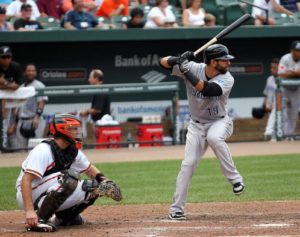
Photo by: Keith Allison
While Octavio Dotel currently holds sole possession of the record for most franchise played for in a career, the record for MLB teams played for in a season (four) is shared by thirteen players. I’ll provide the whole list, but let’s look in more detail at the most recent (and, arguably, best known) player to accomplish this feat. In 2000, 19-year-old Jose Baustista was drafted by the Pirates in the 20th round of the MLB draft. He played in the Pirates’ minor league system until 2003. In those three seasons, Bautista took the field in 349 games, hitting .287, with 24 home runs and 100 RBI – never rising above High A ball. The Pirates left Bautista unprotected in the 2003 Rule Five Draft – and thus began his record-tying odyssey.
Picked up by the Orioles, Bautista started the 2003 season on the Baltimore roster, but seldom left the bench. In fact, by early June, he had only 11 at bats – and the Orioles placed him on waivers. Bautista was claimed by the Tampa Bay Devil Rays on June 3, but got only 12 at bats with the Rays between then and June 28, when his contract was purchased by the Kansas City Royals. Within a month (and 25 at bats), the Royals traded Bautista to the Mets, who put him on their major league roster and then (on the same day) included him in a trade with the Pirates (Remember them – Bautista’s original team). The Pirates kept him on the major league roster for the remainder of the season (40 more at bats). So, Bautista took the field that season for the Orioles, Devil Rays, Royals and Pirates.
Remember that brief stint with the Mets (no games played, traded on the same day he was acquired)? While he didn’t play for the Mets, his brief time on the Mets’ roster means Bautista was on a record five different major league rosters in one season. (There may be a second player to appear on five MLB rosters in a season; although he only played on three teams. BBRT is working to confirm this. See the statistical note at the end of this post. )
How did Joey Bats do in his four-team/five-roster season? He played in 64 games, had 88 at bats, a .205 average, zero home runs and two RBI. From that highly traveled and inauspicious start, Bautista HAS gone on to make a name for himself as a Toronto Blue Jay and one of the AL’s most feared power hitters.
MOST MLB TEAMS PLAYED FOR IN A SINGLE SEASON … FOUR
Jose Bautista (OF/3B) – 2004 (Orioles, Devil Rays, Royals, Pirates)
Dan Miceli (RHP) – 2003 (Rockies, Indians, Yankees, Astros)
Dave Martinez (OF/1B) – 2000 (Devil Rays, Cubs, Rangers, Blue Jays)
Dave Kingman (1B/OF/3B) – 1977 (Mets, Padres, Angels, Yankees)
Mike Kilkenny (LHP) – 1972 (Tigers, A’s, Padres, Indians)
Wes Covington (OF) – 1961 (Braves, White Sox, Athletics, Phillies)
Ted Gray (LHP) – 1955 (White Sox, Indians, Yankees, Orioles)
Paul Lehner (OF/1B) – 1951 (Athletics, White Sox, Browns, Indians)
Willis Hudlin (RHP) – 1940 (Indians, Senators, Browns, Giants)
Frank Huelsman (OF) – 1904 (White Sox, Tigers, Browns, Senators)
Tom Dowse (C) – 1892 (Louisville Colonels, Senators, Reds, Phillies)
Harry Wheeler (OF/RHP) – 1884 (Browns, Kansas City Cowboys, Chicago/Pittsburgh, Baltimore Monumentals)
George Strief (2B/SS/3B/OF) – 1884 (Browns, Chicago/Pittsburgh, Cleveland Blues, Athletics)
__________________________________________________
A Triple Play – Taking the Field for Two Teams in a Single Day
 Three players share the record for the most franchises played for in a single day at two. The first two to accomplish this feat were Max Flack and Cliff Heathcote, who were traded for each other between games of a Memorial Day 1922 Cubs/Cardinals doubleheader. The two outfielders each suited up against their previous team for Game Two. Both went hitless in game one of the doubleheader and both collected hits for their new teams in the second game (Flack a single in four at bats, Heathcote a pair of singles in four trips to the plate).
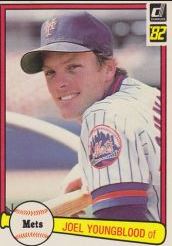
Joel Youngblood tied the record for teams played for in a single day in 1982, adding a twist – he played for and recorded hits for two different teams in two different cities on the same day. Let’s look at Youngblood’s unique achievement.
On August 4, 1982, Youngblood started his day as a member of the New York Mets, who were playing an afternoon game against the Cubs at Wrigley Field. Youngblood opened the game in center field, batting third. After striking out in the first inning, Youngblood drove in two runs with a single in the top of the third. Youngblood was unexpectedly replaced in center field by Mookie Wilson in the bottom of the fourth – and told by Mets’ manager George Bamberger that he had been traded to the Expos (for a player to be named later).
The Expos were scheduled to play in Philadelphia in Philadelphia that night, and Youngblood immediately set out to join his new team. He managed to catch a 6:05 p.m. flight to Philadelphia – eventually arriving at Veterans Stadium with the game in progress. To his surprise, there was an Expos uniform, with his name already sewn on the back, waiting for him. The Expos wasted no time getting there newest player into the game. Manager Jim Fanning sent Youngblood into right field and the number-two spot in the batting order (replacing Jerry White) in the sixth inning. In the top of the seventh, Youngblood singled in his first Expos’ at bat. Thus, Youngblood collected base hits for two different teams in two different cities in one day.
Youngblood’s feat is even more startling when you consider the pitchers he touched for his two safeties. In Chicago, it was future Hall of Famer Fergie Jenkins; while in Philadelphia, it was future Hall of Famer Steve Carlton.
MOST MLB TEAMS PLAYED FOR IN A SINGLE DAY
Max Flack – May 30, 1922: Cubs (RF); Cardinals (RF).
Cliff Heathcote – May 30, 1922: Cardinals (CF); Cubs (RF).
Joel Youngblood – August 4, 1982: Mets (CF); Expos (RF).
BBRT STATISTICAL NOTE: There may be a second player (besides Jose Bautista) to appear on a record five MLB rosters in a single season (although he played for just three teams). I am still working to confirm this one. Casper Wells finished the 2012 season with the Mariners. Wells was designated for assignment on March 31, 2013 by the Mariners. He was picked up by the Blue Jays (off waivers) on August 10. On August 22, the A’s purchased his contract from the Blue Jays. Then, on August 29, the White Sox purchased Wells from the A’s. Finally, on August 8, the Phillies picked him up (off waivers from the White Sox.). During the season, Well actually played for only three teams – the A’s, White Sox and Phillies. But depending on timing, he could have been on a record-tying five MLB rosters during the course of the season. When a player is designated to assignment, they are dropped from the team‘s 40-man MLB roster. Now, the Mariners designate Wells for assignment on March 31 (opening day of the 2013 season). The question is: Was he dropped from the roster before the season officially opened? I have a query into the Mariners to find out the specifics and determine if Wells matches Bautista’s five-roster, single-season record.
I tweet baseball @DavidBBRT
Member: Society for American Baseball Research; The Baseball Reliquary; Baseball Bloggers Alliance.
If you like baseball trivia and haven’t tried a BBRT trivia quiz (each is 99 questions), click here for Quiz One and here for Quiz Two.
Interested in a great baseball trip – a chance to see independent, A, AA, AAA and major league ball on a single trip, click here. I understand there are a few seats left.
.
Book Review: Beyond Baseball – Rounding First … A Good Read – A Good Cause
May 18, 2016 by
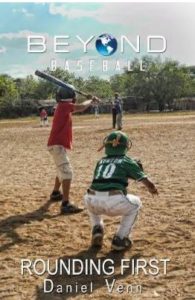 Beyond Baseball – Rounding First
By Daniel Venn
World Beyond Publishing, 2016
$12.00
A bat, a ball, a glove. For most of us these are symbols of the national pastime. For those involved with the charitable organization Helping Kids Round First, they are symbols – and tools – of hope, motivation and empowerment.
Each year, Helping Kids Round First travels to Nicaragua, the second-poorest country in the Western Hemisphere, and delivers hope and empowerment to hundreds of youngsters in the form of baseball equipment. For more information on Helping Kids Round First, click here.
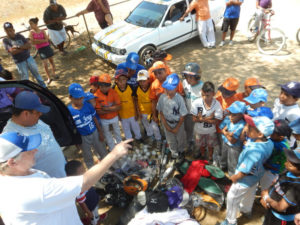
Helping Kids Round First delivers baseball equipment, hope and empowerment across Nicaragua. Photo courtesy of Daniel Venn.
Daniel Venn joined the Helping Kids Round First team on its January-February 2016 trip to Nicaragua and found himself in a nation of breathtaking scenic beauty and equally breathtaking poverty – all wrapped up with a national passion for baseball that ranks second only to religion. Venn, a former college pitcher, took part in the delivery of baseball and softball equipment to youngsters in more than 25 communities – many of them in the very poorest regions of the country. The final tally for Helping Kids Round First in Nicaragua this year was an estimated 6,000 baseballs and softballs, 800 gloves, 1,400 bats, 700 helmets, more than 1,000 uniforms distributed – and countless hearts raised and smiles generated.
Fortunately, for readers, Venn (also an author and educator) has chronicled his experiences in the soon-to-be released book Beyond Baseball – Rounding First.
It’s a good read – and serves a good cause (part of the proceeds will be donated to Helping Kids Round First). Venn does a great job of presenting the importance of baseball to Nicaraguans, bringing the impact of all that donated equipment to life and providing some entertaining glimpses into the trials and tribulations presented by Nicaragua’s culture, politics and infrastructure. The book is available for pre-order now for $12 at www.danvenn.com and will be on Amazon/Barnes & Noble next month.
Most of all, Venn’s book presents a story of hope and empowerment. As former major league outfielder Marvin Bernard (a native of Nicaragua who played nine seasons for the San Francisco Giants) describes it in the Foreword, “Baseball gives children hope in Nicaragua, and hope is motivating. Baseball has the potential to change the lives of young players here, and equipment donations from charities like Helping Kids Round First help make that possible.”
Venn’s book makes it clear that we are not just talking just about having a chance to make the big leagues, we are talking about the hope, motivation and empowerment that comes with the combination of knowing someone cares and being given the opportunity to participate and compete.
Let me use just a couple of stories from the book to illustrate that point.
Helping Kids Round First was scheduled to visit the island of Omatepe this year. The plan was to get the vehicles (a pickup truck and a taxi) filled with equipment to the island early in the day (via ferry crossing). However, weather conditions, an erratic ferry schedule and a (fake) ticket scam put them on an alternative ferry that not only got them to the island in the late evening, but also delivered them to a port on the opposite side of Omatepe – far from the waiting youth baseball team. The Helping Kids Round First team managed, despite spotty cell service, to notify the local baseball coach – Effrain – of the delay and new docking location. The coach walked more than seven miles to meet the group (and guide them to the ball field) and had waited a good portion of the day by the side of the road to welcome them. When they finally met up, Effrain was apologetic “I was going to walk all the way (about 15 miles), but I needed to take a break. I’m sorry I didn’t make it.”
In Venn’s words, here’s what happened when they arrived at the field.
Every one of Effrain’s players was waiting when we arrived. Their parents had given up and gone home hours ago, but the youngsters’ faith had not wavered.
As Craig gave his customary introductory speech to the players, a high pitched electrical shriek cut through the air, and the streetlight we were standing under went dark. All of the lights in the community followed immediately after, and we were left in pitch darkness.
“Happens all the time,” Effrain told us. “The electricity here isn’t very reliable.”
He sent his players home to get flashlights. They scampered off, each returning in minutes with a light. By the glow of their small flashlights alone, we unloaded the gear and presented it to the children. It didn’t take much light to see their smiles.
Note: Venn added that when he touched base with Effrain after returning to the U.S., he learned the coach had used the equipment not only to outfit his team, but also to start two new leagues for kids of different ages on the island.

Helpng Kids Round First gave a boost to the young women and girls of the Academia Mimadas Rubilena Rojac. Photo courtesy of Daniel Venn.
Venn also shares the story of a meeting he found especially rewarding – the delivery team’s visit with the young women of Academia Mimadas Rubilena (Ruby) Rojas – Nicaragua’s only softball academy. Their field was dry, uneven dirt. A piece of board dropped in place served as the pitcher’s rubber. There were no fences, bases or dugouts. The academy had little equipment and much of what they had was homemade. For example, the “weight room” was just a pile of rocks of different sizes. As Venn said in an interview for this review, “Still, the girls were working so hard because they simply love softball and because the sport is a path to a possible college scholarship they wouldn’t have the opportunity to pursue otherwise.”
In his book, Venn recounts his conversation with Denis Martinez, who operates the academy.
“This is a very dangerous neighborhood,” he told me. “There is a lot of crime, a lot of drugs, and a lot of abuse here. Without softball, many of these girls would be on the streets. Some were homeless, some were addicted to drugs, most were in broken homes when they came here. Some already have children of their own.” He gestured towards a small toddler running back and forth between the girls, a batting helmet bouncing up and down as she ran, a glove on each of her hands.
“Here, they can have different lives. They have food here. They have a place to sleep here. For many, this is their home, and this is their family. Scholarships are available through sports, so softball gives them an opportunity for an education and a career they could not afford otherwise. We are able to meet their basic needs here and give them the chance to do more with their lives.
“We train the girls physically here to be better athletes and better softball players. But we also focus on training them mentally. Women are not respected here, especially in this neighborhood. Abuse against women is common. We work hard to improve their self-esteem and their confidence. We want to…” Sergio, who had been translating the conversation for me, paused.
“I’m not sure how to say that word in English.” He pulled out his phone to translate the word. “Empower. They want to empower women in this neighborhood.”
“Girls can turn to softball to give them a reprieve from what they are facing away from the field. The relationships they make, the lessons they learn, and the importance of teamwork and unity they experience will carry over to help them in many facets of their life. It gives them hope, which you can’t put a price tag on.”
Ruby Rojas, Olympic Softball Player
From Beyond Baseball – Rounding First
These are just two of the heart-warming and eye-opening stories that make up Beyond Baseball – Rounding First. The book also looks at the delivery of children’s books to a day care center, the organization’s efforts to help improve agricultural yields and incomes, efforts to leverage softball equipment into an opportunity to deliver hospital equipment to the country, and even the challenges Nicaraguans face getting to (and surviving in) the major leagues.
And, there is a personal side to Venn’s story. He not only shares the satisfaction he found in his work in Nicaragua, he talks about finding baseball in its most pure form there (played solely for the love of the game), and even shares a tale of another kind of love, a lost relationship. (Every song about love or heart break brought her to my mind. It got so bad that songs that didn’t remind me of her reminded me of her, simply because they didn’t remind me of her.)
“Baseball was everywhere I looked. Fathers and sons played catch in front of their homes. Pickup games far short of full teams played in pastures next to cows. Kids hit rocks they picked up off the street with sticks. In many ways, northern Nicaragua was hell. But for baseball at its purest, it was heaven.”
Daniel Venn
From Beyond Baseball – Rounding First
So, what did Venn take away from his experience?
He told BBRT, “The biggest takeaway for me was simply the amount of good any one of us can do if we decide to. Helping Kids Round First was started by one man with a suitcase of baseball gear – just looking to help a few kids find more opportunity. Now, the non-profit is shipping ocean containers full of baseball and softball equipment, entire hospitals, helping catalyze legitimate social change and empower women, and helping put food on the table for over a hundred farming families. It all started with one person just trying to help a few kids. It has evolved into such an impactful organization – any one of us could do that, whether internationally or right here at home.”
Oh, and by the way, Venn intends to stay involved with Helping Kids Round First.
BBRT recommends both the book – an entertaining and inspiring read – and the cause. Just as one person can make a difference, so can one contribution. Again, to preorder Beyond Baseball – Rounding First, click here.
Daniel Venn – Ballplayer, Teacher, Humanitarian, Author
Daniel Venn was born and raised in Cannon Falls, Minnesota – but his baseball life has taken him far beyond his home town and home state. As a pitcher/outfielder in high school, he earned All-Conference and Academic All-Star honors. In college (Gustavus Adolphus College in St. Peter, MN), Venn majored in Social Studies Secondary Education and was a three-year letter winner (pitcher) on the Golden Gusties baseball team. While in college, Venn spent the summer of 2012 playing baseball in Central America with Beyond Study Abroad. The team of college ballplayers barnstormed across Costa Rica, Nicaragua, and Panama playing anyone who would show up – from top talent like Costa Rica’s 18U national team and the pro prospects at Dennis Martinez’s baseball academy in Nicaragua to cobbled together teams made up of the fathers of youngsters who attended clinics put on by the college players. In 2014, Venn published his first book – Beyond Baseball – about his experiences playing baseball (from exhilaration to embarrassment) in Central America. The following year, Venn’s summer trip to visit a foreign exchange student in Ecuador turned into a year teaching English in Ecuador, the Galapagos Islands and Peru. After his graduation from Gustavus Adolphus in 2015, Venn completed a stint with the Peace Corps in Western Samoa before heading to Nicaragua with Helping Kids Round First.
Note: Venn’s first book is available at Amazon.com (paperback – $7.00) or at $0.99 for the Kindle.
Looking for more baseball book reviews? Click here.
I tweet baseball @DavidBBRT
Member: Society for American Baseball Research; The Baseball Reliquary; Baseball Bloggers Alliance.
Twenty Strikeouts in an Outing – and Then Some
May 12, 2016 by
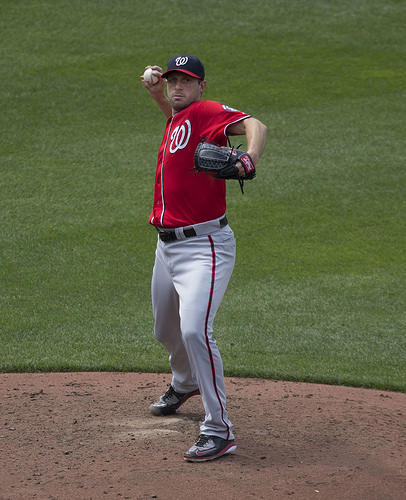
Photo by Keith Allison
On May 11, 2016 Max Scherzer tied an MLB record by fanning twenty batters in nine innings – joining Roger Clemens, Kerry Wood and Randy Johnson as the only pitchers to accomplish that feat. The topic has been “trending “ all over the traditional and social media. BBRT would like to add what is, hopefully, a little unique perspective to that “conversation” – followed by a brief look at each 20-strikeout outing, as well as a couple of hurlers who have done that accomplishment at least one better. A few factoids.
- Roger Clemens is the only pitcher to reach 20 strikeouts in nine-innings twice – and he did it ten seasons apart.
- Despite the ten-year span between Roger Clemens’ nine-inning 20-whiff performances, he is neither the oldest, nor the youngest, pitcher to accomplish the feat. The youngest is the Cubs’ Kerry Wood (who did it in his rookie season at age 20). The oldest is the Diamondbacks’ Randy Johnson, who fanned 20 in nine-innings at age 37.
- The most pitches in a 20-strikeout performance is 151 (by Clemens in 1996), the fewest is 119 by Scherzer.
- Scherzer is the first pitcher to fan 20 hitters in nine innings without fanning every member of the opposing starting lineup at least once.
- Randy Johnson is the only pitcher to notch 20 strikeouts in an MLB game – and not throw a complete game.
- No pitcher to notch twenty strikeouts in nine-innings has ever given up a walk in the contest. That’s right: 45 innings, 100 strikeouts, zero walks.
- Scherzer gave up the most hits (6), most runs (2) and most home runs (2) ever in a nine-inning, 20-strikeout performance.
Here’s a bit of detail on MLB’s nine-inning, twenty-strikeout performances.
April 29, 1986 – Roger Clemens, Red Sox, topped the Mariners 3-1 in Boston. Clemens gave up three, hits, zero walks, while fanning twenty. The only run for Seattle scored on a home run by Mariners’ DH Gorman Thomas in the seventh inning. Clemens threw 138 pitches, 97 for strikes. He struck out all nine members of the Mariners’ starting lineup at least once; LF Phil Bradley four times. Clemens was 23-years-old at the time. He went on to win 24 games (leading the AL), the AL Cy Young Award and the AL MVP. Clemens finished the season second in the AL in strikeouts with 238 in 254 innings.
September 18, 1996, Roger Clemens, Red Sox, topped the Tigers 4-0 in Detroit. He gave up five hits, zero walks, no runs. Clemens struck out all the members of the Tigers’ starting lineup at least once; SS Travis Fryman four times. Clemens threw 151 pitches, 101 strikes. That season, Clemens finished 10-13, 3.63, but led the AL in strikeouts with 257 in 242 2/3 innings. Clemens was 34-years-old.
May 6, 1998, Kerry Wood, Cubs, beat the Astros 2-0 in Chicago. Wood gave up just one hit, zero walks. He threw 122 pitches, 84 strikes. Wood struck out every member of the starting lineup at least once; 1B Jeff Bagwell, 3B Jake Howell and CF Moises Alou three times each. Wood was a 20-year-old rookie at the time. He went on to a 13-6 season, with 233 strikeouts in 166 2/3 innings. Wood was the 1998 NL Rookie of the Year.
May 6, 2001. Randy Johnson, Diamondbacks, whiffed 20 in nine innings as the D-backs topped the Reds 4-3 in eleven innings (in Arizona). Johnson was relieved in the 10th (by Byung-Hyun-Kim) with the score tied 1-1. Johnson gave up three hits, one run, zero walks. The lone run off Johnson scored in the fifth inning on a single by 3B Aaron Boone, a stolen base and a single by CF Ruben Rivera. Johnson threw 124 pitches, 92 for strikes, in his nine innings. Johnson struck out every member of the starting lineup at least once; SS Barry Larkin and RF Alex Ochoa three times each. He went on to a 21-6 season, leading the league with 372 strikeouts in 249 2/3 innings and won the NL Cy Young Award. He was 37-years-old at the time.
May 11, 2016, Max Scherzer of the Nationals topped the Tigers 3-2 in Washington. He gave up six hits and two runs, with zero walks. Both runs scored on home runs – by SS Jose Iglesias in the third inning and RF J.D. Martinez in the ninth. Scherzer struck out everyone in the Detroit starting line up at least once EXCEPT DH Victor Martinez, who collected three hits (all singles) in four at bats. Scherzer threw 119 pitches, 96 strikes. Scherzer is 31-years-old.
DOING ONE OR MORE BETTER.
Tom Cheney struck out a record 21 hitters in a single (extra inning) major league game – a 16-inning contest between the Washington Senators and Baltimore Orioles (in Baltimore) on September 12, 1962. For the full story, click here.
The record for strikeouts in a professional game at any level stands at 27 – Ron Necciai (netch-eye). For that story, click here.
I tweet baseball @DavidBBRT
Member: Society for American Baseball Research (SABR); The Baseball Reliquary; Baseball Bloggers Alliance.
Land of the Lost – Home Runs that Got Away
May 10, 2016 by
Yesterday (May 9), as the Marlins topped the Brewers 4-1 in Miami, Marlins’ catcher J.T. Realmuto had what would have been his third home run of the season turned into an out on the base paths and an RBI single. It came in the second inning, after Realmuto hit what appeared to be a two-run homer (Marlins’ CF Marcell Ozuna was on first base). Ozuna, however, thought Brewers’ CF Kirk Nieuwenhuis had a chance to track the ball down at the wall. So, Ozuna was returning to first base, in case he had to tag up – just as Realmuto was rounding the bag. For a brief couple of seconds, Realmuto passed Ozuna on the base paths and, in accordance with the rules, was called out – resulting in a 409-foot, RBI single.
Land of the Lost – Let’s Look at Some “Lost” Long Balls
BBRT brings this play up not because it is so rare (there have been dozens of “lost’ home runs) or even because it had an impact on the outcome of the game (the Marlins still won 4-1). Rather, I am using it as a segue into a look at my own very subjective list of the five most significant or interesting lost round trippers.
Now, for purposes of this post, I am eliminating unavoidably lost (from the players’ and coaches’ points of view) home runs. This includes those lost under such circumstances as rain outs, bad calls by umpires, forfeited games, unusual ground rules (catwalks, speaker wires, etc.). I’ll focus on those home runs lost due to what I would consider avoidable circumstances – such as players’ base running errors, coaches’ mistakes, batting out of order, etc. So, here are BBRT’s five most significant or interesting lost home runs.
- Number-one on the list is pretty easy. It was not only a lost home run, but a lost “extra-inning, walk-off Grand Slam – IN THE POST SEASON. In fact, had it not been lost, it would have been the first walk-off, Grand Slam in MLB post-season history.
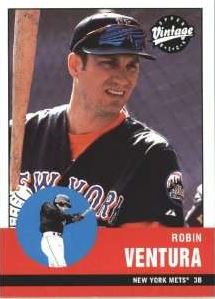
Robin Ventura – hit the true GRAND-daddy of lost home runs.
It came on October 17, 1999, in the fifteenth inning of Game Five of the National League Championship Series between the Braves and Mets (in New York). The Braves had a three games-to-one lead in the NLCS, and Game Five had been tied at 2-2 since the fourth inning. In the top of the fifteenth, Atlanta had taken a 3-2 lead on a single by SS Walt Weiss and a triple by 2B Keith Lockhart. The Mets, however, came right back in the bottom of the inning. It started with a single and stolen base by CF Shawon Dunston, followed by a walk to pinch hitter Matt Franco, a successful sacrifice by 2B Edgardo Alfonzo and an intentional walk to 1B John Olerud. Catcher Todd Pratt then drew a walk to force in the tying run. This brought 3B Robin Ventura to the plate with the game tied and the bases loaded – and that’s when the fun began.
Ventura launched a ball over the right field fence (off right-hander Kevin McGlinchy) for what appeared to be a game-winning, walk-off Grand Slam. However, once the winning run crossed the plate, Pratt turned and ran back to Ventura to give him a celebratory hug. At about the same time, a cadre of Mets poured out of the dugout and onto the field to celebrate the victory. Since, in the chaos, each runner advanced only one base before Ventura passed Pratt on the base paths, the Mets’ 3B was credited not with a Grand Slam, but with an RBI-single.
The lost home run would have been the first game-ending, walk-off Grand Slam in MLB post-season history. Instead, that honor went to the Rangers’ Nelson Cruz, in Game Two of the 2011 American League Championship Series.
_____________________________________
2. Number-two on my list of lost long balls, is significant for putting a dismal exclamation point on one of the best games ever pitched. Like number-one, it put an end to an extra-inning contest – this time in the thirteenth inning. More significant, it put an end to a game in which the starting, and losing, pitcher had been perfect for 12 innings. That’s right 36 up and 36 down going into the unlucky 13th.
Joe Adcock – spoiled Harvey Haddix’ day.
On May 26, 1959, the Pirates’ Harvey Haddix took the mound against the powerhouse Milwaukee Braves (who had won the National League pennant the previous two seasons and came into the game again leading the league). Haddix retired the first 36 hitters in order (eight strikeouts), carrying a perfect game into the bottom of the 13th. Unfortunately, the Braves’ Lew Burdette, despite giving up 12 hits and fanning only two, had held the Pirates scoreless. Braves 2B Felix Mantilla led off the Braves’ half off the 13th by reaching on error by Pirates’ 3B Don Hoak. Slugging Milwaukee 3B Eddie Mathews bunted Mantilla over to second, which led to an intentional walk to RF Hank Aaron, bringing up 1B Joe Adcock. Adcock rapped a 1-0 pitch over the right field fence for what appeared to be a three-run home run. However, the Braves, in celebrating the tension-filled victory, forgot how to run the bases. Adcock passed Aaron between second and third and, after some deliberation, Adcock was called out – changing his three-run homer to a one-run double. So, despite 12 perfect innings, Haddix lost the no-hitter, the shutout and the game itself. Consolation for Adcock – all he lost was a home run and a couple RBI.
_________________________________________________
- Third place on this list goes to a lost home run that would have been the only home run in a player’s career.
On April 17, 1914, the Federal League Buffalo Blues were facing off against the Baltimore Terrapins in Baltimore. In that contest, Blues’ RF and cleanup hitter Luther Bonin bashed what he thought was his first major league home run. As Bonin rounded third base, Blues’ manager Larry Schlafy, coaching third, patted him on the back. Now, the rules prohibit such contact (touching or holding a runner) if, in the judgment of the umpire, the contact “assists” the runner. The umpire made that judgment and Bonin was called out on coach’s interference and credited with a triple. The faux pas did not affect the outcome of the game– the Blues topped the Terrapins 4-3. It did affect Bonin’s line in the record books; robbing him of the only home run he hit in his 21-game MLB career. On the bright side, it did earn him his only career three-bagger.
Honorable Mention. A lost home run that escaped Tigers’ SS Frank Sigafoos (had to get the name in here) on April 21, 1929 gets an honorable mention here. In a game in which the Tigers topped the Saint Louis Browns 16-9, Sigafoos hit what he thought was his first MLB home run. However, the umpire had called a balk on the pitch (which is why it doesn’t exactly fit the criteria for a spot on the list)– negating Sigafoos’ long ball. While it didn’t affect the outcomes of the game, it did cost Sigafoos the only round tripper in his three-year, 55-game MLB career.
______________________________________
4. Number four on this list is significant in that it gave Babe Ruth a share of the 1931 home run title – which sets the record for HR titles in a career at 12, rather than 11.
It happened on April 26, 1931, with the Yankees facing the Senators in Washington. In the top of the first, with Yankee SS Lyn Lary on first base and two out, New York 1B Lou Gehrig hit a home run to center field (off Senators’ starter Firpo Marberry – not significant, just like the name). The hard hit ball however, bounced back out of the bleachers to Senators’ CF Harry Rice. Lary thinking the ball was caught, headed to the dugout – without touching the plate. Gehrig was declared out for passing Lary and credited with a triple. This one did affect the game – which the Yankees lost 9-7 (after losing Gehrig’s two-run blast). Further, it cost Gehrig the outright AL home run crown, he ended the season tied with Ruth at 46. Gehrig also set the AL single-season RBI record at 185 in 1931, Had he not lost that home run, the record would be 187.
____________________________________________
5. No one likes to “lose” a home run – particularly a Grand Slam and, even more particularly, a pinch-hit Grand Slam. And that combination takes the five-spot on the list.
It happened on July 9, 1970, with the Red Sox facing the Tigers in Detroit. In the bottom of the seventh inning of a 3-3 game – with two outs and the bases loaded – the Tigers called on Dalton Jones (who had been traded from the Red Sox to the Tigers in the off season) to pinch hit for catcher Jim Price. Jones launched a long ball into the right field upper deck for an apparent Grand Slam. For some reason (Remember, this ball was in the upper deck.), the base runner at first (Don Wert) decided to tag up – and was passed on the base paths by Jones. Jones was called out and credited with a three-run single. Dalton’s three RBI did help the Tigers win the contest by a 7-3 score. Note: It would have Jones first MLB Grand Slam.
Honorable Mention: As I’ve noted, no one likes to lose a Grand slam – especially a pitcher. On September 20, 1972, Steve Busby started on the mound for the Royals against the Angels (in Anaheim). Rudy May started for California – and it was a rocky beginning. In fact, Busby – hitting in the nine-spot – came to bat in the top of the first with the bases loaded, four runs in (thanks to a Grand Slam by 1B John Mayberry) and just one out. Busby hit a Grand Slam off reliever Lloyd Allen – at least he thought he did. However, first base umpire had called time out before the pitch – negating the blast – which would have made Busby part of a record-tying two Grand slam inning. Busby did eventually touch Allen for a two-run single to center in his extended at bat, but I’m sure he would rather have had the Grand Slam. (By the way, the Royals won 9-2, Busby pitched a complete-game seven-hitter – and collected three hits and three RBI of his own.
I tweet baseball @DavidBBRT
Member: Society for American Baseball Research (SABR); The Baseball Reliquary; Baseball Bloggers Alliance.