BBRT 2017 National League Preview – Cubs Win! Cubs Win!

Spring Training and the WBC are in full swing and thoughts are focused on the upcoming season.  A couple of weeks ago, BBRT made its predictions for the coming American League season. (Click here for that post.)  In this post, I’ll take a look at the National League. You can see projected standings, won-lost records and award winners immediately below and go deeper into this long post for a review of each team, some “stat facts” and a couple of “players to watch” for each squad.  Oh yes, and remember these are just my own observations – like you, from the outside looking in. Like all prediction, their accuracy is up for debate.

PREDICTED NL STANDINGS

EAST

Washington Nationals (92-70)

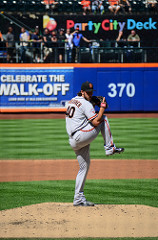
New York Mets (85-77)

Miami Marlins (81-81)

Atlanta Braves (74-88)

Philadelphia\a Phillies (71-91)

CENTRAL

Chicago Cubs (99-63)

St. Louis Cardinals (89-77) … Wild Card

Pittsburgh Pirates (80-82)

Milwaukee Brewers (72-90)

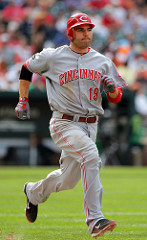
Cincinnati Reds (68-94)

WEST

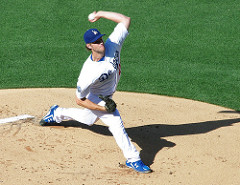
Los Angeles Dodgers (92-70)

San Francisco Giants (90-72) … Wild Card

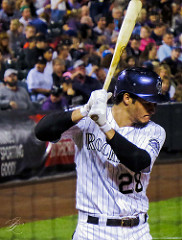
Colorado Rockies (81-81)

Arizona Diamondbacks (76-86)

San Diego Padres (64-98)

National Leqgue Champions: Chicago Cubs

A detailed look at each team is provided after the award winner predictions. ____________________________________________

NL AWARD WINNERS

MVP

  1. Kris Bryant – Cubs (3B) … The Cubs are likely to go to the World Series again and Bryant, last season’s NL MVP is likely to lead them. He was .292-39-102, with 121 runs scored in 2016. If he continues to cut down on the strikeouts – dropped from 199 in 2016 to 154 last year – the 25-year-old could be even better.
  2. Clayton Kershaw – Dodgers (LHP) … Simply the best starting pitcher in baseball, Kershaw won the Cy Young Award and MVP in 2014. I wouldn’t bet against him being the first pitcher to accomplish that feat twice. If he leads the Dodgers to the West Division title with 20+ wins, he’ll be in the running. Last season in just 21 starts, he went 12-4, 1.69 with 172 whiffs in 149 innings.
  3. Nolan Arenado – Rockies (3B) … Arenado is my kind of player – bringing leather and lumber to the ballpark. Just 25, and in is fourth MLB season, he has won four Gold Gloves.  He also led the NL in home runs and RBI in each of the last two seasons (.294-41-133 last year).  If the Rockies can finish above .500 and anywhere near the Dodgers/Giants, Arenado could be the MVP.

Other potential candidates: Buster Posey, Giants; Anthony Rizzo, Cubs; Paul Goldschmnidt, Diamondbacks.

CY YOUNG AWARD

  1. Clayton Kershaw – Dodgers … Three-time CYA winner; 2014 NL MVP; four-time ERA leader; three-time league leader in strikeouts; twice league leader in wins; twice league leader in complete games; three-times league-leader in shutouts. Kershaw has to be the favorite.
  2. Max Scherzer – Nationals … Perhaps a long shot, since he’s nursing a finger injury. However, he pitched through the injury last season and ended up 20-7, 2.96 with a league-leading 284 strikeouts. Don’t count out the defending NL Cy Young Award winner in the chase for his third CYA.
  3. Madison Bumgarner – Giants… The epitome of a big-game pitcher. Consistently posts 15018 wins, an ERA under three and 200+ whiffs. One of these years, MadBum’s gonna be the man.

Other potential candidates: Noah Syndergaard, Mets: Johnny Cueto, Giants; John Lester, Cubs; Jake Arrieta, Cubs.

ROOKIE OF THE YEAR

  1. Dansby Swanson – Braves (SS) … Swanson, just 23, looks to be ready to join the amazing crop of young and talented shortstops dotting MLB rosters. He’s still a rookie, but got a 38 game “look:” from the Braves last season and hit .02, with three home runs, 17 RBI and 20 runs scored. The first overall pick of the 2015 is one of – if not the – 2017 ROY favorites.
  2. Hunter Renfroe – Padres (OF) … Last season’s Pacific Coast League MVP, Renfroe scorched Triple A pitching for a .306 average, with 30 home runs and 105 RBI. Then, in 11 games with the Padres, this former first-round draft pick, hit .371-4-14. He’ll get plenty of opportunity to show his stuff with the rebuilding Padres.
  3. Tyler Glasnow – Pirates (RHP) … At 6’ 8” and 220-pounds, the Pirates hope Glasnow is a big presence in their 2017 rotation. He looked a little overmatched in a late call up last season (0-2, 5.01), but did fan 24 in 23 1/3 innings. In four minor league seasons, he’s gone 36-19, 2.03 with 645 strikeouts in 500 innings. With that seasoning, I’m betting he’s ready for the NL.

Other potential candidates: Josh Bell, Pirates; Manuel Margot, Padres; J.P. Crawford, Phillies.

________________________________________________________________________

NOW A TEAM BY TEAM LOOK AT THE NL

EAST

First Place – Washington Nationals (92-70)

Max Scherzer Nationals photo

Two-time CYA winner Max Scherzer will lead the Natinals’ rotation. Photo by apardavila

The Nationals won the AL East by eight games last season – and the pitching staff led the way – putting up the second-lowest ERA in all of MLB (3.51). The Nats are returning the bulk of that staff.  The Nats also scored the fourth-most runs in the NL – and the most in the East Division.  The offense should be even stronger this season, with a full year of SS Trea Turner and the addition of CF/leadoff  hitter Adam Eaton (trade with the White Sox).  The Nationals will be back on top.

The Nationals starting rotation will again be led by Max Scherzer (20-7, 2.96, 284 strikeouts in 228 1/3 innings), who continues to deal with a ring-finger injury.  Scherzer was the NL Cy Young Award winner last season and is only the sixth pitcher to win the CYA in both leagues.  Following Scherzer in the rotation is Stephen Strasburg (15-4, 3.60), who is an ace when he’s healthy, but has averaged only 137 innings in each of the last two seasons (due to back and elbow issues). If he’s healthy, he could win 17-20 games.  Last season, Strasburg won 15 games in just 24 starts.  The three and four spots also boast proven, quality arms.  Tanner Roark (16-10, 2.83) can be expected to notch 15 victories, while southpaw Gio Gonzalez (11-11, 4.57) has put up double-digit wins in each of the past seven seasons. The final spot should go to Joe Ross (7-5, 3.43), coming off shoulder surgery. If any of these falter, the most likely candidate is A.J. Cole (1-2, 5.17 with the Nationals last year and 8-8, 4.26 in Triple A).   Clearly, the Nationals have a quality rotation, but there are a couple of health questions that need to be answered.

NATIONALS STAT FACT

Last season, the National’s had MLB’s second-lowest ERA at 3.51 (only the Cubs were lower at 3.15). They also head the second-lowest starters’ ERA at 3.60 (again trailing the Cubs, 2.96) and second-lowest bullpen ERA at 3.37 (the Dodgers were at 3.35).

The Nationals “fanned” on signing a free-agent closer, so it appears Shawn Kelley (3-2, 2.64 with seven saves) will get the job. The 32-year-old has just 11 saves (in 23 opportunities) in eight MLB seasons, so he’s far from a proven commodity.  Still, his 80 strikeouts in 58 innings last season indicate he has closer “stuff.”  Getting the ball to Kelley will be Blake Treinen (4-1, 2.28 in 73 games) and Koda Glover (2-0, 5.03; but 3-1, 2.25 in three minor league stops – A/AA/AAA – last season).  A couple of additional assets in the pen include Sammy Solis (2.74 ERA with 47 strikeouts in 41 innings) and veteran Oliver Perez (2-3, 4.95.) If Kelley holds up at closer, the pen should be up to the job.  If not, look for closer-by-committee or a plunge into the trade market.

The biggest change in the Nationals lineup is right at the top, with newcomer Adam Eaton (trade White Sox). Eaton (.284-14-59 with 14 steals) will lead off and play CF.  Eaton is likely to be followed by 23-year-old SS Trea Turner (.342-13-40 in 73 games – after .302-6-33 in 83 Triple A contests). A full year of Turner will further boost the Nationals’ offense.  The middle of the lineup belongs to the proven bats of 2B Daniel Murphy (347-25-104); RF Bryce Harper (.243-24-86, with 21 steals, but capable of much more – he was .330-42-99 in 2015); and 3B Anthony Rendon (.270-20-85, with 12 steals). Included in the supporting cast are 1B Ryan Zimmerman (.218-15-46 in 115 games), who needs to bounce back from age and injuries; LF Jayson Werth (.244-21-69); and new catcher (free-agent) Matt Weiters (.243-17-66). Given a healthy pitching staff, this is more than enough offense to win the East.

A Couple of Players to Watch

Max Scherzer nursed a stress fracture in his right ring finger over the second half of 2016 (and did it successfully – going 10-1. 2.86 over the second half). He ended with a 20-7, 2.96 record and his second Cy Young Award. Keep an eye on the Nationals’ “ace.” Washington gave up some top pitching prospects in the Adam Eaton trade and needs a full season from Scherzer. Besides, why not watch the hurler who last season lead the NL in wins (20); starts (34); innings pitched (228 1/3); and strikeouts (284)? Scherzer is one of only six pitchers to win the Cy Young in both leagues; is one of just three pitchers to fan 20 batters in a nine-inning game; and one of just six pitchers to throw two no-hitters in one season.  Worth watching to see what he does next.

SS Trea Turner, just 23-years-old, is one of the crop of outstanding young shortstops dotting MLB rosters.  In 73 games for the Nationals last season, he hit 342-13-40, with 33 steals. This after minor league seasons in which he hit .331, .322 and .302.  It should be fun to watch him develop.

Second Place – New York Mets (85-77)

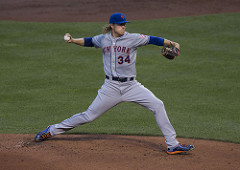
Noah Syndergaard photo

Noah Syndergaard’s “Thor-like” arm will lead the Mets’ rotation. Photo by Keith Allison

With the Mets, contending is likely to be all about pitching – and their pitching is all about health.  Consider their starting rotation. Noah Syndergaard, Steven Matz and Jacob deGrom all had elbow issues last season (Matz and deGrom required surgery); Matt Harvey had only 17 starts (surgery related to thoracic outlet syndrome); and  Zach Wheeler was out due to Tommy John surgery.  Despite all of this, Mets’ starters put up MLB’s third-best ERA (and their relievers were sixth-best). Meanwhile, the team scored MLB’s fifth-fewest runs. Bottom line:  If the pitching holds up, they’ll contend. If not they could drop to third.

The Mets’ rotation starts with hard-throwing Noah Syndergaard (14-9, 2.60, with 218 strikeouts in 183 2/3 innings). Syndergaard is the ace of the staff, but there is plenty of quality to follow.  Jacob deGrom (7-8, 3.04 in 24 starts) was an All Star (14-8, 2.54) in 2015.  Matt Harvey (4-10, 4.86) was 13-8, 2.71 in 2015. Steve Matz was 9-8, 3.40 in 22 starts. Zack Wheeler, coming of Tommy John surgery, hasn’t pitched since 2014, but was 11-11, 3.54 that season.  I’ve already noted the health issues with these very live (all under 30-years-old) arms.  Very simply, the Mets need at least three of these hurlers to put in a full, healthy season. Fortunately, if last season proved anything, it’s that the Mets do have places to turn to in case of injury. Ready to step in are Robert Gsellman (4-2, 2.42 in eight appearances, seven starts) and Seth Lugo (5-2, 2.67 in 18 appearances, eight starts).  The Mets should put a competitive rotation on the mound.

METS STAT FACT

The Mets hit the second-most home runs in the NL last season (218), but scored the fourth-fewest runs (671) – in great part due to their .225 average with runners in scoring position, last in the NL. The Mets were, in some way, an all-or-nothing offense.  They were the only NL team to score more than half their total runs (51.1 percent) via the home run. Maybe it’s time to diversify.

Jeurys Familia – and his high 90’s sinker – will again hold the closer’s role, after a 3-4. 2.55 season in which he posted a league-leading 51 saves (following a 43-save season in 2015).  As reliable as his arm is, the Mets still face a question at closer.  As this post is being written, Familia is still facing a possible MLB suspension related to a domestic violence case. If he is out for any amount of time, it will call for significant adjustment in bullpen roles. Right now it looks like key set up man Addison Reed will have the ninth inning to start the season. Reed was 4-2, 1.97 in 80 games a year ago – whiffing 91 batters in 77 2/3 innings.   Key members of the pen will likely be Fernando Salas (3.91 ERA in 75 appearances for the Angels and Mets); Hansel Robles (3.48 in 68 games); and Jerry Blevens (2.79 in 73 games). Josh Smoker also looked good in a late season call up, going 3-0, 4.70 in 20 outings, but fanning 25 batters in 15 1/3 innings. (Plus. I’d like to see a guy named Smoker on the mound.) The bullpen could be strength once Familia returns.

With 3B David Wright looking to start the season on the DL, the Mets’ lineup has a bit of a hole in the middle.  But, it’s one they are used to filling. Wright has played a total of 75 games in the past two seasons. Jose Reyes (.267-8-24, nine steals in 60 games) and Wilmer Flores (.267-16-49 in 103 games) should fill the gap.  The Mets’ middle-of-the-lineup power will come from LF Yeonis Cespedes (.280-31-86); RF Jay Bruce (.250-33-99); and, hopefully, 1B Lance Duda (who played only 47 games last season due to a back injury). Duda hit .229-7-23 last season, but hit 57 home runs in 2014-15.  The Mets need his power bat. CF Curtis Granderson has a hold on the leadoff spot – but he’s not your typical top of the lineup guy (.237-30-59, with just four steals).  If any of the Mets’ OF falters (or goes down with injury) look for former number-one draft pick Michael Conforto to step in.  Despite hitting just .220-12-42 in 109 games last season, the Mets remain high on the 24-year-old Conforto, who hit .270-9-26 in 56 games after a 2015 call up. If the Mets fall out of contention, I wouldn’t be surprised to see them move Conforto into the lineup and look to trade one of their veteran OF’s. Rounding out the lineup should be Asdrubel Cabrera (.280-23-62) at SS; Neil Walker (.282-23-55) at 2B; and Travis d’Arnaud (.247-4-15 in 75 games) at catcher.

It looks like the Mets will again have plenty of power at the plate, and have the potential for plenty of power arms on the mound.  There are just too many injury-related questions – from Wright and Duda to deGrom, Matz and Harvey – to expect them to catch the Nationals.  And, then, there’s also the impact of the Familia suspension on the bullpen.  They are in the right division to hold on to second place, but I don’t see them in the post season.  Note:  If the entire starting rotation stays healthy. the Mets could win 95 games, but that’s asking a lot.

A Couple of Players to Watch

The Dark Knight – Matt Harvey – is coming back from rib removal surgery (thoracic outlet syndrome) and was limited to 17 starts last season (4-10, 4.86).  In his healthy 2015 season, he made 29 starts, going 13-8, 2.71 and fanning 188 batters (versus just 37 walks) in 189 1/3 innings.  If he gets healthy, you could be looking at the Comeback Player of the Year.

Since joining the Mets in July of 2015, OF Yeonis Cespedes has hit .282, with 48 home runs and 130 RBI in 189 games.  When he has been in the lineup, the Mets have played .589 ball, without him in the lineup (since he joined the team), they’ve played at a .439 clip.  Keep an eye on Cespedes – his performance may well determine where the Mets finish.

Third Place – Miami Marlins (81-81)

Giancarlo stanton photo

The Marlins could use a full season of Giancarlo Stanton’s powerful bat. Photo by Corn Farmer

The loss of 24-year-old Jose Fernandez in a tragic boating accident in late September took a toll on the Marlins – on and off the field.  Fernandez, the 2013 NL Rookie of the Year, was 16-8, 2.86 with 253 strikeouts in 182 1/3 innings at the time of his death.  Obviously, you can’t replace Fernandez’ arm (nor his personality and presence). The Marlins did try to address at least the on-field loss, signing free-agent pitchers Jeff Locke and Edison Volquez and trading for Dan Straily. Those three won a total of 33 games last season.  They also bolstered the bullpen (free-agents Brad Zeigler and Junichi Tazawa). Still, you simply can’t replace an arm like Fernandez’ and the Marlins are returning a lineup that scored the third-fewest runs in the NL a year ago.  Third place seems like the peak – unless the Mets’ rotation falls apart.

There is no real “ace” at the top of the rotation, but there are a lot of arms competing for one-through-five.  Some of the leading candidates: Wei-Yin Chen (5-5, 4.96 in 22 starts); Adam Conley (8-6, 3.85 in 25 starts); Edison Volquez (10-11, 5.37 for the Royals, but a 13-game winner in 2014 and 2015); Tom Koehler (9-13, 4.33 in 33 starts); Dan Straily (14-8, 3.76 in 31 starts for the Reds); Jeff Locke (9-8, 5.44 for the Pirates). The Marlins should be able to put together a workable rotation, but will still lack a “stopper.”

MARLINS STAT FACT

The Marlins were one of two NL teams without a complete game last season (the other was the Brewers). The Marlins also went without a CG outing in 2015. (The Pirates were the only other team without a CG that season.) Their last complete game came on June 3, 2014, when Henderson Alvarez blanked Tampa1-0 on a five-hitter.

The Marlins made a run at a couple of free-agent closers – in particular Kenley Jansen.  They ended up adding Brad Ziegler (4-7, 2.25 with 22 saves for Boston and Arizona) and Junichi Tazawa (3-2, 4.17 in 53 games for the Red Sox).  Going into 2016, A.J. Ramos (2.81 with 40 saves and 73 strikeouts in 64 innings) should handle the ninth inning.  Ziegler will be a key late-inning setup man, along with Kevin Barraclough (6-3, 2.85 in 75 games, with 113 strikeouts in 72 2/3 innings). David Phelps (7-6, 2.26 in 64 games) should also get plenty of work,

When you look at a lineup that includes RF Giancarlo Stanton, it’s hard to imagine the Marlins had the second-fewest HR’s in the NL last season. (They also had the third-fewest runs scored, despite boasting the league’s second-highest batting average.)  They need a couple of things – more power sprinkled trough the lineup and more days in the lineup for Stanton (who has topped 125 games only twice in seven MLB seasons).  Last year, Stanton hit .240-27-74 in 119 games (groin injury). A full year of Stanton would be a big plus. Joining Stanton in the middle of the lineup, expect CF Christian Yelich, coming off a career year (.293-21-98, nine steals) and LF Marcell Ozuna (.266-23-76). Ichiro Suzuki (.291 in 143 games) will also get playing time in the OF.  The top of the order will again feature 2B Dee Gordon (.268 with 30 steals in a season that also featured an 80 game PED-related suspension) and 3B Martin Prado (.305-8-75). Look for Adeiny Hechavarria (.236-3-38) at SS; Justin Bour (.264-15-51 in 90 games) at 1B; and catcher J.T. Realmuto (.303-11-48, with 12 steals) to fill in the bottom of the order.

Overall, a lack of power in the lineup, coupled with uncertainties in the rotation (particularly the lack of a true number-one starter) will keep the Rays out of the post season.  They still, however, have enough to hold off the Braves and Phillies, and should reach the .500 mark.

A Couple of Players to Watch

2B Dee Gordon served an 80-game, PED-related suspension last season and ended up at .268-1-14 with seven steals.  Gordon was an All Star in 2014 and 2015, leading the NL in stolen bases both seasons (64 and 58) and winning the 2015 NL batting title (.333).  It will be interesting to monitor his post-suspension performance.

Giancarlo Stanton hits some of the longest home runs in MLB.  ESPN Home Run Tracker credits him with the two longest of 2016 – and the only two of at least 490 feet.  Stanton hit 27 long balls in 119 games last season (groin strain). However, his durability can be a question. In seven MLB seasons, he’s averaged just 118 games a year – and topped 125 games only twice (in both those seasons, Stanton hit 37 home runs).  His power stroke is worth watching, as is his health.

Fourth Place – Atlanta Braves (74-88)

The Braves has some high-potential young arm in their minor league system, but they are not yet ready to expose them to MLB hitting. So, as they enter a new ballpark, Atlanta has added some not-so-new (veteran) pitchers to the staff – 43-year-old righty Bartolo Colon (free-agent); 42-year-old knuckleballer R.A. Dickey (free agent); and “the kid,” 30-year-old Jaime Garcia (trade with the Cardinals). Together these three likely members of the rotation have 41 years of MLB mound experience.  That may prove a two-edged sword, age and innings can catch up to you suddenly. Unfortunately, for all these pitchers, they will be backed by an offense that produced MLB’s second-fewest runs in 2016 (only the Phillies scored fewer).  I don’t see the Braves finishing higher than fourth.

Let’s look first at the rotation, which will be led by the quality arm of Julio Teheran (7-10, 3.21 with 167 strikeouts in 188 innings). Teheran was an All Star in 2014 and 2016 and should be a double-digit winner this season.  After that, the rotation is a mixture of styles that offer as many questions as answers.  There are the aforementioned Bartolo Colon (15-8, 3.43 in 34 starts for the Mets last season), who just keeps rolling along. The 43-year-old (turns 44 in May) has won 62 games (40 losses) over the past four seasons and has reached the 190-inning mark in all four.  Last season, Colon threw his fastball nearly 90 percent of the time.  Then there is the other 40+ starter, R.A. Dickey (10-15, 4.46 for the Blue Jays), who throws a knuckler more than 80 percent of the time – and has won at least ten games in each of the past five season.  If they stay healthy, they could eat plenty of innings – and keep hitters off balance – for the Braves.   Also in the rotation should be Jaime Garcia (10-13, 4.67 for the Cardinals) and youngster (25-years-old) Mike Foltynewicz (9-5, 4.31). If any of these falter, Matt Wisler and Josh Collmenter are in the wings.  A servicable rotation, but not enough to offset a still rebuilding offense.  A lot of placeholders, while young arms develop in the minors.

BRAVES STAT FACT

Last season, the Braves hit the fewest HR’s in MLB (122); scored the second-fewest runs (649), grounded into the third-most double plays (145) – but still drew the most intentional walks (60). Pretty good sign there are some holes in the lineup.

The closer will likely be Jim Johnson, who stepped up last season when Arodys Vizcaino went on the Disabled List.  Johnson – who saved 101 games for the Orioles in 2012-13 – finished 2-6, 3.06 with twenty saves in 23 opportunities.  Vizcaino – with a career 3.52 ERA (four seasons) and a 9+ strikeouts per nine-inning ratio – should be back as a key set up man. Ian Krol (2-0, 3.18 in 63 games) should also see plenty of work. Others likely to be in the mix include Paco Rodriguez, Mauricio Cabrera and Jose Ramirez. Ramirez’ 33 strikeouts in 32 2.3 inning (3.58 ERA) show promise.

Freddie Freeman (1B) is a truly professional hitter and the key to the Braves’ offense.  Last season, Freeman hit .302-34-91.  He didn’t, however, get much help in the power department – although things may be better this season.  LF Matt Kemp, who came over from the Padres mid-season, went .280-12-39 in 56 games for the Braves (.268-35-108 overall).  A full season of his production will help. Joining Freeman and Kemp in the middle of the lineup is RF Nick Markakis (.308-16-66). Recently acquired 2B Brandon Phillips will also boost the offense.  He hit .280-22-94 for the Reds last season. The top of the order could be interesting. Leadoff should go to 26-year-old CF Ender Inciarte – a Gold Glove defender with an improving bat (.291-3-29, with sixteen steals and 85 runs scored). In the two-spot is a youngster (23-years-old) the Braves see as a rising star, SS Dansby Swanson (acquired in the Shelby Miller trade). Swanson hit .302-3-17 in 38 games for the Braves last season – even better than his .275-9-55, with 13 steals at two minor league stops.  Filling in the bottom of the order, you should see 3B Adonis Garcia (.273-14-65) and C Tyler Flowers (.270-8-41 in 83 games).

The Braves continue to rebuild and once top prospects – particularly the stockpiled pitching prospects – start to move up, they should contend.  While they are not likely to contend this season, this cast should make games at the new ballpark interesting.

A Couple of Players to Watch

Who wouldn’t want to watch a 43-year old, 5’11”/ 285-pound right-hander, who still relies primarily on his fastball in his 20th MLB season?  Colon has won between 14 and 18 games in each of the past four seasons and needs just 17 wins to reach 250.  Each time he is on the mound or in the batter’s box, there’s a potential for a viral video.  I’ll be watching.

Sean Rodriguez, who came over from the Pirates (free agent) hit .270 with 18 home runs for Pittsburgh last season – all career highs for the nine-year MLB veteran. He also saw action in 57 games at 1B, 29 at 2B, 27 at SS, 11 at 3B, 17 in RF, 10 in LF and 5 in CF.  BBRT will be watching to see how the Braves put his versatility (and his bat) to use in 2016.

Fifth Place – Philadelphia\a Phillies (71-91)

Photo by Keith Allison

Photo by Keith Allison

Nobody scored fewer runs (610) in MLB than the Phillies – and they gave up the fifth-most tallies (796). That 186 negative run differential was the worst in baseball.  While there may be some improvement in 2017, the team is still rebuilding. Philadelphians may have to wait a couple more years to get into the hunt.

You can expect young players at the corners to be the cornerstone of the Phillies’ offense. 3B Maikel Franco (24-years-old) hit .255-25-88 in his first full MLB season. He should just get better.  At the other corner, 1B Tommy Joseph (25-years-old, 6’1”, 255-pounds) is a potential 30-40 home run guy (and he has two first names).  Last season, as an MLB rookie, he hit .257, with 21 home runs and 47 RBI in 107 games – after hitting .347-6-17 in 27 contests at the Triple A level.  These two should fit somewhere into the heart (3-4-5 spots) in the lineup.  CF Odubel Herrera (25), doesn’t have the power of Franco or Joseph, but looks to hold onto a middle of the lineup spot. Herrera hit .286-15-49, with 25 steals last season.  Challenging for a spot in the middle – and sure to get plenty of at bats – will be new (trade with the Dodgers) LF Howie Kendrick. Kendrick (33 and in his 12th MLB season) adds a much-needed veteran presence in the lineup and clubhouse. He went .255-8-40, with ten steals, with the Dodgers last season (batting up and down the lineup and playing 1B, 2B, 3B and LF). With a more stable role, he should approach his .289 career average. Anything north of ten homers, however, would be a bonus.  2B Cesar Hernandez (26), a .294 hitter (with 17 steals), should hold down the leadoff spot. He’s only in his third full MLB season and continues to improve.  Hernandez led the NL with 11 triples a year ago, but needs to work on his base running (17 steals, but thrown out 13 times).  The Phillies added a second veteran bat in the off season in likely RF Michael Saunders (free agent). Saunders hit .253-24-57 for the Blue Jays and will add some power to the offense. Freddie Galvis (.241-20-67, with 17 steals) will likely start the season at short, but prospect J.P. Crawford could force the Phillies to make a move.  Cameron Rupp (.252-16-54) will work behind the plate.  A year of growth for the likes of Franco, Joseph and Herrera, plus the veteran bats of Kendrick and Saunders should help the Phillies put more runs on the board, but they still have a long way to go.

PHILLIES STAT FACT

The Phillies negative 186 run differential was the worst in all of MLB. Second worst was Minnesota at -167.  In 2015, the Phillies were second worst at a negative 183, with Atlanta the worst at -187.

Improvement in the rotation, like in the lineup, depends significantly on “growth” among young players. While veterans Jeremy Hellickson (12-10, 3.71) and newcomer (free agent) Clay Bucholz (8-10, 4.78 for the Red Sox) will be counted on for stability, the Phillies are looking for improvement from Jerad Eickhoff (11-14, 3.65 in 2016, his first full MLB season); 23-year-old Aaron Nola (6-9, 4.78 in 20 starts – after 10-4, 2.39 in two minor league stops); and 24-year-old Vincent Velasquez (8-6, 4.12). Alec Asher is an interesting prospect. He went 2-1, 2.28 in five starts for the Phillies and 4-2, 2.37 in 12 minor league starts; including 3-0, 1,53 at Triple A.  He may be earmarked for more seasoning, but we could see him inm Philadelphia mid-season.

The closer role will likely go to either hard-throwing Hector Neris (4-4, 2.58, with two saves and 102 strikeouts in 80 1/3 innings). He would be replacing returnee Jeanmar Gomez (3-5, 4.85 with 37 saves) in that role. Gomez (47 strikeouts in 68 2/3 innings) doesn’t miss as many bats as Neris and seemed to fade down the stretch (2.59 ERA before the All Star game, 8.33 after).  Others in the pen should include: veteran (free agent) Joaquin Benoit (3-1, 2.81 in 51 games for the Blue Jays); newcomer Pat Neshek (trade), 2-2, 3.06 in 60 games for the Astros; and returnee Edubray Ramos (1-3, 3.83 in 42 games). They could use a power southpaw arm in the pen, so I wouldn’t count out 24-year-old Joely Rodriguez, who got a look-see last season (2.79 in 12 games for the Phillies). Rodriguez has eight professional seasons under his belt and went 7-0, 2.35 in 53 games at A, AA and AAA last season.

Overall, the Phillies should improve as young players develop and learn from the scattering of veterans the Phils have brought in.  It should be a more interesting team to watch, just not yet competitive.

A Couple of Players to Watch

I love to watch third basemen (grew up an Eddie Mathews fan), so I’ll be following Maikel Franco, betting on a 30-home run season in his second full MLB year. Although I must admit, his 106 strikeouts versus just 40 walks concerns me. None other than Mike Schmidt, however, has indicated he thinks Franco is capable of a 30-HR, 100-RBI season this year.  

RHP Vincent Velasquez has a big arm (210 strikeouts in 186 2/3 major league innings), but tends to run up high pitch counts.  Still he has shown signs of true brilliance. On April 14, for example, he shutout the Padres on three hits (3-0), while fanning 16 and walking none. He needs to build some consistency.  Here are his 2016 monthly ERA’s: April – 1.78 in five starts; May – 5.12 in six starts; June – 1.86 in three starts; July – 3.19 in five starts; August – 7.52 in five starts; and September 2.57 in one start. Still, 152 strikeouts in 131 innings (versus 45 walks) shows the former Astros’ second-round pick (who has had Tommy John surgery) has potential well worth watching.

CENTRAL DIVISION

First Place – Chicago Cubs (99-63)

Kris Bryant photo

Kris Bryant. Consecutive MVP Awards? Photo by apardavila

The Cubs outscored their opponents by an MLB best 270 runs last season.  How dominant was that?   The second-best run differential was run up by the Boston Red Sox – and it was nearly 100 runs lower (at 176) than the Cubbies.  Second-best in the NL was the Nationals at 156.  Still, the World Champs did lose closer Aroldis Chapman, CF Dexter Fowleer and starter Jason Hammel to free agency. There is still more than enough talent here to carry them back to the World Series – and, besides, they added Wade Davis and Koji Uehara to bolster the bullpen; Albert Almorza, Jr. looks ready to move into Fowler’s shoes; and, even without Hammels, the rotation looks plenty strong.

The lineup is again loaded – with YOUNG AND VERSATILE players who have been through a pennant race and post-season and play like veterans. The offense will be led by 25-year-old 3B Kris Bryant (.284-39-102). Bryant has just two MLB seasonS under his belt and has been Rookie of the Year and MVP.  He should contend for MVP honors again. And, keep in mind, Bryant did all this while appearing at 3B, 1B, SS and all three outfield spots.  Joining Bryant in the middle of lineup will be 1B Anthony Rizzo  (.292-32-109), at 27-years-old already a six-season MLB veteran. Rizzo is a Gold Glover with a  30-homer, 100-RBI bat.  Then there is 23-year-old SS Addison Russell, a plus defender who hit .238-21-95.  At the top of the lineup, we see a veteran presence with 2B/OF  Ben Zobrist (.272-18-76) and youth with 24-year-old Kyle Schwarber, who hit .246-16-43 in 69 games as a rookie in 2015 (and can catch and play outfield). Schwarber is coming off 2016 knee surgery, but looks healthy and is reportedly being considered for the leadoff spot.  Fowler’s CF position looks to go to  veteran Jon Jay (.291-2-26 with the Padres) and/or 22-year-old Albert Almora, Jr., who went .277-3-15 in 47 games for the Cubs after hitting .303 in 80 games at Triple A.  In right field, Jason Heyward and his Gold Glove return, but the Cubs would like to see more offense out of him (.230-7-49).   Wilson Contreras (.282-12-35) and Miguel Montero (.216-8-33) will handle the catching. To add even more versatility, the Cubs have utility man Javier Baez (just 24), who hit .243-14-59, with 12 steals in 142 games – and played 1B/2B/3B/SS and LF.  The lineup is again stacked in Chicago; with lots of options.

CUBS STAT FACT

The Cubs led all of MLB with 103 wins last season, finishing 17 ½ games ahead of the second-place Cardinals in the NL Central. In the process, they tallied MLB’s lowest team ERA (3.15), fewest total runs allowed (556), third-most runs scored (808) – and recorded the most Defensive Runs Saved (107).  See you guys again in October.

Even without Jason Hammel’s 15 wins, the Cubs’ rotation has plenty to offer. Consider returnees: Jon Lester (19-5, 2.44); Kyle Hendricks (16-8, 2.13); Jake Arrieta (18-8, 3.10); and John Lackey (11-8, 3.35). Auditioning for the fifth spot are Brett Anderson, coming off a back injury (1-2, 11.91 for the Dodgers last season, but 10-9, 3.69 in 31 starts in 2015) and Mike Montgomery (4-5, 2.82 for the Mariners and Cubs). Montgomery appears to have the edge.

In the bullpen, the Cubs will miss closer Aroldis Chapman and his 100 mph-plus heat.  But they acquired a more than adequate replacement (trade with Royals) in Wade Davis (2-1, 1.87 with 27 saves for the Royals) and also added free-agent Koji Uehara (3.45 ERA in 50 games for the Red Sox). A couple of others who will play key roles are: Hector Rondon and closer-in-waiting Carl Edwards, Jr. (who fanned 52 batters in 36 innings last season). The pen should again be solid – particularly given a starting rotation not likely to tax the relief corps.

A Couple of Players to Watch

Kris Bryant, the 2015 NL Rookie of the Year and 2016 NL Most Valuable Player (.292-39-102) plays and hits all over the field.  Last season, this hitting machine played 107 games at 3B, 60 in LF, 14 in RF, nine at 1B and one each at SS and in CF.  In 2016, Bryant dropped his strikeout total from a league-leading 199 as a rookie in 2015 (.275-26-99) to 154 and pretty much improved his stats across the board.  If he further improves his plate discipline in 2016, look out.  He bears watching.

Albert Almora, Jr. is among the candidates to replace CF Dexter Fowler.  A first-round draft pick (sixth overall) in 2012, Almora averaged .288 over five minor league seasons, and was hitting .303 at Triple A when called up last season.  In 47 games as a Cub, the now 22-year-old hit .277-3-14. He’s a solid defender, as well.  I’ll be watching to see if he earns Fowler’s spot this spring.

Second Place – St. Louis Cardinals (89-77)

Last season, in an off year, the Cardinals still finished 10 games over .500. Unfortunately, that was one-game out of a Wild Card sport and 17 ½ behind the Central Champion Cubs.  The Redbirds should improve in 2017, contending again for a wild Card berth, but not catching the rival Cubbies.

Matt Carpenter photo

Matt Carpenter – a veteran presence and offensive weapon for the Cardinals. Photo by Keith Allison

Looking at the Cardinals’ lineup, Brandon Moss and Matt Holliday – who represented 48 of the Cardinals’ NL-leading 225 home runs – are gone (free agency). There is, however, still possibility for improvement. Over at 1B, Matt Carpenter continues to provide solid production (.271-21-68, with a .380 on base percentage). Last season, Carpenter split his time relatively equally between 3B, 1B and 2B.  A more stable position this year could result in improved offensive numbers.  Joining Carpenter in the middle of the lineup are RF Stephen Piscotty (.273-22-85, seven steals) and either LF Randal Grichuk (.240-24-68) or C Yadier Molina (.307-8-58 and still an outstanding defensive presence).  I lean toward Grichuk in the number-five hole, as Molina’s (.307-8-58) bat fits into a number of lineup slots.  Right at the top, we’ll see free-agent signee Dexter Fowler (.276-13-48, 13 steals), who provides solid defense and a .393 on base percentage. Note:  The fact that Fowler was signed away from the rival Cubs is an added plus. I look for the Cardinals’ OF to improve on defense and at the plate. SS Aledmys Diaz – a 2016 Rookie of the Year candidate – should fit into the number-two spot. In 111 games last season, Diaz – stepping in after Jhonny Peralta was injured – hit .300-17-65.  The job is his to lose. Filling out the lineup are some interesting 2B/3B combinations: 3B Jhonny Peralta (.260-8-29 in 82 games, but .271-17-71 and an All Star in 2015), who can also play SS; 2B Kolton Wong (.240-5-23); and Jedd Gyorko (.243-30-59), who last year appeared in 11 games at 1B, 46 at 2B, 39 at 3B and 26 at SS. Gyorko is one of the Cardinals’ most valuable assets.

CARDINALS STAT FACT

The Cardinals 35 stolen bases were the fewest in the NL last season, and their 57 percent success ratio was the league’s lowest.

The Redbirds’ rotation put up an NL (and MLB) best 2.99 ERA in 2015, but slid to an NL seventh-best 4.33 last season.  A return to 2.99 is probably out of reach, but the Cards should be able to get back under 4.00.  Either Carlos Martinez (16-9, 3.04 after a 14-7, 3.01 season in 2015) or Adam Wainwright (13-9, 4.62­) may end up at the top of the rotation. Wainwright missed most of 2015 (ankle injury/surgery). In 2013-14, he won 39 games, with an ERA under 3.00 both seasons. A return to past form by the 35-year-old would be a plus for the Redbirds. Also in the rotation, expect Mike Leake (9-12, 4.69) and Lance Lynn (returning from Tommy John surgery). From 2011-2015, Lynn was 60-38 for the Cardinals.  With top prospect Alex Reyes out for the season, there are a few options for the final spot: Michael Wacha (7-7, 5.09 last year, but 17-7, 3.38 the year before); prospect Luke Weaver (the 23-year-old was 1-2, 5.70 in a 2016 call  up, but 7-3, 1.30 with 92 whiffs in 83 innings at Double A /Triple A); and former closer Trevor Rosenthal, who may get a shot at a starting role.

In the pen, Korean star Seung-hwan Ho has taken over from Rosenthal.  Ho’s nickname is Stone Buddha, so he better be good. The 34-year-old was, in fact, one of Korea’s best – and went 6-3, 1.97 with 19 saves and 103 strikeouts in 79 2/3 innings for the Cardinals. Serving key roles in the pen will likely be Kevin Siegrist (6-3, 2.77 in 67 games) and free-agent signee Brett Cecil (1-7, 3.93 in 54 games for the Blue Jays).

Overall, the Cardinals just don’t have enough to overtake the Cubs, but  with solid pitching should capture a Wild Card spot.

A Couple of Players to Watch

Seung-hwan Ho could be an NL surprise.  Last season, Ho went 6-3, 1.97 with 19 saves and 103 strikeouts (versus just 18 walks) in 79 2/3 innings for the Cardinals.  In the previous eleven seasons (Korea/Japan), Ho notched 357 saves, with a 1.81 ERA. Can’t wait to see the 34-year-old’s first full season as an MLB closer.

Will the real Michael Wacha please stand up (or take the mound)?  Wacha who went from 17-7, 3.38 to 7-7, 5.09 (and faced some shoulder issues). He looked good early in Spring Training.  I’ll be watching to see how he performs in 2017, and how the Cardinals work to protect his arm.

Third Place – Pittsburgh Pirates (80-82)

starling marte photo

Starling Marte, BBRT’s favorite Pirate, does it all. Photo by jmd41280

The Pirates need some stability on the mound.  In 2017, they used 14 different starters and only two had at least 20 starts (Gerrit Cole and Francisco Liriano each had 21). One of those, Liriano, has since been traded.  If the starting rotation seems unsettled, the middle of the lineup and the OF defense are just the opposite – with Starling Marte, Andrew McCutchen and Gregory Polanco.

Marte (.311-9-46, with 47 steals) in center, McCutchen (.292-23-96 in right) and Polanco (.258-22-86, with 17 steals) in LF will be at the heart of the Pirates’ line up. At the top of the order will be 2B Josh Harrison (solid at .283-4-59, 19 stolen bases) and 24-year-old 1B Josh Bell. Bell hit .273-3-19 in 45 games – and is just growing into his power potential – after going .295-14-60 in 114 games at Triple A. Jung Ho Kang (.255-21-62) is slated for 3B, but could face some legal issues.  If he’s not available for the Opener, look for David Freese (.270-13-55). Jody Mercer (.256-11-59) will handle shortstop, while Francisco Cervelli (.264-1-53) will do the bulk of the catching.  The Pirates scored the sixth-most runs in the NL last season.  I believe there is real potential for this group to improve – a little more power from Marte, more contact from McCutchen (he hit between .292 and .327 in the four seasons preceding 2016’s .256) and continued development by Bell.

PIRATES STAT FACT

Pirate relievers threw 585 innings last season, second only to the Dodgers (590 2/3). The starters averaged just 5.3 innings per game.  Overall, the Pirates used 14 starters, with no pitcher getting more than 21 starts.

While the Pirates’ lineup seems set (excluding the Kang issue), the rotation has question marks.  The number-one spot clearly belongs to Gerrit Cole (7-10, 3.88 – after a 19-8, 2.60 the year before.) Cole has had some elbow issues, but he should put up 15 wins this season.  Veteran (seven MLB seasons) Ivan Nova is also a lock for the rotation.  Nova went 5-2, 3.06 for the Pirates – with three complete games in 11 starts) after coming over from the Yankees in early August last season. Then the fun begins.  Here are the candidates for the final fours spots (in BBRT’s estimation of rotation likelihood): 25-year-old Jameson Taillon (5-4, 3.38 in 18 starts as a rookie); 24-year-old Chad Kuhl (5-4, 4.20 in 14 starts as a rookie); 23-year-old Tyler Glasnow (0-2, 4.24 in seven appearances- two starts – as a rookie); 24-year-old Steve Brault (0-3, 4.86 in eight games – seven starts – as a rookie).  Also in the mix could be former Blue Jay Drew Hutchinson, who came over in an August trade. Hutchinson – at 26 – could offer a little more experience.  While he was only 1-0, 5.25 in nine MLB appearances last season, he was a 13-game winner for Toronto in 2015. It’s going to be an interesting spring for the Buccos..

The bullpen will be headed by southpaw closer Tony Watson (2-5. 3.05 with 15 saves), who took over the role after Mark Melancon was traded to the Nationals last summer. Melancon saved  98 games for the Pirates in 2014-15, and had 30 saves when he was traded – so Watson has some big shoes to fill.  He has a career (four MLB seasons) ERA of just 2.56, so the Pirates are confidents he can handle the ninth. Others in the pen should include Daniel Hudson (coming off an off year with Arizona; 3-2, 5.22, but a dependable groundball pitcher) and hard-throwing Felipe Rivero (1-3, 3.29 – with 39 strikeouts in 27 1/3 innings after coming over from the Nationals). Rivero is in his fifth MLB season and has notched 135 strikeouts in 125 1/3 innings. Juan Nicasio (10-7, 4.50 in 52 games); Antonio Bastardo (3-0, 4.13 in 28 games) and Jared Hughes (1-1, 3.03 in 67 games) should see also plenty of work.

The Pirates’ offense should again finish in or near the top half of the NL (sixth last season) in runs scored.  The won-lost record, however, will depend on an inexperienced pitching staff, with second-year major leaguers likely to hold down three rotation spots and Watson in his first full season as closer.  Pittsburgh is unlikely to get back into the post season this year.

A Couple of Players to Watch

Tyler Glasnow – at just 23 – is a prospect worth watching.  And, at 6’8” and 220 pounds he won’t be hard to spot.  He boasts a high-90’s fastball and an effective high-70’s curve. He only got two starts with the Pirates last season, but he was 8-3, 1.87 with 133 strikeouts in 110 2/3 innings (20 starts) at Triple A. In five minor league seasons, he’s fanned 645 batters in 500 innings.  He still needs to cut down on his walks – but he should be fun to watch (and the Pirates need him to earn a rotation spot).

Josh Bell, the Pirates’ 24-year-old 1B, maintained his rookie status for 2017, but his 47 MLB games in 2016 (.273-3-19) should help him in the 2017 Rookie of the Year race. Bell is a switch hitter with size (6’2”, 240-pounds) and power (.295 with 14 home runs at AAA before his call up).  He bears watching in the ROY competition.

Fourth Place – Milwaukee Brewers (72-90)

Ryan Braun Brewers photo

Ryan Braun has to lead the Brewers offense. Photo by JHTaylor

The Brewers are rebuilding and the process is not far enough along to yield any great dividends in the win column. Still, there will be some interesting young players in the lineup, they still have Ryan Braun and, if you like stolen bases, this team is your cup of tea (an MLB-leading 181 steals last season).

Let’s start with the lineup. Last season, the Brewers pounded out 194 home runs, but also fanned an MLB-leading 1,543 times. They let a lot of both go when they non-tendered 1B Chris Carter (signed with the Yankees). Last season Carter led the NL in home runs (tied at 41) and strikeouts (206), while hitting .222.   That leaves only one truly proven MLB power bat in the lineup – LF Ryan Braun (.305-30-91, with 16 steals). In ten MLB seasons, Braun has topped 30 home runs six times, 100 RBI five times and a .300 average six times.  Joining Braun in the meat of the Brewers’ line up, look for some combination that includes a couple of  newcomers: trade-acquisition 3B Travis Shaw (.242-16-71 for Boston in his first full MLB season) and free-agent signee 1B Eric Thames (.317-40-118 in Korea last season and a .250-21-62 hitter in 181 MLB games in 2011-12).  Also in the middle-of-the-lineup mix should be RF Domingo Santana.  The 24-year-old has just 135 games of MLB experience and hit .256-11-32 in 77 games for the Brewers last season.  The leading candidates for the CF spot both seem likely to hit in the bottom of the order. Keon Broxton has solid defensive skills, but just 82 games of MLB experience. Last season, hit .242-9-19, but with 23 steals, in 75 games for the Brew Crew.  He also fanned in 36 percent of his plate appearances. Competing for the CF is Kirk Nieuwenhuis, who has more experience at the MLB level, but hit just .209-13-44 in 2016 and also fanned in 34 percent of his plate appearances.  The very top of the order offers more promise – 2B Jonathon Villar hit .285-19-63 and led the NL with 62 steals in his first full MLB season (2016).  Villar, just 25, can also play short and third.  Alongside Villar will top prospect Orlando Arcia. The 22-year-old looks to be a future Gold Glover and hit .282 and stole 104 bases in five minor league seasons. He hit just .219 in 55 games for the Brewers a year ago, but he’ll have to continue his development at the major league level (and may spend some time near the bottom of the order).  Andrew Susac and Jett Bandy likely will handle the catching.  Finally, the Brewers will look for ways to get infielder Scooter Gennett’s reliable bat (263-14-56) in the lineup.

BREWERS STAT FACT

“M” was not a lucky initial in the NL last season – at least on the mound.  Milwaukee and Miami were the only two NL teams to record zero complete games.  Notably, the Brewers’ overall staff  ERA was 4.50 before the All Star break, but a more impressive 3.59 in the second half.

Junior Guerra may be the definition of a late bloomer. Last season, at age 31, he started his first MLB game – in a professional career that began in 2006 and had, to that point, included just three major league relief appearances.  All Guerra did is go 9-3, 2.81 in 23 appearances (20 starts). Also in the rotation will be Zach Davies, who got to the show a little quicker than Guerra.  Davies, 24-years-old, made 28 starts for the Brewers last season and led the team in wins (11-7), while posting a 3.97 ERA. Competing for the final three spots, look for Jimmy Nelson (8-16, 4.62); Wily Peralta (7-11, 4.86); Matt Garza (6-8, 4.51); Tommy Milone (3-5, 5.71); and Chase Anderson (9-11, 4.39).

Free-agent Neftali Feliz has the inside track for the closer designation. He’s a hard thrower with 99 career saves (eight seasons). In 2016, he went 4-2, 3.52 in 62 games for the Pirates, fanning 61 hitters in 53 2/3 innings. His presence should help the bull pen. Key set up men include Carlos Torres (3-3, 2.73 in 72 games) and Jhan Martinez (0-1, 3.18 in 46 games).

Overall, it looks like the rebuilding will continue – and the Brewers will also continue to struggle. There are, however, some prospects in the pipeline – like LHP Josh Hader; OF Lewis Brinson; and RHP Brandon Woodruff – so help may be on the way.

A Couple of Players to Watch

RHP Junior Guerra is a personal favorite.  You gotta admire a guy who starts out in the minors at age 21 … plays until age 30 (minors, Venezuela, Mexico) before getting his first shot at the majors (three games for the White Sox in 2015). Then, finally, at age 31 he becomes a major league starter (9-3, 2.81 for the Brewers).  I’ll be hoping for Guerra to follow up with a solid 2017 season.

Brewers’ 2B Jonathon Villar had a breakout year in 2016 – .285-19-63, with 92 runs scored, 63 RBI and a league-leading 62 stolen bases.  Every one of those figures represents a personal season high (minor league or major league).  It will be fun to see: 1) if he can continue to build on that success; 2) how much havoc he can wreak on the bases.

Fifth Place – Cincinnati Reds (68-94)

Joey Votto photo

Joey Votto – keeps putting up MVP-like numbers.. Photo by Keith Allison

The Reds – who won just 68 games a year ago – are serious about rebuilding.  So serious, in fact, that they traded away their most effective 2016 pitcher Dan Straily (who led the team in wins, starts, quality starts, innings pitched and strikeouts) for a trio of prospects. Straily’s 14 wins (8 losses) were, in fact, 20.6 percent of the Reds’ total. Couple that with Homer Bailey’s elbow surgery and uncertainty about the readiness of the Reds’ top pitching prospects and you have a formula for another fifth-place finish.

With Bailey on the 60-day Disabled List, Anthony DeSclafani should lead the rotation.  DeSclafani missed the first couple of months of the 2016 season with an oblique strain, but looked good upon his return (9-5, 3.28). Behind DeSclafani is Brandon Finnegan.  The 23-year-old southpaw was a dependable 10-11, 3.98 in 31 starts last season – his first MLB season as a full-time starter. After those first two, things get a little less clear. Tim Adelman, who got 13 starts for the Reds (4-4, 4.00) as a 28-year-old rookie last season is a leading option, along with a couple of prospects from among Robert Stephenson, Cody Reed and Amir Garret. There is no guarantee any of them are ready.  If needed, free-agent signee Scott Feldman could fill a need. The 12-season MLB veteran went 7-4, 3.97 last season and has 183 starts in 321 career appearances.

REDS STAT FACT

The Reds’ bullpen led MLB in home runs allowed (103), total runs allowed (356) and walks allowed (297).  They also led the NL in relief losses (32), had the league’s fewest saves (28), worst save percentage (52.8 percent) and second-worst relief ERA (5.09).  There is work to do.

The Reds’ bullpen did not get the job done last season – see the above Stat Facts. (Ah, remember the days of Arolidis Chapman and his 30+ saves or, further back, the “Nasty Boys” bullpen of Rob Dibble, Norm Charlton and Randy Meyers.) Cincy took a step toward resolving the issue with the January signing of veteran closer Drew Storen (98 career saves). This is not a slam dunk, however.  Last season, with Toronto and Seattle, Storen went 4-3, 5.23 with three saves.  He’s just 29, so he should be able to rebound.  The Reds need a return to the form that delivered 29 saves for the Nationals in 2015.  There will probably be key roles in the pen for Michael Lorenzen (2-1, 2.88 in 35 games a year ago); Tony Cingrani (2-4, 4.14, with 17 saves in 2016) and Raisel Iglesias (3-2, 2.53 in 37 games, with 83 strikeouts in 78 1/3 innings pitched). Ultimately, if Storen can close, the bullpen roles should fall into place.  If not, there could be a scramble in organizating the pen.

The Reds had a middle of the pack offense last season – and not much has changed.  Four-time All Star and 2010 NL MVP 1B Joey Votto will lead the offense.  Votto was .326-29-97 in a typical Votto season. He is also a solid defender (Gold Glove in 2011). LF Adam Duvall .241-33-103 will provide protection and support. The only other consistent power source is veteran SS Zack Cozart (.252-15-50). CF Billy Hamilton should be back at leadoff.  He’s a burner – and speed is his game on defense and offense (.260-2-17, with 58 steals). Rounding out the lineup are a number of names that might not be too well known outside of Cincinnati. With Brandon Phillips gone (trade), Jose Peraza looks to get the nod at 2B. He’s just 22, but hit .324-3-25, with 21 steals, in 72 games for the Reds last season. Eugenio Suarez looks solid at 3B, putting up a .248-21-70 line (with 11 steals) in his first full MLB season. Scott Schebler (.265-9-40 in 82 games) has the inside track in RF. The Reds are hoping Devin Mesoraco (coming off shoulder surgery) can handle the backstop duties. Mesoraco was an All Star in 2014, hitting .273-25-80, but has played only 39 games over the past two seasons.  If he isn’t ready, look for Tucker Barnhart (.257-7-51).  If the youngsters work out, the offense could be improved, but there is still a long way to go in this rebuilding process.

A Couple of Players to Watch

LF Adam Duvall (28-years-old) came into his own last season as a regular (and an All Star) for the Reds.  He showed excellent leather and pounded out a .241-33-103 season. He has three minor league seasons of 30 or more homers under his belt.  He needs to cut down on his strikeouts (164 last season). If he does, we will be watching a force to be reckoned with.

Right-hander Raisel Iglesias appeared in 37 games last season, going 3-2, 2.53 with six saves and striking out 83 in 78 1/3 innings. His workload included five starts. The 27-year-old Cuban had 16 starts for the Reds in 2015 (out of 18 appearances) – going 3-7, 4.15, but fanning 104 in 95 1/3 innings. He now appears destined for the bullpen and, perhaps, an eventual closer’s role.  Given the Reds’ pitching needs, it will be interesting to see just how they use him.

WEST

Los Angeles Dodgers (92-70)

Clayton Kershaw photo

Clayton Keershaw – that says it all. Photo by kla4067

The NL West is the toughest call in the league, as the Dodgers and Giants will likely fight it out to the end; with one taking the division and the other a Wild Card spot. BBRT thinks it may all come down to the “aces” – who has the better season, Clayton Kershaw or Madison Bumgarner.  My money is on Kershaw this season – and a Dodger title. I look at it this way.  The Giants gained ground when they acquired Mark Melancon to fortify a leaky bullpen, but the Dodgers should have a full year of Kershaw.  That balances out and points to another Dodgers over the Giants squeaker,

Good pitching is a Dodger tradition and the team’s success will continue to start with the ace of the rotation – southpaw Clayton Kershaw. Despite missing about ten starts with back issues, Kershaw was again the best pitcher in baseball (12-4, 1.69, with 172 strikeouts in 149 innings). A full season from the three-time Cy Young Award winner just makes LA that much stronger. Although there are health concerns up and down the rest of the rotation, they are plenty of arms to step in if problems surface. The Dodgers used 15 starting pitchers last season and still led the division.  Number-two in the rotation will be another lefty – Rich Hill, acquired from Oakland last August and coming off his career-best season (12-5, 2.12 in 20 starts). The next three spots should go to Kenta Maeda, 16-11, 3.48 with 179 strikeouts in 175 2/3 innings in his rookie season. Maeda was a star in Japan for eight seasons (97-67, 2.39) before signing with the Dodgers, so his 2016 season is no fluke. It would not surprise to see some stiff Spring Training competition for the final two spots.  A short list of candidates would include. 1) Young (20-years-old) Julio Urias. The lefty was 5-1, 1.40 at Triple A and then 5-2, 3.39 with the Dodgers. The team may want to limit his innings, but I wouldn’t be surprised if he went north for the opener; 2) veteran southpaw (How many lefties can the Dodgers run out there?) Scott Kazmir – (10-6, 4.57); 3) Alex Wood (1-4, 3.73 with ten 2016 starts – but a 12-game winner in 2015); 4) Brandon McCarthy (2-3, 4.95 with nine starts last season); and 5) Hyun-Jin Ryu, coming off elbow surgery, but a 14-game winner in both 2013 and 2014.  If I had to guess, I see a rotation of Kershaw, Hill, Kazmir, Urias and Ryu.

DODGERS STAT FACT

The Dodgers had the stingiest bullpen in MLB last season (3.35 ERA), despite an MLB-record 607 relief appearances. The pen also picked up 32 of LA’s victories, tops in the NL (tied with the Marlins) and logged the most bullpen strikeouts (633). The Dodgers 47 saves were fourth in the NL; while their 68.1 percent save percentage was very middle-of-the-pack – seventh in the NL.

The Dodgers’ bullpen stability is reflected in the fact that Kenley Jansen racked up all of the Dodgers’ 47 saves (in 53 opportunities), winning the NL Trevor Hoffman Reliever of the Year Award. Jansen’s back in place (3-2, 1.83).  Looking to the remainder of the pen, Pedro Baez (3-2, 3.04 in 73 games); Grant Dayton (0-1, 2.05 with 39 strikeouts in 26 1/3 innings pitched as a rookie); and Josh Fields (1-0, 2.79 in 22 game)s all look to play key roles – as does newcomer, veteran Sergio Romo (1-0, 2.64 in 40 appearances with the Giants and with 498 strikeouts in 439 2/3 career relief innings). The pen should be fine, particularly if the rotation stays just a little healthier.

The Dodgers’ lineup is solid.  Right in the middle you have 1B Adrian Gonzalez, who had a typical year in 2016 (285-28-90).  He is a run producer. He’ll get plenty of support from SS Corey Seager (just 22 and one of the brightest young stars in the game), who won the Rookie of the Year Award on the strength of a .308-26-72 season; 3B Justin Turner (.275-27-90); and catcher Yasmil Grandal, an acknowledged pitch-framer, coming of a career-high 27 home runs and 72 RBI (despite a .228 average).  The outfield has both potential and question marks. LF and the leadoff spot appear slated for 24-year-old Andrew Toles, who hit ,314-3-16 in 48 games with the Dodgers (and has a .309 average over 306 minor league games). Joc Pederson holds the edge in centerfield. He was .246-25-69 last season, but has a .224 average and 311 strikeouts over 306 major league games. Then in RF, there is the mercurial Yasiel Puig – .263-11-45 last season.  Puig is hard to figure out.  He has shown exciting potential, and been criticized for a lack of focus (last season included a demotion to AAA, where he hit .358 in 24 games.). Further, his batting averages have gone (.319-.296-.255-.263). In 2017, Puig could be an All Star or spend some more time at Triple A. Also in the outfield mix are Andre Ethier and Trace Thompson.  The Dodgers coveted Twins’ All Star 2B Brian Dozier, but when that deal could not be made, went out and got Tampa Bay 2B Logan Forsythe (.264-20-52) – a solid keystone option. The Dodgers, ultimately, have plenty of offense – particularly if their starting rotation is healthy and keeping opposition run totals down – to repeat in the West.

A Couple of Players to Watch

Dodgers’ SS Corey Seager, the 2016 NL Rookie of the Year, is only 22 and already has a .308-26-72 MLB season under his belt.  The former first-round draft pick hit .307 with 62 home runs in four minor league seasons and looks poised for a long run as a power-hitting shortstop.  He should be fun to watch.

Clayton Kershaw.  Oh come on, who wouldn’t want to watch this guy pitch? Great control over a mid-90’s fastball, a mid-80’s slider, a big mid-70’s curve and an occasionally changeup.  He is a classic on the mound and it’s paid off with six All Star selections, three Cy Young Awards, the 2014 NL MVP Award, four ERA titles (and a career 2.37 ERA) and three strikeout crowns (and a 300+ strikeout season in 2015). When he pitches, get a ticket.  Too obvious a choice? Then try southpaw Julio Urias, just 22, but starting to look like Kershaw-lite. The Mexican-born Urias was 5-1, with a 1.40 ERA at Triple A Oklahoma City (49 strikeouts in 45 innings) last season – and then 5.2, 3.39 (84 whiffs in 77 innings) with the Dodgers. In 72 minor league appearances, he is 12-8, 2.66 with 313 K’s in 267 1/3 innings.  If he sticks in the LA rotation, you’ve got another must-buy ticket.

Second Place – San Francisco Giants (90-72)

Madison bumgarner photo

Madison Bumgarner – epitome of a big game pitcher. Photo by slgckgc

The Giants filled their most significant hole in the off-season when they picked up proven closer Mark Melancon (Nationals) in free agency. Last season, six Giants relievers recorded saves and the team blew an MLB-high 30 save opportunities. Melancon is a proven closer, who has saved 131 games in the past three seasons. Last season, he saved 47 games in 51 opportunities. Add in a solid starting rotation and solid defense and you have a contender.  There just might not be enough offense  – particularly from a power point of view – to catch the Dodgers, but it will be close.

Let’s start with the rotation – and that starts with southpaw Madison Bumgarner (15-9, 2.74, with 251 strikeouts in 226 2/3 innings). MadBum is a proven big game pitcher. He’s not quite Clayton Kershaw, but a head-to-head matchup would be a pretty good contest.   Number-two in the rotation is Johnny Cueto (18-5, 2.79), who could be the number-one on most staffs. Following those two are Jeff Samardzija (12-11, 3.81) and Matt Moore (13-12, 4.08 for the Rays and Giants). There could be a battle for the five-spot.  Right now it looks like Matt Cain (4-8, 5.64), but he hasn’t made it to the 100-inning mark in any of the past three seasons, so health may be a concern.  If he’s not ready, or falters, Albert Suarez (3-5, 4.29) and a couple of prospects (Ty Blach and Tyle Beede) are waiting for a chance. Blach did well in a brief call up last season and was 14-7, 3.43 at Triple A.  Beede was 8-7, 2.81 at Double A.

GIANTS STAT FACT

The rivalry!  It may surprise a few Dodgers’ fans, but last season the Giants pitching staff had a lower ERA than LA (3.65 to 3.70). They also edged the Dodgers in starters’ ERA (3.71-3.95). They did lag the Dodgers in bullpen ERA (3.65 to 3.35) … a deficiency they worked to address in the off-season.  On defense, the Giants again outshone the Dodgers, making an NL-low 72 errors to the Dodgers’ 80. The offensive edge went to the Dodgers, however.  They outscored the Giants (725-712), out homered them 189 to 130.  The Giants, however, hit .258 to the Dodgers .249.  Two closely matched, long-standing rivals.

The Giants bullpen suffered through 30 blown saves in 2016.  So, San Francisco went out and signed Mark Melancon (47 saves in 51 opportunities).  That set things up for a much-improved pen. Former closers Santiago Castillo and Sergio Romo are gone and key set up men Hunter Strickland (3-3, 3.10 in 72 games), Derek Law (4-2, 2.16 in 61 games) and Will Smith (1-1, 2.95 in 26 games ) seem likely to get plenty of relevant innings.  Overall, roles should be better defined and bullpen performance improved.

The face of the Giants – on offense and defense – is clearly Buster Posey. A Gold Glove catcher, four-time All Star and 2012 NL MVP, Posey delivered a .288-14-80 line in 2016 – and knows he can do better. His main offensive help will come from RF fan-favorite Hunter Pence (.289-13-57 in 196 games), who needs to stay healthy; SS Brandon Crawford (.275-12-84 and a two-time Gold Glover); and 1B Brandon Belt (.275-17-82). Pence and Crawford have both shown the ability to deliver more power than they did in 2016. CF Denard Span (.266-11-53, with 12 steals), looks to be at the top of the order but, at 33, may be losing a step. Mark Williamson (.223-6-15 in 54 games) and Jarrett Parker (.236-5-14 in 63 games) may platoon in LF.  The Giants clearly need a healthy Pence if the OF is going to be productive.  Joe Panik (.239-10-62) will be at 2B. The Giants need a rebound from Panik, who hit .305 in 2014, .312 in 2015, but only .239 a year ago. The surprise of 2016 – the versatile Eduardo Nunez (.288-16-67, with 40 stolen bases for Minnesotan and San Francisco) may get most of the time at third base. Nunez, however, can play all around the infield so Conner Gillaspie or Kelby Tomlinson could see playing time at the hot corner – with Nunez moving around and adding some lineup flexibility.

Overall, the Giants have the pitching and defense to compete, but the lag the Dodgers in offensive fire “power.”  Still a rebound by Panik, a healthy season by Pence and a little more power from Posey and Crawford could be enough to push them past the Dodgers.  No matter what, I expect it’ll be close.

A Couple of Players to Watch

Southpaw Madison Bumgarner is a joy to watch. He’s been All Star each of the past four seasons, going 63-37, 2.86 with 903 strikeouts in 863 2/3 innings. Not only that, he’s 8-3, 2.11 in the post season and was the MVP of the 2014 NL Championship Series and World Series.  Plus, when he picks up a bat – and switches over to the right side – he rakes (at least for a pitcher). In 453 career at bats (in 228 games), Madbum has hit 14 home runs and driven in 49.  In the past three seasons alone, he’s gone 52-for-229 (.227 average), with 12 home runs, 27 runs scored, 33 RBI and 15 walks.  Just another reason #WhyIHateThe DH.

Pitching prospect Tyle Beede may not start the season with the Giants, but watch for him to come up before season’s end. The 23-year-old Beede was the Giants’ first-round draft pick in 2014. Last season, he went 8-7 at Double A Richmond and logged the league’s lowest ERA at 2.81.  Note:  From the Madison Bumgarner school, in 31 minor league at bats, Beede has collected nine hits (a .290 average). His repertoire includes a mid- to high-90’s fastball, an 80-mph curve, a change up and a developing sinker-slider.

Colorado Rockies (81-81)

ROCKIES STAT FACT

Coors Field is a statistician’s nightmare – and one should be aware of the impact on “stats” before evaluating the team.  Consider this hitters’ paradise from a Rockies’ point of view. Home batting average – .304. Away – .246.  Home runs at home – 116. Away – 88.  Runs scored at home – 508. Away – 337.

Or if you’re a Rockies’ pitcher. Home ERA – 5.40. Away – 4.37,  Home runs give up at home – 99. Away – 82. Opponents’ average at home – .289. Away – .259.

Nolan Arenado photo

Nolan Arenado. did someone say leather and lumber? Photo by jenniferlinneaphotography

The Rockies always have a potent offense and 3B Nolan Arenado will be right in the middle of it for some time to come. Just 25-years-old, Arenado is in is fourth MLB season and, not only has he won four Gold Gloves, the past two seasons he has led the NL in home runs, RBI and total bases.  His 2016 line was .294-41-133. Joining Arenado in the heart of the lineup are veteran RF Carlos Gonzalez (.298-25-100); newcomer free-agent Ian Desmond (.285-22-86), who is slated for 1B and should improve on those numbers at Coors; and 24-year-old SS Troy Story, limited to 97 games due to a thumb injury, but who still put up a .272-27-72 line. How good is this Rockies lineup? Desmond, a solid and consistent power source, has spent eight seasons as a SS/2B/OF, but had to switch to 1B to find a spot.   In the one-two spots in the lineup are CF Charlie Blackmon (.324-29-82, with 17 steals) and 2016 NL batting champ 2B DJ LeMahieu (.348-11-66, with 11 steals). To illustrate the “Coors’ Impact,” Le Maheiu hit .391 at home and .303 on the road. Rounding out the lineup are 23-year-old David Dahl (in LF, although he could play CF), who hit .315-7-24 in 63 games as a rookie (after .315-18-61 in 92 games at Double A and Triple A).  Dahl may not be ready on Opening Day (rib injury). George Parra (.253-7-39 in 102 games) is likely to get the early season call. Parra could also take 1B, with Desmond moving to LF. Tom Murphy (.273-5-13 in 21 games) and Tony Walters (.250-3-30 in 71 games) will handle catching with Nick Hundley gone via free agency. It’s a solid lineup that should help the Rockies improve on their 75-87 record of a year ago.

Another year of experience should help the rotation – which has potential to improve, but (thanks to Coors Field) little margin for error. Chad Bettis logged 32 starts a year ago and went 14-8, 4.79. The Rockies would be satisfied with another 14 wins in 2017. Then there is Jon Gray – a 2013 first round draft pick – who went 10-10, 4.61 as a 24-year-old rookie. He has a high-90’s (occasionally triple-digit) fastball and a hard slider that helped him record 185 strikeouts in 168 innings. Also in the rotation, expect Tyler Chatwood, who came back from Tommy John surgery to go 12-9, 3.87. Jeff Hoffman has also had arm issues (and Tommy John surgery), but is considered a top prospect. Hoffman came to the Rockies from the Blue Jays in the Troy Tulowitizki trade and went 6-9, 4.02, with 124 strikeouts in 118 2/3 innings in the hitter-friendly Pacific Coast League last season.

The Rockies made a move to bolster the bullpen by signing former Royals’ closer Greg Holland, who missed the 2016 season due to Tommy John surgery, but saved 125 games for the Royals in 2013-14-15.  Holland is expected to be the closer, but if he isn’t ready other options are free-agent signee Mike Dunn (6-1, 3.40 in 51 appearances for the Marlins); Adam Ottavino (1-3, 2.67, with seven saves and 35 strikeouts in 27 innings – after … here it is again … Tommy John surgery in 2015); and Jake McGhee (2-3, 4.73 with 15 saves). The Rockies are also hoping that Jairo Diaz, who underwent Tommy John surgery last March, can return. In a 2015 call up, he had a 2.37 ERA in 21 appearances. Best hope for the Rockies, whose bullpen had an MLB-worst 5.13 ERA last season, is that Holland is ready to close, Diaz is recovered and Ottavino, Dunn and McGhee can slide into their roles.

Overall, the Rockies look better this season, but there are still a lot of question marks in the pitching staff – and too many past Tommy John surgeries to deal with. Still, third place – and even. 500+-  is within reach.

A Couple of Players to Watch

Greg Holland is coming back from Tommy John surgery (missed the 2016 season) to take over the closer’s role. From 2013-15, Holland saved 125 games for the Royals, appeared in 181 games, struck out 242 batters in 174 innings and notched a 1.97 ERA.  If they are to make progress, the Rockies need him to return to form.

Rockies’ 3B Nolan Arenado is the kind of player BBRT loves to watch – the ones that flash leather and lumber.  In the league just four years, Arenado has won four Gold Gloves. He’s also been an All Star twice and led the NL in home runs and RBI the past two seasons. In 2015-16, Arenado played in 317 of the Rockies’ 324 games, averaged .291, hit 83 home runs, drove in 263 and scored 213.  That is a player well worth watching.

Arizona Diamondbacks (76-86)

Paul Goldschmidt Diamondbacks photo

Paul Goldschmidt – the best of the D-backs. Photo by jnashboulden

Pitching. Pitching. Pitching.  The Diamondbacks had MLB’s absolute worst staff ERA last season at 5.09. That effectively negated an offense that scored the tenth-most runs.  The result was a negative 138 run differential and a fourth-place (69-93) finish.  I expect the pitching staff will rebound a bit, but not enough to move the Diamondbacks out of fourth place (unless the Rockies’ pitching staff totally implodes).

The Diamondbacks do have some names and some talent in the offense.  How can yon not like 1B Paul Goldschmidt, a four-time All Star, who hit .297-24-95, with 32 steals last season – in what could be considered and off year?  Oh, and he also has a pair of Gold Gloves. At the opposite corner, the D-backs have 3B Jake Lamb (.249-29-91) to add some punch.  Also helping drive the offense will be LF Yasmany Tomas, just 26, who delivered a .272-31-83 season – but does have defensive limitations. The leadoff spot belongs to CF A.J. Pollock, who suffered through a broken elbow and a groin injury last season, but hit  .315-20-76, with 39 steals the year before. He could bring a lot of spark to the lineup.  Joining Tomas and Pollock in the outfield expect to see David Peralta, who – like Pollock – had a tough year health wise (on the disabled list three times in 2016). Peralta got in only 48 games a year ago, but in 2015 hit .312-17-78 and led the NL in triples with 10.  Up the middle, look for some combination of SS Nick Ahmed (.218-4-20), SS/2B Chris Owings (.277-5-49, with 21 steals) and utility man Brandon Drury (.282-16-53). Although Ahmed may be the best defender in the group, it may be hard for the Diamondbacks to turn their backs on the offensive potential of Owings and Drury.  Drury, just 24-years-old, may be the most intriguing of the group, as he can play corner OF and any infield position. Also in the mix is newcomer Ketel Marte, who hit .259-1-33 with 11 steals for the Mariners. Catching will be handled by newcomer Chris Ianetta (signed in January), who hit .210-7-24 for the Mariners and Jeff Mathis (a solid defender and pitch-framer).  Chris Herrmann (.284-6-28 in 56 games could see time at C, 1B and OF) depending on matchups and fatigue.

DIAMONDBACKS STAT FACT

The Diamondback had the NL’s (and MLB’s) worst starters’ ERA last season at 5.19 (and they don’t even play half their games in Colorado).  Only one starter picked up more than eight wins – Zack Grienke (13-7, 4.37). The bullpen didn’t fare much better. Its 4.97 ERA was the fourth-worst in the NL and MLB.

The pitching should be better in 2017. (Really, how could it not be.) Zack Grienke will again head the rotation and he should be better than his 13-7, 4.37 record (partially due to injuries that limited him to 26 starts). Grienke was 19-3, 1.66 with the Dodgers in 2015 – and while that is not a likely outcome for 2017, the former Cy Young Award winner (2009) should be closer to his career 3.42 ERA. His 13 wins were his fewest since 2008 and his ERA his highest since 2005. Southpaw Robbie Ray was inconsistent in 2016 (8-15, 4.90), but the 25-year-old showed potential – fanning 218 in 174 1/3 innings.  Newcomer Taijuan Walker (8-11, 4.22 in 24 starts for Seattle); Shelby Miller (3-12, 6.15); Patrick Corbin (5-13, 5.15); and Archie Bradley (8-9, 5.02) are likely to compete for the final three spots.  All, of course, need to improve on 2016’s performance, Miller may be the most interesting. He was a 15-game winner as recently as 2013 and never had an ERA over 3.74 before this past season. 2016 was Corbin’s first full year back after Tommy John surgery … and he was an All Star (14-8, 3.41) for the D-backs in 2013.  In the end, the Diamondbacks need a rebound from at least a couple of the hurlers competing for the back of the rotation.

The Diamondbacks brought in 40-year-old Fernando Rodney (free agent) from Miami to handle the closer’s role.  Arizona will be Rodney’s fifth team in three seasons (Mariners/Cubs in 2015; Padres/Marlins in 2016.). He did save 41 games a year ago (3.44 ERA and 74 strikeouts in 65 1/3 innings). However, he also walked 37 – and that may be an issue.  If Rodney missteps, young (25-years-old) Jake Barrett could get a shot at the ninth inning. Barrett boasts a mid-90’s fastball and an effective slider.  Last season, as a rookie, he went 1-2, 3.49, four saves in 68 games – with 56 whiffs in 59 1/3 innings). From 2013-15, Barrett recorded 76 saves in the minor leagues.  He’ll definitely have an important role in the pen, as will Randall Delgado (5-2, 4.44 in 79 appearances – with 68 strikeouts in 75 innings.) Other likely arms include Enrique Burgos; Andrew Chafin; and Zach Godley. Rodney could make a difference in the pen, but not enough.

The Diamondback go into the season with some emerging young stars on offense, but without enough pitching to contend – particularly in a division that includes the pitching rich Dodgers and Giants.

A COUPLE OF PLAYERS TO WATCH

CF A.J. Pollock fell victim a broken elbow and a groin injury last season – getting into only 12 games. In 2015, he was an All Star (.315-20-76, with 39 steals and a Gold Glove). If he stays healthy he has a chance to become a member of the 30-30 club and seems a shoe-in for a .300 average, 20-25 HR’s and 30 steals.  He is a rising star and should be fun to watch.

2B/3B Brandon Drury, 24-years-old, looks ready for a solid MLB career.  Last season, as a rookie, he hit .282-16-53 in 134 games – pretty much reflecting the numbers he put up in six full minor league season.  He’s a versatile player (2B/3B/1B/OF), so the Diamondbacks will find a place for his bat. Drury also has a solid glove and could develop into a Gold Glove second baseman with power (20-25 home runs).

RHP Brandon Shipley will be working for a spot in the 2017 rotation. He was a first-round pick (15th overall) in the 2013 MLB draft and promoted to the Diamondbacks late last July (4-5, 5.27). He’s got a four-pitch repertoire and a 3.79 ERA in four minor league seasons.

Fifth Place – San Diego Padres (64-98)

Not so long ago, the Padres were all about turning the corner with veterans – bringing in such names as Matt Kemp, Justin Upton, James Shields and Craig Kimbrel. Oops! That didn’t work. Now it’s all about rebuilding with talented youngsters.  For the immediate future, the result looks to be the same (a fifth-place finish). Longer-term there is more promise.

The Padres do have a couple of dependable and proven bats at the corner infield spots – and in the middle of the lineup. 1B Wil Meyers, at 26-years-old, is in his fifth big league season.  Last year was a breakout for Meyers, as he hit .259-28-94, with 28 steals.  The Padres are looking for a repeat. Across the diamond is 3B Yovaris Soloarte who, despite injury and personal tragedy (the death of his wife), turned in a .286-15-71 line in 109 games.  Those two must anchor an offense that will have to “grow up” at the MLB level. Joining them in the middle of the lineup should be RF Hunter Renfroe, who – at 25-years-old – seems ready for the “Show.”  Last season at Triple A, Renfroe hit .306, with 30 home runs and 105 RBI. The top of the order (one and two) looks to be the remainder of the outfield. Leading off could be LF Travis Jankowski (25-years-old), who hit .245 with 30 steals in 131 games as a rookie in 2016. Jankowski looks like a future Gold Glover on defense, but needs to develop offensively (just two home runs and 12 RBI a year ago).  In between Renfroe and Jankowski (and possible in the number-two spot in the lineup), we may see 22-year-old Manual Margot, who hit .304-6-55, with 30 steals at Triple A last year.  If any of these don’t work out, Alex Dickerson (.257-10-37 in 86 games) could take a garden spot.  The bottom of the lineup looks like 2B Ryan Schimpf, who showed good power (20 home runs and 51 RBI in 89 games), but not enough plate discipline (.217, with 105 strikeouts). Corey Spangenburg, who missed nearly all of last season due to injury, may challenge at 2B. In 2015, Spangenburg hit .271 in 108 games. Youngster (23-years-old, see a trend here?) Luis Sardinas should start the season at SS.  Last season, Sardinas his .244 in 66 games for the Mariners and Padres.  Rookie Austin Hedges (24-years-old) should be behind the plate. He hit .326-21-82 at Triple A last season.  His game-calling skills have also been praised as he’s worked his way through the minors.

PADRES STAT FACT

The following six players from the Padres 2016 Opening Day lineup are no longer with the team. CF and leadoff hitter Jon Jay; C and number-two hitter Derek Norris; RF and number-three hitter Matt Kemp; SS and number-five hitter Alexei Ramirez; LF and number-seven hitter Melvin Upton Jr.; SP and number-nine hitter Tyson Ross.

Then again, the Padres lost 15-0 to the Kershaw-led Dodgers.  So maybe change isn’t such a bad thing.

Hard to pick the leader of the rotation, but it is interesting to note that the five-man rotation to start 2017 will not include any hurler who was in the 2016 Open Day rotation. Gone from the team via trades are James Shields, Drew Pomeranz and Andrew Cashner; Tyson Ross left as a free agent; and Colin Rea had Tommy John surgery.  Now, the likely starters include free-agent signees Jhoulys Chacin (6-8, 4.81 for the Angels and Braves) and Jered Weaver (12-12, 5.06 for the Angels, but an 18-game winner as recently as 2015). Joining those two we’ll likely see veteran Clayton Richard (who started 2016 as a reliever with the Cubs and ended up getting nine starts for the Padres and was 3-3, 2.52 with San Diego) and Luis Perdoma (the Padres’ top winner last season at  9-10, 5.71). Competitors for the fifth spot include Trevor Cahill (4-4, 2.74 as a reliever last season, but a steady starter early in his career); Christian Freidrich (5-12, 4.80); and Jarred Cosart (0-4, 6.00).

The Padres are anxious to see how Carter Capps bounces back from Tommy John surgery (did not play in 2016). The 26-year-old could be closer material.  In 2015, after a 1.80 ERA in 13 appearance at Triple A, he put up a 1.16 ERA in 30 games for the Marlins.  More important, he fanned 58 hitters in 31 innings in his MLB stint. If Capps isn’t ready, look to Brett Mauer to close. Despite an overall 0-5, 4.52 record, Mauer converted 13 out of 15 save opportunities after the Fernando Rodney trade. From July 1 on, Mauer had an ERA of 3.08 and fanned 25 batters in 32 innings.  Also likely to have key bullpen roles are Ryan Buchter (3-0, 2.86 in 67 games) and Brad Hand (4-4, 2.92 in a whopping 82 games).  Hand fanned 111 batters in 89 1/3 innings.  Depending on Capps, the bullpen could be a strength.

Overall, it looks like a long season in San Diego – with lots of new names to learn.

A Couple of Players to Watch

RF Hunter Renfroe, a Padres’ first-round draft selection in 2013, has moved to the majors in quick fashion.  In four minor league seasons, he hit .281-77-283 in 438 games.  He was the 2016 Pacific Coast League Most Valuable Player in 2016, when he hit .306, with 30 home runs, 105 RBI and 95 runs scored in 133 games.  That earned him a September call up, where he hit .371 with four home runs in 11 games for the Padres.  Watch him – he looks ready.

RHP Carter Capps misses a lot of bats.   Drafted by Seattle in the third round of the 2013 draft, Capps has fanned 177 batters in 135 1/3 innings in four minor league seasons. He earned a call up to Seattle in 2012, where he fanned 28 major-league batters in 25 innings (3.96 ERA). In 2013, he went 3-3 with the Mariners (5.49), while fanning 66 batters in 59 innings. He got 17 games with the Marlins in 2014, fanning 25 in 20 1/3  innings (3.98 ERA). He then exploded on the scene in 2015, making 30 appearances, posting a 1.16 ERA and whiffing 58 batters in 31 innings. Capps missed the entire 2016 season (Tommy John surgery) and was traded to the  Padres in July of 2016.  BBRT and the Padres are anxious to see what they have.

I tweet baseball @DavidBBRT   Follow there for post notifications.

Member: Society for American Baseball Research (SABR); The Negro Leagues Baseball Museum; The Baseball Reliquary; Baseball Bloggers Alliance.

2017 American League Preview

Box scores – albeit Spring Training box scores – are officially  back, which makes it time for BBRT’s predictions for the coming season.  I’ll start with the American League.  You can see projected standings, won-lost records and award winners immediately below and go deeper into this long post for a review of each team, some “stat facts” and a couple of “players to watch” for each squad.  Remember these are just my own observations – like you, from the outside looking in. Like all prediction, their accuracy is up for debate.  Coming soon: A look at the National League.

PREDICTED STANDINGS

EAST

Boston Red Sox (93-69)

Toronto Blue Jays (89-73) – Wild Card

New York Yankees (83-79)

Baltimore Orioles (80-82)

Tampa Bay Rays (75-87)

CENTRAL

Cleveland Indians (97-65)

Detroit Tigers (83-79)

Kansas City Royals (81-81)

Chicago White Sox (70-92)

Minnesota Twins (65-95)

WEST

Houston Astros (92-70)

Texas Rangers (88-74) – Wild Card

Seattle Mariners (83-79)

Los Angeles Angels (75-89)

Oakland A’s (72-90)

LEAGUE CHAMPION – Boston Red Sox

______________________________________________________

PREDICTED AWARD WINNERS

MVP

  1. Mookie Betts – Red Sox (RF) … Five-tool player (.318-31-113, with 26 steals and a Gold Glove in 2016) will lead Red Sox to the Division title (and be out from David Ortiz’ big shadow). At just 24, he’s the new Mike Trout – and just getting better. Besides, he’s 5’9” and named “Mookie” – gotta like that.
  1. Jose Altuve – Astros (2B) …. Another young dynamo who does it all (.338-24-96, 30 steals in 2016 and a 2015 Gold Glove), Altuve will be recognized as the sparkplug behind and Astros’ division title.
  1. Mike Trout – Angels (CF) … In first five full seasons never finished lower than second in MVP voting (won his second MVP award last season with a .315-29-100, 30 steal line). Angels’ overall performance may cost him ballots this season.

Other likely candidates: Josh Donaldson (Blue Jays); Francisco Lindor (Indians); Miguel Cabrera (Tiges).

CY YOUNG AWARD

  1. Chris Sale (Red Sox) … Could lead the AL in wins and strikeouts. Has notched 200+ whiffs and finished in the top five in CYA balloting in four straight seasons. Won 17 games with the White Sox last season, should do better with the Red Sox.
  1. Corey Kluber (Indians) … 2014 Cy Young winner should not be counted out. (Has fanned 741 batters over the past four seasons and won 18 games in 2016.
  1. Cole Hamels (Rangers) … A dark horse candidate, but went 15-5, 3.22 with 200 strikeouts in 2016. Since joining the Rangers mid-season 2015 is 22-6.

Other likely candidates: David Price (Red Sox); Rick Porcello (Red Sox); Justin Verlander (Tigers).

ROOKIE OF THE YEAR

  1. Lucas Giolito – White Sox (RHP) … Considered one of – if not the – top pitching prospects in baseball, the 22-year-old (acquired from the Nationals in the Adam Eaton trade) already has five minor league seasonS under his belt – with a 25-15, 2.73 record and 397 strikeouts in 369 innings.
  2. Andrew Benintendi – Red Sox (LF) … Probably the pre-season consensus pick for ROY, the 22-year-old hit .312-20-107 in 151 minor league games (two seasons) and then .295-2-14 in 24 games after the Red Sox brought him up  lasta season.
  3. Jharel Cotton – A’s (RHP) … The 25-year-old righty (acquired by the A’s from the Dodgers in the Rich Hill/Josh Reddick trade) went 11-6, 4.31 at AAA before being called up to the A’s, where he went 2-0, 2.15 in five starts, fanning 23 batters in 29 1/3 innings. He showed good poise and a great changeup and a developing cutter to complement a 92-94 mph fastball.  Could surprise a lot of people.

Other likely candidates:  Yoan Moncada (White Sox); Michael Kopech (White Sox); Aaron Judge (Yankees).

______________________________________________________

Now, for those in detail,  here’s a team-by-team rundown.  (Based on rosters as this post is written.)

EAST DIVISION

First Place – Boston Red Sox (93-69)

Mookie Betts photo

Mookie Betts will lead BoSox to AL East title. Photo by Dennis Heller

Despite the fact that the Red Sox scored the most runs in MLB last season (878), they secured their spot at the top of the East for 2017 when they acquired potential Cy Young Award winner Chris Sale (17-10, 3.34 for the White Sox). Sale will head a rotation that also includes last year’s AL CYA winner Rick Porcello (22-4, 3.15) and 2012 AL CYA winner lefty David Price (17-9, 3.99 for 2016). There are solid arms competing for the four and five spots – Eduardo Rodriguez, Drew Pomeranz and Steven Wright.

Red Sox Stat Fact

The Red Sox scored 878 runs last season – the most in MLB. Just as important, they outpaced the second-highest AL total (Toronto) by 101 runs.

While David Ortiz  and his .315-38-127 bat are gone from the offense, there is still plenty from a combination of young stars like MVP candidate RF Mookie Betts (.318-31-113, with 26 steals) and SS Xander Bogaerts (.294-21-89, with 13 steals) – and veterans like former AL MVP 2B Dustin Pedroia (.318-15-74) and 1B/DH Hanley Ramirez (.286-30-111). Rounding out the lineup are newcomer (free agent) 1B/DH Mitch Moreland (who popped 22 home runs for the Rangers last year); CF Jackie Bradley Jr. (.267-26-87); and potential Rookie of the Year Andrew Benintendi in LF.  Pablo Sandoval is back at 3B after shoulder surgery, with the Red Sox hoping he can return to his form of a couple years ago. Catching will be handled by a combination Sandy Leon (.310-7-35 as a rookie) and defensive wiz Christian Vazquez.

The only question mark seems to be the bullpen. Craig Kimbrel (2-6, 3.40, 31 saves) is one of the best closers in the business, but there are some other spots to sort out among newcomer Tyler Thornburg (8-5, 2.15, 13 saves with the Brewers); Joe Kelly; Matt Barnes and Robbie Ross.

A Couple of Players to Watch

RF Mookie Betts (.318-31-113, with 26 steals) was an All Star, Gold Glover, Silver Slugger and number-two finisher in last season’s AL MVP voting – all at age 24. He’ll be an MVP favorite this year.

LF Andrew Benintendi was called up in August and the 21-year-old hit .295, with two home runs and 14 RBI over 34 games.  He should be a leading Rookie of the Year Candidate.

Second Place – Toronto Blue Jays (89-73)

Josh Donaldson photo

Josh Donaldson, 2015 MVP, three-tiem All Star leads Toronto offense. Photo by Terry Foote

Okay, the Blue Jays lost Edwin Encarnacion and his 42 homers and 127 RBI, but there is still plenty of power left with returnees 3B Josh Donaldson (.284-37-99), SS Troy Tulowitzki (.254-24-79); RF Joey Bautista (.234-22-69 in 116 games, but capable of a 35-40 home run season) and new comer (DH) Kendrys Morales (.263-30-93 for the Royals).  The Blue Jays do have some lineup questions – LF and 1B in particular, where candidates include Justin Smoak, Steve Pearce, Melvin Upton, Jr., Ezequiel Carrera and prospect Dalton Pompey. Watch for platooning as this sorts itself out.

Ultimately, the Jays’ pitching (which boasted the AL’s lowest overall ERA – 3.78 – last season) is what will keep them in contention. The team’s starting rotation had the lowest ERA in the AL last season (3.64) – and most of it is back – led by right-hander Aaron Sanchez (15-2, 3.00) and southpaw J.A. Happ (20-4, 3.18). Marco Estrada (9-9, 3.48) and Marcus Stroman (9-10, 4.37) should hold down the three and four spots.  Knuckleballer R.A. Dickey is gone (free agency) and the Blue Jays would like Francisco Liriano (8-13, 4.60 with the Pirates and Jays) to deliver one of his trademark comeback seasons in the number-five spot.

Blue Jays Stat Fact 

The Blue Jays 22 blown saves and 4.11 bullpen ERA last season were both the fourth-worst in the AL.  Blue Jays starters, however, logged the AL’s lowest ERA (3.64). 

Roberto Osuna is only 22-years-old, but he’s a proven closer (4-3, 2.68, 36 saves).  With Brett Cecil and Joaquin Benoit gone (free agency), the Jays may look to Jason Grilli (7-6. 4.12) and 2016 Rule 5 pickup Joe Biagini (4-3. 3.06) to play key roles in getting to the ninth inning.

A Couple of Players to Watch

Joey Bautista is coming off an injury-interrupted season (.234-22-69 in 116 games). The Blue Jays need him to bounce back to his 35-home run, 100-RBI form. Bautista is 36-years-old – in his 14th MLB season – so he bears watching.

After 101 games at the MLB level in 2016 (and 163 games over the past two seasons), Devon Travis is probably beyond the “prospect” stage.  The 26-year-old 2B, however, could be an emerging star – a .317 hitter in five minor league seasons, Travis hit .300-11-50 in 101 games for the Blue Jays last season.  Keep an eye on him, he looks like the real deal.

Third Place – New York Yankees (83-79)

Aroldis chapman photo

Aroldis Chapman returns to fire up the Yankee bullpen. Photo by Keith Allison

Lots of folks slotted the Orioles in third place, but BBRT likes the Yankees’ off-season additions – fire baller Aroldis Chapman (MLB’s hardest thrower), Chris Carter (last season’s NL home run champ) and veteran OF/1B Matt Holliday (.246-20-62 in 110 games for the Cardinals last season). BBRT also likes the Yankees’ balance of rising youngsters like catcher Gary Sanchez (.299-20-42 in just 53 games in 2016), 1B Greg Bird (.261-11-31 in 46 games after putting up solid power numbers at AA and AAA) and OF prospect Aaron Judge – playing alongside proven veterans like Holliday, CF Jacob Ellsbury (.263-9-56, with 20 steals, in an off-year) and LF Brett Gardner (.261-7-41, with 16 stolen bases).  There is also plenty of offensive support from 2B Starlin Castro (.270-21-70) and SS Didi Gregorius (.276-20-70, with seven steals).

The bullpen – led by Chapman (4-1, 1.55 ERA, with 36 saves and 90 strikeouts in 58 innings for the Yankees and Cubs), Dellin Betances (3.08, with 12 saves and 126 strikeouts in 73 innings) and Tyler Clippard (3.57 ERA and 72 whiffs in 63 innings for the Diamondbacks and Yankees) should be one of the best.

Yankee Stat Fact

Masahiro Tanaka just  missed the 200-innings pitched mark last season (199 2/3 IP). If he had reached 200, he would have been the first Yankee pitcher to reach that figure since 2013 (when both C.C. Sabathia and Hiroki Kuroda topped 200 innings).

The starting rotation (Masahiro Tanaka, C.C. Sabathia, Michael Pineda and more) poses a range questions related to age, injury and performance. Tanaka will again lead the staff, after a 14-3, 3.07 record in 2016. If his past elbow issues are truly behind him, 2017 could be a career year for the 28-year-old.  C.C. Sabathia, at 36-years-old, is starting to show signs of wearing down (even beyond the knee brace). He’ll likely be the only southpaw in the rotation and the Yankees need more than last season’s 9-12, 3.91 record.  Michael Pineda absolutely has to improve on last season’s 6-12, 4.82.  He’s shown the potential to be better, but it’s no given. Leading candidates for the final two spots include Chad Green (204, 4.73); Luis Severino 3-8, 5.83); Luis Cessa (4-4, 4.35).

I think the Yankees will surprise a few people in 2017, but finish just shy of a Wild Card sport.

A Couple of Players to Watch

Catcher Gary Sanchez (24-years-old) stormed the American League late last season – and went .299-20-42 in just 53 games. He’s a .275 hitter with 99 home runs in seven minor league seasons.  What will 2017 hold – stardom or regression?

1B prospect Greg Bird (24-years-old) hit .261-11-31 in 46 games after a 2015 call up. He missed the entire 2016 season after shoulder surgery, but is back to earn the starting role at 1B.  The Yanks need him to replace Mark Teixeira.

Fourth Place – Baltimore Orioles (80-82)

Mark Trumbo Orioles photo

Mark Trumbo, the AL HR leader is back for the Orioles. Photo by Keith Allison

If you can bully your way into the playoff, the Orioles could be back in a Wild Card spot in 2017.   No team hit more home runs than the Birds last season (253), but they still finished seventh in the AL in runs scored.  The re-signing of AL home run leader Mark Trumbo (.256-47-108) to serve as primary DH (he can also handle some OF) was key to the Orioles’ chance to compete 2017. Also bringing power to this long ball-dependent offense are 1B Chris Davis (.221-38-84, with 219 strikeouts in 566) at bats; 3B Manny Machado (.29-37-96 and a two-time Gold Glover); CF Adam Jones (.265-29-83 and a four-time Gold Glover); and 2B Jonathon Schoop (.267-25-82).  Veteran SS J.J. Hardy, at 34-years-old, may be losing a step, but the three-time gold Glover is steady in the field and still has some pop in his bat.  Behind the plate, free-agent signee Wellington Castilllo (.264-14-68 for Arizona) appears to be the Orioles’ choice at backstop. What this line-up has in power, however, it lacks in “table-setting” and speed on the bases.

Orioles Stat Fact

The Orioles’ 19 stolen bases were the fewest by any team last season. No other team stole less than 35. Joey Rickard led the team with four stolen bases.

The Orioles’ rotation had the third-worst ERA in the AL last season (4.72), although Camden Yards contributed to that figure.  Still, the Birds have not done much to improve.  The number-one slot in the rotation belongs to Chris Tillman (16-6, 3.71.) Kevin Gausman (9-12, 3.61) and Dylan Bundy (10-6, 4.02) seem set at two and three. At the end of the rotation, it looks like Ubaldo Jimenez and Wade Miley will be back, although there could be competition from the likes of Tyler Wilson or Mike Wright. Notably, all four of the hurlers mentioned for the four and five spots had ERAs over 5.00 in 2016.

The Birds do have one of the best bullpens in baseball, with closer Zach Britton (2-1, 0.54 ERA) saving 47 games in 47 opportunities. He’s backed by Darren O’Day (3-1, 3.77); Brad Brach (10-4, 2.05); Mychal Givens (8-2, 3.13); and Donnie Hart (0-0, 0.49). This group looks to get plenty of work in 2017.

The real question is whether power, solid defense and a great bullpen can compensate for a suspect starting rotation, too many empty swings and a lack of speed.  BBRT’s guess is no.

A Couple of Players to Watch

Southpaw closer Zach Britton is a saves machine (47 saves in 47 opportunities), who posted a 0.54 ERA in 67 innings pitched (74 strikeouts) last season. Over the past three seasons (all with the O’s), he’s notched 120 saves and a 1.38 ERA in 209 innings pitched. It’s worth the price of admission to watch him work.  Britton has now recorded 49 consecutive saves (in save opportunity situations). Eric Gagne holds the record at a whopping 84.

Given the Orioles’ starting pitching issues, you might want to keep an eye on Corey Sedlock – the Orioles’ 2016 first-round draft pick. The 21-year-old, 6’ 3”, 200-pound right hander was the Big Ten Pitcher of the year in 2016 and notched a 3.00 ERA in nine starts at Class A Aberdeen. He’s reported to have a four-pitch repertoire, topped by a four-seam fastball that reaches the mid-90s.  While Sedlock is likely to open the season in the minors, he has the potential to move up the ladder quickly.

Fifth Place – Tampa Bay Rays (75-87)

It looks like another difficult year for the Rays, who have to compete in the tough AL East. Still, the potential of their starting rotation makes them a sleeper pick to move up in the standings.  The key word, however, is potential.

Chris Archer Tampa Bay Rays photo

Chris Archer, a dark horse Cy Young candidate, will lead the Rays’ pitching staff. Photo by rrescot

Righty Chris Archer (28-years-old) leads the staff and has “ace” stuff – fanning 233 in 201 1/3 innings.  However, gopher balls (30 on the season, seventh highest in the AL) and a lack of run support relegated him to a 9-19, 4.02 season. Still, Archer’s 3.25 ERA after the All Star break offers promise for 2017. Likely to join Archer in the rotation are 26-year-old Jake Ordozzi (10-6, 3.69); 29-year-old Alex Cobb (coming back from an injury, but a 10-game winner in 2014); 24-year-old Blake Snell (6-8, 3.54); and 27-year-old Mark Andriese (8-8, 4.37).  Waiting in the wings is prospect Jose De Leon, acquired from the Dodgers in the Logan Forsythe trade. De Leon went 7-1, 2.61 for the Dodgers’ Triple A club (Oklahoma City) last season.

The bullpen is led by closer Alex Colome (2-4, 1.91, with 37 saves in 40 opportunities). The bullpen cast should include Brad Boxberger (4-3, 4.81 – the AL saves leader with 41 in 2015, but coming off an injury-derailed 2016); Xavier Cedeno (3-4, 3.70); and Erasmo Ramirez (7-11, 3.77).

Rays Stat Fact

Tampa Bay has finished last in attendance for five consecutive seasons.

Tampa Bay scored the second fewest runs in the AL last season – and gave up a chunk off offense (Logan Forsythe – .264 with 20 home runs) to acquire top pitching prospect De Leon. The offense – what there is – will again be led by right-handed hitter 3B Evan Longoria (.273-36-98); left-handed batter 1B/DH Brad Miller (.243-30-81); and switch-hitting OF/DH Corey Dickerson (.245-24-70). In the OF, CF Kevin Kiermaier put up a line of  .246-12-37, with 21 steals in 105 games, and is one of the best defensive CF in the game.  He likely will be flanked by newcomer Colby Rasmus (.206-15-54 in 107 games for the Astros) and Steven Souza Jr. (.247-17-49). Matt Duffy, who hit .276 after coming over from San Francisco in the Matt Moore trade, should be back at short, but the Rays do have a lot of options in the infield – Duffy can play 3B/2B/SS; Norm Franklin can fill in at 1B/2B/3B; and even Brad Miller has played every position expect pitcher and catcher in the major leagues (four seasons). Catcher is a question mark. The Rays did sign Wilson Ramos (.307-22-80 for the Nationals), who is coming off a career year – but also coming off knee surgery and opening the season on the Disabled List.

Overall, the East is just too tough, and the offense too scarce, for the Rays to escape the cellar.

A Couple of Players to Watch

As 3B Evan Longoria goes, so goes the Rays’ offense.  Last season, Longoria led the team in batting average (.273); home runs (36), RBI (98), runs scored (81) and base hits (173).  The Rays have to see similar results from Longoria to have any chance of moving up in the standings.  2016, however, was Longoria’s strongest season since his last All Star year (2010).

RHP Jose De Leon – acquired from the Dodgers in the Logan Forsythe trade – brings another young (24-years-old) gun into the Rays’ pitching stable. In four minor league seasons, De Leon is 23-13, 3.35, with 446 strikeouts in 330 2/3 innings. Last season, at Triple A, he was 7-1, 2.61. He earned a call up to the Dodgers (2-0, 6.35.) De Leon will likely start the season at AAA, but could move up quickly – giving the Rays’ some trading options (a young starting pitcher for a bat or two). Stay tuned.

CENTRAL DIVISION

Cleveland Indians  (97-65)

Corey Kluber photo

Corey Kluber heads a stellar mound staff. Photo by apardavila

The Cleveland Indians are heavy favorites to retain their Central Division title – and may very well return to the World Series (only the Red Sox starting rotation seems to stand in their way). Think about it. The Indians made it to the World Series despite losing two members of the starting rotation in September, as well as their top bat – Michael Brantley – for nearly all of the season.

The Indians expected dominance all starts with pitching.  Cleveland had the AL’s second-lowest ERA last season (and second-best among starters as well as relievers) and topped the AL in strikeouts. Not only are the Indians bringing this stellar pitching staff back, they’ve added free-agent signee Edwin Encarnacion (.263-42-127 for the Blue Jays) to an offense that scored the AL’s second-most runs in 2016.

Let’s look at the pitching first. The rotation starts with 2014 CYA winner Corey Kluber (18-9, 3.14 with 227 strikeouts in 2016). He’s followed by Carlos Carrasco (11-8, 3.32); Danny Salazar (11-6, 3.87); Trevor Bauer (12-8, 4.26); and Josh Tomlin (13-9, 4.40). This is a solid rotation (although with the addition of Chris Sale, the Red Sox have the edge).

The bullpen is headed by closer Cody Allen (3-5, 32 saves, 2.51 ERA and 87 strikeouts in 68 innings); Andrew Miller (10-1, 12 saves, 1.45 ERA and 123 strikeouts in 74 1/3 innings); and Bryan Shaw (2-5, 3.24 and 60 whiffs in 66 2/3 innings). The final three innings should belong to the Indians with this trio.  Having Miller for the whole season – he came over from the Yankees at the end of July – will make the Indian’s pen even more effective.

Indians Stat Fact

Cleveland’s home record of 53-28 tied the Rangers for the best in the AL. They were, however, only two games over .500 on the road (41-39).

The Indians’ lineup, with Encarnacion now in the middle, looks strong – particularly if Brantley is ready to resume left field duties. You’ve got 2B Jason Kipnis (.275-23-82, with 15 steals) and young and improving (already a star) shortstop Francisco Lindor (.301-15-78, with 19 steals) at the top. In the middle you have Encarnacion and Carlos Santana (.259-34-87), likely to share 1B/DH and LF Brantley. Even the bottom of the lineup shows some pop with 3B Jose Ramirez (.312-11-76, 22 steals – entering his fifth MLB season at age 24); RF Lonnie Chisenhall (.286-8-57); and CF Tyler Naquin (.296-14-43 in 116 games). Catching could be a question mark. Yan Gomes and Roberto Perez both missed significant time due to injury last season.

Ultimately, the Indians are the class of the Central. .

A Couple of Players to Watch

SS Francisco Lindor, just 23 and entering his third MLB season, may very well be the best player on this roster. Last season, he was an All Star, a Gold Glover and put up a .301-15-78 line, with 19 steals.  This season, he’s likely to be a 30-30 (HR/SB) player and be the catalyst for the Cleveland offense.

I would also keep an eye on CF Tyler Naquin – entering just his second MLB season (at age 25). Naquin, a .287 hitter in five minor league seasons, hit .296, with 14 home runs and 43 RBI in 116 games for the Indians last season.  Right now, it looks like he’ll platoon with Abraham Almonte in center, but Naquin could win the full-time spot. (Besides, he’s on my fantasy squad.)

Detroit Tigers – Second Place (83-79)

Miguel Cabrera photo

Miguel Cabrera – hard to argue with a former MVP and Triple Crown winner in the middle of your lineup. Photo by Keith Allison

The Tigers finished eight games off the pace in the AL Central (behind Cleveland and out of the playoffs for the second straight season). The team is in a process of rebuilding with young players like SPs Mike Fulmer and Daniel Norris and OF JaCoby Jones – but they still have enough solid veterans to remain competitive (and hold on to second place) while these players develop.

The middle of the Tiger batting order belongs to veterans 1B/DH Miguel Cabrera (.316-38-108),  DH/1B Victor Martinez (.289-27-86) and RF J.D. Martinez (.307-22-68). The key plate-setters at the top will be 2B Ian Kinsler (.288-28-83, with 14 steals) and LF Justin Upton (.246-31-87). Keep in mind, Cabrera is 33-years-old; Victor Martinez is 38; and Kinsler is 34.  The Tigers can ill afford an off-season from any of these veterans.  The remainder of the infield consists of Jose Eglesias at SS (.255-4-32) and Nick Costellanos at 3B (.285-18-58).  Costellanos seems to be finding his stroke (career highs in home runs and batting average lasts season), but needs to cut down on the strikeouts.  CF looks like a battle between JaCoby Jones, Matt Mahtook and possibly Tyler Collins (who could slot in better as a versatile fourth outfielder). Overall, OF defense could be an issue again in 2016. The Fielding Bible rated the Tigers garden the second worst defenders in MLB last season.  At catcher, James McCann and his plus-arm should hold sway, but he needs to improve on his .221-12-48 stat line. .

Tigers Stat Fact

Handling Cleveland may be the key to the Tigers’ season. They finished eight games behind the Indians a year ago – and went 4-14 against the Tribe.

The rotation starts with Justin Verlander, who was revitalized in 2016 (16-9, 3.04 with a league-leading 254 strikeouts in 227 2/3 innings – his best totals in since 2012).  The question is: At 34-years-old, and with nearly 2,500 innings on his right arm, can he do it again?  From Verlander, the rotation goes to Michael Fulmer (11-7, 3.06 as a rookie); Jordan Zimmerman (a disappointment last season at 9-7, 4.87); southpaw Daniel Norris (4-2, 3.38 in 13 starts – with lots of upside); and Matt Boyd (6-5, 4.53). In the wings are past starters Anibel Sanchez and Mike Pelfrey. Key for the Tigers will be Verlander’s ability to match last year’s performance (at age 34), Zimmerman’s ability to bounce back from last season’s injury issues (neck) and the development of Norris.  Very simply, there are some questions here. Still, this group put up the fourth-best ERA among AL starting rotations in 2016, so they should be able to get the job done.

Francisco Rodriguez (at 35-years-old) returns as the Tigers’ closer – after a 3-4, 3.24, 44-save record in 2016.  Among the key relievers getting the ball to Rodriguez, expect Bruce Rondon (5-2, 2.97 in 37 games) and Alex Wilson (4-0, 2.96 in 62 games).

Despite some aging in the lineup and question marks in the rotation, the Tiger appear to have enough to hold onto second place, but not enough to catch the Indians.

A Couple of Players to Watch

Miguel Cabrera is a hitting machine, a former Triple Crown winner and two-time MVP, who shows little sign of slowing down in the batter’s box after 14 MLB seasons (four batting titles, two HR crowns). It will be interesting to see if Cabrera, who will turn 34 in April, shows any signs of wear and tear. I’m betting he rakes again.

Michael Fulmer was the AL Rookie of the Year in 2016, after going 11-7, 3.06 in 26 starts. However, there are some questions to be answered. Fulmer went 9-2, 2.11 in 13 first half starts – and then 2-5, 3.94 in 13 starts after the break.

Kansas City Royals – Third Place (81-81)

Danny Duffy photo

Danny Duffy – new staff ace? Photo by KellyK

The Royals were MLB’s darlings in 2014 and 2015, with two World Series appearances and one Championship. Then, last season, they slipped to third place, .500 and 13 ½ games behind the Indians. The Royals look to be a .500 club again in 2016 – despite the tragic loss of key starter Yordano Ventura in an off-season accident. The fact is, pitching and defense will still be strengths for Kansas City – which scored the third-fewest runs in 2016 and lost DH Kendrys Morales’ 30 home runs and 93 RBI to free agency.

The rotation will be led by southpaw Danny Duffy, who didn’t make his first start until May 15 last year, and ended up 12-3, 3.51 with 188 strikeouts in 179 2/3 innings. The number-two spot (replacing Ventura) will likely go to free-agent signee veteran Jason Hammel (15-10, 3.83 for the Cubs last season).  Ian Kennedy will also be in the rotation, after going 11-11, 3.68 for the Royals a year ago. Competitors for the final spots are Jason Vargas (coming back from Tommy John surgery, but an 11-game winner in 2014); Six-foot-ten-inch Chris Young (who had off-season surgery after a 3-9, 6.19 season); free-agent signee Travis Wood (4-0, 2.95 in 75 relief appearances for the Cubs last year, but a starter as recently as 2014); hard-throwing Matt Strahm (2-2, 1.23 in 21 games in relief for the Royals); and Nate Karns (6-2, 5.15). Solid top of the rotation, somepretty good competition for the back end.

Royals Stat Fact

Kansas City finished at .500 a year ago, despite being outscored by 37 runs (712-675) and out-homered by 59 (206-147).

The bullpen has some question marks, particularly with closer Wade Davis (who did spend some time on the DL last season, but still logged 27 saves) gone to the Cubs (in the Jorge Soler trade),  Kevin Herrera will spend the full season as closer (2-6, 2.75, 12 saves and 86 strikeouts in 72 innings last season). He appears ready for that role, but that creates some issues in getting the ball to the ninth (Herrera’s previous role). Right now, it looks like Jaokim Soria; Brian Flynn; and whoever loses out in the battle for starting spots (Woods, Strahm, Young, free-agent Mark Minor).

They keys to the offense belong to 1B Eric Hosmer (.266-25-105 – and a three-time Gold Glover); CF Lorenzo Cain (.287-9-56, with 14 steals in 103 games): and possibly newcomer RF/DH Jorge Soler (.238-12-31 in 86 games for the Cubs). A couple of veterans should fill the top of the order: SS Alcides Escobar (.261-7-55, with 17 steals, who played in all 162 games a year ago – and was a 2015 Gold Glover) and 3B Mike Moustakas (.240-7-13 in 27 games in 2016), an All Star in 2015.  LF belongs to Alex Gordon, a four-time Gold Glover coming off a subpar offensive season.  Salvador Perez is one of the best catchers in the game (four consecutive Gold Gloves), as well as an offensive threat (.247-22-64). He should again slot in somewhere near the middle of the lineup. Second base may be up for grabs with Whit Merrifield, Raul Mondesi and Christian Colon in the mix – none played more than 81 games in 2016. Merrifield had the best season in 2016 (.283-2-29, eight steals in 81 games as a rookie), but the Royals reportedly still have high hopes for Mondesi. At DH, the Royals will be hard pressed to replace (free agent) Kendrys Morales’ 30 home runs and 93 RBI.  It looks like a revolving door with the competitors including Brandon Moss (.225-28-67), Soler (if he doesn’t earn a full-time outfield slot); Merrifield (if he doesn’t hold off Mondesi at 2B); Cheslor Cuthbert (.274-12-46); and Paul Orlando (.302-5-43, with 14 steals – and competition for Soler for the third OF spot).

Middle of the road pitching and a lack of offense hurt the Royals a year ago and, with the loss of DH Kendrys Morales and closer Wade Davis, they seem to have taken a step backward.  They look like a .500 club again.

A Couple of Players to Watch

Salvador Perez is simply the best defensive catcher in the AL – four seasons as the Royals’ full-time backstop and four Gold Gloves (last season he led the AL, tossing out 48 percent of potential base stealers).  He’s also turned into a solid offensive player (.247-22-64 last season). A pleasure to watch behind (and at) the plate.

LF Alex Gordon is a four-time Gold Glover who has fought through injuries (groin and wrist) over the past two seasons. In 2016, he hit just .220-17-40 in 128 games. In his last season of at least 150 games played, he hit .266-19-74 with 12 steals. The Royals need a return to those kinds of offensive numbers

Chicago White Sox – Fourth Place 70-92

dAVID ROBERTSON WHITE SOX photo

David Robertson will take the ninth inning for the ChiSox.Photo by Keith Allison

The White Sox are rebuilding – and doing it in a hurry.  They added some top prospects (at the cost of Chris Sale and Adam Eaton) over the past couple of years and the 2017 team has enough “potential” to be interesting, but not enough proven talent. The veterans may have to “hold the fort” a bit longer.

The middle of the lineup will feature 31-year-old 3B Todd Frazier (who hit 40 homers and drove in 98 runs, but put up only a .225 average) and 30-year-old 1B Jose Abreu (.293-25-100, who has driven in 100+ runs in each of his three MLB seasons). Other likely veterans in the lineup include 2B Brett Lawrie (.248-12-36); LF Melky Cabrera (.296-14-86).  Youth will be served at the top of the lineup with CF Charlie Tilson (a 24-year-old rookie), who hit .282 in 100 games at Triple A last season (but also suffered a foot injury early in Spring Training) and 23-year-old SS Tim Anderson, who hit .283-9-30 in 99 games as a rookie (but needs to cut down on his strikeouts – 117 K’s versus only 13 walks last season). Avisail Garcis is the likely starter in RF, but has still hasn’t lived up to his power potential (.245-12-51 in 120 games). DH is up for grabs – although Abreu and Garcia may spend some time there.  Prospect Matt Davidson (who has shown some power in the minors) may get a look and utility man Tony Saladino ( .282-8-38, 11 steals in 93 games) should see time around the infield and perhaps at DH. Omar Narvarez and Kevin Smith are the (inexperienced) options at catcher.

White Sox Stat Fact

The Sox 4.10 starters’ ERA was right in the middle of the AL (seventh) – with Chris Sale.  Take Sale out of the equation and that ERA jumps to 4.33 (twelfth). Sale had six of the White Sox seven complete games.  The current likely rotation had one complete game among them in 2016.  #BigShoesToFill.

Southpaw Jose Quintana takes over from Sale as the ace of the staff – he was 13-12, 3.20 last season and has the stuff for a number-one or number–two starter.  Still he has reached ten wins only once in five seasons.  The number-two spot will go to another lefty, Carlos Rodon (9-10. 4.04, but on the upswing – he was 7-3, 3.45 with 77 strikeouts in 73 innings over the second half).  At just 24-years-old, he should improve in his third MLB season.  After these two southpaws, however, things get a little rocky. The back of the rotation looks like 35-year-old James Shields (who had been a steady winner through 2015, but last season finished 6-19, 5.85); Miguel Gonzalez (5-8, 3.73); and free-agent signee Derek Holland (7-9, 4.95 with the Rangers), looking for a rebound after three injury-hampered seasons with the Rangers. Holland went 38-21 in 31 starts in 2011-12-13, but 13-12 in 35 starts in 2014-15-16.

David Robertson is back at closer after a 5-3, 3.47, 37-save season. He does need to improve on his walk rate.  In 2016, he walked 32 batters (75 strikeouts) in 62 1/3 innings – and his save percentage was 22nd among pitchers with at least ten saves.   Getting the ball to Robertson are Nate Jones with a high-90s fastball and a .2.29 ERA in 71 appearances (80 strikeouts in 70 2/3 innings); Dave Jennings (2.08 in 64 appearances); and Zach Putnam (2.30 in 25 appearances).  Mike Ynoa (24-years-old), who looked good in his rookie season (1-0, 3.00, 30 strikeouts in 30 innings) could also see more work this season. If Robertson can harness his control, this is a solid pen.

A Couple of Players to Watch

Okay, the White Sox are rebuilding, so keep an eye on a couple of recent “prospect” additions – acquired in the Sale and Eaton Trades.

Yoan Moncada, acquired from the Red Sox in the Chris Sale trade, is considered one of the top prospects in baseball.  He can play 2B and 3B and last season hit .294-16-62, with 45 steals in the minors. He’s just 21-years-old, but if the White Sox flounder early, he could be in the lineup sooner rather than later.

RHP Lucas Giolito (22-years-old), acquired from the Nationals in the Eaton trade, is a starter whose fastball has hit triple digits. He moved from A to Double A to Triple A last season – and even got a look-see at the major league level. In five minor league season, he is 25-15, 2.73, with 397 strikeouts in 369 innings. He may need a little more seasoning, but again, if the White Sox find themselves out of the race early, Giolito could see a major league mound before September.

Minnesota Twins – Fifth Place (65-95)

Only the Diamondbacks had a worse team ERA than the Twins in 2016 (5.09 to 5.08). Further, the Twins had the worst ERA among starters (5.39) and fifth worst out of the pen (4.63), as well as the third-worst save percentage (saves versus saver opportunities) at 57 percent.  They didn’t do much in the offseason to address these issues – other than signing free-agent catcher Jason Castro (an acknowledged accomplished pitch framer).  So, despite the fact that the Twins have a group of potentially exciting young position players, the team seems destined for another last-place finish,.

It all starts with pitching and, in Minnesota, that means Ervin Santana (7-11, 3.38 in 30 starts). Santana will likely be followed in the rotation by Hector Santiago (13-10, 4.48 for the Angels and Twins, but 3-6, 5.05 with Minnesota) and Phil Hughes (1-7, 5.68 in just 12 games – fractured knee). The Twins need Santiago to pitch more like he did for the Angels (10-4, 4.24) and for Hughes to comeback from the knee injury and off-season surgery to correct thoracic outlet syndrome. (Hughes was a 16-game winner for the Twins in 2014).  There’s likely to be competition for the final two spots, with candidates including: Kirk Gibson, Jose Berrios and Tyler Duffy – all with ERA’s north of 5.00 last season. A couple of outside possibilities for the rotation are starter-turned-reliever Trevor May and Twins’ Minor League Pitcher of the Year Stephen Gonsalves.

The bullpen also has question marks, but should be improved. It now appears Brandon Kintzler (0-2, 3.15. 17 saves in 20 opportunities) will be back at closer, as Glen Perkins (who saved 102 games for the Twins from 2013-15) works his way back from shoulder surgery.  The Twins added veteran Matt Bellisle (1.76 ERA in 40 games for the Nationals last season), and he should strengthen the pen. Ryan Pressley (3.70 with 67 whiffs in 75 1/3 innings) also should be assured of a role.  Michael Tonkin, J.T. Chargois, Taylor Rogers and newcomer Craig Breslow will be competing for spots.

Twins Stat Fact

Defense-Defense-Defense.  Twins pitchers gave up the most hits (1,617), earned runs (814), home runs (221) and the highest opponents’ batting average (.283) in the AL in 2016.  The defense behind them didn’t fare much better – leading the AL in errors (120) and unearned runs allowed (75). Pretty good insight into why the Twins finished with the AL’s worst record (59-103).

The Twins lineup has a bit more to offer – and looks to be on the upswing (pun intended).  The power comes from leadoff hitter 2B Brian Dozier (.268-42-99, with 18 steals); 23-year-old 3B Miguel Sano (.236-25-66 and a likely 40-HR candidate down the road); 24-year-old LF Max Kepler (.235-17-63 in 113) games; and likely DH Kennys Vargas .(230-10-20 in 47 games). The Twins like 23-yeaer-old Jorge Polanco at SS (.282 in 69 games), but he is a work in progress on defense. Joining Kepler in the outfield is CF Byron Buxton, who seems like he’s been a prospect forever, but is still only 23-years-old. Eddie Rosario (.269-10-32 in 92 games) or 2016 surprise Robbie Grossman (.280-11-37 in 99 games) should fill the final OF spot. Buxton, an elite defender, has had trouble adjusting to major league pitching (.224-10-38), but showed improvement at the end of 2016. 1B/DH Joe Mauer, a three-time batting champion, will be back at 1B (and some DH), but it’s been awhile since he’s shown the kind of offense you want out of a 1B/DH. (Mauer has a .308 career average, but has hit .277-.265-.261 over the past three seasons.) Newcomer Jason Castro, an accomplished pitch framer brought in to aid the pitching staff, will handle the catching.  Don’t expect a lot of offense, Castro was .210-11-32 in 113 games last season.  Still as Sano, Buxton, Polanco and Kepler mature, this offense should put runs on the board.

A Couple of Players to Watch

Twins’ 2B Brian Dozier hit 42 home runs last season, and an AL record 40 as a second baseman (two came as a DH). He finished as .268-42-99, with 19 steals.  Prior to last season, Dozier’s highest HR total was 28. However, he has increased his home run total every season since his 2012 MLB debut.  It will be interesting to see if the 42-HR season was an aberration, or if Dozier will continue as a major (30+ HR) power threat.  Also of interest, the Twins shopped Dozier in the off-season.  If things go badly, will they attempt to move him again before the trade deadline?

Byung-ho Park represents a significant investment for the Twins –  $12.85 million to the Korean Baseball Organization’s (KBO) Nexen Heroes for the right to negotiate with Park and another $12 million in the form of a four-year contract with the 1B/DH. Park, who hit .324 with 105 home runs and 270 RBI over his last two seasons in Korea (2014-2015), hit just .191 with 12 homers and 24 RBI in 62 games for the Twins. He didn’t fare much better at Triple A (.224-10-19 in 31 games). Park cleared Waivers and was moved from the 40-man MLB roster in the off-season. Twins’ fans will be watching to see if Park adjusts and the investment pays off – or if it goes the way of the Tsuyoshi Nashik signing (from Nippon Professional Baseball) in 2010.

WEST DIVISION

First Place – Houston Astros (92-70)

Jose altuve photo

Jose Altuve – Astros’ spark plug. Photo by roy.luck

What the Astro lacked last season, as they finished in third place, was a veteran presence to show the way for their youthful lineup.  They went out and got it with the signing of free-agent veteran DH Carlos Beltran (.295-29-98 for the Rangers and Yankees) and the trade of two minor league pitchers to the Yankees for catcher Brian McCann (.242-20-58). Their presence in the middle of the lineup and leadership in the dugout should keep the young Astros on course for a first-place finished

There is a lot to like about this lineup – from the top down. OF George Springer and 2B sparkplug Jose Altuve will top the order.  Springer (.261-29-92, nine steals) appears to be moving to center to make room for newcomer Josh Reddick (.281-10-53 in 115 games) in right.  (The Astros have plenty of outfield options with Springer, Reddick, Norichika Aoki and Jake Marisnick.)  Altuve is a potential MVP who does it all. Last season, he won his second batting title (.338) and chipped in 24 home runs, 96 RBI, 108 runs scored and 30 stolen bases.  The 5’6” dynamo makes this team go.  And there is plenty more. Carlos Correa – just 22-years-old – is one of today’s most exciting young shortstops (.274-20-96, with 13 steals) and may man the cleanup spot. 3B Alex Bregman (23-years-old) got off to a slow start (he had only one hit in his first 34 MLB at bats), but came on strong (hitting .311 the rest of the way and finishing at .264-8-34). Behind the plate, you have McCann, as well as veteran Evan Gattis (.251-32-72) – who could spell each other, as well as take a turn at DH. At first base, the Astros will look to Yulieski Gurriel – who defected from Cuba in February of 2016 – and signed with the Astros in July. Gurriel hit .262-3-15 in 36 games (3B/1B/LF) for Houston. (He had a .335 average over 15 seasons in Cuba and Japan).   In short, this lineup is stacked with solid hitters – and a combination of youth and experience.  They are going to score some runs.

Astros’ Stat Fact

In 2016, the Astros starting rotation’s ERA went from 2015’s 3.71 (second best in the AL) to 4.37 (eighth best). They need to turn that back around.

When it come to the starting rotation, the Astros are looking for significant rebounds up and down the staff.  It starts with southpaw Dallas Keuche,l who fell to 9-12, 4.25 in 2016 – after a 20-8, 2.48 Cy Young Award season in 2015.  Keuchel did have shoulder issues last season, and bears watching. Two and three in the rotation should go to 23-year-old Lance McCullers (a respectable 6-5, 3.22 – but coming off  shoulder and elbow issues that limited him to 14 starts); and Collin McHugh (13-10, 4.34 – after 19-7, 3.89 in 2015). The back of the rotation looks to be drawn from among Mike Fiers (11-8, 4.48), veteran Charlie Morton (coming off a hamstring injury – and surgery – that limited his 2016 season to four starts for the Phillies) , Brad Peacock and Joe Musgrove.  There are questions in this group – particularly related to durability.  The dark horse may be Musgrove.  The big (6’5”, 265-pound) righty is only 24-years-old and was 4-4, 4.06 in his rookie season – after going 7-4, 2.74 in two 2016 minor league stops.

The bullpen got off to a rocky start in 2016, but righted itself when Ken Giles moved into the closer role (2-5, 4.11 with 15 saves and 102 strikeouts in 65 2/3 innings). Over the second half, Giles was 1-2, 3.77 with 14 saves and 52 whiffs in just 28 2/3 innings. Giles displaced Luke Gregerson at closer (4-3, 3.28 with 15 saves).  Gregerson should be a key set-up man.  Also in the pen are the bat-missing arms of Will Harris, James Hoyt, and Tony Sipp.  Plenty of live arms.

The Astros have a potent offense, solid defense (third-fewest errors and most defensive runs saved in the AL), some new veteran leadership and a solid bullpen.  The only question mark is the starting rotation, but if a couple of the key starters can bounce back, they should end up atop the AL West.

A Couple of  Players to watch

Second baseman Jose Altuve is THE player to watch on the Astros.  Just 5’6” and 165-pounds, he is the sparkplug that ignites the Astros’ offense. At 26-years-old and starting his sixth full season in the major leagues, Altuve is already a four-time All Star, Gold Glove Winner, two-time batting champion, three-time AL leader in hits (641 base hits over the past three seasons), two-time AL stolen base leader (124 steals over the past three seasons) – and he’s added power to his game (24 home runs in 2016). 

BBRT will give you two members of the pitching staff to watch.  First, Dallas Keuchel – to see if the assumed staff “ace” and 2015 Cy Young award winner can come back from shoulder issues and a 9-12, 4.55 season in 2016. The other is 24-year-old RHP Joe Musgrove, who started 2016 at Double A and ended up going 4-4 4.06 for the Astros (ten starts).  He has a minor league record of 28-11, 2.83, with 320 strikeouts in 337 1/3 innings. One more year of experience – and a full year at the MLB level – could make him a difference-maker for the Astros.

Second Place – Texas Rangers (88-74)

Adrian Beltre photo

Adrian Beltre continuing to build a Hall of Fame resume. Photo by Keith Allison

The Rangers basically won their division by going 15-4 against the rival Astros. BBRT doesn’t see that happening again – particularly since the Astros have added some veteran leadership in the off-season.

Thee Rangers scored the fourth-most runs in the AL last season, but they are going to miss the bats of Carlos Beltran, Ian Desmond and Mitch Moreland (all lost to free agency). The Rangers did work to shore things up a bit, signing free-agent Mike Napoli earlier this month.  Napoli went .239-34-101 for Cleveland last season and will slot into 1B (replacing Moreland). The home run and RBI totals were career highs for Napoli – 35-years-old and going into his twelfth MLB campaign. The Ranger’ lineup will again key off of 3B Adrian Beltre and he’s got plenty of credentials.  In 2016, Beltre not only put up a .300-32-104 season, he also picked up his fifth Gold Glove. The five-time Gold Glover and  four-time All Star is a stud in the middle of the lineup, but he will turn 38-years-old in April and did suffer a calf injury this spring.  He has to hold off father time if the Rangers are to compete. Joining Beltre and Napoli in providing power will be 23-year-old 2B Rougned Odor (.271-33-88); veteran catcher Jonathan Lucroy (.292-24-81); and 21-year-old LF Nomar Mazara (.266-20-64 in his rookie campaign).  Odor and Lucroy should be steady source of power, but Mazara cooled off after a strong start (hitting just .229 after August 1). Along with Mazara (who may see time at both corner OF spots), we’ll likely see Carlos Gomez in CF (.284-8-24 in 33 games for the Rangers, but only .210-5-29 in 85 games with the Astros).  Gomez is a career .257 hitter and is likely to finish in that range. Competing for time in the OF and at DH are Shin-Soo Choo (coming off an injury-marred season), Jurickson Profar  (.239-5-20 – and also available to fill in in the infield); Ryan Rau (.258-8-22  in 99 games and also available at 1B); and perhaps Delino DeShields (.209-7-13 in 74 games). The Rangers would prefer to move Choo’s glove (and bat) to DH, so we may see a Profar, Gomez, Mazara garden on a regular basis.  Finally, there is shortstop Elvis Andrus, coming off a career year (.302-8-69, with 24 steals). The Rangers should score runs again, but there are concerns.  Can Beltre and Napoli repeat their 2016 performances? Which Carlos Gomez will show up? Will Choo bounce back from injury?   Ultimately, the Rangers should have a solid lineup, just less stable than the rival Astros.

Southpaw Cole Hamels (15-5, 3.32).  is back at the top of the rotation, but needs to cut down on walks.  Yu Darvish (7-5, 3.14 in 17 starts after coming back from Tommy John surgery) could get back to his 2012-13-14 All Star form – if he stays healthy. Those two will be followed by lefty Martin Perez (10-11, 4.39), a solid innings eater and two likely drawn from among: free-agent signee Andrew Cashner; A.J. Griffin; and Tyson Ross (coming off thoracic outlet surgery). Ross was the Padres’ Opening Day starter in 2016 – the only game he pitched last season. Ross, however, was an All Star and 13-game winner as recently as 2015 and – if healthy – could boost the Rangers’ rotation.

Rangers Stat Fact

The Rangers were 36-11 in one-run ball games in 2016 (including 8-1 versus the rival Astros) – a modern-era MLB one-run game winning percentage of .766.

In the bullpen, Sam Dyson should return as the closer – after going 3-2, 2.43 with 38 saves a year ago. Dyson is not your typical “lights-out” closer (just 55 strikeouts in 70 1/3 innings).  He’s more of a groundball pitcher, but he gets the job done. Key arms behind Dyson include: Jeremy Jeffress; Matt Bush; Alex Claudio; and Tony Barnette – all with ERA’s under 3.00 last season.

Put it all together and the Rangers should be right on the Aatros’ heels in 2016. If Houston’s starting rotation falters, the Rangers could repeat as division champs.

A Couple of Players to Watch

Free-agent signee Tyson Ross – the San Diego Padres’ 2016 Opening Day starter – is coming off shoulder issues (pitched only on Opening Day last year). Ross, who will turn 30 in April – is a 2014 All Star and has a 3.64 ERA, with 633 strikeouts in 670 2/3 career innings.  If he’s back and healthy, he could put up solid numbers for the Rangers

No one means more to the Rangers’ squad than 3B Adrian Beltre – .300-32-104 in a resurgent 2016 campaign (he also picked up a Gold Glove). Beltre, however is 38, and is playing against father time.  He seems destined for the Hall of Fame (should pick up his 3,000th hit, 450th home run, 1,500th run scored, 1,600 the RBI and 120th stolen base thise season). BBRT will be watching his numbers in 2017.

Third Place – Seattle Mariners (83-79)

Edwin Diaz Mariners photo

Closer Edwin Diaz fanned more than 15 batters per nine innings for the Mariners. Photo by THE Laura Smith

Lots of new faces in Seattle this year, but the results will likely be pretty much the same as a year ago.

The rotation starts with Felix Hernandez (11-8, 3.82), who missed some time with a calf strain (had just 25 starts) and seems to be showing signs of wear (turning 31 in April and a veteran of 12 MLB seasons and more than 2,400 MLB innings). Last season saw Hernandez notch his fewest wins since 2008, highest ERA since 2006 and fewest innings pitched since his rookie campaign (2005). Still, he’s a six-time All Star and the Mariners are counting on a return to form. The number-two spot goes to Hihashi Iwakuma, a steady innings-eater who went 16-12, 4.12 – but will be 36 in April. Hard-throwing James Paxton showed signs of breaking out last season (6-7, 3.79 with 117 strikeouts in 121 innings), but made just 20 starts (bruised elbow).  A full year of Paxton would be a plus for Seattle. A couple of newcomers – Drew Smyly, acqujred in a trade with the Rays, and Yovani Gallordo, picked up in a trade with the Orioles, should round out the rotation. Smyly was 7-12, 4.88 in 30 starts with the Rays, while Gallardo was 6-8, 5.42 with the O’s. If either of those two falters in Spring Training, I’d bet on 28-year-old Cuban Ariel Miranda (5-2, 3.88 in ten starts) to take a spot.

Mariners’ Stat Fact

Seattle played a whopping 60 one-run games last season (30-30 record).  If they could have gone 33-27 in those contests, they would have been in the Wild Card picture.

Hard-throwing Edwin Diaz took over closer duties in July and finished 0-4, 2.79 with 18 saves.  Diaz looks to be the full-time closer. He fanned 88 batters in just 51 2/3 innings. Former closer Steve Cishek, coming off hip surgery could be the numer-one setup man (if healthy).  He was 4-6, 2.81 with 25 saves a year ago. Other key members of the pen are newcomer southpaw Mark Rzepczynski (great on a jersey); Nick Vincent; and youngster Dan Altavilla (considered to be a potential closer in waiting). Altavilla had a 0.73 ERA in 15 relief appearances for the Mariners last season, after going 7-3, 1.91, with 16 saves at Double A.  Overall, the Mariners pen looks solid.

The Mariners offense is powered by DH Nelson Cruz, 2B Robinson Cano and 3B Kyle Seager, and the numbers point to plenty of production. Cruz went .287-43-105 last season; Cano went .298-39-103; and Seager .278-30-99. However, the trio accounted for half of the Mariners’ 2017 home run output and 42 percent of the RBIs. They will look for some help from new leadoff  hitter (trade with the D-backs) SS Jean Segura (.319-20-64, with 33 steals) and 1B Danny Valencia (.287-17-51). Leonys Martin (.247-15-47, with 24 steals) appears set in CF and a spot near the top of the order.  However, Spring Training may see auditions for the other two spots among Jarrod Dyson (.278-1-25, with 30 steals for the Royals); prospect Ben Gamel (.308-6-51, with 19 steals at Triple A); and Mitch Haninger (.229-5-17 in 34 games with the D-backs).  At catcher, Mike Zunino should get most of the playing time, backed by newcomer veteran Carlos Ruiz.

The Mariners made a lot of moves in the off-season, but still face questions in the rotation and an offense that is too dependent on their big three. They have enough talent to finish above .500, but a playoff spot seems unlikely.

A Couple of Players to Watch

OF prospect Ben Gamel hit just .188 in 33 games at the MLB level (Yankees/Mariners), but hit .304, with 16 home runs, 155 RBI and 32 stolen bases at Triple A in 2015-16. Watch to see if Gamel to win a spot in the Mariner’ outfield.

Closer Edwin Diaz fanned 15.3 batters per nine inning last season, second only to the Yankees’ Dellin Betances (15.5).  Diaz and Betances, in fact, were the only pitches to fan more than15 batters per nine. (Aroldis Chapman was seventh at 14.)  Diaz is only 23-years-old, so this youngster bears watching.

Fourth Place – Los Angeles Angels (75-89)

Mike Trout photo

Mike Trout – Keeps putting smiles on the faces of Angels’ fans. Photo by Keith Allison

The Angels have been active in the free-agent market in the past – see Albert Pujols, C.J. Wilson and Josh Hamilton – but played it fairly conservative this off-season. Unfortunately, that means it’s unlikely they will move up in the standings.

Still, there is star power in the Angels’ lineup – starting with a pair of future Hall of Famers: CF Mike Trout (.315-29-100, with 30 steals) – who is a perennial MVP candidate and (hard to believe) just 25-years-old – and 37-year-old DH Albert Pujols (.268-31-119), who should pole his 600th home run this season.  These two will likely hold down the three and four spots in the order. The question is, can Pujols, coming off foot surgery, deliver another solid year at age 37?  3B Yunel Escobar (.304-5-39 in 132 games will likely leadoff, but lacks the speed of a typical leadoff hitter (zero steals last season).  C.J. Cron at 1B (.278-16-69, despite missing 30+ games after being hit by a pitch, should provide some protection behind Pujols and Trout. Andrelton Simmons brings Gold Glove skills to the SS position, but his .281 average last year was a career high (career average .261),  He slots in somewhere near the  bottom of the lineup. Flanking Trout in the outfield expect to see newcomer free-agent Cameron Maybin (.315-4-43, 15 steals in 94 games for the Tigers) and Kole Calhoun (.271-18-75), who may be poised for a breakout year. All three offer solid defense. Free-agent Ben Revere, who joins the Angels after an off-year with the Nationals (.217 average versus a career .285 mark) may also see some time in the OF. Free-agent signee Danny Espinosa, who hit just .209 last season for the Nationals, seems slated for 2B, while newcomer Martin Maldanado and returnee Carlos Perez should share catching duties (all three offer more on defense than offense.)  A year ago, the Angels finished tenth in runs scored and there are still too many offensive holes in the lineup to improve.

Angels’ Stat Fact

The Angels had the AL’s fourth-worst ERA a year ago, gave up the league’s fifth-most home runs and struck out the fewest batters.

The rotation is filled with question marks.  Gone from last year’s rotation are Jered Weaver (free agency); Nick Tropeano (Tommy John surgery); and Andrew Heaney (Tommy John surgery).  At the top of the rotation is Garrett Richards – who seems to have avoided Tommy John surgery with stem-cell therapy (key word “seems”) – and went 1-3, 2.34 before being shut down last season (six starts). Richards was a 15-game winner (15-12, 3.65) in 2015, and the Angels are hoping for a healthy 2017.  Matt Shoemaker could deliver quality innings in the number-two slot (9-13, 3.88 last season, with a 3.75 ERA over four seasons). Shoemaker, however, suffered a small/minor skull fracture (Is there such a thing?) when hit by a line drive last September. He will be watched carefully in spring.  It’ll take Spring Training to sort out the remainder of the staff.  Among the leading candidates: Tyler Skaggs (3-4, 4.17), who recorded only ten starts last year, coming back from Tommy John surgery; veteran Rickey Nolasco (8-14, 4.42 for the Twins and Angels); free-agent Jesse Chavez (2-2, 4.43 in 62 relief appearances for the Blue Jays and Dodgers), who has bounced between starter and reliever; and a couple of prospects –  6’9” Alex Meyer (1-3, 6.75 with the Twins and Angels) and Brooks Pounders (2-1, 9.74 with the Royals, but 5-3, 3.14 at Triple A).  Starting pitching may be an issue in LA.

In the pen, it looks like a race between experienced closer Huston Street (at 33-years-old, coming off an injury-shortened season and knee surgery) and closer-in-waiting Cam Bedrosian (2-0, 1.12 in 45 games, with 51 strikeouts in 40 1/3 innings).  Either Street or Bedrosian could serve in a setup role, along with Andrew Baily (3-1, 5.36, but with a 2.38 ERA in 12 appearances after coming over from the Phillies). Other likely occupants of the Angels’ pen include Deolis Guerra (3-0, 3.21 in 44 games); Jose Alvarez (1-3, 3.45 in 64 games): Mike Morin (2-2, 4.37 in 60 games); and J.C, Ramirez (3-4, 4.35 in 70 games).  The bullpen could be a plus for the Halos.

When you look at the holes in the lineup and the questions in the starting rotation, its hard to see the Angels finishing ina top-three spot this season..

A Couple of Players to Watch

People will show up just to see Mike Trout – just 25-years-old and after five full seasons, he’s a: five-time All Star; two-time MVP (including last year); skilled CF; intimidating base runner (30 steals last year, a league-leading 49 in 2012); and a power threat (.306 career average, three seasons of 30 or more home runs). Worth the price of a ticket.

Matt Shoemaker has a solid fastball, good control and a split-finger out pitch. As a rookie, in 2014, he went 16-4, 3.04. He’s been up and down since, but seemed to right himself after a slow start in 2016 – before suffering a head injury (that required surgery) after being hit by a line drive. In the six starts before the injury, he went 4-2, 3.15.  It will be interesting to see how Shoemaker responds after that injury.  If he bounces back, he can make a significant impact on the Angel’s rotation.

Fifth Place – Oakland A’s (72-90)

Ryon Healy photo

Ryon Healy – Angels need his bat in the lineup. Photo by Keith Allison

Oakland scored the fewest runs in the AL last season – and gave up the second-most. They didn’t make enough changes in the off-season to make a big enough difference.

LF Khris Davis was the brightest bulb in the A’s lineup last season, delivering a .247-42-102 season. Unfortunately, the only other current “A” to reach 15 home runs was SS Marcus Semien (.238-27-75).  (Danny Valancia hit 17 dingers for the A’s, but was traded to the Mariners for prospect RHP Paul Blackburn.)  The A’s will look for offense from free-agent 3B Trevor Plouffe (.260-12-47 with Minnesota, but with two 20+ HR campaigns under his belt).  The Plouffe pickup likely will result in Ryon Healy moving over to 1B (he could also see time at 3B and DH). The A’s need the 25-year-old Healy’s bat in the lineup every day. Last season the 25-year-old went .305-13-37 for the A’s, after going .326-14-64 in two minor league stops. When Healy is not at 1B, look for Yonder Alonso (.253-7-56). The OF looks like Khris Davis in left, with free-agent signees Rajai Davis (.249-12-48, 43 steals) in center and Matt Joyce (.242- 13-42) in right.  Mark Canha, who missed most of last season due to a hip injury, may see time in RF as well. In his 2015 rookie season, Canha hit .254, with 16 home runs and 70 RBI.  Canha can also fill in at 1B and DH. Second base sees Jed Lowrie (.263-2-27) returning, but don’t be surprised if the A’s look for ways to squeeze more offense out of the position. Finally, Stephen Vogt should be the number-one catcher.  He hit .251 with decent power (14 home runs) last season.

Three spots seem assured in the A’s rotation, Sonny Gray, Kendall Graveman and Sean Manaea. Gray is the key pitcher.  The former first-round pick suffered through an injury-plagued 2016, going 5-11, 5.69 – as compared to 33-20, 2.88 over his first three seasons.  The A’s need Gray to return to form. Graveman went 10-11, 4.11 in 31 starts and was a steady presence in the rotation. Southpaw Seth Manaea went 7-9, 3.86 for the A’s and has a 16-9, 2.85 ERA record in three minor league seasons.  He may be ready to break out. Over his last six starts of 2016, Manaea went 34 1/3 innings, struck out 32 and gave up only four earned runs.  There’ll be lot of competition for the final two spots. Best bets appear to be Jharel Cotton (2-0, 2.15 in five starts after a September call up) and Andrew Triggs (1-1, 4.31). Others in the mix include Daniel Mengden, Raul Alcantara and Jesse Hahn.  Should be an interesting Spring Training. If things work out, the rotation could be considerably improved.

A’s Stat Facts

Statistics sometimes tell the story.  The A’s scored the fewest runs in the AL last season (653) – and gave up the second most (761) – for a negative 108-run differential (the AL’s second worst). In the AL, only the Twins had a more negative run differential at -167. In the NL, the largest negatives were the Phillies (-186); Reds (–138); Diamondbacks (-138); and Braves (-138). The Cubs, by the way, had the greatest positive run differential at +270. The Red Sox were second at +176,

Ryan Madson (6-7, 3.62, 30 saves) returns as closer – but needs to improve his strikeout rate (his lowest since 2006) and his save percentage (81.1 percent – 13th among the 16 AL pitchers with at least 15 saves). Ryan Dull should be anything but dull as a key setup man. Last season, he went 5-5, 2.42 in 70 appearances, with 73 whiffs in 74 1/3 innings. The A’s will also be counting on two  former closers: Sean Doolittle (2-3, 3.23 in 44 games) and Santiago Casilla (2-5, 3.57 in 62 appearances).  Liam Hendriks and John Axford are also in the picture.

A Couple of Players to Watch

RHP Jharel Cotton looked good after coming over from the Dodgers in the Josh Reddick/Rich Hill trade. He went 2-0, 2.15 in five starts, He was also 3-1, 2.82 at Triple A and 8-5, 4.90 at Double A. Could be a sleeper in the A’s rotation. Side note: At Triple A, in an August 9 game last season – Cotton’s Nashville Sounds versus the Round Rock Express – Cotton came within one out of a nine-inning perfect game. Cotton struck out 12 in the effort.

If he gets the call, watch for Matt Chapman. The 23-year-old infielder (3B) hit only .237 at two minor league stops last season, but delivered 36 home runs and 96 RBI.  If he can develop a bit more plate discipline (173 K’s last year), he could move up.

Coming Soon:  NL Preview

I tweet baseball @DavidBBRT … follow for posting updates.

Member:  Society for American Baseball Research (SABR); The Baseball Reliquary; Baseball Bloggers Alliance.

Nine-Inning Warm Up for the Upcoming MLB Season

Football’s “Big Game” is finally behind us – and it’s time to really ramp up our focus on the national pastime.  With that in mind, I thought I’d use this post to reflect on a few of the MLB events that caught BBRT’s attention in 2016.  You know, just to get the baseball juices flowing again.  So, here’s nine innings of observation.

First Inning – A Bit of a Slow Start

The Padres set a dubious record in 2016 – becoming the first team to be shutout in the first three games of a season (all in San Diego, by the way).  In fact, the Padres failed to reach home plate in their first 30 innings of 2016 – being outscored 27-0 over that span.  Once they broke the ice, San Diego went on a mini-tear – scoring six times in the first inning they plated a run and a total of 29 runs over a 15-inning span (in a pair of 13-6 and 16-3 road victories).

Second Inning – Coming Out of the Gate Swinging

The Minnesota Twins came out of the gate swinging in 2016 – losing its first nine games and recording more strikeouts than hits in each of those contests.  Over those nine games, Twins’ batters collected 59 hits, but fanned 94 times. They were outscored 36-14. On April 15, the squad finally managed more hits than strikeouts (8-7), winning their first game of the season 5-4 over the Angels in Minnesota. Miguel Sano led the team in K’s during the nine-game stretch with 15, edging Byungho Park and Byron Buxton, who had 13 each.

No team struck out more often in 2016 than the Milwaukee Brewers – 1,543.  Over in the AL, with the DH, the league leaders were the Astros (1,452). Only one team in all of MLB fanned less than 1,000 times last season – the Angels (991).

Third Inning – Why Bother to Take a Bat to the Plate?

Bryce Harper photo

Take your base, Bryce.     Photo by L. Richard Martin, Jr.

On May 8, the Nationals’ Bryce Harper really never had a chance to get into the swing of things. In a game that saw the Cubs’ top Harper’s Nationals 4-3 in 13 innings, Harper came to the plate seven times and reached base seven times – without ever putting the ball in play. Harper drew six walks (tying the MLB single-game record) and was hit by a pitch. (Harper’s reaching base seven times in a game without an official at bat is also a record.) Three of the walks to Harper were intentional – one shy of Barry Bonds’ single-game record.


Fourth Inning – Who Says Pitchers Can’t Hit?

Cardinals’ pitcher Adam Wainwright is one of the best hitting pitchers in the game.  In 2016, from Opening Day until the fourth inning of a Cardinals’ 12-6 victory at Pittsburgh on September 5, every hit (nine) Wainwright collected went for extra bases (six doubles, one triple and two home runs). On the season, Wainwright hit .210 (13-for-62) with seven doubles, one triple, two home runs, 18 RBI, six runs scored and two walks.

Fifth Inning – Pouring ‘em In There

Aroldis Chapman photo

Photo by Keith Allison

According to Stats.com, the thirty fastest pitches thrown in the major in 2016 all belong to Yankees’ (Cubs) reliever Aroldis Chapman (number one at 105.1 mph – number 30 at 103.8). Two of those thirty were actually stroked for base hits (both by catchers) – a 104.2 mph four-seamer  by the Pirates’ Francisco Cervelli on August 31 and a 103.9  mph four-seamer by Oakland’s Stephen Vogt on August 2.  The only other hurler to have even one pitch in the top fifty was Braves’ reliever Mauricio Cabrera, with a 103.8 mph fastball on June 24.


Sixth Inning – Newbies Get their Knocks

Rookies and homers were big in 2016. The Rockies’ Trevor Story became the first rookie  to hit two home runs in an Opening Day MLB debut (the fifth to hit two round trippers in his debut regardless of the day of the season). Story was also the first player whose first four major-league hits went yard; first player to homer in his first four MLB games; and first player to hit six home runs in the first four games of a season.

Then there are the Yankees’ Aaron Judge and Tyler Austin, who on August 13, became the first rookies to homer back-to-back in their first major league at bats.

Finally, there is Yankees’ rookie  catcher Gary Sanchez, who hit 20 home runs in his first 51 MLB games – tying the MLB record for the fewest games to reach 20 career homers. Sanchez finished the season at .299-20-42 in 53 games.

Mark McGwire holds the record for most home runs in a season by a rookie – 49 in 1987.

Seventh Inning – Not Quite Finished

The Blue Jays, Yankees, Marlins and Brewers each had zero complete games during the 2016 season.  (The Giants led MLB with ten complete games.) There were 44 complete games in the AL and 39 in the NL.

In 2016, 3.4 percent of MLB starts resulted in a complete game – as compared to 4.8 percent in 2000; 27.2 percent in 1975; 40.3 percent in 1950; and 49.2 percent percent in 1925.

Eighth Inning – Complete Games? We don’t need no stinkin’ complete games.

On September 17, the Indians shutout the Tigers 1-0 in Cleveland.  Not that a shutout is that unusual, but in this one, the Indians used nine pitchers (an MLB record for a shutout).

Carlos Carrasco started on the mound for the Tribe and gave up a leadoff single to Tigers’ 2B Ian Kinsler – a line shot off Carrasco’s right hand that broke a finger and knocked him out of the game (and the rest of the season).  What followed was a bit of baseball history, as eight Indians’ relievers held the Tigers scoreless in the 10-inning 1-0 victory.  The cast of characters? Carrasco; Jeff Manship (1 1/3 innings pitched); Kyle Crockett (2/3); Cody Anderson (two IP); Zach McCallister, Perci Garner, Bryan Shaw, Cody Allen (one inning each); Andrew Miller (two innings for the win.) Final line:  10 innings, four hits, three walks, ten strikeouts, no runs.

In 2016, MLB teams shut out their opponents 276 times – only 11.6 percent of those (32) were complete game shut outs (by a single pitcher). Clayton Kershaw led MLB with three complete game shutouts. 

Ninth Inning – Just a Little Look Ahead

Thought I’d close this post with a few “marks” to watch for once the 2017 season gets underway. At the top of the list: Adrian Beltre is just 58 hits shy of 3,000; and Albert Pujols needs nine home runs to reach 600.

ACTIVE LEADERS

Here are you active leaders going into 2017.

Hits – Ichiro Suzuki (3,030); Average – Miguel Cabrera (.321); Home Runs – Albert Pujols (591); RBI – Albert Pujols (1,817); Runs Scored – Albert Pujols (1,670); Stolen Bases – Ichiro Suzuki (508).

Wins – Bartolo Colon (233); Strikeouts – C.C. Sabathia (2,726); ERA – Clayton Kershaw (2.37); Complete Games – C.C. Sabatia (38); Shutouts – Clayton Kershaw (15); Saves – Francisco Rodriguez (430).

I tweet baseball @DavidBBRT    … follow there for new post notices.

Member; Society for American Baseball Research (SABR); The Baseball Reliquary; Baseball Bloggers Alliance.


Ballpark Tours 2017 Offerings – Every Mile a Memory

ballpark toursBallpark Tours (BPT) based out of Saint Paul, Minnesota, is celebrating its 35th Anniversary by offering a pair of trips that reflect a baseball-touring heritage launched back in 1982.  Ballpark Tours, which grew out of the “Save the Met” (outdoor stadium) organization, has taken busloads of fans on major- and minor-league baseball “treks” of three-to-ten days, ranging as far north as Duluth, as far south as Chattanooga, as far west as Denver,  as far east as New York City – and simply “as far away” as Cuba.  This year, in honor of the touring company’s 35th Anniversary, BPT is focusing on trips that reflect its earliest jaunts – short (3-4 day) excursions to outdoor ballparks in the upper Midwest – an ideal way to start (or add to)  your own baseball touring tradition. (Note: I’ve been on 28 BPT treks and brought home great memories from every one.)

Ballpark "Tourers" share a passion for baseball, fun and friendship.

Ballpark “Tourers” share a passion for baseball, fun and friendship.

A Ballpark Tours trip is the perfect way to enjoy the national pastime – good times with good friends (old and new) who share a passion for baseball, fun and adventure.  As BBRT has noted in the past “Once you get on the Ballpark Tours bus, every mile is a memory.”  To get the flavor of a BPT trek, you can browse reports from past trips by clicking here.  I’ve also included a few photos from recent trips at the end of this post.


Now, here’s a brief rundown (details courtesy of Ballpark Tours) of the 2017 Ballpark\k Tours offerings, for more info, prices and a sign-up sheet, click here.


Iowa Retreat – June 16-18

Principal Park - Des Moines - home of the Iowa Cubs.

Principal Park – Des Moines – home of the Iowa Cubs.

A minor-league jaunt that will take you to three ball games in Cedar Rapids (Cedar Rapid Kernels vs. Clinton Lumber Kings) and Des Moines (Iowa Cubs vs. Omaha Storm Chasers for two games.) You’ll get to see some of the top prospects of the Minnesota Twins, Seattle Mariners, Chicago Cubs and Kansas City Royals – not to mention the typical minor-league promotions, traditoinal Ballpark Tours hoopla and the opportunity to visit a microbrewery and take in the Cedar Rapids Baseball Hall of Fame.


Bleacher Bums XXXV – August 3-6

bWrigleyFour games, (two major league/two minor league) in three cities in four days – including two games at Wrigley Field, home of the World Champion Chicago Cubs (versus the Nationals). There will also be games in Beloit, WI (Beloit Snappers vs. Peoria Chiefs) and Appleton, WI (Wisconsin Timber Rattlers vs. Cedar Rapids Kernels). Plus, a great hotel and free time in Chicago, and a brewery stop


I tweet baseball @DavidBBRT

Member: Society for American Baseball Research (SABR); The Baseball Reliquary; Baseball Bloggers Alliance. 

—BALLPARK TOURS – A FEW MEMORIES—

8sing

6parkfull


Progressive Field - lots of fireworks, early and late.

BPT Group 2

Pub

Baseball and Beer – Clemson Baseball and Seth Beer – A Winning Combination

Robin Ventura, Jason Varitek, Todd Helton, Mark Teixeira, Jered Weaver, Alex Gordon. David Price, Buster Posey, Stephen Strasburg, Kris Bryant.  What ballplayer wouldn’t want to be mentioned in the same breath as these stars?  Well, a young outfielder with a perfect baseball name – Seth Michael Beer – and tremendous baseball potential already is.

Seth Beer - first rfeshman Dick Howser Trophy winner - helped lead the Clemson Tigers to thr 2016 ACC Title.

Seth Beer – first freshman Dick Howser Trophy winner – helped lead the Clemson Tigers to the 2016 ACC title.  Photo: Courtesy Clemson University.

Playing right field and batting in the three-spot for 2016 Atlantic Coast Conference (ACC) Champion Clemson University, the 6’3”, 200-pound Beer joined the previously noted MLB All Stars in earning the Dick Howser Trophy as the national college baseball player of the year.  And, he did it in dramatic fashion. Not only did Beer become the first freshman to earn the recognition, he did it after leaving high school early to attend Clemson.  Basically, he earned collegiate player of the year honors when he very well could have been playing his senior season at Lambert (GA) High School.

Now, as regular followers of Baseball Roundtable know, during the off-season, this blog has a tendency to look back nostalgically at what some members of my family call “antique baseball.” Witness recent posts on Hall of Famer Richie Ashburn (click here) and 1957 Braves’ hero Bob “Hurricane” Hazle (click here). In this post, however, I’d like to look toward the future – and share with readers a little bit about an individual who is truly a player to follow as he continues his college – and moves on to a major league – career.

THE NUMBERS

A lot of BBRT readers are deep into statistics, so let’s start our look at Seth Beer with a few numbers.

As a college freshman, Beer played in 62 games – hitting .369, with 13 doubles, 18 home runs, 70 RBI, 57 runs scored, 62 walks (versus 27 strikeouts) and 15 hit-by-pitches. He led Clemson to the Atlantic Coast Conference title, being selected team MVP – after leading the squad in batting average, home runs, slugging percentage, on-base percentage and outfield assists.  Can I say it again – as a freshman.

High School – A Precursor

Seth Beer’s performance on the diamond for the Clemson Tigers should be no surprise. In two seasons of high school baseball, Beer hit .537, with 12 home runs, 61 RBI, 44 runs scored, 30 walks (15 strikeouts) in 48 games.  As a pitcher, he went 3-1, with a 1.80 ERA, striking out more than a batter an inning. (High school stats from maxpreps.com.) Beer earned six high school athletic letters (three in baseball, two in football and two in swimming) and was a national high school All American in baseball as a sophomore and a junior.

THE CHARACTER

Seth Beer. Photo: Courtsy of Clemson University.

Seth Beer. Photo: Courtsy of Clemson University.

Then, of course, there is character.  Majoring in Parks, Recreation and Tourism Management, Beer was an Atlantic Coast Conference Academic Honor Roll Member and All-ACC Academic selection.

And, while he definitely has his sights set on a major league career (and cites his parents as the biggest influence in his life and baseball), Beer told BBRT that “After my playing career, I want to be involved in helping others, specifically with homeless shelters.”

Beer’s coach at Clemson, who has called Beer the best freshman he’s ever seen, also praised the young star’s work ethic and quiet leadership.

“Seth is more of a quiet leader and leader by example,” Clemson Coach Monte Lee said. “As he gets older, he will become more of a vocal leader. Players really look up to him because of his work ethic.”

Character is also reflected in Beer’s Dick Howser Trophy selection.  In presenting the Award, DH Trophy Chair David Feaster said “Seth Beer truly deserves this national honor.  His status as a national player of the year as a freshman is a history-making moment. In just a short time, he has exhibited the Dick Howser traits of excellent performance on the field, leadership, moral character and courage.”

ADDITIONAL RECOGNITION

I should emphasize here that the Dick Howser Trophy was not the only recognition Seth Beer earned as a college freshman.  Here are just a few of the additional honors Beer received in his first season at Clemson:

  • College Sports Madness Player of the Year (first freshman winner);
  • First Team All American by American Baseball Coaches Association, Baseball America, College Sports Madness, D1Baseball, National College Baseball Writers Association, and Perfect Game;
  • Atlantic Coast Conference Player of the Year (first freshman winner); and, of course;
  • A host of awards reserved for college freshman, including National Freshman Player of the Year by Baseball America, College Sports Madness, D1Baseball and Perfect game, as well as several freshman All-American honors.

Baseball Roundtable is introducing readers to Seth Beer in this post because I believe he is a player and young man to watch – and that, some day, you will be able to see his baseball skills, leadership and positive character on a major league field near you.  I might add (see the box below), the odds seem to be in his favor.

The Dick Howser Award

The Dick Howser Trophy was established in 1987 to honor the national college baseball player of the year. The Award is named after Dick Howser – twice an All American shortstop at Florida State University, an eight-season major league player (1961 All Star) and eight-season major league manager (1985 World Series Champion) – who passed away in 1987, at age 51, of brain cancer. From 1987-1998 the winner were selected by the American Baseball Coaches Association.  Since 1999, the National Collegiate Baseball Writers Association has made the selection.

How much of an indicator of future success is this honor?  Of the 28 winners (Brooks Kieschnick of the University of Texas is the only two-time winner):

         24 became MLB First-Round draft picks;

         24 went on to play in the major leagues;

         13 became MLB All Stars;

         Three became Rookies of the Year – Jason Jennings, Buster Posey,          Kris Bryant;

         Two were selected first overall in the MLB draft – David Price,                  Stephen Strasburg;

         One went on to win a league MVP Award – Buster Posey; and

         One captured a Cy Young Award – David Price.

BBRT’s advice?  Track Seth Beer’s sophomore season – and beyond. If you are in a fantasy league with “reserve keepers,” consider drafting him now.  Start saving now for an MLB jersey with “Beer” and his number proudly displayed on the back.

In the meantime, BBRT says congratulations to Clemson and Seth Beer on a tremendous 2016 season – and the best of luck for the coming campaign.

I tweet baseball @DavidBBRT

Follow me there for notification of new posts.


Member: Society for American Baseball Research (SABR); The Baseball Reliquary; Baseball Bloggers Alliance.

Bob Hazle – A Milwaukee Hero Who Stormed the National League

Always a Braves' fan-atic.

Always a Braves’ fan-atic.

Heroes are more often born out of circumstances than planning.  That was the case with one of my boyhood baseball heroes, who – aided by circumstance – took the National League by “storm” in 1957.   I’m talking about Bob “Hurricane” Hazle, who more than held his own in terms of heroics on the Milwaukee Braves’ 1957 pennant (and World Series) winning squad.  In fact, for a couple of months that year, Wiffle (R) Ball games in and around Milwaukee saw as many youngsters emulating Bob Hazle as were patterning their stances after Braves’ stars and future Hall of Famers Hank Aaron and Eddie Mathews.  Note: I was a six-year-old baseball fanatic and Milwaukee native when the Braves became Milwaukee’s team in 1953 – and a fan-atic by 1957. 

 What can you say about Hurricane Hazle? He came up to the Braves at the end of July, and for the rest of the year, nobody could get him out. I’ve never seen a guy as hot as he was – ever. …. I don’t know what happens to suddenly make a minor league ballplayer into Babe Ruth, but Hazle was right out of “The Twilight Zone.” We were hanging in there pretty well before he arrived, but he just picked us up.

                         Hall of Famer Eddie Mathews

                       From the book “Eddie Mathews and the National Pastime”

Hurricane Hazle’s Milwaukee Story

Bob "Hurricane" Hazle ... still a treasured autograph.

Bob “Hurricane” Hazle … still a treasured autograph.

On July 11, 1957, the Milwaukee Braves – who had finished just one game behind the NL Champion Dodgers in 1956 – brought a 44-35 record (three games behind the league-leading Cardinals) into a game against the Pirates (in Pittsburgh).  One the very first play in the bottom of the first inning, Braves center fielder Billy Bruton, chasing down a fly ball to shallow left by Pirates’ lead-off hitter Bill Virdon, collided with shortstop Felix Mantilla (the ball fell in for a double). Both Mantilla and Bruton were knocked out of the game. Mantilla was back on the field in a few weeks, but Bruton – who had an eight-stitch cut on his lip and, even worse, a torn ligament in his right knee – was out for the season and headed for surgery.

Braves’ fans (including this soon to be ten-year-old) were devastated.  Bruton was the team’s leadoff hitter and a slick fielding center fielder, who had led the NL in stolen bases three of the past four seasons. The hopes for catching the Stan Musial-led Cardinals now seemed out of reach.

Bruton’s injury led to a series of moves that saw 2B Red Schoendienst move to the leadoff spot, Hank Aaron move to center field, Andy Pafko to right field and journeyman outfield Nippy Jones (who hadn’t played in the majors since 1952) move from the Triple A Sacramento Solons (PCL) to a reserve (1B/OF) role with the Braves. Even catcher Del Crandall found himself taking a few turns in the outfield. Also in the mix was emerging power hitter Wes Covington, a stabilizing regular in left field.

Bob Hazle first picked up the nickname “Hurricane” during a 1954 stint in the Venezuelan winter league; a response to the fact that his home state of South Carolina was hit by Hurricane Hazel that October.  The nickname resurfaced when he took the National League “by storm” in 1957.

Still the Braves’ felt they needed more. So, in late July, they called up Bob Hazle, a 26-year-old outfielder who was hitting .279-12-58 at with the Triple A Wichita Braves. The 6-foot, 190-pound left-handed hitter was initially slated to spell the 36-year-old Pafko (the Braves’ outfield was now Covington in left, Aaron in center and Pafko in right).  Hazle got in his first game on July 29 – as he sacrificed in a pinch-hitting role.  On July 31, with the Braves (59-41, and one tie) in basically a dead heat with the Cardinals (58-40),  Hazle got his first start in right field.

Hazle went one-for-four in his first start in right field for the Braves (a 4-2 win over the Pirates), but there was much more to come. In 21 August games, Hazle hit .493 (33-for-67), with four home runs, 21 RBI, 16 runs scored and 11 walks versus just eight strikeouts. By the end of August, the Braves were 79-48 – and held a 7 ½ game lead over the Cardinals.

Kept the card, too!

Kept the card, too!

Hazle slowed down a bit in September, but still hit over .300 (.317), with two home runs, 10 runs scored and five RBI (seven walks and seven strikeouts) for the month.  The Braves, with the help of their new right fielder, finished the season at 95-59, eight games up on the Redbirds. (In the games in which Hazle appeared, the Braves played .659 ball, while their winning percentage in games – for the entire season – in which Hazle did not appear was .591.)

Hazle ended the season hitting .403 in 41 games with 12 doubles, seven home runs, 27 RBI, 26 runs scored and 18 walks versus just 15 strikeouts – as well as praise from his teammates for playing a key role in bringing the World Series to Milwaukee – not to mention a lot of love from Wiffle Ball-playing youngsters.

Unfortunately, like many hurricanes, things calmed down considerably once the storm blew through. Hazle hit just .154 in the World Series, but did go two-for-four with a run scored (from the leadoff spot) in the decisive Game Seven – won by the Braves 5-0 behind Lew Burdette.  He got off to a slow start in 1958 – hampered by a couple of beanings and an ankle injury – and his contract was sold to the Detroit Tigers on May 24. At the time, he was hitting just .179, with no home runs and five RBI in 20 games.  With the tigers that season, he put up a  .241-2-5 line in 43 games. Hazle spent 1959 and 1960 back in the minors, before retiring as a player at the age of 30.  Notably, he did retire with a .310 career average (in 110 games over three seasons).

 Bob “Hurricane” Hazle – The Back Story 

Bob “Hurricane” Hazle was born. Robert Sidney Hazle, in Laurens, South Carolina, on December 9, 1930. He was the last of six children (four sons) in the Hazle family. Of the four Hazle sons, three (Robert, Joseph and Paul) signed professional baseball contracts, but only Bob made it to the major leagues.  (Paul made it as high as the Norfolk Tides (B-level, Piedmont League), while Joe made to the Double-A Chattanooga Lookouts of the Southern Association.  

Bob Hazle was a Hurricane long before he got the nickname – earning sixteen sports letters in high school (baseball, football, basketball and tennis). Hazle, who graduated from high school in 1949, signed with the Cincinnati Reds in 1950 (reportedly choosing to pass on a football scholarship to the University of Tennessee).  While in the Cincinnati system, he was selected to the Texas League all-star team in 1951), when he hit .280 with the Double A Tulsa Oilers as a 20-year-old. 

Military service, however, interrupted this promising start (and a potential callup to the Reds), as Hazle spent two years in the Army – returning to Tulsa in 1953, where he hit .272 with three home runs in 57 games. In 1955, Hazle hit just .224 with four round trippers at Triple A Indianapolis in 1954 – a discouraging season.  However, he bounced back with a .314 average and 29 home runs at Double A Nashville in 1955  – earning a late-season callup to the Reds (three hits in just 13 MLB at bats.)

Prior to the state of the 1956 season, Hazle and pitcher Corky Valentine (who had a 6-14, 4.81 MLB record over 1954-55) were traded to the Milwaukee Braves for 34-year-old first baseman George Crowe (who had hit .281 with 15 home runs the previous season). The Braves assigned Hazle to their Triple-A team in Wichita, where he hit .285-13-46 in 124 games – despite a mid-season knee injury that hampered his mobility. He was back at Wichita in 1957 and was hitting .279-12-58 when the Braves called him up following Billy Bruton’s injury. And the rest, as they say, is history.

BBRT Note: Bob Hazle died on April 25, 1992, in Columbia, South Carolina, of a heart attack.  


I tweet baseball @DavidBBRT

Follow me there for new post notifications.


Member: Soceity for American Baseball Research (SABR); The Baseball Reliquary; Baseball Bloggers Alliance.

Grounding Into Double Plays – Well Worn Path to HOF?

Chase utley Dodgers photo

Photo by apardavila

In 2016, Dodgers’ second baseman Chase Utley became the first qualifying player (502 plate appearance) since 1997 to complete an MLB season without grounding into a single double play. Ironically, Utley accomplished this feat in the first year of enforcement of what is informally known as the “Chase Utley Rule” – establishing new restrictions related to slides intended to break up double plays. The 37-year-old Utley hit .252 in 565 plate appearances (512 at bats), with 14 home runs and 52 RBI.  (See an explanation of the circumstances behind and impact of the new rule at the end of this post.)

Using a combination of baseball-reference.com and Society for American Baseball Research (SABR) resources, BBRT was able to find only nine qualifying batters (at least 3.1 plate appearances per game played by their teams) who completed a season with zero double plays grounded into (GIDP). Three of those came during the strike-shortened 1994 season. Note; GIDP records only go back to 1933 in the NL and 1939 in the AL.   Here’s the complete list – sorted by number of plate appearances – with each player’s batting statistics for the year.

Augie Galan, OF, Cardinals, 1939 … (748 Plate Appearances/646 At Bats) .314-12-79, with a league-leading 133 runs scored and an NL-best 22 stolen bases.

Craig Biggio, 2B, Astros (NL), 1997 … (744 PA/619 AB) .309-22-81, with 47 stolen bases and a league-leading 146 runs. Biggio played in all 162 games that season and also led MLB in hit-by-pitch (34).

Dick McCauliffe, 2B/SS, Tigers, 1968 …. (658 PA/570 AB) .249-16-56, with a league-leading 95 runs scored.

Chase Utley, 2B, Dodgers, 2016 … (565 PA/512 AB) .252-14-52.

Pete Reiser, Dodgers, OF, 1942 …. (537 PA/480 AB) .310-10-64, with 89 runs scored and a league-leading 20 steals.

Rob Deer, OF/1B/DH, Brewers (AL), 1990 … (511 PA/444 AB) .209-27-69.

Ray Lankford, OF, Cardinals, 1994* … (482 PA/ 416 AB) .267-19-57.

Otis Nixon, OF, Red Sox, 1994* …. (461 PA/398 AB) .274-0-25, with 42 steals.

Rickey Henderson, OF, A’s, 1994* … (376 PA/296 AB) .260-6-20, 22 steals.

*=Strike-shortened season.

Very Honorable Mention – Norm Cash

cashTigers’ 1B Norm Cash broke into the major leagues on June 18, 1958.  From that date until his third at bat in the second game of a May 9, 1961 double header, Cash did not ground into a single double play.  From the start of his major league career, he played 214 games (and part of a 215th), logging 663 plate appearances and 543 at bats, without grounding into a single twin-killing. In 1960, Cash played in 121 games without grounding into a double play, but his 428 plate appearances fell short of making the above list of “qualifying” batters.

On the other side of the coin, no one has grounded into as many double plays in a season as Red Sox’ outfielder Jim Rice, who hit into a record 36 twin killings in 1985.  Rice followed up that season by grounding into 35 double plays in 1985 (MLB’s second-highest total). Rice was an All Star in both years, hitting  .280-28-122 in 1984 and .291-27-103 in 1985. Rice, in fact, led the league in GIDP four consecutive seasons (1982-85), but made the All Star team in three of them. In 1983, he led the league in GIDP (31), but also led in home runs (39) and RBI (126), while hitting.305.  To put some perspective around Rice’s record 36 GIDPs in 1984, Don Buford grounded into just 34 double plays in his 10-season MLB career (1,286 games, 5,347 plate appearances, 4,553 at bats) – an MLB record career-low of one GIDP every 134 at bats,

Phillie’s OF Richie Ashburn led the league in fewest times grounding into double plays (among qualifying hitters) a record six times (1951-52-53-54-58-60). The speedster, for you trivia buffs, also led all MLB hitters in base hits in the decade of the 1950s (1950-59) and led all MLB outfielders in putouts over that same period. For more on this Hall of Famer, click here.

Sixteen-season MLB infielder Miguel Tejada led his league in most times grounding into double plays a record five times – 2004, 2005, 2006, 2008, 2009. Notably, 2007 – the year that breaks the string of GIDP leading years – is the only year between 2004 and 2009 that Tejada did not make the All Star team.

Grounding into Double Plays – Well Worn Path to the Hall of Fame

Lots of games equal lots of GIDP.

Lots of games equal lots of GIDP.

A list of career leaders for grounding into double plays can, of course, be misleading – since their leadership is based on the length of their careers. Cal Ripken, Jr. leads the way with 350 GIDP in 21 MLB seasons.  The active leader is Albert Pujols, with 336 GIDP in 16 seasons (the only active player in the top five overall). Also in the top five are Pudge Rodriguez (337 in 21 seasons), Hank Aaron (328 in 23 seasons) and Carl Yastrzemski (323 in 23 seasons).  Notably, seven of the top eight players on the GIDP list are in the Hall of  Fame (Rodriguez going in this year).  The exception is the still active Pujols, and there is little doubt the Hall is saving him a spot. In addition, those already named, the GIDP top eight includes Hall of Famers: Dave Winfield (319 in 22 seasons); Eddie Murray (315 in 21 seasons); and Jim Rice (315 in 16 seasons). At numbers nine and ten are Julio Franco (312 in 23 seasons) and Harold Baines (298 in 22 seasons).

Three players have hit into a record four double plays in a single game: Tigers’ LF Goose Goslin (April 28, 1934 – in four at bat versus the Indians); Mets’ 3B Joe Torre (July 21, 1975 –  in four at bats versus the Astros); and Tigers’ DH Victor Martinez (September 11, 2011-  in four at bats versus the Twins).

The San Francisco Giants hold the team record for hitting into double plays in a nine-inning game – seven on May 4, 1969 (versus the Astros).  The Giants hit into inning-ending double plays in the first, third, seventh and ninth innings; and additional double plays in the fourth, fifth and eighth. Third Baseman Bobby Etheridge hit into two double plays, while C Dick Dietz, RF Frank Johnson, LF Jim Ray Hart, 2B Ron Hunt and P Juan Marichal hit into one each.   The Giants out hit the Astros 9 to 6, but lost 3-1.

The 1990 Red Sox hold the MLB team record for double plays grounded into in a season (175), while the 1945 Cardinals grounded into an all-time low (since records were kept) 75 double plays. Every member of the 1990 Red Sox starting linup hit into at least 10 double plays (led by Tony Pena with 23), while the 1945 Cardinals had only one player on the entire team that hit into 10 double-killings (Whitey Kurowski, ten).

THE “CHASE UTLEY” RULE

In the bottom of the seventh inning of Game Two of the 2015 Dodgers/Mets National League Division Series, the Dodgers (trailing 2-1) had Enrique Hernandez on third and Chase Utley on first – with no outs and Howie Kendrick at the plate. In what would turn out to be a controversial play, Hendrick hit a groundball that was taken by Mets’ second baseman Daniel Murphy. Murphy flipped to SS Ruben Tejada, who was taken out of the play by Utley – with a slide some thought was well wide of the bag. (Utley was originally ruled out, but – on review – the call was reversed.) After the play, Tejada was taken from the field with a broken leg. After the season, MLB put a new rule into place (to protect fielders). The rule, informally known as the “Chase Utley Rule,” requires that base runners breaking up potential double play “make a bonafide attempt to reach and stay on the base” – basically prohibiting runners from altering their path to the bag for the purpose of making contact with the fielder.


https://youtu.be/xOEHNAMJ4LE


I tweet baseball @David BBRT

Follow me there for notification of new posts.


Member: Society for American Baseball Research (SABR); The Basebalal Reliquary; Baseball Bloggers Alliance.

Inside the Park Home Runs – Prince Fielder over Rickey Henderson

Prince Fielder – had as many inside-the-park home runs in his career as Rickey Henderson and Maury Wills combined.

One of the most exciting plays in baseball is the inside-the-park home run – a mad dash around the bases, often ending in a head-first slide, as outfielders scramble for the ball and infielders try to make the perfect relay to the plate. In this post, Baseball Roundtable would like to take a look at some of the interesting statistics surrounding this exciting play.

As noted in the header, Prince Fielder had as many career inside-the-park homers (two) as Rickey Henderson (one) and Maury Wills (one) combined.  Henderson and Wills, however, recorded 1, 992 stolen bases to Fielder’s 18.

Here are just a few bits of inside-the-park home run trivia.

Jesse Burkett. Photo; Charles M. Conlon

Jesse Burkett. Photo; Charles M. Conlon

Jesse Burkett holds the record for career inside-the-park (ITP) home runs with 55.  The left-handed hitting outfielder hit 75 total home runs over sixteen MLB seasons (1890-1905), with 55 of those being ITP. Note: Hall of Famer Burkett was a three-time batting champ, who topped .400 twice while with the NL Cleveland Spiders (.405 in 1895 and .410 in 1896). The AL career ITP home run record belongs to Ty Cobb (46), while the NL record goes to Tommy Leach (48).

_____

Tom McCreery holds the record for most ITP home runs in a game with three – for the NL Louisville Colonels on July 12, 1897.  McCreery hit a total of five home runs that season. In addition to McCreery, forty-five MLB players have hit two ITP home runs in a game, but only four have accomplished that feat more than once (twice each): Dan Brouthers; Jesse Burkett, Ed Delahanty and Roger Bresnahan.

_____

Ed Delahanty, playing first base for the Philadelphia Colts (Phillies) on July 13, 1896, earned a place in the record books by blasting a record-tying four home runs in a single game. To date, only 16 players have accomplished that feat. Delahanty’s four-homer day is unique in that two of his round trippers were inside-the-parkers.  He is the only one of the 16 members of the four-homer club to have ITP homers included in their one-game total. Twenty of Delahanty’s 101 MLB home runs (16-season MLB career) were of the inside-the-park variety.

_____

Known for power (not speed), Babe Ruth had ten inside-the-park home runs and ten steals of home; while teammate Lou Gehrig has ten inside-the-park homers and 15 steals of home.

____

Roger Bresnahan is the only player to hit two ITP home runs in a single game in both leagues – May 30, 1902, for the AL Baltimore Orioles and June 6, 1904, for the NL New York Giants. Bresnahan hit a reported 13 ITP home runs out of 26 long balls in a 17-season (1897-1915) MLB career.

_____

Luke Stuart of the St. Louis Browns and Johnny Lemaster of the San Francisco Giants are the only two players to hit ITP home runs in their first MLB at bats (August 8, 1921 and September 2, 1975, respectively.)

_______

ClementeThere have been plenty of inside-the-park walk-off (run-off?) home runs, and plenty of inside-the park Grand Slams, but there has been only one inside-the-park walk-off Grand Slam – and that belongs to Roberto Clemente. It came on July 25, 1956, with the Pirates’ Clemente batting against the Cubs’ Jim Brosnan in the bottom of the ninth and the Pirates trailing 8-5. There were no outs and Pittsburgh’s Hank Foiles, Bill Virdon and Dick Cole were on base.  Clemente drove a ball to deep left that hit near the light standard and rolled along the warning track to center.  All three runners scored and Clemente ran through the coach’s stop sign at third base, beating the relay (Solly Drake to Ernie Banks to  Hobie Landrith).

______

Pete Milne had a brief MLB career (three seasons, 47 games, 65 plate appearances) with the Giants (1948-50). He hit only one home run in the majors, but it was a significant. It was the only pinch hit, inside-the park Grand Slam ever (April 27, 1949).

_____

The most recent player to hit two inside-the-park homers in a single game was Minnesota Twins’ shortstop Greg Gagne (October 4, 1986). This, of course, means Gagne had as many ITP home runs in that game as Rickey Henderson and Maury Wills had in their combined careers.

_____

Ichiro Suzuki hit the only inside-the-park home run in an All Star Game (2007).

______

Sam Crawford holds the single-season record for inside-the-park home runs, with 12 ITP home runs (of his NL-leading 16 dingers for the Reds in 1901. Fifty-one of Crawfords 97 career home runs stayed in the park. As  you might expect, the AL record for a season (9) belongs to the Tigers’ Ty Cobb. In 1909, he led the AL with nine homers and all nine were inside-the-park.  Overall, 46 of Cobb’s 117 home runs were of the ITP variety.

______

Ten players have hit ITP home runs in the World Series. The most recent was hit by Kansas City Royals’ SS and leadoff hitter Alcides Escobar, who hit it on the first pitch in the bottom of the first inning of the first game of the 2015 World Series.

For my Twins Fan Readers

The first Twins’ inside-the-park homer was hit by none other than Harmon Killebrew (July 4, 1961). Killebrew, by the way, recorded as many career inside-the-park home runs as teammate and speedster Rod Carew – one. Tony Oliva, Tom Brunansky and Greg  Gagne share the team career lead with three each.  Sam Rice holds the franchise record, with 21 ITP home runs for the old Washington Senators.

In 2016, there were 5,610 home runs hit during the MLB regular season. Of those, just nine were inside-the-park.  Who had them? Byron Buxton, Twins; Stephen Drew, Nationals; Brett Lawrie, White Sox; Eduardo Nunez, Twins; Tyler Naquin, Indians;  Anthony Rizzo, Cubs; Jean Segura, Diamondbacks; Dansby Swanson, Braves; Ryan Zimmerman, Nationals.

______

Here are the inside-the-park totals for a few of MLB’s biggers home run hitters (600+). Barry Bonds (762, three inside-the-park); Hank Aaron (755, one  inside-the-park ); Babe Ruth (714, ten inside-the-park); Alex Rodriguez (696. zero inside-the-park ); Willie Mays (660, six inside-the-park); Ken Griffey, Jr. (630,  three inside-the-park ); Jim Thome (612, zero inside-the-park  ); Sammy Sosa (609, two inside-the-park  ).

____

Final note: Changes in the game – smaller ballparks, bigger gloves, livelier baseballs, speedier outfielders and more –  have made the inside-the-park home run an increasingly rare occurence. A Society of American Baseball Research study, in fact, found that the percentage of home runs that were of the inside-the-park variety dropped from about 35 pecent in 1901 to to less than 25 percent by 1920 to between three and four percent by the 1950s to one percent (or less) since the 1960s.  So, if you happen to see an inside-the-park round tripper, savor that rare bit of excitement.

Info Sources:  Baseball-reference.com;  Baseball-almanac.com; Society for American Baseball Research.


I tweet baseball @DavidBBRT

Follow me there for notification of new posts.


Member:  Society for American Baseball Research (SABR); The Baseball Reliquary; Baseball Bloggers Alliance. 


Book Review … Seinsoth – The Rough and Tumble Life of a Dodger

 seinsothbookSeinsoth … The Rough and Tumble Life of a Dodger

By Steven K. Wagner

$29.95

Sunbury Press, Mechanicsburg, PA; November 2016

Available at:  Sunbury Press, Amazon.com and bookstores.

Steven Wagner’s very personal telling of Bill Seinsoth’s story of triumph and tragedy will leave you wondering what might have been and wishing you had enjoyed the pleasure of crossing paths with Seinsoth – the ballplayer and the young man. You’ll also likely be convinced – as I was – that Bill Seinsoth packed a lot of life into his 22 years.  An inspiring tale, well told.

                                                            Baseball Roundtable, 2017

 Adversity – Triumph – Tragedy. That is the all-too-short life story of Bill Seinsoth, well- told in Steven K. Wagner’s book “Bill Seinsoth – The Rough and Tumble Life of a Dodger.”

 William Robert Seinsoth was born (Los Angeles, California; April 7, 1947) to be a baseball player.  His father William Welty Seinsoth was a left-handed pitcher who spent 13 seasons in the minor leagues (and earned a brief call up to the American League St. Louis Browns). Bill Seinsoth (son) carried on the family tradition as a hard-throwing, hard-hitting left-handed pitcher and first baseman. Like so many youngsters of his era, young Bill longed to be a major leaguer. He spent most of his life scorching a path toward that goal – starring on every team at every level he ever played in.  Seinsoth, in fact, had the brass ring of major league stardom on the edge of his fingertips when he lost his life – at just 22 years of age – in a tragic automobile accident. Along the way, Bill Seinsoth overcame obstacle and injury. Steven Wagner has chosen to share Bill Seinsoth’s story with readers.  It is a story of courage, good nature and triumph in the face of adversity, of consistent excellence on the ball field and, in the end, of unexpected tragedy.

Wagner tells Seinsoth’s remarkable story not just in his own (Wagner’s) words and well-researched statistics, but also in the words of Bill Seinsoth himself, as well as those of his family, friends, coaches and teammates.  In the book, we hear from: Seinsoth’s family and friends; his high school and college coaches; professional scouts and managers; teammates that went on to the major leagues like Bill “Spaceman” Lee, Bob Boone, Ron Cey, Tom House (and more). There are even cameo appearances in Seinsoth’s life by the likes of Tommy Lasorda and O.J. Simpson. It’s a very personal tale and Wagner will leave you wondering what might have been and wishing you had enjoyed the pleasure of crossing paths with Bill Seinsoth.  You are also likely be convinced – as I was – that Bill Seinsoth packed a lot of life into his 22 years.

There is no doubt that adversity had a way of finding Bill Seinsoth.  Here are just a few examples of the trials he faced: beleaguered by parents who believed he was just too talented a player and pressured the Seinsoth family to pull him out of Little League and Babe Ruth League baseball; slashed twice (high school and college) by knife-wielding assailants; had his nose broken three times in one year (baseball and surfing); suffered a broken wrist and severe eye injury when hit by pitches in college; and, the ultimate tragedy,  lost his life at age 22 in an automobile accident while driving home following his first season in the minor leagues.

Through all of this he persevered and triumphed – California Interscholastic League (high school) Player of the Year; College World Series Most Outstanding Player award and All American recognition; Alaska Goldpanners (collegiate summer league) MVP; first-round draft pick of the Los Angeles Dodgers.  But I’m getting ahead of myself.   You’ll need to read the book to get the full details, but here are a few highlights.

“Bill was not just a great baseball player, but a complete person who faced adversity and hardship – and there was much of it – with grace, dignity and a broad smile.”

Tommy Hutton – Twelve-season major league 1B/OF, long-time baseball broadcaster and Bill Seinsoth’s cousin.  From Bill Seinsoth – the Rough and Tumble Life of a Dodger.

seinsothllWagner takes us through Seinsoth’s Little League years, where he was far and away the best player on the field.  In fact, his dominance was so clear that a number of parents demanded the eleven-year-old (nicknamed “No-Hit Seinsoth”) be pulled from the League). The animosity grew to such a level (the family’s mail box was blown up four times) that Seinsoth did leave Little League early, a scenario that was repeated at the Babe Ruth League level.

“I remember one occasion when the opposing team just flat out asked him not to pitch. They were terrified of batting against him.”

Chris Arnold, six-season major league infielder and Little League teammate of Bill Seinsoth. From Bill Seinsoth – The Rough and Tumble Life of a Dodger.

We also get a look at Seinsoth’s high school career – where he was a standout at both baseball and basketball at Arcadia High.  In 1965, he led his basketball team in scoring and the baseball squad to a California Interscholastic Federation title.  That season, Seinsoth went 15-1, with a 0.72 ERA on the mound (145 strikeouts in 116 1/3 innings pitched) and hit .390. In the playoffs, he logged five complete-game victories.  Seinsoth was named CIF Player of the Year – a portent of many recognitions to come.

“He was the best I ever coached. He was dominating, intimidating. He was a man playing with boys.”

 Lani Exton, Bill Seinsoth’s high school baseball coach.  From Bill Seinsoth – the Rough and Tumble Life of a Dodger.

seinsothadultFrom high school, it was on to college at the University of Southern California (1966-69), where he played under legendary coach Rod Dedeaux (eleven national titles and 28 conference championships, six-time College Coach of the Year and Collegiate Baseball Magazine Coach of the Century). Seinsoth had a brilliant run at USC – where he played with such future major leaguers as Bill “Spaceman” Lee, Tom House, Jim Barr and Brent Strom. At USC, Seinsoth was selected as the Most Outstanding Player of the 1968 College World Series, earned All American recognition and was named the USC team captain.  Seinsoth showed the depth of his toughness in the face of adversity in 1969. Early in the season, after crushing a single and a home run in the first game of a doubleheader against Oregon State, Seinsoth took a fastball to the head (above the right eye) in his first at bat of the second game. The blow knocked him unconscious. Rushed to the hospital, he had fifteen stitches to close the wound over his right eye and suffered a blood clot behind the eye that resulted in double vision. He missed just five days (two games) on his way to a .368-14-52 season.

“He (Bill Seinsoth) knew he was good, but he never let you know that he knew he was good. He had that confidence, he was ‘The Natural.’ There wasn’t anything he didn’t do well.”

Jerry Merz, Bill Seinsoth’s freshman baseball coach at USC.  From Bill Seinsoth – The Rough and Tumble Life of a Dodger.

While in college, Seinsoth also played for the Alaska Goldpanners of the Alaska Baseball League – among the premier collegiate summer baseball leagues.  His teammates included such future major leaguers as Dave Kingman, Bob Boone, Jim Nettles, Bill Lee, Brent Strom and Tom House.  How did Seinsoth do in this competitive league?  In 1967, he was the Goldpanners’ MVP.  In three seasons (149 games) with the Goldpanners, Seinsoth hit .341, with 23 home runs and 122 RBI

Baseball was a family passion.

Bill (William Robert) Seinsoth came by his baseball prowess naturally.  His father – William Welty Seinsoth – was a switch-hitting, left-handed pitcher who logged 156 victories (130 losses) and a 3.22 ERA in 13 minor league seasons. He also hit .254 with a 31 home runs during his minor league career.   His best year was 1942, when he went 24-10, with a 2.79 ERA for the Class A New Orleans Pelicans, while also hitting .248 with two home runs. In 1944, Seinsoth was briefly called up to the American League Saint Louis Browns, but did not get into a game.

After college, Seinsoth was – for the fifth time – selected in the MLB Draft.  (Between 1965 and 1969 he was drafted by the Astros, Orioles, Dodger and Senators.)  When the Dodgers made him the eighth overall (first-round) pick in 1969, Seinfoth – born to be a ballplayer and, apparently, also born to be a Dodger – signed.

“I can’t think of any shortcomings (Bill Seinsoth) had. He was a good ballplayer. He had power, he could do everything.”

Tommy Lasorda, former manager, Los Angeles Dodgers. From Bill Seinsoth – The Rough and Tumble Life of a Dodger.

He spent his first (and only) minor league season with the Dodgers’ Bakersfield farm club, where his teammates included Ron Cey, Tom Paciorek and Steve Yeager.   In that season, Seinsoth showed his power potential, hitting.276, with 10 home runs and 37 RBI in 80 games. He was on his way.

Then tragedy struck.  Driving home after his final game of the 1969 minor league season, Seinsoth was killed in a single-car accident along a dangerous stretch of Interstate 15 in the Mojave Desert.  (Note: Seinsoth’s Bakersfield teammate Ron Cey, who went on to stardom with the Dodgers, was slated to make the trip with Seinsoth, but had to cancel.)

His ball playing prowess is reflected in his statistic and awards, but Bill Seinsoth’s status as a person may be better reflected in the recognitions that came after his death: establishment of the Bill Seinsoth Memorial Baseball Scholarship Fund and the Bill Seinsoth Award (for highest batting average each season) at USC; the Bill Seinsoth Memorial Award at Arcadia High School; The Alaska Goldpanners’ Bill Seinsoth Night and Bill Seinsoth Memorial Game in 1970.

“One thing you know more than anyone is how much better the world is because your son passed this way.”

Ronald Reagan, then Governor of California, in a letter to the Seinsoth family.  From Bill Seinsoth – The Rough and Tumble Life of a Dodger.

___________________________

BBRT Talks to Author Steven K. Wagner

What prompted you to write Seinsoth’s story?

I grew up in Arcadia, California, and everyone knew of Bill Seinsoth. In fact, he and I were on the same Little League team, the 7-Uppers, although five years apart. So, I never knew him personally. He was a god to us Little Leaguers, and we all expected him to play for the Dodgers someday. When he died his death hit everyone in Arcadia and indeed Southern California hard. In the early 1990s, I wrote a story on him for the Los Angeles Times, and that got the ball rolling. The feedback was good and the notion to someday write a book stuck with me.

What most impressed you about Seinsoth as a ballplayer and a person?

Everyone liked Bill Seinsoth.  Through dozens of interviews, I never found one person who disliked him. He had intensity for baseball that players found contagious, and everyone respected him. One USC Trojan put it succinctly: You wanted to play well so that Bill Seinsoth thought you were good.

He was friendly, likable, charismatic, athletically gifted and, as the late owner of the Alaska Goldpanners once said, would give you the shirt off his back. He also would destroy your team with the bat if he got the chance. There was nothing not to like about Bill Seinsoth, and that he never had the chance to reach his full potential is a tragedy. That he was around to share his capabilities and his persona for 22 years is a blessing.

Other books by Steven K. Wagner: Perfect: The Rise and Fall of John Paciorek, Baseball’s Greatest One Game Wonder. (Reviewed here.)

About Steven K. Wagner

Steven K. Wagner has worked as a freelance journalist since 1989. He began his career with the Monmouth Sun-Enterprise in Oregon and worked for the Oregon City Enterprise-Courier and Portland Daily Journal of Commerce before joining United Press International. He has also worked for the Portland Oregonian and has freelanced extensively for the Los Angeles Times, Oklahoma City Oklahoman, Seattle Times, Baseball America and numerous other newspaper and magazines. He is also a lifelong fan of the national pastime.

I tweet baseball @DavidBBRT

Follow me there for new post notifications.


Member: Society for American Baseball Research (SABR); The Baseball Reliquary; Baseball Bloggers Alliance.

They’ll Do – In a Pinch

Saint Louis Cardinals photo

Home of baseball’s most prolific 2016 pinch hitters. Photo by Stefan Ogrisek

On April 8 of this past season, the Cardinals put major league baseball on notice that 2016 was going to be the Year of the Pinch Hitter in Saint Louis.  On that day, the Cardinals came to the plate in the top of the seventh inning trailing the Braves 4-3. Here’s what followed:

  • In the seventh, with one out and the bases empty, St. Louis manager Mike Matheny sent Jeremy Hazelbaker up to pinch hit for pitcher Jaime Garcia. Hazelbaker homered to right on a 1-0 count, tying the game.
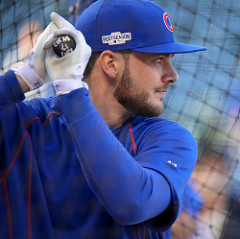
  • In the eighth, with the scored tied (4-4) and Cardinals’ 1B Matt Adams leading off, Matheny went to the bench again – sending Aledmyz Diaz up to pinch hit for Adams. The result? A home run to left on a 1-0 count, giving Saint Louis the lead.
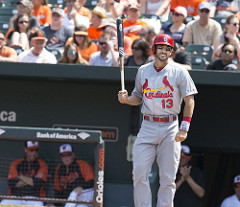
  • In the top of the ninth, with one out and no one on, Matheny again called on a pinch hitter. This time it was Greg Garcia hitting for pitcher Kevin Siegrist. Garcia hit a 2-1 pitch to right field for the Cardinals’ record-breaking third pinch hit homer of the game.

Hazelbaker, Diaz and Garcia were the only pinch hitters used by Matheny that day, and they all went deep.  It was rookie Hazelbaker’s second MLB home run; rookie Aledmys Diaz’ first MLB round tripper; and Garcia’s first homer of the year and just the third home run in his three MLB seasons.  Talk about pushing the right buttons!

The record for pinch hitters used by a team in an MLB games is nine, shared by three teams.

Dodgers (versus Cardinals) on September 22, 1959 – In this contest, won by the Cardinals 11-10, the Dodgers used nine pinch hitters over the final five innings. Those pinch batters went three-for-eight (with a walk), scored two and drove in five. The big blow was a three-run pinch homer by Frank Howard in the top of the nint

Expos (versus Pirates) on September 5, 1975 – Montreal used nine pinch hitters in a 5-2 loss to the Pirates in the second game of a double header. The first pinch hitter was called upon in the fifth inning. Overall, the pinch batters went two-for-eight (both singles) with one walk and one run score

Braves (versus Expos) on September 21, 1993 – In their 18-5 trouncing of the Expos ( in Montreal), the Braves apparently wanted to give everyone a chance to play. They didn’t use their first pinch hitter until the sixth inning – when they were already leading 14-3; and they used six pinch batters in the seventh, when they scored four times to stretch their lead to 18-5. Overall, Braves’ pinch batters went three for six (two doubles) with one hit-by-pitch and two walks.  The pinch batters scored four runs and drove in three. Note: Seven of the Braves’ nine pinch hitters stayed in the game. The only defensive position not occupied by pinch hitter at some time during the game were pitcher and catcher.

That April 8, 2016, trio of pinch-hit home runs for the Cardinals were the first three of the Cardinals’ MLB-record 17 pinch-hit home runs during 2016.  For the season, ESPN.com stats show the Cardinals led all of MLB not just in pinch-hit home runs, but also in pinch hits (81), pinch-hitting average (.333), PH RBI (51), pinch hitters’ on base percentage (.393) and runs scored by pinch hitters (46). At the other end of the spectrum, no team had fewer pinch hits in 2016 than the Minnesota Twins (9-for-62), while the lowest team PH average belonged to Tampa Bay (.124). The White Sox, Royals, Rangers and Reds also completed the season without a single pinch-hit home run; with the White Sox getting an MLB-low three RBI from pinch hitters.

How dominant were the Cardinals pinch hitters? Saint Louis’ .333 pinch hitting average was 49-points higher than the second-best Mets (.282); and 124-points higher than the 2016 MLB pinch-hitting average.  The Mets also finished second to St. Louis in PH home runs (with 13, four behind the Cards) and PH RBI at 51 (ten behind the Redbirds).  The NL team pinch-hitting average production was seven homers and 33 RBI; while the AL (with the DH) averaged two homers and 11 RBI. The Cardinals’ 81 pinch hits were 20 more than runner-up Colorado and their 151 PH total bases outdistanced the runners-up (Mets and Rockies) by 49.

Now, let take a look at a few 2016 individual pinch hitting stats.

Phil gosselin photo

Phil Gosselin – led MLB with 20 pinch hits in 2016.Photo by Keith Allison

Most pinch hits:  Phil Gosselin, Diamondbacks – 20 hits. (77 PH at bats – .263 PH average); Ichiro Suzuki, Marlins, 15 pinch hits (57 PH at bats – .255 PH average).

Pinch-hit home runs: Jeremey Hazelbaker, Cardinals – 4; Matt Joyce, Pirates – 4.

Pinch-hit RBI: Matt Joyce, Pirates – 15; Matt Adams, Cardinals – 13.

Pinch-hit average (minimum 10 PH at bats); Brandon Nimmo, Mets – .500 (six-for-12); Tyler White, Astros  – .462 (six-for-13).


Werth Every Penny

Jayson Werth, deserves special recognition for delivering in the pinch in 2016.  In four pinch hit appearances, Werth delivered three hits – including one double, two home runs and six RBI.

Here are your single-season all-time pinch hitting record holders.

Pinch hits in a season: John Vander Wal, Rockies, 1995 – 28.

Pinch-hit HR in a season: Dave Hansen, Dodgers, 2000 – 7; Craig Wilson, Pirates, 2001 – 7.

Pinch-hit RBI in a season: Joe Cronin, Red Sox, 1943 – 25; Jerry Lynch, Reds, 1961 – 25; Rusty Staub, Mets, 1983 – 25.

Lenny Harris – 212 Pinch Hits

harrisLenny Harris may be the king of the pinch hitters. Harris holds the records for: most pinch hit appearances and PH at bats in a single season (95 and 83, Mets, 2001). He also holds the career records for pinch-hit: at bats (804); and hits (212 – no other player has more than 175). In an 18-season, eight-team, MLB career (1988-2005), Harris appeared in 1,903 games, 883 of those (46.4 percent) as a pinch hitter. He was a true utility player playing 50 or more games at every position except CF (three games), pitcher (1 game) and catcher (zero).  Harris does not, however, hold the record for career pinch-hit home runs.  That belongs to Matt Stairs with 23 (MLB career,1992-2011).


Gene Stechschulte – a Rarity.

In MLB history, 119 players have hit a home run in their first-ever MLB at bat. Of those 119,  29 hit that long ball on the first MLB pitch they ever saw. Out of that 29, six were pinch hitters.  Finally, our of that six, Gene Stechschulte of the Cardinals is the only pitcher to hit a home run, as a pinch hitter, on the very first MLB pitch he saw.

It came on April, 17, 2001 – as you might expect – in a blowout. The Cardinals were trailing the Diamondbacks 15-1 in the sixth inning, when Redbirds’ manager Tony La Russa sent Stechschulte to the plate with one on and two out. It was only Stechschulte’s second professional at bat – and the two-run dinger was his second professional extra base hit.  Stechschulte had one minor league at bat (in 204 games) and hit a double. In his MLB career, Stechschulte batted just five times – collecting a home run and a single.   Stechchulte was no stranger to the batter’s box, however. In 1995, as a pitcher/shortstop at Ashland University, Stechschulte hit .391, with 15 home runs and 58 RBI.


I tweet baseball @DavidBBRT … follow me there for new post alerts.

Member: Society for American Baseball Research (SABR); The Baseball Reliquary; Baseball Bloggers Alliance.