2016 World Series Game Seven – A Century of Heartache is Over

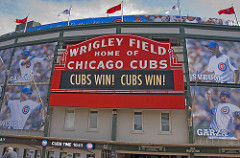
Roller coaster photoIt’s over, the Chicago Cubs 108-year World Championship drought has come to an end – in a Game Seven that had more twists and turns than a carnival ride.  The Cubs topped the Cleveland Indians (whose own World Series Championship drought now stretches to 69 seasons) 8-7 in ten innings.  Was it a “classic” Game Seven?  No, I’ll leave that designation for games like Jack Morris’ ten-inning complete game shutout that brought the 1991 World Series crown to Minnesota.  Was it one of the most exciting Game Seven’s ever?  Definitely – even without its historic significance for both teams.  Let’s look at just a few unexpected developments in this contest:

  • In a Game (and Series) considered a showcase for MLB’s best young talent, three of the four Game Seven home runs were hit by players in their thirties, including one by a 39-year-old retiring catcher (Cubs’ David Ross).
  • Two runs scored on a single wild pitch – by 2016’s likely NL Cy Young Award winner Jon Lester.
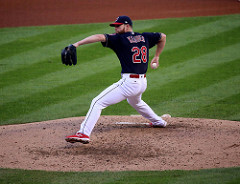
  • Indians’ ace Corey Kluber, who averaged better than a strikeout per inning in both the regular season and post season (up to Game Seven), lasted just four innings, giving up four runs and failing to get a single strikeout.
  • Neither starting pitcher was on the mound at the end of the fifth inning.  (Kluber, of course, was pitching – again – on short rest.  Insert “insert second guess” here.)
  • The Cubs’ seemingly untouchable closer – Aroldis Chapman – came into the game and quickly gave up a double and game-tying home run – but got the win in his least effective post-season appearance.
  • There were a handful of sparkling defensive plays, as well as four errors (three by the Cubs), a hit batter, a costly wild pitch and a flubbed safety squeeze.
  • The Indians came back from a 5-1 deficit after 4 ½ innings, to tie the game 6-6 in the eighth.
  • There was a 17-minute rain delay.
  • Both teams scored in the tenth.
  • The eventual winning run was scored by a player who was intentionally walked.

2016 World Series MVP

Cubs’ LF Ben Zobrist, who drove in the go-ahead run with a double in the tenth inning of Game Seven took home World Series MVP honors. (The Cubs ended up needing the insurance run driven in by C Miguel Montero.)  For the Series, Zobrist hit .357 (10-for-28), with two doubles, a triple and two RBI.

Old Guys Rule

The game and the Series were considered to be a showcase for some of MLB’s best young talent: Francisco Lindor (22-years-old); Jose Ramirez (24); Kyle Schwarber (23); Kris Bryant (24); Addison Russell (22) – to name just a few of the twenty-something stars on the two rosters. In Game Seven, however, there were four home runs – three by players in their thirties.

  • Thirty-year-old CF Dexter Fowler got the Cubs off to a good start – and an immediate lead – with a booming lead-off home run in the first inning.
  • In the sixth inning, Cubs’ 39-year-old catcher David “Grandpa Rossy” Ross, playing in his last major league game, homered to left off Indians’ relief ace Andrew Miller – giving the Cubs a 6-3 lead and becoming the oldest player to homer in Game Seven of a World Series.
  • In the bottom of the eighth, the Indians’ 36-year-old CF Rajai Davis took Cubs’ closer Aroldis Chapman deep – tying the game 6-6 on a two-run shot.
  • One of the youngsters did appear in the long ball parade. The Cubs’ 23-year-old 2B Javier Baez hit a solo shot off Indians starter Corey Kluber in the fifth.

Hope You Remember this Performance

The Indians’ Brandon Guyer did not get into the game until the sixth innning; pinch-hitting and taking over righ field from Lonnie Chisenhall. (He would later move to LF.)  All Guyer did was record a single, double and walk, along with two runs scored and an RBI, in three plate appearancs.

Wild Thing, You Make My Heart Sing
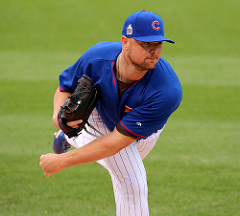
Jon Lester cubs photo

Jon Lester – Wild pitch plated two runs, but he gave the Cubs three much-needed innings. Photo by apardavila

The Indians started the fifth with two quick outs against Cubs’ starter Kyle Hendricks, who appeared to be well in control.  Then DH Carlos Santana walked and Cubs’ Manager Joe Maddon – after just 63 pitches – pulled Hendricks in favor of 19-game winner and strong Cy Young Award candidate Jon Lester. (Before the game, Maddon had said he preferred to bring Lester in at the start of, rather than in the midst of, an inning.  Good place to second guess here.). Lester gave up a dribbling single toward the mound to Indians’ 2B Jason Kipnis. The ball was played by catcher David Ross, whose off target (error) throw to first let Kipnis move up to second and Santana to third. Then, with SS Francisco Lindor at the plate, Lester bounced a wild pitch in the dirt that allowed both Santana and Kipnis to come home – bringing the score to Cubs 5 – Indians 3. Lester got Lindor on a swinging strikeout and went on to pitch a scoreless sixth and the seventh.  He was replaced by closer Aroldis Chapman with two outs and one on in the eighth.

Turning Point

Hard to pick a turning point in a game with so many twists and turns, but I’ll take the 17-minute rain delay between the ninth and tenth innings.  The Cubs were reeling a bit.  The bottom of the eighth had seen the Indians rally to tie the game at six off Cubs’ (overworked) closer Aroldis Chapman (another chance to second guess), who came on with two outs and one on and gave up a run-scoring double to RF Brandon Guyer; a game-tying two-run homer to CF Rajai Davis; and a single to LF Ben Zobrist before striking out C Yan Gomes to end the inning.

Then, in the top of the ninth, with RF  Jason Heyward on third and one out, Cubs’ 2B Javier Baez fouled off a two-strike safety squeeze (bunt) attempt that could have scored the go-ahead run. CF Dexter Fowler followed with a short-to-first ground out and the scoring opportunity was lost.  Fortunately for the Cubs, Chapman settled down to record a 1-2-3 ninth – and then the rain delay gave the Cubs a chance to calm down, regroup (have a team meeting) and right the ship – sailing it into a two-run top of the tenth.

The game-tying home run given up by Aroldis Chapman in the eighth inning was the first round tripper he had surrendered since joining the Cubs on July 25.

Stars of the Game

Cubs’ CF Dexter Fowler started the game with a home run and collected three hits. Cubs’ DH Kyle Schwarber continued his remarkable comeback from surgey with three hits.  Despite initial difficulties, starter-turned-reliever Jon Lester gave the Cubs three solid – and much needed – innings; one run, on two hits and a walk, with four strikeouts. Kyle Hendricks gave up two runs (one earned) in 4 2.3 innings.

For the Indians, CF Rajai Davis had two hits – including a game-tying home run – and drove in three.  Brandon Guyer, who didn’t enter the game until the sixth inning, had a double, a single, a walk,  two runs scored and an RBI – in just three plate appearances. Cody Allen threw two scoreless innings – no hits, one walk, two strikeouts.

The Improbable Tenth –Both Teams Score

Cubs’ DH Kyle Schwarber led off the tenth (Bryan Shaw on the mound for the Indians) with a single to right – and was immediately replaced at first base by pinch runner Albert Almora. 3B Kris Bryant followed with a long drive to center caught by Rajia Davis.  Almora made a heads up running play – tagging and going to second to eliminate the force play. The Indians countered by walking 1B Anthony Rizzo intentionally.  Almora’s advance to second – which led to the Rizzo walk – would prove consequential. Next, LF Ben Zobrist cemented his World Series MVP Award with a run run-scoring double – Almora crossing the plate and Rizzo moving up to third. Shaw then intentionally walked SS Addison Russell to both set up the double play and get to Miguel Montero, the Cubs’ third catcher of the game.  Montero singled the intentionally walked Rizzo home with what would prove to be the winning run.  At this point, Trevor Bauer replaced Shaw and got RF Jason Heyward and 2B Javier Baez to end the inning. Cubs 8 – Indians 6.

The Indians, however, were not done yet.  Carl Edwards replaced Aroldis Chapman on the mound to start the tenth and got two quick outs (1B Mike Napoli on a swinging third strike and 3B Jose Ramirez on a groundout to short.) Victory seemed to be right there, but this ride wasn’t done spinning yet.  Brandon Guyer drew a walk and moved to second on defensive indifference.  He then scored on a single by CF Rajai Davis, cutting the lead to one.  At this point, Cubs’ manager Joe Maddon brought in Mike Montgomery, who got RF Micheal Martinez on a grounder – third to first.

Whew! It was finally over.


World Series Stats Leaders

Addison Russell cubs photo

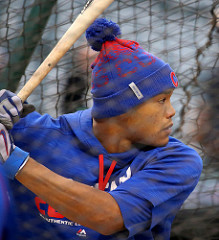
Cubs’ SS Addison Russell drove in one-third (9 of 27) of the World Series runs scored by the Cubs. Photo by apardavila

AVERAGE

Cubs: Anthony Rizzo – .360

Indians:  – Jose Ramirez – .310

HITS

Cubs: Ben Zobrist – 10

Indians: Jason Kipnis – 9

HR

Cubs: Kris Bryant and Dexter Fowler – 2

Indians: Jason Kipnis and Roberto Perez – 2

RBI

Cubs: Anthony Russell – 9

Indians: Roberto Perez – 5

RUNS SCORED 

Cubs: Anthony Rizzo – 7

Indians: Jason Kipnis – 6

STOLEN BASES

Cubs: Jason Heyward – 4

Indians: Rajai Davis – 3

PITCHING WINS

Cubs: Jake Arrieta – 2

Indians: Corey Kluber  – 2

STRIKEOUTS

Cubs: Jon Lester – 16

Indians: Corey Kluber – 15

ERA (starters)

Cubs: Kyle Hendricks – 1.00

Indians: Corey Kluber – 2.81

INNINGS PITCHED

Indians: Corey Kluber – 16.0

Cubs: Jon Lester – 14.2

SAVES

Cubs: Aroldis Chapman and Mike Montgomery – 1

iNDIANS: Cody Allen – 1
 

I tweet baseball @David BBRT

Member: Society for American Baseball Research (SABR); The Baseball Reliquary; Baseball Bloggers Alliance.
2016 World Series Game Six – Next, It’s Heartbreak or Heaven

Game Six of the 2016 World Series was all Cubs – a 9-3 victory that fueled the anticipation of a Game Seven.  It seems appropriate, somehow, that two teams with a combined 176-year title drought would see the difference between continued heartbreak and hardball heaven go down to a Game Seven.  Game Six did have some highlights, mostly for the Cubs:

  • Cubs’ SS Addison Russell had a double and a home run (Grand Slam) in five at bats – tying a World Series Single-Game record with six RBI;
  • Cubs’ 3B Kris Bryant had four hits – including his second homer of the Series to start the Cubs’ scoring;
  • Cubs’ 1B Anthony Rizzo had three hits, including an “insurance” two-run home run in the top of the ninth;
  • Indians’ 2B Jason Kipnis had three hits, including his second home run of the Series; and.
  • Cubs’ starter Jake Arrieta went 5 2/3 innings, giving up two runs on three hits and three walks with nine strikeouts.

Looking to the Future

The Cubs’ starting offensive nine in Game Six included seven players under the age of 28. The Indians’ starting lineup had five players under 28.  Both teams seem to be looking toward a bright future,

Turning Point

Josh Tomlin Indians photo

Josh Tomlin was one pitch away from a 1-2-3 first. Photo by Keith Allison

The turning point in Game Six of the 2016 World Series came at a time that was both early and unexpected.  Indians’ starter Josh Tomlin got off to a good start, retiring Cubs’ CF Dexter Fowler on a liner to third, DH Kyle Schwarber on a grounder to second and then getting 3B Kris Bryant down no balls-two strikes.  Tomlin was one good pitch away from a 1-2-3 first.  He didn’t get it, as Bryant took the 0-2 offering deep to center to give the Cubs an early 1-0 lead.

But that wasn’t the turning point – one run was not likely to win this contest.  And, the Cubbies weren’t done.  1B Anthony Rizzo and LF Ben Zobrist followed with a pair of singles, putting runners on first and third (with Tomlin still one out away from a one-run inning).  Then – wait for it, wait for it – came the turning point.  SS Addison Russell hit what appeared to be an inning-ending soft fly ball to right center.  In an apparent bout of miscommunication, CF Tyler Naquin and RF Lonnie Chisenhall (both seemingly in hot pursuit) let the ball drop in between them for a two-run double. To add insult to injury, Russell took third base on a throwing error by 2B Jason Kipnis.  Cubs’ C Wilson Contreras then flied out to center to end the inning, but the damage was done: 3-0 Cubs and the Indians hadn’t batted.  That “turning point “ inning had several effects: It took the crowd out of the game; put the Indians “under pressure” in the field and at the plate; most likely dampened Cleveland’s aggressiveness on the bases; and impacted how Indians’ manager Terry Francona used his usually fierce bullpen.

Star of the Game

Addison Russell Cubs photo

Photo by apardavila

The star of Game Six was Cubs’ 22-year-old SS Addison Russell with a double, home run and World Series record (tying) six RBI.  Russell’s six runs driven in tied the Cardinals’ Albert Pujols (Game Three, 2011); Yankees’ Hideki Matsui (Game Six, 2009); and Yankees’ 2B Bobby Richardson (Game Three,1960).  Russell’s Grand Slam was the first by a shortstop in the World Series and made him the second-youngest player to hit a Grand Slam in the Fall Classic (only Mickey Mantle was younger).


Pitching Decisions Questioned

The depth of the Cubs’ rotation came into play as Cubs’ starter Jake Arrieta started on his usual rest (the Cubs used a four-man rotation in the Series), while Josh Tomlin (the Indians’ went with a three-man rotation) started on short rest (and gave up six runs in 2 1/3 innings).  The Indians’ Danny Salazar – who went 11-6, 3.87  in 25 starts, but came down with a right forearm strain late in the season – came in to pitch two scoreless innings (one hit and four strikeouts).  Salazar’s performance led to some speculation that a Salazar start and game-by-committee (given Cleveland’s sparkling relief corps) might have better served the Indians.  (Hindsight, however, is always 20/20 and Salazar was a big questins mark, while Tomlin has pitched well this post season.)  Now, the Indians have ace Corey Kluber going in Game Seven, like Tomlin, on short rest.

Still the Indians have the bull pen advantage, as Cleveland Manager Terry Francona did not use any of his “lights-out” bullpen trio of Andrew Miller, Cody Allen and Bryan Shaw in Game Six.  Five innings out of Kluber may be enough for the Tribe to take the finale.

Meanwhile, Cubs’ manager Joe Maddon surprised a lot of folks by using his two most trusted relievers – Mike Montgomery and closer Aroldis Chapman – in Game Six, despite a big lead.

The most engaging questions seem to be:  1) How effective will Kluber be pitching once again on short rest?  2) Has Maddon overused Chapman?.  One thing for sure, there will be some intrigue.

Game Seven Starters

Let’s look at the Game Seven starting pitchers.

Corey Kluber – Cleveland

Kluber has been the Indians’  “ace” all season and in the post season.  On the season he was 18-9, 3.14, with 227 strikeouts in 215 innings.  His home and away stats were relatively even:  10-5, 3.24 at home and 8-4, 3.03 on the road. In the post season, he is 4-1, 0.89. with 35 strikeouts in 30 1/3 innings.  And, while Kluber is going on short rest for the second straight start, he has a well-rested bullpen (Andrew Miller, Cody Allen and Bryan Shaw) behind him.  This post season, that trio has pitched 38 innings, giving up just four runs (0.95 ERA), while fanning 62.  Five quality innings from Kluber may be enough.  BBRT will be watching Kluber’s early pitch count closely.

Kyle Hendricks – Chicago

The Cubs’ Kyle Kendricks wnet 16-8, with MLB’s lowest ERA (2.13) this season.  During the regualr season, he fanned 170 batters in 190 innings.  He was 9-2 1.32 at Wrigley and a still good, but less impressive, 7-6 2.95 on the road. Backing up Hendricks are likely a combination of starter Jon Lester and relievers Mike Montgomery and Aroldis Chapman.  Lester, with a 1.93 ERA in five 2016  post-season starts could come in if Hendricks should falter early. Montgomery and Chapman – who both pitched yesterday – have made 22 appearances this postseason (28 1/3 innings), with a 2.86 ERA and 30 strikeouts.  The Cubs need Hendricks to go deep in this game.  If he could get into the seventh, it would make Maddon’s job a lot easier.


World Series Flashback – My Favorite Game Seven 1960

Game Seven of the 1960 World Series is my favorite World Series contest – which is saying a lot since I was in the park for Jack Morris’ 10-inniing shutout win in Game Seven of the 1991 Fall Classic.  To understand why this is my favorite, it helps to set the stage:

  • There were only 16 major league teams. If you didn’t finish with the most victories in your league, you went home.
  • No one had ever heard of the designated hitter, the wild card, WAR or even WHIP.  
  • Home Run Derby was on TV – in black and white, with power hitters pairing off at Wrigley Field in Los Angeles.
  • Ted Williams finished his career with a home run in his last at bat that season and Brooks Robinson won his first Gold Glove.
  • MLB held two All Star Games.
  • The 1960 White Sox became the first team to put players’ names on uniforms.
  • Warren Spahn threw his first no-hitter taht season  and won a league-leading 21 games – at age 39.
  • Juan Marichal threw a one-hitter in his major league debut at age 22.
  • Roger Maris won his first MVP Award in his first year as a Yankee (after being traded from the Kansas City Athletics).

I was thirteen and an avid baseball fan.  The Game of the Week (in black and white), the radio – especially the radio – and an occasional trip to the ball park were my tickets to the national past time.

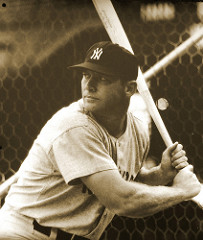
MIckey Mantle photo

Mickey Mantle and the Yankees were a baseball dynasty going into the 1960s. Photo by Tony Fischer Photography

At the time, the Yankees were baseball’s dynasty.  Since my birth in 1947, the Bronx Bombers had been to 11 World Series (including the 1960 Series, tied 3-3) and had won eight World Championships.  Fans from pretty much everywhere but New York had made Yankee-hating a tradition.  I was no exception.  Milwaukee-born, I was a steadfast Braves fan, still smarting from the Yankees’ 1958 World Series comeback, when they downed my Braves after trailing three games to one. 

The prognosticators had predicted a Yankee win in five or six games.  They pointed out that the Yankees, with a 97-57 record (the Pirates were 95-59-1) came into the Series with the momentum of a 15-game, season-closing winning streak, while the Pirates lost four of their final seven.  They also lauded the Yankees’ post-season experience and, they heralded the Yankees power (the Yankees led the AL with a record 193 home runs and 746 runs scored, while the Pirates led the NL with 734 runs scored, but only 120 round trippers) – the Yankees’ Game One starting lineup had belted 152 regular season homers to 98 for the Pirates’ starters.  When it came to mound work, things appeared more balanced, maybe even a shade in favor of the Pirates.  While the Yankees’ 3.52 ERA was the lowest in the AL, the Pirates’ NL third-best ERA (at 3.49) slightly bettered the Bomber mark.  The Pirates did have the clear advantage in strikeouts (811-712) and fewest walks allowed (an NL low of 386 to an AL worst 609 for the Yankees). They also boasted the Cy Young Award winner in Vernon Law (20-9, 3.08), backed up by Bob Friend (18-12, 3.00), while no Yankee starter had topped 15 wins.  The top relievers for the two teams were Elroy Face, with 24 saves for Pittsburgh and Bobby Shantz, who saved 11 for the Yanks.

YANKEE OFFENSE LEADING THE CARGE

To further set the stage, going into Game Seven (October 13 at Pittsburgh), the Series was tied 3-3, despite:

  • The Yankees outscoring the Pirates 46 to 17 over the first six games;
  • The Yankees out-hitting the Pirates 78 to 49 in the first six games; and
  • The Yankees out-homering  the Pirates eight to one in the first six games.

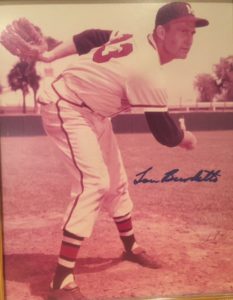
Still,  the Pirates were looking forward the  chance to win the Series at home behind Vernon Law (winner of Games One and Four.)  The Yankees countered with Bob Turley, who, despite winning Game Two, had given up 13 hits and three walks in 8 1/3 innings.  The Pirates also had their top left-handed hitter, Bob Skinner (injured in Game One), back at the number-three spot in the order, while the Yankees were missing Elston Howard (broken finger, Game Six).

PIRATE POWER TO THE LEAD

The Yanks went meekly in the top of the first inning (liner, popup, foul out), and the Pirates, homerless since 2B Bill Mazeroski’s blast in Game One, got a two-run homer from 1B Rocky Nelson (whom Murtaugh chose to start at first base over regular Dick Stuart).

In the second, Law set the heart of the Yankees down in order –CF Mickey Mantle, fly to center; LF Yogi Berra, grounder to third; 1B Bill Skowron, grounder to short.  Pirates’ C  Smoky Burgess started the bottom  inning with a single and Yankee manager Casey Stengel immediately pulled starter Bob Turley in favor of the rookie Bill Stafford (who had stifled the Pirates for five innings in Game Five).  The move, second-guessed by many, did not pay off.  Stafford walked 3B  Don Hoak and Mazeroski beat out a bunt single.  Vernon Law was now at the plate (the Pirates’ pitcher was two for four, with a double, run scored and RBI in Games One and Four).  Law hit back to Stafford for a pitcher-to home-to first double play, but CF/lead-off hitter Bill Virdon followed with a two-run single and a 4-0 Pirates lead.  The Yankees were on the ropes.

YANKEE BATS WARM UP

Law handcuffed the Yankees through four innings, giving up only two singles.  In the fifth, YankeeS’ 1bMoose Skowron made the score 3-1 with a lead-off homer just inside the right field foul pole.  Law did not let the round tripper upset him, retiring C Johnny Blanchard, 3B Clete Boyer and P Bobby Shantz (who came on to pitch for New York in the third) in order.

The Yankees closed the gap – and then some – in the top of the sixth.  Pesky New York 2B Bobby Richardson (who already had nine hits in the series) led off with a single to center, and SS Tony Kubek followed with a walk.  With the Bombers appearing on the verge of a rally, Murtaugh replaced Law (who, it turns out had been pitching on a sore ankle throughout the Series) with his top reliever Elroy Face.   Face got RF Roger Maris on a foul pop to 3B Don Hoak, but Mickey Mantle followed with a “seeing eye” single up the middle, scoring Richardson. Yogi Berra followed with a upper deck home run (like Skowron’s just inside the right field foul pole) to give New York a 5-4 lead in what was shaping up to be a nail biter.  Veteran Bobby Shantz, meanwhile, was baffling the Pirates – giving up only a single and a walk from the third to the seventh innings.

In the top of the eighth, the Yankees appeared to put the game away – using a walk, two  singles and a double to produce two more runs and a 7-4 lead.   Notably, Stengel’s  pitching decisions again came into play.  He let Shantz bat with two out and runners at second and third (Boyer and Skowron) and a chance to extend the Yankee lead.  Shantz flied out and the living-room and press-box managers were quick to point out:  1) The lost scoring opportunity; 2) The fact that Stengel left Shantz in for a sixth inning of work, despite the fact that Shantz had not gone more than four innings in the regular season.

A PEBBLE SENDS WAVES ACROSS THE DIAMOND

In the bottom of the eighth, things unraveled for the Yankees, thanks to a poorly placed pebble.  Gino Cimoli pinch hit for Face and stroked a single to right-center field.  Shantz, who had already induced two double plays appeared to have worked his magic again, as CF Bill Virdon hit a hard ground ball right at  Yankee SS, sure-handed Tony Kubek.  Just as Kubek was ready to field the ball, it appeared to hit a pebble (the Yankees had already been critical of the condition of the Forbes Field infield) and ricocheted into Kubek’s throat.  Kubek went down, gasping for air and spitting up blood, with his windpipe rapidly swelling (doctors on the scene at first thought an emergency tracheotomy might be necessary).  The end result?  Kubek sent to the hospital and replaced by Joe DeMaestri and the Pirates had two on and no outs, instead of none on and two outs.  (Read: Aha, the turning point.)

Pirates’ shortstop Dick Groat took advantage of Kubek’s mishap and lined singled to left, scoring Cimoli.  Stengel came to the mound and replaced Shantz with right-hander Jim Coates (despite the fact that lefty Bill Skinner was coming to the plate).  The righty-lefty matchup made little difference, as Skinner sacrificed the runners up one base.  Next was Rocky Nelson, who flied out to medium right, with the Pirates choosing not to test Roger Maris’ arm.   So, two outs, two on and the Yankees still in front 7-5.   That brought up the Pirates’ best hitter, RF Roberto Clemente, who had been held hitless in his first three at-bats. Coates made a good pitch, getting Clemente to hit a weak ground ball toward first.  A hustling Clemente beat both Coates and Skowron’s throw to the bag, while Virdon scored and Groat moved to third.  Now, 7-6 and the Pirates still had life. 

That brought up backup catcher Hall Smith (who had come into the game in the eighth after Joe Christopher ran for starting catcher Smoky Burgess in the bottom of the seventh).   Smith took a 2-2 Coates’ pitch over the left-field wall for a 9-7 Pittsburgh lead.  The Pirates, with only one round tripper in the first six games had homered twice for five runs in Game Seven.

YANKEES NEITHER GIVE IN NOR GIVE UP

To protect the lead  in the ninth (and with Elroy Face already out of the game), Pirate Manager Danny Murtaugh called on starter Bob Friend, who had lost Games Two and Six, giving up seven earned runs in six innings (and had pitched in relief only once all season).  Yankee lead-off hitter Bobby Richardson started off the ninth with a single to left.  Veteran and former-Pirate Dale Long, pinch hitting for Joe DeMaestri (who had replaced the injured Kubek) singled to right and Friend was gone, replaced by Game-Five starter Harvey Haddix.  Haddix got Roger Maris on a foul out, but Mickey Mantle drove in Richardson with a single to right center.   Yogi Berra followed with a ground ball down the first base line.  Rocky Nelson made a nice backhanded stop, but was out of position for a first-to second-to first, game-ending double play. Nelson took the sure out, stepping on the first base bag and retiring Berra, while Gil McDougald (pinch running for Long) headed toward home.  It was at this point that Nelson realized Mantle had not run to second.  Mantle, sizing up the situation, was returning to first (with the force at second now off). It was an unorthodox base-running move, but as Mantle dove head first back to the bag (avoiding Nelson’s desperate attempt to tag him), McDougald scored the tying run.  Skowron then grounded out to Mazeroski (forcing Mantle) to end the inning in a 9-9 tie. Still, Mantle’s heads up baserunning had kept the Yankees in the game.

THE FIRST WORLD SERIES-ENDING WALKOFF HOME RUN

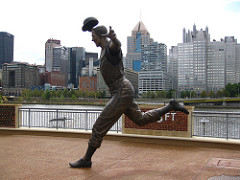
bILL mAZEROSKI photo

Bill Mazeroski’s Series-winning home run has been immortalized in Pittsburgh. Photo by daveynin

Stengel, like Murtaugh, was now using starters in relief, bringing Game Four-loser Ralph Terry in to pitch the ninth.  Number-eight hitter Bill Mazeroski led off the inning.  Terry’s first pitch was a high and inside fastball.  The second pitch, another fastball, was in the strike zone and Mazeroski deposited it over the 406-foot marker in left center.  Not sure the ball would carry out in the deep part of the park, Mazeroski ran full speed with his head down to first and toward second, before seeing the umpire making the circular home run signal.  Mazeroski removed his helmet, waving his way to home plate where his team mates awaited the first player in major league history to end the World Series with a walk-off home run.

Trivia Tidbit:  The seventh game of the 1960 Series is the only World Series game in which neither team recorded a single strikeout.

FINAL: Pirates 10 – Yankees 9; Pirates 4 games – Yankees 3 Games. M

When the Series was over, Pirate pitching made the difference, but you could never tell from the stats line:

  • The Yankees scored a Series’ record 55 runs to 27 for the Pirates,
  • The Yankees collected a Series’ record 91 hits to 60 for the Pirates.
  • The Yankees hit a Series’ record .338 to .256 for the Pirates
  • The Yankees collected a Series’ record 27 extra base hits to 15 for the Pirates.
  • The Yankees out-homered the Pirates 10-4.
  • The Yankees’ pitchers put up a 3.54 ERA to 7.11 for the Pirates.
  • Bobby Richardson of the Yankees won the Series MVP award, hitting .367 with a Series’ record 12 RBI. The only player on a losing team to ever win the Series MVP Award.
  • The Yankees’ Whitey Ford was the Series’ most effective pitcher, throwing two complete game shutout in two starts.

I tweet baseball @DavidBBRT

Member:  Society for American Baseball Research (SABR); The Baseball Reliquary; Baseball Bloggers Alliance.
2016 World Series Game Five – “High Anxiety” and Back to Cleveland

It’s back to Cleveland for Game Six – as the Cubs stayed alive with a classic 3-2 victory in Game Five at Wrigley field (and now trail the Indians three games-to-two). The tension-filled contest – described as “high anxiety” by Cubs’ first-sacker Anthony Rizzo had something for everyone:

  • 23 strikeouts for those who love power pitching;
  • Home runs by both teams’ third basemen – the Indians’ Jose Ramirez and Cubs’ Kris Bryant;
  • A measure of small ball – what proved to be the winning run moved to third on a bunt single and scored on a sacrifice fly;
  • A handful of great fielding plays (particularly on the Cubs’ side by David Ross, Anthony Rizzo, Jason Heyward and Kris Bryant);
  • Seven stolen bases;
  • Plenty of strategy – pitching changes, pinch hitters, double switches; and
  • Particularly rousing crowd renditions of Take Me Out to the Ball Game and Go, Cubs, Go!

Now it’s on to Cleveland, with the Cubs’ Jake Arrieta (18-8, 3.10 in the regular season) facing the Indians’ Josh Tomlin (13-9, 4.40).  Unfortunately for Chicago, even if they take Game Six, they still can’t win the Series without beating Cleveland ace Corey Kluber – slated to start Game Seven against NL Era champ Kyle Hendricks.  For now, it’s simply “Game on.”

Starting Pitchers Come Out Firing Bullets

Jon Lester cubs photo

Photo by apardavila

Jon Lester and Trevor Bauer were throwing bullet right from the start.  Lester struck out the side in order in the first inning, while Bauer fanned two in his 1-2-3 start.  In that first frame both starters threw 13 pitches, ten strikes.  Bauer ran low on ammo for a brief period in the bottom of the fourth, but it was a well-pitched game on both sides.  Lester’s final line in victory: six innings pitched, four hits, two runs, no walks and five strikeouts.


Turning Point

Kris Bryant Cubs photo

Kris Bryant hit a game-tying long ball to lead off the Cubs’ three-run inning. Photo by apardavila

Pretty easy call on the turning point in this one – the bottom of the fourth, when the Cubs finally put a few hits together and scored their only runs of the game. Down 1-0, Cub’s 3B Kris Bryant led off with a game-tying home run to left-center off Indians’ starter Trevor Howard. The second half of “Bryzzo” – 1B Anthony Rizzo – followed with a double off the ivy in right field. That hit seemed to rattle Bauer, who went to 3-0 on LF Ben Zobrist before giving up another single to right.  Then, with Rizzo on third and Zobrist on first, SS Addison Russell beat out a grounder to third, scoring Rizzo.  RF Jason Heyward then fanned (one of three strikeouts he would have on the day), before 2B Javier Baez loaded the bases with a bunt single. C David Ross (playing his last game ever at Wrigley – the 39-year-old is retiring after this season) then drove in what would prove to be the winning run with a sacrifice fly to left.  P Jon Lester, the eighth Cubs’ batter of the inning made the final out – and the Cubs led 3-1.

I would actually extend this turning point to the top of the fifth.  Once the Cubs put some runs on the board, it was important that they keep the momentum and hold the Indians at bay in the top of the fifth.  Cleveland LF Carlos Santana started the inning with a double off Lester and went to third on 3B Jose Ramirez’ groundout to short.  It looked like the Indians were going to come right back with a score. But Lester shut the door with a strikeout of RF Brandon Guyer and a ground out (short-to-first) buy C Roberto Perez.  That, to me, was a critical inning in this game.

Seven Stolen Bases

Rajai Davis photo

Rajai Davis- Three Steals. Photo by Keith Allison

Both teams brought their running game – totaling seven steals. AL regular-season stolen base leader (43 SB) CF Rajai Davis stole three bags, including second and third in the sixth (he would eventually score).  The Cubs stole four bases; one each by 3B Kris Bryant and CF Dexter Fowler and two by RF Jason Heyward (who nabbed second and third in the bottom of the eighth. Notably, the Indians’ sixth-inning rally was cut short when David Ross threw out Indians’ SS Francisco Lindor on an attempted steal of second.  


Both Managers All-In

Clearly both managers were all-in for this one – as both closers (Indians’ Cody Allen and Cubs’ Aroldis Chapman) were in the game by the seventh inning.  Allen struck out four in 1 2/3 scoreless innings, while Chapman fanned four in 2 2/3 innings for the save.  It was the first eight-out save of his career.

Cubs’ closer Aroldis Chapman three 42 pitches, 26 for strikes – including a World Series’ single-game record of 19 pitches of at least 100 mph,  During the regular season, Chapman (according to Statcast) threw MLB’s 30 fastest pitches – including one at 105.1 MPH.

David Ross’ Final Game at Wrigley

Thirty-Nine-Year-old Cubs’ catcher David Ross (Jon Lester’s designated catcher) – nicknamed “Grandpa Rossy” by the youngsters that man the Cubs lineup – is retiring after the Series (and after 15 MLB seasons, the last two with the Cubs).  In his last game at Wrigley, he drove in what proved to the winning run with a fourth inning sacrifice fly, called a great game for Jon Lester and cut short an Indians’ rally by throwing out the speedy Francisco Lindor on a steal attempt to end the sixth inning.  For his career, Ross played in 883 games, hitting .229 with 106 home runs and 314 RBI. For the Cubs this year, he hit .229-10-32 in 67 games.

Pearl Jam Front Man Salutes David Ross

Pearl Jam front man Eddie Vedder was called on to lead the seventh-inning rendition of Take Me Out to the Ball Game – and he dedicated his efforts to popular (and retiring) 39-year-old Cubs’ catcher David Ross.  “There’s one guy in particular I want to sing my *** off for. He’s number three.  He’s behind the plate. He may retire, but he’ll never quit.  Mr. David Ross, I’d like to belt this one out for you.  It’s his last game at Wrigley, let’s sing it for him.”


World Series Flashback

knowlesIn the 1973 World Series, as the Oakland A’s topped the New York Mets four games to three, Oakland reliever Darold Knowles set a record that can be tied, but will never be topped.  Knowles pitched in all seven games of the Series, picking up a pair of saves.

GAME ONE – Knowles came on in the top of the ninth with one on and one out and the A’s up 2-1. He retired PH Jim Beauchamp and 3B Wayne Garrett on fly outs for the save.

GAME TWO – Knowles took the mound in the top of the sixth with the bases loaded one out and the Mets up 4-3. Knowles got PH Jim Beauchamp to ground to the mound, but Knowles threw wildly to the plate, with two runs scoring on the error. He then struck out lead-off hitter 3B Wayne Garrett, intentionally walked 2B Felix Millan and got RF Rusty Staub on a fly out. (Staub hit .423 for the Series, with 11 hits in seven games.)  Knowles stayed in and pitched a scoreless seventh. The A’s eventually lost 10-7 in 12 innings.

GAME THREE – Knowles came in for Catfish Hunter in the seventh inning, with Oakland down 2-1. He pitched two scoreless innings in a game Oakland won 3-2 in 11 innings.

GAME FOUR – Knowles came on in the bottom of the fourth with two on, none out, and New York up 3-1. He struck out P Jon Matlack, then hit 3B Wayne Garrett with a pitch loading the bases. Then 2B Dick Green’s error allowed Mets’ 2B Felix Millan to reach, scoring CF Don Hahn. RF  Rusty Staub followed with a two-run singls and LF Cleon Jone walked before Knowles got 1B John Milner to hit into a 1-2-3 double play. The A’s eventually lost 6-1.

GAME FIVE – Knowles came in with two outs in the sixth inning, the A’s down 2-0, and a runner on third. He intentionally walked number-eight hitter SS Bud Harrelson and fanned P Jerry Koosman. The Mets won this one 2-0.

GAME SIX – Knowles took the mound with one out in the eighth, a runner on first and the A’s up 2-0. He gave up singles to 3B Wayne Garrett and 2B Felix Millan (scoring a run), before fanning RF Rustu Staub.  Rollile fingers then came in to get the last out of the inning. The A’s won 3-1.

GAME SEVEN – Knowles came in with two outs in the top of ninth, the A’s up 5-2, runners on first and third, and the top of the Mets’ batting order coming up.  He got 3B Wayne Garrett to pop up, ending the inning, giving the A’s the Series and earning the save.

For the Series, Knowles pitched in seven games – giving up four hits and five walks in 6 1/3 innings – but only one unearned run – while fanning five.  (ERA 0.00).  On the season, Knowles appeared in 52 games (five starts), going 6-8 with nine saves and a 3.09 ERA.

Side Note:  Willie Mays, then with the Mets, got his final at bat in the major leagues in the Series – grouding into a force out to end the tenth inning of Game Three.  Mays went two-for-seven in the Series, with one run and one RBI.  


I tweet baseball @DavidBBRT

Member:  Society for American Baseball Research (SABR); The Baseball Reliquary; Baseball Bloggers Alliance.


Ieball Bloggers Alliance.

2016 World Series Game Four – Indians Dominate Cubs and More

Cleveland dominated all phases of Game Four – winning 7-2, while out-hitting the Cubs 10-7; out-homering the Cubs 2-1; playing error-free ball to the Cubs’ two errors; getting six innings (just one earned run) out of their starter versus five innings (two earned runs) for the Cubs’ starter; and winning the battle of the bullpens.

The Cubs, now down three games-to-one face some tough, but not unsurmountable, odds.

Since the World Series took its AL/NL format in 1903, 45 teams have taken a 3-1 advantage in the Series and 39 of them have emerged as champions.  Still as a long-time Braves’ fan, I can remember when my Braves (who won the Series in 1957) took a three games-to-one lead in 1958 and the Yankees bounced back to take the Series 4-3. (It is still a painful memory.)

TEAMS TO WIN WORLD SERIES AFTER BEING DOWN 3-1

         1903 Boston Pilgrims (over Pittsburgh Pirates – best of nine)

          1925 Pirates (topped Washington Senators)

        1958 Yankees (beat the Braves)

         1968 Tigers (beat the Cardinals)

         1979 Pirates (beat the Orioles)

         1985 Royals (topped the Cardinals)

Turning Point

Carlos Santana MLB photo

Carlos Santana – got the Indians’ offense going. Photo by Keith Allison

There are those who will point to Cleveland 2B Jason Kipnis’ three-run homer in the top of the seventh (that put the game out of reach at 7-1) as the turning point.  I think it came much earlier – in the top of the second inning. The inning started with the Cubs’ John Lackey giving up a home run to 1B Carlos Santana. After 3B Jose Ramirez grounded out to first, RF Lonnie Chisenhall reached on a throwing error by Cubs’ third-sacker – and 2016 NL MVP candidate – Kris Bryant. C Roberto Perez then grounded out (Lackey to 1B Anthony Rizzo), with Chisenhall moving to second. The Cubs chose to intentionally walk CF  Tyler Naquin to get to pitcher Corey Kluber.  Kluber topped a high-hopper to Kris Bryant. The Cleveland pitcher beat Bryant’s throw (for a single). Bryant’s hurried toss went wide (for his second error of the inning), allowing Chisenahll to score.  LF Rajai Davis ended the inning by grounding out to second.  Still, Cleveland took the lead 2-1 in an inning that included a home run (into a stiff wind), a hit by an AL pitcher and two Cubs’ errors.  The mood was set.

 Kluber Continues to Shine

Staff ace Corey Kluber has been the key to the Indians’ post season and he continued to shine.  Kluber, pitching on three-days rest, went six innings – giving up five hits and one earned run, while fanning six. He threw only 81 pitches in winning his second game of the Series and should be ready if a Game Seven is needed.  In this post season, Kluber (18-9, 3.14 in the regular season) is 4-1, with an 0.89 ERA and 35 strikeouts in 30 1/3 innings pitched.

Relievers of the Year – Zach Britton and Kenley Jansen

MLB yesterday announced the winners of the  Mariano Rivera AL Reliever of the Year Award and the Trevor Hoffman NL Reliever of the Year Award – Zach Britton and Kenley Jansen.

Britton saved 47 games in 47 opportunities for the Orioles.  He also won two games (versus one loss) and struck out 74 batter in 67 innings (69 appearances), finishing with a 0.54 ERA.

Jansen saved 47 games (in 53 opportunities) for the Dodgers.  He fanned 104 hitters (versus just 11 walks) in 68 2/3 innings (71 appearances) and put up a 1.83 ERA.

Francona Strikes Again

Terry Francona photo

Photo by Keith Allison

Meeting the challenge of managing without the DH, Terry Francona once again (as I noted in the Game Three Wrap Up) pulled all the right levers.  In Game Three, he started the Indians’ usual DH Carlos Santana in LF.  Yesterday, he moved Santana to 1B, benching the popular Mike Napoli.  The result?  Santana delivered three hits in four at bats, including a second-inning home run that tied the game.


Tiny, Tiny Criticism

I’m still left wondering why Cleveland Manager Terry Francona brought Andrew Miller in to pitch with a 7-1 lead in the seventh (after using him for 1 1/3 innings the day before).  I expected he would “save” him for a closer game (perhaps in Game Five.).  Francona did give closer Cody Allen the night off, calling on Dan Otero to pitch the ninth.  Francona said he would feel confident using Miller in Game Five (even if it meant putting him out there three days in a row).  This post season, Miller has appeared in nine games, pitching 17 innings, picking up two wins and a save, giving up just one run (0.53 ERA) and fanning 29 hitters (a record for a reliever in a single post season.)

Stars of the Game

Cleveland 2B Jason Kipnis went three-for-five, with a double and a home run, driving in three and scoring two to lead the Indians’ offense, while Corey Kluber pitched another gem – just one run over six innings.  Cubs’ CF Dexter Fowler was a bright spot for Chicago, with a double and a home run in four at bats (two runs scored and one RBI).

World Series Flashback

Roger Peckinpaugh photo

Roger Peckinpaugh -1925 AL MVP committed a WS-record eight errors for the Senators. Photo by The Library of Congress

The first team to come back from a three games–to-one World Series deficit was the 1925 Pirates, who topped the Washington Senators. In that Series, Washington won Game One 4-1, behind Walter Johnson’s five-hit, ten-strikeout complete game. Pittsburgh came back to win Game two 3-2, with a pair of errors by the usually steady fielding Washington SS Roger Peckinpaugh (the 1925 AL MVP) contributing to a two-run eighth inning that broke open a 1-1 tie game.  Game Three was also close, with Washington winning 4-3 and Game Four saw Walter Johnson in peak form again, tossing a six-hit shutout as the Senators topped the Pirates 4-0, scoring all their runs on two home runs in the third inning (a three-run shot by LF Goose Goslin and a solo homer by RF  Joe Harris).The Pirate started their comeback with a 6-3 win in Game Five – in which every Pirate except pitcher Nick Aldredge had at least one hit and Senators’ SS Roger Peckinpaugh made his fifth error of the Series. Game Six went to Pittsburgh 3-2, with another Peckinpaugh error contributing to a two-run third inning for the Pirates. Pittsburgh’s Ray Kremer pitched a nifty six-hitter in that contest.  Game Seven also went to the Pirates.  Pittsburgh was down 6-3 after four innings, but came back to win by a 9-7 score. A dropped popup (by Peckinpaugh) contributed to a two-run Pittsburgh rally in the seventh, and a throwing error by Peckinpaugh contributed to two unearned runs in a three-run Pittsburgh eighth.If there was a goat in this historic comeback, it was Peckinpaugh.  The 1925 season MVP (who hit .294-4-69 in the regular season and made just 28 errors in 126 games) hit .250 for the Series and made a World Series record eight errors. The Senator committed only one other error in the Series.  (Note:  Weather did play a factor. The Series was postponed twice due to weather and Game Seven was played in the rain and fog.  Still, no other player, on either team, committed more than two errors.)

I tweet baseball @DavidBBRT

MEMBER: Society for American Baseball Research (SABR); The Baseball Reliquary; Baseball Bloggers Alliance.
2016 World Series Game Three – And More

Corey Kluber Cleveland Indians photo

Cubs now must beat Corey Kluber at least once to win the Series. Photo by apardavila

Game Three of the World Series is in the books – a nail-biting 1-0 victory for the Indians that, once again, illustrated Cleveland Manager Terry Francona’s ability to “pull all the right levers.”  The Indians now lead the Series two games to one, which means the Cubs will have to beat Cleveland “ace” Corey Kluber at least once to claim the title.  In Game Three, Francona:

  • successfully dealt with the absence of the DH, starting Carlos Santana in LF for the first time this year and using three players in LF, two in CF, two behind the plate, one pinch hitter and one pinch runner;
  • adeptly used his bullpen (a WIN for Andrew Miller, a HOLD for Bryan Shaw and a SAVE for Cody Allen) after squeezing 4 2/3 scoreless innings out of starter Josh Tomlin; and
  • got the game-winning hit out of pinch-hitter Coco Crisp (hitting just .211 for the post season, but with key hits along the way, including two home runs).

Read on for some BBRT observations on Game Three.

Apologies for Timing of this Post – and a Look at One of Baseball’s Greats

Peter Gorton tells the John Donaldson story.

Peter Gorton tells the John Donaldson story.

Baseball Roundtable’s World Series Game Three wrap is coming out a little later in the day than usual, but for good reason.  I spent the top half of the day at the Society for American Baseball Research (SABR) Halsey Hall Chapter Meeting – where we listened to former Twins’ player, manager and broadcaster Frank Quilici and heard presentations on baseball behind bars, in France and in “Dodgerland.”  

We also head from Pete Gorton of the Donaldson Network on efforts to shine additional light on the career of John Donaldson – the African-American pitcher (early 1900s-1940) who amassed at least 399 documented wins and 4,995 strikeouts, while pitching in more than 500 cities.  Donaldson was, indeed, Satchel Paige before Satchel Paige.    As Baseball Hall of Famer Buck O’Neill said “John Donaldson showed Satchel Paige the way.”

BBRT will feature a post on Donaldson in the near future, but in the meantime, here’s a link to the Donaldson Network  (click here)  and one to a film of Donaldson in action (click here).

Real Relief. Win. Hold. Save.

Just one run scored in Game Three, by the Indians, on a Coco Crisp pinch hit bloop single in the top of the seventh.  The 1-0 win was Cleveland’s record-breaking fifth shutout of the 2016 post-season.  All five blankings were team efforts.  Yesterday, Cleveland got 4 2/3 scoreless innings from starter Josh Tomlin.  Then Andrew Miller came on for 1 1/3 innings (and the WIN); Bryan Shaw followed with 1 2/3 scoreless innings (for the HOLD); and Cody Allen tossed the last 1 1/3 (for the SAVE).  Win. Hold. Save. Game. Set. Match.

Note:  Staff ace Corey Kluber started three of the remaining four shutouts – going 7, 6 1/3 and 6 innings in those contests.  The fifth whitewashing was started by Ryan Merritt, who went 4 1/3 – followed by Shaw (1 inning for the WIN), Miller (2 2/3 for the HOLD) and Allen (1 inning for the SAVE).

Bryzzo versus Millallen

The Cubs are looking to Kris Bryant and Anthony Rizzo (affectionately referred to as Bryzzo) to provide the offense.  One the other side of the coin, Cleveland has the Millallen combination – relievers Andrew Miller and Cody Allen – who have thrown a combined 25 scoreless innings this post season, with 45 strikeouts, seven saves, six holds and two wins.


Sporting News Player of the Year – Astros’ 2B Jose Altuve

Jose Altuve photo

Photo by apardavila

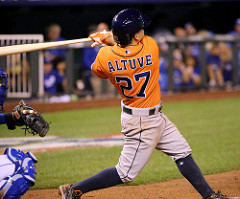
Houston Astros’ 2B Jose Altuve – in a player vote – was selected as the Sporting News MLB Player of the Year. The 26-year-old Altuve, with six MLB seasons already under his belt, led the AL with a .338 batting average and 216 hits. He also hit 24 home runs, drove in 96 runs, scored 108 and stole 30 bases. 2016 marked Altuve’s second batting title, fourth All Star Selection, third consecutive season of 200 or more hits and fifth consecutive season of at least 30 stolen bases. Each of the past ten Player of the Year winners has also won his league’s MVP Award.  This season, Altuve’s competition for that honor is likely to come from Mookie Betts and David Ortiz of the Red Sox.  We’ll see if Altuve can keep the streak going.

On the Wild Side

Chicago fans not only filled Wrigley Field, but also filled the streets and bars in Wrigleyville, celebrating the first Cubs’ World Series game in 71 years. Meanwhile, more than 20,000 Cleveland fans were going wild watching the game on the video board in Cleveland’s Progressive Field.

World Series Flashback

1908 – Cubs versus Tigers

The 1908 World Series featured a rematch of 1907 – Tigers versus Cubs.  The Cubs were the defending World Champions (they had topped the Tigers in a sweep in 1907) and were in the Fall Classic for the third straight year (they lost to the White Sox in 1906, after a season in which the Cubs won a record 116 games). Cubs’ fans – after three straight World Series appearances – probably did not expect their next World Championship was at least 108 years away. 

The Cubs took the Series four games-to-one, but it was not without its “moments.” In Game One (at Detroit) Chicago trailed 6-5 going into the ninth,  but put five runs on the board in the top of the final inning to steal the victory (the inning included a double steal by CF Solly Hofman and 1B Frank Chance – Yes, the Chance of Tinker to Evers to Chance). The Cubs’ ninth-inning rally included six consecutive one-out singles, two stolen bases and a sacrifice.

Like the first game, Game Two (in Chicago) was close late – tied 0-0 until the eighth, when the Cubs scored six times to cement a 6-1 win. The major blow was a two-run home run by Cubs’ SS Joe Tinker – the only round tripper of the Series. Detroit rallied for an 8-3 win in Game Three and then the Cubs’ pitching took over. Chicago’s Mordecai “Three Finger” Brown (29-9, 1.47 in the regular season) shut out Detroit 3-0 on a complete game four-hitter in Game Four and Orvall Overall (15-11, 1.92)  pitched even more masterfully in Game Five, tossing a complete-game, three-hit shutout with ten strikeouts. Note: Overall fanned a World Series (and MLB) record four batters in the first inning of Game Five, in an inning that went: walk to Tigers’ LF Matty McIntyre; strike out of SS Charley O’Leary; single by 3B Bill Coughlin; strikeout of RF Ty Cobb; strikeout of 1B Claude Rossman, who reached on a wild pitch; strikeout of 2B Germany Schaefer.   The final game drew a crowd of only 6,210 – the smallest in World Series’ history.

Cubs stars’ of the Series were Overall (who won two games for the Cubs and gave up just two runs in 18 1/3 innings); 1B Chance (who hit .421 and stole five bases); Cubs’ SS Tinker (who drove in four); and CF Hofman (who hit .316 and also drove in four). Detroit was led by CF Ty Cobb, who hit .368 for the Series.

The Cubs have since gone to the World Series seven times (not including this season) – 1910, 1918, 1929, 1932, 1935, 1938 and 1945 – losing each time.

I tweet baseball @David BBRT

Member: Society for American Baseball Research (SABR); The Baseball Relliquary; Baseball Bloggers Alliance.

World Series Game Three Wrap Up A Little Late

Baseball Roundtable Game Three Wrap Up will be posted early- to mid-afternoon.  Have to attend the Society for American Baseball Research (SABR) Halsey Hall Chapter Meeting (9 a.m.-lunch). Will be posting on Terry Francona’s ability to consistently “pull the right lever,” key moments in Game Three, Cleveland’s bullpen, wild fans in Cleveland and Chicago,  Jose Altuve’s Player of the Year Award, the Cubs’ last World Series Championship (Ty Cobb on one side and Tinker-to Evers-to Chance on the other). Stop in at BBRT before the game.  

2016 World Series Game Two – Random Thoughts and On to Wrigleyville

Game Two of the 2016 World Series is behind us and the Indians and Cubs move on to Wrigley Field tied at a game apiece – should be one heckuva weekend in Wrigleyville!

Jake Arrieta cubs photo

Jake Arrieta – Game Two winner. Photo by apardavila

Yesterday’s game saw the Cubs tie the Series with a 5-1 win, finishing just ahead of the weather thanks to a one-hour early start.  If you had to pick a “hero” or two, they would be: 1) Cubs starting pitcher Jake Arrieta, who got the win after taking a no-hitter into the sixth inning, giving up just one run on two hits, while striking out 6 in 5 2/3 innings; and 2) Cubs’ DH Kyle Schwarber – back after a six-month post-surgery layoff – who continued to surprise nearly everyone by collecting two hits and a walk, scoring once and droving in a pair. His role at Wrigley (he has not yet been cleared to play in the field) remains to be seen.


Here are a few random observations about Game Two.

A Rough Start for Both Pitchers

The way Game Two started out, it looked like a long night all around. The Cubs scored off Cleveland starter Trevor Bauer (who had ten stitches in his pinky finger nine days ago) just three batters into the game. After CF Dexter Fowler grounded out pitcher to first, 3B Kris Bryant singled to center and 1B Anthony Rizzo doubled him home. The Cubs’ first run of the Series came courtesy of (as they say in the Windy City) Brizzo. No more damage was done, but Bauer needed 29 pitches to get out of the inning.

Cubs’ starter Jake Arrieta pitched a scoreless bottom of the inning, but seemed to have trouble locating his pitches in the 43-degree weather. Arrieta gave up a pair of walks and threw just 10 strikes in 23 pitches. Early on, it looked like a short night for both starters.

How Do You Spell Relief?

There was plenty of work for the bullpens, as both starters ran up the pitch counts early, Cleveland starter Trevor  Bauer (12-8, 4.26 in the regular season) lasted only 3 2/3 innings –  giving up two runs on six hits and throwing 53 strikes in 87 pitches. Cleveland Manager Terry Francona then used six relievers to finish the contest, and they gave up three runs, two earned – on three hits and five walks – over the final 5 1/3 innings.

Jake Arrieta, the 2015 NL Cy Young Award winner (18-8, 3.10 this season) settled down after a rocky, two-walk, 23-pitch first inning.  He took a no-hitter into the sixth and exited after 5 2/3 innings (one run on two hits and three walks, with six strikeouts).  The Cubs’ pen (Mike Montgomery and Aroldis Chapman) outpitched the Indians’ relievers – giving up no runs on two hits and two walks, with four strikeouts over the final 3 1/3 innings.  Notably, both Montgomery and Chapman were in-season acquisitions – Montgomery from the Mariners and Chapman from the Yankees.

HANK AARON AWARD

MLB yesterday announced the winners of the 2016 Hank Aaron Award for the best offensive player in each league.  Your worthy pair of winners? The Red Sox’ David Ortiz in the AL and the Cubs’ Kris Bryant in the NL.

David ortiz photo

Big Papi – big bat and big smile in his final season. Photo by Keith Allison

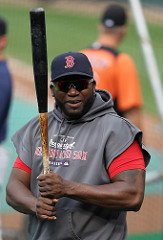
Ortiz, in his final MLB season, had a tremendous season.  As the Red Sox’ DH, he hit .315, with 38 home runs and an AL-leading 127 RBI. He also led all of MLB in slugging percentage (.620) and doubles (48), collected 80 walks and recorded a .401 on-base percentage. In the process, he set the single-season records for a player 40-years-old or older in home runs, RBI, doubles and extra base hits (Elias Sports Bureau). The Hank Aaron Award is a pretty nice – and well-deserved – retirement gift; and a great way to top a 2-yedar MLB career.

Over in the NL, the Cubs’ versatile (3B/of) Kris Bryant earned the Aaron Award. The 24-year-old Bryant, in just his second MLB season, hit .292, with 39 home runs, 102 RBI and a league-leading 121 runs scored (and threw in eight stolen bases).

A final thought/rant.:  I believe MLB should add to the stature and visibility of the Hank Aaron Award by moving the announcement to after the World Series. Consider the time frame for Rookie of the Year (November 14); Manager of the Year (November 15); Cy Young Award (November 16); and MVP (November 17).  I would like to see the Offensive Player of the Year (Hank Aaron Award) in that same time frame – when it would not have to compete with World Series’ hoopla and coverage.

Game Two Turning Point

There are those who may point to the Cubs’ three-run fifth as the turning point in this contest.  I think that came in the top of the third after Indians’ starter Trevor Bauer, trailing 1-0, had retired Dexter Fowler and Kris Bryant and had Anthony Rizzo down no balls-two strikes. He was just a pitch away from a 1-2-3 inning. Bauer ended up walking Rizzo; LF Ben Zobrist followed with a single to center (sending Rizzo to second) and DH Kyle Schwarber slapped a single up the middle to plate Rizzo and give the Cubs a 2-0 lead. 2B Javier Baez then fanned to end the inning. What did that mean in the game?

  • It ran up Bauer’s pitch count, getting the Cubs that much closer to the Indians’ pen.
  • It provided Arrieta a little breathing room and a chance to settle down after early command issues.
  • It gave the Cubs an emotional lift, especially since the runs was driven in by the 2016 post-season surprise player – Kyle Schwarber.

Z is for Zobrist

Veteran Ben Zobrist, who collected three hits in Game One, added a single, triple and walk in five plate appearances. He is now five-for-eight (.625), with a double and a triple in the Series. During the regular season, the 35-year-old Zobrtist hit .276, with 18 home runs, 76 RBI and 94 runs scored.

World Series Flashback

burdetteIn the 1957 World Series – the first I ever attended – Milwaukee Braves’ right-hander Lew Burdette started Games Two, Five and Seven. Three starts in eight days versus a highly-favored Yankee squad that included the likes of Mickey Mantle, Yogi Berra, Elston Howard and Moose Skowron. Burdette tossed three complete games – winning all three (including shutouts in Games Five and Seven), giving up only two runs in 27 innings (0.67 ERA) Note: It appears the Indian’s Corey Kluber could pitch Games One, Four and Seven if this Series goes that far.


I tweet baseball @DavidBBRT

Member: Society for American Baseball Research (SABR); The Baseball Reliquary; Baseball Bloggers Alliance.
2016 World Series – Game One Observations

Game One of the 2016 World Series is in the  books – a 6-0 Cleveland win.  There were expected (Corey Kluber) and unexpected (Roberto Perez) heroes, a notable turning point (seventh inning), 24 strikeouts (15 recorded by Cleveland pitchers) and three players who started the Series with three-hit games (Ben Zobrist, Francisco Lindor and Jose Ramirez).

How meaningful will this Indians win be?  That remains to be seen, but since the best-of -seven format came into play, Game One Winners have a 109-60 edge in World Championships.  Still, with Jake Arrieta and Kyle Hendricks on tap for the next two games, I like the Cubs’ chances.

Here are a few random observations from Game One.

A is for Apple. B is for Bat. … K is for Kluber – an Expected Hero

Corey Kluber photo

Photo by apardavila

Corey Kluber, who started on the mound for the Indians, was an expected hero.  The 2014 Cy Young Award winner was the staff ace in 2016, going 18-9, 3.14 and fanning 227 batters in 215 innings. He set the tone from the start, fanning eight over the first three innings (a WS record for the first three frames) and whiffing nine (versus four hits and no walks) over six shutout innings.  Andrew Miller and Cody Allen added six more strikeouts to wrap up the 6-0 shutout.  A couple of observations: Kluber threw just 88 pitches, which opens options for how he is used (three starts or two starts and a relief appearance) later in the Series.  ALCS MVP Andrew Miller threw 46 pitches in relief, which may limit how he is used in Game Two.

Core Kluber’s outing works to magnify Bob Gibson’s dominance when he fanned a World Series single-game record of 17 – as his Cardinals topped the Tigers 4-0 in Game One of the 1968 WS. Gibson threw three complete games in that Series (1.67 ERA), fanning 35 in 27 innings.

An Unexpected Hero

Number-nine hitter Cleveland catcher Roberto Perez  – who hit .183, with just three home runs in 61 games in the regular season and was hitting just .174 in the post season –  was hardly considered a likely offensive hero.   All he did was belt two home runs in four at bats and drive in four of the Indians’ six runs.

Before Roberto Perez’ two-home run inaugural World Series game, the only other catcher to homer twice in his first WS game was the Oakland A’s Gene Tenace in 1972.  Tenace, who had hit .225 with five home runs in 82 regular season games and was hitting .059 in the post season (ALCS), went on to hit .348 in the WS, with a Series-leading eight hits, five runs, four home runs and nine RBI. The A’s topped the Red in seven games, despite being outscored 21-16. Tenace was the WS MVP.

Turning Point

Some may say the turning point came when Corey Kluber took the mound.  For my money, it came in the top of the seventh when Cubs’ LF Ben Zobrist opened the inning with a single off Kluber – followed by a walk to DH Kyle Schwarber and a single to 2B Javier Baez (both given up by Andrew Miller, who had replaced Kluber), loading the bases with no outs.   Miller went on to retire pinch hitter Wilson Contreras on a short fly (runners holding) to center and SS Addison Russell and C David  Ross on swinging strikeouts. The Cubs failed to score after loading the sacks with no outs.  Game. Set. Match.  Kudos to manager Terry Francona to sticking to his pitching plan in that tense inning.

It’s Not Always Power

While four of the Indians’ tallies came on home runs (Roberto Perez with two), the other two runs scored on a bases-loaded infield single (3B Jose Ramirez) and a bases-loaded hit-by-pitch (LF Brandon Guyer).  That Guyer should “take on for the team” should be no surprise. Guyer led the American League in HBP with 31 this past season (in just 101 games). Guyer was also the AL HBP leader in 2015, with 24.

 A Perfect World Series 9-0

Terry Francona photo

Terry Francona – plenty to smile about. Photo by Keith Allison

Indians’ Manager Terry Francona is piloting his third World Series and has yet to lose a Fall Classic game.  In 2004, his Red Sox swept the Cardinals and in 2007 his Boston squad topped the Rockies 4-0. Now, if only the TV commentators would stop referring to him as “Tito.”  Yes, I know it’s his nickname, but my mind always seems to revert to his dad –  John Patsy “Tito” Francona – whom I saw play often in his 15-seeason (1956-70) career as an MLB OF/1B.  Terry, by the way, was an MLB OF/1B from 1981-90.


While Terry Francona s’ streak of managing nine World Series wining games (still active) without a loss is an MLB record, the record for consecutive  World Series game wins managed belongs to Joe Torre at 14 (1996 – Games Three-through-Six versus Braves; 1998 – four-game sweep versus Padres; 1999 – four-game sweep versus Braves; 2000 – Games One and Two versus Mets.  

Hope from Rehab

Cubs’ DH Kyle Schwarber, out with an injury since early April, was activated for the World Series.  Schwarber who had knee surgery in mid-April was not expected back this season.  He surprised a lot of people yesterday, picking up a double and a walk in four plate appearances. In 2015, as a rookie, Schwarber hit .246, with 16 home runs and 43 RBI in 69 games and then hit five home runs in nine post-season contests.   The Cubs are hoping his power has an impact in the 2016 Series.


I tweet baseball @DavidBBRT

Member: Society for American Baseball Research (SABR); The Baseball Reliquary; Baseball Bloggers Alliance.
BBRT’s Look at the World Series – Position by Position

The last time the Cubs won the World Series, there were only 46 stars on the American flag. 

Cubs Win photo

Photo by Ron Cogswell

Back in early February, BBRT picked the Cubs to break their World Series Championship drought (since 1908) and  win the 2016 World Series. (I did, however, have them winning over the Boston Red Sox – the Cleveland Indians were hardly on my post-season radar.) I’m going to stick with the Cubbies based on a combination of:

  • Starting pitching (three potential 2016 Cy Young Award candidates);
  • Lineup flexibility (particularly MVP candidate Kris Bryant, youngster Javier Baez and veteran Ben Zobrist); and
  • A nice balance of young and veteran players.

The wild card in this prediction – and, most likely the Indians’ best asset if they are to win the Series – is Cleveland’s strong bullpen (particularly ALCS MVP Andrew Miller and Cody Allen).  The bullpen is even more of an asset given Indians’ manager Terry Francona’s adept, if somewhat unorthodox in today’s game, handling of his pitching staff.  (Consider that the Indians won the ALCS four games-to-one over the Blue Jays in a series in which: the 44 Cleveland innings pitched were split exactly equally between the starters and the bullpen; no starter went more than 6 1/3 innings; and the Indians won Game Three 4-2, using seven pitchers and none more than 1 2/3 innings.)

Before looking at the two squads in detail, let’s look at some overall stats from the 2016 season.  (Keep in mind, the DH impacts some of these numbers.)

Wins: Cubs – 103; Indians – 94

Run Differential. Cubs – +252; Indians +101

___________________________________________

Batting Average: Indians – .262; Cubs – .256

Runs Scored: Cubs – 808; Indians 777

Home Runs: Cubs – 199; Indians – 185

Stolen Bases: Indians – 134; Cubs – 66

Walks Drawn: Cubs – 656; Indians 531

Batters’ Strikeouts: Cubs – 1,339; Indians – 1,246

__________________________

ERA: Cubs – 3.15; Indians – 3.84

Strikeouts:  Cubs – 1,441; Indians – 1,398

Saves: Cubs – 38; Indians – 37

WHIP: Cubs – 1.11; Indians – 1.24

Home Runs Surrendered: Cubs – 163; Indians – 186

__________________________________________

Fewest Errors: Indians -89; Cubs – 101

Fielding Percentage: Indians – .985; Cubs – .983

Taking all this into consideration, BBRT is going with the Cubs in six games if Trevor Bauer is ready to pitch – and five games if the Indians’ are forced to bypass Bauer.

Now, let’s take a look at the two squads – and who has the edge where.

Starting Pitching  

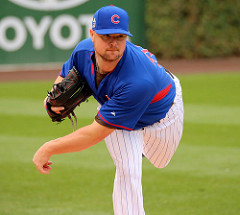
Jon Lester Cubs photo

Jon Lester – Game One Cubs’ starter. Photo by apardavila

The Cubs’ rotation boasts MLB ERA leader righty Kyle Hendricks (16-8, 2.13); veteran southpaw Jon Lester (19-4, with MLB’s second-best ERA at 2.44); and last year’s Cy Young Award winner Jake Arrieta (18-8, 3.10 this season). If any of the big three should falter, there’s also veteran John Lackey (11-8, 3.35.) In the post-season, Cubs’ starters have thrown 56 1/3 innings in ten starts, with a 2.57 ERA.

The Indians have made it to the World Series despite a starting staff hit by injuries. They lost right-handed starter Carlos Carrasco (11-8, 3.32) in mid-September, lost Danny Salazar for a portion of the season to elbow issues (11-6, 3.87) and had Trevor Bauer (12-8, 4.26) suffer an off-field, post-season injury (cutting a pinky finger while working on a drone) that forced him from his ALCS Game Three start after just 2/3 of an inning. Then, there is Josh Tomlin, slated to start Game Three of the World Series. Tomlin was 9-2, 3.51 in the 2016 season’s first half and 4-7, 5.59 in the second half. How deep did the issues facing the Indians starting staff go? In Game Five of the ALCS, they started Ryan Merritt, a southpaw with just 11 MLB innings under his belt.

Still, it’s not all bad news. Indians’ starters have a pitched total of 38 2/3 innings this post season, with a stingy 1.88 ERA. (However, they have averaged less than five innings per start, putting a lot of pressure on the bullpen.) Staff ace Kluber is well-rested for Game One, Bauer has had additional time for his stitched pinky to heal and says he’ll be ready for Game Two, and Game Three starter Tomlin appears to have “righted the ship,” going 2-1, 1.69 after September 1 and giving up just three earned runs in 10 2/3 2016 post-season innings. And, if Bauer is not ready, Danny Salazar may be able to step up.  Ultimately, however, there are too many questions marks in the Indians’ rotation.

Starting Pitching: Advantage – Cubs

________________________________

Bullpen

The Cubs’ bullpen is led by the hardest thrower in baseball – Aroldis Chapman.  Chapman was 4-1, 1.55 with 36 saves and 90 strikeouts in 58 innings for the Yankees and Cubs during the regular season. Chapman has, however,  looked “a bit” more hittable in the 2016 post-season, giving up three earned runs and striking out 10 in eight innings pitched. Chapman is ably supported by the likes of Hector Rondon (3.53 with 18 saves in 54 games); Travis Wood (2.95 in 77 games); and Pedro Strop )(2.85 in 54 games).

The Cleveland pen is led by ALCS MVP Andrew Miller, whom manager Terry Francona will call on at any time.  Pitching for the Yankees and Indians in 2016, Miller went 10-1, 1.45 with 12 saves and 123 strikeouts in 74 1/3 innings.  He’s been even better in the post season – pitching 11 2/3 inning in six appearances, fanning 21 batters, giving up no earned runs, picking up a win and a save. Miller is joined in the Cleveland pen by Cody Allen (2.51 ERA with 87 K’s in 68 innings); Dan Otero, 1.53 ERA in 62 appearances); Jeff Manship (3.12 in 53 appearances); and Bryan Shaw (3.24 in 75 appearances).

Overall, the bullpens are very close.  However, given Miller’s post-season performance thus far and the skill Francona has shown in handling the bullpen, BBRT will give e slight edge to the Indians.  The question, of course, is whether the Indians’ rotation issues will result in too much work for the relief staff.

Bullpen: Advantage – Indians

____________________________________

Now, how about the position players?

Catcher

The Cubs rely on a catching committee, with most of the recent work going to Wilson Contreras (.282-12-35 in 76 games).  Others taking a spot behind the plate include Jon Lester’s designated catcher David Ross (.229-10-32 in 67 games) and Miguel Montero (.216-8-33 in 86 games). Contreras, by the way, is hitting an even .400 (8-for-20) in the 2016 post season.

Catching duties for Cleveland belong to Roberto Perez – an excellent game-caller and defensive backstop.  Perez, however, hit just .183-3-17 in 61 regular-season games, and is hitting just .174 in the post season.  (By contrast, Cubs’ pitcher Jake Arrieta hit .262-2-7 in 31 games.)

Catcher:  Advantage – Cubs

___________________________________

First Base

It’s the Cubs’ Anthony Rizzo (.292-32-109) versus the Indians’ Mike Napoli (.239-34-101) at first base. The 34-year-old Napoli, in his eleventh MLB season, is a big reason the Indians took the AL Central title.  He reached career highs in games played, hits, runs scored, home runs and RBI.  In eight games this post season, however, he is hitting just .179 with one home run and two RBI.  The 26-year-old Rizzo matches Napoli’s power, makes contact more often, and is on a hot steak (.320-2-5 in the NLCS).

First Base: Advantage – Cubs

___________________________________
Second Base

Here again it’s a young Cub versus a veteran Indian.  At the keystone sack for the Cubs you can expect to see 23-year-old Javier Baez, who hit .273-14-59 with 12 steals in 142 games – and started games at 3B, 2B, SS and 1B during the season. This post-season, Baez is hitting .342, with one home run and seven RBI in ten games.

Jason Kipnis photo

Jason Kipnis handles 2B for the Tribe. Photo by Keith Allison

Second base for Cleveland is handled by 29-year-old, six-year MLB veteran, Jason Kipnis a two-time All Star who hit .275-23-82, with 15 steals. This post season, Kipnis is hitting .167 (five-for-thirty) with two home runs and four RBI.  In the field, BBRT would give an edge in reliability to Kipnis.

Second Base: Advantage – Indians


_________________________________________________

Third Base

Both the Indians and Cubs boast young stars who had career years at third base.

The Indians’ Jose Ramirez – like Napoli at 1B – had a career year, hitting .312, with 11 home runs, 76 RBI and 22 steals in 152 games (and getting starts at 3B, LF, 2B and SS). Any team would be glad to have a 24-year-old versatile infielder/outfielder who could put up those kinds of numbers. (Note: Ramirez is hitting .222 this post season.)

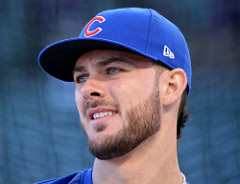
Kris Bryant Cubs photo

MVP candidate Kris Bryant. Photo by Minda Haas Kuhlmann

However, the Cubs have an equally versatile defender at the hot corner, who put up MVP-level numbers in 2016. Kris Bryant, also 24-years-old, played in 155 games this past season – hitting .292, with 39 home runs, 102 RBI and a league-leading 121 runs scored. Bryant got starts at 3B, LF, RF and 1B during the season.  Thus far in the post season, he is hitting .333, with one home run and three RBI.

Third Base: Advantage – Cubs

_________________________________

Shortstop

Francisco Lindor photo

Francisco Lindor, Indians’ star shortstop. Photo by apardavila

Addison Russell, the Cubs’ up and coming 22-year-old shortstop showed solid defense and good power in 2016 – .238-21-95 in 151 games.  However, he is outpaced in the field and at the plate by the Indians’ Francisco Lindor, who – in just his second MLB season – showed Gold Glove-worthy defense, while hitting .301-15-78, with 19 steals in 158 games. In the post season, Lindor has been hot – .323-2-4 in eight games. Russell’s 2016 post-season stat line is .189-2-4.

Shortstop: Advantage – Indians

______________________________________________

Left Field

Versatile veteran Ben Zobrist (11 major league seasons) will be in left field for the Cubs.  He was an All Star this season, hitting .272, with 18 home runs, 94 runs scored and 76 RBI. He is also a veteran of 47 post-season games, although he has managed only six hits in 36 at bats this post-season.

The Indians seem likely to platoon in LF with switch-hitter Coco Crisp and the right-handed hitting Brandon Guyer.  The veteran Crisp (15 MLB seasons), who hit.231-13-55, with ten steals, in the regular season has gotten most of the time in LF this post season. He’s delivered three hits in 14 at bats in the ALDS and ALCS. Guyer seems to offer more potential on offense.  This past season, he hit .266, with nine home runs and 32 RBI in 101 games (Rays and Indians). Thus far, he’s gotten only eight at bats in the post season, but delivered three hits, two runs and an RBI.  We may see more of him in the World Series.

Left Field: Advantage –  Cubs

_________________________________________

Center Field

This is another situation in which the position seems more stable with the Cubs, who put Dexter Fowler out in center nearly every game.  The 30-year-old Fowler, in his ninth season, was an All Star for the first time in 2016. He hit .276-13-48, with 84 runs scored and 13 steals in 125 games. This post season, Fowler is hitting .262, with one home run, four RBI and six runs scored.

The Indians can look to left-handed hitting Tyler Naquin and right-handed Rajai Davis to handle the center of the garden – both offer good defense, speed and enough offense at the position. Naquin, a 25-year-old rookie hit .296-14-43, with six steals and 52 runs scored in 116 games (90 starts in center), while Davis (an 11-season MLB veteran) hit .249-12-48, but led the AL with 43 steals in 134 games (66 starts in CF). Naquin is hitting just .188 in the post season, while Davis has yet to get a hit in 13 2016 post-season at bats.

Center Field: This is a draw, Fowler is the steadier option, but if Naquin or Davis can heat up a bit, the potential to do more damage is there.

__________________________________________

Right Field

I’m making a big assumption here – that the Cubs keep sending Jason Heyward, an offensive disappointment, out to right field. Heyward hit just .230-7-49 during the regular season. Those numbers were all MLB-season lows for him. Still he brings Gold Glove defense (which may be keeping him in the lineup despite just two hits in 28 at bats this post season) and the Cubs have enough offense to opt for his leather.

The Indians send Lonnie Chisenhall out to right field – and he fared a lot better in the regular season than Heyward. The left-handed hitting Chisenhall hit .286-8-57 in 126 games; and has delivered a .269 average this post season.  Heyward delivers superior defense, but I have to go with Chisenhall on this one.

Right Field: Advantage – Indians

________________________________________

Designated Hitter

Carlos Santana Indians photo

Carlos Santana – brings experience and powerf tgo DH role. Photo by Keith Allison

Both teams have versatile players who could play in the field or at DH in AL parks. Most likely, however, the Indians will go with Carlos Santana (who can all fill in at 1B or C in a pinch) and the Cubs with Jorge Soler or Kyle Schwarber (coming off the DL). Santana is a proven power hitter, who delivered a .259-34-87 season and is hitting .250 in the post season.  He’s also familiar and comfortable with the DH role.

Jorge Soler hit .238-12-31 in 86 games for the Cubs (56 starts in the OF) and is hitless in eight at bats this post season.  The Cubs also have Kyle Schwarber back from a torn ACL that has shelved him for nearly the entire season. If the 23-year-old – who hit .246 with 16 home runs in 69 games after a 2015 call up – has his timing back, he could add to the Cubs’ offense.  Still, Santana has more to offer – at a significantly lower risk,

DH:  Advantage –  Indians


I tweet baseball @David BBRT

Member: Society for American Baseball Research (SABR); The Baseball Reliquary; Baseball Bloggers Alliance.
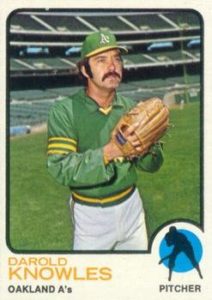
Top 2016 Regular Season Award Candidates – And a Bit of History

First, a disclaimer.  Baseball Roundtable has never claimed to be the best prognosticator – although this year I did get seven of the ten playoffs teams correct in a February 8 post. I missed the Indians and Orioles in the AL (had the Astros and Tigers) and the Nationals in the NL (had the Cardinals).  My predictions for the post season, made October 3, were less accurate – although I still have a chance to be right on the World Series winner.  I have the Cubs winning the Series (just against the Red Sox). Surprises for me?  After an offensive slump in September/October, I did not expect the Blue Jays to get past the Rangers. (Note: the Jays scored the fewest runs in the AL after Aguste 31.) I also underestimated Terry Francona’s ability to manage a pitching staff.

So now, I intend to sit back and enjoy the rest of the post-season – and root for a Cubs/Indians World Series – and (in this post) present BBRT’s selections (and predictions) for MLB’s major 2016 regular season awards.

ROOKIE OF THE YEAR

National League ROY – Corey Seager, SS, Dodgers

Corey Seager photo

Photo by apardavila

The competition for NL Rookie of the Year comes down to a pair of young, power-hitting shortstops – Corey Seager of the Dodgers and Trevor Story of the Rockies.  Seager gets the edge, largely because Story’s season was interrupted by injury.

Seager, the Dodgers’ 22-year-old shortstop was a 2015 September call up and – while not getting enough playing time to lose his rookie status – hit .337, with four home runs and 17 RBI in 27 games.  (In four minor league seasons, Seager put up a stat line of .312-62-278 in 390 games.)  In 2016, Seager proved his late-season 2015 performance was no fluke, playing in 157 games, and hitting .308, with 26 home runs, 105 runs scored, and 72 RBI. He made the 2016 NL All Star team and played a key role in getting the Dodgers to the post-season. He is the real deal.

Seager’s main competition for the ROY Award comes from the early-season rookie “story” of the year – Colorado’s 23-year-old shortstop Trevor Story. After hitting .340 in Spring Training, Story started the season with a bang (several bangs, in fact).  He homered in his first four regular season games (six home runs in those four contests).  Story went on to tie the MLB record for rookie home runs in April with ten long balls – finishing the month with a .261 average, ten homers, 19 runs scored and  20 RBI in 22 games. Unfortunately, in early August, Story suffered a thumb injury that required season-ending surgery. He ended 2016 with a .272 average, 27 home runs, 72 RBI and eight steals in just 97 games.

BBRT Selection:  Corey Seager    

BBRT Prediction:  Corey Seager

Brotherly Love (of the long ball)

The Elias Sports Bureau reports that Dodgers’ SS Corey Seager and Mariners’ 3B Kyle Seager are the first brothers to hit 25 or more home runs in the same MLB season. Corey finished 2016 with 26 round trippers, Kyle with 30.      

American League ROY – Gary Sanchez, C, Yankees

Gary Sanchez Yankees photo

Photo by apardavila

Timing may prove to be everything when the votes are counted for AL Rookie of the Year.  BBRT expects a very close vote and gives the nod to Yankees’ 23-year-old catcher Gary Sanchez – although the fact that he played in only 53 games may work against him. The stats, however, back up his candidacy: a .299 average, 20 home runs, 34 runs scored, 42 RBI and 24 walks drawn (again, in just 53 games) – with virtually all of the damage done after August 1.  Couple that with his praiseworthy work behind the plate and you have a deserving Rookie of the Year candidate. Before his August call up, Sanchez hit .282-10-50 in 71 games at AAA Scranton/Wilkes-Barre.  BBRT side note: Sanchez was called up to the Yankees late in 2015 – made his major league debut on October 3 –  and (few fans may realize) was included on the Yankees’ 2015 post-season roster.

The fewest games ever played by a non-pitcher in a Rookie of the Year season is 52 by Giants’ 1B Willie McCovey in 1959. He played his first game on July 30 and went to post a .354 average, with 13 home runs and 38 RBI.

BBRT sees Sanchez’ main competition coming from Tigers’ RHP Michael Fulmer (acquired by the Tigers from the Mets in the July 2015 trade for Yeonis Cespedes). The 23-year-old Fulmer went 11-7 (26 starts – 159 innings), with a 3.06 ERA.  Timing may be important here. Fulmer, who got his first start April 29, was 9-2, with a 2.50 ERA at the end of July. In August and September, Fulmer went 2-5, 3.59. Fulmer needs to hope the voters remember his May performance – when he went 3-1 with a 0.61 ERA (two earned runs in 29 2/3 innings).

BBRT Selection:  Gary Sanchez    

BBRT Prediction:  Gary Sanchez (in a very close vote)

From 1992 through 1996, the LA Dodgers had a record five consecutive Rookie of the Year Award winners: 1B Eric Karros (1992); C Mike Piazza (1993); OF Raul Mondesi (1994); SP Hideo Nomo (1995); OF Todd Hollandsworth (1996).  

________________________________________________________

MOST VALUABLE PLAYER AWARD

American League MVP – Mookie Betts, RF, Red Sox

Mookie Betts photo

Photo by Keith Allison

This is a tough one to call – Mookie Betts, David Ortiz, Jose Altuve, Mike Trout and, perhaps, Josh Donaldson can all make a good case.  However, there is a need to narrow it down.  As BBRT considers these candidates, I remind myself that this is not the award for best player of the season – but, rather (by its own definition) for most valuable player (to his team).  So, despite another stellar season by the Angels’ CF Mike Trout (.315-29-100, with 30 steals), the Angels’ fourth-place finish becomes a factor.  Then there is David Ortiz’ unbelievable season – in which he pretty much demolished the record book for accomplishments at age 40 or over with a .315-38-127 line. Big Papi slips a bit on my ballot because of his role as DH, but he is likely to get an emotional boost in the actual balloting based on his career, age and attitude.  His leadership – on and off the field – has long meant a lot to this team. Then there is Josh Donaldson, a key element in Toronto’s 2016 success, who put up a .284-37-99 line, with 122 runs.  Still, BBRT sees his impact a bit short of either of the two players on my list I haven’t touched upon yet – Mookie Betts and Jose Altuve.

Altuve led the AL in batting average at .338 and base hits at 216, while also smacking 24 home runs, scoring 108 runs, driving in 96 and stealing 30 bases – all the time serving as the spark plug for the Astros’ offense. Just 26-years-old, the 5’6”, 165-pound Astros’ 2B already has two batting crowns, two stolen base titles, three consecutive 200-hit seasons, a Gold Glove and four All Star selections – and he seems to just keep getting better.  What he doesn’t have is an MVP Award – and I don’t think it’s coming this year. (It might have, if the Astros had made the playoffs.)  BBRT’s choice for AL MVP is Red Sox’ RF Mookie Betts – who did a little bit (a lot, actually) of everything. Betts hit .318 on the season, launched 31 home runs, scored 122, drove in 113 and stole 26 bases.  How does all that flesh out?  He was second in the AL in average, runs scored and base hits; third in doubles, fourth in RBI, sixth in stolen bases.  Betts is just 24-years-old and, like Altuve, just seems to keep improving.  Betts would get BBRT’s vote (if I had one) for AL MVP.  If he doesn’t win it, I expect it will end up as a career-topping tribute to the performance and presence of David Ortiz.

BBRT Selection:  Mookie Betts   

BBRT Prediction: David Ortiz

 You could make a pretty good All Star team of players who have won two or more consecutive MVP Awards:

        C –    Yogi Berra, Yankees (1954-55)

        1B – Albert Pujols (2008-09)

        2B – Joe Morgan, Reds (1975-76)

        3B – Mike Schmidt, Phillies (1980-81)

         SS – Ernie Banks, Cubs (1958-59)

         OF – Barry Bonds/ Pirates (1992), Giants (1993); Giants (2001-04)

         OF – Mickey Mantle, Yankees (1956-57)

         OF – Dale Murphy, Braves (1982-83)

           P –    Hal Newhouser, Tigers (1944-45)

           Bench:    Roger Maris, OF, Yankees (1960-61)

                             Miguel Cabrera, 3B, Tigers (2012- 13)

National League MVP – Kris Bryant, 3B-plus, Cubs

Kris Bryant photo

Photo by apardavila

Really not much of a race here.  Yes, there will be votes cast for Nationals’ 2B Daniel Murphy (.347-25-104), Dodgers’ SS Corey Seager (although the votes cast for Rookie of the Year may work against him) and Rockies’ master of leather and lumber 3B Nolan Arenado (who led the NL in home runs and RBI for the second straight season and is likely to pick up his fourth Gold Glove).  However, Kris Bryant should win the NL MVP Award hands down – he was the most valuable player on MLB’s winningest team.  The 24-year-old Bryant, the 2015 NL Rookie of the Year, played in 155 games, hitting .292, with a league-leading 121 runs scored, 39 home runs and 102 RBI (not to mention eight steals).  In the process, he started games at 3B, LF, RF, 1B and SS. Bryant’s contributions – at the plate and all around the diamond – pretty much define the term “MVP”.  His presence made manager Joe Maddon’s job a whole lot easier.


BBRT Selection; Kris Bryant   

BBRT Prediction:  Kris Bryant

BBRT RANT

Here’s a BBRT rant you have heard before, but BBRT is nothing if not consistent.  I believe we need another major award in MLB – recognizing each season’s best position player (to include the DH position).  Pitchers have the Cy Young Award – recognizing each season’s best pitcher.  There is, however, no equivalent award reserved for the best performance by a position player. While some would argue the MVP Award serves that purpose, the fact that numerous pitchers have won the MVP over the years argues against that contention. I believe we need a position player award equivalent to the Cy Young, as well as the MVP Award (based on contributions to team success).

___________________________________________________________

CY YOUNG AWARD

National League Cy Young Award – Max Scherzer, RHP, Nationals

Max Scherzer photo

Photo by apardavila

BBRT sees the NL Cy Young race as Max Scherzer, followed by “Pick a Cub,” the Marlins’ Jose Fernandez, and a pair of Giants (Johnny Cueto and Madison Bumgarner). Why separates Scherzer from this very talented pack? The Nationals’ righty:

  • Led the NL in wins (20 – the league’s only 20-game winner);
  • Led all of MLB in strikeouts with 284 (30 ahead of Justin Verlander’s second-best total) and WHIP (0.97);
  • Topped the NL in innings pitched (228 1/3); and
  • Turned in a 2.96 ERA – one of just eight qualifying hurlers to come in under 3.00.

That combination is enough to give Scherzer the edge in a very tough Cy Young Awqrd race.

For a list of contenders, look first to the Cubs’ staff.  You have Kyle Hendricks (16-8, with MLB’s lowest ERA at 2.13); Jon Lester (19-4, 2.44, with 197 strikeouts in 202 2/3 innings); and Jake Arrieta (18-8, 3.10). Then there’s the Marlins’ young star Jose Fernandez (who died in a tragic late September boating accident) at 16-8, 2.86, with 253 strikeouts in just 182 1/3 innings.  Finally, you have Giants Johnny Cueto, who had an all-around solid season at 18-5, 2.79, and Madison Bumgarner (15-9, 2.74, with 251 K’s in 222 2/3 innings).   There’s lots of talent here, but I think Scherzer’s numbers stand out from the small crowd at the top of the NL.

BBRT Selection:  Max Scherzer   

BBRT Prediction: Max Scherzer

A few Cy Young Award “firsts:”

      – First winner – Don Newcombe, Dodgers (1956)

      – First southpaw winner – Warren Spahn, Braves, 1957

      – First relief pitcher winner – Mike Marshall, Dodgers, 1974

      – First rookie to win the CYA – Fernando Valenzuela, Dodgers (1981)

       – First to win CYA and MVP in same season – Don Newcombe,                         Dodgers (1956)  

       –  First shared (tied) CYA – Denny McLain, Tigers & Mike Cueller,                  Orioles (1969)

        – First pitcher to win the CYA in both leagues – Gaylord Perry,                         Indians (1972)/Padres (1978)

American League Cy Young Award – Rick Porcello, RHP. Red Sox

Rick Porcello Red sox photo

Photo by Keith Allison

Rick Porcello of the Red Sox is an imposing presence on the mound at 6’ 5” and 205 pounds.  Well, the big guy had a big year in 2016 – leading all of MLB with 22 victories (against only four losses). In his 33 starts, Porcello recorded a 3.15 ERA (fifth-best in the AL), 1.01 WHIP (second-best in the AL) and fanned 189 batters (AL’s eighth-most) in 223 innings pitched (AL’s fourth-highest).  Also in the mix are the Indians’ Corey Kluber (18-9, 3.14, with 222 strikeouts in 215 innings); the Tigers’ Justin Verlander (16-9, 3.04, with a league-leading 254 K’s in 227 2/3 innings); the Blue Jays’ J.A. Happ (20-5, 3.18), and Orioles’ closer Zach Britton (47-for-47 in save opportunities. with a miniscule 0.54 ERA in 67 innings). BBRT has to go with Porcello’s 22 victories and .846 winning percentage.  The most likely pitchers to sneak past Porcello would be Britton and his perfect record in saves or Verlander (those 250+ strikeouts will garner a few votes).  As an aside, 2016 saw Porcello (in his eighth MLB season) record his highest-ever numbers in wins, winning percentage, innings pitched and strikeouts – and his lowest-ever season ERA.

BBRT Selection: Rick Porcello  

BBRT Prediction: Rick Porcello

In 2016, eight MLB pitchers qualifying for the ERA title finished the season under 3.00 – and all eight were in the National League (with the two lowest ERAs belonging to Cubs’ hurlers Kyle Hendricks at 2.13 and Jon Lester at 2.44).  The lowest qualifying American ERA went to the Blue Jays’ Aaron Sanchez at 3.00.

_____________________________________________________________

MANAGER OF THE YEAR

American League Manager of the Year– Terry Francona, Indians

Terry Francona photo

Photo by Keith Allison

Okay, John Farrell did take the Red Sox from worst to first and Rangers’ Manager Jeff Bannister overcame lost time by Yu Darvish, Derek Holland and Colby Lewis (not to mention Prince Fielder’s injury-forced retirement), but BBRT leans toward the Indians’ Terry Francona for AL Manager of the Year. Francona led the Tribe to the top of the AL Central (BBRT didn’t even pick the Tribe to make the post season) with a 94-67 record.  Francona pushed the Indians to the top despite a series of injuries (Michael Brantley, Danny Salazar, Carlos Carrasco, Yan Gomes). In the process, he earned continued praise as a manager who effectively handles a pitching staff under stress and uses position-player platooning to adjust for injuries, balance playing time and put winning combinations on the field.  I expect the voting will be close, but Francona should edge Bannister for the recognition. (Side note: Jeff Bannister was the 2015 AL Manager of the Year and only once has a manager received this recognition in consecutive seasons: Bobby Cox, Braves, 2004 & 2005).

BBRT: Selection: Terry Francona

BBRT Prediction: Terry Francona

National League Manager of the Year  – Dave Roberts, Los Angeles Dodgers

Dave roberts dodgers photo

Photo by Malingering

This looks like a three-way race between the Dodgers’ Dave Roberts, Nationals’ Dusty Baker and Cubs’ Joe Maddon.  All three managers had plenty of talent on the roster – and were expected to make the post-season.  BBRT gives Roberts the edge here for a couple of reasons.  First, Joe Maddon and Dusty Baker were already proven commodities. Maddon and Baker are both three-time Manager of the Year Award winners, while Roberts came into the season with one game of managerial experience. (Roberts filled in when the Padres fired manager Bud Black in June of last year.  He managed one game – a 9-1 loss to Oakland – before Pat Murphy was hired as manager and Roberts returned to the coaching staff.)   As a Rookie manager, Roberts led the Dodgers to a 91-71 record and the NL West title.  Not only that, he did it despite placing an MLB-record 28 players on the disabled list during the season – including staff Ace Clayton Kershaw (who, at one point, went 75 days between starts).  Bringing the Dodgers home in first place, despite an ever-changing lineup, bench and pitching staff (LA used 31 pitchers, including 15 different starters) give this rookie manager BBRT’s vote.

BBRT Selection:  Dave Roberts    

BBRT Prediction: Dave Roberts

MANAGER OF THE YEAR TRIVIA

Established in 1983, the Manager of the Year Award has gone to 44 different managers.  Here are a few tidbits:

     – La-La Land: The first ever Manager of the Year Awards (1983) went to Tony La Russa (White Sox) and Tommy Lasorda (Dodgers).

     – The most MOY Awards (four each) have gone to Bobby Cox and Tony La Russa. Cox won his awards with the Blue Jays (1985) and Braves (1991, 2004, 2005). La Russa won with the White Sox (1983), A’s (1988, 1992) and Cardinals (2002).

     – The first manager to win the award in both leagues was Bobby Cox (see above bullet).

     – Bobby Cox is the only manager to win the award in consecutive seasons

     – 47 MOY Awards have gone to first-place finishers; 15 to second-place finishers; four to third-place finishers; and one to a fourth-place finisher.

     – The only manager to win the MOY Award with a team that finished under .500 was Joe Girardi, who managed the 2006 Florida Marlins to a 78-84 fourth-place finish. (BBRT note: Girardi was fired after the season, despite winning Manager of the Year.)

Coming Soon – A look at the Baseball Hall of Fame 2017 Today’s Game Era ballot.


I tweet baseball @DavidBBRT

Member:  Society for American Baseball Research (SABR); The Baseball Reliquary; Baseball Bloggers Alliance.