Ball Three, Take Yer Base – Courtesy of Charlie Finley and Joe Cronin

How about another Spring Training memory – this one a dream for hitters and a nightmare for pitchers?  Today (March 9) marks the 48th anniversary of a Charley Finley-Joe Cronin production known as the “three-ball walk.”

Oakland A’s owner Charlie Finley was, of course, a bit of a maverick – with all kinds of ideas for changing the game.   He pioneered colorful uniforms (when the practice was white at home, grey on the road); and lobbied (ahead of his time) for inter-league play, the designated hitter (he was also in favor of designated runners); and post-season night games.

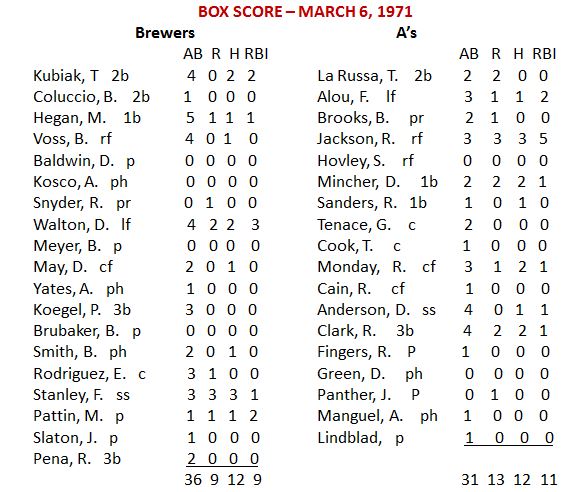
He also thought an “Alert Orange” baseball might be easier for fans to track and that a three-ball walk might add some excitement (and offense to the game).  And, that brings us to March 7, 1971, with the Brewers facing Finley’s A’s in a Spring Training match-up.  Finley was successful in getting then AL President Joe Cronin to approve using the “three-ball walk” for that contest.   The results were less than impressive – and the experiment was not tried again. Oh, there was more offense.  The A’s won 13-9, but the game also featured 19 walks.  (Perhaps Spring Training – when pitchers are still working out “command” issues – was not the best time to try out a three-ball walk.
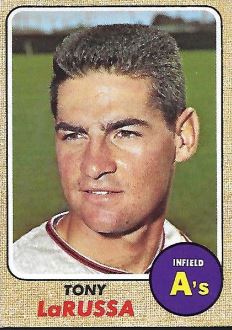
Tony La Russa - holds the unofficial MLB record for three-ball walks.

Tony La Russa – holds the unofficial MLB record for three-ball walks.

With pitchers focused on the “short counts,” the game also featured five home runs, including two (one a Grand slam) by Reggie Jackson.  (See the box score below for details.)  Poor Jim Slaton, a rookie with the Brewers that season, lasted just 1 2/3 innings – giving up six runs on two hits and eight walks (no strikeouts). The 21-year-old would go on to a 10-8, 3.78 record for the Brewers in the regular season – and would win 151 games (158 losses) in 16 MLB campaigns.  By the way, nobody took greater advantage of the three-ball walk than Oakland lead off hitter and second baseman Tony La Russa – who drew four walks in the contest. During the 1971 regular season, La Russa would draw one walk in 32 games (only 16 plate appearances).

Notably, considering the shape of today’s game, the 19-walk, 24-hit, 19-run, seven-pitch, 37-player contest was completed in two hours and 41 minutes.


_________________________________________

Box1Box 2

Box 3

Box 4

______________________________________________________
EVOLUTION OF BASEBALL’S WALK RULE

1879 – Nine “called balls” to achieve a walk; walks do not count as a time at bat.

1880 – Eight balls to achieve a free pass.

1884 – Six balls for a walk.

1887 – Five balls for a walk; bases on ball counted as hits and a time at bat (this season only).

1889 – Four balls for a walk.

1971 – Three ball for a walk approved for one American League Spring Training game.

Primary Resources: Rule Great For Reggie, by Ron Bergman, Oakland Tribune, March 7, 1971; Baseball-Reference.com; Baseball-Almanac.com.

BASEBALL ROUNDTABLE ON THE TOP 100 BASEBALL BLOG LIST

100Baseball Roundtable is on the Feedspot list of the Top 1oo Baseball Blogs.  To see the full list, click here.

I tweet baseball @DavidBBRT

Follow/Like Baseball Roundtable’s Facebook Page here.  More baseball commentary; blog post notifications; PRIZES.

Member: Society for American Baseball Research (SABR); The Baseball Reliquary; The Negro Leagues Baseball Museum.

Sweet Memories – When Cotton Candy and Lemonade Picked up a Save and Johnny Damon almost Recorded a Cycle in One Inning

Spring Training gets the old baseball memory banks running and here’s a coupe – the first one from seven years as a day ago.

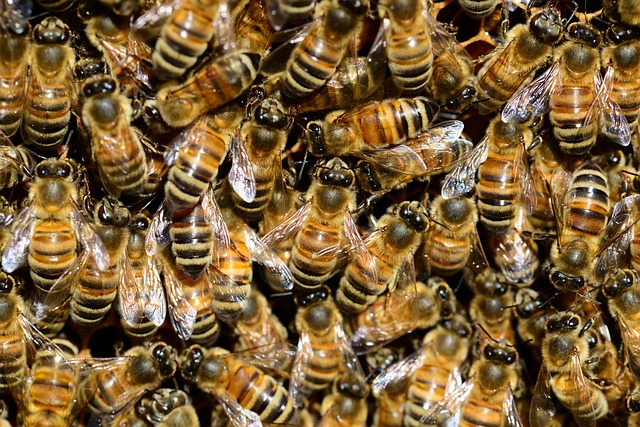
To Bee or Not to Bee

eb3cb30e2bf61c3e81584d04ee44408be272e7d411b1134094f5_640_BeeIt was March 4, 2012, and the Giants were taking on the Diamondbacks at Salt River Field in Scottsdale, Arizona. An SRF record (sold-out) crowd of 12,568 was on hand for the contest – on what would turn out to be a memorable afternoon for all those involved.

Ian Kennedy was on the mound for the D-backs in the top of the second inning of a scoreless contest (there were runners on second and third and one out).  It was then that a dark and buzzing cloud appeared in right-center field.  Center fielder Chris Young recognized it quickly as a swarm of bees and made his way to the relative safety of left field.  (“I didn’t see them at first, I just heard them,” Young would say later, indicating the size of the swarm precipitate his retreat.)  The bees took a turn toward the right field line, then traveled toward the infield before settling in a camera well near the Giants’ dugout.  Two sections of fans in the area were evacuated and play had to bee suspended.

Making Bee-utiful Music

As the grounds crew worked to lure the swarming bees away from the game, the stadium operations staff piped in the Beatles “Let it Be” for the entertainment of the fans.

The grounds crew surveyed the situation and came up with one sweet plan to lure the intruders away from the field and “save” the game – drawing the swarm to a pair of utility carts liberally smeared with lemonade and cotton candy.  It worked and, after a 41-minute delay, play resumed.

By the way, the Giants eventually racked up 21 hits and won the game 11-1. Not sure who got the win, but the grounds crew – relying on a combination of lemonade and cotton candy – got the save.

Here’s another different kind of memory that BBRT finds equally sweet.

——————————————————

Hot Damon – Nearly a Cycle … in the First Inning

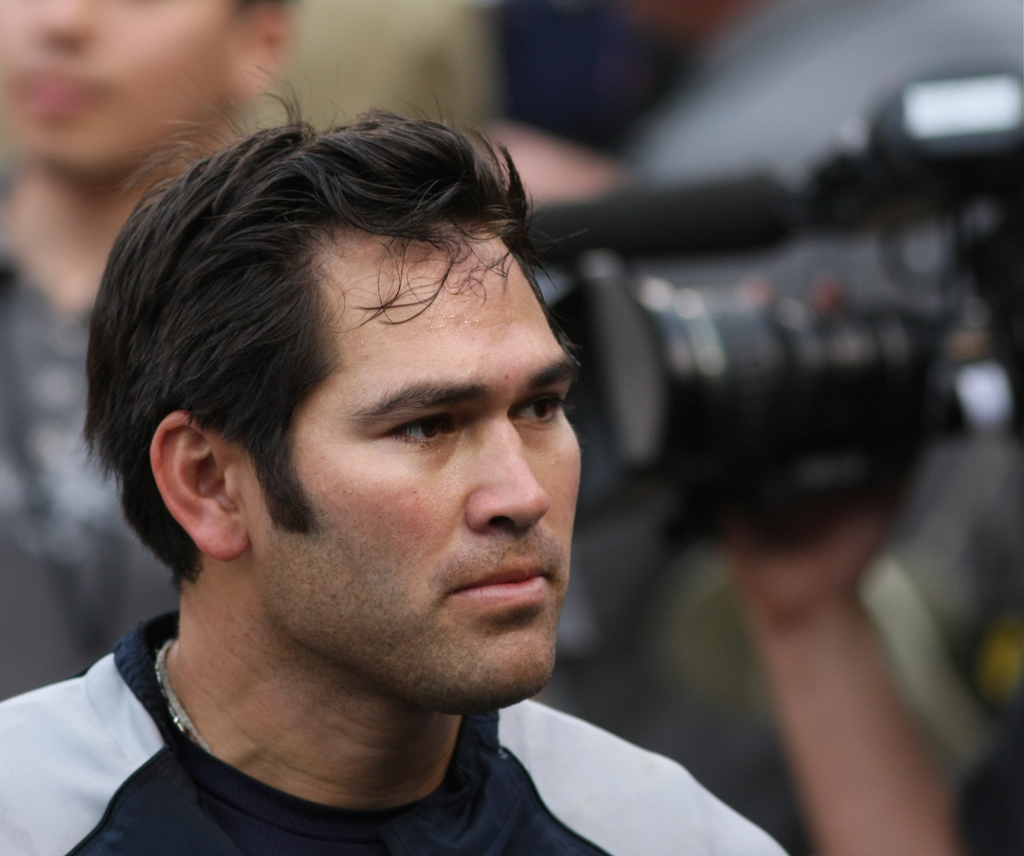
On June 27, 2003, Johnny Damon was playing CF and leading off for the Red Sox – as they took on the Marlins in Boston.  In a start that brought Boston fans up out of their seats, Damon was three-fourths of the way to the cycle before the first inning was over.  (Ironically, he also hit the ball on which the final out of the frame was made).

Johnny Damon, notched three hits in one inning for the Red Sox.

Johnny Damon, notched three hits (a single, double and triple) in one inning for the Red Sox.

On June 27, 2003, Johnny Damon became just the fifth player (only the second since 1900 and the first since 1953) to collect three hits in an inning.  He accomplished the feat in the first inning of a 25-8 Red Sox win over the Marlins. If this kind of fact interests you, each of the four other players to achieve a three-hit frame did it in the seventh inning.

Damon who collected a single, double and triple in the bottom of the first, ended the game five-for-seven, with three runs scored, three RBI, a double, a triple and three singles.  He, unfortunately, did not get the cycle.


Here’s how that first inning went:


Johnny Damon – Double past first base down the line.  (off starter Carl Pavano)

Todd Walker – single, Damon scores.

Nomar Garciaparra – Double.

Manny Ramirez – Home run, scoring three.

David Ortiz – Double.

Kevin Millar – Single, Ortiz scores.

                   Michael Tejera replaces Pavano on the mound.

Trot Nixon – Single.

Bill Mueller – Walk, loading the bases.

Jason Varitek – Single, Millar and Nixon score.

Damon – Triple to deep right field, Mueller and Varitek score.

Walker – Single, Damon scores.

         Allen Levrault takes over for Tejera – at this point, we’ve seen two pitchers, 11 batters, ten hits, one walk, nine runs and no outs.

Garciaparra – Foul pop out.

Ramirez – Single.

Ortiz – Walk, loading the bases.

Millar – Sacrifice fly, scoring Walker.

Nixon – Walk, loading the bases.

Mueller – Double, scoring Ramirez and Ortiz.

Varitek – Walk.

Damon – Line drive single to left, Nixon score, Mueller thrown out at the plate to end the inning.

Red Sox score 14 runs on 13 hits and four walks; Damon collects a single, double and triple.


Primary Resource:  FoxSports.com; NBCSports.com; Baseball-Reference.com; Baseball-Almanac.com.

BASEBALL ROUNDTABLE ON THE TOP 100 BASEBALL BLOG LIST

100Baseball Roundtable is on the Feedspot list of the Top 1oo Baseball Blogs.  To see the full list, click here.

I tweet baseball @DavidBBRT

Follow/Like Baseball Roundtable’s Facebook Page here.  More baseball commentary; blog post notifications; PRIZES.

Member: Society for American Baseball Research (SABR); The Baseball Reliquary; The Negro Leagues Baseball Museum.

The Cowboy Who Helped the Dodgers Win the 1966 NL Pennant

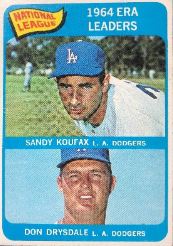
On this date (February 28) in 1966, Los Angeles Dodger pitchers Sandy Koufax and Don Drysdale began what it arguably the most notable holdout in MLB history. The pair refused to report to Spring Training unless the Dodgers signed them to a $1 million, three-year contract – with each receiving $167,000 annually. The hurlers also said neither would sign separately, the deal was to be a two-fer.  Remember, this was at a time when player bargaining rights were considerably restricted – a strong reserve clause, no free agency and no arbitration.  Further, Willie Mays was MLB’s highest-paid player at $125,000 annually and no pitcher had ever made a six-figure salary.

KoufaxNow, Koufax and Drysdale did have some bargaining power. The year before, the two had led the Dodger to the NL pennant and a World Series Championship. During the 1965 season, Koufax had gone 26-8, with a 2.04 earned run average and 382 strikeouts in 335 2/3 innings. The lefty had led the NL in wins, winning percentage, earned run average, complete games, innings pitched and strikeouts.  Drysdale, meanwhile, had gone 23-12, 2.77, with 210 whiffs in 308 1/3 innings – leading the NL in starts, finishing third in victories and placing in the top ten in nearly every pitching category.  Koufax had also won his second Cy Young Award and finished second to Willie Mays in the MVP voting.  The pair would not sign until March 30 – and only after a noted television cowboy (no not Gene Autry) had ridden in to help save the day. The haggling had gone back and forth and the pair of hurlers had even signed on to appear in a movie (with actor David Janssen) – with filming slated to start about a week before the season opener – to make clear their willingness to sit out the season. Reports indicate that Chuck Connors – star of the hit television series The Rifleman – played a key role setting up the late March meeting  between Buzzie Bavasi and Drysdale (at Nicola’s, a popular restaurant near Dodger Stadium) that led finally broke the impasse – with Koufax signing for $125,000 and Drysdale for $100,000.

What followed the signings was a combination of good news and bad news.

  • The Good News was that Koufax and Drysdale did help the Dodgers repeat as NL Champions. The Bad News was that Los Angeles lost the World Series to Baltimore in four games.
  • The Good News was that Koufax delivered a 27-9, 1.73 season. The Bad News was that Drysdale went 13-16, 3.42.
  • The Good News was that, in 1966, Koufax won his third Cy Young Award and led the league in wins (27), ERA (1.73), starts (41), complete games (27), shutouts (5), innings pitched (323) and strikeouts (317).  The Bad News was that, due to an arthritic elbow, that spectacular season would be Koufax’ last.  Note: Drysdale pitched for the Dodgers until 1969 – going 45-48, 2.92 over his final four seasons.
The Rifleman - 1958-63 - was one of televisions most popular westerns.

The Rifleman – 1958-63 – was one of televisions most popular westerns.

Now back to the television cowboy – Kevin Joseph “Chuck” Connors was much more than a TV sod buster. Yes, he was the as star of the successful TV western series The Rifleman and had roles in such classic movies as Old Yeller and television presentations like Roots (which earned him an Emmy nomination).

The 6’5” left-hander, however, also played first base for the Chicago Cubs (and made one pinch-hitting appearance for the Dodgers), took the courts as a forward and center for the Boston Celtics, and was drafted by the Chicago Bears.

Here are a few other Connors tidbits:

AS AN ACTOR

  • In 1959, Connors won a Golden Globe Award (Best Television Performer) for his work in The Rifleman.
  • Connors starred in four television series: The Rifleman; Arrest and Trial; Branded; and Cowboy in Africa.
  •  In 1984, Connors was honored with a “star” on Hollywood’s Walk of Fame.
  • Connors made guest appearances on television shows ranging from Gunsmoke to Spenser for Hire to the Sonny & Cher Comedy Hour.
  • Connors’ movie credits include such films as Pat and Mike; Old Yeller; Geronimo, Flipper; The Big Country; Solyent Green; and Airplane II.
  • Connors is a member of the Western Performers Hall of Fame of the National Cowboy and Western Heritage Museum.

AS AN ATHLETE

  • In a four-season span at AAA (1948-51), Connors’ batting averages were: .307; .319; .290 and .321.
  • In 1951, Connors hit .321, with 22 home runs and 77 RBI in just 98 games for the Triple A Los Angeles Angels.
  • Connors was known to turn cartwheels while circling the bases after a home run.\
  • Connors is credited with shattering the first NBA glass backboard ever, during a November 1946 Celtics’ pregame warm-up.

chuck


For the full story on Chuck Connors, click here.

Primary Resrouces:  Baseball-Reference.com; “Fifty years ago, Dodgers’ Sand Koufax and Don Drysdale engaged in a salary holdout that would change baseball forever” – Los Angeles Times, March 28, 20166;  OurChuckConnors.com; Society for American Baseball Research.

BASEBALL ROUNDTABLE ON THE TOP 100 BASEBALL BLOG LIST

100Baseball Roundtable is on the Feedspot list of the Top 1oo Baseball Blogs.  To see the full list, click here.

I tweet baseball @DavidBBRT

Follow/Like Baseball Roundtable’s Facebook Page here.  More baseball commentary; blog post notifications; PRIZES.

Member: Society for American Baseball Research (SABR); The Baseball Reliquary; The Negro Leagues Baseball Museum.

A New Deal for Cuban Baseball – A Safer Path to The Diamonds to the North

The Cuban Baseball Federation, Major League Baseball and the Major League Baseball Players Association in December reached an agreement that would provide a smoother and safer path to major league franchises for Cuban players – who have been facing often nightmare-ish hardships (smuggling, extortion, kidnapping and banishment from the ball fields of their home land) in pursuing their major league dreams.

Saint Paul,Minnesota-based Ballpark Tours is planning its third Cuban baseball adventure for this fall and recently posted an article on the deal, its implications and the hazards Cuban players have been facing – and they even threw in an All-Cuban-Defector MLB All Star team.  A good read.

To get the full story, just click here.

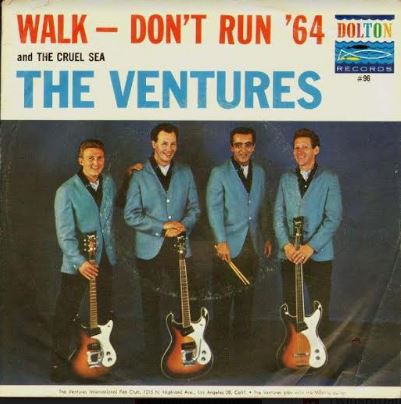
Baseball Roundtable Trivia Teaser … Walk – Don’t Run (but put a run on the board)

A Baseball Roundtable Trivia Teaser to celebrate

the opening of Spring Training workouts.


VenturesWho is the only player to collect two bases-loaded walks in a single World Series game?

Hint:  Sandy Koufax may have considered him a spoiler.


Answer:

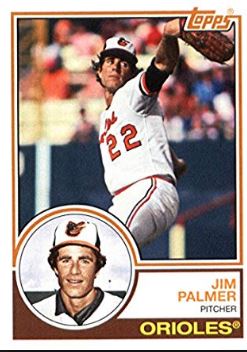
PalmerThe only player to draw two bases-loaded walks in a World Series game is Orioles’ pitcher Jim Palmer, who walked with the sacks full in the fourth and fifth innings, as the Orioles topped the Pirates 11-3 on October 11, 1971.  Notably, Palmer walked only three times in 116 1971 regular season plate appearances. Palmer, in fact, never walked more three times in any of his 19 MLB seasons.

For those interested in details the walks were were issued by

  • Bruce Kison in the bottom of the fourth.  It was a tough inning for the Pirates.  Bob Johnson started on the mound and, after an inning-opening ground out by Oriole’s 1B Boog Powell, gave up a single to RF Frank Robinson, hit C Elrod Hendricks with a pitch, walked 3B Brooks Robinson and gave up a two-run single to 2B Davey Johnson. Bruce Kison was brought on in relief and walked SS Mark Belanger to load the sacks and then issued a free pass to Palmer to force in a run.
  • Bob Veale in the bottom of the fifth. By the time Palmer batted in the bottom of the fifth, the Orioles had a 7-0 lead and had already collected five hits and a walk in the inning. Veale had come on to replace Bob Moose and immediately walked Belanger to load the bases with one out. Palmer batted next and drew his second bases-loaded walk of the game.

The Orioles drew seven walks and had 14 hits in the contest. Palmer, however, did not exhibit any greater control.  He pitched eight innings of three-run ball, but walked eight (and surrendered seven hits).

We’ll take a deeper look at Jim Palmer later in this post (and reveal the story behind the Koufax hint), but first a few more base-loaded free-pass tidbits.

A little more on base-loaded free passes …

  • The record for bases-loaded walks in a single game (and a single inning) is eight – all by the White Sox  in a 20-6 victory over the Kansas City A’s on April 22, 1959. In the seventh inning of that game, the White Sox drew eight bases-loaded walks, while scoring eleven runs on just one hit. (For a full accounting of the inning, click here.)
  • In the above April 22, 1959 White Sox/A’s game, Nellie Fox had a record two bases-loaded walks in a single inning.
  • Ellis Burks holds the record for bases-loaded walks in game. On, September 2, 2000 – as his Giants beat the Cubs 13-2 – Burks drew three bases-loaded walks (in the first and second innings off Reuben Quevedo and in the sixth off Felix Heredia). The Giants drew five bases-loaded free passes in the contest.

INTENTIONAL BASES-LOADED WALKS

Only six players have been intentionally walked with the bases loaded (Baseball-Almanac.com):

Abner Dalrymple, Chicago (NL), August 2, 1881

Napoleon Lajoie, Philadelphia (AL), May 23, 1901

Del Bissonette, Brooklyn (NL), May 2, 1928

Bill Nicholson, Chicago (NL) July 23, 1944

Barry Bonds, San Francisco (NL), May 28, 1998

Josh Hamilton, Texas (AL), August 17, 2008

_____________________________________________________________

A FEW JIM PALMER TIDBITS …

  • In 1971, Palmer was one of four twenty-game winners on Orioles. Palmer went 20-9. 2.68; Dave McNally went 21-5, 2.89; Pat Dobson went 20-8, 2.90; and Mike Cueller went 20-9, 3.08. The only other MLB team to boast four twenty-game winners was the 1920 White Sox (Red Faber, 23-13, 2.99; Lefty Williams, 22-14, 3.91; Dickey Kerr, 21-9, 3.37; and Eddie Cicotte, 21-10, 3.26).
  • On October 6, 1966 – at age 20 – Jim Palmer became the youngest pitcher ever to pitch a World Series complete-game, shutout – topping the Dodgers (and Sandy Koufax) 6-0. Palmer gave up four hits and three walks, while fanning six.

EXPLAINING THE KOUFAX SPOILER HINT …

On October 6, 1966, when Jim Palmer – at age 20 – became the youngest pitcher ever to throw a World Series, complete-game shutout, there was plenty more going on. (As I’ve noted before, in baseball “There is always something.”  So often, when looking into one baseball fact or event, even more of interest emerges.) 

In this case, Palmer was coming off just his second MLB season (after going 15-10, 3.46 with six complete games in 30 starts and recording 147 strikeouts in 208 1/3 innings). His opponent was 30-year-old Sandy Koufax, about to win his third Cy Young Award – after a season in which he went 27-9, 1.73, with 27 complete games in 41 starts and 317 whiffs in 323 innings. In the regular season, Koufax had led all of MLB in wins, earned run average, games started (tie), complete games, shutouts (tie), innings pitched and strikeouts.  What fans didn’t realize at the time – particularly given Koufax’ 1966 performance:

            That 1966 match-up against Palmer – which ended in a loss for Koufax –

would be Koufax’ last major league appearance.

Chronic arthritis in his pitching arm would lead Koufax to retire before the 1967 season.

A couple of other interesting bits of trivia from that game:

  • Koufax gave up four runs in six innings, but three were unearned – largely the result of Dodgers’ center fielder Willie Davis’ World Series’ record of three errors in one inning (the fifth). It was clearly a bad day for Davis, who also went zero-for-four at the plate and was the victim of two of Palmer’s six strikeouts.
  • In addition, Palmer’s shutout was part of a World Series’ record for offensive futility – the Dodgers scored just two run (both in Game One, which they lost 5-2) in the entire World Series. The Dodgers, in fact, did not score after the third inning of Game One – a World Series’ record 33 straight innings without touching the plate. Games Three and Four both went to the Orioles by 1-0 scores.
  • Jim Palmer won more games in the 1970’s (186) than any other pitcher.
  • Jim Palmer is the only pitcher to win World Series games in three decades – 1960’s-70’s -80’s.

Jim Palmer, a solid all-around athlete – was a high school all-stater in baseball, basketball and football.

  • Jim Palmer was a three-time Cy Young Award winner and six-time All Star and four-time Gold Glover.
  • Jim Palmer led his league in wins three times (and won 20 or more games in eight seasons); winning percentage twice; innings pitched four times; complete games once; shutouts twice; earned run average twice.

Jim Palmer, inducted into the Baseball Hall of Fame in 1990, finished his career with a 268-152 record, a 2.86 earned run average, 211 complete games, 53 shutouts and 2,212 strikeouts in 3948 innings pitched.

Primary Resources:  Baseball-Reference.com; Baseball-Almanac.com


BASEBALL ROUNDTABLE ON THE TOP 100 BASEBALL BLOG LIST

100Baseball Roundtable is on the Feedspot list of the Top 1oo Baseball Blogs.  To see the full list, click here.

I tweet baseball @DavidBBRT

Follow/Like Baseball Roundtable’s Facebook Page here.  More baseball commentary; blog post notifications; PRIZES.

Member: Society for American Baseball Research (SABR); The Baseball Reliquary; The Negro Leagues Baseball Museum.

Baseball Roundtable’s All Polish-American Team

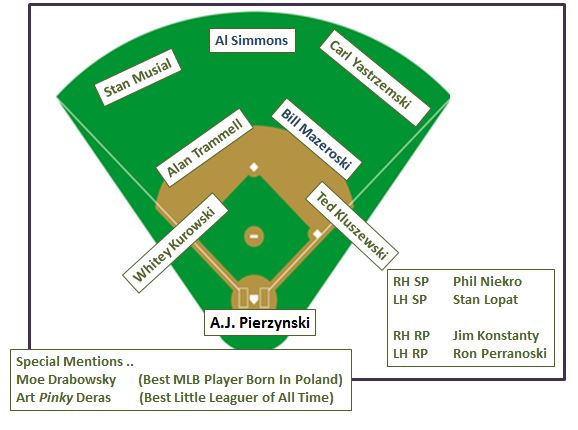
If are Milwaukee-born (particularly into the Karpinski family), you are very likely to be a baseball fan and proud of your Polish heritage.  (I learned a great deal about both from my Aunt Irene.)  With that in mind, this post will be dedicated to my personally selected Polish-American MLB All Star squad – one player at each position in the field, two starting pitchers (a lefty and a righty) and two relievers (again, a right-hander  and a southpaw).

The team I came up with looks pretty competitive. The twelve players played a combined 204 major leagues seasons (none fewer than nine). The lineup includes six MLB Hall of Famers.  Together, this dozen major leaguers garnered 79 All Star selections, 24 Gold Gloves and 12 batting titles.  They also can point to four Most Valuable Player Awards and one Triple Crown. In addition, eleven of the twelve have been inducted into the National Polish-American Sports Hall of Fame in Orchard Lake Village, Michigan.

Note: For a look at an All Star squad picked on the basis of

the ability to handle Nolan Ryan’s heat, click here

We’ll go through the All Star Squad first, but there are a couple of special mentions (detailed at the end of the post): 1) Moe Drabowsky – The best-ever major leaguer actually born in Poland; and Art “Pinky” Deras – the Polish-American youngster acknowledged as the Best Little League Player Ever (there’s even a documentary about him).  So, let’s get to it.

PlayersNew

—–THE BASEBALL ROUNDTABLE  POLISH-AMERICAN ALL STAR TEAM—– 

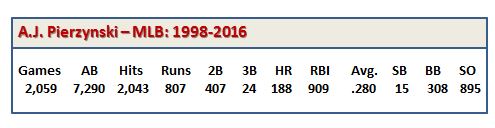
Catcher – A.J. Pierzynski

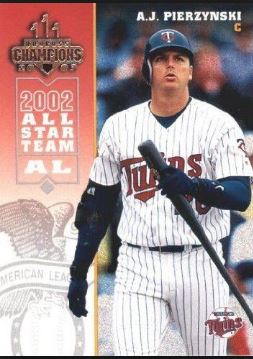
AJ OneI’ve got a special spot in my heart for the catcher on my All Polish-American squad – a hard-nosed player who started his MLB career with my Minnesota Twins.  A.J. Pierzynski was a consistent and quality performer who always came to win

_______________________________________

If you played against him, you hated him.  If you played with him, you hated him a little less …. He’s worth the work because he always shows up for you.”

                                           Ozzie Guillen, Manager, Chicago White Sox

__________________________________


Pierzynski, signed by the Twins out of high school in 1994, made his MLB debut with Minnesota (as a 21-year-old) in 1998. The 6’3”/250-pound, left-handed hitter (right-handed thrower) played in 19 MLB seasons – for the Twins (1998-2003); Giants (2004); White Sox (2005-2012); Rangers (2013); Red Sox (2014); Cardinals (2014); and Braves (2015-16).

A.J.

Pierzynski was a two-time All Star.  He collected 2,043 hits in 2,059 games (for a .280 career average), hit 188 home runs and drove in 909.  His best season came with the Twins in 2003, when he hit .312, with 11 home runs and 74 RBI (although he did hit a career-high 27 home runs for the White Sox in 2012).  He ranks eighth all time in games played at catcher. He holds the AL record for most consecutive games (by a catcher) in a season without an error at 117 in 2005 (tied with Buddy Rosar, Athletics, 1946).  Pierzynski was about as steady at the plate as you can get.  For his career, he hit .280:

  • .283 at home – .277 on the road
  • .282 in the first-half of the season; .278 in the second half.
  • .287 with runners on base; .287 with runners in scoring position; .275 with the bases empty.

______________________________________________________

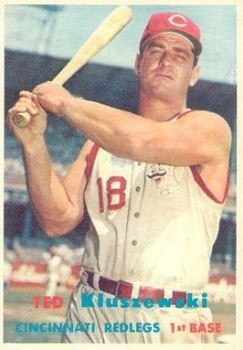
First Base – Ted Kluszewski

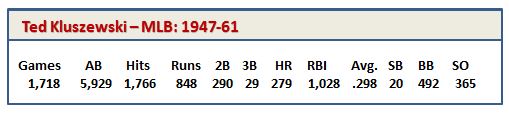
KluTed “Big Klu” Kluszewski was a rare breed – a true power hitter who also practiced exceptional plate discipline.  In 1954, for example, Kluszewski hit .326, with 49 home runs and 141 RBI – a season made even more remarkable by the fact he struck out only 35 times (versus 78 walks). I doubt if we’ll ever see another player top 40 home runs without reaching 40 whiffs.  Kluszewski, in fact, had a streak of four seasons (1953-56) when he hit over .300, drove in 100+ runs, bashed 35+ home runs – and struck out no more than 40 times in any season.  In those four seasons, Kluszewski hit 171 home runs – and fanned 140 times (average 43 HR’s and 35 whiffs a season). It should also be noted that Kluszewski led NL first baseman in fielding percentage every year from 1951 through 1955.  Unfortunately, a back injury in 1956 hampered his performance in the later years of his career (he played until 1961). He played for the Reds (1947-1957); Pirates (1958-59); White Sox (1959-60);  and Angels (1961).

Kluszewski – a big man for his time at 6’2”/225-pounds – is also noted for adding a bit of flair to the game, making his own intimidating fashion statement. Big Klu complained that his uniform jersey was too tight for his large and powerful biceps. He went on to have the sleeves cut from his jersey – exposing his bare arms from the shoulder.  (This was considered a bold move at that very conforming time in the game’s history.)

Klu

Kluszewski only appeared in one post-season – hitting .391, with three homers and ten RBI in the 1958 World Series (for the White Sox).  True to his form – Big Klu did not strike out even once (25 plate appearance) in the Series.

Big Klu was an Angel

Taken by the Angels in the 1960 expansion draft, Kluszewski hit the first-ever home run for the expansion team (a two-run shot in the first inning of the Angels’ first game – April 11 versus the Orioles). He added a punctuation mark, by hitting the Angels’ second–ever home run (a three-run shot) the very next inning. The Angels won 7-2 and, of course, Kluszewski did not strikeout.

The big left-hander hit .298 over his 15-season MLB career, with 279 home runs and 1,028 RBI. The four-time All Star topped .300 in seven seasons, drove in 100+ runs  in four seasons and hit 40 or more long balls in three campaigns.  His best season was 1954, when he hit .326-49-141.  Ultimately, however, Big Klu is best remembered for those sleeveless jerseys, muscular arms and exceptional bat control.

_________________________________________

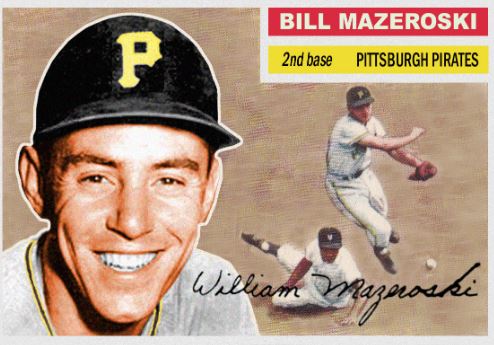
Second Base – Bill Mazeroski

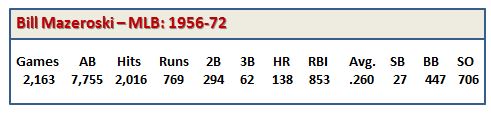
MazpicConsidered the best fielding second baseman of all time by many, Bill Mazeroski was inducted into the Baseball Hall of Fame in 2001.He played 17 MLB seasons – all with the Pirates – hitting .260, with 138 home runs and 853 RBI.  It was, however, his glove the earned him a spot on this squad. “Maz” was a seven-time All Star and an eight-time Gold Glover at the keystone sack.  He led NL second baseman in assists nine times, putouts five times and double plays turned eight times. (He is the all-time career leader in double plays by a second baseman, fifth in assists, seventh in puts and tenth in games played at the two-bag. The 5’11”/183-pound right-hander’s best season at the plate was probably 1962, when he hit .271, with 14 home runs and 81 RBI.

Maz

Bill Mazeroski is best remembered for two things – his unmatched skill at turning the double play and his walk-off home run in the bottom of the ninth inning of Game Seven of the 1960 World Series – which gave the Pirates a 10-9 win and an unlikely World Championship.  In the Series, the Yankees outhit the Pirates .338 to .256, out-homered the Pirates 10 to four and outscored Pittsburgh 55 to 27. Mazeroski hit .320 in the seven-game set, smacked two of the Pirates’ four home runs and drove in five tallies.  Bobby Richardson of the losing Yankees hit .367 and drove in 12 runs to win the Series MVP Award – still the only player on a losing team to take home the World Series MVP Trophy.

____________________________________________________

Third Base – George Kurowksi

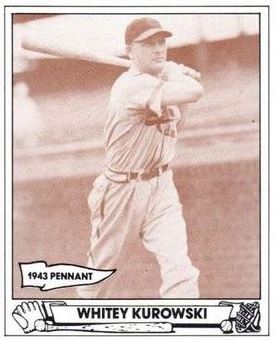
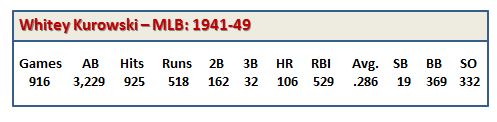
whitgeypicGeorge “Whitey” Kurowski played in nine MLB seasons (1941-49), all for the Cardinals.   In the six seasons that he played at least 100 games, he was an All Star four times. In the three seasons from 1945 to 1947, Kurowski hit .311, with 62 home runs and 295 RBI.  For his career, he hit .286 (in 916 games), with 106 home runs and 529 RBI. He led NL third baseman in putouts in three seasons, as well as in assists and doubles plays once each. He finished in the top ten in home runs in the league five times, RBI four times and batting average three times. His best season was 1947, when he hit .310, with 27 home runs, 104 RBI and 108 runs scored.

Whitey Kurowski had to overcome the effects of a childhood injury and osteomyelitis in his right (throwing) arm in his quest to reach the major leagues. The surgery required to save his arm left his right wing about three inches inches shorter than his left.  His determination is reflected in the fact that he made the major leagues as a third basemen – a position the demands a strong throwing arm. Arm problems most likely shortened his career. (The Society for American baseball Research reports Kurowski “underwent 13 operations on the arm so he could continue playing.)

Whitey

_________________________________________________

Shortstop – Alan Trammell

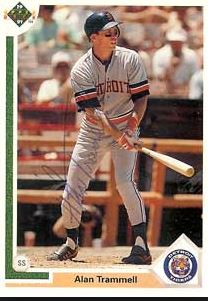
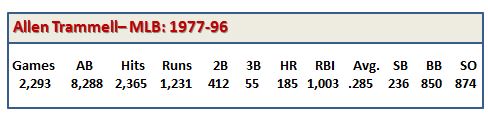
TrampicThe shortstop selection for this team – Alan Trammell – was inducted into the Baseball Hall of Fame in 2019.  The 6’/165-pound Trammell (a right-hander) was a Tigers’ second round draft pick right out of high school in 1976.  He made his MLB debut in September of 1977 and went on to play 20 MLB seasons – all for the Tigers.

Trammell was a six-time All Star and a four-time Gold Glover. Over his career, he collected 2,365 hits (.285 average), with 185 home runs, 1,003 RBI, 1,231 runs scored and 236 stolen bases.  He hit over .300 seven times (a high of .343 in 1987), hit 20 or more home runs twice, scored 100+ runs in three seasons and stole 20 or more bases three times.  His best season was 1987, when Trammell hit .343, collected 205 hits, knocked 28 home runs, drove in 105 and scored 109.

Trammell

Allen Trammell (SS) and Lou Whitaker (2B) played together for 19 seasons – MLB’s longest every SS-2B teammates run.

______________________________________________________________

Honorable Mention at Shortstop – Troy Tulowitzki

Troy Trevor Tulowitzki earns honorable mention here with his glove (a two-time gold Glover) and bat (topping 20 home runs in seven of 12 MLB seasons). Still active, “Tulo” may someday take Alan Trammell’s spot in this lineup.  Tulowitzki has played for the Rockies (2006-2015) and Blue Jays (2016-17). He missed the 2018 season (ankle surgery) and signed with the Yankees for 2019.

Tulowitzki is a five-time All Star, whose best season was 2014, when he hit .340 with 30 home runs and 105 RBI for the Rockies.  For his career, he is .290 (in 1,286 games), with 224 home runs and 779 RBI.  His numbers would be even stronger if not for the injury bug. His past injuries include: a torn left quadriceps, fractured wrist, groin surgery, fractured rib, hip surgery, cracked shoulder blade.

Troy Tulowitzki … Rare Feats

Troy Tulowitzki is one of only two players to both hit for the cycle and turn an unassisted triple play (the other is John Valentin).

____________________________________________________

Outfield – Stan Musial

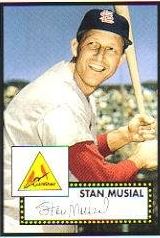
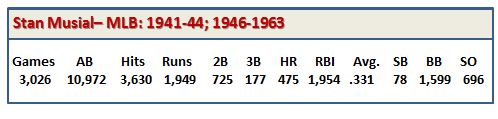
stanpicYou can’t go wrong with Stan “The Man” Musial on your team. One of the greatest players in MLB history (inducted into the Hall of Fame in 1960), Musial played 22 MLB seasons (all for the Cardinals) between 1941 and 1963 (he missed 1945 to military service).

Musial was an All Star in 20 of his 22 seasons and a three-time NL Most Valuable Player. He won seven batting titles and led the NL in hits six times, runs scored five times, RBI two times, doubles eight times and triples five times. He also topped the NL in total bases, on base percentage and slugging percentage six times each.

Stan

Stan Musial hit .347 in 1944 – missed the 1945 season due to military service – and came back to hit .365 in 1946. 

Musial hit over .300 in 17 full seasons and over .350 in five campaigns (a high of .376 in 1948). He topped 20 home runs ten times, with a high of 39 in 1948. He also hit 50 or more doubles twice, 20 triples twice, had 200 or more hits in six seasons, 100+ RBI in ten seasons and 100+ runs scored in 11.  For his career, Musial had 3,630 hits (.331 average), 475 home runs and 1,951 RBI. and 1,949 runs scored. He is in MLB’s top ten all time in games played, hits, runs scored, runs batted in, doubles and  total bases.

How good was Stan Musial?  He was good enough to take your breath away.

                                                                                              Vin Scully

_____________________________________________

Outfield – Al Simmons (Szymanski)

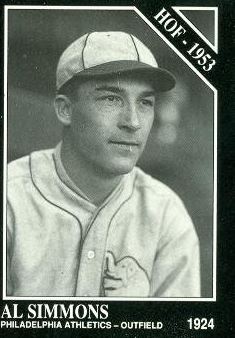
simmonspicAl Simmons is the second Hall of Famer in our Polish-American All Star outfield – and he put up Musial-like numbers (Musial-lite?).  However, Simmons did not enjoy as notable a nickname as “Stan the Man.”   Due to his unusual batting style (front foot pointed toward third base), he became known as “Bucketfoot Al.”   (Note: It’s reported Simmons went with Simmons over Szymanski because of the difficulty people had pronouncing Szymanski.)

Simmons played 20 MLB seasons (1924-41, 1943-44) and ended just 73 hits shy of 3,000 – with a .334 career average and 307 home runs. Simmons played for the Athletics (1924-32, 1940-41, 1944), White Sox (1933-35); Tigers (1936), Senators (1937-38), Braves (1939), Reds (1939) Red Sox 1943)

Simmons was a two-time batting champ, who hit over .300 in 13 seasons – and over .380 in four campaigns. The 5’11”/190-pound righty also led his league in hits twice, and had 200 or more hits six times. In addition, he led his league in runs scored once, and RBI once.  He hit 30 or more home runs in three seasons, drove in 100+ runs in 12 and scored 100 or more runs in six.   Simmons’ best season was 1930, when he hit .381, with  36 home runs, 165 RBI and 152 runs scored.In the seven seasons from 1925 through 1931, Simmons averaged .372 (never hitting below .341).

Al Simmons holds the MLB record for hits in a season by a right-handed batter – 253 in 1925, when he hit .387  at age 23, in (in just his second MLB season.)

__________________________________________________________

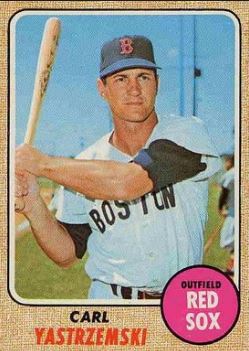
Outfield – Carl Yastrzemski

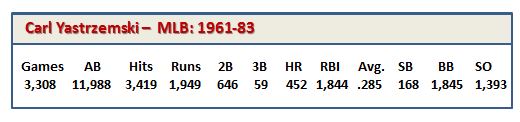
YazpicCarl Yastrzemski enjoyed a 23-season MLB career (1961-83) – all with the Boston Red Sox. The Baseball Hall of Famer was an All Star in 18 seasons, a seven-time Gold Glover and the 1967 AL Most Valuable Player (when he won the batter’s Triple Crown – Avg.-HR-RBI).

Yastrzemski was a three-time batting champ and topped .300 in six seasons. He had 100+ RBI in five campaigns, 100+ runs scored in three and 40 or more home runs in three. He led the AL in runs scored three times, doubles three times, hits twice and home runs and RBI once each.  His best year was 1967, when he won the AL Triple Crown with a .326-44-121 stat line. Yaz finished his career with 3,419 hits (.285 average), 452 long balls and 1,944 RBI. He also hit .369-4-11 in 17 post-season contests. He is among MLB’s top ten (career) in games played, at bats, hits, total bases, doubles and walks.YazIn 1968 – known in baseball lore as “The Year of the Pitcher” – Carl Yastrzemski won the American League batting title with a .301 average  – the lowest ever for a league leaders.

Side Note:

I have my own memories of Yaz.  With two games left in the 1967 season, my Twins went into Boston with a one-game lead over the Red Sox and lost two games (and the pennant) to Boston by scores of 6-4 and 5-3.  All Yaz did was go 7-for-8 with a double, a home run, two runs scored and six RBI.  Ouch-ski!

_____________________________________________________

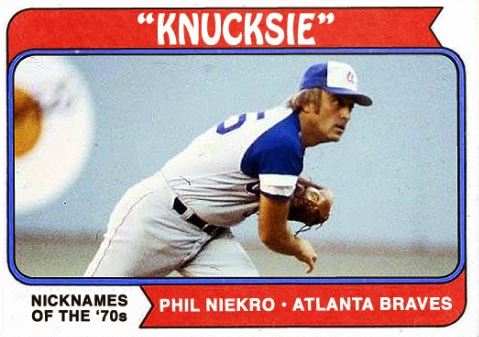
RH Starting Pitcher – Phil Niekro

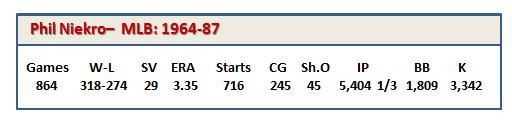
NiekropicPhil Niekro spent 24 seasons on the MLB mound: Braves (1964-83, 1987); Yankees (1984-85); Indians (1986-87); Blue Jays (1987).  During that time, Niekro earned 318 wins (16th all time) versus 274 losses – and put up a 3.35 ERA.  The 6’1”/180-pound knuckleballer won 20 or more games three times and 15 or more in 13 seasons.  His nickname was “Knucksie,” but I would have preferred “Knuck-ski.”

Niekro led the National League in wins in 1974 (20) and 1979 (21)  He was also the league leader once each in earned run average (1.87), winning percentage (17-4, .810 in 1982 – at age 43) and strikeouts (262 in 1977). Working with the tireless ease of a knuckleballer, he also led the NL four times each in games started, complete games and inning pitched. Niekro’s best season was 1974, when he went 20-13, 2.38 – leading the NL in wins, complete games (18) and innings pitched 302 1/3.

Niekro

Phil Niekro Trivia …

Phil Niekro is the last MLB pitcher to lead his league in both wins and losses in the same season – going 21-20, 3.39 in 1979.  That season, he also led the league in starts (44), complete games (23) and innings pitched (342).

Phil Niekro and his brother Joe Niekro hold the record for the most MLB wins by brothers, with 539. Phil went 318-274, while Joe went 221-204.

In 1979, Phil and Joe Niekro tied to the NL lead in victories with 21 each.

On May 29, 1976, Joe Niekro hit the only home run of his 22-season (1,165 plate appearances) MLB career.  The opposing pitcher? His brother Phil.

On August 5, 1973, Phil Niekro threw the first no hitter for the “Atlanta” Braves – defeating the San Diego Padres 9-0.

____________________________________________

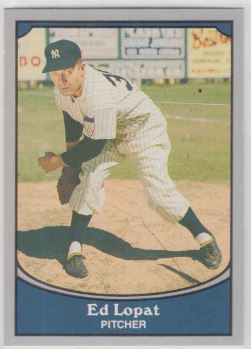
LH Starting Pitcher – Ed Lopat (Lopatynski)

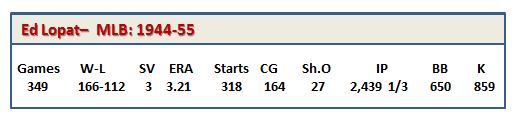
LopatpicEddie Lopat pitched in 12 MLB seasons – for the White Sox (1944-47), Yankees (1948-55) and Orioles (1955).  He went 166-112, with a 3.21 earned run average.  It’s reported that Eddie used Lopat over Lopatynski because the latter did not fit into a box score.  Lopat also picked up the nickname “The Junkman,” because of his ability to both change speeds and deliver a wide range of breaking pitches.

The 5’10’/180-pound southpaw was an All Star with the Yankees in 1933, when he went 21-9, 2.91 (his only 20-win season – although from 1947 through 1953, he won 15 or more games in six of seven seasons). In 1953, again with the Yankees, Lopat went 16-4 and led the American League in winning percentage (.800) and ERA (2.42).

Lopat

In seven World Series starts, all with the Yankees, Lopat went 4-1, 2.60 with three complete games.

______________________________________________________

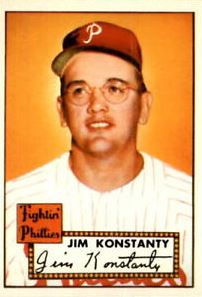
RH Reliever – Jim Konstanty

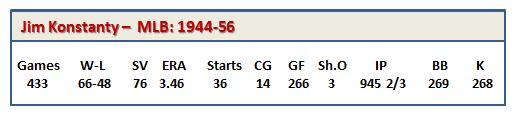
JimKpicJim Konstanty has the distinction of being the first MLB relief pitcher to win a league MVP Award. He accomplished the feat in 1950, when he was called on in relief a league-leading 74 times by the Phillies. Konstanty won 16 games (seven losses) and led the league with 22 saves.  That season, the Phillies won the NL pennant with a 91-63 record – which means Konstanty won or saved 42 percent of Philadelphia’s wins.

In his eleven MLB seasons, the 6’1”/202-pound righty went 66-48, 3.46 and saved 76 games (152 innings pitched in relief).  By the way, James was Konstanty’s middle name – his first name was Casimir.

Konstsanty

A Man for All Seasons …

In his senior year in high school, Jim Konstanty was captain of the Arcade High School basketball, baseball and football teams.  Then, at Syracuse University, he lettered in baseball, basketball, soccer and boxing.

_______________________________________________

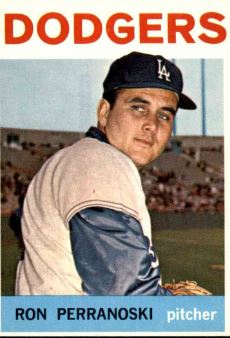
LH Reliever – Ron Perranoski

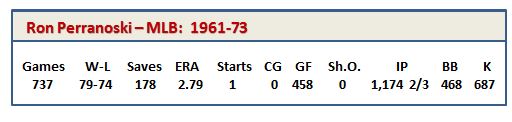
RonPpicRon Perranoski – a 6’/180-pound southpaw – went 79-74, 2.79 with 178 saves in 13 MLB seasons. He played for the Dodgers (1961-67, 1972); Twins (1968-71); Tigers (1971-72); and Angels (1973).

Perranoski led his league in games pitched in three seasons and games saved twice (with a high of 34 saves for the 1974 Twins). In 1963, he led the NL in winning percentage at .842 – picking up 16 wins (three losses) and 21 saves, all in relief.    Add in his 1.67 earned run average and it is clearly his best season.

Perrastats


————————-A COUPLE OF SPECIAL MENTIONS ———————

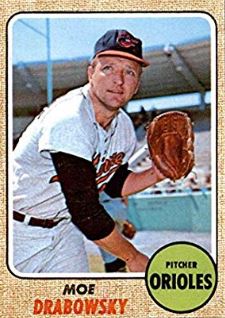
Moe Drabowsky – Best Polish-Born Major Leaguer

MoepicMiroslav Drabowsky was born in Ozano, Poland on July 21, 1935, to a Jewish (American citizen) mother and a Polish father.  His family moved to the United Stars in the late 1930’s, as Adolf Hitler was gaining momentum in Eastern Europe.  Growing up in Connecticut, Drabowsky played high school baseball at Loomis Chaffee School and college baseball at Trinity College in Hartford.  He signed with the Cubs in July of 1956 and made his MLB debut on August 7 of that year (at age 21).

The 6’3”/190-pound righty was a starter his first four seasons, going 29-40, 3.81, with 22 complete games in 83 starts. Drabowsky switched to the bullpen in 1960 (seven starts in 32 appearances) and made a name for himself coming in from the pen.  From 1960-72, he went 59-65, 3.66, with 54 saves (421 appearances in relief, 71 starts).

In 17 MLB seasons, Drabowsky went 88-105, 3.71 with 54 saves. He struck out 1,162 batters (702 walks) in 1,641 innings.  Drabowsky pitched for the Cubs (1956-60); Braves (1961); Reds (1962); Athletics (1962-65); Orioles (1966-68, 1970); Royals (1969-70); Cardinals (1971-72); and White Sox (1972).

Moe Drabowsky, a member of the National Polish-American Sports Hall of Fame (NPASHOF), gave up the 3,000th hit of Stan Musial (another NPASHOF inductee).

____________________________________________

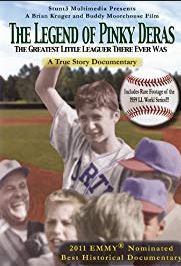
Art “Pinky Deras – Best-Ever Little Leaguer

PinkypicArt “Pinky” Deras was inducted into the National Polish-American Sports Hall of Fame  in 2011 – recognizing his exploits as a 12-year-old Little Leaguer  – leading the Hamtramck, Michigan team to the 1958 Little League National  Championship.   Now, Deras was big for his age, six-feet tall and 135 pounds as a 12-year-old.  He was also a dominant force – going 18-0 on the mound (16 shutouts and ten no-hitters) and whiffing 298 batters in 108 innings.  That means 92 percent of his outs came via the strikeout.  He also hit a resounding .641, with 33 home runs and 112 RBI.

Deras signed a contract with the Cardinals right out of high school, declining of football scholarship to Michigan State. He played five minor league seasons, hitting .243, with 32 home runs in 518 games. He did not pitch in professionally ranks.


______________________________________________________

Primary resources: Baseball-Reference.com; Society for American Baseball Research; National Polish-American Sports Hall of Fame. 

BASEBALL ROUNDTABLE ON THE TOP 100 BASEBALL BLOG LIST

100Baseball Roundtable is on the Feedspot list of the Top 1oo Baseball Blogs.  To see the full list, click here.

I tweet baseball @DavidBBRT

Follow/Like Baseball Roundtable’s Facebook Page here.  More baseball commentary; blog post notifications; PRIZES.

Member: Society for American Baseball Research (SABR); The Baseball Reliquary; The Negro Leagues Baseball Museum.
The Ryan Express … The Ryan Nemesis (Nemeses?) … A World Versus Nolan Ryan All Star Lineup

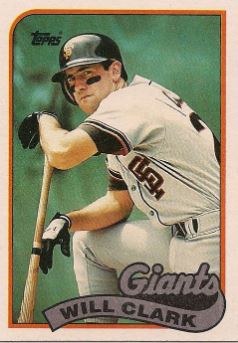
Will clarkOn this date (April 8) in, 1986, Will Clark, a 22-year-old rookie, stepped into the batter’s box for his first-ever major league at bat.  He was the second batter in the top of the first inning, as his Giants took on the Houston Astros.  On the mound was the imposing presence of the Astros’ right-handed flamethrower 38-year-old future Hall of Famer Nolan Ryan – who already had 241 MLB wins and more than 4,000 strikeouts to his credit. Clark took the first two pitches and then – with a one-and-one count – took his first MLB regular-season swing.  The result was a home run – and it set the tone for future Ryan-Clark confrontations.

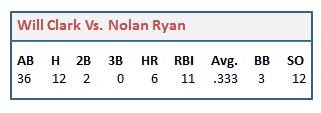
Over his career, Clark would face Ryan 39 times and collect 12 hits in 36 at bats – for a .333 average. More impressive, eight of those 12 hits would go for extra bases, six leaving the park.  Clark’s six home runs are those most any batter hit off Ryan – despite the fact that 163 hitters had more plate appearances versus Ryan than Clark.

That story, and those statistics, led Baseball Roundtable to look into which batters had found the most success against Ryan – and come up with a “World Against Nolan Ryan” All Star lineup. The nine-man, Nolan-centric squad I uncovered went 136-for-390 against Ryan (.349 average), with 22 home runs and 80 RBI.  They range from Hall of Famer (and career .328 hitter) Rod Carew at second base to career .158 hitter Ron Reed on the mound. It’s an experienced squad – each of them played more than a dozen seasons  in the major leagues (averaging better than 17 MLB seasons); all but one made at least one All Star squad; three were league MVPs; two were Rookies of the Year and two are in the Hall of Fame.  (Only one – Rod Carew – checks all four of those boxes.)

A Brief Semi-Commercial Message

This look at batters who “handled” Nolan Ryan’s outstanding stuff was the first step toward Baseball Roundtable’s ongoing “Who’s Your Daddy?” Series of blog post – looking at some of the best pitchers of all time and presenting position-by-position lineups of hitter who fared the best against these elite arms.  The links below will take you to other “edition” of the series. 

                     Sandy Koufax, click here

                    Pedro Martinez, click her

                    Bob Gibson, click here.

                    Randy Johnson, click here.

                   Greg Maddux, click here.

                   Justin Verlander, click here.

                  Bob Feller, click here.

                 Roger Clemens, click here.

                 Max Scherzer, click here.

                 Tom Seaver, click here

                 Mariano Rivera, click here.

                Warren Spahn, click here.

                 Lefty Grove, click here. 

DISCLAIMER

Nolan Ryan photo

Photo by Mike Overall

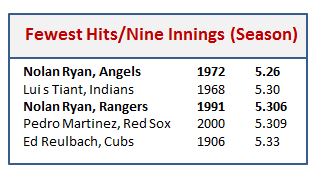
I must note that the fact that I chose to pursue this topic is actually a compliment to Nolan Ryan.  It is Ryan’s excellence that supports this lineup’s exceptionalism against him.  Let’s consider just how difficult it was to put up “good numbers” against Ryan.  Among qualifying pitchers, Ryan has the lowest career batting average against – a mere .204.  He also led his league in fewest hits per nine innings a dozen times – and has the career record for the lowest H/9 at 6.56.  Only five times in MLB history has a qualifying pitcher given up less than 5.5 hits per nine frames in a season. Two of those five campaigns belong to Ryan – and they came 19 years apart (at ages 25 and 44).

Hitsnine

Ryan also amassed 324 MLB victories, threw a record seven no-hitters and holds the all-time record for strikeouts (5,715). In his 27 MLB seasons, he led his league in strikeouts 11 times, set the post-1900 record for whiffs in a season at 383 and six times fanned 300+ batters in a season.  Over his career, Ryan fanned just over one of every four batters he faced.  The eight-time All Star also led the league in shutouts three times, earned run average twice and WHIP twice. It is Ryan’s consistent excellence that makes the success of the batter noted here worth noting.

Longevity – Good News/Bad News

When  you pitch for 27 seasons, you sometimes end up on the wrong side of a record.  Nolan Ryan, for example, not only holds the MLB record for strikeout (5,714), but also for walks (2,795) . In addition, he is the recognized record holder for MLB Grand Slams allowed (10) and the post-1900 record holder for wild pitches at 277 (leading his league in WP six times).

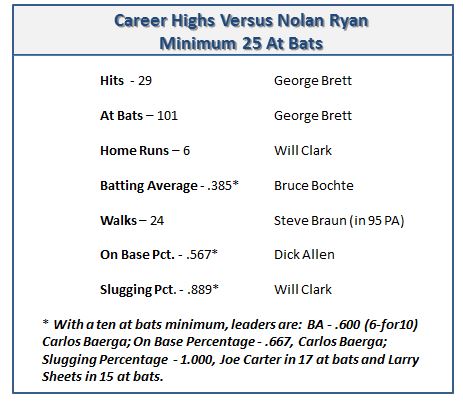
We’ll soon move on to the “World Versus Nolan Ryan” All Star squad, based solely on success against Ryan – but first a look at some of the “record holders” when it comes to matching up against the Hall of Famer.

Career vs, RyAN


THE BIG HURT – OUCH!    

Frank Thomas faced Nolan Ryan 15 times in his career and put the ball in play just once.

Frank Thomas photo

Photo by rchdj10

On August 17, 1990, 22-year-old White Sox Rookie Frank Thomas (in the early days of a Hall of Fame career that would earn him the nickname “The Big Hurt“) stepped into the batters’ box against another (much more experienced) future Hall of Famer  – 43-year old Nolan Ryan.  Thomas was in his 14th MLB game – and was hitting .357.  Ryan was in his 24th MLB season, pitching in his 732nd game.  On the 1990 season, he was 11-6, 4.10 with 150 strikeouts in 134 innings. At that point in his career, Ryan was 300-269, 3.17 with 5,226 whiffs in 4,919 1/3 innings. 

Thomas faced Ryan four times that day, saw 18 pitches and struck out swinging in all four plate appearances. (Ryan, by the way, went ten shutout innings, giving up just three hits and fanning 15, as his Rangers topped the White Sox 1-0 in 13 frames.) Notably, that four-whiff day was a sign of things to come.  Thomas faced Ryan 15 times in his  career (Ryan retired after the 1993 season.) In those fifteen plate appearances he went zero-for-twelve.  His results included two walks, one hit by pitch, 11 strikeouts (nine swinging) and an infield pop out.  In fairness to Thomas, he did go on to hit .301, with 521 home runs and 1,704 RBI over 19 MLB seasons. He was a five-time All Star, a two-time AL MVP and the 1997 AL batting champ. (In the three seasons in which he went 0-12 with 11 whiffs against Ryan, Thomas hit .322-63-255 overall.)


Now that World Versus Nolan Ryan squad.

—–The World Versus Nolan Ryan All Star Team—–

Catcher – Rick Cerone, RHH, 5’11”/192 pounds

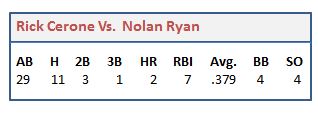
In his 18-season MLB career (1975-92), Rick Cerone faced Ryan 33 times (29 at bats).  He collected 11 hits, for a .379 average – including one double, one triple and two home runs, producing seven RBI.  He also did okay in the walks-to-strikeouts ratio, with four of each.

Cerone

Cerone’s success against Ryan comes as somewhat of a surprise.  Over his 18 seasons, he played in 100 or more games only four times and hit .245, with 59 home runs and 436 RBI.  He played in the major leagues from 1975 to 1992 –  (Indians… 1975-76; Blue Jays … 1977-79; Yankees…1980-84, 1987 & 1990; Braves … 1985; Brewers …1986; Red Sox 1988-89; Mets 1991; Expos 1992). His best season was 1988, when he hit .277, with 14 home runs and 85 RBI for the Yankees.

Rick Cerone’s two home runs and seven RBI against Nolan Ryan are the second-most he accumulated against any pitcher in his career. (He had three homers and ten RBI against Larry  Gura, whom he faced 55 times.)  

______________________________________________

First Base – Will Clark, LHH, 6’2”/190 pounds

As noted earlier, six-time All Star Will Clark got his MLB career off to a good start, homering off Nolan Ryan in his first-ever MLB at bat. He went on to prove the first round tripper was no fluke, hitting six home runs off Ryan between 1986 and 1988. Overall, Clark went 12-for-36 versus Ryan (.333), with eight extra-base hits and 11 RBI.  In 1988, Clark reached Ryan for a .600 average (six-for-ten), with two doubles, three home runs and five RBI. (That season, the 41-year-old Ryan went 12-11, 3.52, with NL leading 228 strikeouts in 220 innings.)

Clark

Over his MLB career (1986-2000), Clark collected 2,176 hits (.303 average), with 284 home runs and 1,205 RBI. He averaged .300 or better in ten of 15 campaigns, topped 20 home  runs six times and 100 RBI three times. Clark played for the Giants (1986-93); Rangers 1994-99), Orioles (1999-2000); and Cardinals (2000).

Will Clark’s six home runs versus Nolan Ryan are not only the most home runs any batter hit against Ryan, but also the most home runs Clark hit against any MLB pitcher.

___________________________________________

.300 – .400 – .400 …

Most at bats versus Nolan Ryan while maintaining a .300 or better average

Rod Carew –  93 at bats, .301 average

Most at bats versus Nolan Ryan while maintaining a .400 or better average

Gary Sutherland – 24 at bats, .417 average

Most at bats versus Nolan Ryan while maintaining a .500 or better average

Lonnie Smith – 24 at bats, .500 average

Most at bats versus Nolan Ryan while maintaining a .600 or better average

Carlos Baerga – 10 at bats, .600 average

__________________________________________

Second Base – Rod Carew, LHH, 6’/170 pounds

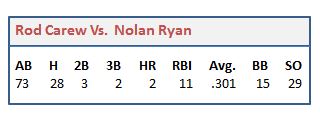
Okay, no surprise to see Rod Carew here.  He is, after all, a seven-time batting champ, who retired with 3,053 hits and a .328 career average. Carew has more at bats versus Ryan (93) than any other player who hit at least .300 against him. He also had the second-most career hits against Ryan with 28 – trailing only George Brett, who had 29 hits  in 101 at bats against Ryan (.287 average). Of course, getting touched for a .300 average versus Carew (.328 career average) is nothing to be ashamed of. The Hall of Famers  Carew hit at least .300 against (regular season) include Fergie Jenkins (.362 in 58 at bats); Jim Palmer (.358 in 95 AB); Catfish Hunter (.347 in 101 AB); Dennis Eckersley (.321 in 56 AB); Gaylord Perry (.316 in 76 AB); and, of course, Ryan.

Carew

Slow Starter?

In his first MLB game, Rod Carew struck out three times and grounded out pitcher-to-first.  Not a sign of things to come.

Carew was an 18-time All Star (in 19 MLB seasons … 1967-85). He hit .300 or better in 15 seasons (a high of .388 in 1977) and reached 200 or more hits in four campaigns. He was the AL Rookie of the Year in 1987, and league MVP in 1977. Carew played for the Twins (1967-78) and Angels (1979-86)

In 1974, when he won his fourth batting crown with a .364 average, Rod Carew hit .538 (seven-for-thirteen) versus Nolan Ryan – with a home run, four walks and four whiffs.

______________________________________________

Whiff – le Ball

Nobody struck out more times against Nolan Ryan than Claudell Washington, who faced Ryan 102 times and fanned 39. In those appearances (90 at bats), Washington hit .144. Nobody faced Ryan more times without striking out than Julian Javier, who stepped in the batter’s box 18 times against Ryan  and never fanned, but hit only .124 (two-for-sixteen). 

Here’s list of those who stepped in against Ryan at least a dozen times and never fanned.

Name                                      PA           AB               H            Avg.

Julian Javier                       18              16                  2            .125

Tommy Helms                    13               13                 2            .154

Carlos Baerga                      12                10               6            .600

________________________________________________

Third Base – Dick Allen, RHH, 5’11”/187 pounds

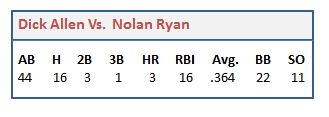
Thank goodness for Dick Allen’s 652 games at the hot corner, which enable me to keep both Allen and Will Clark in this lineup. Allen hit a robust .364 versus Ryan (16 hits in 44 at bats). He also hit three home runs versus The Ryan Express and drove in 16 tallies.  Only Darrell Porter and Rusty Staub had more career RBI (17 each) versus Ryan.  In 1968, Allen was perfect in eight plate appearances versus Ryan (then a 21-year-old rookie) collecting three hits (two home runs) and five walks.  Allen’s competition for this spot in the lineup came primarily from George Brett, who had the most career hits versus Ryan (29), but trailed Allen in HR (Brett had zero) and RBI (Brett had 8). In addition, Brett hit .287 against Ryan, well below his career .305 mark.

Allen

Allen was a seven-time All Star in 15 MLB seasons (1963-77). He collected 1,848 hits (.292 average, reaching .300+ in seven seasons), 351 home runs (topping 30 six times, a high of 40 in 1966) and reaching 100+ RBI three times.  He led his league in home runs twice, RBI once, runs scored once and triples once. He was the NL Rookie of the Year in 1964 and AL MVP in 1972. He played for the Phillies (1963-69 & 1975-76); Cardinals (1970); Dodgers (1971); White Sox (1972-74); and A’s (1977).

Despite striking out nearly twice as many times as he walked in his career (1,556 strikeouts to 894 walks), Dick Allen drew 22 walks versus just 11 strikeouts versus Nolan Ryan.  Those were the most walks Allen drew from any MLB pitcher – only one of the free passes was intentional.

________________________________________________

Shortstop Rafael Ramirez, RH, 6’/170-pounds

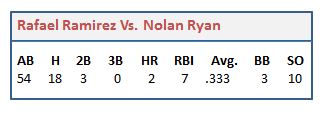
Rafael Ramirez, a .261 hitter in 13 MLB seasons (1980-92), is a bit of a surprise on this list – but put up a .333 average (18-for 54) versus Ryan, with two home runs and seven RBI.

During his career,  Ramirez was an All Star just once (1984, Braves). He reached double digits in home runs just once (10 in 1982) and hit over.270 in three campaigns.  He played for the Braves (1980-87) and Astros (1988-92). His best season was with the Braves in 1983, when he hit .297, with seven home runs, 58 RBI, 82 runs scored and 16 stolen bases in 152 games.

Ramirez

Rafael Ramirez hit two or more home runs against only four pitchers in his career. Don Robinson (3); Nolan Ryan (2); Bob Forsch (2); Dave Dravecky (2).

________________________________________________

Outfield – Carl Yastrzemski, LHH,  5’11’/175-pounds

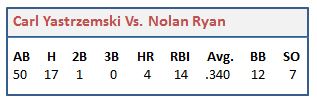
Carl Yastrzemski is no surprise on this list. In 23 MLB seasons (1961-83, all with the Red Sox), he collected 3,419 hits (.285 average), 452 home runs and 1,844 RBI. He touched Nolan Ryan for a .340 average (17-for-50), four home runs and 14 RBI.

Yaz was the AL MVP in 1967 (when he won the AL Triple Crown) and an All Star in 18 seasons. He won three batting titles (and hit .300 or better six times), twice led the AL in hits and three times topped the league in runs scored.

Yaz

Carl Yastrzemski was awarded a basketball scholarship by Notre Dame University.

_____________________________________________

Outfield – Lonnie Smith, RHH, 5’9”/170-pounds

Lonnie Smith was a bit of a journeyman over his 18-season MLB career (Phillies …1978-81; Cardinals … 1982-85; Royals … 1985-87; Braves … 1988-92; Pirates … 1993; Orioles … 1993-94). He was a steady performer throughout, putting up a .288 career average (1,488 hits) with 98 home runs, 909 runs, 553 RBI and 370 stolen bases. He hit over .300 in six seasons. As an All Star in 1982, he led the NL in runs (120) and hit .307 with eight home runs and 68 stolen bases.

Smith

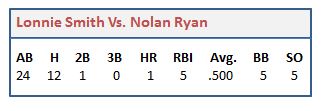
Smith did a good job against Nolan Ryan facing him 31 times and going 12-for-24 (.500 average), with one home run and five RBI. He also walked five times (versus five strikeouts) versus Ryan.

Lonnie Smith batted against Nolan Ryan in five different seasons (1980-84) and never hit under .333 against him.

_______________________________________________________

HALL OF FAMERS WHO DID WELL VERSUS NOLAN RYAN (minimum three at bats)

These Hall of Famers hit .333 or better versus Nolan Ryan:

Catfish Hunter –  .667 (2-for-3)

Eddie Murray  –  .389 (7-for 19)

Harold Baines –  .364 (8-for-22)

Barry Larkin – .357 (5-for-14)

Tony Perez – .346 (9-for-26)

Paul Molitor – .341 (14-for-41)

Carl Yastrzemski – .340 (17-for-50)

Phil Niekro – .333 (1-for-3)

Fergie Jenkins- .333 (1-for-3)

Joe Torre – .318 (7-for-22)

Hank Aaron – .308 (12-for-39)

Tony Gwynn – .302 (19-for-63)

Rod Carew – .301 (28-for-93)

Luis AparIcio – .300 (3-for-10)

Al Kaline – .300 (3-for-10)

These Hall of Famers hit .150 or lower against Ryan (minimum three at bats): 

Frank Thomas – .000 (0-12); Don Sutton – .000 (0-for-5); Jim Thome – .000 (0-for-4); Willie Mays – .000 (0-for-3); Edgar Martinez – .053 (1-for 19); Willie Stargell – .071 (1-for-14); Steve Carlton – .111 (1 for 9); Dave Winfield  – .115 (3-for-26); Rickey Henderson – .118 (2-for-17); Roberto Clemente – .125 (2-for-16); Willie McCovey – .133 (2-for 15); Johnny Bench – .138 (4-for-29); Jim Rice – .150 (6-for-40); Kirby Puckett – .150 (3-for-20).

_________________________________________________

Outfield – George Hendrick, RHH, 6’3”/195-pounds

George Hendrick play 18 seasons in the major leagues (1971-88) – collecting 1,980 hits (.278 average), 267 home runs and 1,111 RBI. He was an All Star four times, hit .300 or better four times, reached at least 20 home runs six  times and drove in 100 or more runs twice. Hendrick played for the A’s (1971-71); Indians (1973-76); Padres (1977-78); Cardinals (1979-84); Pirates (1985); Angels (1985-88).

Hendrick

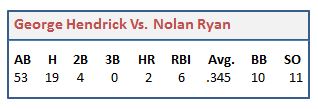
Against Nolan Ryan, Hendrick collected 19 hits in 53 at bats (.345), with two homers and six RBI.  The 19 hits were his sixth-most against any pitcher in his career.

George Hendrick, a .278 lifetime hitter, collected more hits off Hall of Famer Steve Carlton (38) than against any other pitcher.  He hit .345 against Carlton. He collected his third-most hits regular-season hits (22) off another HOFer, Bert Blyleven (.367 average) and his sixth-most (19) off Nolan Ryan.

________________________________________________

Pitcher – Ron Reed, RHH, – 6’6”/215-pounds

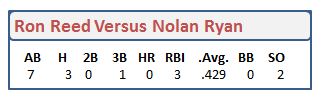
In his 19 MLB seasons, Reed went 149-140, with a 3.46 earned run average.  He stepped up to the plate seven times versus Nolan Ryan and produced two successful sacrifice bunts, one hit by pitch, three hits in seven at bats (a .429 average), one triple and three RBI.  In his career, Reed came to the plate 695 times and produced 98 hits (.158 average). In 1968, when he collected two of his three hits off Nolan Ryan (including the lone triple), he hit just .161 (10-for-62).  Reed’s main competition for a spot on this squad came from Catfish Hunter, who faced Ryan three times and produced a pair of singles and a foul ball pop out.

Reed

Ron Reed’s triple off Nolan Ryan was the only three-bagger of his career – and his three RBI versus Ryan were the most runs he plated off any opposing pitcher.

Primary Resources:  Baseball-Reference.com; MLB.com

Additional “Who’s Your Daddy?” looks at top lineups versus top pitchers:

  • Sandy Koufax, click here.
  • Bob Gibson, click here.
  • Pedro Martinez, click here.
  • Randy Johnson, click here


BASEBALL ROUNDTABLE MAKES TOP 100 BASEBALL BLOG LIST

100Baseball Roundtable has made the Feedspot list of the Top 1oo Baseball Blogs.  To see the full list, click here.

I tweet (on X) baseball @DavidBaseballRT

Follow/Like Baseball Roundtable’s Facebook Page here.  More baseball commentary; blog post notifications; PRIZES.

Member: Society for American Baseball Research (SABR); The Baseball Reliquary; The Negro Leagues Baseball Museum.
Enter Sandman – BBRT Dives into the 2019 HOF Balloting … including BBWAA vs. Fan Tallies

MO

The results are in and congratulations go out to the 2019 Baseball Hall of Fame Class – beginning with Mariano Rivera, the first-ever unanimous selection (Let the debates begin.) Well-deserved congratulations also go to 2019 inductees Edgar Martinez, Roy Halladay and Mike Mussina.  In addition, BBRT would like to congratulate Today’s Game Era Committee electees Lee Smith and Harold Baines. The bios of these deserving new Hall of Famers can be found at the end of this post.  But first, some BBRT observations on both the election (BBWAA and Era Committee) and the differences between the BBWAA official balloting and BBRT’s unofficial fan vote.

BBRT’s BALLOT (If I had one.)

BBRT would have voted for Rivera, Martinez, Halladay and Mussina – as well as Jeff Kent, Todd Helton, Larry Walker, Fred McGriff, Omar Vizquel and Andy Pettitte.  For BBRT’s comments on each of those candidates, see my November 19, 2018 post (click here). At that time, I predicted Rivera and Martinez would get in and had Halladay and Mussina as dark horse candidates with a good chance at election.  Looking at the Today’s Game Era Committee candidates, BBRT would have voted for Smith and Lou Piniella. Back on November 7, I predicted their election and had Harold Baines and George Steinbrenner as dark horse candidates.  For that post, click here.

OBSERVATIONS ON BBWAA BALLOT

Here are just a few thoughts on the BBWAA balloting.

  • Mariano Rivera’s unanimous election may pave the way for higher vote totals in the future. In the past, we have seen voters making a distinction between first-ballot electees and those elected on subsequent ballots (demanding more of first-timers on the ballot).  That distinction may be blurring.
  • The induction of Mariano Rivera (unanimous and first-ballot) and Lee Smith indicate a past bias related to relief pitchers may behind us.
  • The induction of Edgar Martinez (with about 70 percent of his MLB starts at DH) and Harold Baines (with about 60 percent of his MLB starts at DH) may indicate the relaxing of a perceived bias against players who were primarily designated hitters (good news for David Ortiz).   However, since Martinez got in on his tenth and final year on the ballot and Baines was elected by the Today’s Game ERA Committee, this one observation demands further proof.

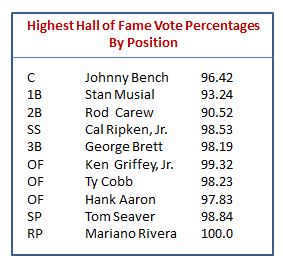
CMost votes
Others with 95 percent or higher: Nolan Ryan (98.79%); Tony Gwynn (97.61); Randy Johnson (97.27); Greg Maddux (97.20); Chipper Jones (97.16); Mike Schmidt (96.52); Steve Carlton (95.82); Babe Ruth (95.13); Honus Wagner (95.13). 

POST ELECTION QUESTION

On BBRT’s mind is whether Mike Mussina goes into the Hall of Fame as an Oriole or a Yankee.  Moose went 147-81, 3.53 in ten seasons for Baltimore and 123-72, 3.88 in eight seasons in New York. I’m rooting for the O’s – with whom Mussina has more wins and a lower earned run average, as well as more complete games (45 to 12) and more shutouts (15 to eight). Then again, his strikeouts per nine innings were better with the Yankees (7.4 to 6.9) and his walks per nine were also better (1.8 to 2.1). Mussina also had more post-season appearances with the Yankees (17 games to six), but his post-season record with Baltimore was 2-1, 2.53 versus 4-7, 3.80 with the New Yorkers.

BIGGEST SURPRISE OF 2019 BBWAA BALLOTING – LANCE BERKMAN

I admit I was surprised by Mariano Rivera’s unanimous election, I anticipated there would be a holdout or two based on a feeling that if Babe Ruth (or Ty Cobb, Hank Aaron, Cy Young, etc.) weren’t unanimous, no one should be.  Credit to the BBWAA for setting aside that thinking.  That aside, BBRT was very surprised to see Lance Berkman as a “one and done” on the ballot – with just 1.2 percent of the vote. I didn’t anticipate his election, but I did expect him to get enough support (five percent) to stay on the ballot.

Berkman – one of Houston’s “Killer B’s” – provided dependable power for the Astros (1999-2010).  He also played for the Yankees (2010), Cardinals (2011-12) and Rangers (2013).  Berkman was a five-time All Star, whose career line was .293-366-1,234.  He also hit 422 doubles (leading his league twice) and scored 1,146 runs. Berkman hit 30 or more home runs five times (a high of 42 in 2002); drove in 100+ runs in six seasons; scored 100+ runs  in five campaigns; and hit  over .300 five times.  Berkman is also one of only 21 major leagues to hit 55 or more doubles in a season and put up a .317-9-41 stat line in 52 post-season contests.

THE BBWAA OFFICIAL BALLOT VERSUS BBRT’S UNOFFICIAL FAN BALLOT

Here are a few comparison between the BBWAA Balloting and BBRT’s fan voting.

  • While the top four players were the same on both sets of ballots, the fan balloting seemed more demanding.  In the fan ballot only Mariano Rivera and Edgar Martinez got the necessary 75 percent. Halladay and Mussina were in the 55-60 percent range.
  • Fans voting in the BBRT ballot were also a tougher sell on Rivera, who got 86.5 percent of the fan vote.
  • Players selected per ballot were fairly even,with fans casting votes for 7.7 players per ballot and the writers voting for 8.0 per ballot.
  • Fans seemed less forgiving than the writers when it came to PED suspicions.  For example, in the BBWAA balloting, Roger Clemens and Barry Bonds  got 59.5 and 59.1 percent of the vote,  respectively.  In the BBRT fan balloting, Clemens got 44.9 percent and Bonds 43.2.
  • Fans spread their votes around a bit more.  In BBRT’s fan balloting only three players received zero votes, while in the BBWAA official ballot eleven players were shutout.
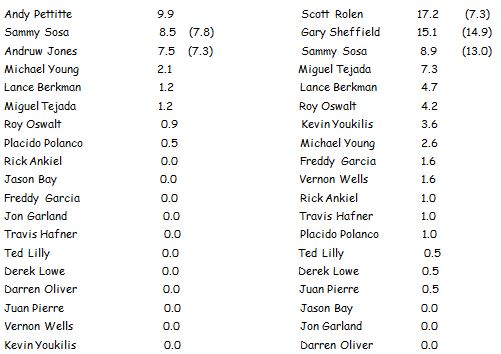
  • Sixteen players were “one and done” on the BBWAA ballot (less than five percent support), while fifteen received less than five percent on the BBRT fan ballot.  The names on the “one and done” lists were identical except that Miguel Tejada received 7.3  on BBRT’s unofficial fan ballot, but only 1.2 percent on the BBWAA ballot.

A half dozen other notable differences between the BBWAA ballot and BBRT’s unofficial fan balloting:

  1. Curt Schilling finished fifth in the BBWAA ballot at 60.9 percent – and 13th in BBRT ballot at 27.6 percent.
  2. Fred McGriff (in his tenth and final year on the ballot) finished tenth on the BBWAA ballot (39.8 percent, up 16.6 points from the previous year). He finished fifth in the fan balloting at 49.5 percent (up 11.6 points).
  3. Jeff Kent got 18.1 percent of the BBWAA vote and 34.9 percent in the fan vote.
  4. Scott Rolen got 17.2 percent support in both tallies.
  5. Todd Helton received 16.5 percent support from the writers, 36.5 percent in the fan balloting.
  6. Andruw Jones got just 7.5 percent in the writers’ balloting, 21.4 percent in the BBRT fan vote.

Here’s the full comparison.

Fan vote 1votepage 2
FV3

_________________________________________________________

BIGGEST HOF SNUBS

The BBRT Fan Ballot asked for comments on which players represent the most significant Hall of Fame Snubs.  Here are the  leaders (in terms of mentions.

Barry Bonds – 11 mentions

Roger Clemens – 8

Jim Kaat  – 7

Fred McGriff – 4

Dale Murphy – 4

From BBRT’s perspective: I’d go with Jim Kaat (283 wins/16 Gold Gloves); Jeff Kent (Most HR’s in MLB history/MVP Award/1,500+ RBI); and Larry Walker (.313 career average/three batting titles/MVP Award/seven Gold Gloves).

_________________________________________

2019 BASEBALL HALL OF FAME INDUCTEES

Now a look at the 2019 inductees.

Mariano Rivera – 100 Percent … (RHP/Closer, 1995-2013) … First year on the ballot.

Mariano Rivera photo

Photo by Keith Allison

Rivera is at the top of the 2019 HOF class, no matter how you look at it – and we finally have our first unanimous selection.  (Although I did always like the speculation.)

Rivera spent nineteen years with the Yankees and racked up an MLB-best 652 career saves.  He was an All-star in 13 seasons, led the AL in games saved three times and finished in the top three in Cy Young  voting four times. He saved 30 or more games in a season 15 times (including nine seasons of 40 or more saves, two of fifty or more) and put up an overall won-lost record of  80-52, with a 2.21 earned run average in 1,114 games. In 11 of his 19 seasons, Rivera’s earned run average was under 2.00 – which included a four-season span (2003-06), in which he saved 170 games, won 21 (13 losses) and put up a 1.69 ERA in 302 2/3 innings pitched. In his final season – at age 43 – Rivera went 6-2, with a 2.11 ERA and 44 saves.  Rivera was the American League Rolaids Relief Man of the Year in five seasons and the MLB Delivery Man of the Year in three campaigns.

In 96 post-season appearances, Rivera went 8-1, with 42 saves and a minuscule 0.70 ERA. Rivera was named the World Series MVP in 1999 and the ALCS MVP in 2003.  In 58 of his 96 post-season appearances, Rivera pitched more than one inning.  In the 2003 post-season, he appeared in eight games, pitching 16 innings (more than one frame in seven of the eight appearances), earning a win and five saves, giving up just one earned run (0.56 ERA).

Mariano Rivera’s Best Season: Lots to choose from here – like 43 saves and a 1.38 ERA in 2005; or 44 saves and a 1.91 ERA in 2011 (at age 41). BBRT will go with 2004, when Rivera saved a career-high 53 games, won four (lost two) and posted a 1.94 ERA

_________________________________________________

Edgar Martinez – 85.4 Percent … (Designated Hitter/Third Base, 1987-2004) … Tenth/Final year on the ballot, 70.4 percent on the BBWAA ballot in 2018.

Edgar Martinez baseball photo

Photo by clare_and_ben

We’ve seen some bias against designated hitters in past voting, but Edgar Martinez’ election indicates this may be subsiding. Martinez clearly, and expertly, defined the DH role. In an 18-season MLB career (all with the Mariners), Martinez was named to seven All Star teams; won a pair of batting titles (hitting a high of .356 in 1995); earned five Silver Slugger Awards; topped 100 RBI in six seasons (leading the league with 145 in 2000); and scored 100 or more runs five times (leading the league with 121 in 1995). He finished his career with a .312 average; 2,247 hits; 1,219 runs; 1,261 RBI; 309 home runs; and 514 doubles.

Martinez hit .571 in the 1995 AL Championship Series (12-for-21), with two home runs, six walks and 10 RBI in five games.  In 34 post-season games, he hit .266, with eight home runs and 24 RBI.

Edgar Martinez’ Best Season: One of two … In 1995, Martinez led the league in batting average (.356), runs scored (121) and doubles (52), adding  29 home runs and 113 RBI.  In 2005, Martinez put up a .324 average, 37 home runs, a league-leading 145 RBI and 100 runs scored.

_____________________________

Roy Halladay – 85.4 percent …. (RHP/Starter, 1998-2013) … First year on the ballot.

Roy Halladay photo

Photo by Keith Allison

Roy Halladay had one of the best-ever ten-year runs on the mound (2002-2011).  In those ten seasons, he went 170-75, with a 2.97 earned run average and 1,699 strikeouts in 2,194 2/3 innings. He was an All Star eight times during that span and won a pair of Cy Young Awards (2003 and 2010). Halladay also recorded three seasons of 20 or more wins during those ten seasons, leading his league twice. Between 2002 and 2011, he also led his league in complete games seven times, shutouts four times and innings pitched four times.

And, there is more to support Halladay’s candidacy.  On May 10, 2010, he pitched a perfect game – striking out 11 – as his Phillies topped the Marlins 1-0 in Miami. Then, on October 6, 2010, Halladay tossed a no-hitter against the Reds in Game One of the National League Division Series – walking one and fanning eight as the Phillies won 4-0. It was just the second no-hitter in post-season history.  Halladay was also one of just six pitchers to win the Cy Young Award in both the American and National Leagues.

Halladay finished his career at 203-105, 3.38 with 2,117 strikeouts in 2,749 1/3 innings pitched.  He pitched for the Blue Jays (1998-2009) and Phillies (2010-13).

Roy Halladay’s Best Season: In his 2010 Cy Young Award season – after being traded from the Blue Jays to the Phillies in December of 2009 – Halladay led the NL in wins (21-10); complete games (nine), shutouts (four), and innings pitched (250 2/3), while putting up a 2.35 ERA (third in the league), fanning 219 batters (second in the NL) and walking just 30.    His 7.3 strikeouts to walks ratio was the NL’s best.

________________________________________

Mike Mussina – 76.7 Percent …  (RHP/Starter, 1991-2008) – Sixth year on the ballot 63.5 percent on the BBWAA 2018 ballot.

Mike Mussina photo

Photo by Willie Zhang

Mussina built a 270-153 record, with a career 3.68 ERA and 2,813 strikeouts over 18 seasons. While only once a 20-game winner (in his final season, at age 39), Mussina won 18 or 19 games five times, leading the AL with 19 wins in 1995. In his first three full seasons in the major leagues (1992-94), Mussina put up a .700 or better winning percentage each year (.783, .700, .762). His record over that span – for the Orioles – was 48-16.

Mussina was a five-time All Star and a seven-time Gold Glove winner. He recorded a .650 or better winning percentage in nine seasons, with a career (and league-leading) high of .783 in 1992.  Mussina ranks among the top 25 pitchers all-time in strikeouts (20th) and strikeout-to-walk ratio (24th among pitchers with 1,000 or more innings pitched). He’s also in the top fifty all-time in games started, wins and winning percentage.  Mussina pitched for the Orioles (1991-2000) and Yankees (2000-2008).  Mussina appeared in 23 post-season games, with a 7-8 record and a 3.42 ERA.

Mike Mussina’s Best Season:  Mussina may have saved his best for last.  In his final season (as a Yankee), at age 39, he recorded his first twenty-win campaign.  That year, Mussina went 20-9, 3.37 – and proved his durability by leading the AL in starts with 34, logging his 11th season of 200 or  more innings pitched and earning his seventh Gold Glove

_________________________________________________


— Today’s Game Era Committee Electees—-

Lee Smith (RHP) … 1980-97

From Baseball Roundtable’s perspective, Lee Smith should have been in the Hall of Fame years ago.  However, in his 15 years on the traditional ballot, he never garnered more than 50.6 percent support – and never less than 29.9 percent.

Why does BBRT feel strongly about Lee Smith spot in the Hall? Smith’s 478 career saves put him third on the all-time list (he was number-one when he retired after the 1997 season).  He recorded 13 consecutive seasons (in an 18-year career) of 25 or more saves, a 3.03 lifetime ERA and 1,251 strikeouts in 1,289 innings pitched; led his league in saves four times; made seven All Star teams; and was the Rolaids Relief Man of the Year in three seasons.  Smith also is one of just 16 pitchers to appear in 1,000 or more MLB games.  His 1,022 appearances put him at number 13.

Smith pitched for the Chicago Cubs (1980-87); Boston Red Sox (1988-90); St. Louis Cardinals (1990-93); New York Yankees (1993); Baltimore Orioles (1994); California Angels (1995-96); Cincinnati Reds (1996); Montreal Expos (1997).

Lee Smith’s best season:  1991, Cardinals … 6-3, 2.34 ERA, 47 saves, 73 innings pitched, 67 strikeouts.

_____________________________________________

Harold Baines (OF/DH) … 1980-2001

Harold Baines baseball photo

Photo by Keith Allison

Harold Baines had a 22-season MLB career. He was a six-time All Star and two-time winner of the Designated Hitter of the Year Award. He is in the top 50 players all-time in hits with 2,866 (46th) and RBI with 1,628 (34th). Baines, with a .289 career average, hit .300 or better in nine seasons. He was a steady source of power with 384 home runs, never reaching 30 in a season, but hitting 20 or more home runs in ten campaigns.  He drove in 100+ runs in three seasons and scored 1,299 runs in his career. Baines hit .324, with five home runs, 16 RBI and 14 runs scored in 31 post-season contests.  Harold Baines played for the White Sox (1980-1989, 1996-1997, 2000-2001); Rangers (1989-1990); A’s (1990-1992); Orioles (1993-1995, 1997-2000); and Indians (1999).

Harold Baines’ best season:  Baines’ best MLB campaign may have been 1999, when – at age 40 – he made his final All Star team and hit .312, with 25 home runs and 103 RBI, playing for the Orioles and Indians. That season, Baines also hit .357 (5-for-16), with one home run and four RBI in four post-season (ALDS) games.

Primary Resources:  Baseball-Reference.com; MLB.com; Society for American Baseball Research. 

BASEBALL ROUNDTABLE MAKES TOP 100 BASEBALL BLOG LIST

100Baseball Roundtable has made the Feedspot list of the Top 1oo Baseball Blogs.  To see the full list, click here.

I tweet baseball @DavidBBRT

Follow/Like Baseball Roundtable’s Facebook Page here.  More baseball commentary; blog post notifications; PRIZES.

Member: Society for American Baseball Research (SABR); The Baseball Reliquary; The Negro Leagues Baseball Museum.
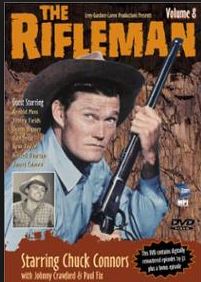
BBRT Trivia Teaser … Looking for the Flint Flash

Baseball Roundtable Trivia Teaser

Who holds the professional baseball record for the most stolen bases in a single season?

While not a multiple choice question, this query does have multiple acceptable answers – at least in Baseball Roundtable’s view.

If you are going with Major League Baseball post-1900, you would be looking at MLB’s all-time best lead-off hitter – Rickey Henderson – who swiped 130 bases for the Oakland A’s in 1982,

If you would prefer MLB all-time, we are talking about Hugh Nicol, credited with 138 steals for the 1887 American Association (considered a major league) Cincinnati Red Stockings.  (At that time, stolen bases were credited on a different standard.  A player, for example, was awarded a steal for taking an extra base on a teammate’s hit – say, for going from first to third on a single.)

Side note:  Researching this post, I did come across a couple of references to a 140-stolen base season by Tommy McCarthy (St. Louis Browns, American Associating, 1890).  However, Baseball-Refeence.com; Baseball-Almanac.com and the ESPN Baseball Encyclopedia all credit McCarthy with a league-leading 83 steals that campaign.

If you want to include the minor leagues, Reds’ CF Billy Hamilton (who recently signed with the Royals as a free agent) is your guy.  In 2012, Hamilton played in 132 games at High A (Bakersfield Blaze) and Double A (Pensacola Blue Wahoos), pilfering a combined, minor-league record 155 bags.

The answer BBRT is looking for. However, put all of the above to shame.  In 1946, Sophie Kurys of the All American Girls Professional Baseball League’s (AAGPBL) Racine Belles stole an all-time professional record of 201 bases (in 113 games) – and she was thrown out only twice.  (By comparison, in his 130-steal season, Rickey Henderson was gunned down 42 times.)

Let’s take a look at the players who make up this quartet of acceptable answers, starting with Kurys.

Sophie Kurys … 1946 Racine Bells … 201 Stolen Bases

KurysAt just 5’ 5”, 120-pounds, the biggest thing about the Racine Belle’s second baseman was her daring heart.  An all-around great player (four-time AAGPBL All Star), Kurys was at her best when she was on the base paths – stealing 1,114 bases in 914 games.  Kurys, who earned the nicknames the Flint Flash (she hailed form Flint, Michigan) and Tina Cobb (after the Tigers’ great base stealer), stole 115 or more bases in seven straight seasons – and she did it in a skirt (no sliding pads) on infields that were often as rougher than sandpaper.

Kurys, who signed with the AAGPBL in 1943, was a superb athlete. As a teenager, she was a leading competitor in track, basketball, softball and volleyball.  After a successful tryout, she further proved her athletic skills and competitive heart with the AAGPBL Racine Belles.

Kurys holds the AAGPBL single season records for runs scored (117); walks (93); and, of course, steals (201).  She also holds the AAGPBL career records for runs scored (688) and stolen bases (1,114).  She was a All Star each season from 1946 through 1949 and the AAGPBL Player of the Year in 1946.  Kurys led the league in stolen bases seven times, runs scored six times and home runs once.

Kurys stats

______________________________________

Billy Hamilton … 2012 Bakersfield Blaze and Pensacola Blue Wahoos … 155 Stolen Bases

Billy Hamilton baseball photo

Photo by Keith Allison

The minor league stolen base record belongs to Billy Hamilton, who swiped 155 bases in 1955, while playing in the Reds’ farm system.  Hamilton signed with the Reds in 2009, after being selected in the second round of the June MLB Draft. Like the other players that share portions of the professional stolen base record (at least for the purposes of this post), Hamilton was an all-around athlete – a high school all-stater (Mississippi) in baseball, basketball and football.

In his first two minor league campaigns, the 6’, 180-pound switch hitter stole 62 bases in 112 games (caught just 12 times) for  the rookie-level Gulf Coast League Reds and Pioneer League Billings Mustangs. In 2001, the then 20-year-old turned on the afterburners with the Class A Dayton Dragons, hitting .278 and swiping 103 bases in 123 attempts. Then came 2012, when he took the field for 132 games (at High A and double A), hitting a combined .311, with 155 steals 192 attempts.

Hamilton

Hamilton spent most of 2013 in the minors, swiping another 75 bases – this time for the Triple A Louisville Bats (.256 average in 123 games).  He made his MLB debut on September 3 of that season.   In his first MLB starting assignment – September 18, 2013, Hamilton (playing CF and batting ninth against the AL Astros) went three-for-four, with two walks, two runs scored, one RBI and four stolen bases.  Over the past five MLB campaigns (all with the Reds), Hamilton has averaged .244 and stolen 264 bases – topping 50 four times.

Pretty Appropriate “Namesake”

Before today’s fleet-footed Billy Hamilton, MLB featured “Sliding Billy” Hamilton – who made his MLB debut in 1888 with the American Association Kansas City Cowboys. Hamilton played 11 MLB seasons, during which he topped 100 steals four times (and led his league in steals five times), with a high of 111 (1889 American Association Kansas  City Cowboys and 1891 Philadelphia Phillies). Hamilton collected 2,164 MLB hits (.344 average) and stole 914 bases – MLB’s third-most all time.  Pretty good (and fast) footsteps for today’s Billy Hamilton to follow in.

________________________________________

Hugh Nicol … 1887 American Association Cincinnati Red Stockings … 138 Stolen Bases

Photo: Library of Congress

Photo: Library of Congress

Cincinnati Red Stockings’ outfielder Hugh Nicol was “slight” even by 1880’s standards – standing just 5’4’ and weighing at 145 pounds. While, he wasn’t exactly a potent offensive force with the bat (.235 average over a ten-season MLB career), he could do some damage on the base paths – being credited with an American Association high 138 stolen bases in 1887.  (Keep in mind that, at the time, stolen bases were award when a runner took an extra base on a batter’s hit – like moving from first to third on a single.) It was the only season Nicol led his league in steals, although he did top 100 thefts in 1888 and reached 80 in 1889.

In ten LB seasons (1881-90), Nicol played in 88 games, hitting .235 (813 hits), scoring 631 runs and driving in 272.  He is credited with 383 stolen bases, but five of his MLB seasons came before stolen base were recorded.

Hugh Nicol was – again like all the players in this post – an all-around gifted athlete;  particularly skilled in gymnastics and wrestling. Nicol, in fact, was known to supplement his baseball income as a gymnastics instructor.  Nicol put his acrobatic skills to use in the outfield – earning a reputation for his range and dexterity.  He twice led his league in outfield assists (also finishing second twice), twice finished second in outfield fielding percentage and twice finished in the top four in outfield putouts and double plays.

Hugh Nicol, in 1906, was selected as the first Athletic Director at Purdue University.

_______________________________________________________

Rickey Henderson … 1982 Oakland A’s … 130 Stolen Bases

Rickey Henderson photo

Photo by Gary Soup

What can you say about Hall of Famer Rickey Henderson (off and running in the photo to the left), who swiped an MLB-record 130 bases for the A’s in 1982? What a year that was, as the 5’10/180-pound outfielder hit .267 (149 games), scored 119 runs, hit ten homers, drove in 51 runs and stole a 130 bags in 172 attempts.

It’s getting repetitive, but these all-time base stealers were all all-around athletes.  In high school, Henderson starred in baseball, football and basketball. Henderson was, in fact, a high school All-American in football.

Born to be Wild

There can be no double that Henderson ran wild on the base paths.  He led his league in stolen bases 12 times – and in caught stealing five times.

Henderson was selected by the A’s right out of high school, in the fourth round of the 1976 MLB Draft.  And, he was going full speed right out of the gate. As a 17-year-old with the Low-A (Northwest League) Boise A’s, Henderson hit .336 and stole 29 bases in 46 games.  That performance was just the first step in his “fast’ track to the major leagues. Henderson moved up to Class A Modesto in 1977 and hit .345, with 95 steals and 120 runs scored in 134 games; while also popping 11 home runs.

Let’ Get this Party Started

On May 26, 1977, Rickey Henderson stole seven bases in a single game, as his Modesto A’s topped the Fresno Giants 13-12 in a California League contest.

To make a long story short, in 3 ½ minor league seasons, Henderson hit .325 and stole 249 bases in 384 games.  On June 24, 1979, the 20-year-old Henderson made his MLB debut and the rest – as they say – is history.  In a 25-year MLB career, Henderson (who played for nine teams) was a ten-time All Star and the 1980 American League Most Valuable Player.  He led his league in stolen bases 12 times, runs scored five times, walks four times and base hits once. He holds the MLB records for career stolen bases (1,406), run scored (2,295) and lead-off home runs (81).  Henderson stole 100 or more bases three times (50 or more 14 times); scored 100 or more runs in a season 13 times; drew 100 or more walks seven times; and hit 20 more more home runs in four seasons.Hendo

Talk About Longevity

Rickey Henderson captured his first stolen base crown in 1980 (100 steals) at the age of 21.  He won his final stolen base crown in 1998, at the age of 39 (when he swiped 66 bases in 79 attempts). 

Primary Resources:  Baseball-Reference.com; Baseball-Almanac.com; AAGPBL.org; Society for American Baseball Research; The ESPN Baseball Encyclopedia.  

BASEBALL ROUNDTABLE MAKES TOP 100 BASEBALL BLOG LIST

100Baseball Roundtable has made the Feedspot list of the Top 1oo Baseball Blogs.  To see the full list, click here.

I tweet baseball @DavidBBRT

Follow/Like Baseball Roundtable’s Facebook Page here.  More baseball commentary; blog post notifications; PRIZES.

Member: Society for American Baseball Research (SABR); The Baseball Reliquary; The Negro Leagues Baseball Museum.
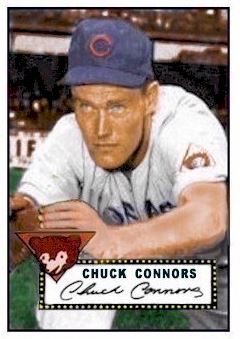
BBRT Unofficial 2019 Hall of Fame Fan Ballot – One Tough Crowd

Baseball Roundtable’s 2019 unofficial fan Hall of Fame balloting is complete – and, in this post, I’d like to share the results and a few early observations.  (I will post a more detailed comparison of the Baseball Writers Association of America – BBWAA –  official balloting and the BBRT fan voting once the official results are announced on January 22). Note: This year’s fan ballot results include 192 ballots (218 were cast, but 26 were eliminated, primarily on one of  two grounds; they either included more than the allotted ten votes or represented multiple ballots from the same individual.
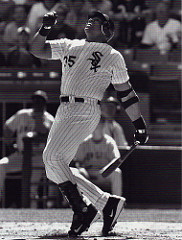
Here are some early notes.  When BBRT ran its first fan ballot last year, I fully expected the fans to be less demanding of candidates than the BBWAA. Oops! A swing and a miss!  Last year, the writers voted in Chipper Jones (97.2 percent); Vlad Guerrero (92.9 percent); Jim Thome (81.8 percent); and Trevor Hoffman (79.9 percent). While the BBRT fan vote put the same four players at the top, only two got the required 75 percent –  Chipper Jones (90.0 percent and Jim Thome (75.9 percent). Vlad Guerrero and Trevor Hoffman got 71.7 percent and 57.5 percent, respectively.

2019 FAN BALLOT – Mariano Rivera and Edgar Martinez Garner 75 Percent-plus

REOnly two players got the required 75 percent support in the 2019 BBRT fan ballot: Mariano Rivera (86.5 percent) and Edgar Martinez (75.5 percent). A coincidence of interest to BBRT, both were at positions subject to previous negative bias in HOF voting and both so eloquently (through their performance) defined those positions that Major League Baseball now has awards named after them:  The Mariano Rivera American League Reliever of the Year Award  and The Edgar Martinez Outstanding Designated Hitter Award.

In the publicly announced BBWAA balloting (171 ballots as of January 14/41.5 percent of eligible voters), Rivera and Martinez received even stronger support than in the BBRT fan ballot, with Rivera at 100 percent and Martinez at 90.1 percent.  Perhaps even more notable, in the BBWAA ballots made public through January 14, Roy Halladay (94.2 percent) and Mike Mussina (81.3 percent) were also above 75 percent mark.  Should those results hold, we would again see four candidate getting the needed 75 percent support from the BBWAA and just two receiving three-fourths of the fan vote. I do anticipate percentages to slip a bit as final BBWAA vote totals are announced – based on an expectation that voters who voted for the fewest candidates at the least likely to have publicly released their ballots.  Of considerable interest will be whether Rivera becomes the first unanimous electee.

2019 ballot

Note: You can view an update total of BBWAA publicly revealed ballot at bbhoftracker.com

In the Baseball Roundtable 2019 Hall of Fame Fan Ballot, participants voted for an average of 7.7 players per ballot. In the publicly announced BBWAA official balloting (through January 14), voters selected 8.7 players per ballot.  Those numbers mirror full 2018 voting, when BBRT ballots showed 7.9 players per voter, while the BBWAA voters selected 8.5 per ballot.

PED FORGIVENESS SLOW IN COMING FROM FANS

Comparing BBWAA balloting (again publicly released ballots through January 14), fans seem less forgiving then the writers when it comes to PED suspicions. For example, in the fan ballot, Roger Clemens came in at 44.8 percent; Barry Bonds at 43.2 percent; and Sammy Sosa at 8.9 percent.  Through January 14, the publicly announced BBWAA total for those three were 73.1 percent, 72.5 percent and 13.5 percent, respectively. Also, of note; fan vote percentages were down from 2018 for all three; while BBWAA percentages were up from 2018 finals for all three.

BIGGEST GAINERS AND LOSERS IN BBRT FAN BALLOT

Here’s a look at the biggest gainers and losers in the BBRT 2019 Fan Ballot.  BBRT will look at official BBWAA ballot gainers and losers when the final tallies are in.

Largest Gains

Larry Walker … +18.7 (28.7% to 47.4%)

Edgar Martinez … +18 .0 (57.5 to 75.5)

Mike Mussina … +13.0 (44.8 to 57.8)

Fred McGriff … +11.6 (37.9 to 49.5)

Jeff Kent … +10.8 (24.1 to 34.9)

Biggest Losses

Curt Schilling … -8.0 (35.6 to 27.6)

Roger Clemens … -4.2 (49.0 to 44.8)

Sammy Sosa … -4.1 (13.0 to 8.9)

Barry Bonds … -3.5 (46.7 to 43.2)

BIGGEST HOF SNUBS

The BBRT Fan Ballot also asked for comments on which players represent the most significant Hall of Fame Snubs.  Here are the  leaders (in terms of mentions.

Barry Bonds – 11 mentions

Roger Clemens – 8

Jim Kaat  – 7

Fred McGriff – 4

Dale Murphy 4

Three each: Jeff Kent; Edgar Martinez; Mike Mussina; Ted Simmons; Sammy Sosa.

There will be more to come when the official BBWAA results are released.  In the meantime, here’s how BBRT would have voted if I had a ballot.  (I would select the maximum ten players.)

——IF I HAD A BALLOT – BBRT’S WISHFUL THINKING——

 Mariano Rivera – (RHP/Closer, 1995-2013) … First year on the ballot.

MO

The question is not whether Rivera is a first-ballot Hall of Famer, it’s will he be the first-ever unanimous electee.  Best guess, there will be at least one BBWAA holdout.  He is at the top of the 2019 HOF class, no matter how you look at it.

Nineteen years with the Yankees and an MLB-best 652 career saves.  Rivera was an All-star in 13 seasons, led the AL in games saved three times and finished in the top three in Cy Young  voting four times. He saved 30 or more games in a season 15 times (including nine seasons of 40 or more saves, two of fifty or more) and put up an overall won-lost record of  80-52, with a 2.21 earned run average in 1,114 games. In 11 of his 19 seasons, Rivera’s earned run average was under 2.00 – which included a four-season span (2003-06), in which he saved 170 games, won 21 (13 losses) and put up a 1.69 ERA in 302 2/3 innings pitched. In his final season – at age 43 – Rivera went 6-2, with a 2.11 ERA and 44 saves.  Rivera was the American League Rolaids Relief Man of the Year in five seasons and the MLB Delivery Man of the Year in three campaigns.

In 2014, MLB established the Mariano Rivera AL Reliever of the Year Award (and the Trevor Hoffman NL Reliever of the Year recognition) – replacing the MLB Delivery Man of the Year Award.

Rivera was also an elite performer in the clutch. In 96 post-season appearances, he went 8-1, with 42 saves and a minuscule 0.70 ERA. Rivera was named the World Series MVP in 1999 and the ALCS MVP in 2003.  In 58 of his 96 post-season appearances, Rivera pitched more than one inning.  In the 2003 post-season, he appeared in eight games, pitching 16 innings (more than one frame in seven of the eight appearances), earning a win and five saves, giving up just one earned run (0.56 ERA).

Mariano Rivera’s Best Season: Lots to choose from here – like 43 saves and a 1.38 ERA in 2005; or 44 saves and a 1.91 ERA in 2011 (at age 41). BBRT will go with 2004, when Rivera saved a career-high 53 games, won four (lost two) and posted a 1.94 ERA

_________________________________________________

Edgar Martinez – (Designated Hitter/Third Base, 1987-2004) … Tenth/Final year on the ballot, 70.4 percent on the BBWAA ballot in 2018.

Edgar Martinez baseball photo

Photo by clare_and_ben

We’ve seen some prejudice against designated hitters in past voting, but Edgar Martinez has made progress against that negative bias – getting 70.4 percent pf the vote last season, a healthy increase from 58.6 percent in 2017. Martinez’ vote percentage has increased every year since 2015. The fact that this is his final year on the ballot should provide that final push. In publicly released BBWAA ballots through January 14, he stands at 90.1 percent.  This will be the year.  (Side note: Martinez came in at 75.5 percent on the BBRT fan ballot.)

Martinez clearly, and expertly, defined the DH role. In an 18-season MLB career (all with the Mariners), Martinez was named to seven All Star teams; won a pair of batting titles (hitting a high of .356 in 1995); earned five Silver Slugger Awards; topped 100 RBI in six seasons (leading the league with 145 in 2000); and scored 100 or more runs five times (leading the league with 121 in 1995). He finished his career with a .312 average; 2,247 hits; 1,219 runs; 1,261 RBI; 309 home runs; and 514 doubles.

Martinez hit .571 in the 1995 AL Championship Series (12-for-21), with two home runs, six walks and 10 RBI in five games.  In 34 post-season games, he hit .266, with eight home runs and 24 RBI.

In 2004, MLB renamed the Outstanding Designated Hitter Award “The Edgar Martinez Outstanding Designated Hitter Award.” That says a lot, right there.

Edgar Martinez’ Best Season: One of two here, In 1995, Martinez led the league in batting average (.356), runs scored (121) and doubles (52), adding  29 home runs and 113 RBI.  In 2005, Martinez put up a .324 average, 37 home runs, a league-leading 145 RBI and 100 runs scored.

_____________________________

Mike Mussina –  (RHP/Starter, 1991-2008) – Sixth year on the ballot 63.5 percent on the BBWAA 2018 ballot.

Mike Mussina photo

Photo by Willie Zhang

In 2015, BBRT speculated that the presence newcomers Randy Johnson, Pedro Martinez and John Smoltz on the Hall of Fame ballot would dampen the chances of all other pitchers – including Mike Mussina – for election.  This year, I speculated that the addition of Roy Halladay to the ballot would help Mussina. Basically, I anticipated that Halladay would generate considerable support and that, as BBWAA voters considered a ballot for Halladay (who has 203 wins), Mussina’s 270 victories will carry additional weight.  That seems to be coming to pass, with Halladay standing at 94.2 percent through January 14 and Mussina at 81.3 percent.

Since his first-ballot percentage of 20.3 percent in 2014, Mussina’s totals have climbed each year – 24.6 percent in 2015; 43.0 percent in 2016; 51.5 percent in 2017; and 63.5 percent in 2018.  He would have had BBRT’s vote in each of those years – and in 2019.

Mussina built a 270-153 record, with a career 3.68 ERA and 2,813 strikeouts over 18 seasons. While only once a 20-game winner (in his final season, at age 39), Mussina won 18 or 19 games five times, leading the AL with 19 wins in 1995. In his first three full seasons in the major leagues (1992-94), Mussina put up a .700 or better winning percentage each year (.783, .700, .762). His record over that span – for the Orioles – was 48-16.

Mussina was a five-time All Star and a seven-time Gold Glove winner. He recorded a .650 or better winning percentage in nine seasons, with a career (and league-leading) high of .783 in 1992.  Mussina ranks among the top 25 pitchers all-time in strikeouts (20th) and strikeout-to-walk ratio (24th among pitchers with 1,000 or more innings pitched). He’s also in the top fifty all-time in games started, wins and winning percentage. While the lack of a Cy Young Award on his resume may hurt him, he finished his career 117 games over .500 – and history says 100 or more wins than losses should be good for a ticket to the Hall. Mussina pitched for the Orioles (1991-2000) and Yankees (2000-2008).

On September 2, 2001, Mike Mussina – pitching for the Yankees – retired the first 26 Red Sox batters he faced and came with one strike of a perfect game. Mussina had a 1-2 count on pinch-hitter Carl Everett before Everett blooped a single to left-center. Mussina ended up with a 1-0, one-hit shutout victory.

Mussina appeared in 23 post-season games, with a 7-8 record and a 3.42 ERA.

Mike Mussina’s Best Season:  Mussina may have saved his best for last.  In his final season (as a Yankee), at age 39, he recorded his first twenty-win campaign.  That year, Mussina went 20-9, 3.37 – and proved his durability by leading the AL in starts with 34, logging his 11th season of 200 or  more innings pitched and earning his seventh Gold Glove

Mussina deserves a spot in Cooperstown and I expect it will be a VERY close call – but it looks like he will make it this year.

_________________________________________________

Roy Halladay – (RHP/Starter, 1998-2013) … First year on the ballot.

Roy Halladay photo

Photo by Keith Allison

Roy Halladay had one of the best-ever ten-year runs on the mound (2002-2011).  In those ten seasons, he went 170-75, with a 2.97 earned run average and 1,699 strikeouts in 2,194 2/3 innings. He was an All Star eight times during that span and won a pair of Cy Young Awards (2003 and 2010). Halladay also recorded three seasons of 20 or more wins during those ten seasons, leading his league twice. Between 2002 and 2011, he also led his league in complete games seven times, shutouts four times and innings pitched four times.

And, there is more to support Halladay’s candidacy.  On May 10, 2010, he pitched a perfect game – striking out 11 – as his Phillies topped the Marlins 1-0 in Miami. Then, on October 6, 2010, Halladay tossed a no-hitter against the Reds in Game One of the National League Division Series – walking one and fanning eight as the Phillies won 4-0. It was just the second no-hitter in post-season history.

Halladay would get BBRT’s vote and (through January 14) is running at just over 90 percent among publicly revealed BBWAA ballots.   If there is a negative in his candidacy it’s that, in the six seasons outside his ten-year run of excellence, Halladay was 33-26, 5.03.  Halladay finished his career at 203-105, 3.38 with 2,117 strikeouts in 2,749 1/3 innings pitched.  That appears to be enough for BBWAA voters.  Halladay pitched for the Blue Jays (1998-2009) and Phillies (2010-13).

Roy Halladay is one of just six pitchers to win the Cy Young Award in both the American and National Leagues.

Roy Halladay’s Best Season: In his 2010 Cy Young Award season – after being traded from the Blue Jays to the Phillies in December of 2009 – Halladay led the NL in wins (21-10); complete games (nine), shutouts (four), and innings pitched (250 2/3), while putting up a 2.35 ERA (third in the league), fanning 219 batters (second in the NL) and walking just 30.    His 7.3 strikeouts to walks ratio was the NL’s best.

_______________________

Larry Walker – (Outfield, 1989-2005) … Ninth year on the ballot, 34.1 percent from the BBWAA last year.

Larry Walker played for the Expos (1989-1994), Rockies (1995-2004) and Cardinals (2004-2005).  Given BBRT’s admiration for “lumber AND leather,” Walker’s combination of three batting titles, three Silver Slugger Awards and seven Gold Gloves earns him my vote.

Walker played 17 MLB seasons and retired with 2,160 hits, a .313 average and three batting titles.  Between 1997 and 2001, he hit .350 or better in four of five seasons. The five-time All Star (and 1997 NL MVP) hit 383 home runs (a high of 49 in 1997) and stole 230 bases (a high of 33 in 1997).  Walker hit just .230 in 28 post-season games, but did rack up seven home runs, 15 RBI and sixteen walks in those contests. Walker’s ten seasons in hitter-friendly Colorado may be hurting his vote totals – he hit .383 for his career in Coors, .271 elsewhere.  Still, BBRT believes if you add his Gold Glove defense to his productive bat, you have a Hall of Famer.  I’m also not much for punishing a player for taking full advantage of his home-field conditions.

Walker has shown progress this voting cycle, going from 34.1 percent among BBWAA voters in 2018 to 66.5 percent on publicly revealed BBWAA ballots (through January 14). He also made a 19-point leap on the BBRT fan ballot.  He has just one more year on the ballot, so a big move this year is crucial.

In 1997, Larry Walker led the NL with 409 total bases – the 18th highest single-season total all-time. (There have been only 29 seasons of 400 or more total bases in MLB history).

Larry Walker’s Best Season: In his 1997 NL MVP year (Rockies), Walker hit .366, with a league-leading 49 home runs. He drove in 130 runs, scored 143, rapped 46 doubles, led the league in total bases at 409, topped the league in slugging percentage at .720 and even threw in 33 stolen bases and a Gold Glove.  That’s using all five tools.

___________________________________

Todd Helton  (First Base, 1997-2013) … First year on the ballot.

Todd Helton would seem to have a good shot at the Hall, but is not likely to be a first-ballot inductee – in part due to the fact that he spent his entire 17-year career with the Rockies (playing half his games in hitter-friendly Coors field).  Helton, who put up a .316 career average, hit .345 at home and .287 on the road. Despite that home/road split, Helton’s body of work deserves HOF consideration. He was a five-time All Star, three-time Gold Glover and four-time Silver Slugger. He hit over .300 in 12 seasons – and won the NL batting crown in 2000 with a .372 average. His 59 doubles that season are the sixth-most all-time. Helton drove in 100 or more runs in five seasons and scored in triple figures six times. His 1,335 walks (36th all-time) indicate the respect he earned at the plate. It looks like he’ll be in the 20-25 percent range on the BBWAA ballot and he finished at 36.5 percent in the BBRT fan balloting.  His vote totals should climb over time – and he would continue to get BBRT’s vote.

Todd Helton’s is one of only 18 players to reach 400 or more total bases in a season – and one of only seven players to have multiple 400+ total base campaigns.

Todd Helton’s Best Season: In 2000, Helton won the NL batting crown with a .372 average – and also led the league in base hits (216), doubles (59), RBI (147),  on-base percentage (.463), slugging percentage (.698) and total bases (405).  He also scored 138 runs and hit 42 home runs.

____________________________________________________

Jeff Kent – (Second Base/Third Base/First Base, 1992-2008) …  Sixth year on the ballot, 14.5 percent from the BBWAA last year.

BBRT believes Jeff Kent is a deserving candidate, but he has not been getting much support from the writers (14.5 percent a year ago, 12.9 percent in publicly released ballots through January 14).  He does better in BBRT’s fan balloting (34.9 percent this year), but still falls far short of 75 percent.  Kent holds the all-time MLB record for home runs by a second baseman (351 of his 377 career round trippers were hit while in the lineup at second base). He has a healthy .290 career batting average; his 1,518 RBI are 54th all time; and his 560 doubles 28th.

Jeff Kent has more career runs batted in than such noted Hall of Famers as Mickey Mantle, Billy Williams, Eddie Mathews, Duke Snider and Orlando Cepeda.

Kent was a five-time All Star and the 2000 NL MVP.  As primarily a middle infielder, he hit 20 or more home runs in 12 seasons (a high of 37 in 2007) and topped 100 RBI eight times. He hit .276, with nine home runs and 23 RBI in 49 post-season games. A couple of Gold Gloves, at this traditionally defense-oriented position, would have really helped his case.  Kent played for the Blue Jays (1992); Mets (1992-1996); Indians (1996); Giants (1997-2002); Astros (2003-2004); and Dodgers (2005-2008).

Jeff Kent’s Best Season: With the Giants in 2000, Kent put up these stats – 159 games; 196 hits; .334 average; 33 home runs; 125 RBI; 114 runs; 12 steals. His performance earned him the NL MVP Award.

Kent would BBRT’s vote – and I believe the BBWAA’s support is overdue (but not forthcoming).

_________________________________

Omar Vizquel – (Shortstop/Third Base, 1989-2012) – Second year on the ballot, 37.0 percent on 2018 ballot.

Omar Vizquel got off to a good start toward an HOF plaque, grabbing 37 percent support on his first-ballot year.  Vizquel, who once again earns BBRT’s vote, is standing relatively stable in both BBRT’s fan vote and the official BBWAA balloting. If Vizquel does make it to the HOF, it will be more with his glove (eleven Gold Gloves) than his bat.  However, voters should be mindful of the fact that he finished his 24-season MLB career just 123 hits short of that milestone 3,000 safeties. Vizquel delivered premier defense to the Mariners (1989-1993); Indians (1994-2004); Giants (2005-2008); Rangers (2009); White Sox (2010-2011); and Blue Jays (2012). He was a three-time All Star – and put together a string of nine straight Gold Gloves at shortstop (1993-2001).

Omar Vizquel led his league in sacrifice bunts four times.

In the field, Vizquel has the second-highest career fielding percentage (.9847) among shortstops with at least 500 games at the position. The still-active Jose Eglasias is number one at .9853. Vizquel  is also the all-time leader among shortstops in double plays, ranks third at the position for career assists and 11th in putouts. He shares the record (with Cal Ripken, Jr.) for the fewest errors by a shortstop in a season of at least 150 games played (three).

On offense, Vizquel put up a serviceable .272 career average, with 80 home runs, 951 RBI and 1,445 runs scored. The 1,445 runs put him in the top 100 players all-time (82nd); while his 2,877 hits puts him in the top 50 (43rd). He also swiped 404 bases – topping twenty steals eight times (a high of 42 in 1999) – putting him at number 72 on the all-time list. Vizquel played in 57 post-season games, hitting .250-0-20.

Omar Vizquel’s Best Season: In 1999, with the Indians, Vizquel hit a surprising .333, with five home runs, 66 RBI, 112 runs scored and 42 stolen bases – and, of course, won a Gold Glove at shortstop.

____________________________________________

Fred McGriff – (First Base, 1986-2004) … Tenth/final year on the ballot, 23.2 percent last year.

Fred McGriff played for the Blue Jays (1986-1990), Padres (1991-1993), Braves (1993-1997), Devil Rays (1998-2001, 2004), Cubs (2001-2002) and Dodgers (2003).  McGriff  was five-time All Star, who bashed 493 career home runs (led his league twice, hit 30 or more  home runs in a season ten times); topped 100 RBI eight times (career total 1,550); and put up a  .284 career average over 19 seasons.  He ranks among MLB top 50 all-time in home runs, RBI, extra base hits and walks. McGriff was the 1994 All Star Game MVP. McGriff was also a solid post-season performer, going .303-10-37 in 50 post-season games.

Fred McGriff retired with 493 home runs, exactly matching the total of another well-respected first sacker – Lou Gehrig.

Fred McGriff’s Best Season: In 1999. McGriff hit .318, with 34 home runs and 104 RBI for Tampa Bay.

McGriff is getting a bit boost because this is his final year on the ballot, but is still falling far short of the  75 percent needed for induction.  (He’s at 35.1 percent on publicly revealed ballots through January 14.) Despite his 493 round trippers (seven more certainly would have helped his case, as would a couple of 40+ HR seasons), McGriff will have to wait for election through the “Era Committees.”.

____________________________________________

Andy Pettitte – (LHP/Starter, 1995-2010, 2012-13) … First year on the ballot.

I had to think for awhile on this one, largely because a major part of Andy Pettitte’s HOF resume was achieved in the post-season. Pettitte holds the MLB post-season marks for most wins (19 … versus 11 losses), innings pitched (276 2/3), games started (44), and is second in strikeouts (183). His post-season accomplishments include a 3.81 career ERA and the 2001 American League Championship Series MVP Award.

Andy Pettitte started 30 or more games in a season 12 times, leading his league three times (1997, 2006, 2007.)

Pettitte was no slouch in the regular season (Yankees – 1995-2003, 2007-2010, 2012-13) and Astros (2004-06).  He finished with 256 wins (153 losses) and a 3.85 ERA. Pettitte won 20 games in two seasons and 14 or more games 12 times – leading the AL with 21 wins in 1996. (As noted earlier, 100 more wins than losses seems to be a good standard for serious HOF consideration.) The three-time All Star struck out 2,448 batters (42nd all-time) in 2,316 innings. BBWAA voters aren’t showing much support, despite the 250 wins.  Through January 14, Pettitte was names on just 7 percent of the publicly released BBWAA ballots. He did better on the BBRT fan ballot – 27.6 percent.

Andy Pettitte’s Best Season: In 1997, following a 21-8 campaign in 1996, Pettitte went 18-7, with a 2.88 ERA (fourth-best in the AL), leading the league in starts with 35, finishing third in innings pitched (240 1/3) and eighth in strikeouts (166).

_____________________________________________________

Coming Soon:  A look at Wally Moon – the player who beat out Hank Aaron  and Ernie Banks for the 1954 NL Rookie of the Year Award and earned a Master’s Degree in Moon Shots and more. 

BASEBALL ROUNDTABLE MAKES TOP 100 BASEBALL BLOG LIST

100Baseball Roundtable has made the Feedspot list of the Top 1oo Baseball Blogs.  To see the full list, click here.

I tweet baseball @DavidBBRT

Follow/Like Baseball Roundtable’s Facebook Page here.  More baseball commentary; blog post notifications; PRIZES.

Member: Society for American Baseball Research (SABR); The Baseball Reliquary; The Negro Leagues Baseball Museum.