BASEBALL ROUNDTABLE TRIVIA(L) TIDBIT TUESDAY – Joey Jay: Only Member of the 99-999 Club

Once again, it’s time for Trivia(l) Tidbit Tuesday. I hope you are enjoying this weekly presentation of baseball occurrences that for some reason caught The Roundtable’s eye.  (I’m particularly fond of unexpected performances and statistical coincidences.) These won’t necessarily be momentous occurrences, just events, statistics or coincidences that grabbed my attention. I’m also drawn to baseball “unicorns,” those one-of-a-kind accomplishments or statistics.
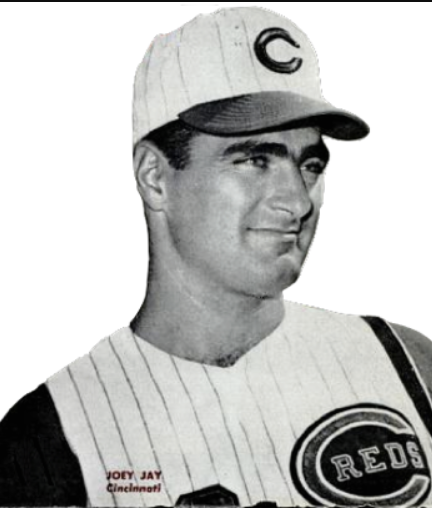
Photo: Public domain, via Wikimedia Commons “https://commons.wikimedia.org/wiki/File:Joey_Jay_1962.png”><img width=”256″ alt=”Joey Jay with the Cincinnati Reds in an issue of Baseball Digest in 1962.”

This week’s Tidbit give me a chance to look back at one of my boyhood heroes. As a Milwaukee native and Little Leaguer, I was pretty excited when Joey Jay signed with the Milwaukee Braves and became the first former Little Leaguer to appear in the major leagues. That made him an MLB “first,” but (of course) he did not remain the only Little Leaguer to make it to the Show.  Still, he does hold “unicorn” status as the first and only pitcher (to date) to retire with exactly 99 MLB wins and 999 MLB strikeouts. Ten pitchers have retired with 99 wins (see chart). Jay is the only pitcher (no matter how many wins) to retire with 999 strikeouts. Bo Ewing (1902-12) and Bill Lee (1934-47) retired with 998 whiffs. Words of explanation:  The retirements noted in this post could have been voluntary or involuntary (released, not signed).  Also, a number of these players continued to play professionally (minor leagues) after their final MLB game.  

Jay had an interesting career along the way to forming the “99-999 Club.” Jay first played Little League ball in Middletown, Connecticut, as a 12-year-old. Since 12-year-olds were not allowed to pitch, he took the field at first base. Jay went on, however, to become a dominating pitcher in American Legion and High School ball. He was signed by the Braves in 1953 (their first year in Milwaukee) as a 17-year-old for a reported $40,000 bonus. He was immediately brought up to the big-league club (there was a rule at the time that players signing bonuses of more than $4,000 – termed bonus babies – could not be sent to the minors for two years without be subject to MLB’s unrestricted draft.
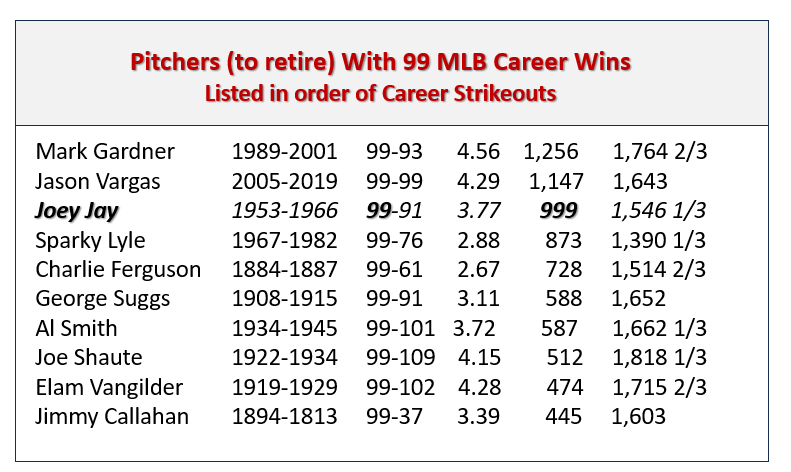
The 17-year-old Jay got his first MLB start on September 13, 1953, in the second game of a doubleheader (the last home game of Milwaukee’s season) and pitched 6 1/3 innings of scoreless ball in a 3-0 win over the Reds. The game ended early due to weather and Jay was credited with a shutout.  On the season, he went 1-0 in three appearances, giving up six hits and five walks – but no runs – in ten innings of major-league work.  In 1954, Jay went 1-0, 6.50 in 15 games (one start). With his two-year MLB “bonus baby” requirement fulfilled, Jay pitched primarily in the minor leagues from 1955-1957 (82 minor-league appearances, 12 with the Braves). After a 17-10, 3.31 season at Triple-A in 1975, Jay got a more extended MLB chance in 1958 (18 games, including 12 starts, for the Braves), going 7-5, 2.14, with six complete games and three shutouts. In 1959-60, he went 15-19, 3.67 for the Braves before being traded to the Reds, where his career took off.

Jay was 21-10, 3.53 for the Reds in 1961 (leading the NL in wins and shutouts – four) and 21-14, 3.76 in in 1962.  Those two seasons, he pitched 30 complete games in 71 starts.  The Reds won the NL Championship in 1961, but lost the World Series to the Yankees four games to one, with Jay getting the Reds’ only win (a complete-game, four-hit, 6-2 win in Game Two.)

From 1963 through his final MLB season (1966), Jay went 33-43, 4.13 to end with an MLB career line of 99-91, 3.77 in 310 appearances – with 63 complete games and 16 shutouts in 203 starts.

The Braves bookended Jay’s MLB career. Jay began his MLB career with the Braves in 1953 (the franchise’s first season in Milwaukee) and finished his career with the Braves in 1966 (traded from the Reds in June of that season), the Braves’ first year in Atlanta.

Side note: Five pitchers have retired with 99 MLB saves: (Jorge Julio (2001-09); Firpo Marberry (1923-36); AJ Ramos (2012-21); and Drew Storen (2010-17). No pitcher has retired with 999 MLB appearances. Lindy McDaniel is closest at 987 (1955-75). Nine pitchers have retired with 99 MLB starts – and nine have retired with 99 MLB complete games.   Russ Christopher (1942-48) retired with 999 2/3 innings pitched. 

Primary resources: stathead.com; Joey Jay, Last Living Player on First Milwaukee Braves Team, Dies at 89, by JR Radcliffe, Milwaukee Journal Sentinel, November 6, 2024; Joey Jay, Society for American Baseball Research Bio, by Joseph Wancho.

Baseball Roundtable – Blogging Baseball Since 2012.

Baseball Roundtable is on the Feedspot list of the Top 100 Baseball Blogs. For the full list click here

I tweet (on X) baseball @DavidBaseballRT

Follow Baseball Roundtable’s Facebook Page here.  More baseball commentary; blog post notifications; PRIZES.

Member: Society for American Baseball Research (SABR); Negro Leagues Baseball Museum; The Baseball Reliquary.

P 1122

Baseball Roundtable Trivia(l) Tidbit Tuesday – A Pair of Immaculate (perhaps divine) Innings

Once again, it’s time for Trivia(l) Tidbit Tuesday. I hope you are enjoying this weekly presentation of baseball occurrences that for some reason caught The Roundtable’s eye.  (I’m particularly fond of unexpected performances and statistical coincidences.) These won’t necessarily be momentous occurrences, just events, statistics or coincidences that grabbed my attention. I’m also drawn to baseball “unicorns,” those one-of-a-kind accomplishments or statistics.

This week, we’re looking at a one-of-a-kind event that I reported (in a monthly Wrap Up) when it happened – and which, after some reflection, I believe has to be among the mostly likely to retain its unicorn status over the very long haul.  This Tuesday’s Tidbit relates to “Immaculate Innings” – three up, three down, three strikeouts, nine pitches).

Now, these days, Immaculate Innings are not all that improbable – after all, there have been more than 100 such feats, 18 since 2020 alone. However, on June 15, 2022, MLB was treated to an “Immaculate” occurrence that is likely to remain “Divine” for quite some time.

Consider:

  • On that day, as the Astros topped the Rangers 9-2 in Texas, the fans witnessed two “Immaculate Innings” in one game – an MLB first, and still only, occurrence.

But wait, maybe you could imagine that happening again.  However:

  • The two Immaculate Innings were delivered by pitchers on the same team, raising the improbability factor even higher.

But there’s more:

  • The same three batters were the victims in both Immaculate frames – putting us into very long-term unicorn status.

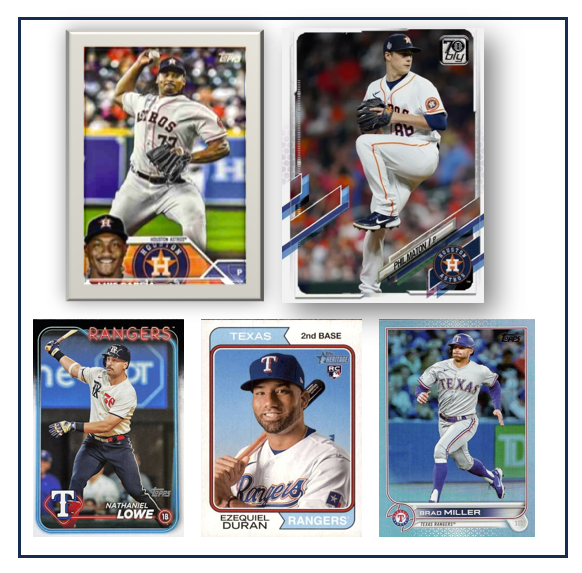
In that game, Astros’ pitchers Luis Garcia and Phil Maton pitched their way into the “Immaculate Innings” club.   It was, as noted, the first-ever MLB game in which two pitchers each tossed an Immaculate Inning and, of course, also made them the first and (currently) only teammates to toss an Immaculate Inning in the same game.

Garcia tossed his nine-pitch, three-whiff frame in the bottom of the second, while Maton achieved the feat in the bottom of the seventh.  The six strikeouts were among 14 recorded by four Astros’ pitchers. The victims in both Immaculate frames were Rangers’ 1B Nathaniel Lowe, 2B Ezequiel Duran and 3B Brad Miller (the 6-7-8 hitters) – making them, of course, the first and currently only three players to be victims in two Immaculate frames in the same game. Side Note:  Rangers’ CF Leody Taveras led off the bottom of the third by fanning on three pitches from Garcia, giving Garcia four consecutive strikeouts on a total of 12 pitches. 

Garcia finished the season at 15-8, 3.72 (28 starts) – with 157 whiffs in 157 1/3 innings pitched. Maton was 0-2, 3.84 in 67 appearances – with 73 strikeouts in 65 2/3 innings.

Lowe finished at .302-27-76 (147 strikeouts in 157 games); Duran at .236-5-25 (54 strikeouts in 58 games); and Miller at .212-7-32 (70 strikeouts in 81 games).


Primary Resources:  Stathead.com; Baseball-Almanac.com.

Baseball Roundtable – Blogging Baseball Since 2012.

Baseball Roundtable is on the Feedspot list of the Top 100 Baseball Blogs. For the full list click here

I tweet (on X) baseball @DavidBaseballRT

Follow Baseball Roundtable’s Facebook Page here.  More baseball commentary; blog post notifications; PRIZES.

Member: Society for American Baseball Research (SABR); Negro Leagues Baseball Museum; The Baseball Reliquary.

P 1122
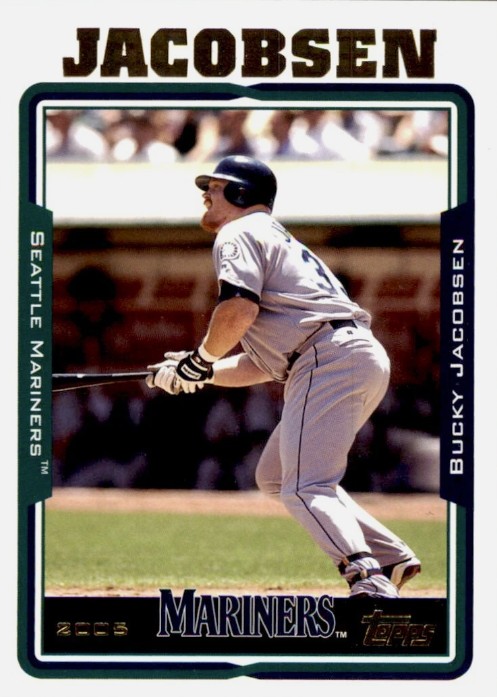
2025 Baseball Roundtable John Paciorek Award – Bucky Jacobsen … Big Man, Big Personality, Seven Weeks of Big League Success

Each year, since 2014, Baseball Roundtable has announced a John Paciorek Award (JPA) honoree. The JPA recognizes players who have had short, sometimes very short, major-league careers, but whose accomplishments, nonetheless, deserve recognition.  Past winners have included:  a player who collected at least one base hit in every MLB game he played; a player whose every MLB hit (three safeties in nine career at bats) was a home run;  a player who had only one MLB at bat, but earned  a World Series ring and a Purple Heart;  a war hero who pitched in the majors on one leg; and much more.  There are links to the bios of past honorees later in this post.

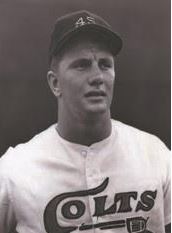
(Note: Information on John Paciorek’s career – the inspiration for the JPA – can be found at the end of this post. Paciorek’s day in the sun constitutes arguably the best one-game MLB career ever.)

This year’s John Paciorek Award honoree is 6′-4″, 255 lb.  155-lb. DH/1B Larry “Bucky” Jacobsen, whose active MLB career lasted 7 1/2 weeks (Mariners) in 2004, but whose perseverance, passion for the game, power and personality made a fan favorite in Seattle.

When  Jacobsen made it to the big leagues with the Mariners in mid-July or 2004, he had a look about him that made you anticipate power.  He was clearly a “big” big leaguer.   Conservatively 6’4” and 255 pounds, with a bald head, a red beard, broad shoulders, huge biceps and a big smile, he looked like he could be downing trees and selling Brawny(R) paper towels. And, it didn’t take nim long to show Seattle fans that he was in the “lumber” business. In his first three MLB games (in Seattle), he went five-for-eight (.625), with two home runs, four runs scored, five RBI, four walks (.769 OBP) and three strikeouts.

But, I’m getting ahead of the Jacobsen story.  The fact is, Jacobsen’s trip to the big leagues (and his brief stay) demanded perseverance and commitment.

Jacobsen was a seventh-round pick (Brewers) in the 1997 MLB Draft – out of Lewis-Clark State College (Lewiston, Idaho), where – in his final college season (1997) –  he hit .354-22-73 and was named the team’s most valuable player.

In six seasons in the Brewers minor-league system, Jacobsen hit .295, with 94 home runs and 501 RBI (in 550 games). He built a reputation as a big man, with broad shoulders and bulging biceps, a quick and friendly smile and the ability to launch baseballs into orbit. Yet, he still hadn’t gotten a taste of the big leagues. Along the way, he also suffered a knee injury (2001 collision with a tarp) that, while it may have hampered his mobility, did not seem to impact his ability to pulverize baseballs.  (That knee injury would eventually require multiple surgeries and cut short his career on the field.)

In mid-June, 2002, Jacobsen (hitting .253-11-39 for the Brewer’ Huntsville Double-A club) was released by the Brewers and quickly signed as a free agent with the Cardinals. He finished the season hitting .294-4-21 in 34 games for the St. Louis Double-A New Haven Ravens. The Cardinals released Jacobsen after the season (October of 2002), then resigned him in December. He  continued to persevere and had a great season for the Double-A Tennessee Smokies in 2003 (.298-31-84 in 131 games); leading the league in home runs, runs scored and total bases, finishing second in RBI. And third in slugging percentage.

Despite that performance, October, once again, did not seem to be a lucky month for Jacobsen, as the Cardinals released him in October of 2003. However, his luck, was about to change.

Jacobsen signed with a free agent with the Mariners on November 10, 2004 and his career skyrocketed with the Mariners’ Triple-A Tacoma Rainiers. After 82 games with Tacoma, he had a .312 average, with 26 home runs and 86 RBI.  And, now in his eighth professional season, Jacobsen finally was called up to “The Show” – the night after he won the Pacific Coast League All Star Game Home Run Derby (where it was reported he launched one shot of more than 500-feet).    Side note: It wasn’t his first Home Run Derby win. In 2000, Jacobsen won the Southern League All Star Game Home Run Derby.

Show-time for Jacobsen was short,  but memorable – and deserving of a spot on the Baseball Roundtable John Paciorek Award honorees list.

Jacobsen made his MLB debut on July 16, 2004 (Indians at Mariners) for the 33-54 Mariners, whose fans were looking for some good news (beyond Ichiro Suzuki’s .320 average). They found it in Jacobsen, who in his first three games went 5-for-8 (.625), with four walks (.750 on-base percentage), two home runs, five RBI and four runs scored. He smacked his third home run in his sixth game (July 21) – a walk-off homer on the first pitch in the bottom of the tenth inning to give the Mariners a 6-5 win over the A’s.

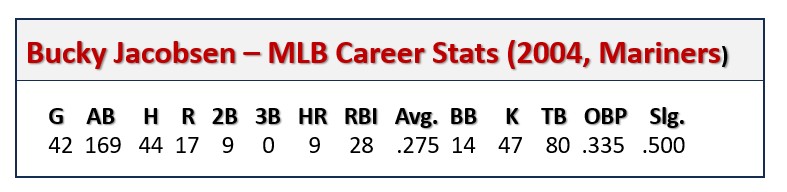
Jacobsen quickly developed a fan following (and proved to be especially fan friendly– quick to sign autographs and talk to fans at the ballpark and outside of it.) Over his first 42 games, he also continued to show solid power (.275-9-28), hitting safely in 32 games and recording ten multi-hit and eight multi-RBI contests.  Ultimately, his power, performance, personality and ties to the region (while he was born in Wyoming, he went to high school in Hermiston, Oregon and college in Pendleton, Oregon and Lewiston, Idaho) made him and instant hero in Seattle (keeping in mind that he plied his baseball skills for eight seasons in the minors to get there.)

Unfortunately, that past knee injury caught up with him, benched him in September and led to multiple surgeries and an end to his big-league career.  (From 2005 through 2007, Jacobsen did suit up in Triple-A, High-A, Rookie ball, the Independent Atlantics League and in Mexico.)  Jacobsen is currently one of the hosts of “Chuck and Buck in the Morning” on Sports Radio 93.3 KJR (Seattle).

Primary Resources:  stathead.com; lcwarriors.com, website of the Lewis-Clark State College Warriors; Coaches Recall Big League Bucky, East Oregonian, August 7, 2004; Bucky Jacobsen Too Big to Ignore, By David Andriesen, Seattle-Post Intelligencer, July 15, 2004); Whatever Happened to Bucky Jacobsen?, by Geoff Bake, Seattle Times, January 21, 2007; Biggest Batter Blasts Most Homers at Derby, by Todd Shanesy, goupstate.com, June 20, 2000.

___________________________

PAST JPA HONOREES

Here’s a look at – and links to – past JPA Award honorees:

2014 – Brian Scott Dallimore

In his first start (not his first game) for the 2004 Giants, Dallimore had two singles, a Grand Slam (his first MLB hit and only MLB home run), a walk and a hit by pitch.  For the full JPA take on Dallimore’s 27- game MLB career, click here.

2015 – Roy Gleason

Gleason played in just eight MLB games, had a double in his only MLB at bat – but also earned a World Series ring (1963) and a Purple Heart. Ultimately, he was the only ballplayer with MLB experience to serve on the front lines in Vietnam. For the full JPA take on Gleason, click here. Note: Gleason’s life is detailed in the book “Lost in the Sun – Roy Gleason’s Odyssey from the Outfield to the Battlefield.”

2016 – John Allen Miller

Miller played just 32 MLB games (during the 1966 and 1969 seasons), taking the field (at 1B/LF/3B/2B) for the Yankees and Dodgers. Miller collected ten hits in 61 MLB at bats (.164 average) and hit just two home runs – but he made those long balls count – becoming one of just two players in MLB history to homer in their first and final official appearances in a major-league batter’s box. For more on Miller, click here.

2017 – Chris Saenz

RHP Chris Saenz’ big day came on April 24, 2004 – when he was called up from Double-A Huntsville (where he was 1-1, 3.86) to make a spot start against the Saint Louis Cardinals, whose powerful lineup included the likes of Albert Pujols, Scott Rolen, Jim Edmonds and Reggie Sanders.   The rookie went six innings, giving up just two hits, three walks and no runs, while fanning seven. Two days after this debut, he was on his way back to Huntsville, where he suffered an elbow injury and never returned to the majors. Statistics before 1900 can be sketchy, but baseball-reference.com shows that Saenz is the only pitcher to complete a one-game MLB career of at least five innings pitched, without giving up a single run (earned or unearned). For more details on this JPA honoree, click here.

2018 – Keith McDonald

McDonald’s MLB career (Cardinals 2000-2001) covered just eight games and 11 plate appearances (nine at bats) and three hits – but he made them count.  All of McDonald’s safeties were home runs – making him the only MLB player with more than one career hit who can look back on major league career in which his every hit was a home run. .For the full story, click here.

2019 – Harley Hisner

Hisner’s MLB tenure encompassed the day of September 30, 1951. That’s when the 24-year-old righty faced the New York Yankees – and a lineup that included five future Hall of Famers: Mickey Mantle in RF; Joe DiMaggio in CF; Phil Rizzuto at SS; Johnny Mize at 1B; and Yogi Berra behind the plate. In his very first MLB inning, Hisner faced five batters, four of them future Hall of Famers, and gave up two singles and no runs.  His place in history? One of those singles was Joe DiMaggio’s last MLB safety. For more on Hisner and his ongoing involvement in and love of the game (he went on to earn the Northeast Indiana Baseball Association Colin Lister Award for “dedication to the game of baseball and its historic legacy,” click here.

2020 – Bert Shepard

Shepard set aside his baseball mound dreams in 1943 – after four minor-league seasons – to enlist in the U.S. Army, where he became a P-38 Lightning fighter pilot. Shepard was shot down on his 34th combat mission and, while a prisoner of war, his wounds resulted in the amputation of his right leg below the knee.  Upon his release (a prisoner exchange), Shepard did not surrender his dreams and fought his way to the major leagues. He made one major-league appearance (for the Washington Senators), pitching 5 1/3 innings of three-hit, one-run ball.  While Shepard’s MLB career consisted of that sole appearance, he did continue to pitch, coach and manage in minor leagues – and his story proved an inspiration for disabled veterans.  For more of Bert Shepard story, click here.

2021 – Henry Schmidt

Henry Martin Schmidt didn’t make it to the big leagues until eight seasons after his professional (minor-league) debut.  In fact, he was just two months shy of his 30th birthday when he first took the major-league mound.   Why did it take so long?  Simple answer – location.  He had considerable difficulty “locating” his pitches.  While it took a long time for Schmidt to make it to the major leagues, it didn’t take him long to leave MLB. He lasted just one season – and is the only pitcher in MLB history who was a 20-game winner in his only major league season. Why was his MLB career so short? Simple answer – location.  He did not care for the geographic “location” of major-league baseball. For more on Henry Schmidt’s unusual career, click here.

2022 – Karl Spooner

Southpaw Spooner holds a share of the record for strikeouts in an MLB debut (15) and also threw complete-game shutouts in each of his first two starts.  After earning a late September (1954) call-up (to the Dodgers), the 23-year-old rookie was thrown right into the fire – starting on September 26 against the league-leading and Dodgers’ chief rival Giants.  His  27 strikeouts in his first two appearances also remain an MLB record.   A shoulder injury suffered in 1955 Spring Training cut Spooner’s career short. He  didn’t get his first start of the 1955 season until May 15 and finished the season, his last in the major leagues, 8-6, 3.65 in 29 games (14 starts).   Spooner pitched for three more seasons in the minors, but never recaptured 1954 glory.  For the full Karl Spooner story, click here.

2023 – Glenn Williams

Williams had a 13-game major-league career – all in June of 2005 and all with the Minnesota Twins.  Over his 13-games in “The Show,” Williams hit a robust .425 and collected at least one hit in every game he played.  Williams holds the MLB record for the longest MLB career for a player who was never held hitless in any MLB game he appeared in.  For the full Glenn William story, click here.

2024 – Irv Waldon

Waldron, who played just one MLB  season (1901) ,  still holds the record for base hits (186), runs scored (102) and total bases (226) by a player who played just one MLB campaign.   Further, Waldron made his “jump” from the minor leagues to the majors without changing cities, teams or even leagues, For the full Waldron story, click here. 

—–INSPIRATION FOR THE JPA—–

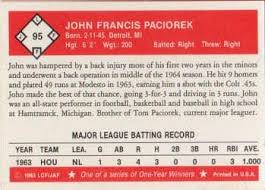
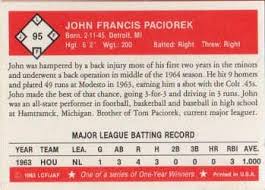
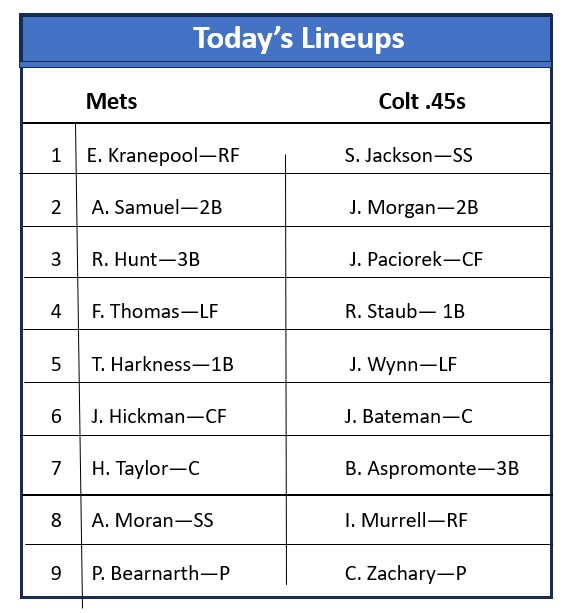
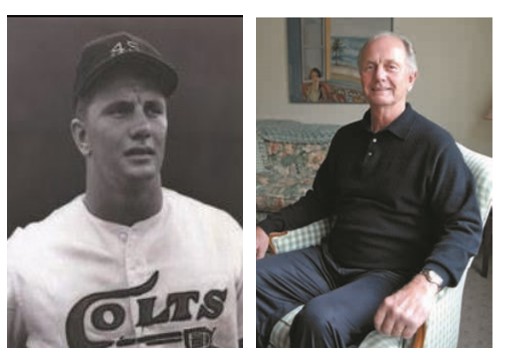
John Paciorek – signed out of Saint Ladislaus High School in Hamtramck, Michigan (where he had starred in football, basketball and baseball) – appeared in his first major-league game on the final day of the 1963 season (September 29) at the age of 18.  The 6’ 1”, 200-pound outfielder had spent the 1963 season with Class-A Modesto Colts. The Colts’ parent club, the Houston Colt .45s (that was the current Astros’ franchise name back then), was suffering through a difficult season. The team was 65-96 going into that final game.  Looking to the future, Houston had, in fact, fielded an all-rookie lineup (average age 19) on September 27. Youth was still being served two days later when John Paciorek started his first MLB game. The results were surprising – and worthy of recognition.

Playing right field and batting seventh in a 13-4 win over the NY Mets, Paciorek ended up with three hits and two walks in five plate appearances, with four runs scored and three runs batted in.  Perhaps equally surprising is that it was not only Paciorek’s first major-league appearance, it was to be his only MLB appearance.  Back pain the following spring, followed by surgery (he played 49 minor league games in 1964 and missed all of the 1965 season), put an end to his MLB playing days. (Paciorek did play in four more minor-league seasons.)  Still, you will find John Paciorek in the Baseball Encyclopedia and his is arguably the greatest one-game MLB career ever.  Among one-gamers, he holds the record for times on base and runs scored, and shares the record for batting average, on base percentage and RBIs.

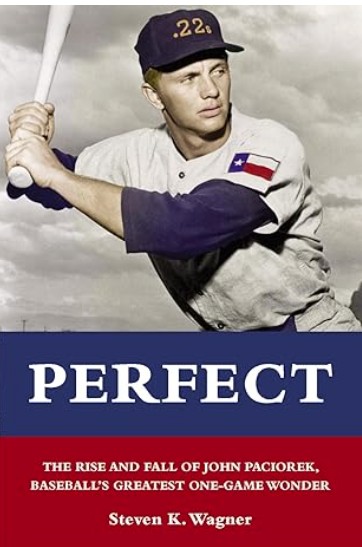
Paciorek, by the way, went on to become a high school teacher and multi-sport coach and is the author of the books (Plato and Socrates – Baseball’s Wisest Fans;  The Principles of Baseball: And All There Is To Know About Hitting; and If I Knew Then What I Know Now. You also can enjoy Paciorek’s prose (and expertise) at his blog “Paciorek’s Principles of Perfect Practice” by clicking here. You can find out even more about Paciorek in Steven Wagner’s 2015 book Perfect: The Rise and Fall of John Paciorek, Baseball’s Greatest One-Game Wonder.

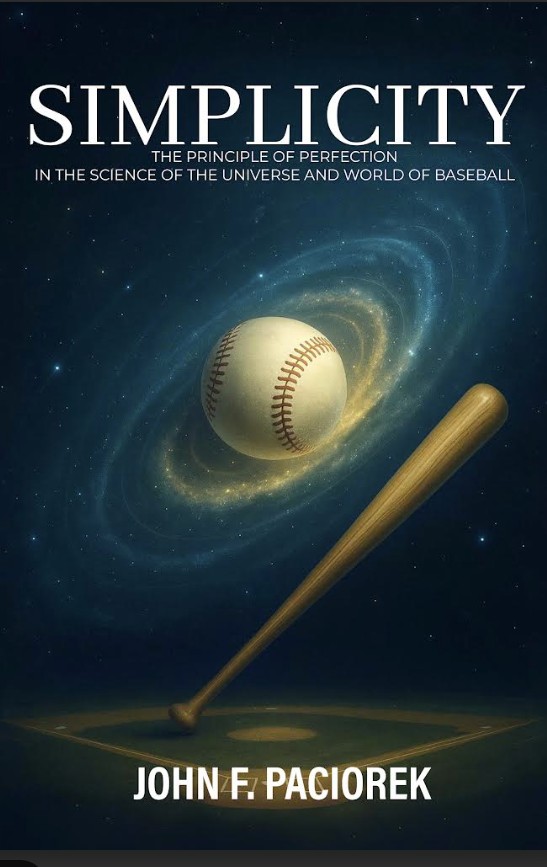
And for a sample chapter of Paciorek’s upcoming book, “Simplicity – The Principle of Perfection in the Science of the Universe and World of Baseball,” click here.

A final note. John Paciorek’s insight into the national pastime should come as no surprise. Paciorek comes from a true “baseball family.”  He was the first born of eight siblings and was followed to the big leagues by younger brothers Jim and Tom Paciorek.  (Like John, Jim’s MLB career was short – 48 games for the Brewers in 1987. Brother Tom, however, achieved a .282 average over an 18-season MLB career.

Baseball Roundtable – Blogging Baseball Since 2012.

Baseball Roundtable is on the Feedspot list of the Top 100 Baseball Blogs. For the full list click here

I tweet (on X) baseball @DavidBaseballRT

Follow Baseball Roundtable’s Facebook Page here.  More baseball commentary; blog post notifications; PRIZES.

Member: Society for American Baseball Research (SABR); Negro Leagues Baseball Museum; The Baseball Reliquary.

P 1121

Baseball Roundtable Trivia(L) Tidbit Tuesday – A Record-Setting Long Ball Barrage

Once again, it’s time for Trivia(l) Tidbit Tuesday. I hope you are enjoying this weekly presentation of baseball occurrences that for some reason caught The Roundtable’s eye.  (I’m particularly fond of unexpected performances and statistical coincidences.) These won’t necessarily be momentous occurrences, just events, statistics or coincidences that grabbed my attention. I’m also drawn to baseball “unicorns,” those one-of-a-kind accomplishments or statistics. Today, we’re looking at a day for the long-ball record books.

On this date (June 10) in 2019, the number 13 proved lucky for the Diamondbacks, but unlucky for the Phillies and their fans.  That night, the Diamondbacks topped the first-place Phillies 13-8 (in Philadelphia), dropping the Phillies into a first-place tie with the Braves.

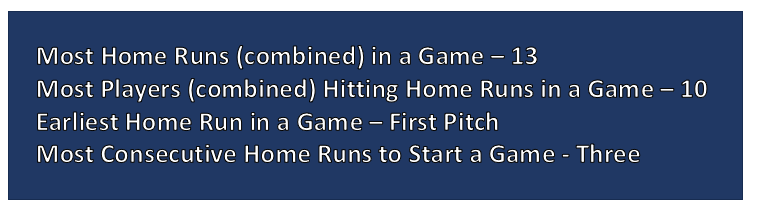
More important for this Tidbit, the two teams combined for still MLB single-game record 13 home runs.

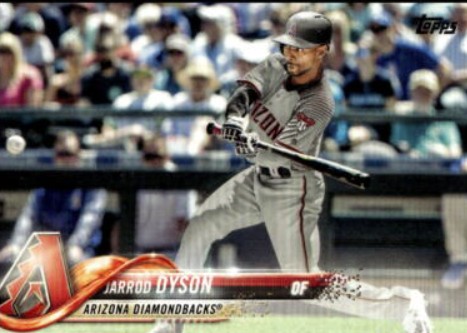
The Diamondbacks set the tone for the day right from the start. Diamondbacks’ leadoff hitter 2B Jarrod Dyson stroked the first pitch of the game (from Jerad Eickhoff) for a home run to deep right.  This, of course, tied a record for the earliest homer in an MLB game. The numbers-two and -three hitters (SS Ketel Marte and LF David Peralta) continued the barrage by homering off Eickhoff – tying the record for the most consecutive homers from the start of a game.

During the course of the game, an MLB-record ten players went deep (a record since tied).  For Arizona they were:  Dyson; Marte; Peralta; 3B Eduardo Escobar (two homers); C Alex Avila; and 2B Ildemaro Vargas (two homers). For Philadelphia, they were: SS Jean Segura; CF Scott Kingery (two homers);  1B Rhys Hoskins; and LF Jay Bruce.  The only other time ten players have gone deep in the same MLB game was April 29, 2023, as the Padres topped the Giants 16-11 in San Diego.  The long ball smashers in that one for the Padres were: DH Nelson Cruz; LF Juan Soto; SS Xander Bogaerts; RF Fernando Tatis, Jr.; 3B Manny Machado (two homers).  For the Giants, they were: SS Brandon Crawford; 1B LaMonte Wade, Jr.; LF Mitch Haniger; C Blake Sabol; and PH-2B David Villar.


A little “one thing always seems to lead to another,” Baseball Roundtable Tidbit: A little extra digging showed that, in that June 10, 2019 game, Phillies’ starter Jack Eickhoff tied an obscure record – the most home runs given up in a game in which every hit surrendered by that pitcher was a home run (five).  This could also be a #InBaseballWeCountEverything moment. To date, eight MLB pitchers share this record: Charlie Hough; Mat Latos; Colby Lewis; Ted Lilly; Denny McLain; Steve Stone; Nick Tropeano; and Eickhoff.

Primary Resources:  Stathead.com; Baseball-Almanac.com

Baseball Roundtable – Blogging Baseball Since 2012.

Baseball Roundtable is on the Feedspot list of the Top 100 Baseball Blogs. For the full list click here

I tweet (on X) baseball @DavidBaseballRT

Follow Baseball Roundtable’s Facebook Page here.  More baseball commentary; blog post notifications; PRIZES.

Member: Society for American Baseball Research (SABR); Negro Leagues Baseball Museum; The Baseball Reliquary.

P 1120

What Readers Think – Baseball Roundtable Survey on Lifting of Permanent MLB Bans

Baseball Roundtable recently published a brief (very) informal reader survey on Baseball Commissioner Rob Manfred’s decision to have permanent baseball ineligibility bans lifted at the time of the banned player’s death.  The most discussed impact of the impact of the change relates to the possible election of previously banned players to the Baseball Hall of Fame (most specifically Shoeless Joe Jackson and Pete Rose).  That topic was covered in the brief, informal survey, which also included some more general questions about how such bans should be justified and their general impact.

First, some general information on the permanent bans.  They have been primarily levied against players, coaches and executives allegedly tied to gambling – betting on baseball on baseball or accepting or offering bribes for actions to affect the outcomes of games. A May 13, 2025 Associated Press article listed 17 players affected by Manfred’s decision to lift permanent bans at a player’s passing and all but one of those bans was gambling related. One player, Giants’ outfielder Benny Kauff, was banned in 1921 after being indicted on charges of auto theft and possession of a stolen vehicle.  Kauff was acquitted in the courts, but not reinstated by MLB.  Note: The eight players banned in relation the 1919 Black Sox Scandal (alleging involvement in the fixing of the 1919 World Series) were acquitted in the courts, but the ban remained in place.

There have been many of (what proved to be) non-permanent bans from baseball. For example, Willie Mays (in 1979) Mickey Mantle (in 1983) were banned from MLB for employment (after their retirement as players) ties to casinos.  They were reinstated in 1985. Yankees’ owner George Steinbrenner was banned in 1990 for hiring a private detective to investigate Dave Winfield.  Steinbrenner was reinstated in 1993.  Over MLB history, individuals have been banned from baseball for varying lengths of time for such additional issues as (but not limited to) violation of baseball’s reserve clause, illegal drug use,  charges of sexual harassment and “barnstorming” without permission.

In relation to the Hall of Fame, while the Hall has consistently gone along with the MLB Commissioner’s Office decisions on bans, it was not until 1991 that the Hall officially established a policy that players deemed ineligible by MLB would also be ineligible for election to the Hall. (1991 would have been Pete rose’s first year on the BBHOF ballot). Note: Shoeless Joe Jackson (one of the players permanently banned by MLB (1919 Black Sox Scandal) received two votes (out of 202) in the 1936 HOF balloting. Jackson also got two votes (out of 226) in the 1946 nominating balloting (at the time, there was a “run-off” vote, with the top 20 vote-getters moving on to the final Hall of Fame ballot).

Now for the readers’ opinions on this issue. My first observation is that this survey drew a far lower response than past Roundtable surveys on MLB’s recent rules changes (no-pitch intentional walks, ghost runner in extra innings, infield shift restrictions, pitch clock, etc.).  Those Roundtable surveys each drew more than 100 responses.  The Hall of Fame ban survey drew just 32.  Readers did not seem to have as much interest (or as strong of opinions) on the transition from permanent to “lifetime” bans.  Also, the readers who did respond voiced the strongest support for the previous system of permanent bans.

Here are the survey responses in order of support:

  • The bans (permanent ineligibility) should remain in effect, with ongoing options for appeal on a case-by-case basis62.9%.


  • I’m fine with lifting the bans upon a player’s passing. BBHOF voters can decide on “Hall worthiness” 21.9%.


  • Any bans should only apply to “on-field” baseball activity, let BBHOF voters decide on Hall of Fame election even before he player(s) passing12.5%.

Again, since 1991, the Hall of Fame has officially banned players on MLB’s permanently banned list from the Hall of Fame balloting. This (12.5%) group supports leaving the decision on Hall of Fame worthiness to voters. Under the decision to lift bans upon a player’s passing, that would most often mean consideration by one of the Hall’s Era Committees, rather than on the BBWAA Ballot.

The survey also included a few questions on how bans should be justified.

  • Bans should be applied in cases where the player(s) actions (on or off the field) affect the integrity of competition and/or the reputation/public image of the National Pastime – 46.9%.

Basically, support of the current justification.

  • Bans should be applied only in cases where a player’s on-field actions affected the outcome of a game/series/season3.1%.


  • Bans should only be imposed if a player has been convicted of a crime in a court of law3.1%.

The “No opinion on this issue”  option was selected by 3.1%.

A few representative comments:

Steve, MI – Given the nature of independence of the Hall, I would like to have a better understanding of their position on the matters beyond the “character clause.”  I am generally a “Hall of Very Good” type of fan, but do agree that individual conduct and character are important traits worthy of thoughtful consideration.

Paul, FL We can no more restore Shoeless Joe Jackson to baseball than we can give back the throne to Lear and Oedipus.

Richard, CAThe ban really becomes irrelevant once the player passes. A “lifetime” ban seems most appropriate.

Robert, MNI would have like to have seen one more question in the survey – regarding whether a ban should be imposed only on activity/indiscretions during the time the individual is active (player/manager/coach/ executive) in MLB or whether it should apply to later actions that might reflect on the reputation of the game.  Editor’s note: Excellent thought. Apologies for the omission of this issue form the survey).

Don, MNA permanent ban or a lifetime ban?  We need to clarify.  Perhaps, there needs to be two or three categories (permanent, lifetime, temporary) depending on the seriousness of the transgression.  I believe “fixing” games would be deserving of a permanent ban, betting on games you participated in possibly lifetime and simply betting on baseball (not games you participate in) temporary. There should be some very specific guidelines as to the relationship of the violations to the length of the penalty.

Primary Resources: MLB reinstates Pete Rose and Shoeless Joe Jackson, making them Hall of Fame Eligible, by Ronald Blum, Associated Press, May 13, 2024); A Full List of Players, Coaches and Owners Permanently Banned by Major League Baseball, Associated Press, May 13 2025; Pete Rose’s Hall of Fame Eligibility Ban Lifted – Here’s What Could Happen Next, by Antonio Pequeno, Forbes.com, Nay 13, 2025.


Baseball Roundtable – Blogging Baseball Since 2012.

Baseball Roundtable is on the Feedspot list of the Top 100 Baseball Blogs. For the full list click here

I tweet (on X) baseball @DavidBaseballRT

Follow Baseball Roundtable’s Facebook Page here.  More baseball commentary; blog post notifications; PRIZES.

Member: Society for American Baseball Research (SABR); Negro Leagues Baseball Museum; The Baseball Reliquary.

P 1119

Baseball Roundtable May Wrap Up – An Ultimate Inning, a 13K “Maddux,” a 21-0 Shutout and More

It’s early June, and that means it’s time for Baseball Roundtable’s May Wrap up – a look at the stats and stories that caught The Roundtable’s attention over the past month, as well as The Roundtable’s Players and Pitchers of the Month, Trot Index and more.   (The Roundtable usually publiches the Wrap Up on the first of the month, but a computer clash led to lost files   a delay.) Just a few of May’s ‘highlights that you will find in this post:

  • A record-tying ten solo home runs in a game (Royals/Orioles);
  • A “Maddux” – shutout of less than 100 pitches – with a Maddux-record 13 strikeouts (Tarik Skubal);
  • A 21-0 shutout win (Padres/Rockies);
  • A hitter with 100+ May at bats raking at a .400+ pace  (Freddie Freeman);
  • A player (a rookie) becoming the first MLBer to achieve a three-homer game, a contest with homers both left- and right-handed, a Grand Slam and a walk-off homer in a single calendar month (Jasson Dominguez);
  • 2025’s first Immaculate inning (Cal Quantrill);
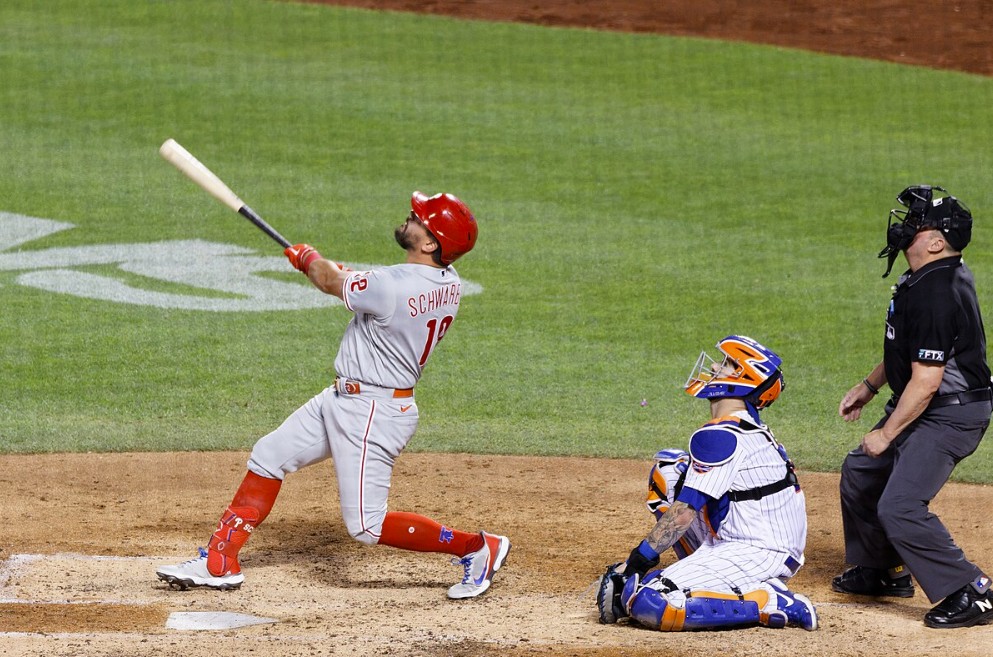
  • Bryce Harper‘s 1,000th RBI and Kyle Schwarber‘s 300th home run;
  • A player tying the record for most times hit by a pitch in an inning and a game (CJ Abrams);
  • Chris Sale becoming the quickest MLB hurler to reach 2,500 strikeouts;
  • A team scoring nine runs before making the first out of a game (Nationals/Diamondbacks); and
  • More

See the Highlights Section for these stories and more.

—-PLAYERS AND PITCHERS OF THE MONTH … MAY 2025—-

NATIONAL LEAGUE

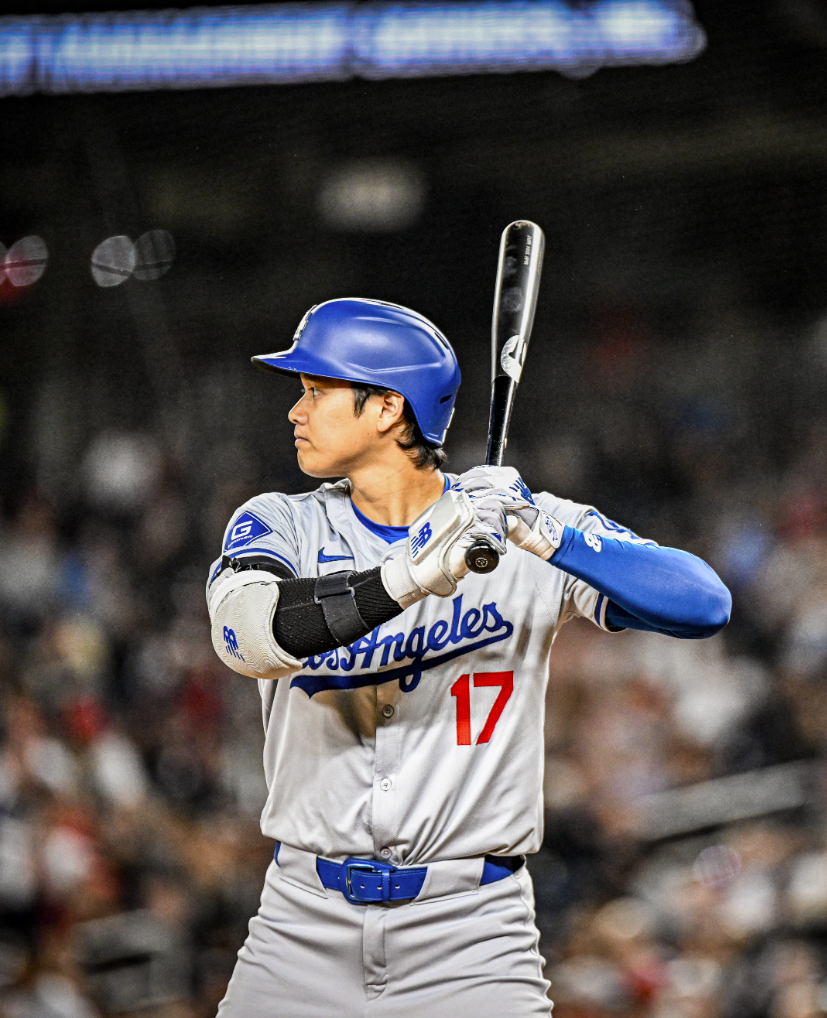
Player of the Month … Shohei Ohtani, DH, Dodgers

Photo: All-Pro Reels from District of Columbia, USA, CC BY-SA 2.0 <https://creativecommons.org/licenses/by-sa/2.0>, via Wikimedia Commons

While I tend to assign some value to playing a defensive position, you cannot ignore Ohtani’s MLB-leading 15 May home runs.  He also drove in 27 May tallies (fourth in MLB, second in the NL) and scored an MLB-best 31 runs, while averaging .309 for the month. In addition. Ohtani ‘s 21 May extra-base hits (five doubles, one triple and 15 homers) led MLB and his .782 slugging percentage was second only to the Yankees’ Aaron Judge (among players with at least 75 May at bats). Ohtani’s month included ten multi-hit games and a thirteen-game span (May 3-16) during which he hit .404-9-19.

Honorable Mentions: Dodgers’ 1B Freddie Freeman hit .410 for the month (highest among players with at least 75 May at bats) and led MLB with 43 May hits. He hit safely in 22 of 27 May games. Cubs’ CF Pete Crow-Armstrong hit .269, with nine home runs and an NL-leading 29 May RBI. He also scored 20 runs and stole five bases in seven attempts. Nationals’ LF James Wood put up a .333-7-23 line for May.

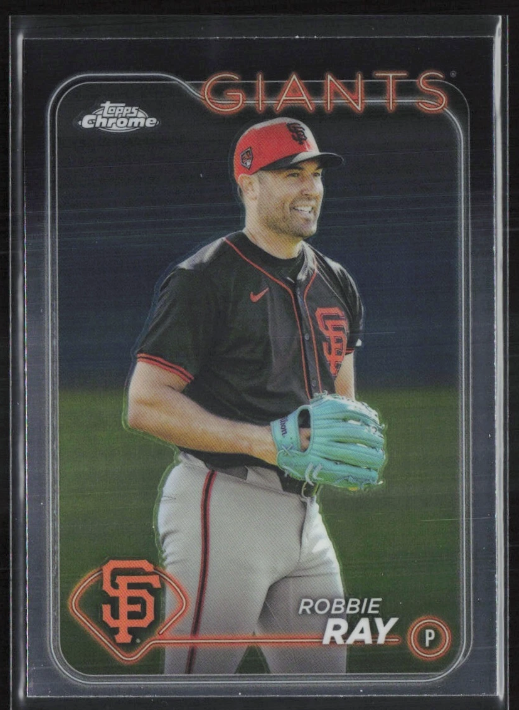
Pitcher of the Month – Robbie Ray, LHP, Giants

I really thought Zack Wheeler would coast in with this one. After four May starts, he was 4-0, 0.68, with 31 strikeouts and only six walks. Then, in his final start of the month (May 29), he gave up six runs in 5 1/3 innings (with four walks and six strikeouts) in a 6-2 loss to the Braves and suddenly 4-0, 0.68 became 4-1, 2.24.  That opened the door for a close race between Robbie Ray and the Reds’ Andrew Abbott. Ray tied for the MLB lead in wins for the month at 4-1 (in six starts), while Abbott was 3-0 in six starts. Ray put up a solid 1.38 ERA, but Abbott was even better with an MLB-best (among pitchers with at least 25 May innings) 0.55.  Digging deeper, Ray bested Abbott in WHIP 0.87 to 0.98 and average against (.169 to .190).  Ray also had a slight edge in strikeouts to walks (45 K / 8 BB to Abbott’s 33 K / 10 BB.  Plus Ray went a little deeper in games (39 innings in six starts to Abbott’s 32 2/3 innings in six outings).  Overall, slight edge, for me, to Ray.

Honorable Mentions: Andrew Abbott, LHP, Reds (see paragraph above.) Zack Wheeler, RHP, Phillies (see paragraph above). Matthew Boyd, LHP, Cubs, who went 3-0. 3.54 in May, gets a nod for putting up 34 strikeouts against just two walks – in 28 May innings.


AMERICAN LEAGUE

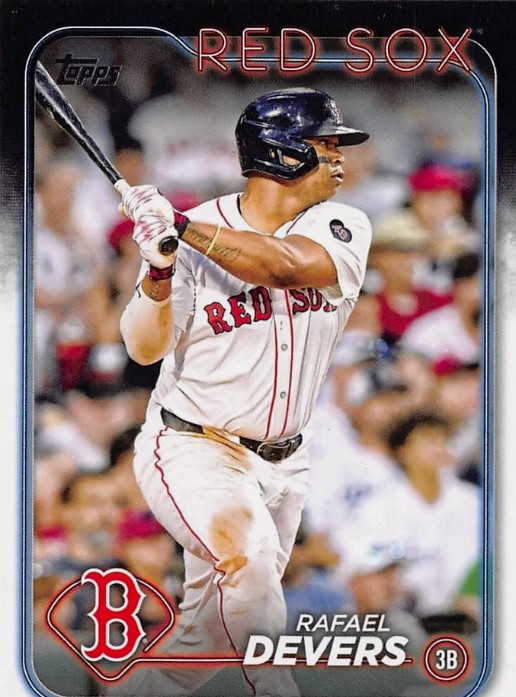
Player of the Month – Rafael Devers, DH, Red Sox

Devers led all major leaguers with 33 May RBI, to go with a .356 average and seven home runs.  He was third in the AL hits with 37 and tied for the MLB lead in walks with 22.  Devers’ .468 on-base percentage was tops among players with at least 75 May at bats. On May 23, he went four-for-six, with two home runs and eight RBI, as the Red Sox topped the Orioles 19-8. It was one of his ten multi-RBI May games.

Honorable Mentions: The Mariners’ Cal Raleigh not only handled the heavy behind-the-plate duties, he led the AL in home runs with 12, while hitting .304 and driving in 26 runs. Yankees’ RF Aaron Judge hit .364 for the month, with eleven home runs (second in the AL), 18 RBI and an AL-leading 25 May runs scored. Guardians’ 3B Jose Ramirez went .386-5-14 for the month, with 22 runs scored and an AL-leading (tied) 39 base hits.

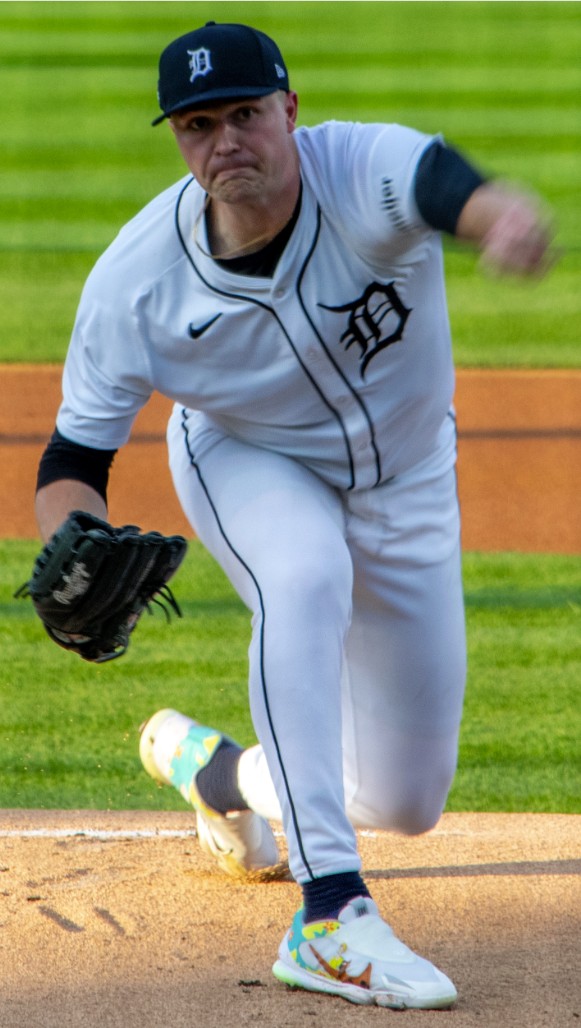
Pitcher of the Month – Tarik Skubal, RHP, Tigers

Photo: Jeffrey Hyde from Bryan, TX, United States, CC BY-SA 2.0 <https://creativecommons.org/licenses/by-sa/2.0>, via Wikimedia Commons

Skubal racked up an MLB-leading 59 strikeouts in 41 May innings (2-0, 2.20 record), while walking just two batters. His month include one shutout – a 94-pitch, no-walk, 13- strikeout, two-hitter in a 5-0 win over division rival Guardians.

Honorable Mentions: Kris Bubic, LHP, Royals, went 3-0 in five May starts and put up a miniscule 0.56 ERA (the lowest among AL pitchers with at least 25 May innings). He did not give up more than one run in any of his five starts. He fanned 33 batters (eight walks) in 32 1/3 innings. Twins’ reliever righty Jhoan Duran appeared in 15 May games and put up four wins (one loss) and seven saves – as well as a tidy 0.60 ERA (one earned run in 15 innings). Veteran Carlos Rodon, LHP, Yankees went 3-0, 1.47 in five starts and Rangers’ righty Nathan Eovaldi went 2-1, 0.68 in five stats.


Surprise of the Month – Carlos Narvaez C, Red Sox

Narvaez signed (Yankees) as a teenager, out of Venezuela, in 2015. In eight minor-league seasons, he hit .250-47-237.  He did have a brief call up to the Yankees in 2024 (.231-0-0 in six games). In December of 2024, Narvaez (noted for his defensive skills) was traded to the Red Sox, and most expected him to compete for the spot as Connor Wong’s backup.  He made the team out of Spring Training and a new door was opened when Wong fractured his left pinkie finger early in the season. In March/April, Narvaez flashed his defensive skills and hit .218-3-8 in 22 games. In May, his bat surprised a lot of people (and earned this spot) – as he went .356-2-9 in 22 games.

Honorable Mention: SS Jacob Wilson of the A’s was a 2023 first-round pick (sixth overall), so his success is less of a surprise.  What is a bit surprising is how quickly he found major-league success.  A little background.  In three seasons at Grand Canyon University, Wilson hit .361-22-155 in 155 games. Then, he hit .401 in two minor-league seasons (79 games) working bis way up from rookie-level to Triple-A. He was called up to the A’s in July of 2024 and hit .250-0-3 in 28 games.  This March/April, he turned it up a notch (.325-3-15) and, in May, he was even better (.366-4-16), with an AL-leading (tied) 39 base hits.  No surprise he’s living up to his promise, just surprising that he got there so fast.

____________________________________________________

THE TROT INDEX … A REGULAR BASEBALL ROUNDTABLE FEATURE

Through May  30,  34.5% of the MLB season’s plate appearances ended in a trot (back to the dugout, around the bases, to first base). We’re talking about strikeouts, home runs, walks, hit by pitch and catcher’s interference – all outcomes that are, basically, devoid of action on the base paths or in the field. Here’s the breakout: strikeouts (21.9%); walks (8.6%); home runs (2.9%); HBP (1.0%); catcher’s interference (less than 1%). 

The 35.0% basically mirrors  the 35.1% through April in 2024 (perhaps we’ve plateaued and the Index no longer serves a purpose). I also looked into full-year Trot Index figures for the years I have been a fan: 34.9% in 2024; 30.3% in 2010; 29.9% in 2000; 31.7% in 1990; 23.1% in 1980; 27.0% in 1970; 25.1% in 1960; and 22.8% in 1950.

__________________________________________________

A few random observations:

  • The Giants and Rangers were the only teams with ERAs under 3.00 – and both had sub-.500 records for the month.
  • The Cardinals were the the only team to play .700+ ball – and they did it despite scoring the 11th most runs and giving up the eighth fewest.
  • The Twins’ 18 May wins included a 13-game winning streak (longest in the majors this season) in which they outscored their opponents 68-29.
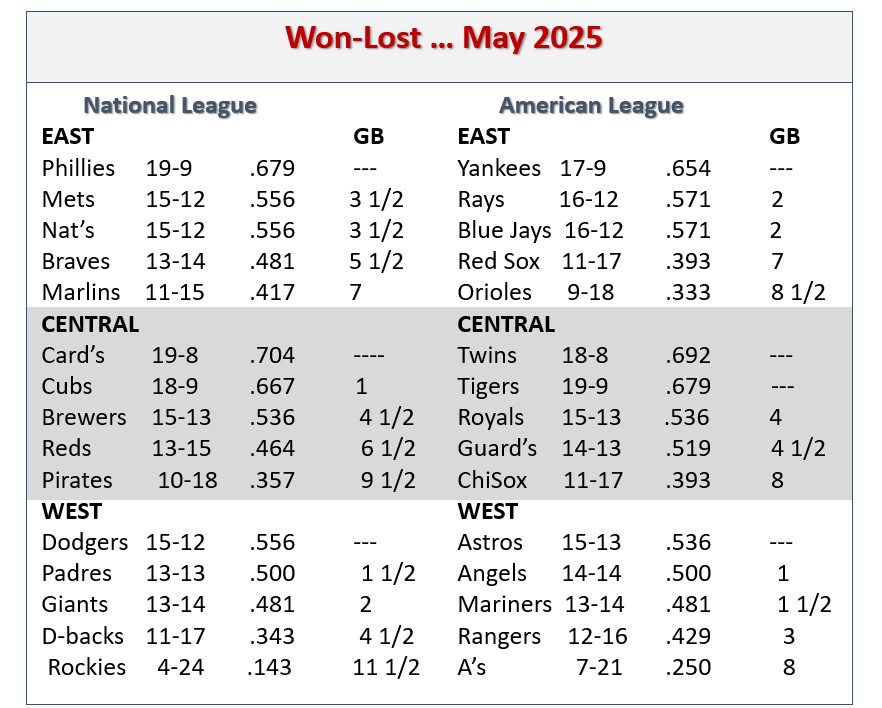
  • The Rockies went 4-24 in May (losing all eight series), leaving them 9-49 on the season – the worst start to a season in MLB’s Modern ERA. In May, the Rockies were outscored 192 to 85.
  • The AL Central was the only division with four teams over .500 in May. (The AL Central is also the only division to have four teams over .500 through May.)
  • Los Angeles was home to the home run kings.  The Dodgers led the NL with 44 long balls, the Angels led the AL with 42.

——-Team Statistical Leaders for May 2025 ———-

RUNS SCORED

National League –Dodgers (173); Cubs (150); Phillies (141)

American League – Tigers (150); Rays (137); Blue Jays (136)

The fewest runs in May were scored by the Pirates (84). In the American League, it was the Rangers at 93. 

AVERAGE

National League – Dodgers (.283); Diamondbacks (.269); Phillies (.265)

American League – Astros (.2785); Blue Jays (.268); Royals (.265)

The lowest team average for May belonged to the Rangers at .210.

HOME RUNS

National League – Dodgers (44); Diamondbacks (39); Cubs (37)

American League – Angels (42); Yankees (41); Blue Jays 38

The Pirates had the fewest home runs in May at 18.  

TOTAL BASES

National League –Dodgers (458); Diamondbacks (442); Phillies (419)

American League – Blue Jays (417); Astros (410); Yankees (410)

The Dodgers led MLB in May Slugging Percentage at .482.  The Yankees led the AL (.459)

DOUBLES

National League – Nationals (56); Diamondbacks (53); Reds (52)

American League – Yankees (50); White Sox (50); Athletics (49); Tigers (49)

TRIPLES

National League – Rockies (9); Diamondbacks (6); five with five

American League – Royals (8); Yankees (6); Red Sox (4); Guardians (4)

STOLEN BASES

National League – Brewers (40); Cubs (30); Nationals (26)

American League – Rays (49); Rangers (27); Orioles (25)

The Tigers stole the fewest sacks in May at seven – in ten attempts.  The Giants stole the fewest May bags in the NL – nine in fifteen attempts.  

WALKS DRAWN

National League – Dodgers (107); Mets (102); three with 95

American League – Yankees (109) Blue Jays (108); A’s (96)

The Dodgers led MLB in May on-base percentage at .357. The Blue Jays led the AL at .345. The Rangers had MLB’s lowest May OBP at (.279).  The Rockies anchored the NL at .280.

BATTER’S STRIKEOUTS

National League – Reds (262); Rockies (257); Pirates (240)

American League – Angels (283); Red Sox (257); Tigers (247)

Padres’ batters fanned the fewest times in May (184). The Royals fanned the fewest times in the AL at 189.

__________________________________________________

EARNED RUN AVERAGE

National League – Giants (2.64): Mets (3.08); Braves (3.08)

American League – Rangers (2.98); Twins (3.11); Royals (3.12)

The Athletics had the highest May ERA at 6.88.  Also over 5.00 were the Rockies (5.91); Diamondbacks (5.33) and Orioles (5.21).  All these teams were under .500, with a combined 31-80 record.

STRIKEOUTS

National League – Phillies (269); Braves (250); Dodgers (238)

American League –Astros (276); Tigers (257); Yankees (254)

The Astros averaged an MLB-best 10.24 strikeouts per nine innings in May. The Phillies averaged an NL-best 9.53.  Six teams averaged nine whiffs per nine or better. By comparison, the Mets led MLB in K/9 in 1990 at 7.61; The Indians led in 1970 at 6.67; and the Dodgers led in 1950 at 5.00.

FEWEST WALKS SURRENDERED

National League –   Cubs (63); Cardinals (69); Giants (71)

American League – Royals (60); Twins (60); Mariners (72)

The Royals walked an MLB-lowest 2.15 batters per nine innings in May.  The Angels walked an MLB-worst 4.30 batters per nine frames.

SAVES

National League – Phillies (12); Cardinals (11); four with eight

American League – Twins (10); Blue Jays (10); three with eight

The A’s blew the most saves in May– nine 13 opportunities.

Walks+Hits/Innings Pitched (WHIP)

National League – Giants (1.12); Cubs (1.15); Braves (1.18)

American League:  Twins (1.13); Blue Jays (1.15); Royals 1.16; Tigers (1.16)

Bonus Stats:

  • The A’s gave up an MLB-high 56 home runs in May. The Giants gave up an MLB-low 17 home runs.
  • Rangers’ pitchers held opponents to an MLB-low .218 average in May. The Rockies’ staff was touched for an MLB-high .300 average.
  • The Twins’ strikeouts-to-walks ratio for May topped MLB at 3.95. The Rockies had MLB’s worst ratio at 1.81.

—-MAY HIGHLIGHTS—-

Wait for the Big Finish

On May 2, the Tigers came up in the top of the ninth innings in a 1-1 tie with the Angels, but ended the pitchers’ duel with an eight-run top of the final frame. Tigers’ DH Riley Greene scored and drove in the first run of the frame with a solo home run off Kenley Jansen. Nine batters later, Greene scored the final run and drove in the final three runs of the contest with a three-run homer off Jake Eder. It was the first time in AL/NL history a player had hit two ninth-inning homers in a game.

Who Did What?

Astros’ CF Jake Meyers came into the game on May 3 (versus the White Sox) batting ninth and hitting .262, with no home runs and six RBI in 30 games.  Those numbers changed in a hurry.  As the Astros prevailed 8-3, Meyers went four-for-four, with two homers, a triple and a double, collecting (a franchise record-tying) 13 total bases, scoring twice and driving in seven tallies.

Baltimore Flyover (The wall, that is.)

On May 4, as the Royals beat the Orioles 11-6 in an afternoon title at Camden Yards – the ball was flying.  The two teams hit a total of 11 roundtrippers in the game. The Royals launched a franchise-high seven and the Birds went yard four times. Further, ten of the 11 long balls were solo homers which, according to the Elias Sports Bureau, tied an MLB record. Overall, nine players went yard.  The Royals got two homers from 3B Maikel Garcia and one each from LF Jonathan India; SS Bobby Witt, Jr.; 1B Vinnie PasquaNtino; 2B Michael Massey; and C Luke Maile.  The Royals got two homers from 2B Jackson Holliday and one each from CF Cedric Mullins and RF Ryan O’Hearn. Massey’s ninth-inning two-run home run as the only one that wasn’t a solo shot.

Royals’ starter Michael Lorenzen gave up all four Orioles’ homers (over a 4 2/3-inning outing). The Orioles, on the other hand, had five different pitchers surrender long balls.

You Chose Well, Grasshopper

On May 4, the Texas Rangers dismissed Offensive Coordinator Donnie Ecker and on May 6 brought on Brett Boone as hitting coach. Well, on Boone’s first day on the job, the Rangers banged out sixteen hits in a 6-1 win over the Red Sox in Fenway (evening the Rangers’ 2025 record at 18-18). Six Rangers had multi-hit games and only the number-nine hitter in the starting lineup went hitless. An omen? Hard to say.  After all the Rangers did collect 12 hits in the game before Boone came on the scene (an 8-1 win over the Mariners in Texas).  But certainly, a good first day on the job for Boone.

Side note: Through May 4, the Rangers had scored three or fewer runs in 22 of its 35 games (63%). From May 6-31, they scored three or fewer runs in 14 of 23 games (58%).

Extra? Extra? Read All About it.

On May 6, the Cubs and Giants were locked in a tight one – tied at five apiece after ten innings. Then things loosened up a bit, as the Giants tallied nine in the top of the eleventh and eventually won 14-5 – the fifth largest extra-inning margin of victory in the Modern Era (post-1900).  It went like this:

Cubs’ Ryan Pressley pitching

  • Giants’ pinch runner Christian Koss started the inning on second base (replacing LaMonte Wade, Jr.);
  • LF Heliot Ramos doubled, Koss going to third;
  • C Patrick Bailey singled to drive home Koss, with Ramos going to third;
  • 2B Brett Wisely bunted, Ramos scored, Bailey went to second, and Wisely reached first;
  • RF Mike Yastrzemski walked, loading the bases;
  • SS Willy Adames was hit by a pitch, forcing in a run;
  • CF Jung Hoo Lee hit an RBI single to right, bases remained loaded;
  • 3B Matt Chapman singled to left, driving in two runs – runners now on first and second;
  • DH Wilmer Flores hit an RBI single to left, runners now on first and third;

Caleb Thielbar replaces Pressley on the mound.

  • Koss struck out;
  • Ramos hit an RBI double to left, runners now on first and third;
  • Bailey hit an RBI sacrifice fly to center;
  • David Villar pinch hit for Wisley and struck out to end the carnage.

The inning: Nine runs on six hits, a walk and a hit-by-pitch.

For the who like to know such things, the most runs scored in any extra-inning was 12 – by the Rangers in a July 3, 1983, 14-inning, 16-4 win over the Athletics.   Notably, like the Giants (above), they accomplished the feat without the benefit of a home run … eight hits (three doubles), four walks, a wild pitch and an Athletics’ error.

200 for Bregman

On May 7, as the Red Sox topped the Rangers 6-4 in Boston, BoSox’ 3B Alex Bregman went three-for-four, with two runs scored and three RBI. One of his hits was a fourth-inning solo home run off Tyler Mahle – the 200th roundtripper of Bregman’s 10-season MLB career. Bregman finished May at .299-11-35 on the season.

The Bronx Bomber Tradition

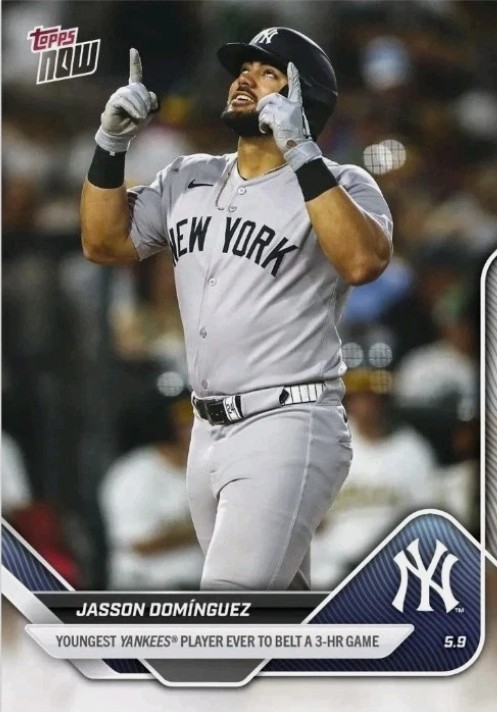
On May 9, 22-year-old (rookie-qualified) Yankee left fielder Jasson Dominguez went deep three times in a Yankees 10-2 win over the Athletics in Sacramento. It was his first MLB multi-homer game and included a first-inning solo homer (hit left-handed off Osvaldo Bido). He also drove in a run with a sac fly off Bido in the fifth; hit a solo homer, batting right-handed, off Hogan Harris in the seventh; and capped off his day with a Grand Slam (back to the port side) off Elvis Alvarado in the eighth.  Dominguez hit only one other home run in May – a walk-off game winner off Luke Jackson of the Rangers in a 4-3 Yankees win on May 21.

Dominguez is now the youngest Yankee with a three-homer game (22 years-91 days), edging out Joe DiMaggio (22 years-200 days). #InBaseballWeCountEverything. It was also reported that Dominguez became the first player to hit three home runs in a game, hit homers both right- and left-handed in a game, hit a Grand slam and hit a walk-off homer all in the same month.

Fedde Shutout – A Rare Bird

On May 10, Erick Fedde of the Cardinals tossed his first MLB shutout and first MLB complete game in eight MLB seasons. It came in his 137th start.  Fedde gave up six hits and no walks (with eight strikeouts) in a 10-0 win over the Nationals in Washington. It was just the third single-pitcher shutout of the season. It was also the Cardinals’ first single-pitcher shutout since August 22, 2022. Fedde threw 109 pitches (68 strikes) in his outing.

Now that’s Embarrassing

The Rockies had a tough May, going 4-24, leaving them 9-49 on the season. The most embarrassing moment may have come on May 10, when the Rox lost to the Padres 21-0 in Colorado. Rockies’ batters tallied just five hits, while Rockies’ pitchers gave up 24 hits, including five home runs (RF Fernando Tatis, Jr.; SS Xander Bogaerts; 2B Jake Cronenworth; 1B Gavin Sheets; LF Jason Heyward.  The Padres missed the Modern Era (post-1900) record for runs scored when shutting out an opponent by just one run.  There have been two 22-0 whitewashings.  On September 16, 1975, the Pirates beat the Cubs (at Wrigley) by that score.  On August 31, 2004, the Indians trounced the Yankees 22-0 in New York. Pre-1900, the Providence Grays beat the Philadelphia Quakers (now Phillies) 28-0 on August 21, 1883.

Oh, and by the way, Padres’ pitcher Stephen Kolek threw a nine-inning shutout (don’t see those too often any more), giving up five hits, walking two and fanning seven.  It was Kolek’s first career complete game and first shutout (in just his fourth MLB start). Kolek made his MLB debut in 2024, getting in 42 games for San Diego (all in relief) and going 3-0, 5.21.  Through May of this season he was 3-1, 4.11 in five starts.

Let’s Change Things Up a Little

The Reds came into their May 10 game at Houston with a 20-21 record, having won only one of their last seven games and having scored a total of ten runs in their last six games. Then BOOM, the Reds matched their offensive output of the previous six games by plating ten runs versus Houston in the top of the very first inning. The Reds sent 14 batters to the plate that inning and scored tens runs on five hits (three singles, a double and a home run), while also benefiting from five walks and a hit batsman. They ultimately won the game 13-9. They then went on to lose their next three games, tallying a total of three runs. But in a see-saw month, after those three losses, they went on a five-game winning streak, outscoring their opponents 26-8.

1,000 for Freddy

On May 12, as the Brewers lost to the Guardians 5-0 in Cleveland, Brewer starter Freddy Peralta lasted 5 1/3 innings, giving up four runs and taking the loss.  He did, however, fan four batters and the third of those strikeouts – 2B Daniel Schneemann to end the fifth inning was Peralta’s 1,000th career strikeout- making him the fastest pitcher to reach 1,000 Ks as a Brewer (187 games/804 2/3 innings).  Peralta is in his eighth season (all as a Brewer).

They Call Him The Streak

Photo: D. Benjamin Miller, CC0, via Wikimedia Commons

On May 14, as the Phillies won the first game of a doubleheader against the Cardinals by a 2-1 score, Phillies’ DH Kyle Schwarber took a zero-for-four collar. Hardly seems worth a highlight, unless you consider that it was the first time in 48 games that Schwarber failed to get on base. It was the fourth-longest such streak in Phillies Modern-Era (post-1900) history. The Phillies’ record belongs to Mike Schmidt at 56 games. The all-time record is 84 games by Ted Williams). Schwarber’s 46-game on-base streak went back to September 23, 2024.  During the streak, he went .262-16-37, with 33 walks.

One For the Money … Two for the Sho(hei)

Timing isn’t everything, but it is something.  On May 15, 51,272 fans packed Dodger Stadium for Shohei Ohtani Bobblehead Night … a bobblehead commemorating his “unicorn” 2024 fifty+ homer/50+ steal season). As usual, Ohtani did not disappoint, going two-for-six, with two home runs and six RBI in a 19-2 win over the Athletics.  Side Note: On April 2, the Dodgers handed out Ohtani bobbleheads commemorating his third unanimous NL MVP Award (2021-23-24). In that game, Ohtani went three-for-five and won the game with a walk-off home run in the bottom of the ninth (Dodgers 5 – Braves 5). Nice timing.

A Nice Round Number

On May 16, as the Phillies topped the Pirates 8-4 in Philadelphia, Phillies’ 1B Bryce Harper went three-for-four (all singles) with two runs scored and two RBI. His first RBI of the game, coming in the fifth inning, was Harper’s 1,000th career run driven in (coming in his 14th season/1,697th career game. More #InBaseballWeCountEverything – In an MLB.com report, Todd Zolecki noted that made Harper just the 14th MLB player to rack up 1,000 runs scored, 1,000 walks and 1,000 RBI before his 33rd birthday.

Immaculately Done, Mr. Quantrill

On May 18, as the Marlins topped the Rays 5-1 in Miami, Marlins’ starter Cal Quantrill tossed five innings of one-run ball for the win (two hits, one run, two walks, six strikeouts). He carved out a little spot in MLB history in the top of the fourth – tossing 2025’s first Immaculate Inning (nine pitches, three outs, three strikeouts). The victims were the 5-6-7 hitters: 1B Jonathan Aranda, LF Christopher Morel and CF Kameron Misner.  For those who like to know such things, there have been more than 100 Immaculate Innings.  Dipping a toe into the research, I found that Baseball-Almanac.com reports 115 such occurrences; The Sporting News 116 and an article on MLB.com 118. One thing that is agreed upon is that Immaculate frames are becoming more common, with more nine-pitch, three-strikeout innings reported between 2000 and 2025 than from 1889 through 1999,

Not as Complete a Day as Hoped For

On May 18, in his 33rd MLB start, Pirates “phenom” Paul Skenes pitched his first MLB complete game – giving up just three hits and one rum (walking one and fanning nine) in eight innings. Unfortunately, all he got for that sharp outing was a loss, as four Phillies’ pitchers held the Pirates scoreless.  The loss put Skenes at 3-5, 2.44 (after ten starts) on the season.

Rolling a 300

On May 19, as the Phillies topped the Rockies 9-3 (in Colorado), Kyle Schwarber led off the top of the ninth inning with a 466-foor home run to right field (off Scott Alexander). It was his 16th of the season and, perhaps more important statistically, his 300th career dinger.  Schwarber finished May with a .232-19-43 stat line on the season.  Sidenote: Schwarber seems to have found a “home” in Philly. In seven seasons before coming to Philadelphia (2015-2021 … Cubs, Nationals, Red Sox), Schwarber hit a total of 153 long balls in 664 games.  In three seasons and change with the Phillies 2022-2025) he has hit 150 home runs in 523 games.

Breaking Out in the Eighth

On May 23, in a 19-5 win over the Orioles in Boston, the Red Sox dropped a “Baker’s Dozen” runs on the Birds in the eighth inning. (For you youngsters a “Baker’s Dozen” is 13.)  The Red Sox sent 18 batters to the plate in the frame – collecting 12 hits (five singles, five doubles, two home runs) and two walks.  Every player in the lineup scored at least once (four scored twice). DH Rafael Devers had a single and a Grand Slam (two runs, five RBI in the inning), while RF Rob Refsnyder had a three-run homer and a single (four RBI, two runs scored). Orioles’ pitchers Cionel Perez and Emmanuel Rivera (a corner infielder by trade) threw a combined 67 pitches in the inning.  For those who like know such things, the most runs ever scored by a team in the eighth inning of an MLB game is 16 – by the Rangers (also against the Orioles) in a 26-7 win on April 19, 1996. In that inning, the Rangers recorded eight hits, but benefited from eight walks and a wild pitch. The Orioles’ pitcher in that frame were Armando Benitez, Jesse Orosco and (infielder) Manny Alexander.

Out-Madduxing the Professor

On May 25, Tigers’ lefty Tarik Skubal threw a rare “Maddux” – a nine-inning shutout using less than 100 pitches (named such in honor of Hall of Famer Greg Maddux). In running his season record to 5-2, 2.49, Skubal shutout the Guardians in a 5-0 Tiger win.  Skubal fanned 13 batters in his 94-pitch outing (the most strikeouts ever in a “Maddux.”)  Maddux himself never fanned more than nine batters in a “Maddux.”

Don’t Be in Such a Hurry

On May 25, Braves’ starter Chris Sale pitched six scoreless frames (two hits, three walks, eight strikeouts), as the Braves topped the Phillies 9-3. His final strikeout – 3B Edmundo Sosa to end the sixth inning, was the 2,500th of Sale’s 15-season MLB career. It made him the 40th MLB pitcher to reach that milestone and he got there faster (in innings) than any other pitcher (2,026 innings). The previous pace-holder was Randy Johnson, who reached 2,500 strikeouts in 2,107 2/3 innings (in his 12th MLB season).

How Things have Changed – A Complete Game is a Highlight

On May 31, The Rays’ Zack Littell – making his 59th career start and 214th mound appearance in eight MLB seasons, tossed his first MLB career complete game. He gave up three runs on ten hits and one walk (six strikeouts) in the 117-pitch outing (a 16-3 Rays win over the Astros in Houston).

Not A Great Day for the Home Crowd

On May 31, the Diamondbacks were in a deep hole even before many of the 29,434 fans at Chase Field were in their seats.  In the top of the first inning, the Nationals scored nine runs off pair of Diamondbacks’ hurlers before an out was even recorded.

It went like this.

Brandon Pfaadt on the mound.

  • CF CJ Abrams hit by a pitch on an 0-2 count;
  • LF James Wood singled to right, Abrams going to third;
  • 1B Nathaniel Lowe hit an RBI double to left;
  • 2B Luis Garcia Jr. hit a two-run double to right;

Hits to all three fields already.

  • DH Josh Bell hit by a pitch on a 2-2 count;
  • CF Robert Hassell III singled to center, loading the bases;
  • C Kiebert Ruiz hit a two-run double to CF;
  • 3B Jose Tena hit a two-run double to right;

With seven runs in, a runner on second and just 36 pitches thrown, Pfaadt was replaced on the bump by Scott McGough.

  • RF Daylen Lile laced McGough’s second pitch for an RBI double to CF;
  • Abrams hit by a pitch for the second time in the inning;

Side Note: Abrams tied the MLB record for most time hit by a pitch in an inning and was hit again in the sixth frame to tie the record for most times hit by a pitch in a game.

  • Wood hit a ground ball, RBI single to CF;
  • Lowe struck out swinging for the first out (nine runs already in).

The Nationals eventually went on to score one more run in the first inning and then hang on for a 11-7 win. According to the Elias Sports Bureau it was the second most runs ever scored by an MLB team before making its first out of a game. The Red Sox scored ten runs before the first out in the first inning of a 25-8 win over the Marlins (in Boston) on June 27, 2003.  The Nationals did tie the NL record for runs scored before making a first out.

200 and Counting

On May 31, as the Dodgers topped the Yankees 18-3, LA third baseman Max Muncy went three-for -six, with three runs scored, seven RBI and two home runs.  The first of the two long balls – a three-run shot in the second inning –  was Muncy’s 200th career MLB roundtripper.


–INDIVIDUAL STAT LEADERS FOR MAY—

BATTING AVERAGE (at least 75 at bats)

American League: Jose Ramirez, Guardians (.386) Jacob Wilson. Athletics (.368); Ryan O’Hearn, Orioles (.365)

National League: Freddie Freeman, Dodgers (.410); Heliot Ramos, Giants (.347); TJ Friedle, Reds (.344)

The lowest May average among players with at least 75 at bats belonged to the Red Sox’ infielder Kristian Campbell at .134 (11-for-82).

HITS

American League: Jose Ramirez, Guardians (39); Jacob Wilson, A’s (39); three with 37

National League: Freddie Freeman, Dodgers (43); Trea Turner, Phillies (38); James Wood, Nationals (35)

The Dodgers’ Shohei Ohtani led all MLBers in May extra-base hits with 21 – five doubles, one triple and 15 home runs.  

HOME RUNS

American League: Cal Raleigh, Mariners (12); Aaron Judge, Yankees (11); Taylor Ward, Angels (10)

National League:  Shohei Ohtani, Dodgers (15); Kyle Schwarber, Phillies (10); Pete Crow-Armstrong, Cubs (9)

The Yankees’ Aaron Judge all hitters with at least 75 at bats in May slugging percentage at .798. The Dodgers’ Shohei Ohtani the NL at .782

RUNS BATTED IN

American League: Rafael Devers, Red Sox (33); Taylor Ward, Angels (28); Cal Raleigh, Mariners (26)

National League: Pete Crow-Armstrong, Cubs (29); Shohei Ohtani, Dodgers (27); Seiya Suzuki, Cubs (27)

RUNS SCORED

American League:  Aaron Judge, Yankees (25); Zach Neto, Angels (23); Jose Ramirez, Guardians (22)

National League: Shohei Ohtani, Dodgers (31); CJ Abrams, Nationals (24); Mookie Betts, Dodgers (23); Kyle Schwarber, Phillies (23)

DOUBLES

American League: Lawrence Butler, A’s (10); Ryan Mountcastle, Orioles (9); Miguel Vargas, White Sox (9); Bobby Witt, Jr., Royals (9)

National League: Seiya Suzuki, Cubs (12); Freddie Freeman, Dodgers (10); Nico Hoerner, Cubs (10)

TRIPLES

American League:  Jarren Duran, Red Sox (3); Bobby Wit, Jr., Royals (3); four with two

National League: Jordan Beck, Rockies (3); Austin Hayes, Reds (3); nine with two

STOLEN BASES

American League:  Chandler Simpson, Rays (16); Jose Caballero, Rays (12); Bobby Witt, Jr., Royals (11)

National League: Jackson Chourio, Brewers (9); Francisco Lindor, Mets (8); Trea Turner, Phillies (8); Kyle Tucker, Cubs (8)

The White Sox’ Luis Robert, Jr.  and Jorge Mateo of the Orioles tied for the most May bases stolen without getting caught (9).

BATTER’S STRIKEOUTS

American League:  Zach Neto, Angels (39); Tyler Soderstrom, A’s (37); Taylor Ward, Angels (37)

National League: Michael Toglia, Rockies (40); Oneill Cruz, Pirates (38); Tyler Stephenson, Reds (37)

WALKS

American League:  Rafael Devers, Red Sox (22); Vlad Guerrero, Jr., Blue Jays (21); Gleyber Torres, Tigers (21)

National League: Marcell Ozuna, Braves (22); Juan Soto, Mets (20); Kyle Schwarber, Phillies (19)

The Highest on-base percentage among players with at least 75 May at bats was .468, by the Red Sox’ Rafael Devers. The NL leader was the Dodgers’ Freddie Freeman at .462.

PITCHING VICTORIES

American League:  Zack Littell, Rays (4-0); Framber Valdez, Astros (4-1); Jhoan Duran, Twins (4-1)

National League:  Ranger Suarez, Phillies (4-0); Robbie Ray, Giants (4-1); Zack Wheeler, Phillies (4-1)

The Rockies’ Antonio Senzatela led MLB in May losses (0-6, 9.10) in six starts.

EARNED RUN AVERAGE (minimum 20 May innings)

American League: Kris Bubic, Royals (0.56); Nathan Eovaldi, Rangers (0.68); Carlos Rodon, Yankees (1.47)

National League: Andrew Abbott, Reds (0.55); Bailey Falter, Pirates (0.76); Chris Sale, Braves (1.11)

The highest ERA among pitchers with at least 25 May innings or four May starts was 9.10 by the Rockies’ Antonio Senzatela (0-6, 9.10 in six starts, 28 2/3 innings).

STRIKEOUTS

American League: Tarik Skubal, Tigers (59 K / 41 IP); Will Warren, Yankees (43K / 28 IP); Framber Valdez, Astros (42 K / 42 IP)

National League: Robbie Ray, Giants A (45 K / 39 IP); Sonny Gray, Cardinals (43 K / 34 IP); Dylan Cease, Padres (42 K / 34 IP); MacKenzie Gore, Nationals (42 K / 27 1/3 IP)

WALKS + HITS/INNINGS PITCHED (at least 25 May innings)

American League: Tarik Skubal, Tigers (0.59); Joe Ryan, Twins (0.72); Kevin Gausman Blue Jays (0.84)

National League: Yoshinobu Yamamoto, Dodgers (0.80); Zack Wheeler, Phillies (0.81); Bailey Falter, Pirates (0.84)

Among pitches with at least 25 Mays innings, the Dodgers’ Yoshinobu Yamamoto held batters to the lowest average at .146.

SAVES

American League:  Jhoan Duran, Twins (7); Emmanuel Clase, Guardians (70; Carlos Estevez, Royals (7); Jeff Hoffman Blue Jays (7)

National League:  Ryan Helsley, Cardinals (9); Trevor Megill, Brewers (7); Kyle Finnegan, Nationals (7)

Ryan Helsley of the Cardinals saved the most games without a blown save in May (nine).  

Bonus:

Among pitchers who faced at least 75 batters in May:

  • The Nationals MacKenzie Gore fanned the most batters per nine innings at 13.83;
  • The Blue Jays’ Kevin Gausman had the best strikeouts-to-walks ratio at 33.0. (He walked one batter and fanned 33 in 32 innings.)


Primary Resources: Stathead.com; Baseball-Almanac.com; MLB.com

Baseball Roundtable – Blogging Baseball Since 2012.

Baseball Roundtable is on the Feedspot list of the Top 100 Baseball Blogs. For the full list click here

I tweet (on X) baseball @DavidBaseballRT

Follow Baseball Roundtable’s Facebook Page here.  More baseball commentary; blog post notifications; PRIZES.

Member: Society for American Baseball Research (SABR); Negro Leagues Baseball Museum; The Baseball Reliquary.

P 1118

Baseball Roundtable Trivia(l) Tidbit Tuesday … The 700-Club

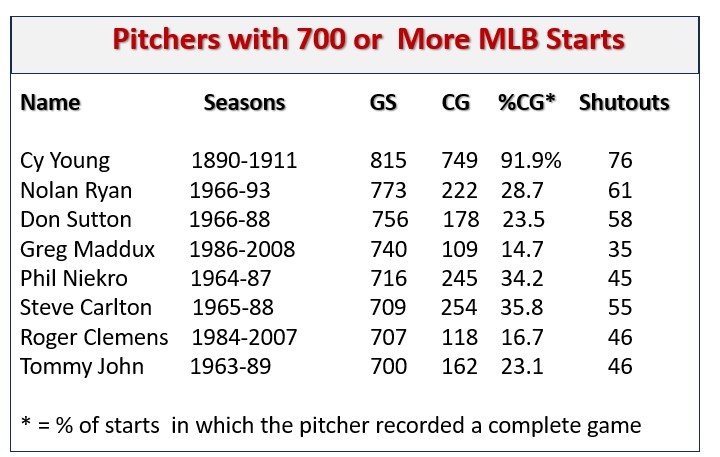
Once again, it’s time for Trivia(l) Tidbit Tuesday. I hope you are enjoying this weekly presentation of baseball occurrences that for some reason caught The Roundtable’s eye.  (I’m particularly fond of unexpected performances and statistical coincidences.) These won’t necessarily be momentous occurrences, just events, statistics or coincidences that grabbed my attention. I’m also drawn to baseball “unicorns,” those one-of-a-kind accomplishments or statistics.  This week, we’re looking at pitchers who started at least 700 MLB games.

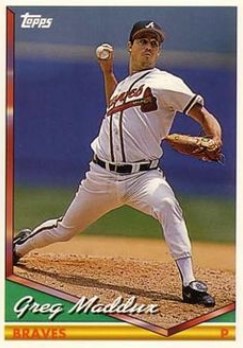
Eight hurlers have reached that lofty number of starts – led, of course, by Cy Young with 815 starts over 22 seasons.  The others are Nolan Ryan, Don Sutton, Greg Maddux, Phil Niekro, Steve Carlton, Roger Clemens and Tommy John.

As, I looked over the stats for this “Great Eight,” I was surprised to find (as the chart shows) that among those on the list, Maddux threw the fewest complete games (109), had the lowest percentage of his starts result in a complete game (14.7%) and tossed the fewest shutouts (35).   On the other side of the coin, of course the times and the game were different, Young threw the most complete games (740) among the pitchers on the list, completed the highest percentage of his starts (91.9%) and threw the most shutouts (76).

A few additional notes:

  • Among the pitchers in the 700-start club, Roger Clemens came in out of the bullpen the fewest times (just two) and those relief stints were, in a way, career bookends. The first came in his rookie season (1984) – a two-inning, scoreless appearance in his 13th career MLB game.  The second came in his final season (2007) – a one-inning scoreless appearance in his 695th career MLB game.
  • Phil Niekro made the most relief appearances among pitchers with 700 MLB starts, coming out of the pen 148 times. (In his first three MLB seasons, Niekro made just one start in 79 appearances.)
  • Tommy John and Steve Carlton pitched for the most teams during their quest for 700 MLB starts – six each. None of the hurlers on the list pitched for fewer than four teams.

Bonus Tidbit.

The pitcher with the most career starts without ever pitching in relief is Tom Glavine, who started 682 games over 22 MLB seasons (1987-2008… Braves, Mets). He went 305-203, 3.54, with 56 complete games and 25 shutouts.

Primary Resource: Stathead.com

Baseball Roundtable – Blogging Baseball Since 2012.

Baseball Roundtable is on the Feedspot list of the Top 100 Baseball Blogs. For the full list click here

I tweet (on X) baseball @DavidBaseballRT

Follow Baseball Roundtable’s Facebook Page here.  More baseball commentary; blog post notifications; PRIZES.

Member: Society for American Baseball Research (SABR); Negro Leagues Baseball Museum; The Baseball Reliquary.

P 1117

Baseball Roundtable Trivia(l) Tidbit Tuesday … I’ll Take a Dozen of Those, Please.

Once again, it’s time for Trivia(l) Tidbit Tuesday. I hope you are enjoying this weekly presentation of baseball occurrences that for some reason caught The Roundtable’s eye.  (I’m particularly fond of unexpected performances and statistical coincidences.) These won’t necessarily be momentous occurrences, just events, statistics or coincidences that grabbed my attention. I’m also drawn to baseball “unicorns,” those one-of-a-kind accomplishments or statistics.  This week, we’re looking at players who were exceptionally busy in the “garden.”

Here are the usual disclaimers: Given statistical accuracy and game formats, I am restricting myself to the Modern Era (post-1900) and not all Negro League game stats have been fully documented and incorporated into the MLB record books. (In 2020, the Negro leagues from 1920-48 were designated major leagues.)

You’re putting me on! No, I’m putting you out.

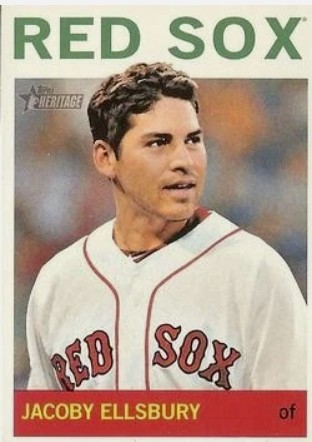
On this date (May 20) in 2009, Red Sox’ CF Jacoby Ellsbury tied the MLB record for putouts by an outfielder in a nine-inning game, gloving an even dozen flyball outs in the center of the garden (in an 8-3 Red Sox win over the Blue Jays in Boston). Ellsbury’s glove provided a home for two Blue Jays’ fly balls in the top of the first inning, two in the second frame, two in the third, two in the fourth, one in the fifth, two in the sixth, and one in the ninth.   Eight of the nine players in the Blue Jays’ starting lineup were put out on flyballs to Ellsbury at least once. Only number-nine hitter LF Travis Lind managed to avoid Ellsbury’s glove.

Here are a few tidbits that caught my eye:

  • Ellsbury’s record-tying twelfth putout came in just under the wire – on the final pitch/final out of the game;
  • Only three outfielders have recorded 12 putouts in an MLB game and all three were CF (Ellsbury, the Twins’ Lyman Bostock and the Boston Braves’ Earl Clark);
  • All three 12-putout games occurred in the city of Boston; and
  • In Ellsbury’s 12-putout game, the opposing CF (Vernon Wells) did not record a single putout.

Bostock’s 12-putout game came in a 9-4 Twins win over the Red Sox (in Boston) on May 25, 1977 (second game of a twin bill). Bostock recorded one putout in the second inning, two in the third, one in the fourth, three in the fifth, one in the sixth, one in the seventh, one in the eighth and two in the ninth.  Like Ellsbury, Bostock’s record-tying putout came on the final pitch/final out of the game.  Eight of the nine Boston starters were victims of Bostock’s glove, only the number-eight hitter, 3B Butch Hobson, escaped that fate. CF Fred Lynn flied out to Bostock three times in five plate appearances (four at bats). Bostock, by the way, had five putouts in Game One of the twin bill.  He finished one shy of Lloyd Waner’s record of 18 putouts by an outfielder (also CF) in a doubleheader (June 26, 1935).

Clark recorded his 12-putout game on May 10, 1929 – as his Braves lost to the Reds 5-3 in Boston. Clark recorded two flyball putouts (and an outfield assist) in the first inning, one flyball putout in the third, two in the fourth, three in the fifth, three in the eighth, and one in the ninth. All nine members of the Reds’ starting lineup flied out to Clark at least once.

For those who like to know such things; The record for outfield putouts in a season is held by Taylor Douthit (also a centerfielder) with 547 for the Cardinals in 1928. Side note:  The kind of thing I notice. Taylor had the words out and hit in his last name.

Speaking of the Words Out and Hit

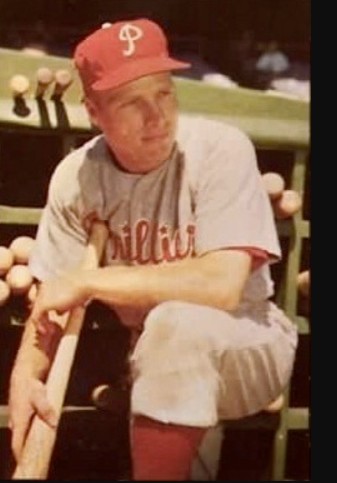
There have been ten seasons of 495 or more putouts in MLB since 1900. Six of them belong to Phillies’ Hall of Fame centerfielder Richie Ashburn.  In the ten seasons from 1949 through 1958, Ashburn lead the NL in outfield putouts nine times. In six of those seasons, he led MLB in outfield putouts. Over that same ten-season span, Ashburn also led all major leaguers in base hits with 1,913 (winning the NL batting title in 1955 and 1958). Stan Musial was second in hits over that span, with 1,891 (batting titles in 1949, ‘50, ‘51,’52 and ‘57).


Primary Resources: Stathead.com; Baseball-Almanac.com

Baseball Roundtable – Blogging Baseball Since 2012.

Baseball Roundtable is on the Feedspot list of the Top 100 Baseball Blogs. For the full list click here

I tweet (on X) baseball @DavidBaseballRT

Follow Baseball Roundtable’s Facebook Page here.  More baseball commentary; blog post notifications; PRIZES.

Member: Society for American Baseball Research (SABR); Negro Leagues Baseball Museum; The Baseball Reliquary.

P 1116

Baseball Roundtable Trivia(l) Tidbit Tuesday – Four Hits to Bookend an MLB Career

Once again, it’s time for Trivia(l) Tidbit Tuesday. I hope you are enjoying this weekly presentation of baseball occurrences that for some reason caught The Roundtable’s eye.  (I’m particularly fond of unexpected performances and statistical coincidences.) These won’t necessarily be momentous occurrences, just events, statistics or coincidences that grabbed my attention. I’m also drawn to baseball “unicorns,” those one-of-a-kind accomplishments or statistics.

Here are the  usual disclaimers: Given statistical accuracy and game formats, I am restricting myself to the Modern Era (post-1900) and not all Negro League game stats have been fully documented and incorporated into the MLB record books. (In 2020, the Negro leagues from 1920-48 were designated major leagues.)

This Tuesday, we start with what seems like a straightforward trivia question:  Who is the only player to collect four hits in both his first and last MLB game?

The answer: Ray Jansen. Jansen’s place as an MLB unicorn, however, is not as straightforward as it may seem. That’s because Jansen’s first MLB game was also his last MLB game. (There was a slight hint in the question, it did say “first and last MLB “game,” not “games.”  Jansen’s game came on September 30, 1910 – as Jansen found himself playing third base and batting second for the St. Louis Browns, facing the White Sox in St. Louis.  In a contest that produced an unusual line score, Jansen produced four singles in five at bats. Despite his output, the Browns (who had sixteen hits) fell to the White Sox (who had just nine safeties) by a lopsided score of 9-1. (The Browns’ seven errors, three by Jansen, didn’t help their cause.)

Still, four-for-five? You’d think Jansen would have found himself in another MLB game at some time, but this proved to be his first and last time on a regular-season MLB field.

Perhaps a little background is in order. The Browns came into the game with a 45-102 record – 54 ½ games out of first place (with a fan-interest level to match). Jansen was a 21-year-old local boy (St. Louis native) who played that season with the Class-D Paragould Scouts. In a lost season, why not give a St. Louis fellow a chance? Who knows, it might even sell some tickets. Long story short, Jansen got his chance and his four-hit game and, in 1911, was back at Class-D (Keokuk Indians).   He played in the minors through 1918, rising as high as Class-A, but never saw the major leagues again.

Now, about that four-hit day. It gives Jansen a share of the NL record for hits in a debut MLB game and a share of the overall MLB record for a final MLB game.

Only one player has ever collected more safeties in his MLB debut and that was Cecil Travis of the 1933 White Sox – and that was in a 12-inning contest.  Travis poked five singles in seven at bats – the last hit coming in the tenth frame. Overall, just 18 players have collected four hits in their debut MLB games (nine innings) – two more, if you include extra-inning contests. A few notables include: Casey Stengel, Willie McCovey and Kirby Puckett. Travis, by the way, played in 12 MLB seasons (1933-41, 1945-47 … Nationals), hitting .314-27-657.

Moving on to final-MLB-game four-hit performances. Six players (including Jansen) have delivered four hits  in their final (nine-inning) MLB game – and one in a final MLB game that went extra-innings.

Photo: James G, CC BY 2.0 <https://creativecommons.org/licenses/by/2.0>, via Wikimedia Commons

While I have you here, let’s look at another MLB debut-game record holder.  You’ll see why I include this here in the next paragraph. In the search that uncovered Ray Jansen, I also came across the sterling debut game of J.P Arencibia, who had one of the best batter’s box debuts in MLB history. Arencibia not only tied the record for hits (in a nine-inning MLB-debut game) with four, he also tied the record for home runs in an MLB-debut game (two) and took sole possession of the record for total bases in a debut game with 11.  He made his debut with the Blue Jays on May 7, 2010 and delivered four hits in five at bats, including a double and two home runs, three runs scored, three RBI and 11 total bases. (The Blue Jays won 17-11.)

What caught my eye was that Arencibia appeared in 10 more games for the Blue Jays that season and collected just one more hit (a single) in 30 at bats (he did draw two walks). Arencibia played in six MLB seasons (2010-2015 … Blue Jays, Rangers, Rays) and hit .212-80-245.  Arencibia was a first-round pick in the 2007 MLB draft – out of the University of Tennessee, where he hit .333-33-165 in three seasons (174 games). The year he was called up to the Blue Jays, he hit .301-32-85 at Triple-A Las Vegas.

Others with two homers in a debut game are: Trevor Story, Mark Quinn, Bert Campaneris and Bob Nieman.

Finally, what about RBI?  The record for RBI in both a first and final MLB games is six. Cubs’ 20-year-old SS Starlin Castro made his MLB debut on May 7, 2010, batting in the eight-hole. He went two-for-five (one home run), with six RBI in a Cubs’ 14-7 win. Castro went on to twelve-season MLB career (2010-2021 … Cubs, Yankees, Marlins, Nationals).  The four-time All Star went .280-138-678 over 1,573 games.

The Rays’ Joey Butler holds the final-MLB-game records for both home runs (two) and RBI (six). On October 4, 2015, in a game against the Blue Jays, Butler (at DH and in the eight-hole) went three-for-four, with two home runs and six RBI in a 12-3 Rays’ win.  Butler played in just three MLB seasons (2013-15 … Rangers, Cardinals, Rays), hitting .276-8-31 in 102 MLB games.  Butler was a 15th round draft pick (2008) out of the University of New Orleans. He made his MLB debut in his sixth professional season. His final professional season was 2017, with the Triple-A Syracuse chiefs.

Primary Resources: Stathead.com; Baseball-Almanac.com

Baseball Roundtable – Blogging Baseball Since 2012.

Baseball Roundtable is on the Feedspot list of the Top 100 Baseball Blogs. For the full list click here

I tweet (on X) baseball @DavidBaseballRT

Follow Baseball Roundtable’s Facebook Page here.  More baseball commentary; blog post notifications; PRIZES.

Member: Society for American Baseball Research (SABR); Negro Leagues Baseball Museum; The Baseball Reliquary.

P 1115

A Ballplayer’s Dream … as Shared by Former Major Leaguer John Paciorek

Most of us, as baseball fans, have shared a dream – a dream of what it would be like to get that one game, that one at bat or that one trip to the mound in the major leagues – and to see our name and “stats” on the back of a baseball card.   Did you ever wonder what a player who actually lived that MLB dream would move on to dream about?  Well, John Paciorek, who had that day in the sun we all dream about, has answered that question for us – in the final chapter of his soon to be released book “Simplicity: The Principle of Perfection – in Science the Universe and World of Baseball”- which explores that idea that simplicity –  identified, understood, visualized and harnessed through practice and meticulous repetition –  is the key to success across all fields (from  the most complicated science to the hitting, throwing and catching of a baseball.

That chapter details Paciorek’s dream about another memorable day in the big-league sun, told in a way that only a former major leaguer with an ongoing passion for the national pastime could (dream it or) tell it.  Paciorek, who has shared his experiences and expertise with Baseball Roundtable readers in the past, has agreed to share his major-league dream with us.

First, by way of background, Paciorek made his major-league debut with the Houston Colt .45’s, as an 18-year-old on September 29, 1963.  And, it was like a dream come true. Starting in right field and batting seventh, he came to the plate five times and delivered three singles and two walks, scored four runs and drove in three. Paciorek’s MLB career was cut short by a back injury (that, ultimately, required surgery) and he lived his MLB dream for just that one 1963 game.

For more on the life, times and literary works of John Paciorek, see the bio at the end of this post.

Now here for your enjoyment is “An Imaginative ‘Real Life”’ Dream” … John Paciorek’s pitch-by-pitch and play-by-play dream of a perfect MLB Game Number Two.

_____________________________________________

An Imaginative “Real-Life” Dream

By John Paciorek

When I am at my “best,” I must be consciously aware I AM within a “high vibration,” as well as being stimulated at a “high frequency.” It would take “highest aspiration,” as well as “consistent focus,” to perform at a level I have desired. How else would it be possible to hit a home run every time I swung my bat?

 As I realized the extent of Batting Imperfection, I knew and felt a humbling sense of simplified perfection. “The Home Run Principle” now offers the ultimate satisfaction of Batting Excellence.

The Dream

The starting lineups for both teams were basically the same in the spring of 1964, with the exception of a few players missing from last year’s Mets team (Sept 29, 1963) or at different positions on the field or in the batting order.

“How perfect will this day and game be?” I asked myself as I raced over to my defensive position in centerfield. A perfect first inning was pitched by Chris Zachary and we were coming up to bat.

With my bat and helmet in hand, I walked to the front end of the dugout, thinking about that scorching Sunday afternoon in Houston, September 29, 1963. I batted five times, walked twice, and got three hits. (That would have been considered, by any casual observer, as an impressive show of batsmanship, unless put into the context of ultimate efficiency – although the results were admirable: three RBI and four runs scored proceeded from those five at bats. Not bad for an 18-year-old Prospect!)

I was genuinely excited to be playing in this “rematch,” but for reasons that far exceeded my original purpose. I was/am appreciative for all that has happened and is happening. But now, I am eagerly anticipating even greater things to occur. I already knew that my first at-bat today was going to be a little different than my first at-bat last fall, six-and-a- half months earlier.

Sonny jumped on Bearnarth’s first pitch and roped it to center field. Joe walked on six pitches, and I came to the plate with two runners on base. It was a good opportunity to drive in a run or two (or three). I didn’t want to walk again (like last year), so if he tries to pitch me in the same manner as last time, I’d better jump on the first “good strike” he throws me.

The first pitch he threw last time was a fastball, over the middle of the plate. I was late on it and fouled it back and to the right. If he throws that pitch again, I’ll be ready and considerably more capable of handling it. As I assumed my new stance, new catcher Hawk Taylor said, “Hmmm, that’s not what I was told. We might have to make an adjustment.” I didn’t know if he was referencing my former “high, open stance,” or what? But after Bearnarth shook off two signs from Taylor, I figured he already knew what he wanted to throw.

 From my lower, stable, crouched position, I could see the ball leave his hand as the fingers snapped downward. It was definitively a fastball, and its trajectory was leading it over the middle-outside part of the strike zone. It may have been identical to his first pitch last time, but in my lower stance, the pitch appeared higher and more within my “wheelhouse.”  With my front foot pointed at 45 degrees to the pitcher, I merely had to press down while driving my back bent-knee forward with all the power of my backside and let my front leg straighten, without fear of twisting my ankle or knee and allowing for maximum and precise contact.

I fouled off that same pitch last time because my high stance and high bat swung down to the ball, slicing too much under the front of it. This time, I intended for my bat to be in a position under the ball as my swing would commence. This time, I could see and feel my bat hit the ball solidly in the direction of center field, on a high ascending line drive. After my “follow-through,” I began sprinting because I didn’t know for sure if it would carry over the fence.

 When I reached first base, Jimmy (Adair) was applauding my “blast,” and I could see it sail over the 410-foot mark. It quickly occurred to me that I was now one-for-one and already had three RBI. As I was stepping onto home plate, the Mets’ catcher smiled and said, “I told Pete that pitch wasn’t a good idea.”

 After Rusty and Jimmy flew out consecutively, John Bateman and Aspro hit consecutive singles, but Ivan struck out to end the inning. In the bottom of the second inning, Bearnarth struck out Zachary and Jackson. Joe got a base hit, and I was coming up for the second time in two innings.

 His first pitch to me was a fastball, about six inches outside. He was intent on not throwing me another strike over the outside part of the plate.  My first major-league hit, last September, was a bloop single that drove in two runs, when Bearnarth “jammed” me on an inside fastball. He had me set up for another one, right now. What he probably didn’t know was that today I knew how to hit that pitch more effectively.

 As I saw his second pitch being released, I knew it was another fastball, this time burrowing onto the inside part of the plate and waist-high. After “gathering,” I waited for the precise instant, then as my front shoulder shrugged, my back bent knee drove forward. I could feel my front foot plant as my front leg began to straighten.

 My vertical axis was intact as my hips turned quickly on stable vertical and horizontal planes. My shoulders followed in rapid succession. As my belly button reached its ultimate frontal position, the muscles of my front leg contracted vigorously to straighten at the knee. The oblique muscles of my abdomen did the same to complete the action of the hips.

Then, in perfect synergy, the coordinated action of the shoulders, arms, and hands propelled my bat into the ball with absolute synchronization and maximum centrifugal force. The point of contact occurred as my arms drew my hands and bat across my body, and the bat head struck the ball as my arms were extending in the direction of its flight.

 My wrists remained intact until well after contact. Then they rolled over with the action of the shoulders at “follow-through.” The ball’s flight pattern had already been determined. An ascending, non-hooking line drive was the resultant effect that eventually sailed over the left field fence, for a “two-run bomb.”

 An indescribable sense of elation blanketed the core of my being as I again circled the bases. I seemed “half stupefied” by what seemed a phenomenal mortal accomplishment. But a clearer perception graciously accepted the entire situation and circumstance as a natural consequence of a high-vibrational frequency applied attentively to the maximum intent of conscientious desire/prayer.

 As this seemed like only the beginning, what would I tell the “press corps” at the end of this day? I feel so good, was my thought as I reached the dugout. As hands and voices applauded the feat(s), I recalled my angel saying, “The better you feel, the better you get; the better you get, the better it gets!”  Oh, boy! How much better can it get?” I asked myself. I was two-for-two, had two home runs, five RBI, two runs scored, and it’s only the bottom of the second inning! Oops! It’s now the top of the third; Rusty just flew out to center field.

 Chris Zachary was still on the mound for us. We’re winning 5–0, so it looked like he’d go for a while. I wondered how long Bearnarth would go.   I saw Ed Bauta loosening up in the bullpen. Zachary gave up four hits in row, to begin the inning, but only gave up one run before getting three outs.

 In the bottom of the inning, Jimmy, Bateman, and Aspromonte would be facing a new pitcher since John Stephenson pinch-hit for Bearnarth and struck out.

 The new pitcher was Ed Bauta. I faced him once in my “debut game.” I got a cheap single, off the handle of the bat, that drove in my third run. He was a tall right-hander, whose fastball had a good “tailing” action in on right-hand batters.

 Jimmy got a base hit to left. Bateman hit a grounder in the “hole,” on which shortstop, Al Moran, made a good backhand play. He fired to second for one, but they couldn’t double up on Bateman.

 Aspro lined a single to right, moving Bateman to second. Ivan then singled to left, but the “slow-footed” Bateman had to stop at third. With bases loaded, Al Spangler pinch-hit for Zachary and immediately sliced a hard-liner toward third base. Third baseman Ron Hunt made a nice backhand play and instantly stepped on third to double off Bateman, who didn’t have time to get back to the bag.

 Larry Dierker then took the mound for the top of the fourth inning. He’d be facing the Mets’ second, third, and fourth batters in the lineup. Second baseman Amado Samuel was Larry’s first batter.

 Samuel tried to push a bunt past the gangly right-hander. As the ball was speeding toward Morgan at second, Dierker’s quick and graceful movement to his left stabbed it with his mitt and easily underhanded the ball to first baseman, Staub. Second batter Ron Hunt laced a low-liner into the gap in right-center. Because I got another “great jump” on the ball, I prevented his initial intent of getting to second base.

 With one out, a runner on first, hard-hitting left fielder Frank Thomas came to the plate. Larry proceeded with two fastballs on the outside part of the plate, which Thomas “fouled back” for two quick strikes. A fastball inside made the count one ball and two strikes. A slider off the outside part of the plate made the count two-and-two. Larry’s next pitch was a fastball on the inside corner—a good pitch—but Thomas must have been looking for it!

 I could see the pitch and his swing synchronize, and I took off immediately in the direction of its flight. Jimmy and I were both racing toward deep left-center field. The grass I threw up before the pitch told me the wind was blowing in slightly. I figured I might have a chance for it. I could see the ball descending on a gradual arc, but could still make it to the fence. As my right foot hit the warning track, I leaped diagonally, extended my left arm, and felt the ball imbed into the pocket of my glove.

 After the catch, I immediately turned to see where Hunt was. Jimmy was already yelling for me to hit the cutoff man. Hunt had rounded second but had to scamper back. He was making his way back to first as my relay reached Sonny. He quickly turned and fired to first. His throw was just in time to nail the sliding Hunt for a “double play.”

 Larry had been backing up both home and third, until he saw me make the catch. Then with his arms held high, waiting for the results at first base, he jumped ecstatically with the realization of the third out of the inning.

 Everyone raced jubilantly back to the dugout, where the rest of players enjoined with a chorus of congratulatory affection and a clear sense of “teamwork” and “team spirit.” In that moment, I couldn’t help but feel that Houston was formulating a team that was destined to make its mark, not only in this spring training’s undefeated “mini season,” but in the upcoming “regular season,” as well as in the unforeseeable future. Sonny, Joe, and I were coming up in the bottom of fourth, and Bauta was still on the mound. Chris Cannizzaro was the new catcher. (Choo- Choo Coleman was no longer on the team—from last season.)

 Sonny grounded out to second baseman Samuel, and Joe lined out to shortstop Moran. I was coming up with two outs, nobody on, with us ahead five to one. As I was approaching the batter’s box, Cannizzaro, glancing to his left, looked in my eyes and emphatically stated, “You’re not getting three today (referring to the 3 homers I hit in our previous game with the Dodgers)!”

 I smiled and asked, “What if the ‘handwriting is’ already ‘on the Wall?’” His expression seemed puzzling, but umpire Nestor Chylak chuckled with amusement.

 Regaining his composure, Mr. Chylak reasserted his official decorum and shouted, “Play ball!” I readied myself to the rhythm of Bauta’s “wind-up,” half-expecting, but not fully attentive to any deliberate prospect of disturbing my “comfort zone.” I was just looking for a pitch in my “wheelhouse” so I could get my best swing. It was still just spring training, so I didn’t think any pitcher or team would be fully engaged in “ultimate strategic deployment.”

 But after Bauta’s first pitch, “all bets were off.”

 In our first ever meeting, he started me with a slider, low and away. Then a fastball, low. A curveball over the plate caught me off guard since I was looking for a fastball to drive, off a 2–0 count. Then I blooped a single off a tailing, inside-corner fastball.  It must have pissed him off since it drove in a run (my third)!

This time, when he released his pitch, I immediately detected the ball’s inside trajectory. I waited briefly for any noticeable change of direction, then quickly realized there would be none. The pitch was slightly above my shoulder, starting inside the plate. Its tailing action meant it would soon be burrowing in on me. If I straightened my legs and turned inwardly, I would either be hit or somehow evade contact.

 Recently, because of my still head and eyes, I would simply lean forward to the plate when a pitch was behind my head, and backward if the pitched ball was on the “face side” of my head. With a “tailing” fastball, I would run the risk of my head running into the ball, whichever way I decided.  So, I simply ducked under it—quickly! Our dugout erupted in protest but quieted quickly because of seemingly little effect on my demeanor. His second pitch was a hard slider, low and away, for another ball and a 2–0 count.

 Could I expect a fastball, like I did last time? Or would he come back with another curve? I watched carefully for the release point. The ball came out of his hand slightly higher than previously. As I waited, I could detect the gradual change of direction. It looked to be proceeding into the outside part of the strike zone.

 After “gathering,” I waited for the precise moment to explode to the “outside.” Even though the pitch was “away,” it was in a perfect position to be hit to right-center field if I waited long enough. My “mechanical advantage” was the same as usual. At the last second, I drove my body, arms, and bat toward right field. Contact was made with perfect synergy, and the ball exploded off the bat on an ascending line drive, toward the right-center field fence.

 Again, after my follow-through, I sprinted out of the box, not knowing if the ball would carry over the fence. Rounding first base at full speed, I only slowed down as I observed Kranepool and Hickman curtail their trek and helplessly watch the ball disappear over the embankment.

 “The moving finger writes, and having writ, moves on.”

 Bauta completed the inning by getting Rusty to fly out to Kranepool in right field. Larry completed two more innings while giving up three hits, but no runs. The Mets had Lefty Ron Locke pitch the bottom of the fifth, giving up only a single to Jimmy (Wynn).

 Tom Parsons, Mets’ six-foot-seven-inch right-hander, came in to pitch the sixth. Steve (Hertz) pinch-hit for Larry and laced a single to center. Nellie batted for Sonny and hit a grounder between first and second, putting two runners on base. Joe scorched a line drive off the first base bag that bounced high into the air, and no one could make a play. Bases were now loaded, and I was coming up for my fourth at bat of the day.

 I thought they might bring in another pitcher, but Casey decided to leave Parsons in. I didn’t know what anyone else was thinking, but I didn’t think they would walk me. Another thought that came to mind was, A grand slam here, and I will have hit for the cycle—the big cycle! Why not?

 Cannizzaro was still behind the plate and, in what appeared to be a more pleasant mood, offered a modest question, “What kind of dream world are you living in?” I chuckled, along with Nestor, and replied, “One in which I desire not to awaken too soon!”

 He retorted, “Well, let’s see if you can keep it alive with this offering.” As I watched Parson’s hand deliver the pitch, I could see it was a fastball descending from his seven-foot frame, right over the heart of the plate. I thought at first it was too good to be true.

 As I intuitively calculated its trajectory, I propelled my bat to an approximate 180-degree angle. My body’s torquing action supplied the power for its ultimate force to contact the ball just as I intended, most efficiently.

 As the ball ascended high into left-center field on a trajectory that left no doubt as to its final destination, at least fifty feet beyond the 380-foot sign, I circled the bases, thinking, did he (Cannizzaro) think I wouldn’t get all of that perfect pitch? Or was he simply wondering if I would?  He just stared at me as I was approaching home plate. As I was stepping on it, Casey was walking toward the mound, giving a signal to “bring in the lefty.”

 “What a wonderful day!” I thought as I made my way to the dugout. At least one more at-bat—maybe I’ll go five-for-five?

 Left-hander Steve Dillon finished his warm-ups then proceeded to get the next three outs. Gordon Jones came in to pitch the seventh inning for us.

 Steve stayed in the game, replacing Aspro, and Walt went to left field to replace Jimmy. Grote batted for Bateman earlier and stayed in to catch. Jones gave up one run, on three hits, and a walk while facing seven batters. The score was 10–2, and Galen Cisco was coming in for the Mets to pitch the bottom of the seventh.

 Since a “double switch” was made in the sixth inning, Steve would be batting in the ninth position, while Jones would have batted in Aspromonte’s seventh position in the order. Pete Runnels came up to bat for Jones and would play first base. Then Walt Bond would bat for Ivan and play right field. Rusty and Ivan were out of the game.

 The seventh inning ended as Cisco retired all three batters he faced: Runnels, Bond, and Steve. And Don Larsen (former Yankee “No-Hit Perfect Game” hero in Game Five of the 1956 World Series) came in to pitch the top of the eighth inning for the Colts. After Nellie entered the game in the sixth, he then replaced Joe at second base, and Eddie (Kasko) replaced Sonny at shortstop.

 After getting the first two batters out, Larsen walked Ron Hunt. He immediately gave up a two-run homer to George Altman, who had previously replaced Frank Thomas in left field. Don then struck out Dick Smith, who had replaced Harkness earlier at first base.

 In the bottom of the eighth inning, Tracy Stallard came in to face the top of our batting order. Stallard pitched briefly in our game last September, but I didn’t get to face him. He was most prominently known as the pitcher who, in the last regular game of 1961 season, threw the ball that Roger Maris hit to beat Babe Ruth’s home run record. It was Tracy’s pitch that set the new record for home runs at 61. Was it a coincidence, or fate, that he would be facing me in the bottom of the eighth inning, in our last Spring Training game of 1964?

 With the score 10–4, Nellie stepped-in to bat against Stallard. He worked the count to two -and-two, then hit a sharp ground ball past the diving Larry Burright (earlier replacement for Samuel at second base) into right field. Eddie walked on five pitches, setting the stage for my last at-bat of the day (and spring).

 As I was approaching the batter’s box, I could imagine the contrasting thoughts of players from both teams, as well as the spectators witnessing what could be a memorable occurrence. I knew of a few players who had hit four home runs in a single game, but I wasn’t sure if anyone ever hit five.

 Willie Mays hit four a few years ago. I knew that Rocky Colavito had hit four, with the Cleveland Indians in 1959, before he was traded to the Tigers. And I thought Gil Hodges and Joe Adcock had hit four homers in the early ’fifties. Of course, “they all” did it during the “regular season.” But this is where I am now! So, I am just appreciating the present opportunity to do the “best that I am capable of doing.” Even if I don’t hit a home run, I will be satisfied with whatever I do — it will be my best effort! But my intent is to wait for “my home run pitch” and “nail it” when I get it.

 Tracy’s first pitch was a fastball, way outside, for ball one. The fans booed when they may have sensed the prospect of an unintentional “intentional pass.”

 I stepped out and pondered my options. Let’s see what they do next, I conferred with myself. The next pitch was identical with the first, so my only option was “of necessity.”

 Stallard’s third pitch was directed in the same area as the first two, so I swung at it, even without any intent to hit it. The count was two balls and one strike. The next pitch was the same, so I swung again, putting me in my most “unenviable position” of a “two-strike” count.

 With a two-strike count, everyone knew I wouldn’t swing at another “outside pitch” and deliberately strike out. But could I induce the two “battery mates” to think they had a chance to get me out? Jesse Gonder, catching replacement for Cannizzaro, called “time-out” to confer with Stallard.

 “Casey” decided to bring his “ancient wisdom” into the fray, and the three seemed to concur on a course of action. Throwing his hands in the air, Stengel shuffled back to his lair. I had hoped that I would convince them to pitch to me, but Stallard’s next pitch proffered only doubt. The pitch was a hard slider—that, if it were meant to induce me to swing, failed miserably, since it was at least six inches outside.

 With the count now three-and-two, Gonder stood up and extended his right arm perpendicular to his body, indicating that an “intentional pass” was the order of business. The fans booed, with unrelenting passion, and I momentarily relegated my high ambitions to the lower aspirations of an inevitable “base-on-balls.”

 Then I listened to a familiar voice beckoning me to step “outside of the box.” An inspired thought suddenly recalibrated the masterful intent of “Stengelesean Wizardry.”

 I reentered that “rarefied cubicle” with a heightened alertness to the prospect of “duplicity.” Stallard again went through his motions on the mound, and Gonder again was standing, right arm extended out to his right. This time, instead of flaccid futility, my body “gathered” all forceful energy in eager anticipation of an abrupt change of strategy. Gonder stepped briefly to his right, as he synchronized his choreography to the rhythm of his “battery mate.”

 As Stallard lifted his front leg and turned his left hip toward home plate, Gonder abruptly repositioned himself down into the “catcher’s box” while Tracy redirected his momentum flow toward the “strike zone.”

 While in my normal “gathering mode,” I could see clearly the “release point” at which Tracy’s fingers snapped through the ball. His altered intention was obviously to blaze a fast one past me before I could recognize the subtlety of its strategic deployment. The plan was one of incomparable genius and should have enjoined itself to the effects of a successful conclusion.

 But my attentive ear heard the “clarion call,” and Wisdom proceeded to avert the entangled web of conspiracy with a “masterful stroke” of its own. The pitch was fast-approaching the strike zone, and the entire Met bench would consider it a moral victory to record a strikeout, or any out for that matter—anything other than a home run!

However, even with “The Mighty Casey” at the helm to administer a credible stratagem, the “gods” of highest vibrational essence were not to be denied. From my body’s low, balanced position, my eyes followed the ball’s flight path as if the ninety-two-mile-per-hour fastball were moving in slow motion.

 When it got to within the “swinging zone,” my back bent knee drove forward as the front shoulder “shrug” ignited the simultaneous circular actions of the elbows, hands, and bat. My front leg began straightening, after its foot planted, to counterbalance the forward momentum produced by the synergistic action of both hips and back bent knee.

 The integrity of both the “vertical axis” and horizontal plane was thus maintained. As the hips brought my belly button to a full-frontal turn, the oblique muscles of the abdomen concluded their contracting force by pulling my torso and shoulders to a position of optimum readiness. My arms kept my hands and bat just behind my right shoulder. My right elbow was riding the circular wave of the centripetal force produced by the body’s rapid turn, around an intact “vertical axis.”

 The shoulder turn sped up to catch up to the rotating hips. The front leg straightened while my back muscles contracted viciously to pull the left side of my upper body across and backward, to further facilitate the forward momentum of the right side of the body  While the shoulders were turning, the front and back elbows began their synchronized extensions to bring the hands, wrists, and flattened bat to the contact point. The entire body was rotating perfectly within the parameters of an intact “vertical axis.”

 Around and under a stationary head, a “tsunami effect” of incrementally induced centrifugal force provided an explosive impact of bat to ball. I watched as the flat bat struck the high-velocity projectile at the angle that facilitated an ascending line drive.

 My hands and wrists had locked their grip tightly an inch above the bat’s handle as the ball contacted the “sweet spot” of its head. When the bat proceeded through the point of contact, my arms extended while the shoulders rolled. This allowed my hands and wrists to follow suit as the arms, hands, and bat ended up over and across my left shoulder, in its naturally efficient “follow-through.”

 At the instant of contact, the ball’s trajectory was marked by an ascending line drive in the direction of deep left-center field. Almost mesmerized by an awareness of what I had just done, I circled the bases with a feeling of “otherworldliness.” I seemed to be floating with each elongated stride.

 The spectators seemed jubilant, but quietness saturated the atmosphere with their silent mutterings. Opposing players watched in solemn reverence (admiration) as I passed their faces of uncommitted smiles.

 My circular trek persisted in sustained, inestimable glory, as I remembered a passage from the “Belated Farewell” to a “master batsman”: Hitting a baseball most effectively would have to be construed as both an Art and a Science. And that is why it would be easy to remember this “Master of the Bat” for his scientific artistry in hitting a baseball. When a pitched ball approached the area of home plate that coincided with the coordinates determining the flight pattern of Ted’s bat, the poetic beauty of rhythm and timing of his majestic swing reflected an incomparable synergy that resounded with an impact of solid communication. Bat united with ball for a brief-instant to echo a glorified exuberance that resonated throughout the ballpark to sustain an illustrious piece of bats-man-ship. From the beginning of “gathering” body momentum, to the point where hickory and leather ignited a hint of scorching scent, the culmination of which transpired to a distinctively magnificent follow-through, the subjugated projectile took flight most often on a trajectory close to 180 degrees (and climbing). (To hit the ball in any other manner would be to mishit it and therefore denigrate any true artistic and scientific confluence.)

 After stepping onto home plate, I could hear Gonder mutter, “I guarantee that won’t happen during the season.” I turned right and proceeded to a dugout of applauding teammates. But while their hands were clapping loudly, their faces indicated sheer disbelief.

 “I can’t believe you swung and missed at two pitches,” Joe joked in sardonic tone. Casey, with arms folded while sitting stoically at the end of his dugout bench, nodded to Stallard that he would finish the inning. Tracy retired the final three batters, and Hal Woodeshick came in for us, to finish the game.

 The final score was 13–4. Joe was quick to mention that it was the same score as after the last time we played against the Mets. It would have been hard not to notice that I had five at-bats. I was five-for-five. I hit five home runs, scored five runs, and produced thirteen RBI. If anyone thought I had a “good game” in 1963, what would they think of today’s performance? If they weren’t at the game, they wouldn’t believe it! Who would? Who could? Only in One’s Dream????

_______________________________________________

John Paciorek Bio

John Francis Paciorek (born February 11, 1945, in Detroit, Michigan) is an American baseball player who made it to the major leagues with the Houston Colt .45’s on September 29, 1963 (as an 18-year-old) – and (in what world prove to be his only major league game – back injury) proceeded to deliver three singles, two walks, four runs scored and three RBI.  It was day so perfect, it inspired Steve Wagner’s book “Perfect: The Rise and Fall of John Paciorek, Baseball’s Greatest One-Game Wonder.”  Perfect was the perfect title, as Paciorek has spent considerable time since then considering, theorizing and writing about perfection on and off the ball field.

Side note: There is no doubt that baseball is a seriously approached Paciorek family  passion. John is one of three Paciorek brothers (along with Jim and Tom) who made it to the major leagues. 

After leaving the professional baseball ranks, John was a teacher and coach for forty-one years at Clairbourn School in San Gabriel, California, until his retirement in 2017.

In the past sixty-plus years since his “big league” debut, he has devoted himself to understanding the principle(s) through which the most efficient means to applying the proper mechanics for hitting and throwing a baseball can be taught and implemented.

While teaching, he began studying the lives and careers of prominent and brilliant minds whose exploits forged ways of improvement in all walks of life. The works of Albert Einstein, Plato, Socrates, Aristotle, and other prominent Historical figures saturated his time and effort until he was able to utilize their expertise in endeavors of his own, usually in applying their brilliance to an area of life most interesting to him, notably sports and especially baseball.

Among his books are: Plato and Socrates – Baseball’s Wisest Fans; The Principle of Baseball and All There Is to Know About Hitting; and If I Knew Then What I Know Now.

His soon-to-be-released book (Simplicity) illustrates in detail that only with artistic and scientific confluence can the display of masterful throwing, fielding, pitching and batsmanship be found in the likes of any aspiring prospects to big-league success.

Scientific understanding and application of the Simple principles for batting and throwing will most certainly provide a competency that would supersede the level of proficiency of most batsmen and throwers of the ball. But without the supplementary metaphysical prerequisite to absolute application, maximum productivity will not be forthcoming, even in the best of good hitters and throwers.

This simplicity-minded former baseball player, rather than continuing to apply himself to playing the game, preferred to learn and teach the fundamentals of the game to aspiring youth by pursuing the secret but simple components to batting and throwing a baseball Perfectly by eliciting help from works of the brilliant minds of Einstein and others.

Final Notes:

Here are Links to Paciorek’s past contributions to The Baseball Roundtable:

John Paciorek Looks at Kirk Gibson’s Iconic World Series Home Run, click here.

John Paciorek on the Art and Science of Perfect Batsmanship, click here.

If I only Knew Then What I Know Now … A Look at John Paciorek’s New Book and an Interview with the Author, click here.

You can also find Paciorek’s thoughts on baseball on his blog – at johnpaciorek.com.

Paciorek was the inspiration for Baseball Roundtable’s Annual John Paciorek Award, recognizing players with brief, but in some way significant, MLB careers. This link (here) will take you to a post on the most recent JPA (that post includes links to bios of previous award winners.


Baseball Roundtable – Blogging Baseball Since 2012.

Baseball Roundtable is on the Feedspot list of the Top 100 Baseball Blogs. For the full list click here

I tweet (on X) baseball @DavidBaseballRT

Follow Baseball Roundtable’s Facebook Page here.  More baseball commentary; blog post notifications; PRIZES.

Member: Society for American Baseball Research (SABR); Negro Leagues Baseball Museum; The Baseball Reliquary.

P 1114