Who’s Your Daddy? – Bob Gibson Edition

WORKS BOTH WAYS

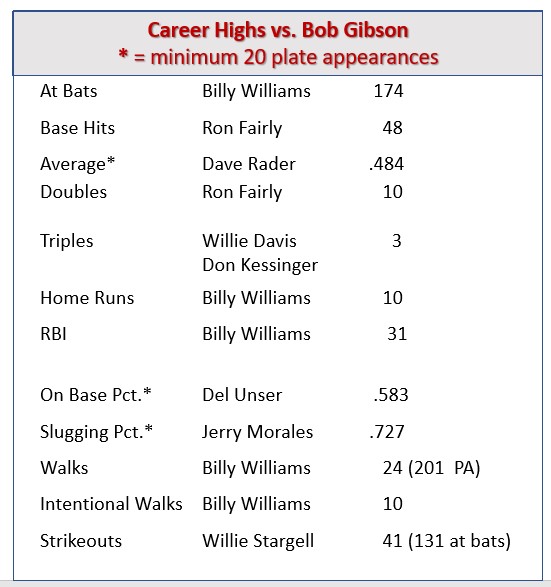
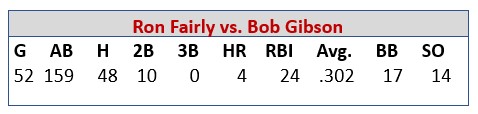
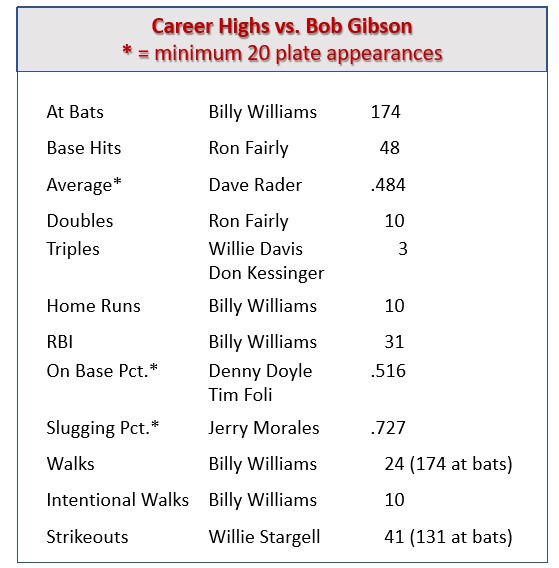
Nobody collected more career base hits off Bob Gibson than Ron Fairly (48) – and Fairly also collected more base hits off Gibson than he did against any other pitcher.


Who’s Your Daddy?

On September 24, 2004, in the middle of a tight pennant race, the Yankees handed future Hall of Famer Pedro Martinez and the Boston Red Sox a tough 6-4 loss.  Martinez went 7 1/3 innings giving up nine hits and five earned runs.  The game came just five days after (in his previous start) Martinez had lasted just five frames against the Bronx Bombers (eight hits, eight earned runs) in a 16-7 loss.

After that second loss, Martinez candidly commented, “What can I say? I just tip my hat and call the Yankees my daddy.”  Little did he know that his comment – and a Yankee fans’ chant of “Who’s your daddy?” would follow him into future starts in New York (all the way to his final MLB start – against the Yankees for the Phillies – in Game Six of the 2009 World Series.)

The concept of “Who’s your daddy?” became the inspiration for Baseball Roundtable to take a look at the players who “had the number” of some of MLB’s premier pitchers.  I started with Nolan Ryan (see that post by clicking here) and the topic was well enough received I decided to continue the journey. I followed up with Sandy Koufax. Click here for that one.  And today, I’m taking a look at intimidating Hall of Fame righthander Bob Gibson. Note:  I’ve since added Pedro Martinez, click here – and Randy Johnson, click here. 


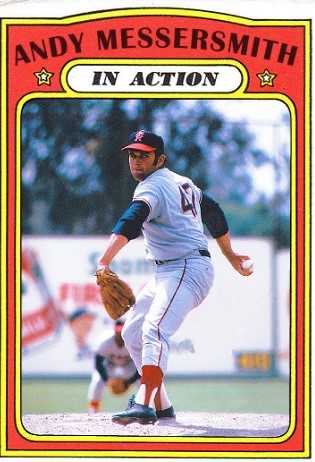
GibbyCardIn 1968 … baseball’s Year of the Pitcher – Future Hall of Famer Bob Gibson went 22-9 and gave up just 49 runs in 304 2/3 innings (an MLB-low 1.12 earned run average), with batters hitting just .184 against him.  He also logged a league-leading 268 strikeouts.  Still, Billy Williams managed a .333 average and .412 on base percentage against Gibson that campaign – with a double, two home runs and four RBI – in four games. He went five-for-fifteen with two walks and just one whiff.

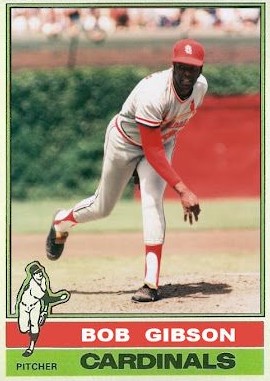
Over his 17-season MLB career (1959-75), Gibson went 251-174, with a 2.91 ERA and 3,117 strikeouts in 3,884 1/3 innings pitched. He was an All Star in eight seasons, a twenty-game winner five times, a two-time Cy Young Award winner, the 1968 NL Most Valuable Player and the MVP in the 1964 and 1967 World Series.   In the 1968 World Series, Bob Gibson set the records for strikeouts in a World Series game (17) and strikeouts in a single World Series (27). In nine World Series starts (1964-67-68), Gibson went 7-2, 1.89 and tossed eight complete games.

Bob Gibson is the luckiest pitcher in the world. He is always pitching when the other team doesn’t score any runs.

                                                                                                           Tim McCarver

So, let’s take a look at the “Who’s Bob Gibson’s Daddy?” lineup. (at least ten at bats versus Gibson).  Here’s BBRT’s take on the players who fared the best against Gibson over his career.

Gibby cAreer f


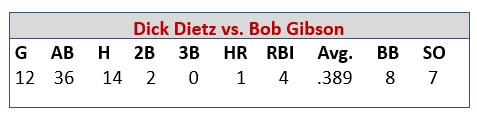
Catcher – Dick Dietz (.389 average in 12 games versus Gibson)

The Giants’ Dick Dietz, who made his MLB debut in June of 1966 (and had just two seasons of 100+ games played … 1970-71), first faced Bob Gibson in the righthander’s spectacular 1968 season – and Dietz was not intimidated. In his first game against Gibson (May 28, 1968), Dietz went one-for-three and hit a game tying (1-1) solo home run in the sixth. (Gibson eventually got the win in a 3-1 Cardinals’ victory on a complete game four-hitter.) Dietz next faced Gibson on July 6 and delivered three walks and a single in four trips to the plate.  In his 12 career games against Gibson, Dietz had a.511 on-base percentage, reaching base via hit or walk in all 12 games.

GibbyDietx

Dick Dietz played in eight MLB seasons (1966-73 … Giants, Dodgers, Braves), putting up a .261-66-301 line in 646 games.  As noted earlier, he played more than 100 games in only two seasons, earning an All Star nod in 1971, when he hit .300, with 22 home runs, 107 RBI and 82 runs scored (all career highs).

——————————————————————————————-

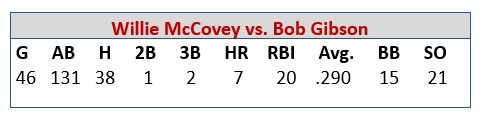
First Base – Willie McCovey (seven home runs and 20 RBI in 46 games against Gibson)

Willie McCovey had a .290 average in 46 games against Gibson – with seven home runs (third most against Gibson) and 20 RBI (fifth most).

Gibby McCovery

McCovey played 22 MLB seasons (1959-1980 … Giants, Padres, A’s), hitting .271, with 521 home runs and 1,555 RBI. The Hall of Famer was a six-time All Star, three-time league home run leader and the 1969 NL Most Valuable Player.  Willie McCovey won the 1959 NL Rookie of the Year award despite playing only 52 games (called up by the Giants at the end of July). He hit .354 over those 52 games, with 13 home runs and 38 RBI.

4-for-4

In his very first MLB game, McCovey went four-for-four, with two singles and two triples, three runs scored and two RBI (all off future Hall of Famer Robin Roberts). He probably got some pretty good pitches to hit, batting between Willie Mays and Orlando Cepeda.

—————————————————————–

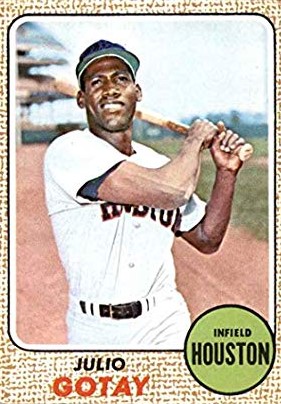
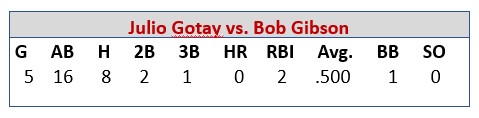
Second Base – Julio Gotay (.500 average vs. Gibson over three seasons)

gotayAstros’ 2B Julio Gotay – a bit of a surprise in this lineup – faced Gibson 17 times (16 at bats) between 1967 and 1969 (when Gibson went 55-29 with a 1.95 ERA) and collected eight hits (.500 average) and a walk.

GibbyGotay

Gotay was a career .260 hitter (389 games over ten MLB seasons … Cardinals, Pirate, Angels, Astros) and his eight hits against Gibson were the most he had against any MLB pitcher (he also had eight against Bob Shaw).  Gotay played more than 77 games in just one MLB season.  As a Cardinal, in 1962, he played in 127 contests and hit .255, with two home runs and 27 RBI.

————————————————————————

A Mays’ Zing

Willie Mays faced Bob Gibson 108 times (92 at bats) over his career and hit just .196 against him – with three home runs, nine RBI, 16 walks and 30 strikeouts (in 33 games). In 1969, Mays faced Gibson five times and never got the ball out of the infield (four strikeouts, a foul pop up to the catcher and a grounder to short.)

—————————————————————-

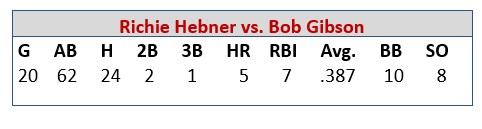
Third Base – Richie Hebner (.387 average with power vs. Gibson)

In 20 games (over seven seasons), Richie Hebner went 24-for-62 against Gibson (.387 average). He also popped five home runs, drove in seven and drew ten walks (versus eight whiffs). Hebner reached base safety (via walk or hit) in 19 of his 20 games versus Gibson. Note:  I also considered the Giants’ Dave Rader for this spot.  In 31 at bats against Gibson, Rader collected 15 hits (a .484 average), but only one RBI.  Hebner got the nod for doing more damage.

GibbyHebner

Hebner was a career .276 hitter (203 home runs/890 RBI) over 18 MLB seasons (Pirates, Mets, Tigers, Cubs). His best season was probably 1972, when he hit .300, with 19 home runs and 72 RBI for Pittsburgh.   The most home runs he hit off any pitcher was five (against Gibson and fellow Hall of Famer Fergie Jenkins).

Hebner Going Deep

Richie Hebner worked as a (pick and shovel) gravedigger at his family-owned cemetery in the off-season.

————————————————————————-

Shortstop – Tie: Tim Foli (.483 average in nine games against Gibson) & Don Kessinger (44 hits and a career .326 average versus Gibson)

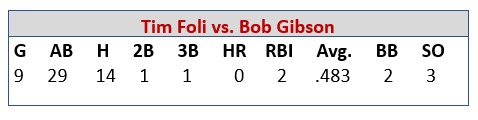
In nine games over three seasons, Tim Foli collected 14 hits and two walks in 32 plate appearances against Gibson (.483 average and .516 on-base percentage).  Why does he only tie for this spot? He didn’t do much damage, just two extra-base hits (one double, one triple) and only two RBI.

GibbyFoli

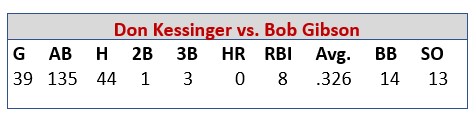
Don Kessinger has to be mentioned here.  While he didn’t top .400 versus Gibson (like Foli), Kessinger did more damage (eight RBI) and maintained a .326 average versus Gibson over 39 games (135 at bats).  Kessinger had more than ten at bats against Gibson in seven seasons and hit .300 or better against him in five of those. His 44 hits against Gibson trail only Ron Fairly (48) and Billy Williams (45).

GibbyKessinger

Tim Foli had a 16-season MLB career (1970-85), hitting .251, with 25 home runs and 501 RBI (1,696 games … Expos, Mets, Pirates, Angels, Giants, Yankees).

Kessinger also played 16 MLB seasons (Cubs, Cardinals, White Sox), hitting .252, with 14 home runs, 899 runs scored, 527 RBI and 100 stolen bases.  He was a six-time All Star and  two-time Gold Glover.

All American Boy

Don Kessinger was an All American in both baseball and basketball for the University of Mississippi.

—————————————————————————

Outfield – Billy Williams (10 home runs in 52 games vs. Gibson)

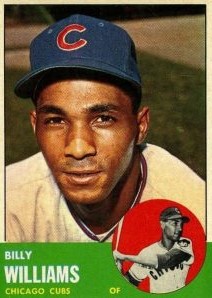
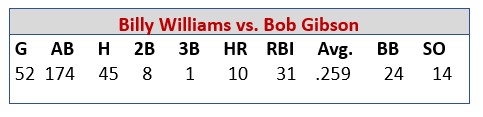
BWilliamsNobody took Bob Gibson deep more often than the Cubs’ Billy Williams – who topped the list of home runs off Gibson with ten and RBI with 31. (It was also the most home runs and RBI Williams had against any pitcher.) How much respect did the big righthander show Williams? Williams also drew the most career walks (24) and career intentional passes (10) from Gibson (although surprisingly he was never hit by a Gibson pitch).  (Side note:  Williams’ 201 plate appearances were also the most he had against any hurler.)

GibbyWilliams

Taking One For The Team

Although Gibson was known for pitching inside, he only hit 102 batters in his career and never led his league in hit batsmen (although he did finish in the NL’s top five in HBP six times). Ironically, the two batters he hit most often in his career (six times each) were Ron Hunt and Roy McMillan (who hit .176 and .194 against Gibson, respectively.)

Hall of Famer Billy Williams had an 18-season MLB career (1959-1974 with the Cubs and 1975-76 with the A’s). The six-time All Star hit .290 (2,711 hits), with 426 home runs and 1,475 RBI.  He was the 1961 NL Rookie of the Year and the 1972 NL Batting Champ.

—————————————————————

Outfield – Ron Fairly (48 hits and a .302 average over 52 games against Gibson)

As noted at the top of this post, Ron Fairly’s 48 hits against Gibson are the most of any batter and his 24 RBI off Gibson trail only Billy Williams (31) and Hank Aaron (26).  In addition, Fairly drew 17 walks (versus 14 strikeouts) off Gibson.GibbyFairly

Ron Fairly played 21 MLB seasons (1958-1978 … Dodgers, Expos, Cardinals, A’s, Blue Jays, Angels). He had a .266 career average (1,913 hits in 2,442 games), with 215 home runs and 1,044 RBI. He made his first All Star team in his 16th MLB season (1973), when he hit .298-17-49 for the Expos.  He made his second and final All Star squad in 1977 – this time for the American League Toronto Blue Jays.  That season (his 20th MLB campaign), the 38-year-old hit .279, with a career high 19 home runs.

Ron Fairly’s best season against Bob Gibson came in 1971, when he faced Gibson 11 times and collected five hits (including one double and one home run) and two walks (.714 average and .727 one-base percentage).

——————————————————

Outfield – Al Oliver (.342 average in 20 games)

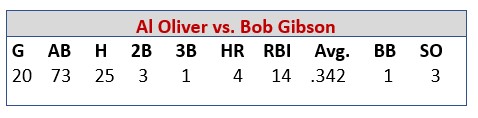
Al Oliver put the ball in play against Gibson.  In 78 plate appearances he fanned just three times, walked once and was hit by a pitch twice.  He collected 25 hits off Gibson (.342 average), with three doubles, one triple, four home runs and 14 RBI – and he didn’t collect his first hit off Gibson until his seventh at bat.

GibbyOlliver

Oliver played 18 MLB seasons (Pirates, Rangers, Expos, Giants, Phillies, Dodgers, Blue Jays) and hit .303, with 2,743 hits, 219 home runs and 1,326 RBI. Oliver hit .300 or better in 12 seasons. He was a seven-time All Star and won the 1982 NL batting title with a .331 average. He led his league in hits once, doubles twice and RBI once.

————————————————————

Honorable Mention – Willie Davis

Willie Davis deserves an honorable mention here.  In 39 games against Gibson, he hit .320 (40-for-125), with five doubles, three triples, four home runs and 21 RBI. In a game on August 17, 1970, the Dodger outfielder touched Gibson for two triples and a single in five at bats – as his Dodgers lost to the Cardinals 11-8. (Gibson got the win despite giving up 14 hits and eight earned runs in 8 1/3 innings. )

Davis had a 18-season MLB career, primarily with the Dodgers, hitting ..279 (2,561 hits), with 182 home runs, 1,053 RBI and 398 steals.  He was a two-time All Star and two-time Gold Glover (who, ironically, set a World Series record by committing three errors in a single inning – fifth inning, Game Two, 1966 WS). The 1966 WS was a rough one for Davis, he also went just one-for-sixteen (.063 average) as the Dodgers lost four straight to the Orioles scoring just one run. 

A trivia question you can use.  In the 1966 World Series the Dodgers scored just two runs against a tough Orioles’ pitching staff.  Those runs came in the second and third innings of Game One – on a solo home run and a bases-loaded walk.  Which pair of “Jims” collected the Dodgers’ two RBI? Jim Lefebvre on a solo home run leading off the second inning and Jim Gilliam on a bases-loaded free pass  in the second.

Bonus: Who were the three Orioles’ starting pitchers in the Series?  Dave McNally, Jim Palmer and Wally Bunker.  The Orioles used one reliever in the Series – Moe Drabowsky, who threw 6 2/3 scoreless frames to get the win in Game One. Games 2-3-4 were complete game shutouts by Bunker, Palmer and McNally (who started Game One).


Del Unser Had a Knack for Getting On

Outfielder Del Unser may have only been a career (1968-1982) .258 hitter (.319 on-base percentage), but he deserves notice for his work against Bob Gibson. In seven career games against Gibson, Under came to the plate 24 times and collected six hits and eight walks (versus just two whiffs) for a .375 average and .583 on base percentage. 

——————————————————

Pitcher – Bill Henry (Gibson never got him out)

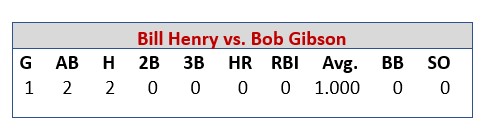
One note here.  I waived the 10-at bat minimum for pitchers hitting against Gibson – which opened the door for the Reds’ Reliever Bill Henry, who faced Gibson in only one game (September 19, 1964) and went two-for-two, with a pair of singles.

GibbyHenryt

Bill Henry had a 16-season MLB career (primarily as a reliever).  He pitched in the majors from 1952 through 1955 and 1958 through 1969 (Reds, Giants, Red Sox, Cubs, Pirates, Astros.)  As a batter he hit .177 (36-for 203) and Gibson was one of only five pitchers that Henry collected more than one hit off of.) On the mound, Henry was 46-50, 3.26 with 90 saves in 527 appearances.

____________________________________________

A few more honorable mentions: The following players not in this lineup hit .350+ for their careers against Gibson: Denny Doyle (.464-1-3 in 28 at bats); Rico Carty (.389-0-10/54 at bats); Ralph Garr (.387-0-1/12 at bats); Dave Cash (.375-0-9/56 at bats); Don Hoak (.375-1-4/24 at bats); Willie Crawford (.370-2-5/46 at bats); Jerry Morales (.364-2-4/22 at bats); Don Blasingame (.357-0-5/28 at bats); Felix Milan (.355-0-9/76 at bats); Joe Adcock (.351-3-7 in 37 at bats).

A few other tidbits:

  • Hank Aaron hit only .215 against Gibson (but did knock eight home runs and pick up 26 RBI in 163 at bats);
  • Willie Stargell fanned more times against Gibson than any other player (41 whiffs in 131 at bats), but still hit .290-5-15 against him;
  • Bill Mazeroski only fanned six times in 99 at bats against Gibson, but collected just 14 hits (.141 average), with one home run and four RBI.
  • Darrell Evans had the most plate appearances and at bats (35 and 23) against Gibson without ever striking out, while hitting .261-3-5 with 11 walks.

Primary Resource:  Baseball-Reference.com

Still thinking about this year’s Baseball Hall of Fame voting?  To see how Baseball Roundtable’s fan vote compared to the BBWAA official voting, click here


100Baseball Roundtable is on the Feedspot list of the Top 100 Baseball Blogs.  To see the full list, click here.

I tweet (on X)baseball @DavidBaseballRT

Follow/Like Baseball Roundtable’s Facebook Page here.  More baseball commentary; blog post notifications; PRIZES.

Member: Society for American Baseball Research (SABR); The Baseball Reliquary; The Negro Leagues Baseball Museum.
The Hall of Fame Vote – A Look at How the BBRT Fan Vote Compared to the BBWAA Balloting

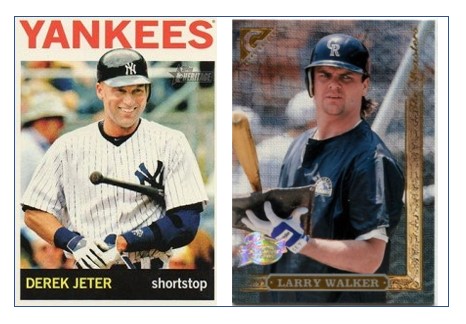
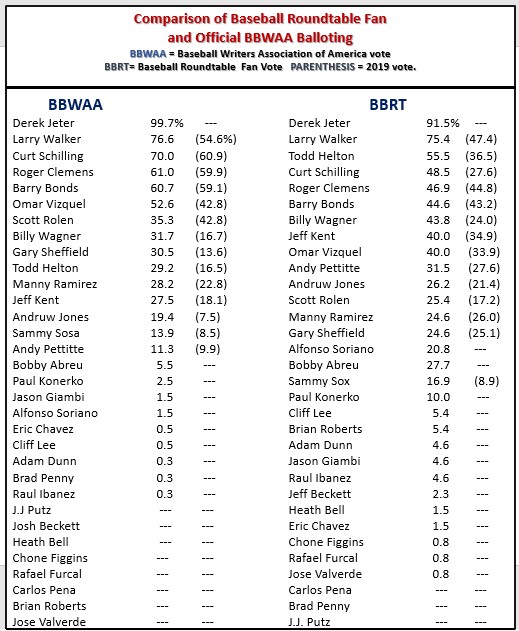
jeter wqalksThe official 2020 Baseball Writers Association of America (BBWAA) Hall of Fame balloting results are in (Or are they officially out?) and two players garnered the 75 percent supported needed for election – Derek Jeter (99.7 percent of the vote) and Larry Walker (76.6 percent). The same two players received at least 75 percent of the vote in Baseball Roundtable’s (BBRT) third annual (unofficial) fan ballot.  This post will take a look at both the BBWAA and BBRT results – the similarities and the differences.  At the end of the post, I’ll add some thoughts on voting patterns I have observed over the years.

A total of 131 BBRT fan readers cast ballots – and the overall results mirrored the BBWAA results.  The only two players garnering the necessary 75 percent in the fan vote were shoo-on, first-time-on-the ballot Derek Jeter (91.5 percent) and final-year-on the ballot Larry Walker (75.4 percent).  Finishing third in the BBWAA voting was Curt Schilling, who got more support from the writers (70 percent) than the fans (who placed Schilling fourth at 48.5 percent).

Eight players finished in the top ten in both the BBWAA and BBRT balloting: Jeter, Walker, Schilling, Roger Clemens, Barry Bonds, Omar Vizquel, Billy Wagner and Todd Helton.  Gary Sheffield and Scott Rolen rounded out the BBWAA top ten, while Jeff Kent and Andy Pettitte completed the BBRT top ten.

Side Note:  When balloting first opened, BBRT predicted that, in the BBWAA balloting, Jeter and Walker would get in and Schilling would fall just a bit short.  For that post, which included bios on all candidates and BBRT’s vote – if, of course, I had one – click here.

So, here’s the final tally, with some observations after the chart.

HOf chart 2 final

  • The fans were a bit tougher on the prospect of a unanimous vote for Derek Jeter, giving him 91.5% versus the writers’ 99.7%. More on that later.
  • Overall, the fans were a bit less demanding in their votes, with nine players getting 40% or higher, as compared to six at 40%+ in the writers’ balloting – and 12 players failing to get the 5% needed to stay on the ballot versus 17 dropping off the BBWAA ballot.
  • The biggest gainer on the BBRT fan ballot was Larry Walker, who jumped 23 percentage points). Others moving up by at least 15 percentage points were: Curt Schilling (+20.9); Billy Wagner (+19.0); and Todd Helton (+19.0). Sammy Sosa’s vote total took the biggest drop among fans – declining 8 percentage points from one year ago. Walker was also the top gainer in the BBWAA balloting, up 22 percentage points.  Others up at least 15 percentage points were: Scott Rolen (18.3); Gary Sheffield (16.9); and Billy Wagner (15.0).
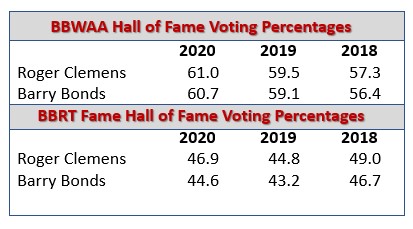
  • The fan ballot continued to show a stronger bias against those touched by the PED-controversey. Just a couple of examples:

ClemensBpomds

  • Todd Helton saw the most notable difference between BBWAA and BBRT Fan support – getting 55.5% of the fan vote (third highest) and just 29.2% of the BBWAA vote (tenth.)
  • In addition to Todd Helton, those getting significantly more support from the fans than the writers were: Alfonso Soriano (20.8% in fan vote/1.5% in BBWAA vote); Andy Pettitte (31.5/11.3); and Jeff Kent (40.0/27.5).
  • Those getting notably more support from the writers than the fans were: Omar Vizquel (52.6% from the BBWAA/40.0% in the BBRT fan ballot) and Scott Rolen (35.5/25.4).

—-FAN OPINION WHO’S NOT IN THAT SHOULD BE—-

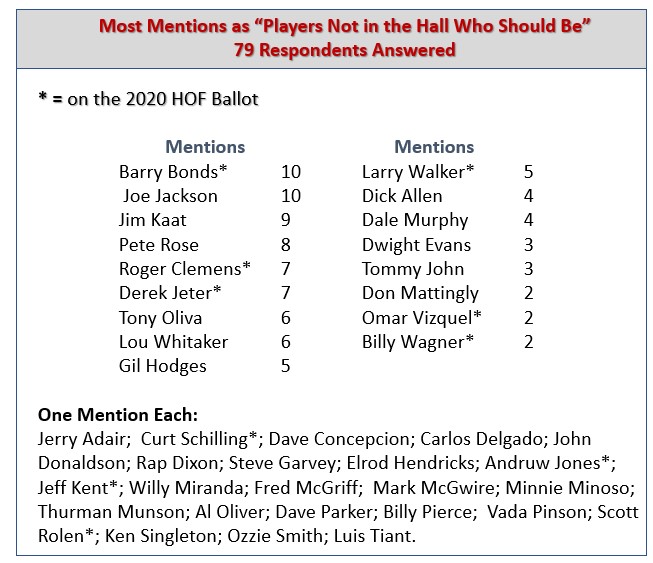
Seventy-nine survey respondents answered the question regarding which players not currently in the Hall of Fame should be there.  Overall, this group of respondents seemed to be a forgiving group – with the candidacy of three of the top four (in terms of mentions) bringing with them come controversy.  Tied for the most mentions at ten (12.6% of those answering the question) were Barry Bonds (with his MLB single-season and career home run record, seven league MVP Awards and PED-controversy) and Joe Jackson (with a .356 career average and the 1919 Black Sox scandal).  Also, in the top four, at fourth place with eight mentions, was all-time base hits leader Pete Rose (banned from baseball – gambling).

Sitting at number-three with nine mentions was southpaw pitcher Jim Kaat (with 283 victories and 16 Gold Gloves).

The top ten included: three players on this year’s ballot (two of whom were elected): Roger Clemens (seven mentions); Derek Jeter (seven); and Larry Walker (five).  Also, in the top ten were Twins’ three-time batting champion Tony Oliva (six); Tigers’ 19-season 2B Lou Whitaker (six), the 1978 AL Rookie of the Year and a four-time Gold Glover; and Dodgers’ 1B Gil Hodges (five), an eight-time All Star and three-time Gold Glover.

HOF Chart 2

A few interesting tidbits from these results. We also saw one mention each for:

  • Rap Dixon, a Negro League star outfielder, who (according to the Seamheads.com Negro Leagues Data Base) hit .326 over 11 seasons and is also reported to have hit .372 in 26 games versus major leaguers.
  • John Wesley Donaldson, a barnstorming African-American pitcher who, between 1911 and 1931, recorded a documented 406 wins and more than 5,000 strikeouts. You can learn more about Donaldson at johndonaldson.bravehost.com.

There was also one mention each for Ozzie Smith and Jack Morris, who are both already in the Hall of Fame and one for Charlie Brown (the losing-est pitcher in comic strip history).


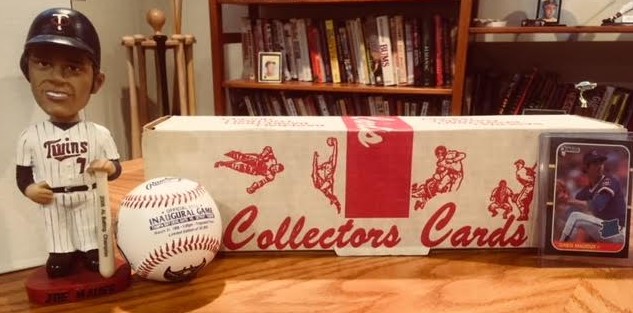
Prize PackThe BBRT HOF Ballot Prize Pack went to Shawn H. of Washington – who will receive a 1990 Topps complete set; a Greg Maddux Donruss 1987 rookie card; a Joe Mauer bobblehead, commemorating his 2006 batting title; and a limited edition ball from the Tampa Bay “Devil Rays” inaugural game.


—–HALL OF FAME VOTING ‘CADRES” —–

Here’s a look at some Hall of Fame voting cadres, I have noticed over time.  This, by the way, is not a judgement on voter strategies, but rather just an observation on factors that appear to have had a current or past influence on voting patterns and vote totals.

The Anti-PED Cadre

This group declines to vote for those who appear to be tied into the PED controversy. There continues to be enough of these voters to effectively block a significant number of PED-associated candidates from election.  In recent years, this cadre has made its presence felt in both the BBWAA and BBRT balloting.  There does seem to be a slowly diminishing effect among BBWAA voters, but the impact on BBRT fan ballot total has been relatively stable.

The Small Hall Cadre

This cadre has focused on demanding the highest standards for election to the Hall of Fame – and has voted vote for very few (sometimes even zero) candidates.  This, by the way, is not a new approach. Back in 1988, for example, nine blank ballots were cast in the BBWAA voting. A Los Angeles Times article quoted New York Daily News reporter Phil Pepe (who sent in one of the nine blank ballots) as saying the Hall of Fame was “too crowded,” adding  “I think to go in alongside Ruth, DiMaggio, Williams, Aaron, Cy Young, you have to be the cream of the cream. The more you erode the standards, the more the standards will be eroded.”  This cadre has a notable impact on elections, since each ballot a player is not named on requires three ballots to counter that omission.

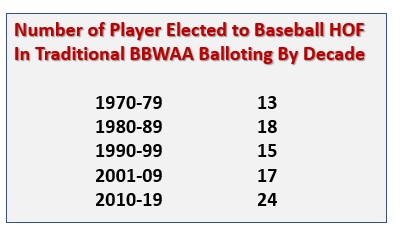
I should note that, in recent years, this particular voting strategy has been on the decline.  In the past seven elections a total of 26 players have been elected in the traditional BBWAA balloting. That’s two more than were elected in the previous 14 years (2000-2013).

BBHOF Decadse

The Unanimously Adverse Cadre

This cadre has been made up of voters who are opposed to (or uniquely demanding) of a unanimous selection to the Hall of Fame. The more recent logic appears to have been “If Babe Ruth, Stan Musial, Willie Mays Cy Young or (insert a legendary player of your choice) was not a unanimous selection, why should player “X” be?”  Mariano Rivera’s unanimous selection and Jeter’s close call seem to indicate this cadre’s days are behind us.  Still, even when this is only a cadre of one, it is effective. I won’t speculate on this year’s lone ballot omitting first-timer Derek Jeter, but the fact that we’ve had only one unanimous selection in HOF voting history is a pretty good indicator that this cadre has impacted voting over time.

The Ballot-Hierarchy Cadre

Over the years, members of this cadre have drawn a line between first-ballot and subsequent-ballot votes.

The Ballot Hierarchy was a “thing” for a long time.  In a 2013 column, ESPN’s Howard Bryant wrote: “I believe in the hierarchy of the ballot, that the first ballot is different than the second or the tenth, that there is a special prestige to a player being voted in the first time he is eligible.”  The question for BBRT is, “Do voters just withhold that first-, second- or other-ballot vote, or does it go to another candidate who meets the hierarchy test?”

I should add that this can be a two-edged sword.  While the ballot-hierarchy test may delay some players’ elections, it can also work in a player’s favor in the final years on the ballot – giving a particular boost in a player’s last year of eligibility.   For example, Larry Walker’s final five years on the ballot saw his vote percentages go (in order) – 15.5, 21.9, 34.1, 54.5 and 76.6.  His stats didn’t change over that time, but the clock on eligibility was ticking downward.

Side Note; There also appears to be a group of voters who combine “Ballot-Hierarchy” with “Anti-PED,” withholding votes from PED suspects until later years of eligibility.  We’ll soon see how that plays out.

The Strategist Cadre

Somewhat related to the “Ballot Hierarchy” group – at least in impact – this group reasons that certain players are sure bets to get the required 75 percent and chooses not to add to the sure-thing margin, instead casting that vote for a player they find deserving further down the ballot.  This approach may actually improve the chances of additional candidates. A subset of this group is those who note that certain players (in, for example, the 40 percent range), while NOT likely to reach 75 percent in a given year, ARE pretty much assured of adequate support to stay on the ballot. This subset withholds votes from those candidates and votes to protects those they would like to see on the ballot (but who are less “safe”).

The From-the-Heart Cadre

This group (which seemed to show up in the BBRT unofficial fan ballot more than in the BBWAA voting) casts votes for a specific player (or players) further “down the board” either as a “fan” statement or to ensure that player does not fall off the ballot (get less than five percent).

The Ten-Best Cadre

This group simply votes for whom they felt are the ten best players; regardless of the factors influencing any of the cadres already noted.  (Well, in some cases it is the eight or nine candidates they feel are deserving.)

So, there’s BBRT’s look at the 2020 HOF election, as well as some observations of current and past voting strategies.

Primary Resources:  Baseball-Reference.com; Baseball-Almanac.com; Blank Hall of Fame ballot serves as protest … January 14, 1988; Associated Press; Drawing a blank on a HOF ballot … January 9, 2013; Howard Bryant, ESPN Senior Writer; espn.com; My crowded Hall of Fame ballot, with no regard for the ‘sacred place’ … January 20, 2018; Ken Davidoff; New York Post (nypost.com);  Hall of Fame Roundtable: Should voters ‘game” the ballot to get more players in? … January 22, 2018; Matt Snyder; cbssports.com; It’s a Hall voter’s prerogative to change mind … January 25, 2018; Patrick Reusse; StarTribune.

100Baseball Roundtable is on the Feedspot list of the Top 100 Baseball Blogs.  To see the full list, click here.

I tweet baseball @DavidBBRT

Follow/Like Baseball Roundtable’s Facebook Page here.  More baseball commentary; blog post notifications; PRIZES.

Member: Society for American Baseball Research (SABR); The Baseball Reliquary; The Negro Leagues Baseball Museum.
 

Baseball Roundtable Trivia Teaser … From Fast Balls to Slow Pitch and Back Again

BASEBALL ROUNDTABLE TRIVIA TEASER

Can you name the major league pitcher who both won 20+ games in an MLB season and was (later) an All World Slow-Pitch Softball third baseman?  Hint:  His slow-pitch long-ball success should come as no surprise.


BBRT Trivia Teaser Answer

Right-hander Tony Cloninger, who won 24 games for the 1965 Milwaukee Braves and was selected to the All-World Team (third base) at the 1978 United States Slow-Pitch Softball Association World Series.

Cloninger’s MLB pitching career stretched from 1961-72 (Braves/Reds/Cardinals).  Over that span, he went 113-87, 4.07 and earned a reputation as a power pitcher who sometimes lost the plate.  His best season was 1965, when he went 24-11, 3.29 for the Milwaukee Braves (only Sandy Koufax won more games than Cloninger that season), striking out 211 batters in 279 innings (but also leading the NL in walks and wild pitches).

Some Cloninger trivia:

  • Cloninger started the very first regular-season Atlanta Braves game (April 12, 1966). He went all 13-innings in a Braves 3-2 loss (he gave up just one run over the first 12 frames) – allowing ten hits and three walks, while fanning a dozen.
  • Cloninger had six professional (minor league) wins before turning 18.
  • On June 15, 1963, Cloninger pitched an “immaculate inning” (nine pitches, three strikeouts) as his Braves topped the Phillies 5-3. It came in the eighth inning and the hitters were Tony Gonzalez, Clay Dalrymple and Ruben Amaro. Cloninger, who fanned eight batters in 4 2/3 innings of scoreless relief, got the win.
  • In 1966, Cloninger hit .234 (26-for-11) with five home runs, five doubles and 23 RBI in 47 games.

TEEING OFF FOR TWO

On July 3, 1966, Tony Cloninger became the first National Leaguer (any position) to hit two Grand Slams in a game – as his Braves topped the Giants 17-3 at Candlestick Park.  He remains the only pitcher to hit two Grand Slams in a single contest and his nine RBI in that game remain the single-game record (tied) by a pitcher.

Cloninger’s final season as an MLB pitcher was 1972, when he was 0-2, 5.19 in 17 relief appearances for the Cardinals.  The following year, he was playing the hot corner in slow-pitch softball tournaments for the vaunted Howard’s Furniture Team (Denver, North Carolina).  That season, Cloninger hit .634, with 34 home runs in 143 at bats.  Cloninger also played part-time for Howard’s in 1974 – hitting .615, with 13 home runs in 54 at bats.  In 1975, his first full season with the squad, Cloninger hit .572, with 90 home runs in 346 at bats.

In 1978, playing for the United States Slow-pitch Softball Association Major Slow Pitch World Series Champion Howard & Carroll team, Tony Cloninger was selected as the third baseman on the Series’ All World Team.

Jumping ahead, in 1988, Cloninger was back in professional baseball as a pitching coach for the Eastern League Albany Yankees and, by 1992, he was back in the major leagues as a bullpen coach for the New York Yankees.  He was with the Yankees from 1992 through 2001, then took over as  pitching coach for the Red Sox in 2002-03. In 2003, he was sidelined with a bout with cancer. He later returned to the Red Sox as a player development consultant – a position he held from more than a dozen years.  (Cloninger passed away on July 24, 2018).

Clearly the competitive spirit and the love of the game burned passionately in the heart of Tony Cloninger.

Primary Resources:  Baseball-Reference.com; Society for Americana Baseball Research; Baseball-Almanac.com; SoftballCenter.com; Softball History USA.

100Baseball Roundtable is on the Feedspot list of the Top 100 Baseball Blogs.  To see the full list, click here.

I tweet baseball @DavidBBRT

Follow/Like Baseball Roundtable’s Facebook Page here.  More baseball commentary; blog post notifications; PRIZES.

Member: Society for American Baseball Research (SABR); The Baseball Reliquary; The Negro Leagues Baseball Museum.
Baseball Roundtable Trivia Teaser – Keeping It All Inside

BASEBALL ROUNDTABLE TRIVIA TEASER

Name the Hall of Famer whose first-ever major league home run was an inside-the-parker – and whose first MLB Grand Slam was the major league’s (to this date) only inside-the-park, walk-off, four-run homer?


BBRT TRIVIA TEASER ANSWER:

Pirates’ OF Roberto Clemente’s first MLB home run came on April 15, 1955 (the 20-year-old’s third MLB game) – off New York Giants’ southpaw Gene Liddle. The fifth-inning four-bagger was a solo, inside-the park home run to left field – and also resulted in Clemente’s first major league run batted in.

On July 25 of the 1956 season, Clemente hit his first MLB Grand Slam – and it was also an inside-the-parker.  Clemente was batting against the Cubs’ Jim Brosnan in the bottom of the ninth with the Pirates trailing 8-5. There were no outs and Pittsburgh’s Hank Foiles, Bill Virdon and Dick Cole were on base.  Clemente drove a ball to deep left that hit near the light standard and skittered along the warning track to center.  All three runners scored and Clemente ran through the coach’s stop sign at third base, beating the relay (Solly Drake to Ernie Banks to Hobie Landrith) – putting an exciting, exclamation-mark finish on the game.

Over his 18-season MLB career, Clemente collected 3,000 hits (.317 average), 240 home runs and 1,305 RBI. He was an All Star in 12 seasons, a 12-time Gold Glover, four-time batting champion and the 1966 NL MVP.


This look at Roberto Clemente’s notable inside-the-park (ITP) round trippers provides a nice segue into a look at some ITP home run trivia.  So, let’s do it!


Jesse Burkett

Jesse Burkett holds the record for career ITP home runs with 55.  The left-handed hitting outfielder hit 75 total home runs over sixteen MLB seasons (1890-1905), with 55 of those being ITP.  Hall of Famer Burkett was a three-time batting champ, who topped .400 twice while with the NL Cleveland Spiders (.405 in 1895 and .410 in 1896). The AL career ITP home run record belongs to Ty Cobb (46), while the NL record goes to Tommy Leach (48).

———————————–

Sam Crawford

Sam Crawford holds the single-season record for inside-the-park home runs, with 12 ITP home runs (of his NL-leading 16 dingers for the Reds) in 1901. Fifty-one of Crawford’s 97 career home runs stayed in the park.

Tom McCreery

Tom McCreery holds the record for most ITP home runs in a game with three – for the NL Louisville Colonels on July 12, 1897.  The switch-hitting OF/1B hit a total of five home runs that season. In addition to McCreery, forty-five MLB players have hit two ITP home runs in a game, but only four have accomplished that feat more than once (twice each): Dan Brouthers, Jesse Burkett, Ed Delahanty and Roger Bresnahan.

—————————————-

Roger Bresnahan

Roger Bresnahan is the only player to hit two ITP home runs in a single game in both leagues – May 30, 1902, for the AL Baltimore Orioles and June 6, 1904, for the NL New York Giants. Bresnahan hit a 13 ITP home runs out of 26 dingers in a 17-season (1897-1915) MLB career.

——————————


Greg Gagne

The most recent player to hit two inside-the-park homers in a single game was Minnesota Twins’ shortstop Greg Gagne (October 4, 1986 versus the White Sox). It was one of only three two-homer games in Gagne’s career.

———————————————

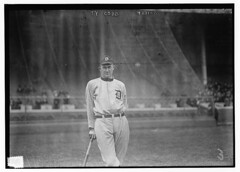
Ty Cobb - once led the American League in home tuns without every clearing the fences. Photo by The Library of Congress

Ty Cobb – once led the American League in home runs without every clearing the fences. Photo by The Library of Congress

Ty Cobb

In 1909, the Tigers’ Ty Cobb won the AL Triple Crown with a .377 average, nine home runs and 107 RBI.  (He also led the league with 76 steals, 216 hits and 115 runs scored.) All nine of his league-topping home runs were of the inside-the-park variety. That’s significant on two fronts.  Nine is still the AL record for ITP home runs in a season and it made Cobb the only MLB player (post-1900) to lead his  league in home runs without ever hitting one over the fence.

Toby Harrah and Bump Wills

On August 28, 1977, in the seventh inning of a game against the Yankees in New York, the Rangers’ Toby Harrah and Bump Wills hit back-to-back, inside-the-park home runs off consecutive pitches from Yankees’ reliever Ken Clay. Harrah hit a three-run home run off  Clay and then, on the very next pitch, Bump Wills also circled the bases while his hit was in play. The only other instance of teammates hitting back-to-back ITP homers came on  June 23, 1946 when the Cubs’ Marv Rickert and Eddie Waitkus accomplished the feat off Nate Andrews of the New York Giants.

Toby Harrah is also knowns for being the only MLB shortstop to play all the innings of a doubleheader without ever getting a fielding chance (June 25, 1976 Wills’ ranger versus the White Sox). Apparently well-rested during his inning in the field, Harrah finished the doubleheader six-for-eight, with two home runs, seven RBI and a stolen base.

———————————————

Ed Delahanty

Ed Delahanty, playing first base for the Philadelphia Colts (Phillies) on July 13, 1896, earned a place in the record books by blasting a record-tying four home runs in a single game. To date, only 18 players have accomplished that feat. Delahanty’s four-homer day is unique in that two of his round trippers were inside-the-parkers.  He is the only one of the 18 members of the four-homer club to have ITP homers included in their one-game total. Twenty of Delahanty’s 101 MLB home runs (16-season MLB career) were of the inside-the-park variety.

————————————————-

Luke Stuart and Johnnie LeMaster

Luke Stuart(2B) of the St. Louis Browns and SS Johnie LeMaster of the San Francisco Giants are the only players to hit ITP home runs in their first MLB at bats (August 8, 1921 and September 2, 1975, respectively.)

—————————————

Pete Milne

Pete Milne had a brief MLB career (three seasons, 47 games, 65 plate appearances) with the Giants (1948-50). He hit only one home run in the majors, but it was a significant. It was the only pinch hit, inside-the park Grand Slam ever (April 27, 1949).

______________________________

Ichiro

Ichiro Suzuki hit the only inside-the-park home run in an All Star Game (2007).

—————————————-

Kyle Blanks

Padres’ rookie OF Kyle Banks hit an inside the park home run on August 18, 2009. The ball hit off the top of the centerfield wall and ricocheted along the warning path nearly to the RF corner.   What makes this one special?  At 6′ 6” and 285-pounds, Blanks became the heaviest player ever to it an ITP homer – beating the throw home with a head-first slide.


Primary Resources:  Baseball-Reference.com; Baseball-Almanac.com

Coming Soon:  A comparison of the BBWAA Hall of Fame Vote with BBRT’s Fan Hall of Fame Voting – and announcement of  the BBRT balloting prize winner.


BASEBALL ROUNDTABLE ON THE TOP 100 BASEBALL BLOG LIST

100Baseball Roundtable is on the Feedspot list of the Top 100 Baseball Blogs.  To see the full list, click here.

I tweet baseball @DavidBBRT

Follow/Like Baseball Roundtable’s Facebook Page here.  More baseball commentary; blog post notifications; PRIZES.

Member: Society for American Baseball Research (SABR); The Baseball Reliquary; The Negro Leagues Baseball Museum.
BBRT Trivia Teaser – and a Look at Unanimous MVP Award Selections

Baseball Roundtable Trivia Teaser

Your task is to name the two MLB Players who:

  • Were born on the same day (May 27, 1968) … approximately 1,200 miles apart;
  • Were both were selected in the 1989 MLB draft;
  • Each played their first full MLB seasons in 1991 (although one lost his rookie status in a 1990 call up);
  • Each recorded nine seasons of 30 or more home runs;
  • Made their mark as MLB first basemen;
  • Both played their way into the Hall of Fame;
  • Were the 11th and 12th players to be unanimously selected Most Valuable Players in their league;
  • Were the first pair 0f first basemen to be selected as league MVPs in the same season.

Trivia Teaser Answer: The White Sox’ Frank Thomas and the Astros’ Jeff Bagwell.  (You can find their bios among the unanimous MVP’s listed below.)

Bonus Trivia: Who are the only two players to be unanimous selections both as Rookie of the Year and Most Valuable Player? (Not earning both awards in the same year, of course.)

Bonus Trivia Answer:  Albert Pujols and Mike Trout.

Note: This trivia teaser is intended as a lead-in to BBRT’s latest post – looking at MLB’s unanimous MVPs.


—–MAJOR LEAGUE BASEBALL’S UNANIMOUS MVP’S—–


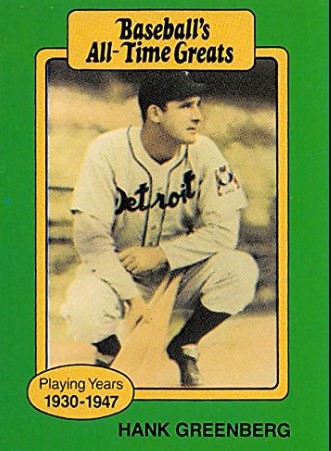
1935 … Hank Greenberg, First Base, TigersGreenberg

Nicknames: Hammerin’ Hank and The Hebrew Hammer  (Putting these in because so many of these stars had slid nicknames.)

In 1935, The Tigers’ Hank Greenberg, at age 24, won his first of two AL Most Valuable Player Awards – and was the first unanimous MVP selection. The future Hall of Famer hit .328 and led the AL in home runs (36), RBI (168) and total bases (389). He collected 203 hits, rapped 46 doubles, legged out 16 triples and scored 120 runs.

Greenberg

Greenberg led his Tigers to a 93-58 season and the American League pennant.  That season, the Tigers led MLB in batting average (.290) and runs scored (918) – and were third in home runs (106). The Bengals pitching staff finished sixth in ERA. Greenberg led the Tigers in hits (203), doubles (46), triples (16), home runs (36), RBI (168) and was second on the team to Charlie Gehringer in average (.328 to .300).

MAJOR LEAGUE ALL-STAR SNUB

In his 1935 unanimous MVP season, Hank Greenberg was not selected to the AL All Star team – despite hitting .317 with 25 home runs and 101 RBI at the All Star break (some statistical sources list the RBI figure at 103. In either case, it is a record that still stands – although Juan Gonzalez of the Rangers reached 101 RBI before the 1998 AS break.)  Lou Gehrig (.320-11-51 at the 1935 break) got the nod at 1B on the 21-player AL All Star squad. 

Between 1930 and 1947, Greenberg played 13 MLB seasons (losing three campaigns to World War II military service) – all but his final season with the Tigers. He was a four-time All Star and two-time MVP.  Greenberg, who played 125 or more games in just eight seasons, led his league in home runs four times (a high of 58 in 1938); RBI four-times (topping 100 in seven seasons, with a high of 184 in 1937); doubles twice; and runs scored once. He hit over .300 in eight seasons and his 63 doubles in 1934 are the fourth-most in an MLB season.  Greenberg retired with a .313 average, 331 home runs and 1,274 RBI.

The runner-up to Greenberg in the 1935 AL MVP balloting was Red Sox RHP (and accomplished pinch hitter) Wes Ferrell, who went 25-14, 3.52 – leading the league in wins, complete games (31) and innings pitched (322 1/3).

———————————————

1936 … Carl Hubbell, LHP, Giants

Nicknames: King Carl and The Meal Ticket

In 1936, Carl Hubbell won his second of two MVP Awards, leading MLB in wins (26 victories versus 6 losses), winning percentage (.813), and earned run average (2.31).  The future Hall of Famer completed 24 games in 34 starts and threw three shutouts.  The Giants’ finished the season fourth in the league in runs scored, but (thanks primarily to Hubbell) gave up the NL’s second fewest runs.

Hubbell

Hubbell’s 1936 Giants’ squad won the NL pennant with a 92-62 record. On offense, they were led by OF Mel Ott (.328-33-135). No other player on the team reached ten home runs or 70 RBI.   Hubbell was the only pitcher to top 14 wins (Al Smith was next at 14-13, 3.78).

A WIN? YOU CAN TAKE IT TO THE BANK!

Between July 17, 1936 and May 27, 1937, Carl Hubbell won a record 24 straight MLB decisions.  During that 24-0 run, he pitched 207 2/3 innings (27 appearances/22 starts), threw 19 complete games, fanned 104 batters and put up a 1.30 earned run average. 

The runner-up to Hubbell for NL MVP in 1936 was another pitcher – The Cardinals’ Dizzy Dean (24-13, 3.17).

Hubbell pitched 16 MLB seasons, going 253-154, with a 2.98 ERA.  He notched 265 complete games and 36 shutouts in 433 starts.  He was a nine-time All Star and led his league in wins three times (and had five consecutive seasons of 20 or more victories – 1933-37).  He also led his league in ERA three times, and in complete games, shutouts, strikeouts and saves once each.  “King Carl was 4-2, 1.79 in six World Series starts (four complete games).

—————————————

1953 … Al Rosen, 1B-3B, Indians

Nicknames:  Flip and The Hebrew Hammer (Yep, two “Hammers” on this list.)

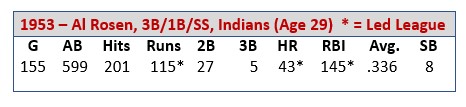
Al Rosen hit.336 for the Indians in 1953 – topping MLB in home runs (43), RBI (145), runs scored (115) and total bases 367); numbers all worthy of a unanimous MVP selection. (Note: Rosen also led AL third basemen in assists and double plays that season.)

Rosen’s stellar year did not quite bring a pennant to Cleveland.  His Indians (with a 92-62 record) finished second, a full 8 ½ games behind the Yankees.

rosen

The runner-up to Rosen in the 1953 NL MVP voting was the pennant-winnings Yankees’ Yogi Berra (.296-27-108). Ironically, the following year – when the Yankees finished second to the Indians, Berra would be the American League MVP.

NOT A BAD ENDORSEMENT

The two best clutch hitters in the game are (Yogi) Berra and (Al) Rosen.

                                                         Hall of Fame pitcher Early Wynn


Rosen played 10 MLB seasons (1947-56), hitting .285, with 192 home runs and 717 RBI. In 1953, he reached career-highs in games played (155), hits (201), runs scored, home runs, RBI and total bases.  He was a four-time All Star, a two-time home run champion and twice led the AL in RBI.

——————————————–

1956 … Mickey Mantle, CF, Yankees

Nicknames: The Mick and The Commerce Comet

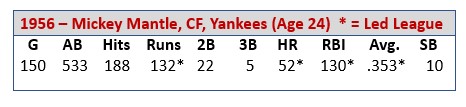
You can probably anticipate a unanimous selection as MVP when your team wins the pennant and you capture the Triple Crown (Avg.-HR-RBI). That’s just what Mickey Mantle did in 1956, leading all of MLB in average (.353). home runs (52) and RBI (130) – as well as in runs scored (132) and total bases (376). It truly was a career year in a Hall of Fame career for the 24-year-old Mantle.  In fact, with the exception of home runs, all the numbers noted above were Mantle’s career highs. (He did pop 54 round trippers in 1961.)

Mantle’s spectacular season helped the Yankees to a 97-57 record – and left the second-place Indians nine games off the pace.

Mnatle

The runner-up to Mantle for 1956 AL MVP was a familiar name, his Yankee teammate Yogi Berra (.298-30-105).

ON THE BIG STAGE IN THE BIG APPLE

Mickey Mantle holds the World Series’ career records for runs scored (42), total bases (123), home runs (188), runs batteD in (40), walks (43) and strikeouts (54).  He played in 65 World Series games, hitting .257.

Mantle played 18 MLB seasons (1951-1968) and was an All Star in 16 of those campaigns. He was a three-time Most Valuable Player and won a Gold Glove in 1962. Mantle led his league in batting average once, home runs four times, triples once, RBI once, runs scored (five times), walks (five times) and total bases three times.  Mantle hit 30 or more home runs in nine seasons, topped 100 RBI in four and scored 100+ runs in nine. He finished his career with a .298 average, 536 home runs, 1,509 RBI, 1,676 runs scored and 153 stolen bases.

———————————————————-

1966 … Frank Robinson, OF, Orioles

Nicknames:  The Judge and Pencils

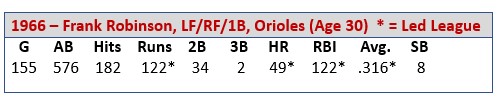
How do you like me now?  After the 1965 season, the Reds traded Frank Robinson to the Orioles for Jack Baldschun, Milt Pappas and Dick Simpson, with Reds’ General Manager Bill DeWitt reportedly referring to Robinson (who had gone .296-33-113 for the Reds in 1965) as an “old thirty.” What did the 30-year-old do for Baltimore the next season?  The future Hall of Famer won the American League Triple Crown with a .316 average, 49 home runs and 122 RBI.  He also led the AL with 122 runs scored and 367 total bases – and was the unanimous choice for AL Most Valuable Player. Not only that, he went on to eleven more MLB seasons, during which he hit .284, with 262 more home runs and 803 additional BI – making six All Star teams in the process.

Robinson

Robinson’s 1966 Orioles’ team went 97-63, leading the American League (and winning the World Series). The squad featured four future Hall of Famers – Robinson, Jim Palmer, Luis Aparicio and Brooks Robinson. The Orioles led the AL in runs scored, and were fourth in earned run average (Palmer was the only starter to reach 15 wins).  Frank Robinson led the team in batting average, home runs RBI, and runs scored.

A REWARDING CAREER

What awards did Frank Robinson take home? Might be easier to ask which awards didn’t he capture.  Robinson was a Most Valuable Player in both the AL and NL; the 1956 NL Rookie of the Year; the 1966 World Series MVP; the 1971 All-Star Game MVP; and the 1989 AL Manager of the Year 

The runner-up for AL MVP in 1966 was Frank Robinson’s teammate Brooks Robinson, who went .269-23-100 and earned his seventh (of an eventual 16) Gold Gloves at third base. Finishing third was another Oriole, 1B Boog Powell (.287-34-109).

Robinson

Frank Robinson played 21 MLB season (1956-76) and was an All Star selection in 12 of them.  He was a two-time MVP and led his league in runs scored three times, doubles once, home runs once, RBI once and batting average once. He also picked up one Gold Glove, topped a.300 batting average in nine seasons, drove in 100 or more runs six times and popped 30 or more round trippers in ten seasons.  He retired with a .294 average (2,943 hits), 586 home runs, 1,812 RBI, 1,829 runs scored and 204 stolen bases.

BEST TO BE FIRST

Frank Robinson was the first Black manager in the AL (Indians – 1974) and the NL (Giants – 1980).

———————————————————

1967 … Orlando Cepeda, 1B, Cardinals

Nicknames:  Baby Bull and Cha Cha

Traded from the Giants to the Cardinals in May of 1966 (for pitcher Ray Sadeki), Cepeda delivered a unanimous MVP season in 1967.  The 29-year-old first-sacker (and future Hall of Famer) hit a career-high .325, with 25 home runs and a league-topping 111 RBI.

Cepeda

Cepeda helped the Cardinals reach 100 wins (101-60) and capture the World Series – leading the team in home runs and RBI.  Lou Brock led the squad in average (.335), hits (206)and runs scored 113 (and finished seventh in the MVP voting).  Dick Hughes led the pitching staff with 16 wins (six losses) – future Hall of Famers Steve Carlton and Bob Gibson went 14-9 and 13-7, respectively.

FIRST OUTSTANDING DH

Orlando Cepeda was the first winner of the Outstanding Designated Hitter Award (1973) for a season in which he hit .289-20-86 for the Red Sox.

The runner-up to Cepeda in the NL MVP Voting was his Redbirds’ teammate – catcher Tim McCarver, who went .295-14-69.

Cepeda played in 17 MLB seasons (1958-74), finishing with a .297 average (2,351 hits), 379 home runs, 1,365 RBI and 1,131 runs scored.  An All Star selection in seven seasons, he hit over .300 in nine seasons, topped 100 RBI five times (leading the league twice) and hit 30 or more home runs five times (leading his league once). He was also Rookie of the Year in 1958, when he went .312-26-96 for the Giants.

————————————————

1968 … Denny McLain, RHP, Tigers

Denny McLain was the unofficial Pitcher of the Year in the Year of the Pitcher – and his performance in 1968 earned him a unanimous AL selection for both the Cy Young and Most Valuable Player Awards.  And, it wasn’t even close.   In 1968, McLain went 31-6, with a 1.96 earned run average – while fanning 280 batters in 336 innings. He led all of MLB in wins, innings pitched, games started (41). He was fifth in ERA, second in strikeouts and complete games (28 – leading the AL).

PLAYING IN SOME RARE AIR

McLain’s historic 31-win season in 1968 was the first 30-win campaign by an MLB pitcher since Dizzy Dean in 1935 (and there have been no 30-win seasons since 1968).  Since 1900, a total of 13 pitchers have won 30 more games in a season (a total of 21 30+-victory seasons among them).

McLain’s Tigers went 103-59, winning the AL crown and the World Series. The keys on offense were Willie Horton (.285-26-85), Jim Northrup (.264-21-90) and Bill Freehan (.263-25-84).  Second to McLain among pitchers was Mickey Lolich (17-9, 3.19).

McLain, a two-time Cy Young Award winner (1968 & 1969), played 10 MLB seasons (1963-72), going 131-91, 3.39 with 1,282 strikeouts in 1,886 innings and 105 complete games in 264 starts.  He was a three-time All Star a three-time winner of 20 or more games in a season (leading the AL twice). He also led the AL in starts twice, complete games once and innings pitched twice.

LONG BALLS – WHAT TO WORRY?

In both of his CYA seasons, Denny McLain led the American League in home runs allowed.

——————————————————–

1973 …. Reggie Jackson, RF, A’s

Nickname: Mr. October

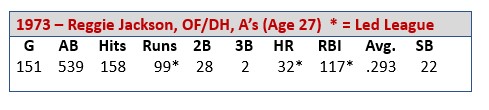
In 1973, Reggie Jackson led the American League in runs scored (99), home runs (32) and RBI (117), while also hitting .293 with 22 stolen bases.  The future Hall of Famer helped the A’s to a 94-68 record (first in the AL West) and a World Series title.  Jackson led the A’s regular lineup in average, home runs, runs scored and RBI.  On the mound that A’s championship squad boasted a trio of 20-game winners: Catfish hunter (21-5); Ken Holtzman (21-13); and Vida Blue (20-9). No other A’s pitcher won more than seven games.

REggie

Finishing second to Jackson in the 1973 AL MVP race was Orioles’ pitcher Jim Palmer, who went 22-9, 2.40.

A MAN FOR ALL SEASONS

Reggie Jackson was a multi-sport star in high school (baseball, football, basketball, track) – and was awarded a football scholarship from Arizona State University.

Jackson played 21 MLB seasons (1967-87) hitting .262, with 563 home runs, 1,702 RBI, 1,551 runs scored and 228 stolen bases. He also holds the all-time MLB record for batter’s strikeouts (2,597).  He was an All Star in 14 seasons and the MVP of the World Series in 1973 and 1977. Jackson led his league in home runs four times, hitting 30 or more round trippers in seven seasons. He also led his league in runs scored twice and RBI once, slugging percentage three times and intentional walks twice.  Jackson his .278-18-48 in 77 post-season games.

———————————————————-

1980 … Mike Schmidt, 3B, Phillies

Nickname: Schmitty

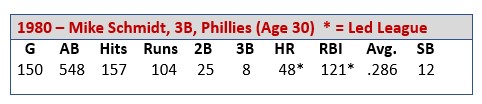
In 1980, Phillies’ third-sacker Mike Schmidt won his first of three Most Valuable Player Awards – and the vote was unanimous. That season, the future Hall of Famer hit .286, leading all of MLB in home runs (48) and total bases (342). He also led the NL in RBI (121) and picked up his fifth consecutive Gold Glove at 3B. To top it off, he scored 104 runs and stole a dozen bases.

schmidt

Schmidt helped the Phillies achieve a 91-71 record (first in the NL East), as well as the 1980 World Series Championship.

THE OLD COLLEGE TRY

Mike Schmidt was a College All-American shortstop in baseball (Ohio University) in 1970 and 1971.

The runner-up to Schmidt for 1980 NL MVP was Expos’ catcher Gary Carter (.264-29-101; with a Gold Glove).

Schmidt played 18 MLB seasons (all with the Phillies) from 1972 through 1989.  He was an All Star in 12 seasons, a ten-time Gold Glover and a three-time NL MVP; as well as the MVP of the 1980 World Series. Schmidt retired with a .267 career average, 548 home runs, 1,595 RBI and 1,506 runs scored.  He led the NL in home runs eight times (topping 30 home runs in 13 seasons), led the league in RBI four times (nine seasons of 100+) and topped the NL in total bases three times.

———————————————————

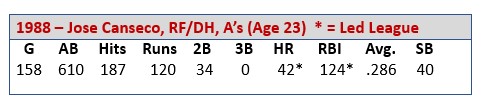
 1988 … Jose Canseco, OF, A’s

IN 1988, the A’s Jose Canseco led all of MLB I home runs (42) and RBI (124). He also tossed in 120 runs scored, 40 stolen bases and a .307 average – leading his Oakland team to 104-58 record (first in the AL West). Also on that squad were Mark McGwire (32 homers and 99 RBI) and Dave Henderson (.304-24-94). The pitching was led by Dave Stewart (21-12); Bob Welch (17-9), Storm Davis (16-7) and Dennis Eckersley (45 saves).

Canseco

40-40 … ABOUT TIME

In his 1988 unanimous MVP season, Jose Canseco became the first major leaguer to achieve 40 home runs and 40 stolen bases in the same campaign. Today, the 40-40 Club includes Canseco, Barry Bonds, Alex Rodriguez and Alfonso Soriano.  

Finishing second in the 198 AL MVP balloting was the Red Sox’ Mike Greenwell, who hiT .325-22-119, with 16 steals.

Canseco played 17 MLB seasons (1985-2001). He was a six-time All Star and the 1986 AL Rookie of the Year. Canseco retired with a .266 average, 462 home runs, 1,407 RBI and 1,186 runs scored.  He led his league in home runs twice (topping 30 long balls in eight seasons) and in RBI once. He drove in 100 or more runs in six seasons and scored 100+ twice.

————————————————————–

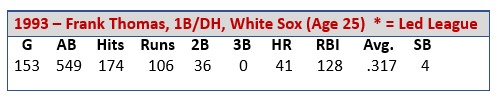
1993 …. Frank Thomas, 1B, White Sox

Nickname: Big Hurt

While Frank Thomas didn’t lead his league in any offensive categories in his unanimous MVP season, he finished third in home runs (41), second in RBI (128) sixth in the AL in average (.317), tenth in runs scored (106), third in total bases (333).   Thomas would repeat as AL MVP in 1994 (not unanimously).  In 1993, the White Sox finished 94-68, first in the AL West.

Thomas

The runner-up to Frank Thomas in the 1993 AL MVP balloting was the Blue Jay’s Paul Molitor, who put up a .332-22-111 season, with 121 runs scored and 22 stolen bases.

THERE HAS TO BE A FIRST

In his 1993 MVP season, Frank Thomas became the first White Sox player to reach 40 home runs in a campaign.

Frank Thomas slugged his way into the Hall of Fame over 19 MLB seasons (1990-2008). He was a five-time All Star and two-time MVP. He was the 1997 AL batting champ with a .347 average – and hit .301 over his career, topping .300 in ten seasons. While he never led his league in home runs, he tallied 521 round trippers (reaching 30 or more in ten seasons; topping 40 five times). He also  drove in 1,704 runs (again without ever leading his league, but topping 100 RBI in 11 times). Thomas also scored 1,494 runs, leading the league once and surpassing 100 tallies in nine seasons. He also led his league in doubles once, walks four times and intentional walks twice.

—————————————————————

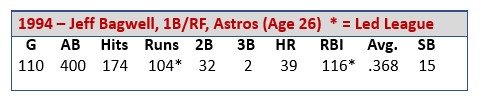
1994 …. Jeff Bagwell, 1B, Astros

Nicknames: Baggy and Bag Pipes

Future Hall of Famer Jeff Bagwell put up some truly MVP numbers in 1994.  He logged a .368 average, popped 39 home runs and led MLB with 116 RBI, 104 runs scored, 300 total bases and a .750 slugging percentage.  Oh yes, he also stole 15 bases and brought home a Gold Glove.  The Astros finished second that season, with a 67-48 record.

Bagwell


The runner-up to Bagwell in the 1994 NL MVP balloting was the Giants’ Gold Glove third baseman Matt Williams (.267-43-96).

PUT ME IN COACH

Jeff Bagwell was a work horse, leading his league in games played four times (playing all 162 games in each of those campaigns) – and logging 156 or more games played in ten of 15 seasons (two of the five seasons in which he did not play in at least 156 games were strike-shortened.).

Bagwell played in 15 MLB seasons (1991-2005). He was an All Star four times, the 1991 NL Rookie of the Year and a one-time Gold Glover. He led his league in runs scored three times (topping 100 runs in nine seasons); hit 30 or more home runs nine times; led his league in RBI once and drove in 100 or more runs eight times. He also led his league in double once; stole 20 or more bases in three times; and topped 300 total bases six times (leading the league once). He retired with a .297 average, 449 home runs, 1,529 RBI, 1,517 runs scored and 202 stolen bases.

—————————————————-

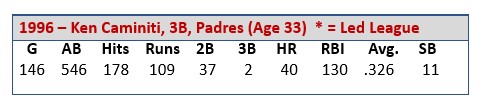
1996 – Ken Caminiti, 3B, Padres

The Padres’ Ken Caminiti turned in a .326-400130 stat line in 1996, adding 109 runs and earning a Gold Glove.  The switch-hitter’s performance helped the San Diego squad finish atop the NL West with a 91-71 record.

PULLING THE OLD SWITCHEROO

In his 1996 unanimous MVP season, Ken Caminiti set the MLB record for most times hitting a home run from both sides of the plate in a game (four). He accomplished the feat on August 1, August 21, August 28 and September 11. Caminiti also hold the National League career record for games with home runs both left- and right-handed at 10. Nick Swisher holds the AL record at 13 – and Swisher and Mark Teixeira share the MLB mark at 14.

The runner-up to Caminiti in the 1996 NL MVP race was Dodgers’ catcher Mike Piazza (a future Hall of Famer), who went .336-36-105.

Caminiti

Caminiti played in 15 MLB seasons (1987-2001) and was a three-time All Star and three-time Gold Glover.  He had a .272 career average with 239 home runs and 983 RBI. His MVP season was the only campaign in which he reached 100 runs, 100 RBI or 30+ home runs.

—————————————

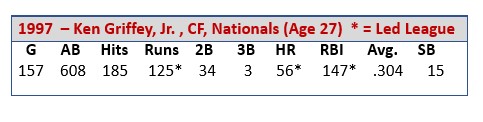
1997, Ken Griffey, Jr., CF Mariners

Nicknames: Junior and The Kid

Future Hall of Famer Ken Griffey, Jr. really showed his stuff in 1997. He hit .304 and led MLB with 147 RBI. In addition, his 56 home runs and 125 runs scored led the American League.  He also led the AL in total bases (393) and intentional walks (23).  He was a force to be reckoned with. And, by the way, he also picked up a Gold for his play in CF.

Griffey

Griffey led Seattle to a 90-72 record, good for first in the American League West. He got plenty of support from Of Jay Buhner (.243-40-109), DH Edgar Martinez (.330-28-108), SS Alex Rodriguez (.300-23-84) and Randy Johnson (20-4, 2.28) on the mound.

Finishing second to Griffey in the AL MVP voting was Yankee first baseman Tino Martinez, who put up a .296-44-141 line.

LIKE FATHER-LIKE SON

On September 14, 1990 – with the Mariner visiting the Angels – Ken Griffey, Sr. and Ken Griffey, Jr. started for the Mariners in LF and CF, respectively. In the bottom of the first inning Ken Griffey, Sr. hit a two-run home run to left-center of Kirk McCaskill). Next up was Ken Griffey, Jr., who also homered (solo shot, of course) to left-center.  It’s the only time in MLB history when a father and son have gone deep back-to-back.

Useful for you next trivia dust-up:  What are Ken Griffey Jr. and Sr.’s first names?  The answer “George” –  George Kenneth Griffey, Sr. and Jr. Oh yeah, other famous baseball “Georges” include George Thomas Seaver and George Herman (Babe) Ruth.

Griffey, Jr.  played 22 MB seasons (1989-2010) from age 19 to 40.  He hit .284 (2,781 hits), with 630 home runs, 1,836 RBI and 1,662 runs scored. He was a 13-time All Star and ten-time Gold Glover.  He led his league in:  runs scored once (scoring at least 100 times in six seasons); home runs four times (hitting 30 or more ten times – with a high of 56 in two seasons); RBI once (with eight campaign of 100 or more); total bases twice; and intentional walks twice. In 19 post-season games, Griffey hit .290, with six home runs, 11 RBI and five stolen bases.

————————————————–

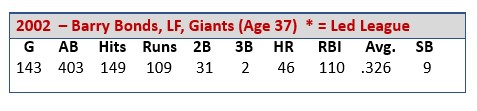
2002 … Barry Bonds, LF. Giants

In 2002, Barry Bonds won his fifth of seven (and second of four consecutive) NL MVP Awards (this one unanimously).  He led all of MB in average (.370), while launching 46 home runs, scoring 117 times and driving in 110 runs. He might have put up even stronger numbers if he hadn’t also led all of MLB in walks (198) and intentional walks (68). That season, the Giants finished second in the NL West, with a 95-86 record.

Bonds

The runner-up to Bonds in the NL MVP voting was Cardinals’ first baseman Albert Pujols, (.314-34-127).

YOU’RE GONNA GET A FREE RIDE

In 2004, Barry Bonds drew an MLB single-season record 232 walks.   They came in 617 plate appearances – that’s one walk in every 2.66 trips to the dish. A total of 120 of those free passes were intentional (another single-season MLB high mark). Bonds holds MLB’s career record for walks (2,558) and intention walks (688) – not to mention home runs (762).

Bonds played 22 MLB seasons (1986-2007).  He was a 14-time All Star, a record seven-time MVP and an eight-time Gold Glover. His 762 homer runs are the MLB career record, although he only led his league in round trippers twice (he hit 30 or more home runs 14 times – 40 or more seven times – and an MLB record 73 in 2001).  His 1,996 RBI are sixth all time. He led his league in RBI once, but topped 100 12 times.  Bonds’ 2,227 runs scored are second all time, and he led his league once (scoring 100+ time in 12 campaigns). He was also a two-time batting champion (.298 career average) and led his league in walks eleven times and intentional walks 12 times.

HERE’S A COMPLIMENTARY RUN

Barry Bonds is one of only six players to be walked intentionally with the bases loaded.

————————————————————

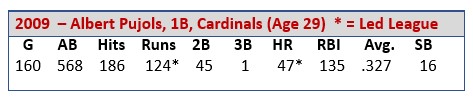
2009 … Albert Pujols, 1B, Cardinals

In 2009, Albert Pujols put up a typical Pujols’ season, and it earned him his third NL Most Valuable Player recognition (this time in a unanimous vote). Pujols hit .327, and led MLB with 47 home runs, 124 runs and 374 total bases.  That campaign, he also drove in 135 runs, swiped 16 bases and drew an MLB-topping 44 intentional passes. This performance helped the Redbirds to a 91-71 record, good for fist place in the NL Central. Pujols was the only player on the Cardinals to reach 100 RBI that campaign, as well as the only Cardinal with more 22 round trippers.

Pujols

The runner-up to Pujols in the NL MVP race was the Marlins’ Hanley Ramirez (.342-24-106, with 27 steals.


CONSISTENCY IS NOT ALWAYS A HOBGOBLIN

In his first ten MLB seasons, Albert Pujols never hit under .312, never launched less than 32 home runs, never drove in fewer than 103 tallies.  His season average from 2001-2010 was .331-41-123,

Pujols, still active, has now played in 19 MLB seasons, hitting .300 (3,202 hits, 15th all-time) with 656 home runs (sixth all-time) and 2,075 RBI (fourth all-time).  He was a unanimous choice for NL Rookie of the Year (2001), is a ten-time All Star, two-time Gold Glover and three-time National League MVP. He has led his league in runs scored five times (topping 100 ten times), home runs twice (reaching forty or more seven times) and RBI once (exceeding 100 in 14 campaigns) and batting average once (topping .300 in ten seasons). In the post-season, he has hit .323 (77 games), with 19 home runs and 54 RBI.

I’LL BRING HOME FOUR AND PUT DOWN THREE

In his first-ever college baseball game, Albert Pujols hit a Grand Slam and turned an unassisted Triple Play.  He finished that freshman season with a .461 average and 22 home runs and 80 RBI.

————————————————————

2014 … Mike Trout, CF, Angels

Nickname:  The Millville Meteor

Mike Trout won his first of three (to date) American League MVP Awards (this one in a unanimous vote) in 2014 at the age of 23 (he turned 23 on August 7 of that season). He was already in his fourth MLB season and had finished second in the MVP voting in each of the previous two campaigns. In 2014, Trout hit .287, with 36 home runs, an MLB-leading 115 runs scored and MLB-tops 338 total bases. He also led the AL with 111 RBI. In 2014, Trout’s Angels topped the AL West with a 98-64 record, with Trout leading the team in nearly every offensive category.

Trout

The runner-up to Trout for 2014 AL MVP was the Tigers’ Victor Martinez (.335-32-103).

Mike Trout was a unanimous choice for AL Rookie of the Year in 2012 (although he did see action in 40 MLB games in 2011). In his Rookie of the Year season, Trout became the youngest MLB player ever to have a 30-30 season (30 home runs/30 stolen bases) – accomplishing it at age 20.   He hit 30 home runs, stole a league-leading 49 bags, drove in 83 and scored a league-leading 129 runs.

Still active, over his first nine MLB seasons, Trout has hit .305, with 285 home runs, 752 RBI, 903 runs scored and 200 stolen bases. He is an eight-time All Star and, in addition to winning the AL Most Valuable Player Award three times, has finishing second four times. He’s led the AL in runs scored four times (topping 100 in seven seasons) and RBI once (topping 100 three times). He’s also topped the junior circuit in walks three times, on-base percentage four times and stolen bases once.

——————————————————

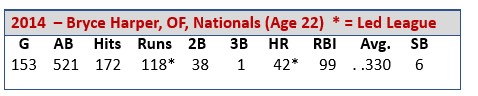
2015 … Bryce Harper, RF, Nationals

In 2015, 22-year-old Bryce Harper became the youngest player to win a league MVP award (and did on a unanimous vote). That season, Harper hit .330, with an NL-leading 42 home runs and 118 runs scored.  He also drove in 99 runs. His Nationals’ squad finished second in the NL East, with an 83-79 record. Harper led the team in average, home runs, runs scored, RBI, hits, doubles, walks, and total bases.

Harpr

The runner-up to Bryce Harper for 2015 NL Most Valuable Player was the Diamondbacks’ Paul Goldschmidt (.331-33-110, with 21 stolen bases).

GOT TO COLLEGE EARLY …. LEFT EARLY

Bryce Harper graduated from High School early and attended the College of Southern Nevada at age 17 (2010). In 66 collegiate games, he hit .443, with 31 home runs and 98 RBI and was named Scenic West Athletic Conference Player of the Year. He was the first overall selection (Nationals) in the 2010 MLB drat.

The still active Harper has eight MLB seasons under his belt. He has put up a .276 average, with 219 home runs, 635 RBI, 708 runs scored and 90 steals., The six-time All Star and 2012 NL Rookie of the Year has led the NL once each in home runs, runs scored, walks and intentional walks. He has topped 30 home runs in three seasons, reached 100 or more RBI in two and scored 100+ ruins in two.

Primary Resource:  Baseball-Reference.com

For a look at unanimous Rookie of the Year choices, click here.  For unanimous Cy Young Award winners, click here.

Coming Soon:  A comparison of the BBWAA Hall of Fame Vote with BBRT’s Fan Hall of Fame Voting – and announcement of BBRT balloting prize winners.

BASEBALL ROUNDTABLE ON THE TOP 100 BASEBALL BLOG LIST

100Baseball Roundtable is on the Feedspot list of the Top 100 Baseball Blogs.  To see the full list, click here.

I tweet baseball @DavidBBRT

Follow/Like Baseball Roundtable’s Facebook Page here.  More baseball commentary; blog post notifications; PRIZES.

Member: Society for American Baseball Research (SABR); The Baseball Reliquary; The Negro Leagues Baseball Museum.
Baseball Roundtable Trivia Teaser … and a Look at all the Unanimous CYA Selections

BASEBALL ROUNDTABLE TRIVIA TEASER:

Sandy Koufax ... three-time unanimous Cy Young Award selection.

Sandy Koufax … three-time unanimous Cy Young Award selection.

Since the Cy Young Award was first presented in 1956 (To honor Cy Young, who passed away in 1955), we have seen 23 unanimous CYA selections (17 different pitchers). No one has been a unanimous CYA selection more often than the Dodgers’ Sandy Koufax, who accomplished the feat three times (and did it when only one CYA was awarded each season). Koufax was the unanimous selection in 1963, 1965 and 1966.   In 1964, despite a 19-5 record and an NL-lowest 1.74 earned run average, Koufax finished third in the CYA balloting.  Your question?  Who were the two pitchers (one American League, one National League) who finished ahead of Koufax in that season’s CYA balloting?  Hint: Both won at least 20 games.


YOUR ANSWER:  Dean Chance and Larry Jackson.

Chance of the Los Angeles Angels won the 1964 CYA with 17 of 20 votes – based on a 20-9 season in which he led the American League in wins, ERA (1.65), complete games (15), shutouts (11),and innings pitched 278 1/3.  Two votes went to the Cubs’  Jackson, who won an MLB-tops 24 games (11 losses), with a 3.14 ERA, 19 complete games and three shutouts.  Koufax, who was shut down in mid-august due to an arm injury, got one vote.

Read on for a look at all of MLB’s unanimous Cy Young Award winners, where you can also pick up some tidbits like which of these unanimous CYA winners:

  • pitched an all-strikeout perfect game in high school;
  • was also a unanimous league MVP selection in his unanimous CYA season;
  • was traded during his unanimous CYA season;
  • after retiring from baseball played in a band that  opened for Willie Nelson;
  • threw a perfect game in his unanimous CYA season;
  • in his unanimous CYA season, gave up zero runs in six September starts (55 innings);
  • and more.

——————UNANIMOUS CY YOUNG AWARD WINNERS —————————

1963-65-66 …. Sandy Koufax, Dodgers

In the final four seasons of an MLB career cut short by arm problems, Sandy Koufax was clearly the best pitcher in baseball – a three-time unanimous Cy Young Award winner at a time when only one award was given out each season.  In each of those three CYA seasons,  Koufax led all of MLB (or tied for the lead) in wins, earned run average and strikeouts.

In 1963, Koufax went 25-5, with a 1.88 earned run average and 306 strikeouts. He had 20 complete games and 11 shutouts in 40 starts (311 innings pitched) and was also the NL Most Valuable Player (not unanimous).

In 1965, Koufax notched 26 wins (eight losses), with a 2.04 earned run average and 382 strikeouts. He had 27 complete games and eight shutouts in 41 starts (335 2/3 innings).

In 1966, the Hall of Fame southpaw’s final season (at age 30), Koufax went 27-9, 1.73, with 317 whiffs.  He notched 27 complete games (five shutouts) in 41 starts (323 innings).

Sandy Koufax really turned it on in his final four seasons (1963-66), going 97-27, 1.86, with 1,228 strikeouts in 1,192 innings pitched.  In his first eight seasons, Koufax was 68-60, 3.17 with 1,168 strikeouts in 1,131 2/3 innings.

Over a 12-season MLB career (1955-66), Koufax went 165-87, 2.76, with 2,396 strikeouts in 2,324 1/3 innings pitched.  He was a six-time All Star, three-time Cy Young Award winner, one-time NL Most Valuable Player and two-time World Series MVP. He led his league in earned run average in six seasons (consecutively), in wins three times, complete games and innings pitched twice (his final two campaigns), shutouts three times and strikeouts four times.

—————————————————-

Until 1967 only one CY Young Award was presented each season.  From 1968 forward, a CYA winner was selected for each league.

1968 …. Denny McLain, Tigers

In the Year of the Pitcher, Denny McLain was arguably “The Pitcher of the Year.” The unanimous Cy Young Award winner won 31 games (just six losses), becoming the first 30-game winner since Dizzy Dean in 1934. McLain also put up a 1.96 earned run average, a league-best 28 complete games (41 starts), a league-topping 336 innings pitched, six shutouts and 280 strikeouts. That season, McLain was also the unanimous choice for American League Most Valuable Player.

In his 1968, 31-win season, Denny McLain led all MLB pitchers in home runs allowed (31).

Over a ten-season MLB career, McLain was a three-time All Star, two-time Cy Young Award winner (1968 & 1969) and, of course, the 1968 AL MVP. He led his league in wins twice, starts twice, complete games once, shutouts once and innings pitched twice.  He was a thirty-game winner once and won 20 or more in two additional seasons.  He finished with a 131-91 record, a 3.39 earned run average and 1,282 strikeouts in 1,886 innings pitched.

————————————————————-

1968 … Bob Gibson, Cardinals

A fierce competitor, Bob Gibson put together a dominant season in 1968. He went 22-9, with a 1.12 earned run average – the fourth-lowest in MLB history (among qualifying pitchers) and the lowest since 1914.  He logged 28 complete games in 34 starts, including an MLB-best 13 shutouts. That season, Gibson fanned 268 batters in 304 2/3 innings.  Oh, and he won a Gold Glove. This performance not only earned Gibson a unanimous selection as the NL CYA winner, but also the NL Most Valuable Player Award (not unanimous, Pete Rose got six of the 20 votes),

In June-July of the 1968 season, Bob Gibson started twelve games and went 12-0 with a 0.50 earned run average. He pitched 12 complete games in that span, including eight shutouts. He gave up three runs in his first June start (June 2) and a total of three runs in his next eleven outings Over those eleven games, his ERA was 0.27),

Over a 17-season MLB career, the Hall of Famer went 251-174, 2.91, with 3,117 strikeouts in 3,884 1/3 innings pitched. He was a nine-time All Star, two-time Cy Young Award winner, the 1968 NL Most Valuable Player, a nine-time Gold Glover and a two-time World Series MVP. Gibson, a five-time twenty -game winner, led the NL in victories once, ERA once, complete games once, shutouts four times and strikeouts once. He went 7-2, 1.89 in nine World Series starts (eight complete games) and holds the record for strikeouts in a World Series game (17 on October 2, 1968).  Gibson also pitched a no-hitter in an 11-0 win over the Pirates on August 14, 1971.

Bob Gibson is one of only two pitchers to strikeout at least one batter in every inning of a World Series game (the other is Ed Walsh, October 11, 1906). 

——————————————————–

After a tie for the American League Cy Yong Award in 1969 (Mike Cueller and Denny McLain), voting was changed to allow the casting of votes for a first-, second- and third-place candidate (as opposed to voting for just one pitcher).


1978 … Ron Guidry, Yankees

In his unanimous CYA season, Ron Guidry led the league in wins (25, against just three losses), earned run average (1.74) and shutouts (9). He threw 16 complete games in 35 starts and fanned 248 batters in 273 2/3 innings.

Ron Guidry’s final regular season win in his 1978 CYA season was one of the most significant in Yankee history. The Yankees and arch-rival Red Sox had tied for the Al East title at 99-63. Guidry was selected to start the one-game playoff (in Boston), matched up against the Red Sox Mike Torrez. Guidry got the win (Bucky Dent got the fame with a three-run home run in the seventh inning), going 6 1/3 innings, giving up two runs on a walk and six hits and fanning five. The Yankees went on to beat the Royals in the American League Championship Series (in four games) and the Dodgers in the World Series (six games).  Guidry got one start in each series, giving up just two runs in 17 frames.

In a 14-season MLB career (1975-88), Guidry was four-time All Star and five-time Gold Glover. He won 170 games (91 losses) and put up a 3.29 earned run average. He reached twenty or more wins in three seasons (leading the AL twice), was a two-time ERA leader and led the league in complete games and shutouts once each.  In 2,392 career innings, he fanned 1,778 batters.

The runner up to Guidry for the 1978 AL CYA was the Brewers’ Mike Caldwell (22-9, 2.36).

———————————————————

1984 …. Rick Sutcliffe, Cubs

1984 did not start out like a Cy Young-worthy season for Rick Sutcliffe. He opened the season with the Indians and was 4-5, 5.15, when he was traded (June 13) to the Cubs.  It was gangbusters from there.  For the Cubbies, Sutcliffe went 16-1, 2.69 in 20 starts (seven complete games/three shutouts), fanning 155 batters in 150 1/3 innings – leading the Cubs to a Division title.

Rick Sutcliffe is one of only six players to win the Sporting News Comeback Player of the Year Award twice … and the only one to win it in both the American and National League. In 1987, Sutcliffe was the Comeback Player of the Year as a Cub – going 18-10, 3.69, following his 1986 record of 5-14, 4.64. In his 1992 Comeback Player of the Year season, Sutcliffe went 16-15, 4.47 for the Orioles, following a 6-5,4.10 1991 season for the Cubs.

Sutcliffe pitched in 19 MLB seasons (1976, 1978-94), going 171-139, 4.08, with 1,679 strikeouts in 3,697 2/3 innings pitched. In addition to his 1984 Cy Young Award, he was the 1979 NL Rookie of the Year and a three-time All Star. He led his league in wins once and earned run average once.

The runner up to Sutcliffe for the 1984 Cy Yong Award was NL Rookie of the Year Dwight Gooden of the Mets, who went 17-9, 2.60 and led the NL with 276 strikeouts.

———————————————————————

1986 and 1998 … Roger Clemens, Red So and Blue Jays

Two of Roger Clemens’ record seven Cy Young Awards saw him capture all the available first-place votes – 1986 (Red Sox) and 1998 (Blue Jays).

In 1998, Clemens won an MLB-best 24 games (just four losses) and posted the American league’s lowest earned run average (2.48). He notched ten complete games in 33 starts and fanned 238 batters in 254 innings pitched.  His performance earned him AL Most Valuable Player Honors (not unanimous.)

The runner for AL Cy Young recognition in 1986 was the Brewers’ Teddy Higuera, who went 22-11, with a 2.79 ERA.

Clemens is the only MLB pitcher to record multiple games (two) in which he fanned 20 batters in nine innings. One of those came in his 1986 unanimous CYA season.  On April 29 of that season, Clemens fanned 20 batters in a 3-1 win over the Seattle Mariners.  (He pitched nifty three-hitter, the only run scoring on a Gorman Thomas home run.) That effort made Clemens the first MLB pitcher to fan 20 batters in a nine-inning contest.  (On September 12, 1962, the Senators’ Tom Cheney fanned 21 batter in a 2-1 16-inning, complete-game win over the Orioles.)  Other pitchers to fan 20 batters in a nine-inning game: Kerry Wood, Cubs; Randy Johnson, Diamondbacks; Max Scherzer, Nationals.

In 1998, Clemens was again a unanimous Cy Young Award selection, this time with the Blue Jays.  That season, he led the AL (tied for the MLB lead) in wins with 20 and topped the junior circuit in earned run average (2.65) and strikeouts (271 in 234 2/3 innings). He threw five complete games and three shutouts in 33 starts.

The runner for American League CYA that season was the Red Sox’ Pedro Martinez (19-7, 2.89, 251 strikeouts).

Clemens enjoyed a 24-season MLB career – going 354-184, 3.12 – with 4,672 strikeouts (third all-time) in 4,916 2/3 innings pitched. He was an eleven-time All Star, seven-time Cy Young Award winner, the 1986 AL MVP and the 1986 All Star game MVP.  He led his league in earned run average seven times; shutouts six times; strikeouts five times; wins three times; and complete games three times.  He won 20 or more games in a season five times.

Roger Clemens won Cy Young Awards with four teams: Red Sox, Blue Jays, Yankees and Astros.

——————————————————

1988 … Orel Hershiser, Dodgers

In 1988, Orel Hershiser went 23-8 (leading the NL in wins), with a 2.26 earned run average.  He tied for the MLB lead in complete games with 15, as well as in shutouts with eight.  He fanned 178 batters in 267 innings pitched.  Oh yes, and he brought home a Gold Glove.

In September of his 1988 unanimous CYA season, Orel Hershiser gave up zero – yes, zero – runs in 55 inning pitched.  His work included five complete-game shutouts and a ten-inning start in which he gave up no runs (but which the Dodgers lost 2-1 in 16 innings). The September stretch was part of a regular-season MLB record streak of 59 consecutive scoreless innings.

Hershiser pitched in 18 MLB seasons (1983-2000), going 204-150, 3.48, with 2,014 strikeouts in 3,130 1/3 innings.  He was a three-time All Star; the 1988 National League Championship Series and World Series MVP; and the 1996 American League Championship Series MVP.  He led his league in wins, complete games and shutouts once each.

The runner up to Hershiser in the 1988 CYA race was the Reds’ Danny Jackson (23-8, 2.73).

———————————————————————

1994 and 1995 … Greg Maddux, Braves

Hall of Famer Greg Maddux won four Cy Young Awards, two (1994 and 1995) in which he captured all the first-place votes.

In the strike-shortened 1994 MLB season, Maddux led the National League in wins with 16 (six losses) and topped all of MLB with a 1.56 earned run average.  He topped MLB with ten complete games and tied for the NL lead in shutouts with three. He fanned 156 batters (walking just 31) in 202 innings pitched. He also earned a Gold Glove.

The runner up to Maddux for the 1994 NL CYA was the Expos’ Ken Hill (16-5, 3.32.)

Greg Maddux was the first pitcher to win four consecutive Cy Young Awards (1992-95).  Randy Johnson (Diamondbacks) matched that feat from 1999-2002. During his streak of four straight CYAs, Maddux went 56-27, with a 2.08 earned run average.  He struck out 552 batters (153 walks) in 737 innings pitched.

In 1995, another strike-shortened season (144 games), Maddux again led the National League in wins with 19 (just two losses, a .905 winning percentage). He posted a league-best 1,63 earned run average, topped MLB in compete games (ten) and led the NL in shutouts (three); fanning 183 batters (just 23 walks) in 209 2/3 innings.

The runner up for the 1995 NL CYA was the Reds’ Pete Schourek, who went 19-7, 3.22 in 29 starts.

Greg Maddux led his league in fewest walks per nine innings pitched in nine seasons.

Maddux pitched in 23 MLB seasons (1986-2008), earning his way into the Hall of Fame with 355 wins (eighth all time) versus 227 losses, a 3.16 earned run average and 3,371 strikeouts (999 walks) in 5,008 1/3 innings pitched.  He was an eight-time All Star, four-time Cy Young Award winner and an 18-season Gold Glover. He led his league in wins three times (only twice reaching 20 wins, however); ERA four times; complete games three times; shutouts five times; and innings pitched five times.

——————————————————————

1999 & 2000 …. Pedro Martinez, Red Sox

Hall of Famer Pedro Martinez earned three AL Cy Young Awards (1997-1999-2000), the last two of which saw him earn unanimous-choice status.

In 1999, Martinez led MLB with 23 wins (four losses) and posted an MLB-lowest 2.07 earned run average in 31 stats.  He pitched 213 1/3 innings and fanned an AL-tops 313 batters – an ML-best 13.2 strikeouts per nine frames.

The runner up for the 1999 American League CYA was the Orioles’ Mike Mussina, who went 18-7, 3.50.

Oh, Brother!

On August 29, 996, Pedro Martinez faced a match up he didn’t really care for.  On that day, Pedro started for the Montreal Expos against the Dodgers (in Montreal).  His mound opponent?  His older brother Ramon.  The Martinez brothers acquitted themselves well.  Ramon went eight frames, giving up three hits, five walks and just one run – earning the win.  Pedro pitched a complete-game, six-hitter, with one walk and 12 whiffs – but took the loss in the 2-1 contest.

In 2000, Martinez repeated as Cy Young Award winner (again unanimously), with an 18-6 record, an MLB-lowest 1.74 earned run average and an AL-topping 284 strikeouts.  He also led the AL in shutouts with four.

The runner up to Martinez in 200 was Oakland’s Tim Hudson (20-6, 4.14).

Martinez pitched in the major leagues for 18 seasons (1992-2009), going 219-100, 2.93 and fanning 3,154 batters in 2,827 1/3 innings pitched. The Hall of Famer was an eight-time All Star and three-time Cy Young Award winner. He led his league in wins once; winning percentage three times; earned run average five times; complete games and shutouts once each; and strikeouts three times (topping 300 whiffs in two season). He also led his league in strikeouts per nine innings five times and strikeouts-to-walks ratio four times.

————————————————————–

2002 … Randy Johnson, Diamondbacks

Randy Johnson won five Cy Young Awards – and his 2002 NL CYA selection was unanimous. That season, Johnson led MLB in wins (24 versus five losses); complete games (tied at eight) and strikeouts (334). He led the NL in winning percentage (.828), earned run average (2.32) and innings pitched (260_.

Johnson’s Arizona teammate Curt Schilling finished second in the 2002 CYA balloting, after a 23-7, 3.23, 316 strikeout season.

In 2002, the Diamondbacks’’ Randy Johnson and Curt Schillings became the first pair of MLB teammates ever to record 300 or more strikeouts (each) in the same season.  In 2019, the Astros’ Gerrit Cole and Justin Verlander matched that feat.

Randy Johnson pitched for 22 MLB seasons (1988-2009), picking up 303 wins (166 losses) and recording a 3.29 earned run average.  His 4,875 strikeouts (4,135 1/3 innings) are second all time. The Hall of Famer was a five-time Cy Young Award winner, ten-time All Star and the 2001 World Series MVP. He three times won twenty or more games in a season, led his league in earned run average four times, winning percentage four times, complete games four times, shutouts twice and strikeouts nine times – topping 300 K’s in an MLB record-tying (Nolan Ryan) six seasons.

———————————————————-

2004 and 2006 … Johan Santana Twins

The Twins’ Johan Santana won two Cy Young Award and was a unanimous number-one selection both times.

In 2004, Santana went 20-6, with a league-best 2.61 earned run average and an AL-topping 265 strikeouts (222 innings pitched) – which translated to an AL best 10.5 strikeouts per nine innings.

Curt Schilling of the Red Sox was the AL runner up in the 2004 CYA voting, after a 21-6, 3.26, 203 strikeout season.

Johan Santana was traded (by the Twins) to the Mets before the 2008 season. On June 1, 2012, he tossed a no-hitter (in New York) in an 8-0 win against the Cardinals, walking five and fanning eight.  It was the first – and is still the only – no hitter thrown by a Mets’ hurler.

In 2006, Santana led the AL in wins (19, versus six losses) and topped MLB in both earned run average (2.77) and strikeouts 245 – logging an AL-tops 9.4 whiffs per nine.

The 2006 CYA runner in the American League was the Yankees’ Chien-Mang Wang (19-6, 3.63.).

Santana pitched 13 MLB seasons (2000-10 and 2012).  He won 139 games (78 losses), with a 3.20 earned run average and 1,988 strikeouts in 2,025 2/3 innings.  He led his league in wins once, earned run average three times, starts and innings pitched twice each, strikeouts three times and strikeouts per nine innings three times. He was a four-time All Star and one-time Gold Glover.

————————————————————-

2007 … Jake Peavy, Padres

In 2007, Jake Peavy led the NL in wins with 19 (six losses) and earned run average at 2.54 and strikeouts with 240. That season, Peavy reached career highs in wins, winning percentage (.760), starts (34), innings pitched (233 1/3) and strikeouts.

The runner up in the 2007 NL CYA balloting was the Diamondbacks’ Brandon Webb (18-10, 3.01).

After retiring from baseball, Jake pursued another passion – music and guitars. His band Jake Peavy and The Outsiders has opened for such acts as Willie Nelson and The Tedeschi Trucks Band.  His passion for music is also reflected in the work of the Jake Peavy Foundation, which supports music and the arts, sports and financial literacy programs for young people.

Peavy pitched 15 MLB seasons (2002-16), going 152-126, 3.63, with 2,207 strikeouts in 2,377 innings. He le his league in wins once, earned run average twice and strikeouts twice. He was a three-time All Star and one-time Gold Glover.

———————————————————–

2010 …. Roy Halladay, Phillies

Roy Halladay was a two-time Cy Young Award winner and  a unanimous selection in 2010. That season, Halladay led MLB (tied) in wins (going 21-10), while putting up a 2.44 earned run average in an MLB-leading 250 2/3 innings (33 starts).  He also topped MLB in complete games (nine) and shutouts (four), while fanning 219 batters.

Halladay gave fans a look at things to come in his very first MLB victory (in just his second MLB appearance).  It came September 27, 1998, as Halladay and his Blue Jays faced the Tigers in Toronto. Halladay had a no-hitter going and a 2-0 lead with two outs in the top of the ninth. Pinch hitter Bobby Higginson, broke up the no-no with a home run to left. Halladay settled for a complete-game, 2-1 win in which walked none and fanned eight.

In his 2010 unanimous CYA selection season, Halladay pitched a perfect game against the Marlins in a 1-0, May 29 victory.  Then threw a no-hitter against the Reds in the first game of the National League Division Series. The only other post-season no hitter was, of course, Yankee Don Larsen’s 1956 perfect game.

The runner up to Halladay in the 2010 CYA balloting was the Cardinals’ Adam Wainwright, who went 20-11, 2.42.

In a 16-season MLB career (1998-2013), Halladay went 203-105, 3.38 – totaling 67 complete games and 20 shutouts. He struck out 2,117 batters in 2,749 1/3 innings.  The Hall of Famer was an eight-time All Star and two-time Cy Young Award winner (once in each league). He won twenty or more games in three seasons, leading his league twice.  He also led his league in complete games seven times (five straight seasons from 2007 to 2011), shutouts four times and innings pitched four times.

BASEBALL ROUNDTABLE FANS’ HALL OF FAME BALLOT

There is still time to cast a ballot in BBRT’s Baseball Hall of Fame (unofficial) Fan Voting.  And, there is a randomly selected baseball card and bobblehead prize.  Click here to access the ballot (read the introduction for prize rules.  Click here for BBRT’s take on the 2020 HOF candidates. 

——————————————————————–

2014, Justin Verlander, Tigers

In 2014, Justin Verlander topped MLB with 24 wins, 251 innings pitched, 250 strikeouts and a 0.92 WHIP.  He also led the AL with a 2.40 earned run average. Verlander’s performance also earned him the American League MVP Award (not unanimous).

Justin Verlander is one of only six MLB pitchers with at least three no hitters (Nolan Ryan had seven, Sandy Koufax four and standing at three are Verlander, Cy Young, Bob Feller and Larry Corcoran).

The runner up to Verlander in the 2011 AL CYA voting was the Angels’ Jered Weaver (18-8, 2.41.

The still-active Verlander was the 2019 National League CYA winner – his second Cy Young Recognition.  He has been an All Star in eight of his 15 seasons and was the 2006 AL Rookie of the Year. Verlander has a 225-129, 3.33 stat line, with 3,006 strikeouts in 2,982 innings.  He has led his league in wins three times, winning percentage twice, ERA once, games started five times, innings pitched four times and strikeouts five times. He was also the 2017 AL Championship Series MVP.

______________________________________________

2014 … Clayton Kershaw, Dodgers

In 2014, Clayton Kershaw (still active going into 2020) won his third Cy Young Award – and was honored as a unanimous selection. That season, Kershaw led MLB with 21 wins, an 8.75 winning percentage, a 1.77 earned run average, a 0.857 WHIP and six complete games.  He fanned 239 batters in 198 1/3 innings.  That performance also earned Kershaw National League MVP honors (not unanimous).

Clayton Kershaw pitched an all-strikeout perfect game in Texas high school playoff game (fifteen batters faced, fifteen fanned – before the “mercy rule” ended the contest).   He was the USA Today High School Baseball Player of the Year that season, after going 13-0, 0.77 with 139 strikeouts in 64 innings pitched.

The runner up to Kershaw in the NL CYA race was the Reds’ Johnny Cueto, who went 20-9, 2.25.

In his 12 MLB seasons, Kershaw has gone 169-74, 2.44.  He has led his league in wins three times, earned run average five times (four straight seasons from 2011-2014), starts twice, complete games twice, shutouts three times, innings pitched once and strikeouts three times. Kershaw is eight-time All Star and one-time Gold Glover.

Primary Resources:  MLB.com; Baseball-Reference.com; ESPN.com

BASEBALL ROUNDTABLE ON THE TOP 100 BASEBALL BLOG LIST

100Baseball Roundtable is on the Feedspot list of the Top 100 Baseball Blogs.  To see the full list, click here.

I tweet baseball @DavidBBRT

Follow/Like Baseball Roundtable’s Facebook Page here.  More baseball commentary; blog post notifications; PRIZES.

Member: Society for American Baseball Research (SABR); The Baseball Reliquary; The Negro Leagues Baseball Museum.
A Look at MLB’s Unanimous Rookie of the Year Selections

BASEBALL ROUNDTABLE TRIVIA TEASER (Just to get you in the mood for this post.)

Only two MLB rookies have ever won the Most Valuable Player Award.  And. while both were selected Rookie(s) of the Year, neither was a unanimous choice.  Your question is not who were those rookies (1975, Fred Lynn, Rex Sox … 2001, Ichiro Suzuki, Mariners), but who were the two players who got the first-place votes that denied Lynn and Suzuki “unanimous status.” 

YOUR ANSWER.

In 1975, the Red Sox’ Fred Lynn went .331-21-105, won a Gold Glove and led the American League in doubles (47) and runs scored (103). His efforts earned him MVP  honors and 23 1/2 of 24 possible first-place votes for Rookie of the Year. That other one-half vote went to Lynn’s teammate and outfield partner Jim Rice, who went .309-22-102.

In 2001, The Mariners’ Ichiro Suzuki led that American Leaguer with a .350 average, 242 hits and 56 stolen bases.  He also hit eight home runs, drove in 69 runners, scored 127 times and won a Gold Glove. That performance earned him league MVP honors and twenty-three of twenty-four possible first-place votes for Rookie of the Year. The remaining vote went to Indians’ rookie C.C. Sabathia, who 17-5, 4.39 in 33 starts. 

___________________________________________________________________________

Now for BBRT’s post on unanimous Rookies of the Year.


AlvarexThe Astros Yordan Álvarez – the 2019 American League Rookie of the Year – was the first-ever primarily Designated Hitter to capture that honor. (Of Álvarez’ 83 starts – in 87 games played – 74 were as a DH.)  He also became the 22nd unanimous ROY selection, capturing all thirty first place votes and far outdistancing runner-up Orioles’ pitcher John Means.

Álvarez, who made his MLB debut June (18 days before his 22nd birthday) hit .313, with 27 home runs and 78 RBI in 87 games. This was after going .343-23-71 in 56 games for the Triple A Round Rock Express. Runner-up Means, a 27-year-old southpaw starter, went 12-11, 3.62 for an Orioles team that finished 54 games under .500.

From BBRT’s perspective, had I been asked to predict who would be a unanimous Rookie of the Year choice, I would probably have gone with Mets’ 24-year-old first baseman Pete Alonso. The 6’3”, 235-pound Alonso played in 161 games and went .263-53-120 (with 103 runs scored) – setting a new MLB record for rookie-season round trippers and leading all major leaguers in 2019 long balls.  Alonso  got 29 of  30 possible first-place votes, with the remaining top tallies going to Braves’ RHP Mike Soroka – who went 13-4, 2,68.  The lone first-place vote for Soroka, by the way,  did not come from a Braves’ beat writer, but rather from a Giants’  beat writer, who was impressed with Soroka’s rookie-season performance in a year in which baseball’s were flying out of the park in record numbers.  The 6’-5”, 22-year-old starter allowed just 14 long balls in 173 2/3 innings.  (Soroka also collected 25 second-place votes and two third-place votes.)

Pete Alonso is the first player (since the Rookie of the Year Award was established in 1947) to break or tie the rookie home run record and not be a unanimous Rookie of the Year selection.  The Reds’ Frank Robinson tied the record (set by Braves’ Wally Berger in 1930) with 38 home runs as a rookie in 1956; the A’s Mark McGwire set a new rookie record with 48 home runs in 1987; and the Yankees’ Aaron Judge set a new rookie record with 52 round rippers in 2017.  All three were unanimous ROY selections.

In this post, BBRT will take a look at all of MLB’s unanimous Rookie of the year selections.

Jackie Robinson, the first-ever Rookie of the Year Award winner (and the award now bears his name), was not a unanimous selection. In fact, he barely edged out Giants’ right-handed pitcher Larry Jansen for the honor.  Robinson hit .296-12-48, with 125 runs and league-topping 29 steals – in a season in which he faced the pressure of breaking MLB’s color line.  Jansen went 21-5,3.16 in his rookie season (his .808 winning percentage leading the league), with 20 complete games in 30 starts.

—-UNANIMOUS ROOKIE OF THE YEAR SELECTIONS—-

1956 …. Frank Robinson, OF, Reds (HOF)

Frank Robinson started his Hall of Fame career with a bang. The unanimous choice for 1956 National League Rookie of the Year played in 152 games and hit .290, with 38 home runs (tying the MLB rookie record) and 83 RBI. The 20-year-old also led the NL in runs scored with 122 and hit-by-pitch with 20 (ouch). He went on to 21-season MLB career; was an All Star in 14 campaigns.  He finished with a career .294 average, 586 home runs, 1,812 RBI, 1,829 runs scored and 204 stolen bases.  He also was a Triple Crown winner, a two-time league MVP, a World Series MVP, an All-Star Game MVP and, after retiring as a player, honored as the American League Manager of the Year (1989, Orioles).

Frank Robinson is the only player to win the Most Valuable Player Award in both the National; (Reds, 1961) and American (Orioles, 1966) Leagues.

———————————————————————

1959 …. Willie McCovey, 1B, Giants (HOF)

Willie McCovey is a bit of a surprise on this list, as he was a unanimous selection for 1959 National League Rookie of the Year despite not making his MLB debut until July 30 of that season – and playing in just 52 Games for the Giants.  Still, he made the most of those games – hitting .354, with 13 home runs and 38 RBI. I also find it surprising the Giants waited until July to call him up to the “show.” He was already in his fifth professional season and was hitting .372-29-92 in 95 games) at Triple-A Phoenix at the time.

Willie McCovey was named the National League Player of the Month in his first full month in the major leagues – playing in 27 games in August of 1959 and going 38-for-102 (.373), with eight home runs and 22 RBI.

McCovey went on to a 22-season Hall of Fame MLB career. He was a six-time All Star and the 1969 NL MVP.  The three-time NL home run leader finished with a .270 average, 521 home runs and 1,555 RBI. He also went .310-2-6 in eight post-season games.

————————————————————

1972 … Carlton Fisk, C, Red Sox (HOF)

Carlton Fish was the unanimous choice for the American League Rookie of the Year in 1972 (the first-ever AL unanimous ROY). The 24-year-old backstop played in 131 games for the Red Sox hitting .293, with 22 home runs and 61 RBI, 74 runs scored and five stolen bases – while also capturing the AL Gold Glove at catcher.

In his rookie season, Carlton Fisk led the American League in triples (tied with Joe Rudi) with nine.

Fisk’s MLB career stretched for 24 seasons. He was an All Star in 11 of those seasons and finished with a .269 average, 376 home runs, 1,330 RBI, 1,276 runs scored and 128 stolen bases.

——————————————————-

*Note a change in All Star voting allowed each voter three votes (first, second third), so BBRT will not the runner-up in each of the season that saw a unanimous number-one choice.

———————————————————-

1985 … Vince Coleman, OF, Cardinals

Vince Coleman came up to the Cardinals as a 23-year-old, in his fourth professional season. Over 328 minor-league games he had hit .286 – and swiped 289 bases.   He continued to show that speed as an MLB rookie, leading the National League with 110 steals in his 1986 ROY season. Coleman remains the only player to steal 100+ bases in his rookie season. He played in 151 games, hitting .267, with just one home run and 40 RBI – but scored 107 runs.

Vince Coleman led that National League in steals in each of his first six MLB seasons (tying the NL record for consecutive seasons leading the league in that category.) He also pilfered 100+ bases in each of his first three seasons, becoming the only MLB player to record three straight seasons of triple-digit steals.

Coleman played 13 MLB seasons, hitting .264, with 28 home runs, 346 RBI, 849 runs and 752 steals. He was a two-time All Star.

The runner up to Coleman for 1985 NL ROY was Reds’ LHP Tom Browning, who went 20-9, 3.55 in 38 starts.

——————————————————-

1987 …. Mark McGwire, 1B, A’s

Mark McGwire got the proverbial “cup of coffee” in the big leagues in  1986, hitting just .189 with three home runs in 18 games. This experience came after a late season call up from Triple a Tacoma, where he hit .318-13-59 in 78 games (he had also gone .303-10-53 in 55 games at Double A).

Then, the following season, with his rookie status still intact, the 23-year-old hit .289, mashed a then MLB rookie-record (and league-leading) 49 home runs and drove in 188 tallies. It was good start to a 16-season MLB career that would see him his .263, with 583 home runs, 1,414 RBI and 1,167 runs scored.  Over that career, McGwire was an All Star in 12 seasons, a four-time home run champion – and even won a Gold Glove (A’s – 1990). In 1998, McGwire broke Roger Maris’ single-season home run record (61), basing 70 round trippers. (Barry Bonds broke McGwire’s record in 2001, with 73 long balls.

Mark McGwire holds the career record for the best at bats-per-home run ratio (among player with at least 3,000 plate appearances) at 10.61. Babe Ruth is second at 11.76.

Runner up to McGwire was the Royals’ INF/OF Kevin Seitzer, who hit .323-15-83, with 105 runs scored and a league-leading 207 hits in 161 games.

——————————————————————–

1987 … Benito Santiago, C, Padres

Twenty-three-year-old Padres’ backstop Benito Santiago got off to a good start as the unanimous NL Rookie of the Year choice in 1987 – batting .300, with 18 home runs, 79 RBI and 12 stolen bases.

The 22-year-old went on to a 20-season MLB career, hitting .263, with 217 home runs and 91 steals.  He was a five-time All Star and a three-time Gold Glover.

From August 25 through October 2, 1987, Benito Santiago hit safely in 34 games – the longest hitting streak ever by an MLB rookie.

Pirates’ RHP Mike Dunn was runner up to Santiago, after going 13-6, 3.03 in 23 starts.

———————————————–

1990 …. Sandy Alomar, C, Indians

Like Benito Santiago (see above bio), Sandy Alomar started out as a catcher in the Padres’ system.   Alomar, however, was blocked by 1987 unanimous Rookie of the Year and 1989 All Star catcher Benito Santiago (Alomar played in just eight games for the padres in 1988-89). In December of 1989, the Padres traded Alomar (along with Carlos Baerga and Chris James) to the Indians for power-hitting Joe Carter.  Alomar got an opportunity to stick with Cleveland in 1990 – and he made the most of it.  Like Santiago, he was a unanimous Rookie of the Year selection – hitting .290-9-66 in 132 games, making the All-Star team and winning a Gold Glove.  (Carter, by the way, hit .232-24-115 for the Padres in 1990 and was traded to the Blue Jays after the 1990 season.)

Sandy Alomar was named as the Baseball America Minor League Player of the year in 1988 and 1989 – hitting .297-16-71 at Double A in 1988 and .306-13-101 at Triple A in 1989.

Alomar played 20 MLB seasons, hitting .273-112-588. He was a six-time All Star.

Yankees’ 1B Kevin Maas was the runner up to Alomar, going .252-21-41 in 79 games.

—————————————————————

1993 … Mike Piazza, C, Dodgers (HOF)

Over his first three minor league seasons, Mike Piazza hit .245, with 43 home runs and 150 RBI over 262 games.  Then, in 1991, the 23-year-old, put it all together – hitting .350-23-90 in 125 games at Double-A and Triple-A and earning a late season call up (.232-1-7 in 21 games) with the Dodgers.

In 1992, still considered a rookie, he was behind the plate for the Dodgers full time – and went .318-35-112 (making the NL All Star squad in the process).

Mike Piazza was the 1390th pick of the 1989 MLB draft.

Mike Piazza went on to a 16-season Hall of Fame career – hitting .308, with 427 home runs and 1,335 RBI – and making an even dozen All Star teams. He topped 30 home runs in a season in nine seasons (reaching 40 twice) and had 100 or more RBI in six campaigns.

Runner up to Piazza was Braves relieve Greg McMichael, who went 2-3, 2.06 with 19 saves in 74 appearances.

————————————————-

1993 … Tim Salmon, OF, Angels

While he did get a late season call up (August) in 1992, Tim Salmon still had his rookie status when he took a full-time spot in the Angels’ outfield in 1993.    In his full-season rookie campaign, the 24-year-old hit .283, with 31 home runs, 95 RBI and 93 runs scored. He enjoyed a 14-season MLB career, hitting .282, with 299 home runs and 1,016 RBI. Salmon – although never an All-Star Selection – hit 30 or more home runs in five seasons and drove in 100+ runs in three. In 1995, he went .330-34-105 in 143 games.

Tim Salmon was the 1992 Baseball America Minor League Player of the Year after hitting .347, with 23 home runs, 94 RBI and 12 steals in 118 games for the Triple A Edmonton Trappers.

The runner up to Salmon was White Sox RHP Jason Bere who went 12-5, 3.47 in 22 starts.

—————————————————–

1994 … Raul Mondesi, OF, Dodgers

Raul Mondesi made a major-league impression before his 1994 season (when he was the unanimous selection for NL Rookie of the year).   Called up to the Dodgers the previous July, the then 22-year-old had hit .291 in 42 games and showed plus defense in the outfield. In his 1994 ROY season, Mondesi played in 112 games for the Dodgers, hitting .306, with 16 home runs, 56 RBI, 63 runs scored and 11 steals.

Raul Mondesi is on of only 13 players to have multiple 30-30 (30 home runs/30 stolen bases) seasons. In 1997, Mondesi hit .310, with 30 home runs and 32 steals for the Dodgers. In 1999, he hit .253, with 33 home runs and 36 steals, again for the Dodgers.

Mondesi played 13-seasons in the major leagues, hitting .273, with 271 home runs, 860 RBI and 229 stolen bases. He was a one-time All Star and two-time Gold Glover.  He hit 30 or more home runs in three seasons and stole at least 30 bases in three seasons.

The runner up to Mondesi for the Rookie of the Year, was Astros reliever John Hudek, who went 0-2, 2.97 with 16 saves in 42 appearances.

————————————————-

1996 … Derek Jeter, SS, Yankees

Derek Jeter was a first-round (sixth-overall) Yankee draft pick right out of high school (1992). He saw his first MLB action in 1995 (15 games as a September call up), before his unanimous selection as Rookie of the Year (as a 22-year-old) in 1996.   In that 1996 season, Jeter played in 157 games, hitting .314, with ten home runs, 78 RBI, 104 runs scored and 14 stolen bases.  He went on to a 20-season MLB career, during which he hit .310 (3,465 hits), with 269 round trippers, 1,311 RBI, 1,923 runs scored and 358 steals. He topped 200 hits in eight campaigns (leading the league twice), scored 100+ runs in 13 seasons (leading the league once), won five Gold Gloves and was an All Star 14 times.   He was also the 2000 World Series MVP (hitting .409 in five games) and 2000 All Star Game MVP.

Derek Jeter holds the record for post-season games played (158), hits (200), total bases (302), runs scored (111), doubles (32); triples (five, tied). His total post-season appearances (158 games) make up a solid single-season stat line (.308-20-61, with 200 hits, 111 runs scored, 61 RBI and 18 steals.)

White Sox’ pitcher James Baldwin was the runner-up to Jeter for ROY, after going 11-6, 4.42 in 28 starts for the Pale Hose.

——————————————————-

1997 … Nomar Garciaparra, SS, Red Sox

Garciaparra, at age 23, was in his fourth pro season when he captured 1997 AL Rookie of the Year honors.  (Garciaparra had earned a late-season – 24 games played – call up in 1996).  In 1997, the 23-year-old played in 153 games for the BoSox, hitting .306, knocking 30 home runs, 44 doubles and a league-leading eleven triples.  He drove in 98 runs, scored 122 and earned his way onto the 1997 AL All Star squad.

Garciaparra went on to a 14-season MLB career in which he hit .313-229-936; was a six-time All Star; and won a pair of batting titles.  He hit .300+ in nine seasons, scored 100+ runs six times, and hit 30 or more homes runs twice and 50 or more doubles twice.

Nomar Garciaparra is one of just 13 players to hit two Grand Slams in a single game (May 10, 1999) – and the only player to achieve this feat in his home ball park.

The runner up to Garciaparra for Rookie of the Year was outfielder Jose Cruz, who split his season between Toronto and Seattle, playing in 104 games and hitting .248-26-68.

—————————————————-

1997 … Scott Rolen, 3B, Phillies

Scott Rolen made his debut with the Phillies (at age 21) on August 1, 1996.  He got in 37 games with the Phils that season (preserving his rookie status for 1997), hitting .254, with four home runs and 18 RBI.  Much better things were on the horizon. In his 1997, ROY season, Rolen played in 156 games, hitting .283, with 21 home runs, 92 RBI – and 16 stolen bases.

He went on to a 17-season MLB career, hitting .281, with 316 home runs, 1.287 RBI and 118 steals.  He was s seven-time All Star and eight-time Gold Glover at the hot corner. Rolen hit 20 or more home runs in 10 seasons (topping 30 three times) and drove in 100+ runs in five campaigns.

Who knows what could have been? In 1993, as a high school senior, Scott Rolen as was named Mr. Indiana (high school) baseball and was the runner up for Mr. Indiana Basketball.  He earned a basketball scholarship to Georgia, but the Phillies offered an attractive bonus to secure his services on the diamond.

The runner up to Rolen for ROY was Marlins pitcher Livan Hernandez, who went 9-3, 3.18 in 17 starts. Side note: Hernandez was also the MVP of the 1997 National League Championship Series and the MVP of the 1997 World Series.
——————————————————————

2001 … Albert Pujols, OF/1B/3B, Cardinals

Drafted by the Cardinals in 1999 (at age 19), after just one year of college ball (Maple Woods Community College), Albert Pujols played just one minor-league season (.314-19-96 in 133 games at three levels) before earning a unanimous National League Rookie of the Year selection.

In his first-ever college baseball game, Albert Pujols hit a Grand Slam and turned an unassisted Triple Play.  He finished that freshman season with a .461 average and 22 home runs and 80 RBI.

Pujols, still active, has now played in 19 MLB seasons, hitting .300 (3,202 hits, 15th all-time) with 656 home runs (sixth all-time) and 2,075 RBI (fourth all-time).  He is a ten-time All Star, two-Gold Glover and three-time National League MVP. He has led his league in runs scored five times (topping 100 ten times), home runs twice (reaching forty or more seven times) and RBI once (exceeding 100 in 14 times) and batting average once (topping .300 in ten seasons). A sign of respect, his 311 intentional walks are second only to Barry Bonds He topped .300, 30 home runs, 100 RBI in each of his first ten seasons. (Over those first ten campaigns, his season average was .331-41-123).  In the post-season,  has hit .323 (77 games), with 19 home runs and 54 RBI.

The runner up to Pujols for 2001 NL ROY was Astros’ pitcher Roy Oswalt (14-3, 2.73 in 28 appearances).

————————————————————

2011 …. Craig Kimbrel, Reliever, Braves

Craig Kimbrel, still active was a 33rd-round draft pick (Braves) in 2007. He earned a look at the major-league level in 2010, going 4-0, 0.44 with one save in 21 games (40 strikeouts in 20 2/3 innings).  In 2011, he was the Braves’ full-time closer, leading the NL with 46 saves – the first in a string of four consecutive seasons as the NL saves leader.

Craig Kimbrel holds the rookie record for saves – at 46.

In his ten MLB seasons, Kimbrel has gone 31-23, 2.08 with 346 saves (13th  all-time) and 898 strikeouts in 553 1/3 innings pitched. He is a seven-time All Star and has led his league in saves four times (topping 30 saves in eight seasons, reaching 40 or more five times, with a high of 50 saves in 2013).

The runner up for ROY in 2011 was Kimbrel’s teammate Freddie Freeman, who hit .282, with 21 home runs and 76 RBI in 157 games.

——————————————————

2012 …. Mike Trout, OF, Angels

While Mike Trout saw 40 games of MLB action as a 19-year-old in 2011 (.220-5-16), he retained his rookie status for the 2012 season.  He earned his unanimous selection as AL Rookie of the Year by going .326-30-83 in 139 games. He also led the AL in runs scored (129) and stolen bases (49).

In his rookie season, Mike Trout became the youngest MLB player ever to have a 30-30 season (30 home runs/30 stolen bases) – accomplishing it at age 20.   He hit 30 home runs and stole 49 bags.

Still active, in nine MLB seasons, Trout has hit .305, with 285 home runs, 752 RBI, 903 runs scored and 200 stolen bases. He is an eight-time All Star and has won the AL Most Valuable Player Award three times (finishing second four times). He’s led the AL in runs scored four times (topping 100 in seven seasons) and RBI once (topping 100 three times). He’s also topped the junior circuit in walks three times and on-base percentage four times.

Finishing second in the 2013 AL Rookie of the Year voting was Oakland’s Yeonis Cespedes, who went .292-23-82 with 16 steals.

————————————————————————-

2014 …. Jose Abreu, 1B, White Sox

Jose Abreu signed with the White Sox in October 2013 after (defecting from Cuba that August). He had already established himself as a star in Cuba – where he had played ten seasons. As a 27-year-old rookie with the White Sox in 2014, Abreu hit .317, with 36 home runs and 107 RBI – earning an All-Star selection and leading the league in slugging percentage.

Jose Abreu was the Most Valuable Player in the Cuban Serie Nacional in the 2010-11 season – after hitting .453, with 33 home runs and 93 RBI in 66 games.

Still Active, Abreu’s six-season MLB stat line is .293-179-611. He is a three-time All Star and, last season, led the AL with 123 RBI.  Abreu has driven in 100 or more runs in five of his six MLB seasons and punched 30 or more home runs in four campaigns.

Angels’ pitcher Matt Shoemaker was the runner up to Abreu in the 2014 AL ROY voting, after going 16-4, 3.04 n 27 games (20 starts).

———————————————————–

2015 … Kris Bryant, 3B/OF, Cubs

As a 23-year-old rookie in 2015, Kris Bryant played in 151 games for the Cubs (he saw action in seven Cubs games in 2014), hitting .275, with 26 home runs and 99 RBI in 151 games – not only earning unanimous ROY honors, but also an All-Star selection. But there was more to come.  The following season, Bryant earned NL Most Valuable Player recognition, with a .292-39-102 season.

Kris Bryant picked up a lot of hardware/accolades before making his Cubs debut. He was a USA Today (High School) All American in 2010; a College All-American in 2012 and 2013; winner of the Dick Howser Trophy and Golden Spikes Award in 2013; and the USA Today and Baseball America Minor League Player of the Year in 2014.  (In 2014, Bryant, then 22-years-old, hit .325, with 43 home runs and 110 RBI in 138 games at Double-A and Triple-A.)

In five MLB seasons, the still active Bryant has a.284-138-403 stat line.  He is a three-time All Star and has topped 100 runs scored in three seasons, 100 RBI once and 30 home runs twice.

The Giants’ Matt Duffy finished second in the 2015 NL ROY balloting, after a .295-12-77 season.

———————————————————————————————

A BRIEF INTERMISSION

There is still time to vote in Baseball Roundtable’s Hall of Fame Fan Ballot.  Just click on the ballot image below to go directly to the ballot.  Voting open until January 1HOFBALLOT


——————————————————————————————————–

2016 … Corey Seager, SS, Dodgers

A first-round draft pick in the 2012 draft, Seager made his MLB debut in 2015 and was the unanimous choice for NL Rookie of the Year in 2016.  As an 18-year-old, Seager hit .309, with eight home runs in 46 Rookie-League (2012) games.  And, Seager just kept getting better.  When he got his first call up (September 2015), he was in the midst of a .293-18-76 season at Double-A/Triple-A.  He acquitted himself well at the MLB-level, going .337-4-17 in 27 games for the Dodgers.

In his 2016 ROY campaign, Seager hit .308, with 26 home runs and 72 RBI, making the All-Star squad and finishing third in NL MVP balloting.

Corey Seager and his brother Kyle Seager were the first siblings to hit 25 or more home runs in the same season.  Corey was .308-26-72 in 2016, while Kyle was .278-30-99 for the Mariners.

Seager has now played in five MLB season and has a .294-73-266 stat line, with a pair of All-Star sections.

The runner up in the 2016 NL ROY voting was the Nationals’ Trea Turner, who went .342-13-40 in 73 games.

————————————————–

2017 … Cody Bellinger, OF/1B, Dodgers

Cody Bellinger joined the Dodgers as a 21-year-old rookie in 2017 and immediately went to work.  That season, Bellinger hit .267, with 39 home runs and 97 RBI in 132 games.  His 39 home runs were a new National League rookie record (broken by Pete Alonso of the Mets last season) and help earn him a unanimous Rookie of the Year selection.  And, like many of our unanimous selections, Bellinger had plenty left in the tank.  In 2019, he was the NL Most Valuable Player (at age 23), putting up a .305-47-115 line, with 84 runs scored and 15 steals.

On July 15, 2017, Cody Bellinger hit for the cycle as the Dodgers topped the Marlins 7-1 in Miami.

In three MLB seasons (thus far), Bellinger has hit .278, with 111 home runs, 288 RBI and 39 stolen bases. He was the 2019 NL MVP and is a two-time All Star and one-time Gold Glover.

Finishing second in the 2017 NL ROY voting was the Cardinals’ Paul DeJong, who went .285-25-65 in 108 games.

———————————————————-

2017 …. Aaron Judge, OF, Yankees

In 2017, Aaron Judge became the first rookie ever to hit 50 or more home runs (52) – setting a rookie record (broken by Pete Alonso last season) 52 dingers to go with a .284 average, 114 RBI, a league-topping 128 runs scored and an AL-highest 127 walks.  (He also led the league in whiffs with 208).

Aaron Judge made his MLB debut on August 13th, 2016.  In his first at bat, he homered off Tampa Bay Rays’ pitcher Matt Andriese. Notably, Yankee Tyler Austin – who hit one spot before Judge and was also getting his first MLB at bat – had also homered.  This made Judge and Austin the first MLB teammates to hit home runs in their first at bat in the same game (much less in their first at bats back-to back.)

Four years seasons into his MLB career, Judge has  a .273-110-246 stat line (396 games). He is a two-tie All-star.

The runner up in the 2017 AL Rookie of the Year race was the Red Sox’ Andrew Benintendi, who went .271-20-90 (with 20 steals (in 151 games).

——————————————————–

2019 …. Yordan Álvarez, DH. Astros

See the opening paragraphs of this post.

Primary Resources:  Baseball-Reference.com; Baseball-Almanac.com; MLB.com


BASEBALL ROUNDTABLE ON THE TOP 100 BASEBALL BLOG LIST

100Baseball Roundtable is on the Feedspot list of the Top 100 Baseball Blogs.  To see the full list, click here.

I tweet baseball @DavidBBRT

Follow/Like Baseball Roundtable’s Facebook Page here.  More baseball commentary; blog post notifications; PRIZES.

Member: Society for American Baseball Research (SABR); The Baseball Reliquary; The Negro Leagues Baseball Museum.
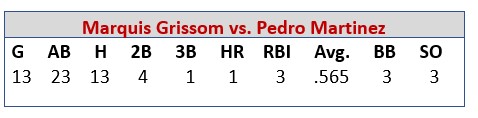
Early Results of Baseball Roundtable’s 2020 Baseball Hall of Fame Fan Ballot

The Baseball Writers Association of America (BBWAA) 2020 Hall of Fame ballots have been distributed and the votes are going in – with the results to be announced in January and the honorees inducted on July 21. This year’s traditional ballot includes 14 holdovers from last year, along with 18 newcomers.

Baseball Roundtable’s unofficial Fan Hall of Fame Ballot is also underway – and voting will remain open until January 1.   In this post, I will share the early results of the fan balloting and provide a link for those who would like to cast a vote (for up to ten candidates).

Also here is a link to an earlier BBRT post that includes:

  • Predictions on the 2020 BBWAA voting;
  • BBRT’s ballot (if I had one);
  • A deep look into all the candidates on the ballot.

For that post, again just click here.

To cast your vote, click the ballot image below.  Note: Read the top of the ballot to see how you can enter into a drawing for a baseball card/bobblehead surprise package.


HOFBALLOT


—–EARLY BASEBALL ROUNDTABLE HALL OF FAME FAN BALLOT RESULTS—–

Can Yankee captain Derek Jeter lead the Bombers to an East title?

Derek Jeter, leading the BBRT fan vote.

(75 Percent needed for election)

Derek Jeter                         93.3 percent

Larry Walker                       80.0

Todd Helton                       60.0

Omar Vizquel                     56.7

Billy Wagner                       53.3

Roger Clements                 50.0

Jeff Kent                             50.0

Andy Pettitte                       50.0

Curt Schilling                      50.0

Barry Bonds                        46,7

Alfonso Soriano                  40.0

Manny Ramirez                   30.0

Gary Sheffield                     23.3

Andruw Jones                       20.0

Scott Rolen                           20.0

Bobby Abreu                         16.7

Josh Beckett                         10.0

Sammy Sosa                         10.0

Paul Konkerko                       10.0

Cliff Lee                                  10.0

Brian Roberts                         10.0

Jason Giambi                          6.7

Below 5 Percent (needed to stay on ballot).

Heath Bell

Eric Chavez

Chone Figgins

Rafael Furcal

Raul Ibanez

Carlo Pena

Brad Penny

J.J. Putz

Jose Valverde

BBRT also asked voters which players not in the Hall of Fame they felt most belonged in the Hall.  The leading names among those not on the current BBWAA Ballot:

Jim Kaat — mentioned by 13.3 percent

Barry Bonds — 10.0

Roger Clemens — 10.0

Pete Rose — 10.0

Joe Jackson — 6.6

Lou Whitaker — 6.6

Dwight Evans — 3.3

Tony Oliva — 3.3

Tommy John — 3.3

Several players on the 2020 ballot also got “mentions” in this write-in portion of the fan ballot, including; Derek Jeter, Omar Vizquel, Jeff Kent, Billy Wagner, Larry Walker and Scott Rolen (as well as Jack Morris, who is already in the HOF).

Coming Soon: A look at MLB’s unanimous Rookie Of The Year selections.

BASEBALL ROUNDTABLE ON THE TOP 100 BASEBALL BLOG LIST

100Baseball Roundtable is on the Feedspot list of the Top 100 Baseball Blogs.  To see the full list, click here.

I tweet baseball @DavidBBRT

Follow/Like Baseball Roundtable’s Facebook Page here.  More baseball commentary; blog post notifications; PRIZES.

Member: Society for American Baseball Research (SABR); The Baseball Reliquary; The Negro Leagues Baseball Museum.
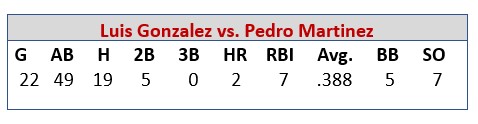
Baseball Roundtable’s 2020 HOF Fan Ballot – along with a look at the candidates for election.

BBRT’s Baseball Hall of Fame 2020 Debate Season is officially open!  The Baseball Writers Association of America (BBWAA) 2020 Hall of Fame ballots were distributed early this week and the results will be announced in January, with the honorees inducted on July 21. This year’s traditional ballot includes 14 holdovers from last year, along with 18 newcomers.

In this post, BBRT will share:

  • Predictions on the 2020 BBWAA voting;
  • BBRT’s ballot (if I had one);
  • A deep look into all the candidates on the ballot;
  • A link to BBRT’s unofficial fan ballot – please take a few minutes to follow the link and cast your vote.

—PARTICIPATE IN BASEBALL ROUNDTABLE’S  2010 FANS’ HALL OF FAME BALLOT—

Baseball Roundtable is once again conducting an unofficial fan ballot – to cast your vote(s), click here or on the ballot image below.  Remember, you can vote for up to ten of the nominees for 2020 induction.  If you want to read through the nominees’ bios first, there is another link to the BBRT Fan Ballot following the bios (near the end of this post).  BBRT will be providing updates on the fan balloting, as well as a post-election comparison of fan votes as compared to the final BBWAA results.  Voting on the BBRT Fan Ballot will remain open until January 1, 2020.

Also, if you leave your email or Facebook address in the comments section at the end of the ballot, you will be entered in a bobblehead and baseball card “surprise-prize” drawing.

HOFBALLOT


As we consider this year’s slate of candidates, BBRT would stress that all the players on the ballot – even those who remain for only one voting cycle – deserve recognition. To rise to the major leagues, last ten years and make it past the Hall of Fame Screening Committee is a significant accomplishment in itself.  In fact, the ballot release is a highlight for BBRT, as it provides a chance to acknowledge the accomplishments of all the candidates – not just the favorites for election.  For example, a review of the ballot gives us the opportunity to note that Orioles’ second basemen Brian Roberts – while he only played 100 or more games in seven of his fourteen MLB seasons – was a doubles machine and a threat on the bases when in the lineup on a regular basis. In his seven seasons of 100+ games, 2003-09, Roberts hit 300 doubles (topping 50 three times and leading the AL twice) and stole 235 bases (stealing 30 or more four times and leading the league with 50 steals in 2007).  It also provides the opportunity to focus on such  accomplishments as Alfonso Soriano’s 40-40 season (one of just four such campaigns in MLB history), Bobby Abreu’s 400 stolen bases and Jose Valverde’s three seasons leading his league in saves.  You get the idea.

Now on to the official 2020 Baseball Hall of Fame election process itself – and, then, a look at the players on the ballot for 2020.

BASEBALL HALL OF FAME ELIGIBILITY/CRITERIA FOR ELECTION

The basic rules for eligibility are that a player must have played at least ten seasons and be retired for at least five years. In addition, the player must be approved for the ballot by the Hall of Fame Screening Committee.

A player can remain on the ballot for up to ten years, but must receive at least five percent of the vote in the preceding year’s ballot to remain on the ballot.  Each voter can vote for up to ten candidates.  Election requires that a player be named on at least 75 percent of the ballots cast.

The criteria for election: “Voting shall be based upon the player’s record, playing ability, integrity, sportsmanship, character, and contributions to the team(s) on which the player played.”

Now, let’s take a look at who BBRT predicts will be elected by the BBWAA; how BBRT would vote if I had a ballot; and, along the way, the bios of these year’c candidates.

—–LIKELY BASEBALL HALL OF FAME ELECTEES FOR 2019—–

BBRT’s Prediction for 2020 …

Last November, Baseball Roundtable released its 2020 BBWAA balloting predictions, projecting the election of Mariano Rivera and Edgar Martinez and listing Mike Mussina and Roy Halladay as “dark horse” candidates with a chance to generate the needed 75 percent support.   All four were elected.  Two years ago, BBRT predicted the election of Chipper Jones, Jim Thome, Vlad Guerrero and Trevor Hoffman (with Mike Mussina as a “dark horse” candidate). Jones, Thome, Guerrero and Hoffman made it, with Mussina garnering 64.5 percent (sixth most).

For 2020, BBRT anticipates just two electees from the traditional ballot:

  • Derek Jeter
  • Larry Walker

I also see one “dark horse” candidate who may slip in this season, but I have a hunch will fall closer to 70 percent than 75 percent.

  • Curt Schilling

Note: For BBRT’s previously posted take on the 2020 Modern Game (Era Committee) Hall of Fame ballot, click here.

Let’s move on to BBRT’s hypothetical ballot and bios of the players I would vote for –  followed by a look at the remainder of the 2020 candidates.

Side note: You will not find those caught up in the PED-controversy on my ballot. While I think the best of them will eventually be elected/inducted, if I had a ballot, I’d prefer they made the 75 percent without my vote.  Still, given their place in the history of the game, I’d probably break down and vote for the top players in this group when they reached their final year of eligibility.

So, here is BBRT’s Hall of Fame Ballot – again, if I had one – with the players listed in BBRT’s order of preference.

GROUP ONE – BBRT WOULD VOTE FOR THESE TWO

AND ANTICIPATES THEY WILL BE IN THE 2019 HOF CLASS.

Derek Jeter – (Shortstop, 1995-2014) – First Year on the ballot.

SPORT MLB BASEBALLA career-long Yankee, Derek Jeter’s 3,465 base hits (for a .310 career average) rank sixth in baseball history.  Who is ahead of him? Pete Rose, Ty Cobb, Hank Aaron, Stan Musial and Tris Speaker.  That probably makes his case right there. But let’s look a little deeper.

Jeter is a 14-time All Star, five-time Silver Slugger and five-time Gold Glover – as well as the 1996 American League Rookie of the Year.

Overall, Jeter hit .300 or better in 12 campaigns.  While he only led the AL in hits twice, he topped 200 safeties in eight times (the final time with an AL-leading 216 hits in 2012; at age 38).   Jeter also scored 1,923 runs (eleventh all time), topping 100 runs scored in 13 season and leading the AL with 127 in 1998. He collected 544 doubles (35th all time), 66 triples and 260 home runs – amassing 4,921 regular season total bases (23rd all time).  A savvy base runner, Jeter also stole 358 bases, twenty or more in eight seasons, with a high of 34 in 2006.

Jeter also played in a record 158 post-season games, hitting .308 (200 hits), with 20 home runs, 61 RBI, 111 runs scored (post-season record) and 18 steals. He was the MVP of the 2009 World Series – and hit .321 in 38 Fall Classic games (seven World Series).

Derek Jeter’s Best Season: In 1999, Jeter hit a robust .349, with a league -leading 219 hits, 24 home runs, 102 RBI, 134 runs scored and 19 stolen bases.

This one’s a gimme – Jeter goes in.  Will it be unanimous?  I just have a hunch there will be a holdout or two.

——————

Larry Walker – (Outfield, 1989-2005) … Tenth (final) year on the ballot, 54.6 percent last year.

WalkerLarry Walker will need a big boost (players usually get somewhat of a boost in their final year of eligibility) to reach 75 percent   I’ll go out on a limb here and predict he makes it; but it is no sure thing.

Walker played for the Expos (1989-1994), Rockies (1995-2004) and Cardinals (2004-2005).  Given BBRT’s admiration for “lumber and leather,” Walker’s combination of three batting titles, three Silver Slugger Awards and seven Gold Gloves earns him my vote.

Walker played 17 MLB seasons and retired with 2,160 hits, a .313 average and three batting titles.  Between 1997 and 2001, he hit .350 or better in four of five seasons. The five-time All Star (and 1997 NL MVP) hit 383 home runs (a high of 49 in 1997) and stole 230 bases (a high of 33 in 1997).  Walker hit just .230 in 28 post-season games, but did rack up seven home runs, 15 RBI and sixteen walks in those contests.

Walker’s ten seasons in hitter-friendly Colorado may be hurting his vote totals – he hit .383 for his career in Coors, .271 elsewhere.  Also reaching 2,500 hits or 400 home runs would have been an asset.  Still, BBRT believes if you add his Gold Glove defense to his productive bat, you have a Hall of Famer.  I’m also not much for punishing a player for taking full advantage of his home-field conditions. Walker did jump from 34.1 to 54.6 percent a year ago.  So, he does have a chance chance of making it this year.  I’d call it 50-50.

In 1997, Larry Walker led the NL with 409 total bases – the 18th highest single-season total all-time. (There have been only 29 seasons of 400 or more total bases in MLB history.  Babe Ruth hold the record with 457 in 1921.).

Larry Walker’s Best Season: In his 1997 NL MVP year (Rockies), Walker hit .366, with a league-leading 49 home runs. He drove in 130 runs, scored 143, rapped 46 doubles, led the league in total bases at 409, topped the league in slugging percentage at .720 and even threw in 33 stolen bases and a Gold Glove.  That’s using all five tools.

—————

A DARK HORSE CANDIDATE WHO WOULD NOT GET BBRT’S VOTE

Curt Schilling – (Starting Pitcher, 1988-2007) … Eighth year on the ballot, 60.9 percent last year.

Curt Schilling pitched for the Orioles (1988-1990), Astros (1991), Phillies (1992-2000), Diamondbacks (2000-2003) and Red Sox (2004-2007).  Schilling was a six-time All Star, with 216 career wins (three seasons of 20 or more wins) over a 20-season MLB career. He recorded the 15th most career MLB strikeouts at 3,116 (three seasons of 300 or more whiffs), led his league in wins twice, complete games four times, innings pitched twice and strikeouts twice. He was also the 2001 World Series co-MVP – and has an impressive 11-2, 2.23 ERA post-season record (19 starts).

Curt Schilling is one-half of one of only two tandems of teammates to strike out 300 batters in the same season. In 2002, Schilling fanned 316 batters for the Diamondbacks, while teammate Randy Johnson whiffed 324.  In 2019, Gerrit Cole (326) and Justin Verlander (300 K) joined this club.

He is on the cusp for the HOF – reaching 250 wins would have helped (although Jim Kaat, with 283 wins and 16 Gold Gloves is still not in the HOF – a Minnesota gripe here).  However, Schilling’s outspoken views and the lack of a Cy Young Award may be working against his vote-getting capacity. I think Schilling will move up a few percentage points, but still fall short.

Curt Schilling’s Best Season: In 2001, Schilling went 22-6 for the Diamondbacks (with a 2.98 ERA).  That year, he led the league in wins, starts (35), complete games (six), innings pitched (256 2/3).

FIVE PLAYERS WHO WOULD GET BBRT’S VOTE …

BUT ARE NOT LIKELY TO ENTER THE HOF IN 2020

Omar Vizquel – (Shortstop/Third Base, 1989-2012) – Third year on the ballot, 42.8 percent on 2019 ballot.

Photo by Keith Allison

Photo by Keith Allison

Omar Vizquel got off to a good start toward a HOF plaque, grabbing 37 percent support on his first-ballot year and moving up to 42.8 percent a year ago.  Vizquel once again earns BBRT’s vote – and should make his way into the Hall of Fame over time.  When he does, it will be more with his glove (eleven Gold Gloves) than his bat.  However, voters should be mindful of the fact that he finished his 24-season MLB career just 123 hits short of that milestone 3,000 safeties.

Vizquel delivered premier defense to the Mariners (1989-1993), Indians (1994-2004), Giants (2005-2008), Rangers (2009), White Sox (2010-2011) and Blue Jays (2012). He was a three-time All Star – and put together a string of nine straight Gold Gloves at shortstop (1993-2001).

Omar Vizquel led his league in sacrifice bunts four times.

In the field, Vizquel has the highest career fielding percentage (.9847) among shortstops with at least 500 games at the position.  Vizquel is also the all-time leader among shortstops in double plays (1,734, 144 ahead of Ozzie Smith in second place), ranks third at the position for career assists and 11th in putouts. He shares the record (with Cal Ripken, Jr.) for the fewest errors by a shortstop in a season of at least 150 games played (three).

On offense, Vizquel put up a serviceable .272 career average, with 80 home runs, 951 RBI and 1,445 runs scored. The 1,445 runs put him in the top 100 players all-time (82nd); while his 2,877 hits put him in the top 50 (43rd). He also swiped 404 bases – topping twenty steals eight times (a high of 42 in 1999) – putting him at number 72 on the all-time list. Vizquel played in 57 post-season games, hitting .250-0-20.

Omar Vizquel’s Best Season: In 1999, with the Indians, Vizquel hit a surprising .333, with five home runs, 66 RBI, 112 runs scored and 42 stolen bases – and, of course, won a Gold Glove at shortstop.

Vizquel would get BBRT’s vote, but the BBWAA voters likely will make him wait a bit longer – showing a preference for a bit more offense.

—————-

Jeff Kent – (Second Base/Third Base/First Base, 1992-2008) …  Seventh year on the ballot, 18.1 percent last year.

KemntBBRT believes Jeff Kent is a deserving candidate, but he has not been getting much support from the writers.  Kent holds the all-time MLB record for home runs by a second baseman (351 of his 377 career round trippers were hit while in the lineup at second base). He has a healthy .290 career batting average; his 1,518 RBI are 54th all time; and his 560 doubles 30th.

Kent was a five-time All Star and the 2000 NL MVP.  As primarily a middle infielder, he hit 20 or more home runs in 12 seasons (a high of 37 in 2007) and topped 100 RBI eight times. He hit .276, with nine home runs and 23 RBI in 49 post-season games.

Jeff Kent has more career runs batted in than such noted Hall of Famers as Mickey Mantle, Billy Williams, Eddie Mathews, Duke Snider and Orlando Cepeda.

Kent has the credentials, but BBRT has a hunch the writers may keep him on the bench – a couple of Gold Gloves, at this traditionally defense-oriented position, would have really helped his case.  Kent played for the Blue Jays (1992), Mets (1992-1996), Indians (1996), Giants (1997-2002), Astros (2003-2004) and Dodgers (2005-2008).

Jeff Kent’s Best Season: With the Giants in 2000, Kent put up these stats – 159 games; 196 hits; .334 average; 33 home runs; 125 RBI; 114 runs; 12 steals. His performance earned him the NL MVP Award.

Kent gets BBRT’s vote – and I believe the BBWAA’s support is overdue (but not forthcoming).  This is one HOF “snub” that somewhat confuses BBRT.

 —————

Todd Helton – (First Base, 1997-2013) … Second year on the ballot, 16.5 percent last year.

HeltonTodd Helton picked up just 16.5 percent of the vote in his first year on the ballot – probably due to a strong ballot and the fact that he spent his entire 17-year career with the Rockies (playing half his games in hitter-friendly Coors field).  Helton, who put up a .316 career average, hit .345 at home and .287 on the road. Despite that home/road split, Helton’s body of work deserves HOF consideration. He was a five-time All Star, three-time Gold Glover and four-time Silver Slugger. He hit over .300 in 12 seasons – and won the NL batting crown in 2000 with a .372 average. His 59 doubles that season are the sixth-most all-time. Helton drove in 100 or more runs in five seasons and scored in triple figures six times. His 1,335 walks (36th all-time) indicate the respect he earned at the plate.  Helton also ranks fifth in games played at first base, second in career assists at the position, 13th in putouts and third in double plays.

Todd Helton is one of only 18 players to reach 400 or more total bases in a season – and one of only seven players to have multiple 400+ total base campaigns. He is also the only player to collect 100 extra-base hits in two consecutive seasons (2000-2001).

Todd Helton’s Best Season: In 2000, Helton won the NL batting crown with a .372 average – and also led the league in base hits (216), doubles (59), RBI (147), on-base percentage (.463), slugging percentage (.698) and total bases (405).  He also scored 138 runs and hit 42 home runs.

Helton will stay on the ballot and has a chance at entry into the HOF – he’s just not likely to overcome the Coors Field-bias in the short-term future.

—————-

Billy Wagner – (LHP 1995-2010) … Fifth year on the ballot, 5.6 percent last year.

wAGNERBilly Wagner played for the Astros (1995-2003), Phillies (2004-2005), Mets (2006-2009), Red Sox (2009) and Braves (2010). Wagner was a seven-time All Star, who amassed 422 saves (sixth all-time) in a 16-season MLB career.  He had nine seasons of 30 or more saves; a career ERA of 2.31; 1,196 career strikeouts in 903 innings; and 47-40 won-lost record.

Billy Wagner’s Best Season: In 2003, Wagner went 1-4, 1.78 for the Astros, saving 44 games and fanning 105 batters in 86 innings.

BBWAA voters have been very demanding of relievers (although the recent induction of Mariano Rivera and Trevor Hoffman may be a good sign – but they, of course, both had 600+ saves.) BBRT thinks Wagner belongs in the Hall (based on his 400+ saves) – and hopes that momentum starts to build.   (However, the odds are not in Wagner’s favor; he is drifting awfully close to that 5 percent mark.)

—————-

Andy Pettitte – (LHP/Starter, 1995-2010, 2012-13) … Second year on the ballot. 9.9 percent last year.

pettI had to think for a while on this one (and will probably get some push back from readers), largely because a major part of Andy Pettitte’s HOF resume was achieved in the post-season. Pettitte holds the MLB post-season marks for most wins (19 … versus 11 losses), innings pitched (276 2/3), games started (44) and is second in strikeouts (183). His post-season accomplishments include a 3.81 career ERA and the 2001 American League Championship series MVP Award.

Pettitte was no slouch in the regular season (Yankees – 1995-2003, 2007-2010, 2012-13) and Astros (2004-06).  He finished with 256 wins (153 losses) and a 3.85 ERA. Pettitte won 20 games in two seasons and 14 or more games 12 times – leading the AL with 21 wins in 1996. The three-time All Star struck out 2,448 batters (45th all-time) in 2,316 innings.

Andy Pettitte started 30 or more games in a season 12 times, leading his league three times (1997, 2006, 2007.)

Pettitte’s post-season numbers, plus 256 regular-season victories and the fact that he had 100+ more career wins than losses secures BBRT’s vote. He still has a long ways to go with the BBWAA voters, however.

Andy Pettitte’s Best Season: In 1997, following a 21-8 campaign in 1996, Pettitte went 18-7, with a 2.88 ERA (fourth-best in the AL), leading the league in starts with 35, finishing third in innings pitched (240 1/3) and eighth in strikeouts (166).

Post-publication note:  One of BBRT’s readers has correctly informed me that Pettitte was a PED-user.  I found he admitted to briefly using HGH while in recovery from and elbow injury – a couple of years before it was banned.    Pettitte was forthcoming, accepting of responsibility and apologetic.  Given the circumstances, I’ll stand by this vote (but also continued to “dig” a bit). I thought, in the name of transparency, I should add this information here.

—————


TWO PLAYERS WHO WERE VERY CLOSE CALLS  …

BUT WOULD GET BBRT’S VOTE (to keep them on the ballot for next year)

Alfonso Soriano – (2B/OF, 1999-2014) … First year on the ballot.

SorianHad Alfonso Soriano spent his career as a second baseman (he was moved to the outfield in his eighth season – sixth full season), his path to the Hall of Fame might have been assured.  Consider that in five full seasons at the keystone sack (2001-2005), Soriano hit .282, with 159 home runs 461 RBI and 167 stolen bases.  I’ll do the math for you. That’s an average campaign of .282, 31.8 home runs, 92.2 RBI and 33.5 steals.  Those are HOF numbers for a middle infielder.  (Of course, it’s also likely that, had he stayed at 2B, he would have put up some pretty impressive numbers for errors. Soriano led AL second sackers in errors in all five of his full seasons at the position.)

Having spent a little more than half of his career in the OF (starting 849 games in the OF and 734 at 2B), Soriano has stiffer competition for a spot in the HOF.  Still, BBRT thinks he deserves to qualify for next year’s ballot.

Soriano was a seven-time All Star (four at 2B, three in the OF) and four-time Silver Slugger.   He also is one of only four members of the 40-40 Club (forty home runs and forty stolen bases in the same season). In 2006, Soriano hit .277, with 46 home runs and 41 stolen bases. The only other players to record 40-40 seasons are Barry Bonds, Alex Rodriguez and Jose Canseco.  Soriano also logged three 30-30 seasons. Overall, he hit 30 or more home runs seven times and stole 30 or more bases five times (leading the AL with 41 in 2002). He also scored 100+ runs in four campaigns and drove in 100+ tallies in four seasons.

Soriano finished with 2,095 career hits (.270 average), 1,159 RBI and 1,152 runs scored.  His 412 career home runs are 54th all time and his 924 extra-base hits are 59th.  He is one of those “on the cusp” Hall of Famers in BBRT’s view – and will have to build some momentum.  Again, BBRT believes he deserves to stay on the ballot.

Soriano played for the Yankees (1999-2003, 2013-14)), Rangers (2004-2005), Nationals (2006) and Cubs (2017-13).

Alfonso Soriano’s Best Season: In 2002 (Yankees), Soriano hit an even .300, leading the AL in hits (209), runs (128) and steals (41).  He also hit 51 double and 39 home runs, while driving in 102.

—————–

Bobby Abreu – (OF, 1996-2012, 2014) … First year on the ballot.

abrfeuBobby Abreu played in 18 MLB seasons. The two-time All Star showed both power and speed, hitting 288 home runs and swiping 400 bases (74th all time). Abreu led his league in games played twice, doubles once (50 in 2002) and triples once. He won a Gold Glove in 2005.

A solid .291 career hitter (2,470 base hits), Abreu hit .300 or better in six seasons. He hit 20 or more round trippers in 10 campaigns, stole 20 or more bases 12 times (a high of 40 in 2004), drove in 100 or more runs eight times and scored at least 100 runs eight times.   Abreu also walked 1,476 times – including 100 or more free passes in eight straight seasons (1999-2006).

Bobby Abreu’s 1,476 walks are 20th all-time and his 574 double are 25th.

Abreu played for the Astros (1996-97, Phillies (1999-2006), Yankees (2006-2008), Angels (2009-1012), Dodgers (2012) and Mets (2014).

In 20 post-season games, Abreu went 19-for-67 (.284), with one home runs and nine RBI.

Bobby Abreu’s Best Season: In 2004, as a Phillie, Abreu hit .301, with 30 home runs and forty steals. An All Star that season, he also drove in 105 runs and scored 118.

Abreu’s 400 steals are an HOF plus. Had he reached 300 home runs, it would have really boosted his prospects. I’d like to see Abreu stay on the ballot.

——————————THE REST OF THE BALLOT————————————

So, with BBRT’s unofficial ballot covered, let’s look at the remainder of candidates – in alphabetical order.  Note: Here you will find a host of players with solid (but perhaps not HOF-level) career numbers and accomplishments. 

Josh Beckett – RHP, 2001-2014) … First year on the ballot.

Josh Beckett put up a 138-106, 3.38 record in 14 MLB seasons.  The three-time all Star led the AL with 20 wins (seven losses) for the Red Sox in 2007, when he finished second in the Cy Young Award voting to C.C. Sabathia (21-7, 2.18).  Beckett won 15 or more games in four seasons and fanned 150 or more batters in 11 seasons (a high of 199 in 2009).

Josh Beckett was a horse in the postseason, going 7-3, 3.07, striking out 99 batters in 93 2/3 innings and throwing three complete games in 14 appearances (13 starts).

Josh Beckett pitched a no-hitter in his final MLB season. On May 25, pitching for the Dodgers, he no-hit the Phillies in a 6-0 win – walking three and fanning six.

Josh Becket played for the Marlins (2001-2005), Red Sox (2006-2012) and Dodgers (2012-2014).

Josh Beckett’s Best Season: In 2007, Becket let the AL with 20 wins (seven losses), his 3.27 earned run average was sixth in the AL, and his 194 strike outs (in 200 2/3 innings) seventh.  That season, he pitched in four post-season games for Boston – going 4-0, 1.20. He was the MVP of the American League Championship Series, when he started and won two games – giving up nine hits and just three earned runs, while fanning 18 in 14 innings.

Beckett had a solid MLB career, but falling short of 150 wins and never reaching 200 strikeouts in a season dims his HOF chances.  I really like his post-season accomplishments, however.

—————

Heath Bell – (RHP, 2005-14) … First year on the ballot.

Heath Bell appeared in 590 MLB games – all in relief. The three-time All Star was truly a dominant closer for the Padres from 2009-11, making the All Star team and saving 40 or more games in each of those three campaigns – and being named NL Reliever of the Year in 2009 and 2010. In 2009, he led the NL with 42 saves. Over his 11-season MLB career, Bell was 38-32, 3.49, with 168 saves. He averaged better than a strikeout per inning – fanning 637 batters in 628 2/3 innings.

Heath Bell’s Best Season: In 2010, Bell went 6-1, with 47 saves.  He pitched to a 1.93 earned run average in 70 innings (67 appearance), fanning 86 batters.

————–

Barry Bonds – (Outfield, 1986-2007) … Eighth year on the ballot, 59.1 percent a year ago.

Barry Bonds played for the Pirates (1986-1992) and the Giants (1993-2007). There is no doubt about Bond’s credentials – .298 average, 2,935 hits, MLB-record 762 home runs, 1,996 RBI, MLB-record 2,558 walks. He was also a 14-time All Star; 12-time Silver Slugger Award winner; his league’s MVP a record seven times; and an eight-time Gold Glove winner.  In 2001, Bonds hit .328, with an MLB-record 73 home runs and 177 RBI.  He drove in 100 or more runs 12 times and also scored 100 or more runs in a dozen seasons.  And, I could go on and on.

Barry Bonds drew an MLB-record 688 intentional walks in his career. Second place?  Albert Pujols, with 311. In 2004 alone, Bonds drew a record 120 intentional passes. He led his league in IBB 12 times.

Still, there are those PED’s – an elephant in the room (and on the ballot) that I think will keep Bonds out of the Hall for at least another year (and probably until his final year on the ballot). Eventually, the dam will break and we will see some of the major stars now under a PED cloud take places in the Hall.  BBRT is not ready to cast that vote yet – and I don’t think 75 percent of the BBWAA is either. We can expect Bonds back on the ballot next year (he may top 60 percent this year).

Barry Bonds’ Best Season: In 2001, Bonds crushed an all-time record 73 home runs, while hitting .328, driving in 137 runs, scoring 129 – all while drawing 177 walks.

————–

Eric Chavez – (3B, 1998-2014) …. First year on the ballot.

BBRT has a soft spot for player who evidence “leather and lumber” – and that would include Eric Chavez, who won six Gold Gloves (consecutively, 2001-2006) and popped 260 home runs during his 17 MLB seasons.

As a defender, Chavez led AL third basemen in assists three times; putouts twice; double plays twice; and fielding percentage twice.

At the plate, Chavez hit .268 (1,477 career hits), with 260 home runs, 902 RBI. He topped 25 home runs six times (a high of 34 in 2002) and 100 RBI four times (a high of 114 in 2001).

Eric Chavez’ Best Season: In 2001, Chavez hit .288, with 32 home runs, 114 RBI, 91 runs scored and eight stolen bases – and picked up his first Gold Glove.

Chavez was a superior defender, with had solid (but not HOF) offensive numbers.

————–

Roger Clemens – (RHP/Starter, 1984-2007) … Eighth year on the ballot, 59.5 percent last year.

Roger Clemens pitched for the Red Sox (1984-1996), Blue Jays (1997-1998), Yankees (1999-2003, 2007) and Astros (2004-2006).  Clemens has Hall-worthy stats:  354 wins (ninth all-time), 4,672 strikeouts (third all-time), an MLB-record seven Cy Young Awards and the 1986 AL MVP Award. The eleven-time All Star was a five-time 20-game winner (led the league in wins four times), seven-time ERA leader, five-time league leader in strikeouts, and six-time leader in shutouts.  He won the AL pitching Triple Crown (Wins/ERA/Strikeouts) three times.  Clemens also has 12 post-season wins, with 173 strikeouts in 199 post-season innings.

Roger Clemens shares the record for strikeouts in a nine-inning game (20) with Kerry Wood and Max Scherzer. Clemens is the only pitcher to achieve 20 whiffs in a nine-inning game twice.

Roger Clemens’ Best Season: Lots to choose from here. Like 21-6, 1.93 in 1990 – or 1987, with a 20-9 record, 2.97 ERA, 18 complete games and seven shutouts.  I take 1986. Clemens went 24-4. 2.48 and won both the Cy Young (his first) and AL MVP Awards for the Red Sox.  He led the AL in wins, winning percentage (.857) and earned run average. He was fifth in innings pitched (254) and second in strikeouts (238).

Yes, he’s got the numbers (those listed and more), but the PED controversy seems to stand between him and the Hall. Don’t think the BBWAA is ready yet, but he’ll continue on the ballot – and will likely gain a bit of ground on that 75 percent requirement.

————–

Adam Dunn – (OF-1B, 2001-2014) … First year on the ballot.

Adm Dunn had a great power swing – putting 462 balls (37th all time) out of the park in his 14 MLB seasons – at one point, (2004-2008), hitting at least forty long balls in five straight seasons.   Then, of course, there is the other side of the coin.  The two-time All Star also struck out 2,379 times (third all time), leading the league in whiffs in four seasons.  Over his career, Dunn hit forty or more homers in six seasons and 30 or more in three more.

Adam Dunn is one of only 12 MLB players to have six or more 40-HR season.

Adam Dunn’s Best Season: In 2004, for the White Sox, Dunn hit .266, with 46 home runs, 102 RBI and 105 runs scored.

Four-hundred-plus home runs is a good start, but Dunn’s .237 career average ad 2,000+ strikeouts work against him.

—————

Chone Figgins (3B/OF/2B, 2002-12, 2014) …. First year on the ballot.

Chone Figgins (almost got my vote just for the name) played for the Angels (2002-2009), Mariners (2010-1012) and Dodgers (2014).  He hit for a .276 average, with 35 home runs, 403 RBI and 341 stolen bases in 1,282 games.   Figgins stole 30 or more bases in seven season – forty or more in five of those.

Chone Figgins’ Beat Season:  In 2005, for the Angels, Chone Figgins hit .290, with a career-high and league-leading 62 stolen bases.  He also had 25 doubles, ten triples and eight home runs – scoring 113 times and driving in 57 runs.

————–

Rafael Furcal … (SS, 2000-2012, 2014) …. First year on the ballot.

Rafael Furcal, who came up with the Braves, was the 2000 NL Rookie of the year, when he hit .294, scored 87 runs and stole 40 bases in 131 games.  In his career, the three-time All Star hit a respectable .282 (1,817 hits), scored 1,063 runs (reaching 100 or more runs scored four times), hit 113 home runs, drove in 587 and stole 314 bases (stealing 25 or more bases seven times).  On defense. Furcal led NL shortstops in assists twice, putouts twice and double plays once.

Furcal played for the Braves (2000-05), Dodgers (2006-11), Cardinals (2011-12) and Marlins (2014).

Rafael Furcal’s Best Season: In 2006, with the Dodgers, Rafael Furcal hit .300, with 15 home runs, 63 RBI, 113 runs scored and 37 stolen bases. He also led the NL in put outs and double plays at shortstop and was second in assists.


—————

Jason Giambi – (1B/OF/DH, 1995-2014) … First year on the ballot.

Jason Giambi’s 20-year MLB career is a tribute to his offensive production – a .277 average to go with 440 home runs and 1,441 RBI. Giambi was a five-time All Star, two-time Silver Slugger and the 2000 AL MVP.  In the four seasons from 1999-2001, Giambi was clearly on top of his game (and on top of the plate), hitting .326, with 155 home runs and 502 RBI.  While he did strike out 1,572 times, he also walked 1,366 times – contributing to a healthy .399 career on-base percentage. Giambi led the AL in OBP three times).

Jason Giambi led the AL in free passes in four seasons – in strike outs just once.

In his career, Giambi topped 25 home runs in nine seasons (40+ twice), 100 RBI in seven seasons (a high of 137 in 2000) and hit over .300 in four campaigns.

Giambi’s career can really be divided into two parts. Over his first ten seasons, he went .297-381-944, as compared to .238-159-497 over his final ten campaigns.

Jason Giambi played for the A’s (1995-2001, 2009), Yankees (2002-2008), Rockies (2009-12) and Indians (2013-14).

In 45 post-season games, Giambi hit .290, with seven long balls and 19 RBI.

Jason Giambi’s Best Season: In his 2000 MVP season (for the A’s), Giambi hit .333, with 43 home runs, 137 RBI, 108 runs scored and a league-topping 137 walks (versus 96 strikeouts). Notably, he put up similar numbers the very next season – .342-38-120, with a league-leading 129 walks.

Giambi is competing at a power-position – still his power numbers and on-base percentage may keep him on the ballot for 2012.

—————

Raul Ibanez – OF/1B, 1996-2014 … First year on the ballot.

Raul Ibanez enjoyed a 20-season MLB career – suiting up from age 24 to age 42. He hit a respectable .272 (2,034 base hits) over that time, with 305 home runs, 424 doubles, 1, 207 RBI and 1,055 runs scored.  He also played solid defense, leading his league’s left fielders in assists and fielding percentage twice each and putouts once.

Ibanez was a one -time all Star (2009 Phillies).  He hit 20 or more home runs in eight seasons, with a high of 34 in 2009. He also drove n 100+ runs in four campaigns and scored 100+ runs in one season.

Ibanez hit .245, with six home runs and 22 RBI in 44 post-season games.

Raul Ibanez’ Best Season:  In 2006, with the Mariners, Ibanez hit .289, knocked 33 home runs, drove in 123 tallies and scored 103 times.

————–

Andruw Jones – (OF, 1996 -2012) … Third year on the ballot, 7.5 percent last year.

Andruw Jones played for the Braves (1996-2007), Dodgers (2008), Rangers (2009), White Sox (2010) and Yankees (2011-2012). In a 17-season career – primarily patrolling centerfield – he won ten Gold Gloves (consecutively, 1998-2007). At the plate, he hit .254, with 434 home runs (47th all time), 1,289 RBI and 1,204 runs scored. He topped 25 home runs in ten seasons (six over thirty and a league-leading and career-high of 51 in 2005). He scored 100 or more runs four times, drove in 100+ five times and stole twenty or more bases in a season four times.

Jones appeared in 76 post-season games, hitting .273, with ten home runs and 34 RBI.

In the 1996 World Series, Andruw Jones – just 19-years-old – hit .400 (8-for-20) with two home runs and six RBI, becoming the youngest player to hit for the distance in the Fall Classic.

Andrew Jones’ Best Season: In 2005, Jones hit only .263, but led the NL in home runs (51) and RBI (128) – finishing second in the MVP voting to Albert Pujols (.330-41-117).

Jones’ ten Gold Gloves work in his favor, but – over the long haul – that .254 average (he only hit .300 or better once and over .270 only four times) will dampen his HOF chances. Still, BBRT believe he deserves more support (he’s perilously close to the five percent mark).

—————

Paul Konerko – (1B, 1997-2014) … First year on the ballot.

Paul Konerko spent 16 of his 18 MLB seasons as a big bat in the middle of the White Sox lineup. A six-time All Star, Konerko hit .279 (2,340 hits), with 439 home runs (44th all time), 1,412 RBI and 1,162 runs scored.  Konerko hit 30 or more home runs in seven seasons (40 or more twice), drove in at least 100 runs in four seasons and hit .300 or better four times.

He was the MVP of the 2005 AL Championship Series, when he drove in seven runs in five games.  In 197 post-season contests, he hit .243, with seven home runs and 17 RBI,

Konerko played for the Dodgers (1997-98), Reds (1998) and White Sox 1999-2014.

Paul Konerko’s Best Season: In 2010, for the White Sox, Konerko his .312, with 39 home runs and 111 RBI.

Like Jason Giambi, his power output gives him a chance to stay on the ballot (listen up, Chicago-area BBWAA members); but long-run, both look to fall short of the HOF.

—————-

Cliff Lee – LHP, 2002-2014) … First year on the ballot.

Cliff Lee won 143 games (91 losses) in 13 MLB seasons, while putting up a 3.52 earned run average. He was a four-time All Star and the 2008 American League Cy Young Award winner.  Over his career, he led his league in wins, earned run average and complete game once each and shutouts and innings pitched twice each. He also led the NL in strikeouts-to-walks ratio three times and finished in the top ten in his league in the category in six seasons.  In addition, between 2008 and 2012, he allowed his league’s fewest walks per nine farms four times, was second once and fourth once.

In 328 games (324 starts), Lee notched 29 complete games and 12 shutouts, He pitched 2,156 2/3 innings, fanning 1, 824 batters.

Lee was solid in the post-season, going 7-3, 2.52 in 11 starts (three complete games).

Lee pitched for the Indians (2002-09), Phillies (2009, 2011-14), Mariners (2010) and Rangers (2010).

Cliff Lee’s Best Season: In his 2008 Cy Young Award season (Indians), Cliff Lee led the AL in wins (22, with just three losses); winning percentage (.880); earned run average (2.54); and shutouts (2). He fanned 170 batters in 223 1/3 innings, walking just 34 (a league-low 1.37 walks per nine innings).

—————

Carlos Pena – (1B, 2001-14) … First year on the ballot.

Carlos Pena hit 286 round trippers in his 14 MLB seasons.  He collected 1,146 hits (for a .232 career average), drove in 818 runs; and scored 745 times. He hit 30 or more home runs in a season three times, leading the AL with 39 in 2009 (his career-high was 46 in 2007). The one-time All Star was also a one-time Gold Glover.  Pena hit .269, with four home runs and 14 RBI in 19 post season games.

Although Carlos Pena played only 40 of his 1,493 games with the Rangers, he played his first (September 5, 2001) and last (July 12, 2014) MLB games in a Rangers’ uniform.

Pena played for the Rangers (2001. 2014), A’s (2002), Tigers (2002-2005), Red Sox (2006), Rays (2007-2010, 2012), Cubs (2011), Astros (2013) and Royals (2013).

Carlos Pena’s Best Season: In 2007, for Tampa Bay, Pena raked at a .282 pace, popping 46 home runs and driving in 121 tallies (all career highs).

—————

Brad Penny – (RHP, 2000-2012, 2014) … First year on the ballot.

Primarily a starting pitcher (349 MLB games, 319 starts), Brad Penny went 121-101, 4.29 over 14 MLB seasons. Penny was a two-time All Star and led the NL in wins (for the Dodgers) with 16 (nine losses) in 2006.  Penny won at least 15 games in just two seasons (16 each in 2007 and 2007, his two All Star campaigns.)  In nine post-season appearances, he went 3-2, 7.66.

Penny pitched for the Marlins (2000-2004), Dodgers (2004-2008), Red Sox (2009), Giants (2009, 2012), Cardinals (2010), Tigers (2011) and Marlins (2014).

Brad Penny’s Best Season: As a Dodger in 2007, Brad Penny went 16-4, leading the NL in winning percentage (.800), finishing fifth in wins and third in earned run average (3.03).

—————

J.J. Putz – RHP, 2003-2014) … First year on the ballot.

J.J. Putz made 572 relief appearance in his 14 MLB seasons, notching 37 wins (33 losses) and 189 saves, while putting up a 3.08 earned run average. The one-time All Star and 2007 Reliever of the Year saved 30 or more games four times, including a high of 45 for the 2011 Diamondbacks.

J.J. Putz’ Best Season: In 2007, Putz appeared in 68 games for the Mariners, going 6-1, 1.38 with 40 saves.  In 71 2/3 innings, he fanned 82 batters and walked just 13.

—————

Manny Ramirez – (Outfield, 1993-2011) – Fourth year on the ballot, 22.8 percent last year.

Manny Ramirez played 19 MLB seasons, collecting 2,574 hits, a .312 batting average, 555 home runs (15th all-time) and 1,831 RBI (19th all-time). Ramirez was a 12-time All Star and led the AL in average (2002), home runs (2004) and RBI (1999) once each.  Ramirez won nine Silver Slugger Awards, including eight consecutive (1999-2006), hit .285 with 29 home runs in 111 post-season games and was the 2004 World Series MVP.  He hit 30 or more home runs in twelve seasons (five of 40+), scored 100 or more runs six times, hit .300 or better in 11 seasons and topped 100 RBI 12 times.

Manny Ramirez’ 29 post-season home runs are first all-time, while his 78 post-season RBI rank second. In addition, he is the all-time post-season leader in walks (72), and ranks third in post-season hits (117) and runs scored (67).

In 111 post-season games, Ramirez hit .285, with 29 home runs and 78 RBI.

Ramirez clearly put up HOF-caliber numbers, but two PED-related suspensions continue to hurt his chances. Not this year, but he’ll be back for another shot.  Ramirez played for the Indians (1993-2000), Red Sox (2001-2008), Dodgers 2009-2010) and Rays (2011).

Manny Ramirez’ Best Season: In 1999, with Cleveland, Ramirez hit .333, with 44 home runs and 165 RBI (14th most in a season all-time) in 140 games.

—————-

Brian Roberts – (2B/SS, 2001-14) …. First year on the ballot.

Brian Roberts was a two-tine All Star, who spent 13 of his 14 MLB season with the Orioles.  Although he played more than 100 games in only seven seasons, he was a doubles machine, banging out 367 two-baggers – hitting 50 or more doubles in three seasons (leading the AL twice).  The speed that enabled Roberts to deliver all those doubles also contributed to his 285 stolen bases. He stole 20+ bases seven times, leading the AL with a career-high 50 steals in 2007 (being caught just seven times ).

Roberts hit .276 over his MLB career (1,527 hits), with 97 home runs, 542 RBI and 850 runs scored.  He scored 100+ runs in four campaigns.

Brian Roberts’ Best Season: in 2005, Brian Roberts hit .314, with 18 home runs and 73 RBI. He also scored 92 runs, stole 45 bases in 52 attempts, and knocked 45 doubles and seven triples. That season, he finished second in the AL among second basemen in assists, fifth in putouts and third in double plays.

BBRT always liked Roberts’ ability to use his speed to change a game, but seven season of 100+ games is just not enough.

————–

Scott Rolen – (Third Base, 1996-2012) … Third year on the ballot, 17.2 percent last year.

Scott Rolen played for the Phillies (1996-2002), Cardinals (2002-2007), Blue Jays (2008-2009) and Reds (2009-2012). The seven-time All Star (including in two of his final three seasons) flashed leather and lumber, collecting eight Gold Gloves (one Silver Slugger) and rapping 316 home runs. He finished with a .281 average, 316 home runs, 1,287 RBI, 1,211 runs scored and 188 stolen bases. Rolen hit 25 or more home runs seven times, with a high of 34 in 2005.  He also put up five 100+ RBI seasons, scored 100+ runs in two campaigns and reached double digits in steals five times. He was the NL Rookie of the Year in 1997 (.283-21-92, with 16 steals).

Scott Rolen’s Best Season: In 2004, with the Cardinals, Rolen hit career highs in average, home runs and RBI (.314-34-124) and won a Gold Glove.

Those Gold Gloves should keep Rolen on the ballot.   If only he had reached 200 steals or 400 home runs.

—————-

Gary Sheffield … (Outfield/Designated Hitter/Third Base/Shortstop, 1988-2009) … Sixth year on the ballot, 13.6 percent last year.

Gary Sheffield played for the Brewers (1988-1991), Padres (1992-1993), Marlins (1993-19998), Dodgers (1998-2001), Braves (2002-2003), Yankees (2004-2006), Tigers (2008) and Mets (2009).  Sheffield was a nine-time All Star (in 22 MLB seasons) and five-time Silver Slugger Award winner. He launched 509 career home runs (26th all time) and topped 30 home runs in a season eight times (a high of 43 in 2000). He also maintained a .292 career average (hit .300+ in eight seasons); and collected 1,676 RBI (30th all-time).  Sheffield won the 1992 NL batting title (.330); topped 100 RBI eight times; and scored 100 or more runs in a season seven times.

Gary Sheffield is one of only four players to hit MLB home runs as teenagers and in their 40’s. The others are Ty Cobb, Rusty Staub and Alex Rodriguez.

Gary Sheffield’s Best Season: In 1996 (Marlins), Sheffield hit .314, with 42 home runs, 120 RBI, 188 runs scored and 16 steals.

Sheffield has the offensive numbers, but defensive questions and the shadow of PEDs are likely to keep him on the outside looking in for now.

—————

Sammy Sosa – (Outfield, 1989-2007) … Eighth year on the ballot, 8.5 percent last year.

Sammy Sosa played for the Rangers (1989, 2007), White Sox (1989-1991), Cubs (1992-2004) and Orioles (2005).  Sosa hit 609 home runs (9th all-time) in 18 MLB seasons – winning two HR titles, topping sixty three times and also hitting 50 one year.  In the four seasons from 1998 to 2001, Sosa averaged 60 home runs and 149 RBI per season. His career numbers include a .273 average, 1,667 RBI (31st all-time), 1,475 runs scored and 234 stolen bases (a high of 36 steals in 1993). Sosa was the 1998 NL MVP (Cubs), led his league in home runs twice, runs scored three times and RBI twice.

Sammy Sosa has the most 60-home run seasons in MLB history with three – yet he did not lead the league in home runs in any of them. In 1998, he hit 66 home runs (Mark McGwire hit 70); in 1999, Sosa launched 63 (McGwire had 65); and, in 2001, he hit 64 (Barry Bonds hit 73).  Talk about unfortunate timing. 

Sammy Sosa’s Best Season: In 1998 (Cubs), Sosa hit .308, with 66 home runs, a league-leading 158 RBI and a league-leading 134 runs scored – and even tossed in 18 stolen bases.

Sosa played in 15 post-season contests, hitting .245-2-7.

Why is the seven-time All Star not in the Hall?  The PED shadow continues to cloud his chances.

—————-

Jose Valverde – (RHP, 2003-14) …. First year on the ballot.

Jose Valverde spent his 14-year MLB career coming out of the bullpen (626 appearances, zero starts).  He finished with a 27-33 record, with a 3.27 earned run average and, most important, 286 saves (ranking 32nd all time).   Valverde was a three-time All Star, who also led his league in saves three times – topping 40 saves in each of those seasons.   Over his career Valverde fanned 692 batters in 630 1/3 innings.

Jose Valverde’s Best Season:  In 2011, with the Tigers, Valverde went 2-4, 2,24 with a league-leading 49 saves.  He also led the AL in appearances (70) and games finished.

————–

Again, to vote in Baseball Roundtable’s unofficial Fan Baseball Hall of Fame Ballot, click here.

Primary Resources: National Baseball Hall of Fame; Baseball-Reference.com; Baseball-Almanac.com

BASEBALL ROUNDTABLE ON THE TOP 100 BASEBALL BLOG LIST

100Baseball Roundtable is on the Feedspot list of the Top 100 Baseball Blogs.  To see the full list, click here.

I tweet baseball @DavidBBRT

Follow/Like Baseball Roundtable’s Facebook Page here.  More baseball commentary; blog post notifications; PRIZES.

Member: Society for American Baseball Research (SABR); The Baseball Reliquary; The Negro Leagues Baseball Museum.
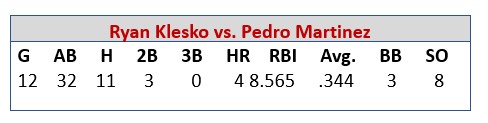
 

Baseball Roundtable Dives into the Cy Young Award

The 2019 Cy Young Award Winners have been announced and, while the results we no surprise, there was at least one historically surprising stat line.

Jacob degrom photo

Photo by slgckgc

Jacob deGrom won the 2018 Cy Young Award with 10-9 record (in 32 starts), an MLB-low 1.70 earned run average and 269 strikeouts (second in the NL) in 217 innings (second in the NL).  This season, deGrom became just the eleventh MLB pitcher to win consecutive CYA’s.  And, he did it, while putting up numbers similar to his 2018 season: an 11-8 record (32 starts); a 2.43 earned run average (second in the NL); and an NL-leading 255 whiffs in 204 innings pitched (third in the NL).  DeGrom also finished second in the league in Walks and Hits Per Nine Innings (WHIP) at 0.971, fourth in K’s per nine innings (11.25) and fourth in strikeouts-versus-walks ratio (5.80).

CYANEW
hen deGrom won the 2018 Cy Young Award with a 10-9 record, it was the fewest wins ever by a starting pitcher who captured the CYA.  This season, at 11-8, he posted the second fewest wins by a starting pitcher capturing a Cy Young Award.

That Historically Surprising Stat

Only twice in MLB history has a starting pitcher captured the Cy Young Award in a season in which his team put up a negative won-lost record in the games he started.  Both times, it was Jacob deGrom – as the Mets went 14-18 in his starts in both is 2018 and 2019 CYA seasons.   For those who are interested, the Yankees went 34-5 in CYA winner Whitey Ford’s 1961 starts. 

20+

DeGrom’s 21 total victories in capturing two consecutive Cy Young Awards illustrate how the Cy Young Award voting has changed in this era of  pitch counts, bullpen games and advanced metrics.   (In addition, to the lack of run support he has received.) Still, victories remain a solid indicator of CYA success.

Keep in mind that the Astros’ 2019 Cy Young Award winner Justin Verlander led MLB in wins with 21 – and number-two in the AL voting was his Houston teammate Gerrit Cole, who was second with 20 victories.

Verlander had only six losses this past season. His 2.58 earned run average was second in the AL; his Walks and Hits per Nine Innings (WHIP) was first in MLB at 0.83; he fanned an even 300 batters in 223 innings (leading the AL in innings pitched), while walking just 42 (for an AL-best 7.14 strikeouts-to-walks ratio).  Verlander threw a no-hitter against the Blue Jays (September 1). It was his third career no-hitter – making him just the sixth pitcher in MLB history to throw three or more no-hit games. Still, the CYA voting was was no cake walk for Verlander.

The Astros’ Gerrit Cole notched twenty wins (five losses); put up the junior circuit’s lowest ERA at 2.50; and led the league (and all of MLB) with 326 strikeouts (in 212 1/3 innings). His WHIP (0.90) was second only to Verlander in MLB and he led the way in whiffs per nine innings at 13.81 (the only qualifying pitcher to top 13.00).  In strikeouts-to-walks ratio, Cole (at 6.79) finished second to Verlander in the AL.

All in all, an interesting Cy Young Award season.

Do Wins Still Count?
There have now been 118 Cy Young Award winners – and the most telling predictor of victory (historically) has been wins – 79 of those CYA recipients have won at least 20 games.    If you factor out relief pitchers who have won CYA’s (nine) and strike-shortened seasons (four), 78.2 percent of the CYA winners have been 20-game winners.  Further, between 1956 and 2009, 79.5 percent of starters winning the CYA in full seasons notched at least twenty wins.  Since 2010, that figure had dropped to 65 percent – but it is still a solid indicator.

Going a step further, seventy-four CYA winners have led their league in victories.  That’s 67.9 percent of starting pitcher winners.   That number has not changed much.  Over the past ten seasons, fourteen of the 20 CYA winner have led their league in victories (70 percent.)

We are seeing some shift.  Consider WHIP.  Between 1956 and 2009, 29 of the starting-pitcher CYA winners (32.6 percent) notched their league’s lowest Whip (Walks and Hits per Nine Innings). Over the past ten seasons, an additional ten CYA winners have led in WHIP (50 percent).  Similarly, between 1956 and 2009, 29 starting-pitcher CYA winners led their league in earned run average, while 13 of the CYA winners over the past ten season (65 percent) have posted their league’s lowest ERA.    So, yes, wins still count – but probably not a as they once did.  Yes. I do have a good grasp of the obvious – but I do like to look at the numbers. 

Now, here are a few Cy Young Award factoids:

  • The first Cy Young Award winner (1956) was Brooklyn Dodgers’ right-hander Don Newcombe, who notched a league-leading 27 wins (seven losses), with a 3.06 ERA – and also captured the NL MVP Award (one of only eleven pitchers to date to win the Cy Young and MVP in the same season).
  • From 1956 through 1966, there was only one Cy Young Award presented each season. Seven of the 11 single awards went to National League hurlers.
  • In the eleven years when only one Cy Young Award was awarded, the Dodgers brought home five – Sandy Koufax (3); Don Drysdale (1); Don Newcombe (1).
  • The first southpaw to capture the Cy Young was Warren Spahn, who, in 1957, went 21-11, 2.69 for the Milwaukee Braves.
  • The first AL CY winner was the Yankees’ (RH) Bob Turley, off a 21-7, 2.97 season in 1958.
  • The first AL left-hander to win the award was the Yankees’ Whitey Ford (25-4, 3.21 in 1961).
  • The first relief pitcher to win the award was the Los Angeles Dodgers’ Mike Marshall (1974). Marshall pitched in a (still) MLB-record 106 games, going 15-12, with a 2.42 ERA and a league-leading 21 saves.  Unlike today’s one-inning closers, Marshall threw a record 208 1/3 innings in relief.
  • Nine relievers have won Cy Awards: Mike Marshall (Dodgers 1974); Bruce Sutter (Cubs, 1979); Sparky Lyle (Yankees, 1977); Rollie Fingers (Brewers, 1981); Willie Hernandez (Tigers, 1984); Steve Bedrosian (Phillies, 1987); Mark Davis (Padres, 1989); Dennis Eckersley (A’s, 1992); Eric Gagne (Dodgers, 2003). Of these, only Willie Hernandez and Sparky Lyle did not lead their league in saves in their CY season.
  • Only two pitchers have won four consecutive Cy Young Awards:  Greg Maddux: 1992 (Cubs); 1993—94-95 (Atlanta Braves); and Randy Johnson: 1999-2001-02-03 (Arizona Diamond backs).
  • The oldest player to win a Cy Young Award is Roger Clemens, who claimed the prize at age 42 in 2004 (going 18-4, 2.98 for the Astros).
  • The youngest Cy Award winner is Dwight Gooden, who captured the award in 1985 (age 20), with a 24-4. 1.53 season for the Mets.
  • The only pitcher to win a Cy Young Award while playing for a last place team was the Phillies’ Steve Carlton.  In 1972, with the Phillies going a dismal 59-97, Carlton led the NL with 27 wins (versus 10 losses), while also topping the league in ERA (1.97), CG (30), innings pitched (346 1/3) and strikeouts (310).
  • The first pitcher to win a Cy Young Award with less than 20 wins was the Mets Tom Seaver in 1973 (19-10, 2.08). Seaver led the NL in ERA, strikeouts and complete games.  In the 35 seasons from 1956 to 1990, there were 13 Cy Young winners with less than 20 victories.  In the 23 seasons from 1991 to 2019, there have been 27 Cy Young Award winners with less than 20 wins.
  • There has been only one tie in Cy Young Award voting.  In 1969, the AL Cy Young Award was shared by the Tigers’ Denny McLain (24-9, 2.80) and the Orioles’ Mike Cueller (23-11, 2.38).
  • Only six times has a starting pitcher won the Cy Young without tossing a single complete game: Roger Clemens with the Yankees in 2001; Clemens again with the Astros in 2004;  Jake Peavy with the Padres in 2007; Max Scherzer with the Tigers in 2013; Blake Snell with the Rays in 2018; Jacob deGrom with the Mets in 2019.
  • The fewest wins ever by a Cy Young Award winner is two, by Dodgers’ reliever Eric Gagne, who went 2-3, 1.20 in 2003 – with a league-topping 55 saves and 137 strikeouts in 82 1/3 innings.
  • The most wins for a CYA winner goes to the Tigers’ Denny McLain, who went 31-6, 1.96 in 1968.
  • The highest-ERA ever for a CY winner was 3.51, by the Yankees’ Roger Clemens; 20-3, 3.51 in 2001).
  • The lowest ERA for a CYA winner was 1.04, by Brewers’ reliever Rollie Fingers in 1981 (6-3, 28 saves, 1.04).
  • The lowest ERA for a starting pitcher winning the CYA is 1.12, for the Cardinals’ Bob Gibson in 1968 (22-9, 1.12).
  • The only rookie to win the Cy Young Award was the Dodgers’ Fernando Valenzuela (13-7, 2.48 in the strike-shortened 1981 season). Valenzuela thus becomes the answer to: “Who is the only pitcher to win the Cy Young and Rookie of the Year in the same season?”
  • Don Newcombe, the first CYA winner, was the first player to win the CY and league MVP in the same year (1956).  Since that time, ten more pitchers have won the CYA and MVP in the same season.
  • Roger Clemens has won the most CY Awards (7) and won for the most teams (4), and gone the longest between his first and final CYA’s (18 years).  Clemens wins: 1986 (Red Sox); 1987 (Red Sox); 1991 (Red Sox); 1997 (Blue Jays); 1998 (Blue Jays); 2001 (Yankees); 2004 (Astros).
  • The first pitcher to win a CYA in both leagues was Gaylord Perry (Indians, 1972 & Padres 1978). He has since been joined in that accomplishment by five hurlers: Randy Johnson (Mariners 1995 & Diamondbacks 1999-00-01-02); Pedro Martinez (Expos 1997 & Red Sox 1999-00); Roy Halladay (Blue Jays 2003 & Phillies 2010); Roger Clemens (Red Sox 1986-87,  1991, Blue Jays 1997-98, Yankees 2011 & Astros 2004); Max Scherzer (Tigers, 2013 & Nationals 2016-17).
  • The only brothers to both win CYA Awards are Jim Perry (1970, AL) and Gaylord Perry (1972, AL & 1978, NL).
Cy Young - Library of Congress photo.

Cy Young – Library of Congress photo.

The Cy Young Award, recognizing baseball’s best pitcher, is named in honor of right-handed hurler Denton True (Cy) Young – the “Cy” being short for his “Cyclone” nickname. Young won an MLB-record 511 games in his 22-season career (1890-1911), topping twenty wins in 15 seasons (with five of those 30+ wins).  The award was introduced in 1956 (by Baseball Commissioner Ford Frick), the year after Young’s death.  For the first eleven years (1956-66), there was only one Cy Young winner and NL hurlers captured the award seven of those eleven seasons.  After Frick retired in 1967, new Commissioner William Eckert, responding to fan requests, announced that, going forward, the Cy Young Award would be presented to the top pitcher in each league.


Primary Resources:  Baseball-Reference.com

BASEBALL ROUNDTABLE ON THE TOP 100 BASEBALL BLOG LIST

100Baseball Roundtable is on the Feedspot list of the Top 100 Baseball Blogs.  To see the full list, click here.

I tweet baseball @DavidBBRT

Follow/Like Baseball Roundtable’s Facebook Page here.  More baseball commentary; blog post notifications; PRIZES.

Member: Society for American Baseball Research (SABR); The Baseball Reliquary; The Negro Leagues Baseball Museum.